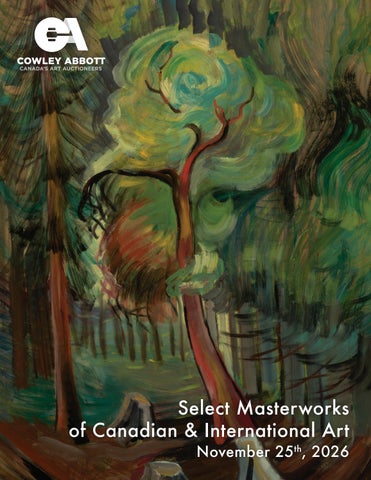
Select Masterworks of Canadian & International Art November 25th, 2026
LIVE AUCTION Wednesday, November 25th at 7 pm EST The Globe & Mail Centre 351 King Street East, 17th Floor, Toronto, Ontario
SELECT MASTERWORKS OF CANADIAN & INTERNATIONAL ART
PREVIEW EXHIBITIONS Calgary
A selection of artworks will be on display.
Cowley Abbott 607 Confluence Way Southeast October 15 - 20: Monday - Friday: 10 am - 5 pm Saturday: 10 am - 5 pm (Closed Sunday)
Montreal
A selection of artworks will be on display.
Galerie Eric Klinkhoff 1200 Sherbrooke Street West November 5 - 7: 10 am - 5 pm
Toronto Cowley Abbott 10 Alcorn Avenue, Suite 101 November 11 - 25: Monday - Friday: 9 am - 5 pm Saturday and Sunday: 11 am - 5 pm November 25: 9 am - 12 pm
AUCTION PARTICIPATION In‒Person Bidding Please contact our offices to reserve your seat and register to bid. Live Stream A live stream of the auction will be available at CowleyAbbott.ca on November 25. Absentee & Telephone Bidding Electronic submission of bids and printable bidding forms are also available at CowleyAbbott.ca. Online Bidding Online bidding is available to our clients via Auction Mobility at live.CowleyAbbott.ca, allowing real‒time bidding via web browser or Apple/Google app. Buyer's Premium A Buyer's Premium of 25% of the successful bid price of each lot up to and including $25,000 and 20% on any amount in excess of $25,000 is paid by the buyer, plus any applicable taxes.
With more than a decade of exemplary service in the Canadian art market, Cowley Abbott has established a reputation for consistently exceeding client expectations. Through a comprehensive suite of offerings— including auctions, private sales, and appraisals—our team leverages extensive expertise, longstanding industry relationships, and an unwavering commitment to providing clients with the highest level of assistance. We invite you to contact our firm to learn more about our specialized departments and services.
Rob Cowley
Lydia Abbott
Toronto: 10 Alcorn Ave., Ste. 101, M4V 3A9 Calgary: 607 Confluence Way SE, T2G 1E5 416-479-9703 • 1-866-931-8415 (toll free) • mail@cowleyabbott.ca
CowleyAbbott.ca
1 JAMES EDWARD HERVEY MACDONALD Sleigh, Moonlight, circa 1908 gouache on paper laid on board signed with initials lower right 5.5 ins x 3.5 ins; 14 cms x 8.9 cms PROVENANCE
Private Collection, Toronto Sotheby's, auction, Toronto, 2 December 1998, lot 188 Private Collection, Toronto LITERATURE
Margaret Fairbairn, "Five Canadian Artists Gain Distinctions", Toronto Star Weekly, 8 March 1913 J.E.H. MacDonald began his career as a graphic designer at Grip Limited in Toronto before moving to London, England, in 1903 to work for Carlton Studios, a design firm established by former members of the Toronto Art League. He returned to Grip in 1907, where he met Albert Robson, Tom Thomson, Frank H. Johnston, and Arthur Lismer. The artists were encouraged to sketch on weekends in the countryside surrounding Toronto, and MacDonald soon began exhibiting his landscapes in the annual exhibitions of various societies. MacDonald’s artistic development was noted by Margaret Fairbairn in the Toronto Star Weekly: "When Mr. J.E.H. MacDonald, A.R.C.A. of Toronto first exhibited, his subjects were invariably low‒toned effects of night, moonlight on snow or twilight and they attracted the attention of knowing ones by their discriminating appreciation of tone. They were little harmonies and symphonies. The canvases were small, but the feeling shown was not. His choice of these subjects, he avers, was not because of any decided predilection for them, but because he happened to have more and better opportunities to study the nuances of twilight, of night, than anything else. Of late he has been experimenting with the atmospheric effects of dazzling sun and snow, an added impetus being the wonderful paintings of a Scandinavian artist shown at Buffalo." This gouache may be a study for Winter Moonlight, 1908, exhibited at the Ontario Society of Artists that year.
$6,000–$8,000
6
COWLEY ABBOTT | Live Auction - Fall 2026
2 ALFRED JOSEPH CASSON Falls at Bracebridge, Ontario, circa 1950 watercolour signed lower left 10.75 ins x 13.25 ins; 27.3 cms x 33.7 cms PROVENANCE
Wedding Gift of the Artist, 1957 By descent to a Private Collection Peter Ohler Fine Arts, Vancouver Joyner Waddington's, auction, 30-31 May 2006, lot 36 Private Collection, Toronto LITERATURE
Paul Duval, Canadian Water Colour Painting, Toronto, 1954, unpaginated
Alfred Joseph Casson was one of the few members of the Group of Seven who held a longstanding commitment to watercolour and mastering the medium. Paul Duval writes that Casson “had become one of the most powerful and expressive watercolour painters Canada has ever known. His compositions had acquired a sure formalization, his washes were laid with a consummate assurance and the boldness of his colour revealed a brilliance and depth then rarely seen in the medium.” Falls at Bracebridge, Ontario is a crisp and vibrant watercolour depicting both the traditional characteristics of the Group as well as elements of abstracted design, reminiscent of Casson's work as a graphic designer. Known as both a “rebel” and a “traditionalist”, Casson often used rock forms in his paintings as they gave a solid sculptural quality to his landscapes. This work was painted circa 1950, while he was President of the Royal Canadian Academy and as his landscapes were becoming more simplified and structurally designed. Forms were increasingly treated as broad planes and patterns rather than detailed representations. This new approach can be seen in the angular rock formations, flowing water and simplified treeline above. His subject matter remained primarily Ontario's rural landscapes, villages, forests and farms, but his handling was becoming increasingly modernist.
$15,000–$20,000 COWLEY ABBOTT | Live Auction - Fall 2026
7
3 JOHN WILLIAM BEATTY Algonquin Park
oil on board signed lower left; titled on a label on the reverse 10.5 ins x 13.75 ins; 26.7 cms x 34.9 cms PROVENANCE
Laing Fine Art Galleries, Toronto Westbridge, auction, Vancouver, 26 September 2010, lot 74 Private Collection, Jackson's Point, Ontario
Algonquin Park demonstrates the lighter, more decorative palette that characterized J.W. Beatty’s work in later years, likely influenced by his many sketching trips with Tom Thomson, J.E.H. MacDonald, and A.Y. Jackson. Between 1906 and 1909, Beatty travelled throughout Europe, where he temporarily adopted the darker tonalities of the French and Dutch traditions he had studied at the Académie Julian in Paris. Upon returning to Toronto, however, Canadian subjects became central to his practice, reflecting his desire to create a distinctly national art. A forerunner to the Group of Seven, Beatty expresses in this oil sketch the pride he took in depicting the Canadian landscape. In this oil painting, a tranquil autumn scene unfolds along the shore of a lake in Algonquin Park. A band of brilliant fall foliage stretches across the horizon, punctuated by the dark silhouettes of evergreens, while a muted sky and restrained palette lend the work a peaceful, atmospheric quality.
$9,000–$12,000
8
COWLEY ABBOTT | Live Auction - Fall 2026
4 ARTHUR LISMER Old Barn, Île d’Orléans, P.Q., circa 1926 oil on board signed and titled on the reverse 12 ins x 16 ins; 30.5 cms x 40.6 cms PROVENANCE
Joyner, auction, Toronto, 14 May 2002, lot 126 Private Collection, Toronto LITERATURE
Paul Duval, Canadian Art-Vital Decades, Toronto, 1970, unpaginated, a similar sketch reproduced titled Old Barn, Quebec, 1926 Lois Darroch, Bright Land, A Warm Look at Arthur Lismer, Toronto/Vancouver, 1981, a similar pen and ink work reproduced page 115 titled Barn, Île D'Orléans, 1925 (fig. 84) Sotheby's, Important Canadian Art, Toronto, 21 November 2005, a similar sketch reproduced as lot 114 titled A French Canadian Barn, Île D'Orléans, circa 1926
The sea and coast were among Arthur Lismer’s favourite landscape subjects. His depictions of turbulent seashores and dramatic skies harkened back to his early studies of John Constable and the Romantic painters. Lismer worked from both Canadian coasts throughout his career, and had lived in Nova Scotia from 1916 to 1919. There, he was commissioned to capture scenes of the Halifax harbour with Navy vessels from the First World War. Following a return to Toronto, his position as vice-principal at the Ontario College of Art allowed Lismer to go on numerous sketching expeditions during the summer. In August of 1925, Lismer travelled to the region of the lower St. Lawrence River, along with A.Y. Jackson and the renowned ethnologist Marius Barbeau. The Gaspé region offered a multitude of ideal painting subjects for Lismer, and the artist’s output on the trip was abundant. He was documented as visiting Île d’Orléans, Baie-Saint-Paul and Saint-Hilarion Île-aux-Coudres in 1925. In his autobiography, Jackson writes about being with Lismer in Saint-Hilarion and Île d’Orléans. This trip marked an important period where he expanded his focus beyond Ontario to the rural and Laurentian landscapes of Quebec. Old Barn, Île d’Orléans, P.Q. wonderfully exemplifies Lismer’s Group period en plein air sketches, with its fresh immediacy and painterly brushstrokes. This charming work reflects Lismer’s broader exploration of Canadian identity through scenes of labour, industry, and the natural environment, capturing his vision of the Canadian landscape as a place shaped by both nature and human activity.
$20,000–$30,000 COWLEY ABBOTT | Live Auction - Fall 2026
9
5 FRANK HANS JOHNSTON Fall Reflections
tempera signed lower left 14 ins x 14.5 ins; 35.6 cms x 36.8 cms PROVENANCE
Private Collection, Toronto Cowley Abbott, auction, Toronto, 15 June 2022, lot 21 Private Collection
10
COWLEY ABBOTT | Live Auction - Fall 2026
Frank Hans Johnston was drawn to wooded areas and small rural lakes, often exploring the interplay of light and shadow among tree trunks. Executed in a decorative style, Fall Reflections showcases his attention to detail and impressionistic handling of paint, with delicate dabs of paint enlivening the paper. Unlike many of his colleagues, who typically painted outdoors in oil, Johnston often favoured fast-drying tempera or gouache for his plein air studies, allowing him to capture the atmosphere of the landscape. Although Johnston later destroyed many of these works, surviving examples offer rare insight into his ability to render the landscape with fine precision while preserving the luminosity of his surroundings.
$7,000–$9,000
6 ALFRED JOSEPH CASSON Marsh's Falls Road, 1981
oil on board signed lower right; signed, titled and dated July 1981 on the reverse 12 ins x 15 ins; 30.5 cms x 38.1 cms PROVENANCE
Private Collection, Toronto
A.J. Casson has played a prominent role in the development of Canadian art, quietly having built his reputation as a master painter without sacrificing the principles of his personal approach to painting. Although a professed lover of travel, Casson never went far afield. He loved the varying landscape of Ontario, from the pastoral rolling hills and villages to shorelines and rocky cliffs. Marsh’s Falls is located just south of Highway 60 between Huntsville and Dwight, Ontario, and is now part of the Marsh’s Falls Nature Reserve in Lake of Bays. Casson depicted the remote road leading to the falls, which he could freely access for sketching when the work was completed in 1981. Today, access to the area is more restricted due to its protected status. Characteristic of the artist’s later works, this oil painting contains a soft, limited colour palette of greys and greens. Casson focuses on the formal qualities of nature, painting the leaves in an abstracted and geometric style, while maintaining his craft in replicating nature’s aura.
$20,000–$30,000
COWLEY ABBOTT | Live Auction - Fall 2026
11
7 JAMES WILSON MORRICE Nude Study, circa 1912-1914 oil on canvas 22 ins x 18.5 ins; 55.9 cms x 47 cms PROVENANCE
Léa Cadoret, Paris (seen by D.W. Buchanan in 1935) Acquired by G. Blair Laing from Jacques Dubourg, dealer, Paris, early 1956 Frederick Mendel, Saskatoon, circa February-May 1956 By descent to Eva Mendel Miller Masters Gallery, Calgary, 1998 Private Collection, Calgary EXHIBITED
The Mendel Collection: Selected Works, National Gallery of Canada, Ottawa, travelling to the Montreal Museum of Fine Arts, 17 May-30 June 1956 as Nude Study [Note: not included in previous 1956 venues of the exhibition, Edmonton and Victoria] The Mendel Collection, David Jones' Art Gallery, Sydney, Brisbane and Adelaide; travelling to George's Art Gallery, Melbourne, SeptemberNovember 1962, no. 41 as Nude Study The Mendel Collection, Mendel Art Gallery, Saskatoon, 16 October-13 November, 1964 30 Years of Masters (1976-2006), Masters Gallery, Calgary, 2006, listed and dated 1919 in error LITERATURE
"Catalogue Raisonné" in Donald W. Buchanan, James Wilson Morrice: A Biography, Toronto, 1936, page 181 as Nude Study [Note: "The back of a nude woman. She reclines to the right against a chair. The background is red". (Léa Cadoret posed for this shortly after she had met Morrice- he gave her the picture.) 22 ins x 18 ½ ins. Not signed. / collection: Mlle, Léa Cadoret, Paris.” The (Léa) comment better applies to Nude Reclining at the National Gallery of Canada; Buchanan did not see his error, and listed Nude Study before 1900, which is impossible.] “Mendel Collection Presents Variety”, The Gazette (Montreal), 16 June 1956, page 26 [Note: Mentions all the works in the exhibition, including “a good nude study”.] “A Selected List of Paintings” in Kathleen Daly Pepper, James Wilson Morrice, Toronto & Vancouver, 1966, page 97 [Note: all undated, at the end.] Sylvain Allaire, Les artistes canadiens aux Salons de Paris de 1870 à 1914, M.A. Thesis, Université de Montréal, 1985, pages 121, 204 [Note: Allaire wrongly identified Étude in the 1911 Salon d’Automne, described by some reviewers as “a nude seen from the back”, with this one (more probably the AGO’s Standing Nude, from the Back, unknown to Allaire).] Charles C. Hill, Morrice: A Gift to the Nation, The G. Blair Laing Collection, Ottawa, 1992, page 140, note 5 [Note: In the text for Blanche Baume, he mentions “at least eight paintings of women, including nudes, that have several internal cross-references (similar backgrounds or textiles, or identical models)... from about 1911 to 1914.” Note 5: “There is... a nude formerly in The Mendel Collection: Opening Exhibition”..., page 6". Same in the French edition of this catalogue.]
12
COWLEY ABBOTT | Live Auction - Fall 2026
Kiriko Watanabe, Kathryn Bridge & al., Emily Carr: Fresh Seeing French Modernism and the West Coast, Whistler, 2019, page 154 note 8 [Note: Titles of works by Canadians at Salon d'Automne 1911 (Source: probably Allaire, 1985 thesis).] “65 paintings personally selected by Mr. Mendel for the opening of the Mendel Art Gallery, Saskatoon, Canada,” The Mendel Collection, Saskatoon, 1965, reproduced page 6 as Nude Study 30 Years of Masters (1976-2006), Masters Gallery, Calgary, 2006, unpaginated, reproduced, dated 1919 in error Lucie Dorais, “Morrice et la figure humaine / Morrice and the Human Figure”, in Nicole Cloutier, James Wilson Morrice, 1865-1924, Montreal, 1985, page 69 Best known as a landscape painter, James Wilson Morrice also aspired to establish himself as a portraitist. Nude Study is one of the few portraits and very few nudes the artist completed during his lifetime. His interest in the human figure evolved gradually, and then further following his move to Europe. Portraits of family and friends are notably absent from Morrice's early years in Toronto and from his studies at the Académie Julian. The artist met Maurice B. Prendergast while in Paris in the 1890s; during this time Morrice filled his sketchbooks with scenes of Parisian life that bore resemblance to Prendergast’s watercolours. Morrice also met American artist Robert Henri around the same time, and it was through Henri that Morrice came to know the work of Manet. The technique and harmonious palette of Morrice's nudes from this period reflect the influence of Manet's celebrated Olympia. Morrice painted his mistress Léa Cadoret, his friend Robert Henri, (likely) Henri Matisse and William Brymner in the mid-to-late 1890s, all in small format oil sketches, which are more spontaneous than large, carefully planned canvases. Numerous sketches of female models fill his sketchbooks from 1895 to 1898. Robert Henri wrote to his family that Morrice had painted several very beautiful portraits of models during the autumn of 1898. Around the turn of the twentieth century, Morrice appears to have shifted his focus away from the human figure as an independent subject. However, his landscapes and city scenes became increasingly animated with human activity. The artist revived the subject of nude and clothed models around 1908, when Morrice presented one at the Salon d’automne of that year. His brighter palette of his portraits of the following years were likely influenced by the colourful work of Pierre Bonnard and Henri Matisse. A depiction of his companion, Léa Cadoret, this intimate nude reflects Morrice's embrace of the decorative modernism that emerged in the years preceding the First World War. Painted circa 1912-1914, the composition suggests the influence of Matisse and Bonnard, with its richly coloured red interior and emphasis on pattern and harmonious colour. The deep crimson background dominates the composition, creating an enveloping tapestry-like effect. Author Lucie Dorais has remarked on the link between the artist’s figural work and his own character, writing: “All of Morrice’s portraits, whether they represent friends or professional models, bear the stamp of his reserved disposition. The models are almost always seen from a distance, sometimes in profile, and most of the nudes have their back to the spectator. The artist, who was extremely shy, perhaps wished in this way to avoid any interference from the subject, so that he could concentrate on his aesthetic preoccupations, especially the harmony of colour tones.”
Around 1912–1914, Morrice was at the height of his artistic maturity. His pre-war paintings are distinguished by small, jewel-like compositions, subtle harmonies of colour, and brushwork that conveys both confidence and restraint. Rather than focusing on narrative, he captured fleeting effects of light, atmosphere, and mood. During this time, the artist produced a number of similar figural works to Nude Study, often with colourful textiles filling the background. Morrice gave this painting to Léa Cadoret and it was later part of the collection of Frederick Mendel, a businessman and art collector who established Intercontinental Packers Limited in Saskatoon in 1940. Mendel's
immense contribution to the arts in Saskatchewan included the inception of the Mendel Art Gallery (now the Remai Modern) in the 1960s. We extend our thanks to Lucie Dorais, Canadian art historian and author of J.W. Morrice (National Gallery of Canada, 1985), for her assistance in researching this artwork.
$90,000–$120,000
COWLEY ABBOTT | Live Auction - Fall 2026
13
8
EXHIBITED
EMILY CARR Forest Interior, circa 1940
oil on paper laid on board estate stamp lower left; inscribed "1948 liner" and with FW monogram on the reverse 32 ins x 24 ins; 81.3 cms x 61 cms PROVENANCE
The Fine Art Galleries, T. Eaton Co., Toronto Private Collection, circa 1950 By descent to the present Private Collection
Possibly Emily Carr, The Fine Art Galleries, T. Eaton Co., Toronto, from 3 December 1949 LITERATURE
Lawren Harris and Emily Carr Correspondence, Emily Carr Fonds (MS-2181), B.C. Archives, Royal B.C. Museum, Victoria Graham McInnes, "World of Art," Saturday Night (3 April 1937), page 8 Doris Shadbolt, The Art of Emily Carr, Toronto, 1979, pages 62-64 Emily Carr, Hundreds and Thousands, Toronto, 1996, page 188, entry dated July 1, 1935 Kathryn Bridge, Unvarnished: Autobiographical Sketches by Emily Carr, Victoria, 2021, page 126
Emily Carr’s style evolved considerably over the years. Her early works reflected the English-centric nineteenth-century manner encouraged by her training. After a year in France, her approach shifted to a PostImpressionist style with moments of Fauvism. However, just when it seemed she was about to hit her stride, the artist painted little for the next fifteen years. This dormant period preceded an explosion of output which would last the rest of her life. Her new style developed rapidly and was marked by a distinctive approach and a conviction, which distinguished Carr’s work thereafter. In June 1935, Emily Carr travelled to Albert Head, along Metchosin Road, approximately eighteen miles west of Victoria, where she spent a highly productive summer sketching from her caravan. She worked in oil paint thinned with gasoline on inexpensive manila paper, a technique she had begun using in 1932. This method offered the transparency and spontaneity of watercolour while retaining the richness of oil paint. Its low cost was an added advantage for Carr, who was often short of money. At Albert Head, Carr returned to a subject she had explored in 1931 and 1932: second-growth trees rising amid thick undergrowth. Her blended brushstrokes give the forms a sculptural presence, drawing the surrounding vegetation around the young tree. Yet in these 1935 works, her attention had shifted towards movement, which became the dominant force shaping her compositions.
Emily Carr, Wood Interior, 1929-1930 oil on canvas, 106.2 x 70.2 cms Gift of Isabel McLaughlin, 1987 The Robert McLaughlin Art Gallery Not for sale with this lot
14
COWLEY ABBOTT | Live Auction - Fall 2026
Carr’s paintings from that summer were exhibited at the Women’s Art Association in Toronto in early December and attracted the admiration of Graham McInnes, who wrote about them in Saturday Night on 7 December. He observed: “[Emily Carr] paints quickly and with a fierceness and passion that are completely convincing. Her technique is astonishing. Viewed closely, the sheer audacity of her rapid brushstrokes compels admiration, while each picture, regarded as a whole, has in it the concentrated essence of the impact of a deeply sensitive and fervent nature on a scene for which she feels with an intensity that only prolonged study and profound conviction can bring. … [Carr is] an artist who is, in her own way, as possessed with the creative urge as that powerful and tragic figure of the last century whose name was Vincent van Gogh.”
COWLEY ABBOTT | Live Auction - Fall 2026
15
Carr recorded in a diary entry in June 1936 that she was parked down the road from a “dense, junglely wood” where she did much study, and she found it “so big and thick you could easily [lose] your bearings”. Carr was intensely drawn to painting her home, her ‘native’ land in British Columbia, as both her paintings of the monumental art and villages of the First Nations and her landscapes of British Columbia suggest.
Emily Carr and her caravan "The Elephant", at the southwest end of Esquimalt Lagoon, May 1934 Photograph by Mrs. S.F. Morley, courtesy of the B.C. Archives Not for sale with this lot
Emily Carr’s Forest Interior belongs to the group of paintings she described as her “woodsey” subjects. The work likely dates to a period when, as Carr recalled, she was “furiously happy from the moment she woke,” immersed in painting from her caravan, which she affectionately nicknamed “The Elephant.” Here, she conveys her delight in the swirling yellow and green foliage of a tree set against a second-growth forest, previously logged yet still mysterious and richly evocative. Trees crowd the composition on all sides, rising in the foreground, framing the scene and extending into the background to create an overwhelming sense of density. Light filters through the foliage, illuminating the area around the base of the central tree. In Forest Interior, Carr explores the forest as a world unto itself. Her trees embody both vulnerability and resilience: the conspicuous stumps scattered throughout the scene bear witness to human intervention, while the surrounding vegetation speaks to the forest’s continuing verdancy and renewal. Through her vigorous brushwork and swirling forms, Carr captures not simply the appearance of the woods but their underlying vitality, conveying the dynamism of the landscape as a living whole.
16
COWLEY ABBOTT | Live Auction - Fall 2026
Forest Interior, circa 1940, recalls features of her early landscape works such as Wood Interior (1929-1930, Robert McLaughlin Gallery, Oshawa) in both composition and medium. She may have thought of earlier work upon viewing the dense foliage, tree trunks and lit-up central image of the tree in the landscape. In Forest Interior, the paint appears thick, not diluted, and more like an oil on canvas. Carr surely would have remembered the words of the American artist Mark Tobey in 1928 when he held a three-week advanced course in her studio. He told her that she should "pep-up" her dark canvases by using lit areas which "pushed" against the dark. Forest Interior offers the collector a painting from the hand of the first among the famous women artists of Canada. Though her career was long, productive and marked by outstanding quality, it is her silent, dark forests and tall firs that created a visual legend of the West Coast. It was also during this period of her work, towards the end of her life, that she expressed her view of nature and life as energy. Carr had become deeply religious and the movement within the picture came to represent the spiritual energy, cosmic consciousness and growth. This period is the culmination of a life spent living, working and travelling within British Columbia. A comprehensive body of work that integrates a clear, universal framework while drawing on specific regional insights. Forest Interior was painted during one of Carr’s many “spiritual” sketching excursions throughout British Columbia. We extend our thanks to Joan Murray, Canadian art historian, for contributing the preceding essay. We also extend our thanks to Charles Hill, Canadian art historian, curator and author for his assistance in researching this artwork.
$300,000–$400,000
9 DORIS JEAN MCCARTHY The Driftwood Island, 2005
oil on canvas signed lower right; titled and dated 1 April 2005 ("050401") on the reverse 36 ins x 48 ins; 91.4 cms x 121.9 cms PROVENANCE
Mountain Galleries, Jasper Private Collection, Vancouver LITERATURE
Doris McCarthy, Doris McCarthy: Ninety Years Wise, Toronto, 2004, page 63 Doris McCarthy’s The Driftwood Island belongs to a mature phase of the artist’s career, when decades of travel and observation culminated in a refined and personal vision of the Canadian landscape. Throughout her life, McCarthy was driven by a desire to paint the varied regions
of Canada, developing a style responsive to each environment she encountered. The Arctic proved especially transformative. The Driftwood Island encapsulates McCarthy’s mature style, wherein she eschews minute detail in favour of broad, sculptural forms and rhythmic movement. In this painting, the foreground is rendered in highly stylized, simplified forms. Scattered across the sandy island, pieces of driftwood appear almost like abstract forms themselves, their weathered shapes suggesting the passage of time and the gradual effects of nature. Although McCarthy’s landscapes are not overtly religious, they are deeply imbued with a sense of reverence. A devout Christian, McCarthy often described her engagement with nature as a way of encountering the divine: “The mystery of creation convinced me that God was immanent as well as transcendent in the rocks, the trees, the animals and me—still creating but not exercising the authority I had once believed.” The absence of human presence shifts the focus to stillness and quiet, transforming this mountainous scene into a space for meditation.
$20,000–$30,000
COWLEY ABBOTT | Live Auction - Fall 2026
17
10 YVONNE MCKAGUE HOUSSER Autumn Gold, 1947
double-sided oil on board signed with initials and dated 1947 lower left; titled on a gallery label on the reverse 20 ins x 24 ins; 50.8 cms x 61 cms PROVENANCE
Collection of the Artist Wedding Gift of the Artist to Kim Ondaatje, Ontario, 1964 Purchased from the above by the present Private Collection, Toronto EXHIBITED
Four Women Who Paint: Exhibition of Works by Rody Kenny Courtice, Bobs Cogill Haworth, Yvonne McKague Housser and Isabel McLaughlin, The Fine Art Galleries, T. Eaton Co., Toronto; travelling to Adelaide House, Oshawa, 22 March-3 April 1948 Paintings and Sculpture for the Purchase Fund Sale (sponsored by the Women's Committee), Art Gallery of Toronto, 30 October4 November 1948 Little Pictures Exhibition, Ontario Society of Artists, The Fine Art Galleries, T. Eaton Co., Toronto, by 29 January 1949 12th Annual Winter Exhibition, Art Gallery of Hamilton, February 1961, no. 30 LITERATURE
"Other Communities Please Copy", Canadian Art 6, no. 3 (Spring 1949), page 122 reproduced
Yvonne McKague Housser, Autumn Gold, 1947, verso
Yvonne McKague Housser was a Canadian Modernist painter and influential art educator whose career spanned more than seven decades. Born in Toronto, she studied at the Ontario College of Art from 1913 to 1918, where she encountered leading Canadian artists including J.W. Beatty and George Agnew Reid. She subsequently taught at the college for many years. In 1921–1922, she studied in Paris at the Académie de la Grande Chaumière, the Académie Colarossi and the Académie Ranson. She later studied in Vienna with Franz Čižek, whose approach to children's art influenced her interest in creative expression and formal experimentation. Housser exhibited with the Group of Seven in 1928, 1930 and 1931. She was not a formal member, but shared its interest in developing a distinctly Canadian approach to landscape painting. In 1933, she became a founding member of the Canadian Group of Painters, which brought together artists working in a range of modernist styles. Housser continued to experiment throughout her career. In 1939, she travelled to Taos, New Mexico, with fellow artist Isabel McLaughlin to study Dynamic Symmetry with Emil Bisttram. By 1947, Yvonne McKague Housser had developed a distinctive approach to the Canadian landscape, combining recognizable natural forms with an increasingly modernist treatment of colour and composition. In this rare double-sided semi-abstract autumn scene, the landscape is simplified into expressive shapes and areas of colour, capturing the seasonal character of the setting while moving beyond literal representation. Housser painted reflections of the shoreline and leafless branches in the still water, emphasizing the abstract quality of the work. The verso depicts a completely different autumnal scene, with a vivid orange tree placed in front of a geometric rocky ledge and highly stylized body of water.
Advertisement for the 1948 Four Women Who Paint Exhibition at The Fine Art Galleries, T. Eaton Co, Toronto Not for sale with this lot
18
COWLEY ABBOTT | Live Auction - Fall 2026
Autumn Gold was included in multiple exhibitions after its completion in 1947, including the notable 1948 show Four Women Who Paint held at T. Eaton Co. in Toronto and Adelaide House in Oshawa. Fellow exhibitors were Isabel McLaughlin, Bobs Cogill Haworth and Rody Kenny Courtice. The Oshawa Gazette writer Margaret Luke McLaughlin published an article in anticipation of the show, describing the opening event as including a Q&A period, a screening of a new film “Henri Matisse at Work”, followed by refreshments.
McLaughlin states: “An evening such as is being planned on Thursday should be a real help to those in the community who are anxious to acquire a better understanding of what the nationally recognized good artists are striving to accomplish.” Following the opening of the show, the Oshawa Gazette published another article reviewing the event and the exhibition. Written by Joe Aldwinckle, it mentioned that “Housser was asked at the exhibition opening to give up the secret that lay behind her “abstracts”. She candidly admitted that it was a free experiment in colour and rhythm, that she wanted to try something different in planes and spheres and here it was.” The article then goes on to mention “Autumn Gold by Mrs. Housser” as “memorable.” Aldwinckle concluded with: “It is a most comfortable exhibition – comfortable, but not complacent, far from
it. Here is mature, exciting interpretation to catch the fancy of the enlightened. On the other hand, there is nothing to “haunt, startle or waylay” those of timid approach.” In the following years, Housser studied with Hans Hofmann in Provincetown, Massachusetts. This experience contributed to her growing interest in abstraction. She was elected a member of the Royal Canadian Academy of Arts in 1950. Housser gave this painting to Kim Ondaatje, her student at the Ontario College of Art, as a wedding present.
$20,000–$30,000
COWLEY ABBOTT | Live Auction - Fall 2026
19
11 FRANKLIN CARMICHAEL Autumn Landscape, 1919
oil on board signed and dated 1919 lower right; signed and inscribed “Lansing, Ont.” and "35" on the reverse 9.5 ins x 12 ins; 24.1 cms x 30.5 cms PROVENANCE
Possibly acquired directly from the Artist by Thomas Broley Godfrey By descent to the present Private Collection, Ontario In April 1919, Frank and Ada Carmichael purchased a home in Lansing, Ontario, part of today’s North York in Toronto, where they remained for the rest of their lives together. Lansing was at that time quite rural, the built environment minimal relative to the density of downtown Toronto. Their property included a house, one out-building, an orchard of fruit trees, and gardens, and there were some neighbours nearby. By the fall of 1919 when Franklin Carmichael painted this autumn sketch, the Carmichael’s would have had about six months to settle in after having moved from Thornhill where they had lived from 1916 to 1919. The environs in and around Lansing, including the Humber River Valley, provided Carmichael with subject matter for many years, beginning in 1919. This sketch represents a style Carmichael would become known for in the early 1920s, colourful scenes of forest interiors and traceries of tree silhouettes and branches. Areas of contrasting colour, such as the horizontal bands of orange and purple in the distant hills, guide the viewer deep into the scene. A hazy green sky sets the darker greens and browns of the trees into relief. Dated 1919, it was one of Carmichael’s earliest oil sketches to be completed once settled in Lansing.
20
COWLEY ABBOTT | Live Auction - Fall 2026
It is not possible to know if this sketch was exhibited during Carmichael’s lifetime because, in those years around 1920-1922, he usually showed them as an untitled group of numbered sketches. In the 1920 Exhibition of Small Pictures and Sketches by Members of the Ontario Society of Artists for instance, he exhibited catalogue numbers 19-24 as “Six Sketches.” Normally, Carmichael would submit work to the OSA’s annual Small Pictures exhibition, but he passed on doing so in 1919, perhaps because he was only just beginning a new body of work in Lansing. Without a title and exhibition history, there is little more that can be known about the journey of this sketch through time. However, it does have an interesting provenance, having been acquired by an accountant who worked for Sampson-Matthews Ltd., Carmichael’s employer beginning in 1922 and where he served as Art Director until 1932. C.A.G. “Chuck” Matthews, the co-founder of Sampson-Matthews Ltd. also became one of the earliest collectors of Carmichael’s work. He owned these four sketches in the McMichael Canadian Collection: Sketch 4 (October), 1920 (1968.25.1); St. Antoine, 1924 (1968.25.3); Green Landscape, circa 1925 (1969.23.3); and Alman’s Trail, 1939 (1968.25.2). It was the Sampson-Matthews circle that offered Carmichael some of his first experiences with serious private collectors who were engaged by his painting. We extend our thanks to Catharine Mastin, PhD, art historian, curator, and Adjunct Member of the Faculty of Graduate Studies in Art History at York University for contributing the preceding essay. Catharine curated the exhibition Franklin Carmichael: Portrait of a Spiritualist, organized by the National Gallery of Canada, Ottawa, which toured Canada between 1999 and 2001.
$40,000–$60,000
COWLEY ABBOTT | Live Auction - Fall 2026
21
12 LAWREN STEWART HARRIS Distant View Over Lake Superior, 1921
oil on panel signed lower right; "Jack & Liel from Lawren" inscribed on the reverse 10.5 ins x 13.75 ins; 26.7 cms x 34.9 cms PROVENANCE
Gift of the Artist to a Private Collection, Ontario Masters Gallery, Calgary Private Collection, Calgary EXHIBITED
Lawren Harris: Urban Scenes and Wilderness Landscapes, 1906-1930, Art Gallery of Ontario, Toronto, 14 January-26 February 1978, no. 110 Lawren Harris, Works from Private Collections, Masters Gallery, Calgary, 22 October-1 November 2016 LITERATURE
Jeremy Adamson, Lawren Harris: Urban Scenes and Wilderness Landscapes, 1906-1930, Toronto, 1978, listed page 227 as no. 110
From the streets of Toronto and the Laurentian hills to Algoma, the North Shore of Lake Superior, the Rocky Mountains and the Arctic, Lawren Harris continually sought out new landscapes across Canada, transforming their distinctive forms into a modern visual language that reflected an evolving sense of Canadian identity. Harris first encountered J.E.H. MacDonald’s work at the Arts and Letters Club in 1911, and the two soon became close friends and artistic collaborators. They travelled together to sketch in Mattawa and Timiskaming in 1912 and the Laurentians in 1913, while Harris also met many of Toronto’s leading artists through the club. In 1914, Harris and Dr. James MacCallum established the Studio Building on Severn Street, creating affordable studios where Canadian artists could devote themselves to painting rather than commercial work. The building became an important gathering place for the artists who would go on to form the Group of Seven. Harris first travelled to Algoma in the spring of 1918, accompanying MacCallum aboard the Algoma Central Railway from Sault Ste. Marie. The region would become a foundational landscape for the Group of Seven, offering the rugged terrain, rocky hills, windswept pines and countless lakes that they sought as an alternative to the academic traditions of Canadian landscape painting. The railway provided access deep into the wilderness, allowing the artists to camp and paint directly in the landscape. Harris returned to Algoma in September 1919 with Frank Hans Johnston, J.E.H. MacDonald and A.Y. Jackson, as the artists prepared for their inaugural exhibition in Toronto the following spring. In May 1920, Harris and the six other founding members of the Group of Seven exhibited together for the first time at the Art Gallery of Toronto. The exhibition featured 121 works, including the Algoma landscapes that had become central to the group’s emerging vision of Canadian modernism. The artists’ bold and highly individual approach to the northern landscape marked a departure from the academic traditions that had long dominated Canadian art.
A.Y. Jackson, Frank Hans Johnston and Lawren S. Harris on the Algoma Boxcar McMichael Canadian Art Collection Archives Not for sale with this lot
Harris and A.Y. Jackson first painted on Lake Superior in October 1921 when they sketched briefly around Rossport and Schreiber. Harris would return to paint and draw on the north shore of Lake Superior almost every October until 1928. His Lake Superior paintings range from depictions of the rocks, hills, bays and interior lakes during early years, to dramatic visions of the light over the vast body of water in later years. Distant View Over Lake Superior was completed during Harris’s initial visit to the North Shore in October 1921. Earlier that year, he had painted in Algoma in May before returning in September with A.Y. Jackson and Arthur Lismer, working around Sand Lake and the Sand River. Jackson wrote on September 25th that he and Harris planned to remain at Sand Lake for several weeks before continuing to the North Shore of Lake Superior. Here, the lake is viewed from an elevated vantage point, framed by foreground trees rendered in varying shades of green. The dark, dense forest contrasts with the shimmering expanse of water and sky, which Harris captures with loose, expressive brushstrokes. Harris frequently returned to the same sites, reinterpreting similar subjects in new pictorial languages. Distant View Over Lake Superior marks an important transition in Harris’s practice, retaining the rich, painterly approach of his Algoma works while pointing toward the more stylized lines and simplified forms that would define his Lake Superior paintings.
$250,000–$350,000
22
COWLEY ABBOTT | Live Auction - Fall 2026
COWLEY ABBOTT | Live Auction - Fall 2026
23
13 ALEXANDER YOUNG JACKSON Grey Day, Port au Persil, 1947
oil on board signed lower right; titled and dated [April] 5, 1947 and inscribed "TWL MacDermot" on the reverse 8.5 ins x 10.5 ins; 21.6 cms x 26.7 cms PROVENANCE
Possibly T.W.L. MacDermot Private Collection Hodgins, auction, 26 May 2015, lot 99 Private Collection, Jackson's Point, Ontario Painted in 1947, Grey Day, Port au Persil captures A.Y. Jackson’s deep affection for the rural villages of the Charlevoix region, one of his most beloved painting grounds. The view depicts a rural winter landscape, with snow-covered fields rolling toward a cluster of farmhouses and barns beneath the St. Lawrence River and blue sky. Jackson uses a restrained palette of whites, blue-greys and warm browns, enriched
24
COWLEY ABBOTT | Live Auction - Fall 2026
by green accents and areas of exposed wood panel. Broad, expressive brushstrokes define the undulating opalescent snowbanks, contrasting with the dark, angular rooftops of the buildings. The only human presence is a single cloaked figure walking toward the house in the foreground. The artist’s gestural brushwork and simplified forms convey the visual harmony of the scene and the vitality of the people who inhabited these communities. Jackson first visited Charlevoix in 1920, after he had already moved to Toronto to share the Studio Building on Severn Street with fellow modern Canadian painters. From there, he embarked on regular sketching trips to rural Quebec and northern Ontario, searching for subjects that reflected both the ruggedness and the humanity of the Canadian landscape. He returned to the Charlevoix region many times, particularly the villages along the north shore of the St. Lawrence River, such as Baie-Saint-Paul, Les Éboulements, Port-au-Persil and Sainte-Irénée. The steep hillsides, clustered wooden houses, and brilliant winter light offered ideal subjects for his modern, distinctly Canadian vision.
$25,000–$30,000
14 ALFRED JOSEPH CASSON Winter in the Albion Hills, 1963
oil on board signed lower right; signed, titled and dated 1963 on an artist label on the reverse 20 ins x 24 ins; 50.8 cms x 61 cms PROVENANCE
Roberts Gallery, Toronto Wood Gundy Inc. Gifted to a Private Collection, Switzerland Private Collection, Jackson's Point, Ontario LITERATURE
Margaret Gray, Margaret Rand and Lois Steen, A.J. Casson, Agincourt, Ontario, 1976, page 50 A.J. Casson preferred to paint winter scenes, drawn to the strong patterning created by the stripped-down landscape. However, winter subjects are a relatively scarce subject in Casson’s market. Most of the artist’s works depicting winter are from the period following his retirement from Sampson Matthews Limited in 1957. Prior to that,
most of Casson’s extended sketching trips were taken in the summer due to work demands. The painting features rolling, snow-covered hills textured with strokes of exposed earth, dried golden grasses, and rocky outcrops. A grouping of stark, dark deciduous trees stands bare in the center, their elegant branches fanning upward into the sky. Smaller, scattered trees are spread across the ridges, adding a sense of depth and scale to the undulating terrain. Above the hilly horizon line sits a flat, green-grey sky, evoking the overcast, heavy atmosphere of a day in late winter. Casson, like his fellow members of the Group of Seven, was drawn to the dramatic transformation of the Canadian seasons, capturing the fleeting moment where winter’s heavy snow yields to the exposed earth of early spring. In Winter in the Albion Hills, Casson uses his design‒oriented approach to the composition, limiting his palette and reducing the landscape to simplified forms to capture the atmosphere of a cloudy winter day in Ontario. As the artist stated, “One day I saw a Velasquez painting of Phillip IV of Spain. The only discernible colours were brown, black, silver and rose. That started me on simple, restricted colour schemes.” Casson also attributed his restricted colour palette to his thirty-year career as a graphic designer, where the specifications of each project challenged him to employ colour selectively and resourcefully.
$50,000–$70,000 COWLEY ABBOTT | Live Auction - Fall 2026
25
15 PETER CLAPHAM SHEPPARD Commerce, 1927
oil on canvas signed lower right; estate stamp no. LG144 on the reverse 34 ins x 38 ins; 86.4 cms x 96.5 cms PROVENANCE
The Artist (1879-1965) By descent to Bernice Fenwick Martin (1902-1999) By descent to Private Collection EXHIBITED
53rd Annual Exhibition, Ontario Society of Artists, 7-29 March 1925 49th Exhibition of the Royal Canadian Academy of Arts, Art Association of Montreal, Montreal, 24 November 1927-2 January 1928, no. 206 LITERATURE
“Pictures at Exhibition of Royal Canadian Academy,” The Globe (Toronto), 20 November 1914, page 7 “C.N.E. Directors Buy Pictures Exhibited,” The Globe (Toronto), 15 September 1915, page 8 “Art and Artists,” The Globe (Toronto), 23 November 1918, page 10 “Toronto’s Own Art Gallery A Haven of Delight To-day,” The Evening Telegram (Toronto), 6 June 1925, page 31 “R.F. Gagen Dies Suddenly While In Art Gallery,” The Evening Telegram (Toronto), 3 March 1926 Catalogue of the Forty-Ninth Exhibition of the Royal Canadian Academy of Arts, Montreal, 1927, no. 206, page 19 Edith G. Firth, Toronto in Art: 150 Years Through Artists’ Eyes, Toronto, 1983, reproduced on the cover and pages 94-95 Tom Smart, Peter Clapham Sheppard: His Life and Work, Richmond Hill, 2018, reproduced page 145 as The City “Skyline View, showing New C.P.R. Hotel – Toronto,” Gift of Norman Attikin, Baldwin Collection of Canadiana, Toronto Public Library, PC_5240, https://digitalarchive.tpl.ca/objects/384213/skyline-viewshowing-new-cpr-hotel--toronto?ctx=494d8409aabdbbff7f4a1698f6f5b b80e3a4c29a&idx=18, accessed 2 October 2026
Toronto 1923, Looking North East from A.R. Williams Machinery gelatin silver print; 11 x 17.7 cms Collection of the Toronto Public Library Not for sale with this lot
Peter Clapham Sheppard brought out the humanity of the cities in which he painted, and none more than Toronto where he spent most of his career. Works such as The Bridge Builders, Construction, Bloor Street Viaduct (1915, sold Cowley Abbott 28 May 2025) and the Montreal scene, Hôtel du Canada, Winter, Marché Bonsecours (1931, sold Cowley Abbott 26 November 2025) exemplify his capacity to evoke the grand and the intimate, and the present painting synthesises those effects as only Sheppard could. Research following the publication of Tom Smart’s defining monograph, Peter Clapham Sheppard: His Life and Work (2018) uncovered documentation confirming the painting The City is not the present painting begging the question, if the present painting is not The City, what is it? Astute observers will see a resemblance with Robert F. Gagen’s Temples of Commerce (1914) in the collection of the Toronto Public Library. Looking north from Toronto Harbour, Gagen presents a gleaming new Toronto rising from a dark, smokey and sooty Toronto a decade after the fire of 19-20 April 1904. On an axis from the harbour to the new temples of commerce straddling Yonge at King Street, Gagen observed Toronto’s economic foundation and future. Reading from left to right, at the southwest corner of King and Yonge Streets is the Dominion Bank Building (1914). On the northeast corner is the Royal Bank of Canada, the Empire’s tallest building upon completion in 1915. At the southeast corner is the Canadian Pacific Railway Building (1913), and rightmost, immediately south on Yonge at Colborne Street, is the Trader’s Bank Building that was the tallest in the Empire upon its completion in 1905. A little more than a decade after Gagen painted Temples of Commerce, Sheppard painted the scene as he painted the city, namely as someone who knew its shabby byways and was not put off by the stink of the streets or the guttural of toilers. He conveyed those sensations keenly in his paintings, and here with his distinct palette favouring Naples yellow, magenta, and ultramarine all infused with white he brought it to life.
Robert Ford Gagen, Temples of Commerce, 1914 oil on canvas; 68.3 x 101.4 cms Collection of the Toronto Public Library Not for sale with this lot
26
COWLEY ABBOTT | Live Auction - Fall 2026
Sheppard moved Gagen’s axis westward and his view north to the towers at King and Yonge is from the south side of Union Station near the fenced-in area in the bottom-left of Toronto 1923, Looking North East from A.R. Williams Machinery. The vapour rising in Sheppard’s painting comes from the site of the future Dominion Public Building that was built in phases from 1929 to 1935 and still occupies the south side of Front Street between Bay and Yonge Streets. The low red brick
buildings on the north side of Front were built by the 1910s, and the taupe eight storey building, partially blocking the view of the Trader’s Bank, was finished in 1923. By around 1929 there was an office block at the northeast corner of Front and Bay Sheppard shows empty. Accordingly, the painting was composed around 1926. Following Gagen’s sudden death on 2 March working on the 1926 exhibition of the Ontario Society of Artists, the Art Gallery of Toronto held a memorial exhibition that opened the next month and included Temples of Commerce. While the exhibition appears to have not been reviewed in the daily press, Temples of Commerce was commented upon in its first exhibition, the following year, and in reviews of exhibitions at the Art Museum of Toronto and, its later iteration, the Art Gallery of Toronto. Its success as a new artistic departure was reiterated in The Telegram’s 3 March 1926 obituary.
Within these brackets we cautiously suggest the present painting is Commerce that was exhibited at the Forty-Ninth Exhibition of the Royal Canadian Academy of Arts held at the Art Association of Montreal from 24 November 1927 to 2 January 1928. Having been able to see Gagen’s Temples of Commerce on multiple occasions over the past decade and having consistently thought about and painted the city, it is plausible Gagen’s painting tipped Sheppard to reinvent the composition for a new decade. Toronto’s commercial district went west through the twentieth century. In this century, it moved south of Sheppard’s vantage and continues to evolve as each of those temples of commerce has been superseded by towers that were unimaginable a century ago. Still, those towers stand, continuing to evolve for new purposes and successes, like the city itself. We extend our thanks to Gregory Humeniuk, independent art historian, curator and consultant, for contributing the preceding essay.
$80,000–$120,000
COWLEY ABBOTT | Live Auction - Fall 2026
27
16 PETER CLAPHAM SHEPPARD Study for "Commerce", circa 1927
oil on panel signed lower right; with unfinished study on the reverse and estate no. LG145 on the reverse 8.5 ins x 10.5 ins; 21.6 cms x 26.7 cms PROVENANCE
Estate of the Artist Private Collection, Toronto LITERATURE
Tom Smart, Peter Clapham Sheppard: His Life and Work, Richmond Hill, 2018, reproduced page 33 as The City Peter Clapham’s Sheppard’s robust study of the Toronto skyline from southwest of Union Station captures Toronto in one of its stages of coming into being. This time it is the onset of the second quarter of the twentieth-century, the First World War is years behind and the economy is thriving. The study’s vantage is a few hundred metres west of that of the related canvas. The season, subject, weather and quality of light connect the works and open our understanding of Sheppard’s
28
COWLEY ABBOTT | Live Auction - Fall 2026
method. In the study’s foreground, the predecessor to the current Union Station is being dismantled. Just beyond, the magnificent Beaux-Arts Union Station anchors Front Street West as the new terminus for travel to and from the city. Much of the Toronto we know now was undreamt then, while all of the monuments in this study remain today. Immediately beyond Union Station is the cluster of commercial skyscrapers around King and Yonge Streets. From left to right they are Dominion Bank Building (1914) on the west side of Yonge, and the Royal Bank of Canada (1915), Canadian Pacific Railway Building (1913), and Trader’s Bank Building (1905) on the east side. When the buildings were completed little more than a decade earlier the Trader’s and Royal Bank buildings were the tallest in the Empire. Further west on King Street, the King Edward Hotel is in the centre-right of the composition and was the premiere hotel in Toronto prior to the construction of the Royal York. Sheppard caught Toronto’s commercial potential and pulse here as he did at his best—from the ground up and redolent with the brilliance, smells and textures of the city. We extend our thanks to Gregory Humeniuk, independent art historian, curator and consultant, for contributing the preceding essay.
$10,000–$20,000
17 MARC-AURÈLE FORTIN Vue sur la gare Viger, circa 1930
watercolour signed lower left; titled and dated circa 1930 on labels on the reverse 16 ins x 20 ins; 40.6 cms x 50.8 cms PROVENANCE
Galerie Clarence Gagnon, Montreal Galerie Walter Klinkhoff, Montreal Private Collection, Montreal
Marc-Aurèle Fortin first experimented with watercolour in 1918. He was drawn to the medium but also found it very challenging. After painting several studies of trees in 1920 using a sponge application technique, he was dissatisfied with his progress and temporarily abandoned watercolour painting. In the mid-to-late 1920s, Fortin reintroduced watercolour into his repertoire with newfound confidence, using bright pigments painted directly on dry paper, which created sharp contours and crisp compositions. Vue sur la gare Viger displays the artist’s proficiency in this new technique. His pigments are soft and delicate, yet his lines are clean and distinct; the watercolour painting demonstrates Fortin’s mastery of the range of techniques presented by the medium. Fortin chose the downtown train station as his subject to highlight the growing urbanization of Montreal.
EXHIBITED
Marc-Aurèle Fortin: The Experience of Colour; Musée national des beauxarts du Québec, Montreal, travelling to McMichael Canadian Art Collection, Kleinburg, Ontario, 10 February-11 September 2011, no. 39 Marc-Aurèle Fortin (1888-1970) Retrospective Exhibition, Galerie Walter Klinkhoff, Montreal, September 2006, no. 24
Recognized by critics for the magnificence of the trees in his works of the early 1920s, Fortin began to develop a greater interest in urban activity by walking the streets of Montreal later in the decade. Vue sur la gare Viger was completed in 1930, when Fortin was receiving wider recognition. The National Gallery of Canada exhibited and acquired one of his watercolours in the same year.
LITERATURE
$15,000–$20,000
Michèle Grandbois, Marc-Aurèle Fortin: The Experience of Colour, Montreal, 2011, no. 39, reproduced page 113
COWLEY ABBOTT | Live Auction - Fall 2026
29
18 JAMES PATTISON COCKBURN Horse Shoe Fall of Niagara from Goat Island, 1829 watercolour signed, titled and dated 1829 on the reverse 12.5 ins x 20 ins; 31.75 cms x 50.8 cms PROVENANCE
Selected Works from the Estate of the late Mrs. Ward. C. Pitfield, Joyner, auction, Toronto, 1 December 1986, lot 23 Private Collection, Toronto
him to paint. Most of his watercolours, such as the sublime view depicted in Horse Shoe Fall of Niagara from Goat Island, were made during his second posting. His duties as a commander of the Royal Regiment of Canadian Artillery required that he travel widely in Lower and Upper Canada on annual inspection tours. During these tours Cockburn sketched constantly, producing a great number of drawings and watercolours covering the country from Quebec to Niagara, documenting the landscape and the buildings of the period with painstaking detail. Shortly after he returned to London, in 1833 he produced sets of hand-coloured aquatint prints of Quebec City and Niagara Falls based on these watercolours.
$12,000–$15,000
LITERATURE
Charles P. de Volpi, The Niagara Peninsula: A Pictorial Record, 16871880, Sherbrooke, 1966, unpaginated, The Falls of Niagara, aquatint illustrated plate 21 Mary Allodi, Canadian Watercolours and Drawings in the Royal Ontario Museum, Toronto, 1974, unpaginated, see plate 434 for a similar view by James Pattison Cockburn titled Horseshoe Fall from Goat Island, 1831 (Includes a picnicking group on Goat Island. Engraved and published by Ackermann & Co., London, 1833 and 1857.) James Pattison Cockburn studied as a cadet at the Royal Military Academy in southeast London from 1793-95. As part of his training he took courses in topographic drawing from renowned watercolourist and engraver Paul Sandby. He learned to observe and record topography with precision, capturing even the smallest details of defensive structures and fortifications. Upon completing his military studies, Cockburn was posted to several areas, including East India and Europe, where he assimilated the influences of the Dutch and Italian landscape schools. He was then posted to Canada, first stationed in Quebec from November 1822 to June 1823, and then again from August 1826 to August 1832, during a calmer period, which allowed
30
COWLEY ABBOTT | Live Auction - Fall 2026
James Pattison Cockburn, The Falls of Niagara. This view of the Horse Shoe Fall, from Goat Island, aquatint by C. Hunt, published by Ackermann & Co., London, 1833 and 1857 Not for sale with this lot
19 ARTHUR HENRY HOWARD HEMING Their Only Chance, circa 1937
oil on canvas signed lower left; signed and titled on the stretcher on the reverse 34 ins x 45 ins; 86.4 cms x 114.3 cms PROVENANCE
Messrs. Frost and Reed's Galleries, St. James's, London Collection of General Motors, Oshawa, Canada Private Collection, Whitby, acquired 2018-2019 LITERATURE
"In King George of Canada's Realm", The Sphere, London, England, 22 May 1937, reproduced page 25 as Their Only Chance (owned by General Motors Canada) "North Woods Drama: The Forest Fire-Realistic Impressionism by a Great Canadian Painter", The Illustrated Sporting and Dramatic News, London, England, 24 September 1937, page 33 reproduced Correspondence from W.E. Austin to T.R. Lee, General Motors Canada, Oshawa, 2 March 1955, Arthur Heming Fonds, National Gallery of Canada, Ottawa Cassandra Getty, et al., Arthur Heming, Chronicler of the North, Museum London, 2013, pages 9-11
Arthur Heming gained international recognition during his career for his dramatic paintings of the Canadian wilderness, “symbolizing the country as a mythic ‘Great White North’ in the minds of millions”, according to Cassandra Getty. Heming’s livelihood was as a dynamic creator of illustrations for books and publications. As Getty notes, Heming was “a colourblind nature advocate. Though his imagery was derided by some as being anti-intellectual, as ‘merely’ illustration, he remained deeply committed to the merit of illustration and its strong influence on his production.” Arthur Heming’s paintings drew on firsthand experience, having spent many years involved in lumbering, mining, railroading and big-game hunting, as well as living in the wilderness. He undertook expeditions into the backcountry to gather material for romantic adventure illustrations in books and publications. In Their Only Chance, Heming has captured the electrifying moment of man succumbing to the power of nature in this highly romantic image, depicting a group of men desperately paddling a boat away from shore as a forest fire ravages the land. In the foreground, a moose and bear swim through the water, also fleeing the disaster in a moment of heightened drama. Heming’s power as a painter was in his conviction to depict thrilling, sometimes tragic incidents, leaving depictions of the softer, more sentimental side of nature to his contemporaries. According to a letter dated 1955 from Mr. W.E. Austin, Public Relations Manager of General Motors (GM), to Mr. T.E. Lee, three paintings by Heming were hanging in the offices of the Senior Executives of GM. Their Only Chance was one of these paintings, acquired for a calendar series that GM designed to exhibit different methods of transportation.
$10,000–$15,000 COWLEY ABBOTT | Live Auction - Fall 2026
31
20 FRANCES ANNE HOPKINS Canoes in a Fog, Lake Superior, 1864 watercolour on paper laid on board signed with initials lower right 13.75 ins x 22.25 ins; 34.9 cms x 56.5 cms PROVENANCE
Collection of Rev. Stephen Henry Phillimore (1881-1956) By descent to Robert Phillimore, 1950s By descent to the present Private Collection, United Kingdom EXHIBITED
Possibly “Canada in the Days of the Bark Canoe” and “Peasant Landscapes in France”: Water-Colour Drawings by Mrs. F.A. Hopkins, Walker’s Galleries, Bond Street, London, 16–28 March 1914 LITERATURE
Janet E. Clarke, Frances Anne Hopkins 1838-1919: Canadian Scenery, Thunder Bay, 1990, see page 85 for a similar work in the collection of the Glenbow Museum Thomas Schultze, Frances Anne Hopkins, Images from Canada, Manotick, 2008, see pages 81-83 for similar works in the collection of the Glenbow Museum MaryEllen Weller-Smith, Frances Anne Hopkins: Hudson’s Bay Company Wife, Voyageurs’ Artist, Madison, Wisconsin, 2022, pages 113, 144 Frances Anne Hopkins holds an important place in Canadian art history. She is best known for her depictions of everyday life in Canada during a period of significant change. Canoe brigades and timber rafts began to give way to steamboats and railways, and Confederation took shape amid growing concerns over American aggression in the postCivil War era. Hopkins documented a country undergoing significant social, economic and political change. Her paintings and drawings reveal a deep affection for the land where she spent nearly twelve years of her life, raising a family while observing and recording the urban and rural landscapes around her. Even after returning to England, she continued to draw inspiration from Canadian subjects, revisiting the experiences and imagery that had shaped her artistic career.
Frances Anne Hopkins, Canoes in a Fog, Lake Superior, 1864 watercolour, 36.8 x 54.6 cms Private Collection (Sold at Cowley Abbott, 28 May 2025, lot 12) Price Realized $240,000 Not for sale with this lot
Born in London in 1836, Hopkins grew up in a distinguished artistic family. Her grandparents and uncles were artists, while her father, Captain Frederick Beechey, R.N., was a noted Arctic explorer and accomplished amateur artist. It is likely that she received her early instruction in drawing and painting from members of her own family. In 1858, she married Edward Martin Hopkins, a Hudson’s Bay Company official and widower fifteen years her senior, and moved to Canada to help raise his three sons from his first marriage. The couple subsequently had six children, only two of whom survived to adulthood. Despite the considerable demands of managing a large household, Hopkins continued to pursue her artistic interests, becoming involved with both the Art Association of Montreal and the Montreal Sketching Club. When the family settled in Lachine, the historic eastern terminus of Montreal’s fur trade, Hopkins immediately began documenting her new surroundings. She sketched the shores of the St. Lawrence River, the Lachine pier and Dorval Island, capturing the landscape and rhythms of everyday life. Her early Canadian sketchbooks contain delicate pencil drawings and watercolours depicting the area surrounding the family home, offering an intimate record of the community in which she lived. She also accompanied her husband on canoe excursions around Montreal and along the St. Lawrence and Ottawa Rivers, experiences that would become central to her artistic practice. Hopkins undertook three particularly significant journeys during her years in Canada. In 1864, she travelled along the north shore of Lake Superior, from Fort William to Michipicoten. Two years later, she journeyed up the Ottawa River into the Temagami District, and in July and August 1869, she travelled by canoe with her husband from Fort William to Montreal. Her enthusiasm for these expeditions was evident, as her husband observed in a letter to one of his fur trade colleagues: “Canoe travel agrees with her.”
Frances Anne Hopkins, Canoes in a Fog, Lake Superior, 1869 oil on canvas, 68.6 x 121.9 cms Collection of the Glenbow Museum, purchased 1955 Not for sale with this lot
In 1871, the Art Journal drew attention to a scene of canoe travel through the Canadian wilderness, exhibited at the Royal Academy by Hopkins. She had first attracted attention at the Academy in 1869 with an atmospheric depiction inspired by her own journey by birchbark canoe through the mists of Lake Superior. The following year, she presented a more intricately detailed composition of voyageurs
COWLEY ABBOTT | Live Auction - Fall 2026
33
transporting two European passengers through the fur-trading territories of the Hudson’s Bay Company, one of whom was, once again, a woman.
thirteen times over her career, as well as being accepted to exhibit with the Society of British Artists and the Society of Women Artists, establishing herself within the art world of Britain.
These paintings distinguished themselves on several fronts. Canadian subjects of this kind remained relatively uncommon in British art exhibitions of the 1860s and early 1870s, and while scenes of travel had long been a familiar feature of the Royal Academy, they were seldom submitted by women artists, and rarer still were depictions of women undertaking adventures of their own. Hopkins’s work thus presented the London art press with an unfamiliar combination of subject and perspective. Her North American experiences became the defining subject of her artistic output, as she drew upon the extensive plein air sketches made during her time in Canada. She had already exhibited her work in Canada on several occasions, most recently at the Art Association of Montreal’s Exhibition in 1870. The exhibition featured sixteen watercolours inspired by her canoeing journeys and the vanishing traditions of voyageur travel, reflecting her interest in a way of life that was rapidly disappearing.
Six related Hopkins sketches are now known: three are held by the Glenbow Museum, one belongs to the Art Gallery of Hamilton, and another appeared in Cowley Abbott’s Spring 2025 Live Auction (Price Realized $240,000). The present sketch is distinguished by its remarkably well-preserved, luminous colours and the exquisite rendering of the figures’ clothing. Beyond its visual appeal, the work varies from the final painting; the position of the hands of the steersman in the closest canoe; the paddler who is not pausing for a drink of water; the reversed positions of the two passengers, with the woman on the left rather than the right. Lastly, the flotsam (branch) present in both the painting and the print is omitted.
Featured in this auction, Canoes in a Fog, Lake Superior is one of several preparatory works Hopkins produced during her first journey along Lake Superior in July 1864. The sketch served as the foundation for her first painting accepted for exhibition at London’s Royal Academy, in 1869, the 100th anniversary year of the Academy. This painting was hung in Gallery 1, a prestigious position for presentation and it was reported that Queen Victoria visited the exhibition five times. This canvas was acquired by the Glenbow Museum in 1955, reaching a wider audience when Knoedler & Co. selected it for engraving and publication in 1873. Hopkins exhibited with the Royal Academy
As MaryEllen Weller-Smith describes, "The white paint on the canoe’s ends is the distinguishing mark on Hudson Bay Company canoes, and Frances Anne Hopkins consistently includes it. The exact symbol painted there varies. The lauburu of the Mi’kmaq people of the Atlantic coast (also a cherished symbol of the European Basques) appears on three of her large oils: Shooting the Rapids, 1874, Canoe Manned by Voyageurs Passing a Waterfall, 1869, and The Red River Expedition at Kakabeka Falls, 1877. The first is described as the ‘Governor’s Canoe,’ the last carries Colonel Wolseley, and the middle painting carries important passengers as indicated by the Red Ensign in its stern. In each case, the lauburu is associated with highstatus owners or passengers. She chose the wheel-star symbol (also a Mi’kmaq symbol and favored by the Mohawks as well) for the oil painting Canoes in a Fog, Lake Superior. Mrs. Hopkins declared years later in a 1907 letter to D.R. McCord that this symbol was on all her canoes, but the various early studies for the oil painting show that she tried out several symbols before settling on the wheel-star." The eightpointed wheel on the end of the canoe in this watercolour incorporates the colours blue, yellow, white, red, and black. At the age of seventy-eight in 1914, Hopkins was hosted at Walker’s Galleries in London for a solo exhibition entitled, Canada and the Days of the Bark Canoe and Peasant Landscapes in France. This watercolour was perhaps acquired at this exhibition by Reverend Stephen Henry Phillimore through dealer, Augustus Walker. Rev. Phillimore’s father was Lord Chief Justice of England and Phillimore travelled to Kootenay, British Columbia to take the position of pastor at the Anglican Church in Nakusp and Arrow Lake parish from circa 19101913. Rev. Phillimore embraced his time in Nakusp, working with families and the community. He had a launch sent from England, which he named “Victory”, and this allowed him to drink in the natural beauty of the Arrow Lakes. Upon his return to England after his time in Nakusp, Rev. Phillimore may have been inspired to acquire a watercolour by Hopkins that reflected his time in Canada and the nostalgia he had for the experience. The watercolour has been treasured in the family’s collection ever since, passed through the generations. We extend our thanks to Jim Burant, art historian and curator, and to MaryEllen Weller-Smith, art historian and author, for their assistance in researching this artwork.
William Notman, Mrs. Edward (Frances Anne) Hopkins, artist, Montreal, QC, 1863 silver salts on glass, wet collodion process; 12.7 x 10.2 cms McCord Stewart Museum, Montreal (I-8274) Not for sale with this lot
34
COWLEY ABBOTT | Live Auction - Fall 2026
$100,000–$150,000
COWLEY ABBOTT | Live Auction - Fall 2026
35
21 FREDERICK ARTHUR VERNER Ojibway Indians, Lake Superior, 1900
signed and dated 1900 lower right; titled and dated on a gallery label on the reverse watercolour 12 ins x 23.5 ins; 30.5 cms x 59.7 cms PROVENANCE
Walter Klinkhoff Gallery, Montreal, circa 1970s Private Collection, Calgary By descent to the present Private Collection, Calgary
Inspired by the work of Paul Kane, Frederick Arthur Verner moved to London in 1856 to enroll at London's Heatherley's Academy. His studies were cut short two years later when he served in the British military. Verner returned to Toronto in 1862 and worked as a photograph colourist, but spent his free time sketching the wilderness and Indigenous communities of Ontario. He co-founded the Ontario Society of Artists in 1872 and exhibited regularly with the group until he permanently moved back to England in 1880. His romantic Indigenous genre scenes had gained tremendous popularity overseas. Verner continued to paint in this style, returning to Canada regularly to gain source material. Verner’s interest in Indigenous subjects was closely connected to his fascination with the Canadian landscape. His depictions of Indigenous people travelling by canoe, living in encampments and moving through lakeside settings became recurring subjects, often based on sketches he had made decades earlier. Although Verner’s paintings often appear documentary, they typically present an idealized vision of Indigenous life, removed from the social and political realities of the period.
$3,000–$5,000
36
COWLEY ABBOTT | Live Auction - Fall 2026
22 CORNELIUS KRIEGHOFF Returning from the Hunt, near St. Césaire, 10 minutes from Chambly, Lower Canada, 1859
oil on canvas signed and dated "1859 Quebec" lower left; titled on a label on the reverse 14 ins x 18 ins; 35.6 cms x 45.7 cms PROVENANCE
Private Collection, Vancouver Kaspar Gallery, Toronto Private Collection, Toronto By descent to the present Private Collection, Toronto LITERATURE
J. Russell Harper, Krieghoff, Toronto, 1979, page 44 Dennis Reid, Krieghoff, Images of Canada, Toronto, 1999, pages 58-61, 155-156, 163 Cornelius Krieghoff specialized in genre scenes depicting everyday life in nineteenth-century Quebec. His 1859 painting Returning from the Hunt offers a lively, anecdotal view of a rural settlement in the depths of winter, populated with amusing details and wry observations. While life on the frontier was often rugged and precarious, it also provided fertile subject matter for Krieghoff, who captured the resourcefulness, industry and character of its inhabitants. In Returning from the Hunt, Krieghoff tells several stories: a hunter confidently stands in the foreground, gun in hand and a hare slung over his shoulder, accompanied by his loyal dog. Nearby, a family struggles to move a sleigh filled with logs across the ice. A man
wearing a ceinture fléchée pushes the heavy load, assisted by a dog pulling the sleigh. Another man greets the hunter, or perhaps is giving him directions to the nearest town. In the background a plume of smoke rises from a log house. A couple tends to their chores—one man gathers logs while a woman stands in the doorway. This winter scene is recorded as taking place near Saint-Césaire and Chambly, what is now a suburb of Montreal. Krieghoff remains somewhat enigmatic in Canadian art history, as little is known about his formal education or what motivated him to focus so intensely on the lives of everyday Canadians. Historian Ramsay Cook suggests a few possibilities: the artist may have been captivated by the uniqueness of Canadian life, or he may have tapped into a market among soldiers stationed in Quebec looking for souvenirs. Another possibility is that Krieghoff drew inspiration from Dutch genre painting, a style he would have been familiar with due to his Dutch-German background. Cook notes that genre painting was already a key part of 17th-century Dutch visual culture, and Krieghoff ’s travels in America would have allowed him to study these works firsthand. It is clear that Krieghoff brought the genre painting tradition to Canada in the 1840s and practiced it with great success throughout his career. Unlike other artists of his time, such as Antoine Plamondon, Théophile Hamel, or Joseph Légaré, Krieghoff focused on everyday, often overlooked subjects. Cook stipulates that Krieghoff ’s goal was not to elevate his subjects, but to record and share the human condition. Krieghoff would have encountered these farmsteads up the St. Maurice and Shawinigan Rivers, in the hinterlands up the Montmorency and beyond Lake St. Francis.
$40,000–$50,000
COWLEY ABBOTT | Live Auction - Fall 2026
37
23 JAMES LILLIE GRAHAM Winter Morning, Bonsecour Market, circa 1923 signed lower right oil on canvas 22 ins x 28 ins; 55.9 cms x 71.1 cms PROVENANCE
Dominion Gallery, Montreal Private Collection, Toronto Alan Klinkhoff Gallery, Montreal Private Collection, Montreal EXHIBITED
41st Spring Exhibition, Art Association of Montreal, Montreal Museum of Fine Arts, 27 March-20 April 1924, no. 93 as Au Marché de Bonsecours 54th Spring Exhibition, Art Association of Montreal, Montreal Museum of Fine Arts, 18 March-11 April 1937, no. 129 as Winter, Bonsecours Market
Born in Belleville, Ontario, in 1883, James Lillie Graham moved to Montreal as a child and studied under William Brymner before pursuing further training in London, Paris and Antwerp. He returned to Canada around 1910, establishing his Montreal address at 66 Jacques-Cartier Square, the very location depicted in Bonsecours Market, Montreal. The painting exemplifies Graham’s contribution to Canadian Impressionism, capturing the lively atmosphere of Montreal’s main public marketplace on a winter’s day. Viewed from the west side of Jacques-Cartier Square, the scene looks east along St. Paul Street toward Bonsecours Market and Notre-Dame-de-Bon-Secours Church. Shoppers gather among merchants, some transporting their purchases by sleigh while others pull heavily laden sledges through the snow. The absence of motor vehicles suggests a scene dating to the early twentieth century, or possibly earlier. Graham was based in Montreal for the remainder of his career and he exhibited alongside artists including Maurice Cullen, Laura Muntz and Robert Harris. He was also an associate of the Royal Canadian Academy. The artist went missing in the Gatineau Hills in August 1965 and was never found. His work is represented in several major Canadian public collections, including the National Gallery of Canada, the Art Gallery of Ontario and the Musée national des beauxarts du Québec.
$15,000–$20,000 38
COWLEY ABBOTT | Live Auction - Fall 2026
24 JAMES WILSON MORRICE Along the Tow Path, circa 1895
oil on canvas laid on board titled on a gallery label and inscribed "From the studio of J.W. Morrice J.C. Heaton", "30" and "Along the tow path of Dutch canal" on the reverse 8.75 ins x 12 ins; 22.2 cms x 30.5 cms PROVENANCE
Studio of the Artist Wm Scott & Sons (inv. no. M121) Continental Galleries, Montreal (no. 30) Mrs. J.C. (Margary) Dallas, Chilliwack, B.C., 24 March 1949 Laing Galleries, before 1970 Private Collection, London Joyner, auction, Toronto, 29 May 2007, lot 87 Private Collection, Toronto Joyner, auction, Toronto, 22 November 2010, lot 43 Private Collection, Toronto EXHIBITED
Paintings from the Dallas Collection shown during the "Summer Home Festival", Chilliwack and District Museum, B.C., 1-4 July 1959 London Collects, London Public Library and Art Museum, London, 6-30 October 1972, no. 117 Off the Wall: Art Treasures from Niagara Collections, Riverbrink Art Museum, Queenston, Summer 2011, no. 22 At the turn of the twentieth century, Holland briefly became a fashionable destination for artists seeking picturesque subject matter. Some local customs puzzled North American artists, including the practice of having people tow boats along canals too narrow for rowing.
Yet travel guides recommended this leisurely mode of transportation as an ideal way to appreciate the fertile countryside, where cattle were prized for their milk production rather than used for labour. James Wilson Morrice painted what he observed on a grey day in southern Holland, not far from the historic city of Dordrecht. He felt no need to include a windmill where none was visible, or to lower the horizon in the manner of the Old Dutch Masters so popular with Canadian collectors. If a man was pulling a boat, Morrice included him, though he was no ethnographer and did not fully understand the technique: the rope had to be wrapped tightly around the chest and arms several times to distribute the weight of the load. This oil painting was based on a very loose pencil sketch. Although the dates and frequency of Morrice’s visits to Dordrecht are unknown, he had painted there on more than one occasion before 1895. Most of his Dutch drawings depict landscapes featuring the characteristic windmills and sailboats, but they also reveal an emerging interest in the lives of working people, which would come to the fore in his depictions of Cancale, Brittany, the following summer. This small painting is quite luminous despite the grey sky and water. Every colour is carefully considered, from the varied tones of the roof tiles, echoed in the earthy path, to the two distinct shades of blue worn by the figures. The delicate colour harmonies that would become a hallmark of Morrice’s mature work are already evident in this charming painting, one of his last before the influence of Whistler and his discovery of Venice ushered in a new phase of his career. We extend our thanks to Lucie Dorais, Canadian art historian and author of J.W. Morrice (National Gallery of Canada, 1985), for her assistance in researching this artwork.
$15,000–$20,000
COWLEY ABBOTT | Live Auction - Fall 2026
39
25
Mira Godard Gallery, Toronto Private Collection
Each area of the painting is approached with a fine attention to detail, from the texture of the grass and foliage to the lower branches of the shrubbery. Art historian Pat Bovey comments on this quality of Eyre’s landscapes, stating: “Eyre’s keen sense of composition has enabled him to treat in the same work both the macro space of the prairie and the micro-detail of the grasses, leaves, trees and individuals in that expanse. Some details are magnified, others reduced in size.” Interestingly, Eyre notes that these landscapes are never done on location, and does not proclaim the scenes or even perspectives to be realistic. White Amber Mist and his other lush landscapes of river banks, fields and mountains are instead generated to induce associations of home and familiarity.
LITERATURE
In his own writings, Eyre commented on White Amber Mist:
IVAN KENNETH EYRE White Amber Mist, 1990
oil on canvas signed lower right; titled and dated 1990 on a gallery label on the reverse 48 ins x 48 ins; 121.9 cms x 121.9 cms PROVENANCE
Ivan on Eyre: The Paintings, Winnipeg, 2004, page 278, reproduced page 279, fig. 34 Denis Cooley, Amy Karlinsky and Mary Reid, Figure Ground: The Paintings and Drawings of Ivan Eyre, Winnipeg, 2005, page 19 In 1969 Ivan Eyre established a studio in a spacious room within Winnipeg’s old warehouse district. Through its expansive windows, the western sky offered a compelling and ever-changing presence that would become integral to many of his compositions. Throughout his career, the landscapes of Saskatchewan and Manitoba remained a recurring source of inspiration, reimagined through Eyre’s distinctive vision and imbued with personal meaning. For the artist, landscape offered boundless possibilities for creative expression, as he reflected: “The subject is inexhaustible. Infinite possibilities exist. It's still possible to make of a landscape a very personal statement—even a radical one, different from anything previous.” White Amber Mist is a prime example of one of Eyre’s later large-scale landscapes. In this masterwork, Eyre draws us into the composition, along an ambiguous white path up into the misty mountains in the distance. The painting has an engrossing effect on the viewer; Eyre achieves this by including multiple perspectives, guiding the eye to various points in the upper portion of the landscape. Author Nancy Hermann speaks to this strategy of Eyre’s, and describes the viewer’s immersive experience with large landscapes such as White Amber Mist: “The artist offers no single ledge on which the observer may stand and fully take in all aspects of a work. The viewer must enter into a painting’s theatre by travelling across it and into it, and thus interact with the work, rather than studying it from a fixed distance.”
“The year before this, I had suffered a heart attack and had undergone a coronary bypass. By 1990 I was well recovered and looking forward to my painting. Landscape has always allowed me a special freedom– a way of losing myself in my work. I poured myself into my painting, completing a dozen major landscapes. One work led to another. I vicariously moved through the land. Each offered me a different painting experience and satisfied me in a special way. As I’ve said elsewhere, my landscape subjects are all invented, built entirely from the imagination and without specific outside references. I’d much rather find my motivation after I’ve completed a work than feel obliged to represent a scene before me. I’m more able to express my vision by constructing my own subjects, and I enjoy being surprised by the outcome. I don’t know, until the last stroke, exactly how my landscape will turn out. That sense of anticipation adds a continual element of intrigue and requires that I give all the options a good chance. It means standing back and mulling over all the possibilities. I feel as if I’m operating as a landscape creator, able to shape my world as I wish. In my travels, I’ve come upon places where everything seemed perfect– whether a high mountain pass in Austria, olive-tree-covered-hills in Spain, or a Mediterranean beach in France. They were places where I felt a sense of peace, bliss, and awe. A similar yearning underlies these paintings, but without illustrating locales in a literal, one-viewpoint manner– as in photography. The mist in this painting, as in many others, is placed near the top of the work so as not to suffocate the bulk of the colouring. The contrasting soft texture is a way of emphasizing the clarity of the lower bush.”
$80,000–$120,000
42
COWLEY ABBOTT | Live Auction - Fall 2026
COWLEY ABBOTT | Live Auction - Fall 2026
43
26 EDWARD JOHN HUGHES Finlayson Arm, Looking North, 2002
watercolour signed and dated 2002 lower left; signed, titled and dated on the reverse 18 ins x 24 ins; 45.7 cms x 61 cms PROVENANCE
John "Bud" Ross Lee, British Columbia LITERATURE
Jane Young, E.J. Hughes 1931-1982: A Retrospective Exhibition, Surrey, 1983, page 43 Ian M. Thom, E.J. Hughes, Vancouver, 2002, pages 99, 210 The E.J. Hughes Album, The Paintings Volume I, 1932-1991, Vancouver, 2011, the 1965 oil entitled Finlayson Arm reproduced page 44, the 1973 oil entitled Looking South over Finlayson Arm reproduced page 61 and the 1983 acrylic entitled Above Finlayson Arm reproduced page 79 E.J. Hughes' work is celebrated for its depictions of the stunning wilderness of British Columbia. As art movements in Canada rapidly evolved into abstraction and minimalism, Hughes maintained a steadfast dedication to realism throughout his long career. Unlike the Group of Seven, Hughes did not romanticize the unpeopled wilderness, nor did he celebrate Canada’s industrial development. He simply looked at what was in front of him and did his best to assemble the forms and colours into a work of art. His distinct and nostalgic style consisted of flattened perspective and simplified forms. On the subject of the association between realist art and photography, the artist proclaimed: “If I didn’t have a conviction that a serious painter can portray nature more profoundly than the best colour photography, I’d probably give it all up or go abstract or take up photography.”
In July 1951, art dealer Max Stern came to western Canada to find a successor to Emily Carr, whose work had been popular at his Dominion Gallery in Montreal. While having lunch with Lawren Harris at the faculty club of the University of British Columbia in Vancouver, Stern noticed a painting by Hughes on loan to the club. From that moment, Stern was determined to find the artist, eventually tracing him to his home at Shawnigan Lake. Arriving unannounced, he took a look at the paintings and told Hughes: “I like your work. I’d like to buy it all.” He then drafted a brief contract by which, for $500, he bought the contents of Hughes’ studio and arranged to buy everything the artist would make in the future. This simple contract was in effect until the Dominion Gallery closed in 2000, and significantly contributed to Hughes’ continued success nationwide. Hughes could now give his full attention to painting, while he and his wife lived in isolation. In 1956 he made a six-week sketching trip across Canada, travelling by bus. Then, in 1958 Hughes received his first grant from the Canada Council for the Arts which enabled him to set aside three months for sketching in B.C. During the 1950s, the artist approached each painting through a series of drawings, beginning with intricately detailed notes outlining full reference for the picture's theme. Hughes normally completed a detailed graphite drawing known as the “cartoon”, which was then ruled off into squares in order for the composition to be transferred to the canvas. Beginning in 1960, Hughes abandoned the cartoon in favour of a watercolour sketch, in order to speed up the procedure. In early 1991, nearing the age of eighty, Hughes was finding it increasingly difficult to stand for the long periods of time that painting at his easel required, and decided to turn his full attention to watercolour. He had first used the medium in his art school days and periodically returned to it, finding watercolour less intense and certainly less time-consuming than oils. Hughes produced many watercolours throughout the 1990s and 2000s, including Finlayson Arm, Looking North. Author Ian Thom wrote of this period: “Hughes, in his late 80s, continued to bring incisive vision and visual excitement to his depiction of a landscape that he knows and loves so well.” This watercolour is related to several works executed by Hughes over the years in this favoured painting location: Overlooking Finlayson Arm, 1963 (graphite), View of Finlayson Arm, 1965 (oil), Looking South over Finlayson Arm, 1973 (oil), Above Finlayson Arm, 1983 (acrylic), Finlayson Arm, near Victoria, B.C., 1986 (graphic), Finlayson Arm, Saanich Inlet, 1997 (watercolour) and A View of Finlayson Arm, 1998 (acrylic). A particularly enchanting detail within this richly layered composition is the presence of pleasure boats scattered across the distant ocean. Hughes’s expansive West Coast vistas evoke a sense of serenity, presenting the relationship between humanity and the natural world as one of quiet harmony. His deep appreciation for the beauty of this landscape is evident throughout the work.
Edward John Hughes, A View of Finlayson Arm, 1998 acrylic on canvas Private Collection Not for sale with this lot
44
COWLEY ABBOTT | Live Auction - Fall 2026
John "Bud" Ross Lee was a fixture of the Cowichan Valley's local business and social scene. He was a well-known entrepreneur who built a lasting community legacy through his long-standing dining and social establishments on Vancouver Island. Bud Lee owned Dog House Restaurant where Hughes regularly enjoyed his main meal of the day.
$60,000–$80,000
COWLEY ABBOTT | Live Auction - Fall 2026
45
27 WILLIAM KURELEK My Father's Barn at Stoney Creek, 1973
mixed media on board signed with initials and dated 1973 lower right; titled on the reverse 29.5 ins x 36 ins; 74.9 cms x 91.4 cms PROVENANCE
The Isaacs Gallery, Toronto, 29 February 1980 Private Collection, Montreal LITERATURE
William Kurelek, Manitoba Diary, 17 July 1967, file 4, vol. 1, William Kurelek Fonds, Library and Archives Canada William Kurelek, Someone With Me: The Autobiography of William Kurelek, Toronto, 1980, page 139 Tobi Bruce, “The Clarity of Conviction: Kurelek as Journeyman Picture Maker,” William Kurelek: The Messenger, Hamilton, 2011, page 140 William Kurelek is known as a painter of memory. The recollections he rendered—usually his own, sometimes those of others—were varied and constituted what curator Tobi Bruce refers to as “an immense storehouse of memories.” He illuminated his schooldays, painted the visionary dreams of friends, and recalled with minute detail the farming practices of his formative community. In a sense, Kurelek’s creative quest was to track and record the familiar to tell stories about his roots. He focused his narrative efforts, however, not simply on the nostalgic reanimation of the past. Home, after all, is not always a place of unalloyed joy; it can also be commingled with tribulation and sorrow. Scenes of agrarian life represent a significant portion of Kurelek’s artistic output for good reason. He was born in rural Alberta, east of Edmonton, in 1927 and grew up on a farm north of Winnipeg. His parents, relatives, and many of their friends had either arrived on the Prairies from rural Ukraine over the previous three decades or were themselves second-generation offspring of immigrants. Dmytro Kurelek, the artist’s father, focused initially on dairy production before shifting to wheat. In the late 1940s, just as Kurelek left home to attend the Ontario College of Art in Toronto, the family relocated from Stonewall, Manitoba, to a farm in the hamlet of Vinemount near Stoney Creek, Ontario, on the outskirts of Hamilton.
My Father’s Barn at Stoney Creek is deceptive in its simplicity. The central importance afforded to cow rumps and monotonous clapboard seems an overindulgence in the mundane. But this artwork rewards patience. The raking light, skulking, yellow-eyed farm cats, and overall rustic surround lend the vignette a sense of scene design, of stagecraft. Looking closer still, we notice elements that establish not only drama, but a febrile strangeness: caged chickens seething like a fire in the background, a dismembered avian foot poking unceremoniously from its bucket, and a faceless boy gazing out the window. Has he simply turned away, or is there a more unnatural explanation for his lack of countenance? It is the panel’s subtle fever-dream quality, over and above any cogent explanation of its symbolism, that reignites the question: for Kurelek, is this actually a story about home? One answer is simply no. After all, this is not the barn of Kurelek’s childhood. While “home,” he insists in his travel diaries, “was not Vinemount in my heart or in my dreams,” Vinemount, as the title conveys, became his patriarch's residence—the place of Dmytro's retirement, and therefore the location where he not just lived but would also die. Kurelek’s relationship with his father was deeply formative yet unsettled. Dmytro valued hard work, physical strength, and competence; on the farm, he had little time for his son’s creative sensitivities and artistic proclivities. In his autobiography, published the same year My Father’s Barn at Stoney Creek was produced, Kurelek shares a letter Dmytro wrote him soon after the family arrived in Vinemount: “I do admit I wanted you to be a doctor or anything else as long as you’d not end up cleaning stables.” Is what we see then in the painting not so much a recollection, as a kind of counterfactual speculation? Is the faceless boy a projected image of Kurelek daydreaming at the window in perpetual youth, trapped in his father’s image of him? Two other details are worth noting: a bare lightbulb suspended from its cord, and a crown of thorns crumpled under the stairs leading to the chicken coop. Together, these symbols of truth and sacrifice—testament to Kurelek’s deep-seated religious convictions—confirm that what My Father’s Barn at Stoney Creek bears witness to is no simple memory. Instead, it is a nuanced meditation on the struggle to find home as an alignment of both a place and an idea. In this relatively late work in the artist’s career, past and future, memory and prophecy, arrive at a single point. We extend our thanks to Andrew Kear, Canadian art historian and Head of Collections, Exhibitions and Programs at Museum London for contributing the preceding essay. Andrew is the past Chief Curator and Curator of Canadian Art at the Winnipeg Art Gallery, a curator of the 2011-2012 national travelling exhibition William Kurelek: The Messenger and author of the Art Canada’s Institute’s William Kurelek: Life & Work (2017).
$80,000–$120,000
48
COWLEY ABBOTT | Live Auction - Fall 2026
COWLEY ABBOTT | Live Auction - Fall 2026
49
28 JACK HAMILTON BUSH Young Man–Old Problem/Repose, April-May 1953
oil on masonite signed and dated 1953 lower left; signed, titled, dated and inscribed "Toronto" on the reverse; titled and dated to the estate of the artist label on the reverse; catalogue raisonné no. 1.189.1953.186 40 ins x 59.5 ins; 101.6 cms x 151.1 cms PROVENANCE
The Artist Estate of the Artist, 1974 Jack Bush Heritage Corporation Private Collection, Ontario EXHIBITED
Jack Bush: Hymn to the Sun, Early Work, Art Gallery of Algoma, Sault St. Marie; travelling to Dalhousie Art Gallery, Halifax; The Art Gallery of Newfoundland, St. John’s; Mendel Art Gallery, Saskatoon; Art Gallery of Greater Victoria; Winnipeg Art Gallery; Hart House, University of Toronto; Laurentian University, Museum and Art Gallery, Sudbury; MacLaren Art Centre, Barrie and the Institute for Modern and Contemporary Art, Calgary, 1 May 1977–1979 as Repose LITERATURE
Michael Burtch, Jack Bush: Hymn to the Sun, Early Work, Sault Ste. Marie, 1997, reproduced page 89 Sarah Stanners, Jack Bush Paintings: A Catalogue Raisonné, Volume 1, 1920-1954, Toronto, 2024, page 436, reproduced page 437, no. 1.189.1953.186
50
COWLEY ABBOTT | Live Auction - Fall 2026
Jack Bush worked as a commercial artist in his father’s business, Rapid Electro Type Company, in Montreal before relocating to work at the Toronto office in 1928. His interest in fine art grew through contact with members of the Group of Seven, the Ontario Society of Artists, and the Canadian Group of Painters. Bush painted and took night classes at the Ontario College of Art throughout the 1930s. Like many Toronto artists of his generation, he had limited exposure to international modernism in his early career. For nearly two decades, his landscape and figural work was shaped largely by artists associated with the Ontario Society of Artists and the Canadian Group of Painters. In early 1953, Bush created this alluring painting entitled Repose, depicting a reclining figure in an ambiguous landscape with a single geometric tree. The structure of the composition, including a circle surrounded by a patchwork of multicoloured sky, foreshadows his impending move into abstraction less than a year later. Toward the end of 1953, Bush joined the newly founded Toronto artist group that would exhibit as Painters Eleven the following year. By 1954 he had adopted a fully non-representational style and never looked back. Jack Bush created approximately 250 paintings during his Painters Eleven period (October 1953 to 1960), best known for their bold, often audacious abstractions. According to Dr. Sarah Stanners, Bush's "diary reveals the influence of Fauvism on this painting. In the artist's first record book, the painting is titled Young Man-Old Problem. In the artist's fourth record, which he made when establishing his Estate in 1974, it is titled Repose."
$20,000–$30,000
29 WILLIAM KURELEK There Stands a High Mountain, 1960
tempera and ink on board signed with initials and dated 1960 lower right; titled on a gallery label on the reverse 15.75 ins x 19.5 ins; 40 cms x 49.5 cms PROVENANCE
The Isaacs Gallery, Toronto, 5 December 1979 Private Collection, Montreal William Kurelek’s appreciation of his Ukrainian heritage deepened throughout his life. Themes of his heritage and identity were often present in his art, including in There Stands a High Mountain, which serves as the title of this painting and the title of a Ukrainian song whose lyrics reflect on the passage of time. The lyrics were written by Ukrainian poet Leonid Hlibov in 1859, in a poem titled Zhurba, meaning “Sorrow” or “Melancholy”. The poem was later set to music and became part of Ukraine’s popular folk-song tradition.
Kurelek’s painting depicts the scene described in the song: a mountain above a dense green grove, with a clear stream winding through a valley. The lyrics are written in the upper-left corner of the painting, providing context for the viewer. The beautiful natural scene gradually takes on a more melancholy meaning, represented by the contemplative solitary figure sitting at the top of the mountain. Spring will return after winter, but youth will not return once it has passed. The landscape becomes a reflection of human sorrow, nostalgia and the inevitability of aging. The monumental painting by Kurelek at the Art Gallery of Ontario, Reminiscences of Youth, completed in 1968, eight years after this work, also references the song and its sentiment. In the later painting, Kurelek depicts himself lying on a bed by a record player, with the lyrics to “There Stands a High Mountain” next to him. By contrast, outside the large window beside him is a large group of children playing in the snow, echoing the song’s theme of the irretrievability of youth.
$10,000–$15,000
COWLEY ABBOTT | Live Auction - Fall 2026
51
30 JEAN PAUL LEMIEUX Baigneurs du soir
oil on canvas signed lower right; titled on the stretcher on the reverse 20 ins x 16 ins; 50.8 cms x 40.6 cms PROVENANCE
Collection of Michel Bouchard Galerie Lacerte Art Contemporain, Montreal, 2019-2020 Private Collection, Montreal LITERATURE
Jacques Thériault, “J.-P. Lemieux s’explique sur sa nostalgie,” Le Devoir, Montreal, September 18, 1971, page 11 Michèle Grandbois, Jean-Paul Riopelle: Life & Work [online publication], Art Canada Institute, Toronto, 2016, page 55. Guy Robert, Lemieux, Gage Publishing, 1978, pages 209, 244. As Quebec was experiencing a decade of artistic innovation with flourishing avant-garde abstract movements, Jean Paul Lemieux himself turned away from narrative to focus on the flat space of the picture plane. He never fully embraced abstraction, however, viewing the movement as the expression of a society in decline. In his view, the work of his contemporaries reflected the tension and mechanization of their era, as well as the frightening future these developments seemed to promise. Lemieux claimed that “an anxious era will not produce tranquil art. Painting today is in transition. It is tormented, disturbed, and seeking, like contemporary humanity, new modes of expression.”
52
COWLEY ABBOTT | Live Auction - Fall 2026
Portraits occupy a strong presence in Lemieux’s multi-faceted body of work. Throughout his career he depicted his sitters in a frontal stance with a direct view into the facial expression. Guy Robert, on the subject of the artist’s portraits, writes that “Lemieux believes that the face has a message to impart all through life, and a good deal of his work has been concerned with capturing the characteristic expressions of different stages of life from cradle to the deathbed.” In Baigneurs du soir, two young men are shown from the waist up against a brooding, dark sky. The contrast between the exposed torsos of the men and the nearly black sky heightens their vulnerability, despite the seemingly innocent theme of night swimming, as suggested by the title. As Michèle Grandbois writes, Lemieux “expressed the perilous human condition by showing figures isolated in their personal solitude.” Inspiration for documenting human expression came from an interest in American Social Realism in his early career, particularly the movement’s interest in showcasing the lives of the daily lives of working class people. Later in life, Lemieux’s portraits were influenced by Edvard Munch and the Expressionist school of painting, as they seek to portray anxiety and the artist’s “dark, tragic vision of the tormented historical era he was living through.” This painting was in the collection of Michel Bouchard, a Quebec City art collector and a former student of Jean Paul Lemieux at the École des beaux-arts.
$40,000–$60,000
31 WILLIAM HODD MCELCHERAN The Crowd, 1973
bronze signed with initials and dated 1973 on a briefcase at the back of the crowd 5 ins x 16.5 ins x 13 ins; 12.7 cms x 41.9 cms x 33 cms PROVENANCE
Private Collection, New York, acquired late 1970s After graduating from the Ontario College of Art in 1948 at the top of his class, William McElcheran became the went on to become the
chief designer for Bruce Brown and Brisley Architects. From 1955 to 1960 he planned and designed twenty-three churches and university buildings. He taught sculpture at the Ontario College of Art from 1960 to 1967. In the mid-1960s, he gradually withdrew from liturgical commissions and began to exhibit his secular work. With this shift to a more corporate career path, McElcheran began building a client base of corporate professionals—his inspiration for his businessmen series. Although McElcheran worked in a variety of media, he became best known for his sculptural depictions of businessmen. Dressed in suits and hats and carrying briefcases, McElcheran’s businessmen hurry through their daily routines, driven by society’s expectations. His portrayal is both satirical and empathetic, capturing their ambition to succeed, acquire and conform, even as they remain constrained by the very system they serve. McElcheran began exploring themes of crowds, the "rat race" and corporate life in the late 1960s and early 1970s. This early example of the "rat race" motif of a bronze crowd of businessmen and businesswomen transforms the ordinary act of commuting into something theatrical: figures stride forward in unison with exaggerated determination, their physiques and nearly interchangeable business attire suggesting conformity in a world in which professional identity can overwhelm individuality. Their forward momentum conveys the relentless pace of working life, as though each person is rushing toward an appointment or competing to get somewhere first. McElcheran gently mocks the self-importance of the business world, but he does not ridicule his subjects; the businessman sculptures gently satirize corporate life while preserving their subjects’ humanity, recasting the modern hero as an urban "Everyman." The artist elevates a familiar figure of contemporary life into a subject worthy of bronze.
William McElcheran photographed with a smaller related work, 10 April 1973, Toronto Star Not for sale with this lot
This sculpture is related to a smaller crowd scene exhibited in McElcheran's second solo exhibition at the Art Gallery of Hamilton in 1987. It was completed in 1973, while McElcheran was artist-inresidence at the University of Toronto’s School of Architecture, from 1970 to 1974. Also in 1973, he established Daedalus Designs, a firm dedicated to integrating sculpture and architecture, and produced public sculpture in Canada, the United States and Europe.
$25,000–$35,000 COWLEY ABBOTT | Live Auction - Fall 2026
53
32 SOREL ETROG Knotted Figure, 1962-1964
bronze stamped signature and numbered 1/7 on the base 48.5 ins x 12 ins x 7 ins; 123.2 cms x 30.5 cms x 17.8 cms PROVENANCE
Hokin Gallery Inc., Palm Beach, 1982 Estate of Florence Morris, Palm Beach, Florida Palm Beach Modern Auctions, Florida, 2 May 2020, lot 183 Private Collection, Florida By descent to the present Private Collection, United States LITERATURE
Carlo L. Ragghianti, Sorel Etrog, Florence, 1968, unpaginated, reproduced as Knotted Figure, 1962-1964 Pierre Restany, Sorel Etrog, Munich/London/New York, 2001, reproduced page 14 Sorel Etrog’s sculpture from 1962–1964 belongs to his early biomorphic period, when he was developing the organic, elongated forms that first established his reputation internationally. Compared with his later hinge-based works of the 1970s, these sculptures tend to be more fluid and lyrical, often suggesting human figures, plants or other living forms. Etrog drew inspiration from African, pre-Columbian and Oceanic art, which he encountered at the Brooklyn Museum, as well as from modern sculptors such as Constantin Brâncuși, Henry Moore and Barbara Hepworth. He was particularly interested in how simplified forms could convey movement and vitality, even in a static medium like bronze. Abstracted bodies and relationships emerge from the interplay of solid masses, slender stems and sculptural openings. Etrog captures his new form of anatomy in Knotted Figure. The elongated, tapering form loosely evokes the human figure, with the twisting, interlocking curves suggesting a torso and limbs in motion. The dark bronze surface and contrasting curves create a sense of tension between the rigid, pointed base and the more fluid forms above. The early 1960s were a period of growing international recognition for the artist. The Museum of Modern Art in New York acquired Ritual Dancer in 1963, and Etrog’s sculpture Flight (1963–64) was later presented at Expo 67 in Montreal.
$20,000–$30,000
Similar work depicted in Pierre Matisse Gallery Exhibition photo, New York, February 1965 Not for sale with this lot
54
COWLEY ABBOTT | Live Auction - Fall 2026
33 SOREL ETROG Stretch, 1976
bronze stamped signature and numbered 1/7 53 ins x 18 ins x 12 ins; 134.6 cms x 45.7 cms x 30.5 cms PROVENANCE
Buschlen Mowatt Gallery, Vancouver Private Collection, Florida By descent to the present Private Collection, United States LITERATURE
Theodore Allen Heinrich, Introduction to Etrog: Painting on Wood/ Sculptures/Drawings, Toronto, 1959, unpaginated Ihor Holubizky, Sorel Etrog: Five Decades, Toronto, 2013, page 13 After the Screw and Bolt series, Sorel Etrog's Hinges period (19731979) further simplified the human figure. During these years, he explored the relationship between the human body and mechanical forms, using hinges and articulated joints to suggest movement, psychological tension and the complexities of human experience. Remarking on the inspiration for this new phase in his work, the artist explains: "On a vacation in Israel, visiting my family, I picked up a child's drawing pad and began to draw doodles of flat and organic surfaces connected by hinges. At first, new ideas feel like illegitimate children of the brain. The hinge started to obsess me and so I adopted it." The hinge, writes Ihor Holubizky, functions both as “a tangible link to the European avant-garde between the wars and a hinge to the past, the Mediterranean world of antiquity and non-Western culture; the hinges, metaphorically, bring the past into direct contact with the present." Stretch stands at fifty-three inches tall, with a distinct human-like presence. Its figurative shape is enforced by the two curved tubes connecting the base to the top, resembling a person stretching their arms behind their head. A hinge separates the torso from the legs. Describing Etrog's understated yet compelling sculpture, Theodore Allen Heinrich wrote: "[Etrog] has a strong musical sense for rhythms, balances and silence. He has a profound capacity for experiencing and conveying emotion. His work is imbued with poetic fantasy... Above all he has something to say. The adventurous art of Sorel Etrog is centred on increasingly simple but constantly more meaningful form in conjunction with intricately subtle balances of movement, weight and colour."
$25,000–$35,000
COWLEY ABBOTT | Live Auction - Fall 2026
55
34 ANDY WARHOL Mick Jagger (F. & S. II.147), 1975
colour screenprint on Arches Aquarelle (Rough) paper signed by the artist lower right and signed by Mick Jagger and numbered 13/250 lower left. Printed by Alexander Heinrici, New York, and published by Seabird Editions, London, England 43.5 ins x 29 ins; 110.5 cms x 73.7 cms PROVENANCE
Private Collection, Toronto, late 1970s LITERATURE
Frayda Feldman and Jörg Schellmann, Andy Warhol Prints: A Catalogue Raisonné 1962-1987, 4th edition, Milan, 2003, reproduced page 93, catalogue no. II.147 Christopher Andersen, Mick: The Wild Life and Mad Genius of Jagger, New York, 2012, page 66 Stuart Lenig, The Many Lives of Andy Warhol, London, 2021, page 91 The pop art sensation Andy Warhol first met the Rolling Stones frontman at “The Mods and Rockers Ball” held at the American photographer and filmmaker Jerry Schatzberg’s Park Avenue South apartment. While Mick was inescapably drawn to this white-blond painter of Campbell’s soup cans, Warhol “was beguiled by Jagger’s unique blend of raw, unschooled talent and gender-bending glamour.” This historic encounter during the vibrant cultural landscape of the 1960s sparked a lasting friendship that endured until Warhol's death over two decades later, ultimately culminating in one of the most celebrated print portfolios of the twentieth century.
The series captures Mick’s sexual charisma in ten poses, with the singer gamely performing for the artist's camera. The work focuses on his pensive expression framed by unruly locks of hair curling around his forehead. His gaze is piercing and unwavering, with the contours of his eyes, nose, and mouth thinly traced, drawing the viewer’s gaze downward towards his interlaced fingers. Covered by dark grey and a shimmery fragment of burnt orange Color-Aid paper, Mick appears almost godlike, with the singer’s idealized persona layered onto the subject’s actual features captured on a Polaroid. During the 1970s, Warhol regularly attended the party circuit in New York, meeting people of wealth and stature who were all too flattered to have such a famous artist in their midst. Even though he was an inveterate socialite who enjoyed gossiping and having a good time, Warhol also attended these events with a singular purpose: finding the right patrons to commission celebrity portraits. The artist would then arrange a photo session with the subject, often going through ten rolls of film while snapping informal shots. They would review the day’s work together, choosing the perfect shot, which would be sent to a photo lab to be enlarged to poster size before being delivered to Warhol’s studio. Once received, the artist would “attach it to an easel, dab it with acrylic transparent paint, often in subtle pastel colors that would retain all the elements of the original portrait with a dash of color, and finish the work. The completed standard-sized, portrait poster artwork would be framed, the work packaged and delivered to the customer with an invoice for $25,000 to $40,000.” Through his celebrity portraits, Warhol reclaims the stars themselves, whether Mick Jagger, Marilyn Monroe, Jackie Kennedy, or Liz Taylor, and replaces the star in the public’s mind. Ultimately, Warhol has preserved the aura of the Rolling Stones frontman in his series of repetitive and glamorous representations, ensuring that Mick Jagger— as both a celebrity to be worshiped and a commodity to be consumed— can live on eternally.
$100,000–$150,000
56
COWLEY ABBOTT | Live Auction - Fall 2026
COWLEY ABBOTT | Live Auction - Fall 2026
57
35 ANDY WARHOL Wayne Gretzky #99 (F. & S. II.306), 1984
colour screenprint on Lenox Museum Board signed and numbered 251/300 lower left, signed by Wayne Gretzky and inscribed "99" lower right, printed by Rupert Jasen Smith, New York; published by Frans Wynans, Vancouver 40 ins x 32 ins; 101.6 cms x 81.2 cms PROVENANCE
Revolver Gallery, West Hollywood Private Collection, Vancouver LITERATURE
Frayda Feldman and Jörg Schellmann, Andy Warhol Prints: A Catalogue Raisonné 1962-1987, 4th edition, Milan, 2003, reproduced page 133, catalogue no. II.306 Pat Hackett, ed., The Andy Warhol Diaries, New York, 2014, page 515 "When Andy Warhol and Wayne Gretzky Teamed Up for a Portrait", CBC Archives [online publication], 12 December 2019, accessed 10 October 2026
Andy Warhol and Wayne Gretzky were introduced by Vancouver dealer Frans Wynans, with Gretzky having been a long-time admirer of the artist prior to their meeting. This collaboration followed Warhol's 1977 Athletes portfolio, which featured ten portraits of iconic sports stars including Muhammad Ali, O.J. Simpson, Jack Nicklaus, and Pelé. While the original paintings created from the sitting sold for $35,000 and the screenprints initially sold for $2,000, Gretzky retained one portrait for himself, noting the distinct appeal of the "Oiler colours" with its blue, orange, and white tones. Warhol's diary from June 9, 1983, captured their studio appointment, recording his initial frustration at delays before noting that Gretzky finally arrived as an "adorable, blond twenty-two and cute" figure who spoke of upcoming television appearances on The Fall Guy and with Tom Selleck. In this vibrant screenprint, Warhol hones in on "The Great One’s" boyish blond hair and intense gaze, accentuating the features with energetic neon tones set against a large white square that pops against a deep blue background. A striking neon pink square frames Gretzky's legendary number ninety-nine, while expressive, graphic coloured outlines draw the eye directly to his hockey stick. The composition captures subtle details such as the faint lettering of the Titan logo—the iconic brand synonymous with Gretzky’s stellar career—solidifying the portrait as a quintessential tribute to a Canadian sporting icon.
$25,000–$30,000 58
COWLEY ABBOTT | Live Auction - Fall 2026
36 FRANCIS BACON Figure Writing Reflected in a Mirror, 1977
colour lithograph on Arches wove paper signed in felt-tip pen and numbered 153/180 in the lower margin, published by Galerie Claude Bernard, Paris 33.25 ins x 24.75 ins; 84.5 cms x 62.9 cms PROVENANCE
Estate of Robert Noakes LITERATURE
Bruno Sabatier, Francis Bacon: The Graphic Work, 2012, catalogue no. 13 Recognized as one of the most uncompromising and powerful figurative painters of the twentieth century, Francis Bacon explored the raw anxieties of human existence through distorted anatomy, visceral brushwork, and claustrophobic interior spaces. Throughout his prolific career, mirrors and reflective surfaces served as a crucial motif, acting as psychological barriers that simultaneously isolate the subject and expose their inner turmoil. Bacon's compositions frequently confront the viewer with an unsparing vision of isolation, framing the human form within cages or geometric frameworks that emphasize vulnerability.
Here, Bacon captures a lone, contorted figure seated at a table, bent over writing. The composition is rendered in a sombre, atmospheric palette dominated by deep, muted tones and sharp, destabilizing graphic lines across the surface. Reflected against the dark, ambiguous depths of a mirror, the subject's features are dramatically dissolved and rebuilt through gestural distortion, evoking a powerful sense of psychological urgency. The stark geometry of the room frames the twisting anatomy, reinforcing the haunting atmosphere that defines Bacon's mature graphic oeuvre. Bridging his monumental canvas paintings and his printmaking practice, this work demonstrates Bacon's mastery of mark-making on paper, where dense areas of colour play against scraped and linear elements. By freezing a fleeting, intimate moment of solitary labour within a reflective boundary, Bacon strips away superficial narratives and presents an unforgettable meditation on memory, identity, and existential dread.
$7,000–$9,000
COWLEY ABBOTT | Live Auction - Fall 2026
59
37 DAVID ALEXANDER COLVILLE New Moon, 1980
screenprint signed, dated 1980 and numbered 30/70 in the lower margin; inscribed "Dock" on a label on the reverse 14 ins x 17.5 ins; 35.6 cms x 44.5 cms PROVENANCE
Private Collection, Toronto LITERATURE
David Burnett, Colville, Toronto, 1983, illustrated page 236 David Burnett, Alex Colville, Prints/Estampes, 1985, illustrated page 15 Ray Cronin, Alex Colville: Life & Work [online publication], Art Canada Institute, Toronto, 2017, pages 50, 65
Alex Colville is known for his meticulously constructed images, in which seemingly ordinary subjects often take on an enigmatic, psychologically charged quality. Mark Cheetham notes that his artworks have a literary approach, without telling a specific story. He writes: “To suggest that Colville’s images are imbued with narrative elements by viewers is not to claim that he narrates the scenes that he constructs. By the same token, though he is careful to depict only what he understands, not all that he shows is his experience. He creates fictions, just as the novelists that he admires do.” New Moon exemplifies Colville’s moody, cinematic approach, leaving the narrative open to interpretation. Colville worked with serigraphy as of 1955, making thirty-five screenprint subjects until 2002, including New Moon, dating to 1980. Colville made all his prints himself and never reproduced his paintings in this medium. The relative immediacy of the technique, the unforgiving nature of making images with colour applied through screens, and the inherent limits of the process, drew Colville’s interest: “One of the appeals of print-making is the discipline of the printing technique; in painting almost anything is possible—in print-making there are limitations of means; the concept must be adapted to a more economical mode of expression.”
$6,000–$8,000 60
COWLEY ABBOTT | Live Auction - Fall 2026
38 JOSEPH HECTOR YVON FAFARD Dragonfly; Papillon (Butterfly), 1998
two bronzes - Dragonfly: signed (incised), dated 1998 and numbered 4/7 on the base; 23 ins x 18 ins x 10 ins; 58.4 cms x 45.7 cms x 25.4 cms - Papillon (Butterfly): signed (incised), dated 1998 and numbered 4/7 on the base; 22.5 ins x 15.75 ins x 10 ins; 57.1 cms x 40 cms x 25.4 cms PROVENANCE
Douglas Udell Gallery, Edmonton Bruce Saville, Edmonton LITERATURE
Terence Heath, Joe Fafard, Ottawa, 2007, pages 133-136 Joe Fafard grew up on a farm in Saskatchewan, where he developed a close familiarity with cattle and their individual characteristics. Rather than treating cows as generic farm animals, he approached them as distinct personalities, capturing their expressions, postures and quirks. Their names often reinforce this sense of individuality. The reliance on cows, not just to farm life, but to society at large, is a theme constantly explored by the artist.
Terence Heath points to Fafard's view of his subject, the cow existing not just as “part of farm life but also of the very basis of a settled society that could build cities and roads, pursue fixed economic and social programs and project a planned, sustainable life for large groups of people. The history and fate of the domesticated animal and the human are interlinked at the deepest of levels of survival and symbiotic development.” For Fafard, cows embodied the relationship between humans and animals, and naming each bronze sculpture reflected his respect for their individuality and personality. “Each animal has a presence; there are no generic animals; even the ones called simply Ayrshire are individuals.” Bruce Saville was an entrepreneur and community leader, who made a lasting impact on the lives of Edmontonians across diverse fields, from high technology to sport. Saville was also a visionary supporter and philanthropist whose contributions to the University of Alberta helped shape its future.
$20,000–$30,000
COWLEY ABBOTT | Live Auction - Fall 2026
61
39 RITA LETENDRE Embryon stellaire, 1961
oil on canvas signed and dated 1961 lower left; signed, titled and dated on the reverse 40 ins x 30 ins; 101.6 cms x 76.2 cms PROVENANCE
Galerie Camille Hébert, Montreal Joyner, auction, Toronto, 29 May 2001, lot 145 Private Collection, Toronto EXHIBITED
Contemporary Canadian Art, National Gallery of Canada, Ottawa, August-November 1962, no. 9 Rita Letendre, Galerie Camille Hébert, Montreal, from 20 November 1963 Born in Drummondville, Quebec, Rita Letendre moved to Montreal at the age of fourteen with her Abenaki-Québécois mother, QuébécoisMohawk father, and her six siblings. In 1948, Letendre enrolled at the École des beaux-arts after a customer at the coffee shop where she worked encouraged her artistic ambitions and helped her pursue formal training. Previously self-taught, she developed her artistic knowledge by studying reproductions of European masters and Indigenous artists in art books and catalogues borrowed from her local library. The rigid methodology and conservative environment of the École des beaux-arts’ proved ill-suited to Letendre’s interest in creative exploration. Ulysse Comtois, a fellow student who became a lifelong friend and companion, introduced her to the Automatiste circle surrounding Paul-Émile Borduas. She exhibited with the Automatists in Montreal between 1952 and 1955, and held her first solo exhibition that year at L’Échouerie, a café-bar run by Guido Molinari. Molinari presented a second solo exhibition of her work in 1956 at his newly
62
COWLEY ABBOTT | Live Auction - Fall 2026
opened gallery, L’Actuelle. Throughout the late 1950s, Letendre continued to experiment with luminosity and movement, developing a distinctive approach that set her work apart from that of many of her male contemporaries. These concerns would remain central to her practice over the course of her more than six-decade career. In 1956, Letendre joined the Non-figurative Artists’ Association of Montreal, formed to promote the work of local abstract artists. Her approach was distinctly her own, resisting easy classification as either gestural or hard-edge abstraction. Her work drew on a diverse range of influences, from the forceful brushwork of Franz Kline to the geometric precision of Frank Stella. Throughout her career, Letendre found ways to work through the seemingly impossible unification of expressionism, lyrical abstraction, and hard-edged abstraction. In the early 1960s, she began to explore luminosity and dynamism by bringing heavy, gestural masses into conflict with each other. In these paintings, including Embryon stellaire, dating to 1961, Letendre arranged combinations of rich colours in heavy impastos against black paint, creating an oscillation between foreground and background. In this large canvas, a central mass of black evokes a tornado, drawing loose patches of red, blue and green into its swirling vortex. The grey background is built up with equally thick impasto, blurring the distinction between figure and ground. In 1960, the National Gallery of Canada organized the exhibition Non-Figurative Artists of Montreal, which travelled to other venues in Canada and solidified Letendre's place in the forefront of Canadian non-figurative abstraction. Embryon stellaire was included in a 1962 exhibition of contemporary Canadian art at the National Gallery, and subsequently included in a show at Galerie Camille Hébert in Montreal in November 1963. The 1960s brought new opportunities and growing recognition for Letendre. In 1962, she received a Canada Council grant and travelled to Europe with Ulysse Comtois, visiting Paris and Rome before continuing to Israel.
$100,000–$150,000
COWLEY ABBOTT | Live Auction - Fall 2026
63
40 MARCELLE FERRON Sans titre, 1965
gouache on paper mounted on canvas signed and titled 1965 lower left; dated on the gallery label on the reverse 36 ins x 23.25 ins; 91.4 cms x 59.1 cms PROVENANCE
Gallery Moos, Toronto Private Collection, California, United States LITERATURE
Roald Nasgaard, Abstract Painting in Canada, Vancouver/Toronto, 2007, page 84 Marcelle Ferron remained faithful to Automatism throughout her career, driven by its aesthetic principles, the solidarity of the group, and especially the teachings of Paul-Émile Borduas, who promised at their first meeting to show her how to find the “joy” in her painting. Ferron
64
COWLEY ABBOTT | Live Auction - Fall 2026
had experienced an artistic crisis in the years preceding their meeting in 1946, and the impact of Borduas’s art and personality on the young painter was profound and enduring. A signatory of Refus global in 1948, Ferron was one of seven women to sign the manifesto and, at twentyfour, one of its youngest signatories. Her work consistently celebrated the Automatistes’ aim of liberating consciousness, when “man is freed from useless chains, to realize a plenitude of individual gifts, in necessary, unpredictability, spontaneity and resplendent anarchy.” By the mid-1950s Ferron had achieved significant success in Quebec and across Canada. She moved to Paris in 1953 and exhibited throughout Europe until 1965. She was granted a silver medal at the São Paulo Biennale in 1962, which marked the most recognition a female artist from Quebec had ever received. Always carving her own artistic path, in 1966 Ferron abandoned painting to work in stained glass for several years, she was drawn to creating public art that would reach out to the “ordinary people” she loved so much.
$20,000–$30,000
41 MARCELLA MALTAIS Les pas retrouvés, 1957
oil on canvas signed and dated 1957 lower right; titled on the stretcher on the reverse 28 ins x 22 ins; 71.1 cms x 55.9 cms PROVENANCE
The Fine Art Galleries, T. Eaton Co., Toronto Private Collection Joyner Waddington's, auction, Toronto, 23-24 November 2004, lot 109 Private Collection, Toronto As a high school student in Quebec City in the 1940s, Marcella Maltais enrolled in Saturday art classes at the École des beaux-arts de Québec, where she met Jean Paul Lemieux. In 1949 she worked an office job while taking night classes taught by Jean-Philippe Dallaire, who motivated her to pursue painting as a career. Throughout the early 1950s Maltais rented a studio and showed her work in local group
exhibitions in Quebec and the Charlevoix region. A major shift in Maltais’s career occurred in 1955, when she moved to Montreal and encountered the Automatistes and other avant-garde artists including Guido Molinari, Claude Tousignant, Marcelle Ferron and Rita Letendre. Les pas retrouvés was completed in 1957, shortly following her move and transformation from figurative painting to abstraction. With its spontaneous, ‘all-over’ brushwork, it demonstrates the influence of the Automatistes and other artistic peers. Characterized by expressive gestures, organic forms and dynamic colour, her paintings from this period reflect an increasingly assured and individual style. During the same year, Maltais showed her works alongside François Soucy at the Montreal Museum of Fine Arts as well as with Armand Vaillancourt at Galerie Denyse Delrue in Montreal. She quickly became recognized as one of the most talented young painters of Quebec. Maltais moved to Paris in the following year, marking the beginning of an extended period of living and working abroad.
$12,000–$15,000
COWLEY ABBOTT | Live Auction - Fall 2026
65
42 GORDON APPELBE SMITH January II, 1989
acrylic on canvas signed lower right; signed, titled and dated 1989 on the reverse 67 ins x 83 ins; 170.2 cms x 210.8 cms PROVENANCE
Bau-Xi Gallery, Vancouver Private Collection, Toronto LITERATURE
Ian M. Thom and Andrew Hunter, Gordon Smith: The Act of Painting, Vancouver, 1997, page 122 Gordon Appelbe Smith was a significant figure in Canadian art from the 1950s to the 2020s. Born in England in 1919, Smith moved to Winnipeg in 1933 and spent the majority of his career in Vancouver. Prolific and experimental, Smith’s long painting career was marked by a series of creative breakthroughs, creating many distinct shifts in his visual style throughout his career. Despite the artist’s avoidance of providing explanations of his artwork, Smith’s abstract work is in part self-explanatory, as his style appears to parallel the international post-war movements of the 1950s and 1960s. In 1951, Smith studied with Elmer Bischoff at the California School of Fine Arts. Bischoff helped to introduce him to action painting, encouraging Smith to work spontaneously with large brushes and house paint on wide sheets of canvas laid out on the floor. Smith embraced Abstract Expressionism from the mid-1950s onward. Smith changed his style abruptly in 1960 to bright colours and hard-edge abstraction, influenced by the colour theories of Johannes Itten, Josef Albers and Guido Molinari.
While exploring various modes of abstraction, Smith also returned repeatedly to the influence of the West Coast. Smith’s love of the land remained consistent throughout his life, and the artist continually incorporated the forests and shorelines into his work. In the 1970s, Smith returned to painting semi-abstract paintings of the sea and shore near Vancouver. His visit to the Queen Charlotte Islands in 1984 brought a change to a darker, cooler colour palette and a gestural brushstroke in subsequent paintings of abstracted rock faces, forests and waterfalls. Art historian Andrew Hunter noted that in the early 1980s, Smith “travelled throughout British Columbia and into the dense forest landscapes of the province… Smith found his new bridge, and he made a breakthrough. Like Emily Carr before him, Smith wandered out into the wilderness and found his voice… Smith was renewed: the vigour and intensity of his painting, the inquisitiveness that marked his first probings into abstraction in the 1950s, returned.” January II, completed in 1989, demonstrates this shift back to gestural abstraction with a new, dark colour palette. Here, Smith’s loose forms and expressive lines at first resemble melting snow across a rocky, earthy terrain, yet the imagery remains deliberately ambiguous and ultimately non-representational. While January II does not depict a specific natural scene, Smith anchors his use of colour in a familiar sensory experience. Subtle accents of blue, green and deep red are layered across the predominantly black and white composition. Through layered brushwork and tonal shifts, he conjures a sense of space and atmosphere that is rendered through abstraction rather than literal form. Smith’s experimentation continued into the 1990s; he painted a series based on observations of graffiti in the subways of London, and a series of “black” paintings referring to his war experiences. Landscape returned after a visit to Monet’s home in Giverny, France in 1995, which inspired a long series of forest pool paintings. The artist often described himself as being "one hundred artists deep"-referring to his constant openness to the influence of other painters. Seen within this broader trajectory, January II reflects Smith’s enduring interest in landscape while underscoring his remarkable ability to move between representation and abstraction throughout his career.
$100,000–$150,000
68
COWLEY ABBOTT | Live Auction - Fall 2026
COWLEY ABBOTT | Live Auction - Fall 2026
69
43 GERSHON ISKOWITZ Autumn H, 1978
oil on canvas signed, titled and dated 1978 on the reverse 44 ins x 38 ins; 111.8 cms x 96.5 cms PROVENANCE
Galerie Elca London, Montreal Private Collection, Montreal Sotheby's, auction, Toronto, 14 May 1992, lot 93 Private Collection, Toronto LITERATURE
David Burnett, Iskowitz, Toronto, 1982, page 72
Across the pale, atmospheric ground of Autumn H, dating to 1978, irregular patches of blue, green, yellow and violet appear to drift, overlap and recede, creating a sense of movement across the surface. The forms suggest leaves seen from above, but remain deliberately open-ended, allowing colour itself to become the subject. The painting encourages viewers to think of landscape not as a fixed view, but as an expansive field of colour and atmosphere. The violet and purple forms can be read as either positive or negative space, creating a shifting sense of depth and perspective. In this way, Gershon Iskowitz plays with and ultimately inverts the conventions of atmospheric perspective, a device used by landscape painters since the sixteenth century in which lighter, cooler colours recede into the distance while stronger colours appear to advance. In Iskowitz’s abstract works, both possibilities remain open. We might imagine looking down through clouds at the landscape below, or looking upward through clouds toward the sky. Ultimately, however, the composition remains an abstraction, offering the sensation of landscape without referring to any particular observed scene.
$25,000–$35,000 70
COWLEY ABBOTT | Live Auction - Fall 2026
44 LISE GERVAIS Évolution naturelle, 1959
oil on masonite signed and dated 1959 on the stretcher on the reverse; titled on a label on the reverse 50 ins x 40 ins; 127 cms x 101.6 cms PROVENANCE
Jean Paul Riopelle, Paris The Montreal Museum of Fine Arts, Art Sales and Rental Gallery Galerie John A. Schweitzer, Montreal Private Collection Sotheby's & Ritchies, auction, Toronto, 27 May 2003, lot 188 Private Collection, Toronto EXHIBITED
Lise Gervais, Thirty Years, 1953-1983, Bishop's University, Lennoxville, Quebec, 29 September-12 October 1983 (collection of John A. Schweitzer) Lise Gervais: Peintures importantes des années 50, Galerie John A. Schweitzer, Montreal, March 1989
LITERATURE
John A. Schweitzer, Lise Gervais; Thirty Years, 1953-1983, Lennoxville, 1983 Lise Gervais studied painting and sculpture at the École des beauxarts de Montréal from 1950 to 1954 and steadily developed a forceful, gestural approach to abstraction influenced by the legacy of Paul-Émile Borduas and the Automatistes. She was associated with this broader movement but was not a formal member of the original group. Gervais was concerned with the limitations of paint itself, opting for bold pigments with high contrast, creating energy in her works. In Évolution naturelle, Gervais uses short bursts of layered colour, ranging from thin veils to opaque strokes of paint. Building on top of one another, each stroke of paint creates depth, movement and an invigorating contrast of black, white and red, not unlike Riopelle’s colour palette of the time. In this early work, the viewer can see the foundations of the artist's technique, focused on the limitations of the medium she developed throughout the 1960s. The liberation of painting is the central purpose of this work, breaking from narrative and landscape painting which dominated the dialogue of the medium within Canada until this critical period of revolution in art history.
$30,000–$40,000
COWLEY ABBOTT | Live Auction - Fall 2026
71
45 JEAN ALBERT MCEWEN Grande icône, 1963
oil on canvas titled on the reverse and dated on a gallery label on the reverse 20 ins x 18 ins; 50.8 cms x 45.7 cms PROVENANCE
Marlborough Godard Gallery, Toronto Kaspar Gallery, Toronto Private Collection, Toronto LITERATURE
Fernande Saint-Martin, McEwen, 1953-73, Musée d’Art contemporain, Montreal, 1973, not paginated Roald Nasgaard, Abstract Painting in Canada, Vancouver/Toronto, 2007, pages 174 Jean McEwen was a Montreal-born painter who moved away from figurative work in the late 1940s and became a leading figure in Quebec abstraction. The artist’s distinctive approach to painting is rooted in texture and luminosity. Rather than treating colour as a way to describe objects, he used it as the central subject of his paintings. His works often build up translucent layers of pigment, creating a sense of depth, luminosity and colour seeming to emerge from within the canvas. Fernande Saint-Martin writes that McEwen “repeatedly stresses that what is important to him is the establishment of chromatic juxtapositions so extreme and rich, that they impose themselves on the spectator. Colour is to McEwen a mutable and expressive element to which he can never refer in terms of single pigments: he tends to talk of ‘the yellows’ or ‘the purples’ in the plural, suggesting thereby the emotional impact and symphonic potential of colour in concert.”
Jean McEwen, Icône No. 1, 1963 watercolour, 41 x 31 cms Private Collection Not for sale with this lot
72
COWLEY ABBOTT | Live Auction - Fall 2026
Grande icône was painted during McEwen’s mature period in the early 1960s. The artist had already firmly established his reputation in Montreal and had captured the interest of Toronto gallerist Walter Moos, who, in turn, introduced McEwen to New York dealer Martha Jackson. McEwen’s paintings from this period explore the relationship between colour and structure, often featuring the fiery reds and golds that became hallmarks of his most acclaimed works. Works from 1960–1963 also often feature a central vertical band or dividing line, with contrasting fields of colour on either side, as is in Grande icône. He layered oil paint and varnish, sometimes working directly with his fingers, to create surfaces that alternate between opacity, transparency and varying depth. Roald Nasgaard remarks on McEwen’s technique: “His continuous coloured textures are built out of strata of superimposed paint layers, sometimes as many as a dozen. Their ever more variegated hues and tones lie in ambiguous depths, sometimes opaque and other times transparent and luminous.” Grande icône explores shifting, ambiguous depths through contrasting treatments of colour and surface. The central red column consists of monochromatic layers that evoke flames, while the gold sections reveal multiple layers of different pigments. In contrast, the opaque black bands absorb light, resembling black holes within the composition. The year 1963 was a very active year for Jean McEwen. He held a solo exhibition at the prestigious Martha Jackson Gallery in New York in February 1963, presenting his work to an important American audience. He reduced his hours at the pharmaceutical company Frosst to devote more time to painting. The artist also won the Jessie Dow Prize at the Montreal Museum of Fine Arts’ Spring Salon. McEwen then represented Canada at the seventh São Paulo Biennial in the fall of 1963, where he received an honourable mention.
$30,000–$40,000
Jean McEwen, Icône No. 2, 1963 watercolour, 41 x 31 cms Private Collection Not for sale with this lot
COWLEY ABBOTT | Live Auction - Fall 2026
73
46 GREGORY RICHARD CURNOE Revolver, 1967
double-sided mixed media sculpture (collage, Plexiglass, screws, duct tape and painted wood) 12.25 ins x 17 ins; 31.1 cms x 43.2 cms PROVENANCE
Acquired directly from the Artist, late 1960s/early 1970s Private Collection, Ontario
Gregory Richard Curnoe, Revolver, 1967, verso
74
COWLEY ABBOTT | Live Auction - Fall 2026
LITERATURE
Ben Partis, Robert Fones and Carol Ann M. Ryan, Greg Curnoe, Shaped Collages 1965-1968, London, 2011, page 61 From December 1965 to August 1968, Greg Curnoe produced approximately fifty shaped collages mounted on painted wooden supports. Revolver belongs to an important and distinctive body of work in Curnoe’s practice, one that gave him the freedom to work quickly and intuitively. In creating these cutouts, he also began experimenting with unconventional materials, marking a departure from his earlier methods. Made from found paper clippings, Plexiglass, and scraps of wood from his studio, the collages reflect Curnoe’s fascination with popular culture while helping him develop the distinctive framing devices that would become characteristic of his work. Although the collages draw directly from the artist’s everyday experiences, as Robert Fones observes, Curnoe’s juxtapositions were neither isolated nor arbitrary. His work was also shaped by the NeoDada and Pop sensibilities of American and British artists of the 1950s, which had a direct impact on his practice. Like the other shaped collages of this brief but key period-thermometers, moustaches, ties, noses, and blimps-Curnoe’s Revolver demonstrates the humour he shared with his international contemporaries, while revealing his interest in transforming discarded commercial materials into forms that evoke the abstracted human body and the machine. As Robert Fones notes, Revolver has a similar irony in that it only shoots visual information. "I recall seeing Curnoe walking east on Dundas Street carrying the revolver collage and being struck by the irony-since Curnoe was an avowed pacifist-of his carrying a firearm."
$5,000–$7,000
47 KIM DORLAND Alley #4, 2007
oil, acrylic and spray paint on canvas signed, titled and dated 2007 on the reverse; titled and dated to a gallery label on the reverse 24 ins x 31.5 ins; 61 cms x 80 cms PROVENANCE
Bonelli Arte Contemporanea, Mantova, Italy Private Collection, Toronto EXHIBITED
Kim Dorland, Bonelli Arte Contemporanea, Mantova, Italy, 23 May25 July 2009 Katerina Atanassova, “You are Here: Kim Dorland and the Return to Painting” in Katerina Atanassova, Robert Enright and Jeffrey Spalding, Kim Dorland, Vancouver/Berkeley and Kleinburg, Ontario, 2014, pages 6, 44 LITERATURE
Kim Dorland, Mantova, 2009, reproduced page 48 A native of Wainwright, Alberta, Kim Dorland draws heavily on his tumultuous upbringing to challenge preconceived notions of the Canadian wilderness. Known for his paintings of landscapes, often including figures, Dorland seeks to demystify the idea of terra nullius-the void, pristine, virgin land often idealized by historical Canadian painting and art history. Rather, the artist often incorporates contemporary figures and objects in a rugged environment emphasizing
one's place in the landscape. Graffiti, cars, toys and modern infrastructure populate Dorland’s landscapes, making a contemporary comment on the traditionally barren Canadian landscape throughout art history. Dorland works in a variety of media, including neon pigments, spray paint and even inkjet technologies; the artist excels at creating imagery that is both abrasive and attractive. Alley #4 was painted in 2007, when Dorland was starting to see significant success in the gallery world. In this work, he transforms an ordinary suburban scene into a vibrant, psychologically charged landscape. A black pickup truck in the foreground is surrounded by an abstract setting of a garage, a trailer, a fence, and ambiguous vegetation. Fluorescent pink emerges as negative space between and around the various subjects, while a thin layer of dripping grey paint suggests the pavement beneath. The sky is defined by a striking contrast between thick, tactile strokes of green and pink pigment layered over a spray-painted ground of the same hues. The scene recalls the gritty, working-class environment Dorland grew up in and often references. Curator Katerina Atanassova remarks that “Dorland’s world - although referencing locales in his native Wainwright, Alberta - is no longer focused on a specific place but rather represents a kind of ‘anywhere’”. In many of Dorland’s works, including Alley #4, the artist has challenged the conventional notion of the romantic Canadian landscape. Jeffrey Spalding remarks on how Dorland’s scenes of Canadian life and terrain are important because they are truthful. He writes: “It may still be plausible to manufacture an encounter with pristine wilderness, but it is not our predominant, day-to-day lived reality. [...] Kim Dorland’s figuration and landscapes sit as a continuity of Canadian art history, not as an anomaly.”
$15,000–$20,000 COWLEY ABBOTT | Live Auction - Fall 2026
75
48 DORIS JEAN MCCARTHY The Depths, 1996
oil on canvas signed lower right; titled on the stretcher; dated 12 September 1996 ("960912") on the reverse; titled and dated on the gallery label on the reverse 48 ins x 66 ins; 121.9 cms x 167.6 cms PROVENANCE
Wynick/Tuck Gallery, Toronto Private Collection, Toronto EXHIBITED
Everything Which is Yes. Works by Doris McCarthy, Doris McCarthy Gallery, Toronto, 11 March-25 April 2004 LITERATURE
William Moore, “Heart of Vision” in Celebrating Life: The Art of Doris McCarthy, Kleinburg, 1999, pages 180, 199 Stuart Reid, “Island Sketches: Thoughts on the Watercolour Paintings of Doris McCarthy” in Celebrating Life: The Art of Doris McCarthy, Kleinburg, 1999, page 214 Nicole Collins and David Urban, Doris McCarthy: Everything Which is Yes, Toronto, 2004, reproduced A love of nature was central to the character of the young Doris McCarthy. Her father, whom she recalled as “one of the early conservationists,” instilled in her the belief that “nature and the outof-doors were an important part of my heritage.” McCarthy would eventually combine this deep appreciation for the natural world with her passion for painting. While attending Malvern College in Toronto, she took introductory art classes for high-school students at the Ontario College of Art. Although she felt little of technical importance was gained from the classes, they introduced her to a new generation of Canadian landscape painters, including the Group of Seven. The Saturday morning classes were taught by Group of Seven member Arthur Lismer, who quickly recognized the young McCarthy’s talent. In May 1926, he awarded the fifteen-year-old a
Doris McCarthy at the opening of Everything Which is Yes. Works by Doris McCarthy in March 2004. Photo by Ken Jones. Not for sale with this lot
76
COWLEY ABBOTT | Live Auction - Fall 2026
full-time scholarship to the Ontario College of Art, where she began her studies that October. At the time, George Agnew Reid served as principal, with Lismer as vice-principal. At the Ontario College of Art, McCarthy studied figure painting and composition under J.W. Beatty. Deeply rooted in the academic traditions of the nineteenth century, Beatty had little interest in the modernist approach championed by the Group of Seven. McCarthy’s student years coincided with a period of profound change in Canadian art. By the end of the 1920s, a growing divide had emerged between the Group of Seven and the academic establishment. By the early 1930s, however, the idea of a distinctly national school of painting was gaining momentum, culminating in the formation of the Canadian Group of Painters in 1933. That same year, McCarthy attended the Ontario Training College for Technical Teachers in Hamilton to obtain her teaching certification, where she studied under Hortense Gordon. The two developed a close relationship, and McCarthy admired Gordon’s approach to art, later recalling that her analysis of design and composition was far ahead of anything she had previously encountered. By the 1950s and 1960s, McCarthy’s work was evolving in new directions. The growing influence of abstraction in Canadian art was exemplified by Painters Eleven, whose members included Alexandra Luke, Jack Bush, Tom Hodgson, William Ronald, and McCarthy’s former teacher Hortense Gordon. McCarthy had already exhibited alongside several of these artists in group exhibitions, and her own work began to flirt with abstraction. Yet even as the language of Canadian painting was changing dramatically, she remained firmly committed to the landscape as her subject. She turned her attention to the natural forms and rhythms found at ground level, creating increasingly intimate compositions that explored the cadence of land and water. In her hard-edge works of the late 1960s, these observations were reduced to simple structures of shape, colour, and line, reflecting the influence of Post-Painterly Abstraction, Color Field painting, and Minimalism in style and method. The subject, however, remained rooted in the places she experienced firsthand. These increasingly simplified forms and explorations of perceptual change over time would become an important foundation for the next major evolution in her work: the iceberg paintings.
Everything Which is Yes. Works by Doris McCarthy, 2004, installation view including The Depths (back right). Not for sale with this lot
In 1972, the year of her retirement from teaching, McCarthy made her first of many trips to the Canadian Arctic. She was fascinated with the topography of this territory and the new painting opportunities it provided her. Her paintings of icebergs and the Arctic landscape, including The Depths, are considered to be the artist’s best known and most celebrated works. She described her first encounter with an iceberg: “It was almost noon before we reached the berg. This was the first time I had seen the brilliant turquoise and incredible green of the deep crevasses of glacial ice, the results of the enormous pressure of the weight of that great depth of ice, fifteen metres of it visible and more than ten times that depth below the surface.” In some instances McCarthy painted on site, and other times she took photographs to refer to later in her studio while painting on large canvases. During the latter, she “relied on sensual recollections of light, the wind and weather, the character of the place.” The monumental canvas The Depths would have been completed in the studio, where she
effectively preserved the feeling of the crisp air and the still channel of water surrounding the sublime iceberg formations. Their angular, sculptural forms are rendered in delicate shades of lavender, blue, and turquoise, with brilliant white peaks catching the light. This iceberg painting can be seen as a culmination of McCarthy’s artistic development, bringing together the lessons of her traditional and modern landscape training with the nature-based abstractions she explored throughout the previous decade. Author Stuart Reid praises McCarthy’s Arctic scenes, writing: “Within all her great body of work, gleaned from her travels that have taken her around the world, perhaps the most powerful and poetic works she has completed are those which address the grand, mysterious islands of ice.”
$50,000–$70,000
COWLEY ABBOTT | Live Auction - Fall 2026
77
49 DORIS JEAN MCCARTHY Mountains, 2003
oil on canvas signed lower right; dated 18 March 2003 ("030318") on the reverse 45 ins x 60 ins; 114.3 cms x 152.4 cms PROVENANCE
Mountain Galleries, Jasper Private Collection, Vancouver LITERATURE
Murray Whyte, “Doris McCarthy exhibit speaks to the artist as lover of life”, Toronto Star, 27 June 2010 Dr. Nancy Campbell, “Doris McCarthy: Roughing it in the Bush” [online publication], Doris McCarthy Gallery, Scarborough, 2010
Born in Calgary and raised in Toronto, Doris McCarthy is recognized as one of Canada’s foremost landscape painters. In a 2004 interview with Harold Klunder, the artist remarked: “I was influenced very strongly by the tradition of going out into nature and painting what was there. I bought it. And I still buy it.” Throughout McCarthy’s long and storied career, the artist made numerous trips around the world, including a year painting in Europe in 1951, and a solo tour of Asia in 1961. However, McCarthy favoured her paintings of Canada, which became her best-known subject matter. In particular, the Arctic landscapes are considered McCarthy’s most desirable pictures. Nancy Campbell writes in her curatorial essay accompanying the exhibition Doris McCarthy: Roughing it in the Bush: “The simplification of form was pivotal in McCarthy’s major breakthrough following a trip to Resolute, Nunavut, in 1972. The Arctic landscape not only captured the artist’s imagination but also served as a springboard for her studies in form. The sharp edges of the icebergs, the blocks of colour and the shifting light offered a setting that perfectly suited the expansion of her earlier explorations during the sixties.” In Mountains, McCarthy reduces the snow-covered landscape to simplified, geometric forms, continuing her exploration of the North through hard edges and bold shapes. The shadows cast by the mountain peaks become abstract patterns in their own right, emphasizing the interplay of light, form, and landscape.
$30,000–$40,000
78
COWLEY ABBOTT | Live Auction - Fall 2026
COWLEY ABBOTT | Live Auction - Fall 2026
79
50 DAVID BROWN MILNE Fireweed and Cabin, 1923
dry brush watercolour signed and dated "10 July 1923" lower right; titled on two gallery labels on the reverse, catalogue raisonné no. 205.2; with an unfinished, cancelled watercolour of a storage shed, post and cabin on the reverse 11 ins x 15.5 ins; 27.9 cms x 39.4 cms PROVENANCE
Douglas Duncan, Toronto H.J. Allen Jr., Toronto, circa 1960 Christopher Varley, Toronto, 1984 Equinox Gallery, Vancouver, 1984 Hon. J.R. Longstaffe, Vancouver, 1985 Ohler Fine Arts, Vancouver, 1992 Masters Gallery, Calgary, 1992 Private Collection, Calgary EXHIBITED
Possibly 41st Annual Exhibition, Art Association of Montreal, 27 March-28 April 1924, as Bungalow, no. 71 Possibly David Milne, Arts Club, Montreal, January-February 1924 David Milne Paintings, Masters Gallery, Calgary, 4-7 December 1996 Sight and Site: Location and the work of David B. Milne, The Nickle Arts Museum, Calgary, 8 August-2 November 1997 LITERATURE
David Milne Jr. and David P. Silcox, David B. Milne: Catalogue Raisonné of the Paintings, Volume 1: 1882 ‒ 1928, Toronto, 1998, page 380, no. 205.2
One of Canada’s pioneers of modern art, David Milne moved from Burgoyne, Ontario, to work and study in New York City in 1903. In 1916, he and his wife Patsy left the city to embrace a more rural life where Milne could afford to paint full-time with few responsibilities or distractions. They first settled in Boston Corners, a village of ninetysix inhabitants at the edge of the Taconic Range, where New York meets Massachusetts and Connecticut. He had been searching for a location that was a reasonable distance from the city and suitable for painting. The artist enjoyed the peace and solitude of a rural life in Boston Corners. However, in late 1917 Milne joined the Canadian Army, training in Toronto and Quebec, before arriving in Europe just prior to the end of World War I. In 1919, he worked as a war artist, painting camp and training facilities scenes in England as well as in the deserted battlefields in France and Belgium. He returned to New York State later that year and resumed painting full time. Milne found all his Boston Corners watercolour subjects within a few miles of his house. They were painted en plein air, often with a graphite stencil beneath the pigment, and Milne claimed not to alter them once they were done. These works, such as Fireweed and Cabin, are distinguished by an expressive linear vocabulary, with sinuous drybrush contrasting with the white paper. Here, a rustic house is nestled in a forest of tall trees; the woodpile in the foreground adding a sign of human activity. Milne employed a very reduced colour palette, repeating the same shades of green, brown and grey throughout the composition. This work was completed on 10 July 1923 in Big Moose Lake, Adirondacks, N.Y., shortly before the artist made an attempt to re-establish himself in Canada. Milne moved to Ottawa in the fall of that year, where he sketched and painted numerous buildings throughout the city in his signature linear approach. Milne was inspired by international avant-garde modern art and was unlikely to have appealed widely to the more conservative tastes of Ottawa, but he continued to exhibit there until 1927. Ultimately his income was insufficient to sustain him, and he missed his wife, who was living in Montreal. Milne soon moved back to upper New York State, where he would remain until 1929.
$20,000–$30,000
80
COWLEY ABBOTT | Live Auction - Fall 2026
COWLEY ABBOTT | Live Auction - Fall 2026
81
51 TAKAO TANABE Goletas, Bates Passage, Nigei Island, 1994
acrylic on canvas (diptych) each signed lower right; each signed, titled and dated 1994 on the reverse 42 ins x 110 ins; 106.7 cms x 279.4 cms (overall) PROVENANCE
Private Collection Maynards, auction, Vancouver, 10 May 2017, lot 49 Private Collection, Vancouver LITERATURE
Ian McNairn, 7 West Coast Painters, Vancouver International Festival Exhibition, The University of British Columbia, 1959, unpaginated Nancy E. Dillow and Jane Rule, Takao Tanabe, 1972-1976: The Land, University of Regina, Saskatchewan, 1976, page 7 Robin Laurence, “A Landscaper of Many Colours: Tak Tanabe in Profile”, Border Crossings, Volume 16, Number 1, February 1997, page 42 Roger H. Boulet, Takao Tanabe: Wet Coasts and Dry Lands, Kelowna, 2000, pages 9, 13
84
COWLEY ABBOTT | Live Auction - Fall 2026
Acclaimed contemporary painter Takao Tanabe was born in 1926 at Seal Cove, a small Japanese Canadian fishing community near Prince Rupert, British Columbia. His father was a commercial fisherman, and as a boy Tanabe accompanied him on fishing trips along the northern B.C. coast. He studied at the Winnipeg School of Art, and while taking classes from Joseph Plaskett, he furthered his technique of soft, atmospheric painting. In the post-war era of heavy painterly abstraction imbued with aggressive brushstrokes and bold colour, Tanabe favoured a sense of restraint and quietude in both his abstract and landscape works. He pursued the same contemplative quality found in the landscapes of Toronto-based artist Kazuo Nakamura. In 1959, Tanabe visited his ancestral Japan to study traditional Japanese painting and calligraphy, which had a profound impact on his artistic practice. Tanabe developed a technique of layering thin washes of acrylic paint to achieve a “muted, non-textural colour, that did not necessarily attract attention to its painterly qualities but focused the viewer on the overall effect of the minimal landscape forms without distracting detail.” Roger Boulet attributed this technique to Tanabe creating a “zen landscape... convincing as both a landscape and as a modern painting.” Tanabe was Head of the Art Department at the Banff School of Fine Arts from 1973 to 1980. During his tenure, he was painting dramatic semi-abstract landscapes. Nancy Dillow writes that “Tanabe's paintings of the land are the outcome of intense personal discipline and a search for the subtleties of landscape.” In an interview for Border Crossings, Tanabe remarked on his attachment to the subject: “What
I want is this completely unoccupied, pristine land, as though I'm the first person to see it. It's lonely, it's mysterious, it has wonderful appeal to me. I feel great kinship with it.” The artist’s decisive return to landscape painting came after he moved back to B.C. from Banff in 1980. He had spent much of the 1970s painting the Prairies, but on Vancouver Island he increasingly turned toward the coast. Bates Passage is located on the northern coast of Vancouver Island, British Columbia, in the remote waters between Nigei Island and Hope Island. It connects Goletas Channel with the waters of Queen Charlotte Sound, and this location belongs to the very remote coastal world that became central to Tanabe’s mature practice. The North Coast and the Inside Passage became part of his subject matter through travel by boat. In 1983 he made an excursion to Haida Gwaii that resulted in a group of paintings and prints, and in 1987 he travelled north with his brother, a commercial fisherman, from Vancouver toward Prince Rupert. Tanabe photographed extensively on these journeys, using the photographs as source material for paintings. Tanabe was fascinated by these remote marine environments: the maze of islands, passages, channels and sheltered waters along northern Vancouver Island and toward Queen Charlotte Sound. Tanabe was not seeking to depict a recognizable landmark in the conventional sense. He was interested in the relationship between land, water, and the atmosphere of the West Coast.
His compositions often reduce the landscape to a few essential elements: a horizontal band of water, a distant island or shoreline, misty atmosphere and a subdued sky. The monumental Goletas, Bates Passage, Nigei Island is the quintessential example of Tanabe’s atmospheric landscapes. Low-lying islands emerge from a calm expanse of water beneath a softly layered sky. Tanabe employs a monochromatic palette of grey, blue and muted green, with delicate horizontal brushstrokes capturing the subtle reflections of the distant landforms. Tanabe deliberately pared away extraneous detail in order to get at the essence of his subjects. Of his West Coast paintings, Tanabe explained “the views I favour are the grey mists, the rain-obscured islands and the clouds that hide the details. However much we desire order and clarity in all the details of our lives, there are always unexpected events that cloud and change our course. Life is ragged. The typical weather of the coast is like that, just enough detail to make it interesting but not so clear as to be banal or overwhelming. It can be a metaphor for life.” On Tanabe’s technique and style, Robert Boulet writes that “there is no great effusion of self-expression. The paintings are cool, calculated, yet enormously affecting.” Author Ian McNairn explains: “Tanabe’s painting is essentially poetic. Perhaps all painting is poetic but in this case it is lyrical, delicate and hypersensitive. His work shows a refinement of taste and touch which is often lost in the technical process of contemporary painting.”
$120,000–$150,000 COWLEY ABBOTT | Live Auction - Fall 2026
85
52 FRANKLIN CARMICHAEL Bracebridge, 1932
oil on panel titled, dated 1932, inscribed "OS 50" & "166" with "Estate of Franklin Carmichael" stamp on the reverse 10 ins x 12 ins; 25.4 cms x 30.5 cms PROVENANCE
Estate of the Artist Collection of Mary Carmichael Mastin Private Collection EXHIBITED
Franklin Carmichael, 1890-1945, Centennial Show, Arts & Letters Club, Toronto, 29 April-19 May 1990, no. 14 as Bracebridge, 1932 (lent by Mary Carmichael Mastin) LITERATURE
"Group Portrait" in Douglas Fetherling, Documents in Canadian Art, Peterborough, 1989, page 64 Franklin Carmichael began to develop an interest in depicting old buildings around 1912. When he arrived in Antwerp in October 1913, the architecture there further inspired him, notably in his first studio watercolour of the Notre Dame Cathedral held in the McMichael Canadian Art Collection (1991.1.2). When he returned to Toronto, Canada in October 1914, his interest in depicting architecture was mostly put on hold while he focused on developing his pure landscapes, those works that came to define his early years showing with the Group of Seven beginning in 1920. But, in 1922, he made his first sketching excursion to the Severn River, and he returned there again in 1923. It was those trips that rekindled Carmichael’s interest in painting old houses and industrial architecture. In the decade ahead, these subjects engaged him more seriously and he developed a body of work depicting many towns and communities throughout Ontario. He continued this practice well into the 1940s. His first major studio painting of an Ontario community was A Northern Village, 1926 (Orillia Public Library), his award-winning masterpiece for which he won a silver medal at the Sesqui-Centennial
86
COWLEY ABBOTT | Live Auction - Fall 2026
International Exhibition: Celebrating One Hundred and Fifty Years of American Independence, June 1-December 1, 1926. For him and A.J. Casson, their goals included documenting derelict buildings and the changing faces of a given place over time. Casson remarked: “I loved to paint villages. I must have covered every village in Ontario, and I’m glad, because they are pretty much gone now. They’ve all changed, fallen down, or been destroyed.” It was in May 1932 that Carmichael sketched in Bracebridge, Ontario, about 200 kilometres north of Toronto, in the District Municipality of Muskoka. Two focal points in this sketch are the fresh spring growth on the trees, and the cluster of about five buildings nestled against a dense forest. Given the many floating logs jammed along the shoreline below, the water body may have been used for logging operations. Carmichael does not offer more information on his subject through his rather generic title, one that simply documents where he was sketching. In 1932, Carmichael sketched in many places including Elora, Bradford, La Cloche and, in November, at Deux-Rivières, Mattawa, Bissett, and Stonecliff. This is only known sketch he made of a setting in Bracebridge. There is no known exhibition history of Bracebridge during Carmichael’s lifetime but it was shown at the Arts & Letters Club of Toronto in the Franklin Carmichael, 1890-1945, Centennial Show curated by John Snell, an architect who served as the Club’s curator for eighteen years. Drawn from private collections, including the artist’s family, this exhibition was held concurrently with Carmichael’s landmark exhibition Light & Shadow: The Work of Franklin Carmichael, organized by the McMichael Canadian Art Collection in 1990. Comprised of thirty-five works, the exhibition included one studio watercolour, twenty-five sketches in oil, watercolour and tempera, and nine works on paper. Bracebridge, 1932, was one of several sketches of Ontario village subjects in the exhibition. We extend our thanks to Catharine Mastin, PhD, art historian, curator, and Adjunct Member of the Faculty of Graduate Studies in Art History at York University for contributing the preceding essay. Catharine curated the exhibition Franklin Carmichael: Portrait of a Spiritualist, organized by the National Gallery of Canada, Ottawa, which toured Canada between 1999 and 2001.
$25,000–$35,000
COWLEY ABBOTT | Live Auction - Fall 2026
87
53 ALEXANDER YOUNG JACKSON Georgian Bay, 1952
oil on canvas signed lower right; titled and dated 1952 on a gallery label on the reverse 16 ins x 20.25 ins; 40.6 cms x 51.4 cms PROVENANCE
Walter Klinkhoff Gallery, Montreal Private Collection, Winnipeg A.K. Prakash & Associates Inc., Toronto Private Collection, Toronto LITERATURE
A.Y. Jackson, A Painter’s Country, Vancouver/Toronto, 1958, page 25 Naomi Jackson Groves, A.Y.’s Canada, Toronto/Vancouver, 1968, pages 108, 110 Dennis Reid, A Concise History of Canadian Painting, second edition, Toronto, 1988, page 247
In the spring of 1913, A.Y. Jackson made his first of many trips to Georgian Bay. Through Lawren Harris, he was connected with Dr. MacCallum, who had a cottage in the area and offered to host Jackson and support him financially, on the condition that he take a space in The Studio Building in Toronto. MacCallum also introduced Jackson to Tom Thomson, a friendship that helped lay the groundwork for the uniquely Canadian art movement that would be known as the Group of Seven. In the summer of 1919, Jackson returned to paint in Georgian Bay, and that work supplied material for the Group’s first exhibition in Toronto the following spring. For Jackson, land exists as more than subject matter. Following the end of the First World War, Group of Seven artists turned to the Canadian landscape at a moment when the country was beginning to think about its own identity. They believed this identity could be discovered through direct engagement with the land itself and immersing themselves in its distinctive character rather than relying on the conventions of European painting. For Jackson, who had served in the war and witnessed its devastation across Europe, this relationship carried a deeply personal significance. Georgian Bay became a place of recovery, one to which he returned to even after the disbanding of the Group of Seven. His connection to Georgian Bay was both intimate and national, rooted in personal experience while inseparable from a broader search for Canadian identity. Part of Jackson’s enduring appeal lies in his ability to transform the particular into the universal: a stretch of shoreline becomes an expression of resilience and growth, impacted by the human relationship with the land. Through his sustained attention to this one place, Jackson offers a vision of belonging, and his legacy endures through his paintings and the role they played in shaping how a nation came to see itself. Georgian Bay was a region that Jackson revisited regularly throughout his prolific career, referring to the area as his “happy hunting ground.” He enjoyed the opportunity to paddle around islands and explore the web of channels, affording him near-infinite vistas for sketching. Over repeated visits, this landscape shaped a visual language of its own: iconic rocky terrain, windswept pines and a rugged shoreline. That language is evident in this 1952 oil painting, where the viewer looks out onto a layered, high horizon line, with rocky peninsulas receding into the distance. The curving lines of the granite bedrock in the foreground are quintessentially Jackson, as are the many subtle yet skillful variations in earth tones. His fluid brushstrokes guide the viewer’s eye across the rock and out toward the water, while the blues, oranges and greens of the pines and shoreline give the scene a tranquil feeling.
A.Y. Jackson on an early spring outing south of Ottawa, 1960 Rosemary Gilliay Eaton, Library and Archives Canada Not for sale with this lot
The volume of work that A.Y. Jackson produced in his lifetime is incredible. Georgian Bay was painted at a time when Jackson was not only keeping up with an increased demand for his artwork, while also regularly contributing to newspapers and magazines, participating in a retrospective exhibition and writing his autobiography. As Dennis Reid remarked, it is a testament to the artist that well into the 1950s he still held court as the “heart and soul of painting in the city – in fact in most of English-speaking Canada.” The sketch for this canvas is in the collection of Nelles Douglas (Jack) Young. Young was A.Y. Jackson's friend, patron and financial advisor. Young acquired and built a fine collection of Canadian art.
$30,000–$40,000
88
COWLEY ABBOTT | Live Auction - Fall 2026
COWLEY ABBOTT | Live Auction - Fall 2026
89
54 EDWIN HEADLEY HOLGATE Low Tide—North Shore, Natashquan, 1930
oil on panel signed with initials lower left; titled and dated 1930 on labels on the reverse 8.5 ins x 10.5 ins; 21.6 cms x 26.7 cms PROVENANCE
Galerie Eric Klinkhoff, Montreal Private Collection, Calgary In the 1920s and 1930s, Edwin Holgate took a strong interest in the literature and iconography of the French-Canadian rural tradition. “Rural literature” developed as a genre in French Canada, and it was a source of inspiration for a number of painters-among them Marc-Aurèle de Foy Suzor-Coté and Clarence Gagnon, both of whom illustrated Louis Hémon’s book Maria Chapdelaine, and Ozias Leduc, who created the drawings for the novel Claude paysan by Dr. Ernest Choquette. The genre had its source in an intellectual approach that the historian Michel Brunet labelled as “agriculturist”. Faced with growing industrialization and urbanization, religious leaders and intellectuals became increasingly concerned about the future of French-Canadian Catholic society. They feared that, by abandoning long-standing traditions and moving toward urban centres, French Canadians risked losing their distinct identity.
90
COWLEY ABBOTT | Live Auction - Fall 2026
This ideology emerged in response to the rapid pace of urbanization and the resulting shifts in population. The survival of French Canada appeared to be under threat. Since French-Canadian society had endured largely through the perseverance of its rural communities, the agrarian population came to be seen as a kind of bulwark against these changes. Holgate became interested in the iconography of French-Canadian rural life. Holgate made a series of woodcuts to illustrate rural subjects in the English translation of Vieilles choses, vieilles gens, a book by Georges Bouchard in 1928. Subjects included farmers, ploughs, blacksmiths, and others. Holgate also made several images-both prints and paintings-of French Canadian interiors, not only to show human figures in their habitual setting, but as ends in themselves. In 1930, the artist embarked on a trip to Labrador, stopping at the Acadian fishing village Natashquan along the way. Located on Quebec’s north shore of the Gulf of St. Lawrence, the municipality inspired the artist to paint numerous interior scenes of fishing cabins, as well as beach scenes and this charming oil painting of a fishing station, called magasins du Galet. Holgate’s interest in rural Quebec and its traditional ways of life is particularly evident in Low Tide–North Shore, Natashquan. The weathered cabin, docks, and fishing equipment evoke a way of life closely tied to the land and water, offering a glimpse of the rural traditions that were increasingly threatened by industrialization and urbanization.
$20,000–$30,000
55 EDWIN HEADLEY HOLGATE Laurentian Hills, circa 1930
oil on panel signed with initials lower left; titled and dated circa 1930 on a gallery label on the reverse 8.75 ins x 10.5 ins; 22.2 cms x 26.7 cms PROVENANCE
Family of the Artist, United Kingdom Galerie Walter Klinkhoff, Montreal Private Collection, Montreal EXHIBITED
Masterpieces of Canadian Art, Annual Loan Exhibition, Galerie Eric Klinkhoff, Montreal, 4-18 November 2023, no. 32 LITERATURE
Dennis Reid, Edwin H. Holgate, Ottawa, 1976, page 22
Edwin Holgate loved the outdoors and was always interested in depicting the wilderness of the Laurentians, a short distance from Montreal, where he was living. He was a good skier and took regular trips to various parts of Quebec, often in the company of A.Y. Jackson. Holgate built a cabin at Lac Tremblant in 1925, but later sold the property to purchase a nine-acre piece of land in Morin Heights, where he would eventually settle with his wife in 1946. Author Dennis Reid describes the artist’s Laurentian paintings as “among the most sensual of his works, they reveal across every inch of their surfaces the long hours of concentration that have brought to them the gentle glow of life.” This winter Laurentian painting was completed circa 1930, the year before Holgate became known as the eighth member of the Group of Seven and remained a member of the Group until it disbanded in 1933. The artist was reaching the peak of his success. In addition to Group exhibitions in 1930 and 1931, his portrait paintings were included in a major show of contemporary Canadian art organized by the American Federation of Arts that was shown first at the Corcoran Gallery of Art in Washington in March 1930, and then travelled to Providence, Baltimore, New York, Minneapolis, and St. Louis. The National Gallery of Canada purchased its second artwork by Holgate, Nude in a Landscape, in 1930, the same year as the Art Gallery of Toronto acquired its large Nude in the Open. Holgate also received a mural commission in 1930 when architect Aristide Beaugrand-Champagne included historical murals in his plans for the chalet on the top of Mount Royal in Montreal. He was among thirteen artists chosen to execute the seventeen paintings and maps to adorn the frieze of the chalet’s grand hall.
$20,000–$30,000 COWLEY ABBOTT | Live Auction - Fall 2026
91
56 MAURICE GALBRAITH CULLEN Logging Near Beaupré, on the Lower St. Lawrence, Below Quebec, 1905 oil on canvas signed and dated 1905 lower right; titled on the gallery invoice; Cullen inventory no. 1037 29 ins x 36.5 ins; 73.7 cms x 92.7 cms PROVENANCE
Continental Galleries of Fine Art, Montreal Mr. G.M. Hobart, Montreal, acquired in 1951 By descent to the present Private Collection EXHIBITED
Possibly Four Canadian Artists Exhibition, John Hammond, Laura Muntz, William Brymner, Maurice Cullen, Art Association of Montreal, 15 December 1905-5 January 1906, no. 1 as Logging LITERATURE
R.W. Pilot, Maurice Cullen, 1866-1934, Ottawa, 1956, page 5 Hugues de Jouvancourt, Maurice Cullen, Montreal, 1978, reproduced page 15 as Oxen Pulling Logs, 1905 (Private Collection) Sylvia Antoniou, Maurice Cullen, 1866-1934, Kingston, 1982, page 11 A.K. Prakash, Impressionism in Canada: A Journey of Rediscovery, Stuttgart, 2015, page 321 Renowned Canadian Impressionist Maurice Cullen began studying fine art sometime between 1884 and 1887. By November 1888, he was in Paris, where he audited the classes of Léon Gérôme at the École des Beaux-Arts while also studying at the Académie Colarossi under Gustave Courtois and J. A. Rixens. Additionally, he also attended the Académie Julian, a popular destination for expatriate students and artists, where he joined fellow Canadians, including George Agnew Reid, Edmund Morris, Robert Harris, and William Brymner. A number of Québec artists had formed a small group known as La Boucane, which met monthly at a café in the Latin Quarter to exchange news and maintain connections with home. Cullen returned to Canada in 1895, perhaps homesick or eager to establish himself as an artist in his native Montreal. On December 1, 1896, the Montreal Herald reported Cullen’s exhibition “of summer work done on the Lower St. Lawrence” at 258 St. James Street. The following day, the Gazette reported that some of the works had been painted in France the previous year and that the Canadian paintings were the result of an eight-month stay near Ste-Anne-de-Beaupré. This rural region is located along the north shore of the St. Lawrence River north-east of Quebec City, and would become one of Cullen’s favourite and most prized subjects, as depicted in the masterwork Logging Near Beaupré, on the Lower St Lawrence Below Quebec, 1905.
92
COWLEY ABBOTT | Live Auction - Fall 2026
We know from a letter that in January and February of 1897, Maurice Cullen and James Wilson Morrice had been painting together at Beaupré. During this painting expedition, Cullen and Morrice worked outside, en plein air. Morrice described it as follows: “we have had a very cold weather 30 below zero. Difficult to work out of doorspaint gets stiff.” Cullen was interested in creating an impression of luminosity and space evocative of a Canadian winter. Modifying the technique of the French Impressionists, Cullen used the palette range but ignored the fractured brushstroke and fragmentation of colour. He preferred a more solid paint application which did not allow light and colour to disintegrate form. The titles of works exhibited at the Royal Canadian Academy, the Artists Association of Montreal Spring Exhibition and at Chapman's Bookstore in 1897 suggest a concentration of subjects from the Quebec City area, including Beaupré. Cullen’s Quebec paintings were praised by all the Montreal English newspapers. However, it took the public several years to recognize his groundbreaking vision. In the spring of 1899, Cullen was elected an Associate Member of the Royal Canadian Academy. This honour may have enticed Montreal collectors to purchase three of the five Cullen paintings hung at the Academy exhibition. Cullen spent the summer painting in Beaupré, and, in December, he contributed fourteen works to a group show sponsored by the Art Association of Montreal. Among the exhibitors were William Brymner and Edmont Dyonnet who had been in Beaupré with Cullen. In June 1900, Cullen returned to Paris, and then travelled to Brittany for the winter. The following summer, he travelled to Venice with Brymner and Morrice, returning again in the summer of 1902. During this period, Cullen exhibited his work at the Paris Salon in 1902, renewing his ties in Europe. He returned to Montreal in the fall of that year and established a studio at 100 rue Saint-François-Xavier, just two doors from the studio he had occupied three years earlier. In the spring of 1903, he exhibited his European landscapes at the Art Association of Montreal. Cullen’s decision to remain in Canada may have been influenced by the positive reception of his works. Upon his return from Europe in 1902, Cullen settled into a familiar rhythm, beginning a period of intensive study of the effects of light on snow, with its intricate interplay of complementary colours and reflections. Working year after year at Quebec, then further afield at Beaupré and Les Éboulements, he followed the brilliant autumn to gleaming winter. He also traced the hours of the day to record the transitory play of light. “At some hour of the day”, he observed, “the commonest subject is beautiful”. Cullen created a completely new vision of the Canadian wilderness, which influenced the next generation of landscape artists including the Group of Seven. Logging Near Beaupré, on the Lower St Lawrence, Below Quebec demonstrates the quintessential Canadian Impressionist style that established him as a pioneer of the movement. A farmer in heavy winter clothes guides a pair of yoked oxen pulling a log through deep
snow. Only the top of a wooden fence peaks out from the deep snow on the left side of the canvas, offering a subtle visual hint of the immense depth of the winter drifts burying the landscape. The terrain rises into a steep, snow-covered bank lined with evergreens, overlooking a vast frozen plain and distant village. A low horizon gives way to a heavy, overcast sky of softly textured clouds. A.Y. Jackson praised these winter scenes, remarking: “To us [Cullen] was a hero. His paintings of Quebec City, from Lévis and along the river are among the most distinguished works produced in Canada.”
Completed in 1905, this painting dates to an important and successful period in Cullen’s career, when his style had matured and he had adapted the Impressionist technique to paint distinctly Quebec subjects with confidence. It was a period of artistic accomplishment that preceded World War One. In 1918, Cullen was commissioned alongside several other Canadian artists to travel overseas and document scenes of the Western Front for the Canadian War Memorials.
$200,000–$300,000
COWLEY ABBOTT | Live Auction - Fall 2026
93
57 ROBERT WAKEHAM PILOT Winter, Baie St. Paul, P.Q.
oil on canvas signed lower right; titled on the stretcher on the reverse 24 ins x 32 ins; 61 cms x 81.3 cms PROVENANCE
Roberts Gallery, Toronto Private Collection, Toronto LITERATURE
A.K. Prakash, Impressionism in Canada: A Journey of Rediscovery, Stuttgart, 2015, pages 621, 632
Similar to his stepfather Maurice Cullen, Robert Pilot's most renowned work focuses on the villages and towns of Quebec and eastern Canada. Pilot’s poetic compositions share the same search for identity that motivated J.W. Morrice, Clarence Gagnon and Albert Robinson-his Quebec predecessors and counterparts. Recognized for his artistic abilities early on, the artist had already received training with art organizations throughout Montreal before enlisting and serving as a gunner in the First World War. Soon after his return, the painter was invited by A.Y. Jackson to include two of his works in the Group of Seven's first exhibition in 1920. Following the exhibition, A.K. Prakash explains that Pilot declined “to formalize an association with these artists. Like Cullen, he differed philosophically from the group's nationalistic approach to art.” Prakash, describing the work for which Pilot received accolades throughout his life, says that through his work, the painter “offered his own interpretation of the Canadian landscape, one he handled with great visual clarity and sharp focus. Although he painted many charming subjects throughout Canada, Spain, Morocco, England, France, and Italy, it was the countryside and the urban life of old Quebec that were his preferred subjects – as they had been for Cullen, Suzor-Coté, and Gagnon before him.”
$8,000–$12,000
94
COWLEY ABBOTT | Live Auction - Fall 2026
58 CLARENCE ALPHONSE GAGNON Study, Winter Silence
oil on canvas on board titled and certified by Lucile Rodier Gagnon (no. 511) on a label on the reverse 7.75 ins x 9.75 ins; 19.7 cms x 24.8 cms PROVENANCE
Canadiana House, Calgary Hodgins, auction, Calgary, 27 November 2017, lot 70 Private Collection, Toronto LITERATURE
Clarence Gagnon, National Gallery of Canada Collections, https://www.gallery.ca/collection/artist/clarence-gagnon, accessed 10 October 2026 Although French-Canadian painter Clarence Gagnon spent many years working in Europe, he remained deeply connected to his native Quebec, a lasting attachment reflected in both his choice of subject matter and his exhibition history. Gagnon took his first trip to France in 1904, and he was soon recognized at the Salon of the Society of French Artists for his etchings in 1906. Yet the artist quickly abandoned the fashionable seaside subjects in favour of Baie-Saint-Paul landscapes.
Back in Paris in November and December 1913, Gagnon convinced the Parisian dealer Adrien M. Reitlinger to curate a special exhibition, Paysages d’ hiver dans les montagnes des Laurentides au Canada. Following the First World War, Gagnon moved to Baie-Saint-Paul with his second wife, Lucile Rodier, in 1919. Marking a short but prolific period for the artist, the rural region offered the artist infinite seasonal landscapes to capture. From 1919 to 1924, before moving to France, Gagnon took advantage of the newly accessible area, thanks in part to the newly constructed rail line connecting Montreal and Quebec City to Baie-Saint-Paul, and produced numerous sketches, paintings and print works of the area. During this time, A.Y. Jackson, Albert Henry Robinson, Edwin Holgate, Mabel May and Lilias Torrance visited him at various times to join in sketching trips across the region. Between 1924 and 1936 Clarence Gagnon lived in Europe, based primarily in France and embarked on road trips during the summer months. He made brief returns to Canada throughout these years, and in 1927, Gagnon’s works were included in exhibitions at the National Gallery of Canada, Ottawa; the Musée du Jeu de Paume, Paris; the Château Frontenac, Quebec City; and the Art Association of Montreal. In 1931, the artist wrote: “It was not the over-sensitivity of the misunderstood that made me move to Paris....Over there, I paint only Canadian subjects, I dream only of Canada. The motif remains fixed in my mind, and I don’t allow myself to be captivated by the charms of a new landscape. In Switzerland, Scandinavia - everywhere, I recall my French Canada.”
$15,000–$20,000 COWLEY ABBOTT | Live Auction - Fall 2026
95
59 ALFRED JOSEPH CASSON Storm Breaking, 1978
oil on board signed lower right; signed, titled, dated September 1978 and inscribed "Fairmount" on the reverse 12 ins x 15 ins; 30.5 cms x 38.1 cms PROVENANCE
Roberts Gallery, Toronto Private Collection, Jackson's Point, Ontario LITERATURE
Paul Duval, A.J. Casson, Toronto, 1951, unpaginated
In its looming and heavy sky, Storm Breaking exudes the feeling of the last moments of calm in anticipation of an impending storm. Speaking to Casson's moody village compositions, Paul Duval notes that, “even when no figures ornament their architecture, this Canadian artist's townscapes are pregnant with mood. Like the contemporary American realist, Edward Hopper, he has the ability to crystallize a moment, to make concrete and eternal the passing vision. It is as though the timemachine has suddenly ceased to function, in a world where the wind had stopped breathing and the shadows no longer moved and every blade of glass and cloud were fixed forever.” Storm Breaking was painted in 1978, when Casson was increasingly receiving recognition for his work. A major solo retrospective was held at the Art Gallery of Windsor from 14 May to 9 July 1978, before travelling to the Art Gallery of Ontario in Toronto from July 22 to August 27. The exhibition traced his development through paintings and watercolours. Despite the attention, Casson remained actively engaged in painting the Ontario landscape. He continued to explore rural communities, farms, forests and lakes—the subjects that had defined his career. He was then appointed an Officer of the Order of Canada in 1979.
$20,000–$25,000 96
COWLEY ABBOTT | Live Auction - Fall 2026
60 ALFRED JOSEPH CASSON Lake La Pêche, 1951
oil on board signed lower right; signed, titled and dated 1951 on a label and inscribed "Margaret", "La Peche Lake" and "15" on the reverse 9.5 ins x 11.25 ins; 24.1 cms x 28.6 cms PROVENANCE
Private Collection, Toronto LITERATURE
Paul Duval, A.J. Casson, His Life and Works, A Tribute, 1980, unpaginated Although A.Y. Jackson had invited A.J. Casson to paint in Quebec as early as the 1920s, Casson considered the province to be Jackson’s territory. He made his first sketching trip to Quebec in 1951, renting a cabin with his family for two weeks at a resort near Wakefield in the
Gatineau region. This painting depicts the shoreline of Lake La Pêche, where the artist sketched while his daughter fished in a boat. The tranquil scene is interrupted only by three small birds in flight, with the Gatineau hills looming in the distance. This painting is the first executed in Quebec by Casson. Casson’s sustained exploration of Quebec’s landscape began in 1966, when A.Y. Jackson finally persuaded him to accompany him on a sketching trip to Grenville, near the Ontario–Quebec border. As Paul Duval writes, “Casson was persuaded at last to paint in Quebec by A.Y. Jackson... Jackson spoke enthusiastically about the painting possibilities around the town of Grenville, a half-French, half-English community where he had stayed as a guest of Munroe Putnam.” The Putnams, while in Toronto buying a number of sketches by Casson, invited him to their home to paint with Jackson. After visiting Grenville, the artist was so taken with the surrounding countryside that he returned to paint there nearly every summer until 1974, staying with the Putnams. Casson produced at least one hundred and fifty oil sketches while exploring the surrounding countryside with Jackson showing him the best painting places.
$20,000–$30,000
COWLEY ABBOTT | Live Auction - Fall 2026
97
61 DOROTHY ELSIE KNOWLES Shore at Emma Lake, 2002
acrylic on canvas signed, titled, dated 2002 and inscribed “AC-14-2002” on the reverse 40 ins x 60 ins; 101.6 cms x 152.4 cms PROVENANCE
Art Placement Inc., Saskatoon Private Collection, Toronto Dorothy Knowles was raised on a farm in Saskatchewan with no intentions of becoming an artist; rather, she enrolled in the biology program at the university in Saskatoon. Upon graduating in 1948, a friend convinced her to enroll in a six-week summer art course given by the University of Saskatchewan at Emma Lake, led by Reta Cowley and James Frederick Finley. Knowles’s interest in painting blossomed and she returned to the workshops in following years.
98
COWLEY ABBOTT | Live Auction - Fall 2026
Knowles’s participation in the Emma Lake Workshops in the 1950s and 1960s greatly influenced and encouraged her interest in landscape painting. She took Clement Greenberg’s advice to continue painting from nature, and discovered the importance of working en plein air. Knowles found it difficult to find time to station herself outside for extended periods of time to paint while raising her three daughters. She produced some finished paintings outdoors but she often made sketches and took photographs to use back in the studio. Shore at Emma Lake, dating to 2002, would have been painted after her children had grown up, thus enabling her to spend more time outside. Depicting the location that carries significant history and meaning for the artist, the painting captures the richness of the shoreline through exploration of colour and texture. Knowles’s delicate handling of the paint appears as transparent as watercolour, a technique which enables the artist to capture the nuances of the colour and light of Saskatchewan.
$20,000–$30,000
62 FRANK HANS JOHNSTON Fall (Algoma), 1918
oil on wood-pulp board signed lower right; titled and dated 1918 on gallery labels and inscribed "Algoma, 1918 certified an authentic work by my father Frank H. (Franz) Johnston, Paul Rodrik" on the reverse 8.5 ins x 5.75 ins; 21.6 cms x 14.6 cms PROVENANCE
The Canadian Fine Arts Gallery Ltd., Toronto Roberts Gallery, Toronto Private Collection The Art Gallery of Ontario, Toronto, deaccessioned February 2026 Private Collection, Ontario EXHIBITED
Possibly Algoma Sketches and Pictures by J.E.H. MacDonald, A.R.C.A., Lawren Harris and Frank H. Johnston, the Art Museum of Toronto, April 1919, no. 61 as Falls, Algoma for $200 LITERATURE
F.H. Johnston, Toronto to Eric Brown, Ottawa, File 5.42 Johnston, Library and Archives, National Gallery of Canada, Ottawa "Etchings Predominate at Art Exhibition", Daily Star (3 May 1919) Possibly Algoma Sketches and Pictures by J.E.H. MacDonald, A.R.C.A., Lawren Harris and Frank H. Johnston, Toronto, 1919, page 9, no. 61 as Falls, Algoma Algoma is intimately associated with the early history of the Group of Seven. In August 1918, Frank Hans Johnston received a commission to draw and paint the activities of the flight training schools in southern Ontario for the Canadian War Memorials program; however, a trip to Algoma with Lawren S. Harris and J.E.H. MacDonald in October interrupted his war work and set him off in a new direction. “Our trip north was a great success–we struck new country in every respect and had a wonderful time sketching for all that was in us”, he wrote to Eric Brown, director of the National Gallery. Johnston had fifty-seven works in the Algoma exhibition at the Art Museum of Toronto in late April 1919. The works in the three-man exhibition, which included Harris and MacDonald, were arranged chronologically and geographically following the advance of the autumn colour from Canyon, to Hubert, to Batchewana. The smaller works of this collection were made on a sketching trip along the line of the Algoma Central Railway during the last three weeks of September 1918. This oil sketch would have been made during this important trip. Johnston depicts a lush forest in autumn, filled with delicate green, orange and yellow leaves in a loose, nearly abstract approach, blending into the ground of the rocky terrain.
The writer in the Toronto Daily Star admired Johnston’s contributions in the 1919 Algoma exhibition, stating, “Mr. Johnston sees nature much as a huge decoration—the blue and purple mountains with a glimpse of orange sky; the sparkle of autumn foliage against the molten grey of a placid lake—he eliminates detail and finds wide unbroken expanses.” In September 1919, Johnston returned to Algoma with Harris, MacDonald and A.Y. Jackson in preparation for the inaugural Group of Seven show in spring 1920.
$30,000–$40,000
COWLEY ABBOTT | Live Auction - Fall 2026
99
63 NORVAL MORRISSEAU Shaman and Apprentice, 1978
acrylic on canvas signed in syllabics lower left; titled and dated 1978 on gallery labels on the reverse 52.5 ins x 38 ins; 133.3 cms x 96.5 cms PROVENANCE
The Pollock Gallery, Toronto Kinsman Robinson Gallery, Toronto, 1978 Private Collection, Toronto LITERATURE
Lister Sinclair and Jack Pollock, The Art of Norval Morrisseau, Toronto, 1979, pages 116, 133 Armand Garnet Ruffo, Norval Morrisseau, Man Changing into Thunderbird, British Columbia, 2014, pages 196, 198 Norval Morrisseau is considered to be a trailblazer of contemporary Indigenous art. He was the eldest of five siblings, born to Grace Theresa Nanakonagos and Abel Morrisseau. Following Anishinaabe customs, he was sent to live with his maternal grandparents at the Sand Point First Nation (now known as Bingwi Neyaashi Anishinaabek), located on the shores of Lake Nipigon in Ontario. It was there that Morrisseau immersed himself in the rich stories and cultural traditions of his people, guided by his grandfather, Moses Potan Nanakonagos, who was a shaman trained in the Midewiwin spiritual tradition. Unlike other children his age, Morrisseau preferred the company of elders and enjoyed listening and learning about traditions or being by himself immersed in his artistic pursuits. Fascinated by local petroglyphs, Morrisseau wanted to depict things he had heard about or seen, such as sacred bears, Thunderbirds or shamans. Norval Morrisseau’s complex visual language was rooted in cultural traditions which included the shaman artists of the Midiwewin scrolls, the Agawa Bay rock paintings and the Peterborough petroglyphs. Morrisseau’s innovative and expressive artistic vision would provide an essential influence for the artists of the Woodland School. The artist’s maternal grandfather, Moses Nanakonagos, was an Anishinaabe storyteller and was recognized as a shaman by his peers. Morrisseau grew up surrounded by this spiritual tradition. Morrisseau himself became deeply interested in shamanism and eventually identified himself as a shaman artist. He described his painting practice as a means of accessing other spiritual realms, and scholars have characterized his paintings as functioning as a kind of spiritual intermediary. In Shaman and Apprentice, two figures are closely intertwined, and appear engaged in a transfer of power. The figures’ protruding tongues are nearly touching, possibly suggesting an exchange of otherworldly energy in historic Woodlands iconography.
In 1976 Norval Morrisseau was introduced by his assistant, Eva Quan, to Eckankar, a belief system that welcomes past lives, dreams and the ability of the soul to travel. As Lister Sinclair states, “Morrisseau has been devoted to Eckankar, a body of teaching which centers around soul travel. Once again he has found a way of systematically using personal visions to liberate his artistic imagination. Once again, for all his uniqueness as an artist and as a human being, he shows himself securely placed in the Indian tradition of a vision–generating shaman.” As Jack Pollock reflected, “As soon as Morrisseau joined the Eckankar movement in 1976, he gave up drinking altogether. Not an easy task.” The artist’s use of colour became bolder and brighter in his later paintings of the 1970s. As Armand Garnet Ruffo writes of Morrisseau, “a light goes on that illuminates the world and confirms everything taught to him by his grandfather Potan all those years ago. He connects Eckankar’s emphasis on soul travel through the astral planes to his traditional Ojibway teachings.” Morrisseau began to deeply explore myths and legends, reinventing them from the various worlds of the Great Ojibway. Throughout his career, Morrisseau repeatedly used the same classic, balanced compositional forms. The subjects are often depicted in a pyramid, with a central, symmetrical arrangement of figures or groupings balanced on the ground of the work, as exemplified in Shaman and Apprentice of 1978. By the mid-1970s, Morrisseau had entered the mainstream art world, with his work finding its way into major institutional collections across the country. In 1978, the same year he painted Shaman and Apprentice, Morrisseau was appointed to the Order of Canada—an acknowledgement of an artist at the height of his powers. Morrisseau was represented by Jack Henry Pollock, founder of The Pollock Gallery in Toronto. Pollock was a painter, art educator, author and gallerist who represented Canadian artists and played a defining role in the Toronto art scene for over three decades. In the summer of 1962, while teaching painting workshops in Northern Ontario funded by the Ontario Government, Pollock met Morrisseau; he immediately recognized the artist's genius and arranged for a solo exhibition at his Toronto gallery that September. The sold-out 1962 exhibition received unanimous praise and is considered both the launch of Morrisseau’s career but also one of the most important events of the burgeoning Toronto art scene at the time. Morrisseau went on to arguably become Canada's most important Indigenous artist. Pollock developed a reputation for identifying talent in young artists and was instrumental in the careers of many notable artists, including Ken Danby, Charles Pachter, Robert Bateman, Ron Martin and Jack Bush. The Pollock Gallery also exhibited an impressive array of international artists, many of whom for the first time in Canada, including Willem de Kooning, David Hockney, Josef and Anni Albers, and Victor Vasarely. Pollock became known for his discerning eye and his legacy is most closely associated with his discovery and promotion of Norval Morrisseau. This artwork is accompanied by a certificate of authenticity issued by John Zemanovich of Art Experts Canada Inc.
$25,000–$35,000
100
COWLEY ABBOTT | Live Auction - Fall 2026
COWLEY ABBOTT | Live Auction - Fall 2026
101
64 MARCEL BARBEAU Sans titre, 1955
oil on fibreboard signed and dated 1955 lower right 30 ins x 40 ins; 76.2 cms x 101.6 cms PROVENANCE
Collection of John and Lynda Shearer Private Collection, Toronto EXHIBITED
The Automatiste Revolution: Montreal 1941-1960, The Varley Art Gallery, Markham; travelling to the Albright Knox Gallery, Buffalo; Art Gallery of Alberta, Edmonton; the Prairie Art Gallery, Grand Prairie and the Mendel Art Gallery, Saskatoon, 23 October 2009-15 September 2013 as Sans titre, 1953 LITERATURE
Roald Nasgaard and Ray Ellenwood, The Automatiste Revolution: Montreal 1941-1960, Vancouver/Toronto/Berkeley, 2009, page 79, reproduced page 83, plate 50 as Sans titre, 1953 The influence of Automatiste philosophies are readily apparent in this work by Christian Marcel Barbeau. Prior to the publication and signing of the Refus global in 1948, Barbeau had re-examined his paintings of this period and destroyed many works deemed not radical enough for total abstraction. When Jean Paul Riopelle and Paul-Émile
102
COWLEY ABBOTT | Live Auction - Fall 2026
Borduas left Montreal for Paris and New York respectively and the other signatories formed the Plasticiens, Barbeau began to investigate his own form of abstraction. He exhibited small ink non-objective paintings in New York City in 1952, and following his divorce in the same year, he began to travel more and exhibited in Montreal, Ottawa and Quebec City. By 1955, he was pursuing increasingly expansive abstract compositions, exploring the expressive possibilities of spontaneous gesture, allover arrangement and nuanced colour. In this 1955 work, vigorous, overlapping lines animate the picture plane, sending the viewer’s eye in multiple directions. The gestural, spontaneous composition recalls Paul-Émile Borduas’ Automatiste paintings, with their emphasis on unconscious expression. Against a dark green ground, the interwoven lines form a dense network of marks that hints at a mysterious, almost landscape-like space. As Roald Nasgaard notes, Barbeau “continued to produce some dazzling Automatiste-like pictures in the early 1950s, such as Untitled, 1953, which performs an underwater reprise of his own.” Barbeau pursued a distinctly individual path within Quebec's avant-garde. His work was rooted in the Automatiste's emphasis on spontaneous expression, yet his continued experimentation would lead him toward other forms of abstraction in subsequent decades. In 1957 he returned to drawing from live models and experimented with calligraphy, then focused on drawing and collage until pursuing OpArt in the 1960s.
$20,000–$30,000
COWLEY ABBOTT | Live Auction - Fall 2026
103
65 GUIDO MOLINARI Sans titre, 1956
oil on canvas signed and dated 1956 lower right 31.5 ins x 25.5 ins; 80 cms x 64.8 cms PROVENANCE
Acquired directly from the Artist, Montreal, late 1950s Private Collection, New York LITERATURE
Pierre Théberge, Guido Molinari, Ottawa, 1976, pages 16, 17 Before establishing his signature plasticien style of crisp, solid bands of colour, Guido Molinari passed through a brief but important and comparatively little-known phase of drip painting. Molinari’s first solo exhibition was held in December 1954 at L’Échourie, a restaurant located at 45 Pine Avenue West in Montreal, where he also served as director of exhibitions. The artist was twenty-one years old, and he exhibited more than twenty ink drawings. In January 1955, he made his first trip to New York. Molinari was overwhelmed by the colour and the lyricism of Kandinsky’s paintings at the Guggenheim Museum. He was also equally inspired by Mondrian’s paintings at MoMA. “The powerful sparseness of Mondrian’s works confirmed Molinari’s belief that he could enrich the meaning of his own pictorial language by reducing its number of elements.” Upon his return from New York, Molinari participated in Espace 55, an exhibition of drawings held at the Montreal Museum of Fine Arts in February. This show led to a disagreement between Paul-Émile Borduas and Fernand Leduc over the viability and the originality of painting practices in Montreal circles. Molinari soon published an article “Tachist space or the situation of Automatism” in which he discussed Automatism in Canada in relation to the United States. Molinari saw Canadian Automatists continuing to use stylistic devices
104
COWLEY ABBOTT | Live Auction - Fall 2026
traditionally linked to the illusion of three-dimensional space. These devices had already been abandoned by Jackson Pollock, following the example set by Mondrian, who used the notion of a “dynamic plane in which colour rediscovers all its potential energy.” Molinari’s article ended with an appeal for the creation of a new painting approach whose spatial structure would be original, concluding with “In short, we must stop redoing the painting which has already been overly redone.” On May 28th, 1955, Molinari and Fernande Saint-Martin opened L’Actuelle Gallery at 278 Sherbrooke Street West in Montreal, exhibiting only non-figurative artists and serving as a meeting place for young artists of the post-Automatist generation. That November, Molinari participated in L’exposition de peinture canadienne, held at the École des Hautes Études Commerciales. The exhibition featured seventy-one Quebec painters and forty-five artists from other provinces. Molinari exhibited two drip paintings, which combined the technical experiments of Jackson Pollock with his own explorations in calligraphy and spatial relationships in black-and-white drawings. This rare untitled drip painting dates to this brief but formative period in Molinari’s early career. The layers of splattered yellow, red, black and blue pigments attest to the direct influence of Jackson Pollock. During the winter of 1956, Molinari shifted away from painting for a year to make calligraphies. He continued exhibiting with the Association des artistes non-figuratifs de Montréal, including its second annual exhibition at the MMFA in February–March of 1957. He also had a final exhibition at L’Actuelle with Claude Tousignant in May 1957, just before he closed the gallery, having presented about thirty exhibitions. This painting was acquired directly from Molinari in the late 1950s in Montreal. The private collector became friends with Molinari, Marcel Barbeau, Jean Paul Mousseau and other celebrated artists of Quebec, visiting frequently from New York to meet at a bar and discuss art.
$30,000–$40,000
COWLEY ABBOTT | Live Auction - Fall 2026
105
66 PIERRE GAUVREAU Parfait aux raisins, 1962
oil on canvas signed and dated 1962 lower right; titled on the stretcher on the reverse 26 ins x 20 ins; 66 cms x 50.8 cms PROVENANCE
Collection of Monique Lepage Gérard Gorce Beaux-Arts, Montreal Private Collection, Toronto Private Collection, Montreal LITERATURE
Karen Wilkin, Pierre Gauvreau: The First Decade, Kingston, 1981, pages 29-30 Jeanette Biondi, Le jeune homme en colère : Biographie de Pierre Gauvreau, Montreal, 2003, reproduced page 320 (collection of Monique Lepage) Ray Ellenwood et al., Échos d’un autre monde. Janine Carreau et Pierre Gauvreau, Montreal, 2009, reproduced page 24 Montreal-born artist Pierre Gauvreau made a significant contribution to Quebec’s cultural legacy. While studying at the École des beaux-arts de Montréal in 1941, Gauvreau came to the attention of Paul-Émile Borduas, then a jury member for a group exhibition at the theatre Le Gésu. Struck by the “singular qualities” of the young artist’s work, the jury awarded him first prize. Two years later, Gauvreau was invited to exhibit with the Société d’art contemporain, bringing him into closer contact with the circle of avant-garde artists who would become the Automatistes. In 1948, the group published Refus global, a landmark manifesto that challenged Québec’s prevailing social and cultural conventions. By the mid-1950s, Gauvreau had begun to move beyond the movement’s influences, exploring a freer, more gestural approach to painting.
As a member of the Automatistes, he participated in several groundbreaking exhibitions that advanced the cause of abstract art in Canada. In 1952, Gauvreau shifted his focus to broadcasting, becoming a newsreader for Radio-Canada before moving into television production. In the early 1960s he set aside his artistic practice to pursue opportunities in the emerging medium of television, establishing himself as an author, screenwriter, television director and film producer. He worked as a director in the network’s youth programming department. In 1961, he also helped establish the Non-Figurative Artists’ Association of Montreal. The Galerie Denyse Delrue presented his recent work in 1961 and 1962, and in the latter year, he participated in the Festival of Two Worlds in Spoleto, Italy. In 1976 he renewed his artistic career after a break of more than ten years, resuming a visual practice that had evolved alongside his broader contributions to Quebec’s cultural life. As Karen Wilkin shares, "It seems strange that after such passionate commitment to such difficult painting, in such tempestuous times, Gauvreau should have stopped painting, as he did in the early 1960s. Perhaps it had something to do with the dissolution of the Automatistes group in the mid-1950s, which removed both a point of focus and a climate of supportive criticism. Then too, aesthetic issues in Montreal were perhaps less clearly polarized than they had been in the 1940s and early 1950s; many ideas about what painting could be, which had seemed extraordinarily challenging at the time Borduas and his circle came together, were now accepted as commonplace. In any event, Gauvreau says he never made a conscious decision “to stop painting for good” or even ‘until next year’, and it is clear that the years he spent without painting were stimulating and fruitful in other ways. He makes no distinction between different kinds of creativity, and he has, throughout his career, been concerned with many different disciplines. As a young man he even studied modern dance. His years in television, as writer, director and producer, offered him an opportunity to investigate a new kind of visual medium during its pioneer years, and he often speaks of the close connection between this portion of his career and his attitudes towards painting." Parfait aux raisins was completed in 1962, as Gauvreau balanced his artistic practice with an increasingly demanding career in television.
$15,000–$20,000
106
COWLEY ABBOTT | Live Auction - Fall 2026
COWLEY ABBOTT | Live Auction - Fall 2026
107
67 JEAN-PAUL JÉRÔME Abstraction, 1994
acrylic on canvas signed and dated "9 April 1994 " lower left; inscribed "4" on the stretcher on the reverse 40 ins x 65 ins; 101.6 cms x 165.1 cms PROVENANCE
Acquired directly from the Artist Private Collection, Montreal, circa 1994 Galerie l'Héritage Contemporain, Montreal Private Collection, Montreal
Jean-Paul Jérôme was a Quebec painter and one of the important figures in the development of geometric abstraction in Canada. In 1955, Jérôme co-founded Les Plasticiens with Louis Belzile, Fernand Toupin and art critic and painter Rodolphe de Repentigny, who worked under the name Jauran. Their manifesto emphasized the formal elements of painting—colour, line, texture and shape—as subjects in their own right. This approach differed from the more spontaneous, gestural abstraction associated with the Automatistes. Rather than using colour primarily to represent the natural world or convey a narrative, Jérôme explored its relationships with geometric forms, lines and the picture plane. He lived in Paris from 1956 to 1958, where he encountered a range of European modernist artists, including Victor Vasarely, Alberto Giacometti and Hans Hartung. This experience broadened his engagement with abstraction and the expressive possibilities of colour and form. Jérôme’s paintings, including this vibrant abstraction, often feature carefully organized compositions in which the interaction of colour and shape creates visual rhythm, balance and movement. Here, the artist has arranged colourful geometric forms, predominantly in contrasting black and white and complementary colours orange and blue.
$12,000–$15,000
108
COWLEY ABBOTT | Live Auction - Fall 2026
68 JAAN POLDAAS Inverse Squares (Yellow on Black), 1991
oil on canvas signed, titled and dated 1991 on the stretcher on the reverse 39 ins x 82 ins; 99.1 cms x 208.3 cms PROVENANCE
Private Collection, Toronto Jaan Poldaas was born in Sweden to Estonian refugees and raised in Northern Ontario. Initially trained as an architect at the University of Toronto, he developed a geometric abstract painting practice based in conceptual thinking. Beginning in the early 1970s, Poldaas explored various methods of creating colour sequences through numerical, mechanical, and chance-based systems. He established self-imposed rules for each body of work or series, drawing on mathematical principles, physical laws, and elements of chance to organize colour and forms. In some cases, he even used dice or playing cards to determine compositional arrangements. Poldaas was interested in what happens when an artist deliberately relinquishes some conventional artistic decisions. The artist’s Inverse Squares series dates to 1991, a pivotal period in his exploration of pre-established geometric systems and compositions. In this series of twelve oil paintings, Poldaas calculated square roots of included shapes to develop compositions mathematically. He placed four increasingly smaller squares in the corners of the next largest squares, and each square’s size was determined by the sequential square roots of 4, 3, 2, and 1. The word “inverse” is not only descriptive of the visual effect; it refers to the mathematical operation underlying the construction.
Colour is also a central component in Poldaas’s practice. While his paintings may appear minimal at first glance, they are highly controlled and deliberate, prioritizing optical experience over expression or narrative. He consistently emphasized the flatness of the picture plane and the relationships between tonal variations. The twelve Inverse Squares paintings are all composed of varying arrangements of black, red, blue and yellow rectangles. In a written statement by the artist, Poldaas explains the complex ‘Law of Inverse Squares’ as the inspiration for this series: “In Newtonian physics, the Law of Inverse Squares applies to electromagnetic radiation and gravity, and defines the intensity of forces acting at a distance as being inversely proportional to the square of the distance. If a light shining on a wall has a certain intensity at a given distance, then that intensity is divided by four when the distance is doubled. Newton discovered this principle in the seventeenth century and used it (along with his nascent calculus) to plot the paths of the planets. The principle itself is implicit in the laws of perspective, which were formulated about a century earlier by painters in Italy and Holland.” In 1990–1991, Poldaas was producing several related bodies of work based around geometric structures and colour. The artist remarked: “When it had become obvious, by the early 1990s, that perspective drawing was being taken over by machines, I involved myself nostalgically by making several series of paintings that used a sequential square-root variation of width to produce equal areas of different size and shape.” Immediately preceding Inverse Squares were the Vertical Composition and Square Composition series, completed in 1990. In 1991, the artist participated in the exhibition Abstract Practices at Toronto's Power Plant, alongside Claude Tousignant Works from the Inverse Squares series are held in the permanent collections of the Art Gallery of Hamilton, Kenderdine Art Gallery, Art Museum of Estonia, and Art Bank, Ottawa.
$15,000–$20,000
COWLEY ABBOTT | Live Auction - Fall 2026
109
69 JULIO LE PARC Série 19 no. 7, 1972-2021
acrylic on canvas signed, titled twice, dated "1972-2021" and inscribed "sure 748" on the reverse 31.5 ins x 31.5 ins; 80.0 cms x 80.0 cms PROVENANCE
Galería RGR Galerie, Mexico Private Collection, Quebec A central figure of Kinetic and Op Art, Argentine artist Julio Le Parc emerged in the post-war era as a radical force in redefining the relationship between the viewer and the work of art. While studying in Argentina, Le Parc attended Lucio Fontana’s classes at the Escuela Nacional de Bellas Artes, where Fontana encouraged him to explore dynamic pictorial space. Following his arrival in Paris in 1958, Le Parc began experimenting with sequential combinations of geometric shapes in black and white or colour, opposing the dominant currents of Abstract Expressionism and, in France, Art Informel, Tachisme, Action painting, and Lyrical Abstraction. While works by Jackson Pollock, Jean Paul Riopelle, Georges Matthieu, and Wols emphasized gestural brushwork and spontaneous action, Le Parc minimized the role of the artist's personal sensibility.
110
COWLEY ABBOTT | Live Auction - Fall 2026
In Série 19 no. 7, Le Parc explores the dynamic possibilities of chromatic variation and geometric repetition. Constructed as a sequence of concentric circular bands, the canvas presents a vibrant spectrum of blues, greens, oranges, reds, purples, and yellows radiating outward from a dense central core. The precise execution creates an intense optical rhythm where colours pulse and interact, destabilizing static perception. Le Parc sought to let the viewer engage directly with the artwork by using a limited number of geometric shapes, colours, and materials, and by conferring artistic responsibility on the viewer through perceived illusory movement in his paintings and drawings. Throughout his career, Le Parc has been the subject of major exhibitions at institutions worldwide, including the Tate Modern, the Serpentine Gallery, and the Pérez Art Museum Miami, with his works held in permanent collections such as the Museum of Modern Art in New York and the Museum of Fine Arts in Houston. By stripping away subjective emotion in favour of systemic colour progression and visual sensation, Le Parc transformed the canvas into an active space of perceptual discovery. This work exemplifies his lifelong commitment to democratic art, engaging the eye in a perpetual interplay of form, light, and movement.
$70,000–$90,000
70 CORNEILLE À la brunante, 1962
oil on board signed and dated 1962 lower middle; titled on a gallery label on the reverse 24 ins x 30 ins; 61.0 cms x 76.2 cms PROVENANCE
Cobra Gallery Private Collection, Quebec A founding member of the influential post-war avant-garde CoBrA group alongside Karel Appel and Constant, Dutch artist Guillaume Cornelis van Beverloo—known as Corneille—pioneered a poetic, instinctual approach to abstraction. Rejecting academic rationalism and the austerity of formal geometric abstraction, Corneille sought to reconnect with a sense of childlike spontaneity, taking inspiration from folk art, primitive forms, and the expressive freedom of Joan Miró and Paul Klee. Following the dissolution of CoBrA in 1951, his travels through North Africa and the Americas profoundly transformed
his visual vocabulary, leading to a lyrical style where landscapes and organic forms merge into rhythmic, vibrant compositions. In this work, Corneille captures the warm, shifting mood of twilight through an intricate network of interlocking shapes and painterly fields. The composition is grounded in earthy, deep brown tones, across which are luminous passages of ochre, yellow, red, and violet. Black and deep blue brushstrokes outline a mosaic of abstract forms and geometric shapes, creating a dense, labyrinthine landscape that mirrors the transition from daylight into night. The early 1960s represented a pivotal moment in Corneille’s career, marked by growing international acclaim, including his first major American solo exhibition at the Lefebre Gallery in New York in 1962. Today, his works are preserved in public collections worldwide, including the Centre Pompidou in Paris, the Peggy Guggenheim Collection in Venice, and the Cobra Museum of Modern Art in Amstelveen. This work exemplifies Corneille’s mature abstract period, highlighting his singular ability to translate sensory encounters with nature into an evocative visual language.
$20,000–$30,000
COWLEY ABBOTT | Live Auction - Fall 2026
111
71 ÉDOUARD VUILLARD Étude pour Madame Henraux dans son salon colour pastel on paper signed lower left 12.75 ins x 9.75 ins; 32.4 cms x 24.8 cms PROVENANCE
Nadia du Bouchet, Paris By descent to André du Bouchet (1924-2001), Paris Gifted to Hélène Comay, Toronto LITERATURE
Guy Cogeval, Vuillard, London, 2003, page 356 Katherine M. Kuenzli, The Nabis and Intimate Modernism: Painting and the Decorative at the Fin-de-Siècle, London/New York, 2010, page 1 A co-founder of the Nabis and a central practitioner of Intimism, French painter Édouard Vuillard transformed quiet, domestic interiors into rich visual meditations on space, light, and psychology. By envisioning interior decoration as an all-encompassing environment, the Nabis transformed the private home into a miniature Gesamtkunstwerk, or total work of art. For the Symbolist poet Stéphane Mallarmé and his followers during the 1890s, intimacy served as the foundation for creating a sense of totality. According to the Nabis, art “was to enable an experience of psychological intimacy that was characterized by the breakdown of boundaries between self and other.” Consequently, their pursuit of meaning was grounded in private, enclosed interiors, particularly domestic apartments. By stripping the home of its conventional family functions, these artists transformed it into a sanctuary for reverie and contemplation. Renowned for capturing the subtle nuances of Parisian high society, Vuillard frequently depicted his sitters amidst the dense fabrics, patterned wallpapers, and curated décor of their personal sanctuaries.
112
COWLEY ABBOTT | Live Auction - Fall 2026
Among his distinguished sitters was Madame Lilita Abreu, the Cuban wife of Albert Henraux, one of the administrators of the Beaux-Arts, whom Vuillard later immortalized in a painting. In this delicate pastel study, Vuillard creates an intimate atmosphere in her private drawing room through a velvety veil of soft, powdery pigments. At the right, Madame Henraux reposes comfortably on an upholstered settee in a light, patterned gown, resting her head in her hand in a quiet moment of contemplation. The middle ground is anchored by a soft pink armchair and a table, while a monumental, framed landscape painting hangs prominently above her on the warm, speckled pink wall, echoing the synthesis of art and interior architecture. Pastel served as an ideal medium for Vuillard during this mature period, offering a unique technical bridge that seamlessly combined the graphic fluidity of drawing with the richness and tactile texture of colour. Rather than defining sharp outlines, he layered soft strokes of chalk and paper tone to build texture, creating an immersive, tapestried effect where the sitter and her environment softly merge. This work ultimately showcases Vuillard’s extraordinary sensitivity to atmosphere and quiet luxury, revealing how a preparatory study could capture a fleeting moment with effortless mastery. The work was originally acquired by the owner’s grandmother, Nadia du Bouchet. In 1941, she and her family fled Europe for the United States, later returning to Paris at the end of the Second World War. The pastel was subsequently passed down to her son—the owner’s uncle, André du Bouchet, a noted poet and friend of Alberto Giacometti—who gave the work to Hélène Comay, by whom it was brought to Toronto. We are grateful to the Comité Vuillard for confirming the authenticity of this work.
$15,000–$20,000
COWLEY ABBOTT | Live Auction - Fall 2026
113
72 ALEX SIMEON JANVIER Watermelon, 2014
watercolour signed lower right; signed, titled and dated 2014 on the reverse 30 ins x 23 ins; 76.2 cms x 58.4 cms PROVENANCE
Private Collection, Alberta Private Collection, Toronto EXHIBITED
Alex Janvier, National Gallery of Canada, Ottawa, 25 November 2016-17 April 2017 LITERATURE
Greg A. Hill, Alex Janvier, Ottawa, 2016, page 18, reproduced page 181, fig. 234 Alex Janvier was a pioneering Canadian Indigenous artist of Dene Suline and Saulteaux heritage, widely recognized for helping establish contemporary Indigenous art as a significant part of Canada’s modern art history. He was born in Cold Lake First Nations territory in northern Alberta and developed a distinctive abstract style combining Indigenous cultural traditions with modernist influences. The intricate beadwork and birch bark basketry created by his mother and other family members greatly influenced the artist's development. Janvier's striking and unique paintings blend Denesuline imagery with Western modernist techniques, including automatic painting and abstraction. Janvier’s abstractions possess an endless fluidity, while seeming on the verge of settling into recognizable images. In Watermelon, 2014, Alex Janvier brings his signature curvilinear abstraction to a fresh and unexpected palette of pink, green and white. Flowing lines and organic forms animate the composition, while the colours evoke the fruit suggested by the title. Curator Greg Hill noted, “Spirituality is also evident in Janvier’s work in subtle ways, such as in his characteristic sinuous lines. The lines... are reminiscent of the graceful and ever–changing movement of tobacco smoke and steam intermixing in shafts of light, or the dance of the aurora borealis spanning an entire night sky, the movement and patterns transcribed to feelings, colour and paint.”
$7,000–$9,000
114
COWLEY ABBOTT | Live Auction - Fall 2026
73
74
73
74
CHRISTOPHER PRATT
CHRISTOPHER PRATT
Fox Marsh Siding, 1991
The Raven, 1996
PROVENANCE
PROVENANCE
LITERATURE
LITERATURE
$5,000–$7,000
$5,000–$7,000
screenprint signed, titled, dated "August '91" and numbered 6/60 in the lower margin; titled, dated and numbered on the gallery label on the reverse 15.5 ins x 35.75 ins; 39.4 cms x 90.8 cms Mira Godard Gallery, Toronto Private Collection, Toronto The Prints of Christopher Pratt, Mira Godard Gallery, 2020, illustrated page 31
screenprint with hand-colouring signed, titled, dated "Dec. 1996" and numbered 5/57 in the lower margin; titled, dated and numbered on the gallery label on the reverse 16.75 ins x 37.25 ins; 42.5 cms x 94.6 cms Mira Godard Gallery, Toronto Private Collection, Toronto The Prints of Christopher Pratt, Mira Godard Gallery, 2020, illustrated page 67
COWLEY ABBOTT | Live Auction - Fall 2026
115
75 CHARLES PACHTER The Painted Flag, 1989
acrylic on canvas signed and dated 1989 lower right; signed, titled and dated on the reverse 40 ins x 30 ins; 101.6 cms x 76.2 cms PROVENANCE
Acquired directly from the Artist Private Collection LITERATURE
Bogomila Welsh-Ovcharov, Charles Pachter, Toronto, 1992, pages 4, 5, 139 Known for his vibrant imagery and distinctly Canadian subject matter, Charles Pachter brings a playful irreverence to contemporary Canadian art. His best-known subjects include his barn, Toronto streetcar, and moose-and-Queen series, though his depictions of the Canadian flag remain among his most recognizable and iconic works. Pachter’s first exhibition featuring Canadian flag motifs, The Painted Flag, opened on November 7, 1981, one day after Prime Minister Pierre Trudeau announced that the Canadian constitution was being
116
COWLEY ABBOTT | Live Auction - Fall 2026
repatriated. The show featured thirty large canvases in the artist’s newly renovated four-storey private commercial gallery on Queen Street in Toronto. The artist remembered his initial inspiration behind the series came to him one summer night when he “built a flag-pole out of two-by-fours nailed together, attached a small rayon flag to the top, and maneuvered the flimsy mast into a fencepost hole. As the sun was setting, I lay down in a hammock to watch the flag undulate slowly in the breeze, rocking back and forth like a primitive mobile.” Margaret Atwood, the novelist and a childhood friend of Pachter, explains: “Pachter’s conscious exploration of the visual symbolism that surrounded him began, long before the ascendancy of Andy Warhol, when as a teenager he painted the landscape from a two-dollar bill on his bedroom wall, much to the bewilderment of his mother… Since that time, in a career which has now lasted three decades, Pachter has continued vigorously to explore his several media, to diversify his imagery, and to structure and restructure his visual world. In doing so he has restructured the world around him, and has changed profoundly the way we look at our own familiar iconography, even our own banalities… His is a sophisticated art which draws upon many techniques and evokes many echoes, yet it remains strongly individual, and firmly rooted in a ground which Pachter has both excavated and cultivated himself.”
$15,000–$20,000
Rob Cowley President Managing Director
Cowley Abbott Calgary Peter Ohler Matthew Ohler
Lydia Abbott Vice-President Director of Fine Art
Art Department Anna Holmes Patrick Staheli Catherine Lacroix
Nicole Plaskett General Manager & Appraisals Peter Ohler Western Canada Representative Director of Private Sales Duane Imambaksh Director of Technology & Innovation Canadian Art canadianart@cowleyabbott.ca International Art internationalart@cowleyabbott.ca Private Sales privatesales@cowleyabbott.ca Appraisals & Valuations appraisals@cowleyabbott.ca Client Services admin@cowleyabbott.ca
Appraisals & Valuations Nicole Plaskett Catherine Lacroix Client Services & Logistics Nicole Plaskett Julia De Kwant Matthew Ohler Cedric Gerard Finance Radek Costa-Sarnicki Heena Shaik Photography Ibrahim Abusitta Michael Cullen Catalogue Production & Design Anna Holmes Patrick Staheli Catherine Lacroix Katherine Meredith Sydney Rodrigues
Shipping shipping@cowleyabbott.ca
Cowley Abbott
Consignor Auctions Ltd.
Toronto: 10 Alcorn Ave., Ste. 101, M4V 3A9 Calgary: 607 Confluence Way SE, T2G 1E5 mail@cowleyabbott.ca www.cowleyabbott.ca 416-479-9703 1-866-931-8415 (toll-free)
UPCOMING CALGARY EXHIBITIONS
WORKS FROM THE ESTATE OF DAVID BLACKWOOD
SEAN WILLIAM RANDALL NEW PAINTINGS
November 5-19, 2026
December 9-23, 2026
LOCATION 607 Confluence Way SE Calgary
CONTACT Peter Ohler peter@cowleyabbott.ca
KENT MONKMAN: THE COLONY A Selling Exhibition
In celebration of Kent Monkman’s public art commission The Colony at the Lassonde Art Trail, Cowley Abbott is hosting a selling exhibition of preparatory drawings in graphite, ink and charcoal as well as etchings and paintings featuring the iconic Castor canadiensis.
On view until November 6th Available for purchase through December 18th 10 Alcorn Avenue, Suite 101, Toronto
Private Sales Peter Ohler combines connoisseurship with personalized marketing strategies to connect clients with a broad network of collectors, ensuring confidential and convenient transactions at mutually agreed-upon prices. Whether you are searching for a specific artist or have long-term collecting goals, Peter Ohler is dedicated to providing a customized experience.
Peter Ohler Western Canada Representative Director of Private Sales peter@cowleyabbott.ca J.E.H. MacDonald, Early Autumn, Montreal River, Algoma, c. 1919 (detail)
Fine Art Appraisals & Art Collection Management We provide formal, USPAP-compliant appraisals for private collectors, corporations, and professional advisors, including wealth managers and legal counsel. Our ISAcredentialed appraisers deliver market insights tailored for insurance, estate planning, and charitable donations. Beyond valuation, we offer comprehensive collection management to safeguard the physical integrity and longterm investment value of fine art assets.
appraisals@cowleyabbott.ca
Fate, Friendship, Discovery
the POWER of ART
to TRANSFORM
LIVES
224 pages in full colour 100 photographs and artworks throughout Available October 2026 Preorder now wherever fine books are sold Hardcover • $49.95
pcsheppard.com ◆ louisgagliardi@rogers.com
Terms & Conditions of Sale
The provisions of these Terms and Conditions of Sale shall govern any proposed or actual transaction between Cowley Abbott (aka Consignor Auctions Limited) (“CAL”) and the prospective buyer/ bidder (“Bidder”). CAL is acting as agent for the person who has consigned the property to CAL for sale, whether as principal, owner or agent (“Consignor”).
1. The descriptions of items offered by CAL (“Property”), including artist, title, medium, size, date of execution, provenance, exhibition history, inclusion/reproduction within literature sources, attribution and genuineness, are subject to change leading to the final sale of said Property (including the process during which bidding is active for the Property during CAL online auctions). Descriptions of Property provided by CAL are not meant to stand as a representation to Bidders and no guarantee or warranty of complete accuracy of the provided descriptions is intended or should be assumed. Bidders are provided the opportunity to view and inspect all Property offered for sale by CAL through public and/or pre‒arranged private viewings prior to a sale’s completion. No sale shall be rescinded due to a lack of correspondence between the provided description of the Property by CAL and the Property itself, including the illustration of the Property provided by CAL. It is the sole responsibility of a Bidder to make arrangements for the inspection of the Property of interest (by the Bidder itself and/ or by the Bidder’s advisors) prior to sale, and to bid in accordance to this actual inspection and/or reliance upon their advisors’ guidance. 2. The Bidder who has successfully bid on Property (the “Successful Bidder”) confirms that any claims relating thereto shall be claims against the Consignor, without recourse to CAL. CAL represents the Consignor exclusively and makes no representation or warranty, express or implied, regarding legal title or ownership of the Property offered by CAL and has relied upon the Consignor confirming same to CAL, without further independent investigation. The Bidder shall be solely responsible for satisfying itself of the legal title or ownership of the Property and liens or encumbrances affecting same and the capacity of the Consignor to sell the Property offered. However, notwithstanding the stipulations listed above, the Successful Bidder may make arrangements for a recognized and fully‒qualified authority, who is accepted by CAL, to inspect the Property prior to collection by the Successful Bidder from CAL’s premises. Should this authority submit in writing to CAL a statement regarding the challenge of genuineness and/or authenticity of the lot in question, the sale may be rescinded by CAL and a full refund will be provided to the Successful Bidder. The above process must take place within seven days of the final sale of the Property. 3. CAL is pleased to offer a service of providing condition reports on the lots which are offered through its auctions. Please note that these reports are matters of opinion and are prepared by CAL specialists and are not a substitute for a physical inspection of the artwork by the Bidder or their advisors. CAL specialists are not trained restorers and the provided condition reports are not meant to equal a comprehensive report created by a professional restorer. The reports provided by CAL are meant to provide assistance to the Bidder through observations of the artwork and the report will not disclose any imperfections which might be revealed through the process of subsequent restoration. In all cases, the Bidder is advised to consult their own conservator for a complete report with regard to condition (CAL is happy to provide access to the artwork by conservators through public previews and private pre‒arranged appointments). Bidders should be aware that CAL’s warranties with regard to the Property offered through their auctions are limited to the terms listed in the Terms and Conditions of Sale and in no case extend to the condition of the artwork.
122
COWLEY ABBOTT | Live Auction - Fall 2026
4. A Buyer's Premium of 25% of the successful bid price of each lot up to and including $25,000 and 20% on any amount in excess of $25,000 is paid by the buyer. In addition, 13% HST (Harmonized Sales Tax) is applied to the successful bid (hammer) price and buyer’s premium. However, HST will not be charged on purchased Property which is shipped outside of Canada. Where purchased Property is shipped outside of the Province of Ontario but within Canada, the applicable HST or GST will be charged based on the tax applications within the province or territory of destination. In both cases, the Property must be collected from the offices of CAL with a waybill provided indicating the destination. It is the sole responsibility of the Purchaser to provide acceptable details and make the necessary arrangements to meet the requirements for altered tax responsibilities based on the destination of the shipped Property. Alterations of invoices and/or crediting of tax payments will not be possible once CAL has released the Property. 5. The Bidder acknowledges that CAL may collect a commission and associated fees through its agreement with the Consignor of a lot included in a CAL auction. 6. Purchases completed through CAL auctions are not represented to necessarily include copyright allowances to the Successful Bidder for the purchased Property. 7. CAL reserves the right to withdraw any Property from sale for any reason whatsoever and without liability. This withdrawal may occur up to the close of bidding for the Property. CAL also reserves the right to divide lots of Property into smaller lots or to combine individual lots of Property into larger lots. The above can be carried out at the sole discretion of CAL and can occur without notice. 8. Each Bidder must register with CAL, agreeing to the Terms and Conditions of Sale. Registered Bidders represent that they are bidding on their own behalf and are responsible for those lots in which they are the successful high bidder (becoming the Purchaser or Successful Bidder). In the event that a registered Bidder is representing another party, CAL must be contacted regarding this arrangement at least twenty‒four hours prior to the opening of bidding for a particular auction and CAL reserves the right to refuse this arrangement for any reason whatsoever. Failure to abide by this provision shall entitle CAL to deem the Bidder as bidding on its own behalf. Splitting of and/or transferring of an invoice to an individual and/or organization other than the registered Bidder can only be completed at the discretion of CAL and must meet the requirements of such an amendment, including written authorization from both the registered Bidder and its beneficial buyer and the individual or representative of the individual who will become the new invoiced client in such an arrangement. 9. CAL reserves the right to refuse any bid and/or bidding registration application at their absolute discretion. Further, CAL also reserves the right to suspend or cancel any account used for bidding at their sole and absolute discretion. CAL also reserves the right to refuse any bid which is not in relation to the provided pre‒sale auction estimate provided by CAL and also reserves the right to not accept a bid recognized to not fall within the set bidding increments during sale. Additionally, CAL reserves the right to accept any bid which does not meet any pre‒established reserve. In no instance may a Bidder withdraw or alter their submitted bid. 10. CAL reserves the right to accept and execute absentee or telephone bids on behalf of prospective purchasers, unable to directly participate in the particular auction. In such a case, CAL provides the service of absentee or telephone bidding as a privilege and shall not be responsible for failure to execute the absentee bid(s) for any reason whatsoever and shall also not be responsible for errors and/or omissions related to the process. Bidders who wish to employ CAL in the process of absentee or telephone bidding
must complete and sign the required documentation (absentee/ telephone bidding form) prior to the start of bidding for the particular auction. In the event that two identical absentee bids are submitted to CAL, the bid which is received earlier (and which has been submitted through a completed and signed absentee bidding form) will take precedence over the later bid(s), allowing the earlier submitted bid(s) to potentially purchase the lot(s) at bid level submitted. CAL reserves the right to request and charge a deposit to a Bidder submitting an absentee or telephone bid, in relation to the value of the artwork, to a maximum of $10,000 CAD. CAL reserves the right to hold and apply this Deposit to the invoice, should the Bidder become the Successful Bidder. In the event that final payment and invoice settlement is not made within 30 days following the completion of the live auction, then CAL shall have the right to rescind the purchase and the Deposit shall be retained by CAL as liquidated damages. In the event that the Bidder is not successful, the Deposit will be refunded within 10 business days following the completion of the auction. 11. CAL is pleased to provide the opportunity for bidders to participate through online bidding during live auctions via Auction Mobility, a third‒party provider of these services. Please be aware that CAL is not responsible for errors or issues associated with this service which may have an adverse effect on the Client’s ability to bid. 12. At the completion of the sale, the Successful Bidder shall be recognized as the Purchaser and shall then take on complete responsibility and risk for the purchased Property, adhering to all of the Terms and Conditions of Sale. In the event of a dispute between the Successful Bidder and any other Bidder regarding the result of the auction, CAL will have absolute discretion to rescind any transaction with the Successful Bidder and designate a new winning buyer or to withdraw the Property from the auction. In such a case, CAL may choose to re‒offer the Property in a future auction or private sale. In all such cases, final decision shall be made solely by CAL. 13. The Successful Bidder shall make arrangements with CAL for the payment of the whole invoiced amount following the immediate close of the auction, unless alternate arrangements are agreed by CAL for payment of a portion of the invoiced amount. Until full and final settlement of the invoice is completed by the Successful Bidder, the purchased Property will not be released to the Successful Bidder. Failure to pay for purchases may lead to the cancellation of the sale with no promise of re‒offering in a future auction. In the event of failure of payment by the Successful Bidder, CAL reserves the right to suspend and/or delete the bidding account of the Bidder and/or their representatives, all at the sole discretion of CAL. The artwork must be collected by the Successful Bidder or his/her representative or delivered to the shipping destination within 14 days of the invoice date. 14. The Successful Bidder shall settle final payment and collect their purchase(s) from CAL within five business days following the completion of any CAL auction. Failure to settle payment and/ or collect the property from CAL within five business days may lead to monthly interest charges of 1.5% in addition to the invoice amount and/or storage charges for the Property being held on the premises of CAL. Property being held by CAL is being stored at the sole risk of the Successful Bidder and may be stored either on the premises of CAL or at a secondary storage location. In the event that final payment is not made within 30 days following the completion of the auction, then CAL shall have the right to rescind the purchase and, if it is in an online CAL auction, the Deposit shall be retained by CAL as liquidated damages.
15. CAL, its employees or agents, shall not be liable for the loss or damage of any Property purchased through a CAL auction (through negligence or otherwise) while the Property remains in the possession of CAL and once the allowed five business days following an auction closure or completion of a private sale has passed. 16. In any event resulting in failure by the Successful Bidder (Purchaser) to pay for Property purchased either through the defined auction process or a private sale within the five day period following the sale, CAL, in its sole discretion, may re‒offer the Property in question without limiting the terms in place with the Consignor of the Property. Should CAL reoffer the Property, the original Successful Bidder (Purchaser) shall be responsible to CAL and the Consignor for the following: any difference marked as a deficiency between the price achieved and amount invoiced upon the re‒sale of the Property versus the price achieved and amount invoiced to the Purchaser upon the original sale of the Property; any storage charges to CAL for the holding of the Property between its original offering and the reoffering; and the total in sales commissions which CAL would have collected had the original sale of the Property been completed. 17. CAL accepts payment by cash, certified cheque, wire transfer, VISA, Mastercard and/or American Express (AMEX) for the settlement of invoices. To offset third-party processing costs, a 2.00% convenience fee is applied to credit card payments, a standard practice in the global auction industry. This fee applies across all payment transactions by credit card, including online, in person, or by phone. Cowley Abbott accepts Visa, Mastercard, and American Express for transactions up to $25,000. Artwork purchased with a certified cheque will not be released by CAL until the clearance of the cheque has been confirmed by CAL's bank. Payments arranged by wire transfer may be subject to administrative charges related to the transfer and banking processes. 18. CAL is pleased to assist clients in arranging for the shipment of their artwork from our Toronto premises. However, it is the responsibility of the Successful Bidder to make these arrangements in full, including the packing, insuring and actual shipment of the Property. Assistance provided by CAL in this regard is provided as a service and CAL carries absolutely no liability through this courtesy. CAL carries absolutely no liability to possible damage of framing (including glass) during shipment arranged by CAL or otherwise. 19. Without limitation, the Purchaser accepts that any lot (Property) purchased through CAL may be subject to provisions of the Cultural Property Export and Import Act (Canada). 20. CAL reserves the right to refuse admission, enrolment and/ or participation in any of their events and/or auctions. Further, CAL reserves the right to refuse admission to their premises to any individual or group of individuals. 21. These Terms and Conditions of Sale and all agreements related to the business of CAL shall be construed under the laws of Ontario and the parties hereby attorn to the exclusive jurisdiction of the Ontario Courts. 22. This agreement may be executed and delivered in a number of counterparts, each of which when executed and delivered is an original but all of which taken together constitute, as applicable, one and the same instrument.
COWLEY ABBOTT | Live Auction - Fall 2026
123
INDEX OF ARTISTS Bacon, Francis (1909-1992) Barbeau, Marcel (1925-2016) Beatty, John William (1869-1941) Bush, Jack Hamilton (1909-1977)
36 64 3 28
Carmichael, Franklin (1890-1945) 11, 52 Carr, Emily (1871-1945) 8 Casson, Alfred Joseph (1898-1992) 2, 6, 14, 59, 60 Cockburn, James Pattison (1779-1847) 18 Colville, David Alexander (1920-2013) 37 Corneille (1922-2010) 70 Cullen, Maurice Galbraith (1866-1934) 56 Curnoe, Gregory Richard (1936-1992) 46 Dorland, Kim (b. 1974)
47
Etrog, Sorel (1933-2014) Eyre, Ivan Kenneth (1935-2022)
32, 33 25
Fafard, Joseph Hector Yvon (1942-2019) Ferron, Marcelle (1924-2001) Fortin, Marc-Aurèle (1888-1970)
38 40 17
Gagnon, Clarence Alphonse (1881-1942) Gauvreau, Pierre (1922-2011) Gervais, Lise (1933-1998) Graham, James Lillie (1873-1965)
58 66 44 23
Harris, Lawren Stewart (1885-1970) Heming, Arthur Henry Howard (1870-1940) Holgate, Edwin Headley (1892-1977) Hopkins, Frances Anne (1838-1919) Housser, Yvonne McKague (1898-1996) Hughes, Edward John (1913-2007)
12 19 54, 55 20 10 26
Iskowitz, Gershon (1919-1988)
43
Jackson, Alexander Young (1882-1974) Janvier, Alex Simeon (b. 1935) Jérôme, Jean-Paul (1928-2004) Johnston, Frank Hans (1888-1940)
13, 53 72 67 5, 62
Knowles, Dorothy Elsie (1927-2023) Krieghoff, Cornelius (1815-1972) Kurelek, William (1927-1977)
Le Parc, Julio (1928-2026) 69 Lemieux, Jean Paul (1904-1990) 30 Letendre, Rita (1928-2021) 39 Lismer, Arthur (1885-1969) 4 MacDonald, James Edward Hervey (1873-1932) 1 McCarthy, Doris Jean (1910-2010) 9, 48, 49 McElcheran, William Hodd (1927-1999) 31 McEwen, Jean Albert (1923-1999) 45 Maltais, Marcella (1933-2018) 41 Milne, David Brown (1882-1953) 50 Molinari, Guido (1933-2004) 65 Morrice, James Wilson (1865-1924) 7, 24 Morrisseau, Norval (1931-2007) 63 Pachter, Charles (b. 1942) 75 Pilot, Robert Wakeham (1898-1968) 57 Poldaas, Jaan (1948-2018) 68 Pratt, Christopher (1935-2022) 73, 74 Sheppard, Peter Clapham (1882-1965) Smith, Gordon Appelbe (1919-2020)
15, 16 42
Tanabe, Takao (b. 1926)
51
Vuillard, Édouard (1868-1940) 71 Verner, Frederick Arthur (1836-1928) 21 Warhol, Andy (1928-1987)
Front Cover Emily Carr, Forest Interior, circa 1940 (detail) (Lot 8) Back Cover Ivan Kenneth Eyre, White Amber Mist, 1990 (Lot 25) Inside Front Cover Maurice Galbraith Cullen, Logging Near Beaupré, on the Lower St. Lawrence, below Quebec, 1905 (detail) (Lot 56) Inside Back Cover Gordon Appelbe Smith, January II, 1989 (detail) (Lot 42) Artwork Features Page 1: Alexander Young Jackson, Georgian Bay, 1952 (detail) (Lot 53) Page 2: Lawren Stewart Harris, Distant View Over Lake Superior, 1921 (detail) (Lot 12) Page 4: Rita Letendre, Embryon stellaire, 1961 (detail) (Lot 39) Page 32: Frances Anne Hopkins, Canoes in a Fog, Lake Superior, 1864 (detail) (Lot 20) Pages 40/41: Ivan Kenneth Eyre, White Amber Mist, 1990 (detail) (Lot 25) Pages 46/47: William Kurelek, My Father's Barn at Stoney Creek, 1973 (detail) (Lot 27) Pages 66/67: Gordon Appelbe Smith, January II, 1989 (detail) (Lot 42) Pages 82/83: Takao Tanabe, Goletas, Bates Passage, Nigei Island, 1994 (detail) (Lot 51)
124
COWLEY ABBOTT | Live Auction - Fall 2026
61 22 27, 29
Additional images and details related to the works of art included in the auction can be viewed at cowleyabbott.ca
34, 35