BY
FIRE design
OSU EXTENSION REDUCES LOCAL WILDFIRE RISK THROUGH PRESCRIBED BURNS
T
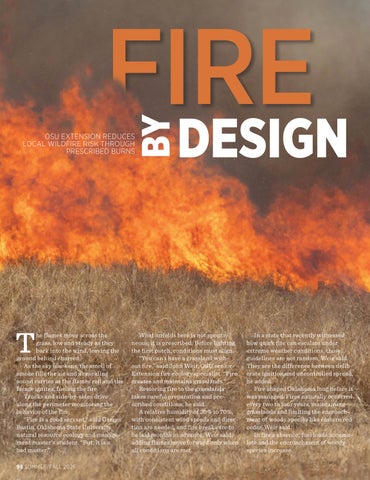
he flames move across the grass, low and steady as they back into the wind, leaving the ground behind charred. As the sky blackens, the smell of smoke fills the air and a crackling sound carries as the flames roll and the forage ignites, fueling the fire. Trucks and side-by-sides drive along the perimeter monitoring the behavior of the fire. “Fire is a good servant,” said Garren Bastin, Oklahoma State University natural resource ecology and management master’s student. “But, it is a bad master.” 98 SUMMER/FALL 2026
What unfolds here is not spontaneous; it is prescribed. Before lighting the first patch, conditions must align. “You can’t have a grassland without fire,” said John Weir, OSU senior Extension fire ecology specialist. “Fire creates and maintains grasslands.” Restoring fire to the grasslands takes careful preparation and prescribed conditions, he said. A relative humidity of 30% to 70%, with consistent wind speeds and direction are needed, and fire breaks are to be laid months in advance, Weir said, adding flames move forward only when all conditions are met.
In a state that recently witnessed how quick fire can escalate under extreme weather conditions, those guidelines are not random, Weir said. They are the difference between deliberate ignition and uncontrolled spread, he added. Fire shaped Oklahoma long before it was managed. Fires naturally occurred every two to four years, maintaining grasslands and limiting the encroachment of woody species like eastern red cedar, Weir said. In fire’s absence, fuel loads accumulate and the encroachment of woody species increase.