OSU Ferguson College of Agriculture Volume 28 Number 1 • Winter/Spring 2026
Shannon Angle
Bill Clymer
Robert Hodgen
M. John Kane IV
N. Malone Mitchell Jr.
Rhonda and Thomas Coon
CONGRATULATIONS TO OUR 2025 HONOREES!
DISTINGUISHED ALUMNI Shannon Angle, 2002
Robert Hodgen, 1997
Bill Clymer, 1965 and 1969
M. John Kane IV, 1984
N. Malone Mitchell, 1963
CHAMPIONS Rhonda and Thomas Coon
Learn more about the honorees at agriculture.okstate.edu/about/honors
COWBOY JOURNAL Winter/Spring 2026 | Vol. 28 No. 1
EDITORS JOSLYN GONZALEZ PRESLEY PULLEN MALANA UNSELL MANAGING EDITORS CARRIE BAKER, PH.D. ANGEL RIGGS, PH.D. ASSISTANT MANAGING EDITORS DWAYNE CARTMELL, PH.D. AUDREY KING, PH.D. KENNA SANDBERG, M.S. QUISTO SETTLE, PH.D. KAYLEE TRAVIS, M.S. HANNAH WILCOCKS, B.S. ASSISTANT EDITOR CYNTHIA MCNALLY
SOCIAL MEDIA COORDINATOR CODY GARCIA SPONSORSHIP COORDINATOR SAVANNA METZ PHOTO COORDINATOR HAILIE BRAKE GRAPHIC COORDINATOR MCKENNA BREEDING STAFF JACI ALLEN LYDIA BELL MCKENNA BLAIR ANNABELLE BLASIUS KAITLYN BROUGHTON
MACI CARTER RIANNA CHANEY RYLEE GLAZIER AVA JERNIGAN MORGAN MALONEY JONNA MCCULLOUGH EMILY MCGOUGH ALLISON MCNAMARA MOLLY MEEK KARA MINER EMMA GRACE MOORE SARAH MULLENS KARMAN NEWMAN MADISON PADEN HANNAH PHELPS KARLI SCHWERDTFEGER BAYLEE SMITH HALLE SUMPTER HARRISON WICKER CORTNEY ZIMMERMAN
MESSAGE FROM THE EDITORS
As editors, we are grateful and proud to present the 55th edition of the Cowboy Journal under the leadership of Carrie Baker and Angel Riggs. While you read through these pages, we believe you can recognize the commitment and enthusiasm from the staff for agricultural storytelling. We hope you feel a sense of joy in being a member of the Cowboy Family, whether you are a student, alum, faculty or staff member, or friend. We want to extend our utmost gratitude to our 33-member staff, Mandy Gross, Sara Howard, Kristin Knight, Jami Mattox, Kate Miller, Lauren Quinlan, Jessica Spence, Sydney Trainor, Hannah Wilcocks and Laura Wuebker for their editorial work. A profound thanks goes also to Dwayne Cartmell, Audrey King, Shelly Legg, Kenna Sandberg, Quisto Settle and Kaylee Travis for their commitments to the agricultural communications program. Without their consistent guidance, none of this would be achievable. As we carry this lasting tradition into a new era, our pride in telling the stories of the Ferguson Family remains the same. Forever Loyal and True,
The Cowboy Journal staff includes the leadership team seated in front and staff members standing behind. Photo by Hannah Wilcocks.
FROM THE PASTURE TO THE CAPITOL, WE’VE GOT YOUR BACK.
405-235-4391 okcattlemen.org
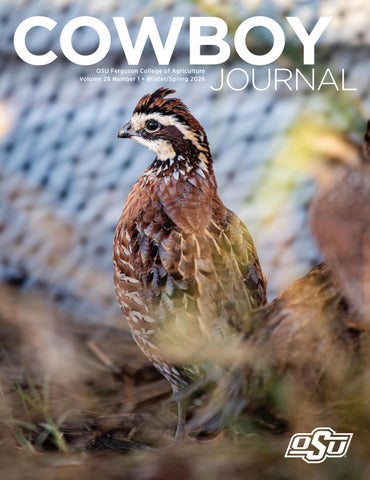
ON THE COVER
Oklahoma is home to two species of quail. The call of the northern bobwhite quail is a nostalgic tune for Oklahomans. Thanks to the efforts of OSU researchers, conservationists and Extension educators, wildlife and the native landscapes they inhabit are being preserved and protected. Learn about statewide conservation efforts on pages 14, 46, 97 and 116. Photo by Kara Miner. Oklahoma State University as an equal opportunity employer, complies with all applicable federal and state laws regarding non-discrimination and affirmative action. Oklahoma State University is committed to a policy of equal opportunity for all individuals and does not discriminate based on race, religion, age, sex, color, national origin, marital status, sexual orientation, gender identity/expression, disability, or veteran status with regard to employment, educational programs and activities, and/or admissions. For more information, visit eeo.okstate.edu. This publication is printed and issued by Oklahoma State University as authorized by the vice president for agricultural programs and has been prepared and distributed at no cost to the taxpayers of Oklahoma.
COWBOY JOURNAL 3
INSIDE Sidelines to Stethoscopes. . . . . . . . . . . . . . . . . . . . . .6
Roots of Conservation . . . . . . . . . . . . . . . . . . . . . . . .72
Cowboy Orange & Corduroy . . . . . . . . . . . . . . . . . . 10
Classroom Meets World . . . . . . . . . . . . . . . . . . . . . 76
Conditions of the Covey . . . . . . . . . . . . . . . . . . . . . . 14
Branching Out . . . . . . . . . . . . . . . . . . . . . . . . . . . . . . 80
Grounded & Growing . . . . . . . . . . . . . . . . . . . . . . . . . 18
Life Lessons Beyond the Barn . . . . . . . . . . . . . . . . 84
Beyond the Feed Bunk . . . . . . . . . . . . . . . . . . . . . . .22
Joining a Global Movement . . . . . . . . . . . . . . . . . . .87
A Career Abroad . . . . . . . . . . . . . . . . . . . . . . . . . . . . 26
Discovering Her Yes Moments . . . . . . . . . . . . . . . . 92
Innovation in Action . . . . . . . . . . . . . . . . . . . . . . . . . 30
4-H for Oklahoma . . . . . . . . . . . . . . . . . . . . . . . . . . . 95
Engineering Through the Decades . . . . . . . . . . . . 34
Where the Tallgrass Grows . . . . . . . . . . . . . . . . . . . 97
Tiny Insect Big Problem . . . . . . . . . . . . . . . . . . . . . 38
Prepared to Protect . . . . . . . . . . . . . . . . . . . . . . . . 100
More than a Class . . . . . . . . . . . . . . . . . . . . . . . . . . . 42
Planting Solutions. . . . . . . . . . . . . . . . . . . . . . . . . . .104
Wading into Conservation . . . . . . . . . . . . . . . . . . . 46
Peace Corps & Papayas . . . . . . . . . . . . . . . . . . . . .107
Hooked on Sustainability . . . . . . . . . . . . . . . . . . . . 50
Work With a Purpose . . . . . . . . . . . . . . . . . . . . . . . . 110
AMPing up Agriculture . . . . . . . . . . . . . . . . . . . . . . 54
Beef Without Borders . . . . . . . . . . . . . . . . . . . . . . . 112
Trail to Beef Excellence . . . . . . . . . . . . . . . . . . . . . . 58
Handstands and Hidden Habits . . . . . . . . . . . . . . . 116
A Legacy Etched in Stone. . . . . . . . . . . . . . . . . . . . 62
Dirty Jobs Clean Water . . . . . . . . . . . . . . . . . . . . . .120
Eyes in the Sky. . . . . . . . . . . . . . . . . . . . . . . . . . . . . . 66
Bringing the World Within Reach . . . . . . . . . . . . . 124
From: Ferguson To: The World . . . . . . . . . . . . . . . 70
Walking the Extra Mile . . . . . . . . . . . . . . . . . . . . . . . 126
76
84 62
6 72 COWBOY JOURNAL 5
Kaitlyn Davis shines on the field with the OSU Pom Squad and in the classroom. Photo by Presley Pullen. 6 WINTER/SPRING 2026
SIDELINES TOStethoscopes A
PRE-VETERINARY STUDENT EXPERIENCES A UNIQUE UNDERGRADUATE JOURNEY
roar of the crowd and rustling of orange poms. This is a typical Saturday in Stillwater, Oklahoma, for Kaitlyn Davis, fourthyear Oklahoma State University Pom Squad member and animal science senior. As Davis runs onto the field, she cannot help but reflect on her unique journey and opportunity as the only Ferguson College of Agriculture student on the OSU Pom Squad. From Norman, Oklahoma, Davis said she always knew she wanted to escape the college town she grew up in to pursue her dream of being a Cowboy. Davis always used dance as a creative outlet, but it was not until she watched former high school pom teammates and role models grace the field of Boone Pickens Stadium that she realized she wanted to follow in their footsteps. During the spring of Davis’ senior year of high school, she embarked on a strenuous tryout process with the goal of securing a coveted spot as an OSU Pom Squad member. Several eight counts later, her dream became a reality and her excitement only grew. Throughout the rest of the summer, Davis reached out to a fourth-year pom squad veteran to learn
dances and prepare for the upcoming year, Davis said. Stepping onto campus just a few short months after her summer of training, Davis had no idea what the next few years would hold for her. With a childhood dream of being a marine biologist, she decided to pursue a degree in animal science. “I didn’t know that being an animal science major meant I would be in the agricultural college,” Davis said. “I just thought that having grown up visiting my grandpa’s small farm, animal science sounded more like my speed than any other major.” As a freshman enrolled in the Introduction to Animal Science
She never seems to get tired or stressed, or at least she never lets it show. JADEN KINDT
course, Davis was exposed to the different animal units across OSU’s campus. At first, she was a little hesitant, but it did not take long for her to realize she was right where she was meant to be, she added. “I would come back to my college dorm and excitedly FaceTime my mom about all the new and different things I was learning in my classes,” Davis said. This excitement carried into conversations with her freshman-year roommate and fellow animal science student, Jaden Kindt. “Kaitlyn and I met during our senior year of high school at The Leadership Experience Conference on campus,” Kindt said. “We bonded through our shared major, instantly clicked and decided to be roommates.” Somewhere between the hectic pom practices and animal science labs, Kaitlyn’s interest in her coursework turned into a goal of becoming a veterinarian. Kindt and Davis held one another accountable throughout challenging and rigorous animal science courses, Kindt said. “One thing I admire about Kaitlyn is how she never seems to ever get tired or stressed,” Kindt said. “Or at least she never lets it show.”
COWBOY JOURNAL 7
Left: Kaitlyn Davis aspires to practice equine medicine after graduating veterinary school. Middle: Kaitlyn Davis’ poms and stethoscope, on the field of Boone Pickens Stadium. Right: Kaitlyn Davis credits the Charles and Linda Cline Equine Teaching Center with fostering her passion for the equine industry. Photos by Presley Pullen.
It was inspiring to watch Davis’ dedication to her early morning workouts, late night practices and academics throughout our freshman year, Kindt added. “I think Kaitlyn’s daily mindset of, ‘This is what I want to achieve, and these are the things I have to do to get there,’ is what keeps her motivated each day,” Kindt said. Davis’ peers are not the only ones quick to pick up on her drive and desire to succeed. “As a pre-vet student, she is trying to do something that some people focus their full attention on,” said Beki
Jackson, OSU Pom Squad coach, spirit coordinator and Pistol Pete coordinator. “And at the same time, she’s got this whole other side to her life.” Jackson said she places an emphasis on building successful young women who will be leaders long after their time on the squad. “I want them to thrive in this world, their college world, their personal world and careers, whatever that path is,” Jackson said. “Just remembering every relationship they build will add to their life, and it’s such an important thing for me to continue pushing that mission.”
The OSU Pom Squad members are well-rounded student athletes who give 110% and hit the mark every time, she added. “I don’t have to sit here and motivate them,” Jackson said. “They are already motivated, and I just find those little sparks in them that keep them going.” For Davis, that spark is ignited by her passion for animals and fuels all aspects of her life. She talks about her schoolwork constantly, and all the girls are intrigued by her, Jackson said. “It’s not every day we have a pom member with an agricultural major,
It is not every day we have a pom member with an agricultural major, but what is even more unique about Kaitlyn is her drive to become a veterinarian. BEKI JACKSON 8 WINTER/SPRING 2026
but what is even more unique about Kaitlyn is her drive to become a veterinarian,” Jackson said. Davis has something that is unique to the team, and she is proud of it, Jackson added. Davis said that strong relationships with faculty — especially with her academic adviser, Riley Messman, animal and food sciences assistant professor — have helped her develop a clear sense of career direction. “Kaitlyn entered the animal and food sciences department with a clear passion for veterinary medicine, particularly in the equine-related field,” Messman said. “My role has been to help her identify related coursework, experiences and internship opportunities that align with her goals and interests.” Messman said Davis’ ambitious and driven personality, paired with her time management habits, made conversations and course planning easy. As Davis looks toward the future, she credits the Equine Breeding and
Foaling course with Marissa Chapa, equine herd manager, with piquing her interest in equine medicine. “She enrolled in our Equine Breeding and Foaling class, an extensive course with foal watching and hands-on work,” Messman said. “She excelled within the course despite her already demanding schedule.” Knowledge and experience from this course, plus Davis’ internships and shadow opportunities with Interstate Equine Hospital and the Professional Animal Health Center helped build her portfolio for veterinary school applications, Davis said. Messman said she has no doubts Davis will achieve big things in her future endeavors. “Her combination of academic achievement, leadership and commitment to the pom squad gives her a distinctive edge,” Messman said. “Balancing the physical and time demands of collegiate athletics with the rigorous pre-veterinary curriculum, demonstrates the level of discipline
and perseverance many veterinary schools value highly.” Davis said her path is still unfolding and the uncertainty of life after graduation grows near, but her peers, family and mentors see the unknowns as an opportunity. Her mom reminds her to have a positive mindset daily, she added. “When I am feeling overwhelmed, my mom tells me, ‘What an opportunity you have to not just be a normal college student. You were picked out of 140 girls to stand on the field and represent your school.’ That is what keeps me going,” Davis added.
PRESLEY PULLEN
STRATFORD, OKLAHOMA
COWBOY JOURNAL 9
Past National FFA officer jacket hangs outside of Agricultural Hall. Photo by Cortney Zimmerman. 10 WINTER/SPRING 2026
Cowboy Orange & Corduroy
F
FERGUSON HOSTS NATIONAL FFA OFFICER CANDIDATES
or the past two years at Oklahoma State University, Agricultural Hall has shifted from its signature America’s Brightest Orange® to a dominant sea of National Blue for one weekend, as National FFA officer candidates from across the country gather, preparing for the honor of serving on the next National FFA officer team. “Hosting the National FFA Officer Candidate Experience at the Ferguson College of Agriculture brings a certain level of prestige to the college,” said Shane Robinson, agricultural education, communications and leadership professor and department head. The event gathers National FFA officer candidates in Stillwater, Oklahoma, where they spend three days preparing for the National FFA officer selection process while engaging with OSU faculty, staff and students, Robinson said. “In the summer of 2024, I received an email from Dr. Lusk indicating he had spoken with Ross McKnight, asking if we would take on the National Officer Candidate Experience and that he would be willing to help support it as he had in the past,” Robinson said. “The only way we felt comfortable doing it was if Ryan Best, a former National FFA president and doctoral
student in our program at the time, would be able to take the lead,” Robinson said. Best’s strong credibility and work ethic proved he was the person needed to make this event happen and he hit the ground running, Robinson added. When the conversation began about hosting this experience, Best said he had three main objectives in mind. First, it would provide candidates with an opportunity to gain exposure to the National Officer selection process before National FFA Convention. “This training provides a unique opportunity for students to experience something very similar to what they are going to experience at National FFA Convention,” Best said. “From timing to interviewing structure, we make the rounds as close as we can to mimicking the real national process.” The next objective was to provide candidates with resources to take home and use to further train with their state associations, Best said. “If we are being realistic, not all state associations have the same resources and funds available to them,” Best said. “This is a chance to help those states and candidates gain a few extra resources and work with individuals who help build candidates’ confidence
in who they are and what they have to offer,” Best said. While establishing the event, one of the most significant goals was to help students network and build relationships with other candidates, he said. “The week of National FFA Convention is already stressful enough,” Best said. “The whole week is collectively better when you have candidates who come in already friends and are ahead in the relationship-building process.” OSU was the best fit for the training experience because of the access to resources available for candidates, Best said. Hosting this event involved more than the facilities, donors or sponsors — the true difference was the human capital behind it, he said. There are more than 60 former state FFA officers, along with several former National FFA officers and former National FFA officer nominating committee members represented in the Ferguson College of Agriculture student body, Best said. “Because of the people who are willing to donate their time and abilities, that is what truly makes this event world-class and a unique experience,” Best said. When Best graduated from OSU in Spring 2025 with his doctorate in COWBOY JOURNAL 11
Back Row: Braden Havlik (left), Joey Nowotny, Cole Sundeen, Trey Myers, Trenton Page, Ethan Wolheter, Christopher Sarnik, Levi Faulkner, T. Wayne Williams, Kadence Boender, Dustin Kolb, Braelyn Durbin, Delaney McKeen, Keston Zimmerman, Gabby Howell, Ryer Roberts, Hunter Smigel, Ty MacDonald, Hunter Lawson, Ryan Bal. Front Row: Eliza Dugan (left), Claire Woeppel, Rebecca Lehman, Hannah Saum, Lilly Nyland, Mia McGuffin, Jael Cruikshank, Laynie Dodson, Taylor Moffett, Anna Conway, Mirhonda Good, Emily Ryder and Alyssa Schauer traveled to the National FFA Officer Candidate Experience. Photo by Olivia Rooker.
agricultural education, communications, and leadership, Robinson said, organizers began looking for a new leader to continue the training. Josiah Cruikshank, a former National FFA officer from Oregon, became the easy choice, he added. “Both years I ran for national office, I would hear about states that had awesome mentorship programs set up to prepare candidates for the selection process,” said Josiah Cruikshank, who is also the National FFA Officer
Candidate Experience coordinator and agricultural economics graduate research assistant. “Though this is great for states that have this apparatus in place, many states may not have as much access to these individuals,” Cruikshank said. “I am grateful to the mentors of mine who volunteered their time to work with me.” Cruikshank said he appreciated the opportunity to participate, recognizing the experience as a key component
I really believe this is just a humble approach by people to invest in others. SHANE ROBINSON 12 WINTER/SPRING 2026
in preparing him to run for national office, he added. Cruikshank built upon Best’s foundation and led a successful training experience for candidates in October 2025, with the desire to make sure officer candidates have a similar experience as he once did, Robinson said. “I remember arriving in Indianapolis as a candidate and it feeling like you are being analyzed every move, whether you are in an interview room or not,” Cruikshank said. “The experience we give candidates in Oklahoma is very different from this, as we encourage them to be themselves, and we have structural components to help them do just that,” he said. With 33 candidates in attendance, volunteers conducted realistic simulations of each of the six interviews candidates undergo in Indianapolis,
NOC EXPERIENCE BY THE NUMBERS
3
Days of Training for the National FFA Officer Selection Process
Josiah Cruikshank speaks to candidates about the facilitation round. Photo by Olivia Rooker.
Cruikshank said. In addition, informational sessions helped address any questions candidates had with individuals who had firsthand selection process experience, he said. Each National FFA Officer Candidate Experience is designed not only to prepare candidates for the national officer selection process, but also to equip them for success as national officers, Cruikshank said. Ultimately, the experience helps set them up for whatever is next, whether it means a year of service in blue corduroy or a life of service outside of the jacket, he added. “The skills they are learning through this process and developing throughout their prep leading up to convention, all of it, not just during this weekend, are so transferable everywhere,” Best said. “I had somebody once tell me that sometimes the students who are not successful in running for national office often have a greater reach than those who are successful because their service is not limited to strictly the blue jacket,” Best said. As the experience concluded, Robinson indicated he hopes the Ferguson College of Agriculture can continue to keep this event around for years to come.
“I really believe this is just a humble approach by people to invest in others to try and make this an enjoyable, positive, learning experience for these national officer candidates,” Robinson said. “Because at the end of the day, these, in the truest sense, are the leaders going into the industry of agriculture. So, we all win when agricultural leaders are stronger.” Without the help of OSU faculty, staff, former state and National FFA officers, and volunteers from across the nation, the weekend would not have been the success it was, Cruikshank said. “We are excited to support each of these candidates as they run for National FFA office and hope their time at Oklahoma State University will be something they forever look back on as key to their FFA journey and future careers,” Cruikshank said.
5
Former National FFA Officers in Attendance
33
National FFA Officer Candidates in Attendance
38
Former State FFA Officer Volunteers
122
Flights Boarded by Candidates & Volunteers
693
CORTNEY ZIMMERMAN
National FFA Officer Selection Rounds Practiced
SPENCER, WISCONSIN
COWBOY JOURNAL 13
Covey Conditions of the
Q
RESEARCHERS SEARCH FOR AN ANSWER TO QUAIL POPULATION DECLINE
uail are nostalgic birds for many Oklahomans, from avid bird hunters to landowners used to hearing their distinctive call. However, the northern bobwhite population is decreasing across the nation. Oklahoma State University researchers are working to identify the cause of decline. For the past 25 years, OSU researchers have been studying northern bobwhite across Oklahoma and the Texas Panhandle. The research is led by Craig Davis, natural resource ecology and management professor and Bollenbach chair, and Sam Fuhlendorf, natural resource ecology and management Regents professor and Groendyke chair. Fuhlendorf ’s first quail project at OSU in 1998 took him to Mesa Vista Ranch in Pampa, Texas, which then belonged to T. Boone Pickens II, an OSU benefactor. “Mr. Pickens was involved in much of the day-to-day activities of the research project,” Fuhlendorf said. “He interacted frequently with graduate students and faculty.” 14 WINTER/SPRING 2026
It was important for Pickens to find a way to have quail on his ranch, Fuhlendorf added. “This is where we first started looking at the temperature effects and realizing it could be the thing that mostly causes the boom-bust,” Fuhlendorf said. Boom and bust describe the cycles in the inconsistent increase and decrease of quail populations, he added. “The real question is, ‘How can you have this boom-bust sort of thing going on?’” Fuhlendorf said, “But, then, you can also have a long-term declining.” Many factors play a role in the decline of the quail population, Fuhlendorf said. Weather, climate change, habitat loss and degradation seem to be the main reasons, he added. “Good northern bobwhite habitat in western Oklahoma consists of open mixed-grass prairies with a patchwork of native grasses, forbs and scattered low shrubs such as sand plum, shinnery oak and sumac,” Davis said. Habitat change and degradation can come in all shapes and sizes, Fuhlendorf said, from an increase of
OSU researchers band bobwhite quail to track population dynamics and assess habitat management for conservation. Photo by Todd Johnson. COWBOY JOURNAL 15
Left: GPS units are used by researchers on northern bobwhite to analyze nest temperature. Middle: Landowners can learn more about northern bobwhite at quail field days hosted by OSU researchers. Right: GPS units are being used on northern bobwhite at the Packsaddle Wildlife Management Area near Arnett, Oklahoma. Photos courtesy of Sam Fuhlendorf.
woody plants like eastern red cedar, to certain farming patterns to human developments of lands. “Eastern red cedars are harmful to bobwhite quail habitat,” Davis said. “As cedars spread, they shade out native grasses and forbs that quail need for nesting, brood cover and food.” One way to help with this issue is through prescribed burns or mechanical removal, Davis said. Researchers are also considering how extreme temperatures are affecting the northern bobwhite population, Fuhlendorf said. The quail struggle to reproduce during heat waves and can suffer high mortality throughout cold spells in Oklahoma, he added.
The use of GPS units and cameras in front of nests have allowed researchers to observe the quail trying to keep their nests at a consistent temperature, Fuhlendorf said. Male quail have also been found to help the females incubate the eggs to assist with temperature control of the nest. This can potentially create a 30-degree difference between the nest and the surrounding area, Davis said. On cold mornings, quail will stay in their nest to keep the eggs warm, and then, in warm evenings, they try to keep the nest cool, Fuhlendorf said. Davis and Fuhlendorf also noticed quail leave the nest to feed when the temperature starts to warm, potentially allowing the nest to stay cooler.
When Oklahoma experiences heat waves, it interferes with keeping the nest and eggs at the temperature needed for survival, Fuhlendorf said. A lot of quail will abandon the nest because they cannot keep it at a consistent temperature, he added. “Think about just how hard a day in the life of a quail would be,” Fuhlendorf said. Quail not only worry about temperature, they also worry about predators trying to eat them and their eggs, Fuhlendorf added. “In some of the videos, we’ve seen quail sort of bow up to predators to defend their nest,” Fuhlendorf said. The interesting thing about the fluctuation of the quail population is when
Think about just how hard a day in the life of a quail would be. SAM FUHLENDORF 16 WINTER/SPRING 2026
SCIENCE OF SOUND Migratory patterns of northern bobwhite have the potential to be impacted by a variety of different human and environmental factors. Researchers at Oklahoma State University have recently started researching the influence of sound. Jullianna McCauley’s master’s thesis, “The Spatiotemporal Distribution of Anthropogenic Noise and Impacts on Grassland Birds Response,” focuses on anthropogenic noise, specifically low-frequency noise from hunting and oil development that often occurs at similar frequencies as quail vocalizations. This is known as acoustic masking and previous research observes quail react to acoustic masking by
the conditions are perfect, quail often reproduce quickly and easily, Davis said. In the past, quail were believed to have monogamous behavior. However, when the conditions are right, females will mate with multiple males and can have several nests at once during the season, Davis said. Davis and Fuhlendorf are also working with a graduate student who is conducting research on how noise affects the quail population. Hunting and oil development noises can keep male and female quail from hearing each other’s mating calls, said Jullianna McCauley, natural resource ecology and management graduate research assistant. “I use automated recording units specifically to track how their calling behaviors and attendance rate change over time,” McCauley said. McCauley uses the units to record noises in northern bobwhite habitats, allowing her to assess how the effect of noise on calling rates and loudness of calls, she said.
“We can also measure abundances via how many vocalizations we can hear with the automated recording units,” McCauley said. McCauley found that northern bobwhite quail are significantly affected by pumpjack noise, she said. If we want to bring quail into the future for our grandkids and generations to come, we need to start thinking about what habitat will be available to them, Fuhlendorf said. “We need to start planning now,” Fuhlendorf said.
• Vocalizing at different frequencies to compete with disruptive background noise, which results in more energy allocated to calling. • Calling less frequently in an area, which leads to decreased mating success and overall populations. • Leaving the habitat with anthropogenic noise in search for new, non-fragmented areas. Source: Jullianna McCauley
LEARN MORE KARA MINER
PERKINS, OKLAHOMA
COWBOY JOURNAL 17
GROUNDED& ALUM LEADS IN LANDSCAPE WITH INTENTIONAL DESIGN
GROWING
Mike Albert stands on one of his completed projects. Photo courtesy of Brandon Huttenlocher/Design Workshop, Inc.
18 WINTER/SPRING 2026
M
ike Albert remembered being a 14-year-old growing up in the Oklahoma Panhandle looking for ways to earn money. “I started bugging my parents for an allowance, and instead of giving it to me, they gave me a lawnmower,” said Albert, Design Workshop principal in Aspen, Colorado, and an Oklahoma State University alumnus. The following summer, Albert’s mother helped him mow lawns all around his town. Albert was raised on a third-generation ranch, surrounded by the family’s cattle operation. Both sides of his
family had farms and ranches since the early 1920s. “I was the kid growing up who would run to the post office and see when the Architectural Digest was being released,” Albert said. “I was so excited in my small town to see what the world was.” By the end of the summer, Albert said, he and his mother raised $3,000 mowing lawns. He invested the money in his own plant business, which became his supervised agricultural experience FFA project, Albert added. What started as selling house plants turned into seasonal flowers, such as
COWBOY JOURNAL 19
Cristof Eigelberger (left) and Mike Albert collaborate on the award-winning Highlands Retreat project in Pitkin County, Colorado. Photo courtesy of Brandon Huttenlocher/Design Workshop, Inc.
poinsettias and bedding plants, which quickly gained an attraction in his community, Albert said. After graduating from Beaver High School, Albert enrolled at OSU majoring in landscape architecture with a minor in international business. “OSU had always been my plan,” Albert said. At OSU, Albert was mentored by the late John Ritter, former landscape architecture professor, who encouraged him to try many internships. Albert took his advice and completed internships globally with projects in Beijing, China, and Warsaw, Poland, he said. “Landscape architecture is a calling, not a profession,” Albert said. “It is a career that allows so much creativity, and the ability to shape the world around us.” Upon graduation, Albert was hired at Design Workshop — a firm he always admired, he said. “When we hired Mike, he came with a lot of presence,” said Richard Shaw, 20 WINTER/SPRING 2026
former Design Workshop principal who also served as a mentor. “It was obvious he was very destined to be a great employee.” Design Workshop started in Colorado and now includes seven studios throughout the U.S., Albert said. The company’s growth allows the team to work on landscape architecture and planning projects worldwide, he added. Albert said he remembered landing in Aspen, Colorado, in January 2006 to begin his position at Design Workshop. Snow was falling, lights were on all around town and people were watching the Olympics on restaurant TVs,
Landscape architecture is a calling, not a profession. MIKE ALBERT
cheering on their hometown athletes, he recalled. “Growing up in a town of 1,000 people, a big city didn’t feel right, so Aspen with 6,500 was absolutely perfect,” Albert said. From the beginning, Albert noticed an office culture that centered around intentional work. “There was a fierce attention to doing great work that would impact the world,” Albert said. “I fell in love with client relationships, and it was almost the same thing I had back in high school.” He said he continued in the role for five years before earning a master’s degree in landscape architecture at Harvard University. When he returned to Design Workshop, he was promoted to be a principal in the firm, he said. Most individuals become a principal in their 40s, but Albert earned the promotion at 32. “Most projects take about five years to finish, making experience a lengthy process to prove,” Albert said.
Following his success, Albert turned to his alma mater for a way to give back and support students. Albert endowed the OSU Mike Albert Leadership Scholarship in 2021. He also created the OSU Landscape Architecture Excellence Fund. “I just want to see OSU and our students succeed,” Albert said. “That was important to me.” This scholarship is awarded annually to students who showcase leadership and also display academic excellence, Albert said. “It allowed me to craft a vision for myself and begin to really define my own narrative,”said Jacob Krafft, a recipient of the Mike Albert Leadership Scholarship. Krafft, a 2020 graduate of the landscape architecture program, worked as an intern for the Los Angeles Design Workshop studio before his senior year in 2019. Krafft and Albert now work together at the Aspen studio. “I truly view Mike as not just a colleague, but a friend,” Krafft said. “It’s been an honor to learn under him and develop more as an emerging professional with him as a person to go to.” Ogheneruno Okotie, a 2024 landscape architecture graduate, benefited from the Landscape Architecture Excellence Fund, which funded her travel to the American Society of Landscape Architects’ national conference in Minnesota in 2023. “That was a tremendous help for myself and helped reduce the financial strain,” said Okotie, who worked as a Design Workshop intern and is now employed at the firm. Since 2006, Albert has won more than 70 American Society of Landscape Architects awards, and he was inducted into the ASLA Council of Fellows in 2022. The Fellowship is one of the ASLA’s highest honors and recognizes individuals whose professional achievements and contributions have advanced society and landscape architecture, according to the ASLA. “Typically, people get the Fellowship award 20 or 30 years into their career,” Okotie said.
Ogheneruno Okotie (left), Mike Albert and Jacob Krafft collaborating at the Design Workshop studio in Aspen, Colorado. Photo courtesy of Brandon Huttenlocher/Design Workshop, Inc.
The award honors excellence in work, leadership, management, knowledge and service over time, according to the ASLA. “A lot of the awards and recognitions are well deserved because Mike reached a national level with those abilities quickly,” Shaw said. Albert credited both his Design Workshop colleagues and his collaborators for the award-winning projects. “The best designs are from the collective minds of many people,” Albert said. Cristof Eigelberger, Eigelberger Architecture and Design principal, has collaborated with Albert on more than a dozen projects. “He has a very rich history of living on land and knows what it is to have a ranch and cattle,” Eigelberger said. “I think that is really special about him.” The two started working together on designs in 2008. “He is always the first landscape architect I call on every single project,” Eigelberger said.
“We work with many landscape architects that are really good at one thing,” he added. “But Mike is able to see the entire vision blended together.” Throughout Albert’s life, he has been taught and inspired by the work around him, Albert said. “Across history you have artists over time that have been inspired by the places they live, and, in turn, try to communicate their value and their importance in the art with what they create to inspire the next generation,” Albert said. “Our work seeks to have the same impact.”
HANNAH PHELPS
LAWTON, OKLAHOMA
COWBOY JOURNAL 21
Beyond
C
OSU RESEARCHERS REDEFINE HOW PRODUCERS UNDERSTAND CATTLE STRESS
attle gather around the feed bunk, dust rising as feed hits the trough. It is a familiar sight for any producer, but what happens during that daily routine can carry the biggest impact. Beyond the feed bunk, there is more to raising healthy, productive cattle than balanced rations and steady growth, said David Lalman, Oklahoma State University Extension beef cattle specialist and animal and food sciences professor. Hidden stressors, from transportation to temperature swings, can affect animal health, meat quality and a producer’s bottom line, he added. 22 WINTER/SPRING 2026
Understanding what causes stress and how to manage it is the focus of new research at OSU, Lalman said. A team of OSU researchers is tackling the issue head-on through a four-year, $1 million project funded by the USDA Agriculture and Food Research Initiative. The multidisciplinary research effort uses artificial intelligence, sensor technology and producer perspectives to better understand how cattle respond to stress and what can be done to manage it. The project brings together animal and meat scientists, sociologists, engineers and computer scientists. Their goal is to identify cattle at risk
of stress and develop practical tools producers can use to reduce its impact, said Ranjith Ramanathan, animal and food sciences professor. One of the major challenges producers often face is unexplained losses during the finishing phase of production, Lalman said. “The industry has seen a gradual increase in unexplained death loss in finishing cattle,” Lalman said. “Some believe this is related to how we have selected for faster and more efficient growth. This kind of growth requires so much energy that may come at the expense of immune function and overall resilience.”
The Willard Sparks Beef Research Center houses cattle used to study stress. Photo by Allison McNamara.
e h t Feed Bunk Stress not only threatens animal health but can also affect meat quality. In packing plants, carcasses from highly stressed animals are often discounted. Ramanathan is researching the biological changes that occur when cattle experience stress. “We are collecting samples from cattle that have experienced sudden death to analyze proteins and metabolites,” Ramanathan said. “This helps understand what is happening inside the animal at the molecular level.” These samples provide insight into the biological pathways involved in stress, Ramanathan said, but the research team is also using new
technology to monitor cattle behavior in real time. Sensors and video systems track indicators such as heart rate, steps and body temperature. “The goal is to see if we can develop tools to identify at-risk animals early on,” Ramanathan said. “These tools could make a big difference for producers in the future.” By combining molecular data with sensor-based information, the research team is building predictive models using artificial intelligence, Ramanathan said. The models could help producers spot cattle predisposed to stress before major losses can occur, he added.
Still, even the most advanced technology has to be realistic for onfarm use. That is why the project also includes a social science component, Ramanathan said. The team is collaborating with producers to understand how they view new technologies and what factors influence adoption, said Ashley Railey, sociology assistant professor. “Producers are very practical in their decision making,” Railey said. “They want to know if the technology will really help them make better decisions, if it is affordable and if it is something they can realistically implement in their operations.” COWBOY JOURNAL 23
Cattle in research pens are monitored daily as part of a multi-year study on stress and well-being. Photo by Allison McNamara.
The cost of adoption is often the most significant factor, she added. Even when research demonstrates benefits, producers want to know the return on investment before they commit, Railey said. “Producers need to be confident that the technology will pay off in the long run,” Railey said. “Understanding those perspectives is critical to making sure our research can be applied beyond the lab.” The team’s multidisciplinary approach reflects the complexity of the problem. Cattle stress is not caused by a single event but by a series of environmental, genetic and
management factors that build over time. Addressing it requires perspectives from across the spectrum of animal health, science and sociology, Lalman said. Collaboration among different fields has been one of the most valuable parts of the project so far, Ramanathan said. “This work requires multiple perspectives,” Ramanathan said. “By working together across disciplines, we can connect what is happening at the cellular level with what producers see every day in their herds.” The research is ongoing, but early findings suggest genetics play a
It is about giving producers the tools they need to raise healthy cattle in an efficient, sustainable way. DAVID LALMAN 24 WINTER/SPRING 2026
role in how cattle respond to stress. Monitoring and sampling have also shown potential for identifying early warning signs before visible symptoms appear, he added. For producers, the implications could be significant. Improved ability to manage stress would not only help animal well-being but also reduce financial losses linked to discounted carcasses and unexplained death loss, Ramanathan said. The beef industry has always been resilient in the face of challenges, and this project is one more step toward ensuring long-term sustainability, Lalman said. “Understanding stress is not just about avoiding losses,” Lalman said. “It is about giving producers the tools they need to raise healthy cattle in an efficient, sustainable way.” The ultimate test of success will be whether producers find the results practical, Railey said. “Technology has to make sense on the ground,” Railey said. “Our job is to ensure producers’ perspectives are
included so the tools we develop can actually be used where it matters.” As the project continues, the research team remains focused on connecting science to the people it serves, Railey added. The collaboration has positioned the project to make a lasting contribution to the beef cattle industry, Ramanathan said. “The goal is not just to study stress for the sake of science,” Ramanathan said. “The goal is to find solutions that help producers, improve animal welfare and strengthen the beef industry as a whole.”
ALLISON MCNAMARA
EAST AURORA, NEW YORK
Data from sensors attached to cattle provide insight into how animals respond to environmental and management stressors. Photo by Allison McNamara.
Supporting Rural Oklahoma Farm & Ranch | Livestock | Equipment | Country Homes | Lines of Credit
OK L A HO M A
AgCredit ®
866-245-3633 okagcredit.com NMLS ID: 809962
EQUAL HOUSING
LENDER
COWBOY JOURNAL 25
Women walk along a village road in Apac, Uganda, after a community gathering near the church where Field of Hope held a training for local farmers. Photo courtesy of Jessica Spence. 26 WINTER/SPRING 2026
Abroad A Career
MIAP GRADUATE FINDS SUCCESS IN INTERNATIONAL HUMANITARIAN WORK
F
rom rural Iowa to Oklahoma State University, one alumna is using her education to provide humanitarian efforts worldwide. Brandi Murley, from Rockwell City, Iowa, works as a Country Monitoring and Evaluation, also known as MEAL manager, with Acted, a non-governmental organization. From middle school through college, Murley was active in 4-H and FFA, and continues to volunteer with the programs today. A 2012 American FFA Degree recipient, Murley was later inducted into the Iowa 4-H Hall of Fame in 2022 for her continued dedication to youth in agriculture.
Murley completed her bachelor’s degree in agricultural leadership at South Dakota State University in 2015. While completing her degree, she thought of the idea of joining the Peace Corps. This led her to OSU’s Masters of International Agriculture Program, she said. Murley said she appreciated the flexibility of MIAP, which allowed her to later complete an experience in the Peace Corps. MIAP allows students to pursue a variety of careers and opportunities, said Pam Bay, MIAP coordinator. “The flexibility of MIAP allowed me to do the Peace Corps as I knew I
COWBOY JOURNAL 27
Ugandan residents participate in educational camps to learn about entrepreneurship and prepare them to start their own businesses. Photo courtesy of Brandi Murley.
wanted to work in international development and do humanitarian work,” Murley said. Murley began her journey through MIAP in Fall 2015. During her first year, she built a connection with Craig Edwards, Starkey’s Distinguished Professor of Agricultural Education, when she took his Methods of Technological Change course. Through this connection, Edwards said he knew Murley wanted to join the Peace Corps to complete humanitarian work while taking his courses. Murley completed her first year of MIAP and soon was accepted into the Peace Corps. In 2016, Murley began her service in Uganda with the NGO Mercy Corps. Her first project was working with youth in African villages in northern Uganda, she said. The main project was getting youth involved in working in agriculture and entrepreneurship, Murley said. She also helped with various activities related to malaria prevention and sanitation in the area, she added. Alongside the project, Murley helped with a camp for youth with aspirations to run their own businesses. 28 WINTER/SPRING 2026
The camp included training on different types of businesses and business-related topics such as budgeting and building a business plan, she said. Murley’s time at OSU allowed her to make connections with alumni living in Uganda before she even made the trip, she said. “Once Dr. Edwards found out I was going to Uganda, he connected me with some graduate students from Uganda,” Murley said. “We made connections in Stillwater, and throughout my time in the Peace Corps, we stayed in touch.” During Murley’s time in Uganda, she received the opportunity to present remotely in one of Edwards’ undergraduate agricultural education courses, where she shared her experience in the Peace Corps. Most Peace Corps positions last two years. However, Murley extended her time in service to three years. In 2018, Murley joined the NGO Care International. During her work with Care International, her team provided communities with shelters, latrines, clean and accessible water, mental health support and protection for women against gender-based violence, Murley added.
Following her experience in the Peace Corps, Murley said she knew she wanted to continue working in the humanitarian sector. “The humanitarian sector is fast paced — no day is the same — and it keeps me busy,” Murley said. “This environment fit well with my personality, and I wanted to continue a career in humanitarian work.” In January 2020, Murley returned to the U.S. and resumed her studies at OSU, graduating in December 2020. In October 2021, Murley took her first full-time job in Washington, D.C. While in Washington, D.C., Murley worked for a research-focused government contractor, evaluating the impact of the U.S. Agency for International Development projects to ensure the appropriate services were effectively provided to affected populations. As part of her role, she also regularly communicated with the contractor’s donors, she said. “Whenever we get money from donors, we tell them exactly what we are doing or what we plan to do with this money,” Murley said. “It is part of my job to make sure we are, in fact, doing this to make our donors happy.”
Be prepared to have your world change. Step back, humble yourself. Be willing for change to happen, and let it come to you. BRANDI MURLEY Murley also worked on evaluating each program’s success — its achievements — and whether it was relevant, useful or made an impact, she said. A year and a half later, she accepted a position with Acted, where she has been for three years. Acted is a humanitarian and development organization, assisting people around the world, Murley said. “My first job with them was in South Sudan, and I was based in Juba, the capital city,” Murley said. “I got to go back to what started me in humanitarian work. I started with refugees in northern Uganda and then made it full circle when I was able to go into South Sudan and provide assistance to the people there.” Murley began in Juba as a MEAL officer and was promoted to country manager after seven months, where she oversaw the country’s monitoring and evaluation activities. Today, she is continuing to work with Acted in other parts of the world. While Murley was attending OSU, both Edwards and Bay recognized her
heart for service and determination, which set her apart from her peers, Bay said. They watched her lean into every opportunity, knowing Murley would one day take those values beyond the classroom, Bay added. “Everyone knew Brandi would humbly do good things,” Bay said. “She has a servant’s heart, and working with women and children was written into her story.” Edwards said Murley’s journey is proof of how drive and purpose can turn education into action. “Brandi is a living example of what a person can do,” Edwards said. “She has the skills she needs to succeed.” Murley’s life looks different from the one she imagined growing up in rural Iowa. Returning home only once a year for a few days, the adjustment can be challenging, Murley said. She credits her support system — both in the U.S. and abroad — for keeping her grounded through long stretches away from home and the nature of humanitarian work, she added.
Students hoping to follow in Murley’s footsteps should take an intentional approach to shaping their college and career experiences, Edwards said. “You have to seek out the experiences you think will best prepare you for your long-term efforts and aspirations,” he said. For those considering a life or career overseas, Murley offered her own advice, drawn from years of learning, adapting and embracing the unknown. “Be prepared to have your world changed,” she said. “Step back, humble yourself. Be willing for change to happen and let it come to you.”
HARRISON WICKER
RUSHVILLE, INDIANA
Left: While in Uganda, Brandi Murley’s parents and grandparents had the opportunity to visit her. Right: Brandi Murley traveled to many new places, including Kenya, through her experiences in the Peace Corps. Photos courtesy of Brandi Murley. COWBOY JOURNAL 29
New technologies are being used by OSU Extension to provide information to the public. Photo by Hailie Brake. 30 WINTER/SPRING 2026
Innovation in Action I
TECHNOLOGY IS CHANGING THE WAY EXTENSION INFORMATION IS SHARED
nnovation and technology go hand-in-hand within agriculture. From an app all about plants, to an agronomy podcast, to a wheat text group, OSU Extension is using innovative technology to translate scientific information and make it more accessible for producers and the public. The Plant-IT OK app helps Oklahomans choose the right plants for their landscape, said Justin Moss, OSU horticulture and landscape architecture department head and professor who developed the Plant-IT OK app. “The goal of the app is to help people find the right plant for the right place,” he said. “People want to be successful in their gardening efforts. That is what we are trying to accomplish.” The Plant-IT OK app takes information from Extension fact sheets, condenses it, and adds pictures to help Oklahomans choose plants to best fit their planting needs, he said. Different filters assist in making the user experience simpler, such as the USDA hardiness zone, light exposure,
water, plant type, season, flower color, wildlife and whether the plant is native or non-native, Moss said. “We wanted people to have the information directly in their hands and for it to be accessible and easy to use,” Moss said. The app is still in its early stages, and new technology opens a range of possibilities, Moss added. “I would like to see a scanning-type feature that would populate results for the user,” Moss said. “Geographic variation and heartiness zones are other filters I would like to see implemented as well.” Moss and his team continually update the app with new pictures and information to make it as useful and impactful as possible, he said. “In five years, I would like to see our list of plants become fully populated,” Moss said. “I am looking at this app going to the next level and having a broader impact.” Broader impact is also what the Red Dirt Agronomy podcast is looking to
accomplish, while maintaining a fun environment, said Brian Arnall, OSU plant and soil sciences professor. Arnall and Josh Lofton, OSU plant and soil sciences associate professors, as well as Dave Deken, Oklahoma farmer and AgNow Media owner, collaborate in the form of a podcast focused on agronomy. “It has always been the doctors and Dave,” Deken said. “When they get into the specifics about topics, I can simplify it for people.” The podcast explores a broad array of topics related to plant and soil sciences and agronomy, as well as general agricultural topics, Arnall said. The podcast has different guests with expertise in the topics related to the show, which helps provide information and different points of view, Deken said. “One of the things we wanted to do with this podcast was to get information already available to people, like fact sheets or project data, to them in a simpler form,” he said. “We really want
We wanted people to have the information directly in their hands and for it to be accessible and easy to use. JUSTIN MOSS COWBOY JOURNAL 31
EXPLORE DIGITAL TOOLS PLANT-IT OK APP The Plant-It OK App helps you choose plants based on water, light, soil, size, color and more. Scan the QR code to learn more and download from the App Store or Google Play.
RED DIRT AGRONOMY The Red Dirt Agronomy Podcast covers the latest in plant and soil science with expert guests every two weeks. Scan the QR code to listen on Apple Podcasts, Spotify or Amazon Music.
WHEAT EXTENSION Text WHEAT to 855-452-0489 for updates on harvest results, disease alerts and more. Message and data rates may apply. Scan the QR code to learn more and stay in the know about wheat.
Sources: OSU Extension & Red Dirt Agronomy 32 WINTER/SPRING 2026
the podcast to be a more long-term and outreaching avenue to get information out to the public.” The podcast is a different form of technology being used to help get information out to growers and producers who are located all across Oklahoma, Lofton said. The podcast aims to be an outlet delivering information in an accessible way to everyone. This keeps producers educated without taking them away from their farms, Lofton added. “This is a new way of reaching people in a new age of technology,” Lofton said. “A lot of our Extension clientele are leaning heavily on a lot of these new technologies.” Extension provides information and data for producers, and the Red Dirt Agronomy podcast aims to help put all the information into action by hosting experts with experience in the field on the show, Lofton said. The OSU Wheat Text Group is an additional way producers can get information, both simplified and promptly, said Amanda de Oliveira Silva, OSU plant and soil sciences professor who developed the OSU Wheat Text Group.
A conversation with a farmer sparked the idea of text messages being an efficient way to get information quickly to producers, Silva said. Updates include alerts about fact sheets and harvest data, as well as timely recommendations for producers to access. “The text group is a two-way conversation,” Silva said. “Not only do I text, but they can respond with other questions or even field observations.” The OSU Wheat Text Group is accessible to producers in rural areas, possibly those who do not have reliable internet access, because it is sent directly to their phone, she said. “Nowadays, everybody has a phone, and everyone is receiving texts, whereas some people may not have social media to see updates that get posted,” Silva said. The text group is not exclusive to growers in Oklahoma, Silva added. There are people enrolled from other states who receive the updates as well. “By being able to get disease management updates out quicker, we can help producers save money,” Silva said. Even through a text group, this is still a person-to-person interaction, which seems to resonate well with producers, she said. “The OSU Wheat Text Group is more informal. Our producers feel like they can just send a picture or questions directly,” Silva said. “People like to feel like they are talking directly to someone else.” The information being exchanged back and forth about wheat is useful to both the producer and Extension specialist, Silva said. “It is so simple,” Silva said. “The solution was right in front of us, and we could have missed it.”
HAILIE BRAKE
VIAN, OKLAHOMA
Engineering
Decades
THROUGH THE
O
OSU FOOD PROCESSING ENGINEER REFLECTS ON CAREER ACHIEVEMENTS
n a cold December day in 1996, Tim and Jodi Bowser, along with their two sons, packed up the car and left Spartanburg, South Carolina, heading northwest to Stillwater, Oklahoma. For Tim Bowser, food processing engineer at the Oklahoma State University Robert M. Kerr Food and Agricultural Products Center, this trip would become a decades-long career of ingenuity, innovation and research excellence, contributing to numerous projects within FAPC. After nearly 30 years at FAPC, Tim Bowser plans to retire in 2026. “Bowser has a heart for service and a passion for helping businesses grow,” said Roy Escoubas, FAPC director. “He has always been ready to help and ready with sage advice. He will be missed at FAPC.” In the 23 years Escoubas has worked as FAPC director, Tim Bowser has helped create more than five new positions in Oklahoma businesses each year, Escoubas said, totaling at least 100 new jobs added to the state’s workforce through his in-plant assistance alone. “He has assisted in the creation of new products, recommended and helped install affordable equipment for Oklahoma businesses, participated in plant expansions, led and supported on- and off-site workshops and training programs, solved customer problems and — above all — been a friend to our clients,” Escoubas said. 34 WINTER/SPRING 2026
Tim Bowser’s contributions to the team have led to the growth and recognition of the center throughout Oklahoma, Escoubas said. He has completed projects both nationally and internationally, while representing OSU and FAPC, he added. Tim Bowser has completed international projects in Africa, helping meat processors find more efficient ways to provide meat to low-income communities, said Rodney Holcomb, FAPC assistant director. He has been in postwar Croatia, finding ways to manufacture products from available agricultural commodities Holcomb said. In Guatemala, he helped place low-cost, solar-powered, food-drying systems for fruit and vegetable farmers, allowing them to dry and dehydrate products to minimize foliage and losses, Holcomb added. “Tim has done a little bit of everything, and he just soaks all information up like a sponge,” Holcomb said. “He is a jack-of-all-trades and an expert in most areas.” Some projects he has worked on within FAPC include developing turtle food for a reptile farmer, building and testing a solar food dehydrator in classrooms in rural Nicaragua, creating a low-cost pecan sanitizer for small-scale producers and producing healthy, low-caffeine energy bars. Originally from southwest Pennsylvania, Tim Bowser had a unique journey to OSU. He earned bachelor’s and master’s degrees from
Pennsylvania State University in agricultural engineering, now known as biosystems engineering. After graduating with a master’s degree in 1986, Tim Bowser entered the food production industry, working at Gerber Products Co. from 1986 to 1991 as a project engineer. He credits this position for exposing him, fresh out of college, to an industry of high-quality products, Tim Bowser said. After five years in the industry, Tim Bowser decided to pursue higher education, earning a doctorate in agricultural engineering from the University of Tennessee in 1993. After completing his doctorate, Tim Bowser moved to South Carolina to work for Lockwood Greene Engineers from 1994 to 1996 as a consulting engineer. At this engineering design firm, he designed food plants and processing projects for food companies. While Tim Bowser was working in South Carolina, he met his wife, Jodi Bowser, at church. After they married, the couple decided a career change was needed for their growing family. In 1996, Tim Bowser received a call about a job opportunity in Oklahoma. He would become one of the first employees hired at FAPC. “We had never heard of Oklahoma State University,” Jodi Bowser said. “After he accepted the job, we left for Oklahoma on Christmas Day.” The Bowsers began to make Oklahoma their new home over the holidays. Tim Bowser started his new
Tim Bowser has dedicated nearly 30 years to OSU. Photo by Madison Paden.
COWBOY JOURNAL 35
Throughout Tim Bowser’s professional career, he had the opportunity to build a variety of connections and travel to new places around the world. Photos courtesy of Robert M. Kerr Food and Agricultural Products Center.
position at OSU Jan. 2, 1997, as the FAPC building was in the final stages of construction. “The building was not even finished yet,” Tim Bowser said. “I had a temporary office for three months in Agricultural Hall, now Legacy Hall, until the prep work was done.” Once Tim Bowser moved into the FAPC building, he began helping clients and companies enhance their products using his knowledge from his industry jobs. He said it was an easy adjustment to OSU because of the organization’s loyal and true standard. “Right away, you get a trust factor from clients because you are coming
from OSU,” Tim Bowser said. “Your clients look at you as a friend and are looking to you for advice and for help.” Throughout Tim Bowser’s time at OSU, he has collaborated on and completed many projects for different companies through FAPC. One project, refurbishing coffee roasters for U.S. Roasters Corporation, has revolutionized environmentally friendly technology and equipment that meet environmental standards. The innovation has since been incorporated into the OSU Senior Engineering Design Project courses. Students learn about environmentally friendly practices and
Bowser has a heart for service and a passion for helping businesses grow. ROY ESCOUBAS 36 WINTER/SPRING 2026
the improvement of roasting methods through innovative design. This project started around 2011, when Tim Bowser said he was contacted by Dan Jolliff, U.S. Roasters Corporation owner, who asked for help to make his coffee machines larger. As Jolliff increased the size of the machines, the steel expanded, causing it to crack because of intense heat, which led to beans leaking out, he added. Tim Bowser and his team identified a special grade of stainless steel that could withstand intense heat with minimal expansion to resolve this issue. Afterward, Jolliff had another problem for him to solve. “Mr. Jolliff had an idea to use a catalyst to help remediate the smoke that comes off a roaster,” Tim Bowser said. “As you roast beans, you get this great aroma. But unfortunately, you also create a big cloud of smoke, too. So, in a place like California, you cannot have a coffee roaster in town because it violates the air pollution laws.”
Building on Jolliff ’s idea — and with support from an Oklahoma Center for Advancement of Science and Technology grant and Tim Bowser’s expertise — the team set out to develop an advanced coffee roaster. “We developed the world’s first roaster that would meet the air pollution control requirements in California,” Tim Bowser said. “That opened Jolliff up to that market, plus Europe and different parts of the world that have similar restrictions.” So far, students have designed and built coffee roasters, blenders for coffee beans, grinders and a new mixing arm to improve bean-cooling performance for U.S. Roasters Corporation. Through all the years and projects Tim Bowser has worked on with clients and students, one thing has stayed the same — his approach to a project. “If you start looking at it with a big picture of all the things that are involved in making that product and how you can make it better, make it faster, make it less expensive and better for
the environment — that is right in the ballpark for most engineers,” Tim Bowser said. “And, as a food engineer, it is just square with what I do.” With years of impressive accomplishments behind him, Tim Bowser avoids self-promotion and prefers to stay out of the spotlight. His previous colleagues praise his years of work and recognize him as a humble, kind and hardworking person. Mandy Gross, OSU Agriculture senior manager of strategic communications and special projects, who worked with Tim Bowser from 2003 to 2021, said he is one of the best individuals in the food processing industry. “He is an expert in his field and is the go-to person for drawing up design plans or finding solutions within food engineering,” Gross said, adding Tim Bowser does not seek the spotlight. “He likes to stay under the radar and complete his job.” Stephanie Greenlee, FAPC communications and media manager who has worked with Tim Bowser off and on
since 1999, said he will be difficult to replace and has made a lasting impact within FAPC and the food industry. “Tim has been an incredibly valued member of the FAPC team,” Greenlee said. “He’s been instrumental in shaping how the center operates, blending innovation with practicality. His leadership helped define the engineering side of the center and strengthened FAPC’s reputation for solving real-world challenges.” After retiring, Tim Bowser plans to continue consulting with companies and hopes to move closer to his grandchildren in Oklahoma City.
MADISON PADEN SALESVILLE, OHIO
Experience America’s Friendliest College Town! #FLYSWO TO THE ORIGINAL HOME OF RED DIRT MUSIC
COWBOY JOURNAL 37
tiny insect
BIG
PROBLEM
OSU FACULTY CONTINUE MONITORING THE CORN LEAFHOPPER IN OKLAHOMA THROUGH RESEARCH AND EXTENSION
C
ornfields across Oklahoma are under close observation as the corn leafhopper makes its tiny but mighty presence known. While only the size of a grain of rice, this invasive insect is causing big problems for corn producers statewide. Faculty at Oklahoma State University and OSU Extension are working together to identify the corn leafhopper, the pathogens it spreads, and ways producers can manage and monitor the issue. Oklahoma cornfields infected by the leafhopper in 2024 took a major hit with 10-55% yield loss, said Ashleigh Faris, OSU Extension cropping systems entomologist and integrated pest management coordinator. “There was documentation of the disease from the 1940s in south Texas with reoccurrences in other states,” Faris said. “It likely has been in Oklahoma prior to 2024, but no one knew what it was, or what to look for.” Identifying symptoms of corn stunt disease are often similar to those of nutrient deficiencies, with stunted growth and yellow to red leaf streaking, said Estefania Jinez-Rodriguez, a visiting scholar from Ecuador and 38 WINTER/SPRING 2026
OSU entomology and plant pathology intern in the plant pathology Extension lab. Knowing the identifying symptoms is half of the problem to look for. If these symptoms are noticeable, producers should check for leafhoppers, Jinez-Rodriguez said. Together, the likelihood for corn stunt disease, caused by the corn leafhopper, increases significantly. Corn stunt disease does not kill the plant. Instead, the pathogen absorbs the nutrients the plant needs to grow, Jinez-Rodriguez said. In response, the plant becomes stunted, produces multiple ears and takes on a sickly appearance as it struggles to fight the infection, she said. “The hopper is small in size, yellow to tan in color and has two dark dots located in-between its eyes,” Faris said. “However, those dots are the same as a lot of other leafhoppers, making field identifications difficult – often resulting in misidentifications.”
In Oklahoma, corn is typically not as intensively managed as other crops, Faris said. Scouting cornfields is a quick way for producers to check if the pest is present. Ways to scout include walking the outer rows of cornfields and checking around the leaves of the plant for present corn leafhoppers, she said. “Just because you have the insect, doesn’t mean you are always going to have the pathogen the insect is transmitting,” Faris said. “The insect has to pick up the pathogen from somewhere else. Plus, they don’t pass pathogens along to their babies. “Each leafhopper has to pick it up from the environment,” she added. “So, if you have a low pathogen year, even if you have a high population of
leafhoppers, there’s not as much opportunity to pick up that pathogen.” To know if the leafhopper is a carrier of the pathogens, it must be tested. Part of OSU Extension’s role in research includes sending in insect and corn samples for identification and testing of diseases through the Plant Disease and Insect Diagnostic Laboratory, or PDIDL. When testing the corn leafhopper in the PDIDL, the insects' legs must be carefully removed from its body and tested independently, said Sara Wallace, plant diagnostician.
“We test the body for identification,” Wallace said. “We want to verify it is the corn leafhopper since there are so many different types of leafhoppers. The legs are tested to see if the insect is transmitting the pathogen.” Due to the corn leafhoppers' small size, producers can use sticky traps to collect insects for testing. For proper implementation, producers can place
The corn leafhopper is extremely tiny, approximately 0.125 inches long. Photo by Mitchell Alcala. COWBOY JOURNAL 39
Left: Estefania Jinez-Rodriguez cuts corn leaf material to prepare for testing of present pathogens. Right: Red streaking on corn leaves is an indicator of corn stunt disease. Photos by Annabelle Blasius.
Top: Jinez-Rodriguez collecting samples from a sticky trap for identification and testing. Bottom: Jinez-Rodriguez cutting small sample sizes of leaf material. Photos by Annabelle Blasius. 40 WINTER/SPRING 2026
traps along the outer rows of the field on posts at canopy height. “Producers this year have been scouting fields more intensively than in previous years,” said Isaac Peebles, Golden Harvest Seeds Oklahoma territory manager. “Using sticky traps and knowing where to find corn leafhoppers has made an impact on production in Oklahoma. “With the destruction caused last year, there is a fear among producers, resulting in them being proactive and looking for the signs of corn stunt disease,” he added. Peebles works directly with corn producers across Oklahoma and said he has assisted in scouting methods and sending in samples to the PDIDL. The tricky part is plants often do not show symptoms of infection until 21-30 days of exposure, Faris said. Time may vary depending on the type of pathogen transmitted, she added. “The leafhopper transmits three pathogens,” Wallace said. “There’s a virus, a phytoplasma and a spiroplasma, but the phytoplasma and the
spiroplasma are what’s most common in the United States. “When testing the plant for disease, we need symptomatic material,” she said. “That can be reddening, purpling or streaking of the leaves. Then, we cut the leaves up and perform molecular testing depending on the type of pathogen we are testing for.” For testing, a positive control of the certain pathogen is needed, Wallace said. As of today, only the cornstunt spiroplasma has been found in Oklahoma, she added. Nothing can be done to save the plant or yield once it has become infected, Faris said. Managing becomes an important step to control the problem before it spreads. Part of the research Faris conducts is examining weather patterns to determine influencing factors for insect population in specific years or regions. “The possible reason why south Texas is a really big hot bed for this issue is because they have very mild winters,” Faris said. “With that, volunteer corn sprouts up after harvest.
We see that in Oklahoma, too, but it is more common for producers to graze that area. “Last year in Oklahoma we had a freeze come in mid-December and kill all the volunteer corn,” she said. “The reason this is important is because corn leafhoppers can only be produced in corn itself. If you can knock out the volunteer corn, or resources they produce on, then you’re helping to reduce that population of the insect and the reservoir for the pathogens.” Volunteer corn refers to corn plants that grow unintentionally from kernels
left in the field post-harvest. These plants often compete for nutrients, water and sunlight, potentially reducing yields for producers and creating habitats for the corn leafhoppers to thrive, Faris said. Knowing the identifying factors of the insect and the symptoms of corn stunt in the plant itself can help producers safeguard their fields and bring awareness to the rising issue. “This has become a top issue to look for in production when it comes to scouting and preventative measures,” Peebles said. “It is a new phenomenon
in Oklahoma that impacts the corn industry, and we need to be more conscious when monitoring for the pest and symptoms.”
ANNABELLE BLASIUS
YUKON, OKLAHOMA
PLANT DISEASE & INSECT DIAGNOSTIC LAB The Plant Disease and Insect Diagnostic Laboratory provides residents in Oklahoma accurate diagnoses of plant diseases and insect pests, while making recommendations for control. The lab operates year-round providing plant disease and insect identification services to Extension educators, individuals, consultants and commercial producers. Images are often sufficient to manage problems in home landscapes and gardens. Commercial clients are encouraged to submit physical samples for examination and testing. Source: OSU Extension
LEARN MORE
COWBOY JOURNAL 41
Bailey Norwood (left) and Christy Lusk teamed up in the Agricultural Product Marketing and Sales class. Photo by Hailie Brake. 42 WINTER/SPRING 2026
MORE THAN A
CLASS
COLLEGIATE CONNECTION INSPIRES PARTNERSHIP TO TEACH SALES AND LIFE LESSONS
O
n the first day of Sales Class, you can feel the energy before you even find a seat—quick wit flies between the two instructors and students laugh as they settle in. There is an unmistakable sense: This is not your typical lecture. For decades, eager students have piled into Room 107 in Legacy Hall as the Agricultural Product Marketing and Sales course takes place at Oklahoma State University. The course, fondly known to students as “Sales Class,” has a long-standing, positive reputation among the OSU Ferguson College of Agriculture students. Now, a duo keeps this tradition alive with a new set of teaching skills and stories to illustrate the art of sales. Much like this decades-long course, the co-facilitators, Christy Lusk, a Ferguson College of Agriculture instructional volunteer, and Bailey Norwood, agricultural economics professor, share a similar history. Their friendship dates back to 1996 when they were pursuing graduate degrees in the same program at Kansas State University, in Manhattan, Kansas.
“We both started our master’s degree in agricultural economics at K-State at the same time,” Norwood said. “That is where we became very good friends.” Now, the pair combine their professional expertise and real-world experiences to teach the course, following the retirement of Kim Anderson, former agricultural economics professor. “We knew we needed to keep the sales class going because it is very successful,” Norwood said. “It is the class we have consistently heard was the most impactful class students take.” Norwood said he knows the course is vital for students to learn soft skills and real-world sales techniques. “Sales is a fundamental part of life — professional life, certainly,” Norwood said. “It is embedded in everything you do.” Sales is a common entry-level position for students beginning their careers after graduation. Even if their first job is not in sales, the skills taught in this class can apply to any role, said Jayson Lusk, OSU Agriculture vice president and dean.
This course does a great job of preparing students, not only to get a job in sales, but also to be more successful in whatever they do, he said. Norwood teaches the technical aspects of sales, and Christy Lusk conveys applied, real-world skills, Norwood said. Together, they combine sales theory and practice to ensure students are equipped and confident to take on industry roles. “It is an art to be a good salesperson, but in the modern world, salespeople have to be good data analysts as well,” Norwood said. A curriculum refresh, now incorporating more technology and data tools such as Excel and Power BI, has proven beneficial for students, said Katie Dillon, an agricultural economics master’s student and former undergraduate teaching assistant for the course. “Sales is changing, and they wanted to make sure students were equipped to enter the workforce, not just in sales, but in general,” Dillon said. “My employers have been impressed with my Excel skills, and I think that is because of classes like this.” COWBOY JOURNAL 43
Left: Bailey Norwood engages with a student preparing to pitch their product of choice during Ready, Set, Sell. Right: Christy Lusk helps prepare sales professionals to interact with Ferguson College of Agriculture students during RSS Night. Photos by Mitchell Alcala.
Additionally, the duo recognizes the importance of professionalism and real-world application. “The class teaches a lot of life skills, even if you are not going into sales,” Dillon said. The expertise Christy Lusk provides gives students the interpersonal skills to navigate the business world, Norwood said. She guest lectures for modules such as etiquette, professionalism and relationship building. All the instruction Norwood and Christy Lusk offer in the classroom leads up to the Ready, Set, Sell event. On RSS night, each student conducts a mock sale of a product to a real-world professional, Norwood said. Often, those professionals are OSU alumni who were once students in the same class, he added. Professional industry relationships are a vital part of the program and great example of how relationships with alumni are maintained in the Ferguson College of Agriculture, Jayson Lusk said. There are mutual benefits when alumni return for RSS night because they want to give back, interact with students and share their knowledge, Jayson Lusk added. The lessons also extend far beyond sales, Dillon said. 44 WINTER/SPRING 2026
You can be a good person, be yourself and still be successful. CHRISTY LUSK “The class taught me how to have nuanced discussions and realize it is all just business at the end of the day,” Dillon said. “It also taught me how to ask for ‘the close’ and that rejection is okay. It is going to happen often, and you move forward.” Christy Lusk hopes the life lessons they teach shine through the most. She wants their message of authenticity and service to resonate with students. “You can be a good person, be yourself, and still be successful,” Christy Lusk said. What sets the course apart even more is how the duo teaches. The pair are very different people, but they complement each other and create a better experience in the classroom, Jayson Lusk said. Christy Lusk prioritizes student engagement, Dillon said. She learns
every student’s name, asks intentional questions and remembers details. Christy Lusk values her role in making students feel welcome and building rapport, Jayson Lusk said, adding she is a connector and cares about developing relationships. “I think that’s just a testament to who she is as a person and how she gets to know people well,” Dillon said. Norwood flips the script on traditional teaching approaches. Dillon said he uses out-of-box activities to keeps students on their toes. “Dr. Norwood’s philosophy is that teaching and learning should be fun,” Dillon said. Together, the co-instructors emphasize the lessons students learn in “Sales Class” should extend beyond the walls of Agricultural Hall. In a class about closing deals, the duo prove that authentic connections are the key to success.
MACI CARTER
CALEDONIA, OHIO
BUILT ON HERITAGE BRED FOR PERFORMANCE.
Simmental & Sim-Angus Bulls Jarod & Melanie Kennedy 918-629-8627 | Wagoner, OK
COWBOY UP with a hot slice!
DDK
Kennedy Farms
YOUR SEED SOURCE SINCE 1950 REGISTERED AND CERTIFIED WHEAT a PIONEER BRAND SEED DEALER
580-726-3220
SCOTT
Brian
COLVIN
405-372-4777 | thehideaway.net 230 S. Knoblock St. Stillwater, OK 74074
COWBOY JOURNAL 45
Wading into
Conservation
BLUE THUMB PROMOTES CITIZEN SCIENCE FOR WATER QUALITY
W
ith clipboards, test kits and jars, a group of Oklahoma State University students turned a quiet creek into a living classroom. It may look like a class field trip, but these students are helping map the health of Oklahoma waters. Runoff, fertilizer, erosion and development all affect streams and other bodies of water in urban and rural counties across the state. State agencies often do not have the capacity to monitor all of the tributaries and smaller creeks that lead to Oklahoma’s larger rivers, said Hunter Hodson, Blue Thumb education coordinator. Oklahoma’s Blue Thumb program bridges that gap, he added. “When we’re advocating for these small streams, it’s really helpful if we can go to the representatives or municipalities with this data and say, ‘This is the reason why we need to protect this stream because we’ve seen what happens when we don’t,’” Hodson said. “Or the stream has been a great habitat and has been serving its purpose and filtering out pollutants for 20-something years. We don’t want to want to mess that up.” Blue Thumb, a 30-year-old statewide citizen science program, allows volunteers to monitor the water in their local creeks and streams.
The OSU Environmental Science Club students work with the Blue Thumb program to monitor water health in Duck Creek, which flows through Myers Park in Stillwater, Oklahoma, and is part of the Cimarron River Basin. Storm drains carry water to streams, which flow into larger bodies of water such as rivers, eventually becoming someone’s source of drinking water, said Cheryl Cheadle, Oklahoma Conservation Commission conservationist. Blue Thumb provides the training, guidance and equipment needed for motivated citizens to become monitors, gaining data on a stream, she added. “A lot of times we drive over bridges and don’t give it a second thought,” Hodson said. “Our streams and ditches aren’t only serving a purpose of moving water for us when it’s a creature’s home and serves a huge overall ecological purpose.” Trained Blue Thumb volunteers collect samples monthly, tracking metrics like nutrient levels, sediment and aquatic insects. These data samples help scientists spot trends, detect pollution sources and inform conservation strategies. Volunteers record the information and can submit it through an app, or
Blue Thumb provides the training, guidance and equipment needed for motivated citizens. CHERYL CHEADLE 46 WINTER/SPRING 2026
MaKayla Friend (left) and Kaitlyn Watt collect water samples from Duck Creek in Stillwater, Oklahoma. Photo by Savanna Metz. COWBOY JOURNAL 47
Left: Joy Layne collects stream water in a bottle to be analyzed for water quality as part of the Blue Thumb program. Right: Ethan Johnson performs laboratory testing on water samples. Photos by Savanna Metz.
they can mail or email the data to Blue Thumb, Hodson said. The program includes not only research but also provides outreach through community education initiatives and work with local school districts. “Blue Thumb takes the reports that they get from volunteers and submits them to the Oklahoma Conservation Commission,” said Ethan Johnson, Environmental Science Club vice president. “The OCC then develops reports and can present those to citizens as well as representatives and senators.” The club’s involvement with the Blue Thumb program has allowed students to identify areas of the environmental science industry in which they are interested in pursuing a career. Nicole Taylor, OSU alum and past Blue Thumb intern, now works at Garver, an Oklahoma City engineering, 48 WINTER/SPRING 2026
planning and environmental services firm. She said she began her undergraduate internship with little experience. “I was excited to challenge myself, but I was also terrified to do something new in a subject I had no actual experience in besides studying it in school,” Taylor said. She credited the program with providing the confidence she needed to succeed in her current career as an environmental specialist. “Feeling as if you are truly being taught how to succeed makes all of the difference in your confidence moving forward in the search of the right job for you,” Taylor said. The Blue Thumb program monitoring efforts are a volunteer, student-led component of the Environmental Science Club, and the students have passed the responsibilities down to
each other through the years, said Karen Hickman, OSU environmental science director. “The Ferguson College of Agriculture has a history of promoting extracurricular activities to help develop the whole person rather than just the academic side,” Hickman said. “The involvement is something bigger than the student club — it’s a personal interest. Contributing to society is huge, and I think that is what this program does for our students.”
SAVANNA METZ
WHEATLAND, WYOMING
JOIN THE BROTHERHOOD
okstatefh.com | osufarmhouse@gmail.com
Hooked on T
hrough a partnership among Oklahoma State University, Njala University and the Milburn Foundation, the Sustainable Aquaculture for Food Empowerment project uses fish as a sustainable protein source for families in Sierra Leone, West Africa, said Josephus Borsuah, OSU SAFE director. “The goal is to provide a stable protein supply using tilapia and catfish to the community,” said Karen Hickman, environmental science director. SAFE is targeted to people living below the poverty line using fish as a unique protein source, said Aakriti Adhikari, environmental science second year doctoral student.
The SAFE project recreates the fish’s environment through earthen or concrete ponds. Photo by Karman Newman. 50 WINTER/SPRING 2026
“The idea of the project is to distribute fish after harvest to local community members in the area to consume, not for sale,” said Karl Rich, Master of International Agriculture Program director. Within the last 10 years, Sierra Leone’s population has rapidly grown, leading to many people living below the poverty line, Adhikari added. “Sierra Leone has traditionally been deficient in protein,” Rich said.“We are trying to take advantage of the climate to develop an aquaculture system. “Aquaculture is the best fit for Sierra Leone,” Rich said. “During the rainy months, Sierra Leone can receive up to 40 inches of rain per month, so
aquaculture is both suitable and accepted for the area.” SAFE was approved in November 2024 and launched the following month, Adhikari said. The five-year project is expected to end in December 2029. “In the first year, our goal was to build just four earthen ponds and six concrete ponds, but we ended up constructing six earthen ponds and nine concrete ponds,” Borsuah said. “Each pond is measured 50 by 100 feet and built from natural materials from the earth or concrete to replicate the fish’s natural habitat.” Njala University’s main campus contains nine concrete ponds, while
Sustainability INTERNATIONAL PARTNERSHIP RAISING FISH FOR A SUSTAINABLE PROTEIN SOURCE
the Bo campus includes six earthen ponds, Borsuah said. “Once the ponds are constructed and water quality tested, then it is time for the fish stocking,” Borsuah said. Each pond is filled from a natural stream connecting to a main water channel between ponds, allowing water to be transferred as needed, Borsuah said. The ponds are stocked with tilapia and catfish, Hickman said. Once the fish reach maturity, they will be processed and distributed to the community, she added. “The next step of the process is breeding,” Borsuah said. “We do not have the facility to breed fish yet, so
we travel to Ghana where we purchase 60,000 fingerlings.” Fingerlings are young fish and are about the size of a pinky finger, he said. “After acclimatizing to their new environment, the fish are transported to the grow-out ponds,” Borsuah said. To promote growth, the fish are provided 2-millimeter pellets, which increase to 6-millimeter pellets overtime, he added. “Within the next year, we plan to produce our own fish feed to be more efficient,” Borsuah said. “Once the machine is installed, we’ll train people in the community to use the equipment so they can produce their own,” he said.
The SAFE project’s goal is to reach 60,000 pounds of fish per year, Adhikari said. “Once the fish reach the proper size, we will harvest, clean, process, package and place the fish into a refrigerated room until distribution time,” Borsuah said. The first harvest of fish for the local community was distributed in December 2025. “We want to make sure the target audience are the people who are going to receive the fish,” Borsuah said. The community members who will receive the fish first are pregnant women, mothers, children and senior citizens, Adhikari said.
COWBOY JOURNAL 51
Karl Rich (left), Josephus Borsuah, Sarjoh Aziz-Kamara and Moses Gevao in Sierra Leone reflect on their hard work during launch day in December 2024. Photo courtesy of Elaine Dorn.
“One reason we chose tilapia and catfish was for their fast-growing qualities and tolerance for the environment,” Borsuah said. “After the first harvest, we will know how often we can produce harvests.” The first local community members training was Fall 2025, Borsuah said.
As a result, the team will have 50 locals trained with all the techniques and knowledge needed to farm fish effectively, he said. This way communities can be self-sufficient, Borsuah added. “Njala University and OSU serve as hosts for technology, providing training to local communities,” Rich said.
FISH & FOOD SECURITY Aquaculture helps advance two United Nations Sustainable Development Goals through: 2 — Zero Hunger, 6 — Clean Water and Sanitation. Seafood and other alternatives promote sustainable aquaculture and help address food insecurity. Committed to building a resilient and sustainable future through a diverse set of goals that address both environmental and human needs, these priorities include • Restoring ecosystems and strengthening food security.
“We’re hopeful funding will come through for the next three years, and we have pretty good confidence in that,” Rich said. The project has already received funding to support its second year, Rich said. Borsuah has met the people who are going to benefit from SAFE. Seeing the smiles on their faces and how appreciative they are for the project makes it all worth it, he added. “With our knowledge, time and commitment, I believe we can provide a stable and sustainable protein supply in Sierra Leone,” Borsuah said.
• Driving innovation and economic growth. • Preserving culture while fostering global collaboration. • Advancing sustainable and efficient food production. Source: NOAA Fisheries 52 WINTER/SPRING 2026
KARMAN NEWMAN
BILLINGS, OKLAHOMA
Client Focused. Technology Leaders. Superior Results.
Industry leaders in equine reproduction focusing on:
ICSI Sexed Semen Flush to Freeze Embryo Storage Genetic Preservation Embryo Biopsies Cloning With locations in Whitesboro, TX; Ocala, FL; and Lethbridge, AB, Canada
Your Passion. Our Resources. Together, We’re Unstoppable.
equine@viagenequine.com / (866) 434-5181 / www.viagenequine.com
UP
AMPING
AGRICULTURE
M
FERGUSON DEPARTMENTS COME TOGETHER FOR YOUTH MICROBIOME RESEARCH
icroscopic communities can be found on everything we see — in the rumen of cattle, the roots of wheat, and even the secretions of a rare beetle. A new Oklahoma State University program is giving Oklahoma students a front-row seat to the hidden world of microbes and microorganisms, which shape the world of agriculture. The Agriculture Microbiome Program provides an opportunity for ninth and 10th grade students and STEM teachers to learn how big an impact the smallest organisms can make. The program is a collaboration among multiple departments within the Ferguson College of Agriculture: Agricultural Education, Communications and Leadership; Biochemistry and Molecular Biology; Entomology and Plant Pathology; Natural Resource Ecology and Management; Animal and Food Sciences; OSU Extension; and 4-H Youth Development.
A microbiome is a collection of microorganisms — including bacteria, fungi and other microbes — found in a particular environment or area, said John Gustafson, AMP program co-director. Gustafson is also the biochemistry and molecular biology department head and a professor. “Right now, fundamentally, it’s a new science, microbiome science, and we’re all learning it as we go,” Gustafson said. Students are coming to college with less science experience, resulting in a lack of STEM understanding overall, said Christopher Eck, AMP co-director and agricultural education associate professor. STEM, or science, technology, engineering and mathematics, refers to the interconnected academic disciplines and career fields available among them, Eck said. AMP was originally created with the intent to bridge the communication gap between scientific research
and community understanding, Gustafson said. The program provides students with a valuable opportunity to learn about agricultural microbiome sciences at an early stage in their development, he said. Gustafson and Eck received a USDA National Institute of Food and Agriculture Agricultural Non-Formal Education grant, providing funding for the project through August 2027. The project began with just the co-founders but soon grew to a collaboration among multiple programs, Gustafson said. “We got some fantastic people from multiple departments within the Ferguson College of Agriculture and Extension,” Gustafson said. “You have to when you consider the number of disciplines that are represented under the Agriculture Microbiome Program.” Microbiome research is important because it can be used to help everyone be more purposeful in what they do in agricultural production, Eck
AMP really fits within everything that we try to do at OSU, developing more agriculturally literate people, communicating the impact of agriculture and educating people. CHRISTOPHER ECK 54 WINTER/SPRING 2026
AMP participants learn the streak plate method using the inoculating loop. Photo by Joslyn Gonzalez. COWBOY JOURNAL 55
PROGRAM DETAILS • Current eighth and ninth grade students are eligible to apply. (Ninth & 10th graders for the 2026-27 school year) • Agriculture, science, technology, engineering, and math teachers can apply as participants and student mentors. • Participants will learn handson laboratory skills and safety, communication and presentation techniques, field research skills, etc. • Students stay on campus for one week at Oklahoma State University in campus housing. • Each participant will receive a stipend for successfully completing the program. For additional information about the program, scan this QR code.
said. This research can help producers make informed decisions on fertilizer application, pesticide application, feed additives, feedstuffs and more as work progresses in cultivating each microbiome, he added. “AMP really fits within everything that we try to do at OSU, developing more agriculturally literate people, communicating the impact of agriculture and educating people,” Eck said. “So, all those things really come together for this program.” For the 2025 cohort, AMP had more than 80 applicants with 20 students and five STEM teachers selected to participate, he said. To help students learn the importance of microbes in the world and agriculture, the curriculum included virtual modules and hands-on labs. Students conducted microbiome research with wheat and cattle, which are integral to Oklahoma agriculture. They also conducted research with the American burying beetle. “The American burying beetle is unique in that it actually returns nutrients to the soil,” Gustafson said. “So it plays an ecological role with agriculture and soil fertility.” The American burying beetle has a preservative property in its anal and oral secretions, and its microbiome is not as well characterized when compared to cattle and wheat, said Ashley
Mattison, AMP science content lead and a biochemistry and molecular biology assistant professor. “This was a really huge opportunity for the students to be involved in front-edge research because this is something that we are delving into for the first time and really characterizing what exists,” Mattison said. The three components — cattle, wheat and the American burying beetle — together showcased the life cycle from the wheat to the cow to the burying beetle as a decomposer, she said. Wanting AMP participants to get authentic research, students and the STEM teachers were able to collect samples, culture them, and isolate and sequence the DNA, Mattison said. “I wanted students to be able to say at the end, ‘This was the microbe I identified,’” she said. Students were exposed to high-throughput sequencing for DNA, Gustafson said. Students also learned pipetting and microscope skills, with an emphasis on safety, throughout the camp, he said. “We are really fortunate here in the Ferguson College of Agriculture that we do have the variety of departments that we see,” Eck said. “We’re also really fortunate in the facilities that we have.” AMP participants used spaces in the new Agricultural Hall and
Left: Agriculture Microbiome Program participants handle their own samples and learn how to streak them before looking under a microscope. Photo by Joslyn Gonzalez. Above: 2025 Agriculture Microbiome Program participants enjoy official tours and activities across OSU’s campus and the Stillwater community. Photo by Oluwatosin “Benjamin” Fakunle. 56 WINTER/SPRING 2026
the cutting-edge laboratories in the Noble Research Center, Eck said. Participants went to wheat fields to collect samples and to see a cannulated cow on campus, he said. A cannulated cow refers to a cow that has a surgical porthole, known as a cannula, surgically implanted in its side to provide direct access to its rumen. The rumen is one of the four stomach compartments found in ruminants, such as the cow. “They got to actually stick their hand in a rumen and take out a sample,” Eck said. “A lot of places that just isn’t feasible.” Providing these hands-on experiential learning opportunities was important, Mattison said. “I think giving them the chance and empowering students to get that information out there is really fun,” Mattison said. “We get to see them grow so much, where they come in and they don’t even know what a microbe is, and then they get to learn and present it to their communities.” AMP included an Extension and outreach component, where student participants developed a 10- to 15-minute presentation to be presented in their home communities after their week on campus, Eck said. Data from the 2025 cohort shows more than 280 people have been reached through the presentations, he said.
Isabella Abit, 2025 AMP participant and an eighth grader, said she recognized AMP’s impact in growing her confidence in her scientific abilities, due to the hands-on experiences. “I gained a lot of respect for science and scientists in general,” Abit said. “I didn’t realize how much microbiomes and microorganisms affect environments. Every single time I see something now I’m like, ‘Oh! There must be so many microbiomes in that,’ or ‘I must be touching so many microbes right now.’” STEM teachers also got an opportunity to learn as they participated in the same labs and activities as the students and supported students working on presentations, Eck said. Having STEM teachers involved is beneficial as another source of support for student participants, especially when the students go back home, he said. “I am very appreciative because the camp was phenomenal,” said Brooke Treadwell, 2025 AMP STEM teacher. Treadwell is also an Oologah, Oklahoma second grade teacher and 4-H Extension leader. Treadwell said she now feels encouraged to share her passion for science though teaching and 4-H. AMP leaders are currently working to improve the program based on the data collected throughout the 2025 cohort, Eck said.
“For the 2026 cohort, we’ll have 20 new students and five new STEM teachers,” Eck said. There will also be a new fun twist for AMP 2026 as two students from AMP 2025 will be brought back to serve as student mentors, he said. Both Abit and Treadwell recommend other students and STEM teachers apply and participate in AMP. “Don’t be scared,” Abit said. “Take a step forward.” Treadwell said: “The possibilities are endless, from medicine to entomology. Do it. Don’t hesitate. It’s worth it.” In the end, it comes down to making sure the public is educated to be good producers, consumers and teachers of agriculture, Eck said. AMP is starting to accomplish these goals, is replicable, and available for other programs or universities to use as well, he said. “There’s only so many people that are going to go into the agricultural industry, but agriculture impacts everybody,” Eck said.
JOSLYN GONZALEZ
YUKON, OKLAHOMA
Above: Agriculture Microbiome Program participants learn with hands-on support in small groups with guidance from OSU professors and students. Photo by Oluwatosin “Benjamin” Fakunle. Right: Christopher Eck and John Gustafson collaborate with numerous OSU departments to lead AMP during a successful first year. Photo by Joslyn Gonzalez. COWBOY JOURNAL 57
Trail to BEEF EXCELLENCE OSU ALUM ADVANCES CATTLE PRODUCTION IN OKLAHOMA
Oklahoma ranks as the nation’s second largest state in beef cattle production. Photo by Karli Schwerdtfeger. 58 WINTER/SPRING 2026
A
t the age of 7, Mark Shaw, from Canyon, Texas, was perched on the fence with his parents watching a cow C-section be performed by a local veterinarian. Not long after, Shaw decided animal health was his passion. “I began raising and showing livestock at an early age, which led to a key interest and a passion for judging livestock,” said Mark Shaw, a cattle producer and entrepreneur. “I was involved in 4-H and later FFA.” Having been involved with cattle and quarter horses growing up, Shaw said he knew he wanted to focus his education in agriculture. Oklahoma State University was a straightforward decision to further his education. “As a leader in animal agriculture, a leader in livestock judging and facilitating a leading veterinary school, it was an easy decision for me.” Shaw said. “My experience while I was at OSU was phenomenal.” During Shaw’s collegiate journey, he was a dedicated member of the OSU Block and Bridle Club and an advisory group led by Robert Totusek, former animal science department head. Shaw was also a member on the 1983 OSU Livestock Judging Team, he said. While earning his bachelor’s degree in animal science, with a concentration in production and agribusiness, Shaw said he started raising cattle and hogs on his own with hopes of a successful career in producing livestock. Industry leaders invested in him and helped him prepare for his future career, Shaw added. “I was truly surrounded by icons,” Shaw said of his mentors at OSU.
“They were really instrumental in my life and my career.” In 1984 Shaw graduated from OSU and experienced a major turn in his plan due to a market correction and disease outbreak affecting his cattle business, he said. Shifting gears, he created an alternate plan, Shaw added. Shaw started his next career with the Upjohn Company, a pharmaceutical manufacturer, he said. His work with Upjohn sparked his career in animal health, he added. With this sales-based position, he was able to travel and be involved with cattle feedyards and cow-calf operations, he said. “The red light turned green for me,” Shaw said. “I had a great experience there getting my career started.” He took the opportunity to further his involvement with large cattle operations by moving to West Texas, he said. This move led him to join Micro Technologies, an animal health distribution and technology innovation business, a few years later. Along with Bill Pratt, Micro Technologies founder and fellow OSU alum, Shaw delved deeper into entrepreneurship commercializing more than 30 inventions for animal agriculture. The company secured about 100 patents worldwide, he said. Shaw became the CEO, president and a shareholder of Micro Technologies in 2000, he added. “We grew the business 10 times over a 12-year period,” he said. “We were able to achieve about a 65% market share in large feedlots.” In 2011, MWI Animal Health acquired Micro Technologies and Shaw chose to continue with the business
It takes someone to step up and be the first one to move the idea. JAYSON LUSK COWBOY JOURNAL 59
A steer raised by Mark Shaw and his family was named Grand Champion at the Fort Worth Stock Show and Rodeo in 2023. Photo courtesy of Mark Shaw.
as the CEO and president. During his tenure at MWI, Shaw said he gained many global experiences. “I spent two years going to Brazil every other week looking at business expansion opportunities,” Shaw said. “I was excited about that because Brazil has more cattle than people.” Three years later, MWI sold the company to Cencora, a human and animal pharmaceutical distribution company. Those endeavors were foundational to building businesses and markets, he said. The business garnered close to $5 billion in revenue. Shaw is proud of the advancements all three of the businesses brought to the industry, he added. After years on the road, Shaw said, he found himself reflecting on his life and career at the beginning of the COVID-19 pandemic in 2020. His world slowed down at the time, he said, and he wanted to take steps back into his own path. “I missed having the entrepreneurial spirit,” he said. 60 WINTER/SPRING 2026
He saw an opportunity to invest in IGNITE Veterinary Solutions, a global veterinary learning company founded by Jill Clark, a veterinarian who graduated from the OSU College of Veterinary Medicine, Shaw said. At the time Clark’s startup was in an early stage and growing, he added. IGNITE now works with a network of around 10,000 practices and 25,000 subscribers. There is a shortage in the food and companion animal markets that is overwhelming for veterinary teams and their clients, Shaw said. The opportunity to help make a difference through a learning company like IGNITE makes this both a challenging and exciting venture, he added. “We are focused on providing learning solutions that elevate veterinary teams,” he said. “It helps upscale and reskill veterinary staff.” In 2024, IGNITE Veterinary Solutions embarked on a new venture launching IGNITE Studios, Shaw said. IGNITE Studios is a content creation and creative services business
that works with pharmaceutical, nutrition and technology companies to help them grow their brands, incorporating education with marketing. IGNITE videographers and animators with Hollywood experience pair with veterinary and animal health industry experts to create education-based marketing content that makes the complex information simple, he added. “We help tell their story about either their company or products,” Shaw said. “To accelerate their company and their brand.” In addition to his successful career, Shaw’s family operates a commercial and show cattle operation, he said. Focusing on genetics, Shaw, his wife and children work as a team to produce high quality livestock, he added. “As fate would have it,” Shaw said, “we won the Fort Worth Stock Show two years ago with one of our steers.” He credits his accomplishments to his family, faith and mentors, he said. “Determination and faith have been the building blocks,” Shaw said.
Mark Shaw was awarded Graduate of Distinction in the OSU Department of Animal and Food Sciences in 2025, which recognizes his success. Photo courtesy of Christy Henley.
Recently, OSU has conducted research regarding the purebred cattle on campus generating multiple initiatives, he added. Through his involvement within the Animal Science Alumni Association, he learned about the Beef Center of Excellence. “To persist and maintain those facilities into the future, there is a need for ongoing investment,” Shaw said. The Beef Center of Excellence became his passion, Shaw said. Oklahoma is ranked second in the nation’s cattle production leading to an opportunity for growth, he said. “Mark was the first person to step up and say he was willing to be on the advisory committee,” said Jayson Lusk, OSU Agriculture vice president and dean. “It takes someone to step up and be the first one to move the idea.” When the opportunity arose to invest in the OSU Beef Center of Excellence, Shaw joined the advisory committee. The program focuses on improving beef production in Oklahoma and the United States.
“There aren’t many land-grant schools that can foster that proximity within the campus,” Shaw said. The center reflects OSU visionaries’ intention to find avenues to expand research, Extension and student leadership activities within the beef cattle industry, Lusk said. OSU faculty, research and Extension experts’ current work elevates those efforts to address real-world problems, he said. With Shaw’s extensive knowledge and dedication to advancing innovation for production agriculture, he has created the rapport needed to communicate with producers, said Kevin Hafner, Express Ranches vice president of operations. Shaw and Hafner were teammates on the 1983 OSU Livestock Judging Team. “He has the utmost character,” Hafner said. “He is analytical, thought provoking and forward thinking.” The importance of leading in beef production links back to the direct need of feeding the growing population across the country, Shaw said.
Shaw said he believes in OSU and its efforts. His family’s decision to invest in OSU transpired because of his loyalty to the Ferguson College of Agriculture and his recognition of the research, innovation and education occurring, he added. “It is important to have a purpose and pursue your passion,” Shaw said. “Do it in a way to make a difference.” If interested in contributing to the Beef Center of Excellence, contact Jayson Lusk at 405-744-2474 or jayson.lusk@okstate.edu.
KARLI SCHWERDTFEGER STRATFORD, OKLAHOMA
COWBOY JOURNAL 61
Ethan Stone (left) and Jared Stone pay tribute to their late grandfather, John Solie, and his Cowboy Motorsports legacy. Photo by Baylee Smith. 62 WINTER/SPRING 2026
A legacy etched in
STONE
F
A FAMILY DRIVES GENERATIONS OF IMPACT FOR COWBOY MOTORSPORTS
luorescent lights, clanging tools and teamwork at its best. At Oklahoma State University, students spend years learning in classroom environments. For Cowboy Motorsports members, the shop is their classroom. “Cowboy Motorsports is a club where students can get hands-on experiences and learn a variety of skills,” said Ethan Stone, 2025-2026 Cowboy Motorsports president and biosystems engineering junior. Every year, Cowboy Motorsports members work together to design and build a quarter-scale tractor from scratch. Members use a digital software program, Solidworks, to design the tractor from the ground up, Ethan Stone said, adding this is the longest part of the process. Once the tractor design is finished, Ditch Witch donates and cuts the metal needed for the tractor frame. The club is part of the OSU Department of Biosystems and Agricultural Engineering, but students of any major are welcome. Students can join regardless of their prior mechanical or engineering experience. Older and more experienced club members teach the newer
members anything they want to learn, whether that is building the tractor itself or skills pertaining to life and leadership, said Derek DeGroot, Cowboy Motorsports 2025-2026 vice president and agricultural systems technology senior. “Last year we had a few members say they had never pulled a trailer before,” DeGroot said. “So we took an afternoon and taught them how to hook up and pull a gooseneck. We’re always happy to teach.” Skills members gain in the club extend further than mechanics. Members learn how to think through processes, problem solve, work in a team and lead others, Ethan Stone said. The team hosts two fundraisers per year. The first is a pulled pork sale during OSU Homecoming. The second is a lawnmower clinic in which community members can bring in their lawnmowers to be serviced. With fundraising support, the club travels to Peoria, Illinois, each June to compete in the American Society of Agricultural and Biological Engineers International 1/4 Scale Tractor Competition. At the contest, teams from across the nation put their student-built tractors through an intense COWBOY JOURNAL 63
John Solie (far right) is pictured with the 2005 Cowboy Motorsports team, winners of the 2005 ASABE International 1/4 Scale Tractor Student Design Competition. Photo courtesy of Ethan Stone.
test of durability, maneuverability and pulling, DeGroot said. Because Cowboy Motorsports is a smaller club – usually around 10 people – members become more of a “family away from family,” Ethan Stone said. The members spend weeks working together to build the tractor and then competing. However, this “family” would not be possible without John Solie, grandfather of brothers Ethan, Jared and Seth Stone. Solie, a former OSU biosystems and agricultural engineering professor, co-founded Cowboy Motorsports with Emeritus Professor Ron Elliot and the late Marvin Stone, also a former professor in biosystems and agricultural engineering. The professors took the team to their first competition in 1998. “Dr. Stone isn’t related to us, but he worked closely with our grandfather,” Ethan Stone said. The professors wanted to provide students with a unique hands-on learning experience, Ethan Stone said. The goal of Cowboy Motorsports was 64 WINTER/SPRING 2026
to give students a chance to use what they learned in the classroom and apply it to real-world situations, he said. Solie spent time as the club’s adviser, and his involvement continued after he retired. Solie passed away in 2019, but his legacy lives on in the Cowboy Motorsports club today, Ethan Stone said. “When Grandpa was the adviser, Cowboy Motorsports had a tractor with a drive train in it that Cowboy Motorsports designed and patented,” said Jared Stone, 2024-2025 Cowboy Motorsports president and first-year veterinary student. “The three of us brothers have tried to adapt that innovation into tractors we build.” Cowboy Motorsports was a big part of the Stone brothers’ lives from a young age, Jared Stone said, adding they heard a lot about the club while growing up. “I remember going out to the biosystems lab as little kids and playing on the tractors as they were being built,” Jared Stone said. “Where we got
started in the club was just going out there with Grandpa.” When the oldest Stone brother, Seth, began school at OSU, he sought a hands-on experience. As a biosystems engineering major, he became the first Stone brother to join the club in 2019. “Cowboy Motorsports fit well with Seth’s major, and he had the support from the biosystems and agricultural engineering department to succeed within the club,” Ethan Stone said. Following in his brother’s footsteps and continuing the Stone legacy, Jared Stone joined the club in 2021. Throughout Jared Stone’s undergraduate journey, his eyes were set on veterinary school, so he approached the club with a different perspective, Jared Stone said. He knew the club involved problem solving and critical thinking, which he would need for veterinary school, he said. “Most of the time, we come at a problem thinking one way,” Jared Stone said. “With Cowboy Motorsports, we have to come at it
Every Cowboy Motorsports tractor features OSU logos to represent the university. Photo by Baylee Smith.
multiple different ways and be able to solve problems with what we have. It taught me a different way of thinking.” The youngest Stone brother, Ethan, is continuing the family legacy and joined Cowboy Motorsports in 2023. Like his oldest brother, he is also a biosystems engineering major. For Ethan Stone, the club is more than just applying what he learns in the classroom. “What sticks with me the most are the skills I have built,” Ethan Stone said. “It’s not just the designing and building of the tractor but also being able to improvise and adapt to unforeseen challenges.” Members put these improvisation skills to work at the 2025 competition, Ethan Stone said. Toward the end of the competition, the rear axle on the team’s tractor broke. “We had to think through the process carefully as a team,” Ethan Stone said. “It obviously was not what we wanted to happen, but we all came together as a club to evaluate how to
address the situation.” The team did not win, but they learned a lot along the way, he added. From the initial creation to now, Cowboy Motorsports and the Stone family continues to impact students and shape them to be leaders, Ethan Stone said. “The drive to keep pushing is just something that’s in our family,” Jared Stone said. “We want to continue building the legacy of always being willing to teach others and try something new.”
BAYLEE SMITH
SOUTH WHITLEY, INDIANA
GROW YOUR CAREER WITH US Kick off your career with us; we can help prepare you for leadership right after graduation. Through hands-on business management training, mentorship from our leadership team, and exposure to our connected food system, you’ll develop the skills to step into a supervisory or technical role where you can make a real impact. As you grow with us, you’ll gain the knowledge, experience, and career guidance needed to advance within our company.
OUR PEOPLE COME FIRST
• 401k with generous company match • Paid time off and paid holidays • Free access to LMS to help grow your skills
Proud Producers of
Scan here for career opportunities or contact careers@seaboardfoods.com
COWBOY JOURNAL 65
in the
SKY
researchers would be able to systematically measure, analyze and characterize the observable traits of the crops for research purposes, Alderman said. “My focus is on providing traits and things that are going to benefit breeders,” Alderman said. “We are aiming to do research that is directly relevant for the OSU wheat breeding program.” The drones help identify key traits in the wheat that are beneficial for the growth of the crop under a wide range of conditions, he said. The key traits we focus on are plant height, disease ratings, early vigor, and senescence dynamics, said Sanju Shrestha, third-year crop science
doctoral student working in the program with Alderman. “With the drone technology, we can rapidly go out and collect imagery over an area and convert it into a series of images throughout the season,” Alderman said. “It then shows us a set of traits that describe the growth of the crop that will allow breeders to be able to select among those and say, ‘This is a winning breeding line.’” The drones stand out because of their advances in imaging technology, Shrestha said. The drones allow the research team to survey the fields in a more efficient and thorough way than traditional methods, Shrestha said.
EYES
A NEW PERSPECTIVE ON RESEARCH FROM THE AIR
D
rone technology research is helping to improve the lives of farmers and ranchers across Oklahoma by allowing them to pinpoint possible issues and provide a faster response. Phil Alderman, agricultural systems modeling research assistant professor, leads the drone technology research for the Oklahoma State University wheat breeding program. Joining the program in 2022, Alderman’s research builds numerical models to examine how different crops grow in various conditions. Brett Carver, OSU Regents Professor and wheat genetics chair, identified the need for the drones, so
66 WINTER/SPRING 2026
“These drones are equipped with advanced sensors,” Shrestha said, “such as multispectral and hyperspectral cameras, which go beyond the range of human sight.” These drones are equipped with high-resolution RGB cameras, Shrestha said, which allows them to capture photographic details. Precise GPS systems ensure accurate mapping and repeatable flight paths, she added. “Sensors pick up variation in light reflected by plants at multiple wavelengths, which means they can detect crop stress, diseases and nutrient deficiencies long before these issues become visible to the naked eye,” Shrestha said.
Most people use drones as a way of layering different kinds of information, specifically for precision mapping, Alderman said. However, another added benefit is identifying areas of the field with issues, he said. “Drones help us to see if things are deviating from what is expected or if everything is going as planned,” Alderman said. Drone technology is not just reserved for universities or big operations, said Brian Arnall, plant and soil sciences professor and precision nutrient management Extension specialist. Arnall helps Oklahoma farmers and ranchers apply off-the-shelf drone technology in their own operations.
“I try to figure out how we can most quickly help farmers and ranchers use drone technology on their operations,” Arnall said. By using drones, producers save valuable time identifying where potential issues exist, he said. “We are trying to account for those factors quantitatively, using math to capture those processes,” Alderman said. “Then, what we do once we have those models is to project them out.” The research team’s primary work over the last few years focuses on identifying key traits of the crop through the drone images and figuring out the issue as well as the solution, Alderman said.
Drone technology is used to collect data, such as mapping the Agronomy Research Station. Photo by Rianna Chaney. COWBOY JOURNAL 67
Arati Poudel (left) holds a drone while Sanju Shrestha makes sure it is ready to take flight before mapping a field. Photo by Rianna Chaney.
“Agricultural systems modelers typically receive data from others and then make sense of it,” Alderman said. “One major retooling within the research is becoming aware of these issues that relate before we have any data to work with.” Bringing this kind of imagery and remote sensing data helps provide
68 WINTER/SPRING 2026
information to the wheat breeder, Alderman said. Whether the treatment is to apply top dress, fungicide or insecticide, the information is there for their benefit to be able to attack the problem, he added. “We may or may not be able to detect with accuracy what is causing the problem,” Alderman said. “But, we can
tell there is a problem and where it is in the field.” The research team asks questions: “What if we did this to the crop?” “What if we did something different?” or “What if it was a dry year?” Alderman added. All these questions help with the research and coming up with a solution, he said. “We are scientists, too, not just technicians, right?” Alderman said. “We are interested in identifying these things and then publishing so other breeding programs or groups can benefit from the knowledge generated.”
RIANNA CHANEY
KEYMAR, MARYLAND
“When products of the wheat breeding program stand a better chance against nature than the facilities used to create them, we know it’s time to upgrade.” Brett Carver, OSU Regents professor & wheat genetics chair
OSU is doubling down on its efforts to nourish and feed the world by modernizing and improving the Agronomy Research Station, home to one of the world’s top wheat breeding programs. The research station is located on the west side of campus along Highway 51 and includes 28 buildings used for classroom instruction, greenhouse trials, research, Extension efforts and support services.
Thank you to our top investors. Together, we will ensure OSU Agriculture remains at the forefront of discovery. - Oklahoma Genetics, Inc. - Oklahoma Wheat Commission - Ben Rempel - Carol and J.B. Stewart - Shirley Farm - Bob Baker - 4 Generations Organic Farms - Triangle Cooperative Service Company
To learn more or make a gift to the Agronomy Discovery Center, scan here or contact Teresa Gustafson at tgustafson@osugiving.com.
FROM:
Ferguson TO: The World 2025 HOMECOMING WEEK
1
2
3
4 70 WINTER/SPRING 2026
5 6
7
1. Tatumn Kennedy (left) and Clara Duncan kickoff Homecoming week by decorating Agricultural Hall. 2. Dylan Erwin (left) and Garrett Case assembled the Swine Club sign. 3. Ty Jones (left), Hunter Haslem and Savannah Mauk smile as they serve at the Homecoming Chili Cook-off. 4. Callen Veit (left) and Izzy Whitlock are all smiles for Walkaround. 5. Homecoming Executive team prepare to dye the Edmon Low fountain orange in front of Edmon Low Library. 6. Jaxon Bowman (left), Riley Gilreath, Cooper Crow and Karli Lanzi celebrate at the Harvest Carnival. 7. William Meinert (left) and Emerson Lauterjung bring their passion for the Aggie-X club on Library Lawn. Photos by McKenna Blair, Ava Jernigan, Cynthia McNally, Malana Unsell and Harrison Wicker. COWBOY JOURNAL 71
Emily Warner presents her father’s soil testing kit at OSU. Photo by Rylee Glazier. 72 WINTER/SPRING 2026
of Roots Conservation L
A SOIL LEGACY IS RETURNED HOME TO OSU SOIL SCIENCE TEACHING LABS
ittle glass bottles nestle inside a wooden box with well-worn hinges. Rolled up canvas maps outline the boundaries of Oklahoma’s red soils. Together, these relics of soil science from Oklahoma’s Dust Bowl days have made their way back home to Oklahoma State University’s Agricultural Hall. At a university event in March 2025, Emily Warner sought out Sergio Abit, plant and soil sciences professor. She had some family heirlooms she thought the Ferguson College of Agriculture might be interested in. From there, the story gusted into a living legacy of two families’ stewardship of Oklahoma’s soil history and donations connecting the past and future of soil science at OSU. During the event, Emily Warner told Abit she was interested in donating a soil testing kit that belonged to her late father, Isaac Warner — one of the pioneers in soil mapping and conservation in the state. Emily Warner also shared a family friend was interested in donating two hand-drawn soil maps from the 1920s. The maps belonged to the Hollopeter family and had been cared for by Judy Turner. Turner was one of eight siblings whose late father, Charlie Hollopeter,
was known as a trailblazer within the state’s soil and conservation history. Isaac Warner and Hollopeter, both early 1930s Oklahoma A&M graduates, worked to shape the foundation of soil conservation and research in Oklahoma, getting their start during the height of the Dust Bowl. “These families kept these items for nearly a century,” Abit said. “They weren’t just old tools — they were symbols of the beginning of soil conservation in Oklahoma. Having them here means we can show and tell students, ‘This is where it all began.’” Isaac Warner and Hollopeter’s paths crossed when they were chosen to work as part of a national program tasked with mapping soils with the Stillwater Creek Watershed Project which was established Nov. 1, 1933. “They were visionaries,” Turner said. “The fact that Oklahoma A&M took on such a large project at the time speaks volumes. They understood the land before we even had the tools to measure it.” Together, their work went beyond science; it was an act of service, Emily Warner said. “Those farmers were scientists,” said Ruthie Stipe, who donated the soil testing kit with her sister, Emily Warner. “They saw the world differently, always improving the land.”
COWBOY JOURNAL 73
Emily Warner says goodbye to her father’s soil testing kit as her family donates it to the OSU Soil Science Teaching Lab. Photo by Rylee Glazier.
Each family held onto their fathers’ tools for decades. The soil testing kit is believed to be one of the first used in Oklahoma and was displayed in Emily Warner’s home for years. The maps, which predate the Dust Bowl-era creation of the Soil Conservation Service, were carefully stored by the Hollopeter family. The families, who remained close since their fathers’ days at the university, felt the choice was clear when it came to finding a permanent home for the artifacts, Emily Warner said. “It’s about posterity,” Emily Warner said. “This is for our fathers, but it’s also for OSU. Their work belongs here on campus.” Emily Warner, Stipe and Turner gathered in Agricultural Hall in October 2025, to officially donate the items to OSU. For Abit, the donations are more than historical artifacts. They are teaching tools and conservation pieces, he said. “Emily walked up to me and asked where she could give a donation,” Abit said. “When she said it was a soil 74 WINTER/SPRING 2026
They saw the world differently, always finding ways to make the land better. RUTHIE STIPE testing kit, I practically shouted, ‘Me! I’ll take it!’ “The problems our students face today, soil loss, erosion and sustainability, are the same challenges their fathers faced a century ago,” Abit said. “The only difference is the tools we have now. Understanding history helps us appreciate how far we’ve come and how much responsibility we still have.” During the donation ceremony, the families spoke of their fathers’ passion for conservation and how the friendship has spanned nearly a century.
Emily Warner said her father pointed out different types of soil during family car rides and was constantly teaching, observing and explaining the earth to those he was around. Those little lessons planted a lifelong respect for the soil and land, Turner added. The worn brass hinges on Isaac Warner’s soil kit and the century-old maps tell more than a scientific story; they tell a story of people. The men saw Oklahoma’s soil not as just dirt, but the foundation of life itself, Turner said. “We’re here because of one inch of soil,” Turner said. “Our fathers knew that. And now, others will, too.”
RYLEE GLAZIER
OMEGA, OKLAHOMA
MEETS
CLASSROOM
WORLD
Akaroa Harbour in South Island, New Zealand, is a stop on the study abroad course for a dolphin cruise. Photo by Dwayne Cartmell. 76 WINTER/SPRING 2026
THROUGH IMMERSIVE AGRICULTURE ABROAD, STUDENTS GAIN INSIGHT AND PERSONAL GROWTH
F
or a group of Oklahoma State University students, the classroom stretched approximately 12,418 kilometers, or 7,716 miles, from Oklahoma to the rolling landscapes of New Zealand and Australia. What began as a study abroad course soon became a journey of personal growth, global awareness and appreciation for the many ways agriculture shapes daily life. Led by Dwayne Cartmell, agricultural communications professor, the summer study abroad course goes far beyond sightseeing. Each year, it offers students across agricultural disciplines the chance to experience production, culture and community on a global scale. The goal is simple — broaden students’ worldviews while also deepening their understanding of global agriculture, Cartmell said. “I want students to learn about agriculture globally, but also about themselves,” Cartmell said.
That goal fuels his passion for helping students see the world through a wider lens, he said. Cartmell first led students to New Zealand and Australia early in his career, beginning in 2014. After coordinating a few other international courses in places such as Costa Rica, Thailand and countries in Europe, Cartmell resumed offering this course in 2022, he said. While it took a year to rebuild student interest, the study abroad course has since become one of the Ferguson College of Agriculture’s most consistent and anticipated courses, he said. Arakssi Arshakian, Ferguson College of Agriculture student engagement and international experiences director, said study abroad experiences are essential to developing future leaders in the industry. “Students gain insight into agriculture on a global scale, not just locally,” Arshakian said. “They learn to navigate different cultures and systems,
which helps them grow personally and professionally. When they look back on college, these experiences are often what they remember most.” Before students ever set foot abroad, long months of preparation take place behind the scenes. Each course must be approved annually through multiple university levels, Arshakian said. “It’s a lot of work before the travel portion of the course begins,” she added. “But we want everything in place so students can focus on learning and experiencing as much as they can once they are abroad.” Most of the 23-day course is based in New Zealand, with a few nights in Australia focused on cultural sightseeing. This past summer, students visited the Sydney Opera House to see a performance, a bucket-list item, Cartmell said. While group outings created shared memories, each student’s journey was personal, shaped by individual goals and first-time experiences.
COWBOY JOURNAL 77
Back row: Izzy Moreland (left), Addison Maggard, Samantha Witt, Sara Wandishin, Isabella Gibson, Braden Miner, Ethan Marschall, Emma Flury, Ava Mills, Jolie Bryson, Isabelle White, Audrey Graumann. Front row: Hailie Brake (left), Kenna Sandberg, Chloe Wells, Azure Dornback, Shelby Sumner, Elizabeth Perdue, Hannah Wilcocks, Kaylie Adams, Emma Taylor, Lettie Locke, Mackenzie Arnold, Kenzie Eastwood traveled across New Zealand and Australia seeing a variety of landscapes and agricultural practices. Photo by Dwayne Cartmell.
Taylor McGill, Master of International Agriculture Program graduate student, traveled to New Zealand and Australia during her undergraduate studies in 2024. She knew she wanted to travel but had never flown out of the country before. With a combination of curiosity and opportunity, the course brought her to the Southern Hemisphere. “That trip was legitimately life changing,” McGill said. “It opened my eyes to how connected we all are through the same goals of feeding people and caring for the land.” The study abroad course combines both intensive preparation and immersive experiences. Pre-meetings 78 WINTER/SPRING 2026
covered everything from climate and currency to local agriculture and food, Cartmell said. Students also connect with Rebecca Peterson, the New Zealand coordinator, who helps plan the itinerary and offers local insight before departure. “I honestly think the growth I see from the students from when they first arrive to when they leave is huge,” Peterson said. Much of that transformation happens once the students touch down in New Zealand, where lessons quickly move from lecture to lived experiences, Cartmell said. Kenna Sandberg, agricultural communications lecturer who helped
co-instruct the course with Cartmell, emphasized students were exposed to a variety of agricultural practices. The trip itinerary was designed to blend cultural experiences with exploration. Students walk through vineyards, tour sheep farms, visit beef and dairy operations and much more, said Sandberg, who is also an agricultural communications second-year doctoral student. “I think it opened a lot of eyes to seeing how technology really has advanced, and it was cool to see them appreciate a different lens of agriculture,” Sandberg said. A highlight was attending National Fieldays, the Southern Hemisphere’s
Left: Students rock climb along Sumner Beach in Christchurch, New Zealand. Right: Dave Butler from Ariki Seed explains the importance of tunnel houses for bees to pollinate specialty crops. Photos by Dwayne Cartmell.
largest agricultural exhibition. “I strive to cater the experiences to students from all across majors in the college,” Cartmell said. “I hope every student can identify and feel like the study abroad opportunity really fits them, growing as a part of their major.” Students also gain the chance to network and build confidence through conversations with New Zealand producers while learning about the country’s agricultural practices and technologies, Sandberg said. “I enjoy watching students engage and participate in conversation with producers,” Cartmell said. “It’s so much fun to see them develop a broader, more global view of agriculture as they connect what they’ve learned in the classroom to real-world practices.” Shayde Harris, 2024 participant and first-year veterinary medicine student at OSU, said out of the six study abroad courses he has participated in, this course was the most informative study abroad experience he has been on. “We learn all areas of agriculture, from animal science to horticulture, and not just agricultural communications,” Harris said. “Dr. Cartmell does a fantastic job of tailoring our passions into different excursions throughout the course.” Lexi Albright, 2024 participant and 2025 horticulture graduate, said the culture lessons she learned abroad
were just as meaningful as the agricultural ones. “We started in the South Island and their native culture is so prominent throughout the country with the Māori people,” Albright said. Harris added the people of New Zealand are deeply connected to their ancestral history. The pride New Zealanders take in preserving their history inspired Harris to think about how cultural identity influences the way communities approach farming and food production, he said. “I was completely in a different world, a different hemisphere; everything was different,” Albright said. “Even so, I was able to find little reminders of home, so it made me so grateful for where I do come from.” Lettie Locke, animal science sophomore who studied abroad in 2025, said she was nervous before leaving but quickly found herself immersed. “Nothing beforehand can prepare you for some things; you just never know until you are fully surrounded by the culture and are experiencing it firsthand,” Locke said. “I feel dumb in the best way, and I get the opportunity to ask questions and learn more.” For Cartmell and Sandberg, the value of the course lies in building globally minded agricultural leaders. “I think at the end of the day the biggest thing moving forward for OSU is
keeping this course student-centered and making sure students gain the most from the experiences along the way,” Sandberg said. Students expressed the same feedback and have described the program’s experience as transformative, both personally and professionally. “I hope the students have a global perspective on the agriculture, food and natural resource systems,” Cartmell said. “I want them to recognize the differences and areas of the world that are advanced while understanding how we can help each other for a better planet.” Throughout the course, students recorded their experiences in daily journals and later wrote reflective essays about their growth and learning. Many of those reached beyond agriculture, Sandberg said. “This trip was nothing like what I expected, yet it ended up being everything I needed it to be,” McGill said.
JACI ALLEN
AMARILLO, TEXAS
COWBOY JOURNAL 79
Nate Priest, OSU alum and business owner, stands in front of his new second location. Photo by Cody Garcia.
80 WINTER/SPRING 2026
Branching
OUT
OSU ALUM GROWS SUSTAINABLE BUSINESSES IN STILLWATER
I
n the summer of ’98, Nate Priest rattled down dusty back roads carrying soil samples in an Oklahoma State University pickup truck with no air conditioning. He followed the horizon of the Oklahoma sunset, one weather station at a time. Priest came to OSU in 1996 as a biosystems and agricultural engineering student, drawn to the program by his love for nature and interest in environmental protection, he said. Gary Sands, former professor in the OSU Department of Biosystems and Agricultural Engineering, said he realized Priest’s passion for helping the environment and steered him toward biosystems engineering. During his time in the classroom and on campus, Priest said he found several professors and friends whose encouragement helped shape the course of his career. Today, Priest is the owner of three Stillwater companies: Priest Environmental, Yucca Point and Nate’s Tree Service. “The teachers who treated students with respect and encouraged their development inspired and helped me learn how to treat employees and others in the business world,” Priest said. Sands and later mentors, including Ron Elliott, Emeritus biosystems and agricultural engineering professor, and the late Marvin Stone, also a former biosystems and agricultural
engineering professor, were major influences in his life, Priest said. Priest remembered spending a summer traveling the entire state maintaining and collecting soil samples at Oklahoma Mesonet sites, the premier statewide environmental monitoring network. Priest said his work with Elliott led to him digging post holes, sometimes in 100-plus degree heat, and putting more than 10,000 miles on the university truck. Priest said he didn’t just enjoy the job — he loved it. “I first met Nate when he came through as a new undergrad,” Elliott said. “A couple of summers later, I hired him as a student worker, and he traveled all over the state maintaining sensors, taking soil samples and keeping things running.” Elliott said what he remembers most is not Priest’s stamina, but his integrity. Priest could have cut corners, Elliott said, but he did not. Even today, Elliott remembers that he could always rely on Priest, he added. “That kind of character, that willingness to roll up your sleeves and do the work, you can see it now in the way he runs his business,” Elliott said. His love for the environment and nature pushed Priest to start Nate’s Tree Service in Stillwater, Oklahoma, while still a student, he said. “Starting it was quite by accident,” he added. COWBOY JOURNAL 81
Top: Nate Priest’s landscaping creativity extends to his personal residence, which features unique botany and design. Photo by Cody Garcia. Bottom: Nate Priest rediscovered the roundtailed horned lizard on Sept. 24, 2023, in Oklahoma. Photo courtesy of Nate Priest. 82 WINTER/SPRING 2026
Priest and a friend had a passion for air plants and had started a business in which they displayed the plants on driftwood and sold them at local nurseries, he added. However, Priest said, the business was not going well, and the two decided to pivot and focus their efforts on tree trimming when they heard their landlord paid $600 to have the trees on their property trimmed. To them, this was an astronomical amount of money, more than they had ever made on air plants, Priest said. The duo purchased an ad in the paper and switched their focus from air plants to trees. After graduation, the two parted ways as they started their careers. However, a crash in the tech industry at the time meant Priest was beginning his career in an unusually tough job market. Priest said he realized he enjoyed the work he was doing, especially the environmental aspect, which led him to establish Nate’s Tree Service in Spring 2001. More than two decades later, Priest and his businesses still chase that passion for the environment, but now on a much larger scale, Elliott said. Nate’s Tree Service continues to make impacts that can be seen every day in Stillwater and across the state, Priest said. The company emphasizes sustainability through tree preservation and mulch recycling. While Nate’s Tree Services focuses on sustainability, Priest’s third business, Priest Environmental, that allows him to focus on minimizing environmental impact. Being a long time fan of reptiles, Priest said he is interested in minimizing impact and restoring the natural habitat of the reptiles in the areas where his companies work. “He always came home with odd animals,” said Mickey Clark, Priest’s former college roommate and lifelong friend. “We always had snakes and turtles. At any given time, there were eight to 15 terrariums in our condo.” Priest has always been driven to nature, even after some of the crazy animal encounters they had while in college, Clark said.
It’s nice to come back full circle to my original mission of helping the environment. NATE PRIEST Today, Priest is still just as big of a fan of the reptiles, but now he extends his passion for reptiles and plants into his professional work. “We plan trips based on how many and what kind of reptiles we can see,” Priest said. Priest and his family enjoy traveling, including a trip to Panama where they caught and released caimans, and another where they rediscovered the round-tailed horned lizard in Oklahoma, he said. “It’s nice to come back full circle to my original mission of helping the environment,” Priest said. Those who know Priest personally know how passionate he has always been about the environment and sustainability, Clark said. They
also describe him as “fun-loving but steady” and known for his sense of dry humor, resilience and his deep care for people, Clark added. “He might seem standoffish at first, but once he knows you, the amount of care and love that’s in his heart is pretty extreme,” Clark said. Priest said he wants to be remembered for treating people fairly and leaving things better than he found them. Even in difficult situations, he strives to maintain values of respect, honesty, safety and communication in his businesses, Priest added. “He’s a feather in the cap for our department,” Elliott said. “Most of our graduates go on to work for firms, but he took it a step further. He created something entirely his own.”
This kind of initiative — a blend of technical skill and creativity — is rare, Elliott said. Priest said he has a piece of advice for students who are looking to start their own businesses one day. “Surround yourself with good people,” Priest said. “Don’t grow too fast, and most of all, do what you say you’re going to do.”
CODY GARCIA
SUMMERSVILLE, MISSOURI
Meeting the Needs of Farmers & Ranchers Since 1891
the best barbecue in Cowboy Country 405-372-2766 | stillwatermill.com 502 E. 6th Ave., Stillwater, OK 74074
616 Range Road, Stillwater, OK 74074
405-624-5454 smokinjoesstilly.com
COWBOY JOURNAL 83
In September 2025, Jim Coakley was recognized as a Zoetis Champion of Care. Photo by Morgan Maloney.
84 WINTER/SPRING 2026
Life Lessons BEYOND THE BARN HANDS-ON LEADERSHIP DRIVES SUCCESS AT OSU SWINE RESEARCH AND EDUCATION CENTER
G
rowing up in Hobart, Oklahoma, Jim Coakley had many career options in mind. Playing in the National Football League, taking over the family farm or becoming an agricultural educator were all on the table. Coakley said he quickly learned playing in the NFL was not an option. “I figured out pretty quick I was too slow, too short, and not strong enough,” Coakley said. However, his involvement in the swine industry soon replaced his NFL dream. His passion for pork production started the day he was old enough to feed his pigs on his family farm. “I love taking care of the pigs,” Coakley said. “I love watching them eat and gain weight and learning the ins and outs of the pork industry.” Coakley said he was involved in nearly every aspect of agriculture, but it did not take long for him to realize his true gift — teaching. Coakley was recognized as a Zoetis Champion of Care in September 2025. This program honors individuals in the pork industry with a passion for agriculture, a commitment to animal health, a focus on building relationships and an investment in the future of the industry, according to the company’s website. “I come from a long line of educators,” Coakley said. “My mom, sister and both brothers were all educators.” Coakley was inspired by his high school agricultural education teacher, Kent Orrell, and his brother, Jon David Coakley, to pursue agricultural education, he said. After earning a bachelor’s degree from Oklahoma State University in
1997, he began his career at Bethel Acres Public Schools. Following this opportunity, Coakley said he transitioned to Anadarko Public Schools briefly before moving home to teach in Hobart for the next 20 years. Coakley said he planned to retire from teaching, but when the opportunity to manage the OSU Swine Research and Education Center arose, he made a career switch. Coakley’s mentor, teacher and friend, Kim Brock, encouraged him to accept the challenge, he said. “I fell in love with the farm,” Coakley said. When the position of the OSU swine farm manager opened, Coakley was eager to embark on his role, he said. He was heavily involved in the show pig industry while growing up and teaching, but it was at OSU where his passion for production truly took hold, Coakley added. He was hesitant to transition from teaching to swine farm manager, Coakley said, as he worried he might miss working with the students in
You never feel judged. You never feel criticized. He is everyone’s biggest supporter. MALLORY FUHRIG
his classroom every day. However, he is able to do daily chores with OSU students and teach labs, which helps foster that student connection, he said. “The transition from what I thought was the perfect job in regard to teaching ag to this has truly been day and night,” Coakley said. The approach Coakley takes when teaching are the same principles he uses on the farm, said Scott Carter, OSU Swine Research and Education Center facility supervisor. This made the transition from the classroom to managing the swine farm smooth, Carter said. “That passion is always there,” said Carter, who is also an animal and food sciences associate professor. “Whether it’s teaching a lab, working with the student workers, or helping me out with research, it’s an intense passion.” Coakley meets every student at their level and determines how to explain a topic in terms the student will understand, said Mallory Fuhrig, animal and food sciences graduate research assistant. This quality makes him invaluable to OSU and the program, she added. “You never feel judged. You never feel criticized. He is everyone’s biggest supporter,” Fuhrig said. One of the most rewarding and inspiring parts of working at the swine farm is the passion and legacy of those who came before him, Coakley said. Brock built a legacy of highly competitive purebred livestock at the swine farm and is proud of Coakley’s accomplishments throughout the years, Coakley said. “The neat thing about the OSU Swine Research and Education Center COWBOY JOURNAL 85
Scott Carter (far left) and Coakley guide students, Hailey Johnson, Mallory Fuhrig and Connor Pell (right), through real-world lessons while teaching a lab about farrowing sows for the swine science course. Photo by Morgan Maloney.
is the volume of alumni who are so passionate about what was going on here and what is continuing to go on here,” Coakley said. The farm’s success comes from the student workers, whom Coakley describes as the piston to the engine. They gain hands-on experience working in a facility and are exposed to not only the show industry, but also the commercial side of pork production, Coakley added. Coakley’s work with the students helps them learn a solid work ethic, how to show up day in and day out and how to treat others with respect, Carter said. The student workers also build connections with alumni and get to interact with 4-H and FFA students across the state looking for show pigs and breeding prospects, Coakley said. “It’s their ability to supplement Jim to keep the farm going and move it forward,” Carter said. “He puts them in a position where they can take ownership of the pigs and the farm and take pride in representing the farm, the department and the university, across the nation.” Coakley corresponds with faculty to work closely on how to benefit the farm. He teaches labs, but also oversees the breeding, farrowing and finishing of the pigs. Coakley directs 86 WINTER/SPRING 2026
daily operations and ensures every task gets completed. “My role here is to guide, guard and direct,” Coakley said. “I want to guide students on a path, guard them in what decisions they make, and direct them in different avenues that may be better choices than what they had thought was the best one at that point.” Coakley’s way of managing the swine farm and the life lessons he teaches students are monumental, Fuhrig said. The lessons Fuhrig has learned from him will stick with her in every phase of life, she added. The student workers at the swine farm are “hungry to learn,” Coakley said, adding his teaching methods have evolved in response to students’ energy and interest in the industry. “I will always hope that I have helped to nurture and foster the work ethic, the ability to stay till the job’s done, not be afraid of a little bit of dirt or a little bit of hard work, and have the tenacity to complete something,” Coakley said. He wants his students to perform at a high level and manage the pressure of everyday life, Coakley said. The students’ ability to apply the skills learned at the swine farm to a variety of jobs is his greatest reward, he said. “There is a lot of work that goes into the day-to-day operations out
here, and none of it would be possible without the people that I work with every day,” Coakley said. Coakley is deserving of the Zoetis Champion of Care honor because of the lives he touched across the country and those he helped get to where they are now, Carter said. “Everything he does has a purpose that is based on science, not opinions,” Carter said. “He shows up at the farm, thinking this is what we’re going to do today to make the pigs better, the students’ lives better, and the potential futures better.” Fuhrig described Coakley as someone who always shows up. Rain or shine, Coakley is her first phone call when something goes wrong, she said. “I wish there were enough words, or I could do him justice for just the person he is and what he does,” Fuhrig said. “Because he is just a difference maker, all around the board.”
MORGAN MALONEY
HOOKER, OKLAHOMA
Community members gather at Block 34 in downtown Stillwater, Oklahoma, for an event featuring live music, food trucks and local vendors. Photo courtesy of Gabe Gudgel.
JOINING A
T
GLOBAL
Movement STUDENTS BRING SUSTAINABLE DESIGNS TO BLOCK 34
he community expected parked cars. Instead, a row of parking spaces at Block 34 was filled with three mini exhibits featuring a couch, a prairie field of plastic bottles, and a fence of hay bales and pallets. All displays were designed and built by students with something to say. In September 2025, Oklahoma State University landscape architecture students participated in a global movement known as Park(ing) Day. Park(ing) Day occurs annually on the third Friday of September. Across the world people repurpose parking spaces into art exhibits to advocate for a safer, greener environment. The goal is to create conversations around sustainability and a community-centered urban design.
The chosen location for this year’s event was Block 34 in downtown Stillwater, Oklahoma. The newly developed community park, in collaboration with the City of Stillwater, provided parking spaces where landscape architecture students could set up their displays for the day. “This is a global movement that our students get to be a part of,” said Bo Zhang, OSU landscape architecture associate professor, who led the event. “This movement started in 2005 in San Francisco and has reached all across the world.” The annual event aims to “reclaim urban space,” and expanded to New York City in 2009, according to the Park(ing) Day website. Some New York City Park(ing) Day spaces became
permanent; now the day has been celebrated annually worldwide by thousands, according to the website. As community members arrived in downtown Stillwater, students guided them through each of their exhibits, relaying the sustainable intentions behind the designs. “Within landscape architecture, we were all just fighting to help our purpose become known,” said Chloe Meyer, landscape architecture senior. “It is a way to find community.” Park(ing) Day is about more than displaying the urban designs, Meyer said, adding it is a place to connect with the community members and advocate for landscape architecture. “It is great for awareness, because every time someone asks me my major COWBOY JOURNAL 87
and I tell them landscape architecture, they have never heard of it. It is a great way of telling what we do through a fun act of service,” said Regan Shepard, landscape architecture senior. Meyer said the exhibits also helped students demonstrate sustainable practices to the community. “If you think about it, it is a way to bring everybody together and see all the different ideas everybody has,” Meyer said. “Depending on the context of where you go and set up, students can collaborate with a lot of different businesses,” she added. “Some of our students did that, resourcing different materials and functions.” This year, three groups were formed based on the top three designs submitted by students. The students with winning designs were tasked with guiding their group members to bring their ideas to life. Each installation told its own story using reusable materials found on
campus or around Stillwater, revealing how landscapes can connect people to simple places, like a parking space. “The goal is to raise awareness about the need for more public green spaces, to highlight environmental concerns in our urban areas, and to imagine alternatives that prioritize people, ecology and community,” Zhang said. The groups transformed three concrete parking stalls into creative spaces, encouraging the community to view their surroundings in a new way. The recycled and salvaged designs not only caught the eyes of people walking by but also linked the OSU campus to an international conversation on how public spaces can better serve people. Meyer designed the project “The Prairie Mosaic,” a creative installation inspired by the region’s native landscapes. The group members who helped Meyer with the project were landscape architecture seniors,
including Garrett Blair, Tanner Lam and Kaylee Morris. “Our Park(ing) Day installations stemmed from individual concepts that each person in our group decided to use,” Meyer said. The group studied the fading prairie landscape and the lasting effects of human activity. For the project, they used more than 300 recycled plastic bottles, collected from Legacy Hall, to symbolize the waste generated in daily life, she said. “I decided to play off the eco tones of Oklahoma historically to tell a short story for people to experience,” Meyer said. “It is making a statement about the reuse of constant materials, while also stating how we can recreate nature, but can never truly cover up the damage that we have done.” Bustani Plant Farm, located in Stillwater, loaned plants for the exhibit to add color and life to the display, Morris said. Morris said the purpose was to demonstrate the potential for
Above: Recycled bottles collected by OSU students represent the decline of prairies. Top Right: Chloe Meyer (right) enjoys a conversation with a community member at Park(ing) Day. Bottom Right: OSU students work on assembling a display for Park(ing) Day. Photos by McKenna Blair. 88 WINTER/SPRING 2026
renewal, even in the face of environmental challenges. “By utilizing natural elements, like the plants, with reusable materials, we wanted to create a reminder of both loss and resilience in the prairies,” said Blair, a landscape architecture senior who worked with Meyer on “The Prairie Mosaic” project. While one installation asked viewers to reflect on the resilience of the prairies and human impact on natural spaces, another group shifted the focus inward, emphasizing nostalgia, said Shepard, a member of the group. “When we first heard about the idea of ‘civic joy,’ we got together as a group, and the first thing that came to mind was children,” Shepard said. “They experience the most joy.” Capturing childhood memories, the group displayed a couch, childhood photograph and a snack bar to resemble a living room. “We went for an enchanted forest feel, something that is very cozy and
comfortable, something you could go to and be at peace in,” Shepard said. The group encouraged viewers to pause and connect in an environment that had once been a parking spot, she added. The transformed space became a spot for reconnecting with nostalgic childhood memories. Also in the team were landscape architecture seniors, Chloe Tyler, Hattie Witherell and Chloe Campbell. The final senior group, led by Kristofer-Andrew McKinley, along with group members Nohelia Hernandez and Laken Crane, designed an installation to provoke questions about food security. As a visual aspect, they created “a rustic farm feel achieved through the use of hay bales and salvaged shipping pallets, capturing the essence of a patched fence and stacks of hay,” McKinley said. The purpose of the rustic design was to “inform everyone about the produce they can grow locally and
demonstrate the methods for growing it,” McKinley said. By showcasing locally grown produce, McKinley said the group created a space that honored agriculture’s history while demonstrating practical steps toward a sustainable future . Park(ing) Day provides students with hands-on training and real-world experience in urban design and community engagement, Zhang said. “Park(ing) Day also significantly raises the visibility of OSU and our commitment to sustainability and creating urban environments for the future,” Zhang said.
MCKENNA BLAIR
WAGONER, OKLAHOMA
COWBOY JOURNAL 89
LIVING &
LEARNING Just across the street from Agricultural Hall, a new outdoor living space combines Oklahoma State University history with a modern living plaza. The outdoor living plaza, north of the Animal Science building, features native plants, refurbished building materials and inviting benches and tables. The design allowed the OSU horticulture and landscape architecture students to gain experience in the design of the project while contributing hands-on to its construction. “It was the perfect opportunity to get students involved,” said Nick Ouellette, OSU landscape design manager. Students from two horticulture and landscape architecture courses contributed to the project by laying the pavers, preparing the foundation and planting native plants. The pavers are recycled from a building that stood where the new Agricultural Hall building now stands, Ouellette said. The plaza stemmed from a request from faculty members, who noted the area lacked outdoor gathering spaces. Michael Holmes, landscape architecture professor and program director, said the program has often collaborated with the university in the construction and design of the green wall and the Greenhouse Learning Center. “The students love being outside and doing things handson,” Holmes said. “It allows the students to have a real-world experience.”
1 2
4 3 90 WINTER/SPRING 2026
5
1. Trevor Shaw reviews the pre-designed landscape layout for a new outdoor seating plaza north of Animal Science. 2. Angel Casco removes debris from a hole before placing a plant inside. 3. Coleman Junell digs a hole with hand shovels for a plant to be transplanted. 4. Thomas Caverlee digs a hole with a shovel to be able to transplant native plants. 5. Design blueprint of the outdoor living plaza. Photos by Hailie Brake.
INVESTMENT FUTURE GAIN OF VALUE
CONNECTION CONNECTED IN COMMUNITY
EXPERIENCE IMPACT OF A LIFETIME
COMMITMENT A PROMISE OF QUALITY
Our state-of-the-art facilities and experienced personnel ensure careful livestock handling with the most efficient processing in Oklahoma.
405-262-8800 7200 Hwy 66 El Reno, OK 73036 www.okc-west.com
Angelique Robinson, the 2025 Barry M. Goldwater Scholarship recipient, aspires to pursue a Doctor of Veterinary Medicine degree at OSU. Photo by Cynthia McNally.
92 WINTER/SPRING 2026
DISCOVERING HER
Yes
MOMENTS
F
FERGUSON STUDENT BUILDS A FUTURE FROM PASSION
inding your path as a student is no easy task, especially after moving around 20 times and transitioning directly from middle school to college courses. Angelique Robinson’s college journey is anything but ordinary. Robinson, who grew up in Jollyville, Texas, attended a junior college in rural California at the age of 15 before transferring to Oklahoma State University at 17. While at junior college, Robinson said she studied biology and worked at a private animal preserve in Point Arena, California, where she discovered her passion for animals. After changing majors nine times at OSU, Robinson said she eventually settled on a dual major in entomology and psychology, with multiple minors and concentrations. Throughout her time at OSU, Robinson received several research scholarships including the Niblack and Wentz Research Scholarships. She also participated in the Cambridge Scholars program and the Rural Scholars program through the Rural Renewal Initiative. In 2025, Robinson was selected as a Barry M. Goldwater Scholarship recipient, one of three from OSU. This
national scholarship aims to provide support for college sophomores and juniors with career interests in science, engineering and mathematics. OSU conducts an internal competition before the national deadline. A standing campus committee reviews the applications and selects up to four institutional nominees to represent the university. “The impact on the students who go through the process, whether they are selected or not, is the process of self-reflection,” said Cynda Clary, Ferguson College of Agriculture associate dean. Robinson “embraced knowledge,” Clary said, adding, “You come in with an idea of what you want to do or where you want to go, or major you want to receive. And then, as you take courses, sometimes that shapes your journey in a different kind of way, and it definitely did for her.” Robinson’s dedication to research started when her mother and brother were diagnosed with a rare terminal illness, Duchenne muscular dystrophy, a slow paralysis that eventually affects the major organs, Robinson said. After attending a medical conference in San Francisco, Robinson and her family learned Duchenne muscular
dystrophy can predispose individuals to serious heart issues, Robinson said. A big part of Robinson’s journey was figuring out whether she wants to study her family’s condition or study animals, which is her passion. She combined her dedication and interests by working on multiple research projects throughout her time at OSU. “I have not said no to any opportunity if I can help it. I have had the craziest research experiences,” Robinson said. One of Robinson’s research projects involved performing open-heart surgery on neonatal mice to induce a heart attack and determine if the heart could heal itself. She was the only undergraduate student who successfully performed the surgery, she said. “Slowly but surely, I got more confident in my surgery skills,” Robinson said. “It got me comfortable with being in the setting of anesthesia, surgery techniques, nursing the mice back to health and also monitoring the mice.” With help from Jiyoung Bae, nutritional sciences assistant professor, Robinson and graduate students published a peer-reviewed journal article with Robinson as second author, Bae said. COWBOY JOURNAL 93
Angelique Robinson uses different methods in the laboratory to conduct research such as pipetting liquids into molds. Photo by Cynthia McNally.
“Angelique is very personable,” said Joshua Butcher, physiological sciences associate professor. “She’s a unique combination of articulate, bright and incredibly hard working.” During Robinson’s junior year, she said she wanted to grow her research experience, which led her to apply for the Rural Scholars program. By working with rural Oklahoma communities, Robinson researched the attitudes, knowledge and prevalence of exercise, nutrition and diabetes in these communities, Butcher said. Robinson worked in communities in Latimer County and in Wilburton, Oklahoma, where she spent half of her time volunteering and connecting with the community, Butcher said. The other half was spent conducting research through a health and nutrition-related survey for adults in the area, he added. “Ultimately, the long-term goal of our research is to increase the health span in patients,” Butcher said. After volunteering, attending church and joining weekly movie nights with rural residents, Robinson said she realized her research needed further development. 94 WINTER/SPRING 2026
“I didn’t want to stop with adults because every adult I was seeing at the food bank had a bunch of kiddos,” Robinson said. “I want to see this study be replicated in children, specifically high school students and college students, because they’re less able to advocate for themselves.” Robinson and Butcher are currently working to create a survey for the younger population in their research efforts, Butcher said. Expanding their research, Robinson and Butcher also intend to include survey questions regarding how frequently students exercise, their understanding of diabetes and carbohydrates, as well as perceived nutritional and exercise barriers, such as safety, accessibility, income and parental insight, Robinson said. “I’m very happy she chose to take the original project and expand on it, which is a tremendous accomplishment for an undergraduate student,” Butcher said. Robinson has presented her research efforts and findings at numerous conferences, including OSU symposiums, Niblack Symposium,
Rural Renewal Symposium and the Oklahoma Capitol, she said. At one of Robinson’s first presentations, she said she met an evaluator who noticed she was unprepared for the presentation. “That was the last time I was caught slacking,” Robinson said. “Everything he said was truthful. I just wasn’t able to defend the research properly.” Over a year later, at a summer symposium, Robinson encountered that same evaluator. This time, Robinson’s presentation was much better, she said, because she had found her footing in science and had grown. Moving forward, the evaluator became Robinson’s student mentor through the Rural Scholars program, Robinson said. After being nominated by OSU for the Goldwater Scholarship, Robinson joined other nominated student scholars from OSU for a retreat in Taos, New Mexico, she said. “It was an amazing experience, but I did struggle a lot with comparing myself,” Robinson said. “I’m so glad I did this trip because I was able to really figure out what I wanted to do with my life and defend it.” Throughout her time at the retreat, Robinson spoke with other students applying for the Truman Scholarship and Udall Scholarship and gained valuable insights from OSU professors, faculty and staff, she said. As Robinson looks toward the future, her professional career plans consist of earning a Doctor of Veterinary Medicine and a doctorate in entomology at OSU, Robinson said. OSU allows students to obtain a DVM and a Ph.D. in the field of their choosing, which aided her career decision, Robinson said.
CYNTHIA MCNALLY
CHATTANOOGA, OKLAHOMA
Milford Jenkins (left) presents the Rule of Law 4-H Alumni Scholarship to Dylan Neely at the 2025 4-H Roundup. Photo by Mitchell Alcala.
FOR
4-H Oklahoma
D
OSU ALUM DEDICATES HIS CAREER TO SUPPORTING YOUTH DEVELOPMENT
uring his childhood as a devoted 4-H member from Shattuck, Oklahoma, Milford Jenkins wore his 4-H green with pride. He was just a boy, excited to raise and exhibit his livestock. Today, he serves as the executive director of the Oklahoma 4-H Foundation, committed to providing those same opportunities to the next generation of youth. Milford Jenkins’ leadership of the Oklahoma 4-H Foundation represents a career built on philanthropy, service and agricultural education. His dedication to youth organizations has continued to expand over the years. Before Milford Jenkins was managing donor relationships and leading foundations, he was an Oklahoma farm kid who grew up involved in 4-H before putting on the blue corduroy jacket of the FFA.
“I was a product of both,” Milford Jenkins said. “I was in 4-H until I was a freshman in high school, and then, at that time, I transitioned to FFA.” Milford Jenkins was elected the Oklahoma Northwest District FFA president in 1982 and later served as the Oklahoma FFA state president from 1983 to 1984. In 1984, Milford Jenkins received his American FFA Degree at the National FFA Convention in Kansas City, Missouri. After his FFA journey, he attended Oklahoma State University to pursue a degree in agricultural education. After completing his bachelor’s degree in agricultural education from OSU in 1987, Milford Jenkins student taught in Bethel, Oklahoma. Following his teaching experience, Milford Jenkins said he was presented
the opportunity to serve as the Oklahoma Agricultural Cooperative Council executive director for about 21 months. His wife, Peggy Jenkins, said fundraising always brought him joy. “I always asked him when he came home if he raised any money,” Peggy Jenkins said. “If he did, he was in a good mood.” Upon finishing out this role, Milford Jenkins took a new position with OSU where he reached out to donors for support through the OSU Foundation. “As the years have progressed, it’s amazing what Oklahoma State University can do when alumni come forward with their philanthropic gifts and charitable support,” Milford Jenkins said. In Fall 2004, Milford Jenkins recalled receiving the latest Angus COWBOY JOURNAL 95
Milford Jenkins is passionate about improving the Angus breed and advancing the cattle industry. Photo by Kaitlyn Broughton.
Journal in the mail and reading it cover to cover in his living room on the couch. While reading, he saw an article written by John Crouch, executive vice president of the American Angus Association, discussing a new position to lead the Angus Foundation, Milford Jenkins said. “I recall standing in the kitchen, and the Lord spoke to me and said, ‘Milford, I’m sending you to St. Joseph, Missouri, to be president of the American Angus Association’s Angus Foundation,’” he said. Miford Jenkins said he presented the article to his wife, and she knew he seemed interested. Milford Jenkins began his new position with the Angus Foundation in May 2005. Before returning to Oklahoma, he grew the foundation’s assets from $1.9 million to $21.5 million. “Milford is very passionate about anything and everything he does,” said Peggy Jenkins. After 15 years with the Angus Foundation, Milford Jenkins returned to his Oklahoma 4-H roots.
In June 2019, Milford Jenkins assumed the role of executive director for the Oklahoma 4-H Foundation. Milford Jenkins’ primary role as the executive director is raising money for the foundation, said Steve Beck, Oklahoma 4-H program leader. Milford Jenkins secures private funding to support youth development programs, scholarships, awards and activities for Oklahoma 4-H. Milford Jenkins also builds relationships with numerous individuals and organizations to obtain philanthropic gifts for youth. “He is very passionate about raising money for scholarships and programs,” Beck said. With Milford Jenkins' experience, he said he was able to raise the Oklahoma 4-H Foundations' assets from $11 million to $15 million over the last six years. Before taking on the leadership role as executive director, Milford Jenkins was one of many youth members impacted by the program, learning leadership, responsibility and hard work through his livestock projects.
As of October 15, 2025, Milford and Peggy Jenkins have celebrated 37 years of marriage. Photo by Kaitlyn Broughton.
“Milford Jenkins is a person of high integrity,” Beck said. “He is a very hard worker — one of the first to arrive and last to leave.” From his early years as an outgoing 4-H member to his decades of agricultural leadership, Beck said Milford Jenkins’ career reflects his lifelong dedication to instilling youth and advancing agriculture. Now, back to where it all began, Milford Jenkins said he plans to ensure Oklahoma 4-H youth have the same opportunities that once shaped his life.
Milford is very passionate about anything and everything he does. PEGGY JENKINS 96 WINTER/SPRING 2026
KAITLYN BROUGHTON
SILVER SPRINGS, NEW YORK
Where the Tallgrass Grows T
MEMORABLE LANDSCAPE BECOMES A GATEWAY FOR FUTURE GENERATIONS
he golden tallgrass swayed as a little girl’s hand ran through the grass of Oklahoma’s oldest and most treasured landscapes. The Joseph H. Williams Tallgrass Prairie Preserve is tucked away in Pawhuska, Oklahoma. It is a unique place, covered in thousands of acres, which now brings together agriculture by conservation, ranching and education. To Delores and Jerry Etter, that land now also represents a new learning opportunity for students and faculty at Oklahoma State University. “I grew up living close to the preserve,” said Delores Etter, an OSU donor and former student. “It has always held a special place in my heart since I was a little girl.” Delores Etter grew up in Shidler, Oklahoma — just west of Pawhuska. In
high school, she loved mathematics, which led her to choose that as a major at OSU. While at OSU, she met and married her husband, Jerry Etter, who was studying aerospace engineering. Both of their careers and their lifelong relationship with OSU were influenced by their shared desire for learning. Later, Delores Etter was the first woman to earn a doctorate in electrical engineering at the University of New Mexico, which started her career as a faculty member, she said. After serving in the U.S. Air Force, Jerry Etter worked in aerospace engineering and national defense. Delores Etter worked for over 40 years in academia, research and public service. The Etters were inspired to keep a connection with OSU by their
successful careers and to show their appreciation. They found opportunities that brought together their passion for research, education and the land in Oklahoma that influenced Delores Etter’s life early on. “For Delores, the grassland was a reminder of her childhood that brought her a little piece of home,” Jerry Etter said. “We felt as if we should also give back to the universities that got us to where we are today.” Together, they established the Etter Faculty Fellowship, a four-year program supporting research within the OSU Ferguson College of Agriculture for faculty and students. The fellowship funds research at the Tallgrass Prairie Preserve, which helps cover the costs for travel, lab work and field studies.
Spanning 39,650 acres, the Joseph H. Williams Tallgrass Prairie Preserve in Pawhuska, Oklahoma, is the largest protected tallgrass prairie. Photo by Malana Unsell. COWBOY JOURNAL 97
Throughout Jerry and Delores Etters’ marriage, they have enjoyed many opportunities across the U.S., but have never forgotten their roots. Photo by Cody Garcia.
“Education opened doors for Jerry and me,” Delores Etter said. “We want to open those doors for others so they can get the education they need.” The first recipient of this fouryear fellowship for 2025 is Chris Zou, natural resource ecology and management professor. He focuses on prairie conservation and ecosystem resilience, researching the long-term health of Oklahoma’s native grasslands in relation to land use, fire, grazing, and climate change, Zou said. “I am very excited for this fellowship,” Zou said. “To be picked out of all of the faculty here to receive it — I am very lucky.”
Zou’s journey to OSU began in a place far away from Oklahoma. Originally from China, he studied biology and plant ecology for his bachelor’s and master’s degrees before going to New Zealand to complete his doctorate in forest science at the University of Canterbury in 2000. There, he focused on ecohydrology, examining the relationship between water systems and forests and grasslands. After working as a postdoctoral researcher at Texas A&M University in ecohydrology, Zou started his career at OSU, where he has spent the past 17 years researching the tallgrass prairie and how human and natural factors
impact grasslands and future ecosystems, Zou said. Zou plans to continue researching the effects of fire, grazing and woody plant encroachment on soil health, water cycles and plant biodiversity at the preserve, he added. His objective is to identify land management strategies that maintain the prairie ecosystems’ resilience in the wake of land use pressure and climate change, Zou said. “The prairie is a living classroom,” Zou said. “Students get hands-on experience while contributing to real-world research, which will make a difference for Oklahoma.”
Students get hands-on experience while contributing to real-world research, which will make a difference for Oklahoma. CHRIS ZOU 98 WINTER/SPRING 2026
Zou engages graduate and undergraduate students in his projects at the preserve to support this research. He supports the next generation of national resource professionals while assisting students in gaining handson research experience through data collection, analysis, and fieldwork. “Students gain practical skills in field data collection, hydrologic instrumentation, data analysis, scientific writing and teamwork,” Zou said. “Students also learn how to think critically and solve real environmental problems. These skills will make them highly competitive and effective in natural resources management careers after graduation.” The Etters hope their support leaves an impact on the Ferguson College of Agriculture, Delores Etter said. “We did not have this kind of support going through college,” Jerry Etter said. “It makes a difference to students who cannot afford college, but they are very wise and we do not want the lack of funds in college to stop them from
reaching their goals for the future.” Gifts such as the Etter Faculty Fellowship are investments in the future of Oklahoma’s natural resources, not just financial support. This funding advances OSU’s land-grant mission through hands-on learning, Zou said. Inspired by their love for the Tallgrass Prairie Preserve, the Etters wanted to give back in a way that provides meaningful opportunities for students. They hope this fellowship will support high-impact learning and research experiences in one of Oklahoma’s most treasured landscapes, Jerry Etter said.
HALLE SUMPTER
MOUNT VERNON, TEXAS
BUILT ON FAMILY !"#$%&'$()*+&,-.*/0)&100)2
Unlocking the key to peak equine Performance Scan me
2S Feed & Ranch Supply FITNESS & THERAPY
903-370-2028 401 Hwy 37, Mount Vernon, Texas 75457
COWBOY JOURNAL 99
Prepared - to PROTECT
OSU EXTENSION EXPERTS ACTIVATE STATEWIDE TO PROACTIVELY MANAGE SCREWWORM RISKS
I
n Oklahoma, the last recorded outbreak of the New World screwworm, the parasitic fly that once devastated livestock, pets and wildlife, was in 1976. As the NWS advances through Mexico, Oklahoma State University Extension specialists and educators are working to ensure producers stay informed and prepared for the U.S. threat many have only heard about. The NWS could have major effects across animal agriculture, wildlife populations and public health, said Dr. Rosslyn Biggs, OSU Extension veterinary medicine director of continuing education and beef cattle specialist. Biggs is also a veterinary clinical sciences assistant professor. “The time to develop a relationship with a veterinarian is not during an emergency,” Biggs said. “Every animal owner needs a veterinarian on their team, not just for screwworms, but to ensure animal health and welfare every day.” Awareness of the parasite is the first line of defense, she added. “We want to raise awareness among producers while ensuring that we’re
keeping consumers informed and reassured,” Biggs said. “This is not a food safety concern, but it is a real animal health threat. And we need eyes looking for it.” The NWS, a zoonotic parasite, does not discriminate between species, as it can affect all mammals, including humans, she added. Through the use of sterile male flies, the NWS was eradicated from the U.S., said Jonathan Cammack, OSU Extension livestock entomology and parasitology specialist. “The main way we control NWS is through the sterile male insect technique,” said Cammack, who is also an OSU entomology and plant pathology assistant professor. The male flies are raised in a factory and sterilized with radiation before being loaded into boxes and released by airplane, he said. Female NWS flies only mate once in their life cycle, Biggs said. When they mate with the sterile male NWS fly, it stops the lifecycle. Part of the challenge with the spread of the NWS is the closure of a few facilities that were used to
Historic New World screwworm books, sterile male fly boxes and OSU Extension handouts show the evolution of screwworm management in the U.S. Photo by Malana Unsell. 100 WINTER/SPRING 2026
sterilize male flies as the parasite was largely controlled, Cammack said. The flight distance of the NWS fly varies depending on weather conditions, said Justin Talley, OSU entomology and plant pathology department head. Locally, the flight distance of the NWS is around 5 kilometers, though it usually travels until it finds its next host, he added. The NWS fly can lay eggs near wounds as small as a tick bite, Biggs said. Once the eggs hatch, the NWS larvae feed on live tissue, Biggs added. The scientific name of the NWS is Cochliomyia hominivorax, which translates to “man eater,” and they are part of the blow fly family, Talley said NWS poses a serious threat to the Oklahoma agricultural economy, said Damona Doye, OSU Extension associate vice president and OSU Regents’ professor. While other sectors are affected, the beef industry is the largest sector of Oklahoma’s agricultural economy. An outbreak could restrict the movement of livestock within the state and across the nation, she added. “We have a lot of people raising cattle, who are not familiar with this
COWBOY JOURNAL 101
HOW TO STAY INFORMED Oklahoma State University continues to share the latest updates on the NWS and its potential impact. To learn more about the New World screwworm and how to protect your animals, visit livestockbugs.okstate.edu/nws or get in contact with your local OSU Extension office. For the latest information on NWS, view the resources below from the USDA.
Sources: USDA & OSU Extension
problem that was once a daily issue. We are doing everything we can to educate our county educators to help address the threat of the NWS,” Cammack said. Through resources, communication and outreach, OSU experts are taking a proactive approach in helping Oklahoma producers detect early warning signs of the parasite. Depending on the site of infection on an affected animal, NWS infestation could easily be missed, Biggs said. The classic signs of NWS include maggots present in wounds, often arranged in a distinct, ridged patterned formation, Biggs said. Infected animals may show head shaking, irritation, signs of pain, depression and a strong, foul odor coming from the wound. If left untreated, NWS can cause death in an animal within 14 days, Biggs said. Monitoring newborn animals is essential as the parasite can infect the umbilicus. Infections in newborns, if left untreated, can lead to 100% mortality, she added. County Extension educators are receiving training and resources about the ongoing threat of the NWS,
Dr. Rosslyn Biggs provides cattle producers with information on the NWS and other zoonotic threats to the agricultural industry in Norman, Oklahoma. Photo by Malana Unsell. 102 WINTER/SPRING 2026
Cammack said. OSU Extension has a dedicated webpage to keep state educators and producers up-to-date on the latest information and resources. Collection kits have been distributed to support quick response and sample submission if a suspected NWS case occurs, said Bradley Secraw, Clemson University Extension consumer horticultural agent, and former OSU Cleveland County agriculture and 4-H Extension educator. “All 77 counties in Oklahoma have an Extension presence, and Extension educators play a key role in surveillance,” Biggs said. “They have received training on how to recognize potential cases, collect samples and submit those samples.” Samples can be sent to the Plant Disease and Insect Diagnostic Laboratory, or PDIDL, and the Oklahoma Animal Disease Diagnostic Laboratory, or OADDL, on OSU’s Stillwater campus, which are equipped to identify NWS, Cammack said. There are also educational opportunities for producers that county Extension educators host, Biggs said. Extension specialists also offer information sessions geared toward producers, which are helpful in establishing community relationships, Secraw said. “The important message for producers is do not panic and be vigilant,” Cammack said. “Look for wounds, interact with your animals and treat injuries so they are able to heal as fast as possible.” As events with the NWS continue to change, OSU Extension remains committed to protecting Oklahoma wildlife, livestock and companion pets by providing current, relevant and timely updates.
MALANA UNSELL
BAKERSFIELD, CALIFORNIA
Bridging the Gap Between Sale Days. Because ag doesn’t run on a banker’s calendar—and neither do we.
Feedlot Financing | Stocker Financing | Cow-Calf Financing
National Livestock
NationalLivestock.com | 800-310-0220
PLANTING Solutions
The OSU Greenhouse Learning Center houses the hydroponics system used to grow lettuce for Pete’s Pantry. Photo by Ava Jernigan. 104 WINTER/SPRING 2026
OSU PROGRAMS COLLABORATE AGAINST FOOD INSECURITY
W
alking into the basement of the Oklahoma State University Student Union, students, faculty and staff are met with a comforting sight — shelves and coolers fully stocked with groceries. As a land-grant institution, OSU has a leading focus area of “Innovating to Nourish Our World.” The Greenhouse Learning Center does just that by partnering with Pete’s Pantry, the on-campus food pantry, to produce lettuce. With just a swipe of an OSU ID, Cowboys across campus have access to local, healthy food. Around 54% of OSU students experience some form of food insecurity during their time in college, said Brian Blevins, OSU Campus Life basic needs resources coordinator. “The Student Government Association saw this gap in resources,” Blevins said. “In 2019, they transformed a small office into Pete’s Pantry, which, at the time, consisted of just tables and canned goods.” To help meet needs of the Cowboy Family each week, Pete’s Pantry turns to local partners for donations, specifically fresh produce, Belvins said, About once a month, a student intern at the Greenhouse Learning Center harvests buckets of lettuce from the hydroponic system, which are then provided to Pete’s Pantry, said Stephen Stanphill, senior agriculturalist and greenhouse manager. “In the summer of 2024, Dr. Moss suggested that we could get involved with the Intern OSU program,” Stanphill said, referring to Justin Moss, horticulture and landscape architecture department head. “We tried to come up with some more hands-on projects around the greenhouse.” To give students more experience, the Greenhouse Learning
Center internship includes working with various aspects of the greenhouse, from the outside triangle beds and compost bins to the hydroponics system, Stanphill said. In August 2025, Elli Winbolt, horticulture sophomore, stepped into the student intern role at the Greenhouse Learning Center. “I chose urban horticulture because it offers the opportunity to grow produce throughout the year,” Winbolt said. “When you grow produce outside, you’re limited to the seasons, but you can control the environment in a greenhouse.” The Greenhouse Learning Center uses a nutrient film technique, or NFT, hydroponic system, Stanphill said. This type of system moves water through a covered gutter in a thin, nutrient-rich film, allowing plant roots to grow in multiple directions due to its low-flow design, he added. “The hydroponics is a series of tubes that funnel water,” Winbolt said. “It carries the fertilizer and follows the proper pH rules. So, the nutrients can in fact be acquired by the plants.” A normal working day with the hydroponics system includes checking the water levels daily since the lettuce absorbs so much water, which helps the lettuce leaves stay fresh an d crisp, Winbolt said. Through a daily checklist, Winbolt manages various components and processes of the system, they added. Once the routine checks are complete, the focus then shifts to selecting and maintaining the lettuce varieties that thrive best in the system, Stanphill said. Stanphill said they initially tried growing seven different varieties of lettuce but eventually settled on Black Seed Simpson and Buttercrunch, COWBOY JOURNAL 105
CONNECT WITH PETE’S PANTRY
Captions explain, rather than repeat, what
With proper OSU identification, Pete’s Pantry is available to OSU students, faculty and staff facing food insecurities. Photo by Ava Jernigan.
which performed the best. Other varieties are prone to flowering too quickly, reducing both quality and flavor, he added. “I personally like Black Seed Simpson, and Buttercrunch is super popular,” Winbolt said. “Those two are in rotation as those are very popular varieties available in America.” Once the varieties are selected, the seeds are started using foam cubes to give them the best chance to grow, Winbolt said. Each cube receives two seeds into the pre-drilled holes to rest on a misting bench until they sprout, they said. The harvest itself is much quicker than the preparation, Winbolt added. The process takes about 30 minutes, during which the plants are pulled and placed in buckets of water. Each harvest yields roughly three buckets of lettuce, produced every four to five weeks, Winbolt said. Stanphill said sustainable growing systems like hydroponics can bridge the gap between agricultural innovations and community needs. 106 WINTER/SPRING 2026
Hydroponics is a new emerging technology that is advancing the industry, he added. “I chose to learn about urban agriculture and the hydroponics system to combat food deserts and help families with low income,” Winbolt said. Donations from the Greenhouse Learning Center are always welcome to continue growing Pete’s Pantry, Blevins said. “The goal is to provide shelf-stable goods, fresh produce and frozen or refrigerated items to ensure students, faculty and staff have reliable access to food,” Blevins said.
AVA JERNIGAN
OWASSO, OKLAHOMA
Several opportunities are available to help support Pete’s Pantry, said Brian Blevins, OSU Campus Life basic needs resources coordinator. “To volunteer, the first step is to look on a website called GivePulse,” he said. “If you don’t see a volunteer opportunity that fits what you’re looking for, email basicneeds@okstate.edu, and we’ll do our best to find somewhere for you to help.” In addition to volunteering, the pantry accepts food donations to help keep its shelves stocked. “We prefer people reach out to us beforehand to let us know they’re wanting to donate,” Blevins said. “This way, we can also give them a list of high-need items, and we can work together on setting up a drop-off schedule and sending you a list of what we need.” All donations are welcome. “We prefer that you reach out in advance, but it is important to choose items you would be happy to receive yourself,” Blevins said. With roughly half of OSU students, staff and faculty facing some form of food insecurity, the greenhouse offers another way to help, Blevins added.
LEARN MORE
Peace Corps
OSU GRADUATE STUDENT FINDS INSPIRATION ABROAD
Papayas
&
During Tim Wetzel’s graduate program, he enjoyed the mountain cascades. Photo courtesy of Tim Wetzel. COWBOY JOURNAL 107
Community centers serve as hubs on the island where fundraiser cookouts for youth are held. Photo courtesy of Tim Wetzel.
F
rom Cameroon to the Cook Islands, Tim Wetzel, an Oklahoma State University graduate student, is working to ensure smallholder farmers have access to the resources they need to thrive. After earning a bachelor’s degree in political science focusing on international relations at Western Illinois University, Wetzel said a friend recommended he consider a position in the Peace Corps. The opportunity brought together his passions for helping others and international agriculture, Wetzel said. He decided to join the Peace Corps, and soon, Wetzel, originally from Decatur, Illinois, found himself with the opportunity to serve in the Republic of Cameroon, located in West-Central Africa.
“The development world drew me in hard while in the Peace Corps and connected me to a network of people,” Wetzel said. “This began my aspirations for my own little nerdy corner within agriculture.” Wetzel worked with smallholder farmers in Cameroon to increase their income. One of his team’s first projects was the creation of a pig production facility, Wetzel said. It began with just 10 swine: two boars and eight sows. Additionally, the Cameroon team was able to provide work support for the farmers to help build capacity and increase their monthly income, Wetzel said. The additional income made an impactful difference in the community, he added. “Tim did a good job connecting with his community in the ways he knew he
could,” said Duke Maher, fellow Peace Corps volunteer. “I was just blown away by his ability to be immersed and connected to the people.” Maher said Wetzel was especially intentional in building relationships. “Tim was very focused on the good he was doing in the community and the relationships he developed because he had a good perception of the needs there,” Maher said. Wetzel transitioned from the Peace Corps to the OSU Master of International Agriculture Program in August 2022, allowing him to travel and conduct research internationally as part of his graduate coursework. “As soon as I found out about the opportunity for graduate research in the Cook Islands, I started thinking about all the constraints and issues faced
Tim was very focused on the good he was doing in the community and the relationships he developed because he had a good perception of the needs there. DUKE MAHER 108 WINTER/SPRING 2026
Star fruit is common in the Cook Islands. Photo courtesy of Tim Wetzel.
there,” Wetzel said. “This was a unique opportunity to research to understand and really focus on smallholder farming and their resource constraints while pursuing my master’s degree.” The Cook Islands are a collection of 15 islands in the South Pacific Ocean, on the northeast side of New Zealand and south of Hawaii. About 16,000 people live on the islands, which have around 150,000 tourists every year, Wetzel said. “What made Tim stand out was his humility to look at the bigger picture and listen, and to integrate himself to understand and make a change,” said Karl Rich, Master of International Agriculture Program director. Wetzel’s research in the Cook Islands examined barriers preventing farmers from selling their products locally or to the tourism market, Wetzel said. He questioned the structural and cultural barriers that prevented farming from being a full-time operation and main source of income for many farmers, Wetzel added. Wetzel received far more gifts of coconuts and papayas than he could possibly eat while in the Cook Islands, he recalled.
“I think a lot of people forget that all research has a human relation,” said Meghan Macaulay, fellow Peace Corps volunteer and Wetzel’s partner. “Tim respects and wants to make a positive impact, not just for the sake of his degree, but to positively impact everyone he collaborates with. “He wants to be there for people and be the best version of himself,” Macaulay said. “Whether that is with friends, someone who needs help, or gathering data and research.” During his time in the Cook Islands, Wetzel said he observed how New Zealand’s shift in banana imports — from the Cook Islands to a Central American country — affected local communities. This change had a devastating impact on the Cook Islands, but it was a necessary shift for New Zealand, he said, adding this sparked his interest in researching how communities can become more self-sufficient. The experience Wetzel gained from his research in the Cook Islands showed him he can not only conduct research, but he can also be good at research, he said. “I think it has also driven my personal goal to understand without judgment and reinforces the importance of personal and professional goals,” Wetzel said. Wetzel said he would tell future students: “Be quiet. Use your ears and eyes, and be some place that demands expansion of vision of what life is. OSU has really given me skills that I didn’t know I needed.”
LYDIA BELL
WAYNE, OKLAHOMA
Top: The Cook Islands provide gorgeous landscape scenery to enjoy. Second: In the Cook Islands, Tim Wetzel enjoyed going to the beach. Third: While abroad Tim Wetzel saw crops growing in a hobby farm located in Rarotonga. Bottom: Mopeds frequently provide transportation on the Cook Islands. Photos courtesy of Tim Wetzel. COWBOY JOURNAL 109
WORK R
In 2019, Susanne Wasson received the OSU Ferguson College of Agriculture Distinguished Alumni Award. Photo by Jonna McCullough. 110 WINTER/SPRING 2026
aised around cattle and community, Susanne Wasson turned her agricultural background into a lifelong career in business and leadership. Originally from Odessa, Texas, she later moved with her family to Poteau, Oklahoma, where she grew up raising Santa Gertrudis cattle. In 1984, Susanne Wasson graduated high school. Inspired by her agricultural background and father Robert “Bob” Wasson, an Oklahoma State University alum, she decided to study agricultural economics and accounting at OSU. In 1988, Susanne Wasson graduated with her bachelor’s from OSU and pursued a master’s degree at Texas A&M University in agricultural economics. After working for 32 years at Corteva Agriscience, Susanne Wasson retired in 2022 as president of the company’s crop protection business platform. Her career took her from Indianapolis to living abroad in the United Kingdom and Irish Republic. “Susanne is a forward-thinker,” said Cheryl DeVuyst, OSU agricultural economics department head and professor. “She quickly advanced through the ranks while at Dow AgroSciences and Corteva.” At first, Susanne Wasson said she believed accounting was the career she wanted to pursue. However, her experience in accounting those first few years curated her interest in sales, she added.
WITH A Purpose OSU ALUM’S AGRICULTURAL ROOTS SHAPE HER PATH IN BUSINESS AND PHILANTHROPY “I worked to try to find an opportunity in sales,” Susanne Wasson said. “You have to be responsible for your career; no one else is going to be.” After a few years, Susanne Wasson was hired as a sales territory representative for Dow AgroSciences in Wichita, Kansas, where she sold crop protection products and range and pasture herbicides. “I loved it! I really loved the company, what we were trying to do by helping farmers feed the world and bringing them new technology to do so,” Susanne Wasson said. She intended to only be away from home for a few years with dreams of moving close to home, Susanne Wasson finally made her dream a reality, as she moved back to Oklahoma, she said. “Ms. Wasson is instrumental in partnering with other employees to pool scholarship dollars for our students,” DeVuyst said. “This all began at a time when it was atypical for women to be in leadership of agriculture and crop protection businesses.” Susanne Wasson, also a Tri Delta alum, oversees fundraising for the new Tri Delta house set to go under
construction in 2026 near the OSU campus. She remains active with Women for OSU, OSU Alumni Association and OSU Foundation. She also provided funding to support the new Claudia’s Career Closet set to open January 2026 next to Pete’s Pantry in the Student Union. “She brings a very well-rounded, philanthropic personality to the table, and I think everyone she’s ever met or been in a room with, is impressed,” said Teresa Gustafson, OSU Foundation senior director of development and OSU Agriculture team lead. Susanne Wasson said her father Bob Wasson, remains a role model in her continuing efforts to the support university students. Bob Wasson’s outgoing personality helped inspire Susanne Wasson to break out of her shell in college and join multiple clubs and a sorority, she said, adding she learned how to talk to people and make connections. Susanne Wasson and her sister, Diana Sowder, began the J. Robert Wasson Scholarship in Agriculture in memory of their father with the intent to help support Ferguson College of Agriculture students who
transfer from Connors State College, in Warner, Oklahoma. “My dad was a big influence in my life because he and my grandmother always spoke about giving back to people,” Susanne Wasson said. “Their philanthropy was quiet. They didn’t talk about it. They didn’t make a big deal, and it wasn’t for the recognition. They did it because it was the right thing for them to do.” Susanne Wasson and her sister were a part of the campaign for the new Agricultural Hall and named the Wasson Ranches Conference room in memory of their father. “He was always a big, out-of-thebox thinker, in terms of marketing and working with people,” Susanne Wasson said of her father. “He was always a people person; there was no one he didn’t know.”
JONNA MCCULLOUGH
GERALDINE, MONTANA
You have to be responsible for your career; no one else is going to be. SUSANNE WASSON
COWBOY JOURNAL 111
BEEF WITHOUT
BORDERS
Brahman cow in a Florida pasture. Photo courtesy of Cat Wofford, UF/IFAS Communications. 112 WINTER/SPRING 2026
GROWING PARTNERSHIP BETWEEN OKLAHOMA AND FLORIDA STRENGTHENS BEEF IN THE SOUTHERN REGION
W
hips once cracked through the thick Florida air as cowboys drove cattle out of the swamp years before Oklahoma’s red dirt pastures became home to a herd of their own today. In April 2023, the shared legacy in cattle production came full circle as a group of Oklahoma producers and Extension specialists visited Florida to tour several cow-calf operations, hear from local producers, and learn about Florida’s beef industry. This trip reinstated a longstanding tradition of the Oklahoma Cattlemen’s Association ranch tours. They are organized by OCA, in collaboration with Oklahoma State University Extension. These tours create impactful learning experiences and educate beef producers and educators about the diversity of agriculture globally. After years of ranch tours across Oklahoma, OCA approached Derrell Peel, OSU Extension livestock marketing specialist and agricultural economics professor, to organize an international ranch tour in 2015. The inaugural international tour was in 2016, with Peel and a group of OCA members visiting tropical cattle production operations in Veracruz to the highlands in Tlaxcala, Mexico, and ending the tour in Mexico City. A second tour followed in 2018, with Oklahoma producers visiting cattle ranches and cattle feedlots in the arid regions of Chihuahua and Durango, Mexico, and the border crossing into Santa Teresa, New Mexico. Another tour to Canada was planned for 2020, but COVID-19 put this trip and future ones on hold. Eager to provide this opportunity again, Peel said the OCA approached him about reinstating the ranch tours in 2023, and he pitched Florida as the next ranch tour site. “It’s not international, but a unique environment, and I believed it would be fun for our producers,” Peel said.
Florida is historically significant as the place where cattle were first introduced in what is now the U.S. It was also a strong candidate given the interdependence of the two states in beef production. Oklahoma is currently ranked second in the nation for beef cattle production, while Florida ranks 10th, according to Hannah Baker, OSU alum and state specialist in beef cattle and forage economics for the University of Florida Institute of Food and Agricultural Sciences Extension. Kellie Curry Raper, agricultural economics professor and OSU Extension livestock marketing specialist, attended the Florida trip. Raper said due to differences in climate and geography, producers in each state represent different sides of the cattle industry. “Producers from Oklahoma and Florida are having to make the same decisions, but their circumstances are different,” Raper said. Florida producers run a different production system due to the climate and geographic location, Raper said. Many Florida producers send calves to Oklahoma and Texas at the end of June to avoid most of the rainy season, Raper said. This also reduces stress on the calves, she added. Meanwhile, Oklahoma cattle are raised to withstand more variable conditions, Raper said. “The cattle we produce in Oklahoma would struggle in Florida with how much hair and meat they have on them,” Raper said. “This is one of the small things while on the visit that made me say, ‘Wow.’” Oklahoma producers and Extension educators’ visit to Florida provided more than a chance to compare operations — it also offered an opportunity to build relationships and identify ways to improve beef production. “Everyone loved the trip, and the idea was that Oklahoma would reciprocate the generosity,” Peel said. COWBOY JOURNAL 113
On the 2025 tour, Derrell Peel (left), Laura Bennett, Bridget Stice, Ally Bastien, Hannah Baker, Allie Williams, Robby Kirkland, Kendall Gill, Sonja Crawford, Christa Kirby, Sheri Trent, Lauren Butler and Carrie Alexander, visit Perry Kirkland Feedyard in Vega, Texas, which is one of the feedlots that receives Florida cattle. Photo courtesy of Derrell Peel.
In September 2025, the group of UF/IFAS Extension agents flew into Oklahoma City for their visit, which was packed with tours of Oklahoma and Texas operations and visits to research facilities. The group started their trip by visiting the OKC West Livestock Market and, after dinner, met with representatives from National Livestock and Superior Livestock Auction. Later in the week, the trip continued with a drive to Amarillo, Texas, where they began feedlot tours, starting with West Texas A&M University’s research feedlot, Baker said. “All the feedlots welcomed us with open arms, and were more than willing to show us what a Florida calf ’s life looks like after Florida,” Baker said. The UF/IFAS Extension agents also observed Florida cattle that had been moved to each of the visited feedlots in Texas, Baker said. “The importance of this trip for us as Extension agents from Florida to Oklahoma and Texas was to see the lives our calves have after they leave Florida,” Baker said. “We wanted to see how our cow-calf management practices in Florida affect the performance of those calves in the feedlot.” Lauren Butler, UF/IFAS Extension livestock agent, was also one of the Florida attendees on the most recent Oklahoma trip. Butler, also a beef 114 WINTER/SPRING 2026
cattle producer, indicated Florida must place greater emphasis on the maternal part of the production system. Hearing that feedlots and buyers are not going to pay as much for high-risk cattle reinforces the importance of shot placement, dehorning, castration and vaccinations for beef producers, Butler said. As producers consider how management practices impact market value, collaboration and shared learning across state lines becomes increasingly essential, Raper said. Helping producers understand that partnerships and relationships nationwide can strengthen the entire beef supply chain is a common goal of continuous improvement, she added. “Everyone’s goal is to produce healthy calves, which then feed them into the system and the supply chain,” Raper said. “But Florida does it differently than Oklahoma. And it is important we learn from others.” A relationship between a cow-calf producer, a feedlot manager and even the packing plant is vital for the beef industry, Baker said. The life of Florida calves does not stop when the producer puts them on the truck. How producers care for their cattle not only affects their performance, but also their value. That is why Florida cow-calf producers need to be aware what feedlots look for, she added.
“Your steak may have come from a Florida calf that could have ended up at a Texas or an Oklahoma feedlot; its environment was different in the beginning, but the end goal is all the same,” Raper said. These trips are pushing producers and Extension agents to better themselves, Raper said. The trips may even help them change their perspective to improve their operations, she continued. “The bottom line of these trips are the relationships,” Butler said. The opportunity to visit other operations — whether it is the exact product a producer hopes to put on the table or something different — allows anyone in agriculture to learn something, Raper said. “Make it happen,” Raper said. “Go make partnerships, friends and relationships because in the end, it’s going to make our cattle industry grow for the better.”
EMMA GRACE MOORE ARDMORE, OKLAHOMA
COWBOY JOURNAL 115
Handstands & Hidden Habits DISCOVERING OKLAHOMA’S ELUSIVE PLAINS SPOTTED SKUNK
W
hile a handstand may be a party trick for friends, for the plains spotted skunk, a handstand is a unique defense mechanism used to spray its enemy. Balancing on its front paws with its tail in the air, this skunk flashes its white spots as a warning sign. Unlike its striped cousins who linger on roadsides and torment campgrounds, the plains spotted skunk is elusive and secretive. Hiding in dense vegetation across central United States, humans rarely see it. “When most people think of any sort of skunk, they think of Pepe Le Pew or just regular striped skunks,” said Danielle Brosend, Oklahoma State University natural resource ecology and management master’s student. “Plains spotted skunks are smaller, more carnivorous, and you are not going to see them as easily.” Plains spotted skunks are roughly the size of a squirrel, typically weighing around 2 pounds. In contrast, striped skunks are larger, averaging between 5 to 13 pounds, Brosend said. The plains spotted skunk’s elusive behavior paired with a lack of research conducted on them drew OSU researchers to study them, Brosend said. Research includes how to locate the species and learn more about its habitat in Oklahoma, she said. “We know almost nothing about them,” Brosend said. “We have ideas about longevity and reproduction, but we don’t know their causes of mortality or exactly where they still live.” 116 WINTER/SPRING 2026
Through the Oklahoma Department of Wildlife Conservation, the OSU Department of Natural Resource Ecology and Management was awarded a grant to conduct research on the species’ distribution and habitat needs, said Robert Lonsinger, U.S. Geological Survey research wildlife biologist and Oklahoma Cooperative Fish and Wildlife Research Unit assistant unit leader. “ODWC partners with the Oklahoma Cooperative Fish and Wildlife Research Unit at OSU,” Lonsinger said. “Through this contracted partnership, OSU conducts the work themselves.” Beyond providing funding, ODWC plays an active role in the study by supporting field studies to ensure management goals, granting access to wildlife management areas, and assisting with landowner connections, Lonsinger said. After OSU received the grant three years ago, Brosend began conducting fieldwork studies on the species in Ouachita National Forest in LeFlore County, Oklahoma, with her advisor, Lonsinger. This year she completed her final year of the study. “The first year of research we really wanted to hone in on detection methods,” Brosend said. “With elusive, rare species, the first thing you need to do is just be able to find them; otherwise, you can’t do anything.” The first step in Brosend’s research was finding a lure to attract the plains spotted skunk. Brosend and her team
tested four lures: sardines in oil, fatty acid tablets; a skunk-based lure made from ground striped skunk scent glands; and a sugary mixture of peanut butter, jelly, molasses, anise oil and marshmallows, Brosend said. Researchers used four cameras at each site. Each camera aimed at carefully arranged rocks or rock cairns with a single lure nested inside, Brosend said. Researchers randomly selected three of the lures to place at three of the cameras, while the fourth camera was left without a lure to serve as a control, she said. From lures used, the sardines were the most effective at increasing detection of plains spotted skunks, Brosend said. The accessibility and affordability of sardines makes it a great option for any researcher to recreate this study, she said. After finding sardines was the most popular lure, Brosend placed the sardines beneath carefully arranged rocks, shielding them from larger animals while leaving them accessible to plains spotted skunks and other small wildlife, she said. A motion-activated trail camera took photos each time a visitor approached. “My work has been completely non-invasive, all cameras,” Brosend said. “From 2023 to 2025, we had 82 to 90 sites where we set up four cameras each between January and May.” Brosend and her team sorted through more than 300,000 images in search of patterns on how plains spotted skunks live, she said.
TECHNICAL
Habitats
The plains spotted skunk scares off its predators by using a handstand defense mechanism to seem larger. Photo courtesy of Adobe Stock. COWBOY COWBOYJOURNAL JOURNAL117 9
In addition to testing lures, Brosend gathered information about the location of plains spotted skunks and vegetation surveys, she said. Brosend measured visual obstruction, concealment and canopy density for each research site to assess how habitat structure might influence plains spotted skunk occupancy and why their population may be declining, she said. The team found that plains spotted skunks were more likely to be present in areas with downed woody debris, such as logs and branches, which provide both cover from predators and habitat for prey, Brosend said. Sites burned within the past year were more likely to be colonized by plains spotted skunks, suggesting fire may have a positive influence on where the animals settle, though more research is needed to understand why, she said. Findings like these help shape broader conservation about the species’ future, Lonsinger said. “When considering whether a species should be listed as threatened or endangered, the goal is always to keep populations healthy enough that a listing isn’t necessary,” Lonsinger said. “At the same time, if a species is truly at risk, listing is the right step to protect it.” With the possibly of the plains spotted skunk being petitioned for the endangered species list, studies on the species are essential, Lonsinger said. Brosend is far too modest about the significance of her work, he said. Lonsinger’s three-year study shows the plains spotted skunk population is relatively stable in the area sampled.
To conduct her research, Danielle Brosend prepares trail cameras at numerous sites to test methods for detecting the plains spotted skunk in Oklahoma. Photo by McKenna Breeding.
Brosend’s findings provide Oklahomans with valuable information about the plains spotted skunk’s status in the state, Lonsinger said. While formal research and data collection has concluded, the public can contribute by photographing any plains spotted skunk sightings and submitting them to the ODWC along with the location, time, and other helpful details, Brosend said. Although much about the plains spotted skunk remains a mystery, Brosend’s research provided scientists
The coolest thing about spotted skunks I think most people would agree on is that they do a little handstand before they spray. DANIELLE BROSEND 118 WINTER/SPRING 2026
and wildlife managers with a clearer understanding of its presence in Oklahoma, Lonsinger said. “The coolest thing about spotted skunks I think most people would agree on is that they do a little handstand before they spray,” Brosend said. “That’s probably what will make you fall in love with them.” Possessing a rare and remarkable defense mechanism display sets these tiny skunks apart from other small mammals and shows even the smallest, most elusive creatures can leave a lasting impression on those who take the time to watch and learn from them, Brosend said.
MCKENNA BREEDING FELTON, DELAWARE
THE FUTURE OF AGRICULTURE IS
BRIGHT Celebrating 2025 as the Year of Youth in Agriculture ag.ok.gov | 405-521-3864
DIRTY CLEAN J O B S WAT E R N
SOIL HEALTH IMPACTS OKLAHOMA SEPTIC SYSTEMS
early a third of Oklahoma homes use septic systems, but wastewater treatment often goes unnoticed. At Oklahoma State University, a new project is shedding light on the process. “Many rural Oklahomans don’t know what’s underground,” said Daniel Adamson, plant and soil sciences assistant professor and OSU Extension specialist overseeing the Dirty Job project. “Especially when it comes to their septic system.” At the OSU Botanic Garden, an above-ground septic tank demonstration helps people see how everything works below the surface. It was created a decade ago by Sergio Abit, plant and soil sciences professor. This display is now part of OSU Extension programming. It demonstrates to visitors how wastewater flows through a system and how soil plays a crucial role in maintaining water quality. “The biggest takeaway from surveys was how few homeowners know where their septic tank is or how it works,” Abit said. “About 12% could identify their system’s location. We have work to do when it comes to outreach.” Helping people understand their systems is the goal, Abit said. Homeowners should know where their tanks are, how they function, and what to do if something goes wrong. “I grew up on a septic system but never thought much about how it worked,” Adamson said. “It’s an intricate biological process happening right outside our homes.” The demonstration site shows how water moves through drain fields 120 WINTER/SPRING 2026
and how soil treats wastewater, Adamson said. Professionals use it for training and continuing education, while Extension educators use it with community groups and homeowners who want to learn more. “Our site lets us expand our impact through training, demonstrations and now video education,” Adamson said. “We’ve made videos before that reached thousands of viewers, but it’s time for an update.” These videos will target students, homeowners, real estate agents, installers and even legislators, Abit said. “If people understand how the systems function and what soil properties affect performance, they can make better, faster decisions,” Abit said. “Proper training now saves people time and resources later,” he said. “The goal is to give students a head start before they graduate.” Expanding outreach, Adamson and his team partnered with the Oklahoma Department of Environmental Quality to produce educational videos for both professionals and the public.
Protecting systems health is protecting the community’s health. ROSE OKINDA
Adamson said the team can now reach more people across Oklahoma. “Surveys show people prefer YouTube for learning,” Adamson said. “The Department of Environmental Quality saw this need and helped us make it happen.” He said the project fits perfectly with Extension’s mission of using modern tools to share clear, research-based information. “We’re making soil biology and wastewater treatment understandable,” Adamson added. To help bring this science to life, Rose Okinda, an agricultural communications master’s student is producing these videos. “What makes septic systems work is not the pipes or tanks,” Okinda said. “It is the soil. Soil is the filter protecting people and the environment.” Combining soil science and communications helps reach more people, Okinda said. “Extension already shares trusted, research-based information,” she said. “But videos make it easier to connect with people who prefer watching demonstrations online instead of attending workshops.” The videos focus on system design, soil biology and water movement, as well as troubleshooting, maintenance, and system placement for groundwater protection, Abit said. Each video combines live demonstrations with graphics to help viewers visualize what is happening underground, he added. “These aren’t just homeowner howto guides,” Adamson said. “They’re also technical tools that support the industry across the state.”
Daniel Adamson spends a lot of time out in the field for his research. Photo by Molly Meek.
COWBOY JOURNAL 121
Left: Daniel Adamson at The Botanic Gardens at OSU shows how soil breaks down waste and impacts water health at the OSU Septic System demonstration facility. Right: An aerial view of the OSU Septic System demonstration facility. Photos by Molly Meek.
We’re making soil biology and wastewater treatment understandable. DANIEL ADAMSON The long-term goal is to make septic system education more accessible across Oklahoma. “We want people to understand how septic systems work and why proper installation and maintenance protect our water,” Adamson said. The Dirty Job project also shows how Extension continues to grow with new technology, he added. “It takes time and effort to make quality content, but if we succeed, it could be a model,” Adamson said. “We could show what Extension can do, open doors for more outreach, and keep creating content that matters.” Okinda hopes people will recognize the connection between soil and community well-being though the Dirty Jobs project, she said. 122 WINTER/SPRING 2026
“The goal is to build public confidence in septic systems and the professionals who work with them,” Okinda said. “When people see the soil’s role, it makes sense. Protecting system health is protecting the community’s health.” When looking back on where he started, Abit realized he passed this project on at the right time. “When I started, there wasn’t an Extension program focused on septic systems in Oklahoma,” Abit said. “We had to build it from scratch. We’ve come a long way, but now it’s about growing our reach.” While Oklahoma’s program is smaller than some in other states, OSU Extension is proving it can make a significant impact. By connecting
with neighboring programs, the team hopes to share ideas, resources and education beyond state lines, Abit said Adamson is helping make it happen. “He’s doing a great job taking these videos and trainings statewide, even to remote corners in southeast Oklahoma. This is the kind of reach we need,” he said. Abit said he hopes the program’s visibility continues to grow. “Collaboration across state lines makes us all stronger,” he said. “If these videos help expand the program and open doors to partnerships in other states, it will magnify the impact of our work even more.”
MOLLY MEEK
CANADIAN, TEXAS
TO MAKE BETTER MEN FOR GENERATIONS ALPHA GAMMA RHO
Cash Slezickey | 405-589-5859 | osuagrs.com
Bringing the
h ac
i t W h in R WORLD e
AgriTalks: Global Perspectives hosts guest speakers to share about global agriculture. Photo by Emily McGough.
124 WINTER/SPRING 2026
A
SERIES FACILITATES GLOBAL CONNECTIONS FOR STUDENTS
n Agricultural Hall classroom is filled with students eager to hear real-world experiences from a guest speaker. Immersed in global agriculture, students are transported to another region of the world without ever leaving the building. The AgriTalks: Global Perspectives series, hosted by Ferguson College of Agriculture’s Global Engagement Leaders, aims to engage the college’s community with global agricultural topics, said Arakssi Arshakian, Ferguson College of Agriculture student engagement and international experiences director. AgriTalks: Global Perspectives series began in Fall 2024 as a way for students to broaden their understanding of global agriculture, Arshakian said. This was developed into a recurring series each semester, connecting classroom learning with global agricultural practices, challenges and opportunities, she added. Speakers are selected during weekly meetings by the Global Engagement Leaders, said Samantha Buie, Global Engagement Leaders’ president and horticulture senior. The committee considers faculty and industry professionals who bring experiences from around the world, she added. The series also bridges the gap between global agriculture development and study abroad, Buie said. “We want students to understand the importance of global agriculture without having to go abroad because we understand not everybody can,” Buie said. Guest speakers provide students with valuable insights and
expand their understanding of global agriculture, she added. “AgriTalks brings in a lot of different perspectives, exposing you to different areas within agriculture,” said Monica Ferris, Global Engagement Leaders’ marketing coordinator and agribusiness and agricultural communications senior. “This is what makes AgriTalks so exciting,” Ferris said. “There are so many things I previously did not know, and it is exciting to walk away curious and wanting to learn more.” Students often leave with fresh perspectives and an appreciation for the global aspects of agriculture, said Karleigh Erramouspe, AgriTalks: Global Perspectives attendee and agricultural communications sophomore. “It was a great way to step out of my bubble and meet other individuals,” Erramouspe said. At a Fall 2025 session, Liberty Galvin, plant and soil sciences assistant professor, shared her master’s research in international agriculture. Drawing experiences from both OSU and Njala University in Sierra Leone, she explored how extension tools can be adapted and applied in diverse agricultural settings. Galvin, who is also an OSU Extension weed science specialist, spoke about adapting community engagement initiatives worldwide. Erramouspe, who attended Galvin’s talk this fall, said she remembered a story Galvin told about creating a water filter in Sierra Leone. “Galvin’s experience was a great reminder to work hard, dream big and to not live in fear of failure, because
failing is ultimately part of the process and the pathway to success,” Erramouspe said. “We wanted to bring the cultural aspect of the world to the U.S. for students to experience the differences in agriculture,” said Jayson Lopez, Global Engagement Leaders’ vice president and animal science senior. Looking ahead, Global Engagement Leaders plan to continue growing the series by inviting speakers from within and outside OSU, Lopez said. The series offers an opportunity for students, faculty and staff to learn from experts and each other through meaningful conversations, inspiring individuals to make a positive impact wherever they go, Arshakian said. Global Engagement Leaders also aim to incorporate global agricultural topics that connect with nearly every major within the Ferguson College of Agriculture, making the series relevant and engaging for a broader range of students, she added. Creating opportunities for students to explore the world, build connections and deepen their understanding of global agriculture reflects the true impact of the series, Arshakian said.
EMILY MCGOUGH
WOODWARD, OKLAHOMA
COWBOY JOURNAL 125
Walking the
EXTRA MILE
Fall 2025 Orange Gown honoree, Cody Loganbill, strides toward a bright future. Photo by Sarah Mullens. 126 WINTER/SPRING 2026
CELEBRATING FERGUSON ORANGE GOWN HONOREE FOR TURNING OPPORTUNITY INTO IMPACT
L
eadership is more than individual merit; it is about going above and beyond, uplifting others and always being up for the next challenge. Cody Loganbill, agribusiness senior, was named the Oklahoma State University Ferguson College of Agriculture orange gown recipient for Fall 2025 commencement. Recognized for his widespread impact, Loganbill sets an incredible example of embracing the college’s call to community. A Cowboy fan from the start, Loganbill always knew he would experience a top-notch education at OSU but said he could have never predicted how deeply those relationships would impact him. Growing up in Lawrence, Kansas, Loganbill was surrounded by Jayhawk and Wildcat fans. “I was sort of the outlier in school, coming to class on Fridays, fully decked out in orange, to celebrate orange Fridays by myself,” he said. Loganbill’s mom, Kelly Loganbill, is an alum, so Stillwater already felt like a second home to him, he said. “When I toured Ferguson, I was encapsulated by all the innovation going on with the college at the time,” Loganbill said. “They had the studs in the ground for the new Ag Hall, and the future vision for the college was something I desperately wanted to be a part of.” During his time at OSU, Loganbill has become a familiar face to many. Cynda Clary, Ferguson College of Agriculture associate dean, said Loganbill’s involvement brought community to others. This honor recognizes students for their holistic contributions to the college, she said. “It’s not just about personal success,” Clary said. “It’s also about supporting the success of others.” Whether serving as a student success leader, student government representative, or intramural basketball referee, Loganbill left his mark on OSU. Loganbill said countless other students could have been chosen for this honor, which makes being selected even more meaningful to him.
“Every time I was out doing something for Ferguson, there were 10 or 12 other people with me,” Loganbill said. “It takes a very tightknit community to make Ferguson what it is.” Early on, Loganbill said he was encouraged by the student leaders around him who inspired him to pour into his peers. “I was able to see those ahead of me and how they treated others around them,” Loganbill said. “I became comfortable in the fact that I’m my own unique person.” Loganbill got involved early as an undergraduate Extension research assistant for Amy Hagerman, agricultural economics associate professor and OSU Extension agriculture and food policy specialist. The two have been a dynamic research duo since. “Dr. Hagerman has been a super helpful mentor to me, not only academically, but personally as well,” Loganbill said. “Being able to put your head down, get to work and get your hands dirty are things she’s taught me.” Hagerman describes Loganbill as her “right hand,” always willing to learn something new and broaden his perspective. In his tenure as a research assistant, Loganbill studied everything from pecan insurance policies to climate-smart agriculture. “He is someone who has such a great curiosity about how things work,” Hagerman said. “I was really impressed with how enthusiastic he was and how willing he was to work hard on anything.” She appreciates how Loganbill is never satisfied with standing still and he is always ready to embrace a challenge, she added. “Cody wrote a journal article as an undergraduate,” Hagerman said. “That’s not a small thing. It’s something faculty members do.” Loganbill is one to “walk the extra mile” and remain flexible while doing it, she added. Over the years, Loganbill’s confidence and mentorship skills grew, Hagerman said. “I’ve watched him evolve from being the person trying to figure out how to
get involved to being the one encouraging others to take on leadership roles,” Hagerman said. Clary echoed this sentiment. “Cody has invested in his own growth,” she said. “He’s also made it a priority to look at how his growth and talents can benefit other people.” While those around him see his growth, Loganbill admits he struggled with imposter syndrome, in part, because he did not have a traditional agricultural background. Despite this, Loganbill leaned into his strengths and embraced the call to serve and pour into others. This mindset aligns with Loganbill’s self-proclaimed “favorite” principle of the Cowboy Code: Being a Cowboy isn’t in our clothes, it’s in our character. The agricultural sector offers countless opportunities, Loganbill said. Whether it is marketing and outreach or analyzing commodity prices and data, there are all sorts of roles that can positively influence the agricultural industry, he said. “I think Ferguson does a great job of making sure students understand they can make a change wherever they are,” he added. “I’ve really felt that during my time in the college.” After graduation, Loganbill said he plans to move to Kansas City to work for Cargill Animal Nutrition as a pricing specialist in the management associate program. He said he hopes to get involved with local organizations to benefit young people interested in starting careers in agriculture. “He’s a learner,” Clary said. “He has great work ethic, and he’s dependable. These are things that leave a legacy — what you do, not what you say.”
SARAH MULLENS
FLOWER MOUND, TEXAS
COWBOY JOURNAL 127
FERGUSON COLLEGE OF AGRICULTURE
ALUMNI SOCIETY NEWS
THE 2025 HOMECOMING 1
2
5
6
For OSU Homecoming 2025, Ferguson College of Agriculture alumni, faculty, staff and students gathered in the courtyard of Agricultural Hall. The celebration honored the college’s graduates reaching their 10-, 25- and 50-year milestones. It also served as a time for alumni to reconnect and reminisce on their time at OSU. The event provided alumni and guests with refreshments, giveaways, activities and more for guests of all ages to enjoy. 1. Kelly Loganbill (left), Cody Loganbill and Shelly Legg reconnect and share memories. 2. Jayson Lusk (center right) connects with Homecoming Celebration attendees, taking time to engage with guests and share in the festivities. 3. Guests of all ages enjoy the energy and excitement of the celebration. 4. Jason Warren (right) engages in conversation with a guest in Agricultural Hall. 5. Cynda Clary (left) and her granddaughter, Radley, strike a pose with fun photo props. 6. Landri Jones (left) and Jake Beutler enjoy a meal cooked by Cowboy Meats. 7. Udaya DeSilva (left), Darren Hagen and Richard Coffey share a lively conversation. 8. Minnie from Pete’s Pet Posse brought extra joy to the festivities as she engaged with attendees. Photos by Mitchell Alcala, Karman Newman and Malana Unsell. 128 WINTER/SPRING 2026
8
CELEBRATION 3
4
FERGUSON COLLEGE OF AGRICULTURE ALUMNI SOCIETY
BOARD OF DIRECTORS Justin Anderson President Stillwater, Oklahoma At-Large Member Becky Walker Chandler Vice President Stratford, Oklahoma Southeast District Travis Jones Secretary/Treasurer Roff, Oklahoma At-Large Member Herb Lengel Executive Secretary Stillwater, Oklahoma
7
Barry Bessinger Stillwater, Oklahoma Northeast District Will Chaney Roff, Oklahoma Southeast District Tucker Dotson Enid, Oklahoma Northwest District Matt Gard Fairview, Oklahoma Northwest District
HOW TO GET INVOLVED You can stay connected with and show your support of the college by becoming a member of the OSU Alumni Association and the Ferguson College of Agriculture Alumni Society. A portion of all OSU Alumni Association membership dues received are returned to the college to support alumni-sponsored events, scholarships and student programming. Each year, the Ferguson College of Agriculture Alumni Society Board
of Directors coordinates and is involved with several events, including Ferguson College Roundup, the annual Homecoming Reception and Alumni Meeting, the Ferguson Week cookout and more. If you are interested in getting involved with these activities, consider becoming a board member. Visit agriculture.okstate.edu/alumni-friends to learn more.
Danielle Metz Binger, Oklahoma Southwest District Austin Partida Edmond, Oklahoma At-Large Member Amy Seiger Newalla, Oklahoma Northeast District Marcus Washington Oklahoma City, Oklahoma Southwest District Debbie Wedel Yukon, Oklahoma At-Large Member COWBOY JOURNAL 129
Control Your
Concrete PAY FOR WHAT YOU USE
Proudly providing concrete solutions for your projects in Eufaula, Stillwater and the surrounding communities.
Eufaula | 405-620-3401 Stillwater | 405-880-2842 mcquayvolumetric@gmail.com
A future built right here
in rural Oklahoma. Oklahoma Farm Bureau members are innovators and problem solvers. From fields and pastures — and from main street to rural routes — we are hometown-proud Oklahomans invested in our local communities and the future of our state. Whether it is running the family farm or ranch, running a successful rural business or running local volunteer organizations, Farm Bureau members proudly stand up, show up and lead the way to keep our rural communities vibrant.
www.okfarmbureau.org/join
We are rural Oklahoma.® Featured: Kyle Widney of Flying W, Inc., Blaine County Farm Bureau leader
Cowboy Journal Oklahoma State University Department of Agricultural Education, Communications and Leadership 215 Agricultural Hall Stillwater, OK 74078-6020
GROW IDEAS. LEAD SOLUTIONS. Discover how you can lead with innovative techniques, sustainable solutions and real-world strategies that shape the future of agriculture, natural resources and food systems in the Oklahoma State University Ferguson College of Agriculture. FERGUSON COLLEGE OF AGRICULTURE OKLAHOMA STATE UNIVERSITY 146 Agricultural Hall | Stillwater, OK 74078 405.744.5395 | agriculture.okstate.edu
SCHEDULE YOUR CAMPUS TOUR TODAY!