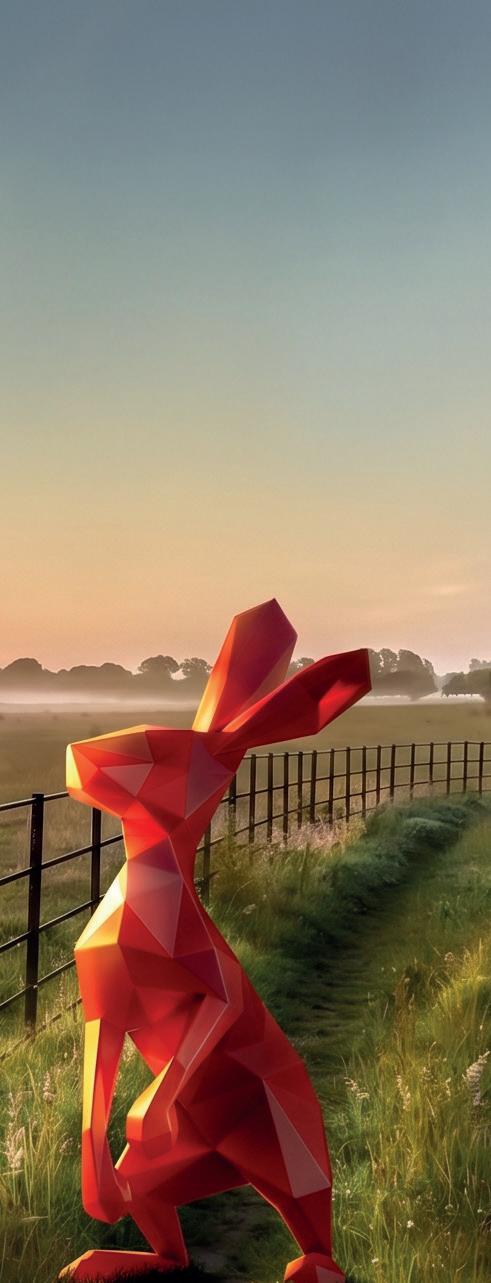






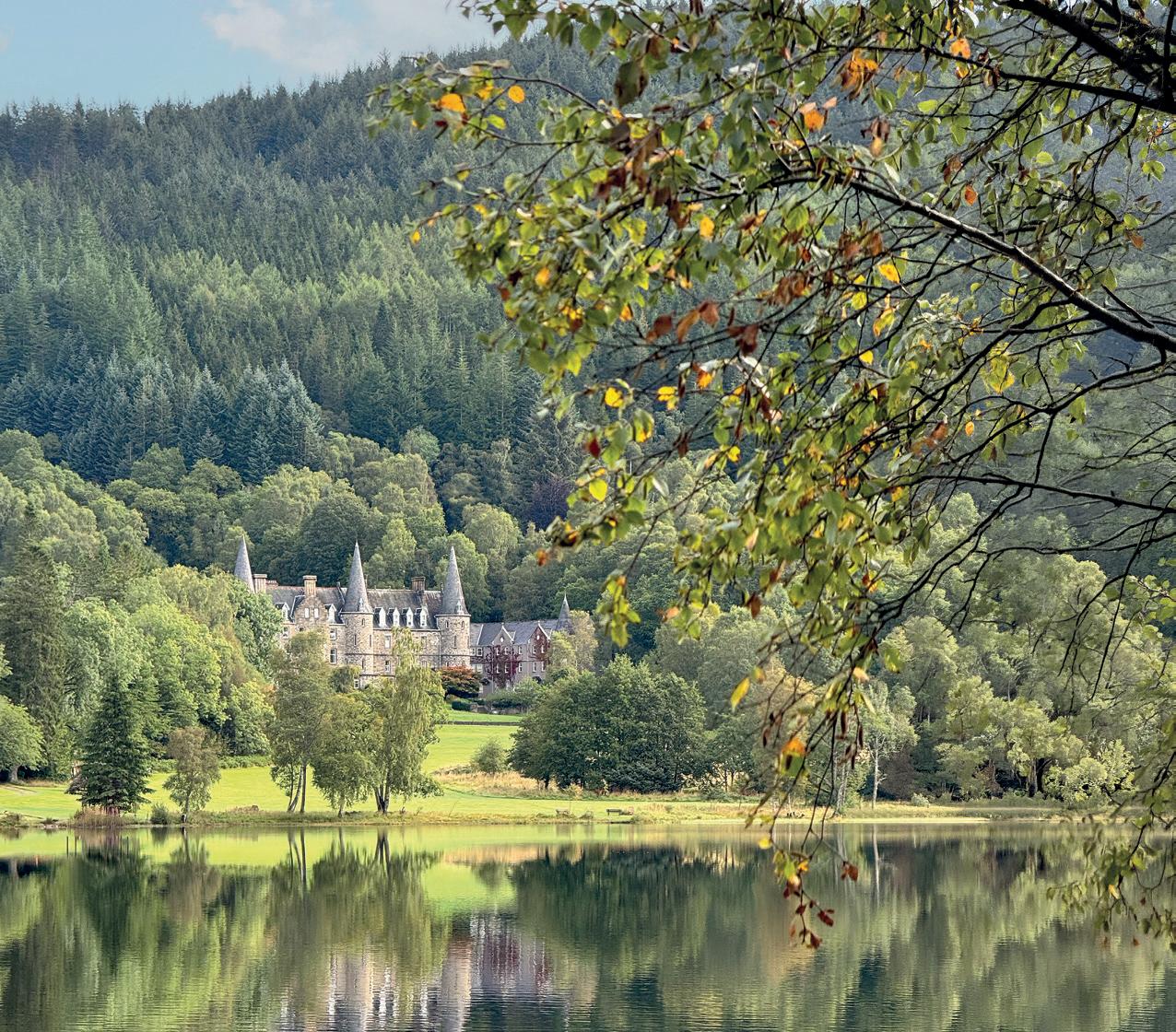
Imagine being able to enjoy fantastic holidays in beautiful locations like this. That’s exactly what over 40,000 discerning holidaymakers have already done.
The Holiday Property Bond’s portfolio currently includes more than 1,500 holiday homes in over 30 exclusive UK and European destinations. Discover this refreshing new approach to the way you plan and enjoy your holidays. You can even pass the benefits on to your children and grandchildren so they will also have a lifetime of wonderful holidays to look forward to.
Become a Bondholder with HPB and you could take your pick from unforgettable locations with breathtaking scenery every year, for life.
Please request your free brochure today Visit hpb.co.uk/nwt Or scan the QR code

HPB support The Wildlife Trusts in their aim to save and protect the UK’s wildlife and wild places.
That’s why we will donate £300 for every Norfolk Wildlife Trust member who becomes a Bondholder. See summary of the terms and conditions below.
Exclusive holidays for life An initial payment from £5,000 and a quarterly fee of under £39 (that is around £155 a year), which can increase in line with but not exceed the Retail Price Index Excluding Mortgage Interest (RPIX), gives you access to all HPB’s holiday homes. For each HPB holiday, you will pay a no-profit user charge covering only property running and maintenance costs and use of on-site facilities. The average charge is the same throughout the year, the average weekly charge for a studio sleeping two is around £388 and around £597 for a two bedroom property, larger properties are also available. After an initial charge of 25% your money is invested in a fund of holiday properties and securities. The fund itself meets annual charges of 2.5% of its net assets at cost, calculated monthly. Your investment return is purely in the form of holidays and, as with most investments, your capital is at risk. You can surrender your investment to the company after two years or more (subject to deferral in exceptional circumstances) but you will get back less than you invested because of the charges referred to above, as well as other overheads and changes in the
of the
and securities. This
Norfolk Wildlife Trust is a charity dedicated to all aspects of wildlife conservation in Norfolk. Our members help us to create a county where there is space for nature to thrive and more people are inspired to take action for nature.
Thank you so much for being a member. Why not give the gift of wildlife to someone else? A gift membership is a unique present for wildlife watchers, outdoors enthusiasts, or families keen to explore Norfolk further. We can even post a welcome pack with a message directly to the recipient on your behalf. They will also receive three copies of Tern each year, access to local events, and be able to explore NWT nature reserves for free. Visit our website to buy your gift or call 01603 625540
If you're not already a member of NWT, please join us today by visiting our website, calling our friendly team using the details below, or asking a member of staff at one of our visitor centres. Help us create a wilder Norfolk for all. 01603 625540 or norfolkwildlifetrust.org.uk/Join
Tern is published three times a year by Norfolk Wildlife Trust. Advertising sales by Countrywide Publications. Printed by Micropress Printers Ltd.
Editor Vicky Boorman Design Scott Poulson
While every care is taken when accepting advertisements neither Norfolk Wildlife Trust nor Countrywide Publications can accept responsibility for unsatisfactory transactions that may arise. The views expressed in this magazine are those of the contributors and not necessarily those of Norfolk Wildlife Trust. All contents © Norfolk Wildlife Trust.
Registered charity no. 208734
Alternative ways to read Tern
The magazine can be read on our website as a text-only document. You can make changes to font size and background colour, for easier reading, and enjoy Tern using a screen reader. This issue is available to download at norfolkwildlifetrust. org.uk/PlainTextTern
Never has it been more important to have hope. Active hope.
It can be very easy to lean towards despair when listening to the news. But if I am to have any agency, any sense of control over what is happening around me, I want to take action.
Inspiring and supporting everyone to act for nature lies at the heart of Norfolk Wildlife Trust’s strategy – from our staff and volunteers to our members, supporters and communities.
Our centenary year is a wonderful time to look back over the last 100 years and remind ourselves just how much has been done to help our county’s wildlife – and the amazing results that can be achieved by actively working together.
Taking action, and being hopeful, is a discipline. If we are to be effective, we need to plan with purpose and deliver with passion.
I’m delighted to be heading into our new century embarking on vast new habitat creation at Wood Norton, our new Wilder Claylands project and having achieved new funds to develop our ambitions for wildlife and people at Hickling Broad – all celebrated in this issue of Tern.
I would also recommend feeding your hope with a dose of wild inspiration. I’m getting mine from daily visits to our new osprey camera. What better reminder of what’s possible than watching the first osprey pair in the East to breed in hundreds of years settle down to raise a second family at NWT Ranworth Broad (p13).
I read recently that ‘Despair is a luxury and hope is a discipline’. That I think, really nails it. It’s a privilege to stand on the shoulders of every single person who has nurtured Norfolk’s nature during the last century. I take hope from each one of you – our members – and the fact that you are greater in number now than at any other point in our history.
I’m excited to continue sowing the seeds of ambition knowing that by acting together, we will nourish new growth as we look towards another 100 years of action – and hope.
With many thanks for your continued support,
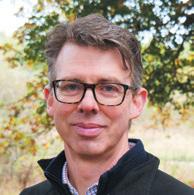
Eliot Lyne
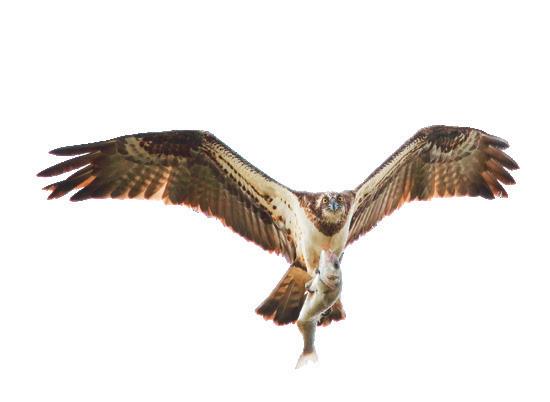
‘What better encapsulates our theme of hope than the return of the ospreys’

Welcome to summer Tern magazine. In this issue, we focus on our centenary theme of ‘100 years of hope’. Ambassador Nick Acheson explains why our recent ambitious land purchases fill him with optimism – and why, after all these years, he’s still passionate about Norfolk’s nature and the work of the Trust (p26). And what better encapsulates our theme of hope than the return of the ospreys to NWT Ranworth Broads and Marshes. We also hear stories of inspiration on our Wild People pages – plus we have a Q&A with a very special guest (p35).
As well as the excitement around the osprey, Ranworth is celebrating a milestone of its own this summer. It's been 50 years since the floating visitor centre was opened by Queen Elizabeth II. Read on to find out more about this beautiful Broadland nature reserve, as well as hear from one of our boat operators.
It's certainly been an exciting year so far – with our centenary celebrated on local TV and radio. Yet we can’t forget the everyday hard slog of conservation work – without which we may not be welcoming back the osprey or watching aquatic wildlife thrive in our crassula-free ponds. I hope you enjoy reading about it all in the magazine – thank you so much for your continued support.
Vicky Boorman Editor of Tern magazine
Alternative ways to read Tern
The magazine can be read on our website as a text-only document. You can make changes to font size and background colour, for easier reading, and enjoy Tern using a screen reader. This issue is available to download at norfolkwildlifetrust.org.uk/ PlainTextTern
6 Conservation in action
A snapshot of our latest conservation work
8 My wild life
Boat Operator Jayne Evans shares the best parts of her job
10 Wild news
Nature news from Norfolk and The Wildlife Trust 16 Wild summer
Explore and enjoy the nature on your patch this summer 32 Get involved Take action for Norfolk’s
Nick Acheson explores the nature supported by Norfolk’s sandy shores
Sarah Wilde delves into tales of hedgerows
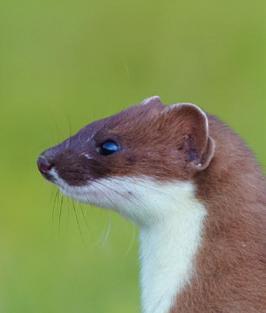
Can you tell the difference between a stoat and a weasel? 46 From our President
Patrick Barkham shares the delights of the Ranworth ospreys

14 Cracking down on crassula
Our mission to free aquatic life from this invasive plant
20 Wins for wildlife –thanks to you!
We celebrate some wildlife wins – and why we need your help to secure even more
22 A vision for an ancient landscape
Our Director of Nature Recovery shares our ambitions for a wilder Claylands
26 Hope for the future
Nick Acheson reflects on his time with NWT and explains why he is full of hope for the future
35 Chris Packham Q&A
Iconic author, presenter and naturalist reveals his favourite Norfolk sights
seed and the sower
Why gardening is no longer a lone pursuit for our conservation officer
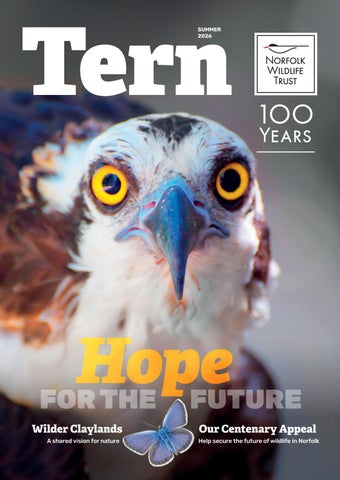
On the cover
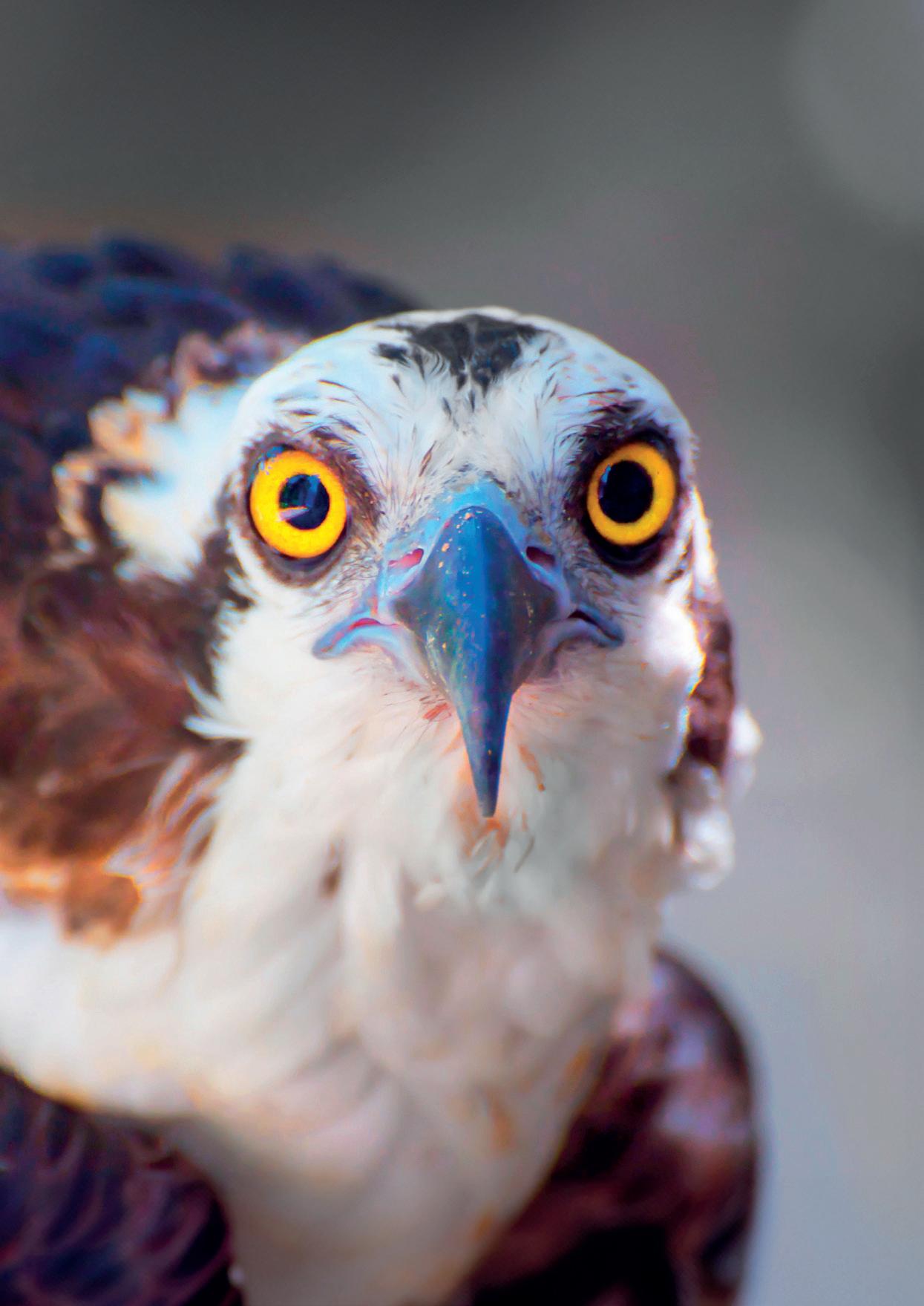
Male osprey BY ADOBESTOCK/GUNILLPHOTODESIGN
Our new camera provides a view of the nesting osprey at NWT Ranworth Broads and Marshes this summer.
in touch
Keep up to date with the latest nature news, campaigns and wildlife highlights
@norfolkwt norfolkwt /NorfolkWildlifeTrust

norfolkwildlifetrust.org.uk norfolkwildlifetrust.org.uk/SignUp
If you want to share an inspirational wildlife story, or something you’ve done to help nature, it could feature in our magazine. Get in touch editor@norfolkwildlifetrust.org.uk
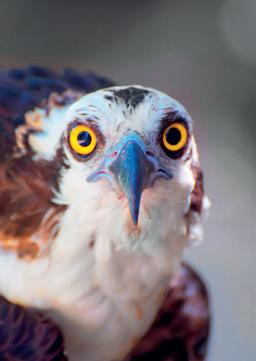
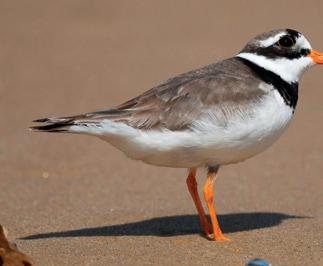
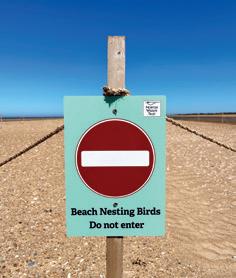
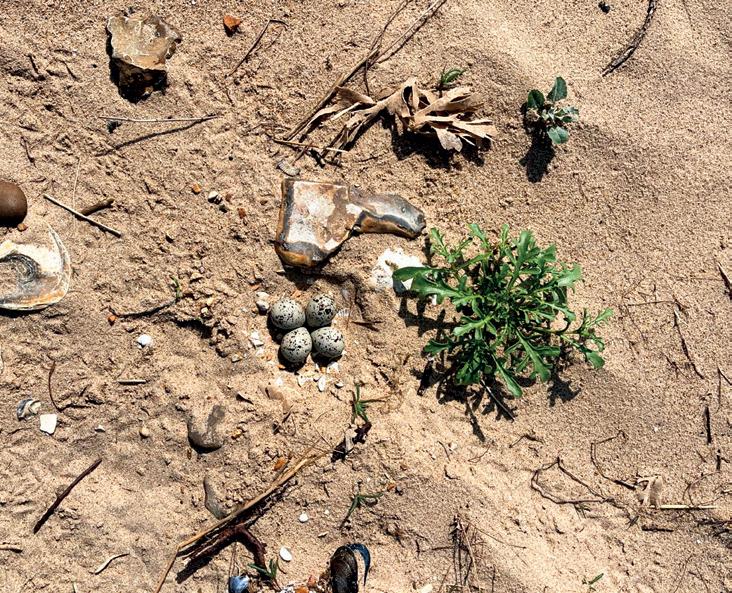
Together with volunteers, we started the huge job of putting up beachnesting bird cordons in March, protecting species such as ringed plover at Holme Dunes and Cley Marshes. Over the summer, our volunteer beach wardens support our wildlife by patrolling the beaches, helping the public to understand the importance of looking after these special species, as well as recording bird behaviour and nesting activity. Help us protect beach-nesting birds this summer: norfolkwildlifetrust.org.uk/ BeachNestingBirds
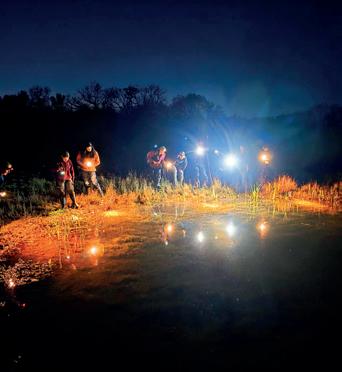
NWT staff taking part in training to learn how to survey ponds for great crested newts. Surveying was done with licence holders present under their strict guidance due to the protected nature of the species.
A snapshot of our latest conservation work, successes and favourite wildlife photos across Norfolk
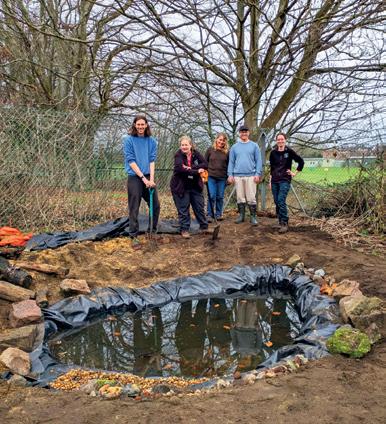
Together with Forest School Rangers and staff at Angel Road Junior School in Norwich, we’ve been digging a pond in the school grounds as part of our Wilder Schools project. It still needs some more plants and a bit more sprucing up, but they've already had frogs making themselves at home.
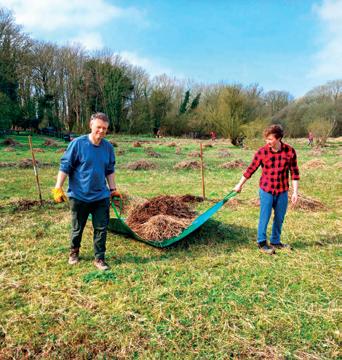
Volunteers at Toll’s Meadow, a County Wildlife Site, can now clear away cut vegetation more easily thanks to new drag mats purchased by NWT. Toll’s Meadow is an area of four and a half acres of species-rich wet meadow and woodland. It is situated in a gentle valley either side of the River Tiffey on the southwestern side of Wymondham.
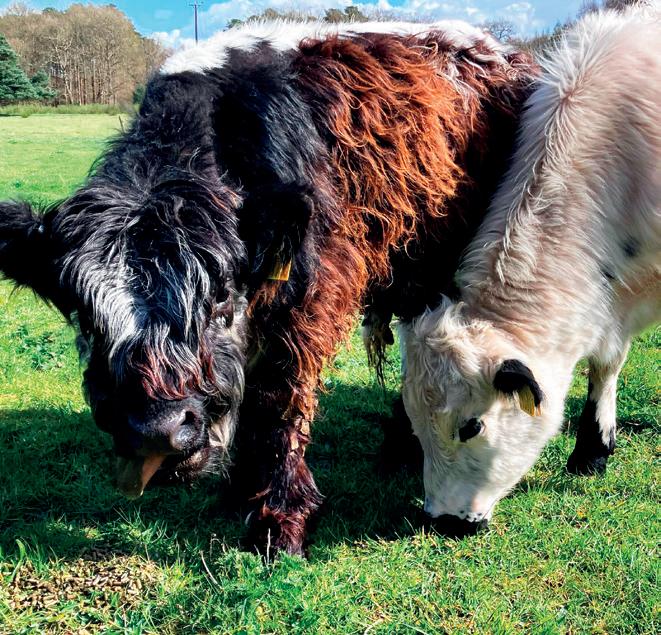
Our conservation grazing team has a fluffy new addition – our new bull calf. He's a Riggit Galloway and has been brought in to establish a small breeding herd to help us graze some of our wetland sites, especially in the Broads where their tough mouths will eat through harder vegetation like sedges.
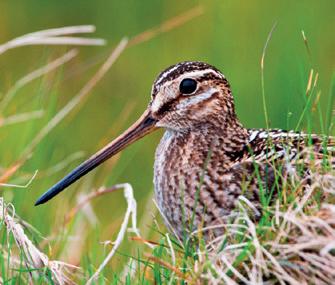
Fen plants such as milk parsley and grass-of-parnassus, insects including swallowtail and Norfolk hawker and birds such as snipe, benefit from the opening of coarse sedge beds for nesting and feeding.
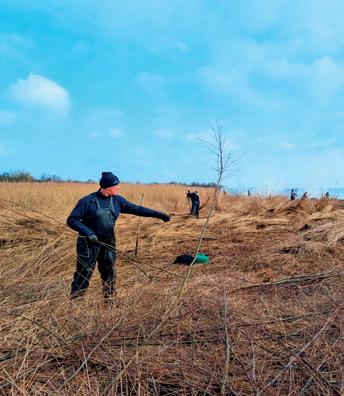
Here are some of our hard-working volunteers at Ranworth Broad and Marshes carrying out reed cutting and scrub management work. This winter work ensures the reedbed remains suitable for more specialised species such as marsh harrier, bittern and bearded tit.
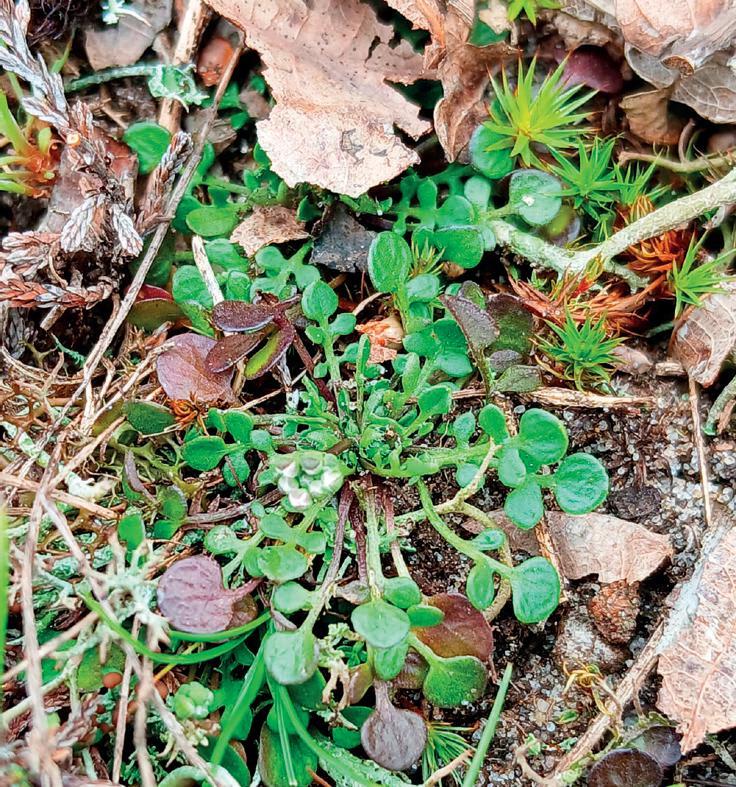
Pony grazing is essential to maintain an open, low sward for a range of scarce plants such as this shepherd’s cress on Grimston Warren where, before rediscovering it again in 2023, it hadn’t been recorded since 1962.
How did you get into your job?
My passion has always been the great outdoors and the natural world. I love mountain walking and anything that gets me on or in the water, like paddleboarding, canoeing and swimming. When I retired from fulltime work, as a journalist and events producer, I wanted a part-time job that finally banished offices and computers from my life. My partner saw this advertised and encouraged me to apply.
What does a typical day as a boat operator look like?
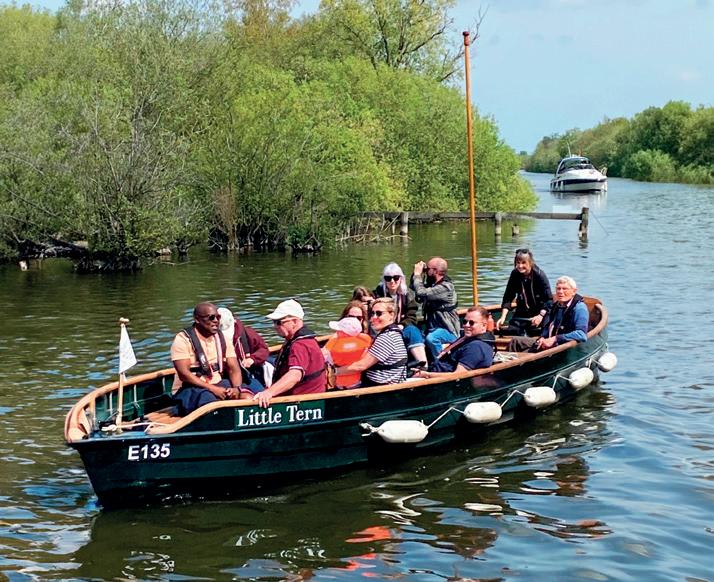
First we carry out safety checks on the boat and look at the weather forecast. I always chat to people while fitting their life jackets, so I can find out what they want out of the trip. The Little Tern is the only craft allowed on Ranworth Broad. We slowly and quietly explore the different habitats, talking about the birds we see, the history of the Broads and the conservation work of Norfolk Wildlife Trust. Each tour is different depending on the time of year, the weather conditions and who is on the boat.
What skills do you need to be able to do your job well?
All through my professional life I’ve had to communicate well with people, react to changing situations and get the best results possible, whatever the circumstances. I like to think I’ve transferred these skills to this new role. I’m also learning all the time and it’s such a pleasure when my passengers share their knowledge and stories about birds, wildlife and conservation.
What is your favourite part of your job?
I love the huge variety of people that I meet, from those new to Norfolk and the Broads, to bird experts with their long lens cameras and high end ‘bins’. But the greatest joy is making people happy and seeing their smiles as they get off the boat.
What makes Ranworth Broad such a special nature reserve?
Our reserve is so accessible; it’s a short, easy walk from Ranworth village along a boardwalk, or via the ferry service from Ranworth Staithe.
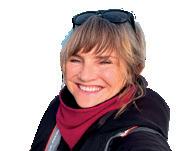
Jayne shares how she turned a love of nature into life on the water
The visitor centre offers a panoramic view over the Broad, we have binoculars for people to borrow, and the staff are happy to answer questions. There’s also a big screen broadcasting live from the ospreys’ nest this summer.
Why should people book a boat trip on Ranworth Broad?
As soon as the Little Tern purrs out onto the Broad, I like to think people relax. Each trip has its highlights, whether it’s a kingfisher, buzzards, great crested grebes, marsh harriers, and sometimes even a glimpse of an otter. Some passengers are lucky enough to see the osprey dive for fish.
What do you do in your spare time? Now my time is my own, I’m indulging in all my interests, from hiking and cycling, to knitting and weaving, to learning to paint and to play the ukulele. I know. It’s a lot. Friends tease me. But I’m never bored!
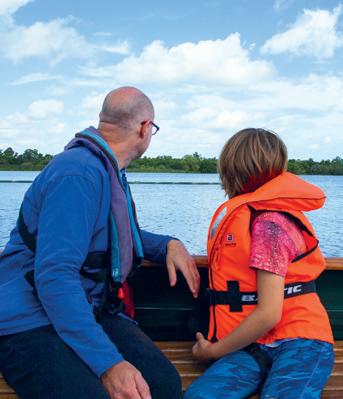
Explore the waterways of the Norfolk Broads with our guided wildlife boat trips from NWT Hickling Broad, the Pleasure Boat Hickling pub, and Ranworth Broad. norfolkwildlifetrust. org.uk/BoatTrips
SEE
PREMIUM OPTICS MADE SIMPLE
Sharp, high-contrast optics with natural color fidelity in a compact, intuitive design.
FEELS LIGHT AND RIGHT
Just 550 g and ergonomic, it fits any hand comfortably – even with gloves or glasses.
MADE TO MATCH YOUR ADVENTURE

Available in 8x30 or 10x30, with a color palette inspired by nature — Desert Orange, Mountain Green, and Safari Brown.
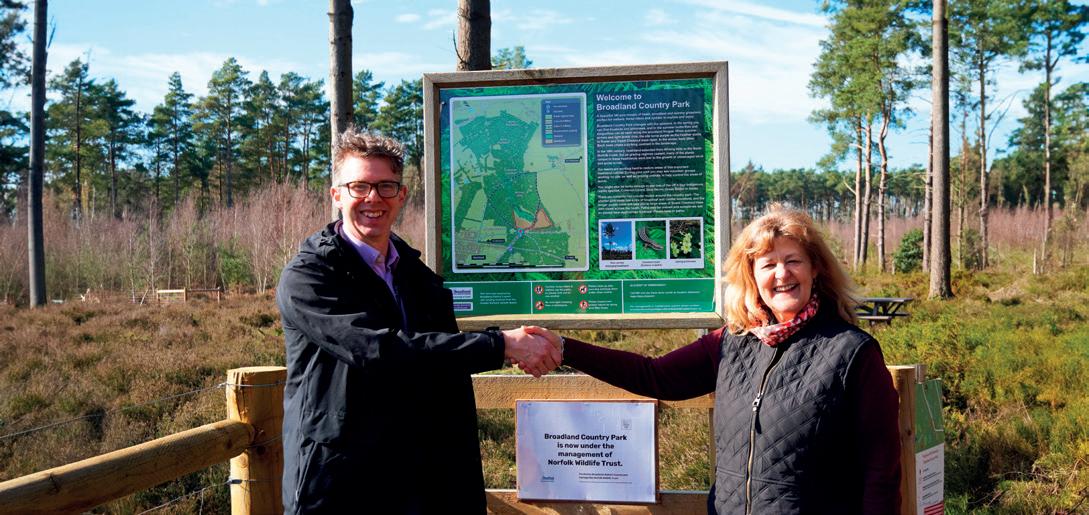
We’ve taken on the management of Broadland Country Park – and doubled it in size!
We are proud to announce that Broadland District Council has formally handed over the management of Broadland Country Park to Norfolk Wildlife Trust.
Since its opening, Broadland Country Park has become a popular green space for residents of Felthorpe, Horsford, and the wider Greater Norwich area.
As part of this exciting new partnership, the council will remain a key stakeholder in the park’s future, while Norfolk Wildlife Trust will serve as the principal managers of the site, bringing our extensive experience in managing land to benefit both nature and local communities.
Together, we have significantly expanded Broadland Country Park by purchasing 114 acres of land to the south of the site, effectively doubling the size of the park. Over time we will carry out conservation work designed to increase biodiversity across the landscape. We will restore and expand habitats such as native broadleaf woodland and
heathland, creating a richer and more varied environment for wildlife.
Across the park, we will create new paths for walkers and cyclists and offer a programme of wildlifefocused events, guided walks, and educational workshops.
Norfolk Wildlife Trust CEO, Eliot Lyne says: ‘We’re delighted to become custodians of Broadland Country Park and to be able to grow this amazing green space to almost twice its size with funding from Broadland District Council.
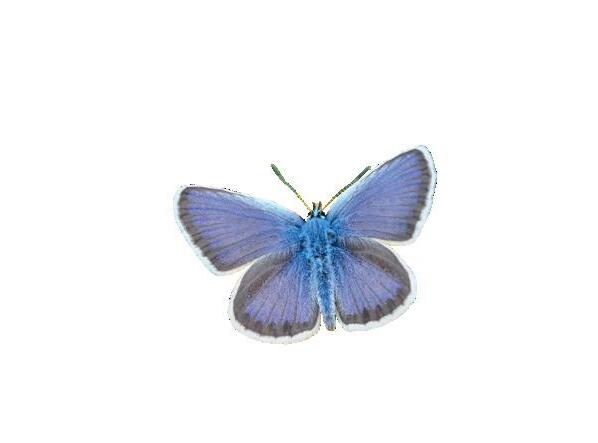
‘This is a brilliant site for the people of Norwich and its surroundings to experience nature and a vital piece of the puzzle for nature’s recovery in Norfolk. By managing these woods and heathlands, we can create a more resilient landscape for rare species like the nightjar and silverstudded blue butterfly. Nurturing Norfolk’s nature and helping make it part of everyone’s daily lives is vital if we are to protect wildlife for future generations and support healthy,
happy communities. We look forward to doing even more for nature and people at this special site for years to come.’
The park will remain free to enter and open to the public daily.
For more information, visit: www.norfolkwildlifetrust.org. uk/BroadlandCountryPark
Broadland District Council is in the process of building new visitor facilities at the park, thanks to generous funding provided by the Greater Norwich Growth Board. When they are complete, the site will offer a cafe and picnic benches, along with toilets, additional parking, a dog washing station and electric vehicle and bike charging points. They are due for completion in summer 2026 and will be handed over to Norfolk Wildlife Trust to manage.
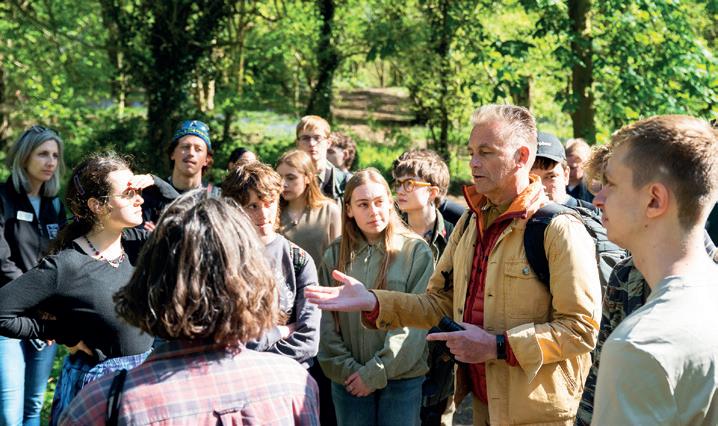
We were delighted to welcome Chris Packham for a special evening exploring Norfolk’s nature as part of our centenary celebrations.
The sell-out evening at UEA's lecture theatre in April was hosted in two acts. The first saw Chris joined on stage by NWT President Patrick Barkham for a wide-ranging conversation, before three remarkable young people – Toby, Scarlett and Oscar – took their seats alongside Chris. All three had taken part in a mentorship programme led by NWT Ambassador Nick Acheson, and their questions were as thoughtful as they were moving.
Afterwards, Toby reflected on how ‘speaking on stage with Chris Packham has really benefited my confidence.’ Scarlett echoed this, adding that her signed book now holds ‘a very special place’ on her shelf. For Oscar, the evening was nothing short of extraordinary: ‘Meeting Chris Packham in such a fantastic setting was a dream come true.’
Chris also generously gave his time before the event to lead our Youth Forum on a guided walk around campus and met with key NWT donors and partners.
The event was led by Norfolk Wildlife Trust, with UEA providing staff and spaces to welcome
guests. The collaboration follows our 2025 Memorandum of Understanding, in which UEA and NWT formally recognised a shared vision for nature and society.
Don’t miss our Q&A with Chris Packham on p35.
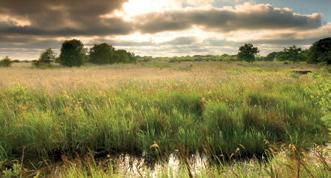
Our ambition for a wilder Hickling has received a boost thanks to funding from the National Lottery Heritage fund. We have been granted £453,115 to support us to expand our work creating a haven for many of the UK’s rarest animals and plants at Hickling Broad and Marshes. Thanks to National Lottery players, we will also be able to explore new ways for people to experience the uniquely wild landscapes of the Broad, both at our nature reserve and at NWT Hickling Staithe.
Much of our work for wildlife will focus on the urgent need to improve the resilience of the nature reserve’s nationally important habitats in the
face of climate change. This will include helping Hickling’s habitats adapt to future higher water levels. It will also allow us to create a 160-hectare shifting mosaic of sustainably managed wetland. This habitat will benefit breeding crane, spoonbill, marsh harrier, bittern, lapwing, and swallowtail butterfly.
We now have an opportunity to develop new nature experiences for a wide diversity of people. This will include improved paths and viewpoints at the nature reserve. We're also planning a new welcome cabin and Changing Places toilet at Hickling Staithe. Across the wider area, we’re designing an accessible boardwalk as well as cycling and walking routes. To top it off, we’re looking forward to developing new ways for people to enjoy the Broad by water, including boat trips, ferry services and via canoe and paddleboard.
The new funding will allow us to put detailed plans in place over the next 18 months. This will enable us to apply for further funds to make them a reality in future years. There will be lots of opportunities for residents and visitors to share their thoughts as our plans develop – we're excited to get started!
To find out more about our vision for a wilder Hickling visit: norfolkwildlifetrust. org.uk/WilderHickling
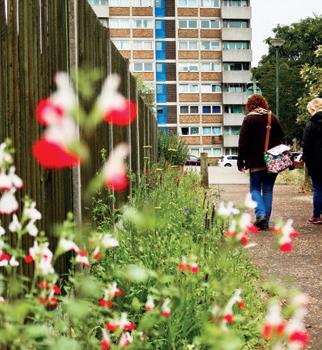
We are delighted to launch Wilder Norwich — a new urban nature project bringing people and wildlife together.
In partnership with Norfolk and Waveney Mind and Norwich City Council, we will work with communities around three key green spaces: NWT Sweet Briar Marshes, Mousehold Heath and Whitlingham Country Park.
Wilder Norwich is all about listening to local people and supporting them to shape greener, healthier neighbourhoods. By sharing stories and inspiring action, we hope to spark a ripple effect across the city — helping more communities connect with and care for nature.
With more communities and individuals coming together to create more nature-rich spaces, green and blue corridors will connect across the city, creating super highways for a range of wildlife and making Norwich a more vibrant, healthy and climateresilient city for everyone.
The three-year project is funded by lottery players, through the National Lottery Reaching Communities Fund.
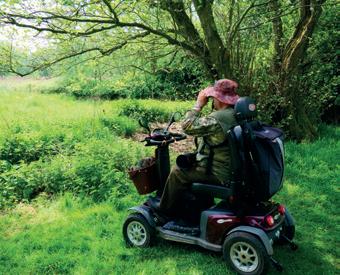
Exciting times at our Norwich nature reserve as we near completion of our work to enhance accessibility. There is now a surfaced path replacing the often flooded and muddy one linking our reserve through Mile Cross Marsh to the riverside path. This means that our Mile Cross entrance is now accessible to wheelchair users and mobility scooters directly from the south and from Marriott’s Way to the north.
On the eastern side of the reserve itself, our new entrance to Marriott’s Way is nearly complete. This gate will create a link to our recently purchased yard on Burnet Road, Sweet Briar Road Industrial Estate. The yard will have facilities for those with accessibility needs, including some Blue Badge parking spaces. It will also contain a much-needed base for staff and volunteers, as well as parking for school groups.
Near the new entrance, you may notice a cleared hard surface area that will become a space with social seating, a new path that will eventually lead to a viewing platform over the marshland and mounds of earth left by the excavation of
Since spring, we’ve been calling for stronger safeguards for chalk streams through the government’s recent National Planning Policy Framework (NPPF) consultation. With your help, we are pushing for chalk streams to be designated as ‘irreplaceable habitats’ –giving them the same protection as ancient woodland. More than 500 of you contacted your MPs, joining almost 5,500 others across the UK. Together, we made a difference –and draft NPPF changes now mention chalk streams. However, these protections aren't nearly enough, and we continue to press for clearer legal status and stronger planning controls to protect this rare habitat.
In another area of government, a Nuclear Regulatory Review was published. Alarmingly it proposed weakening our existing Habitats Regulations and environmental duties
our new entrance. The latter will be landscaped to create a bank of sandy, bare earth, ideal for solitary bees to nest in. Look out for new illustrated information panels across the site too.
This phase of work at Sweet Briar Marshes has been made possible thanks to generous funding from our project partners, Aviva, the Greater Norwich Growth Board through the Infrastructure Investment Fund, and The Geoffrey Watling Charity.


– the laws that protect so many of our wild spaces from harm. NWT, alongside 500 of you, joined thousands of others across the country to campaign against the proposals, resulting in the most environmentally damaging of them being watered down.
Thanks to our campaigning, the government has pulled back from a blanket removal of the legal duty to protect important habitats. However, we are still really concerned about the implementation of new guidance and the consequent risks to nature – so we will continue to fight for the protection that our wildlife needs.
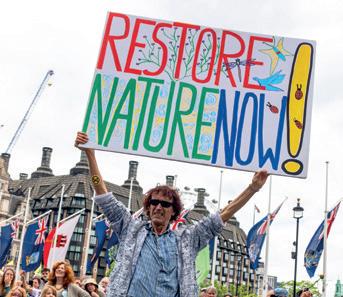
Ahead of the County Council elections in May – and with plans underway to establish a new Combined County Authority for Norfolk and Suffolk – we joined forced with Suffolk Wildlife Trust, alongside other local environmental groups, to launch our United for Nature campaign.
The initiative calls on local leaders to ensure that nature recovery and environmental sustainability are central to future decision-making.
At a time when climate change and biodiversity loss are approaching
critical tipping points, we believe that the region faces a once-in-ageneration opportunity to deliver genuinely sustainable growth that benefits both people and wildlife.
At the heart of the campaign is a clear message: restoring nature is not optional – it is essential to securing a healthier, more resilient future.
Our CEO, Eliot Lyne, says: ‘Devolution is reshaping how our county is governed. We’re seizing all opportunities to influence today’s
New camera’s view of osprey nest
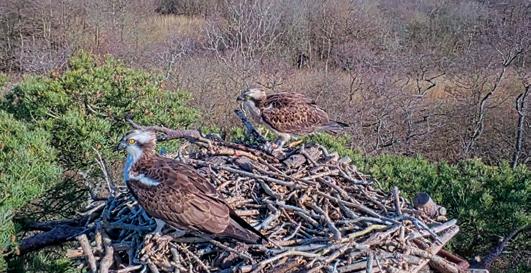
We have launched a special new wildlife camera at NWT Ranworth Broad offering nest-side views of family life for our history-making osprey pair.
Last year, the couple successfully fledged two chicks – making Ranworth Broad the first known site in the region for breeding osprey in hundreds of years.
Just before the avian couple were due to return this year, we carefully installed a camera that offers views into the nest the pair used in 2025, which are being streamed online thanks to support from NWT corporate partners, MelBek.
Much to our delight, the birds returned in late March following a long migration, choosing to settle back into the same nest site as last year within close sight of our new camera.
Teala Leader, NWT Visitor Centre Co-ordinator, tells us: ‘I’ve been watching our osprey pair for years now, so it’s like welcoming old friends back. Visitors love to see these special birds so it’s brilliant to be able to offer them even closer views of family life. It also opens a new world of natural wonder to people that can’t visit the nature reserve by offering them the chance to watch from home.’
The osprey camera is available to view on a screen in the visitor centre, or watch online at: norfolkwildlifetrust.org.uk/RanworthCamera
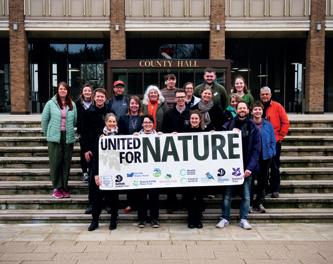
leaders and tomorrow’s decisionmakers to put Norfolk’s nature at the heart of it from the start.’
Find out more: norfolkwildlifetrust.org.uk/ UnitedForNature
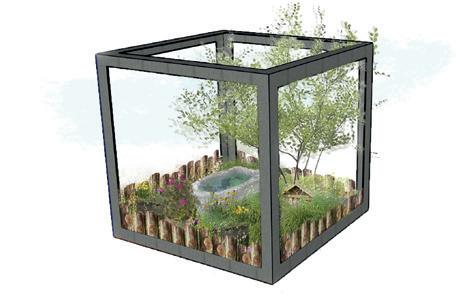
Some exciting news during our centenary year – we will be exhibiting at the inaugural RHS Sandringham Flower Show this July!
Our garden will form part of RHS ‘Community Cubes’ scheme, a series of 3m x 3m metal frames housing show gardens by charities and community groups. Our garden will showcase just some of the ways that gardeners can ‘Do One Thing for Wildlife’ in their own green spaces. Featuring hedgehog highways, a reclaimed pond, and native plants a-plenty, we hope our garden will show visitors how they can encourage wildlife into their gardens. Our garden has been created in collaboration with designer Bea Tann and will be built by an enthusiastic team of Norfolk Wildlife Trust staff.
The show runs from 22 – 26 July in the grounds of the royal family-owned estate. It will be open from 10am6pm, Wednesday 22 – Saturday 25, and 10am-5pm on Sunday 26 July. Be sure to come and see us and say hello if you’re attending the show! More information about our garden and purchasing tickets to the show can be found by visiting: norfolkwildlifetrust. org.uk/RHSSandringham
Celebrate our 100th birthday with us by pledging to do one new thing for wildlife. Find out more: norfolkwildlifetrust. org.uk/DoOneThing
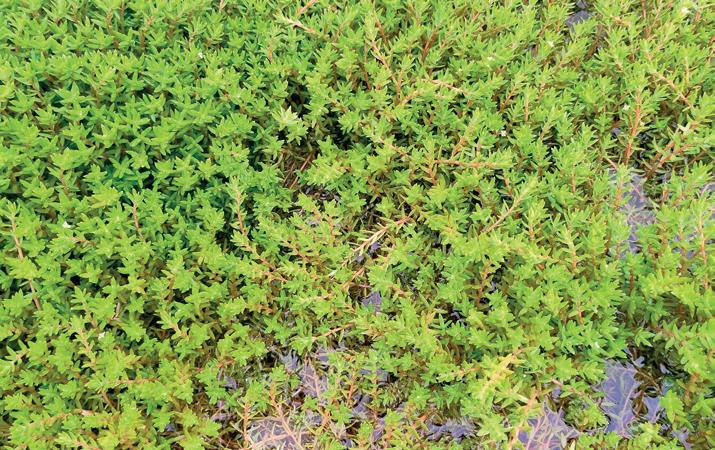
With funding from the Anglian Water Invasive Non-Native Species Fund, we have set out on a twoyear project to remove an invasive plant from two important sites in South Norfolk, and spread awareness of this pernicious plant.
Crassula helmsii, also known as New Zealand pygmyweed or Australian swamp stonecrop, is a non-native plant that can quickly dominate waterbodies, forming thick mats, to the exclusion of almost every other species.
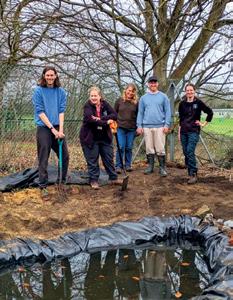
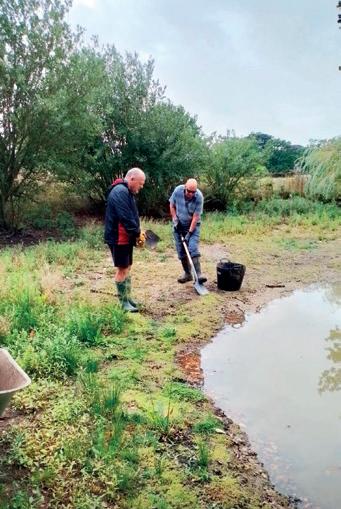
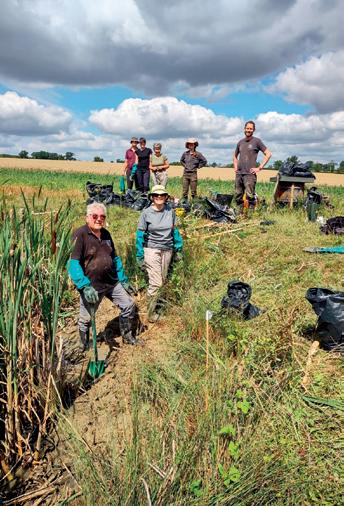
Two groups of intrepid NWT volunteers have embarked on efforts to tackle pond infestations of the plant at Earsham Estate and Mulbarton Common, to preserve the sites’ wetland biodiversity.
NWT's Wilder Landscapes Adviser, Ethne Clark has been leading the project and tells us more: ‘Clad in "Crassula wellies" and with spades in hand, we have been undertaking regular clearance sessions. Combing over each pond, we mark any patches that we encounter with tape-topped bamboo flags, before digging the plant out under the roots and removing the material from the ponds.
‘As well as Crassula helmsii, we have discovered evidence of many other species using the ponds: grass snake
sheds, water scorpions, dragonfly exuviae (exoskeletons left on vegetation as nymphs transform into adults), rushes nibbled by water vole, and a plethora of native pond plants. This beautifully demonstrates the rich biodiversity we are protecting through tackling this invasive weed. At Mulbarton Common we’ve also found a total of four horseshoes buried in the mud, showing the historic and cultural importance of ponds on common land for watering horses.
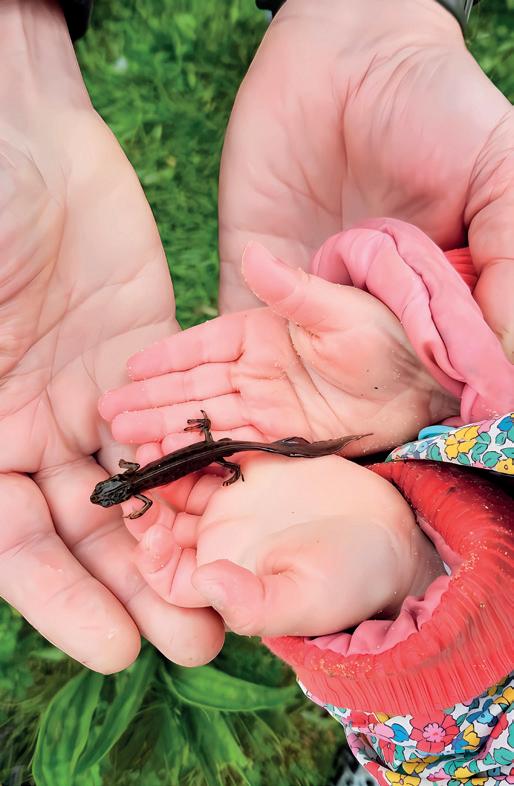
'This bright green creeping succulent can quickly colonise ponds, lakes, reservoirs, ditches and reedbeds. New infestations can grow from a single tiny fragment, so biosecurity is key with any management method. However, by clearing and controlling this invasive species, we can protect native aquatic plants that are necessary for creatures such as frogs, newts and dragonflies to hide, feed and lay eggs.
‘If you have been inspired by the achievements of our current volunteers and want to help out, we would love for you to join us! Please contact ponds@norfolkwildlifetrust. org.uk for more information, check out our events page for our upcoming Crassula helmsii training event, and help protect the wonderful wildlife of Norfolk’s ponds.’
Our new Crassula helmsii eradication guidance is here! In collaboration with Norfolk Ponds Project and Crassula Project Officer, Julia MumfordSmith, we have devised a handy leaflet, providing guidance on how to safely and successfully remove Crassula helmsii from your pond. Find the document on our website at www.norfolkwildlife. org.uk/CrassulaClearOut


supporting nature conservation since 1988
ALL our profits are donated to the Wildlife Trusts
natural history holidays
small friendly groups

2026-27 trips
Morocco: autumn wildlife


Cyprus: wild flowers at Christmas
Tasmania: marsupials and wild flowers
South Africa: Drakensberg mountains
Costa Rica: easy birding
Bavarian Alps: wildlife by train
Lesvos: spring wildlife of the Aegean
France: Dordogne, Cevennes, Vercors
Crete: spring flowers/autumn bulbs 01954 713575 www.wildlife-travel.co.uk
Traditional Farm - Workhouse Museum - Adventure Playground


relaxed pace expert leaders www.gressenhall.norfolk.gov.uk

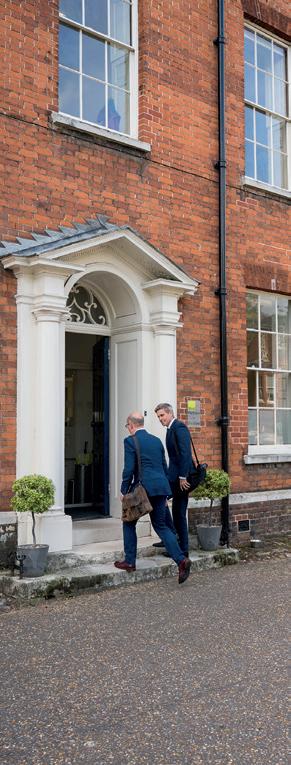
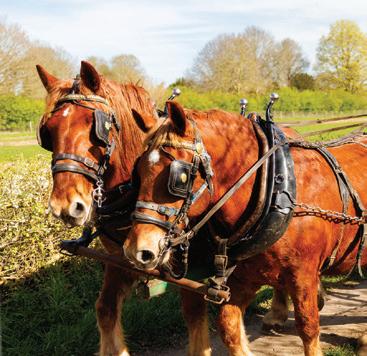
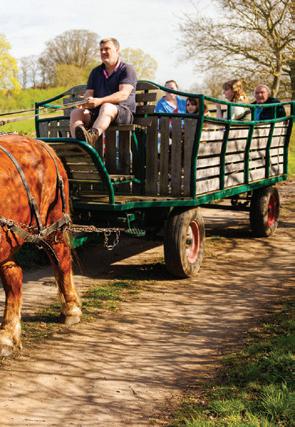
Discover East Anglian rural life in the heart of Norfolk. Explore a Victorian workhouse museum, a recreated 1930s village and heritage farm with rare breeds, all set within 50 acres of woodland, gardens and orchards. Enjoy family trails, an adventure playground, a lively programme of events and a welcoming café.




Explore and enjoy the nature on your patch
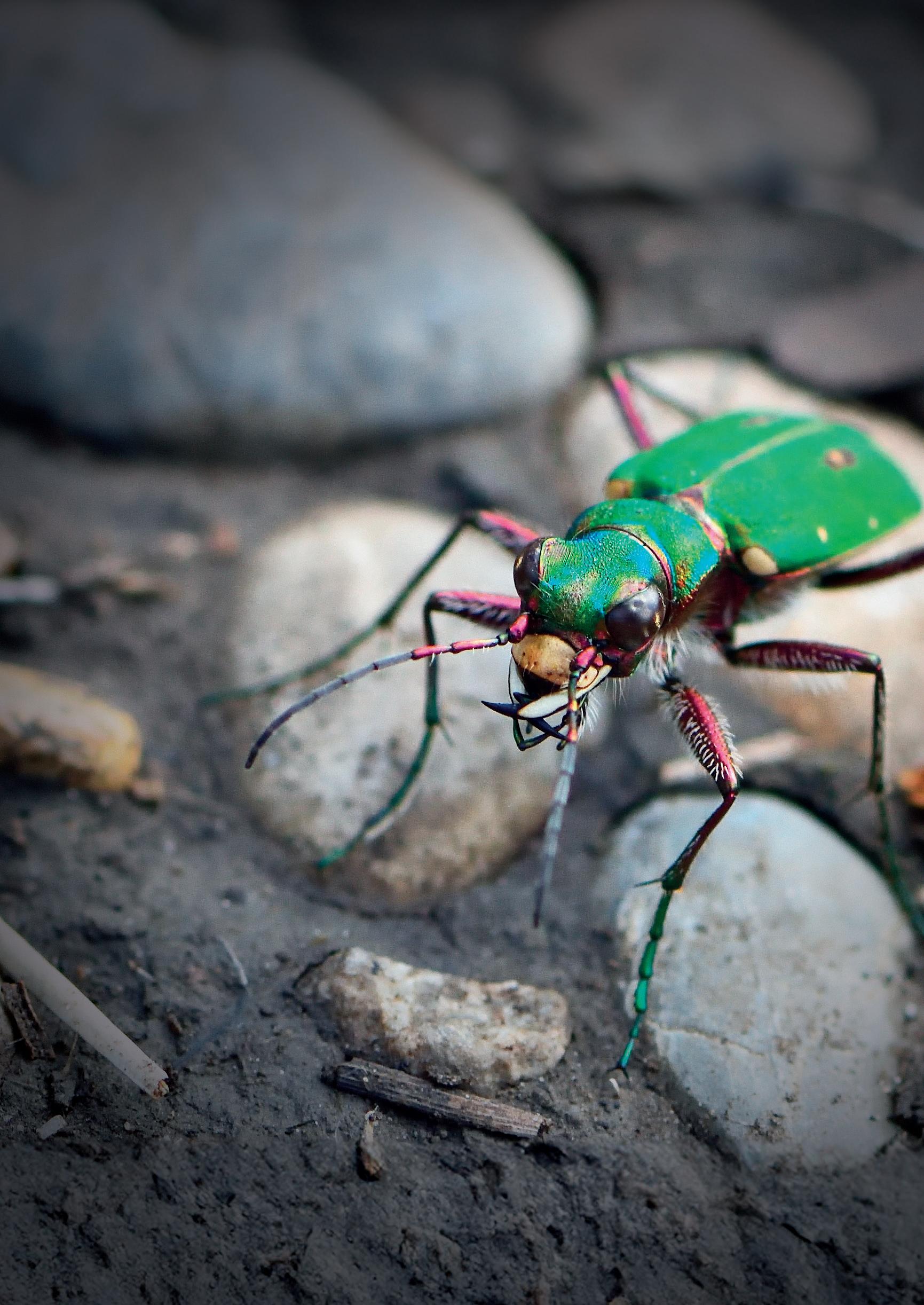
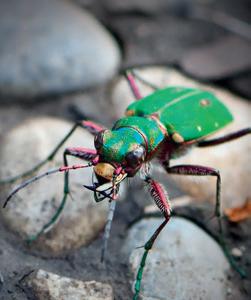
A green tiger beetle has been clocked running at five miles an hour – scaled up that would make it one of the fastest animals on the planet.
The green tiger beetle is a ferocious predator found on bare dry ground with patchy vegetation. As its name suggests, it is a metallic green colour with cream spots that are bordered with black. They have huge eyes, strong sharp jaws and are constantly active. These fast-moving hunters feed on any small invertebrates that are unfortunate enough to get in their way. They are competent flyers too.
Living in small colonies, the beetles’ eggs are laid in separate burrows in the ground. When the egg hatches the resulting larvae will remain in the burrow, widening it to fit as they grow. Like their parents they have formidable mandibles (paired jaws), and their burrow acts like a pitfall trap. They will pull an insect the size of a damselfly into their lair. They also have a spine adaptation on their back that anchors them in and prevents them being dragged out.
Go wild
As it is with nature, the green tiger beetle doesn’t have it all its own way. The larvae are often parasitised by a solitary wasp Methoca Ichneumonoides, which will paralyse it with a sting, then lay an egg next to the beetle larva’s immobile body. The wasp grub will have a ready supply of fresh meat and a safe burrow to live in. The adult and larvae beetles are on the look-out for this wasp and will kill it if they can, but the wasp’s smooth and slender body makes it difficult for the green tiger beetle to hold on to it.
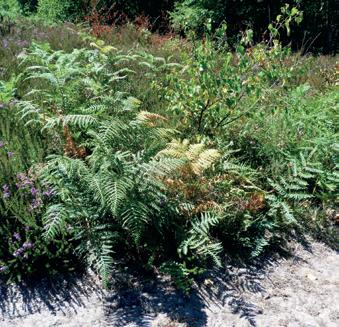
Green tiger beetles can be relatively easy to find in the right place. NWT Buxton Heath, NWT Holme Dunes and the paths and flood bank around Hickling Broad are good places to look.
If you haven’t been to NWT’s Broads Wildlife Centre at Ranworth, then this summer is the time to go. This year marks the 50th anniversary of its opening by the Trust’s former patron, Queen Elizabeth II. This unique reed-thatched floating visitor centre can be reached by a ferry service from Ranworth village public staithe, or by a pleasant ten minutes’ walk along Broad Road to the entrance of the nature reserve. The ferry trip will take you across Malthouse Broad, and in summer great crested grebes will slip silently under water as the boat approaches. Swallows and martins hunt insects disturbed from the water’s surface, throwing themselves towards the ferry like darts, then turning sharply as if surprised to find it there.
Why not combine your visit with a wander around Ranworth village, which sits between Ranworth and Malthouse broads. The beautiful Saint Helen’s church allows visitors to climb the spiralling staircase to the roof of the 96ft tower, giving spectacular views across the landscape. There is also a village pub, and a charming tea room.
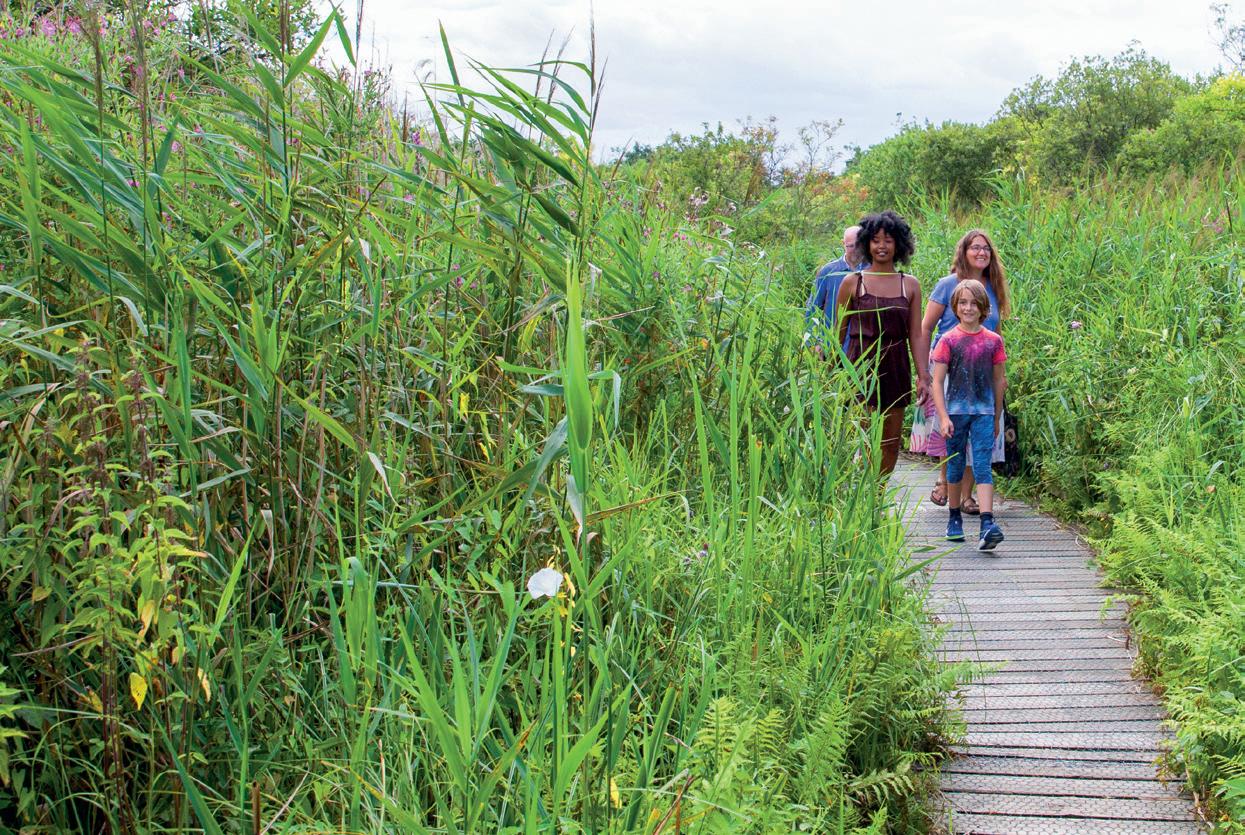
If you take the boardwalk to the nature reserve, you will be welcomed by a five-hundred-year-old oak standing like a sentinel at the beginning of the route. There is ease of access for wheelchairs along the raised wooden path. It ambles through a swampy alder carr wood before opening into reedbed and ending at the floating visitor centre.
The wood contains an array of flora, including an impressive royal fern. Marsh tit and Cetti’s warbler breed here, as do reed bunting and sedge warbler. Either side of the boardwalk, dissecting the reedbed, colourful orchids sit among meadowsweet, purple loosestrife, marsh sow thistle and decades-old tussock sedges. The picnic tables at the end of the boardwalk are as good as anywhere to see the splendid swallowtail butterfly.
By car: NWT Ranworth Broad is close to the village of Ranworth in the heart of the Broads. In Ranworth look for signs for Broads Wildlife Centre Car Park (postcode NR13 6HY)
By train/bike: the reserve is a 25-minute cycle ride from Salhouse and Acle stations which have regular train services to Norwich, Great Yarmouth and Sheringham. Norfolkwildlifetrust.org.uk /RanworthBroad
We'd love to hear which of our reserves is your favourite. Let us know what you love about it: editor@norfolkwildlifetrust.org.uk
Tell us
This summer...
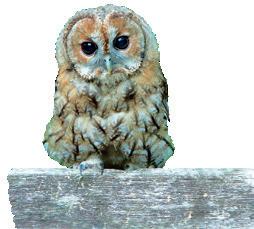
If you hear something like squeaky toys in the trees at night, it might be tawny owl chicks begging for food from their parents. During the day you may find the downy chicks sitting together on a branch, their location is often given away by noisy songbirds ‘mobbing’ them.
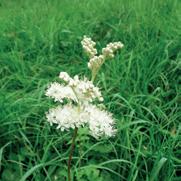
If you crush a leaf of meadowsweet, it produces an antiseptic smell reminiscent of ‘Germolene’. In contrast the creamywhite flowers have a wonderful honey scent to them. This led to the old country name for the plant – ‘courtship & matrimony’.
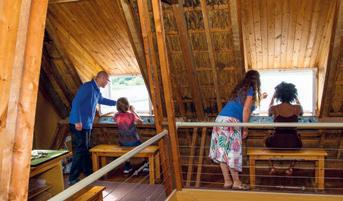
A view from the visitor centre
Ranworth allows, in a neat package, a taste of the Norfolk Broads. The Broads Wildlife Centre has large panel windows that provide unrestricted views of the broad. With luck you may see a kingfisher skimming across the water, or the family of otters that frequent the broad. Multiple pairs of common tern nest on the special rafts provided in front of the visitor centre. Sit for a while and watch their noisy antics as they acrobatically plunge into the water to catch small fish.
The centre has displays providing information on the history of the Broads, as well as the people and wildlife here. Summer visitors can watch our new osprey camera feed on a screen in the visitor centre. Head upstairs to the top-floor viewing gallery via our new, more accessible, staircase and you’ll find children’s activities and binoculars available to borrow.
1 2 3 4 5 6
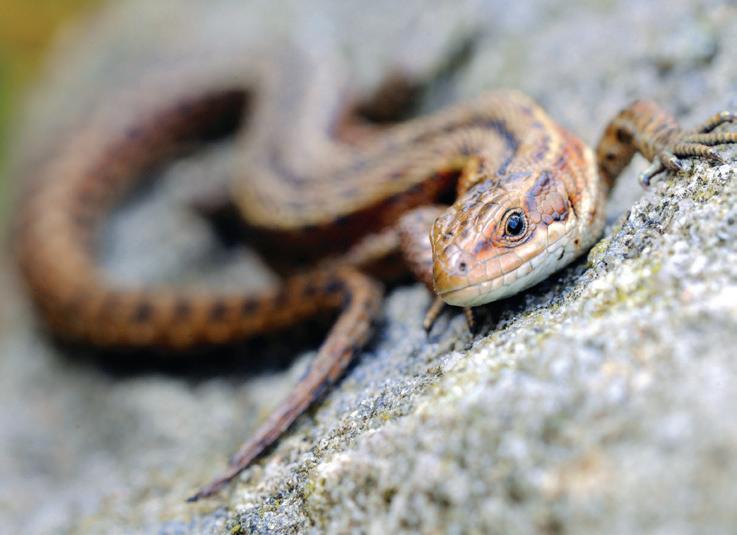
The first step is to make sure reptiles (and other wildlife) can get into your garden. A hedge is a better garden boundary for wildlife than a fence, providing shelter and letting small animals pass through. If a hedge isn’t an option, consider cutting a small hole in the bottom of your fence.
Nothing attracts wildlife like water. Add a pond to your garden, wildlife will come. If you’re lucky, grass snakes might even hunt there, searching for frogs and other amphibians. They’re excellent swimmers, wriggling through the water with ease.
Reptiles bask to raise their body temperature. Grass snakes and common lizards like open spots, so a sun-drenched rock or log could be perfect. Slow-worms prefer to warm up under cover. A piece of slate, wooden board or roofing felt could make a great slow-worm sauna. Place it in a south-facing, sunny position, on top of vegetation rather than bare ground.
Composting is more than just a great way to recycle garden waste. Slow-worms will slither through a compost heap in search of slugs. It might even serve as a natural incubator for the eggs of a grass snake – avoid turning compost from June to late September to avoid damaging them. Place your heap in a sunny spot, ideally by a hedge or long grass.
Leave an area of lawn to grow wild, providing cover for reptiles. If you need to cut some long grass, walk through it first to give any hiding reptiles the chance to move.
A log pile is the ultimate multi-use facility. It can offer shelter for reptiles to hide away over winter, attract insects and other wildlife that reptiles feed on, and provide a prominent perch for basking in the sunlight.
Get more inspiration for wildlife gardening on p30.
Over the last century, our members have helped achieve some truly incredible wins for wildlife in Norfolk. Whether you have donated to an appeal, given your time as a volunteer, or simply enjoyed visiting our nature reserves, every achievement has been built on your generosity and dedication to protecting Norfolk’s wildlife. Together we have helped to reintroduce lost species, expand and restore precious habitats, and advocate for nature in Norfolk.
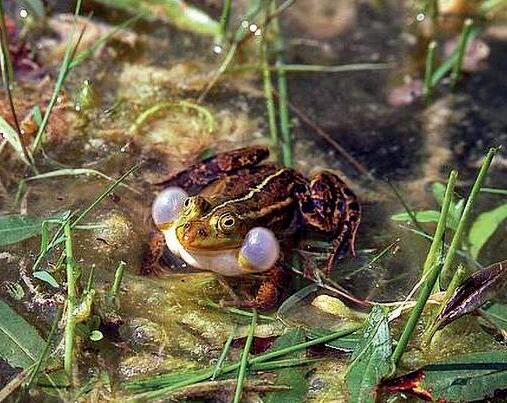
As recently as 1995, northern pool frogs were presumed extinct in England. Today, thanks to a reintroduction project in collaboration with Natural England and the Amphibian and Reptile Conservation Trust (ARC), they are thriving once again at NWT Thompson Common.
The success of this project hinged on creating the perfect conditions for these rare amphibians. Existing suitable habitat – large sunny ponds set within open woodland – was carefully enhanced to provide an ideal home. Northern pool frogs were successfully reintroduced in 2021, marking the end of a decades-long absence.
But the story doesn't end there. In 2023, your support helped us begin an ambitious project to restore ancient ice age ponds, known as pingos, on land bordering Thompson Common. Our aim is to restore 32 of these remarkable ponds across 700 acres of wildlife-focused habitat, allowing the pool frog population to move and grow, ensuring this species has the best possible chance of a secure future in Norfolk.
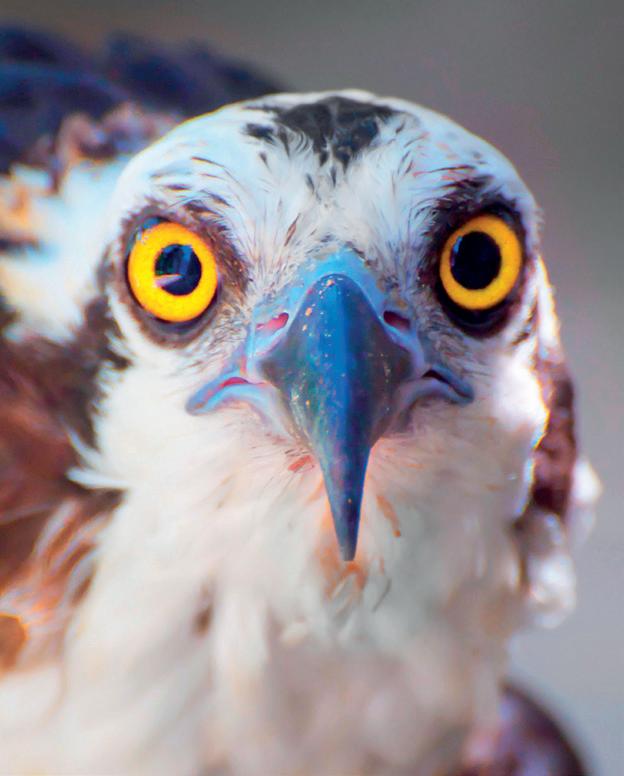
2025 was an exciting year at NWT Ranworth Broad! Around 250 years after they last bred in East Anglia, a pair of ospreys successfully fledged two young. Through careful manipulation of the underwater ecology of the Broad as part of our ‘Tipping the Balance’ project, we helped encourage clearer water that has allowed vital aquatic plants to regenerate and provided the perfect hunting grounds for osprey. Your enthusiasm for our family of fish-hawks helped to raise vital awareness of our wonderful Broadland wildlife!
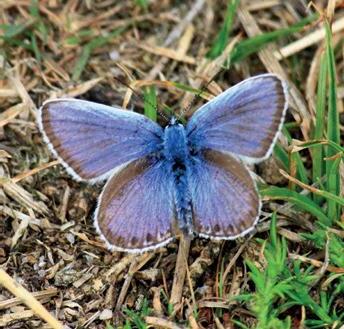
The silver-studded blue, a small and beautiful heathland butterfly, has suffered dramatic declines across much of Britain. But in Norfolk the story is one of hope, thanks to dedicated conservation work and habitat creation enabled by your support.
A thriving colony now exists at NWT Buxton Heath, the result of a reintroduction programme that began in 1985. Through considerable
heathland restoration work – including extending heathland habitat into former commercial pine forest –we have helped enable this population to flourish and grow year after year.
The benefits extend far beyond a single butterfly species. Improvements to the heathland at Buxton have created a haven for a whole host of wildlife, from rare invertebrates to ground-nesting birds, demonstrating how restoring one habitat can bring wins for countless species.
These stories represent just a fraction of what we've achieved together over the last 100 years. Northern pool frogs calling from sunny Breckland ponds, ospreys soaring over the Broads, silverstudded blues flitting across heather-strewn heathland –each victory is only possible because of your support.
But, sadly, our work is not over. Beloved species like swallowtail butterfly, curlew, and water vole are struggling amidst mounting challenges from habitat loss, climate change, and declining biodiversity –and they need us now more than ever. We must raise vital funds to protect Norfolk's precious wild places and the wildlife that lives there – that's why we need your help to raise £100,000 to secure the future of Norfolk's nature.
We want to be able to celebrate even more wins for wildlife with you. Please donate to our Centenary Appeal today and help us to give species like these – and many others – a fighting chance.
Donate over £500 and leave a lasting legacy by joining us to plant one of just 100 centenary oak saplings in our new land at NWT Foxley Wood this autumn. We’re delighted that many members, trustees and staff have supported the appeal by donating in celebration of anniversaries, in memory of loved ones, or by pledging to raise the amount through exciting challenges. As a thank you, donors of £500 or more will also receive acknowledgement on a plaque at Foxley Wood and a limited-edition illustrated map of the reserve.

Just 50 oaks and maps availablestill
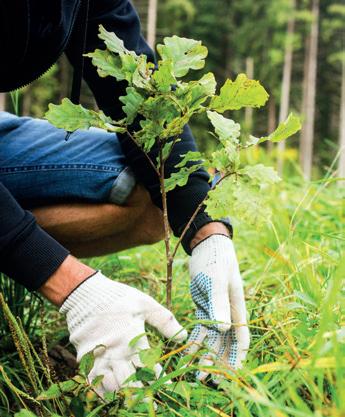
My legacy to my son Joe, and for future Norfolk residents. Ours is a beautiful, stunning county!
– Gillian, NWT member
Your support makes a huge difference to wildlife in Norfolk. Thank you!
Donate at norfolkwildlifetrust.org.uk/CentenaryAppeal
Donate by calling 01603 598351
Donate by sending back the form included with this issue of Tern to Freepost Plus RTKH-LGSA-TCJS, Centenary Appeal, Norfolk Wildlife Trust, Bewick House, 22 Thorpe Road, Norwich, Norfolk, NR1 1RY

Helen Hebditch NWT Director of Nature Recovery
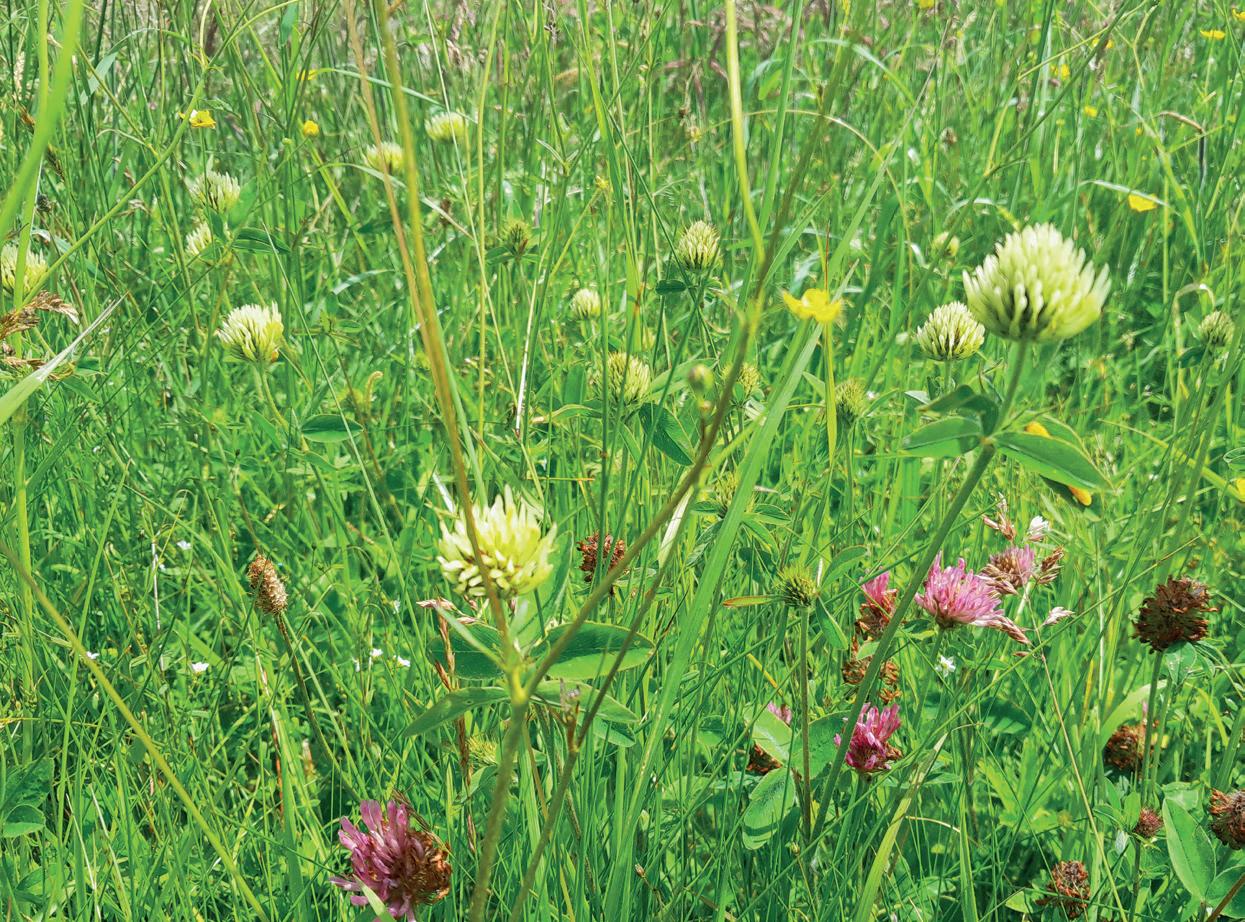
The South Norfolk Claylands form part of the East Anglian Plain, a distinctive landscape found on a belt of boulder clay that lies over chalk and runs through Suffolk and southeast Norfolk. It is an area noted for its ancient landscape, characterised by high hedges, pollarded trees, and open fields and commons.
But over time, many of its natural habitats have been lost. Ancient meadows have been converted to arable fields; trees, hedgerows and ponds have been removed to make way for more intensive farming and development. Relict habitats remain but are patchy and fragmented, making it difficult for wildlife to move across the landscape.
The key to a wilder landscape is improving and restoring connectivity between relict patches of habitat by creating stepping stones and wildlife corridors and building resilience to climate change.
Norfolk Wildlife Trust’s Nature Recovery Strategy identified South Norfolk as a priority landscape. We have a long history of working with farmers, landowners, community and other organisations here to create, improve, expand and connect natural spaces for wildlife, build economic opportunities and help people reconnect with nature.
In 2025, we started planning a 25-year Wilder Claylands Vision. We looked at how to build on our previous nature recovery project, Claylands Wilder Connections, which was piloted in three areas, and create a shared vision for the area’s wildlife and wild spaces.
Claylands Wilder Connections achieved so much over two years, from restoring over 50 ponds to creating new areas of woodlands, meadows and hedges, and working with over 100 volunteers. It showed how important nature is to the South Norfolk community and how much can be achieved when we work collaboratively.
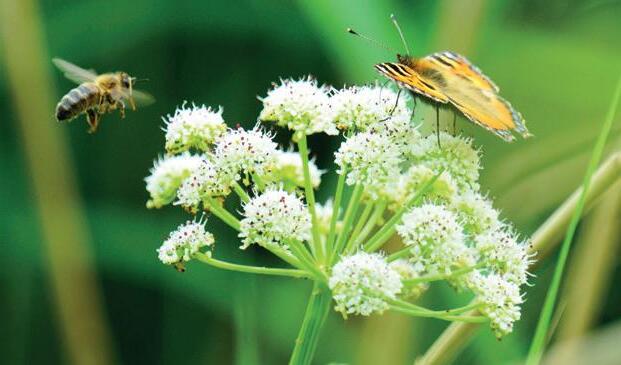
Top left: The potential for nature to flourish in South Norfolk led us to choose the Claylands as a key area to focus on.
Top right: We wanted to hear the views and opinions of those people that lived and worked in South Norfolk.
We also looked at what national targets there were for nature recovery through the Environment Act 2021. We now know that the UK is one of the most nature-depleted countries in the world. To tackle this, there is a national 30:30 ambition, under which 30% of UK land and sea will be positively managed for nature by 2030. How can we achieve this across South Norfolk?
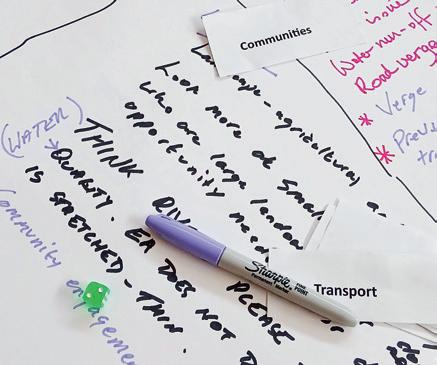
We wanted to hear from people who live and work in South Norfolk. To do this, we ran an online survey and hosted events across the district, gathering views from individuals, communities, businesses, farmers, landowners, and decisionmakers about the future of the Claylands.
Views and opinions about the long-term future highlighted biodiversity and food production as priorities. Other common themes included visions of ‘a joined up, greener, accessible South Norfolk where sustainability is central to everything and everyone’ and ‘a landscape that wildlife can travel through easily with woods and hedges, ponds and meadows.’ These ideas alongside other views from our consultation will be held at the core of our future work here.
Last November, Norfolk’s Local Nature Recovery Strategy was launched. This is part of a national programme created by the Environment Act 2021, which requires every county in England to agree a plan for nature recovery.
The strategy was developed collaboratively in consultation with thousands of people and organisations across Norfolk. It has resulted in a shared vision for restoring Norfolk’s nature and produced detailed maps of areas of existing important habitat, as well as those that could be important for nature recovery.
Working with Natural Norfolk at Norfolk County Council, we have been able to create a series of maps specifically for the South Norfolk Claylands. These will help us identify areas of geographical focus for our nature recovery work.
So where are we now and what’s next?
Now we need to put the jigsaw pieces together and create a plan to find the investment to start delivering nature recovery actions in partnership with farmers, landowners, other environmental organisations and the community.
Funding large-scale, long-term nature recovery programmes is always a challenge but today we have a larger range of opportunities than ever before. This includes the emergence of the nature economy and green finance, in conjunction with traditional funding models.
Our work with Langley Abbey Environment Project is a perfect example of collaborating on nature recovery with green finance – see case study over the page.
It’s an exciting time for the nature recovery team at NWT and we’re looking forward to sharing the successes of Wilder Claylands in future editions of Tern.
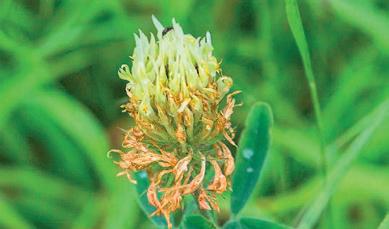
Our first Wilder Claylands project is ‘Meadows of the Future’, which is kindly funded by the supporters of our Meadows Appeal. This funding will enable us to start establishing a network of meadow donor sites. These will help provide seeds to restore existing meadows and create new ones, helping to recover some of the unique and threatened species found across the South Norfolk Claylands.
Find out more: norfolkwildlifetrust.org.uk/ WilderClaylands
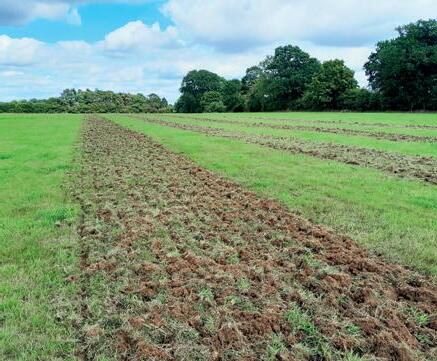
At Langley Abbey in South Norfolk, our Wilder Landscapes team is providing expert advice and delivery to transform 19.5 hectares of former arable land into a species-rich meadow. This long-term project, using green finance through Biodiversity Net Gain, strengthens biodiversity across the estate and supports sustainable development across the region.
Rob Smith, NWT Wilder Landscapes Advisor, explains more about our work with Langley Abbey. ‘We began by surveying the grassland to determine the type of soil, what it had been previously used for, and the current mix of plants – this baseline information is essential to create a suitable management plan.
‘Once hay had been cut and removed, we harrowed some strips into the grass, creating areas of bare ground, ready for seeding into. Hand-collected local wildflower and grass seeds were then scattered into the prepared strips, with additional species introduced via green hay from nearby donor sites.
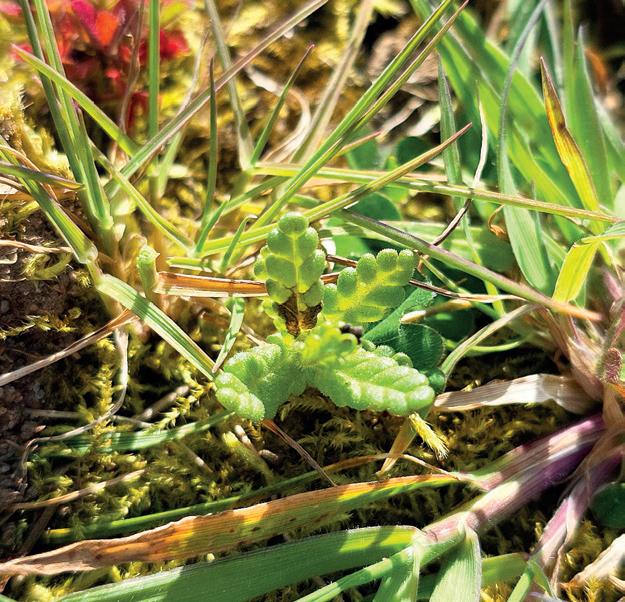
‘Our aim is to use seeds collected from the local area, but we did introduce a small supplemental seed mix which included yellowrattle – a crucial plant for reducing competition from coarse grasses. We then used a tractorpulled roller to achieve good seed-to-soil contact. To further help the enhancement work, we advised a routine of summer hay cutting followed by autumn grazing going forward.
‘Over the next two years, we will carry out regular surveys on the enhanced grasslands – recording which plants are thriving and recording any wildlife that is benefitting. We found yellow-rattle seedlings in our first survey – which is great news!’
Find out more about Langley Abbey Environmental Project: langleyabbeyestate.co.uk

‘The team at NWT have been incredibly helpful and supportive, and it has been a great comfort to know that we can rely on the significant expertise within the organisation. It’s also really encouraging to be working with seed and hay that is genuinely of local provenance, utilising the numerous donor sites managed by NWT, some only a handful of miles from Langley Abbey.’
–
Henry Parkinson, Project Lead at Langley Abbey Environment Project
If you would like to find out how we can help increase biodiversity on your farm or land, please contact our Wilder Landscapes Team on wilderlandscapes@norfolkwildlifetrust.org.uk








Nick Acheson reflects on his time with NWT and explains why he is full of hope for the future
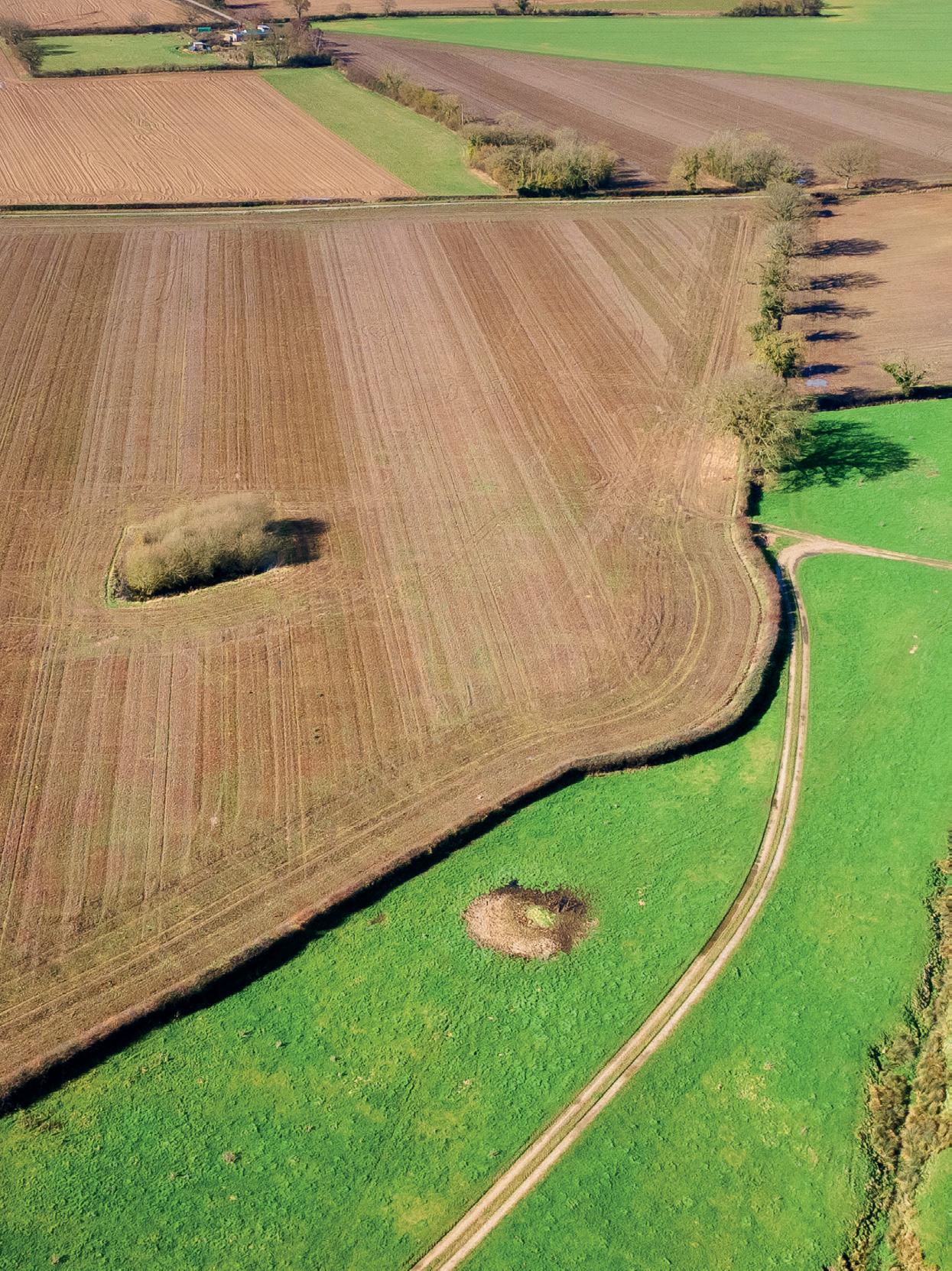
I wish that I could be alive in 100 years’ time, to witness what our land at Wood Norton has become...
Ican’t remember when I first joined Norfolk Naturalists Trust (as we were known until 1994), though I do know that my membership was a Christmas present from my parents. Most likely it was Christmas 1987, as that was the year I began to visit Cley Marshes every week, with my school natural history club.
I clearly remember joining Norfolk Wildlife Trust as staff. It was March 2008. I had just come home from ten years in South America (spent largely in shorts and a t-shirt in Amazonia). When my first NWT assignment took me to Holme Dunes –on a day of howling, icy wind – to teach Year 7 students from an inner London school, I remember wondering what on Earth I had done.
At the end of that day, as school buses prepared to leave, a charismatic lad – aged no more than 12 but seeming older – came up and handed me a stone. ‘This is for you,’ he said. ‘To thank you.’
That stone – a flint – was near-identical to hundreds of thousands of others on Holme Beach. Near-identical to millions of flints on Norfolk beaches. But by this simple act it was made unique. I have it still, on the windowsill above my desk, where it reminds me daily that what we do at Norfolk Wildlife Trust is important.
In the 18 years since then, I have always, in some capacity, worked with NWT. I have guided thousands of schoolchildren around our reserves, given hundreds of talks, led hundreds of workshops, and written hundreds of thousands of words on our work. I have censused endangered speedwells, raised large marsh grasshoppers for release, campaigned on behalf of our environment, and presented films to raise funds for major purchases of land. Throughout, I have been inspired by a round, grey stone on the windowsill above my desk.
For the stone on my windowsill reminds me that we can make a difference, for people and for nature. It reminds me of the countless young people who experience wildness for the first time on our reserves. It reminds me of the boundless talent and dedication of my many colleagues at Norfolk Wildlife Trust. It reminds me of the changes for the better we can make – we do make – every day.
In March this year I visited the farm we recently bought at Wood Norton, with Nature Conservation Area Manager Steve Collin and Conservation Research and Evidence Manager Helen Baczkowska. I'm always inspired by those two conservation sages, but the land at Wood Norton filled me with an even greater hope. To be sure, much of the land was farmed until last autumn and holds little life apart from common annual plants. Even the meadows along the beck have been laced with nitrate fertiliser and have barely anything but ryegrass. Look hard, though, and there are little signs of hope.
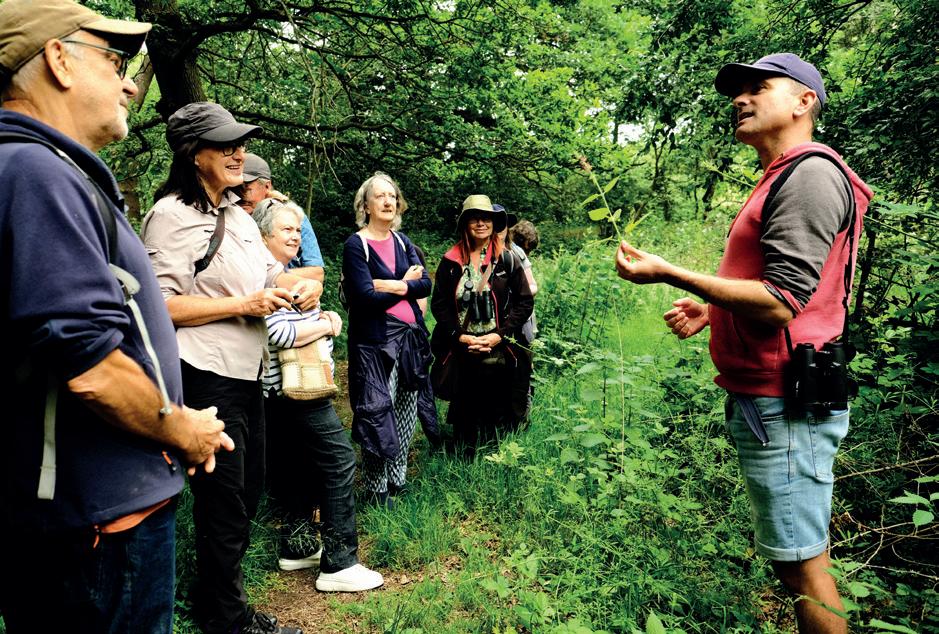
On the heavily canalised banks of the beck, there are clumps of brooklime, water figwort, primrose and meadowsweet, tenacious reminders of a flora that has been all but lost. A flora that we promise to help recover. Even a modest patch of mouse-ear hawkweed has somehow escaped the spray boom and will one day seed across recovering grassland here. Elsewhere, a tiny wood on the edge of the farm is carpeted with dog’s mercury and the hopeful shoots of bluebells. In our care, they too will be encouraged to spread.
I wish that I could be alive in 100 years’ time, to witness what our land at Wood Norton has become by then. It is enough, however, to be filled with hope for its future. To me, Wood Norton represents three things. The first is simple: 140 hectares of midNorfolk land that will be held forever in our care. The soils here will never be disturbed again (except by the claws
of badgers, the snuffling snouts of moles). These soils will lock carbon in the ground, feed billions of worms, allow fungal mycelia to reach across the land, speaking to plants and other organisms, rewriting the ancient, Earth-deep story of this place.
The second thing is that Wood Norton lies between Swanton Great Wood and Foxley Wood, Norfolk’s two most significant remnants of ancient woodland. In time, in our care, Wood Norton will come to be a stepping stone in the landscape, for these precious places’ rarest plants and animals to mix and meet and share their genes. And the third thing, of course, is that Wood Norton is not ours alone, but also yours: another link in the chain of connection between Norfolk people and our wondrous wildlife heritage.
A few days later, on a morning of sharp spring sunshine, I visited Broadland
Country Park, which has just come into the management of Norfolk Wildlife Trust. This remnant stretch of heathland, natural birch woodland and conifer plantation – once part of the mighty heaths embracing Norwich – is already hugely important for local people, giving them access to birdsong, butterflies, and the sound of winter wind through trees. In our care, its size will almost double, with a land purchase we have just made to the south. Over time, the habitats of this much larger reserve will be gently guided towards the beauty and abundance they once held.
Together with Sotshole Broad (which we acquired last year), Wood Norton and Broadland Country Park represent a 10% increase in the Norfolk land we protect and manage for wildlife. And for people. As with Broadland Country Park and (one day in the future) Wood Norton, the addition of Sotshole to our network of reserves means far better
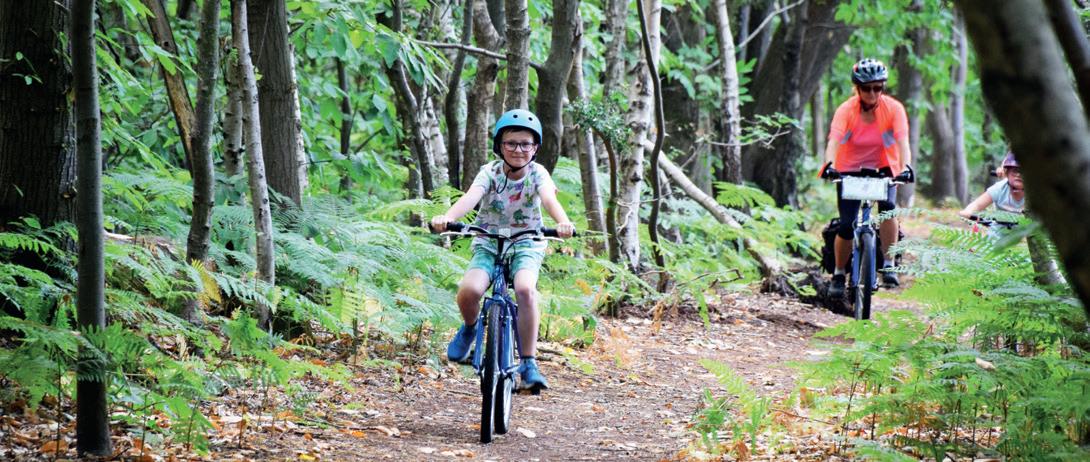
Together with Sotshole Broad (which we acquired last year), Wood Norton and Broadland Country Park represent a 10% increase in the Norfolk land we protect and manage for wildlife.
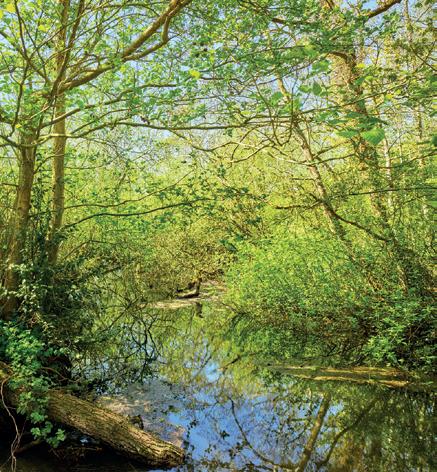
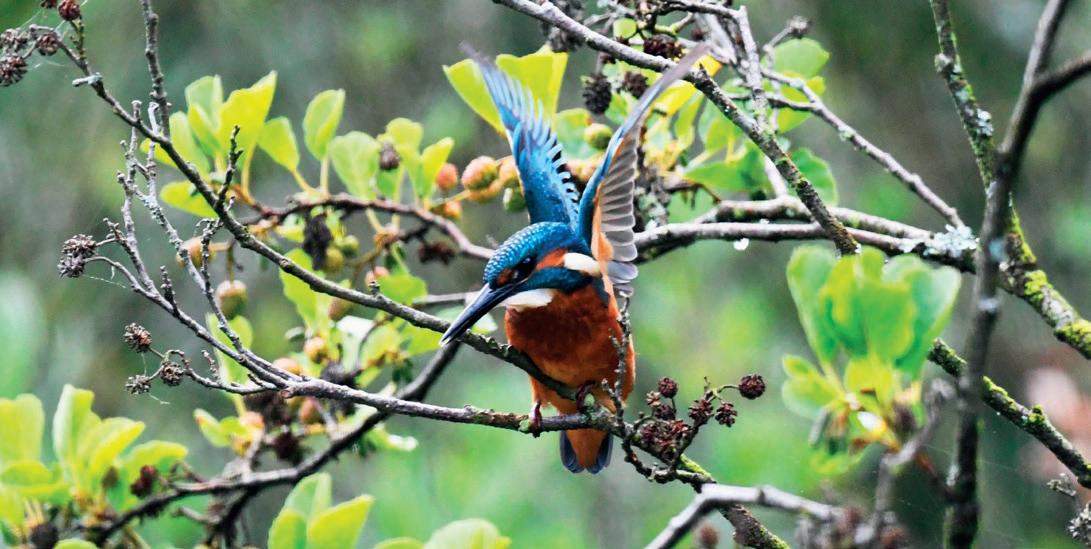
Our wonderful new reserve at Sotshole Broad will make the peerless biodiversity of the Bure more accessible...
access to Norfolk nature for you, our members and supporters. We are developing a circuit around our existing reserve at Ranworth and our wonderful new reserve at Sotshole Broad, that will make the peerless biodiversity of the Bure more accessible to visitors, to schoolchildren, to naturalists and to future conservationists.
Meanwhile, with the purchase of a plot adjacent to Sweet Briar Marshes, where – with continued support from Aviva and the Greater Norwich Growth Board – inclusive facilities will be built and buses will be able to drop children safely, our work in Norwich goes from strength to strength. Right across the city, our initiatives are helping people grow closer to nature and make a difference for wild species in their communities.
With our help, 50 farm ponds were restored in Norfolk last year. Ice Age pingos were excavated and brought to life
at Mere Farm next to Thompson Common. Northern pool frogs bred in a pingo where they were unrecorded since their reintroduction. Ospreys bred in Norfolk, at Ranworth Broad, for the first time in recorded history. And our membership passed 41,000 people for the first time ever. That’s 41,000 voices for nature, for wild places and for the environment in Norfolk.
Eighteen years ago, a young lad gave me a stone on Holme Beach, to thank me for sharing nature with his class. Weighing it in my hand today, it reminds me of all that has since been achieved for wildlife in our county. It reminds me of my tireless NWT colleagues. And of you, our members. It gives me hope for a future in which wildlife is bountiful, diverse and treasured across Norfolk once again. And it reminds me why I chose to stay on a cold, wind-harried beach. Why, after all these years, I still love NWT.
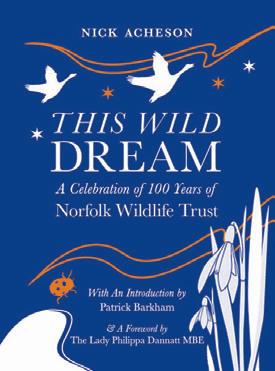
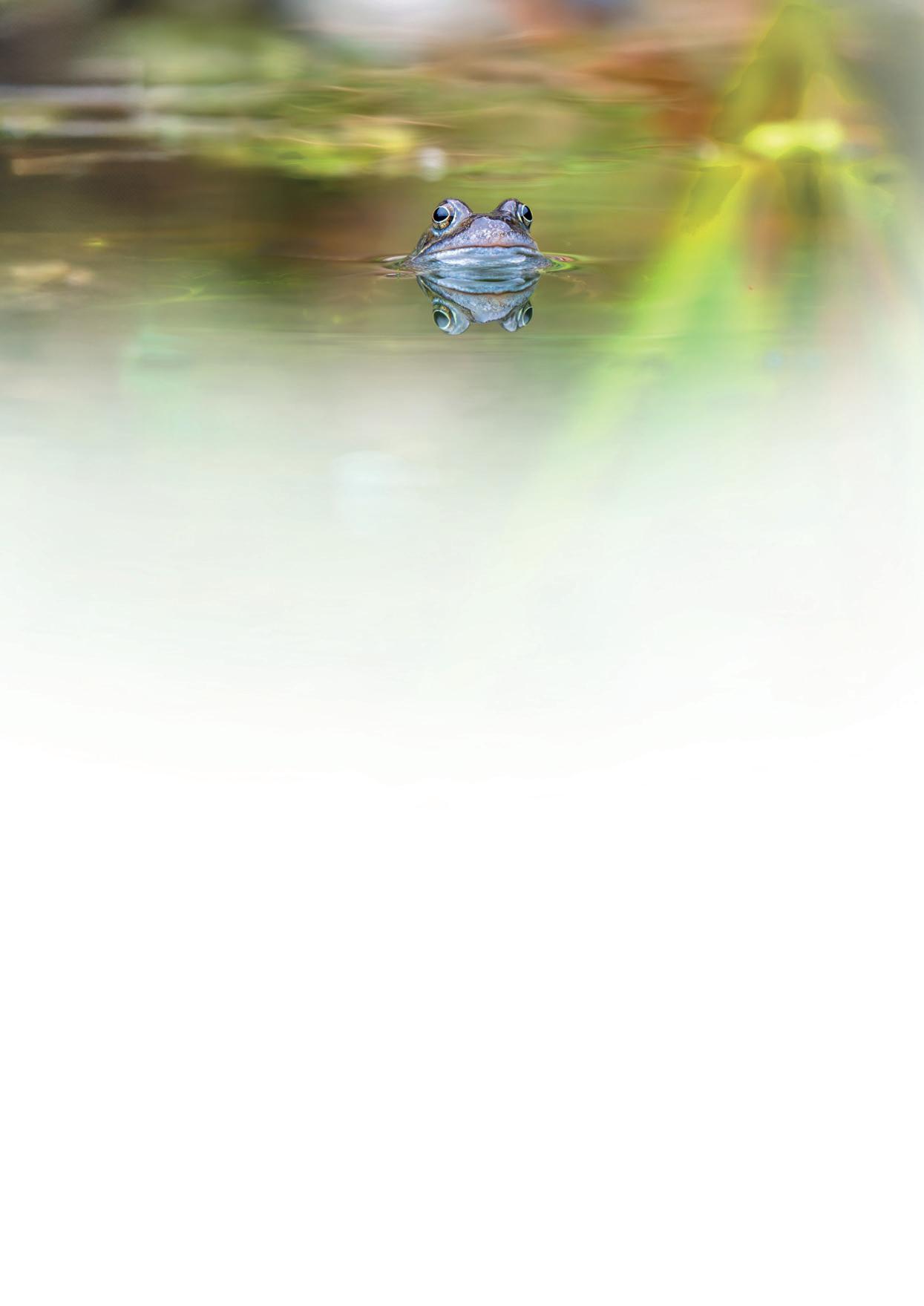
Nature Conservation Officer Bob Morgan writes about the joy of wildlife gardening with his granddaughter.
Although it was many years ago, I clearly remember my first pond. It was a Belfast sink sunken into the ground in my parents’ back garden. This humble basin was full of aquatic life, and it sparked a lifelong interest and love of the natural world. Every garden I’ve had since has had a pond and a small corner turned over to nature.
I’m fortunate that my current garden allows me enough room to create a larger wildlife area. It contains four hand-dug ponds, a bog garden and a patch of meadow. It has brought me enormous pleasure seeing local wildlife benefit, and even flourish because of my modest efforts. Surrounded by intensively farmed land, it is, in all other respects, an ordinary garden. However, it has yielded some remarkable records, with one particularly memorable visitor being an otter that somehow found its way into my house!
Despite all this wonderful nature, there is nothing quite as magical as stepping into my garden with my granddaughter, Ava, by my side. Seeing her proudly spotting and naming a garden bird, watching bees and butterflies amongst the blossom, or her excitement at seeing a grass snake threading its way through the pondside plants, is enormously fulfilling. Wildlife gardening
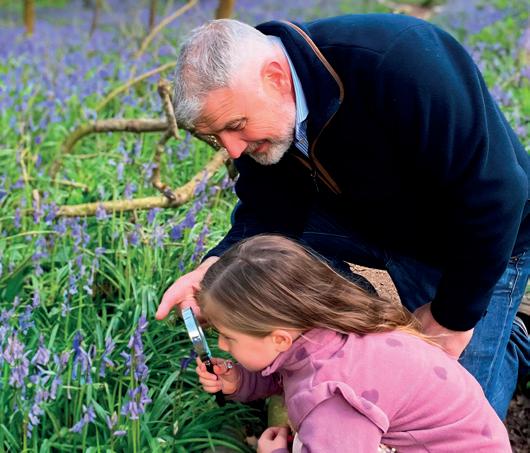
has become for me, no longer a lone pursuit of planting wildflowers, taking notes or digging ponds. It is about sharing curiosity, patience, and a love of nature with a younger generation.
The first step is often the simplest: noticing what is already there. Ava and I often sit quietly for a few minutes and see which birds or butterflies arrive in the garden, or I will choose a particular animal or plant for her to find, a living treasure hunt. Planting nectar-rich wildflowers is another joyful activity to share. I have given Ava a patch of garden that is hers to look after.
Children love the feeling of responsibility, especially when it involves cherishing and growing something. A tidy garden may look neat, but nature often prefers mess. Ava and I have piled up sticks and logs in a quiet corner of the garden as shelter for insects, or if we are lucky a hedgehog. Long grass, rough areas of nettles or a tangle of brambles provides refuge and food for all kinds of creatures. Explaining this to a child can help them see that nature doesn’t always follow human ideas of tidiness and, hopefully, forms an adult less hostile to the non-conformity of nature.
Perhaps the most important part of wildlife gardening is time. Nature does not rush. Seeds take weeks to sprout, caterpillars slowly transform, and many birds leave us for months at a time. Gardening teaches children patience in the gentlest way possible. It shows that care and attention, given day by day, can create something beautiful. So, whether you have a large or small garden, yard or balcony, every little can make a difference for wildlife, and when a child helps create it, a garden becomes something even more special.
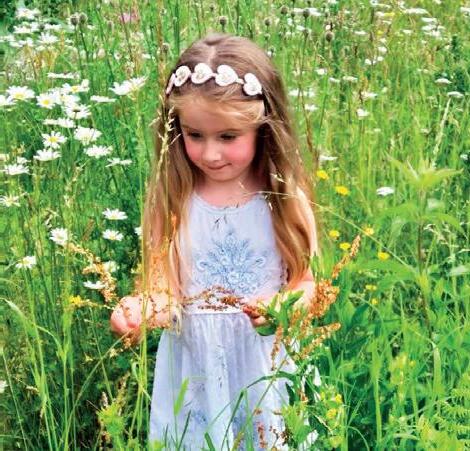
Wildlife gardening has become for me, no longer a lone pursuit of planting wildflowers, taking notes or digging ponds. It is about sharing curiosity, patience, and a love of nature with a younger generation.
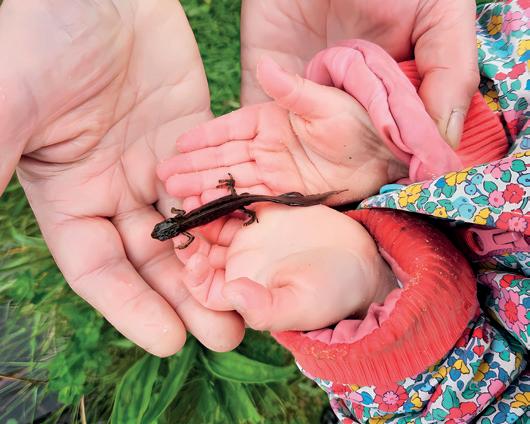
With Norfolk Wildlife Trust celebrating its one hundredth birthday, it is a time not only to look back, but to look forward too. For there’s an everpressing need to pass on the baton in our race to rescue nature. Wildlife gardening is, in many ways, an act of hope. By inviting nature into our gardens, we remind children that the world is alive, beautiful and worth protecting. A patch of wildflowers or a small garden pond, shared between generations, can become the beginning of a lifelong friendship with the natural world.
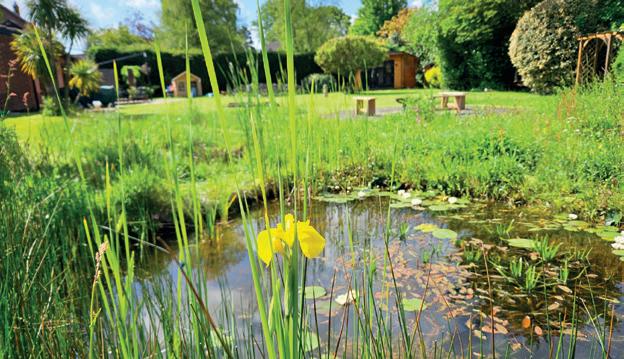
Bob and Ava have recorded the following wildlife in their garden:
6 species of reptiles and amphibians
18 species of dragonflies and damselflies
19 species of butterflies
Over 300 species of macro-moths
19 species of birds have nested in the garden, with 76 recorded in total

Join in: Find out how to create a pond and other ways to have a wildlife friendly garden: norfolkwildlifetrust.org.uk/actions Join in
23 different mammals either live in or have passed through the garden
We launched our Wildlife Guardian scheme in September 2024 and now have 13 guardians who generously support our work each year and get the opportunity to stay involved in the Trust’s work in a unique way. This includes invitations to special experiences across the county, such as exploring the ancient woodland at Ashwellthorpe with local expert Anne Edwards, a winter opening of Ranworth Broad visitor centre for a talk by our president Patrick Barkham, and searching for northern pool frogs in the ancient pingos at NWT Thompson Common.
This year’s event schedule so far has included a private view of our nature photography competition and a visit to our new land at Sotshole Broad
to admire the bluebells – before it is open to the public. We also hosted an evening summer event at NWT Foxley Woods, plus provided an exclusive opportunity to purchase a VIP dinner package and meet and greet for Chris Packham’s Wild Norfolk event.
The generous, regular support we receive helps us protect and restore nature, while Wildlife Guardians see and hear about the real, tangible impact of their support on the county’s wildlife.
The Annual Lunch with our CEO takes place in mid-September, followed by festive refreshments in December, completing a year-round line up of events, which ensure our Wildlife Guardians are among the first to know of any exciting developments at NWT.
22-26 July: We will be exhibiting at the inaugural RHS Sandringham Flower Show – come and see our wonderful cube garden (more information on our news pages).
24 August–6 September: renowned local artist James McCallum, who has produced some wonderful centenary art products for us, will be exhibiting his nature-inspired watercolours in the Simon Aspinall Wildlife Education Centre at Cley for the first time.
4 October: Walk on the Wild Side sponsored walk (see opposite page for more information).
7 November: Hybrid Annual General Meeting, including a walk and talk at Cley Marshes.
21 November: Wild by Design at St Andrews Hall, Norwich – a free vibrant day of hands-on creativity, wildlife discovery and big ideas. Then round off our centenary year with an unforgettable evening of live music, Songs of the Wild, with folk singer and nature champion, Sam Lee.
For more information, including full events listings, visit: norfolkwildlifetrust. org.uk/Events
Your chance to feature in our 2027 calendar and centenary exhibitions.
We want to see your best images of Norfolk’s nature — taken anywhere, from one of our nature reserves to your own garden within the past year. Photographers with any level of experience are encouraged to take part, with images taken with professional cameras or mobile phones welcome! In our centenary year, we are also asking you to share your hopes for the future of Norfolk’s nature.
Judges will select a favourite photograph for each month of the year to be printed in Norfolk Wildlife Trust’s 2027 calendar, with
2025 overall winner, by Alan Dixon
a selection of the best photos also being shown in exhibitions at Cley Marshes and around the county throughout the year.
An Overall Winner, Young Person Winner, and Mobile Phone Photography Winner will also be chosen, with winners receiving a prize from a range of fantastic specialist and local businesses.
To enter; submit up to three of your best images, taken in Norfolk within the past year, at: norfolkwildlifetrust. org.uk/PhotoComp.
Entries are open 1 June–31 July. Please read the competition rules on our website before entering.
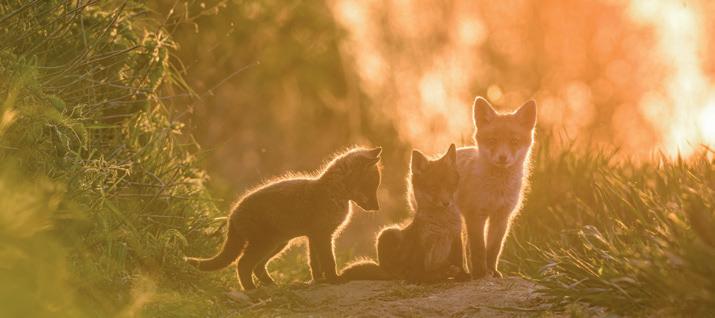
Walk on the wild side returns this autumn!
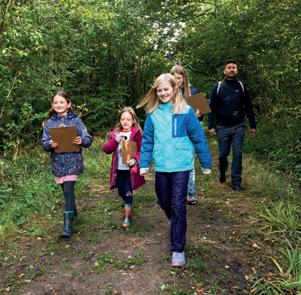
Lace up your walking boots –NWT’s annual sponsored walk is back on Sunday 4 October and we’re heading to Broadland Country Park! As we celebrate our centenary year, it’s the perfect opportunity to come together in this beautiful mix of woodland, heathland and open green space, and enjoy a day out in nature.
Come along for a fun day outdoors and raise vital funds for Norfolk’s wildlife. By collecting sponsorship from friends, family or colleagues, every step you take will help care for precious habitats and the wildlife that depends on them.
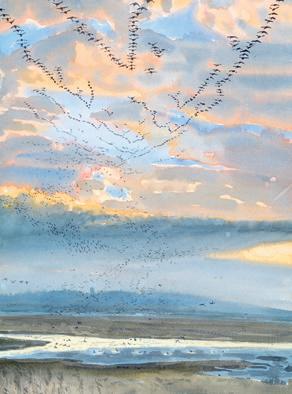
This year, we’re delighted to work with several wonderful artists who share an affinity for Norfolk’s wildlife. Thanks to their generosity, our visitor centres will be selling a variety of printed products – from posters to greetings cards – featuring artwork that celebrates our wild spaces and the species that call them home.
Born and based in North Norfolk, James McCallum graduated from The Royal College of Art and is best known for his watercolours of wildlife, often painted outdoors from life. James has kindly collaborated with us to produce a stunning poster, postcard,
and greetings cards featuring his evocative work ‘Pinkfeet overhead Cley’ and two other beautiful paintings. We are also delighted to offer a selection of greetings cards showcasing a variety of the habitats the Trust manages across Norfolk, alongside some of the species that we care for. The brilliant artists that have generously gifted us the use of their images for these cards are Angie Lewin, Sue Welfare, Niki Bowers, Max Angus and Sarah Bays.
A3 poster (£9.99), greetings cards (from £2.95) and postcard (£1), available in visitor centres.


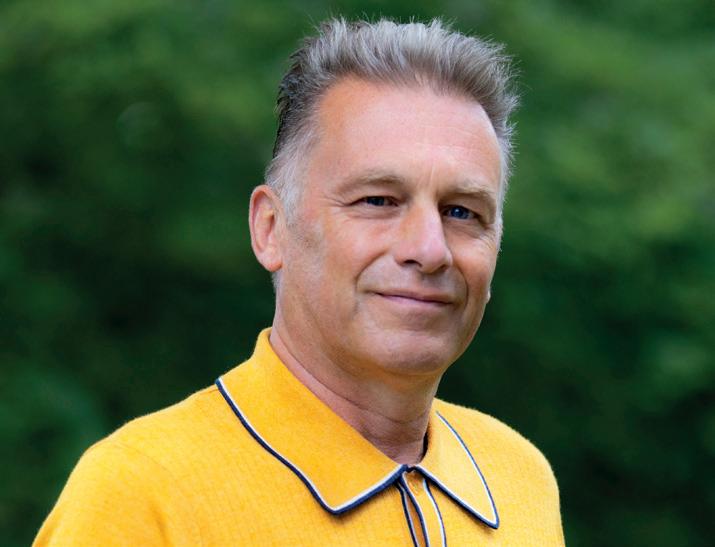
“Give nature a window of opportunity and it will take it.”
Chris Packham reveals his favourite Norfolk sights and why he holds onto hope.
Interview by Natalie Douglas
When you look at Norfolk’s wildlife story over the last 100 years, what gives you the most hope for the next hundred?
There’s a lot to be hopeful about. We’ve seen real progress in terms of habitat restoration, species recovery and reintroductions. We now have tried and tested methods that we know can work, and that’s incredibly important.
At the same time, we have to be honest. There have been significant declines in habitats and species, and we haven’t always acted quickly enough.
But I always look forward. The next 100 years depend on changing our methods and our attitudes. The most important thing is helping people recognise that they can be part of that change. We have a problem, yes, but we don’t have to be part of the problem.
The Trust’s “100 species” challenge celebrates wildlife that feels especially Norfolk. If you had to choose a species that captures this county, which would it be and why? It’s difficult to choose just one because Norfolk has such a rich diversity of habitats and species. That’s one of the things that makes it so special. But the spoonbill is a favourite of mine.
I first came to Norfolk in the 1970s to look at birds, and at that time the idea of spoonbills breeding successfully in the UK would have felt almost unimaginable. Now they’re here, breeding, and doing well. That’s a real success story and a powerful reminder that nature can recover when given the chance.
Norfolk is famous for its big skies and spectacular wildlife, but what is a quieter wildlife moment here that people might miss unless they slow down?
For me, it’s the reedbeds. In summer they’re dense, green and full of life, with bitterns booming somewhere deep inside. But in winter they become something completely different. The reeds turn brown and gold, the light drops, and the wind moves through them in a really soft, subtle way.
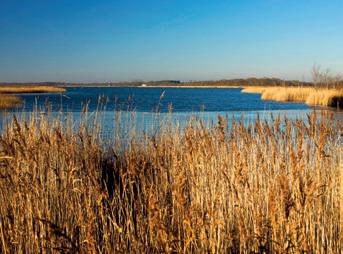
As it gets darker, you might hear a water rail calling from deep within the reeds. It sounds like a pig squealing, which can be quite startling if you’re not expecting it!
There have been some real conservation successes in Norfolk, from spoonbills to cranes and bitterns. Which comeback story do you find most inspiring?
What’s inspiring is the principle behind them. Give nature a window of opportunity and it will take it.
Sometimes those opportunities come from unexpected places, but when we restore habitats or change how we manage the land, we see wildlife respond. That’s the key lesson. If we create the right conditions, nature has an incredible ability to recover.
Projects that start from scratch and rebuild landscapes show just how quickly things can change when we get it right.
For readers who love Norfolk but may not think of themselves as naturalists, what one thing would you encourage them to do this year to feel more connected to wildlife? Go out and experience it for yourself. On a crisp winter’s day, take a walk along the coast. And if you’re feeling bold, go to Snettisham and see the knot when the conditions are right.
When the tide and the birds align, and those flocks come over you, it’s extraordinary. The sound of thousands of wings moving together, it’s like a thousand swords clashing in the air.
We often look to faraway places for wildlife spectacles, but some of the best experiences in the world are right here in Norfolk.
The contribution of Norfolk’s business community has always been integral to Norfolk Wildlife Trust’s ability to protect and conserve wildlife and habitats, in the county that so many of them, their staff, their customers and suppliers call home. Through memberships, sponsorship, volunteering and benefits in kind, business continues to make a vital difference to our success.
In our special centenary year, we wanted our corporate supporters to be central in everything we do to mark this milestone for Norfolk’s nature. Nine very generous businesses have pledged additional funding of £5,000 each by becoming NWT ‘Centenary Partners’, and we thank and celebrate them all:



A percentage of our partners' donations will be distributed in grants to small conservation and community groups all over Norfolk who share our objectives.



In addition to this valuable support for NWT’s core activities on our nature reserves, in the wider landscape and engaging all of Norfolk’s diverse communities, their impact and legacy will also be maximised by the establishment of the ‘Norfolk Wildlife Trust Centenary Partners Fund’. Thirty percent of our partners' donations will be distributed in grants to small hard-working conservation and community groups all over Norfolk who share our aims and objectives, but often find it hard to source funding. Applications to the fund will be invited later in our centenary year.
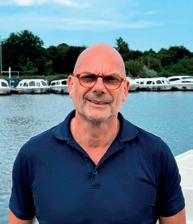
We have been proud to support Norfolk Wildlife Trust over many years through our Broads’ tourism businesses. Now we are delighted to amplify their work and stand by them during NWT’s centenary. Our many visitors and holidaymakers know the Broads are such a unique and special place, and the dedication of Norfolk Wildlife Trust in protecting these fragile habitats whilst introducing so many people to them is something incredibly worthwhile. Happy birthday NWT!
– Greg Munford, Executive Chairman of Centenary Partners Norfolk Broads Direct
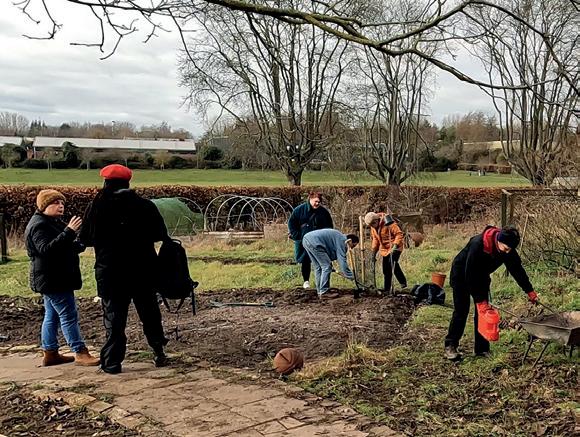
Our community group was founded in 2001 with the aim of enhancing the local environment. We began with litter picks, removing discarded items that can be harmful – and often deadly – to wildlife. Since then, our work has grown, with a strong focus on increasing biodiversity.
By planting and encouraging nectarrich species, we aim to ‘bring back the buzz’ to our shared green spaces. We also install bird boxes and plant trees to support local habitats.
In 2022, we launched an exciting new project: a Community Garden called ‘The Back Garden’, named after a prominent local family. What was once a derelict skate park behind the Village Hall has been transformed into a welcoming and vibrant space, featuring raised beds, fruit trees, and seating areas.
Today, the garden serves as a hub for the community: a place to relax, connect, and help tend organic vegetable, flower, and herb beds. We run twice-weekly volunteer sessions, and pupils from the local
junior school attend weekly to get involved. We also host workshops on topics such as composting and wildlife-friendly gardening, as well as seed and plant swap events.
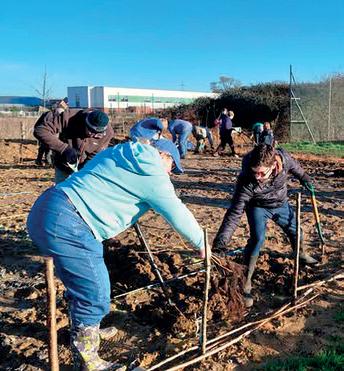
Last year, we took another major step forward by planting a Miyawaki forest, known as the ‘Back Pocket Forest’, as part of our contribution towards the village’s Net Zero goals. With the help of 50 volunteers, we planted 840 trees across 31 species. To protect the young forest, we created a natural fence using sustainably coppiced hazel.
We welcome new volunteers and share regular updates via our Facebook page and WhatsApp group. Refreshments are always provided at our work sessions – not just to keep everyone going, but also to encourage social interaction and the sharing of ideas and experiences.
Projects like these help people connect with nature, build friendships, and develop valuable new skills, all while improving the environment we share.
Our Wilder Communities workshops are specially designed to support individuals, communities and groups acting for nature in their local area. Find out more: norfolkwildlifetrust. org.uk/WilderCommunities
Thanks to our member Kevin Delaney for emailing in with a story about Norfolk's nature.
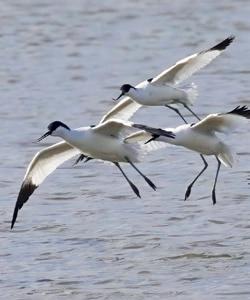
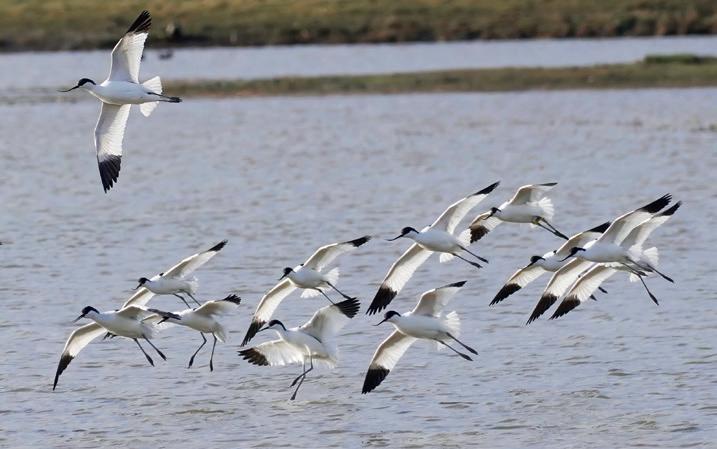
I'm lucky to live a 10-minute drive from NWT Cley Marshes and yesterday visited for a walk and a coffee. As ever, a wide variety of birds including shelduck were showing off. After lunch we visited the photo exhibition and I idly peered through the CleySpy display spotting scope. My curiosity was rewarded with a crystal-clear view of 30-40 avocet on the large pond opposite the visitor centre window. Having never seen more than two avocet at a time, I was fascinated by the sight. A Google search threw up the collective noun for avocet, orchestra. The name describes the group perfectly. Future visits will include a window seat in the visitor centre!
story
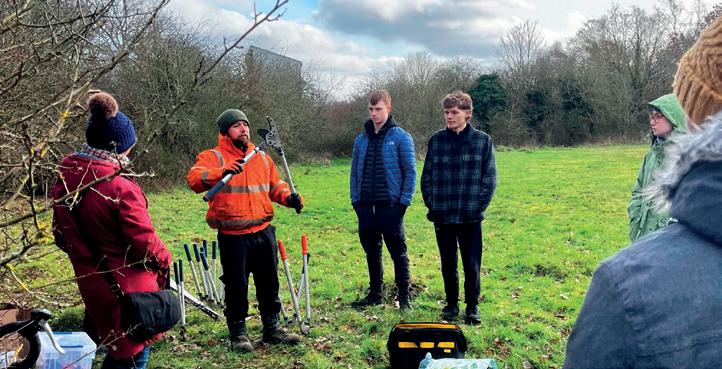

2026 got off to a busy start for the Youth Forum members as you took on some coppicing and tree planting work. How did you find this experience?
Tree planting is so important and a way to restore nature. I think it is beneficial for us to do that kind of thing and learn how it’s done, as well as work out where different species should be planted. I like how coppicing is a traditional form of land management that goes back hundreds of years and yet we can still do it. I get satisfaction out of learning how things used to be done – you get a feel of how land was managed in the past.
As we move towards the warmer months, what are you most looking forward to doing next as part of the Youth Forum?
Seeing the meadows in full bloom; it will be great to see if we have species like common blue butterflies coming in. And seeing the progress of the coppicing – and if it has let some more light into the forest floor.
What would you recommend people look out for over the summer in our wild urban spaces?
I like it when the fledglings come out –when the nestlings have left the nest and you see their parents feeding them. I love seeing the next generation of birds, because people can spot them in their gardens and local spaces – birds such as robins, blue tits and great tits.
What do you love most about being part of the Youth Forum?
I think there’s a lot of camaraderie that we have as a group. It is just a worthwhile thing, and I find it satisfying each day. I get to meet new people and hear about the huge amount of knowledge and expertise that they have. We have a lot of scope to make the group our own. There are a lot of different ideas and it’s exciting that we can shape it in our own way. Trying to introduce this type of work to a wider audience has been a new experience for me – I’ve not really done anything quite like it before.
This new initiative is part of the wider Building Foundations for the Future programme which aims to help us engage new audiences with nature, made possible with funding from The National Lottery Heritage Fund with thanks to National Lottery Players.
Join in
Come and see the amazing improvements we've made to this beautiful meadow on this fun-filled day! A free drop-in day of walks, talks, activities and food; curated and organised by the Youth Forum.
Saturday 15 August 1pm onwards
Free and no need to book
More information: norfolkwildlifetrust.org.uk/events
Find out more about the Youth Forum and sign up to our e-newsletter at norfolkwildlifetrust. org.uk/YouthAction

















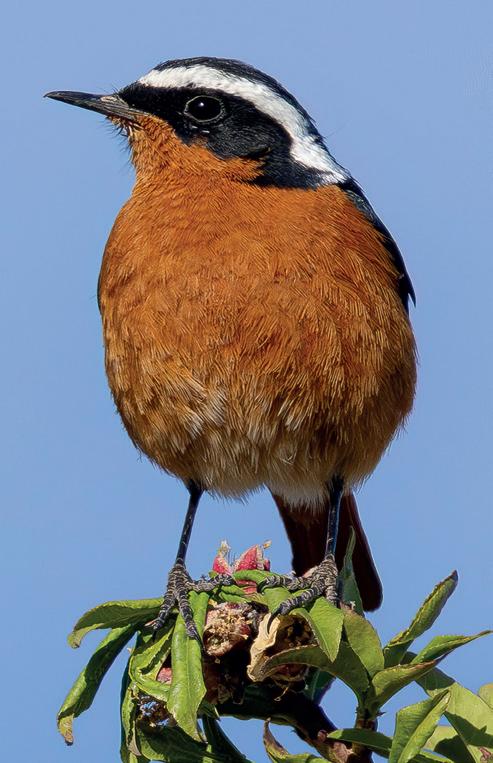

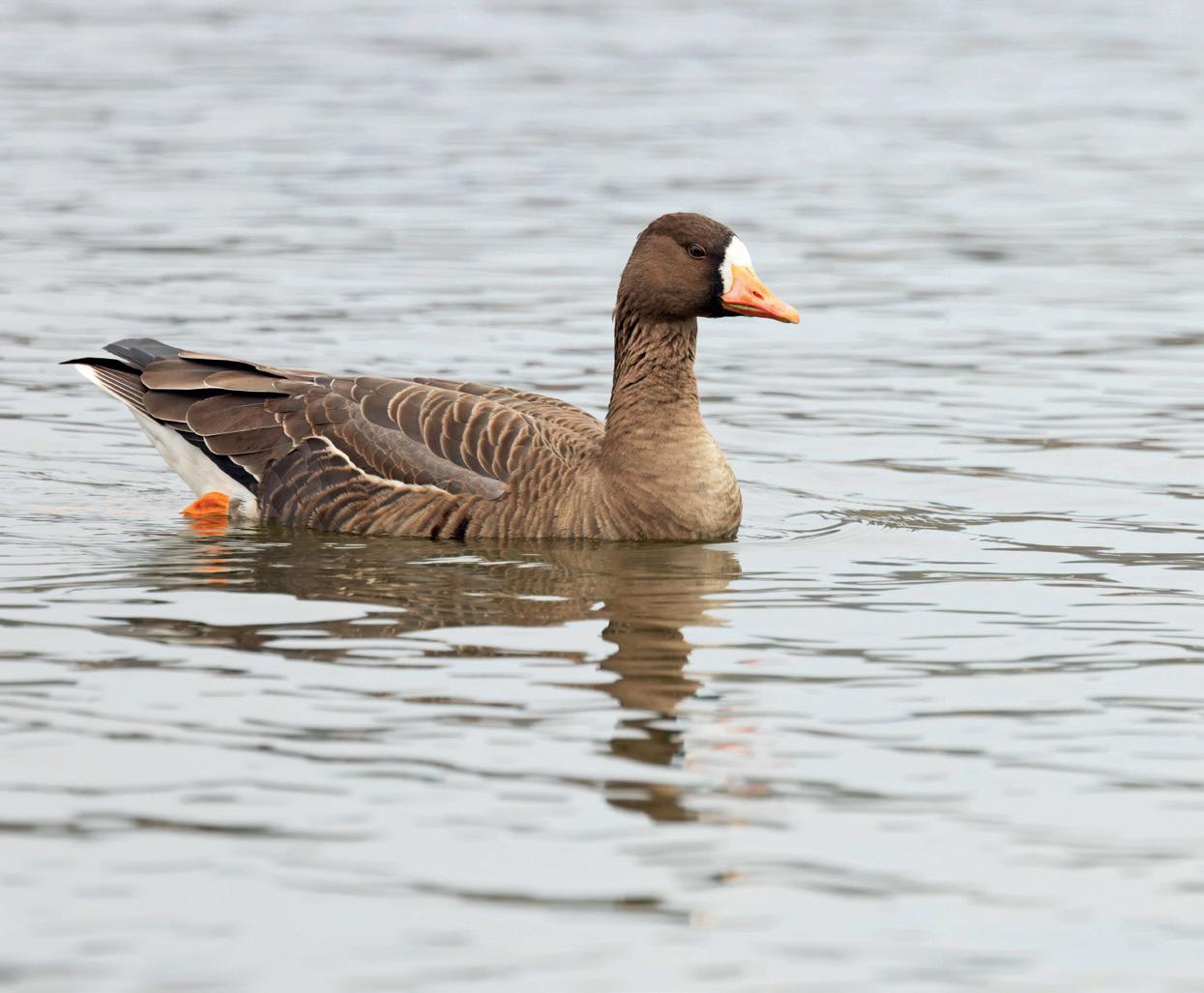
A good variety of geese and some surprising bird behaviour, writer and photographer Robin Chittenden looks back.
Parts of northern mainland Europe were unusually chilly this winter – so cold it was a bit like the old days, when in most winters great numbers of geese would head west from the continent in search of slightly warmer conditions here. With the help of easterly winds, this resulted in large numbers of white-fronted and tundra bean geese arriving in Norfolk during December.
Both species of geese originate from Siberia but in recent years many haven’t bothered to hop across the North Sea from Holland. This year, however, there were nearly 800 white-fronted geese at RSPB Cantley Marshes. By the beginning of March many birds had returned east. One flock of at least 400 birds was spotted flying out to sea at Great Yarmouth on 5 March.
Tundra bean geese could be found almost anywhere, often mixed in with the pink-footed geese. Scanning through a flock of pink-feet to find a tundra bean goose, look out for orange legs, darker (not grey) backs and a slightly more robust feel to the bird.
A red-breasted goose was seen at Morston Quay on 27 January, for just a day, with a dark-bellied brent goose flock, but was more friendly with a small flock of barnacle geese within the brent goose flock. It was speculated, probably accurately, that the barnacle geese and red-breasted goose had just flown in from Holland.
The biggest surprise in the smaller bird department was a red-flanked bluetail found during February in the Norfolk hinterland, near Dillington at the Wendling Beck Project. Apart from being the first to be found during a Norfolk

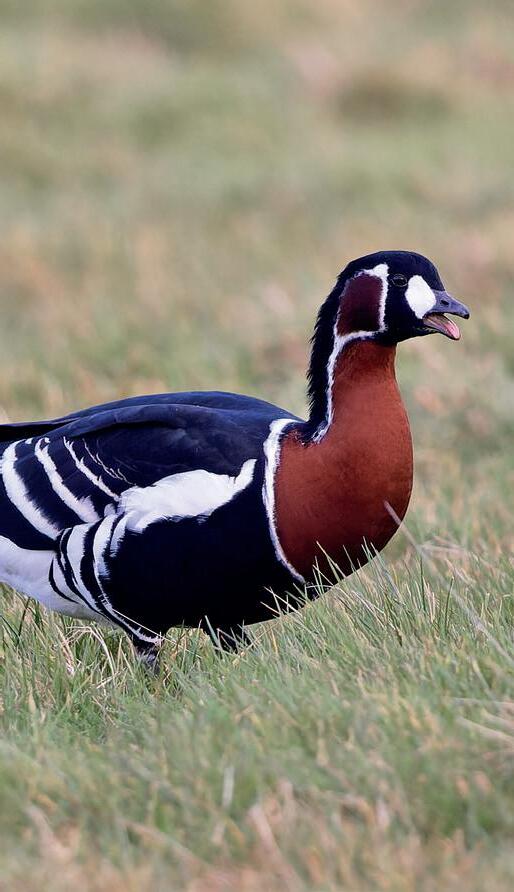
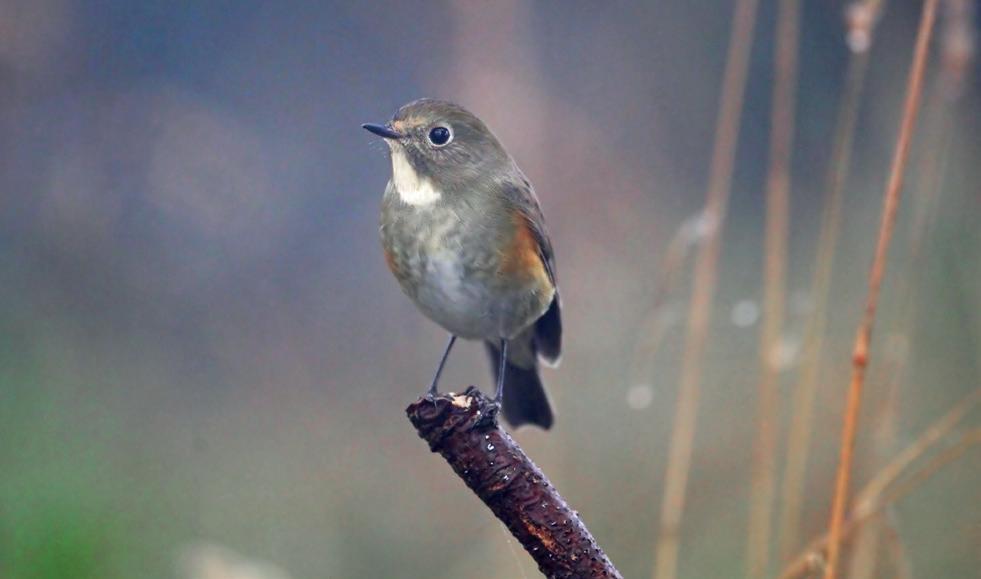
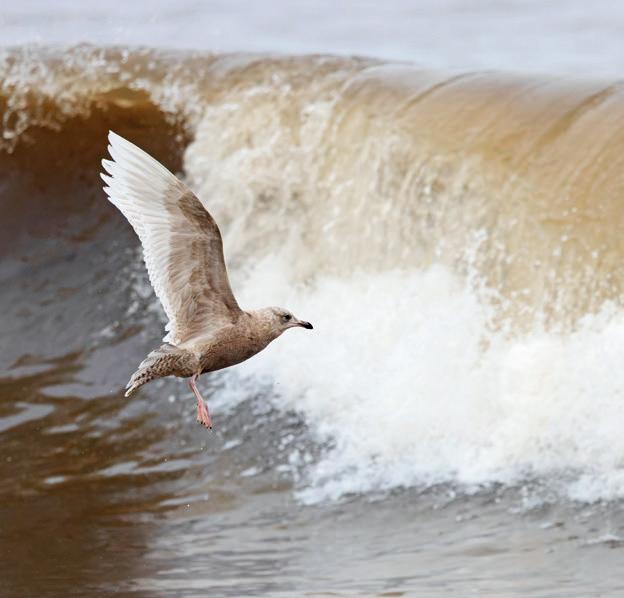
winter, the other slight surprise was that it seemed to move on quite quickly. Perhaps it moved on to even warmer climes or perhaps it was predated, for instance, by a sparrowhawk.
The grey seal colony between Waxham and Horsey seems to be going from strength to strength. Post breeding gatherings of the seals on the beaches attracted some of the white winged gulls that originate from the Arctic, such as the glaucous and Iceland gull, along with the more usual species, such as herring gulls.
Earlier in the winter, I watched an Iceland gull at Sea Palling among a large number of other gulls, including black-headed gulls, herring gulls, and the occasional Caspian gull, consuming seafood morsels that had the undignified experience of being picked up by the rough seas and smashed against the sea defence rocks. The resulting seafood buffet of razorshells and shore crabs was a bonanza for the gulls, which many birdwatchers enjoyed watching. The whole experience was enhanced by several purple sandpipers attracted there by the now rocky coastline.
Left to right:
Large numbers of white-fronted geese arrived in Norfolk during December;
A red-breasted goose was seen at Morston Quay at the end of January but only stuck around for a day;
The biggest surprise in the smaller bird department was a red-flanked bluetail;
This Iceland gull was spotted at Sea Palling this winter.
Holme Dunes
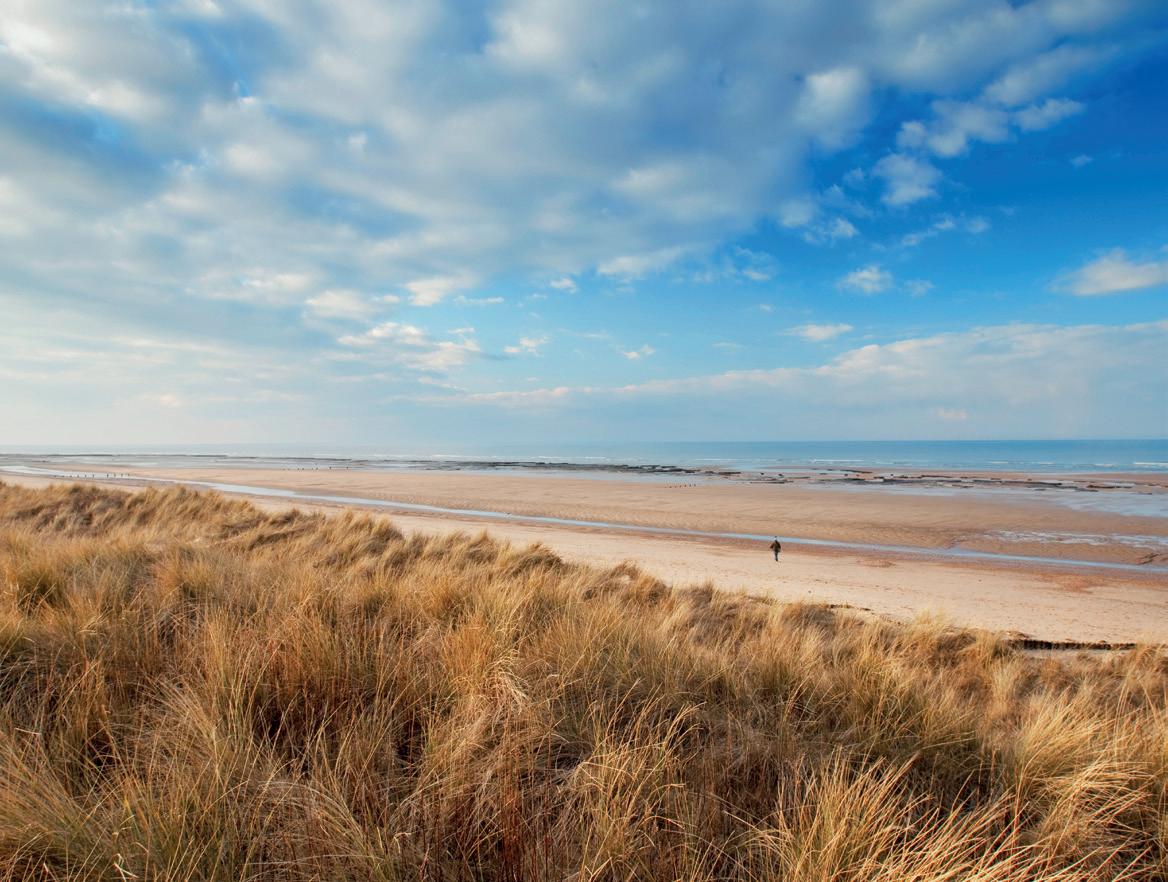
This summer, thousands of people will head to the beach. Norfolk has a range of coastal landforms, from the life-rich mudflats of The Wash, through the cobble beach of Sheringham, to the exposed chalk of West Runton. But our sandy beaches are the most prized by families on holiday.
On the inland side of our sandy beaches – as at Holme, Brancaster, Wells, Horsey and Great Yarmouth – there is typically a line of sand dunes. These form naturally where four conditions are found. The first, self-evidently, is sand.
There also needs to be a large tidal range. Sand needs to dry sufficiently between tides for the wind to blow it inland. Whereas the energy for saltmarshes comes from the tide, and for shingle beaches it comes from waves, the energy to create sand dunes comes from the wind. The third condition for sand dune formation is therefore an onshore wind (blowing up a long beach, where the sand has time to dry out between tides).
The final condition is known technically as a nucleus. This is often debris at the top of the beach that breaks the flow of the wind carrying or rolling the sand. Left undisturbed – by the tide, by a person’s footprint, by heavy rain –sand can begin to accumulate around a nucleus, forming an embryo dune.
Now life arrives. Embryo sand dunes are extremely hostile to plants – no organic matter, very little freshwater, exposure to salt – and only true specialists can colonise them. In Norfolk, the first plants to move in are prickly saltwort, sea rocket and sea sandwort.
These pioneer plants change the physical environment into which they move. They sequester carbon, enriching the soil of the embryo dune, giving it greater ability to retain moisture; their roots bind the substrate, adding stability; and their stems raise the dune a little higher, trapping more wind-borne sand.
Next, grasses move in. First comes sand couch, but it is quickly joined by the dune-builder par excellence, marram.

Nick Acheson is an author and NWT Ambassador
Marram grass has many extraordinary adaptations, enabling it both to ration freshwater and to grow up through the developing dune. Its coarse stems anchor sand in place, adding both physical structure and tons of carbon.
Eventually, the soil becomes rich enough for other species to outcompete marram. Inland of the marram-dominated yellow dune, we find the grey dune, with its wonderful chaos of lichens, flowering plants, fungi, insects and other life. In some places in Norfolk, as at Winterton, the grey dune supports acid-loving plants like common heather and sheep’s-bit. At Holme, Holkham and other sites in West Norfolk, chalkloving species can be found.
On the inland side of the dune, if the water table is exposed, wonderful wetlands form. These dune slacks support countless specialist species, including early marsh orchids, marsh helleborines and natterjack toads.
As you visit Norfolk’s beautiful beaches this summer, spare a thought for the many other lives their sand supports.





The perfect location for exploring the North West Norfolk coast and countryside.
> FREE Leisure and Entertainment Passes
> Walking Distance to Beach and Town Centre
> Mains Serviced, Serviced and Standard Pitches
> Variety of Onsite Food and Drink Venues
> Golf, Fishing, Tennis and Bowls
> Heated Shower Facilities
> Rally Groups Welcome
> 24h Reception
> Open Year Round*
*Limited facilities in off-season Booking hotline: 01485 534211
Lines open: 8am - 8pm Monday to Saturday. 9am - 6pm Sunday or scan QR code to book online


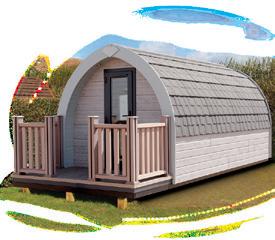
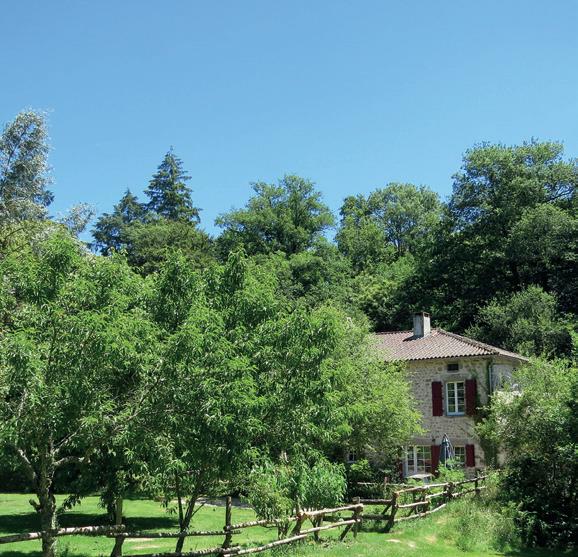
Gites and B&B set in 20 acres of rewilded countryside Incredible biodiversity -68 species of butterflies recorded on our grounds alone Limousin, France TGV Train to Angoulême Flights to Limoges Stansted Manchester Bristol East Midlands Leeds


Widespread, web-like, separating cows from commons, fields from fens, yet connecting whole landscapes together. Hedges have been a feature of our landscape for over two millennia – they pre-date the Roman invasion. They are a staple of our British landscape and a pillar of our culture.
The word hedge was once used to mean low-born, or unprofessional. One would put the word ‘hedge’ in front of another, to be derogatory. A ‘hedge-doctor’, ‘hedge-lawyer’, ‘hedge-priest’, was deemed unqualified and undeserving of their profession.
Even our beloved hedgehogs did not escape the scrutiny of being hedge dwellers. Shakespeare famously labels the ‘hedgepig’ as the evil familiar to the three witches in Macbeth.
However, there has always been a nurturing premise to using the word hedge in this way. The practice of putting ‘hedge’ in front of words stemmed from a time when labourers took shelter beneath them during bad weather. With it being largely ‘common folk’ doing this, it became a demeaning
term; but at its root, 'hedge' meant protection. As thick, wide, hardwearing structures, hedges provided shelter to all. 'Hedge-born’ was the term given to children whose mothers had nothing more than a hedge to shelter the birth. ‘Hedge-schools’ were unlicensed places of education.
Before the agricultural revolution, hedges were part of the rural economic structure. Traditionally cut or laid by hand, hedges thrived, becoming thick, healthy and bountiful. When properly managed, hedges benefitted people, livestock and wildlife.
However, in the latter half of the 20th century, circumstances changed. Livestock could be controlled using electric fences; and fields needed to grow to keep up with the supermarkets’ demand for cheap food.
Domestically, the need to park cars has resulted in many hedges being replaced by hard landscaping, and the ones that are planted are easy to maintain, non-native, species.
Driving through the countryside now one sees low, leggy, ‘lollipop’ hedges, flailed tight at the top and gappy at the bottom. Around our houses,
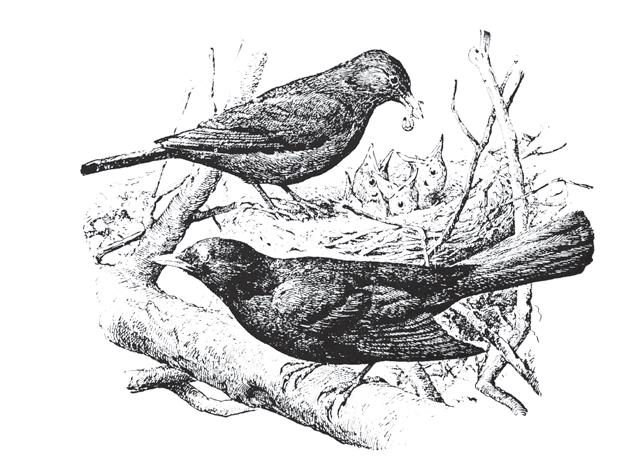
NWT Urban Nature Reserves Assistant, Sarah Wilde explores wildlife folklore
we’ve created clipped, neat hedges bordering manicured lawns. No longer thick, protective structures, these hedges are of little use to wildlife.
In just a few decades, thousands of miles of the thick, luscious, sheltering structures that gave nest sites for birds, cover for mammals, pollen for insects and fruits, nuts and seeds for us all, were lost.
Hedge laying, a 2,000-year-old traditional craft, can revitalise hedges. Laid hedges are a small bird's paradise, out of reach of any rapidly descending sparrowhawk. The leaf buds provide sustenance in the spring, pollinators hum around the blossoms in May, and the berries provide a feast in the autumn. Moths shelter in the shady, windproof understory and small mammals move safely under the thicket.
For millennia hedges gave protection to both people and wildlife. By reintroducing traditional methods of management and cutting less frequently our hedgerows can be the nurturing, bountiful structures they once were.

If you’re thinking of growing a hedge that benefits wildlife you could consider hawthorn, blackthorn, dog rose, field maple, elder and bramble. Find out more about managing hedgerows for wildlife: norfolkwildlifetrust.org.uk/hedgerows


Coat The division between the brown back and pale belly is neat
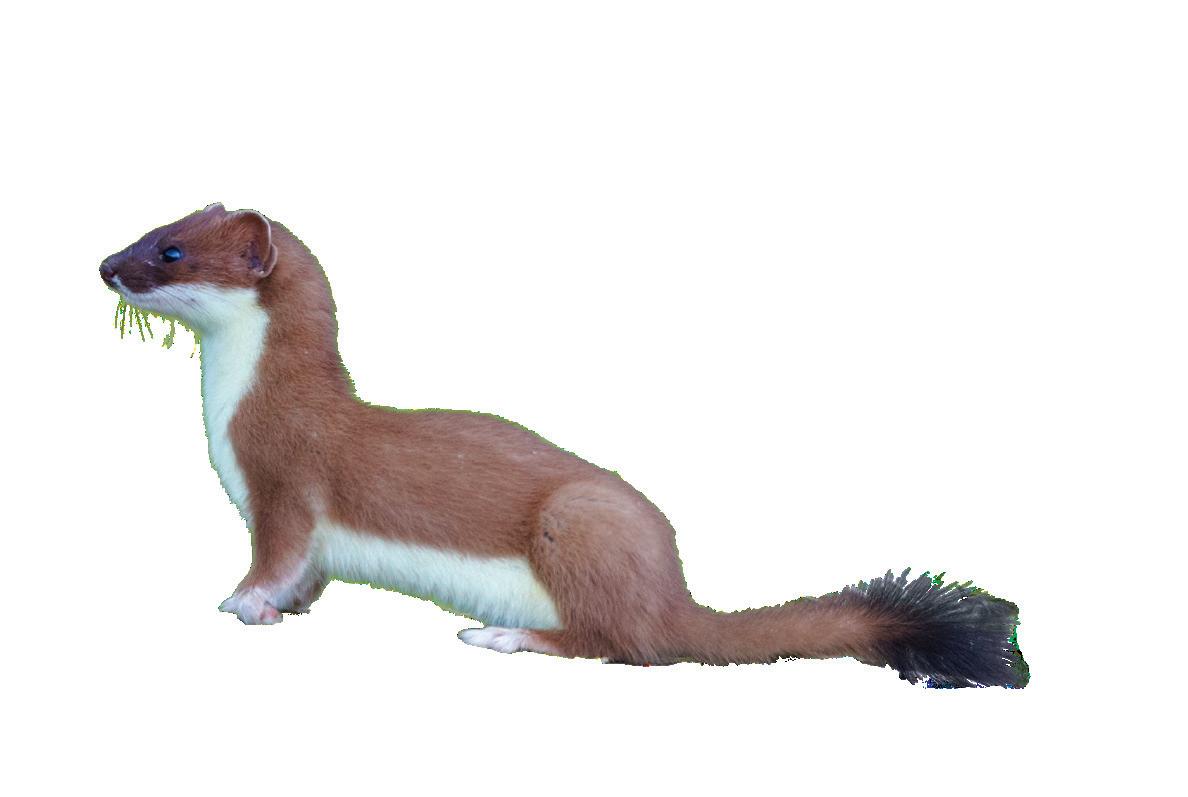
Tracks larger footprints with a more irregular heel pad
Mustela erminea
Length Around 24-31 cm body length, with a 9-14 cm tail
Weight 140-445 g (males are around twice as heavy as females)
Tail Long, with a bushy black tip
Movement Often bounds along with a strongly arched back
Diet Mostly eats rabbits, as well as rodents, birds and their eggs and other food
Length Around 17-22 cm body
length, with a 3-5 cm tail
Weight 55-131 g (males are around twice as heavy as females)
Tail Shorter than a stoat’s and completely brown
Movement Usually scurries low to the ground
Diet Specialises in hunting mice and voles, but may also eat small rabbits, birds and their eggs and other food
Tracks smaller footprints with a more rounded heel pad
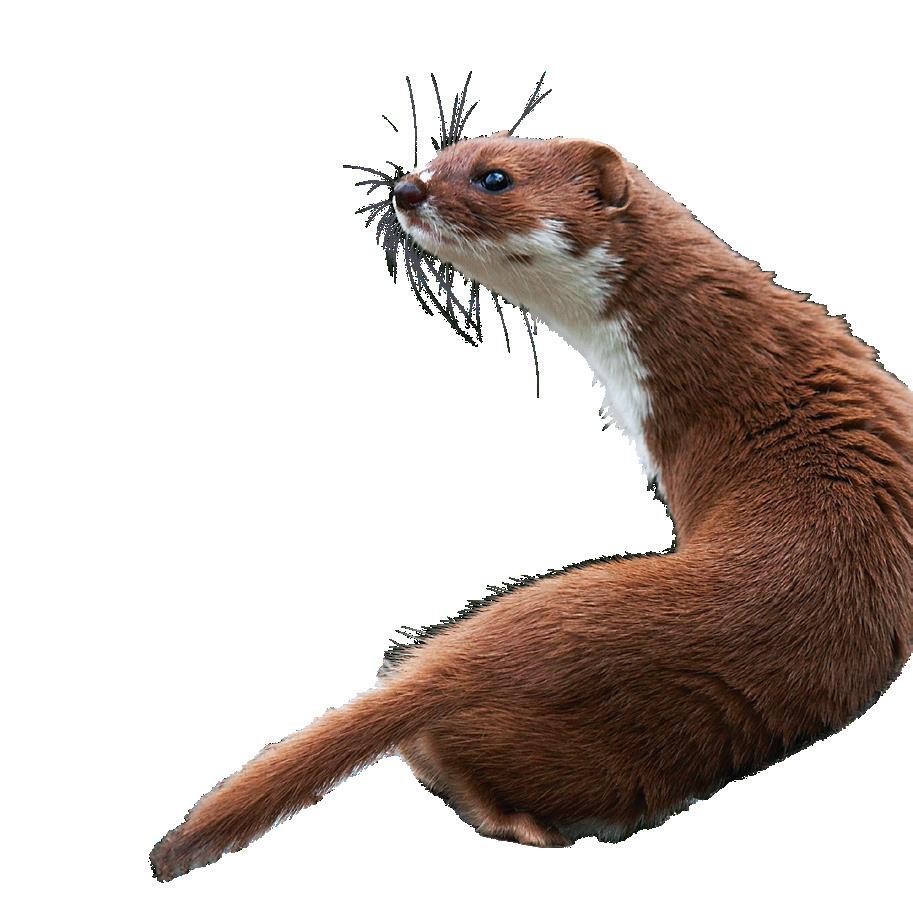
Coat The division between the brown back and pale belly is jagged and patchy
Patrick Barkham is a natural history writer and President of Norfolk Wildlife Trust

My son and a mate recently went on a miniature adventure that I hadn’t experienced since I was their age – twelve. They visited Ranworth and climbed the church tower.
Up 89 uneven stone steps spiralling round, up two ladders past the bells, through a trap door and out onto the breezy church roof.
A little elevation goes a long way in a flat place and the view from 96ft up is spectacular. The Broads look more wooded than watery – a slice of deep green Norfolk Amazonia wiggling through one of the most intensively farmed landscapes in the world.
Up high, you really appreciate the unique significance of Britain’s largest freshwater wetland for nature. Aren’t we lucky to have it here.
And the boys could spy something I couldn’t have dreamed of when I climbed the tower back in 1987: osprey, nesting on the Broads again, drawn back to Norfolk Wildlife Trust’s Ranworth reserve after years of efforts to improve water quality and clarity, and enable these majestic predators to catch the fish they require.
When the boys went down to the visitor centre, they enjoyed an osprey view through a telescope and, of course, the thrilling webcam.
Hang on, I can have a miniature adventure of my own at my desk. While I write these words, I turn on the webcam. I can’t quite believe it! There is a magnificent osprey, sitting on its Ranworth nest, piercing

A little elevation goes a long way in a flat place and the view from 96ft up is spectacular.
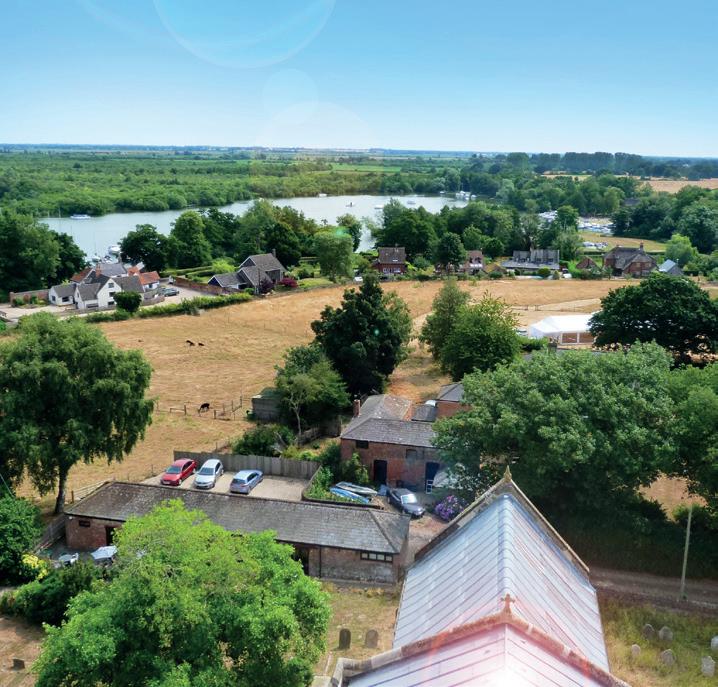
yellow eye surveying the scene, feathers ruffling in the wind.
There are hundreds of other mini adventures you can enjoy at NWT reserves across the county. In a time of a cost of living crisis, it seems almost miraculous that most are free.
Find a swallowtail at Hickling. Hunt for a goshawk in our brand new Broadland Country Park reserve. Listen to the pool frog chorus at Thompson Common. Hear the nightjars churring on Grimston Warren, a heathland entirely recreated by NWT. Or head to one of the little, less heralded reserves – Alder Fen, say, or Booton Common – and breathe in deep peace.
What all these...
Hang on, there’s a call! The male osprey has flown in. The pair are
having a chat. How was your day dear? Actually, it might be a row: he’s munching a freshly-caught roach, and he’s definitely not sharing.
What all these miniature adventures have in common is that they bring both joy and hope. Nick Acheson writes powerfully about the hope that our new reserves represent. Hope is innate in all the doings of the natural world, from a dandelion unfolding to a swift returning. It’s our moral duty to let other species flourish – let hope flourish – and of course it does us good too.
So please help us celebrate our centenary year by enjoying some miniature adventures of your own.
PS – the male osprey has only left the roach bones! The female is furious!