VOLUME 39 • NUMBER 3 • SPRING 2026 Print Post Publication No. PP 100018976
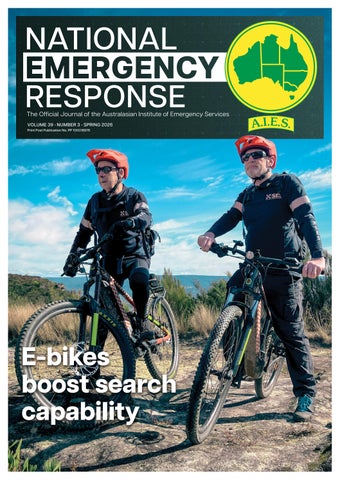
E-bikes boost search capability
Australia's preferred Indigenous contractor Eastern Guruma Pty Ltd supports Australia's leading iron ore miners and services the broader resources and industrial sector across WA.
Mine site services Eastern Guruma provides various mine site services including creating and maintaining access, road management, exploration works and rehabilitation.
Integrated Services
Integrated Services is one of Eastern Guruma’s top specialties. The team tailors every service to ensure operational maximisation of client assets.
Get in touch today
08 9325 2424 enquiries@easternguruma.com.au www.easternguruma.com.au
Rehabilitation & closure Eastern Guruma provides and industrial contaminated area rehabilitation.
Civil construction As an experienced civil contractor, Eastern Guruma has delivered experienced team. The company has the ability to undertake detailed civil works and determine solutions to meet client needs and budgets.
Locally Owned Since The 1950’s Servicing WA Mining Twomeys is a Geraldton-based metal fabrication & labour hire specialist with a rich history in the mining industry. Our Geraldton head office features a modern fabrication workshop and labour hire service, supported by our Perth office dedicated to labour hire solutions. Strategically located, we efficiently service Kalgoorlie, Mid West, Gascoyne, and Pilbara mining regions. Backed by generations of experience, we provide: • fabrication & maintenance for all fixed mining plant • experienced labour hire for projects and shutdowns With decades of expertise and a trusted name since the 1950’s, Twomeys delivers quality workmanship, reliable service, and local knowledge for the WA mining industry.
Ph: 08 9935 9511
www.twomeysgroup.com.au Proudly Supporting our Local Emergency Service Volunteers
02 Official Publication of Australasian Institute of Emergency Services Print Post Approved PP 100018976 Disclaimer Views expressed in this journal, unless specifically acknowledged, are not necessarily those of the Publisher, of the Institute, of its Board or of the Editor. Editorial Rights The Editor of National Emergency Response reserves the right to grant permission to reproduce articles from this journal. Such approval is hereby granted, unless a specific withdrawal of this permission is included in the article in question. The Author and the journal must be acknowledged in any such reprint. Mailing Amendments or Enquiries For any amendments or enquiries regarding mailing, please email: secretary@aies.net.au Notice to Advertisers This publication is the official journal of the Australasian Institute of Emergency Services. It is published by Countrywide Austral for the Australasian Institute of Emergency Services and will be distributed to its members. An illegal practice is presently operating where advertisements from some of our publications are used to produce unauthorised publications and our advertisers are contacted for payment for the unauthorised advertisement. If you are approached to place an advertisement or with a request for payment for another publication, you should verify that the advertisement has been authorised and establish the bona fides of the company. The invoice and any correspondence should have the company name, ABN, and an address (not just a PO Box) and you should ask for proof of publication. If you do receive a request for an unauthorised advertisement, or have concerns about the bona fides of a company, we suggest you refer it to the Office of Fair Trading in your capital city.
Contents Features
Fifty years of AIES Australasian Institute As AIES prepares to mark its 50th anniversary, members past and present are invited to of Emergency Services
16
E-bike trial boosts land search capability
30
share the 50 stories, Celebrating years •photographs 1977 - 2027 and historical material that will bring those years to life.
The NSW SES Blue Mountains Cluster and Bush Search & Rescue (BSAR) Unit are helping shape the future of land search operations by taking part in a 12-month NSW SES e-bike trial.
Editorial Team Editor: Kristi High Associate Editor: Steve Jenkins FAIES Send articles for inclusion to: Email: editor@aies.net.au Website: www.aies.net.au
Beirut explosion On 4 August 2020 at 6.08pm, during the COVID-19 pandemic, a fire in a warehouse at the Port of Beirut spread to a warehouse containing 2,750 tonnes of ammonium nitrate (AN) creating an explosion equivalent to an earthquake with a magnitude of 3.3 to 3.6.
Website Content The website has sections for each State as well as National Areas. If you have ideas for State Division content, please contact your State Secretary. For National content, email secretary@aies.net.au Please be aware that all content must be cleared by the National President prior to web publication to ensure it meets required guidelines. Publisher National Emergency Response is published by
Countrywide Austral 1, 460 Bourke Street, Melbourne GPO Box 2466, Melbourne 3001 (03) 9937 0200 contact@cwaustral.com.au ACN: 30 086 202 093 Journal Enquiries For any enquiries regarding the publication, please contact Tony Cornish: Mob: +61 411 055 050 Disclaimer: Countrywide Austral (”Publisher”) advises that the contents of this publication are at the sole discretion of the National Emergency Response and the publication is offered for background information purposes only. The publication has been formulated in good faith and the Publisher believes its contents to be accurate, however, the contents do not amount to a recommendation (either expressly or by implication) and should not be relied upon in lieu of specific professional advice. The Publisher disclaims all responsibility for any loss or damage which may be incurred by any reader relying upon the information contained in the publication whether that loss or damage is caused by any fault or negligence on the part of the publisher, its directors and employees. Copyright: All advertisements appearing in this publication are subject to copyright and may not be reproduced except with the consent of the owner of the copyright. Advertising: Advertisements in this journal are solicited from organisations and businesses on the understanding that no special considerations other than those normally accepted in respect of commercial dealings, will be given to any advertiser.
N AT I O N A L E M E R G E N C Y R E S P O N S E
44
Vale Maurice Massey
11
HEMCOP, one year on: from four members to a global Community of Practice
18
St John WA walks the green carpet to celebrate Paramedics television debut
20
Stronger businesses, stronger communities
22
From classroom to crisis: rethinking how we train Australia’s future humanitarian and emergency responders
34
Member recognition at the 2026 Disaster and Emergency Management Conference
39
Inaugural scholarship recipient earns double recognition
41
AIES gets early look at new SEOC technology
43 Spring 2026
03
AIES Contacts Regular Columns
General Enquiries
05
New members
Message from our National President
06
David Parsons ESM FAIES CESM
Thought Leadership
08
from experts in emergency services and management Jonathan Curtis MAIES
Advancing practice through research
12
enquiries@aies.net.au PO Box 2469, Chermside Centre, Qld 4032 www.aies.net.au www.facebook.com/aies.online www.linkedin.com/groups/3844281
National Board President
David Parsons ESM FAIES CESM president@aies.net.au
Immediate Past President
Steve Jenkins FAIES steve.jenkins@aies.net.au
Vice President
Rebecca Hunt MAIES vice.president@aies.net.au
Company Secretary
Marilena Salvo secretary@aies.net.au
National Treasurer
Jenny Crump ESM FAIES treasurer@aies.net.au
Webmaster/Systems Costa Zakis FAIES Administrator webmaster@aies.net.au
NSW, ACT and International
Showcasing recently published research in emergency and disaster management John Moy MAIES
President
Dr Brett Henderson MAIES CESM president.nsw@aies.net.au
Secretary
Ian Manock FAIES secretary.nsw@aies.net.au
Queensland and Northern Territory
Resources
49
Merchandise
51
Secretary/Treasurer Jenny Crump ESM FAIES secretary.qld@aies.net.au
Membership information
52
South Australia and Western Australia
On the cover
John Moy MAIES president.qld@aies.net.au
President
Shane Bolton FAIES CESM president.sa@aies.net.au
Secretary
Warren Erasmus MAIES CESM secretary.sa@aies.net.au
Tasmania
NSW SES volunteers trial e-bikes at Katoomba, exploring how electric mountain bikes can help land search teams cover more ground. Story on page 30.
President
Vacant president.tas@aies.net.au
Vice President
Dr Bodie Rodman MAIES vice.president.tas@aies.net.au
Secretary
Greg Webster RFD MAIES secretary.tas@aies.net.au
Victoria
Photo: NSW SES
Articles, photographs and short stories are sought for the National Emergency Response Journal. Please submit items for the next edition to editor@aies.net.au by 1 March, 2027. After each edition, awards of $250 each are available for the best article submitted by an AIES member and an original front cover photograph.
President
Content Deadline
MAR
01
President
Doug Caulfield OAM RFD FAIES MIAEM president.vic@aies.net.au
Vice President
Kate Goldsmith MAIES MIAEM CESM vice.president.vic@aies.net.au
Secretary
Bill Little FAIES MIAEM secretary.vic@aies.net.au
National Emergency Response Journal Editor
Kristi High editor@aies.net.au 0407 366 466
Advertising Enquiries
Tony Cornish tcornish@cwaustral.com.au 0411 055 050
Spring 2026 N AT I O N A L E M E R G E N C Y R E S P O N S E
Specialists in HME Field Maintenance Mechanical • Hydraulics • Auto Electrical • Air Conditioning • Boilermaking Breakdowns • Rostered Maintenance • Shutdowns • Technical Support • Supervision
Safety | Quality | Integrity | Accountability | Reliability
shane@sbheavydiesel.com
NEW MEMBERS
05
New members
The Australasian Institute of Emergency Services is pleased to announce the following emergency services people joined the AIES between July and September 2026. Name
Organisation
Name
Organisation
NSW / ACT / International Division
SA / WA Division
Jeremy Black
SES
Jordan Argentieri
Rio Tinto
Russell Buzby
Rural Fire Service
Padraic Durham
Country Fire Service
Kelly Chadwick
NSW Ambulance
Johanna Garnett
SAFECOM
Michael Cole
Department of Climate Change, Energy, the Environment and Water
Robyn Green
Emerald Sky Solutions
Brad Slater
Krisis Consultancy
Adrian Stoker
MKAS Training
Richard Hingston
SES/ Surf Life Saving
Matthew Kirby
SES
Steven May
West Coast Regional Council
Peter Myers
Australian Maritime Safety Authority
Kristy Petersen
Mid Coast Council
Christopher Samuel
NSW DCCEEW
Matt Staniforth
Department of Climate Change, Energy, the Environment and Water
Fergus Stewart
SES / St John Ambulance
Tim Thornton
SES
QLD / NT Division
VIC Division Thomas Bamford
St John Ambulance
Emma Bugler
SES
Greg Christison
Fire Rescue Victoria
James Healy
Melbourne Archdiocese Catholic Schools
Luke Herezo
SES
Nathan Keating
Focus Building Risk and Compliance Pty Ltd
Brooke Langdon
AusNet Services
Peter Moore
Department of Health
Kiara Noonan
City of Greater Bendigo
Cherilyn Bickers
Western Queensland Primary Health Network
Adam O’Brien
Royal Melbourne Hospital
Shaun Gillott
Life Flight
Ian Peters
St John Ambulance
Gregory Spencer
Marine Rescue Queensland
Danielle Stephenson
V/Line
Thomas Szczupak
Emergency Management Victoria
Leah Thompson
Moira Shire Council
Marc Unsworth
Emergency Management Victoria
Andrew Williams
Charles Sturt University
Journal contributions Have a story, insight or lesson that could strengthen emergency management practice or showcase work in the emergency services sector? New contributor guidelines are now available to help you share it with confidence.
The updated guide provides clear direction on article length, writing style, imagery requirements and editorial standards, supporting contributors to develop highquality, sector-relevant content. It also outlines how submissions may be edited for inclusion. Contributions are welcomed from practitioners, volunteers, academics and industry experts. Submissions should be written in clear, accessible Australian English, minimise jargon and include high-resolution images to support the story. Submissions that share practical insights, innovation, research and real-world experience are strongly encouraged, helping build knowledge and capability across the sector. References To make the best use of available print space, full reference lists are not always reproduced in National Emergency Response. Readers can obtain the references for an article, where indicated, by contacting editor@aies.net.au. Please include the edition, article title and page number.
The full Contributor Guidelines, including submission timelines, are available on the AIES website. To submit an article or discuss an idea, contact your division representative.
Spring 2026 N AT I O N A L E M E R G E N C Y R E S P O N S E
06
N AT I O N A L P R E S I D E N T
Message from our National President David Parsons ESM FAIES CESM AIES President
T
his year has brought many challenges and opportunities. We have conducted a number of webinars including two on the Bondi terrorist attack. The goal is to conduct webinars enabling all our members including those from regional and remote Australia to have access to contemporary issues. If you have an idea for a speaker please get in touch. In 2026 our membership passed the 500 mark and is on its way to passing 600 in 2027. For the past five years, we have had annual growth rates exceeding 10% per annum. The majority of members join due to the recommendation of a friend. Is there anyone you should be inviting to join?
Vale Maurice Massey
It was sad to hear that Maurice Massey, one of our Tasmanian members who had served as both a state and national president for a long period of time, passed away on September 11. Maurice made a significant contribution to society in his police career and to the AIES. We have written a Vale to Maurice on page 11.
Disaster and Emergency Management Conference (DEMC)
This year we were in a position to provide a record number of member passes to the DEMC. For the first time we established a WhatsApp group for the conference to help members network and connect. This idea was well received. Our most remote member Jess Strzelecki attended from Christmas Island connecting with colleagues and getting the opportunity to eat fresh fruit and vegetables.
Education pathways project
Jenna Mott MAIES will be our first member to gain her Emergency Management Degree through our pathways project. Jenna earned her diploma in Public Safety through our Corporate Member ACIM Solutions. Jenna then transitioned to our Corporate Member Charles Sturt University with four subject credits and will shortly graduate with her Emergency Management Degree. Jenna plans to complete her master’s degree at Charles Sturt University. We will be making new announcements from our education pathways project in coming months.
N AT I O N A L E M E R G E N C Y R E S P O N S E
Massey University Joint Centre for Disaster Research Management Institute Week 2027
In 2027 we will be organising a study tour to the Massey University Joint Centre for Disaster Research Management Institute Week March 1-5. For more information email president@aies.net.au
Professional Development Scholarships
In 2027 there will be six Professional Development Scholarships available. You can apply for a scholarship to attend an emergency management conference or course such as an AIDR masterclass. You must be prepared to write an article for National Emergency Response sharing your experience. Applications are via your Division Committee.
AIES members at the DEMC. Jess Strzelecki MAIES. Jenna Mott MAIES.
Spring 2026
N AT I O N A L P R E S I D E N T
07
Contribution awards
In each edition of our journal, Countrywide Austral selects the best member contribution to receive $250 for an article and the same for an original image provided for our front cover. Our first award for an article went to Karen van Huizen MAIES. Articles or photos can be sent to our Editor via editor@aies.net.au Karen van Huizen MAIES CESM.
Certified Emergency Services Managers
Graeme Craig ESM FAIES CESM.
In 2026, the number of Certified Emergency Services Manager (CESM) recipients passed 40. CESMs represent AIES members who are proactively growing their knowledge and sharing it with others. Our first group of CESM applicants are coming up for renewal. David Rose from the ACT was quick to submit and has been recertified for another three years. If you are thinking about applying check the information provided on the website. If you have any questions email CESM@aies.net.au
Tiffani King MAIES CESM. Brody Wickham MAIES CESM.
Fire deployments
Brody Wickham MAIES CESM and Graeme Craig ESM FAIES CESM have recently returned safely from their deployments to Canada. Both members say the experience was highly valuable to their own professional development. We look forward to their webinars and National Emergency Response articles on their experience. Both members also gained 45 CESM knowledge points for their time away. The deployments provide a unique learning experience.
Future ready
With membership numbers doubling over the last five years, the range of member services has also grown significantly. The Board has commenced work to prepare the AIES for further development and growth in the decade ahead. The Board recently developed a new Strategic Plan and has started developing a suite of Standard Operating Procedures. As our numbers grow towards 1,000, we will explore options to improve our member management system, which includes reviewing our branding. We will keep you updated on our future ready projects.
Congratulations Tiffani King MAIES CESM
Congratulations to Tiffani King on graduating with an Emergency Management Degree from Charles Sturt University recently. All those years of hard work have paid off. As one of my former students, I know first hand that Tiffani is a great national asset. I look forward to seeing the impact she has on the sector.
Book reviews
If you read an interesting book on an aspect of emergency management you can now earn CESM points. Reading the book earns five knowledge points and writing a review for our Journal adds another 10 contribution points. Reading and writing will help you gain 15 points. Our first review appears in this edition.
The AIES has and will need to continue to evolve to stay relevant and add value in the decades ahead.
Australasian Institute of Emergency Services Celebrating 50 years • 1977 - 2027 Turning 50 in 2027
In 2027, the AIES will celebrate its 50th anniversary. Our founding members had great foresight to create the AIES. At the time it filled a gap to bring together emergency services in Australia. The industry has evolved since 1977 with emergency management becoming a role separate to emergency response services. In addition, the field of recovery has emerged and grown. Today we also see the emergence of resilience practitioners. The AIES has and will need to continue to evolve to stay relevant and add value in the decades ahead. Our anniversary celebrations are being led by Queensland President John Moy.
End of the year
As this is our last edition for 2026, I would like to thank our Board and all of our Members for their significant contributions this year. I look forward to seeing many of you in 2027 at our anniversary celebration events.
Spring 2026 N AT I O N A L E M E R G E N C Y R E S P O N S E
08
THOUGHT LEADERSHIP
Thought Leadership
from experts in emergency services and management Jonathan Curtis MAIES
Editor AIES Thought Leadership Series
Adaptive planning in crisis: moving beyond static emergency plans Mark Owens MAIES CESM MEmergMgt Fire Rescue Victoria Commander
Introduction
More than 70 years ago, General Dwight D Eisenhower captured a fundamental truth about preparedness: ‘Plans are useless, but planning is indispensable.’ His words resonate today as strongly as they did in the 1950s, and they carry particular weight for anyone working in emergency management. Across all levels of government, emergency services, and supporting agencies, the emphasis has long been placed on producing formal plans that are often lengthy, technical, and designed to satisfy legislative requirements or organisational policies. Yet the real value lies not in the document but in the process: collaborative planning, shared understanding, testing, rehearsing, and relationship building. This paper explores why adaptive planning, not rigid documentation, remains the most effective foundation for emergency management success.
Do we rely too heavily on written plans?
Emergency management environments are increasingly complex, fast-moving, and unpredictable. Yet the sector continues to invest disproportionate time and energy into developing static plans. These documents serve an administrative purpose: they demonstrate compliance, provide records for audits, and give agencies something to point to during inquiries
N AT I O N A L E M E R G E N C Y R E S P O N S E
or coronial investigations. But they rarely reflect the dynamic realities encountered during a real incident. In my more than two decades of experience, I have never seen an incident controller or emergency management team pause during a crisis to consult a State or Municipal Emergency Management Plan. In the middle of a bushfire, flood, or major structural incident, nobody has the time to read, interpret, and apply a document written months or years prior. Instead, they rely on training, experience, teamwork, and the shared mental models built long before the incident began. Plans, in this context, become artefacts, useful for structure, but insufficient for action.
Does Eisenhower’s insight still matter?
These activities should not be viewed as separate preparedness functions. Rather, they form a reinforcing cycle. Planning establishes shared intent and identifies assumptions. Exercising tests those assumptions under realistic conditions. Relationships enable agencies and stakeholders to coordinate effectively when plans encounter the inevitable friction of reality. Lessons identified through both exercises and operations then improve future planning. Weakness in any one of these elements diminishes the effectiveness
of the others. A comprehensive plan that is never exercised may create false confidence, while strong relationships without agreed planning can lead to duplication, inefficiency, or conflicting priorities during a crisis. Effective preparedness therefore emerges not from a document, but from the interaction between planning, exercising, relationships and continuous learning. Eisenhower’s observation that planning is indispensable highlights a critical distinction. The value lies not in the written product but in the act of planning itself: z Discussing and analysing risks z Testing assumptions z Building and maintaining relationships across agencies z Developing and refining response strategies z Exercising scenarios to understand limits and capabilities A written plan may outline roles, responsibilities, and procedural steps, but without shared understanding and practice, these elements fall apart under pressure. True preparedness is built through repeated interaction: discussing hazards, rehearsing responses, and cultivating trust across professional and personal networks. Emergency management demands adaptability, and adaptability only emerges when planning is embraced as an ongoing, interactive discipline.
Spring 2026
THOUGHT LEADERSHIP
Personal experience: the power of joint planning and exercising
In recent years, my work has increasingly focused on exercising specific risks such as complex alpine building fires, bushfires, ski lift rescues and incidents isolating communities with critical infrastructure failures. By engaging agencies, partners, and stakeholders early and often, we are able to explore response actions using SMART principles. These exercises do more than test procedures. They surface capability gaps, identify assumptions, and expose weaknesses that must be addressed. More importantly, they build relationships and foster a collective sense of ownership over the emergency response. This approach reflects a principle that extends well beyond emergency management and the military. Organisations operating in complex and safety-critical environments routinely recognise that plans must be tested, not simply written. Airports, for example, are required to regularly exercise emergency arrangements to demonstrate preparedness and maintain compliance with aviation safety requirements. Similar expectations exist across health, critical infrastructure, utilities and transport sectors. The common lesson is clear: a plan cannot be assumed to work simply because it has been approved and published. The Australian Defence Force applies this same philosophy through an integrated cycle of planning, exercising and operational readiness. Within Headquarters Joint Operations Command, preparedness is continually strengthened through structured activities such as Tactical Exercises Without Troops (TEWTs), command post exercises and scenario-based planning. These activities are designed not to validate plans, but to challenge assumptions, explore uncertainty and develop adaptive decision-makers. Emergency management should adopt the same mindset. Is accepting imperfection and building capability what we should strive for? One of the greatest barriers to effective planning and exercising is a fear of uncovering limitations. Yet vulnerability is essential. No agency, no individual, and no plan is perfect. Exercises and collaborative planning deliberately highlight weaknesses so they can be addressed before a real emergency exposes them. We must normalise the idea that improvement comes from iteration, not from presenting an image of flawless preparedness. When agencies work together, test together, and learn together, the community ultimately benefits from safer and more effective responses.
The often-overlooked value of relationships
Relationships are frequently acknowledged as important, yet they are often developed too late in the planning process. Traditional emergency planning tends to focus on agencies with legislated responsibilities and established response functions. Increasingly, however,
09
When agencies work together, test together, and learn together, the community ultimately benefits from safer and more effective responses. successful emergency management depends on organisations and individuals outside these traditional structures. Community organisations, telecommunications providers, energy companies, transport operators, volunteer groups, Indigenous representatives, faith-based organisations and local businesses often possess capabilities, local knowledge and community trust that government agencies alone cannot replicate. Bringing these non-traditional partners into the fold requires deliberate relational planning. This means involving them early in risk discussions, recognising their interests and constraints, including them in exercises, and establishing communication pathways before an emergency occurs. At the local level, relationship-building can occur through municipal planning committees, multi-agency workshops, community resilience forums and scenario-based exercises. The objective is not necessarily to create formal command relationships, but to build familiarity, trust and shared understanding. When an emergency occurs, organisations that have planned together and exercised together are far more likely to coordinate effectively under pressure than organisations meeting for the first time in a response environment.
Is adaptive planning the path forward?
While this paper argues against overreliance on written plans, it is equally important to recognise that plans perform an important governance function. They establish agreed responsibilities, decision-making authorities and accountability mechanisms. During a fast-moving emergency, circumstances may require leaders to adapt or depart from aspects of an approved plan. Such adaptation is often necessary and can represent good leadership. However, decisions that significantly diverge from established arrangements can attract scrutiny following an incident, particularly where outcomes are contested or subject to review. This reality further strengthens the case for exercising. Robust exercises help decisionmakers understand where plans provide firm direction, where discretion exists and how alternative courses of action can be justified. By exposing leaders to ambiguity, competing priorities and degraded operating conditions, exercises develop the judgement necessary to make defensible decisions when reality does not align with the plan. In this sense, exercising is not merely about testing a document. It is about preparing people
to make sound and accountable decisions when the unexpected occurs. For emergency management to succeed, particularly at the local level, it must prioritise adaptive planning, not static documentation. Plans will always have their place; they provide structure, clarity, and legislative compliance. But they are not enough on their own. True capability is built through: z Ongoing planning z Regular discussion of risks z Repeated exercising in varied formats z Strengthening cross-agency relationships z Embracing imperfection to drive improvement Emergency management is inherently time consuming and resource intensive. However, the investment in adaptive planning pays dividends in operational readiness, interagency coordination, and community safety. As Eisenhower taught us decades ago, the plan itself may become irrelevant, but the process of planning is what equips us to meet the challenges we cannot yet see. The future of emergency management will not be defined by the quality of our plans, but by the quality of the thinking, relationships and adaptability developed through the planning process itself.
Author bio
Mark Owens is a Fire Rescue Victoria Commander, seconded to the Country Fire Authority as Commander Alpine based in North-East Victoria. Mark holds a Master’s in Emergency Management, is a Certified Emergency Services Manager through the Australasian Institute of Emergency Services, is the co-inaugural winner of the 2022 Disaster Challenge run by Natural Hazards Research Australia and sits on their Project Management Committee for the project ‘Evaluating and monitoring for impact: developing a framework for risk reduction programs’. Mark has presented twice at Disaster & Emergency Management Conference.
Do you have a contribution for the AIES Thought Leadership series? Articles should be a maximum of 1,000 words. Send your idea to: thoughtleadership@aies.net.au
Spring 2026 N AT I O N A L E M E R G E N C Y R E S P O N S E
ProudSupporter Supporter Of Proud Of The Soldier On Program! Emergency Service Volunteers!
We've established
Home to
Working locally
8 Estates
2500 Families
Since 1988
INSPIRED BY NATURE DRIVEN BY EXPERIENCE.
elementsnq.com.au 07 4731 1425
VA L E
11
Vale Maurice Massey Maurice was a true legend and pioneer in many areas, including AIES, Tasmania Police Search and Rescue and, in particular, the national search and rescue (SAR) community. John Rice LFAIES
M
aurice was a foundation member of the National SAR Committee, which was convened at a time when Australia did not yet have a nationally consistent framework of policies, procedures and practices for search and rescue. The Committee brought together representatives and practitioners from across the country to share experience, resolve differences in approach and work towards a common national standard for SAR. Initially, the Committee’s focus was primarily on maritime search and rescue (SAR). However, as its work became increasingly focused on developing national search and rescue arrangements, policies, procedures and training, it became apparent that a single, nationally accepted approach to SAR was essential, rather than different policies and procedures being applied across individual jurisdictions and organisations. As the scope and importance of its work expanded, the Committee was renamed the National SAR Council to better reflect its national role and responsibilities. Its work contributed to the development of nationally agreed SAR policies, procedures, standards and training that have continued to evolve and underpin the Australian SAR system, including the National SAR Plan and the national arrangements that exist today. Maurice served as the Tasmanian delegate on the Committee and later the National SAR Council for many years and made an unmistakable contribution to this work. His involvement in those formative years helped shape the national approach to search and rescue and the standards and practices that followed. His contribution to the AIES was equally unparalleled. Through his many years as National President, he provided strong leadership and guided the Institute through many challenges, changes and periods of significant development. His outstanding contribution to the Institute was recognised through the awarding of Life Membership and his 2013 National Award for Excellence. Maurice was also a foundation member of the National Police Search and Rescue Training Course and served as
Through his many years as National President, he provided strong leadership and guided the Institute through many challenges, changes and periods of significant development. a member of its Directing Staff for many years. His contribution and expertise were recognised when he was appointed Director of Studies for two years, during which he delivered the course from the Tasmania Police Academy. Yet, above all his achievements in policing, search and rescue and the AIES, Maurice
was a good friend to many — and to me in particular, for nearly 40 years. Sadly, at the age of 88 years, the ravages of time have now taken him from us. Maurice made an enormous contribution to so many people and organisations, and his passing will leave a significant void. He will be sorely missed.
Spring 2026 N AT I O N A L E M E R G E N C Y R E S P O N S E
12
AI ES M E M B E R STO RY
Advancing practice through research Showcasing recently published research in emergency and disaster management
A
ustralian research continues to play a critical role in shaping policy, strengthening community resilience, and enhancing the professional practice of those working on the frontline of crises. Across Australia, an increasing number of emergency management practitioners are undertaking doctoral studies, generating valuable evidence that informs decision-making, capability development, and sector-wide reform. As the discipline continues to mature, these practitioner-researchers are helping bridge the gap between academic inquiry and operational practice. The previous article in this series examined the PhD research of Dr Steven Schwartz, whose investigation into lost person behaviour in wilderness environments provided valuable insights into the human experience of becoming lost and highlighted the contribution of qualitative, user-centred research to search and rescue practice. The first article in this series explored how Dr Russell Dippy’s practice-led doctoral inquiry was used to address complex operational challenges faced by emergency services professionals. This third article returns to the Professional Doctorate pathway and examines the work of Dr Brett Henderson. Dr Brett Henderson is the current President of the AIES NSW/ACT/ International Division and his research explores one of the most enduring and contested issues within Australian emergency management: community participation. Drawing on more than three decades of experience across policing, emergency management, disaster investigations, and volunteer disaster response, Henderson’s work challenges long-standing assumptions about the role of communities within emergency management systems and asks whether the concept of ‘shared responsibility’ has ever been fully realised in practice. A defining strength of the Professional Doctorate is its ability to harness professional experience as the foundation for rigorous inquiry.
N AT I O N A L E M E R G E N C Y R E S P O N S E
From Receptors to Partners: The Research of Dr Brett Henderson John Moy MAIES
AIES President Queensland/Northern Territory Division with reference to the research of
Dr Brett Henderson MAIES CESM
AIES President NSW, ACT & International Division
Are we really sharing responsibility?
Few concepts are more deeply embedded within contemporary Australian emergency management than “shared responsibility.” Governments, emergency services, and policymakers regularly encourage communities to prepare for disasters, understand local risks, and take responsibility for their own resilience. Yet despite this commitment, inquiries following bushfires, floods, storms, and other disasters continue to reveal familiar themes. Communities consistently report concerns about communication failures, limited consultation, disregard for local knowledge, and a lack of influence over decisions that directly affect them. These recurring concerns raise a simple but important question: if emergency management is truly built on shared responsibility,
why do communities so often feel excluded from the decisionmaking process? It is this question that sits at the heart of Dr Brett Henderson’s Professional Doctorate research.
A practitioner-scholar grounded in experience
What makes Henderson’s research particularly compelling is the depth of professional experience from which it emerged. Prior to commencing doctoral studies, Henderson served more than 36 years with the NSW Police Force in a range of operational, investigative, and leadership roles. Throughout that career he was exposed to numerous emergencies and disasters, giving him a unique perspective on how emergency management functions in practice. A defining chapter occurred between 2001 and 2003 when Henderson led a multi-agency
Spring 2026
AI ES M E M B E R STO RY
13
Communities were expected to be responsible for their own resilience, yet they possessed limited authority, influence, or participation in the systems designed to manage risk.
Phillip Wittke @istock
task force responsible for investigating bushfires that occurred during declared States of Emergency in New South Wales and the Australian Capital Territory. The investigation examined approximately 750 incidents involving more than 753,000 hectares of fireaffected land, fatalities, extensive property damage, and major operational responses. The work contributed to numerous coronial inquiries and commissions of inquiry examining prevention, preparedness, and response activities. During this period Henderson became increasingly interested in the perspectives of community members who had lived through these events. While formal inquiries focused heavily on agency performance, public submissions often revealed a different perspective. Community members spoke about communication failures, the loss of local control,
frustrations with decisionmaking processes, and the failure of authorities to recognise local knowledge. Henderson subsequently helped introduce processes that enabled members of the public to provide evidence directly rather than having their contributions reduced to summary reports. For Henderson, the message was clear: communities wanted more than information. They wanted a voice.
Discovering a persistent pattern
Throughout the remainder of his career, Henderson continued to encounter the same concerns. As a Local Emergency Operations Controller (LEOCON) for more than a decade, he participated in Local Emergency Management Committees (LEMCs) across Western Sydney. These committees were tasked with identifying
risk and developing emergency management plans for local government areas. Yet Henderson observed something striking. He noticed that while agencies, councils, and emergency service organisations were represented, community members themselves were not. The people most affected by disasters had little formal involvement in planning processes. He also observed that planning was overwhelmingly focused on response arrangements. Prevention, preparedness, and recovery frequently remained the domain of agencies, despite increasing discussion around shared responsibility. In practice, communities remained largely absent from formal decision-making structures. For Henderson, this exposed a fundamental contradiction. Communities were expected to be responsible for their own
resilience, yet they possessed limited authority, influence, or participation in the systems designed to manage risk.
Learning from disasteraffected communities
The themes identified through inquiry work and emergency management planning were reinforced by Henderson’s direct involvement in disaster response and recovery. During the 2013 Blue Mountains bushfires, Henderson established a recovery centre for evacuees, assisted with the reunification of schoolchildren and families, and supported residents who had lost homes, vehicles, and possessions. Following the immediate response, his own home became an informal support hub and logistics point for affected community members. continued on page 14
Spring 2026 N AT I O N A L E M E R G E N C Y R E S P O N S E
14 Following the devastating Black Summer bushfires of 2019‑20, Henderson volunteered in Moruya on the NSW South Coast, assisting community recovery efforts. Once again, he heard familiar concerns. Residents described communication failures, limited consultation, and frustration that local knowledge accumulated over generations had been overlooked by decision-makers. Further deployments supporting flood operations across Western New South Wales, along the NSWVictoria border, and within Western Australia’s Kimberley region revealed remarkably similar experiences. Despite different hazards and different communities, many people expressed the same desire: they wanted opportunities to participate in decisions affecting their communities, before, during, and after disasters.
The central finding: communities are more than receptors Drawing upon these experiences, Henderson’s research challenges one of the fundamental assumptions underpinning traditional emergency management. He argues that communities are frequently treated as receptors of information and recipients of assistance rather than as active contributors to emergency management. Agencies inform, educate, warn, and assist; communities receive information and services. While this model reflects established institutional arrangements, Henderson argues it undervalues significant community capabilities. Communities possess extensive local knowledge, communication networks, social capital, cultural understanding,
As disasters become more interconnected and socially disruptive, the limitations of purely agency-centred approaches become increasingly apparent. and lived experience. Informally, communities already contribute to preparedness, support vulnerable people, share information, coordinate resources, and assist recovery efforts. Henderson’s research suggests these capabilities should be formally recognised and integrated into emergency management systems. Importantly, communities also perceive risk differently from agencies. While emergency plans often prioritise critical infrastructure and government assets, communities frequently attach equal importance to local halls, community facilities, historical collections, sporting clubs, and social networks. These assets contribute significantly to community identity and resilience yet often receive limited attention within formal risk assessments and planning arrangements.
Recommendations for reform
Henderson’s research proposes a number of practical reforms designed to strengthen community participation. These include: Strengthening two-way communication Communities should be consulted to determine the most effective methods for communication both within their community and between
Dr Brett Henderson
Dr Brett Henderson is the current President of the AIES NSW/ACT/ International Division. Brett is a former NSW Police officer whose career spanned more than 36 years across operational policing, disaster investigations, emergency management, and community recovery. He has served as a Local Emergency Operations Controller, led major bushfire investigations, and contributed extensively to disaster response and recovery activities across Australia. His Professional Doctorate research examines community participation within Australian emergency management systems and explores pathways for strengthening the role of communities as active partners in managing disaster risk.
N AT I O N A L E M E R G E N C Y R E S P O N S E
communities and external agencies during emergencies. Communication must flow in both directions. Building community capability Communities should be appropriately resourced to develop capabilities relating to shelter, food distribution, logistics, and welfare support, recognising the critical role communities often play during disasters. Formal community representation Existing community organisations should have opportunities to participate formally in emergency management planning and decision-making processes. Reorienting system priorities Facilitating community requirements should become a primary objective of emergency management systems, shifting focus from purely managing incidents to supporting community outcomes. Legislative reform and oversight Henderson also advocates stronger legislative responsibilities for local government, mandatory mechanisms for community participation, and the creation of an Inspector-General for Emergency Management to provide governance and oversight.
Why this research matters
Henderson’s work arrives at a time when emergency management faces increasing complexity. Bushfires, floods, severe weather events, pandemics, and other crises continue to test established arrangements. As disasters become more interconnected and socially disruptive, the limitations of purely agencycentred approaches become increasingly apparent. More broadly, the research reflects a growing recognition that resilience is not something delivered to communities. Rather, resilience emerges through relationships, trust, participation, and collaboration. Supporting these factors requires communities to be recognised not as passive recipients but as partners.
Conclusion
Dr Brett Henderson’s Professional Doctorate provides a compelling challenge to conventional emergency management thinking. Drawing upon decades of operational experience and informed by the voices of disaster-affected communities, his work argues that genuine, shared responsibility requires more than public education campaigns and preparedness messaging. It requires meaningful participation. For policymakers, practitioners, and researchers alike, Henderson’s message is both clear and timely: communities should no longer be viewed merely as receptors of information and assistance. Instead, they should be recognised as knowledgeable, capable, and essential partners in creating safer and more resilient communities.
John Moy
John Moy is the current President of the Queensland/ Northern Territory Division of the Australasian Institute of Emergency Services (AIES) and a Lecturer in Emergency and Disaster Management at CQUniversity. He has professional experience across emergency management, public safety, leadership, and vocational education. John is currently undertaking his own Professional Doctoral studies examining the future of emergency services volunteerism in Australia. He is developing a new VolunTier Framework to address the challenge of declining volunteer participation within emergency services.
Spring 2026
ConvaLine is a conveyor and rubber lining company, providing service to the mining industry. With an emphasis on quality, safety and client satisfaction, we have a vision to be the leading provider of belt and rubber lining services in the Goldfields-Esperance Region. Through interaction with our clients, we strive to achieve optimal efficiency and to go above and beyond their quality standards and expectations to maximise their site performance.
Give us a call today! 0426 225 701
convaline.com Proudly Supporting Our SES Volunteers
16
AI ES 50TH AN N IVERSARY
Australasian Institute of Emergency Services Celebrating 50 years • 1977 - 2027
Fifty years of AIES Help tell our story As AIES prepares to mark its 50th anniversary, members past and present are invited to share the stories, photographs and historical material that will bring those years to life.
O
n 12 April 1977, the first AIES meeting was held at the National Emergency Management Centre at Mount Macedon. In 2027, the Institute will mark 50 years in Australia, with a special edition of National Emergency Response, plans for an online historical collection and a proposed return to the place where it began. At the centre of those celebrations will be the people who have shaped AIES. Members, former members, Divisions and supporters are being asked to contribute their recollections and records, helping build a picture of the Institute across five decades. An account of a significant event, a photograph from a Divisional gathering or a colleague’s recollection could all form part of that history. Contributions need not be lengthy or formal. Short personal stories and images are just as welcome as detailed articles. The immediate opportunity is an eightpage anniversary lift-out planned for the March 2027 edition of National Emergency Response. This October edition is the last opportunity to put the call to readers through the journal before that special issue, so now is the time to begin looking through records and considering what you could contribute.
N AT I O N A L E M E R G E N C Y R E S P O N S E
Victorian Government
The Victorian Emergency Management Institute (VEMI) located in Mount Macedon, Victoria.
The history you can help tell
We are calling on our members to help us recognise AIES achievements and the people behind them, drawing on experiences from across the Institute. Contributions might recall how a Division developed, an initiative that made a difference or a member whose work deserves recognition. Former office holders may have insights into decisions and events that shaped AIES. Other members may wish to reflect on their involvement, lessons learned or a memorable experience.
There is also room to consider how emergency services and emergency management have changed over the past 50 years, and what those changes have meant for the people working in the sector. The invitation extends to ideas about the future of AIES and the profession. Alongside the historical record, the anniversary edition offers an opportunity to consider what members would like to see in the years ahead. Personal reflections, interviews, memoirs, Divisional histories and profiles of members are all welcome. You do not need to prepare an academic article to take part.
Spring 2026
AI ES 50TH AN N IVERSARY
Check out our calendar of events and visit our website for up-to-date information about how to get involved in our celebrations.
17
Upcoming dates Late October 2026
Formal invitations for the Mount Macedon gathering to be issued once arrangements are confirmed.
March, June & October 2027
Anniversary lift-outs published in National Emergency Response.
12 April 2027
The 50th anniversary of the first AIES meeting. Beyond the Journal
AIES is also planning an online historical collection as part of its website, giving members and others a place to access material beyond the printed anniversary edition. The proposed Digital History Hub will bring together written contributions and historical items that help document the Institute and its members. Some material may be selected for the journal, while other contributions may be included online or featured during the 2027 anniversary year. Photographs, newsletters, conference programs and meeting records can help trace that history. Certificates, awards, badges, uniforms and other memorabilia are also being sought, along with newspaper clippings, significant correspondence and oral histories. Where possible, include a brief description with each item. Identify the people pictured, the place or event and the date, even if it is approximate. That information will help others understand the material and its place in the AIES story. Please keep original and irreplaceable items safe. Clear scanned copies or highquality digital photographs are preferred.
A return to Mount Macedon
The National Board is planning a commemorative gathering at the Victorian Emergency Management Institute at Mount Macedon on Saturday 17 April 2027. The proposed event would bring members together at the location of the first AIES meeting, recognising the Institute’s achievements and the contributions of its members over 50 years, while looking ahead to the profession’s future. Expressions of interest in attending in person are being collected through Divisions to assist with planning. These are an initial indication of interest, with formal invitations expected in late October 2026 once arrangements are confirmed. A national livestream is also planned, allowing members across Australia and overseas to participate. State and Territory Divisions may hold local activities during the anniversary week, with details to follow.
Saturday 17 April 2027
Our commemorative gathering will be held at the Victorian Emergency Management Institute in Mount Macedon, Victoria. More details to come. Contact your State Division (see details on page 3) or John Moy at president.qld@aies.net.au to register an expression of interest.
Sharing your stories
Do you have an article, a personal story or a collection of photographs or records that could help tell our story? Start looking now, and consider teaming up with colleagues or former members to contribute. Our anniversary is an opportunity to bring those accounts together and make them available to a wider audience. z A personal recollection or story about your involvement with AIES z A profile of a member or former office holder z A Divisional history, milestone or significant achievement z Reflections on changes in emergency services and emergency management z Photographs, newsletters, journal articles or event programs z Certificates, awards, citations or images of memorabilia z Meeting records, correspondence, newspaper clippings or oral histories z Ideas about the future of AIES and the profession Include the context. Where possible, provide names, locations, events and dates with your material. Keep your originals. Supply clear scans or high-quality digital photographs of historical items. Submission details and closing dates will be published on our website.
For enquiries about our anniversary celebrations, contact our project lead John Moy at president.qld@aies.net.au.
Spring 2026 N AT I O N A L E M E R G E N C Y R E S P O N S E
18
AI ES M E M B E R STO RY
HEMCOP, one year on: From four members to a global Community of Practice
One year ago, AIES’s community of practice re‑launched with four members and an idea. Today it counts 137 members across six-plus countries, and its sessions are tackling some of the hardest, most nuanced ground in emergency management. Shane Bolton FAIES, CESM, CStJ, CBCI AIES SA/WA Divisional President
H
ealth emergency management doesn’t belong to any single profession or domain. A clinician sees it one way, a hospital administrator another, a policy officer a third, and all three are right. That was the gap the AIES Health Emergency Management Community of Practice (HEMCOP) set out to fill 12 months ago: a place where people from across those worlds could talk to each other without first explaining their jargon. HEMCOP started with four members and a plan. A low-key soft launch drew 97 sign-ups within weeks, and the official launch event pulled 115 registrants, hearing from Chief Operating Officer, Women’s and Children’s Health Network, SA Health Ms Julia Waddington-Powell and Regional Emergency Director, WHO Health Emergencies Programme Dr Gina Samaan. Twelve months on, the group has grown to 137 members across more than six countries. Its companion LinkedIn group, 61 members with job titles as different as emergency manager, doctor, professor of medicine and financial counsellor, isn’t especially high-traffic: 41 posts over the year, though they’ve drawn more than 3,500 views. What gets posted tends to be worth reading, diverse and often challenging questions traded across shifts and specialties. For a purpose-built niche inside a niche, that is not a small thing. Part of that growth has been driven by the calibre of people willing to gift their time for a volunteer community of practice, starting with the National
Coordination Committee itself: Ms Jenny Luke, Mr Dan Byles, Dr Karen Hammad, Ms Amanda Cameron, Dr Diana Wong and Shane Bolton. On 8 April, Adjunct A/Prof Alan Eade ASM KStJ, a career intensive care paramedic and former Chief Paramedic Officer at Safer Care Victoria, joined HEMCOP for the inaugural ‘Grounds for Discussion’ session, an informal (virtual) fireside-style conversation introduced by committee member Dr Karen Hammad. It was also the session at which HEMCOP marked Sven Nilsson’s AIES National Medal of Excellence, announced days earlier at the AIES National AGM. Two days later, on 10 April, sadly Sven died. HEMCOP’s most recent session, on 31 August 2026, was its most sobering, and well attended: 130 people registered, with 70 logged on at the peak. On 14 December 2025, a terrorist attack on a Hanukkah gathering at Bondi Beach’s Archer Park killed 15 victims and injured around 40 people. One of the attackers was also killed. Dr Aidan Baron, a practising paramedic and doctor who was Medical Incident Controller for the Jewish community during the attack, and Tamar Hoffman, Crisis and Preparedness Manager for the Sydney Jewish Community, spoke to HEMCOP about what it demanded of them: triage under a community security plan built for exactly this scenario but never expected to be activated, coordination with the formal health system, and the preparedness and mental-health work that has continued since. It was a
N AT I O N A L E M E R G E N C Y R E S P O N S E
Health EM CoP: National Coordination Committee
Top row, L-R: Ms Jenny Luke; Mr Dan Byles; Dr Karen Hammad. Bottom row, L-R: Ms Amanda Cameron; Dr Diana Wong; Shane Bolton. AIES HEM CoP National Coordination Committee.
reminder that health emergency management is rarely as clean as a doctrine document suggests. That’s what HEMCOP is actually for. Health emergency management does not reduce well to a single framework, domain, professional college or government department, and pretending otherwise tends to produce arrangements that fall down at the first sign of stress. The stronger approach takes what works from the broader emergency management discipline and contextualises it for the health environment, rather than trying to shoehorn health emergency management into a framework built for someone
else’s context. What HEMCOP offers is somewhere for that borrowing and contextualising to actually happen: a place where paramedics, public health physicians, hospital incident controllers and policy officers bring their own version of the problem and contest it with people who see it differently, instead of working it out alone inside their own sector. A year and 137 members in, that is what HEMCOP has become. Membership is one number. Whether it reaches the right people is another, and more deliberate, question. Of HEMCOP’s 137 members, 39 are financial AIES members and 98 are not.
Spring 2026
AI ES M E M B E R STO RY
Standing on the Shoulders of Giants: In Memory of Sven Nilsson
HEMCOP membership, cumulative sign-ups 150 120 90 60 30 0
Jun 25
Aug 25
Oct 25
Dec 25
Feb 26
Apr 26
Jun 26
Aug 26
Oct 26
Source: HEMCOP membership sign-up data, AIES, deduplicated, as at 21 September 2026.
HEMCOP membership: open by design Of 137 members recorded as at 21 September, most reached beyond AIES’s financial ranks, by deliberate design Financial AIES Members
39 (28%)
Not AIES Financial Members
98 (72%)
Source: HEMCOP membership sign-up data, AIES, deduplicated, as at 21 September 2026. Open access is a deliberate strategy, not a conversion shortfall.
Top row, L-R: Ms Julia Waddington-Powell (Chief Operating Officer, Women’s and Children’s Health Network, SA Health). Dr Gina Samaan (Regional Emergency Director, WHO Health Emergencies Programme). Bottom row, L-R: Adjunct A/Prof Alan Eade ASM KStJ presenting to HEMCOP’s ‘Grounds for Discussion’ session, 8 April 2026. Dr Aidan Baron, Medical Incident Controller spoke on the demands of the 2025 Bondi Beach attack.
Staying open beyond AIES’s financial membership ranks is what let HEMCOP extend beyond the Australasian context, and across the full breadth of health emergency management practice, rather than limiting itself to those who had already joined AIES. Over the past 12 months, HEMCOP has produced 10 to 12 new financial AIES members, spread across several divisions. That’s a good outcome, but the goal of keeping membership open was never conversion. It was reach across the HEM sector. HEMCOP’s sessions, a mix of ‘Grounds for Discussion’ fireside conversations and formal professional development
19
presentations, have come at a considered pace rather than a fixed one, prioritising quality over quantity. They’re open to AIES members and non-members across health, emergency management and allied fields.
Author bio
Shane Bolton FAIES, CESM, CStJ, CBCI is the Chair of the AIES Health Emergency Management Community of Practice. He is AIES SA/WA Divisional President and a National Director of AIES.
A year ago, closing out the note on HEMCOP’s launch, we wrote that the community stood “on the shoulders of a giant”: Sven Nilsson, whose pioneering vision and nearly fifty years of health and emergency management service had laid the foundation we were building on. This year, we lost him. Sven Nilsson CStJ, FAIES, CEM, JP spent close to five decades in the field: frontline clinical care during the 1980s HIV/AIDS epidemic, major trauma and emergency department leadership, and strategic disaster planning at local, district and state level. He was Health Liaison Officer at the 2000 Sydney Olympics, APEC 2007 and World Youth Day 2008, liaised at the Government Coordination Centre through the 2001–2002 white powder incidents, and coordinated Sydney Airport’s reception operation after the 2002 Bali bombings. Through the Black Summer bushfires and COVID-19, as Manager of the SLHD Disaster Resilience and Response Unit and later Acting General Manager of its Vaccination Program, he stood up the NSW Health Vaccination Centre and the state’s mobile vaccination and airport screening, work Susan Pearce AM, NSW’s Secretary of Health, described as carried out “with his trademark calmness.” It was also Sven who drove the establishment of the original AIES Health Emergency Management Special Interest Group, years before HEMCOP existed. That group later lapsed under the weight of the pandemic response; HEMCOP has picked up where it left off. Sven was elevated to AIES Fellow in 2019, received an AIES Commendation in 2022, and was awarded the Institute’s highest honour, the National Medal for Excellence, “for exceptional leadership across five decades of health emergency management … whilst advancing the profession through sustained volunteer service, education, and the development of frameworks that define contemporary Australian emergency management practice.” He sadly passed away on 10 April 2026, two days after HEMCOP marked that award, not long after still teaching MIMMS courses for St John NSW. If HEMCOP has anywhere to stand, it is on ground Sven cleared first. I had many dealings with Sven over the past 25 years, whether through our involvement with the original AIES Health EM – Special Interest Group, St John Ambulance Australia, our time at the former Australian Emergency Management Institute at Mount Macedon both as attendees and instructors, our shared work on event healthcare and mass gatherings, or sharing MIMMS and HMIMMS course information. He was my instructor for the EmergoTrain™ senior instructor course in Sydney more than 12 years ago. He always carried himself with humility and was a sound voice of reason. We owe him so much.
Spring 2026 N AT I O N A L E M E R G E N C Y R E S P O N S E
20
F E AT U R E
St John WA walks the green carpet to celebrate Paramedics television debut St John WA team members traded their usual emergency calls for green carpet treatment as they joined cast, crew and hundreds of guests for the premiere of Paramedics at Luna Cinemas in Leederville. Source: St John Ambulance WA
T
he new season marks the first time St John WA paramedics and call takers have featured in the popular reality series, giving audiences an unprecedented look at the people and pressure behind some of Western Australia’s most challenging emergency call-outs. For those featured in the series, seeing their work play out on the big screen was a very different experience from a normal shift in an ambulance. The premiere brought together the St John WA paramedics and calltakers and their families and friends with the cast and production crew behind the series, as well as St John WA team members, supporters and special guests. The series follows paramedics as they respond to emergencies across WA, capturing the split-second decisions, difficult situations and human moments that come with working on the frontline. For St John WA, the series also offers viewers a rare glimpse into the skill, compassion and teamwork that goes into caring for patients on some of the worst days of their lives.
N AT I O N A L E M E R G E N C Y R E S P O N S E
St John WA team members on the green carpet for the premiere of Paramedics.
St John WA CEO Kevin Brown said the premiere was an opportunity to celebrate the team members who had opened the doors to their working lives and allowed cameras to capture the reality of the job. “It was fantastic to see our people, their families and the incredible production team come together to celebrate the series,” he said. “Being a paramedic and a State Control Centre team member is about far more than responding to an emergency. It’s about the people, the teamwork, the decisions made under pressure and the care shown to patients and their families. “This series gives the community an opportunity to see that side of the job.” Paramedics airs on Channel 9 from October 8.
Spring 2026
F E AT U R E
21
Being a paramedic and a State Control Centre team member is about far more than responding to an emergency. It’s about the people, the teamwork, the decisions made under pressure and the care shown to patients and their families.
Spring 2026 N AT I O N A L E M E R G E N C Y R E S P O N S E
22
AI ES M E M B E R STO RY
Stronger businesses, stronger communities: How Corporate Emergency Management Supports Disaster Recovery Traditionally, emergency management discussions focus on the role of emergency services, governments and communities in disaster recovery. However, the resilience of local businesses may be equally important. Aurora Jan MAIES
Emergency Management professional
Suncoast Fresh
T
he speed at which communities recover is influenced not only by government assistance and emergency services, but also by the preparedness and resilience of local businesses. Small and Medium Enterprises (SMEs) that can withstand disruption and resume operations quickly provide employment, restore essential services, support supply chains and contribute directly to community recovery. During major disasters such as floods, bushfires, and severe storms, resilient businesses do more than survive the event. Through effective emergency management and business continuity planning, they reduce impacts on employees and communities, recover more quickly, restore essential goods and services, and actively support community recovery efforts. When a major flood impacts a community, attention rightly focuses on emergency services, evacuations and immediate life safety concerns. Yet once floodwaters recede, a different challenge emerges: recovery.
N AT I O N A L E M E R G E N C Y R E S P O N S E
Most discussions about flood emergencies focus on response activities such as warnings, evacuations, rescues and relief operations. While these are critical, recovery begins long before floodwaters arrive. Businesses are often among the most heavily affected entities in a flood. Premises may be inundated, staff displaced, utilities lost and supply chains disrupted. However, organisations enter these events with varying levels of preparedness. Businesses with mature emergency management and business continuity arrangements are often able to limit impacts and recover more quickly, contributing not only to their own survival but also to the recovery of the communities they serve. When major flooding occurs, it is not just residential areas that are impacted. Flooding can result in damage to facilities, transport networks being disrupted, loss of utilities, workforce displacement, and damage to business products. The 2021-2022 South East Queensland floods demonstrated just how widespread disruption can affect businesses
across multiple sectors simultaneously. Many businesses experienced prolonged recovery periods, with some sectors continuing to experience disruption months after the event. Jointly, the Australian and Queensland governments provided $201 million for economic recovery, including loans for medium-to-large businesses, grants for rural landholders, and support for small businesses and tourism operators to assist with recovery. Businesses are not isolated entities; they form an integral part of the community through employment, supporting supply chains and generating economic activity. Further, workplaces provide purpose and social cohesion among a community, with employees able to return to some sense of normalcy following a disaster as well as continue to earn an income. When businesses remain closed, recovery slows; when they reopen, recovery accelerates. Effective emergency management arrangements provide a structured approach to decision-making during a disaster.
Spring 2026
AI ES M E M B E R STO RY
While emergency management helps organisations withstand an event, it is business continuity planning that helps them recover from it. This may include activating incident management teams, implementing shutdown procedures, protecting critical assets, safeguarding employees and coordinating communications. These activities help reduce immediate consequences and position the organisation for a more effective recovery. During disasters such as a flood this may result in a business being able to account for personnel, manage their evacuation decisions, communicate
with stakeholders and coordinate with emergency services. This mirrors the EM principle that preparedness increases organisational capacity to respond effectively under pressure. By being well prepared organisations are more likely to avoid becoming secondary emergencies requiring additional intervention by governments. While emergency management helps organisations withstand an event, it is business continuity planning that helps
23
them recover from it by enabling businesses to maintain or restore critical operations through measures such as alternative worksites, remote working capabilities, supplier contingencies, technology recovery arrangements and pre-established recovery teams. While the flood itself may be unavoidable, the length and severity of the disruption are not. The contrasting experiences of Brisbane Markets at Rocklea and Toombul Shopping Centre following the 2022 South East Queensland floods illustrate the broader importance of business recovery outcomes. Brisbane Markets represented a critical node in the fresh food supply chain, making the restoration of operations important not only for market tenants but for retailers, suppliers and consumers across the region. By contrast, the permanent closure of Toombul Shopping Centre demonstrated how the loss of a major retail and employment hub can have lasting continued on page 24
Spring 2026 N AT I O N A L E M E R G E N C Y R E S P O N S E
24
AI ES M E M B E R STO RY
Business Resilience Drives Community Recovery
Organisational Resilience Emergency management and business continuity
When businesses are prepared, communities recover faster. 1. Emergency Management
Preparedness, planning and effective response reduce impacts on people, assets and operations.
Business Recovery
Reduce disruption and resume operations
2. Reduced Impact
Less damage, lower disruption and safer people mean a stronger foundation for recovery.
Employment + Services + Supply Chains
Restore jobs, services and supply chain activity
3. Business Continuity
Plans and capabilities enable critical operations to continue or be restored through alternatives.
Community Recovery
4. Faster Reopening
Businesses resume operations sooner, reducing downtime and restoring customer confidence.
Stronger communities and improved wellbeing
5. Restoring What Communities Rely On
Investing in emergency management and business continuity = Reduces Disruption + Speeds Recovery + Strengthens Communities + Builds Long-Term Resilience
6. Community Recovery
Resilient Businesses. Stronger Communities. Together, We Recover.
Jobs Restored • Supply Chains Restored • Services Restored • Economic Activity Restored Employment, goods and services return. Supply chains stabilise and economic activity grows.
Stronger businesses build stronger communities – supporting wellbeing, social connection and long-term resilience.
consequences for workers, businesses and the surrounding community. This highlights the broader consequences of business disruption beyond the physical damage to buildings and stock. The loss of a major retail and employment hub affected workers, customers and the wider community. Businesses are often viewed as recipients of disaster assistance and recovery support. However, resilient organisations can also act as recovery enablers. Through the restoration of employment, services, supply chains and economic activity, businesses contribute directly to the recovery of affected communities. In this sense, organisational resilience can be viewed as a capability that supports broader community resilience. The 2022 flood is just one example of how community recovery is closely linked to organisational and business recovery. Where organisations were able to restore services, employment and supply chains quickly they contributed positively to community recovery. Where recovery was delayed or impossible the consequences extended beyond the organisation and into
N AT I O N A L E M E R G E N C Y R E S P O N S E
the wider community. The United States FEMA National Disaster Recovery Framework explicitly recognises businesses and industry as key drivers of community recovery, and according to the United Nations Office for Disaster Risk Reduction, 40% of small businesses never re-open after a disaster. While large organisations often receive significant attention following disasters, SMEs are equally important to community recovery. When SMEs fail to recover, communities can experience prolonged economic and social impacts. Conversely, when local businesses reopen quickly, they contribute to a visible sense of recovery and normality. Emergency management and business continuity in SMEs is an important pillar of community recovery. Following a flood, every organisation will experience disruption to varying degrees. The difference is in how effectively that disruption is managed. Businesses with mature emergency management and business continuity arrangements, either formal or informal, are often able to protect their people, reduce operational impacts and
recover more rapidly. With this recovery they are able to restore employment, services, supply chains and economic activity that communities rely on. Organisational resilience therefore extends beyond corporate interests; it is a critical contributor to community resilience and disaster recovery. As disasters become more frequent and severe, the resilience of businesses will increasingly influence the resilience of communities. Investment in emergency management and business continuity should therefore not be viewed solely as a corporate obligation, but as a contribution to broader community preparedness, recovery and resilience. This could potentially be supported by insurance companies with reduced premiums with evidence of emergency management and business continuity planning. There is much to explore in the intersection of corporate emergency management and public safety and community recovery, especially as emergencies continue to get more frequent responsibility for recovery and preparedness will push more to the community as government support is quickly used up.
Spring 2026
Whatever floats your boat, HMS has got you covered!
Your Waterfront Restoration Experts
At Holmes Marine Services, we are passionate about ensuring that your waterfront property is well -maintained and always ready for use. With years of experience in the industry, our team of experts offers a range of services, including new pontoon sales and dock relocation, maintenance, refurbishment & jetty removal/repairs
0432 663 184 holmesmarineservices.com Now servicing SEQ, Northern NSW & surrounding areas!
Located in Logan Village, QLD, GM Portable Homes specialises in high-quality, affordable portable homes, granny flats, and transportable buildings. Proudly Australian-owned and operated, we utilise local tradespeople and materials to create innovative and sustainable living solutions that meet the unique needs of modern Australians. 57 Quinzeh Creek Road, Logan Village, QLD
Mob: 0414 996 634 Email: gmportablehomes@gmail.com www.gmportablehomes.com.au Proudly Supporting Our Local SES Volunteers
KEEPING YOU ON THE WATER LONGER Your One-Stop Destination For Boat & Outboard Sales, Servicing, Repairs, Parts And Accessories 30 Gordon Road, Redland Bay QLD 4165
(07) 3186 5270
With Decades Of Marine Experience, Marine Care QLD Provides Reliable Marine Solutions For Recreational And Commercial Boaties. Marine Care QLD Is A One-Stop Marine Shop Offering Sales, Servicing, Repairs, Parts And Accessories. Their Team Has Over 70 Years Of Combined Marine Mechanical Experience, Servicing Everything From Inboards To Outboards. New & Pre-Owned Boats | New Yamaha Outboards Outboard Servicing & Repairs – All Brands Yamaha & Evinrude E-TEC Specialists Repowers & Outboard Installations Genuine Spare Parts & Accessories Boat Trailer Sales, Service & Maintenance Marine Electronics & Accessories Finance & Insurance Available Commercial & Recreational Boating Specialists Proudly Servicing Our Emergency Service Volunteers.
BUILT FOR TODAY.
DESIGNED TO LAST. RETAINING WALLS • FENCING • DECKS LANDSCAPING • DESIGN & CONSTRUCTION
For all your Excavating needs: Servicing Brisbane, Gold Coast and surrounds Proudly Supporting Our Local SES Volunteers
Proudly supporting our local emergency services.
Get in touch with us today 07 3521 6009 www.rrprojects.com.au
We are a leading contractor for commercial and industrial roofing across Brisbane and south east qld. With over 20 years of experience, we ensure your project, big or small, is treated with the utmost care for quality and safety
Proudly Supporting Our Emergency Service Volunteers
0400 535 950 | louwrens@lionsdenec.com
RG Mining Consulting is a specialist multi-disciplinary mining consultancy with highly experienced mining professionals who have broad expertise across coal, base metals, precious metals and critical minerals sectors. We provide high-quality support across technical due diligence, feasibility studies, mine optimisation, JORC Reserve reporting and site-based operational services, offering end-to-end capability across the full project life cycle.
Let’s Talk Mining Solutions: www.rgmining.com.au Proudly Supporting Our Emergency Service Volunteers
0410 348 870 www.wheellink.com.au Transport & Equipment Sales Wheellink can provide the equipment you need in the transport industry. Based on the Darling Downs and access Australia wide, call today and let us provide the service you have been looking for. Proudly Supporting Our Emergency Service Volunteers
DM Coastal Constructions is a professional concrete contractor that specialises in Power Substations and Reinforced Concrete. We provide top-quality services to meet all your concreting needs.
Mob: 0467 883 953 www.dmcoastal.com.au Proudly Supporting our Local SES Volunteers
J2DESIGN.COM. AU J2_DESIGN_AU
J2DESIGNAU
The only company to call for professional, affordable furniture removals throughout South East QLD
Call Michael on 0411 851 829 northsideremovalsqld.com.au Proudly Supporting our Local Emergency Services
Learn more & make a booking at www.luxemassagebeauty.com.au Gift cards available on our website! Call or text us on - 0403 735 951 or (07) 5620 3169 Find us at - 6/43 Price Street, Nerang QLD 4211 Exhale. You’re in expert hands. We are Open 7 days - 8:00 AM – 10:00 PM
Mob: 0467 346 400 Member of the Massie Rural Fire Brigade
Proudly Supporting our Local Emergency Service Volunteers
29
New awards launched to recognise contributors shaping sector knowledge A new award recognising the role contributors play in strengthening professional learning and knowledge sharing across the emergency management and emergency services sectors has been launched by Countrywide Austral, publisher of the Australasian Institute of Emergency Services’ National Emergency Response Journal. Kristi High
Australasian Institute of Emergency Services
Editor National Emergency Response Journal
T
he Contributor Impact Awards for best member story and front cover photo will be presented after each edition, through the newly established Countrywide Austral Contributor Impact Fund initiative. Under the initiative, $250 will be awarded for an outstanding feature article, story or opinion piece submitted by an AIES member, while a further $250 will be awarded for an original front cover image that captures the work of emergency management or emergency services personnel. Countrywide Austral Managing Director Tony Cornish said the award recognises the important role practitioners play in sharing experiences, lessons and insights that help advance professional practice across the sector. “Emergency management has always been a profession that learns from experience. The stories shared through National Emergency Response capture lessons that can help others prepare for, respond to and recover from future events,” Tony said.
“Some of the most valuable knowledge in our sector comes from practitioners reflecting on what they’ve experienced, what they’ve learned and what others can take away from those experiences.” The awards are also designed to encourage a broader range of voices to contribute to the journal. “There are many people across emergency management and emergency services with valuable perspectives and lessons to share who may not traditionally see themselves as writers,” Tony said. “This award is about recognising those contributions and encouraging more people to participate in professional discussion and knowledge sharing.” The initiative also recognises the role visual storytelling plays in documenting the work of emergency management and emergency services personnel. “A powerful image can capture the reality of response, recovery and resilience in ways words alone cannot. Photography helps preserve important moments and provides
another way for practitioners to share their experiences with the sector,” Tony said. The awards are for articles that are compelling, accessible and experiencebased. Formal academic research papers published in their original form are not eligible, although articles that reference or translate research findings into practical insights for practitioners will be included in the judges’ consideration of award-ready content.
Please read the Contributor Guidelines, which are available on the AIES website. Or contact the Editor if you have any questions. Submissions are accepted all year round. https://aies.net.au/ner editor@aies.net.au
Judging Panel Editor National Emergency Response Journal
Kristi High AIES President
David Parsons ESM FAIES CESM
National Emergency Response Sub Editor (or delegate)
Steve Jenkins FAIES
Spring 2026 N AT I O N A L E M E R G E N C Y R E S P O N S E
30
F E AT U R E
E-bike trial boosts land search capability The NSW SES Blue Mountains Cluster and Bush Search & Rescue (BSAR) Unit are helping shape the future of land search operations by taking part in a 12-month NSW SES e-bike trial. John Hughes OAM MAIES
Chief Inspector – Local Commander | Blue Mountains Cluster
T
he trial is designed to evaluate how electric mountain bikes can enhance search capabilities and support NSW Police, the lead agency for land search operations. By providing rapid access to areas that are difficult or impossible for conventional vehicles to reach, the e-bikes have the potential to significantly improve search efficiency. The Blue Mountains Cluster is currently trialling four e-bikes, which have already been deployed on four land search operations across Greater Sydney. A second trial is also underway with the NSW SES Kiama Unit. Early results have been extremely encouraging. These e-bikes have the potential to significantly enhance our land search capability by helping crews move faster, cover more ground and access areas that other vehicles simply can’t reach. This trial is all about finding smarter and more effective ways to support NSW Police when every minute counts.
Stephen Ehrlich, John Hughes, Bill Mcghie and Morten Storaker.
N AT I O N A L E M E R G E N C Y R E S P O N S E
Early operational success
Over the past three months, the e-bikes have been used primarily in open terrain throughout Western Sydney, with one search area involving paddocks containing grass more than one metre high. The e-bikes were able to push through the long grass with very little effort, allowing our four-person team to search an area in around one-third of the time it would have taken a team on foot. Volunteers have also completed extensive training throughout the Blue Mountains on fire trails and narrow bush tracks. One unexpected advantage identified during the trial has been the ability for riders to maintain excellent situational awareness. Unlike travelling in a four-wheel drive or on a motorbike, riders can hear calls for help and other environmental sounds because there is no engine noise. During one training exercise, a volunteer was concealed just off a single bush track. Every rider successfully located the hidden person. It’s something they all agreed would have been much more difficult if they had been travelling in a motor vehicle. continued on page 32
Spring 2026
F E AT U R E
31
Spring 2026 N AT I O N A L E M E R G E N C Y R E S P O N S E
32
F E AT U R E
Unlike travelling in a four-wheel drive or on a motorbike, riders can hear calls for help and other environmental sounds because there is no engine noise. N AT I O N A L E M E R G E N C Y R E S P O N S E
Ideal for Blue Mountains terrain
The rugged terrain of the Blue Mountains has also highlighted another major advantage of the e-bikes. Many fire trails throughout the region have been heavily eroded over time, making them challenging even for capable four-wheeldrive vehicles. The e-bikes have proven able to negotiate these rough tracks with ease, allowing crews to quickly conduct reconnaissance searches over large areas. This capability is particularly valuable when searching for missing people who continue to move during a search. Often missing persons don’t remain in one location. A person may walk through an area after it has already been searched. Being able to rapidly revisit tracks and search corridors greatly improves our chances of locating them.
Spring 2026
F E AT U R E
33
John Isles and Stephen Ehrlich at Katoomba. David Loong at a search in Penrith. David Loong and Glen Thomson at Katoomba. Glen Thomson at a search in Penrith. David Loong and Glen Thomson at a search in Penrith in July 2026.
Testing more than just the bikes
The trial is also evaluating which e-bike models are best suited to SES operations, with both Trek and Giant bikes being assessed. Volunteers are also testing different transport methods. At approximately 25 kilograms each, the bikes present manual handling challenges when carried on rear-mounted bike racks, particularly when transporting four bikes. The Blue Mountains team is currently trialling enclosed box trailers, which not only reduce manual handling risks but also provide space for tools, spare parts and repair equipment.
Impressive battery performance Battery life has exceeded expectations throughout the trial.
Depending on terrain and riding mode, the e-bikes are capable of travelling up to 150 kilometres on a single charge. During one five-hour search conducted on relatively flat terrain using the lowest power setting, the bikes still retained more than 25 per cent battery capacity at the end of the operation. Even on steep and rugged terrain using the highest “Boost” power mode, volunteers achieved more than 30 kilometres of riding while still finishing with approximately 20 per cent battery remaining. Recharge times have also proven practical, with most bikes reaching around 90 per cent charge from empty in approximately two hours. As the trial continues, the results will help determine how e-bikes could become
an important operational resource for NSW SES land search teams across the state, providing volunteers with another valuable tool to help locate missing persons quickly and safely.
Spring 2026 N AT I O N A L E M E R G E N C Y R E S P O N S E
34
AI ES M E M B E R STO RY
From classroom to crisis: Rethinking how we train Australia’s future humanitarian and emergency responders Dr Adriana A. Stibral
Lecturer in Humanitarian, Emergency and Disaster Management at Charles Darwin University
Dr Rodney Eksteen
Senior Lecturer in Humanitarian, Emergency, and Disaster Management at Charles Darwin University
Introduction
Disasters are becoming increasingly frequent, severe and complex in Australia and globally, spanning natural hazards and extreme weather events, climate-related displacement, pandemics, technological and industrial incidents, conflict and war, and other human-induced crises. This evolving risk landscape is driving a growing need for disaster preparedness and a skilled, professional disaster relief and humanitarian workforce able to operate under uncertainty, collaborate across diverse stakeholders, technical sectors and cultures, deliver life-saving assistance in resource-constrained environments, and translate theory, standards and plans into action. Located in the Northern Territory (NT), a gateway to the Asia Pacific, a region most prone to and affected by natural-hazard induced and human-made (anthropogenic) disasters, Charles Darwin University (CDU) is combining domestic and international disaster relief to prepare the next generation of emergency-humanitarian responders that is equipped to respond to crises domestically as well as internationally. An immersive, industry-connected two-week, on-campus humanitarian intensive unit in Australia’s Top End provides a practical model for developing Interoperable Dual-Capable Responders relevant to Australian disaster response and international humanitarian relief.
N AT I O N A L E M E R G E N C Y R E S P O N S E
Developing Dual Capability: Bridging Domestic Emergency Management and Humanitarian Action
Australia and communities around the world are facing increasingly complex and interconnected disaster and humanitarian challenges. Across regions, disasters, including natural hazards, extreme weather, conflict, war, pandemics, technological and human-induced crises, are increasing in frequency, severity and complexity, while humanitarian needs and forced displacement continue to rise. The climate crisis is further amplifying these risks, compounding vulnerabilities and placing growing demands on disaster management and humanitarian systems. In Northern Australia, the operational landscape regularly tests the boundaries of standard emergency protocols. Remote geography, severe tropical weather, supply chain vulnerability, and dispersed populations create operational conditions where domestic disaster response frequently mirrors international humanitarian operations. Preparing future responders for this reality requires training that develops adaptive leadership, inter-agency communication, and rapid problem-solving under pressure. Humanitarian, emergency and disaster management (HEDM) have evolved into established professional fields in Australia
Mock Evacuation Centre in the CDU basketball court.
and globally, driven by the increasing scale, complexity and frequency of disasters and crises. Domestic disaster and emergency management sectors, along with the global humanitarian response sector, encompass specialised practice across preparedness, response, recovery, risk reduction and resilience, supported by coordination, logistics, protection, community engagement and technical expertise. Increasingly, disaster responders must operate across disasters, displacement, complex multi-agency environments, remote locations, resource-poor or hostile environments and climate-related hazards. Meeting these converging operational pressures demands a shift away from passive instruction toward immersive, experiential training that mirrors the friction of real-world deployments.
Spring 2026
AI ES M E M B E R STO RY
Simulations, role plays and scenarios were central to the delivery model because disaster response and humanitarian action cannot be fully learned through theory alone. To bridge this operational gap, Charles Darwin University (CDU) delivered HCS261: Fundamentals of Humanitarian Practice from 13–24 July 2026 at its Casuarina campus. This compulsory, simulationbased intensive brought together 87 Bachelor of Humanitarian Aid and Development students, supported by more than 30 academic staff, volunteers, and operational mentors. Combining academic theory with immersive simulations, field activities and mentorship from experienced disaster and humanitarian practitioners, the intensive developed students’ technical and interpersonal capabilities through simulations and problem-based learning, culminating in a simulation exercise (SimEx). Co-designed with key sector
stakeholders, including the Australian Red Cross, the National Critical Care and Trauma Response Centre (NCCTRC), and RedR Australia, the program moved training beyond static lectures into an immersive, experiential learning environment that connected theory to the realities of contemporary disaster and humanitarian response. Simulations, role plays and scenarios were central to the delivery model because disaster response and humanitarian action cannot be fully learned through theory alone. Throughout the course, students navigated uncertainty, competing priorities, limited information, resource constraints, time pressure and changing circumstances. Simulations provide a safe, controlled environment in which students
35
can experience these pressures, make decisions, work in teams and reflect on their performance and ethical practice—without the consequences of a real disaster. A defining highlight of the intensive was the transformation of the CDU Basketball Court into a fully functioning, simulated emergency evacuation centre in the first week of the intensive. Facilitated by the Australian Red Cross, part of the largest humanitarian movement around the world, the one-day training gave students direct, practical experience erecting shelters, establishing registration flows, managing resource distribution, and coordinating crowd dynamics. During an operational field trip to the NCCTRC headquarters in the same week, students gained rare behind-the-scenes access to disaster logistics, warehousing, and deployable emergency shelters. Professor Len Notaras AO, Executive Director of the NCCTRC, personally welcomed the CDU students to the facility and highlighted the vital importance of this training initiative, emphasising the strong strategic collaboration between CDU and the NCCTRC in building regional disaster response capabilities. continued on page 37
Spring 2026 N AT I O N A L E M E R G E N C Y R E S P O N S E
CONCRETE SUPPLIERS CONCRETE PUMPING AND MOBILE BATCHING IN CLONCURRY, RICHMOND, MT ISA & NORTH WEST QUEENSLAND If you need to get your mining or infrastructure project off the ground, you can count on Bell Rural Contracting. For 14 years, we’ve been servicing industrial, commercial and government clients with efficient and reliable concrete batching and pumping. Thanks to state-of-the-art mobile batch plants, we have the ability to batch concrete at remote locations for large-scale projects for the highest quality results.
CONTACT US TODAY
0458 355 275 admin@bellrural.com.au www.bellrural.com.au FEATURE 57
Mining in North West Queensland
JULY2023 A
THINK CONCRETE WITH BELL RURAL CONTRACTING
WW
herever you look in an indusbusiness started its first concrete plantthat in Cloncurry to suppletrial mine site, Westbatching herever youoperation look in anor industrial Queensland offers mobile batchthere’s to be a plant ing plants. ment its services started and delivoperation or bound mine site, there’s In day-to-day 2007, the business its facility or other offacility infrastructure concrete to clients in in theCloncurry local rebound to be atype plant or first er concrete batching plant gion. It now a second that’s carefullythat’s crafted of con- to supplement her type of been infrastructure been itsoperates day-to-day servicesplant and outconcrete of Richmond. crete. refully crafted of concrete. deliver to clients in the local reIt now operates a second plant out Based in Cloncurry and Richmond, Bell gion.Batching plants can be quickly and eaased Rural in Cloncurry and(BRC) Richmond, Contracting servicesBell all ar- of Richmond. si-ly established onsite, saving clients ural Contracting services all areas eas of rural(BRC) North West Queensland time and money as trucks don’t need ruralwherev-er North West Queensland wherevplants can be quickly and easiconcrete pumping and mo- Batching to travel long distances to get concrete concrete pumping and mobile batchly established onsite, saving clients time bile batch-ing are required. For f strial, where it is needed. Having a batching g aremining required. fourteen projects years, the money as trucks don’t need to travel and For government of all and plant onsite is a valuable tool for any mily sizes. owned and operated business has longsignificant distances infrastruc-ture to get concreteproject. where This it is pplied concrete to domestic, industrial, needed. Having a batching plant onsite isloa is particularly important in remote in-ground pools and concrete iningFrom and government projects of all sizvaluable toolprone for any significant infrastruccations to high tem-peratures, slabs to major mining infrastructure ture project. This is particularly important . which can impact the quality of conand main road culverts, BRC has the in remote prone to high temcrete inlocations transit. We are the only Comcapability to tackle projects of any om in-ground pools and concrete slabs peratures, which quality of pany that hascan twoimpact Chiller the plants to proscope. major mining infrastructure and main concrete in transit. vide chilled water when required. ad culverts, BRConly has concrete the capability to in BRC is the supplier ckle projects of anyQueensland scope. setssets BRCBRC apart apartfrom fromother other conconNorth West that offers WhatWhat suppliers is itsisfour mobile batching suppliers its four mobile batchmobile batch-ing plants. In 2007, the cretecrete RC is the only concrete supplier in North plants, which are capable of batching 30
ing plants, which are capable of batchto 40 cubic of metres of concrete toing 40 30 cubic metres concrete per hour in any location As required. Ascona inper anyhour location required. a result, result, con-crete pumpingfor or large spraying crete pumping or spraying infrafor largeprojects infra-structure projects can structure can be completed in a be completed in a fraction of the time, fraction of the time, delivering significant delivering cost savings.significant cost savings. “Our mission is to supply high quality “Our mission is to supply high quality concon-crete services to remote and rural crete services to remote and areas of areas of Queensland,” saidrural BRC DirecQueensland,” said BRC Director, Allen Bell. tor, Allen Bell. “Wepride prideourselves ourselvesononbeing beingtimely, timely,re“We re-sponsive and committed to worksponsive and committed to working with ing with clientstheir to meet their unique clients to meet unique needs, proneeds, pro-vidingpricing competitive viding competitive on all pricing services. on all services. Thanks to our stateThanks to our state-of-the-art mobile of-the-art mobile batch plants, we are batch plants, we are able to batch conable to batch con-crete at remote locacrete at remote locations for large-scale tions for large-scale projects. projects. Another service unique to BRC is a Another service unique to BRC is aused sprayspray-ing service, which can be ing service, which can be used to concrete
to concrete hard-to-reach areas, such as angled batter slopes. The business hard-to-reach areas, such as angled batter has continued to re-fine this serviceto reslopes. The business has continued through extensive expe-rience fine this service through extensiveinexpeconcreting culverts and batter and slopes rience in concreting culverts batter along Flinders Highway. slopesthe along the Flinders Highway. Mr Bell added that all products are Mr Bell added all products are sourced sourced fromthat accredited suppliers, fromdesigns accredited suppliers, mix designs are mix are approved by Cement approvedand by trial Cement and Australia, mixesAustralia, are tested by trial tested by a NATA accredited oramixes NATAare accredited or-ganisation. ganisation. “Our exceptional customer service and quality assurance has secured service us ‘pre- and “Our exceptional customer ferred status the Departqualitysupplier’ assurance hasforsecured us ‘prement Transport and Roads, ferredofsupplier’ status forMain the Department as as RoadTek, adhereas to well of well Transport and and MainweRoads, strict EPA guidelines all works un- EPA as RoadTek, and we in adhere to strict dertaken.” guidelines in all works undertaken.”
more information, visit ForFor more information, visit https://bellrural.com.au/ https://bellrural.com.au/AMR AMR
AI ES M E M B E R STO RY
37
The second week brought humanitarian experts from RedR Australia to campus for three days of intensive workshops covering key technical sectors, including humanitarian logistics and coordination, emergency shelter, food and nutrition in emergencies, water, sanitation and hygiene (WASH), cash and voucher assistance, and humanitarian ethics. The week culminated in a full-day disaster simulation exercise, where students conducted rapid needs assessments, engaged with disaster-affected populations and developed a humanitarian response plan in a simulated international disaster setting. Working under pressure, students navigated evolving interagency coordination challenges and delivered a comprehensive mock donor briefing. While grounded in international humanitarian practice, the two-week intensive training develops practical capabilities, including
Working under pressure, students navigated evolving inter-agency coordination challenges and delivered a comprehensive mock donor briefing. evacuation centre design, emergency shelter and supporting affected populations, that are equally relevant to Australian disaster response. This connection is particularly strong in the Top End, where remoteness, tropical hazards, distance and constrained resources create operational challenges that blur the boundary between humanitarian action and domestic emergency management. Informal feedback from students and participating practitioners consistently highlighted the value of learning by doing, working across cultures and disciplines, and confronting the practical complexity of a disaster response. The teaching model demonstrates how industryinformed, experiential learning can build practical capability, confidence and professional readiness for future disaster and humanitarian responders. The intensive is both timely and innovative, responding to the growing need for highly skilled disaster and humanitarian responders in Australia and across the Asia-Pacific, one of the world’s most disaster-prone and disasteraffected regions, by building Interoperable Dual-Capable Responders through immersive, industry-informed education and training.
Prof Notaras welcoming CDU students and staff to the NCCTRC. Students set up mock emergency shelters at CDU’s Casuarina campus.
Author bios
Dr Adriana A. Stibral is a Lecturer in Humanitarian, Emergency and Disaster Management at Charles Darwin University. She holds a PhD in Humanitarian Studies from Deakin University, and an MA in Peace and Conflict Studies and a BA in European Studies from Otto-von-Guericke University. Stibral is a pracademic with over 15 years of international experience in teaching, training, research, course coordination and curriculum design in Humanitarian Studies and related fields. She served for six years as an Associate Humanitarian Trainer with RedR Australia and completed numerous field-based deployments across the humanitarian-development and international relations sectors. Her research focuses on Humanitarian Studies as an emerging academic field, humanitarian education, and the professionalisation of humanitarian aid.
Dr Rodney Eksteen is a Senior Lecturer in Humanitarian, Emergency, and Disaster Management at Charles Darwin University. He holds a PhD in Fire and Emergency Management from Oklahoma State University, an MBA, and a Graduate Certificate in International Disaster and Emergency Management. With over 30 years of experience, Dr Eksteen has served as Divisional Head for the City of Johannesburg Emergency Management Services and Project Manager for the 2010 FIFA World Cup disaster preparedness. He also co-founded the Burn Foundation of Southern Africa. His research focuses on transdisciplinary approaches to disaster risk reduction in vulnerable communities, particularly regarding fire risks in informal settlements.
Spring 2026 N AT I O N A L E M E R G E N C Y R E S P O N S E
V I C T O R I A D I V I S I O N U P D AT E
39
Member recognition at the 2026 Disaster and Emergency Management Conference Doug Caulfield OAM RFD FAIES President AIES Victorian Division
N
arelle Hocking JP MAIES CESM received her Certified Emergency Services Manager (CESM) certificate at the Australian and New Zealand Disaster & Emergency Management Conference, joining 38 AIES members from across Australasia attending the event. Held in July 2026 at the Star Casino Resort on the Gold Coast, the conference brought together 560 delegates to discuss evolving challenges in emergency management. The theme, ‘The next chapter in emergency management: Adapting, Learning, Leading’, focused on change and recovery through learning, innovation and adaptation. As a member of the Program Advisory Committee, I had the pleasure of facilitating several concurrent presentation sessions. At the closing session on the second day, we announced Narelle’s certification. Unfortunately, Narelle had left the auditorium shortly before the announcement, so we used it as an opportunity to speak about the benefits of AIES membership and the longstanding relationship between the Institute and the conference. The certificate presentation took place immediately following the conference, when AIES members gathered for a group photograph. The program offered delegates a range of speakers and opportunities to connect with colleagues, emergency service providers and suppliers. AIES members reported positive outcomes from attending, including opportunities to exchange ideas and learn from others in the sector. We thank the sponsors and organisers for their contribution to the event and look forward to continuing our support as a co-host organisation. The 2027 conference will be held on 20‑21 July at the Royal International Convention Centre, Brisbane Showgrounds, Bowen Hills. More details to follow.
Narelle Hocking, JP MAIES CESM, receives her CESM certificate. Doug Caulfield addresses delegates at the conference.
Spring 2026 N AT I O N A L E M E R G E N C Y R E S P O N S E
YOUR TRUSTED AUSTRALIAN EXPERTS IN IMPORTING AND EXPORTING. We are here to help businesses smoothly navigate the complexities of moving products through the border. Freight Forwarding • Courier Service • Warehousing Global Logistics Management • Logistics Consulting Customs & Quarantine Clearance
1300 135 964
ISO 9001
www.oscl.com.au
ACCREDITED
H I G H LY C O M M E N D E D
www.trilogyco.com.au Founded in Adelaide, Trilogy Consulting is a rapidly growing multidisciplinary consultancy integrating environmental, geotechnical and drone-based expertise to deliver better outcomes across complex and disturbed sites. Trilogy was founded on a simple observation: environmental, geotechnical and drone survey work are routinely handled by separate firms — creating gaps, rework loops and unnecessary cost. By combining these disciplines under one team, we give clients a single point of accountability, faster decision making, and outcomes that are better because the disciplines talk to each other from day one. Since founding in 2024, we have grown to a multidisciplinary team of 12+ highly qualified and experienced staff while leading remediation strategy across some of South Australia’s most complex brownfield redevelopments.
Proudly Supporting our Local Emergency Service Volunteers
V I C T O R I A D I V I S I O N U P D AT E
41
Inaugural scholarship recipient earns double recognition Doug Caulfield OAM RFD FAIES President AIES Victorian Division
K
aren van Huizen from Alpine Shire (Bright) received the inaugural AIES Professional Development Scholarship to attend the two-day Australian Disaster Resilience Conference (ADRC) in Melbourne in 2026, with her registration and accommodation funded through the AIES Professional Development Fund. Karen had also recently applied for recognition as a Certified Emergency
(L-R) Karen van Huizen MAIES CESM receives her CESM certificate from Victorian Division Vice President Kate Goldsmith MAIES CESM at the Australian Disaster Resilience Conference held in Melbourne over 19-20 August 2026.
Services Manager under the AIES CESM program. While she was in Melbourne attending the conference, Victorian Division Vice President Kate Goldsmith, MAIES CESM, formally presented Karen with her CESM certificate. At the July National Board meeting, approval was granted to fund a Professional Development Scholarship covering registration for one member to attend the conference and, should the member reside in a remote or regional location, financial assistance for accommodation. The ADRC takes place in conjunction with the AFAC Conference each year, with the location rotating between states. With the 2026 conference held in Melbourne, the Victorian Division called for expressions
of interest from Victorian members interested in expanding their professional development. Karen responded to the call and, following consideration of her expression of interest, the Victorian Committee of Management recommended her to the National Board. The Board subsequently approved funding for her registration and accommodation. As part of its ongoing commitment to member benefits, the National Board has approved the ongoing provision of a ‘homejurisdiction conference grant’ for the ADRC in future years, giving a Divisional member from the host state the opportunity to attend. QLD/NT Divisional members will have this opportunity in 2027, with the conference scheduled to take place in Brisbane in August. Exact details are to be confirmed.
Spring 2026 N AT I O N A L E M E R G E N C Y R E S P O N S E
Raisebore Australia is a South Australian -based company providing specialised raiseboring services to the Australian and international mining sector. It has the dynamic ability to ream raises from 0.6 metres up to 6.0 metres in diameter utilising a large fleet of raiseboring machines and an extensive inventory of consumables. To July 2016, the company has drilled in excess 132 kilometers and reamed in excess of 116 kilometres of shafts; and provided drilling machines and crews for projects throughout Australia and to international projects in West Africa, New Zealand, Hong Kong, Vietnam and Portugal.
Give us a call today! 08 8358 4444 | raisebore.com.au Proudly Supporting Our SES Volunteers
METAL ROOFING
RE-ROOFING & REPLACEMENT
CLADDING
ARCHITECTURAL CLADDING
Servicing all surrounding areas Contact us today and discuss a quote!
Specialising in all aspects of Residential and Commercial Roofing and Cladding!
0477 809 820 bronsonmroofing@gmail.com bmroofingandcladding.com.au bmroofing_
BM Roofing & Cladding
Proudly supporting all first responders and emergency services members/volunteers!
New Roofing / Re-Roofing Maintenance and much more!
AI ES M E M B E R STO RY
43
AIES gets early look at new SEOC technology AIES members were among the first to see new technologies being installed and tested at the NSW State Emergency Operations Centre (SEOC) during a professional development visit in June 2026. Dwight Robinson MAIES CESM
T
he visit brought 15 ACT/NSW Division members to the SEOC and Sydney Olympic Park Operations Centre (SOPOC) for an insight into statewide emergency coordination and major event management. Presentations from the SEOC Duty Officer, NSW Police Emergency Management Unit and Rural Fire Service Emergency Management Unit covered: z NSW and national emergency management arrangements z Agency roles and responsibilities across prevention, preparedness, response and recovery at a statewide level z Case studies and lessons from recent major incidents. A tour of the SEOC included a demonstration of the new technologies, while lunch offered an opportunity to connect with fellow Division members, presenters and hosts. At SOPOC, members learned how major events are managed across the Sydney Olympic Park precinct, including the Football World Cup Live Site and the recent Rugby League State of Origin. Participants welcomed the opportunity to see how other agencies operate, with one commenting: “This was a great time investment seeing the RFS ICC and SEOC. SOPOC was also very interesting.”
AIES member and SEOC Duty Officer Scott Dove presents to the visiting AIES members. AIES members, SEOC staff and members of the NSW RFS Emergency Management Unit in front of the upgraded knowledge wall at the NSW State Emergency Operations Centre.
Spring 2026 N AT I O N A L E M E R G E N C Y R E S P O N S E
44
CROSSING BORDERS
Beirut explosion 4 August 2020 Damien Ahchow Charles Sturt University
Disaster event overview
On 4 August 2020 at 6.08pm, during the COVID-19 pandemic, a fire in a warehouse at the Port of Beirut spread to a warehouse containing 2,750 tonnes of ammonium nitrate (AN) creating an explosion equivalent to 0.9 kilotonnes of TNT or an earthquake with a magnitude of 3.3 to 3.6 (Pasyanos & Kim, 2022). The AN was being stored at the warehouse at the port in Mar Mikhael, Lebanon, after being confiscated from an abandoned cargo ship in 2014. AN is used as a fertiliser and as a major ingredient in manufacturing explosives. The impacts of the explosion were significant to the Beirut area and its population. At the time of the explosion, Beirut had a population of approximately two million and approximately three hundred thousand of those were displaced due to the damage from the blast which is estimated to have severely damaged more than one third of all buildings in Beirut (Gebran, et al., 2022). The blast killed more than two hundred people and injured over seven thousand. As the disaster occurred during the COVID-19 pandemic hospitals were already stretched, and immediately after the blast five hundred hospital beds were required to care for the injured. The cost to the economy of Lebanon, which had recently defaulted on a loan, was significant, with damage to buildings and infrastructure estimated to have totalled between seven and eight billion US dollars and the impact on the economy being a 0.5–2% drop in Gross Domestic Product (GDP) over the following two years (World Bank Group, 2020). The financial and trade impacts of the disaster on an already struggling economy
N AT I O N A L E M E R G E N C Y R E S P O N S E
gave rise to the Lebanon Financing Facility (LFF) by the World Bank, United Nations (UN) and the European Union (EU) (World Bank Group, 2020). Immediately after the explosion, World Bank, UN and EU established the Rapid Damage and Needs Assessment (RDNA) to establish the physical and financial damage, the recovery requirements, and created the Lebanon 3RF (Reform, Recovery and Reconstruction Framework) for the recovery efforts (World Bank Group, 2020).
Environment and vulnerability analysis
Social environment As discussed, the disaster had a significant impact on the communities and the social environment within Beirut. Due to the magnitude of the explosion, damage to buildings and infrastructure extended beyond three kilometres from the location of the blast. In addition to the death and injury toll, and the number of residents made homeless, approximately 70,000 jobs were lost (Habib & Buccianti-Barakat, 2026). The disaster also had an impact on social cohesion due to the recovery efforts being led by NonGovernment Organisations (NGOs), diaspora networks and residents themselves (Habib & Buccianti-Barakat, 2026). The recovery working groups were notably good for solidarity, however recovery financing wasn’t evenly spread which caused some tensions among residents. The cultural impact assessment by RDNA identified many historic and heritage buildings in the surrounding communities damaged by the blast, creating additional financial strain on recovery resources.
Beirut ammonium nitrate explosion.
Built environment Damage to the built environment was significant, with entire neighbourhoods within a three-kilometre radius levelled by the explosion (Habib & Buccianti-Barakat, 2026). The World Bank’s RDNA estimated physical damage at between US$3.8$4.6 billion and losses between US$2.9-3.5 billion where the areas of housing, transport and culture were the most impacted (World Bank Group, 2020). Timko (2023) claimed the cost of the damage was up to US$15 billion. The Beirut suburbs of Mar Mikhael, Gemmayzé, and Karantina were the most damaged by the blast. These suburbs were vulnerable before the disaster due to the multiple high-density and heritage buildings, many of which were already in poor condition before the disaster (Habib & BucciantiBarakat, 2026).
Spring 2026
CROSSING BORDERS
By far, the most critical facility damaged by the blast was the Port of Beirut, a key piece of infrastructure for Beirut and Lebanon’s economy, and supply chains (Jabbour Al Maalouf & Mouawad, 2025). Economic environment The epicentre of the blast was the port which served as Lebanon’s main trade gateway. The damage to the port and supporting infrastructure had a devastating effect on Beirut’s logistics and supply. The timing of the disaster added additional challenges to the financial position of Lebanon as the country had recently defaulted on loans from its financiers and was experiencing losses in trade and income due to the COVID-19 pandemic (Habib & Buccianti-Barakat, 2026). 70,000 jobs were lost due to damage to the port and surrounding buildings resulting in smaller traders and low-income renters being the most severely affected. Losses to trade were estimated to cost the Lebanese economy US$2.9-3.5 billion, and to have caused a drop in GDP of 0.5-2% over the following two years (World Bank Group, 2020).
Natural environment The size and nature of the explosion sent a plume of nitrogen oxides and small particulate matter into the air that was suspended over and through the Beirut area for several days before it was dispersed downwind to the northeast (Al-Hajj, et al., 2021). The warehouses at the port were also storing insecticides, acids, bases and alcohols, many of which could not be located after the explosion, recovery agencies believe these chemicals could have been pushed into the harbour, or vaporised into the atmosphere. The suspended particles and gases in the atmosphere may also have been washed into soils and water supplies due to rain on the fifth day after the disaster, however research into this event was not conducted. Additionally, the disaster is estimated to have created over 800,000 tonnes of waste, including asbestos and other toxic materials, despite one of Beirut’s two landfills being damaged in the disaster (UN Development Program, 2020). Al‑Hajj (2021) also discusses the lack of studies into the long-term effects of this disaster on the environment.
45
Vulnerability factors Before the disaster in August 2020, Lebanon and Beirut were in a uniquely fragile situation with regard to their financial position, associated political paralysis and the COVID-19 pandemic (Timko, 2023). Additionally, the Beirut region had no developed disaster plans and suffered from regulatory gaps, especially regarding the storage of AN, which contributed to the risk of this disaster occurring (Habib & BucciantiBarakat, 2026). The neighbourhoods surrounding the port, including Mar Mikhael were vulnerable to this type of disaster; the condition of many of the heritage buildings was poor before the disaster, and many residents lived precariously with housing insecurity and mental health challenges (Pietrostefani, et al., 2021). Social resilience Habib and Buccianti-Barakat (2026) observed that before the disaster, political resilience was very low, as discussed above, and social continued on page 46
Spring 2026 N AT I O N A L E M E R G E N C Y R E S P O N S E
46
CROSSING BORDERS
resilience was substantial. Socially, residents were existing in dense neighbourhood networks and were supported by NGOs and active diaspora groups. The authors also explore the relationship between strong community resilience and weak political resilience, discussing how the more residents absorbed the recovery burden, the less the government was inclined to reform and provide the resources required to support the community. After the explosion, residents, community and diaspora groups shouldered the burden of recovery, supported by NGOs, becoming the infrastructure for recovery, which is termed “people as infrastructure” (Habib & Buccianti-Barakat, 2026). The community people-centred or bottom-up recovery reportedly outperformed the top-down Solidere model of recovery; both groups faced adversity, after a period of time, progress with the Solidere model completely stalled, while the community-led projects were completed with more satisfaction from end-users (Verešová, 2025).
Recovery principles and community recovery processes
The Lebanese government has been criticised over its lack of emergency planning, and its heavy reliance on support from international NGOs for assistance after disasters. Immediately following the explosion, a partnership between the UN, World Bank, and the EU conducted a Rapid Damage and Needs Assessment (RDNA) and subsequently recommended a framework for Beirut to build back better (BBB). The framework for BBB, and the key document relating to recovery principles following the explosion is the Lebanon Reform, Recovery and Reconstruction Framework (3RF) (World Bank Group, 2020). The 3RF states three principles explicitly: transparency, accountability and inclusion. The three principles: peoplecentred, sustainability, and social justice, can also be drawn from their stated key objectives. While reviewing the selected resources for this article, several criticisms directed at the Lebanese government throughout the papers were identified for not administering the recovery efforts through a government organisation, and how this affected many aspects of recovery and did not prevent violations of the identified principles from occurring. The lack of government leadership and established governance set a predictably poor standard for recovery process management. The recovery efforts were effective at being people-centred, however, this was often due to a lack of support from overarching agencies (Kammouh, 2025). Funding allocations did not fit well with the principles of transparency or inclusion; more money was allocated to more visible issues such as heritage building facades, instead of consulted issues identified by community members (Habib & Buccianti-Barakat, 2026). According to Timko (2023) at the time their
N AT I O N A L E M E R G E N C Y R E S P O N S E
article was published, efforts for transparency and accountability for the explosion at the port were stalled due to political manoeuvring, resulting in more widespread calls for an international investigation into the causes of the explosion more prolific. Tools to assist with the sustainable deployment of recovery efforts have been recommended, but not taken up readily, making the priority of sustainability sound more aspirational than achievable (El Hage, Shahrour, Hage Chehade, & Farraj, 2023). The lack of government support meant that recovery was driven by community response and international NGOs. The recovery principles evident in community response were predominantly people-centred recovery and inclusion. Kammouh (2025) praises the response of the community members to the immediate disaster, and the recovery. In this example, the lack of government support may have led to a greater community response to fill the vacuum, which is criticised as a failure of governance. Community members were empowered to advise on recovery decisions, and many community recovery efforts were notably more effective due to the inclusion of community voices (Verešová, 2025). Sustainability is identified as a priority under the 3RF recovery framework, with the stated aims to “put Lebanon on a path of sustainable development”, and by embedding
Al Jazeera infographic of Beirut Explosion (Al Jazeera Staff, 2022). Beirut blast damage assessment (BBC, 2020).
sustainability in all pillars of recovery (Reform Recovery Reconstruction Framework, 2020). El Hage et al (2023) proposed a recovery prioritisation system that had sustainability as a key element of the system based on the Sendai framework of BBB. Verešová (2025) also explains that people-centred recovery proves to be more sustainable over top-down recovery models. Environmental considerations appear to be a low priority in 3RF recovery because they are not explicitly stated as priorities, and long-term monitoring of air, water and land contamination has been inadequate (Al-Hajj, et al., 2021). Disasters are responsible for a variety of psychosocial responses for people who experience them. The Beirut blast was no exception and research conducted with residents after the explosion confirmed higher levels of Post-Traumatic Stress Disorder (PTSD), depression and anxiety, consistent
Spring 2026
CROSSING BORDERS
47
Nsouli, & Dimitrov, 2021). Lebanon is a signatory to international DG codes and regulations such as the International Maritime Dangerous Goods (IMDG) Code. Improved DG handling and storage regulations will have an initial financial cost; however, it will strengthen resilience across all four environments of recovery (social, built, economic and natural), particularly the economic environment, as safer material handling encourages investment, including international investment, and Lebanon’s centrally located ports between Europe, the Middle East and Africa make a strong argument for this investment. DG handling and storage regulations, if enforced correctly, will see an increase in safety around DGs, and a reduction in accidents, spills and leaks of DGs into the surrounding air, waterways and environment (Malak, Rifai, Baydoun, Nsouli, & Dimitrov, 2021). This improvement in safety will improve resilience in social, built and natural environments. Improvements in storage and handling will have a positive impact on preventing future disasters and improving conditions for emergency response and recovery operations following incidents, with downtime reduced compared to unregulated or under-regulated storage environments (Wawak & Malkus, 2025).
… the explosion at the Port of Beirut was preventable as many people were speaking out about the incorrect storage of the AN for six years from 2014 to 2020. with other population responses to manmade disasters (Tohme, Grey, & El-Tawil, 2024). Tohme et al (2024) also identified higher symptoms in women and those who had to leave their home after the disaster. Protective factors against elevated rates of poor mental health included those with greater resilience and better mentalising ability. Other issues identified regarding mental health outcomes in Beirut were housing and livelihood insecurities, insomnia, and a lack of government accountability leading to prolonged trauma for the survivors (Habib & BucciantiBarakat, 2026). Conversely, people-centred and participatory recovery has wellbeing improvements due to its ability to foster connection and ownership (Verešová, 2025). One of the three stated overarching principles of 3RF is inclusion, and equity is a key focus in the central goals (Reform Recovery Reconstruction Framework, 2020).
Despite the intended focus on equity, Habib et al (2026) argue that the recovery process had the effect of reproducing inequities rather than correcting them. This occurred through reconstruction targeting areas of higher visibility instead of agreed priority areas. Verešová (2025) also explains that the groups least served throughout the recovery process were often the most disadvantaged.
Resilience-building strategies
Recommendation 1: Lebanon’s dangerous goods storage regulations The AN explosion at the Port of Beirut was preventable as many people were speaking out about the incorrect storage of the AN for six years from 2014 to 2020. This is a combined failing in an absence of comprehensive dangerous goods (DG) storage and handling regulation and enforcement (Malak, Rifai, Baydoun,
Recommendation 2: Enforced national disaster recovery framework The recovery for the Beirut explosion was predominantly organised and financed by the coalition between the World Bank, UN and EU (Habib & Buccianti-Barakat, 2026). This is largely due to the missing coverage by the Lebanese government for recovery operations (United Nations Development Group, 2015). Lebanon’s unit responsible for all areas of disaster management including recovery, the Disaster Risk Management Unit (DRMU), suffers from many deficiencies. The DRMU has no dedicated, sustained budget for recovery, and lacks a command structure and enforcement mechanism, creating vulnerability in Lebanon’s disaster risk reduction (DRR) space. The DRMU, with better funding and enforcement will increase safety and resilience across the four environments for recovery, minimise risks and aid with more efficient and equitable recovery following future disasters. If successful, the DRMU can oversee a reduction in disaster numbers and impact, which will prevent the expense of disasters on Lebanese economy, thereby adding more resilience, and the natural environment will also benefit from this reduction. The biggest hurdle for this recommendation is funding. Funding for a properly functioning DRR organisation could be sought through partnership with various international NGOs who already operate within Lebanon like the Lebanon Financing Facility (LFF), however this type of funding adds a layer of fragility and is therefore not ideal. continued on page 48
Spring 2026 N AT I O N A L E M E R G E N C Y R E S P O N S E
48
CROSSING BORDERS
Recommendation 3: Supply chain strengthening A major recurring theme identified while researching this paper has been the financial insecurity Lebanon has been experiencing, and how this was exacerbated by the explosion in the port of Beirut (Jabbour Al Maalouf & Mouawad, 2025). After the explosion, the port of Beirut was rendered inoperable, forcing the much smaller port of Tripoli to become the country’s primary port. The Tripoli port lacked capacity to service the needs of Lebanon causing significant delays, material shortages and lost competitiveness, all of which had a negative impact on recovery efforts. Strengthening and adding redundancy to the supply chain has significant financial implications, however, public-private partnerships in port infrastructure and resilience investment are commonplace internationally (Jabbour Al Maalouf & Mouawad, 2025). Adding redundancy into the supply chain for Lebanon adds resilience into the four environments; economically it protects trade, ensuring continuity and preventing cascading financial problems during a disaster (Jabbour Al Maalouf & Mouawad, 2025). This will also protect employment and prevent trade shortages. Both have impacts on quality of life, and having redundant infrastructure adds resilience to the built environment, as it allows for more maintenance on structures within the port. Environmentally, Jabbour et al (2025) argue that resilience is tied to sustainable supply-chain management, and that proper redundancy planning includes environmental safety dimensions.
N AT I O N A L E M E R G E N C Y R E S P O N S E
Damage to Port of Beirut after explosion (The Guardian, 2020).
Community resilience is essential; however, it cannot be the foundation on which state recovery relies. Conclusion
Recovery following the explosion at the Port of Beirut in 2020 was a challenging task due to compounding vulnerabilities affecting Lebanon including financial issues, political difficulties and the large number of residents affected (Kammouh, 2025). The recovery effort was conducted by international NGOs who established thorough and commendable frameworks for recovery (Reform Recovery Reconstruction Framework, 2020), however, recovery delivery was marred by visible issues receiving more attention than less visible ones that had been agreed to be a higher priority (Habib & Buccianti-Barakat, 2026). Beirut’s strong residential and diaspora communities created a layer of resilience that ultimately led much of the positive recovery in Beirut’s neighbourhoods. While some aspects of the recovery have been very successful, ultimately
recovery requires institutionalised leadership and should not be improvised. The three resilience-building strategies above identify gaps in resilience and achievable areas for change that do not require governmental reform. The lessons learnt from the explosion in Beirut are many and vast. Community resilience is essential; however, it cannot be the foundation on which state recovery relies.
References have been supplied by the author but are not reproduced here, in accordance with the journal’s editorial guidelines (see page 5). For the full list, contact editor@aies.net.au, quoting the edition, article title and page number.
Spring 2026
49
RESOURCES
Books for emergency managers and students Recommendations from the emergency management community Got a book tip? Scan the QR code or visit this link to add your suggestion: tinyurl.com/mvjc8s67 Floodpath: The deadliest man-made disaster of 20th-century America and the making of modern Los Angeles
z Category
Fukushima
Mark Willacy, 2013 z Natural hazards z Tsunami
Jon Wilkman, 2016 z Natural hazards z Flood
Gone at 3:17: The untold story of the worst school disaster in American history David M. Brown & Michael Wereschagin, 2012 z Human-induced z Terrorism
Grenfell Tower Fire: Benign neglect and the road to an avoidable tragedy Tony Prosser & Mark Taylor, 2020
z Human-induced z Fire
z Topic
Ghosts of the tsunami: Death and life in Japan’s disaster zone Richard Lloyd Parry, 2017 z Natural hazards z Tsunami
Head and heart: The art of modern leadership
Kirstin Ferguson, 2023 z Human capability z Leadership
BOOK REVIEW
When the Dust Settles By Lucy Easthope
Review by
David Parsons ESM FAIES CESM
I recently read Lucy Easthope’s book When the Dust Settles and immediately ordered her next book Come What May. Lucy is a world-leading authority on recovering from disaster. She holds governments to account, supports survivors and helps communities to rebuild. She has been at the centre of the most seismic events of the last few decades, advising on everything from the 2004 Indian Ocean Tsunami and the 7/7 London bombings to the Grenfell Tower fire and the war in Ukraine. Lucy’s job is to pick up the pieces and help people and communities move forward. Lucy takes us behind the police tape to scenes of chaos, and into government briefing rooms where confusion can reign. Lucy writes in an easy-toread style exploring the issues in managing people’s bodies, personal belongings, loss and
grief in a disaster. The stories from her own experiences are so informative and relatable. Lucy introduced me to the Welsh word hiraeth which describes a deep, soulful longing for a home, place, or time that may no longer exist or perhaps never existed. Hiraeth is more than simple homesickness or nostalgia; it embodies a complex blend of longing, grief, wistfulness, and yearning for something lost, missing, or even imagined, such as a place, person, or era that might only exist in memory or imagination. This is a great way of explaining the post-disaster emotion many feel. Another key term was the “Tombstone Imperative”. Lucy describes this as when safety failings result in a large enough death toll (tombstones) that some form of action becomes essential, the government will acquiesce to a series of legislative
changes. Then, once that is done, responders and politicians can set about shifting the tragedy into archive and historical narrative. Another great quote from Lucy is: A more intractable problem is that the people turning up to enact the plan’s dot-to-dot sequences are often the most senior commanders in the area. We call it the moment that ‘the scrambled eggs have landed’, a reference to the curly twill on the commanders’ epaulettes which looks a bit like breakfast. When the call comes in, the commanders want a piece of the action but rarely have they engaged in the vital and most recent training or exercises, so they often get it wrong. There are so many thoughtprovoking ethical issues raised in this book. This is a must-read for emergency managers and recovery managers alike.
Spring 2026 N AT I O N A L E M E R G E N C Y R E S P O N S E
Make your brand
IMPOSSIBLE
to ignore..
Digital out-of-home campaigns planned, designed, and measured for real-world impact.
Liebelt Group Pty Ltd
Talk to our DOOH team.
0485 989 466
contact@prodigygrowthlabs.com prodigygrowthlabs.com
Liebelt Group Pty Ltd is a Roxby Downs based mechanical repair and field service business supporting mining, civil, transport and remote operations across Olympic Dam, Roxby Downs and Far North South Australia.
www.liebeltgroup.com.au Proudly Supporting The Local Emergency Service Volunteers
Bunji Hire Pty Ltd is a Certified Aboriginal hire company that offers a comprehensive range of plant and vehicles to businesses across Australia We offer a complete vehicle solution to help you run your operation smoothly and efficiently Specialising in the dry hire of plant and equipment such as trucks, light towers, generators & forklifts www.bunjihire.com.au | Call 1300 4 BUNJI (1300 428 654)
Proudly Supporting Our Emergency Volunteers & Community
51
Merchandise
The AIES now has polo shirts and caps available for purchase. To make an order:
Complete and email this order form to: treasurer@aies.net.au
Complete and post this order form to: PO Box 2469, Chermside Centre Queensland 4032
Phone your order to 0418 726 224 (after business hours)
Inquiries are to be directed to treasurer@aies.net.au or by telephoning 0418 726 224. Allow 4-5 weeks for delivery as some sizes may not be in stock. Invoice for payment will be issued once goods are in stock.
Order form Polo Shirt
Cap
$40*
$12.50* each
each
The best way to find a shirt that fits: lay a polo flat on a table and measure under the armpit, from armpit to armpit then match to get the sizing below.
*including postage & handling fee
Polo Size
Measurements (cm)
X Small
Chest 48 – Front Length 67.5
Small
Chest 51 – Front Length 70
Medium
Chest 54 – Front Length 72.5
Large
Chest 58 – Front Length 75
X Large
Chest 61 – Front Length 77.5
2X Large
Chest 63 – Front Length 80
3X Large
Chest 66 – Front Length 82.5
4X Large
Chest 68 – Front Length 85
5X Large
Chest 71 – Front Length 87.5
Quantity
Other goods
Quantity
Cap
Your details Name:
Member No:
Address: Suburb:
State:
Postcode:
Country:
Spring 2026 N AT I O N A L E M E R G E N C Y R E S P O N S E
52
Membership information Membership forms are available online at www.aies.net.au Please forward all mail for all divisions to:
Company Secretary secretary@aies.net.au www.aies.net.au
Australasian Institute of Emergency Services
PO Box 2469, Chermside Centre Queensland 4032 enquiries@aies.net.au www.aies.net.au www.facebook.com/aies.online www.linkedin.com/groups/3844281
New South Wales, Australian Capital Territory and International The Secretary NSW Division of AIES secretary.nsw@aies.net.au
Queensland and Northern Territory The Secretary QLD Division of AIES secretary.qld@aies.net.au
Vision
Australasian communities will be served by progressive emergency service, allied service and emergency management practitioners.
Statement of Purpose
The purpose of the AIES is to: Provide Australasian emergency services and emergency management practitioners with opportunities to interact, network, exchange ideas and recognise their professionalism. Provide Australasian emergency services and emergency management practitioners with a voice to advocate and contribute to the development of their industry’s professional practices.
Objectives
Connect / Network / Interact To provide opportunities for members to connect and exchange information. Inform / Educate To provide professional development promoting contemporary emergency management practices for members. Recognise To recognise exemplary emergency management practice by members, individuals and organisations. Professional practice To represent members on reviews of national education packages, standards development and inquiries.
South Australia and Western Australia
National Board
The Institute offers
z Access to the thrice yearly National Emergency Response magazine z Regular (monthly) newsletters (dependent upon State Division of residence) z Complimentary access to AIES webinars (and webinars offered by affiliated partner organisations) z Opportunities for complimentary admission to conferences z The ability to apply for Certified Emergency Services Manager status (fee applies) z National Awards program z State Awards program z Progression program (Member to Fellow) z An official membership certificate z Authority to carry MAIES as post nominals whilst a financial member z A lapel badge z Recognition of years of service (certificate/endorsed lapel badge) z Ability to participate in reviews of units of competency or sector policies z Potential for access to overseas study opportunities via online/face-to-face training courses z Potential access to Volunteer Leadership training courses z Access to an independent forum where members can be heard and opinions shared with other emergency services members
N AT I O N A L E M E R G E N C Y R E S P O N S E
The Secretary SA Division of AIES secretary.sa@aies.net.au
Tasmania
The Secretary TAS Division of AIES secretary.tas@aies.net.au
Victoria
The Secretary VIC Division of AIES secretary.vic@aies.net.au
z The ability to be part of an Australasia-wide Institute dedicated to the progression and recognition of the Emergency Service role in the community z Access to a Professional Development Fund z Ability to contribute to thought leadership through development of industry White Papers. z Participation in overseas study tours. z Access to the AIES Knowledge Hub (2027) z Discounts on Public Safety Units of Competency.
Membership
Annual membership fees Individual member
$80
Fellow $100 Corporate
On application
Note: Institute Fees may be tax deductible.
Classes
There are four classes of membership: 1. Members 2. Fellows 3. Life Fellows 4. Corporate There are five categories of affiliation with the Institute that may be offered to persons who do not meet the requirements for membership: 1. Associate 2. Student Member 3. Retired Member 4. Honorary Member 5. Honorary Fellow
Eligibility
Applications for membership will be considered from persons who are at least eighteen years of age and have a paid or volunteer role in an emergency management organisation or an emergency service. Admission as a member may be granted if in the opinion of the National Board the applicant meets all other conditions of membership.
Members
Our members come from: z Local Government z Non Govt Organisations z Education providers z Critical infrastructure z Ambulance Service z Community Services z Emergency Equipment Industry z Emergency Management Organisations z Fire Services z Surf Life Saving z Health, Medical and Nursing Services z Mines Rescue z Police and law enforcement agencies z Safety Officers z SES z Transport Services z Volunteer Marine Rescue z Volunteer Rescue Associations
Spring 2026