e e Fr Wednesday August 24, 2022
Where did all the hotel and restaurant workers go? Originally published in The Chronicle on Wed. Aug. 17, issue.
DAMON RUNBERG Chronicle Guest Article
O
regon businesses are on the verge of fully recovering all jobs lost from the COVID-19 pandemic recession. As of June 2022, total nonfarm employment levels were only 0.9% below the previous peak. When looking over the recovery by industry we see a fairly large disparity. For some industries, employment is now far higher than pre-pandemic levels, such as construction; transportation, warehousing, and utilities; real estate, rental, and leasing; and professional and technical services. Meanwhile other industries remain below their previous peak, such as educational services; leisure and hospitality; other services; and local government. These disparate trends are not surprising. The pandemic recession was not an equal opportunity offender. The largest job losses were concentrated in restaurants, hotels, tourism facilities, personal care services, and education. Employment in accommodation and food services, the sector that includes hotels and restaurants, remains roughly 6% below the previous peak. The industry is sitting with 6,200 fewer jobs than before the pandemic, yet
Below is a list of WHERE to pick up a FREE copy of the print edition of the News-Advertiser. Also available every week at: thechronicleonline. com and at thechiefnews.com
there were nearly 10,800 new unique job ads between April and June as these employers try to ramp back up. Frustratingly slow Clearly the demand exists to lead the state’s accommodation and food services into a full recovery, but that recovery has been frustratingly slow for many employers with 77% of Oregon vacancies identified as difficult to fill this past spring. The most common response when businesses were asked why their vacancies were difficult to fill? A lack of applicants. If these restaurants and hotels remain far from recovered and yet the demand for workers is high, it begs the question: where did all the restaurant and hotel workers who were working in the industry before the pandemic go? To answer this question, we tracked the cohort of preCOVID accommodation and food services workers (employed in the industry in first quarter 2020) through the end of 2021 using wage records and unemployment insurance (UI) claims. If an Oregon business reported payroll earnings for a worker or a worker was on an Oregon UI claim, this worker showed up in our data. Unfortunately, we don’t know anything about those workers who dropped out of the labor force (retired, back to school, etc.) or moved outside the state. Of the 181,700 workers who had a primary job in accommodation and food services before the pandemic in early 2020, roughly 45% were still employed in the industry by the end of 2021. To put it another way, over half the workers churned out of the industry after nearly two years. Churn or turnover is very common in this industry as it is highly seasonal, employs large numbers of young workers, and tends to offer lower-paying jobs on
Where did the workers go? The industries that received the most restaurant and hotel workers by the end of 2021 were retail trade (6.5% of the original cohort); professional and business services (+3.9%); health care and social assistance (+3.9%); and manufacturing (+2.3%). There are not a lot of patterns to draw from this industry changing. Industry hopping tended to be towards industries less impacted by pandemic closures, higher paying industries, and less seasonal industries. Those who left restaurant and hotel jobs to different industries during the pandemic only account for about one-third of the increased churn out of the industry compared with a more normal period of time. The other large difference in churn in this period is movement to an unemployment insurance claim. In the fourth quarter of 2021, 7% of the COVID-19 cohort of restaurant and hotel workers claimed at least one week of unemployment insurance. This was a considerable increase over the 2% of the 2018 restaurant and hotel workforce on UI. The higher share of restaurant and hotel workers on an unemployment insurance claim in fourth quarter 2021 explains roughly two-thirds of the drop in retention compared with the 2018 cohort. There are a couple of reasons why a higher share of COVID-19 impacted restaurant and hotel workers were claiming unemployment insurance nearly two years later. This COVID-19 cohort experienced mass layoffs in the spring of 2020. In late 2021, hiring demand waned modestly for restaurants and hotels due to the surging Delta variant. Despite the massive layoff shock at the onset of the pandemic, it is still surprising to see 7% of the workforce claiming
average. To get an idea about how normal the turnover was for this COVID-19 impacted cohort of restaurant and hotel workers, we looked back at a cohort of workers from early 2018 and tracked their employment patterns over the same amount of time. The churn was high for this 2018 cohort of restaurant and hotel workers by the end of 2019, with only 52% of the workforce still primarily employed in a restaurant or hotel. Retention of these workers in the COVID-19 cohort was around 7 percentage points lower than our comparison cohort from 2018. The first place to look for workers who left the industry is to check if they are still employed in Oregon, but in a different industry. Around 26% of the COVID-19 cohort of restaurant and hotel workers had moved their primary job to a different industry by the end of 2021, a higher share than 24% of the cohort from 2018. There was increased job hopping into different industries during the pandemic.
unemployment at a time when labor demand was high for these workers. These counts don’t tell us the length of UI claims, only that at least one week was claimed in fourth quarter 2021. It is possible that increased business failures, changes in ownership, and other reorganizations could affect the share of the workforce claiming UI in the stretch between jobs after a layoff that occurred much later than the initial COVID-19 mass layoff events. Some of these claimants could have worked for a restaurant or hotel that closed or changed ownership in summer or fall 2021, and their claim would show up here. We don’t yet have complete data on business dynamics through 2021, but it has certainly been a tough time to be in the restaurant and hotel business, characterized by labor shortages,
The pandemic recession was not an equal opportunity offender. The largest job losses were concentrated in restaurants, hotels, tourism facilities, personal care services, and education. unsteady supply chains, and rapidly increasing business costs. One thing we known for certain By fourth quarter 2021, the expansion of unemployment insurance through the CARES act and other federal legisla-
CLATSKANIE • CLATSKANIE SAFEWAY • HI SCHOOL PHARMACY IN CLATSKANIE • CLATSKANIE MARKET SCAPPOOSE • ROAD RUNNER GAS & GROCERY • JACKPOT 76 • ENGSTROM CHEVRON • B&B MARKET • FRED MEYER • SMOKE SHOP • NELSON NEIGHBORHOOD MARKET • ACE • GROCERY OUTLET ST. HELENS • CHUBB’S CHEVRON • SHERLOCK’S • YANKTON STORE • ZATTERBURG’S • MARKET FRESH • WALGREENS • BEST WESTERN • MOLLY’S MARKET • WALMART • ACE • DON’S RENTAL DEER ISLAND • DEER ISLAND STORE COLUMBIA CITY • COLUMBIA CITY GROCERY & GAS RAINIER • ALSTON STORE • DOLLAR GENERAL • GROCERY OUTLET
Contact The Chronicle and The Chief
Phone: 503-397-0116 Email: chroniclenews@ countrymedia.net Email: chiefnews@ countrymedia.net
tion had expired. Workers who claimed unemployment in fourth quarter 2021 were no longer receiving the more generous weekly UI benefits. Around 78% of the pre-
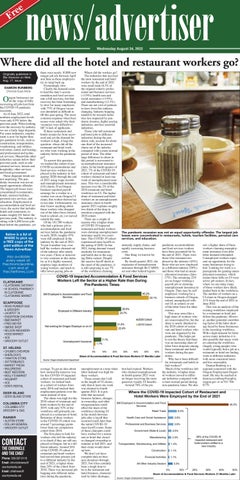
pandemic accommodation and food services workers have been accounted for by the end of 2021. There were those who remained employed in the industry (45%); those who are now employed in a different industry (26%); and those who had an unemployment insurance claim (7%). The remaining 22% are no longer working a payroll job or claiming unemployment insurance in Oregon. They may be selfemployed, working for a business outside of Oregon, retired, unemployed without UI, in school, or out of the labor force for other reasons. This may seem like a high share of workers who are unaccounted for, but the share is nearly identical to the 2018 cohort of restaurant and hotel workers who were not impacted by the pandemic. This helps put to rest the theory that there was an increasing share of labor force dropouts among these restaurant and hotel workers during the pandemic. Why has it been difficult for restaurants and hotels to find workers? Much of the workforce left the industry. A higher share of workers moved to different industries compared with a more normal period during non-pandemic times. We also
saw a higher share of these workers claiming unemployment insurance even after labor demand rebounded. Unemployed workers represent an opportunity for the many businesses trying to hire. Looking for work is a prerequisite for gaining unemployment insurance, which means those folks on UI were active job seekers. In fact, where we are today many of those workers have likely landed back in the workforce. The number of workers on a UI claim in Oregon dropped 31% from the end of 2021 to June 2022. This was an analysis of the existing workforce employed by a restaurant or hotel just before the pandemic. However, another potential contributing factor of the labor shortage faced by these businesses is the incoming workforce. With a high demand for labor across many industries it is also possible that many workers entering the workforce (largely young people) who would typically find a job in a restaurant or hotel are finding work in different industries with more consistent hours and less seasonality. Damon Runberg is a regional economist with the Oregon Employment Department. He may be reached at damon.m.runberg@employ. oregon.gov or at 541-7060779.
News Advertiser Columbia County
Classifieds
Page 2
Wednesday, August 24, 2022
Listings are updated daily at thechronicleonline.com
301 Meetings
500 Help Wanted
500 Help Wanted
500 Help Wanted
500 Help Wanted
500 Help Wanted
Alcoholics Anonymous Info-line, (503) 3660667 www.pdxaa.org
are interested in becoming a part of the Columbia River PUD team, please visit our website at www.crpud.net to view and apply for open positions or call us at (503) 397-1844 to have an application mailed to you.
pay. Please call 503964-0275.
Assistants. 16+ years old. Temporary Part-time. 2 positions available. $14.00 per hour. Apply online. www. sthelensoregon.gov. Open until filled. Equal Opportunity Employer.
Open until filled. Equal Opportunity Employer.
Interview Skills Call for free introductory meeting. Cathleen C a r m i c h a e l 408-499-4829 c c ar m i c h a e l . c om or cathleencarm@ gmail.com
Columbia River PUD is hiring. Position name: Vegetation Management Operator Salary: $33.66/hr 1st 6 mos, $37.40/hr thereafter. Deadline: Thursday, August 25, 2022 by 5:30 pm. If you
Help Wanted Looking for person with chainsaw to help cut dry peach wood at 2365 Columbia Blvd, St. Helens in the morning. Will
ASPHALT PAVING Offering Quality Asphalt Paving Services to Columbia County and surrounding areas.
The City of St. Helens is hiring Seasonal Recreation $$$
Millions Available
$$$
Commercial Real Estate Mortgage Loans
H20793
500 Help Wanted
The City of St. Helens is hiring a Seasonal Recreation Assistant. 18+ years old. Temporary Part-time $16.00 per hour. Apply online. www. sthelens.oregon.gov. Open until filled. Equal Opportunity Employer.
Farms/Apartments/Motels, etc. Purchase | Refinance | Construction
Call Salem 971-600-4327
The City of St. Helens is hiring a Seasonal Recreation Program Specialist. Temporary Part-time. $16.00 per hour. Apply online. www. sthelensoregon.gov.
The City of St. Helens is hiring a Librarian I (Youth Librarian) $4,439 (Step 1) to $5,245 (Step 5). Apply online at www. sthelensoregon.gov. Open until filled. First review deadline: 9/9/22. Equal opportunity employer. Career Counseling Career Path Resume
730 Misc. For Sale For Sale: 6 ft Cedar fence boards, 4x4x8 posts, 2x4x8 ft rails and 2x6x8 ft boards. Please call 503-3961884.
730 Misc. For Sale FREE COMPOST Horse manure We load, U Haul. Please call for Info: 503543-7406 Kunekune pigs available after Sept 2022. Friendly breed that grazes, as meat pigs best butchered around 20 months. Located off Pittsburg Rd, starting at $150, email happyhollowhomestead. hogs@gmail.com 702 Garage Sale
702 Garage Sale Garage Sale Aug. 26 & 27 from 9 to 3. 3520 Tahoma St, Columbia City. No large bills. Cash only. Multi-Family Garage Sale/ Estate Sale at 58453 S. Bachelor Flat Rd, Warren. Something for everyone. Fri 8/26 & Sat 8/27 from 9-2. Garage Sale on 8/27 from 9-4 at 58974 Morten Lane. Toys and more.
Call Jon to find out about display advertising today! 503-397-0116
FREE Estimates Family Owned & Operated. Serving Columbia County Since the early 1900s.
COMMERCIAL • RESIDENTIAL • INDUSTRIAL Driveways • Roadways • Subdivisions • Parking Lots • City, County, State Specification Products
Call Jim today at
Every Life Celebrated
(503) 509-8657
Quality Workmanship At Affordable Prices
Funerals, Cremations, Memorial Services Pre-Arrangement Plans, Grave Markers Cemetery/Mausoleum Space
681 Columbia Boulevard • St. Helens www.columbiafh.com • 503.397.1154
Your clutter is someone’s treasure. Call Kelli today to place your Garage Sale ad in our Columbia County publications at 503-391-0116
Columbia County
BUSINESS & SERVICE DIRECTORY
www.thechronicleonline.com
ATTENTION LAND OWNERS We buy CEDAR and NOBLE boughs. What we pay depends on the quality of your trees. We do all the work and won’t damage your trees. For more information contact Jorge Martinez (360) 751-7723
Waterman Garage Doors
CCB#204858
SALES, SERVICE INSTALLATION
Scott Waterman Owner
503.819.6715 St. Helens, OR 97051
YOUR AD HERE
Advertise your business in the Business & Service Directory. Call 503-397-0116 for more information
Chronicle and News/Ad Classified Ad Deadline is Monday by noon Ads received after the deadline are not guaranteed to be placed in that week’s issue. Call 503-397-0116 for more information
Get your ad in the paper and reach out to potential customers. Call 503-397-0116 to place your ad in the newspaper and online.
SOLVE Cleanup registration opens in Columbia County If you are interested in volunteering to clean up waterways in Columbia County, you have an opportunity to join a statewide effort. Registration is open for SOLVE’s annual statewide river and beach cleanup scheduled for Sept. 17. Partnering with the Oregon Lottery, SOLVE is offering the volunteer registration live, and all Oregonians, from Astoria to Brookings, Pendleton to Sunriver, are encouraged to sign up for the cleanup event. For nearly four decades, SOLVE has hosted the annual Beach & Riverside Cleanup. With the support of SOLVE, community leaders and partner organizations host restoration events, urban litter cleanup projects, and beach cleanups. “Each volunteer project is aimed at caring for one of Oregon’s most precious resources, our water, from source to sea,” according to a SOLVE release. The nonprofit group said over 60,385 pounds of trash and marine debris were removed, and 32,717 square feet of invasive plants were cleared by more than 3,000 volunteers in the 2021 fall cleanup. Removing invasive plant species, nurturing native plants, and collecting litter are all easy ways volunteers can positively impact Oregon’s water quality, according to SOLVE. “Each piece of litter collected removes the possibility of it entering a nearby river, waterway, or storm drain, where it can eventually make its way to the sea and contribute to our global
marine debris crisis,” the release starts. “Invasive plant species crowd out native plants and typically have shallow roots, leading to increased erosion and poor water filtration.” Since 1969, SOLVE has been mobilizing volunteers to restore and preserve Oregon’s natural spaces. “The Oregon Lottery is proud to continue supporting SOLVE’s Beach & Riverside Cleanup,” Oregon Lottery Director Barry Pack said. “Now more than ever, it’s important for Oregonians to come together for a common cause. SOLVE’s Beach & Riverside Cleanup provides the perfect opportunity.” Interested community members are encouraged to visit solveoregon.org to see a list of volunteer projects and sign up. To create a culture of sustainability around litter cleanups, it is suggested that you bring your own reusable gloves, buckets, and safety vests. The Beach & Riverside Cleanup is a great way to bond with family members, coworkers, and neighbors, all while collectively giving back to some of Oregon’s most beautiful places. SOLVE’s Beach & Riverside Cleanup is in partnership with the Oregon Lottery, with additional support from Metro, Oregon Parks and Recreation Department, Oregon Department of Transportation, OnPoint Community Credit Union, Rogue Ales & Spirits, Chevron, Fred Meyer, Bamboo Sushi, Clean Water Services, City of Beaverton, Next Adventure, and Deep Blue Pacific Wind.
Wednesday, August 17, 2022 Wednesday, August 24, 2022
News Advertiser News Advertiser Columbia County Columbia County
Page Page 3 3
News Advertiser Columbia County
Page 4
Wednesday, August 24, 2022
Oregon to get $333 million in opioid settlement funds Oregon will receive approximately $333 million from a historic $21 billion settlement with the three largest distributors of opioids — Cardinal, McKesson, and AmerisourceBergen. The Oregon Health Authority (OHA) has launched a new website to share updates and information on opioid settlement funds, which will be used to support opioid prevention, treatment and recovery efforts around the state. Specifically, the settlement
agreement outlines that the funds will be used for: • Prevention programs. • Naloxone distribution and education. • Syringe services. • Medication-assisted treatment, treatment and services for pregnant and postpartum people. • Treatment and services for incarcerated populations. • Neonatal abstinences syndrome treatment. • Warm handoff recovery programs and services.
• Leadership, planning and coordination. • Data Collection and Research. The Oregon Opioid Settlement Funds site, at www. oregon.gov/opioidsettlement, has background on the multi-state litigation against the pharmaceutical industry of which Oregon was a party and links to national settlement agreement sites. It also describes how the settlement funds will be distributed in Oregon, how much money is
available and what it can be used for. In addition, the site offers people the opportunity, if interested, to apply to serve on the Oregon Opioid Settlement Prevention, Treatment and Recovery Board, which will determine how the state uses its share of funds from the settlements with the opioid industry. “These settlement funds will provide much-needed opportunities for cities and counties in Oregon to help their communities begin healing from the ravages caused by the pervasiveness of these drugs over the last decade,” OHA Health Systems Division state opioid treatment authority’s John McIlveen, Ph.D., said. “We’re looking forward to working with our local partners to get these funds distributed as soon as they become available.” The lawsuits hold opioid manufacturers, distributors and retailers accountable for their role in creating and fueling the opioid epidemic and for aggressively marketing prescription opioids while simultaneously downplaying their risks to health care providers and the public. The State of Oregon reached resolution with four of these companies in July 2021. The resolution consists of two agreements and is referred to as the Distributor and Janssen Settlement Agreements. The 18-member, governorappointed Opioid Settlement Prevention, Treatment and Recovery (OSPTR) Board will be responsible for making funding decisions that align with approved opioid prevention, treatment and recovery strategies listed in Exhibit E of the settlement and Oregon’s Strategic Plan for Substance Use Services developed by the state Alcohol & Drug Policy Commission (ADPC). A portion of the state’s funds must go toward a uni-
fied and evidence-based state system for collecting, analyzing and publishing data about the availability and efficacy of substance use prevention, treatment and recovery services statewide. The governor will appoint the board based on the OSPTR Board membership requirements defined in House Bill 4098. The OSPTR Board is expected to begin meeting in late fall 2022. About $333 million will be awarded to Oregon from the Distributor and Janssen Settlement Agreements over the course of 18 years, beginning this year. Forty-five percent of the opioid settlement funds will be allocated to a new Opioid Settlement Prevention, Treatment & Recovery fund managed by OHA; 55% will be paid directly to cities and counties with populations of more than 10,000. About $503 million is going directly to tribes from the Distributor and Janssen Settlement Agreements. All federally recognized tribes are eligible to participate in the Tribal Opioid Settlements, regardless of whether that tribe filed an opioid lawsuit. Oregon’s tribes are eligible to receive a portion of the $503 million settlement. Oregon followed the model developed through the national opioid settlement to determine how much funding each eligible city and county would receive. This allocation formula is based on population and public health metrics. Oregon anticipates receiving additional opioid settlement funds from other lawsuits. However, the timing, amount and allowable uses of these funds have yet to be determined. Generally speaking, the funds must be used for opioid prevention, treatment and recovery strategies that are listed in the settlement. They may not be used for other purposes. Cities and counties will de-
cide how their funds are used. Oregon drug overdose deaths more than doubled between 2019 and 2021, an alarming trend driven largely by misuse of the powerful synthetic opioid fentanyl, an OHA analysis found. Preliminary data indicate this trend continued in 2022. A review of State Unintentional Drug Overdose Reporting System (SUDORS) and Oregon death certificate data by analysts from OHA’s Injury and Violence Prevention Section found that unintentional/undetermined drug overdose deaths increased from 496 in 2019 to 1,072 in 2021. The 2021 figure doesn’t include all fourth-quarter overdose deaths, which are still being tallied and analyzed. The number of unintentional/undetermined fentanyl overdose deaths jumped more than 600% between 2019 and 2021, from 71 to 509, respectively. Of all unintentional/undetermined drug overdose deaths in 2021, 47.5% were due to fentanyl; in 2020, fentanyl caused 32.1% of overdose deaths; in 2019, the drug was responsible for 14.3% of overdoses. Overall, unintentional/ undetermined overdoses from opioids, including fentanyl and heroin, also rose sharply during that time, from 280 to 739 deaths – a 164% increase. Unintentional/undetermined stimulant – methamphetamine – overdoses doubled, from 325 to 658 deaths between 2019 to 2021. The Oregon Department of Justice provides additional information about the settlement below: https://www.doj.state.or.us/ media-home/news-mediareleases/oregon-receivesfirst-payment-from-historicopioid-settlements/?utm_ medium=email&utm_ source=govdelivery
Quality Bark at Competitive Prices
BEAVER BARK
Sold by yard or Unit for pick up or Delivery • Variety of Fir & Bark Dust • Mulch & Potting Soil • Cedar Chips & Trail Mix
Clean Woodwaste Recycling Yard Debris & Woodwaste Recycling
Yard Debris & Clean Wood Waste Recycling $15 per yd. Clean = No pressure treated, paint or stain Wood Waste = Lumber, branches, small stumps and logs. We do not accept trash, plastic, dirt or sod.
$6 yard with $8 minimum charge
BEAVER BARK
We Deliver 1 Unit Minimum!
54000 West Lane Rd 503-543-3000 Scappoose Oregon Mon-Fri (503) 8-5 543-3000 Call for weekend deliveries
www.beaverbarkllc.com 54000 West Lane Rd. Scappoosethru Friday 8am to 4pm Open Monday
$5,000 for local food bank Follow me to Berry Global in St. Helens for
Big Pay, Big Career, and Big Success $1,000-$1,500 SIGN-ON BONUS It’s not a myth…it’s the real thing. Berry Global offers competitive pay starting at $18.00/hr. ➢ 4-Tier Pay Progression within first 2yrs. ➢ Monthly Bonus Programs ➢ Full-Benefit Package after 30-days A unique team environment, and a workplace culture with career advancement that makes me even want to come out of hiding to join their team. Apply online at: www.berryglobal.com/careers Berry Global is an equal opportunity employer
Columbia County Commissioners have presented the Columbia Pacific Food Bank (CPFB) with $5,000. “The Columbia Pacific Food Bank does a tremendous job of working closely with the local food pantries and charitable organizations to help our neighbors struggling with hunger. We are pleased that this donation will help them continue to help families,” Columbia County Commissioner Henry Heimuller said. The presentation was made during the food bank’s grand opening and ribbon
cutting ceremony at the CPFB’s new location Friday, Aug. 12 in St. Helens. CPFB is Columbia County’s regional food bank, delivering food to 38 food pantries, meal programs, and produce distribution points throughout the county, including Rainier and Clatskanie. The food bank also operates the Barbara Bullis H.E.L.P. Food Pantry in St. Helens. The $5,000 is the county’s annual contribution to the food bank.