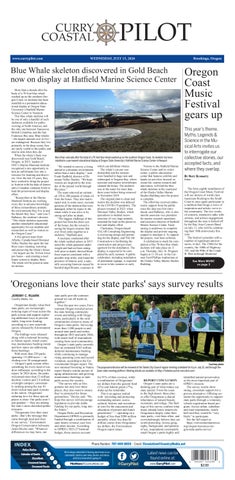

Blue Whale skeleton discovered in Gold Beach now on display at Hatfield Marine Science Center
More than a decade after the body of a 70-foot blue whale washed up on the southern Oregon Coast, its skeleton has been installed in a permanent educational display at Oregon State University’s Hatfield Marine Science Center in Newport.
This blue whale skeleton will be one of only a handful of such skeletons available for public viewing in North America, and the only one between Vancouver, British Columbia, and the San Francisco Bay area. Blue whales – the largest animals ever to live –are endangered. Because they live primarily in the deep ocean, they are rarely visible to the public and tend to sink when they die.
When the whale’s body was discovered near Gold Beach, Oregon, in 2015, leaders of OSU’s Marine Mammal Institute recognized a rare opportunity to turn an unfortunate loss into a resource for learning and discovery. Over the last 10 years, they have worked to bring the project to fruition with the help of donors and a Canadian company hired to lead the preservation and display effort.
“Researchers at the Marine Mammal Institute are working every day to advance knowledge of these extraordinary animals, the environments they live in and the threats they face,” said Lisa T. Ballance, the institute’s director.
“This whale skeleton represents another remarkable educational opportunity for our students and researchers as well as visitors to the Oregon Coast.”
A five-person team from Alberta, Canada-based Dinosaur Valley Studios has spent the last three years cleaning, restoring and preserving the whale’s bones – the largest are the 18-foot lower jaw bones – and creating a steel frame system to display them. The whale will be posed in natural motion.
“We wanted to convey a living animal in a dynamic environment, rather than a static display,” said Frank Hadfield, director of Dinosaur Valley Studios. “We hope visitors are inspired by the wonder of the natural world through this piece.”
The team removed an estimated 150 to 200 pounds of whale oil from the bones. They also had to repair and, in some cases, recreate portions of the skeleton that were damaged, either by injury to the whale while it was alive or by strong surf after its death.
“The biggest challenge of this project has been the sheer size of the bones, but the reward is seeing the largest creature that ever lived come together as a skeleton,” Hadfield said.
A necropsy conducted after the whale washed ashore in 2015 noted the whale appeared underweight and had not been eating well prior to death; showed blunt force injuries consistent with a possible ship strike; and found the presence of domoic acid, a naturally occurring biotoxin caused by harmful algal blooms, exposure to
which can debilitate whales.
The whale’s carcass was dismantled and the remains were bundled in huge nets and submerged in Yaquina Bay, where seawater and marine invertebrates cleaned the bones. The skeleton was in the water for more than three years before being removed in November 2019.
The original plan to clean and restore the skeleton was delayed by the COVID-19 pandemic. The project resumed in 2023, when Dinosaur Valley Studios, which specializes in skeletal reconstruction of very large animals, assumed the lead on the preservation and display effort.
Clackamas, Oregon-based VALAR Consulting Engineering is overseeing design and permitting for the display, and VALAR Construction is facilitating the construction and project management for the installation. The display is expected to be completed by early summer. A public celebration, including installation of permanent signage, is expected to occur in late summer or early fall.
Visitors to the Hatfield Marine Science Center and its visitor center, a public educational center that features exhibits and hands-on activities focused on ocean life, marine research and innovation, will find the blue whale skeleton in the courtyard of the Gladys Valley Marine Studies Building once the project is complete. The effort has received enthusiastic support from the public since the idea was first introduced, said Ballance, who is also interim associate vice president for marine research operations and executive director of Hatfield Marine Science Center. Fundraising is underway to complete the display and provide ongoing support to maintain it. To support the project, visit beav.es/bones.
A celebration to mark the completion of the 70-foot blue whale skeleton will take place on 11 a.m. Thursday, July 16. Program begins at 11:30 a.m. in the Carmen Ford Phillips Auditorium at the Gladys Valley Marine Studies Building.
Oregon Coast Music Festival gears up
This year’s theme, Myths, Legends & Science in the Musical Arts invites us to interrogate our collective stories, our accepted facts, and where they overlap.
BY NAtE SChwARtz Editor
The forty-eighth installment of the Oregon Coast Music Festival will see dozens of world class musicians flocking to the South Coast to once again participate in a tradition that brings a wave of inspiration and artistic verve to the community. The two weeks of concerts, interactive talks with soloists, and artistic engagement throughout the area is kicked off by the Bay Area Concert Band on July 11, who will be celebrating their 50th anniversary this year. The festival coincides with a number of significant anniversaries, in fact. The 250th for the country, the 100th of Highway 101, and the 90th of the Conde B. McCoullough Memorial
'Oregonians love their state parks' says survey results
JEREMY C. RUARK
Media, Inc.
Country
Oregonians deeply value their state parks, are increasingly noticing signs of wear across the park system and support exploring additional ways to provide stable, long-term funding, according to a new statewide survey released by Environment Oregon.
The findings were released along with a national Investing in Nature report, which examines maintenance backlog trends and how states are addressing those backlogs.
With more than 250 parks spanning 113,000 acres — including over 50 campgrounds — Oregon’s park system offers something for every kind of outdoor enthusiast, according to the report. In 2024 alone, the parks welcomed more than 53 million daytime visitors and 2.8 million overnight campers, consistently ranking among the top 10 most-visited state park systems in the nation. Oregonians’ enduring love for these special places is clear: Our parks aren’t just popular — they are among the state’s most cherished public treasures.
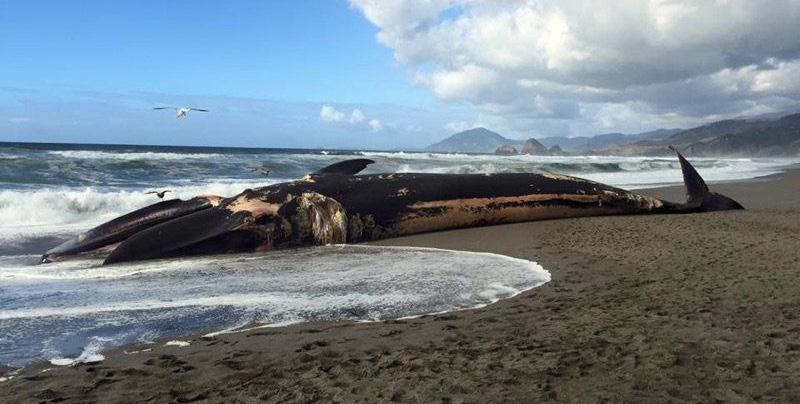
“Oregonians love their state parks –that’s the message that came through loud and clear in our survey,” Environment Oregon Conservation Advocate Justin Boyles said. “Whatever differences we may have, our
state parks provide common ground we can all stand on, together.”
Over the past two years, Environment Oregon traveled across the state hosting community events and talking with Oregonians, particularly in the rural communities closest to many of Oregon’s state parks. Surveying more than 1,000 people in and around state parks and online throughout 2025 and early 2026, with nearly half of respondents coming from rural communities.
Oregon’s state parks currently face an estimated $345 million deferred maintenance backlog while continuing to manage rising operating costs and record visitation, according to the Environmental Oregon report. The new national Investing in Nature report found a similar picture of aging infrastructure and growing maintenance backlogs at state parks across the country.
“The survey tells us Oregonians not only love these places, they also want to ensure they’re protected for future generations,” Boyles said. “We hope this survey will encourage legislators to provide stable funding for our parks, long into the future.”
Oregon Parks and Recreation Department (OPRD) is primarily funded through a combination of state lottery revenue, user fees and other income. According to OPRD’s 2025-27 biennial budget, those sources account
for 91% of their revenue, while a combination of Oregonians’ tax dollars from the general fund (2%) and federal grants (7%), make up the remainder.
This is an agency tasked with “providing and protecting outstanding natural, scenic, cultural, historic and recreational sites for the enjoyment and education of present and future generations” — operating on a budget of less than $200 million annually, where less than $4 million comes from Oregonians’ tax dollars, the Environment Oregon report states.


REPORT CONCLUSION
Oregon’s state parks are a defining part of what makes our state special. From the coast to the high desert, these places offer Oregonians a shared inheritance of natural beauty, recreation, and refuge. The findings of this survey confirm what many already know intuitively: Oregonians deeply value their state parks, visit them often, and overwhelmingly believe they are worth protecting. Across geography, background, and patterns of use, respondents consistently rated Oregon’s parks highly and
identified natural preservation as the most important part of OPRD’s mission.
The survey results show strong, consistent support for a proven alternative: Offering residents the opportunity to support state parks through a voluntary, vehicle-registration-based program. Across urban, suburban and rural respondents, nearly half said they would be “very likely” to participate.
See the full report at: https://environmentamerica. org/oregon/resources/oregon-state-parks-survey/

Courtesy photo
The proposed ordinance will be reviewed at the Toledo City Council regular meeting scheduled for 6 p.m. July 15, and through the Zoom video meeting platform. Meeting details are available at https://toledoor.portal.civicclerk.com/
More than a decade after the body of a 70-foot blue whale washed up on the southern Oregon Coast, its skeleton has been installed in a permanent educational display at Oregon State University’s Hatfield Marine Science Center in Newport.
By June Casagrande
If you think everyone’s out to get you, you’re paranoid. But if you think words are out to get you, you’re right. English has a lot of words that seem custom-made to undermine your ability to make verbs agree with subjects, creating a grammatical error called subject-verb disagreement.
Even if you’re not familiar with the concept, you’re already pretty good at making your verbs agree with your subjects. You never say, “I is here.” You never write, “The dogs has puffy tails.” You never say, “He be the man I’ll marry.” Instead, you know instinctively that the verb should match the number of the subject: “I” is singular, requiring “am.” “Dogs” is plural, so it takes “have.” “He” is singular, so it takes “is.”
But some words make this simple process so difficult that we all make mistakes, or at least find ourselves uncertain how to phrase something. Here are some terms that, if you’re not careful, will mess up your subject-verb agreement.
Couple. This word means two of something. But is it plural? Yes and no. Compare these two examples, both of which are correct:
“The couple is in therapy.”
“The couple are going their separate ways.” In the first, we use the singular verb “is.” In the second, we use the plural verb “are.”
That’s because “couple” is what’s called a collective noun, a category that includes “family,” “group,” “team,” “band,” “bunch,” “minority” and “majority.”
Many collective nouns can change number depending on whether you’re focusing on a single unit or whether you’re talking about people or things acting
independently of each other. Go with your gut and you won’t go wrong. Politics. Her politics are very reasonable, but politics is a difficult profession. If “politics” were plural, you would say, “Politics are a difficult profession.” If it were singular, you’d say “Her politics is very reasonable.” But obviously those are wrong. The correct verb form is whatever works best in your sentence. Other words, notably “ethics,” work the same way.
Each. “Each is able to choose for himself.” But “A number of families will attend and each have their own objectives.” Just like “politics” and “couple,” “each” seems to be sometimes singular and sometimes plural. But unlike those other words, “each” has a strong leaning: It’s almost always singular unless that’s just too weird. And. In simple sentences, this conjunction makes subject-verb agreement a breeze: Raoul and Sven work together. But there are lots of situations in which “and” can complicate matters. Consider “Their high water and fiber content makes these vegetables heart healthy.” Is the subject of the verb the singular “content”? Or is it the implied plural “fiber content and water content”?
I don’t know.
Or. Like “and,” “or” is a coordinating conjunction. But unlike “and” it can’t make a subject plural. “Jenny and Trey have your keys,” but “Jenny or Trey has your keys.” In more complicated sentences, this fact gets lost: “Crossing tracks or trespassing on private property are two of the most common occurrences.” The “or” creates a subject-verb agreement error because only one of those two things is the subject of the verb
By J. Mark Powell InsideSources.com
There was much anxiety in the early 1970s inside Chrysler’s Highland Park, Mich., headquarters outside Detroit. Everywhere the Big 3 automaker turned, serious trouble was staring it right in the face.
For starters, sales were declining in a sluggish economy. Then there was the Arab oil embargo, which sent gasoline prices skyrocketing to the unheard-of price of 50 cents a gallon or more. That was a blow to the bottom line of a company that made gas-hungry big cars. However, the worst problem by far was that American consumers were turning their backs on full-scale four-door sedans, which were Chrysler’s

and butter. The
needed something new, something bold, something daring — and pronto — or it faced the very real risk of going the way of Studebaker, Packard and DeSoto.
So, the boys in Chrysler’s C-Suite did some brainstorming. Car buyers were crazy just then for what the industry called “intermediate personal luxury coupes,” two-door models that carried the vibe of top-of-the-line models, but which came in a smaller, more energy-efficient size.
The ailing automaker needed one of its own. And so, the big brass pulled out all the stops in designing, building and promoting one. The result was the 1975 Chrysler Cordoba. Designed to compete


against Ford’s Thunderbird and Chevy’s Monte Carlo, buyers were dazzled when the first models rolled into showrooms in the fall of 1974. The Cordoba boasted a Rolls-Royce-inspired grille, hidden windshield wipers, a ritzy raised hood ornament, and even an optional vinyl roof.
However, its showcase was the interior.
That was where Chrysler really went all out. It paid handsomely for an aggressive TV advertising campaign trumpeting this elegance on four wheels.
The sophisticated actor Ricardo Montalbán walked around a Cordoba parked in what appeared to be an Old World plaza, a Spanish guitar strumming as he gushed about “pride, the very cornerstone of a new automobile.”
Then the camera cut to the car’s interior, and the magic words rolled off Montalbán’s tongue: “Here is the warmth of thickly cushioned contoured seats, available even in fine Corinthian leather.”
For some reason, the American public latched on to those three words, “fine Corinthian leather.” They came to symbolize what set this new car apart from its competitors. Suddenly, Joe Six Pack
could haul the wife and two kids (three if they were small) around town as their fannies savored the same “fine Corinthian leather” heretofore enjoyed only by the bottoms of the rich and famous.
The Cordoba was a big hit, selling 151,000 cars in its first year. It became one of Chrysler’s best sellers and helped save its bacon, pulling the company back from the brink of possible ruin. Later ill-advised and unrelated decisions put it back in that precarious position at the end of the decade. (It would take a congressional bailout and the genius of Lee Iacocca to snatch it from the jaws of Chapter 11.)
For the moment, Chrysler’s future looked brighter thanks to the Cordoba.
As the 1970s rolled on, Montalbán kept hawking the Cordoba, invariably including a special plug for the luxury of “Corinthian leather.” Sometimes it was “rich Corinthian,” other times “fine” or “soft.” But always “Corinthian,” the one detail about the car that consumers remembered — and responded to positively — above all others.








There was just one small problem. There is no such thing as Corinthian leather, fine or otherwise. A creative writer had simply made it up. The Cordoba’s interior was upholstered in pretty much the same material found in most other cars of that era.


bread
carmaker
Off the charts: Tick-associated disease
By Dr. GiGi reeD, MD
We live in the heart of western blacklegged tick country, which brings a seasonal risk of tick-borne diseases.
Tick-borne diseases occur when ticks transmit microscopic pathogens through their saliva while feeding. Most of these illnesses are caused by bacteria. Common examples include Borrelia burgdorferi, the bacterium responsible for Lyme disease, and Rickettsia rickettsii, which causes Rocky Mountain spotted fever. In addition to bacteria, ticks can also carry parasites, viruses, and other infectious agents.
The western blacklegged tick is commonly found in our region. It typically waits on low vegetation or in leaf litter, attaching to passing hosts such as rodents, birds, lizards, deer, and humans. Only about 3% of these ticks carry Borrelia burgdorferi.

Of those, only a small percentage will bite a person, and an even smaller number of those bites result in Lyme disease. If you find a tick attached to your skin, proper removal is simple and effective. Use fine-tipped tweezers to grasp the tick as close to the skin as possible, then pull straight out with steady pressure until it releases. After removal, clean the bite site with soap and water. Avoid common folk remedies such as using heat, oils, nail polish, or
petroleum jelly. These methods can stress the tick and may cause it to release more saliva or gut contents, potentially increasing the risk of infection. If small mouthparts remain in the skin, they will usually work their way out naturally, similar to a splinter.
Lyme disease generally progresses in three stages. Early Lyme disease often begins within days with a spreading red rash at the bite site, sometimes resembling a bull’s-eye, though this pattern is not always present. Days to weeks later, the infection can affect the nervous system or heart. One possible complication is Bell’s palsy, where inflammation of the seventh cranial nerve causes temporary facial weakness that can resemble a stroke. This condition often improves, especially with appropriate treatment such as a short course of steroids.
Months to years later, untreated Lyme disease may lead to more serious complications, including joint inflammation (arthritis) and neurological symptoms. Timing plays an important role in reducing risk. The likelihood of Lyme disease transmission increases the longer an infected tick remains attached. Removing a tick within 24 hours significantly lowers the chance of infection, although no timeframe is completely risk-free. Because some pathogens can be transmitted more quickly, it is important to monitor for symptoms for about a month after a tick bite. Watch for fever, rash, or flu-like illness and seek medical care promptly if these develop.
In certain higher-risk situations—such as a clearly identified western blacklegged tick attached for approximately 36
hours or more in an area where Lyme disease is common—healthcare providers may recommend a single preventive dose of antibiotics. When Lyme disease or other tick-borne illnesses are diagnosed early, standard antibiotic treatments, often including doxycycline or amoxicillin, are typically very effective, and serious complications are uncommon.
For those of us who live, work, and spend time along the northern California and southern Oregon coasts, prevention is key. Use EPA-registered insect repellents on exposed skin, wear long sleeves and pants in grassy or brushy areas, and consider treating clothing and gear with permethrin. After outdoor activities such as hiking, yardwork, or time spent in tall grass or leaf litter, perform a full-body tick check.
For families with chil-
dren who play outdoors, reducing tick habitat around the home can also help. Clear leaf litter, trim tall grass and brush along yard edges, and keep play areas away from dense vegetation.
Ticks are a natural part of our local environment. With prompt removal, awareness of early symptoms, and simple preventive measures, the risk of serious tick-borne illness can remain low while we continue to enjoy the forests and coastline we call home.
Leaving Germany after college, Dr. Gudrun (Gigi) Reed spent over 20 years as a scientist in the U.S. She holds four patents in DNA research and was a university professor. Today she is busy as co-medical director for hospice, acute rehabilitation and practices family medicine in Brookings, OR. Gigireedmd@gmail.com
Rotarians' water safety program saves lives
Rotary Club of Brookings-Harbor
For years the Rotary Club of Brookings-Harbor has presented a water-safety program the last week of school to area thirdgrade students. This year, 122 students learned about water safety, and during five days of classes, worked with 19 community volunteers.
Day 1 classes began with testing and grouping students according to their water skills. Some students are not as comfortable in the water as others, but by the end of the first session, and with the help of the volunteers, many were blowing bubbles, smiling, and floating face-up in the water.

On Day 2, students learned pool rules, and splashed and squealed as they practiced bobbing and floating on their backs, then kicking and doing arm strokes across the water. And, for some, even jumping into the
pool! Day 3 highlighted safety lessons and various ways to save a struggling swimmer, while Day 4 included river and water safety rules, including individual and group life-saving techniques. It also included the ever-popular life-jackets and safety tips.
The final Day 5, was Fun Day, and students floated on their backs, played and jumped from pool sides and the diving boardwith life jackets on, instructors and volunteers always nearby.
Susan Lunsford, Rotary Project Chair, worked with nine Rotary Club members, and an additional ten in-the-water volunteers, to deliver this important and life-saving program. Every
day and every detail was planned out to teach the children to safely learn and enjoy the water.
Lunsford commented, "Some students were terrified of the water on their first day, on Day 2, they are already floating - unassisted! That is huge!"
"Being a member of the Rotary Club of Brookings-Harbor gives us many opportunities to positively impact our community - and this is definitely one of those experiences," stated Lunsford.
One of this year's volunteers stated she was very glad to be part of the program - and especially enjoyed seeing the student's enthusiasm for learning and then getting qualified for
swimming in the deep end of the pool. They were very proud of their success in overcoming their initial fear of the water - and now are looking forward to summer family fun at the river, ocean beaches and lakes.
The Rotary Club of Brookings-Harbor thanks the Friends of Rotary, South Coast Community Aquatics Group, and the Brookings Harbor School District for their assistance in supporting this life-saving program. To contribute funds to the Rotary Water-Safety project, please send a check to Rotary, P. O. Box 357, Brookings, Oregon, and specify the funds should go towards the water safety project.
Bridge which was featured on the 1999 edition of the festival’s poster.
Also celebrating its 90th birthday, is the art deco post office that is now home to the Coos Art Museum and, coincidentally, the office for the Oregon Coast Music Association (OCMA) who organize the yearly festival. A conversation with OCMA Board President Christine Moffitt in said office gave insight into the huge undertaking, the nationwide connections that make it possible, and the local lore that might otherwise go unnoticed. For instance:
“This building and Marshfield [High] were all Works Progress Administration (WPA), and that’s why they’re still standing. That’s why their architecture echoes each other. The acoustics are incredible, and the art deco is there. So, this building and that auditorium are sisters at least. The pioneer cemetery rock wall was also a WPA,” explained Moffitt.
Marshfield’s auditorium is just one of the ten venues that will be hosting shows of all kinds over the twoweek festival. Genres range from classical, to jazz, to folk rock and Celtic music. Those Marshfield shows will feature the Festival Orchestra, an 80-person outfit of musicians from around the country, many of which have played the festival for years, some for decades. All are brought together through the intricate work of Orchestra Personnel Coordinator Nancy Johnson, who herself is a violinist in the group.
Outside of a small travel allowance and per diem on rehearsal or show days, the musicians come back every year for the beauty of the South Coast and the chance to collaborate with other talented musicians of all walks. In fact, getting so many musicians to come is only possible through a system of home stay volunteers. The artists are put up by community members who are kind enough to open their spare bedrooms. Some musicians have stayed with same host families their entire stint with
addressed the issue headon.
Letterman: “So what was the deal with Corinthian leather?” Montalbán admitted, “Jim Nichols, who wrote the commercials for Chrysler … wanted to
the orchestra, they’ve seen each other’s families grow and the community evolve with each yearly visit.
“It’s a unique symphony. These are top artists from across the U.S., dominated by the Pacific Northwest but much more than that… Its music camp without chaperones. They party, and they have a huge impact… they have a golf tournament; they frequent every bar in town,” laughed Moffitt. “They have an evening where they go down to Sunset Beach. Their whole schedule of rehearsal and performances is built so they have these blocks of time to go and play. But they’re really good musicians, so they come prepared.”
The orchestra are directed and conducted by Dr. Martin Majkut in his second year in the role, having taken over from long-time festival director James Paul who served the festival for 35 years.
This year’s poster and theme
One of the festival’s iconic traditions is its poster. You may have seen
find a word that sounded sort of elegant that I could say like a little verb. So, ‘Corinthian,’ you know?”
Letterman: “But does it mean anything?’
Montalbán: “Nothing … it’s a trade name.”
some of the classic editions around town over the years. A significant figure in that tradition was Don McMichael, who’s fascination for marine life was stoked by his time in the coast guard. Critters became a cornerstone of the yearly poster thanks to McMichael’s thirteen-year run of marine life posters starting in 1985. That tradition is continued this year, with two whales adorning the poster, titled The Long Song of Survival by Susan Chambers. Chambers uses the juxtaposition of Livyatan melvillei, an ancient ancestor to the modern sperm whale, with its contemporary counterpart to express the changing climate and evolutionary patterns throughout the earth’s history. The left side of the poster represents the ancient oceans and displays creatures that can now be seen nearby in their fossilized form. The right side shows us reflection of our current ocean.
“The Long Song of Survival, bridges prehistoric and modern oceans through the story of the sperm whale lineage and the changing
As author Paul Fussell wrote in his 1991 book “BAD: Or, the Dumbing of America,” the leather “never saw Corinth at all.” It was just an advertising gimmick. By the time the last Cordoba rolled off the
climate of Earth across millions of years, while also reflecting the themes of the Oregon Coastal Premier of Adam Shoenberg’s composition, Losing Earth,” wrote Chamber about her poster. “Shoenberg’s percussion-driven concerto explores the science of climate change and humanity’s journey on Earth, moving from upheaval and loss toward resilience and hope.”
The poster and theme are a product of the various orchestral pieces in the program, tying the whole experience of the festival under the umbrella of Myths, Legends & Science in the Musical Arts. The subjective and collective nature of myth and the singular, factual character of science are two sides of the same coin. Both are lenses through which we interpret and understand the world around us, and the ways we’ve devised to explain them to each other.
“These myths take you to our ancestral stories,” said Moffitt. “Every tribe has its creation stories, has its myths. Those fables are about our civilizations,
assembly line in the summer of 1983, 691,263 had been sold. And fine Corinthian leather had been available for every one of them.
ABOUT THE WRITER J. Mark Powell is a for-
about our humanity, so it made sense to put it together... What is myth and what is metaphor? What is truth? Its big thinking. It’s what keeps my brain going, and that’s what people should be doing instead of looking at their cell phones. They should be reading and thinking.”
This is a wonderful framing for music, especially classical and jazz music. Music is inherent to the human experience in unmeasurable ways. Melodies and rhythms are universal yet personal. Intrinsic and subjective. Music is also a science of a kind. It has its own theory and language, and a concerto on sheet music is illegible to those who don’t know the notation. That density, that opaqueness, is a hurdle (especially to younger audiences). But those universal and experiential aspects are still there and can be enjoyed by anyone, regardless of age or previous aversions to classical or jazz music. Regardless, the OCMA are still making efforts to engage and encourage younger audiences to attend.
mer television journalist. His nonfiction book “Witness to War: The Story of the Civil War Told by Those Living Through It” is available at jmarkpowell.com. He wrote this for InsideSources.com.









Obamacare premiums likely to surge again next year
By Nada Hassanein
Health insurance pre-
miums are likely to grow more expensive next year for those who buy Marketplace plans, after increases this year.
Affordable Care Act
Marketplace insurers are proposing a median premium increase of 14% for 2027, which would be a double-digit hike for the second year in a row, according to a new analysis of preliminary rate filings.
Insurers must submit their requested premium
changes to state regulators by July 15, per Centers for Medicare and Medicaid Services deadlines. Rates should be finalized later this summer. Released Wednesday by the Peterson Center on Healthcare and healthcare research group KFF, the analysis looked at proposed rate changes among 77 Marketplace insurers across 16 states and Washington, D.C., that have made proposed rates publicly available. Those are Connecticut, Hawaii, Illinois, Indiana,
Iowa, Kentucky, Maine, Maryland, Massachusetts, Minnesota, New York, Oregon, Rhode Island, Texas, Vermont and Washington state.
The majority of insurers across those states are proposing a median ACA Marketplace premium increase between 10% and 20%, while 20 insurers are requesting premium increases of more than 20%.
None included in the analysis proposed a decrease in premiums.
Along with the expiration of enhanced premium
subsidies, insurers are also citing rising healthcare costs and changes in federal regulations as reasons behind the increases. At the end of last year, enhanced premium tax credits expired, leading to more out-of-pocket costs for some people enrolled in Marketplace plans. Premiums increased especially for those with incomes at 400% or more of the federal poverty level — or roughly $63,000 for a single person — who completely lost subsidies. That caused many
healthier enrollees to leave the Marketplace, leaving behind enrollees who are more expensive to cover, according to KFF.
While the proposed increases are lower than last year’s median nationwide proposed rate change of 18% — the finalized change was 20% — it’s the second-highest requested change since 2018, according to the report.
ACA Marketplace enrollments have seen a steep drop, with 2.6 million fewer Americans on the rolls in February compared
with the same time last year, The Associated Press reported. Stateline reporter Nada Hassanein can be reached at nhassanein@stateline. org. This story was originally produced by Stateline, which is part of States Newsroom, a nonprofit news network which includes Oregon Capital Chronicle, and is supported by grants and a coalition of donors as a 501c(3) public charity.
Robin study suggests fleeing isn’t necessarily wildlife’s first response to wildfire smoke
Steve Lundeberg
Guest Article
Research by Oregon State University biologists suggests that toxic air stemming from wildfires won’t necessarily prompt animals to flee in search of better breathing conditions.
The study of American robins led by OSU’s Jamie Cornelius is one of the few to examine
how wildfire smoke, an increasingly common phenomenon as annual fire seasons become longer and more intense, affects animal behavior.
Published in Integrative and Comparative Biology, the paper also presents a “stay, shift, go” framework for characterizing how wildlife species respond to smoky conditions.
“Wildfire smoke is an increasing disturbance across much of the globe yet it hasn’t received much attention as a driver of animal behavior,” Cornelius said. “Animals may have evolved strategies to cope with smoke exposure, but what those strategies are and how they affect health outcomes are largely unknown.”
Cornelius and collaborators at UCLA and




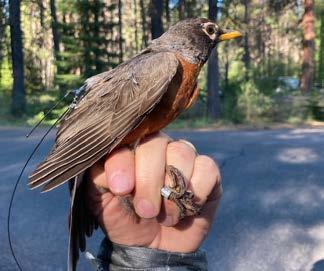
Cornell University found, somewhat surprisingly, that the birds in their




study didn’t simply fly away as foul air set in.
“Robins in the post-breeding season, despite not being tied to a nest location, did not just leave when it got smoky,” said Cornelius, an ecophysiologist in the OSU College of Science. “Instead they shifted behavior to reduce activity, presumably to limit the negative consequences of smoke inhalation, and oriented differently according to prevailing wind conditions.”
To learn what the birds were doing, the scientists captured 21 adult robins in fire-prone habitat in Oregon, affixed them with data-transmitting bands and monitored their movements during the 2023 and 2024 wildfire seasons








The researchers hypothesized that the robins would follow a “go” strategy to avoid smoke from nearby wildfires. What they found, though, was that the birds made shorter-distance movements as wildfire smoke intensity grew.
They also learned that robins didn’t change their orientation behavior relative to wind direction under light smoke, but they were more likely to orient into the wind in the presence of heavy smoke, which tended to reduce their smoke exposure.
“It’s possible that robins do attempt to flee high-density smoke with long-distance movements and that the levels of smoke that occurred during our study were not quite high enough to induce that response,” Cornelius said. “There could be some threshold that triggers the ‘go’ response that was not reached.”
Often detectable by sight and/or smell, wildfire smoke is a complex mixture of gases and particulate matter that can be harmful to people and animals when inhaled or ingested. With large fires, Cornelius notes, potentially billions of organisms are exposed to toxic air as the smallest particles remain airborne indefinitely and can travel for hundreds or thousands of miles.
“Animals very close to wildfires are obviously at risk of serious injury or death from exposure to extreme heat and survive only through behavioral responses like fleeing or seeking shelter,” she said. “We’re trying to understand the behaviors animals adopt when they are exposed to hazardous smoke but not in imminent fire danger.”
The researchers conceptualize three buckets to hold those behaviors. Animals can stay, resisting changes to behavior.
They can shift, altering their behavior to reduce negative impacts. Or they can go, moving somewhere with cleaner air. Species-specific traits, such as locomotion, are factors that can affect an animal’s smoke response.
Additionally, Cornelius said, it’s likely that some of the responses will prompt other species to alter their own behaviors. For example, a change in prey behavior may have consequences for predator behavior, even if the predator isn’t directly responding to smoke.
Many questions remain to be answered by future research, Cornelius added. Can all animals detect smoke, and when do they adaptively respond with behaviors that reduce their exposure?
Do behaviors or response thresholds change depending on habitat, time of year, age, stage in the annual cycle, evolutionary history or other contextual factors?
“Even though research on animal responses to wildfire smoke has accelerated as climate change alters fire regimes, there is a lot we don’t know,” she said. “But emerging evidence definitely suggests that animal health is impaired by acute exposure to smoke.”
OSU research associate Alex Jahn and graduate students Dorothy Zahor and Ken Glynn also worked on the study, which was funded by the National Geographic Society, the National Science Foundation and the La Kretz Center for California Conservation Science.
Steve Lundeberg is a news and research writer at Oregon State University. He may be reached at Steve.Lundeberg@ oregonstate.edu


(Coyrtesy from Alex Jahn)
Robin Behavior - To learn about robin behavioral changes caused by wildfire smoke, OSU scientists captured 21 adult robins in fire-prone habitat in Oregon, affixed them with data-transmitting bands and monitored their movements during the 2023 and 2024 wildfire seasons. The study suggests that toxic air stemming from wildfires won’t necessarily prompt animals to flee in search of better breathing conditions.
Wild RiversCoast Classifieds
Audien Hearing. The world's first hearing aid with touchscreen controls. No tiny buttons, apps or prescriptions. 45-day risk free trial. Free shipping. Lifetime support. More than 1.5 million happy customers. Call Audien 1-844-387-1163.
Consumer Cellular - the same reliable, nationwide coverage as the largest carriers. No longterm contract, no hidden fees and activation is free. All plans feature unlimited talk and text, starting at just $20/month. For more information, call 1-855504-6496.
DIRECTV OVER INTERNET
Get your favorite live TV, sports and local channels. 99% signal reliability! CHOICE Package, $84.99/mo for 12 months. HBO Max and Premium Channels included for 3 mos (w/CHOICE Package or higher.) No annual contract, no hidden fees! Some restrictions apply. Call IVS 1-855-602-2009.
–DIVORCE $130. Complete preparation. Includes children, custody, support, property and bills division. No court appearances. Divorced in 1-5 weeks possible. 503-772-5295. www. paralegalalternatives.com legalalt@msn.com.
Donate your car, truck, boat, RV and more to support our veterans! Schedule a FAST, FREE vehicle pickup and receive a top tax deduction! Call Veteran Car Donations at 1-866-695-9265 today!
FreedomCare. Let your loved ones care for you and get paid!\~ Paid by Medicaid. Choose family or friends as your paid caregiver. Check your eligibility today! Call FreedomCare now! 1-855-994-1589.
Get a break on your taxes! Donate your car, truck, or SUV to assist the blind and visually impaired. Arrange a swift, nocost vehicle pickup and secure a generous tax credit for 2025. Call Heritage for the Blind Today at 1-844-533-9173 today! Get Boost Infinite! Unlimited Talk, Text and Data For Just $25/mo! The Power Of 3 5G Networks, One Low Price! Call Today and Get The Latest iPhone Every Year On Us! 844955-3417.
Get DISH Satellite TV + Internet! Free Install, Free HD-DVR Upgrade, 80,000 On-Demand Movies, Plus Limited Time Up To $600 In Gift Cards. Call Today! 1-866-373-9175.
Jacuzzi Bath Remodel can install a new, custom bath or shower in as little as one day. For a limited time, waiving ALL installation costs! Additional terms apply. Subject to change and vary by dealer. (Offer ends 12/27/26.) Call 1-855-341-5268.
MOBILE WASH N' WAX Detail Cars n' Trucks Service to your door License # 3763 541-661-0807 or text me No more cleaning out gutters. Guaranteed! LeafFilter is backed by a no-clog
aches.
Fast payment. Call 1-855-980-4382.
Portable Oxygen Concentrator May Be Covered by Medicare! Reclaim independence and mobility with the compact design and long-lasting battery of Inogen One. Free information kit! Call 855-839-0752.
The bathroom of your dreams in as little as 1 day. Limited Time Offer - $1000 off or No Payments and No Interest for 18 months for customers who qualify. BCI Bath & Shower. Many options available. Quality materials & professional installation. Senior & Military Discounts Available. Call Today! 1-844847-9778.
YMT Vacations. Over 50 guided tours available. Affordable, social and stress-free travel designed for mature travelers. Our tours include accommodations, transportation, baggage handling, sightseeing, entrance fees, a professional Tour Director and select meals. For a limited time SAVE $250 on all tours. Call YMT today. 1-866-335-3689
1 bd and 2 bd unit available for rent $800 and $1100 respectively per month. 417 Fern Ave. Brookings. Call Janel Drew 541-661-3890
1BR 1BA apartment. Upstairs. Approx 600 sqft. Renter pays electric. $1000/mo + $1000 dep. Background check required. If interested call 541-469-6119
1 Bedroom 1 Bath. $1100 rent + $1100 deposit. Landlord pays electric, water, sewer, garbage, and internet. 541-469-6119
McLennan Excavation has a full-time working foreman position to fill. The working foreman will have full understanding of underground utilities and grading. Foreman will have full working knowledge of the use of heavy equipment needed for all excavation projects. Leadership, communication, critical thinking, and problem solving under pressure will be essential in this position. The ability to successfully manage projects and use project management plans and can set grades and elevations. McLennan Excavation offers health & dental benefits as well as 401K opportunities. Email your resume to: lily@pipeandrock.com or drop off your resume & apply directly at 98109 N. Bank Chetco River Road; Brookings, OR. Open hours are Monday through Friday from 7aqm to 5pm. Please be prepared for a prospective interview.
RV space that fits 25' trailer. Monthly rent $600 plus electric. Full hookups. With balcony overlooking Chetco River. 805550-9059.
NOTICE OF PUBLIC MEETING The Curry County Soil & Water Conservation District is holding its regular monthly meeting at 5:30 p.m. on July 28, 2026. Agenda topics include routine business. Other matters may be discussed. Curry Weed Advisory Board agenda topics include approving updates to the Curry County Noxious Weed List. Other matters may be discussed. The meeting will be held at the Curry Watersheds Partnership office located at 29286 Ellensburg Ave., Gold Beach. The location is accessible to persons with disabilities. An option to join electronically is available. For electronic access information, please contact Liesl Coleman at liesl. coleman@currywatersheds. org or (541) 247-2755 ext 0. To request an interpreter for the hearing impaired or for other accommodations for persons with disabilities, please contact Liesl Coleman at least 48 hours prior to the regular meeting. 7/15/2026 Pilot 428xxx
IN THE CIRCUIT COURT OF THE STATE OF OREGON, FOR THE COUNTY OF CURRY Case No. 26PB05025 NOTICE TO INTERESTED PERSONS In the Matter of the Estate of: KEVIN ALLEN PATRICK, Deceased NOTICE IS HEREBY GIVEN that the undersigned has been appointed Personal Representative of the above estate. All persons having claims against the estate are required to present them, with vouchers attached, to the undersigned Administrator or her attorney at the address below, within four months after the date of first publication of this notice, or the claims may be barred. All persons whose rights may be affected by the proceedings may obtain additional information from the records of the Court, the Personal Representative, or the lawyer for the Personal Representative, David C Johnston. Dated and first published on July 1, 2026. /s/ Lynn B Patrick Personal Representative Lawyer for Personal Representative: David C. Johnston, OSB #140957 Law Office of David C Johnston P.O. Box 4884 Brookings, OR 97415 (541) 373-8706 7/1, 7/8, 7/15/2026 Pilot 428219
IN THE CIRCUIT COURT OF THE STATE OF OREGON, FOR THE COUNTY OF CURRY Case No. 26PB05027
NOTICE TO INTERESTED
PERSONS In the Matter of the Estate of: GARY MASCHMEYER, Deceased NOTICE IS HEREBY GIVEN that the undersigned has been appointed Personal Representative of the above estate. All persons having claims against the estate are required to present them, with vouchers attached, to the undersigned Personal Representative or his attorney at the address below, within four months after the date of first publication of this notice, or the claims may be barred. All persons whose rights may be affected by the proceedings may obtain additional information from the records of the Court, the Personal Representative, or the lawyer for the Personal Representative, David C Johnston. Dated and first published on July 1, 2026. /s/ David Smith, Personal Representative Lawyer for Personal Representative: David C. Johnston, OSB #140957 Law Office of David C Johnston 15957 Hwy 101 S, #6; P.O. Box 4884 Brookings, OR 97415 (541) 3738706 7/1, 7/8, & 7/15/2026 Pilot 428220 IN THE CIRCUIT COURT OF THE STATE OF OREGON, FOR THE COUNTY OF CURRY Case No. 26PB05160 NOTICE TO INTERESTED PERSONS In the Matter of the Estate of: GRACE MAY WEISHAAR, Deceased NOTICE IS HEREBY GIVEN that the undersigned has been appointed personal representative of the above
estate. All persons having claims against the estate are required to present them, with vouchers attached, to the undersigned personal representative at P.O. Box 4884, Brookings, OR 97415, within four months after the date of first publication of this notice, or the claims may be barred. All persons whose rights may be affected by the proceedings may obtain additional information from the records of the Court, the personal representative, or the lawyer for the personal representative, Sonya Astad. Dated and first published on July 1, 2026. /s/ Sonya Astad Personal Representative Lawyer for Personal Representative: David C. Johnston, OSB #140957 Law Office of David C Johnston, LLC 15957 Hwy 101 S, #6; P.O. Box 51 Brookings, OR 97415 (541) 373-8706 7/1, 7/8, &7/18/2026 Pilot 428221
TS No. OR0800000726-1 APN 3615-36AD02000 / R20782 TO No 260005833-OR-MSI TRUSTEE'S NOTICE OF SALE Reference is made to that certain Trust Deed made by, RAY R. BARMORE AND BARBARA A. BARMORE, HUSBAND AND WIFE AS TENANTS BY THE ENTIRETY as Grantor to FIRST AMERICAN TITLE as Trustee, in favor of MORTGAGE ELECTRONIC REGISTRATION SYSTEMS, INC., as designated nominee for FIRST NATIONAL BANK OF ARIZONA, Beneficiary of the security instrument, its successors and assigns, dated as of March 16, 2007 and recorded on March 22, 2007 as Instrument No. 2007-1661 and that said Deed of Trust was modified by Modification Agreement and recorded September 27, 2012 as Instrument Number 2012-03660 and that said Deed of Trust was modified by Modification Agreement and recorded January 30, 2020 as Instrument Number 2020-00391 and the beneficial interest was assigned to Federal Home Loan Mortgage Corporation as Trustee for the benefit of the Freddie Mac Seasoned Credit Risk Transfer Trust, Series 2021-2 and recorded March 5, 2026 as Instrument Number 202600655 of official records in the Office of the Recorder of Curry County, Oregon to-wit: APN: 3615-36AD-02000 / R20782 THAT CERTAIN TRACT OF LAND LYING IN GOVERNMENT LOT 3, SECTION 36, TOWNSHIP 36 SOUTH, RANGE 15 WEST, WILLAMETTE MERIDIAN, IN THE CITY OF GOLD BEACH, CURRY COUNTY, OREGON, DESCRIBED AS FOLLOWS: BEGINNING AT AN IRON BAR DRIVEN AT A POINT ON THE WEST BOUNDARY OF JUNE STREET NORTH 01° 30 WEST 20.0 FEET FROM THE NORTHEAST CORNER OF LOT 1, FITZWATER SUBDIVISION. THENCE NORTH 01°30
WEST 76.5 FEET TO AN IRON BAR. THENCE NORTH 86°50 WEST 134.2 FEET TO THE EAST BOUNDARY OF COLVIN STREET. THENCE SOUTH 11° EAST 77.4 FEET. THENCE SOUTH 86°15 EAST 121.9 FEET TO THE POINT OF BEGINNING.EXCEPTING THEREFROM THAT PORTION CONVEYED TO THE STATE OF OREGON, BY AND THROUGH ITS DEPARTMENT OF TRANSPORTATION, HIGHWAY DIVISION, BY INSTRUMENT RECORDED DECEMBER 28, 1989 AS INSTRUMENT NO. 89-02554, OFFICIAL RECORDS, CURRY COUNTY, OREGON. Commonly known as: 94260 JUNE STREET, GOLD BEACH, OR 97444
Both the Beneficiary, Federal Home Loan Mortgage Corporation as Trustee for the benefit of the Freddie Mac Seasoned Credit Risk Transfer Trust, Series 2021-2, and the Trustee, Nathan F. Smith, OSB #120112, have elected to sell the said real property to satisfy the obligations secured by said Trust Deed and notice has been recorded pursuant to Section 86.752(3) of Oregon Revised Statutes. The default for which the foreclosure is made is the Grantor's failure to pay: Failed to pay payments which became due Total Monthly Payment(s): Total Monthly Payment(s) from 09/01/2025 to 05/01/2026 at $8,081.75 By this reason of said default the Beneficiary has declared all obligations secured by said Trust Deed immediately due and payable, said sums being the following, to-wit: The sum of $211,691.25 together with interest thereon at the rate of 3.87500% per annum from August 1, 2025 until paid; plus all accrued late charges thereon; and all Trustee's fees, foreclosure costs and any sums advanced by the Beneficiary pursuant to the terms of said Trust Deed. Wherefore, notice is hereby given that, the undersigned Trustee will on October 6, 2026 at the hour of 11:00 AM, Standard of Time, as established by Section 187.110, Oregon Revised Statues, Main Entrance, Curry County Courthouse, 29821 Ellensburg, Gold Beach, OR 97444 County of Curry, sell at public auction to the highest bidder for cash the interest in the said described real property which the Grantor had or had power to convey at the time of the execution by him of the said Trust Deed, together with any interest which the Grantor or his successors in interest acquired after the execution of said Trust Deed, to satisfy the foregoing obligations thereby secured and the costs and expenses of sale, including a reasonable charge by the Trustee. Notice is further given that any person named in Section 86.778 of Oregon Revised Statutes has the right to have the foreclosure proceeding dismissed and the Trust Deed
reinstated by payment to the Beneficiary of the entire amount then due (other than such portion of said principal as would not then be due had no default occurred), together with the costs, Trustee's or attorney's fees and curing any other default complained of in the Notice of Default by tendering the performance required under the obligation or Trust Deed, at any time prior to five days before the date last set for sale. Without limiting the Trustee's disclaimer of representations or warranties, Oregon law requires the Trustee to state in this notice that some residential property sold at a Trustee's sale may have been used in manufacturing methamphetamines, the chemical components of which are known to be toxic. Prospective purchasers of residential property should be aware of this potential danger before deciding to place a bid for this property at the Trustee's
Monday, June 29
8:07 am, Hillside Ave, criminal trespass. 8:23 am, Boat Basin Rd, fire.
12:07 pm, Gerlach Ln, fire alarm.
1:10 pm, 5th St, criminal trespass. 8:11 pm, Oak St Stout Park, dispute/ fight.
Tuesday, June 30
10:27 am, Memory Ln, theft.
10:58 am, Highway 101 S Crissey Field State Park, theft. 12:49 pm, Chetco Ave, traffic crash. 4:30 pm, Sunset Strip, disorderly conduct. 10:24 pm, Redwood Bar, traffic crash.
POLICE BLOTTER
11:20 pm, Highway 101 S, fire. 11:42 pm, Mill Beach Rd, loud noise.
Sunday, July 5
1:52 am, Pioneer and Hassett, illegal fireworks. 8:14 am, Northbank Chetco, disorderly conduct. 9:17 am, Elk Dr, civil problem.
11:28 am, Highway 101 S, harassment. 11:29 am, Highway 101 S, dispute/fight. 3:00 pm, North Bank Chetco, traffic crash. 4:04 pm, Oceanview Dr Mcvay State Park, fire. 7:42 pm, Oxford St, loud noise. 8:28 pm, Payne Rd, harassment. 8:32 pm, Mill Beach
CALENDAR OF EVENTS
Rd, fire. 10:08 pm, Tuttle Ln, illegal fireworks. 11:17 pm, Hidden Ct, dispute/fight. 11:25 pm, Oxford St, illegal fireworks.
Monday, July 6
8:44 am, Pedrioli Dr, fire alarm. 9:53 am, Chetco Ave, criminal trespass. 11:41 am, Hemlock
St, threats. 1:08 pm, North Bank Chetco River Rd, fire. 2:21 pm, Sundown Dr, civil problem. 2:37 pm, Chetco Ave, warrant service. 9:57 pm, Hall Way, criminal trespass. 11:21 pm, Chetco Ave, criminal trespass.
DAILY
Daily Meal, Chetco Activity Center, 550 Chetco Lane: 11:15 am - 12:30 pm.
All Year Long
• Beyond 250 Oral History Project, Chetco Library. Anyone who has called Brookings-Harbor home is welcome to share lived experiences for the oral history project. Learn more and sign up at chetcolibrary. org/Beyond250.
Mondays
• Line dance lessons, Brookings Elks Lodge, 800 Elks Drive: 10:30 am - 1:00 pm. Membership not required. Absolute beginners 10:30 am, improver 11:00 am, intermediate 12:00 pm. $2 minimum donation. Qi Gong for Health & Vitality, Chetco Library: 5:30 pm. Free class with licensed instructor Linnie. All are welcome; donations appreciated.
Tuesdays
Brookings-Harbor Garden Club Work Party, Brookings Botanical Garden: 10:00 am - 11:30 am. Bridge, Chetco Activity Center: 12:15 pm. Line Dancing, Brookings Elks Lodge: 6:00 pm - 8:00 pm. Donations requested. Storytime, Chetco Library: 10:30 am. Stories, songs, and games for young children.
• Tween Club, Chetco Library: 3:30 pm. Activities for youth ages 10-13. Pinochle and Card Games, Chetco Activity Center: 12:00 pm - 4:00 pm.
• Amateur Radio Net, Gasquet Net: 6:30 pm (147.18); DN Amateur Radio Club: 7:15 pm (146.88).
Line dance lessons, Crescent City Elks Lodge, 359 H Street: 10:30 am - 1:00 pm. Membership not required. Absolute beginners 10:30 am, improver 11:00 am, intermediate 12:00 pm. $2 minimum donation.
• Ukulele Group, Chetco Activity Center: 1:00 pm - 2:30 pm. Bring your instrument and a music stand. Music provided.
Wednesdays
T’ai Chi, Chetco Activity Center: 9:00 am - 10:30 am and 12:00 pm - 1:30 pm.
• Qi Gong for Health & Vitality, Chetco Library: 9:30 am. Free class with licensed instructor Linnie. All are welcome; donations appreciated.
Line dance lessons, Brookings Elks Lodge, 800 Elks Drive: 10:30 am - 1:00 pm. Membership not required. Absolute beginners 10:30 am, improver 11:00 am, intermediate 12:00 pm. $2 minimum donation.
• The Walking Group, Azalea Park: 11:00 am. Meet by Capella by the Sea. If raining meet at Brookings Harbor Shopping Center by the barbershop. 541-412-8664.
• Afternoon Creation Station, Chetco Library: 1:30 pm4:00 pm. Drop-in activities for school-aged kids.
Recorder Group, Chetco Activity Center: 1:00 pm - 2:30 pm. Bring your instrument and a music stand. Music provided. Men’s Club Golf, Salmon Run Golf Course: 9:00 am. Friendly team and individual play. All skill levels welcome. Bob K: 701-2697822.
Cribbage Club, Wild Rivers Pizza: 5:30 pm.
Thursdays Rowdy Creek String Band, Chetco Library: 10:00 am - 12:00 pm. Open rehearsal for acoustic string instrument players.
• Bridge, Chetco Activity Center: 12:15 pm. Widows and Widowers Coffee Clique, Community Center, Airport Way, Gold Beach: 10:30 am - 11:30 am.
• Checkmate Corner, Chetco Library: 3:00 pm - 5:00 pm. Weekly chess club for all ages and skill levels. Easy Flow Yoga, Chetco Library: 5:30 pm. Free class. Participants should be able to comfortably get up and down from the floor. All are welcome; donations appreciated.
• Recreational Table Tennis, 102 Park Street, Brookings: 6:30 pm. Intermediate players welcome; bring your own paddle.
• Line dance lessons, Crescent City Elks Lodge, 359 H Street: 10:30 am - 1:00 pm. Membership not required.
Absolute beginners 10:30 am, improver 11:00 am, intermediate 12:00 pm. $2 donation. Jean: 541-2518998.
Fridays Bingo, Chetco Activity Center: 12:00 pm - 12:30 pm.
• The Walking Group, Azalea Park: 11:00 am. Meet by Capella by the Sea. If raining meet at Brookings Harbor Shopping Center by the barbershop. 541-412-8664.
• Pinochle and Card Games, Chetco Activity Center:
12:30 pm - 4:00 pm.
T’ai Chi, Chetco Activity Center: 9:00 am - 10:30 am.
• Threads, Hooks, & Needles, Chetco Library: 10:30 am. Fiber arts club for knitters, sewers, and more.
Saturdays • Saturday Storytime, Chetco Library: 10:30 am. Stories, songs, and games for young children.
Saturday Shuffle: Pokemon, Chetco Library: 1:00 pm. Play and trade Pokemon cards with guidance from an experienced player.
Wednesday, July 15Thursday, July 23
• Summer Food Service Program, Brookings-Harbor High School cafeteria, 629 Easy St.: Monday - Thursday, 10:45 am - 12:15 pm. Free breakfast and lunch to go for children ages 1-18. Parents, guardians, family members, siblings and babysitters may join for $6 lunch. Enter from the back parking lot. Cindy Devos: 541-469-2108 ext. 8 or cindyd@brookings.k12. or.us.
Wednesday, July 15, 22 and 29
• D&D One-Shot Adventure, Chetco Library: 1:30 pm. Youth ages 10-16 learn character creation, dice rolling and teamwork in a short tabletop role-playing adventure. No experience needed. Space limited; registration required.
Wednesday, July 15
• Library Farmer's Market Visit, Brookings-Harbor Farmer's Market: 10:00 am - 3:00 pm. Browse and check out a mini-collection of library books, get dropin tech help or sign up for a library card.
• Brookings Rural Fire District meeting, Brookings Fire Department: 9:30 am.
Thursday, July 16
• SWOCC Summer Curry Campus Lecture Series, Southwestern Oregon Community College Curry Campus, 96082 Lone Ranch Parkway, Brookings: 1:00 pm. Bill Gorham presents 'Crustaceans: crabs, beach hoppers, krill, shrimp, barnacles and their kin.' Free. 541-813-1667.
adults and kids ages 8 and older.
Friday, July 17 - Sunday, July 26
• Threepenny Theater Co. presents The Laramie Project, old Performing Arts Center Building, 97900 Shopping Center Ave., Unit 28, Brookings. Performances are July 17, 18, 24, 25 and 26 at 7:00 pm, and July 19 at 2:00 pm. July 24 is pay-whatyou-want. Tickets $17 with discounts for seniors, students and veterans. Viewer discretion advised. threepennytheater.com or 541-373-0534.
Saturday, July 18
• Mosaic Workshop: Stardew Valley Chickens, Chetco Library: 11:00 am - 1:00 pm. Tile artist Dave Christie leads a mosaic tile workshop inspired by the video game Stardew Valley.
• Toni Land Trio, Travel Oregon Welcome Center, 14433 Highway 101, Brookings: 2:00 pm - 3:30 pm.
Saturday, July 18Sunday, August 9
• Sawdust Theatre Season 58, Sawdust Theatre, 120 N. Adams St., Coquille: Calamity at the Coquelle Creamery or "Udder Confusion." Shows are July 18 and 25, and Aug. 1 and 8 at 7:00 pm; July 26 and Aug. 9 at 2:00 pm. Tickets $10, with online service charge. Sawdusttheatre.com or 541-396-4563.
Sunday, July 19
• Chetco Activity Center monthly potluck, 550 Chetco Lane: 4:30 pm. Bring your own food or enough to share for community and friendship.
Monday, July 20
• Master Gardener Plant Clinic, Chetco Library: 10:00 am - 1:00 pm. Curry County Master Gardeners offer free help with plant questions. Bring a question and a picture or small cutting.
Tuesday, July 21
Wednesday, July 22
•Comic Quest Book Club, Chetco Library: 4:00 pm. Comics and illustrated-book club for tweens and young teens, with creative activities related to the book of the month.
• Locally Sourced: The People and Places Feeding Your Community, Chetco Library: 5:00 pm. Summer speaker series on the local food scene.
Thursday, July 23
• SWOCC Summer Curry Campus Lecture Series, Southwestern Oregon Community College Curry Campus: 1:00 pm. Bill Gorham presents 'Echinoderms: sea stars, sea cucumbers, sea urchins, and their relatives, living and fossils.' Free. 541-8131667.
• Creature Teachers Reptile Show, Chetco Library: 1:00 pm. Educational live reptile presentation for kids and families. Space limited; free tickets and registration required.
Friday, July 24
• Elks Bingo, Brookings Elks Lodge, 800 Elk Drive: 11:00 am - 2:00 pm. Early bird: three games for $3; regular: 13 games for $11. Lunch available for $10. Free screen with a nonperishable food donation for the food bank.
• Lighthouse Talk with John Zimmerman, Travel Oregon Welcome Center, 14433 Highway 101, Brookings: 2:00 pm.
Saturday, July 25
• Library Farmer's Market Visit, Brookings-Harbor Farmer's Market: 10:00 am - 3:00 pm. Browse and check out a mini-collection of library books, get dropin tech help or sign up for a library card.
• BookTok Book Club, Chetco Library: 1:00 pm. Adults discuss books going viral on social media. July's selection will be posted by July 1.
Monday, July 27
learn anatomy and composting, and get tips for compost bins. Space limited; free tickets and registration required.
• Watersheds Art and Exploration, Chetco Library: 1:00 pm. Curry Watersheds presentation with a nature-based art project.
• Locally Sourced: The People and Places Feeding Your Community, Chetco Library: 5:00 pm. Summer speaker series on the local food scene.
Wednesday, July 29
• Library Farmer's Market Visit, Brookings-Harbor Farmer's Market: 10:00 am - 3:00 pm. Browse and check out a mini-collection of library books, get dropin tech help or sign up for a library card.
• Look-Back Book Club, Chetco Library: 5:30 pm. Teens and adults revisit classic childhood books and discuss how they hold up. July's selection will be posted by July 1.
Thursday, July 30
• SWOCC Summer Curry Campus Lecture Series, Southwestern Oregon Community College Curry Campus: 1:00 pm. Bill Gorham presents 'Sponges, anemones, jelly fish, and the many, many types of worms and other weird sea critters.' Free. 541-8131667.
• Tea and Tarot, Chetco Library: 3:00 pm - 5:00 pm. Monthly gathering near the full moon hosted by Kalyca Bell. Bring a tarot or oracle deck, settle in with tea and explore the cards. No experience necessary.
Friday, July 31 - Saturday, August 1
• Library Escape Room: Envy, Chetco Library. The River Room becomes an all-ages, roaring-20sthemed murder mystery escape room. Recommended for ages 14 and older due to puzzle complexity. Registration required at chetco. librarycalendar.com.
Sunday, August 2

• Take-Home Craft Kit: Kaleidoscopes, Chetco Library: All day. Free kits include instructions and supplies. Suitable for
• Sensory Play Storytime, Chetco Library: 10:30 am. Kids explore farm and garden-themed sensory stations; Harmony & Me Music joins for music.
• Azalea Quilters Guild m nthly meeting, Driftwood Estates Club House, 16063 Driftwood Lane, Brookings: 5:30 pm social time, meeting at 6:00 pm.
Tuesday, July 28
• Bugs'R'Us: Worms & Composting, Chetco Library: 11:00 am - noon. Kids study live worms,
• End of Summer Reading Pool Party, 12:00 pm - 4:00 pm. Celebrate the close of the 2026 Summer Reading Program with swimming, giant bubbles, hula hoops and more. Summer Reading Log participants swim free.





OLIVE & POPEYE By Randy Milholland
$97M awarded across Oregon to improve rural health
OHA announces grants to advance rural healthcare in every Oregon county
Oregon Health Authority (OHA) is awarding about $97.1 million in additional federal funding to improve the health and well-being of Oregon’s rural communities this year. The grants will collectively support 136 new projects across all counties in the state.
With this announcement, Oregon has so far awarded about $175.3 million total to support health in rural communities this year.
“Overwhelming interest in this program demonstrates the need across Oregon,” Gov. Tina Kotek said. “At a time when Oregon’s healthcare system is facing significant funding shortfalls due to federal policies, I’m pleased to announce this next step in distributing funding to innovative projects that further the state’s goals to support maternal and child health, bolster the behavioral health workforce, and sustain safety net providers. Our goal is to move these funds as quickly as possible to these critical partnerships.”
Supported by the federal
Rural Health Transformation Program, the new grants will enable community-driven projects that collectively: improve rural people’s healthcare access; increase the number of health professionals who work in rural areas; expand the use of data and technology to improve rural healthcare; and help rural communities build regional partnerships that can sustain long-term healthcare improvements.
"These awards support practical, community-driven efforts to improve access to health in rural Oregon," OHA Director Dr. Sejal Hathi said. “Rural communities know their needs best, and this funding is intended to help them strengthen local services, expand workforce capacity, and address barriers that make it harder for people to get care close to home.”
The awards are being offered through two funding pools that OHA established for Oregon’s Rural Health Transformation Program efforts. The largest – competitive Catalyst Award grants –
will provide about $80.1 million to 85 organizations that will lead 103 projects addressing either maternal and child health, co-occurring mental health conditions and substance use disorder, aging in place, or chronic disease. The selected organizations will support rural health in every Oregon county.
Another $17 million will go toward Immediate Impact Awards to fund 33 new ready-to-go projects this year. These direct grants are in addition to OHA’s April announcement that it would give $6.5 million in Immediate Impact Awards to support 12 other shovel-ready projects this year. The new Immediate Impact Award projects address a broad variety of rural health needs, including: expanding mobile health units that serve areas with limited healthcare infrastructure; creating a new family medicine residency training program to grow the rural healthcare workforce; and connecting patients with nutritious food to address diet-related conditions.
“OHA is quickly distributing grants through this unique federal funding source and looks forward to supporting Oregon’s rural communities as they improve their own health for years to come,” OHA Health Policy & Analytics Director Clare Pierce-Wrobel said.
“While the total funding Oregon is receiving through the Rural Health Transformation Program is relatively small when you consider the full impact of recent federal Medicaid cuts, these awards can make a huge difference for individual organizations that are doing much-needed work in rural Oregon.”
Today’s Catalyst Awards Announcement includes the names of organizations that have been selected and the maximum award amounts that are available to those organizations.
Exact grant amounts and other details will be finalized when award negotiations are completed this summer. More information about Catalyst Award and Immediate Impact Award recipients can be found by clicking “awards” in
the top right corner on the OHA Rural Health Transformation Program homepage.
This marks the largest round of awards OHA has announced since the federal government launched the Rural Health Transformation Program in late 2025. Other rural health awards that Oregon has made to date include: $35 million in direct funding for rural hospitals; $21.7 million for the Tribal Initiative, which aims to improve healthcare access and health outcomes in rural Tribal communities based on the Nine Federally Recognized Tribes of Oregon’s needs; $10 million in direct funding for rural health clinics; and $5 million in direct funding for local public health authorities.
A federal-state partnership The Rural Health Transformation Program was created by U.S. House Resolution 1, a federal tax and spending bill that became law in July 2025. While the law will cut an estimated $15 billion in federal funding for Oregon
programs that provide health insurance, food benefits and more, it also created this federal program. The U.S. Centers for Medicare & Medicaid Services will distribute a total of $50 billion nationwide between 2026 and 2031 through this program. Oregon is receiving a total of $197.3 million in 2026 and could receive more in the following four years. If Oregon is awarded similar amounts in future years, the state could receive an estimated total of $1 billion through the program. The federal government will determine 2027 funding after it reviews Oregon’s first annual progress report, which is due by the end of August. Through this federal program, OHA is investing in community-driven projects that improve healthcare access, boost chronic disease management and prevention, grow and sustain the healthcare workforce, and expand the use of health technology and data in Oregon’s rural and remote communities.
Fewer Oregon bees are dying from pesticides, report shows
By Mia Maldonado Oregon Capital Chronicle
There have been no pesticide-related bee kills in Oregon since 2021, according to a new Oregon State University report — marking a win from more than a decade ago when the state was experiencing an alarming number of dead bees related to pesticides.
The inaugural 140page “Bees of Oregon: 2025” report builds on years of work from university experts, state agencies and environmental advocates tasked by the Oregon Legislature in 2014 with finding ways to improve bee health and habitat.
The report summarizes major steps the state has taken to improve bee health. It also includes a look at bee biodiversity and guidance for Oregonians to support the pollinators whose services to the state’s crops are worth $600 million annually.
After 25,000 bees in 2013 died in a Target parking lot in Wilsonville following exposure to pesticides, the Legislature established the
Task Force on Pollinator Health to address increasing reports of bee deaths associated with pesticides, charging Oregon State University scientists with developing statewide educational materials aimed at reducing pesticide exposure, improving bee habitat and slowing the spread of invasive bees, pests and diseases impacting bees.
The first quarter of the report highlights the Oregon Bee Project, an initiative by those stakeholders to educate the public on bee health.
Since 2018, the bee project has trained more than 12,000 pesticide applicators on pesticide labels, provided K-12 youth with educational booklets about Oregon bees and established bee protection protocols for land managers growing critical state crops such as clover seed, blueberries and western vegetable seeds.
The bee project has also bolstered training on bee health and partnered with experts at Oregon State to train the public about pollinator landscaping. In 2023, it
spearheaded the creation of the pollinator paradise license plate to fund a bee taxonomist and honey bee disease diagnostic positions at Oregon State.
The pollinator license plate, which requires a $40 surcharge at car registration, has generated more than $800,000 to support these positions since its launch, but the project faces a major funding gap after federal funding for it ended in the spring.
The remaining pages outline the Oregon Bee Atlas, a program of the Oregon Bee Project that consists of a massive state bee inventory that tracks 567 bee species across each of the state’s ecoregions — including some of the state’s rarest bees.
“One of the reasons we have several hundreds of species of wild bees in Oregon is because they have really specialized relationships with our native flora and some of our bees only visit one kind of plant,” said Lincoln Best, an OSU faculty research assistant and taxonomist for the Oregon Bee Atlas project.




The atlas, compiled by volunteers, is the largest contemporary state bee inventory in North America, according to the report.
“Oregon has built one of the strongest bee survey and education networks in the country,” said Andony Melathopoulos, a pollinator expert at OSU’s Extension Service.
“The public value is that
we can now give people better information for protecting bees, improving habitat and making informed decisions in every part of the state.”
https://oregoncapitalchronicle. com/2026/07/06/feweroregon-bees-are-dyingfrom-pesticides-reportshows/ Oregon Capital Chronicle is part of States Newsroom, a network of news bureaus supported by grants and a coalition of donors as a 501c(3) public charity. Oregon Capital Chronicle maintains editorial independence. Contact Editor Lynne Terry for questions: info@oregoncapitalchronicle.com.









The Oregon Bee Atlas lists 567 bee species across Oregon, including the cuckoo bee as seen in the image above. DNA barcoding results show evidence for nearly 200 additional species that aren’t listed in the Oregon Bee Atlas database. (Photo by August Jackson/Oregon State University)