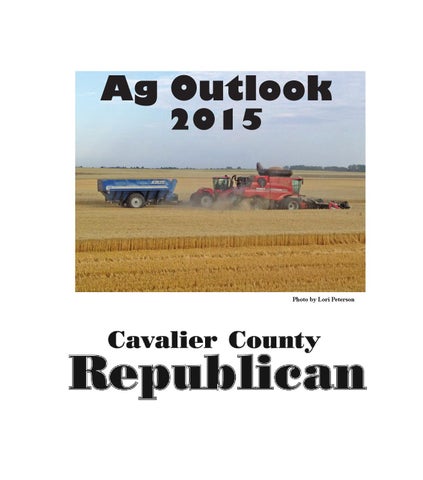
Ag Outlook 2015
Photo by Lori Peterson
Page 2 – Monday, March 30, 2015
Ag Outlook 2015
Cavalier County Republican
“No Barley - No Beer”was the theme for the 71st Annual ND State Barley Show By Melissa Anderson Republican Editor
The 71st Annual Barley show held in Osnabrock had the rallying cry of “No barley, no beer” as latest statistics show a 25 percent decrease in production last year. The show drew many area farmers to hear presentations from the NDSU Extension Services to the President of the National Barley Growers Association. Dr. Rich Horsley, an NDSU Barley Research Agronomist presented NDSU’s newest barley variety, the two row ND Genesis. Horsley believes that there will be an increased demand for the two row barley as the craft beer industry has begun to show more interest in the use of barley in their product. “The craft industry has gotten very excited and very driven about what goes into their beer” Horsley stated. The craft industry has been joining the American Malt Brewers Association in droves over the past ten years, making bigger brewers take note of their barley variety needs. With the increased demand for two row barley, the task of creating a better barley when the two row has been at a “historical disadvantage compared to the six row”, NDSU has been working on creating a new variety that will hold its own. “[We] are projecting that the actual malt usage will go up in the U.S. even though beer sales are going down” Horsley said. The ND Genesis was developed to meet the growing demand for low protein, two row barley that craft brewers are looking for. The ND Genesis is comparable to current barley variety favorites Pinnacle and Lacey. Genesis has a three to four day later heading date than Pinnacle and Lacey but is taller than these current varieties.
Compared to Pinnacle alone, Genesis has better disease resistance but also a weaker straw. Genesis has a three to five percent advantage with a slightly higher malt extract. Genesis has almost two points lower in protein than Lacey and current testing shows that Genesis has a higher yield than the six row Lacey. This variety is currently being distributed through the NDCIA County Increase Program with 4,000 bu foundation seed and 6,000 bu certified seed. At the time of the barley show, Horsely stated that 66,000 bushels of the Genesis variety had been requested. “We are hoping that the demand and the seed availability match” Horsley stated. The beer industry has also taken notice of this new demand for the two row variety. Adjunct brewers who mainly rely on the six row barley have begun contracting farmers to grow current six row varieties versus two row. Horsley believes that the ND Genesis variety will be able to meet in the middle for the low protein demand of the craft beer producers and the more well known adjunct brewers. “We see it as a barley that will work for the big adjunct brewers and the craft brewers” Horsley stated. Steve Edwardson, the Executive Administrator for the North Dakota Barley Council(NDBC), continued the barley discussion by explaining what the NDBC has done to encourage the beer industry to see barley production from the farmer’s side. Edwardson elaborated that the beer industry has long treated barley as more of a commodity than an ingredient in their beer making. The numbers show that barley production in ND has long been in a decline with feed grade barley taking the sharpest drop. “North Dakota is producing less barley as a result of numerous crops for growers to produce that are often easier
to grow and more profitable” Edwardson stated. For many growers, Edwardson explained, the risk of not achieving malt quality barley is too high and coupled with the fact that crop insurance for barley is based on feed barley prices, the payout should the barley not reach malt quality is too low to be a benefit. “There is no secret in how growers determine which crops to plant. The process is methodical and mathematical” Edwardson said. The NDBC has been working with the beer industry to help them understand this so that the industry is better able to grasp the risk ratio farmers face every time they consider planting barley. As a result of this effort new contacting practices for malt barley creates a 50 percent contracted with a 70 percent acceptance rates versus the old way of zero percent contracted and 50 per-
cent acceptance, stabilizing the profit margin. The NDBC has also been addressing the issue of crop insurance for barley. The NDBC along with private insurance developer Watts and Associates have been working with growers, industry, and crop insurance companies to create a crop insurance strictly for malting barley. The data rating for this insurance was provided by the malting industry which will allow the insurance product to insure malting barley on malting industry purchasing practices. “The crop insurance is vital for management and securing production” Edwardson explained. The new insurance product has been submitted and will hopefully be deployed in 2016. Doyle Lentz, the President of the Na-
cont. on page 3
DOWNS OIL COMPANY Oil Sale on now thru May 15
See us for your oil, fuel & gas needs. Call Terry at 370-2113
First place
Madi Diehl of Hillsboro was the first place winner in the ND State Barley Show in the malting and feed barley classed. Diehl won $75 for the malting and $25 for feed barley. Photo by Melissa Anderson.
Cavalier County Republican tional Barley Growers Association (NBGA) was present at the show and during his presentation shared with local producers what is happening at the national level. The NBGA has been pushing the idea of treating barley like an ingredient versus a crop to encourage the malting industry to reconsider how they contract and get the needed barley. Lentz shared the news that big adjunct brewers are actively contracting farmers to grow their needed six row barley and are particularly focusing on this area of North Dakota as their view of the area is that it is better able to manage the crop and also has better access to transportation once harvested. “Miller’s has come to North Dakota and contracted 10,000 acres of six row
Ag Outlook 2015 and will contract more in the future” Lentz stated. Lentz continued his presentation by informing growers of the importance North Dakota producers play in the national barley field as the barley crop in Idaho and Montana was essentially lost this past year, putting a strain on consumers of the crop. The NBGA, which is supported mainly by growers, has been working on securing increased industry support. The alliance with the industry makes access to the needed funds for lobbyists as well as funding for education programs. The NBGA has been focusing on stabilizing the production of barley through continuous education. By educating growers and the industry on the
Monday, March 30, 2015 – Page 3
risks of producing barley compared to other crops such as corn, soybeans, and wheat the crop insurance and contract programs can be in line with current production trends as well as being informed of the newest developments and refinement of barley varieties. Other presenters were Dwight Aakre of the NDSU Extension Service who spoke to those gathered about the upcoming deadline of the 2014 Farm Bill. Aakre, who has been giving presentations on the 2014 Farm Bill since last fall informed the crowd on the latest stastitical data to help them make decisions. Aakre reminded those gathered that the deadline for applying for the Farm Bill was March 31. “The best thing we can do with the Farm Bill is forget about it after April 1”
Aakre stated. Randy Mehlhoff, the Director of the Langdon Research Extension Center gave a presentation on the recent improvements at the center and what area producers can look forward to occurring at the center over the upcoming year. Mehlhoff informed the crowd that the center will potentially be researching the commercial production of industrial hemp under the 2014 Farm Bill Section 7606. The research, if conducted, will be used to determine if the production of industrial hemp would be beneficial to the American farmers and businesses.
The 71st ND State Barley Show was held March 20 in Osnabrock. The theme of this year’s show was “No barley, No beer”. The show was well attended with great presenters. Photo by Melissa Anderson.
Beck Brothers Seed We are your seed headquarters
Call today for varieties & prices 682-5546 • Munich
Page 4 – Monday, March 30, 2015
Ag Outlook 2015
Cavalier County Republican
Railways show gains in improving service
By Melissa Anderson Republican Editor As harvest season came to a close last fall, farmers and those in the farming industry faced the ongoing issue of less than sufficient railcars and lines to move their crops. On September 22, 2014 from Washington, D.C., the rail companies released a status report on the grain car backlog that read as followes, “Today Congressman Kevin Cramer announced BNSF Railway and Canadian Pacific Railway (CP) have publicly filed updated weekly status reports on the backlog in grain shipments. The figures from BNSF show a total of 1,646
((a
past due rail cars in North Dakota averaging 8.8 days late as of September 19, compared to the report the previous week which indicated 1,000 past due cars were averaging 7.9 days late. The CP report shows a total of 3,023 open requests in North Dakota with an average age of 10.45 weeks. The previous report showed 5,184 open requests with an average age of 11.81 weeks.” Over the last 20 years farmers have gotten used to delays in movement due to crew and weather. With the recent oil boom along with more productive harvests’, and last years excessively cold temperatures causing much delay, they are now eagerly waiting for a long-term solution. General Manager of CHS, Tom Le-
har, commented, “Our local farmers continue to produce increasingly larger crops, and in the past several years the prices have prompted producers to sell grain aggressively which places a lot of pressure on railcar movements in the first several months of the marketing season. With grain price erosion over the past six months, it appears that grain flow will be spread across the entire marketing year and perhaps get carried into the future years.” Lehar continued, “The railroads are experiencing record movements in their industry, with oil being the most publicized. They are in the process of adding additional lines to their bottleneck areas to make their lines more fluid. This will improve overall flow of
Why should you grow
STAR CANOLA on your farm?
Premium Contract Option Available High Yielding RR Canola Hybrid o #1 variety in both Velva, ND and Langdon, ND trials Early/Medium Maturity Strong Season Vigor Average Plant Height Proven Consistent High Oil Content Excellent Shatter Tolerance Straight Cut Harvest Option STAR 402 Canola Developed For this Region
all railcars, but it will take several more years to complete.” All across the industry, steps had been taken locally to compensate for the lack of railroad dependability; farmers have built additional on-farm storage and elevators have added storage capacity. The railroads have made progress over the winter months. The latest status reports on the grain car backlog from BNSF and CP show significant improvement. On March 19 BNSF reported that for the first week in March they had 976 outstanding cars with an average of being 15 days late; 62 new car orders and 918 car orders filled;31 car orders cancled by the shipper and 0 orders canceled by the railroad. CP has even better improvement in their report. The filed report showed that for the week of March 9 through the 15 CP has no outstanding requests for cars; 427 new orders for cars with 947 orders filled; 50 orders canceled by the shipper and 0 orders cancled by the railroad. BNSF Railway is also keeping in mind other options such as, buying additional shuttle trains from other facilities across the country in the secondary market, though it would cost a significant amount to accomplish that. At this time, farmers can only hope that the improved service continues and that by harvest time the crops will hit the rails on time with not delays.
Please support these Agri-businesses that support us!
Check us out online at Call STAR Canola Today. Your Canola Expert. 701-361-8958 or jimj_start@hotmail.com
www.cavaliercountyextra.com
Cavalier County Republican
Ag Outlook 2015
Monday, March 30, 2015 – Page 5
NDSU Extension Service gives presentation on Clubroot of Canola
By Melissa Anderson Republican Editor The North Dakota State University Extension Service gave presentations last fall concerning Clubroot of Canola, a potentially devastating pathogen that could wipe out canola crops. Ron Beneda, former Cavalier County Extension Agent gave presentations to large crowds about the pathogen that has had devastating effects on the Canadian canola crop and now threatens to lay claim to North Dakota’s. Clubroot is a soil pathogen that “infects the roots of canola and other Brassicae plants (such as broccoli, cauliflower, Sheperd’s purse, and wild mustard)causing galling and swelling, and giving them a “club” appearance.” The pathogen was first discovered in 2003 in Alberta, Canada. Since then, it has made its way across Canada and now evidence of it has been found in Cavalier County fields. The pathogen is in the soil, so anything that moves soil can move the pathogen. This pathogen also travels by wind and water with the most likely cause of its arrival in the States being that of farm equipment. Beneda began the presentation by explaining what types of conditions favor Clubroot. “ This stuff loves low pH levels, which means we are lucky because our pH levels are higher” Warm temperatures and wet soil also helps this pathogen thrive. The appearance of Clubroot often
begins with small patches in fields. “The canola may be stunted, yellow, and generally unhealthy looking and the stand may be thin. The roots of the plants that have been infected will be swollen and shaped like clubs.” Those plants that are infected will be very easy to pull from the ground. Beneda cautions farmers against uprooting plants and bringing them into the extension office. “The worst thing you can do is grab samples and bring them into the coffee shop and show guys or bring them into the office.” Currently, the Extension Service is in contact with the Canadian Canola Counsel trying to determine what strain the pathogen found in ND is. The Extension Service will be in contact with the Canola Counsel to determine how big of a radius will be needed to inform farmers of contaminated fields. The resting spores have a life span of 20 years and have a half life of four to five years. “That’s why this is so significant, it’s not like one, two, three years of rotation and it’s not a problem anymore” Beneda stated. There are no known fungicides for the treatment of Clubroot in canola. Kevin Shepard, the Marketing Manager for Simplot in Langdon stated that Simplot offers a few clubroot resistant varieties and other seed companies such as Pioneer and Cropland do as well. “There is always going to the be the
potential now that we have found it. It seems like in Canada that is has spread quite wide across the country up there and expect to see the same thing here” Shepard stated. Shepard cautions area farmers that they only need the resistant varieties of canola if they have confirmed clubroot in their fields. The reason being that the pathogen responsible for clubroot could mutate and overcome the newly developed resistant varieties of canola. Beneda remarked that even with these resistant varieties the need to rotate them was crucial to prevent the Clubroot from becoming stronger. The key to keeping the pathogen under control is cleaning equipment thoroughly and any other machinery and vehicles that come in contact with the contaminated soil. “Stay out of the fields when wet and muddy, go fishing instead” Beneda said. The sanitation process begins with the location of where the cleaning takes place. It is recommended that units be cleaned and disinfected before leaving the field. A low traffic, grassy area is recommended to reduce chances of carrying soil off the field. Begin with a rough cleaning using either a hand brush or wirescraper
which will remove most of the loose or clinging soil from tires and equipment. Next use a pressure washer aset at two to three thousand psi on all areas where soil accumulates. Turbo nozzles are the more effective than regular nozzles for removing soil . This step along with step one should remove 99 percent of soil from equipment. The final step is to disinfect all openers, tires, and wheels with a one percent solution of bleach or surface disinfectant of equal strength. The recommendation for completing the disinfecting process is to use a three gallon backpack herbicide sprayer. The key to successfully disinfecting is to have areas sprayed remain wet for at least 15-20 minutes. This step is best done in the early morning or at night when evaporation will be slower. The third step alone is not enough, the first two steps must be completed as well in order for disinfection to be effective in eliminating the pathogen. While the cleaning process can be long in the undertaking, up to four hours or more for a 40 foot cultivator if all the steps are followed, it is the best defense against the spread of the Clubroot pathogen. For more information on Clubroot of Canola please contact Cavalier County Extension Service, 701-256-2560.
Made to Spec: • • • •
Hydraulic Hoses A/C Hoses Battery Cables Air Brake Hoses Filters of All Kinds
Batteries – Alternators – Starters Pictured is an example of Clubroot of canola. Photo submitted by Luis del Rio Mendoza of North Dakota State University.
101 9th Ave. E., Langdon 256-2158
Page 6 – Monday, March 30, 2015 By Melissa Anderson Republican Editor The 64th North Dakota State Legislative Assembly had four bills on their docket that addressed concerns with the booming honeybee industry in North Dakota. The main legislation, SB 2025 introduced by the Agriculture Committee, aims to create and enact a new chapter of the North Dakota Century Code (4.116) relating to beekeeping, amend and reenact section 4.1-08-03 of the North Dakota Century Code that pertains to
Ag Outlook 2015
Update on Bee Legislation
the submission of assessments by beekeepers and to repeal chapter 4-12.2 of the North Dakota Century Code which is the current legislation relating to beekeeping. This will be the third time that legislation relating to the honeybee industry in North Dakota will have its laws significantly reworked. The new legislation of SB 2025 has some significant reworking’s of the laws pertaining to the handling, licensing, penalties, and powers of the agricultural commissioner over this new agroindustry. A notable change in proposed law is
Wales Farmers Elevator Wales, N.D.
See us for all your Canola • Grain • Fertilizer Seed for sale Canola Soybean Sunflower
Call 283-5222 For details
Cavalier County Republican
the grounds for denial of a beekeepers license, which is not included in current laws. The grounds for the agricultural commissioner to deny a beekeeping license include repeated violations of beekeeping laws, failure to pay an adjudicated civil penalty for violating this beekeeping laws within the thirty days allotted after a final determination is made or if the applicant has provided false or misleading information in connection with any application or notification required by the state laws. The requirements for identification of apiaries were also addressed in the proposed legislation with a significant increase in size of lettering for the information of the beekeeper. The proposed legislation increases the size of lettering from the current inch and half to three inches and a line thickness of a half an inch. The lettering must be done in contrast to the affixed hive and must also be visible from the entrance to the apiary. The legislation also more clearly defines the terms for seizure of unidentified apiaries as well as the agricultural commissioner’s powers in regards to assisting and executing the laws pertaining to beekeepers and honey industry. The most significant statue is that of
an individual now being able to petition the agriculture commissioner for an order requiring the relocation of an apiary. The grounds for this petition are if the individual resides on land neighboring to that on which the beekeeper has placed an apiary or/and the individual’s health or welfare is endangered as a result of the apiary’s location. This legislation is currently under consideration in the North Dakota House of Representatives. There was legislation which would have addressed how close beekeepers could place their hives to occupied residences, HB1236, which was given a “Do Not Pass” recommendation by the Agricultural commission and was subsequently voted down by the House. The issue of applying pesticide in the vicinity of bees was also addressed with proposed legislation in the form of SB 2228. Under this proposed legislation as a condition of licensor, a beekeeper had to sign a statement agreeing to confine or relocate their bees within twentyfour hours when notified by a pesticide applicator that spraying would occur within two miles of the apiary. This legislation was also given a “Do Not Pass” recommendation by the Agricultural Commission and was also voted down in the Senate.
Your Local Outback Dealer
Authorized Dealer:
SIOUX STEEL COMPANY PM AG Sources, Inc.
866-588-7624
Call Aaron Balsdon Today for Specials 370-0730 or 256-2738
Contact Chris Plummer at 701-256-0878
Stop in & see us for your
Farming Needs We have a wide selection of
Let Your Local Agent Review & Upgrade All Your Insurance Needs!
Home - Business - Auto - Life - Farm Crop - Long Term Care
clothing
Langdon Hardware & Rental 804 1st St., Langdon • 256-2120
SIMPLY DIFFERENT That’s our promise to you... Ken Myhre & Russ Stremick – Your local agents Not All Products are underwritten by Farmers Union Insurance
FARMERS UNION INSURANCE COMPANY 720 3rd Street – 256-5142
Cavalier County Republican
Ag Outlook 2015
Monday, March 30, 2015 – Page 7
Dr. Drone may visit your canola field By Melissa Anderson Republican Editor
As agriculture becomes more high tech, will we now see drones flying over fields instead of pickups driving through them? The Langdon Research Extension Center is hoping to have quite the showcase at their upcoming Field Day on July 16. Randy Mehlhoff, the Director of the Langdon Research Extension Center, is planning on exhibiting how a drone can be used to diagnose disease in canola fields. John Nowatzki of NDSU gave a presentation at last years Canola Expo on the effectiveness of using Unmanned Aerial Systems (UAS or drones) in agricultural capacity. Nowatzki is heading a two year research project based in Carrington in conjecture with the University of North Dakota Aerospace program, which offers a four year program in Unmanned Aircraft Systems Operations. The objective of the study is to evaluate drones capabilities of being used for agricultural purposes in both the livestock and farming sectors. The drones were equipped with color, thermal, and infrared sensors to detect crops and animals from the air. Mehlhoff hopes to present area growers with the latest innovation in combating diseases such as Black Leg, White Mold, and the newest threat to canola growers, Clubroot. “It is a new technology and we are working with the Ags and Biosystems Engineering Depts [at NDSU] to use spectral imaging to identifty diseases in canola” Mehlhoff stated. The FAA has very strict regulations in regards to the use and flying of UAS, however. Generally, the FAA limits operation for hobby and recreational use only and those who practice are re-
stricted to flying below 400 feet, away symptoms, weed damage, weed infes- off and landing, tell it where you want from airports and air traffic, and the tation, and plant vigor are the primary it to fly, then you can go sit on the porch UAS must be within sight of the opera- points. and have a cup of coffee” Nowatzki tor. Nowatzki is utilizing two differ- stated in regards to the Trimble UX5. Experimental certificate regulations, ent types of UAS or drones within the Nowatzki explained that the study is which is what this study falls under, study. One is a rotocopter, called the showing significant promise for utilizdoes not allow carrying people or prop- Draganflyer. The other drone is a fixed ing drones for agricultural purposes. erty for compensation or hire, but do wing model called the Trimble UX5. “Statistically, the program has found allow operations for research and deThe key difference between these that the UAS using MATLAB software velopment, flight and sales demonstra- two drones is in how they are flown. has the same abilities as a human counttions and crew training. The robocopter is flown much like a re- ing and identifying standing corn” “The FAA is working with civilian mote control aircraft where the person Nowatzki stated at the presentation. operators to collect technical and opera- flying has a controller and flies the veAs seeds become smarter and tional data that will help refine the UAS hicle that way. ground technology becomes increasairworthiness certification process” the The Trimble UX5 on the other hand ingly advanced it would appear the sky FAA stated on their website concerning utilizes GPS and computer software to is the limit for the future of agriculture. the future of UAS. virtually fly itself. Mehlhoff explained that the Lang“You enter in the coordinates of take don Research Center had hoped to exhibit the use of drones at the 2014 Field Day but FAA regulations at that time deterred the Center. “Last year we had to have a licensed pilot which would have cost $5,000. The FAA has relaxed their regulations to just a certified pilot” Mehlhoff stated. Mehlhoff has verbal consent from the Langdon Airport Authority for this showcase and is waiting on news from the FAA to confirm the flight. Some of the things Nowatzkis’ study hopes to identify with drones mounted sensors in regards to crops is plant emergence, plant John Nowatzki of NDSU gave a presentation during last year’s Canola Expo on the effecpopulation, nutrient tiveness of using Unmanned Aerial Systems (UAS or drones) in agriculture. deficiencies, disease
Erlings Oil
Your Headquarters for: OIL
Bulk gas & diesel fuel Bulk oil & oil products Home delivery for fuel oil, tractor & farm fuel 511 4th Ave., Langdon 256-2276
Seed for Sale
Wheat Cert. SY Ingmar Cert. Rowyn
Flax Cert. Carter Common 94 Rahab
Durum Cert. Carpio
Custom Seed Treatment & Innoculation Available
Contact us about Flax Sales Opportunity.
Dicks’ Seed, LLC
Munich, ND 58352 • 682-5151
Page 8 – Monday, March 30, 2015
Ag Outlook 2015
Air Filter Washing Saves You Money
• All tractor and truck filters are washable. • Our washed air filters have been laboratory tested and guaranteed equal in performance and efficiency to new.
• Conserve our natural resources and save our landfills by recycling.
• Collection centers are located throughout the region.
Filter Care of Grafton, Inc. Call us collect for details and collection centers near you.
(701) 352-3304 - Grafton, ND
Cavalier County Republican
Sustaining the Northern Plains By Janet Jacobson What sector of US agriculture has seen demand grow by double digits since 1990, had sales nearly triple between 2004 and 2014, and is projected to continue to grow at a similar rate for the next decade? If you guessed organic food production, you would be right. When we began farming organically more than three decades ago, we were a rare and novel kind of farmer. We grew crops for “niche” markets and attracted a number of journalists looking for a quirky human interest story. There were so few of us in those days that we knew most of the other organic farmers in a four state area by their first names. Not these days. More than 80 percent of all consumers say they have bought organic products in the last year. Some 20,000 specialty grocers and health food stores sell organic food and nonfood products. Three out of four conventional grocery stores have an organic and natural food section. According to food industry sources, organic foods accounted for more than $30 billion in sales in 2011. That number is often downplayed as being a tiny portion of the total food consumption in this country. For comparison, however, the egg industry is thought of as a major part of US agriculture production. According to the Ag Marketing Resource Center, we bought a total of $7.8 billion worth of eggs in 2012. Still many people do not really know much about organic agriculture. If you ask the average consumer what they know about organic agriculture, they may be able to tell you what they think we don’t do. We don’t use chemical pesticides and fertilizers. They might be able to tell you we don’t use antibiotics in our livestock production and that we use manure to fertilize our crops. Beyond those things which we don’t do, we have not done a very good job explaining what it is we actually do. Organic farmers are prohibited by the National Organic Standards from using many kinds of pesticides and fertilizers, but we are also mandated to use good farming practices. Organic farming is an attempt to grow food in a way that works with natural processes. We try to nurture beneficial insects, improve the soil in our fields, prevent diseases and insect pests by variety choices and by complex and diverse crop rotations. We use clover and other legumes to fix nitrogen and increase organic matter in our fields. We limit disease in our livestock by choosing breeds adapted to our climate. We avoid introducing new animals without a lengthy quarantine. We use low stress handling methods and pasture rotations to limit parasites. We give our animals lots of
room, fresh air and good food. We often make choices based on what is best for our animals, not what is most cost effective or efficient in the short term. Organic research projects, often funded by organic growers and processors, are exploring new combinations of cover crops, companion planting, perennial grains and organic no-till. Individual farmers innovate minimum tillage equipment, weeding techniques and work with plant breeders to test new crop varieties better suited to low-input agriculture. Some detractors farming try to raise concerns about the safety of organic food because organic farmers use animal manure on their fields. Yes, we do use manure. Manure use is strictly regulated as to the amount and timing of application. Compost production has very specific rules about temperatures, timing and application rates. Usually those who claim organic food is not safe because of the possibility of contamination from our fertilization practices neglect to mention the millions of tons of manure applied by conventional farmers with far fewer regulations and limits on when and how much is applied. Organic food is as safe as any other food product. Besides the requirements of the National Organic Standards which are certified by annual inspections, audit trails and review by third-party certifiers approved by the USDA, organic food must meet the same food safety requirements as all other food. Processing plants are inspected by organic certifiers and by APHIS and local health inspectors. All farmers market suppliers meet the same health regulations whether the food they are selling is organic or not. Organic certifiers expect farmers to have plans for protecting the environment, building soil, preventing contamination from unapproved insecticides, herbicides and fungicides as well as genetic drift. Most of our fields have a buffer strip between them and the neighboring fields. We must make sure trucks and machinery is cleaned before use. We are required to use organic seed if it is available. Every bag of organic flour should be able to be traced through documentation back to the field where the wheat was grown. The field history records should list all practices used on that field for all the years that piece of land has been certified as organic. While organic certification applies to the farming practices used and not the product produced, buyers of organic products do expect the product to meet their standards of quality and purity which often exceed conventional standards. In spite of all the things consumers don’t know about organic agriculture, it is consumers who have driven the expanding sales of organic food, fiber and other products. Food industry analysts expect the market to continue to grow–organically, of course.
Cavalier County Republican
Ag Outlook 2015
Monday, March 30, 2015 – Page 9
OSNABROCK FARMERS CO-OP ELEVATOR Osnabrock & Nekoma, North Dakota General Manager - Chris Schaefer
~ Here for all your farming needs √ Shuttle Loading √ Chemicals √ Canola Seed √ Drying √ Dry Fertilizer √ Custom Applicator
Osnabrock 496-3111
Nekoma 949-2722 Chevrolet
The Most Awarded Car Company Over The Last Year
2015 Chevrolet Silverado 2500HD High Country GM Parts
Certified Service www.dandbmotors.com
Page 10 – Monday, March 30, 2015
Ag Outlook 2015
Cavalier County Republican
HE Everson Company
D EALER Other oil brands
Automobile Parts Welding Supplies Automotive Paint Supplies
125 9TH AVE • LANGDON 256-3199
See us today for all your oil needs!
Hoffarth Oil 256-5113 or Cell 256-0277
We also have quality fuel at the best prices.
M OSTAD I NSURANCE S ERVICES Insurance Services of all Kinds • Home • Crop Insurance • Farm • Life • Auto • Long-term care • Commercial 824 3rd Street Langdon • 256-2253
See us for your seed or seed treating needs.
256-2374
Filter, Oil & Tool Sale! Don’t miss out on this factory Direct Sale
& 1st week of
MONTH OF MARCH See us for your Diesel Exhaust Fluid
lute We Sa lture u Agriecry Day! Ev
April
• Lawn & Garden • Combine • Semi • Auto • Farm Equipment • Farm Trucks • Tractors • Construction
45%Off ALL FILTERS anything that takes a filter!
We are Your Diesel Exhaust Fluid Dealer in Langdon Competitive pricing on 2.5 gallon to 55 gallon drums
275 & 330 gallon totes are also available Buying bulk saves money! New Emissions Regulations already on new tractors, combines, trucks – anything that’s a new diesel.
DAHL’S TRUCK & AUTO CENTER, INC. Hwy 1 South • Langdon, ND • 701-256-3930
CAL ORDER L YOUR IN T & SAVE ODAY !
Cavalier County Republican
Ag Outlook 2015
SOLID AS A ROCK! ROCK!
A Durable Rock Picker That Is Made With Only Quality Craftsmanship
OTTO ROCK PICKER
Hurr B y in the efore S Ruspring h!
Featuring: 16.5x16 Flotation Tires 8,000 lbs. Axles Double Cylinders on Buckets rea or As & f l l Ca ealer lers D Dea e MorWanted
Richard’s Welding 701-496-3289 • Osnabrock
Monday, March 30, 2015 – Page 11
John Deere
Spring Parts Specials No Payment & No Interest Until July 1, 2015 To preferred Farm Plan Customers $1,000 Minimum
Westeel
Truckload Savings T
Grain Storage
In house Crews Available A
Startin Starting Fluid
PM AG Sources, Inc.
866-588-7624
Super-premium, high-ether content helps prolong battery life. life f . fe
Contact Chris Plummer at 701-256-0878
Pistol-Grip Grease Gun
$2630
Save 10%
on JD Strongbox Batteries
$378 BE556468
Stop in or call to see how Farm Maps can make your crop insurance record-keeping a breeze.
TY26517
CHECK REDUCED PRICING ON AIR SEEDER HOSE 47-Degree Field Cultivator Sweep For All Brands
Excellent for seedbed preparation, incorporation chemicals, self-sharpening edges. Competitively priced.
10% OFF
Weston Seed House 10771 Hwy 20, Sarles
Your Headquarters for all your seed & chemical needs
697-5140
Dealer
Check out Truckload Savings on selected John Deere parts. We bought big so you save big!
N130184
JD Filters & Fleetguard Filters
Choose filters designed to protect your machines, not just fit them!
12% OFF
Filter 1
Torq-Gard Supreme® Plus 50 Engine Oil & Hyd Oil
The best engine oil on the market today. Formulated for John Deere engines to provide: • Longer life • Less ring wear • Better corrosion protection
10% OFF TY26678
SPECIAL PRICING ON NICHOLS SWEEPS & SHOVELS
Langdon Implement Co. Inc. Hwy. 1 North • Langdon • 256-5275 Sale ends April 15, 2015
Remember to check with Kent, Paul or Dale for all your spring planting needs. We do alternator, generator and hydraulic hose repair on all makes and models.
Page 12 – Monday, March 30, 2015
Ag Outlook 2015
Farmers Union Oil Co.
Langdon • (701) 256-5531 – Calvin • (701) 697-5208 Lawton • (701) 655-3514
• Fertilizer Hauling & Spreading • Chemicals
Cavalier County Republican
Forest Flying Service Langdon & Wales
• Fuel • Tires • Batteries
• Anhydrous Ammonia
• Oil
• Seed
• Sprays
Stop by the Farmers Union Oil Co. and visit with us about all your farm needs!
Custom Aerial Application Call Kevin at 305-0072 Ken at 283-5108 Langdon Airport 256-5108
forestflying@yahoo.com
Equipment That Works As Hard As You Do! We specialize in two way radios that keep you connected and your business working. Our radios are heavy duty, proven performance, versatile and user-friendly.
“We Have The Right Radio For The Job!”
North Plains Communications Hwy. 2 East • Devils Lake • 662-6988
YOUR LOCAL RURAL ELECTRIC CO-OP
1. Supplies low cost, dependable electric power to Cavalier County and northern 1/3 of Ramsey County. 2. The first lines were energized Sept. 14, 1948. 3. Total members served, 1,501. 4. Miles of line, 1,457. 5. Located in the northwest corner of the Minnkota Power service area. Home of Minnkota Power’s first wind farm in North Dakota. 6. Licensed and insured electricians to carry out your wiring needs. 7. Trenching for yard wiring. 8. Sales of electrical material, electric heating equipment, livestock waterers & electric motors.
Cavalier Rural Electric Co-op, Inc. P.O. Box 749 - Langdon - 256-5511
Cavalier County Republican
Ag Outlook 2015
Thinking about a new Window? Now is the time to order. Thick extruded vinyl never needs painting Replacements or New Construction Lifetime Guarantee on Frames 20-Year Warranty on Glass
Monday, March 30, 2015 – Page 13
Stop in and see us for your insurance needs today! Commercial • Home • Farm Auto • Life • Crop-Hail • MPCI-RP-YP
(warranty is transferable)
Fast Delivery & Installation by Local Professional Crews
Stop in and see Mark, Sid, Al or Lucas
about “in-stock” specials
‘We want to to be the CENTER of your building needs.’ Mark Zimmer - Manager Hwy. 5 East • Langdon 256-5191
405 8th Ave. • Langdon, ND 701-256-2166 waindins@utma.com
Page 14 – Monday, March 30, 2015
Ag Outlook 2015
Cavalier County Republican
Outlooks and Updates for the 2015 Growing Season from NDSU Extension Service
Technology Outlook by Lesley Lubenow, Area Extension Specialist, Langdon Research Extension Center 2015 will be the twentieth growing season where transgenic crops are available to U.S. farmers. How far have we come in the arena of technology since that time! Technology has marched forward by adding GPS to farm equipment and yield monitoring. To now, companies are marketing prescription field management services. Add-in physical engineering feats like VRT sprayers, faster and more precise seed singulation planters, and equipment performance data; we have come a long way since 1985. Here are a few pieces of advice as we move into the data age of farming. Firstly, who owns your data? The answer is probably you, but read contract terms for data sharing or if it is equipment performance data, does the data stay with you when you sell the equipment or is it transferred to second-party? As we look into the future, the question of data management and ownership is still evolving. Will field data become a monetary valuable commodity which can be sold along with equipment or land sale? In rented land agreements, will data-sharing be a part
of landowner negotiations? The crystal ball is murky. There are no universal data sharing agreements between companies ie. like when hydraulic hose tips were different between John Deere, Case IH and Pioneer. When you choose a data management system, you may be locked-in that company to reap full functioning benefits of precision equipment. Ask questions of compatibility, data transference and programs needed to read file formats as you make buying decisions. Finally, avoid the ‘Oh shiny; let’s buy that’ syndrome. Precision ag should be about making your goals come true – whether that is profitability and/or reduced environmental impacts. Will this new technology actually help you reach your goal? How will it do that? Make sound decisions based on the facts.
2015 Disease Outlook by Sam Markell, Plant Pathologist, NDSU Extension Service There are three diseases to watch for in 2015, and every canola grower in the county is aware of them. White mold is a potential threat every year. If we have a wet spring and the weather stays cool and wet in bloom, then white mold is a threat. Fortunately, there is a risk map available to help you decide if a fungicide application is
necessary. (http://www.ag.ndsu.edu/ sclerotinia/) The map helps you assess your risk, and hedge your bets on whether an application will pay or not. Remember that early bloom (often 20% flower) is the target timing for fungicides. Blackleg is another disease that is always a risk. Damaging blackleg occurs when infection happens early in the season and lesions girdle the stem. Plants can simply die or be ‘unthrifty’. While resistant hybrids were very effective in the past, they are less consistent now because the pathogen has evolved new PG-types (like races or strains). Some of the most damage we have seen has been in fields where the same hybrid has been planted again and again. The damage is possibly the result of the pathogen becoming well adapted the genetic package of the hybrid – essentially building up in the field and overcoming the resistance. Another option that has shown some promise is an early season fungicide application – targeting the 2-4 leaf pair. Several fungicides have been shown to be effective. However, fungicides are not a sure management plan, but they can help. Clubroot is on everyone’s mind. Clubroot is confirmed in the county, and has been found in a few fields. Growers should be watching their
fields throughout the season and pay attention to any patches of thin stands and poor yield. If you see this, carefully dig up the roots and look for the classic swollen roots. The galls might be dusty and brittle. Clubroot spreads like most soil-borne pathogens – anything that moves soil can move Clubroot. Consequently, areas that are close to field entrances might be the first place you find it. Also, clubroot likes low pH soil, so pay attention to those areas.
Sub-surface Water Management by Hans Kandel, Extension Agronomist and Tom Scherer, Extension Ag-Engineer, NDSU Extension Service The 2015 planting season is rapidly approaching. Farmers can control many of the production factors, however, annual precipitation is out of our control. In many years water management for crop production is a critical issue. One way to control the water table is with tile drainage. Sub-surface drainage also called tile drainage does not remove “plant available” water from the soil; it merely removes “gravitational” water that would drain naturally, if unimpeded by confining layers in the soil. The greatest benefits of tile drainage
cont. on page 15
Stop in and see the all new 2015 Ford F-150 Supercrew
Great selection of Previously Owned Vehicles
Christie Motors Jct. 1 & 5 • Langdon • 256-2182
Cavalier County Republican are typically realized in wet years. Drainage promotes deep root development and crops will often have better access to soil moisture during drier parts of the year. During extremely dry growing seasons it is certainly possible that a tile-drained field might have less available water at some point during the growing season than a non-drained field. Whether or not such an effect would offset the early-season positive effects of drainage is unknown, and highly siteand year-specific. In general, where poorly drained soils exist, crop yields will be more uniform from year to year with tile drainage. Drainage control structures (also known as controlled drainage or drainage water management) can be installed to provide the potential for limiting the release of drainage water to conserve more soil water in the root-zone. Similarly, the pump in a lift station can be turned off when there is a concern about drier growing conditions. The economics of tile drainage systems depend on crop yield response, initial capital investment for the materials and installation of the system, and any annual operation and maintenance costs (such as electricity for pumped outlets). Although crop yield response to drainage can be assessed directly, the impacts of inadequate drainage on soil quality (structure, microbial activity, etc.) are more difficult to measure and assign economic value. Many field crops show a positive response to drainage (on previously poorly drained soils), often with the best response from a combination of surface and tile drainage. The level of yield increase for a given year depends greatly on how poorly drained the soil was prior to drainage, and the timing of seasonal rainfall. Research has shown that over many growing seasons, average yields may increase around 10 to 15 percent, depending on the aforementioned factors. In addition to yield increases associated with adequate drainage, there may also be reductions in operating expenses on the farm due to reduced crop-
Please support these Agri-businesses that support us!
Ag Outlook 2015 ping inputs, less power consumption, and timely field operations. For more information see http:// www.ag.ndsu.edu/pubs/ageng/irrigate/ae1690.pdf. How Bad is Your Spray Water? By Rich Zollinger, NDSU Extension Service Weed Specialist Minerals, clay, and organic matter in spray carrier water can reduce the effectiveness of herbicides. Clay inactivates paraquat, diquat, and glyphosate. Organic matter inactivates herbicides. Salts in water such as calcium, magnesium, manganese, sodium, and iron reduce efficacy of most herbicides. Cations antagonize POST herbicides by binding with the herbicide to form salts (e.g. glyphosate-Ca) that are not readily absorbed by plants. North Dakota water often contains a combination of sodium, calcium, magnesium, and iron
Monday, March 30, 2015 – Page 15
and these cations generally are additive in the antagonism of herbicides. When added to a spray solution, the sulfate (SO42-) ion complexes with the hard-water cations (e.g. calcium sulfate), causing the salt to precipitate from solution. Ammonium (NH4+) ions bind with herbicide molecules and reduces herbicide interaction with the hard-water cations. This combined effect increases herbicide absorption and efficacy. Ammonium nitrogen always increases herbicide effectiveness even in good quality water that does not contain any antagonistic salts in the water. Use at least 1 lb/A of AMS when spray volume is more than 12 gpa. The amount of AMS needed to overcome antagonistic ions in the spray solution can be determined as follows: Lbs AMS/100 gal = (0.002 X ppm K) + (0.005 X ppm Na) + (0.009 X ppm Ca) + (0.014 X ppm Mg) + (0.042 X ppm Fe).
Generally, AMS at 4 to 8.5 lbs/100 gallons of water is sufficient to overcome most hard water in North Dakota. Use spray grade AMS to prevent nozzle plugging. Commercial liquid solutions of AMS are available and contain approximately 3.4 lbs of AMS/gallon. When using liquid AMS formulation and a desired AMS rate of 8.5 lbs of AMS/100 gallons of water then add 2.5 gallons of liquid AMS solution to 100 gallons of water. Analysis of spray water sources can determine water quality effects on herbicide efficacy. Water samples can be tested at the NDSU Soil and Water Laboratory: USPS: NDSU Dept 7680, Fargo, ND 58108-6050 UPS and Physical Address: Waldron Hall 202, 1360 Bolley Dr. NDSU, Fargo, ND 58102, 701 231-7864. Analysis is approximately $25.00 to $29.00.
When it’s time to plant, it’s time for Johnson Seed. All your seed needs. o AgriPro Wheat o Star Canola o GoldenHarvest Corn o Syngenta Sunflowers o NK Soybeans
Premium Inoculants and Biological Products from Xite. Exclusive US Distributor: o PeasRhizo o SoyRhizo o Canola Yield Plus Experienced, professional on farm support. Call us today: Jim Johnson 701-361-8958 jimj_star@hotmail.com
Doug Preskey 701-339-1230 dpreskey@hotmail.com
Page 16 – Monday, March 30, 2015
Ag Outlook 2015
Cavalier County Republican
NDSU Langdon Research Extension Center 2015 Growing Season Update/Report Will it be a dry year as is predicted? Only time will tell but with the resources available to you at the Langdon REC and at county extension offices, growing season updates will keep you well informed of potential issues threatening your crop. NDSU agriculture has a vast network of crop scouts and production specialists linked to the most modern forms of communication technology to keep you informed in a timely manner. NDSU Langdon REC Agronomy/ Pathology Lab Completion of the $1,225,000.00 agronomy and pathology laboratory on the campus of the Langdon REC will be completed in April 2015. The lab consist of a receiving area, cleaning and weighing room, preparation and analysis room, a fully equipped plant pathology lab and three offices. The new lab offers a new level of support for research and extension program efforts at the Langdon REC. Tours of the new lab will be conducted at the NDSU Langdon REC annual field day to be held on Thursday, July 16, 2015. New Research Extension Activities for 2015 Along with the traditional research at the Langdon REC which is in high demand by the regions producers, some new efforts are underway. UAS Applications for Agriculture
are moving forward as Federal Aviation Administration (FAA) officials begin to relax requirements to fly UAS. The Langdon REC in cooperation with the NDSU Ag and Bio-systems Engineering Department are proposing to use UAS technology to identify diseases in Canola in northeast North Dakota in 2015. Planning is underway with the expectation a UAS could be flown at the Langdon REC 2015 field day (assuming approval from FAA). The Langdon REC Groundwater Management Project (south of the Stables restaurant) has been constructed and research and extension projects are being planned. NDSU Langdon REC Groundwater Management Project Potential Research and Extension Efforts • Sodic and saline-sodic soil remediation with and without tiling. • Use of soil amendments to remediate sodic soils. • Effects of excessive sodium on the efficiency of tiling. • Can we improve the efficiency of soil drainage after tiling sodic soils? • Screening of salt tolerant crops and grasses. • Other?? • Maintaining optimum water table levels throughout the growing season. • Screening of water use efficient
crops. • Screening of short and long duration of cover crops. • Screening of crops surviving under high moisture stress conditions. • Other?? • Demonstration of future crop growth due to tiling on selected crops. • Plant Pathology 2014/15 Growing Season Weather Setup Weather statistics for the National Weather Service have been recorded at the LREC since 1909. Table 1 reports snowfall and precipitation in inches from October 1, 2014, through March 21, 2015. The average snowfall for this time period is 32.92 inches and the average precipitation is 4.24 inches. The National Weather Service outlook for the months of April, May, and June 2015 in our region calls for the threat of drought like conditions. NDSU Langdon REC Groundwater Management Project Potential Research and Extension Efforts • Sodic and saline-sodic soil remediation with and without tiling. • Use of soil amendments to remediate sodic soils. • Effects of excessive sodium on the efficiency of tiling. • Can we improve the efficiency of soil drainage after tiling sodic soils?
• Screening of salt tolerant crops and grasses. • Other?? • Maintaining optimum water table levels throughout the growing season. • Screening of water use efficient crops. • Screening of short and long duration of cover crops. • Screening of crops surviving under high moisture stress conditions. • Other?? • Demonstration of future crop growth due to tiling on selected crops. • Plant Pathology 2014/15 Growing Season Weather Setup Weather statistics for the National Weather Service have been recorded at the LREC since 1909. Table 1 reports snowfall and precipitation in inches from October 1, 2014, through March 21, 2015. The average snowfall for this time period is 32.92 inches and the average precipitation is 4.24 inches. The National Weather Service outlook for the months of April, May, and June 2015 in our region calls for the threat of drought like conditions. Table 1: NDSU Langdon REC Snowfall and Precipitation 2014/15.
The growing season is on the horizon! Providing hometown service and cutting edge technology go hand in hand with banking and agriculture. Contact one of our lenders for personalized service to fit your unique farm credit needs. Operating loans • Refinancing loans • Real estate loans • Equipment loans Managing your accounts on the go has never been easier with the new Horizon e-Mobile app! Check account balances • Transfer funds • Remotely deposit checks (Yep, even from your tractor!) Download Horizon e-Mobile today! You’ll be hAPPy you did!
Bryan Anderson Munich 701-682-5331
Denise Hornstein Devils Lake 701-665-2020
Bobby Foster
Munich/Osnabrock 701-682-5331/496-3482
Horizon Financial Bank has been growing with you for 110 years!
Munich, Osnabrock, Devils Lake, Bismarck • www.horizonfinancialbank.com
Cavalier County Republican
Month October 2014 November 2014 December 2014 January 2015 February 2015 March (to the 21st) TOTAL INCHES +/- From Average
Ag Outlook 2015
Snow Actual “ 0 5.4 1.75 9.35 9.15 0 25.65 -7.27
Snow Avg. “
Precip. Actual “
Precip. Avg. “
1.05 6.55 6.90 7.42 5.5 4.60
.28 .25 .22 .70 .80 0
1.24 .76 .57 .62 .54 .51
32.92
Munich Elevator and Oil
Napa Filter Sale!
Call Jack (701) 682-5198
Monday, March 30, 2015 – Page 17
2.25 -1.99
4.24
Agents with answers. Auto. Home. Farm and Ranch. Business. Life and Annuities. Crop-Hail. Call me with your insurance questions.
Call LeeAnn Charon
256-2407
Bureau Life Insurance Company, West Des Moines, IA.
Agents with answers. www.nodakmutual.com
Page 18 – Monday, March 30, 2015
Ag Outlook 2015
BOOK SEED NOW! Grain Cleaning * Wheat, Canola, Soybean, Grain Cleaning * Wheat, Canola, Corn, Sunflower & Alfalfa&Seed Soybean, Sunflower Alfalfa Seed WHEAT SOYBEANS CANOLA SUNFLOWERS Certified SY Soren NK S00-A7 *Premium Contracts Available Certified SY Rowyn NK S007-Y4 *STAR 402 High Oleic Certified SY Ingmar NK S009-J1 *7111 HO/CL/DM Nusun Certified LCS Breakaway NK S02-B4 Certified Mayville 3495 NS/CL/DM Prosper (Certified & Registered) *Programs/Special Pricing Available Faller (Certified & Registered) *Custom Seed Treatments – Cruiser Maxx Certified Elgin Soybeans, Cruiser Maxx Vibrance Cereals, Soy Rhizo Inoculant
Custom Grain Cleaning Located 3 Miles North of Langdon, ND
9651 Highway 1 * PO Box 189 * Langdon, ND 58249 (701) 256-2599 or (701) 370-3800 jimj_star@hotmail.com * johnsojo1962@gmail.com
Cavalier County Republican
Report From the Legislature Rep. Chuck Damschen R – District 10
Production agriculture is once again facing a number of challenges, specifically the crop production sector. Commodity prices are stale, for the most part, and it seems difficult to find a crop that will “pencil out” with the still high costs of inputs. It seems the only significantly reduced cost would be fuel. With the downturn of another commodity, oil, we are reminded of the importance of agriculture to the economy of North Dakota. For years North Dakota existed on little else than the ag industry, despite the uncertainty of weather and markets that left revenue streams basically unpredictable. As the industry grew and changed, manufacturing related to farming developed and in some cases thrived. We saw industry expand to areas beyond farming yet the overall industrial strength seemed to fluctuate with the rest if the ag economy. The addition of crude oil and eventually other energy development provided a, at least, supplemental source of revenue. Producers have accepted ways of making these industries complement one another in many cases. Rents for wind tower placement, pipeline easements, water delivery systems, oil leases, power line easements and the like have served as varied influxes of cash to a number
of operations. This has not occurred without some level of consternation but for the most part it has worked, or is being, worked out. The demand for diesel fuel in the oil patch put a level of stress on the industry relations as did the competition for rail service. It appears much of the rail issue is being addressed by our congressional delegation and the railroads. The railroads have committed $4 or $5 billion to their systems in ND for improvements to be accomplished in the near future. The oil refinery in western ND is intended to take the pressure off of the diesel fuel supply for ag by producing enough diesel for the oil industry, freeing up the normal supply for ag. The possibility of a refinery in the Devils Lake area should be an asset to both the oil and ag industries. Still we face the cash flow challenges in production ag. In the Legislature we feel the crunch. It is very obvious that the ag industry is a huge factor in our State’s economy and the budgeting process. There is a misconception that our economy hinges on oil. Though undeniably, oil has recently been a large factor in revenue generation for our State, agriculture remains the mainstay of our economy. It has changed many times in many ways, but it still reaps new wealth from the land. There is no other industry that does that. It is that self-renewing quality of the industry that always gives us optimism for the next season. Have a safe and enjoyable crop year!
TOP QUALITY SEED & FERTILIZER FOR TOP PROFITS • Chemicals • Grain • Seed • Cleaning • Fertilizer CHS
CUSTOM APPLICATION OF CHEMICALS AND FERTILIZER!
Milton ~ Loma ~ Osnabrock ~ Edmore ~ Hampden ~ Fairdale ~ Langdon ~ Sarles ~ Calvin
Cavalier County Republican
Ag Outlook 2015
Report From the Legislature
Rep. David Monson R – District 10
After a rather dry fall, at least for us, and a winter with normal to low snow cover, we may be facing something a bit different for us in ND this year. A dry summer could be ahead of us with an early spring. As I’ve driven back and forth between Bismarck and Osnabrock this winter and spring, I can’t help but think the farmers in much of the state will be in the fields in April. There is virtually no snow or spring runoff in many areas. I can remember some remarkable snow storms in years past that hit in March and April, but odds are looking to me like an early spring planting season in most of ND. That usually means a good start to the year. If the dry pattern continues into the summer, however, crops could suffer from a lack of moisture. Some areas are already saying moisture is quite short. The darkest spot on the horizon, as I see it, is the lower commodity prices, at least lower than what we’ve seen the past few years. Inputs, especially fuel, have come down some, but the bottom line will be rather tight unless we see a surge in the price of what we raise or we get a bumper crop. So what is causing the lower prices in the market? The same things that are plaguing the oil industry; a strong dollar and a weak world economy causing an overabundance of commodities. Now low oil and gas prices are great for a farmer or people filling up at the pump or heating their homes. For a state that runs its services on income taxes, sales taxes, and energy taxes, however, it is hard to balance the budget with these prices. If our farmers’ income is low, the income tax the state collects is low. If money is short for farmers and they trim their spending, sales tax revenue to the state is lower as well. Businesses up and down main street will likely see lower income and pay less income tax to the state. The same thing happens to the oil companies and the businesses that supply that industry with supplies and equipment. The bottom line for the state when businesses and commodity producers struggle is lower income to the state.
Just to give you an idea of what a strong dollar means to all commodity prices, when our dollar is high compared to other currencies, the people in countries with a weak currency wanting to buy our commodities find it takes a lot more of their currency to buy what they want. In other words, they can’t afford to buy our grain, livestock, and oil. They find they can buy grain and livestock much cheaper from places like Argentina, Europe, Canada, and Australia. Oil gets very expensive for all countries with weak currency but cheaper for the country with the currency in which oil is purchased. Oil is bought and sold with dollars all over the world. You can see that farmers will struggle with lower prices at the elevator and hopefully lower fuel and input prices until our dollar becomes weaker in comparison to other currencies around the world. It is a bit more complicated than this, but in short, two things move the commodity market; the strength of our dollar and the abundance of the commodity we want to sell. Until the dollar weakens or a drought (or rumor of one) somewhere in the world reduces the amount of grain to sell, commodity prices will likely move sideways or move up and down very little, in my opinion. With that in mind, I believe farmers in our area will not be having a banner year, but possibly a decent year with a little luck.
Monday, March 30, 2015 – Page 19
Our Financial Services Team Brings More to Your Table
Back, L-R: Jennifer Lee, Connie Howatt and Sherri Romfo Front, L-R: Dean Aanderud and Randy Hill
Delivering Value and Providing Solutions Through: • Competitive credit and financial services products • Competitive rates • Local decision making & Personalized services
Langdon Office – 877-623-9582
Full Line of Seed Liquid • Dry • NH3 Ag Chemicals Custom Application Precision Ag Specialists Soil Testing • Seed Treating Crop Monitoring
Call or See Gordon – Chad – Todd – Justin
Simplot Grower Solutions • 256-2815
Page 20 – Monday, March 30, 2015
Ag Outlook 2015
Cavalier County Republican
ANOTHER FARM OPERATING SEASON IS JUST AROUND THE CORNER! Stop in and visit with your local ag lending experts
Cole Solseng
Dennis Lyons
See us for:
Operating Loans Equipment Loans Real Estate Loans Equipment Leasing
Mike Granlund
Patrick Rime
We offer competitive rates and terms, friendly and efficient service. Local decision making on all loans.
Farmers & Merchants State Bank 816 3rd Street, Langdon, ND 58249 (701) 256-5431 • www.fmbanklangdon.com
Member FDIC
Serving Northeast North Dakota for over 60 years. Let us provide you with all your communication needs. Telephone, High Speed Internet, TV, Security Cameras