Vol. 34, No. 4 | Fall 2026
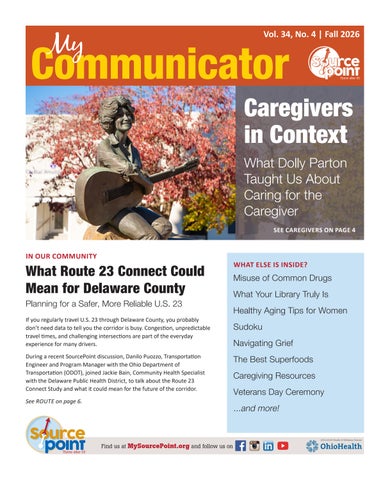
Caregivers in Context What Dolly Parton Taught Us About Caring for the Caregiver
SEE CAREGIVERS ON PAGE 4
IN OUR COMMUNITY
What Route 23 Connect Could Mean for Delaware County Planning for a Safer, More Reliable U.S. 23
If you regularly travel U.S. 23 through Delaware County, you probably don’t need data to tell you the corridor is busy. Congestion, unpredictable travel times, and challenging intersections are part of the everyday experience for many drivers.
WHAT ELSE IS INSIDE?
Misuse of Common Drugs What Your Library Truly Is
Healthy Aging Tips for Women Sudoku Navigating Grief
During a recent SourcePoint discussion, Danilo Puozzo, Transportation Engineer and Program Manager with the Ohio Department of Transportation (ODOT), joined Jackie Bain, Community Health Specialist with the Delaware Public Health District, to talk about the Route 23 Connect Study and what it could mean for the future of the corridor.
The Best Superfoods
See ROUTE on page 6.
...and more!
Find us at MySourcePoint.org and follow us on
Caregiving Resources Veterans Day Ceremony
FA L L C O N T E N T 01 What Route 23 Connect Could Mean for Delaware County In Our Community
03 SourcePoint CEO Fara Waugh Announces Plans to Retire in 2027 In Our Community
04 Caregivers in Context Feature
08 3 Common Drugs You Might be Overusing Health & Wellness
10 To Afford Aging in Place, Older Adults Turn to ‘Golden Girls’ Housing Transitions in Aging
12 More Than Books: Your Library is a Place to Connect, Learn, and Explore Age-Friendly Delaware County
14 From the Source
SourcePoint Program Highlights
16 Blood Tests May Flag Early Alzheimer’s Health & Wellness
17 Sudoku
Fun & Games
18 5 Healthy Aging Tips Every Woman Should Know Health & Wellness
20 Navigating Grief
Transitions in Aging
22 The 8 Best Superfoods for Seniors Nutrition
24 When a Friend Becomes a Caregiver Transitions in Aging
SourcePoint 800 Cheshire Road, Delaware 740-363-6677 | MySourcePoint.org EIN 31-1354284 SourcePoint is a nonprofit 501(c)(3) organization that provides professional expertise, services, and programs for Delaware County adults who want to thrive after 55, as well as family caregivers. Services and programs are supported by the local senior services levy, private and corporate donations, grants, and the Central Ohio Area Agency on Aging. 2026 Board of Directors President: Pamela Foster, Orange Township Vice President: Cheri Thompson, Delaware Secretary: Annie Horstman, MD, Delaware Treasurer: Michael Tucker, JD, Delaware Eleanor Biddulph, Westerville Randy Bournique, Delaware Bill Brown, Delaware Adrienne Corbett, Delaware Todd Everingham, MBA, Dublin Ron Fantozzi, Columbus Beth Fligner, JD, Dublin Alice Frazier, MD, Delaware Liz Gitter, MSSW, Delaware Beth Long-Higgins, MDiv, Delaware Heidi Reed, Sunbury Jodie Wegmiller, BSN, MBA, Delaware The board typically meets the last Wednesday at noon for six months out of the year. Members of the public who wish to attend may call the chief executive officer at 740-363-6677. My Communicator is published quarterly and is made possible through advertisers, donors, and volunteers. About 5,000 copies of each edition are printed and distributed throughout Delaware County. My Communicator is available for pick-up at SourcePoint and 50 other locations, such as libraries, senior living communities, health care facilities, and other nonprofit organizations. To find a nearby pickup site, contact SourcePoint at 740-363-6677. Read My Communicator online at MySourcePoint.org/publications.
26 I Have a Job and I’m the Caregiver for My Loved One
To advertise or submit educational content for consideration, contact Chief Advancement Officer Alison Yeager at alison@MySourcePoint.org.
28 Veterans Day Ceremony
The appearance of advertising does not represent an endorsement by SourcePoint. We reserve the right to refuse any advertising that conflicts with our mission.
Transitions in Aging In Our Community
Fall 2026
3
IN OUR COMMUNITY
SourcePoint CEO Fara Waugh Announces Plans to Retire in 2027 SourcePoint announced today that Chief Executive Officer Fara Waugh will retire in 2027, concluding more than 30 years of service to the Delaware County nonprofit. Waugh joined the organization in 1995 and helped create and develop many of the programs and services SourcePoint provides today. Over the course of her career, she has overseen areas including in-home care, nutrition services, caregiver support, insurance education, service coordination, quality improvement, and partnerships with government, nonprofit, and private-sector organizations. She was appointed chief executive officer by SourcePoint’s board of directors in 2019. “Fara’s impact on SourcePoint and on older adults throughout Delaware County is difficult to overstate,” said Pamela Foster, board president. “Over more than three decades, she has helped build programs, develop partnerships, mentor professionals, and position SourcePoint to meet the evolving needs of a rapidly growing community. We are tremendously grateful for her leadership and equally grateful that her advance notice gives us the opportunity to plan thoughtfully for SourcePoint’s next chapter.” Waugh’s tenure has encompassed significant growth and change for SourcePoint. The organization has expanded its services and community programs, navigated the COVID-19 pandemic without missing a day of service to its Meals on Wheels clients, undertaken strategic efforts to increase organizational efficiency and capacity, and strengthened its long-term sustainability. SourcePoint continues to focus on long-term financial planning and sustainability while responding to increasing demand for services. In 2025, the organization purchased its facility at 800 Cheshire Road, an investment intended to strengthen organizational stability and support continued service to the community well into the future. “SourcePoint has been such an important part of my life, and it has been a privilege to work alongside so many talented staff members, volunteers, board members, partners, and community
MySourcePoint.org | 740-363-6677
leaders,” Waugh said. “I am incredibly proud of what we have accomplished together, but I am even more excited about what lies ahead. SourcePoint is a strong organization with an extraordinary team, a clear mission, and deep community support. I look forward to continuing that work over the coming months and helping make this transition a success.” The SourcePoint board of directors will oversee a comprehensive search for the organization’s next chief executive officer. Additional information about the search process and leadership transition will be shared as it becomes available. “This is a planned transition, and SourcePoint is approaching it from a position of strength,” Foster said. “Our organization is financially strong, our leadership and staff are experienced, and our mission remains firmly at the center of everything we do. While leadership will change, SourcePoint’s commitment to older adults and families in Delaware County will not.” A search firm has not yet been named as the board is in the planning phase. Waugh will continue to serve as CEO until her successor is onboarded, which is anticipated to be in late spring 2027.
4
Caregivers From page 1
Few people have shaped American culture quite like Dolly Parton. The singer, songwriter, actress, entrepreneur, and philanthropist, who died August 25 at age 80, leaves a legacy that extends far beyond songs like “Jolene,” “9 to 5,” and “I Will Always Love You.” She used her platform to champion people whose voices or opportunities were too often limited—from women and working people to rural and low-income communities, children without access to books, the LGBTQ+ community, and Black Americans confronting racial injustice. She spoke publicly in support of Black Lives Matter and consistently emphasized dignity, acceptance, and respect for people different from herself. Her philanthropy put those values into practice. Inspired by her father’s inability to read and write, Dolly Parton’s Imagination Library grew from a small program in rural Tennessee into an international effort that now provides more than three million free books each month to children, regardless of family income. And near the end of her life, Dolly gave us another lesson—this time about caregiving. When Caring for Someone Else Means Neglecting Yourself Caregiving was not just something Dolly supported from a distance. Family responsibility and caring for others were part of her life from the beginning. She grew up as one of 12 children in a family with very limited resources, and her family remained central to her identity. Although she did not have children of her own, she
Fall 2026 spoke openly about loving her nieces and nephews and seeing a broader purpose in caring for children.
balancing employment, children, financial pressures, and increasingly complex medical responsibilities.
The most direct caregiving chapter of her later life was her care for her husband of nearly 60 years, Carl Dean, who died in March 2025 after an illness. In one of her final interviews, Dolly acknowledged that while caring for him, she had stopped paying attention to some of her own health needs.
Caregiver health challenges can include: • Delayed medical care and preventive screenings • Chronic stress, anxiety, depression, and caregiver burnout • Poor or interrupted sleep • Back pain, injury, and other physical strain • Reduced exercise and disrupted nutrition • Social isolation and loneliness • Financial and workplace stress • Grief and anticipatory grief • Increased cardiovascular health risks associated with prolonged caregiving stress
She told People that she was dealing with health issues she “just didn’t pay attention to when I was watching over Carl.” There is no evidence that caregiving caused Dolly’s death. But her experience illustrates something millions of family caregivers know well: when someone you love needs you, your own health can quickly move to the bottom of the list. Love can make it difficult to step away, ask for help, rest, or remember that the caregiver is a person with needs too. The doctor’s appointment gets postponed. Exercise disappears. Sleep becomes fragmented. A new symptom is ignored because someone else’s health crisis feels more urgent. Over time, those tradeoffs can matter. Caregiver Stress is a Health Issue According to Caregiving in the U.S. 2025, the latest study from AARP and the National Alliance for Caregiving, nearly one in four U.S. adults are family caregivers. The research shows the toll caregiving can take. One in five caregivers reports being in fair or poor health, and nearly one in four says caregiving makes it difficult to care for their own health. Many are also
Research has found particularly significant concerns around sleep and cardiovascular health. A systematic review of caregiver sleep research found poor sleep widespread among family caregivers, while a systematic review of cardiovascular research found evidence of elevated cardiovascular risk among caregivers, particularly linked to factors such as caregiving intensity, psychological distress, poor sleep, and reduced physical activity. Caring for the Caregiver Dolly’s story reminds us that caregiver self-care isn’t simply about taking a break or finding time for yourself. Caregivers need meaningful support. That means keeping your own medical appointments, telling your doctor you’re a caregiver, asking family and friends for specific help, using respite when available, protecting sleep and nutrition, and creating a plan for what happens if the caregiver gets sick or can’t provide care. It also means health care professionals, employers, families, and communities recognizing caregivers as people with their own needs. 740-363-6677 | MySourcePoint.org
Fall 2026 When we ask a patient, “Who is taking care of you?” we should also ask their caregiver: “Who is taking care of you?” Dolly Parton spent much of her life caring for and giving to others—her family, children she would never meet through her literacy work, communities affected by disasters, people who felt different or overlooked, and ultimately to the husband she loved for nearly six decades.
5 Tips for Caregivers: Balancing Caregiving and Self-Care 1. Seek Support from Other Caregivers. One of the most valuable resources for family caregivers is connecting with others in similar situations. Seek support from other caregivers through online communities and support groups. Sharing experiences and advice with fellow caregivers can provide emotional relief and practical tips for managing caregiving challenges. 2. Take Care of Your Own Health. Maintaining your health is crucial for being able to care effectively for your loved one. Take care of your own health by focusing on nutrition, exercise, and sufficient rest. Regular self-care routines can help you stay strong and resilient in the face of caregiving demands.
Her experience leaves America’s family caregivers with a simple but important reminder:
3. Accept Offers of Help. It is essential to accept help when offered. Accept offers of help and suggest specific tasks or errands that others can assist with. Delegating responsibilities can ease your workload and reduce stress.
Caring deeply for someone else should not mean disappearing from your own care plan.
4. Communicate Effectively with Healthcare Professionals. Effective communication with healthcare professionals is vital for managing your loved one’s care. Learn how to communicate effectively with doctors to ensure that all medical concerns are addressed. Clear and concise communication helps in understanding treatment plans and making informed decisions.
Source: Caregiver Action Network. Read more at caregiveraction.org.
5. Take Respite Breaks. Caregiving can be overwhelming, so taking respite breaks regularly is important. These breaks can help prevent burnout and give you time to recharge. Schedule time for yourself to engage in activities that you enjoy and that help you relax. 6. Watch Out for Signs of Depression. Be vigilant about signs of depression, which can affect caregivers. If you notice symptoms such as persistent sadness or fatigue, seek professional help promptly. Addressing depression early can prevent it from impacting your caregiving effectiveness. 7. Be Open to New Technologies. New technologies can significantly ease the caregiving process. Explore new technologies that offer practical solutions for monitoring health, managing medication, or enhancing communication with healthcare providers. 8. Organize Medical Information. Keep your loved one’s medical information wellorganized and accessible. Use resources like the patient file checklist to ensure that all necessary documents are up-to-date and easy to find 9. Ensure Legal Documents Are in Order. Make sure that all legal documents are current and correctly handled. Use a legal documents checklist to review and update important paperwork, ensuring that you are prepared for any caregivingrelated legal requirements. 10. Give Yourself Credit. Caregiving is demanding, so remember to give yourself credit for doing the best you can. Recognize the hard work and dedication you put into caregiving, and appreciate your positive impact on your loved one’s life.
MySourcePoint.org | 740-363-6677
6
Fall 2026
Route From page 1
Why U.S. 23?
The Route 23 Connect Study focuses on U.S. 23 between I-270 and Waldo and was launched in response to three interconnected concerns: growth, congestion, and safety.
• Overpasses and underpasses would allow the intersecting road to cross above or below U.S. 23 without connecting to it. This would eliminate conflict points and through-traffic delays but could create longer routes to nearby homes and businesses.
Public Hearing ODOT will host a public meeting at the end of October to share more information and answer questions about 23 Connect. Stay tuned for more information.
The corridor currently carries nearly 30% more traffic than it was designed to handle, contributing to bottlenecks and unreliable travel times. There are also 39 signalized intersections between I-270 and Waldo, creating numerous points where traffic must stop, turn, and cross. Left turns are an especially important safety consideration. The challenges extend beyond Delaware County. U.S. 23 is an important north-south connection linking the Columbus region with northwest Ohio, Michigan, and Canada. Improving the corridor can therefore support both local mobility and the region’s role as a national logistics hub.
From Study to Solutions
Route 23 Connect isn’t a single road construction project. Instead, ODOT has been evaluating the corridor to identify potential improvements and develop a long-term action plan. During the SourcePoint discussion, Puozzo reviewed four types of improvements evaluated in the study: • Traditional freeway interchanges would carry U.S. 23 traffic over or under the intersecting road, eliminating signals and left turns to and from U.S. 23. They would keep through traffic moving but require the most land, carry the highest cost, and add bridges that must be maintained. • Connector road interchanges would redirect traffic to a nearby interchange rather than place one directly at the existing intersection. This offers greater flexibility to avoid nearby properties, but drivers entering or leaving U.S. 23 may travel farther and navigate lower-speed turns. • Restricted Crossing U-Turns, or RCUTs, would require drivers on the intersecting road to turn right and use a designated U-turn rather than cross U.S. 23 or turn left directly onto it. RCUTs cost less and require less land than interchanges but may add time and distance for drivers on the intersecting road.
The goal is not necessarily to apply the same solution everywhere. Each intersection has different traffic patterns, safety concerns, surrounding development, access needs, and physical constraints. ODOT’s initial recommendations identify the options that appeared most promising during the feasibility study, but additional engineering, environmental review, public input, funding, and design work would be required before an improvement moves forward. The options and initial recommendations for U.S. 23 are summarized in the 2024 Preliminary Feasibility Study. A recommendation does not mean a project is fully designed, funded, or scheduled for construction. Each improvement must advance separately through environmental review, engineering, right-of-way acquisition, and construction. Funding may include federal and state transportation dollars, local or regional contributions, and competitive grants. Because funding is limited and may be secured in stages, improvements along U.S. 23 are likely to move forward as individual projects over several years rather than as one corridor-wide construction project. Two intersection projects north of the city of Delaware are already moving forward: • U.S. 23 at State Route 229 • U.S. 23 at Coover Road.
Safety Is Part of the Conversation
Congestion was a major concern among participants, particularly the stretch of U.S. 23 from I-270 north through the Orange Road area. Participants described frustration with traffic, concerns about safety, and questions about how future roadway changes could affect nearby properties. According to information reviewed during the discussion using the Ohio State Highway Patrol’s interactive OSTATS Dashboard, 3,963 crashes were reported in Delaware County in 2025, including 559 crashes along U.S. 23—approximately 14% of all crashes reported in the county that year.
740-363-6677 | MySourcePoint.org
Fall 2026 What Can Drivers Do Today?
Long-term infrastructure improvements take time, but drivers can take steps now to improve their safety. Bain emphasized the importance of defensive driving—remaining alert, anticipating the actions of other drivers, and giving yourself enough time and space to respond to unexpected situations. If you encounter a driver whose behavior appears unsafe, Ohio motorists can dial #677 to contact the Ohio State Highway Patrol.
7 Try It Yourself Curious about a road or intersection you regularly travel? Use the OSHP Crash Dashboard at statepatrol.ohio.gov/ ostats.aspx to explore where crashes have occurred and look for patterns along your route. The dashboard’s crash count provides an aggregate view, while the crash point map shows individual crash locations. The information can help drivers explore alternate routes or potentially less stressful times to travel.
The Delaware Public Health District also provides driver safety programs throughout the year, many hosted at SourcePoint.
Stay Informed and Have a Voice
The Route 23 Connect Study is about more than moving vehicles faster. It is an opportunity to think about how a growing Delaware County can move people more safely, efficiently, and reliably in the years ahead. ODOT plans to hold a public meeting at the Delaware County Fairgrounds to share more information and provide another opportunity for residents to learn about the project. SourcePoint will share meeting details on our website and social media when they become available. In the meantime, residents can visit ODOT’s Route 23 Connect website at transportation.ohio.gov/23connect to learn more about the study, review project materials, and explore the proposed concepts. Jodie Kaminsky is SourcePoint’s community aging planner, leading the Age-Friendly Delaware County initiative. Learn more at MySourcePoint.org/age-friendly.
MySourcePoint.org | 740-363-6677
8
Fall 2026
HEALTH & WELLNESS
3 Common Drugs You Might be Overusing The scenario often unfolds like this: Medical researchers investigate a frequently used drug and report that it’s less effective for older patients than previously thought, or that its risks outweigh its benefits in older adults. More studies follow, confirming those findings. After a few years, medical associations revise their guidelines, warning that the drug in question should be avoided or at least prescribed more selectively. It might be added to the Beers Criteria, an influential list of potentially inappropriate medications for older patients, published by the American Geriatrics Society. If the drug’s role is preventive, the U.S. Preventive Services Task Force, an independent expert panel, may weigh in with cautions. The FDA may issue “black box” warnings about concerning side effects. After a few more years, researchers look at broad national data to see whether use of this drug declined. Often, the answer is: Yes, but not enough. Sometimes, though, use didn’t decline much at all or actually increased. “Medications are like barnacles,” said Michael Steinman, a geriatrician at the University of California-San Francisco and codirector of the U.S. Deprescribing Research Network. “They’re easy to start, but they can be hard to stop.” This medical inertia partly reflects the time lag involved in disseminating findings. “Clinicians have a million things they need to know and attend to, and information may take a while to get to them,” Steinman said. But it also reflects the way “clinicians and patients get used to treating conditions in certain ways,” he said. “They become ingrained habits.” Finding alternative approaches is challenging, so “it’s easy to go with what you know.” Recent studies of three medications or classes of drugs widely used among older Americans illustrate the problem. The Drawbacks of Benzodiazepines Scientists began raising alarms about benzodiazepines more than 20 years ago. Prescribed for insomnia and anxiety, “they offer prompt relief,” said Mark Olfson, a psychiatrist and epidemiologist at Columbia University.
The problem? Benzodiazepines (including Valium, Xanax, and Ativan) and the related “Z” drugs (Ambien, Lunesta) “may impair balance, coordination, and cognition that can translate into falls and fractures and motor vehicle accidents,” Olfson said. In patients also taking opioids for pain, benzodiazepines can cause overdoses. Moreover, “once you’ve taken them for a period of time, you develop a dependence,” Olfson added. “When you come off them, you may develop withdrawal symptoms.” So what’s happened to benzo use among older adults, who are more sensitive to these effects? In a recent examination of prescribing trends, published in the Annals of Internal Medicine, Olfson and his team reported progress. Among people 65 and older, the rate of patients filling prescriptions for benzos dropped to 11.5% in 2024, from about 14% in 2015. But that decline has stalled since 2020, perhaps related to the Covid-19 pandemic. Moreover, prescribed use actually rose among those over 75, from 12% in 2020 to about 13% four years later. Dispensing through pharmacies in long-term care facilities more than doubled. And about a third of users were taking the drug for longer than six months, increasing the likelihood of dependence. “It’s worrisome,” Olfson said. But he cautioned that patients shouldn’t stop benzodiazepines suddenly or on their own, which can provoke withdrawal. “It requires supervised tapering” with a medical professional, he said. “It takes many weeks.” Overprescribing Antibiotics For years, the standard treatment for diverticulitis, the inflammation or infection of small pouches that form in the colon, was antibiotics, primarily fluoroquinolones (like Cipro and Levaquin) or amoxicillin-clavulanate (Augmentin). “It was unquestioned,” said Jesse Sutton, a pharmacist and researcher at the Minneapolis Veterans Affairs healthcare system. “Antibiotics are safe and effective, great, lifesaving drugs, so the mindset was: When in doubt, use them.” But in 2015, the American Gastroenterological Association recommended against routinely prescribing antibiotics for “uncomplicated” diverticulitis, which represents a great majority 740-363-6677 | MySourcePoint.org
Fall 2026
9
of cases. Other medical groups followed suit. Clinical trials had shown that, for this condition, antibiotics had little or no effect on mortality, the need for surgery, complications, or recurrences. “They hadn’t improved anything,” Sutton said. And as with any drug, “there are downsides, unintended consequences,” he said. “Side effects from antibiotics account for a substantial amount of emergency room visits” for symptoms like nausea, vomiting, and diarrhea. Antibiotics heighten the risk of the virulent C. difficile infection, too. Plus, “the more you use antibiotics, the less they work in the future,” Sutton said. The World Health Organization has deemed antimicrobial resistance “a major global health threat.” So Sutton and his colleagues, studying treatment in 70,000 visits to 120 VA facilities, expected to see antibiotic use for uncomplicated diverticulitis decline over 10 years. Instead, they reported recently in the Annals of Internal Medicine that antibiotic prescriptions remained nearly universal at 97% of visits, guidelines or no guidelines. The patients would most likely have done as well with a few days of Tylenol and a clear liquid diet. Antibiotic overuse remains common for other conditions of later life, too, including the kind of urinary tract infections that cause no troublesome symptoms and upper respiratory infections that are typically viral, not bacterial.
dose aspirin for “secondary prevention” does lower the odds of another event, studies have demonstrated. But for “primary prevention” in people who haven’t had one, the guidelines changed in 2019, when the American College of Cardiology and the American Heart Association recommended against aspirin for this purpose in those 70 or older. The U.S. Preventive Services Task Force went further, warning against aspirin for primary prevention starting at age 60. Large clinical trials had shown scant benefit for aspirin as a primary prevention measure, but there were harms, notably gastrointestinal bleeding. “As we age, the risks of bleeding go up,” said Timothy Anderson, an internist at the University of Pittsburgh who co-directs its Prescribing Wisely Lab. More rarely, but more seriously, aspirin can cause bleeding in the brain. In a JAMA study published last year, Anderson and his co-author found the message was getting through: Aspirin use for primary prevention, as reported in the National Health and Nutrition Examination Survey, had dropped substantially from 2011 to 2023. But more than a third of those 70 or older were still taking it. Some caveats: A subgroup of older adults with high risk factors for cardiovascular disease may benefit from aspirin for primary prevention. And, confusingly, some evidence suggests that older patients already taking aspirin face a higher risk of cardiovascular disease if they discontinue it. “Step 1 is a conversation with your primary care physician” about aspirin, Anderson said. “‘Is this still right for me as I get older?’”
In such cases, when a doctor prescribes an antibiotic, “I’d encourage patients to say, ‘Please explain the rationale for doing this,’” Sutton said. “If they don’t, it’s OK to press pause.”
Older patients taking aspirin, many without any medical guidance, “are interested in reducing their risk of heart attack and stroke,” he said. “They’re trying to be proactive and healthy.” But with blood pressure medications and statins for cholesterol, “we have better strategies than aspirin for that.”
When Aspirin Isn’t the Answer Aspirin is different. Because it’s cheap and sold over the counter, anybody can start taking it on their own—and millions of older Americans do, thinking it will help prevent cardiac problems. For people who’ve already had a heart attack, stroke, or cardiac intervention like a stent or bypass surgery, daily low-
Source: KFF Health News. Read more at kffhealthnews.org. 614-276-1439
MySourcePoint.org | 740-363-6677
modlich-monument.com
10
Fall 2026
TRANSITIONS IN AGING
To Afford Aging in Place, Older Adults Turn to ‘Golden Girls’ Housing Shirley Jennett, a retired nurse, loves her spacious ranch-style house in Denver, with its big backyard and gazebo.
women who share a house in Miami met through an ad on a supermarket bulletin board.
“I want to stay here,” she vowed. “And die here.”
In Denver, the housing matchmaker was Sunshine Home Share Colorado, a local nonprofit that Alison Joucovsky, a senior services administrator, founded in 2016 when the problem became urgent. “My phone was ringing off the hook,” she said, recalling anxious pleas from older residents spending most of their Social Security checks on rising rent or facing years-long waiting lists for subsidized senior housing.
She might pull that off. In relatively good health, Jennett still drives to lunch with friends, does her own housekeeping and grocery shopping, and plows through a book a day, usually a mystery. But her children worry about her living alone at 89, especially after she has had a couple of falls. Enter her new housemate, Susan Beese. Despite working four days a week in retail, Beese could no longer afford her nearby onebedroom apartment as the rent topped $1,500 a month. She moved out, first staying with friends and then in what she delicately called “a senior women’s facility.” Now Beese, who is 79, pays Jennett $800 monthly for a bright two-bedroom space, with a bath and a kitchen, on the lower level of her house. As part of the agreement the housemates worked out, she helps plant and water Jennett’s garden, takes out the trash, and cooks occasional meals. “It’s been a lifesaver,” Beese said. Jennett even welcomed her dog. Meet the real-life Golden Girls. In the much-loved 1980s sitcom, still in perpetual reruns, the four wisecracking
Home sharing “is a really efficient way to create affordable housing and to support older people who want to age in place,” Joucovsky said. Carefully vetting both “home providers,” who may be rattling around in family houses now too big and too empty, and “home sharers” seeking reasonable rents, Sunshine facilitated 31 shares last year, a record for the nonprofit. “The cost of developing and building new housing is astronomical, and so is the length of time it takes,” said Laura Fanucchi, president of the National Shared Housing Resource Center and an administrator with HIP Housing, a homeshare organization in San Mateo County, California. “Why not make use of existing housing stock?” About 55 organizations around the country offer these services — and
demand is growing, driven by housing shortages, rising rents, and sales prices that affect both the old and the young. Legislators in several states are working to promote home sharing as an option. (Personal care is not part of these arrangements.) The need is acute. About a third of households headed by someone 65 or older were “cost-burdened” in 2024, according to an analysis by the Harvard Joint Center for Housing Studies. That means they spent more than 30% of their income on housing. Although nearly 80% of those people were homeowners, the center found, an increasing proportion are still paying off mortgages or home equity loans, and most contend with higher taxes, utility and maintenance costs, and insurance premiums. “A lot of the people calling me to complain about property taxes and inflation are senior citizens on fixed incomes whose children have left, and maybe their spouse has died,” said Pennsylvania state Rep. Abby Major, a Republican co-sponsor of a bill that would facilitate home sharing. “They’re a single older adult living in a four-bedroom house.” Yet most don’t want to relocate. Even if they do, many older adults will find that downsizing has also become prohibitively expensive as home prices rise and very low interest rates become a memory. Younger people are similarly costburdened, including 37% of those age 25 to 34 and 31% of those 35 to 44, the Joint Center has reported. Home sharing can 740-363-6677 | MySourcePoint.org
Fall 2026 benefit both older homeowners who need income and people of any age in search of lower-cost housing. To help increase their reach, some homeshare programs now supplement or replace the traditionally labor-intensive matching process with online platforms. (For-profit companies like Nesterly or roommates.com also facilitate shared housing.) “It’s like online dating, except that people who have rooms can meet people who need rooms,” said Candice Smith, executive director of HomeShare Oregon. “And it’s a lot more secure.” HomeShare’s online platform has drawn close to 7,000 providers and seekers over five years. Further support has come from the city of Portland, which this year announced a pilot program to pay $1,000 to homeowners who make a spare room available (or $1,500 for two rooms) through qualified home-share programs. In addition, legislators in several states have introduced or passed bills that prohibit municipalities from unduly restricting homeowners who want to rent spare rooms to nonfamily members. Sponsors in Pennsylvania and Connecticut actually call them Golden Girls bills, and they’ve drawn bipartisan support. “So many young people have basically given up on buying a home,” said Colorado state Rep. Manny Rutinel. The Democrat helped pass a 2024 law prohibiting cities and counties from limiting the number of unrelated people who could live together in a single dwelling. In Pennsylvania, state Rep. Tarik Khan steered a similar bill through the House in June; it awaits a Senate vote. “It doesn’t make sense that your cousin can move in but someone unrelated to you can’t,” said Khan, a Democrat. The Pennsylvania bill caps the number of nonfamily occupants in a home at five;
MySourcePoint.org | 740-363-6677
11 Connecticut’s limit would be three. That bill passed the Senate in April and then died without a vote in the House. But the bill sponsors plan to reintroduce it next session. Home sharing can’t solve the housing crisis, its fans acknowledge. But it could make a dent, potentially unlocking thousands of spare bedrooms across the country without requiring new construction that would change the character of neighborhoods. Admittedly, matching homeowners with those who want to rent a room becomes a delicate process. Home-share staff members typically interview the individual parties, run background checks, verify incomes, coordinate initial phone calls and meetings, and mediate if problems later arise. They also help applicants sift through the myriad lifestyle preferences that can torpedo a match. “Living together isn’t easy,” Fanucchi said. Will the home provider accept smokers, pets, visitors? Does the sharer work from home? Or need to park a car? Who sets the thermostat? Sometimes the agreement includes a “service exchange,” in which the newcomer does a few hours of chores like snow shoveling, shopping, or some meal preparation in return for reduced rent. Jenlyn and Larry Boyer, for instance, have lived in their ranch house in suburban Broomfield, Colorado, for 31 years and never want to leave. But Jenlyn, who is 80, has “gotten unsteady” and uses a walker. Her husband, 70, suffers chronic fibromyalgia pain and needs a wheelchair. Because they now pay for tasks that they used to undertake themselves, and because inflation has undermined their finances, “I had an epiphany,” Jenlyn said. “We need more help and we need more money.”
Six months ago, through Sunshine Home Share, they met a 46-year-old graduate student whose monthly rent had doubled to an unmanageable $2,000. The student moved into their furnished downstairs bedroom/family room with a bathroom, a small refrigerator, and a microwave. In exchange for about 10 hours of dishwashing a month, she pays a reduced rent of $600. The additional income has helped the Boyers cover expenses like van repairs and wheelchair batteries. But they also enjoy chatting with their new housemate. “She turns out to be just a gem,” Jenlyn said. “We laugh together a lot.” Source: KFF Health News. Read more at kffhealthnews.org.
12
Fall 2026
AGE-FRIENDLY DELAWARE COUNTY
More Than Books: Your Library is a Place to Connect, Learn, and Explore When you think about the library, books probably come to mind first. And with good reason. But today’s Delaware County District Library offers much more than shelves of books. It is a place to learn something new, connect with others, explore an interest, preserve family memories—or simply find a comfortable place to spend some time. For older adults in particular, those opportunities can play an important role in staying engaged and connected to the community. The Delaware County District Library (DCDL) includes five physical branches—Delaware, Liberty, Orange, Ostrander and Powell—along with Outreach Services, which library staff consider their “sixth branch.” DCDL has approximately 120,000 cardholders, and patrons borrow more than 2 million physical and digital items each year, according to Nicole Fowles, DCDL Communications Coordinator. And the library continues to look for new ways to make all those resources easier to access.
A Place to Belong
As Fowles describes it, the library can be a “third place”— somewhere that isn’t home or work, but simply a welcoming place to spend time. That idea can become increasingly important as we age. The library offers a place to learn, connect with others, explore an idea, or discover a new skill. Social connection is an important part of healthy aging, but staying connected doesn’t always require a big event or organized social activity. Sometimes it is simply having somewhere to go where you know you’ll see familiar faces. At DCDL, book clubs are one example. Many meet at the same place and time each month, and participants may stay with the same group for years. Fowles describes some of the longstanding clubs as “little mini families.” She recalled one participant living with dementia who could no longer drive but continued attending her book club each month
with help from her husband. Whether or not she had been able to read that month’s selection, she participated and remained part of the group. “It was one of those things that really kept her connected,” Fowles said. There are plenty of other ways to connect, too. Library programs offer opportunities to learn and meet people with similar interests, while the Friends of the Delaware County District Library provides volunteer opportunities ranging from sorting donated books and helping with book sales to serving on committees or representing the library in the community. Volunteers can choose opportunities that fit both their interests and the amount of social interaction they prefer. For some older adults, that connection goes a step further. Fowles says the library often attracts people who have retired from one career but aren’t quite ready to leave the workforce. Retired teachers and other professionals have found second— or even third or fourth—careers at DCDL, bringing a lifetime of knowledge and experience to roles throughout the library. Whether you’re looking for a new chapter in your working life or simply a meaningful way to give back, the library offers plenty of ways to stay engaged.
Bringing the Library to You
Getting to a library isn’t always easy. An illness, surgery, mobility limitation, or lack of transportation can turn a routine library visit into a challenge. That doesn’t mean you have to stop using the library. DCDL’s Outreach Branch provides home delivery—and you don’t have to be permanently homebound to qualify. Someone recovering from a knee or hip replacement, for example, may use the service temporarily while getting out of the house is difficult. Library staff work with participants to identify their interests and can deliver requested titles or select a bundle of materials based on a favorite genre or topic. DCDL recently doubled the size of its Outreach Branch, expanding its ability to serve residents throughout its service area. 740-363-6677 | MySourcePoint.org
Fall 2026 The library also operates a Bookmobile with community stops and visits to senior living communities. And for those curious about e-readers but hesitant to purchase one, Outreach has a limited number of pre-loaded devices available to borrow. The devices are pre-loaded with books, making it easy to try an e-reader without purchasing one or navigating unfamiliar technology: turn it on and the books are already there. Accessibility extends to the library buildings themselves. Orange and Liberty have drive-up windows, while patrons at Delaware, Powell, and Ostrander can call from the parking lot and request that materials be brought to their vehicle. DCDL also works with community partners including the Delaware Public Health District and Delaware County Board of Developmental Disabilities to assess its facilities for fall risks, mobility concerns, and accessibility. The library has also expanded its large-print collection and digital offerings through support from SourcePoint. Digital books and audiobooks can offer additional flexibility for readers who benefit from adjustable font sizes or listening instead of reading printed text.
Try Something New
One of the best things about a library is that you don’t have to be an expert—or invest in expensive equipment—to explore a new interest. DCDL’s Maker Studios at the Delaware and Liberty branches offer opportunities to experiment with equipment ranging from sewing and embroidery machines to laser engravers and wideformat printers. Fowles says older adults are among the patrons who enthusiastically embrace the opportunity. “They have the time, they have the desire, they have the creativity,” she said. After one appointment and a little help from library staff, many become regular Maker Studio users. One particularly interesting resource at the Liberty Maker Studio is its digital preservation equipment. Have boxes of old family photographs, slides, negatives, or even film reels? The equipment can be used to convert them into digital files, helping preserve family memories for future generations. The same low-barrier approach extends throughout the library. Curious about genealogy? The Delaware Branch partners with the Delaware County Genealogical Society, whose volunteers can help people research family history or simply learn how to get started. Library patrons can also access Ancestry Library Edition while inside the library.
MySourcePoint.org | 740-363-6677
13 Ready to Explore? Start Here Explore DCDL’s website (delawarelibrary. org) to discover upcoming programs and activities. Sign up for The Mature Reader to receive news and programs geared toward older adults. Download the DCDL mobile app to search the catalog, place holds and keep your library card on your phone. Want to learn a language, try sewing, explore a new technology, or research a subject you’ve always wondered about? The library gives you a place to start without making a big investment.
Don’t Miss What’s Happening
With so much happening at the library, figuring out where to start can be the hardest part. One easy option is The Mature Reader, DCDL’s email newsletter geared specifically toward adults 55 and better. Approximately 12,000 people subscribe for information about library programs, resources and activities—including programs offered in partnership with SourcePoint and organizations like AARP Ohio. Readers can learn more and sign up through the Mature Reader section at delawarelibrary.org/mature-reader. And keep watching for even more ways to access the library. DCDL is exploring 24/7 book lockers that would allow patrons to pick up reserved materials outside normal library hours. The library plans to begin with lockers at existing branches in mid-2027. It’s another reminder that today’s library isn’t simply a building filled with books. It’s a community resource designed to meet you where you are—and perhaps help you discover where you’d like to go next. Learn more about locations, programs, digital resources, Outreach Services, the Maker Studio, and The Mature Reader at delawarelibrary.org. Jodie Kaminsky is SourcePoint’s community aging planner, leading the Age-Friendly Delaware County initiative.
14
Fall 2026
FROM THE SOURCE The latest news, programs, and resources available at SourcePoint.
Fitness & Wellness
Transitions in Aging
GOLDEN MARATHON OUTDOOR HIKING Mondays with Bob, 9:30–11 a.m. at various parks. Get moving with SourcePoint’s Golden Marathon Outdoor Hikers! We hike and walk, rain or shine, except temperatures below 10 degrees or a Level 2 or 3 snow emergency! Meet at locations listed, bring your own water, and be prepared for the weather and terrain. Remember to register!
CARE, SHARE, CONNECT Mondays, 12:45–2:15 p.m. Throughout life, we encounter many types of loss‒ whether it’s loved ones, pets, personal belongings, or changes due to health conditions. Join us to share your experiences or simply listen as RJ Jones facilitates meaningful discussions on these topics.
MIDLIFE MUSCLE: AFTER HOURS Wednesdays with Gina, 7–7:45 p.m. Beginner-intermediate. The workday is over; now it’s time to work for yourself. Reclaim your strength, longevity, and resilience in a strength-focused class specifically designed to support muscle maintenance, bone health, posture, and functional movement. This program is ideal for those looking to build a strong physical foundation with a focus on longevity and injury prevention. Members must be able to get up and down from the floor. Fee: $50 for the series.
HOME CARE VS. HOME HEALTH – WHAT’S THE DIFFERENCE? Thursday, Nov. 5, 2–3 p.m. Everyone wants to stay independent and safe at home — but knowing what help is available can be confusing. Join Jennifer from FirstLight Home Care for a helpful discussion about the difference between home care and home health services. Learn what each type of care provides, what insurance may cover, when these services might be needed, and practical tips to plan ahead for yourself or a loved one. Jennifer will also share practical tips to help you plan ahead, navigate available resources, and make confident decisions for yourself or a loved one. Whether you’re a family caregiver or simply planning for the future, this class will give you valuable insight into the support options available to help you stay safe and independent at home.
RESISTANCE TRAINING Mondays with Jennifer, noon‒12:45 p.m. Beginner-advanced. This class demystifies resistance/ strength training by teaching you the ‘how’ behind the exercise and equipment. Using dumbbells and bodyweight to help you achieve your goals to build muscle, boost bone health, and gain confidence. Occasional sessions conclude with a brief, 10-minute floor segment, allowing you to build strength while safely avoiding repeated transitions. Fee: $50 for the series. TAI CHI: CHAIR ONLINE Thursdays with Mimi, 1–1:45 p.m. (No class Dec. 24.) Experience the gentle, stress-relieving movements of Tai Chi from home! This modified, seated class is perfect for improving your flexibility, coordination, and relaxation, all from the stability of your chair. Fee: $10 for the series.
OLDER DRIVER SAFETY AWARENESS WEEK Monday, Dec. 7 through Friday, Dec. 11. SourcePoint celebrates the experience older drivers bring to the road while highlighting simple ways to stay safe, confident, and independent behind the wheel. Join us throughout the week to talk with special guests and learn more about how adjusting driving habits can extend your safe driving years. Plus, attending events throughout the week increases your chance to win a Winter Driving Safety Kit—the more events you attend, the more entries you can earn. Find more information about the events under Driver Safety & Transportation.
Register for these programs and more at
MySourcePoint.org
740-363-6677 | MySourcePoint.org
Fall 2026
15
Learning
Social Connections
AVOIDING SCAMS: STAYING SAFE ONLINE Thursdays, Oct. 8, Nov. 12, Dec. 10, 10–11 a.m. Scam texts, fake emails, and suspicious websites are getting harder to spot, and they’re often designed to look like the real thing. In this practical hour, you’ll learn a simple framework for recognizing scams in your inbox, on your phone, and on the web. Bring your phone along with any suspicious messages you’ve been wondering about. Taught by Anna Bitters, who works one-on-one with seniors on everyday tech challenges. Fee: $10.
SPECIAL LUNCHEON: FRIENDSGIVING Friday, Nov. 20, 11 a.m.–1:30 p.m. The talented kitchen staff will create a feast to enjoy with friends. Also, stop by our photo booth to get some pics with your besties. For Delaware County Residents ages 55 and better, lunch is available on a donation basis upon completion of proper paperwork. For non-residents and those younger than 55, lunch is $8. Sponsored by Ohio Living Sarah Moore.
DECLUTTERING: HOW TO ORGANIZE YOUR SPACE Friday, Nov. 13, 1–2 p.m. You are ready to organize your space! But now what? The possibilities are overwhelming! Where do you start? What do you do? How do you keep the area from becoming a mess again in 6 months? The key is making organizing accessible to you! Organizing is not one size fits all. It is as unique as we are! In this class, you will learn different ways to organize and tips and tricks to help you manage your “stuff.” Come to this class to achieve your goals of having a beautiful closet, a neat pantry, or whatever else you need organized. Learn ideas that can help you achieve success! Fee: $5.
The Arts BEADING GROUP Tuesdays, 1–2:30 p.m. Learn to make a necklace or bracelet or both! All supplies are included! COLORING & CHAT GROUP Wednesdays, 1–3 p.m. Looking for a fun and relaxing way to spend your afternoon? Join our Coloring and Chat Group, where creativity and conversation go hand in hand. Bring your favorite coloring book and supplies, or simply come as you are—we’ll have coloring pages, pencils, and markers available for anyone who needs them. This friendly get-together is a great opportunity to meet new people, make friends, share stories, and enjoy a few hours of laughter and creativity in a welcoming atmosphere. Whether you’re an experienced colorist or just looking for a casual way to connect with others, everyone is welcome! Fee: $5 for series.
MySourcePoint.org | 740-363-6677
DANCE! NOT NEW YEAR’S EVE DANCE Wednesday, Dec. 30, 5:30–7:30 p.m. What do you get when you mix the Fill-Ins, a dance floor, and friends a few days before the new year? A dance party to celebrate what a wonderful year 2026 has been! We’ll provide the band and the dance floor while you come ready for a fun evening. Feel free to bring in your own snacks and beverage of choice.
Day Trips CHRISTKINDLMARKT DUBLIN Wednesday, Dec. 16; estimated timing: 4:15 p.m. bus departure, 8:30 p.m. return. Experience a European holiday village of cultural cheer in Dublin, Ohio! Dublin’s brand-new European-style Christkindlmarkt will capture the Gemutlichkeit and Freude of the season through a unique and memorable cultural experience. Stroll through Riverside Crossing Park and enjoy festive shopping, holiday treats, and charming seasonal activities. This unique market brings the warmth and wonder of a classic European holiday tradition right to Dublin. Activity Level 2. Registration through Nov. 25. Fee: $30 for members; $50 for non-members. CANDLELIGHT: TRIBUTE TO THE BEATLES Friday, Jan. 8; estimated timing: 5 p.m. bus departure, 9 p.m. return. Candlelight concerts bring the magic of a live, multi-sensory musical experience like never seen before. Savor the music of The Beatles at the Columbus Museum of Art under the gentle glow of candlelight. Anticipate hearing your favorites with other SourcePoint music and experience enthusiasts. Activity Level 1. Registration through Dec. 11. Fee: $75 for members; $95 for non-members.
16
Fall 2026
HEALTH & WELLNESS
Blood Tests May Flag Early Alzheimer’s Alzheimer’s disease makes thinking, memory, and the ability to carry out daily tasks more difficult. Early treatment can help people stay mentally sharp for longer. So scientists are looking for ways to identify the disease early on. A new study showed that a blood test may help identify early brain changes related to Alzheimer’s in midlife. Alzheimer’s is characterized by the buildup of two proteins in the brain. They’re called tau and amyloid-beta. Older adults with more of certain Alzheimer’s-related forms of these proteins in their blood tend to do worse on thinking and memory tests. Researchers recently looked to see if people in midlife show similar effects. The NIH-funded research team tested blood samples from 1,350 people in their 50s and 60s. None of them had been diagnosed with Alzheimer’s disease. The researchers measured the Alzheimer’s-related forms of the proteins. The study participants
Help
also took cognitive tests. These tests measured their thinking and memory abilities. Most of the participants had taken the same tests five years earlier. Those with higher levels of the Alzheimer’s-related forms were more likely to have cognitive test scores that fell more dramatically over time. They showed slower thinking speeds and greater memory decline over the five years. “Alzheimer’s disease pathology begins years before symptoms emerge,” says Dr. Kristine Yaffe of the University of California, San Francisco. “Detecting the disease early means patients can target modifiable risk factors and maybe seek other care.” But more studies are needed on the blood tests before they can be used in the clinic. Source: NIH News in Health. Read more at newsinhealth.nih.gov.
Physical Signs Dehydration or weight changes Missing daily living aids
Elder Abuse
Unexplained injuries or bruises Unsanitary living conditions and poor hygiene Unattended medical needs
Report Suspected Abuse 614-833-2690 prosecutor.co.delaware.oh.us
Call 911 if there is a risk of immediate harm or call Adult Protective Services at 740-833-2340.
Behavioral Signs Increased anxiety or fear Isolation from friends or family Unusual changes in sleep
Withdrawal from normal activities
Financial Signs Fraudulent Signatures on financial documents Unpaid bills Unusual or sudden changes in spending habits or estate documents 740-363-6677 | MySourcePoint.org
Fall 2026
17
FUN & GAMES
Sudoku EASY Grid n°113654752 easy
HARD Grid n°104178 hard
3 7
6 3
1 7 4
8 7 6 3 4
6 1 3 6 8 4
8
1 9
5 8 9 8
4 1 3
6 5
3
6
5 1
9 3 7 5 1 9 9 8 3 1 7 5 7 5 3 4 6
See Sudoku Solutions on page 27.
MEDICARE Mastery Class
Make your own free printable sudoku at www.PrintMySudoku.com
Make your own free printable sudoku at www.PrintMySudoku.com
We have all the free sudokus you need! 400 new sudokus every week.
We have all the free sudokus you need! 400 new sudokus every week.
Take charge of your Medicare decisions with this free, comprehensive, two-part workshop designed to educate and empower. Available Saturday, Nov. 7 or Dec. 5, 9 a.m.–noon. at SourcePoint. Learn more and register at
MySourcePoint.org/insurance Bring a complete list of your prescription medications, full names of your doctors, your Medicare card, and a tablet or laptop.
MySourcePoint.org | 740-363-6677
8
18
Fall 2026
HEALTH & WELLNESS
5 Healthy Aging Tips Every Woman Should Know Want to feel your best in the years ahead? For women, there’s no secret recipe to aging well. But a few everyday habits— like keeping up with health screenings, staying active, eating well, and caring for your mental health— can make a big impact on your quality of life. These five tips can help you protect your health and maintain your independence as you age. 1. Get routine breast cancer screenings One in eight women in the U.S. (roughly 382,640 women) will be diagnosed with breast cancer this year. It’s the most commonly diagnosed cancer in women and this risk increases with age. Mammograms are the best way to screen for breast cancer, especially during the early stages. The good news is breast cancer can usually be treated successfully when found early; in fact, when detected in its earliest stages, the 5-year relative survival rate is more than 99%. The U.S. Preventive Services Task Force recommends that women ages 40–74 who have an average risk of breast cancer get a mammogram every two years. Medicare covers a free yearly mammogram screening. 2. Routine pap exams are the best way to detect cervical cancer Known as the “silent killer,” cervical cancer is one of the most common types of cancer for American women. But thanks
to the HPV and Pap tests, early detection has significantly improved and boosted U.S. survival rates. HPV and Pap tests can help prevent cervical cancer or find it early: The HPV test checks for human papillomavirus, which can cause changes in cervical cells. The Pap test (“Pap smear”), checks for abnormal cervical cells that could develop into cancer if they’re not treated. Both tests can be performed at a doctor’s office or clinic. The Centers for Disease Control and Prevention (CDC) recommends the following cervical cancer screening schedule: If you’re under 65, depending on your doctor’s recommendation, you should get a Pap test every three years, an HPV test every five years, or both tests every five years. If you’re 65 or older, you may no longer need screening if your recent test results have been normal and you have no history of cervical precancer. Screening may also be unnecessary if your cervix was removed during a total hysterectomy for a noncancerous condition. Ask your doctor or nurse about the screening schedule that’s right for you. 3. Exercise will improve your overall health
Roughly 150 minutes (2.5 hours) of moderate exercise a week can improve both your physical and mental health. Benefits for older adults include: • Improves sleep • Eases anxiety • Lowers blood pressure • Makes it easier to maintain a healthy weight • Reduces the risk for eight types of cancer (including breast, colon, and lung cancer) • Strengthens bones • Improves balance and coordination and reduces fall risk You don’t need to join a fancy gym to add more movement to your days. Here are some activity suggestions that can help keep you on your toes: • Take your dog—or a friend’s dog—for a long walk. • Stroll through the mall and enjoy the window displays. • Explore a local nature trail and take photos along the way. • Play a round of golf and walk the course instead of taking a cart. • Go for a bike ride around your neighborhood or on a local trail. • Swim a few laps for a gentle, lowimpact workout. • Try a Zumba class at your local community or senior center. • Sign up for a dance class (no partner needed!). • Plan a weekly tennis match with a friend. 4. Focus on your mental health Approximately 15% of adults age 70 and older live with mental disorders, depression being one of the most 740-363-6677 | MySourcePoint.org
Fall 2026 common. There’s often confusion around what exactly depression is, especially since many older adults experience life events that can trigger feelings of sadness—like the death of loved ones or serious health problems. The difference is that normal negative emotions tend to be temporary. If feelings of sadness and hopelessness begin to interfere with your daily life and normal functioning, you may have depression. The first thing you should know is that depression can be successfully treated and managed. Start by speaking with your doctor, who can help you determine if a Medicare depression screening is right for you. 5. Healthy eating can prevent serious health conditions Proper nutrition is essential for the body. As you get older, you lose muscle mass and bone density and burn fewer calories. It takes extra effort to make up for the natural changes in your body—which is why eating high-nutrient foods makes a big difference. For example, consuming foods rich in calcium and vitamin D can help you maintain good bone density. This in turn can reduce your risk for osteoporosis— a major health concern affecting about 8 million women in the U.S. Protein helps preserve muscle and strength, while fiber supports digestion and may help control cholesterol and blood sugar. And healthy fats (found in foods like fish, nuts, seeds, and olive oil) can support heart and brain health. Try to build your meals around vegetables, fruits, whole grains, high-quality proteins, and low-fat dairy or fortified alternatives. Small changes, like adding berries to oatmeal or snacking on yogurt and fruit instead of chips, can help you get more of the nourishment your body needs. Source: National Council on Aging. Read more at ncoa.org.
MySourcePoint.org | 740-363-6677
19
Can you lend a helping paw? In honor of Sandy Must, who helped shape SourcePoint’s Just for Paws Pet Program, we invite you to donate:
dry cat & DOG food
5.5 oz. Wet cat food
Drop donations off at customer service or order online! Just for Paws Amazon Wishlist
Monetary donations accepted at MySourcePoint.org/give
2026 Sandy Must Pet Food Donation Drive
october 5-17 For the furry companions of Delaware County, Ohio, Meals on Wheels clients.
20
Fall 2026
TRANSITIONS IN AGING
Navigating Grief
Helpful Strategies to Cope with Loss Grief is something we all go through. It can follow the death of someone you love, the end of a relationship, or another major loss or life change. While experiencing grief is normal and natural, it can still feel hard to understand. Researchers are working to learn more about how people grieve and what helps people move through it. “Grief is a natural response to losing someone or something we are deeply attached to,” says Dr. Wendy Lichtenthal, a clinical psychologist at the University of Miami Health System. “We are wired for connection, so when we lose someone central to our lives, we often respond with distress and longing.”
The Myth of ‘Stages’
Many people expect grief to follow a set path. They wait to move through stages of sadness, then anger, then acceptance. But researchers say that grief is not a straight line. “There’s no wrong way to grieve,” says Dr. Sarah Stahl, an associate professor of psychiatry at the University of Pittsburgh. “Everyone grieves differently. There’s no timeline.” Grief looks different for everyone. It can bring sadness, anger, or a loss of meaning in life. Some people cry often. Others feel numb, restless, or even guilty. These are all normal responses. “One of the things that can make grief harder is when people believe they are grieving the wrong way, or should be ‘further along,’” says Lichtenthal. Her research focuses on meaningcentered grief therapy for parents who have lost a child. “We help people recognize and shift the meanings they are making about their grief, their loss, and themselves, while also strengthening their sense of meaning in life by connecting them with things that matter most to them.” In early findings, parents who went through the therapy reported a stronger sense of meaning in life and sense of connection to the child they lost. Lichtenthal says, “It’s not about moving on, but about learning to coexist with grief while finding ways to stay connected to the person who died and engaged in life.”
The Body’s Response
Grief doesn’t just affect your emotions. It can take a toll on your body. Physical symptoms can include headaches, loss of appetite, fatigue, dizziness, and trouble sleeping. Older adults who lose a spouse face unique challenges. They may be dealing with changes in their own health challenges and are more likely to feel socially isolated, which can make grieving harder.
Stahl’s study helped older grieving adults rebuild regular routines around sleep, meals, and physical activity. These three healthy habits are often disrupted after a loved one dies. The online program provided daily digital check-ins and health coaching. Even without inperson contact, participants showed real improvements in their depression and anxiety symptoms. “Focusing on simple, healthy routines is very empowering,” Stahl says. “It helps people work through their grief by taking care of themselves.” Sleep plays an important role in healing. It supports brain health and helps people process emotions and memories. Stahl’s research suggests that rebuilding healthy sleep habits may be one of the most important things a grieving person can do for their health and well-being.
Feeling Stuck
Most people adapt to loss over time. But some people get stuck in their grief for much longer. They can develop a condition called Prolonged Grief Disorder, or PGD. People with PGD feel intense grief for more than a year after a loss. They may think constantly about the person who died, feel unable to connect with others, or believe the future holds nothing for them. Unlike normal grief, these feelings do not ease with time and can make it difficult to get through the day. Dr. Holly Prigerson, a social scientist at Weill Cornell Medicine, spent years working to get PGD formally recognized. Her research showed that this form of grief is distinct from depression and requires its own approach to care. 740-363-6677 | MySourcePoint.org
Fall 2026 “Before PGD was formally recognized, many grieving people were misunderstood or misdiagnosed,” Prigerson says. “We didn’t invent a new problem. We gave a name to something people have been struggling with for centuries.” Risk factors for PGD include losing someone who was central to your identity, a history of depression or anxiety, social isolation, financial hardship, and sudden or traumatic loss. Parents who lose a child and isolated older spouses also face higher risk. “The term ‘prolonged grief disorder’ doesn’t mean that grief that continues beyond one year is, by itself, a disorder,” says Lichtenthal. “The concern is when grief remains so intense, persistent, and disruptive that a person feels unable to re-engage with life.”
What Can Help
There are many things you can do to support healthy grieving for yourself and others. One of the most important is to give yourself or your loved one permission to grieve. Trying to push grief away often makes it harder, not better. Being flexible in how to cope also matters. There is no one strategy that works for everyone or every moment. Sometimes talking helps. Sometimes a walk, a regular routine, or quiet time is what you need. Try different things, notice what helps. If it’s not, be willing to try something else.
MySourcePoint.org | 740-363-6677
21 When supporting someone who is grieving, let them know you are there for them. Keep checking in. Respectfully acknowledge their loss and show empathy. Use phrases like, “I know I can’t fully understand what you’re going through, but I’m here for you.” Avoid phrases that minimize the loss, like “Everything happens for a reason.” It can be especially helpful to offer support like bringing meals, helping with errands, remembering important dates, or continuing to reach out over time, not just after the initial loss. Prigerson’s current work focuses on social connection to help with grief. It uses an online tool to match people who are grieving with others who share similar experiences. “Sometimes the most powerful support comes from someone who has walked the same path,” Prigerson says. Not everyone needs professional counseling for grief. Many people find their way through with the support of family, friends, faith, or other sources of connection. But if you’re feeling “stuck” after a significant loss, or if your grief is making daily life difficult, talk with your doctor or a licensed counselor who specializes in grief. Source: News in Health. Read more at newsinhealth.nih.gov.
22
Fall 2026
NUTRITION
The 8 Best Superfoods for Seniors One of the secrets to aging well starts with the foods we put on our plate every day. The best superfoods for older adults are nutrient-rich foods that support heart and brain health, strengthen bones and muscles, and promote healthy digestion. They include berries, leafy greens, fatty fish, eggs, nuts, whole grains, and other everyday foods that can help lower the risk of chronic disease. A balanced diet can help us maintain healthy cognitive function and strong bones as we age, and even prevent chronic disease. Here are 10 of the best superfoods for older adults and the benefits they provide. What is a superfood? Superfoods are not a distinct food category on their own. Rather, this heroic-sounding name simply describes whole, minimally processed foods that are nutrient dense. Generally, superfoods contain healthy fats, vitamins, minerals, antioxidants, and other compounds found to promote good health and prevent illness and disease. While most are plantbased, certain fish and dairy products may also be considered superfoods. What superfoods should older adults eat? No single superfood provides all the nutrition we need. That’s why it’s important to eat a wide variety of nutritious foods daily. What are the best superfoods for older adults? There are many foods that are considered superfoods. No single superfood provides all the nutrition we need. That’s why it’s important to eat a wide variety of nutritious foods daily. Here are some nutritional rockstars known to contribute to healthy aging.
1. Dark leafy greens Dark-colored leafy greens like kale and spinach are rich in carotenoids, which have been shown to protect the eyes against oxidative damage. Spinach is also loaded with vitamins A and C, which help protect the heart and moderate blood pressure levels. Vitamin K is another leafy-green nutrient, found to play a major role in preventing osteoporosis. Leafy greens are delicious in a salad, in a sandwich, or sautéed with a splash of healthy oil (like olive oil). When it comes to leafy greens, it’s important to watch out for interactions with any drugs you’re taking: Spinach, kale, collard greens, broccoli, and other leafy greens can make bloodclotting medications less effective. Green leafy veggies are rich in vitamin K, which interacts with the common bloodthinning drug warfarin (brand name Coumadin). Speak with your doctor before adding more leafy greens to your diet. 2. Cruciferous vegetables This veggie family includes broccoli, cabbage, Brussels sprouts, and turnips— all of which are great sources of fiber, vitamins, and cancer-preventing phytochemicals. Cruciferous vegetables are tasty and extremely versatile. Toss them in soups, pasta dishes, and casseroles; steam them; or stir-fry them with seasoning and some olive oil. 3. Blueberries Blueberries are rich in anthocyanins,
a class of water-soluble flavonoids found in many colorful fruits and vegetables. In a recent study, researchers linked anthocyanins with improved cognitive performance in people with high levels of inflammation. Blueberries also contain antioxidants, compounds that help protect our cells against freeradical damage and reduce the risk for heart disease and cancer. These flavorful, versatile berries can be added to smoothies and desserts, sprinkled over cereal, and of course, eaten all by themselves! 4. Nuts and seeds From almonds and pecans to hazelnuts and pistachios, nuts are packed with antioxidants, fiber, and plant protein. They also contain monounsaturated fats, which are thought to help lower heart disease risk. As long as you have no known allergies, nuts make a delicious standalone snack. They can also be blended into pestos or used as a scrumptious salad topper. Seeds are another satisfying superfood. A 2022 study found that the nutrients in chia seeds can help prevent cancer, GI tract-related diseases, and cardiovascular disease. Chia seeds may also aid in controlling type 2 diabetes, high blood pressure, and high cholesterol. Other tasty seed options include hemp seed and flax seed, which are also high in inflammationfighting omega-3 fatty acids.
740-363-6677 | MySourcePoint.org
Fall 2026
23
Something to keep in mind about nuts and seeds: They are high in fat and calories, so it’s best to limit consumption to a small handful each day. 5. Eggs Eggs have been a source of dietary controversy over the years due to cholesterol found in the yolk. However, skipping the yolk could deprive you of key nutrients such as vitamin B12, vitamin D, and selenium. Egg yolks also contain choline, a nutrient and neurotransmitter responsible for regulating mood and memory. There is no official recommendation limiting how many eggs you should eat every day. Many sources suggest that eating one egg daily is reasonable for most people in good health (eating more could still adversely affect cholesterol levels in some people). Since eggs are high in protein, this superfood is an ideal choice for a hearty breakfast—scrambled, poached, hard-boiled, or sunny side up. 6. Salmon Fatty fish (e.g., salmon, herring, mackerel, trout, and tuna steak) is an excellent source of protein—a nutrient vital to maintaining muscle mass in older adults. It’s also loaded with omega-3 fatty acids, which can help reduce the risk of heart
disease. A great way to enjoy a fresh fish filet is to lightly season it, bake it, and serve with a side of cruciferous vegetables. 7. Plain Greek yogurt When it comes to protein, Greek yogurt delivers. Just one cup has 17 grams of protein as well as 20% of the daily recommended intake of calcium. Why else is Greek yogurt considered one of the best superfoods? It contains probiotics, which help us maintain gut health. Probiotics have been shown to aid in digestion, boost immune function, and even prevent infection. Plain, unsweetened Greek yogurt is highly versatile. It can be topped with granola and berries or even be substituted for sour cream in certain recipes. Look for yogurt made with whole milk or reducedfat milk with no added sugar. 8. Avocados Avocado is a nutritional powerhouse, loaded with nourishing fats, antioxidants, and other nutrients that support headto-toe health. This creamy-textured fruit is delicious in guacamole or spread on
toast. If you or an older adult you care for doesn’t like the taste of avocado, consider blending it into a fruit smoothie for a subtle nutritional boost. Are frozen superfoods as healthy as fresh foods? Yes. Frozen fruits and vegetables often cost less than fresh varieties, and they can be just as nutritious (sometimes even more so). That’s because they’re usually harvested at their peak of freshness and then quickly flash-frozen to lock in vitamins, minerals, and antioxidants. In contrast, fresh produce can lose some of its nutrients during the shipping process. Choose frozen food items without added sugar, salt, sauces, or saturated fat whenever possible. Source: National Council on Aging. Read more at ncoa.org.
Skilled Nursing & Therapy Services Providing personalized care with compassion since 1985
Call to schedule a tour today!
4 New Market Drive Delaware, Ohio 43015 740-369-6400 delawarecourt.com
MySourcePoint.org | 740-363-6677
24
Fall 2026
TRANSITIONS IN AGING
When a Friend Becomes a Caregiver For several years, Nicole Straight and Patricia Wood, who lived across the street from each other in Sausalito, California, were more neighbors than friends, exchanging sociable greetings and occasionally having coffee. Then, last October, Wood took a fall, broke her neck, and spent three months in rehabilitation. When she returned to the house she shares with her niece, she couldn’t walk without assistance. “I still don’t dare go up and down stairs unless someone is with me,” said Wood, 93. That has redefined their neighborly relationship. Straight, 53, a retired chef, now visits weekly, bringing lattes and cookies, and often leftovers from dinners she has made. Her husband installed a grab bar in Wood’s bathroom, put up shelves, and changed her light bulbs and smoke detector batteries. The texts fly back and forth. Straight calls to say I’m going to the grocery store. Do you need anything? Wood, who no longer drives, provides a shopping list. “She is a gift from heaven,” said Wood, a retired insurance executive. “We talk and talk. Sometimes we shed a few tears, but mostly we laugh. I never thought I’d have a new best friend at this time of my life.” Eldercare, typically considered a family obligation, is evolving to adapt to demographic shifts that make reliance on spouses and children less assured. “The number of older adults who have never married or are divorced has been increasing, so we have more people aging alone,” said Deborah Carr, a sociologist at Boston University who has investigated these trends. “The proportion who are childless, by choice or not, is also growing,” she added, and families with children have fewer of them than in past generations. Geographic distances or family estrangements also fuel the need for other kinds of caregivers—roles that friends or neighbors can fill. How commonly do friends step into caregiving gaps? A recently published study in JAMA Network Open, led by researchers at the University of Michigan, looked into friends and neighbors serving
as caregivers, usually in supplementary roles. They used data from the National Health and Aging Trends Study, in which more than 2,600 older people with health limitations (average age: 79) identified friends and family members who provided help. Family members were most likely to care for aging relatives, but about 14% of participants identified friends (including neighbors) in that role. That represents 2.4 million caregiving friends nationally, the authors estimated. Last year, a national survey by AARP and the National Alliance for Caregiving put the proportion of caregivers supporting nonrelatives at 11%. “Friends are among the auxiliary caregivers who have not been acknowledged,” said Karen Fingerman, a gerontologist at the University of Texas-Austin and co-author of a commentary accompanying the study. “We neglect the sacrifices they make.” The study, believed to be the first nationwide look at caregiving friends, found they functioned differently from relatives. They’re unlikely to live with the person they’re helping, for example, and rarely serve as the sole caregiver. “They provide fewer care hours,” said Yee To Ng, a gerontologist and lead author of the study, which found that friends supplied 18 hours of help a month on average, compared with about 67 hours from family. They assist in different ways, too. “Friends are more likely to provide transportation,” Ng said. Two-thirds of caregiving friends drive their friends around; shopping, helping people go outside, preparing meals, and accompanying patients to medical appointments round out the top five tasks. Sometimes they do more. Czes Ferrino, 82, is widowed and lives alone in Westerly, Rhode Island. She has no disabling health problems, but when her car died recently, her next-door neighbor went with her to several Subaru dealers to find a used replacement. “He walked me through it like a son would for a mother or grandmother,” Ferrino said. On the other hand, “there are some tasks friends might not be well equipped to provide or be comfortable with,” Ng said. 740-363-6677 | MySourcePoint.org
Fall 2026
25
Personal care, like bathing and dressing, remains largely the province of family members.
condition,” Laura Lawless, a labor and employment lawyer with Squire Patton Boggs, said in an email.
“Those can infringe on people’s self-esteem,” Ng said. “With family, we accept that when you’re really ill, they step up with intimate activities. It’s embarrassing to have your friends help you use the toilet.”
“For family, ‘through thick and thin’ is the expectation,” Carr said. “There’s huge stigma to being estranged from your family, but it’s kind of normal for some friendships to just fall away.”
The researchers also found that respondents who named friends as caregivers were younger than those with only relatives in that role, and more apt to have college degrees. People with higher education levels have larger social networks, Fingerman said. Those assisted by friends were also, unsurprisingly, less likely to be married and more apt to live alone — like Ann Greenwater, 84, who lives in a mobile home park in rural Humboldt County, California. She managed independently until a few years ago, when severe back pain rendered her bedridden for nearly three months. Although she’s up and about now and can handle housekeeping, cooking, and personal care, “I’ve never really fully recovered,” Greenwater said.
In Sausalito, Wood tells Straight that “she’s not allowed to move until I die.” She’s joking, sort of. Greenwater’s friends in Humboldt County, to her gratitude, have not fallen away either. But they are aging along with her; at 86, Quam pointed out, she may stop driving before long, too. “I’m wondering what will happen when these friends aren’t able to come to me,” Greenwater said. “I guess we’ll deal with it when it comes.” Source: KFF Health News. Read more at kffhealthnews.org.
She is single, with no family beyond a distant nephew she barely knows, and has stopped driving. But a cadre of friends she knows from a nearby Zen Buddhist center stepped in.
FACTS ABOUT CAREGIVING
Milli Quam, 86, does her laundry and drops it off, sometimes picking up prescriptions en route. A 73-year-old helped Greenwater with her computer and, along with several others, takes her grocery shopping or shops for her. Members of a local volunteer organization drive her to medical appointments.
63 million
But nonrelatives may also prove less stable as a source of help. Neighbors move. Strains can develop if the person needing care becomes too demanding or feels guilty about accepting help, challenging the egalitarian expectations for friendships. These strains can intensify depression in those with physical limitations, a study led by Carr found. Nor is there much policy support for these caregiving relationships. The federal Family and Medical Leave Act, for instance, “with rare exceptions does not provide job-protected leave from work to care for a friend with a serious health
MySourcePoint.org | 740-363-6677
are men
U.S. adults (nearly 1 in 4) are family caregivers
“I love Ann, and I’m happy there’s something concrete I can do,” Quam said. “I hope I can keep doing it for a long time.” Friends have some advantages as caregivers. “Our friends are our own age and understand what we’re going through,” Carr said. “They may have more empathy and sometimes real knowledge they’ve acquired.” When family caregivers are on the job, friends’ efforts can reduce their burden.
49%
29%
30%
take care of an adult and a child or grandchild
have been providing care for 5 years or longer
20% live in rural areas
of family caregivers care for someone
28% with an emotional or mental health issue 28%
report difficulty getting affordable services like inhome help, transportation, and meal delivery
70%
of caregivers ages 18-64 work while providing care
Only 11%
of caregivers received any formal training for helping their loved ones with activities of daily living
26
Fall 2026
TRANSITIONS IN AGING
I Have a Job and I’m the Caregiver for My Loved One Balancing job responsibilities with caregiving demands is a challenge faced by many family caregivers. According to recent data, 60% of family caregivers are employed, and approximately two-thirds have had to adjust their work-life balance due to their caregiving responsibilities. This dual role can impact various aspects of life, including work performance, personal wellbeing, and family dynamics. Understanding and managing these dual responsibilities effectively is crucial for maintaining both career and caregiving roles. Challenges Faced by Working Caregivers Time Management: One of the primary challenges for working caregivers is managing their time effectively. Juggling work responsibilities with caregiving tasks often leads to conflicts, scheduling issues, and an increased risk of burnout. Finding time for both work and personal care can be difficult, leading to stress and fatigue. Stress and Mental Health: The emotional and physical toll of balancing work and caregiving can significantly affect mental health. Working caregivers may experience heightened levels of stress, anxiety, and depression due to the constant demands of both roles. This stress can impact job performance and personal relationships. Financial Strain: Managing the financial aspects of caregiving while maintaining a job can be challenging. Caregivers often face additional expenses related to medical care, and managing these costs
while maintaining a stable income can be a source of significant stress. Seeking Help: Why and How Reaching out for assistance is crucial for managing the demands of both work and caregiving. Seeking help can prevent burnout, provide emotional support, and improve overall well-being. It allows caregivers to maintain their own health while effectively supporting their loved ones. Types of Help Available: Professional Help: Hiring a professional caregiver or using respite care services can provide temporary relief, allowing you to focus on work or take a much-needed break. Professional help ensures that your loved one receives quality care while you manage other responsibilities. Support Groups: Joining support groups can offer emotional support and practical advice from others in similar situations. Support groups provide a platform for sharing experiences, gaining insights, and finding encouragement. Employee Assistance Programs (EAPs): Many employers offer EAPs that provide counseling and support services for employees managing caregiving responsibilities. Check with your HR department to see what resources are available.
Effective Support Strategies Finding Support Groups: Finding the right support group can provide valuable assistance and a sense of community. Start by searching online for local or virtual caregiver support groups. Websites such as Caregiver Action Network and Alzheimer’s Association offer directories and resources to help you find suitable groups. Additionally, local community centers and healthcare providers may have recommendations. Care Manager Tips: Create a Care Plan: Develop a comprehensive care plan that outlines your loved one’s needs, medical appointments, and daily routines. This plan helps you stay organized and ensures that all caregiving tasks are covered. Prioritize Self-Care: Make time for your own health and well-being. Regular exercise, proper nutrition, and adequate rest are essential to manage stress and maintain energy levels. Utilize Technology: Use apps and tools to manage medication schedules, appointments, and care tasks. Technology can streamline caregiving duties and reduce the risk of errors.
740-363-6677 | MySourcePoint.org
Fall 2026 You’re Not Alone Balancing a job with caregiving responsibilities is undoubtedly challenging, but it is manageable with the right strategies and support. By understanding the everyday challenges working caregivers face, seeking appropriate help, and implementing effective support strategies, you can maintain a healthiers work-life balance and provide quality care for your loved one. Source: Caregiver Action Network. Read more at caregiveraction.org.
27 Sudoku Solutions EASY Grid n°113654752 easy
5 2 3 1 4 6 9 8 7 7 4 9 3 8 2 5 1 6 6 1 8 9 7 5 3 2 4 3 5 2 7 1 9 6 4 8 1 9 7 4 6 8 2 3 5 8 6 4 2 5 3 7 9 1 2 7 5 8 9 4 1 6 3 9 8 1 6 3 7 4 5 2 4 3 6 5 2 1 8 7 9
HARD Grid n°104178 hard
5 7 6 1 3 8 9 2 4 3 4 9 6 5 2 1 7 8 1 8 2 4 7 9 6 3 5 6 3 4 8 2 7 5 1 9 2 1 5 3 9 6 4 8 7 7 9 8 5 1 4 2 6 3 8 6 3 9 4 1 7 5 2 9 2 1 7 8 5 3 4 6 4 5 7 2 6 3 8 9 1
DYNAMIC CAREGIVER SUPPORT GROUPS SourcePoint promotes a variety of support groups tailored to meet your needs, ensuring you find the right community for your journey.
Care, Share, and Connect We experience different losses in life‒loved ones, pets, to things or illnesses in our everyday lives. Come share or listen as topics are discussed.
Grandparents as Parents Meetup Join this casual group of older adults, holding space for other grandparents acting as secondtime parents. This group aims to support one another through shared life experience as well as help individuals get connected with resources Caregiver Conversations Make your own free sudoku at Make www.PrintMySudoku.com your own free printable sudoku at www.Print in printable their communities. This group fosters supportive conversations, 400 new sudokus and solutions every week. 400 new sudokus and solutions every week. allows you to share experiences, meet other Grief Support: Living Beyond Loss caregivers, discover new resources, and Provides dynamic support for those dealing ask questions. with loss and empowers members to steer the conversation. Rediscover yourself, regain a sense of identity, and build your support system. MySourcePoint.org/caregiver MySourcePoint.org | 740-363-6677