Relevant Information Document TKNBIES1


Bank duly authorized under Salvadoran law to carry out financial and banking transactions, with registered office in San Salvador, El Salvador
For more information on the issuer, see section 7.
Issuer
Banco Industrial El Salvador, Sociedad Anónima
Ticker symbol or trading code TKNBIES1
Type of public offering: Public Debt Offering
Type of digital asset: Debt token
Nature of the token:
Term of the issuance:
Issuance amount:
Tokens to be issuanced and nominal value:
Minimum trading amounts:
Form and place of payment
Debt tokens represent a credit right of the issuing entity in favor of the purchaser in accordance with the participation and conditions acquired in each of the traded series. See section 8 for more information.
The issuance may have a maximum term of 10 years from the date of granting of the material entry by the National Digital Assets Commission.
The issuance amount is up to FIFTY MILLION United States dollars (USD $50,000,000.00).
The issuance will consist of a total of 50,000,000 tokens. Each token will have a nominal value of ONE US dollar (USD $1.00).
The minimum purchase amount for tokens (TKNBIES1) on the primary market will be USD $100.00 (ONE HUNDRED DOLLARS), which corresponds to the acquisition of at least 100 tokens.
Principal and interest will be paid according to the frequency established for each series, which may be monthly, bimonthly, quarterly, semi-annually, at maturity, or on a specific date, on or after which the Issuer may, at its discretion, pay the entire balance of principal and interest outstanding on the date of each series in advance of maturity. See section 8 for more information.
Token yield:
Issuance Guarantee:
Banco Industrial El Salvador, S.A. will pay interest on the balance of the tokens in each holder's wallets throughout the term of the issuance, which will be calculated on a calendar year basis. The interest rate will be determined for each series and may be fixed or variable. See section 8 for more information.
This issuance does not have a specific guarantee. The issuance is backed by the Bank's financial strength.
Trading Currency: United States dollars
Digital Asset Service Provider: Digital Exchange, S.A. de C.V.
Trading platform: www.digitalexchange.com.sv
i. "The issuer of the digital assets is solely responsible for the content of this Relevant Information Document";
ii. "The digital assets covered by this offering are registered in the CNAD Public Registry. Their registration does not imply certification of the quality of the security or the solvency of the issuer";
iii. "It is the investor's responsibility to read all the information contained in this Relevant Information Document";
Statements and indications
iv. Digital assets may lose their value in whole or in part;
v. Digital assets may not always be negotiable;
vi. Digital assets may not be liquid;
vii. Digital assets do not guarantee future performance.
viii. This offer is strictly limited to the specific Digital Assets detailed in this Material Information Document and does not constitute an invitation to sell financial instruments;
ix. This offering does not constitute an offer available in any jurisdiction where it is considered illegal.
AUTHORIZATIONS: Resolution of the issuer's Board of Directors, authorizing the Registration of the issuance, in session No. 182, dated September 4, 2025, in which the Board of Directors established the main characteristics of the issuance. Resolution of the National Digital Assets Commission, in session No. CNAD-CD-490-2025 held on December 12, 2025, which authorized the Registration Entry of the issuer with number EAD-0027 and issuance with number AD-00033.
DATE OF PREPARATION OF THIS RELEVANT INFORMATION DOCUMENT
October 2025
This document is available at www.digitalexchange.com.sv
The following glossary has been prepared with the aim of standardizing and clarifying the main technical, financial, and legal terms used in the preparation of this Relevant Information Document (DIR) related to the issuance of TKNBIES1 tokens
• Digital Asset: Digital representation of an asset that may include tokens and other virtual assets that exist on a blockchain.
• External Auditor: BDO Figueroa Jimenez & CO, S.A., responsible for examining and issuing an impartial opinion on compliance with legal and regulatory provisions.
• Algorand: Smart contract platform for creating decentralized applications.
• AML (Anti-Money Laundering): Set of laws, regulations, and procedures designed to prevent income obtained from illegal activities from being introduced into the financial system as legitimate funds.
• Blockchain: a decentralized digital record of transactions shared across a network that is immutable or unchangeable.
• Burn: A process by which digital tokens are permanently removed from circulation, reducing their total supply.
• Certifier: TR Capital, S.A. de C.V., the entity responsible for verifying and validating that an issuance of digital assets complies with regulatory compliance standards.
• Custodian: An entity that protects, manages, and safeguards tokens issuanced on behalf of investors.
• National Digital Assets Commission (CNAD): Regulatory authority in El Salvador that supervises digital asset issuances.
• Cash in: Deposit of funds.
• Cash out: Withdrawal of funds.
• Crypto As a Services (CaaS): Cloud services model that provides the technological and regulatory infrastructure necessary to integrate cryptoasset services.
• Digital Exchange S.A. de C.V. (DAX): Platform for the issuance, management, trading, and custody of digital assets.
• Issuer: Banco Industrial El Salvador, S.A., the legal entity carrying out the issuance.
• Structurer: Digital Exchange, S.A. de C.V., a legal entity specializing in digital asset structure.
• KYC (Know Your Customer): Procedure for the identification and verification of customers, essential for preventing fraud and money laundering.
• Primary Market: Market where tokens are issuanced and sold for the first time.
• Secondary Market: Market where tokens previously issuanced in the primary market can be traded among themselves.
• Marketplace: Offering of tokens within the trading platform (DAX).
• Proof of Stake (PoS): Mechanism used to validate the legitimacy of transactions on blockchains.
• Digital Asset Service Providers (DASPs): Entities that facilitate the process of issuing, custodying, and other transactions of digital assets.
• Smart Contract: Self-executing program on the blockchain that automatically executes the conditions agreed upon in an issuance or transaction.
• Token: A type of digital asset that is issuanced on a blockchain and can represent various rights.
1. Debt Token: A digital asset that represents a financial obligation of the issuer to investors.
• Transaction Execution Approval Language (TEAL): Smart contract language used on the Algorand blockchain.
• Token Holder: Person or entity that owns one or more tokens registered on a blockchain. Token holders have rights associated with the type of token.
• Wallets: A digital wallet that allows digital assets to be securely stored, sent, and received.
• Wallet as a Service (WaaS): A technology model that allows companies to create and manage digital wallets and crypto assets.
These definitions do not constitute, nor should they be interpreted as, legal, tax, or regulatory advice, nor should they be considered applicable outside the context of this Material Information Document (MID).
Name: Banco Industrial El Salvador, Sociedad Anónima
Address: Boulevard El Hipódromo Avenida Las Magnolias, Colonia San Benito #144, San Salvador
Contact person:
Phone: 2213-1700
Website: http://www.bi.com.sv/
Email:serviciobi@bi.com.sv and notificaciones@bi.com.sv
Tax ID Number: 0614-120110-102-0
Issuer registration number: EAD-0027
Banco Industrial El Salvador, Sociedad Anónima, is a private corporation with fixed capital and Guatemalan investment participation. Incorporated in accordance with the laws of the Republic of El Salvador on January 12, 2010, it began operations on July 13, 2011, as authorized by the Board of Directors of the Superintendency of the Financial System. Throughout its 14 years of operation, Banco Industrial El Salvador, S.A. has supported thousands of Salvadorans in realizing their projects and dreams, distinguishing itself for its service, characterized by a human touch, agility, and practicality. At the end of 2024, the Bank had US$769 million in assets, a net loan portfolio of US$591 million, a deposit portfolio of US$510 million, and an equity fund of US$100 million.
Name: Digital Exchange, S.A. de C.V.
Address: Torre Millenium Level 9, San Salvador, San Salvador
Contact person: Eduardo López
Phone: 2212-6400
Website: www.digitalexchange.com.sv
Email: eduardo.lopez@digitalexchange.com.sv
PSAD registration number: PSAD-0037
Digital Exchange, S.A. de S.V. is a Digital Asset Service Provider registered with the CNAD under number PSAD-0037. Digital Exchange is part of the El Salvador Stock Exchange business group, a company with more than 30 years of experience in the El Salvador financial system. Digital Exchange, S.A. de C.V. offers an innovative platform designed to facilitate the secure and efficient exchange of digital assets. Authorized for the structuring, issuance, management, trading, and custody of digital assets, with a focus on security and transparency. It leverages advanced technologies to provide seamless user experience and comply with current regulations.
Name: TR Capital, S.A. de C.V.
Address: Calle Cuscatlán #4312 Col. Escalón, San Salvador, El Salvador
Contact person: Héctor Ramón Torres Córdova
Phone: 2538-6300
Website: https://trcapital.net
Email: info@trcapital.net
Certifier registration number: CERT-003
TR Capital is a leading firm in the certification of public offerings of digital assets, registered as CERT-0003 with the CNAD. It has participated in more than 85% of the issuances approved by the CNAD, excelling in certification and regulatory validation roles. In its role as issuer certifier, TR Capital validates the terms and conditions for investors, certifies the regulatory compliance of the issuance, reviews and approves the Relevant Information Document (DIR) and other key documents.
Name: Legal Address Banco Industrial El Salvador
Address: Boulevard El Hipódromo Avenida Las Magnolias, Colonia San Benito #144, San Salvador
Contact person: Edgar Orlando Zuniga Pérez
Phone: 2213-1700
Website: http://www.bi.com.sv/
Email:serviciobi@bi.com.sv and notificaciones@bi.com.sv
The Legal Department of Banco Industrial El Salvador, S.A. was formed in 2013. The team is made up of Salvadoran lawyers with more than 20 years of experience in banking, trusts, and the stock market, and has received numerous awards, including: Derechos y Negocios in 2020 and 2021; and Legal 500 in 2018, 2019, and 2022.
V. External Auditor
Name: BDO Figueroa Jimenez & CO, S.A.
Address: 17 Avenida Norte &, Calle El Carmen, Cd Merliot
Contact Person: Oscar Armando Urrutia Viana
Phone: 2218 - 6400
Email: auditoria@bdo.com.sv
BDO Figueroa Jiménez & Co., S.A., began operations in San Salvador in 1967. It is one of the leading public accounting firms in El Salvador and, over the years, has provided services to national and multinational companies in accordance with the ethical standards of the profession governed by international guidelines. The firm has more than 50 years of experience in the Salvadoran market , and is a strong and recognized firm known for its exceptional service. As a member firm of BDO
International, it has access to the most modern technological tools, which allow it to offer solutions to companies of all sizes and in a wide variety of industries.
Company name: Banco Industrial El Salvador, Sociedad Anónima
Trade name: Banco Industrial El Salvador, S.A.
Line of Business: Banks
Head Office Address: Boulevard El Hipódromo Avenida Las Magnolias, Colonia San Benito #144, San Salvador
Phone 2213-1700
Email: serviciobi@bi.com.sv andnotificaciones@bi.com.sv
Website: http://www.bi.com.sv/
Banco Industrial El Salvador, S.A. (the "Issuer") is a private corporation with fixed capital, a direct subsidiary of Banco Industrial, S.A. (Guatemala). Incorporated in accordance with the laws of the Republic of El Salvador on January 12, 2010, it began operations on July 13, 2011, as authorized by the Board of Directors of the Superintendency of the Financial System. Its headquarters are located at Avenida las Magnolias #144, Colonia San Benito, San Salvador.
Banco Industrial is registered in the Issuers Registry of the National Digital Assets Commission since January 09, 2026 in accordance with approval letter reference CNADCD-012-2026, under registration number EAD-0027, and submits this Material Information Document (DIR) in order to provide investors and the general public with a clear and detailed description of the issuance of the TKNBIES1 Debt Token.
The purpose of the issuance is to finance the financial intermediation operations of Banco Industrial El Salvador, S.A. The issuance consists of a program of issuances of up to US$50 million to be placed gradually, through series, over a maximum period of 10 years from the date of granting of the material Entry by the National Digital Assets Commission. Additionally, the issuance has been designed to adapt to business needs, allowing flexibility in terms of amount, term, and different capital repayment modalities and interest rate types.
The funds obtained from the negotiation of this issuance will be invested by BANCO INDUSTRIAL EL SALVADOR, S.A. to finance short-, medium-, and long-term brokerage operations; the resources may also be used as an alternative for funding and matching active and passive operations, among others.
The applicable interest rate to each series will be subject to market conditions, ensuring competitiveness and aligning with investor expectations. Moreover, the applicable interest rate to be offered in each Serie will consider a diverse range of factors,
considering, for example without being exclusive, international reference interest rates, local deposits interest rate and the interest rate of comparable local issuances of similar tenor within the Salvadoran debt markets.
The number of series among which the total amount of the program will be distributed will be determined according to the issuer's financing needs during the term of the program. The placement of each series of the issuance, within the term of the program and up to the maximum authorized amount, will consist of three stages:
The first stage consists of identifying the issuer's financing needs, identifying interested investors, and negotiating the terms of the potential series to be issued between the issuer and the investors.
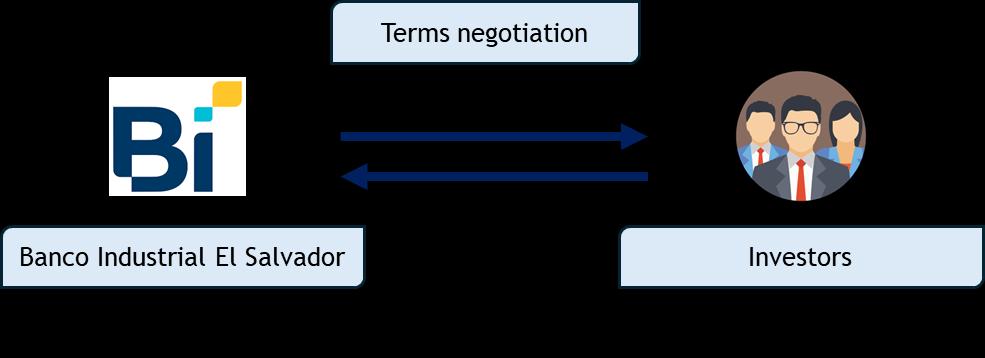
The second stage consists of placing the series and exchanging economic resources through the Digital Asset Service Provider (DASP) platform.

The third stage consists of periodic payments made by the issuer to tokenholders in accordance with the terms of each series.

This issuance has been registered in the Issuance Registry of the National Digital Assets Commission (CNAD), under registration number AD-00033. This Relevant Information
To the best of our knowledge and belief, and based on the information available to date, the information contained in the Relevant Information Document for the Offering submitted to the National Digital Assets Commission is correct, accurate, and complete, and does not contain any material omissions. Banco Industrial El Salvador, S.A., will keep all information up to date and, in the event of any material change in the information provided or in situations affecting the issuance of the tokens, will communicate such information to investors and the competent authorities without delay, as required by applicable laws and regulations. Annex 1 - Affidavit.
TR Capital, S.A. de C.V., is a company authorized by the CNAD as a Digital Asset Certifier under registration number CERT-0003. It is a Salvadoran company, incorporated on May 13, 2017, before the notary public Alfredo Alejandro Muñoz Rodas. It is registered in the Registry of Companies of the Commercial Registry under number 21 of Book 3776; with registration number 2017088178; and Tax Identification Number 0614-130517-102-0.
Attached to this Material Information Document is the Certifier's full report, together with all its considerations regarding this issuance. Annex 2 - Certifier's Report.
Banco Industrial El Salvador, Sociedad Anónima, is a private corporation with fixed capital and Guatemalan investment participation. Incorporated in accordance with the laws of the Republic of El Salvador on January 12, 2010, it began operations on July 13, 2011, as authorized by the Board of Directors of the Superintendency of the Financial System.
The bank is a subsidiary of Banco Industrial, S.A., (Guatemala), which in turn is a subsidiary of Bicapital Corporation, a company incorporated in the Republic of Panama. Corporación BI was founded in 2003 and is one of the leading financial groups in Central America, with a presence in Guatemala, El Salvador, Honduras, and Panama, with more than US$32 billion in assets and more than 20,000 employees. Banco Industrial, S.A. (Guatemala) emerged from the Guatemalan Chamber of Industry in the late 1960s with the aim of supporting the country's industrial sector and was founded with the backing of a hundred of Guatemala's most important industrialists. Today, what began as a dream of several Guatemalan industrial entrepreneurs now has a network of thousands of service points and has become the leading bank in the Guatemalan banking system. It currently has an international BB rating with a positive outlook from Fitch Ratings.
In El Salvador, Banco Industrial was created with the aim of supporting the country's productive sector and the vision of becoming the first choice for companies and individuals in the development of their operations in the northern triangle, through agile and innovative service. On the one hand, the bank offers the Salvadoran market a broad portfolio of savings and investment financial products, including demand deposit accounts, savings accounts, scheduled savings accounts, and time deposits. On the other hand, the bank also offers credit financing alternatives through working capital lines of credit, mortgage loans, consumer loans, and vehicle loans, as well as services such as letters of credit, surety bonds, international transfers, collection, and foreign currency transactions.
As of December 2024, the results reflect the bank's financial strength. Profits increased by 13.9% compared to 2023. This strong performance was achieved thanks to significant growth in net loans of 16.1% and the excellent quality of the portfolio, reflected in a maturity index of 0.2%. On the other hand, deposits grew by 19.1%, which strengthened the business's liquidity position.
In addition, the credit rating agency Moody's Local assigned Banco Industrial El Salvador, S.A. a long-term national rating of EAAA.sv with a stable outlook and very low default risk. The bank's risk ratings are based on its financial performance, capital adequacy, and risk policies, which guarantee good portfolio quality indices, as well as on the support provided by its main shareholder, Banco Industrial, S.A.
The corporate governance structure of Banco Industrial El Salvador, S.A. is composed of management, regulatory, line or executive, and support bodies for the various committees.
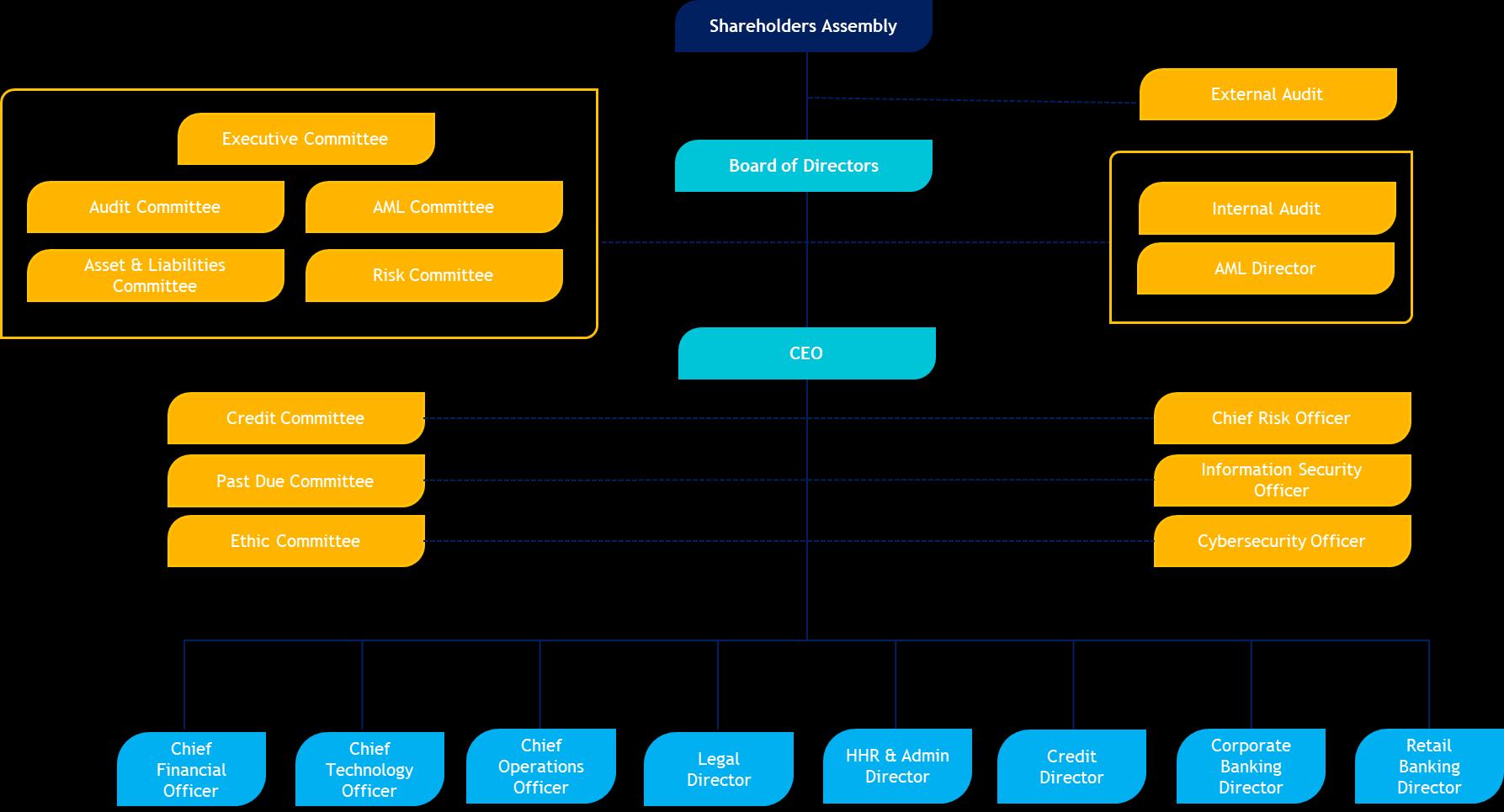
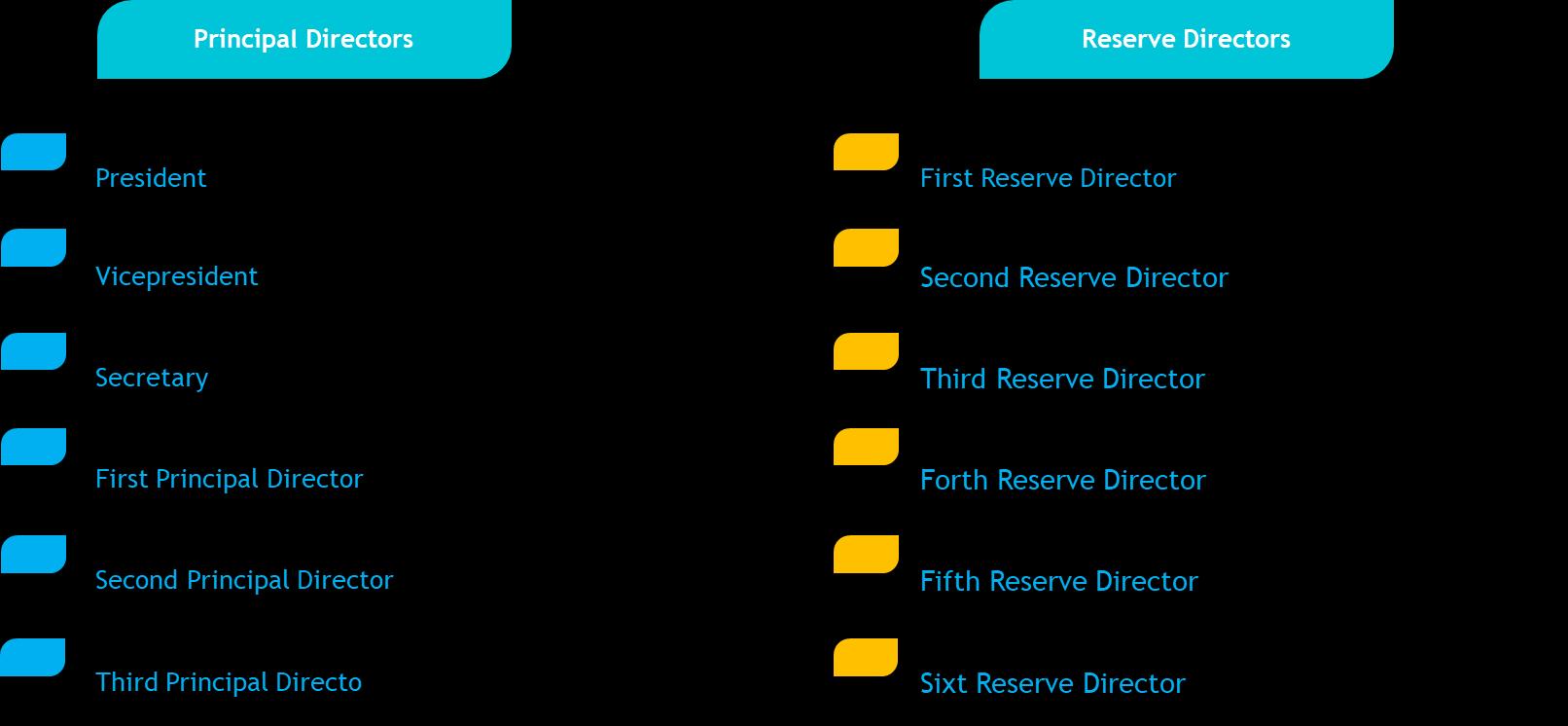
The management, responsibility for the direction and administration of the bank's business rests with a Board of Directors, composed of six regular directors and an equal number of alternate directors, which is in office for the period 2024-2026.
The bank's institutional strength is reflected in the outstanding track record of its management team. Their vision, leadership, and commitment to excellence have been fundamental in consolidating the bank as a reliable, innovative, and sustainable development-oriented institution.
Accompanying this leadership, the senior management team is made up of professionals with recognized track records in key areas such as finance, risk, operations, and technology, among others. Each of them brings a unique combination of technical knowledge, practical experience, and leadership, which allows the bank to successfully face the challenges of the current financial environment and project itself firmly into the future.
Chief Executive Officer
María Alicia Mayorga de Pérez Ávila
Chief Financial Officer Gabriel Alejandro Flores Lizanne
Compliance Director Liliana Lissette Del Cid Iglesias
Director of Internal Audit Felix Antonio Ganuza Garcia
Legal Director Edgar Orlando Zúñiga Pérez
Chief Operations Officer Patricia Elizabeth Lima Calix
Chief Risk Officer Rolando Ernesto Doradea Bustamante
Director of Human Resources and Administration
Credit Director
Director of Corporate Banking
Chief Technology Officer
María José Altamirano López
Andrea María Landaverde Chacón
Carmen Elena Meléndez
Mario Enrique Soto Torres
Name: Julio Ramiro Castillo Arévalo
Nationality: Guatemalan
Education: Bachelor's Degree in Business Administration from Mariano Gálvez University in Guatemala and the Senior Banking Management Program at INCAE Business School.
Work Experience:
Bicapital Corporation, Panama - 2020 to date - Chairman of the Board of Directors
Bicapital Corporation, Panama - 2007 to 2020 - Vice President of the Board of Directors
Banco Industrial El Salvador, S.A. - 2020 to date - Chairman of the Board of Directors
Banco Industrial El Salvador, S.A. - 2011 to 2020 - Vice President of the Board of Directors
Westrust Bank (Intl.) Limited, Guatemala - 2020 to date - Chairman of the Board of Directors
Westrust Bank (Intl.) Limited, Guatemala - 2010 to 2020 - Vice President of the Board of Directors
Seguros El Roble, S.A. and Fianzas El Roble, S.A., Guatemala - 2020 to date - Chairman of the Board of Directors
Seguros El Roble, S.A. and Fianzas El Roble, S.A., Guatemala - 2010 to 2020 - Vice President of the Board of Directors
Almacenadora Integrada, S.A., Guatemala - 2010 to present - Chairman of the Board of Directors
Almacenadora Integrada, S.A., Guatemala - 2010 to 2020 - Vice President of the Board of Directors
Banco Industrial, S.A., Guatemala - 2020 to date - Chairman of the Board of Directors
Banco Industrial, S.A., Guatemala - 2010 to 2020 - Vice Chairman of the Board of Directors
Banco Industrial, S.A., Guatemala - 1990 to 2010 - Director of the Board of Directors
Banco del País, S.A., Honduras - 2020 to date - Chairman of the Board of Directors
Banco del País, S.A., Honduras - 2010 to 2020 - Vice President of the Board of Directors
Banco del País, S.A., Honduras - 2008 to 2010 - Director of the Board of Directors
Seguros del País, S.A., Honduras - 2020 to date - Chairman of the Board of Directors
Seguros del País, S.A., Honduras - 2010 to 2020 - Vice President of the Board of Directors
Seguros del País, S.A., Honduras - 2008 to 2010 - Director of the Board of Directors
Negocios Empresariales, S.A., Guatemala - 2002 to present - Chairman of the Board of Directors
Fundación Ramiro Castillo Love, Guatemala - 1992 to present - Founder and Vice President of the Board of Directors
Name: José Antonio Arzú Tinoco
Nationality: Guatemalan
Education: Bachelor's Degree in Business Administration from Francisco Marroquin University in Guatemala.
Work Experience:
Banco Industrial El Salvador, S.A. - 2020 to date - Vice President of the Board of Directors
Banco Industrial El Salvador, S.A. - 2011 to 2020 - Director of the Board of Directors
Banco Industrial, S.A., Guatemala - 2020 to date - Vice President of the Board of Directors
Banco Industrial, S.A., Guatemala - 2011 to 2020 - Director of the Board of Directors
Banco Industrial, S.A., Guatemala - 2010 to 2021 - Advisor to the Board of Directors
Westrust Bank (Intl.) Limited, Guatemala - 2020 to date - Vice President of the Board of Directors
Banco del País, S.A., Honduras - 2020 to date - Vice President of the Board of Directors
Banco del País, S.A., Honduras - 2010 to 2020 - Director of the Board of Directors
Seguros del País, S.A., Honduras - 2020 to date - Vice President of the Board of Directors
Seguros del País, S.A., Honduras - 2020 to date - Director of the Board of Directors
Bicapital Corporation, Panama - 2020 to date - Vice President of the Board of Directors
Bicapital Corporation, Panama - 2020 to date - Director of the Board of Directors
Corporación Fazur, S.A., Guatemala - 2015 - Director
Grupo Amparo, Central America - 2000 to date - Director of the Board of Directors
Grupo Denver, Guatemala - 2009 to date - Advisor to the Board of Directors
Grupo Arrend, S.A., Guatemala - 2006 to 2009 - Advisor to the Board of Directors
Albrooks, S.A., Guatemala - 2006 to present - Advisor to the Board of Directors
Servicios Integrados de Representación, S.A., Guatemala - 1999 to present - Advisor to the Board of Directors
Seguros Casa, S.A., Guatemala - 1997 to 2003 - Advisor to the Board of Directors
Centro de Seguros, S.A., Guatemala - 1996 to 2008 - Advisor to the Board of Directors
Grupo Azur, Guatemala - 1990 to 2017 - Director
Name: María Alicia Mayorga de Pérez Ávila
Nationality: Salvadoran
Education: Bachelor's Degree in Business Administration from José Matías Delgado University and Executive Master's Degree in Business Administration from INCAE.
Work Experience:
Banco Industrial El Salvador, S.A. - 2010 to present - General Manager
Banco Cuscatlán de El Salvador - 2006 to 2010 - Chief Operating Officer, Corporate Business (Commercial Banking)
Banco Cuscatlán de El Salvador - 1999 to 2006 - Corporate Manager
Banco Cuscatlán de El Salvador - 1995 to 1999 - Branch Division Manager
Banco Cuscatlán de El Salvador - 1993 to 1995 - Assistant Corporate Manager
Banco Cuscatlán de El Salvador - 1988 to 1993 - Corporate Executive
Banco Cuscatlán de El Salvador - 1987 to 1988 - Financial Analyst
Chief Financial Officer
Name: Gabriel Alejandro Flores Lizanne
Nationality: Salvadoran
Education: Bachelor's Degree in Economics and Business from ESEN. CFA Charterholder, CFA INSTITUTE. Member of CFA Society New York.
Work Experience:
Banco Industrial El Salvador, S.A. - 2021 to date - Chief Financial Officer
Banco Atlántida, El Salvador - 2020 to 2021 - Head of Treasury
Banco Atlántida, El Salvador - 2019 - Treasury Coordinator
Banco Atlántida, El Salvador - 2017 - 2018 - Treasury Analyst
Name: Edgar Orlando Zúñiga Perez
Nationality: Salvadoran
Education: Bachelor's Degree in Legal Sciences. Lawyer and Notary. Dr. José Matías Delgado University.
Work Experience:
Banco Industrial el Salvador, S.A. - Legal Director. 2013 to present Development Bank of El Salvador – Bandesal (formerly Multisectoral Investment Bank)
– Legal Manager. 2009 to 2013
Banco Cuscatlán, S.A., now Banco Citibank de El Salvador, S.A., Legal Department. Legal Coordinator of the Credit Legalization Department. 1999 to 2009
Tarjetas de Oro, S.A. de C.V., Collections Management. Legal Advisor. 1999
Banco Hipotecario de El Salvador, S.A., Legal Management. Coordinator of the Registry Department. 1997 to 1998
Name: Félix Antonio Ganuza García
Nationality: Salvadoran
Education: Bachelor's Degree in Public Accounting from Las Américas University in El Salvador, Master's Degree in Financial Management from the Technological University of El Salvador.
Work Experience:
Banco Industrial El Salvador, S.A. - 2010 to present - Director of Internal Audit
Banco Promerica, S.A. - 1998 to 2009 - Internal Audit Manager
AFP Profuturo, S.A. - 1997 to 1998 - Internal Audit Manager
Banco Credisa - 1995 to 1997 - Internal Audit Manager
Superintendency of the Financial System - 1992 to 1995 - Bank and Financial Institution
Examiner
Banco de Fomento Agropecuario - 1986 to 1992 - Audit Technician
Name: Carmen Elena Meléndez
Nationality: Salvadoran
Education: Bachelor's Degree in Business Administration from the Polytechnic University of El Salvador.
Work Experience:
Banco Industrial El Salvador, S.A. - 2012 to present - Director of Corporate Banking
Banco Industrial El Salvador, S.A. - 2011 to 2012 - Corporate Executive
Banco Cuscatlán / Citi - 1993 to 2010 - Corporate Executive
Banco Cuscatlán - 1983 to 1992 - Business Banking Executive
Name: Andrea María Landaverde Chacón
Nationality: Salvadoran
Education: Bachelor's Degree in Business Administration from the José Simeón Cañas Central American University, Master's Degree in Financial Management and Corporate Finance from EUDE Business School.
Work Experience:
Banco Industrial El Salvador, S.A. - 2018 to present - Credit Director
Banco Promerica El Salvador, S.A. - 2018 - Coordinating Financial Analyst
Banco Promerica El Salvador, S.A. - 2015 to 2018 - Senior Financial Analyst, Corporate Banking
Banco Hipotecario de El Salvador, S.A. - 2011 to 2015 - Financial Analyst
Name: Rolando Ernesto Doradera
Nationality: Salvadoran
Education: Bachelor's Degree in Public Accounting, Technological University. Master's Degree in Financial Management, University of El Salvador
Work Experience:
Banco Industrial El Salvador, S.A. - 2012 to present - Risk Director
Director of Compliance
Name: Liliana del Cid Iglesias
Nationality: Salvadoran
Education: Industrial Engineering, José Simeón Cañas Central American University
Master's Degree in Business Management, Central American University "José Simeón Cañas"
Work Experience:
Banco Industrial de El Salvador, S.A. Compliance Director 2022 to present
Banco Davivienda, Assistant Manager of Risk Management LDFT.
Banco Davivienda, Regulatory Officer (Compliance Management).
Banco Davivienda, Project Leader (Channel and Product Support Department).
Banco Davivienda, Project Leader (Branch Operations Assistant Manager).
UNICOMER REGIONAL, Regional Merchandise Planner. FUENTE APPAREL (Miramar Free Trade Zone), Planning Assistant. COMPRES S.A, Sales and Inventory Assistant.
BCTC (San Bartolo Free Trade Zone), Production Assistant.
Name: Patricia Elizabeth Lima Calix
Nationality: Salvadoran
Education: Bachelor's Degree in Business Administration. Technological University of El Salvador
Work Experience:
Banco Industrial de El Salvador, S.A. Director of Operations 2024 to present
SAC Credicomer, S.A. Head of Deposits 2008-2024
Municipality of San Luis Talpa Municipal Treasurer 2005-2008 Banco Hipotecario. Mortgage Agency Manager. 2001-2005"
Name: María José Altamirano López
Nationality: Salvadoran
Education: Bachelor's Degree in Legal Sciences, Dr. José Matías Delgado University
Master's Degree in Human Resources Management, Evangelical University of El Salvador
Work Experience:
Director of Human Resources and Administrative Services, Banco Industrial El Salvador, 2010-present
Administrative Assistant, Banco Industrial de Guatemala Information Office in El Salvador, 2006-2010
Corporate Executive, AIG Unión y Desarrollo, 2002-2005
Name: Mario Enrique Soto Torres
Nationality: Honduran
Education: Bachelor's Degree in Financial Engineering, Technological University of Honduras. Master's Degree in Business and Finance, UTH Florida.
Work Experience:
Director of Technology. Banco Industrial El Salvador, 2023 - present
Project and Process Manager. Banco del País, 2019–2023
Head of Compliance. Banco del País, 2014–2019
Head of Process and Systems Engineering. Banco del País, 2005 - 2014
Banco Industrial El Salvador, S.A., prepares and presents its financial statements in accordance with the "Accounting Manual for Deposit-Taking Financial Institutions and Holding Companies" (NCF-01), issued by the Central Reserve Bank of El Salvador. The 2024 results reflect the financial strength of Banco Industrial El Salvador, S.A. and its comprehensive performance in all strategic pillars. Profits increased by more than 13.9%, substantially exceeding the net result for 2023. This strong performance was achieved thanks to significant growth in net loans of 16.1% and the excellent quality of the portfolio, reflected in a PAR90 indicator of 0.2%. On the other hand, deposits grew by 19.1%, which strengthened the business's liquidity position. To view the complete Financial Statements, see Annex II.
The bank's financial projections for the period 2025–2035 are based on a strategy of sustained growth, operational efficiency, and stability in the macroeconomic environment.
The loan portfolio is expected to close 2025 at $749 million, corresponding to +27% versus 2024. For the period 2025–2035, sustained growth in line with historical trends is projected, with a CAGR of 10.3%. This growth is due to a combination of greater penetration in strategic segments, strengthening of digital channels, and a prudent but dynamic credit policy, which will allow loan income levels to exceed $150 million by 2035, with a target portfolio rate of 7.10%.
The main funding mechanism is deposits, which are projected to grow in line with the loan portfolio at a CAGR of 10.6%, closing at a total of $2 billion by 2035. In addition, a target reduction in financial costs to levels close to 3.7% is projected.
Furthermore, the issuance of Digital Debt Assets (TKNBIES1) is being considered to complement and diversify funding sources. The projections include the gradual issuance, through series, of US$50 million in Digital Debt Assets (TKNBIES1). Each series has independent characteristics adapted to market conditions at the time of placement, ensuring competitiveness and aligning with investor expectations.
The bank's equity shows a solid and growing structure through capitalization of $20 million in 2026, reaching $90 million in paid-in capital, reflecting $320 million in equity by 2035, with a CAGR of 11.1%.
The company's general expenses are forecasted to grow steadily at 2.50%, in line with historical performance.
The pre-tax profit margin is estimated at an average of 20.3% for the period, reflecting a compound growth of 12.6% over the 10-year projection, reaching a profit of more than $25 million by 2035.
Profitability measured through ROE and ROA is projected to perform positively, estimated at an average of 9% and 1%, respectively.
The bank's financial projections reflect a solid equity position, backed by an efficient capital structure and adequate levels of liquidity and reserves. Payment capacity remains robust, with coverage and solvency indicators exceeding regulatory minimums. The projected growth of the loan portfolio, together with excellent management of deposits and funding sources, is driving balanced expansion of the balance sheet. This dynamic translates into sustained improvements in profitability, efficiency, and institutional resilience, consolidating the bank as a strategic player within the financial system, with the capacity to grow responsibly and generate long-term value.
Banco Industrial de El Salvador has opted to conduct a public offering using digital assets as part of its financial innovation strategy, with the aim of modernizing its financing mechanisms, reducing operating costs, and expanding access to investors through the use of distributed ledger technology (DLT). This modality allows for greater transparency, traceability, and efficiency in transactions, aligning with the national regulatory framework established by the National Digital Assets Commission (CNAD). In addition, this issuance seeks to promote financial and digital innovation, with the creation of modern and secure financial products, and positioning the bank as a leader in the adoption of technological solutions in the Salvadoran financial system.
To date, Banco Industrial de El Salvador declares that there are no conflicts of interest between the members of its management body, partners, or employees and the members of the National Digital Assets Commission (CNAD). Likewise, no transactions between related parties have been identified and must be disclosed in accordance with current regulations.
Issuer Banco Industrial El Salvador, Sociedad Anónima
Ticker symbol or listing code TKNBIES1
Type of public offering: Public Debt Offering
Type of digital asset: Debt token
Nature of the digital asset:
Debt tokens represent a credit right of the issuing entity in favor of the purchaser in accordance with the participation and conditions acquired in each of the traded series. These debt tokens do not confer ownership rights, shareholdings, or voting or intervention powers in the administration, management, or governance of the issuing entity. Their nature is strictly financial and is limited to the recognition of a payment obligation by the issuer, under the established terms.
Trading currency: United States dollars.
Term of the Issuance:
Issuance Amount:
Tokens to be issuanced and nominal price:
Minimum trading amounts:
Minimum issuance amount:
The issuance may have a maximum term of 10 years from the date of granting of the material entry by the National Digital Assets Commission.
The issuance amount is up to FIFTY MILLION United States dollars. (USD $50,000,000.00)
The issuance will consist of a total of 50,000,000 tokens. Each token will have a nominal price of ONE US dollar (USD $1.00).
The minimum purchase amount for tokens (TKNBIES1) on the primary market will be USD $100.00 (ONE HUNDRED DOLLARS), which corresponds to the acquisition of at least 100 tokens.
The minimum amount required to carry out the issuance will be ONE HUNDRED United States dollars (USD $100.00). The deadline for meeting the minimum amount will be thirty days from the first placement.
Series to be traded:
The issuance may be offered in one or more series. The series may be traded with a term not exceeding the established term and without exceeding the maximum amount authorized in the program. No series may have a maturity date later than the term of the issuance. The specific characteristics of each series to be traded (amount to be issued, interest rate, principal payment, etc.) will be determined by the issuer in accordance with this Material Information Document. The series to be traded shall be communicated to by means of a public offering notice to the National Digital Assets Commission at least one day prior to trading; all characteristics and documentation of the series shall be made available to investors on the Digital Exchange S.A. de C.V. platform
Technical and commercial functionality of the digital asset:
Description and details of the underlying asset:
The debt token issued by Banco Industrial, S.A. represents a financial obligation that allows investors to participate in a secure, transparent, and efficient financing structure. From a technical standpoint, the token operates through smart contracts that guarantee the automatic execution of payments and transfers, reducing operational risks. Commercially, it offers investors access to periodic returns and the possibility of trading the asset on the Digital Exchange S.A. de C.V. platform.
The digital asset offered by Banco Industrial, S.A. is backed by debt obligations issued directly by the financial institution. These tokens represent contractual commitments for future payments, structured in accordance with the terms established in each series of issuance. There are no additional
physical or financial assets that serve as direct backing, as the value of the token derives exclusively from the creditworthiness and solvency of the issuer. Each token is linked to a smart contract that guarantees traceability, transparency, and compliance with the agreed conditions, allowing investors to be certain about the nature of the underlying asset.
Form and Place of Payment
The principal and interest shall be paid according to the frequency established for each series, which may be monthly, bimonthly, quarterly, semi-annually, at maturity, or on a specific date, on or after which the Issuer may, at its discretion, pay the entire balance of principal and interest outstanding on the date of each series in advance of maturity. Such repurchase may be at par value or at a premium, which shall be negotiated between the Issuer and the Investor in the form of a percentage. The option may be exercised on one or more specific dates or from a specific date. If the option is exercised, Banco Industrial de El Salvador S.A. must inform Digital Exchange S.A. de C.V. at least 5 business days prior to the execution date. The payment terms must be reported by Banco Industrial El Salvador S.A. on the Digital Exchange S.A. de C.V. platform at the time of the public offering so that they are available to investors, and they will be counted from the date of publication of the public offering on the Digital Exchange, S.A. de C.V. platform. The payment of principal and interest will be made to the investors' wallets on the Digital Exchange, S.A. de C.V. platform. Upon exercising the repurchase option, the tokens will be withdrawn from circulation and permanently deleted (burned). For legal purposes and for the information of investors, this issuance is considered "pari passu" debt, meaning that for the purposes of principal and interest payments, it has the same conditions as the issuer's other obligations to third parties that do not have a preferential or specific guarantee condition.
Token yield:
Banco Industrial de El Salvador, S.A. will pay interest on the balance of the tokens in each holder's wallet throughout the term of the issuance, calculated on a calendar year basis. The interest rate will be determined for each series and may be fixed or variable according to market conditions at the time of placement. If the rate is fixed, it will remain in effect throughout the term of the corresponding series. If the rate is variable, it may be a scheduled upward interest rate, a scheduled downward interest rate, or variable by means of a base rate, which may be: a) Secured Overnight Financing Rate (SOFR) or Term SOFR published by the CME Group on its website, which may be established in specific terms, as determined on the date of placement; b) Weighted Average Passive Interest Rate (WAPIR) published by the Salvadoran Central Bank or c) Any other basis defined in each series. When the interest rate is variable, it will be adjusted periodically, either monthly, bimonthly, quarterly, semi-annually, or annually. A surcharge will be added to this base rate, which will be fixed throughout the term of the issuance or the respective series and must be established prior to the negotiation of the issuance or the corresponding series. Banco Industrial de El Salvador, S.A. may set minimum and maximum rates prior to the negotiation of a series, which will be established according to market conditions; in the case of the minimum rate, it may not be less than 10 basis points per annum, those rates shall be applicable during the term of the issuance or its corresponding series, with the understanding that if the rate resulting from the sum of the base rate plus the fixed surcharge is equal to or greater than the minimum, provided that
the result is not greater than the maximum rate to be paid, then Banco Industrial de El Salvador, S.A. shall pay that resulting rate; but if, on the contrary, the rate resulting from the sum of the base rate plus the fixed surcharge is less than the minimum rate established by Banco Industrial de El Salvador, S.A., the latter shall pay the investor the minimum rate; and if, failing that, the rate resulting from the sum of the base rate plus the fixed surcharge is greater than the maximum rate established by Banco Industrial de El Salvador, S.A., the latter will pay the investor the maximum rate.
Guarantee of the issuance
This issuance does not have a specific guarantee. The issuance is backed by the Bank's financial strength.
Payment priority
If the minimum amount necessary to carry out the issuance is not reached at the end of the public offering within thirty days after the first placement, or if it is canceled for any reason, purchasers shall be entitled to recover their capital in full, which shall not generate interest or default.
During the initial placement period, all funds contributed by investors will remain in an operating account in the financial system linked to the Digital Asset Service Provider Digital Exchange S.A. de C.V. without being transferred to the Issuer until the minimum amount established is reached. These funds will not be considered income of the issuer, nor will they be integrated into its operating accounts until the minimum validation threshold is reached.
In the event that the issuer finds itself in a situation of insolvency, bankruptcy, revocation of its operating license, or any other situation that prevents the normal operation of its business, all series of this issuance that are in force on that date and the interest generated by them will be paid in accordance with the corresponding order of payment of obligations, as provided for in Article 65 j) of the Law for the Stability of the Financial System and Deposit Guarantee. Capital Recovery:
If the minimum placement amount of USD $100.00 is not reached within 30 days from the first public offering, a reimbursement mechanism will be activated to guarantee investors the recovery of their capital. This process will be managed through Digital Exchange S.A. de C.V. platform, ensuring transparency at every stage.
The reimbursement procedure will be as follows:
1. Notification to token holders: The issuer, through Digital Exchange S.A. de C.V., will inform token holders of the failure to meet the minimum placement amount. The notification will include details of the reimbursement process and the corresponding schedule.
2. Funds transfer: The digital asset service provider Digital Exchange S.A. de C.V. will credit the funds to investors' wallets within the platform to reimburse 100% of the capital invested. This transfer will be made
within a period of no more than 30 business days from the formal notification to token holders.
3. Refund confirmation: The digital asset service provider Digital Exchange S.A. de C.V. will be responsible for confirming that the refund process has been completed in full. The details of the refund will be recorded in the investor's account within the PSAD platform in the operations module.
Digital asset service provider:
Trading platform:
Payment methods:
Custody of tokens:
Digital Exchange, S.A. de C.V.
Digital Exchange S.A. de C.V. platform URL: www.digitalexchange.com.sv
The trading currency will be USD. Investors may fund their wallets through the methods established by Digital Exchange S.A. de C.V.
Digital Exchange S.A. de C.V., as a digital asset service provider, is responsible for the custody of tokens, which includes the execution of operational actions such as the transfer, withdrawal, burning, or freezing of tokens, among other necessary measures. These functions are carried out with the aim of ensuring that tokens remain in compliance with established rules and regulations.
Smart contracts: Smart contracts are based on Algorand Smart Contract (ASC1) written in TEAL.
Convertibility of digital assets:
Secondary market:
Plans for future issuances:
The tokens in this issuance may only be traded within the Digital Exchange, S.A. de C.V. platform and cannot be converted or exchanged for other digital assets. Nor may they be transferred to other platforms or wallets outside Digital Exchange, S.A. de C.V.
Once the first series of the issuance has been placed, trading of TKNBIES1 tokens will be enabled on the secondary market. This trading will be carried out exclusively through the Digital Exchange, S.A. de C.V. platform, which will guarantee the traceability and security of transactions.
Banco Industrial reserves the right to make new issuances at any time, under the conditions, terms, and characteristics that it deems appropriate, at its sole discretion and based on market conditions and its financing needs. These successive issuances will be subject to the applicable regulatory authorizations and may be aimed at strengthening the Bank's financial soundness, diversifying its funding sources, and optimizing its capital structure.
Disclaimer:
Financial covenants:
Banco Industrial El Salvador, S.A., is a corporation incorporated under the laws of the Republic of El Salvador. In this regard, and in its capacity as issuer of digital assets, it is the only entity legally obligated to make any payment related to this issuance, and therefore no other company in its business group, including subsidiaries, parent companies, affiliates, or related companies of Banco Industrial El Salvador, S.A., has or will have any responsibility with respect to the obligations arising from this issuance.
Banco Industrial, is a banking entity authorized to operate in El Salvador, therefore in addition to being under the supervision of the Superintendency of the Financial System, it must comply with the applicable legal and regulatory framework, which establishes conditions and ratios that it must always maintain, including:
i. Maintain a capital adequacy ratio greater than or equal to 12.00%.
ii. Maintain a legal debt ratio greater than or equal to 7.00%.
These covenants are verified monthly. In the event of an update or modification in accordance with the applicable legal framework, the Bank undertakes to comply with current legislation.
i. "The issuer of the digital assets is solely responsible for the content of this Material Information Document";
ii. "The digital assets covered by this offering are registered in the CNAD Public Registry. Their registration does not imply certification of the quality of the security or the solvency of the issuer";
iii. "It is the investor's responsibility to read all the information contained in this Material Information Document";
iv. Digital assets may lose their value in whole or in part;
Statements and indications
v. Digital assets may not always be negotiable;
vi. Digital assets may not be liquid;
vii. Digital assets do not guarantee future performance.
viii. This offer is strictly limited to the specific Digital Assets detailed in this Material Information Document and does not constitute an invitation to sell financial instruments;
ix. This offer does not constitute an offer available in any jurisdiction where it is considered illegal.
The purpose of the issuance is to finance the financial intermediation operations of Banco Industrial El Salvador, S.A. The issuance consists of a program of issuances of up to US$50 million to be placed gradually, through series, over a maximum period of 10 years from the date of granting of the material entry by the National Digital Assets Commission. Additionally, the issuance has been designed to adapt to the business needs, allowing flexibility in terms of amount, term, and different capital repayment modalities and interest rate types.
The number of series among which the total amount of the program will be distributed will be determined according to the issuer's financing needs during the term of the program. The applicable interest rate will be subject to market conditions, ensuring competitiveness and aligning with investor expectations.
The funds obtained from the negotiation of this issuance will be invested by BANCO INDUSTRIAL EL SALVADOR, S.A. to finance short-, medium-, and long-term intermediation operations; the resources may also be used as an alternative for funding and matching active and passive operations.
Role Information Issuer
Banco Industrial El Salvador, Sociedad Anónima Boulevard El Hipódromo Avenida Las Magnolias, Colonia San Benito #144, San Salvador 2213-1700
serviciobi@bi.com.sv andnotificaciones@bi.com.sv http://www.bi.com.sv/
Digital Exchange, S.A. de C.V.
Digital Asset Service Provider
Millennium Tower Level 9, San Salvador, San Salvador 2212-6400
eduardo.lopez@digitalexchange.com.sv
Banco Industrial El Salvador complies with the Regulatory Framework for the Prevention of Money Laundering and Assets, Financing of Terrorism, and Financing of the Proliferation of Weapons of Mass Destruction, as well as with the recommendations of international organizations and the best practices that Banco Industrial El Salvador, S.A. has deemed necessary for this purpose.
The prevention program implemented brings together the general administrative policies, the main ones being: Roles and Responsibilities of Compliance Program Participants,
Money Laundering and Asset Risk Management, Know Your Customer Policy, Policy on the entry, verification, and treatment of local and international watch lists, Training Program, Know Your Supplier Policy, Know Your Employee Policy, Policy against the Financing of Terrorism and Proliferation of Weapons of Mass Destruction, among others.
The following details the operational flow linking investors, digital platforms, and the issuer:
• Funding the investor's wallet
The investor transfers funds to their digital wallet on the Digital Exchange S.A. de C.V. platform authorized by the CNAD.
• Purchase of tokens
With available balance in their wallet, the investor selects the number of tokens to purchase and confirms the purchase order through the platform interface.
• Receipt of funds in the issuer's wallet
Once the purchase is executed, the transaction is settled in real time, sending the funds to the issuer's digital wallet on the Digital Exchange S.A. de C.V. platform.
• Cash Out to the issuer's bank account
The issuer requests the withdrawal of funds from their Digital Exchange S.A de C.V. wallet to their bank account, thus completing the settlement process.
The issuer has ownership and control over the digital asset wallets used to manage its operations, which are under the custody and administration of the Digital Asset Service Provider (PSAD), i.e., Digital Exchange S.A. de C.V., in accordance with current legal and regulatory provisions. Additionally, the issuer maintains active bank accounts within the Financial System of El Salvador, which provides it with access to traditional financial services that complement its activities in the digital ecosystem.
10.3 Issuer's capacity to receive funds through digital assets
Banco Industrial El Salvador, S.A. was formally registered in the CNAD Issuers Registry on January 9, 2026, in accordance with approval letter number CNAD-CD-012-2026 and under registration number EAD-0027 and is fully authorized to issuance products linked to digital assets.
11.1.1 Blockchain
The Digital Assets offered are based on Algorand's Blockchain technology. This is a decentralized network designed to be fast, secure, and scalable. It uses a consensus mechanism called Pure Proof of Stake (PPoS), which allows transactions to be validated efficiently without the need for high energy consumption.
The basic principles governing Algorand include:
1. Security: a blockchain that cannot be manipulated.
2. Scalability: high transaction throughput with minimal latency and low costs.
3. Finality: instant transaction finality with no possibility of forks.
4. Decentralization: a truly distributed network with no central authorities.
5. Sustainability: environmental responsibility through minimal energy consumption.
Advanced cryptography, including verifiable random functions (VRF) and cryptographic sorting, is used to ensure fairness, prevent collusion, and maintain a high level of security.
11.1.2 Protocol
The Algorand Standard Asset (ASA) protocol is the token standard for creating and deploying assets on Algorand. Built directly on top of the Algorand base layer, ASAs inherit its key properties: high transaction speed, minimal fees, traceability, and resistance to forks.
This approach offers multiple advantages:
1. Security and traceability: Being recorded on a public blockchain, every transaction related to the token is immutably recorded, facilitating audits and regulatory compliance.
2. Configurability: ASAs allow parameters such as freezing, revocation, access control, and transfer rules to be set, enabling the token's behavior to be adapted to different business models or legal requirements.
3. Interoperability: As a native standard, ASA tokens can easily interact with smart contracts, wallets, exchanges, and other applications in the Algorand ecosystem.
4. Operational efficiency: Algorand's infrastructure allows thousands of transactions to be processed per second with confirmation times of less than 5 seconds, improving the user experience and reducing operating costs.
11.1.3 Protocol interoperability
The system is composed of a modular architecture that exposes its components, connectors, and functionalities through a robust authorization and authentication scheme. This scheme allows control of access to the various services in the ecosystem, ensuring security, traceability, and regulatory compliance in all operations.
One of the main objectives of this infrastructure is to enable the development of solutions geared toward the digital representation of real-world assets. The architecture allows these assets to be represented in a standardized way, facilitating their interoperability.
The system is also designed to integrate with traditional and digital financial infrastructures, including entry and exit ramps between fiat currencies and digital assets. These ramps enable secure and regulated conversion between different forms of value and are backed by licenses and compliance mechanisms that ensure alignment with local and international regulatory frameworks.
In addition, the architecture includes specialized modules for digital asset management, enabling purchase, sale, and holding. These modules operate under principles of transparency, security, and efficiency, and are connected to liquidity mechanisms that enable real-time execution of transactions.
The Algorand blockchain uses a decentralized Byzantine Agreement protocol that leverages Pure Proof of Stake (Pure POS). This means that it can tolerate malicious users and achieve consensus without a central authority as long as a large majority of the stake is held by non-malicious parties.
This protocol allows many transactions to be processed quickly without sacrificing decentralization. Proof of Stake (PoS) blockchains are scalable, but often at the expense of a small number of validators who have large amounts staked dominating block approvals.
Algorand's PPoS consensus mechanism randomly selects validators and block proposers from anyone who has staked and generated a stake key. The chance of being selected is directly related to the participant's stake as a proportion of the total amount staked.
The digital assets offered operate on the Algorand blockchain, which has been designed to provide a highly efficient, accessible, and secure environment. The protocol employs an innovative consensus approach based on Pure Proof-of-Stake (PPoS), which allows for open and decentralized participation, where incentives are aligned with the security, stability, and governance of the network.
The incentive mechanisms in Algorand are structured primarily around two pillars:
1. Unlocked staking: Unlike other protocols that require funds to be locked in order to participate in validation, Algorand allows any user with ALGO in their account to participate indirectly in the consensus. This encourages broad distribution of participation without compromising asset liquidity.
2. Decentralized governance: Users can choose to actively participate in the governance of the protocol, which involves voting on key ecosystem decisions. In return, they receive rewards proportional to their commitment and participation, strengthening the model of sustainability and alignment of interests between users and developers.
In terms of transaction fees, Algorand stands out for its extremely low, fixed, and predictable cost structure. Each standard transaction incurs a minimum fee of 0.001 ALGO, allowing for cost-effective operations even on a large scale. This feature makes the protocol an ideal solution for payment applications, decentralized finance (DeFi), digital asset issuance, and micropayments, where operational efficiency is critical.
Algorand Smart Contracts (ASC1) are self-executing programs on the Algorand Blockchain. They are implemented using a proprietary language called TEAL (Transaction Execution Approval Language), designed to be secure, efficient, and deterministic. Unlike other smart contract environments that allow arbitrary code execution, TEAL is based on an execution model based on transaction approval logic, which significantly reduces security risks and improves the predictability of contract behavior.
Key features of TEAL and smart contracts on Algorand:
1. Security and determinism: As a logic-based language, TEAL avoids nondeterministic executions, improving security and facilitating auditing.
2. Low execution cost: The execution of smart contracts on Algorand maintains the same policy of low and predictable fees, allowing their use in high-volume applications without affecting economic viability.
The custody of digital assets in blockchain environments requires a comprehensive approach that combines physical, logical, and organizational security practices to protect both funds and associated sensitive information. In this context, advanced mechanisms are implemented to ensure the integrity, availability, and confidentiality of the assets under management.
Among the most relevant measures are:
1. Multi-factor authentication (MFA): Multi-level verification is required to access critical systems, reducing the risk of unauthorized access.
2. Multi-signature: Assets are stored with multi-signature schemes that require approval from multiple parties to execute transactions, mitigating operational and custody risks.
3. Robust data and private key encryption: Advanced cryptographic algorithms are used to protect sensitive information, including the use of hardware security modules (HSMs) for key storage.
4. Private key encryption with AES256 algorithm: This method ensures that the key remains secure, as it is transformed into an unreadable format without the appropriate password, which is obtained from a key vault. This reinforces the security of users' digital assets.
5. Infrastructure segmentation and perimeter protection: The technological architecture is designed with layers of isolation between components, firewalls, and intrusion detection systems to prevent unauthorized access.
6. Continuous monitoring and incident response: Security information and event management (SIEM) systems and security operations centers (SOC) are integrated to enable early threat detection and coordinated incident response.
7. Regular external and internal audits: Systematic reviews of security controls are performed by both internal teams and independent entities to validate compliance with policies and standards.
8. Regulatory compliance and international standards: Custody operations are aligned with regulatory frameworks such as KYC/AML, as well as recognized standards such as ISO/IEC 27001 and NIST, ensuring secure and transparent practices.
9. Organizational security culture: Continuous training, security drills, and awareness programs are actively promoted for all employees, with the aim of reducing operational, financial, and reputational risks.
Wallet as a Service (WaaS) is used to generate user wallets, creating an address on the blockchain along with its private key. An encryption password is then obtained from a secure key vault, and the private key is encrypted using the AES256 algorithm. Once encrypted, the wallet is delivered to the user.
Crypto As a Services (CaaS) is used to generate tokens, providing the necessary infrastructure for the generation and management of tokens for customers.
Asset transfers are a fundamental operation in the Algorand ecosystem, as they enable the movement of ASA between accounts. These transactions form the backbone of the token economy, enabling the trading, distribution, and general circulation of assets on the blockchain.
The freeze capability allows asset issuers to temporarily suspend the transfer of their assets to specific accounts. This feature is especially useful for assets that require periodic compliance checks, need to enforce trading restrictions, or must respond to security incidents. Once an account is frozen, it cannot transfer the asset until the designated freeze address lifts the freeze.
The deletion of an ASA (Algorand Standard Asset) is an administrative operation that allows the creator of the asset to permanently deactivate it within the Algorand ecosystem. This prevents any future transfers or interactions with it. This feature is useful for closing asset lifecycles or removing digital instruments that are no longer needed, while maintaining the traceability and transparency inherent in blockchain technology.
11.1.9 Token Flow within the platform of Digital Exchange S.A. de C.V.
The entire investment process including investor registration, wallet funding, token trading, transaction recording, principal and interest payments, and fund withdrawals is conducted exclusively through the Digital Exchange S.A. de C.V. (DAX) platform. Thanks
to the infrastructure based on blockchain and smart contracts, the entire issuance flow guarantees security, transparency, traceability, and regulatory compliance at every stage of the investment cycle.
1. Wallet registration and funding process:
The investor begins by registering on the DAX platform, complying with KYC verification requirements. Once approved, they are assigned a wallet within the platform. This wallet allows them to access all available functions. To begin trading, the investor must make a "cash in," funding their account according to the mechanisms established on the platform

2. Token purchase process:
With funds available in their wallet, investors access the DAX platform marketplace. There, they can purchase tokens on the primary or secondary market, depending on the available supply. Each purchase is recorded on the blockchain, ensuring transparency and traceability. The purchased tokens are automatically credited to the investor's wallet.

3. Capital and interest payment process:
The issuer funds their wallet through the procedure established by DAX. The platform executes payments automatically through smart contracts linked to the issuance. Investors receive the corresponding returns or capital directly in their wallets.

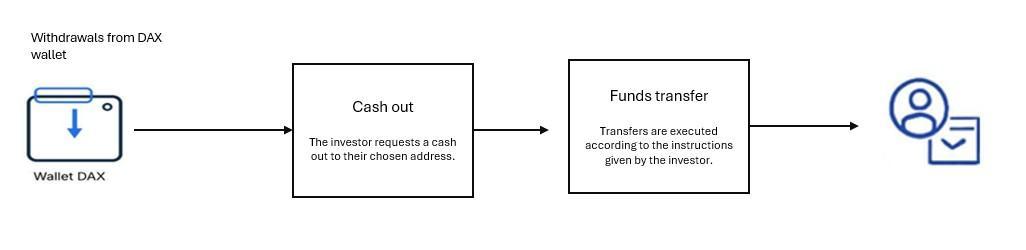
4. Fund withdrawal process (Cash out):
If the investor wishes to withdraw their funds, they can submit a cash-out request from the DAX platform according to the established mechanisms. Once processed, the request
is sent according to the investor's instructions, thus completing the investment cycle safely and efficiently.
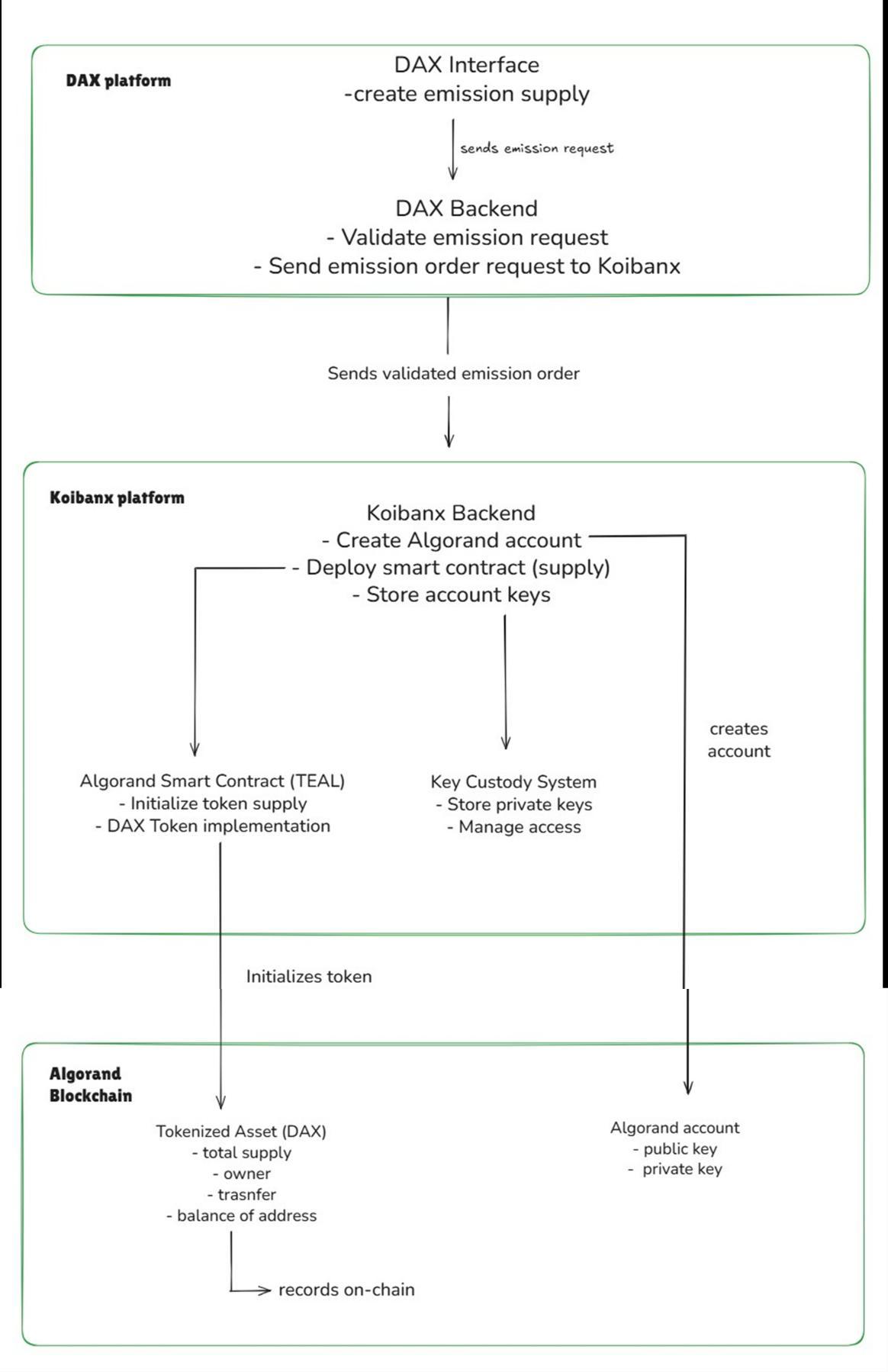
Each token is issuanced through a structured process that begins on the DAX platform, where the issuance request for its creation on the blockchain is generated.
The token is created within the framework of the characteristics authorized by the CNAD in this relevant Information Document in accordance with the market conditions for trading each series, ensuring from its creation that the conditions agreed upon with the investor are met from the outset. Once validated, an account is created on Algorand and the smart contract that defines the token supply is deployed, establishing the rules of ownership, transfer, and balance. This contract, implemented in TEAL, is the core that ensures the transparency and immutability of the agreed conditions.
Subsequently, the private keys are stored and secure access is managed, recording all relevant information on the Algorand blockchain: total supply, owner address, and token movements. This on-chain record allows investors to verify in real time the nature of the asset, its origin, and any transactions, ensuring complete traceability and confidence in compliance with the conditions.
The storage, maintenance, and transfer of the issuance are managed through a secure custody system integrated into the DAX platform, which implements access control and encryption mechanisms to ensure the integrity and confidentiality of the assets. As for wallets, each issuance is linked to a unique Algorand account, whose public address is used to record the total supply, initial owner, and subsequent transfers on the blockchain. This address, together with the smart contract, allows for on-chain verification of all operations, ensuring complete traceability and transparency.
Schematically, the creation of smart contracts is carried out as follows:
Investing in Digital Assets is speculative in nature and therefore involves a certain degree of risk. Potential investors should therefore carefully consider the following summary of certain risks.
Market risk: This risk is related to fluctuations in the market value of the assets of Banco Industrial El Salvador, Sociedad Anónima, on the secondary market. Banco Industrial El Salvador, Sociedad Anónima, reports the company's exposure to interest rate risk to the Board of Directors and Risk Committee.
Credit risk: This is the possibility of loss due to a counterparty's failure to meet its contractual obligations; the latter being understood as a borrower or debt issuer. It is managed by the Company in compliance with Banking Law, its regulations and related rules and instructions, and is monitored by the Board of Directors and the Risk Committee.
Liquidity risk: Liquidity risk is the possibility of incurring losses due to not having sufficient resources to meet obligations and not being able to conduct business under the expected conditions. The Board of Directors and Risk Committee are provided with details on types of investments and returns, available and committed amounts, and estimated monthly expense projections. Administrative expenses are monitored monthly, and estimated projections are made. The composition of reserves is also monitored.
Operational risk: This is the possibility of incurring losses due to failures in processes, personnel, information systems, and external events; it includes legal risk. Banco Industrial El Salvador, S.A., manages operational risk by monitoring events with procedures and controls to mitigate the risks associated with them.
Reputational risk: Reputational risk is the possibility of incurring losses because of damage to the company's image. The Company manages this risk through a Corporate Governance Policy and policies that define ethical guidelines and values, such as the Code of Business Ethics and the Conflict-of-Interest Policy.
Money and Asset Laundering Risk, Terrorist Financing, and Financing the Proliferation of Weapons of Mass Destruction: This is the possibility of loss or damage that the entity may suffer due to its propensity or vulnerability to being used directly or indirectly, or through its operations, as an instrument for money or asset laundering, channeling resources toward terrorist activities, financing terrorism, and financing the proliferation of weapons of mass destruction.
12.2
Liquidity risk: The liquidity risk for an investor in this issuance is related to the uncertainty of trading on the secondary market. This risk is mitigated because Banco Industrial has a continuous and documented process for identifying, measuring, controlling, mitigating, monitoring, and communicating liquidity risk. This includes a robust framework that provides a comprehensive projection of the liquidity position.
Market risk: Market risk refers to the potential losses that investors may incur due to price changes caused by exogenous variables that affect the free market mechanism. In addition, the tokens may be traded on the secondary market to have a certain degree of liquidity.
Competition: The company faces a high level of competition from other banking companies, some of which are very well capitalized and have an international presence, which can significantly affect the company's financial results. Proper planning, cuttingedge technology, and proprietary sales forces are some of the tools that Banco Industrial El Salvador uses to be competitive and achieve its objectives.
Systems and Technologies: There is a high degree of dependence on computer systems, software, and technological equipment, and any interruption or failure of these systems can cause serious problems. Banco Industrial El Salvador has experience in technology, both in dealing with external suppliers and consultants and in internal developments.
Technological risk: This refers to possible technical failures that may arise in the use of technologies such as smart contracts, which may contain programming errors or vulnerabilities that compromise their operation. In addition, there is a strong dependence on digital infrastructure, such as blockchain platforms and digital wallets, which means that any interruption or failure in these systems can affect operations. Cybersecurity risks, such as phishing attacks or hacking, which can jeopardize digital assets and sensitive information, must also be considered.
Mitigating factors:
✓ Security audits of smart contracts.
✓ Use of established and proven blockchain platforms.
✓ Implementation of robust cybersecurity measures (MFA, firewalls, monitoring).
Legal and regulatory risk: The legal and regulatory environment surrounding digital assets and tokens is still evolving. Changes in regulations could affect or imply changes in issuance.
Mitigants:
✓ Constant monitoring of regulatory changes.
✓ Token design in accordance with existing legal frameworks.
Counterparty risk: This risk arises when one of the parties involved in the transaction, such as the issuer, fails to meet its obligations. Failure to make timely payments linked to the token may affect investor confidence and the viability of the financial instrument.
Mitigants:
✓ Assessment of the solvency and reputation of counterparties.
✓ Use of smart contracts with automatic payment execution.
✓ Guarantees or collateral in case of default.
Operational risk: This includes human error or failures in internal processes related to the management, issuance, or settlement of tokens. These errors may be due to a lack of experience, inadequate procedures, or technical problems.
Mitigants:
✓ Training of personnel in digital processes.
✓ Automation of critical processes.
✓ Documented procedures and internal controls.
Market risk: Tokens may face low liquidity in secondary markets, making it difficult to buy or sell them at fair prices. In addition, price volatility can create uncertainty for investors, affecting the stability of the token's value and its attractiveness as a financial instrument.
Mitigants:
✓ Promotional strategies to increase token adoption.
✓ Price stabilization mechanisms (such as reserves or market makers).
Custody risk: This risk relates to the possibility of loss of digital assets held in custody by a platform.
Mitigants:
✓ Custodial scheme.
✓ Segmentation of private keys and secure backup.
The issuance of digital assets on the Algorand blockchain involves the use of advanced technologies that, while offering multiple benefits, also present inherent risks that must be properly managed. The main associated technological risks are detailed below, along with the mitigating measures implemented to reduce their impact.
12.4.1 Blockchain Infrastructure Security Risk
Exposure to cyberattacks, vulnerabilities in smart contracts, or errors in node implementation can compromise the integrity of digital assets and the network.
Mitigants:
1. Use of advanced cryptography (VRF, cryptographic classification).
2. Multi-factor authentication (MFA) and multi-signature wallets.
3. Continuous monitoring using SIEM/SOC.
4. Regular internal and external audits.
12.4.2 Interoperability Risk with Traditional Infrastructures
Integration with traditional financial systems and other blockchain networks may face technical, operational, and regulatory challenges.
Mitigants:
1. Modular architecture with standardized connectors.
2. Regulatory compliance (KYC/AML, ISO/IEC 27001).
3. Regulated entry/exit ramps between fiat and digital currencies.
12.4.3 Digital Asset Custody Risk
Loss, theft, or unauthorized access to private keys may result in the irreversible loss of assets.
Mitigants:
1. Use of multi-signature schemes.
2. Robust encryption and HSM modules for key storage.
3. Infrastructure segmentation and perimeter protection.
4. Organizational security culture and continuous training.
12.4.4 Risk of Failures in Smart Contracts
Errors in the logic of smart contracts can lead to financial losses or undesirable behavior.
Mitigants:
1. Use of TEAL, a deterministic and secure language.
2. Development tools to facilitate audits.
3. Exhaustive testing and peer review prior to deployment.
12.4.5 Regulatory and Compliance Risk
Changes in legislation or regulatory frameworks may affect the operation, acceptance, or legality of issuance digital assets.
Mitigants:
1. Alignment with local and international regulatory frameworks.
2. Infrastructure prepared to adapt to legal requirements.
3. Transparent and immutable record of transactions on the blockchain.
12.4.6 Risk of Friction in the User Experience
The technical complexity of blockchain technology may hinder adoption by nonspecialized users.
Mitigants:
1. User-friendly and simplified interfaces for end users.
2. Clear documentation and accessible technical support.
3. Automation of critical processes through smart contracts.
12.5 Issuer risk management policies
12.5.1 Background
Comprehensive Risk Management at Banco Industrial El Salvador, S.A. is considered a management system that involves all areas and employees of the Bank; and whose
objective, in addition to compliance with current regulations, is the identification, measurement, control, mitigation, monitoring, and communication of all risks to which the entity is exposed, as well as the interrelationships that arise between them in order to achieve adequate compliance with the institution's strategic goals.
12.5.2 Organizational structure for comprehensive risk management
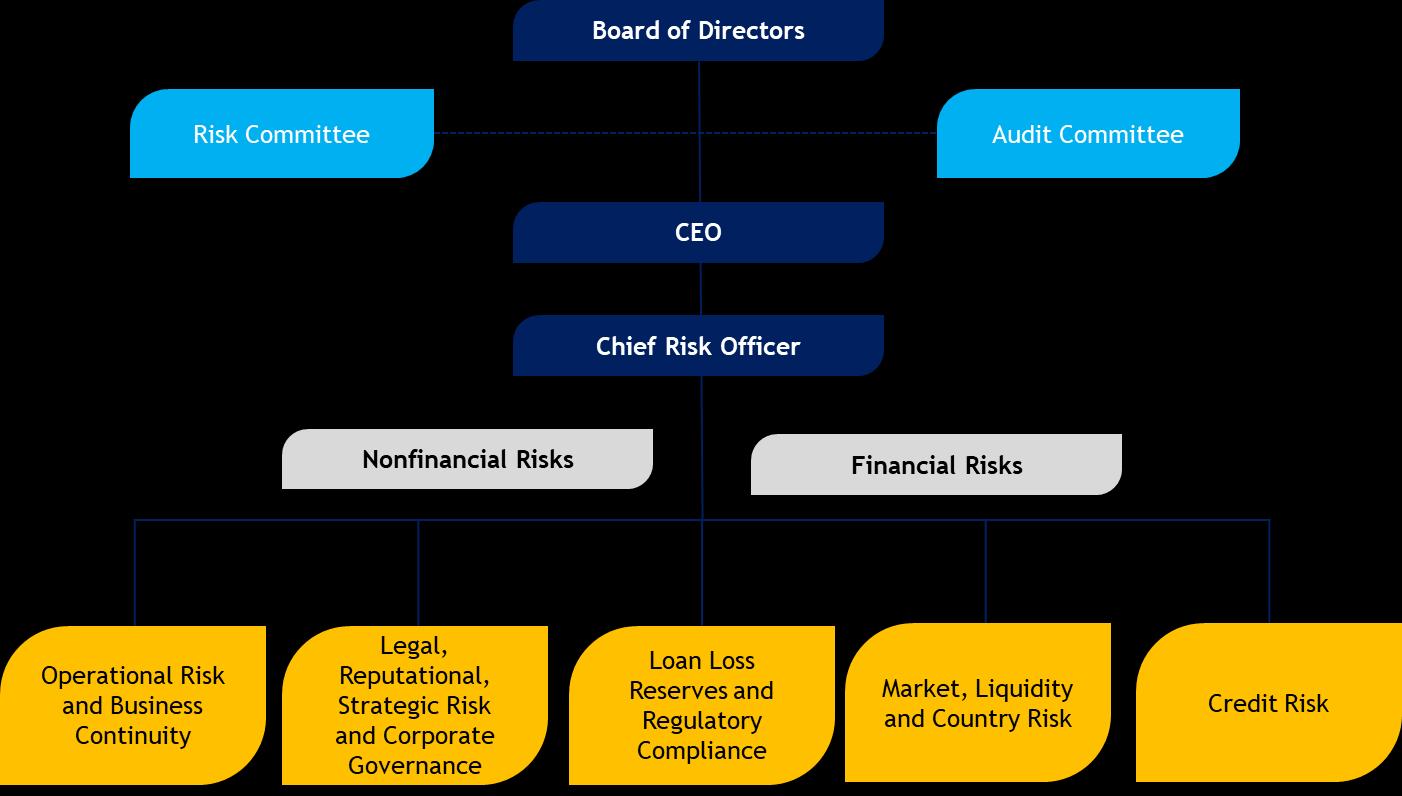
12.5.3 Liquidity risk
Banco Industrial El Salvador, S.A. defines liquidity risk as the possibility of incurring losses due to not having sufficient resources to meet assumed obligations, incurring excessive costs, and not being able to conduct business under the expected conditions.
Mitigating factors:
To manage this risk, Banco Industrial El Salvador, S.A. has policies, methodologies, systems, and tools that allow it to monitor the evolution of risk through indicators and coordinate its management among the different departments and teams involved.
Risk management policies:
1. Liquidity Risk Management Manual
2. Liquidity Contingency Plan and Strategy to Mitigate Liquidity Crises
3. Solvency Policy
Methodologies, systems, and tools used: The liquidity risk management system is a continuous and documented process whose main objective is the identification, measurement, control, mitigation, and communication of the different liquidity risks.
b. Impact on Financial Margin (Short-Term Interest Rate Risk).
c. Interest Rate VaR (Long-Term Interest Rate Risk).
d. Price Risk (VaR of the investment portfolio).
e. Exchange Rate Risk (VaR by exchange rate).
f. Investment Portfolio Monitoring.
g. Monitoring Financial Margin Evolution.
h. Monitoring External Market Risk Factors.
i. Stress testing.
12.5.5
BIES defines country risk as the risk assumed when maintaining or committing resources in a foreign country, due to possible impediments to recovering those resources resulting from adverse effects on the economic, social, or political environment, or from natural disasters occurring in the country where the source generating the counterparty's cash flows is located. Country risk includes sovereign risk, political risk, and transfer risk.
Mitigating factors:
To manage this risk, Banco Industrial El Salvador, S.A. has policies, methodologies, systems, and tools that allow it to monitor the evolution of risk through indicators and coordinate its management among the different entities and teams involved.
Risk management policies:
1. Country Risk Management Manual
Methodologies, systems, and tools used: The country risk management system is a continuous and documented process whose main objective is the identification, measurement, control, mitigation, and communication of different liquidity risks.
The internal framework for management is developed in the "Country Risk Management Manual," which includes:
1. The functions and responsibilities of the areas involved in country risk management.
2. The criteria for assessing and classifying country risk.
3. The policies, methodologies, and procedures for country risk management, including:
a. Preparation and updating of country risk files.
b. Preparation of the "Summary of Assets Subject to Country Risk."
c. Preparation of country risk reserve projections prior to monthly accounting closings.
d. Internal methodology for country risk assessment and classification.
12.5.6
Banco Industrial El Salvador, S.A. defines credit risk as the possibility of suffering a loss due to the failure to meet contractual payment obligations. Default is usually caused by a decline in borrowers' solvency due to liquidity problems, continued losses, bankruptcies, declining income, rising interest rates, and unemployment in the case of families, although it can also occur due to unwillingness to pay.
Mitigating factors:
To manage this risk, Banco Industrial El Salvador, S.A. has policies, methodologies, systems, and tools that allow it to monitor the evolution of risk through indicators and coordinate its management among the different departments and teams involved.
Risk management policies:
1. Credit Risk Management Manual
Methodologies, systems, and tools used: The credit risk management system is a continuous and documented process whose main objective is the identification, measurement, control, mitigation, and communication of different credit risks.
The internal framework for management is developed in the "Credit Risk Management Manual," which includes:
1. Proposing, managing, and implementing methodologies and tools for credit risk management to manage such risk in a timely manner.
2. Complying with credit risk management policies, as well as risk monitoring and follow-up.
3. Ensuring monthly monitoring of credit risk limits and credit concentration and submitting a report with the results of such monitoring to the Risk Committee and Board of Directors.
4. The methodologies and tools for quantifying and measuring credit risk
5. :
a. Calculation of expected loss.
b. Calculation of unexpected loss due to credit risk.
c. Establishment of credit risk limits.
d. Establishment of credit concentration limits.
e. Preparation of stress tests for the portfolio.
This consists of the possibility of losses occurring due to failures in the execution of contracts or non-compliance with regulations, as well as external factors such as regulatory changes or legal proceedings.
Mitigating factors:
To manage this risk, Banco Industrial El Salvador, S.A. has policies, methodologies, systems, and tools that allow it to monitor the evolution of risk through indicators and coordinate its management among the different departments and teams involved.
Risk management policies:
1. Legal Risk Management Manual
Methodologies, systems, and tools used: Legal risk management is the process by which legal risk is identified, monitored, controlled, prevented, and mitigated. To comply with the above, the following aspects are developed in the "Legal Risk Management Manual":
1. Functions and responsibilities of officials in charge of Legal Risk Management.
2. General policies
3. Formalization of contracts in which those responsible for their preparation are determined, considering the objective conditions of the entity and the protection of its interests.
4. Judicial and Administrative Resolutions
Banco Industrial El Salvador, S.A. defines reputational risk as the possibility of incurring losses because of damage to the entity's image due to non-compliance with laws, internal regulations, corporate governance codes, codes of conduct, money laundering, among others.
Mitigating factors:
To manage this risk, Banco Industrial El Salvador, S.A. has policies, methodologies, systems, and tools that allow it to monitor the evolution of the risk through indicators and coordinate its management among the different instances and teams involved.
Risk management policies:
1. Reputational Risk Management Manual
Methodologies, systems, and tools used: The reputational risk management system is a continuous process whose main objective is the identification, measurement, control, mitigation, and communication of different risks.
The internal framework for management is developed in the "Reputational Risk Management Manual," which includes:
1. Basic rules for social media management.
2. Monitoring mentions on institutional social media.
Banco Industrial El Salvador, S.A. defines operational risk as the possibility of incurring losses due to failures in processes, people, information systems, and external events.
Mitigating factors:
To manage this risk, Banco Industrial El Salvador, S.A. has policies, methodologies, systems, and tools that allow it to monitor the evolution of risk through indicators and coordinate risk management among the different departments and teams involved.
Risk management policies:
1. Operational Risk Management Manual
2. Business Continuity Plan
Methodologies, systems, and tools used: The operational risk management system is a continuous and documented process whose main objective is identification, measurement, control, mitigation, and communication of the different operational risks.
The internal framework for management is developed in the "Operational Risk Management Manual," which includes:
1. Capture and monitor operational risk events.
2. Process flows where risks are identified.
3. Capture of risks in Risk, Failure, and Control Matrices.
4. Calculation of the Operational Risk Expenditure Indicator and the Basic Indicator.
5. Business Continuity Plan applying the Business Impact Analysis methodology.
6. Risk opinion report on new products or services.
7. Manage employee training with the aim of strengthening best practices for adequate risk management and creating a risk culture at all levels.
13.1 Dispute resolution
Arbitration shall be the primary mechanism for resolving any dispute arising under this agreement.
13.2 Predetermined jurisdiction for dispute resolution
The jurisdiction for dispute resolution shall be the Republic of El Salvador, which provides a clear and enforceable legal recourse for dispute resolution.
13. Additional Information
This provision clearly establishes that all digital assets, represented by tokens issued by the issuer, are unequivocally owned by the token holders, even in the event of the issuer's financial insolvency or during liquidation scenarios. The interests and property rights associated with the tokens are recognized and maintained as belonging exclusively to the token holders, regardless of the issuer's financial situation.
In the event of the issuer's insolvency or bankruptcy, the liquidation process must be managed by designated and qualified agents who are experts in handling the complexities of asset liquidation and distribution, in accordance with the applicable laws and regulations of the jurisdiction.
In the event of default, an enforcement process regulated by articles four hundred and fifty-seven et seq. of the Civil and Commercial Procedural Code must be followed.
To preserve institutional integrity and ensure compliance with applicable regulations, it is expressly prohibited to make changes to the characteristics or conditions of the issuance without the prior authorization of the National Commission for Sports Activities (CNAD).
Digital Exchange S.A. de C.V., as the PSAD designated for marketing, shall be responsible for implementing and always maintaining the KYC and AML processes applicable to investors as established in the relevant law, rules, instructions, or regulations.
The issuance of digital assets is in the Republic of El Salvador and is mainly regulated by the Digital Asset Issuance Law (LEAD), which establishes the legal framework for public offerings of these instruments, as well as the requirements and obligations of issuers, digital asset service providers, and market participants. In addition, where applicable, such issuance is governed by provisions contained in the Commercial Code, the Civil Code, the Tax Code, and the Civil and Commercial Procedural Code.
This regulatory framework aims to provide legal certainty, protect the interests of purchasers, and promote the efficient development of the digital asset market in the country.
15.1 Tax Regime
The issuer hereby states that this issuance is subject to the tax regime established in Article 36 of the Digital Asset Issuance Law.
15.2 Tax Exemptions for Investors
Both the nominal value and the returns or income derived from digital assets are exempt from all types of taxes, levies, fees, and contributions. This includes exemptions from the transfer tax on movable property and services, income tax, and municipal taxes, as well as any other type of tax, regardless of its nature. In addition, capital gains or ordinary income derived from the sale or transfer of digital assets, including debt forgiveness, are also exempt from tax.
15.3 General tax benefits
Issuers, certifiers, and digital asset service providers benefit from the provisions of Article 36 of the Digital Asset Issuance Act.
15.4 Processing of personal data
The Issuer and the digital asset service provider collect personal data in connection with the structuring and trading of digital asset issuances on the Digital Exchange, S.A. de C.V. platform, in accordance with the guidelines of the Personal Data Protection Act. The
personal data collected includes, but is not limited to: full name, identification number, email address, telephone number, bank account, and financial history.
The data is processed in accordance with the informed consent of the owner for the purposes of compliance with Money Laundering and Asset and Terrorism Financing regulations, and the execution of operations specific to the purpose of the platform.
As protective measures, the parties apply technical and organizational security measures such as encryption, access control, and integrity protocols, which are maintained throughout the time that digital assets are traded.
Data subjects may exercise their ARCO-POL rights by submitting a request to the Data Protection Officer, following the procedure established in said law and the guidelines determined by the Cybersecurity Agency and applicable to the operations to be carried out.
This Relevant Information Document has been prepared under the sole responsibility of the issuer of the digital assets, who assumes full responsibility for the accuracy, integrity, and adequacy of the information contained herein.
The registration of digital assets in the Public Registry of the National Digital Assets Commission (CNAD) does not constitute a certification of the quality of the token, nor does it imply any guarantee regarding the issuer's solvency, financial stability, or ability to comply.
Investors are advised that it is their responsibility to carefully review the entire contents of this document before making any investment decision. Failure to do so may entail significant risks, as the digital assets covered by this offering may lose all or part of their value, may not always be tradable on secondary markets, and may lack liquidity at certain times. Furthermore, these instruments do not guarantee future returns or offer protection against losses.
This offering is strictly limited to the digital assets described in this document and should not be construed as an invitation to acquire other financial instruments. Furthermore, this offering does not constitute a valid proposal in jurisdictions where its promotion, marketing, or distribution is considered illegal or restricted by local regulations.
Investors should carefully consider all risks associated with investing in digital assets, including their volatile nature, the possibility of loss, lack of liquidity, and the absence of property rights or governance rights over the issuing entity.