4. WHAT WE LEARNED
The following is a summary of the feedback received through the online survey and comment box.
Property Owner Survey
Q1: Please review the map and identify the neighbourhood in the Sunshine Hills area where you own property.
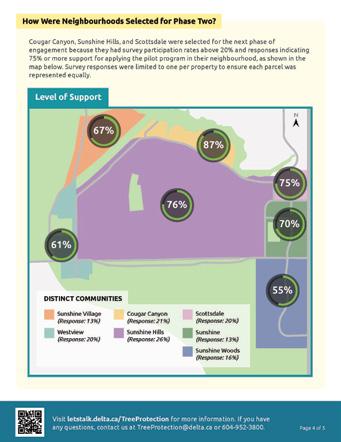
Responses indicate that Sunshine Hills neighbourhood property owners had the highest level of participation across the Sunshine Hills area. This is reflective of the relative size of the neighbourhood compared to Cougar Canyon and Scottsdale.
Q2: Did you or someone in your household complete the first survey to gather input on possible options and gauge interest in a pilot program?
While a majority of respondents participated in Phase One (52%), a significant portion did not (39%), indicating expanded reach and inclusion of respondents who may be encountering the proposed changes for the first time.
Q3: Before today, were you aware of the plans to create a Neighbourhood Tree Protection Pilot Program in the Sunshine Hills area?
Awareness of the proposed pilot program was relatively high, with 79% of respondents indicating at least some level of familiarity. One in five respondents (20%) reported no prior awareness.
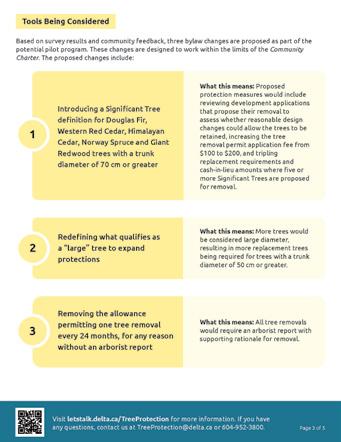
Q4: Lowering the Threshold for Large Trees - To what extent do you support this proposed change?
A majority of respondents support lowering the threshold for large trees (61%) with 14% supporting the change with modifications, indicating overall support for lowering the threshold for large trees.
Please provide your comments
Across all response types, there was consistent recognition that tree loss—particularly related to redevelopment—is a key concern, although views differed on whether lowering the threshold would effectively address this issue. There was also broad alignment on the need for flexibility, with respondents across all groups emphasizing the importance of allowing exemptions for hazardous trees and considering property-specific conditions. Calls for stronger enforcement, monitoring, and complementary approaches were also noted, while a key point of divergence was the balance between protection and property impacts, with some prioritizing expanded tree retention and others raising concerns related to costs, fairness, and property rights.
Continued on next page.
Below is a summary of themes from comments, organized by the three response categories.
Full Support
• Desire to protect more trees with recognition that lowering the threshold would capture more trees under protection alongside concern about ongoing tree loss and its impact on neighbourhood character, aesthetics, and the identity of Sunshine Hills.
• Concern about large-scale tree loss associated with redevelopment and “mega homes,” alongside a perception that current bylaws are not effectively preventing it, with support reflecting a need to better balance housing growth with preservation of mature tree canopy.
• Environmental and ecological benefits, as a rationale for lowering the threshold, with respondents noting that expanding protection would help retain more trees that contribute to air quality, cooling, climate resilience, and erosion prevention, as well as support wildlife habitat, biodiversity, and broader environmental protection goals.
• Interest in clearer implementation and stronger oversight, including how thresholds are applied, how replacement requirements function, and how the City will monitor and enforce compliance.
• Recognition of safety considerations, with support for flexibility to allow tree removal where there are risks to people, property, or infrastructure.
Support with modifications
• Support for lowering the diameter threshold further, with suggestions to reduce it below 50 cm (e.g. as low as 30cm) and views that the threshold should better reflect tree age, condition, and ecological value rather than relying solely on diameter.
• Need for exemptions and flexibility based on property-specific context, with respondents noting that trees posing safety risks or causing damage to homes, infrastructure, or underground services—or those that are hazardous, diseased, or poorly maintained—should be excluded, alongside calls to consider factors such as proximity to structures, lot size, and existing tree density, and recognition that not all properties are suitable for replacement planting.
• Request to focus on large-scale tree loss related to redevelopment, with comments that stronger measures should target redevelopment practices rather than individual homeowners removing a single tree, and views that current and proposed changes may not effectively limit largescale tree removal.
• Stronger replacement and retention requirements, with support for increasing replacement ratios and ensuring comparable species are planted for long-term value, alongside concerns that replacement planting does not adequately compensate for the loss of mature trees and requires stronger oversight.
• Increased penalties and restrictions on removal, with suggestions for higher financial penalties, stricter limitations for newer property owners, and caps on the number of trees that can be removed from a property.
• Support for tree replacement and stronger requirements, including increased replacement ratios, with some concern about where and how replacement trees are planted, a desire for improved monitoring of replacement success, and recognition that replacement planting does not fully compensate for the loss of mature trees.
• Implementation, monitoring and accountability, with concerns regarding the visibility and follow-through of replacement planting and questions about whether trees are being planted and maintained, alongside suggestions for stronger oversight and accountability measures to ensure compliance.
• Calls for greater City accountability, including concerns about perceived inconsistencies in approvals and a desire for the City to lead by example in protecting trees on public land.
Do not Support
• Regulatory overreach and property rights, with comments that the proposed changes impose excessive regulation, limit homeowner autonomy, and restrict control over private property.
• Preference to maintain the current threshold and bylaw, with views that the existing 60 cm definition is appropriate and that current regulations are sufficient without further amendment.
• Increased costs and financial burden, with concerns that the proposed changes would result in higher permit fees, replacement requirements, and overall costs for homeowners, particularly those with multiple mature trees.
• Safety, maintenance, and property impact concerns, with comments that large trees can pose risks to homes, infrastructure, and personal safety, and this may discourage removal.
• Focus on developers and large-scale tree loss, with views that tree removal is primarily driven by redevelopment and that lowering the diameter threshold will not meaningfully reduce canopy loss and may unfairly impact individual homeowners.
• Inequitable impacts on properties with more trees, with concerns that lowering the threshold would disproportionately affect homeowners with higher tree density compared to others.
• Concerns about development, housing, and property use, with views that the proposed changes may restrict redevelopment, limit housing options, or make property use more difficult.
• Desire for consistency across Delta, with concerns that neighbourhood-specific application creates inequity and that regulations should be applied city-wide.
• Views that requirements should be less restrictive for homeowners, with some respondents suggesting thresholds should be easier to meet or allow greater flexibility for non-developmentrelated tree removal.
• Concerns that the proposed change would not effectively preserve neighbourhood character, with views that existing protections already support the aesthetic and environmental qualities that define the area.
Q5: Removing the 1-in-24 Months Allowance - To what extent do you support this proposed change this proposed change?
Responses indicate moderate support for removing the 1-in-24 months allowance, with (43%) of respondents fully supporting the change. However, nearly one-third do not support the change, indicating concern from participants.
I fully support this change I support this change with modifications I do not support this change
Please provide your comments
Feedback in support of removing the 1-in-24-month allowance noted that it could help discourage incremental tree loss. In contrast, those who supported the change with modifications or did not support it expressed concerns that it may disproportionately impact individual homeowners, especially those with more trees, though redevelopment was widely perceived as the primary driver of canopy loss. Views were mixed on the role of arborists, with some seeing value in supporting more justified removal decisions, while others raised concerns about cost, accessibility, consistency, and the need for oversight. There was also consistent emphasis across all respondents on maintaining practical flexibility, particularly to allow for the timely removal of hazardous or clearly problematic trees and to account for site-specific conditions.
Below is a summary of themes from comments, organized by the three response categories.
Full Support
• Perception that this could help prevent unnecessary tree removal more effectively than current allowance and would help to avoid cumulative canopy loss.
• Support for clearer and more consistent rules, with the removal of the allowance seen as strengthening requirements for arborist oversight, evidence-based decisions, and clear justification before any tree removal.
• Support for stronger enforcement and accountability, with suggestions for clarity about what happens when trees are removed without permits, increased penalties and improved enforcement to deter unauthorized removal.
• Questions about whether the rules would apply equally to developers and homeowners, along with concerns about the cost burden of arborist reports and overall fairness in how regulations are applied.
• Calls for greater City accountability and enforcement, including the need for oversight of arborist reports, monitoring of compliance, and meaningful penalties to deter unauthorized or inappropriate tree removal.
• Recognition of the need for flexibility, with support for allowing exceptions where trees pose legitimate safety risks or cause unavoidable damage to property or infrastructure.
Support with modifications
• Concern that arborists may be biased, or financially incentivized to support tree removal, leading to calls for City-approved or vetted arborist lists, independent or third-party review, and increased City oversight and accountability, including suggestions for City-led arborist services and random audits.
• Concern that a one-size-fits-all approach may not be appropriate, with suggestions that tree type (e.g., non-native, ornamental, or fruit trees) and site-specific conditions—such as tree density or the impact of a tree on the property—be considered for exemptions.
• Need for exemptions for safety, damage, and property impacts, with suggestions that trees posing risks or causing damage to structures, infrastructure, or the safe enjoyment of property be eligible for timely removal without full requirements, including consideration of photo-based review in certain cases.
• Concerns about cost, accessibility, and efficiency of arborist reports, with views that the process should be more affordable, timely, and not create barriers to removing trees for legitimate reasons, with suggestions for the City to subsidize or partially reimburse costs or have a City-led inspection as an economical alternative.
• Support for clearer definitions, information and removal criteria, including requests to clarify thresholds, tree types, and what qualifies as a permitted removal or exemption, alongside calls for clearer bylaw wording, more transparent and consistent decision-making processes, faster approvals—particularly for urgent cases—and improved communication, including public display of permits and easier access to information.
• Concerns about loopholes related to development and permitted structures, with views that building design should be adjusted to retain trees and that current wording in bylaw may allow avoidable removal.
• Desire to differentiate between homeowners and development-related tree removal, with comments that individual homeowners removing one tree should be treated differently from largescale removal associated with redevelopment.
• Preference to retain a limited allowance for tree removal, such as permitting one tree every 3–5 years, allowing removal of smaller or non-significant trees, and accommodating minor removals.
Do not Support
• Increased costs and financial burden, with concerns that requiring an arborist report would add unnecessary expense for homeowners, particularly for routine or necessary tree removal.
• Regulatory overreach and property rights, with comments that the proposed change limits homeowner autonomy and imposes control over private property.
• Preference to maintain the current allowance, with views that the existing 1-in-24-month rule provides a reasonable balance and sufficient flexibility.
• Safety, maintenance, and property impact concerns, with comments that trees posing risks or causing damage should be removable without added delays or requirements.
• Views that tree loss is primarily driven by redevelopment and that the proposed change would target homeowners and with requests to focus efforts on new builds, density and loss of multiple trees.
• Inequitable impacts on properties with more trees, with concerns that additional requirements disproportionately affect homeowners with multiple mature trees.
• Concerns about red tape, delays, and administrative burden, with views that the process would introduce unnecessary steps and make tree management on private property more difficult.
• Potential impacts on property use and value, with concerns that increased restrictions may limit redevelopment options, property use, or future resale value.
Q6: Creating a Significant Tree Definition - To what extent do you support this proposed change?
Responses indicate moderate support for introducing a Significant Tree definition, with a notable proportion of respondents supporting the change with modifications (28%).
I fully support this change I support this change with modifications I do not support this change
Please provide your comments
There was broad interest in strengthening financial deterrents, limiting the number of trees that can be removed, and enhancing replacement requirements, alongside concerns related to costs, space constraints, and the long-term maintenance of replacement trees. Some respondents also questioned whether the proposed approach would be effective in influencing developer behaviour. Views varied on the balance between enhancing protection and maintaining fairness for homeowners, with some supporting stricter measures to preserve significant trees and others raising concerns about financial burden, property rights, and whether the proposal adequately targets development-driven canopy loss.
Below is a summary of themes from comments, organized by the three response categories.
Full
Support
• A defined category would help preserve large canopy-forming trees and maintain neighbourhood character and environmental benefits.
• Support for increased fees and stronger financial deterrents, with views that higher permit costs and cash-in-lieu contributions are needed to discourage unnecessary removal, particularly by developers.
• Concern about large-scale tree loss from redevelopment, with support reflecting a need for the Significant Tree designation to meaningfully influence building design and reduce the removal of mature trees associated with larger homes and redevelopment pressures.
• Support for a retention-first approach in development applications, with views that building design should be adapted to preserve significant trees wherever possible.
• Recognition of the need for flexibility, with support for allowing exceptions in situations where strict application of the definition may not be appropriate across all property contexts (e.g. properties with multiple trees).
• Acknowledgement of safety and hazard-based considerations, with support for permitting removal where trees pose risks to people, property, or infrastructure despite meeting the Significant Tree criteria.
• Interest in clearer implementation and definitions, including how Significant Trees are classified, how replacement requirements are applied, and how compliance will be monitored and enforced.
Support with modifications
• Views that removal should be limited to unsafe or necessary cases and that development should be designed to retain trees wherever possible.
• Need for flexibility for safety and property-specific conditions, with views that exemptions should apply for dangerous trees and that site-specific factors should be considered.
• Need for higher fees, lower diameter threshold and stronger financial deterrents, with views that proposed costs are too low to influence behaviour, alongside concerns that a “pay-to-remove” model may persist—particularly for development—where fees are treated as a cost of doing business and may not effectively prevent large-scale tree removal.
• Stronger replacement requirements and on-site planting, with support for replanting trees on the same property and concern that current approaches do not adequately compensate for the loss of mature trees.
• Uncertainty about feasibility of replacement requirements, with comments that required replacement numbers may not be realistic given lot size and space constraints.
• Desire to differentiate between developers and homeowners, with views that developmentrelated tree removal should be subject to stricter requirements and higher costs
• Concerns about cost impacts and fairness for homeowners, with views that requirements may be too burdensome for individual property owners and should differentiate between homeowners and developers.
• Desire for Caps on Tree Removal limiting the number of Significant Trees that can be removed from a property, with suggestions that caps should apply regardless of replacement or payment plans.
• Interest in incentives for tree retention, with suggestions to introduce financial or tax-based measures to encourage homeowners to preserve mature trees.
• Support for stronger enforcement and accountability, with calls for improved monitoring and penalties to ensure compliance with tree protection bylaws.
• Perceived limits of replacement trees, with recognition that replacement planting does not replicate the ecological or aesthetic value of mature trees, and that large, established trees are effectively irreplaceable and require stronger protection.
• Requests for clearer definitions and implementation details, including how trees are classified, how replacement requirements are applied, and how cash-in-lieu contributions are used.
Continued on next page.
Do not Support
• Increased costs and financial burden, with concerns that proposed fees, replacement requirements, and cash-in-lieu contributions would create significant expense for homeowners and impact housing affordability.
• Regulatory overreach and property rights, with comments that the proposal limits homeowner autonomy and imposes excessive control over private property.
• Preference to maintain the current bylaw, with views that existing regulations are sufficient and provide an appropriate balance between protection and flexibility.
• Ineffective in addressing development and large scale tree loss, with views that developers may treat fees as a cost of doing business and that the changes may not prevent canopy loss.
• Concerns about feasibility of replacement requirements, with comments that required replacement numbers are unrealistic given lot size and space constraints.
• Safety, maintenance, and property impact concerns, with views that large trees can pose risks and should be easier to remove when causing damage or safety issues.
• Negative impacts on property use, development, and value, with views that increased restrictions may limit redevelopment potential and affect property value.
• Concerns about replacement effectiveness and loss of mature trees, with comments that replacement planting does not adequately compensate for the loss of established canopy.
• Measures do not go far enough to protect Significant Trees, with some respondents indicating opposition based on the need for substantially stronger restrictions, higher fees, or stricter limits on removal.
• Suggestions that tree protection should consider species differences, with views that nonnative or less desirable species should not be subject to the same level of protection.
• Disproportionate impact on properties with a higher number of trees, with views that homeowners who have retained more trees are unfairly penalized compared to those with fewer trees.
Q7: Do you understand that these changes could mean higher costs and additional requirements should you need to remove trees on your property for any reason?
Respondents understanding of impacts was high, with 99% indicating awareness of potential increased costs and requirements.
Q8: Based on the proposed bylaw amendments described in this survey, do you support the implementation of a Tree Protection Pilot Program in your neighbourhood?
Survey results indicate strong overall support for the pilot program, with 71% of respondents in favour and 29% not supporting its implementation in their neighbourhood.
Q9: You indicated you completed the Phase One survey regarding the proposed Sunshine Hills Neighbourhood Tree Protection Pilot Program. In that survey, did you support the proposed Sunshine Hills Neighbourhood Tree Protection Pilot Program?
Among the 231 respondents who participated in the Phase One survey, 74% indicated they previously supported the pilot program, while 13% did not and 13% were unsure.
Note: Those who indicated they had completed the Phase One Sunshine Hills Neighbourhood Tree Protection Pilot Program survey were also asked whether they supported the Pilot Program at that time. Based on their responses, participants were grouped into the following categories: Supported, no change; Supported previously, now oppose; Opposed, no change; and Opposed previously, now support. Respondents who did not recall their previous response were grouped under I don’t recall.
Continued on next page.
Responses indicate that most participants did not change their opinion between Phase One and Phase Two, with 70% continuing to support the pilot program and 13% continuing to oppose it. A small proportion (3%) shifted from supporting the program to opposing it.
Please tell us why your view has changed.
Among the eight respondents who reported a change in view, shifts were primarily driven by concerns about the effectiveness and focus of the proposed measures. Respondents questioned whether the changes would meaningfully deter redevelopment-related tree loss and noted they may instead create a financial burden for property owners. There was also interest in more directly targeting developers rather than homeowners.
Below is a summary of themes from comments.
• Views that proposed measures do not meaningfully deter large scale tree loss from redevelopment, as increased fees are seen as too low to influence behaviour and unlikely to prevent ongoing canopy loss.
• Desire to target developers rather than homeowners, with comments indicating that proposals disproportionately impact long-term property owners while failing to address redevelopment as the primary driver of tree loss.
• Desire for stronger tree protection measures, with perceptions that current proposals do not go far enough and calls for more meaningful deterrents and stronger regulatory approaches to preserve tree canopy.
• Cost concerns, with views that proposed changes introduce financial burdens that may be too high for property owners.
Q10: Do you have any additional comments about the proposed Neighbourhood Tree Protection Pilot Program that have not been captured in the survey?
The 258 responses reflect mixed views, with consistent themes around fairness, cost, and effectiveness. While there is reiteraton of support for protecting mature trees for environmental and neighbourhood character reasons, concerns continued to be raised about property rights, financial burden, and whether the proposed measures will effectively address large scale tree loss. Respondents also called for clearer implementation, stronger enforcement, and flexibility for safety considerations, with mixed views on expanding the program city-wide.
• Frustration with current maintenance of boulevard or City-owned trees and requests for improved pruning, inspection, and care of public trees.
• Concerns that the area is already heavily treed or overgrown, questioning the need for additional measures where they affect food gardening, infrastructure, and property use.
• Requests to allow periodic removal without substantial penalties where tree density is significantly higher than surrounding properties.
• Suggestions for incentives and alternative approaches, including ideas such as tax incentives, rebates, or minimum tree requirements for each property to encourage retention rather than relying solely on penalties.
• Concerns about trust, transparency, and process are expressed, with some respondents questioning the effectiveness of engagement and whether feedback will meaningfully influence decisions.
• Concern about property rights and perceived government overreach, with some respondents expressing that homeowners should retain greater control over tree management on private property and avoid additional regulatory burden, alongside questions about municipal liability for damage caused by retained trees.
• Ongoing tension between housing needs and tree protection, with views that redevelopment and densification are primary drivers of tree loss and that current proposals may not adequately address development-related impacts while increasing costs for homeowners.
• Concern about increased costs and financial burden, particularly for existing homeowners, with perceptions that fees may be unaffordable, inequitable, or treated as a cost of doing business by developers.
• Continued support for tree protection, with many respondents emphasizing the importance of preserving mature trees for environmental, aesthetic, and community value.
• Recognition of safety and risk considerations, with calls for clear allowances to remove trees that pose hazards to property, infrastructure, or personal safety.
• Mixed views on program scope and expansion, with some advocating for broader, city-wide application and others expressing concern about targeting specific neighbourhoods.
• Fairness and equity concerns, including perceptions that the program may disproportionately impact certain property owners, particularly those with more trees or long-term ownership.
• Need for clearer implementation, communication, transparency, and enforcement, including how the program will be implemented, how decisions are made, how compliance is monitored, and how replacement requirements are fulfilled.
• Concern about loss of neighbourhood character, with many respondents linking tree removal to changes in aesthetics, livability, and the overall identity of the community.
• Emphasis on climate and environmental considerations, with recognition of trees as critical for ecosystem health, climate resilience, cooling, and supporting biodiversity.