Table 8 - Degree of structure and level of competition in sport participation for children aged 5–17 (Data from 2022) .....................................................................................
Table 9 – Percentage of adults participating in unorganized physical activity/sport and their level of satisfaction with the number of opportunities available (Canada) (Data from 2016–2018) ............................................................................ 29
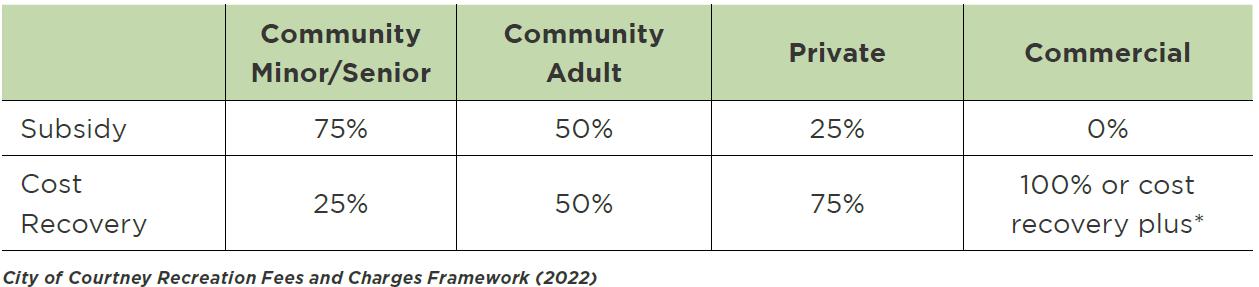
Table 10 - City of Courtney Example .................................................................................................. 33
REFERENCES
Clemente, F. R.-C. (2021). Effects of Small-Sided Game Interventions on the Technical Execution and Tactical Behaviors of Young and Youth Team Sports Players: A Systematic Review and MetaAnalysis. Front. Psychol..
Gyarmati, S. (2024). Here's Metro's Population Projections for Delta. July 2024. Retreived from : https://www.delta-optimist.com/local-news/heres-metros-population-projections-for-delta9210064. Delta Optimist.
Jacques, I. (2022). Delta's Population Shows Modest Growth. Retrieved from: https://www.deltaoptimist.com/local-news/deltas-population-shows-modest-growth-5051327. Delta Optimist
LA28. (n.d. ). LA 2028 Olympic Sport Program. Retrieved.; from LA28: https://la28.org/en/LA28_Sports_Program.html
NPRA. (2018). Park and Recreation Inclusion Report. Retreived from https://www.nrpa.org/contentassets/e386270247644310b06960be9e9986a9/park-recreationinclusion-report.pdf. National Recreation and Park Association..
Onatrio Volleyball. (n.d.). Ontario Volleyball. Retrieved from https://www.ontariovolleyball.org/grassvolleyball
OTRF. (2021). Usage Goals for Winning Sports Turf. Toronto: Ontario Turfgrass Research Foundation. Retrivied here:https://www.otrf.ca/wp-content/uploads/2021/02/otrf_brochure_finaljan21_print.pdf.
Sport Turf Canada. (2012). Athletic Field Construction Manual. Guelph: Sports Turf Association, Canada. viaSport. (n.d.). Climate Change. Retrieved from viaSport British Columbia: https://viasport.ca/climatechange/#:~:text=Rising%20temperatures%20make%20playing%20outdoors,cancellation%20of% 20practice%20or%20competition.
World Lacrosse. (2020). 2019-2020 Annual Report. Retrieved from https://d13mgad1aost97.cloudfront.net/2020/11/FINAL-2019-20-World-Lacrosse-AnnualReport.pdf
APPENDICES
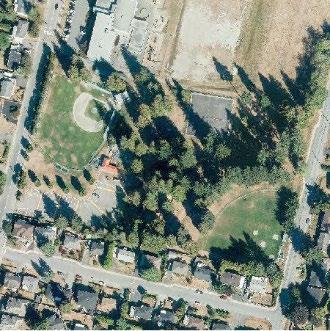
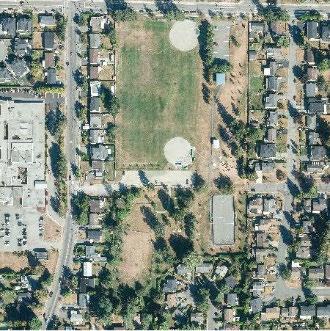
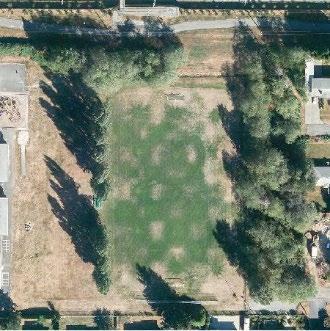
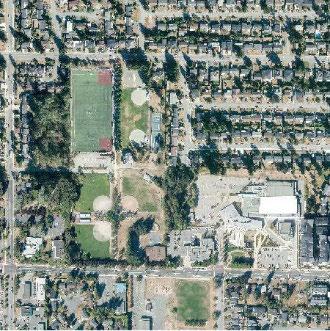
Appendix A: Master Field Inventory, Aerial Images
Appendix B: Field System Inventory and Data Collection Process, Inventory Attributes
Appendix C: Joint-Use Agreements
Appendix D: User Groups – Delta Communities
Appendix E: City of Delta Allocation Policy
Appendix F: Fields Fees and Charges Comparison
Appendix G: User Group Engagement Feedback
Appendix H: Weekly Facility Use
Appendix I: Field Use Hours by Group and Facility
1 ACKNOWLEDGEMENTS
Land
The City of Delta (the City) is comprised of the communities of North Delta, Ladner, and Tsawwassen, which are located on the shared, traditional, ancestral and unceded territories of the scəwaθən (Tsawwassen), xʷməθkʷəy̓əm (Musqueam), and other Coast Salish Peoples.
Project and Team
The information outlined in this report serves as a tool to inform the future planning and development of outdoor sports fields and amenities to serve City residents for the next 10 years and beyond.
This report would not be possible without the input and participation of many local City outdoor sports organizations, and the guidance from City of Delta Parks, Recreation, and Culture staff. The following are acknowledged for their contributions:
Sports Groups and Organizations
Organization
Adult Soccer
BC Christian Soccer League
British Columbia Mainland Cricket
Canada West Field Lacrosse League
Delta Fastpitch Association
Delta Force Soccer
Delta Lacrosse Association
Delta Stars/Lower Mainland Baseball Association
Ex-Britannia Red Lions Athletic Association
Falcons Field Hockey Club
Ladner Men’s Fastball
Ladner Minor Baseball
Ladner Mixed Slo-Pitch
Latino Workers Support Society
North Delta Baseball Association
North Delta Football Association
City of Delta
Doug Rose, Manager of Parks and Recreation Planning
Dan Cooper, Director, Parks and Planning
Organization
North Delta FC
North Delta Mixed Slo-Pitch
North Delta Stingers Over 65 Soccer
Patriots Cricket Club
Punjab Burricanes
South Delta Men’s Soccer - Fall/Winter
South Delta Outdoor Volleyball Association
South Delta Rams Football
South Delta Slo-Pitch Group
South Delta United
South Delta United Soccer Club (Over 45’s)
Touch Football BC
Tsawwassen Amateur Baseball Association (TABA)
Tsawwassen Men's Masters Slo-Pitch
Tsawwassen Mixed Slo-Pitch (25+)
James Palframan, Recreation Service Manager, Fitness and Outdoor Sport
Danielle Rancourt, Park Planner
Consulting Team
R. F. Binnie & Associates Ltd.
R C Strategies
2 EXECUTIVE SUMMARY
The City of Delta (the City) is committed to continuing to provide quality outdoor sports facilities and related services to meet current and future needs of residents. The City is expecting its population to grow by 24% in next 10 years, increasing by approximately 26,551 residents by 2035 Looking at the projected growth, a review of the current inventory, trends and practices, usage patterns, and system administration policies is needed to understand service levels, identify gaps, find opportunities to create capacity, optimize facility use and capacity, as well as improve facility management, operations, and allocation.
The general growth trend shows an aging demographic with the 75+ age group expected to show the greatest increase. Another item of note is the changing diversity, with 45% of the population to be of diverse ethnicity In the development design and delivery of outdoor sports facilities and supporting infrastructure, the City will need to consider age-friendly facilities and programs to recognize the strong interest and passion of outdoor sports among ethnic communities. The City will also need to be conscious of increasing access to sports and recreation for diverse individuals across a range of socialeconomic classes in the context of increasing capital and operational costs of providing services.
Outdoor sport activities continue to grow and are an integral part of the healthy lifestyle of Delta residents. There are approximately 64 sports groups primarily representing baseball, softball, slo/fastpitch, soccer, lacrosse, football, rugby, and cricket These groups and residents enjoy access to an inventory of 71 reservable outdoor ball and rectangle fields managed and maintained by the City (supplemented by 45 fields on school sites).
The City’s provision of outdoor sports fields is keeping pace with the standards of other local and regional communities. Applying the current provision standards and service levels to the projected growth for the next 10 years shows that additional field capacity is required to accommodate future demand. This assumes all fields in the inventory are at capacity and optimized.
The additional field capacity required to accommodate the community's growth can largely be provided through more efficient use of the City's existing facilities. A detailed review of residual capacity and more efficient ways to use existing facilities actually suggests that there is enough capacity in the current inventory to accommodate future demand without prioritizing development of new additional fields. However, not all fields are equal nor can they all accommodate changing program needs. As such, appropriately matching facilities and specific/changing programs needs to be ongoing to assess the priority for facility improvements or additional inventory.
For example, collectively, ball diamonds are, on average, used to 78% of capacity. However, many natural turf ball diamonds, notably those programmed for baseball, are used up to or beyond their capacity (up to 65% beyond optimum recommended standards to allow for recovery and maintenance of field quality and longevity) Rectangle fields are, on average, used up to 43% of capacity and appear to have residual capacity to accommodate some growth. A priority for future provision should be on improving or adding ball diamonds and a new cricket pitch. Refer to Section 10.3 and 11.0 for more information.
Based on the findings of this review, non-ranked recommendations include:
Capacity Creation
Optimize existing field capacity through a variety of improvements, including upgrading surfaces to synthetic turf, synthetic infield, and from soil to sand or blended base profiles; upgrading field grading and drainage; and adding lighting.
Redistribute field hours and reassign user groups to rebalance extreme usage and optimize existing field capacity (e.g., softball) while reconfiguring under-utilized fields to meet high demands from other sports (e.g., baseball programs).
Continue partnerships with School District #37 to redevelop school fields, adding to the inventory of safe and premium facilities able to accommodate a range of play and program development. Also develop partnerships with for-profit and/or non-profit organizations to deliver associated amenities, features, facilities, or services to enhance user experience.
Comprehensive Field Classification Development
Set standards to distinguish classes of fields, outlining conditions, quality, program, and associated amenities or features, which will inform planning, design and development, and operation and maintenance of the facilities. This will also help define use expectations and provide cost clarity and transparency for users.
Allocation Policy Update
Improve how field hours are distributed among user groups to optimize field use, balance demand and supply to address the needs of youth and adult programs and strive for equitable access to facilities.
Fees and Charges Update
Align rates with field classifications, allocation policies, and with other local and regional municipalities to confirm that the rates are meeting target revenue or cost recovery, which will help to offset municipal contributions to sustain current and future operational and maintenance costs.
Data Collection
Improve collection of valuable information and insight into user behaviour, needs, and demands. More information will better inform strategic and investment decisions.
Equity and Inclusion
Initiate strategies to raise diversity awareness and increase equity and inclusion in the delivery of parks and recreation programs and facilities.
Infrastructure Improvements
Propose improvement projects based on review of current inventory, usage patterns, allocation data, participation trends, and feedback from user group engagement. Include items that focus on safety, increasing capacity, and enhancing player experience, such as:
Improve field surfaces and drainage to address irregular turf surfaces and flooded conditions considered to be hazardous and unplayable.
Develop a sport hub to provide centralized facilities with more full-sized fields including cricket and indoor court facility as well as better access to more features, amenities, and services The hub will serve as a destination venue that can host larger tournaments and events. There is support for the development of John Oliver Park for this purpose.
Update existing field programming and layout to optimize low-use fields to meet highdemand sports programs.
Improve access to basic amenities at facilities (e.g., redevelop existing or build new washrooms/changerooms, storage, drinking water fountains, covered seating, and related sports equipment).
Refer to Section 11 for more information and see Table 36 for the full list of proposed facility and park improvements.
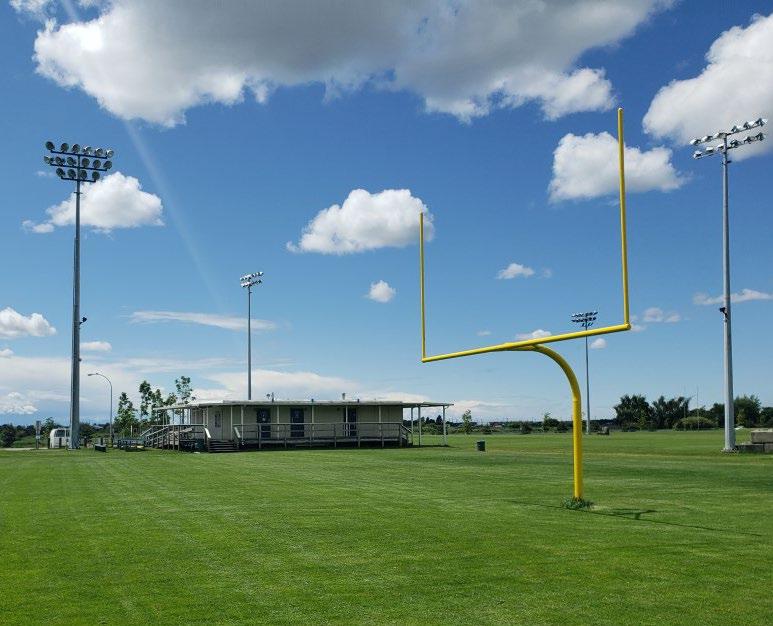
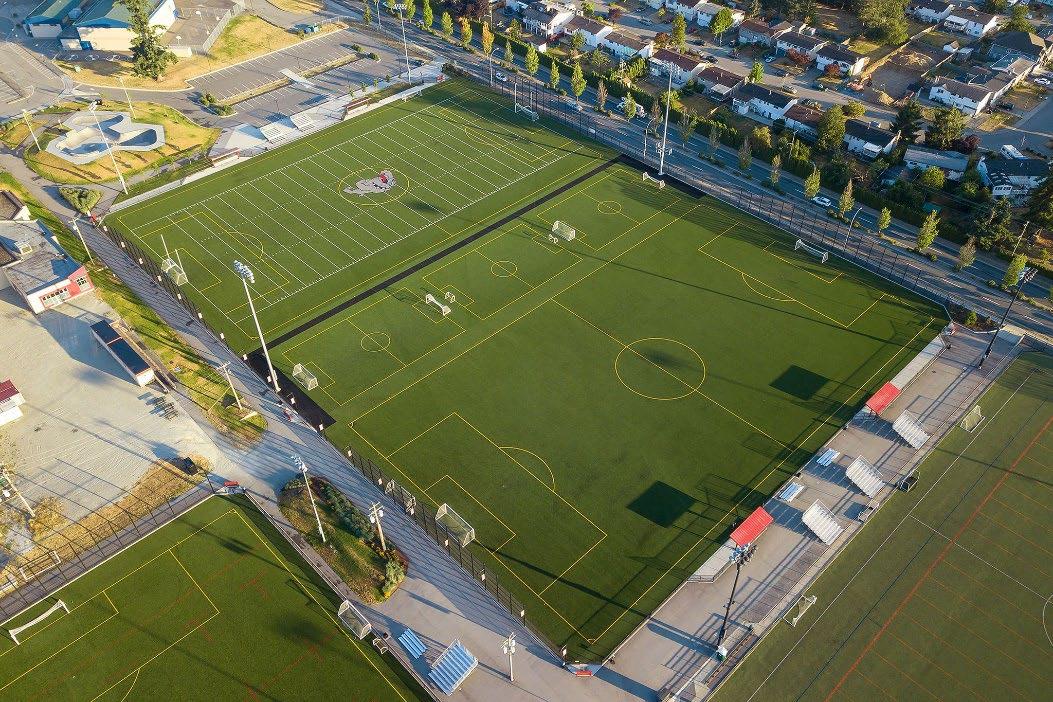
Fieldhouse, Football field 1, John Oliver Park, Photo: Binnie
3 INTRODUCTION
3.1 Purpose
As the City of Delta continues to grow, they are committed to continuing to provide quality services and infrastructure to meet the current and, most critically, future needs of all Delta residents and communities, where there has always been a strong interest and trend in outdoor sports and associated activities.
The City wants to review and reassess the current inventory of ball diamonds and rectangle play fields, benchmarks, trends, and practices in order to identify gaps in service and capacity, opportunities to optimize facility use and longevity, and administration policies to create a plan that will help guide planning and development decisions for the next 10 years and beyond. Findings and recommendations of this assessment will give members of various local and regional sports organizations enhanced and equitable opportunities to access City facilities and amenities.
3.2
Process
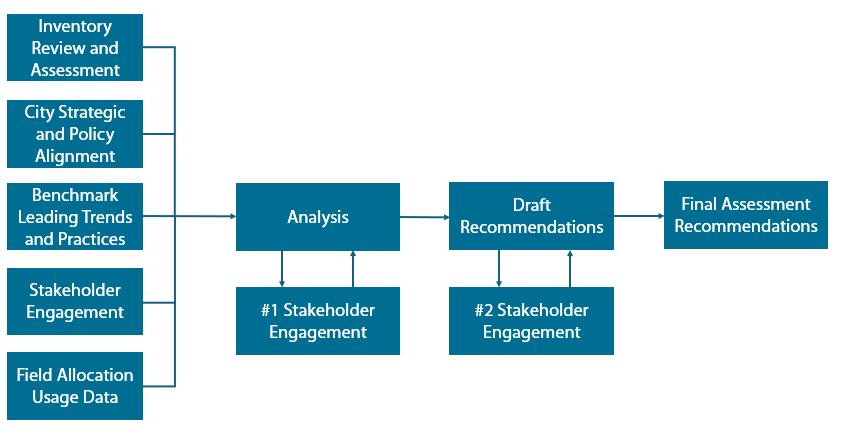
This report will review and consider the existing inventory of reservable ball diamonds and rectangle sport fields in City parks, strategic alignment, sport activity trends, allocation, benchmarking, leading practice, and field usage and patterns, as well as input and feedback from various sports organizations and stakeholders. Detailed data collection and analysis will exclude non-reservable, casual, spontaneous use facilities, and fields on school sites.
Figure 1 - Process Diagram
4 BACKGROUND
4.1 City Sport Fields
The many outdoor sports organizations in the City have always been and continue to be an active community with a strong interest for better and more facilities to support and grow their programs. The current inventory of outdoor field facilities, both City park and School District facilities, are well used and in high demand by residents for casual use and organized youth and adults’ sports groups, as confirmed by the annual total of field hours booked. Many sports clubs are actively growing their sport and, with expected population growth, the City is assessing their current inventory, usage patterns, and needs for future service levels.
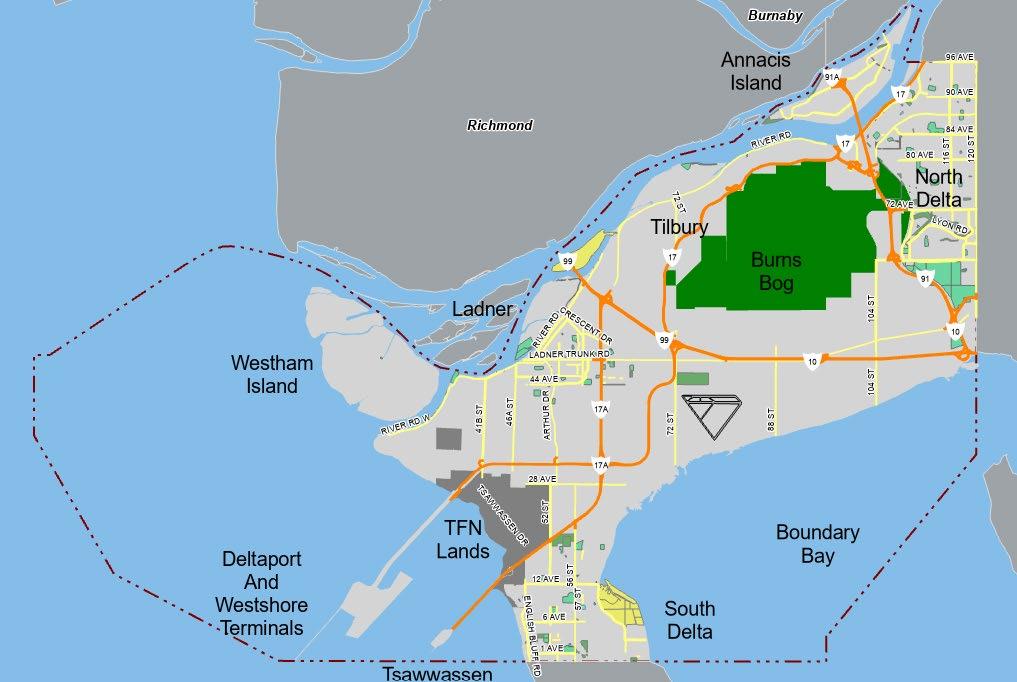
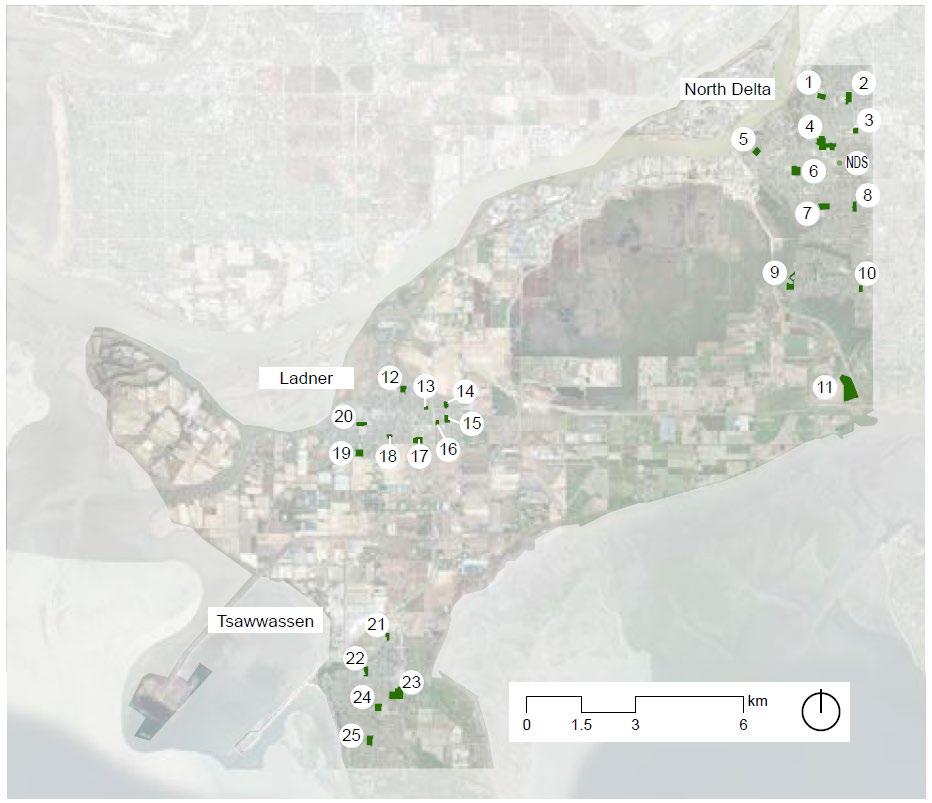
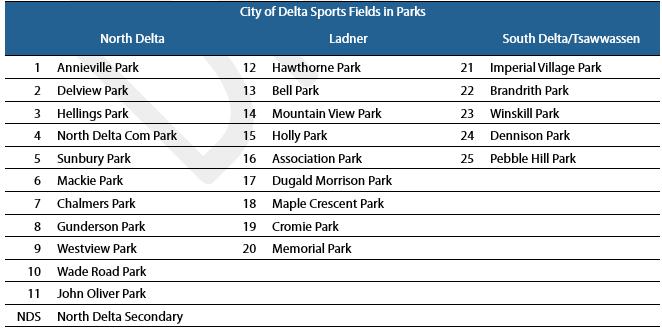
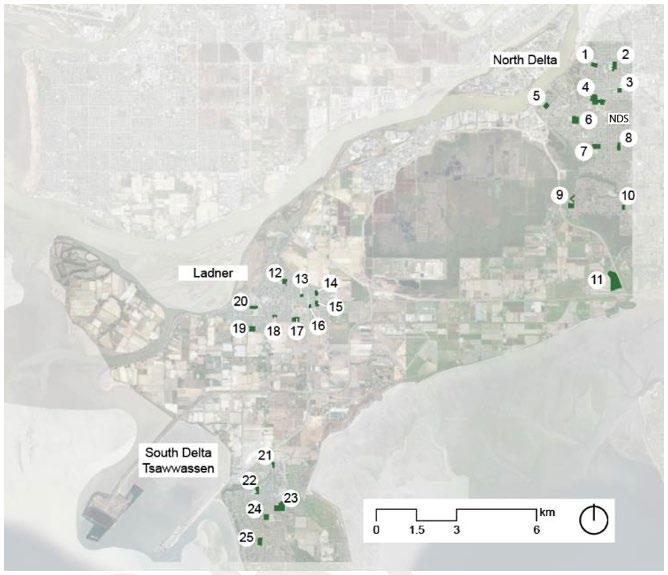
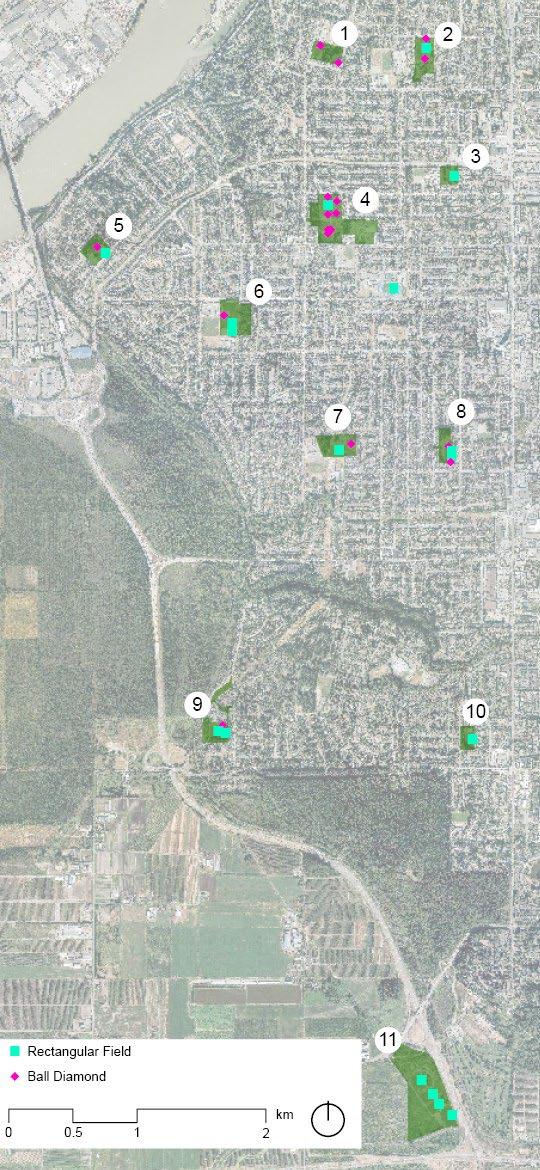
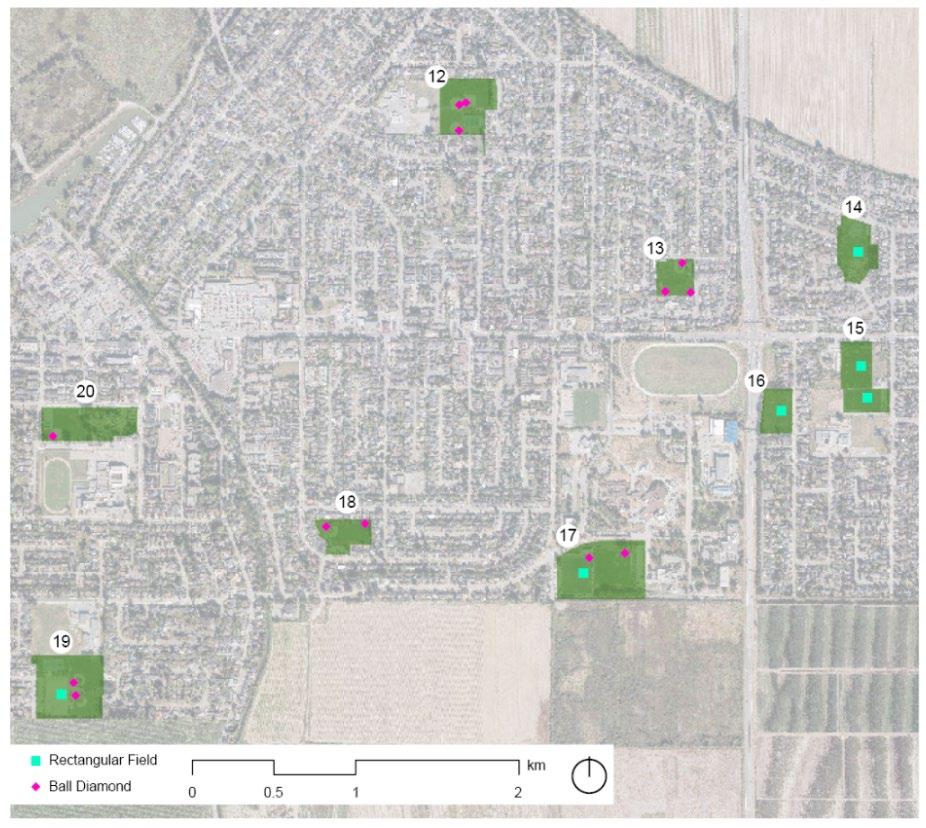
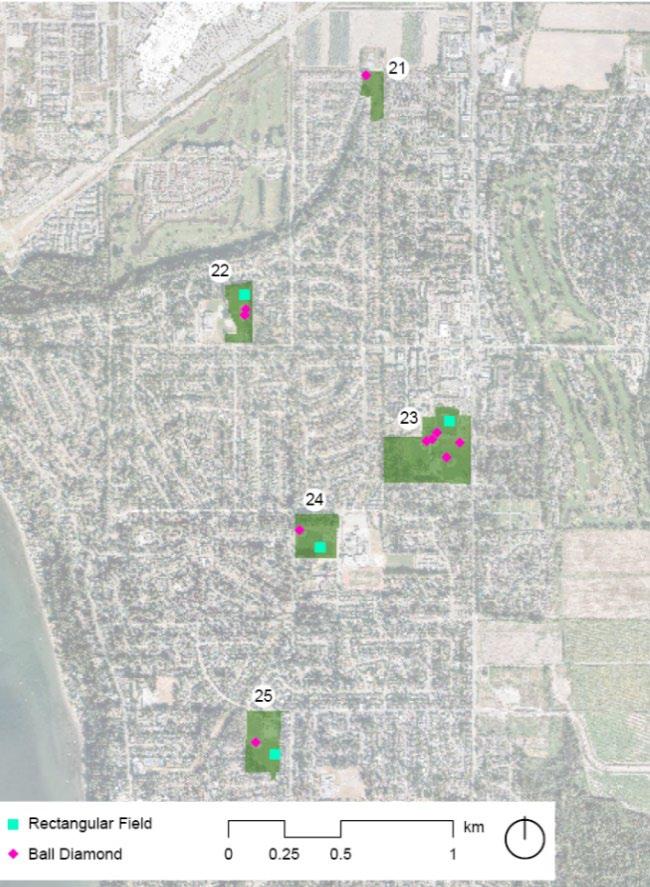
Figures 2 and 3 illustrate the location and distribution of athletic parks within the City, in the communities of North Delta, Ladner, and Tsawwassen
Figure 2 - City of Delta
There are 71 ball and rectangle sports fields distributed within 26 sites across the City’s communities, with about 48% located in North Delta, 30% in Ladner, and 22% in Tsawwassen. The distribution in each Delta community is summarized in Table 1
Table 1 - City Sport Fields Distribution
*City of Delta Growth Study, Watson & Associates Economists, 2024
**School District fields are excluded in the total
4.2 City Profile, Population, and Demographics
In March 2024, Watson & Associates Economists Ltd. completed a report analyzing the population, employment, and housing for the City. The total population in the City of Delta is estimated to be 111,900 residents (Watson & Associates Economists Ltd, 2024), with the population having increased by 6.1% between the 2016 and 2021 census (Jacques, 2022).
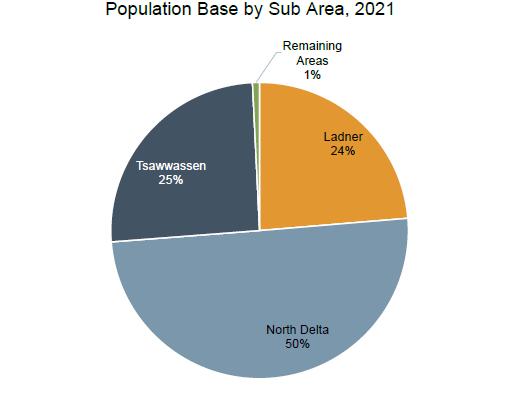
Currently, the City is made up of three urban communities: North Delta, Ladner, and Tsawwassen. The population distribution for each community based on the 2021 census is summarized in Table 2.
Table 2 - Delta Population Distribution
Source: Derived by Watson & Associates Economists Ltd.,2024.
According to the City of Delta Growth Study (Watson & Associates Economists Ltd, 2024), the population is expected to increase by 26,551 residents by 2035 to 138,451 An estimate of 13,807 people (Gyarmati, 2024), over half of total projected increase, is forecasted to reside in the North Delta area with the remaining growth to be divided equally between Ladner and Tsawwassen communities.
4 - Population Base by Sub Area, 2021
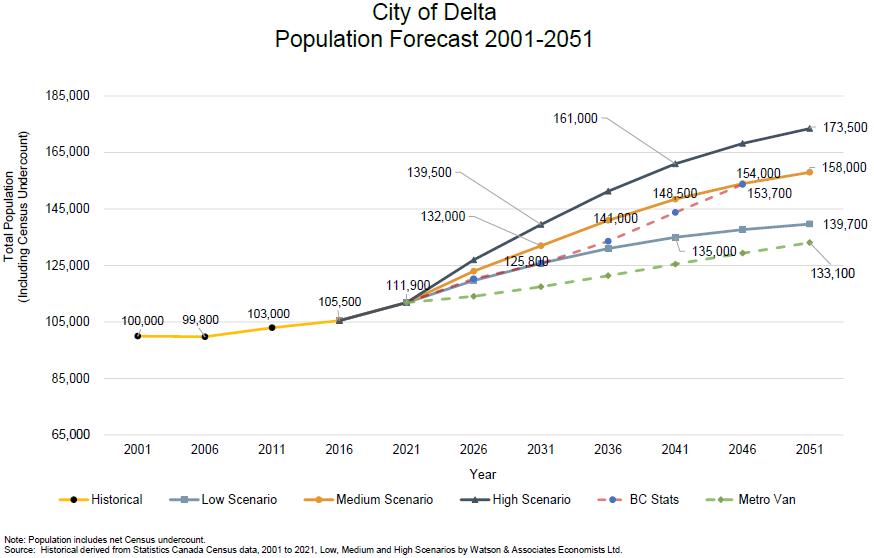
High, medium, and low population growth scenarios for the next 30 years are presented in Figure 5 below (Population Forecast 2001–2051) The Population, Employment, and Housing Analysis report forecasts that annual population growth will range from 0.7% (low scenario), 1.2% ( medium scenario), to 1.5% (high scenario) from 2021 to 2051.
Figure 5 - Population Forecast 2001 - 2051
Figure
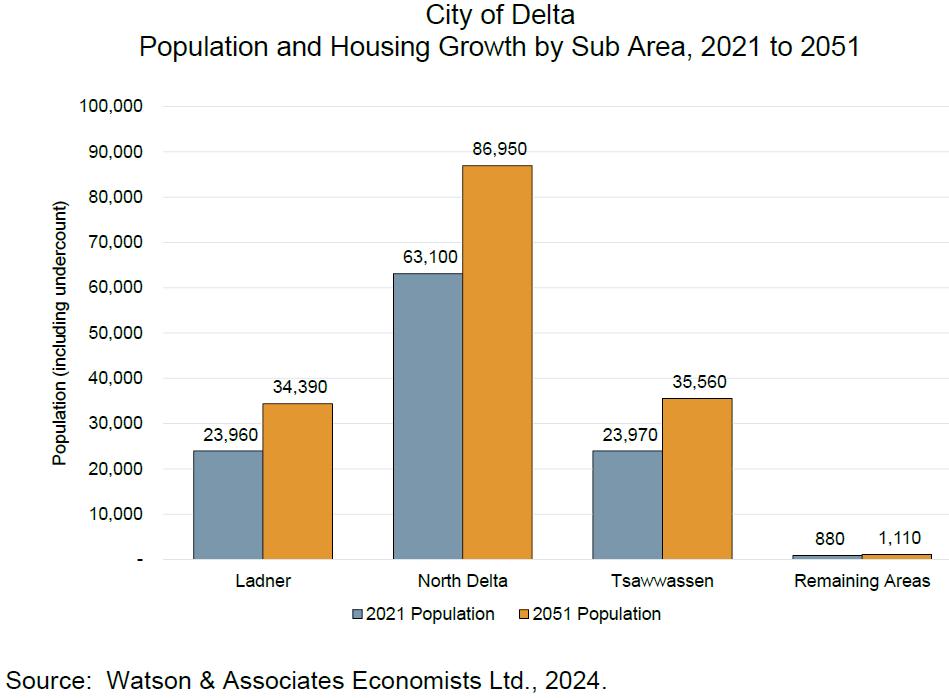
The Population and Housing Growth by Sub Area, 2021 to 2051 graph illustrates the projected growth for each community. Each area of the City is expected to experience between 27–33% growth over the forecast period.
6 - Population Housing Growth by Sub Area 2021–2051
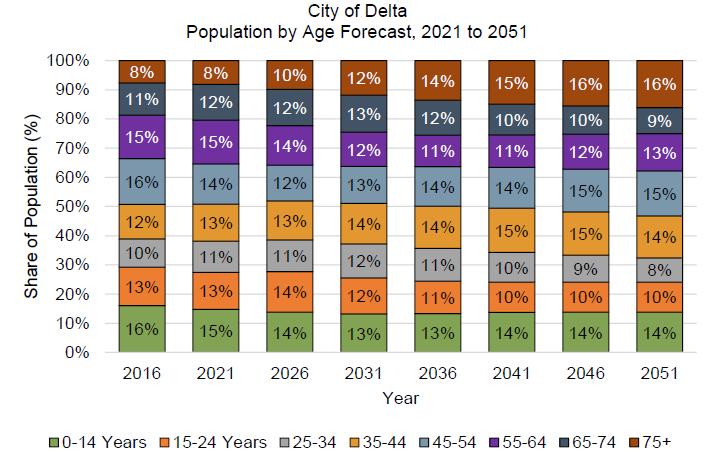
The following Population by Age Forecast graph summarizes population growth forecasted by age groups from 2021–2051. Most age groups maintain a similar proportion of the population during the forecast period except for the 75+ age group. The 75+ age group is expected to grow from 8% to 16%. This is consistent with regional trends, which anticipate the aging population to have an increased share of the demographic landscape. When looking at the 10-year horizon, the 75+ age group is expected to grow to 14%, while the 0–14 age group is projected to shrink from 16% to 13%. (City of Delta Growth Study, March 2024)
Figure
Figure 7 - Population by Age Forecast, 2021–2051
Source: Population forecast by age derived from 2001 to 2021 Statistics Canada Census data 2021 to 2051 population forecast by age prepared by Watson & Associates Economists Ltd., 2024.
4.3 Ethnic Groups and Immigration
In 2021, 55% of the population in Delta was Caucasian. The next largest ethnic group was South Asian (26%), followed by Chinese (9%) and Filipino (3%).
8 - Top 4 Ethnic Groups in Delta
Top 4 Ethinic Groups in Delta
Source: Statistics Canada, 2021 Census of Population
As illustrated in Figure 9, The top five places of origin of recent immigrants to Delta in 2021 was India (47%), China (13%), the Philippines (8%), Syria (5%), and the United States of America (3%).
Figure
Figure 9 - Top 5 Places of Origin
Top 5 Places of Origin of Recent Immigrants
Source: Statistics Canada, 2021 Census of Population
4.4 Education, Employment, and Income
Most residents aged 25–64 in Delta have some form of post-secondary education (64%). Only 8% of residents aged 25–64 have no certificate, diploma, or degree.
Figure 10 - Education Level
Highest Level of Education for Residents Age 25 - 64 years
Source: Statistics Canada, 2021 Census of Population
According to Statistics Canada, the average annual household income after tax in Delta is $107,500.
Figure 11 illustrates the breakdown of the labour force by occupation type. Delta’s largest labour force is sales and service occupations (25%), followed by trades, transport, and equipment operators and related occupations (22%), and business, finance, and administrative occupations (18%)
Approximately 4% of residents aged 18–64 are considered low income after tax in Delta.
India China Philippines Syria United States of America
Percentage of Employed Labour Force
Sales and service occupations
Trades, transport and equipment
operators and related…
Business, finance and administration occupations
Occupations in education, law and social, community and…
Natural and applied sciences and related occupations
Health occupations
Occupations in manufacturing and utilities
Occupations in art, culture, recreation and sport
Natural resources, agriculture and related production…
Legislative and senior management occupations
Source: Statistics Canada, 2021 Census of Population
4.5 Key Findings - Community Overview & Potential Impacts
The City’s population is expected to steadily age, with the 75+ age group forecasted to experience the most growth, doubling over the forecast period. An aging population will generate added demand on recreation facilities and services that orient to older persons. An age-friendly lens should be considered in the development and design of sport fields and support infrastructure. Age-friendly considerations may include:
Accessible dugout designs
Universal washroom facilities
Barrier-free pathways
Approximately 45% of Delta residents are of non-Caucasian ethnicity. The popularity of field sports among these ethnic communities is significant and is likely to drive future demand. The City’s ethnic makeup needs to be considered when determining future needs. Field programming may need to diversify to include sports that have not traditionally been provided in the City (e.g., Futsal)
With the rising costs of living, many residents are getting by with less funds available for quality-of-life services such as recreation and sport. The City may need to support more individuals and families in accessing sports and recreation programs, and work with community partners to promote available supports.
5 STRATEG IC AND POLICY ALIGNMENT
5.1 Policy Alignment
This asset review and assessment intends to align with related and overarching City policy and leverage previous planning considerations and strategic recommendations
Summarized below are documents that have been reviewed by the project team for their insights and integration into the needs review.
5.1.1 Delta Official Community Plan (OCP) 2024, Housing Our Future
Table 3 summaries the key excerpts from the Parks, Recreation, and Culture section of the OCP that may guide the planning and development of sport fields in the future.
Table 3 – Recommendations - Parks and Recreation, OCP
Planning for Parks, Recreation and Culture
“Plan for a comprehensive parks, recreation, and culture system that meets the needs of future generations.”
2.9.1. Update the 1989 Parks and Recreation Master Plan, and include standards for parks, recreation facilities, and services.
2.9.6. Develop parkland provision targets for community and neighbourhood parks and regularly review and update the parks, recreation, and culture inventory to ensure that demographic and geographic needs are met.
2.9.9. Work in partnership with other agencies and organizations such as adjacent municipalities, regional, provincial and federal governments, local Indigenous communities, and community groups to provide and maintain a coordinated system of parkland, trails, services, and recreation and cultural facilities and programs while protecting ecological and cultural resources.
Recreation and Cultural Services
“Provide a balance of recreation and cultural services, facilities and programs for the development of an active and healthy community.”
2.9.12. Work to provide a range of areas, facilities, programs and amenities that support both active and passive recreational uses and that meet the changing needs of the community; these would include social, athletic, fitness, recreational and cultural facilities, parks and open spaces, trails and bike paths, and natural areas.
2.9.13. Work in partnership with community organizations and volunteers to maintain and create special purpose parks and amenities that appeal to different interests, ages, and abilities with an emphasis on sustainable partnerships.
2.9.17. Work with the Delta School District to provide for the effective, reciprocal, and integrated use of municipal and school facilities, land, and programs that will maximize the community benefit of government resources.
2.9.18. Work with the Delta School District to coordinate, where possible, the development, redevelopment, upgrading, and management of recreational and cultural amenities.
2.9.21. Ensure parks and recreation facilities are designed and operated to maximize equitable and inclusive access for all.
2.9.22. Consult with stakeholder groups and the broader community when developing new parks and recreation facilities.
2.9.26. Encourage collaboration with other agencies, organizations, and the business community to leverage partnership opportunities that enhance and support arts, recreation, and culture.
Parks and Open Space
“Provide, manage and preserve a comprehensive mix of parks, natural areas, and open spaces that are reflective of Delta’s diverse needs, while meeting the changing demands of the population.”
2.9.29. Support the provision of passive and active outdoor recreational opportunities within a five-minute (400m) walking distance of every neighbourhood where possible.
5.1.2 City of Delta, Goals and Priorities
Table 4 - City of Delta Goals and Priorities – Related Excerpts
Goals
Build Housing and Grow Sustainably
Enhance Recreational Facilities
Lead Responsibly
Build an Inclusive and Safe Community
Create a More Vibrant Community
Priorities
Align infrastructure upgrades and plans with new housing growth areas
Modernize and upgrade outdoor and indoor facilities to offer world- class recreational opportunities:
- Rebuild Winskill Aquatic Centre
- Advance the Cromie Park Master Plan
- Invest in updating track and fields at Mackie Park, Seaqueam Secondary School, Delta Secondary School, and South Delta Secondary School
- Explore a cover for the North Delta Recreation Centre outdoor pool
- Prepare a Master Plan for John Oliver Park
Invest sustainably in the maintenance of City Infrastructure and Facilities
Reduce unnecessary regulations and processes to make City operations more efficient and effective
Continue to strengthen connections with Tsawwassen First Nations and Musqueam Indian Band through meaningful collaboration
Develop initiatives to further support diversity, equity, and inclusion
Develop initiatives to enliven the City, like pop-up parks, concerts, and community events as well as pursue the revitalization of Ladner Village
5.1.3 The City of Delta’s Foundation for the Future (2020)
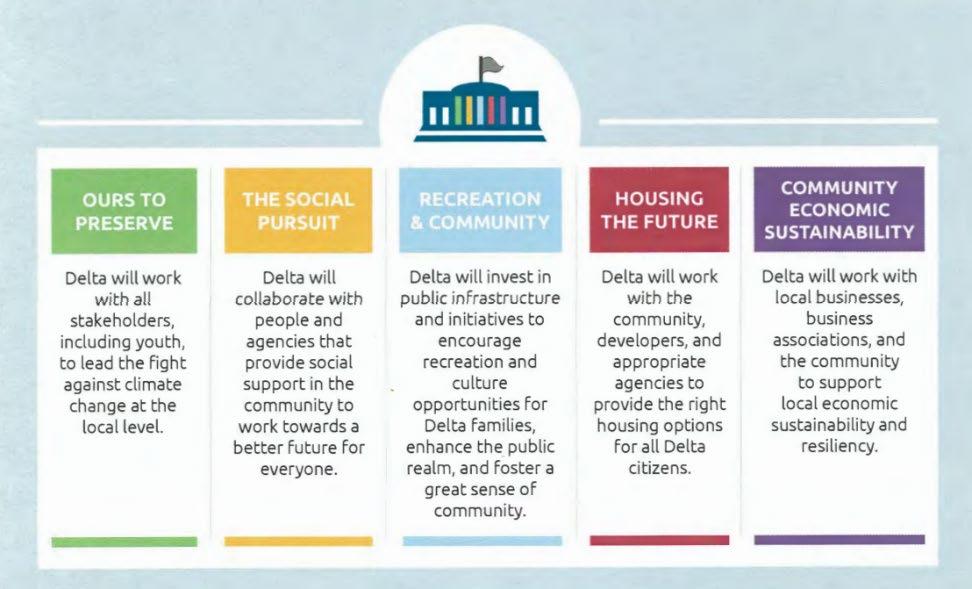
The Foundation for the Future forms the basis for City staff efforts when implementing Council direction and serving the community. While significant work is undertaken in areas beyond the scope of the Foundation for the Future, these are the key areas of emphasis and encompass a wide range of projects and initiatives.
12 - Delta's Foundation for the Future
Figure
5.1.4 Delta Cycling Master Plan (2022)
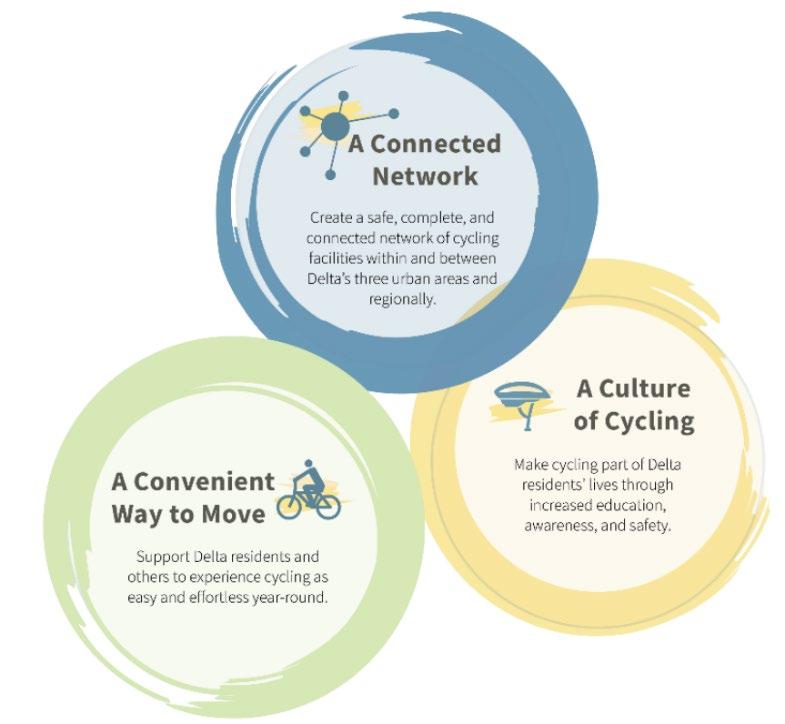
The Cycling Master Plan is a long-term vision for Delta's cycling investments over the next 20 years. It also includes a short-term action plan to create a complete, connected, and comfortable cycling network for people of all ages and abilities, focusing on actions over the next 5–10 years. The plan consists of three pillars shown below.
13 - Three Pillars - Delta Cycling Master Plan
Source: Delta Cycling Master Plan (2022)
Strategies from the plan to keep in mind during the sport field and ball diamonds needs review include:
Strategy 2A: Provide more bicycle parking and end-of-trip facilities.
Strategy 2E: Update guidelines and standards (specifically Action 2E.1: Ensure all new plans, projects, and developments integrate with the cycling network and are designed according to best practices).
Figure
5.2 Recent Projects Related to Sport Fields
Several sport field related capital projects have been planned and underway over the past few years. The most recent projects include:
Delta Secondary School Track (Spring 2024)
The City, in partnership with the Delta School District, is working to replace the existing running track and grass infield at Delta Secondary School.
Cromie Park - Indoor Training Facility, Ladner Minor Baseball Association Proposal (Summer 2022)
The training facility is located at the southern edge of the park, in between the existing baseball diamond and the current all-weather field
The all-weather field was converted into a third diamond in 2023.
The lease agreement was approved by Delta Council at the March 11, 2024, Regular Meeting.
The building is now open for use, Spring 2025
New ball field in design phase – Spring 2025
Winskill Renewal Project (Spring/Summer 2024)
The City is replacing the Winskill Aquatic & Fitness Centre (Winskill) with a new facility that will offer improved and expanded amenities to meet the growing needs of the community.
The facility will have a new location in the park.
Site improvements will include park and sports field improvements and development of one additional ball diamond.
Ongoing project over next two years with realigned fields ready for use by 2026.
Mackie Park Synthetic Turf Field (2024–completion in 2025)
The new synthetic turf field will be large enough to accommodate a full-size soccer pitch and high school-rules football field.
Backstop, drainage and irrigation upgrades throughout the City including:
North Delta Community Park – Diamond #3 drainage and irrigation upgrades
Pebble Hill Park – Backstop replacement
Associated Park – drainage and irrigation upgrades
5.3 Upcoming Projects Related to Sport Fields
Several upcoming sports field projects and backstop renewal program included in the 2025 Financial Plan include:
Seaquam Secondary: Renovated track and field
South Delta Secondary: Renovated infield
Bell Park: Renovated diamond (drainage/irrigation/backstop)
Dennison Park: Upgraded lighting
North Delta Community Park – Diamond #1 and #2: drainage and irrigation updates
6 BENCHMARKING
6.1 Sport Field and Ball Diamond Supply Benchmarking
Benchmarking research compared the provision of sport fields in Delta with other jurisdictions. While benchmarking provides useful insight into the broader understanding of service levels, the following contextual factors and limitations need to be considered:
Benchmarking only looks at whether an amenity exists in a community and does not capture qualitative factors such as volume of space, age, condition, and functionality.
Data is gathered from several secondary sources, including websites, planning documents (e.g., needs assessments and Master Plans), and local project team contacts. Although efforts are made to ensure accuracy, some margin of error may exist due to a number of factors (e.g., recent additions/subtractions from the inventory, different ways of counting amenities, etc.).
A number of different contextual factors impact supply dynamics in every community. These include relationships with the school system, private sector provision (e.g., strength of the private sector fitness market), fundraising capacity, and proximity to other regional centers.
It is important to note that the overarching objective of benchmarking is not to compare Delta to a specific community but rather the average of the entire sample of communities. Additionally, factors used to consider provision calculations may differ between various communities, and there are challenges to determine “player to field” ratios in the absence of dependable or accurate registration data across communities to allow for a finer level of comparison.
6.1.1
Regional Comparison
Table 5 illustrates regional comparisons of inventory and provision per 1,000 residents of neighbouring communities.
Table 5 - Regional Review - Inventory and Provision
*There are four synthetic diamonds
School District #37 facilities are excluded
6.2 Comparison with Community of Similar Size
Table 6 illustrates the per capita comparison of inventory and service level of communities of a comparable size
Table 6 - Comparable Community Size – Inventory and Provision
*There are four synthetic diamonds ** School District #37 facilities are excluded
6.3 Key Findings from Benchmarking
The City has comparable provision of rectangular sports fields (natural turf and synthetic surfaces) and higher provision of ball diamonds per 1,000 residents compared to neighbouring municipalities in the region.
The City has a better provision per 1,000 residents of all three field types in comparison to municipalities of comparable size.
7 TRENDS AND BEST PRACTICES REV IE W
7.1 Sports Field Participation Trends
7.1.1
Field Sport Activity Trends
The following table summarizes several current field sport participation trends, participant data insights, and factors that influence various sports.
Table 7 - Field Sport Activity Trends
participation is experiencing growth.
More data is needed. Not Designated
There is a national growth in femaleidentifying players.
In 2022, BC Minor Ball reported having over 18,000 players and coaches province wide.
Youth baseball accounted for 70% of all ball diamond bookings in Delta during the 2023/2024 season.
The Jumpstart Canadian Tire State of Play Youth Report 2024 noted that 16% of respondents indicated that they have played baseball more than once in the last three years, and 15% indicated that they would like to try baseball. This landed baseball as a top 10 outdoor activity that respondents had played recently and want to play in the future
Baseball is an official Olympic Sport and will be included in the 2028 Olympics, set to take place in Los Angeles (LA28 , n.d. ).
According to Cricket Canada, there are approximately 130,000 players across Canada.
Currently, cricket does not have an Accredited, Recognized, nor Affiliated organization (see Section 7.2.6).
Some Canadian communities have experienced a slight re - emergence of cricket as immigration from South Asian countries continues to rise where the sport is popular.
The first Cricket World Cup is being held in North America and the West Indies in June 2024.
The Jumpstart Canadian Tire State of Play Youth Report 2024 noted cricket as a sport not listed in their survey but was identified by 7% of youth as a sport that they played more than once. 7% of all respondents indicated that they had played cricket more than once.
Cricket is an official Olympic Sport and will be included in the 2028 Olympics, set to take place in Los Angeles (LA28 , n.d. )
More data is needed.
More data is needed. Accredited
Field design requirements can limit the supply of fields that are appropriate for the sport. However, after the Olympic Games in Paris, no more global tournaments will be played on water fields.
The Junior Pan American Championships were held in Surrey in July 2024.
56% of the Junior Women’s National Team roster is from Metro Vancouver. 50% of the Junior Men’s National Team roster is from Metro Vancouver.
The Jumpstart Canadian Tire State of Play Youth Report 2024 noted field hockey as a sport not listed in their survey but identified by 18% of respondents as a sport that they played more than once. 5% of respondents noted field hockey as a sport that they want to try.
BC High School Football reported a 32% increase in players in grades 9–12 from 2019 to 2021.
Professional leagues (NFL and CFL) have placed significant emphasis on developing flag football programs geared towards increasing participation in non- contact formats.
Flag football will be making its Olympic debut in the 2028 Olympics, set to take place in Los Angeles. (LA28 , n.d. ).
The Jumpstart Canadian Tire State of Play Youth Report 2024 noted that 22% of respondents indicated that they have played football more than once in the last three years. 14% of respondents indicated that they want to try football.
Lacrosse is a popular sport around the world, particularly in North America, where it has its roots in Indigenous communities (LA28 , n.d. ). Lacrosse Canada reports little change in participation rates.
Lacrosse is an official Olympic Sport and will be included in the 2028 Olympics, set to take place in Los Angeles (LA28 , n.d. ).
The Jumpstart Canadian Tire State of Play Youth Report 2024 listed lacrosse as a sport played more than once in the last three year by 5% of respondents. 12% indicated that they want to try lacrosse.
Lacrosse
Rugby Activity participation is stable.
Accredited
Rugby Canada reported a 141% increase to membership participation in 2021 from 2020, with BC reporting 8,000 registered members.
Rugby in Canada is continuing to see growth in female -identifying players.
Local organizations(Ex. Brits Rugby) indicated a sharp decline during the pandemic (2020–2022) but a slow return was occurring through efforts of the organization’s executive.
The Jumpstart Canadian Tire State of Play Youth Report 2024 noted rugby as a sport not listed in their survey but identified by youth as sport that they played more than once. 8% of respondents indicated that they had played rugby more than once. 9% of respondents noted rugby as a sport that they want to try.
Both indoor and outdoor soccer are popular sports. Soccer continues to experience growth and is the largest participatory sport in Canada.
Soccer is one of the top team sports for New Canadian youth.
Soccer Activity participation is experiencing modest growth. Accredited
Activity participation is experiencing growth. Accredited
Over 3,000 youth play soccer in Delta according to user groups.
The Jumpstart Canadian Tire State of Play Youth Report 2024 listed soccer as the top sport played more than once. 62% of respondents had played soccer more than once. 20% indicated that they want to try soccer.
68% of grass field bookings and 73% of synthetic turf field bookings in Delta’s 2023/2024 season were made by youth soccer organizations.
Growth in softball/slo -pitch is largely driven by social recreation participation among adults.
Softball BC estimates approximately 2–3% of school-aged children play softball.
The Jumpstart Canadian Tire State of Play Youth Report 2024 noted that 5% of respondents have played softball more than once in the last three years. 6% of respondents noted softball as a sport that they want to try.
Slo -pitch accounted for 4% of all ball diamond bookings in Delta during the 2023/2024 season.
Softball/ SloPitch
Ultimate Frisbee
Overall Sport Trend viaSport Designation* Factors that Impact the Trend
Youth softball accounted for 23% of all ball diamond bookings in Delta during the 2023/2024 season.
More data is needed. Accredited
*See Section 7.2.6 for description of the viaSport Designation Program.
7.1.2 Volleyball on Grass
Prior to the 2020 COVID -19 pandemic, membership in the BC Ultimate Society had increased by 7% (from 2018 to 2019).
The 2024 BC Summer Games will include ultimate frisbee.
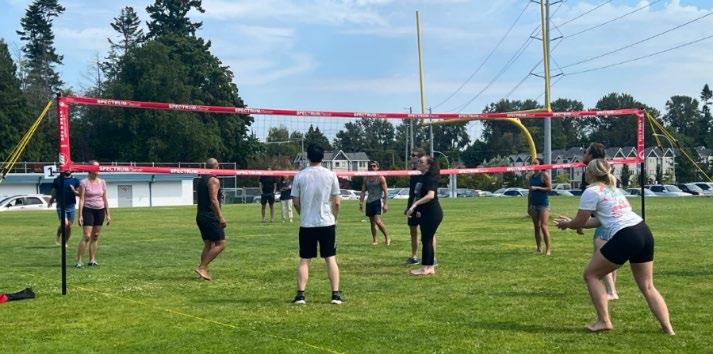
Traditionally, when people think of playing volleyball outdoors, they think of beach volleyball . However, grass volleyball is gaining momentum with clubs looking to play a game more closely related to the indoor game played on courts in a gymnasium. The format saw increased popularity through the COVID-19 pandemic. Sport equipment manufacturers have recently developed shoes meant for grass play, special balls, etc. Benefits of playing volleyball on grass include:
Grass areas or fields can usually accommodate several courts.
It is relatively easy to set up on the grass, with portable nets and line options.
It can be played with in teams of two, three, four, or six, making it highly adaptable for participation numbers (Onatrio Volleyball, n.d.).
Provides another option to get players outside and play.
Seen as good option for players new to the sport.
Source: Tsawwassen Sun Festival 2023 Photo Gallery (https://www.sunfestival.ca/gallery)
Figure 14 - Volleyball on Grass Courts
7.1.3 Small-sided Sports
Small-sided Sports (SSS) are a growing trend within the Metro Vancouver area, but also across the world. SSS refer to sports with adjusted formats where the field of play, rules, and number of players are manipulated to achieve a desired program outcome. Figure 16 illustrates an example of how fields are configured to include small, sided programs. Recently, the trend towards playing small-sided games increased, partially in response to the COVID-19 pandemic as an effort to reduce the risk of transmission.
There are many SSS leagues within the Metro Vancouver area, such as soccer, field hockey, and basketball. Many children and sports camps are incorporating SSS into their camps or training (Clemente, 2021). There is also growing interest in SSS across the globe as they require fewer players, less space, allows for more games scheduled in the space, and may be more intense than bigger versions. SSS also have many benefits to sport development, including:
1. Increased Accessibility:
With smaller team sizes, it can be easier for people to find enough players to participate in a game. This is particularly beneficial for those who may have limited access to larger groups or who may have difficulty finding players of the same skill level.
2. More Opportunities to Participate:
With smaller team sizes, there are more opportunities for people to participate in court sports; they are rotated into play more often because of the size and intensity of the game. This is particularly important for those who may be new to the sport or who may not have had the opportunity to participate meaningfully on larger teams.
3. More Intense Gameplay:
With fewer players on the court, each player has more opportunities to touch the ball or be involved in the game. This can lead to a more intense and engaging gameplay experience.
4. Enhanced Skill Development and Body Conditioning:
With smaller team sizes, each player has more opportunities to practice their skills and develop their abilities. This can be particularly beneficial for those who are looking to improve their game or who are new to the sport Additionally, players can:
Gain more experience getting more touches and become more confident.
Improve aerobic capacity due to more playing and higher intensity.
Develop higher neuromuscular adaptations.
Mimic particular game conditions for higher skill development.
Improve technical skill development and execution.
5. Reduced Risk of Illness Transmission:
With the reduced number of players on the court, there is less risk of transmission of illnesses (e.g., COVID-19) Physical distancing is easier to maintain with fewer players on the court.
As space for fields becomes more limited in growing urban areas, small-sided games and small fields or practice fields are becoming more popular. Small-sided fields are intimate and makes efficient use of underused areas.
SSS fit into all three levels of the Long-Term Athlete Development (LTAD) Sport and Physical Activity Model. Due to the higher level of skill development, it can help people learn fundamentals at a higher rate to increase physical literacy. It can also be applied to higher levels of LTAD models, such that elite players can mimic game scenarios to further their skills.
7.1.4 Climate Impact on Community Sport Participation
The environment and climate that we live in has a significant impact on sports participation. Extreme temperatures, air quality, and damage to infrastructure from natural disasters, such as flooding and fires, are just a few of the increasingly common factors that impact outdoor sport venues (viaSport, n.d.). In The Sport Ecology Groups article Sports at risk: Addressing climate change in the Canadian sport sector, author Madeline Orr introduces considerations for strategic sport management for the future. Orr suggests that the first step in adapting to climate change is to identify and learn about potential hazards and make adaptations efforts from there.
Figure 15 - Matsqui Field – Small-sided, Lined
Matsqui Recreation Centre Sports Complex, Abbotsford with small, sided fields between two larger fields.
Opportunities for sport leaders and municipalities to adapt, as outlined in the article, include:
Develop weather policies
Form strategic partnerships (e.g., sharing space in the event of inclement weather that affects one location more than the other)
Follow government leadership (municipal or provincial climate adaptation plans)
Build in Flexibility for multi-use spaces
Upgrade infrastructure and equipment (e.g., adding shaded areas to outdoor sports facilities, adding natural ditches and water drainage on the site to alleviate risks of flooding)
7.1.5 Spontaneous Recreation
There is growing demand for more flexibility in timing and activity for leisure pursuits. People are now seeking individualized informal pursuits that can be done alone or in small groups, at flexible times, and often near or at home. This trend does not eliminate the need for structured activities but suggests that planning for the general population is as important as planning for more traditional structured-use environments. Spontaneous recreation is broadly characterized as physical activities in which the activities, nature of participation, and timing of participation are freely chosen and do not require registration for programs or leagues.
The following two tables illustrate how children and adults participate in unorganized or unstructured activity or sports. This data is from the Canadian Fitness and Lifestyle Research Institute (CFLRI), which monitors changes in rates of physical activity and sport participation among the Canadian population. This is achieved through the Physical Activity and Sport Monitoring Program.
While the demand for spontaneous recreation is increasing, usage patterns are difficult to track due to the lack of registration and general informality of these activities. For that reason, it is difficult to know where conflicts between structured and unstructured recreation exist. Future planning for infrastructure and allocation should consider spontaneous recreation demands. Considerations may include:
Allocating time at various facilities for drop-in or spontaneous recreation.
Providing unstructured fields that operate on a first come, first serve basis where bookings are not taken.
Establishing a monitoring system to track spontaneous recreation at various facilities.
Table 8 - Degree of structure and level of competition in sport participation for children aged 5–17 (Data from 2022)
aged 5 to 17
Children living in a household that brings in <$60,000/year
Children living in a household that brings in $60,000 - $99,999/year
Children living in a household that brings in >$100,000 year
Source: CFLRI
Table 9 - Percentage of adults participating in unorganized physical activity/sport and their level of satisfaction with the number of opportunities available (Canada) (Data from 2016–2018)
Age Group Participated in unorganized physical activity or sport Participated in organized physical activity or sport
Source: CFLRI
7.2 Sport Field Service Delivery Best Practices
7.2.1 Sport Facility Allocation Best Practices
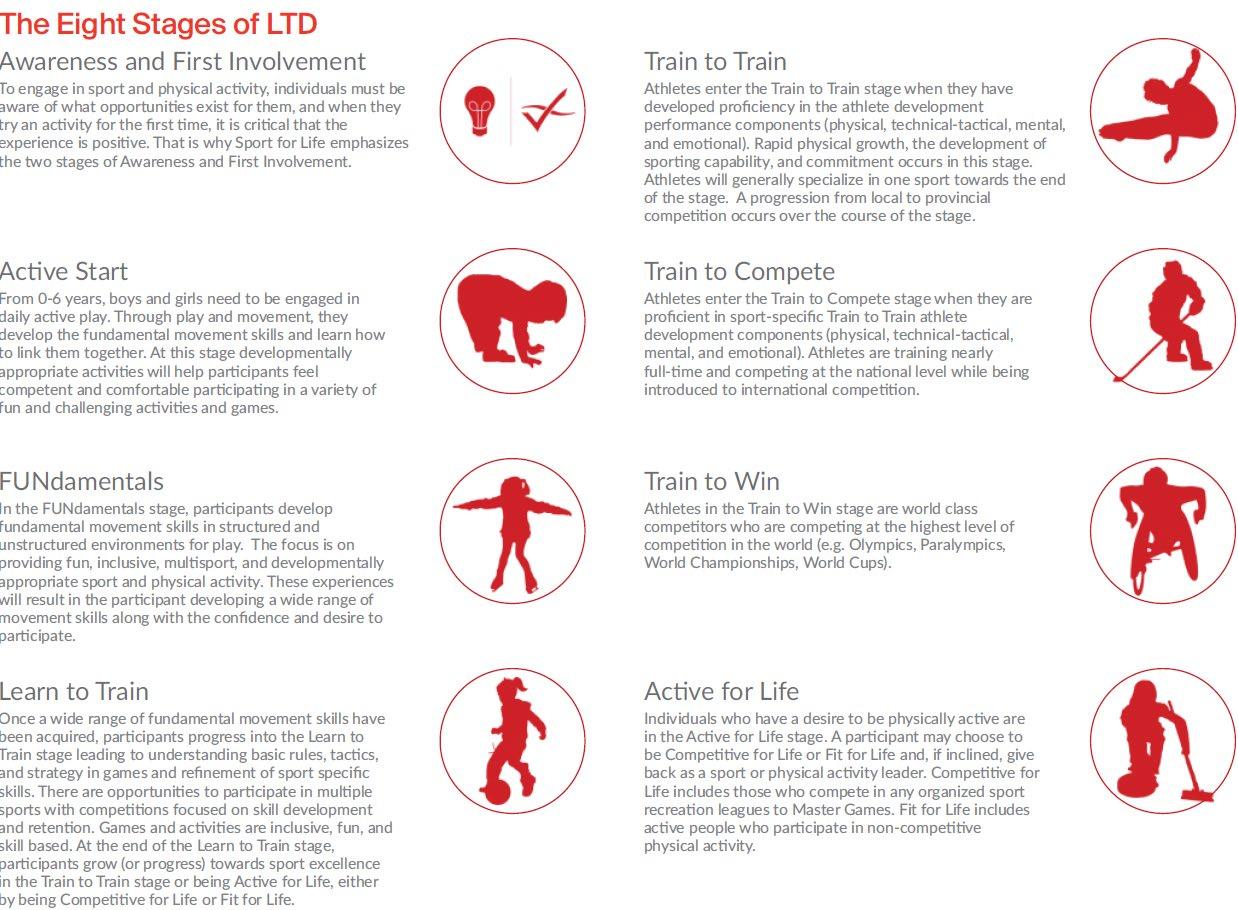
The LTAD is a nationally accepted eight-stage framework that identifies an appropriate pathway for developing physical literacy across all ages and athletic goals. Many municipalities use this framework as an important guideline in developing allocation policies
Figure
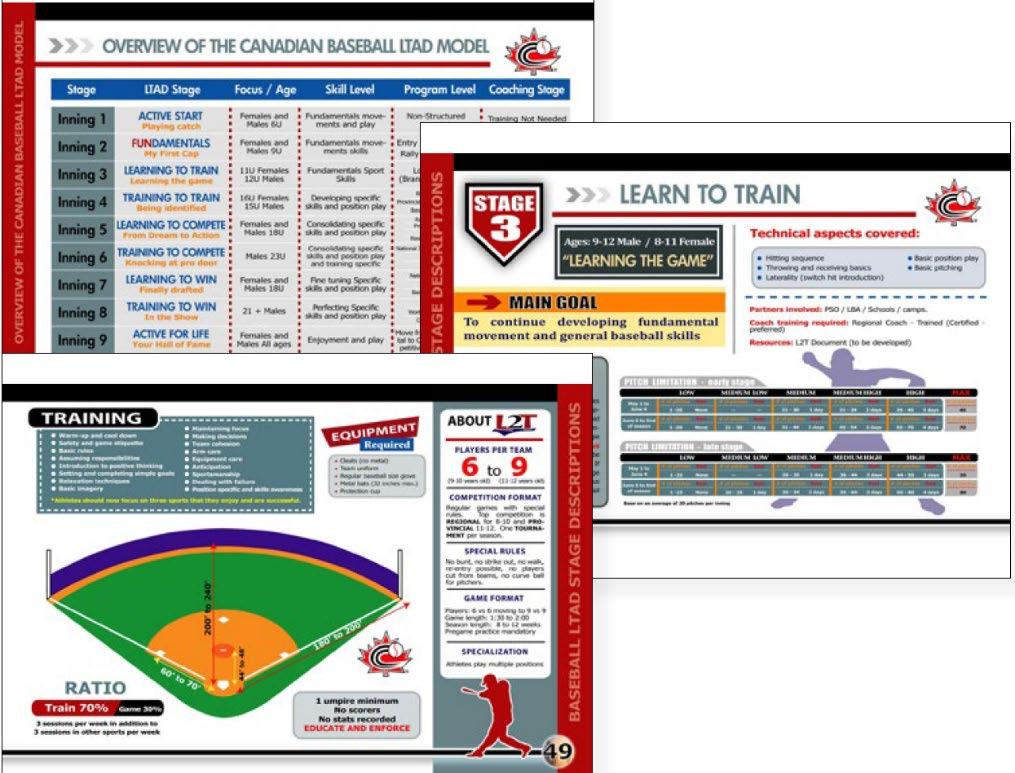
National Sport Organizations (NSOs) are required to demonstrate alignment with LTAD by developing a Sport Framework. Fifty-five NSOs currently have a Sport Framework (or multiple-sport Frameworks depending on the nature of the sport) that vary in specificity and format but generally outline an appropriate duration, frequency, and intensity of participation for each stage of LTAD.
Sport Frameworks can provide municipalities and other public sector providers of facility space with a reference point from which to identify standards of play and allocation guidelines.
Figure 17 - Examples of Player Development Guidance - Baseball Canada LTAD Model
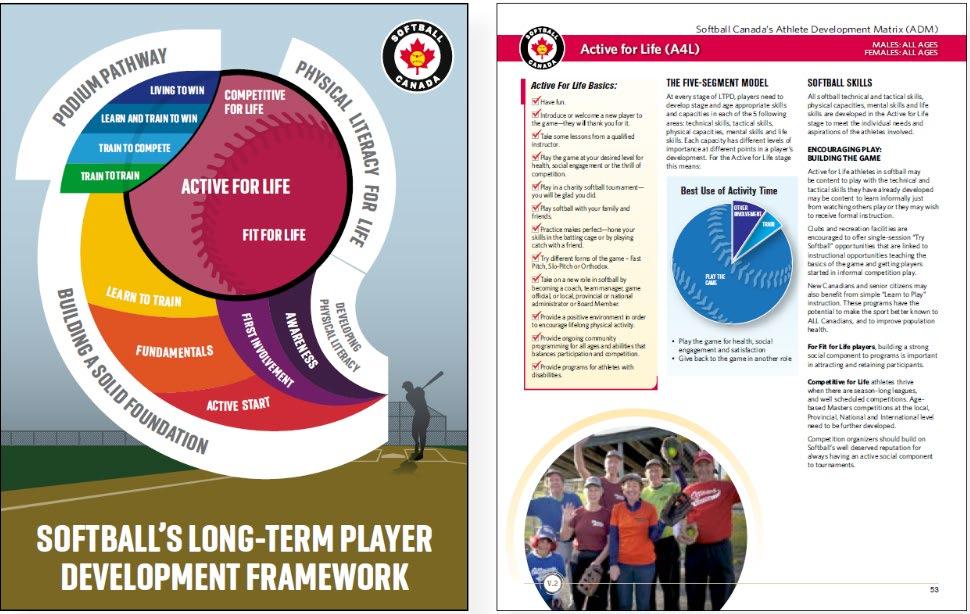
Figure 18 - Examples of Player Development Guidance from Softball Canada’s Athlete Development Matrix
Sport for Life (CS4L) has also developed a series of best practices and recommended principles for the allocation of facility time to user groups:
Allocation practices are based on “standards of play” principles in terms of the time and space required by each group.
Allocation policies are transparent and reviewed with the groups. Allocation is not done by tradition, but rather on actual requirements of all groups, including the needs of emerging sports.
Seasonal allocation meetings are held with common user groups to review their requests and try to achieve consensus on sharing available spaces and times.
As seasons progress, groups are encouraged to be flexible in the reallocation of spaces with other groups when no longer needed, either temporarily or for longer periods. User fees and subsidies need to reflect community taxpayer support, and the rationale should be shared with sport organizations.
7.2.2 The Benefits-based Approach to Fees and Charges
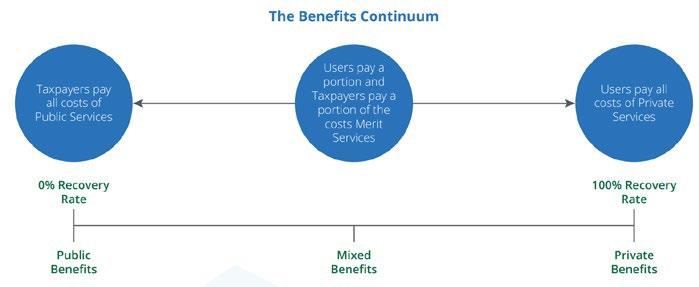
Establishing a community benefits-based approach to setting fees and charges for recreation programming creates logical alignment between subsidy levels (the % of expenditures recovered through revenues) and the rationale for providing the type of program. This approach fundamentally works on the principle that it should be acceptable for programming that provides higher levels of community benefit to receive a higher level of subsidy, while programming with lower levels of community benefit may still be offered but needs to recover most or all its associated costs.
Figure 19 reflects how the City of Abbotsford uses the benefits continuum, and Table 10 shows how the City of Courtney structures their fees based on that continuum.
Figure 19 - The Benefits Continuum
Implementing this approach will require the City to establish a basis for determining which programming provides the most community benefits. A more thorough checklist of community benefits may also be required to evaluate programming and categorize it accordingly along the continuum. Examples of these potential community benefits include:
Targets key population cohorts (e.g., youth and older adults).
Offers multi-generational opportunities.
Supports and aligns with best practices in physical literacy (e.g., group is affiliated with a provincial or national sport organization with a Long-Term Development plan).
Provides programming and activities not available through the private sector.
Fosters community spirit and sense of place.
Teaches important life skills.
Offers introductory opportunities that can increase comfort levels and foster longer-term participation.
The City of Delta’s updated fees and charges structure broadly aligns with these principles, but there is an opportunity to further formalize the framework in future reviews.
7.2.3 Regional Cost Sharing and Partnerships
Across British Columbia, many jurisdictions collaborate to deliver regional recreation services. These collaborations often involve one or more municipalities along with adjacent electoral areas and are typically formed to leverage available resources to provide costly types of facilities that would be challenging for a single jurisdiction to provide (e.g. pools, arenas, major parks, etc.).
While resident usage is sometimes the basis of determining funding responsibility within a regional partnership, increasingly other considerations are being integrated into funding models that reflect the broader benefits that recreation services can provide even if a large proportion of residents from a jurisdiction do not use the services directly. These benefits include the ability for a region to attract and retain professionals and much needed skill sets, economic generation, and increased community satisfaction. As recreation and parks infrastructure becomes more expensive to build and operate, it is probable that regional funding partnerships will become even more of a necessity across the province.
Partnerships with schools present another opportunity, especially given the different time of day needs of the school system (daytime) and community (evenings and weekends). Examples of common space partnerships include:
Municipal “topping up” of new school gymnasium funding in order to provide a full-size gymnasium with community access.
Artificial turf field partnerships.
Performing arts space funding partnerships.
7.2.4 Data Collection
Parks and recreation departments are increasingly utilizing data to understand user behavio urs, needs, preferences, and desires. According to the National Parks and Recreation Associations Survey of parks and recreation professionals, more than 90% of respondents (in leadership roles) identified data collection and analysis as important or very important for activities such as master planning, capital investments, programming, and support staff. However, not every municipality is collecting data, and no two municipalities collect data using the same methods. Respondents identified facility usage data, program utilization data, demographic trends, crime data, and school enrolment as important data sources for decision making.
In terms of methods for collecting data, surveying residents and users is the most common approach. For facility usage, some municipalities have staff manually count visitors and others use automated methods such as scanning user cards. Other departments that may be collecting useful data include public works or utilities, police and fire departments, and transportation departments. Geographic Information Systems (GIS) are also becoming frequently used within the sector to understand where users live, what amenities are available to whom, and to identify gaps and opportunities geospatially.
7.2.5 Equality and Inclusion in Recreation and Sport
There is increasing cultural awareness regarding the systemic nature of racism and the structural inequalities that exist within society. In Canada, the work of the Truth and Reconciliation Commission (TRC) was fundamental in highlighting and exposing historical and ongoing structural flaws within society that perpetuate racism and harm towards Indigenous populations.
Like most sectors, municipalities and other public entities that provide recreation services are in the midst of evaluating their history in perpetuating historical inequalities and future-forward solutions that can address these issues. The recreation sector is uniquely positioned to foster inclusiveness and provide a platform to help blunt racism, prejudice, and inequality. Identified below are initiatives that are being undertaken by leading organizations in the sector:
viaSport has identified inclusion as a key focus area and has developed a number of free or low-cost resources focused on fostering increased diversity and opportunity for women and girls, persons with disabilities, the LGBTQI2S community, marginalized youth, Indigenous people, socio-economically disadvantaged individuals, newcomers to Canada, individuals from rural/remote/isolated regions, and older adults.
The Social Planning and Research Council of BC (Sparc BC) has published or co-developed a wealth of resources on inclusion and access. One of these documents, Everybody’s Welcome: A Social Inclusion Approach to Program Planning and Development for Recreation and Parks Services, was developed in conjunction with the British Columbia Recreation and Parks Association and provided the sector with a formative resource that helped generate a greater understanding of what inclusion means and how to undertake actions that can foster it within public facilities and spaces.
Indigenous Sport, Physical Activity & Recreation Council (iSparc BC) is aimed at creating elite athletes, promoting healthy living for Indigenous peoples, and providing grants to help do so. iSparc offers regionally specific plans focused on increasing youth participation and building leadership capacity in the areas of coaching and officiating. iSparc is the stewards of the Aboriginal Sport, Recreation and Physical Activity Strategy and has begun to address TRC’s calls to actions 88 and 90 by funding Indigenous games, team, and skill development and providing funding and education.
The Canadian Parks and Recreation Association (CPRA) “The Bench” website includes numerous resources on topics and issues related to equity, inclusion, and accessibility. CPRA has also launched a grant program for Gender Equity in Recreational Sport among numerous other initiatives focused on levelling the playing field.
The National Recreation and Parks Association (NRPA) in the United States has been a leader in fostering conversations on topics related to inclusion and inequality in parks and recreation. In 2018, NRPA published a Parks and Recreation Inclusion Report (NPRA, 2018), which outlined findings from a comprehensive review of inclusion practices across parks and recreation agencies (service providers) in the United States.
7.2.6 The viaSport Designation Program
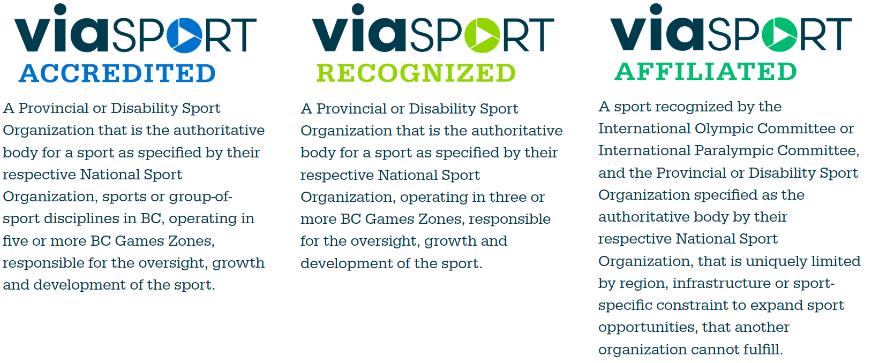
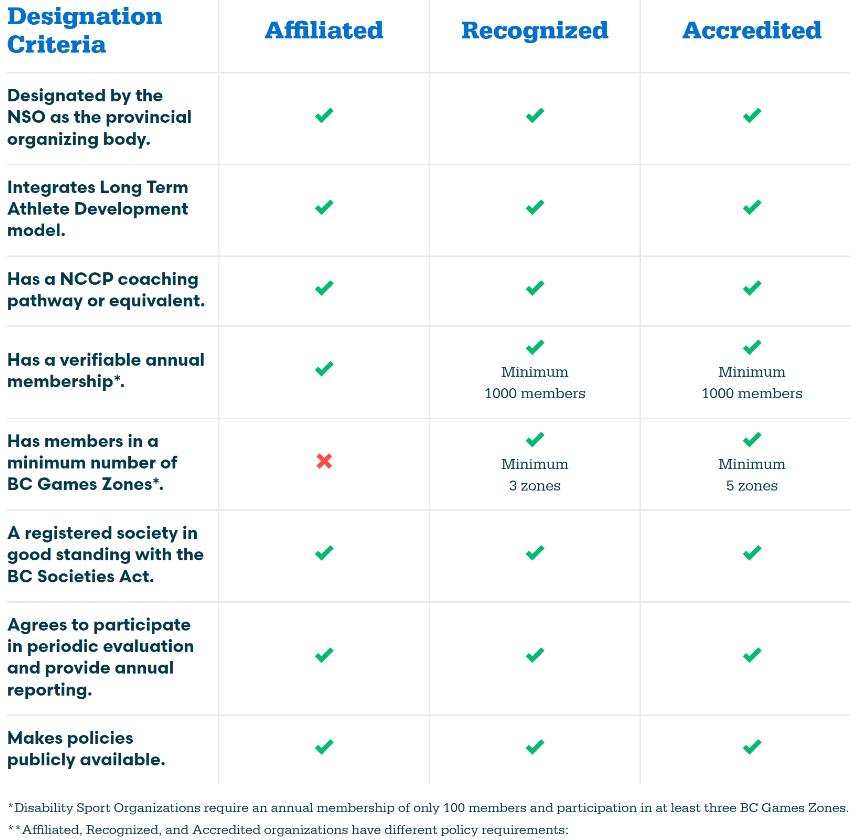
The viaSport Designation Program establishes standards to the strengthen the quality of amateur sport and manages government investment. There are three categories of designations that set minimum standards depending on the size and reach of the sport and tenure of the organization. These designations hold sport organizations and their board of directors accountable to these standards, which include:
Upholding the BC Societies Act as a non-profit entity.
Achieving specific targets for sport participation reach and inclusivity.
Ensuring Board and operational policies and practices are in place.
Implementing development programs for coaches and officials as well as high-performance athletes.
The three viaSport designation categories are noted in Figure 20. It is important to note that not all sport organizations apply, meet, or receive a designation. Once a designation is provided to an organization, they are required to sign an annual agreement accepting their responsibility to uphold the standards. Every three years the organizations undergo a more comprehensive evaluation.
A significant trend affecting the provision of sport fields is the growing user preference and demand for synthetic turf fields. In many urban centres, a broader array of user groups is increasingly looking to access synthetic turf fields to expand their season of use, limit rainouts and field condition-related cancellations, and enhance overall participant experience. Advancements in synthetic turf technologies have also fuelled this trend. In several communities, converting gravel or all-weather fields to synthetic turf have become a popular upgrade. While in the best circumstances, many user groups may still prefer premium quality natural surfaces, advances in synthetic grass types of synthetic turf have narrowed the gap between how synthetic and natural surfaces feel when playing sports on.
7.3.2 Multi-sport Field Markings
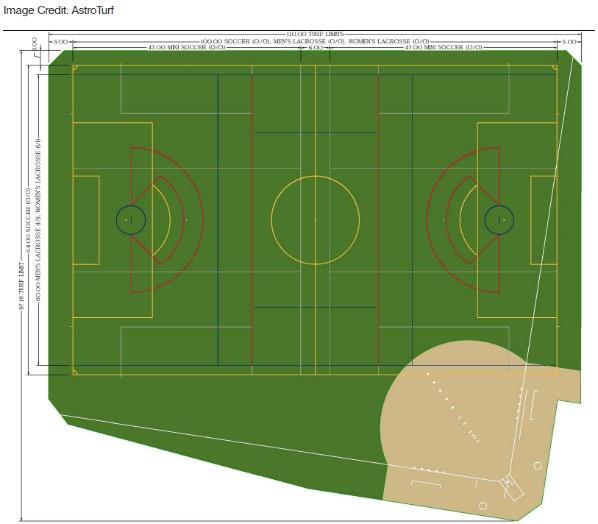
As communities are developing out and have finite land for new development, they look for strategies and other creative ways to optimize current assets and inventory. As mentioned, development of synthetic fields is costly yet an effective long-term option to maximize playability, programming opportunities, and investment within a smaller footprint. They are no longer marked for a dedicated sport, but now more commonly marked to accommodate a variety of sports programs This make sense as annual use capacity (playable hours) on synthetic fields are as much as 5–8 times than natural turf fields and can provide more reservable hours and be allocated to many more users, especially with added lighting for extended night-time use.
Figure 22 provides an example of possible multiple-sport line markings accommodating soccer, Men’s/Women’s Lacrosse, and softball.
7.3.3
Multi-field Sites
While local neighbourhood and community provision of fields may be important to sustain, a continuing trend in the development of dedicated sport fields is to develop these spaces as multi-field “hubs”, which are destination venues able to host larger training events and tournaments. This practice has several advantages, including operational efficiencies, increased tournament hosting capacity, and the ability to develop amenities (washrooms, change facilities, concessions, social areas, play spaces, walking paths) that can be shared between users of multiple fields. When developing multi-field sites, several design factors are important to consider such as:
Ensuring that fields are spaced and oriented in such a manner that activity conflicts are minimized is (e.g., balls being hit into an adjacent rectangular field or seating area).
Being near arterial routes with transit where possible.
Providing buffering from residential developments.
Providing adequate parking for tournaments and high-use/peak hours if public transit is not accessible.
Ensuring, if possible, that the site is developed to accommodate future growth and/or repurposing if warranted.
7.3.4
Multi-use Facilities
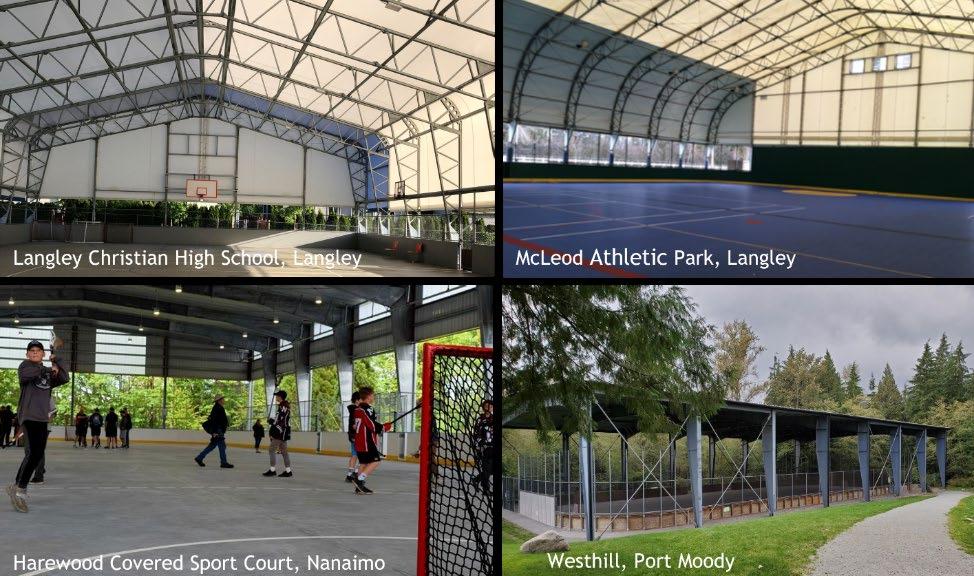
For many communities, covered open-air or enclosed multi-use facilities that allow for multiple sports activities, as well as community events and programming, have become a popular option to maximize function, access by variety of users and investment dollars to support current and future sporting needs, and community programs.
Facility features include open-air roofing types, lighting, surfacing/flooring treatments, side boards, seating, and practice walls. They can accommodate a variety of sports including lacrosse, ball hockey,
Figure 22 - Multi-sport Line Markings - Telosky Stadium, Maple Ridge
soccer, basketball, futsal, pickleball/badminton, tennis, and volleyball. Community uses include community celebration, youth camps, outdoor fitness, school fairs, and Christmas/farmer’s markets. Examples of built regional facilities show the standards many communities are setting to meet current and future sport and community programming needs. They include:
Harewood Covered Sport Court, Nanaimo
Westhill Park Sports Box, Port Moody
McLeod Athletic Park Lacrosse Box, Langley
Langley Christian High School, Langley
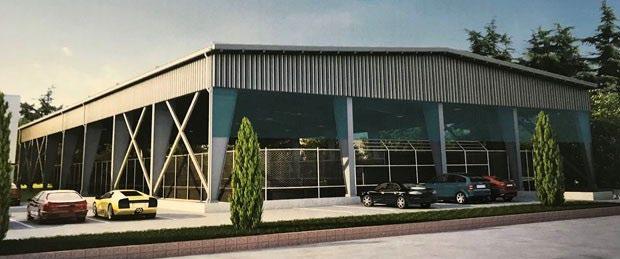
Ladner Multi-Sport Court, Delta
Figure 23 - Covered Open-air Multi-Use Facilities
Ladner Multi-Sport Court, Delta
7.3.5 Support Amenity Considerations
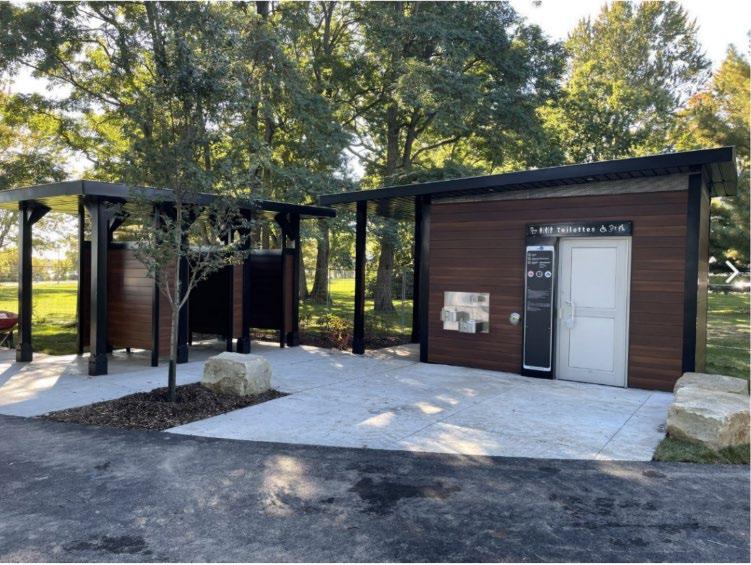
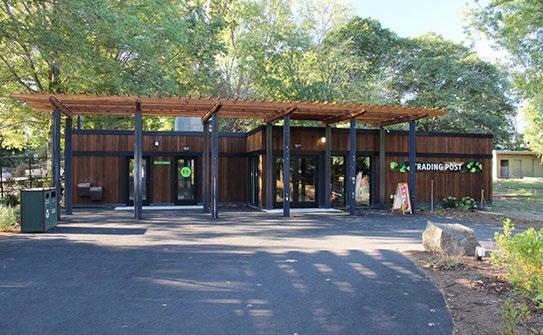
Across recreation and leisure, there are increasing expectations for the quality of experience provided in public facilities and spaces. Sport fields are no exception, especially as it pertains to support amenities. Examples of support amenities that can have a significant impact on both the perceived experience and overall level of utilization include washrooms/changerooms that are safe and functional in major park spaces, adequate seating areas, access to water or filling stations, and shade (natural or built). Many municipalities are also looking to find ways to provide these amenities and others in ways that create a sense of “place” and generate interest.
A relatively new concept in recreation and leisure infrastructure planning is to ensure that the indoor environment interacts seamlessly with the adjacent outdoor environment. This can include ideas such as public event spaces, indoor/outdoor walking trails, indoor/outdoor child play areas, and indoor/outdoor public art.
Although there are a number of operational issues that need to be considered when planning indoor/outdoor environments (e.g., cleaning, controlled access, etc.) the concept of planning an indoor facility to complement the site it is located on (and associated outdoor amenities included) as well as the broader community parks and trail system is prudent and will ensure the optimi zation of public spending on both indoor and outdoor recreation infrastructure. Integrating indoor and outdoor environments can be as “simple” as ensuring interiors have good opportunities to view the outdoors.
8 CURRENT C ONDITIONS , S ERVICE AND S PORT F IELD SYSTEM
8.1 Outdoor Facility Inventory
The City of Delta manages and maintains an inventory of 71 outdoor sport fields located within 26 City park sites. There are several fields on School District #37 sites that are also reservable for public use
Conveniently, the City administers the allocation and reservation of both City and school fields. For this report, the collection and analysis of field data will focus primarily on fields within park sites. Table 11 below summarizes the distribution of City facilities according to area and current level of service.
1. City of Delta Growth Study, Watson & Associates Economists, 2024
2. Excludes SD #37 fields
As discussed in Section 6.1 – Benchmarking, the City supply and provision of sport fields per 1,000 residents is generally keeping pace relative to other communities with synthetic and natural turf fields, higher with ball diamonds, and overall, better compared to other neighbouring, regional municipalities and communities of similar size.
Table 11 - City Outdoor Facility Inventory
Figure 26 - Delta Sports Fields Location
Figure 27 - North Delta Sports Fields
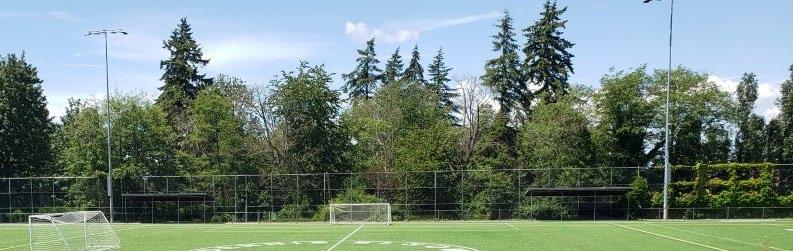
Dennis Elson SFT Field, North Delta Community Park, Photo: Binnie
Ladner
18
19
20
Figure 29 - Tsawwassen Sports Fields Tsawwassen
Tsawwassen
8.1.1 Field System Inventory and Data Collection
The process to collect, document, and organize data for City fields in park sites comprised of five stages: identifying attributes, compiling existing GIS data, visiting field sites, analyzing data, and developing the master inventory. Together with the City allocation data, field assets will be easily updated and referenced for future planning or monitoring purposes For more detailed inventory information, refer to Appendix B.
8.2 School District Fields
As mentioned previously, fields on school sites augment the City’s current inventory but are not the first choice for many sport user groups (especially for youth programs). According to feedback from stakeholder engagement, users have concerns about field quality, maintenance, “hazardous” surface conditions, and lack of or access to basic amenities (e.g., washrooms or parking) The partnership between the City and School District is ongoing but work needs to continue to further define and refine joint-use, care, and development of these community assets so they may benefit both school and community users by expanding the inventory of quality facilities.
Table 12 lists 45 school fields currently available for reservation within the allocation system administered by the City. About 33 fields and approximately 8,100 hours are currently being reserved primarily by softball, baseball, and soccer groups Without specific data about field surface profile or condition, there may be an estimated total field use capacity of 15,180 hours The remaining available capacity of 7,080 hours is equivalent to two synthetic fields, or 12 natural grass turf fields.
Table 12 - School Fields in the Allocation System
Use Agreements with School District #37
Joint-use agreements between the City and School District #37 have been in place to access specific school facilities over many years, but with very general terms of use Previous updates to agreements focused on addressing enhancing field maintenance. Currently, access to fields on school sites is guided by the Memorandum of Understanding: Adult School Crossing Program and School Field Maintenance (See Appendix C) replacing the expired agreements previously in place:
Memorandum of Understanding: Adult School Crossing Program, outlines play fields and other facilities on school board property made available for community use, 1999.
Agreements for the enhanced maintenance of school playing fields available to the City for park and recreational use, 1990s.
General joint-use agreement providing reciprocal use of schools and municipal recreation for and community activities, 1984.
Access agreements naming specific sites, 1960-70s.
Maintenance of fields to an acceptable playing standard has been an ongoing concern for many user groups, requiring the City to subsequently review and update agreements in 2001 for enhanced maintenance options for nine specific play fields. The current access agreement has few details but outlines maintenance responsibilities and charges for use by parties.
According to feedback from user group engagement, the safety and quality of maintenance of school play fields significantly impacts to their sport program and is a barrier to accessing quality playing fields for their sport.
As a best practice, continued partnership and collaboration between the City and School District #37 is an important strategy to expanding capacity, increasing the inventory of premium fields and amenities to meet future needs of both school and community users.
8.4 Sports Groups and Organizations
There are approximately 64 registered organized sports groups who primarily reserve outdoor sports facilities through the City reservation system to practice and compete in their respective sports. Memberships and participation have been steady in the past few years, with many experiencing an expected dip due to COVID-19 in 2020–2021. Many organizations have strategic plans to continue growing their sport and have an interest in supporting programs at the grassroots to minor levels but are also keen to develop programs that support elite levels of play all within the City and at local facilities Over 12 different sport activities are represented in the city. Approximately 50% total registered players represent soccer players, 30% represent ball players, and 20% represent other sports combined.
City of Delta, 2024
Table 13 - Sport Groups
Within the local communities, the distribution of groups active and the ratio of fields to members in each area is summarized below in Table 14.
Table 14 - Groups by Area
* Delta School Groups are excluded
However, the total number of groups (organized and leisure sports and informal community groups) reserving time in all areas of the city is higher Specifically, 2023/24 data show over 40 groups reserving facilities in North Delta, over 24 groups reserving Ladner facilities, with over 20 groups reserving time on Tsawwassen facilities. For more information, see Appendix D.
8.5 Allocation Policy (2023)
In 2023, the City updated their Facility Allocation Policy. There are 11 guiding principles considered and applied collectively with no one principle standing alone in the process. They include:
Age
Residency
Inclusive/Equity
Public Good
Program Development and Facility Tenure
Efficiency of Use
Season of Use Program Demand and Service
Exclusive Use
Facility
Traditional Use
Permits to use facilities are issued according to the City’s user priority category as follows:
First Priority: City programs and special events
Second Priority: Delta not-for-profit community sport organizations and traditional users
Third Priority: Delta School District programs
Fourth Priority: Delta casual users
Fifth Priority: Delta commercial and for-profit users
Sixth Priority: Non-Delta groups, organizations, and casual users
For more information refer to Appendix E.
8.6 Common Compliance/Penalties in Allocation Policies and Procedures
User groups in many municipalities are frustrated at continually having trouble accessing and reserving the appropriate amount of facility time to meet their program needs. Many groups have also expressed frustration to observe prime fields during prime times reserved by others but appearing to sit empty and unused. Several municipalities both locally and across Canada are implementing compliance polices that outline penalties for infractions, including unused time, using closed facilities, and unauthorized subletting. Generally, repeated infractions are managed in three stages:
Step 1: Written Warning
Step 2: Reduction in allocation (especially for unused time)
Step 3: All privileges revoked
Examples of communities that implement one or more of the above penalties:
Vaughn, Ontario
For no shows or cancellations, clubs are to submit forms providing an explanation in advance, or in extenuating circumstances (e.g., Illness, weather) forms are submitted after the fact. The first no show instance without extenuating circumstances results in a written warning; second offence results in higher non-resident rates charged retroactively; three or more occurrences results in permits being revoked
City of Calgary
Track non-use by groups and as result, reduce the field time allocated to those non-users the following season.
City of Coquitlam
Implements a penalty for youth organizations only. Youth organizations are not charged for field use; however, a non-use fee is applied when there is non-use without advance notice (4 days) prior.
City Surrey
Groups are required to post their training and game schedule online for transparency. Staff cross reference and complete random field checks. If the field is unused or sublet to another group without authorization, the field time may be re-allocated to another group.
The challenge with implementing the above measures is having the staff resources to check and monitor field use Some municipalities schedule staff randomly for checks to verify complaints, while others have their groundskeeper note field conditions and evidence of use (e.g., fields are not lined, infields not raked, no cleat marks, etc.).
Perhaps a combination of penalties and incentives may be an option to encourage better habits around reserving only time that is required for group programs. For example, discounted rates or field allocation priority could be offered to eligible groups who release surplus or unused field time for other to use.
8.7 City Fees and Charges
8.7.1 Sport Field Booking Fee Review
The City has compiled and summarized fees for fields and other outdoor amenities from surrounding communities (Burnaby, New Westminster, Coquitlam, Richmond, Surrey, Vancouver, and the Township of Langley) that informed recent updates to the City’s schedule of fees and charges. See Appendix F for a comprehensive list of fees from each of these communities.
Each municipality sets fees slightly differently, but they generally follow similar fee categories:
Youth
Commercial/Private
School (in absence of a joint-use agreement)
Prime vs. Non-Prime
Community Group/Non-profit
Almost all municipalities structure fees differently for each type of field or outdoor amenity (e.g., artificial turf, natural grass, all-weather, diamonds, etc.). Most municipalities (4 out of 7) charge more for fields with lighting or in combination with other amenities at the location, and there is often a daily rate for tournaments or special events.
8.7.2 How Does Delta Compare to Neighbouring Municipalities?
The City adopted an updated Fees and Charges Bylaw in December 2024, which will come into effect in April 2025. The bylaw includes changes to the park rental fee structure while aligning fees with the median of comparable Lower Mainland municipalities. These forthcoming changes are not reflected in the analysis throughout this report but are anticipated to help ensure efficient use of the City's fields by discouraging block booking and incentivizing non-prime use.
Artificial Turf
In neighbouring communities, community youth groups are charged approximately $30 per hour for synthetic turf field use during prime time on average.
The City charges youth groups $6.50 per hour for synthetic turf use. Light fees are an additional $8.60 per hour. The 2025 fee will be $30 per hour for prime time and $15 per hour for non-prime time (both inclusive of light fees).
In neighbouring communities, adult community groups are charged approximately $53 per hour for synthetic turf field use during prime time on average.
The City charges adult groups $30 per hour for synthetic turf use. Light fees are an additional $17.20 per hour. The 2025 fee will be $60 per hour for prime time and $30 per hour for nonprime time (both inclusive of light fees).
Premium Natural Grass
On average, in neighbouring communities, youth user groups are charged approximately $7.04 per hour for premium natural grass use during prime time However, a few communities did not distinguish the fees beyond natural turf vs. artificial (4 out of 7 communities).
The City charges youth groups $2.25 per hour for premium natural grass field use. The 2025 fee will be $6.25 per hour.
On average, in neighbouring communities, adult user groups are charged approximately $18.72 per hour for natural turf field use during prime time.
The City charges adult groups $10 per hour for natural turf field use. The 2025 fee will be $12.50 per hour.
Natural Grass/All Weather
In neighbouring communities, on average, youth user groups are charged approximately $6.25 per hour for all-weather/natural turf use during prime time.
The City charges youth groups $1.50 per hour for all-weather/natural turf field use. The 2025 fee will be $3.13 per hour.
In neighbouring communities, on average, adult user groups are charged approximately $11.15 per hour for all-weather/natural turf field use during prime time.
The City charges adult groups $5 per hour for all-weather/natural turf field use The 2025 fee will be $6.25 per hour.
Table 15 - Comparison of Hourly Rates by Field Type
The City should continue to review and update field fees and charges annually. This will allow them to adjust the rates to align with other local and regional municipalities and confirm that the rates are meeting target revenue or cost recovery to offset municipal contributions to sustain current and future operational and maintenance costs. The City should align fees and charges with a comprehensive field classification system to provide users with transparency of costs and clarify expectations for services.
9 USER GROUP ENGAGEMENT
9.1 Process
Feedback from groups that use sport fields and ball diamonds in Delta was a crucial element of this study. User groups were contacted by the project team in two rounds of engagement that invited groups to complete online User Group Questionnaires and participate in virtual discussion sessions.
In round one (June, July 2024), approximately 31 different sport groups provided information and feedback on a wide range of themes and topics related to sports field use:
18 user groups participated in a virtual discussion session.
31 user groups completed the online survey.
In round two (February 2025), a total of eight sport groups participated in two virtual Community Update sessions that shared key findings. An online feedback platform was open for three weeks to provide an opportunity to submit any follow up comments but received no further responses.
Table 16 - Participating Sports User Group
Lacrosse Association
Stars/Lower Mainland Baseball
Red Lions Athletic
Field Hockey Club
Men’s Fastball
Minor Baseball
Mixed Slo -Pitch
Workers Support Society
Delta Baseball Association
Delta Football Association
Delta Mixed Slo -Pitch
North Delta Stingers Over 65 Soccer
Cricket Club
South Delta Men’s Soccer - Fall/Winter
South Delta Outdoor Volleyball
South Delta Rams Football
South Delta Slo -Pitch Group
South Delta United
South Delta United Soccer Club (Over 45’s) x Touch Football BC x
Tsawwassen Amateur Baseball
Association (TABA) x x x
Tsawwassen Men's Masters Slo -Pitch x
Tsawwassen Mixed Slo -Pitch (25+) x Total
9.2 Round One Engagement - Virtual Discussions Sessions
A series of meetings were convened with Delta sport/rectangle field and ball diamonds user groups in late June and July 2024. Discussions were primarily held in a small group or one-on-one interview setting with the intent to discuss user groups experiences and perspectives on sport/rectangle fields and ball diamonds in Delta.
9.2.1 Key Themes from the Sessions
A synopsis of key themes from the discussions are presented as follows. It is important to note that perspectives and opinions vary these themes are not intended to capture consensus but rather reflect prevalent viewpoints and notable points of interest that were captured. To provide anonymity for participants, comments are not attributed to specific individuals or groups.
Overview of Current Use/Organization Participation
Most groups indicated that their organization is growing and/or at capacity for the fields/diamonds that they use.
A number of groups expanded their season of play into shoulder seasons (spring season for soccer and fall season for diamond sports) due to increased demand.
The COVID-19 impacted participation for all groups. Some groups, such as rugby, are still recovering while other groups, such as baseball, are now larger than they were before the pandemic.
Many of the groups anticipate growth in participation due to recent housing bylaw changes. They anticipate more families moving into the community and potentially more participants.
Although most youth-serving organizations note participation tends to drop-off when participants reach the age of 13–14, a few groups noted that some participants start their sport later than they had previously.
Some groups indicated that participation is inhibited by the types of facilities or lack of specific facilities available in Delta.
A few groups noted that they are working to build their programs so that skilled players do not leave the community to play in a more competitive league/team in neighbouring communities (e.g., Surrey). Athletes from Delta have gone on to play at an international level.
Assessment of Sport Field and Ball Diamonds
Maintenance Perspectives
Field maintenance has improved over the last couple of the years. Some groups specifically noted that this changed when a new maintenance staff was added to the team.
School fields and diamonds are not sufficiently maintained, and in some cases, groups believe they are dangerous to play on Additionally, groups expressed frustration with the relationship between the City and the School District, which has not worked to improve maintenance standards.
Infields become compacted and hard over the season. Some groups feel that the City should be on top of raking these out, while others believe that groups need to take responsibility for this piece of maintenance.
The cricket pitch is a concern as the concrete pad is not flush and creates a tripping hazard; additionally, the shared use creates conflicts forcing rescheduled games
The cricket pitch was not built to the usual specification for the sport and has too much surface give resulting in a bouncier surface than is typical. Because of this, the cricket club will not allow younger players to play on the pitch to prevent risk of injury.
Some sport groups believe that a maintenance meeting between groups and maintenance staff at the beginning of the season would be helpful to outline tasks groups are responsibilities for ensuring fields are maintained appropriately.
Surface drainage is an issue in the spring with both ball diamonds and sport/rectangle fields.
The current system of checking the fields before the weekend is not working for some groups. Some feel it puts too much pressure on groups to decide whether to play or not.
Access to Support Amenities
Washroom access has become an issue for a number of groups, especially during tournaments or events held at the fields/diamonds.
Changeroom access is top of mind for most groups.
Storage for some groups is a challenge When arranging storage options, groups noted the City’s concern with the appearance of the storage units (C-Cans) and are concerned that the City’s suggested options are very cost prohibitive and not feasible for groups to provide.
Parking is an issue for most locations, particularly at John Oliver Park and Dugald Morrison Park, especially when multiple sports are hosting events on the same date.
Some groups expressed a desire to run a concession or have access to bookable concession spaces at sport fields and diamonds.
More covered benches for players and spectators are often requested.
The washroom location at Mackie Park is a concern for parents with young children. A volunteer or parent must walk children to/from washroom facilities due to concerns for safety.
Supply of Fields and Diamonds
Many diamonds are not suitable for adult use as they are not the appropriate size where outfields are short and are too close to nearby homes or other park structures. Some groups make adjustments to their equipment to reduce hitting distances by using softer balls and different bats to mitigate the issue. Most groups agree more adult size diamonds are needed.
There are not enough facilities for hosting tournaments or community events. A sport hub with four or more sport/rectangle fields and diamonds is desired.
More lit fields and diamond are desired, especially for sports that play through the winter months.
When a game is cancelled, most sport groups really struggle to reschedule due to the lack of fields/diamonds.
Many groups agreed that better maintenance of school amenities and optimizing the current infrastructure would solve most of the supply issues.
Some groups are frustrated at the lack of appropriate facilities or specialized field for their sport. Field hockey does not have a field that can accommodate elite competition in the community.
Another cricket pitch is desired.
Allocation of Fields and Diamonds
Some groups indicated that they did not understand the rationale around fees/charges for some specific fields. A few groups noted that there is no clear field classification system so the charge for different fields feels arbitrary.
Groups agree that they could allocate their fields use better if school fields/diamonds were in better working order. Some groups find sharing fields difficult.
Some groups believe that the fields/diamonds should be designated for specific sports to create hubs for activity types.
Some user group note conflict between the adult slo-pitch teams and minor baseball groups. Minor baseball expressed frustration with the time slots that adult groups have been historically allocated and with the disruption to their booking schedule to accommodate the slo-pitch season. Slo-Pitch groups noted difficult interactions with baseball groups refusing to leave diamonds past their reserved time slot to allow the next group on.
Barriers to Use and Participation
Not having appropriate facilities to grow their sport (i.e., not having the most optimal facilities for the sport [field hockey] has driven some participants to other areas)
Lack of transportation for youth that do not drive.
Lack of warm-up spaces.
Lack of parking.
Poor field drainage sometimes causes games/practices cancellations, leaving participants and teams frustrated leaving groups struggling to make up for lost time.
Better facilities in neighbouring communities attract some participants away from Delta.
Some fields are so popular for unorganized/spontaneous sport use, teams that book the fields experience difficult interactions getting access because of unauthorized use of the fields (cricket).
Prioritization
Groups had varying opinions on how different sport field/diamond projects should be prioritized. Most groups agreed that maintaining the current facility is most important. The following additional criteria (not in any specific order) should also be considered when prioritize projects:
Projects should be prioritized by the number of participants affected
Projects for underserved sports
Fields/diamonds that need the most work
Projects that can be partially or fully funded by sport organizations
Projects for field types that are currently booked to capacity
Projects that cost less
Projects that would serve the most people
Various proposed projects mentioned in the sessions are captured in the Section 11.8 – Table 36.
9.3 Round One Engagement Virtual Sessions - Final Feedback
Groups are looking for the City to be creative and plan facilities for future use (i.e., facilities sports can grow into). A couple of groups hoped that a new hub field facility could put Delta on the map as place to host tournaments and events.
Some groups would like more opportunities to bring groups together, problem solve and provide feedback to the City.
An indoor turf is desirable.
Central sport hub with multiple sports is a top request.
Create facilities that aid in the linear development of the sport and ensure all levels of the Long-Term Athletic Development framework can be accommodated.
A few groups would like an online booking system that would allow groups to see in real time when fields are available and make last minute bookings/trades with other groups.
Cricket is a sport that is becoming increasingly popular. Many new Canadians and international students are passionate about the game. People know that Delview has a pitch, and it has become a hub for the sport but also a place where community gathers and socializes.
A few groups emphasized the social value of their activity and its importance to players and the community. Sports give the opportunity for people to gather and create connections beyond the game itself.
9.4 Round One Engagement Online Survey - User Groups Responses
Delta sport field and diamond user groups were invited by City staff via email to provide information and feedback by way of an online survey from June to August, available on Delta’s Let’s Talk engagement platform There were 31 field/diamond user groups that completed the questionnaire. For more feedback details, please see Appendix G.
9.4.1 About the Respondents
The questionnaire began by asking groups about the programs that their organization currently runs The following types of programs were noted by respondents:
Adult and youth soccer programs
Adult and youth rugby programs
Adult slo-pitch programs
Adult and youth fastpitch programs
Adult and youth baseball programs
Adult and youth field hockey programs
Casual recreational soccer programs for Delta’s foreign workers
Youth lacrosse programs
Adult and youth cricket programs
Adult and youth outdoor volleyball programs
Next, groups were asked about their participation numbers. The following table groups the participation ranges of groups from 2021–2024 20 out of 30 groups had under 500 participants in 2024, while eight groups had over 500 participants. Two out of three groups with over 1,000 participants were soccer organizations, while the third was a regional cricket organization.
Table 17 - Group Participation Trends
Number of Groups
When asked about future enrollment expectations, over half of the groups (17 groups) expect participation to increase. Only one group expected a decline in participation, as seen in Figure 30.
Enrollement
Most groups indicated that their organization plays during the spring (23 out of 30 groups).
Approximately two thirds of groups play in the fall (19 groups) and summer months (20 groups). A quarter of the groups play in the winter months (12 groups).
Figure 31 - Season of Play
When asked about a group’s main season of play, less than half indicated summer (7 groups) and just over a quarter of groups indicated the spring (7 groups). Three groups indicated the winter as their main season of play and two groups indicated fall as their main season of play.
Most groups indicated that their group trains, offers tournaments, or plays a modified version of their sport outside of their main season of play.
9.4.2 Access to Fields and Diamonds
Next, groups were asked about their access to the fields/diamonds that they require. Just over one third of groups indicated that they have access to the fields that they require, seven groups do not have access, and over a third of groups (13 groups) indicated that they somewhat have access. They were asked to consider things like location, transportation, field type, and quality
Figure 33 - Access to Fields
When asked to explain their responses, groups noted that following concerns:
Loss of diamond usage to other user groups.
Lack of quality fields/diamonds at schools (with some groups emphasizing that they are unsafe).
The new lawn bowling green was replaced where volleyball was typically played.
There is a lack of specialized fields for their sport and having to compromise on times and locations. There is only one cricket pitch in Delta.
Feeling as though their sport is a lower priority to the City and thus is given subpar fields/ diamonds.
Some groups cannot access enough field time to accommodate the growth of their sport.
Some sports are growing and have to turn down players because there are not enough fields.
Indoor training space is desired.
Subsequently, groups were asked about access to the amenities that they need, such as changing areas, washrooms, and spectator seating. Approximately half of the groups indicated that they somewhat have access to the amenities that their group needs, 11 groups indicated they do have access, and three groups indicated that they do not have access.
Figure 34 - Access to Amenities
your group have the amenities they need?
Groups
Groups
Groups
When asked to explain their responses, most groups noted that washrooms were of concern Spectator seating, lighting, changerooms, and concessions facilities were also top of mind. Most of these concerns were reiterated when asked if the fields available are adequate. Most groups feel that the fields available are either adequate or somewhat adequate (26 groups out of 31).
4 Groups
9 Groups 17 Groups
When groups were asked to explain their answers, some noted that their fields are well maintained (the rugby fields, turf fields, and some fields that are maintained by groups), while others noted the poor quality of school fields, and the need for more fields with lighting and parking. Transit issues and field use by non-permitted sports/teams was also a concern.
Groups were also asked about the vision for future or new programs and if there were any programs that they would like to run but are currently unable to. The following summarizes the key themes from the responses:
Having dedicated fields for their specific sport would be ideal.
More access to spring fields would allow sports to expand and add variations of their sport to their program options (e.g., 6’s lacrosse).
Maintaining school fields to a safe level would help to ensure that programs continue.
Feeling like their sport is important and ingrained in the community.
Some groups are planning to pursue more off-season player development.
A number of groups indicated attempting to grow their sport, particularly their competitive levels and female-only divisions.
Some teams are considering adapting programs for older players by adding walking versions of their sport.
A number of groups indicated offering more tournaments.
Many teams would love to grow their sport and accommodate more teams to play.
There is a desire to train in the winter and groups are hoping for an indoor facility to be developed in the future.
9.4.3 Factors that Influence Field Use
Factors that may influence sport field use were presented and groups were asked to select all that apply to their group/activity. Most groups indicated that the availability of suitable sports fields (16 groups), amenities at the fields (13 groups), and the quality of sport fields (11 groups) are factors that influence sports fields use.
36 - Factors Influencing Field Use
What factors influence which sports fields you use?
The sports amenities at sports field sites {e.g., restrooms, change rooms, spectator seating, etc.)
The availability of suitable sports fields for you to use
The quality of sports fields that you or your family uses for program-based activities (leagues, teams, dubs)
Safety at sports fields that you use or visit
Proximity to suitable sports fields to your home
The quality of sports fields that you or your family uses for casual “pickup activities
Physical accessibility at sports field that you use
When asked if there were improvements that would help with field usage, the following themes emerged from the responses provided:
Improving the quality of school fields would make a world of difference Currently, many of these fields are considered dangerous to play on by groups.
Adding lights to fields and diamonds to allow for play into the evening and during the darker months would be helpful.
Addressing drainage issues at City and school fields would increase the number of playing options.
Providing washrooms access across all field locations.
Providing equipment storage for groups would be helpful.
Having more oversight and enforcement on field usage by groups (i.e., groups that drop in for casual use and refuse to leave for the groups that have reserve field time).
Creating tournament-ready field locations that have the appropriate amenities and field quality.
Providing better maintenance and/or tools at field sites for groups to do the maintenance.
Figure
Building specialized facilities for specific sports.
Improving communications. Some groups struggle with ongoing communication with the Parks Booking department. They find it difficult to keep up with cancellations and rescheduling with the new booking processes.
Providing more parking at park locations
9.4.4 Booking Fields
Next, groups were asked to indicate how they determine the amount of field time they need for their season of play Almost all groups indicated that past practices and participant expectations are factors (16 groups), eight groups indicated that they assess program needs and offering on a season-toseason basis, and eight groups indicated that feedback from coaches and participants helps them determine future field time needs.
How does your group determine how much field time it needs during the season of play?
Past practices and participant expectations (what you’ve always provided for times and quantity of programming hours)
Assessing program needs and offerings on a season-toseason basis
Feedback from coaches and participants
Your organization takes as much time as you can get access to
Direction from provincial or national governing bodies (e.g. as prescribed in your national organization's Long Term Athlete Development)
Looking at comparator communities in the region or elsewhere
Figure 37 - Field Time Requirements
When asked, 21 groups indicated that league and regional scheduling impacts their booking needs.
Figure 38 - Impacts to Booking Field Time
Are there league or regional scheduling needs that impact your booking needs such as evening or weekend usage?
Most groups indicated that they face some challenges accessing field time (22 groups), and nine groups reported no issues when they were asked if they have challenges accessing field time. Groups were asked to explain their response and a few noted that they sometimes must ask other users to leave the fields that they booked. A number of groups noted that there simply are not enough fields for the amount of user groups, and some groups indicated that other sport use impacts their use.
Figure 39 - Challenges Accessing Field Time
Does your group face any challenges accessing field time?
Groups
Groups
When asked if groups book fields outside of Delta, most groups indicated that they do not book outside of the community (22 groups). Those who do book outside of the community indicated that they do so because they are part of a regional league, and that they use indoor facilities during the offseason for training.
Figure 40 - Booking Field Time Outside Delta
Do you currently book fields outside of Delta?
8 Groups
22 Groups
Booking fields and allocating fields internally can be a challenge for groups. Groups were asked how they do this and how they prioritize field bookings and allocations within their organization. The following bullets summarize the key themes from the responses provided:
A designated volunteer creates the schedule for the season based on what the City allocates and what their league requires.
Some groups use online booking systems.
Some groups stick to the same schedule that they have had for many years.
Groups keep the players in mind and attempt to match the age groups with appropriate times.
Games are prioritized over practice times.
Groups were next asked what is working well with field bookings and allocations. The following bullets summarize the key themes from the responses provided:
City booking staff work very hard and are very much appreciated. Many groups praised a specific booking staff member.
Continual communication with parks booking staff is appreciated.
Keeping the same consistent bookings year after year works well for a number of groups.
Some groups feel that communicating when a field becomes available last minute would be helpful to maximize use.
Booking fields in close proximity have been a helpful for some groups with scheduling.
A few groups noted that they collaborate with other groups to adjust as needed.
9.4.5 Field Maintenance and Improvement
Groups were asked to identify priority field(s) for improvement and provide their reasons. The following table summarizes their comments and feedback.
Table 18 - Field Maintenance and Improvement Priorities (Not Ranked)
Field/Site Noted by Groups
Holly Park
John Oliver Park Field #3
John Oliver Park Field #4
Memorial Park Diamond
Dugald Morrison Diamond #1
Winskill Park Diamonds
John Oliver Park
Gunderson Park
Mackie Park
Cromie Park
Westview Park
Delview Park
Wade Road Park
North Delta Track and Field
Why?
More weather protection for spectator stands is needed
Improve primary practice and game field conditions for a couple of sports
Could use a club house
Only partially lit (to be considered in the John Oliver Master Plan process Spring/Summer 2025)
No lighting
Has a few very low spots that result in standing water after any amount of rain
The diamond cannot absorb a lot of water
No rationale provided
As part of the new development, there is an opportunity for full size fields
Four diamonds for our regular season games and/or tournament play would suit the needs of slo-pitch
Field conditions are still not up to standard
Clubhouse is quite old and washrooms are too far from the field (Planning for new washroom building underway – 2025)
Need lights
Needs a new diamond (Planning for new diamond underway – Spring 2025)
Is a good field but in need of improvements
Field conditions are still not up to standard
Needs power plug at the backstop
If the cricket pitch is staying, there needs to be some serious attention paid to it and the area around it
More fields are needed
There is a problem with the goal mouth at the south end. It gets chewed up and floods
Field conditions are still not up to standard
Grass condition needs improvement
More general feedback provided is summarized in the bullets below:
Drainage is an issue at most parks. Rain impacts the use quite a bit and causes cancellations when fields/diamonds become unusable.
School diamonds in North Delta, Ladner, and Tsawwassen need to be improved for softball play. This would help groups a great deal.
The City needs to provide indoor facilities.
Covered or indoor seating for players and parents to watch games is desired.
Changerooms at fields and diamonds are desired.
A water-based field hockey pitch is desired.
Groups were asked if their group contributes to maintaining or improving fields, how so, and how they could contribute if they were not already doing so. 18 groups indicated that they do contribute to maintenance and improvements to facilities they use Many groups noted that they weed, rake, sweep, and clean up regularly at the facilities they use. Some groups have rebuilt pitching mounds, painted their own lines, and filled holes in fields. A few groups noted that they would be open to helping the City raise funds for field improvement projects and new developments.
41 - Groups Improve or Maintaining Facilities
12 Groups Does your group contribute to improve or maintain the facilities it currently uses? Yes
9.5 Round One Engagement Survey Feedback - Future Priorities
Looking forward, groups were asked what types of amenities should be enhanced or provided in greater supply. Washrooms and changerooms were the most popular response with 22 groups indicating that these amenities are a priority. Parking (18 groups), and lighting (15 groups) were also top of mind. For those that indicated “Other”, a variety of responses were provided such as batting cages, netting between the fields at Cromie field, and adding nearby amenities for other activities to take place simultaneously.
Figure
18 Groups
What types of amenities do you think should be enhanced or provided in greater supply at sports fields in Delta?
Next, groups were asked about their top three priorities/concerns/improvements/changes for their club in the next 10 years. The following bullets summarize the key themes from the response provided:
Continue to grow their sport.
Create year-round opportunities for players.
Ensure that fields are safe and well maintained for players.
Make field specific improvements for their sport such as lighting, washrooms access, and power supply to out buildings.
Be mindful of their group’s limitations (not over registering their sport when there are not fields to support the growth).
Push for indoor training spaces in the community.
Create at least one field in the community that meets all their sport specifications.
Advocate for better parking at their park sites.
Work with the City to expand field spaces and make improvements.
When asked about the most important considerations for capital investment in sport field facilities, groups indicated enabling more use throughout the year (24 groups), improving the quality of existing sport fields (23 groups), and keeping sport fields affordable for all users (20 groups) the most often.
Most Important Considerations for Capital Investment in Sport Field Facilities
Enabling more use throughout the year (e.g. developing or retrofitting fields that can handle more use in all weather)
Improving the quality of existing sport fields (even if it means not adding new fields)
Keeping sport fields affordable for all users
Improving the city’s event and tournament hosting capacity (e.g. developing more / better sites to accommodate higher level sports
Addressing gaps where some areas of the city are lacking some types of sport fields
Prioritizing fields that are cheaper to operate and maintain
Focusing resources on areas of the city experiencing growth
Considering issues of equity (e.g. ensuring that residents or communities facing barriers to participation have access to sport fields)
Prioritizing environmental and sustainability considerations (related to using, developing, maintaining sport fields)
Prioritizing fields that are cheaper to build
Meeting needs for new and emerging types of activities
9.5.1 Final Comments from Survey Feedback
Lastly, survey respondents were given an opportunity to provide additional comments or suggestions. The following bullets summarize the key themes from the comments provided:
John Oliver Park needs to be a priority development.
Convert gravel fields to artificial turf to increase utilization.
Indoor turf facilities should be a development priority.
Some groups would like the City to help with promoting their sport.
Field quality, poor lighting, and washrooms were expressed as barriers to growing sports in the community.
There is a need for sport-specific field development in the community. Without some specialized fields, some sport organizations may cease to exist.
Some groups would like the City to be creative and forward thinking with their future facility development. If fundraising is needed, there is interest in working with the City.
The facility user experiences should be prioritized over the aesthetics of sport fields and parks spaces.
Groups emphasized the need for the City and School District to work more closely to ensure fields are safe.
9.6 Round Two User Group Engagement
In round two the City hosted two virtual Community Update sessions on February 26 & 27, 2025. One each for field and diamond user groups. These sessions shared key findings from research and round one engagement, presented draft recommendations, and outlined prioritized improvement projects for the coming years.
A total of eight sport groups participated (See Table 16), discussing specific park-related questions and reinforcing previously identified needs. Session materials were posted via the city Let’s Talk Delta platform, along side an online feedback form to allow for any follow up comments. The platform was open for three weeks following these sessions but received no further responses.
For more information, see Appendix G.
10 FIEL D USE ANALYSIS
10.1 Recommended Field Usage Hours
Estimating maximum playable hours is a helpful benchmark for City recreation and field managers to effectively manage assets to optimize facility lifecycle and minimize major field damage/repair. This benchmark helps gauge allocation of use, ensuring field surfaces, particularly natural turf, can sustain use and field quality to support safe and high-level play. Staff can monitor field conditions and schedule appropriate recovery time and maintenance treatments before major damage occurs, which may shorten life span and/or require major capital investment for repairs.
Capacity field usage standards prescribed by the Athletic Field Construction Manual (AFCM) is best suited to the local conditions and is used as the basis for estimating field capacity.
10.1.1 Estimating Maximum Usage Hours - AFCM
The AFCM by Sports Turf Canada (Sport Turf Canada, 2012) has been a staple reference guiding the design and development of sports turf fields. The recommended maximum hours are a point of reference used to gauge if usage and cultural management (e.g., allocation and maintenance) practices are in line to ensure fields are safe and maintained to perform at an expected level of quality to optimize field performance and longevity. Adjustments to development, permitted use, and/or maintenance standards for play fields can be refined to suit conditions unique to an area or situation to achieve their intended goals.
1. Maximum hours are based on Manufacturer’s Warranty Standard, AFCM, Sports Turf Canada.
2. Ball Fields with Skinned or Synthetic Infields may be played on for longer hours.
a. Consider factors unique to local conditions that may impact playability and in determining limits for usage including season of play, weather conditions, infield care, and maintenance.
3. Other factors:
a. Over 10 years, sand/soil field revert back to a soil base and so will the available hours
b. Two-day recovery per week
c. A one-month recovery period in spring (April) or four one-week recovery periods during the year
d. Weather closure reduces available hours by 12–15%
e. Reduced play during late fall, early spring, and midsummer months
4. Usage hour recommendations are applied in conjunction with appropriate and best management practices (e.g., Synthetic turf to manufacturers specifications) for preserving and maintaining field quality for expected levels of play.
10.1.2 Estimated Field Capacity for Ball Diamonds
The estimate for recommended maximum hours of use for sport/rectangular fields is straightforward with the application of the AFCM standards according to the base profile. Further to the AFCM notes for ball diamonds, estimates need a closer review as the play and wear pattens are different for ball fields Generally, ball fields are used during spring and summer with more favourable weather conditions, as well the majority of play and wear is within the infield, in the granular or skinned areas. Primary wear occurs along base lines, bases, and pitchers’ area with relatively minimal wear and damage in the outfield turf areas compared to other sports. Ball diamonds, especially those with skinned, synthetic infields or baseline cut-outs, can withstand more hours of play beyond the general standard of hours for sport/rectangle fields Considering these factors, field capacity for diamonds was calculated based on:
1. Field Type/Program, Season of Use: Working from the AFCM standards, a detailed review of possible hours of actual use for dedicated single-use (non-overlapping and maintained to the City’s Tier 1 standards) diamonds (i.e., baseball) during the spring and summer season of play (March-August) allows the following:
Table 20 - Estimated Hours of Play in a Ball Season
Single -use Ball Field Type (no overlap)
Spring/Summer Weekly Hours
a. Natural Turf (sand, irrigated, drainage) 44/56
b. Natural Turf (soil, irrigated, drainage) 40/42
c. Natural Turf (soil, optional irrigation, drainage) 36/30
Estimated Use Hours
2. Diamonds Overlapping Other Fields: Use capacity defaults to the recommended standards for the rectangle field base composition.
3. Infield Condition: Synthetic, skinned or with baseline cut-outs. Sand/soil and soil-based diamonds with irrigation and enhanced infield conditions are calculated with an additional 30% above recommended standard according to field base composition.
To confirm if the estimated maximums are appropriately suited to local conditions, ongoing review and monitoring may be required. Items to consider include field classifications, associated level of maintenance, extent of field damage and repair, recovery time required, the total booked time, local weather conditions, season of/weather conditions during play time as well as game day care, and conditioning of infield surfaces (e.g., raking, dragging after games, tarping during wet weather).
10.1.3 Booked vs. Actual Use Hours
The total hours allocated to user groups is well documented through the allocation system Information broken down to individual fields will help inform the intensity of use, wear and tear, and how it aligns with recommended permitted use.
Total reserved hours provide a very general view of the patterns and reflects a conservative estimate of time sport users need to accommodate their sports programs. In some cases, sport groups will voluntarily release unused field time to other groups to fill vacancies. Releasing “surplus” field time is currently at the discretion of the group with the permitted booking and is not mandated Reallocation of time is coordinated among the teams within the clubs and/or between clubs Unfortunately,
reserved field time is not always fully used by the booking group or released resulting in unused valuable play time on high-demand fields. For example, analysis of ball diamonds at Winskill Park indicated that only 43% of the time reserved for baseball was actually used This example and anecdotal feedback from the community suggests that this is a city-wide pattern present in all facilities. Documentation and data of actual field use relative to booked time would provide further insight and understanding of the extent of the gaps.
Electronic monitoring is an option for data collection but currently very costly. They may include:
Video surveillance cameras (closed circuit television surveillance [CCTV]) as part of security system.
Video transmitting devices that offer viewing capabilities. For example, Musco Lighting is developing a system to be housed in their field lighting poles with a built-in video transmitting device to offer pay-per-view functionality, as well may also serve as a security and/or facility usage surveillance tool.
Emerging approaches and tools that can track overall site visitation (geo-indicators helping to analyze behaviour pattern in a specific location) using mobility data (for cost i.e., subscription service). An example platform is called Propulso, which can monitor and report the number of visitations at a certain location or parameter.
In the absence of mechanisms in place to collect data of actual use, a factor will be applied to the total reserved time to estimate “actual” hours of use. A review of booked hours against posted practice schedules provided by sport clubs has helped to establish the following factors which are applied to estimate more closely “actual” utilization:
Synthetic Turf – 95% of reserved time
Natural Turf -Sand, Sand/soil – 85% of reserved time
Natural Turf – Soil – 75% of reserved time
10.1.4 Inventory Field Capacity
Based on the AFCM recommended standards for sport/rectangle fields (Section 10.1.1), the use assumptions for ball diamonds in the typical season of play (Section 10.1.2), and the estimated maximum field use capacity (per field surface type) described in the previous sections, the City field inventory may provide an estimated capacity of 73,000 hours of use in a year Table 21 summarizes the breakdown of estimated capacity for the inventory of City fields by area and surface type.
10.2 Field Bookings By Sport
Table 22 summarizes the field hours booked by several popular sports groups in 2023–2024, illustrating the demand for facilities to support their programs. An approximate total of 44,075 hours were reserved. Time on ball fields is in high demand relatively, with a total of 29,470 hours
representing 67% of the total reserved. An approximate total of 14,605 hours were reserved for rectangle fields representing 33% of the estimated capacity. Softball and baseball groups appear to be most active followed by soccer, football, and rugby programs
Table
- City Field Use Hours by Sport
Note: Approximate totals exclude hours booked on school sports fields Discrepancies may occur due to sorting method, but results are relative to show the general context
Tracking City field use hours is only a portion of the picture that illustrates the use patterns of sports organizations. Although school fields are not as popular, with fewer hours reserved and as discussed in Section 8.2 – School District Fields, they do provide a significant resource that is helping to support community demand The information in Table 12 – School Fields in the Allocation System suggests that sport clubs are already using these fields primarily for adult programs leaving City park fields for youth sports programs.
Note: Approximate totals include hours booked on school sports fields Discrepancies may occur due to sorting method, but results are relative to show the general context
22
Table 23 - City and School Field Use Hours
10.3 Field Usage Patterns
The allocation data for the 2023–2024 season shows a total of 46,218 hours reserved by various sports and community user groups combined. Out of an estimated field capacity of 73,000 hours for both ball diamonds and rectangle fields, the total hours reserved suggests 63% utilization overall, with 39% remaining capacity However, looking at the estimated total of 36,487 hours of “actual” use (applied factors outlined in Section 10.1.3), the usage may be closer to 50%.
Table 24 - Overall Usage
It is important to note that although there is more capacity available, the allocated hours are locked in, and any time not used is not accessible. This contributes to the perception that the current inventory is not adequately accommodating need and that capacity is close to the limit.
1. Utilization % based on booked hours
2. Utilization % based on estimated “actual” hours
Careful consideration will be required to implement changes to reservation and allocation practices to better balancing need with supply to optimize best use of and access to available field time.
As the estimated capacity is different on ball diamonds and rectangle sports fields, the data has been separated for a more focused review of the use patterns The following Tables 25–29 show percentage utilization calculations based on the estimate of “actual” hours used and not the hours reserved by groups.
10.3.1 Synthetic Ball Diamonds
Table 25 illustrates that most synthetic ball diamonds are only being used 2% of the possible 12,000 field capacity hours Synthetic turf fields are typically designed with overlaying lines for both ball and rectangle field sports programs. A closer look at individual fields will be discussed in following Section 10.3.5. Reserved hours for rectangle field use averages about 1,400+ hours representing about 46% of the possible 3,000 hours per field Where there are openings and no competition with rectangle field sports programs (i.e., outside of prime-time slots), ball clubs should be encouraged to reserve available time on synthetic fields to relieve pressure and redistribute hours from high-use natural turf ball diamonds.
The low utilization and/or access by ball clubs of synthetic diamonds (and any overlapping fields) is impacted by competition for coinciding hours during prime -time slots reserved by rectangle sports programs.
Table 25 - Synthetic Ball Diamond Use and Capacity
Table 26 lists the City’s premium natural turf ball diamonds that are dedicated to single-program use, sand/soil-based with skinned infields or base lines, and maintained to the City’s Tier 1 maintenance standard. Under these considerations, the estimated play capacity (within the spring and summer season) for these fields is calculated according to standards, conditions, and assumptions outlined in Section 10.1.2 The estimates will be higher relative to the estimates calculated for sport/rectangle fields according to the AFCM guidelines.
The estimated capacity for these premium fields is a tool to guide best management practices With this information, turf managers can take measures that respond to specific conditions unique to their situation to best ensure longevity and quality levels that allow for play beyond standard limits. Given the composition and level of care, the City has the discretion to allow allocation of hours beyond the estimated capacity if required to help meet current and increased (short-term) future demand before needing to plan and develop new facilities Through careful monitoring and enhanced care, the City can ensure field quality is maintained to withstand the extended play and continue to provide a safe and high-quality play experience for players.
The data shows these dedicated fields appear to be meeting current demand (30–80% usage) with residual capacity that can accommodate future increased demand or growth in the short term. If required, these field can easily accommodate redistribution of hours from other high-use diamonds in the area.
6. Usage:
10.3.3 All Other Natural Turf Ball Diamonds
Generally, the remaining inventory of natural turf ball diamonds summarized in Table 27 appear to be providing good capacity to meet demand in Ladner and North Delta. Usage in Ladner shows that demand is not exceeding supply and there is room to accommodate more hours of play The capacity of diamonds for softball in North Delta is more than meeting the demand for programs with lower usage averaging at 30–40%. Many diamonds for baseball show demand is at, or slightly over, capacity with only two diamonds that are played over recommended usage limits. The diamond at Mackie Park is played 39% beyond the recommended limit and the diamond at Westview is being played 65% beyond the optimum. A review of all area diamonds, particularly those accommodating softball programs, suggests shifts in programming and reconfiguration will be required to equalize the demand across the inventory for the area.
The data for Tsawwassen show that softball is being well served Softball is currently being played on five diamonds at Brandrith Park, Imperial Village Park, and Pebble Hill Park. The data shows the diamonds at all three parks are meeting demand and with some residual capacity to accommodate growth and increased demand.
However, the data suggest that ball diamonds accommodating baseball programs are needing some attention. Baseball is played on diamonds at Dennison Park (1) and Winskill Park (5). The diamond at Dennison Park and three of the five diamonds at Winskill Park are played at or beyond their suggested capacity limits
Improvements to upgrade existing field surfaces, maintenance program, additional lighting, and other amenities will improve player experience and provide added capacity to alleviate the pressures from current demand, but they may not be enough to accommodate future demand and population growth. For this area, planning and development of new ball diamonds will be a consideration.
Table 27 - Ball Diamond Capacity and Use – All Remaining Natural Turf
10.3.4 Rectangle Fields
The sport/rectangle fields in all areas of the City show ample capacity to meet the demands of various sports with an estimated usage of 43% overall with room to accommodate increased demand from future growth. The only exception is the full-sized soccer field at North Delta Secondary school, which is showing exceedingly high use at 47% beyond recommended limits The hours of extended use may be redistributed to another field to with lots of capacity such as the synthetic fields at Mackie Park and North Delta Park, or other full-sized natural turf fields in the area. Table 28 - Rectangle Fields Capacity and Use
10.3.5 Overlapping Fields
Most synthetic fields and several natural turf fields have overlapping ball diamond and rectangle field configurations. A closer review of these examples in Table 29 summarizes how fields are utilized and observations on potential improvements to their utilization and programming. Maximizing field use is guided by recommended maximum use hours for the type of field base composition as part of best management practice.
With shared field configurations, the other key factor affecting maximum utilization of the estimated capacity of “each” field is the demand and competition for the same prime-time slots as only one sport/group can occupy the overlapping field area at any given time slot.
During the weekdays, fields may be reserved from 7am–10pm (3,120 hours) but are typically reserved/used from 3–9pm (1,520 hours) Similarly, on weekends, fields may be reserved from 7am–10pm but are typically reserved/used between 9am–6pm (936 hours) See Section 10.4 for an overview of the use pattern during prime times across the most highly reserved/used fields.
Competition for the same prime-time slots will impact use statistics for overlapping fields regardless of estimated potential play capacity of the field based on field conditions and base composition.
Table 29 - Overlapping Ball Diamonds and Rectangle Fields
The 49% utilization of the rectangle field suggested it is reserved majority of the time during prime-time slots. Play on ball diamonds may be increased if time for rectangle field programs is reduced, or if ball play is booked in non-prime-time slots on weekday evenings before 3 or after 7pm, or on weekends after 5pm.
There is capacity to schedule more time for both ball play and rectangle field sports to optimize use. Add field lighting to extend hours of play.
is well used beyond the suggested limits. Capacity may be increased with improved maintenance, field lighting, and improvements Redistribute excess hours to another ball diamond. There is capacity to accommodate more hours for rectangle field sports play.
Ball diamonds are fully used to capacity The rectangle fields have capacity for additional hours of use If demand for ball play increases, consider reducing hours of soccer to compensate for wear, or fully dedicate to ball play and reassign soccer to another field.
The 47% utilization of the rectangle field suggests it is reserved majority of the time during prime-time slots. Play on ball diamonds may be increased if time for rectangle field programs is reduced, or ball play is booked in non-prime-time slots on weekday evenings before 3 or after 7pm, or on weekends after 5pm.
The 46% utilization of the rectangle field suggested it is reserved majority of the time during prime-time slots. Play on ball diamonds may be increased if time for rectangle field programs is reduced, or ball play is booked in non-prime-time slots on weekday evenings before 3 or after 7pm, or on weekends after 5pm.
The ball diamond is well used, just under the suggested limits. There is capacity for additional hours of use. There is capacity to accommodate more hours for rectangle field sports play.
Ball diamond is well used. The overlapping areas are not overused and able to sustain additional ball play. If ball play increases, consider reducing hours of soccer to compensate for wear, or dedicating to only ball play.
Use by ball sports is very high, exceeding suggested use capacity standard. T he field area is used to recommended capacity and there is little no residual capacity to accommodate the extended ball play
Shifting hours from the ball diamond and reducing rectangle field programming is a consideration 24
Diamond show minimal overlapping with Dia 4 and 5 functioning more like a single-use field.
To increase capacity, upgrade maintenance levels Dedicate field use to only ball play.
As this is at capacity, increased play will need to be shifted to a comparable field or develop more fields
Usage of Dia 4 and 5 is balanced between their shared outfields and have capacity for additional hours of use.
1. Utilization calculation applied estimated “actual” use
2. *Ball Diamonds with skinned infield
3. ** Ball diamonds with base line cut-outs
4. L = Field Lighting
5. OL – Overlapping field
6. Estimated actual hours of use per Delta analysis
7. Minimal overlap – field capacity adjusted according to single-use field
8. Usage: Very Low = 0-30% Higher = 115%-130% Balanced = 85-115% Lower = 30%-85% Very High = >130%
10.4 Weekdays and Weekend Usage Patterns
A more detailed look at the distribution of hours booked over the weekdays and weekends reveals the concentration of field use and confirms high-demand time slots and prime hours. Tables 30 and 31 list the highly reserved natural turf fields in each community which best show the density of hours (reserved) in prime-time slots. Tables 32 summarizes the use patterns on synthetic turf fields. For more information on weekly use patterns that include all other fields, see Appendix H
10.4.1 Natural Turf Fields
Weekdays
On weekdays, the usage data show natural turf fields (mostly diamonds) are most actively used between 4–8pm. Time slots from 5–7pm are reserved 2–5 times as much as others. Interestingly, many fields with lighting do not show significant use after 8pm.
On weekends, the usage data show high-demand fields (mostly diamonds) are most actively used between 9–5pm. The demand and use are different in each of community areas. North Delta field use is concentrated between 12–3pm. In Ladner, the concentration of hours occurs between 10am–4pm, while in Tsawwassen, fields use hours are concentrated between 11am–4pm. The reserving of longer time slots may be due to the scheduling of multiple games or tournaments on weekends. Except for fields in Tsawwassen, many fields are not used much from 5–10pm in North Delta and Ladner. Notably, many fields with lights are not used past 5pm.
10.4.2 Synthetic Turf Fields
Most synthetic fields have overlapping diamond and rectangle field layouts. The usage data shows much of the weekday prime evening hours and weekend hours were reserved for rectangle field use On weekdays, they are most actively used between 5–9pm with no significant use between 9–11pm even with lighting available. On the weekend, rectangle fields are most used between 9am–7pm.
As only one sport/group is able to use the overlapping field at a given time, synthetic ball diamond use is minimal during both prime weekday hours and weekend daytime hours.
The current population of 111,900 is expected to grow by 24% in the next 10 years, which is an increase of approximately 26,551 1 (Watson & Associates Economists Ltd, 2024) residents for a total population of 138,451 by 2035
Current provision of fields per 1,000 residents is summarized in Table 33 (as noted in Table 11) To keep pace with current provision levels, provision ratios are applied to estimated population growth illustrated in Table 34 to estimate future capacity. Factored in this review is the analysis of usage patterns and estimated residual capacity (based on estimated “actual” use hours) within the existing inventory of fields. Residual capacity will help offset increased demand from future growth, which will delay the need to invest in the development of new additional fields With more efficient use of existing fields through updated allocation practices, fees, and charges, even more capacity will be available within the existing inventory.
Residual capacity, along with more efficient management and use of fields, may serve current need and future growth in the short term but may not necessarily fully meet medium- to long-term future needs. Not all fields are easily interchangeable, configured, or sized to meet all program needs. Some existing facilities may not accommodate specific sport program needs (dependent on local sport trends and growth) due to site limitations or logistical constraints Therefore, some fields are unlikely to reach 100% use capacity without changes to its configuration and/or programming The appearance of residual capacity in the overall inventory needs to be reviewed carefully. Continued monitoring of how well existing facilities are accommodating changing/emerging program needs between full strategic updates or needs reviews will help inform ongoing planning.
The data shows (Section 10.3) that across the inventory, the estimated “actual” usage of all existing fields averages 50%. However, a closer look at the categories shows that the average (actual) usage of ball diamonds is 78% (73% for premium natural turf; 83% for all other natural turf diamonds), while rectangle fields (synthetic and natural turf) use averages 43% There appears to be ample capacity on rectangle fields to accommodate increased demand from population growth, especially through more efficient allocation of hours. This approach can also be applied to the supply of ball diamonds, but only in the short term as there is lower residual capacity to accommodate long-term increased growth. Many ball diamonds appear to be well used at or beyond their suggested limit, especially those used for baseball programs. The provision of ball diamonds will be the priority for future planning and development in all areas of the City.
By 2035, projected needs based on provision ratios suggest a number of additional fields that will be required to meet future growth and anticipated demand within each City community. This would be straightforward if the inventory of fields is assumed to be at usage capacity. When comparing the projected increase of additional fields or equivalent capacity, against the residual capacity of existing fields within the current inventory, the net requirement is (negative) zero in most cases and across
1 Population is expected to increase by 46,100 (Watson & Associates Economists Ltd, 2024) people by 2051 for estimated population of 158,000
field categories with the exception of Tsawwassen, which shows a need for the development of two additional ball diamonds. Based on these calculations in Table 34, the City should plan and prioritize in the short term, developing additional ball diamonds in this community to alleviate pressure from current demand on existing diamonds and accommodate future need. Monitoring of ball diamond use should be ongoing, and the prioritization of additional ball diamond should be considered for medium- to long-term planning.
Table 33 - City Provision 2024
1. City of Delta Growth Study, Watson & Associates Economists, 2024
2. Excludes School District #37 Fields
Table 34 - Future Park Provision - 2035
11.2 Creating Capacity
There are a variety of options to create capacity to better support current and future demand including:
Optimize existing inventory of City fields
o Redistribute use hours across area inventory where extremes exist to rebalance between overand under-utilized facilities where possible.
In conjunction, conduct a comprehensive internal review of service gaps, field programming, and assignment to better serve youth and adult programs reducing conflict and competition for facilities.
Encourage use of significant capacity available on synthetic turf fields. Usage data across the inventory show synthetic ball diamonds are only used 2% of the time and synthetic
rectangle fields are used up to 48% of capacity. However, this may be due to competition for same time slots.
o Upgrade category or class of field by improving the surface quality to improve playability, use capacity, and longevity (i.e., base profile from soil to sand or sand/soil, sand to synthetic turf, irrigation, drainage).
o Add field lighting to allow play into evening hours and optimizing use of field capacity.
o Multiple/grouping improvements will go further to provide increased user satisfaction and experience (i.e., along with lighting, address other associated service gaps like proper drainage, washrooms, netting, or backstops).
o Reconfigure fields to accommodate other programs in need (e.g., ball diamonds to accommodate baseball from softball).
Feedback from the Winskill Renewal Project engagement indicated that some ball clubs are willing to play on multi-sport surfaces with use of temporary fencing as long it adequately accommodates their programs (e.g., upgrade underused rectangle [soccer] fields to accommodate ball play).
o Update fees and charges to “create” more capacity by placing appropriate value on field time to encourage less stockpiling of surplus reservation of hours, making more of the previously locked hours available for other users.
o Previously free of charge, in early 2024, the City's fees and charges framework was updated to include charges for natural turf fields used for youth sports.
Upgrade or redevelop existing fields on school sites in partnership with School District #37.
Redevelop existing park sites with room for expansion to add new facilities through partnerships with for- and non-profit organizations.
Acquire parkland for athletic development through the City’s Development Cost Charges program (DDCs).
Develop a sport field development, renewal, and improvements program, and create a reserve fund as part of a capital improvement program and/or City-wide Amenity Cost Charges (ACCs) program through development.
11.2.1 Rebalancing Extremes
As discussed in previous sections, there may be opportunities to shift hours to comparable fields or reconfigure existing low-use fields to relieve pressure on high-use fields. In North Delta, the ball diamonds at Mackie Park and Westview Park, and the rectangle field at North Delta Secondary appear to be well used beyond their suggested capacity. The ball diamonds at Dennison Park, and Winskill Park in Tsawwassen face a similar situation. Table 35 outlines possible redistribute targets, including synthetic fields with ample capacity or natural turf fields with lower use In all areas, softball programs appear to be well served. The diamonds used for softball with low-use rates and/or ample residual capacity were identified for possible reconfiguration.
A closer assessment and consideration of individual field layout and sport program needs will be required at the planning/preliminary design stage to assess feasibility as field reconfiguration and
reprogramming will be dictated by new program requirements (i.e., outfield dimensions), site size, condition, and surrounding park area.
Reference Appendix I for more detail on reservation information by group and facility to help assess possible redistribution of hours and reassignment of fields
Table 35 - Proposed Field Program Shifts
U10&11, U9, U8, U7, Little league (4-13)
Baseball: U10&11, U9, U8, U7,
- Time slot competition with rectangle
programs - Field for youth programs
- Time slot competition with rectangle field programs - Field for youth programs
- Short outfield length - Upgrade outfield - Potential overlap with rectangle field - Field for youth programs - Central to Westview and Mackie 2
OF
Men, Women U15+ Baseball : U13, U10/11, U9, U8, U7, Little League (413) - Short outfield - Field for youth programs
~67m OF Softball: U13,U11,U9,U7
baseball: U10&11, U9, U8, U7, Little league (4-13) - Short outfield - Field for youth programs
~70m OF Softball: Men, Female U15+
Baseball: U13, U10&11, U9, U8, U7, Little league (4-13) - Short outfield 3
~55-60m OF Baseball: U10&11, U9, U8, U7, Little league (4-13)
- Redevelop for baseball, field hockey, or other sports
2 Delview Dia
Hellings Field
Add lighting to increase capacity
- Move youth programs to alternate fields - Winskill Redevelopment Project to include additional field to help with excess demand
Baseball - TABA/Tsawwassen Amateur Baseball Association 60 Event - TSFG/Tsawwassen Sun Festival Group 20 Proposed Underused Fields to Receive Reassigned Hours or Program:
- New diamond expected to accommodate excess demand
- Time slot competition with rectangle field program
- Short outfield length - Partner with School District #37 to upgrade
Mackie
Baseball:
~60m OF
Softball: U13,U11,U9,U7
Baseball: U10&11, U9, U8, U7,
(4-13) - Overhead powerlines and pole locations - Field base upgrades required
6.
For more information, refer to Appendix I – Field Use Hours by Facility and Users.
11.2.2 Partnerships
Create or continue to enhance collaboration with local partners to plan, deliver, joint-use, and maintain facilities:
School District #37
Continue to build upon a successful partnership and strong relationship of collaboration with the School District to optimize access and quality of available facilities by developing comprehensive joint-use agreements that will better formalize access to fields, associated parking, storage, washrooms, coordinate operational, and maintenance requirements.
Continue work with School District partners to develop a strategic plan to upgrade or redevelop existing fields, improving surface quality and increasing more premium play fields for both school and community users. According to engagement feedback, user groups felt many school fields were not well maintained and hazardous This concern for player safety has led a few groups to not schedule any youth programs on school fields. This can be seen as a barrier to access.
Consider developing a working group to jointly plan, develop, improve, and maintain facilities.
Consider partnership to enhance school district facilities that abut existing municipal parks (e.g. Brandrith/Cliff Drive or Hawthorne Park)
User Groups
A few user groups have expressed interest and ability to partner with the City to help contribute to facility improvements, features, amenities, and equipment. Where there is City support for partnerships on a specific or appropriate project, develop agreements (e.g., MOUs), guidelines to outline terms, expectations, and responsibilities with user groups.
Neighbouring Municipalities
Collaborate with neighbouring municipalities and Indigenous neighbours to combine and leverage resources to reduce costly duplication of services, anticipating cross-use to provide mutual benefit to residents of both communities. As discussed in Section 7.2.3 - Regional Cost
Sharing and Partnerships, partnerships between adjacent municipalities working to deliver recreation facilities and services makes sense as infrastructure becomes cost prohibitive for many communities, especially for smaller municipalities Premium outdoor sport fields or hub is a good candidate (e.g., collaborate with local Indigenous communities to support Indigenous sports such as lacrosse with development and access to shared facilities).
11.3 Field Classification
Develop a comprehensive sport field classification system to outline standards for planning, design and development, operation, and maintenance of facilities. This will also help to define use expectations and provide cost clarity and transparency for users.
Develop a field classifications system guided by the AFCM common convention (Class A–D) or the Sports Turf Canada Field system (Class 1–4). This system helps distinguish field categories by specific attributes, including field type (diamond, rectangle), surface/profile (synthetic, sand, soil), soil profile properties, type of use or program (single-use/dedicated, multi-sport, overlapping), permitted or spontaneous use, field capacity, associated amenities (washrooms/changerooms, cover seating, storage, concessions, etc.), and services (lighting, batting cage, practice/warm-up areas, etc.) They may also outline maintenance standards or requirements, associated fees/charges, and allocation priorities or conditions.
Set field fees/rates according to defined field categories/classification, available amenities, and features. Update fees and charges policies to reflect pricing and field classifications.
Identify and reclassify fields not in demand for organized sports programs that can be available for alternate programs (e.g., community events or spontaneous use).
Create bookable amenities associated with fields (e.g., concession, storage space, metered field lighting, video recordings of practices, covered areas, picnic shelters).
Create a comprehensive GIS database of all City field facilities complete with all associated attributes, amenities, and assets so they can be easily accessed, updated, and maintained by staff.
11.4 Update Allocation Policy
To optimize use of, and encourage equitable access to, the facilities, update the allocation policy to include:
Update allocation policy to address historic block booking practices. Refine priorities according to user groups and programs (formalized graduated programs that follow the Sport for Life, Long-Term Athletic Development Model) requirements (e.g., season, practice/game times, and matched with facilities to best accommodate activities)
Include Sport for Life’s best management practices and principles to guide facility allocation
Use “standards of play” principles to guide time and space required by each group.
Improve transparency by reviewing policies with the groups.
Allocate not by tradition, but rather by actual requirements of all groups, including the needs of emerging sports. Submission of program plans would be helpful to justify bookings for groups and the City
Hold seasonal allocation meetings with common user groups to review their requests and try to achieve consensus on sharing available spaces and times.
Encourage groups to be flexible in the reallocation of spaces with other groups when no longer needed, either temporarily or for longer periods. User fees and subsidies need to reflect community taxpayer support, and the rationale should be shared with sport organizations.
Establish standards/guidelines based on supply/need, with a focus to match sport program needs with appropriate facilities.
Practice inclusion where possible by capturing opportunities to balancing needs according to gender and emerging ethnic/cultural/sports interests or trends
Require groups booking field time on weekdays or weekends from 5–10pm in spring and summer season to schedule two games.
Give priority to youth programs for prime-time hours mid-afternoon to early evening, between 5–8pm. Encourage older youth and adult user groups to reserve evening times from 8–10pm.
Outline code of conduct, etiquette, and expectations/obligation for field use, including club responsibilities for care and maintenance requirements.
Outline expectations and outcomes for violation of the terms of use. For example, code of conduct violations or block booking practices resulting in surplus or unused field hours
Apply a combination of penalties, warnings, and incentives to help encourage better habits around reserving only time that is required for group programs.
Require practice and game schedules to be submitted with permit applications for field bookings with more than 300 hours over a season.
Devote staff resources or groundkeepers to monitoring or spot check field use.
Develop online access for the booking system that allows groups to see in real time when fields are available and make last minute bookings/trades with other groups.
11.5 Data Collection
Collection of data has proven to be an important exercise and tool to provide valuable information and insight into user behaviour, needs, and demands More information will better inform strategic and investment decisions
Allocation Data – Standardize facility references nomenclature to reduce inconsistencies and improve information sorting. Increase sortable categories or filters to include sorting according to community, school/City facilities, time by hour, and group sport.
User Group Information – Create a database to track user information to include registration numbers, program, practice and games schedule, location, etc. This will inform local trends in sport, improve assignment and allocation of fields to best accommodate programs, and inform planning for future needs.
Field Usage – Gather actual field usage data via recorded observation (staff spot checks, caretaker logs, or community member report) or through electronic surveillance (e.g., security footage, video transmission, visitation, or movement tracking program, etc.) to verify user group program needs.
11.6 Fees and Charges
A review of field fees and charges relative to other local and regional municipalities is recommended to confirm rates are sufficient to achieve returns on investment goals and cost recovery targets, which will offset municipal contributions and subsidies to sustain current and future operational and maintenance costs.
Consider establishing a community benefits-based approach to setting fees and charges (e.g., programming that provides higher levels of community benefit are to receive a higher level of subsidy, while programming with lower levels of community benefit may still be offered but needs to recover most or all its associated costs) Update reservation fees and charges accordingly to field classification and level of service.
Encourage use of under-utilized time slots with reduced rates. For example, time slots after 3pm on weekends and time slots from 8:30–10pm on weekdays on lit natural or synthetic turf fields.
Consider “surge” pricing for prime-time or high-demand slots for all programs except for youth.
11.7 Equity and Inclusion
Initiate strategies to highlight diversity and increase equity and inclusion in the delivery of parks and recreation programs and facilities. This may include:
Collaborating with neighbouring Indigenous communities to deliver infrastructure that can mutually support sports interests, including Indigenous and mainstream sports such as lacrosse.
Working with local Indigenous communities to find ways to appropriately incorporate and reflect Indigenous culture (e.g., culturally appropriate motifs, patterns, colour, designs, and naming of facilities).
Addressing physical environment to address gender balance in sports. The Canadian Women & Sport’s Rally Report 2024 identifies the importance of providing access to private changerooms as an important piece for improving girls’ sporting experience. Additionally, having washrooms or places for girls to access menstrual products is critical.
Ensure flexibility in planning and facility renewal to accommodate emerging sport, and review allocation policies to ensure equitable and inclusive access to City sport fields.
11.8 Proposed Improvements
Based on the review of the current inventory, available allocation/usage data, and feedback from the user group engagement process, a list of proposed infrastructure improvements is summarized in Table 36. Project prioritization will factor current and future demand/usage, projected community and
sports participation with a priority given to addressing safety, optimizing current inventory and capacity to meet current and future demand, and enhancing user experience. This will be useful to guide planning and prioritizing of major and minor capital projects for the next 10 years and beyond Implementation timing is fluid and will be influenced by capital planning priorities and potential emerging budget priorities.
Table 36 - Proposed Facility and Park Improvements
Park Master
– Programming to be explored through master planning process. Potential elements include ball diamonds, rectangle turf fields (soccer, rugby, football, field hockey), mini fields, cricket, indoor tennis/pickleball, indoor soccer (synthetic turf)
APPENDIX A
MASTER FIELD INVENTORY
AERIAL IMAGES
SF
DeltaSF ID Name Of Sport Field
SF ID 001 Annieville Dia 1 NW Bob Bunnett
SF ID 002 Annieville Dia 1 SE
SF ID 003 Association Field
SF ID 004 Bell Dia 1 NE
SF ID 005 Bell Dia SE T-ball
SF ID 009 Brandrith Dia 1 S
SF ID 008 Brandrith Dia 4 N
SF ID 010 Brandrith Field
SF ID 011 Chalmers 1 Dia
SF ID 012 Chalmers 1 Field
SF ID 013 Cromie Dia 1 NE
SF ID 014 Cromie Dia 2 SE
SF ID 015 Cromie Field AWG
SF ID 016 Delview Diamond 1 NE
SF ID 017 Delview Diamond 2 SE
SF ID 018 Delview Field
SF ID 019 Dennison Dia 1
SF ID 020 Dennison Field
SF ID 021 Dugald Morrision Dia STF
SF ID 022 Dugald Morrison Dia 1 NE
SF ID 023 Dugald Morrison Field STF
SF ID 024 Dugald Morrison N 1/2 Field STF
SF ID 025 Gunderson Dia 1 N
SF ID 026 Gunderson Dia 2 S
SF ID 027 Gunderson Field N
SF ID 028 Gunderson Field S
SF ID 029 Hawthone Dia 1 NE
SF ID 030 Hawthorne Dia 2 N
SF ID 031 Hawthorne Dia 3 S
SF ID 032 Hellings Field
SF ID 033 Holly Field N
SF ID 034 Holly Field STF
SF ID 035 Imperial Village Dia
SF ID 039 John Oliver Park Field 2 S
SF ID 036 John Oliver Park Football Field 1 S
SF ID 038 John Oliver Park Rugby Field 3 S
SF ID 037 John Oliver Park Rugby Field 4 N
SF ID 040 Mackie Dia 1 N
SF ID 042 Mackie Field 1 N STF
SF ID 041 Mackie Field 2 S AWG
SF ID 044 Maple Crescent Dia 1 NW
SF ID 043 Maple Crescent Dia 2 NE
SF ID 045 Memorial Dia
SF ID 046 Mountain View Field S
SF ID 050 North Delta Community 1 SW
SF ID 049 North Delta Community Dia 2 W
SF ID 048 North Delta Community Dia 3 SE
SF ID 047 North Delta Community Dia 6 E
SF ID 052 North Delta Dennis Elsom Dia 4 S
SF ID 051 North Delta Dennis Elsom Dia 5
SF
SF
SF
SF
SF
SF
SF
SF
Delview Park
Annieville Dia 1 NW Bob Bunnett
Annieville Dia 1 SE
Dleview Dia 2 SE
Delview Field
Delview Dia 1 NE
North
Hellings Field
Sunbury Park
6 Mackie Park
Sunbury Field
Sunbury Dia 1
Mackie Dia 1 N
Mackie Field 2 S AWG
Mackie Field 1N STF
North Delta Pk # Park Name
7 Chalmers Park
Delta Parks and Fields
8 Gunderson Park
Chalmers 1 Field
Chalmers Dia 1
Gunderson Field N
Gunnerson Dia 1 N
Gunderson Field S
Gunnerson Dia 2 S
Wade Park
Wade Road Field 1
Westview Field W
Westview Dia 1
Westview Field E
North Delta Sec Field 1
John Oliver Park Rugby 4 N
John Oliver Park Rugby 3 S
John Oliver Park Football 2 S
John Oliver Park Football 1 S
Delta Parks and Fields
Hawthorne Park
13 Bell Park
Hawthorne Dia 2 N
Hawthorne Dia 1 NE
Bell Dia SE
Bell Dia 1 NE
Hawthorne Dia 3 S
Bell Dia SW
Bell Field
Mountain View Park
15 Holly Park
Mountain View Field S
Holly Field STF
Holly Field N
Ladner
PK # Park Name
16 Association Park
17 Dugald Morrison Park
Association Field
Dugald Morrison Dia STF
Dugald Morrison Field STF
Dugald Morrison Dia 1 NE
Dugald Morrison N ½ Field STF
Maple Crescent Park
19 Cromie Park
Maple Crescent Dia 1 NW
Maple Crescent Dia 2 NE
Cromie Dia 2 SE
Cromie Dia 1 NE
Cromie Field AWG
Delta Parks and Fields
Tsawwassen
Pk # Park Name
20 Memorial Park
21 Imperial Village Park
Memorial Dia
Imperial Village Dia
Tsawwassen
Brandrith Field
Brandrith Dia 4 N
Brandrith Dia 1 S
Winskill ½ Field STF
Winskill Field STF
Winskill
Tsawwassen
Pk # Park Name
24 Dennison Park
25 Pebble Hill Park
Pebble Hill Dia 1
Dennison Dia 1
Dennison Field
Pebble Hill Field 1
APPENDIX B
FIELD SYSTEM INVENTORY AND DATA COLLECTION PROCESS
Inventory and Assessment Process
Step
1. Identifying Attributes
2. Field Assessment Preparation.
3. Desktop analysis and field work.
4. Master Inventory Database
Notes:
Description
Qualitative and quantitative attribute relevant to the intended sport program were itemized. A list of the attributes captured in this assessment and their definitions can be found in the following tables.
City GIS mapping data and user group participation data were used to identify city parks and open spaces that contain ball diamonds or rectangular fields.
A point data set was created in ArcMap to list all potential sports field sites identified by orthophotos with a assigned a GIS ID. A KMZ file was created from the point file as reference to guide the subsequent field work.
Following initial site reviews, a strategy to categorize, measure and document site data was development and standardized. Field notes and photos were taken of surface type, turf quality, amenities/equipment, washrooms, changerooms. drinking fountains, parking, site access and surrounding natural areas or open space.
Review of rectangle field features included turf quality, planarity, weed infestation, and turf condition at goal area and posts. Features were rated on a sliding scale of very good, good, moderate, and poor.
Review, assessment and documentation of ball diamonds included similar features as for rectangle fields as well as fencing condition, length of backstop, wing walls, and distances between home pitch to second base, edge of the skinned in-field, dugouts, scoreboards, and score keepers’ box. Where applicable, features were also rated from very good to poor.
Desktop analysis of aerial photos helped to confirm attribute details such as overall dimensions of rectangular fields and parking lot stalls.
All attributes recorded in the field, and further evaluated during desktop analysis were entered and organized in an excel spreadsheet database to form the master inventory. The database was then linked to the point file in ArcMap to populate the Attribute table.
Some discrepancies exist between the Field Inventory data collected by the consulting team and the Field Allocation data provided by the City of Delta
The field inventory data were collected from sports fields primarily located within City of Delta parks.
Field Allocation data from 2017, 2018, 2019 and 2023-2024 includes booking data from both parks and school district facilities.
Field naming convention is not consistent from year to year in the field allocation reports. Within the field inventory, some fields are identified as combined, as seasonal, or no longer existing.
The field inventory excludes temporary ball diamonds.
The field allocation data does not consistently identify the use, sport or activity. Sorting and distinguishing different sports from the booking data is not possible with all four sets.
All rectangular fields are considered suitable for both adult and youth.
Baseball diamonds for adult or youth use are determined by the diamonds size i.e. base line dimensions, and measurements between bases.
Bantam and Junior baseball diamonds are considered suitable for both. Pee Wee and smaller field size are considered for Youth only.
Softball diamonds with 55’ (16.764m) or smaller base paths are for Youth. 60’ (18.288m) base paths are considered suitable for both. 65’ basepaths are suitable for Adults.
Delta Sports Field Inventory Attributes
Diamonds inventory - Amenities
Delta Sports Field Inventory Attributes
Diamond Inventory – Conditions
Delta Sports Field Inventory Attributes
Rectangular Fields
Delta Sports Field Inventory Attributes
APPENDIX C
JOINT-USE AGREEMENTS
City of Delta and School District #37 Joint Use A greements – History of Cooperation
Year Topic
Late 60’s, Early 70’s Cooperative planning for park school sites
Mid 70’s
Mid 70’s
Sunshine Hills Park maintenance
Schedule of community use of school facilities
Mid 70’s Provision of recreation, arts and general interest programming
Late 70’s
1984
1988
1991 - 1993
1993 - 1999
Pinewood Leisure Centre development
Reciprocal use of schools and municipal recreation for school and community activities
Genesis Theatre
School site play field maintenance
School site play field maintenance
1999 Enhance maintenance of 9 premiere (school site) play fields
2000 - 2001 Enhanced field maintenance of school play fields
2003
School district sports, arts, dance programs
2005 S chool Sports Academies
2019 South Delta Secondary Track
APPENDIX D
USER GROUPS – DELTA COMMUNITIES
Sports User Groups – Registrations
APPENDIX E
CITY OF DELTA ALLOCATION POLICY
APPENDIX F
FIELD FEES AND CHARGES COMPARISON
Synthetic Turf Field (Youth) per hour (General)
Synthetic Turf Field (Adult) per hour (General)
Synthetic Turf Field (Youth) per hour (Community)
Synthetic Turf Field (Audlt) per hour (Community)
Grass Field per hour (General) $28.27
Grass Field per hour (Community) Youth N/C
Field with Lights (General)
All-Weather Field with Lights (Community) Youth N/C
Practise Field & Lacrosse Boxes (General) $14.02
Practise Field & Lacrosse Boxes (Community) $6.93
Lighted Grass Field, Ball Diamonds per hour (Youth)
Lighted Grass Practise and Gravel Fields per hour (Youth)
Adult Tournaments and Track Meets per day
Artificial Turf Fields Youth/Schools Prime Time per hour
Artificial Turf Fields Adult Prime Time per hour
Artifical Turf Field Non Surrey Youth/Private Prime Time
Artificial Turf Field Non Surrey Adult/Private Prime Time
Artifical Turf Field Commercial Prime Time
Artificial Turf Field Tournaments Youth - per day
Artifical Turf Field Tournaments Adult - per day $430.70 $671.38
Artificial Turf Fields Youth/Schools Non Prime Time per hour
Artificial Turf Fields Adult Non Prime Time per hour
Artifical Turf Field Non Surrey Youth/Private Non Prime Time
Artificial Turf Field Non Surrey Adult/Private Non Prime
Artifical Turf Field Commercial Non Prime Time
APPENDIX G
USER
GROUP ENGAGEMENT FEEDBACK
Sport Field and Ball Diamond User Groups Engaged
Adult Soccer
BC Christian Soccer League
British Columbia Mainland Cricket
Canada West Field Lacrosse League
Delta Fastpitch Association
Delta Force Soccer
Delta Lacrosse Association
Delta Stars/Lower Mainland Baseball Association
Ex-Britannia Red Lions Athletic Association
Falcons Field Hockey Club
Ladner Men’s Fastball
Ladner Minor Baseball
Ladner Mixed Slo -Pitch
Latino Workers Support Society
North Delta Baseball Association
North Delta Football Association
North Delta FC
North Delta Mixed Slo -Pitch
North Delta Stingers Over 65 Soccer
Patriots Cricket Club
Punjab Burricanes
South Delta Men’s Soccer - Fall/Winter
South Delta Outdoor Volleyball
South Delta Rams Football
South Delta Slo -Pitch Group
South Delta United
South Delta United Soccer Club (Over 45’s)
Amateur Baseball
(TABA)
Tsawwassen Men's Masters Slo -Pitch
Tsawwassen Mixed Slo -Pitch (25+)
What programs does the club currently run? Groups/youth/adult/male/female, activities, skill level (house, rep, development, metro, etc.)?
Adult Recreational Slo-Pitch
Adult soccer tournaments, casual play for Delta's foreign workers
Youth - 4 to 18 years old, boys and girls. Development and BC competition
Senior 18+ men & women. BC League competition
Youth and adult, female, house and rep.
Adult men’s Fastpitch softball 19 and over.
The teams play throughout Metro Vancouver
Adult recreational baseball
adult recreactional slo pitch softball
Youth and young adult
House up to AAA
soccer for youth/adult or male and female, for house, dev, and metro
We run all programs for youth and adult for both male and female athletes in house, premiere and provincial tournaments.
All of the above
Youth lacrosse
House, development and rep levels
Adult pickup soccer for all abilities.
Adult Slowpitch
Soccer 65 + team playing BC Masters Soccer League
Adult
Masters soccer
Recreational Soccer mixed ages 16 to 69
Adult Co-Ed Softball - Spring [Pre Season] and Fall [Post Season]
U5 to U18 plus men’s 26U and Challenger for all abilities. House and rep (A, AA and AAA)
Outdoor volleyball
Youth, house
Men’s and youth soccer
Youth, adults, females and males leauge and tournaments
Www.Bcmcl.ca
Youth leagues 5U-18U and adult 26U - recreation level for 5U-7U and recreation and competitive levels for 9U-26U
We play in the VMSL fall/winter season. 045, division 1.
Youth community football - Spring Flag (ages 5-18) and Fall including flag and tackle
Cricket for youth and adult
Adult league for male/female
Male over 18 field lacrosse level 1 and 2
What was your estimated enrollment for the following years: 2021
N/A - did not run due to COVID
4
Team
They are drop in games and the total pool size is probably 40-50 people.
About 20 male participants
22 None due to covid
[Pebble Hill] - 26 / Fall [Brandrith] - 30
Approximately 25 players
260 approx (unable to access previous registration system as we switched to new in 2022 but this is the approx number I was able to find)
They are
in games and the total pool size is probably 40-50 people.
3 teams 60 players
Team 17; Association approx 400
They are drop in games and the total pool size is probably 40-50 people. 100
About 20 male participants 314
Male 25 900 estimate
Spring [Port Guichion] - 22 / Fall [Brandrith] - TBA
544 (spring) - maximum capacity at 7U and older
Approximately 25 players
Haven’t begun enrolment yet What is your estimated enrollment forecast for 2025?
Same as 2024
Team 17; Association 440
Were are holding at around 200. Decline is directly due to lack of proper surface which has seen an exodus of players to other clubs as a result.
2000
240
They are drop in games and the total pool size is probably 40-50 people.
100
About 20 male participants
320
Male 25
1000
Around 22-26 Spring/ 28-32 Fall
450
160
300
25
3000
540 - we cannot increase our numbers as we don't have field space to accommodate additional teams/programs
Approximately 25 players
400
100
800
We run 2024/2025 season
What are your club’s seasons of play? (Check all that apply)
Summer
Spring, Summer
Winter, Spring, Summer, Fall
Spring, Summer
Spring, Summer, Fall
Spring, Summer, Fall
Spring, Summer
Spring, Summer, Fall
Winter, Spring, Fall
Winter, Spring, Summer, Fall
Winter, Spring, Summer, Fall
Winter, Fall
Winter, Spring, Summer, Fall
Summer
Winter, Spring, Summer, Fall
Summer
Winter, Fall
Spring
Spring, Fall
Winter, Spring, Summer, Fall
Spring, Summer
Spring, Fall
Winter
Spring, Summer
Spring, Summer, Fall
Winter, Spring, Fall
Spring, Summer, Fall
Spring, Summer
Spring, Fall
Winter, Fall
What is your club's main season of play?
Summer
Summer Spring Spring Spring Summer
Summer Spring
Fall Spring
Fall
Fall
Summer
Summer
Winter
Summer
Winter
Spring
Fall
Spring
Summer
Fall
Winter
Summer
Spring
Fall
Spring
Summer
Spring
Winter
What supplemental programs do you run outside of the main season times?
Summer camps, learn to play, intro programming
We run Try Rugby events for children (4 to 12) in summer. We run Provincial representative team practices and games in summer. We run non-contact rugby in summer for juniors and adults. We host High School rugby in the spring.
Fall tournament
Fall training
Summer Camps
Pitching clinics, indoor practice sessions
Fall tournament in Arizona, winter training
Winter training programs, advanced pitching/catching clinics have winter and spring seasons as well
We are actually winter a spring mostly, then summer tournaments. We have run indoor at SDRC but had to stop during covid.
Spring Break Camps, Summer Camps, PD Day Camps, Weekend Academies, Jamborees and Tournaments
We also run box lacrosse through our association. We run camps for both Additional games are played on holiday Mondays.
We play the Winter league that extends from September to March and Summer league that runs from April to August
N/A
None
Not too much now. We arrange some friendly games PLUS season playoffs at Burnaby
Lakes
I am apart of the Tsawwassen Slo-Pitch Softball community which main seasons run from Mid June to Mid August. Where we currently have 14 teams enrolled on 4 Tsawwassen fields. We are a passionate group that likes to play outside these 'peak' season times.
Summer ball for rep play. Fall Ball. Winter Training
None
Training camps and spring flag
N/a
Indoor trainings
We currently run various camps/clinics from spring break through the spring season for 9U13U ages. When we are finally able to build our new building (currently held up with the City legal dept once again), we will run development programs and training year round.
None
We have two main season's of play: Spring (late Feb to mid-June) and Fall (June to end of November). We also run academy programs in the early Spring. indoor practice sessions
Tournaments
None
Does your group have access to the fields they require? (Consider things like location, transportation, synthetic turf, game quality fields, etc.)
No
Yes
Somewhat
No
Please explain your response.
Quality of fields available is extremely sub-par. School fields are not maintained whatsoever, at any time. Injuries OFTEN occur because of this. We make due and do our own maintenance where we can.
We are not allowed Hawthorne 1, because of 'field length' even though it is the longest field at Hawthorne. We are allowed the other fields, but our priority is the lowest. Memorial is limited access as well, but it is well maintained.
Limited field time
High occupancy rate
Not enough turf
Lack of lit facilities
Our usual, first choice, field is being renovated in 2024 but we were able to find another to use for this season.
We have been told that getting to John Oliver Park is very difficult for young players who do not have vehicles. There is limited parking available close to the rugby fields.
Growing numbers, loss of use this year of some diamonds, losing diamonds at our normal parks to adult slow pitch leagues has put some kids on fields not suited for softball. We appreciate the cities help in trying to find us alternatives, but there just aren’t that many, with most school ball fields having been neglected for decades. In the past we’d receive some
permits for the diamonds on the turf and Mackie Park which would allow use even when dirt fields are puddled, this has not been received for the past few years.
We only use the diamond at Memorial Park and have been good stewards of this facility for many years.
Stars have access to Dugald Morrison for bi weekly games and weekly practices. We work closely with Delta and Ladner Minor Baseball to maximize field use. over the last 15 years we have had to reduce our registration and team numbers based on available (and safe/maintained) field allotment. We have growing interest for new teams but do not have the field allocation to accommodate. The current allotment does not give opportunity for any practice field time before our regular season starts as the fields are used by other groups up until our season starts. the user groups have managed to share the field allocations but as all groups have been growing in recent years, we are feeling pressure from all other user groups.
Not enough field time, as we are required to give up usage of the fields at Winskill turf, Dennison and Pebble hill starting June 10th adding 2nd synthetic turf will help immensely. Could still use improvements to our grass fields.
The field turfs available in delta are only useful to low level field hockey. Our sport has been played on a water based turf at all levels above U10 for over a decade and our players have been leaving to play at other communties that have those surfaces so that they can improve and get the most out of their training. We've been advocating for a sport specific turf that is able to share with other sports for 15 years. Falcons were promised that leaving the grass field at Winskill for lawn bowling would get us a turf elsewhere in delta which we are still waiting on. The development at Holly was recently confirmed by the Mayor to include a water based turf (or equivalent) but we are still waiting to hear the public announcement. Ideally we wanted to stay at winskill but this was offered to our club and because we are losing membership due to the surface issue we agreed to move forward and support the development proposal so we could see a turf in the community within two years.
We need an Indoor Multi Sport Training Facility with Change Rooms, Bathrooms accessible from the outside for hosting Tournaments and Jamborees. Right now visiting teams do not have anywhere to change. This is also critical for the kids Age 3-7 due to weather and when our season runs. Also, BC Soccer will be requiring a 3/4 Size field for U 13's We always have to compromise on times and locations to make things work. We use the Winskill turf field. We play rain or shine and the turf field ensures the surface is safe and available year round. By always playing at the same place and times, we don't have to notify participants where the games are being held, making it easy for them to drop in. Winskill is a good central location for the players. No issue with fields when needed.
For Winter League we play on John Oliver, Westview, or Wade Road. For the Summer League we play on Hellings.
Currently using school fields in conjunction with city fields. School fields in poor shape and too small.
We always seem to be accommodated weather permitting, we are flexible should we have to move to an alternate location. Pretty good access.
Fall Season Friday Nights: While we really appreciated having the Winskill turf on Friday nights in the 2020 season. We were not able to get that field again due to SD Soccer having priority. While it's nice having Brandrith field, the trouble with it sometimes is when it rains and pours we have to cancel. There is seemingly no other fields with lights available for us. Spring Season Monday Nights; We really appreciated Memorial Park in 2022, 2023... Couldn't say the same about Port Guichion field in 2024 which did not have bathroom facilities until week 4 and our numbers seemingly dropped. If we do not get Memorial [or a better field] on Monday nights in Spring 2025, we will not continue our bookings with Delta and might opt to inquire about the TFN field.
We need a larger indoor training space. A covered cage with walls 50ft. Wide by 100ft long with high ceiling. Turf floor and power and lights. We also need lights at Mackie Park
Outdoor volleyball is typically played on grass or sand. We are looking for a level field with great drainage. Out original home field has now been taken by the lawn bowling club. All other fields in the Tsawwassen area are too undulating or have major divots causing undue injuries. At the moment we have a small field which does not allow for expansion plus it is without proper irrigation therefore our field will soon be bone dry and not safe. We have access to John Oliver Park, and Delta school gyms for our cheer program
We book Holly Turf for our men’s team.
We only have one field in Delta to play cricket when surrey has 10 fields . We should have another 3 more field in Delta based on numbers of players
We have had to cap the number of teams for a number of years as we cannot accommodate programming for any more. We have supplemented using turf to ensure our teams have access to one practice each week, and this is the first time in a while that we have had to use turf in the summer season to facilitate practices. This is a result both from higher number of teams in the summer competitive season but also BC Minor is adapting its scheduling to include more games which puts more pressure on our field space.
We have access to Dugald Morrison turf, which works well. It would be nice to have a grass field option as well, when weather permits.
We have a great field for regular games, but as we are growing in registration numbers we often find oursleves squished during the season, Spring especially, to be able to accommodate all of our teams on our field for practices (approx. 27-28 teams), in general which is more pronounced when we have other groups using the field as well.
We are also unable to host any Spring tournaments (Jamborees) as we do not have enough space or facilities to host. (Need 5-6 full fields to be able to run the tournament + adequate parking and bathroom facilities).
Our lighting is also an issue, which is currently being addressed, but prevents us from practicing later into the evenings which is also an issue for having enough field space for practices as we cannot practice late enough into the evening and are unable to host any night games in the Fall as our field has been deemed unsafe by the referres. Our Concession space is also very old and degraded, we consistenly have issues with mice and other infestations and the electrical often doesn not work and in general needs upgrading. We have access to one and only Cricket pitch in Delta. Cricket is growing in Delta and we need more grounds/crickets pitches
We are needing 1-2 grass fields on Sundays. North Delta sec oval and John Oliver Park are ideal locations.
If we get the field then yes
If we don’t then no
Does your group have the amenities they need? Consider things like changing areas, washrooms, and spectator seating.
Somewhat
Somewhat Yes
Somewhat
Somewhat
Somewhat
Somewhat
Somewhat Yes
Somewhat
Please explain your response.
Portalets (that we pay for) at Port Guichon and Delta Manor are often not cleaned in a timely manner.
Need more protected seating for spectators (covered box at llc)
Outdoor lacrosse boxes need convenient washrooms & change rooms (all - not just arena washroom)
Washrooms, spectator space or seating
We require and have requested for better or more lighting for the two rugby fields at John Oliver Park (field#3 & #4)
Washrooms at Hawthorne Park have been problematic , but I understand plans are being formulated to address that.
We lease a small storage space at Memorial Park as well as a portion of the meeting room to use as a changing room for umpires. We do have one issue in that our season runs from April through August and we have to pay a full 12 month lease.
Equipment storage facilities at Dugald are inadequate. Dugout size is too small. the fields we play at are in good condition, and have seen vast improvements over the last 5 years. However there are other fields we do not play on specifically because of their condition. Also, recommend adding netting above any spectator bleacher area to protect from foul balls.
NA
Not all fields have adequate washrooms in a safe location
There arent any change rooms for the local team to change in after games during the wet fall winter time or for the visiting team. This will keep players at the venue longer and if a concession was available would let players stay and buy food and drinks, an important revenue stream for clubs.
An improved concession cosnsiting of 2-3 1000 sq ft retail units, contracted or leased out offering healthier options such as a Body Energy Club would be great. Charge rent and a % of sales as an additional revenue source for the clubs and city to share. Im happy to do a presentation on this topic/opportunity btw. Also a community team store for all clubs to retail their Merchandise etc.
We need an Indoor Multi Sport Training Facility with Change Rooms, Bathrooms accessible from the outside for hosting Tournaments and Jamborees. Right now visiting teams do not have anywhere to change. This is also critical for the kids Age 3-7 due to weather and when our season runs. Also, BC Soccer will be requiring a 3/4 Size field for U 13's
There are no change rooms so equipment bags sit in the rain, the seats for spectators are poorly designed and let rain and wind in to the point of the roof being pointless
The new washrooms by the field are greatly appreciated.
Better washroom facilities at all parks are needed, especially ones closer to or more central to playing fields. Also in the summer months the washrooms need to stay open longer or be coded for after hours use with a specific code given out to each user group.
We need grass filed with lined burnt, washrooms, access to equipment (Nets, flags) change rooms if available and parking.
New washroom at Delview frequently require service.
Not all parks have washrooms
We need bathrooms and a few benches - basic needs
Fall Season Friday Nights: Yes at Brandrith, Bathrooms were open... Sometimes we would have to call to get the all of the lights turned on. Spring Season Monday Nights: Was a struggle at the best of times, often the Memorial Park bathrooms beside the field and pickleball courts were closed, Port Guichion in 2024 was a disaster as previously mentioned we did not get Bathroom Faculties until week 4 of 6 which really hurt Female turn out.
More accessibility to Westview for wheelchairs
Our small field is located on School grounds and there is a washroom facility close with ample parking. However the field is not flat and does not have irrigation for the summer heat. We may have to relocate halfway through summer.
We have washrooms, concession, 2 small changing rooms but we don’t have enough room to storage our equipment and also we don’t have a training facility for off-season training.
Seats and washrooms are at the field
It will help to have nets to practice and change room
Bell T-ball field - having limited seating restricted to one side does not satisfy the needs at this field.
Cromie - once the new building is built, this field will become adequate however it cannot be delayed further as the use of portable washrooms is not adequate in any manner at a park this busy between baseball and pickle ball user groups. Cromie is also a dangerous venue for the between field spectators who are watching their game with the back to the diamond behind them. Multiple foul balls have hit spectators or come very close and it is a matter of time before someone is seriously injured.
Dugald - additional seating is required at this field. The dugouts could also use an upgrade based on the level of play occurring at this field.
There are changerooms, but no showers which are often available when playing in other districts. We find that bathroom/changeroom access in general is not good in Delta. ie: no bathroom/changerooms at Winskill field.
Yes, to all except the boys bathroom is an a poor location on the opposite side of the buillding as the playing field which is often challenging for teams of younger players as it is unsafe to send younger children on their own to the other side of the building, but the coaches are busy with the teams and unable to accompany them.
As well, the bleachers/seating is not covered and we play the majority of our games with spectators in attendance in the late Fall when the weather is poor. We need storage facility at Delview ground. A container can be used for the storage and also as a changing area.
Just need washrooms
We have access to bathrooms and parking which for league is all we require If we run a tournament then we would also need change rooms Are the fields available to your club adequate? (Consider the condition and things like accessibility)
Somewhat Somewhat
Somewhat
Somewhat
No
Somewhat
Yes Yes
Somewhat
Somewhat
Somewhat
Somewhat
Yes
Somewhat
Please explain your response.
Not well maintained (or not maintained at all) but easy to get to with ample parking.
The DSS field has not been great quality in the past 3 years, lumpy grass and holes, at times not mowed. We do know that is being renovated in 2024.
The two rugby fields are well maintained and are rated among the best in the Lower Mainland.
As noted above.
Once diamonds 1 and 2 at NDCP are treated for drainage improvements this summer/fall it will help.
The work done on diamond 3 has definitely improved its usability after moderate rain. The upper diamonds- 6/7 at this park will still be challenges with their poor drainage.
If work was done on some of the larger school parks that have worn out old diamonds, in all 3 Delta communities, it would allow us grow the younger ages by having more places to run skill development programs.
We maintain the diamond at Memorial Park to a very high standard. It is referred to as the best infield in the Lower Mainland Fastball League.
Turf at Dugald is generally kept in excellent condition. More clay for pitchers mound is needed. Some repairs of turf in heavy traffic areas near dugouts are needed.
Field quality has improved over the last 5 years, and regular maintenance during the season has also been noticed.
Not enough field time, as we are required to give up usage of the fields at Winskill turf, Dennison and Pebble hill starting June 10th
Accessibility issues at Mackie, in particular for 1st responders. Westview is not wheelchair accessible.
We are always in competition with soccer and baseball for turf time at winskill during our peak times. We also struggle with hosting FHBC tournaments which all clubs in the lower mainland are responsible to host. We lack the appropriate surface, field time and facilities around the field (ie change rooms, showers etc.) to entertain clubs coming from the island or kelowna etc. This has meant in some cases we are not invited to other clubs tournaments.
A covered/ Indoor viewing area/seating along the sideline of the existing Winskill Turf Sliding Glass doors. Lower floor open to field for competing teams. Upper floor for viewing.
Due to so many people using the same fields parking can be at a premium cause some to have to park blocks away and navigate from there. This includes the elderly and handicapped
We use the Winskill turf field. We play rain or shine and the turf field ensures the surface is safe and available year round.
Very small league so we don't require many fields.
There were times we had to change the fields at short notice
The cricket pitch that was recently placed at Delview is poorly maintained and an incredible hazard to both diamonds.
Yes with the exception of availability of washrooms.
Turf fields work well for us for now.
Yes and No. Yes we appreciated the condition of Brandrith Park in the fall despite some of the draining after rain. No we are never priority booking, and I get it... We are a casual adult group looking for fields of play during youth softball and soccer seasons who get priority, which we understand.... We just wish there was more available facilities for us, I understand the nature of us [well me] getting the application in late [I am a recreation programmer in Richmond and we have to meet programming deadlines, so I get it...] but I just wish there were more options for us... Like for Fall -- Douglad Morrision turf field? or Cromie Park Baseball park with the lights even, run a makeshift softball diamond out of the bantam field, we can get creative.
Lack of indoor training space leads to leaving the community for it
Too small for expansion. Not level. Poor drainage when it rains. No irrigation. Not accessible by transit, need better drainage as it gets flooded on some areas where the spectators are and around the clubhouse
We are able to book our fields with Delta Parks
Adding nets to practice will help Bell park diamond 1 is not a Tier 1 level diamond and needs to be reclassified. This field has significant drainage issues for the majority of the spring season and while the concession building is the largest building in Ladner, that does not transfer over to the actual playing field.
Maple small field - accessibility is not strong as there is no paved pathway to the bleachers from the entry point.
Cromie - same as above regarding the danger zone between the two diamonds. Dugald Morrison works for us. We would prefer an earlier practice time on Tuesday nights. Currently 9pm start.
See response above re: tournaments/space needed for practice.
We have only one cricket pitch ion Delta. The ground size is not as per the game regulations. Cricket is the fastest growing sport in Canada. To properly train our youth as per the international standards, we need practice cages and more grounds. North delta sec oval has been getting over used by non permitted sports/teams. It has been getting run down.
There are goal nets but without the strung netting. Putting it in and taking it out at the end of the evening is a LOT of work
What is the vision for future or new programs?
We would LOVE for the city to take an interest in providing us with even one adequate sized field or to maintain the school fields (we understand this falls under school board jurisdiction). We have inquired for 2 years about installing molds for drop in bases (these are the safest bases you can have) and the school board has not made an effort. The city did install these molds at one of our fields at Hawthorne.
We are a very active part of the community and we are 400 tax paying residents, and we love our league!!
We hope to use the DSS field Sunday afternoons from mid June to beg of Sept each year for 2 soccer games each Sunday. The DSS field is ideal because it is central for the farm workers and spectators to access by bike. It also has the hill which is great for sitting on the ground to watch.
We are adding possibly 2 Junior boys rugby teams (U16/U18) this summer with the possibility of a Junior girls team as well. We are growing our mini rugby group (U5-U12).
We’d like to continue to grow the number of kids playing softball in Delta. Based on our current registration numbers, we’re unfortunately facing the situation of being limited by our field availability. Losing 3 diamonds mid season to adult “beer leagues” is a major hinderance.
We continue to ba part of the Lower Mainland Men’s Fastball League and will be part of any expansion opportunities in other communities. Stars expect to continue with no change, bi weekly games and weekly practices. Our league would like to be able to accommodate new teams. Between Ladner and Tsawwassen leagues there are over 30 teams for adult softball. There used to be another Tsawwassen league but they folded due to limited field availability and those teams were absorbed into Ladner league because our Tsawwassen league couldn't accommodate due to the limited field allotments. We would like our season to start a week or so earlier to give teams an opportunity to practice, we would like to see availability to rent out batting cages for training/ practice.
Continued spring and summer play will be focus.
Push for more sport specific training and offseason development to get up to par with other associations within delta (Ie Ladner)
n/a
Our club history in Tsawwassen goes back to 1968. Our club was a elite club for over 20+ years producing over 30 national teams players, 10 olympians and over 400 Provincial players. We have many of the people here to train and coach to get the club back to it early glory but need a field hockey specific surface to do so. We know the players will return also as they didnt want to leave in the first place but had no choice. We need Delta to finally see that field hockey has as much a place in this community as baseball, soccer and ice hockey of the diversity of sport will be reduced to 3. Field hockey is at a very tenuous place, its imperative that there is a commitment from Delta now.
South Delta should be a destination for all our Youth Sport Programming. We have been limited by out facilites forcing families to battle the tunnel after school or drive to Surrey for adequate facilities.
We are trying to grow our association and programs to a level where all athletes will be able to play at a level that suits them.
We will continue playing our current friendly running games but are considering adding walking soccer for older players. We would split Winskill for the two games or get additional times.
Expected to maintain the status quo. South Delta demographic is making a 35-40+ league hard to expand.
Our fall/winte season is usually played on a Sunday and spring/summer is played on a weekday. We would like to continue with these programs
We continue to grow and are getting closer to pre COVID numbers. No plans to increase programs
My focus is to grow the league which includes getting more churches involved. We will need 6 or 12 more game slots next spring.
I might suggest the City of Delta sit down with the Delta school board to work out some sort of deal that helps improve the condition of certain fields at the school. Beach Groove Softball Diamond comes to mind, even the treatment of the Port Guichion fields. Ultimately it would be awesome if we were treated in a bit of a different priority process.
We just launched 18UAAA with huge success. Midget College Prep is possible with indoor training space and Mackie field lights
Our program has consistently expanded for the past 4 years. We consistently have 10 teams playing on any night. We will need to increase our playing space soon.
To have a training facility and way more parking available to host bigger events.
None right now
Grow youth programs and woman programs as we already have male dominate leauge . BCMCL is pathway for youth to play Canada or high level cricket and we do need more facilities to accomplish it
When the new diamond at Cromie is built (hopefully in 2025), we will be able to increase our registration for spring and offer more practices on grass for 9U, 11U and 13U. We also plan on offering the Challenger program which is a program for youth who are unable to participate in full league play due to cognitive or physical disabilities.
With the new building, the opportunities for year round training will allow our families to stay within the community vs going to Surrey, Vancouver and Richmond on a regular basis. Our needs should remain basically the same. One game per week (preference is Friday evening), one practice per week (currently Tuesday evening)
Continue to grow our girls program which would add additional registration number, continue to offer a spring tackle academy program that we trialed this year, and potentially add a rep team per division in the Spring (In addition to current house program). We would also like to be able to host one jamboree per Spring season in future.
We wish to engage more youth and would like to promote Cricket in Delta schools. Multiple field tournaments run out of John Oliver Park 10 teams + tier 1 and tier 2 games consistently every weekend Which would give us a registration of approx 300 pkayers Are there league or regional scheduling needs that impact your booking needs such as evening or weekend usage? No
Are there any programs you would like to run but are currently unable to? Please provide details:
N/A
no
We would like to run more evening rugby practices but it is difficult with only one field having partial lighting and the other field has no lighting. Just as noted above.
All we request is some flexibility with field usage. Access to indoor winter training facilities is problematic. we would like to be able to add more teams, so 1 or 2 more fields on top of the current allocation would be ideal.
Proper summer select baseball programs programs for younger players - would like indoor facilities or covered areas. Yes, we cant play in the premier league as we dont have a surface to support the minimum requirment of the league. Many of the players in premier or Tier 1 have gone to other clubs decimating our house teams over the years. That also applies to FHBC championships for tier 1 ages U14 and up.
Tournaments, Jamboree's. These are contingent upon the facilities having adequate facilites, change rooms, Indoor seating. This has a broader impact on the community. Tournaments bring people from out of town whe rent hotels, spend money at restaurants, shop etc.. If we had more time we would like to be able to run dryland training
We are considering walking soccer for older or less mobile players.
No
N/A
No No
We are good.
We are happy to book late games on turf Monday and Friday - Fridays are preferred. It would be ultimately perfect if we could have a turf field with lights on a friday night from 730 - 10pm in the fall.
As for spring, Memorial park is perfect for us on Monday nights and served us well in 2022 and 2023
Proper all weather hitting and pitching training for larger groups
No
Off season training, unable to do because we don’t have a training facility
No
We have many players who are not getting opportunities to play cricket due to not enough fields
Challenger program is one we have wanted to start offering for a few years but we simply don't have the space to do so. We also have a strong desire for basic skills development programs to allow for newer players to join the sport with confidence no matter their age. Covid has altered the traditional norm of new players not typically registering after the 9U age group and there is a safety matter sometimes when a player joins in 11U or older age division as a new player.
We have started to operate a fall ball league at Dugald so we are able to, however we are not able to do so at the best times due to soccer on the grass outfield. As discussed, we are happy to give soccer another year to sort out an alternative plan, but we do expect the fall program to grow considerably over the next couple of seasons and hope it won't be capped as a result of not having access to the diamond.
No.
See above re: one Spring Jamboree (tournament) per season and several night games in the Fall.
Yes, we have more registered players, but we have only one cricket ground in Delta and no practice cages. We want to promote Cricket in Delta Schools. Due to lack of facilities we find it difficult to accommodate all the players.
Not at this time
We’d like to develop ‘sixes’ which is an event driven field lacrosse program (this is the game that will be introduced in the summer Olympics in LA in 2028) currently we don’t have the field time available or the coaching staff
Currently
Are there improvements that would help with field usage for your sport?
School fields (Delta Manor, Port Guichon) being maintained would make a WORLD of difference. They are uneven, the grass is rarely cut, the dirt fields are not maintained and are often full of weeds.
We ask for very little, it would be wonderful to have fields that don't endanger folks. Already being done. A flat, safe field at DSS. Thank you School board. Only to mention regular mowing if it remains grass.
Add floodlights to the unlit field (#4), improve lighting on field #3. Improve power supply to changerooms between field #3 & #4. In the summer the mosquitoes are very bad, we have had people not come back due to the clouds of mosquitoes. As above. Drainage- partly being addressed.
School diamonds upgrades to provide additional practice opportunities.
The 2024 user fees are understandable but we lack the flexibility with our schedule for games and practice. The current policy of booking individual times in advance requires on going communication with Park Bookings, cancelling and rescheduling due to weather and umpires availability, etc.
Currently we have a credit card on file with the City and have to contact Park Bookings for the card to be credited for each cancellation.
As we only use the Memorial Park diamond we would prefer a block booking of Tues, Wed, Thur as well as Sunday at a set lump sum payable in advance.
No need to cancel and no requirement for credits being posted multiple times during the season .
Field configurations like McLeod Athletic Park (Langley), Softball City (South Surrey) with 4 back to back diamonds are ideal for multi use field play. Full- size adult fields, with lighting situated for baseball play could allow for back to back games in one designated location; safety netting and high fencing would also be required.
Additional fields for play and covered pitching/batting facilities having stricter enforcement of field usage by groups that don't book fields (eg. teams that just show up and use fields)
The only thing that can help us at this point is to catchup by commiting to a Water based turf (or equvalent) so we can invite players back and begin to rebuild. This committment will put us back on the level with the rest of the field hockey community at large. facilities having adequate facilites, change rooms, Indoor seating. This has a broader impact on the community. Tournaments bring people from out of town whe rent hotels, spend money at restaurants, shop etc..
More lit fields
We are satisfied with the current arrangement at Winskill.
Raking tools for all field with dirt infields. Maybe something that could be shared across user groups.
Less rubber pellets on the turf fields.
Burning the lines, availability of the equipment and cutting the grass would help.
Proper field maintenance
Washrooms
Keep up the condition of the fields - it is an on going job. I mentioned the school fields could use a little TLC. Perhaps a partnership we can all sit down and work with.
Gunderson and Annieville having data connections for Interac payment
We are hoping to move to the old lawn bowling site, since they bumped us off of our original location.
Bigger Paved Parking, covered bleachers, better field drainage and as we are growing we need more room to storage equipment.
None
Adding more fields and practice nets on side will help to keep youth in grounds and make best of their times and skills
Aside from getting things rolling on the new building so we can ensure we get the new field at Cromie built next year and in place for the 2026 season, we know the capital plan does not include additional fields anytime soon. We are at capacity currently and expect that we will be once again within a year of that field becoming operational.
Having more fields available in general in our area (Ladner/Tsawwassen)
A permanent scoreboard and increased maintenance on the field as well as the facilities listed above.
Yes, we need storage bin at the existing facility (Delview)
We need practice cages we need more Cricket pitches/grounds.
More bylaw patrol to keep non permit leagues off of fields
Just having strung nets available
What factors influence which sports fields you use? Click all that apply
Safety at sports fields that you use or visit, The availability of suitable sports fields for you to use, The quality of sports fields that you or your family uses for program-based activities (leagues, teams, dubs), The sports amenities at sports field sites {e.g., restrooms, change rooms, spectator seating, etc.
Physical accessibility at sports field that you use, Safety at sports fields that you use or visit, Proximity to suitable sports fields to your home, The quality of sports fields that you or your family uses for casual “pickup activities, The availability of suitable sports fields for you to use, The quality of sports fields that you or your family uses for program-based activities (leagues, teams, dubs), The sports amenities at sports field sites {e.g., restrooms, change rooms, spectator seating, etc.
Safety at sports fields that you use or visit, The availability of suitable sports fields for you to use, The quality of sports fields that you or your family uses for program-based activities (leagues, teams, dubs), The sports amenities at sports field sites {e.g., restrooms, change rooms, spectator seating, etc.
Safety at sports fields that you use or visit, Proximity to suitable sports fields to your home, The availability of suitable sports fields for you to use, The quality of sports fields that you or your family uses for program-based activities (leagues, teams, dubs), The sports amenities at sports field sites {e.g., restrooms, change rooms, spectator seating, etc.
The availability of suitable sports fields for you to use, The quality of sports fields that you or your family uses for program-based activities (leagues, teams, dubs), The sports amenities at sports field sites {e.g., restrooms, change rooms, spectator seating, etc.
Proximity to suitable sports fields to your home, The availability of suitable sports fields for you to use, The quality of sports fields that you or your family uses for program-based activities (leagues, teams, dubs), The sports amenities at sports field sites {e.g., restrooms, change rooms, spectator seating, etc.
Safety at sports fields that you use or visit, The availability of suitable sports fields for you to use, The quality of sports fields that you or your family uses for program-based activities (leagues, teams, dubs)
The availability of suitable sports fields for you to use
Safety at sports fields that you use or visit, The quality of sports fields that you or your family uses for casual “pickup activities, The availability of suitable sports fields for you to use, The sports amenities at sports field sites {e.g., restrooms, change rooms, spectator seating, etc.
Proximity to suitable sports fields to your home, The quality of sports fields that you or your family uses for casual “pickup activities, The availability of suitable sports fields for you to use, The quality of sports fields that you or your family uses for program-based activities (leagues, teams, dubs), The sports amenities at sports field sites {e.g., restrooms, change rooms, spectator seating, etc.
Proximity to suitable sports fields to your home, The quality of sports fields that you or your family uses for casual “pickup activities, The quality of sports fields that you or your family
uses for program-based activities (leagues, teams, dubs), The sports amenities at sports field sites {e.g., restrooms, change rooms, spectator seating, etc.
Physical accessibility at sports field that you use, The availability of suitable sports fields for you to use, The quality of sports fields that you or your family uses for program-based activities (leagues, teams, dubs), The sports amenities at sports field sites {e.g., restrooms, change rooms, spectator seating, etc.
Physical accessibility at sports field that you use, Safety at sports fields that you use or visit, Proximity to suitable sports fields to your home, The availability of suitable sports fields for you to use, The quality of sports fields that you or your family uses for program-based activities (leagues, teams, dubs), The sports amenities at sports field sites {e.g., restrooms, change rooms, spectator seating, etc.
Proximity to suitable sports fields to your home, The availability of suitable sports fields for you to use, The sports amenities at sports field sites {e.g., restrooms, change rooms, spectator seating, etc.
Physical accessibility at sports field that you use, Safety at sports fields that you use or visit, Proximity to suitable sports fields to your home, The availability of suitable sports fields for you to use, The quality of sports fields that you or your family uses for program-based activities (leagues, teams, dubs), The sports amenities at sports field sites {e.g., restrooms, change rooms, spectator seating, etc.
The availability of suitable sports fields for you to use, The sports amenities at sports field sites {e.g., restrooms, change rooms, spectator seating, etc.
The quality of sports fields that you or your family uses for casual “pickup activities, The availability of suitable sports fields for you to use, The quality of sports fields that you or your family uses for program-based activities (leagues, teams, dubs), The sports amenities at sports field sites {e.g., restrooms, change rooms, spectator seating, etc.
Proximity to suitable sports fields to your home, The quality of sports fields that you or your family uses for program-based activities (leagues, teams, dubs), The sports amenities at sports field sites {e.g., restrooms, change rooms, spectator seating, etc.
Safety at sports fields that you use or visit, Proximity to suitable sports fields to your home, The quality of sports fields that you or your family uses for casual “pickup activities, The availability of suitable sports fields for you to use, The sports amenities at sports field sites {e.g., restrooms, change rooms, spectator seating, etc.
Physical accessibility at sports field that you use, Safety at sports fields that you use or visit, Proximity to suitable sports fields to your home, The quality of sports fields that you or your family uses for casual “pickup activities, The availability of suitable sports fields for you to use, The quality of sports fields that you or your family uses for program-based activities (leagues, teams, dubs), The sports amenities at sports field sites {e.g., restrooms, change rooms, spectator seating, etc.
Safety at sports fields that you use or visit, The quality of sports fields that you or your family uses for casual “pickup activities, The quality of sports fields that you or your family uses for program-based activities (leagues, teams, dubs), The sports amenities at sports field sites {e.g., restrooms, change rooms, spectator seating, etc.
Physical accessibility at sports field that you use, Safety at sports fields that you use or visit, Proximity to suitable sports fields to your home, The quality of sports fields that you or your family uses for casual “pickup activities, The availability of suitable sports fields for you to use, The quality of sports fields that you or your family uses for program-based activities (leagues, teams, dubs), The sports amenities at sports field sites {e.g., restrooms, change rooms, spectator seating, etc.
The quality of sports fields that you or your family uses for casual “pickup activities, The availability of suitable sports fields for you to use, The sports amenities at sports field sites {e.g., restrooms, change rooms, spectator seating, etc.
Safety at sports fields that you use or visit, The quality of sports fields that you or your family uses for casual “pickup activities, The availability of suitable sports fields for you to use, The sports amenities at sports field sites {e.g., restrooms, change rooms, spectator seating, etc.
Safety at sports fields that you use or visit, Proximity to suitable sports fields to your home, The availability of suitable sports fields for you to use, The quality of sports fields that you or your family uses for program-based activities (leagues, teams, dubs), The sports amenities at sports field sites {e.g., restrooms, change rooms, spectator seating, etc.
Proximity to suitable sports fields to your home, The quality of sports fields that you or your family uses for casual “pickup activities, The availability of suitable sports fields for you to use, The quality of sports fields that you or your family uses for program-based activities (leagues, teams, dubs), The sports amenities at sports field sites {e.g., restrooms, change rooms, spectator seating, etc.
Safety at sports fields that you use or visit, The quality of sports fields that you or your family uses for program-based activities (leagues, teams, dubs), The sports amenities at sports field sites {e.g., restrooms, change rooms, spectator seating, etc.
Safety at sports fields that you use or visit, The availability of suitable sports fields for you to use, The quality of sports fields that you or your family uses for program-based activities (leagues, teams, dubs), The sports amenities at sports field sites {e.g., restrooms, change rooms, spectator seating, etc.
Proximity to suitable sports fields to your home, The quality of sports fields that you or your family uses for program-based activities (leagues, teams, dubs), The sports amenities at sports field sites {e.g., restrooms, change rooms, spectator seating, etc.
Physical accessibility at sports field that you use, Safety at sports fields that you use or visit, Proximity to suitable sports fields to your home, The availability of suitable sports fields for you to use
How does your group determine how much field time it needs during the season of play? Select all that apply.
Past practices and participant expectations (what you’ve always provided for times and quantity of programming hours), Your organization takes as much time as you can get access to, Assessing program needs and offerings on a season-to-season basis, Feedback from coaches and participants
Past practices and participant expectations (what you’ve always provided for times and quantity of programming hours)
Past practices and participant expectations (what you’ve always provided for times and quantity of programming hours)
Past practices and participant expectations (what you’ve always provided for times and quantity of programming hours), Assessing program needs and offerings on a season-toseason basis, Feedback from coaches and participants, Looking at comparator communities in the region or elsewhere, Direction from provincial or national governing bodies (e.g. as prescribed in your national organization's Long Term Athlete Development)
Past practices and participant expectations (what you’ve always provided for times and quantity of programming hours), Your organization takes as much time as you can get access to, Assessing program needs and offerings on a season-to-season basis, Feedback from coaches and participants
Past practices and participant expectations (what you’ve always provided for times and quantity of programming hours)
Past practices and participant expectations (what you’ve always provided for times and quantity of programming hours), Your organization takes as much time as you can get access to
Past practices and participant expectations (what you’ve always provided for times and quantity of programming hours), Your organization takes as much time as you can get access to
Past practices and participant expectations (what you’ve always provided for times and quantity of programming hours), Your organization takes as much time as you can get access to, Assessing program needs and offerings on a season-to-season basis
Past practices and participant expectations (what you’ve always provided for times and quantity of programming hours), Assessing program needs and offerings on a season-toseason basis, Feedback from coaches and participants
Past practices and participant expectations (what you’ve always provided for times and quantity of programming hours), Assessing program needs and offerings on a season-toseason basis, Feedback from coaches and participants, Direction from provincial or national governing bodies (e.g. as prescribed in your national organization's Long Term Athlete Development)
Past practices and participant expectations (what you’ve always provided for times and quantity of programming hours), Assessing program needs and offerings on a season-toseason basis, Feedback from coaches and participants, Direction from provincial or national governing bodies (e.g. as prescribed in your national organization's Long Term Athlete Development)
Past practices and participant expectations (what you’ve always provided for times and quantity of programming hours)
Other
Past practices and participant expectations (what you’ve always provided for times and quantity of programming hours), Assessing program needs and offerings on a season-toseason basis, Feedback from coaches and participants, Direction from provincial or national governing bodies (e.g. as prescribed in your national organization's Long Term Athlete Development)
Past practices and participant expectations (what you’ve always provided for times and quantity of programming hours), Other
Past practices and participant expectations (what you’ve always provided for times and quantity of programming hours), Feedback from coaches and participants
Past practices and participant expectations (what you’ve always provided for times and quantity of programming hours), Assessing program needs and offerings on a season-toseason basis
Past practices and participant expectations (what you’ve always provided for times and quantity of programming hours), Assessing program needs and offerings on a season-toseason basis, Feedback from coaches and participants
Past practices and participant expectations (what you’ve always provided for times and quantity of programming hours), Assessing program needs and offerings on a season-toseason basis, Feedback from coaches and participants, Looking at comparator communities in the region or elsewhere, Direction from provincial or national governing bodies (e.g. as prescribed in your national organization's Long Term Athlete Development)
Past practices and participant expectations (what you’ve always provided for times and quantity of programming hours)
Past practices and participant expectations (what you’ve always provided for times and quantity of programming hours), Your organization takes as much time as you can get access to, Assessing program needs and offerings on a season-to-season basis, Feedback from coaches and participants, Looking at comparator communities in the region or elsewhere, Direction from provincial or national governing bodies (e.g. as prescribed in your national organization's Long Term Athlete Development)
Past practices and participant expectations (what you’ve always provided for times and quantity of programming hours)
Past practices and participant expectations (what you’ve always provided for times and quantity of programming hours), Your organization takes as much time as you can get access to, Assessing program needs and offerings on a season-to-season basis
Past practices and participant expectations (what you’ve always provided for times and quantity of programming hours), Your organization takes as much time as you can get access to, Assessing program needs and offerings on a season-to-season basis, Feedback from coaches and participants, Looking at comparator communities in the region or elsewhere, Direction from provincial or national governing bodies (e.g. as prescribed in your national organization's Long Term Athlete Development)
Past practices and participant expectations (what you’ve always provided for times and quantity of programming hours)
Assessing program needs and offerings on a season-to-season basis, Feedback from coaches and participants, Direction from provincial or national governing bodies (e.g. as prescribed in your national organization's Long Term Athlete Development)
Past practices and participant expectations (what you’ve always provided for times and quantity of programming hours), Your organization takes as much time as you can get access to, Direction from provincial or national governing bodies (e.g. as prescribed in your national organization's Long Term Athlete Development)
Your organization takes as much time as you can get access to Past practices and participant expectations (what you’ve always provided for times and quantity of programming hours), Assessing program needs and offerings on a season-toseason basis, Feedback from coaches and participants, Looking at comparator communities in the region or elsewhere
Does your group face any challenges accessing field time?
No
Somewhat
Somewhat
Somewhat
Somewhat
Somewhat
Please explain your response.
As mentioned, (and we understand this), we are the lowest priority for city run fields. This is why we are relegated to the school board fields.
Thankfully not so far
The fields we use are rugby specific, we are the only Delta rugby club.
As noted above
Turf diamonds at Mackie Park were redone last year but we are unable to receive permits to use them.
Park Bookings does a commendable job working with us prior to the season and throughout the schedule but we lack the flexibility with cancellations and rescheduling.
Access for weeknite practice requires coordination with Ladner Minor Baseball. Access in spring can be difficult due to heavy use. No other option for men’s baseball than Dugald. Over recent seasons, our league has been asked to make concessions regarding our historically allotted field times. Our league is the oldest adult softball league in south delta and we would like to continue offering fun recreational adult sport to our community, however we have been squeezed by other user groups to give up field time as there are not enough diamonds to accommodate everyone's needs. We have not been able to grow our league, extend our season or offer any more activities that what has historically been allocated to our league due to the limited availability in Tsawwassen. We would like to have assurances from the City that we will continue to get the same, if not more, field times every spring, and not be positioned against other user groups in our community to fight for field time. We live in a very small community, where all participants should have the same equal opportunity to play sports at any age.
Slo-pitch
training times during the weeknights are difficult when they are either too early in the evening or late at night.
Field hockey shares the only field at winskill with soccer and baseball which puts a strain on turf bookings at peak times.
Weather is limiting factor particulalry for out younger age groups
There are more users that fields currently
The City of Delta has provided us with our regular times and accommodates our requests for extra times, such as on holiday Mondays.
Other users claim that they have the permit for use when we have booked the field. Although we pull permits and play on fields marked permit users only, there’s a continuous user group trying to use the field before and or during our permitted time.
No as we are only one team we are flexible and can be accommodated most of the time. SOmetimes we get issues of finding a quality turf near the church.
Well yea now in the fall season we only seem to get the first and 4th week of September. 2nd Friday is Harvest Fest [out of our control] and 3rd Friday is usually a SD soccer tournament. Our parks programmers do a great job of communicating and doing their best to ensure we get a field once a week in the spring and fall. it just seems that we are less and less of a priority as more groups look for more field time.
Field time for Spring Evals in February. Need Turf and good weather as no indoor space suitable
This year our field ran into an overlap with another organizations field time. However we were able to negotiate with them to allow us to use it this year.
As we share the park with other clubs sometimes we face some challenges, for example we try to book the 3rd weekend of August to run our annual sungod tournament but this year we couldn’t because Rugby club are hosting a big international tournament that left us with no other option since that’s the only weekend for us as a club to host.
Delta parks has been excellent at obtaining fields for us.
Not enough fields and one we have in delta is. Wing shared with baseball and we lose many days
Simply not enough fields. We operate from as early after school ends to sundown on weekdays and games start at the earliest permitted for league play (9 am) on weekends with most days going to sundown.
We normally get what we need. It would be nice to have options to choose other fields or times.
Typically no in that we can typically book the field when needed, but sharing with other user groups squeezes us and even without sharing, at times we are squeezed for space in the current location.
We have two teams registered with BC Mainland Cricket League. Our pre-season games are played in March and April (depends on weather) Our main season occurs commencing May until August, games on every Thursday evening and weekends. We have only one cricket ground in Delta, still we do not get permits for two weekends in July and two weekends in August.
Cost for adult participation can be somewhat prohibitive
Do you currently book fields outside of Delta?
If yes, Please provide reason why outside facilities are used.
Book games in cities close to where teams live.
Indoor facilites in Richmond and White Rock for training
Indoor training spaces needed
Our league is lower mainland league and we have teams from multiple city
However delta has lowest field on based of number of players
We are part of the Lower Mainland Fastball League and play throughout the Lower Mainland. We book 6 home games during the regular season at a turf field close to the church. PLUS any additional practice requested through the league for the church.
We have to book outside the community for games in the adult league as we cannot host games on the current surfaces availble to us in delta. The Field turf surfaces are not suitable so mens and womens teams tend to book at tamanwais in surrey which has two water based surfaces. We pay nearly double to play there. They also have change rooms, showers and outdoor concession.
We try and keep fields central to all participants.
As we have 2 Coquitlam teams and one mission/valley team we do have field time in Coquitlam but not enough for all the teams to regularly play
How does your club organize and coordinate internally field bookings and allocations for your organization’s team activities, practices and games?
I alone create the schedule based on what we are allocated from the city
We have just one time slot needed, Sunday afternoons. Sunday's are the only day that the foreign workers have off work.
We have an Executive VP who looks after all field bookings. This person works with each age group (coaches/team manager) to set all practice and game times for each season.
We run an online scheduling system.
Constant communication with Park Bookings.
The Lower Mainland Baseball Association 45+ Division is a Saturday morning program. All teams have Saturday 9am field times. Stars have had 9am booking for games All at Dugald since 2014. Practice bookings on weeknite coordinated with Ladner Minor Baseball and Delta.
Our league only plays regular season games, we do not use our allotted field time for practices. We host an opening tournament at the beginning of our season (use of 1 youth size and 1 full size softball diamonds) and a closing tournament at the end of our season (3 full size diamonds including turf, and 1 youth size). Our season typically spans 10 weeks through Spring and Summer. Teams typically play 2 games during weekday evenings. we do not play weekends or Mondays.
Both in house and with BC Minor Baseball directives
Field Coordinator takes this responsibility
We have an internal person who submits field time we need based on our teams and membership.
We collect the schedules, historical usage and future planning to use for our bookings I am the person who books based on previous seasons and projections.
Our main organizer arranges our times and fees with the City. We have only one group playing and there are not any internal bookings or allocations.
one person makes a games schedule
Coordinate with park bookings
Schedule is made
Not applicable
We set up the season in software with each church team, field and days available. The software optimizes the request (rules based).
There are 3 divisions - div 1 teams get the priority on closest available fields
We take what's available to us, within the perimeters of what we need [I.E. Lights in the fall]
By
Field Manager
We contact the person who allocates fields.
We plan our spring and fall seasons with a couple months in advance with times and days for us to prepare our park bookings
Harp calls and arranges with Delta Parks
Leauge manage internally based on players and allocate fairly based on numbers
Certain fields are available to specific divisions as per field dimensions.
For 5U to 11U - these are all internal leagues with some minor crossover with Tsawwassen and sometimes Richmond and/or North Delta. Division managers determine game schedules and every team is allocated one practice time per week with the turf being secured for 9U and 11U to ensure every team has one practice and a second is rotated through the teams during the first month of play to front load the skills development for these young players.
For 13U and above - all games are scheduled by a governing body and is determined on the number of associations entering teams at each level. Similar to the younger groups, once the game schedule is determined, field allocation is done based on the number of teams at each level with the target of 2 practices per week - with 13U also gaining access to the turf to accommodate this.
Any remaining blocks of field are managed through myself and camps/clinics are determined based on what is available. For the odd open slot when all teams in a division are scheduled for away games, coaches have access to an available field document and any age can book additional time on any field for practices - not restricted by field dimensions.
One of our two team managers contact Delta Parks directly by email.
It's a blend of support between myself (President), our Registrar who determines registration numbers and number of teams requiring practice times/coaches and an Executive member who supports with creating a practice schedule and allocating practice times.
As per the City of Delta guidelines through Delta Parks
Scheduler decides
Try and book what we need as specified by the amount of players and teams and locale of same
How do you prioritize allocating field times within your organization?
I ensure we have the times available to make the schedule
A tournament schedule determines which teams play each week.
We work with the schedules for each group provided by BC Rugby Union. We set practice times to minimize overlap between each age group. Typically the younger players start first and the seniors finish later.
Games, then practices and clinics
As we only use Memorial Park it is relatively easy to work with the other teams and the league.
All teams are responsible for booking their home field allocation for weekly game times and practice times. Division managers develop game schedule based on teams field availability.
we utilize every field allocation for the duration of the times given. we use the field times for game play only. Our schedule is generated to allow each time 2 games per week. This has been the way we've allocated game times for the 30+ years of the leagues existence.
Games first then practices and training past practice combined with age of participants, and BC Soccer guidelines. Our coordinators decide which times work for which teams for training. Games I believe are different.
N/A
Younger kids get earlier times and rep teams get a bit extra
This is not applicable.
we don't. every team in our organization uses all the fields we have allocated to us on our given nights
League fixture/schedule
Schedule
Not applicable
See above
Friday nights in the fall. Monday nights in the spring.
Seem to work best for the group at large.
Historical needs
We choose specific days of the week and keep it consistent. Requesting early
Right now just once a week on every second Friday.
Based on field quilts, allocation goes based on division
Higher division gets bigger and more professional fileds
Games take priority. For practices, the goal and all field time is equal across all teams with the target of being the same over every two week period. For teams that missed practices due to rainouts, they have priority over other teams on any available field time if they did not get their one practice per week.
We are only booking for ourselves (one team). we do try to coordinate bookings with the O35's group to share practice times, and to utilize Dugald on alternating Friday evenings. Based on coach and executive availability but largely we are running 4-5 days per week and within that we build our own practice schedule and coaches select their 1st and 2nd choice of practice times and we allocate based on that.
Preference to existing players for weekend games and we try to accommodate new players during the weekday games/practice sessions
By level of competition
Every team plays one game on a Saturday night
What is working well with your field bookings and allocations for locations, dates and times?
<Redacted> with the Parks Department is an angel! She has intimate knowledge of slo-pitch as a long time player so she knows what we need and when. She is so helpful and understanding.
We have had no conflict of time for the DSS field in past years, Sunday afternoons 3 to 8pm. We appreciate our close working relationship with <Redacted> at Park n Rec to help us book our needs well in advance of the season and coordinate any changes needed. We have developed a good understanding with the Parks Booking team Lights and NDCP and Brandrith Park allows us to run double headers on a lot of night.
Constant communication with Park Bookings
New Delta on line booking works well. In season adjustments via email to parkbookings@delta.ca also works very well. Having contract for full spring and summer bookings fits well with baseball season needs.
We appreciate the consistency of being allocated the same field times and durations as historically given. We would like more field time, but can work with what we typically get, we could not run with less.
We recieved the fields that we require until the early June months remained consistent over the years which helps with planning.
Im not sure as I dont do the bookings. The common concern is at the end and beggining of the season where we overlap with soccer and baseball.
The open dialog with with City Coordinators in addition to using our historical bookings for reference.
The cooperation between user groups
Having the same times and place.
great communication with Chrissy at Delta and with other organizations that use the parks. <Redacted> at park bookings have been great addressing our needs.
Using 4 fields in close proximity helps with scheduling
That is satisfactory at this time
We get cases, across the board, where we don't get the field request, but the municipality has been good to offer an alternative.
As mentioned earlier fields with lights in the fall is much appreciated. Nice to have a field in the spring to play on with many different softball organizations getting started in April.
Online booking
The communication between our league and the city. They understand our needs and try to accommodate us until the renovations of the old lawn bowling field can be completed.
Making sure the request of booking are sent on time
Every second Friday at Delta
Booking has no issue and city is very cooperative. However having only one field and then sharing it cause Scheudle issues
<Redacted> is amazing and has been a tremendous help as we have had to adjust to paying for fields this season. Other than Dugald, we are fortunate that no other user groups use our fields so the primary challenge we face is just how popular baseball is in Ladner.
Contacting <Redacted>(or others) at Delta by email works well.
The above system seems to be working well.
We get good support and help from the City staff
The current structure
Nothing at the moment � � � �
Which field(s) is/are a priority for improvements and why?
Delta Manor, Port Guichon.
Delta Manor is very uneven and the 'home plate' areas are craters in the ground, they are never seemingly never filled.
Port Guichon field is seemingly never mowed, and the dirt field is often covered in weeds. DSS field and it is already underway. The grass is lumpy and has holes.
John Oliver Park -Field #3 is only partially floodlit. Field #4 has no floodlighting. Drainage is key at all parks we use. We appreciate the work done and the work scheduled this year.
We host teams at tournaments throughout the spring and even fall where teams travel from all over BC and even Washington and Alberta. When we are forced to cancel because parks don’t have enough diamonds that can handle some rain it is problematic.
A school diamond in each of ND, Ladner and Tsawwassen to receive a makeover for softball would help us a great deal.
The diamond at Memorial Park has a few very low spots that result in standing water after any amount of rain. We had to cancel the Sunday or May Days despite the weather improving Sunday. The diamond cannot absorb a lot of water. It requires some loading of material a levelling or crowning to assist in drainage.
Dugald Morrison #1
Winskill diamonds as part of the new development; opportunity for full size fields.
John Oliver Park depending on the development plan for diamonds- our league would happily play there if we had exclusive use of 4 diamonds for our regular season games and/ or tournament play.
Field 2 (peewee field)
Field 3 (Bantam field)
Years of soil buildup has created raised and lower spaces in the field.
Mackie Clubhouse - quite old and washrooms are too far from the field.
Wade Rd, Westview, and Gunderson - field conditions are still not up to standard. As mentioned before we need a Sport Specfic turf. Water based (or equivalent) is the only option for us. Weve suggested it be field hockey primary (meaning it meets the field hockey requirments) but can also then be used by junior groups like soccer and lacrosse. this is diferent than multi use that has been suggested in the past. Field hockey just needs one field, soccer and baseball have over a dozen each.
Winskill and Dugald. 3/4 length soccer field per BC Soccer, Indoor facility, Covered indoor seating for players and parents. Change rooms.
Holly because it is our primary practice and game field
The Winskill turf field was recently resurfaced and we do not see any need for improvements. none that we use.
Westview is a good field that needs some imporvements - It has parking and washrooms but the field needs improvement.
John Oliver is a very good field and drains well in the rainy season.
Delview park.
If cricket pitch is staying there needs to be some serious attention paid to it and the area around it.
Wade Road. There always seems to be a problem with the goal mouth at the south end. It gets chewed up and floods.
NOt sure
I would personally say maybe Beach Groove Elementary diamond... and then maybe Port Guichion. Be nice if a field like Memorial Park had lights but that is a big request. We appreciated the improvements on Pebble Hill park for our Summer seasons.
Mackie - lights and indoor training for expanded 18U high performance. We have 5 teams playing here now . Annieville and Gunderson. Westview needs power plug at backstop
The old lawn bowling field. They bumped us off of our field.
John Oliver park because that’s the only field we have for our youth football program
No improvements noted except maybe a clubhouse at Holly turf
Delview and need more fields
Cromie - we need that new diamond to be able to keep up with the governing body's expectations for game schedule.
Dugald - this field hosts our highest level of competitive ball played and some upgrades could easily turn this into a premier diamond.
Association Park or John Oliver to have a good grass field option available. Adding heaters for changerooms at Dugald - as they are used through winter.
Dennison field as it is our home field, with our own concession and equipment buildings attached. As well, it would be beneficial for our club to have a larger multi-sport faciity in the area that could be used for larger events (tournaments) and for additoinal practice space if needed as we continue to grow our club.
We have only one Cricket Field in Delta North delta sec oval, grass condition needs improvement
Love Delsom
Easy access to freeway
Does your group contributing to improve or maintain the facilities it currently uses? Yes
How does your group contribute?
We weed / garden the dirt fields 3x per season - with hand tools as power tools are not allowed of course.
We maintain the changeroom building for the rugby fields.
Regular diamond maintenance
Batting cage repairs and upkeep
Our group is diligent with the diamond , it is well maintained before and after use and as mentioned previously it is referred to as the best infield within the Lower Mainland League. Additional work is done in the spring prior to practice and games. It has certainly helped with city installing signage regarding dogs and also having the entrances to the diamond blocked off as they were in the winter.
We would also be in favour of installing snow fencing around the infield from Oct through March to prevent dogs from digging and damaging the surface.
Regular maintenance including raking after use, sweepings dugouts, tarps on mound and home plate. Have rebuilt pitchers mound on occasion including providing clay material.
We rake the infields and provide all league equipment needed for game play.
Daily field maintenance, mound repairs raking and cleanup
Happy to contribute more if require monitors grass fields and ensure not to overuse them during the season. Also fills holes which are created by dogs on the fields.
We often take the infield ourself during the season to keep it from getting too dangerous to play.
We have a passionate group that looks to take care of the fields we use, which include pre game raking and post game dug out clean up. We understand the importance of keeping the fields in good shape with multiple different user groups on them for soccer or softball.
Mackie we paid for rail pad covers, a turtle for BP. Mound maintenance
Making sure we leave the field clean after using it, respect the facilities.
Ensure field and surround areas are clean after usage.
We added carpet on pitch and help clean up
Our group regularly provides volunteers to redo the mound/home plate areas at all our fields. We also had a parent redo the bullpens at Cromie Bantam field as they were becoming a safety issue. Our concession manager has done a significant amount of work over the last two years upgrading the Bell and Maple buildings.
Moving nets on and off field as needed, putting equipment away, cleaning change rooms as needed.
Exterior painting and general upkeep of buildings interior and exterior.
We try to clean the and maintain the surface of the Pitch and area around the pitch
How can your club contribute?
We paint our own lines when we use the field. We are a small charity and unable to contribute financially.
Not sure what you mean or what we can do as we dont have a field of our own.
We can and would love to Fundraise. Blue Sky vision a full indoor facility. If money is the issue then we will go get you money. Simple.
We have worked with the city to improve our box facilities and would of course be open to discussing how we could help at a field level
Other than moving nets around the turf field with the printed lines make it easy for us to have games.
Could contribute with manpower or fundraising.
We take. care of the field, equipmet and follow all the rules pertaining to use. We are a very responsible group and if we notice any issues, we bring it to the attention of park bookings. Don't have an answer for that. If there's something we can do we would be glad to help
don't know - typically the contribution would be at the church level.
I am aware for Delta that the one pastor or church team member is involved in the local soccer association.
None. The school board is in charge of cutting the grass. They cannot water it because of lack of irrigation.
N/a
Tell us what you need
What types of amenities do you think should be enhanced or provided in greater supply at sports fields in Delta? Please select your top 5 choices.
Washrooms
Washrooms, Spectator seating, Bike racks
Washrooms, Parking, Lighting
Lighting, Water fountains, Change rooms, Warm-up areas
Washrooms, Parking, Water fountains, Change rooms, Warm-up areas
Washrooms, Lighting
Washrooms, Parking, Lighting
Washrooms, Lighting, Change rooms, Warm-up areas
Washrooms, Parking, Water fountains, Warm-up areas
Washrooms, Lighting, Spectator seating, Change rooms, Warm-up areas
Washrooms, Water fountains, Spectator seating, Change rooms, Warm-up areas
Washrooms, Parking, Lighting, Water fountains, Warm-up areas
What types of amenities do you think should be enhanced or provided in greater supply at sports fields in Delta? Please select your top 5 choices. (Other (please specify))
Would like covered batting cages we could rent for practice. More storage at each diamond for maintenance equipment (could use bigger storage bins for rakes, chalk lining machines); protective netting over spectator stands
Fenced in off-leash dog areas within close proximity to sports fields. Spring and fall is puppy season and people love to bring them to the park when their kids or themselves are playing. An area designated for dogs that people could use before or after their activity (or even during if dog is with family) would be excellent.
Field improvements and maintaince on school board fields.
Practice facility
Netting between the two current Cromie fields
Practice cages
What are the top three priority concerns/improvements/changes for your club in the next ten years?
Getting our new building up and running - if it is not approved very soon, we risk losing another fall/winter's worth of revenue and our membership is growing restless of contributing to a capital fund that has seen a number of delays. Once we are able to operate, we will be able to not only add a revenue stream to our association, families will have access to development training close to home and other youth sport user groups will gain access to an indoor facility to expand their own training and potential revenue opportunities.
- lack of diamonds overall limiting the number of youth who can participate (we haven't advertised in ~10 years and are at capacity). Even with the new diamond coming in at Cromie, we know we won't be able to make it accessible to everyone who would participate.
- with fields now being charged a fee, ensuring these don't grow too quickly as more and more families are struggling to pay additional registration fees. We are looking at revenue streams closely to identify how we can support more families vs only relying on registration and the gaming grant.
1. Increase team enrollment
2. Increase player safety
3. Improve relationships between user groups to avoid conflict when sharing fields
1. The surface. A water based surface (or equivalent). 2. Changerooms with showers. 3. Concession area to support tournaments and post game players and spectators (Also a revenue stream)
1.Field space that we can be confident and knowing we will have season in and season out
2. Safe fields to play on, which includes school board fields, fields with bathroom immunities
3. Having a field with lights and a good draining system for fall. A field with bathroom facilities for the spring.
for a group that plays only once a week, we hope these requests can be met.
Achieving BCSPL status. Doubling Registration particularly on the girls side of Soccer. Making soccer accessible in the winter months which is when our season runs.
Additional space and/or sole use of the field and facilities at Dennison Park
Improved facilities at the field (including concession & equipment buildings, washrooms and lighting)
Field improvement & expansion (field behind the concession is often in poor condition and with the revomal of the baseball diamond and expansion the additional practice and warm up space would be adequate for our clubs continued growth)
Being able to keep / gain grass fields
Better, safer fields that are well maintained.
We do have several teams on our waitlist to join the league but we simply do not have the space to grow because we do not have enough fields.
conditions of grass fields.
Washrooms at fields.
security/monitoring overnight at fields.
Continue to find new young players and introduce them to the game if Fastpitch Softball. Continue with pitching clinics to insure new pitchers enter the league and thus expand the number of teams.
The intent to run additional tournaments and bring in quality teams from outside the lower Mainland yo showcase the sport.
don't know
Easy affordable accessibility to fields
We’re pretty low maintenance!
Ensuring that the Winskill turf field is available, well-maintained, and safe. We would be very concerned if baseballs could be hit into the field and endanger our players.
Equipment storage, larger dugouts, full infield cutout all at Dugald Morrison #1.
Field Capacity
Proper training areas
Lighting and safety
Field maintenance, Parking, washrooms
Hopefully being able to find new players in the area to at the very least maintain our membership.
Improve rugby field lighting, provide washroom facilities, improve power supply to rugby changerooms
Indoor large training cage we discussed with Dan Cooper. Lights at Mackie Lights, change rooms, seats
Maintenance.
Approval for us to use permanent bases. We use the soft temporary ones right now and replace yearly. It’s a giant waste.
More fields to match up with growth and number of players , more youth programs and community involvement
More Grounds
Practice Cages
Change rooms/storage
New field options, washrooms, changerooms.
Not applicable
Parking and adjacent parking lot, spectator seating
Quality of diamonds /fields available in both south and north Delta. Having to limit enrollment of kids if space is not there
Need for indoor training space
Quality players
Quality fields
Good competition
We could have used other soccer fields except for the lack of washroom, example Ladner El. Also, the flat fields are more difficult for spectators, the DSS field has the hill. All our participants ride bikes to the event. The DSS field has plenty of space to lay down the bikes. Well maintained, level natural grass surface.
Indicate your top 5 most Important considerations for Capital Investment in Sport Field Facilities:
Improving the quality of existing sport fields (even if it means not adding new fields), Addressing gaps where some areas of the city are lacking some types of sport fields
Enabling more use throughout the year (e.g. developing or retrofitting fields that can handle more use in all weather), Keeping sport fields affordable for all users, Considering issues of equity (e.g. ensuring that residents or communities facing barriers to participation have access to sport fields), Focusing resources on areas of the city experiencing growth, Prioritizing fields that are cheaper to operate and maintain
Enabling more use throughout the year (e.g. developing or retrofitting fields that can handle more use in all weather), Keeping sport fields affordable for all users, Addressing gaps where some areas of the city are lacking some types of sport fields, Considering issues of equity (e.g. ensuring that residents or communities facing barriers to participation have access to sport fields), Prioritizing fields that are cheaper to build
Enabling more use throughout the year (e.g. developing or retrofitting fields that can handle more use in all weather), Improving the quality of existing sport fields (even if it means not adding new fields), Addressing gaps where some areas of the city are lacking some types of sport fields, Improving the city’s event and tournament hosting capacity (e.g. developing more / better sites to accommodate higher level sports, Focusing resources on areas of the city experiencing growth
Enabling more use throughout the year (e.g. developing or retrofitting fields that can handle more use in all weather), Keeping sport fields affordable for all users, Improving the quality of existing sport fields (even if it means not adding new fields), Prioritizing fields that are cheaper to build, Prioritizing fields that are cheaper to operate and maintain
Enabling more use throughout the year (e.g. developing or retrofitting fields that can handle more use in all weather), Keeping sport fields affordable for all users, Improving the quality of existing sport fields (even if it means not adding new fields), Prioritizing fields that are cheaper to build, Prioritizing fields that are cheaper to operate and maintain
Enabling more use throughout the year (e.g. developing or retrofitting fields that can handle more use in all weather), Addressing gaps where some areas of the city are lacking some types of sport fields, Improving the city’s event and tournament hosting capacity (e.g. developing more / better sites to accommodate higher level sports, Focusing resources on areas of the city experiencing growth, Prioritizing fields that are cheaper to operate and maintain
Enabling more use throughout the year (e.g. developing or retrofitting fields that can handle more use in all weather), Improving the quality of existing sport fields (even if it means not adding new fields), Addressing gaps where some areas of the city are lacking some types of sport fields, Improving the city’s event and tournament hosting capacity (e.g. developing more / better sites to accommodate higher level sports, Prioritizing fields that are cheaper to operate and maintain
Enabling more use throughout the year (e.g. developing or retrofitting fields that can handle more use in all weather), Keeping sport fields affordable for all users, Improving the quality of existing sport fields (even if it means not adding new fields), Prioritizing fields that are cheaper to build, Prioritizing fields that are cheaper to operate and maintain Enabling more use throughout the year (e.g. developing or retrofitting fields that can handle more use in all weather), Improving the quality of existing sport fields (even if it means not adding new fields), Addressing gaps where some areas of the city are lacking some types of sport fields, Considering issues of equity (e.g. ensuring that residents or communities facing barriers to participation have access to sport fields), Improving the city’s event and tournament hosting capacity (e.g. developing more / better sites to accommodate higher level sports
Enabling more use throughout the year (e.g. developing or retrofitting fields that can handle more use in all weather), Improving the city’s event and tournament hosting capacity (e.g. developing more / better sites to accommodate higher level sports
Enabling more use throughout the year (e.g. developing or retrofitting fields that can handle more use in all weather), Keeping sport fields affordable for all users, Prioritizing environmental and sustainability considerations (related to using, developing, maintaining sport fields), Improving the city’s event and tournament hosting capacity (e.g. developing more / better sites to accommodate higher level sports, Meeting needs for new and emerging types of activities
Enabling more use throughout the year (e.g. developing or retrofitting fields that can handle more use in all weather), Keeping sport fields affordable for all users, Improving the quality of existing sport fields (even if it means not adding new fields), Focusing resources on areas of the city experiencing growth
Enabling more use throughout the year (e.g. developing or retrofitting fields that can handle more use in all weather), Keeping sport fields affordable for all users, Improving the quality of existing sport fields (even if it means not adding new fields), Improving the city’s event and tournament hosting capacity (e.g. developing more / better sites to accommodate higher level sports, Focusing resources on areas of the city experiencing growth
Enabling more use throughout the year (e.g. developing or retrofitting fields that can handle more use in all weather), Keeping sport fields affordable for all users, Improving the quality of existing sport fields (even if it means not adding new fields), Improving the city’s event and tournament hosting capacity (e.g. developing more / better sites to accommodate higher level sports, Prioritizing fields that are cheaper to operate and maintain Keeping sport fields affordable for all users, Improving the quality of existing sport fields (even if it means not adding new fields), Improving the city’s event and tournament hosting capacity (e.g. developing more / better sites to accommodate higher level sports
Enabling more use throughout the year (e.g. developing or retrofitting fields that can handle more use in all weather), Keeping sport fields affordable for all users, Improving the quality of existing sport fields (even if it means not adding new fields), Addressing gaps where some areas of the city are lacking some types of sport fields
Keeping sport fields affordable for all users, Improving the quality of existing sport fields (even if it means not adding new fields), Prioritizing environmental and sustainability considerations (related to using, developing, maintaining sport fields), Prioritizing fields that are cheaper to operate and maintain
Enabling more use throughout the year (e.g. developing or retrofitting fields that can handle more use in all weather), Keeping sport fields affordable for all users, Improving the quality of existing sport fields (even if it means not adding new fields), Prioritizing environmental and sustainability considerations (related to using, developing, maintaining sport fields), Improving the city’s event and tournament hosting capacity (e.g. developing more / better sites to accommodate higher level sports
Enabling more use throughout the year (e.g. developing or retrofitting fields that can handle more use in all weather), Improving the quality of existing sport fields (even if it means not adding new fields), Addressing gaps where some areas of the city are lacking some types of sport fields, Improving the city’s event and tournament hosting capacity (e.g. developing more / better sites to accommodate higher level sports, Meeting needs for new and emerging types of activities
Keeping sport fields affordable for all users, Improving the quality of existing sport fields (even if it means not adding new fields), Addressing gaps where some areas of the city are lacking some types of sport fields, Prioritizing fields that are cheaper to operate and maintain , Meeting needs for new and emerging types of activities
Enabling more use throughout the year (e.g. developing or retrofitting fields that can handle more use in all weather), Improving the quality of existing sport fields (even if it means not adding new fields), Addressing gaps where some areas of the city are lacking some types of sport fields, Considering issues of equity (e.g. ensuring that residents or communities facing barriers to participation have access to sport fields), Improving the city’s event and tournament hosting capacity (e.g. developing more / better sites to accommodate higher level sports
Keeping sport fields affordable for all users, Improving the quality of existing sport fields (even if it means not adding new fields), Prioritizing fields that are cheaper to build, Prioritizing fields that are cheaper to operate and maintain
Enabling more use throughout the year (e.g. developing or retrofitting fields that can handle more use in all weather), Keeping sport fields affordable for all users, Improving the quality of existing sport fields (even if it means not adding new fields), Addressing gaps where some areas of the city are lacking some types of sport fields, Considering issues of equity (e.g. ensuring that residents or communities facing barriers to participation have access to sport fields)
Enabling more use throughout the year (e.g. developing or retrofitting fields that can handle more use in all weather), Keeping sport fields affordable for all users, Improving the quality of existing sport fields (even if it means not adding new fields), Addressing gaps where some areas of the city are lacking some types of sport fields, Focusing resources on areas of the city experiencing growth
Enabling more use throughout the year (e.g. developing or retrofitting fields that can handle more use in all weather), Improving the quality of existing sport fields (even if it means not adding new fields), Addressing gaps where some areas of the city are lacking some types of sport fields, Prioritizing environmental and sustainability considerations (related to using, developing, maintaining sport fields), Meeting needs for new and emerging types of activities
Enabling more use throughout the year (e.g. developing or retrofitting fields that can handle more use in all weather), Keeping sport fields affordable for all users, Improving the quality of existing sport fields (even if it means not adding new fields), Considering issues of equity (e.g. ensuring that residents or communities facing barriers to participation have access to sport fields), Improving the city’s event and tournament hosting capacity (e.g. developing more / better sites to accommodate higher level sports
Enabling more use throughout the year (e.g. developing or retrofitting fields that can handle more use in all weather), Considering issues of equity (e.g. ensuring that residents or communities facing barriers to participation have access to sport fields), Prioritizing environmental and sustainability considerations (related to using, developing, maintaining sport fields), Focusing resources on areas of the city experiencing growth
Keeping sport fields affordable for all users, Improving the quality of existing sport fields (even if it means not adding new fields)
Enabling more use throughout the year (e.g. developing or retrofitting fields that can handle more use in all weather), Keeping sport fields affordable for all users, Addressing gaps where some areas of the city are lacking some types of sport fields, Prioritizing environmental and sustainability considerations (related to using, developing, maintaining sport fields), Improving the city’s event and tournament hosting capacity (e.g. developing more / better sites to accommodate higher level sports
Any additional comments or suggestions?
Rugby is becoming much more popular in the local schools, with the biggest increases being in the number of young girls playing. It is a cheap team sport to play and any assistance we can get to promote or continue growing our rugby club will be a great help to us and will help encourage more participation and athletic activity in our local community. The public expect
good facilities when using sports fields. Poor lighting, poor washrooms and millions of mosquitos does not help our push to grow our club numbers.
Thanks for seeking input.
We are only limited by our imagination on this project. We should build a facility that is going to last us 20-30 years and future proof it in all regards. If we need money then lets engage with the community, clubs and local business to build a best in class facility. The opportunity is now.
We feel Delta has given baseball and soccer many opportunities over the years to grow and be successful by investing in their facilities. Winskill alone has four diamonds and only plays half the year at most. Soccer has multiple turf fields in delta including winskill, holly and Ladner, Mcdougal to name a few. Field hockey has been marginalised over the past 20 plus years despite how well it has done producing top level athletes. Now, we are in a bind and need delta to support our club or we will cease to exist in the next few years. Its time to support a legacy club that has done so much for the community.
We are trying to grow our league back to its potential of 16 teams at 25 players per. The most common complaint I receive is the quality of the fields we play on.
no thank - you
I couldn't stress enough the importance of trying to get on the same page with the school district and the city. In Richmond our Parks Booking Community Facilities Coordinator meets with the School district in turn they have King George park in Cambie that is like softball city with 4 diamonds and they are always well maintained and being used all summer. Be nice if we had something like that [I guess Hawthorne is that in Ladner] for Tsawwassen... Especially with Winskill transforming soon.
I’ve been part of the community and North delta football association for last 10 years and Not many changes have happened. I would like to see in the near future more resources for the community and specifically the youth community. City of Delta is growing rapidly and kids needs better sports opportunities.
None noted
Having a way to see what fields across Delta are available would be tremendous, especially if those in the roles such as mine could add open times on our fields/pick up other times without having to rely on staff being in the office to deal with it. No.
N/A
Cricket is the fastest-growing sport in Canada. This year, the Canadian cricket team qualified for the first time and participated in the T20 World Cup. The Canadian Olympic Committee (COC) Board of Directors has approved the recognition of Cricket Canada as a COC member. Cricket has been included as a sport in the 2028 Summer Olympics to be hosted in Los Angeles, USA.
Excellent working with the booking staff in delta!
APPENDIX
1 N 234
05:00 PM - 09:00 PM 8 05:00 PM - 10:00 PM 150 08:00 AM - 08:00 PM 24 08:00 AM - 09:00 PM 52 Delview PK Dia 2 S 234
05:00 PM - 09:00 PM 8 05:00 PM - 10:00 PM 150
08:00 AM - 08:00 PM 24
08:00 AM - 09:00 PM 52
Gunderson PK Dia 1 N Premium 804 05:00 PM - 09:00 PM 424
09:00 AM - 05:00 PM 8 09:00 AM - 06:00 PM 288 09:00 AM - 09:00 PM 84 Gunderson PK Dia 2 S Premium 804
05:00 PM - 09:00 PM 424 09:00 AM - 05:00 PM 8 09:00 AM - 06:00 PM 288 09:00 AM - 09:00 PM 84 Gunderson PK JR E Grass Field 336 09:00 AM - 05:00 PM 336 Gunderson PK JR W Grass Field 336 09:00 AM - 05:00 PM 336 Hellings PK Grass Field 38 05:30 PM - 07:30 PM 28
06:45 PM - 08:45 PM 6
09:30 AM - 11:30 AM 2 10:00 AM - 11:00 AM 2
John Oliver PK Premium Field Football 1 (Lights) 761.5