Warren County Connection A Publication of Cornell Cooperative Extension of Warren County
June 2022
Hummingbirds and Fruit Flies
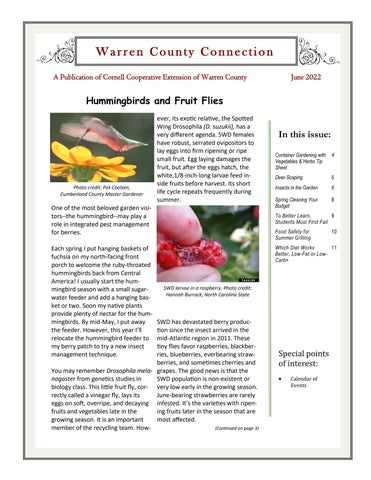
Photo credit: Pat Coolsen, Cumberland County Master Gardener
ever, its exotic relative, the Spotted Wing Drosophila (D. suzukii), has a very different agenda. SWD females have robust, serrated ovipositors to lay eggs into firm ripening or ripe small fruit. Egg laying damages the fruit, but after the eggs hatch, the white,1/8-inch-long larvae feed inside fruits before harvest. Its short life cycle repeats frequently during summer.
One of the most beloved garden visitors--the hummingbird--may play a role in integrated pest management for berries. Each spring I put hanging baskets of fuchsia on my north-facing front porch to welcome the ruby-throated hummingbirds back from Central America! I usually start the hummingbird season with a small sugarwater feeder and add a hanging basket or two. Soon my native plants provide plenty of nectar for the hummingbirds. By mid-May, I put away the feeder. However, this year I’ll relocate the hummingbird feeder to my berry patch to try a new insect management technique.
In this issue: Container Gardening with Vegetables & Herbs Tip Sheet
4
Deer-Scaping
5
Insects in the Garden
6
Spring Cleaning Your Budget
8
To Better Learn, 9 Students Must First Fail Food Safety for Summer Grilling
10
Which Diet Works 11 Better, Low-Fat or LowCarb>
SWD larvae in a raspberry. Photo credit: Hannah Burrack, North Carolina State
SWD has devastated berry production since the insect arrived in the mid-Atlantic region in 2011. These tiny flies favor raspberries, blackberries, blueberries, everbearing strawberries, and sometimes cherries and You may remember Drosophila mela- grapes. The good news is that the nogaster from genetics studies in SWD population is non-existent or biology class. This little fruit fly, cor- very low early in the growing season. rectly called a vinegar fly, lays its June-bearing strawberries are rarely eggs on soft, overripe, and decaying infested. It’s the varieties with ripenfruits and vegetables late in the ing fruits later in the season that are growing season. It is an important most affected. member of the recycling team. How(Continued on page 3)
Special points of interest: •
Calendar of Events
Warren County Connection
Page 2
Cornell University Cooperative Extension of Warren County 377 Schroon River Road Warrensburg, NY 12885
Phone: (518) 623-3291 or (518) 668-4881 Fax: (518) 668-4912
Visit Our Web Site: www.cce.cornell.edu/warren
Who We Are Nation-wide, thousands of people in each state tap into their state’s land -grant university research and know-how to make sound confident decisions concerning family, home, business, finances, and the future. In New York State, the land-grant university is Cornell University. The Cornell Cooperative Extension network brings you the expertise of Cornell University, other land-grant universities across the country and locally-based Extension Educators, volunteers, and other experts through such programs as: horticulture, youth and families, leadership, environment, food, nutrition & health, home environment, and financial management.
Staff Dr. James Seeley, Executive Director John Bowe, Associate Team Leader Dan Carusone, 4-H Natural Resources Coordinator Dr. Marybeth Mitcham, Nutrition, Food Safety & Healthy Living Educator Roxanne Westcott, 4-H Family Living Educator Rebecca Devaney, Community Horticulture Coordinator Sharon Bellamy, Finance Manager Amy Sabattis, Public Relations/Publications Manager Michele Baker, Administrative Assistant Chris Dittus, Administrative Assistant Connor Eastman, Maintenance
Board of Directors David Strainer - President Jim Kneeshaw - Vice President Dan Bruno - Secretary William Hamelin - Treasurer Aimee Azaert Lisa Earl Maureen Folk Ed Griesmer David Little Cynthia Muratori
Extension Service Committee Chair - Ben Driscoll Daniel Bruno Andrea Hogan Brad Magowan Debra Runyon
Warren County Connection
CALENDAR
Please visit our website for more events www.cce.cornell.edu/warren 6/15/2022 - 12:00 PM - 1:00 PM Father's Day Fish Luncheon - Celebrate Father's Day with a delicious fish lunch while also learning about local fish and fishing techniques! To register, please contact Director Barb Mitchell at: 518-696-6451. Location: Lake Luzerne Senior Center, 539 Lake Ave., Lake Luzerne, NY 12846 6/16/2022 - 2:00 PM - 3:00 PM Diabetic Diets - If you have diabetes, are pre-diabetic, or even just want to learn more about the relationship between diet and diabetes, come and join us for a short webinar where we will discuss what foods are sources of carbohydrates, the plating method, carb counting, and more. To register, please contact Director Tricia Golden at 518-793-1494. The Conkling Center, 79 Warren St., Glens Falls, NY 12801 6/23/2022 - 10:30 AM - 12:00 PM Senior Hikes - Physical activity can be fun when done as part of a group! Join us for an easy group hiking event that (weather permitting) will run for around 2 hours. Registration is limited. To register, please contact Director Barb Mitchell at 518-696-6451. Location of Hike TBD Lake Luzerne Senior Center, 539 Lake Ave., Lake Luzerne, NY 12846 6/28 - 6/30/2022 - 12:30 PM - 4:00 PM Food Preservation Workshop Series - The summer growing season is almost here, so it's a good time to learn the basics of food preservation! Join us for three food preservation workshops, where we will use different food preservation methods to make several food items. Each participant will learn how to make jam and jelly (Tuesday), pickles & dilly beans (Wednesday), & canned tomatoes and salsa (Thursday). Additionally, the processes of dehydrating, freezing, hot water bath canning, and pressure canning will be covered. Pre-registration and pre -payment is required. Fee: $10/workshop. To register for these workshops, please contact the CCE Warren office at: 518-623-3291. Cornell Cooperative Extension Warren County, 377 Schroon River Road, Warrensburg, NY 12885
If you have special needs as addressed by the Americans with Disabilities Act and need assistance with attending these workshops, please make your needs known by the registration deadline. Reasonable efforts will be made for accommodations.
Page 3
Warren County Connection (Continued from page 1)
So, what does this have to do with relocating my hummingbird feeder? Our ruby-throated hummingbirds are limitless consumers of small insects and spiders. Tiny arthropods are their source of protein, especially for feeding their nestlings. Cornell University researchers have verified that hummingbirds do help control adult SWD in berry patches! Although hummers are unfamiliar with this new and exotic insect, when a sugar-water feeder is placed in the berry patch, hummingbirds will be attracted to the area. While there, the hummers explore the plants and consume the adult spotted wing drosophila, often
is good air circulation and low humidity. Not only will this reduce disease pressure, but also limit SWD populations. If you decide to place hummingbird feeders in your berry patch, remember that the feeder will probably be in full sun. You must replace the sugar-water and scrub the feeder often, perhaps even daily as temperatures warm. Consider a second feeder as the replacement while you clean the first. Prepare the sugar-water solution using 1part white sugar and 4 parts tap water. Red coloring is neither needed nor recommended. For new plantings, select berry varieties that mature early when SWD pressure is low.
While no one likes to see tiny white worms in fruit, these larvae are harmless if we consume them. If your berry crop is late maturing, do consider using the fruit for juice or jelly rather than for whole fruit or jam. Filter the juice through cheesecloth to remove the interlopers. Those berries are too good to give up! Next year I’ll add native flowers to the berry patch to attract the hummers. Adaptation is part of gardening.
Adult SWD. Photo credit: Hannah Burrack, North Carolina State University, Bugwood.org
before mating and egg laying occur. Why not just grab a spray to manage spotted wing drosophila? Insecticidal sprays will not affect the eggs or destructive larvae as these stages are inside the berries. The tiny SWD adults fly from fruit to fruit within the canopy of the plant leaves. An insecticide with a long residual effect means that it lasts for several days. You would apply this insecticide to fruits that you harvest every day or two. If you decide to use an insecticide, select one that has a short Pre-Harvest Interval, PHI, the time between application and harvest. Bifenthrin, malathion, acetamiprid, spinosad, and pyrethrin are effective. Apply at a time when pollinators are not active. Remember to follow all instructions on the pesticide label. Sanitation is essential to manage spotted wing drosophila. Always pick all the berries cleanly, including damaged fruits. Do not allow unwanted fruits in the area where SWD reproduction can continue. Either freeze or “bake" the unwanted fruits in clear plastic bags in the sun to kill the eggs and larvae, then bury the fruit in a compost pile. Prune the canes or limbs and reduce weeds so that there
“Knowledge is knowing a tomato is a fruit; wisdom is not putting it in a fruit salad.” ~ Unknown “Gardening is the art that uses flowers and plants as paint, and the soil and sky as a canvass.” ~ Elizabeth Murray “A garden is always a series of losses set against a few triumphs, like life itself.” ~ May Sarton
Have a Gardening Question? Cornell Cooperative Extension’s Master Gardeners answer questions on a variety of topics including growing vegetables, fruits, ornamental and turf grass, plant identification, pruning, and insect and disease problems.
Call 518-623-3291
Page 4
Container Gardening with Vegetables & Herbs Tip Sheet
Warren County Connection
longer than containers with natural materials as their sides. Terra cotta is an exception to this as some moisture is lost through the unglazed clay container. Take the material into account as you determine container size and the number of plants you can easily grow in the container. Size The size of the container will limit how much potting mix you can fill the container with. Smaller volume containers, and especially smaller containers with natural material side walls, will dry out much faster than larger containers with solid side walls. Hanging baskets with coir (coconut fiber) sides may require watering two or three times per day during warmer months. If you don’t want to water that often, select a larger volume container and one with solid side walls.
Nothing tastes as good as fresh produce. It tastes even better when you pick it in your own garden. What if you don’t have much space or no yard? You can have some vegetables and herbs growing on a sunny patio, porch, or deck in containers. A few minutes of planning and preparation will improve your success and enjoyment of any container garden. Site selection Vegetables and herbs need to be placed in a location with at least six hours of sunlight each day. Shade from overhangs, buildings or furniture will decrease the total number of hours the container receives sunlight, so take that into consideration. Without enough sun, there won’t be much production. Container selection The most important part of container selection is to find a container that has sufficient drainage holes in the bottom. Anything, in theory, can be a container from boots to wagons to tires. A good container has numerous small holes, ideally quarter-inch holes every two to three inches of container bottom. One large hole does not permit as much drainage as numerous small holes.
Material Plastic containers are lighter in weight and can be more easily moved from one spot to another, if you like to move containers as you might move your furniture. Resin containers look like clay or terracotta, but are also lightweight and easily moved. Real clay and terra-cotta containers are heavy and more difficult to move. Concrete, iron and other materials may not be moved much, if at all. Hanging basket containers may not have solid sides, but have coconut coir or other natural material sides. Solid wall containers will generally hold more moisture
Potting mix It is best to use a potting mix, one you purchase or make, rather than field soil in any container. Lighter mixes will drain better, have better root development, and will give you a lighter total container if you want to move it. Mixing equal parts (by volume) of peat moss and perlite makes a great potting mix for most plants. You can also purchase potting mixes, but avoid heavier “potting soils,” which may not drain well.
Fill containers with mix and wet the dry potting mix with warm water before adding plants. In very large containers, use solid pieces of Styrofoam to fill no more than one-third of the total volume of the container. Do not use Styrofoam peanuts to fill a part of the container. Often, these peanuts are not biodegradable and will “melt.” Larger pieces of Styrofoam won’t compact and will just take up space, saving some money on potting mix. Plant selection How many plants do I need? As a general rule of thumb, select approximately one plant for each eight to twelve inches of the diameter of the top of a round container. For example, if your container measures 18 inches across the widest part of the top, then use only one to two plants in that container. Often, larger diameter containers are deeper and can hold more potting mix. If you over-crowd a container, plants won’t grow as well and you will be watering very often. You also won’t get much production if you crowd plants. (Continued on page 5)
Page 5
Warren County Connection
Deer-Scaping
(Continued from page 4)
Which vegetables grow best in containers? Without much space, you’ll need to think of using smaller varieties so they can grow well in a container. Look for dwarf plants or smaller height plants at plant maturity. Most of this information is contained on seed packages and plant labels. If the plant has a mature height of 36 inches or less, you can probably find a container to grow it in. Vegetables well-suited for summer container gardening Cucumbers
Bush varieties are easier to manage, but vining varieties can be trellised.
Eggplant
Most varieties work well.
Peppers
Most bell and hot peppers grow well in most containers.
Squash
Summer squash do the best.
Tomatoes
Grape, cherry and other smaller varieties. Bush, “patio” or determinate varieties are good choices.
Herbs well-suited for summer container gardening
Herbs
Parsley, sage, cilantro, thyme, rosemary and oregano. Note: plant mints separately so they don’t overtake a container.
Care and maintenance Keep soil medium in containers well-watered. Healthy and actively growing plants are more disease and insectresistant than water stressed or over-watered containers. As the plants grow, they will use more water each day and may need to be watered twice daily toward the end of the summer. Fertilize Fertilize following the fertilizer’s label directions. Most containers will benefit from regular fertilization, either from slow or controlled-release fertilizer or regular application of a soluble fertilizer.
By Dr. Leonard Perry, Horticulture Professor, University of Vermont Deer-scaping combines landscaping and garden plants not for deer, but to discourage them. It is one of three main control techniques, probably the one most people try after deterrents but before resorting to fencing. Here are ten deer-resistant strategies that relate to choosing and placing your plants, and to designing your landscape. These and many other tips can be found in the the book Deerproofing Your Yard and Garden, by Rhonda Massingham Hart. As with any controls, if the deer are hungry enough, only exclusion or proper fencing may work. Choose deer-resistant plants. This is the first place most begin. After you decide what type of plant you want for such features as foliage, texture, color, and habit, then choose from plants deer tend to avoid. Instead of hybrid roses for instance, substitute the more thorny rugosa ones. If you like spring bulbs, try daffodils instead of tulips. Of course make sure plants you choose will grow in your climate, soil, and site. If you must have a certain plant that deer like too, be ready to use repellents and other strategies. Create entries to your property that are not attractive to deer. They are creatures of habit, so tend to beat down the same path. Find where they usually enter your property, and put the most deer-resistant plants here. This is the place to begin using repellents and other strategies. Such entries may be the place for play areas, paved areas, groundcovers, or lawn.
Protect the perimeter or edges of your garden or property. You might use an unattractive (to deer) hedge that is fuzzy, thorny, or strongly aromatic. If the deer pressure isn't high, you might just mix such plants in a border for the same effect. I like to move pots of tender and fragrant herbs, such as rosemary and pineapple sage, that I have overwintered inside around the landscape in summer. Herbs in a container garden can be
Source: Michigan State University Extension
(Continued on page 6)
Page 6 (Continued from page 5)
Warren County Connection
Insects In The Garden
Uses terraces, multiple levels, wide hedges, or double fences around your landscape. This is another way to protect your perimeter. Deer can jump, but won’t if they are not sure they'll have a safe landing. This is the idea behind low wire fences that slant outward. If you have a wood rail fence, just add another one four to five feet away to create this "unsafe" zone for deer clearance.
Gardeners grow frustrated as insect pests make a meal out of their fruits, vegetables, flowers and ornamentals. While gardeners are skilled at their craft, it’s nearly impossible to know everything about each type of pest when there are hundreds of insects, each feeding on a different plant, causing different types of damage at different times of the growing season.
Use multiple levels within your landscape. Deer don't like climbing up and down, in and out of areas, or getting into confined spaces. Create intimate garden "rooms" with plantings, trellises, and walls. Use raised beds and sunken areas. Your landscape will be more interesting to you, but much less attractive to deer.
For example, cucumber beetles can cause defoliation on plants in the same family, such as squash, zucchini and cucumbers. In contrast, aphids suck the sap from plants, such as tomatoes, cucumbers or roses, that belong to different plant families.
Camouflage your choice plants. You do this by confusing the deers' sensitive nose by interplanting highly aromatic plants such as garlic or herbs. They sense danger with their noses. If this sense is blocked, and they can't "smell" danger, they won’t be comfortable. You also can hide choice plants with taller plants in front, or surround trees and shrubs with unappetizing plants. Create a "moat" of strong odors they have to cross to get to your plants, and they often may not even try, if they can see them.
Out of sight, out of mind, applies to deer and your landscape. If you have a tall or thorny hedge, or solid fence, deer won’t be tempted by what they can't see. Put choice plants out of sight with such a hedge or aromatic border, or even a fence with vines. Remember deer have poor eyesight, so take advantage of this. Remove cozy deer beds. Deer like to bed down in tall grass and brushy areas. Keep these trimmed, tidy, or mowed, even if on the edges of your landscape. Keep up with the harvest. If you have fruit trees, keep drops picked up. Clear away corn, peas, and other favorite deer vegetables as soon as your harvest is done. Substitute hardscape elements for plants. Do you have some gardens that deer just won’t leave alone? Consider replacing them with landscape elements such as patios, benches, arbors, or statuary. As with other deer control strategies and deterrents, deer-scaping techniques are best started before you have a problem. Train deer early that your landscape is either too unsafe, too much trouble, too bad tasting, or too aromatic, and maybe they will move on.
In order to know when pest damage is present, it’s critical to recognize what a healthy plant looks like. When planning the garden, it is also helpful to do some quick research on common pests that may affect your plants. This can help with quicker identification of pests and thus, quicker implementation of control measures. Identifying a Pest A pest cannot be controlled without first identifying what it is. Start by asking the following questions to either properly identify the pest yourself or receive identification help from your local Extension agent: 1. What is the affected plant? Some crops, like broccoli, are far more likely to receive pest damage than others, such as lettuce. 2. What type of damage is present? Is it on the entire plant, leaves, stem or fruit? Some damage can actually be caused by diseases or environmental factors, but it may closely resemble certain types of pest damage. 3. What stage of the life cycle is the pest/could the pest possibly be? Many butterflies or moths are beneficial, but can cause damage while in their larva stage. If possible, snap a picture or capture the specimen to make identification easier. Not all pests are damaging – in fact, many insects in the garden setting are beneficial. Life Cycles Pests have different forms throughout the course of their life cycle, and not all stages cause the same type of damage or any damage at all. Understanding the life cycle of a pest is also beneficial because timing is helpful in identification. While there’s no one specific date for various life cycles of pests, a rough timeline of the season when each phase appears is useful in knowing when to scout for pest damage. (Continued on page 7)
Warren County Connection
Some insects undergo complete metamorphosis and have four developmental stages – egg, larvae, pupa and adult. Larvae and adult stages have different forms and usually live in different habitats. Often, the larvae stage is the most harmful stage for garden crops. The most common insects in this category are moths, butterflies, beetles, flies and bees. In contrast, insects that undergo simple or incomplete metamorphosis have three developmental stages – egg, nymph and adult. An example of these would be squash bugs. Pests with incomplete metamorphosis have the potential to cause damage during both the nymph and the adult stages. They also can be harder to identify, as nymphs of most insect species with incomplete metamorphosis look nearly identical to the adults, except that the adults are larger and reproductively mature. Aphids, whiteflies and stinkbugs are examples of insects with incomplete metamorphosis. Prevention and Control Prevention is the key to keeping garden pests under control, but sometimes that is not always feasible. When the weather is suitable for planting, it is also suitable for pests. Integrated pest management (IPM) strategies combine a variety of tactics to keep pest populations under control, with chemicals being a last resort.
Cultural Cultural controls mean altering the environment to make it undesirable for a pest. This is often the first line of defense because it is the easiest. Cultural control is as simple as maintaining a healthy plant through proper fertilization, irrigation, timing of planting to work around life cycles, selecting resistant varieties and practicing crop rotations.
Page 7
where pests have a chance to overwinter. In a garden setting, routine monitoring for pests means quick response time for hand-removal to be an easier task. Chemical When an infestation is beyond the help of cultural, biological or mechanical means, chemicals can provide effective, safe control when used correctly and sparingly. Use pesticides as a last resort, and always follow label instructions. The label will provide information on how much product to apply, where to apply and how long to wait before harvesting the product for consumption. Contact your local Extension office for advice on what products provide effective control for certain insects. Source: Emily Morrow, WVU Extension Agent – Jefferson County
Both Striped and Spotted Cucumber Beetles feeding on a cucumber plant.
Biological Biological controls use beneficial organisms to reduce pest populations. Commercial growers may choose to bring in the organism from an outside source. In a garden setting, this is accomplished by the placement of plants that attract a beneficial insect that will prey on a harmful insect, such as using ladybugs to control aphids. Mechanical and Physical Man-made manipulation is an easy control option, but it often can be labor intensive. Tilling the soil to allow overwintering eggs to dry out, hand-removing pests and egg masses from plants, using a floating row cover or installing sticky traps are all simple ways to disrupt a routine of pests. Other means of mechanical control include keeping a clean garden and removing any weeds and plant debris
Squash bugs undergo incomplete metamorphosis – eggs, nymph and adult (in order). (Photos by Emily Morrow)
Page 8
Spring Clean Your Budget By Nichole Huff, Ph.D., CFLE , Assistant Extension Professor Family Finance and Resource Management, University of Kentucky As you spring clean your home this year, also consider spring cleaning your household budget. Like our homes, our budgets need annual maintenance. As changes occur with our income, expenses, and financial goals, we need to be in the habit of regularly evaluating our spending and savings practices. Whether you’re preparing for tax season, or dreaming of your next vacation, spring cleaning your household budget keeps your wallet focused on financial priorities. REMOVE “DUST BUNNIES” Start financial spring cleaning by looking at what’s collecting dust in your accounts. Is there a service, membership, or subscription you’re no longer using? To save money, clean up any automated charges you may have forgotten about. Did you start a free trial but forgot to cancel it? Have you stopped going to the gym but never ended your membership? Are you paying for a home phone line you never use? Or a data storage plan you don’t need anymore? Is there a monthly subscription that would be cheaper if you paid annually? Overlooked fees, services, and recurring charges are often easy “cleanups” that will put money back in your account. MAKE FINANCIAL REPAIRS Like our homes, our budgets may need repairing from time-to-time. Consider your needs (such as housing, food, and monthly bills) versus wants (such as streaming services, restaurant meals, and anything “extra”). Are your financial priorities aligned? Do you focus on purchases that are most important to your family? You may need to identify parts of your budget that need repair. Also take the time to reflect on any changes to your financial situation. Have you taken on any new debt or added any new reoccurring expenses? If so, make sure they are reflected in your current budget. Look ahead to expenses you anticipate in the upcoming year or next few years. Then draft a savings plan so that you’re prepared when the time comes. Perhaps you’re saving for a child’s braces, a vehicle for a teen driver, or a new dishwasher. Work backward from the expected purchase date to determine how much money to save from each paycheck. For example, if you anticipate your 8-year old will need braces in three years (estimated cost
Warren County Connection
$5,000), you’ll need to save approximately $140 a month for three years to pay for the braces in full. CELEBRATE YEARLY SUCCESSES Each year it’s also important to recognize (and celebrate!) any financial progress you’ve made. For example, have you paid off a debt, saved for an intentional purchase, started an emergency fund, or contributed to your retirement account? These financial practices require discipline and deserve recognition. As you review past spending trends and spring clean your budget, be sure you are “paying yourself first” by including consistent contributions to savings. KEEP YOUR FINANCES ON-TRACK Spring cleaning your budget does not mean removing all flexible spending. Rather, look at it as “tidying up” your spending choices so you know where your money goes each month. This keeps your financial priorities in focus. A helpful way to see where your money goes is to track your expenses. Try using a simple tracking tool such as this one provided by the Consumer Financial Protection Bureau at https://www.consumerfinance. gov/about-us/ blog/track-your-spending-with-this-easy-tool/. Tracking your spending includes saving your receipts and tallying everyday purchases and recurring bills. This spring, give your household budget a refresh and set yourself up for financial success all year long.
Family Budget Coaching Program Now Available for Families and Individuals in Warren County Cornell Cooperative Extension of Warren County is now offering a free, confidential Family Budget Coaching Program to community residents. The one-on-one sessions are available to individuals and families who want to improve their financial literacy, set goals, create a savings plan, reduce debt and get a better handle on finances. The trained coaches will offer sessions either via Zoom or in person in Glens Falls, Warrensburg and Johnsburg. Since 1914, Cornell Cooperative Extension has responded to the needs of New York residents enabling people to improve their lives and communities through partnerships that put experience and research-based knowledge to work. For more information on this program, please contact Roxanne Westcott at rmw38@cornell.edu or (518) 668-4881.
Page 9
Warren County Connection
To Better Learn, Students Must First Fail
knowledge gaps in trying to solve the initial problem, it sparks an interest in learning. This helps them better understand the new concept when the teacher explains it. To further test “productive failure,” Kapur’s team implemented the theory starting in a university-level algebra course at ETH Zurich, a public university in Switzerland.
For years, educators have followed a model of explaining a new concept, then letting students practice. Think of a typical math class: the teacher will introduce an idea, do some example problems on the blackboard, and then ask students to practice similar problems on their own. New research finds that this age-old pattern may not be the most effective teaching method. A systematic review published in October in the journal Review of Educational Research identifies a better system: allow students to wrestle with a new problem first, and then explain the underlying concept.
Education researcher Manu Kapur, a co-author of the review, calls this strategy “productive failure.” His research suggests it may be the key to teaching STEM (science, technology, engineering, and math) concepts in middle school and beyond. For the review, Kapur and postdoc researcher Tanmay Sinha analyzed 53 studies of science and math students in North America, Europe, and Asia. The students ranged from second graders to postgraduates, but most were 12 to 18 years old. Their findings demonstrate that asking students to problem-solve first was two to three times more effective for learning than providing instruction first. Kapur and Sinha are quick to note that “productive failure” requires specific circumstances. First, students need enough background knowledge to attempt the initial problem (Interestingly, their strategy did not work well with younger students, probably because they don’t have enough general knowledge to effectively problem solve). The initial problems should be challenging, but not impossible. And the model functions best when students work in small groups to figure out answers. Evidence shows that when students recognize their
Usually, the course uses a traditional approach of learning through a lecture, followed by practice exercises. For their on-going study, Kapur’s team gave students the option to solve some problems before the class lectures. The preliminary data show that students who completed the extra work were 20% more likely to pass the class and had considerably higher grades compared to students who did not complete the extra work. The take-home message: An alternate method of learning where students first problem-solve, then receive instruction, is more effective than traditional learning methods. Source: https://evidencebasedliving.human.cornell.edu/ (Continued from page 10)
to their destinations without having to ask for directions. But when you are transporting hot foods to your picnic like fried chicken or BBQ ribs, take the most direct route. Hot take-out food should be eaten within two hours and within one hour if the temperature exceeds 90°F. Keep the flame alive - For many grilling enthusiasts, there is only one way to cook - with fire! However, realize that foods left out in temperatures higher than 90°F will become unsafe in just one hour. Because summer picnics and barbeques often last for more than a few hours, food that has been cooked and left sitting on the table for several hours should not be eaten. Hot foods need to be kept hot (140°F or higher). Use the grill and warming trays to maintain these temperatures. Chill out - Play it safe by putting leftovers and perishables back on ice after eating. Don't send leftovers home with the guests unless this food is transported in a cooler with ice and immediately chilled. These foods can reach the "Danger Zone" (40°F to 140°F), where bacteria can grow and multiply if not properly chilled. Also, cold foods need to be kept cold (40°F or lower). Use coolers and ice to maintain these temperatures. Source: http://warren.cce.cornell.edu/food-nutrition/food-safetystorage/safe-grilling
Page 10
Food Safety for Summer Grilling
The risk of foodborne illness increases during the summer months because disease-causing bacteria grow faster on raw meat and poultry products in warmer weather. Bacteria also need moisture to flourish and summer weather, often hot and humid, provides the perfect conditions. USDA's four key recommendations can help keep friends and family safe from foodborne illness: • Clean - Wash hands and surfaces often. • Separate - Don't cross-contaminate. Keep raw meat and poultry apart from cooked foods. • Cook - Use a food thermometer to be sure meat and poultry are safely cooked. • Chill - Refrigerate or freeze promptly. In addition, USDA's Meat and Poultry Hotline in the spirit of a food safe summer grilling season is providing these important recommendations for grillers: It's a wash! - In sports, "it's a wash" means that the two opposing teams are equally matched and the victor is anyone's guess. But during the summer grilling season, unless you wash your hands thoroughly, the opponent bacteria that cause foodborne illness - will have the advantage. Be safe by thoroughly washing hands with soap and warm water for 20 seconds. If soap and water are not available at the picnic site then bring disposable towelettes or an alcohol-based hand sanitizer. Handwashing is one of the simplest ways to help reduce the threat of foodborne illness. Go ahead, make more marinade - Sauces and marinades used on raw meat or poultry should never be reused on cooked foods. Reused marinade could potentially harbor bacteria that can make people sick. Recycling the mari-
Warren County Connection
nade as a dipping sauce after the food has been cooked is a bad idea if it has not been boiled first. Always allow meat and poultry to marinate in the refrigerator. At room temperature bacteria on raw meat and poultry can double in number every 20 minutes. Likewise, thaw meat and poultry in the refrigerator, never on the counter. Safe at the plate - This term applies to more than baseball. One of the most common mistakes people make is serving cooked food on the same plate that was used to transport the raw meat or poultry from the kitchen to the grill. Cross-contamination can also occur when vegetables or other uncooked foods come into contact with cutting boards, plates, and utensils that were used for raw meat and poultry products. So this summer keep it safe by using separate plates - one for raw foods and one for cooked foods. Tools of the trade - You can never have enough tools and two of something is better than one - and safer. It is important to have more than one spatula, fork, and other utensils on hand when grilling. Backyard chefs often use a spatula or kitchen tongs to place raw food on the grill and later use the same utensil to remove the food after it's been fully cooked. Because the utensil came into contact with raw food, it could harbor bacteria and transfer them to the cooked food. Be sure to use two utensils, one for raw food, and one for cooked food. Watch the temperature rise - Studies show that the color of cooked poultry and hamburgers is not a reliable way to determine if foods have been cooked to a temperature high enough to kill bacteria like E. coli O157:H7 and Salmonella. The only way to be sure food is safely cooked is to use a food thermometer to measure the internal temperature. All poultry products should reach a safe minimum internal temperature of 165°F. Ground beef and pork should be cooked to 160°F and steaks, roasts and fish should be cooked to 145°F. An ice chest isn't just for drinks - An ice chest is a valuable tool at summer outings. Not only does it serve as a vehicle for transporting food, but it also plays a critical role in reducing the chances of foodborne illness. Drinks aren't the only food products that should be chilled. Popular picnic items like hot dogs, raw hamburgers, and salads should be packed in a cooler with enough ice or freezer packs to keep the temperature inside at 40°F or below. Dad, are we there yet? - All dads know the best way to get (Continued on page 9)
Warren County Connection Warren County Connection
Which Diet Works Better, Low-Fat or Low-Carb?
Page 11
months or less. There were six trials that followed participants for two years. Combining all of that data, researchers found that the two types of diets performed about the same. In the shorter duration studies, people who followed a lowcarb diets lost on average about 2 pounds more than those who followed the low-fat diets (this amount is not statistically significant); over the long term, there was even less difference. The two diets also resulted in little or no differences in health indicators like blood pressure, unhealthy cholesterol levels, and blood sugar levels.
If you’ve ever tried to lose weight, you’ve noticed the myriad of diet options out there: keto, paleo, WW (formerly Weight Watchers), the Mediterranean diet, and many more. Is there a way to tell which one works the best? Public health officials have been asking this question for decades. The answer emerging from the most recent data is unexpected: They all work, and what works best for you depends on a variety of biological and lifestyle factors. Take, for example, a recent systematic review by the Cochrane Collaboration, a consortium of researchers and experts spread around the globe. The group recently pooled the available evidence to ask which type of diet works the best, low-carb or low-fat? The researchers categorized low-carb diets as meal plans that restrict grains, cereals, legumes, dairy, most fruit, and some vegetables. These diets replace those carbs with foods higher in fat and protein including meat, eggs, and cheese. Some low-carb diets suggest eating as much as you want and others restrict food intake. Popular examples are the keto and paleo diets. Low-fat, or balanced-carbohydrate diets, include moderate amounts of all of the types of foods: carbohydrates, proteins, and fats. They often require eating healthier foods – such as olive oil instead of butter – and encourage weight loss through reduced calorie intake. Examples include the DASH diet or WW. For the review, researchers found 61 trials with nearly 7,000 participants who were considered overweight or obese. The shortest trials – 37 of them – lasted for six
But there is a kicker: Although both groups lost weight on the whole, weight loss varied greatly for individuals. The low-carb diets worked much better for some people and not at all for others; the same held true for the lowfat diets. This is because diets are not one-size-fits-all, explained Martha Field, assistant professor in the Division of Nutritional Sciences at Cornell University. In fact, nutrition researchers are discovering that many factors – genetics, gut microbiome, medications, lifestyle, and more – contribute to how each individual responds to a specific diet. “As nutrition science has evolved, moving toward a more individualized approach is something we all see as an important goal,” she said. “When you get into the details and the variability from person to person, that’s what precision nutrition aims to understand.” The National Institutes of Health has launched a new research campaign called Nutrition for Precision Health that is investigating individual responses to diet. In the meantime, Field said, researchers don’t know enough yet to identify which diets work best for which people. But there are some general recommendations that probably apply to everyone according to the most current evidence: eat plenty of fruits, vegetables, and fiber; drink enough water; and keep as active as possible. The take-home message: There isn’t one diet that works best for losing weight. But with all of the options out there, it’s possible to find the one that works best for you. Source: https://evidencebasedliving.human.cornell.edu/
Cornell Cooperative Extension 377 Schroon River Road Warrensburg, NY 12885 RETURN SERVICE REQUESTED
IF THERE IS A CHECK IN THIS BOX , THIS IS THE LAST ISSUE OF THE WARREN COUNTY CONNECTION YOU WILL BE RECEIVING. To renew your subscription clip the form below and send to Cornell Cooperative Extension of Warren County.
Warren County Connection
THANK YOU INTERNATIONAL PAPER!! "Paper for this newsletter was donated by International Paper, proudly produced at the Ticonderoga, New York Mill from trees harvested in working Adirondack forests that are managed responsibly in accordance with the principles of the Forest Stewardship Council (FSC) and the Sustainable Forestry Initiative (SFI)." “International Paper is proud to join almost 60 manufacturers and importers supporting the Paper & Packaging – How Life Unfolds™ campaign.” “Cornell University Cooperative Extension of Warren County provides equal program and employment opportunities.” “The information given herein is supplied with the understanding that no discrimination is intended and no endorsement by Cornell Cooperative Extension is implied.” The Cornell Cooperative Extension educational system enables people to improve their lives and communities through partnerships that put experience and research knowledge to work. "Cornell Cooperative Extension actively supports equal educational and employment opportunities. No person shall be denied admission to any educational program or activity, or be denied employment on the basis of any legally prohibited discrimination involving, but not limited to, such factors as race, color, religion, political beliefs, national or ethnic origin, gender, sexual orientation, age, marital or family status, veteran status, or disability. Cornell Cooperative Extension is committed to the maintenance of affirmative action programs that will assure the continuation of such equality of opportunity."
Just $5.00 per year will give you one full-year subscription to the “Warren County Connection,” mail this coupon to: Cornell Cooperative Extension ☺ Be sure to include your fee of $5.00 to cover the cost of mailing. Name______________________ Address____________________ __________________________ Zip Code___________________ OR To get this publication FREE e-mail als77@cornell.edu and you will be added to our E-Edition.
We’re on the Web! http://counties.cce.cornell.edu/warren/ & Facebook - Look for CCE Warren