Warren County Connection A Publication of Cornell Cooperative Extension of Warren County
May 2021
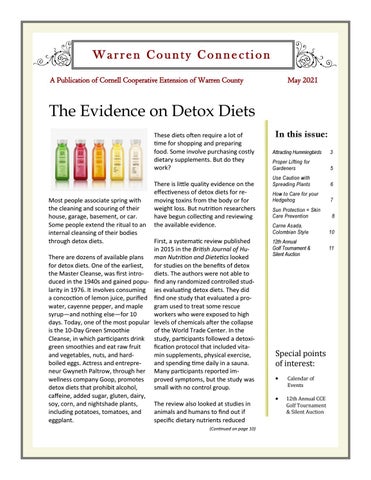
The Evidence on Detox Diets These diets often require a lot of time for shopping and preparing food. Some involve purchasing costly dietary supplements. But do they work?
Most people associate spring with the cleaning and scouring of their house, garage, basement, or car. Some people extend the ritual to an internal cleansing of their bodies through detox diets.
There is little quality evidence on the effectiveness of detox diets for removing toxins from the body or for weight loss. But nutrition researchers have begun collecting and reviewing the available evidence.
First, a systematic review published in 2015 in the British Journal of HuThere are dozens of available plans man Nutrition and Dietetics looked for detox diets. One of the earliest, for studies on the benefits of detox the Master Cleanse, was first introdiets. The authors were not able to duced in the 1940s and gained popu- find any randomized controlled studlarity in 1976. It involves consuming ies evaluating detox diets. They did a concoction of lemon juice, purified find one study that evaluated a prowater, cayenne pepper, and maple gram used to treat some rescue syrup—and nothing else—for 10 workers who were exposed to high days. Today, one of the most popular levels of chemicals after the collapse is the 10-Day Green Smoothie of the World Trade Center. In the Cleanse, in which participants drink study, participants followed a detoxigreen smoothies and eat raw fruit fication protocol that included vitaand vegetables, nuts, and hardmin supplements, physical exercise, boiled eggs. Actress and entrepreand spending time daily in a sauna. neur Gwyneth Paltrow, through her Many participants reported imwellness company Goop, promotes proved symptoms, but the study was detox diets that prohibit alcohol, small with no control group. caffeine, added sugar, gluten, dairy, soy, corn, and nightshade plants, The review also looked at studies in including potatoes, tomatoes, and animals and humans to find out if eggplant. specific dietary nutrients reduced (Continued on page 10)
In this issue: Attracting Hummingbirds
3
Proper Lifting for Gardeners
5
Use Caution with Spreading Plants
6
How to Care for your Hedgehog
7
Sun Protection = Skin Care Prevention
8
Carne Asada, Colombian Style 12th Annual Golf Tournament & Silent Auction
Special points of interest: •
Calendar of Events
•
12th Annual CCE Golf Tournament & Silent Auction
10 11
Warren County Connection
Page 2
Cornell University Cooperative Extension of Warren County 377 Schroon River Road Warrensburg, NY 12885
Phone: (518) 623-3291 or (518) 668-4881 Fax: (518) 668-4912
Visit Our Web Site: www.cce.cornell.edu/warren
Who We Are Nation-wide, thousands of people in each state tap into their state’s land-grant university research and know-how to make sound confident decisions concerning family, home, business, finances, and the future. In New York State, the land-grant university is Cornell University.
The Cornell Cooperative Extension network brings you the expertise of Cornell University, other land-grant universities across the country and locally-based Extension Educators, volunteers, and other experts through such programs as: horticulture, youth and families, leadership, environment, food, nutrition & health, home environment, and financial management.
Staff Dr. James Seeley, Executive Director John Bowe, Associate Team Leader Dan Carusone, 4-H Natural Resources Coordinator Marybeth Mitcham, Nutrition, Food Safety, & Healthy Living Educator Roxanne Westcott, 4-H Family Living Educator Jessica Holmes, Master Gardener Coordinator Sharon Bellamy, Finance Manager Amy Sabattis, Public Relations/Publications Manager Michele Baker, Administrative Assistant Chris Dittus, Administrative Assistant Samantha Sprague, Maintenance & Farm to School Assistant
Board of Directors Laura Conway - President Peter Benoit - Vice President Dan Bruno - Secretary William Hamelin - Treasurer Aimee Azaert Lisa Earl Ed Griesmer Jim Kneeshaw David Little David Strainer Michael White
Warren County Connection
CALENDAR Please visit our website for more events www.cce.cornell.edu/warren 5/8/2021 10:00 AM - 12:00 PM Basic Food Preparation - Learn the basics of food preservation from CCE Warren educator MB! In this class, participants will learn about food preservation safety skills (a must when preserving food), and how to safely make refrigerator salsa fresca, refrigerator pickles, jerky and jam. To register, contact the SUNY Adirondack Continuing Education department: 518-743-2238. Online Training Via Zoom 5/5, 5/12, 5/19/2021 6:00 PM NYS Virtual 4-H Forestry Event - This event will be presented in both a Beginner Level & Advanced Level. The Beginner class is for youth 10 and over who have little or no experience with tree identification, map & compass, or learning about how to measure trees. The Advanced class is for youth 13 and over with experience in tree identification, map & compass, and tree measurement. Contact your county’s CCE office to register for the event. Questions - e-mail John Bowe at jfb32@cornell.edu or call 518-668-4881. Online Training Via Zoom 5/7/2021 11:00 AM Culinary Tour Around the World! - Come and join us as we take a culinary tour around the world! Each month, we will learn how to make a recipe from a different region of the world. Join us this month as we make - and taste - a recipe from Israel! To register for this event, please contact Michelle Whitbeck at the Queensbury Senior Center 518-761-8224. Queensbury Senior Center, 742 Bay Road, Queensbury, NY 12804 5/15/2021 1:30 PM - 3:00 PM Wild Edibles - This short workshop will be focused on how to identify wild edibles that are available in Northeastern United States, what parts of the plants are safely edible, when they should be harvested, and how they can be prepared. To register, contact CCE Warren at: 518-623-3291 or e-mail MB at: mem467@cornell.edu. Cornell Cooperative Extension Warren County, 377 Schroon River Road, Warrensburg, NY 12885 5/18/2021 8:30 AM - 4:00 PM Timber Measurements for Harvesters This course teaches loggers how to estimate tree and product volumes on an individual tree basis as well as a stand and property basis. For more information call Dan Carusone at 518-623-3291. Warrensburg Fish Hatchery, 145 Echo Lake Road, Warrensburg, NY 12885 5/23/2021 1:00 PM - 4:00 PM Basic .22 4-H Rifle Course - This course is for Warren County youth 12 years of age or older. Participants will learn the parts and functions of a .22 caliber bolt action rifle, safe handling and carrying of such, and the range rules that are associated with using a shooting range. The class is $5 for current 4-H members and $15 for non-members who are required to join 4-H before the event for liability reasons. To register call 518-668-4881 and ask for Michele or John. Or e-mail mlb222@cornell.edu. Dunham’s Bay Fish & Game Club, 2080 Ridge Road, Queensbury, NY 12804
Extension Service Committee Chair - Sylvia Smith Daniel Bruno Ben Driscoll Andrea Hogan Brad Magowan
If you have special needs as addressed by the Americans with Disabilities Act and need assistance with attending these workshops, please make your needs known by the registration deadline. Reasonable efforts will be made for accommodations.
Warren County Connection
Attracting Hummingbirds Learn about the many aspects of hummingbirds and how to attract them to your property.
With the approach of summer, it is time to welcome New York’s smallest bird, the ruby-throated hummingbird. Named for the humming sound made by their wings in flight, these birds are renowned for their small size, amazing energetic feats, and iridescent beauty. More than 330 species of hummingbirds live in North and South America. Most live in the tropics. Sixteen hummingbird species occur on a regular basis in the United States, but only the ruby-throated hummingbird is found east of the Mississippi River. General Biology The ruby-throated hummingbird is only 3 to 4 inches long and weighs less than 0.2 ounces. Each fall it migrates from the eastern United States to Mexico and Central America. The birds fly nonstop 600 miles across the Gulf of Mexico during migration. They return in the spring and move northward, following the blooming of early-season flowering plants, such as azaleas, rhododendrons, and columbine. They arrive in Alabama by late March; Washington, D.C., by mid-April; Pennsylvania by mid-April to early May; and further north in New England by May. They stay in the Northeast until September, when they migrate back to Central America. Hummingbirds are promiscuous: one male mates with more than one female. Males perform a pendulum-like aerial display to attract females. The birds will often use this same display to defend a food source such as a patch of flowers from other hummingbirds. The female builds the nest and generally lays two eggs. She incubates the eggs and raises the young without assistance from the male.
Page 3
Habitat Requirements During the breeding season, ruby-throated hummingbirds are found in deciduous and mixed deciduousconiferous forests, woodland clearings and edges, parks, and suburban gardens. They often are found near water. They prefer areas where they can find nectar-bearing flowers, with trees and shrubs nearby for shelter and perching. Cover Hummingbirds build their tiny nests on the small limbs of trees or shrubs, usually 5 to 20 feet above the ground. Most nests are sheltered from above by over-hanging leaves and branches. Usually there is no cover below the nest, and nests often are located above water, a trail, or other open area. Females return each year to the same area to nest, sometimes reusing their old nests. New nests may be located in the same tree as in previous years or in a nearby tree. Many tree species are used, but hummingbirds appear to prefer rough-barked trees and those covered with lichens rather than smooth-barked species. Food Hummingbirds are specially adapted for eating nectar from flowers. They have long beaks and long tongues for consuming the nectar. The tiny birds can maneuver easily around flowers because they fly backward as well as forward and can hover in midair. This hovering ability makes it easy for them to feed from flowers. Hummingbirds get nectar from plants, and plants get pollinated by hummingbirds. When the birds feed from flowers, they brush against them, and the pollen sticks to their heads and throats. As they go to the next flower to feed, they transfer some of the pollen to that flower. While bees and other insects also pollinate plants in this way, some plants have evolved so that hummingbirds are their main pollinators. Such flowers tend to have petals joined into long tubes and long stamens (the part of the plant that holds the pollen). Stamens are arranged in such a way as to brush against the hummingbird when it feeds on the nectar. Hummingbirds lack a well-developed sense of smell and are drawn to flowers by their color instead of their scent. Preferred hummingbird flowers are red, orange, and pink, but the birds eat nectar from flowers of most colors. At least 19 species of native plants in the northeastern United States are pollinated primarily by hummingbirds. These include spotted touch-me-not, trumpet vine, (Continued on page 4)
Page 4 (Continued from page 3)
cardinal flower, fly honeysuckle, trumpet honeysuckle, fire pink, columbine, and wild bergamot. Hummingbirds also assist in pollinating many other native, introduced, and cultivated species. Along with nectar from flowers, hummingbirds eat insects (off flowers and those caught in the air), spiders, and occasionally sap from trees, especially from woodpecker drilling holes. Hummingbirds also consume sugarwater solutions from bird feeders. Water Hummingbirds get most of the water they require from the nectar they eat. They also drink water from leaf surfaces after rains. Hummingbirds use water for bathing and particularly like to bathe by flying through a fine mist. A device that creates a misting fountain within a bird bath can be found at many garden supply stores. Management Practices The factor that most often determines whether hummingbirds are found in a particular area is the availability of food. By planting sources of food and providing bird feeders, you can supplement local food supplies for hum-
Warren County Connection
consider using native plant species rather than species introduced from other parts of the country or world. Provide a Hummingbird Feeder Once you have established your hummingbird garden, a great way to attract the birds to a specific location is to provide a hummingbird feeder. These are not traditional bird feeders but designed to dispense a sugar-water solution. Place the feeders near large clusters of flowers early in the season, so that hummingbirds are easily drawn to them. Once the birds come to your feeder, you can move the feeder, gradually, to almost any location, such as in sight of a window for better viewing. The hummingbirds will find the feeder once they are attracted to an area.
Minimize the Use of Pesticides Hummingbirds eat insects in addition to nectar and sugar water. Pesticides reduce the number of insects available for hummingbirds to eat. Herbicides may kill plants that produce flowers from which hummingbirds feed. Birds may also be susceptible to the chemicals themselves. Therefore, pesticide use should be minimized. Protect Hummingbirds from Cats Cats are a favorite pet in many a home, but if allowed to roam outside they kill many wildlife species--including hummingbirds. It is best to keep your cat indoors at all times to keep it from killing local wildlife. If you do allow your cat outside, place hummingbird feeders in open areas and high enough to be out of cats' reach. Hummingbird Feeders You can attract hummingbirds by using feeders that dispense sugar water. Hummingbird feeders generally consist of a plastic or glass storage bottle with red "flowers" encircling the feeding openings. a number of commercial designs are available. select a feeder that is easy to clean and that will store enough nectar for three to four days. Nectar left in feeders for a longer time will go bad.
mingbirds. Plant Sources of Food Flowering herbs, shrubs, vines, and trees provide additional food for hummingbirds and attract them to specific areas. Your plantings should include a variety of plants that flower from May through early September. This will ensure food is available throughout the time hummingbirds are present. Hummingbirds are attracted to large clusters of flowers, so group the plantings so that they are conspicuous to the birds. Many species of flowering plants attract hummingbirds. In general, the flowers most attractive to hummingbirds are red, orange, or pink and are tubular in shape. When planning your plantings,
Hummingbird "nectar" is made by mixing one-part sugar to four-parts water. Bring water to a boil and pour over sugar. Stir solution and let cool to room temperature before pouring into the feeder. Extra nectar may be stored in the refrigerator. Weaker sugar solutions will be less attractive to hummingbirds, and stronger solutions may be harmful. Never make the solution from honey, because fermented honey can cause a fatal fungal disease in hummingbirds. It is unnecessary to add red dye to the solution since hummingbirds are attracted to the red coloring of the feeder. If your feeder does not have red on it, you can use red nail polish to paint the color near the (Continued on page 5)
Page 5
Warren County Connection
Proper Lifting for Gardeners
(Continued from page 4)
Dr. Leonard Perry, Horticulture Professor, University of Vermont
openings. Commercial "nectar" mixes are available but are no better than those you make yourself. Placement Place feeders close to plantings of hummingbird flowers and in a location where you can watch the feeder. Hummingbirds are very aggressive at feeders. If a number of birds are fighting over one feeder, set up an additional feeder away from the first one. Timing Feeders should be placed outside as soon as the first flowers come out in spring, because hummingbirds follow the blooming flowers north in their spring migration. Leave the feeders out until September, when the birds leave Pennsylvania to migrate to Central America for the winter. A concern that feeders keep hummingbirds from migrating and hold them in northern areas has proved to be unfounded. The primary clue hummingbirds use to migrate is change in day length. Therefore, feeders can be kept up until birds quit using them. Generally, you can take them down when they have not been used for a week or more. Maintenance Replace the sugar solution every three to five days and clean the feeder before adding a new supply. Wash the feeder thoroughly with soap; you can use a weak bleach solution to sterilize the feeder. Vinegar may be used to clean feeders too. Just be sure to rinse thoroughly with hot water to get rid of the vinegar. Remove the plastic flowers and scrub inside them with a small brush. Make sure to rinse all parts thoroughly before refilling with sugar solution. Feeders may attract bees, yellow jackets, wasps, hornets, ants, or other unwanted species. Some feeders have "bee guards" on the openings. These allow a hummingbird's long bill and tongue to reach the sugar solution but prevent bees or other flying insects from reaching it. Bee guards are not foolproof, because hummingbirds often splash sugar water on them, but they do help cut down the bee problem if you clean the feeder regularly. You can also put cooking oil, petroleum jelly, or mineral oil on the outside of the feeder around the feeding holes, and on the wire from which the feeder is suspended. This makes it more difficult for ants, bees, and other insects to land or walk near the feeder openings. Again, this method is not foolproof, but it will reduce insect problems. Source: PennState Extension
Back injuries are second in the number of injuries, only to fingers and hands. Most back injuries come from improper lifting, lowering, pushing, pulling, and carrying—all activities we perform in the garden. Here are some basic principles which apply to any means of lifting, lowering, and carrying, whether at the gym, home, store, or in the garden. They apply whether lifting bags of fertilizer off a shelf, bags of compost, lifting rocks or pulling weeds.
Start slowly, don’t rush, don’t jerk. Move weights or objects in an unhurried, controlled manner.
Use good form, or body position. This is more important than the amount you can lift. If you have problems keeping good form, decrease the weight or get help from another person or with some aid as a dolly.
Make sure to breathe; the tendency for some is to hold your breath when lifting.
Make sure to keep your feet all on the ground, don’t rock back on your heels.
Lift with your legs and not your back. Not doing so is the main cause of back injury when lifting. Lift with your knees and waist bent, not your back. Keep your back straight. Knees should be directly above your toes, your shoulders above your knees. If this isn’t happening, try taking a wider stance with feet further apart, and toes pointed outward slightly.
You can look down at the object to lift, but when lifting keep the head in a neutral position looking forward— not up, not down. This creates less stress on your neck muscles.
Keep objects close to your body when lifting. Holding them at arm’s length increases the weight on your (Continued on page 6)
Page 6
Warren County Connection
(Continued from page 5)
lower spine by 15 times. Stand close to the object when squatting down to lift.
If lifting an object, particularly if heavy, onto a shelf, keep the object close to you and walk toward the shelf rather than stretching your arms out.
Be careful when raising objects higher than your waist, as this can throw off your balance. Standing with one foot slightly ahead of the other may help with balance. If lifting higher than your shoulders, you may need to lift less (if possible), or use a step ladder.
Use Caution With Spreading Plants By Rosie Lerner, Extension Consumer Horticulture Specialist, Purdue University
Make sure you plan ahead when lifting where the object will go. This avoids twisting improperly, carrying around heavy items, or lifting too much too high.
People often select plants first for their beauty and second for their functionality in the garden. Frequently, we don’t know or don’t consider a plant’s behavior when we’re selecting them.
Make sure you have good footwear to provide solid support, and that surfaces you’ll stand or walk on when lifting and carrying aren’t slippery, or with hazards such as cords, ropes, or stones.
Almost by definition, a species that is an effective ground cover will have a spreading habit. But does that make the species aggressive or invasive? There can be much confusion about the meaning of the terms aggressive and invasive.
If lifting large items that obstruct your full vision, make sure you know where you’re going first; that there aren’t obstructions below or above.
Don’t twist or turn at the waist while lifting; turn your whole body instead, leading with your waist and not shoulders.
Don’t ignore pain. The saying of “no pain, no gain”, doesn’t apply here. Take time to rest if your body calls for this.
If you’ve been sitting, stretch your muscles when getting up before beginning to lift.
As with any garden activities, do 15 repetitions or so, then rotate to another activity. Especially in the case of lifting motions, doing too many and getting tired often leads one to start using the back and lifting improperly.
Kind hearts are the gardens, Kind thoughts are the roots, Kind words are the blossoms, Kind deeds are the fruits. ~19th century rhyme used in primary schools
Some plants, given their optimal habitat, can become quite prolific in the garden. A plant can be considered aggressive if it spreads and has the potential to take over a garden area. However, some planting sites may call for an aggressive habit. A spreading plant can be considered invasive if it can also escape the garden setting and move into natural areas (prairies, wetlands, and so on) and displace native vegetation. Truly invasive plants have the potential to dominate natural vegetation. Many useful plants get bad reputations for their spreading behavior when they may simply be in the wrong place or managed the wrong way.
Some spreading ornamental plants have a high propensity for becoming invasive. You should always avoid using these plants in the landscape. As you consider what to plant, it may seem that more and more plants are classified as invasive — and you would be correct. There are more invasive plants for several reasons, including an increasingly unstable climate, more gardeners who unwittingly plant invasives, greater scrutiny of invasives, and changes in species (that is, individual species have adapted to cooler or warmer environments).
Warren County Connection
How to Care for Your Hedgehog
Page 7
Dr. Kehoe also advises having only one hedgehog per enclosure. “Hedgehogs are solitary in the wild and may fight if housed together,” he warns. Bedding for your hedgehog should be soft and absorbent. Recycled newspaper bedding is preferred, and aspen wood shavings are acceptable, but do not use other wood chip products that are aromatic, such as cedar, or dusty materials. These can irritate the respiratory tract and predispose it to infection.
Hedgehogs are not tiny cats or spiny hamsters. Before getting a hedgehog as a pet, you need to understand their unique needs so you can keep it healthy and happy. Luckily, Dr. Spencer Kehoe, the newest veterinarian on the zoological medicine service at the University of Illinois Veterinary Medicine South Clinic, is eager to share his advice. Dr. Kehoe earned his veterinary degree from the University of California-Davis. He then completed a specialty internship in wildlife medicine, surgery, and conservation at the Clinic for the Rehabilitation of Wildlife (CROW) in Sanibel, Florida, and a three-year zoological medicine and surgery residency at the University of Georgia. “I love teaching, mentoring, and getting to work with students, specialty interns, and residents to provide the best care possible for the amazing species our service sees,” says Dr. Kehoe of his new role. “I also enjoy being in an environment where I can challenge myself and learn from my colleagues every day.” And speaking of challenging, a hedgehog can be a demanding pet, so learn all you can before you bring one home.
Where to Keep Your Hedgehog Dr. Kehoe recommends using a solid-sided cage, such as a glass aquarium, so your hedgehog can’t climb up the walls, which not only could lead to their escape, but also leads to damaging their toes. “As long as the bottom 12 inches of the walls are solid to prevent climbing, a wire-sided cage could be used,” he notes. “Hedgehogs are normally quite active, so the floor of the cage should be at least 2 feet by 3 feet to give them plenty of room to roam. And they are nocturnal, so they are going to be active at night.”
What to Put in the Enclosure “Bedding will need to be changed frequently. I recommend daily spot cleaning to remove feces, a midweek change of bedding, and a thorough cage cleaning (everything removed and the cage washed) at the end of each week,” says Dr. Kehoe. Their cage should offer a place to hide and sleep during the day. “Options include a box, a ‘hut’ purchased from a pet store, or a length of PVC pipe,” says Dr. Kehoe. “Be sure the hiding spot has no sharp edges and has a big enough entryway that the hedgehog does not get stuck.” Hedgehogs need a warm environment. Dr. Kehoe recommends having at least two thermometers inside the pet’s enclosure to ensure that the temperature range stays between 75°F and 85°F. “If the temperature goes outside this range, the hedgehog may enter a state of torpor where it becomes less active,” says Dr. Kehoe. “This situation also negatively impacts the animal’s immune function.” What to Feed Your Hedgehog Hedgehogs are considered insectivores. In the wild they eat insects and other invertebrates, eggs, vegetation, and on occasion small vertebrates. “The best diet for your hedgehog is a commercially formulated diet specifically made for hedgehogs, or an insectivore diet,” advises Dr. Kehoe. “Never feed your hedgehog food marketed for cats or ferrets because these diets are too high in protein and fat and far too low in fiber.” You can supplement your hedgehog’s commercial food with a variety of invertebrates, such as crickets, earthworms, and mealworms, that have been fed a diet rich in calcium, a practice called “gut loading.” Pet stores carry these supplements for the invertebrates. (Continued on page 8)
Page 8 (Continued from page 7)
Hedgehogs should also be given a variety of vegetables, such as beans, cooked carrots, squash, peas, tomatoes, and leafy greens. Dr. Kehoe warns that only very small amounts of fruits—less than ¼ teaspoon per day—should be offered as treats. Fruits are high in sugar. Fresh water should be always available in a shallow pan and changed daily. No additives are needed for your hedgehog’s water. Exercise and Veterinary Care for Your Hedgehog In the wild hedgehogs are good swimmers and agile climbers. They may run several miles a night. In captivity, they need an enclosure large enough to allow for natural foraging behavior. Dr. Kehoe recommends providing an exercise wheel, but the wheel must have a solid bottom, not a wire one, which can lead to severe injuries such as broken legs. “Since hedgehogs are nocturnal, nighttime is the best time to interact with your pet,” says Dr. Kehoe. “Interaction is mentally stimulating for your hedgehog and allows them to become more comfortable with you and with handling.”
One warning about handling hedgehogs, though: hedgehogs can carry the salmonella bacteria without showing any symptoms. Salmonella causes a disease in humans and animals with the symptoms of diarrhea, weight loss, and dehydration. This disease can be fatal if left untreated. For this reason, it is very important to use caution and wash your hands after handling your pet. Hedgehogs typically live 4 to 6 years, and Dr. Kehoe recommends a veterinary checkup every six months. Common health concerns in hedgehogs include obesity, fatty liver disease, cancer, wobbly hedgehog syndrome, skin disease, and dental disease. Unspayed female hedgehogs can also develop reproductive diseases. Obesity and fatty liver disease can be prevented by giving your pet a proper diet and plenty of exercise. If you have questions about hedgehogs or other pets, please see your local veterinarian. Source: College of Veterinary Medicine, University of Illinois at UrbanaChampaign
Life is not so short but that there is always time enough for courtesy. ~Ralph Waldo Emerson, Social Aims
Warren County Connection
Sun Protection = Skin Care Prevention As the sun and fun of summer begin, most people think of sun protection only when they spend a day at the lake, beach, or pool. However, sun exposure adds up day after day all year long. It’s also the time of year we think more about skin cancer which is by far the most common type of cancer in the United States and worldwide. 1 in 5 Americans will develop skin cancer by the age of 70 and more than two people die of skin cancer in the U.S. every hour.
“We see people at our practice at UConn having sunburns during June more often than we do in July or August,” said Dr. Philip Kerr, Chair of Dermatology, UConn Health. He said the June sun is the strongest because the days are long and the sun is directly over us. Most skin cancers are caused by too much exposure to ultraviolet (UV) rays. Most of this exposure comes from the sun, but some can come from man-made sources, such as indoor tanning beds and sun lamps. People who get a lot of exposure to UV rays are at greater risk for skin cancer. The main types of UV rays that can affect your skin include UVA rays and UVB rays. UVB rays have more energy and are a more potent cause of at least some skin cancers, but both UVA and UVB rays can damage skin and cause skin cancer. There are no safe UV rays. “Any color to the skin including a tan is the skin’s way of protecting itself from UV radiation by producing more melanin,” says Dr. Hao Feng, a Mohs micrographic surgeon and the Director of Laser Surgery and Cosmetic Dermatology at UConn Health. Sunburn accelerates skin aging and is a leading cause in the majority of cases of basal cell carcinoma, squamous cell carcinoma, and melanoma, the deadliest form of skin cancer. Basal cell carcinoma is the most common form of cancer worldwide. In the United States, it accounts for approximately 80 percent of all skin cancers. The majority of basal cell carcinomas are easily and successfully treated with current therapies. According to Dr. Feng, basal cell carcinomas are most commonly found on the face, neck, ear, trunk, or other parts of the body that are frequently exposed to the sun. The cure (Continued on page 9)
Page 9
Warren County Connection (Continued from page 8)
rate for this type of cancer is very high at 99 percent when treated with Mohs micrographic surgery. However, because basal cell carcinomas often occur on the face, they can cause serious cosmetic damage and functional difficulties if not diagnosed and treated early. Squamous cell carcinoma is the second most common form of skin cancer in the United States. It accounts for about 15 percent of all skin cancers. This type of cancer is also found around the face, the nose, top of ears, and the scalp are common places for skin cancer to develop due to exposure to the sun. While squamous cell carcinoma also has a high cure rate of 92-97 percent for tumors treated for the first time depending on the treatment modality, it generally does have a higher recurrence rate compared to basal cell carcinoma. Melanoma is among the most serious forms of skin cancer. Most melanoma develops in the skin. The face, scalp, neck, arms, legs, chest, belly, and back are common areas where melanoma develops. Cutaneous melanoma can also start on the bed of a fingernail or toenail. Kerr said he sees what sun damage and skin cancer does to people daily. Fair-skinned people with blue eyes, who freckle easily, are most at risk, but Kerr said they do see some cases in dark skin. People who spend a lot of time in the sun or have a history of using tanning beds are at the highest risk for melanoma. But some people are at greater risk than others. The risk for melanoma also increases with age. When detected early, the 5-year survival rate for early stage melanoma is 99 percent, it is when it is found late and has spread to other parts of the body that it can cause death. “Skin cancer is common and prevention is the key to not only preventing skin cancer but skin health in general to prevent healthy aging,” says Feng. Kerr says sunscreen is the first line of defense against skin cancer and said it needs to be done properly. “If a person’s going to be out for more than two hours, then we recommend to reapply, and also we recommend to reapply if someone has been in a swimming pool or the ocean for more than five or 10 minutes.” He recommends a 30 SPF for those going to be out for under two hours and 50 if longer or near water. “The
reason is that water reflects the ultraviolet up towards us,” he explained. That means getting sun from overhead and below from the water’s reflection. “The frequency and amount of application is an important part of using sunscreen,” says Feng. Not applying enough or frequently enough is a common mistake when using sunscreen.
• •
• •
Apply 15 minutes before you go outside. This allows the sunscreen (of SPF 30 or higher) to have enough time to provide the maximum benefit. Use enough to cover your entire face and body (avoiding the eyes and mouth). An average-sized adult or child needs at least one ounce of sunscreen (about the amount it takes to fill a shot glass) to evenly cover the body from head to toe. Know your skin. Fair-skinned people are more susceptible to the damaging effects of the UV rays than dark-skinned people under the same conditions. Reapply at least every two hours, and more often if you’re swimming or sweating.
Kerr said the single best ingredient in sunscreen is zinc oxide. He said it lasts longer and “doesn’t absorb into the bloodstream. We know that the chemical-based sunscreens do absorb into the body and are found in the bloodstream.” Some key sun safety tips include: • Limit time in the sun, especially between the hours of 10 a.m. and 2 p.m., when the sun’s rays are most intense. • Wear clothing to cover skin exposed to the sun, such as long-sleeved shirts, pants, sunglasses, and broadbrimmed hats. • Use broad-spectrum sunscreens with SPF values of 30 or higher regularly and as directed. • Reapply sunscreen at least every two hours, and more often if you’re sweating or jumping in and out of the water. There is no such thing as a base tan to protect you. For a sun-kissed look, you can consider tanning gels and lotions or spray tans. These are safer options, however, they don’t provide protection from the sun’s damaging rays. It’s never too late to protect your skin from damage. You and your dermatologist can determine based on you and your family’s health history how often you should be checked for skin cancer. Source: Jennifer Walker - UConn Health, University of Connecticut
Page 10
toxins in the body; they did find some evidence that specific nutrients were able to eliminate toxins. For example, one study found that consuming citric acid reduced aluminum levels in mice. Another found that selenium reduced mercury levels in birds, fish, and mammals, including humans. The reviewers found no evidence that detox diets lead to weight loss. (More on that in a minute.) But they did find that detox diets can be harmful. First, many detox diets don’t provide enough nutrients or calories, so they can lead to deficiencies and, in extreme cases, death. There is also the danger that people on detox diets can overdose on a specific nutrient. A second review published in 2017 looked at the evidence on detox diets for weight loss. Again, the authors found limited evidence available, especially over the long term. There is evidence that many people lose weight during and shortly after a detox diet, most likely due to a drastic reduction in calorie intake and sometimes a loss of water and fecal weight. But there was no evidence that detox diets lead to weight loss over the long term. The authors did find a study demonstrating that strict calorie limitations led to a rise in stress hormones, including cortisol, which may stimulate a larger appetite and ultimately lead to weight gain in the long term. The take-home message: There is a lack of scientific evidence showing that detox diets reduce toxins from the body or lead to weight loss. According to the best data available today, a healthy diet that includes restricted calories and regular physical activity is the best way to lose weight over the long term. Visit Cornell University’s Bronfenbrenner Center for Translational Research’s website for more information on our work solving human problems.
During my second year of nursing school our professor gave us a quiz. I breezed through the questions until I read the last one: "What is the first name of the woman who cleans the school?" Surely this was a joke. I had seen the cleaning woman several times, but how would I know her name? I handed in my paper, leaving the last question blank. Before the class ended, one student asked if the last question would count toward our grade. "Absolutely," the professor said. "In your careers, you will meet many people. All are significant. They deserve your attention and care, even if all you do is smile and say hello." I've never forgotten that lesson. I also learned her name was Dorothy. ~JoAnn C. Jones, in
Warren County Connection
Carne Asada, Colombian Style By Marybeth Mitcham, Nutrition, Food Safety, and Healthy Living Educator, Cornell Cooperative Extension of Warren County Carne asada, or grilled meat, is a popular staple in Latin American cuisine. Although the exact recipe for carne asada will vary from region to region, and from person to person, most carne asada recipes contain a 1” thick, tough cut of beef steak, lime juice, garlic, onion, and black pepper. The final product, grilled to perfection, is cut against the grain into thin strips that are often used in tacos, and/ or served along beans and rice. This recipe for marinated flank steak is based on a Colombian version of the traditional recipe. If you do not prefer to use beer in your cooking, free to substitute non-alcoholic beer or even a dark soda (such as cola). Ingredients: • 1 flank steak (~2 lbs.) • 1 Tablespoon vegetable oil • 1 bottle of beer (OR beer substitute) • 1/2 cup orange juice • 2 Tablespoons lime juice (OR juice from 1 lime) • 4 - 6 whole cloves of garlic • 2 Tablespoons red wine vinegar • 1 Tablespoon Worcestershire sauce • 1 teaspoon cumin • 1 packet Sazon Goya con achiote • Salt and pepper to taste Directions: 1. Combine the wet ingredients, and then add dry ingredients. Stir thoroughly. 2. Place the steak inside of a gallon-sized zip-top bag, and pour marinade in the bag with the steak. Seal the bag tightly and place in refrigerator for at least 2 hours before cooking (12+ hours is better). 3. Remove the steak from the marinade and discard marinade. 4. Heat the grill to medium-high, and grill steak for 5 to 8 minutes on each side, or until it reaches desired doneness. 5. Let the steak rest for 5 minutes, then slice very thinly against the grain and serve. *Recipe adapted from The Spruce Eats
Warren County Connection Warren County Connection
Page 11
12th Annual Cornell Cooperative Extension Golf Tournament & Silent Auction Saturday, August 28th Monies raised through this event will be used to help support our organization’s educational programs.
4 Person Scramble Individual players are welcome and will be placed within a team. $95.00 per player prepaid $100.00 per player day of event (Includes: green fees, cart, BBQ and goodie bag) Contact Amy Sabattis or Dr. James Seeley at 518-623-3291
Cronin’s Golf Resort Warrensburg, NY August 28th Tee Time: 10am
Cornell Cooperative Extension 377 Schroon River Road Warrensburg, NY 12885 RETURN SERVICE REQUESTED
IF THERE IS A CHECK IN THIS BOX , THIS IS THE LAST ISSUE OF THE WARREN COUNTY CONNECTION YOU WILL BE RECEIVING. To renew your subscription clip the form below and send to Cornell Cooperative Extension of Warren County.
Warren County Connection
THANK YOU INTERNATIONAL PAPER!! "Paper for this newsletter was donated by International Paper, proudly produced at the Ticonderoga, New York Mill from trees harvested in working Adirondack forests that are managed responsibly in accordance with the principles of the Forest Stewardship Council (FSC) and the Sustainable Forestry Initiative (SFI)." “International Paper is proud to join almost 60 manufacturers and importers supporting the Paper & Packaging – How Life Unfolds™ campaign.” “Cornell University Cooperative Extension of Warren County provides equal program and employment opportunities.”
“The information given herein is supplied with the understanding that no discrimination is intended and no endorsement by Cornell Cooperative Extension is implied.” The Cornell Cooperative Extension educational system enables people to improve their lives and communities through partnerships that put experience and research knowledge to work. "Cornell Cooperative Extension actively supports equal educational and employment opportunities. No person shall be denied admission to any educational program or activity, or be denied employment on the basis of any legally prohibited discrimination involving, but not limited to, such factors as race, color, religion, political beliefs, national or ethnic origin, gender, sexual orientation, age, marital or family status, veteran status, or disability. Cornell Cooperative Extension is committed to the maintenance of affirmative action programs that will assure the continuation of such equality of opportunity."
Just $5.00 per year will give you one full-year subscription to the “Warren County Connection,” mail this coupon to : Cornell Cooperative Extension ☺ Be sure to include your fee of $5.00 to cover the cost of mailing. Name______________________ Address____________________ __________________________ Zip Code___________________ OR To get this publication FREE e-mail als77@cornell.edu and you will be added to our E-Edition
We’re on the Web! http://counties.cce.cornell.edu/warren/ & Facebook - Look for CCE Warren