Warren County Connection A Publication of Cornell Cooperative Extension of Warren County
December 2021
5 Strategies to Help Traumatized Students By Dr. Marybeth Mitcham, Nutrition, Food Safety & Healthy Living Educator, Cornell Cooperative Extension of Warren County
and then turned back to my distraught student, keeping a smile on my face. Still speaking calmly, I told him that it was okay, that I was not upset with him, and that I was glad he wanted to make sure I was okay. He quickly raised his head to look at me. “Really? You’re not mad at me?”
“She’s standing too close to you. She’s standing too close to you. She needs to go now. She needs to go now.”
Still smiling, I shook my head no and repeated that I was glad he wanted to make sure that I was okay. At this, he burst into tears and began to speak about the hard things at home—pain, hurt, and anguish pouring out of him—as he finally felt safe enough to share what he had previously been too ashamed to let anyone know.
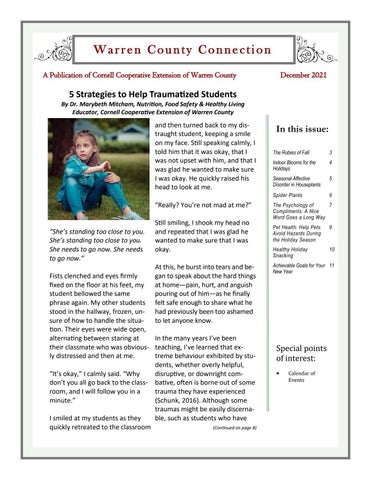
Fists clenched and eyes firmly fixed on the floor at his feet, my student bellowed the same phrase again. My other students stood in the hallway, frozen, unsure of how to handle the situation. Their eyes were wide open, alternating between staring at In the many years I’ve been their classmate who was obvious- teaching, I’ve learned that exly distressed and then at me. treme behaviour exhibited by students, whether overly helpful, “It’s okay,” I calmly said. “Why disruptive, or downright comdon’t you all go back to the class- bative, often is borne out of some room, and I will follow you in a trauma they have experienced minute.” (Schunk, 2016). Although some traumas might be easily discernaI smiled at my students as they ble, such as students who have quickly retreated to the classroom (Continued on page 8)
In this issue: The Rubies of Fall
3
Indoor Blooms for the Holidays
4
Seasonal Affective Disorder in Houseplants
5
Spider Plants
6
The Psychology of 7 Compliments: A Nice Word Goes a Long Way Pet Health: Help Pets Avoid Hazards During the Holiday Season
9
Healthy Holiday Snacking
10
Achievable Goals for Your 11 New Year
Special points of interest: •
Calendar of Events
Warren County Connection
Page 2
Cornell University Cooperative Extension of Warren County 377 Schroon River Road Warrensburg, NY 12885
Phone: (518) 623-3291 or (518) 668-4881 Fax: (518) 668-4912
Visit Our Web Site: www.cce.cornell.edu/warren
Who We Are Nation-wide, thousands of people in each state tap into their state’s land -grant university research and know-how to make sound confident decisions concerning family, home, business, finances, and the future. In New York State, the land-grant university is Cornell University. The Cornell Cooperative Extension network brings you the expertise of Cornell University, other land-grant universities across the country and locally-based Extension Educators, volunteers, and other experts through such programs as: horticulture, youth and families, leadership, environment, food, nutrition & health, home environment, and financial management.
Staff Dr. James Seeley, Executive Director John Bowe, Associate Team Leader Dan Carusone, 4-H Natural Resources Coordinator Marybeth Mitcham, Nutrition, Food Safety & Healthy Living Educator Roxanne Westcott, 4-H Family Living Educator Kali DeMarco, Farm to School Coordinator Rebecca Devaney, Community Horticulture Coordinator Sharon Bellamy, Finance Manager Amy Sabattis, Public Relations/Publications Manager Michele Baker, Administrative Assistant Chris Dittus, Administrative Assistant Connor Eastman, Maintenance
Board of Directors Laura Conway - President Peter Benoit - Vice President Dan Bruno - Secretary William Hamelin - Treasurer Aimee Azaert Lisa Earl Ed Griesmer Jim Kneeshaw David Little David Strainer Michael White
Extension Service Committee Chair - Ben Driscoll Daniel Bruno Andrea Hogan Brad Magowan
Warren County Connection
CALENDAR
Please visit our website for more events www.cce.cornell.edu/warren 12/4/2021 9:00 AM - 3:00 PM - Evergreen Swag Workshop Join us at the 33rd Annual Christmas in Warrensburgh which is a celebration of all things Christmas. This year's theme is...."A tribute to all the lives we have loved and lost since the beginning of the pandemic.” Warrensburg Town Hall, 3797 Main St., Warrensburg, NY 12885 12/7/2021 11:00 AM - DIY Tiger Balm - Why purchase expensive health products when you can make them yourself? In this hands-on workshop, participants will learn about the health benefits of the different ingredients in tiger balm, an analgesic and thermogenic salve, and will learn how to make their own! Registration is limited for this event. To register, please contact Director Barb Mitchell at: 518-696-6451. Lake Luzerne Senior Center, 539 Lake Ave., Lake Luzerne, NY 12846 12/11/2021 1:00 PM - 2:00 PM - European Christmas - Come and join us as we celebrate the upcoming Christmas holiday, in the European tradition, learning about (and sampling) a sweet holiday treat from Europe! To register for this event, please contact Stephanie Belden at: 518 793-2189. Greater Glens Falls Senior Center, 380 Glen Street, Glens Falls, NY 12801 12/18/2021 11:00 AM - Holistic Wellness: Body Products Body products, made from pure ingredients, can help you care for your skin, naturally! In this hands-on workshop, we will make exfoliating scrubs, a soothing facial oil, and dry mask mix that you can combine with liquids to make a purifying and skinimproving mask. These products will also make fantastic holiday gifts! Cost: $10/person. This workshop is part of a yearlong series on holistic wellness, focusing on using natural ingredients to promote holistic health. For more information about the series, or to register for this workshop, please contact MB at: 518-623-3219 or mem467@cornell.edu. Cornell Cooperative Extension of Warren County, 377 Schroon River Road, Warrensburg, NY 12885 12/28/2021 1:30 PM - 3:00 PM - FREE 4-H Holiday Activity Upcycling is for the Birds! We will re-use a holiday pine tree (that does not have any type of tinsel) to create a shelter and feed cover for local birds. Participants will learn about where to locate the tree, how to create natural feed options with pinecones, and popcorn and berry garland. We will also learn about common birds in our area. Dress with layers and bring outside shoes/boots. For more information contact John Bowe 518-623-3291. Cornell Cooperative Extension of Warren County, 377 Schroon River Road, Warrensburg, NY 12885
If you have special needs as addressed by the Americans with Disabilities Act and need assistance with attending these workshops, please make your needs known by the registration deadline. Reasonable efforts will be made for accommodations.
Warren County Connection
The Rubies of Fall By Dr. Leonard Perry, Horticulture Professor Emeritus, University of Vermont
Page 3
will eat the berries, but reluctantly as they are tart. This makes them good for jams and jellies though. 'Brilliantissima' is a cultivar with even brighter fruit, while 'Autumn Magic' is a more compact selection with slightly larger fruits. Some of the shrub roses produce large red fruits, known as "hips", in late summer and fall. Some of the showiest are the blueleaf rose (Rosa glauca), eglantine (R. eglanteria), Moyes (R. moyesii), and the rugosa (R. rugosa). All are hardy to at least USDA zone 4 except the Moyes rose (zone 5).
Shrubs with red berries come in handy this time of year for use in holiday decorations and arrangements, for feeding wildlife, and for brightening landscapes. Although the well-known American and Chinese hollies can't be grown in many cold northern climates, other fine red-berried shrubs are suitable and hardy. Unless noted, these are hardy to at least USDA zone 4 (-20 to -30 degrees F average annual minimum). The winterberry (Ilex verticillata) is a native and deciduous (loses its leaves in winter) shrub. It is related to the evergreen hollies, only much hardier. With its brilliant small and shiny red berries it is spotted quickly in wet areas in fall, even at high speeds along interstates. Reaching heights of 6 to 8 feet, winterberry grows well in sun or shade, wet or dry soil. Like the other hollies, the sexes are on separate plants. If you want berries, you'll need a female plant and a male plant (no berries) for pollination. Even then you may not see many berries before the birds get to them. Over 40 species of birds eat their berries, including bluebirds, cedar waxwings, brown thrashers, mockingbirds, red-winged blackbirds, and robins. 'Jim Dandy' is a good male to pollinate early cultivars (cultivated varieties) such as the compact 'Nana', 'Sprite', or Maryland Beauty', to the 8-foot tall 'Stoplight' or 'Jolly Red'. 'Sprite' was a Cary award winning plant for New England. 'Southern Gentleman' is a good male to pollinate later cultivars such as the popular 'Winter Red' and 'Sunset'. The male 'Apollo' pollinates the hybrids 'Harvest Red' and 'Sparkleberry'. Red chokeberry (Aronia arbutifolia) is easy to grow and tolerates many soil types. In addition to the red berries, the shiny green leaves turn reddish-purple in fall. Birds
If you want a less known but attractive native shrub, try the spicebush (Lindera benzoin). When crushed, leaves are spicy and the red fall fruits peppery. Berries stand out against the light yellow fall leaves, and arise from the bright yellow flowers that appear in spring before the leaves. It is marginally hardy to zone 4, thriving in moist soil and partly shaded woodlands. Hawthorns (Crataegus) are small trees (15 to 25 feet tall) with attractive red fall fruits, but most have some drawbacks-- namely lots of diseases and long, dangerous thorns. Exceptions, and among the best choices with few thorns and good disease resistance, include 'Crimson Cloud' English hawthorn (C. laevigata), Princeton Sentry Washington hawthorn (C. phaenophyrum), and 'Winter King' green hawthorn (C. viridis). A group of low shrubs up to 2 feet high, good for groundcovers on slopes and rock gardens, is the cotoneasters. Some of the best red fall fruits are from the cranberry cotoneaster (C. apiculatus) and related creeping cotoneaster (C. adpressus), rock spray cotoneaster (C. horizontalis), and the spreading cotoneaster (C. divaricatus). All have small, shiny green leaves and pinkish-white flowers attractive to bees early in the season. The rock spray and spreading cotoneasters are less hardy (zone 5). Even lower groundcovers with red berries are the bunchberry (Cornus canadensis) and the bearberry (Arctostaphylos uva-ursi). Both are very hardy to USDA zone 3 (-30 to 40 degrees F). The bunchberry also has attractive red leaves in fall, and edible fruits. This native plant needs acidic and organic soils. Another low native for similar soils, and needing plenty of moisture, is a red berry that all know— the cranberry (Vaccinium macrocarpon). (Continued on page 4)
Page 4
Warren County Connection
(Continued from page 3)
The bearberry is a tough evergreen, tolerating bogs to dry sandy areas, alkaline to acidic soils, and prefers infertile soils. Don't confuse bearberry with barberry-- a shrub usually seen on older lists but no longer recommended. Barberry is listed as an invasive plant in many states as birds spread its colorful red fruits to natural areas where they germinate and end up crowding out more desirable native plants. For gardeners in warm climates there are even more choices for red berries in fall, including both deciduous and evergreen hollies. Heavenly bamboo (Nandina), Japanese skimmia, and firethorn (Pyracantha) provide bright red color in fall and winter, while the latter can provide orange and yellow berries as well, depending on cultivar. While the heavenly bamboo and firethorn are hardy to USDA zone 6 (average low of -10 degrees F in winter), they may survive in protected areas in colder zone 5. Firethorn often is seen trained to a wall, or "espaliered", where it can benefit from heat absorbed by the wall. Skimmia on the other hand is hardy only to the warmer USDA zone 7, and its berries can be poisonous if eaten in quantity.
Family Budget Coaching Program Now Available for Families and Individuals in Warren County Cornell Cooperative Extension of Warren County is now offering a free, confidential Family Budget Coaching Program to community residents. The one-on-one sessions are available to individuals and families who want to improve their financial literacy, set goals, create a savings plan, reduce debt and get a better handle on finances. The trained coaches will offer sessions either via Zoom or in person in Glens Falls, Warrensburg and Johnsburg. Since 1914, Cornell Cooperative Extension has responded to the needs of New York residents enabling people to improve their lives and communities through partnerships that put experience and research-based knowledge to work. For more information on this program, please contact Roxanne Westcott at rmw38@cornell.edu or (518) 668-4881.
Indoor Blooms for the Holidays By Margaret Murphy, Horticulture Outreach Specialist, University of Wisconsin - Madison
A few years ago, about this time, I went shopping for an amaryllis bulb to give my mom. I decided to purchase a kit that contained the bulb, a pot and a soil disc. It was hard to choose among the many varieties. I narrowed it down to the ‘Red Lion’ which has a striking, crimson red bloom; the ‘Minerva’ which has a red flower with a white, starshaped middle; and the ‘Apple Blossom’ which has a white flower with pink tinges on the petals. Ultimately, I could not decide, so ended up buying all three. It was worth it. We had multiple, eye-catching blooms to enjoy over the holiday season. The amaryllis is native to tropical and subtropical areas of the Americas. It normally flowers February to April but can be forced to bloom in time for the holidays. A bulb potted in early November should be in bloom by Christmas. Amaryllis bulbs are widely available now in stores and garden centers. You can buy a kit or you can purchase just the bulb. If you have only the bulb, plant in a pot that is one to two inches wider than the base of the bulb. Amaryllis bulbs prefer to be a bit cramped when growing. Make sure the container has drainage holes. For bulbs, good drainage is essential. Plant the bulb in well-drained potting soil. Begin by adding a small amount of potting soil in the bottom of the pot. Place the bulb in the center atop the soil then add additional potting soil, firming it around the roots and bulb. The top half of the bulb should be showing above the surface of the potting medium when finished. Water thoroughly then place the potted bulb in a warm, (Continued on page 5)
Page 5
Warren County Connection (Continued from page 4)
sunny location (keep between 70-75 degrees F). Wait until the soil surface is dry to the touch before watering again. The soil should remain slightly moist but don’t overwater. Also, avoid fertilizing the bulb until after it begins to grow. Use a water-soluble fertilizer once or twice a month. To keep the flower stalk growing straight, rotate the pot regularly.
Seasonal Affective Disorder in Houseplants By Sue Gwise, Consumer Horticulture Educator & Master Gardener Coordinator, Cornell Cooperative Extension Jefferson County
Flowering usually occurs six to eight weeks after the bulb is potted. To prolong the life of the bloom, move the plant out of direct sunlight until the flower fades. Then remove the bloom to prevent seed formation. Cut the flower stalk back to about an inch or two above the bulb and place the plant back in a sunny location with the foliage intact. The plant uses its leaves to produce food that is stored in the bulb for next year’s flower. You can keep your amaryllis indoors all year or place it outside for the summer after the danger of frost has passed. If the plant will be outdoors for the summer, harden it off by placing it in a protected area out of direct sunlight for the first two to three days. Gradually increase the plant’s exposure to direct sunlight until it is fully acclimated. Find a place where it will receive at least six hours of full sun. Bring the amaryllis back indoors before the first fall frost. Whether the plant stays indoors or out, water as needed and fertilize monthly to help build up its nutrients for next year’s bloom. To get amaryllis to rebloom, the bulb needs exposure to cool temperatures (between 50-55 degrees F). Amaryllis will naturally rebloom if kept in a well-lit, cool spot and tended as a green houseplant. However, there are steps you can take to control the bloom time. The bulb can be forced to rebloom after going dormant or resting for eight to ten weeks. In early fall or when you bring your amaryllis back indoors, store the plant in a semi-dark place such as a basement or closet. The temperature should be cool but stay above freezing. This will induce dormancy. Do not water and only remove the foliage once it has turned yellow and shriveled. After the resting period, bring the plant into bright light and water thoroughly. Then wait for a beautiful bloom in about six weeks. Amaryllis performs best when slightly root bound so does not require repotting more than every few years. If needed, repot the bulb after the dormant period right as the growing cycle is beginning again. To read more about amaryllis, go to https://wimastergardener.org/article/amaryllishippeastrum/.
You may have noticed that in the fall and winter your houseplants begin to look a little sad. They stop growing, the leaves become dull, and some plants even drop many of their leaves. This is perfectly normal! Houseplants behave this way for many reasons, but the big limiting factor is light. Once we hit fall the days become shorter, the sunlight is less intense, and there are more cloudy days. Houseplants respond to this by going into a dormant period. Since there is less light for photosynthetic activity plants will naturally begin to slow down. Most plants need a rest period during the winter. Think about the native locations of many houseplants- most of them come from tropical regions. These areas don’t have snow, but they have a dry or cool season when plant growth slows. A rest period is naturally ingrained in most plants. The worst thing you can do is to fertilize. This will drive increased growth that can’t be sustained because of less photosynthesis. Fertilizers will do more harm than good. Another factor that contributes to poor growth in the winter is humidity. Our homes are much drier in the winter due to heat sources. Most houseplants like a relative humidity of around 60%. In the winter the humidity in our homes can drop to 30%. Depending on their location, houseplants can also be affected by temperature extremes in the winter. Plants on a windowsill may be too cold while plants near a heat vent may get too hot. (Continued on page 6)
Page 6
Warren County Connection
(Continued from page 5)
There are a few things you can do to make your plants happier over the winter: 1. Move your houseplants to the sunniest room in the house. 2. Move plants out of windowsills and away from heat sources. 3. Group plants to naturally increase the humidity, or mist plants daily. 4. Keep in mind that you may have to adjust your watering schedule. Since the plants are not putting out new growth, they may require less water. Conversely, they may need more water if the humidity is very low or if they are located in a warm room. These strategies won’t magically rejuvenate your plants, but it will keep them healthier over the winter. Grow lights are also an option in rooms with very low or no light. They are expensive, and to make a difference they need to be placed 6 inches above the plant and should be on for 14 to 16 hours per day. Once spring is on the horizon and days become longer your plants will respond by putting out a flush of new growth. At that point fertilization will be helpful. It is also a good time to re-pot your houseplants so that they can take advantage of more space due to their increased activity.
Spider Plants Overview A terrific activity for beginning gardeners, or new gardeners on the go! Spider plants are easy to propagate! Spider plants will provide you with enough plantlets to grow and to give away! Step by step - try one or more of these three methods Rooting runners: Peg down runners in individual pots of moist, standard potting soil. Keep them well-watered. After a few weeks separate each rooted plantlet, still in its pot, from the parent plant by cutting the runner close to the young plant. Rooting in water: Cut the runner off the mother plant by cutting close to the young plant. Choose a runner that has many roots and little foliage. Place the runner in a container of water, making sure that the base is submerged. When roots show, plant into moist, standard potting soil. Keep well-watered to establish plant.
Rooting directly in soil: Cut the runner close to the young plant. Choose a runner that has little foliage and many roots. Dip the base into a small amount of water to moisten. Dip the moistened base into a small amount of rooting hormone, and plant into moist, standard potting soil. Go one step further... Compare spiderette plants: One in zip lock sandwich bag One in a pot One grown in water 1. Fill sandwich bag with potting soil; cut X on top and poke holes in the bottom for drainage, and insert plant into bag. 2. Start another plant in a pot, according to the propagation instructions above/on the other side of this page. 3. Do the same with rooting in water, again, according to the instructions. 4. Compare among the three, over weeklong intervals: Root development, such as number of roots and length. Top growth, including the number of leaves and length. Color – are there differences in the depth of the green color? Do any of them produce plantlets more rapidly?
Basic care Provide bright, indirect light. Some direct sunlight during the winter months may be preferred. Keep out of hot midday sun, which may scorch the leaves. During the active growth period, water to keep soil moist, but do not overwater. Fertilize lightly every two weeks (standard liquid fertilizer), once your plant starts to produce plantlets. Materials • Spider plant runners • Individual pots • Moist, standard potting soil • Or a container of water • Rooting hormone Source: https://gardening.cals.cornell.edu/lessons/activities/
Page 7
Warren County Connection
The Psychology of Compliments: A Nice Word Goes a Long Way Imagine that you’re sitting in a coffee shop enjoying your drink and reading the paper when someone taps you on the shoulder. “Your jacket is beautiful,” the stranger says. “The color really complements your eyes.” You say thank you and return to reading. The whole exchange lasts less than 30 seconds, but it leaves you feeling uplifted. A new field of research is delving into the positive effects of compliments and what motivates people to give them. The latest paper on this topic was published earlier this year in the Personality and Social Psychology Bulletin. Two researchers, including Cornell social psychologist Vanessa Bohns, conducted a series of studies to better understand how individuals felt before and after giving or receiving compliments. In their first study, the researchers recruited people on a college campus to go to specified locations and give a compliment to the fourth person of the same gender they encountered. Before heading out, the participants answered some questions about how they felt about giving compliments. Once out on campus, they gave a brief compliment about the person’s clothing, such as “I like your shirt.” After giving the compliment, the participant handed the compliment-receiver a sealed envelope with a survey inside and waited for them to fill it out and reseal the envelope. The compliment receiver then returned to the lab with the survey. The surveys showed that compliment-givers underestimated how good their compliments would make people feel. In other words, people who received the compliments felt happier, more pleased and flattered than the compliment-giver predicted. In a second study, compliment-givers were free to offer compliments on anything they genuinely liked; this time, they still underestimated the receivers reaction to the compliment. And even after they witnessed a positive reaction, they still underestimated how good the receiver felt.
In a third study, the researchers asked the question, do people avoid giving compliments to strangers because they worry about making them feel awkward or uncomfortable? This time, they asked compliment-givers to predict whether the receivers would have negative feelings about receiving a compliment. They found complimentgivers “drastically overestimated how bothered, uncomfortable, and annoyed” the receiver would feel, and this likely prevents people from giving more compliments. The researchers also wondered if anxiety about talking with a stranger discouraged people from giving compliments. In a fourth study, they recruited participants they called “third-party forecasters,” who would try to predict how the compliment receivers would feel. This time around, they found compliment-givers felt anxious before giving their compliments, and those with higher levels of anxiety were more likely to expect the receiver to react negatively to their compliment. Compliment-givers also worried about their ability to effectively give a compliment. The “third-party forecasters” did not report feeling anxious before the compliment was delivered (they didn’t have to approach and talk to a stranger) and were more likely to expect the compliment-receiver to feel flattered and happy about receiving the compliment. The conclusion: Anxiety about talking to a stranger and worry about not effectively delivering a compliment likely discourages people from delivering compliments to strangers. A side note: The researchers also found that complimentgivers were in a better mood after delivering a compliment, and reported they would be more likely to give a compliment to a stranger in the future. “Many of us have moments where we notice and appreciate something about another person—perhaps we like what they are wearing, or we were really impressed by their presentation—but we keep our appreciation to ourselves, rather than sharing it,” Bohn said. “This research offers an explanation for why: In the moment, we tend to forget how good a simple, even awkwardly delivered, compliment will make another person feel.” The take-home message: Why not be generous in doling out compliments? Not only do compliments make the recipients feel good, but they will make you feel good as well! Source: Evidence-Based Learning, Cornell University
Page 8 (Continued from page 1)
battled with cancer or who have lost their home in a fire, many traumas are much harder to identify. And, even if identified, they are still extremely challenging to address without inadvertently causing more pain or shame for the student.
Warren County Connection
you want to know if your outfit is ugly, just ask what they think. They’ll tell you! Traumatized students may struggle with separating reality and fantasy. They also may believe that they need to avoid speaking about certain things or hide the truth. If your classroom expectations are that everyone will speak the truth in love, then no topic is taboo. This provides a safe place for all students, including those who have been traumatized. 4. Exhibit and promote integrity. Educators, by
Here are five strategies I’ve found to be helpful, both as a formerly traumatized student and as an educator, in creating a safe and supportive learning environment for all students, but especially for those who are struggling with trauma. 1. Be consistent in your expectations. This is beneficial to all students, but even more important for students who have experienced trauma. Many traumatized students may currently live in very unstable home situations, remaining on high alert at all times. Consistent expectations will provide sorely needed stability and allow your students to lower their guards and hopefully gain some emotional respite. 2. Value everyone equally. It is very difficult to not
show favoritism toward your students. Those who are easier to work with, are more compliant, or simply tug at your heartstrings often get extra smiles, encouraging words, and praise. Although teachers often do this unconsciously, we need to be aware that it happens and actively remain consistent and comprehensive with our praise and attention. 3. Speak the truth in love. One thing that I love
most about young children is their lack of artifice. If
nature of our roles and responsibilities, are also leaders. We are watched by our students, colleagues, and community members for how we conduct ourselves. For traumatized students, who may witness situations where people in authority exhibit hypocrisy, it is imperative for them to witness integrity in a leader. When you model integrity in the classroom, you set a high standard for the rest of the class to follow, creating a safe place and helping all students, including traumatized ones, to develop their own good leadership skills. 5. Create classroom traditions. My second-grade
teacher was known for her love of butterflies. Every student entering her classroom knew that they would have monthly activities relating to butterflies and, in the spring, would raise and release butterflies. That tradition gave me something to look forward to and value, a truly priceless gift that helped me feel like I belonged. By creating classroom traditions—something completely unique to your class— you will help traumatized students feel like they belong. By implementing these strategies in your classroom, you will provide sorely needed stability and safety that will help all your students thrive, including those suffering from trauma.
The laughing faces of children on a school playground. A thousand gifts. ~Dr. SunWolf A torn jacket is soon mended; but hard words bruise the heart of a child. ~Henry Wadsworth Longfellow
Page 9
Warren County Connection
Pet Health: Help pets avoid hazards during the holiday season
sugar substitute. Its use has grown in home kitchens, and some pet poison helplines have simultaneously reported increased cases of xylitol toxicity in pets. Sharing our delicious ham dinner with our pets can induce vomiting, diarrhea, or even pancreatitis, primarily because of the effects of high fat and salt content.
Dangerous decorations Holiday decorations and gift wrapping also pose danger: Tinsel and holiday ribbon, if ingested, can cause serious intestinal damage. Many household plants, such as mistletoe and holly, can cause gastrointestinal upset if ingested. Lilies are highly poisonous, and it takes only a small taste of a leaf to kill a cat. Tree ornaments can be ingested and lead to blockage of the intestines. The water your Christmas tree is sitting in may contain substances from the tree that could make your pets sick. As we head into the busy holiday season, it’s good to keep in mind that our pets require careful supervision to keep them safe.
Here are some tips to avoid these hazards during the holidays.
Guest-related risks Guests may also inadvertently introduce risks: With people coming in and out of your yard and home, doors and gates often are left open – presenting the opportunity for pets to dash out and encounter traffic and other hazards. Guests might also have prescription medications that, if left unsecured, could be ingested and cause serious health problems. Remember to share with guests that feeding pets “people food” can make animals sick, even if it seems like a nice gesture.
Food-related reminders Most people do more cooking and baking this time of year. Here are some important food-related reminders:
Even with all these potential dangers, the holidays are a wonderful time of year. With a little extra care and supervision, our pets will add to the joys of the season.
Dr. Heather Weir is a veterinarian at the Community Practice group at Colorado State University’s James L. Voss Veterinary Teaching Hospital. The team provides general care, wellness services, and treatment of minor injuries and illnesses for pets.
Emergency visits increase for both dogs and cats during this time of year – a reminder that holiday threats can come from a variety of sources, including food, decorations, gift wrapping, and even the comings and goings of friends and family members.
Chocolate – especially rich, dark chocolate – can be toxic to dogs. Symptoms range from vomiting and diarrhea to tremors and seizures. Ingesting uncooked yeast can cause serious discomfort and possible intestinal rupture in pets. Grapes, raisins, and nuts are often found in holiday recipes, and they can pose serious risk to your pets. The ingestion of grapes and raisins, for instance, can cause toxicity that leads to development of kidney failure and lack of urine production. The alternative sweetener xylitol can cause acute hypoglycemia, sometimes leading to internal bleeding and liver failure. Xylitol is extracted from corn fiber and other vegetable material and is used as a
I walk with my dogs which keeps me fit. I talk to my dogs which keeps me sane. I can't think of anything that makes one happier than to cuddle and play and start the day with a warm puppy. ~Audrey Hepburn
Page 10
Warren County Connection
Healthy Holiday Snacking By Dr. Marybeth Mitcham, Nutrition, Food Safety & Healthy Living Educator, Cornell Cooperative Extension of Warren County The holiday seasons can be stressful for people who strive to adhere to any sort of dietary guideline. Holidays offer numerous festive occasions, where people often gather around tables laden with food. Gifts of sweet and baked treats are regularly given to friends and loved ones. Schools and workplaces host holiday parties, usually providing unhealthy food options to attendees. Many people turn to comfort food and drinks, that are, more often than not laden with empty calories, fat, and preservatives, to relax and recover from the added hustle and bustle that accompanies the season. Rather than throwing away any thoughts of healthy eating during the holiday season, or giving up and considering health as something on which to focus during the new year, why not consider using some of these tips and strategies that can help you navigate potentially perilous holiday snacking season! Have a Realistic Plan in Place. It is important to strive to keep expectations as potentially realistic as possible. Part of this is knowing what you will – or won’t – consume. Also, consider portions. If there is a holiday treat that you love, could your realistic plan include enjoying a little of it, rather than avoiding it altogether?
Hydrate! Hydration helps our bodies function well. Drinking water also helps address our satiety, making us feel fuller. This can help us to make better choices when faced with less healthy food options at holiday events. Drinking water also helps when consuming (or considering) calorie-laden alcoholic beverages. If you do choose to consume alcohol, then alternating those drinks with water will help to ensure that you do not overconsume empty calories or overeat. Just Say No. If you do not want something, then just say no (politely, of course!). Another option is to ask if you can pack up some food to share with others. Just because the food is there does not mean that you have to eat it. This also holds true with portions. I try to only put a little on my plate at a time so that I do not waste the food that my stomach was just too full to eat. However, eating to just finish up what is on your plate may not be the best choice, either, so remember that you can say no (even if it is to yourself!) before the food goes from the table to your plate. Get Up and Move! It is tempting to want to stay sedentary when the weather turns cooler, and we are just plain tired. However, regular aerobic activity (think heartpumping!) can help to burn up some extra calories that you might consume during the holiday season.
Bring Your Own Food. Why not ensure that there will be something that you can eat, guilt-free, at an event? I follow a whole-food, plant-based (WFPB) diet, so I know that it is very unlikely that I will find many options at events that meet my dietary needs. So that I do not go hungry, I often bring something that I can eat without worry. The best part about this is that, when other people try it, they are surprised that something so healthy can also taste good. Win=win!
Eat Before Going. I try to not shop for food or attend any party where food will be present when I am hungry. I know that a hungry me will be less likely to make good food choices than a satiated me! So, I will eat a small meal or snack before attending any party or event where there is food. If food that I can eat and enjoy happens to be available, then I am able to make good choices on the amount of that food that I eat. If no healthy options are there, then I won’t be tempted to eat something that I would normally avoid.
Enjoy the Season! This season only comes once a year, so make sure to enjoy all of it – food, family, and friends. Try cooking with friends and family members, walking together after a meal, celebrating with someone from a different cultural background, volunteering at a soup kitchen or food pantry, or bringing snacks to residents at a rehabilitation center. A healthy holiday can include enjoying food, especially when that food is used to bring people together.
Warren County Connection Warren County Connection
Achievable Goals for Your New Year By Courtney Chapman, Russell Sage Dietetic Intern
Page 11
Adding whole foods (i.e. fruits and vegetables) to your diet is a great way to add nutrients and help your body fill up quicker and stay satisfied for longer. Overall, go into this new year by treating yourself with kindness. No change worth making is overnight and the work you put into improvement is worth so much more than cutting corners. You will find that these small changes to your typical New Year’s resolutions can make a huge impact on how you feel and where you can go with them. So, again, Happy New Year and good luck! You’ve got this!
Happy New Year! It’s time to make attainable goals. It’s tiresome every year thinking about the same ol’ healthful resolutions that are impossible to fulfill because they either are too lofty or they are too general. This year, give yourself the gift of specific goals to focus on and the supplemental materials needed to succeed. For example, if you are looking to eat less refined carbohydrates then make a list for yourself of complex carbohydrates and whole grains as well as meals you can make with them. This is an easy way to set yourself up for success. You know that you are going to go grocery shopping so making a list of beneficial foods that you want to eat will make it easier to focus on your health goals. Moving forward, PLEASE make it a priority to drink enough water. Water is so important for our bodies as it helps to keep all of our cells happy and functioning properly. Having enough water throughout the day can provide the body with energy, elasticity, and improved digestion. The best way to identify how much water you need is to divide your body weight in half and drink that many ounces per day (i.e. a 200-lb individual would drink 100 oz. of water a day).
For more information on attainable nutrition goals and winter nutrition, check out: https://www.mindtools.com/pages/article/smartgoals.htm https://www.nytimes.com/guides/smarterliving/ resolution-ideas https://www.hfe.co.uk/blog/winter-nutrition-stayingtrack-cooler-months/ https://share.upmc.com/2015/03/maintain-energynutrition-winter/
Pumpkin Seeds, Roasted Serves: 4 | Serving size: 1/4 cup Ingredients Needed: 1 pumpkin (using 1 cup raw pumpkin seeds 1 tablespoon olive oil ¼ teaspoon or salt to taste Directions: Preheat the oven to 350°F. 1.
2.
Continuing on, you cannot expect your body to easily jump into going to the gym 5x a week if you are just starting an exercise regimen. Start off small by getting in 30 minutes of movement 2x per week. This will give your body time to get used to moving more and help you decide a good daily schedule for your lifestyle. We know movement is important for the body so starting slow will increase your motivation to keep going without hurting yourself in the process. Lastly, PLEASE stop looking up to fad diets. All bodies are created differently and therefore thrive off of different diets. If you are wanting to improve your diet, look at what you can add rather than what you can restrict.
3.
4.
5.
Carve the pumpkin, and separate pumpkin seeds from the stringy pulp. Rinse raw pumpkin seeds in a colander under cold running water, and shake or pat seeds dry with a paper towel. In a bowl, toss seeds in olive oil and salt. Spread seeds on a lightly greased cookie sheet.
6. Roast seeds in the oven for 20–30 minutes or until golden brown, flipping halfway through.
Cornell Cooperative Extension 377 Schroon River Road Warrensburg, NY 12885 RETURN SERVICE REQUESTED
IF THERE IS A CHECK IN THIS BOX , THIS IS THE LAST ISSUE OF THE WARREN COUNTY CONNECTION YOU WILL BE RECEIVING. To renew your subscription clip the form below and send to Cornell Cooperative Extension of Warren County.
Warren County Connection
THANK YOU INTERNATIONAL PAPER!! "Paper for this newsletter was donated by International Paper, proudly produced at the Ticonderoga, New York Mill from trees harvested in working Adirondack forests that are managed responsibly in accordance with the principles of the Forest Stewardship Council (FSC) and the Sustainable Forestry Initiative (SFI)." “International Paper is proud to join almost 60 manufacturers and importers supporting the Paper & Packaging – How Life Unfolds™ campaign.” “Cornell University Cooperative Extension of Warren County provides equal program and employment opportunities.” “The information given herein is supplied with the understanding that no discrimination is intended and no endorsement by Cornell Cooperative Extension is implied.” The Cornell Cooperative Extension educational system enables people to improve their lives and communities through partnerships that put experience and research knowledge to work. "Cornell Cooperative Extension actively supports equal educational and employment opportunities. No person shall be denied admission to any educational program or activity, or be denied employment on the basis of any legally prohibited discrimination involving, but not limited to, such factors as race, color, religion, political beliefs, national or ethnic origin, gender, sexual orientation, age, marital or family status, veteran status, or disability. Cornell Cooperative Extension is committed to the maintenance of affirmative action programs that will assure the continuation of such equality of opportunity."
Just $5.00 per year will give you one full-year subscription to the “Warren County Connection,” mail this coupon to: Cornell Cooperative Extension ☺ Be sure to include your fee of $5.00 to cover the cost of mailing. Name______________________ Address____________________ __________________________ Zip Code___________________ OR To get this publication FREE e-mail als77@cornell.edu and you will be added to our E-Edition.
We’re on the Web! http://counties.cce.cornell.edu/warren/ & Facebook - Look for CCE Warren