Warren County Connection A Publication of Cornell Cooperative Extension of Warren County
June 2020
How To Boost Your Immune System Helpful ways to strengthen your immune system and fight off disease How can you improve your immune system? On the whole, your immune system does a remarkable job of defending you against disease-causing microorganisms. But sometimes it fails: A germ invades successfully and makes you sick. Is it possible to intervene in this process and boost your immune system? What if you improve your diet? Take certain vitamins or herbal preparations? Make other lifestyle changes in the hope of producing a near-perfect immune response?
What can you do to boost your immune system? The idea of boosting your immunity is enticing, but the ability to do so has proved elusive for several reasons. The immune system is precisely that — a system, not a single entity. To function well, it requires balance and harmony. There is still much that researchers don't know about the intricacies and interconnectedness of the immune response. For now, there are no scientifically proven direct links between lifestyle and enhanced immune function.
In this issue:
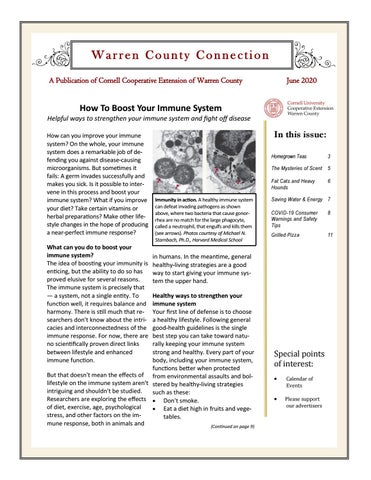
Immunity in action. A healthy immune system can defeat invading pathogens as shown above, where two bacteria that cause gonorrhea are no match for the large phagocyte, called a neutrophil, that engulfs and kills them (see arrows). Photos courtesy of Michael N. Starnbach, Ph.D., Harvard Medical School
Homegrown Teas
3
The Mysteries of Scent
5
Fat Cats and Heavy Hounds
6
Saving Water & Energy 7 COVID-19 Consumer Warnings and Safety Tips
8
Grilled Pizza
11
in humans. In the meantime, general healthy-living strategies are a good way to start giving your immune system the upper hand.
Healthy ways to strengthen your immune system Your first line of defense is to choose a healthy lifestyle. Following general good-health guidelines is the single best step you can take toward naturally keeping your immune system strong and healthy. Every part of your body, including your immune system, functions better when protected But that doesn't mean the effects of from environmental assaults and bollifestyle on the immune system aren't stered by healthy-living strategies intriguing and shouldn't be studied. such as these: Researchers are exploring the effects • Don't smoke. of diet, exercise, age, psychological • Eat a diet high in fruits and vegestress, and other factors on the imtables. mune response, both in animals and (Continued on page 9)
Special points of interest: •
Calendar of Events
•
Please support our advertisers
Warren County Connection
Page 2
Cornell University Cooperative Extension of Warren County 377 Schroon River Road Warrensburg, NY 12885
Phone: (518) 623-3291 or (518) 668-4881 Fax: (518) 668-4912
Visit Our Web Site: www.cce.cornell.edu/warren
Who We Are Nation-wide, thousands of people in each state tap into their state’s land-grant university research and know-how to make sound confident decisions concerning family, home, business, finances, and the future. In New York State, the land-grant university is Cornell University.
The Cornell Cooperative Extension network brings you the expertise of Cornell University, other land-grant universities across the country and locally-based Extension Educators, volunteers, and other experts through such programs as: horticulture, youth and families, leadership, environment, food, nutrition & health, home environment, and financial management.
Staff Dr. James Seeley, Executive Director John Bowe, Associate Team Leader Dan Carusone, 4-H Natural Resources Coordinator Marybeth Mitcham, Nutrition, Food Safety, and Healthy Living Educator Roxanne Westcott, 4-H Family Living Educator Anne Mills, Farm to School Coordinator Jessica Holmes, Master Gardener Coordinator Sharon Bellamy, Finance Manager Amy Sabattis, Public Relations/Publications Manager Michele Baker, Administrative Assistant Chris Dittus, Administrative Assistant Samantha Sprague, Maintenance
Board of Directors
William Mason - President Laura Conway- Vice President Julie Pearl - Secretary William Hamelin - Treasurer Aimee Azaert Daniel Bruno Peter Benoit Ed Griesmer Jim Kneeshaw David Strainer Michael White
Warren County Connection
CALENDAR Please visit our website for more events www.cce.cornell.edu/warren 6/2/2020 6:30 PM - 7:30 PM Starting a Small Poultry Flock In The Adirondacks - Topics include: housing, feed, water, space requirements, local ordinances, and breeds of chickens, ducks, and geese. The program is FREE of charge, but registration is required for the program and can be accomplished by calling 518-623-3291 or emailing John Bowe at jfb32@cornell.edu. Online Training Via Zoom 6/4/2020 11:00 AM - 12:15 PM Want Protein? Eat Plants! Although many people think of animals when considering protein sources, plant-based protein is an inexpensive, sustainable, delicious, and nutrient-rich option that can easily be incorporated into your diet. In this webinar, you will learn what plants contain the most protein, how to incorporate plants into a traditional diet, how to shop smart for protein-rich plants, and tips on cooking plants for picky palates. The webinar will also include a time for questions and answers, and attendees will be able to sign up to receive plant-based recipes either emailed or mailed to them. For more information, or to sign up, please contact Marybeth at Cornell Cooperative Extension of Warren County at mem467@cornell.edu. Online Training Via Zoom 6/4/2020 2:00 PM - 3:00 PM Family Fun with Flowers - Come join us to learn about the annual and perennial flowers you can plant right now, basic flower arranging, crafts, and other activities to do at home with flowers! Please register at https://pub.cce.cornell.edu/ event_registration/main/events_landing.cfm? event=funwithflowers_252. Please contact Annie Mills at akm233@cornell.edu with questions. Online Training Via Zoom 6/11/2020 1:00 PM - 2:15 PM Outdoor Cooking Webinar - Summer is just around the corner, and with it, the perfect temperatures to cook outdoors. If you have wanted to learn a few methods of outdoor cooking, this webinar is for you! Basic fire construction and safety, methods of cooking outdoors, demonstrations of several of these methods, and recipe ideas will be covered. In addition, there will be a time for questions and answers, and attendees will be able to sign up to receive a copy of the recently published Outdoor Cooking curriculum either emailed or mailed to them. For more information, or to sign up for this free program, please contact Marybeth at mem467@cornell.edu. Online Training Via Zoom
Extension Service Committee Chair - Andrea Hogan Daniel Bruno John Diamond Ben Driscoll Susan Shepler Matthew Simpson Michael Wild If you have special needs as addressed by the Americans With Disabilities Act and need assistance with attending these workshops, please make your needs known by the registration deadline. Reasonable efforts will be made for accommodations.
Warren County Connection
Homegrown Teas By Dr. Leonard Perry, Horticulture Professor Emeritus, University of Vermont
Page 3
leaves. This will encourage the plant to bush out. Choose only healthy looking leaves and flowers, and nothing that has been treated with chemical pesticides, herbicides, or fertilizers. After harvest, rinse off any dust, dirt, or insects. If you collect some herbs from the wild (some call this “wild crafting”), be positive that you know what you are picking. If not picking from your property, make sure you have landowner permission. Don’t pick more than about ten percent of a plant stand, to avoid its demise. And avoid roadside plants that have been contaminated with oil and fumes from cars and trucks, and possibly sprayed with pesticides and other toxins. A good rule-of-thumb is to not harvest within 50 feet of a road.
While using herbs for brewing teas has been increasing in popularity, and is easy if you follow a few simple steps, there are some precautions as well. Chamomile, sage, catnip, lemon verbena, comfrey, scented geranium, and any of the mints--peppermint, orange mint, and spearmint, for example--are all ideal for tea. Rose hips, while not an herb, also can be used. A few herbs (such as mints and lemon balm) spread aggressively by their roots. Contain them by planting in bottomless buckets or pots sunk into the ground. Control the self-sowers (such as dill) by cutting off the flowers after bloom, before they produce seeds. Some, like lemon verbena and lemongrass, are not winter hardy in northern climates and so need to be grown in containers or replanted annually. Or try lemon balm instead, which is hardier and also has a lemony flavor. It does well in sun or shade although most of the tea herbs prefer a sunny location. Teas can be made from fresh-cut or air-dried leaves and flower heads. (Chamomile tea, for example, is made from the flowers not the foliage. Flowers and foliage of goldenrod can be used for tea.) Parsley, which makes a surprisingly tasty tea, is best used fresh. Both stems and leaves of parsley can be harvested for tea. Make sure to harvest at the proper stage of growth for maximum flavor and benefit. Harvest leaves in early morning on a sunny day after the dew has evaporated. Gather flowers when in peak bloom and not wilted or gone by. Collect seed heads just as they turn brown. Use a sharp knife, scissors or pruners to harvest, leaving enough foliage to keep the plants growing. In other words, don't cut back farther than the second set of
Even if you’re picking plants in your own garden to use for teas, make sure you know without a doubt what you are picking. Familiarize yourself with any look-alike plants. If any doubt, consult online resources, books, local herbalists, and trained garden store professionals. Some other cautions relate to which herbs or plants are safe to use for brewing teas, whether from your garden or the wild. If you stray away from the usual herbs such as mint, chamomile (made from the flowers), or lemon verbena, make sure that the plant is safe to drink without causing adverse or allergic reactions, particularly in combination with any medications. Chamomile is a common tea herb but, being in the daisy family, may cause an allergic reaction in individuals allergic to other members of this family, including ragweed. Ginkgo usually is fine by itself but, if one is drinking this tea and taking aspirin, the result might be fatal bleeding or stoke. Some herbs to avoid include lobelia and pennyroyal. Ones to use with caution include ginkgo, echinacea (coneflower), and valerian. Make sure, too, to use the correct amount, particularly if using medicinally, as too much of some herbs may be harmful. Too much of some herbal teas may cause insomnia and yellowed teeth, to gastric irritation and kidney stones. Most advise not to give herbal teas to children, particularly those under the age of six. Even common herbs may cause a reaction in a few people. Peppermint, for instance, while generally safe may cause heartburn in some individuals. If, after drinking an herbal tea you notice your health change for the worse, make sure to consult with a pharmacist or your doctor. (Continued on page 4)
Page 4 (Continued from page 3)
You can harvest herbs for teas throughout the season although perennial herbs will need time to build up their reserves before winter so should not be cut any later than a month or so before the first expected fall frost-that's generally mid-August in cold climates. Annual herbs, or those perennials you are treating as annuals, can be harvested up until frost. In late summer you can pot up scented geraniums, mints, and other herbs for an indoor herb garden. Just be sure you place the pots under lights or on a sunny windowsill to keep the plants producing. The perennials left in the ground need to be mulched with several inches of organic mulch such as straw, after the last harvest, for winter protection. Although you can use fresh herbs for tea, most home tea growers prefer to dry the leaves and flowers to store for use throughout the year. There are several ways to do this. Bunches of cut herbs can be tied with string and hung upside down to dry. Choose a warm, dark place with good ventilation. Herbs may mildew or not dry properly if air circulation is poor. The herbs are ready for storage when the leaves are dry and crackly. Strip the leaves off the stems, crumble in your hands or use a food processor, and store in airtight jars away from direct sunlight. There are special gadgets you can buy to easily strip leaves from herbs, or herb scissors to quickly cut the leaves. If using screens for air drying, remove the flower heads or leaves from the stems (discarding the stems), and spread in a thin layer on the screen. You can stack several screens, providing you leave a few inches between each one. If using a microwave, place herbs on a paper towel and microwave on low for 60 seconds. Dry for one-minute intervals until the herbs are almost dry. Then allow to air dry for 24 to 48 hours before storage. In a conventional oven, spread foliage and flowers thinly on cookie sheets, and "bake" at the lowest possible oven temperature setting for several hours with the oven door open. Stir occasionally. When herbs are completely dry, let cool completely before placing in jars. Label your jars of herbs with name and date. Store in a cool, dark place to maintain color and taste. Most dried herbs will keep for up to a year, although you should discard them as soon as they have lost flavor.
Warren County Connection
Making herbal tea is a simple process, requiring little more than boiling water, dried or fresh herbs, and honey, sugar, and lemon depending on taste. Use one tablespoon of fresh herbs or one teaspoon of dried for each cup of water. Place leaves in a tea ball or in your tea pot, pour in boiling water, cover the pot, and allow it to steep. Strain and serve. You can get creative combining herbs (it may take a few tries to get the right combination you like) such as goldenrod leaves and flowers, lemongrass, calendula petals, rose hips, and hawthorn berries. You will need to experiment with how long tea needs to steep before drinking although, for most blends, three to ten minutes is sufficient. The longer the tea brews, the stronger it will be. One exception is mint, including catnip, which should be steeped for no more than eight to ten minutes as the tannins in the plants will give the tea a bitter taste if brewed for longer times. Brewing teas safely from homegrown herbs is both rewarding and can save money, and trying various combinations is fun.
Page 5
Warren County Connection
The Mysteries of Scent By Sue Grumet, Master Gardener Volunteer, Cornell Cooperative Extension Dutchess County
It was a warm summer night and the moon was full. The apple tree in my grandparent’s garden was strung with Japanese lanterns, and although I was only about five years old, I knew that this was some type of family celebration. My uncles had decided that it would be great fun to put the children on a large wool blanket, and, one at a time, toss them up in the air for the sheer joy of it. I cannot describe the thrill that night of being flung up into that dark, starry sky. My cousins and I could not get enough of it, even after our uncles grew tired and wanted to get back to their party.
But here’s the catch: The one thing that made that night so memorable to me was the smell of my grandpa’s roses. The bushes along the backyard fence sported big bold white flowers that were intensely fragrant -the very air that night was saturated with their scent. To this day, so many years later, I cannot smell a rose without a wonderful, Deja-vu-like feeling wash over me. What is this magic that our sense of smell delivers? Our understanding of our other four senses are pretty straightforward: we can see, touch, taste, and hear in a logical and explicable way. Smell, however, is the one sense that defies our understanding. There is much scientific evidence that links our sense of smell to that of memory. Studies have shown that the signals from our nose pass right into the amygdala and hippocampus, areas of the brain that are linked to long-term memory. Scientists believe that it is this memory of smells, more than any of our other senses, that helps to shape our brains from a very young age. To illustrate: The scent of that beautiful lilac flower you might have swooned over two weeks ago was physically carried into your nasal cavity through the inhalation of air. As that air rushed through your nasal membranes, it
would have deposited small “lilac” molecules onto your nasal receptors. These, in turn, would lock onto corresponding receptors in the nasal cavity which are able to decipher this unique smell. Once activated, this would set off a signal which is sent up to a bundle of nerves called the olfactory bulb, and from there directly to the brain. This process, from inhalation to comprehension, takes place in a fraction of a second. Therefore, smell is not just centered in the nose, but instead creates a synergy connecting with the brain that detects the signals sent to it and synthesizes them into an experience. Smell = scent recognition = experience associated with it = long-term memory. Given this, it is no wonder that the scent of a magnolia, or your high school crush’s aftershave, can trigger memories that come flooding back to you from a seemingly mystical place. Deja-vu! But do not let these scientific explanations take any of the enchantment out of your June ramblings, for this is the month that brings us into the thick of fragrance. Venture forth into your garden to experience those peonies, roses, and honeysuckles as only the nose of a knowledgeable gardener can. Who knows –all those little “sniffs” in Grandma’s garden so many years ago may have contributed into making you the gardener you are today!
New York State Flower - Rose The rose, wild or cultivated, in all its variety and colors, was made the State flower in 1955. The rose is a perennial flower that grows on a shrub or vine of the genus Rosa. Roses often have beautiful and fragrant flowers, but the stems have thorns, or prickles. Wild roses like the pasture rose (right) usually have just five petals, while cultivated roses tend to have multiple sets of petals. Roses can be found in many gardens, as well as growing wild, throughout New York. Ever popular, the rose was at the top of a school children's poll of favorite flowers in 1891. The rose is also the national floral emblem of the United States.
Page 6
Warren County Connection
Fat Cats and Heavy Hounds The Problem of Overweight Pets
every day and are surprised when they learn that their pet is overweight. Dr. Pavlovsky says that owners will often report that their pet is slowing down as they age or that they are limping. Both of these signs can be exacerbated by weight gain. “In cats, increased weight gain often doesn’t allow them to groom themselves properly or use their litter box,” Dr. Pavlovsky says. As a result, they may have an unkempt hair coat and the owners may notice inappropriate urination and defecation just outside of the litter box.
By most estimates, well over half of all cats and dogs in the United States are overweight. Dr. Gene Pavlovsky, a small animal veterinarian at the University of Illinois Veterinary Medicine South Clinic in Urbana, says that those extra pounds can have serious health consequences for pets. He has suggestions for keeping your pet at a healthy weight. Is My Pet Overweight? “In order to tell if a pet is considered overweight or obese, we use a scale called the body conditioning score,” Dr. Pavlovsky says. This is a subjective measure based on physical examination and criteria. Small animal medicine commonly uses two body conditioning score systems, one on a five-point scale and the other on a nine-point scale. In both systems, 1 refers to the animal being very thin or emaciated; a very overweight pet ranks as 5 or 9, depending on the scale. An ideal score is at the midpoint of the range, or 3 on the five-point scale and 4.5-5 on the nine-point scale. During an annual physical exam, the veterinarian will feel the pet’s ribs and determine how much fat is covering them. The more fat that is present, the more overweight the pet is. At an ideal weight, the ribs should be easily felt without having to press too firmly. “In cats specifically, the body conditioning score criteria involves looking at the animal from the side,” Dr. Pavlovsky explains. “During this part of the exam, I am looking for an abdominal fat pad that is more easily seen from the side to determine the score.” What to Notice at Home “Oftentimes, pet owners won’t notice that their pet has gained weight,” Dr. Pavlovsky says. Owners see the pet
Health Consequences for Overweight Pets Dr. Pavlovsky explains that there are several proven connections between weight gain in pets and their health. For example, overweight pets are more likely to develop diabetes and orthopedic diseases. “Pets that are overweight typically have mobility issues that can lead to reductions in both quality of life and life expectancy,” Dr. Pavlovsky says. The pet could struggle going up and down steps to reach their food or litter box or to get outside. A pet may struggle to jump up in bed or into a car like they used to be able to do. How Can I Help My Pet Lose Weight? If a pet owner notices any of these signs or that their pet has gained weight, it is important to seek the advice of a veterinarian on how to safely help the pet lose weight. The veterinarian will make sure that there aren’t any other health issues with the pet and make recommendations. “It is vital to a pet’s health to not just reduce the amount of food that a pet is fed,” Dr. Pavlovsky says. In cats, simply reducing the food they eat may create problems for their internal organs. “There are so many different diets available to pet owners that it can be overwhelming,” Dr. Pavlovsky notes, as he offers some broad advice. His first recommendation is to choose a reputable brand that has been around for a long time and has veterinary nutritionists on staff. He also says the life stage of the food should be right for the age of the animal; for example, a puppy should be eating a specifically labeled “puppy food” and an adult dog should eat a diet designed for adults. Owners should also look for an Association of American Feed Control Officials (AAFCO) statement on the bag. (Continued on page 7)
Page 7
Warren County Connection
This ensures that the food follows the rules and is complete and balanced. The amount to feed listed on the pet food bag gives a good starting point, but is based on the pet’s ideal weight, not the weight that they are currently at. “Owners need to remember that any other food—human table scraps or treats—that their pet gets adds calories to the diet,” Dr. Pavlovsky says. It is important to use consistent treat brands versus switching between brands to avoid stomach upset, and calories from treats should make up less than 10% of the diet. It’s generally advisable to avoid giving human food as treats. Preventing Obesity Dr. Pavlovsky emphasizes that overweight pets are a very common problem, but one that can be resolved. Love and affection can be given in other ways than food, such as through interaction and training.
Washing Dishes If you use a dishwasher: • Wash only full loads. It costs exactly the same to wash one dish as a whole load. • Air dry dishes. If the dishwasher has an air-dry feature, use it. • Hand-rinse dishes in cold water and only if you plan to wait a day or more before washing. Most dishwashers today do a great job of washing dishes without prerinsing. So save energy, water and elbow grease - and time. • Fill dishwasher with detergent right before running. Dry detergent may harden, while liquid detergent can leak. • Fill the dishwasher according to the manufacturer's instructions. This will allow the flow of water to properly clean the dishes.
If you wash by hand: • Rinse dishes in groups rather than one at a time. • Don't leave the water running. “Veterinarians are available to help pets lose weight safely • Don't wash a few dishes - wait unit you have a full and help pets do what they love for as long as possible,” sink. he says. If you have any questions about pet obesity, contact your local veterinarian. Source: University of Illinois College of Veterinary Medicine
Saving Water & Energy Water Bills The water heater is the second biggest energy user in the home. You're charged for the water - and for heating it. An average family can spend about $290 a year just taking showers, and many families spend more. • Install a low-flow shower head. They use half the water that regular ones use - and can save $2 a month per family member. • Turn the water heater thermostat down to 120°F. That saves energy and prevents scalding. • Take short showers. They use about half as much water as a full bathtub. • Repair leaky water faucets. One drop a second can waste as much as 25 gallons a week! • Buying a new water heater? Get one that is no larger than required for your household needs, and consider a heat pump water heater. These super-efficient electric water heaters cost more up-front, but can save a family of four around $330/yr according to the EPA.
Laundry • Wash laundry in warm or cold water instead of hot. Hot water needs to be used only for oily stains and very dirty loads. • Lower the thermostat from the recommended 140°F to 120°F. Each 10 degree reduction in water temperature will generally save you 3 to 5% on your water heating costs. • Wash and dry only full loads. The machine uses about the same amount of water whether you wash a full load or just one item. • Clean the dryer lint filter after every load. Clogged filters drive up drying costs. • Clean your outside dryer exhaust vent. It draws unwanted heat away from the house. • Dry several loads of laundry in a row. Using the heat already there saves money. • Dry clothes outside in good weather. Sunlight is free! Source: Cornell Cooperative Extension
Page 8
COVID-19 Consumer Warnings and Safety Tips
Warren County Connection
cures and asking for payment over the phone.
As the novel coronavirus (COVID-19) pandemic continues to impact the United States, phone scammers have seized the opportunity to prey on consumers.
The Federal Trade Commission and the U.S. Food & Drug Administration have posted consumer warnings about fake websites and phishing emails used to promote bogus products.
The FCC has received reports of scam and hoax text message campaigns and scam robocalls offering free home testing kits, promoting bogus cures, selling health insurance, and preying on virus-related fears.
Opportunists are also making robocalls to offer HVAC duct cleaning as a way to "protect" your home and family from the virus.
A text message scam may falsely advertise a cure or an offer to be tested for coronavirus. Do not click on links in texts related to the virus, and check cdc.gov/coronavirus for the most current information.
Fraudsters are also preying on financial fears tied to the pandemic. The FCC is aware of robocall scams with COVID-19 themed work-from-home opportunities, student loan repayment plans, and debt consolidation offers. Consumers aren't the only target. Small businesses are also getting scam calls about virus-related funding or loans and online listing verification.
Some text scams are impersonating government agencies. The FCC recently learned of a text scam claiming to be from the "FCC Financial Care Center" and offering $30,000 in COVID-19 relief. There is no FCC program to provide relief funds to consumers. The text is likely a phishing attempt to get banking or other personal information from victims. The BBB is also warning of a text message scam impersonating the U.S. Department of Health and Human Services informs recipients that they must take a "mandatory online COVID-19 test" using the included link. Text message hoaxes may claim that the government will order a mandatory national two-week quarantine, or instruct you to go out and stock up on supplies. The messages can appear to be from a "next door neighbor." The National Security Council tweeted that these are fake. FEMA is tracking rumors and reminds consumers to always check a trusted source. Scammers are also using robocalls to target consumers during this national emergency. For example, the World Health Organization recently issued a warning about criminals seeking to take advantage of the pandemic to steal money or sensitive personal information from consumers. It urges people to be wary of phone calls and text messages that purport to be from the WHO, or charity organizations, asking for account information or for money. The FCC has received reports of robocalls purporting to offer free virus test kits, in an effort to collect consumers' personal and health insurance information. One pernicious version of this scam is targeting higher risk individuals with diabetes, offering a free COVID-19 testing kit along with a free diabetic monitor. Other robocalls are marketing fake
Many consumers will receive checks as part of the federal government response to the coronavirus. No one will call or text you to verify your personal information or bank account details in order to "release" the funds. The Treasury Department expects most people to receive their payments via direct-deposit information that the department has on file from prior tax filings.
If you think you've been a victim of a coronavirus scam, contact law enforcement immediately. The FCC offers the following tips to help you protect yourself from scams, including coronavirus scams: • Do not respond to calls or texts from unknown numbers, or any others that appear suspicious. • Never share your personal or financial information via email, text messages, or over the phone. • Be cautious if you’re being pressured to share any information or make a payment immediately. • Scammers often spoof phone numbers to trick you into answering or responding. Remember that government agencies will never call you to ask for personal information or money. • Do not click any links in a text message. If a friend sends you a text with a suspicious link that seems out of character, call them to make sure they weren't hacked. • Always check on a charity (for example, by calling or looking at its actual website) before donating. (Learn more about charity scams.) For more information about scam calls and texts, visit the FCC Consumer Help Center and the FCC Scam Glossary. You can also file a complaint about such scams at fcc.gov/complaints.
Warren County Connection (Continued from page 1)
• • • • • •
Exercise regularly. Maintain a healthy weight. If you drink alcohol, drink only in moderation. Get adequate sleep. Take steps to avoid infection, such as washing your hands frequently and cooking meats thoroughly. Try to minimize stress.
Increase immunity the healthy way Many products on store shelves claim to boost or support immunity. But the concept of boosting immunity actually makes little sense scientifically. In fact, boosting the number of cells in your body — immune cells or others — is not necessarily a good thing. For example, athletes who engage in "blood doping" — pumping blood into their systems to boost their number of blood cells and enhance their performance — run the risk of strokes. Attempting to boost the cells of your immune system is especially complicated because there are so many different kinds of cells in the immune system that respond to so many different microbes in so many ways. Which cells should you boost, and to what number? So far, scientists do not know the answer. What is known is that the body is continually generating immune cells. Certainly, it produces many more lymphocytes than it can possibly use. The extra cells remove themselves through a natural process of cell death called apoptosis — some before they see any action, some after the battle is won. No one knows how many cells or what the best mix of cells the immune system needs to function at its optimum level. Immune system and age As we age, our immune response capability becomes reduced, which in turn contributes to more infections and more cancer. As life expectancy in developed countries has increased, so too has the incidence of age-related conditions. While some people age healthily, the conclusion of many studies is that, compared with younger people, the elderly are more likely to contract infectious diseases and, even more importantly, more likely to die from them. Respiratory infections, influenza, the COVID-19 virus and particularly pneumonia are a leading cause of death in people over 65 worldwide. No one knows for sure why this happens, but some scientists observe that this increased risk correlates with a decrease in T cells, possibly from the thymus atrophying with age and producing fewer T cells to fight off infection. Whether this decrease in thymus function explains the drop in T cells or whether
Page 9
other changes play a role is not fully understood. Others are interested in whether the bone marrow becomes less efficient at producing the stem cells that give rise to the cells of the immune system. A reduction in immune response to infections has been demonstrated by older people's response to vaccines. For example, studies of influenza vaccines have shown that for people over age 65, the vaccine is less effective compared to healthy children (over age 2). But despite the reduction in efficacy, vaccinations for influenza and S. pneumoniae have significantly lowered the rates of sickness and death in older people when compared with no vaccination. There appears to be a connection between nutrition and immunity in the elderly. A form of malnutrition that is surprisingly common even in affluent countries is known as "micronutrient malnutrition." Micronutrient malnutrition, in which a person is deficient in some essential vitamins and trace minerals that are obtained from or supplemented by diet, can happen in the elderly. Older people tend to eat less and often have less variety in their diets. One important question is whether dietary supplements may help older people maintain a healthier immune system. Older people should discuss this question with their doctor. Diet and your immune system Like any fighting force, the immune system army marches on its stomach. Healthy immune system warriors need good, regular nourishment. Scientists have long recognized that people who live in poverty and are malnourished are more vulnerable to infectious diseases. Whether the increased rate of disease is caused by malnutrition's effect on the immune system, however, is not certain. There are still relatively few studies of the effects of nutrition on the immune system of humans. There is some evidence that various micronutrient deficiencies — for example, deficiencies of zinc, selenium, iron, copper, folic acid, and vitamins A, B6, C, and E — alter immune responses in animals, as measured in the test tube. However, the impact of these immune system changes on the health of animals is less clear, and the effect of similar deficiencies on the human immune response has yet to be assessed. So, what can you do? If you suspect your diet is not providing you with all your micronutrient needs — maybe, for instance, you don't like vegetables — taking a daily multivitamin and mineral supplement may bring other health benefits, beyond any possibly beneficial effects on the immune system. Taking megadoses of a single vitamin does not. More is not necessarily better. (Continued on page 10)
Page 10
Improve immunity with herbs and supplements? Walk into a store, and you will find bottles of pills and herbal preparations that claim to "support immunity" or otherwise boost the health of your immune system. Although some preparations have been found to alter some components of immune function, thus far there is no evidence that they actually bolster immunity to the point where you are better protected against infection and disease. Demonstrating whether an herb — or any substance, for that matter — can enhance immunity is, as yet, a highly complicated matter. Scientists don't know, for example, whether an herb that seems to raise the levels of antibodies in the blood is actually doing anything beneficial for overall immunity.
Stress and immune function Modern medicine has come to appreciate the closely linked relationship of mind and body. A wide variety of maladies, including stomach upset, hives, and even heart disease, are linked to the effects of emotional stress. Despite the challenges, scientists are actively studying the relationship between stress and immune function. For one thing, stress is difficult to define. What may appear to be a stressful situation for one person is not for another. When people are exposed to situations they regard as stressful, it is difficult for them to measure how much stress they feel, and difficult for the scientist to know if a person's subjective impression of the amount of stress is accurate. The scientist can only measure things that may reflect stress, such as the number of times the heart beats each minute, but such measures also may reflect other factors. Most scientists studying the relationship of stress and immune function, however, do not study a sudden, shortlived stressor; rather, they try to study more constant and frequent stressors known as chronic stress, such as that caused by relationships with family, friends, and coworkers, or sustained challenges to perform well at one's work. Some scientists are investigating whether ongoing stress takes a toll on the immune system. But it is hard to perform what scientists call "controlled experiments" in human beings. In a controlled experiment, the scientist can change one and only one factor, such as the amount of a particular chemical, and then measure the effect of that change on some other measurable phenomenon, such as the amount of antibodies produced by a particular type of immune system cell when it is exposed to the chemical. In a living animal, and especially in a human being, that kind of control is just not possible, since there are so many other things happening
Warren County Connection
to the animal or person at the time that measurements are being taken. Despite these inevitable difficulties in measuring the relationship of stress to immunity, scientists are making progress. Does being cold give you a weak immune system? Almost every mother has said it: "Wear a jacket or you'll catch a cold!" Is she right? Probably not, exposure to moderate cold temperatures doesn't increase your susceptibility to infection. There are two reasons why winter is "cold and flu season." In the winter, people spend more time indoors, in closer contact with other people who can pass on their germs. Also the influenza virus stays airborne longer when air is cold and less humid. But researchers remain interested in this question in different populations. Some experiments with mice suggest that cold exposure might reduce the ability to cope with infection. But what about humans? Scientists have dunked people in cold water and made others sit nude in subfreezing temperatures. They've studied people who lived in Antarctica and those on expeditions in the Canadian Rockies. The results have been mixed. For example, researchers documented an increase in upper respiratory infections in competitive cross-country skiers who exercise vigorously in the cold, but whether these infections are due to the cold or other factors — such as the intense exercise or the dryness of the air — is not known. A group of Canadian researchers that has reviewed hundreds of medical studies on the subject and conducted some of its own research concludes that there's no need to worry about moderate cold exposure — it has no detrimental effect on the human immune system. Should you bundle up when it's cold outside? The answer is "yes" if you're uncomfortable, or if you're going to be outdoors for an extended period where such problems as frostbite and hypothermia are a risk. But don't worry about immunity. Exercise: Good or bad for immunity? Regular exercise is one of the pillars of healthy living. It improves cardiovascular health, lowers blood pressure, helps control body weight, and protects against a variety of diseases. But does it help to boost your immune system naturally and keep it healthy? Just like a healthy diet, exercise can contribute to general good health and therefore to a healthy immune system. It may contribute even more directly by promoting good circulation, which allows the cells and substances of the immune system to move through the body freely and do their job efficiently. Source: Harvard Medical School
Warren County Connection Warren County Connection
Grilled Pizza By Marybeth Mitcham, Nutrition, Food Safety, and Healthy Living Educator, Cornell Cooperative Extension of Warren County
Summertime is grilling time! Instead of sticking to traditional grilling foods like burgers or hot dogs, why not consider grilling one of my personal favorite foods, pizza! This fantastic dish can be modified to suit a variety of dietary needs and preferences, and can be easily adjusted to be a healthy food choice. Cheese can be left off for vegans, vegetables and fruit can be used as toppings, and some traditionally unhealthy topping choices, such as pepperoni or sausage, can be swapped for healthier options such as turkey pepperoni or venison sausage. Even more appealing, though, is the taste. Nothing truly compares to the smoky and savory flavors that combine in a good grilled pizza. The secret to making great grilled pizza is to remain light on the toppings. A thick grilled pizza is a soggy grilled pizza. Make sure to grill the dough first so that it remains firm enough to support the additional toppings. Be creative with your toppings, but remember that simple can also be profound, especially if you use fresh, locally sourced products. If you try your hand at making grilled pizza this summer, let me know how it turns out!
Grilled Pizza Ingredients: • 3 cups all-purpose flour (plus extra for kneading) • 1 packet (or 2 ¼ teaspoons) yeast • 1 Tablespoon sugar (or honey) • 1 cup warm water • 1/2 teaspoon salt • Olive oil for the bowl • Additional flour for rolling • Additional oil for grilling • Pizza sauce (jarred or homemade) • Other toppings as desired (turkey pepperoni, diced
Page 11
•
vegetables, venison sausage, pineapple, etc.) Shredded mozzarella cheese (optional)
Directions 1. Start charcoal fire or preheat gas grill to mediumhigh heat. 2. In a glass or ceramic (not metal) bowl, combine very warm water, sugar, and yeast. Let sit in a warm place for around 10 minutes, or until yeast begins to foam. Add flour, a little at a time, mixing the yeasty water and flour, until you have a slightly sticky dough. Transfer dough onto floured surface and knead, adding a little flour if the dough is too sticky, or a little water if the dough is too dry. You should only knead for around a minute; kneading is done when the dough looks smooth. Place dough in oiled bowl, cover with a clean towel, and set in a warm place to rise until doubled (usually around 30 minutes). 3. Divide dough into 4 portions. Pat or roll dough on a well-floured counter to about 8-inch circles. 4. Brush both sides of crust with additional oil. Using hands, lift each crust carefully and place on grill. Cook for 3 to 4 minutes until bottom is lightly browned and top looks set. Using long-handled tongs, remove crust from grill, grilled side up, to a platter or baking sheet. 5. Lightly add sauce and top the grilled side of each pizza crust. Excess sauce or toppings makes the pizza hard to handle. Repeat with remaining pizzas. 6. Carefully slide each pizza onto the grill. Cook an additional 3 to 4 minutes until bottom of crust is browned and cheese is melted. Remove from grill and serve immediately. Nutritional Information for Pizza Dough (other nutritional information will vary depending on sauce and toppings chosen): Serving size: 1/2 of recipe | Servings per recipe: 2 crusts | Per Serving: 718kCal, 2 g fat, 0.3 g saturated fat, 0 g trans fat. | 151 g carbohydrates, 6.7 g fiber, 6.7 g sugar | 21 g protein
Cornell Cooperative Extension 377 Schroon River Road Warrensburg, NY 12885 RETURN SERVICE REQUESTED
IF THERE IS A CHECK IN THIS BOX , THIS IS THE LAST ISSUE OF THE WARREN COUNTY CONNECTION YOU WILL BE RECEIVING. To renew your subscription clip the form below and send to Cornell Cooperative Extension of Warren County.
Warren County Connection
THANK YOU INTERNATIONAL PAPER!! "Paper for this newsletter was donated by International Paper, proudly produced at the Ticonderoga, New York Mill from trees harvested in working Adirondack forests that are managed responsibly in accordance with the principles of the Forest Stewardship Council (FSC) and the Sustainable Forestry Initiative (SFI)." “International Paper is proud to join almost 60 manufacturers and importers supporting the Paper & Packaging – How Life Unfolds™ campaign.” “Cornell University Cooperative Extension of Warren County provides equal program and employment opportunities.” “The information given herein is supplied with the understanding that no discrimination is intended and no endorsement by Cornell Cooperative Extension is implied.” The Cornell Cooperative Extension educational system enables people to improve their lives and communities through partnerships that put experience and research knowledge to work. "Cornell Cooperative Extension actively supports equal educational and employment opportunities. No person shall be denied admission to any educational program or activity, or be denied employment on the basis of any legally prohibited discrimination involving, but not limited to, such factors as race, color, religion, political beliefs, national or ethnic origin, gender, sexual orientation, age, marital or family status, veteran status, or disability. Cornell Cooperative Extension is committed to the maintenance of affirmative action programs that will assure the continuation of such equality of opportunity."
Just $5.00 per year will give you one full-year subscription to the “Warren County Connection,” mail this coupon to : Cornell Cooperative Extension ☺ Be sure to include your fee of $5.00 to cover the cost of mailing. Name______________________ Address____________________ __________________________ Zip Code___________________ OR To get this publication FREE email als77@cornell.edu and you will be added to our E-Edition
We’re on the Web! http://counties.cce.cornell.edu/warren/ & Facebook - Look for CCE Warren