M O O R H E A D , M I N N E S O TA // 2 0 2 6 M A G A Z I N E
FROM BRUIN TO COBBER AND BACK
SPACE EXPLORATION AT THE VILLAGES
‘CHILD OF PROMISE, SHINE THROUGH US’
18
20
28
A MESSAGE FROM PRESIDENT IRVINE As I reflect on this past year at Concordia, I find myself grateful — not simply for all that we’ve accomplished, but for the people who make this place what it is.
But none of those things explains Concordia.
Spend a few minutes with the people featured in these pages and you’ll understand what I mean.
What explains Concordia is a professor who notices when a student is struggling and finds time before or after class to connect. A coach whose office door is always open and whose handshake or high five is timely, genuine, and reassuring. A dining hall employee who knows students by name and notices when someone is looking around Anderson Commons for a place to sit. A grad who quietly pays for a student’s ring without ever taking credit. A colleague who carries someone else’s burden without being asked.
They are extraordinary people: truly gifted teachers, coaches, mentors, artists, scientists, musicians, and staff members whose lives have shaped generations of Cobbers. But they are also extra-ordinary in another sense. They are representative. They are, I have come to discover in my first three years at Concordia, wonderfully typical.
As I have come to know Concordia, I have also come to realize that these remarkable people walk in the footsteps of countless quiet giants who came before them. They have inherited a culture of generosity, humility, faith, and service, and they are now passing that gift to the next generation of Cobbers. It is one of the great privileges of my life to witness it.
What makes them remarkable is not that they stand apart from this community, but that they embody it. They care — quietly, humbly, faithfully, and courageously — for students, colleagues, alumni, neighbors, and the wider world. They give not only their expertise, but also their time, their talent, their compassion, their faith, their prayers, and their love. They do the kind of work that rarely attracts headlines or applause but changes lives in seen and unseen ways every single day.
Concordia has always aspired to prepare people to influence the affairs of the world. We do that not only by what we teach, but by how we live together. Here, caring is not an extra or even extra-ordinary activity or an institutional aspiration. It is simply what we do.
We spend a great deal of time in higher education talking about market share, value propositions, strategic differentiation, rankings, and excellence. Those conversations matter. We owe it to our students to build a strong and sustainable institution.
God bless, Roll Cobbs, and Soli Deo Gloria!
Yes, we’ve launched new programs, strengthened partnerships, and continued investing in our campus and our future. Those things matter. They are signs of an innovative college that refuses to stand still. But they are not why people love Concordia.
To care for one another and for the world is, I have come to believe, what it means to be a Cobber.
President Colin Irvine
Introducing the Concordia Clay Classic | Presented by SCHEELS Join President Colin Irvine and members of Concordia leadership Saturday, Sept. 19, at the Minnesota Horse and Hunt Club in Prior Lake, Minnesota, for a day of connection and competition outdoors while helping provide opportunities for clay target student-athletes to succeed on and off the range. Participants can choose the President’s Hunt, featuring hunting in small groups alongside Concordia leadership and a social lunch, the Clay Classic Community Shoot, which includes a shooting demonstration, friendly competition, and social time, or register for both experiences and enjoy a full day at the club.
FEATURES
18
From Bruin to Cobber and Back
20
From Language Immersion to Space Exploration
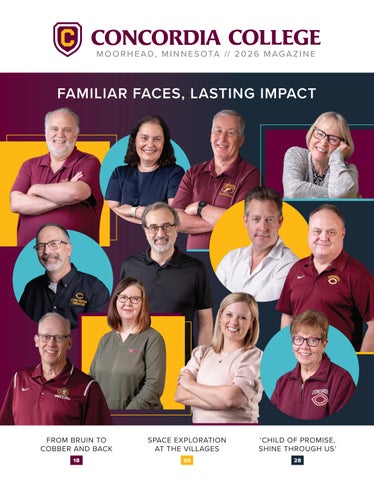
Familiar Faces, Lasting Impact
22
Purpose on Four Paws
24
Cobber Fest: A New Chapter Begins
26
Cobbers Take on Cancer
28
‘Child of Promise, Shine Through Us’ EDITORIAL AND DESIGN TEAM Managing Editor: Kelly Heyer Content Editor: Tracey Bostick Art Design: Eme Otto, AJ Saeter, Lori Steedsman Photo Editor: Penny Burns
COMMUNICATIONS AND MARKETING TEAM Amy Arioglu, Tracey Bostick, Penny Burns, Kurt Cameron, James Cella, Ali Froslie, Alyssa Haagenson, Candace Harmon, Ta’mia Hedlin, Steven Hetland, Kelly Heyer, Katie Hogfoss, Addy Kollman, Kari Lucin, Joshua Lysne, Eme Otto, Kyle Ronsberg, AJ Saeter, Lori Steedsman, Lindsey Swiers, Alayna West
CONCORDIA MAGAZINE 2026 | VOLUME 63 Concordia Magazine is published once a year by Communications and Marketing, Concordia College, 901 8th St. S., Moorhead, MN 56562. To change your address or unsubscribe from the mailing list, contact Alumni Records at smithc@cord.edu or update your record online at ConcordiaCollege.edu/AlumniUpdate
©2 026 Concordia College, Moorhead, Minnesota 927183/36M/0726
2026
|1
<< NEWS
‘Three Bears’ opera collaboration earns national recognition The Concordia Opera has been awarded second place (tie) in Division II of the National Opera Association’s Opera Production Competition for its commissioned orchestral version of Jonathan Stinson’s “The Three Bears.” The honor places Concordia among the top collegiate opera programs nationwide. It was the first collaboration between the college’s opera, theatre, and orchestra programs — a partnership that strengthened the production and showcased the talents of students, faculty, and staff across disciplines. “I am deeply honored,” said Dr. Robin Griffeath, director of the college’s opera program and associate professor of voice. “Producing an opera demands extraordinary effort and collaboration from a diverse team of dedicated artists, and it has been immensely rewarding to work alongside such talented colleagues.”
Concordia names lab after groundbreaking physicist alumnus In honor of his work in health physics and foundational discoveries in neutron scattering, Concordia has named a physics laboratory after Dr. E.O. Wollan, who graduated in 1923. Wollan was recruited to work on the Manhattan Project by Enrico Fermi and Nobel laureate Arthur Compton, and established the protocols for measuring and controlling radiation during the startup of the first controlled nuclear chain reaction. If Nobel Prizes could be awarded posthumously, Wollan would likely have been recognized with one in 1994, when his research collaborator, Dr. Clifford Shull, received the Nobel Prize in Physics. Concordia dedicated the lab during a ceremony last year, which was attended by Wollan’s son 2 | CONCORDIA MAGAZINE
and fellow physicist, John Wollan, with his wife, Barbara, daughter, Katheryn Wollan Aagard, and granddaughters, Martha and Lynn Aagard. John Ahlquist ’63, Ben Larson ’63, and Jerry Ostenson ’62 reflected on Wollan’s work during the event. During World War II, Wollan worked in the University of Chicago’s Metallurgical Laboratory as part of the Manhattan Project, leading the laboratory’s health-physics section and codeveloping the film-badge dosimeter used to monitor radiation exposure. After the war, Wollan designed and built the first instruments for neutron diffraction and he and Shull made critical discoveries in neutron scattering, a technique used to determine the atomic or magnetic structure of materials.
NEWS >>
Olson named VP for Advancement Concordia has appointed Jenny (Bohnsack) Olson ’01 as the new vice president for Advancement and chief executive strategy officer. Olson’s leadership experience includes 20 years at Microsoft and four years leading the Office of Recovery Reinvented under the North Dakota Governor’s Office. “I am honored to return to Concordia in this leadership role at such a pivotal time,” she said. “Concordia has played a significant role in shaping who I am, and I am eager to contribute to the institution’s future.” Olson will oversee the college’s advancement strategy, including fundraising, donor relations, and alumni engagement. She will also spearhead efforts to secure principal gifts and steward relationships with major donors and corporate sponsors. She earned a bachelor’s degree in communication with a business minor from Concordia.
Syverson named director of healthcare leadership program
Concordia names Johnsrud new alumni director
Kate Syverson ’05 has been named the program director and assistant professor of healthcare leadership for the Sanford Heimarck School of Health Professions.
Concordia has named Erica Johnsrud ’10 as its director of alumni and family engagement.
“What drew me back to campus is that the college has prioritized interprofessional education,” she said. “I believe this is going to set our students up with an even greater competitive advantage, whether they chose to go on to graduate school or enter a really competitive workforce.” She credited her own Concordia education and the curiosity it instills in students for preparing her to lead in the healthcare field, and looks forward to fostering the growth of Concordia’s interdisciplinary Center for Population Health. Syverson earned a bachelor’s degree in social work and healthcare management from Concordia, as well as a Master of Social Work degree from the University of Minnesota.
“My time at Concordia taught me what it means to belong to a mission-driven network built on shared values, pride, and responsibility,” she said. “I am honored to activate and expand the Concordia network and am so excited to join the campus community in being a cheerleader for all Cobbers of every generation!” As director of alumni and family engagement, Johnsrud will lead efforts to deepen connections among alumni, families, and the college by designing signature programs, cultivating volunteer engagement, strengthening regional and affinity networks, and fostering lifelong Cobber pride. She earned a bachelor’s degree from Concordia in communication studies and sociology.
Concordia named a top 5 college in Minnesota Concordia College has been named one of the top five colleges in Minnesota in a new ranking from the personal finance website WalletHub, which compared institutions on 30 key measures of academic quality, cost, campus experience, and student outcomes.
“We are honored by this recognition,” President Colin Irvine said. “It reflects what our students experience every day, a top-tier education grounded in values with a global perspective, supported by dedicated faculty, and focused on preparing graduates for meaningful lives and careers.”
Based on WalletHub’s Best Colleges and Universities data, Concordia is also the highest-ranked institution within a 200mile radius of the Fargo-Moorhead area. 2026
|3
<< NEWS
Turn a passion for sports into a career with new sports management program Students interested in the business side of athletics have a new opportunity at Concordia College. The new sports management concentration within the business major is designed to prepare graduates for successful careers in one of the fastest-growing sectors of the global workforce. “The program emphasizes applied learning, giving students opportunities to connect classroom concepts to real-world sports settings,” said Dr. Jorge Scarpin, department chair of the Offutt School of Business. “It prepares students to pursue careers in a growing industry while staying engaged with something they care deeply about.”
The concentration blends Concordia’s liberal arts foundation and strong business training with focused study of the sports industry. Students will build skills in event planning, sponsorship development, analytics, and fan engagement. They will also explore the managerial, financial, legal, and marketing aspects of sports. Through internships, hands-on projects, and partnerships with local organizations, students will engage with collegiate athletics, youth sports programs, and community partners.
From passion to action: Inspiring students to dream big Lauricenia Buque ’26, a computer science major and a recipient of the Projects for Peace grant, has always had a passion for education. She believes that education can be a transformative power. Buque traveled to Chokwe, Mozambique, for her Projects for Peace work, FutureReady, created to address the low school retention rates attributed to low motivation, lack of career guidance, and lack of local success stories. In Chokwe, Buque asked the students, “What do you want to do in the future?” Some couldn’t answer, or answered with generic careers, possibly because they hadn’t been exposed to many career paths.
4 | CONCORDIA MAGAZINE
She partnered with a local organization to target students’ creativity and hone their entrepreneurial mindset. To develop the program, she took an entrepreneurship course offered at Concordia and partnered with the organization offering it to adapt it to her target audience. For career guidance, Buque found a career coach to talk to students about how to turn passion into a career. As a final project, students needed to develop a business idea to solve a problem in their community and run the business. During the last activity, students were asked, “Who knows Mana (older sister) Lauricenia’s dream?” The answer: “Her dream is for our dreams to come true.”
NEWS >>
Growing Together brings new life to Concordia’s garden Concordia College is partnering with Growing Together Community Gardens to make the college’s Cornucopia Garden the organization’s first community garden in Moorhead.
Kopperud encouraged students to join the fun, noting that they could split the work — and the produce — between roommates.
The partnership expands opportunities for student learning and involvement, foster sustainability, work toward food justice, and strengthen community engagement.
Students will benefit through enhanced learning and research opportunities, as the Cornucopia is fertile ground for soil studies, First-Year Seminar projects, course collaborations, and faculty research across multiple disciplines.
“Gardening is good for the body, mind, and soul, I would say, and for you and for the community,” said Dr. Joan Kopperud ’75, professor emeritusin-residence of English.
“It’s a lot of fun to connect with all these different people who all share that same passion for gardening and good food,” said Henry Skatvold ’27, an avid Growing Together member.
Celebrating Norwegian connections: Irvine meets with King of Norway President Colin Irvine was among six U.S. college presidents invited to Oslo for a celebration marking 100 years of educational cooperation between Norway and the United States. The ceremony, held at the Fanehallen of Akershus Fortress and hosted by the Norway-American Association, gathered leaders from six institutions founded by Norwegian immigrants, including Concordia. In his remarks, Irvine reflected on
personal and professional connections, having served as a Fulbright Roving Scholar in Norway himself. “Our ties to Norway are not abstract — they are tangible, personal, and profound,” he said. “They are lived every day through our alumni, through our faculty, and through our enduring partnerships with Norwegian institutions. They are reaffirmed with every new exchange of students and ideas, with every shared discovery, with every story passed down of hospitality, wonder, and learning.” About 20 Concordia alumni living in Norway joined the celebration.
2026
|5
<< NEWS
Awards presented at 2025 Fall Update event Six Concordia faculty and staff members were honored at the Fall Update in August 2025.
From left: President Colin Irvine, Jim Cella, Dr. Lisa Twomey, Dr. Thelma Berquó, James Jehlik, and Dr. Rebecca Moore
Carus Distinguished Professorship Award
Ole and Lucy Flaat Inclusive Excellence Award
Ole and Lucy Flaat Teaching Award
Ole and Lucy Flaat Distinguished Service Award
Dr. Thelma Berquó, professor of physics
Dr. Lisa Twomey, associate professor of Spanish and director of community engagement and integrative learning
Ole and Lucy Flaat Distinguished Scholarship Award Dr. Rebecca Moore, professor of political science
Jason Giffey, associate director of Dining Services Jim Cella, director of athletics communication
Lean Innovation Award
James Jehlik, associate director of academic and user technology services, Solution Center
2025 Athletic Hall of Fame recipients Five former student-athletes were inducted into the Concordia Athletics Hall of Fame in 2025. They were Heidi (Brenden) Selch ’01, cross country and track & field, 19972001; Melanie (Hageman) McNay ’08, basketball, 2004-08; Mike Hashbarger ’97, hockey and soccer, 1993-97; Andrew Passanante ’05, football, 2002-05; and Nathan Reiff ’00, football and wrestling, 1995-2000. From left: Mike Hashbarger, Nathan Reiff, Andrew Passanante, Melanie (Hageman) McNay, and Heidi (Brenden) Selch were inducted into the Hall of Fame
Concordia honors retirees Eleven members of the faculty and staff retired during the 2024-25 academic year. They have a combined total of 264 years of service and include: Stephen Bennett, Concordia Language Villages, 32 years; Greg Borgen, Cobber Bookstore, 10 years; Renée Duval, Concordia Language Villages, 23 years; Ann Hadrava, Concordia Language Villages, 20 years; Dr. Jane Indergaard, Nursing, 28 years; Bill Ishaug, Campus Events and Facilities Management, 19 years; Eric Johnson ’82, Advancement, 19 years; Vicki Juven, Advancement, 24 years; Mark Lillehaugen ’83, Business Office, 32 years; Ron Twedt, Offutt School of Business, 34 years; and David Williams, Facilities Management, 24 years.
6 | CONCORDIA MAGAZINE
Fifteen members of the faculty and staff retired during the 2025-26 academic year. They have a combined total of 443 years of service and include: Tim Brown, Facilities Management, 20 years; Martin Graefe, Concordia Language Villages, 30 years; ElRoy Hagen, Facilities Management, 25 years; Larry Jensen, Facilities Management, 24 years; Dr. Mark Krejci, Psychology, 39 years; Dr. Steven Makela, Music, 24 years; Elizabeth Maring, Cobber Bookstore, 14 years; W. Scott Olsen, English, 39 years; Debbie Pollock, Conferences and Events, 35 years; Dr. James Postema, English, 37 years; Dr. Jack Rydell, Nursing, 20 years; Carol Terhark, Admission, 38 years; Karin Wakefield, Music, 38 years; Dr. Leigh Wakefield, Music, 38 years; and Jennifer Wang, Concordia Language Villages, 22 years.
NEWS >>
Concordia musical ensembles go on tour • The Concordia Handbells performed a “Good Shall Prevail” concert, featuring the music of Broadway musicals and movies at four Minnesota locations in April. The group included 21 participating ringers playing five full octaves of Malmark Handbells, six octaves of Choirchimes, and borrowed bells from conductor Jessica Westgard Larson, expanding the group’s treble range up to G8. • The Concordia Chapel Choir brought their home along with them on their March tour of Minnesota, with a program titled “Soon As I Get Home,” featuring an eclectic variety of music from across history and cultures. Conducted by Dr. Stephanie Tubiolo, the 85-voice mixed choir of sophomores, juniors, and seniors sang two world premiere pieces, including “Sympathy,” by composer Levi Patton ’27. • The Concordia Orchestra’s tour of the Midwest featured a thrilling musical adventure in space, with the state premiere of Lawren Brianna Ware’s “M31 (Messier 31),” written about the Andromeda Galaxy. The 92 student musicians performed pieces by Gustav Mahler, Camille Saint-Saëns, Jamyangiin Chuluun, and Bao Yuankai in South Dakota, Iowa, North Dakota, and Minnesota. The itinerary also included two university residencies and visits to local high schools. • The Concordia Choir’s national tour, directed by Dr. Michael Culloton ’89, included music by J.S. Bach, John Rutter, Lucy Walker, Susan LaBarr, Cedric Dent, and emeritus conductor Dr. René Clausen. The 68-voice ensemble shared music at 17 concert halls and churches across Minnesota, South Dakota, Wisconsin, Indiana, Kentucky, Ohio, Pennsylvania, Maryland, Washington, D.C., New York, Vermont, and Massachusetts. The tour featured a special guest appearance by Clausen, who conducted the choir in “Canticle of Praise” in Roseville, Minnesota. • The Concordia Band’s domestic tour included workshops with high school musicians and performances in Mandan, North Dakota, and Missoula, Bozeman, and Billings, Montana, as well as Detroit Lakes and Moorhead in Minnesota. About 70 students strong, the band was conducted by Dr. Peter Haberman ’97, with music performance major LaReena Mosbrucker ’26 of Mandan as assistant conductor.
Cobbers play first-ever night football game.
2024-25 Sports highlights • Concordia College celebrated its first-ever football night game by overcoming a halftime deficit and scoring 10 unanswered points to beat Mayville State 17-6 in the 2025 season opener in September. The game was played in front of just under 7,000 people, the largest crowd in recent history. • The Concordia women’s basketball team finished the regular season on a high note in February, defeating the College of St. Scholastica 74-54, improving to 22-3 overall and 16-2 in MIAC play. The Cobbers entered the MIAC playoffs as regular-season champions and the No. 1 seed. In their first playoff game, the Cobbers overcame Johns Hopkins for a 64-59 win in the Sweet 16 of the NCAA Tournament. The last time the Cobbers made it to the Sweet 16 was 1993. Concordia took its tourney trek to the Elite Eight, an incredible feat, but fell to the No. 2-ranked Scranton. • Concordia track and field partied like it was 1999, ending its 27-year championship drought to capture its fourth MIAC Indoor Championship Meet title in program history in February. Less than three months later, Concordia won the MIAC Outdoor Championship Meet at St. Olaf. The outdoor championship is the third in program history, the first since 2004, and the second time the Cobbers captured the indoor and outdoor championships in the same season.
2026
|7
C
ommunity is at the heart of the Concordia experience. Ask alumni, students, faculty, or staff what makes Concordia so special, and you’ll hear the same answer again and again: community. It’s the sense of belonging, connection, and care that
8 | CONCORDIA MAGAZINE
makes Concordia feel not just unique, but like home. That feeling doesn’t happen by chance. It is shaped every day by faculty and staff who live out Concordia’s mission each day through their dedication and commitment to students.
FEATURE >>
In conversation with Larson and Roeske, it quickly becomes clear that their shared sense of teamwork and collaboration extends beyond their own coaching partnership. Together, they have helped create a strong sense of community across Concordia’s men’s and women’s track and field and cross country teams.
MARV ROESKE AND GARRICK LARSON
They often describe the program as “one team” and are quick to credit Maddie Van Beek, head coach of the men’s and women’s cross country teams, and the assistant coaches for helping build that unified approach.
It’s rare to spend more than 30 years working for the same company. It’s even rarer to spend those years working side by side — and sharing an office — with the same person.
“I have a role in coaching both men and women in different event groups, and Marv does the same,” Larson said. “We work to make the students comfortable with either one of us and with the entire coaching staff.”
When Concordia track and field coaches Marv Roeske and Garrick Larson walk into a room, you don’t have to wait long to understand their dynamic. The easy banter, the quick laughs, the mutual respect — even the fact that Larson knows the password to Roeske’s phone — all point to a connection built over years of working side by side. Larson, head coach for men’s track and field, arrived at Concordia first, joining the college in 1993. At the time, his role was split between serving as an athletic trainer and coaching track and field. Two years later, in 1995, Roeske joined the college as the head coach of women’s track and field. For Larson and Roeske, Concordia’s reputation and mission were what first drew them to their roles. “When I started working here, my dad was really proud of me. He didn’t care what I did or that I was a head college coach — that didn’t matter to him,” Roeske said. “What mattered was that I was working at Concordia College.” Larson was drawn to Concordia’s mission and the opportunity to make an impact on young adults. “For me, Concordia’s mission statement really resonated,” Larson said. “I feel like I’ve been called my whole life to be a teacher and a coach. Impacting young adults and walking alongside them while they figure out who they are and their path ahead is what really drives me and makes me feel good day to day.”
That approach has left a lasting impact on generations of student-athletes. “I would say both Marv and Garrick have significantly impacted my years at Concordia,” Kiernan Darling ’25 said. “As a freshman, I was terrified, but they both immediately made me feel welcomed and valued as a team member. They are some of the most dedicated and giving people you will meet.” Darling says their care extends well beyond practices and meets. “If you’re ever having a bad day, their office door is always open, and they are both more than happy to pause what they’re doing and just talk,” she said. “They care for you as a person and not just an athlete.” For Darling, that support helped define her Concordia experience. “They’re just two big lovable goofballs who double as the best track coaches,” she said. “Because of them and the track team, my time at Concordia was so memorable and so hard to say goodbye to.” Throughout their interview, Larson and Roeske’s commitment to their student-athletes was clear. Whether they are making sure students have space to gather, study, relax, or eat lunch, or working to create an atmosphere of friendship and support, the students remain at the center of everything they do. 2026
|9
<< FEATURE Watch Larson and Roeske’s full interview:
“I just really enjoy being around the kids,” Roeske said. “They bring so much energy and fun.”
While Larson and Roeske both point to the students as their favorite part of the job, they also recognize how rare their own partnership has been.
“I know it may sound cliche, but it’s the people,” she said. “No day was the same. Every classroom was different. There was an energy and a vibe around here that kept me curious, kept me interested, kept me learning, and kept me wanting to stay.”
“Marv and I are super fortunate to have found each other and work together,” Larson said. “From the very beginning, we had a fast friendship and a shared loyalty to our teams and to Concordia.”
Larson-Casselton has a hard time narrowing down her favorite part of being a faculty member, but nearly every memory comes back to the same thing: the relationships built along the way.
Larson agrees. “It brings us both so much joy to watch their friendships grow and to see their development as athletes and as people.”
Whether she was getting to know students, sharing coffee with a colleague, coaching the forensics team, or traveling abroad to places like Norway, Scotland, London, and Australia, LarsonCasselton found joy in learning alongside others.
DR. CINDY LARSON-CASSELTON When Dr. Cindy Larson-Casselton ’80 walked through the door, two of her former students rushed over to greet her with hugs and excitement. The moment reflected what LarsonCasselton has long believed about Concordia: that the faculty-student relationship is rooted in intentional connection and care that extends far beyond the classroom. Larson-Casselton initially came to Concordia as a first-generation college student, not knowing then that she would go on to spend the majority of her career at the college.
Hear more from LarsonCasselton’s interview:
She served as a professor in the communication studies and theatre art department for 36 years and was also one of the associate directors of the forensics program. After a brief retirement, she has returned to Concordia in a new role, now serving as an academic counselor. When Larson-Casselton reflects on what kept her at Concordia for more than three decades and what ultimately brought her back, her answer is simple.
10 | CONCORDIA MAGAZINE
“One of my favorite things was that spark in a student’s eye when they’ve just ‘got it,’” she said. “I also loved being an advisor, advising students in the discipline and getting to know them so much more deeply beyond the classroom.” Lovingly referred to as “CLC” by many of her former students, that commitment and drive to develop personal and meaningful relationships is echoed by many that took courses from her. “CLC taught me to embrace the world with a critical, but empathetic eye,” Gunnar Fering ’23 said. “As we discussed communication theory, she made space for everyone’s lived experiences while maintaining a sharp sense of justice. It is professors like her who taught me to move through the world with the understanding that everyone’s perspective is uniquely theirs and to celebrate that. I take this lesson to work with me every day.” For Sage Barta ’19, Larson-Casselton’s care and guidance helped shape her path. “Cindy had a tremendous impact on my time at Concordia,” Barta said. “As someone who changed majors multiple times, she was always there to help guide me through the process and encouraged me to find a path that truly fit who I was.”
FEATURE >>
Barta says Larson-Casselton’s influence extended well beyond academics. “Her passion for teaching, mentoring, and genuinely connecting with her students is evident in everything she does,” Barta said. “Cindy goes beyond being a professor; she is a mentor, role model, and friend.” Even with accomplishments like taking fourth place at the national speech tournament, it is the quieter, everyday moments in the classroom that have stayed with Larson-Casselton the most. “When you shut that door to the classroom, and you have this wonderful, intimate experience with a classroom full of students where it all clicks and is going well,” she reflects. “There’s nothing like it. That feeling of all of us learning together, digging in, and dissecting whatever we may have brought to the classroom that day. Those are truly the moments I value and will never forget.”
RUSSELL PETERSON Spend just a few minutes with Russ Peterson, and it’s easy to see why one colleague called him a “magnet for saxophone players” and a “true musical genius.” His energy is electric, his presence captivating, and his passion for music impossible to miss. For the past 30 years, Peterson has shared his talent and expertise with Concordia College students as an instructor of saxophone, bassoon, and jazz studies. While over the years Peterson has considered moving to a larger city or bigger school, the Concordia community has kept him here.
surrounded by not only great musicians, but colleagues that make my work life enjoyable every day.” That appreciation goes both ways. “Russ Peterson is an outstanding member of our faculty and a linchpin of our program,” said Dr. Nat Dickey, chair of the music department. “He is a world class performer and teacher who is also an exceptional, positive colleague. He is collaborative, community-minded, and humble, taking on many service roles as a senior faculty member. He is so appreciated by me and all of his colleagues.” Choosing a favorite part of the job is easy for Peterson: the students. Through one-on-one instruction and small group lessons, he has the chance to build meaningful relationships with students, helping them grow as musicians while getting to know who they are beyond the music. “I enjoy getting to know students and what makes them tick,” Peterson said. “Oftentimes, I’m communicating with students long after they’re gone from here, making sure to keep in touch.” During his time at Concordia, Peterson has had the opportunity to travel with students across the country and around the world. But for him, those trips were about more than performing great music. They were opportunities to watch students grow, connect, and experience the world in ways that stayed with them long after they returned home. For Peterson, music is the rhythm of his everyday life. At Concordia, in the community, and everywhere in between, he is grateful for a career that keeps him connected to what he loves most. “I get to make music every day, I get to talk about music, comment on music, listen to recordings of music. And then, when I’m done with that, I get to go out in the community and play music,” he said. “I know not everybody has jobs where they’re always in their happy place, but I kind of am, and I don’t take that for granted ever.”
Hear more about Peterson’s musical journey:
“I like working in an environment with brilliant, considerate people,” Peterson said. “I’m
2026
| 11
<< FEATURE
that experience, students gain hands-on training in technical theatre, from hanging and focusing lights to adding color, programming cues, and helping bring each production to life.
BRYAN DUNCAN Growing up in Grand Forks, North Dakota, Bryan Duncan ’90, campus lights director and instructor of theatre art, had never heard of Concordia until his high school drama director mentioned that he was an alumnus. That chance conversation was Duncan’s first introduction to the college, but it would not be his last. What began as a passing mention soon became the start of a connection that has carried through his student years, his work in theatre, and now his leadership of one of Concordia’s most beloved traditions. As the director of campus lighting since 1991, Duncan has designed the staging and lighting for more than 400 events, including groundbreaking designs in Concordia Theatre productions and the Concordia Christmas Concert. “Bryan Duncan has been mentoring students, inspiring audiences, and lighting up our campus for several decades, and Concordia is a better place because of the care and professionalism with which he approaches his work,” said Dr. Michael Culloton ’98, director of choral activities. “His partnership with me on the Concordia Christmas Concerts makes for one of my favorite collegial relationships on campus, and this place shines brighter because of him.”
Catch more of Duncan’s interview:
Duncan’s own experience as a Cobber continues to shape the way he approaches his role today. He is passionate about giving students the same kinds of opportunities he had at Concordia — opportunities to learn by doing, build confidence, and discover what they are capable of behind the scenes. That includes mentoring a group of students who work with him daily in the theatre. Through
12 | CONCORDIA MAGAZINE
“My favorite thing about my job is being creative with students,” Duncan said. “It’s not just about being creative on my own. I have to invite students into the processes of the project we’re working on and give them the opportunity to make those creative choices along with me. I want them to understand what they’re doing, why they’re doing it, and hopefully have a lot of fun along the way.” Duncan never expected Concordia to become the place where he would spend more than 35 years. There were moments when he imagined a different path, perhaps working on Broadway in New York or in another city. But Concordia’s mission, and its call to influence the affairs of the world, continued to resonate with him. “I had a couple of opportunities, but ultimately it came back to where I could make a good impact on the world,” Duncan said. One recent career highlight for Duncan was working on Concordia Theatre’s production of “Jesus Christ Superstar.” Projects like that, along with the annual Concordia Christmas Concerts, remind him why the work continues to feel meaningful after so many years. For Duncan, the joy is not only in the production itself, but in what it gives to the people who experience it. “Seeing people smile coming out of the Christmas concerts is one of the reasons I keep coming back year after year,” he reflects. “We get the chance to brighten their lives a little bit. There’s a lot of darkness in the world, but we’re literally lighting their life up a little bit.”
FEATURE >>
to engage more fully in lab work. Along with physical shifts to the department, the curriculum has also expanded. Manzoni says the program is broader and more modern than it was when he arrived.
DR. LUIZ MANZONI AND DR. THELMA BERQUÓ For Dr. Luiz Manzoni, a member of Concordia’s physics faculty since 2008, and Dr. Thelma Berquó, who has also spent more than 15 years teaching in the physics department, the heart of the work is found in the classroom, in the lab, and in the relationships that continue long after graduation. “It’s all about the students,” Manzoni said. “We have great students — always have had great students. It’s very nice to interact with them and see them growing and to see what happens with them afterward, where they go, the jobs they get, grad school, and their achievements.” That commitment to students has left a lasting impression on alumni, including those who arrived at Concordia still searching for their path. “I showed up at Concordia with no direction about what I really want to do, or which major to pursue, but I think the best decision I made was sticking with my applied physics degree because of Thelma and Luiz,” Johan Dominguez Lopez ’25 said. “They pushed me to be the best student and the best person I could be. I don’t think I would have made it as far as I did without their support and mentorship, and I am forever grateful for the opportunities they gave me.” Over the years, both faculty members have watched the physics program grow and adjust in meaningful ways. One of the biggest changes came with the renovation of the Integrated Science Center, which gave the department updated space and equipment to better support hands-on learning. Berquó says the renovated space has made a significant difference in how they teach introductory physics courses, especially with new apparatuses and instruments that allow students
Even as the program has changed, the most meaningful part of the work has remained the same. “Definitely, the interaction with the students,” Berquó said. For Manzoni, some of the most memorable moments come when former students return, reach out, or share where life has taken them. “It’s the friendships that we make with the students,” he said. “They keep coming back and telling us about what they have been doing. Sometimes they invite us to their weddings.” Recently, a former student who had completed his doctorate included Manzoni and Berquó in his acknowledgements. For Manzoni, moments like that are reminders of the lasting impact of faculty-student relationships. As they reflect on their work, Manzoni and Berquó are quick to acknowledge that teaching requires energy, creativity, and constant growth. “We work a lot,” Berquó says with a laugh. “But we work a lot because we like to do that.” She says the job requires faculty to be creative, flexible, and continually up to date in both research and teaching. Manzoni says that constant learning is one of the defining parts of their profession. “We are always learning,” he said. “Every class is different, every year is different, so we are always having to learn new ways to teach. And then, of course, in our research, it’s continuous learning.” After more than 15 years at Concordia, both Manzoni and Berquó (who have been married for more than 30 years) continue to find purpose in that balance — teaching and learning, challenging and supporting, leading students while also growing alongside them.
Watch their full interview:
2026
| 13
<< FEATURE
In the end, their work is not only about physics. It’s about helping students discover what they are capable of, equipping them to communicate what they know, and watching with pride as they carry that learning into the world.
as a student. After graduation, he stayed on, eventually moving into roles as catering manager and assistant director. At one point, Fradet left Concordia for the private sector. It did not take long for him to realize what he missed. “I missed the community, the people, and the students,” he said. “When you come back, there’s a different feeling to work for the mission of the college than just for the private sector.”
For the Concordia Dining Services leadership team, it has never been just about food. It is about community. It is about creating a place where students feel seen, known, and at home. Together, the three have spent decades serving Concordia students, faculty, staff, and guests. Janet Despard, director of Dining Services, spent more than 22 years at the college, left for seven years, and returned in 2023. Jason Giffey, associate director of Dining Services, will begin his 25th year at Concordia this fall. Bill Fradet ’89, assistant director of Dining Services, has been part of the Concordia community for nearly 40 years, aside from a brief time away. For Despard, it is the sense of community that first drew her to Concordia and eventually brought her back. “The smaller campus community is definitely a strength of Concordia,” she said. “You really do feel like you’re part of a community and that you’re working with others to serve the mission of the campus.”
Hear more from the Dining Services team:
Giffey came to Concordia looking for better work-life balance after working in sales. At first, he thought he might stay only a year or two. Then Concordia became something more. “I got drawn in by the people, the community, and always having somebody there to have your back,” he said. Fradet’s connection to Dining Services began
14 | CONCORDIA MAGAZINE
That mission is lived out daily in Anderson Commons, where Dining Services plays an important role in the student experience. For many students, meals are not only a source of nourishment but also comfort, routine, and connection. “Students are away from home, and we recognize that food is a huge comfort factor in feeling like you’re at home,” Despard said. “Trying to provide meals that are comfortable and familiar, but also maybe introduce them to new things, is really fun.” The team also works to create a space where students feel welcomed the moment they walk in. “We try to provide an environment where our staff are welcoming and help students feel that they’re seen and heard,” Despard said. “Anderson Commons is their kitchen table.” Giffey has especially appreciated the opportunity to support students with specific dietary needs, whether for health, religious, or personal reasons. In recent years, he has seen students choose Concordia in part because of the care shown around food and accommodations. Their care for students is also evident to colleagues across campus. “The on-campus housing experience would not be the same without the exceptional work of our Dining Services team,” says Sean Payette ’17, director of Residence Life. “Every time I have the opportunity to connect with Janet, Bill, or Jason, I’m reminded just how deeply they care about creating a positive experience for our students.” For Payette, that impact is experienced beyond the meals served each day.
FEATURE >>
“Their work extends far beyond preparing meals, as they help create spaces where students gather, build friendships, celebrate milestones, and find a sense of community,” he said. “Whether they’re dreaming up new menu items for Anderson Commons, expanding allergy-friendly offerings, or responding thoughtfully to student feedback, they approach every moment with creativity, flexibility, and a genuine desire to serve. They understand that a great campus dining experience doesn’t happen by accident. It requires innovation, collaboration, and a willingness to continually adapt to the needs of our students.” One of the most significant changes in Concordia Dining Services came in 2007, when Anderson Commons opened. Before then, the dining center was located in the space now known as The Maize. Despard remembers the old dining center as dark, outdated, and limited in what it allowed the team to do. “To be out of the basement was fantastic,” she said. “But not just the physical setting, which Anderson Commons is beautiful, but also being provided with modern equipment that allowed us to prepare the types of foods that students wanted.” Today, Anderson Commons has become a social hub on campus — a place where students not only eat but gather, linger, talk, and build community. For Giffey, one of the most meaningful moments came when he received an award from the Student Government Association. What stayed with him was not the recognition itself, but the letter a student wrote about his impact. “That really made me want to stay here at a time when we …” Giffey says, pausing. “I was offered a job shortly after that and, after thinking about it, that job would never give me what this does.” For Despard, the work is a labor of love. “When you love what you do, you love the people that you do it with, and you love the people that you do it for,” she said. In a place where students come looking for community, comfort, and connection, Despard,
Giffey, Fradet, and the entire Dining Services team help make Concordia feel like home.
Dr. Joan Kopperud ’75 began her Concordia journey as a college student in 1971. Now, decades later, Concordia remains woven throughout nearly every chapter of her life — as a student, graduate, faculty member, mentor, traveler, colleague, and now emeritus-inresidence. In 1989, Kopperud and her husband, Kevin ’75, moved back to Moorhead with their two sons. She returned to Concordia as an adjunct faculty member in the English department and, after completing her doctorate, joined the college as a full-time faculty member in the mid-1990s. Over the years, Kopperud taught courses in the English and education departments, served as the Writing Center director, and later became director of integrative learning. In that role, she helped advance Concordia’s recommitment to hands-on learning and community engagement, supporting experiential learning as an essential part of a liberal arts education. After retiring as a full-time professor in Spring 2021, her Concordia story continued. As professor emeritus-in-residence of English, she has taken on special projects that continue to connect the college with the wider community. Most recently, she has served as the liaison between Concordia’s garden and Growing Together Community Gardens, helping bring the organization’s 10th community garden to the east side of campus. “Joan Kopperud was instrumental in the launch of Peak at Concordia,” says Dr. Susan Larson, provost and dean of the college. “As the inaugural director of integrative learning, her thoughtful mentorship and commitment to high-
2026
| 15
<< FEATURE
quality Peak experiences helped ensure that Concordia met its ambitious goals when the program launched. “Joan has been an engaged and active emerita faculty member, serving the college in ways that connect her passions with our institutional needs. She has supported the food pantry and worked alongside staff and students in ways both practical and meaningful, from picking up food to stock the pantry to offering cooking lessons that help students make healthy, nutritious food choices. “More recently, Joan has been involved in the successful launch of the Growing Together Community Garden at Concordia. Her connections to both Growing Together and Concordia make her an excellent bridge between the college and the community garden. We are fortunate to have emeriti faculty like Joan, who see an institutional need and step forward to help.” For Kopperud, the reason she has stayed connected to Concordia for so long is both simple and deeply personal. “Definitely the people — students, colleagues, alumni, and the countless relationships I’ve developed over the years,” she said.
With so many years connected to Concordia, choosing a favorite memory is difficult. One meaningful highlight came in 2018, when she received the Ole and Lucy Flaat Distinguished Teaching Award. “It was humbling to be recognized for something I loved doing,” she said. Travel has also been a significant part of her Concordia experience. Through the college, she co-led an international Habitat for Humanity trip to Nicaragua, co-led a body-mind-and-spirit retreat to Switzerland, traveled with colleagues to Germany, and spent time in Norway while on sabbatical. Those opportunities have continued in her emeritus role, including co-leading alumni trips to Norway in 2023 and 2025, with another trip, Adventures of the High North, planned for October 2027. Looking back, Kopperud describes her career at the college with gratitude. “Concordia challenged me to grow, learn, and serve in more ways than I ever could have imagined when I decided to attend and then teach at Concordia,” she said. “I am forever grateful.”
Those relationships have shaped her life and work, but so has Concordia’s mission. She believes in the liberal arts and has found meaning in opportunities that allowed her to teach, research, serve, travel, and build lasting connections across campus and beyond. “My roles and opportunities at Concordia have changed over the years, and I think this has kept me closely connected to and interested in the college over several decades,” she said.
Hear more about Kopperud’s journey:
No matter the position Kopperud held, her favorite part was the opportunity to build relationships with students and support their growth. “My favorite part about the job was working with students, both in and out of the classroom,” she said. “That was always just so rewarding to watch them grow as readers and writers, critical thinkers, and engaged citizens.”
16 | CONCORDIA MAGAZINE
For Rachel Bergeson ’05, walking into Memorial Auditorium is never just the start of another workday. It is the place where her grandfather coached, where her parents worked, and where Bergeson herself once competed, learned, and grew as a Concordia student. Now, it is also the place where she leads as Concordia’s director of athletics. “When I get to come to work every day, and I get to come through those doors of Memorial
Auditorium, it was a place that I was practically born in,” Bergeson said. “It’s also the place where my grandpa coached, and my parents have worked, and I got to be a student.” Bergeson has served as athletic director since 2018, but her Concordia story began long before that. Her father, Bucky Burgau, worked at the college throughout her childhood as head baseball coach and equipment manager. Her grandmother, Marcella, worked in the pastor’s office, and her grandfather, Sonny Gulsvig ’50, coached football, basketball, and baseball. Her mother, Penny (Gulsvig) ’75, worked in the Registrar’s Office for 44 years. Before becoming the director of athletics, Bergeson served as assistant women’s basketball coach and compliance officer, then moved into an associate athletic director role. What makes the role especially meaningful, Bergeson says, is the chance to lead at a place so deeply connected to her family’s story. That sense of connection is part of what has kept Bergeson at Concordia for 20 years. While she admits it may sound familiar, she says the reason is simple. “It seems so cliche to say that the people have kept me here, but it’s the people that have kept me here,” Bergeson said. “The people that I get to work with every day, but also the people that I get to work for, and that would be our studentathletes.” In athletics, she says, the work often becomes more than a job. It becomes a lifestyle, a community, and a shared commitment. Long nights, weekend games, and behind-the-scenes preparation are all part of the rhythm. “At the end of the day, when it’s game day, whether it’s on an evening or a Saturday afternoon, that is when you really get to see your work come into play,” she said. “You get to see the student-athletes do what they love to do because of all the work that we’ve done behind the scenes.” That hard work does not go unrecognized by Bergeson’s colleagues. “Rachel has taught me that the hard things are worth doing and that winning the right way matters,” says Tate Hovland ’20, gift planner
for athletics. “She is fiercely competitive and always pushing for improvement, but never at the expense of the people around her. It has been a joy to work alongside her, and I’ve seen firsthand how deeply she cares about helping people succeed. “Many people could lean on a family legacy, but Rachel has built one of her own. The people she has impacted tell that story best, and Concordia is better for it.” One of the most rewarding parts of her job is watching student-athletes grow during their time at Concordia. Bergeson sees students arrive as first-years, sometimes shy or uncertain, and later become confident leaders. “To see that growth in our student-athletes and that we’re providing the platform for that growth, that’s really rewarding,” she said. And, she adds with a smile, there is one more thing she enjoys. “Of course, winning,” Bergeson said. “I really like to win.” While Concordia has changed over the years, especially as the landscape of college athletics has shifted dramatically, Bergeson believes the core of the college has remained steady. “The heart of this place has stayed the same,” she said. “The heartbeat of this institution has stayed the same.” When she accepted the role here, there had never been a female athletic director at Concordia before. Bergeson says mentors on campus, within the conference, and at home helped give her the courage to accept the role and become the first woman to serve as Concordia’s director of athletics. “That is definitely a highlight of my career and a really important turning point,” she said. “I hope to be able to take that experience and feed that to other young women future leaders.” For Bergeson, Concordia is both personal and purposeful. It is a place shaped by generations of her family and a place where she now helps shape the experience of today’s student-athletes.
Watch Bergeson’s complete interview:
2026
| 17
school, then at Concordia. Johnson was a senior when Byer was a freshman, and the two crossed paths in pep band, jazz band, and concert band. Later, their shared Concordia experience deepened the connection. Their stories are filled with small parallels: South graduates, Cobbers, percussionists, band teachers — they even have cats that look eerily alike. But what connects them most is a shared belief in the power of music to build community. At Concordia, both found that sense of community in the music program. “I don’t think I had such a strong community experience until I was a member of The Concordia Band,” Johnson said. “It was one of the single most wonderful and cherished things about my college experience.”
W
hen Noah Johnson ’20 and Tristan Byer ’23 walk into the band room at Fargo South High School, they are stepping into more than a classroom. They are returning to a place that helped shape who they are — as musicians, teachers, mentors, and people. Both are graduates of Fargo South. Both went on to study at Concordia College. Both are percussionists. And now, both are back at their high school alma mater, teaching in the same program that once inspired them. “Returning to South High School to teach is really special and unique,” Johnson said. “The opportunity to return to your alma mater and give back to the program that helped shape who you are — it’s really special.”
BYER
JOHNSON
For Byer, the pull back to Fargo South was personal. “When I was a student here at South High, there was a lot of pride in being a Bruin,” he said. “When I saw this job open up, I was like, ‘I really, really want that job.’ I loved my time here, and being able to give back and hopefully provide that same experience for students was something that was really important to me.” Johnson is in his sixth year of teaching overall and his first at Fargo South. Byer is in his second year at South. Their paths overlapped long before they became colleagues — first in high
18 | CONCORDIA MAGAZINE
Byer felt that same sense of belonging. “The Concordia Band especially was like one big family,” he said. “There were so many people who were really committed to making the best possible music they could and looking out for each other. Music and community are huge aspects and values of Concordia.” That experience now shapes the way they teach. For Johnson, the goal is for students to leave the Fargo South band program as more than stronger musicians. “It’s my hope that students emerge from the South High School band program not only better musicians, but better people,” he said. “People who treat each other kindly, know how to work as a team and collaborate, and have developed real-life skills that will benefit them far beyond their high school years.” Byer shares that vision. Community is central to his teaching philosophy, along with the hope that students continue to value music long after they leave high school. “I hope kids can come through here and leave with a sense that music is important,” he said. “Even if they’re not a music major or don’t pursue music as a career, I hope they keep music in their life somehow — even if it’s just for fun.” Johnson added that while music education helps students develop skills like teamwork, discipline,
and collaboration, music also has value on its own. “Music is valuable for music’s sake, too,” he said. “It transcends time and all cultures, and to be a part of making music on a daily basis is something special.” Both Johnson and Byer say Concordia prepared them well for the realities of teaching, especially through hands-on experiences in classrooms throughout Fargo-Moorhead and the surrounding area. “Concordia prepared me for being a teacher by giving us a lot of opportunities to work hands-on in the education field,” Byer said. “Pretty much every year, I had some kind of clinical teaching or student teaching experience.” Johnson agreed that those real classroom experiences were valuable. “Nothing really prepares you for that first year of teaching,” he said. “But the hands-on opportunity to get into real-life classrooms was really valuable.” Their Concordia professors also left a lasting impact. Byer credits several teachers and mentors with helping him find his path, including his mother, who is a music teacher, and teachers from his time at Fargo South. At Concordia, he found a strong mentor in Dr. Peter Haberman ’97. “He’s fantastic,” Byer said. “He’s outgoing and supportive and will do anything to help you. Even now, as adults who are teaching, he still comes in and works with our bands or gives us advice. He’s been a huge part of my journey.” For Johnson, mentors such as John Syverson at Fargo South and Haberman at Concordia helped shape the kind of teacher he strives to be. “I cannot speak highly enough about Dr. Haberman,” Johnson said. “Mentor, role model, friend — just a wonderful all-around educator who I still try to emulate every day in my teaching.” The lessons from those mentors show up in their own classrooms, sometimes in ways they notice only after the words have already left their mouths.
“I find myself saying something and then realizing, ‘Oh, I’ve heard him say that before,’” Byer said with a laugh. Johnson came to music education later in his college career and said Concordia faculty helped him make that path possible. “I did not declare music education until well beyond a year into college,” he said. “The number of professors who worked with me to make sure I finished in four years and still had experiences that would prepare me for the field — I am so indebted to the faculty and music staff at Concordia.” Byer remembers Concordia standing out even before he enrolled. “Concordia was the only place where I had multiple professors reaching out and saying, ‘Let’s schedule a lesson’ or ‘Come watch a rehearsal,’” he said. “That really stood out to me. They really cared about prospective students.” Now, in a full-circle moment, Johnson and Byer get to watch their own students grow — day by day, rehearsal by rehearsal, year by year.
Johnson receives award Photo credit: Sam Weber / WDAY News
For Byer, the best part of the job is the students. “We have such a great community of kids here at South who are proud to be Bruins, proud to be in band, and totally give it their all,” he said. “They make our jobs a lot easier.” In December, Johnson received the Young Band Director of the Year award from the Minnesota Chapter of the American School Band Directors Association, which recognizes the achievement of young directors and their impact on their school band. But for Johnson, the reward is seeing students develop over time. “Music is unique in that we often see our students over the course of four years,” he said. “To be able to see that growth is so rewarding and special.”
Hear more from Johnson and Byer:
In many ways, Johnson and Byer are continuing a rhythm that began years ago — in the band room at Fargo South, through the music halls of Concordia, and now back where it started. Their calling has been to help students discover the same joy, belonging, and purpose they found through music.
2026
| 19
FROM LANGUAGE IMMERSION TO SPACE EXPLORATION: CONCORDIA LAUNCHES INTO A NEW FRONTIER AT CONCORDIA LANGUAGE VILLAGES BY CANDACE HARMON
Dr. Krys Strand ’96, right, helps prep a research team from American Public University System for a simulated spacewalk at Concordia Language Villages.
W
hat does it take to prepare humans to live on Mars? That question is moving beyond the classroom and into a unique research environment within the forest of northern Minnesota. Mist wafts from a miniature greenhouse tucked inside a science building at Waldsee, the German Language Village in Bemidji, Minnesota. Dr. Krys Strand ’96 opens the door to adjust the humidity. Inside, the stage is set for mushrooms to emerge. These mushrooms aren’t just destined for a dinner plate. They’re part of a growing body of research exploring how future astronauts might grow food, support brain health, and survive during longduration missions to places like Mars. For Strand, a Concordia College biology and neuroscience professor, the mushrooms represent one piece of a much larger vision. That vision is called ECOS Concordia. ECOS is a new space analog habitat Strand is developing at Concordia Language Villages. Space
20 | CONCORDIA MAGAZINE
analogs are Earth-based environments designed to simulate some of the challenges astronauts will face while living and working as small crews or a larger settlement on the Moon or Mars. “Every analog has a name,” Strand said. “I chose the name ECOS because from Greek, it refers to home and from Latin, it is associated with house or environment. Taken together with Concordia, which means harmony or hearts together, ECOS Concordia is a habitat where humans must live in harmony with each other and their environment.” The first step was a pilot mission at Waldsee’s BioHaus, a STEM-focused building and hub for sustainable living education. As the first certified German Passivhaus in North America, the facility’s design, and its built-in science lab, made it an ideal testing ground. For eight days in January, participants from the American Public University System’s Analog Research Group lived and worked in a simulated space mission environment. APUS comprises both
the American Military University and the American Public University. Crew members assessed the BioHaus as a space habitat, conducted numerous “spacewalks” in the frigid landscape, and tested food-production systems that could someday support astronauts millions of miles from Earth. Among the projects: growing microgreens and mushrooms under different conditions to identify the most efficient methods for producing food in a closed habitat.
“CLV is already built around immersion and experiential learning,” she said. “That’s exactly what an analog mission requires.” Recently named the 2026 Nu Rho Psi Outstanding Faculty Member, a national honor for neuroscience educators, Strand is also bringing the project into Concordia classrooms. For several years, Strand has taught a course examining the effects of spaceflight on the human body. Neuroscience of Space explores how microgravity, radiation exposure, isolation, and confinement affect the nervous system. Students study everything from balance and sensory systems to cognition, psychology, and long-term brain health. Recent student projects examined ways to counteract the neurological effects of longduration space travel. Some students have worked with the same mushrooms cultivated at BioHaus, investigating whether compounds found in certain fungi may help protect cognitive function during extended missions.
Those kinds of experiments may sound futuristic, but they address practical questions scientists must answer before humans can establish a presence on another planet.
“That’s what space is all about,” Strand said. “To use and reuse everything. How do you live in a closed system? You can’t just put in an Amazon delivery.”
The setting at Concordia Language Villages makes it an ideal place to begin exploring those questions.
For Strand, this work is not only about preparing for future missions; it is also about improving life here on Earth.
Like a language village, a space analog asks participants to step into another reality. They live by a different set of rules, solve problems together, and become immersed in an environment designed to mimic life somewhere else. For Strand, the connection between Concordia Language Villages and space exploration is natural.
— Dr. Krys Strand
Mushrooms are particularly attractive because they require relatively little space, can be grown repeatedly, and provide nutritional benefits. Strand is also researching ways mushrooms might fit into larger closed-loop ecosystems that include fish, plants, and water-recycling systems.
How will astronauts recycle resources and grow food? How will they handle communication time delays? How will they maintain their physical and cognitive health during months or years away from Earth?
“This is all immersive simulation, education, and research, which fits the mission perfectly,” Strand said. “Just because it’s for outer space doesn’t mean it’s not totally in line with the language and culture training they already do.”
“The future for ECOS feels exciting and packed with potential.”
“In order to live off Earth, humans will have to figure out how to do so sustainably and be able to solve numerous difficult problems,” she said. “Each step we take in solving these problems, though, can help us live better on Earth.” As ECOS takes shape, it reflects something essential about Concordia’s approach to education: a willingness to imagine boldly, collaborate deeply, and connect learning with the world’s most complex challenges.
Catch up on the experience: Instagram.com/ecos_Concordia 2026
| 21
PURPOSE ON FOUR PAWS BY TA’MIA HEDLIN ’23
C
obbers have a way of finding purpose in service. For Jeff Johnson ’89, that calling has led to an organization where every success begins with a simple partnership: a person, a dog, and the promise of greater independence. As president and CEO of Can Do Canines, Johnson leads one of the nation’s premier assistance dog organizations, matching highly trained assistance dogs with people living with disabilities at no cost to recipients. Since its founding in 1989, the Minnesota nonprofit has transformed more than 1,000 lives through partnerships that restore confidence, expand independence, and create opportunities that once seemed out of reach. Johnson’s path from Concordia to law, public service, and nonprofit leadership may not have been predictable, but the values that shaped him as a Cobber remain at the center of his work. Every day, he sees firsthand how compassion, community, and a willingness to serve can change a life, sometimes with four paws leading the way. “I think Concordia helped me lead from my values,” Johnson said. “You have a certain set of core values that affect every decision you make. For me, that’s my faith first, along with integrity.” Those values guided him through several chapters of his career before he arrived at Can Do Canines five and a half years ago. At age 54, Johnson made what he describes as a “180-degree turn” professionally, leaving behind a career in politics and public service for nonprofit leadership. It didn’t take long to know he had found his calling. “Within the first few weeks, it was obvious to me that I was where I was supposed to be,” he said.
22 | CONCORDIA MAGAZINE
Today, Johnson leads an organization that trains assistance dogs to perform specialized tasks for people with disabilities. While many people are familiar with therapy dogs or emotional support animals, assistance dogs serve a different role. They are trained to complete physical tasks that help their partners live more independently, from opening doors and retrieving items to alerting someone with diabetes to dangerous changes in blood sugar.
He recalls another client, a young woman living with Postural Orthostatic Tachycardia Syndrome, whose mobility assistance dog helped with everyday household tasks, including laundry. What many people might consider a convenience became life-changing. “We take things like that completely for granted,” Johnson said. Those experiences have also expanded his understanding of service.
“They don’t just comfort people,” Johnson said. “They provide assistance that nothing else has been able to provide. They literally “I think Concordia helped transform people’s lives.” For Johnson, the most meaningful part of his work is hearing those stories firsthand. One family, in particular, has stayed with him.
me lead from my values. You have a certain set of core values that affect every decision you make. For me, that’s my faith first, along with integrity.”
Before receiving an autism assistance dog, an 8-yearold boy rarely spoke to others, struggled to leave the house, and often experienced meltdowns that made family outings nearly impossible. His parents eventually stopped taking vacations, going to restaurants, or even attending church together. Within a year of receiving their assistance dog, everything changed. The boy began talking with people. He wanted to leave the house. Family outings became possible again. The dog not only provided physical safety by staying tethered to the child but also helped calm him in overwhelming moments in ways no one else had been able to. Johnson still remembers what the boy’s mother told him. “This dog rescued a little boy who was trapped inside our son that we didn’t know existed,” she said. “And it saved our family.” Stories like that have changed Johnson’s perspective, both as a leader and as a person. “You realize how difficult some people’s lives are,” he said. “Things as simple as opening a door, getting something out of the refrigerator, or running to Target — those aren’t simple for everyone.”
While the organization depends on hundreds of volunteers who raise, socialize, and help train future assistance dogs, Johnson has also come to appreciate the unique role the dogs themselves play. When asked if he had ever learned something from one of the dogs, he said one dog stands out: Tucker.
The yellow lab was matched with Tiff, who has cerebral palsy that affects her speech as well as her mobility. Tucker had to start all over again and essentially learn a new language. Tiff would give a command and every ounce of Tucker’s being wanted to perform a task, but he didn’t understand what to do.
Jeff Johnson ’89 is president and CEO of Can Do Canines, one of the nation’s premier assistance dog organizations.
“There were times when he’d just look at Tiff and start to cry because he couldn’t help,” Johnson said. It took a long time, but he would not give up. Today, Tucker understands Tiff at a level that only her husband and son can match. “Tucker taught me the value of perseverance,” he said. Watching those partnerships develop has reinforced something Johnson first learned as a student at Concordia: meaningful service is rooted in relationships. Behind every assistance dog is a community of employees, volunteers, trainers, puppy raisers, donors, and supporters who share a common purpose. Together, they make it possible for every dog to change someone’s life because, sometimes, purpose finds you on four paws.
2026
| 23
24 | CONCORDIA MAGAZINE
it coincided with Terry Horan’s 25th year of coaching at Concordia.
T
here’s a sea of people scattered across the main lawn and around Concordia’s iconic Dovre Campanile. Old classmates are connecting and reminiscing, and current students are showing their friends and families around this new place they now call home. The buzz on campus is palpable during Concordia’s inaugural Cobber Fest. Cobber Fest debuted Sept. 6, 2025. This fun-filled day included student-led music performances, games, an ice cream social, mini classroom lectures, and wrapped up with Concordia’s first football game under the new stadium lights.
“Cobber Fest 2025 was, at its core, a walk down memory lane for us. Deciding to come together for that long weekend last fall allowed us all to reconnect in the most authentic ways possible,” Rob Szymanski ’01 said. “Sharing stories, being back on campus, going to the football game, and visiting old eateries or watering holes in the F-M area was a very familiar way to fill our time together, and it was a great way to kind of relive our shared past. Now, 25 years later, we all continue to share a slice of life as dads, husbands, and working professionals.” Traditions are never static. They adapt, they grow and take on new life and meaning as each generation adds its own chapter to the story. Cobber Fest is the newest chapter and represents Concordia’s long history of bringing people together.
Unlike previous campuswide events that have been held before school starts, Cobber Fest intentionally took place after students returned for the academic year. The celebration was designed to bring students, families, alumni, and friends together in a more student-centered experience. The day created powerful moments of connection. “Built on the spirit of beloved traditions (like the campus corn feed and Family Day) and reimagined for today, Cobber Fest felt like Concordia at its best: welcoming, inclusive, fun, and full of belonging,” President Colin Irvine said. “And then we made history: Our first-ever night football game at Jake Christiansen Stadium — a postcard-perfect evening capped with a Cobber victory!” One of these powerful connections included a group of alumni who had not been to campus together since they graduated more than 20 years ago. Football teammates and roommates, this group of friends remained close while living in various cities throughout the U.S. When they heard about Cobber Fest, they knew this was the perfect opportunity for them all to reunite on campus and reminisce while sharing new memories with their families. The timing of this reunion was even more appropriate, as
COBBER FEST RETURNS FOR ITS SECOND YEAR!
Mark Your Calendars: Sept. 12, 2026 The second annual Cobber Fest returns this fall with even more celebration and fun in store including a Gold Rush theme, the Lefse Bowl football game, plant bingo, and some bonus surprises. You won’t want to miss this event. 2026
| 25
COBBERS TAKE ON CANCER BY FORMING RURAL CANCER INSTITUTE BY KARI LUCIN
F
riendship and a drive to stop cancer inspired a pair of Cobbers to form the Rural Cancer Institute along with other experts, seeking to draw attention to the disparities in cancer care affecting rural communities — and, eventually, end them. “My dad is a two-time rural pediatric cancer survivor, and a one-time adult cancer survivor, so cancer is something I’m very passionate about stopping,” said Ingrid Jacobson ’21, director of research at the Rural Cancer Institute.
Ingrid Jacobson ’21 is the director of research at the Rural Cancer Institute.
While the cancer rate is similar in rural and urban areas, the outcomes are generally much worse for rural people, she explained. And many of the reasons that outcomes are worse are fixable, such as lack of access to care, poverty, and fewer public health resources. Infrastructure challenges like scarce public transportation, distant hospitals and specialty care, and inadequate broadband that impedes telehealth access are also common factors for rural residents. “Growing up in a small town in Minnesota, I understood that where you live shapes the care you can access,” said Dr. Abby Swenson ’21, a board member of the Rural Cancer Institute. “What I didn’t fully understand until I started doing research was just how stark those numbers are and how little organized effort existed to address the cancer piece specifically.” Swenson graduated from the Medical College of Wisconsin in May 2026 and currently serves as an
26 | CONCORDIA MAGAZINE
internal medicine resident at Gundersen Health System in La Crosse, Wisconsin. Jacobson also pursued a healthcare-related field, earning a Master of Public Health degree and studying epidemiology. Their paths crossed at Concordia College, and they became friends. Swenson, a biology major with chemistry and psychology minors, participated in the Sigma Zeta National Science and Mathematics Honor Society, studied abroad, and did undergraduate research with the biology department. Jacobson also majored in biology, with minors in chemistry and religion. She too did undergraduate research with the biology department and studied abroad, as well as served on the Diversity, Equity, and Inclusion Commission and participated in the Beta Beta Beta biology honor society. “I was a co-author on a literature review in 2020 that looked at proposed solutions to address the disparities between rural and urban cancer care outcomes,” Swenson said. “The other two authors and I became the first three board members of RCI and later met our fourth founding board member while presenting research at a conference.” Drawing together the existing research made it very clear that rural cancer outcomes were a major problem. The authors and others, including Swenson’s father, a rural oncologist himself, started talking about it. “We knew — from a lot of people like oncologists and those of us with lived experience — that this
is an issue, and it makes sense when you think about it, but most people aren’t thinking about it,” Jacobson said. The conversation persisted, and the idea for the Rural Cancer Institute grew. “I think we can make a nonprofit organization to raise awareness around the issues … and we can do something,” Jacobson recalled the group deciding. “We can do health policy. We can lobby for funding. We can try to get more medical students and pre-med students interested (in rural medicine). We can write a bunch of papers that are not being written. There’s a lot to be done.” Jacobson offered to help. “I got immediately sucked in because I was the only biostatistician they knew that had time,” she said. In just a few years, the group has already conducted student-led and provider-led research about the rural cancer gap, started a one-year research and advocacy fellowship, and spurred more than a dozen states to proclaim a Rural Cancer Awareness Day — June 4. “Your ZIP code should not determine your cancer survival odds but, right now, it often does. Rural Americans are more likely to be diagnosed at a later stage, less likely to have access to a clinical trial, and more likely to travel hours just to receive chemotherapy,” Swenson said. “That’s not inevitable. It’s a solvable problem, and that’s what RCI is working on.”
her fellow students, many of whom had specialized bachelor’s degrees specifically in public health. Instead, she discovered that she was ahead of them, as her classes in biology, chemistry, and religion gave her a more holistic view of the world, the ability to connect with others, and the option to change fields if she had changed her mind. “It’s very, very useful for public health, health policy, and politics,” she said. Swenson, too, believes her Concordia experience is key to her vocation in healthcare. She found her coursework in biology and chemistry challenging, took a gap year, and even retook the MCAT in order to pursue her future. “There were moments where I really wasn’t sure this was going to happen for me,” she said. “But what I did have was a genuine story and a well-rounded life outside my GPA. Real research experience that I cared about, hobbies, community, a reason why — and those things ended up mattering more than I expected.”
Above left: Dr. Abby Swenson ’21, left, and Ingrid Jacobson ’21, right, are part of the Rural Cancer Institute. Above right: From left, Dr. Wade Swenson, Aidan Swenson, Dr. Abby Swenson, and Ingrid Jacobson gather for an informal photo during a meeting of members of the Rural Cancer Institute in St. Paul.
Not only did that get Swenson through applying for medical school, it got her through medical school and into her residency. “Concordia is honestly a big part of why I had that. Not just the science courses, but pottery class, studying abroad, the friends I made, the professors who actually knew my name,” she said. “Concordia helped me figure out what I cared about and who I was and, looking back, that turned out to be the foundation that everything else was built on.”
That work is right in line with Concordia’s mission to influence the affairs of the world through its students, and it also aligns with the two Cobbers’ experiences at Concordia. Jacobson, who knew she wanted to be an epidemiologist as a child, was concerned going into her master’s program that she would lag behind
For more information about the Rural Cancer Institute, visit RuralCancer.org.
2026
| 27
‘CHILD OF PROMISE, SHINE THROUGH US’
CONCORDIA CELEBRATES 100 YEARS OF CHRISTMAS CONCERTS BY ALI FROSLIE ’18
A
s artistic director of the Christmas Concerts, Dr. Michael Culloton ’98 describes working on the concerts as one of the “great joys” in his work at Concordia. “This concert is in my musical bones,” he said. “I think in many ways, this concert has helped shape my musical life, my faith life. It’s one of the most important things that I’m blessed to do at Concordia.”
and all these references to the word ‘child’ made me think that ‘child’ hasn’t been used all that often in concert themes. I thought, ‘OK, this is a legacy concert, and the legacy is that we return to the narrative of a child’s nativity on a yearly basis.’” That was a start. From there, Culloton dove into liturgical poetry with the help of campus pastors the Revs. Dave and Kim Adams. They focused on poems by Ann Weems, Susan Cherwien, and Jan Richardson, which helped identify themes of “light” and the continued relevancy of Christmas even as many years pass.
When he replaced Dr. René Clausen in 2020, Culloton knew there were certain things he wanted to save for the 100th Christmas Concert. He’s known for five years what the concert finale “This is a legacy will be (he’s not telling). However, concert, and the this year’s theme took longer to legacy is that figure out.
“The theme emerged from a list of brainstorms that we were passing back and forth,” Culloton said. “‘Child of Promise, Shine Through we return to the Us’ felt like there was a legacy feel narrative of a child’s to it. We’re singing of the child of The initial inspiration for this year’s promise again, and we’re reflecting concert, “Child of Promise, Shine nativity on a yearly on how the light of the season has Through Us,” initially struck last basis.” shined from this place for 100 years December. through the students and through the audience members who have “We were doing our lessons in heard it. May we all leave this place renewed and carols at Trinity Lutheran Church,” Culloton said. ready to shine the light.” “One of the readings between two of the choir pieces was taken from ‘The Great Turning Point A SENSE OF NOSTALGIA of All Things’ by Deitrich Bonhoeffer. The reading ended with the words: ‘a child has our life in his hands.’ When asked what he hopes audiences will take away from this year’s concert, the first thing Culloton says is “a sense of nostalgia. “The whole reading was beautiful. Everything We’re going to very intentionally celebrate and past and everything future is encompassed here, 28 | CONCORDIA MAGAZINE
showcase the people who have come before us and who have been part of the Christmas concert history.” In the early 20th century, Concordia celebrated the holiday with the annual Christmas Tree Party where students, faculty, and guests sang Norwegian and English carols around the tree. In 1927, a new tradition emerged. Concordia piano and organ professor Clara Duea organized the college’s first music club with the goals of studying music and helping the local community appreciate “better music.” It was out of this desire to bring music to the community that led the club to start sponsoring the annual Christmas music program. Ten years later, Paul J. Christiansen became chair of the music department in 1937 and started infusing his own musicality into the Christmas concerts. Cyrus M. Running came to Concordia in 1940 as the new art department chair. The two started collaborating shortly after. After one of the pair’s first Christmas concert collaborations, President J.N. Brown called both Christiansen and Running to his office, imploring them to “do the Christmas Concert in the exact same way every year.” And while things haven’t stayed “exactly the same,” those early years of the concerts nevertheless formed the groundwork for today’s concerts. It’s important for Culloton to honor that. “I want the audience to feel all of the special feelings they relate to when they think of Concordia Christmas Concerts,” he said. As a student at Concordia, Culloton experienced Concordia Christmas Concerts under the direction of Clausen (who took over when Christiansen retired in 1986) and the artistic vision of David Hetland. Now as artistic director, Culloton, mural artist Paul Johnson (who views Hetland as a close mentor), and production director/lighting designer Bryan Duncan ’90 have the ability to honor those who came before. “When I was hired in 2020 to replace Dr. Clausen, one of my first great joys was that I knew that the Concordia Christmas Concert was going to continue resembling the kind of experience that thousands of people have enjoyed for so many years,” Culloton said.
CELEBRATING THE NOW However, the concert won’t simply be a blast from the past. Culloton also wants to celebrate everything that’s special about now. One way he’s doing that is by involving a young grad and a current student in the musical composition. Jared Campbell ’23 will be arranging the processional for the fourth year in a row. Levi Patten ’27 will be arranging the carol suites for all choirs. “I wanted to have a student composition on the program. I felt like that’s how we could reflect what’s happening now and into the future,” Culloton said. Culloton will be joined on stage by Dr. Stephanie Tubiolo, who will be in her second year conducting Concordia’s Chapel Choir and Kantorei. Foster Beyers will be returning as interim director of The Concordia Orchestra. Previously, Beyers had conducted The Concordia Orchestra from 2011-16. Culloton doesn’t forget those who work behind the scenes either. He lists both Johnson and Duncan as “the greatest colleagues you could imagine.” “I work with a wonderful production team,” Culloton said. “I feel so good about the script and the music selections, but their artistic contributions make the concert come to life.” Beyond the production development happening this summer, Culloton looks forward to welcoming students back to campus in the fall. Starting in October, the choirs will begin gathering weekly to practice the group pieces. There’s a lot to look forward to. Audiences can expect an invitation to reflect on the past, but there will also be an opportunity to celebrate the joy of the present. The Christmas Concert will remain what it’s ultimately been — a space for people to come together in community and reflect, no matter if this is their first concert or their 100th. The 2026 Concordia Christmas Concert will be performed at 7:30 p.m. Friday, Dec. 4; 2 p.m. and 7:30 p.m. Saturday, Dec. 5; and 2 p.m. Sunday, Dec. 6, in Memorial Auditorium; and at 5 p.m. and 7:30 p.m. Thursday, Dec. 10, at Orchestra Hall in Minneapolis. Tickets will go on sale at 9 a.m. Tuesday, Oct. 27, at ConcordiaCollege.edu/Christmas.
2026
| 29
CONCORDIA BUILDS ON SUCCESS
With nearly 600 incoming students in both Fall 2024 and Fall 2025, Concordia welcomed the largest consecutive classes since 2017 and 2018. In response to growing demand, Concordia continues to launch new or enhanced innovative programs, including: • Criminal Justice minor • Musical Theatre Performance minor • Instrumental Conducting undergraduate academic certificate • International Business minor • Business major with a Sports Management concentration • Economics major and minor • Sustainability and Business minor
ACCELERATED AND GRADUATE STUDIES • Accelerated Master of Science in Business Analytics 4+1 programs — accounting, business-management, business-finance, data science, computer science-data analytics, finance, supply chain management • Accelerated Pharmacy 3+4 program (partnership with NDSU) —
Concordia Launches Bridge Year Program Bridge Year is a one-year program designed for Concordia alumni who want more time, support, and opportunity to prepare for what comes next. Alumni may return for one academic year (fall and spring semesters) and take up to 16 credits of coursework, with a maximum of 12 credits per semester. Students will work with the Career Center to explore career-related experiences that support their goals.
Learn more at ConcordiaCollege.edu/BridgeYear
Biosciences Major with a Pharmacy Concentration • Accelerated Engineering 3+3 program (partnership with WashU) — Applied Physics Major • Accelerated Pharmacy 3+3 program (partnership with the Medical College of Wisconsin) — Biochemistry or Biosciences Major with a Pharmacy Concentration
Learn about all of our recently launched programs at ConcordiaCollege.edu/NewPrograms
96%
of Concordia graduates are employed or continuing their education within six months of graduation
30 | CONCORDIA MAGAZINE
Refer a NEW Cobber! Know a high school student who would make a great Cobber? Let us know! Referred students will be eligible for a $500 grant annually ($2,000 over four years). ConcordiaCollege.edu/Refer
THANK YOU FOR SUPPORTING COBBERS
“Scholarships are incredible. They make our Concordia education possible and allow us to get the most out of the college experience. Thanks to generous donors, I’m able to stay involved in music and a range of campus organizations without a financial burden. I chose Concordia because the moment I stepped on campus, it felt like home. I just knew it was right, which is why it ended up being the only college I applied to.”
Lydia Repnow ’27
Hometown: Minot, North Dakota Majors: Social Studies Education and Teaching English to Speakers of Other Languages (TESOL) When you support The Cobber Fund, you are investing in students like Lydia. Together, we are preparing Cobbers to become courageous citizens, transformational leaders, and accomplished professionals ready to serve in their communities and beyond.
ConcordiaCollege.edu/Giving
GET READY FOR
SHAPE THE FUTURE OF CONCORDIA
The world needs more Cobbers! You know the students in your community that would be great Cobbers, and we need your help in sharing the Concordia story with those who would benefit from being a part of the Cobber community. As alumni, when you refer a student, they receive a $500 Alumni Referral Grant. The grant is renewable for three additional years — a $2,000 benefit to the students during their time at Concordia. Refer any prospective high school freshman, sophomore, junior, or senior student you know from your community to join the Concordia family. Roll Cobbs!
“I have referred students to Concordia for over 50 years ... As a teacher, coach, and mentor, I appreciate the commitment to faith, family, and ethics that Concordia represents. I stay in contact with students that I have referred in the past. All continue to have positive comments about Concordia and its impact on their lives. They, like so many others, continue to live the mission of Concordia and, together, we are influencing the affairs of the world.”
Whether it’s been five years or 50, pull on your boots and join us to celebrate with Cobber pride! From the parade to the football game and meaningful reunion gatherings, Homecoming is a weekend full of connection and celebration. Check out the events happening across campus and relive your favorite memories Oct. 9-11, 2026.
— Everett Hall ’70
ConcordiaCollege.edu/ReferralGrant 2026
| 31
CREATING SPACE FOR REMEMBRANCE BY KARI LUCIN
I
n the heart of Waldsee, Concordia Language Villages’ German Village, lies a quiet gathering space set aside for remembrance of the victims of Nazi genocide.
While the sun-dappled leaves of Minnesota’s North Woods are thousands of miles and decades away from the camp system where the Nazi regime committed mass murder, Waldsee, meaning “forest lake,” bears a connection to those crimes.
The Tikkun Olam circle, unveiled in a 2025 commemoration ceremony, was named with a Hebrew phrase meaning “repair of the world,” a call to action not to simply remember but to improve and fix the world with care to make it better.
Seeking to hide their genocide from the world even as they implemented it, from 1942-1945 the Nazis forced their victims to write postcards to friends and family inviting them to come to their new home, using a name that evoked a beautiful natural landscape — Waldsee, or “forest lake.” In reality, the postcard writers were thrown into camps to be worked to death or murdered outright.
The design features two semi-circular seat walls that reference an embrace, centered around an inlaid pomegranate, which is a symbol of love, hospitality, and blessing in Jewish culture. It is surrounded by the German words begegnen (encounter/engage), besinnen (reflect/contemplate), and bewegen (move/set things in motion). The gathering space also includes five informational panels with a corresponding website telling the story of the Holocaust, remembering the victims and survivors through stories, poems, and art, confronting prejudice and discrimination, and the history of the German Language Village, with its mission of inspiring courageous global citizens.
After research and nationwide collaboration with historians and experts, Concordia Language Villages decided to keep the Waldsee name and honor the victims through remembrance and learning. The Tikkun Olam circle stands as a reminder that language learning is inseparable from empathy, understanding, and the responsibility to care for one another.
Learn more about Tikkun Olam:
A VISUAL TIMELINE OF CONCORDIA LANGUAGE VILLAGES
1961
1962
1963
1966
1975
1978
1982
1984
German
French
Spanish
Russian
Swedish
Finnish
Danish
Chinese
WALDSEE
32 | CONCORDIA MAGAZINE
LAC DU BOIS EL LAGO DEL BOSQUE LESNOE OZERO SKOGFJORDEN Norwegian
SJÖLUNDEN
SALOLAMPI
SKOVSOEN
SĒN LÍN HÚ
A TRADITION THAT SPANS GENERATIONS BY CANDACE HARMON
Concordia Language Villages marked its 65th summer of language and cultural immersion and unique educational opportunities along the lakeshores and trees across Minnesota. It’s now grown into North America’s premier language learning program with 15 different language options.
“When my folks picked me up, I said, ‘I want to come back next year,’” Avery said. And she did. She even became a counselor for two summers. Her connection with Waldsee deepened after her sons started attending and repeating the same line during pickup that Avery had said to her family.
When the first village, Waldsee, the German Language Village, welcomed its first curious kids that summer in 1961, Jane Marie Avery was among the eager faces embarking on this new venture.
While the lessons and memories stuck with her, it was when her own kids started attending that she started engaging more.
“It was just a great time,” she said. “It’s the independence to be somewhat on your own, but feeling safe, feeling cared for.”
“I think it’s just so important to have kids, even pre-adolescents, exposed to the fact that people speak other languages, and they have other customs,” Avery said. “It’s about not just tolerating other people but really understanding them and appreciating them and empathizing with them.”
It was Avery’s first time attending a summer camp, and it was a hit.
Thousands of kids now carry a piece of that spirit throughout their lives.
The songs and the games resonated, but there was more to it.
SUMMER NOTES FROM A COBBER COUNSELOR Daniel Rufus Weisbrod’s journey with Concordia began with a quiet first weekend at the French Language Village. “I didn’t speak more than five words, but I had an amazing time,” he said. He returned for several summers as a villager, discovering not only a love of French but also the confidence to grow into the person he wanted to become. That experience led Weisbrod to major in French at Concordia College, where he
advocated for the importance of language learning before graduating in 2020 to pursue his master’s degree in literary translation. Today, he’s back at the French Language Village as a counselor in the summers, carrying the lessons of camp far beyond the shores of Turtle River Lake. “Whenever I enter leadership roles outside of CLV,” he said, “I channel the magic of CLV and bring the camp counselor version of me into the world beyond the woods.”
1988
1999
2003
2006
2008
French Voyageur
English
Italian
Arabic
Portuguese
LES VOYAGEURS MORI NO IKE Japanese
HOMETOWN USA SUP SOGUI HOSU Korean
LAGO DEL BOSCO
AL-WĀHA
Jane Marie Avery points to a 1961 newspaper featuring her performing a traditional German dance during the first summer of Waldsee.
ALUMNI NETWORK STAY CONNECTED AT CONFERENCES Concordia Language Villages is bringing our alumni community together at conferences and events across the country. Whether you’re a former villager, counselor, dean, or staff member, join us for informal alumni meetups to reconnect with old friends, make new connections, and celebrate your shared CLV experience. Planning to attend a conference? We’d love to see you. Visit ConcordiaLanguageVillages. org/Alumni to see where we’ll be and learn about upcoming meetups.
MAR E FLORESTA 2026
| 33
2025 AWARDS 2025 Alumni Achievement Awards
The Alumni Achievement Award, the college’s highest honor, is conferred upon alumni of 20 years or more who have distinguished themselves in their careers and service to others. The Rev. Michael Housholder ’86 has led Lutheran Church of Hope in West Des Moines, Iowa, for 24 years, growing it into a 16,000-member congregation. A dynamic leader, he champions community outreach, global mission efforts, and faith-driven service, making a lasting impact locally and beyond. He is also a respected mentor and speaker, inspiring faith communities nationwide with his vision for vibrant service-centered ministry.
Stephanie Lundquist ’98, executive vice president and chief human resources officer at Cargill, oversees HR strategy for 155,000 employees globally. She previously held executive roles at Target Corp., implementing transformative business strategies. A Board of Regents member, she champions leadership and inclusion in her field. She is widely respected as a mentor and role model for emerging leaders.
Dr. Patricia (Vold) Pepper ’86, a retired U.S. Navy captain, physician, and medical educator, has trained hundreds and contributed to groundbreaking diabetes research. A dedicated leader in military medicine and humanitarian efforts and a Board of Regents member, she continues to influence healthcare through teaching and consulting. Widely respected for her mentorship and compassionate care, she exemplifies Concordia’s mission of service and impact.
Dr. Kevin Urdahl ’87 is a leading physician-scientist whose research on tuberculosis has transformed our understanding of immunity and vaccine development. As a professor at the University of Washington and Seattle Children’s Hospital, his work is globally recognized and funded by the National Institutes of Health and the Bill and Melinda Gates Foundation. He is a dedicated mentor and leader in tuberculosis research.
2025 Sent Forth Awards
The Sent Forth Award is conferred upon alumni of less than 20 years who have distinguished themselves early in their careers and service to others. Andrea (Hydukovich) Stordahl ’05 has revitalized McIntosh, Minnesota, by transforming vacant buildings into thriving businesses and community spaces. Through Minnesota Rust and McIntosh Properties LLC, she has fostered entrepreneurship and smalltown renewal. Her dedication to rural revitalization and community service exemplifies the spirit of the Sent Forth Award. 34 | CONCORDIA MAGAZINE
Dustin White ’05 is a visionary leader, analytics expert, and entrepreneur. As Visa’s general manager of risk and identity solutions, he drives strategic advancements that leverage artificial intelligence to prevent financial crime. A dedicated philanthropist, he supports Unseen, combating human trafficking around the world. He exemplifies Concordia’s mission through service, mentorship, and transformative leadership.
2025 Called to Serve Awards
The Called to Serve Award is conferred upon alumni of any year who have demonstrated notable commitment to the mission of the college through lifelong service to their faith communities, education, arts, or other not-for-profit activities. Bonnie (Schon) ’69 and Roger ’69 Neugebauer founded a magazine, Exchange, and the World Forum Foundation. These two creations helped to revolutionize early childhood education and allowed for greater communication between educators. Their leadership and commitment to early childhood education is evident. Through Exchange, they created a platform that has empowered generations of educators and leaders, while the World Forum has united professionals from more than 100 countries in a shared mission of equity, sustainability, and care for young children. Even in retirement, they continue to mentor, write, and inspire with humility, wisdom, and generosity. Their global impact and dedication to service reflect the heart of Concordia’s mission to influence the affairs of the world through thoughtful leadership and compassionate action.
Peter Smerud ’86 has dedicated his life to environmental education and service. As executive director of the Wolf Ridge Environmental Learning Center in northern Minnesota, he has raised more than $20 million to expand its programs and led the first renovation project in the world to achieve full Living Building certification. In 2025, he helped establish Minnesota’s Outdoor School For All Act, ensuring every child in the state has access to outdoor learning. Internationally, he shared Wolf Ridge’s model in China, helping launch nature-based programs abroad. Named the 2023 National Nature Center Leadership Award recipient, he continues to inspire learners of all ages with humility, integrity, and a deep sense of purpose — exemplifying Concordia’s mission.
2025 John S. Pierce Ambassadorship Award
The John S. Pierce Award honoring Concordia Ambassadorship is given annually to someone who embodies what it means to be a Cobber and is deeply invested in advancing the mission of the college. Linda (Hoag) Dorn ’90 has been a dedicated advocate for Concordia, serving as a class agent, reunion chair, National Alumni Board member, and Twin Cities CORD committee leader. She has helped organize dozens of alumni events, mentored students through the Insight Exchange program, and regularly supported career networking opportunities on campus. Professionally, she is assistant director of stewardship at Carleton College and the owner and travel advisor of Northstar Journeys by Linda. She and her husband, Mark, have generously supported Concordia scholarships and mission-driven initiatives for many years.
2025 Special Recognition Award Eric Johnson ’82 served Concordia College for nearly 20 years in the Advancement Division, most recently as director of Alumni Relations. A proud Cobber and former U.S. Navy Judge Advocate General, he brought a wealth of experience and a deep passion for Concordia’s mission to his work. He strengthened key traditions such as Homecoming, Family Weekend, and Move-In Day, launched the SALT (Students and Alumni Linked Together) program, and expanded alumni programming across the country and globe. 2026
| 35
In posts shared with friends, family, and the Concordia community, recent grads captured the friendships, opportunities, and memories that shaped their college experience. Their words offer a glimpse of what it means to be a Cobber.
36 | CONCORDIA MAGAZINE
tyler.kraft10
emily.brugman
lucycatephotography
What a time to be alive. Thank you Conco for the unforgettable people and memories.
hallemattern
Concordia grad hallelujah! leaving the biggest piece of my heart on 8th street today!
Concordia really does bring you the best people.
andy_mera10
jade.moe14
Graduated & wishing weekends like this with all my people could last forever. Hats off to the best 2 years as a Cobber. Forever grateful!
kiernan.darling
I want to thank God, my family for always supporting me, and the people I met who made this place so much better. I appreciate y’all and all the memories.
Hoping whatever medical school I end up at has people as special as the ones at Concordia
Yay for 5th years! Thx Covid. Best 5 years of my life. Thank you Concordia! 2026
| 37
NONPROFIT U.S. POSTAGE
901 8th St. S., Moorhead, MN 56562
PAID
CONCORDIA COLLEGE
Cobbers know how to make midwinter feel magical!
2026 Cobber Winter Classic
Use #cordmn to share your posts and images with us.