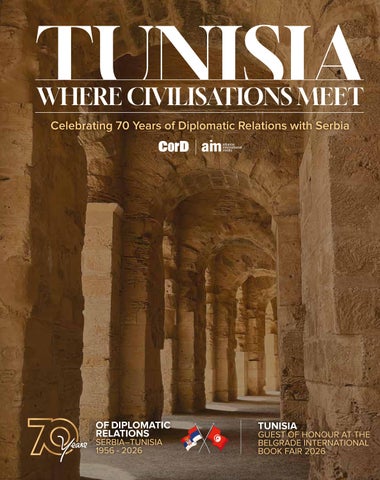
WHERE CIVILISATIONS MEET Celebrating 70 Years of Diplomatic Relations with Serbia
OF DIPLOMATIC RELATIONS SERBIA–TUNISIA 1956 - 2026
TUNISIA
GUEST OF HONOUR AT THE BELGRADE INTERNATIONAL BOOK FAIR 2026
COMMENT | H.E. IMEN LAAJILI AMMARI AMBASSADOR OF TUNISIA TO SERBIA
A Friendship Across Generations Seventy years of diplomatic relations between Tunisia and Serbia reflect a partnership rooted in historical solidarity, strengthened through political and cultural cooperation, and looking towards new opportunities for closer ties eventy years after the establishment of diplomatic relations between Tunisia and Serbia, the friendship between our two nations remains a testament to the importance of dialogue, mutual respect and the human connections that transcend geographical distance. Rooted in solidarity and a shared commitment to international cooperation, our relationship has been shaped by historical experiences that brought our peoples closer together. Beyond formal diplomacy, these ties have endured through a common belief in peaceful coexistence and cooperation. Their origins reach back to the First World War, when Tunisia, particularly the city of Bizerte, became a refuge for thousands of Serbian soldiers and civilians. This chapter of shared history left a lasting legacy that continues to resonate more than a century later. Following Tunisia’s independence in 1956 and the establishment of diplomatic relations, this historical connection acquired a new political dimension. The friendship between President Habib Bourguiba and President Josip Broz Tito, together with their countries’ engagement in the Non-Aligned Movement, strengthened bilateral relations around the principles of sovereignty, equality among nations and peaceful coexistence. Today, Tunisia and Serbia continue to build on this foundation, seeking to deepen political dialogue, broaden cooperation and encourage closer exchanges between their peoples. Culture has always played an important role in bringing our societies together. Despite the geographical distance separating us, Tunisia and Serbia
S
02
The strength of our relationship lies not only in the history we share, but also in our willingness to build upon it share an appreciation of cultural heritage, artistic expression and the ability of creativity to connect people across borders. This spirit was reflected in Echo of the Two Shores, a symphonic production conceived by Wassim Makni and per-
formed at the National Theatre in Belgrade on 24 October 2026, as part of the celebrations marking seven decades of diplomatic relations. Bringing together the Carthage Symphony Orchestra, conducted by Maestro Hafedh Makni, and the Serbian folklore ensemble KUD Sevojno, directed by Đorđe Delić, the performance combined symphonic music, traditional dance and historical memory. Inspired by the experiences of Serbian soldiers who found refuge on the Tunisian coast during the First World War, it offered a moving artistic interpretation of a shared past. Through Tunisian and Serbian musical traditions, the production demonstrated how culture can preserve historical memory while creating new connections between generations. As we celebrate this anniversary, we are also looking towards the future. EXPO 2027 in Belgrade, under the theme Play for Humanity – Sport and Music for All, will provide another opportunity to strengthen our ties. Tunisia looks forward to sharing its cultural heritage, contemporary achievements and aspirations with the Serbian public and the international community. Beyond presenting our country’s identity, this international gathering will offer opportunities for new partnerships, closer exchanges and cooperation in areas of mutual interest. The strength of our relationship lies not only in the history we share, but also in our willingness to build upon it. As Tunisia and Serbia enter a new chapter of their partnership, we remain committed to ensuring that the friendship between our peoples continues to develop and inspire future generations. TUNISIA 2026
TUNISIA
| GUEST OF HONOUR
Where Words Bring Cultures Together Tunisia takes centre stage at the 69th Belgrade International Book Fair, presenting its literary heritage and contemporary creativity as the two countries celebrate 70 years of diplomatic relations he written word has long travelled between the shores of the Mediterranean, carrying stories, ideas and traditions across languages and civilisations. This October, that journey brings Tunisia to Belgrade, where it is Guest of Honour at the 69th International Book Fair, held from 23 to 31 October under the slogan Words Build Worlds. The occasion carries particular significance. Serbia and Tunisia are celebrating seven decades of diplomatic relations, while their shared history reaches further back, to the First World War, when Tunisia offered refuge and recovery to thousands of Serbian soldiers. The Tunisian presence at the Book Fair is therefore both a celebration of literature and a reminder of the human connections that have shaped relations between the two countries. At the heart of the programme is the Tunisian pavilion in Hall 2, conceived as a meeting place for writers, scholars, artists and readers. Alongside books and translations, visitors can discover a cultural tradition shaped by Carthaginian, Roman, Arab, Amazigh and Mediterranean influences, as well as the voices of contemporary Tunisia. The literary programme reflects the country’s linguistic and intellectual diversity. Professor Emeritus Mansour Mhenni explores Tunisian literature written in French, while philosopher Fathi Tri-
T
H.E. Amina Srarfi, Tunisia’s Minister of Cultural Affairs, and H.E. Imen Laajili Ammari, Ambassador of Tunisia to Serbia, at the 69th Belgrade International Book Fair cordmagazine.com
ki examines the relationship between philosophical thought and everyday life. Writer Mohamed Aissa Ben El Meddeb introduces the richness of contemporary Tunisian fiction, and poet Ahmed Chaker Ben Dhaya brings poetry into dialogue with music. Beyond literature, the programme encompasses Arabic calligraphy workshops, presentations of Tunisia’s UNESCO World Heritage sites, archaeological exhibits and film screenings. Together, these events offer a broader introduction to a country whose cultural identity has developed through centuries of exchange. One of the most meaningful contributions is the Serbian translation of a book by historian Ali Aït Mihoub on the presence of Serbian soldiers in Bizerte between 1916 and 1919. A documentary exhibition at the National Library of Serbia revisits the same chapter of history, giving contemporary audi-
Tunisia’s presence in Belgrade celebrates not only a rich literary tradition, but also the shared history and cultural dialogue connecting the two countries ences an opportunity to rediscover a bond forged more than a century ago. The cultural programme also extends beyond the fairgrounds. A performance by the Carthage Symphony Orchestra at the National Theatre in Belgrade brought together Tunisian and Serbian artistic traditions, while discussions between the two countries’ cultural institutions have opened possibilities for further cooperation in translation, cinema, music and heritage preservation. For Tunisia, being Guest of Honour is an opportunity to introduce Serbian readers to literary voices that remain relatively unfamiliar to them. For Serbia, it offers a closer encounter with a country whose history and cultural achievements extend far beyond the familiar images of Mediterranean tourism. Above all, the occasion demonstrates the enduring ability of books to cross borders. Languages may differ, but literature continues to create spaces in which cultures can recognise one another, discover unexpected affinities and begin new conversations. 03
CULTURE | H.E. AMINA SRARFI TUNISIAN MINISTER OF CULTURAL AFFAIRS
Tunisia… The Fragrance of the Written in Belgrade As Guest of Honour at the 69th Belgrade International Book Fair, Tunisia brings a literary heritage shaped by centuries of cultural exchange, alongside a renewed commitment to friendship with Serbia ow generous, and meaningful, that Belgrade has chosen Tunisia as Guest of Honour at the 69th International Book Fair, held from 23 to 31 October 2026. This distinction coincides with 70 years of friendship between our countries: time has passed, yet the bond remains strong. Tunisia’s presence offers an opportunity to discover the fragrance of its written word, rising from books on display and the diversity of cultural events throughout the fair. Visitors will encounter a creative spirit faithful to its roots without relinquishing its universal aspirations, nourished by the Mediterranean and the legacy of Carthage. These are the melodies of civilisations that succeeded one another on Tunisian soil, leaving an archaeological heritage of extraordinary depth and an abundant intellectual and literary legacy. Together, they have made Tunisia a land receptive to every breeze of creativity calling humanity towards art, beauty and peace. Among our shared memories is the arrival of thousands of Serbian soldiers in Bizerte during the First World War. Their years of recovery became a time of coexistence and cultural exchange. Two nations, distant in geography yet close in spirit, began weaving a bond inscribed in their collective memories, one successive generations continue to cherish. Another compelling chapter is Yugoslavia’s support for Tunisian inde-
H
04
TUNISIA 2026
pendence. During the 1950s, Yugoslavia helped bring the Tunisian question before international forums and voted in favour of Tunisia’s admission to the United Nations. The Book Fair offers an opportunity to revisit this shared memory not merely as a diplomatic legacy, but as a living human heritage from which we can draw inspiration. It invites us to deepen cultural ties and develop a sustained, forward-looking strategy for exchange. Tunisian culture draws its richness from diverse sources and deep historical roots. Roman theatres at Dougga and Carthage, and the magnificent Amphitheatre of El Jem, testify to a long tradition of performance. Poetry, too, flourished in ancient Carthage, where figures sometimes combined the gifts of poet and philosopher. The French Jesuit scholar Jean Fontaine explored this inheritance in his history of Tunisian literature. That ancient poetic sensibility forms part of the inheritance from which modern Tunisian poetry emerged. Today, vernacular poetry, known as malhoun, and poetry in Classical Arabic continue to flourish, retaining echoes of earlier verse while engaging with currents from across the Mediterranean and beyond. Carthage was also a meeting place of languages and ideas, attracting minds devoted to philosophy, rhetoric and grammar. Punic and Latin both flourished there. In Punic, Mago composed his celebrated agricultural treatise; under Roman rule, Latin became a principal language of learning and culture. The region produced eminent thinkers, including Apuleius and Augustine. The National Library of Tunisia safeguards another dimension of this heritage. Its oldest manuscripts date to the tenth century and include Ptolemy’s Almagest. Its collections of manuscripts and ornate Arabic calligraphy preserve the work of generations of scholars, among them the historian and thinker Ibn Khaldun, author of the Muqaddimah. Tunisia is also pursuing the inscription of the Muqaddimah on UNESCO’s Memory of the World Register. A joint cordmagazine.com
Two nations, distant in geography yet close in spirit, began weaving a bond inscribed in their collective memories, one successive generations continue to cherish
nomination by Tunisia, Algeria, Egypt and Türkiye for the 2026–2027 cycle is under evaluation, with a decision expected in spring 2027. This intellectual inheritance remains alive in Tunisia’s distinctive traditions of teaching and inquiry, particularly in philosophy, grammar and linguistics. Tunisia is a land of storytellers, of voices gathered around the hearth and along the seashore, where imagination has long conjured heroes who triumph amid life’s trials and hearts that withstand adversity yet yield to love. That tradition lives on in the novel, short sto-
ry and spoken narratives of traditional storytellers. An early milestone in Tunisian fiction came in 1906 with Al-Hayfa wa Siraj al-Layl (The Slender Beauty and the Night Lamp), by Saleh al-Swissi al-Qayrawani. Over the following century, fiction and literary criticism developed a substantial tradition recognised across the Arab world. Mahmoud Messadi challenged established narrative and dramatic forms, while Bashir Khraief, Hassan Nasr, Abdelmajid Attia and Mohamed Salah al-Jabri helped pave the way for new generations of novelists. For this year’s fair, the Tunisian Embassy in Belgrade has translated into Serbian a book by Professor Ali Aït Mihoub on the Serbian presence in Tunisia in the early twentieth century. The Ministry of Cultural Affairs has also arranged Serbian translations of selected Tunisian children’s literature. Tunisian writers working in foreign languages need not pledge allegiance to one language at the expense of another. They do not necessarily regard Arabic, in which they may choose not to write, as a form of exile, or their chosen foreign language as ‘the spoils of war’, to borrow the expression of Algerian writer Kateb Yacine. Rather than experiencing an inevitable conflict between identity and language, they may create a distinctly local literary universe through linguistic means that are not themselves local. Something similar occurs in Arabic-language literature. Written in a language different from the Tunisian vernacular of everyday life, it draws on a literary medium acquired through education, with its own richness and expressive possibilities. Tunisian culture, then, is far more than a historical inheritance recalled on ceremonial occasions. It is a living endeavour, renewed by generations of writers, poets, researchers and artists, and sustained by publishers, cultural institutions, festivals and book fairs that encourage the circulation of ideas. Tunisia, whose very name is said to evoke the warmth of hospitality and the art of making strangers feel at home, remains a source of inspiration to travellers, artists and all who come to discover its spirit. 05
INTERVIEW | H.E. SOFIANE TEKAYA MINISTER OF TOURISM OF THE REPUBLIC OF TUNISIA
Beyond the Beach With more than 11 million visitors in 2025, Tunisia is seeking to move beyond traditional seaside tourism towards a more diversified, higher-value model that combines cultural heritage, regional development, quality services and sustainable growth unisia is seeking to translate record visitor numbers into lasting economic benefits by diversifying its tourism offer, improving infrastructure and encouraging development beyond established coastal resorts. In this interview for CorD, H.E. Sofiane Tekaya, Tunisia’s Minister of Tourism, discusses investment priorities, the potential of cultural and Saharan tourism, and the role of traditional crafts in creating opportunities for local communities. He also highlights the designation of Tunis as Arab Tourism Capital for 2027 as an opportunity to strengthen the country’s international appeal.
T
Tunisia welcomed more than 11 million visitors in 2025. How can this growth generate greater economic benefits, improve services and create more opportunities for local communities? — Welcoming more than 11 million visitors reflects Tunisia’s attractiveness as a destination and the confidence it inspires among travellers. Our ambition is to build on this momentum by developing a diversified, sustainable tourism model that generates greater value for the economy, tourism professionals and local communities. Our strategy rests on three priorities: diversifying the tourism offer, improving service quality and distributing economic benefits more evenly across the country. Beyond seaside tourism, Tunisia possesses exceptional historical and cultural heritage, Saharan and oasis landscapes, rich culinary traditions, traditional crafts and internationally recognised expertise in wellness and thalassotherapy. 06
We are therefore placing greater emphasis on cultural, rural, gastronomic, Saharan and oasis tourism, alongside agritourism, sports tourism and health and wellness services. Diversification will help extend the tourism season, encourage longer stays and attract visitors to different regions.
Improving quality is equally important. We are modernising infrastructure and strengthening professional training. In 2026, our tourism training institutions increased their capacity to 1,776 trainees, up 16.6%, while expanding their programmes to 23 specialisations. We have also introduced an ISO TUNISIA 2026
certification process to improve training standards. Nearly 4,000 inspections of accommodation establishments, tourist restaurants and travel agencies were conducted during the first seven months of 2026 to strengthen service quality. The designation of Tunis as Arab Tourism Capital for 2027 offers another opportunity to showcase our heritage, enhance the capital’s international profile and promote Tunisia as a whole. Our ambition is to make every region a destination in its own right and every tourism development initiative a sustainable source of employment and investment. What are Tunisia’s main infrastructure and investment priorities, particularly regarding air connectivity, accommodation and access to cultural and historical sites? — Accessibility and infrastructure quality are essential to tourism competitiveness. Air connectivity is a strategic priority, and we are working to strengthen existing links, develop new routes and improve connections with our principal source markets. We are also focusing on road transport and access to archaeological sites, medinas, mountain villages, seaside resorts and Saharan destinations. Better connections will enable visitors to explore several regions during a single stay. Accommodation is another priority. Alongside modernising existing establishments, we encourage guesthouses, alternative accommodation and projects that reflect the distinctive character of their surroundings. Investment opportunities extend to medical and wellness tourism, thalassotherapy, sports facilities and tourism in the southern regions. Digital transformation is also opening new possibilities. Artificial intelligence, virtual reality and augmented reality can improve destination promotion, make heritage more accessible and enhance the visitor experience. Our objective is to develop an integrated tourism environment that combines accessibility, quality, innovation and regional diversity. cordmagazine.com
Tunisia’s cultural and natural heritage extends far beyond its coastal resorts. How can tourism encourage visitors to explore these attractions while protecting heritage and supporting local communities? — Tunisia is a land of civilisations, encounters and diversity. From Carthage and Dougga to the Amphitheatre of El Jem, historic medinas, mountain villages, oases and Saharan landscapes, our country offers experiences deeply rooted in its history and traditions. We are developing thematic and regional itineraries combining heritage, gastronomy, handicrafts, nature
Our ambition is to make every region a destination in its own right and every tourism development initiative a sustainable source of employment and investment and encounters with local communities. These experiences can encourage longer stays while creating economic opportunities beyond established tourist centres. Saharan and oasis tourism have considerable potential, particularly for travellers seeking authentic experiences and contact with local traditions. Alternative accommodation, cultural itineraries and outdoor activities can contribute to the development of these regions. We are also promoting rural tourism, agritourism and gastronomic experiences that connect visitors with local products, agricultural traditions and culinary expertise. This creates opportunities for cooperation between tourism, agriculture, handicrafts and regional businesses. However, developing tourism must go hand in hand with protecting the environment and preserving cultural heritage. Responsible resource management, ecosystem protection and support for local products are essential to this approach.
We particularly encourage initiatives involving young entrepreneurs, artisans and regional communities, ensuring that tourism creates employment while helping preserve traditional skills. Traditional crafts are an important source of employment, particularly for women and young people. How can Tunisia help artisans reach international markets while preserving traditional skills? — Tunisian handicrafts are an essential part of our cultural identity and an important economic sector, particularly for women’s entrepreneurship, regional development and exports. Our priority is to preserve this heritage while helping artisans adapt to changing markets. This means improving access to training, financing and marketing opportunities, while encouraging innovation, contemporary design and higher product quality. The third edition of ARTICREA, held from 5 to 11 October 2026, brought together 227 artisans and craft businesses from across Tunisia, alongside international buyers and industry professionals. The exhibition focused on exports, e-commerce, design and innovation, including digital technologies and artificial intelligence. These efforts are reflected in export performance. By the end of August 2026, Tunisian handicraft exports had reached nearly 85 million Tunisian dinars, an increase of 3% compared with the same period in 2025. We want to strengthen this trend by supporting higher-value products, promoting their distinctive Tunisian identity and expanding access to international markets. Passing traditional skills to younger generations is equally important. We encourage cooperation between artisans, young designers and training institutions to preserve established techniques while developing contemporary products. Tourism plays an important role in this process. Craft villages, workshops, traditional markets and itineraries focused on local craftsmanship allow visitors to meet artisans and discover the heritage behind their work. 07
INVESTMENTS | JALEL TEBIB D IRECTOR GENERAL OF THE FOREIGN INVESTMENT PROMOTION AGENCY (FIPA-TUNISIA)
A Gateway to Investment and Growth
With an established industrial base, skilled professionals and access to markets across three continents, Tunisia is seeking to attract higher-value investment, strengthen innovation and support sustainable economic growth. unisia’s position at the crossroads of Europe, Africa and the Middle East gives investors access to major markets, backed by a skilled workforce, an established industrial base and growing technological capabilities. As the country advances its development priorities for 2026–2030, its focus is on attracting quality foreign direct investment, developing higher-value industries and supporting sustainable growth. Foreign direct investment increased by more than 30% in 2025 compared with 2024, reflecting renewed momentum.
T
Aerospace is another promising field. More than 80 companies operate in Tunisia’s aerospace industry, supported by an established industrial cluster and qualified technical professionals. Precision engineering, machining, electrical systems and aeronautical components offer opportunities for manufacturers seeking reliable production capabilities and access to international markets. Digital industries provide a different route to higher-value investment. Tunisia’s engineers and technology companies are active in software development, artificial intelligence, cybersecu-
Tunisia’s investment ambitions are increasingly focused on innovation, advanced industries and sustainable economic growth This ambition rests on a diversified economy and several sectors in which Tunisia has built industrial expertise and international connections. Automotive components are among the most established. Experienced suppliers and engineering talent support production ranging from wiring systems, electronics and plastic parts to mechanical components. As global manufacturers move towards electrification and smarter mobility, Tunisia can strengthen its position within international supply chains. 08
rity, cloud services, fintech and business process outsourcing. International businesses can draw on these skills to establish technology centres, shared-service operations and research and development activities. Tunisia is also developing opportunities in pharmaceuticals, biotechnology and medical devices. Its scientific workforce, manufacturing experience and emerging research capabilities can support partnerships, technology transfer, clinical research and the production of higher-value healthcare products, sub-
ject to relevant regulatory and quality requirements. Agribusiness links the country’s investment ambitions to its Mediterranean heritage. Olive oil, dates, seafood and other agricultural products provide a foundation for further investment in processing, packaging, traceability and modern, water-efficient production. Strengthening these activities can increase local value creation while improving export competitiveness and supply-chain sustainability. The common thread across these sectors is the opportunity to move beyond cost-based competitiveness towards greater innovation, technological capability and added value. Tunisia’s geographic position matters, but so do the skills of its people and the industrial networks already in place. The Foreign Investment Promotion Agency, FIPA-Tunisia, works with international investors to identify opportunities, navigate procedures and establish partnerships. Our role is to turn investment interest into viable projects that create value for businesses and contribute to Tunisia’s long-term development. We stand ready to support investors from their first enquiries through to implementation and growth. TUNISIA 2026