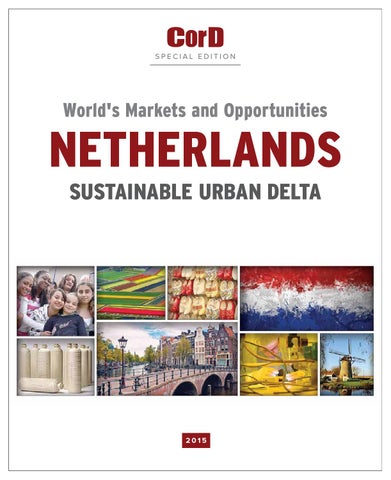
SPECIAL EDITION
World's Markets and Opportunities
NETHERLANDS SUSTAINABLE URBAN DELTA
2015
THE DUTCH PARLIAMENT IN THE HAGUE
The Netherlands has two capitals : Amsterdam (the official capital by constitution since the 19th century) and The Hague (the seat of government and first capital stince 1584)
Social media in the Netherlands has always been very popular. Research done in 2014 suggests that nine out of ten Dutch citizens are active on social media
There are 1,180 windmills in the Netherlands
According to a new food database by worldwide development organisation Oxfam, the Netherlands is No. 1 in the world for having the most plentiful, nutritious, healthy and affordable diet
Keukenhof Park is the world's largest flower garden
ROYAL FAMILY
In Love With ORANGE
OF THE NETHERLANDS
Dutch people love their royal family and each year throughout the country they celebrate Queen’s Day, which has become King’s day again, since king Willem-Alexander became the nominal head of state in the Netherlands in 2013
T
KING WILLEM-ALEXANDER, PRINCESS BEATRIX, AND QUEEN MÁXIMA
he Kingdom of the Netherlands has been an independent monarchy since 16th March 1815, but has been hereditarily “governed” by members of the House of Orange-Nassau since 1559, when Philip II of Spain appointed William of Orange as stadtholder. Today orange is the traditional colour of the Dutch monarchy, the symbol of unity and solidarity of the nation, as well as the beloved colour of the whole country. At the end of January 2013, Queen Beatrix of the Netherlands, the longest reigning Dutch monarch, announced her abdication after 33 years on the throne, and her eldest son, WillemAlexander, became the nominal head of state in the Netherlands. During her reign, Beatrix was affectionately called “Queen Bea”. King Willem-Alexander was the long-awaited baby boy born to a throne that had seen only girls for more than 123 years. The role of king is largely ceremonial and is officially passed down through an inauguration rather than a coronation. Before taking the throne, Willem-Alexander said he didn't want to be a “protocol fetishist”, but rather a king who puts his people at ease. He also said he doesn't expect people to address him as “Your Majesty”. The King married Argentinean born Maxima in 2002. Now, as the King’s wife, she holds the title of Queen. WillemAlexander and Maxima have three daughters – CatharinaAmalia, Alexia and Ariane. Catharina-Amalia Beatrix Carmen Victoria, age 13, became the Princess of Orange in 2013, when her
father inherited the throne. Like most Dutch children, she attends public school. A pair of princesses are her younger sisters: Princess Alexia, 12, who is second in line to the throne, and Princess Ariane, 10, who is third in line. The popularity of the royal house remains strong in the Netherlands. Nearly 80 per cent of Dutch citizens support the monarchy, according to a poll taken after King WillemAlexander’s ascension to the throne in 2013. Every 27th April the carnival-like King’s Day is celebrated all over the country, with parties, street markets, concerts and special events for the royal family. The royal celebrations were first held on 31st August 1885, in honour of the birth of Queen Wilhelmina, and the Queen’s Day (Koninginnedag) tradition was born. After Wilhelmina’s daughter (Juliana) succeeded to the throne in th 1949, the day was changed to 30th April, in accordance with the new Queen's birthday. When she became queen, the now Princess Beatrix chose to retain the day in honour of her mother, but as of 2014 King’s Day has been officially celebrated on 27th April (the king’s birthday). All clubs across the Netherlands organise special festivities on this day and young people move across the city from one party to another, while others prepare the next day’s market. In Amsterdam it is a unique night and day carnival-like event throughout the city, combined with the market in the streets. It is an occasion to trade all sorts of things that are unnecessary at home, representing more of a social gathering than a real commercial opportunity, and a unique family event with children actively participating. Prices are symbolic and the most important factor is fun. The event annually attracts about 700,000 visitors who are seeking a relaxed and joyful atmosphere. Every year, the royal entourage visits a town or municipality in the Netherlands as part of the celebrations. In 2015 they spent the day in Dordrecht, in Zuid-Holland.
Every year on 27 April, King Willem-Alexander’s birthday, a festive, carnival-like King’s Day is celebrated all over the country, with parties, street markets and concerts
S U S TA I N A B L E U R B A N D E LTA
|
133
| 3
INTERVIEW
H.E. HENDRIK GERRIT CORNELIS VAN DEN DOOL, DUTCH AMBASSADOR TO SERBIA
Take on the Toughest
While it has to be acknowledged that Serbia has achieved considerable success in many areas of the EU accession process, the rule of law will need a lot of attention from the government. This is one of the key areas, both in terms of enlargement policy and when it comes to media and business freedoms
TASKS FIRST
R
eforms take time to come to fruition fully and it is therefore important for each country to tackle the toughest tasks at the very beginning of the process. One of them is certainly ensuring the
rule of law, which is also the priority policy issue in the region for the Netherlands, says H.E. Hendrik Gerrit Cornelis Van Den Dool.
■ How would you assess the progress made by the Western
Balkan countries recently in terms of EU integration? Progress made by the Western Balkan countries should be viewed from a country-by-country perspective. This has also been the goal of the European Commission’s new methodology concerning annual progress reports. Looking at Serbia, we can state that EU accession has become Serbia’s strategic goal. In January 2014, Serbia became an EU candidate country. An extensive agreement with the IMF was reached in the field of economic governance. Parliament adopted laws on bankruptcy and privatisation, which allow for the restructuring and privatisation of a large number of state companies. Likewise, a set of laws was adopted to restructure and privatise the media landscape. Furthermore, amendments were adopted to modernise the labour law and make it easier to obtain building permits – a move that could have a positive impact on attracting foreign investments;
4 |
133
| S U S TA I N A B L E U R B A N D E LTA
The dialogue with Pristina led to the 2013 Brussels Agreement and several follow-up agreements, the latest being in August 2015. There is commitment to continue the dialogue until all outstanding issues regarding the normalisation of relations are resolved. Looking ahead, we must also admit that there are still challenges to be faced. The rule of Law will need a lot of attention from the government. Implementation of newly adopted laws is often time-consuming, slow or sometimes even lacking entirely. Reform of the judiciary is required in order to strengthen the independence, professionalism, effectiveness and efficiency of the judicial system. The business and investment climate in Serbia can be improved in numerous ways. The fight against corruption will continue to be a top priority for this government. Media freedom faces several challenges in Serbia and we have seen the drop that the country experienced on several global press freedom ranking lists. Proper implementation of the adopted media laws can contribute to strengthening the media landscape. ■ In the context of EU integration, how important is it
to improve relations between Belgrade and Tirana? The progress of the Western Balkan countries in the process of
PRIORITIES
PRECONDITIONS
MIGRANTS
The Netherlands feels that Chapter 35 could be opened and hopes that during its EU Presidency, in the first part of 2016, it will also be possible to open chapters 23 and 24 on the rule of law
Our mutual economic relations will increase significantly once Serbia has created a truly investorfriendly climate, tackled excessive red tape and corruption issues, and once it has reformed the judiciary
We appreciate the way Serbia is managing a difficult situation and we have secured additional funding for Serbia and Macedonia to address the continuing refugee crisis
European integration includes regional cooperation, reconciliation and good neighbourly relations. Over the course of recent years we have seen an improvement in relations between Serbia and Albania – with mutual visits of prime ministers. This was an important step and one that is welcomed in the process of regional cooperation and the strengthening of neighbourly relations. ■ How do you see the current status of the Brussels
just our future efforts accordingly, in cooperation with the relevant government institutions and civil society organisations. ■ How could already good bilateral relations between
Serbia and the Netherlands be further advanced? In past few years we have seen a moderate increase in the interest of Dutch companies in Serbia. We see encouraging developments in energy, energy efficiency, ICT and water technologies. The bilater-
Agreement and, in that context, Serbia’s prospects of opening some of the first accession negotiation chapters soon? Both Serbia and Kosovo have taken tangible steps to advance the dialogue in 2015, with the agreement on the judiciary in February and the agreement on four other issues in August 2015 – most notably the establishment of the Community of Serbian Municipalities. It is to be expected that chapters will be opened soon now, but of course this is a decision that must find agreement among all EU member states. The Netherlands is of the opinion that Chapter 35 could be opened, and we hope that during our Presidency of the European Union, to run from 1st January to 30th June 2016, we will also be able to open important chapters 23 and 24, on the rule of Law. ■ Some of the region’s countries are exerting great ef-
forts to accommodate migrants, while simultaneously struggling to assist their own asylum seekers. How well do you feel Serbia is managing these two processes?
Serbia can find a strong partner in the Netherlands on the road to creating a world with greater respect for human rights I have appreciation for the way in which Serbia is managing a difficult situation. The current situation is a pan-European one by its very nature. It is therefore important that Serbia, as an affected country at the heart of the transit route, was involved in drafting the 17 point action plan.
al trade balance is growing steadily. Overall trade totalled about 420 million euros in 2013. We expect the final figures for 2014 to show a marked increase. There is, however, plenty of room to elevate mutual trade and investment to a significantly higher level. The Netherlands is one of the world’s main traders of goods, services and commodities, the world’s second largest exporter of agricultural goods and the 18th largest economy in the world. Serbia has much underused potential. Our mutual economic relations will increase significantly once Serbia has created a truly investor-friendly climate, has tackled excess red tape and the corruption issues that are slowing Serbia down, and when it has reformed the judiciary.
■ The Netherlands is already assisting Serbia and
Montenegro in terms of capacity building for the countries’ asylum and migration systems. How does your country intend to proceed with these efforts in the period ahead?
■ Which projects supported by the Dutch govern-
The Netherlands has indeed supported a number of projects with the goal of strengthening the asylum systems in the countries of the Western Balkans. Additional funding (€670,000) was allocated to address the continuing refugee crisis in Serbia and Macedonia, and the supported projects have just started and will unfold in the coming year. We will closely monitor progress and how the situation generally develops in the future, and will ad-
The Netherlands currently supports Serbia’s EU accession prospects through a programme called Matra, which stands for ‘social transformation’ in Dutch. The overall goal of this programme is to develop a plural democracy, grounded in the rule of law, with room for dialogue between the government and civil society. This year alone we were able to support as many as 20 projects in a variety of areas – legislation and justice, good governance, anti-corruption, media freedom, minority rights etc.
ment do you consider as being the most important for Serbia when it comes to embracing European values and practices?
S U S TA I N A B L E U R B A N D E LTA
|
133
| 5
■ Considering that you have personally witnessed the transformation of societies in Central and Eastern Europe, as well as in this neighbourhood, what do you consider as being crucial to their success in the broadest terms?
the experience of other countries, this is helpful in analysing Serbia’s draft law and supporting the Serbian authorities in bilateral projects. The overarching goal is to be a better interlocutor with local authorities in the rule of law reforms.
Reforms take time to come to fruition fully. In this respect, implementation and building track records are key factors. This is why the Netherlands supports the Fundamentals First approach. By starting with the most difficult reforms, the necessary time is allowed for a society to fully embrace the underlying norms of these reforms.
■ The Netherlands is very active in assisting civil society in Serbia in the field of human rights. How would you assess progress made by Serbia in this area, particularly when it comes to the fight against gender-based violence and discrimination against minority groups?
■ Ensuring the rule of law seems to have been one of the toughest tasks for almost all countries that have already gone through this process. How far has Serbia progressed when it comes to embracing standards in this domain? Embracing rule of law standards is a continuous process. Serbia has made progress in improving the relevant legal framework within which fundamental rule of law reforms are taking place. Besides adopting relevant legislation and action plans, implementing and strengthening relevant institutions is key to succeeding in these reforms. Rule of law is one of three pillars of the Fundamentals First approach to EU Enlargement. The Netherlands subscribes fully to this. To underpin this, last year the Netherlands intensified its efforts in the area of the rule of law in the entire region by establishing a regional rule of law unit. Despite budget cuts to Dutch diplomacy as a whole, the Netherlands increased investments in priority policy area’s, such as the rule of law. Chapters 23 and 24 are a Dutch policy priority. The main aim of this policy intensification is twofold: First, to create a regional centre of excellence on rule of law issues – what we mean with that is to move beyond the one-liners, such as “independence of the judiciary”, and actually have evidence-based analysis of the real problems and challenges. This is not a one-size-fits-all analysis, but rather analysis that looks at each and every country individually; the second is the regional aspect: we do not believe in one-size-fits-all solutions. All enlargement countries are aiming for the same goal: EU accession. Rule of law reforms are important, but this is not a linear process. Therefore we hope that through our regional approach we can find appropriate multiplier effects. For instance: Serbia is the last country in the region to draft a Law on Free Legal Aid. As we have already learned from
6 |
133
| S U S TA I N A B L E U R B A N D E LTA
Serbia has made progress in aligning its legislative framework governing the protection of human rights with EU standards, but implementation still needs to be improved. We see that women in Serbia still fall victim to domestic violence and human trafficking. We also witness violations of the rights of minority groups, such as LGBT, Roma, etc. On the other hand, we have also witnessed peaceful Pride Parades in Belgrade for the last two years in a row. So there are many steps that have been taken forward, but many that are still to be made, and Serbia can
The Netherlands last year intensified its efforts in the area of the rule of law in the entire region by establishing a regional rule of law unit find a strong partner in the Netherlands on the road to creating a world with greater respect for human rights. ■ How is the Netherlands supporting media freedom in Serbia? Promoting the freedom of expression, both online and offline, is a very important part of the Netherlands’ global human rights policy. In addition to discussing this issue in our political dialogue in Serbia, the embassy also supports projects aimed at strengthening the independent position of journalists and media organisations through the Matra programme. A set of media laws was passed in August 2014 that marked the culmination of the media reform process and was welcomed by the EU Delegation and EU member states, including the Netherlands. Since the adoption of this new legislation, our embassy has supported projects that contribute to the successful implementation of these laws. ■
CORPORATE
HEINEKEN SRBIJA D.O.O., ZAJEČAR
Committed to QUALITY
From the very beginning of its operations, HEINEKEN Srbija company has given great importance to producing the highest quality products through investments in people and technology, as well as the continuous advancement of operations
H
EINEKEN Srbija is part of HEINEKEN company, the world’s most international brewer. It is the leading developer and marketer of premium beer and cider brands. Led by the Heineken® brand, the Group has a powerful portfolio of more than 250 international, regional, local and specialty beers and ciders. We are committed to innovation, long-term brand investment, disciplined sales execution and focused cost management. Through Brewing a Better World programme, sustainability is embedded in the business and delivers value for all stakeholders. HEINEKEN has a well-balanced geographic footprint with leadership positions in both developed and developing markets. The company employs 81,000 people and operate more than 160 breweries in over 70 countries. HEINEKEN Srbija operates in two breweries in Serbia, in Novi Sad and Zaječar, with an administrative office in Belgrade. While the brewery in Zaječar is proud of its long tradition of brewing skills dating back to 1895, the brewery in Novi Sad is one of the technologically most advanced breweries in the region. The portfolio of HEINEKEN brands in Serbia include: Heineken, Sol, Strongbow, Amstel Premium Pilsener, Weifert, Zaječarsko, PilsPlus, Master and MB Pils. From the very beginning of its operations, company HEINEKEN Srbija has given great importance to producing the highest quality products through investments in people and technology, as well as the continuous advancement of operations. Transparency in everyday work and communication, respect for the individual, the local community and society, a passion for quality and corporate social responsibility – these are the key values of the company. As an integral part of the society in which it operates, the company establishes, develops and nurtures strong relations with the cities of Novi Sad and Zaječar, through mutual cooperation aimed at improving the quality and standard of life for all citizens. Thanks to the high-tech pro-
duction and high capacities of its breweries, the company is focused on developing its core business and exporting to many different countries. HEINEKEN Srbija has introduced and implemented all procedures and standards of the parent company, which are often even more stringent than those required by European regulations. The breweries in Novi Sad and Zaječar have the most significant international certificates of quality, operations, production, organisation and environmental protection, such as ISO 9001, ISO 14001, OHSAS 18001 and ISO 22000, with strictly controlled conditions and parameters in the production process and quality monitoring (of both processes and markets). In addition to investments in technology and production processes, the company continuously directs its investments towards its people, improving working conditions, increasing operating efficiency, as well as on ensuring health and safety at work. The company is dedicated to reducing water consumption and ensuring its balanced use, reducing carbon emissions and electricity consumption, and these levels are falling year on year thanks to various initiatives and programmes. The company devotes particular attention to promoting the responsible consumption of alcohol. For the last three years consecutively, in cooperation with Belgrade Public Transport Company GSP, a CSR campaign has been organised during the Belgrade Beer Fest – "Guys, who drives home?" – in order to educate the public and raise awareness about responsible behaviour in traffic.
HEINEKEN Srbija is dedicated to environmental protection through responsible use of water, reducing carbon emissions and electricity consumption as well as to the promotion of responsible consumption
S U S TA I N A B L E U R B A N D E LTA
|
133
| 7
INTERVIEW
MARIA CORNELIA WILHELMINA VAN MILTENBURG COUNSELLOR AT THE EMBASSY OF THE NETHERLANDS IN BELGRADE
Many Business Prospects Yet to be
UNVEILED
Private sector can be an important partner to the government in this case. It is in the best interests of all companies to support the government in
Serbia has much potential that remains unknown to Dutch companies and, as such, the Embassy is putting a lot of effort into bringing Serbian business opportunities closer to Dutch businesses
S
fighting illegal competition. In this respect, the Netherlands could offer interesting experiences and we are more than happy to work with the government to help further improve the business climate.
■ How interesting is Serbia as a destination for Dutch investors? The country offers more potential than is known to most Dutch companies. The Embassy contributes to bringing Serbian business opportunities closer to Dutch firms in the Netherlands, and we cooperate closely with many Serbian institutions and stakeholders on
erbia’s success in implementing economic reforms is an import-
this matter. Right now, Serbia is attractive to Dutch ICT, trade, ship-
ant factor in attracting new investments from the Netherlands,
building, brewing and energy companies.
but additional efforts need to be made to remove administrative
country has much to offer the Dutch business community, but it also
■ How do Dutch companies already present in Serbia view the market and opportunities for its further expansion?
has a lot of gain from the Netherlands, especially when it comes to trans-
Serbia is seen as a country with much underutilised potential.
burdens and change the unpredictable business and legal climate. The
ferring knowhow in many areas, says Maria Cornelia Wilhelmina van Miltenburg, Counsellor at the Dutch Embassy in Belgrade. One of the areas of mutual connection that has advanced the most is agriculture, where numerous projects have so far been implemented.
Right now, Serbia is attractive to Dutch ICT, trade, shipbuilding, brewing and energy companies. It also has much to offer the Dutch business community, especially in agriculture
Companies generally tread carefully, but they do see potential. Difficulties are mostly related to bureaucracy and administrative burdens, as well as an unpredictable business and legal climate. However, many of our companies continue experiencing growth from year to year, which means
■ How would you assess the progress made to date by Serbia in the reform process? Serbia has chosen to become an EU member state, which implies that the outcome of the reforms has to comply with the EU’s rules in the are-
8 |
expansion is definitely possible and is occurring.
■ In which areas do you see the greatest potential to improve trade relations between Serbia and the Netherlands?
as of the free movement of goods, workers and capital, freedom to provide
The Dutch are well known as traders and international businesspeo-
services, establish companies, public procurement, company law, compe-
ple. Serbia offers a lot of room for expansion in ICT services, food produc-
tition and economic policies, financial services, transport, energy, taxation,
tion, textiles, clothing, energy, and water technologies, as well as consult-
industrial policy etc. The country has made good progress when it comes
ing services. The Dutch are particularly developed in the domain of wa-
to construction permits and the fight against the grey economy. Fiscal con-
ter and that’s why our companies played an important role in the pump-
solidation, under the framework established with the IMF, and savings
ing of the flooded Tamnava Mine last year. Trade relations in agriculture
achieved by the government, are also worthy of respect. The inspection re-
are strong. Serbia has comparative advantages when it comes to agricul-
form is also a good step forward, but it is important to continue with ca-
ture and can become a serious player in this area. It has a tradition of food
pacity building and better coordination of different inspection services.
production and the natural resources required to utilise that.
133
| S U S TA I N A B L E U R B A N D E LTA
CORPORATE
NEDA SRETOVIĆ
■ The Netherlands has been providing Serbia with assistance in the field of agribusiness for years. What do you see as the greatest achievements made to date in this domain, particularly in terms of EU accession?
COUNTRY MANAGER WINDVISION SERBIA
Wind Farm
The Netherlands and Serbia have established a High Level Working Group on Agriculture, which represents a forum for cooperation in the agriculture field. Numerous projects in different fields of agriculture have so far been implemented. These projects predominantly aimed at accessing the market through the alignment of rules and regulations and the training of staff, especially in the phytosanitary and veterinary policy field. The focus recently shifted to agrarian policy and the need to harmonise legislation with the common market organisation and producer organisations. Much progress has also been made in terms of harmonisation with the EU acquis, especially in the field of food safety.
■ To what extent has Serbia embraced the opportunities provided by the EU accession process in the field of agribusiness? We believe EU accession provides a lot of advantages for Serbia in the field of market access and use of EU funds for agriculture and rural development. In our view, Serbia has made significant steps in the EU accession process. This is, however, a huge task and will continue to take time, energy, patience and the setting of priorities. From a technical perspective, we see that Serbia has done a lot of hard work on phytosanitary and veterinary issues, food safety, agrarian policy and rural development. Aligning procedures, rules and regulations with the EU is essential, but is not easy. From a business perspective, it is essential for companies, producers and processors to build the capacity to strengthen competitiveness for a sustainable future. The Serbian administration has a role in building a facilitating framework. However, companies must take responsibility to build towards their own future.
■ How many Dutch companies are operating in the field of agriculture in Serbia today and what do they see as the greatest opportunities for, and possible setbacks to, the development of their businesses? Many Dutch agriculture companies are present here in Serbia and they are generally doing well. Several have invested here in Serbia, often through joint ventures. They bring much needed knowhow, technology and innovations to promising Serbian companies. The opportunities here in Serbia are good factors of production, or rather, the absence of limiting factors that are sometimes present in the Netherlands. Among the shortcomings, limited knowledge of the market and business climate is always a drawback of which every company needs to be aware.
■ In which areas could Serbia profit the most from the transfer of Dutch knowledge and experience? Agriculture is the most promising sector where the transfer of knowledge and experience can be used to generate profit. Reducing costs, increasing yields, increasingly quality and working more efficiently in the entire production chain, from producer to consumer, are examples of what can be achieved simply by embracing knowledge and experience. Besides agriculture, Serbia can profit from transfer of knowledge in energy savings and efficiency measures, urban and water-management planning, creative industries and R&D stimulation. ■
“ALIBUNAR” W
i ndVision, as international investor experienced both in development and management and operations in RES projects, in 2010 started project development of wind farm complex “Alibunar” of total installed capacity 174MWe in Serbia as the attractive destination due to the “good” wind at average speed at 7,5 m/s and attractive tariff system. After obtaining building permit for “Alibunar”, the most important challenge is setting up the national legal framework, i.e. its completeness and simplicity. Although the key legislation (Energy Law) has been adopted back in 2011 and updated in December 2014, majority of by-laws required for the law implementation still are not adopted and harmonized with latest amendments. However, for the Law to be implemented in practice in such a way as to secure that construction of wind farms starts in 2015, it is absolutely necessary that the bylaws are adopted as soon as possible and in close collaboration with investor association and representatives of international financial institutions (IFIs) and commercial banks which will finance these large projects. Essential piece of legislation that is outstanding is the Power Purchase Agreement (PPA) since the actual draft has not been accepted by the banks. PPA is extremely sophisticated agreement based on which banks lend money to investors for construction of these projects. Thus, it is instrumental that banks are consulted in the process of drafting the PPA and that, at the end of that process, they find it sufficient for them to support wind farm development in the long run. Thanks to the hard work of Ministry of Mining and Energy and other competent institutions, we may expect above mentioned documents to be in place by the end of the year. WindVision strongly believes that Serbia may be secure environment and reliable partner for development of RES projects and announces realization of project of wind farm complex “Alibunar” with the start of construction in 1Q 2016.
S U S TA I N A B L E U R B A N D E LTA
|
133
| 9
ECONOMY
Constant SELF-IMPROVEMENT Yes, the Netherlands is still the land of windmills, cheese and tulips, but it is also one of the world’s largest exporters of agri-food and horticultural products, a world leader in water management, and an excellent place for investments and home to eager foreign investors
ROTTERDAM IS INTERNATIONALLY RENOWNED AS ONE OF THE BIGGEST PORTS IN THE WORLD AND IS THUS ALSO DUBBED THE GATEWAY TO EUROPE
T
he Netherlands has an open economy that has managed to stay relatively buoyant despite the financial crisis of 2008. In terms of the size of the economy, or the Gross Domestic Product (GDP), which stood at about 615 billion euros in 2014, the Netherlands is the world’s seventeenth-largest economy and the sixth-largest in the European Union. In 2014, the country was the world’s fifth-largest goods exporter, with the value of exports at 83.2% of the Netherlands’ GDP. It occupies first place in the world rankings in production and auctioning of cut flowers and flower bulbs, 2nd in exports of agricultural products ($103.3 billion) and 9th in exports of commercial services ($134 billion). At the same time, the Netherlands is 8th in terms of imports of commercial services ($119 billion) and the 9th biggest importer of goods ($501 billion) in the world. All of this is achieved despite modest natural preconditions. In terms of surface area and population size, the Netherlands is not a particularly large country and ranks 133rd and 64th worldwide. Efforts are constantly underway to reclaim land from the see and keep it dry using innovative and daring solutions for water control. As they say: “God created the earth, but the Dutch created the Netherlands”. About 20 per cent of the Netherlands’ territory is below sea level, while 55% is under direct threat of flooding. The Dutch landscape is full of polders, artificial tracts of land hosting. Through land reclamation, the Netherlands “built” a new province (Flevoland), with a population of 400,000 and large areas of arable land. Being faced with the cold weather and not much sunshine, the Dutch invented greenhouses and today produce 2.5 times more food
per acre than other EU countries. No wonder then that the Netherlands is the world’s second-largest exporter of agri-food products, the leading exporter of tomatoes and potatoes and the world’s second largest exporter (in value) of fresh vegetables in 2014. This is the result of continual investment in innovation in agri-food value chains, thanks to successful cooperation between knowledge institutes, government and the private sector, the so-called “golden triangle”. Furthermore, the Netherlands is one of the world’s leading developers and manufacturers of food processing machinery. Dutch industry produces 80% of the world’s capacity of poultry processing machinery, and a substantial amount of cheese production machinery. It is well known that the Netherland is the international market leader when it comes to horticulture, with a quarter of the world’s trade in horticultural products (24%) in its hands. Dutch horticultural innovations include intelligent greenhouses that can float on water, moving platforms, robots, innovative lighting, water and waste recycling, and greenhouses that generate more energy than they consume, thereby contributing to CO2 reduction. Holland has a 52 per cent share of the worldwide trade in floricultural products, making it the dominant global supplier of flowers and flower products. Some 80 per cent of all flower bulbs traded worldwide come from the Netherlands, the majority of which are tulips. The Dutch are the world’s largest exporter of seeds, which amounted to 1.6 billion dollars in 2014. As already mentioned, the Dutch are renowned for their integrated water management and their multi-disciplinary approach, which balances social, economic, environmental and engineering needs. Having suffered a lot from floods, the country built the Dutch Delta Works, one of the most extensive engineering projects in the world, with almost 16,500 kilometres of dykes and 300 structures, and in the meantime developed high end technology and knowhow. Today it exports water management models and technology to all corners of the world and is involved in some of the leading projects in the sustaina-
The Delta Works, with almost 16,500 kilometres of dykes and 300 structures, are listed in the Guinness Book of Records as the world’s largest flood defence project
10 |
133
| S U S TA I N A B L E U R B A N D E LTA
CORPORATE
ble development of low-lying urban agglomerations, such as Jakarta and Bangladesh, and coastal development in areas such as Dubai, Vietnam and Romania. In fact, 40 per cent of the freely accessible market for water management is in Dutch hands. In the field of water technology and maritime technology, the Netherlands ranks 8th worldwide in terms of global patents; the Dutch maritime cluster comprises 12 sub sectors and 12,000 companies, employing 224,000 workers. The cluster has a strong international focus: 60 per cent of seafaring ships produced in the Netherlands are destined for export. According to the World Economic Forum, the Netherlands has the eighth-best business climate in the world and holds seventh position in terms of the amount of FDI from Europe. The Netherlands is widely considered as being a pleasant place to live, while the high productivity of Dutch workers (the Dutch workforce is well-educated and flexible, with people often speaking several languages) has given it one of the highest per capita incomes of any country in the European Union. The Netherlands has a great deal to offer the business community, and foreign companies in particular. It is the gateway to Europe, connecting nearly half a billion consumers on the European mainland to the world’s producers. It operates the world-class Port of Rotterdam,
THE NETHERLANDS IS THE WORLD MARKET LEADER WHEN IT COMES TO HORTICULTURE
has extensive network of waterways, Amsterdam’s internationally acclaimed Schiphol Airport, Europe’s strongest road transport sector and an extensive network of rail links. The Netherlands is home to more distribution centres than anywhere else in Europe; it has the largest inland shipping fleet in Europe and Amsterdam is the largest cocoa port in the world. Furthermore, it holds second position worldwide in terms of the number of broadband connections per 100 inhabitants (39.4%), and has a population which is highly IT literate. In spite of these achievements, the Dutch government is not resting on its laurels, but rather works constantly to adapt and improve the Dutch business climate in order to meet the challenges of the future. In the last two decades, a number of structural reforms were implemented and resulted in the rise of employment that increased by more than 30 per cent. The high average income in the Netherlands is the result of high productivity and a high level of labour participation. Flexible work is much cherished in the Netherlands: a relatively high proportion of Dutch people work part-time and many of them (75%) are women. Dutch businesses are constantly on the lookout for opportunities all over the world. In late 2013, investments overseas totalled in excess of $1,072 billion, making the Netherlands the seventh-largest foreign investor in the world. Dutch-based multinationals, such as AkzoNobel, Heineken, KPN, ING, Philips, Unilever and Shell, are keen investors. ■
FREELAND GROUP
Development and
CONSTRUCTION
After the successful development and sale of more than 150 apartments in four projects, Freeland Mijanović has established a solid and reliable reputation on the local residential market
S
ince 2008, Freeland Group (Rotterdam, Netherlands) and the Mijanović Group (Novi Sad, Serbia) have joined forces to develop and construct apartments, primarily in Novi Sad. These projects have been, and are still being, realised through joint venture organisation Freeland Mijanovic, typically within 18 months - from obtaining building permits to selling all apartments. After the successful development and sale of more than 150 apartments in four projects, Freeland Mijanović as established a solid and reliable reputation on the local residential market. No bank loans are used for the financing of projects. Instead, Freeland offers financial participation in each project to Dutch investors, with an average return of 16 to 18 per cent (annualised).
For more detailed information please contact:
In Serbia In the Netherlands Freeland Mijanović Freeland Corporate Advisors Aleksander Mijanović Wilbert van Twuijver Vojvode Mišića br. 2 Weena 210-212 21000 Novi Sad, Serbia 3012 N Rotterdam, Netherlands T + 381(0)21532532 or T + 31102013600 or +381(0)63532232 +31628940151 E freelandoffice@gmail.com E wilbert.van.twuijver@freelandgroep.nl www.freeland.rs www.freelandgroep.nl
S U S TA I N A B L E U R B A N D E LTA
|
133
| 11
CULTURE AND TRADITION
Land of Refined DESIGN
From the golden age of Rembrandt and Vermeer, to Vincent van Gogh and Piet Mondrian, industrial and fashion design, architecture, and the gaming industry, Dutch artists have always shown refined taste, humour, clarity and simplicity
VINCENT VAN GOGH'S LANGLOIS BRIDGE AT ARLES
P
erhaps it’s easy or even natural to become an artist in the Netherlands. Just by travelling along the canals of Amsterdam, there is a feeling of admiration for this open-air museum from the 17th century. ‘A masterpiece of human ingenuity’, according to UNESCO, the Amsterdam canal district is a unique example of architecture and planning, a reflection of the Netherlands’ economic, political and cultural heyday in the Golden Age, and an area that was placed on UNESCOs World Heritage List in 2010. The rise of masters ‘like Rembrandt and Johannes Vermeer are usually explained by the fact that in the 17th century the Netherlands accumulated wealth of such proportions that the period is known as the nation’s Golden Age. In the 17th and 18th centuries, VOC, which stands for "Vereenigde Oost-Indische Compagnie" (United East India Company), was the largest commercial enterprise in the world, with a fleet of more than a hundred ships, thousands of employees, dozens of offices in Asia, and six establishments in the Netherlands. This accumulated wealth soon led to the rise of a middle class and an increase in religious freedom, with the country becoming known for tolerance and openness, while many Dutchmen were in position to acquire artworks. The masters of the Golden Age were followed in the 19th and 20th centuries by painters like Vincent van Gogh and Piet Mondrian, with the latter inspiring many modern Dutch designers. As an open society always keen to attract foreigners and nourish lib-
eral thinking, the Netherlands blended different influences in fashion, food, sport, festivals and interior design. The result – Dutch culture has grown and flourished. Amsterdam’s Concertgebouw orchestra ranks among the world’s top five symphony orchestras, while the Nederlands Danstheater is a world-class modern dance company. Dutch designers, industrial designers and architects are present everywhere in the world. Dutch design is at the forefront of combining commercial and artistic works. It is particularly strong in interior design, gaming, fashion, and architecture. According to Hugo van den Bos, strategy director of Dutch graphic design studio Koeweiden Postma, “Dutch design is simple and powerful,” while author and journalist Tracy Metz notes that “The Dutch have the ability to make fun of themselves. It’s also a matter of combining things that usually don't combine at all. Dutch designers are good at utilising materials that look worthless. The designers give them a new value.” Dutch design was led for a long time by uncompromising functionality. Eccentric, innovative, and breath-taking, it remained down-to-earth, with a sense of humour and smart design. This period, marked by functionalism, which went in line with the Calvinist attitude of the Dutch, brought some famous works, such as those of the members of the ‘De Stijl’ artistic movement, with artists such as Mondrian and Rietveld. In 1918, Gerrit Rietveld started creating experimental furniture, including the world famous ‘Red blue chair’ – modern, inexpensive and easy to manufacture according to
According to Forbes, Eindhoven is hands-down the most inventive city in the world, with 22.6 patents filed for every 10,000 residents in the city
12 |
133
| S U S TA I N A B L E U R B A N D E LTA
CORPORATE
the ‘De Stijl’ style. which was easily recognisable by the use of primary colours, combined with black, white, grey and straight lines. Prior to the 1980s, the country was known primarily for graphic design, but in the ‘90s the term Dutch Design came to be closely identified with a group of Dutch product designers who gained international recognition, such as Maarten Baas, Jurgen Bey, Richard Hutten, Hella Jongerius, Wieki Somers, Hester van Eeghen and Marcel Wanders, fashion designers Viktor & Rolf and architects like Rem Koolhaas and Francine Houben, as well as internationally recognised design firms and collectives like Droog and Moooi, which helped gain prominence for Dutch designers. The Netherlands is a country of designers, but also a country that is itself a largely man-made design. Topographical and social circumstances in the Netherlands, such as the presence of large areas of water, the focus on sustainability and the lack of living space, have led to innovative architectural solutions. That is how the Dutch architecture industry became one of the most innovative in the world. The Dutch architectural tradition is known for more than just its building design. Rather, it is also renowned for its total approach to urban planning and complex restructuring. Among the most prominent architects and firms specialising in housing are Mecanoo, Claus & Kaan,
KRISTINA ANĐELKOVIĆ VAHALI
Ambitious PLANS The aim of the Vahali shipyard is to increase the level of equipping ships in order for this to be one day carried out completely in Serbia
C
ompany Vahali has been operating successfully for more than 90 years in the Netherlands and for the last 10 years in Serbia, where it has managed to put together a good team of expert shipbuilders, with the help of the decades of experience of the Dutch parent company. Since taking over the Sava Shipyard in 2013, Vahali has – through the work of its employees – completely overhauled the old shipyard in line with the latest trends in technology and construction.
■ From the perspective of your company, how do you view Serbia’s potential for the production of complex products? Our production is primarily orientated towards the needs of river tourism transport, so the geographical position of Serbia, qualified workforce THE ROYAL CONCERTGEBOUW ORCHESTRA, RENOWNED FOR BEING ONE OF THE WORLD'S FINEST ORCHESTRAS
and Atelier Kempe Thill. There are others who stand out on account of their stand-alone buildings that function as 'business cards', including the OMA (the Kunsthal), Neutelings Riedink (Netherlands Institute for Sound and Vision) and Meyer & van Schooten (ING head office). During the 20th century, Dutch architects played a leading role in the development of modern architecture. From the early 20th century rationalist architecture of Berlage, architect of the Beurs van Berlage, separate groups developed during the 1920s, each with their own view on which direction should be taken by modern architecture. Expressionist architects like Michel de Klerk and Piet Kramer worked in Amsterdam, while another group, with names such as Mart Stam, Leendert van der Vlugt, and Johannes Duiker, was mainly devoted to more functionalist architecture (Nieuwe Zakelijkheid or Nieuwe Bouwen). A third group came out of the De Stijl movement, among them J.J.P. Oud and the aforementioned Gerrit Rietveld. Both architects later built in a functionalist style. The architecture sector in the Netherlands is the fifth-largest in Europe, in terms of both employment and production value. Top architects, such as Rem Koolhaas and Ben van Berkel, are in high demand worldwide. Some 13,100 architects were registered in the Netherlands as of 2010. These statistics band together architects, interior architects, urban planners and landscape architects. Almost every company in the Dutch archi-
and shipbuilding tradition are recognised as key potentials for our further development. The aim of the Vahali shipyard is to increase the level of equipping ships in order for this to be one day carried out completely in Serbia.
■ In which areas do you collaborate with local companies and do they service your needs exclusively in Serbia, or also in the Netherlands? Ships head from Zasavice to Holland with a fully equipped engine room, installed pipelines, insulation, windows and stainless steel railings. With this, various domestic companies are able to participate in our projects. Moreover, ships that leave are installed with air conditioning and ventilation systems, as well as cable routes and installed walls in the hotel part of the vessels. All boats are made exclusively for foreign clients.
■ Which characteristics do you primarily seek in the people you employ and how do you approach their training? One of our main goals is to educate the younger generation in the shipbuilding industry. As such, we plan to open our own training centre in Mačvanska Mitrovica, which is a project that is under development. Our goal is to use the training of young people and the continuous improvement of our production processes in order meet the needs of the most demanding customers. ■
S U S TA I N A B L E U R B A N D E LTA
|
133
| 13
tecture sector is categorised as an SME. The Netherlands is also a serious player in the global gaming industry, and performs particularly well in markets like serious and casual gaming. Serious games are simulations, or games used for educational purposes. These games can be used, amongst other things, for recruitment processes, emergency response training or practicing skills ranging from driving to performing surgery. In 2010 there were 173 gaming companies in the Netherlands, employing a total of 2,300 people. The total turnover of the Dutch gaming industry was estimated at €145 million in 2009. Since 2004, the number of gaming companies in the Netherlands has risen to 39. Dutch educational institutes have responded to these trends by developing courses and curricula to support development in the gaming sector. The Dutch government supports enterprises in attracting funding and provides guarantees for security, business loans and microfinance facilities, as well as support for venture capital funds investing in technology. There are several factors contributing to the rise of design in the Netherlands. The first is a strong education system for designers; while the second is government support for new designers. Financial support from the Fonds BKVB (the Fund for Visual Arts, Design and Architecture), launched in 1988, has enabled design students to set themselves up as independent entrepreneurs immediately upon graduation. Also playing an important role is the fact that design has become an integral part of product development in the Netherlands. Designers are included in the earliest phases of innovative processes and the production development cycle. The Netherlands is currently ranked fourth in the world in this area, according to the 2013 Global Innovation Index report, ahead of the United States, Finland, Germany and Japan. The country’s major focal point of inventions and industrial design is Eindhoven. The Dutch Design Awards are awarded annually during Dutch Design Week in Eindhoven. According to Forbes, Eindhoven is hands-down the most inventive city in the world, with 22.6 patents filed for every 10,000 residents in the city. To put this into context, the second city on the list, San Diego, produces 8.9 patents for every 10,000 people. The Eindhoven Design Academy has produced many well-known designers, such as Marcel Wanders, Piet-Hein Eek, Li Edelkoort and Hella Jongerius. The academy offers courses in art, design and architecture, and designer Hellas Jongerius is a member of the alumnae. In a 2003 New York Times’ ar-
ticle it was dubbed “without question, currently the best design academy in the world”. Another well-known school is the Gerrit Rietveld Academie in Amsterdam. Eindhoven is also the headquarters of Philips, the world famous Dutch electronics company. For many years now Philips has endorsed research and innovation in industrial design, mainly in the areas of consumer electronics, lamps, communication devices and medical equipment. Since 1980, a large part of the company has been based in Amsterdam. However, when it comes to industrial design, the knowledge centres of Philips Lighting and Philips Research in Eindhoven still contribute greatly to keeping the city on the map. Well known products incluide the Senseo coffee machine, the wakeup light and various medical products. The HTC (High Tech Campus), a technology centre launched by Philips, houses over 100 different tech companies from over 60 nations (including IBM, NXP, Intel and Philips). These companies employ over 8,000 developers, engineers, technicians, scientists and researchers. According to the HTC website, “Here, a patent is created every 20 minutes”. Almost all of Dutch fashion design’s big names have their origins in the fashion academies of Eindhoven or Arnhem. Large Dutch architecture and engineering firms dominate the international market for architecture services. Part of this success is due to the high level of education and training in the Netherlands, including at the Delft and Eindhoven technical universities. Hanze University of Applied Sciences offers a programme within the field of Graphic Design and Illustration/Animation. Industrial Design is particularly strong at the Eindhoven University of Technology and The Hague University of Applied Sciences, both of which offer Industrial Design and Industrial Design Engineering respectively. Willem de Kooning Academy (WdKA), one of the 14 institutes of the Rotterdam University of Applied Sciences, follows a media-orientated approach and highlights the commercial aspects of art in its programmes. A key organisation dedicated to supporting fashion designers is the Dutch Fashion Foundation (DFF). DFF represents the interests of top talents among Dutch fashion designers, both at home and abroad. Another key support programme for the fashion sector is DutchDFA: a multi-year programme for international positioning of the design, fashion and architecture sectors. For game developers, NHTV Breda University of Applied Sciences’ four-year Bachelor Degree in Games Architecture and Design are the address most sought after. ■
The Netherlands is a hot-bed of innovation, creativity and design, thanks to a strong education system for designers
14 |
133
| S U S TA I N A B L E U R B A N D E LTA
There are some 18 million bikes in the country (Netherlands has a population of 16.7 million) and on any working day almost two million bikes take to Dutch roads
Amsterdam has more museums per square metre than any other city in the world. Amongst them are the world famous Rijksmuseum, Van Gogh Museum and House of Anne Frank
The Netherlands has the highest population density (493 inhabitants per square km of land) of any European country with more than a million inhabitants.
The term “Go Dutch” came about because in the Netherlands it’s not unusual for dating couples to split the bill. Gender equality is a big thing.
KLM (Royal Dutch Airlines), founded in 1919. is the longest running national airline in the world.