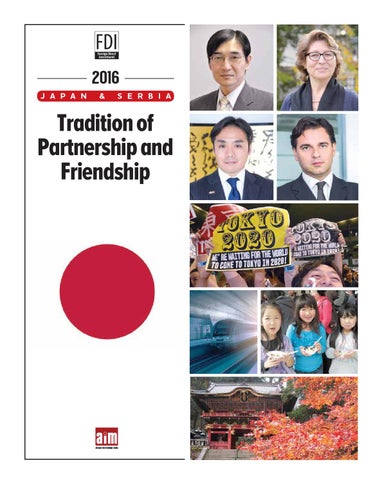
FDI Foreign Direct Investment
2016 J A P A N
&
S E R B I A
Tradition of Partnership and Friendship
FDI Foreign Direct Investment
EDITOR Tanja Jakobi ART DIRECTOR Jasmina Laković j.lakovic@aim.rs
J A P A N
2016 CO N T E N T S
6
ENTHUSIASTIC FRIENDSHIP
10 BETTER PREPARED
FOR FUTURE RISKS
IRENA VOJÁČKOVÁ SOLLORANO UN Resident Coordinator & UNDP Resident Representative – Serbia
PRINTING Rotografika d.o.o. Makenzijeva 67, 11000 Belgrade, Serbia Phone: +(381 11) 2450 508 Fascimile: +(381 11) 2450 122 E-mail: office@aim.rs www.cordmagazine.com ISSN no: 1451-7833 All rights reserved alliance international media 2016
28 READY FOR NEW
MILENA ARGIROVIĆ, MD Commercial Excellence Head Balkans, Commercial Head Serbia Montenegro TAKEDA
RADE GRUJIĆ President of the Municipality of Krupanj
INVESTORS
IN COMBATTING THE ILLEGAL CUT TOBACCO TRADE
30 MIND YOUR
MANNERS!
JAPANESE BUSINESS CULTURE
31 DEDICATED TO
CLIENTS
14 PEOPLE CREATE THE
STRONGEST BONDS
CHRIS WOODS Vice President, JTI Adriatica
EXECUTIVE DIRECTOR Ruža Ristanović r.ristanovic@aim.rs GENERAL MANAGER Ivan Novčić i.novcic@cma.rs
19 INNOVATIVE
20 IMPROVEMENTS
PHOTOS Zoran Petrović
FINANCIAL DIRECTOR Dragana Skrobonja d.skrobonja@aim.rs
CANON
H.E. JUICHI TAKAHARA Ambassador of Japan to Serbia
TRANSLATION Snežana Bjelotomić / MRP
EDITORIAL MANAGER Neda Lukić n.lukic@aim.rs
ADMINISTRATIVE CHALLENGES
GORAN PEKEZ President of the Japanese Business Club
TREATMENTS
COPY EDITOR Mark Pullen
OFFICE MANAGER Nataša Nešić n.nesic@aim.rs
S E R B I A
Tradition of Partnership and Friendship
EXECUTIVE PROJECT MANAGER Maja Vidaković m.vidakovic@aim.rs PROJECT MANAGERS Biljana Dević b.devic@aim.rs Ljiljana Kneževć lj.knezevic@aim.rs Aleksandra Ebilji a.ebilji@aim.rs
&
22 GREAT
OPPORTUNITIES FOR COOPERATION
YOSHIFUMI KANNO First Secretary at the Embassy of Japan in Belgrade
16 JAPANESE COMPANIES
SUPPORT CHANGES THAT CONTRIBUTE TO STABILITY
ECONOMIC EXCHANGE
24 SLOW GLOBAL
RECOVERY SLOWS JAPAN
32 HELP FROM A
CARING FRIEND
DONATIONS
34 TIME FOR HAPPY
FAMILY GATHERINGS
JAPANESE ECONOMY
NEW YEAR’S TRADITION
26 DEDICATED TO
36 LET THE BEST SHINE TOKYO SUMMER OLYMPIC GAMES 2020
IMPROVING PEOPLE’S HEALTH
ASTELLAS PHARMA EMEA CELEBRATES 10TH ANNIVERSARY
27 SOLUTIONS FOR
OVERCOMING
4 | TRADITION OF PARTNERSHIP AND FRIENDSHIP
STOJAN JOVANOVIĆ YOKOGAWA
39 STATE OF BEAUTY
AND HARMONY
JAPANESE TRADITIONS
40
COMPANY REGISTER
INTERVIEW
H.E. JUICHI TAKAHARA
AMBASSADOR OF JAPAN TO SERBIA
Enthusiastic FRIENDSHIP Japan recognises Serbia’s efforts in promoting the Western Balkans as a place of stability and prosperity, the Government’s EU focused reform goals, the potential the country offers investors and, above all, the mutual bonds that people of the two countries have built
I
n this interview for CorD’s special edition, Japanese Ambassador to Serbia, H.E. Juichi Takahara, explains the bonds that he sees between our two countries and the opportunities for further improving business ties, as well as confirming the continuous willingness of Japan to help Serbia deal with important issues, including the development of infrastructure and particularly related to the environment, where Japanese technology and knowhow could be of precious assistance.
■ Considering that you arrived in Serbia only recently, have you had time to form an overview of the national economy of Serbia? How would you assess the current situation? - Although only five months have passed since my arrival in Serbia, I have used this initial period of my mandate to meet the officials of the national government and representatives of domestic institutions, international financial organisations and several companies. Thus, I had the opportunity to get better acquainted with the past and current situation when it comes to your country’s economy. The Serbian economy is at a crucial juncture that will affect the
6 | TRADITION OF PARTNERSHIP AND FRIENDSHIP
future orientation of national economy development. The global economic crisis of the past seven years has contributed to weakening macroeconomic results and the country’s fiscal position, primarily in terms of budget deficit, public debt and the unemployment rate. However, the entire world is facing similar problems and the condition of the Serbian economy is not an isolated case. We realise that the Serbian Government is exerting all efforts in order to overcome the current situation and create a stable and sustainable national economy, which is not a short-term task, nor an easy one. The reforms that the Serbian Government is implementing under the leadership of Prime Minister Aleksandar Vučić include the privatisation process, budget consolidation and improvement of the business environment. And we can see positive results already: the budget deficit has reduced significantly, the unemployment rate has fallen slightly and we can see new investors coming to Serbia, or showing interest in doing so in the future. ■ How could the continuing Serbian reform efforts help improve the business environment and do you think it can contribute to strengthening economic ties between our two countries? - In my understanding, the ongoing reforms realised by the Serbian Government have both short-term and long-term goals. Their shortterm goals include the improvement of the country’s fiscal position, macroeconomic and monetary indicators. The long-terms goals are the reorganisation and rationalisation of the public sector, the privatisation and restructuring of public companies and the adoption of new economic policies adjusted to the regulations of the European Union.
It is understandable that Serbian officials are attempting to develop a national economy based on the model of the European economies, and to improve the living standards to those of EU countries. Converging with the standards of the European Union and adjusting to the business environment within the Union will help Serbia improve its trade and investment ties – not only with the EU, but also with other countries, including Japan.
Your country’s geographical position and good connections with the EU enable investors to easily reach the EU market, especially considering the Free Trade Agreement Serbia has with the Union. Additionally, the same agreements with the Russian Federation, Kazakhstan, Belarus or Turkey create the opportunity to export products to a market of a billion consumers. That is a major advantage of Serbia and the investors present here. In talks with the Japanese companies here, I was informed of their positive experience with employees in Serbia. They are fastlearning, dedicated, loyal, and tend to accept new technologies easily. Skilled labour is a very important factor in an investor’s decision-
■ Japan is a huge donor to Serbia. Are you satisfied with the way that help is utilised and where do you see room for the further development of the two countries’ economic cooperation? - Japan has been providing economic assistance to Serbia since 1999, either in the form of financial aid or technical assistance to national institutions, local governments and NGOs. Our assistance to Serbia has been focused on three sectors: private sector development, environmental protection and healthcare & education. All of these sectors impact directly on the lives of Serbian citizens and we believe our efforts are widely recognised in your country. For example, in 2011 Japan and Serbia signed an agreement on a soft loan for the Flue Gas Desulphurisation Construction Project for the Nikola Tesla Thermal Power Plant, at the request of the Serbian Government. This project has the goal of reducing air pollutants, such as sulphur oxide and dust contained in the flue gas emission at Nikola Tesla TPP, which cause health hazards in the Obrenovac area, and to assist Serbia in harmonising with EU standards on flue gas desulphurisation. Unfortunately, the tender procedure for this project has been at a standstill for more than a year. However, we hope that this halt will soon be solved and the project will be realised in the manner agreed between the two governments. making process when it comes to The allocation of our assistance to Serbia sometimes reflects the cur- The Japanese business community selecting a new investment location. rent situation in the country. Japan in Serbia shares the views of other Japanese investors also seek consistency in policy implementation, a has provided emergency assistance to investors that further efforts are good security situation, good comSerbia both in 2014, after the disastrous needed in order to improve the rule mand of the English language, etc. floods, and in 2015, for the better hanof law, implement regulations and On the other hand, some condling of the migrant crisis. We are glad cerns still remain that need to be to see that our assistance was used in ensure fair competition solved in order to improve business line with emergency needs. I see that circumstances. I was recently invited to the annual conference there is still a tremendous need to improve infrastructure, in particular of the Foreign Investors Council, where I learned how investors in the environmental sector, such as sewerage system development assess the current state of the Serbian economy. The conclusions and waste management. I would be very happy if we could cooperate of the FIC are, to a great extent, in line with the assessment of the further in this field, making use of Japan’s advanced technologies. Japanese business community in Serbia. Investors are mainly focused on improvement of the rule of law, implementation of ■ What are the major impressions and concerns of Japaregulations, more efficient cooperation with the government in nese investors currently present in Serbia? investment-related issues, assurances of fair competition and - The Japanese business community in Serbia includes investors in the enhancement of institutional capacity building. the manufacturing sector, representative offices of trading compaI consider the country’s success in coping with these chalnies, as well as domestic companies dealing in Japanese products lenges as something that could contribute to the improvement of and services. Some of these companies even had offices in the forthe Serbian business environment and result in a larger number mer Yugoslavia, but there is growing interest in Japanese business of investors arriving in the country. in recent years to expand activities to the Serbian market. TRADITION OF PARTNERSHIP AND FRIENDSHIP | 7
■ How do you assess the role Serbia plays in contributing to stability and prosperity in the Western Balkan? - If we analyse the situation over the past 25 years in the Western Balkans, we could say that it has been complicated and unstable. However, Japan sees Serbia as a key country for the stability and development of the Western Balkans, a region to which Japan attaches great importance. In this context, we appreciate Serbia’s efforts towards reconciliation among the nations of the Western Balkans, such as the recent development in the Belgrade-Pristina dialogue under the auspices of the European Union. Japan supports the dialogue and also encourages both sides to discuss the issue of the protection of cultural heritage in Kosovo. We also commend the frequent visits of senior Serbian officials to other Western Balkan countries, in particular Prime Minister Vučić’s appearance at the commemorative service marking the 20th anniversary of the crime in Srebrenica, held at the Potočari Memorial Centre in July.
is becoming more popular among the Serbian youth. Let me mention “Japanizam”, the event for the promotion of Japanese pop culture that we co-organise every summer with a local group of Japanese culture fans, with more than 7,000 visitors enjoying manga and anime promotions, cosplay (costume culture) shows, etc. I was amazed to find out that over 8,000 people in Serbia practice some form of Budo, Japanese martial arts. In every town there is a club where you can train Karate, Aikido, Judo or Kendo. We have recognised the passion for Budo and provided continuous support for many martial arts clubs by providing tatami matrasses and sports equipment, or by organising events to promote martial arts as an integral part of Japanese culture and sports. Japan will host the Tokyo Olympic and Paralympic Games in 2020. Serbia is very famous for its sporting achievements and we are looking forward to welcoming many Serbian athletes. By then, I hope that our athletes and sports experts will have many opportunities to exchange knowledge and experience in various sports, both on and off the court.
■ Where do you see the highest ■ What do you see as common potential for mutual cooperation features of Serbian and Japawhen it comes to education, culnese culture and habits that ture and sport? may explain the deep respect - I am glad to hear that there is increasand mutual devotion between ing interest in studying the Japanese two countries? language, especially among the youth - Since my arrival in Serbia I have of Serbia. The flourishing of Japanese had the chance to meet and talk to culture in Serbia results in greater many people. People here are very interest in learning the Japanese lanhospitable and very proud of their guage. In this regard, last year our EmJapan’s assistance since 1999 has history, culture and cuisine, which bassy, in cooperation with a Japanese been focused on private sector are traits they share with the Japacompany and Belgrade University’s nese people. The Japanese love sake Faculty of Philology, initiated a project development, environmental and sushi, while Serbs enjoy cevapi which enabled children at 11 primary protection and healthcare & (kebabs) and rakija (brandy). In adand secondary schools throughout Serbia to attend Japanese language education, as they impact directly on dition to all this, I realised that there the lives of Serbian citizens is a strong friendship between our classes as an optional course. two countries, although, geographiThe number of students from cally, Japan and Serbia are about 9,000 km apart. Serbia who are applying for scholarships provided by the GovThe Japanese people will never forget the material and moral ernment of Japan is increasing. Serbian students want to perfect support they received from the Serbian people when we were in their Japanese language skills and learn more about the counneed after the Great East Japan Earthquake of 2011. As proof, aftry’s culture, arts, architecture, engineering or science. There are ter the unprecedented floods last year, the Government of Japan also Japanese students who are doing research at the University had no dilemma about providing emergency aid or supporting of Belgrade on history, politics, linguistics, art history and the the recovery efforts. conservation of frescoes. The Japanese people also visited the Embassy of Serbia in ToMore than 100 titles of Japanese literature have been translated kyo for days, in order to make individual contributions to Serbia. into Serbian and they are very popular in Serbia. That is the reason In that sense, I think that the people of our two countries are rethat the Belgrade Book Fair stand of the Embassy of Japan is one of ally considerate and warm-hearted towards people in need. Our the most visited. The Embassy organises Japanese film festivals, friendship is based on the simple notion that we trust and support which always receive a great response from the audience. Japanese each other through good times and bad. ■ pop culture, based on anime (animation movies) and manga (comics),
8 | TRADITION OF PARTNERSHIP AND FRIENDSHIP
TRADITION OF PARTNERSHIP AND FRIENDSHIP | 9
INTERVIEW
IRENA VOJÁČKOVÁ-SOLLORANO
UN RESIDENT COORDINATOR & UNDP RESIDENT REPRESENTATIVE – SERBIA
Better Prepared for
FUTURE RISKS With the support of the government of Japan, and in partnership with UNDP, Serbia is now better prepared to face future threats – both at the municipal level and in terms of the overall response to future crisis management in the case of disasters
A
broad partnership established between all partners, at both the government and municipal levels, as well as between numerous partners in state institutions and organisations, and with the help of civil society and donor support, promises that Serbia will be in a better position to face possible new threats.
firmly on the future, on implementing lessonslearned, on joint actions for disaster risk reduction and prevention measures. We have moved from building back better to constructing better and safer new homes in places like Krupanj, Valjevo and Obrenovac, to building crucial infrastructure to save lives and sustain development in the face of future threats. We have done this by constructing, for example, two dozen torrential barriers on smaller rivers in the mountainous parts of Western Serbia, of the kind that demonstrated so much destructive power last year. Moreover, we have assisted Serbia in moving towards being in a position of global leadership when it comes to building the legislative framework for effective disaster risk management, one which encapsulates the goals of the Sendai Framework for Disaster Risk Reduction, adopted earlier this year in Japan.
Together with our partners in the Government of Serbia, we have moved a long way from what was ■ A year and a half initially an emergency response after disastrous floods that hit to now having our eyes firmly set Serbia, where do on the future we stand when it comes to the flood relief effort, in terms of UNDP’s involvement? - Together with our partners in the Government of Serbia, above all with the Government Office for Flood Relief and Reconstruction, we have progressed a long way from what was initially an emergency response followed by reconstruction and recovery, to now having our eyes fixed
10 | TRADITION OF PARTNERSHIP AND FRIENDSHIP
SUPPORT
Japan supports municipalities in Serbia, this year with a $3.64 million grant aimed at increasing local-level resilience and preparing to respond to future disasters
INNOVATION
The support by Japan has given all of the partners in the project more than just the financial resources: it has infused our collective efforts with the culture of being more open to innovation and the use of the latest technology
■ How is this issue being addressed by the Japanese funded ($3.64 million) project “Increased Resilience to Respond to Emergency Situations”? - Japan supports municipalities in Serbia, this year with a $3.64 million grant aimed at increasing local-level resilience and preparing to respond to future disasters. We are pleased to be implementing this 12-month project with a view to benefiting local communities in at least 27 municipalities in Serbia, which between them account for some 1.3 million inhabitants in total. With this project, Japan and UNDP are supporting three landmark activities in Serbia: The Flood Risk Management Study of the Kolubara River Basin – a detailed and comprehensive study of the entire Kolubara river basin, with practical recommendations on minimising future risks posed by flooding. In
RECYCLING
The brand new recycling centre in Novi Pazar, for example, was financed by the UN Human Security Trust Fund and the Government of Japan
short, what should be built/removed and where, in order not to have floods in the future; create design for the Rehabilitation of the “Stolice” Antimone Mine, which is polluting Serbian rivers. The Government Office for Reconstruction and Flood Relief, together with Public Water Company “Srbijavode”, will implement the works based on this design; UNDP was able to contract a design company for a complex set of measures to rehabilitate and cultivate the tailings landfill of the “Stolice” mine in Krupanj municipality. The May 2014 floods caused the western landfill for tailings to collapse, causing great volumes of flotation sludge to spill into local rivers and on into the Drina. Most notably, the BEWARE project has created the basis for the Landslide Register in the Republic of Serbia, hazard and vulnerability maps and training of municipalities on how to moni-
The long-term vision built into the project “Increased Resilience to Respond to Emergency Situations” is a testament to the quality and flexibility of support provided by the Government of Japan to Serbian communities
TRADITION OF PARTNERSHIP AND FRIENDSHIP | 11
tor them and avoid creating on landslide risks. Information on this area is available at www.mre.gov.rs/geoliss/beware I think the long-term vision of this partnership is also testament to the quality and flexibility of support provided by the Government of Japan. Moreover, the project also includes small scale infrastructure works, including reparation and improvement of water supply systems, wastewater treatment and improving sanitation at the municipal level; enhancement of municipal capacities for disaster preparedness in line with the EU Civil Protection Mechanism and many other activities. ■ What were the guiding principles when it came to selecting projects and what major goals need to be achieved? - Based on the previously conducted post-flood needs assessment, project activities are geared towards supporting recovery,
reducing vulnerability and increasing resilience. As with all of our work, UNDP is able to deliver thanks to its ability to forge smart and effective partnerships, which include those with local governments, experts and specialised public companies, such as Srbijavode, as well as civil society organisations, which in this case also include those with the capacity to include women in local disaster risk management.
International Consortium on Landslides, who supported our project. One of the many beneficial aspects of this project is certainly the adoption of both social and technological innovation in addressing challenges in local level resilience, such as using the latest technology for mapping and managing thousands of landslide sites across Serbia and using drones for reconnaissance and inspection of fires, damaged infrastructure or other types of disaster environments which would otherwise prove extremely life-threatening situations for first responders. I think the support by Japan has given all of the partners in the project more than just the financial resources: it has infused our collective efforts with the culture of being more open to innovation and the use of the latest technology. ■ How does UNDP cooperate with the local municipalities and civil society organisations involved in the implementation of this project? - We do more than just cooperate – we forge smart partnerships by allowing local stakeholders to enhance their own capacities through the implementation of project activities, which they themselves have conceived and designed. ■ UNDP, with the support of the Government of Japan, was also involved in an equally important project related to human security in the Sandžak region. How does this approach to human security differ from other interventions related to social security and why is it an important framework for action? - The concept of human security underscores the universality and interdependence of a set of freedoms that are fundamental to human life: freedom from fear, freedom from want and freedom to live in dignity. This is the common denominator for achievements facilitated by the Joint UN Programme entitled “Improving Human Security in Southwest Serbia”, and the concept Japan uses as a guiding principle for its official development assistance (ODA). Funded by the UN Human Security Trust Fund and the Government of Japan, the programme is worth 2.8 million dollars and was implemented by four UN agencies (UNDP, UNFPA, UNOPS and WHO), working in close partnership with the people and local governments of the region in order to deliver diversified support to economic, environmental, community, political and cultural security, as the drivers of regional development. Physical infrastructure has been improved in ways that respond directly to the development priorities of local partners. The brand new recycling centre in Novi Pazar, for example, was financed by the UN Human Security Trust Fund and the Government of Japan. ■
As with all of our work, UNDP is able to deliver thanks to its ability to forge smart and effective partnerships, which include those with local governments, experts and specialised public companies
■ How will Japanese knowhow be transferred and implemented in Serbia, thereby empowering local communities to prevent further damage of this kind? - We already had a visit from Professor Kyoji Sassa, Chairman of the
12 | TRADITION OF PARTNERSHIP AND FRIENDSHIP
TRADITION OF PARTNERSHIP AND FRIENDSHIP | 13
INTERVIEW
YOSHIFUMI KANNO
FIRST SECRETARY AT THE EMBASSY OF JAPAN IN BELGRADE
People Create the
STRONGEST BONDS
Citizens and their interest in learning new things about Japan or Serbia give us the chance to promote our cultures with each other, to promote our countries and strengthen our bonds
still see this region as unique and recognise the newly formed countries as one, as Yugoslavia. Considering that things have changed in the past 25 years, the Japanese people have slowly started researching about Serbia and are getting better and better acquainted with your country. So, my opinion is that in both cases it’s the people who create such strong bonds between our countries. Citizens and their interest in learning new things about Japan or Serbia give us the chance to promote our cultures with each other, to promote our countries and strengthen our bonds. Let me remind you that in 2011 the citizens of Serbia gave strong support to Japan in its recovery following the major earthquake and tsunami that caused severe damage to parts of our country. The people of Japan did not forget this and last year, after disastrous floods hit Serbia, Japan reacted promptly to help your country and citizens recover.
A
lthough Japan and Serbia are geographically distant, the two countries have been building strong bonds for many years. Here Yoshifumi Kanno, First Secretary at the Embassy of Japan to Serbia, speaks about his impressions of Serbia and the possibilities for the two countries to deepen their relations. ■ Considering your two-year presence in Serbia, what would you say are the strongest bonds between Japan and Serbia? - Upon my arrival in Serbia, I was pleasantly surprised with the respect for, and understanding of, Japanese culture in Serbia. People here are very well acquainted with Japan’s cuisine, history and tradition. I believe the geographic distance between our two countries creates a certain curiosity, which pushes people towards exploring about Japan or Serbia. On the other hand, the former Yugoslavia was well known and respected among Japanese politicians and people. Many Japanese people
14 | TRADITION OF PARTNERSHIP AND FRIENDSHIP
■ How would you assess the progress Serbia has made in its integration towards the EU? How important is this for Japan? - Several weeks ago the European Commission presented its annual Progress Report, assessing the integration process of country-candidates for EU membership. In the case of Serbia, the report praised the firm orientation of your country towards EU accession, especially focusing on economic and political reforms implemented by the Serbian government in the past year. My view is that in the past year the Serbian government, primarily in the economic sector, has showed the intention of implementing structural reforms in order to create a stable economic environment and improve the living standards of Serbian citizens. The reform implementation process is in line with Serbia’s 15-year policy of creating a democratic country, with a market economy, respect for freedoms and rights, which should ulti-
mately result in your country’s membership in the European Union. However, I strongly believe that the accession date itself should not be the ultimate goal of Serbia, but rather the path to the European Union membership which you should use as an opportunity to realise the project of creating a country that shares the value of those countries which already are part of the EU. As the European Union is one of the most important partners of Japan, in both political and economic terms, there is no doubt that Serbia’s EU accession progress is of significant interest to us. To give you an example, the EU and Japan are currently negotiating a new Free Trade Agreement that aims to improve our mutual trade and investments. Once it enters the EU, Serbia will be obliged to respect all the policies and agreements of the Union, including the trade agreement with Japan. If your economy is fully adjusted with the EU regulations once it enters the Union, Japan and Serbia could realise trade in a much easier manner. This would potentially attract new investors from Japan to Serbia, but would also provide Serbian companies with easier access to the Japanese market.
ate a good image for this Club and eventually advance it to become the Chamber of Commerce by also growing the number of members. My impression is that employees of Japanese companies in Serbia are satisfied. They tend to work for the companies for a long time and adapt well to new technologies and the business culture brought to them from Japan. I hope that the further increase in the number of Japanese investor in Serbia will confirm my impressions in the best manner. ■ To end this interview with a reminder that you have been in Serbia for two years now, what do you think Serbian citizens’ impressions of the Japanese community in Serbia are like? Do you feel welcome? - Although two years represent a period sufficient to draw some
■ The Japanese business community in Serbia is growing, including the recent establishment of the Japanese Business Club. How do you think Serbia sees Japanese investors in the country? - In recent years the Japanese business community in Serbia has been on the rise. Although there are only two Japanese investors in Serbia, we do not consider JTI and Panasonic as being “just two”. The importance of these companies in Serbia is best understood by the citizens of the municipalities of Senta and Svilajnac. Not only do these companies employ a significant number of workers in their conclusions about your country and factories, but they also insist on contributing to the improvement of the social life As the European Union is one of people, my understanding of Serbian citizens’ relations towards foreign people of these municipalities. They are integral Japan’s most important partners, and guests was formed only few months and vital parts of these communities. in both political and economic after my arrival, and it has only been reIn a wider spectrum, the presence of affirmed since then. such renowned investors in your counterms, there is no doubt that try is a good reference for potential new Serbian citizens’ affinity towards Jaforeign investors, from Japan or another Serbia’s EU accession progress is pan – our culture, tradition, business and of significant interest to us other aspects that characterise my councountry. They contribute to the improvement of knowhow, import new technolotry – is something I could not have exgies, improve the education level of your engineers, but also cooperpected, but now I am fully aware of. Combined with the traditional ate with numerous expert schools in finding and creating the highand well-known hospitality for which you are famous, this results in level young engineers they greatly need. a friendly and warm living environment and place for work. The Japanese Business Club was established in summer 2014. What makes me really proud is the fact that more and more The joint idea of the Embassy of Japan and the Japanese business students, even in high schools, are provided with the option of community in Serbia is to provide visibility to Japanese companies learning the Japanese language, which differs enormously from in the country and to ensure their better mutual networking. So far, the majority of other languages. However, they are very enthusiastic and excited to learn, thereby contributing to bringing our counwe had several meetings, including a very important conference in tries closer together. Maybe they are not aware of that, but it is so. December 2014 that was attended by the Minister of Trade, Telecommunication and Tourism, Mr Rasim Ljajić. For all the aforementioned reasons, and thanks to my position At present, the Club gathers together numerous Japanese investors, and job, I have a great wish to contribute to further improving of our representative offices and traders of Japanese products. We hope to cretwo countries’ ties, be that in business, culture or even private life. ■ TRADITION OF PARTNERSHIP AND FRIENDSHIP | 15
INTERVIEW
GORAN PEKEZ
PRESIDENT OF THE JAPANESE BUSINESS CLUB
Japanese Companies Support
CHANGES THAT CONTRIBUTE TO STABILITY
T
What is most important for members of the Japanese Business Club, but also all other investors, is macroeconomic stability, in terms of the predictability and stability of the business environment
he Japanese business community in Serbia is not as large as the communities of some other foreign countries, but it comprises several exceptionally distinguished and significant Japanese companies that are doing well in Serbia and whose operations contribute to the transfer of technology, job creation, employment of a qualified workforce and the progress of the local communities in which they operate. Their experience gained in Serbia is also very important for other Japanese companies that are potentially considering entering the Serbian market. Like all investors, the important factor for Japanese companies is political stability, the macroeconomic situation and, above all, the predictability of the business environment. “The situation in Serbia is good in this respect, although room for improvement exists,” says Goran Pekez, president of the Japanese
16 | TRADITION OF PARTNERSHIP AND FRIENDSHIP
Business Club, the function of which is to improve cooperation between the two countries and connect Japanese companies already operating in Serbia. Japanese companies pay close attention to the course of reforms in Serbia, especially the part that relates to everyday easing and simplifying of administrative procedures, tax and inspection policies. Within the framework of the business club, members mutually exchange experience and, in cooperation with other business associations and institutions, are engaged in issuing recommendations and directives that, when applied, could lead to improvements in the overall business climate. The presence of Japanese companies in Serbia also has a special significance for the business community and the local workforce, as they have also brought to the country a special approach to the organisation of work in the form of the Kaizen business philosophy, which – thanks to its extremely good results – has also been accepted in America and Europe. This relates to the constant improvement of the production process and numerous small training courses in which the whole work collective
is involved and where, with a very small financial investment, steady and remarkable results can be achieved in terms of raising the efficiency of the overall work process. “In Serbia such principles are not only applied at the factory of the company where I work (Japan Tobacco International), but also, for instance, at Panasonic and Bosch,” says Pekez.
■ What principles underpin the functioning of the Japanese Business Club and what would you single out as its most important activities in the previous period? - The idea of the Japanese Business Club is to contribute to strengthening economic relations between Serbia and Japan, and to facilitate networking between Japanese companies already operating in Serbia. Through joint action, the members of the club are tasked with ■ How many companies does The constructive exchange of to improving business the Japanese Business Club experiences and information of mutual contributing conditions and improving the busibring together today and in interest, as well as joint approaches ness climate in Serbia. which areas of business are This relates primarily to the they active? in dialogue with the government and stability and predictability of the - The Japanese business commusociety, form the basis of cooperation market, which are of key impornity in Serbia has 47 companies, between companies within the club tance to the operations of existing among which are Astelas, Fujitsu, investors and the attracting of poItochu, Mitsubishi Corporation, Patential investors. Of course, this doesn’t apply only to companies nasonic, Sony, Takeda, Toyota and Japan Tobacco International. coming from Japan, but rather for all companies, regardless of Thus, different industries are part of our business club and where they come from. This is the only way that leaves room we are all gathered around a common interest – doing business for creating business strategies that will enable the realisation long-term and investing in Serbia. of profits which companies use to pay taxes and employ people. The basic premise of cooperation with various partners is to develop partnership relations, because only building trust and ■ In which ways do member companies cooperate mutumutual cooperation can lead to results that will be a lasting and ally and how does the club cooperate with other stakewill make the overall economic environment more interesting holders in the business context – state institutions, for long-term investments.
TRADITION OF PARTNERSHIP AND FRIENDSHIP | 17
the Serbian Chamber of Commerce and other business clubs and associations of foreign investors? - The constructive exchange of experiences and information of mutual interest, as well as joint approaches in dialogue with the government and society, form the basis of cooperation between companies within the club. Our goal is to build partnership relations with representatives of state bodies, because only cooperation and mutual understanding between the government and foreign investors can lead to the building of an attractive business environment in Serbia that will motivate existing investors to continue investing and potential new ones to start.
economies in Southeast Europe, as well as adequate mechanisms for maintaining a stable economic and fiscal environment. ■ What kind of institutional changes do Japanese companies consider as being the most important when it comes to improving the business environment? - Certain essential institutional changes have already taken place. There has been adoption, for example, of the Law on Inspection Oversight, which should lead to the reduction of the grey economy and the black market, which are burning problems of the Serbian economy and business that cause enormous damage to the state budget. Likewise, certain improvements have been made in regulating the import of medicines and public procurement, which our Club identified as one of the problems. However, the transparency and predictability of procedures related to the pharmaceutical industry remains a major challenge both for the country and for foreign investors in Serbia. ■ What do you expect from 2016? - What is very important is strengthening the predictability of the tax system in general, but also its consistent implementation in practice, as a way of stimulating the interest of potential investors. It is also important to harmonise regulations with the EU, especially in the domain of the pharmaceutical industry.
■ What specific principles of management and business culture do Japanese companies promote in Serbia? - Much can be learned from When it comes to the Japanese in this respect, cooperation between Strict application of the Law on Inspection both in terms of the organithe club and other institutions, I would like to Oversight and the predictability of tax regulations sation of work and the orstress that we are open are prerequisites for attracting greater interest ganisation of life. One of the lessons is certainly Kaizen for cooperation with all among investors – the business philosophy institutions, given that applied by Japanese comachieving a better busipanies, which has – thanks to its excellent results – been acness environment and results of operations is not just our goal cepted in America and Europe. Kaizen is basically a principle – but rather the common goal of all players on the market. of constant “change for the better”, with the optimal use of all available resources, with particular emphasis on employee ■ How do members of the club assess the overall coninitiatives. Financial investments are small, but the changes in ditions for doing business in the context of the macthe way people work and think are big. Employees are encourroeconomic environment and the current reform proaged to give their own suggestions for improving their workgramme? space and the jobs they do. - As I have already noted, what is most important for the memIn Serbia such principles are not only applied at the factory bers of the Japanese Business Club, but also for all other invesof the company where I work (Japan Tobacco International), but tors, is macroeconomic stability, in terms of the predictability also, for instance, at Panasonic and Bosch and stability of the business environment. The situation in this I think that is the best advertisement for the local workforce. respect in Serbia is good, but room for improvement exists. We believe that our experience can be useful not only to other That is exactly what we expect from the reform programme Japanese investors who are considering investing in Serbia, but – progress in the development of the market economy, strengthalso all other Serbian companies that wish to introduce Kaizen. ■ ening its capacity to respond to the pressure from competitive
18 | TRADITION OF PARTNERSHIP AND FRIENDSHIP
CORPORATE
MILENA ARGIROVIĆ, MD
COMMERCIAL EXCELLENCE HEAD, BALKANS, COMMERCIAL HEAD, SERBIA/MONTENEGRO, AT TAKEDA
Innovative TREATMENTS Takeda sees great future potential in the Balkan region, especially Serbia, and intends to bring to the market high end medicines and advanced therapies suited to patients’ needs
especially Serbia, and intends to invest seriously on the local healthcare landscape.
■ In which areas of healthcare in Serbia
T
akeda is a dynamic international company with an expanding presence in fast-growing markets around the world and, as such, it has been establishing its presence in Serbia since 2012. Takeda is at the forefront of the research and development of innovative treatments to satisfy unmet medical needs. The company soon intends to launch two of its innovative treatments for Hodgkin Lymphoma, Crohn’s disease and ulcerative colitis.
■ After three years on the mar-
has Takeda made the biggest advances with its offer? - Takeda Serbia activity will be mainly focused on pharmaceuticals. Takeda is still investing despite the financial crisis, with the patient in the centre, and its unique portfolio is based on established medicines and innovative therapies. We are committed to excellence and we want to serve the needs of patients in the best way. Our human capital is our strongest asset and our high quality employees are our strongest ambassadors towards health-
nies were affected by patent losses, price cuts and governmental measures aimed at further reducing pharmaceutical expenditure. Nevertheless, we believe strongly that the pharmaceutical business model should be transformed and new priorities put in place. Rare diseases and serious medical conditions are still waiting for new innovative therapies, which will save lives and improve quality of life for many patients. Our modern lifestyle has led to many diseases. However, thanks to medicines, life expectancy has increased. We think that it is in the interest of patients in Serbia that innovative treatments be protected and every citizen deserves access to treatment.
Our human capital is our strongest asset and our high quality employees are our strongest ambassadors towards healthcare professionals, the scientific community, the authorities and society
ket, how would you assess Serbia’s potential for the sale of Takeda’s innovative medicines? - Takeda is a pioneering global biopharmaceutical company that relies on its innovative solutions for patients. A leader in research and development in the fields of oncology, haematology and the gastrointestinal system, we provide high end therapies for patients in need. Takeda Serbia is a dynamic company operating in this country, and also an integral part of Takeda Balkans organisation. Our country is an emerging market with high future potential. Takeda is putting its trust in the Balkan region, and
care professionals, the scientific community, the authorities and society.
■ Considering budgetary constraints to financing the national healthcare sector, how much space remains for pharmaceutical companies to sell their most advanced products here and ensure payment is received? - The pharmaceutical industry has gone through unprecedented change due to the recession. Many pharmaceutical compa-
■ What are Takeda Serbia’s
plans for the period ahead? - We are preparing for two very important launches; more specifically, brentuximab vedotin, in the management of Hodgkin Lymphoma, and vedolizumab, in the management of Crohn’s disease and ulcerative colitis. Takeda is investing heavily in the research and development of novel treatments to satisfy unmet medical needs. Our organisation is expecting to grow and expand into new therapy areas. We want to be a useful partner to the Serbian economy and society and to be based on ethical business embracing our corporate philosophy of integrity: fairness, honesty and perseverance, developed over the company’s long corporate history of more than 230 years. ■
TRADITION OF PARTNERSHIP AND FRIENDSHIP | 19
INTERVIEW
CHRIS WOODS
VICE PRESIDENT, JTI ADRIATICA
Improvements in Combatting the Illegal
CUT TOBACCO TRADE
Higher seizures of illegal tobacco contributed to an almost 20 per cent increase in tobacco excise collection in the first nine months of 2015, in comparison to the same period last year. Further law enforcement measures should be followed by effective action taken by prosecutors and courts
One of those challenges is certainly the illegal trade in cut tobacco, which caused the tobacco industry to lose between 30 and 40 per cent of the legal market in 2013 and 2014.
J
apan Tobacco International is part of the industry which collectively represents the largest investor in Serbia. The overall investments of the tobacco industry in the past 10 years are worth over €1.2 billion. The industry employs 1,700 people, with about 70,000 people in the chain that includes the retail sector, tobacco growing and distribution.
■ Your company alone contributed to the state budget with 17 billion dinars in 2014, making it the 4th largest tax payer in Serbia. From that perspective, how do you see the situation in Serbia; is it investor friendly? - We came to Serbia in 2006 by purchasing the Senta Tobacco Industry. Since then we have invested almost 170 million dollars in Serbia, modernised utilities, started cigarette production and exported cigarettes to Montenegro, Bosnia-Herzegovina, Macedonia, Croatia and Albania, as well as exporting tobacco to the EU. So far, the total value of our export is 150 million dollars. These are successes of which we are proud. But a very important factor in this success story is the open dialogue we have maintained with the Government of Serbia. We are thankful to the government for understanding the issues and challenges faced by foreign investors and for being cooperative in dealing with those issues.
20 | TRADITION OF PARTNERSHIP AND FRIENDSHIP
■ Regarding the illegal trade in cut tobacco, you have said on several occasions that the situation is improving and that the volume of the illegal market is shrinking. Is this trend decreasing steadily? - Illegal trade in cut tobacco is still a major issue. It still has a significant negative impact on budget revenues, jobs, farmers, retailers and the overall Serbian economy. However, I am pleased to say that the government has recognised this problem and over the last 18 months genuine improvements are being noted. Higher seizures of illegal cut tobacco contributed strongly to an almost 20 per cent increase in tobacco excise collection in the first nine months of 2015, in comparison to the same period last year. Further law enforcement measures should be followed by effective action taken by prosecutors and courts, and a zero tolerance approach in the fight against illegal trade. This is the way to stabilise the business environment, which is a key factor for the sustainable operations of all companies present on the market. ■ And what financial results do you expect, given the improvements in fighting the grey economy?
- In terms of volume we have seen a good improvement, which is clearly beneficial both financially and in protecting employment. However, our margins have deteriorated due to significant price discounting at the end of 2014. Even more, the price of Winston KS Blue is the same today as it was back in January 2014, despite increasing excise tax and higher costs of raw materials purchased in foreign currency, such as U.S. dollars or euros. So it is very much one step forward and two steps back, but we build our plans with a longer term view and Serbia is regarded as a market where we are willing to invest today in the hope of future returns.
tory, the Kaizen programme has led to a productivity increase of 47 per cent and reduced wastage by as much as 67 per cent. We believe that Serbian-based companies can improve their performance significantly if they involve and motivate their employees to evolve their job better. Financial investments are small, but changes in the way people work and think are huge. ■ Japan is a country known for its humanitarian work in Serbia. How active is Japan Tobacco International in that regard?
■ Despite the challenges, JTI is determined to stay in Serbia, grow and keep investing. In 2014 you invested five million dollars in production and operations in Senta. What are your plans for 2016? - Japan Tobacco International came to Serbia with a long term strategy of growing and investing. When we came here, Senta Tobacco Industry had 77 employees. Today we employ over 350 people in the Western Balkan region, which is headquartered in Belgrade, and engage over 380 tobacco growers and seasonal workers. So, our strategy and intentions are clear. And as long as we are doing business in a favourable business climate we will be able to maintain the same level of investment and employment. Our plans for next year include the expansion of production and storage capacities and further increases in productivity. The plan is to introduce a new production line in Senta next year. This investment amounts to 3.5 million dollars and is part of the investment cycle we started last year. On the other hand, our aim is to reduce imports and replace imported products with those produced locally. We currently import certain pack designs from our factory in Russia, as there are no If you look at publicly disclosed financial customs duties for Serbia, and results of the industry as a whole, you we also import from some EU factories for specialised packs. can see that operations were running at a
- JTI is strategically orientated towards helping the local community in which it operates. We believe that the role of large companies is financial loss of 3.4 billion dinars at the end to invest in the development of soand simultaneously support ■ Which Japanese skills of 2014. Our longer term aim is to make ciety projects of national and local imand knowledge are applied in the factory in Senta and that positive, so there is a challenge for us portance, regardless of the industry in which they operate. how was this accepted? We want to help the social categories that most require help. - Our factory in Senta is the first factory in Serbia that has entirely implemented Kaizen and received 5S certification, mod- In that regard, we helped Belgrade open the Day Care Centre for elled on the prestigious Kaizen institute certificate, the business adults with special needs in Zvezdara. We also helped establish philosophy that is the key to the success of Japanese companies. two clubs for the elderly in Vračar and New Belgrade. Since we The basic principle of Kaizen is continuous improvement with pay equal attention to projects in Senta, we have traditionally optimal use of all available resources, with particular emphasis supported Caritas in providing food for the local Soup Kitchen, on the initiatives and ideas of employees. Employees are encour- while we also helped with the opening of a day care centre for aged to offer proposals for the improvement of their work space people with work-related disabilities in Senta. Alongside philanthropic projects, JTI is one of the main proand the jobs they perform. The best proposals are accepted and moters of Japanese culture and tradition in Serbia, endeavouring those who propose them are rewarded. We are very proud of our employees, who don’t lack high to bring the best of Japan to Belgrade. Hisakura gardens in Belquality ideas. One of the best proposals in 2013 brought us sav- grade and Senta, Sakura scholarships and the concerts of Japanese ings in the amount of almost 75,000 dollars. This year’s best pro- artists, represent just part of the activities we do in that respect, posal saved us 42,000 dollars. Since its introduction to the fac- cooperating, of course, with the Japanese Embassy in Belgrade. TRADITION OF PARTNERSHIP AND FRIENDSHIP | 21
ECONOMIC EXCHANGE
Great Opportunities for
COOPERATION T
he trade exchange between Serbia and Japan is characterised by its modest volume, especially when it comes to the value of our exports, with a constant trade deficit on the Serbian side and the low level of coverage of imports by exports. When it comes to Japanese investors, it could be said that on several occasions huge efforts of Japanese companies to promote Serbia have been thwarted by the fact that domestic companies have not respected the deadlines or rules agreed. That said, there are very successful examples, such as, for example, the investments of JTI and Panasonic and interest among other Japanese companies in organising production in Serbia. Total trade in 2014 amounted to a value of $114.3 million, which represents a decrease of 12.5% compared to 2013. A growth in exports was recorded of 6.7%, or $6.8 million, which is our best export performance in the last 10 years – and a decline in imports of 13.4% ($107.5 million), compared to the previous year, with an export-import coverage ratio of 6.28%. According to data for the first nine
Although located in the immediate vicinity of the Visegrad Group of countries, Serbia does not do enough to interest Japanese investors, and in the past it has missed out on the chances provided. However, Japanese companies are beginning to show renewed interest in investing in the country months of 2015, total trade amounted to $111.3 million, which represents an increase of 26.9% compared to the same period in 2014. The value of exports was $27.6 million, while imports were worth $83.7 million. Exports have increased 426.8% and imports 1.5%, compared with the first nine months of 2014. Such a high rate of growth of exports of goods from Serbia to Japan during this period is due to the exports of cigarettes. In the first nine months of 2015, over 150 times more cigarettes were exported than during the whole of 2014. A deficit is still present and amounts to $56.1 million, while the export-import coverage is 32.91%. Japanese companies are interested in importing our health food, wine, spirits, mineral water, herbal teas and traditional goose feathers. JETRO (Japan External Trade Or-
22 | TRADITION OF PARTNERSHIP AND FRIENDSHIP
ganisation) believes there is room for the placement of Serbian furniture, kitchenware and equipment, wooden toys and the like, because no quantitative restrictions apply on imports of these products to Japan, while customs duties are marginal. Company Sirogojno has been present in Japan for decades, primarily through the export of folk handiwork items. In recent years, the most important export product from Sirogojno has been frozen raspberries, and in addition to a regular customer (JAM Incorporated), there is interest for cooperation from trade giant Marubeni and company Aoba Trading. They are expected to start exporting dried fruit soon. In 2014, exports of frozen raspberries grew by 69.3%, jams and marmalades by 32.6% and dairy spreads by 12.1%, compared to 2013. Last
year’s statistics registered exporters of frozen and dried fruit, juices, dairy spreads and wine, alongside the aforementioned Sirogojno, as: Master Frigo, Belgrade, Agropartner, Lučani, Foodland, Belgrade, Zadrugar, Ljubovija, ITN, Belgrade, Drenovac Arilje, Farmakom, Šabac, Miletić Winery, Rekovac and Winery Kiš, Sremski Karlovci. The Aleksandrović Winery and Japanese company Makato Investment agreed in May this year on the export of around 2,400 bottles of wine by the end of 2015, with this amount set to double in 2016 to 4,800 bottles and in 2017 to 9,600 bottles. Company Waido-Waido has long-term cooperation with Serbian companies, primarily with Agrostemin, and is interested in the production of kajmak milk curd. Mitsubishi is generally interested in cooperation in the production of auto parts for export to the SEE region, the machine industry, importing our food products, artificial fertiliser production, and participation in projects related to energy and transport infrastructure and environmental protection. Pharmaceutical company Takeda has been present in Serbia since 2012 and in December 2013 it was joined by another Japanese pharmaceutical company, Astellas. Toshiba is present in Serbia through its distributor CT Computers. JETRO has previously carried out exten-
INVESTMENT
The first Japanese investment in Serbia was the purchase of Senta Tobacco Industry by Japan Tobacco International in May 2006. Since that acquisition to date, this company has invested $169 million, the last time in October 2014, in a new machine for the production of super slim cigarettes ($5 million). This latest reinvestment in the factory in Senta is even more significant when viewed in light of the decision of JTI to close two of its factories in Europe in the 2016-2018 period, as well as to relocate part of its production. Japan To-
Vosloh, based in Lüdenscheid, Germany) has been present in Serbia since 2010. It launched the production of energy-efficient electronic devices for lighting (LED modules) in 2011. Intitially working out of a rented production hall, in April 2013 the company bought a building in the Veliko Polje industrial zone in the municipality of Svilajnac. The target markets are Eastern and Western Europe as well as Asia, provided the price is competitive. Japanese corporations Itochu and Mitsui have shown interest in participating in the realisation of priority investment projects in
ICHIRO AISAWA (left), Chairman of the Serbia - Japan Parliamentary Friendship Group in the Japanese Parliament and IVICA DAČIĆ, Serbian First Deputy Prime Minister and Foreign Minister
bacco International is a leader The amount of Japanese assistance in the production of tobacco in Serbia, with a market share through projects to serve the basic of over 40%, and is the sixth needs of the population (POPOS) in largest taxpayer in Serbia. The Serbia since 1999 totals around €10 biggest problem for the commillion. The total amount of Japanese pany is cutting illegal trade in tobacco, which has negative assistance to Serbia over the same consequences for this company and the entire tobacco industry. period exceeds €460 million Company Asahi Food and sive analysis of market potential based on a Healthcare Co. Ltd. (part of the Asahi Breweries corporation), in collaboration with survey of Japanese companies operating in companies Alltech and Mitsui Co., plans the Europe and Turkey. It is significant that in full investment of 45 million euros in the the medium-term period of 5-10 years, Japanese companies consider promising manuFermin factory in Senta (under American facturing bases as being Russia, Poland, the ownership) for the production of natural Czech Republic, China, India, Romania and food additives (special yeast), for export to Turkey, while Serbia is not on the list. AcEurope, the U.S. and Japan. Equipment has cording to the criteria of key sales destinabeen ordered from Serbian producers, while tions for Japanese products, at the top of list the investment envisages the total creation are Russia, Turkey and Germany, while at of over 100 new jobs. This factory operates the bottom are Slovakia, Croatia and Macand exports successfully. edonia, and Serbia agin does not feature. Panasonic Electric Works (via subsidiary
Serbia (construction of bridges, Pan-European Transport Corridors 10 and 7, water-supply).
JAPANSE CORPORATE PRESENCE
Company Shimizu (which constructs Japanese factories overseas and provides consulting services to investors) has expressed an interest in working in Serbia and Croatia, where Croatia is seen as suitable for investment in real estate and logistics (due to the Port of Rijeka) and Serbia as a production destination. November 2014 saw the opening of the representatives office of Yokogawa Electric Corporation in Belgrade, as a result of years of being present on the market in Serbia (sector of industrial automation and control). In September 2014 Serbia was visited by representatives of organisation Keidanren, which is Japan’s most influential business association, representing the interests of the biggest Japanese companies. This was their first visit to Serbia and interest was shown in investing in the food, automotive and electrical industries). ■
TRADITION OF PARTNERSHIP AND FRIENDSHIP | 23
JAPANESE ECONOMY
Slow Global Recovery
SLOWS JAPAN
Weak economies of the EU, U.S. and China, Japan’s top trading partners, as well as weak demand at home, have resulted in low GDP growth and weakened exports. New incentive measures, including major infrastructure works, should help support future growth
D
espite scarce natural resources and high import dependency, sectors, except agriculture), with a deficit on the Japanese side. Japan has the world’s second most technologically advanced Preliminary data from the Ministry of Finance indicate that exports in 2014 increased year-on-year by 4.8%, to $620 billion, while economy (behind the U.S.) and the third economy in the imports increased by 5.7% and amounted to $767.7 billion. The defiworld, as measured in terms of the size of economic and industrial cit increased by 11.4% compared to 2013, which was the worst result potential, behind the U.S. and China. Japan’s dependence is particularly evident when it comes to the import of raw materials for since the start of tracking trade with foreign countries in 1979. Sales energy and agricultural products. Despite this, thanks to extremely of automobiles, electrical appliances and equipment on foreign markets grew five per cent. Exports to China rose by as much as 15 per advanced sectors of industry, banking, insurance, real estate, transport, telecommunications and construction, Japan realised a surcent, while exports heading to the U.S. rose by 5.6%. plus in goods exchanges until recently. The OECD expects Japan to conJapanese exports are dominated The OECD expects Japan to continue tinue recording growth in exports, due by motor vehicles, semiconductors, recording growth in exports, due to to the weak yen policy and a gradual increase in trade globally. It is also exchemical products, office equipment the weak yen policy and a gradual pected that inflation, which was around and electronics, while its most imincrease in trade globally portant export markets are China, the 0% in the first half of 2015, will slowly United States, the Republic of Korea, begin to grow to about 1.5% in late 2016, Thailand and Hong Kong. The country imports fuels, machinery while the unemployment rate will continue to fall. Export growth is particularly important due to the foreign trade and equipment, food, chemical and textile products, mainly from China, the U.S., Australia, Saudi Arabia, the United Arab Emirates, deficit that has been present consecutively for the last 24 months. the Republic of Korea and Qatar. Additionally, Japan is one of the That is why Prime Minister Shinzo Abe unveiled a package of measures which imply increasing liquidity (in order to increase the availaEU’s most important trading partners. Exports from the EU to Japan are growing steadily (machinery and transport equipment, bility of capital for companies), the purchase of government bonds by chemicals and agricultural products), as are imports (in the same the Japanese central bank (to alleviate the public debt), an aggressive
24 | TRADITION OF PARTNERSHIP AND FRIENDSHIP
monetary policy (furthering reduction of the value of the yen), the to the very low price of oil and the expected gradual recovery of world renewing of infrastructure (planned engagement of a large number trade. In its March forecast, the OECD announced that it expects economic growth in Japan of 0.75% this year, and from 1.5% in 2016. of companies, fiscal incentives for research and development and job Prime Minister Abe recently voiced his aim of Japanese GDP creation) and structural reforms to improve competitiveness. The plan of fiscal reforms implies a reduction in income taxes reaching a rate of two per cent growth, but many economists express and raising taxes for citizens, which should increase government doubt that this is possible, bearing in mind that this would mean that GDP would have to grow by 491 trillion yen at the end of the last fiscal revenue by 500 billion yen. Both measures are a reaction to the year, with more than 600 trillion yen over the next five years. present outflow of capital from Japan and an attempt to mobilise According to the latest statistics, following a sharp deterioration huge resources that are dormant through various forms of savings, in the second quarter, sluggish private consumption and weaker ecomainly in the possession of an aging population. nomic growth among Japan’s neighbours threaten to exert new presPart of the plan is also to increase salaries of employees. For example, car manufacturer Toyota announced that it will raise workers’ sures on the economy. According to the latest economic surveys, Japanese manufacturers are more inclined to pessimism, especially givsalaries by an average of 4,000 yen (33 dollars) per month, about 1.14% en that the weaker growth higher than the current of China also influences salary. Toyota employees will also receive an averslowing exports. Prime age bonus in the amount Minister Abe recently reshuffled his cabinet again of 6.8 basic monthly salary payments. The secand appointed a special ond largest Japanese car minister to ensure the implementation of his “100 manufacturer, Nissan, million”, which – in addiwill raise the wages of its tion to the aforementioned workers by 5,000 yen per increase in GDP, implies a month, with bonuses of number of other measures, 5.7 basic monthly salary including increasing the payments. Electronics birth rate and strengthenmanufacturers Panasonic and Toshiba will ing social measures. increase wages by 3,000 It should be considered that Japan is highly yen per month, compared indebted (public debt exto last year’s growth of SHINZŌ ABE, Prime Minister of Japan ceeds 240% of GDP). Un2,000 yen. Wage growth til recently this did not in Japan is particularly Prime Minister Abe recently reshuffled his cabinet represent a significant significant because of the again and appointed a special minister to ensure problem, because the first increase in the sales main creditors of Japan tax in 17 years, which enthe implementation of his “100 million”, which – in dangered the pace of ecoare its citizens. However, addition to the aforementioned increase in GDP – nomic recovery. The deciwith an aging populaimplies a number of other measures sion to increase consumer tion and changing habits, concern is growing tax to 8% (compared to the that this public debt will not be as easy to service in the long term. previous 5%) came into effect as of 1st April 2014, and is combined with About 95% of Japanese government debt is wasted in debts to the so-called stimulus package (worth $50 billion), and relates to the population with lower income, increasing salaries in the corporate secbanks, insurance funds and private individuals. A problem is that tor, incentives for business start-ups, investment in research and develthe citizens who actually lend to the state are all older (a quarter of opment, employment and the introduction of high technology. the population is over 64), while young people are reluctant to buy Also contributing to economic growth should be the fact that government bonds and spending on pensions and health insurance is growing (800 billion yen per year). Tokyo is set to host the 2020 Summer Olympic Games, and the When it comes to the overall economic environment, analysts country is planning a series of major infrastructure projects. One of them is construction of the Tokyo-Osaka railway, which should are particularly concerned that, despite incentives measures applied, caution prevails among foreign investors mainly because of be completed by 2045. This is a super hi-speed rail line for trains complex relations with China, but also the increasing relocation of that travel without friction on magnetic levitation rails, with speeds production to China and Southeast Asian countries. It is already exceeding 500 km per hour. The first part of the railway, between clear that Japan is gradually losing political influence, due to newTokyo and Nagoya, should be completed by 2027. ly developing countries, complex relationships with neighbours, According to OECD forecasts, for now Japan’s economic growth is competition and an internal crisis. ■ not particularly impressive, while the shift could largely be attributed TRADITION OF PARTNERSHIP AND FRIENDSHIP | 25
CORPORATE
ASTELLAS PHARMA EMEA CELEBRATES 10TH ANNIVERSARY
Dedicated to Improving
PEOPLE’S HEALTH
of those patients affected by life limiting or life altering conditions,” says Ken Jones, President and Chief Executive Officer of EMEA Operations at Astellas. “Our dedication to research, our patients, stakeholders and employees will continue to grow and develop over the next ten years, and we are looking forward to an exciting future.” Astellas has built a robust global oncology development network and has established collaboration with key organisations at the forefront of cancer research. Over the past For the last decade, Astellas has been enhancing ten years, Astellas’ focus on global developpatient care and quality of life throughout Europe, the ment has led to the recent launch of several Middle East and Africa major new medicines, including new classes of treatment for prostate cancer, overactive stellas Pharma Europe Ltd. operates bladder and the hospital-acquired infection, a value for patients through its unwavering advance of research and development. in 40 countries across Europe, the Clostridium difficile. Astellas continues to With a company ethos of CHANGING TOMiddle East and Africa, and is the restrive to improve patients’ lives by focusing on gional EMEA business of Tokyo-based AstelMORROW™, Astellas aims to contribute to areas of disease where there is a vital need for las Pharma Inc. Astellas is a pharmaceutical improving the health of people around the better treatments. Astellas EMEA has eight company dedicated to improving the health world by providing them with innovative new treatments in the stage of late development. As an organisation, Astellas is comof people around the world through the proand reliable pharmaceutical products. vision of innovative and reliable pharmaceutimitted to corporate social responsibility and Over the past decade, Astellas EMEA cals. The organisation is focused on delivering supports a range of local and global health has been committed to developing and reoutstanding R&D and marketing, causes, including Action on Fistula. This is a ground-breaking in order to continue growing on Astellas EMEA has been committed to three-year initiative aimed at the world pharmaceutical mardeveloping and refining its specialist ket. Astellas’ presence in Europe transforming the lives of women also includes an R&D site and in Kenya who are living with a expertise in six priority therapeutic areas, three manufacturing plants. The including urology, oncology, transplantation, stigmatising condition, caused company employs over 4,500 by prolonged obstructive labour anti-infective remedies, pain management people across the EMEA region. called obstetric fistula. In 2013 Astellas was declared Across Europe, offices get and dermatology SCRIP Pharmaceutical Company together annually for CHANGfining its specialist expertise in six priority ING TOMORROW day, when Astellas doof the Year in recognition of its commercial nates working time to enable employees to therapeutic areas, including urology, oncolsuccess and pipeline development. ogy, transplantation, anti-infective remedies, volunteer at local charities. The Astellas EuAstellas Pharma EMEA is celebrating ropean Foundation, established with fundpain management and dermatology. These its 10th anniversary this year. Established ing from Astellas, operates independently in 2005, following the company’s founding are areas in which there is an urgent need for of the company and provides three annual through the historic merger of Japanese treatments that improve patients’ lives. grants for academic researchers in the fields pharmaceutical companies Yamanouchi “Astellas is proud of its achievements of Functional Urology/Uro-Gynaecology, and Fujisawa, Astellas has, for the last ten over the last ten years. In the past decade we Uro-Oncology and Transplantation. ■ years, committed to turning science into have been able to enhance and help the lives
A
26 | TRADITION OF PARTNERSHIP AND FRIENDSHIP
CORPORATE
Solutions for Overcoming
ADMINISTRATIVE CHALLENGES The goal of every small company is to improve its business processes while maintaining a competitive range of services and products. But they often lack the resources of large corporations and struggle with administrative issues that slow down their growth
T
he results of research commissioned by Canon show that almost a third (28%) of small and medium-sized enterprises in Europe spend too much time dealing with paperwork, which is why they don’t have enough time to spread their business.
IT CHALLENGES
Analysts note the IT directors of large corporations should also spend more time dealing with new business projects, as opposed to daily operations. Great help in this respect is provided by Canon’s IT solutions for managing documents that remove from the user the burden of dealing with documents and direct them to an automated system, which can carry out most
of the work related to archiving and retrieving information completely autonomously. Canon’s software solutions, such as uniFLOW and Therefore, in combination with Canon’s hardware, such as the imageRUNNER digital office printer or imageFORMULA document scanner, allows users to easily scan a document, process it and send it to the right location. Moreover, locating information is also simplified greatly with the help of these systems. On the basis of these solutions, Canon’s partners develop extended systems for various industries. For example, Canon partner Avantech created ScanStation for one client from the financial industry – a solution that consists of adapted software that relies
Improving the Work of CFOs
NIKOLA PAVLOVIĆ, Business Development Manager at Canon
Canon, a world leader in imaging solutions, organised the Canon for Business conference on 18th November at Belgrade’s Hyatt Regency Hotel, which brought together a large number of the most important financial directors (CFOs) from Serbia, with the aim of Canon experts relaying their knowledge to colleagues and making business operations more innovative. During their presentations, eminent speakers sought to respond to the challenges of modern financial operations and thus contribute to the development of CFOs.
on Therefore and any of Canon’s document scanners. With the help of this solution, bank staff can scan a personal document with one touch of the keyboard and the system will itself recognise the name and expiry date, then store the information in the database.
MOBILITY IS IMPORTANT
Small business owners can also utilise the advantages of mobile computing in the cloud and enable their employees to receive and update information while they are out of the office. In this way, small businesses can adopt new technologies and drastically reduce the time spent on administrative tasks, and thus increase the time spent on activities that bring profit. ■
One of the challenges was striking a balance between modern operations and meeting deadlines, i.e., how to walk the thin line between acceptable moves and those that are harmful. It was concluded that minimising risk by introducing changes that could improve profitability is crucial to the financial health of an organisation. The majority of CFOs agreed that their role is no longer purely the operational management of finances. They are now at the centre of important business decisions and rely ever more on technology. CFOs are also becoming responsible for investments in technology, thus the application of innovative technologies that can improve operations is one of their main roles.
TRADITION OF PARTNERSHIP AND FRIENDSHIP | 27
INTERVIEW
RADE GRUJIĆ
PRESIDENT OF THE MUNICIPALITY OF KRUPANJ
Ready for
NEW INVESTORS The municipality has locations available for investment that are equipped with complete infrastructure, a technically modernised local administration, a completed real estate registry and a swift procedure for the issuance of permits
T
he Municipality of Krupanj is one of many to be hit by major flooding last year. Thanks to the help of many donors, the municipality has recovered and greatly developed its economic potential.
velopment Programme (UNDP) is implementation of the “Programme for the construction of facilities for strengthening the resilience of communities against future disasters”. This programme is funded by the Government of Japan. As a priority of this programme, the drafting of landfill site sections in torrent streams, on order II waters, has been adopted. Of a total of 18 landfill bulkheads in the municipality of Krupanj, with the help of donors, four torrent barriers have been constructed, while it is necessary to construct another 14, which the Municipality of Krupanj is attempting to secure additional funds to finance. Much work remains to be done on the regulation of destroyed river beds. One of the priorities of the River Likodra, for which there is a major regulation project in the area of the settlement of Krupanj.
■ Krupanj was one of the symbols of the suffering of the flooding. How much has it been restored today and will you be more ready to face any similar challenge in the future? - The Municipality of Krupanj was hit by the catastrophic flood in May 2014, which caused enormous damage to residential and commercial buildings, as well as completely destroying infrastructure as a result of a large number of landslides and mudslides. After more Cooperation between the Municipality of How much have donations than a year, the situation in the Krupanj and the Embassy of Japan has ■contributed to restoring normal municipality is good. All damaged been exceptional and we expect this to living conditions in Krupanj? and destroyed residential buildings - Help for citizens threatened and have been renovated and rebuilt, continue in the future harmed by floods and landslides since while businesses have also been May 2014 has been realised by humanitarian organisations, associations repaired and significant investments have been made by the state and individuals through various forms: food aid, water, hygiene, school and the EU to reconstruct regional roads. supplies, firewood, psychological and social support, electrical appliThere has been renovation of 12 kilometres of the Krupanj – Korenita road, which connects the municipality of Krupanj with Loznica and the ances, furniture and fittings, construction material, financial assistance wider region. Another approach to Krupanj, via the Krupanj-Zavlakafor animal fodder, installing greenhouses, purchasing irrigation systems Tekeriš-Šabac regional road, has also been improved significantly in the and secondary devices for agricultural equipment... Aid has been directed previous period. Individual landslide areas have been partially fixed, to the citizens of Krupanj by more than 200 donors. The fact is that the while some are still active and require significant resources and the deMunicipality of Krupanj would not be able to recover without the help of many donors, to whom we owe a debt of gratitude. velopment of projects. On the territory of the municipality of Krupanj, floods damaged or destroyed a total of 22 bridges. Some of these bridges ■ Many facilities in the municipality have been renovated have been repaired and secured, while 11 bridges currently remain to be and furnished thanks to donor assistance from Japan. constructed or reconstructed. One of the joint activities of the Office for How did your cooperation unfold? assistance and rehabilitation of flooded areas and the United Nations De-
28 | TRADITION OF PARTNERSHIP AND FRIENDSHIP
- Back in 2011, the Government of Japan donated to Public Company “PUT” Krupanj a water tank worth €58,500 in order to improve the supply of drinking water to citizens. This donation is important for this small and underdeveloped municipality, and partly solves water supply problems, and was particularly important at the time of the floods, when supplying water was made more difficult. The Embassy of Japan donated €31,376 in 2014 for equipment and reconstruction of the old people’s home in Krupanj, with funds earmarked for the reconstruction of the flooded basement, for the purchase of smaller and larger water boilers and industrial washing machines. This year saw agreements signed on donations from the Embassy of Japan, according to which the Borivoje Ž. Milojević Primary School in Krupanj received €66,400 for the reconstruction of its heating system and the replacement of interior doors, while the Krupanj Health Centre received €78,000 for the procurement of a fully equipped ambulance vehicle and X-ray machine. All works and procurements were carried out as planned. A Mazda 3 car was donated to the Municipality of Krupanj as part of a larger donation of the Japanese Government to the public sector of the Republic of Serbia in 2015. Cooperation between the Municipality of Krupanj and the Embassy of Japan has been exceptional and we also expect this to continue in the future. In light of the huge assistance received, we are immensely grateful to the Embassy, Government and people of Japan.
■ What represents Krupanj’s most significant economic potential? - Apart from mining and wood processing, the 1960s saw the development of Krupanj’s textile industry, the production of cardboard packaging, contact lenses, small businesses, trade and tourism. The majority of the municipality’s population is engaged in agriculture. Of the 34,200 hectares covered by the municipality, arable land accounts for 48%, the majority of which comprises fields and fruit orchards. The agricultural potential encompasses fruit, vegetable and livestock cultivation. The area is mostly known for its cultivation of raspberries, blackberries, strawberries, plums and potatoes. Unpolluted nature and diverse flora offer opportunities for collecting wild fruits and herbs. The production of exceptionally high quality honey is also well developed. Processing facilities for the aforementioned agricultural products can be developed for the production of
■ What kind of quality of healthcare do Krupanj residents now have? - The Krupanj Health Centre was separated from the Loznica Health Centre in 2010 and has been operating independently since then. The municipality has used its own funds to gradually procure the necessary healthy food with protected indidevices, while two ambulance vehicators of geographical origin. We would like Japanese companies to cles have also been bought. With the also come to the municipality of Krupanj to Tourism is one of the develophelp of the Embassy of Japan, we ment priorities of the municicheck out the conditions and investment pality. Contemporary Krupanj procured an ambulance and new Xray machine. The quality of primary is characterised by ecologically opportunities healthcare provided by the Krupanj pristine and attractive nature Health Centre has improved greatly. What will also improve conditions complemented by cultural and historical sites, which makes this for taking care of patients is the reconstruction and utilisation of infirarea interesting for tourists and provides excellent conditions for the development of all forms of tourism (sports and recreamary buildings within the framework of the health centre, for which full funding has been secured courtesy of numerous donors. tion, excursion, rural, hunting and fishing). The Municipality of Krupanj has locations available for investment that are equipped with complete infrastructure, with a technically modernised lo■ Following the arrival of Turkish company Jeanci, how much has interest in investing in your region increased? cal administration, good coverage of fixed and mobile telephony, - The significant restoration of transport infrastructure on rea completed real estate registry, and swift procedures for issuing permits and approvals for investors. gional roads in the previous period has had a positive impact on potential investors. Today it is easier to reach Krupanj with good roads that facilitate faster and better transport communications, ■ How capable is Krupanj when it comes to offering invesand which create better conditions for potential investors to artors a skilled work force? - Krupanj has a lot of qualified and high quality workers of all profiles. rive. The previous period has seen the appearance of investors in Highly qualified and trained personnel are mostly present in the texagriculture, especially in processing facilities, while there is also some interest in the field of textile production. We would like Japtile sector, mechanical engineering, electrical engineering, economics and the legal domain. There is also the Krupanj Secondary School, anese companies to also come to the municipality of Krupanj to where young people are educated in the majority of these profiles. ■ check out the conditions and investment opportunities. TRADITION OF PARTNERSHIP AND FRIENDSHIP | 29
JAPANESE BUSINESS CULTURE
Mind Your MANNERS!
There are many aspects of Japanese business culture that are different from the way European business is conducted, even if they are already greatly influenced by the West
I
n the business culture of Japan, trustworthiness relates to the faith put According to Japanese culture, once you have established closer reinto you to protect from loss. You establish compatibility when you are lations, a trip to the bar follows a day of discussion - though this usually seen as being be concerned about personal relationships and the comimplies men only. It is considered very rude to decline such an invitation. pany’s well-being, and not just focused on financial gain. When you receive business cards in Japan, it is a must to say thank you, When you meet someone from Japan for the first time, it is considered ‘hajiememashite,’ and to receive it with both hands. There really is a degree impolite to introduce yourself. Rather, you should wait to be introduced. of ceremony when exchanging business cards in Japan. Cards are thought When you are, you should state your full name and company name. to be representatives of the person, and need to be treated with respect. A pleasant attitude should be maintained by professionals. When In the business culture of Japan, it is not appropriate to wear talking to businesspeople in Japan, it is the custom to smile often. anything that could be thought of as flashy. Wearing anything that Unlike in Europe, the Japanese do not shake hands when they first makes you stand out from the team might be viewed as offensive meet, so resist the urge to give a warm, firm handshake upon meeting. according to Japanese business standards. For men, dark-coloured Rather, bowing is the correct greeting method. Also remember that business suits in black, blue or grey are acceptable. Women should when you are in a meeting you should remain standing at your seat unwear business suits that include a jacket and a skirt. Pants are not til the highest ranking person tells you to sit down. When the meeting is acceptable for women to wear in a business set-up. over, wait until this person first stands before you do. An important part of doing business in Japan has to do with giftJapanese businesspeople like dealing with compromising, sincere and giving. You won’t be expected to give gifts at the beginning of a meeting. quiet individuals. They see extroverts as arrogant and brash. Negotiations Properly wrapped small cakes and good quality chocolates are great gifts. initially remain indirect, non-threatening The protocol is not to open gifts the For men, dark-coloured business suits moment you receive them. and humble. Do not openly disagree and do not put anyone on the spot. Be sure in black, blue or grey are acceptable. In the event you are going to be to hold off on concessions until the proWomen should wear business suits that late for a meeting, the correct eticeedings end. If you make them too early, quette would be to call an hour in adinclude a jacket and a skirt they might question your integrity. vance of the time you are supposed Be extremely courteous in a business meeting. The Japanese use to be there and re-schedule. Professionals are expected to arrive ten manners excessively, sometimes to the point that many Westerners minutes before the meeting at the designated location. would think they are overdoing it. When conducting business with the Be conscious of facial expressions and body language. Since the JapaJapanese, it is a must that you are as gracious as possible. nese are so polite, they sometimes consider it rude to say ‘no’ to requests In the business culture of Japan, the higher your status in a meeting, that they actually have no intentions of fulfilling. You will know what they the closer you ought to be seated to the ‘head honcho’ of the host comreally mean by watching their body language closely. pany. This is the way companies in Japan motivate their workers to keep In a meeting you will need to resist the urge to break long silences. The the status they have attained as they work for a higher status. Japanese don’t mind sitting in silence. They have even been known to use Before you attend a meeting, it is considered good form to give this to their advantage when they conduct business. Closed eyes might even a comprehensive presentation of your business literature. Include cliaccompany the silence. Never attempt to break or interrupt the silence. ent articles and testimonials. This lets the Japanese participants in the After work hours, Japanese professionals may entertain business partmeeting know that you have prepared well. Follow-up after the meetners, and this usually happens at a restaurant. Unlike during business meeting with a thank you letter and don’t forget to maintain regular comings, Japanese view drinking as a method of relieving work stress, so it is acmunication, including sending seasonal greetings cards. ceptable to drink at dinner, especially during a toast, or ‘kampai.’ ■
30 | TRADITION OF PARTNERSHIP AND FRIENDSHIP
CORPORATE
STOJAN JOVANOVIĆ YOKOGAWA
Dedicated to CLIENTS
YOKOGAWA readily welcomes all reforms on Serbia’s path towards the European Union, and particularly in the field of energy efficiency
Y
able future. Our ambitions include further regional growth through an increase in the number of employees and cooperation with local and international system integrators. We place special emphasis on complex software and hardware solutions of APC – “Advanced Process Control”, as the link between production and ERP management systems, which contributes to increasing efficiency and reducing production costs. OKOGAWA, which this year celebrates the 100th anniversary of its establishment, recently started operating in Serbia.
■ A year after the opening of your branch in Belgrade, how do you assess the results achieved and what are your further ambitions? - The first year of operations of YOKOGAWA’s branch in Serbia passed dynamically and the results exceeded expectations. As a global leader in the field of industrial automation, we are dedicated to creating added value for our clients and building a sustain-
■ How do you assess the potential of this market today, given the expected reforms in the field of energy? - Yokogawa readily welcomes all reforms on Serbia’s path towards the European Union, and particularly in the field of energy efficiency, where our equipment and software solutions can bring significant benefits to the end user. Our partnership with Soteica Visual
We place special emphasis on complex software and hardware solutions of APC – “Advanced Process Control”, as the link between production and ERP management systems, which contributes to increasing efficiency and reducing production costs
■ In which areas is YOKOGAWA recognised as a global leader? - Today Yokogawa has more than 20,000 employees worldwide and represents a pillar of support for the biggest companies in the processing industry. The reliability of our equipment and solutions has resulted in us gaining the trust of major oil and energy companies around the world, who leave the management of their production processes to us.
MESA, a world leader in software for the optimisation of energy consumption in production processes, shows the direction in which we want to go in the future, and that is to be a “solution and service provider”. ■
TRADITION OF PARTNERSHIP AND FRIENDSHIP | 31
DONATIONS
Help From a CARING FRIEND
H.E. MASAFUMI KUROKI, Japanese Ambassador to Serbia, handed over the keys of 150 Eco-Friendly Cars to Serbian Prime Minister ALEKSANDAR VUČIĆ
I
n the last 15 years, the Government of Japan has donated a total of €460
Over the last 25 years, Japan has been one of the biggest and most unobtrusive donors in this part of the world. With its one-off donations, the Japanese Government targets mainly healthcare, youth education and environmental protection, with the goal of contributing to raising the living standard for Serbian citizens
EDUCATION
million to Serbia, with some €10,567,418 of that amount spent on the so-
The Japanese Government donated a total of €263,281 to several
called POPOS donations, which were used to fund 178 projects. Thanks to
educational facilities in 2014. The Perka Vićentijević preschool facility in
these projects, the children of Serbia got new school benches, as well as new
Obrenovac received €42,420 for purchasing food delivery vehicles, laundry
doors, windows and roofs for their damaged schools. Patients in Serbia were
delivery vehicles and maintenance equipment. The Ub preschool facility re-
provided with better healthcare and were quickly transported to the nearest medical centres thanks to new ambulances. Senior citizens were given better accommodation in nursing homes and the quality of their life improved as a result of donated equipment. Thanks to these donations, the people of Serbia are now also able to live in a healthier environment. Through the POPOS donation programme, which was launched in 1989, the Japanese Government has been continuosly providing one-
ceived €53,870 for reconstruction of its heat-
During the 2014 Japanese fiscal year, which ran from April 2014 to the end of March 2015, the Japanese Government provided the Republic of Serbia with financial assistance in the amount of €731,138 via the POPOS donation programme
off assistance for the reconstruction of schools
ing system and repairs to the building façade. The Radoje Domanović Primary School from Paraćin was given €54,480 to reconstruct its heating system, while the Mladost Secondar School from Petrovac na Mlavi received €46,111 to renovate the school gym. The Borivoje Ž. Milojević Primary School from Krupanj got €66,400 to reconstruct heating pipes and replace the school’s doors and windows. Earlier this year, financial assistance was sent to pupils of the Svetozar
and nursery buildings, the acquisition of medical equipment and ambulance
Marković Primary School in Rekovac and the Nada Popović Primary
vehicles, the acquisition of dump trucks and rubbish containers, tank cars and
School in Kruševac, where money donated by the Japanese Govern-
sweepers, special vehicles for transportation of disabled people, equipment for
ment was spent on replacing doors and windows. Early last year, the
social welfare institutions and other needs, amounting to a total of 10 million
Japanese Embassy in Serbia officially donated money to the Pčelica
Japanese Yen. Many towns in Serbia were able to respond immediately to the
Nursery School, which was spent on reconstructing the roof that had
urgent needs of their citizens, due to assistance from the Japanese Government.
been damaged by snow and rainfall, as well as on painting the façade
During the 2014 Japanese fiscal year, which ran from April
and interior walls, which were damaged by mold and rot and, thus,
2014 to the end of March 2015, the Japanese Government provided the Republic of Serbia with financial assistance in the amount of €731,138 via the POPOS donation programme.
32 | TRADITION OF PARTNERSHIP AND FRIENDSHIP
posed a health hazard to both children and staff. Two years ago, pupils of the Sava Kerković Primary School in Ljig received two financial donations from the Japanese Government. The first
was spent on reconstructing the entire sewage and water supply grid,
pliances. The old people and pensioner’s home in Krupanj, which was
while 11 classrooms were given new furniture. The Japanese Government
one of the Serbian towns hardest hit by the flooding, received a €31,376
also donated books to the Ljig Town Library, covering origami and martial
donation to renovate the floors and interior walls, replace doors and
arts, as well as books written by Japanse novelists, books about Japanese
purchase washing machines and two boilers.
traditional and modern arts, and text books for people wishing to learn
Last year saw the Home for Mentally Disabled People in Tutin
the Japanese language on their own. In October 2012, a Japanese dona-
receive an ambulance vehicle and medical equipment - ultrasound,
tion was spent on replacing all doors and windows at the Vuk Karadžić Primary School in Stubal and the Ivan Vušović Primary School in Ražanj, where all school toilets were repaired. The biggest preschool facility in Brus – Pahuljica – got new doors and windows, and had its roof, interior and exterior walls fixed, all thanks to a Japanese donation from 2012. Since 1999, the Japanese Government has provided assistance to 56 educational facilities in Serbia and six educational facilities in Montenegro.
DONATIONS FOR HEALTHCARE Through the POPOS donation programme, the Japanese Government has provided assistance to 58 healthcare facilities in Serbia and 12 healthcare facilities in Montenegro, most commonly in the form of various medical equipment and ambulance vehicles. Last year alone saw the Japanese Government provide financial assistance in the amount of €287,996
FOLLOWING THE EARTHQUAKE THAT STRUCK JAPAN IN 2011, THE CITIZENS OF SERBIA EXPRESSED THEIR SOLIDARITY WITH THE PEOPLE OF JAPAN BY FORMING THE JAPANESE FLAG WITH THEIR BODIES
to healthcare facilities in Serbia. Four health centres – in Obrenovac, Krupanj, Ub and Mionica – received €70,128, €78,000, €61,950 and €77,918 respectively, in order to purchase medical equipment, medical furniture, ambulance vehicles and other ER equipment. In September this year, the Osečina Health Centre received €70,145 to purchase medical equipment and an ambulance vehicle. Two years ago, the Japa-
Since 1999, the Japanese Government has provided donations worth over €10 million to nurseries, schools, health centres, old people’s homes, children with special needs and enviromental protection
hematology analyser, wheelchairs and anti-decubitus mattresses. In 2013, the Gerontology Centre in Pančevo received a €82,340 donation for new beds and equipment required for nursing disabled senior citizens. In September 2012, the Thermal Special Rehabilitation Hospital at Vrdnik Spa was given an ambulance vehicle, defibrillator, ECG, hematology analyser, laboratory centrifuge and biochemical analyser.
In 2013, the Japanese Government donated €40,581 to be used to renovate part of the Red Cross building in Kraljevo, as a contribution to advancing social protection in the Republic of Serbia.
ENVIRONMENTAL PROTECTION In the 2014 budget year, the Japanese Government set aside a total of €70,490 as financial assistance to public utility enterprises. Public utility enterprise Morava from Svilajnac was given €70,490 to purchse a combined machine. Last year, public utility enterprise Komunalac from Knić received €89,176 to spend on extending the waste collection system in Knić, while public utility enterprise Duboko Regional Waste Management Centre from Užice was given €86,154 as financial aid for advancing THE JAPANESE GOVERNMENT DONATED A TOTAL OF €263,281 TO SEVERAL SERBIAN EDUCATIONAL FACILITIES IN 2014
their waste collection system and further developing the recycling sys-
nese Government donated an X-ray machine to the health centre in
age maintenance machines and a snow plough. In 2012, public utility
Rača. The health centre in Kučevo also received an X-ray machine,
enterprise Gradska Čistoća from Novi Pazar received financial assistance
in addition to a biochemical analyser and water purifying equip-
in the amount of €81,290, which enabled the company to buy refuse col-
ment, worth a combined total of €67,284.
lection trucks and 60 garbage containers, thus making the environment
tem. Public utility company Vrelo was given €89,200 to purchase sew-
in which the citizens of Novi Pazar live much better and cleaner.
SOCIAL WELFARE
Also, public utility enterprise Blace from Blace was given
Thanks to Japanese donations, the residents of the nursery home
€58,000 for the acquisition of a refuse collection truck. To date,
in Obrenovac, which was heavily damaged during the 2014 flooding,
the Japanese Government has approved eight donations aimed at
received financial assistance in the amount of €77,995, thanks to which
improving environmental protection in Serbia, as well as two dona-
the nursery home purchased new washing machines and kitchen ap-
tions for the same purpose in Montenegro. ■ TRADITION OF PARTNERSHIP AND FRIENDSHIP | 33
NEW YEAR’S TRADITION
Time For Happy
FAMILY GATHERINGS New Year’s celebrations in Japan last until Dondoyaki, which takes place between 15th and 18th January, depending on local shrines. This day sees last year’s talismans burned – as an ultimate step to put the past to rest, and to begin the year with a fresh start. This rite ends the New Year season
IT'S A TRADITION IN JAPAN TO RING THE BELLS IN THE BUDDHIST TEMPLES ON NEW YEAR'S EVE
A
n intricate combination of traditions ensures the Japanese New Year’s celebration differs geatly from Western customs for Christmas and New Year’s Eve. Instead of loud street parties, New Year’s Eve in Japan is usually a time when people are completely devoted to their families. This time of year is rich in tradition and culture. It used to be celebrated based on the Chinese calendar, but in 1873 Japan adopted the Gregorian calendar and 1st January became Japan’s official New Year’s Day. Most business are closed from 1st to 3rd January, with the exception of a few retailers. Families usually gather to spend these days together. The occasion has been celebrated for centuries, with its own unique customs. Ōmisoka, New Year’s Eve, is the second-most important day in Japanese tradition, because it marks the final day of the old year and the eve of New Year’s Day, which is the most important day of the year. As preparation for New Year, people at home and in the offices perform “osoji” an end-of-year cleaning, in order to welcome the “Toshigami-sama” (god of the coming New Year). A few days after Christmas, the entrances of
34 | TRADITION OF PARTNERSHIP AND FRIENDSHIP
many homes, shops and buildings in Japan are decorated with a pine and bamboo kadomatsu. This decoration is prepared to welcome the Shinto gods and derives from the Shinto belief that the god spirits reside in trees. Furthermore, the display of pine, which stays green even in winter, and bamboo, which grows quickly and is ramrod-straight, expresses the desire to obtain virtue and strength to overcome adversity. Entrances to ordinary homes are decorated with a shimenawa, a braided straw rope. Like the kadomatsu, it signifies that the home has been purified in order to welcome the gods. Japanese consider 31st December a very important day, and it’s not unusual for people to stay up all night on this occasion. As midnight nears, the air is filled with the deep sound of temple bells being rung. The bells are rung 108 times, as the old year fades out and the new one arrives. Around 11:00 PM on Ōmisoka, people often gather in their homes for one last time in the old year, to have a bowl of toshikoshi-soba or toshikoshi-udon together — a tradition based on people’s association of eating the long noodles with “crossing over from one year to the next”. It is an old custom which started in the Edo period (1603–1868).
On New Year’s Day, it is time to deliver New Year greeting cards - “nengajo”. While young people tend to decorate them on their own and send them by email, traditional post cards are still important for businesses and the older generation for expressing appreciation and best wishes for the New Year. “Nengajo,” many of which are handwritten, also have lottery numbers on them. On New Year’s Day, children aged 22 and under receive monetary gifts from their parents and grandparents in specially decorated envelopes called “Pochi Bukuro” (Pochi bag). Many department stores and other retailers now open on New Year’s Day, giving children a chance to spend their “otoshidama”, as well as tempting other shoppers with these lucky bags. The most popular activity on New Year’s Day is “hatsumode”, or first visit to the shrine. In Japan, sunrise on New Year’s Day is believed to have special supernatural powers, and praying to the first sunrise of the year has become a popular practice since the Meiji era (1868–1912). The bigger shrines, like Meiji in Tokyo, Kawasaki Taishi
The original reason for needing it to last for seven days is because there is a seven-day period of non-cooking to appease the fire god, Kohji. He would get upset and cause a natural disaster if a fire was made so early in the year. In later years, this non-cooking period has changed to give housewives a rest during the New Year holidays, since they worked so hard until New Year’s Eve. The food often comes in an elaborate bento box. The vibrant colours and beauty of these boxed culinary treasures represent the hopes of families around the nation. Around 10 varieties of food are placed in the boxes. The ingredients and cooking style may vary slightly, depending on the region and the family, but three are always present: kuro-mame, date-maki and ta-zukuri. Kuro-mame are black soybeans cooked with sugar and soy sauce. Mame also means “hardworking” or “diligent,” so eating kuro-mame means inviting a willingness to work with energy and enthusiasm during the coming year. Date-maki is an omelette roll made from eggs mixed with minced
KIDS ENJOY TRADITIONAL NEW YEAR FOODS
TYPICAL MENU FOR JAPANESE NEW YEAR'S EVE
in Kawasaki and Fushimi Inari white fish paste. In the old days, Even people who do not ordinarily go to Taisha in Kyoto, are packed important documents were shrines or temples in everyday life go at New stored as scrolls, so rolled egg with hundreds of thousands of people from early morning Year’s in order to pray for their health and their has another connotation as well throughout New Year’s Day. families’ happiness. Visitors go there to burn — the hope for success while Even people who do not ordistudying or training. incense sticks narily go to shrines or temples Ta-zukuri adds radiance to in their everyday life go at New Year’s in order to pray for their health the display. It is made by frying dried young anchovies, then glazing and their families’ happiness. Visitors go there to burn incense them with a simmered mixture of sugar, sweet mirin sake and soy sticks. The smoke itself is called “zuko,” and shrine visitors wave it sauce. Anchovies were once used as a fertiliser for the fields, so in over their heads to purify spirits and their bodies for the New Year. o-sechi they represent the hope for a good harvest. This is also the time of year when people enjoy mochi soft rice cakes Once upon a time o-sechi was prepared at home. Today, people and osechi-ryori, the traditional foods associated with New Year celeare buying them in the department stores and restaurants. brations. O-sechi foods were originally offerings to the Shinto gods, but Mochi soft rice cakes have decorations that consist of two round they are also “lucky” foods intended to bring happiness to the family. rice cakes and a mandarin (mikan) on top. Traditionally, these cakes Each of the ingredients has a special significance. were adorned with a different citrus fruit known as “daidai,” which The word o-sechi apparently comes from sechiku, which are meals were considered auspicious as the meaning of the word can be prepared for the gods. Sechiku were served at other times of the year as translated to “generation after generation”, representing the family’s well — to mark a change in the season, to express hope for a bumper wish for a long and prosperous bloodline. The rice cakes are supposed to be an homage to the mirror of the sun goddess Amaterasu. harvest, or to wish for success for one’s children and grandchildren, and With its round, mirror-like shape, “kagami-mochi” symbolises the safety in the home. The New Year holidays are most closely associated renewal of light and energy at the start of a new year. ■ with o-sechi, so the word has come to mean New Year’s meals. TRADITION OF PARTNERSHIP AND FRIENDSHIP | 35
TOKYO SUMMER OLYMPIC GAMES 2020
Let the Best SHINE Five years ahead of the Summer Olympics, Tokyo is already a winner - as of 2015, total sponsorship for the 2020 Games reached approx. $1.5 billion, setting an Olympics record. After some initial setbacks, the city is moving ahead with preparations for only the second Summer Olympic Games ever to be held in an city in Asia
T
okyo is to become the fifth city to host the Summer Olympic Games, and the first city in Asia to host them more than once. Prior to receiving the honour to host the Summer Olympics in Tokyo in 2020, Japan’s capital hosted the 1964 Summer Olympic Games. Tokyo was announced as the host city at the 125th IOC Session in Buenos Aires in Argentina, on 7th September 2013, beating of two other competitors in the form of Istanbul and Madrid. The Tokyo games are set to run from 24th July to 9th Au-
36 | TRADITION OF PARTNERSHIP AND FRIENDSHIP
gust, with 28 sports to be included on the list. Tokyo will also be hosting the 2020 Summer Paralympics, from 25th August to 6th September 2020, with 22 sports represented. The final list of sports to be included will be announced in August 2016. Under new IOC policies, the host organising committee can now propose the addition of sports to the programme—with a particular focus on adding sports that are popular in the host country. So far there were two proposals: on 22nd June 2015, eight sports were proposed: base-
The Tokyo 1964 Games completely transformed Japan, while the 2020 Games will enable Japan, now a mature economy, to promote future change throughout the world
ball/softball, bowling, karate, roller sports, sport climbing, squash, surfing, and wushu, while on 28th September 2015 the organisers proposed five sports - baseball/softball, karate, sport climbing, surfing and skateboarding - to the IOC for inclusion in 2020. The IOC recently announced that it is particularly pleased with the five sports Tokyo had chosen to present to the IOC for inclusion in the 2020 Summer Games, because some of the chosen sports are particularly appealing to young people. The Organising Committee is headed by former Prime Minister Yoshiro Mori, while Olympic and Paralympic Minister Toshiaki Endo is overseeing preparations on behalf of the Japanese government. “The 1964 Tokyo Games completely transformed Japan, enhanced the Japanese people’s awareness of the outside world and helped bring about rapid growth for the Japanese economy. The 2020 Games will enable Japan, now a mature economy, to promote future change throughout the world, and leave a positive legacy for future generations.” The quote above is an excerpt from “Con-
necting to Tomorrow,” one of three concepts governing the Games, while the two others are “Achieving Personal Best” and “Unity in Diversity”. The second relates to the organiser’s aim of preparing the event in such a manner that “every athlete can realise their best performance and achieve their personal best”, by using the world’s best technologies in developing competition ven-
ish. Therefore, organisers say, The Tokyo 2020 Games will foster a welcoming environment and raise awareness of unity in diversity among the world’s citizens. Opinion polls show that more than 90 per cent of the Japanese population supported Tokyo’s hosting of the Olympic and Paralympic Games. By hosting the 2020 Tokyo Games, organisers hope to accelerate the recovery of Japan’s tsunami-affected area, to boost the economy through major construction works, proceeds from marketing, tourism and other activities, both before and after the Games. Among the projects envisaged are not new sporting facilities, but also new capacities at both Haneda Airport and Narita Airport, new railway lines, the completion of the Central Circular Route, the Tokyo Gaikan Expressway and Ken-Ō Expressway, as well as the renovation of other major expressways in the area and many other projects. Although some plans have been changing (such as the financing and design of the new Olympic Stadium, and a new logo) the International Olympic Committee (IOC) said in October that
The Organising Committee is headed by former Prime Minister Yoshiro Mori, while Olympic and Paralympic Minister Toshiaki Endo is overseeing preparations on behalf of the Japanese government ues and running the Games, so as to offer the best Japanese omotenashi, or hospitality. The “Unity in Diversity” concept relates to the aim of accepting and respecting differences in race, colour, gender, sexual orientation, language, religion, political or other opinion, national or social origin, property, birth, level of ability or other status, thereby allowing peace to be maintained and society to continue to develop and flour-
TRADITION OF PARTNERSHIP AND FRIENDSHIP | 37
things are heading in the right direction. The stadium should be completed by January 2020. A second competition for the stadium design is set to be held later this year, with construction to start early next year and its completion scheduled for early 2020, a year later than originally planned. Zaha Hadid Architects, which came up with the initial design, has opted not to take part again, after their proposal proved too expensive. Japan has high ambitions when it comes to hi tech being promoted during the 2020 Tokyo Olympics and Japan being reaffirmed as still being the world’s tech leader. One of those efforts is a self-driving taxi service that is currently under development. Tokyo-based Robot Taxi is to be tested for the first time next march. The company – a joint venture between DeNA (one of Japan’s mobile internet pioneers) and ZMP (a robotics firm; tagline “Robot of Everything”) – is not building its own cars from scratch, but rather adding driverless capabilities to existing vehicles. Giants such as Honda Motor, Toyota Motor and Nissan Motor all announced plans to offer cars that can drive themselves on highways by around 2020, part of an attempt by Japanese automakers to move ahead of foreign rivals in this new high-tech field. They are not alone. Cartivator, an automobile engineering group led by Nakamura, is moving forward with development of the SkyDrive, a fly-
the Infinity Ventures Summit, a high-profile gathering of entrepreneurs and venture capitalists. Japan can say that it already achieved what
Olympics in Beijing, which attracted only $1.3 billion. Worldwide Olympic Partners to date include: The Coca-Cola Company, Atos, Bridge-
JACQUES ROGGE, president of the International Olympic Committee (left), and SHINZO ABE, Prime Minister of Japan
Japan can say that it already achieved what it hoped for in one area, with total sponsorship for the 2020 Games having reached approx. $1.5 billion by 2015, setting an Olympic record
TOKYO IS ONE OF THE MOST FUTURISTIC, COMPLEX, AND SOPHISTICATED CITIES ON EARTH
ing car for personal use, which the group would like to show at the opening ceremony of the Tokyo Olympics. The car is still very much a work in progress, but a prototype was on show this year at
it hoped for in one area, with total sponsorship for the 2020 Games having reached approx. $1.5 billion by 2015, setting an Olympics record, in contrast, for example, to the 2008 Summer
38 | TRADITION OF PARTNERSHIP AND FRIENDSHIP
stone, Dow Chemical Company, General Electric, McDonald’s, Omega SA, Panasonic, Procter & Gamble, Samsung Electronics, Toyota, Visa Inc. while Gold Partners include: Asahi Breweries, ASICS, Canon Inc., Fujitsu, JX Holdings, Mitsui Fudosan, Mizuho Financial Group, Nippon Life, NEC Corporation, Nippon Telegraph and Telephone, Nomura Holdings, Sumitomo Mitsui Financial Group and Tokio Marine Nichido. In the United States, the 2020 Summer Olympics will be broadcast by NBC, as part of a US$4.38 billion agreement that began at the 2014 Winter Olympics. In Europe, these will be the first Summer Olympics under the IOC’s exclusive pan-European rights deal with Discovery Communications, which began at the 2018 Winter Olympics. The rights for the 2020 Games cover almost all of Europe, excluding Russia, as well as France and the United Kingdom, due to pre-existing rights deals that will expire following these Games, thus marking the BBC and France Télévisions’ final Olympics. Discovery will sub-license coverage to free-to-air networks in each territory. ■
JAPANESE TRADITIONS
State of Beauty and
HARMONY Japan is known for its unique culture and heritage, which has been preserved by the Japanese people since ancient times
T
he age-old Japanese traditions and customs which give a unique character to the lifestyle of the Japanese people have to be experienced to be truly appreciated. GARDENS: The original Japanese gardens were inspired by Buddhist and Chinese philosophy and later evolved to have their own distinct Japanese identity. The gardens found in Japanese temples and shrines are inspired by the Shinto religion and the belief in an ideal state of harmony. The Japanese attempt to recreate this idealized harmony in their beautifully designed gardens that include aspects such as water, rocks, gravel, moss and miniature plants or Bonsai. ARCHITECTURE: Traditional Japanese Architecture has a distinct style deeply influenced by Buddhism and Shintoism. Houses and temples made of wood, placed on stilts to raise them above the ground, and with sloping roofs made of thatch or tiles create a distinctive silhouette in traditional Japanese architecture. The use of lightweight wood and bamboo to create Fusuma (sliding doors) and straw or woven grass to create Tatami (mats) are other unique features of Japanese architectural design. TEA CEREMONY: The Japanese ceremony of preparing and offering tea to revered guests is a formal and stylized ritual, almost like a meditative performance. The art or skill of preparing tea and all the elements of the tea ceremony have special and symbolic meaning. Deeply influenced by Zen Buddhism, the Japanese tea ceremony has evolved into a cultural ritual which means much more than the mere sampling of powdered green tea, and is a unique part of Japanese traditions. CUISINE: Japan is an island nation and seafood plays an important role in Japanese cuisine. Rice and fish along with vegetables are eaten by most Japanese. Tofu or soy bean curd is another popular and healthy dish often consumed by the Japanese people. Japanese food such as Sushi and Sashimi (cut and sliced raw meat, usually seafood) are forms of Japanese cuisine that have become famous worldwide. Teppanyaki or food cooked on an iron griddle is another popular form of Japanese cuisine. FESTIVALS: The Japanese people celebrate many festivals, most of which are of the Buddhist and Shinto religions. Different temples or shrines across Japan have their own specific Matsuri or festive holiday. Some festivals that began long ago are also celebrated today in a modern form. These include Aomori Nebuta Festival, the Hadaka Matsuri Festival and the Cherry Blossom Festivals, which are an integral part of Japanese culture.
CHERRY BLOSSOM FESTIVALS: Every year in spring the Japanese people take time out to appreciate the beauty of nature as the Cherry trees burst into full bloom and their lovely pink flowers offer a wonderfully appealing sight. People picnic in the Cherry groves, drink tea and Sake and enjoy music in the delightful ambience of the blooming Cherry flowers. The Cherry Blossom festivals at Okinawa and at Matsuyama Castle in Ehime prefecture are the best-known among many flower festivals across Japan.. JAPANESE KIMONO: The traditional Japanese costume, the Kimono, is a graceful full-length robe that falls from the wearer’s shoulders to the ankles. The robe is tied around the middle with a sash called the Obi. Kimonos for special occasions were made of rich fabric such as silk, satin and brocade and feature designs inspired by nature such as Cherry blossoms, autumn leaves, butterflies and pine trees. Kimonos are now worn mostly for ceremonial occasions and events such as festivals and marriages. PAINTING: Japan has a long tradition of painting and woodblock printing. Some of the famous Japanese painters are Utagawa Hiroshige (1797-1858) who is famous for the Ukiyo-e or woodblock printing style of art. Another famous Japanese painter is Katsushika Hokusai (1760-1849) who is famous for a series of woodblock prints depicting Mount Fuji. The best known among these is The Great Wave off Kanagawa. CALLIGRAPHY: The Japanese script consists of characters which were traditionally painted using smooth brushstrokes on handmade paper. The fine art of calligraphy requires many years of practice and was considered essential learning for an accomplished person in Japanese society. IKEBANA: The Japanese cultural practice of flower arrangement is a fine art that encompasses the ideas of aesthetics, spirituality, discipline and harmony with nature. It is believed to have evolved from the Buddhist practice of offering flowers in memory of those who have passed away. The emphasis on minimalism, attention to the line and form of the plants or flowers used in an arrangement and the harmony of the overall arrangement exemplify this Japanese tradition. There are many more fascinating aspects of traditional Japanese culture, such as viewing Mount Fuji, the Samurai Code, Sumo Wrestling, the role of the Geisha... ■ TRADITION OF PARTNERSHIP AND FRIENDSHIP | 39
COMPANY REGISTER AKS TYRES DOO ŠABAC (YOKOHAMA) Petar Gavranović Director Gavrila Principa bb 15000 Šabac Tel: +381 15 375 166 Fax: +381 15 314 003 marija.gibaca@ aks-fleet-solution.co.rs www.akstyres.com www.aks-fleet-solution.co.rs
11050 Beograd Tel: +381 11 3221 758 Fax: +381 11 3227 571 bestsmc@eunet.rs www.bestsmc.rs www.smc.rs BG ELEKTRONIK D.O.O. (TOSHIBA) Maja Štrajh Director Servisno-prodajni centri: Dragoslava Srejovica 1b 11000 Beograd i Đorđa Stanojevića 9, lokal 10 (naselje Belville, zgrada Šeboj), 11070 Beograd Tel: +381 11 2086 666 servis@bgelektronik.com www.bgelektronik.rs
DACE SINGIDUNUM D.O.O. (DAIKIN) Bojan Aleksic Director Juzni bulevar 1a/I 11000 Beograd Tel: +381 11 2455 138 Fax: +381 11 2438 192 office@dace.rs www.dace.rs www.daikin-ce.com
Viline vode bb 11158 Beograd Tel: +381 11 4140 499 office@eport.rs www.eport.rs EURO SUMAR D.O.O. Mr. Dušan Đurašević, General Manager Vojislava Ilića 145 11000 Beograd Tel: +381 11 2889 554 Fax: +381 11 2886 076 dusan.djurasevic@ suzuki-srbija.rs www.suzuki-srbija.rs
prodaja@hondasrbija.co.rs www.hondasrbija.co.rs ITOCHU CORPORATION BELGRADE REPRESENTATIVE OFFICE Miloš Vesnić Manager Vladimira Popovića 40, 11070 Novi Beograd Tel: 381 11 3016 990 Fax: 381 11 6128 123 m.vesnic@itochu.co.rs www.itochu.co.jp
Director Jurija Gagarina 34 11070 Novi Beograd Tel./Fax: +381 11 3193 408 office@koving.com www.alpine-europe.com www.koving.rs LUKVEL D.O.O. Željka Miočinović Director Bežanijskih ilegalaca 68 11070 Novi Beograd Tel: +381 11 2285 922 Mob:+381 60 678 9 678 zeljka@lukvel.rs www.lukvel.rs
DELTA AUTOMOTO D.O.O. (HONDA) Ms. Milena Piščević v.d. Director Omladinskih brigada 33a JT INTERNATIONAL AD 11070 Novi Beograd Christopher Woods FUJITSU Tel: +381 11 2010 987 General Manager MAZDA CENTRAL & SOUTH Fax: +381 11 6168 024 TECHNOLOGY Vladimira Popovića 38 EAST EUROPE jelena.rogan@ SOLUTIONS GESMBH 11070 Novi Beograd Igor Brankov deltaautomoto.rs Tel: +381 11 2050 300 PREDSTAVNIŠTVO www.honda-srbija.rs BEOGRAD BTS SER COMPANY Director Fax: +381 11 2050 181 Ernst-Diez-Strasse 3 D.O.O. (SUMITOMO, www.jti.com Mr. Branko Ilić A-9029, Klagenfurt, Austria MITUTOYO) Zastupnik info@mazda-rs.com DELTA ESPERO D.O.O. Milan Mihailović Vladimira Popovica 6/III www.mazda-rs.com ASBIS D.O.O.(TOSHIBA) JETRO WIEN Director (MITUTOYO) 11070 Beograd, Srbija Ljubiša Janevski Bulevar Vojvode Mr. Vladimir Petrović HIDEO SUZUKI, Tel: +381 11 2223 510 Director Mišića 14, hala 6 Director Fax: +381 11 2223 520 CORRESPONDENT MIKODENTAL D.O.O. Cara Dušana 205A Bulevar kralja Aleksandra 11000 Beograd office.serbia@ts.fujitsu.com Džona Kenedija 10a/19 (SHOFU) 11080 Zemun 247, 11000 Beograd Tel: +381 11 2656 068 www.fujitsu.com 11070 Novi Beograd Damjanka Đurić Tel: +381 11 3107 700 Sedište : Skadarska 10a, Fax: +381 11 26 56 074 bgdsuzuki@gmail.com Faks: +381 11 3107 710 slobodan.jovanovic@ 11000 Beograd Director GRADITELJ GROUP www.jetro.go.jp infosales@asbis.rs Tel: +381 11 630 77 11 Stojana Novakovića 19 bts-company.com Zdravko Jokić www.asbis.rs 15000 Šabac milanbts@sezampro.rs Fax: +381 11 308 98 92 Director office@deltaespero.rs Tel: +381 15 300 261 www.sr.bts-company.com Bulevar Slobodana KEMOIMPEX A.D. www.deltaespero.rs Fax: + 381 15 345 123 Jovanovića 4a Dragan Karadžić mikodentaloffice@ ASTELLAS PHARMA21000 Novi Sad Director gmail.com CANON CEE GMBH PREDSTAVNIŠTVO Tel: +381 21 468 816 Novosadski autoput bb, www.mikodental.rs DIFOL D.O.O. Fax: +381 21 64 97 792 PREDSTAVNIŠTVO BEOGRAD Nova Galenika, Dragan Popović zdravko@ BEOGRAD Jovica Lukić 11000 Beograd Director graditelj-group.com Thomas Antes Strahinjća Bana 39 Tel: +381 11 3779 779; MILUROVIĆ KOMERC Antifašističke Borbe 21 www.graditelj-group.com 11000 Belgrade Zastupnik Tel: +381 11 3779 700 Dušan Milurović 11070 Novi Beograd Tel: +381 11 7850 502 Nikola Pavlović Fax: +381 11 3779-705 Tel: + 381 11 2120 233 Director GRAND MOTORS Fax: +381 11 2620 865 dragan.karadzic@ Business Development dragan@difol.net Beogradska 32 jovica.lukic@astellas.com Manager kemoimpex.com (NISSAN INFINITY) www.difol.net 11277 Ugrinovci www.astellas.si Omladinskih brigada 90v www.kemoimpex.com Stanko Radić Tel: +381 11 8409 810 11070 Novi Beograd Director Fax: +381 11 8409 809 Tel: + 381 11 35 33 480 Milutina Milankovića 21 office@milurovickomerc.com ECO TRADE BG D.O.O. Fax: +381 11 2286798 AZALEA MARITIME D.O.O. 11070 Novi Beograd KIM TEC D.O.O.(TOSHIBA) www.milurovickomerc.com (TERUMO) nikola.pavlovic@canon.rs Mr. Nenad Lazović Tel: +381 11 20 90 612 Goran Kotlarević Miloje Branković www.canon.rs Tel: +381 11 20 90 680 Director V.D. Direktora Director milos.stefanovic@ Adriatic Shipyard Bijela Viline vode bb, MIMOTO D.O.O. Strahinjića bana br.3 85343 Bijela, Montenegro grandmotors.rs Slobodna zona BG L12/3 (KAWASAKI) 18000 Niš COMPACT MM TRADE Tel:+ 382 31 680 040 www.grandmotors.rs 11000 Beograd Dragan Stanković Tel: +381 18 520 691 Fax: + 382 31 680 050 Tel: +381 11 2070 600 D.O.O. (YOKOGAWA) Vojvode Sime Popovića 11 Fax: +381 18 522 144 azalea@t-com.me Fax: +381 11 2070 854 Mr. Mirko Jovanović ICM-ELECTRONICS 11000 Beograd ecotradebg@ecotradebg.rs info@azalea-maritime.com prodaja@kimtec.rs Managing Director D.O.O. (FANUC) Tel: +381 11 240 2344 www.ecotradebg.rs www.azalea-maritime.com www.kimtec.rs Milana Rakića 35 Nenad Mićić Fax: +381 11 3087 240 11000 Beograd General Director office@mimoto.rs Tel: +381 11 2413 222 Vase Miškina Crnog 4 www.mimotokawasaki.com ECOTEH D.O.O. BEOLASER D.O.O. KLIMA M (MITSUBISHI Fax: +381 11 2423 244 21000 Novi Sad www.mimoto.rs mirko.jovanovic@ (KYOCERA SRBIJA) (TOSHIBA) ELECTRIC) Tel: +381 21 518 458 Tomislav Kužet compact-mmt.rs Dragan Rokić Pavle Markovski Fax: +381 21 518 253 www.compact-mmt.rs Director office@icm.rs Director Technical manager MITSUBISHI Tabanovačka 2 www.icm.rs Trgovačka 16a (TC “Mondo”), Bul. Despota Stefana 109a CORPORATION 11000 Beograd 11147 Beograd 11000 Beograd Tel: +381 11 3910 429 PREDSTAVNIŠTVO Tel./Fax: +381 11 2395 639 Tel: +381 11 2084 650 COMTRADE INOTO D.O.O. Fax: +381 11 3910 396 drokic@beolaser.com Fax: +381 11 2084 651 BEOGRAD D.O.O.(TOSHIBA) (MITSUBISHI MOTORS) sales@ecoteh.com www.beolaser.com office@klima-m.rs Naoki Tsukada Srđan Stanković Dragan Koprivica www.ecoteh.com www.klima-m.rs Director Director Director Savski nasip 7 Milentija Popovića 5a Karadjordjeva 69 EHOM AUTO D.O.O. BEOLEK EXPORT-IMPORT 11070 Beograd 11070 Novi Beograd 11000 Beograd KODUS D.O.O. (SUBARU) Tel: +381 11 2015 555 Tel: + 381 11 6350 100 D.O.O. (PENTAX MEDICAL/ Tel: +381 11 2022 300, Bojan Nikolić Fax: +381 11 2015 556 Fax: +381 11 6149 371 (TSURUMI) Tel: +381 11 2022 333 HOYA CORP.(HITACHI)) Director CT.Toshiba@comtrade.rs naoki.tsukada@ Boško Pantelić Fax: +381 11 20 22 331 Ms. Gordana Martinov Severni Bulevar 6 www.comtradegroup.com mitsubishicorp.com d.koprivica@inoto.rs Director Director 11000 Beograd www.mitsubishicorp.com office@inoto.rs Jovijanova 13A Murska 1 Tel: +381 11 6752 497 www.mitsubishi-motors.rs 11126 Beograd 11050 Beograd Fax: +381 11 7292 055 COOL AIR D.O.O. Tel: +381 11 4141 666 Tel: +381 11 3808 124, office@ehom.co.rs Igor Zivkovic Mob: +381 65 5221 699 MP AUTOMATIZACIJA Tel: +381 11 3808 170 www.ehom.co.rs kodusdoo@gmail.com Directror ITH TRADING D.O.O. D.O.O. (FUJI ELECTRIC) g.martinov@beolek.co.rs office@kodus.rs Vojvode Vlahovića 23b Milan Mićić (HONDA) www.kodus.rs 11000 Beograd Director Isidora Selakovic E-PORT SOLUTIONS Tel: +381 11 3960025 Pavla Vujisića 69a BEST PNEUMATICS D.O.O. Director Fax. +381 11 3960048 SISTEM D.O.O. 11283 Beograd Majke Jevrosime 26 (SMC) Mob: +381 65 397 35 87 KOVING D.O.O. Tel:+381 60 6333 604 (TOSHIBA) 11000 Beograd Vladimir Matić igor@coolair.rs Mob: +381 60 6333 610 Velibor Tegeltija (ALPINE) Tel: +381 11 3240 627 Director coolair@eunet.rs office@ Bojan Radulović Fax: +381 11 3240 470 Director Toplice Milana 14a ALPHA IMAGING D.O.O. (SHIMAZU) Mr. Predrag Bjeletić Director Vrtlarska 35b, 11080 Zemun Tel: +381 11 3164 033 Fax: + 381 11 3166 226 www.alphaimaging.co.rs p.bjeletic@alphaimaging.rs
40 | TRADITION OF PARTNERSHIP AND FRIENDSHIP
11000 Beograd Jurija Gagarina 227/35 Director Tel: +381 11 20 84 030 11070 Novi Beograd Zrenjaninski put 26 Fax: +381 11 20 83 898 Tel: +381 11 7184 781 11210 Beograd office@prointer.rs Mob:+381 64 2700 999 Tel: +381 11 3316 300 www.prointer.rs www.spices.rs Fax: +381 11 3318 861 NETPLANET D.O.O. info@toyota-centar.rs Nanad Kolundzija www.toyota-centar.rs Maksima Gorkog 50 REFOT B (NIKON) SUPERLAB 11 000 Beograd Petar Vukadinović Tel: + 381 11 744 62 79 (NIHON KODEN) Fax: +381 11 744 62 79 TOYOTA SRBIJA Director Vladan Kocić office@netplanet.rs Pčinjska 17 President & CEO D.O.O. www.netplanet.rs 11000 Beograd Milutina Milankovića 25, Akira Kimura Tel: +381 11 6456 151 11070 Novi Beograd Director Fax: +381 11 7860 234 Tel./Fax: +381 11 22 22 222 Miladin Vrbaški info@refot.com NIPPON TRADE D.O.O. superlab@super-lab.com Director www.refot.com Dragoslav Karadžić superlab@superlab.rs Omladinskih Brigada 88b/6 www.super-lab.com 11070 Beograd Director Tel: +381 11 2090 901 Vladimira Tomanovića 5 SHIMADZU D.O.O. Fax: +381 11 2090 902 11000 Beograd Jelena Lazić info@toyota.rs Tel: +381 11 3473 439 SYSTEM ONE D.O.O. www.toyota.rs nippontrade@eunet.rs Director (TOSHIBA) Delceva 46/I Dejan Zečević 11070 Novi Beograd Director Tel: +381 11 269 52 27 TRIO MOTORS D.O.O. NIPRO D.MED D.O.O. Omladinskih brigada 102 jelena.lazic@shimazdu.rs Dejan Tomović (ISUZU) 11070 Novi Beograd www.shimadzu.com Tel: +381 11 4140 620 Director Živko Marković Baštovanska 68a Fax: +381 11 2287 014 Director 11000 Beograd info@s1see.com Futoška 102 SHOPGROUP D.O.O. Tel: +381 11 7515 578 www.rs.s1see.com 21000 Novi Sad Fax: +381 11 6306 307 (ENEOS ULJE) Tel: +381 21 6398 510 office@diamed.rs Zoran Matković Mob: + 381 63 561 562 www.diamed.rs Director office@triomotors.rs TAKEDA SRBIJA Patrijarha Dimitrija 12 G isuzu@triomotors.rs Milena Argirović 11090 Beograd www.triomotors.rs Zastupnik Tel: +381 11 3510 101 OLYMPUS D.O.O. Bulevar Zorana Đinđića 64a/III Mob: +381 63 499 000 Ondrej Typolt 11070 Novi Beograd office@shopgroup.rs Director TRIVAX D.O.O. Tel: +381 11 3122 550 www.shopgroup.rs Đorđa Stanojevića 12 Fax: +381 11 2670 632 (NIHON KODEN) 11070 Novi Beograd milena.argirovic@takeda.com Vladimir Trikić Tel: +381 11 2222 902 www.takeda-serbia.rs Director Fax: +381 11 2222 901 SKY TECHNOLOGIES Triše Kaclerovića 24a Aleksandar.Roksic@ D.O.O. (ALPINE) 11000 Beograd olympus-europa.com Marko Životić TEIKOM D.O.O. Tel: +381 11 3975 830 www.olympus.co.rs Fax: +381 11 3976 092 Director (KOMATSU) office@trivax.com Milutina Milankovića 1/lok. 12, Slobodan Terzin www.trivax.com 11070 Novi Beograd Director PANASONIC LIGHTING Tel: + 381 11 7114 722 Banatska 83a Fax: + 381 11 6134 335 DEVICES SERBIA D.O.O. 11080 Zemun info@sky-tec.rs Dirk Bantel, VARSTROJ - S D.O.O. Tel: +381 11 3814 400 www.sky-tec.rs Managing Director Fax: +381 11 3814 444 (DAIHEN) Karl Rojm bb d.milcic@teikom.com Đorđe Janković 35210 Svilajnac www.teikom.com Director Tel: +381 35 8150 154 SMS MUSIC D.O.O. (KAWAI) Petrijevski put bb Fax: +381 35 8150 101 Staša Lorbek 11300 Smederevo ana.marincic@ Director TERMOINŽENJERING D.O.O. Tel : +381 26 4715 170 vsu.vossloh-schwabe.com Dragiše Brašovana 14 Nebojša Miletić Fax : +381 26 4715 170 www.panasonic.net 21000 Novi Sad info@varstroj-s.rs Director Tel: +381 64 11 47 926 www.varstroj-s.rs Miloja Đaka 2 kawai.srbija@gmail.com 11000 Beograd www.kawai-srbija.com PLATTNER D.O.O. Tel: +381 11 2065400 Fax: +381 11 367 29 57 (YAMAHA ) VEDIR-IMPEX D.O.O. office@termoinzenjering.com Nenad Plattner (EBARA, TSURUMI) www.termoinzenjering.com SONY EUROPE LIMITED General Manager Vesna Anđelić Novosadski put 19 PREDSTAVNIŠTVO BEOGRAD Director 21400 Bačka Palanka Takahito Uesugi Adresa sedišta: Tel: +381 21 2100 040 TOSHIBA ELECTRONICS Director Igmanska 8, Fax:+381 21 60 40 157 Nebojša Popovski EUROPE GMBH 11120 Beograd nenad.plattner@plattner.rs Omladinskih brigada 88a Miroslav Aničić Adresa kancelarije: www.yamaha-motor-srbija.rs 11070 Novi Beograd Ljermontova 13, Country Sales Manager www.plattner.rs Tel: +381 11 2225 963 Hammfelddamm 8 11050 Beograd Fax: +381 11 2225 960 41460 Neuss, Germany Tel : +381 11 3473 177 companyinfo.sr@ miroslav.anicic@toshiba-teg.com Fax: +381 11 3471 783 PREDSTAVNIŠTVO SMC eu.sony.com www.toshiba.rs office@vedirimpex.rs www.sony.rs www.vedirimpex.rs INDUSTRIAL AUTOMATION SRB BEOGRAD TOSHIBA Robert Angel SONY MOBILE YOKOGAWA Zastupnik TRANSMISSION COMMUNICATIONS Toplice Milana 14A EUROPE & DISTRIBUTION 11050 Beograd BRANCHES WEST BALKAN OFFICE EUROPE S.P.A. Tel: +381 11 3221 758 Omladinskih brigada 88a OGRANAK - OGRANAK BEOGRAD Fax: +381 11 3227 571 11070 Novi Beograd BEOGRAD Zoran Korać bestsmc@eunet.rs andreja.jaukovic@ Stojan Jovanović Zastupnik www.smc.eu sonymobile.com Zastupnik Bulevar Mihaila Pupina 165e www.sonymobile.com Đorđa Stanojevića 12 11070 Novi Beograd www.toshiba-tds.com 11070 Novi Beograd PROINTER IT SOLUTIONS Tel: +381 11 4047 981 SPICES OF THE WORLD D.O.O. AND SERVICES D.O.O. Fax: +381 11 4047 987 Dragan Milošević, (KIKKOMAN) TOYOTA CENTAR D.O.O . stojan.jovanovic@ Commercial Director Željko Meter BEOGRAD rs.yokogawa.com Dunavska bb Director Jovan Marković www.yokogawa.com mp-automatizacija.com www.mp-automatizacija.com
TRADITION OF PARTNERSHIP AND FRIENDSHIP | 41
Japanese Emperor AKIHITO and Empress MICHIKO
Japan is a constitutional monarchy whereby the power of the Emperor is very limited. Akihito is the current Emperor of Japan. Crown Prince of Japan, stands as next in line to the Chrysanthemum Throne
There are approximately 800,00 industrial-use robots in operation around the world, and fully half of them in Japan. That's about 1 robot for every 310 people in Japan
The longest transportation tunnel in the world is the Seikan tunnel (53.5 km long). In the list of longest rail tunnels in the world, Japan has 7 in the top 16
Japan is a world leader in fundamental scientific research, having produced twenty-one Nobel laureates
42 | TRADITION OF PARTNERSHIP AND FRIENDSHIP
Japan is composed of 6,852 islands, 600 of which are inhabited. Honshu, the main island, is the 7th largest island in the world
The oldest festival in the world is reputed to be the Aoi Matsuri, held every May 15th and 16th in Kyoto
The Greater Tokyo area is the largest city in the world with a population of 26.5 million
The population of Japan is approximately 127 million. This makes it the tenth most populated country in the world
RINNO-JI BUDDHIST TEMPLE IN NIKKO, JAPAN
Japan has a developed system for the protection of both tangible and intangible Cultural Properties and National Treasures. Nineteen sites have been inscribed on the UNESCO World Heritage List, 15 of which are of cultural significance
Japan has the most Michelin starred restaurants in the world
TRADITION OF PARTNERSHIP AND FRIENDSHIP | 43