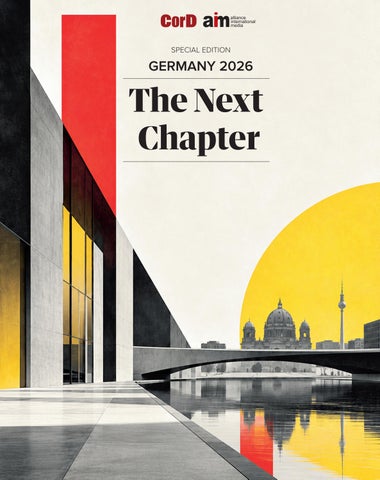
SPECIAL EDITION
GERMANY 2026
The Next Chapter
Content
Germany 2026
06 B eyond the Numbers Comment
18 Responsibility Builds Financial Stability 08 I mplement Odihr Recommendations
24 Culture Knows no Borders Dr Christoph Veldhues
Director of the Goethe-Institut Belgrad
Jelena Jović
Managing Director, EOS Matrix
H.E. Anke Holstein
German Ambassador to Serbia
19 Safe Energy From the Rooftop 12 Trust Must Create New Value
OBO BETTERMANN
26 Art As a Public Act ob Squad and Professor Ana G Vujanović
Filip Simović
President of AHK Serbia
20 A Credible and Constructive Voice Alexander Markus
16 Technology to transform the Everyday for Everyone Goran Milisavljević
General Manager, Siemens Serbia
AHK Serbia Executive Board Member and CEBAC Secretary General
22 Made in Germany, Reconsidered Economy
31 Connected Cities Resource Efficiency Igmako Smart Solutions
WHERE DO YOU STAND WITH YOUR ART? Jörg Immendorff
Uvek više za vaš novac. Dugoročno povoljne cene vaših omiljenih proizvoda.* Saznajte više na dm.rs/uvekpovoljno *
Povoljnost cena proizvoda koji su deo koncepta dm uvek povoljno je u tome da cene neće biti uvećane najmanje četiri meseca od datuma naznačenog na cenovnoj etiketi.
COMMENT
Beyond the Numbers
German-Serbian relations no longer need to prove their strength through statistics. The more important question is whether a partnership built successfully around trade and investment can now generate the knowledge, trust and institutional quality needed for a far more demanding European future ermany’s relationship with Serbia has long been easy to describe in numbers. More than 900 companies with German capital, around 80,000 jobs and bilateral trade exceeding €10 billion provide compelling evidence of its scale. After 25 years of intensive economic cooperation, however, those figures increasingly tell only part of the story. The harder questions begin where the statistics end. German investment helped transform Serbia’s industrial landscape and connect its economy much more closely to European production networks. That achievement should not be underestimated. But neither should it be treated as a guarantee of what comes next. German companies are becoming more selective about new commitments, while Serbia can no longer build its competitiveness primarily on costs, geographical proximity and a skilled workforce. The next chapter will have to be more demanding on both sides. For Serbia, it means competing through knowledge, innovation, institutional reliability and the ability to move higher up European value chains. For German business, it means seeing Serbia not merely as a production location, but increasingly as a place where technologies, products and solutions can also be developed. There is a broader lesson here. Economic integration between Serbia and the EU has in many respects moved faster than political integration. Goods, capital, companies and people cross borders every day, while Serbia’s accession process continues to advance slowly. Germany remains one of the strongest advocates of the Western Balkans’ European fu-
G
06
ture, but support for enlargement has never meant dispensing with conditions attached to membership. That gap between economic proximity and political distance is likely to remain one of the defining questions of the relationship. And yet relations between countries are never built by governments and companies alone. German-Serbian cultural ties reveal another Europe – one in which artists, institutions, students and ideas already move across borders with an ease that politics often struggles to achieve. In a period of growing polarisation, preserving those spaces of encounter may prove just as important as opening another factory or signing another agreement.
A mature partnership should have enough confidence in what has been achieved to ask harder questions about what comes next A mature partnership does not require agreement on everything. It requires enough trust to discuss disagreements, enough shared interest to keep moving forward and enough ambition not to confuse past success with future relevance. German-Serbian relations have accumulated considerable economic and political capital over the past quarter of a century. The challenge now is not simply to preserve it, but to put it to better use. The numbers tell us how much has been built. What comes next will tell us what it is worth.
GERMANY 2026
INTERVIEW
EXCLUSIVE
INTERVIEW
EXCLUSIVE
Implement ODIHR Recommendations Free and fair elections, free media, independent and effective institutions, and the protection of fundamental rights are the benchmarks against which every democracy, here as elsewhere, is measured ~ Anke Holstein H.E. Anke Holstein German Ambassador to Serbia By Ljubica Gojgić
12 08
october
GERMANY 2026
he arrival of the new German ambassador in Belgrade happened to coincide with preparations for extraordinary parliamentary elections, which is why it comes as no surprise that she includes the “intensity of political life” among her first impressions of Serbia. Speaking in this interview for CorD Magazine, she includes as priorities of her term the “further strengthening of excellent bilateral relations, deepening economic cooperation, fostering Serbia’s European perspective by supporting reforms, and contributing to regional stability, including the normalisation of relations between Belgrade and Pristina”.
T
Your Excellency, you‘ve only been in Serbia for a few weeks, though you arrived with considerable knowledge and experience of the region. What are your first impressions of the country; and what priorities have you set for your mandate? — Serbia is a fundamentally European country with a rich history, a dynamic society and great economic potential. Having previously served in Sarajevo, Ljubljana, Tirana and Skopje, I know a bit about the region; the people, culture and natural beauty are all close to my heart. My first weeks here have reminded me of the warmth of the people, the vibrancy of civil society and the intensity of political life. My priorities for this mandate are the obvious ones: further strengthening the excellent bilateral relations between Germany and Serbia; deepening economic cooperation, particularly with German businesses; fostering Serbia’s European perspective by supporting reforms; and contributing to regional stability, including the normalisation of relations between Belgrade and Pristina. Germany will remain a reliable partner throughout these processes. Speaking in a recent interview, you said that Serbia “has all the elements of a democracy”, adding that the benchmarks of democracy include “free and fair elections, free media, independent and effective
cordmagazine.com
institutions, and the protection of fundamental rights”. As you begin your mandate with parliamentary elections looming, do you see these criteria being met in the current pre-election environment? — Serbia has all the formal elements required of a democracy: a constitution, institutions, a multiparty system and elected representatives. These must be put to good use and worked on further in the best spirit of democracy. Free and fair elections, free media, independent and effective institutions, and the protection of fundamental rights are the benchmarks against which every democracy, here as elsewhere, is measured. These standards remain essential in the current pre-election period. We
expect the electoral process to be conducted in line with international recommendations, notably those of ODIHR. Media freedom and the independence of institutions need to be fully respected. Democracy thrives when citizens engage freely and institutions function independently. Progress in these areas is also indispensable for Serbia’s European perspective.
You’ve stated that Serbia belongs in the European Union. Yet its accession process has effectively been stalled for five years at Cluster 3, which both the European Commission and Belgrade have maintained should have been opened some time ago. What is holding Serbia back on its European accession path? — Germany wants Serbia to become a member of the European Union as
soon as possible. The accession process is, however, strictly merit-based. Opening new clusters, including Cluster 3, depends on both technical readiness and sustained progress on the fundamentals, above all the rule of law, judicial independence, the fight against corruption and organised crime, and media freedom. Serbia has demonstrated in recent months that progress is possible when the political will is there. We encourage the continuation of this positive dynamic. Stagnation or regression slows the process. Consistent, irreversible reforms open doors. Germany, as Serbia’s largest bilateral development partner, continues to support these efforts.
As a diplomat with extensive experience in Brussels, where you worked specifically on EU enlargement, you’ve reiterated that there are no shortcuts to EU membership and that every candidate country advances on the basis of its own merits. Yet the history of EU enlargement suggests that geopolitical circumstances often influence decisions on admitting new members, at least in terms of compliance with the Copenhagen criteria. Is geopolitics once again playing such a role today, allowing Ukraine and Albania to advance towards membership faster than Serbia or North Macedonia? — You quoted me correctly. There are no shortcuts to EU membership. Every candidate country advances on its own merits in accordance with the Copenhagen criteria, including the adoption of the Acquis Communautaire, the huge collections of accumulated EU legislation and legal acts. Of course, geopolitical considerations can create a favourable context and strengthen the political will on all sides, but they do not replace the need for reforms. Montenegro and Albania have recently shown that focused, determined reform efforts and overarching agreement on the path forward can produce tangible results and accelerate the process. This opportunity is there for Serbia
cordmagazine.com
13 09
ELECTIONS
REFORMS
CONTINUITY
Free elections, free media and independent institutions remain essential democratic standards
Serbia’s path to EU membership depends primarily on the speed and consistency of its reforms
Political change in Germany will not alter its commitment to the Western Balkans
as well. Germany remains committed to a credible, merit-based enlargement policy for the entire Western Balkans. Serbia belongs in the European Union. When the country will get there depends primarily on the speed of its reforms.
Speaking about Kosovo, you’ve insisted on establishing the full circumstances surrounding the armed clash in Banjska. How do you view the recent actions of the Pristina authorities at Lake Gazivode and the destruction of property belonging to Serbs? — Bringing clarity to the circumstances surrounding the armed clash in Banjska remains essential for Serbia’s credibility and also for the credibility of the dialogue process. We expect a thorough, transparent investigation and full cooperation with the relevant bodies. Regarding recent actions by the Pristina authorities at Lake Gazivode and the demolition of property, Germany and the EU are monitoring the situation closely. We have called for restraint and urged all sides to refrain from unilateral actions that tend to raise tensions. All open issues shall be dealt with through the EU-facilitated dialogue on the basis of existing agreements, including those reached in Brussels and Ohrid. Both parties shall engage in good faith, protect the rights of all communities and facilitate stability and reconciliation. The future of the entire region lies in the EU. Your statements that German investors remain interested in Serbia are certainly encouraging, given that German companies are among the country’s largest employers. Which sectors of the Serbian economy are attracting the greatest interest from potential new German investors? — It is indeed true that more than 900 companies with German capital already
14 10
october
operate here, employing around 80,000 people. Sectors that attract the greatest interest remain those in which German knowhow meets Serbian manufacturing capabilities and include automotive components and e-mobility, machinery and industrial equipment, information and communication technologies and digitalisation, renewable energy and energy transition, pharmaceuticals and healthcare-related manufacturing. The combination of a skilled workforce, geographical proximity to European markets and Serbia’s EU accession prospects continues to make the country an attractive location for
The EU, Germany and Serbia share a strategic interest in securing the critical raw materials needed for the green transformation and resilient European industries long-term investment. However, maintaining this attractiveness requires remaining focused on reforms. Predictable policymaking, reliable and transparent institutions, including a strong and independent judiciary, are prerequisites for a thriving business environment. These are vital if Serbia not only wants to maintain its competitiveness, but also to move closer to the EU – since up to 80% of the EU acquis is related to the common market.
Former German Chancellor Olaf Scholz advocated strongly in favour of developing Serbia’s mining sector, including through his support for an international mining corporation. Is mining a sector in which German investors are interested in investing in Serbia?
— The European Union – including Germany – and Serbia share a strategic interest in the secure and sustainable supply of the critical raw materials needed for the green transformation and resilient European industries, especially e-mobility. Lithium and other critical minerals are being discussed in this context. Any envisaged project must meet the highest environmental, social and legal standards. Decisions on specific mining projects remain with Serbia. Germany stands ready to contribute expertise on sustainability, transparency and responsible resource management within the framework of the EU-Serbia strategic partnership on raw materials. Public acceptance and strict adherence to European environmental standards are indispensable.
During Angela Merkel’s chancellorship, the Western Balkans – and Serbia in particular – appeared to occupy a prominent place in German foreign policy. Since then, however, that focus seems to have shifted towards other regions, while the Berlin Process has become less prominent. Will the political changes we are witnessing in Germany also bring a new policy towards the Western Balkans? — The Western Balkans – and Serbia in particular – remain a priority for German foreign policy. The Berlin Process continues to deliver tangible results for citizens of the region, from connectivity and the Common Regional Market to energy cooperation and people-to-people contacts. The current German Government has reaffirmed its strong commitment to the European perspective of the Western Balkans and to a credible enlargement policy on many occasions. Our approach is marked by continuity and reliability: Serbia can count on Germany as a close partner on its European path.
GERMANY 2026
konstruktorgrupa.com
WE CONSTRUCT YOUR VISION DESIGN AND BUILD
PRODUCTION COMPLEXES
1M+ S Q UA R E M E T E R S B U I LT
LO G I S T I C S CENTERS
T U R N - K E Y S O LU T I O N S
R E TA I L PA R K S
RESIDENTIAL AND B U S I N E S S FAC I L I T I E S
I N H O U S E S O LU T I O N S
AG R I C U LT R U R A L FAC I L I T I E S
250+
200+
1.000+
70+
P R OJ E C T S COMPLETED
DIRECT E M P LOY E E S
INDIRECT E M P LOY E E S
ENGINEERS OF ALL PROFILES
ENGINEERING FAC I L I T I E S
INTERVIEW | FILIP SIMOVIĆ PRESIDENT OF AHK SERBIA
Trust Must Create New Value After 25 years of intensive German-Serbian economic cooperation, the relationship is ready to enter a new phase. Filip Simović sees its future in greater predictability, innovation and knowledge, deeper integration into European value chains and an investment environment capable of turning long-established trust into higher added value
s he takes over as President of AHK Serbia in this anniversary year, Filip Simović sees the trust built between companies, institutions and business communities as the foundation for a new phase of cooperation – one increasingly driven by R&D, innovation, technology and knowledge.
A
This year marks 25 years of intensive German-Serbian economic cooperation and the 10th anniversary of the German-Serbian Chamber of Commerce. Looking back, what 12
would you identify as the greatest achievement – and what should define the next decade? — The greatest achievement is that German-Serbian economic relations have evolved from individual investments into a genuine business ecosystem. Today, more than 900 companies with German capital operate in Serbia, contributing to employment, industrial development, exports, technology transfer and the development of local management and supplier capabilities. In 2025, bilateral trade exceeded €10 billion, demonstrating the scale and depth of this relationship. GERMANY 2026
For me, however, the most important achievement goes beyond these numbers. It is the trust that has been built between companies, institutions and business communities on both sides. German companies increasingly see Serbia as a place where they can build long-term operations, while Serbian companies are becoming more integrated into German and wider European value chains. The next decade should build on that foundation and take the relationship further up the value chain – towards more R&D, technology transfer, innovation, engineering and university cooperation, alongside stronger participation of Serbian suppliers in European industrial ecosystems. You are taking over as President of the Chamber in this anniversary year. What priorities would you like to set during your mandate, and where can AHK become an even stronger voice for its more than 460 members? — My priority is to ensure that AHK Serbia remains closely connected to the reality in which our member companies operate, while also helping them prepare for the economy that is coming. A modern chamber must do more than represent business interests. It must understand where the economy is heading, identify emerging challenges early and create connections that generate opportunities. I see particular potential in competitiveness, industrial transformation, technology and innovation, the labour market, skills, infrastructure, logistics and Serbia’s deeper integration into the European economic space. I also want AHK to strengthen connections between the German and Serbian business communities beyond the traditional investment model. There is significant scope for joint innovation, research cooperation, digital transformation and new business models. As a CEO, I know that companies need predictability, speed and access to the right people and information. As President of the Chamber, I see it as our responsibility to help create that environment. The experience of our more than 460 members should inform economic dialogue and their challenges should be translated into concrete proposals. This year’s AHK survey shows that 77% of German companies would choose Serbia again as an investment location, compared with 88% a year earlier. You have said that you are particularly interested in the 23% who responded negatively. What are they telling us? — The 77% figure is encouraging, but the 23% matters enormously. Those companies are telling us that potential alone is not enough. Investors make decisions based on their everyday experience of the business environment – how predictable the rules are, how quickly institutions respond, how contracts are protected, how transparent procedures are and whether they can plan several years ahead with confidence. The decline from 88% to 77% should therefore be treated as a signal, not simply as a statistic. Serbia has built a strong investment story over the past two decades. The greatest risk now would be to assume that this success will automatically continue. cordmagazine.com
For me, the 23% represent an important opportunity for dialogue. We should ask them very directly: What happened? What did you experience? What would have to change for you to invest again? Listening carefully to those answers can help us identify problems before they become structural. German companies continue to identify legal certainty, predictable economic policy, efficient public administration, transparent public procurement and political and social stability as key challenges. What changes would have the most immediate impact on a new investment cycle? — The first requirement is predictability. Companies can operate in difficult environments if they understand the rules and can plan around them. What is much harder to manage is uncertainty about what those rules will be tomorrow. I would focus on three things: greater consistency in the application of regulations and stronger institutional predict-
Investor confidence is accumulated slowly and can be lost surprisingly quickly. Maintaining it requires predictable rules, consistent institutions and continuous dialogue with business. ability; faster and more digital public administration, because every unnecessary administrative step ultimately becomes a cost for business; and greater transparency and competition in public procurement. These are not demands specific to German companies. They are the foundations of a competitive modern economy. Serbia has already demonstrated that it can move quickly when there is a clear strategic priority. The next step is to make that speed and predictability part of everyday institutional performance. German-Serbian cooperation has traditionally been built around industry and manufacturing. Is the next phase likely to place greater emphasis on R&D, AI, digital transformation and knowledge – and less on cost advantages? — Absolutely. Cost competitiveness can attract an investment. It cannot sustain a competitive economy indefinitely. Serbia’s next opportunity is to become increasingly valuable because of the quality of its people, technology, engineering capabilities and capacity for innovation. The first generation of German investment helped build industrial capabilities and integrate Serbia into European production networks. The next generation can take this further – into R&D, advanced manufacturing, engineering, software, artificial intelligence, automation and technology-driven services. 13
That requires stronger connections between companies, universities and research institutions. Industrial transformation is accelerating, while AI and automation are changing production, logistics, energy management and virtually every major business process. For Serbia, this represents an opportunity to move from being primarily a location for production to becoming a location where products, technologies and solutions are also developed. That is why I see knowledge as economic infrastructure. Your professional background is in logistics. With the 90/180-day rule for professional drivers again threatening disruption at border crossings, how seriously can such administrative barriers affect Serbia’s competitiveness and regional supply chains? — Logistics makes the interdependence of European economies very visible. A truck may carry components, raw materials or finished products, but behind every shipment there is a production schedule, a customer commitment and a wider supply chain. That is why the 90/180-day rule has implications well beyond transport. When professional drivers cannot operate across borders with the continuity their profession requires, transport capacity is reduced, delivery schedules become less predictable and costs increase across the value chain. In other forms of transport, professionals such as pilots and train drivers are already treated differently because
Serbia’s next opportunity is to compete through the quality of its people, technology and capacity for innovation, moving from production towards developing products and solutions. their work requires continuous cross-border mobility. Professional road drivers perform a comparable role in keeping European supply chains moving, and their specific working pattern should therefore be recognised in the regulatory framework. We need a practical solution that recognises the specific position of professional drivers while a sustainable long-term European framework is being developed. For Serbia, this is also a competitiveness issue, because reliability is increasingly becoming a factor in investment decisions, alongside cost, skills and infrastructure. After 25 years of partnership, what would represent its true success ten years from now: more German investment, more Serbian companies in European value chains, more joint technology projects – or deeper integration into the EU Single Market? 14
— I would not choose one of these. I see them as parts of the same ambition. Ten years from now, I would like to see more German companies developing in Serbia, not simply operating here; more Serbian companies integrated into German and European value chains; more joint R&D and technology projects; stronger links between universities and industry; and a business environment in which European market integration is increasingly a practical reality. EU membership is an important strategic objective, but economic integration is already happening every day through companies, supply chains, investment, technology and people. For me, the ultimate measure of success will be whether Serbia has become more competitive, more innovative and more deeply connected to the European economy – and whether German companies see Serbia as a place where the next generation of European business can be built. GERMANY 2026
Technology to Transform the Everyday for Everyone Automation, industrial AI and sustainable technologies are opening a new phase in the transformation of Serbia’s economy, with Siemens seeing opportunities for growth precisely in linking digitalisation with greater productivity and competitiveness fter three decades with Siemens, Goran Milisavljević took over the leadership of the company in Serbia this year, at a time of accelerating industrial and energy transformation. He speaks to CorD about his priorities, the readiness of Serbian companies for the next phase of digitalisation and technologies that can simultaneously improve productivity, energy efficiency and business sustainability.
A
16
After three decades with Siemens, you took over as General Manager of the company in Serbia this year. What priorities have you set for your new role and where do you see the greatest potential for further growth on the Serbian market?
Photo by Nebojša Babić
INTERVIEW | GORAN MILISAVLJEVIĆ GENERAL MANAGER, SIEMENS SERBIA
— After three decades with Siemens, I see this new role as both a great privilege and a great responsibility. I have had the opportunity to grow alongside the company and today have a clear picture of where we can make our next leap forward. My focus is on three areas: building even closer relationships with customers, developing our people and further strengthening our business performance. My priority is to continue building Siemens as a trusted partner to our customers, with an even stronger focus on their needs and challenges. We will work particularly on further developing our ONE Sales approach, intensifying cooperation with key clients and strengthening Siemens’ position as a company that delivers technology with a clear purpose and measurable value. At the same time, the success of every company ultimately depends on its people. That is why employee development, wellbeing, an inclusive culture and continuous learning are among my most important priorities. I want everyone on the Siemens team to have the opportunity to develop their potential and contribute to our shared results through a GERMANY 2026
culture of trust, responsibility and open communication. When it comes to growth potential, Serbia is undergoing a significant industrial transformation. An increasing number of companies are investing in automation, digitalisation and sustainable technologies. This is where Siemens can deliver the greatest value, as we have the knowledge, experience and technologies to help companies become more productive, resilient and competitive.
Photo by Nebojša Babić
Siemens today strongly integrates automation, digital twin and industrial AI. How ready are Serbian companies for the next phase of digital transformation, and where do you see the greatest potential for Siemens technologies to improve their productivity and competitiveness? — Over recent years, we have seen significant progress in the Serbian economy’s understanding of the importance of digitalisation. More and more companies no longer view digital transformation as a technology project, but as a strategic investment that directly impacts competitiveness, product quality and operational efficiency. I am proud of the many projects we have already implemented in Serbia, yet there remains considerable scope for further development. I see the greatest potential in integrating automation, industrial software, digital twin and artificial intelligence. A digital twin enables companies to simulate products and processes before production begins, reducing development costs and time to market. Industrial AI, meanwhile, opens up opportunities for predictive mainte-
cordmagazine.com
nance, production optimisation, quality improvements and greater energy efficiency. A particularly interesting example is Siemens’ new AI tool for industrial automation, the Eigen Engineering Agent, available to more than 600,000 users of the TIA Portal platform. Put simply, TIA Portal is to automation what CAD tools are to design, while this agent goes beyond providing recommendations to autonomously planning, configuring and validating specific engineering tasks. It is easy to imagine how significantly its use can accelerate development and system commissioning. This demonstrates just how quickly artificial intelligence is moving from experimentation to concrete business applications. These technologies are no longer reserved solely for the largest systems. To-
need for a more efficient and sustainable Serbian industry? — Siemens has been part of Serbia’s development for 140 years, and I believe we can also play an important role in the next phase of its transformation. Our strength lies in combining global experience and cutting-edge technologies with a strong local team of engineers who provide our customers with support every day. From the digitalisation of industry and infrastructure to the green transition, together with our partners we are already building a more sustainable and competitive future. That is precisely why, when we talk about the energy transition, we are not talking about the future – it is happening now. At the same time, companies are under pressure to become both more sustaina-
Sustainability is demonstrated not by slogans, but by data, concrete indicators and clear targets day, medium-sized companies can also use digitalisation to increase production flexibility, manage resources more effectively and respond to the demands of global markets. Our role is to help them make that journey faster and with less risk, relying on Siemens as their digital transformation partner. As a German company with a long-standing presence in Serbia, Siemens is both an industrial partner and part of the broader modernisation of the economy. What new opportunities are being created by the energy transition, decarbonisation and the
ble and more profitable. The good news is that these two objectives are no longer contradictory. An increasing number of companies also recognise that sustainability is not merely about meeting regulatory requirements, but is a way to reduce costs, increase business resilience and strengthen their market position. One of the great advantages of our time is that we can measure the impact of technology with exceptional accuracy. When it comes to digital transformation, for example, Siemens’ global data show that its technologies have enabled customers to avoid 694 million metric tonnes of CO₂e cumulatively as of 2025, demonstrating that digitalisation and sustainability go hand in hand. At the same time, around 90% of Siemens’ business directly helps customers improve their sustainability impact, confirming that technology today is not only about efficiency, but also about long-term competitiveness. Perhaps it is an occupational trait shared by all engineers, but I like facts and measurable results. That is why I believe sustainability is demonstrated not by slogans, but by data. Siemens’ DEGREE framework enables precisely that – measuring progress through concrete indicators and clear targets. It is an approach that transforms sustainability from a good idea into a business discipline. 17
INTERVIEW | JELENA JOVIĆ
MANAGING DIRECTOR, EOS MATRIX
Responsibility Builds Financial Stability Digitalisation and artificial intelligence are transforming receivables management, but sustainable solutions still require an understanding of people. EOS Matrix therefore combines technology and the experience of Germany’s EOS Group with in-depth knowledge of the local market Behind every receivable is a person or company with its own story. We therefore view technology not as a substitute for human interaction, but as a tool that helps our teams make better decisions and engage in more meaningful dialogue with debtors. Our goal is not merely more efficient debt collection, but to find sustainable solutions that create value for creditors while giving debtors a genuine opportunity to regain financial stability.
mproved payment discipline in Serbia does not mean that risks have disappeared. In periods of economic uncertainty, the consequences of late payments can quickly spread from one company to another. Jelena Jović, Managing Director of EOS Matrix, explains how technology is making receivables management more efficient, why human interaction remains indispensable and where she sees opportunities for further market development.
I
The latest EOS Group survey shows that one in four invoices in Europe is paid late or remains unpaid. How is payment discipline changing in Serbia and what poses the greatest risk to the domestic economy today? — Payment discipline in Serbia is significantly better today than it was a decade ago, thanks to an improved regulatory framework, digitalisation and greater financial responsibility. Challenges nevertheless remain, particularly during periods of economic uncertainty. The greatest risk is no longer simply late payment, but its knock-on effects on liquidity, investment and the ability to plan future development. In such circumstances, it is particularly important to have a partner who understands the interests of creditors while also considering the circumstances of debtors. Over more than two decades of operating in Serbia, EOS has established itself as a credible partner in 18
finding sustainable solutions that enable creditors to protect their interests while helping debtors overcome financial difficulties and move forward. Digitalisation enables faster, more efficient and transparent receivables management, yet only a small percentage of European companies have fully digitalised these processes. How does EOS Matrix use data, automation and AI while maintaining an individual approach to clients and debtors? — Technology enables us to work more efficiently, but it can never replace an understanding of people and their individual circumstances. We use advanced digital tools, automation and artificial intelligence every day to process large volumes of information and identify the most appropriate approach for each individual case.
EOS has operated in Serbia for more than two decades as part of Germany’s EOS Group. How does the Group’s international experience help you develop locally tailored solutions, and where do you see the greatest opportunities for further growth? — Being part of the international EOS Group gives us access to knowledge, technology and best practices developed across numerous markets. At the same time, our long-term success in Serbia is based on understanding the local market, business environment and the needs of our partners. We believe the market’s next phase of development will be shaped by further digitalisation and a growing need for sustainable receivables management. There is also increasing recognition that successfully resolving debt is not only about recovering funds for creditors, but also about giving debtors a second chance to regain financial stability and become active participants in the economy. We see the balance between financial results, responsible business and long-term sustainability as the greatest opportunity for the further development of both the market and our company. GERMANY 2026
Safe Energy From the Rooftop From PV module mounting to protection against lightning, fire and mechanical damage, OBO Bettermann provides integrated solutions for reliable, long-lasting photovoltaic installations.
OBO offers a complete system for the electrical requirements of photovoltaic installations, alongside flexible, future-oriented installation solutions. These include innovative mounting systems for pitched and flat roofs and free-standing installations: the Magic PV system. Most pitched-roof systems are installed on existing buildings. PV modules are attached to roof rafters using metal roof hooks, mounting rails and module clamps. Photovoltaic systems can also be installed on flat roofs, allowing PV modules to be mounted independently of the roof’s orientation. Products for flat and pitched roofs can be combined, significantly reducing the number of individual components required. When retrofitting, integrating a photovoltaic system into a building’s existing lightning protection concept is often overlooked, significantly increasing the risk of damage from direct lightning strikes. OBO systems safely intercept lightning strikes and conduct them to earth. These include air-termination rods, round and flat conductors and their holders, the insulated isCon® lightning protection system and related accessories. Outdoor cables are particularly exposed to weather conditions. Rain, snow, heat, UV radiation and wind constantly impact
Weishaupt doo Beograd Omladinskih brigada 88 11070 Beograd
tel: +381 11 35 33 430 e-mail: info@weishaupt.rs www.weishaupt.rs
www.linkedin.com/company/weishauptbeograd cordmagazine.com
photovoltaic systems. OBO cable support systems combine optimum protection with quick and easy installation. Cables are also exposed to mechanical stress that can cause system failure. OBO products provide reliable cable protection from roof to inverter. Wall and ceiling trunking is complemented by suitable fittings, while plastic and metal systems protect the cables. Fire protection and preventing the spread of fire are key installation priorities. In the event of fire, the insulation system prevents it from spreading via photovoltaic cables. Planning photovoltaic systems and electrical installations requires expertise and reliability. With OBO Bettermann, you have a partner committed to providing both.
Innovative systems for door and window technology www.geze.com 19
INTERVIEW | ALEXANDER MARKUS AHK SERBIA EXECUTIVE BOARD MEMBER AND CEBAC SECRETARY GENERAL
A Credible and Constructive Voice
As companies become more selective about new investments, predictability, reliable institutions and competitiveness are gaining importance. Alexander Markus explains why European businesses need practical solutions – from professional driver mobility and green energy to a stronger collective dialogue with Serbia and the EU by weaker European growth, geopolitical uncertainty, decarbonisation and changing regulation, he argues that Serbia’s ability to offer predictability will increasingly determine its competitiveness. This year’s AHK Business Climate Survey suggests that German companies are becoming more cautious, despite remaining committed to Serbia. What has changed most in their assessment of the business environment? — What has changed is not companies’ fundamental interest in Serbia, but the caution applied to new commitments. Investment and expansion plans are more selective, with greater attention to predictability and resilience. There is no single cause: weaker European growth, pressure on German industry, geopolitical uncertainty and higher costs all influence decisions. However, domestic conditions determine how successfully Serbia competes for available investment. Legal certainty, predictable economic policy, efficient administration, transparent procedures and social stability directly affect investment decisions. Serbia retains strong advantages, but companies need confidence to plan for the long term. or a quarter of a century, AHK Serbia has worked at the intersection of German-Serbian economic cooperation, helping companies navigate an increasingly complex business environment. Today, that role is expanding further, as the Chamber assumes the secretariat of CEBAC and European businesses in Serbia seek a stronger collective voice. For Alexander Markus, the goal is not to be the loudest participant in the debate, but to ensure that business experience is translated into workable solutions. In an environment shaped
F
20
AHK Serbia assumed the secretariat of CEBAC this July, while you were appointed its Secretary General. What would you like to achieve during your mandate, and how can the collective voice of 13 organisations representing more than 1,500 companies strengthen dialogue with Serbia and the EU? — Our first objective is to institutionalise CEBAC through its formal establishment under Serbian law, giving it a clear legal identity, transparent governance and long-term continuity. Our second priority is to place CEBAC on a financially stable and sustainable basis, because a GERMANY 2026
strong collective voice requires reliable structures and resources. We also want to develop CEBAC into an operational, solution-oriented platform. Its value lies not only in representing more than 1,500 companies, but in identifying common priorities and translating them into practical recommendations. When 13 European business organisations identify the same obstacle, it points to a structural issue affecting Serbia’s competitiveness and European integration. CEBAC should be a bridge in both directions: conveying business experience to the Serbian Government and showing EU institutions how European policies affect companies in candidate countries and integrated supply chains. European business organisations have taken a joint position on the application of the 90/180-day rule and the Entry/Exit System to professional drivers from the Western Balkans. How serious is the risk to supply chains, and what would constitute a sustainable European solution? — The risk is immediate and significant. Professional drivers from the Western Balkans are essential to European production and logistics networks. Applying the 90/180-day limit without an appropriate mobility framework reduces transport capacity when the sector already lacks qualified drivers. The EES did not create the rule, but it makes enforcement systematic, turning a legal mismatch into an acute economic problem. The consequences include production delays, higher costs, contractual penalties and the possible relocation of orders. A sustainable solution must be European, not a patchwork of national arrangements. It should preserve the integrity of Schengen while recognising highly mobile professionals, for example through a harmonised exemption, dedicated authorisation or specific long-stay arrangement valid across the Schengen area. Drivers should be controlled and registered, but not treated like tourists when their work keeps European goods moving. When we spoke two years ago, you warned that CBAM and rising carbon costs would dramatically increase demand for green energy in Serbia. Have Serbian companies responded quickly enough, and how important will access to reliable green energy be to their competitiveness in the EU? — Two years ago, many companies viewed CBAM mainly as a future reporting obligation. cordmagazine.com
Today, it is a commercial reality. For Serbian exporters in carbon-intensive sectors, emissions are becoming part of the price of access to the EU market. Awareness has increased, but preparedness remains uneven. Larger exporters generally began measuring emissions and examining renewable electricity procurement earlier. Many smaller suppliers still need expertise, reliable data, financing and realistic investment pathways. Decarbonisation requires energy efficiency, cleaner processes, verifiable emissions data and long-term access to low-carbon electricity. Reliable green energy will be decisive for Serbia’s industrial competitiveness. European customers increasingly assess suppliers not only on
Companies’ fundamental interest in Serbia has not changed, but new commitments are more selective. Predictability and confidence are increasingly decisive for long-term investment decisions price, quality and delivery, but also on embedded emissions. Companies with stable access to traceable renewable electricity will strengthen their position in European supply chains. Green energy is therefore no longer only an environmental objective; it is industrial infrastructure and a condition for export competitiveness. AHK Serbia is active in areas ranging from technology, hydrogen and energy efficiency to dual education and supply chains. As the Chamber marks its tenth anniversary, how do you see its role evolving over the next decade? — The Chamber may be celebrating its tenth anniversary, but our team has been supporting German-Serbian economic cooperation for a quarter of a century. And we have been doing exactly what you describe from the very beginning, although perhaps in a different way from some others. Our role is not to be the loudest voice in the room. It is to be a credible and constructive one. We prefer direct dialogue to public campaigning and focus on solving concrete problems rather than claiming ownership of solutions. If a proposal originating from the business community is eventually adopted by policymakers, we consider that a success. What matters is not who receives the credit, but whether the problem has actually been solved. 21
ECONOMY
Made in Germany, Reconsidered For decades, “Made in Germany” stood for a remarkably successful industrial formula. That formula is not disappearing, but it is being rewritten as energy, AI, demographics and global competition change what it takes to remain one of the world’s great industrial economies ew national labels carry as much economic meaning as Made in Germany. Three words came to represent precision engineering, industrial reliability and a particular conviction that things should be built properly, last a long time and work exactly as promised. Behind the label stood an equally recognisable economic model: a powerful manufacturing base, highly specialised Mittelstand companies, world-class engineering and an export machine capable of selling sophisticated products almost everywhere. That industrial identity remains unusually strong. Industry accounted for 22.9 per cent of German gross value added in 2025, compared with 19.2 per cent across the EU. Yet after two years of recession, the German economy grew by just 0.2 per cent in 2025, with exports declining and investment in machinery, equipment and construction remaining weak. The question is therefore no longer whether Germany still knows how to make things. It plainly does. The more interesting question is what it will need to do differently to remain competitive.
F
n Industrial Model Under Pressure A There is no single explanation for Germany’s recent weakness. The Federal Government points to high energy and bureaucracy costs, infrastructure investment backlogs, taxation and labour costs, demographic pressure and a more difficult geopolitical and trade environment. By September 2026, the picture remained mixed. Industrial production fell 1.1 per cent in July compared with June and was 1.6 per cent below its level a year earlier. Manufacturing orders increased, but the Economy Ministry cautioned that prospects for a broad industrial recovery remained limited. China adds another dimension. Once seen primarily as an extraordinary market for German industry, it is increasingly 22
also a competitor in sophisticated industrial sectors. German exports to China fell sharply month-on-month in July, even as total exports remained higher than a year earlier. Excellence in manufacturing remains an advantage. It is simply no longer a moat.
When Mittelstand Meets AI Germany’s next industrial transformation may be less visible than previous ones. Its Mittelstand – the ecosystem of often family-owned companies specialising in everything from machine tools and sensors to industrial components – remains one of the country’s great economic assets. Their next productivity breakthrough, however, may come from software rather than steel. In 2025, 26 per cent of German companies were using artificial intelligence, rising to 57 per cent among companies with at least 250 employees. Smaller businesses lagged behind, while lack of knowledge, legal uncertainty and data-protection concerns remained important barriers. Germany does not necessarily need to become Europe’s imitation of Silicon Valley. Its particular opportunity may be to combine something it already possesses in abundance – industrial knowledge accumulated over generations – with AI, robotics, software and data. And it is hardly starting from an empty laboratory. Research and development expenditure reached €137.1 billion in 2024 – the latest full-year data available – equivalent to a record 3.17 per cent of GDP. The ingredients for innovation are present. The harder question is how quickly they can be translated into productivity and commercial success. GERMANY 2026
Germany does not need to abandon its industrial model. It needs to decide which parts are principles – and which are habits
People Are Also Infrastructure Machines and algorithms are only part of the equation. According to the Federal Employment Agency’s latest shortage analysis, published in September 2026 and covering 2025, shortages persisted in 157 occupational categories. Half of registered vacancies for skilled workers, specialists and experts were in shortage occupations. At the same time, more workers are reaching retirement age than younger people are entering the workforce. The share of foreign workers in shortage occupations has doubled since 2014, from seven to around 14 per cent, making immigration increasingly important to Germany’s labour supply. For a country accustomed to thinking of infrastructure as railways, bridges and power grids, human capital may prove just as strategic. The Energy Equation Germany has already transformed its electricity mix dramatically. Renewables accounted for 58.8 per cent of electricity fed into the public grid in 2025, with wind remaining the largest source and solar generation rising strongly. Yet greener electricity does not automatically mean cheaper industrial energy. The Federal Government continues to identify high energy costs as a structural disadvantage for Germany as a business location. That tension is central to the next phase of the Energiewende. Decarbonisation, energy security and industrial competitiveness can no longer be treated as separate conversations. For energy-intensive companies, the energy system is effectively part of the factory. Green energy is therefore becoming more than climate policy. It is industrial policy. cordmagazine.com
einventing Without Starting Again R Germany is responding with investment on a scale that reflects the challenge. Its Special Fund for Infrastructure and Climate Neutrality provides borrowing authorisation of €500 billion over 12 years, from 2025 to 2036, for additional investment in infrastructure and the path towards climate neutrality. Money alone, however, cannot reinvent an economic model. Perhaps the more difficult adjustment is cultural. The qualities traditionally associated with German industry – precision, reliability, careful planning and incremental improvement – remain formidable strengths. But AI, technological disruption and geopolitical uncertainty also reward speed, experimentation and a willingness to launch something before version one has achieved perfection. That does not mean abandoning the German model. It means deciding which parts of it are principles and which are habits. Made in Germany is unlikely to lose its value. Few economies possess Germany’s combination of industrial depth, engineering expertise, research capacity and accumulated manufacturing knowledge. But the label may gradually come to promise something broader than the place where a physical product was assembled. The next Made in Germany may increasingly mean invented, engineered, coded, produced and continuously improved in Germany. For an economy that built much of its prosperity on making excellent things, the next chapter may depend on becoming equally good at reinventing how they are made. 23
INTERVIEW | DR CHRISTOPH VELDHUES DIRECTOR OF THE GOETHE-INSTITUT BELGRAD
Culture Knows no Borders Culture can create spaces in which political deadlocks are temporarily suspended, while also challenging nationalism, disinformation and social division hree years after our first interview with Dr Christoph Veldhues, Director of the Goethe-Institut Belgrad, we return to the role of cultural dialogue in a more polarised Europe. He discusses Serbia’s vibrant international cultural links, the need to strengthen cultural life beyond major cities, regional cooperation and culture’s contribution to a European future.
T
When we spoke in 2023, you said that “dialogue is key” to the Goethe-Institut’s work. Three years on, what has that dialogue taught you about Serbia’s cultural scene and your priorities? — “Cultural dialogue” is, in a word, the mission of the Goethe-Institut. We don’t put on a “Germany show”, but bring together artistic and civil society leaders in Serbia, Germany and around the world, facilitating exchange between partners. I’ve learned that Serbia’s arts scene is already exceptionally well connected internationally, particularly with Germany. The Goethe-Institut hardly needs to initiate anything, but can support this collaboration through programmes such as the International Cooperation Fund and Culture Moves Europe. This November, we are also organising a visit by 20 German museum directors to meet their Serbian counterparts. Our audiences have very different expectations. Alongside the arts – GoetheFEST, concerts, readings, exhibitions and talks – I find a broader concept of culture particularly exciting, encompassing urbanism, sustainability and diversity. Projects such as Urban Utopias, the planned ecology project Kriva Drina and Mlada partizanka, focusing on the progressive women’s movement in early Yugoslavia, 24
GERMANY 2026
show how these themes translate into concrete cultural work. Our priorities are therefore to address a broad cultural spectrum, focus on current issues and foster active collaboration among artists. You have sought to reach beyond Belgrade through initiatives such as Beyond the Cities, the Muzikon Caravan and Films on the Road. How can such projects create lasting cultural infrastructure? — The Goethe-Institut is well represented in Belgrade and the major cities, which makes our work in rural areas all the more important. There is a significant gap and great need there; it is precisely there that culture can and must fulfil its emancipatory role. At event level, Muzikon Karavan and Films on the Road bring concerts and films to small towns and villages, while we also support rural festivals such as ARLEMM and Polja. In the long term, however, the focus must be on building self-sustaining cultural structures. Beyond the Cities surveys communities of former Yugoslav artist colonies, assesses their needs and uses peer-led workshops to help create a functioning network of residency programmes in rural areas. Mentoring programmes for young artists,
tut pursues this approach through projects such as True Lies, which strengthens students’ resilience to manipulation in Serbia and Montenegro, and Fakeless, which exposes mechanisms of disinformation. Supporting the alternative theatre festival neBITEF is likewise a decision that reflects the times. Can art genuinely influence how Western Balkan societies confront their shared past, or does it too often remain within like-minded circles?
Culture may develop from the past, but it is oriented towards the future such as Conditio humana and the School of Unintentional Listening, also contribute to sustainable cultural development. Can culture preserve space for dialogue at a time of growing political polarisation – and where are the limits of cultural diplomacy? — Culture has two roles. Through art, it can create “transpolitical” alternative spaces in which political deadlocks are at least temporarily suspended and which can be experienced by people who, outside the art world, may no longer even want to speak to one another. At the same time, culture cannot avoid being politically engaged: it must take a stand, identify social shortcomings and point to alternatives. The Goethe-Insticordmagazine.com
— Contributing to cultural integration and cooperation within the shared experiential space of the Western Balkans – the former Yugoslavia – is a major priority for us. Yet my impression is that, for the younger generation and most cultural practitioners, this integration has long been achieved. Thinking across borders is normal for them; only the “die-hards” remain confined to narrow national categories. Balkan Affairs, featuring seven young composers from all the former Yugoslav states, is a wonderful example of shared reflection on the Balkan wars and their aftermath. Most Goethe-Institut Belgrade activities now involve participants from across the Western Balkans. Culture should also open itself more to audiences who are not particularly
interested in the arts. To counter populism, high culture cannot appeal only to a small elite; it must itself become more accessible – more “popular”. In 2023, you described Serbia as being “in the heart of Europe”. With EU accession still moving slowly and Europe increasingly polarised, are you equally optimistic today? — I continue to believe that Serbia’s EU integration is sensible, feasible and ultimately inevitable. However, I have the
impression that some in the country are currently setting a different course that is incompatible with the EU – for example, by provocatively celebrating the wrong “heroes”. This reinforces social polarisation between nationalism rooted in the past and a European vision for the future, while diminishing the EU’s willingness to recognise Serbia as a full-fledged partner. This conflict is often more about emotions than factual arguments. Culture can help strengthen a sense of European belonging by drawing on two of its strengths. In the temporal dimension, culture may develop from the past, but it is oriented towards the future: it can turn over a new leaf, and the title of that new chapter is Europe. In the spatial dimension, culture is always open; it knows no borders and has no need for them. Socalled “national culture” is merely a contribution to global culture. The European reference point should, in my view, be Serbia’s defining orientation within it. 25
INTERVIEW | GOB SQUAD AND PROFESSOR ANA VUJANOVIĆ
Art as a
Public Act 26
20
GERMANY 2026
GERMANY 2026
Artistic autonomy is never guaranteed – it depends on the ability to question structures, share responsibility and defend spaces for critical thought. Gob Squad and Ana Vujanović discuss collective practice, institutional independence and what ne:BITEF reveals about the power – and limits – of self-organisation
cordmagazine.com
cordmagazine.com
27
21
hen Gob Squad withdrew from institutional BITEF but subsequently chose to take part in ne:BITEF, the decision opened a larger question: what does it mean to defend artistic freedom without abandoning the community built around a public institution? In conversation with CorD, Gob Squad and Professor Ana Vujanović reflect on censorship and solidarity, collective authorship and self-organisation, while revisiting Before Your Very Eyes – a work first presented at BITEF more than a decade ago and newly resonant in an age of constantly constructed identities.
W
Gob Squad declined to participate in this year’s institutional BITEF, yet you chose to come to Belgrade and meet the audience through ne:BITEF. What distinction do you draw between withdrawing from an institution whose artistic autonomy has been compromised and continuing to support the cultural community that grew around it? GS: The distinction is one of artistic independence and “open structures”, which is extremely important at this current moment, when everyone across Europe, as well as in other parts of the world, is feeling the strong hand of censorship and silencing. BITEF has historically supported artistic practice based on freedom of expression. The experimentation with artistic form and content that the festival has platformed provides examples of different ways of thinking and seeing, challenging entrenched perceptions and working methods. It is an open and contentious field of work that is heterogeneous, full of contradiction and debate. With the recent changes at BITEF, this freedom of expression was clearly compromised and it felt important not to legitimise this. However, we ac-
Self-organisation can defend the values of public institutions, but it should not absolve institutions of their responsibilities knowledge that withdrawing from the invitation of the institutional BITEF was, besides being a gesture of solidarity, also a privilege originating from our status as a successful international group. Specifically in a culturally repressive climate, it felt important to show support for the local community and not just walk away. Therefore, having the opportunity to participate instead in ne:BITEF was a chance for us to learn about the situation on the ground from the people who acutely experience systems of repression, censorship and corruption. With its 22 28
60 micro-stages across the city, we encountered a festival that was a testament to independent curation and non-hierarchical working structures, in defiance of the attempt to instrumentalise culture. The Belgian version of Before Your Very Eyes opened the 47th BITEF in 2013, although Gob Squad itself did not accompany the production to Belgrade. What does it mean to encounter the festival directly for the first time now, while revisiting a work that formed part of its history more than a decade ago? GS: The show was produced by the Ghent-based arts centre CAMPO, which toured with the work, so this year was the first time we came to Belgrade. It was a very good way to see the festival from a historical perspective because of all the micro-stages. Before Your Very Eyes was an unusual work for us because it was one of the few things we have made in which we ourselves are not in it. Also, because we were working with children who spoke a different language, we actually had to fix almost all the spoken text in the performance, which is something we never usually do. In this respect, that work became more like a written play evolved from improvisation with the children who performed the show. The children are now all grown adults in their mid to late 20s. Revisiting the work today is interesting because it is already clear that GERMANY 2026
GERMANY 2026
Photo by Marta Popivoda
intense over the last couple of decades. As performers, we have always somehow put ourselves in the picture as authors of our own image-making. It has always been important to somehow show that authorship, in its construction, as something fragile, flawed but also layered, as a form of escapism or wish fulfilment. We have often tried to show that image construction as a task that sometimes tries to fulfil an impossible ideal, like the impossible aesthetics of dominant cinema, for example. In the mirrored box of Before Your Very Eyes, that task becomes explicit because you can see the performers constantly confronting their own image and trying to somehow adjust themselves to both an inherited and self-imposed idea. Now there are millions of people authoring image-making, many of them attempting to live up to certain ideals. In that world, the “self” has become a “brand”, using the same logics of capital in a giant feedback loop of imagery that is now difficult to distinguish between what is real and what is not. The “doubling” of ourselves into imagery is one of the layers of our new work, the omen of the “Doppelganger” in fiction often being a harbinger of death. children of the age they were in the video are experiencing a very different world. Before Your Very Eyes places children behind one-way mirrors and allows audiences to watch them move rapidly from childhood to old age. More than a decade after the production was created, how has its exploration of identity, self-observation and growing up changed in an era when children increasingly learn to perform their lives before cameras and digital audiences?
The question is not how to become completely independent of institutions, but how to engage with them without surrendering artistic integrity GS: Before Your Very Eyes is set inside a mirrored room, in which the performers are unable to see the audience and only see reflections of themselves. It echoes a type of lab experiment where the audience is put in the position of the observers. The same setting was taken from two earlier works: Close Enough To Kiss (1997) and What Are You Looking At? (1998), and also features in our new work Doppelganger/Doppelgänger. This set-up perhaps speaks about identity and self-observation, which was already a topic when we made those early works and has become more cordmagazine.com
cordmagazine.com
Gob Squad emerged between Britain and Germany and has developed a collective, non-hierarchical way of creating work across national and disciplinary boundaries. At a time when cultural institutions across Europe are facing political pressure, can such collaborative structures offer not only an artistic method, but also a model of resistance and institutional independence? AV: Definitely. Gob Squad reminds us that collectivity is a way of producing art as much as it is a political proposition: a commitment to sharing authorship, responsibility and decision-making. In a European cultural scene increasingly shaped by managerial thinking, competition and political interference, such practices offer a different way of working together. But I would distinguish between artistic and institutional independence. Art doesn’t exist outside material conditions. Even self-organised groups depend on funding, infrastructure and audiences. The question is then not how to become completely independent of institutions, but how to engage with them without surrendering artistic integrity. Over the past thirty years, Gob Squad have sustained collective practice across different political and cultural contexts. This requires continuous negotiation, the capacity to disagree and the willingness to question one’s own position. Resistance is never only about opposing something; it 23 29
is also about developing other ways of working, relating and making decisions. In this sense, collective artistic practices can become laboratories for democratic life. Professor Vujanović, your work explores the relationship between performance and politics, as well as feminist storytelling and resistance to fascism. From your perspective as a cultural worker active between Berlin and Belgrade, what does ne:BITEF reveal about the ability of a cultural community to maintain the values of a public institution when its formal structures no longer protect them – and where are the limits of self-organisation? AV: For me, ne:BITEF reveals that a public institution is not simply its administrative structure. It is also the people, knowledge, relationships and shared histories that have built it over time. When we encountered censorship of the proposed BITEF programme in 2025, we refused to accept that the festival’s artistic identity depends on the taste or decisions of its administrative authorities. Together with numerous colleagues, stu24 30
dents and international collaborators, we initiated ne:BITEF. What emerged is not merely an alternative festival, but a collective defence of artistic freedom, critical thinking and the public character of culture. Here one can see that institutions carry collective memory, but that memory does not belong to those who temporarily administer them. It lives in practices, bodies and in a community’s capacity to reactivate its history. Yet I would not romanticise self-organisation. ne:BITEF requires enormous amounts of unpaid labour, solidarity and personal commitment. These are powerful resources, but they cannot replace stable public funding, professional working conditions or institutional accountability. Working between Berlin and Belgrade, I am increasingly aware that artistic autonomy is never guaranteed. It must be defended. The challenge is to sustain autonomous spaces of artistic, civic and political action while insisting that public institutions remain genuinely public. Self-organisation can defend their values, but it should not absolve institutions of their responsibilities. GERMANY 2026 GERMANY 2026
IGMAKO SMART SOLUTIONS
Connected Cities Resource Efficiency Secure 5G infrastructure, integrated data and autonomous solutions enable cities to manage transport, energy and other critical systems more efficiently, while enhancing safety and sustainability lobal change is unfolding at a pace that transcends traditional ways of thinking. We are living in an era of exponential technological progress, climate challenges and an increasingly urgent imperative for sustainability. In this environment, cities’ critical infrastructure is coming under growing pressure. Cities today generate around 70% of global GDP, while consuming approximately 75% of the world’s energy and accounting for an equally significant share of global emissions, despite occupying only around 2% of the Earth’s surface. With more than two-thirds of the world’s population expected to live in cities by 2050, urban residents already account for 72% of the European Union’s population, with this figure projected to reach 80–83%. In comparison, Serbia’s urbanisation rate stands at around 56%, highlighting the need to lay the foundations for smart development systematically and move beyond isolated pilot projects.
G
Comprehensive Connectivity Advanced communication technologies are a key driver of urban transformation, with 5G networks becoming the foundation of comprehensive connectivity across urban systems. Their true value lies in their ability to connect people, institutions, road users, utility systems and environmental sensors within a single interoperable ecosystem. Within such a network, it is particularly important to provide a stable and secure communications backbone for different cordmagazine.com
services, including transport through the implementation of C-ITS (Cooperative Intelligent Transport Systems). The Via Aware platform is built on this architecture and designed to provide direct support to transport infrastructure. It connects drivers, emergency services and public transport in real time, enabling the exchange of information that is vital to the safety of all road users. The same principle can be applied to other municipal services. Interoperability makes it possible to overcome one of the greatest challenges of digitalisation to date – so-called digital silos, where data remains isolated within individual city services. When a city operates through a shared digital network, information becomes immediately available, creating the basis for smarter and more timely decision-making.
Preserving Resources and ESG In the context of ESG criteria, the focus is shifting from theory to making a tangible contribution to community resilience. Managing a smart city within the concept of a fully connected world (Everything Connected) requires a high level of data security and sovereignty, making safety and sustainability increasingly inseparable. Critical urban infrastructure must be resilient to risks and cyber threats, while
autonomous systems offer new possibilities for protecting it. European strategies prioritise smart grids that can securely integrate energy from renewable sources, supporting the objectives of the “Fit for 55” regulatory framework. Connected systems reduce the potential for human error, automatically detect network losses and optimise electricity and water consumption. At the same time, smart mobility systems directly support the goal of reducing greenhouse-gas emissions by 90% by 2050, while artificial intelligence can analyse sensor data to help city authorities identify risks earlier, such as flooding or increased pollution levels, and take preventive action. This enables cities to anticipate potentially dangerous situations and protect citizens’ health before problems arise. On this path of transformation, Igmako Smart Solutions serves as a partner to businesses and local authorities. Through its specialised portfolio, expertise in establishing secure private 5G communications infrastructure and integration of advanced smart mobility solutions, the company helps urban communities respond to the pressures of rapid development, transform critical infrastructure and build safer, greener and more sustainable environments for generations to come. 31
ART
Where do You Stand With Your Art? Jörg Immendorff spent his life questioning what an artist owes to the age in which they live. Almost two decades after his death, a major Düsseldorf retrospective returns the spotlight to a painter whose work was shaped by Germany’s division, politics, rebellion and history – and by a persistent questioning of the very purpose of art
Jörg Immendorff
John McIver, Porträt Jörg Immendorff in Auckland, Neuseeland, 1987, Atelier Immendorff Photo by: E H McCormick Research Library, Auckland Art Gallery Toi o Tōmaki, © John McIver © Nachlass Jörg Immendorff
44 32
october
GERMANY 2026
cordmagazine.com
cordmagazine.com
33
45
n a 1973 painting, a man throws open the door of a studio and points almost accusingly towards the street. Outside are demonstrators, slogans and political struggle; inside, an artist sits before his canvas. Across the entire painting runs the question: Wo stehst Du mit Deiner Kunst, Kollege? – Where do you stand with your art, colleague? Few sentences could better encapsulate the life and work of Jörg Immendorff. For him, the question was never simply what to paint, but rather what painting could achieve, who it was for and whether an artist had the right to remain on the sidelines while the world around them was changing. From 25th September 2026 to 10th January 2027, Düsseldorf’s Kunstpalast is presenting the first major retrospective devoted to Immendorff in the city where he studied, taught and worked for decades. Organised in cooperation with the artist’s estate, the exhibition traces every phase of his career through around 100 works – monumental painting cycles, sculptures in wood and bronze, drawings and previously unseen archival material.
I
46 34
Jörg Immendorff, Der Malerfeind im Maler ist sein bester Freund, 1985, Öl auf Leinwand, 330 × 285 cm, Sammlung Hans Grothe Photo by: Farbanalyse, © Nachlass Jörg Immendorff
Jörg Immendorff, Für uns alle, 1994, Gouache auf beschichtetem Papier, 80 × 59 cm, Kunstpalast, Düsseldorf Photo by: Kunstpalast – LVRZMB – Annette Hiller,© Nachlass Jörg Immendorff
At its heart are not only Immendorff’s works, but also his contradictions: the political activist who became an international art star; the rebel who would later teach at the academy he had once been forced to leave; the opponent of art for art’s sake who became one of the most prominent German painters of his generation.
STOP PAINTING Born in Bleckede in 1945, Immendorff entered the Kunstakademie Düsseldorf in 1963. He initially studied stage design under Teo Otto before joining the class of Joseph Beuys. The encounter proved decisive. Art no longer had to be merely an object: it could be an action, a social intervention, a provocation. As early as 1966, the 21-year-old Immendorff produced a work with a title that sounded like a declaration of war on his own vocation: Hört auf zu malen – Stop Painting. Across the canvas he drew an enormous black cross. Yet this iconoclastic gesture was not simply a rejection of painting. It was an attack on art enclosed within its own world, on academicism and artistic production stripped of social purpose. The paradox is perfect: in order to say that art-
october
GERMANY 2026
For Immendorff, the question was never simply what to paint, but what painting could achieve – and whether an artist had the right to remain on the sidelines while the world around them was changing ists should stop painting, Immendorff had to paint a picture. Together with Chris Reinecke, he soon developed Lidl, a series of actions combining conceptual art, neo-Dada, Fluxus and political activism. They established an autonomous space in Düsseldorf that also welcomed people with
TWO GERMANYS, ONE CAFÉ A decisive moment came in 1976, when Immendorff met Dresden artist A. R. Penck in East Berlin. Their friendship became far more than a personal relationship. One artist lived in the West, the other in the East; between
Jörg Immendorff, Naht, 1981, Öl auf Leinwand, 180 x 400 cm, Kunstpalast, Düsseldorf, Photo by: Kunstpalast, Düsseldorf – LVRZMB – Stefan Arendt, © Nachlass Jörg Immendorff
no connection to galleries, organised the Lidl Academy and staged actions that challenged the boundaries of the art institution itself. Immendorff also took part in protests against the way documenta represented contemporary art. Following provocative actions, he left the academy and, in the early 1970s, worked as an art teacher at a Düsseldorf school. Painting, however, returned. With a vengeance.
So, progress is being made, but more efforts are needed. Western Balkan countries need to effectively integrate environmental objectives into other policy areas – such as agriculture, transport or urban development
Jörg Immendorff, Für alle Lieben in der Welt, 1966, Kunstmuseum Karlsruhe Photo by: Heinz Pelz, Karlsruhe © Nachlass Jörg Immendorff
them stood a country divided by a wall. Their collaboration and conversations opened up the theme that would bring Immendorff international recognition: the division of Germany. This encounter ultimately led to his great Café Deutschland cycle, begun in the late 1970s. Comprising sixteen monumental paintings, alongside related drawings and prints, it transformed the café into something far more significant than a place to meet over a drink. It became a stage on which two Germanys, past and present, East and West, artists, politicians, ideologies and ghosts of history could all occupy the same space. In Café Deutschland I from 1978, that space is crowded with figures and symbols. Immendorff does not organise the painting as a tranquil scene that the viewer can simply “read”. It resembles a theatre in which several perfor-
cordmagazine.com
cordmagazine.com
47 35
mances are unfolding simultaneously. A wall appears as a physical obstacle, but also as a mental boundary. People move, observe and confront one another; the artist is simultaneously participant and witness. Elsewhere in the cycle, the Brandenburg Gate, Berlin Wall and German national colours share the stage with historical, political and artistic figures. A. R. Penck is among the recurring protagonists of this imaginary world. Café Deutschland thus becomes a metaphorical arena in which the opposing ideologies of East and West Germany are transformed into images. What is particularly striking is how provocative Immendorff’s choice of visual language was at the time. While many of his Düsseldorf contemporaries had turned away from monumental figurative painting, he embraced precisely that: scale, narrative and a visual vocabulary that could occasionally recall Socialist Realism. Yet he used it to create something entirely different – history painting without a stable historical truth, political painting that refuses to become propaganda, and allegory in which no sym-
48 36
LEFT: Jörg Immendorff, Hört auf zu malen, um 1966, Kunstharz auf Leinwand, 132 × 132 cm, Van Abbemuseum, Eindhoven, Foto: Farbanalyse, © Nachlass Jörg Immendorff
RIGHT: Jörg Immendorff, Café Deutschland I, 1978, Öl auf Leinwand, 282 × 330 cm, Museum Ludwig, Köln Photo by: Farbanalyse, © Nachlass Jörg Immendorff
bol is permitted only one meaning. Immendorff did not paint Germany as it was. He painted a Germany talking, arguing and negotiating with itself.
THE SCAR REMAINS That may be why Naht from 1981 is among the most powerful works of this period. Its title means “seam” or “stitch”. Against a dark background lies a pale, wounded form of the German eagle, its body literally stitched together. The division of the country has become a physical wound. The seam joins what has been torn apart, yet remains visible proof that the wound existed. When Immendorff painted it, German reunification hardly appeared to be an imminent historical possibility. That gives Naht a peculiar retrospective power today. Immendorff could not have known how history would unfold, yet he intuitively found an image that also speaks about what follows division: joining the parts together does not erase the scar. The fall of the Berlin Wall in 1989 brought Immendorff both the fulfilment of a political aspiration and an artistic problem. The great subject to
Jörg Immendorff, Café, 1990, Öl auf Leinwand, 140 x 160 cm, Sammlung der Stadtsparkasse Düsseldorf im Kunstpalast, Düsseldorf Photo by: Kunstpalast, Düsseldorf – LVR-ZMB – Stefan Arendt, © Nachlass Jörg Immendorff
october
GERMANY 2026
which he had devoted years no longer existed in the same form. His painting consequently became increasingly self-referential: the artist, the studio, art history and the act of painting itself moved to the foreground. Even the title Der Malerfeind im Maler ist sein bester Freund – The Painter’s Enemy within the Painter Is His Best Friend – reveals this internal struggle. The artist who had written “Stop Painting” as a young man never really stopped doubting painting. It was precisely that doubt that kept bringing him back to it.
FROM REBEL TO MALERFÜRST During the 1980s and ’90s, Immendorff became an internationally recognised artist. He exhibited around the world, participated in documenta and the Venice Biennale, designed stage sets and costumes and taught art. In 1996, he became a professor at the Kunstakademie Düsseldorf. The former rebel against the art establishment had become one of its most visible figures. He also cultivated the public image of a forceful and at times controversial personality – what the Germans call a Malerfürst, or “painter-prince”. The new Kunstpalast retrospective does not seek
In Café Deutschland, Germany becomes a stage on which East and West, past and present, politics and art are constantly negotiating what it means to belong to the same country to smooth over these contradictions. On the contrary, it places them at the centre of the story: a man who demanded political responsibility from art also understood the power of his own image and the media; a former opponent of the artistic establishment ultimately became part of it. Then the boundary shifted once again – this time in a profoundly personal way. In 1998, Immendorff was diagnosed with ALS, a progressive neurodegenerative disease. As his illness advanced, his physical world narrowed and his work increasingly turned inward. Yet he did not stop creating. During his final years, when he was no longer physically able to execute paintings himself, he worked with assistants who realised his ideas according to his instructions. He continued creating almost until his death in 2007.
Jörg Immendorff, Wo stehst Du mit Deiner Kunst, Kollege?, 1973, Acryl auf Leinwand, 2-teilig, je 130 × 210 cm, Musée d’Art Moderne de la Ville de Paris Photo by: Farbanalyse, © Nachlass Jörg Immendorff
The question he had posed in 1973 thus returned in an entirely different form. Where do you stand with your art, colleague? was no longer merely a political challenge directed at a painter secluded in a studio. It became a question of authorship, the body, the possibility of creation and the reason an artist continues to work when his own body is making that work almost impossible. Almost two decades after his death, Düsseldorf is now bringing the arc of Immendorff’s life and work together in a major retrospective. It is perhaps surprising that the city in which he lived, studied, taught, worked and provoked for so long has waited until 2026 to present such a comprehensive survey. Yet perhaps this is precisely the right moment. Because behind Immendorff’s historical references, German flags, walls, eagles, slogans and political figures lies a question that did not belong solely to the divided Germany of the 1970s: Can art exist outside the time in which it is created – and should it even try? Immendorff never offered a simple answer. But throughout his life, he insisted that an artist should at least ask the question.
cordmagazine.com
cordmagazine.com
49 37