SERBIA PLAYS THE KEY ROLE IN THE WESTERN BALKANS
SERBIA WOULD LOOK MUCH DIFFERENT WITHOUT NALED
OUR CHOICES ARE DANGEROUSLY LIMITED
Swedish Ambassador in Serbia
President of Managing Board, NALED
Actor
ANA BRNABIĆ
BRANKO CVEJIĆ
www.cordmagazine.com
JUNE ’16 / ISSUE No. 140
H.E. MR CHRISTER ASP
interviews opinions news comments events PRICE 300 RSD
ARÜNAS KUNDROTAS, FORMER ENVIRONMENT MINISTER OF LITHUANIA
Better Preparation, Shorter Negotiations DR SRĐAN VERBIĆ, MINISTER OF EDUCATION, SCIENCE AND TECHNOLOGICAL DEVELOPMENT
Education and Science as The Basis for Serbia’s Development
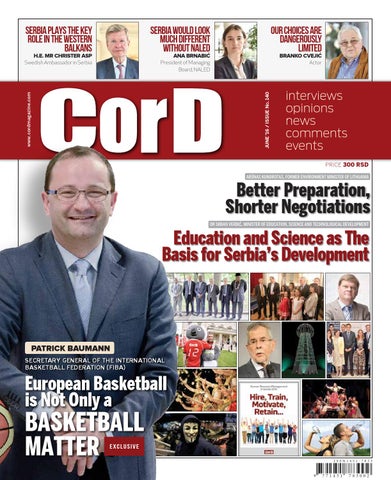
PATRICK BAUMANN SECRETARY GENERAL OF THE INTERNATIONAL BASKETBALL FEDERATION (FIBA)
European Basketball is Not Only a
BASKETBALL MATTER E XC L U S I V E
ISSN1451-7833
9
771451
783002
COVER PATRICK BAUMANN, Secretary General of the International Basketball Federation (FIBA)
European Basketball is Not Only a BASKETBALL MATTER FIBA - the world governing body for basketball - is an independent association comprising 215 National Basketball Federations throughout the world. It is recognised as the sole competent authority in basketball by the International Olympic Committee (IOC)
CONTENTS
PAGE 8
6
EDUCATION AND SCIENCE AS THE BASIS FOR SERBIA’S DEVELOPMENT
Dr Srdan Verbić, Minister of Education, Science and Technological Development
8
EUROPEAN BASKETBALL IS NOT ONLY A BASKETBALL MATTER
Patrick Baumann, Secretary General of the International Basketball Federation (FIBA)
12
SERBIA PLAYS THE KEY ROLE IN THE WESTERN BALKANS
39
Summer 2016
46
SERBIA WOULD LOOK MUCH DIFFERENT WITHOUT NALED
CULTURE CALENDAR
52
FACES & PLACES
55
GLOBAL DIARY
24
BETTER PREPARATION, SHORTER NEGOTIATIONS
Arunas Kundrotas, Former Environment Minister of the Republic of Lithuania, Director of UAB Axante
HIRE, TRAIN, MOTIVATE, RETAIN... Human Resource Management in Serbia 2016
75
OUR CHOICES ARE DANGEROUSLY LIMITED Branko Cvejić, Actor
80
Ana Brnabić, President of Managing Board, NALED
22
AFTER WORK
50
H.E. Christer Asp, Swedish ambassador to Serbia
16
DENTAL TOURISM IN SERBIA
THE GOOD, BAD, AND UGLY SIDE OF INTERNET Feature
83
TURBOCHARGED CHESS Sport: Squash
84
CHILL OUT
86
RUNNING AND JOGGING INTO SPRING & SUMMER Running & Jogging
27 90
June 2016 EDITOR: Ana Novčić a.novcic@aim.rs ART DIRECTOR: Jasmina Laković j.lakovic@aim.rs CONTRIBUTORS: Rob Dugdale, Mirjana Jovanović, Miša Brkić, Radmila Stanković, Steve MacKenzie, Zorica Todorović Mirković, Sonja Ćirić EDITORIAL MANAGER: Neda Lukić n.lukic@aim.rs PHOTOS: Zoran Petrović COPY EDITOR: Mark Pullen TRANSLATION: Snežana Bjelotomić, MRP Editorial PROJECT MANAGERS: Biljana Dević, b.devic@aim.rs Aleksandra Ebilji, a.ebilji@aim.rs Ljiljana Knežević, lj.knezevic@aim.rs Dragana Radović, d.radovic@aim.rs Nataša trifunović, n.trifunovic@aim.rs OFFICE MANAGER: Svetlana Petrović s.petrovic@aim.rs FINANCIAL DIRECTOR: Dragana Skrobonja d.skrobonja@aim.rs EXECUTIVE DIRECTOR: Maja Vidaković m.vidakovic@aim.rs GENERAL MANAGER: Ivan Novčić i.novcic@aim.rs PRINTING: Rotografika d.o.o. Segedinski put 72, Subotica CorD is published by: alliance international media Makenzijeva 67, 11111 Belgrade 17, PAK 126909, Serbia Phone: +(381 11) 2450 508 Fax: +(381 11) 2450 122 E-mail: cordeditorial@cma.rs www.cordmagazine.com www.allianceinternationalmedia.com ISSN no: 1451-7833 All rights reserved alliance international media 2016
HOW FAST DO YOU CHANGE?
Maja Stojanović, Executive Director at Olaf&McAteer
Subscribe NOW and save 10% 11 ISSUES FOR ONLY €29 Call our subscription line +381 11 2450-508, 2450-122 4 |
140
| JUNE
COMMENT
Education and Science as the Basis for
Serbia’s Development
Systems in which more than ninety per cent of money is spent on staff salaries inevitably become conservative, regardless of how bright they were in their previous history. In Serbia this applies to both educational and scientific research systems
DR SRĐAN VERBIĆ, Serbian Minister of Education, Science and Technological Development
B
udget cuts always first reflect on activities, and only then on When it comes to innovations that are more related to services earnings. The way out of such a situation is to create an enthan tangible products, the gap between academic knowledge and vironment in which small but effective changes are always the successful application of such knowledge to real world challengwelcome. There is no reason to set the changing of the enes is generally not so great. Not so many links are required in the tire system as an imperative. Small and sustainable steps are very chain of knowledge application if recycling old clothes is identified important, primarily in the field of motivation, which turns out to as an innovation that simultaneously solves the ecological problem be the most difficult burden of change in our country. With modest and employs people. We today require innovation of this kind in resources, it is not possible to make major organisational or techmany fields, e.g. innovations concerning the reduction of social disnological breakthroughs, but society needs them, and those small parities, securing the population’s health, youth employment, care innovations, step by step, improve the quality of life. for the elderly etc. These do not need to be innovations that we have The application of science is not a task only for researchers. On come up with here in Serbia. It is sufficient to implement something the contrary, the appliance of science is a job for engineers and spethat someone else is already working. Unfortunately, this is not alcialists of various kinds, as well as all those who notice that their ways easy due to the specific legal framework. In any case, it is neccurrent practice is not perfect and that there is enough space for essary to develop a culture of innovation, which implies supporting innovation. Applying science to production is not as simple as it was small effective solutions rather than that being left to the grace of a few decades ago. administrations that will always find a reason to say no. Globalisation and mass production have ensured that the kind Innovations don’t necessarily have to have a commercial efof expertise that a regular school can profect. Many innovations do not bring any vide is no longer sufficient for the transfer sort of profit, but they do increase the When the 2016-2020 of knowledge from science to the economy quality of life of citizens. These are social to be efficient. In order to link science and Strategy for the Scientific innovations. They bring new effective, the economy successfully, it is necessary efficient, equitable and sustainable soluand Technological apart from continuous learning – for all levtions for well-known social problems. Valels of knowledge transfer to be completed ue that is created in this way is more visDevelopment of the well and for competent people to have ible at the level of the macro-scale society Republic of Serbia was enough ideas and scientific results, for than at the individual level, and therefore there to be innovators who will turn some undergoing public debate, it does not make sense to measure the of these ideas into tools to solve specific value of such innovation relative to their one of the most painful problems, for there to be investors who financial effects. issues for established will invest in good innovation, for there to When the 2016-2020 Strategy for the be engineers who will develop mass proScientific and Technological Development and quite successful duction and, finally, for there to be those of the Republic of Serbia was undergoing researchers was who will find a place for a new product on public debate, one of the most painful isan often already saturated market. This is sues for established and quite successful orientation towards indeed a great task, and thus innovations researchers was orientation towards ininnovation originating directly from scientific laboranovation. It appeared, at the very least, as tories, which result in mass production, are though scientists were defending themrare outside the narrow circle of the most developed countries. selves from innovation as a monster that could destroy basic reHow closely linked science and the economy are can best be search which, according to many, is the intrinsic value of our sciseen in the degree to which the economy is devoted to financing ence. I am sure that the essence of this opposition was primarily scientific research. There is no doubt that the private sector will inin a misunderstanding of the term innovation. This is something vest in what will be profitable and will turn a profit in the foreseefor which we all need to have a lot of understanding. Nobody reable future. If no such interest exists, pressure exerted by the state ally expects scientists to become entrepreneurs and to figure out to merge the incompatible will not help much. Of course, if interest how to earn money, and then to deal with that. That is not their exists at least in trace amounts, the state should be a catalyst for job. It is only important that they communicate with the rest of connections and primarily for all adequate financial instruments to the world. Now science has to show why it is relevant to the sociassist in this cooperation. ety in which it develops. ■
6 |
140
| JUNE
JUNE
|
140
| 7
INTERVIEW
B y S A Š A M I L E T I Ć ■ Photo: FIBA
European Basketball is Not Only a
BASKETBALL MATTER PATRICK BAUMANN SECRETARY GENERAL OF THE INTERNATIONAL BASKETBALL FEDERATION (FIBA), THE WORLD GOVERNING BODY OF BASKETBALL
FIBA - the world governing body for basketball - is an independent association comprising 215 National Basketball Federations throughout the world. It is recognised as the sole competent authority in basketball by the International Olympic Committee (IOC)
EXCLUSIVE Sport (ICAS) and a council member of the Association of Summer Olympic International Federations (ASOIF).
A
ccording to FIBA, Euroleague Properties SA, a subsidiary of Euroleague Commercial Assets (ECA), which today organises the Euroleague club competition, wishes to reap the benefits of the basketball ecosystem developed by national federations (players, coaches, referees and thousands of other clubs) without contributing to the foundations of the sport’s pyramid and holding the national teams hostage to serve the interests of six commercially powerful clubs. We discussed this topic with Patrick Baumann, who has served for many years as the FIBA Secretary General. He joined FIBA in April 1994 and was appointed Deputy Secretary General following Borislav Stanković in 2003, thereby becoming only the third person to hold the position. Beyond basketball, Mr Baumann has been appointed to commissions and panels of a large number of sports-related organisations, including the IOC’s Evaluation Commissions for the Beijing and London Olympics. He was elected an IOC Member in 2007. He is also a member of the International Council of Arbitration for 8 |
140
| JUNE
■ You are a member of the International Olympic Committee (IOC). FIBA is one of the pillars of the IOC and basketball is one of the most important and most commercial Olympic sports. Have you held talks within the IOC about the current situation in European basketball, and what is the stance of the highest international sporting organisation regarding this issue? - Of course, we are holding regular talks with the IOC. The current
situation in European basketball is of interest for a lot for sports and is not only a basketball matter. Clubs are part of the foundation of the sport structure in Europe. They develop players and create coaches and bring new athletes as well as children to sports. Clubs needs to be pushed to excel in order to reach the top. This should happen in each country, through the domestic leagues. The pyramid must then continue: the best in each country should have the opportunity to show their talents at the European level. If they don’t succeed, they should try harder the following season. This is the European model that we are trying to protect.
■ What is at the root of the misunderstanding and the crisis in relations between FIBA and the Euroleague, and where you see a possible compromise?
STRUCTURE
OBJECTIVE
SPORTING VALUES
Clubs are part of the foundation of the sport structure in Europe. They develop players and create coaches and bring new athletes, as well as children, to sports
FIBA’s objective is to create a solid and open house where each club is welcome to enter and climb the stairs all the way to the top
ECA has started to hand-pick the clubs for Euroleague and Eurocup, which basically means destroying any commercial and sporting value of domestic leagues
- There is a difference of philosophy. FIBA’s mission is to promote and develop the game. We care not only about the elite, but also about all other clubs around the world, including women, youth and wheelchair basketball. Euroleague is a private organisation that aims at making money in basketball for the benefit of a few clubs. FIBA cannot accept that Euroleague takes away the best clubs without caring about the consequences on the basketball landscape. If we let the Euroleague model prevail, then the domestic leagues will soon die. As the governing body of basketball, we can’t let this happen. We have shown our serious intent to negotiate professionally and in good faith during the recent meeting where we proposed that Euroleague Commercial Assets (ECA) organise the Euroleague (EL) as the 1st tier competition and the Basketball Champions League would be the 2nd tier competition. These two competitions would be linked through principles of promotion and relegation of club, based on domestic results. ■ The impression in public is that the arguments revolve around money. Considering FIBA’s long tradition and the great impact this organisation has had on basketball’s development, financing and popularisation worldwide, it could perhaps be said that we are talking about a sporting conflict and purely commercial motives. How would you comment on that? - This has nothing to do with money and FIBA’s
aim is not to organise club competitions. That’s why we have founded a company, the Basketball Champions League (BCL), with 10 national leagues. The leagues should be in charge of running the European club competitions. FIBA’s objective is to create a solid and open house where each club is welcome to enter and climb the stairs all the way to the top. We need to protect this structure for the good of the game.
■ Both sides will seek justice in court, using the laws of the European Union. What is the basis for FIBA’s claim? - Undue pressure has been exercised on leagues
In essence, ECA wishes to reap the benefits of the basketball ecosystem developed by national federations (players, coaches, referees, thousands of other clubs) without contributing to the foundations of the sport’s pyramid and holding national teams hostage to serve the interests of few commercially powerful clubs.
FIBA cannot accept that Euroleague takes away the best clubs without caring about the consequences on the basketball landscape. If we let the Euroleague model prevail, then the domestic leagues will soon die. As the governing body of basketball, we can’t let this happen
and clubs with threats of exclusion from Euroleague unless they commit to Eurocup. Such practices were applied in the case of the Adriatic League and other European leagues. This constitutes abusive behaviour under EU and national laws. The ECA has also arbitrarily been cherry-picking clubs for Euroleague and Eurocup, which means destroying any commercial and sporting value of domestic leagues and undermining the competitive balance in European basketball.
■ What went wrong during the last negotiations in May? Was the problem only the number of top clubs that will control both sides, or is there something else? - We held constructive discussions. We
have made a clear proposal to Euroleague and we hope to find an agreement. The discussion is not about the number of clubs. It is about creating the appropriate synergies between Euroleague and the Basketball Champions League, in a transparent, nondiscriminatory and fair environment. It is for this exact reason that we envisage also operational collaboration between ECA and the Basketball Champions League, not just a simple “co-habitation” in the club business. We are now waiting for ECA to come back to us with an answer to our proposal. ■ FIBA communicates and operates through national associations that are members of FIBA, while the Euroleague negotiates with clubs directly. Do the national federations have sufficient authorJUNE
|
140
| 9
ity to implement agreements made in FIBA within their respective countries? - I think that people often forget one important fact: all those
clubs are part of a national federation. They have agreed, freely, to be part of an existing structure in their own country. This comes with rights and obligations. Like in any organisation, you have to respect those obligations. For example, a club cannot just say: “I play the national championship, but I don’t play the national cup”. It’s the same at the international level. A club cannot just decide for itself outside of the structure. Each national federation must make sure they take the necessary steps in their country that will help the sport to develop. All the different actors should sit around the table and have those discussions at a national level.
the Spanish League (ACB) has no competence to be involved or participate in any way in the process of registering clubs or national teams in international competitions. These are competences granted to the Spanish Federation. Spanish law has implemented the “European model of sport” and all stakeholders have to comply with the rules of the pyramidal structure of sport in Spain. If this happens, we are confident that Spain can participate at all FIBA competitions. This decision should be first taken by FIBA Europe regarding the European level.
■ At the 2008 Beijing Olympic you announced that FIBA would fight for basketball to have 16 teams at the Olympics. Have these plans been abandoned, given the IOC’s sharp propositions when it comes to the total number of athletes at the Games and the fixed calendar? - We have been trying to add more teams in
■ The Euroleague resents FIBA’s apparent “use of force” (issuing ultimatums to national associations) in implementing the future format of European club competition. What do you say to that? - ECA has started to hand-pick the clubs for
Euroleague and Eurocup, which basically means destroying any commercial and sporting value of domestic leagues. In response to ECA’s aggressive and illegal behaviour, FIBA Europe decided that, with the exception of the 16 Euroleague teams, any National Federation that supports ECA’s illegal tying practices and allows their leagues or clubs to conclude and/or implement agreements with ECA will automatically lose the right to participate in senior men’s national team competitions organised by FIBA Europe.
Each national federation must make sure they take the necessary steps in their country that will help the sport to develop. All the different actors should sit around the table and have those discussions at a national level
■ The Euroleague’s new concept (16 teams in a so-called closed league) is at odds with FIBA criteria and the obligations of national teams. Can FIBA change something in this regard? - This is part of our proposal to ECA: to develop a joint calen-
dar, bearing in mind that the calendars of the competitions will respect the calendar of domestic leagues (in particular, not having Euroleague or Basketball Champions League games played on weekends) and the calendar of national teams. FIBA/FIBA Europe are ready to discuss slight adjustments in order to avoid scheduling conflicts, particularly for the national team windows of November and February. All clubs participating in the competitions shall release players to national teams in accordance with the existing regulatory framework.
■ Spain, as European champion and Olympic runner-up, finds itself in a difficult situation when it comes to the dispute between FIBA and the Euroleague. How far is FIBA actually prepared to go and is it really possible that the Spaniards will not compete in Rio? - The Spanish Supreme Council of Sport (CSD) has confirmed that 10 |
140
| JUNE
the Olympics for the last three editions but as you are well aware this is a very delicate matter. Each sport would like to have more athletes, some new sports would like to enter the Olympic programme… At the same time, the number of athletes at the Olympics is not extensible and the IOC is implementing the agenda 2020, which aims at delivering Games on a human scale. Our priority for the Tokyo Games is to include 3x3. FIBA made an official bid for 3x3 to join the Olympic programme as a new discipline of the sport of basketball and has been actively promoting it ever since. The development of 3x3 is one of FIBA’s four strategic pillars and the game is growing fast with an unparalleled digital platform and an impressive competition network which allows for players to go from the streets to the world stage.
■ What has changed within FIBA’s organisation since the complete authority was centralised in Geneva at the Congress in Istanbul two years ago? - The basketball family is now more united and has more partici-
pation. All these changes will enable us to have more open lines of communication and better understanding among all institutions. FIBA is involving more and more basketball stakeholders in the decision-making process. We have incorporated the NBA in our Central Board by having Mark Tatum, NBA Deputy Commissioner and Chief Operating Officer, as its representative. We also approved the inclusion of a player representative, Vlade Divac, who is also the Chairman of the newly-created Players’ Commission. This is also happening at the European level where two League Representatives were approved by the FIBA Europe Board (Mr Arthur Goethals, President of the Belgian Basketball League, and Mr Marcin Widomski, President of the Polish Basketball League). ■ Which Olympic qualifying tournaments will you attend? Will we perhaps see you in Belgrade from 4th to 9th July? - I do not know yet, but I hope so. ■
JUNE
|
140
| 11
INTERVIEW
Serbia Plays The Key Role in
THE WESTERN BALKANS H.E. CHRISTER ASP SWEDISH AMBASSADOR TO SERBIA
One of the most active ambassadors in Serbia and an outstanding expert on the situation in Serbia and the region, Swedish Ambassador H.E. Christer Asp, is leaving to take on a new role after six years in Belgrade. With his departure imminent, but also on the eve of the National Day of this friendly country, CorD spoke with the ambassador about his experiences and observations, as well as future relations between the two countries
T
he tradition of celebrating the National Day of Sweden began 100 years ago, on the day honouring the coronation of King Gustav Vasa in 1523, which is considered as the event marking the foundation of modern Sweden. As part of this year’s celebration, the Embassy of Sweden will mark 250 years of media freedom, when the first ever constitution came into force in Sweden, laying down this fundamental right
■ Sweden celebrates its national holiday this month. To what extent do you think Sweden is still considered a well-regulated state with a strong feeling for social justice? - I hope that Sweden is perceived like that outside our borders, because our aim is to be a well-regulated state with equal opportunities for everybody and with a strong social welfare system. We will celebrate our national day on 6th June and every year we have a different theme for celebration. Last year we celebrated 20 years of membership in the EU and this year our theme will be freedom of speech and freedom of media, because we celebrate 250 years of Sweden’s first ever constitution, which laid down this fundamental right. ■ One of the changes that took place in Sweden is the government deciding that the country wasn’t able to take in economic migrants anymore. How much has the migrant crisis served as a test of the tolerance and democratic values 12 |
140
| JUNE
for which Sweden is known? - We do not accept economic migrants because there is no such thing, but we have a very open policy regarding political asylum seekers, for people seeking protection from conflict and war. Last year Sweden took more refugees than any other country in Europe per capita; a total of 180,000 refugees. And the year before that we accepted around 90,000 refugees, so we have a very open policy. But what happened is that we had too many refugees coming and we had to find a shelter for all of them and to manage this great inflow. So we didn’t change the policy for those who seek protection, but we did introduce certain restrictions in the sense of the refugees who are not able to identify themselves, since our whole asylum system was under great threat. Of course, everyone coming to Sweden will be sorted out, if they are political refugees they have the right to stay, but economic refugees will be sent back where they came from. ■ It has been announced that Sweden will take in three times fewer migrants this year. The Swedish government has also changed laws in order to exercise more efficient control over refugees’ whereabouts and accommodation. Do you think that the refugee crisis can be resolved? - We didn’t set a fixed number of refugees that can enter Sweden, because our policy is that if you need protection, or if you say that you need protection, then you have the right for your case to be resolved,
REFUGEES
KEY
NATIONALISM
Last year Sweden took more refugees than any other country in Europe per capita; a total of 180,000 refugees
We are working really hard in Brussels to find a key to unlock the concerns of Croatia, and I frankly think that if we are not able to find that key we are all stand to lose
We have seen development when it comes to nationalist type of parties, as we have seen in many other countries in Europe
also according European laws and international conventions, and we will continue to do that. We have introduced rules for people coming so we can identify them. We have much fewer refugees coming in the last few months and we don’t know what is going to happen in the future, as there are so many refugees – about 60 million in the world – and we need to deal with the situation depending on how many people appear on our borders. But what we do hope and what are we pushing for from the Swedish side is to have a European solution and a common European approach this crisis. We don’t have that today and I regret that very much. ■ Do you think that tougher migration criteria will also affect the people who are not war refugees, but rather economic migrants from countries like Serbia who want to immigrate to Sweden? - We introduced a visa free regime for Serbia in 2009, that occurred actually during Sweden’s EU presidency, of which we are very proud, because that was a really important step in bringing our countries closer together. Since then we had a large number of false asylum seekers, who asked for asylum based on the economic situation and not the political situation. In principal there shouldn’t be political immigrants from a democratic Serbia entering Sweden or the European Union generally. Numbers have come down significantly. We still have some people coming, but in the majority of cases they will be sent back to Serbia.
■ How much has the migrant crisis fuelled the right-wing in Sweden and is there any danger of these forces gaining more influence in relevant institutions? - We have seen development when it comes to nationalist type of parties, as we have seen in many other countries in Europe. I think that is something we need to take very seriously. I think that the governments of Europe, along with my own, will have to be able to deal with this, to isolate the reasons and try to counter that, because these are often parties that are looking for a more closed kind of policy, and Sweden’s traditional policy is to be open to the rest of the world when we talk about refugees, economic relations and so on. I think that we cannot neglect this.
Serbia will bring benefits to the European Union. Serbia plays the key role in this part of Europe; whatever happens in Serbia impacts on the rest of the region. That means that Serbia plays an important role in ensuring the long-term stability of the Balkans. Of course, Serbia will be an important partner in trading and economy, so I think it is completely false to say that these countries of the Western Balkans will be a problem, rather I think they will be an added advantage to the EU. From the Swedish side we look at the enlargement of the European Union with strategic eyes, and for the reasons I mentioned this is why we so strongly support Serbia’s efforts to gain membership in the EU.
Sweden is the third largest bilateral donor to Serbia and one third of the funds that we set aside for Serbia are aimed towards solving environmental issues, which is going to be a very important chapter in the EU accession process
■ The British people are debating whether their country should be in the EU and they have been questioning the purpose of further EU enlargement since, allegedly, countries like Serbia, Macedonia and Albania would only bring problems to the EU. What is Sweden’s stance on this issue? - First of all, Sweden wants Britain to stay in the EU, because it is an important country and the UK can continue to contribute to the development of the Union. I think it is an absolutely false the argument that suggests that countries like Serbia, Montenegro and other newcomers only create problems; I think opposite. I think that a country like
■ What do you think about Croatia’s decision to block the opening of Chapter 23 in Serbia’s accession negotiations? Is it really true that Croatia is the only EU member that is deliberately slowing down the EU accession process for Serbia, or does Croatia have tacit support from other EU members in doing so? - Basically we have the situation where 27 member states are ready to open up Chapter 23, regarding justice and home affairs. We decided to open the chapter for negotiations, but we of course need to have a unanimous decision form all 28 member states. In this case Croatia has some concerns that they want to solve before opening this chapter; we still have time to deal with this and hopefully you should be able to open chapters 23 and 24 in the near future. We are working really hard in Brussels to find a key to unlock the concerns of Croatia, and I frankly think that if we are not able to find that key we are all stand to lose. The opening of that chapter means that we will intensify dialogue in that area with the candidate country and I think that is very important. Serbia is ready, from the Sweden point of view. We still have time and I hope that process will continue soon. JUNE
|
140
| 13
■ What do you think is the most important task for the new Serbian government in order for Serbia to continue moving along the EU accession path? - First of all, you must continue economic reforms. That is difficult for any country, but for Serbia it is fundamental. Another issue that I talked about with the Serbian prime minister is the importance of environmental policy. Sweden is the third largest bilateral donor to Serbia and one third of the funds that we set aside for Serbia are aimed towards solving environmental issues. It is going to be a very important chapter in the process of EU accession for Serbia. I would love to see more focus on this. The third area is judicial reform. The EU is a legal entity, and different legal systems in the 28 member states need to be compatible in order for them to be able to work together. ■ Sweden is an EU country, but not a NATO member. Do you think the same is possible for Serbia, or is NATO membership a prerequisite for candidate countries aspiring to join the EU? - The same goes for Serbia as it does for Sweden. There is no condition whatsoever that Serbia needs to be a NATO member. Serbia is already member of Partnership for Peace, as is Sweden, and over the years here I was surprised with this recurrent discussion. Serbia doesn’t have to be in NATO. If that condition would come up then my country would also have to join and we don’t have that as a topic in Sweden. But we do have really close cooperation with NATO within the same programme that Serbia is already in.
it comes to economic development. But what happens when IKEA comes to a new country is that they gradually start working with local industries. In Serbia, IKEA has had cooperation with the SIMPO furniture factory for many years. So I think this is a benefit, apart from the employment of people in the stores that IKEA will establish. It also important to say that Sweden giant company TetraPak in 2016 marks the 50th anniversary of its successful production in Gornji Milanovac. With a big number of customers supplied from this site, and 91 per cent of production being exported to Europe and Central Asia, it is one of the strongest performers in TetraPak’s production network. ■ You have helped with holding a conference about the importance of public broadcasting in informing citizens and strengthening society’s democratic capacity, which took place in Belgrade recently. People working for Swedish national radio and TV claim that they are not pressured or influenced by any interest or political groups whatsoever. Since you come from Sweden, what is your view of public broadcasting in Serbia? - We look at this from the perspective that we have in our country, and we believe that independent public broadcasting is an important part of our democratic development. So we had a seminar, where some other countries also took part, along with Sweden, where we explained how we are organising public broadcasting. That’s because we think that is important to have it here in Serbia on the same level as we have it in my country. But how will you structure it and organise it is of course upon to Serbia to decide. I think that the notion of having a public broadcasting service is extremely important.
■ Preparations are underway in several locations in Serbia for construction of IKEA department stores, the famous Swedish brand. Since the arrival of IKEA has been announced ■ Do you believe that journalists can and postponed several times, do you Sweden giant company be autonomous in this day and age think that you will have the opportuwhen their work is hindered all over nity to visit an IKEA store here durTetraPak marks the 50th the world, both in democratic and uning your term? anniversary of its successful democratic societies? - Not as ambassador, since my time here production in Gornji Milanovac. - I think that there is a major concern about will be over in two weeks. But during violence against journalists all over the the six years that I have been here, the It is currently one of the world. Journalists are considered to be the most common question to me was that. strongest performers in fourth estate, and independent journalists And finally IKEA will come and I particiTetraPak’s production network play an extremely important role when it pated in the ground-breaking ceremony comes to democratic developments, and it a couple of weeks ago on Avala. I must is the obligation of every government to enable journalists to work unsay that we received very good support from the current governder these independent conditions. ment in overcoming all obstacles and getting all permissions for IKEA to start working here. ■ This year Sweden was again the host of the Eurovision Song Contest. Do you think that the festival has become a sort of ■ Do you think IKEA’s arrival can boost economic cooperaa stage for showcasing different political interests? Do you tion between Sweden and Serbia, and which other areas could think that Ukraine’s victory is a triumph of music or politics? prove interesting for advancing this cooperation? - I don’t think so. Ukraine won this year, last year it was Sweden, the year - In the short-term, I don’t think it will have any significant impact on before that Austria and so on. I think that certain countries sometimes the trade between Sweden and Serbia. I think that when a global comwin with support from other countries, but music is not a homogenous pany like IKEA decides to setup business in the country it means that kind of thing in Europe. People in different parts of Europe like different IKEA believes in the economic development of that country. That is types of music and this diversity has been a strong point of Europe. ■ a powerful signal to other investors about the future of Serbia when 14 |
140
| JUNE
G
R
E
E
N
S
Q
U
A
R
E Office building FOR RENT GREEN SQUARE is a luxurious building, exceptional quality, placed in a unique location in the city center. GREEN SQUARE is built to the highest standards of class A+ office buildings. Equipped with innovative technologies that provide care for preservation of nature and offers maximum comfort to clients with a highest standard of business. Building is located in heart of the Vracar in Mutapova street, next to the churchyard of temple St. Sava. GREEN SQUARE consists of ● ground floor, with enterance hall and exclusive restourant ● four floors, each has about 580m2 ● fifth floor - VIP etage of 335 m2 with a terrace of 230m2. ● garage on 3 underground levels with 50 parking spaces ● the building has a optical cable on each floor ● VRV system for cooling and heating, with the possibility that each Office separately heated and cooled with smart control system ● 24h security with non-stop video surveillance ● provided cleaning and maintenance works
Granit Invest Mraovića sokače 6, 11000 Belgrade - Serbia Tel: +38111 30 88 850 Fax: +38111 30 88 851 E-mail: granit.invest@eunet.rs Web: www.granitinvest.co.rs www.greensquare.in.rs
INTERVIEW
Serbia Would Look Very Different
WITHOUT NALED ANA BRNABIĆ PRESIDENT OF THE MANAGING BOARD AT NALED
In the last ten years of its existence, NALED has managed to launch numerous initiatives and suggest solutions that have directly resulted in a higher quality of life and work in Serbia. After successfully partnering with the Serbian government to boost the country's business ratings, NALED is now eager to continue cooperating with the new goverment in countering the shadow economy
A
dvocating efficient administration, cutting red tape and parafiscal burdens on the economy, and fair competition are NALED’s guiding principles, principles which have enabled this unique association of local self-governments, businesses and civil society organisations to become a reputable partner to the state in implementing reform. At the same time, this organisation, which is unique in the region, has been given the opportunity to implement its successful solutions, such as the certification of municipalities with a favourable business enviornment, in Montenegro, Croatia and Bosnia. “I believe that the foundation of our success comes from suggesting concrete solutions for all the problems that we indicate,” says Ana Brnabić, one of NALED’s founders and the President of Managing Board. In this interview, Ms Brnabić talks about NALED’s current plans, ongoing initiatives, and challenges in creating a favourable business environment in Serbia.
■ You are one of the Alliance’s founders and a member since the very beginning. Now, you are also the President of its Managing Board. What events in NALED’s ten-year history would you single out as crucial? 16 |
140
| JUNE
MEMBERSHIP
SUCCESS
AIM
NALED has over 220 members, and our aim is to increase this number to 250 by the year’s end
I believe that the basis of our success is that we suggest concrete solutions for the problems we point out
Our aim is to reduce the share of the shadow economy in the national GDP from 30.1% to 26.7% over the next four years
- The founding idea behind NALED – namely, bringing together local self-governments, businesses and civil society organisations under one roof – made this organisation unique and created a space for it to deal with crucial issues affecting all three segments of society, and, in turn, to manage the issues that affect the state and general well-being, rather than dealing with particular interests of the members or sectors. When I look back at NALED’s activities over the last decade, it seems to me that our development and growth were gradual and that every success was hard-earned. The first year was the most challenging since it required of us to be persistant and convincing enough in selling the idea of NALED to potential members. Then, in 2008, we entered our “adulthood” and parted ways with USAID, which had helped us to create NALED. And the third challenging moment came in late 2014, when we finally got the chance to cooperate directly with the Serbian government on devising and implementing important reform projects, like the building permit issuing system, improving Serbia’s rankings on the World Bank’s Doing Business List and countering the shadow economy.
■ How did NALED manage to position itself to be directly involved in implementing reforms and is an authority on what to do and how to proceed? - Truth be told, it took us a little by surprise when, in December 2014, the Prime Minister asked us to help with implementing certain projects. I believe that the basis of our success is that we suggest concrete solutions for the problems we point out, and these solutions are good because they are devised in agreement with all interested
■ Could you tell us about NALED’s organisational structure and membership criteria?
- NALED has over 220 members, and our aim is to increase this number to 250 by the year’s end. The main criteria is for a company, local selfgovernment or civil society organisation (CSO) wanting to join us because it wants to make Serbia and its regions better together, support I believe that Serbia and parties. Since the very beginning it was NALED’s mission and its Code of Ethics and, at clear to us that we can reach results in people who want to the same time, understand that no individual this segment, and this cooperation natlive and work here interests will be favored only because they are urally progressed and spilled over into members of NALED. other areas too. Together with the Minreally need an The members make up NALED’s Assembly, istry of Construction we have worked organisation like NALED, on reforming the complete building which meets once a year to be presented with the operating and financial reports and to define with all of its experience permit issuing system and, in exactly reform priorities. Furthermore, NALED has an one year, we managed to introduce an and standards that we executive office that is engaged in everyday acE-system. Now that we have demonhave been nurturing and strated that the state administration, tivities, while a nine-member Managing Board strategically manages the organisation. Every upholding over a decade public enterprises and local self-govsector has proportionate member representation ernments are ready to change and can of dedicated work – business has five representatives, local self-govmove into electronic systems, we are ernments three and civil society one. The Managgoing to keep pushing this in 2016 too. ing Board is convened once a month, and it monitors the work done E-governance will make the state more efficient, more transparent by the Executive Office. NALED also has a Supervisory, Advisory and and safer for both the citizens and businesses. Executive Board and each of them performs a specific function in the organisation. Additionally, our members also come together in ■ What has been the previous government’s biggest reform sucworking bodies or alliances and, at this moment, we have the Fair cess according to NALED’s standards and what expectations did Competition Alliance. We are in process of setting up the E-Governthe government fail to meet? ance Alliance and Food & Agriculture Alliance, and we are also con- The approach that the Serbian government took for implementing templating forming a Healthcare Alliance. the project of improving Serbia’s ranking on the World Bank’s Doing JUNE
|
140
| 17
Business List demonstrated how efficiently and systematically the ■ Considering the election results, do you think that the new govgovernment can work. In December 2014, the Prime Minister inernment will find it easier to continue with the reforms in a more vited NALED to work together with the government, and, soon after decisive manner? in January, we formed a joint working body with Deputy PM Zorana - Any government will find it much easier to start with serious reMihajlović at its helm. By April, we had finished and sent the Reform forms at the beginning of its term. This government has a fourReport to the World Bank. The Reform Report is a document which year-term ahead of it and a parliamentary majority so we expect it explains all regulatory changes and their practical implementation to use this in the best way possible. in the given year. In fewer than ten months, in October 2015, the 2016 Doing Business List was released with Serbia bumped up to ■ What do you think should the government’s priorites be in terms the 59th place, the country’s best ranking in the past nine years. A of overall macroeconomic policy? day after the List came out, the Joint Working Body had a meeting at - It is absolutely vital to make business more transparent and, by that which they adopted the Reform Action Plan for next year. This work we primarily mean to reduce the financial burden which comes in dynamic is very much that of the the form of various fees that busiprivate sector, and it demonstrates nesses have to pay. There should be an efficiency that is not customary a ceiling when it comes to business in the state sector. expenses in order to prevent them Important progress in implefrom skyrocketing. Furthermore, menting reforms was made with the the state administration needs to adoption of the new Labour Law, be more professional enabling the making the labour market more public sector to be more efficient dynamic, reforms of the building and responsible. It is important to permit issuing system, the introduclaunch core reforms in education tion of E-services in tax collection, and healthcare and boost producstarting the fight against the shadow tion primarily through developing economy, which was marked by the agriculture and IT sector. We see the passing of the Law on Inspection latter as a potentially key sector for Oversight and other similar moves. future development because there There is still a lot of work to be is a real need today for several thoudone in terms of the quality of draftsand programmers. Our IT export ing, passing and implementing laws, is larger than the raspberry export, which currently stand at only 40 while the education sector lacks the per cent of the standards that we capacity for delivering the needed aim to reach. Two thirds of the laws work profiles to the business world. important for businesses are still urLast but not least, we have been congently adopted without an adequate stantly talking about public-private public debate and a number of them partnerships as the key for developdo not even contain an analysis of ment of local self-governments withthe influence they will have on citiout plunging them further into debt We have been constantly talking zens and businesses. What is truly and spending their own financial reworrying is the fact that the averabout public-private partnerships sources. These partnerships have to age delay in the adoption of bylaws be implemented more in Serbia. as the key for the development of is 1,550 days (or over four years), local self-governments without preventing the full implementation ■ Could you further elaborate on of new laws. We hope that the new plunging them further into debt and the five most important reform Serbian government will manage to steps that NALED will suggest to spending their own financial resolve some of these problems. the new Serbian government? resources. These partnerships have - Introducing E-governance ■ Prior to the election, there had to be implemented more in Serbia through concrete E-services for been speculation that the campaign citizens and businesses, countering and the time needed to form a new the shadow economy, continuing government could affect the reform pace and the overall business to reform building permit issue process through further reform dynamic. Do you think that such assumptions proved to be true? in the land registry, reforming the healthcare funding system to - It seems that the campaign did not affect the overall business dymake it sustainable, reforming the education system to make it namic, but it did affect certain reform processes. We are eager to meet more compatible with business, further emphasis on improving the new government so that we can continue working on the impleSerbia’s ranking on the Doing Business List through reforming the mentation of the National Programme for Countering the Shadow judicial system, and more efficient implementation of contracts. Economy. Our aim is to reduce the share of the shadow economy in We are going to work together with local self-governments on the the national GDP from 30.1% to 26.7% over the next four years. This certification of municipalities with favourable business environis a complex task, and although we are already working on implements both in Serbia and the region and on revitalising unused menting some of the 67 measures from the Action Plan, we need the brownfield locations (primarily army assets, as well as cultural ingovernment to be more dedicated in order to ensure success. stitutions, old industrial facilities and similar). 18 |
140
| JUNE
■ When do you expect adoption of the Law on Parafiscal Charges which the business community has been anticipating for a long time, considering that almost a year has gone by since the Government announced its adoption and nothing happened as yet?
scope of fiscalisation, this is one of the key reforms envisaged by the National Programme for Countering the Shadow Economy.
■ Realistically speaking, how high up could Serbia go on the Doing Business List, and what do you think are the main prerequisites - The work on the Law on Administrative Fees and Charges started for better ranking? during Ministar Krstić’s term so it is quite urgent for this law to be - We expect the biggest jump to be made in the segment of building adopted and for the country finally to have a public non-tax levy regpermits following the implementaistry which will regulate all the fees tion of software for online issuing, and charges both on state and local The approach that the Serbian which will reduce the number of prolevels. We need this in order to introduce a ban on additional charges government took for implementing cedures, expedite the issuing of building permits, make the process more that are not in the registry, as well the project of improving Serbia’s transparent and reduce the opporas finally to abolish those parafiscal ranking on the World Bank’s Doing tunities for corruption. Our position charges or fees for which entreprewill primarily hinge on the efficiency neurs and companies no longer are Business List demonstrated how with which building permits are isgiven any corresponding service. It efficiently and systematically the sued in Belgrade rather than the Seris also important to prevent public bian average, since the World Bank enterprises from introducing their government can work uses our capital city as an indicator. own charges. We also expect progress to be made in tax collection following the application of the new E-filing system. ■ How high is the adoption of this law on your list of priorities, Furthermore, we expect a better ranking as the result of amendments considering that you are a coordinator of the interdepartmento the Law on State Survey and Cadastre and shorter deadlines for land tal government task force for improving Serbia’s ranking on the registration. Together with certain reforms that were implemented in World Bank’s Doing Business List? 2015, such as abolishing the land development fee for warehouses and - It is high on our list of priorities for countering the shadow econother manufacturing facilities, we believe that we are going to jump omy because parafiscal charges are one of the reasons why SMEs between five and 10 places on the 2017 Doing Business List. are drawn to the shadow economy. Together with increasing the
JUNE
|
140
| 19
■ How would you compare NALED’s role to the role of other business associations like the Foreign Investors Council and Serbian Chamber of Commerce which have also been cooperating closely with the government on the reforms?
- NALED is quite a unique organisation compared to those which you mentioned because it brings businesses, local self-governments and civil society organisations together under one roof. NALED is a public-private alliance and, as such, is the largest in the region. This gives us an opportunity to focus on practical problems that are common to businesses, towns and municipalities, and citizens.
■ You held the first diplomatic symposium about the professional development of civil servants in collaboration with the Ministry of State Administration and Local Self-Government. What are your long-term goals in this segment?
directly involved in conducting reforms and where the government consults us about what needs to be done and how the reforms should proceed. When you are in such position and when you demonstrate that you can implement change, you often attract unwanted attention. Not all people welcome the reforms, and they are not comfortable with transparency and the fight for fair living and working conditions. There are people and media in Serbia that think that only the government and the parliment should deal with amending laws and that nobody, least of all civil society organisations, has the right to ‘meddle,’ although democratic principles ensure that every individual citizen has a right and an obligation to control, supervise and direct the government, elected by us and which suits us. ■ You think that NALED needs in-
tegrity and stability the most right now. What are your priorities in terms of improving the organisation’s internal structure?
- Our goal is to improve cooperation with the diplomatic offices of European and other countries which provide our citizens with an opportunity to attend training courses abroad at their expense. We would like to work with the new government on developing a platform for the continous education and development of civil servants in order to create a more efficient state administration. We are also hoping that a State Administration Academy will be formed soon. Devising a training manual for civil servants should be the first result of this diplomatic forum.
■ In addressing your members, you said that you expect attacks on NALED to increase. What led you to such conclusion and where do you expect these attacks to come from?
I believe that all of our members should be proud of the fact that, through our contribution as individuals and as members, be they companies, local self-governments or organisations, we support the reforms that NALED has been working dilligently on every day
- I believe that Serbia and people who want to live and work here really need an organisation like NALED, with all of its experience and standards that we have been nurturing and upholding over a decade of dedicated work. My message to our members is that Serbia would look very different without NALED. Hence, I believe that all of our members should be proud of the fact that, through our contribution as individuals and as members, be they companies, local self-governments or organisations, we support the reforms that NALED has been working dilligently on every day. Quite a few projects that NALED implements are funded solely by our members, and they can vouch for the fact that these funds have been spent on making Serbia more competitive and, in turn, making the business and life in Serbia better. In 2015, NALED entered a new stage whereby we are now 20 |
140
| JUNE
- My absolute priority, as the President of Managing Board, is communicating and networking with our membership. I think that it is very important for every member of NALED to be informed about what we are working on so that they can view all of our successes as their own, because that’s what they actually are. Our success would be impossible without our members and the inavluable people that work in our Executive Office who believe so much in what they are doing. When I meet a Slovenian MP in the European Parliament who tells me that an organisation like NALED should be replicated in Slovenia or when the Montenegrin government insists on being included in NALED’s programme for certification of municipalities with favourable business environments that we patented here and that we implement in local self-governments in Croatia, Macedonia and Bosnia, then you can truly believe that it is possible to create amazing things in Serbia, and that we are all a part of it. ■ How does NALED nurture its demo-
cratic decision making structure?
- Our members in the Assembly decide about NALED’s priorities. They also appoint the members of the Managing Board which has an obligation to implement these priorities together with the Executive Office. Our members are encouraged to attend the meetings of the Managing Board so that we can talk about ongoing topics and new initiatives as much as possible. NALED’s organisational structure is largely horizontal so members of the Managing Board or any other boards are easy to reach.■
REGION
GLOBAL DIARY
“No other country had so close economic and historical relations with the Western Balkans as Austria… As the president, I will discuss with the chancellor and foreign minister ways in which Austria could help the region along the EU path.” - Alexander Van der Bellen, President of Austria
STAY YOUNGER BY PRACTICING TAI CHI ▶ Tai chi chuan is an ancient exercise which embodies China’s most profound concepts and principles of health and movement. It offers true harmony between body and mind. Based on softness and awareness instead of force and resistance, tai chi chuan (also referred to as tai chi, taiji, or taijiquan) has been recognised for centuries as a method of self-cultivation and an unexcelled form of self defense. In Chinese, tai chi means “Supreme Ultimate.” Tai chi movements are widely acknowledged to help calm the emotions, focus the mind, and strengthen the immune system. Practiced at a slow and even speed, tai chi promotes relaxation, straight posture, and balance. In a very real sense, tai chi helps us to stay younger as we grow older, thus making an outstanding contribution to our overall health and well-being. Tai Chi practitioners perform at Hongdu scenic region of Yuqing county, Guizhou province,China
VAN DER BELLEN DEFEATS HOFER IN PRESIDENTIAL VOTE
financial corporate wealth to grow this year to approximately $1.9 trillion.
UBER JOINS TESLA AND GOOGLE IN SELF-DRIVING RACE
▶ Austria has chosen the former
Green leader Alexander van der Bellen to be the country’s next president, in what was one of the tightest presidential election races seen in Austria.
▶ The taxi hailing firm Uber has
FIVE TECHNOLOGY FIRMS CONTROL 30% OF ALL CORPORATE WEALTH ▶ The report, released by inter-
In the end there was just a 0.6 per cent difference, with Van der Bellen receiving 50.3 per cent and Freedom Party’s Norbert Hofer receiving 49.7 per cent. Posting on social media, Hofer has also admitted defeat to his Greenbacked opponent, thanking people for their support. The win from van der Bellen means Austria did not become the first country in the EU to have a head of state from the anti-immigrant far-right. 22 |
140
| JUNE
national ratings agency Moody’s Investor Service, revealed that Apple, Microsoft, Google parent company Alphabet, Cisco Systems and Oracle owned about 30 per cent of the $1.7 trillion in cash and cash equivalents controlled by non-financial corporations in 2015. All of the top 50 wealthiest corporations have at least $6.12 billion in cash. Microchip companies Intel and Qualcomm are ninth and 10th on Moody’s list of the most cashrich companies, while the remainder of the entries consist of health carefocused corporations. Moody’s found that 72 per cent of all non-financial corporate cash-approximately $1.22 trillion-was kept on foreign soil in 2015. The agency expects total non-
confirmed it is testing driverless cars in the US after announcing a Ford Fusion fitted with an array of sensors will take to the streets of Pittsburgh. Joining the race for driverless technology, the Uber’s Fusion will be used for “collecting mapping data”, alongside tests of the vehicle’s autonomous driving capabilities. Developed by Uber’s Advanced Technology
Centre, the car has radars and laser scanners, as well as high resolution cameras – all three working to map the road environment. The company joins a growing list of tech firms and carmakers developing autonomous technology, such as Google and Tesla. The Ford Fusion used by Uber is a car Ford itself is using for its self-driving tech programme.
TESLA’S TOWER AT ZAGREB’S INMUSIC FESTIVAL ▶ Zagreb’s INmusic festival which will be held from 20 – 22 June in Jarun near Zagreb, Croatia is set to build a one of a kind festival stage, dedicated to pay tribute to David Bowie and Nikola Tesla, which will be operating within a 30 metres tall construction replica of the original Tesla’s Wardenclyffe tower. The Tesla Tower Stage at INmusic festival will be the first of its kind ever built in the world exactly 99 years after the historic original was torn down in 1917 in Long Island, New York. In 2016 the 160th anniversary of Tesla’s birth will be celebrated all over the world and the Tesla Tower Stage at INmusic will pay homage to more than one geniuses who shaped our world.
SOLUTION
“Zagreb is searching for a solution in cooperation with the European Commission, Dutch presidency and EU member states so that Serbia could continue negotiating…Personally, I am an optimist and I think we will find a solution.” - Miro Kovač, Croatian Minister of Foreign and European Affairs
TURKISH PRESIDENT'S DAUGHTER MARRIES ▶ Turkish President Recep Tayyip Erdogan last month saw his
younger daughter Sumeyye marry defence industrialist Selcuk Bayraktar at a large-scale and high security ceremony in Istanbul. Erdogan and his wife Emine have four children -- eldest son Burak, Bilal and two daughters Esra and Sumeyye, who studied at Indiana Univeristy in the U.S. and earned a master’s degree from the London School of Economics. She now works as the deputy head of the non-govermental group Women and Democracy Association (KADEM) Top officials attended the ceremony, to which some 6,000 guests were reportedly invited. Foreign leaders including Pakistani Prime Minister Nawaz Sharif were also in attendance. The groom Bayraktar received masters degrees from the University of Pennyslvania and the Massachusetts Institute of Technology, and his doctorate from the Georgia Institute of Technology in the US.
WORLD’S FIRST ROD INCORPORATING GRAPHENE
ised the tennis world, after equipment makers Head produced a racquet using the new material for Andy Murray and Novak Đoković.
▶ A Scottish angling legend Scott
MacKenzie and a NASA scientist have cast salmon fishing into the space age by developing the world’s first rod incorporating graphene, the recently-discovered Nobel Prizewinning super-material. Inverness-based former World Spey Casting Champion has designed and produced the revolutionary rod in partnership with a Space Shuttle scientist and Formula One carbon and composites expert. Graphene was
SCOTT MACKENZIE
discovered at Manchester University, whose professors Andre Geim and Konstantin Novoselov were awarded the Nobel Prize for Physics in 2010 for pioneering the new material, which is 30 times stronger than Kevlar but can be woven into strands that can flex lengthways by up to 20 per cent. Graphene has already revolution-
ROBOTS TO REPLACE MIDDLE CLASS PROFESSIONALS
▶ Scientists predict traditionally
middle class jobs in law, medicine and architecture will soon be performed by robotic workers. The study by London Business School management professor Lynda Gratton and futurologist David A. Smith predicts the massive shift could occur within the next 20 years. It has long been thought machines will replace unskilled and repetitive labor. However, the new report examines what kinds of work will be important in the future and ruled that many middling professions will become obsolete.
NEW FIFA SCANDAL ▶ FIFA acting secretary general
Markus Kattner has been sacked after being accused of paying himself bonuses worth millions of pounds. The 45-year-old German took over as acting general secretary after Jerome Valcke was sacked for irregularities in. The dismissal is not connected to the payment made to Michel Platini by former president Sepp Blatter in 2011. Kattner joined FIFA in 2003 as director of finance, becoming deputy secretary general in 2007. His salary and bonuses were part of a contract that was unseen by relevant Fifa committees. No other current Fifa
directors are believed to be involved. United Nations official Fatma Samoura has already been named as Fifa’s new permanent secretary general. The 54-year-old Senegalese woman is set to start her role next month.
JUNE
|
140
| 23
INTERVIEW
Better Preparation,
SHORTER NEGOTIATIONS ARUNAS KUNDROTAS FORMER ENVIRONMENT MINISTER OF THE REPUBLIC OF LITHUANIA, DIRECTOR OF UAB AXANTE
If Serbia wants to tackle the “environmental” Chapter 27 successfully, it has to develop its position and prepare for negotiations before they officially start. The process demands strong institutional capacities, careful funding, and responsibility toward citizens
Lithuania negotiations, and an adviser of the Serbian Ministry of Agriculture and Environmental Protection (MAEP), and therefore has keen insights into the challenges that Lithuania faced during the process, about lessons learned by other EU candidates, and his work with the MAEP.
C
hapter 27 is one of the most demanding in the EU accession process, both in terms of the funds required, institutional capacities and the need for profound changes in the habits of people and industries. We spoke with Arūnas Kundrotas, Director of UAB Axante, a company specialised in environmental protection, to get his views on this critical juncture. Mr. Kundrotas is also a former Environment Minister of the Republic of Lithuania, an adviser to the Chief Negotiator on the environmental chapter during the EU24 |
140
| JUNE
■ What was the Lithuanian experience in fulfilling the demands of Chapter 27 during your EU accession process ? - As you know, the environmental chapter is one of most challenging chapters for negotiations. It is technically and financially rather complex, and it requires specialised knowledge and resources in the process of implementation. The most intense period for us started in 1997 with the development of the Approximation Strategy and our assumption that we would become members in 2005. We were quite good in planning - Lithuania became an EU Member State in May 2004, while also being distinguished by having the shortest negotiations for environmental chapter ever. Less than one year passed from the time the negotiations position was submitted and the chapter was preliminarily closed. Short negotiations do not mean easy negotiations. On the contrary,
a very intense and well-organised preparatory process paved the path to success. We developed our positions and prepared for negotiations before the negotiations had even officially started.
with reduced risks of ground water contamination, saving resources and bringing other related benefits, safer chemical management, better preparedness for managing industrial accidents, the preservation of species and natural habitats. Among the other outcomes are the return of fish to our rivers and an increased recreational potential, better infrastructure in protected areas and affording more people access to nature. Lastly, but not the least: a clear regulatory environment for business and investment.
■ What were the financial implications for Lithuania at a national level and at a household level? What sort of financial support was at your disposal? - There is no doubt that it is an expensive chapter. We estimated public investment at Short negotiations do ■ You are currently working on two about €1.2 billion, mainly to be used for the major environmental projects in Sernot mean easy water and waste management sectors. In order bia. The first one aims to prepare the not to impose too big of a burden on people, negotiations. On the Serbian Ministry of Agriculture and we established affordability limits: for water contrary, a very intense Environmental Protection - MAEP’s tariffs, a maximum of 4% of the average famEU Department for the upcoming EU and well-organised ily income, and for waste management 1%. accession negotiations, while the secSimilar limits were imposed in other counpreparatory process ond one involves enabling the Project tries. When looking for grant support from paved the path Management Department to plan and the EU and other funds, you have to be clear implement major environmental infrato success about what you are ready to generate from the structure projects in solid municipal cost recovery mechanisms. When preparing waste, waste water management and our negotiation position, we established the following investment firemediation across Serbia. Based on this experience, how nancing ratio: 50% EU and other grant funds, 20% national and local would you assess Serbia’s readiness to open negotiations budgets and 30% loans (to be repaid through tariffs). on Chapter 27? With this preliminary financing structure, you can realistically as- I would say we are right on track in preparations for the negotiasess your finance potential – how much you can accumulate during tions. The process of preparations for negotiations is well established, the institutional responsibilities are clear, the people understand the one year and how many years you need to implement one or another EU requirements, and a quite advanced level of reciprocity has been EU directive fully. achieved. ■ Which part of the chapter proved to be the most difficult for implementation? - There are two sides to this question. One is related to investment needs and the long implementation periods necessary for establishing the required public infrastructure. We managed to comply with the Landfills Directive during the period required by the directive itself by mid 2009. We therefore did not ask for a transitional period. It was, however, rather demanding not only to build the landfills but also to change the structure of the municipal waste management sector and establish regional waste management systems. It is very similar to what is Serbia going through right now. We asked for a transitional period for the implementation of the Urban Waste Water Treatment directive. Originally we had asked for 2015, but during the negotiations we were pushed up to 2010 and have managed to implement it with only a slight delay in 2011. Another side is related to changing the behaviour of people and industries. In terms of people, the biggest need for behavioural change was in the waste management sector. Lithuania complies with the formal requirements, but even today the practice could be much better. For industries, it took some time to adapt the technologies and comply with EU requirements, and it was costly too. The changing of behaviours is a lengthy task, and it is probably impossible to fulfil without a strong enforcement system. ■ What was the most important benefit for the Lithuanian citizens that emerged from the Chapter 27 implementation process? Was it worth the effort? - Chapter 27 brought cleaner air and water – that would be my immediate answer. The health benefits go beyond any question of that kind. In addition to this, you have the more “civilised” management of waste JUNE
|
140
| 25
We will see the proof of these efforts soon, when the EU issues the Screening Report, and I hope that Serbia will be invited to start the negotiations process on Chapter 27. Still, there is a long way to go. A number of documents still have to be developed and positions clarified before the chapter can be ready for closing. This will take several years. A great deal will depend on the structuring of environmental financing, which is recognised as one of the main challenges in the Progress Report for 2015. Institutional reinforcement is needed in many sectors. This does not necessarily mean adding more people, and new or reformed institutions, though in some cases this will be needed as well. What would certainly be needed are trainings and improvement of skills. A few weeks ago, I attended several events in the Ministry that were aimed at preparing the negotiations. The people in the Ministry made presentations and answered questions. I was really proud about them. It was such a change from the end of 2013 when we started out! I am sure we can have successful negotiations with such a team.
that the Ministry of Agriculture and Environmental Protection will be inspired by the lessons learned by others in this area. ■ Which sector do you expect to be the most demanding for Serbia? - The hardest sector will definitely be water, and more precisely, waste water treatment. This is the most expensive sector and will require most of the investment resources from public funds. The costs for the provision of drinking water will depend on decisions as to how to provide all inhabitants with good quality of drinking water. Still the volume of these costs is not comparable to waste water treatment needs. Waste management is another expensive sector. These two, water and waste, will be sharing much of PA and future funds during membership. Water management will probably receive about three quarters of all the funds. But cost is not the only issue. Institutional capacity at the local level might become a limiting factor if not properly addressed. ■ What would be your advice to the Serbian Government when it comes to negotiating EU Chapter 27? - Our advice has already been shared with the Ministry. We know what the negotiation process is about. And we can be prepared for it. Let’s not wait for the formal steps of the negotiation process. Let’s get prepared now, while we still have some time. The better the preparation, the shorter the negotiations. I am sure the Ministry understands and supports this approach. The preparatory process was planned in detail for the next several years.
■ Does Serbia’s MAEP have the capability and the tools to oversee the programming and implementation of environmental infrastructure projects? In your opinion, what are the major issues affecting environmental infrastructure projects in Serbia? - This is not an easy topic for any country. We have our own painful experience in Lithuania. We started the process in 2000 with similar capacity levels, but soon I would say we are right on ■ Upon the completion of your it proved to be insufficient. You cannot track in preparations for the ministerial career, you continued engage in investment management, in working on international environnegotiations. The process of particular with EU assistance, and have mental projects in the EU and nononly few people. It is a very demanding preparations for negotiations EU states, such as the Ukraine, Beprocess. We were growing our capacity larus, Moldova, Georgia, Armenia, is well established, the year by year until we had some 15 peoAzerbaijan. How do the experiinstitutional responsibilities are and ple in the Ministry who were mainly ocences of these other countries comcupied with programming and about 100 clear, the people understand pare to Serbia? people in the Agency for Implementation - Serbia’s commitment and potential is not the EU requirements, and a focusing only on environmental projects’ comparable with these other countries you quite advanced level of implementation. And this is when we dementioned. It is very rewarding when you reciprocity has been achieved see your work is appreciated. People are centralised procurement functions to the municipalities. committed and attentive to your advice. And Serbia is not different: it will need to grow its capacities, in parthings are really changing in the country. If I could choose, I would definitely choose Serbia to work on EU accession issues in the following years. ticular, for project implementation. But there are some positive steps. The establishment of the Green Fund provides a good opportunity. I ■ What should Serbian citizens ask for from their national believe this organisation can build the necessary capacity for manand local government officials in this area? aging investment projects and later grow to the Agency for Imple- To ensure a good quality and healthy environment in the shortest time mentation of the EU funds. This road of growth from the fund to possible, but with an affordable cost to the people. This requires good the implementing agency works and has been tested in several counplanning and responsible action from everyone involved. ■ tries – Poland, Czech Republic, Estonia and others. It is my hope 26 |
140
| JUNE
JUNE BUSINESS LEADERS’ MEETING POINT
PAGE 28
PAGE 33
Šabac Cinderella story turns sour
NENAD VUČINIĆ, General Manager of TeleSign Belgrade
Broken Wings of Galeb
Fighting Online Fraud Using the Mobile Phone Number
PAGE 32
PAGE 36
ZORAN MARTINOVIĆ, Director of National Employment Service
JAN TECHAU Economy
Employment as Government’s Unchanging Priority
A World in Which Only Three Things Matter? JUNE
|
140
| 27
CORPORATE
ŠABAC CINDERELLA STORY TURNS SOUR
Broken Wings of Galeb The Privatisation Agency has annulled the privatisation of the Zavarivač Company, took over both the capital and shares of the Galeb Group, and left the company RSD 572 million in debt out it was all a big fraud. Zavarivač’s financial reports that had been presented to us were forged to cover up €2.8 million of debt and €905,000 in uncollectible receivables. The company’s assets were inflated to the value of €3 million, as were the inventory of finished products and raw materials by €1 million.” Regardless, the president and the management of the Galeb Group decided to do a “clean-up“ in Zavarivač. They transferred valuable equipment from Šabac to Vranje and they needed cash to launch production and cover other costs. Earlier, Zavarivač had received a loan from the Development Fund but, after the company’s financial records were
of Zavarivač,” Veselinović explains. “We started to pay outstanding salaries and bills and boost the production. We didn’t fire anybody and even wanted to hire young engineers. The loan money was he state of Serbia and Prime spent entirely on Zavarivač and we have Minister Vučić have been conauditor’s report to prove it.” stantly pleading with foreign Galeb also agreed to be the guaraninvestors to invest in Serbia, tor of a €300,000 loan that Zavarivač had offering them a €10,000 incentive for taken directly from the AOFI. Following each new job they create. Given that, the Privatisation Agency’s terminating the it becomes big news when a foreign privatisation, the AOFI demanded from company employs hundred or so workGaleb, a privately owned company, to pay ers while, at the same time, and as a back the loan that had been spent entirely result of negligence and asset seizing, a on Zavarivač, a state-owned company. good Serbian company had to lay off 700 In the meantime, Galeb’s managepeople. Another 500 could be laid off ment had drummed up new business for soon too if that the state administration Zavarivač abroad, reorganized the and courts continue behaving in the company and, as a result, the company same manner. Zavarivač is now a company was out of the woods. What happened We are talking about a well-known under restructuring, has a huge next was a series of deceitful events, company called Galeb Group, based in with even trade unions involved, and Šabac, whose anguish began after acdebt, owes 33 outstanding strikes. The general consensus was quiring the Zavarivač Company from salaries to 250 of its that the brains behind these events Vranje. The whole acquisition process were outside the company. was conducted by the Privatisation employees and qualifies for And then came a shock – the Agency that closed last year. bankruptcy Privatisation Agency terminated the “Up until that point, Galeb Group privatisation of Zavarivač following had no major problems whatsoever. properly audited, the balance proved to a request by certain employees, memOur business was as usual, we were be unsatisfactory, and the Fund offered bers of the company’s trade unions. This developing, regularly paying our taxes, to grant a loan to Galeb with the intent happened on February 7, 2011 while Mirko which amounted to over €5.3 million of investing in Vranje. Galeb was given a Cvetković was prime minister, and it culannually, and salaries to our employees,” loan with Zavarivač’s assets as the collatminated with the Privatisation Agency’s says Galeb Group President Radoslav eral and other companies from the Galeb deciding to strip Galeb of the shares that Rade Veselinović. “The privatisation was Group agreeing to be guarantors. the company bought from the state and carried out according to the law. We “Our loan was approved on condition small shareholders. The company had bought the state’s share in the company that, apart from allowing Zavarivač’s aspaid RSD 3,000 per share for the latter. in the amount of 40.2% and 23% of the sets to be mortgaged, other companies “Their explanation was absolutely shares from small shareholders at the from the Galeb Group business system unacceptable. They told us they had same price per share. In total, we paid had to act as guarantors. We agreed to taken away those shares from us so that €1.12 million. When, in early 2009, we this because we were the proprietors they could sell Zavarivač again. We paid finally took over the company, we found
T
28 |
140
| JUNE
€423,000 for the shares of small shareholders and they were all registered to our name at the Central Registry. We have been trying to recuperate these assets since 2011,” the President of the Galeb Group explains. Subsequently, Zavarivač was given the status of company under restructuring. However, the state transferred all of the company’s debt and loans to the Galeb Group, i.e. the guarantors, including the RSD 250 million loan from the Development Fund despite the fact that there was proof that every loan that Zavarivač took and the Galeb Group guaranteed for was spent on Zavarivač alone. Also, all the equipment that Galeb temporarily
ment Fund transfer the RSD 250 million loan from Galeb to Zavarivač. “I couldn’t tell you why or because of whom the Fund never adhered to this resolution. In the meantime, Zavarivač’s liabilities towards the Galeb Group only grew to reach the amount of RSD 572 million. This is a huge amount of money. In 2011, we had 1,320 employees, we were acquiring European markets and, if the state hadn’t done this to us, today we would have had 2,000 employees. The direct damages that the Galeb Group suffered as a result amount to approximately €6 million while the indirect damages stand at over €30 million. We have been cooperating closely with the EBRD, which
gave to Zavarivač was frozen and the company has been using it for If the state can give thousands the past six years without any comof euros to foreign investors pensation whatsoever. “Once this was done, the Galeb’s for each new job they create, I complete operations were jeoparhope they are going to give us dized. We are paying back the RSD 250 million loan, although that is back what is ours in order for Zavarivač’s obligation. If the state us to keep our existing workers took away Zavarivač and our shares from us, why didn’t they do the same with the company’s debt? Rather, co-owns one of the Group’s companies, they froze our bank accounts,” Veselinović but we cannot participate in tenders declaims. “They are preventing us from because our bank accounts are frozen,” taking back our equipment, saying that it President Veselinović explains. is now being used by the workers. That’s There are many versions of this none of our business. As far as we are corporate scandal and the construction concerned, Zavarivač is now in the care of of the South Stream pipeline, which was the state but the equipment belongs to supposed to start in 2012 is often menus!” tioned in context. Many saw Zavarivač as Veselinović adds that the Government one of the main contractors. Our interdid eventually recognize the error, and, locutor says that, back in the day, he did on 2nd February 2012, adopted a resolunot believe in those stories but today it tion recommending that the Developseems that Zavarivač was taken from the
Galeb Group so that unknown parties can set up a new company with Zavarivač, win South Stream deals and make handsome profits. However, Zavarivač is no longer needed. The Galeb Group and its president have filed several lawsuits in Serbia, fighting for their assets, for their bank accounts to be reactivated and for their liabilities settled. So far they have not spoken publicly about this, but they did compile the Zavarivač files. Veselinović adds: “This is a well-documented story about the state trying to impede Galeb’s growth. The files are intended for the state, investigative and judicial authorities, the media, and EU representatives and institutions.
At the same time, they are dedicated to our workers and my family. We wanted to share the files with the participants of the Kopaonik Business Forum but we were asked not to.” Veselinović is also considering an option of seeking justice outside Serbia. “I still have faith in our institutions and courts and I hope that the Government and Prime Minister Vučić will find a fair solution for the Galeb Group. So far, they haven’t been of much help, but they haven’t done anything either. We have 500 employees, we pay our financial obligations on time, we export our products to 28 countries, and we have been fighting and working despite our growth’s being thwarted. If the state can give thousands of euros to foreign investors for each new job they create, I hope they are going to give us back what is ours in order for us to keep our existing workers and create new jobs,” Veselinović says. ▪ JUNE
|
140
| 29
LOCAL
NEWS
RELATIONS “I hope that whatever new government’s composition, it will give a worthy place to people who give serious attention to developing the relations between the Russian Federation and Serbia.” APATINSKA PIVARA
— VLADIMIR PUTIN, Russian president
Apatinska Pivara Wins IEDC Case Study Competition in Serbia Four teams representing some of the leading Serbian companies and organizations participated in a two-day IEDC Case Study Competition (CSC), organized by IEDC Alumni Club Serbia. The winning team is the one from Apatinska Pivara. All teams (Apatinska Pivara, Comtrade,
Mercator,Triglav Osiguranje) presented their final solutions of the business case. Dr. Ian Sutherland, Deputy Dean at IEDC, internationally renowned specialist on strategic leadership, arts and innovation, who led the competition and also gave an open lecture on strategic innovation, announced that the winner is Apatinska Pivara. The members of the winning team are: Aleksandra Jovanoski, Jasna Hamzić, Daša Stanimirović, Miloš Miljanić, Rastko Golubović Aleksandar Knežić. SBERBANK SRBIJA
Profit of 323 million dinars realised in 1Q Sberbank Serbia in the first quarter of 2016 recorded profit of 323 million dinars. HouseVALERIY OVSYANNIKOV, hold deposits Chairman of the Executive posted the high- Board of Sberbank Serbia est growth of as much as 10,456 million dinars, which is 46 per cent more than in the same period last year. “The positive business result shows that our business model brings success. Building longterm relationships with clients, responsible risk management policies and further development of services in the area of digital banking will continue to be the focus of the bank,” announced Valeriy Ovsyannikov, Chairman of the Executive Board of Sberbank Serbia. In addition to offering new products and services, the positive result in the first quarter of 2016 is the result of more efficient cost management and a responsible risk management policy, which creates a sound basis for investment in new projects.
30 |
140
| JUNE
SECOND CREDIT LINE FACILITY
Second €30 Million Credit Line from Italy After the successful utilization of the First Credit Line Facility, the Italian government has approved a new Second Credit Line Facility worth €30 million, which the Italian Embassy and the Serbian Ministry of Finance will administer together in Serbia. The goal of this credit line is to contribute to economic development in Serbia through boosting the development of the private sector, expanding cooperation with the EU, and helping public utility companies with improving their local services all through facilitating easier access to favourable loans granted by nine local banks which are involved in
the facility. Small business owners and companies registered in Serbia, regardless of the nationality of their owners, can become beneficiaries of the Italian credit line. The loans range from €5,000 to €1 million for microenterprises and small business owners, from €50,000 to €1 million for SMEs and from €150,000 do €2 million for public utility companies. At least 70 per cent of the money should be used for the acquisition of equipment, technology, technical assistance, spare parts, and industrial licenses for Italian products, while up to 30 per cent of the money can be used for covering local costs and working capital for investments. The equipment purchased with the money from the credit line is exempt from VAT. For more information, please visit www.italiancreditlineserbia.org .
MITSIDES POINT
Award from the Vojvodina Chamber of Commerce After 12 years of successfully doing business in Serbia, company Mitsides Point from Sremska Mitrovica was awarded with the prestigious prize for its work by the Vojvodina Chamber of Commerce, which was traditionally awarded for the 53rd time for the most significant economic achievements to companies and individuals who invest huge commitment, knowledge and ability and achieved significant results in business under extremely difficult economic conditions. Within the auspices of the 83rd International Agricultural Fair in Novi Sad, company Mitsides Point for the first time officially presented the project of redesigning the packaging of Panona and Panona Durum products. All packages have been modernised and functionally improved. The crowning of this one-year project is the “The Great Design Award” for all three groups of products, which was presented to company Mitsides Point, designer Slobodan Jovanović Cobi and Jovana Nedeljković for their contributions to the strengthening of the corporate identity of the company. NOVI SAD AGRICULTURAL FAIR
More Visitors than Last Year The biggest agribusiness event in this part of Europe, the 83rd International Agricultural Fair, took place at the Novi Sad Fair from 14th to 20th May. According to the Executive Director for Integrated Marketing Communications Jelena Marinković, close to 125,000 JELENA MARINKOVIĆ, Executive Director for Integrated visitors came to Novi Sad Fair, the oldest fair company in the Marketing Communications country, over seven days. Compared to last year, this year’s international agricultural fair was more successful in terms of the number foreign exhibitors, international activities, visitors and the fact that exhibition area was 10 per cent bigger. This year, 1,500 exhibitors participated in the Fair where they presented products and services from 60 countries. Through joint appearances, companies from Italy, the official partner of the Agricultural Festival this year, showed the latest products and services in agribusiness and related industries. Companies from Austria, Belgium, Bosnia & Herzegovina, Bulgaria, Montenegro, The Czech Republic, Greece, The Netherlands, Croatia, Italy, Kyrgyzstan, Latvia, Hungary, Macedonia, Germany, Poland, Serbia, Romania, Slovenia, Spain, Turkey, and United Arab Emirates exhibited directly at the Fair. Also, more Chinese companies exhibited this year.
GOVERNMENT “We will have the new government formed by mid-June. We consider it our honor and duty to do everything we can to continue developing our relations with the Russian Federation in all areas.”— ALEKSANDAR VUČIĆ, Serbian Prime Minister INTERNATIONAL AGRICULTURAL FAIR, NOVI SAD
Italian-Serbian Agribusiness Partnership Under the auspices of the Italian Trade Agency, ITA-ICE, and the Ministry of Agriculture and Environmental Protection of the Republic of Serbia, a conference was held at the Novi Sad Fair devoted to strengthening the cooperation between the two countries - Serbia and Italy particularly that in orcharding and organic production. ‘In terms of applying the most sophisticated, cutting-edge technological solutions, Italy is a wonderful example to follow,’ says the Minister of Ag. Dept., Snezana Bogosavljevic Boskovic, stating that it is a remarkable fact that the Italian exports of goods and services totals €37 billion per year.” “Serbian farmers should be investing in the production of high-quality products. In order to do so, the Italian Government is making a credit line worth €30 million to small and midsized businesses including farming entrepreneurs in Serbia,” says the Italian Ambassador in Serbia, Giuseppe Manzo. Director of the Italian Institute for Foreign Trade in Belgrade (ICE), Giovani Mafodda, said he was very pleased with the way the agricultural collaboration between two countrires was being fostered.
Placements & postings appointments@aim.rs
DR GIORGIO AMBROGIO MARCHEGIANI
New President of Italian Chamber of Commerce
The Italian Chamber of Commerce elected a new President Dr Giorgio Ambrogio Marchegiani (51), director General of “DDOR Novi Sad”. He earned M.Sc. degree in economics from the Bocconi University in Milan. In 1988 he studied at the Wirtschaftsuniversitaet in Vienna. He started his professional carrier in 1989 with Swiss Re Germany, Munich. In 1992, he joined the Boston based strategy consultancy Bain & Company, becoming a Partner of the firm and focusing on insurance. From 2007-2010 Mr. Marchegiani worked with the consultancy Oliver Wyman (part of Marsh & McLennan Group) as Director, member of European Insurance Group and Head of Italian Insurance. In the period 2011-2012 he joined Fondiaria-Sai (now UnipolSai) as Head of Distribution, Retail and Motor Business Unit, in charge of 3,500 agencies and 11,000 sales. From 2012-2014 he was a manager of the insurance company UnipolSai, resulting from the merger of Unipol and Fondiaria – Sai, with the role of CEO of Liguria Assicurazioni (P&C) and Liguria Vita (Life), bringing them back to profitability. In December 2014, he has been appointed CEO of the insurance company DDOR Novi Sad, part of Unipol Group. He speaks Italian, fluent German and English, basic skills in French and Spanish
BERNHARD WODL
New Regional Director of Lufthansa Group in Serbia, Croatia, Bosnia & Herzegovina, Montenegro and Slovenia Bernhard Wodl (age 39) has been appointed Director of Lufthansa Group in Serbia, Croatia, Bosnia & Herzegovina, Montenegro and Slovenia. He will work from Zagreb, Croatia. Prior to this appointment, Mr. Wodl was working as a Director of SWISS for Austria and Central & Eastern Europe and he was in charge of coordinating the company’s regional development activities. Wodl also worked in different positions in Lufthansa. His first job in Lufthansa was in the Group’s pricing department, after which he was appointed business development manager at Lufthansa Austria. Mr. Wodl was born in February 1977, and was graduated in electronics in 1997. He is married and has two children. Lufthansa Group and Brussels Airlines are providing services to ten airports in this region and fly 249 times a week.
UNICREDIT
UniCredit re-invests €13 bln in Organic Growth UniCredit is a long-term, strategic investor in CEE, focused on developing its corporate and private customers business in the region. Since 2007 it re-invested €13 billion in profit before tax in the region. In 2015 it acquired over 1.2 million new customers across CEE and intends to grow its customer base by a million customers each year until 2018. According to its Strategic Plan UniCredit will invest €1.2 billion into digitalization aiming at matching new trends in customer behaviour and reducing costs. The number of internet banking users is projected to increase from five to 10 million and the number of mobile banking users from one to seven million over the next three years. CEE lending volume is expected to grow by EUR 20 billion to €106 billion in 2018. YOGA
International Day of Yoga The Embassy of India in Belgrade will be celebrating the International Day of Yoga (IDY) in Serbia on Sunday, 19th June 2016. The celebrations in Belgrade will be held in the morning from 7:00 to 9:00 outside the National Assembly of Serbia, followed by meditation and consultations on Yoga and Ayurveda at Belgrade City Hall. Local organisations and Yoga experts have also organised IDY Celebrations in other cities and municipalities of Serbia. The Celebrations will be as per the Common Yoga Protocol which can be download from Embassy’s website at http://eoibelgrade.gov.in/pages.php?id=187.
JUNE
|
140
| 31
INTERVIEW
ZORAN MARTINOVIĆ, DIRECTOR OF THE NATIONAL EMPLOYMENT SERVICE
Employment as Government’s Unchanging Priority A drop in the unemployment rate and an increase in number of employed persons are the results of economic recovery, higher FDIs and the government’s effort in reducing unemployment, with the latter being at the top of its priorities in coming months
T
he National Employment Service enjoys the confidence of all labour market stakeholders and an increasing number of employers are using its services – says Zoran Martinović, Director of The National Employment Service.
■ Employment fairs are one of the popular measures implemented by The National Employment Service. What results have they had? - For the unemployed, fairs are a very simple way of applying for jobs with several companies at once and having interviews with multiple employers, all in one place. In 2015, over 12,000 people found jobs in this way.
Groups project calls for the opening of 60 job search clubs, 20 information and consulting centres, and 80 self-service workstations, as well as launching an internship programme for the rural youth and training courses for jobless vulnerable groups.
■ In late March, you received the ■ What do you think about the drop Captain Miša Anastasijević Award. in the number of unemployed perWhat do you think was crucial in you sons registered with The National winning this award? Employment Service, and what had ■ The IPA 2012 project, implemented - I was very pleasantly surprised by the greatest influence on employby The National Employment Service this award that I received for social ment growth? with the support from the EU, is onresponsibility, and I am especially - The average annual unemployment going. What results do you expect? humbled by the jury’s explanation rate in 2015 relative to 2014 and 2013 has gone down by 1.5% and Employment is certainly one of of why I won it, namely due to my personal and professional commit4.4% respectively. the country’s economic ment. I have been at the helm of At the same time, in Q1 of the National Employment Service 2016, the number of unemployed priorities and National 2014. One valuable thing that persons registered with The Employment Service is one of since I hopefully contributed was reNational Employment Service the important links in the chain establishing the confidence of the who found jobs rose by 13.5% labour market in our work. More compared to last year. A drop of creating prerequisites for and more employers are using our in unemployment rate and an supply matching the demand services, almost all local self-govincrease in number of employed on the modern labour market ernments have made employment persons are the results of ecotheir top priority and we are jointly nomic recovery, higher FDIs and implementing all employment prothe Serbian government’s effort in - One of the priorities of the employgrammes regardless of what political reducing unemployment. ment policy in 2016 is introducing emoption is in power. Employment is certainly one of the ployment incentives for less employI have always viewed holding a country’s economic priorities, and The able people, especially younger and state function as my job. I believed National Employment Service is one older jobseekers, redundant workers, and continue to believe that knowlof the important links in the chain people with no professional qualificaedge, expertise and responsibilof creating prerequisites for supply tions, and people with disabilities. ity, along with continuous personal matching the demand on the modern The Increasing the Effectiveness growth, are a sure path to success. ■ labour market. of Employment Policies for Vulnerable 32 |
140
| JUNE
INTERVIEW
NENAD VUČINIĆ, GENERAL MANAGER OF TELESIGN BELGRADE
Fighting Online Fraud Using the Mobile Phone Number TeleSign helps secure more than four billion end-user accounts for the world’s largest brands
T
strong educational and work backgrounds to become part of TeleSign, we believe the combination of our attractive international work environment, competitive compensation package and exciting company culture are the keys to attracting top talent.
■ Where are you seeing innovation in this area of security? - We believe the future of online account security lies in a layered security approach that balances security with a seamless user experience. The best way to accomplish this is through the use of mobile devices and phone numbers, which are unique to every user in the world. To accomplish this vision, we have developed new products like TeleSign Auto Verify, which seamlessly verifies users through their phone number in the background, while they are registering for a mobile app. Not only does this reduce friction for users and thus increase registrations, it also reduces costs for our customers over SMS-based verification alone.
oday, just about everyone has one or more usernames and passwords to protect a wide variety of online ■ What are the biggest challenges facing accounts, from banking to social the account security industry? media and more. Despite their ubiquity, - As the growth in data breaches over the passwords are failing us. Some 70 per cent last several years has shown, cybercrime is of consumers no longer trust passwords to a rapidly growing industry. According to one adequately protect their online accounts, study from IBM (2015 Cost of Data Breach while 68 per cent want companies to Study: Global Analysis), the average total provide them with an extra layer of security cost of a data breach rose 23 per cent to a (as per TeleSign’s 2015 Consumer Account Security Report). TeleSign opened its Belgrade TeleSign, which is headquartered in Marina Del Rey, California, has a office in 2012, with about 20 significant presence in Belgrade and is ■ Why do customers choose TeleSign? employees. Today we have leading the way in developing the next - Customers turn to TeleSign for our generation of account security. Twenty grown to encompass more than complete account security and fraud of the top 25 global internet brands use expertise. Thanks to our proprietary data 150 employees that span all TeleSign products to protect their users and analytics products, innovative fraud and, in total, TeleSign helps secure more solutions, and experience protecting departments across the entire than four billion end user accounts for users of some of the world’s largest organizational structure its customers around the world today. internet brands, we are able to provide We sat down with Mr Nenad Vučinić, our clients with the best solutions to General Manager of TeleSign Belgrade, to talk whopping $3.79 million from 2014 to 2015. stop fraud at the most important points. about the history of the company, its presence Beyond financial implications, however, Our highly experienced team is passionate in Belgrade, and its vision for the future. these breaches have also led to a rise in about customer success and is well-versed stolen account credentials and more acin online security work with our clients to ■ How long has TeleSign operated in Belcount takeovers around the world. Despite ensure they can provide their users with a grade and which job functions are there? this increased threat, many people are still seamless and secure experience built around - TeleSign opened its Belgrade office in not using available security features, such tested and proven account security best 2012, with about 20 employees. Today we as two-factor authentication, which can practices. have grown to encompass more than 150 be used to protect users even when their Beyond our expertise and customer employees spanning all departments across account credentials are stolen. The 2016 service, customers come to TeleSign thanks the entire organizational structure. From enVerizon Data Breach Investigation Report to our robust global network. We operate gineering to marketing, knowledge engineerconcluded that 63 per cent of confirmed in more than 200 countries and territories ing to technical support and more, our office data breaches were a result of weak, default across 87 different languages, making features a diverse range of talent. As we or stolen passwords, an issue that can be us a unique global security partner in the continue to look for talented individuals with drastically improved by TeleSign’s services. modern era. ■ JUNE
|
140
| 33
REGIONAL
NEWS
INDEPENDENCE “Our state is Republika Srpska, we are not interested in worldwide charlatans, Daniel Serwer being among them. Nobody except its people will decide on whether the RS will be independent:” — MILORAD DODIK, President of Republika Srpska
CROATIA
MONTENEGRO
The Most Desirable Employers in Croatia
Peter Munk to sell Montenegro Marina
The first place on the list of most desirable employers in Croatia belongs to dm-drogerie markt, second to Lidl Hrvatska, while Muller Trgovina Zagreb is in the third place, according to the poll of the most sought-after employers in Croatia in 2016. The research was conducted by MojPosao website and it included over 15,000 participants, reports agrobiz.hr. This was also the first time that Rimac Automobili (9th place) and Kaufland Hrvatska (16th place) have joined the group of the 20 most attractive employers. Meanwhile, the companies that have taken the first two places have proven to be equally attractive to both men and women. As for the third place, for men it belongs to INA, while women have chosen Muller Trgovina Zagreb. FYR MACEDONIA
Apartment Prices Rise, Still Massively Sold
Demand for apartments in Macedonia seems immune to the political crisis that has lasted more than a year. Prices mildly increased, but apartments are still bought, though perhaps in a slightly smaller number. According to analysis of the companies, in terms of political crisis and uncertainty about the state, the citizens began to question their decisions to invest in a new apartment, but so far it is not alarmist. Annually, the sales of apartments has increased significantly, while the banks issued 18.4 percent more
home loans. Constructors say that so far the sector is stable, both permits for construction and built residential areas are increasing, and there was enough interest in selling.
Barrick Gold founder Peter Munk is selling his last significant investment, Porto Montenegro, the superyacht marina and resort that he built as a Mediterranean rival to Cannes, to Investment Corp. of Dubai for an undisclosed sum. The price is thought to be €200-million or more, though the seller and buyer are not expected to disclose the figure. In an interview in Montenegro in mid-2014, Munk said that the project by then had cost €287-million, split between debt and equity. The sale price is expected to leave Munk and his investors whole, with perhaps a small profit.
9 THINGS
A HR DIRECTOR MUST KNOW UNICREDIT
BULGARIAN
Supporting Sustainable Growth and Innovation According to UniCredit Study ‘Banking in Central and Eastern Europe (CEE), corporate lending will remain in focus of banks´ business and it is expected to recover moderately going forward. According to Carlo Vivaldi, Head of CEE Division at UniCredit, “the economic environment in CEE is expected to remain overall positive. Most countries will show solid economic growth in both, 2016 and 2017”,. Real GDP growth of CESEE should reach 3.2% this year and 3.3% next year following 3.5% in 2015, the respective rates of CEE will be 1.3% and 2.6% following 0.4% last year. Moreover economic growth is expected to spread to all CEE countries in 2016. CARLO VIVALDI, Head of CEE Division at UniCredit
34 |
140
| JUNE
BMK Teams up With Saudi Investor on €30 mln Diary Project
Bulgarian diary producer BMK has teamed up with a Saudi Arabian company to build a €30 million diary farm in the region of Haskovo, southern Bulgaria, the country’s agriculture ministry said on Maz 20, without disclosing the name of the Saudi firm. Out of the total investment, €10 million will come from the foreign partner, the ministry said in a statement, implying that BMK will fund the balance of the project’s cost. The project, which will span over an area of 270 ha, envisages a livestock farm with 5,000 cows and a dairy establishment with a capacity of processing 400 tonnes of milk per day. It involves also the construction of an animal waste management system with a capacity of 300,000 tonnes, which will be used to fertilise farmlands nearby. This will be the second Saudi investment in Bulgaria. Last month, local investment fund BlackPeak Capital and Saudi Arabia-funded financial company Global Cap acquired jointly a minority stake in travel agency Astral Holidays for a total of 2.5 million levs (€1.28 million).
Managing human resources is becoming increasingly complex and requires specialized and comprehensive knowledge. Failure to effectively manage your human resources will only result in costly mistakes. To prevent such problems, here are nine things you must know about HR. 1. Use patience in recruitment and selection 2. Conduct appropriate and legal candidate interviews 3. Apply provincial employment legislation 4. Set out performance expectations 5. Document performance 6. Produce and maintain policies and procedures 7. Ensure Excellence in employee communications 8. View training as an investment not as an expense 9. Value Human Resources in general
INDEPENDENCE II “Of course I will not be deciding whether the RS will become independent… nobody would recognise that independence. Certainly not Serbia, because that would put it in a difficult position.”— DANIEL SERWER, Professor at the Johns Hopkins School of Advanced International Studies
VLADIMIR VULETIĆ
PROCREDIT GROUP
New Chairman of Managing Board of Radio & Television of Serbia (RTS)
Teaming up Boosts Region’s Potential
The new Managing Board of RTS appointed Belgrade University Professor Vladimir Vuletić as its new Chairman at the Board’s constitutive session. Vladimir Vuletić was born in Pančevo in 1965. After completing his elementary and high school education in Pančevo, he enrolled into the Faculty of Philosophy in Belgrade where he graduated in 1990, obtained his Master’s Degree in 1996 and a PhD in 2002, majoring in Sociology. From 1991 to 2014, he lectured at the Faculty of Philosophy in Nikšić, Novi Sad and Belgrade. He was appointed professor by the Faculty of Philosophy, Belgrade, in 2014.
Networking between entrepreneurs and their tighter cooperation could boost the region’s economic potential – it was concluded at the Business to Business (B2B) conference organized by the ProCredit Group in Thessaloniki with over 600 proprietors of SMEs from Serbia and the region in attendance. The ProCredit Group’s representatives presented to
PREDRAG MIHAJLOVIĆ
New Manager of Corporate Banking, VTB Bank VTB Bank Belgrade has appointed Predrag Mihajlovic the new manager of Corporate Banking. His main tasks in the coming period will be to create singular banking services and products, especially for corporate clients who are exporting to the Russian market as well as strengthening the bank’s overall standing. He has been building his rich twenty-year working experience at the head positions in the leading international and local banks, as well as in auditor chambers. JSC VTB Bank Belgrade is a part of the VTB Group, an international finance group with the headquarters in Moscow, one of the biggest such groups in Russia VTB Group has developed a global network of companies in more than 20 countries across Europe, Asia and America. The majority shareholder of VTB Bank is the Government of the Russian Federation.
HUNGARY
Fitch Upgrades Hungary to Investment Grade the conference participants the new formats of business support that this banking group has included in its portfolio. Production, agriculture and service sector entrepreneurs, as well as many export-orientated companies, were also given an opportunity to have a series of meetings with potential business partners from the neighbouring countries, in addition to exchanging their opinions with the top officials from ProCredit Holding, a majority owner of all ProCredit banks in the region. „These B2B meetings are an important networking platform for entrepreneurs. Potential business partners from the regional countries, which have a good economic cooperation with Serbia, such as Macedonia, Bulgaria and Bosnia & Herzegovina, have expressed interest in our clients. For us, as a bank that is committed to funding companies, it is exceptionally important that we maintain regular contact with our clients and meet their needs in a timely manner”, said Ivan Smiljković, a member of ProCredit Bank Serbia’s Executive Board.
SREBRENKA GOLIC, Minister of Civil Engineering of Republika Srpska
BOSNIA AND HERZEGOVINA
Chinese Company to Built Thermal Power Plant A thermal power plant in northern Bosnia and Herzegovina (BiH) was permitted on Mazy 21 for a test run. Srebrenka Golic, Minister of Civil Engineering of Republika Srpska (RS), an entity of BiH, handed the license for the test run at a ceremony. The plant, located near Stanari and built by Chinese company “Dongfang Electric Corporation,” has an installed capacity of 300 megawatts. The test run license meant all jobs done in accordance with the planning, design and technical documentation, said Golic. A permanent license will be issued one year later if everything goes smoothly, she said, adding the environment requirements of the plant were met in accordance with EU standards.
ROMANIA
Enel to Install Another 110,000 Smart Meters The local subsidiary of Italian utility Enel got the green light from the energy regulator ANRE to install another 110,000 smart meters as part of a pilot program. Last year, the company put in operation smart meters for over
Fitch Ratings has upgraded Hungary back to investment grade (BBB-) on mid May. Analysts were split about the possible outcome of rating update, as many thought the rating agency could delay the upgrade - which would have been justified because of the long-standing positive outlook - because of the government’s plans to ease fiscal policy in a bid to keep growth above 2%. Fitch has upgraded Hungary’s Long-term foreign currency IDR to ‘BBB-’ from ‘BB+’ and affirmed the Long-term local currency IDR at ‘BBB-’. The issue rating on Hungary’s senior unsecured Foreign Currency bonds has been upgraded to ‘BBB-’ from ‘BB+’. The issue rating on the Local Currency bonds has been affirmed at ‘BBB-’. The Outlooks on the Long-Term IDRs are Stable. The Country Ceiling has been revised to ‘A-’ from ‘BBB’ and the Short-Term Foreign-Currency IDR upgraded to ‘F3’ from B.
30,000 clients. Enel plans to install similar meters for all of its 2.7 millions clients in Romania, in a move designed to pave the way for smart cities and infrastructure. Through the smart meters, Enel will be able to see better what are the areas which have significant issues with power outages and where further investments are needed. Enel currently controls around one third of the electricity distribution market in Romania and employs over 3,100 people.
JUNE
|
140
| 35
B y JA N T E C H AU
ECONOMY
A World in Which Only Three Things Matter? What if only three topics mattered in international politics? Wouldn’t that be great? If you try to follow the development of international politics in the early twenty-first century, and you are not a super gifted multitasker, you are lost. There is just too much going on, even on the surface of things, from Syria to China to Trump to Ukraine to Brexit—to name just a few of the more obvious items on the list
in Turkey, he would be interested only if you could convince him that any of these issues has an impact on one (or more) of the other big three. You are lucky if you are a Russia analyst. But don’t even bother if you deal with Africa, Afghanistan, or climate change. Let’s assume for a minute that this is how international politics really works. What does this analytical banker’s matrix tell us about today’s world?
the EU does not handle its status with proper political maturity. This is an aspect of great importance: if you Once you start digging a bit have market power, you had better deeper than the news cycle, act like you do. Being powerful in the things become truly dizzymarkets and then behaving fooling. So many megatrends, ishly in politics is the ultimate sin. so many microevents, so much The message is that when you have structural change, and the myriad money, grow up. Hear that, Europe? of ways in which all of this is maniGet the message, Saudi Arabia? fested. What if one could simplify all In essence, it is a world of merthis and have a one-size-fits-all cantile realpolitik. Only a few filter to separate the crucial from places across the globe, those Three things are only the clutter? with market impact, matter. interesting. First, will the euro Other places, and the people in Just a few weeks ago, I met someone who claims to have them, matter less. You can call survive? Second, what will done just that. He is an investthat a healthy sense of priority China do? Third, what’s the ment strategist at a big bank or you can call it brutal heartlessstate of the U.S. economy? based in London. His job is to ness, but so be it. Human affairs advise the bank’s clients on where do not impact everyone the same Everything else is of interest to put their money and tell them way. The big rich three—America, only in relation to these how risky investments would be, China, and Europe—deserve your three items given political situations around attention; the rest are just politithe world and the way that marcal derivatives. kets develop. It is a world in which power is As a consequence, it is also a He told me that he is really only defined solely in terms of market world in which Russia is much less interested in three things. First, will value. Soft power does not exist, important than most of us would the euro survive? Second, what will but military power is also much less claim today. Which means it is a China do? Third, what’s the state of valuable than most believe. Europe’s world in which having oil and nukes the U.S. economy? Everything else is combination of the single market, and little green men can make of interest only in relation to these its 500 million consumers, a unified you somewhat important, but not three items. So if you want to entrade policy, and the common curreally important. Mr. Putin might gage this strategist on, say, Russia or rency make it a superpower, but one disagree, and Poland and the Baltic Brazil or the human rights situation that is under supervision because states probably would, too—but
O
36 |
140
| JUNE
they don’t move markets very much, so what do they know? It is a world ruled by short-term considerations. Investors want return on investment. Many of them want it on a quarterly basis, which puts their attention span at one-sixteenth of that of a politician who runs on a four-year election cycle. If you think Western democratic politics is short-termist, shallow, and out of breath, welcome to the world of mercantile realpolitik! Everything here happens so fast that all those undercurrents of human development, the slow-burning big issues, barely
cisions, long-term and short-term. Politicians, elected or unelected, only have the job of administering such change. Policymakers are only interesting in as much as they are good or bad at their jobs. They are not interesting per se. It is a world in which the daily worries of leaders matter only on the margins: how to evacuate those stranded tourists from a civil war country? How to make sure those refugees are not cycling across my border? How to stand firm with that prickly neighbor of mine without sounding too scary? It is a world that has taken the politics out of the political. It is a world in which only the big stuff matters and the small stuff is sweated only by folks who don’t move markets. Ultimately, it is a world in which humans count only as collectives: customers, satisfied and thus calm or register. unsatisfied and In essence, it is a world of Or rather, these thus unruly. It is mercantile realpolitik. Only a undercurrents a world in which few places across the globe, matter, but very economics and differently from politics are the those with market impact, the way convensame thing. matter. Other places, and the tional analysts Big banks people in them, matter less. describe. Because might think that the world of merthey can get away You can call that a healthy cantile realpolitik sense of priority or you can call with this view of is not the world the world. But my it brutal heartlessness, of representative guess is that they but so be it democracy. It’s the can’t. We all crave world of the persimplicity in an manent collective referendum of customage of high complexity, but reducing interers, investors, commodity traders, curnational politics to three issues goes too far. rency speculators, equity managers, and, If this is the way that investors look at the perhaps, if they are lucky, central bankers. world, no wonder they get it wrong so often. All of the big underlying developments, Besides: how uninteresting a world it would such as demographic trends, technologibe if they were right. Thank God there is cal innovation, global warming, and so on, more that matters than just three big things. are permanently being factored in by their The author is the director of Carnegie crowd smartness. In this world, the big Europe, the European centre of the Carnegie Endowment for International Peace. ■ bazaar of human need makes the real deJUNE
|
140
| 37
WORLD
NEWS
SUPPORT “Greece needs more financial support and relief to avoid failing to meet its debt obligations under its third financial rescue programme this decade.” — CHRISTINE LAGARDE, Managing Director of the lMF
GERMANY
VW Paves the Way For Big Changes
Seeking to move past its Dieselgate scandal and catch up with the rapidly changing auto industry, VW is focused on a brighter, more nimble future. It wants MATTHIAS MÜLLER , CEO Volkswagen to hand its brands more power and boost their cooperation. The strategy - which will set goals until 2025 - aims to make the company more agile and entrepreneurial, in large part
by decentralizing decision-making processes. “In the future, our decisions will be made where it makes the most sense,” Matthias Müller , CEO Volkswagen announced. “In many cases that is with the brands,” he added, reasoning that they are more in touch with their customers and their competition.”Volkswagen needs to better synergize its size and scope,” which, Müller admitted, other large automakers did better. In so doing, VW would be able to improve its cost-efficiency, earning the money necessary for investing in the development of the technology of the future, in areas such as digitalization and electromobility. It aims to sell one million electric-powered and hybrid automobiles in 2025.
RUSSIA
Sberbank to Start Islamic Banking Pilot Programme According to Sberbank Deputy Chairman Maxim Poletaev, the Central Bank of Russia is discussing changes in legislation that could allow Islamic banking in the country. At present, Russian legislation prohibits some Islamic HERMAN GREF, CEO, Sberbank banking operations. At the end of 2015, the Ministry of Finance said the idea was “under discussion”, but no legislation changes had been made. In May last year, Sberbank CEO Herman Gref welcomed the introduction of Islamic banking in the country’s traditionally Muslim regions, saying it would help attract capital from Arab countries. According to the UAE Finance Ministry, Islamic banking is developing faster than traditional banking, attracting $1.8 trillion annually. Tatarstan is a key Russian region, where the idea of Islamic banking is being actively developed. It’s located about 800 kilometers east of Moscow and has a significant Muslim Tatar population.
FINLAND
Nokia Makes a Comeback
Nokia Smartphones are returning to the market thanks to an agreement that will see a brand new company pumping out the oncepopular devices. Microsoft, which purchased Nokia’s handset division in 2014, is handing over the rights to use the Nokia brand on feature phones to HMD global Oy, a new Finnish company that will be headed by Arto Nummela, a longtime Nokia employee who went to Microsoft when the software giant acquired Nokia’s Smartphone business for $6.0bln. Nokia 215HMD has been granted an exclusive global license to create Nokia-branded mobile devices for the next decade, although it must shell out royalty payments to Nokia to cover its brand and intellectual property rights. The agreements between Microsoft and Nokia with HMD are to be finalized by the end of June.
TURKEY
CHINA
Turkish Airlines Familiarity Rate Increased
Samsung Partners With China's Alipay
Turkey’s global brand Turkish Airlines (THY) is one of the best Turkish companies competing in international markets. The company’s investments in its fleet, onboard flight services, immediate transfers at airports and flights to 289 destinations in 115 countries puts THY on a different plane to its rivals. While the familiarity rate of the company was just 12 per cent 12 years ago, it has now risen to 64 percent along with its sponsorship deals with the Batman movie, Euroleague and Superbowl, meaning that 64 people out of 100 count THY as one of the top three airlines in the world.
38 |
140
| JUNE
Samsung Electronics Co Ltd has struck a partnership with Chinese payment service Alipay, to expand Samsung Pay in the world’s largest smartphone market. Currently Alipay was a separate app on the devices. But Samsung Pay users are now able to link to their Alipay accounts and access to Alipay’s QR codes to make payments, without separately opening the Alipay app. Samsung officials hope that by using Samsung Pay more directly, it will increase the popularity of the company’s payment technology in China as it battles US rival Apple Inc. Run by Alibaba Group Holding Ltd’s finance arm Ant Financial, Alipay is by far China’s largest payment service with 450 million active registered users. Transactions completed through third-party mobile payment platforms reached $1.8 trillion last year.
Dental Tourism in Serbia Summer 2016
DENTAL TOURISM BECOMES MORE WIDESPREAD YEAR-ON-YEAR
They Come, Fix Their Teeth, See Serbia and Save Money Europe are so much higher compared to Serbia, given the fact that almost identical materials and medical protocols are used. One of the reasons is that the cost of having a hiqhly qualified workforce in Serbia is far lower than in other countries. Also, healthcare costs in these countries are unrealistically high, while the quality is the same as in Serbia.
Compared to Serbia, dental services in Europe are up to three, five and even ten times more expensive. This is why for the past decade or so, foreigners – primarily Slovenians, Norwegians, Italians, Americans and Australians – have been coming to Serbia to fix their teeth, sightsee and then return to their homes, having saved a lot of money
T
his practice, known as dental tourism, is a fusion of something that is both enjoyable and useful.
INVASION IS COMING Dentists are usually at their busiest around the holidays and in the summer, when they frequently work longer hours, oftentimes because they have patients coming from abroad. In order to appeal to as many patients as possible, most dental offices have websites in several foreign languages and some even have special presentations for foreign tourists. In the last few years, there has a been a rise in the number of agencies that bring dental patients to Serbia while also offering them sightseeing.
40
Dental Tourism in Serbia
Many dentists also provide free city centre accommodation, airport transfers, a professional guide and, if the patient wants, a personal taxi driver. They will also organise sightseeing of Belgrade for their patients, as well as recommending good restaurants, shops and tourist attractions. LOWER PRICES, SAME QUALITY Foreigners usually choose to use dental services here because they are among the most affordable in Europe. To compare, only Ukraine, Georgia, Armenia and Albania provide cheaper dental services. All other countries offer much more expensive dental treatments, which raises the question of why prices of dental services in Western
DIAGNOSIS VIA EMAIL Local dentists point out that the Serbian authorities still haven’t recognised the importance of this branch of tourism and dentists alone have to do all the marketing work. In Hungary, which is a dental tourism pioneer, there is even a border village which has numerous dental surgeries, while Italians are flocking to Croatia, usually by bus, because the dental prices there are three times lower than in Italy. In Hungary, the government provides dental subsidies for foreigners, while Turkey has a longterm dental tourism development strategy. Our dentists say that communicating with foreign patients via email is the best medium for establishing the first contact. Patients usually email a description of their dental problem, their wishes, expectations and questions, as well as a digital image of both jaws so that dentists could gain better insight into the health of their teeth and jaw bones. After that, a team of dentists performs a detailed analysis, determines further course of medical action, suggests different options, procedures and interventions, as well as timeframes for all of the suggested treatments and a detailed breakdownn of the treatment price. Contrary to popular belief, foreign patients are not only flocking to Belgrade for dental treatments. Many of them are also frequenting offices in Novi Sad, Subotica and Niš.
GERMANS IN AWE OF OUR EQUIPMENT When asked about typical patients, our dentists say that they have usually had long-term dental problems that prevent them from chewing or smiling freely. Although such patients have had dental problems for years, most of them cannot afford the treatment in their respective countries, due to the exorbitant prices. They usually come to Serbia for serious interventions, namely for prosthodontics and implant work. For instance, the quality of dental services in Serbia is tantamount to the Western one and sometimes even higher. Those familiar with the situation in Serbian dentistry say that many Belgrade dentists have the latest laser equipment and digital ultrasounds that use lasers to create dentures. Certain devices that Serbian dentists use are not even available in Germany, despite it being a far more developed country. Serbia does not lag behind in any of the dental segments. Some of the dental offices in Serbia use equipment that is worth a million Euros. NEW SMILE IN SEVEN DAYS If a patient does not require serious surgical intervention, Belgrade dentists claim that the required dental treatment can be completed in seven days. However, if surgery is required, the patient is advised to come back again in two months. For example, in Germany patients have to wait a month for dentures or crowns at best, and they even have to wait two weeks to even schedule an appointment to try the crown. Also, a second fitting is required, which again can last for months. In Serbia, all of this is done in a much shorter space of time. European patients who have national health insurance usually don’t come to Serbia, but rather travel to Croatia or Hungary, which are EU countries that also provide cheaper dental services. Nevertheless, a certain number of EU citizens do come to Serbia, because it is still more affordable for them to finance complete top quality treatment than to pay additionally for services that are not covered by their insurance. SERBS ABROAD HAVE NO DILEMMA Most dentists admit that Serbian citizens who live and work abroad are their most frequent patients and the reasons are obvious. In Germany, for instance, basic health insurance will cover only a cement filling, which dentists in Serbia use only as a temporary solution. If a German wants a composite white filling, he or she needs to pay €70 extra. Our people are not keen on doing that, because they can have three fillings done for that price in Serbia. Furthermore, our people living abroad don’t have to pay for accommodation in Serbia during their treatment. For them, there is no doubt in their mind – apart from the treatment, they only need to pay for transportation and while undergoing treatment they can stay with relatives and save money. ▪
Service* Price in Serbia Price in Germany Porcelain-Fused 80-170 400-1,000 -to-Metal Crown Metal Free Crown Implant Filling *prices in Euros
170-300 500-1,000 from 20
from 1,000 from 1,500 from 150
Located in the heart of Belgrade, C Dental Center is a state-of-theart dental centre in Belgrade. The idea behind opening C Dental Center was to create a space that is a one-stop-shop for all dental services. This is what separates C Dental Center from other dentist’s offices. The members of C Dental Center’s multidisciplinary team – dentists, specialists, assistants and technicians – are ready to meet any patient need. From conservative dentistry, endodontics, pediatric dentistry, and prosthodontics to oral surgery, implants, and other kinds of dental services. In keeping with global trends, we have the latest 3D X-ray station (Soredex Crenex 3D), a dental- prosthetic lab with the modern CAD-CAM system 3D Sirona MC X5, used for making zirconia crowns and bridges, and a state-of-the-art dental office with Sirona 3D imprint scanners. The founder of the C Dental Center clinic started his extensive career as a prosthodontist at the Medical Military Academy
(VMA). Following his advanced training at the Vita Dental Academy in Germany in 2011, he earned the title of demonstrator while the lab received the VITA Masterlab certificate and officially became the first Vita laboratory in the Balkans. In 2013, the founder of C Dental Center continued his training at Bredent Dental Academy in Germany following which he became a professional consultant for complicated dental interventions using Bredent implant systems. Through regular participation in national and international conferences, seminars and courses, the Center’s multidisciplinary team has been perfecting their knowledge and skills with the
goal of providing even better, higher quality services. “Let wisdom guide our work, let our knowledge carry it out, and let our expertise make it whole.” This is a motto to which we adhere, while giving our undivided attention to each patient.
CAD-CAM TECHNOLOGY
The era of new technology has permeated all segments of our lives and has become an integral part of dentistry too. Thanks to the latest computer processing, we can use CAD-CAM technology for making crowns and bridges. The CAD-CAM (Computer Aided-Design, Computer Aided Manufacture) technology has set new standards in dental
Cvijićeva 130, 11000 Belgrade Tel: +381 11 275 284 9 Tel: +381 69 130 130 1 Tel: +381 63 802690 7 Email: info@cdentalcenter.rs cakandental@gmail.com www.cdentacenter.rs https://www.facebook.com/CDentalCenterBg
medicine. The speed of work, precision, and improved aesthetics are the main benefits of this advanced technology. When you come to our offices for the first time, we will make a virtual model of your teeth with the latest 3D scanner APOLLO DI. With the help of design and milling software, we will use the most advanced materials to make a prosthetic restoration that will put smile back on your face. The CAD-CAM APOLLO DI device scans upper and lower jaw with a digital camera, an integral part of the system. The entire procedure lasts 15 minutes and causes no discomfort to the patient. The Sirona MCX5 and APOLLO DI scanner are the most advanced systems in the dental industry. They make dental work easier both for dentists and patients who will need only one or two appointments for that perfect smile. Long experience in using the CAD-CAM system and thousands of happy patients set us apart from our competition and make us the leaders in this segment.
Prof. ALEKSANDAR TODOROVIĆ, DDS, MD, MS, PhD
European Standards at Much Lower Prices T
he basic idea behind the clinic is for understanding and meeting particular needs of our patients to become the trademark of our dental office, because satisfied patients are our only and our best reference. We try to be flexible, accessible, accurate, friendly, professional, modern, accommodating, jovial, informed, diverse and inventive. SERVICES AND TREATMENTS The first step is a free dental check-up that involves a professional and comprehensive evaluation of the dental status. After an accurate analysis and diagnosis, we suggest a plan for the therapy and its length. The implementation of the therapy protocol is harmonized with the fundamentals of modern dentistry. Dental implants are one of
The AdenT dental clinic was founded more than twenty years ago, and today has become a specialized dental, implantology, CAD/CAM centre, located in Vračar, in the heart of Belgrade, widely recognized for the implementation of modern technology, new materials and its professional team of doctors from all areas of dentistry the most common reasons for patients coming to us. Our clinic is certified by Nobel Biocare, one of the most renowned manufacturers of implants in the world. Why is this so important for foreign patients? Because by having these implants, they also get a lifelong guarantee. In terms of the prosthetic reconstruction of teeth or implants, we can make all kinds of both mobile and fixed dental implants from top quality materials. CAD/CAM or computer technology is synonymous with speed, accuracy and quality, and it is also our trademark. AdenT is one of the first dental offices in the region to start using medical
CAD/CAM systems. Today, our clinic has the latest CerecAC (Sirona, Germany) CAD/CAM technology with which we can make several types of ceramic implants – be it inlays, onlays, crowns, endocrowns, facets or bridges with up to three components – during a single patient visit and in only few hours (the length of the appointment depends on the type and the number of indicated implants). THE QUALITY OF SERVICES Our professional team of doctors regularly attends and follows different kinds of education seminars that take place in Europe and on other continents.
We are very proud to say that when it comes to quality of our services, equipment and materials, we don’t lag behind global standards. All of the materials that we use to make prosthetic implants are biocompatible. THE PRICES AND HOW AFFORDABLE ARE THEY COMPARED TO THE PRICES ABROAD Based on the past comparisons, our prices are between four and six times lower than in Europe and worldwide, and we would also like to underscore that the quality of our materials and equipment is in line with the global standards. ▪
Cara Nikolaja II 33, 11000 Belgrade Phone +381 11 24 39 416 Mobile Phone +381 63 77 59 741 E-mail: adent.bg@gmail.com The AdenT dental clinic is located close to the heart of old Belgrade, in Vračar, 33, Car Nikolaj II Street, on the first floor. You can reach us by trolleys no. 19, 21, 22 and 29, the bus no. 83 or by taking a leisurely stroll from the St. Sava Temple that takes between 7 and 10 minutes. If you are coming from abroad, we can provide accom-
modation at the Garni Hotel Allegra (phone no. +381 11 241 5600 and +381 65 241 5600). We would also like to recommend to our patients that they visit cultural monuments and beautiful locations in Belgrade between therapies, because many of the sightseeing attractions (like the Temple and the St. Sava Small
Church) are in the close vicinity of the clinic. They should also try our traditional dishes, restaurants and vibrant nightlife in many nightclubs. Visiting neighbouring towns like Novi Sad, Aranđelovac and Topola can also be quite enjoyable, especially for the lovers of good local wines, rakija and tasty food.
AFTER WORK
09 CANADIAN EDUCATIONAL PROGRAMME
MAY
LEADER PROJECT SERBIA
The Canadian educational programme LEADER Project Serbia, from the Richard Ivey Business School, one of the world’s top-ranked business schools, has been officially launched in Belgrade, implemented for Board and members of CANSEE, Canadian-Serbian Business Serbian Chamber of Commerce with instructors from the the first time by CAN- Association, LEADER project SEE, the Canadian-Serbian Business Association, in cooperation with both the Serbian Chamber of Commerce and the Canadian Embassy in Belgrade. Mirjana Dončić-Beaton, Executive Director of CANSEE, noted that the main goal of the LEADER Project’s programme in Serbia was to bring together a large number of leading entrepreneurs who would use their acquired knowledge and contacts to improve the competitiveness of the Serbian economy in the upcoming years. Canadian Ambassador Philip Pinnington pointed up the vast potential to improve economic cooperation between Serbia and Canada in a variety of sectors. Marko Čadež, the President of the Serbian Chamber of Commerce (SCC), emphasized that the essential goal and the added value of these business education programmes were to enable entrepreneurs to improve their MIRJANA DONČIĆ-BEATON, Executive Director of CANSEE business performance.
09 ŠABAC AMONG THE BEST CITIES AND
MAY
MUNICIPALITIES IN THE REGION
The City of Šabac has been certified as a favourable business environment, which means that this local government ranks among the best investment destinations in Southeast Europe. The certificate acknowledging the improvement in the work of the Šabac local administration was presented at the 4th regional BFC SEE Congress in Podgorica, organised by the Montenegrin Ministry of Finance and NALED, with the support of the GIZ Open Regional Fund for the Modernisation of Municipal Services. Certificates were presented to another 14 local governments, four each from the Federation of Bosnia-Herzegovina, Republika Srpska and Macedonia, and two from Croatia. A total of 26 local governments were certified according to the BFC SEE standard as providing quality services and a favorable business environment for around two million people and 105,000 businesses. In Serbia, this confirmation of quality has to date been received by Leskovac, Pančevo, Pirot, Ruma and Stara Pazova.
46 |
140
| JUNE
09 “APPLIED NOSTALGIA” EXHIBITION
MAY
On the occasion of Europe Day on 9th May Minister for European Integration Jadranka Joksimović opened a photo exhibition entitled “Applied Nostalgia” in the gallery of the National Bank of Serbia. In addition to many other distinguest guests, the opening ceremony was attended by Head of the EU Delegation to Serbia Michael Davenport and Deputy Ambassador of the Netherlands Marielle van Miltenburg. Ms. JADRANKA JOKLSIMOVIC (left), Ms. MARIELLE “Applied Nostalgia,” organised by VAN MILTENBURG and H.E. Mr. MICHAEL the European Integration Office with DAVENPORT the support of the Royal Netherlands Embassy in Belgrade, was conceived as a series of joint exhibitions of photographs by two eminent photographers - one from Serbia and the other from the presiding EU country.
09 CITY OF VIENNA OPENS MISSION IN BELGRADE
MAY
The City of Vienna officially opened its mission in Belgrade. The event, organised by Eurocomm-PR, was attended by many political and public figures, alongside numerous media representatives. The mission will be engaged in bringing Vienna and Belgrade closer together and implementing projects in Belgrade and elsewhere in Serbia that are of interest to Vienna. Eurocomm-PR operates under Wien Holding, along with over 70 other city companies. The opening was attended by executives from Eurocomm-PR from Vienna – Marcin Kotlowski and Markus Pöllhuer – who provided a short presentation about the mission’s plans and activities. The City of Vienna has had its own office in Belgrade since 1996, under the management of a private company. As of 1st January this year, all of the City’s missions – in Belgrade, Budapest, Krakow, Ljubljana, Prague, Sarajevo, Sofia and Zagreb – are now managed by the City itself.
10
MAY
UNICEF: PARENTS, BE “CONNECTED” WITH YOUR CHILDREN
As a result of their ever-increasing involvement in the world of communications and the Internet, children are exposed to inappropriate online content and at risk of abuse. This has prompted UNICEF Serbia to conduct a survey about how much parents know about the risks and abuse to which children are exposed online. The survey’s goal is to raise awareness about safer use of digital media DEJAN RADOSAVLJEVIĆ (left), VESNA DAMJANOVIĆ, for children, young people, parents and teachers, SEVERINE LEONARDI and IVANA ZARIĆ as well as to prevent digital violence. Many Serbian public figures have joined UNICEF in this campaign, which was presented at a press conference held by Severine Leonardi, UNICEF Deputy Representative in Serbia, Dejan Radosavljević, Research Director at Ipsos Strategic Marketing, Vesna Dejanović, UNICEF Children Protection Project Coordinator in Serbia and Ivana Zarić, TV presenter.
12
MAY
14
MANAK'S HOUSE RESTORED, OFFICIALLY OPENED
Culture and Information Minister Ivan Tasovac has officially opened the restored Manak’s House, which showcases the Hristifor Crnilović Ethnographic Memorial Collection and the exhibition, “Language as Cultural Record”. Manak’s House is one of the oldest repositories of ancient Balkan culture in Serbia, dating back to the first half of the 19th century. Manak’s House has been completely restored and renovated and now has a new courtyard. After almost five decades of conservation effort, the House will soon be open to the public. Manak’s House, which has been a part of the Belgrade Ethnographic Music since opening in 1968, houses the biggest ethnographic memorial collection in Serbia. The House’s official opening also marks the beginning of the Serbian Museums, “10 Days From 10 to 10” event.
MAY
DR MIRJANA MENKOVIĆ, Director of the Belgrade Etnographic Museum and IVAN TASOVAC, Serbian Culture and Information Minister
14
MAY
GREEK WEEKEND IN BELGRADE
The Greek Weekend event was held in the Republic Square in Belgrade under the patronage of the Greek Embassy in Belgrade, the Hellenic Business Association in Serbia, the Greek Tourist Board, the City of Belgrade, the Serbian Tourist Board and the Belgrade Tourist Board. This is a unique fair that took place for the first time ever in Belgrade with the goal of presenting Greek culture, music and cuisine, as well as to boost good relations between Serbia and Greece. The Greek Weekend was officially opened by the Greek Embassy’s Minister Plenipotentiary for Economic and Trade Relations, Charalambos Kounalakis. Also, Director of the Greek Tourist Board in Belgrade Sofia Lazaridou, Deputy Chairman of the Hellenic Business Association in Serbia Vasileios Kakagiotis, Acting Director of the Belgrade Tourist Board Miodrag Popović and the organizer of the Greek Weekend and Chairwoman of the Association of International Friendship Olivera Janković adVASILEIOS KAKAGIOTIS, MIODRAG POPOVIĆ, dressed the visitors. SOFIA LAZARIDOU, CHARALAMBOS KOUNALAKIS
“OUR BELGRADE”
The 8th annual “Our Belgrade” volunteer event was held on 14th May, with U.S. Ambassador H.E. Kyle Scott and the Head of the EU Delegation to Serbia, H.E. Michael Davenport, among the many volunteers fixing up schoolyards and participating in inclusive workshops with children living with disabilities and the elderly at more than ten locations throughout the city. This year’s “Our Belgrade” event brought together more than 200 volunteers from companies including Banca Intesa, Coca-Cola Hellenic, Delta Holding, Erste Bank, Eurobank, Mercator-S, Meris, Societe Generale H. E. KYLE RANDOLPH SCOTT and Volunteers at the Radivoje Popović PRIMary Serbia, UniCredit Bank, Vojvođanska Banka and Vip School in Zemun mobile, as well as representatives of the international community, to promote community engagements, donating and corporate volunteerism. Over the past eight years, more than 30 companies have participated in the “Our Belgrade” event and more than 2,700 employees have engaged in giving back and contributing to the improvement of the quality of life of more than 9,000 adults and children. “Our Belgrade” is organised by Smart Kolektiv and the Responsible Business Forum, with the support of USAID.
THE “OUR BELGRADE” EVENT GATHERED MORE THAN 200 VOLUNTEERS FROM COMPANIES
H.E MICHAEL DAVENPORT and a group of volunteers
JUNE
|
140
| 47
AFTER WORK
17
MAY
STEFAN BONDŽIĆ, HAVIJER VAKAS, STEFAN ARSENIJEVIĆ
18
MAY
FESTIVAL OF SPANISH FILM
Belgrade’s Institut Servantes (Cervantes Institute) and the Belgrade Culture Centre, in cooperation with the Yugoslav Cinematheque Film Archives, organised the 9th consecutive annual “Spanish meter” festival of contemporary Spanish film from 19th to 30th May. For the first time since its inception, the festival had an accompanying ancillary programme: the cycle “Music Goya Award”, which included six films awarded with the most prestigious awards in Spanish cinematography, the Goya Awards. They included Palm Trees in the Snow, Even the Rain, 13 Roses, I Know Who You Are, Lucky Star and Snow White. The special guest of the festival was Alfonso de Vilallonga, winner of the Goya Award for Best Original Score.
SIEMENS CONFERENCE: NEW ERA OF MANUFACTURING
The Conference “Siemens - Partner for sustainable transition to 4.0 Industry” was held with the aim of pointing out the key challenges of the “Fourth industrial revolution” and the ways in which the process of digitisation affects business in the modern world. The event was organised in cooperation with Serbian Chamber of Commerce and the German-Serbian Chamber of Commerce (AHK). Ksenija Karić, director of the Digital Factory of Siemens Serbia, said that this company introduces innovative solutions for a new era of production, while German-Serbian Chamber of Commerce Executive Director Martin Knapp pointed out the importance of Industry 4.0 to the national economy. The speakers who presented the latest findings in this field included Leonhard Muigg, coordinator of Industry 4.0 at the level of Siemens Austria and CEE, Werner Schoefberger, director of the Processing Automation Department of Siemens Austria and Marko Nikolić, an expert in automation and energy efficiency at Siemens Serbia.
19
MAY
AUSTRALIAN B2B NETWORKING FORUM
The Australian Ambassador, H.E. Julia Feeney, hosted the first-ever business forum targeted at Australian companies and entrepreneurs, including business people with strong Australian business links, at the Australian Embassy Belgrade. The aim of the event was to foster increased visibility for Australian firms and entrepreneurs operating in the region, and also to provide a B2B networking platform for all participants. A total of 16 speakers participated at the event, representing world-class Australian firms, lesser known Australian-based SMEs and local businesses with robust business links with Australia. Speakers took the opportunity to showcase their innovative business models and highlight successes in forging inroads within niche industry sectors in Serbia. H.E. JULIA FEENEY and DANIEL BERG 48 |
140
| JUNE
21
MAY
THE NIGHT WHEN SERBIA LIT UP
Like every year, the third Saturday in May was dedicated to exploring museums, galleries and many other places and city corners that told their riveting stories well into the night. The Night of Museums, which takes place under the patronage of the Delegation of the EU in Serbia, is a unique cultural spectacle that takes place in over 120 cities around the world, including Belgrade, which joined the group in 2005. For the seventh consecutive year, Viasat History, which operates under the international corporation Viasat World and has 100 million subscribers in 47 countries, is the sponsor of the Night of Museums. MTS was also the official friend and sponsor, for the eleventh time, of the 13th Night of Museums. Other sponsors and supporters included the Delegation of the EU in the Republic of Serbia, Coca-Cola, IDEA, Alpha Bank and Grafix print shop.
CVIJETA ZUZORIC PAVILLION
24
MAY
SEMINAR ADDRESSING KOREAN PENINSULA SITUATION
The Embassy of the Republic of Korea has organised a political seminar about the current situation on the Korean Peninsula and Inter-Korean Dialogue. The aim of this seminar was to exchange information on the current situation on the Korean Peninsula and InterAMBASSADOR H.E. LEE DOHOON (left), KIM Korean Dialogue. Renowned speaker Kim EuiEUI-DO, ALEKSANDAR JANKOVIĆ, ALEKSANDRA Do, Senior Representative for Inter-Korean JOKSIMOVIĆ, SONJA BISERKO and BORISLAV KORKODELOVIĆ Dialogue at the Ministry of Unification, presented numerous details of Inter-Korean Dialogue, focusing on the chronicle of the Korean Peninsula issue, unification policy and preparation for unification. Panelists also discussed the economy and nuclear programme of North Korea, as well as human rights violations.
25
MAY
MINISTER KORI UDOVIČKI, AMBASSADOR AXEL DITTMANN and Mrs RUŽICA ĐINĐIĆ (centre) with scholarship recipients
26
MAY
ZORAN ĐINĐIĆ SCHOLARSHIPS AWARDED
H.E. German Ambassador Axel Dittmann awarded scholarships to 30 students of the Zoran Đinđić Foundation and the DAAD (German organization for exchange students). The Zoran Đinđić Foundation awarded scholarships for the 13th time. In total, this program, which primarily enables young and successful students to gain experience in Germany, has included the participation of 600 scholars from the region. DAAD annually awards about 500 scholarships for young people, enabling youngsters from Serbia to study in Germany, but also young Germans to do likewise in Serbia. “Threaded connections of young and educated people make ties between Serbia and Germany even stronger,” said Ambassador Dittmann. In addition to the 30 scholarship receptions, the presentation was attended by representatives of the Eastern Committee of German Economy, Ružica Đinđić, as well as numerous representatives of political, economic and diplomatic milieu Serbia.
EXHIBITION AT THE SWISS AMBASSADORIAL RESIDENCE
The residence of the Embassy of Switzerland is hosting an exhibition of the works of four outstanding young visual artists from the region - Ivana Ivković, Emir Šehanović, Vladimir Miladinović and Saša Tkačenko. The curators are two Swiss citizens who live and work in Belgrade – writer and publicist David Laufer and artworks producer with rich international experience, Jan Eugster. This is the second exhibition to be implemented in the space of the residence, which are the result of the shared aspirations of its selectors and the Swiss Ambassador to point out the great artistic potential of young authors from this region. “The Swiss Residence is proud to again open its doors to a spring exhibition of talented young artists from the region. Innovation in arts goes hand-in-hand with the development of a robust economy. Both dynamics will lead to an attractive and vibrant Serbian society. Through its cooperation programme of almost 20 million CHF per year, and through the cultural fund of the Embassy, Switzerland wants to help bring to fruition the tremendous potential of the Serbian people,” said H.E. Jean-Daniel Ruch, Swiss Ambassador to Serbia and Montenegro.
H.E. Mr. JEAN-DANIEL RUCH
25
MAY
BUSINESS FORUM SERBIA - UAE
The Serbian Chamber of Commerce, in cooperation with the Embassy of Serbia in the United Arab Emirates, has organised the Serbia - United Arab Emirates Business Forum, under the auspices of the first visit to Serbia of the representatives of the Dubai Business Women Council Board. The delegation of businesswomen from the UAE, led by President Dr Raja Easa Al Gurg, who, according to the Forbes list, is one of the most influential women in the Middle East. Representatives of the UAE business community are interested in establishing contacts with Serbian companies, especially in the fields of furniture production, textiles, fashion and art, hospitality, health and spa tourism, the IT sector and real estate. Serbian Deputy Prime Minister Zorana Mihajlović opened the Business Forum Serbia-United Arab Emirates and said that this marks a new chapter in cooperation between the two countries in many areas.
DR. RAJA EASA AL GURG, ZORANA MIHAJLOVIĆ and MARKO ČADEZ
JUNE
|
140
| 49
CULTURE CALENDAR CONCERTS
Esma Redzepova
Dave Harrington
& Mostar Sevdah Reunion
3 – Barutana – 22:00 Dave Harrington, New York-based multi-instrumentalist, jazz guitarist, composer, and one half of the famous duo, Darkside, returns to Belgrade on Friday, 3rd June, with the new Apgrade Live events. After his Belgrade concert in 2013, Dave returns to promote his new album “Become
12 – Mikser House – 21:00 Dubbed by many as “the most beautiful voice in the Balkans,” Esma Redžepova will perform at Miksalište on 12th June, on the last day of the Mikser Festival. During her five-decade career, Esma has performed at the most popular world festivals and won numerous prestigious awards. She is also a known humanitarian and has contributed much to the wellbeing of our society. She has adopted and raised 47 children, and donated money for the opening and renovation of several hospitals and orphanages. She also uses her music to promote the rights of the Roma people. Esma is a recipient of the UNICEF award and has been nominated twice for the Nobel Peace Prize.
Alive”, which he also authored. The album was collaboration with Nicolasa Jaara, Valentin Stip, Nenad Marković, known to the public under the numerical pseudonym 33.10.3402. Tickets will be available first at the Eventtim box office. Early booking price: 990 dinars. Belgrade, alongside Paris, London, Copenhagen and Amsterdam, is among the first cities in the world in which Dave Harrington and “Other People” will present live the new album “Become Alive”, released in April this year.
S.A.R.S 3 – Niška Tvrdjava – 22:00
Sveže Amputirana Ruka Satrijanija or S.A.R.S. for short, is a Serbian rock band from Belgrade. Presenting a combination of pop rock, reggae, blues, jazz and hip hop with the ethnic music of Serbia, the band is one of the leading acts of the so-called New Serbian Scene.
5th Round of Concerts of the Best Students from the Belgrade Faculty of Music 10 – Guarnerius – 20:00 Minja Marčetić – flute, and Gabor Henjel – clarinet Two young artists, students of the Faculty of Music (FMU) in Belgrade, flutist Minja Marčetić and clarientist Gabor Henjel, will perform on the Guarnerius stage on Friday, 10th June 2016, at 20:00, as a part of the fifth round of the FMU and Guarnerius Award event. Both Minja and Gabor have been lar concert, to be held at the Tašmajdan Stadium on 18th June starting at 20:30. The band will perform at the concert under the slogan ‘Taš je naš’, their most recent album ‘Sirotinjsko Carstvo’.
successful in national and international competitions. Programme: Reinecke, Taffanel, Soler, Martinu, and Stravinsky
first time. Programme: Mozart, Verdi, Puccini, Bellini, Rachmaninov, Pejačević and Mokranjac
OPERA
CLASSICAL MUSIC
Belgrade Philharmonic Orchestra 3 – Kolarac – 20:00 Conductor: Danijel Rajski Programme: M. Musorgiski, D. Shostakovich
She recorded 20 albums and over a hundred singles in her musical career. Because of her incredible voice, prolific song writing, and has a career that spans several decades, she is recognized as one of the most important artists on the world music scene. Esma Redžepova will perform at the Mikser Festival on 12th June as a special guest of one of the best world music bands, Mostar Sevdah Reunion, with whom she has already collaborated in the past. Following their very successful, sold-out concert in November, the band is performing again before the Belgrade audience at the Mikser Festival.
Carmen
Professors Perform 12 – Guarnerius – 20:00 A concert by professors of the Chair of Chamber Music.
Antonia Mirat 24 – Guarnerius – 20:00
Partibrejkers
4 – National Theatre – 19:00 A riveting drama of love and jealousy, filled with famously alluring melodies and captivating dances, Carmen is one of the world’s most popular operas. With dazzling bursts of colour, a thrilling production brings the sights and sounds of Seville to life, from the dusty town centre to the clamour of the bullring. Bizet’s immortal score overflows with one delight after another, a music lover’s hit parade of opera’s most intoxicating melodies.
Otello 18 – National Theatre – 19:00 Often cited as Italian opera’s greatest tragedy, Otello is a miraculous union of music and drama, a masterpiece as profound philosophically as it is thrilling theatrically.
18 – Tašmajdan – 20:30 Rock band Partibrejkers announces a spectacu-
Simply Red 23 – Tašmajdan – 19:00 One of the biggest mainstream bands in the world, Simply Red, will perform in the highly acoustic open air spaces of the completely renovated Tašmajdan Stadium, on 23 June. The re-formed band, which sold 55 million records, is celebrating 30 years of their career and promoting their new album with the ‘Big Love’ tour.
50 |
140
| JUNE
Award-winning soprano from Split, Croatia, who currently lives in Vienna, Antonia Mirat will perform at Guarnerius as a part of a project of regional cultural cooperation. Antonia has been a successful soprano since a very young age and is known for her exceptionally beautiful voice, appreciated all over the world. Antonia, who studied under Sona Ghazarian, Teresa Berganza and Montserrat Caballe, is performing for a Belgrade audience for the very
Shakespeare’s tale of an outsider, a great hero who cannot control his jealousy, was carefully moulded into a taut and powerful opera text, by librettist Arrigo Boito. Otello almost was not written: following the success of Aida and his setting of the Requiem mass in the early 1870s, Verdi considered himself retired, and it took Boito and publisher Giulio Ricordi several years to persuade him to take on a major new work.
The production design is typically Elizabethan, inspired by the authentic artwork from that era. This riotous comedy is led by an ensemble of actors who will delight with songs, romance and creative chaos.
8th Mikser Festival 8 – 12 – Mikser House
ART
Riggoletto 22 – Narodno Pozorište – 19:30 One of the most exciting and gritty operas, Rigoletto is not for the faint-hearted. Rigoletto is the first of Verdi’s middle period operas and marks a shift towards coherent musical tapestries as opposed to the typical Italian aria format (though Verdi by no means leaves the form behind). It’s an opera with extremes but also a sense of moral ambiguity. The grim palace of the Duke is contrasted by the tranquility and isolation of Gilda, Rigoletto’s daughter. Gilda gets some of the most divine music, particularly in the Act I aria Caro nome, in English Sweet name. Verdi also cleverly gives the despicable Duke some devilishly charming music, you’ll probably recognise La donna è mobile, Woman is flighty. Rigoletto himself gets no flashy arias, his music is punchier and more declamatory, an uneasy mix of both worlds.
THEATAR
’The Two Gentlemen of Verona’, Globe Theatre, London 28 – National Theatre – 19:00
The famous Globe Theatre from London will perform Shakespeare’s play, “The Two Gentlemen of Verona”, directed by Nick Bagnall, on the Main Stage of the National Theatre on 28 June. This is the second performance in Belgrade by the famous English troupe, following their successful rendition of Hamlet two years ago. This time around, the Globe Theatre is performing one of their newest productions. Begnall, true to his innovative direction, offers a rather anarchic version of Shakespeare’s early work from 1591 with an emphasis on music.
Exhibition: ‘Pupin – From Physical to Spiritual Reality’ until 30th June – The History Museum of Serbia – 10:00-22:00 This unusual interactive setting, showcasing the most comprehensive cross-section of the life and work of Mihajlo Idvorski Pupin, can be seen in Belgrade until the end of June.
The exhibition shows why the FBI was monitoring Pupin’s work, his numerous patents, his involvement in the establishment of NASA, and his relationship with US President Woodrow Wilson, Nikola Tesla, Albert Einstein and other luminaries of that era. What makes this exhibition a unique museum experience for visitors is its interaction with the latest technology. Visitors can download a free Pupin app on their mobile phones or tablets and every segment of the exhibition is interactive, containing both audio and visual content for visitors to learn about the life and work of this world-renowned inventor. For the first time ever, visitors will be able to see very unique pieces – Pupin’s personal library and art collection on loan from the Belgrade National Museum and is comprised of masterpieces by painters like Paja Jovanović, Uroš Predić, Konstantin Danilo, Vlaho Buhovac and others.
LITERATURE
5 Belgrade Festival of European th
Literature 21-24 – Dom Omladine Beograda In cooperation with Dom Omladine, the Arhipelag publishing house is staging the 5th
The eighth Mikser Festival, the largest regional festival of creativity and innovation, will be held for the fifth time at more than 40 locations in Belgrade’s Savamala district, from 8th to 12th June, with the participation of 1,000 creators. This year’s Mikser Festival comes under the moniker “Sensitive Society”, and will be characterized by themes of gender equality and female creativity, social equality, open dialogue, multiculturalism and more efficient conflict resolution. The focus of this year’s Mikser Festival is threefold. In the spotlight are female creativity and gender equality, as well as the refugee crisis and possible directions for integration into European
Belgrade Festival of European Literature from 21st to 24th June. The Belgrade Festival of European Literature is one of the most popular literary events in Serbia. The festival is frequented by both young and old attracting a much wider than typical literary events. The Festival comprises of four full-length multimedia literary programmes – seven readings by renowned national and international writers, four film projections as a part of the Literature on Film retrospective, a panel discussion about contemporary culture called “The Rise of Tabloid Man” and an exhibition of etchings called “In Autumn, When Winds Begin to Howl” by Ivana Ristić, inspired by Danilo Kiš’s book “Early Sorrows”. The main literary star of the 5th Belgrade Festival of European Literature is Israeli writer David Grossman, author of bestsellers “See Under: Love”, “To the End of the Land” and “Falling Out of Time”. The Belgrade Institute’s Literature Café Goethe will also be featured.
Belgrade Markets at Night
FILM
3 – Bajloni market – 18:00-01:00
Spanish Meter Film Festival
The first Beogradski Noćni Market (Belgrade Night Market), will be held on 3rd June at Belgrade’s Bajloni market. A large number of exhibitors from the fields of gastronomy, art, fashion and design will be there. The event will include performances from street musicians, bands and DJs who will take care of the
6-10 – Novi Sad The Spanish Meter is the leading Spanish film festival in Serbia. This project started in 2008 as a film series devised by the Cervantes Institute in Belgrade and the Belgrade and Novi Sad Culture Centre, and it soon became the standard for other film festivals in the region. This is the ninth festival so far and, for the
entertainment throughout the evening. See you at the markets!
society, and, lastly, the opening of a platform for the exchange of knowledge and ideas. Mikser Festival aims to explore the social concepts with which citizens and creative professionals can influence current social processes to improve the quality of everyday life, open the way for more direct cooperation with sensitive and vulnerable groups, and promote humane values, empathy and love. The program will be divided into several segments, including Mikser Talks, exhibitions, workshops, lectures, debates, performances, music, children and youth programs, Mikser Cinema, with the removal of boundaries based on gender, age, racial, ethnic, religious or cultural differences that people face as the common denominator. Visit the following link for the event program: http://mikser.rs/en/ first time, the festival will honour the winners of the Goya Award for the Best Original Score. The Spanish Academy of Cinematic Art and Science gives The Goya Awards every year. The audience will be able to see the work of the composer Alfonso Vilallonga who will present one of the most outstanding European films in the last few years – a modern silent film called “Snowhite and Seven Dwarfs”.
For the full programme, please visit www. spanskimetar.rs.
Forest Fest 2016 18-19 – Paštrić
Serbia can be proud of its beautiful landscape. One such gem is called Mionica and it is found 25km from the town of Valjevo. In the vicinity of Mionica, there is the village of Paštrić. Its surroundings are one of the most breathtaking places in the country. For the second consecutive year, Paštrić is home to the Forest Fest. The festival will take place in a wooded valley with beautiful pastures that is perfect for such events. The line-up includes Middle Mode, Octohertz, Tropical Bleyage, Side Winder and others.
JUNE
|
140
| 51
FACES & PLACES 27.04.2016
Dutch King’s Day Marked in Orange In honour of King’s Day, a Dutch national holiday, the Embassy of the Netherlands hosted a reception at the Usce’s Top of the Hub. Netherlands Ambassador Henk van den Dool welcomed numerous guests including business partners, members of the international community, and representatives of the Government and the civil sector. Addressing the gathered crowd, the Ambassador spoke about good bilateral relations between Serbia and the Netherlands and cooperation in many fields, including economy, agriculture and culture. This orange-themed party was supported by a number of highly successful Dutch companies in Serbia. The Netherlands owes its national colour orange to the Dutch royal family, officially called “the House of Orange.” To honour this tradition, Belgrade landmarks Ada Bridge and the Albania Palace were draped in orange on King’s Day, with the support of the City of Belgrade.
H.E. HENK VAN DEN DOOL with embassy staff
05.05.2016
08.05.2016
225th Anniversary of Polish Constitution Marked
World Red Cross Day
The Polish Embassy marked the 225th anniversary of the country’s first Constitution, adopted in 1791, the first constitution ever in Europe and the second in the world, following the American. The Polish Chargé d’Affaires, Ms Hanna DalewskaGreń, hosted the reception with many guests in attendance, including representatives of the Serbian government, a diplomatic chorus, religious officials, media, cultural figures, scientists, business people and the Polish diaspora in Serbia. The guests were able to view the Constitution of May exhibition, a re-print of the Constitution’s original manuscript and 18th Polish national dress. The reception was accompanied by Frédéric Chopin’s ballads and mazurkas performed by Kristina Krstić and Galina Nikolin, winners of the Belgrade Chopin Festival.
The World Red Cross and Red Crescent Day was celebrated on the Republic Square in Belgrade. On the occasion, Red Cross Serbia Director Dragan Radovanović said that, in 2015, the Red Cross helped over 1.5 million people in Serbia. Also in 2015, Serbia had 21 natural disasters with 15,335 families (around 60,000 people) seeking help from Red Cross as a result of it. “In May last year, the Red Cross also got involved in helping migrants in Serbia. We distributed 600,000 ration packs at both entry and exit points in the country, as well as along their journey through the country,” said Mr. Radovanović. He also spoke about the fact that the Red Cross conducts 12 educational programmes for citizens such as supporting seniors, blood donation, combating school violence and anti-trafficking programme, which is of particular interest to school children.
H.E. GORDAN MARKOTIĆ and H.E. HANNA DALEWSKA-GREŃ
52 |
140
| JUNE
MAJA VIDAKOVIC, Executive Director, aim and H.E. HANNA DALEWSKA-GREŃ
DRAGAN RADOVANOVIĆ, Director of Red Cross Serbia
09.05.2016
Europe Day Formally Celebrated
Mrs and Ambassador DAVENPORT welcome President NIKOLIĆ
Europe Day was formally celebrated in Belgrade City Hall, in the presence of numerous guests. The audience was addressed by H.E. Michael Davenport, Head of the EU Delegation to Serbia, who noted that: “66 years ago a huge step was taken in building the new Europe after the devastation and suffering of World War II. On that day, Robert Schuman, the great French statesman, urged Europe to build a common future, step by step, towards a unified and peaceful Europe...” Alongside Serbian President Tomislav Nikolić and Prime Minister Aleksandar Vučić, the reception was also attended by the highest state officials, representatives of the diplomatic corps and numerous personalities from the political and public life of Serbia.
10.05.2016
Day of Courage and The Holiday of The Bulgarian Army The Day of Courage and the Holiday of the Bulgarian Army – 6th May – was marked with an official reception at the Bulgarian Ambassadorial Residence, which was prepared on 10th May by H.E. Angel Dimitrov, Ambassador of Bulgaria. Among the guests at the reception were Serbian officials from the ministries of defence and internal affairs, as well as representatives of the military mission in Belgrade, the diplomatic corps, representatives of non-governmental organisations, business organisations, journalists and other guests. The Day of Courage and the Holiday of the Bulgarian Army is one of Bulgaria’s most important national holidays. That day is celebrated in the name of St. George, the patron saint of the Bulgarian Army, and has been celebrated as a holiday in Bulgaria since 1879, when the Army of modern Bulgaria was formed.
H.E. MEHMET KEMAL BOZAY(left) and H.E. ANGEL DIMITROV
12.05.2016
14.05.2016
Israeli Independence Day The Israeli Ambassador to Serbia, Mr. Joseph Levy, soon to leave Serbia, hosted a reception in honour of Israeli Independence Day at the Metropol Hotel in Belgrade. On the occasion, Mr. Levy gave letters of thanks to the people who greatly contributed to development of the SerbianIsraeli relations including the Serbian Parliament Speaker Maja Gojković, Interior Minister Nebojša Stefanović, Sports Minister Vanja Udovičić, Labour Minister Aleksandar Vulin, Director of Kosovo & Metohija Office Marko Đurić, Director of AirSerbia Dane Kondić, Director of the Restitution Agency Strahinja Sekulić, Director of the Agency’s Coordination & Supervision Sector Branko Lakić, Belgrade Mayor Siniša Mali, H.R.H. Princess Jelisaveta Karađorđević and Director of the B92 News Programme Zoran Baranac.
HE JUMA RASHID, acting UAE Ambassador to Serbia, and H.E. ANGEL DIMITROV
Get-Together for Queen’s 90th Birthday In celebration of the 90th birthday of Queen Elizabeth II, the British Society of Serbia organized a family gettogether at the White Palace. In the presence of their royal highnesses Crown Prince Alexander and Princess Catherine Karađorđević, over 300 Serbian and British citizens, as well as the Commonwealth citizens, both young and old, spent a lovely afternoon socializing and enjoying themselves. The British Society of Serbia was founded last year with the aim of further developing cooperation between the two countries and assisting British citizens in Serbia. The Society regularly hosts charity events and the raised funds are usually donated to the Red Cross office in Kragujevac.
DANE KONDIĆ and H.E. JOSEPH LEVY
NEIL HOWIE, British Society of Serbia
H.E. JULIA FEENEY, HRH ALEKSANDAR KARAĐORĐEVIĆ, Mrs TRACY GALLAGHER, HRH KATARINA KARAĐORĐEVIĆ, Mr ANTHONY FEENEY, Mrs BETTY ROUMELIOTIS
JUNE
|
140
| 53
FACES & PLACES 18.05.2016
Montenegrin Independence Day Marked The Embassy of Montenegro in Serbia organised a reception to mark 21st May, the Day of Independence of Montenegro, at which Ambassador H.E. Branislav Mićunović said that there were no outstanding issues to be resolved between Belgrade and Podgorica. He stressed that strengthening political relations between the two countries, alongside the expectation of cooperation between Montenegro and Serbia, will be deepened in all fields. The Montenegrin ambassador said that he remembered the words of Serbian President Tomislav Nikolić when he took over as ambassador and said that the two countries enjoy the highest degree of closeness, understanding and mutual cooperation in the region. The reception at Belgrade’s Hyatt Regency Hotel was attended, in addition to high-ranking Serbian officials, by representatives of the diplomatic corps and people from the cultural, sporting and public life of Serbia and Montenegro.
14.05.2016
Norwegian Celebration With Serbian Twist
Not even a heavy shower could ruin the atmosphere at the Kalemegdan park where a couple of hundred people gathered to celebrate Norwegian Constitution Day. The celebration started with sounds of Serbian and Norwegian national anthems — “Boze pravde” (Lord, give us justice) and ”Ja, vi elsker dette landet” (Yes, we love this country). As the anthems were echoing and despite the rain, people were standing still in their nice clothes, some few even wearing bunad (Norwegian national costumes), for this special occasion. Children were waving Norwegian flags, contributing thus to the solemnity of the event.
Mrs and H.E. MIĆUNOVIĆ welcome H.E. GIUSEPPE MANZO
25.05.2016
26.05.2016
Africa Day Officially Marked
AHK Members Dinner
The Museum of African Art hosted a reception on the occasion of Africa Day, which was attended by numerous personalities from the political and public life of Serbia. Africa Day is celebrated worldwide to commemorate the date when the Organisation of African Unity, whose successor is the African Union, was founded in 1963 in Addis Ababa, Ethiopia, with the aim of fighting for the complete decolonisation of Africa, but also for unification and cooperation of the countries of Africa in all areas of human activity. The basis of the celebration of the International Day of Africa lies in the need to inform the public about various aspects of African culture, which is developing a sense of tolerance and thereby fighting against racial and ethnic discrimination. The host country of this year’s celebration was Libya.
54 |
140
| JUNE
H.E. TAJOURI SH. TAJOURI, H.E. EZZELDIN FAHMY MAHMOUD FAHMY, H.E. JOSÉ JOÃO MANEL, H.E. ABDELHAMID CHEBCHOUB, H.E. MOHAMED BOUGAMRA, Mr. CHIJIOKE MCHARDY ANIX
President TOMOSLAV NIKOLIĆ and members of the diplomatic corps
Mrs MIĆUNOVIĆ, H.E. ARNE SANNES BJØRNSTAD, H.E. BRANISLAV MIĆUNOVIĆ and Mrs BJØRNSTAD
The newly established German-Serbian Chamber of Commerce held the very first Members Dinner with the German Ambassador to Serbia H.E. Mr. Axel Dittmann and around 150 member companies meeting at the Metropol Palace Hotel in Belgrade. The EU Ambassador to Serbia H.E. Mr. Michael Davenport, who was the guest of honour, spoke about the topic “Serbia at the Threshold of the European Union – Opportunities and Challenges”, a subject that is important to business people. The entire Managing Board of the GermanSerbian Chamber of Commerce, with its Chairman Ronald Seeliger, PhD, and Director Martin Knapp at the helm, were also present while the guests had many of their questions answered at the dinner. The gathering continued in a pleasant ambiance of a cocktail party following the dinner. The event’s host CEO of Generali Insurance Serbia Dragan Filipović presented the company’s new programme Generali’s Global Corporate & Commercial Unit which provides support to German companies in Serbia. The Unit operates on a global level, it has an integrated approach and provides insurance services to medium and large enterprises.
RONALD SEELIGER and H.E. MICHAEL DAVENPORT
DRAGAN FILIPOVIĆ
Human Resource Management in Serbia 2016
Hire, Train, Motivate, Retain...
INTERVIEW
People Will Be The Key Success Factor of Business In upcoming decades, the main challenge of HR companies in Europe will be how to meet the expectations of employers in view of the shortage of high quality candidates on the job market TOMASZ HANCZAREK, CO-FOUNDER AND VICE-PRESIDENT OF THE SUPERVISORY BOARD OF WORK SERVICE S.A.
I
n this interview for CorD, Tomasz Hanczarek, Co-Founder and VicePresident of the Supervisory Board of Work Service S.A., discusses the major changes in the job market driven by globalization and innovation.
• What do you see as the major developments when it comes to labour supply and demand in our challenging economic circumstances? - According to the International Monetary Fund, 20 million people have migrated out of Central and Eastern
Central and Eastern Europe augment the situation. The conditions on the job market in the region have been very good in recent months, in stark contrast with other European countries. This is corroborated by statistics: according to the Eurostat, unemployment stands at 10.3% in the European Union and 8.9% in the euro zone. This is much more than in Poland (6.8%), the Czech Republic (4.1%) or Hungary (5.9%). As a result, the job market operates in favour of employees, while employers face the challenge of recruiting and hir-
UNTIL RECENTLY, CENTRAL AND EASTERN EUROPE COMPETED WITH THE WEST MAINLY BY MEANS OF LOW LABOUR COSTS, BUT TODAY SUCCESSFUL COMPETITION IS INCREASINGLY BASED ON QUALITY HUMAN CAPITAL Europe within 25 years, representing more than 6% of the working-age population. Many nationals of Poland, Hungary, the Czech Republic, Slovakia and Balkan countries are looking for better paid jobs and a higher standard of living. For example, a Pole who works in Germany can earn three times as much for the same job as in his home country. Record-low unemployment levels in
2
Human Resource Management in Serbia 2016
HIRE, TRAIN, MOTIVATE, RETAIN...
ing the best talent both for lower-level and senior positions. This is why the Czech Republic is working to attract migrants from Ukraine while Hungarian employers are looking to hire Slovaks and Serbs who speak Hungarian. • What are the major characteristics of the CEE market in terms of demand for HR services?
- The main challenge is how to meet the expectations of employers in view of the shortage of candidates on the job market. From 2015 to 2060, Poland’s working age population is expected to shrink by up to 40%. The working age population will decrease by 34% in Slovakia, 31% in Hungary, and 25% in the Czech Republic. The gap will be hard to fill, and this will the a key challenge to employers as well as HR service providers. • Which factors contributed the most to successful results of your group? - Demand in today’s economy is very volatile, affecting orders and production in industrial and service sectors. The volatility is driven by very tough competition as well as the low predictability of business processes. This creates a natural demand for flexible employment. Since the crisis, companies have faced constant uncertainty about the pipeline of orders. If their products don’t sell within a month, they will be replaced by new lines or models. It is the buyer who drives the sales, the main objective of economic processes. Due to sales peaks and the mismatch between order pipelines and production timelines, the best
solution for employers is to use flexible employment. The Work Service Group is the Central and Eastern European market leader because we bring the best solutions developed on the local market and implement the same strategy in other countries. Our resources provide employers with qualified employees who are available during times of peak demand before they are redeployed in other sectors where production is starting. Last year, within two years of the acquisition, our Hungarian company Prohuman became the local temporary job leader. Its revenue has increased by 600% since 2010, and its sales improved by 38% year on year in 2015 alone. Prohuman hired 17,000 temporary workers in total, the best performance in the peer group. Low unemployment and a mounting HR gap drive demand for services of companies like Work Service.
- In the age of globalisation, people are free to choose where they want to live and work. These choices are enabled by our political system, open borders, and the freedom of movement. This leads to foreign investments, which support the job market. Investment creates and grows new local companies, which supply subsystems and provide services to international corporations. Less developed economies benefit in the process. International corporations relocate. As a result, people are on the move. Until recently, Central and Eastern Europe competed with the West mainly by means of low labour
This is exactly why our group has such a diverse scope of business. • What is today the ideal model of an employee in terms of knowledge and other capabilities in the CEE region? - Growing innovation in the economy is intrinsically linked with building human capital, which will increasingly contribute to the competitiveness and market position of companies. This requires a well-designed long-term HR strategy and policy supporting the development of employee competences and driving the efficiency of HR processes. People,
• What are the European experiences that you have gained which might be useful for HR professionals in our region? - Western Europe faced a new phenomenon even before we did: a new generation of today’s 20 and 30 year olds who have very high expectations of the job market. These young people are confident, quick to adopt new technologies, and speak foreign languages. Their aspirations include personal development, life passions, collaboration, as well as life-long talent and skills are the key success factors of business as jobs evolve from production and services towards research and creativity.
OUR RESOURCES PROVIDE EMPLOYERS WITH QUALIFIED EMPLOYEES WHO ARE AVAILABLE DURING TIMES OF PEAK DEMAND BEFORE THEY ARE REDEPLOYED IN OTHER SECTORS WHERE PRODUCTION IS STARTING learning. They want to improve their competences and skills and to strike a good work/ life balance. They appreciate flexible working hours, a collaborative organisational culture, as well as training opportunities. For employers who need to look for the best solutions and implement custom incentive systems, meeting their expectations is a major challenge. In ten years’ time, Generation Y will account for 75% of the world’s working population. Meeting their demands will be a precondition for employers to hire the best talent. • How does globalisation change the nature of HR services, and which good practices stand out as the most successful ones?
costs. However, this is changing, and successful competition is increasingly based on quality human capital. • How do HR companies, prone to seasonal changes, maintain good business results? - Business is under the high pressure of volatile market factors. It is therefore instrumental to have the right strategy ensuring a stable revenue flow in spite of unforeseeable market developments. The key measures include geographic and business segment diversification, as well as a balanced approach to growing business in those sectors that provide expected revenue under prevailing market conditions.
• In which areas should HR companies invest in order to live up to the market demands? - The HR services sector is changing with the evolving job market. HR service providers must align with these developments. The key challenge now is to establish and develop a recruitment structure, attract the best talent in the market, and provide companies with the right HR resources. Fluency in new technologies is increasingly instrumental to the process as technology helps to reach the best candidates. In addition, the activation of senior citizens in the job market will also become increasingly important. The next 25 years will see a revolution in senior citizens’ employment. In the future, a professional life will be all about life-long learning rather than waiting for retirement. ■
Human Resource Management in Serbia 2016
HIRE, TRAIN, MOTIVATE, RETAIN...
3
INTERVIEW
Education Compatible With Labour Market Needs
In the course of economic reforms, it is vital to make the education system compatible with labour market needs and eliminate unreported employment by having the minimum wage as a non-taxable base for taxes and contributions, which would result in many unreported workers re-entering the employment system
TIJANA TADIĆ, HR DIRECTOR, KARANOVIĆ & NIKOLIĆ LAW FIRM
A
mple experience and excellent results achieved in large-scale, complex business systems have led to Tijana Tadić’s being appointed HR director in one of the most reputable law firms in the region – Karanović & Nikolić. • How do you, as an experienced HR manager with excellent references, view HR trends in Serbia? Tell us the good and the bad news from the HR market. - For a long time, HR played mainly an administra-
• What is the biggest difference in the HR approach in the public and private sectors in Serbia? - My experience with the public sector is fairly limited, with the exception of a couple of large systems with which I cooperated and where the HR approach was structured, systemic and strategic. They do invest in the development of their employees and are trying to follow latest HR trends. The private sector has much greater flexibility in decision-making and a lot of freedom in creating merit based award systems while allowing HR managers to really change things.
WE, AT KARANOVIĆ & NIKOLIĆ, HAVE BEEN FORTUNATE ENOUGH TO HAVE EXCELLENT COOPERATION WITH THE FACULTY OF LAW, THE MANAGEMENT OF WHICH IS ATTUNED TO THE NEEDS OF THE BUSINESS SEGMENT, WHILE RECOGNISING CONTEMPORARY TRENDS IN HIGHER LEARNING tive role without much affecting strategies and decision-making in companies. The good news is that, in the last few years, a generation of young experts with sound business knowledge has emerged who are slowly but surely changing ingrained beliefs. Unfortunately, HR professionals still invest very little in their knowledge and professional development and are hesitant to leave their comfort zones, comprised of routine, administrative tasks. I do not see enough of innovative practices, and what often happens is that international standards are implemented without much thought given as to how they will fit into our culture and system.
4
• A lot has been said about the incompatibility of the education system and business segment in Serbia. What is your view of this problem from the standpoint of an HR director in a company that has high HR standards? - Our education system is obsolete and incompatible with labour market needs. Graduates have out-dated theoretical knowledge and unrealistic expectations. Employers are forced to pour substantial resources into training first-time workers or rather compensating for the shortcomings of the education system with their costly internal educational programmes. This is something that countries with compatible
Human Resource Management in Serbia 2016
HIRE, TRAIN, MOTIVATE, RETAIN...
education systems do not have to deal with. We, at Karanović & Nikolić, have been fortunate enough to have excellent cooperation with the Faculty of Law, the management of which is attuned to the needs of the business segment, while recognising contemporary trends in higher learning. What makes them special is the fact that they involve legal professionals into their curriculum, and our lawyers have been guest lecturers at various workshops where students learned about business practices and could talk to us about the practical application of their theoretical knowledge. We are pleased to see that many workshop participants often apply for a job at our firm once they graduate, and some of them start their careers through our Intern-Candidate programme. I think there is enough good will in the ministry and in the education system to change things for better. Having an open dialogue with business is of crucial importance for the success of reforms. • What, do you think should be included in existing economic reforms in terms of HR? - Workforce flexibility is a key prerequisite for successful business. Properly regulating the work done by staff leasing and recruitment agencies has been on hold for 10 years now. These agencies employ quite a few people and are of great help to employers because they deal with all the employmentrelated paperwork, leaving companies with more time and energy to engage in their core business. On the other hand, radical changes are needed in eliminating unreported work, which can be done pretty quickly and efficiently by having the minimum wage as a non-taxable basis for taxes and contributions. Hundreds of thousands of unreported workers would re-enter the employment system this way, making them and their employers more visible and protected by relevant institutions. ■
INTERVIEW
Creating Efficient and Successful Teams
Assessment Systems, which has offered quality services in the countries of Central and Eastern Europe for the past 15 years, uses the same high-quality tools and services evaluation, selection and development of employees in Prague, Warsaw, Bratislava, Budapest, Moscow, Cologne, Astana, Zagreb, Sarajevo, Podgorica, Skopje and Belgrade
PAVLE BUDINČEVIĆ,
MANAGING PARTNER, ASSESSMENT SYSTEMS ADRIA
A
ssessment Systems has a client portfolio that includes an impressive list of multinational companies as well as some of the most successful Serbian and regional companies. • Your company’s core business is focused on increasing efficiency in people-related business. What are the most frequent challenges companies face and you help them overcome? - We help companies make better people-related decisions, based on hard data and scientifically validated methodologies. The most frequent request would be to help them assess the leadership or managerial potential of their candidates in succession planning or talent management. Recently we are receiving more and more requests to provide assistance in making teams more efficient, collaborative and coherent. In order to achieve these goals, we use proven and renowned metrics and standardised approaches, but they are always tailored to the specific needs of each client. We usually start with assessing the managerial and leadership potential and identifying individual strengths and development needs.. It is only when you are absolutely sure where and what the issue is that you can implement an efficient employee developmental programme.
• Have the economic crisis and ongoing economic reforms resulted in Serbian companies seeking your assistance more often? - Absolutely. The fact that more and more talented, skilled and educated people are leaving this country, and that companies’ priority have shifted from attracting to retaining key people, is leading to an increased interest in leadership and management development and engagement programmes. On the other hand, it is hard to make rapid tangible progress in work with human capital, but clients which experienced our unique approach quickly spread the word on the market. This has also been due to out team building programs we deliver that are not only fun but also bring changes of business approach and can lead to increasing the efficiency of organizations.
we will move from contact to delivery phase. • To what extent can the assessed leaders that you recommend improve the efficiency of operations, when compared to employees who were hired through ‘normal’ hiring processes? - It is an accepted fact that poor selection usually costs a company 150% of the employee’s annual salary. The cost of hiring the wrong person for a managerial position is much higher. Companies that use reliable and validated assessment tools (such as Hogan Assessment tools) dramatically reduce their chances of financial losses and disappointment with their hiring choices. Placing the right person in the right position improves the efficiency of company operations and the satisfaction of all employ-
IT IS AN ACCEPTED FACT THAT POOR SELECTION USUALLY COSTS A COMPANY 150% OF THE EMPLOYEE’S ANNUAL SALARY. THE COST OF HIRING THE WRONG PERSON FOR A MANAGERIAL POSITION IS MUCH HIGHER • Where do you see free space for a greater role of Assessment Systems and other similar companies in the Serbian economy? - In many, many fields. In SMEs – because making bad hiring choices in a smaller system has even more dramatic consequences. In public companies – to start with competency-based approach vs. political approach in employee selection procedures. The same would go for all the governmental institutions. It is a good sign that more and more public companies are contacting us and using our services, but even more so that the Serbian Government contacted us for collaboration. Hopefully,
ees. Unfortunately, the majority of companies in our region do not use assessment tools at all. On the other hand, some companies use psychometric tools that are low cost or free, but not been validated or, more importantly, are not standardized on population in Serbia. We insist on using the methodologically correct approach to each and every task, and therefore organizations that use Hogan and Assessment Systems tools achieve better results, especially over the long run. The fact that more than 70% of Fortune 500 companies are using Hogan tools in their selection and development processes speaks for itself. ■
Human Resource Management in Serbia 2016
HIRE, TRAIN, MOTIVATE, RETAIN...
5
INTERVIEW
Key to Success – Constantly Caring About Employees The foundation of the HR management strategy at Carlsberg relies on continuously caring about the company's employees, both as a group and as individuals, ensuring that the staff is happy with their work environment, in which their private lives and work compliment each other LIDIJA LATINOVIĆ, HR DIRECTOR AT CARLSBERG SRBIJA
I
f the workers are happy and satisfied and feel loyal to the company, then they will be successful and prosperous. Carlsberg Srbija appreciates both individual and team contributions, while the company's corporate culture facilitates a balanced life for its employees. • With 40,000 employees in 40 countries around the world, Carlsberg Group has one of the most advanced HR management systems. What are the key features of this system that is applied globally?
I think that the shortest answer to that is “GloCal” or the global approach in local context. What does this mean? Every system, regardless of how good it is, cannot be successful without having a clear purpose and application adapted to individual markets. Carlsberg Srbija nurtures the GloCal approach and gives free reign to local management to adapt certain business processes, including HR, to local needs. Additionally, Carlsberg Group pays great attention to recruiting new and caring for existing employees by encouraging their dedication, adaptability and motivation.
OUR EMPLOYEES ARE OUR STRENGTH AND OUR COMPETITIVE EDGE. ALTHOUGH WE HAVE A VERY MOTIVATED WORKFORCE, WE STILL THINK THAT WE HAVE TO BE CONSTANTLY RECEPTIVE TO CONSTRUCTIVE CRITICISM FROM OUR EMPLOYEES AND TO CONTINUE IMPROVING OURSELVES - Carlsberg Group, under which Carlsberg Srbija operates, is committed to the constant development and implementation of responsible business practices through various projects, as well as through ongoing and strategic investing in the company's internal policies and business procedures. In terms of HR management,
6
Human Resource Management in Serbia 2016
HIRE, TRAIN, MOTIVATE, RETAIN...
• The Danish management system is considered to be one of the most efficient in the world. What are the main prerequisites that Carlsberg's employees need to fulfil? - We at Carlsberg have a combined strategy to persistently and continuously push the envelope in our industry, to expand
and improve our production portfolio, to be constantly focused on our clients, buyers and consumers and to give good example to other companies in terms of innovation and social responsibility. Also, it is important to mention that we are recognised as a company with a family-like work atmosphere where people reflect the company's attitude, ambitions and culture. All in all, our employees are what matter most to us, because they are the pillars of support of successful operations in any company. Apart from the individual workers, the employee structure is also important and we have a simple hierarchy with decentralised decisionmaking. We are very focused on each individual employee, and we encourage him or her to make team decisions within their scope of activity. Furthermore, we particularly encourage middle management, which serves as a strong link between individual employees and top management on our corporate ladder. • If we were to sum up Carlsberg's HR policy in one sentence, it would be “happy worker – happy client”. What is this, deceptively simple but difficult to apply policy, based on?
- Our constant care for our employees is the key to success. A satisfied employee is a prerequisite for successful operations and prosperity. Every one of us wants our work to be properly valued, to be given the opportunity to make decisions, and to act on them. Based on that, Carlsberg Srbija appreciates both individual contributions and team results. It is important to underline that Carlsberg Srbija's corporate culture allows every worker to find a balance in life. Although we work diligently, we do care about our employees being satisfied with their work environment, where private and work lives go hand in hand. As HR director, I try to foster this principle and spirit and to be mindful of the fact that the hours spent working count less than the quality of work. Sometimes, providing that our job allows it, we work from home, and we do not stockpile our annual leave days but use them to the fullest with our families and friends.
ting to a certain function. If I had to sum up what Carlsberg Group is in a few words, I would say that we are one big family, that we have an individual approach to our employees, that we are giving and that we willingly accept responsibility. • Could you tell us something about your HR management experiences in Carlsberg Group in Serbia so far? - I have to admit there were quite a few challenges, especially regarding the corporate culture, but most of my experiences are very
evaluate processes, learn from others and, as I said earlier, readily pass on their knowledge and experience. • What are the main differences between Carlsberg and other companies in Serbia regarding HR management? - I don't think it makes sense to divide companies between Carlsberg Srbija and other companies. I would rather say that there is a difference in HR management in domestic and foreign companies. Carlsberg Srbija operates in accordance with the joint mission and vi-
• Carlsberg pays a great deal of attention to the social status of its employees, the work environment and good interpersonal relations. How do you manage to keep these important premises at such a high level? - I like to say that we are one big family and that you can approach a family either as
CARLSBERG SRBIJA OPERATES IN ACCORDANCE WITH THE JOINT MISSION AND VISION OF CARLSBERG GROUP. I BELIEVE THAT THE MAJORITY OF INTERNATIONAL COMPANIES HAVE A SIMILAR APPROACH BASED ON RECOGNISED HR MODELS an entity or individually, i.e. each one of its members. Our employees are our strength and our competitive edge. Although we have a very motivated workforce, we still think that we have to be constantly receptive to constructive criticism from our employees and to continue improving ourselves. Carlsberg Srbija pays a great deal of attention to training its employees. Every worker has his or her annual development plan. However, our approach to training is not simply sending our employees to attend a workshop. In our company, we have a culture of sharing and exchanging know-how regardless of position, sector or country in which our branch is located. We try to break down functional barriers and work as a team to benefit our company and its employees, even if certain decisions that we make are not the most fit-
positive. It is a well-known fact that people in Serbia highly value authority and hierarchy while Carlsberg nurtures the principle of cooperation and acting as one big team regardless of the country. This posed quite a challenge for us because we had to adapt the way we function. Sometimes it is much easier to do as you are told than have the freedom to make and implement independent decisions. The latter is exactly what we want from our employees – efficiency, practicality, proactive approach, new ideas and responsibility for decision-making. We often like to say that we employ attitude and develop skills. It is very important to us that our new colleagues have a positive attitude and are open to new experiences and working with different cultures, willing to explore and play with ideas, change and re-
sion of Carlsberg Group. I believe that the majority of international companies have a similar approach based on recognised HR models and, I presume that there are differences in corporate culture as well, which, in our case, is based on empowering the individual for the benefit of the overall team. Often our colleagues are engaged in projects implemented in other Carlsberg's companies around the world – from Denmark, France and Switzerland to India and China. We take great pleasure in saying that all of our colleagues are very open-minded and welcoming, which makes learning a real pleasure. • Considering that global markets are more or less different in terms of the companyemployee relations, what are these relations like in Serbia? - It is not helpful to generalise about something and then try to give a clear answer. I believe that there are different practices, both positive and less positive. Also, I believe that we, at Carlsberg Srbija, give a good example, which will, hopefully, encourage other companies to follow in our footsteps. ■
Human Resource Management in Serbia 2016
HIRE, TRAIN, MOTIVATE, RETAIN...
7
INTERVIEW
Providing Clients With Bespoke Solutions Gi Group has the realistic goal of becoming one of the top ten HR groups in the world in the next five years. Gi Group Serbia bases its business on high standards, business strategy, and the exchange of experience with over 30 offices around the world OLGA SVOBODA, DIRECTOR, GI GROUP HR SOLUTIONS D.O.O. BELGRADE
G
i Group is one of the leading companies in the field of Human Capital Management. They are passionate about inspiring creativity and encouraging collaboration across markets and industries in order to achieve unique blended solutions that will help businesses grow smarter. • Gi Group operates in over 30 countries in Europe, Asia and America. What would you mark as the common denominator of the business strategy of Gi Group International and Gi Group Serbia? - Gi Group’s mission is to contribute through our HR services as a key player on a global basis to the evolution of the labour market and to emphasise the personal and social value of work. Within the next five years, we predict that we will become one of the top 10 groups in the world by size and one of the top five in Europe. We could never achieve these goals if we didn’t have a shared and common business strategy worldwide. Wherever we are, one of the key pillars of our strategy is PEOPLE. We aim to attract the best professionals and retain our key talent. In Serbia today we employ 27 full-time people with average tenure with the company of six years. Gi Group believes that by offering work environment that allows for develop-
8
ment, creativity and cooperation, we are able to keep up with the ever-changing business environment in which we work and provide our clients with bespoke solutions. • HR management came to Serbia through foreign investors. How is this practice adapted in Serbian companies, and which Gi Group services are most needed? - In the past 14 years, we have witnessed the de-
Human Resource Management in Serbia 2016
HIRE, TRAIN, MOTIVATE, RETAIN...
velopment of the HR function from strictly administrative to a more strategic business function, and we are proud to say that we have taken an active part in this process. Most international companies have their HR strategies formed in their head offices, however their local offices often seek support in implementing them. The HR function is not exclusive to international companies. We have great examples of local, Serbian companies that have recognised the value of strategically managed human resources. Today, aside from providing recruitment, staff leasing and training services, we also have more and more projects that aim at developing corporate cultures fostering employee empowerment and engagement. • From Gi Group’s international experience, where do you see space for a significant efficiency increase for companies using your services? - Companies that want to keep pace with the market or take the lead need to be aware of market challenges and trends, ensuring that their work environment fosters innovation and an entrepreneurial mind-set. We support our clients’ overall strategy by ensuring they have identified and hired key potential, developed their talent, and engaged their employees. If they want to secure sustainable growth, companies should be sure to have a clear strategy for developing a new generation of leaders, improving their employee engagement, as well as tackling recruitment challenges and skills shortages. ■
HAY GROUP - WINNING HEARTS AND MINDS FOR HIGH PERFORMANCE ORGANIZATIONS:
From Employee Engagement to Effectiveness We’ve all heard the one about the CEO who was asked how many people worked in his organization. “Oh, about half of them,” he replied. Joking aside, how true is this within your organisation?
C
hances are it’s not being measured, or at least not in the rigor of top-line data such as profits or days outstanding or units produced. Today employee engagement has become a major focus for leaders. Hay Group defines engagement as “ability to stimulate employees’ enthusiasm and pride in their work and directing it toward organisational success.” It has two components: Commitment – connection with the organisation’s purpose, and Discretionary Effort - the willingness to go beyond formal job requirements. However, engaging employees alone is not sufficient to achieve the maximum level of individual and team effectiveness. What’s the missing piece? The answer lies in Employee Effectiveness: the measurement of engagement combined with enablement. To get the most from employees, leaders must not only moti-
more likely to outperform their individual performance targets. The companies that both engage and enable their people achieve 4.5 times the revenue growth of the rest, while high levels of engagement and enablement can improve staff retention by up to 54%. Most importantly, organisations with highly engaged and enabled workers also exceed industry averages for five-year ROA, ROI, and ROE – by up to 60%. WHAT ARE SOME KEY TAKEAWAYS FOR YOUR HR AGENDA? First, you need to make a conscious effort to win hearts and minds. This means leading with purpose and a clear, promising direction. In
ORGANISATIONS WITH HIGHLY ENGAGED AND ENABLED WORKERS ALSO EXCEED INDUSTRY AVERAGES FOR FIVE-YEAR ROA, ROI, AND ROE – BY UP TO 60% vate them but also enable them to channel their extra efforts productively. Organisations must ensure that employees are given the tools, skills and clear roles and resources to facilitate employees’ productivity. Why is this important? Our research among millions of employees worldwide shows that highly engaged and enabled employees are 50%
process. Focus not just on annual targets, but also on on-going feedback, fair recognition and skills development. ● Don’t be afraid to give people autonomy – but always be clear on goals. Follow the “freedom in frame” approach. You will be amazed how people can leverage their skills and abilities in their job roles.
addition, senior leaders must be trusted and appear genuinely interested in organisations and people development. Second, you should ensure that motivated employees have the support they need to be optimally effective in their jobs. This idea is underscored in some of the following recommendations: ● Re-align the Performance Management
● Be mindful of employee needs regarding information, tools and resources to do their jobs. Make them feel that they are working not just harder, but smarter! ● Re-think training. Ensure that people don’t have just “narrow” technical skills, but also the capability to serve customers, manage change, and work effectively in teams, under time constraints and tight budgets. Employee effectiveness is not an option if you want to build a truly great organisation with lasting performance and a stellar employer brand. Today, HR and business leaders have an opportunity to make this happen. Are you ready? ■
Human Resource Management in Serbia 2016
HIRE, TRAIN, MOTIVATE, RETAIN...
9
INTERVIEW
Helping Companies Achieve High Performance ICAP Business Services provides its valued clients with "full service." This ranges from identifying and selecting right candidates, to trainings, to creating a good business atmosphere. ICAP also can help manage the outplacement of redundant employees
JELENA STANKOVIĆ, HEAD OF PEOPLE SOLUTIONS, ICAP BUSINESS SERVICES D.O.O.
I
ICAP BUSINESS SERVICES D.O.O.
a broad range of HR services, and this is one of the reasons that we have clients that seek our support in all of these areas. Often it happens that we start cooperation in executive search and we continue with team development workshops or coaching. Some clients hire us mainly for executive search, while others want to have a world-class training provider – ICAP is the exclusive, licensed partner of Huthwaite International and some of our most popular programs are SPIN® Selling skills, Skilled Negotiator, and recently we see an increase of interest in Effective Coaching skills.
crucial as each organisation is a unique dynamic system, reflected mostly in a specific set of competencies and their meaning and relevance that are assigned to a role by the hiring manager. After sourcing the candidates, we begin indepth assessments. We try to put ourselves in our clients’ shoes and look at candidates as they might do. We do that by running structured competencybased interviews. Moreover, if a client wants additional information about candidates, we use Hogan personality tests to learn more about their drivers, strengths and “derailers” at work.
EXECUTIVE SEARCH, TRAININGS, AND HUMAN CAPITAL CONSULTING ARE INTEGRAL PARTS OF OUR PEOPLE SOLUTIONS BUSINESS, AND WE PROVIDE THE FULL SCOPE OF HR SUPPORT
• ICAP Group is an international business organisation that has operations in many EU countries. Do your standards in Serbia match EU standards? Are you planning to launch any new services or products this year? - Definitely. ICAP Group is one of the most successful business services groups in South-eastern Europe, with a strong presence in Serbia, Greece, Bulgaria, Romania, Bosnia-Herzegovina and Cyprus. Apart from operating in EU countries, we also have strategic partnerships with top international companies such as Google, Huthwaite, Hogan, Cut-e and Northgate Arinso. Specifically, as far as our core business is concerned, this year we are launching a new B2B online platform (www. icapb2b.rs) allowing our customers to access all kind of business information through Internet concerning legal entities on the Serbian market. ■
CAP Group is one of the most successful business services groups in Southeast Europe, with a strong presence in Serbia, Greece, Bulgaria, Romania, Bosnia-Herzegovina and Cyprus.
• ICAP provides a wide range of B2B services on Serbian market. When it comes to HR consulting, you provide executive search, training, and various consulting services. Which of these services are required most often on our market? - Executive search, trainings, and human capital consulting are integral parts of our People Solutions
Business, and we provide the full scope of HR support. We help clients attract talented people, support the development and training of employees, and facilitate in creating an environment based on teamwork, motivation and reward. Basically, we help companies achieve high performance and become an employer of choice. We also support employees from our client companies if they become redundant, through outplacement projects in which we enhance their employability by providing psychological support and “technical” guidance: from writing CVs to networking with prospective employers successfully. Not many HR companies in Serbia provide such
10
GEORGIOS PANOUTSOPOULOS, COUNTRY MANAGER,
• On which criteria do you base your assessments of prospective business leaders before recommending them to clients for specific positions? - We always start our executive search projects with diagnosis and profiling. We want to identify the company’s needs and define the search profile precisely, as one of the success factors in placing the right candidate depends on open communication between the consultant and the hiring company. Therefore, we agree on the experience and competences needed for a specific role, as well as the expectations from a prospective candidate. This phase of aligning with the company’s view is
Human Resource Management in Serbia 2016
HIRE, TRAIN, MOTIVATE, RETAIN...
INTERVIEW
From Agreement to Efficiency The aim of iConsult is to create efficient solutions using minimal resources that companies already possess, which are then upgraded with a new structure that does not encumber on the employees or the company segments. Our aim is to develop solutions that will be efficient and yield results while utilising the resources that the company already has and upgrading them with a new structure that does not impose on the employees or the company.
SENIOR PARTNER, ICONSULT D.O.O.
F
or over a decade, iConsult has been working on improving business and processes of its clients through training, employee performance management systems, consulting and other human resource services. During this time, iConsult has always insisted on achieving efficiency through knowledge, transparency, control and management skills. • The scope of your offering ranges from employee management systems and measuring their performance to various types of advanced skill trainings. Which of these services are the most popular among your clients in Serbia? - We are experts at performance management systems which enable our clients to improve their employee management skills and processes through providing contemporary transparent management tools with the end result of higher employee efficiency and better control. Our services are tailor-made for each client and their goals, which they appreciate because it guarantees them efficiency. This approach is also proven to be the most useful and most cost-efficient. It is very difficult to single out our most popular services because all of our methods and tools are compatible, and we often combine them. Furthermore, when developing complex systemic solutions, we use other tools like employee training or evaluation in different
• Could you give us an overall estimate of the quality of the public sector employees compared to the private sector in the context of “having the right people in right places”? - The biggest problem in the public sector is under-competent management. Our experience with working with the public sector has shown that management positions are usually occupied by some “experts” (e.g. engineers or computer programmers) that are not competent enough to be managers because that is not what they were trained for. Usually, they work on operational tasks together with their
BY HIRING EXTERNAL EXPERTS YOU ARE GETTING UNIQUE AND PRACTICAL EXPERIENCE, WHICH IS OF UTMOST IMPORTANCE, IN ADDITION TO OBJECTIVITY AND IMPARTIALITY, WHICH, IN TURN, REDUCES THE MARGIN FOR ERROR • Measuring employee performance in the salary context is quite a delicate segment of your work. How much can this process improve organisation and management, reduce overhead and provide other benefits for the company? - It can do all of that to a fairly large extent, providing that that the new system corresponds to the company’s realistic needs and aims, and is properly implemented. The best people to implement this system are the people who have sufficient knowledge and experience in this area. • Could you tell us why hiring external performance management consultants is a growing trend in the world? - By hiring external experts companies are get-
employees rather than being engaged in organising the actual work. Unfortunately, this is also often the case in the private sector too, but in this sector, the companies invest more in educating their managers with the aim of improving their executive skills. Our starting point is usually evaluating managerial skills of executives after which we create tailor-made management training sessions or systemic solutions that help them to manage better, all based on the company’s realistic needs. The situation with the management potential in the private sector is not that bad, and we provide excellent solutions and tested tools that will help them to improve. Oftentimes, we manage to achieve exceptional results with very small investments. ■
GERMANY 2012
IVANA MRKALJ,
• It has been announced that many large public enterprises will be restructured in the course of the economic reforms in the country. In which segments can iConsult help in order to achieve the most efficient results? - The main issue here is the conventional approach to changes without clearly respecting the idiosyncrasies and the environment in which the particular company operates. Our expertise can help them to find formats that will be applicable in the given circumstances and that will yield the desired results.
ting unique and practical experience, which is of utmost importance, in addition to objectivity and impartiality, which, in turn, eliminating the margin of error.
Human Resource Management in Serbia 2016
HIRE, TRAIN, MOTIVATE, RETAIN...
11
INTERVIEW
Eliminating Fear of Public Speaking The experiences of the Media Skills Agency show that it is fundamental for political and business leaders to work harder on their speech culture and more suitable communication styles. Fear of public speaking is often the most common problem SLAĐANA ADAMOVIĆ ILIĆ FOUNDER OF MEDIA SKILLS
I
n the contemporary business environment and especially among business and other leaders, more and more attention is being given to public speaking and communication skills. The Media Skills Agency conducts its training courses in line with the highest standards while applying American methods in training clients for public speaking.
• Unlike other similar agencies, Media Skills holds unique media and public speaking courses. How did the Serbian market react to the new opportunities that you offer?
when a lot is expected from communication skills.
it, we use American methods and advice from Harvard University.
• Could you elaborate on this comprehensive project? - We offer our clients the opportunity to pick their trainers and the programmes they wish to attend. Our guest lecturers are reputable TV editors, anchors and reporters who have considerable experience in working for global media outlets like CNN, BBC, Al Jazeera, Deutsche Welle, The Guardian and others. Lectures can be individual or in groups, but our advice is to go for the one-on-one education which
• Media appearances and communication skills are very important in the US. What is the situation like in Serbia? - Look at Donald Trump and you’ll realise just how important is to be convincing in public appearances. Whether you like him or not, his statements are always reported. I remember that, at the beginning of the election campaign in the US, many global analysts predicted that Jeb Bush would be the next US president. As it turned out, Trump unexpectedly beat him in South Carolina, the traditional stronghold of the Bush family and the state where they had many supporters. Based on my TV experience, I think that our politicians need to improve significantly their speech culture and have a more suitable communication style. Businesses are also becoming more interested in our work. Business people are very keen to improve their presentation skills.
FEAR OF PUBLIC SPEAKING IS ACTUALLY THE BIGGEST ROADBLOCK AND TO ELIMINATE IT WE USE AMERICAN METHODS AND ADVICE FROM HARVARD UNIVERSITY - Bearing in mind that our programme is geared towards middle and top management and that the pharmaceutical and health industry have expressed a great interest in it, we can confidently say that we are very satisfied with our results so far. Since we opened in February, we have held seminars for over 30 national and international companies, in addition to various public speaking courses, attended by representatives from the 14 most influential national institutions. We are so glad to see that business leaders have recognised the importance of our programme at a time
12
Human Resource Management in Serbia 2016
HIRE, TRAIN, MOTIVATE, RETAIN...
brings the best results. One of the most renowned diction professors, Radovan Knežević, Ph.D., gives practical workshops featuring the most important speeches from the history of rhetoric. We also prepare our clients for political, lecturing and other types of appearances. Furthermore, we provide simulations of TV appearances and giving statements to the media in a lifelike environment with a camera, lights and the assistance from reporters, cameramen, directors, script editors and stylists, if required. Fear of public speaking is actually the biggest roadblock and to eliminate
• How compatible are your training courses with the EU standards and procedures? - Media Skills conducts its courses in line with the highest standards, applying American methods in training our clients for public appearances. Also, we are cooperating with the Gustav Käser Swiss training centre in Serbia. ■
● MEDIA TRAINING ● SIMULATION OF TV APPEARANCES ● DICTION / CULTURE OF SPEECH ● SEMINARS ON PUBLIC PERFORMANCES ● COMMUNICATION AND PRESENTATION SKILLS ● CODE OF ETIQUETTE AND DIPLOMATIC DRESS
MEDIA SKILLS - Agency for media education, production and consulting Address: Bulevar kralja Aleksandra 26, 11000 Belgrade, Serbia Phone: 011 3233300, Mob: 063 360236 Email: office@mediaskills.rs, www.mediaskills.rs Human Resource Management in Serbia 2016
HIRE, TRAIN, MOTIVATE, RETAIN...
13
INTERVIEW
Harmonising Education With Market Needs The Belgrade Chamber of Commerce’s Education Centre holds a substantial number of training courses. In 2015 alone, the Centre held over 160 different seminars and workshops on various topics, with over 2,000 people attending
MILIVOJE MILETIĆ,
PRESIDENT OF THE BELGRADE CHAMBER OF COMMERCE
T
he Belgrade Chamber of Commerce is known for encouraging and promoting different forms of cooperation among business people through the establishing of bilateral and multilateral contacts and cooperation both in the country and abroad. • As a professional business organisation which communicates to some extent with businesses, what do you think about the trends in the area of HR management, among Belgrade companies?
there is a discrepancy between demand and supply in terms of work profiles. The majority of unemployed persons are high school graduates and their know-how is simply not attractive enough for today’s employers. There is on the market a constant demand for IT specialists, computer programmers, experienced managers, experts with broad education, as well as for certain specialists both from service and production sectors. It is of great importance that all labour market stakeholders actively participate in net-
IT IS HIGHLY IMPORTANT FOR EVERYONE IN THE LABOUR MARKET TO WORK ACTIVELY ON THEIR OWN NETWORKING, DEVELOPING AN ENTREPRENEURIAL SPIRIT, ADOPTING NEW AND CREATIVE IDEAS, IMPROVING TEAMWORK AND RAISING THE OVERALL BUSINESS CULTURE - The economy of our capital participates with almost 38% in the GDP of the Republic of Serbia, and it can be thus considered as a good indicator of the economic situation and trends of the country. Human resources are definitely the biggest potential of Belgrade. However,
14
Human Resource Management in Serbia 2016
HIRE, TRAIN, MOTIVATE, RETAIN...
working, entrepreneurial spirit development, implementation of new, creative ideas, and teamwork and business culture promotion. Human resource management should be committed to further education, knowledge upgrading and training of employees.
• The Belgrade Chamber of Commerce has organised quite a few seminars and other forms of professional trainings for companies’ employees. How much attention is given to the efficient engagement of the workforce and new trends in this segment? - The Belgrade Chamber of Commerce’s Education Centre holds a substantial number of training courses. In 2015 alone, the Centre organised more than 160 different seminars and workshops on various topics, with more than 2,000 attendees. Our programmes are innovative, competitive and we are showing a great responsibility in choosing highly qualified teachers. As a result, our attendees become more effective at work and 97% of them are satisfied with our services. We certainly expect further demands from companies for our trainings, within our continuous education programs, in different economic sectors. Companies’ motive is to improve their position on demanding market. Continuous professional education is the best way to maintain the quality of HR and have more efficient employment at all levels.
• The Chamber also organises meetings among business people from Belgrade and other towns in the country and abroad. How much attention do your clients pay to HR management as means to increase efficiency? - The Belgrade Chamber of Commerce encourages and promotes different forms of cooperation among business people by establishing bilateral and multilateral contacts and cooperation both in the country and abroad. In that sense, we all agree that human resources present the most important resource in an organisation, and they should be treated with the utmost care and interest. The fact remains that people, their development, capacity and motivation, as well as the way in which they are managed, are the key factors of competitiveness and development for any organisation. Exchanging experiences in this area is certainly invaluable, and the Belgrade Chamber of Commerce will persist in doing its best to continue with this practice of organising meetings among business people. • How do business leaders react to this, and do you think they are willing to apply new HR management solutions in the companies they manage? - Our business leaders are aware of the growing importance of HR. They know that the efficient management of these resources is of strategic interest to the organisation itself. This is something that can provide them a competitive edge because it is one of the main prerequisites to develop a strong, competitive company. Able, competent and skilful workforce is ready to respond to all the challenges and changes in business environment. HR management uses innovative strategies and policies, with an emphasis on education of the employees their capacity building. Formal and informal types of education are carried out simultaneously in Serbia. • There are many public and private enterprises operating on the territory covered by the Belgrade Chamber of Commerce, and some of these companies employ hundreds,
even thousands of workers. What is the overall situation regarding labour skills? - Belgrade’s share in the overall number of companies and employees in the Republic of Serbia is 45% and 23% respectively. Several decades ago, the Serbian educational system used to produce high quality workers and internationally recognised experts who, unfortunately, had been unable to find jobs in national companies and subsequently left the country. The current structure of our workforce is such that it requires continuing education and acquisition of know-how. The lifelong learning concept has become imperative for the current generation of employees, and this is implemented through informal education. At the same time, formal education is being reformed with the goal of producing a highly qualified workforce.
The modern chambers of commerce present a driving force of change in developed economies, providing as well the support to the science and business community, through a dual education model and efficient communication. The Serbian chamber of commerce system is currently being modernised, in order to be able to respond to the economic challenges, support businesses and reinforce the partner relationship with the government in the EU accession process. • Are businesses in Belgrade satisfied with the level of high school and university education among young people and their willingness to work? - There is no doubt that our educational institutions are solid, but the problem is that, for a very long time, educational programmes have
been lagging behind technology and market requirements. According to our information, employers are only partially satisfied with the knowledge that young people get from high schools and universities. The biggest complaints are related to the lack of practical knowledge, as opposed to theoretical. Also, businesses have problems when new employees take too long to start work independently, and their lack of creativity and motivation, often a result of job insecurity, small salaries or an inability to progress. Improving our educational system, that is to say making our educational programmes more modern and flexible, properly implementing the programmes and making them more attuned to market needs, is certainly something that needs work. • What seminars and educational gatherings for HR managers and workforce are you planning in the near future? - The Belgrade Chamber of Commerce’s Education Centre regularly holds seminars covering various topics – commerce and finance, project management, writing EU projects, IT training, legal, management, quality management, and HR. And we are constantly expanding. I would also like to single out our innovative education model that we began to offer late last year, following our two-day business seminar, held in April that was attended by the 10 most prestigious Serbian companies. We used the seminar to promote our Case Study Business Simulation where we successfully presented educational opportunities offered by this platform. Soon we will hold a Simulation for different sectors – banking, pharmaceutical, telecommunications and other. We are constantly researching economy’s needs for new educational formats, and our task is to successfully implement these formats in cooperation with the top lecturers and to further position the Belgrade Chamber of Commerce as widely recognised and reliable partner. ■
Human Resource Management in Serbia 2016
HIRE, TRAIN, MOTIVATE, RETAIN...
15
INTERVIEW
At Least 10 Reasons for Skills The story of ‘Skills’ started in the last century, or in 1996, to be precise. Back then we were the only training company in Serbia. In the last twenty years we have been working hard to develop and adopt new workforce knowhow and skills
DRAGAN ĐORĐEVIĆ, DIRECTOR, SKILLS
A
t Skills we combine knowledge, skill, passion and innovation. We continuously come up with new ways to further develop human skills. Our impressive list of clients is the best possible reference that we can provide. We think that developing people is tantamount to developing business. This is the key component of the success of
proud. More than 36,000 people have to date attended our training courses and teambuilding events.
2. LIST OF REFERENCES WITH 306 + CLIENTS We are extremely proud to say that our list of references includes more than 306 companies. This number gains added importance when one considers
WE ARE ABLE TO OFFER YOU MUCH MORE THAN JUST AN ‘ORDINARY’ TRAINING COURSE, OR A ‘TRAINING ONLY’ TYPE COURSE. WE DEVELOP OUR PROGRAMMES BY TAILORING THEM TO MEET YOUR NEEDS; WE DO NOT ADAPT YOUR NEEDS TO SUIT OUR TRAINING COURSES any company. By training employees and developing their skills, companies gain a substantial corporative advantage on the market. Here are at least 10 reasons why you should contact us:
1. OVER 36,000 PARTICIPANTS Young people just embarking on their career paths, people attending training courses for the first time, as well as experienced managers holding top positions in their companies, have all gained benefit from our innovative, practical training methods, of which we are truly
16
Human Resource Management in Serbia 2016
HIRE, TRAIN, MOTIVATE, RETAIN...
the fact that we deal exclusively with in-house training. We have worked with different industries, both domestic and multinational companies, as well as the public sector.
3. SKILLS INNOVATIVE LEARNING EXPERIENCE – OUR METHODOLOGY © We are able to offer you much more than just an ‘ordinary’ training course, or a ‘training only’ type course. We develop our programmes by tailoring them to meet your needs; we do not adapt your needs to suit our training courses. We only hold ‘in house training sessions’, as we are fully aware that
each client is special and, consequently, it will be our pleasure to adapt our training to your needs. It is crucial to highlight that we apply the 80/20 method, i.e., the method that includes 80 per cent practical work and 20 per cent theory.
4. ‘’OLD SCHOOL WISDOM, NEW SCHOOL DELIVERY’’ In our business, as well as in designing and staging training courses, we rely on our trainers’ experience and knowledge. At the same time, we follow and create trends and keep up to date with new technology and current tendencies, both in the world and at home. As a result, a Skills training event includes elements of ‘both worlds’.
members) throughout Serbia and in neighbouring countries (Montenegro, Croatia, Slovenia, Austria, Macedonia, Greece and Italy), holding sessions in both Serbian and English... The major news in 2016 is our TeamBonding programme, which is actually teambuilding with a twist. That is a cooking (grill) competition with some additional creative activities. For more information, visit our website www. teambuilding.co.rs
that companies with innovative ideas are far more successful than those that lack such ideas. As such, in 2011 we decided to take another step forward and set up Q Space, a club for those interested in innovations and change management. Various innovations which are now an ‘integral part’ of each of our training courses originated there. For more information, visit our website www.q-space.rs
8. HR+ We are founders of the HR PRO Club, the first and biggest association of HR professionals in Serbia. Founded in 2003, the HR PRO Club has for years
10. CORPORATE SOCIAL RESPONSIBILITY (CSR) The Skills firm, headed by its management and staff, deeply believes in, and supports strongly, the concept of corporate social responsibility.
WE ARE FOUNDERS OF THE HR PRO CLUB, THE FIRST AND BIGGEST ASSOCIATION OF HR PROFESSIONALS IN SERBIA. FOUNDED IN 2003, THE HR PRO CLUB HAS FOR YEARS COMBINED EDUCATION AND EXPERIENCE SHARING WITH SOCIALISING EVENTS FOR HR MANAGERS
We have conducted different campaigns for free education, organised group donations and promoted CSR activities as a business model. Some of our partners include UNICEF, Dobri Rodjak, Mali Svet et al. Consider these two as bonuses for you :)
combined education and experience sharing with socialising events for HR managers. We are proud of the events that we have organised, such as HRadionica and HRevolution. Our LinkedIn group boasts over 600 members. This year will see some new projects launched, which were promoted in April. For more information, visit our website www.hrpro.rs.
11. DOG FRIENDLY COMPANY As of the end of march 2016, Skills is probably the only dog friendly company in Serbia. In other words, you can bring your dog and we have food, toys and even a host – our own dog, Don. http://www.skills.rs/aktuelnosti/dog-friendly
5. EXPERIENCE TRAINING CENTRE We have a unique training centre, the Experience Centre (www. experiencecenter.rs). This multifunctional, multipurpose and multimedia space, equipped with the state-of-the-art tools needed to stage our training courses, is situated in New Belgrade’s Yu Business Centre. 6. TRAINERS We can always provide you with a trainer who has considerable experience and expertise in the relevant training field. We cooperate with 14 trainers, each of whom has an average of 17 years of experience in the relevant training field. We have been cooperating with all
of our trainers for at least five years. When several Skills trainers work for you, what you get is synergy-enhanced training quality, due to their flawless teamwork and the Skills methodology.
7. TEAMBUILDING AND TEAM BONDING: NEW PROGRAMME FOR 2016 Teambuilding events are our ‘middle name’ and something for which we are known on the market. We have worked with large teams (up to 450 people), as well as very small groups of people (six
9. Q SPACE Innovation has always been part and parcel of the way we do business. It is common knowledge
12. AAH! Our director, Mr Dragan Đorđević, is founder of the Association of Authentic Hedonists AAH! www.aah.rs, but that's another story. ■
Human Resource Management in Serbia 2016
HIRE, TRAIN, MOTIVATE, RETAIN...
17
INTERVIEW
Employees: The Bank’s Biggest Capital Piraeus Bank pays special attention to the recruitment process with the main criteria being education, work experience and prior references. However, a candidate‘s capacity and desire to fit into the unique organisational culture, for which banking sector is known, are becoming increasingly important for employers
BOJANA VESIĆ ANTIĆ,
DIRECTOR OF THE HUMAN RESOURCES SECTOR AT PIRAEUS BANK AD BELGRADE
• Due to its uniqueness, many legal limits, high degree of responsibility, procedures, and standards, the banking sector definitely has particular recruitment demands. What are the main recruitment criteria in Piraeus Bank? - The basic criteria that a candidate needs to meet in order for us to consider their job application are fulfilling the requirements and demands of that specific job. That is, having relevant experience and education. It is equally important to trust the person that we develop based on market references. Also, as of late, we have been insisting on something that we find very important which is the candidate‘s capacity and desire to fit into our unique organisational culture. Only those employees who really want to fit in and show effort will perform beyond expectations and view their job and work environment as an extended family. • What is the basis of Human Resource Management in your bank? - Human Resource Management in our bank is based on constantly improving our organisation-
18
al culture, where we view all of our employees as equally important members of a large family. In order to achieve this, our employees need to feel like they belong, and we do this by perpetually working on their professional and personal development. The bank provides the required training for acquiring and advancing their know-how, and improving their competencies and soft skills. Human Resource Management needs to show the employees that it cares, that the people are the bank‘s most important asset and capital. At the same time, managing people has to be based
HUMAN RESOURCE MANAGEMENT IN OUR BANK IS BASED ON CONSTANTLY IMPROVING OUR ORGANISATIONAL CULTURE, WHERE WE VIEW ALL OF OUR EMPLOYEES AS EQUALLY IMPORTANT MEMBERS OF A LARGE FAMILY on respect, understanding and showing empathy when needed, and, above all, on tolerance and fair rules which are the same for everyone. It is paramount for everyone to adhere to policies and procedures in the same manner. • Are you satisfied with the know-how, potential and ambition for acquiring more knowledge shown by young graduates that are applying for a job with you? - Yes and no. Some young people are thirsty for
Human Resource Management in Serbia 2016
HIRE, TRAIN, MOTIVATE, RETAIN...
• What incentives does the bank provide to motivate their employees to be more productive and efficient? - We try to create the best possible conditions for
work and advancement. We motivate, and give them special tools and opportunities for development in their desired direction. Both the employees and the bank benefit from this. In order for our people to be more productive and efficient, they need to trust the management, i.e. the people who run the bank, to understand our mission and vision and to feel that their work is appreciated and valued. It is also important for them to know that they are authorised and responsible for making decisions in their scope of work. ■
GERMANY 2012
I
f we are talking about Human Resource Management in Piraeus Bank, the accent is on mutual relations, where the bank regularly provides training and works on improving the organisational culture and, in return, expects its employees to be loyal, adhere to procedures and work hard on performing their given tasks.
knowledge, because they understand that knowledge is the basis for progress and receiving benefits. On the other hand, there are people who are convinced that the knowledge they got from school is sufficient, and their focus is solely on rapidly advancing up the corporate ladder. More and more young people already have a pre-defined job criteria and salary range. It has been awhile since I have noticed any hunger for knowledge in these young job applicants. Also, I cannot remember when I last heard: “All I am interested in is learning the job and acquiring as much knowledge as possible. And I am ready to volunteer if need be.”
INTERVIEW
Tailor-Made Client Solutions
Workforce HR offers comprehensive and efficient solutions, tailor-made for each client and its market needs. Some of the services that Workforce offers are staff leasing, recruitment and selection, training and development of human potential
NIKOLA MIJAILOVIĆ,
CEO & Partner, Workforce Group
W
orkforce HR bases its business on trust, reliability and a wide range of services harmonised with internationally recognised standards and procedures, as well as on the monitoring and implementation of new trends and solutions for the efficient utilisation of human resources.
• Workforce operates on the basis of tried and tested practices from developed countries. Could you tell us something about the most important services you offer to your clients? - Our duty is to recognise the challenges faced by our clients with a view to offer solutions to overcome these challenges. In most cases, our HR agency offers support in staff leasing, recruitment and selection. Staff leasing means that Workforce undertakes the role of a formal employer and carries out all staff-related activities, while the client focuses solely on its business. This format of flexible employment has been used in Serbia for over ten years, and even more so after the arrival of multinational companies. In terms of recruitment and selection, we offer full support in selecting the best possible candidates for a job while applying our reliable Workforce methods. Apart from conventional recruitment sources like Infostud and Linkedln, we also have our own database with over 50,000 candidates. We handle job ads, CV screening, phone interviews, personality and skill testing (SHL assessment tools), competence based interviews, and presenting the most suitable candidates to the client. • In this time of challenging economic circumstances and reforms, the job market is rapidly
changing. How does Workforce contribute to improving the job search in Serbia? - Labour fluctuation is a natural occurrence in the current economic environment. We expect the labour market to become even more dynamic in near future. As an HR agency, we provide support not only to employers, but also to candidates who are looking for a job. Our advantage is that we
have information about employers who are hiring and those who are downsizing. The biggest challenge here is how flexible and adaptable is workforce in the new circumstances. • What benefits can companies have from Workforce taking over their payroll? - The main benefit for companies is that they are getting a partner in one of the most important business segments. Trust and reliability are the core values of our organisational culture. By care-
fully listening to the needs of our partners, we deliver tailor-made solutions for their challenges. These are just a few benefits: • Focusing on core business • Reducing staff-related administration • Overcoming challenges associated with labour fluctuation and reducing employment risks • Headcount reduction • Professionalism and expertise of the Workforce team • In which way is the Workforce HR tool / software solution for HR professionals unique? - In line with our business philosophy of providing tailor-made HR solutions, we have created the Workforce HR tool, specialised software for HR professionals and anyone engaged in HR. This cloud-platform enables our clients to have centralised management of all HR procedures. The Workforce HR tool simplifies procedures, reduces files, ensures transparency and increases productivity while saving time and money for its users. The main benefits for clients are: • Database of all hired workers • Electronic records of the staff-related documentation • Transparent cost overview • Data analysis with different parameters • Statistical data processing and reporting ■ More info: www.workforce.rs
Human Resource Management in Serbia 2016
HIRE, TRAIN, MOTIVATE, RETAIN...
19
INTERVIEW
Company Composed of Employees In Serbia, and elsewhere in the world, the company is composed of its employees – they are the drivers of innovation, the latest technologies, change and the advancement of all business processes JELENA MARKOVIĆ, HUMAN RESOURCES DIRECTOR AT G4S SECURE SOLUTIONS
A
t the heart of every company is also the essence of human resource management – the development of staff within the organisation, finding people with appropriate knowledge and skills outside the company and motivating them to join the team, on the one side, and strategic support to the management as that relates to organisational development with the aim of advancing operations and achieving results, on the other side. • During your career in human resource management you have worked in various economic sectors, from trade, via telecommunications to banking, while now you are at one of the world's leading companies for the provision of security services. What is the common strategy that you have adhered to in your career to date?
resource management at G4S SECURE SOLUTIONS in Serbia. • G4S employs over 600,000 people worldwide. What forms the basis of its common strategy for the selection of employees and which areas of this corporate strategy are implemented in Serbia? - G4S is the leading company in offering integrated security services and solutions of its customers on six continents. Our global presence in over 100 countries and our experience, as well as the longterm relationship and trust we have built up with our customers, allow us to develop services and security solutions that are leaders on the market. The G4S brand is today synonymous with the most modern and highest quality services in this field, thanks to our employees and the corporate values that we cherish. In Serbia, just as in any other mem-
G4S IS COMMITTED TO OPTIMISING THE INDIVIDUAL AND OPERATIONAL CAPACITY OF EVERY EMPLOYEE THROUGH THE PRACTICE OF HIRING THE BEST PEOPLE IN ALL WORKPLACES - Looking over my eleven-year experience in this field, I believe that the knowledge of all processes in the field of human resources, understanding the business in which the company operates, constant education and the application of global trends in the profession, and continuous communication with employees at all levels, are the most important elements of success. The professional experience and knowhow that I gained in various industries, and the knowledge of the situation on the local market, have allowed me to develop myself further and profile myself as Human Resources Director, as well as, at the strategic level, installing and overseeing the implementation of human
20
ber country of the G4S group, we apply unique HR and corporate strategies, tailored to the needs of the local market and practices. We have ensured this through the uniform application of the principles of corporate human resources strategy in everything we do - PRIDE model (protect, respect, involve, develop, engage). • The specific jobs done by G4S Secure Solutions Serbia certainly also imply specific requirements when it comes to employees, given the great responsibility towards clients. What are the basic principles that must be fulfilled by employees of G4S Secure Solutions Serbia?
Human Resource Management in Serbia 2016
HIRE, TRAIN, MOTIVATE, RETAIN...
- The essence of our operations is in providing services to clients at any time. That’s why it is most important for us, as a company, that we are always able to adapt to the needs of the client. In this sense, G4S is committed to optimising the individual and operational capacity of every employee through the practice of hiring the best people in all workplaces, as well as creating an environment where our employees can and want to give their full contribution to the success of the organisation. This practically means that we employ people who have different knowhow and skills, which enables us to respond successfully to the specific requirements of over 1,000 clients in Serbia. • In your opinion, does the education system in Serbia provide sufficiently qualified people for the work you do, or is it necessary to conduct long-term training in order to secure qualified associates? - The G4S team in Serbia comprises about 4,000 employees of various profiles and education, depending on the job in which they are engaged. Although cooperation with local universities is very important to us, and one of the colleges which we collaborate with the most is precisely the Faculty of Security Studies, every member of the G4S team, in addition to the formal vocational education they possess, also passes through special dedicated training and professional practice. An example of the additional training we organise within G4S Serbia is Introductory training on the values of the company, the code of ethics, safety and security, local and company procedures. We also work intensively on specialised training programmes for all employees, aimed at providing their licensing for security affairs, which is brought by the introduction of the Law on Private Security. ■
CULTURE
B y R A D M I L A S TA N KO V I Ć
Our Choices are
Photo: Zoran Petrović/Nenad Petrović
DANGEROUSLY LIMITED BRANKO CVEJIĆ ACTOR
I believe we live in a country that has an opposition that will be a barrier to any attempt of absolute power. No democratic society can function without an opposition. I think everyone should have a choice of where they want to live and work. The most important thing in life is for a person to have a choice, that they don’t do something just because they can’t do anything else. I'm afraid that those choices are dangerously limited for us. Not for me, but for the upcoming younger generations
B
ranko Cvejić is a child from a good home, the son of renowned opera singer Žarko Cvejić, husband of Vesna, a former Professor of the Faculty of Medicine, a father of two very successful children, grandfather of Zora and an actor who played close to 150 theatre, film and television roles. After spending ten years as the director of the Yugoslav Drama Theatre (JDP) and a few previous years in which he was assistant director to JoJUNE
|
140
| 75
van Ćirilov, it is easy to prove that Branko Cvejić, after founder I did some acting here and there. And then I spent ten years Bojan Stupica, has been the most successful administrator in leading the theatre myself and there were no more new roles. the 69-year history of this theatre. In my second life, this one after my managerial mandate, I During his tenure, a new building was erected on the site became a novice actor. However, whichever way you look at of the old one, which was destroyed by fire in 1997, and JDP it, whichever way I functioned, it’s wonderful to be anything was admitted into the European Union of Theatres as the only in the theatre. And the most beautiful thing to be in a theatheatre from the territory of the former Yugoslavia, and durtre is an actor. It is particularly satisfying for me now, as a pensioner, to perform in my former ing his mandate this theatre was the theatre, JDP, but also to walk on stage first to make a guest appearance in Croatia after the wars of the 1990s. in other theatres. I’ve never chased roles, but I’ve tend to accept what I To the general public, the popular received. Now I performed for the Cveja, who will turn 70 this August, first time in a musical, Sweet Charity, will remain eternally known as Bane which is being shown successfully on Bumbar from the unrivalled sentimental series of Srđan Karanović the stage of Terazije Theatre. That called Grlom u jagode (Throat full really feels good for me, like everyof strawberries). It is realistic to exthing else I play, because I feel I will pect that he has had his fill of stories perform for as long as I can move. It about how that figure marked his cawould be very boring for me without reer, but today he explains simply: the theatre.” “The more the years pass, the easier it is for me to answer that ■ It is well known how hard you question. For the past few decades, fought for the Yugoslav Drama it turned out that that was a very Theatre to retain its name, beimportant job the success of which cause there were those who were very vocal in their intenwas contributed to by all those who participated in it. That’s also how it tion that it should be changed. was with my lead role. You can’t be Therefore, it is worth asking the protagonist of such a large and how much you can be credited positive enterprise without having with the JDP name being kept. yourself contributed to that suc- I would not discuss my credit, but cess. When you consider how much it’s true that there was a lot of prespopularity and positive critiques sure, especially before the opening of the new building. I don’t remember that series received, I can say that it For me as an administrator, was my biggest success. My second who started that campaign, but there were great names from the world of success was what I did at the Yugoit was very important and slav Drama Theatre during the years culture, academia, and those who significant for JDP to perform commented with disgust on the fact when I was director. TO put it simply again in Zagreb and Ljubljana, that the act on the establishment of – if I had just played Bane Bumbar and did what I did for fifteen years and for plays from Zagreb and JDP was signed by Josip Broz Tito. at the JDP, I would have reason to be I asked anyone who defamed that Ljubljana to once again be happy.” name, and who I was able to speak performed on the stage at the with, how they proposed it be called. While he was director of the Yugoslav Drama Theatre he vowed to Mostly they answered that it is best JDP. I remembered that himself that he would not accept to be the Serbian Theatre, and I reas an actor, because that new roles. Since he has not been sponded to them by saying that in was a regular exchange of director, he has played more roles Novi Sad there is already the Serthan ever. He has even stepped in to bian National Theatre. There were guest performances at least perform in the place of a colleague, those who suggested that the theatre once a year which has never represented a probbe named after an individual, but it was hard to agree on which name. lem for him. Particularly interesting Some individuals were bothered by that being the name of and valuable is Cvejić’s work with young and very successful theatre director Andrej Nosov on the plays the Distorted, Hunthe first director, Bojan Stupica, but one stage already carger and Ghosts: ried his name, while others wanted someone else, but for me “I have a habit of saying that in my first life, and that was it was incomprehensible why we wold kill a name that had before I became JDP director, I played so many roles in theafor so many years, you must admit, been successful. I don’t tre, shot so many films and TV series. Then I became the aseven think that’s just a term of the post-war Yugoslavism, but sistant to a brilliant man and director of JDP Jovan Ćirilov, and rather an expression of the Yugoslavia created as a country in 76 |
140
| JUNE
the Balkans, a place with a rich history. I said then, as now, that no one has the right to change the name of Yugoslav Drama to any other name, because that would be a great disgrace for all. For now that topic has been removed from the agenda. More specifically, that is no longer discussed. That is the most important thing. ■ Today its normal to exchange guest performances between theatres in Belgrade with theatres in Zagreb, Sarajevo, Ljubljana. After the wars of the 1990s, you were the first to go with the JDP to Zagreb. How did that look at that time? - For me as an administrator, it was very important and significant for JDP to perform again in Zagreb and Ljubljana, and for plays from Zagreb and Ljubljana to once again be performed on the stage at the JDP. I remembered that as an actor, because that was a regular exchange of guest performances at least once a year. For me that was important, because I considered that an actor can only verify their work in another developed theatrical ambient. We can consider ourselves fantastic here, the best, but it’s only when you go somewhere else in the world, perhaps first and foremost in the region, that you gauge your strengths in another terrain and receive, or don’t receive, confirmation that you have done something good. Our markets for the theatre were the first that could be areas where we speak the same, or similar, languages. And it was easy to go to each of those areas of the former Yugoslavia, except to Zagreb. It was the hardest to go there for the first.
the JDP director. How did you avoid scandal while you were in that position? - For me the institution has always been important, and the theatre was the most important institution, whose interests I protected. There were attempts by some parties in power for me to rent out the hall in the JDP for some party occasion, but I did not do that. Because if I did that for parties that were close
I can’t say that the poor cultural policy is a result of today’s authorities, because I know it started to go bad much earlier, while the same people who made some significant moves were in the government
■ And it was phenomenal? - We were lucky that we had three plays in the repertoire by local authors – Biljana Srbljanović’s “Grasshoppers”, “Rails” by Milena Marković and Uglješe Šejtinca’s “Huddersfield”. So it happened that we presented to the public three contemporary local authors and all three plays were excellent. After that guest appearance everything was much easier. I remember the first big post-war guest performances, with the play Powder Keg in Cankarjev Dom in Ljubljana. We played three nights in a row in a packed auditorium, and that was really a spectacle.
■ Formally, you were not a member of any political party. However, it was known that you supported the Democratic Party, just as it supported you in being
to me, then I would have to have done the same for those that are not close to me, and then I would no longer have an argument to say no. In this way I declined both.
■ Today it is clear that the government after 5th October 2000 did a lot for culture, but it was quickly proven that they no longer care for it. Why is that? - I do not know why that’s so, but it is true that the government helped to elevate JDP, to renovate the Belgrade Drama Theatre and Terazije Theatres and to do some other good things. However, that government also made many bad moves. That’s why I can’t say that the poor cultural policy is a result of today’s authorities, because I know it started to go bad much earlier, while the same people who made some significant moves were in the government. And today the situation is disastrous. We have the statistic that JDP receives funds to perform only two premieres per season. That was never the case before. And that’s not only at JDP, but also in all other theatres, not counting the National Theatre. ■ The situation’s not much better in neighbouring countries? JUNE
|
140
| 77
- I know that there is a crisis everywhere, but when they cut 15 per cent from 100 dinars there, 85 remains. And when here they cut 15 per cent from 10 dinars, then nothing remains. Here in theatres there is only money to pay for electricity and maintenance, and for some sort of salaries. Money for projects must be found and it all depends on how resourceful someone is. However, even
that cannot be constant. From year to year it gets worse and it becomes pointless to have a theatre that exists but has no money for its basic need – to perform new plays.
I have around me three Ph.D.’s, my wife, son and daughter gained their doctorates here and elsewhere in the world, and I was a witness to all the suffering which they went through to work and defend their doctoral dissertations. I am ashamed when I hear about all those who bought their diplomas, who stole the work for their doctoral dissertation and gained benefit for themselves for that
■ How do you view non-institutional cultural projects today? - The same as when I was the manager of an institutional theatre. I think they are necessary and important. But a society must have institutional theatres in which there will be repertoires, where they will perform classical dramas, or modern dramas, theatres in which young people and generations of viewers will be educated. Institutions are the foundation, the base, while non-institutional projects are extensions. You must have a good base in order to have something to extend upon. You must have a firm foundation in order to have an alternative on the other side. That’s because an alternative implies that you have something stable. I’m sorry that there is no more space in which young people, and those who are not young, can practice and perform their projects. Of course, I mean a space that is actually minimally equipped to perform plays. 78 |
140
| JUNE
■ Can you predict what will appeal to the audience; does it happen that you back a play that fails and that a play endures which you did not anticipate? - You can never be sure what will go down well and what will not. When you add Shakespeare to the repertoire you count on it playing for five or six seasons and that’s it. However, then you have the case of The Merchant of Venice that has been performed at the JDP for 12 years. Or it happens that you place on the repertoire Nušić’s melodrama “It Had To Be So” not expecting it to last and then it plays for nine years. Or when you perform the premiere of Biljana Srbljanović’s play “Grasshoppers” never dreaming that it will be performed for 11 years, each time to a packed auditorium. It’s bad when you want to perform something that needs to look like something that has already had fantastic success and ratings. Suppose, if you can set up something like the “Bug in the ear” and that it will automatically repeat its success. That is not the case; that’s the wrong way of thinking.
■ There is no recipe for a hit show? - There isn’t. I will quote for you famous playwright Aleksandar Popović, whose plays are still performed today with equal success. Author of the dramas “Spawning Carp”, “White Coffee”, “Ljubinko & Desanka” etc., who responded to the question of how to make a hit show by saying: “You first have to have a text that is valuable, then a producer, or a theatre that wants to play it or has the means to do so, you must have at your disposal a director who knows how to choose good actors, and then - if God is willing! No matter how hard you try, whatever you do, always, in the end, it remains that – if God is willing”.
■ Why was it so important to have guest directors from the region at the JDP, which you insisted upon, while many local directors thought that they were thereby denied work? - This simply is not true. The repertoire has always been kept by people from here, Bojan Stupica, who was of Slovenian origin, but who was a Belgrader in everything he did, through Miroslav Belović and Branko Pleša, to Dejan Mijač. I thought, as I think today, it’s always good to bring a director with a slightly different sen-
sibility, even if that did not prove to be a great success. That’s because you need to shake things up a bit, in order not to fall into a rut. And thus great plays were realised in that theatre by Slobodan Unkovski, who otherwise says that the JDP is his, or that he is a man from JDP, Haris Pašović and many others. It was often not easy for me due to these guest directors, because I was criticised by various compilers of the lists of non-Serbs, who would unearth some names that sounded to them like they were Muslim, Croatian, Slovenian or Macedonian.
power. There is no democratic society that can function without an opposition. After these elections, it increasingly occurs to me to say: I was born in the city of Vračar, I’ve spent all my life in the city of Vračar, today I live in the city of Vračar ... And it’s ever tougher for me to say that I am from Belgrade and I live in Belgrade. It’s silly, but that’s the way it is. I am often ashamed.
■ You did not, as a rule, react to that? - It never occurred to me to discuss such topics. It’s stupidity to deal with someone’s origins. I stick to the belief that it’s best to remain silent when a man hears foolishness and acts like they never heard it.
■ What is the price of not responding to things like that? - The price is to eat oneself up inside, but also to bang around the house. However, I always thought that evil people should not be responded to; that you do not need to talk about topics that are not topics; that should not exist as topics in a civilised world. I was always repulsed by that counting of red blood cells that people are prone to do, especially in some troubled times. And we in this region have often lived through fraught years.
I’m neither sad nor
■ Why? - I am ashamed when I hear about all those who bought their diplomas, who stole the work for their doctoral dissertation and gained benefit for themselves for that. I have around me three Ph.D.’s, my wife, son and daughter gained their doctorates here and elsewhere in the world, and I was a witness to all the suffering which they went through to work and defend their doctoral dissertations in places where that is seriously controlled. And we read, we hear how it is shown and proven that someone stole, copied, forged ... and did so as though nothing happened. And whenever I think that I cannot hear, see and read anything worse, something new happens, something incomprehensible. It happens, for example, the overnight demolition of illegally constructed structures in Savamala, which I have nothing against, but must that be done at night, wearing ski masks? Must they induce fear in people in that way? Fortunately, I live at the top of a block of flats so it might not reach me. Or, perhaps, it will start from the top?
■ How do you go to your former disappointed. What I could theatre today? - With great pleasure. I mostly go have expected happened. when I have a play, but I also go However, I believe we live in a when I don’t. I know how hard it is ■ Still, you never wanted to go country that has an opposition and live somewhere else? for them today when they have lost one stage, because plays are no long- I started to act in my native lanthat will be a barrier to any er performed on the Bojan Stupica guage and language is my craft. I attempt at absolute power. Stage, when they have no money for don’t think I could ever express myThere is no democratic society self in any other language in the way new shows, when it is difficult to that can function without get the money for two or three prethat I can in my own. That’s the way mieres, and we had as many as nine. I chose, just as my children chose to an opposition And if three of those nine succeeded, study abroad. My son received his you could be satisfied. And what can doctorate at Cornell in America and you do today if both plays are not successful? returned here to be a professor, while my daughter decided to live in Belgium, but she works in Europe and here. I think ■ This year you publicly gave your vote to the Demeveryone should have a choice of where they want to live and ocratic Party. Are you sad and disappointed by the work. The most important thing in life is for a person to have election results? a choice, not to do something just because they cannot do anything else. I’m afraid our choices are dangerously limited. - I’m neither sad nor disappointed. What I could have expected Not mine, but rather those of the up and coming younger genhappened. However, I believe we live in a country that has an opposition that will be a barrier to any attempt at absolute erations. ■ JUNE
|
140
| 79
FEATURE
The Good, Bad, And Ugly
SIDE OF THE INTERNET
Before the internet, there was the ARPANET, a computer network used by the U.S. government to share sensitive data in the 1970s. About a decade later, the ARPANET’s limited networks gave way to a single, worldwide network we call the Internet 80 |
140
| JUNE
H
owever, the Internet as we know it didn’t materialise until 1991. That’s when an English programmer introduced the World Wide Web as a place to store information, not just send and receive it. Gone were the days of only using the Internet to send e-mails or post articles in forums. Now users could create and find web pages for just about anything. As the World Wide Web grew in popularity, users faced a new problem: learning to navigate it. Along came Google (and its predecessors), to give users a starting point for their web search. With the help of search engines, users could finally explore cyberspace without getting completely lost. Today’s biggest search engines are much more adept than they
were 20 years ago. They can predict your search, interpret multi-word search engines can only collect static pages and not dynamic pages, inquiries, and serve trillions of (yes, we said trillions) of webpages. which is estimated to have only 0.03% of the information in the However, despite Google’s web prowess, it and other search World Wide Web. engines have a very limited view of what’s out there. (Some researchers say that search engines only show about 1% of what’s DEEP WEB actually available online!) Search engines work by “crawling” links For the rest, it is hidden in the so-called “Deep Web”, invisible on a website. If a site owner doesn’t want a page on their site to be web, or the deep Internet. this huge unkiwn space of the world found, it won’t include a direct link to that page. If a web page has wide web contains all the information that can not be found with no link, it can’t be crawled or indexed in Google’s massive search a simple Google search. It is unknown exactly how big the Deep library. The page won’t appear as a result on a search engine. Because search engines skim the surface of what’s available online, the websites they show on their results pages are part of what’s called the Surface Web. Using Google is like scanning the horizon with your naked eye. Sure, there’s a lot to take in, but you’re only seeing a tiny bit of what’s happening in the world. When you find web pages that a typical search engine can’t access, you’re using the Deep Web. We know the Deep Web sounds intimidating, but believe it or not, you use it every day. When you search for a place on AirBnB, or compare plane flights on Expedia, you’re using the Deep Web. When you log in to your email account, online bank account, or Amazon account, you’re using the Deep Web. Anytime you log in to an account, or search for information directly on a web page, you’re getting access to Deep Web content that won’t show up on a search engine. And that’s a good thing. If someone Googled your name, you wouldn’t want your banking information list showing up Web, Bright Planet estimated that it could When you search for a in results. That information is meant to be around 500 times larger than our surplace on AirBnB, or be private, so those sensitive web pages face Internet. Considering that Google, by aren’t crawled by search engines. compare plane flights on itself, covering around 8 billion pages, it is Using the Deep Web is like looking at truly amazing. Expedia, you’re using the the world from an airplane. At such high The vast majority of the invisible web Deep Web. When you log in pages contain valuable information. A reelevations, you’ll have a much broader vantage point than your friends on Earth. port published in 2001 estimated 54% of to your email account, The Deep Web is enormous in comsites are are records of valuable informaonline bank account, or parison to the surface Web. Today’s Web tion or secret documents such as reports of has more than 555 million registered doAmazon account, you’re NASA or NOAA. mains. Each of those domains can have Automatically determining if a Web reusing the Deep Web dozens, hundreds or even thousands of source is a member of the surface Web or the sub-pages, many of which aren’t cataDeep Web is difficult. If a resource is indexed loged, and thus fall into the category of Deep Web. by a search engine, it is not necessarily a member of the surface Web, Although nobody really knows for sure, the Deep Web may be 400 because the resource could have been found using another method into 500 times bigger that the surface Web. And both the surface and stead of traditional crawling. If a search engine provides a backlink for Deep Web grow bigger and bigger every day.Most people use intera resource, one may assume that the resource is in the surface Web. net daily, however, most of us only know a fraction of it. putting that Unfortunately, search engines do not always provide all backlinks to fraction in an example, uit could be said we only know the very top of resources. Furthermore, a resource may reside in the surface Web the iceberg, most of the ice is submerged invisible except to those who even though it has yet to be found by a search engine. know how to find it. This submerged network is known as the Deep Most of the work of classifying search results has been in categorisWeb (also called the Deepnet, Invisible Web, or Hidden Web). ing the surface Web by topic. For classification of Deep Web resources, Usually we use the term “Surface Web” to refere to the “norIpeirotis et al. presented an algorithm that classifies a Deep Web site mal” internet. This is the information and pages you can easly find into the category that generates the largest number of hits for some by searching on any search engine such as Google or yahoo. This carefully selected, topically-focused queries. Deep Web directories unJUNE
|
140
| 81
from search engines, web page search forms, and even standard web browsers. In fact the Dark Web accounts for less than .01% of the Deep Web. Often you can only access these sites by using special software browsers. This software ensures the privacy of both the source and the people visiting it are very secure. Ones secure and in you will into a world you never thought existed. Here you will find everything from purchasing a human kidney to prostitution, weapon or drugs. Anonymity allows the transfer, legal or illegal, information, goods and all type of services you can ever imagine all around the world. Dark Web sites are so bent on anonymity, they require a special web browser to access them. The majority of Dark Web sites in America use the TOR Network (short for The Onion Router). The TOR network is a collection of “volunteer” computer networks that send users’ encrypted traffic to multiple servers before pulling up content. That way, a user’s browsing session is so jumbled up, their identity and location is almost untraceable. Because the TOR network allows users to browse anonymously, it’s used by secret service agents, law enforcement, activists, researchers, whistleblowers, and users who are banned from Internet access. WikiLeaks is a notorious Dark Web site that allows whistleblowers to anonymously upload classified information to the press. While the legality of leaking classified information is a hot topic in the U.S., no formal charges have been made against WikiLeaks founder, Julian Assange. Even Facebook has a Dark Web site. al search reports. End users expect their WikiLeaks is a notorious Last October, the social media giant search tools to not only find what they are Dark Web site that allows launched a Tor hidden service so users looking for special, but to be intuitive and could avoid surveillance or censorship. user-friendly. In order to be meaningful, the whistleblowers to Anonymity, however, has a dark side. search reports have to offer some depth to anonymously upload The TOR network can also be used to hide the nature of content that underlie the sourcclassified information to the identities of users involved in criminal es or else the end-user will be lost in the sea activity. of URLs that do not indicate what content the press. While the The types of illegal operations you lies beneath them. The format in which legality of leaking classified could find on the TOR network include: search results are to be presented varies widely by the particular topic of the search information is a hot topic in sale of unlicensed firearms, child pornogand the type of content being exposed. The sale of malware, pirated software, the U.S., no formal charges raphy, challenge is to find and map similar data eland hacking guides, sale of illegal drugs, have been made against ements from multiple disparate sources so sale of stolen credit card information and that search results may be exposed in a uniuser accounts, sale of forged documents WikiLeaks founder, Julian fied format on the search report irrespective and currency, hiring hit men, gambling, Assange of their source. money laundering, insider trading etc. However, everything is not as cool as it Among the most famous of the TOR may sound. There is a dark side of the deep internet, and this side darknet content is a collection of secret websites that end with is as illegal and dangerous as it can ever be. “.onion”. TOR activity can not be tracked because it works from a broadcasting system that bounces signals between different TOR compatible equipment worldwide. DARK WEB The Silk Road is the best-known source of nefarious activity This dangerous and illegal part of the web is called the Dark on the Dark Web. Known as the “Amazon of drugs,” the site sold Web. high-grade, illegal drugs—that is, until it got shut down by the FBI. The Dark Web still falls under the Deep Web umbrella; it’s just Evolution, Agora Marketplace, and Nucleus Marketplace are three a much, much smaller portion of the Deep Web. The Dark Web, or black market sites that are still active. ■ “Darknet,” uses masked IP address to intentionally hide web pages der development include OAIster at the University of Michigan, Intute at the University of Manchester, Infomine at the University of California at Riverside, and DirectSearch (by Gary Price). This classification poses a challenge while searching the Deep Web whereby two levels of categorisation are required. The first level is to categorise sites into vertical topics (e.g., health, travel, automobiles) and sub-topics according to the nature of the content underlying their databases. The more difficult challenge is to categorise and map the information extracted from multiple Deep Web sources according to end-user needs. Deep Web search reports cannot display URLs like tradition-
82 |
140
| JUNE
FEATURE
SPORT: SQUASH
Turbocharged Chess At the beginning of 19th Century, a group of prisoners from the London prison fleet, started hitting a ball against the prison walls. They also laid down certain rules, and at the same time, laid the foundation for one of the most wide-spread recreational sport in the world today - squash conjunction with the racket. The player saves energy and reduces the chances of loss of points. By constantly playing, squash player will improve flexibility and Great Britain is considered The most important benefits of playto ensure that his or her muscles get the to be the cradle of squash. ing squash: most out of each game. English soldiers, who taught It develops physical agility - buckling, It develops better concentration. the residents of South Africa, abruptly stopping, bending, jumping, From the very beginning of the game, the India, Australia and New Zealand to play running and sprinting are just some of player’s eyes must be sharply focused on this sport are considered to be chiefly rethe moves that the body performs while the ball. Mental and visual concentration sponsible for the development of squash playing squash. come from focusing on the ball in play, in the colonies of Great Britain. From BritSquash promotes good hand-eye cowhile the peripheral vision concentrates ain, squash spread to the rest of Europe. ordination in a way that motivates players on the movements of your opponent, Australia is now the most successto focus their vision on the ball and adjust hoping to catch him off guard. ful squash nation, where the first squash their body and arms so they can return the Squash improves the cardiovascular courts on the continent were built in 1913. ball with both the right intensity and to a system. The game includes running, jumpOn the North American continent, squash precise spot. ing, and hopping in search of shots, so that has been played from much earlier, about It improves flexibility of the body in the heart and lungs are working efficiently. 1880. As an interesting note, there were The first courts in Serbia were at squash courts aboard the Titanic. Kopaonik, in the Grand Hotel, 25 years The first courts in Serbia were While it is still not a very popular ago. Today, we have professional sport in Serbia, squash has gained great at Kopaonik, in the Grand players who compete at national and popularity as a sport around the world. Hotel, 25 years ago. Today, we international tournaments, as well as It is a sport that is played on a court of have professional players who a junior national team. defined dimensions and requires the You can play squash in Serbia use of racquets and hollow rubber balls. compete at national and in Belgrade, Novi Sad, Subotica and Squash can be played by two or four international tournaments, as Sombor. Besides that, one might use players. Squash players move quickly, courts in the MK Resort on Kopaonik. making the sport an excellent cardiowell as a junior national team Squashland is the first Serbian vascular workout. squash club and the home of the national team, boasting the most national and international achievements. All information you may need about squash is available at Squashland - which Squash is played between two individuals (singles) or two teams of two (doubles) equipment is used, where to buy it, basic on a Squash Court. One player serves to start a rally which proceeds until one instructions on how to play, or even help to find a partner to play with. player hits the ball out or down or fails to hit the ball before it has bounced twice. There are numerous professional and Squash can be played using two scoring options, traditional (International) amateur tournaments that are played scoring and point a rally scoring (PARS). each season. Among the favourites are Squash players having a social game may modify the rules to their own the Winter Cup, Junior State Championrequirements. ship, and Belgrade Trophy. ■
W
HOW TO PLAY SQUASH
JUNE
|
140
| 83
CHILL OUT USA
TRAVEL IN A TUBE ▶ The Hyperloop is a hypothetical mode of high-speed transportation proposed by the entrepreneur and SpaceX founder Elon Musk. The company Hyperloop One is now working to develop the futuristic transportation technology, announced the closing of $80 million in financing and said it plans to conduct a full system test before the end of the year. A hyperloop would whisk passengers and cargo in pods through a low pressure tube at speeds of up to 1,207 km per hour. Maglev technology would levitate the pods to reduce friction in the city-to-city system, which would be fully autonomous and electric powered. Hyperloop One builds off a design by Tesla and SpaceX CEO Elon Musk, who has suggested it would be cheaper, faster and more efficient than high speed rail projects, including the one currently being built in California. Speaking on the eve of the first demonstration test of the propulsion in the Las Vegas desert, Hyperloop One CEO Rob Lloyd tried to dispel criticism that the technology is unproven and better suited for science fiction than practical use. “It’s real, it’s happening now, and we’re going to demonstrate how this company is making it happen,” said Rob Lloyd, CEO of Hyperloop One. CHINA
GUCCI APOLOGISED TO FUNERAL OFFERING SHOPS ▶ Gucci and its parent company
apologized Friday after drawing heavy criticism for warning some Hong Kong shops not to sell paper offerings for the deceased that resembled the fashion brand’s luxury products. After meeting with the shop owners, “Gucci would like to reiterate their USA
WE ARE BAD JUDGES OF FRIENDSHIP ▶ Only half of your friends would
consider you their friend, a new study suggests. People have a very poor perception of friendship ties, and this limits their ability to influence their “friends,” according to the research. Most of us think that friendship is a two-way street, but that’s true only
utmost respect with regards to the funeral context,” the statement said. In Hong Kong and some other parts of Asia, people burn paper offerings at funerals and during grave-sweeping festivals for deceased relatives to “use” in the afterlife. Specialty shops near funeral parlors sell a diverse array of paper offerings, including bundles of “hell money,” mansions, iPhones, cars, cigarettes and designer handbags, cans of beer and soda, mahjong tables and dogs and cats.
half the time, according to research from Tel Aviv University and the Massachusetts Institute of Technology. People have a very poor perception of friendship ties, and this limits their ability to influence their “friends,” according to the research. If researchers can understand this limitation, companies and social groups that depend on social influence for collective action, information dissemination and product promotion could improve their strategies and interventions. FRANCE
THE GOIS RUN ▶ Located in a natural site that’s unique in the world, between Beauvoir-sur-Mer and Noirmoutier Island in Vendée, France the Gois Passage is a 4 km long submersible road which the sea covers and uncovers as the tide comes in and out. Since 1987, this historic passage has been the site for the spectacular Gois Run held on June 12 this year. This athletics event draws over 1,500 participants this year. Apart from the popular children’s, men’s and women’s races, the famous “Race against the sea” pits thirty athletes from the international elite in a unique battle against the rising tide. Registered on the federation calendar, the Gois Run features athleted from the main clubs in the Great West and the main groups of the Paris region.
84 |
140
| JUNE
MOROCCO
THE FES FESTIVAL OF WORLD SACRED MUSIC ▶ The Fes Festival of World Sacred Music in Morocco held this year from May 6 – 14 was born with an idealistic hypothesis: the diversity and wonder of music from different faiths and cultures can break through barriers of intolerance and misunderstanding and create harmony among very different people. Another core belief is that the world and especially the phenomena we call globalization are badly in need of spiritual succor. A wonderful thing about festivals is that they can bring together so many different threads and a distinctive feature of Fes is that the artistic elements, which are the main attraction, are balanced with intellectual and political ideals. The joy of diversity is what this festival is all about.
SOUTH AFRICA
S. AFRICA LOSES 363 RHINOS TO POACHING IN FOUR MONTHS ▶ A total of 363 rhinos were
poached in South Africa in the first four months of this year. That is down from 404 rhinos lost to poaching in South Africa in the same period last year, according to official figures. CALIFORNIA
The Kruger National Park (KNP), one of Africa’s biggest game reserves in northeastern South Africa, continued to bear the brunt of rhino poaching, losing 232 rhinos from January to April. Despite the moderate fall in poached rhinos, poaching activities have however become more alarming. The number of poaching activities recorded in the KNP in the four months stood at a staggering 1,038, up from 808 a year ago.
PANAMA
MYSTERY OF ‘GHOST SHIP’ ▶The Tamaya 1, a 64-metre long oil
tanker registered in Panama, disappeared off the face of the Earth end of April after all contact was lost with its crew. But now the investigation has intensified after the large vessel built in 1980 was found by locals on the coast of Liberia in west Africa.
USA
BUDWEISER RENAMES ITSELF ‘AMERICA’
DANGEROUS FREEWAY SKATEBOARDING IN CALIFORNIA ▶ The latest trend among thrill-seekingCalifornia
teenagers involves riding a skateboard on the freeway during rush hour and performing all sorts of stunts. The ‘Freeway Challenge’ made its online debut beginning of May, with skater Nakel Smith posting footage of himself skating down the 110 freeway in LA. Since then, several skateboarders have tried copying the idea, giving rise to the trending social media hashtag #FreewayChallenge. While most of the copycats are trying Smith’s original stunts, some are pulling off their own, like dropping down a shoulder ramp and riding directly out into oncoming traffic, or hanging on to the back of large trucks. Nikel Smith was contacted by the Los Angeles news station to get a statement, but he declined to talk to them. Instead, his manager spoke on behalf of the pro-boarder, saying Nikel does not encourage anyone to take part in the activity.
▶ The brewer of Budweiser announced it will rename its eponymous Budweiser brew as “America” from May through to the 8th November presidential election to “inspire drinkers to celebrate America.” During that period, cans and bottles of the beer will be adorned with U.S. icons such as the Statue of Liberty, phrases from the Pledge of Allegiance and lyrics from “America the Beautiful” and “The Star Spangled Banner.” The change will coincide with the Rio 2016 Olympic and Paralympic Games. The marketing effort sent both Budweiser and “America” trending on Twitter in the United States, with social media users reacting in befuddlement and amusement. “Pretty cheeky for Budweiser to rename its beer ‘America’ considering it’s now a Belgian company,” tweeted T.C. Sottek, the managing editor of technology news website Verge. Budweiser is owned by Anheuser-Busch InBev, which is based in Belgium.
The boat had last been recorded near Gambia and Senegal, far north of Liberia, and should have headed with its cargo to the port of Dakar in Senegal Investigators are now struggling to work out what may have happened to them, but there have been local reports police initially failed to carry out enquiries for a number of days. One theory is the owner may have become insolvent and failed to pay the crew, so they simply abandoned ship. But the seas in the region are also notorious for pirates, leading to speculation the crew may have been kidnapped or worse, or a fire broke out.
JUNE
|
140
| 85
RUNNING & JOGGING
This year's Belgrade Marathon, which was held in April, brought together more than 20,000 people who wanted that day to don t-shirts, shorts and trainers, and to run a few kilometres in the company of their fellow citizens. If we leave aside the professionals, who run dozens or hundreds of kilometres every week as an unavoidable hobby, the majority of participants in this unique sporting spectacle are occasional joggers in the most popular discipline of “walk and run” to the office and back, to the shops, to a friend for coffee ... to the extent determined by their age, physical condition and spare time
Running and Jogging into
SPRING & 86 |
140
| JUNE
SUMMER JUNE
|
140
| 87
RUNNING & JOGGING PRICE:
€82
Asics Ladies Running Shoes The award-winning GELCumulus® series gets a modern makeover, with the seventeenth version sporting a new FluidRide® midsole.
I
f you are a beginner or recreational runner, you should be aware that all physical effort, even jogging, can produce negative consequences if you do not balance your physical abilities with the goals you have set. Our advice to you is not to set targets in advance. You should let your body determine whether your first jog will cover one, two or 10 kilometres. So, start by running mindfully while listening to your body – run until you’re tired or can hear your breathing, and then walk until you’re bored (or until you catch your breath). The idea is to focus less on the numbers (pace) and more on how you feel and gain a sense of where you are in your progression, rather than following just the numbers (distance pace, run and walk ratios etc.). To avoid injury and ensure you enjoy the experience, it’s essential to ease yourself into running slowly and to increase your pace and distance gradually over several outings. Start each run with a gentle warm-up of at least five minutes. This can include quick walking, marching on the spot, knee lifts, side stepping and climbing stairs. PRICE:
€80
Running Shoes – Men These men's shoes have a tumbled nubuck and mesh upper and wraparound tongue.
88 |
140
| JUNE
WALK AND RUN PLAN
If you are a true beginner and cannot run constantly for ten minutes, you should start out with a walk/run plan. Here’s a good one to start with (do each one three times a week): Week 1: Walk for 10 minutes. Jog slowly for a minute, then walk for a minute. Repeat these at 1/1 intervals for 10 minutes, or until you become uncomfortable. Walk for five minutes in order to cool down. Week 2: Walk for 10 minutes. Jog slowly for two minutes, and then walk for two minutes. Repeat these 2/2 intervals for 10 minutes, or until you become uncomfortable. Walk for five minutes in order to cool down. Week 3: Walk for 10 minutes. Jog slowly for three minutes, and then walk for two minutes. Repeat these 3/2 intervals for 15 minutes, or until you become uncomfortable. Walk for five minutes in order to cool down. Week 4: Walk for 10 minutes. Jog slowly for five minutes, and then walk for two minutes. Repeat these 5/2 intervals for 20 minutes, or until you become uncomfortable.
Walk for five minutes in order to cool down. The idea is to gradually increase your running time until you can do 10 minutes straight. Then increase that 10 minutes to 12, and so on, each week, until you can eventually run for 30 minutes. Now you’re a runner!
MAKE IT A HABIT
Regular running for beginners means getting out at least twice a week. Your running will improve as your body adapts to the consistent training stimulus. It’s better to run twice a week, every week, than to run six times one week and then do no running for the next three weeks. Habits are easiest to form if you do them consistently. The key is to go very easy in the
Running Socks A no-show look with innovative Invisi Tab® to ensure the running socks stay in place.
PRICE:
€14.00
Men casual running T shirt Summer short sleeve sportswear fitness men breathable jogging, quick dry shirt PRICE: €14.00
RUNNING VS. JOGGING
Maybe this seems obvious – running means you’re moving at a faster pace than jogging. They are both considered great cardio and aerobic exercises that work your muscles and are good for your heart, lungs, and bones. Jogging is harder than walking because it requires more muscle exertion to go faster, bounce up-and-down, breathe deeper, and bal-
ance. Running requires more effort than jogging and is more intense. It requires stamina to go faster, and endurance to keep going for longer periods of time. So, which is better? Well that depends on your fitness goals. Jogging is a great form of exercise and will help you lose weight, lower blood pressure, strengthen bones - both are great forms of exercise.
Women's Running T Shirt
PRICE:
€19.00
beginning — nothing that will stress your body out or make you sore the next day.
HAVE A REST
Some runners try to go hard every single day. They are ignoring the truth about muscles — your muscles grow by giving them stress, and allowing them to rest after the stress so that they can grow. If you run hard every day, you will just continually break your muscles down, and improvement will be slow and difficult — and it could lead to burnout or injury. It’s best to rest the day after a tough run, to allow your body to recover. Does this mean you should rest completely, with no running or exercise at all? Not necessarily.
PRICE:
€9.00
Running Socks
Technical performance wicking running t shirt PRICE: €11.00
The important thing is that you don’t run hard two days in a row. But you can do a very easy, short run (or other type of easy exercise) in between harder runs and still allow your muscles to recover.
EQUIPMENT
You can get started running with any pair of comfortable trainers and any shorts and tshirt, but once you really get into it you’ll want to buy some real running clothes — breathable fibres, with some comfortable underwear built in (not cotton!) so you don’t chafe. A running t-shirt is also good. If the weather is cold, you’ll need some breathable clothes to put over your shorts and t-shirt. However, good running shoes are the most important item of running equipment, because they not only make running more comfortable, but also prevent injury.
Women's Running Shorts Exceptionally comfortable short. It feature built-in briefs for comfort and fabric that wicks sweat away from the skin to help keep you dry while running. PRICE: €28.00
Terry sole for extra comfort. Flat toe seam to prevent irritation. Air channel for ventilation. Arch support for better fit, prevents the sock from slipping.
Womens Running T-Shirt
Men’s Running Shorts
Women's running T-shirt with 'Running: Cheaper Than Therapy' slogan. PRICE: £14.00
This running shorts benefit from breathable mesh inserts and feature a back zipped pocket which offers ample storage for all your personal items. PRICE: €30.00
JUNE
|
140
| 89
PROFILE
How Fast do You Change? If you don't like where you are, move! You're not a tree! And if you do like it, move even faster! Always learn and improve!! Personally and professionally - as someone's child, mother, partner, friend, but especially as a leader, manager and communicator
MAJA STOJANOVIĆ Executive Director at Olaf&McAteer
I
t is now 14 years since I started working in communications – first as an in-house specialist, and for the last nine years, “at home”, at our Olaf&McAteer agency. Back in the days when my generation started, there was no formal education in the field of communications. This has changed in the meantime, which I find very important. Several state and private universities have graduate or post-graduate courses in Public Relations, and I think this will certainly contribute to the further development of the communications industry in Serbia. I personally studied Scandinavian languages and literature. I loved drama, theatre, acting, and adored Scandinavian authors, such as Strindberg, Ibsen or Amalie Skram. I was very much into Shakespeare and Aca Popović, but after having failed at the Drama Academy (What a loss for Serbian culture! Yes, just kidding!), the Philological Faculty was a natural choice. There I met famous professor Ljubiša Rajić, who taught me some of the most important things in life: Think, don’t reproduce! Discuss and argue, don’t fall for general acceptance! …Argument is my favourite, some would say! Through my studies - those were the ’90s - and my early twenties, I started working. The industries I worked in were 90 |
140
| JUNE
different, including even TV and fashion, as well as teaching. But the idea of the communications industry came to clearly stand out in the early 2000s. I started in-house, in 2002, in the strong political, social and governmental environment, which is how my interest in public affairs was born. I cooperated at different levels with state officials, ministers, MPs, mayors, and the international, NGO and diplomatic communities. This experience had a major influence on my current location - public relations and strategic communications, once and for all. Brands and the for-profit sector came later!! If you’re still reading this article, here’s where the interesting part comes. The story takes us to the 2002 FIFA World Cup!
Today, with a dedicated team of 20 professionals, strong enthusiasm and a drive for continuous learning and changing, the agency meets the needs of modern business That was when our Olaf&McAteer agency was founded, as one of the then first communication consultancies in Serbia. In 2002 the top story was the sticker album with football players participating in the championship. The agency’s founders, Srđan Đurić and Ivan Radovanović, picked symbolically two of them, Olaf and McAteer, and launched a successful team
that has been playing ever since, for 14 exceptional years! The “scoreboard” shows more than 150 international and domestic clients operating in both the for-profit and nonprofit sectors, with more than 25 brands launched, advising more than 100 international and domestic CEOs, countless media events and more than 15 pro-bono campaigns. The agency was founded as a typical PR and media relations consultancy. Today, after a decade of strategic changes, driven from both in- and outside, Olaf&McAteer, an exclusive affiliate of Ketchum, which has been recognised as top-specialists in the field of communications: above all in corporate and brand communications, crisis and change management, intern communications, CSR, media relations and event management, communications trainings, design, visual identity and digital communications. Today, with a dedicated team of 20 professionals, strong enthusiasm and a drive for continuous learning and changing, the agency meets the needs of modern business. On a daily basis we provide creativity and strategic thinking to our clients, their top management and related sectors. We give our best to drive change not only in ourselves, but in the ones we work with, not only because business, society and technology are changing faster than ever, but because change leads us to learning, improving and being better in every sense. So, if you ask me for the tip-of-the-day – yes, it’s: change!
New Special Offer for 2016
1 2 3
NOW! Subscribe NOW! You can now subscribe online: www.cordmagazine.com/subscriptions Get a year of CorD and receive your copy each month in addition to all special editions FREE
and Receive a Special Gift! ONE COPY €39.oo p/a
TWO COPIES €60.OO p/a
THREE COPIES €85.oo p/a
Contact Us Without Delay
011.2450-508 011.2450-122 011.2450-204
office@aim.rs
www.cordmagazine.com