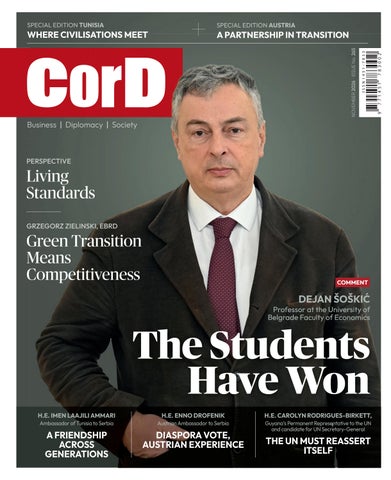
SPECIAL EDITION TUNISIA
A PARTNERSHIP IN TRANSITION NOVEMBER 2026 · ISSUE No. 265
WHERE CIVILISATIONS MEET
SPECIAL EDITION AUSTRIA
Business | Diplomacy | Society
PERSPECTIVE
Living Standards GRZEGORZ ZIELINSKI, EBRD
Green Transition Means Competitiveness
COMMENT
DEJAN ŠOŠKIĆ
Professor at the University of Belgrade Faculty of Economics
The Students Have Won H.E. IMEN LAAJILI AMMARI
H.E. ENNO DROFENIK
Ambassador of Tunisia to Serbia
Austrian Ambassador to Serbia
A FRIENDSHIP ACROSS GENERATIONS
DIASPORA VOTE, AUSTRIAN EXPERIENCE
H.E. CAROLYN RODRIGUES-BIRKETT, Guyana’s Permanent Representative to the UN and candidate for UN Secretary-General
THE UN MUST REASSERT ITSELF
The Region P R E S E N TS
Western Balkans 2030 5 NOVEMBER 2026
AVALA HOTEL · BUDVA · MONTENEGRO
Organisations Represented at the Forum
Institutional Partners
Exclusive Dinner Partner
Contents
WHERE CIVILISATIONS MEET
A Partnership in Transition
Celebrating 70 Years of Diplomatic Relations with Serbia SPECIAL EDITION
AUSTRIA 2026
OF DIPLOMATIC RELATIONS SERBIA - TUNISIA 1956 - 2026
TUNISIA
GUEST OF HONOR AT THE BELGRADE INTERNATIONAL BOOK FAIR 2026
06 THE STUDENTS HAVE WON
COMMENT BY DEJAN ŠOŠKIĆ
68 BIZERTE BEYOND
18 LIVING STANDARDS
THE BATTLEFIELD
56 THE SECOND ACT
08 THE UN MUST
110 YEARS OF BIZERTE
ADAM NEUMANN
REASSERT ITSELF
Founder of Flow and Co-founder of WeWork
H.E. CAROLYN RODRIGUES-BIRKETT
Guyana’s Permanent Representative to the UN and candidate for UN Secretary-General
74 THE POWER OF DAYDREAMING
24 GREEN TRANSITION MEANS COMPETITIVENESS
GRZEGORZ ZIELINSKI
12 DIASPORA VOTE,
Managing Director, South-Eastern Europe, EBRD
MARIE DARRIEUSSECQ
French Writer and Psychoanalyst
67 THE ART OF
AUSTRIAN EXPERIENCE
RETURNING TO MYSELF
DIANA ELIZABETH MARTINOVICH
H.E. ENNO DROFENIK
Opera Singer, Author and Entrepreneur
Austrian Ambassador to Serbia
80 CHILL OUT 82 OBJECTS 84 CALENDAR 86 FACES & PLACES
“CorD - 23 Years of Independent Thought and Inspiration”
CorD_Magazine cordmagazine thecordmagazine cordmagazine cordmagazine The views expressed in this publication are those of the presenter; they do not necessarily reflect the view of publications published by alliance international media
04
EDITOR IN CHIEF: Neda Lukić n.lukic@aim.rs DESIGN: Slađan Radosavljević Zoran Perović design@aim.rs COPY EDITOR: Mark Pullen TRANSLATION & EDITING: Pullen Editorial, Halifax
november
CONTRIBUTORS: Ljubica Gojgić Zoran Panović Radmila Stanković Maja Vukadinović Mirjana Jovanović Miša Brkić, Rob Dugdale Steve MacKenzie Zorica Todorović Mirković Sonja Ćirić, Miloš Belčević
SALES MANAGERS: Biljana Dević b.devic@aim.rs Vesna Vukajlović v.vukajlovic@aim.rs Jelena Mirković j.mirkovic@aim.rs SUBSCRIPTIONS: office@aim.rs FINANCE: finance@aim.rs
PRINTING: E-mail: office@aim.rs CEO: office@cordmagazine.com Rotografika d.o.o. Ana Novčić a.novcic@cordmagazine.com Segedinski put 72, Subotica www.cordmagazine.com www.aim.rs CorD is published by: PUBLISHER: ISSN no: 1451-7833 alliance international Ivan Novčić All rights reserved media d.o.o. i.novcic@aim.rs alliance international media Resavska 1/III, 2026 11111 Belgrade 17, PAK 125806, Serbia Phone: +(381 11) 2450 508
Business Alcazar of Adria ADRIA'S VOICE IN GLOBAL BUSINESS
The Region
Ten visionaries from Adria. One future being built today.
ISSN 3009-4380
Inventing Tomorrow
9 773009 438006 >
No.7 • APRIL - JUNE 2025
COMMENT
The Students Have Won By Dejan Šoškić, Professor of Economics and former Governor of the National Bank of Serbia
The Student List’s victory marks the beginning of the restoration of democracy and constitutional order in Serbia. At the same time, it could inspire all those who, despite deep concern for its future, continue to believe in democracy as the most advanced form of government for modern societies.
he Student List’s victory in the parliamentary elections of 25 October represents more than a change of government. It marks the beginning of the restoration of democracy, constitutional order and institutions in Serbia, while renewing faith that citizens united around clear values and a shared interest can change society through peaceful means. The Student List grew out of the movement that emerged following the tragedy at Novi Sad railway station on 1 November 2024 at 11:52, when 16 innocent people lost their lives. The people of Serbia did not perceive this tragedy as an isolated accident, but as a consequence of systemic corruption, institutional decay and the absence of accountability. That sense of injustice gave rise to a movement that succeeded in transforming public discontent into an organised, peaceful and democratic political force. The Student List achieved a convincing victory despite profoundly unequal electoral conditions, the misuse of state resources, restrictions on media freedom, pressure and vastly inferior fi-
T
06
november
nancial and organisational resources. It stood against an authoritarian regime that had for years commanded almost unlimited media, financial and institutional resources, while relying on intimidation, bribery and the systematic dissemination of falsehoods. Despite all this, the clear will of the electorate prevailed. A well-organised and responsible student movement, supported by the strong determination of citizens, defeated a government that believed control over institutions, the media and public resources could permanently replace democratic legitimacy. The significance of this victory also stems from the way it was achieved. The struggle for constitutional government,
The victory was achieved peacefully; the new government must be established in the same way – in accordance with the Constitution, the law and the expressed will of citizens the rule of law, democracy, freedom of information, and human and civil rights was conducted through exclusively peaceful and non-violent means. In a society subjected for years to division, fear and political violence, the students demonstrated that determination need not be accompanied by aggression and that the most profound political change can be achieved at the ballot box. Serbia now faces an equally important task: once the final results have
been confirmed, this electoral victory must be translated peacefully, with dignity and in accordance with the Constitution and the law, into new legislative and executive authorities that reflect the will expressed by citizens at the ballot box. There can be no place for political revenge, violence or actions outside the constitutional and legal order. Anyone who advocates or attempts anything that threatens the peace and security of citizens or exceeds the boundaries of the law is acting neither in accordance with the fundamental principles of the Student List nor with the will of the people expressed in the election. What lies ahead is the peaceful and civilised restoration of state institutions, democracy, civil liberties and human rights. This task will be neither easy nor quick. It will require the restoration of public trust, the establishment of accountability, the return of independence to institutions and the creation of a society in which the law applies equally to everyone. But this task is achievable. Serbia finally has an opportunity to enter a phase of development in which there is a genuine possibility that each new day will be better than the last. We must seize this opportunity for the recovery and progress of our society and state. We owe it to the citizens who voted on 25 October. We owe it to future generations. Above all, we owe it to those who lost their lives at Novi Sad railway station on 1 November 2024 at 11:52.
Photo by Goran Srdanov
INTERVIEW
EXCLUSIVE
The UN Must Reassert Itself The UN is the ultimate legitimiser, validator, global norm setter and early warner. The Organisation is indispensable. We have seen that, even when agreements are decided outside of the Organisation, they are brought to the UN to receive the stamp of global legitimacy. However, many have expressed the view that the UN must reassert itself, including in its peacemaking role, and not be on the periphery of decision making. As Secretary-General, this will be a priority for me in working closely with Member States – Carolyn Rodrigues-Birkett
H.E. Carolyn Rodrigues-Birkett Guyana’s Permanent Representative to the UN and candidate for UN Secretary-General By Ljubica Gojgić
he United Nations is selecting its next Secretary-General, who will take office on 1st January 2027 for a five-year term. Several women are among the candidates, and choosing one would place a woman at the head of the Organisation for the first time in its history. One of them is Carolyn Rodrigues-Birkett, Guyana’s Permanent Representative to the UN, a former foreign minister and an experienced multilateral diplomat. In this interview for CorD Magazine, she argues that reform must make the UN “more effective, efficient, agile and capable of delivering better results on the ground”.
T
08
november
You are seeking to become the first woman to serve as United Nations Secretary-General. Do you believe the Organisation is ready to take that step? — I do. However, the ultimate test of that readiness of the UN to have a representative from the other half of humanity (women) serve for the first time as the Secretary-General will be seen in whom the Security Council recommends to the General Assembly for approval, and the latter’s acceptance of that proposal. The Security Council is currently conducting a series of informal
polls on the candidates for Secretary-General. Could you explain to our readers how this process works, including what it means when Council members cast secret ballots marked “encourage”, “discourage” or “no opinion”? — The straw poll is an informal process intended to assist the Security Council in reaching a consensus on a candidate. The votes in the polls are in the categories of “encourage”, “discourage” and “no opinion.” A candidate requires a minimum of nine affirmative votes and no veto (negative vote by a Permanent member) to be approved by the Security Council
cordmagazine.com
09
for recommendation to the General Assembly. So, the number of “encourage” or “discourage” votes garnered during the straw poll is used as a gauge to determine the level of support a candidate has, and if they are likely to attract a veto, before moving to the formal stage of deciding on a candidate to recommend to the General Assembly. Six rounds of straw polls have been conducted to date. Five sets used white ballots and one used “coloured ballots”, where a different colour of paper is used by Permanent members to distinguish how they voted. A coloured “discourage” vote could mean an eventual veto when the process moves to a vote, or it could be used to signal that there is a need for further negotiation. In the last straw poll, all candidates received at least two coloured “discourage” votes. Candidates will therefore have to ascertain with the relevant P5(s) whether negotiation is desired or it is a veto. When the Council reaches a consensus on a candidate, a resolution with the name of the person being recommended to the General Assembly is voted on in a formal meeting of the Council. This recommendation is then submitted to the General Assembly for approval.
At the time of this interview, you rank among the leading candidates in the informal polls. If selected, what would be the single most important priority of your term? — I have more than one priority: carrying out the necessary reforms approved by the General Assembly and within my remit; working with Member States to end and prevent conflicts; addressing the immense humanitarian needs; making progress on the issue of geographical representation in the staffing of the UN and partnering with international financial institutions to address issues related to financing for development. All of these are aimed at making the UN more effective, efficient, agile, and capable of delivering better results on the ground.
10
november
You made history in 2008 as the first woman and the youngest person to serve as Guyana’s minister of foreign affairs. Your appointment also made you the highest-ranking Guyanese of Indigenous descent in government at the time. Do you believe the world, and the United Nations in particular, needs to listen more closely to the voices of smaller countries and underrepresented communities? — In general, we should all listen to each other in the UN, whether large or
Our currency isn’t our size or military might; rather, it is our ability to build bridges and produce results with limited resources small, developed or developing. This is the only way we can appreciate diverse perspectives and work to find consensus. We all need each other in this interdependent world. That said, the UN’s objective of leaving no one behind means that, as a matter of priority, we must consider the most vulnerable and those in vulnerable situations. In many cases, small states fall into these categories. Small states are often disproportionately affected by climate change and face limited ac-
cess to concessional financing, high levels of debt that constrain their development and, in some cases, conflict. They therefore require international support. So, yes, listening to them is important, but so is acting on the issues affecting them.
If selected, you would also be the first person from the Caribbean to serve as UN Secretary-General. Beyond the historic significance of your candidacy, which experiences have best prepared you to lead the Organisation at this time of deep geopolitical division and declining trust in multilateralism? — My career spans the technical, governmental, political, international civil service and diplomatic fields. I know the importance of trust and political will if one is to achieve even a modicum of success. In the negotiations that I led in the UN, I enjoyed the trust of Member States because I demonstrated impartiality and the ability to listen – sometimes the same issue was being raised by scores of delegations, but it was important to let everyone have their say. On the Security Council, I coordinated resolutions in highly charged situations and also served as a neutral broker when there were divisions among members. Sometimes patience was tested, but skilful leadership and a little more time took us over the
PRIORITIES
CARIBBEAN STRENGTH
SELECTION
UN reform, conflict prevention, humanitarian action, geographical representation and development finance
Bridge-building and achieving results with limited resources define her leadership approach
A candidate requires at least nine affirmative votes and no veto before being recommended to the General Assembly
finish line. It was a natural approach because I am from the Caribbean. As a group of small states, our currency isn’t our size or military might, as we possess neither; rather, it is our ability to build bridges, convince others, work with large and small countries, and produce results with limited resources. That is our strength. Indeed, our smallness requires us to always have a view of the global picture, as we know it is small states that experience the consequences of global shocks first and most deeply. The combination of this expertise that I have honed over the years is what I will deploy should I be appointed Secretary-General.
How do you see the UN’s role in today’s multipolar world, when calls for reform are growing but major powers sometimes pursue responses to urgent crises outside the organisation, rather than through it? — The UN is the ultimate legitimiser, validator, global norm setter and early warner. The Organisation is indispensable. We have seen that, even when agreements are decided outside of the Organisation, they are brought to the UN to receive the stamp of global legitimacy. However, many have expressed the view that the UN must reassert itself, including in its peacemaking role, and not be on the periphery of decision making. This would be a priority for me as Secretary-General, working closely with Member States. The Secretary-General works with the Security Council and General Assembly to advance the UN’s mission, while retaining an independent voice. António Guterres, whose term ends this year, has faced strong criticism from Israel and was declared persona non grata in 2024. How would you preserve the inde-
pendence of the office and speak openly on divisive conflicts, while maintaining the trust required to bring the parties to the table? — The Secretary-General is the premier global voice, and that carries immense weight and responsibility. The world expects the Secretary-General to always be faithful to the UN Charter and international law, and to have moral clarity. This means the Secretary-General will have to speak on very difficult issues precisely to demonstrate her impartiality and in-
The Secretary-General does not have the luxury of not trying. Wars do not end with military solutions; they always end with diplomacy
dependence, and to retain the trust of Member States. That said, in my view, a Secretary-General must be discerning. She must discern whether speaking immediately on a matter would prevent her from being part of the solution and bringing the parties to the table, or whether remaining silent would be more damaging. It’s a call that will have to be made.
You have said that you would be prepared to engage directly with both
Russia and Ukraine. Could such an initiative expose you to criticism from Member States with very different approaches to the war? What could a UN Secretary-General realistically contribute to bringing this conflict to an end? — The Secretary-General does not have the luxury of not trying. We live in an era when wars do not end with military solutions; they always end with diplomacy. I cannot see this one ending any other way. I am not oblivious to the deep-seated challenges associated with some conflicts, but I will try. In the final analysis, it will be up to the parties to the conflict whether to accept the Secretary-General’s offer or not. Your country recognised the independence of Kosovo, which Serbia regards as a province that seceded from it. Under Security Council Resolution 1244, the United Nations established an international interim administration in Kosovo, while its final status has remained unresolved. Kosovo is not a member of the UN. At the same time, the UN mission continues to play an important role in maintaining peace and protecting the rights and security of the Serb minority population. What practical role should the UN and the Secretary-General play in reviving dialogue, protecting the rights and security of all communities, and preventing renewed escalation, while complementing the EU-led process? — The UN has always worked to promote dialogue in any given situation. This particular Mission operates under an open-ended mandate established by the Security Council under Resolution 1244. Its scope and timeline are decisions of the Security Council, including any specific roles for the UN and the UN Secretary-General.
cordmagazine.com
11
INTERVIEW
Diaspora Vote, Austrian Experience Voters based abroad can simply vote by mail without having to contact embassies or official polling stations. Nearly 650,000 Austrians live abroad. The Austrian government makes an effort to enable their participation in the electoral process as much as possible and without any undue bureaucratic obstacles. The prerequisite is registration with the Austrian voter rolls, which can be completed online and is valid for 10 years. Voting cards will be sent automatically to your foreign address and the vote can be cast immediately, without having to wait for election day ~ Enno Drofenik
H.E. Enno Drofenik Austrian Ambassador to Serbia By Ljubica Gojgić
ustria’s new ambassador to Serbia arrived in the country on the eve of the snap parliamentary elections, with one of the important questions regarding the elections relating to the right of Serbian citizens living abroad to freely exercise their right to vote. Speaking in this interview for CorD Magazine, Ambassador Drofenik reveals that this procedure has been maximally simplified in Austria. Discussing his priorities in Serbia, the ambassador says that his goal is to support the country’s path to EU membership, which is currently being led by Montenegro, Albania, Moldova and Ukraine. Ambassador Drofenik also says that Austria is very much looking forward to EXPO 2027 Belgrade because it “offers an excellent opportunity to further deepen our already strong bilateral relations and strengthen economic ties between Austria and Serbia”. The
A
12
november
focus of Austria’s EXPO 2027 presentation – themed “Austria. Join the Flow” – is on the Danube, as a symbol of economic cooperation, innovation and cultural exchange.
Your Excellency, what priorities have you set for your term as ambassador to Serbia, which began in August of this year? — One of my priorities is to support Serbia on its path towards the European Union. Austria is convinced that Serbia – just like the other countries of the Western Balkans – must have its own place in the EU. Relations between Austria and Serbia are close and friendly. We cooperate in many different fields, ranging from agriculture, to internal affairs, justice and social affairs. Given that Austria is one of the largest foreign investors in Serbia, strengthening our economic cooperation is undoubtedly one of
our priorities. The close human ties that exist between Austria and Serbia, thanks not least to the large Serbian diaspora community in Austria, form strong foundations for our bilateral relations.
Your first months in Belgrade have coincided with preparations for snap parliamentary elections. One of the issues around the electoral process relates to voting by Serbian citizens living abroad. Many of them have registered to vote, but fear that the system may not be able to guarantee them the opportunity to exercise their electoral rights. Austria’s experience is particularly interesting in this regard. How does Austria’s postal voting system work, including the requirement for voters living abroad to renew their electoral registration every ten years?
cordmagazine.com
13
— Austrian voters abroad can simply vote by mail, without having to contact embassies or official polling stations. Nearly 650,000 Austrians live abroad. The Austrian government makes an effort to enable their participation in the electoral process as much as possible and without any undue bureaucratic obstacles. The prerequisite is registration with the Austrian voter rolls, which can be done online and is valid for 10 years. Voting cards will be sent automatically to the voter’s foreign address and the vote can be cast immediately, without having to wait for election day.
You arrived in Belgrade as the ambassador of a country that supports Serbia’s European integration. Yet Serbia’s accession process has effectively ground to a halt, with no new negotiating clusters opened for more than five years. Is this primarily the result of slow reforms, or are the obstacles essentially geopolitical, particularly with regard to Serbia’s refusal to impose sanctions on Russia, as suggested in recent weeks by Serbia’s former President? — While Serbia clearly has the potential to make rapid progress towards European Union accession, a strong commitment to the rule of law and reconciliation in the region would help secure the necessary support from all EU member states. As part of the accession negotiations, the European Commission proposed opening Cluster 3 with Serbia; a proposal that was fully supported by Austria but, unfortunately, didn’t receive the unanimous approval of all member states. It goes without saying that alignment on foreign policy—which is essentially an expression of shared EU values— plays an important role. As someone who’s well acquainted with European affairs, do you believe the EU’s next enlargement will involve Ukraine or Montenegro? — Montenegro, Albania, Ukraine and Moldova have been identified by the
14
november
Only EU membership – which would eliminate all of the quite significant non-tariff trade barriers – will raise Serbia’s economic cooperation with the EU to the next level
European Commission as the most advanced candidate countries and the Commission plans to present indicative reform progress roadmaps for these four countries. We are indeed seeing tangible results, particularly in Montenegro, where 21 of the 33 negotiation chapters have been provisionally closed. This sends a strong signal to all candidates: reforms deliver results.
EU
TRADE
VOTING
Austria backed opening Cluster 3 with Serbia, but the proposal failed to secure unanimous EU support.
Serbia–Austria trade in goods and services reached €2.8 billion in 2025, with Serbian exports above €1.2 billion.
Austrians abroad can register online to vote by post. Registration remains valid for ten years
Let me stress one fundamental point: the accession process is strictly merit-based, with the same conditions applying to all candidates. Austria, together with other European partners, is very clear on this. It is a question of ensuring the credibility, fairness and integrity of the enlargement process. Let me also underline that the European Union is serious about its commitment to enlargement. Accession is achievable and the necessary reforms are feasible, provided the political will and sustained commitment exists. Austria is strongly committed to supporting all Western Balkan countries on their European path and helping them become members of the EU.
difficulties faced by professional haulage drivers from Serbia and the wider region who transport goods to EU countries. In your view, why has it taken so long to find a solution that would enable these transport operators to work without such obstacles? — Austria is aware of the problems faced by professional drivers as a result of the introduction of the EU entry-exit system and the strict enforcement of Schengen regulations. Any
Do you believe that the mass protests in Kosovo following the first-instance war crimes verdict against former President Hashim Thaçi, together with the Assembly’s decision to amend legislation governing the Kosovo Specialist Chambers in order to restrict their work, could impact the EU-facilitated dialogue between Belgrade and Pristina? How do you view these developments? — I hope that new momentum can emerge following the upcoming elections in Serbia and the successful presidential election in Kosovo. Progress on the dialogue between Belgrade and Pristina, supported by the EU, is significant for the entire Western Balkan region. All sides must make efforts to overcome the current impasse. Serbian media have reported that both the Austrian Government and the Austrian Federal Economic Chamber have been engaged in efforts to find an acceptable solution to the
Alignment on foreign policy – which is essentially an expression of shared EU values – plays an important role
reliable solution to the issue will require an amendment to the EU Visa Codex, which is something that cannot be done overnight. However, we very much hope that a solution can be found as soon as possible and we will offer our full support in this regard.
Austria is one of Serbia’s most important economic partners. Which sectors do you see offering the greatest potential for the further development of bilateral economic cooperation? — EU membership is by far the greatest growth potential that still needs to be tapped. Due to its association agreement with the EU, Serbia already benefits from duty-free exports of industrial goods to the EU market. However, only EU membership—which would eliminate all of the quite significant non-tariff trade barriers—will raise Serbia’s economic cooperation with the EU to the next level. Austria is one of the largest foreign investors in Serbia, with our companies employing more than 26,000 people in the country. We wholeheartedly support Serbia’s economic integration into Europe. How does Austria plan to present itself at EXPO 2027 Belgrade? — Austria is very much looking forward to EXPO 2027 in Belgrade. EXPO 2027 will provide an excellent opportunity to further deepen our already strong bilateral relations and strengthen economic ties between Austria and Serbia. The Austrian contribution is themed “Austria. Join the Flow.” The focus is on the Danube, as a connecting element between Austria and Serbia, but also as a symbol of economic cooperation, innovation and cultural exchange.
cordmagazine.com
15
Global Diary
“Hope is definitely not the same thing as optimism” Václav Havel
Lula Wins Historic Fourth Term in Brazil Brazilian President Luiz Inácio Lula da Silva has secured an unprecedented fourth term after defeating Senator Flávio Bolsonaro, son of former President Jair Bolsonaro, in a closely contested runoff. Lula won 51.79% of valid votes against Bolsonaro’s 48.21%, overturning his first-round deficit in a remarkable electoral comeback. Bolsonaro has refused to concede and is challenging the result, leaving Latin America’s largest democracy facing renewed political divisions as Lula prepares for another term.
Spain Calls Snap General Election Spanish Prime Minister Pedro Sánchez has called an early general election for 29 November after parliament rejected key housing measures proposed by his minority government. Sánchez is seeking a renewed mandate amid political fragmentation, public dissatisfaction over housing costs and growing pressure from opposition parties. The vote could determine whether Spain retains its Socialist-led government or undergoes a change in political direction.
Nobel Peace Prize Goes to Navi Pillay South African jurist and former UN High Commissioner for Human Rights Navi Pillay has been awarded the 2026 Nobel Peace Prize for her contributions to peace and international law. The 85-year-old, who served as a judge at the International Criminal Court and the International Criminal Tribunal for Rwanda, has spent decades pursuing accountability for serious international crimes. The Norwegian Nobel Committee’s decision comes amid mounting pressure on international judicial institutions and renewed debate over their authority. 16
november
“The pursuit of peace and progress can never be relaxed and never abandoned” Dag Hammarskjöld
Student Movement Ends Vučić’s Parliamentary Dominance Serbia’s student-led opposition has won a historic parliamentary election, ending 14 years of dominance by Aleksandar Vučić’s Serbian Progressive Party and its allies. Preliminary results from the Republic Electoral Commission give the Student List 52.65% of votes against 39.22% for Vučić’s coalition, with projections indicating a majority of around 140 seats in the 250-member parliament. The victory follows nearly two years of anti-corruption protests sparked by the deadly Novi Sad railway station collapse and opens the way for a new government, although its leadership and political direction remain to be determined.
Middle East Conflict Threatens Regional Stability Fighting between Saudi Arabia and Iran-backed Houthi forces has intensified following attacks on Riyadh’s airport and renewed military operations in Yemen. The escalation has heightened concerns over security around the Bab al-Mandab Strait, a vital passage for international shipping between the Red Sea and the Gulf of Aden. With diplomatic efforts stalled and the humanitarian situation deteriorating, the conflict threatens further instability across the Middle East.
Washington and Kyiv Clash Over Russia Policy Relations between US President Donald Trump and Ukrainian President Volodymyr Zelensky have deteriorated following Washington’s decision to ease restrictions on Russian energy exports. Trump has criticised Ukrainian strikes on Russian oil infrastructure, while Zelensky has warned that relaxing sanctions risks strengthening Moscow’s position in the continuing war. The disagreement has raised fresh concerns about the future of American military and diplomatic support for Ukraine. cordmagazine.com
17
PERSPECTIVE
LIVING STANDARDS
Better Off, or Just on Paper? Serbia has become more economically successful over the past decade, but how much of that progress has translated into better lives for its citizens? Behind the improved statistics are people for whom employment offers no escape from poverty, families lacking financial security and widening disparities in who can afford a decent standard of living
ver the past decade, Serbia has recorded significant growth in employment and real wages, while material deprivation and poverty have declined. Yet almost a third of citizens still report having difficulty or great difficulty making ends meet. Do the statistical improvements and persistently high lev-
O
18
november
els of subjective poverty reveal two different pictures of Serbia, or simply differe n t w ay s o f i n t e r p r e t i n g e c o n o m i c reality? We spoke to five economists about what the statistics reveal about living standards, the extent to which perceptions of poverty reflect actual living conditions and how the
benefits of economic growth have been distributed over the past decade. Their differing interpretations also raise the question of whether economic progress has brought lasting improvements for the most vulnerable, or whether significant vulnerabilities remain concealed behind the overall decline in poverty.
PERSPECTIVE
Jelena Žarković Full Professor, Faculty of Economics, University of Belgrade
More Jobs, Too Little Security Despite significant employment growth, poverty has declined much more slowly. Most new jobs have been less productive and lower paid, leaving many working people unable to escape poverty. tatistical data confirm that material deprivation has declined since 2013, when it was first measured in Serbia, but it is important to understand precisely where improvements have occurred. In 2013, 67% of people could not afford a week’s holiday away from home, compared with 36% today. The proportion unable to afford meat or fish every other day has also halved, as has the share of those unable to heat their homes adequately. The smallest improvement, however, concerns another component of the material deprivation indicator: whether a household can cover an unexpected expense from its own resources. In 2013, half the population could not do so, while by 2021 that proportion had fallen to 35%. Five years later, 36% of people in Serbia report having no savings to cover an unexpected expense, currently set at €250. In other words, a large number of citizens lack even minimal savings. This is consistent with household indebtedness figures, which have risen continuously and significantly over the past decade or so, with people even taking out loans to pay for holidays. Alongside material deprivation, the proportion of people living in households with very low work intensity – where household members work for only a small part of the year – has fallen threefold. This means that considerably more work is available today than in 2013. Employment, however, does not always guarantee a substantial improvement in living standards. The proportion of people whose income falls below the poverty threshold – the at-risk-of-poverty rate – has changed much less than the previous two indicators,
S
declining from 24.5% to the current 19.6%. This can be explained by the fact that most jobs created since 2013 have been in less productive and lower-paid activities, meaning that not everyone who has found employment has managed to rise above the poverty threshold. Moreover, following the introduction of the Social Card information system, the state has withdrawn financial social assistance from almost 70,000 people over the past three years, reducing the number of recipients by 30%. This has pushed people already struggling to survive even further into poverty. Despite the undeniable growth in GDP and employment over the past decade, further improvements in
Despite the significant decline in material deprivation, 36% of citizens have no savings to cover an unexpected expense of €250, revealing just how fragile improvements in living standards remain economic indicators will only lead to a more substantial reduction in poverty if the economy can generate better-quality, better-paid jobs. Social benefits must also reach more of the most vulnerable. When the poorest citizens are deprived of already modest social assistance, we cannot expect them to be motivated to improve their knowledge and skills – something that would genuinely make it easier for them to enter the labour market and potentially escape poverty.
cordmagazine.com
19
PERSPECTIVE
Ivan Nikolić Economist, Director of Research and Development at the Economics Institute in Belgrade and Editor of Macroeconomic Analyses and Trends (MAT)
Pessimists Without Good Reason A history of crises, distrust in institutions and prevailing negative narratives perpetuate insecurity and prevent citizens from recognising genuine improvements in living standards ince 2013, Serbia has undergone one of Europe’s most impressive socio-economic transformations. The unemployment rate has fallen from 23% to 7.2% (second quarter of 2026), while formal employment has increased by more than 300,000 workers. Material deprivation among employed people declined from 31.3% in 2014 to 6.2% in 2025, a better result than those recorded in Germany, France and the EU average. The risk of poverty or social exclusion fell from 43.2% to 23.2%, narrowing the gap with the EU by 87%. In certain areas, Serbia has even outperformed the European average. One example is the proportion of people unable to replace worn-out furniture, at 4.5%, compared with 7.4% in the EU. Yet despite this objective progress, as many as 31% of citizens feel poor – one of the highest proportions in Europe, surpassed only by Greece and Bulgaria. The difference between material deprivation (6.2%) and subjective poverty (31.1%) amounts to as much as 24.9 percentage points, one of the largest gaps in Europe. What explains this discrepancy? First, Serbia finds itself in a state of integration limbo – neither part of the EU nor completely isolated. This uncertainty creates chronic insecurity. Citizens do not want Brussels directives, but they want German salaries; they do not want sanctions against Russia, but they want to work in Berlin without a visa. The EU has become an emotional symbol of higher living standards rather than a political community. Second, narratives and media influence are crucial. While Croatia, as an EU member, has a settled narrative – “we have arrived in Europe” – Serbia is dominated by the message that “everything is rigged, the government steals, Europe does not want us and young people are leaving”. This narrative does not merely reflect reality; it creates reality. Even when wages rise and hospitals are renovated, the message remains unchanged: “things are bad, and they will get worse”.
S
20
november
Third, history has left deep psychological scars: wars, hyperinflation, sanctions, NATO aggression and the seizure of Kosovo and Metohija. The collective consciousness has learnt to be sceptical and pessimistic because optimism has repeatedly been disappointed. This pessimism is not irrational, but it has now become an outdated framework that prevents people from recognising progress. Finally, there is a deeper layer: we are a nation that likes to criticise. Distrust of authority, a tendency to emphasise shortcomings and the belief that we are “smarter” than those who govern us are all traits that undermine collective satisfaction. A critical spirit is the foundation of democracy, but when it becomes excessive, it can prevent people from acknowledging any success whatsoever. In material terms, Serbia is already in Europe, but psychologically and institutionally it remains in the Balkans.
In material terms, Serbia is already in Europe, but psychologically and institutionally it remains in the Balkans. Without recognising the progress achieved, even substantially higher salaries will not bring a sense of a better life It is not poor, yet part of its population feels poor. Material deprivation is declining, but psychological deprivation persists, rooted in collective memory, distrust and the habit of criticising everything, including our own progress. Perhaps the real next step is to acknowledge that we have made progress. Not as an advertisement for the government, but as recognition of our people’s own work and perseverance. Without that acknowledgement, even a salary of €2,000 will not bring a sense of a better life.
PERSPECTIVE
Gordana Matković
Economist, Programme Director at the Centre for Social Policy and Professor Emerita at Singidunum University
Is Subjective Poverty Objectively Grounded? People’s perceptions of poverty have an objective basis. Despite improvements in living standards, almost a fifth of the population remains at risk of poverty, as indicators of severe material hardship confirm.
ubjective poverty in Serbia remains high. According to the latest available data, a significant proportion of the population lives in households that report finding it difficult (20.9%) or very difficult (10.3%) to make ends meet. Such a high level of subjective poverty is not inconsistent with improvements in employment, growth in real wages over the past decade or other indicators of living standards. To begin with, subjective poverty itself has declined substantially over the same period, from almost 65% to approximately 31%, while every indicator used to measure poverty in Serbia confirms an improvement. Despite these positive trends, the latest figures for 2025 show that almost 20% of the population remains at risk of poverty. For example, the median monthly income of a four-person household reporting great difficulty making ends meet was only around 76,000 dinars. This suggests that subjective poverty has an objective basis. The correspondence between the proportion of people reporting great difficulty making ends meet (10.3%) and indicators measuring the most severe forms of poverty is also revealing. The extreme poverty rate, defined in European terminology as the proportion of people living below 40% of median equivalised income, stands at 8.9%. Certain indicators of the most severe forms of material deprivation show similar figures: 14.2% of people live in households unable to afford adequate nutrition, while 9.3% cannot afford adequate heating.
S
The income-based absolute poverty rate monitored by the World Bank, using a threshold defined in accordance with the level of development of countries such as Serbia, also stands at 9.0%. Here, too, objective indicators provide a basis for understanding people’s subjective assessments of their financial circumstances. Without appropriate research, it is difficult to assess whether the growth achieved over the past decade has produced a proportionate reduction in poverty. What is clear is that economic progress has not been sufficient to lift a substantial share of the population out of poverty. Serbia continues to lag
Economic progress has failed to lift a substantial share of the population out of poverty, while poverty reduction has stagnated in recent years. At the same time, social assistance for the poorest has almost halved behind almost all EU countries in terms of living standards, while the decline in poverty has stagnated in recent years. At the same time, programmes targeting the poorest have not been improved. Expenditure on financial social assistance and the number of beneficiaries have almost halved, while the adequacy of benefits remains unsatisfactory. High levels of subjective poverty in Serbia should therefore come as no surprise.
cordmagazine.com
21
PERSPECTIVE
Aleksandra Anić Assistant Professor at the Faculty of Economics, University of Belgrade, and Researcher at the Foundation for the Advancement of Economics (FREN)
Least Support for Those Who Need It Most While wages are high in a handful of major urban centres, many people on modest incomes elsewhere in Serbia struggle to repay loans, cover everyday expenses and make ends meet cannot describe the distribution of economic growth as either good or equitable. There are enormous disparities in living standards between Belgrade and a few other major centres on the one hand, and rural areas, as well as the entire region of Southern and Eastern Serbia, on the other. In 2025, the highest average wage was recorded in the municipality of Stari Grad, at almost 190,000 dinars, while the lowest was in Preševo, at 74,000 dinars. Average earnings in computer programming were almost 300,000 dinars, compared with just 61,000 dinars in other personal service activities. The median wage last year was 85,000 dinars, meaning that half of all employees in Serbia earned no more than that amount. When people have to pay rent, repay loans, settle bills and raise children on the minimum wage or only slightly more, it is hardly surprising that a considerable number of citizens find it difficult or very difficult to make ends meet. The economic position of children has been a focus of my research to date, so I would like to address the various policies affecting the living standards of families with children. Serbia still has no progressive taxation of wages, nor does it provide tax allowances for dependent family members, except under the annual personal income tax. The annual personal income tax is paid by taxpayers whose earnings exceeded 5.4 million dinars last year, equivalent to more than three average annual salaries in 2025. This means that tax allowances for children and other dependants are available only to those who need them least – the highest earners.
I
22
november
People earning the minimum or average wage receive no tax relief whatsoever, even if they have dependent children. Policies relating to families with children have been amended several times since 2018, with the aim of increasing the birth rate. Substantial parental allowances are provided for newborn children, meaning that children born before 2018 are not covered by the generous parental allowance currently available. By contrast, child benefit, whose purpose is to reduce child poverty, remains very modest in both amount and coverage. In many European countries, child benefit is universal, meaning that all children receive it regardless of their family’s financial cir-
While the state provides generous financial incentives for childbirth, child benefit, which is intended to reduce child poverty, remains modest and reaches only a small proportion of children in Serbia cumstances. In Serbia, just 16.8% of children received child benefit in 2025. The tax and social welfare system urgently requires thorough reform to ensure a fairer distribution of income. Nevertheless, although this system plays an important role in reducing poverty and improving living standards, access to better-paid jobs remains crucial if people are to stop struggling to make ends meet.
PERSPECTIVE
Mihail Arandarenko Full Professor, Faculty of Economics, University of Belgrade
Poverty Has Simply Changed Address Objective and subjective poverty indicators have improved in parallel, while high income inequality affects both. The perception of poverty is therefore not merely a matter of sentiment, but also reflects actual living standards undamentally, there is no major divergence between trends in objective indicators of living standards and subjective poverty in Serbia, as both have improved in recent years. However, the concepts themselves and the methods used to measure them are quite different, which can lead to confusion when drawing conclusions. From a European perspective, subjective poverty indicators are strongly correlated with objective measures of living standards. The highest rates of subjective poverty are found in objectively poorer countries, such as Greece, Bulgaria, Romania, North Macedonia, Albania, Montenegro and Moldova. Serbia also belongs to this group. Two additional factors certainly contribute to subjective poverty indicators exceeding expected levels: negative GDP trends and high inequality. Greece, for example, although wealthier than Serbia, has a higher level of subjective poverty. This is precisely because, following the decline in GDP, most of Greece’s population is objectively poorer today than it was 10 or 15 years ago, which is not the case in Serbia. High income inequality also increases both objective and subjective poverty. In Serbia, statistically recorded income inequality, previously among the highest in Europe, fell dramatically towards the end of the last decade and has since remained at a relatively moderate, albeit above-average, level. This was partly the result of employment growth and the recovery in living standards following the periods of transition and fiscal consolidation. It also reflected a change in the statistical methodology used for the EU Statistics on Income and Living Conditions (EU-SILC) survey, on which inequality and poverty indicators are based. Under the revised approach, particular attention was paid to achieving more comprehensive coverage of the lowest incomes.
F
Distributional issues, which have a major impact on living standards and both objective and subjective poverty in Serbia, are usually overlooked when assessing the quality of economic growth. Our system of taxation and social transfers has remained essentially unchanged since the beginning of this century, when it was designed, through a domestic version of neoliberal transition reforms, primarily to serve the interests of the upper-middle class. In the meantime, labour market developments and demographic changes – particularly the shrinking working-age population, accelerated by emigration – have partially re-
With the tax and social transfer system unchanged, poverty is shifting between social groups rather than declining. While it is falling among children and working-age people, it is rising among the elderly duced the inequality systematically generated by the tax and transfer system. Public policy measures have also played a role, including more substantial increases in the minimum wage during this decade, more generous childbirth support measures and occasional universal payments to the population. However, with the tax and transfer system unchanged, objective poverty is shifting from one social group to another rather than being reduced. Thus, while objective poverty among working-age people and children has declined in recent years, it has risen sharply among older people and pensioners. It now affects around a quarter of the population in these two largely overlapping categories.
cordmagazine.com
23
INTERVIEW
Green Transition Means Competitiveness Affordable, reliable and sustainable energy should be treated as a single economic priority. For South-Eastern Europe, the green transition is not merely a costly adjustment to European standards, but an opportunity to strengthen energy security, attract investment and secure a more competitive position within European value chains
Grzegorz Zielinski
Managing Director, South-Eastern Europe, EBRD
24
november
urope’s green transition is entering a decisive phase, with energy security and industrial competitiveness becoming as important as climate ambition itself. Grzegorz Zielinski, EBRD Managing Director for South-Eastern Europe, argues that countries able to provide reliable, competitively priced and increasingly low-carbon energy will be best placed to attract investment and support growth. For Serbia and the wider region, this means developing renewables, stronger grids and storage in parallel, while ensuring regulatory predictability. As European supply chains become greener, access to cleaner energy will increasingly shape the region’s ability to compete and attract investment.
E
Europe’s green transition is unfolding at a time of geopolitical uncertainty, concerns over energy security and mounting pressure on industrial competitiveness. Can Eu-
rope still reconcile ambitious climate goals with affordable energy and economic growth – and is delaying the transition ultimately a greater economic risk? — Europe can reconcile these objectives by treating affordable, reliable and sustainable energy as a single economic priority. Electricity prices shape industrial competitiveness, transport costs and inflation. Countries that provide dependable power at competitive prices give businesses a stronger platform to invest and grow, while renewables now provide the cheapest energy per MWh for new power plants. Delaying the transition carries a clear cost: early movers can modernise their energy systems, reduce exposure to imported fuels and gain an advantage in markets that increasingly value low-carbon production. Renewables are central because competitively priced new power, supported by grids, storage and flexibility, can lower longterm costs, strengthen energy security
and support the electrification of the wider economy. Climate ambition and competitiveness are therefore not opposing goals. A well-managed transition increasingly underpins both economic growth and energy security.
The scale of investment required for the green transition cannot be met by public finance and international institutions alone. What will it take to mobilise private capital on a much larger scale, and when will green investment become sufficiently commercially attractive to stand increasingly on its own? — Private capital is already willing to invest in green energy. The main constraint is whether projects can be developed under clear and stable rules. Predictable regulation, efficient permitting, timely grid connections and transparent markets turn interest into investment. Public and private actors have complementary roles: networks often re-
cordmagazine.com
25
quire public-sector leadership, while private investors can bring capital, innovation and efficient delivery to renewable generation and storage. Competitive mechanisms limit overcompensation and strengthen confidence. As a practical example, the EBRD has supported the Ministry of Mining and Energy in designing and implementing Serbia’s first and second renewable energy auctions through technical assistance co-funded by the Swiss government via SECO. With EBRD technical support, the second auction attracted 41 proposals and awarded support to wind and solar projects totalling up to 645 MW. The EBRD has been similarly successful in mobilising grant funding from the European Union for more innovative technologies, such as thermal storage. In Novi Sad, the EBRD is financing a solar thermal plant with seasonal heat storage, a heat pump and an electric boiler. This is thermal, rather than battery, storage. It can absorb surplus electricity through power-to-heat technology, support grid balancing and reduce reliance on natural gas. Green investment is commercially attractive; what it now needs is a stable enabling framework.
For South-Eastern Europe and the Western Balkans, is the green transition primarily a costly adjustment to European standards, or could it become a genuine source of competitive advantage? Where do you see the region’s strongest opportunities to attract investment and secure a place in Europe’s emerging green economy? — The green transition can become a genuine competitive advantage for South-Eastern Europe and the Western Balkans. Grids and renewable plants require upfront investment but generate value over many years, while fossil-fuel generation leaves countries exposed to recurring costs, volatile imported fuels and significant indirect healthcare costs. For economies without domestic gas, that dependence represents both an economic and strategic risk.
26
november
The region’s integration with the European Union makes the direction clear. Companies will increasingly need to demonstrate that their supply chains are lower-carbon and that their products meet European climate requirements. The EU’s Carbon Border Adjustment Mechanism reinforces the need to reduce the carbon intensity of production. Cleaner electricity can help manufacturers retain customers, attract investment and integrate more deeply into European value chains. The opportunity extends beyond energy. With its renewable resources, industrial base and proximity to the EU, the region can turn cleaner power into lasting competitiveness.
Serbia still faces the challenge of strengthening energy security while reducing its reliance on coal and expanding renewables, grids and storage. What should its priorities be over the next few years – and
Cleaner electricity can help manufacturers retain customers, attract investment and integrate more deeply into European value chains where could EBRD support make the greatest difference? — Serbia’s priorities are interdependent: renewable capacity, stronger electricity networks and storage must advance together. Adding wind and solar without modernising the grid would create bottlenecks, while grid investment without flexibility would limit the system’s ability to manage variable generation. Serbia needs an integrated plan for demand and supply over the next five to ten years. It must account for economic growth and the electrification of transport, heating, industry and digital infrastructure. Data centres and artificial intelligence applications require large, dependable electricity supplies. Serbia will be better placed to participate in this growth if
it can provide reliable power while lowering its carbon intensity. The EBRD can contribute by combining finance with policy support, including investment in generation, grids, district heating and storage, alongside assistance with auctions, regulation and project preparation. The Novi Sad solar thermal project illustrates this approach: renewable heat, seasonal storage and power-toheat technology will reduce natural gas use and support electricity system balancing. The goal is a coherent system in which generation, networks and flexibility reinforce one another.
Looking towards 2030, what would need to change for you to consider South-Eastern Europe’s green transition a success? And what is the greatest risk that could prevent the region from getting there? — The clearest measure of success would be a sustained change in the region’s energy mix. In Serbia, where coal still plays a major role, this would mean more renewables supported by stronger grids, storage and efficiency, alongside a credible pathway towards reducing dependence on coal. The exact year in which every target is reached matters less than maintaining the direction, pace and consistency of reform. Long-term commitment gives investors confidence by providing a stable project pipeline and predictable rules. It tells companies that more low-carbon energy will become available, helping them plan investments and compete in Serbia, the region and the EU. It also demonstrates to European and regional partners that the transition is credible. The greatest risk is policy inconsistency. If commitments shift, permitting is managed in a stop-start fashion, or grid modernisation falls behind, investors and businesses will delay decisions. By 2030, success should be judged not only by installed capacity, but also by whether the region has created a durable investment environment and a more secure, competitive and progressively cleaner energy system.
A Partnership in Transition SPECIAL EDITION
AUSTRIA 2026
Contents 30 A Partnership at a Crossroads
36 A Crisis Is the Ultimate Test of Trust
32 Building on Trust, Investing in the Future
Milena Avramović Bjelica and Tamara Bekčić Directors of Chapter 4 PR and Consulting Agency
Austria 2026 37 The Price of Stability Austria Today
38 The Art of Erasure Arnulf Rainer
Andreas Haidenthaler
Austrian Commercial Counsellor and Head of ADVANTAGE AUSTRIA Belgradeserbia
Formwork & Scaffolding
We make it work.
Doka Serb d.o.o. | Svetogorska 4 | 22310 Šimanovci | Srbija T + 381 22 400 100 | serb@doka.com | www.doka.com/rs | A company of Umdasch Group
COMMENT
A Partnership at a Crossroads ustria and Serbia have built a relationship that extends far beyond diplomatic cooperation. Decades of investment, trade, migration and cultural exchange have created strong connections between their economies and societies. Austria is among Serbia’s largest foreign investors, with its companies employing more than 26,000 people. But the depth of these ties should not obscure the challenges that will determine their future. Serbia today faces a different set of choices from those that shaped its earlier development. Attracting foreign capital and creating jobs remain important, but they are no longer sufficient measures of economic success. The greater challenge is to develop a more competitive economy, strengthen domestic businesses and create conditions in which investment generates innovation, higher productivity and lasting value. For Austrian companies, opportunities are emerging in renewable energy, advanced manufacturing, digital technologies, environmental solutions and healthcare. Serbian businesses, meanwhile, have the potential to become more deeply integrated into Austrian and European supply chains. Realising that potential requires more than competitive costs and geographical proximity. It demands predictable regulations, transparent procedures and institutions that businesses and citizens can trust. These conditions cannot be separated from Serbia’s wider political and institutional environment. Persistent corruption concerns, weaknesses in judicial independence and short-
A
30
comings in public procurement continue to undermine confidence in the rule of law. The European Commission’s 2026 assessment makes clear that these are not abstract political questions, but structural problems affecting accountability, fair competition and the investment climate. Austria’s support for Serbia’s European integration therefore carries both an opportunity and a responsibility. Vienna has consistently advocated enlargement, but progress towards EU membership ultimately depends on reforms undertaken in Serbia itself. The stalled accession process illustrates the limits of diplomatic support when commitments are not matched by implementation. The relationship nevertheless has considerable room to develop. Stronger links between Austrian industry and Serbian suppliers, cooperation in technological innovation and investment in skills could help Serbia move towards a more sophisticated economic model. Equally important is ensuring that the benefits of growth extend beyond individual projects and established investors. The cultural and human connections between the two countries provide a further foundation for cooperation. They offer continuity even when political circumstances change, while opening space for dialogue, creativity and mutual understanding. As this special edition explores through its diplomatic, economic and cultural perspectives, Austrian–Serbian relations are entering a period in which established partnerships must respond to new realities. Their future will depend not simply on how much capital crosses the border, but on whether Serbia can build the institutions and economic conditions needed to turn existing opportunities into lasting progress.
AUSTRIA 2026
MINIMALIST DESIGN Expansive glass surfaces, concealed vent, and minimal aluminium profile dimensions. FUNCTIONALITY Quality, reliability, and durability of the aluminium system. ARCHITECTURE A combination of aesthetics, comfort, and energy efficiency.
ALU KOENIG STAHL d.o.o. Vladimira Popovića 6, 11000 Beograd, Srbija
+381 11 222 30 83 +381 63 430 78 7 +381 63 437 05 1 office@alukoenigstahl.rs
INTERVIEW | ANDREAS HAIDENTHALER AUSTRIAN COMMERCIAL COUNSELLOR AND HEAD OF ADVANTAGE AUSTRIA BELGRADE
Building on Trust, Investing in the Future
Austria and Serbia enjoy decades of successful economic cooperation, built on strong business ties and mutual trust. With new opportunities emerging in innovation, renewable energy and advanced manufacturing, the focus is increasingly shifting towards higher-value partnerships and deeper integration into European supply chains
32
AUSTRIA 2026
eturning to Belgrade more than a decade after his previous posting, Andreas Haidenthaler finds a Serbian economy that has undergone significant transformation. As the new Head of ADVANTAGE AUSTRIA Belgrade, he sees considerable potential to build on Austria’s position as one of Serbia’s leading investors, strengthen cooperation between businesses and create lasting partnerships through EXPO 2027.
R
You previously headed ADVANTAGE AUSTRIA in Belgrade from 2008 to 2015. How has Serbia changed as a business destination, and what are its greatest strengths and challenges today? — Returning to Belgrade after more than a decade feels both familiar and excitingly new. Serbia has undergone a remarkable transformation in recent years. Its infrastructure has improved significantly, its economy has become more diversified, and its role as a regional business hub has strengthened considerably. For Austrian companies, Serbia’s key strengths are its strategic location, competitive and highly skilled workforce, strong industrial tradition and growing innovation ecosystem. Equally important is the entrepreneurial spirit I encounter across the country. Serbian companies have become increasingly export-oriented and technologically advanced, making them attractive partners for Austrian businesses. What has remained constant is the exceptionally strong economic relationship between Austria and Serbia. Austrian companies have invested in Serbia for decades and continue to rank among the country’s most important investors and employers. These long-standing ties have created a high level of trust, often one of the most valuable assets in international business. Challenges remain, of course. Companies everywhere value predictability, transparency and efficiency. Continued progress in these areas will further strengthen Serbia’s attractiveness. Where do you see greater potential – in attracting new Austrian investors or expanding existing operations and strengthening links with Serbian suppliers? — Many Austrian companies have operated successfully in Serbia for years. Their positive experiences often lead to additional investment, expansion into new business areas and the development of higher-value activities. Existing investors know the market well and are therefore well positioned to increase their engagement. cordmagazine.com
SUPPLIERS Serbian companies offer growing engineering expertise and opportunities to enter European value chains. EXPO 2027 Flow2Expo aims to connect businesses, research institutions, start-ups and publicsector stakeholders. INVESTMENT Austrian companies are exploring opportunities in renewable energy, healthcare and advanced manufacturing.
At the same time, Serbian suppliers have become increasingly competitive, offering high-quality products, engineering expertise and growing technological capabilities. This creates excellent opportunities for closer integration into Austrian and European value chains. Strengthening these connections benefits both sides: Austrian companies gain reliable partners, while Serbian businesses gain access to new markets and technologies. New investments remain equally important. Austrian companies are closely following opportunities in renewable energy, environmental technologies, digitalisation, healthcare, advanced manufacturing, logistics and infrastructure. Serbia’s economic development, geographic position and skilled workforce continue to attract Austrian businesses seeking long-term opportunities in Southeast Europe. How will Austria use EXPO 2027 and initiatives such as Flow2Expo to create lasting business partnerships? — EXPO 2027 will be a historic event for Serbia and an outstanding opportunity to showcase the country’s economic dynamism and innovation 33
potential to the world. Austria intends to make full use of this platform to strengthen business cooperation and create lasting partnerships. For us, EXPO is not simply about presenting Austrian innovation. It is about connecting people, companies, institutions and ideas. Through initiatives such as Flow2Expo, we want to facilitate direct contacts between Austrian and Serbian businesses, research institutions, start-ups and public-sector stakeholders. Austria has internationally recognised expertise in sustainability, energy efficiency, environmental technologies, smart cities, mobility and advanced industrial solutions. These are also areas of growing importance for Serbia. By bringing together relevant stakeholders, we aim to generate concrete business projects, joint ventures, technology partnerships and investment opportunities. Above all, we want EXPO 2027 to leave a lasting business legacy, with contacts established before and during the exhibition developing into longterm cooperation. 34
Which improvements to Serbia’s business environment would make the greatest difference to Austrian investors? — Austrian investors generally view Serbia as an attractive market with strong long-term potential. Nevertheless, further improvements in several areas would encourage greater investment and business activity. One of the most important factors is regulatory predictability. Businesses make decisions with
These long-standing ties have created a high level of trust, often one of the most valuable assets in international business a long-term horizon and therefore value stable, transparent and consistently implemented rules. Greater predictability helps companies plan investments, allocate resources and pursue expansion projects with confidence. Administrative efficiency is another key area. Significant progress AUSTRIA 2026
has already been achieved, particularly through digitalisation and modernisation. Further simplification of procedures and a continued reduction in administrative burdens would benefit both domestic and foreign companies. What are your priorities for your new mandate, particularly in strengthening Serbian companies’ integration into Austrian and European value chains?
Businesses make decisions with a long-term horizon and therefore value stable, transparent and consistently implemented rules. — Although I previously served in Belgrade, I approach Serbia as a new posting, as much has changed in recent years and I am getting to know the market afresh. My primary objective is to further strengthen the already excellent economic partnership between Austria and Serbia. The relationship between our countries goes far beyond statis-
tics. It is built on decades of successful cooperation, strong business connections and close people-to-people ties. I see considerable potential in renewable energy, digital technologies, industrial innovation, healthcare, infrastructure and environmental solutions. Another priority will be integrating Serbian companies into Austrian and European supply chains. Serbian businesses have demonstrated impressive capabilities, flexibility and competitiveness. By connecting Serbian suppliers with Austrian industry, we can generate benefits for both economies while contributing to more resilient European value chains. ADVANTAGE AUSTRIA will continue to serve as a platform for business networking, knowledge exchange and innovation partnerships. Our role is to bring the right partners together, identify opportunities and support long-term cooperation. By contributing to stronger trade, increased investment and deeper integration of Serbian companies into European markets, we can strengthen bilateral economic relations while supporting sustainable growth and prosperity in both countries.a
Osigurajte svoje zaposlene. Wiener Premium Care je jedinstveni proizvod na našem tržištu koji podrazumeva pokriće troškova lečenja malignih bolesti u inostranstvu do milion evra! Pogledaj ponudu
Dobrovoljno zdravstveno osiguranje Zdravlje prvo.
INTERVIEW | MILENA AVRAMOVIĆ BJELICA AND TAMARA BEKČIĆ DIRECTORS OF CHAPTER 4 PR AND CONSULTING AGENCY
A Crisis Is the Ultimate Test of Trust
Reputation is built not through individual campaigns, but through consistency, transparency and lasting relationships. Companies must therefore remain true to their values, even as markets, media and public expectations evolve s part of the Vienna-based international Chapter 4 Group, Chapter 4 has operated in Belgrade for 17 years, providing communications and strategic support to some of the market’s most successful companies. Its directors, Milena Avramović Bjelica and Tamara Bekčić, discuss trust as the foundation of reputation, the value of combining local expertise with international experience and why consistent communication matters more than following passing trends. Trust is now every brand’s most valuable currency. How can companies build and maintain it? MAB: Trust is built primarily through behaviour, when what a company says consistently matches what it does. The first step is honesty, followed by consistency, because audiences remember patterns rather than individual messages. The third is a willingness to communicate openly, even when things become difficult. A crisis is the ultimate test of trust. Companies that have invested in transparent communication over the years have built up reserves of goodwill that protect them, while those that communicated only when necessary find themselves without that support. Chapter 4 has worked closely with clients’ management teams for years. How important are local expertise and international experience? TB: For us, it is about balance. Local expertise means understanding society, the media, culture and how audiences think and respond. Without it, even the best strategy remains theoretical. International experience provides a broader perspective, high professional standards and insight into what works in other markets. The best results come from combining the two. We help international clients understand the local context, while supporting domestic companies in adapting their stories for international audiences and partners. Markets, media and public expectations are constantly changing. How can companies remain relevant and true to their identity without getting lost in trends? MAB: The key is a clear understanding of your values. Not every new platform or format suits every brand, and that is perfectly fine. We advise companies to treat their identity as a stable foundation while adapting how they communicate. Tone, channels and formats may change, but the essence should remain. 36
Photo by Nebojsa Babic
A
Brands that chase every trend gradually lose their distinctiveness and, with it, trust. In your experience, what distinguishes brands that endure for decades, and what role does communication play? TB: Enduring brands have a clear purpose and remain committed to it, regardless of challenges. They listen to their audiences and adapt without losing their character. They invest in relationships, not just sales, and understand that reputation is built strategically over many years. Communication is the thread connecting everything. It translates corporate values into clear messages, builds relationships with employees, partners and the public, and protects brands during crises. A brand without communication is just a name, while communication without substance is merely noise. If you could offer companies one piece of advice, what would it be? MAB: Before thinking about media, campaigns or social networks, ask yourselves: who are we, and why should anyone choose or remember us? Once you have that answer, communication becomes simpler and results more lasting. And do not wait until you need communication to start investing in it. TB: I agree that the best time to start building a reputation is before you need to rely on it. I would simply emphasise the importance of continuity in both communication and reputation building. AUSTRIA 2026
AUSTRIA TODAY
The Price of Stability After two years of recession, Austria is confronting a difficult question: how can it preserve the prosperity and social protections that have long defined its identity while restoring economic competitiveness and bringing public finances under control?
or decades, Austria has represented a particularly successful European compromise: a competitive economy, strong public services, extensive social protection and a political culture built on negotiation. Its prosperity has rested not only on industrial strength and exports, but also on the conviction that economic success should translate into security and opportunity for society as a whole. Today, that model is facing a demanding test. After contracting in 2023 and 2024, Austria’s economy returned to modest growth in 2025. The recovery, however, has been fragile. High energy and labour costs, weak productivity growth and pressure on export-oriented industries have exposed structural vulnerabilities. According to the European Commission, Austria has also lost economic ground relative to the EU average. Public finances present another challenge. In October 2026, the Finance Ministry projected a budget deficit of 4.1% of GDP for the year, equivalent to approximately €21.4 billion. The government fac-
F
cordmagazine.com
es the difficult task of consolidating spending without undermining the services and protections on which much of Austria’s social consensus depends. The pressure is particularly evident in the debate over social welfare. Chancellor Christian Stocker’s coalition is pursuing changes intended to make social assistance more consistent across Austria while strengthening incentives to work. Supporters argue that reform is necessary to ensure fairness and sustainability. Critics face a different question: whether tighter eligibility requirements could leave vulnerable households with less protection at a time of rising living costs. Demographic change adds to the difficulty. An ageing population is increasing pressure on pensions, healthcare and public finances, while businesses face shortages of skilled workers. Austria’s established vocational training system remains an important strength, but adapting education and employment policies to technological change is becoming increasingly urgent. The challenge is not simply financial. Austria’s traditional culture of political
compromise is being tested by sharper divisions over migration, social policy and the distribution of economic burdens. Decisions about who receives support, who pays for it and how newcomers participate in society increasingly shape the national political debate. Yet Austria retains considerable advantages: strong institutions, a highly developed industrial base, skilled workers and a tradition of social partnership. These provide a foundation for renewal, particularly if investment in innovation, digitalisation and clean technologies can help restore competitiveness. The central question is therefore not whether Austria can afford its social model, but how that model must evolve to remain viable. Fiscal discipline alone cannot guarantee prosperity, just as generous social protections cannot be sustained without a productive economy. Austria’s experience offers a broader European lesson. Stability is not a permanent achievement inherited from the past. It requires continual adjustment, public trust and a willingness to reconcile economic necessity with social responsibility. 37
hat happens to an image when an artist begins to erase it? Does it disappear, or does something previously invisible emerge? For the Austrian painter Arnulf Rainer, these questions became the foundation of an extraordinary artistic career. He painted over photographs, obscured faces, crossed out drawings and covered entire canvases in dense layers of colour. Yet what might appear to be an act of destruction was, in his hands, a means of discovery. Few artists have pursued the relationship between creation and destruction with such persistence. Rainer, who died in December 2025 at the age of 96, left behind a body of work that resists easy classification. His paintings can be violent and contemplative, disturbing and strangely beautiful. They invite the viewer to look closely at what has been concealed, while refusing to reveal everything. That tension lies at the heart of a major retrospective opening at Vienna’s Albertina on 13 November 2026. Bringing together works from different periods of his career, the exhibition offers an opportunity to reconsider one of Austria’s most influential post-war artists, whose rad-
W
38
AUSTRIA 2026
Photo Christian Wind
Art of Erasure
ARNULF RAINER
The
For Arnulf Rainer, painting was never simply an act of creation. It was also an act of concealment, destruction and transformation Images Courtesy of the ALBERTINA Museum, Vienna, and the Arnulf Rainer Museum, Baden
cordmagazine.com
39
ical experiments helped redefine the possibilities of painting.
Schwarze Rinnen
PAINTING AGAINST THE IMAGE
Born in Baden, near Vienna, in 1929, Rainer grew up in a country whose cultural and political identity had been profoundly shaken by war. The collapse of familiar certainties formed the background against which a new generation of Austrian artists sought alternative ways of seeing and expressing the world. Rainer’s artistic education was unconventional. His encounters with formal institutions were brief, and he developed much of his practice independently. Early experiments with surrealism gave way to an increasingly personal visual language, shaped by abstraction, automatism and an interest in psychological states that resisted conventional representation. By the early 1950s, he had begun developing the technique that would become his signature: Übermalung, or overpainting. Rather than beginning with an empty canvas, Rainer began with something already present. An existing image became both the foundation of the work and the object of its transformation. Sometimes only fragments survived: an eye, a contour, a patch of colour, the suggestion of a figure beneath an apparently impenetrable surface. Elsewhere, the original image seemed to vanish altogether. Yet its absence remained palpable. Rainer’s overpaintings challenge the assumption that artistic creation necessarily involves adding something to the world. In his work, concealment and interruption become equally powerful creative gestures. Painting becomes a way of questioning whether an image can ever be considered complete.
THE FACE AS A BATTLEFIELD Muede pose
40
Among Rainer’s most compelling works are his celebrated Face Farces, developed from the late 1960s onwards. In these photographs, he contorted his face into extreme expressions, transforming his features into a theatre of physical and psychological tension. He then intervened in the images with paint, drawing and aggressive marks. The results are unsettling. Eyes disappear beneath dark strokes. Mouths are distorted. Faces seem to struggle against the very surfaces on which they are represented. The conventional portrait seeks to preserve identity. Rainer’s portraits appear determined to destabilise it. His face becomes a site of conflict between the individual and the image, between the body’s involuntary expressions and the artist’s deliberate interventions. The painted marks do not simply disguise the person beneath them. They intensiAUSTRIA 2026
fy emotions that the photograph can only partially communicate. There is also an element of performance. Before the camera captures an expression, the artist must physically produce it. The photograph records an action, while the subsequent painting transforms that record into another event. The body is no longer merely represented. It participates in the creation of the image.
THE BEAUTY OF DISTURBANCE
Rainer’s work is frequently described in terms of aggression, darkness and destruction. Thick black marks cut across delicate photographs. Red pigment spreads across surfaces like a wound. Human figures appear trapped beneath gestures that seem simultaneously expressive and destructive. Yet to see only violence in these works would be to overlook their sensitivity. His interventions often follow the underlying structure of an image. A sweeping brushstroke may echo the movement of a body. A dark field may intensify the vulnerability of a face. A seemingly chaotic accumulation of marks may produce an unexpected visual balance. Rainer was fascinated by the expressive potential of the human body, including states of exhaustion, ecstasy, fear and physical strain. His painted photographs frequently capture figures at moments when ordinary composure has disappeared. The body becomes exposed, vulnerable and difficult to interpret. Such images challenge the comforting distance that often separates a viewer from a work of art. They demand an emotional response, even when that response is discomfort. For Rainer, beauty did not necessarily reside in harmony. It could emerge from disturbance, contradiction and the refusal to make experience reassuring.
Arnulf Rainer, Ich brenne und strahle
A RADICAL AUSTRIAN LEGACY
BEYOND THE VISIBLE
An overpainted image contains two histories: the image that existed before the intervention and the marks that transformed it. Neither can be understood entirely independently of the other. The viewer is invited to imagine what lies beneath the surface, even when the original can no longer be recovered. This creates a peculiar form of visual memory. Something has been obscured, but its disappearance becomes part of the work’s meaning. The process has psychological resonances. Human memory rarely preserves experience intact. It alters, suppresses and reconstructs. What we remember is often inseparable from what we have forgotten, while what we attempt to conceal may continue to shape our understanding of ourselves. cordmagazine.com
Rainer’s paintings do not offer a literal illustration of these processes. Their power lies in their resistance to a single interpretation. Nevertheless, they make the viewer conscious of the unstable relationship between appearance and experience. The visible surface is never the whole story. This is perhaps why his work remains so compelling in an age saturated with images. Contemporary visual culture encourages immediate recognition and effortless consumption. Rainer’s paintings resist both. They demand time, uncertainty and an acceptance that not everything can be explained.
Ohne titel
Over a career spanning more than seven decades, Rainer explored an extraordinary range of materials, formats and artistic strategies. His practice encompassed drawing, painting, photography and experimental approaches to the body and gesture. He worked with religious imagery, crosses, death masks and photographs of other artists, repeatedly returning to the possibility that an existing image could become the starting point for an entirely new work. The cross became a recurring form. Sometimes it carried religious associations; elsewhere, its stark geometry offered a structure through which colour, gesture and concealment could be explored. Rainer’s relationship with Austria’s artistic establishment was often uneasy, yet his international reputation continued to grow. He represented Austria at the Venice Biennale in 1978 and became one of the country’s most widely recognised contemporary artists. His work entered major museum collections, while exhibitions across Europe and beyond in41
seems inadequate and sometimes attempt to erase what we would rather forget. Yet those earlier layers rarely disappear entirely. Rainer transformed this tension into a visual language of extraordinary intensity. His paintings suggest that destruction and creation are not always opposites. An image can be altered beyond recognition and still retain the presence of what came before. A gesture that appears to obliterate may also reveal. That is the enduring paradox of his art. In an age increasingly devoted to producing flawless images, Rainer reminds us that imperfection, conflict and uncertainty can possess a deeper expressive truth.
troduced new audiences to an artistic language that remained unmistakably his own. In Baden, the Arnulf Rainer Museum, housed in a former bathhouse, provides a permanent institutional setting for engagement with his work. The retrospective at Vienna’s Albertina, running from 13 November 2026 to 25 April 2027, adds another chapter to that legacy. Featuring approximately 70 works, it traces his artistic development from early overpaintings and the celebrated Face Farces to his crosses and later paintings. Opening less than a year after his death, it offers a timely opportunity to reconsider the enduring significance of his work.
WHAT REMAINS BENEATH
There is something profoundly human about Rainer’s refusal to leave an image untouched. We, too, revise the stories we tell about ourselves. We conceal what is painful, alter what
Arnulf Rainer, Sternsucher, 1994, ein Film von Herbert Brödl
Schranken
Arnulf Rainer, Body Pose (Ohne Titel) Arnulf Rainer, Schwarzes Blut
The marks that cover his paintings are not simply barriers preventing us from seeing. They are evidence of an artist’s struggle to reach beyond what an image can ordinarily contain. And perhaps that is what makes his work so difficult to forget: the sense that beneath every surface, however heavily painted, something continues to demand to be seen. 42
AUSTRIA 2026
Business Dialogue LEADERS’ MEETING POINT
Technology That Makes a Difference JELENA BELOKAPIĆ ČAVKUNOVIĆ General Manager, Medicon
Prevention Is the Future of Healthcare DR PETER HARPER
48
Investor Trust Underpins Growth STANISLAVA PETKOVIĆ Executive Director, Vista Rica
50
44
Prokupac as Serbia’s Wine Signature BOŽIDAR ALEKSANDROVIĆ Owner of Aleksandrović Winery cordmagazine.com
54
43
Technology That Makes a Difference Jelena Belokapić Čavkunović General Manager, Medicon
Advanced medical equipment brings real progress only when supported by expertise, continuous training and reliable professional support. Medicon sees its role as connecting technological innovation with the practical needs of healthcare institutions and patients
ver several decades, Medicon has evolved into a partner to healthcare institutions, providing not only advanced medical equipment but also support with its implementation, maintenance and staff training. We speak with Jelena Belokapić Čavkunović, General Manager of Medicon, about the importance of new technologies in treating critically ill patients, the
O
44
november
challenges of making them more widely available and the future of medical innovation.
For decades, Medicon has connected Serbian healthcare institutions with leading global manufacturers of medical equipment. How has the company’s role evolved in recent years – from a supplier of medical technology to a partner sup-
porting its implementation, healthcare professionals’ training and improvements in clinical practice? — Medicon’s role has evolved significantly over the decades. Today, we are a trusted partner providing comprehensive support throughout the entire lifecycle of medical technology. An important part of this is recognising that technology’s val-
ue lies not only in its technical sophistication, but also in how it is used in everyday practice. Medicon therefore strives to bridge innovation and practical needs by understanding clinical challenges, providing timely support and maintaining equipment. Our relationships with healthcare institutions are built on partnerships founded on trust, accessibility, expertise and continuous improvement. This enables challenges to be addressed more quickly, resources to be used more efficiently and healthcare teams to rely on a trusted partner. Today, Medicon helps bring technology into clinical practice, creating the conditions for high-quality, safe patient care.
In March this year, Medicon announced the installation of Serbia’s first Prismax monitor for continuous renal replace-
Investing in healthcare professionals’ knowledge is therefore just as important as investing in technology. I believe the future lies in making advanced technologies part of accessible, well-organised and professionally supported clinical practice, enabling higher-quality, safer and more personalised care for critically ill patients.
Purchasing advanced medical equipment is only the first step towards its successful implementation. How important are continuous staff training, reliable servicing and technical support, and how does Medicon ensure that new technologies genuinely improve healthcare institutions’ daily operations? — Simply providing advanced equipment and making it available to the healthcare system is no longer enough. It is equally
Introducing new equipment is an important step, but its full value is realised only when accompanied by continuous training and well-organised teamwork. Investing in healthcare professionals’ knowledge is therefore just as important as investing in technology ment therapy. What does introducing such technology mean for treating critically ill patients, and how prepared are Serbian healthcare institutions to keep pace with advances in nephrology and intensive care? — This represents an important step forward in treating critically ill patients in intensive care units. Medicon has many years of experience in this field, and Prismax is the latest system developed following earlier platforms that established themselves as the gold standard. Its significance lies not only in its technical capabilities, but also in enabling treatment to be tailored to patients’ conditions and changing needs. As for the readiness of Serbian healthcare institutions to embrace modern advances, we have highly experienced specialists in this field. Introducing new equipment is an important step, but its full value is realised only when accompanied by continuous training and well-organised teamwork.
important to ensure its proper use, train healthcare professionals and make certain that technology genuinely improves the quality of treatment. Medicon therefore builds its role around several interconnected areas. The first is introducing advanced medical technologies into clinical practice. The second is training and ongoing support for healthcare professionals. Through training programmes, professional conferences, seminars and knowledge sharing, we aim to equip doctors, nurses and other healthcare team members with the skills needed to use new technologies correctly and effectively. The third area encompasses servicing and technical support, equipment installation and maintenance, and regulatory compliance – all essential to the reliable and safe operation of medical devices.
Healthcare institutions face growing patient needs, limited resources and pressure to improve treatment quality. What
are the main obstacles to faster adoption of advanced medical technologies in Serbia, and what needs to change to make innovation accessible to more patients? — Discussions about innovation must go beyond purchasing equipment to consider how a particular technology will improve healthcare teams’ work and deliver tangible benefits to patients. I believe innovation should be viewed not as a cost, but as a long-term investment in the quality and sustainability of the healthcare system. Making advanced technologies available to more patients requires sustainable financing, strategic planning, workforce development and reliable technical support. Real progress is not simply about bringing the latest technology into a healthcare institution, but ensuring that as many patients as possible benefit from it in a timely manner. This is one of our fundamental goals. Medicon works with international manufacturers and follows developments in medical solutions, particularly in nephrology, anaesthesia, intensive care, urology and transfusion medicine. Which technologies and trends will be most important in the coming years, and where will the company focus its future development and investment? — In the coming years, we expect medical technology to focus increasingly on patient safety, more effective therapeutic procedures and better integration of medical devices with healthcare institutions’ digital systems. We see particular value in solutions that enable healthcare teams to monitor patients more reliably, make clinical decisions faster and optimise daily workflows. Alongside advances in medical equipment, digitalisation, device connectivity and smarter management of clinical data will become increasingly important. Our goal is to introduce innovations that deliver measurable value in clinical practice. We believe future success will depend on combining high-quality technology, professional expertise and long-term partnerships with healthcare institutions. This is the direction in which we want to develop Medicon – as a trusted partner translating advanced medical solutions into tangible benefits for patients.
cordmagazine.com
45
Business Dialogue
“Our goal is for EatFruit to connect investors, producers, technology and markets” Milan Mačvan
Owner & CEO, EatFruit
LOCAL NEWS
Delta Auto Group Brings AVATR to Serbia
Tuborg’s #UNCOOLFRIEND Campaign Hits Cinemas
Following its European premiere in Paris, luxury electric vehicle brand AVATR is expanding into Serbia and the Western Balkans through Delta Auto Group. The first models, AVATR 06T and AVATR 07L, are expected to arrive in Serbia by the end of 2026, with competitive pricing in the premium segment. Combining distinctive design, advanced technology and luxury features, AVATR aims to establish a strong presence in Europe’s growing premium electric vehicle market.
Tuborg’s #UNCOOLFRIEND campaign is expanding to Cineplexx cinemas across Serbia this October, promoting responsible driving and raising awareness of the dangers of drink-driving. Supported by the Serbian Road Traffic Safety Agency, the initiative has welcomed Cineplexx as its newest partner. Launched in 2024, the campaign encourages young people to be the friend who takes away the keys, calls a taxi or prevents someone from driving after drinking alcohol.
Wienerberger Acquires Serbia’s Univerzum Group Austrian building materials manufacturer Wienerberger has completed its acquisition of Serbian clay-block producer Univerzum Group, expanding its manufacturing presence in Southeast Europe. The transaction includes factories in Aranđelovac and Inđija, employing approximately 200 people and expected to generate €20 million in revenue in 2026. Wienerberger plans to modernise the facilities and integrate them into its regional production network, strengthening Serbia’s role in the company’s growth strategy.
46
november
“We see A1 Serbia as a driver of Serbia’s digital economy” Judit Albers CEO, A1 Serbia
World Bank Mobilises €1.07bn for Serbia The World Bank Group mobilised more than €1.07 billion in private capital for Serbia during its 2026 fiscal year, representing an increase of over 50% compared with the previous period. The financing reflects the growing role of international guarantees and commercial lenders in supporting investment. The development represents a significant expansion of private-sector financing available to Serbia.
German MS Industrie Acquires Majority Stake in Serbia’s IDAS
EBRD Invests €64m in Serbia’s AikGroup
German industrial group MS Industrie, through its subsidiary MS XTEC, has acquired a 51% stake in Serbian precision-engineering company IDAS, based in Mol, Vojvodina. The company, which employs around 190 people and generated approximately €8.5 million in revenue in 2025, specialises in high-precision metal components and industrial assemblies. The acquisition strengthens German investment in Serbia’s manufacturing sector, while existing shareholder Jovan Pejić retains a 49% stake.
The European Bank for Reconstruction and Development (EBRD) is investing up to €64 million to acquire a 5% stake in AikGroup, strengthening the Serbia-based banking group’s regional expansion strategy. The investment will support acquisitions and organic growth across Southeast Europe, where AikGroup operates banks in Serbia, Slovenia and Montenegro. The EBRD will also appoint a representative to the group’s board, reinforcing corporate governance as AikGroup expands its regional presence.
cordmagazine.com
47
Prevention Is the Future of Healthcare Dr Peter Harper
Healthcare systems must shift their focus towards prevention rather than concentrating primarily on treating disease. Innovation can help reduce health risks and improve quality of life, but only if technology serves people rather than placing additional demands on them r Peter Harper discussed the challenges facing modern healthcare and the role of prevention at the TECHNOVATION SEE 2026 conference organized by Philip Morris International in Belgrade, and subsequently in an interview with CorD. “What we call healthcare services are often, in reality, services that treat illness. People tend to seek medical attention only when they develop symptoms and become ill. We treat the consequences rather than preventing the causes,” says Harper. During a panel discussion at the conference, he also emphasised that no one could dispute that quitting smoking is the best decision any smoker can make, just as never starting is the best choice of all. However, Harper argues that we must also be realistic. “Some people are unable to quit smoking even after being diagnosed with lung cancer. That is why we need to talk about harm reduction. We know that nicotine is addictive, but it is the carcinogens produced by burning tobacco that are the main cause of smoking-related cancer risk. If someone cannot quit, the next step is to understand what causes the harm and what we can do to reduce it.”
D
Innovation and Better Quality of Life When discussing the role of innovation and new technologies in healthcare, Harper stresses that innovation alone does not guarantee better health outcomes. “Innovation matters, but we first need to know what we want to achieve. Over the past two generations, life expectancy has
48
november
increased significantly, but the number of years we spend in good health has not kept pace. Those additional years often include prolonged periods of illness. Our goal must be to narrow that gap.” Harper cites smoking as one example of where risks can potentially be reduced. “Nicotine is addictive, and products that do not involve combustion can reduce expo-
Products that do not involve combustion can reduce exposure to harmful substances, although they are not riskfree. Nicotine replacement therapy has been used for decades to help people quit smoking
sure to certain harmful substances, although they are not risk-free. Nicotine replacement therapy has been used for decades to help people quit smoking.” At the same time, Harper notes that people are becoming increasingly conscious of their health, monitoring their diet, physical activity and other indicators – an area in which technology can play a valuable role. “Devices that track our steps, calorie expenditure or heart rate can remind us to move more, manage our weight and stay physically active. That is useful.” He cautions, however, that an overload of information and the constant monitoring of every health indicator can become an additional source of stress. “Innovation should make it easier for us to make healthier choices, rather than turning the pursuit of good health into yet another daily burden.”
The Future of Finance From saving and investing to digital banking and financial resilience, the financial sector is undergoing a transformation that will reshape not only how money moves, but how economies grow and societies prepare for uncertainty
he future of finance is often described in technological terms: artificial intelligence, instant payments, digital wallets and banking services available at the touch of a screen. Yet the most consequential changes may have less to do with how quickly money moves than with what financial systems enable people and businesses to achieve. At a time of persistent geopolitical uncertainty, demographic change and shifting economic expectations, finance faces a fundamental challenge: how to combine innovation with stability, accessibility with security, and short-term efficiency with long-term prosperity. For households, this begins with a question as old as banking itself: how to preserve the value of savings while building financial security for the future. Inflation has exposed the limitations of keeping money idle, while increasingly complex investment products have made financial literacy more important than ever. The challenge is no longer simply to encourage people to save, but to help them understand risk, diversify responsibly and make informed decisions over time. For businesses, the stakes are equally high. Access to affordable, predictable financing remains essential for investment, innovation and productivity. In economies such as Serbia and its Western Balkan neighbours, where bank lending continues to play a central role, developing deeper capital markets and broader sources of finance could help unlock opportunities that traditional credit alone cannot support.
T
Beyond the Digital Revolution Digitalisation is changing the relationship between financial institutions and their customers. Banking is becoming less a place people visit and more a service embedded in everyday life. Artificial intelligence promises faster decisions, more personalised services and greater operational efficiency. Open banking and new payment technologies could further expand competition and consumer choice. But convenience is not the same as confidence. As financial services become more interconnected, cybersecurity, data protection and operational resilience are moving to the centre of financial strategy. Trust, once built through personal relationships and physical branches, must increasingly be earned in digital environments. This creates a paradox. The more invisible and effortless financial services become, the more important the institutions and safeguards behind them are.
Stability as a Competitive Advantage The next phase of financial development will therefore require more than technological investment. It will demand sound regulation, responsible lending, stronger financial literacy and institutions capable of managing risks that do not respect national borders. For the Western Balkans, the opportunity lies in combining the stability of established financial institutions with the flexibility of new technologies and business models. Greater financial inclusion, more sophisticated investment opportunities and stronger regional integration could help mobilise domestic savings and channel capital towards productive uses. The defining question is not whether finance will become more digital. It already is. The question is whether this transformation will make households more secure, businesses more competitive and economies better equipped to withstand future shocks. Ultimately, the future of finance will be measured not by the sophistication of its technology, but by the confidence it inspires and the opportunities it creates.
cordmagazine.com
49
Investor Trust Underpins Growth Stanislava Petković Executive Director, Vista Rica
With five investment funds and over €120 million in assets under management, Vista Rica continues to strengthen its position in the domestic market, focusing on responsible asset management, investment diversification and investors’ long-term interests. quality investment opportunities. In these circumstances, diversification is essential to effective portfolio and risk management. Making Serbia’s capital market more attractive requires a broader range of financial instruments, greater liquidity, easier market access and increased participation by institutional investors. These improvements would give investors more investment opportunities while providing companies with better access to long-term capital.
hree years after its establishment, Vista Rica has developed a range of investment funds catering to different investor profiles. We discuss the company’s results, challenges facing Serbia’s capital market and future development plans with Executive Director Stanislava Petković, who emphasises that growth in investor numbers must be accompanied by consistently high standards of asset management.
T
Vista Rica marks three years since its establishment this November, having become a significant player in Serbia’s investment fund market. With five funds and over €120 million in assets under management, how do you assess the results achieved in 2026, and what do you consider the company’s most important measure of success? — We consider the trust of our clients and the growth of our investor base to be our greatest achievements. These results reflect the quality of our asset management, based on clearly defined investment strategies, disciplined decision-making and careful risk assessment. Our long-term development rests on responsible management, consistent investment principles and a focus on clients’ interests. We see continued growth in our investor base, while maintaining high asset management standards and adapting to changing market conditions, as key measures of future success. Although Serbia’s investment fund market is growing, the domestic capital market still faces limited liquidity and an
50
november
Investment diversification is essential to effective portfolio and risk management insufficient range of investment instruments. What has actually changed in 2026, particularly in the regulatory environment, and what is needed to make the market more attractive to domestic and international investors? — The limited range of domestic financial instruments remains a challenge for all market participants, reinforcing the need to protect investors’ interests and actively seek
In a relatively short period, you have developed a portfolio comprising alternative investment funds and publicly offered open-ended investment funds, catering to different investor profiles. How are your clients’ needs changing, and how do you plan to develop Vista Rica further – through new investment products, a broader investor base or different capital management strategies? — Our future development focuses on carefully enhancing our existing offering and considering new investment products that meet different needs and investor profiles. At the same time, we continue to strengthen our market presence. Current market developments call for a more cautious approach to asset management, emphasising capital preservation, maintaining liquidity and careful risk assessment. This involves evaluating new options through detailed analysis and in line with our defined investment strategies. Our goal is to make well-considered decisions even in changing market conditions, safeguarding investors’ long-term interests and the stability of our funds.
Your Money. Wiser Choices.
Investment Funds
vistarica.rs
Before making an investment decision, please read the fund’s prospectus and key information document carefully and consider the investment objectives, risks, fees and costs associated with investing in the fund.
Business Dialogue
“Business opportunities are like buses, there’s always another one coming” Richard Branson
WORLD NEWS
Schneider Electric Buys PTC France’s Schneider Electric has acquired US engineering software company PTC for nearly $24 billion, strengthening its position in industrial artificial intelligence. The transaction combines Schneider’s expertise in electrical equipment and automation with PTC’s engineering and product-development software. The acquisition positions the French group to compete more aggressively in the rapidly expanding market for AI-powered industrial systems.
Fairfax Takes Control of IDBI Bank Canadian investment group Fairfax Financial Holdings has agreed to acquire a 60.7% stake in India’s IDBI Bank for approximately $5.56 billion. The transaction, which still requires regulatory approval, represents India’s largest cross-border banking acquisition and will leave the Indian government and Life Insurance Corporation holding a combined 34% stake. The deal marks a significant step in India’s bank privatisation programme and expands Fairfax’s presence in one of Asia’s fastest-growing financial markets.
Kimberly-Clark Wins Kenvue Approval The European Commission has conditionally approved US consumer goods group Kimberly-Clark’s $40 billion acquisition of Kenvue, the company behind Tylenol and other household healthcare brands. To address competition concerns, Kimberly-Clark agreed to divest several feminine hygiene brands, including Kotex, Camelia and Record, in the European Economic Area. The decision removes a significant regulatory obstacle to one of the largest consumer goods transactions of recent years. 52
november
“In the business world, the rearview mirror is always clearer than the windshield” Warren Buffett
Getty Images Plans Private Ownership US visual media company Getty Images has announced a restructuring agreement that will take the business private, supported by up to $533 million in new equity from Getty family affiliates and Koch Equity Development. The arrangement includes debt reductions and extended repayment terms, with the company planning to implement the transaction through a prepackaged Chapter 11 bankruptcy process. The move follows Getty’s abandoned $3.7 billion merger with Shutterstock, which encountered regulatory difficulties in Britain.
Zetwerk Launches $518m IPO Indian manufacturing technology company Zetwerk has launched an initial public offering seeking to raise approximately $518 million, targeting a valuation of $2.64 billion. Backed by investors including Peak XV Partners and Accel, the company supplies industrial and consumer products to clients such as Siemens Gamesa, Acer India and NTPC Renewable Energy. The listing highlights growing investor interest in India’s manufacturing sector as companies expand production capabilities and diversify global supply chains.
ABB Expands with Rotork Acquisition Swiss industrial technology group ABB has acquired British flow-control equipment manufacturer Rotork for approximately $5.5 billion, strengthening its position in industrial automation. The acquisition expands ABB’s portfolio of physical infrastructure technologies at a time when industrial groups are increasing investment in data centres and AI-driven manufacturing. The transaction places ABB alongside European rivals Schneider Electric and Siemens in the intensifying competition to modernise global industrial operations. cordmagazine.com
53
Prokupac as Serbia’s Wine Signature Božidar Aleksandrović Owner of Aleksandrović Winery
The Platinum medal awarded to Kameničarka Prokupac 2022 confirms the international potential of indigenous grape varieties, but Božidar Aleksandrović stresses that Serbian wines earn recognition through patience, expertise and consistent quality
t took 15 years of work for Kameničarka Prokupac to win a Platinum medal and 97 points at the prestigious Decanter World Wine Awards. For Božidar Aleksandrović, owner of Aleksandrović Winery, this recognition is a success not only for his winery, but for Serbian winemaking as a whole. Discussing demanding international markets, the combination of science and tradition, climate change and his recently published book, Aleksandrović emphasises that great wines emerge where knowledge and experience meet nature and time.
I
Kameničarka Prokupac 2022 won 97 points and a Platinum medal at this year’s Decanter World Wine Awards, becoming the first Prokupac to receive this distinction. Does this confirm that indigenous varieties can be Serbia’s strongest asset on the international wine scene, and what will it take for Prokupac to become Serbia’s recognised wine signature? — This award is a major endorsement of Prokupac as an indigenous variety and of our Kameničarka, but also recognition for Serbian viticulture and winemaking as a whole. Prokupac has a great future because it offers a new perception of indigenous varieties. We have brought out its fruitiness, elegance and
54
november
lingering finish, and I am confident it will attract growing numbers of enthusiasts. But recognition like this does not happen overnight. It took 15 years to select a clone, graft it, plant a vineyard, understand its characteristics and wait for the vines to reach maturity. For Prokupac to become Serbia’s wine signature, we need precisely that patience, expertise and consistency. Individual successes open doors, but only when more wineries demonstrate the same quality year after year does a variety become a country’s recognised hallmark. That is why we must promote Prokupac together, as a variety that tells Serbia’s story.
Aleksandrović wines have been present in Japan for ten years and China for more than fifteen. What have you learnt about
building trust in Serbian wines in these demanding markets, and where do you see the greatest potential for further international growth? — Japan and China are large, sophisticated markets. Japanese consumers are cautious, but once they recognise consistent quality, they become loyal customers. For ten years, we have worked intensively at trade fairs and with our importer and distributor to familiarise Japanese consumers with Serbian wines. Over the past 15 to 20 years, the Chinese market has become increasingly discerning, with Serbian wines competing against those from around the world. Consistent quality and awards at prestigious international competitions will help Serbian wines gain greater recognition there.
Trust is built through patience, presence and consistency. Customers must know they will find the same quality in every bottle. We see further growth potential in markets that value authenticity, while awards such as the one for Prokupac open new doors.
Following the acclaimed 2017 vintage, you introduced Vožd Cabernet Sauvignon 2022 this year, the result of a long-term project involving three university faculties. How are science, technology and detailed knowledge of vineyards changing what was once considered primarily a winemaker’s craft? — Vožd is the guiding star of our red wines. With the 2017 vintage, we began collaborating with the faculties of Medicine, Mechanical Engineering and Organisational Sciences to create a wine rich in antioxidants. Everything we learnt through this project enabled science and technology to bring out the best in Cabernet Sauvignon. Today, we know far more about each vineyard plot – its soil, sun exposure and ideal harvest time – allowing us to make more precise decisions. The project demonstrated just how scientific modern viticulture and winemaking have become, and Vožd Cabernet Sauvignon 2022 continues along that path. Nevertheless, great wine always combines nature’s gifts and terroir with knowledge, craftsmanship and time. Science does not replace the craft – it helps it achieve its full potential. Winemaking is among the industries most directly affected by climate change, with every year leaving its mark on the vineyard and in the bottle. How have conditions in Oplenac changed over the past decade, and what must you do differently to maintain Aleksandrović’s consistent quality? — We are witnessing major climatic changes. Just a century ago, Šumadija was a challenging region for red wines; today, it produces outstanding reds. Global warming has affected the Oplenac wine region, but in terms of red wines, the changes have worked in our favour. The greatest adjustments have been in vineyard management, particularly for white varieties. Vines must remain healthy, with sufficient foliage, while grapes need to ripen in the shade, protected from direct sunlight. This allows rich aromas to develop
Individual successes open doors, but only consistent quality can turn a grape variety into a country’s recognised hallmark
alongside balanced acidity and sufficient sugar levels. We therefore treat every year differently and make vineyard decisions more carefully than ever. Science and expertise are essential to adapting to changing conditions.
This year, you published your autobiographical book A Piece of Sky and a Patch of Land – On Wine and Time, almost simultaneously with Prokupac’s greatest international recognition. Looking back from the family vineyard to a winery whose wines reach Japan, China and international competitions, what has changed most, both at Aleksandrović and in Serbian winemaking? — The book grew out of years of dedication and the desire to produce the finest wines on our estate. I have lived this life since early childhood, in harmony with the land, vines and nature. Our winery expanded, our vineyards grew and our wines gained international recognition. That entire journey is described in the book. The greatest change in Serbian winemaking over the past 10 to 15 years has been the emergence of more wineries employing qualified oenologists and producing excellent wines, raising overall quality considerably. Aleksandrović Winery has followed the same path. Our vineyards have matured, their roots have reached deep into the soil and our wines have developed their own identity. Ambition alone is not enough – this takes time. We have established our style, reputation and consistent quality, and that is our greatest achievement. Looking back, what pleases me most is that we have preserved our connection to the land we came from while opening doors to the world.
cordmagazine.com
55
ENTREPRENEUR ew entrepreneurs have experienced the extremes of modern business quite like Adam Neumann. He built one of the world’s most celebrated start-ups, attracted billions from powerful investors and became the embodiment of Silicon Valley’s appetite for audacious ideas. Then, almost overnight, the story changed. The company once valued at $47 billion became a symbol of excessive ambition, questionable governance and the dangers of confusing rapid growth with sustainable success. Yet Neumann’s most intriguing chapter may still lie ahead. Seven years after leaving WeWork, the Israeli-American entrepreneur is building Flow, a residential real estate company that promises to bring community, design and technology into a fragmented housing market. Backed by some of Silicon Valley’s most influential investors, the venture is expanding across the United States and the Middle East. The question is no longer whether Neumann can persuade investors to believe in his vision. He has already demonstrated that ability twice. It is whether he can build something that lasts.
F
The Making of a Phenomenon Born in Israel in 1979, Neumann grew up between countries and cultures before moving to New York, where he began pursuing entrepreneurial ideas. His early ventures included a children’s clothing business, but his breakthrough came from recognising something that traditional commercial landlords had largely overlooked. Offices were not simply places where people worked. They could become environments where entrepreneurs, freelancers and growing companies felt part of something bigger. In 2010, Neumann and Miguel McKelvey founded WeWork, transforming conventional office space into stylish, flexible workplaces with a strong emphasis on community. The concept ar-
56
november
rived at precisely the right moment. Start-ups were multiplying, independent work was becoming increasingly attractive and companies wanted flexibility without committing to longterm leases. WeWork offered more than desks and meeting rooms. It sold belonging, identity and the promise of participating in a new way of working.
He built one of the world’s most celebrated start-ups, attracted billions from powerful investors Investors were captivated. Under Neumann’s charismatic leadership, WeWork expanded rapidly across major cities, attracting substantial backing from Japan’s SoftBank and its founder, Masayoshi Son. By early 2019, the company had reached a private valuation of $47 billion. For Neumann, it seemed that the bigger the ambition, the greater the possibilities.
When Vision Outruns Reality The problems became impossible to ignore when WeWork prepared for its initial public offering in 2019. The company’s financial disclosures revealed enormous losses, substantial long-term lease obligations and a business model whose economics looked considerably less revolutionary than its presentation suggested. Investors also raised serious concerns about corporate governance, conflicts of interest and the extraordinary influence Neumann exercised over the business. At the heart of the problem was a fundamental contradiction. WeWork had been valued like a high-growth technology company, but much of its business depended on leasing physical properties for long periods and renting them to customers on more flexible terms. That mismatch became particularly dangerous when expansion accelerated.
The planned IPO collapsed. Neumann stepped down as chief executive in September 2019, and the company’s valuation plunged. WeWork eventually entered bankruptcy protection in November 2023, although by then Neumann had been absent from its management for more than four years. The consequences extended far beyond one founder’s reputation. Investors suffered substantial losses, employees faced uncertainty and thousands of people who had believed in the company’s extraordinary promise saw its future unravel. Neumann, meanwhile, left with considerable personal wealth, making his downfall more complicated than the familiar narrative of an entrepreneur who loses everything. He had lost his company, but not the resources or connections needed to begin again.
A Second Billion-Dollar Bet In 2022, venture capital firm Andreessen Horowitz announced a $350 million investment in Flow, Neumann’s new residential real estate venture. The decision immediately attracted attention. Why would one of Silicon Valley’s most prominent investment firms commit such an extraordinary sum to an entrepreneur whose previous company had become a cautionary tale? For Neumann’s supporters, the answer lay in the distinction between a flawed business and a founder capable of identifying genuine market opportunities. WeWork may have failed to fulfil its financial promise, but it had helped establish flexible, community-oriented workplaces as a mainstream commercial concept. Flow applies a related philosophy to housing. Rather than concentrating on offices, the company seeks to create residential communities where design, services, technology and shared experiences are integrated into everyday life.
The Second Act After building WeWork into a $47 billion phenomenon and watching it unravel, Adam Neumann is back with another ambitious idea. This time, the entrepreneur who promised to transform the workplace wants to reinvent the way people live
Adam Neumann Founder of Flow and Co-founder of WeWork
cordmagazine.com
57
The opportunity is substantial. Housing remains one of the world’s largest and most fragmented industries, while changing lifestyles and growing urban populations are creating new expectations around flexibility, convenience and community. Yet the challenge is equally significant. Residential property is capital-intensive, operationally demanding and highly sensitive to local market conditions. A compelling brand cannot eliminate those realities.
From Miami to the Middle East Unlike many start-ups built primarily around a future promise, Flow has begun assembling a substantial physical portfolio. By September 2026, the company reported a portfolio valued at approximately $2.5 billion, encompassing some 8,500 residences under management or development. Its operations extend across American markets, including Florida and California, while the Middle East has become an increasingly important part of its expansion strategy. Flow entered Saudi Arabia in 2024 and subsequently announced plans to establish a presence in the United Arab Emirates. In September 2026, it secured a commercial licence from the Dubai International Financial Centre, with its first UAE residential communities expected to open in 2027. The expansion suggests that Neumann is thinking internationally from the outset, much as he did with WeWork. But there is an important difference between acquiring properties, developing a recognisable residential brand and demonstrating that the model can deliver sustainable financial returns. Flow’s scale is becoming visible. Its long-term economics remain the more important test.
The Lessons of Failure In a September 2026 interview on The Diary of a CEO, Neumann reflected publicly on the decisions that shaped WeWork’s extraordinary rise and collapse.
58
november
He discussed the influence of Masayoshi Son, the pressure to pursue ever-greater valuations and the danger of allowing ambition to move faster than the foundations of a business. The reflections offered an unusual opportunity to hear one of the technology industry’s most controversial founders reconsider the choices that defined his career. They also raised a difficult question: how much does acknowledging past mistakes tell us about the decisions a founder will make in the future? Entrepreneurship celebrates resilience, but resilience alone does not guarantee better judgement. The
Both begin with the belief that physical spaces can become more valuable when they create a sense of community. Both seek to transform familiar property businesses into branded experiences. And both depend heavily on Neumann’s ability to persuade investors and customers that something ordinary can be reimagined. That continuity is both Flow’s greatest advantage and its most obvious risk. Neumann understands the emotional appeal of belonging. He recognised it in offices long before coworking became commonplace, and he now sees a similar opportunity in residential living. But the experience of WeWork demonstrates that an appealing idea is not necessarily a sustainable business model. Community may attract customers, yet long-term success depends on occupancy, operating costs, financing and the capacity to generate reliable returns. If Flow succeeds, it may demonstrate that Neumann’s original insight was stronger than the company through which he first expressed it. If it struggles, the parallels with WeWork will be difficult to ignore.
Beyond the Comeback
ability to attract investment and communicate a powerful vision is different from the discipline required to manage capital, establish effective governance and build a durable organisation. Neumann’s second venture will ultimately be judged not by how convincingly he explains the past, but by how differently he manages the future.
The Business of Belonging There is a striking continuity between WeWork and Flow.
Business history is filled with entrepreneurs who recovered from failure. What makes Neumann’s story unusual is the scale of both his previous success and the collapse that followed. He has already experienced the intoxicating power of a multibillion-dollar valuation, the enthusiasm of investors willing to finance an enormous vision and the speed with which confidence can disappear.Now, with Flow, he has another opportunity to demonstrate what kind of entrepreneur he wants to become. His comeback is not yet a redemption story. That distinction will have to be earned through results. For Neumann, the real measure of success may no longer be how quickly he can build a billion-dollar company, but whether he can create one that remains standing when the excitement fades.
WHERE CIVILISATIONS MEET Celebrating 70 Years of Diplomatic Relations with Serbia
OF DIPLOMATIC RELATIONS SERBIA–TUNISIA 1956 - 2026
TUNISIA
GUEST OF HONOUR AT THE BELGRADE INTERNATIONAL BOOK FAIR 2026
COMMENT | H.E. IMEN LAAJILI AMMARI AMBASSADOR OF TUNISIA TO SERBIA
A Friendship Across Generations Seventy years of diplomatic relations between Tunisia and Serbia reflect a partnership rooted in historical solidarity, strengthened through political and cultural cooperation, and looking towards new opportunities for closer ties eventy years after the establishment of diplomatic relations between Tunisia and Serbia, the friendship between our two nations remains a testament to the importance of dialogue, mutual respect and the human connections that transcend geographical distance. Rooted in solidarity and a shared commitment to international cooperation, our relationship has been shaped by historical experiences that brought our peoples closer together. Beyond formal diplomacy, these ties have endured through a common belief in peaceful coexistence and cooperation. Their origins reach back to the First World War, when Tunisia, particularly the city of Bizerte, became a refuge for thousands of Serbian soldiers and civilians. This chapter of shared history left a lasting legacy that continues to resonate more than a century later. Following Tunisia’s independence in 1956 and the establishment of diplomatic relations, this historical connection acquired a new political dimension. The friendship between President Habib Bourguiba and President Josip Broz Tito, together with their countries’ engagement in the Non-Aligned Movement, strengthened bilateral relations around the principles of sovereignty, equality among nations and peaceful coexistence. Today, Tunisia and Serbia continue to build on this foundation, seeking to deepen political dialogue, broaden cooperation and encourage closer exchanges between their peoples. Culture has always played an important role in bringing our societies together. Despite the geographical distance separating us, Tunisia and Serbia
S
60
The strength of our relationship lies not only in the history we share, but also in our willingness to build upon it share an appreciation of cultural heritage, artistic expression and the ability of creativity to connect people across borders. This spirit was reflected in Echo of the Two Shores, a symphonic production conceived by Wassim Makni and per-
formed at the National Theatre in Belgrade on 24 October 2026, as part of the celebrations marking seven decades of diplomatic relations. Bringing together the Carthage Symphony Orchestra, conducted by Maestro Hafedh Makni, and the Serbian folklore ensemble KUD Sevojno, directed by Đorđe Delić, the performance combined symphonic music, traditional dance and historical memory. Inspired by the experiences of Serbian soldiers who found refuge on the Tunisian coast during the First World War, it offered a moving artistic interpretation of a shared past. Through Tunisian and Serbian musical traditions, the production demonstrated how culture can preserve historical memory while creating new connections between generations. As we celebrate this anniversary, we are also looking towards the future. EXPO 2027 in Belgrade, under the theme Play for Humanity – Sport and Music for All, will provide another opportunity to strengthen our ties. Tunisia looks forward to sharing its cultural heritage, contemporary achievements and aspirations with the Serbian public and the international community. Beyond presenting our country’s identity, this international gathering will offer opportunities for new partnerships, closer exchanges and cooperation in areas of mutual interest. The strength of our relationship lies not only in the history we share, but also in our willingness to build upon it. As Tunisia and Serbia enter a new chapter of their partnership, we remain committed to ensuring that the friendship between our peoples continues to develop and inspire future generations. TUNISIA 2026
TUNISIA
| GUEST OF HONOUR
Where Words Bring Cultures Together Tunisia takes centre stage at the 69th Belgrade International Book Fair, presenting its literary heritage and contemporary creativity as the two countries celebrate 70 years of diplomatic relations he written word has long travelled between the shores of the Mediterranean, carrying stories, ideas and traditions across languages and civilisations. This October, that journey brings Tunisia to Belgrade, where it is Guest of Honour at the 69th International Book Fair, held from 23 to 31 October under the slogan Words Build Worlds. The occasion carries particular significance. Serbia and Tunisia are celebrating seven decades of diplomatic relations, while their shared history reaches further back, to the First World War, when Tunisia offered refuge and recovery to thousands of Serbian soldiers. The Tunisian presence at the Book Fair is therefore both a celebration of literature and a reminder of the human connections that have shaped relations between the two countries. At the heart of the programme is the Tunisian pavilion in Hall 2, conceived as a meeting place for writers, scholars, artists and readers. Alongside books and translations, visitors can discover a cultural tradition shaped by Carthaginian, Roman, Arab, Amazigh and Mediterranean influences, as well as the voices of contemporary Tunisia. The literary programme reflects the country’s linguistic and intellectual diversity. Professor Emeritus Mansour Mhenni explores Tunisian literature written in French, while philosopher Fathi Tri-
T
H.E. Amina Srarfi, Tunisia’s Minister of Cultural Affairs, and H.E. Imen Laajili Ammari, Ambassador of Tunisia to Serbia, at the 69th Belgrade International Book Fair cordmagazine.com
ki examines the relationship between philosophical thought and everyday life. Writer Mohamed Aissa Ben El Meddeb introduces the richness of contemporary Tunisian fiction, and poet Ahmed Chaker Ben Dhaya brings poetry into dialogue with music. Beyond literature, the programme encompasses Arabic calligraphy workshops, presentations of Tunisia’s UNESCO World Heritage sites, archaeological exhibits and film screenings. Together, these events offer a broader introduction to a country whose cultural identity has developed through centuries of exchange. One of the most meaningful contributions is the Serbian translation of a book by historian Ali Aït Mihoub on the presence of Serbian soldiers in Bizerte between 1916 and 1919. A documentary exhibition at the National Library of Serbia revisits the same chapter of history, giving contemporary audi-
Tunisia’s presence in Belgrade celebrates not only a rich literary tradition, but also the shared history and cultural dialogue connecting the two countries ences an opportunity to rediscover a bond forged more than a century ago. The cultural programme also extends beyond the fairgrounds. A performance by the Carthage Symphony Orchestra at the National Theatre in Belgrade brought together Tunisian and Serbian artistic traditions, while discussions between the two countries’ cultural institutions have opened possibilities for further cooperation in translation, cinema, music and heritage preservation. For Tunisia, being Guest of Honour is an opportunity to introduce Serbian readers to literary voices that remain relatively unfamiliar to them. For Serbia, it offers a closer encounter with a country whose history and cultural achievements extend far beyond the familiar images of Mediterranean tourism. Above all, the occasion demonstrates the enduring ability of books to cross borders. Languages may differ, but literature continues to create spaces in which cultures can recognise one another, discover unexpected affinities and begin new conversations. 61
CULTURE | H.E. AMINA SRARFI TUNISIAN MINISTER OF CULTURAL AFFAIRS
Tunisia… The Fragrance of the Written in Belgrade As Guest of Honour at the 69th Belgrade International Book Fair, Tunisia brings a literary heritage shaped by centuries of cultural exchange, alongside a renewed commitment to friendship with Serbia ow generous, and meaningful, that Belgrade has chosen Tunisia as Guest of Honour at the 69th International Book Fair, held from 23 to 31 October 2026. This distinction coincides with 70 years of friendship between our countries: time has passed, yet the bond remains strong. Tunisia’s presence offers an opportunity to discover the fragrance of its written word, rising from books on display and the diversity of cultural events throughout the fair. Visitors will encounter a creative spirit faithful to its roots without relinquishing its universal aspirations, nourished by the Mediterranean and the legacy of Carthage. These are the melodies of civilisations that succeeded one another on Tunisian soil, leaving an archaeological heritage of extraordinary depth and an abundant intellectual and literary legacy. Together, they have made Tunisia a land receptive to every breeze of creativity calling humanity towards art, beauty and peace. Among our shared memories is the arrival of thousands of Serbian soldiers in Bizerte during the First World War. Their years of recovery became a time of coexistence and cultural exchange. Two nations, distant in geography yet close in spirit, began weaving a bond inscribed in their collective memories, one successive generations continue to cherish. Another compelling chapter is Yugoslavia’s support for Tunisian inde-
H
62
TUNISIA 2026
pendence. During the 1950s, Yugoslavia helped bring the Tunisian question before international forums and voted in favour of Tunisia’s admission to the United Nations. The Book Fair offers an opportunity to revisit this shared memory not merely as a diplomatic legacy, but as a living human heritage from which we can draw inspiration. It invites us to deepen cultural ties and develop a sustained, forward-looking strategy for exchange. Tunisian culture draws its richness from diverse sources and deep historical roots. Roman theatres at Dougga and Carthage, and the magnificent Amphitheatre of El Jem, testify to a long tradition of performance. Poetry, too, flourished in ancient Carthage, where figures sometimes combined the gifts of poet and philosopher. The French Jesuit scholar Jean Fontaine explored this inheritance in his history of Tunisian literature. That ancient poetic sensibility forms part of the inheritance from which modern Tunisian poetry emerged. Today, vernacular poetry, known as malhoun, and poetry in Classical Arabic continue to flourish, retaining echoes of earlier verse while engaging with currents from across the Mediterranean and beyond. Carthage was also a meeting place of languages and ideas, attracting minds devoted to philosophy, rhetoric and grammar. Punic and Latin both flourished there. In Punic, Mago composed his celebrated agricultural treatise; under Roman rule, Latin became a principal language of learning and culture. The region produced eminent thinkers, including Apuleius and Augustine. The National Library of Tunisia safeguards another dimension of this heritage. Its oldest manuscripts date to the tenth century and include Ptolemy’s Almagest. Its collections of manuscripts and ornate Arabic calligraphy preserve the work of generations of scholars, among them the historian and thinker Ibn Khaldun, author of the Muqaddimah. Tunisia is also pursuing the inscription of the Muqaddimah on UNESCO’s Memory of the World Register. A joint cordmagazine.com
Two nations, distant in geography yet close in spirit, began weaving a bond inscribed in their collective memories, one successive generations continue to cherish
nomination by Tunisia, Algeria, Egypt and Türkiye for the 2026–2027 cycle is under evaluation, with a decision expected in spring 2027. This intellectual inheritance remains alive in Tunisia’s distinctive traditions of teaching and inquiry, particularly in philosophy, grammar and linguistics. Tunisia is a land of storytellers, of voices gathered around the hearth and along the seashore, where imagination has long conjured heroes who triumph amid life’s trials and hearts that withstand adversity yet yield to love. That tradition lives on in the novel, short sto-
ry and spoken narratives of traditional storytellers. An early milestone in Tunisian fiction came in 1906 with Al-Hayfa wa Siraj al-Layl (The Slender Beauty and the Night Lamp), by Saleh al-Swissi al-Qayrawani. Over the following century, fiction and literary criticism developed a substantial tradition recognised across the Arab world. Mahmoud Messadi challenged established narrative and dramatic forms, while Bashir Khraief, Hassan Nasr, Abdelmajid Attia and Mohamed Salah al-Jabri helped pave the way for new generations of novelists. For this year’s fair, the Tunisian Embassy in Belgrade has translated into Serbian a book by Professor Ali Aït Mihoub on the Serbian presence in Tunisia in the early twentieth century. The Ministry of Cultural Affairs has also arranged Serbian translations of selected Tunisian children’s literature. Tunisian writers working in foreign languages need not pledge allegiance to one language at the expense of another. They do not necessarily regard Arabic, in which they may choose not to write, as a form of exile, or their chosen foreign language as ‘the spoils of war’, to borrow the expression of Algerian writer Kateb Yacine. Rather than experiencing an inevitable conflict between identity and language, they may create a distinctly local literary universe through linguistic means that are not themselves local. Something similar occurs in Arabic-language literature. Written in a language different from the Tunisian vernacular of everyday life, it draws on a literary medium acquired through education, with its own richness and expressive possibilities. Tunisian culture, then, is far more than a historical inheritance recalled on ceremonial occasions. It is a living endeavour, renewed by generations of writers, poets, researchers and artists, and sustained by publishers, cultural institutions, festivals and book fairs that encourage the circulation of ideas. Tunisia, whose very name is said to evoke the warmth of hospitality and the art of making strangers feel at home, remains a source of inspiration to travellers, artists and all who come to discover its spirit. 63
INTERVIEW | H.E. SOFIANE TEKAYA MINISTER OF TOURISM OF THE REPUBLIC OF TUNISIA
Beyond the Beach With more than 11 million visitors in 2025, Tunisia is seeking to move beyond traditional seaside tourism towards a more diversified, higher-value model that combines cultural heritage, regional development, quality services and sustainable growth unisia is seeking to translate record visitor numbers into lasting economic benefits by diversifying its tourism offer, improving infrastructure and encouraging development beyond established coastal resorts. In this interview for CorD, H.E. Sofiane Tekaya, Tunisia’s Minister of Tourism, discusses investment priorities, the potential of cultural and Saharan tourism, and the role of traditional crafts in creating opportunities for local communities. He also highlights the designation of Tunis as Arab Tourism Capital for 2027 as an opportunity to strengthen the country’s international appeal.
T
Tunisia welcomed more than 11 million visitors in 2025. How can this growth generate greater economic benefits, improve services and create more opportunities for local communities? — Welcoming more than 11 million visitors reflects Tunisia’s attractiveness as a destination and the confidence it inspires among travellers. Our ambition is to build on this momentum by developing a diversified, sustainable tourism model that generates greater value for the economy, tourism professionals and local communities. Our strategy rests on three priorities: diversifying the tourism offer, improving service quality and distributing economic benefits more evenly across the country. Beyond seaside tourism, Tunisia possesses exceptional historical and cultural heritage, Saharan and oasis landscapes, rich culinary traditions, traditional crafts and internationally recognised expertise in wellness and thalassotherapy. 64
We are therefore placing greater emphasis on cultural, rural, gastronomic, Saharan and oasis tourism, alongside agritourism, sports tourism and health and wellness services. Diversification will help extend the tourism season, encourage longer stays and attract visitors to different regions.
Improving quality is equally important. We are modernising infrastructure and strengthening professional training. In 2026, our tourism training institutions increased their capacity to 1,776 trainees, up 16.6%, while expanding their programmes to 23 specialisations. We have also introduced an ISO TUNISIA 2026
certification process to improve training standards. Nearly 4,000 inspections of accommodation establishments, tourist restaurants and travel agencies were conducted during the first seven months of 2026 to strengthen service quality. The designation of Tunis as Arab Tourism Capital for 2027 offers another opportunity to showcase our heritage, enhance the capital’s international profile and promote Tunisia as a whole. Our ambition is to make every region a destination in its own right and every tourism development initiative a sustainable source of employment and investment. What are Tunisia’s main infrastructure and investment priorities, particularly regarding air connectivity, accommodation and access to cultural and historical sites? — Accessibility and infrastructure quality are essential to tourism competitiveness. Air connectivity is a strategic priority, and we are working to strengthen existing links, develop new routes and improve connections with our principal source markets. We are also focusing on road transport and access to archaeological sites, medinas, mountain villages, seaside resorts and Saharan destinations. Better connections will enable visitors to explore several regions during a single stay. Accommodation is another priority. Alongside modernising existing establishments, we encourage guesthouses, alternative accommodation and projects that reflect the distinctive character of their surroundings. Investment opportunities extend to medical and wellness tourism, thalassotherapy, sports facilities and tourism in the southern regions. Digital transformation is also opening new possibilities. Artificial intelligence, virtual reality and augmented reality can improve destination promotion, make heritage more accessible and enhance the visitor experience. Our objective is to develop an integrated tourism environment that combines accessibility, quality, innovation and regional diversity. cordmagazine.com
Tunisia’s cultural and natural heritage extends far beyond its coastal resorts. How can tourism encourage visitors to explore these attractions while protecting heritage and supporting local communities? — Tunisia is a land of civilisations, encounters and diversity. From Carthage and Dougga to the Amphitheatre of El Jem, historic medinas, mountain villages, oases and Saharan landscapes, our country offers experiences deeply rooted in its history and traditions. We are developing thematic and regional itineraries combining heritage, gastronomy, handicrafts, nature
Our ambition is to make every region a destination in its own right and every tourism development initiative a sustainable source of employment and investment and encounters with local communities. These experiences can encourage longer stays while creating economic opportunities beyond established tourist centres. Saharan and oasis tourism have considerable potential, particularly for travellers seeking authentic experiences and contact with local traditions. Alternative accommodation, cultural itineraries and outdoor activities can contribute to the development of these regions. We are also promoting rural tourism, agritourism and gastronomic experiences that connect visitors with local products, agricultural traditions and culinary expertise. This creates opportunities for cooperation between tourism, agriculture, handicrafts and regional businesses. However, developing tourism must go hand in hand with protecting the environment and preserving cultural heritage. Responsible resource management, ecosystem protection and support for local products are essential to this approach.
We particularly encourage initiatives involving young entrepreneurs, artisans and regional communities, ensuring that tourism creates employment while helping preserve traditional skills. Traditional crafts are an important source of employment, particularly for women and young people. How can Tunisia help artisans reach international markets while preserving traditional skills? — Tunisian handicrafts are an essential part of our cultural identity and an important economic sector, particularly for women’s entrepreneurship, regional development and exports. Our priority is to preserve this heritage while helping artisans adapt to changing markets. This means improving access to training, financing and marketing opportunities, while encouraging innovation, contemporary design and higher product quality. The third edition of ARTICREA, held from 5 to 11 October 2026, brought together 227 artisans and craft businesses from across Tunisia, alongside international buyers and industry professionals. The exhibition focused on exports, e-commerce, design and innovation, including digital technologies and artificial intelligence. These efforts are reflected in export performance. By the end of August 2026, Tunisian handicraft exports had reached nearly 85 million Tunisian dinars, an increase of 3% compared with the same period in 2025. We want to strengthen this trend by supporting higher-value products, promoting their distinctive Tunisian identity and expanding access to international markets. Passing traditional skills to younger generations is equally important. We encourage cooperation between artisans, young designers and training institutions to preserve established techniques while developing contemporary products. Tourism plays an important role in this process. Craft villages, workshops, traditional markets and itineraries focused on local craftsmanship allow visitors to meet artisans and discover the heritage behind their work. 65
INVESTMENTS | JALEL TEBIB DIRECTOR GENERAL OF THE FOREIGN INVESTMENT PROMOTION AGENCY (FIPA-TUNISIA)
A Gateway to Investment and Growth
With an established industrial base, skilled professionals and access to markets across three continents, Tunisia is seeking to attract higher-value investment, strengthen innovation and support sustainable economic growth. unisia’s position at the crossroads of Europe, Africa and the Middle East gives investors access to major markets, backed by a skilled workforce, an established industrial base and growing technological capabilities. As the country advances its development priorities for 2026–2030, its focus is on attracting quality foreign direct investment, developing higher-value industries and supporting sustainable growth. Foreign direct investment increased by more than 30% in 2025 compared with 2024, reflecting renewed momentum.
T
Aerospace is another promising field. More than 80 companies operate in Tunisia’s aerospace industry, supported by an established industrial cluster and qualified technical professionals. Precision engineering, machining, electrical systems and aeronautical components offer opportunities for manufacturers seeking reliable production capabilities and access to international markets. Digital industries provide a different route to higher-value investment. Tunisia’s engineers and technology companies are active in software development, artificial intelligence, cybersecu-
Tunisia’s investment ambitions are increasingly focused on innovation, advanced industries and sustainable economic growth This ambition rests on a diversified economy and several sectors in which Tunisia has built industrial expertise and international connections. Automotive components are among the most established. Experienced suppliers and engineering talent support production ranging from wiring systems, electronics and plastic parts to mechanical components. As global manufacturers move towards electrification and smarter mobility, Tunisia can strengthen its position within international supply chains. 66
rity, cloud services, fintech and business process outsourcing. International businesses can draw on these skills to establish technology centres, shared-service operations and research and development activities. Tunisia is also developing opportunities in pharmaceuticals, biotechnology and medical devices. Its scientific workforce, manufacturing experience and emerging research capabilities can support partnerships, technology transfer, clinical research and the production of higher-value healthcare products, sub-
ject to relevant regulatory and quality requirements. Agribusiness links the country’s investment ambitions to its Mediterranean heritage. Olive oil, dates, seafood and other agricultural products provide a foundation for further investment in processing, packaging, traceability and modern, water-efficient production. Strengthening these activities can increase local value creation while improving export competitiveness and supply-chain sustainability. The common thread across these sectors is the opportunity to move beyond cost-based competitiveness towards greater innovation, technological capability and added value. Tunisia’s geographic position matters, but so do the skills of its people and the industrial networks already in place. The Foreign Investment Promotion Agency, FIPA-Tunisia, works with international investors to identify opportunities, navigate procedures and establish partnerships. Our role is to turn investment interest into viable projects that create value for businesses and contribute to Tunisia’s long-term development. We stand ready to support investors from their first enquiries through to implementation and growth. TUNISIA 2026
PROFILE
The Art of Returning to Myself From the discipline of the opera stage to literature, entrepreneurship and coaching, Diana Elizabeth Martinovich has built a life around transformation – while remaining firmly anchored in family, authenticity and the search for inner harmony eople often ask me how I combine the opera stage, literature, coaching and entrepreneurship. For me, these have never represented separate identities, but rather different ways of expressing the same essence and telling the same story – my own. Yet, if I had to single out my most important, demanding and cherished project – one I have been working on for years – it would be Diana Elizabeth Martinovich herself. Working on my own awareness, aligning my thoughts with my actions and remaining conscious of who I am when the spotlights come on is an exciting process, full of surprises and continual rediscovery. It is also a process without an end. In NLP terminology, we call this congruence – a state in which what we think, feel and say are in harmony. My journey began in the world of bel canto, shaped by the rigorous discipline of my studies in Stuttgart and Lyon. The opera stage taught me precision and the power of breath, but it also confronted me with a subtler danger: how easily we can become prisoners of our own form and the limitations imposed by others. Many years later, that experience gave rise to my novel Echoes of the Unspoken: The Heart He Could Not Break. Through the character of Elena, an opera singer who loses her voice, I wanted to explore what happens when the external structures on
P
Diana Elizabeth Martinovich Opera Singer, Author and Entrepreneur
which we rely suddenly disappear. Her silence in the novel is more than a medical symptom; it is an unconscious rebellion of the soul – a moment when the body refuses to continue following an old pattern and compels us to discover a new, more authentic inner voice. Yet no applause, recognition or professional breakthrough would have meaning without the foundation of my life. Motherhood and family are my anchor and my greatest driving force. Family is the place where there are no masks, roles or performances. It keeps me grounded, provides
unconditional support and remains my greatest school in the art of being present. Everything I build in the outside world endures because it is rooted in the peace of my home. It was from this same desire for balance and inner harmony that my American cosmetics brand, AVY Health & Beauty, was born. I came to believe that beauty should not be the product of corrective procedures, but a reflection of our inner state and of the respect we show ourselves and the bodies through which we experience life. Through AVY, as well as in my roles as Artistic Director of BM Global Opera & Arts and Artistic Director of the Vienna Opera and Classical Music Festival, I strive to create spaces in which people feel supported – whether they are young talents searching for their own form of expression or individuals with whom I work as a certified coach. When I work with people, I do not offer ready-made answers. My own path has taught me that each of us already possesses many of the resources needed for change; my role is simply to help people quieten the internal noise and hear themselves more clearly. Life constantly invites us to change, and my forthcoming jazz album, Shades of Love, represents another step into the unknown – music born of maturity, experience and a sense of inner peace.
Success is not about proving ourselves to others, but about remaining true to who we are and finding meaning in every transformation My philosophy is simple: success is not a destination we reach in order to prove ourselves to others. It is the ability to remain true to who we are, to contribute to the community around us and to recognise every transformation as an opportunity to return to our authentic selves.
cordmagazine.com
67
HISTORY | 110 YEARS OF BIZERTE
68
november
Bizerte Beyond
the
Battlefield In January 1916, exhausted Serbian soldiers began arriving in the Tunisian port of Bizerte after their devastating retreat through Albania. What followed was a remarkable chapter of recovery, survival and cultural life far from home. A century and a decade later, exhibitions, music and historical research are bringing that experience back into public view.
Archival images of Serbian soldiers form the backdrop to Echo of Two Shores, bringing the events of 1916 into a contemporary stage production cordmagazine.com
69
n 24 October 2026, the past occupied the stage of the National Theatre in Belgrade. Behind the performers, enormous archival images showed Serbian soldiers aboard trains and in the streets of a North African city. More than a century separated the figures in those photographs from the people performing before them, yet the distance between the two seemed, for a moment, remarkably small. Earlier that day, the National Library of Serbia had opened a documentary exhibition devoted to the presence of Serbs in Tunisia between 1916 and 1919. Photographs, newspaper pages and historical documents offered a quieter encounter with the same history. The exhibition formed part of a series of events through which the Embassy of Tunisia in Belgrade com-
O
70
november
memorated the 110th anniversary of the arrival of Serbian soldiers in Bizerte. The programme also included the presentation of the Serbian translation of Tunisian historian Ali Aït Mihoub’s book Bizerte in the Great War: A Refuge for the Serbs (1916– 1919) at the 69th Belgrade International Book Fair. The evening’s performance, Echo of Two Shores, formed part of the celebrations marking 70 years of diplomatic relations between Serbia and Tunisia. Bringing together the Carthage Symphony Orchestra and Serbia’s KUD Sevojno, it combined music, choral singing, theatre and dance with archival imagery recalling the two countries’ shared history. Together, these events brought renewed attention to an episode of the First World War often overshadowed by the retreat through Albania, the
Echo of Two Shores, a commemorative performance at the National Theatre in Belgrade, 24 October 2026.
evacuation to Corfu and the subsequent fighting on the Salonika Front. Yet Bizerte was not simply a stop along that journey. For thousands of Serbian soldiers and civilians, it became a place where survival was followed by the difficult work of rebuilding strength and restoring everyday routines.
After the Retreat By the end of 1915, Serbia’s military position had become untenable. Facing a combined offensive by Austro-Hungarian, German and Bulgarian forces, the Serbian army, accompanied by civilians, withdrew across Montenegro and Albania towards the Adriatic coast. The retreat took place in exceptionally harsh conditions. Hunger, disease, exposure and exhaustion claimed countless lives before the survivors
reached the sea. Those who did arrive were often in desperate need of medical attention. The Allied evacuation carried Serbian troops and refugees to several destinations, including Corfu and French-controlled North Africa. The first ship carrying Serbian soldiers departed from Durrës for Bizerte on 6 January 1916, with the first arrivals disembarking three days later. Bizerte was then a major French naval base, while Tunisia was under French protectorate rule. Medical treatment and military organisation were largely provided through French institutions. Further groups arrived from Corfu and, later, from the Salonika Front. The scale of the evacuation was considerable. According to figures presented by the National Library of Serbia, more than 61,000 Serbs, including 57,588 soldiers, passed
through North Africa during the war. This figure encompasses the wider network of facilities in Tunisia, Algeria and Morocco, rather than Bizerte alone. For those who had survived the retreat, reaching North Africa did not mean their ordeal was over. Many suffered from infectious diseases, malnutrition and severe exhaustion. Hospitals and convalescent facilities became places of recovery, but also of waiting, uncertainty and loss. French Vice-Admiral Émile Guépratte is remembered for his role in the reception and care of Serbian troops. Yet the history of Bizerte also belongs to less visible figures: doctors, nurses, local inhabitants and the many people whose efforts helped make daily life possible.
A Life Rebuilt As the months passed, a community developed around the needs of
The newspaper Napred, published in Bizerte during the First World War, reflects the cultural and intellectual life maintained by the Serbian community in exile
soldiers, invalids and refugees. Military organisation existed alongside education, publishing and cultural activities. The newspaper Napred was published in Bizerte, providing news and a connection with events beyond the camps. A Serbian military camp theatre was established, alongside a printing house operated by disabled Serbian servicemen. These activities served practical purposes, but their significance went further. For people displaced from their country, newspapers, performances and books helped preserve language, identity and a sense of continuity. They offered opportunities to participate in a shared cultural life at a time when the future of Serbia itself remained uncertain. The people who reached Tunisia were not simply patients or soldiers awaiting orders. They were readers, teachers, craftspeople, performers and
cordmagazine.com
71
civilians trying to recover something of the lives the war had interrupted. Some eventually returned to military service, while others faced lasting disabilities. Not everyone survived. Serbian military cemeteries in Tunisia, including those at Bizerte and Menzel Bourguiba, remain tangible reminders of those who died far from home. The documentary exhibition Serbs in Tunisia 1916–1919, opened at the National Library of Serbia on 24 October, restores some of this complexity. Among its exhibits are historical photographs and pages of Napred, revealing a community whose existence cannot be reduced to images of exhausted soldiers and military cemeteries. The documents offer a broader picture of institutional organisation, medical care, cultural activity and the gradual return of a measure of normality. One of the most valuable contributions to understanding this histo-
72
november
The exhibition Serbs in Tunisia 1916–1919 at the National Library of Serbia explores the wartime experiences of Serbian soldiers and civilians in North Africa
ry comes from Tunisian historian Ali Aït Mihoub. His book, Bizerte dans la Grande Guerre: Un refuge pour les Serbes (1916–1919), originally published in French in 2018, approaches the Serbian presence through the wartime history of Bizerte and its wider North African setting. The Serbian translation, Bizerta u Velikom ratu: Sklonište za Srbe (1916–1919), was presented at this year’s Belgrade International Book Fair. Its significance lies partly in its perspective. In Serbian historical memory, Bizerte often appears between two defining experiences: the retreat through Albania and the Salonika Front. Seen from Tunisia, the same events also belong to the history of a port city, a colonial territory and the peo-
ple who received thousands of unexpected arrivals. Considering these different perspectives makes the history richer and more precise.
Memory Beyond the Archives The commemorations in Belgrade demonstrated how historical events can be revisited through different forms of cultural expression. The National Library’s exhibition relied on documents and historical testimony. The performance Echo of Two Shores, presented on the Main Stage of the National Theatre on 24 October, approached shared history through music, movement and visual interpretation. Created by Wassim Makni and conducted by Hafedh Makni, the production brought together the Carthage Symphony Orchestra and the Serbian
folklore ensemble KUD Sevojno. Choral performances, theatrical scenes and traditional dance formed part of a production in which historical images provided a powerful visual backdrop. In one scene, photographs of soldiers travelling by train filled the background as performers crossed the stage. In another, images of wartime North Africa accompanied a theatrical representation of suffering and medical care. The contrast was striking precisely because the photographs documented real people and circumstances. The stage could evoke their experiences, but the images themselves re-
A scene from Echo of Two Shores evokes the treatment and recovery of Serbian soldiers in North Africa during the First World War.
mained evidence of lives lived more than a century earlier. The performance was conceived to celebrate seven decades of diplomatic relations between Serbia and Tunisia. That anniversary belongs to a later political history, beginning in 1956, the year of Tunisian independence. The events of 1916–1919 took place in a very different world. Tunisia was then administered under French colonial authority, and the Serbian presence formed part of the wider Allied military effort. These distinctions matter. The history of Bizerte should not be reduced to a convenient prehistory of modern
diplomacy. Its enduring importance lies in the human experiences it produced and in the historical connections subsequent generations have chosen to preserve. Bizerte is often remembered through the language of gratitude, sacrifice and friendship. Those sentiments are understandable, but the fuller story encompasses evacuation, military medicine, displacement, cultural resilience and death, as well as recovery. A century and a decade later, Bizerte remains part of Serbian history — not because it was a battlefield, but because of what happened there after the fighting had driven thousands of people from their country.
cordmagazine.com
73
74
november
MY LIFE
The Power of Daydreaming Marie Darrieussecq French Writer and Psychoanalyst By Neda Lukić
I became a writer because I needed to find words and give the ghosts a voice. Writing has given me everything, says Marie Darrieussecq, whose remarkable literary journey began with a little girl daydreaming in a Basque village ne of the most distinctive voices in contemporary French literature, Marie Darrieussecq has spent three decades exploring identity, the female body, desire, motherhood, absence and the elusive boundary between reality and imagination. Her sensational 1996 debut Truismes (Pig Tales) brought her international recognition, while Il faut beaucoup aimer les hommes (Men) earned her the prestigious Prix Médicis in 2013. Serbian readers have encountered her work through several translations, including Biti ovde divno je (Being Here Is Wonderful) and Policijski izveštaj (Police Report), published by Clio, and Naš život po šumama (Our Life in the Forest), published by Akademska knjiga. Born in Bayonne and raised in the French Basque Country, Darrieussecq knew from childhood that she wanted to write. A novelist, essayist and psychoanalyst, she has built a body of work in which the intensely personal repeatedly opens onto larger questions of freedom, identity and what it means to inhabit a woman’s life. Her visit to Serbia for the 20th International Prose Festival offers CorD an opportunity to meet the woman be-
O
hind that remarkable body of work – and to trace a life shaped by books and languages, unexpected success, difficult choices, motherhood, psychoanalysis and an enduring determination to live and write on her own terms.
You have said that you knew at the age of six that you wanted to become a writer. Where does such certainty come from in a child – and how much of that six-year-old girl do you still recognise in yourself today? — When I was little, I was terribly bored. I lived in a village of 500 inhabitants in the Basque Country in the 1970s and 1980s. There was only one television channel, then two, and the second was no better than the first. One television programme kept me alive: Les Enfants du Rock, on Saturday evenings. We were introduced to British pop – “Boys Don’t Cry” by The Cure – and to a French band that would become legendary, Les Rita Mitsouko. I dreamt of going to live in Paris. That boredom, accompanied by the sounds of chickens and sheep and the village church bell, meant that I spent a great deal of time daydreaming. Daydreaming is a human virtue that AI will
cordmagazine.com
75
never be able to steal from us, provided we know how to reserve some of our attention for our inner lives. Like everyone else, these days I reach for my phone the moment I feel the slightest boredom. The slightest sense of something missing. It’s like sugar for the brain. And it leaves us just as dissatisfied, sickened, tired and overstimulated as too much sugar does. So I force myself NOT to pick up my phone and to rediscover the boredom of the past. After a while, I begin to daydream. It’s close to meditation, or a light trance. I drift away. That space belongs to me. My books are born in that place of my own, that room of my own, just as they were in childhood. Children are prevented from daydreaming at school. But I always knew that, in my daydreaming, I possessed a superpower. And I always wanted to be a writer – not simply to write, but to be a recognised writer. Writers are artists like any others. But they work with a unique material, language, which has the particular characteristic of belonging to everyone. They work it, manipulate it, play with it, immerse their heads and hands in it. They have to isolate their own vocabulary and syntax – their palette – from the mass of other people’s words. When I talk about isolating words, I mean creating a space of silence within oneself. Hence daydreaming, meditation, walking and solitude. You don’t really need complete silence to write (poor Kafka). But you do need silence within yourself. To hear the words. Writing is what I love doing most in the world. Along with reading, discovering new landscapes, swimming in the sea and, in certain circumstances, making love. And spending time with my children, or with a few friends. That’s what I enjoy doing when I’m not writing, given the circumstances of our planet and what it is possible to do here when you don’t have to worry about finding drinking water, food or somewhere safe to sleep for the night. When you have the privilege of being able to write, and to read.
76
november
You grew up between two family cultures, two languages and even the contrasting political worlds of your parents. Did living “in between” from an early age shape your instinct to look at the world from more than one perspective? — I grew up in a trilingual family: Basque, Spanish and French. My father thought Basque was old-fashioned. He felt he belonged to the French Republic and believed in its schools and its progress. My mother spoke Basque to me, and then she fell into depression when I was six – my father was a “good enough” father but a very bad husband. And I believe that the role of fathers is to make mothers happy, so that mothers don’t drive their children mad... Anyway, my mother stopped speaking Basque to me. In fact, she stopped
© Hélène Bamberger
Marie as a child, 1972
I became a writer because I needed to find words, and also because I needed to give the ghosts a voice
speaking to me altogether. We became a terribly silent family, surrounded by three living languages that we scarcely used. My parents had lost their son, before I was born, when he was still a baby. I was brought up by people who were grieving and virtually mute. I became a writer because I needed to find words, and also because I needed to give the ghosts a voice. All writers have a family history of secrets and silence. As do most human beings. But writers feel a vital need to put things into words, in writing. Which is quite different from speaking. Writers want to leave traces – evidence that those who were unable to speak once walked this Earth.
Your mother spoke Basque to you, while as a child you chose French – the language of your father, school and the outside world. Are there inheritances whose value we only understand after we have distanced ourselves from them? — My mother was punished for speaking Basque at school in the late 1940s, in Ciboure, on the Bay of Saint-Jeande-Luz. My father’s parents, meanwhile, had not spoken Basque to him, out of a desire to integrate and to be “modern”. The only school available to me in my village was, of course, French-speaking, although the teacher, who never took off his beret, occasionally taught us Basque words and songs. French has enormous firepower, a vast literature, and rests upon the foundations of a former colonial empire. And on top of that, it can play the victim in the face of English, which is supposedly “invading” us. I don’t know what minority languages could possibly steal from French, or how French could be diminished by them. It’s a fantasy of nationalist purity, and it’s dangerous. French is alive precisely because of all the languages that nourish it and flow through it. And all writers write in a kind of foreign language, as Proust famously said.
I think all my books ask the same question: who has the right to live where?
Romans d’enfance (Childhood Stories), 1975
My French had been enriched by a childhood spent in another language, moving back and forth between two or three languages. From the moment I was born, I understood that French was simply one language among others, neither more nor less beautiful, and certainly not sacred: I could play with it. I love French for its sound, its little clicking noises, its u, its r, perhaps unique in the world, its balance between dry and wet, soft and hard, perhaps its eroticism, between the lips and the back of the throat. I love French for its rhythm and its balance between distinct vowels and linked sounds, between staccato, legato and glissando. I don’t love French for its outrageous rule that “the masculine takes precedence over the feminine”, for the way the feminine is obliterated in the plural, so that “five hundred million girls and one boy are happy” takes the masculine contents, rather than the feminine contentes... In Basque, grammatical gender doesn’t exist. In short, I don’t like academic French. I reinvent it in my own way. I make it a little more feminine. I play with it, while always remembering that I like to tell stories, narratives with a beginning, a middle and an end. I think all my books ask the same question: who has the right to live where? As a citizen, I’m also very involved with people in exile, those we call “migrants”. The Basques migrated a lot. Our experience of the border in the Basque Country, in Euskadi, is quite particular. It’s a country divided in two by the two great, arrogant states of France and Spain, Jacobin states that believe in their own historical legitimacy and think Guernica is a painting before it is a town. But for us Basques, the border, the muga, doesn’t exist. It’s arbitrary. The only real border is the ocean, that long blue boundary with its great waves. Apart from that, there is no major natural obstacle in our geography. We don’t come up against a great river like the Danube, for example, and
cordmagazine.com
77
the Pyrenees in our part of the country are relatively low and easy to cross. And we are separated from France by a great forest, the Landes. That forest is very present in my imagination. It was where the Basque “terrorists” hid when I was a child. I wasn’t afraid of them. I didn’t want them to be caught. To me, they were fighters. But I didn’t like violence. I didn’t want bloodshed. A childhood memory. I’m six years old, walking between my father and mother. The dictator Franco has just died on the Spanish side of the border, and cries of joy have echoed through my village. We are in the mountains between Sare and Zugarramurdi. I have one foot in Spain and one in France. I stand there, waiting to feel or see something. The landscape is green, damp and rounded. The pottoks – Basque ponies – are grazing, the oak forest pays no heed to the border. And beneath my feet, the networks of caves connect. I cannot feel the border. It doesn’t exist. In my everyday life, I am a supporter of Basque independence, but I don’t believe that cause justifies taking a single human life. The only struggle that could make me accept taking up arms would be the fight against fascism – against a fascist government that is itself violent. I played my own small part in supporting the Peace process that took place in the Basque Country in the early 2010s, which almost nobody talks about, although it was exemplary.
You once said that you sacrificed a great deal in order to become a writer and insisted on following your own path. What was the greatest price you paid for that determination – and was there anything you later wished you had not sacrificed? — Did I say that? I don’t feel that I’ve sacrificed anything. On the contrary, writing has given me everything. It has given structure to my mad-
78
november
ness. Without it, I would be in a psychiatric hospital. I say that quite simply. Like many members of my family. I also needed to give structure to those dizzying days – or nights – of writing by creating a family around me. I have three children, and their school schedules helped me enormously in setting limits on the space that writing occupies in my life – even though I think about it almost constantly. Finding a good life partner is also very important for a writer. It’s always better than alcohol, which has also been a great temptation in my life. I’ve been fortunate enough to travel extensively because of my books. My husband also travelled for his work – he’s an astrophysicist – and we divided up our schedules to look after our children. I absolutely need to be alone during my writing day – shut away at the back of my study, seeing nobody, at any rate. But in the evening, I need people around me. Otherwise, it’s an abyss. Nothing seems solid any more, and I feel as though I’m dissolving into the universe. You could also simply call that anxiety. But in my novels, I avoid using words like “anxiety”, “harassment” or “patriarchy”. These are necessary
words for communicating in society, for debating and explaining things. In a novel, though, I prefer to make room for sensations experienced in the body and mind, and to find other “commonplaces”, other ways of conveying what it means to be a human animal standing upright on the Earth.
Much of your work has challenged the ways in which society “makes”
Writing has given me everything. It has given structure to my madness. Without it, I would be in a psychiatric hospital That is changing, very, far too slowly, but it’s one of the few things in the world that is getting better: girls know that they have the right, for example, to report an assault, and that rape is NEVER their fault. And that rape doesn’t happen at night in the depths of some car park. Most of the time, it happens within families or among friends. Men commit 99% of sexual crimes. Men have to change. It isn’t up to women to adapt to male violence. We shouldn’t be teaching girls to
Marie de Médicis
writing in overcoming it. Soon afterwards, Truismes made you internationally known at just 27. — Psychoanalysis saved me from suicide. That, too, is very simple. It also helped me turn my books towards other people, rather than talking only about my own little neurosis. I channelled my neurosis into twice-weekly sessions with my psychoanalyst. Very effective. By recounting my life aloud to a professional, I was able to devote myself entirely to written language and to stories that were as universal as possible. What does such sudden success at a young age do to friendships, love and, perhaps most importantly, to one’s sense of self? Did you have to learn how not to become the person others suddenly believed you to be? It probably takes a certain degree of megalomania, as well as tremendous persistence, to write and to be a writer – two slightly different things. When I achieved that enormous success, I wasn’t actually all that surprised, to tell the truth. I had a good head on my shoulders. I came from a middle-class family in which there were no artists. I immediately bought a flat in Paris, secured a roof over my head in what is the best city in the world for writers – at least for me... And I was able to keep my childhood home in the village. That was all that mattered to me: escaping salaried employment, the obligation to work that my family had known for centuries. My grandparents had experienced real poverty. To do nothing but write was a dream I had thought absolutely unattainable. And suddenly, that bestseller at the age of 27 made the dream possible. Even today, when I get up in the morning and all I have to do is write, I find it incredible. Like a waking dream. To little six-year-old Marie, I would say: you’re right to dream. Keep dreaming. nelly blumenthal et emmanuel charles
women – the roles, behaviours and expectations imposed on them. Looking at yourself today as a daughter, mother, partner and woman in her fifties, what have you managed to “unmake” in yourself, and what has proved more stubborn than you expected? — My love for my father proved very stubborn, and yet, following certain revelations within my family, I had to completely reassess my relationship with him. I think it’s urgent that men reinvent what it means to be men. A new masculinity – I find the prospect of inventing that tremendously exciting, and it might even save the world. There’s a wonderful field of exploration here for young men, a new way of writing too, breaking free from all those old patterns that imprison men, forbid them to cry or show emotion, and force them into a kind of “virility” that restricts them and makes them structurally dangerous, frustrated and angry. You know, a woman who desires someone gives very clear signals. Her lack of interest is equally clear. You simply have to open your eyes and ears, and accept it. But men think they have rights over women, as though women were some kind of livestock from which they could help themselves... My first novel, Pig Tales, was born out of the street harassment I experienced as a young woman. “Harassment” didn’t have a name back then. It was presented as a fact of nature. Men were simply “like that”, and it was up to us girls to protect ourselves, to devise strategies to stay safe. And if we’d been drinking, or had gone out “too late”, or weren’t wearing the right clothes, it was our fault if something “bad” happened to us. I belong to a generation that was taught that public space didn’t belong to girls, that we were second-class citizens, and that men enjoyed privileges over us that we didn’t have. Women don’t have the same right to inhabit the Earth as men.
Marie Darrieussecq as Marie de Médicis, 2013. © Emmanuel Charles avoid the streets at night, or to dress in this way or that. We should be teaching boys not to assault girls.
You have spoken openly about going through a very difficult period in your twenties, and about the importance of psychoanalysis and
cordmagazine.com
79
Chill Out AL PACINO TO RECEIVE LIFETIME HONOUR Hollywood legend Al Pacino has been named the recipient of the SAG-AFTRA Life Achievement Award, recognising six decades of extraordinary performances. The 86-year-old actor, celebrated for The Godfather, Scarface and Scent of a Woman, will receive the honour at the Actor Awards ceremony in February 2027. The announcement on 15 October adds another distinction to a career that has already earned him an Oscar, two Tony Awards and two Emmys.
SPANISH TENNIS MAKES SHANGHAI HISTORY Spain is guaranteed its first Shanghai Masters singles champion after Alejandro Davidovich Fokina and Rafael Jódar reached the final on 17 October. Davidovich Fokina defeated top seed Alexander Zverev in three sets, while 20-year-old Jódar eliminated former world No. 1 Daniil Medvedev. Their all-Spanish final promises a new name on the trophy at one of the ATP Tour's biggest tournaments.
STEVE REICH CELEBRATES 90 YEARS OF MUSIC American composer Steve Reich marked his 90th birthday on 3 October, celebrating a career that transformed contemporary classical music. His latest composition, In All Your Ways, premiered at the Edinburgh International Festival, demonstrating that his appetite for experimentation remains undiminished. The minimalist pioneer continues to question the role of artificial intelligence in music while trusting the human intuition that has guided his work for more than six decades. 80
november
ANNE CARSON WINS THE NOBEL PRIZE Canadian poet and writer Anne Carson received the 2026 Nobel Prize in Literature on 8 October for her inventive blending of poetry, prose and classical mythology. Known for works including Autobiography of Red and Nox, the 76-year-old has spent decades challenging conventional literary forms. Surprised by the announcement while in Iceland, Carson responded with characteristic humour, suggesting that at least her books would now receive a Nobel sticker.
ANDREW GARFIELD BECOMES SAM ALTMAN Andrew Garfield portrays OpenAI chief executive Sam Altman in Artificial, Luca Guadagnino's new film exploring the personalities behind the artificial intelligence revolution. Premiering at the London Film Festival in October, the drama revisits Altman's dramatic dismissal and reinstatement in 2023, alongside the competing ambitions of Silicon Valley's leading figures. Garfield said he approached the role with curiosity about the people shaping a technology that could transform humanity's future.
SPRINGSTEEN AND BAEZ SHARE THE STAGE Bruce Springsteen joined Joan Baez, Dave Matthews, Jack Black and other musicians at the Power to the People festival in Maryland in October. Organised by Rage Against the Machine guitarist Tom Morello, the event combined live performances with support for civic participation and Social causes. Springsteen and Baez performed Bob Dylan's Chimes of Freedom, bringing together two generations of American protest music. cordmagazine.com
81
OBJECTS
THE FUTURE OF LIVING
10 innovations
transforming everyday life From intelligent interiors to personal wellbeing, technology is becoming more intuitive, more beautiful and more closely integrated into our daily routines. These ten objects offer a glimpse of how design and innovation are reshaping the way we live, work and unwind LG StanbyME Go A portable touchscreen display housed in its own carrying case, reimagining entertainment for spaces beyond the traditional living room.
Birdfy Bath Pro A solar-powered smart birdbath with integrated cameras and bird recognition, bringing an unexpected connection with nature into the connected home.
Teenage Engineering OP–1 field Elgato Stream Deck Studio A customisable control surface that simplifies complex production workflows, illustrating how intelligent interfaces can put powerful technology at our fingertips.
82
november
A portable synthesiser, sampler and recording studio that turns sophisticated music technology into a remarkably compact creative instrument.
Nanoleaf Skylight Modular ceiling panels combine customisable illumination with smart controls, transforming ordinary lighting into an adaptable architectural feature.
Dyson OnTrac High-performance noisecancelling headphones with interchangeable components, bringing personal expression to precision-engineered sound.
Oura Ring 4 Ceramic
Sony aibo An expressive robotic companion that uses sensors, cameras and artificial
intelligence to create a new kind of interaction between people and machines.
Samsung The Frame Pro A television that doubles as a digital art display, combining premium picture quality with a design intended to blend into contemporary interiors.
Advanced health-tracking technology concealed within a refined ceramic ring, making everyday wellbeing insights more discreet and accessible.
Eight Sleep Pod 5 An intelligent sleep system that adjusts bed
temperature throughout the night, bringing personalised climate control into the bedroom.
cordmagazine.com
83
CULTURE CALENDAR
DANCE: LOS VIVANCOS BRING FLAMENCO SPECTACLE TO BELGRADE 10 November – mts Hall, Belgrade
CONCERT: ALTIN GÜN BRING ANATOLIAN PSYCHEDELIA TO BELGRADE 28 November – Hangar, Port of Belgrade
Spanish dance ensemble Los Vivancos brings its fusion of flamenco, live music, acrobatics and martial arts to Belgrade. Known for transforming traditional flamenco into a theatrical spectacle, the brothers combine virtuosic footwork and choreography with instrumental performance and remarkable physical precision. Having performed hundreds of shows worldwide, Los Vivancos have developed a distinctive style that bridges flamenco tradition and contemporary performance. Their Belgrade appearance promises an energetic evening of dance, music and acrobatics.
CLASSICAL MUSIC: EDGAR MOREAU JOINS THE BELGRADE PHILHARMONIC 27 November – Belgrade Philharmonic Hall, Belgrade Acclaimed French cellist Edgar Moreau joins the Belgrade Philharmonic Orchestra under conductor Daniel Raiskin. The programme features works by Christopher Theofanidis, Edward Elgar and Igor Stravinsky, spanning contrasting musical styles and traditions. At its heart is Elgar’s deeply expressive Cello Concerto, performed by Moreau, whose virtuosity and musical sensitivity have earned him international recognition. Stravinsky’s colourful and rhythmically inventive Petrushka completes an evening combining lyrical intimacy with orchestral brilliance.
84
november
Amsterdam-based Altın Gün bring their distinctive fusion of Turkish folk music, psychedelic rock, funk and electronic sounds to Belgrade. Inspired by Anatolia’s musical heritage, the internationally acclaimed band bridges tradition and contemporary alternative music. Their latest album, Garip, pays tribute to Turkish musician Neşet Ertaş, reimagining his songs of love, longing and resilience through hypnotic rhythms and psychedelic guitars. Renowned for their energetic performances, Altın Gün offer a musical journey connecting East and West, past and present.
EXHIBITION: PREDRAG NEŠKOVIĆ – EARTH–AIR Until 22 February 2027 – Museum of Contemporary Art, Belgrade The Museum of Contemporary Art presents Earth–Air, an exhibition spanning six decades of work by Predrag Nešković, a distinctive figure in Serbian and Yugoslav contemporary art. Almost four decades after his 1988 retrospective, the exhibition traces his artistic evolution from New Figuration and early Pop Art to postmodern irony and appropriation. Featuring paintings, objects and installations across six thematic sections, it explores his fascination with popular culture, mass media and everyday objects. Nešković represented Yugoslavia at the 1978 Venice Biennale.
SCIENCE: AIR POLLUTION AND ITS IMPACT ON HUMAN HEALTH
LECTURE: MEDIA REGULATION AND FREEDOM IN SERBIA
4 November – Serbian Academy of Sciences and Arts, Belgrade
17 November – Serbian Academy of Sciences and Arts, Hall 2, Belgrade
The Serbian Academy of Sciences and Arts (SANU) hosts a scientific conference examining the impact of air pollution on human health, its underlying mechanisms and the consequences of prolonged exposure. Addressing one of the region’s most pressing environmental and public health challenges, the event will explore ways to reduce harmful effects and strengthen prevention. With air quality remaining a major concern across the Western Balkans, the conference connects medical research with environmental policy, sustainable development and quality of life.
CONCERT: OTTAVIANO TENERANI AT THE INTERNATIONAL HARPSICHORD FESTIVAL 5 November – SANU Gallery, Belgrade
Professor Dubravka Valić Nedeljković, a prominent Serbi-
an media scholar, delivers a lecture entitled Ne(rem)ovanje medija u Srbiji, examining media regulation in Serbia. Drawing on her academic and professional experience, she will address challenges facing the country’s media landscape, including regulatory independence, professional standards and the role of media in democratic society. The lecture explores issues central to media freedom, public trust and institutional accountability
EXHIBITION: PEOPLE, PLAC E S, HOMES – SOCIAL HOUSING IN EUROPE Until 21 November – SANU Gallery of Science and Technology, Belgrade
Italian harpsichordist Ottaviano Tenerani performs at the 23rd International Harpsichord Festival, Ars Vivendi Clavicembalum, presenting Tra le Stelle e Vicino al Cuore – Stylus Fantasticus in Music. Featuring works by Froberger, Trabaci, Erbach, Merula and Bertoldo, the programme explores the expressive freedom and virtuosity of early Baroque keyboard music. The concert introduces audiences to the stylus fantasticus, a style characterised by dramatic contrasts, improvisatory passages and inventive musical expression.
The exhibition People, Places, Homes: Social Housing in Europe explores the relationship between architecture, urban development and affordable housing across Europe. Organised by the Jovan Cvijić Geographical Institute and the SANU Gallery of Science and Technology, it examines how housing policies and architectural approaches shape communities and everyday life. Addressing an increasingly important European challenge, the exhibition considers how residential design can contribute to social inclusion, sustainability and a better quality of life.
cordmagazine.com
85
Faces & Places
China Marks National Day in Belgrade 29/10/2026 The Embassy of the People’s Republic of China in Serbia celebrated the 77th anniversary of the founding of the People’s Republic of China with a reception hosted by Ambassador Li Ming. The event brought together Serbian officials, diplomats, business leaders and representatives of the Chinese community to celebrate the country’s national holiday. The occasion highlighted the longstanding friendship and comprehensive strategic partnership between China and Serbia, with particular emphasis on expanding economic cooperation, investment and cultural exchange
FIC and EBRD Discuss the Future of Financial Services 30/10/2026 The Foreign Investors Council (FIC) and the European Bank for Reconstruction and Development (EBRD) organised the fourth Financial Services Conference, bringing together government officials, regulators and business representatives to discuss the future of Serbia’s financial sector. The panel “Turning Opportunities into Progress: Innovation Meets Regulation” featured NBS Vice-Governor Željko Jović, Vanja Korać of Philip Morris International, Finance Ministry representatives Dragan Demirović and Ognjen Popović, and Danilo Mrvaljević of Banca Intesa. Discussions focused on digitalisation, Open Finance, regulatory reforms and the practical implementation of innovations aimed at improving financial services and business processes. 86
november
Germany Marks Unity Day in Belgrade 1/10/2026
The German Embassy in Serbia celebrated German Unity Day with a reception at Metropol in Belgrade, hosted by Ambassador Anke Holstein. The event brought together Serbian officials, diplomats, business leaders and representatives of cultural and civil society organisations to commemorate Germany’s reunification on 3 October 1990. The celebration highlighted the close ties between Germany and Serbia, including their extensive economic cooperation, cultural exchange and Germany’s continued support for Serbia’s European integration.
cordmagazine.com
87
Faces & Places Czech Republic Marks National Day in Belgrade 1/10/2026 The Embassy of the Czech Republic in Serbia celebrated Czech National Day with a reception hosted by Ambassador Jan Bondy, bringing together Serbian officials, diplomats, business representatives and friends of the Czech Republic. The event commemorated the establishment of independent Czechoslovakia in 1918 and celebrated the longstanding friendship between the Czech Republic and Serbia. The occasion also highlighted opportunities for further strengthening bilateral cooperation, particularly in trade, investment and cultural exchange.
Indonesia Celebrates Independence and Armed Forces Day 5/10/2026 The Embassy of Indonesia in Serbia marked the 81st anniversary of Indonesia’s Independence Day and National Armed Forces Day with a reception hosted by Ambassador Andreano Erwin in Belgrade. The celebration brought together Serbian officials, diplomats, business representatives and friends of Indonesia to commemorate the country’s independence and honour its armed forces. The occasion also highlighted the longstanding friendship between Indonesia and Serbia and opportunities to strengthen bilateral cooperation in trade, investment and cultural exchange.
88
november
Spain Marks National Day in Belgrade 9/10/2026 The Embassy of Spain in Serbia celebrated Spanish National Day with a reception hosted by the newly appointed Ambassador Ander Ruiz de Gopegui Aramburu. The event brought together Serbian officials, members of the diplomatic corps, business leaders and friends of Spain to celebrate the country’s national holiday. The occasion provided an opportunity to welcome the new Ambassador and reaffirm the longstanding friendship between Spain and Serbia, highlighting opportunities for further cooperation in business, culture and diplomacy.
cordmagazine.com
89
Faces & Places
Dragan Đuričin Discusses Post-Crisis Economic Growth 12/10/2026 The Kolarac Foundation, in cooperation with the Serbian Association of the Club of Rome, hosted a lecture by Professor Dragan Đuričin on new economic growth models and policymaking in the post-crisis era. Đuričin, a member of the World Academy of Art and Science and UNESCO’s Advisory Committee for the International Decade of Sciences for Sustainable Development, addressed global economic imbalances, geopolitical tensions and environmental challenges. Dr Nebojša Nešković, President of the Serbian Association of the Club of Rome, delivered the opening remarks.
Indian Embassy Celebrates ITEC Day in Belgrade 15/10/2026 The Embassy of India in Serbia celebrated ITEC Day in Belgrade, bringing together Serbian government officials, alumni of the Indian Technical and Economic Cooperation (ITEC) programme and friends of India. The event provided an opportunity for former participants to share their experiences and reflect on the professional knowledge, skills and lasting connections gained during their training in India. The celebration highlighted ITEC’s contribution to strengthening India–Serbia cooperation and people-to-people ties, while guests enjoyed a selection of traditional Indian cuisine. 90
november
SUBSCRIBE NOW dm
subscri l a
75€
ion
a nn
ALL SPECIAL EDITIONS FREE
pt
u
.cor w w w
e.co
in agaz
e
crib
bs m/su
Get a year of CorD and receive your copy each month in addition to
CONTACT US WITHOUT DELAY 011 2450-122 subscriptions@cordmagazine.com