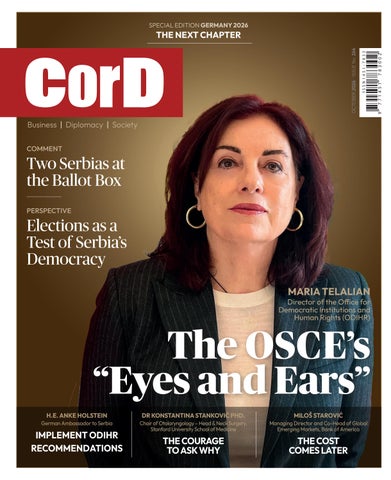
SPECIAL EDITION GERMANY 2026
OCTOBER 2026 · ISSUE No. 264
THE NEXT CHAPTER
Business | Diplomacy | Society COMMENT
Two Serbias at the Ballot Box PERSPECTIVE
Elections as a Test of Serbia’s Democracy MARIA TELALIAN
Director of the Office for Democratic Institutions and Human Rights (ODIHR)
The OSCE’s “Eyes and Ears” H.E. ANKE HOLSTEIN
German Ambassador to Serbia
IMPLEMENT ODIHR RECOMMENDATIONS
DR KONSTANTINA STANKOVIĆ PHD.
MILOŠ STAROVIĆ
Chair of Otolaryngology – Head & Neck Surgery, Stanford University School of Medicine
Managing Director and Co-Head of Global Emerging Markets, Bank of America
THE COURAGE TO ASK WHY
THE COST COMES LATER
SPECIAL EDITION
Contents
GERMANY 2026
The Next Chapter
06 T WO SERBIAS AT
68 WHERE DO YOU
THE BALLOT BOX
BY SLOBODAN G. MARKOVICH
08 THE OSCE’S ‘EYES AND EARS
MARIA TELATIAN
STAND WITH YOUR ART?
18 E LECTIONS AS A
TEST OF SERBIA’S DEMOCRACY
PERSPECTIVE
JÖRG IMMENDORFF
40 THE ENTREPRENEUR WHO TURNED TO MEDICINE
Director of the Office for Democratic Institutions and Human Rights (ODIHR)
ERIC LEFKOFSKY,
Founder and CEO of Tempus AI
74 THE COURAGE TO ASK WHY
DR KONSTANTINA STANKOVIĆ PHD.
24 T HE COST
Chair of Otolaryngology – Head & Neck Surgery, Stanford University School of Medicine
COMES LATER
MILOŠ STAROVIĆ
12 I MPLEMENT ODIHR
RECOMMENDATIONS
Managing Director and Co-Head of Global Emerging Markets, Bank of America
67 CULTURE AS A SPACE OF FREEDOM
JELENA KNEŽEVIĆ
H.E. ANKE HOLSTEIN
Theatre Producer and Teaching Assistant at the Faculty of Dramatic Arts in Belgrade
German Ambassador to Serbia
80 C HILL OUT 82 T HE ART
OF MATERIALS 84 C ALENDAR 86 F ACES & PLACES
“CorD - 23 Years of Independent Thought and Inspiration”
CorD_Magazine cordmagazine thecordmagazine cordmagazine cordmagazine The views expressed in this publication are those of the presenter; they do not necessarily reflect the view of publications published by alliance international media
04
october
EDITOR IN CHIEF: Neda Lukić n.lukic@aim.rs DESIGN: Slađan Radosavljević Zoran Perović design@aim.rs COPY EDITOR: Mark Pullen TRANSLATION & EDITING: Pullen Editorial, Halifax
CONTRIBUTORS: Ljubica Gojgić Zoran Panović Radmila Stanković Maja Vukadinović Mirjana Jovanović Miša Brkić, Rob Dugdale Steve MacKenzie Zorica Todorović Mirković Sonja Ćirić, Miloš Belčević
DSALES MANAGERS: Biljana Dević b.devic@aim.rs Vesna Vukajlović v.vukajlovic@aim.rs SUBSCRIPTIONS: office@aim.rs FINANCE: finance@aim.rs
PRINTING: E-mail: office@aim.rs CEO: office@cordmagazine.com Rotografika d.o.o. Ana Novčić a.novcic@cordmagazine.com Segedinski put 72, Subotica www.cordmagazine.com www.aim.rs CorD is published by: COO: ISSN no: 1451-7833 alliance international Ivana Jovanović All rights reserved media d.o.o. i.jovanovic@aim.rs alliance international media Resavska 1/III, 2026 PUBLISHER: 11111 Belgrade 17, Ivan Novčić Cover page photo by PAK 125806, Serbia i.novcic@aim.rs Phone: +(381 11) 2450 508 Credit OSCE Katya Andrusz
COMMENT
Two Serbias at the Ballot Box By Slobodan G. Markovich, Professor at the Faculty of Political Science, University of Belgrade
Photo Marija Janković, Vreme
The October elections reveal two profoundly different visions of Serbia – divided not only over the country’s geopolitical orientation, but also over democracy, institutions and the exercise of political power
n October 25, 2026, extraordinary parliamentary elections will be held in Serbia amid tensions and polarisation that have reached their peak. In its resolution on Serbia of October 22, 2025, the European Parliament accused government-controlled media and Serbian government officials of contributing to this situation. One year later, little has changed. A report by the Kofi Annan Foundation (June 2026) predicts an 82% likelihood of moderate violence during the Serbian elections and an 8.6% likelihood of severe violence. These elections represent yet another crossroads in Serbia’s recent history. While the Student List, Students Win, insists that the choice is straightforward – between Serbia and the mafia – the leader of the government list, United Serbia, Aleksandar Vučić, argues that Serbia can achieve major economic prosperity only under his leadership. From the perspective of Western capitals, two years of the Student and Civic Protest have fundamentally changed
O
06
october
the way Serbia is perceived, and violations of the rule of law in Serbia have become a key topic in many European institutions. The foreign policy of “four pillars” (the EU, Russia, China and the USA), advocated by Mr Vučić, has reached its limits in 2026. Only the Chinese pillar appears to remain strong, which further complicates Serbia’s relations with Brussels, where even meetings with Serbian officials have become a reputational risk, particularly after the recent state-sponsored funeral of Ratko Mladić, who was convicted of genocide and war crimes by the ICTY. The Times recently described Mr Vučić as a “chameleon whose time may be running out”, while the Euro-
While 85% of Student List voters believe that democracy is preferable to any other form of government, only 38% of SNS voters share that view pean People’s Party is discussing what measures to take regarding its associate member, SNS. Serbia’s position in Brussels has deteriorated dramatically. A frontrunner for EU accession in the 2010s has become a country that Ursula von der Leyen plans to avoid during her regional tour in October. A recent CRTA survey conducted at the end of June in cooperation with the Stanford Democracy Action Lab revealed striking differences in the
visions of Serbia held by supporters of the two main competitors. While 75% of Student List voters favour closer ties with the EU, only 15% of SNS voters share that view, and 60% prefer closer ties with Russia. Even greater differences emerge in attitudes towards democracy and the rule of law. Among SNS voters, only 38% believe that democracy is preferable to any other form of government, whereas 85% of Student List voters hold that view. While 78% of SNS voters believe that a president may govern even beyond constitutional limits, only 2% of Student List voters accept that. The CRTA survey suggests that the October 25 election will primarily be a contest between two distinct groups of voters. The first group is older and more conservative, prefers a strong hand in politics, values stability, and predominantly accepts economic growth without democracy. The second group places greater emphasis on the rule of law, institutional guarantees and the fight against corruption, rejects personality cults, and is more receptive to broader democratic movements. This second group is particularly dominant among younger voters. Although the first weeks of the campaign offer few indications that the elections will be conducted in a genuinely democratic atmosphere, one may only hope that warnings about the dangers of deep polarisation will be taken seriously by both international observers and Serbian institutions.
The Region PRESENTS
Western Balkans 2030 5–6 NOVEMBER 2026
AVALA HOTEL · BUDVA · MONTENEGRO
Where the region’s next chapter takes shape Business leaders. Investors. Policymakers. International institutions.
Investment
Energy
Infrastructure
Technology
Tourism
Join the conversation shaping 2030
Future of Work
INTERVIEW
08
october
EXCLUSIVE
The OSCE’s “Eyes and Ears” We don’t begin our observation having already formed conclusions. We know which issues require close attention, including from our previous observation and the needs assessment mission, but our findings will be based on what this observation mission observes during this electoral process ~ Maria Telalian
Maria Telalian
Director of the Office for Democratic Institutions and Human Rights (ODIHR) By Ljubica Gojgić
ore than 300 people will be engaged to monitor Serbia’s extraordinary parliamentary elections, under the scope of the observation mission organised by the OSCE’s Office for Democratic Institutions and Human Rights (ODIHR). That number renders this mission the largest to have been engaged in Serbia to date. Long-term observers, as well as those arriving on the eve of 25th October, will strive to put together an entire picture of the election process, which encompasses not only voting day itself, but also an assessment of “whether contestants are able to campaign freely and on an equal basis,
M
and whether fundamental freedoms are respected,” explains the ODIHR’s Maria Telalian in this interview for CorD Magazine.
The ODIHR Mission that’s set to observe Serbia’s early parliamentary elections began its activities in September, with the arrival of the
We will assess whether contestants are able to campaign freely and on an equal basis, and whether fundamental freedoms are being respected
core team. Could you tell us how preparations are progressing and when the Mission will formally begin its work? — The mission is already fully operational and preparations are progressing well. Our core team of 14 international experts, headed by Eoghan Murphy, arrived in Belgrade on 15th September and began its work immediately. Since then, the team has been meeting with the authorities and election administration, political parties, civil society, the media and other relevant stakeholders in the elections, while our media monitoring has also been underway.
cordmagazine.com
09
An important operational milestone was the arrival of our 30 longterm observers. Following an intensive briefing in Belgrade, they were deployed in multinational teams of two across Serbia and are now observing the election process at the regional and local levels. The next major step is preparing for the arrival of the 300 short-term observers requested from OSCE participating states, who will join the mission shortly before election day to observe voting, counting and the tabulation of results. Deploying an election observation mission of this size is a considerable undertaking. Beyond the observation itself, it requires extensive planning and coordination: recruiting and briefing observers from across the OSCE region, arranging their deployment throughout the country, establishing regional coverage and communication structures, and ensuring that all observers work according to the same methodology. Much of this work is carried out behind the scenes, but is essential to ensuring that the information gathered from across the country can be analysed consistently and form part of one coherent assessment. This long-term presence is at the heart of the ODIHR approach to election observation. Elections are processes rather than one-day events, and our observation therefore extends well beyond election day. The mission assesses election-related laws and regulations and their enforcement, the work of the election administration, voter and candidate registration, the campaign and campaign finance, the media environment, including social media, and the resolution of election-related disputes. Having both specialised experts in Belgrade and observers across the country allows us to monitor these different aspects of the process over time and build a comprehensive, evidence-based assessment.
The ODIHR Needs Assessment Mission, whose members visited Bel-
10
october
grade from 6th to 10th July in order to assess the pre-election environment, recommended the deployment of a full Election Observation Mission. The ODIHR has announced that OSCE participating states will be requested to second 30 longterm and 300 short-term observers. Would this make it the largest ODIHR mission ever deployed to Serbia? — The ODIHR has a long history of election observation in Serbia, and this will be the 21st electoral process we’ve observed in the country. The scale of individual missions has varied over the years, depending on the type of election and the particular circumstances and needs identified at the time. The size and format of every ODIHR mission are determined following a needs assessment mission conducted ahead of the elections. In making its recommendation, this mission consid-
We listen to a wide range of voices and perspectives, but we don’t simply reproduce competing narratives. We cross-check information and make our own independent assessment ers the legal and political context, developments since previous elections, the extent to which earlier ODIHR recommendations have been addressed, and the areas that may benefit from closer observation. Importantly, it also takes into account the views expressed by a broad range of stakeholders during the assessment, including state institutions, political parties, civil society, the media and representatives of the international community. The size and composition of the mission are therefore carefully determined to ensure that we have the expertise and geographical coverage needed for a comprehensive assessment. The Election Observation Mission format, combining a specialised
core team with long-term observation across the country and systematic observation of election-day proceedings, allows us to follow the different stages and aspects of the electoral process over time.
How will the observers be deployed across the country, and how will they cooperate with the authorities, civil society organisations and participants in the electoral process? — We sometimes describe our longterm observers as the “eyes and ears” of the mission, because they allow us to monitor what is happening across the country on a daily basis. Our 30 long-term observers work in multinational teams of two and are based in 15 locations across Serbia, from where they travel extensively throughout their respective areas of responsibility. Each team is supported by a local assistant/interpreter, whose knowledge of the local context is an important part of their work. Observers’ working days are quite varied. They meet with regional and local election officials, representatives of political parties and candidates, civil society organisations, journalists and other stakeholders, and they attend campaign events held by different contestants. They follow how election preparations and the campaign are unfolding locally, including issues that may not necessarily be visible from Belgrade. Throughout their deployment, they report regularly to the core team, allowing our analysts to identify developments and patterns across the country, and to follow up on issues that may require closer attention. In that sense, there is a constant flow of information between the observers in the regions and the experts in Belgrade. Short-term observers have a different role. They arrive shortly before election day and are deployed throughout the country to observe the opening of polling stations, voting, counting and the tabulation of results. They use standardised obser-
The Needs Assessment Mission report notes that these elections are expected to take place in a highly polarised political and social environment. How is the mission preparing to operate under such circumstances? — Every election takes place within a particular political and social context, and understanding that context is essential to meaningful election observation. In a highly polarised environment, it becomes all the more important that our observation remains independent, impartial and firmly grounded in facts. Polarisation does not change our methodology; rather, it demonstrates why that methodology is so important. ODIHR’s election observation methodology has been developed and refined over more than 30 years and through more than 470 election observation activities across the OSCE region. That provides us with a consistent framework for assessing very different electoral processes against the same OSCE commitments and other international obligations and standards for democratic elections, as well as national legislation. A fundamental part of this approach is broad and balanced engagement. We listen to a wide range of voices and perspectives, but we don’t simply reproduce competing narratives. We cross-check information, seek to
verify relevant facts through different sources and direct observation wherever possible, and make our own independent assessment. Long-term and countrywide observation is equally important. Rather than drawing conclusions from individual events or allegations, we follow developments over time and look for broader patterns. Our presence across Serbia also allows us to understand whether experiences differ between regions and to complement what we
Photo by CC BY-SA 2.0, httpscommons.wikimedia.orgwindex.phpcurid=1
vation forms, which allow the ODIHR to analyse election-day proceedings systematically across a large number of polling stations. Dialogue is central to our work. We seek to meet representatives from across the political spectrum and a wide range of institutions and organisations, and we very much appreciate the cooperation extended to our observers by the Serbian authorities and other stakeholders. This openness and access are essential for our observers to do their work effectively, and for them to understand how the electoral process is unfolding in different parts of the country.
hear at the national level with direct observation at the local level. At the end of the day, our job is to understand what is actually happening on the ground and to reach our own conclusions based on the facts gathered. In a polarised environment, where perspectives can differ so widely, that careful and independent approach becomes even more important.
Following recommendations issued by ODIHR observation missions after Serbia’s 2023 and 2024 elections, the Serbian authorities adopted amendments to a number of election-related laws. However, ODIHR assessments, as well as those of domestic election monitoring organisations, indicate that concerns remain over pressure on voters, an uneven playing field favouring the ruling party, media
bias and restrictions on journalists’ ability to work freely. Will these issues be among the key areas of focus for ODIHR observers? — Yes, these are all issues that fall within the scope of our observation. But an election is a complex process, with many different and interconnected elements, and our assessment will look at the process in its entirety. This means looking at the campaign environment, including any credible allegations of pressure or intimidation of voters and the use of public resources, as well as campaign finance, the media and online environment, voter registration, the work of the election administration, the legal framework and the resolution of election-related disputes. We will also assess whether contestants are able to campaign freely and on an equal basis, and whether fundamental freedoms are being respected. Following up on previous recommendations is also an integral element of our methodology. Each new ODIHR election observation mission assesses the extent to which recommendations from previous missions have been addressed, looking both at changes to legislation and their implementation in practice. That assessment is reflected in the final report, together with a new set of recommendations based on the findings of the current mission. In this way, there is continuity from one observation to the next and an ongoing basis for dialogue on possible improvements to the electoral process. What I would stress, however, is that we don’t begin our observation with conclusions already formed. We know which issues require close attention, including from our previous observation and the needs assessment mission, but our findings will be based on what this observation mission observes during this electoral process. Our preliminary assessment will be presented after election day, followed by a more comprehensive final report once the process has been completed.
cordmagazine.com
11
INTERVIEW
EXCLUSIVE
Implement ODIHR Recommendations Free and fair elections, free media, independent and effective institutions, and the protection of fundamental rights are the benchmarks against which every democracy, here as elsewhere, is measured ~ Anke Holstein H.E. Anke Holstein German Ambassador to Serbia By Ljubica Gojgić
12
october
he arrival of the new German ambassador in Belgrade happened to coincide with preparations for extraordinary parliamentary elections, which is why it comes as no surprise that she includes the “intensity of political life” among her first impressions of Serbia. Speaking in this interview for CorD Magazine, she includes as priorities of her term the “further strengthening of excellent bilateral relations, deepening economic cooperation, fostering Serbia’s European perspective by supporting reforms, and contributing to regional stability, including the normalisation of relations between Belgrade and Pristina”.
T
Your Excellency, you‘ve only been in Serbia for a few weeks, though you arrived with considerable knowledge and experience of the region. What are your first impressions of the country; and what priorities have you set for your mandate? — Serbia is a fundamentally European country with a rich history, a dynamic society and great economic potential. Having previously served in Sarajevo, Ljubljana, Tirana and Skopje, I know a bit about the region; the people, culture and natural beauty are all close to my heart. My first weeks here have reminded me of the warmth of the people, the vibrancy of civil society and the intensity of political life. My priorities for this mandate are the obvious ones: further strengthening the excellent bilateral relations between Germany and Serbia; deepening economic cooperation, particularly with German businesses; fostering Serbia’s European perspective by supporting reforms; and contributing to regional stability, including the normalisation of relations between Belgrade and Pristina. Germany will remain a reliable partner throughout these processes. Speaking in a recent interview, you said that Serbia “has all the elements of a democracy”, adding that the benchmarks of democracy include “free and fair elections, free media, independent and effective
institutions, and the protection of fundamental rights”. As you begin your mandate with parliamentary elections looming, do you see these criteria being met in the current pre-election environment? — Serbia has all the formal elements required of a democracy: a constitution, institutions, a multiparty system and elected representatives. These must be put to good use and worked on further in the best spirit of democracy. Free and fair elections, free media, independent and effective institutions, and the protection of fundamental rights are the benchmarks against which every democracy, here as elsewhere, is measured. These standards remain essential in the current pre-election period. We
expect the electoral process to be conducted in line with international recommendations, notably those of ODIHR. Media freedom and the independence of institutions need to be fully respected. Democracy thrives when citizens engage freely and institutions function independently. Progress in these areas is also indispensable for Serbia’s European perspective.
You’ve stated that Serbia belongs in the European Union. Yet its accession process has effectively been stalled for five years at Cluster 3, which both the European Commission and Belgrade have maintained should have been opened some time ago. What is holding Serbia back on its European accession path? — Germany wants Serbia to become a member of the European Union as
soon as possible. The accession process is, however, strictly merit-based. Opening new clusters, including Cluster 3, depends on both technical readiness and sustained progress on the fundamentals, above all the rule of law, judicial independence, the fight against corruption and organised crime, and media freedom. Serbia has demonstrated in recent months that progress is possible when the political will is there. We encourage the continuation of this positive dynamic. Stagnation or regression slows the process. Consistent, irreversible reforms open doors. Germany, as Serbia’s largest bilateral development partner, continues to support these efforts.
As a diplomat with extensive experience in Brussels, where you worked specifically on EU enlargement, you’ve reiterated that there are no shortcuts to EU membership and that every candidate country advances on the basis of its own merits. Yet the history of EU enlargement suggests that geopolitical circumstances often influence decisions on admitting new members, at least in terms of compliance with the Copenhagen criteria. Is geopolitics once again playing such a role today, allowing Ukraine and Albania to advance towards membership faster than Serbia or North Macedonia? — You quoted me correctly. There are no shortcuts to EU membership. Every candidate country advances on its own merits in accordance with the Copenhagen criteria, including the adoption of the Acquis Communautaire, the huge collections of accumulated EU legislation and legal acts. Of course, geopolitical considerations can create a favourable context and strengthen the political will on all sides, but they do not replace the need for reforms. Montenegro and Albania have recently shown that focused, determined reform efforts and overarching agreement on the path forward can produce tangible results and accelerate the process. This opportunity is there for Serbia
cordmagazine.com
13
ELECTIONS
REFORMS
CONTINUITY
Free elections, free media and independent institutions remain essential democratic standards
Serbia’s path to EU membership depends primarily on the speed and consistency of its reforms
Political change in Germany will not alter its commitment to the Western Balkans
as well. Germany remains committed to a credible, merit-based enlargement policy for the entire Western Balkans. Serbia belongs in the European Union. When the country will get there depends primarily on the speed of its reforms.
Speaking about Kosovo, you’ve insisted on establishing the full circumstances surrounding the armed clash in Banjska. How do you view the recent actions of the Pristina authorities at Lake Gazivode and the destruction of property belonging to Serbs? — Bringing clarity to the circumstances surrounding the armed clash in Banjska remains essential for Serbia’s credibility and also for the credibility of the dialogue process. We expect a thorough, transparent investigation and full cooperation with the relevant bodies. Regarding recent actions by the Pristina authorities at Lake Gazivode and the demolition of property, Germany and the EU are monitoring the situation closely. We have called for restraint and urged all sides to refrain from unilateral actions that tend to raise tensions. All open issues shall be dealt with through the EU-facilitated dialogue on the basis of existing agreements, including those reached in Brussels and Ohrid. Both parties shall engage in good faith, protect the rights of all communities and facilitate stability and reconciliation. The future of the entire region lies in the EU. Your statements that German investors remain interested in Serbia are certainly encouraging, given that German companies are among the country’s largest employers. Which sectors of the Serbian economy are attracting the greatest interest from potential new German investors? — It is indeed true that more than 900 companies with German capital already
14
october
operate here, employing around 80,000 people. Sectors that attract the greatest interest remain those in which German knowhow meets Serbian manufacturing capabilities and include automotive components and e-mobility, machinery and industrial equipment, information and communication technologies and digitalisation, renewable energy and energy transition, pharmaceuticals and healthcare-related manufacturing. The combination of a skilled workforce, geographical proximity to European markets and Serbia’s EU accession prospects continues to make the country an attractive location for
The EU, Germany and Serbia share a strategic interest in securing the critical raw materials needed for the green transformation and resilient European industries long-term investment. However, maintaining this attractiveness requires remaining focused on reforms. Predictable policymaking, reliable and transparent institutions, including a strong and independent judiciary, are prerequisites for a thriving business environment. These are vital if Serbia not only wants to maintain its competitiveness, but also to move closer to the EU – since up to 80% of the EU acquis is related to the common market.
Former German Chancellor Olaf Scholz advocated strongly in favour of developing Serbia’s mining sector, including through his support for an international mining corporation. Is mining a sector in which German investors are interested in investing in Serbia?
— The European Union – including Germany – and Serbia share a strategic interest in the secure and sustainable supply of the critical raw materials needed for the green transformation and resilient European industries, especially e-mobility. Lithium and other critical minerals are being discussed in this context. Any envisaged project must meet the highest environmental, social and legal standards. Decisions on specific mining projects remain with Serbia. Germany stands ready to contribute expertise on sustainability, transparency and responsible resource management within the framework of the EU-Serbia strategic partnership on raw materials. Public acceptance and strict adherence to European environmental standards are indispensable.
During Angela Merkel’s chancellorship, the Western Balkans – and Serbia in particular – appeared to occupy a prominent place in German foreign policy. Since then, however, that focus seems to have shifted towards other regions, while the Berlin Process has become less prominent. Will the political changes we are witnessing in Germany also bring a new policy towards the Western Balkans? — The Western Balkans – and Serbia in particular – remain a priority for German foreign policy. The Berlin Process continues to deliver tangible results for citizens of the region, from connectivity and the Common Regional Market to energy cooperation and people-to-people contacts. The current German Government has reaffirmed its strong commitment to the European perspective of the Western Balkans and to a credible enlargement policy on many occasions. Our approach is marked by continuity and reliability: Serbia can count on Germany as a close partner on its European path.
konstruktorgrupa.com
WE CONSTRUCT YOUR VISION DESIGN AND BUILD
PRODUCTION COMPLEXES
LO G I S T I C S CENTERS
T U R N - K E Y S O LU T I O N S
R E TA I L PA R K S
RESIDENTIAL AND B U S I N E S S FAC I L I T I E S
I N H O U S E S O LU T I O N S
AG R I C U LT R U R A L FAC I L I T I E S
1M+
250+
200+
1.000+
70+
S Q UA R E M E T E R S B U I LT
P R OJ E C T S COMPLETED
DIRECT E M P LOY E E S
INDIRECT E M P LOY E E S
ENGINEERS OF ALL PROFILES
ENGINEERING FAC I L I T I E S
Global Diary
“There are decades where nothing happens; and there are weeks where decades happen” Vladimir Lenin
Sweden’s Centre-Left Wins KnifeEdge Election Sweden’s centre-left opposition secured a narrow parliamentary victory, prompting Prime Minister Ulf Kristersson to announce his resignation. Social Democrat leader and former prime minister Magdalena Andersson is now positioned to attempt to form a new government, following an election closely watched for the performance of the anti-immigration Sweden Democrats and the direction of one of NATO’s newest members.
Yemen War Escalation Threatens Another Global Shipping Route Iran-backed Houthi forces made major advances along Yemen’s Red Sea coast, including the strategic port of Mocha, while missile and drone attacks against Saudi Arabia triggered renewed Saudi air strikes. The escalation threatens shipping through the Bab el-Mandeb Strait at a time when the Strait of Hormuz is already severely disrupted, raising the prospect of simultaneous pressure on two of the world’s most important energy and trade corridors.
BRICS Leaders Meet in New Delhi Amid Iran War India hosted the expanded BRICS summit with leaders including Narendra Modi, Xi Jinping, Vladimir Putin and Iran’s Masoud Pezeshkian, as the bloc confronted deep divisions created by the Iran conflict. The summit was particularly significant because Iran and the UAE, both BRICS members, have found themselves on opposing sides of the regional crisis, while disruption in the Strait of Hormuz has pushed energy security to the top of the global agenda. 16
october
“The future depends on what we do in the present” Mahatma Gandhi
Trump, Denmark and Greenland Reach Historic Arctic Deal The US, Denmark and Greenland signed an agreement allowing a substantially expanded American military presence in Greenland, including two new military sites and elements of the proposed “Golden Dome” missile-defence system. The deal stops short of Trump’s earlier ambition to acquire Greenland and follows months of tension within NATO over the strategically important Arctic territory.
UN General Assembly Opens Amid Wars and AI Challenge Nearly 130 world leaders gathered in New York for the UN General Assembly, where Secretary-General António Guterres used his final annual address to call for an end to major conflicts, stronger international governance of artificial intelligence, climate action and reform of global institutions. With Guterres due to leave office at the end of 2026, the gathering also opened a wider debate about the UN’s ability to remain effective amid intensifying great-power rivalry.
Russia and China Block Independent Monitoring of Iran Sanctions Russia and China vetoed a UN Security Council resolution that would have extended independent monitoring of international sanctions on Iran. The move deepened divisions among the major powers over Tehran and effectively ended the mandate of the expert mechanism responsible for reporting sanctions violations, against the backdrop of continuing conflict involving Iran. cordmagazine.com
17
PERSPECTIVE
ELECTIONS AS A TEST OF SERBIA’S DEMOCRACY
Restoring Trust Or Fuelling a New Crisis The anticipated resolution to the social crisis in Serbia can only be expected if citizens are convinced that the votes won in the upcoming elections are a result of their electoral will By Ljubica Gojgić
xtraordinary parliamentary elections in Serbia have been scheduled for 25th October and will be held in the heated atmosphere of a society divided, serving as a long-awaited resolution to the political crisis that began in November 2024, following the collapse of the concrete canopy of the newly renovated railway station in Novi Sad that left 16 peo-
E
18
october
ple dead and led to the longest and biggest protests in the country’s modern history. The upcoming elections meet many criteria to be dubbed historic, primarily due to the fact that the strongest challengers to the current government aren’t opposition parties, but a civic movement gathered around students. Despite a set of amended laws being adopted on the eve of elections – follow-
ing an ODIHR recommendation and at the urging of the EU – and creating prerequisites for the improvement of election conditions, one of the key questions among the public is whether the upcoming elections can be held under conditions that will make their results legitimate and acceptable. What will be the biggest test of democracy in these elections, and what awaits Serbia after them?
PERSPECTIVE
Dejan Bursać Senior Research Fellow at the University of Belgrade’s Institute for Philosophy and Social Theory
Will Europe Support the Values For Which Citizens are Fighting? Serbia’s citizens are today much more motivated and mobilised. That equates to many more inspectors at polling stations, many more observers, as well as a stronger public reaction to any election fraud ~ Dejan Bursać lection conditions in Serbia have long since deviated from everything that could be classified under the standard of fair and honest elections. As things stand, it seems we could be in for the worst situation yet on 25th October. We are already seeing fraud with the collection of signatures for candidacies, phantom electoral lists and doubts about voting from abroad. SNS launched a campaign in which the President of the Republic appears as a candidate, in which we see open discussions about exchanges of money and services in return for votes, as well as huge spending on promotional activities, advertising materials and SNS branding throughout Serbia – with no insight into flows of that money. Add to that the already standard media dominance and occupation of institutions in the interests of the party, as well as what we’ve seen on the streets of Serbia since last year: attempts to suppress protests, including with the existence of a paramilitary camp of regime supporters in the very centre of Belgrade. We saw many of these same anomalies and abuses in previous elections. Frankly, European countries are partly responsible because they’ve been yielding to Aleksandar Vučić for years, ready to overlook the lack of democratic standards in Serbia for the sake of short-term geopolitical interests. Following the previous parliamentary elections, the European Parliament issued a resolution calling for an investigation into allegations of electoral irregularities in Serbia, which resulted in the European Commission doing nothing. The Serbian authorities were
E
able to draw clear conclusions from that fact. That’s why Vučić is running a double campaign: one in Serbia for his voters; the other directed towards Europe, where he’s trying to prove himself useful. That’s why, in the midst of the campaign, he’s visiting Ukraine and opening an Israeli drone factory in Serbia. However, one important difference exists compared to previous elections. Serbia’s citizens are today much more motivated and mobilised. That means many more inspectors at polling stations, many more observers, as well as a stronger public reaction to election fraud. And, for the first time since 2012, there is also a credible competitor that could defeat SNS.
For the first time since 2012, there is also a credible competitor that could defeat SNS From the perspective of citizens, these elections will be a great demonstration of democracy and a test of the society’s ability to oppose an autocratic and violent regime. The question is whether Europe will support those values. Will it stand with the Serbian citizenry or will it be tempted to once again choose short-term and uncertain geopolitical benefits instead of supporting the long-term democratisation of Serbia and the building of a system in which political power rests on the sovereignty of citizens, and not on corruption, controlled media, hijacked institutions and election fraud.
cordmagazine.com
19
PERSPECTIVE
Emilija Orestijević Executive Director of the Centre for Free Elections and Democracy (CeSID)
For Equal Rules to Apply to All The legitimacy of these elections can’t be measured purely on the basis of whether polling stations open on time and whether voting is formally conducted in accordance with procedures. A lot depends on the conditions that precede election day itself ~ Emilija Orestijević
erbia’s upcoming parliamentary elections will be held at a political juncture in which the question isn’t only who will secure a majority, but also whether citizens, political players and the general public will consider the results legitimate. Following almost two years of social tension and protests, these elections are coming under circumstances of extremely deep distrust in institutions and strong political polarisation. As such, their legitimacy can’t be measured purely on the basis of whether polling stations open on time and whether voting is formally conducted in accordance with procedures. A lot depends on the conditions that precede election day itself. The incumbent’s campaigns, unequal media treatment of political players, the absence of a functional electronic media regulator and various forms of pressure on voters are issues that have been highlighted for years and that still haven’t been fully resolved ahead of these elections. This is precisely why legitimacy must be seen as a result of the entire election process, and not just its final day. The greatest test of democracy will be the ability of institutions to ensure that the rules apply equally to all and to react to irregularities in a timely and efficient manner. What happens at polling stations will be particularly important: whether voters will be able to vote freely and without pressure; whether the secrecy of the vote will be protected; whether polling committees will work professionally and whether observers will be able to monitor the pro-
S
20
october
cess unhindered. In a highly tense atmosphere, an additional test will be the ability of all stakeholders to prevent political conflict from escalating into incidents and violence. However, election day won’t be the end. What follows after polls close will be equally important. Results must be determined transparently, with any objections dealt with through institutions and decisions publicly explained and available. The acceptance of results can’t boil down to one side declaring victory and the other side accepting or rejecting that. Legitimacy is built through trust in the
Legitimacy is built through trust in the process – from the launch of campaigns to the final determining of results process – from the launch of campaigns to the final determining of results. Serbia can therefore expect not only the formation of a new parliamentary majority the day after the elections, but also the continued confronting of deep political and social distrust and the extending of the political crisis. If elections are conducted in such a way that citizens are able to believe that their vote is protected, this process could represent an initial step towards the restoring of trust. If not, the result (whatever it may be) won’t, in and of itself, bring an end to the political crisis.
PERSPECTIVE
Nemanja Nenadić Transparency Serbia Programme Director
Extended Incumbent’s Campaign Even if laws have been improved, that means very little if their application has to be entrusted to biased or passive institutions ~ Nemanja Nenadić he outcome of the election and the acceptance of results by participants remain uncertain. Legitimacy can be threatened by the bribing or blackmailing of voters (with the provision of evidence that they voted in a certain way), but mostly by the passivity of the police in response to suspicions of such criminal activity. Whatever happens on election day, the freedom of decision-making, at least for some voters, has already been threatened indirectly – through the excessive use of public resources to promote government candidates. Contrary to the ODIHR’s main 2023 recommendation, a series of laws were amended without the broad consent of stakeholders, and even without formal public discussions, because the proponent wasn’t the Government, but rather a member of parliament (Petrašinović, SNS). ODIHR noted the failings of those regulations, while the government didn’t even attempt to solve one of the main problems – pressure on voters. That’s why, compared to 2023, election conditions are today better in a few ways and worse in many others. Back then, the government spent over 400 million euros of budget funds through schemes for the pre-election distribution of assistance to citizens, while now they will spend almost a billion. The “incumbent’s campaign” started before the elections were even scheduled (“at meetings between the president and citizens”) and will certainly continue – with “restrictions” from the amended Law on the Prevention of Corruption easily circumvented. Finally, a legal spending limit per election campaign participant has been established, though at a much higher level (6 million euros) than in comparable countries. Contrary to the ODIHR’s opinion, no punishment has been prescribed for violating this rule, nor do the sanctions for other types of violations of this law serve as a deterrent.
T
Even if laws have been improved, that means very little if their application has to be entrusted to biased or passive institutions. They have to date demonstrated a high degree of creativity in ignoring the violations of the ruling party, choosing to believe the statements of representatives rather than establishing all the facts. The bias of the repressive apparatus increased significantly during the protests, which led to the emergence of the main opposition list in these elections. That on occasion has had an almost comical character (e.g. announcements on the number of participants in public meetings), while on other occasions it has represented a serious security risk (e.g. the ignoring of masked individuals brandishing dangerous weapons in Belgrade's Pionirski Park, 15/03/2025).
Whatever happens on election day, the freedom of decision-making, at least for some voters, has already been threatened indirectly – through the excessive use of public resources to promote government candidates In my opinion, the EU was mistaken in deciding to see progress purely through changes to regulations or the establishment of institutions (the REM Council, the Electoral Roll Audit Commission). It would be more effective if the authorities’ determination to change disputable practices was also checked through the examples of the local elections of 2025 and 2026, as well as determining the readiness of the public prosecutor’s offices and the Agency to apply the rules by checking the way criminal charges were resolved and funding control was conducted in connection with the 2023 and 2026 elections.
cordmagazine.com
21
PERSPECTIVE
Raša Nedeljkov Programme Director of the Centre for Research, Transparency and Accountability (CRTA)
The Limits of Acceptability? What kind of day after can I expect if I‘m disturbed by the memory of the recent local election in Bor and the stitching of the head of an observing CRTA attorney? How did it happen that election days in our country have become high-risk situations? ~ Raša Nedeljkov ’ve been asked whether the upcoming elections can be held under conditions that will make their results legitimate and acceptable. I have to wonder what is legitimate and acceptable. You’re approached by your boss, an otherwise good man, with a request to do him a favour and let him put you down as a certain vote. He’s been tasked with doing so by the party. Is that legitimate? No! It isn’t even legal! But is it more acceptable than the company director, long known as a bad person, arrogantly threatening that you’ll lose your job if you don’t vote as he tells you? Is it acceptable that a sheet of paper containing a printed table for registering certain voters, with the name of the director of the Niš University Clinical Centre written as a header, sits on the reception desk of the Clinic for Children’s Surgery? Or would it be more acceptable for the director to recruit doctors and nurses under his authority behind closed doors? I’m afraid we’ve been too willing to accept as normal the fact that we’re citizens of a country in which elections aren’t really free and fair, so we now look to see how much democratic criteria can be lowered for us to still view ourselves not as subjects, but as citizens, as bearers of sovereignty. Do we choose the government or will the government perhaps choose other people who will be more grateful for the almost one billion euros that it squanders as so-called “helicopter money” on the eve of elections? Should I accept that I’m simply not the right audience for RTS if I don’t like the fact that this public service broadcaster – which I, like all other citizens, finance – gives 98 per cent of the time allocated for
I
22
october
political players to the ruling majority, while everyone else gets just two per cent? Is it okay with me that I’m dragged through the tabloids, accused of being a foreign agent who falsely presents himself as an activist and election observer, if I know that no one close to me follows that kind of media? Why would it be difficult for someone to go to the police and deregister people who reportedly live in his apartment, according to voter lists, despite him not even knowing those people? While we’re on the topic of internal affairs, is it legitimate that I, as an observer, feel scared in knowing that my colleagues were attacked by thugs, while the police officers present behaved as if nothing was happening?
I’m afraid we’ve been too willing to accept as normal the fact that we’re citizens of a country in which elections aren’t really free and fair What kind of day after can I expect if I‘m disturbed by the memory of the recent local election in Bor and the stitching of the head of an observing CRTA attorney? How did it happen that election days in our country have become high-risk situations? Why does the Speaker of the National Assembly intimidate voters with alleged plans of the other party to provoke violence, even mentioning civil war? I’m not worried about the results. I’m worried about all the unacceptable conditions under which the election process is unfolding.
PERSPECTIVE
Vladimir Vuletić professor at the University of Belgrade’s Faculty of Philosophy
No Reason to Doubt Election Legitimacy After all recent elections, there were more or fewer complaints from participants and individual observers regarding various stages of the election procedure, but never have there been enough complaints to threaten the overall legitimacy of those elections he upcoming parliamentary elections will be the 15th (11th extraordinary) to be held since the restoration of the multiparty system in 1990. After all of those elections, there were more or fewer complaints from participants and individual observers regarding various stages of the election procedure, but never have there been enough complaints to threaten the overall legitimacy of those elections. And there’s no reason to suspect that things will be any different now. Actually, considering the greatly increased attention of the international and domestic public, it can be expected that these elections will be the cleanest in that sense. The period of more than a year since “blockading students” first requested extraordinary elections hasn’t, unfortunately, been used for discussions and agreements between election participants on all the details, so we can expect subsequent objections, but they will not be of such a nature that they undermine the legitimacy of the elections. A bigger problem could be posed by the attempts of certain groups to spread, on election day itself, various unverified “shocking” information as a reason to mobilise and engage in riots that could threaten and call into question the elections if the results don’t meet their expectations – which will be concluded even before voting ends, on the basis of exit polls. However, local elections held in 15 municipalities over the course of the past 18 months have shown that such attempts cannot bear fruit.
T
To date (with the exception of so-called “votes from Kosovo” during the 1990s) there have never been any objections to the counting of votes, so there won’t be this time either. That is the basic test of elections’ democratic nature. Objections to the election process have mainly related to the updating of voter lists and the media (incumbent) campaign. Those issues must be resolved ahead of the elections, while subsequent objections can’t serve as a test of democratic nature. The election results will largely determine post-election dynamics. If the results are close (+/- 1%), social tension could continue. If the results are more than 10% in
Objections to the election process have mainly related to the updating of voter lists and the media (incumbent) campaign favour of SNS compared to its main competitors, tension can be expected to fall. Whatever happens, preparations for the presidential elections will follow, in which the result will be much more uncertain, as it is already clear that none of the possible candidates can win in the first round, regardless of the results of these parliamentary elections.
cordmagazine.com
23
INTERVIEW
The Cost Comes Later Miloš Starović
Managing Director and Co-Head of Global Emerging Markets, Bank of America
Russia may remain economically resilient and geopolitically important, but the deeper impact of the war still lies ahead, as the country risks falling behind in the technologies and capabilities driving future growth. The consequences of this rupture may extend well beyond its borders 24
october
he breakthrough of Alternative for Germany (AfD) in Saxony-Anhalt has once again placed Europe’s relationship with Russia at the centre of political debate: what kind of relationship can Europe have with Russia after more than four years of war and sanctions? AfD openly advocates closer ties with Moscow and an end to German support for Ukraine, lending particular weight to that debate in Europe’s largest economy. At the same time, the sheer number and duration of today’s conflicts mean that even major wars can gradually be reduced in the daily news cycle to another attack, another shift in the front line and another tally of the dead. Less visible is the deeper history being made: economic links being severed, trade and capital redirected, people and knowledge displaced, and relationships built over decades dismantled. Miloš Starović is an unusually compelling observer of this transformation. A Serbian educated in Milan, whose career has spanned London, Moscow and Paris, he witnessed Russia’s integration into global finance at close quarters and later saw that integration unravel. His perspective is rooted in markets and real economic relationships rather than geopolitical abstraction, while his background places him somewhat outside the conventional East–West divide. Those experiences lie at the heart of his book The End of an Era – From the Integration to the Isolation of Russia, published by Clio.
T
More than four years into the sanctions regime, who has borne the greater economic cost: Russia or Europe? And where is that cost most visible today? — There is a contrast between polarised political messaging during pre-election campaigns and the practical reality once governments take office. Italy offers a useful example. Ahead of the election, Giorgia Meloni was often portrayed as representing an extreme shift to the right that might significantly reshape Italian and European policy. In
practice, however, her government has remained broadly aligned with EU policy on Russia and Ukraine, including continued strong support for Ukraine. By contrast, the current US administration has displayed noticeably less rhetorical distance from Russia, although the existing sanctions regime has not been meaningfully reduced in practical terms. Sanctions continue to exert a substantial economic impact, particularly on younger Russians who experienced Moscow in the early decades of this century as an increasingly important financial and cultural hub connected to Europe and the United States, but who are now becoming ever more distant from Europe, both physically and
Despite the human and economic exhaustion caused by the war, Russia and Ukraine remain far from negotiations. In the near term, Syria may offer better prospects for development and investment than Ukraine
psychologically. At a systemic level, Russia has also lost much of its former deep integration into the international financial system. Despite attempts to develop a more autonomous financial ecosystem, significant challenges remain because of the country’s continuing dependence on foreign currencies and technologies, which is likely to constrain its resilience over the longer term.
Early expectations of a rapid Russian economic collapse proved exaggerated. What did Western economists underestimate, and where are the longer-term costs of sanctions now becoming visible? — Expectations that sanctions would have an immediate and draconian effect on the Russian economy were exaggerated. Russia had benefited from roughly two decades of continuous integration into the global economic system, including prolonged periods of elevated oil prices. This was particularly true from 2011 to 2014, when Brent crude frequently traded at or above $100 per barrel, enabling Russia to accumulate substantial financial resources and strengthen its external position. Russia was also a participant in BRICS at a time when the grouping had a clearer economic rationale within the broader wave of globalisation. Today, BRICS has acquired a more politically defiant dimension, while also providing Russia with greater opportunities to redirect trade towards alternative markets, albeit at discounted prices and with additional transaction costs. At the same time, the immobilisation of around $300 billion of the Central Bank of Russia’s foreign reserves is a significant data point. It demonstrates both the scale of the measures imposed and the limits of Russia’s accumulated financial buffers. The more important question, therefore, is not necessarily the immediate impact of sanctions, but their cumulative effect. Prolonged economic and technological isolation is likely to impose greater costs over time than were visible initially, particularly through reduced access to technology, capital and investment. In this sense, the long-term effects of isolation may prove considerably more consequential than the immediate shock of sanctions. You observed Russia’s financial system from within during its integration into global markets. How sophisticated had it become by 2022, and where did its real institutional weaknesses lie?
cordmagazine.com
25
RESILIENCE
INTEGRATION
BRICS
Russia has avoided the collapse once predicted, but more than four years of war are increasingly turning resilience into stagnation and mounting economic costs
Pre-war Russia was more integrated and professionally sophisticated than its image suggested, but institutional weakness, hierarchy and concentrated decision-making remained serious constraints
BRICS began as an economic project of globalisation. Today, its logic is increasingly political, reflecting a more fragmented and confrontational world order
— Russia was, in many respects, highly standardised in terms of its integration into Western economic and professional spheres, and significant parts of its corporate and institutional environment had sought to become substantially ‘Westernised’ in practical terms. Its workforce was exceptionally well educated, with particularly strong technical and scientific capabilities. Negotiations could be difficult, but they generally had depth: there was substantive debate, technical understanding and the capacity to engage seriously with complex issues. The more fundamental problem was institutional and, to some extent, rooted in persistent post-Soviet patterns of hierarchy and decision-making. There was often uncertainty over where ultimate decision-making authority resided. This could create a disconnect between the depth and sophistication of professional debate and the decisions ultimately taken. At times, decisions emerged whose underlying rationale was difficult to reconcile with the preceding analysis. The issue was therefore not a lack of technical capability or education, but rather hierarchy, institutional opacity and the concentration of decision-making authority.
appears remarkably clean, prosperous and developed, but the question is how representative it really is of the rest of Russia. The other major source of resilience has been China and India, which have absorbed a significant share of the trade previously directed towards the West. This is why, in my book, I distinguish between the BRICS of 2004 and the BRICS of 2024: then, it was primarily an economic project born out of globalisation; today, it is increasingly a politically defiant grouping operating in a much more fragmented global economy.
How far has Russia genuinely adapted to sanctions, and how much of its resilience depends on redirected trade, particularly towards China and India? — Russia has effectively shifted towards a war economy, with defence spending reaching around 7% of GDP in 2024. This enormous fiscal stimulus has created a new middle class linked to defence-related industries. It is also changing the country’s economic geography, with workers from the regions moving to Moscow. The capital today
In your book, you draw an important distinction between the Russian state and Russian culture. Has Europe sometimes gone too far in extending political isolation to Russian artists, academics and cultural figures? — We tend to see these questions in black and white. As I said in an interview last year, ‘we are not the only ones who read Dostoevsky’. In Paris, people can admire Russian culture while clearly rejecting the policies of the Russian state. In our part of Cen-
26
october
After so many years of war, can economic interests still create meaningful pressure for a negotiated settlement? — At this stage, tragically, that seems highly unlikely. This has been the largest tectonic event in Europe since the Second World War. Even after so many lives have been lost, the two sides remain so far apart that the prospect of reaching even a starting point for negotiations still appears remote. Judging by the current flow of news, Syria may have a greater chance of entering a cycle of development and investment in the short to medium term than Ukraine.
tral and Eastern Europe, this is sometimes politically exploited, as though Russia were the only country to have produced great writers, composers and artists. France, Italy and the rest of Europe have equally profound cultural traditions. The more difficult question concerns contemporary Russian artists who have not condemned the invasion of Ukraine. European audiences react strongly, particularly when artists refuse even to discuss it. But we do need to strike a balance when it comes to art and culture.
DISCLAIMER: The views and opinions expressed in this interview are solely those of the interviewee and do not represent the views of Bank of America, its affiliates or any other organisation with which the interviewee is affiliated.
In an increasingly multipolar world, what kind of economic power can Russia realistically remain, particularly as its ties with China deepen and its access to Western capital and technology remains constrained? — Russia is far from being a great economic power. In my book, one comparative analysis, based on GDP figures from the period preceding the invasion, places the true size of Russia’s economy roughly in the same range as Spain’s. It remains, however, a major military power. Today, Russia has developed strong economic ties with India, largely driven by mutual convenience in the post-invasion, post-sanctions environment; a much deeper strategic alignment with China, spanning diplomacy, defence and infrastructure; and, more troublingly, increasingly close ties with internationally isolated states such as Iran and North Korea. This matters even more as we enter the era of data centres, in which economic power will depend not simply on exploiting resources provided by nature, but on our ability to create the resources required by the new economy: energy, computing capacity, infrastructure and, above all, the free movement of human capital.
Business Dialogue LEADERS’ MEETING POINT
GREEN ESCAPE Where Business Finds its Balance
Agriculture as an Investment MILAN MAČVAN Owner & CEO, EatFruit d.o.o.
IMEL GROUP
Expanding for Future Growth Kolektor Etra Belgrade
33
32
28
cordmagazine.com
27
GREEN ESCAPE Where Business Finds its Balance The GREEN ESCAPE business complex in New Belgrade’s Block 51 continues IMEL’s decades-long development of this part of the city, combining excellent transport links with contemporary business amenities and a green, human-centred environment
IMEL entrusted the development of this significant project to the renowned team of architects at VISTA Studio, with a vision of GREEN ESCAPE as a distinctive new premium business district. Located directly alongside one of the city’s main arterial roads, the complex offers excellent connectivity – just 5.5 km from the city centre and 8.5 km from the airport – while providing users with an urban yet pleasant environment surrounded by greenery. GREEN ESCAPE offers numer-
28
october
ous amenities and added benefits beyond the standard provision of office space, providing an excellent platform for contemporary business development in this part of the city. Alongside office space within its three buildings, the complex can accommodate a broad range of complementary facilities, including hotel accommodation, services, cafés and restaurants, wellness & fitness facilities, sports grounds, a running track and childcare services, adding value on multiple levels.
As lead architect, VISTA Studio is developing the design concept across the entire complex, building by building, giving it a distinctive visual and cognitive identity. The architectural concept follows a shared vision, beginning with the urban composition of the building forms, designed to define and complete the space while creating engaging environments within this new urban zone. This vision continues through the architectural expression, design and landscaping, where the aim is to find the right balance between
Building K3, with its 13,814 m², provides premium office space that combines advanced technology with functional design. The building has been completed and is fully occupied by tenants comprising renowned companies from across the region. Building K2, currently under construction, comprises approximately 25,042 m² and continues the vision and best practices established with the complex’s first building. This is reflected in the numerous enquiries and strong client interest in leasing and purchasing office space while the building is still under construction. Building K1, which is currently in the planning stage, will be the largest building in the complex, with more than 40,000 m². Its completion will bring the development of the GREEN ESCAPE business complex to fruition.
the dynamics of the business world, on the one hand, and the human need for balance and equilibrium, on the other. The complex derives its visual identity from a measured composition of façades with echoes of Bauhaus aesthetics, inter-
GREEN ESCAPE is synonymous with a modern, contemporary and technologically advanced working environment that is also healthy, rational, sustainable and humancentred, representing a step towards the future of business environments in this region preted in a contemporary way and enhanced through carefully selected details, materials and high-quality finishes. The dynamic forms of the buildings introduce a sense of movement, reflecting the vibrant business life within.
The same idea is reflected in the landscaping, which serves as the connective tissue of the complex. The interplay between landscaped public areas in front of the buildings and more intimate, semi-public atriums deeper within the block creates distinct zones that respond to their purpose and the changing dynamics of use throughout the working day. These dynamics are further nuanced within the individual zones, accommodating the fast pace of business along the main circulation routes while creating micro-environments for relaxation or informal business conversations in pleasant small piazzas with water features. Open space is equally important, with greenery serving as a defining element of the identity of both the space and the complex as a whole. Most vehicles are accommodated in underground garages, leaving only essential access roads and guest parking spaces at ground level, while electric vehicle charging points are available in line with users’ needs. An additional convenience is provided by attractively designed drop-off zones in front of the entrances, ensuring easy and comfortable access to the buildings. Particular attention has been devoted to the buildings’ entrance lobbies. Double-height spaces, functionality, design and materials
create a strong first impression and lend character and appeal to the buildings and their users alike. All three buildings within the complex have been designed as modern, technologically advanced and functional business spaces, offering the flexibility to accommodate a wide variety of business and commercial uses and respond to the specific requirements of future clients. Designed to provide all the conveniences expected of contemporary workplaces, the buildings can meet even the most demanding business requirements thanks to the adaptability of their spatial layouts, design, materials, interior fit-outs and building systems. This enables each client to obtain a technologically advanced business space tailored to their specific needs.
cordmagazine.com
29
Business Dialogue
“So far, SME HUB has worked with 36 manufacturing SMEs” Aleksandar Goračinov SME HUB Project
LOCAL NEWS
Serbian Wool Loses Its Value
€56.5 Million Financing Boost for Serbian Businesses Serbian SMEs and mid-cap companies will gain access to €56.5 million in financing under a new EIB–UniCredit Serbia initiative. The package combines €50 million in loans with €6.5 million in EU-backed grants, with a focus on companies creating employment opportunities for women, young people, persons with disabilities and other groups facing labour-market barriers. The agreement brings total EIB–UniCredit financing in Serbia to €240 million, supporting more than 1,000 companies to date.
Sheep farmers in Serbia are paying 400–450 dinars to shear each animal, while wool sells for only around 35 dinars per kilogram. With buyers increasingly difficult to find, much of the wool is discarded despite its potential use in the textile and construction industries. The lack of a functioning domestic wool market is creating both an economic loss for farmers and an environmental problem as discarded wool ends up in landfills and nature.
Solar Power Plant Opens at BAT Factory in Vranje British American Tobacco (BAT) has once again confirmed its leadership position in the field of sustainable development in Serbia by implementing one of its most significant and largest infrastructure projects – the installation and commissioning of a modern solar power plant at its factory in Vranje.
Coca-Cola HBC Serbia and Bambi Cut Emissions and Resource Use Coca-Cola HBC Serbia and Bambi have presented their 2025 Sustainability Report. Coca-Cola HBC Serbia reduced Scope 1 and Scope 2 CO₂ emissions by more than 75% compared with 2019, while Bambi achieved a reduction of nearly 55%. Coca-Cola HBC Serbia also invested €35.2 million in business development, production capacity and operational improvements.
30
october
“Intermodal transport was long discussed as the future of logistics”
PLACEMENTS & POSTINGS
Ivan Milićević Nelt
H.E. Ander Ruiz de Gopegui Aramburu new Ambassador of Spain to Serbia
Ambassador Ruiz de Gopegui holds a Law degree, specialising in economics, from the University of Deusto, a diploma in Business Studies from the University of the Basque Country (UPV/EHU), and a Master’s degree from the Université Libre de Bruxelles. He also completed the Leadership Program for Public Management at IESE.
Dr. Max Group Becomes Europe’s Largest Pharmacy Chain Dr. Max Group has become Europe’s largest pharmacy chain by number of locations. Entering the second half of 2026 with more than 3,300 pharmacies, alongside joint investments in over 580 additional pharmacies through partnerships with other companies, the Group has reached a major new milestone. The achievement follows two decades of work to make healthcare more accessible, affordable and relevant to millions of people across Europe.
He joined the Spanish Diplomatic Service in 2009 and has served as Deputy Head of Mission at the Spanish Embassies in Namibia and Sudan. His diplomatic career has also included postings to Spain’s
Permanent Representations to the European Union in Brussels and the United Nations in Geneva. At the Ministry of Foreign Affairs, European Union and Cooperation, he served as an adviser in the Minister’s Cabinet and in the Directorate-General for the United Nations, International Organizations and Human Rights, as well as a technical counsellor in the Deputy Directorate-General for Eastern Europe and Central Asia. Prior to joining the civil service, he worked in legal consulting and foreign trade in Madrid, Casablanca and Shanghai.
H.E. Hong Geun Jeong New Ambassador of the Republic of Korea Ambassador Jeong holds a BA and an MA in Business and Public Administration from Seoul National University and an MBA from the University of California, Berkeley. Prior to his posting in Belgrade, he served as Ambassador to the DR Congo. His distinguished diplomatic career includes service as Deputy Chief of Mission and Consul General in the UK, alongside postings at Korean Embassies in Mongolia, Denmark and Malaysia, as well as at the Permanent Delegation to the OECD in France. At the Foreign Ministry in Seoul, Am-
bassador Jeong held several key leadership roles, including Director for FTA Services and Investments, Director-General for International Cooperation at the Ministry of Health and Welfare, and Senior Coordinator for Foreign Affairs at the Office for Government Policy Coordination. In recognition of his public service, he was awarded the Presidential Citation in 2003. Ambassador Jeong is married with one daughter and one son.
H.E. Tahir Taghizade
Erste Bank Moves to New Novi Sad Headquarters Erste Bank Serbia has begun operations at its new modern office building at Industrijska 3j in Novi Sad, marking a new chapter in the city where its Serbian roots were established. A new branch has also opened within the premises, designed to provide clients with a more modern and comfortable banking experience. Erste Bank today operates 89 branches in around 50 Serbian cities, employs more than 1,300 people and serves nearly half a million individuals and businesses.
new Ambassador of Azerbaijan to Serbia
A career diplomat with extensive international experience, he previously served as Azerbaijan’s Ambassador to Hungary from 2021 to 2026, to the United Kingdom from 2014 to 2021, with concurrent accreditation to Denmark, Ireland and Iceland, and to the Czech Republic from 2007 to 2014. Born in 1967, Ambassador Taghizade graduated cum laude from the
Moscow State Institute of International Relations in 1989. His diplomatic career has included postings in the United States and senior positions at Azerbaijan’s Ministry of Foreign Affairs, including serving as Director of the Department of Press and Information Policy. He speaks Azerbaijani, English, Russian and Czech fluently. His interests include music, film and literature, and he also writes poetry. He is married and has two sons.
cordmagazine.com
31
Agriculture as an Investment Milan Mačvan Owner & CEO, EatFruit d.o.o.
EatFruit aims to turn traditional food production into a transparent investment model combining capital, technology and agriculture, with ambitions to expand beyond its own orchards rom professional sport to agriculture and entrepreneurship, Milan Mačvan is building a model based on the idea that Serbian agriculture can attract a new generation of investors. He speaks to CorD about EatFruit Invest, its expansion to other producers and his ambition to make EatFruit Serbia’s largest fruit producer by 2030.
other Serbian producers, giving them access to capital, technology, expertise, standardised production and major buyers. This would broaden our offering and develop the business through a network of partner growers. Our goal is for EatFruit to connect investors, producers, technology and markets – first in Serbia and the region, and ultimately internationally.
F
EatFruit presents agriculture as an investment class, allowing direct investment in orchards. What was the greatest challenge in developing this concept and what will it take to attract international capital? — The greatest challenge was turning traditional agriculture into a transparent, measurable system that investors can understand. This requires clearly defined yields, costs and risks, regular reporting, investment traceability and technology that gives investors insight into what they have invested in. We also want to change perceptions of agriculture and show that it can be modern, attractive and profitable. By applying AI, drones and precision farming – and, above all, employing quality people – we are building a model that can compete beyond Serbia. Attracting international capital requires proven results, independent oversight, international certification, a clear legal framework and the ability to scale. Once the concept proves itself in Serbia and the region, we believe international investors will recognise its potential. How scalable is EatFruit Invest, and could it give other producers access to capital, technology and major buyers? — EatFruit Invest is essentially a modern form of cooperative. People are increasing-
32
october
ly interested in agriculture, but often lack the time, knowledge or opportunity to engage in it directly. They do, however, recognise its investment potential. Our model allows them to join a specific agricultural project by investing in a number of trees. This provides capital for further development, while increasing production capacity and the value of company assets, which also largely serve as security for investors. The model can extend beyond our orchards. In the long term, we want to include
Agriculture can be modern, technologically advanced, transparent and an attractive investment class
What needs to change for Serbian agribusiness to become more technologically advanced and attractive to investors by 2030 – and where do you see EatFruit? — By 2030, I see EatFruit as a leading company in fruit production and the modern cooperative system. We aim to become Serbia’s largest fruit producer, with 600 to 700 hectares of orchards. Our results and investor interest show that people want to participate in new models of agricultural investment. Serbia has high-quality land and a long tradition, but fulfilling its potential requires modern technology, expertise and professional management. We need greater investment in precision farming, automation, AI, irrigation, climate-risk protection, processing and higher value-added products, alongside easier access to capital and major buyers. We also need to change the investment narrative. Property should not be almost the only investment option people recognise. Alternative models and financial literacy are needed to help people understand different ways of creating and preserving capital. I see EatFruit as part of that transformation – demonstrating that agriculture can be modern, technologically advanced, transparent and an attractive investment class.
Expanding for Future Growth Kolektor Etra Belgrade
A new 3,100m² production hall in Barajevo strengthens Kolektor Etra Belgrade’s transformer production capacity and supports ambitious plans to double sales by 2030.
On the foto from the left to the right: Vladimir Tomić, Stojan Petrič, Peter Novak, Simon Palfi n 24 September 2026, Kolektor Etra opened a new 3,100m² production hall at its facility in Barajevo, near Belgrade, for the production of power transformers of up to 40 MVA and up to 145 kV. The new production hall is equipped with two drying ovens. A new hot-air drying oven has been installed for drying windings, while a vacuum-drying oven will be used for drying of active parts. A 70-tonne crane and air-cushion system enable transformers to be moved through the production facility and lifted onto trucks. Once pro-
O
Management of Kolektor Etra Belgrade (from left): Matjaž Nabernik, Simon Palfi and Peter Perič
We aim to grow in markets that demand high-quality products and excellent supplier service duced, the transformers are tested in the laboratory that was built in 2024. “With this new investment, we plan to double our sales by 2030. We aim to grow on markets that demand high-quality products and excellent supplier service. We are able to meet the requirements of custom-
ers seeking transformers with low losses and low noise levels,” says Director Matjaž Nabernik. Kolektor Etra Belgrade is a subsidiary of Kolektor Etra Ljubljana, which produces transformers of up to 500 MVA and 420 kV. The production hall was officially opened by Simon Palfi (Director of Kolektor Etra Belgrade), Peter Novak (Chairman of the Supervisory Boad of Kolektor Etra Belgrade), Stojan Petrič (President of Kolektor Group) and Vladimir Tomić (Director of sector for Strategic Investments, Development Agency Serbia).
cordmagazine.com
33
Business Dialogue
“OTP Group gives CKB the strength of a large international financial network” Tamás Kamarási Crnogorska Komercijalna Banka
REGIONALNEWS
Ferrari Brings First Lounge to Croatia Ferrari brought its first Ferrari Lounge in Croatia to Zagreb’s King Tomislav Square from 25 to 27 September. The three-day event gave visitors the opportunity to see Ferrari models up close in the heart of the Croatian capital. The project was organised by Croatian entrepreneur Robert Bajs, who has worked with Ferrari and its Maranello headquarters for several years.
Croatia Has EU’s Most Seasonal Tourism Industry Croatia has the EU’s most seasonal tourism industry, with employment in accommodation and food services showing the strongest seasonal fluctuations. The number of workers rises sharply during the summer months as the country welcomes millions of international visitors. The trend reflects Croatia’s continued reliance on coastal and summer tourism, one of the country’s key economic sectors.
Marina Burazer Joins Hrvatski Telekom Marina Burazer has been appointed Director of Corporate Communications at Hrvatski Telekom, effective 1 September. She brings more than 20 years of experience in communications, reputation management, marketing and sustainability, most recently serving as Director of Marketing and ESG at Fortenova Group. Burazer, who previously held senior communications and marketing roles at INA, succeeds Igor Vukasović, who had held the position since 2020. 34
october
Source
“Everything we do is based on data and insights” Jelena Sretenović Mastercard
The Region and AMM Academy Launch Partnership The Region and AMM Academy, the educational platform of the Association of Managers of Montenegro, have signed a Cooperation Protocol establishing a longterm partnership. The agreement focuses on connecting business and management communities, exchanging knowledge and developing joint initiatives. The partnership will also strengthen the regional visibility of Montenegro’s business community and support the development of management skills and future leaders.
North Macedonia Leads Region in Labour Productivity North Macedonia recorded the region’s highest labour productivity in 2025 at $34 per hour worked, followed by Montenegro at $31.1 and Serbia at $29.8. Bosnia and Herzegovina stood at $26.3, while Albania recorded the lowest level at $18.7 per hour, compared with a global average of $23.3. The figures measure economic value generated per hour worked, rather than workers’ earnings, using purchasing-power-parity-adjusted international dollars.
Slovenia and Japan Partner on Hydrogen Slovenia’s Eles and Plinovodi have signed a cooperation agreement with a Japanese multinational to develop a carbon-neutral hydrogen ecosystem. The first project will explore the production, storage and use of hydrogen within Slovenia’s energy system. The partnership aims to strengthen energy resilience and integrate electricity and gas networks as Slovenia expands renewable energy. cordmagazine.com
35
FEATURE
Are You Still on Mute? Hybrid work has rewritten the rules of business etiquette. We may have mastered the technology, but when it comes to meetings, messages, cameras and the increasingly blurred line between available and unavailable, we are still learning when to speak – and when to stay on mute.
36
october
here was a time when business etiquette seemed relatively straightforward. You arrived on time, shook hands, silenced your phone and tried not to interrupt. Then came Zoom, Teams, Slack, WhatsApp and a working day that can begin at the breakfast table and end with a “quick question” just before bedtime. We learnt remarkably quickly where the mute button was. The etiquette surrounding it has proved rather more complicated. Take the online meeting. Is keeping your camera off the digital equivalent of wearing sunglasses during a conversation, or simply a reasonable way to survive a day of back-to-back calls? There is no universal answer. A ten-minute team update hardly requires a television studio, while meeting a new client as a black square bearing your initials can feel distinctly unwelcoming. And what about the background? The early days of video conferencing gave us carefully curated bookshelves, tropical beaches and occasionally a colleague disappearing into outer space. Most of us have since settled for blur. Perhaps that is progress. Nobody really needs to know whether you have read all the books strategically positioned behind you. Then there is multitasking – perhaps the great fiction of hybrid work. We all recognise the expression of someone who is technically in the meeting but is clearly answering an email somewhere else. The occasional glance at another screen has evolved into entire conversations conducted while participants simultaneously read, type and perhaps attend another meeting in spirit. Being logged in, it turns out, is not quite the same as being present.
T
he Meeting That Could T Have Been an Email
with a cheerful “Sorry, previous call ran over” has somehow become almost a business model.
Available Does Not Mean Available Our new communication habits are equally confusing. Email once came with a degree of formality and distance. Messaging apps removed both. A WhatsApp message can now arrive from a client on Sunday afternoon. A colleague can send a four-minute voice note instead of four lines of text. “Are you free for a quick call?” can appear at precisely the moment you are not. And the innocent blue ticks have introduced an entirely new category of professional anxiety: they have seen it, so why haven’t they answered? Because seeing a message is not the same as having time to deal with it. The fact that somebody can be reached does not necessarily mean that they are available. Nor does a green dot beside a name constitute an invitation to interrupt them. Perhaps one of the more useful rules of modern business etiquette is therefore to choose the communication channel according to the recipient, not simply according to what is most convenient for the sender. Urgent is a phone call. Important but not urgent may be an email. A message can be perfect for a quick clarification. And a voice note? That depends very much on how much the other person loves voice notes.
Being logged in is not quite the same as being present – and being reachable does not mean being available
Technology has also made meetings dangerously easy to organise. Finding six available squares in a calendar and clicking “Send” requires seconds; taking an hour from six people costs six working hours. The meeting itself has consequently become one of the stranger currencies of corporate life. We complain constantly that we have too many, then schedule another one to discuss why nothing is getting done. Before sending the next invitation, three questions might help. Does this require a discussion? Does a decision need to be made? Do all the people invited actually need to be there? If the answer to all three is no, there is a revolutionary piece of technology worth considering: email. The same applies to meeting length. Somewhere along the way, calendar software convinced us that human thought naturally occurs in blocks of 30 or 60 minutes. It does not. A conversation that requires 17 minutes does not become more important because everyone remains seated for another 43. Nor does punctuality disappear when the meeting moves online. Walking into a conference room ten minutes late would once have required an apology. Appearing on screen ten minutes late
Attention Is the New Courtesy
The real issue behind all these small irritations is not technology at all. It is attention. Hybrid work has given us extraordinary freedom. We can work from almost anywhere, bring together colleagues on different continents in seconds and solve in a short video call something that once required a flight. But every convenience also makes it easier to claim a piece of someone else’s time. That is why the smallest gestures increasingly matter. Give a calendar invitation a subject and a purpose. Schedule the latenight email for the morning unless it genuinely cannot wait. Do not copy twelve people into a conversation merely to demonstrate that something has been done. Avoid “Reply All” unless all really need the reply. And if a meeting ends without anyone knowing who is supposed to do what next, another meeting is probably already on its way. None of this requires a new book of manners. Good business etiquette has always been less about knowing rules than recognising other people’s boundaries. Technology has changed the places in which we work and multiplied the ways in which we can reach one another, but it has not changed that basic principle. If anything, the abundance of communication has made restraint more valuable. So, are you still on mute? Sometimes, perhaps, that is exactly where we should be.
cordmagazine.com
37
Business Dialogue
“The essence of strategy is choosing what not to do” Michael Porter
WORLD NEWS
Paramount Clears $110bn Warner Bros Deal Paramount Skydance and Warner Bros Discovery reached a settlement with California and 11 other US states, clearing a major obstacle to their $110 billion merger. The combined group will bring together assets including Paramount Pictures, Warner Bros, CBS, CNN and HBO, creating one of the world’s largest media businesses. Under the settlement, the company committed to minimum levels of theatrical film production and safeguards for editorial independence at CNN and CBS.
Nuveen Takes Over Schroders US asset manager Nuveen is set to complete its £9.9 billion ($13.3 billion) acquisition of Britain›s Schroders on 1 October after securing shareholder and regulatory approvals. The combination will create an investment group overseeing approximately $2.5 trillion in assets, while Schroders will leave the London Stock Exchange. Schroders has appointed former HSBC and Goldman Sachs banker Matthew Westerman as chairman ahead of the transaction.
Cohere and Aleph Alpha Join Forces Canada’s Cohere and Germany’s Aleph Alpha signed a definitive merger agreement to create a stronger competitor in the enterprise AI market. The combined company, valued at around $20 billion when the plan was first disclosed, will operate under the Cohere name with headquarters in Toronto and Berlin, while Germany’s Schwarz Group is investing €500 million. The deal brings together Cohere’s AI models with Aleph Alpha’s focus on deploying secure, locally controlled AI systems for companies and governments. 38
october
“Change before you have to” Jack Welch
FedEx Consortium Takes Control of InPost More than 89% of InPost shares were tendered to a consortium led by FedEx and Advent International, surpassing the threshold required for their takeover of the Polish parcel-locker company. The all-cash transaction values InPost at approximately €7.8 billion ($8.95 billion) and will result in the company’s delisting from Euronext Amsterdam. InPost will retain its name, management and Polish headquarters while continuing to operate its parcel-locker network across nine countries.
Lottomatica Buys Spain’s CIRSA Italy’s Lottomatica agreed to acquire Spanish rival CIRSA in a €2.8 billion all-share deal, creating what the companies say will be the world’s second-largest listed gaming and sports-betting group. Blackstone, currently CIRSA’s main shareholder, will become the combined company’s largest investor with a 24% stake. Headquartered in Rome with offices in Barcelona, the enlarged business expects annual adjusted core profit of around €2 billion.
Starbucks Weighs Japan Stake Sale Starbucks is considering selling a majority stake in its Japanese business, potentially valuing the operation at around $3 billion. Japan is Starbucks’ largest overseas company-operated market, with 1,883 stores representing almost 9% of its global footprint. The potential sale forms part of CEO Brian Niccol’s broader effort to reshape the coffee group’s international portfolio and restore profitability. cordmagazine.com
39
ENTREPRENEUR
Eric Lefkofsky Founder and CEO of Tempus AI
The Entrepreneur Who Turned to Medicine After building companies across commerce, logistics and media, Eric Lefkofsky took on a far more personal challenge: using data and artificial intelligence to change the way diseases are diagnosed and treated 40
october
ric Lefkofsky had already achieved what most entrepreneurs spend a lifetime pursuing. He had founded and co-founded multiple technology companies, taken businesses public and become a billionaire through Groupon, one of the defining internet companies of its era. Then his wife was diagnosed with breast cancer. What Lefkofsky encountered as his family entered the healthcare system surprised him. Medicine possessed extraordinary scientific knowledge, yet enormous amounts of information about patients, treatments and outcomes remained fragmented and difficult to use. For an entrepreneur who had spent his career building businesses around data and technology, the gap was impossible to ignore. In 2015, he founded Tempus. The ambition was considerably greater than building another successful technology company. Lefkofsky wanted to create an infrastructure capable of organising clinical and molecular data at scale and using artificial intelligence to help doctors make more precise decisions for individual patients. A decade later, Tempus sits at the intersection of two of the most consequential industries of our time: artificial intelligence and medicine.
E
hen the Problem W Becomes Personal Lefkofsky was hardly new to entrepreneurship. Before Tempus, he had helped build businesses spanning ecommerce, advertising technology, logistics and printing services. His best-known venture, Groupon, turned the once-simple idea of online daily deals into a global phenomenon and briefly became one of the fastest-growing technology companies in history. But healthcare presented a fundamentally different challenge. When his wife began treatment, Lefkofsky became interested in why doctors could not always easily compare
an individual patient with vast numbers of previous cases. The healthcare system generated enormous quantities of information, but much of it existed in disconnected records, laboratory results, genomic tests and clinical notes. His question was essentially entrepreneurial: what if all that information could be connected? Tempus was created around the idea that every patient treated should make the system smarter for the patient who comes next.
Giving Doctors Better Data At the heart of Tempus is precision medicine — the idea that treatment should reflect the individual characteristics of a patient and their disease rather than relying solely on broad diagnostic categories. The company began in oncology, combining genomic sequencing with clinical information to help physicians understand the molecular characteristics of cancers and identify potential therapies and clinical trials. It has since expanded beyond oncology into other areas of medicine while building one of the world’s largest libraries of multimodal healthcare data. Artificial intelligence provides the connective tissue.
By analysing genomic, clinical, imaging and other forms of medical information together, Tempus aims to uncover patterns that would be difficult for an individual physician or researcher to identify alone. The goal is not to replace doctors. It is to give them access to knowledge accumulated from the patients who came before.
rom AI Promise F to AI Business That distinction has become increasingly important.
Lefkofsky’s career offers an unusual contrast between two eras of technology entrepreneurship Artificial intelligence is now attached to almost every corner of the technology industry, but healthcare provides one of the clearest tests of whether AI can move beyond impressive demonstrations and create measurable real-world value. Tempus is already operating at considerable scale. In the second quarter of 2026, the company reported revenue of $382.5
cordmagazine.com
41
million, an increase of 22 per cent year on year. Oncology testing volumes grew 31 per cent, while its data licensing and modelling business grew 36 per cent. The company also raised its full-year revenue forecast to approximately $1.6 billion. Perhaps more revealing than the numbers is where the business is heading. Tempus is increasingly combining diagnostics, enormous datasets and AI models into a single ecosystem connecting physicians, researchers and pharmaceutical companies. In July 2026, it announced plans to acquire Personalis, strengthening its position in molecular residual disease testing, which can help detect traces of cancer remaining after treatment. This is no longer an experiment in applying technology to medicine. It is becoming an industrial-scale business.
The Value of Knowing More Lefkofsky’s central insight is deceptively simple: medicine improves when information from one patient can benefit another. For much of modern healthcare, that feedback loop has been imperfect. Doctors learn from research and clinical experience, but valuable information generated during everyday treatment can remain trapped inside individual institutions and incompatible systems. AI changes the economics of that knowledge. Once sufficiently large and well-structured datasets exist, algorithms can search for relationships among disease characteristics, treatments and outcomes on a scale that humans cannot replicate manually.
tional evidence when choosing treatments. And for patients, the promise is deeply personal: receiving a therapy informed not only by general medical knowledge, but by what has happened to people whose disease resembles their own.
Different Measure A of Success Lefkofsky’s career offers an unusual contrast between two eras of technology entrepreneurship. Grou-
Lefkofsky’s central insight is deceptively simple: medicine improves when information from one patient can benefit another For pharmaceutical companies, such information can accelerate drug development and identify patients who may respond to particular therapies. For physicians, it can provide addi-
42
october
pon belonged to the first great wave of consumer internet businesses, where success was measured in users, geographic expansion and speed.
Liz and Eric Lefkofsky
Tempus belongs to something different. Healthcare rewards accuracy, evidence and trust. Mistakes have consequences that cannot be measured simply in lost customers or declining engagement. Building in this environment requires patience that the consumer internet rarely demanded. It also gives entrepreneurship a different purpose. Lefkofsky has already built companies that changed how people shop, advertise and move goods. Tempus is attempting something considerably more consequential: to make each medical decision better informed than the one before it.That may ultimately be the most important distinction in his entrepreneurial career. His first generation of companies demonstrated what technology could do for business. His latest is asking what it can do for human life.
SPECIAL EDITION
GERMANY 2026
The Next Chapter
Content
Germany 2026
46 Beyond the Numbers Comment
58 Made in Germany, Reconsidered 54 Responsibility Builds Financial Stability
Economy
Jelena Jović
48 Trust Must Create New Value
Managing Director, EOS Matrix
Filip Simović
President of AHK Serbia
58 Culture Knows no Borders Dr Christoph Veldhues
55 C onnected Cities Resource Efficiency
Director of the Goethe-Institut Belgrad
Igmako Smart Solutions
52 T echnology to transform the Everyday for Everyone Goran Milisavljević
General Manager, Siemens Serbia
56 A Credible and Constructive Voice Alexander Markus
62 Art As a Public Act ob Squad and Professor Ana G Vujanović
AHK Serbia Executive Board Member and CEBAC Secretary General
66 Safe Energy From the Rooftop OBO BETTERMANN
Uvek više za vaš novac. Dugoročno povoljne cene vaših omiljenih proizvoda.* Saznajte više na dm.rs/uvekpovoljno *
Povoljnost cena proizvoda koji su deo koncepta dm uvek povoljno je u tome da cene neće biti uvećane najmanje četiri meseca od datuma naznačenog na cenovnoj etiketi.
COMMENT
Beyond the Numbers
German-Serbian relations no longer need to prove their strength through statistics. The more important question is whether a partnership built successfully around trade and investment can now generate the knowledge, trust and institutional quality needed for a far more demanding European future ermany’s relationship with Serbia has long been easy to describe in numbers. More than 900 companies with German capital, around 80,000 jobs and bilateral trade exceeding €10 billion provide compelling evidence of its scale. After 25 years of intensive economic cooperation, however, those figures increasingly tell only part of the story. The harder questions begin where the statistics end. German investment helped transform Serbia’s industrial landscape and connect its economy much more closely to European production networks. That achievement should not be underestimated. But neither should it be treated as a guarantee of what comes next. German companies are becoming more selective about new commitments, while Serbia can no longer build its competitiveness primarily on costs, geographical proximity and a skilled workforce. The next chapter will have to be more demanding on both sides. For Serbia, it means competing through knowledge, innovation, institutional reliability and the ability to move higher up European value chains. For German business, it means seeing Serbia not merely as a production location, but increasingly as a place where technologies, products and solutions can also be developed. There is a broader lesson here. Economic integration between Serbia and the EU has in many respects moved faster than political integration. Goods, capital, companies and people cross borders every day, while Serbia’s accession process continues to advance slowly. Germany remains one of the strongest advocates of the Western Balkans’ European fu-
G
46
ture, but support for enlargement has never meant dispensing with conditions attached to membership. That gap between economic proximity and political distance is likely to remain one of the defining questions of the relationship. And yet relations between countries are never built by governments and companies alone. German-Serbian cultural ties reveal another Europe – one in which artists, institutions, students and ideas already move across borders with an ease that politics often struggles to achieve. In a period of growing polarisation, preserving those spaces of encounter may prove just as important as opening another factory or signing another agreement.
A mature partnership should have enough confidence in what has been achieved to ask harder questions about what comes next A mature partnership does not require agreement on everything. It requires enough trust to discuss disagreements, enough shared interest to keep moving forward and enough ambition not to confuse past success with future relevance. German-Serbian relations have accumulated considerable economic and political capital over the past quarter of a century. The challenge now is not simply to preserve it, but to put it to better use. The numbers tell us how much has been built. What comes next will tell us what it is worth.
GERMANY 2026
INTERVIEW | FILIP SIMOVIĆ PRESIDENT OF AHK SERBIA
Trust Must Create New Value After 25 years of intensive German-Serbian economic cooperation, the relationship is ready to enter a new phase. Filip Simović sees its future in greater predictability, innovation and knowledge, deeper integration into European value chains and an investment environment capable of turning long-established trust into higher added value
s he takes over as President of AHK Serbia in this anniversary year, Filip Simović sees the trust built between companies, institutions and business communities as the foundation for a new phase of cooperation – one increasingly driven by R&D, innovation, technology and knowledge.
A
This year marks 25 years of intensive German-Serbian economic cooperation and the 10th anniversary of the German-Serbian Chamber of Commerce. Looking back, what 48
would you identify as the greatest achievement – and what should define the next decade? — The greatest achievement is that German-Serbian economic relations have evolved from individual investments into a genuine business ecosystem. Today, more than 900 companies with German capital operate in Serbia, contributing to employment, industrial development, exports, technology transfer and the development of local management and supplier capabilities. In 2025, bilateral trade exceeded €10 billion, demonstrating the scale and depth of this relationship. GERMANY 2026
For me, however, the most important achievement goes beyond these numbers. It is the trust that has been built between companies, institutions and business communities on both sides. German companies increasingly see Serbia as a place where they can build long-term operations, while Serbian companies are becoming more integrated into German and wider European value chains. The next decade should build on that foundation and take the relationship further up the value chain – towards more R&D, technology transfer, innovation, engineering and university cooperation, alongside stronger participation of Serbian suppliers in European industrial ecosystems. You are taking over as President of the Chamber in this anniversary year. What priorities would you like to set during your mandate, and where can AHK become an even stronger voice for its more than 460 members? — My priority is to ensure that AHK Serbia remains closely connected to the reality in which our member companies operate, while also helping them prepare for the economy that is coming. A modern chamber must do more than represent business interests. It must understand where the economy is heading, identify emerging challenges early and create connections that generate opportunities. I see particular potential in competitiveness, industrial transformation, technology and innovation, the labour market, skills, infrastructure, logistics and Serbia’s deeper integration into the European economic space. I also want AHK to strengthen connections between the German and Serbian business communities beyond the traditional investment model. There is significant scope for joint innovation, research cooperation, digital transformation and new business models. As a CEO, I know that companies need predictability, speed and access to the right people and information. As President of the Chamber, I see it as our responsibility to help create that environment. The experience of our more than 460 members should inform economic dialogue and their challenges should be translated into concrete proposals. This year’s AHK survey shows that 77% of German companies would choose Serbia again as an investment location, compared with 88% a year earlier. You have said that you are particularly interested in the 23% who responded negatively. What are they telling us? — The 77% figure is encouraging, but the 23% matters enormously. Those companies are telling us that potential alone is not enough. Investors make decisions based on their everyday experience of the business environment – how predictable the rules are, how quickly institutions respond, how contracts are protected, how transparent procedures are and whether they can plan several years ahead with confidence. The decline from 88% to 77% should therefore be treated as a signal, not simply as a statistic. Serbia has built a strong investment story over the past two decades. The greatest risk now would be to assume that this success will automatically continue. cordmagazine.com
For me, the 23% represent an important opportunity for dialogue. We should ask them very directly: What happened? What did you experience? What would have to change for you to invest again? Listening carefully to those answers can help us identify problems before they become structural. German companies continue to identify legal certainty, predictable economic policy, efficient public administration, transparent public procurement and political and social stability as key challenges. What changes would have the most immediate impact on a new investment cycle? — The first requirement is predictability. Companies can operate in difficult environments if they understand the rules and can plan around them. What is much harder to manage is uncertainty about what those rules will be tomorrow. I would focus on three things: greater consistency in the application of regulations and stronger institutional predict-
Investor confidence is accumulated slowly and can be lost surprisingly quickly. Maintaining it requires predictable rules, consistent institutions and continuous dialogue with business. ability; faster and more digital public administration, because every unnecessary administrative step ultimately becomes a cost for business; and greater transparency and competition in public procurement. These are not demands specific to German companies. They are the foundations of a competitive modern economy. Serbia has already demonstrated that it can move quickly when there is a clear strategic priority. The next step is to make that speed and predictability part of everyday institutional performance. German-Serbian cooperation has traditionally been built around industry and manufacturing. Is the next phase likely to place greater emphasis on R&D, AI, digital transformation and knowledge – and less on cost advantages? — Absolutely. Cost competitiveness can attract an investment. It cannot sustain a competitive economy indefinitely. Serbia’s next opportunity is to become increasingly valuable because of the quality of its people, technology, engineering capabilities and capacity for innovation. The first generation of German investment helped build industrial capabilities and integrate Serbia into European production networks. The next generation can take this further – into R&D, advanced manufacturing, engineering, software, artificial intelligence, automation and technology-driven services. 49
That requires stronger connections between companies, universities and research institutions. Industrial transformation is accelerating, while AI and automation are changing production, logistics, energy management and virtually every major business process. For Serbia, this represents an opportunity to move from being primarily a location for production to becoming a location where products, technologies and solutions are also developed. That is why I see knowledge as economic infrastructure. Your professional background is in logistics. With the 90/180-day rule for professional drivers again threatening disruption at border crossings, how seriously can such administrative barriers affect Serbia’s competitiveness and regional supply chains? — Logistics makes the interdependence of European economies very visible. A truck may carry components, raw materials or finished products, but behind every shipment there is a production schedule, a customer commitment and a wider supply chain. That is why the 90/180-day rule has implications well beyond transport. When professional drivers cannot operate across borders with the continuity their profession requires, transport capacity is reduced, delivery schedules become less predictable and costs increase across the value chain. In other forms of transport, professionals such as pilots and train drivers are already treated differently because
Serbia’s next opportunity is to compete through the quality of its people, technology and capacity for innovation, moving from production towards developing products and solutions. their work requires continuous cross-border mobility. Professional road drivers perform a comparable role in keeping European supply chains moving, and their specific working pattern should therefore be recognised in the regulatory framework. We need a practical solution that recognises the specific position of professional drivers while a sustainable long-term European framework is being developed. For Serbia, this is also a competitiveness issue, because reliability is increasingly becoming a factor in investment decisions, alongside cost, skills and infrastructure. After 25 years of partnership, what would represent its true success ten years from now: more German investment, more Serbian companies in European value chains, more joint technology projects – or deeper integration into the EU Single Market? 50
— I would not choose one of these. I see them as parts of the same ambition. Ten years from now, I would like to see more German companies developing in Serbia, not simply operating here; more Serbian companies integrated into German and European value chains; more joint R&D and technology projects; stronger links between universities and industry; and a business environment in which European market integration is increasingly a practical reality. EU membership is an important strategic objective, but economic integration is already happening every day through companies, supply chains, investment, technology and people. For me, the ultimate measure of success will be whether Serbia has become more competitive, more innovative and more deeply connected to the European economy – and whether German companies see Serbia as a place where the next generation of European business can be built. GERMANY 2026
Technology to Transform the Everyday for Everyone Automation, industrial AI and sustainable technologies are opening a new phase in the transformation of Serbia’s economy, with Siemens seeing opportunities for growth precisely in linking digitalisation with greater productivity and competitiveness fter three decades with Siemens, Goran Milisavljević took over the leadership of the company in Serbia this year, at a time of accelerating industrial and energy transformation. He speaks to CorD about his priorities, the readiness of Serbian companies for the next phase of digitalisation and technologies that can simultaneously improve productivity, energy efficiency and business sustainability.
A
52
After three decades with Siemens, you took over as General Manager of the company in Serbia this year. What priorities have you set for your new role and where do you see the greatest potential for further growth on the Serbian market?
Photo by Nebojša Babić
INTERVIEW | GORAN MILISAVLJEVIĆ GENERAL MANAGER, SIEMENS SERBIA
— After three decades with Siemens, I see this new role as both a great privilege and a great responsibility. I have had the opportunity to grow alongside the company and today have a clear picture of where we can make our next leap forward. My focus is on three areas: building even closer relationships with customers, developing our people and further strengthening our business performance. My priority is to continue building Siemens as a trusted partner to our customers, with an even stronger focus on their needs and challenges. We will work particularly on further developing our ONE Sales approach, intensifying cooperation with key clients and strengthening Siemens’ position as a company that delivers technology with a clear purpose and measurable value. At the same time, the success of every company ultimately depends on its people. That is why employee development, wellbeing, an inclusive culture and continuous learning are among my most important priorities. I want everyone on the Siemens team to have the opportunity to develop their potential and contribute to our shared results through a GERMANY 2026
culture of trust, responsibility and open communication. When it comes to growth potential, Serbia is undergoing a significant industrial transformation. An increasing number of companies are investing in automation, digitalisation and sustainable technologies. This is where Siemens can deliver the greatest value, as we have the knowledge, experience and technologies to help companies become more productive, resilient and competitive.
Photo by Nebojša Babić
Siemens today strongly integrates automation, digital twin and industrial AI. How ready are Serbian companies for the next phase of digital transformation, and where do you see the greatest potential for Siemens technologies to improve their productivity and competitiveness? — Over recent years, we have seen significant progress in the Serbian economy’s understanding of the importance of digitalisation. More and more companies no longer view digital transformation as a technology project, but as a strategic investment that directly impacts competitiveness, product quality and operational efficiency. I am proud of the many projects we have already implemented in Serbia, yet there remains considerable scope for further development. I see the greatest potential in integrating automation, industrial software, digital twin and artificial intelligence. A digital twin enables companies to simulate products and processes before production begins, reducing development costs and time to market. Industrial AI, meanwhile, opens up opportunities for predictive mainte-
cordmagazine.com
nance, production optimisation, quality improvements and greater energy efficiency. A particularly interesting example is Siemens’ new AI tool for industrial automation, the Eigen Engineering Agent, available to more than 600,000 users of the TIA Portal platform. Put simply, TIA Portal is to automation what CAD tools are to design, while this agent goes beyond providing recommendations to autonomously planning, configuring and validating specific engineering tasks. It is easy to imagine how significantly its use can accelerate development and system commissioning. This demonstrates just how quickly artificial intelligence is moving from experimentation to concrete business applications. These technologies are no longer reserved solely for the largest systems. To-
need for a more efficient and sustainable Serbian industry? — Siemens has been part of Serbia’s development for 140 years, and I believe we can also play an important role in the next phase of its transformation. Our strength lies in combining global experience and cutting-edge technologies with a strong local team of engineers who provide our customers with support every day. From the digitalisation of industry and infrastructure to the green transition, together with our partners we are already building a more sustainable and competitive future. That is precisely why, when we talk about the energy transition, we are not talking about the future – it is happening now. At the same time, companies are under pressure to become both more sustaina-
Sustainability is demonstrated not by slogans, but by data, concrete indicators and clear targets day, medium-sized companies can also use digitalisation to increase production flexibility, manage resources more effectively and respond to the demands of global markets. Our role is to help them make that journey faster and with less risk, relying on Siemens as their digital transformation partner. As a German company with a long-standing presence in Serbia, Siemens is both an industrial partner and part of the broader modernisation of the economy. What new opportunities are being created by the energy transition, decarbonisation and the
ble and more profitable. The good news is that these two objectives are no longer contradictory. An increasing number of companies also recognise that sustainability is not merely about meeting regulatory requirements, but is a way to reduce costs, increase business resilience and strengthen their market position. One of the great advantages of our time is that we can measure the impact of technology with exceptional accuracy. When it comes to digital transformation, for example, Siemens’ global data show that its technologies have enabled customers to avoid 694 million metric tonnes of CO₂e cumulatively as of 2025, demonstrating that digitalisation and sustainability go hand in hand. At the same time, around 90% of Siemens’ business directly helps customers improve their sustainability impact, confirming that technology today is not only about efficiency, but also about long-term competitiveness. Perhaps it is an occupational trait shared by all engineers, but I like facts and measurable results. That is why I believe sustainability is demonstrated not by slogans, but by data. Siemens’ DEGREE framework enables precisely that – measuring progress through concrete indicators and clear targets. It is an approach that transforms sustainability from a good idea into a business discipline. 53
INTERVIEW | JELENA JOVIĆ
MANAGING DIRECTOR, EOS MATRIX
Responsibility Builds Financial Stability Digitalisation and artificial intelligence are transforming receivables management, but sustainable solutions still require an understanding of people. EOS Matrix therefore combines technology and the experience of Germany’s EOS Group with in-depth knowledge of the local market Behind every receivable is a person or company with its own story. We therefore view technology not as a substitute for human interaction, but as a tool that helps our teams make better decisions and engage in more meaningful dialogue with debtors. Our goal is not merely more efficient debt collection, but to find sustainable solutions that create value for creditors while giving debtors a genuine opportunity to regain financial stability.
mproved payment discipline in Serbia does not mean that risks have disappeared. In periods of economic uncertainty, the consequences of late payments can quickly spread from one company to another. Jelena Jović, Managing Director of EOS Matrix, explains how technology is making receivables management more efficient, why human interaction remains indispensable and where she sees opportunities for further market development.
I
The latest EOS Group survey shows that one in four invoices in Europe is paid late or remains unpaid. How is payment discipline changing in Serbia and what poses the greatest risk to the domestic economy today? — Payment discipline in Serbia is significantly better today than it was a decade ago, thanks to an improved regulatory framework, digitalisation and greater financial responsibility. Challenges nevertheless remain, particularly during periods of economic uncertainty. The greatest risk is no longer simply late payment, but its knock-on effects on liquidity, investment and the ability to plan future development. In such circumstances, it is particularly important to have a partner who understands the interests of creditors while also considering the circumstances of debtors. Over more than two decades of operating in Serbia, EOS has established itself as a credible partner in 54
finding sustainable solutions that enable creditors to protect their interests while helping debtors overcome financial difficulties and move forward. Digitalisation enables faster, more efficient and transparent receivables management, yet only a small percentage of European companies have fully digitalised these processes. How does EOS Matrix use data, automation and AI while maintaining an individual approach to clients and debtors? — Technology enables us to work more efficiently, but it can never replace an understanding of people and their individual circumstances. We use advanced digital tools, automation and artificial intelligence every day to process large volumes of information and identify the most appropriate approach for each individual case.
EOS has operated in Serbia for more than two decades as part of Germany’s EOS Group. How does the Group’s international experience help you develop locally tailored solutions, and where do you see the greatest opportunities for further growth? — Being part of the international EOS Group gives us access to knowledge, technology and best practices developed across numerous markets. At the same time, our long-term success in Serbia is based on understanding the local market, business environment and the needs of our partners. We believe the market’s next phase of development will be shaped by further digitalisation and a growing need for sustainable receivables management. There is also increasing recognition that successfully resolving debt is not only about recovering funds for creditors, but also about giving debtors a second chance to regain financial stability and become active participants in the economy. We see the balance between financial results, responsible business and long-term sustainability as the greatest opportunity for the further development of both the market and our company. GERMANY 2026
IGMAKO SMART SOLUTIONS
Connected Cities Resource Efficiency Secure 5G infrastructure, integrated data and autonomous solutions enable cities to manage transport, energy and other critical systems more efficiently, while enhancing safety and sustainability lobal change is unfolding at a pace that transcends traditional ways of thinking. We are living in an era of exponential technological progress, climate challenges and an increasingly urgent imperative for sustainability. In this environment, cities’ critical infrastructure is coming under growing pressure. Cities today generate around 70% of global GDP, while consuming approximately 75% of the world’s energy and accounting for an equally significant share of global emissions, despite occupying only around 2% of the Earth’s surface. With more than two-thirds of the world’s population expected to live in cities by 2050, urban residents already account for 72% of the European Union’s population, with this figure projected to reach 80–83%. In comparison, Serbia’s urbanisation rate stands at around 56%, highlighting the need to lay the foundations for smart development systematically and move beyond isolated pilot projects.
G
Comprehensive Connectivity Advanced communication technologies are a key driver of urban transformation, with 5G networks becoming the foundation of comprehensive connectivity across urban systems. Their true value lies in their ability to connect people, institutions, road users, utility systems and environmental sensors within a single interoperable ecosystem. Within such a network, it is particularly important to provide a stable and secure communications backbone for different cordmagazine.com
services, including transport through the implementation of C-ITS (Cooperative Intelligent Transport Systems). The Via Aware platform is built on this architecture and designed to provide direct support to transport infrastructure. It connects drivers, emergency services and public transport in real time, enabling the exchange of information that is vital to the safety of all road users. The same principle can be applied to other municipal services. Interoperability makes it possible to overcome one of the greatest challenges of digitalisation to date – so-called digital silos, where data remains isolated within individual city services. When a city operates through a shared digital network, information becomes immediately available, creating the basis for smarter and more timely decision-making.
Preserving Resources and ESG In the context of ESG criteria, the focus is shifting from theory to making a tangible contribution to community resilience. Managing a smart city within the concept of a fully connected world (Everything Connected) requires a high level of data security and sovereignty, making safety and sustainability increasingly inseparable. Critical urban infrastructure must be resilient to risks and cyber threats, while
autonomous systems offer new possibilities for protecting it. European strategies prioritise smart grids that can securely integrate energy from renewable sources, supporting the objectives of the “Fit for 55” regulatory framework. Connected systems reduce the potential for human error, automatically detect network losses and optimise electricity and water consumption. At the same time, smart mobility systems directly support the goal of reducing greenhouse-gas emissions by 90% by 2050, while artificial intelligence can analyse sensor data to help city authorities identify risks earlier, such as flooding or increased pollution levels, and take preventive action. This enables cities to anticipate potentially dangerous situations and protect citizens’ health before problems arise. On this path of transformation, Igmako Smart Solutions serves as a partner to businesses and local authorities. Through its specialised portfolio, expertise in establishing secure private 5G communications infrastructure and integration of advanced smart mobility solutions, the company helps urban communities respond to the pressures of rapid development, transform critical infrastructure and build safer, greener and more sustainable environments for generations to come. 55
INTERVIEW | ALEXANDER MARKUS AHK SERBIA EXECUTIVE BOARD MEMBER AND CEBAC SECRETARY GENERAL
A Credible and Constructive Voice
As companies become more selective about new investments, predictability, reliable institutions and competitiveness are gaining importance. Alexander Markus explains why European businesses need practical solutions – from professional driver mobility and green energy to a stronger collective dialogue with Serbia and the EU by weaker European growth, geopolitical uncertainty, decarbonisation and changing regulation, he argues that Serbia’s ability to offer predictability will increasingly determine its competitiveness. This year’s AHK Business Climate Survey suggests that German companies are becoming more cautious, despite remaining committed to Serbia. What has changed most in their assessment of the business environment? — What has changed is not companies’ fundamental interest in Serbia, but the caution applied to new commitments. Investment and expansion plans are more selective, with greater attention to predictability and resilience. There is no single cause: weaker European growth, pressure on German industry, geopolitical uncertainty and higher costs all influence decisions. However, domestic conditions determine how successfully Serbia competes for available investment. Legal certainty, predictable economic policy, efficient administration, transparent procedures and social stability directly affect investment decisions. Serbia retains strong advantages, but companies need confidence to plan for the long term. or a quarter of a century, AHK Serbia has worked at the intersection of German-Serbian economic cooperation, helping companies navigate an increasingly complex business environment. Today, that role is expanding further, as the Chamber assumes the secretariat of CEBAC and European businesses in Serbia seek a stronger collective voice. For Alexander Markus, the goal is not to be the loudest participant in the debate, but to ensure that business experience is translated into workable solutions. In an environment shaped
F
56
AHK Serbia assumed the secretariat of CEBAC this July, while you were appointed its Secretary General. What would you like to achieve during your mandate, and how can the collective voice of 13 organisations representing more than 1,500 companies strengthen dialogue with Serbia and the EU? — Our first objective is to institutionalise CEBAC through its formal establishment under Serbian law, giving it a clear legal identity, transparent governance and long-term continuity. Our second priority is to place CEBAC on a financially stable and sustainable basis, because a GERMANY 2026
strong collective voice requires reliable structures and resources. We also want to develop CEBAC into an operational, solution-oriented platform. Its value lies not only in representing more than 1,500 companies, but in identifying common priorities and translating them into practical recommendations. When 13 European business organisations identify the same obstacle, it points to a structural issue affecting Serbia’s competitiveness and European integration. CEBAC should be a bridge in both directions: conveying business experience to the Serbian Government and showing EU institutions how European policies affect companies in candidate countries and integrated supply chains. European business organisations have taken a joint position on the application of the 90/180-day rule and the Entry/Exit System to professional drivers from the Western Balkans. How serious is the risk to supply chains, and what would constitute a sustainable European solution? — The risk is immediate and significant. Professional drivers from the Western Balkans are essential to European production and logistics networks. Applying the 90/180-day limit without an appropriate mobility framework reduces transport capacity when the sector already lacks qualified drivers. The EES did not create the rule, but it makes enforcement systematic, turning a legal mismatch into an acute economic problem. The consequences include production delays, higher costs, contractual penalties and the possible relocation of orders. A sustainable solution must be European, not a patchwork of national arrangements. It should preserve the integrity of Schengen while recognising highly mobile professionals, for example through a harmonised exemption, dedicated authorisation or specific long-stay arrangement valid across the Schengen area. Drivers should be controlled and registered, but not treated like tourists when their work keeps European goods moving. When we spoke two years ago, you warned that CBAM and rising carbon costs would dramatically increase demand for green energy in Serbia. Have Serbian companies responded quickly enough, and how important will access to reliable green energy be to their competitiveness in the EU? — Two years ago, many companies viewed CBAM mainly as a future reporting obligation. cordmagazine.com
Today, it is a commercial reality. For Serbian exporters in carbon-intensive sectors, emissions are becoming part of the price of access to the EU market. Awareness has increased, but preparedness remains uneven. Larger exporters generally began measuring emissions and examining renewable electricity procurement earlier. Many smaller suppliers still need expertise, reliable data, financing and realistic investment pathways. Decarbonisation requires energy efficiency, cleaner processes, verifiable emissions data and long-term access to low-carbon electricity. Reliable green energy will be decisive for Serbia’s industrial competitiveness. European customers increasingly assess suppliers not only on
Companies’ fundamental interest in Serbia has not changed, but new commitments are more selective. Predictability and confidence are increasingly decisive for long-term investment decisions price, quality and delivery, but also on embedded emissions. Companies with stable access to traceable renewable electricity will strengthen their position in European supply chains. Green energy is therefore no longer only an environmental objective; it is industrial infrastructure and a condition for export competitiveness. AHK Serbia is active in areas ranging from technology, hydrogen and energy efficiency to dual education and supply chains. As the Chamber marks its tenth anniversary, how do you see its role evolving over the next decade? — The Chamber may be celebrating its tenth anniversary, but our team has been supporting German-Serbian economic cooperation for a quarter of a century. And we have been doing exactly what you describe from the very beginning, although perhaps in a different way from some others. Our role is not to be the loudest voice in the room. It is to be a credible and constructive one. We prefer direct dialogue to public campaigning and focus on solving concrete problems rather than claiming ownership of solutions. If a proposal originating from the business community is eventually adopted by policymakers, we consider that a success. What matters is not who receives the credit, but whether the problem has actually been solved. 57
ECONOMY
Made in Germany, Reconsidered For decades, “Made in Germany” stood for a remarkably successful industrial formula. That formula is not disappearing, but it is being rewritten as energy, AI, demographics and global competition change what it takes to remain one of the world’s great industrial economies ew national labels carry as much economic meaning as Made in Germany. Three words came to represent precision engineering, industrial reliability and a particular conviction that things should be built properly, last a long time and work exactly as promised. Behind the label stood an equally recognisable economic model: a powerful manufacturing base, highly specialised Mittelstand companies, world-class engineering and an export machine capable of selling sophisticated products almost everywhere. That industrial identity remains unusually strong. Industry accounted for 22.9 per cent of German gross value added in 2025, compared with 19.2 per cent across the EU. Yet after two years of recession, the German economy grew by just 0.2 per cent in 2025, with exports declining and investment in machinery, equipment and construction remaining weak. The question is therefore no longer whether Germany still knows how to make things. It plainly does. The more interesting question is what it will need to do differently to remain competitive.
F
n Industrial Model Under Pressure A There is no single explanation for Germany’s recent weakness. The Federal Government points to high energy and bureaucracy costs, infrastructure investment backlogs, taxation and labour costs, demographic pressure and a more difficult geopolitical and trade environment. By September 2026, the picture remained mixed. Industrial production fell 1.1 per cent in July compared with June and was 1.6 per cent below its level a year earlier. Manufacturing orders increased, but the Economy Ministry cautioned that prospects for a broad industrial recovery remained limited. China adds another dimension. Once seen primarily as an extraordinary market for German industry, it is increasingly 58
also a competitor in sophisticated industrial sectors. German exports to China fell sharply month-on-month in July, even as total exports remained higher than a year earlier. Excellence in manufacturing remains an advantage. It is simply no longer a moat.
When Mittelstand Meets AI Germany’s next industrial transformation may be less visible than previous ones. Its Mittelstand – the ecosystem of often family-owned companies specialising in everything from machine tools and sensors to industrial components – remains one of the country’s great economic assets. Their next productivity breakthrough, however, may come from software rather than steel. In 2025, 26 per cent of German companies were using artificial intelligence, rising to 57 per cent among companies with at least 250 employees. Smaller businesses lagged behind, while lack of knowledge, legal uncertainty and data-protection concerns remained important barriers. Germany does not necessarily need to become Europe’s imitation of Silicon Valley. Its particular opportunity may be to combine something it already possesses in abundance – industrial knowledge accumulated over generations – with AI, robotics, software and data. And it is hardly starting from an empty laboratory. Research and development expenditure reached €137.1 billion in 2024 – the latest full-year data available – equivalent to a record 3.17 per cent of GDP. The ingredients for innovation are present. The harder question is how quickly they can be translated into productivity and commercial success. GERMANY 2026
Germany does not need to abandon its industrial model. It needs to decide which parts are principles – and which are habits
People Are Also Infrastructure Machines and algorithms are only part of the equation. According to the Federal Employment Agency’s latest shortage analysis, published in September 2026 and covering 2025, shortages persisted in 157 occupational categories. Half of registered vacancies for skilled workers, specialists and experts were in shortage occupations. At the same time, more workers are reaching retirement age than younger people are entering the workforce. The share of foreign workers in shortage occupations has doubled since 2014, from seven to around 14 per cent, making immigration increasingly important to Germany’s labour supply. For a country accustomed to thinking of infrastructure as railways, bridges and power grids, human capital may prove just as strategic. The Energy Equation Germany has already transformed its electricity mix dramatically. Renewables accounted for 58.8 per cent of electricity fed into the public grid in 2025, with wind remaining the largest source and solar generation rising strongly. Yet greener electricity does not automatically mean cheaper industrial energy. The Federal Government continues to identify high energy costs as a structural disadvantage for Germany as a business location. That tension is central to the next phase of the Energiewende. Decarbonisation, energy security and industrial competitiveness can no longer be treated as separate conversations. For energy-intensive companies, the energy system is effectively part of the factory. Green energy is therefore becoming more than climate policy. It is industrial policy. cordmagazine.com
einventing Without Starting Again R Germany is responding with investment on a scale that reflects the challenge. Its Special Fund for Infrastructure and Climate Neutrality provides borrowing authorisation of €500 billion over 12 years, from 2025 to 2036, for additional investment in infrastructure and the path towards climate neutrality. Money alone, however, cannot reinvent an economic model. Perhaps the more difficult adjustment is cultural. The qualities traditionally associated with German industry – precision, reliability, careful planning and incremental improvement – remain formidable strengths. But AI, technological disruption and geopolitical uncertainty also reward speed, experimentation and a willingness to launch something before version one has achieved perfection. That does not mean abandoning the German model. It means deciding which parts of it are principles and which are habits. Made in Germany is unlikely to lose its value. Few economies possess Germany’s combination of industrial depth, engineering expertise, research capacity and accumulated manufacturing knowledge. But the label may gradually come to promise something broader than the place where a physical product was assembled. The next Made in Germany may increasingly mean invented, engineered, coded, produced and continuously improved in Germany. For an economy that built much of its prosperity on making excellent things, the next chapter may depend on becoming equally good at reinventing how they are made. 59
INTERVIEW | DR CHRISTOPH VELDHUES DIRECTOR OF THE GOETHE-INSTITUT BELGRAD
Culture Knows no Borders Culture can create spaces in which political deadlocks are temporarily suspended, while also challenging nationalism, disinformation and social division hree years after our first interview with Dr Christoph Veldhues, Director of the Goethe-Institut Belgrad, we return to the role of cultural dialogue in a more polarised Europe. He discusses Serbia’s vibrant international cultural links, the need to strengthen cultural life beyond major cities, regional cooperation and culture’s contribution to a European future.
T
When we spoke in 2023, you said that “dialogue is key” to the Goethe-Institut’s work. Three years on, what has that dialogue taught you about Serbia’s cultural scene and your priorities? — “Cultural dialogue” is, in a word, the mission of the Goethe-Institut. We don’t put on a “Germany show”, but bring together artistic and civil society leaders in Serbia, Germany and around the world, facilitating exchange between partners. I’ve learned that Serbia’s arts scene is already exceptionally well connected internationally, particularly with Germany. The Goethe-Institut hardly needs to initiate anything, but can support this collaboration through programmes such as the International Cooperation Fund and Culture Moves Europe. This November, we are also organising a visit by 20 German museum directors to meet their Serbian counterparts. Our audiences have very different expectations. Alongside the arts – GoetheFEST, concerts, readings, exhibitions and talks – I find a broader concept of culture particularly exciting, encompassing urbanism, sustainability and diversity. Projects such as Urban Utopias, the planned ecology project Kriva Drina and Mlada partizanka, focusing on the progressive women’s movement in early Yugoslavia, 60
GERMANY 2026
show how these themes translate into concrete cultural work. Our priorities are therefore to address a broad cultural spectrum, focus on current issues and foster active collaboration among artists. You have sought to reach beyond Belgrade through initiatives such as Beyond the Cities, the Muzikon Caravan and Films on the Road. How can such projects create lasting cultural infrastructure? — The Goethe-Institut is well represented in Belgrade and the major cities, which makes our work in rural areas all the more important. There is a significant gap and great need there; it is precisely there that culture can and must fulfil its emancipatory role. At event level, Muzikon Karavan and Films on the Road bring concerts and films to small towns and villages, while we also support rural festivals such as ARLEMM and Polja. In the long term, however, the focus must be on building self-sustaining cultural structures. Beyond the Cities surveys communities of former Yugoslav artist colonies, assesses their needs and uses peer-led workshops to help create a functioning network of residency programmes in rural areas. Mentoring programmes for young artists,
tut pursues this approach through projects such as True Lies, which strengthens students’ resilience to manipulation in Serbia and Montenegro, and Fakeless, which exposes mechanisms of disinformation. Supporting the alternative theatre festival neBITEF is likewise a decision that reflects the times. Can art genuinely influence how Western Balkan societies confront their shared past, or does it too often remain within like-minded circles?
Culture may develop from the past, but it is oriented towards the future such as Conditio humana and the School of Unintentional Listening, also contribute to sustainable cultural development. Can culture preserve space for dialogue at a time of growing political polarisation – and where are the limits of cultural diplomacy? — Culture has two roles. Through art, it can create “transpolitical” alternative spaces in which political deadlocks are at least temporarily suspended and which can be experienced by people who, outside the art world, may no longer even want to speak to one another. At the same time, culture cannot avoid being politically engaged: it must take a stand, identify social shortcomings and point to alternatives. The Goethe-Insticordmagazine.com
— Contributing to cultural integration and cooperation within the shared experiential space of the Western Balkans – the former Yugoslavia – is a major priority for us. Yet my impression is that, for the younger generation and most cultural practitioners, this integration has long been achieved. Thinking across borders is normal for them; only the “die-hards” remain confined to narrow national categories. Balkan Affairs, featuring seven young composers from all the former Yugoslav states, is a wonderful example of shared reflection on the Balkan wars and their aftermath. Most Goethe-Institut Belgrade activities now involve participants from across the Western Balkans. Culture should also open itself more to audiences who are not particularly
interested in the arts. To counter populism, high culture cannot appeal only to a small elite; it must itself become more accessible – more “popular”. In 2023, you described Serbia as being “in the heart of Europe”. With EU accession still moving slowly and Europe increasingly polarised, are you equally optimistic today? — I continue to believe that Serbia’s EU integration is sensible, feasible and ultimately inevitable. However, I have the
impression that some in the country are currently setting a different course that is incompatible with the EU – for example, by provocatively celebrating the wrong “heroes”. This reinforces social polarisation between nationalism rooted in the past and a European vision for the future, while diminishing the EU’s willingness to recognise Serbia as a full-fledged partner. This conflict is often more about emotions than factual arguments. Culture can help strengthen a sense of European belonging by drawing on two of its strengths. In the temporal dimension, culture may develop from the past, but it is oriented towards the future: it can turn over a new leaf, and the title of that new chapter is Europe. In the spatial dimension, culture is always open; it knows no borders and has no need for them. Socalled “national culture” is merely a contribution to global culture. The European reference point should, in my view, be Serbia’s defining orientation within it. 61
INTERVIEW | GOB SQUAD AND PROFESSOR ANA VUJANOVIĆ
Art as a
Public Act
Artistic autonomy is never guaranteed – it depends on the ability to question structures, share responsibility and defend spaces for critical thought. Gob Squad and Ana Vujanović discuss collective practice, institutional independence and what ne:BITEF reveals about the power – and limits – of self-organisation
62
GERMANY 2026
cordmagazine.com
63
Photo by neBitef promo
hen Gob Squad withdrew from institutional BITEF but subsequently chose to take part in ne:BITEF, the decision opened a larger question: what does it mean to defend artistic freedom without abandoning the community built around a public institution? In conversation with CorD, Gob Squad and Professor Ana Vujanović reflect on censorship and solidarity, collective authorship and self-organisation, while revisiting Before Your Very Eyes – a work first presented at BITEF more than a decade ago and newly resonant in an age of constantly constructed identities.
W
Gob Squad declined to participate in this year’s institutional BITEF, yet you chose to come to Belgrade and meet the audience through ne:BITEF. What distinction do you draw between withdrawing from an institution whose artistic autonomy has been compromised and continuing to support the cultural community that grew around it? GS: The distinction is one of artistic independence and “open structures”, which is extremely important at this current moment, when everyone across Europe, as well as in other parts of the world, is feeling the strong hand of censorship and silencing. BITEF has historically supported artistic practice based on
Self-organisation can defend the values of public institutions, but it should not absolve institutions of their responsibilities freedom of expression. The experimentation with artistic form and content that the festival has platformed provides examples of different ways of thinking and seeing, challenging entrenched perceptions and working methods. It is an open and contentious field of work that is heterogeneous, full of contradiction and debate. With the recent changes at BITEF, this freedom of expression was clearly compromised and it felt important not to legitimise this. However, we acknowledge that withdrawing from the invitation of the institutional BITEF was, besides being a gesture of solidarity, also a privilege originating from our status as a successful international group. Specifically in a culturally repressive climate, it felt important to show support for the local community and not just walk away. Therefore, having the opportunity to participate instead in ne:BITEF was a chance for us to learn about the situation on the ground from the people who acutely experience systems of repression, censorship and corruption. With its 60 micro-stages across the city, we encountered a festival that was a 64
testament to independent curation and non-hierarchical working structures, in defiance of the attempt to instrumentalise culture. The Belgian version of Before Your Very Eyes opened the 47th BITEF in 2013, although Gob Squad itself did not accompany the production to Belgrade. What does it mean to encounter the festival directly for the first time now, while revisiting a work that formed part of its history more than a decade ago? GS: The show was produced by the Ghent-based arts centre CAMPO, which toured with the work, so this year was the first time we came to Belgrade. It was a very good way to see the festival from a historical perspective because of all the micro-stages. Before Your Very Eyes was an unusual work for us because it was one of the few things we have made in which we ourselves are not in it. Also, because we were working with children who spoke a different language, we actually had to fix almost all the spoken text in the performance, which is something we never usually do. In this respect, that work became more like a written play evolved from improvisation with the children who performed the show. The children are now all grown adults in their mid to late 20s. Revisiting the work today is interesting because it is already clear that children of the age they were in the video are experiencing a very different world. Before Your Very Eyes places children behind one-way mirrors and allows audiences to watch them move rapidly from childhood to old age. More than a decade after the production was created, how has its exploration of identity, self-observation and growing up changed in an era when children increasingly learn to perform their lives before cameras and digital audiences? GS: Before Your Very Eyes is set inside a mirrored room, in which the performers are unable to see the audience and only see reflections of themselves. It echoes a type of lab experiment where the audience is put in the position of the observers. The same setting was taken from two earlier works: Close Enough To Kiss (1997) and What Are You Looking At? (1998), and also features in our new work Doppelganger/ Doppelgänger. This set-up perhaps speaks about identity and self-observation, which was already a topic when we made those early works and has become more intense over the last couple of decades. As performers, we have always somehow put ourselves in the picture as authors of our own image-making. It has always been important to somehow show that authorship, in its construction, as something fragile, flawed but also layered, as a form of escapism or wish fulfilment. We have often tried to show that GERMANY 2026
Photo by neBitef promo
image construction as a task that sometimes tries to fulfil an impossible ideal, like the impossible aesthetics of dominant cinema, for example. In the mirrored box of Before Your Very Eyes, that task becomes explicit because you can see the performers constantly confronting their own image and trying to somehow adjust themselves to both an inherited and self-imposed idea. Now there are millions of people authoring image-making, many of them attempting to live up to certain ideals. In that world, the “self” has become a “brand”, using the same logics of capital in a giant feedback loop of imagery that is now difficult to distinguish between what is real and what is not. The “doubling” of ourselves into imagery is one of the layers of our new work, the omen of the “Doppelganger” in fiction often being a harbinger of death.
Gob Squad emerged between Britain and Germany and has developed a collective, non-hierarchical way of creating work across national and disciplinary boundaries. At a time when cultural institutions across Europe are facing political pressure, can such collaborative structures offer not only an artistic method, but also a model of resistance and institutional independence? AV: Definitely. Gob Squad reminds us that collectivity is a way of producing art as much as it is a political proposition: a commitment to sharing authorship, responsibility and decision-making. In a European cultural scene increasingly shaped by managerial thinking, competition and political interference, such practices offer a different way of working together. But I would distinguish between artistic and institutional independence. Art doesn’t exist outside material conditions. Even self-organised groups decordmagazine.com
pend on funding, infrastructure and audiences. The question is then not how to become completely independent of institutions, but how to engage with them without surrendering artistic integrity. Over the past thirty years, Gob Squad have sustained collective practice across different political and cultural contexts. This requires continuous negotiation, the capacity to disagree and the willingness to question one’s own position. Resistance is never only about opposing something; it is also about developing other ways of working, relating and making decisions. In this sense, collective artistic practices can become laboratories for democratic life. Professor Vujanović, your work explores the relationship between performance and politics, as well as feminist storytelling and resistance to fascism. From your perspective as a cultural worker active between Berlin and Belgrade, what does ne:BITEF reveal about the ability of a cultural community to maintain the values of a public institution when its formal structures no longer protect them – and where are the limits of self-organisation? AV: For me, ne:BITEF reveals that a public institution is not simply its administrative structure. It is also the people, knowledge, relationships and shared histories that have built it over time. When we encountered censorship of the proposed BITEF programme in 2025, we refused to accept that the festival’s artistic identity depends on the taste or decisions of its administrative authorities. Together with numerous colleagues, students and international collaborators, we initiated ne:BITEF. What emerged is not merely an alternative festival, but a collective defence of artistic freedom, critical thinking and the public character of culture. Here one can see that institutions carry collective memory, but that memory does not belong to those who temporarily administer them. It lives in practices, bodies and in a community’s capacity to reactivate its history. Yet I would not romanticise self-organisation. ne:BITEF requires enormous amounts of unpaid labour, solidarity and personal commitment. These are powerful resources, but they cannot replace stable public funding, professional working conditions or institutional accountability. Working between Berlin and Belgrade, I am increasingly aware that artistic autonomy is never guaranteed. It must be defended. The challenge is to sustain autonomous spaces of artistic, civic and political action while insisting that public institutions remain genuinely public. Self-organisation can defend their values, but it should not absolve institutions of their responsibilities. 65
Safe Energy From the Rooftop From PV module mounting to protection against lightning, fire and mechanical damage, OBO Bettermann provides integrated solutions for reliable, long-lasting photovoltaic installations.
OBO offers a complete system for the electrical requirements of photovoltaic installations, alongside flexible, future-oriented installation solutions. These include innovative mounting systems for pitched and flat roofs and free-standing installations: the Magic PV system. Most pitched-roof systems are installed on existing buildings. PV modules are attached to roof rafters using metal roof hooks, mounting rails and module clamps. Photovoltaic systems can also be installed on flat roofs, allowing PV modules to be mounted independently of the roof’s orientation. Products for flat and pitched roofs can be combined, significantly reducing the number of individual components required. When retrofitting, integrating a photovoltaic system into a building’s existing lightning protection concept is often overlooked, significantly increasing the risk of damage from direct lightning strikes. OBO systems safely intercept lightning strikes and conduct them to earth. These include air-termination rods, round and flat conductors and their holders, the insulated isCon® lightning protection system and related accessories. Outdoor cables are particularly exposed to weather conditions. Rain, snow, heat, UV radiation and wind constantly impact
Weishaupt doo Beograd Omladinskih brigada 88 11070 Beograd
tel: +381 11 35 33 430 e-mail: info@weishaupt.rs www.weishaupt.rs
www.linkedin.com/company/weishauptbeograd 66
photovoltaic systems. OBO cable support systems combine optimum protection with quick and easy installation. Cables are also exposed to mechanical stress that can cause system failure. OBO products provide reliable cable protection from roof to inverter. Wall and ceiling trunking is complemented by suitable fittings, while plastic and metal systems protect the cables. Fire protection and preventing the spread of fire are key installation priorities. In the event of fire, the insulation system prevents it from spreading via photovoltaic cables. Planning photovoltaic systems and electrical installations requires expertise and reliability. With OBO Bettermann, you have a partner committed to providing both.
Innovative systems for door and window technology www.geze.com GERMANY 2026
PROFILE
Culture as a Space of Freedom
Photo by Jakov Simović
From Bitef and the experience of collective work to FIST and ne:Bitef, Jelena Knežević’s professional journey has been shaped by a desire to continually question established patterns and preserve culture as a space for experimentation, dialogue and social engagement
Jelena Knežević Theatre Producer and Teaching Assistant at the Faculty of Dramatic Arts in Belgrade
t has always been important to me to do work that has a broader social purpose – something that is creative and exciting, while also connecting me with people, culture and the society in which we live; something that changes the world and creates new opportunities. That is how I came to choose theatre production, with a focus on
I
experimental and socially engaged forms. My experience with Walking Theory (TkH) introduced me to collective work and self-organisation, both of which profoundly shaped the way I would later think about arts institutions. When the first opportunity arose, following Nikita Milivojević’s appointment as Bitef’s artistic director, I suggested to him that it might be interesting to establish a collective structure for the festival’s artistic leadership. For the following two years, Bitef’s programme was jointly selected by Ksenija Đurović, Tijana Grumić and Nikita Milivojević. That same year, I also proposed broader consultations with the community surrounding Bitef – people from different professions and generations – so that those who had followed, created and shaped the festival over many years could also participate in decision-making and discussions about its future. I consider it a great privilege to have spent 16 years as Bitef ’s executive director – for me, it remains a dream job, the most exciting job you can have if you work in theatre production in Serbia. Working at
An institution is far greater than the people who happen to be leading it at any given moment
Bitef meant keeping abreast of developments in theatre worldwide, operating within a complex public-sector system and finding new solutions every day – conceiving, negotiating, changing or launching something that had not existed until then. Jovan Ćirilov passed on to us the knowledge that Bitef had accumulated over decades and taught us what high professional standards mean, as well as what it means to bear responsibility towards an institution that is far greater than the people who happen to be leading it at any given moment. Today, I pass that knowledge on to students at the Faculty of Dramatic Arts, where I work as a teaching assistant, while also mentoring FIST, the International Student Theatre Festival. At the same time, FIST has opened up another space for experimentation. Unlike large institutions, a student festival allows formats to be questioned more radically, mistakes to be made and risks to be taken – and for us to learn from those attempts. What perhaps interests me most today is precisely the possibility of refusing to accept existing patterns as a given. That same need to question established patterns can also be seen in the emergence of ne:Bitef. It demonstrated the strength of the domestic and international theatre community surrounding Bitef and the extent to which it is prepared to fight for the festival with all the creative resources at its disposal. This year, ne:Bitef was something of a small miracle – a struggle for truth, justice and freedom that ended in victory. At the same time, it was also a small part of the broader struggle being led by students, which I believe will likewise end in victory. If there is a thread connecting all these stages, it is the need for culture to remain a space for struggle and experimentation. And I will probably continue to be most interested in work where it is not entirely clear in advance what the next step will look like.
cordmagazine.com
67
ART
Where do You Stand With Your Art? Jörg Immendorff spent his life questioning what an artist owes to the age in which they live. Almost two decades after his death, a major Düsseldorf retrospective returns the spotlight to a painter whose work was shaped by Germany’s division, politics, rebellion and history – and by a persistent questioning of the very purpose of art
Jörg Immendorff
John McIver, Porträt Jörg Immendorff in Auckland, Neuseeland, 1987, Atelier Immendorff Photo by: E H McCormick Research Library, Auckland Art Gallery Toi o Tōmaki, © John McIver © Nachlass Jörg Immendorff
68
october
cordmagazine.com
69
n a 1973 painting, a man throws open the door of a studio and points almost accusingly towards the street. Outside are demonstrators, slogans and political struggle; inside, an artist sits before his canvas. Across the entire painting runs the question: Wo stehst Du mit Deiner Kunst, Kollege? – Where do you stand with your art, colleague? Few sentences could better encapsulate the life and work of Jörg Immendorff. For him, the question was never simply what to paint, but rather what painting could achieve, who it was for and whether an artist had the right to remain on the sidelines while the world around them was changing. From 25th September 2026 to 10th January 2027, Düsseldorf’s Kunstpalast is presenting the first major retrospective devoted to Immendorff in the city where he studied, taught and worked for decades. Organised in cooperation with the artist’s estate, the exhibition traces every phase of his career through around 100 works – monumental painting cycles, sculptures in wood and bronze, drawings and previously unseen archival material.
I
70
october
Jörg Immendorff, Der Malerfeind im Maler ist sein bester Freund, 1985, Öl auf Leinwand, 330 × 285 cm, Sammlung Hans Grothe Photo by: Farbanalyse, © Nachlass Jörg Immendorff
Jörg Immendorff, Für uns alle, 1994, Gouache auf beschichtetem Papier, 80 × 59 cm, Kunstpalast, Düsseldorf Photo by: Kunstpalast – LVRZMB – Annette Hiller,© Nachlass Jörg Immendorff
At its heart are not only Immendorff’s works, but also his contradictions: the political activist who became an international art star; the rebel who would later teach at the academy he had once been forced to leave; the opponent of art for art’s sake who became one of the most prominent German painters of his generation.
STOP PAINTING Born in Bleckede in 1945, Immendorff entered the Kunstakademie Düsseldorf in 1963. He initially studied stage design under Teo Otto before joining the class of Joseph Beuys. The encounter proved decisive. Art no longer had to be merely an object: it could be an action, a social intervention, a provocation. As early as 1966, the 21-year-old Immendorff produced a work with a title that sounded like a declaration of war on his own vocation: Hört auf zu malen – Stop Painting. Across the canvas he drew an enormous black cross. Yet this iconoclastic gesture was not simply a rejection of painting. It was an attack on art enclosed within its own world, on academicism and artistic production stripped of social purpose. The paradox is perfect: in order to say that art-
For Immendorff, the question was never simply what to paint, but what painting could achieve – and whether an artist had the right to remain on the sidelines while the world around them was changing ists should stop painting, Immendorff had to paint a picture. Together with Chris Reinecke, he soon developed Lidl, a series of actions combining conceptual art, neo-Dada, Fluxus and political activism. They established an autonomous space in Düsseldorf that also welcomed people with
TWO GERMANYS, ONE CAFÉ A decisive moment came in 1976, when Immendorff met Dresden artist A. R. Penck in East Berlin. Their friendship became far more than a personal relationship. One artist lived in the West, the other in the East; between
Jörg Immendorff, Naht, 1981, Öl auf Leinwand, 180 x 400 cm, Kunstpalast, Düsseldorf, Photo by: Kunstpalast, Düsseldorf – LVRZMB – Stefan Arendt, © Nachlass Jörg Immendorff
no connection to galleries, organised the Lidl Academy and staged actions that challenged the boundaries of the art institution itself. Immendorff also took part in protests against the way documenta represented contemporary art. Following provocative actions, he left the academy and, in the early 1970s, worked as an art teacher at a Düsseldorf school. Painting, however, returned. With a vengeance.
So, progress is being made, but more efforts are needed. Western Balkan countries need to effectively integrate environmental objectives into other policy areas – such as agriculture, transport or urban development
Jörg Immendorff, Für alle Lieben in der Welt, 1966, Kunstmuseum Karlsruhe Photo by: Heinz Pelz, Karlsruhe © Nachlass Jörg Immendorff
them stood a country divided by a wall. Their collaboration and conversations opened up the theme that would bring Immendorff international recognition: the division of Germany. This encounter ultimately led to his great Café Deutschland cycle, begun in the late 1970s. Comprising sixteen monumental paintings, alongside related drawings and prints, it transformed the café into something far more significant than a place to meet over a drink. It became a stage on which two Germanys, past and present, East and West, artists, politicians, ideologies and ghosts of history could all occupy the same space. In Café Deutschland I from 1978, that space is crowded with figures and symbols. Immendorff does not organise the painting as a tranquil scene that the viewer can simply “read”. It resembles a theatre in which several perfor-
cordmagazine.com
71
mances are unfolding simultaneously. A wall appears as a physical obstacle, but also as a mental boundary. People move, observe and confront one another; the artist is simultaneously participant and witness. Elsewhere in the cycle, the Brandenburg Gate, Berlin Wall and German national colours share the stage with historical, political and artistic figures. A. R. Penck is among the recurring protagonists of this imaginary world. Café Deutschland thus becomes a metaphorical arena in which the opposing ideologies of East and West Germany are transformed into images. What is particularly striking is how provocative Immendorff’s choice of visual language was at the time. While many of his Düsseldorf contemporaries had turned away from monumental figurative painting, he embraced precisely that: scale, narrative and a visual vocabulary that could occasionally recall Socialist Realism. Yet he used it to create something entirely different – history painting without a stable historical truth, political painting that refuses to become propaganda, and allegory in which no sym-
72
october
LEFT: Jörg Immendorff, Hört auf zu malen, um 1966, Kunstharz auf Leinwand, 132 × 132 cm, Van Abbemuseum, Eindhoven, Foto: Farbanalyse, © Nachlass Jörg Immendorff
RIGHT: Jörg Immendorff, Café Deutschland I, 1978, Öl auf Leinwand, 282 × 330 cm, Museum Ludwig, Köln Photo by: Farbanalyse, © Nachlass Jörg Immendorff
bol is permitted only one meaning. Immendorff did not paint Germany as it was. He painted a Germany talking, arguing and negotiating with itself.
THE SCAR REMAINS That may be why Naht from 1981 is among the most powerful works of this period. Its title means “seam” or “stitch”. Against a dark background lies a pale, wounded form of the German eagle, its body literally stitched together. The division of the country has become a physical wound. The seam joins what has been torn apart, yet remains visible proof that the wound existed. When Immendorff painted it, German reunification hardly appeared to be an imminent historical possibility. That gives Naht a peculiar retrospective power today. Immendorff could not have known how history would unfold, yet he intuitively found an image that also speaks about what follows division: joining the parts together does not erase the scar. The fall of the Berlin Wall in 1989 brought Immendorff both the fulfilment of a political aspiration and an artistic problem. The great subject to
Jörg Immendorff, Café, 1990, Öl auf Leinwand, 140 x 160 cm, Sammlung der Stadtsparkasse Düsseldorf im Kunstpalast, Düsseldorf Photo by: Kunstpalast, Düsseldorf – LVR-ZMB – Stefan Arendt, © Nachlass Jörg Immendorff
which he had devoted years no longer existed in the same form. His painting consequently became increasingly self-referential: the artist, the studio, art history and the act of painting itself moved to the foreground. Even the title Der Malerfeind im Maler ist sein bester Freund – The Painter’s Enemy within the Painter Is His Best Friend – reveals this internal struggle. The artist who had written “Stop Painting” as a young man never really stopped doubting painting. It was precisely that doubt that kept bringing him back to it.
FROM REBEL TO MALERFÜRST During the 1980s and ’90s, Immendorff became an internationally recognised artist. He exhibited around the world, participated in documenta and the Venice Biennale, designed stage sets and costumes and taught art. In 1996, he became a professor at the Kunstakademie Düsseldorf. The former rebel against the art establishment had become one of its most visible figures. He also cultivated the public image of a forceful and at times controversial personality – what the Germans call a Malerfürst, or “painter-prince”. The new Kunstpalast retrospective does not seek
In Café Deutschland, Germany becomes a stage on which East and West, past and present, politics and art are constantly negotiating what it means to belong to the same country to smooth over these contradictions. On the contrary, it places them at the centre of the story: a man who demanded political responsibility from art also understood the power of his own image and the media; a former opponent of the artistic establishment ultimately became part of it. Then the boundary shifted once again – this time in a profoundly personal way. In 1998, Immendorff was diagnosed with ALS, a progressive neurodegenerative disease. As his illness advanced, his physical world narrowed and his work increasingly turned inward. Yet he did not stop creating. During his final years, when he was no longer physically able to execute paintings himself, he worked with assistants who realised his ideas according to his instructions. He continued creating almost until his death in 2007.
Jörg Immendorff, Wo stehst Du mit Deiner Kunst, Kollege?, 1973, Acryl auf Leinwand, 2-teilig, je 130 × 210 cm, Musée d’Art Moderne de la Ville de Paris Photo by: Farbanalyse, © Nachlass Jörg Immendorff
The question he had posed in 1973 thus returned in an entirely different form. Where do you stand with your art, colleague? was no longer merely a political challenge directed at a painter secluded in a studio. It became a question of authorship, the body, the possibility of creation and the reason an artist continues to work when his own body is making that work almost impossible. Almost two decades after his death, Düsseldorf is now bringing the arc of Immendorff’s life and work together in a major retrospective. It is perhaps surprising that the city in which he lived, studied, taught, worked and provoked for so long has waited until 2026 to present such a comprehensive survey. Yet perhaps this is precisely the right moment. Because behind Immendorff’s historical references, German flags, walls, eagles, slogans and political figures lies a question that did not belong solely to the divided Germany of the 1970s: Can art exist outside the time in which it is created – and should it even try? Immendorff never offered a simple answer. But throughout his life, he insisted that an artist should at least ask the question.
cordmagazine.com
73
MY LIFE
The
Courage
to Ask
Why
From physics and molecular biology to ear surgery, gene therapy and artificial intelligence, Professor Konstantina Stanković has built a remarkable career by crossing boundaries between disciplines – while never losing sight of the patient, the power of curiosity and the human relationships at the heart of medicine
Prof. Dr Konstantina Stanković Bertarelli Foundation Professor and Chair of Otolaryngology – Head & Neck Surgery, Stanford University School of Medicine By Neda Lukić
he life journey of Professor Tina Konstantina Stanković could be read as a story of constant curiosity and a refusal to accept the boundaries between scientific disciplines as fixed. From physics and biology at MIT, through medicine at Harvard and the science of hearing, to ear and skull-base surgery and her current leadership role at Stanford, her professional path brings together two qualities rarely found in a single career: a scientist determined to understand how things work and a physician intent on turning that knowledge into help for individual patients.
T
74
october
Today, as Bertarelli Foundation Professor and Chair of Otolaryngology – Head & Neck Surgery at Stanford University School of Medicine, she leads research aimed at something medicine has yet to fully achieve: preventing and perhaps one day reversing certain forms of hearing loss. Her work combines molecular biology, physics, neuroscience, surgery, gene therapy and emerging technologies, while she simultaneously trains future generations of physicians and scientists. She came to Belgrade this September as a guest of the Serbian Acad-
emy of Sciences and Arts to discuss the future of surgery in the age of agentic artificial intelligence and the emerging relationship between patient, physician and AI. It was an opportunity to speak with Professor Stanković not only about where medicine is heading, but also about the journey that took her from this region to the highest levels of American academic medicine – about belonging, music and hearing, patients and mentors, success and its price, and what must remain irreplaceably human in a world of increasingly capable machines.
cordmagazine.com
75
When you look back beyond MIT, Harvard and Stanford, where did it all begin? — I was raised in a loving family of five – my parents, both physicians, and my two older brothers. As a child, I wanted to be just like my brothers. My psychiatrist father and stomatologist mother instilled in us a love of learning, optimism, and the courage to dream big. Growing up in Yugoslavia – a country that no longer exists – our hero was Nikola Tesla; his patient, sustained work and perseverance through setbacks helped electrify the world. You came to America alone at 17. How did that experience shape your path? — My early high school education at MIOC in Zagreb focused on mathematics, science, and informatics. At seventeen, I came to the United States on my own as an exchange student. I arrived in the small town of Adams in Western Massachusetts and graduated from Hoosac Valley High School. My tight-knit host family, the Roberts, welcomed me with open arms. The American school system was, of course, very different, and subjects like English Literature were both challenging and rewarding. I decided to apply to U.S. universities alongside my host sister, Rachel. Although the process initially felt hurried and uncertain, it ultimately shaped my path. At MIT, you studied both physics and biology. Was interdisciplinarity already part of your thinking? — My school trajectory, like that of many students, was shaped largely by serendipity. I began as a physics student, deeply interested in particle and quantum physics, and was fortunate to have Professors Earle Lomon and Felix Villars as my advisors. Both encouraged me to pursue my growing interest in molecular biology. This fascination was sparked by my work in Ron McKay’s neurobiology laboratory, which I joined out of a deep curiosity about the brain. Although my course load was demanding because my two majors had little overlap, it al-
76
october
lowed me to compare the distinct approaches of the two fields and discover the beauty and intellectual depth of each.
What did medicine offer you that pure science could not? — My first close exposure to surgery came while working on my undergraduate physics thesis, modelling auditory nerve responses to electrical stimula-
As factual knowledge becomes easier to obtain, the ability to ask new, deep questions becomes increasingly valuable. New questions can reframe the problem and lead to even better questions With collaborator Anantha Chandrakasan, current MIT Provost, after co-developing a prototype chip for a fully implantable cochlear implant
tion. I conducted this work under Professor Don Eddington at Massachusetts Eye and Ear, which would become my second – and sometimes first – home for the next thirty years. I fell in love with ear surgery during my early doctoral studies. A few years later, I found a clear explanation for this draw in the writings of psychologist Mihaly Csikszentmihalyi. He studied the mental state of absolute focus, full in-
volvement and enjoyment in a technically challenging, highly rewarding activity – a state he called flow. I enjoy microsurgery because of its technical demands, complete immersion, immediate feedback and its capacity to help people directly in real time. For me, combining surgery with fundamental research – which typically offers much more delayed gratification – is the most fulfilling career.
Is surgical courage really the ability to live with uncertainty? — Yes, it is. I remember a case from my neurotology fellowship when I assisted my surgical mentor, Professor Michael McKenna, with a particularly difficult cholesteatoma that had spread intracranially. A medical student entered the operating room and exclaimed, “I’m here to see the fearless surgeon!” My mentor replied, “Then you came to the wrong room. Courage is not the absence of fear but the resolve to act despite it.” These words left a deep impression on me because they echoed what I had heard from my mother growing up. When did you realise that hearing is about much more than sound? — I first came to understand sound’s power to connect us when I reflected on the music that had moved me most
The total volume of fluid in the human inner ear is about three teardrops. We have focused on developing tools and techniques to reveal its workings, with the ultimate goal of improving the diagnosis and treatment of sensorineural hearing loss.
deeply. Chopin’s Fantaisie-Impromptu, for instance, with its virtuosity and lyrical central melody, may seem to capture a private emotional world, yet it is ultimately shaped as communication with the listener. Sound likewise is essential to many religious traditions: in Hinduism, sound is understood as a primordial substance of the Universe; Al-Qur’an means “the recitation”; the Buddhist term for disciple translates as “one who hears”; and Genesis begins “And God said…”.
What do we actually lose when we begin to lose our hearing? — Most hearing loss originates in the inner ear. You can think of this organ as an exquisitely sensitive sensor that we sometimes mistreat. Hair cells are so sensitive that, at the thresholds of hearing, they can detect vibrations as
small as one-hundredth of an Angstrom, or about 1% of the diameter of a hydrogen atom. As hearing deteriorates, one’s emotional well-being and relationships can suffer, increasing the risk of social isolation and cognitive decline. Importantly, these effects may be reversible when hearing is improved, such as with a properly fitted hearing aid or cochlear implant.
The inner ear remains something of a “black box”. Is that frontier of knowledge what attracted you? — I was drawn to the inner ear’s remarkable anatomical, electrical, biochemical, physical and metabolic complexity and beauty – and to the challenge of studying properties that cannot yet be measured directly in living people because the inner ear is so small and encased in the hardest bone in the body.
With Victor Dzau, president of the US National Academy of Medicine
Will people alive today see some forms of lost hearing restored? — Yes, we have already entered that era! For example, the FDA recently approved the first gene therapy for sensorineural hearing loss caused by an otoferlin mutation. We helped advance this field by demonstrating that a synthetic adeno-associated virus can safely and effectively deliver genetic cargo to hair cells in mice and nonhuman primates. This viral vector, together with the surgical approach we developed to deliver gene therapy to the inner ear, is now being used in ongoing clinical trials. If physics and biology powered much of the 20th century – including the development of the cochlear implant, the most successful neural prosthesis – biology may be the defining science of the 21st century. Progress will encompass regenerative and stem cell biology, along with novel biologics designed to prevent, treat and perhaps even cure hearing loss, with precision tailored to each patient. For a great scientist, is knowledge more important than asking the right question? — Science, in many ways, aims to transcend the limits of what is currently known. Breakthroughs often arise from unexpected directions, which is why foundational knowledge remains essential, even in the current era of widely accessible artificial intelligence tools. As factual knowledge becomes easier to obtain, the ability to ask new, deep questions becomes increasingly valuable. New questions can reframe the problem and lead to even better questions, but they must be grounded in accumulated scientific knowledge to be relevant.
cordmagazine.com
77
After decades at Harvard, why start again at Stanford? — What attracted me was both the challenge and the opportunity, much like the pull of the unknown that brought me to the U.S. as a teenager. I certainly had not planned to leave – my Otology Division at Harvard was the largest in the country and included many respected and dear colleagues. Stanford presented a different challenge: helping a department, currently comprising 60 full-time faculty, including surgeons and scientists, realize its potential amid profound change in US healthcare and tectonic advances in technology.” In a way, serendipity intervened again – ChatGPT was released publicly just a year after I moved to Stanford. After your election to the National Academy of Medicine, did you feel you had finally “arrived”? — I’ll answer that question by returning to my favourite psychologist, Csikszentmihalyi, who studied autotelic personalities – people who engage in an activity for its intrinsic rewards rather than to achieve external goals. His research identified curiosity, persistence and humility as defining traits of this personality. I would like to think I possess at least traces of them. As for having “arrived”, I am reminded of a story I heard about Michelangelo, to whom I bear no comparison. In his late eighties, after painting the Sistine Chapel and widely regarded as the greatest artist of all time, he supposedly said: “Ancora imparo,” meaning “I’m still learning.” That sentiment applies even more aptly to ordinary mortals like me. What do you teach young physicians and scientists that no textbook can? — One of the great rewards of my job is the privilege and responsibility of mentoring young scientists and physicians during their formative years. While technical skills are important and must be mastered, so is a broader sense of purpose and context.
78
october
When AI can analyse more data than any doctor, why will patients still need the human being sitting opposite them? — I think the roles of AI and physicians will continue to evolve. AI will increasingly handle large-scale data analysis, while physicians will continue to provide interpretation and meaning. This complementary partnership is also technically robust, because each brings distinct strengths and, importantly, different modes of failure. We are accustomed to being cared for by another person, a healer, and that relationship remains central to medicine; it has an aura.
At PhD graduation from MIT in 1998
Courage is not the absence of fear but the resolve to act despite it. These words left a deep impression on me because they echoed what I had heard from my mother growing up Among the many desirable traits for a future scientist or physician, I would single out kindness as the most important. Science and medicine are, and will remain, highly collaborative. Thus, the ability to listen, communicate openly, help eagerly, and engage others with honesty and respect is critical.
With family in Kyoto, Japan in 2023, practicing kendo
How do we prevent AI from “deskilling” future doctors? — It is important to integrate AI into medical education thoughtfully, not indiscriminately. If we rush to substitute AI for physicians in tasks it performs well, we risk both deskilling and mis-skilling future clinicians. AI performance depends on effective “prompt engineering” by the human in the loop – an ability grounded in a solid foundation of medical knowledge. If that foundation among physicians erodes, so may AI’s performance and usefulness. I would therefore preserve the core of preclinical medical education, while adding classes on the foundations of AI and using AI in a controlled, supervised manner in clinical training.
ed less in any particular state than in the culture of the region. Growing up among multiple ethnicities, languages and religions gave me, and many others like me, a framework for understanding and adapting to new environments anywhere in the world. America is an even richer tapestry of nationalities, languages and races. Yet, I have found it surprisingly familiar through the lens of mutual understanding and respect I carried with me from home.
You have also worked with Paul Simon. What did his experience teach you about hearing and identity? — Paul Simon is a treasure, both as an artist and as a person. To sell over 100 million records and continue touring the world well into his eighties is extraordinary. What sets Paul apart is his remarkable ability to connect, communicate and bond with his audience. His meticulous attention to detail, rooted in deep respect for that audience, has enabled him to maintain an exceptional level of performance despite hearing difficulties. It takes great generosity of spirit for a musician to speak openly about hearing impairment, and doing so encourages fellow artists and ordinary people alike who may be living with health challenges. In such a competitive academic world, what sustained you through setbacks and self-doubt? — Setbacks are an inevitable part of professional life. Rejected manuscripts and unfunded proposals are reminders of the competitive nature of scientific work. At such moments, it is natural to turn inward and draw on one’s intrinsic motivation. For me, that resilience comes from my children, my family and my faith.
I have received many blessings in my life, including a free education, for which I remain deeply grateful to my adopted country, the United States. I think the best way to repay that debt is to pay it forward – by caring well for my patients, teaching and mentoring my students, and being a thoughtful colleague.
When you return to Belgrade, where does your sense of belonging lie today? — Many changes have occurred since I left, carrying a passport from the Socialist Federal Republic of Yugoslavia, some precipitated by wars and tragic events. My sense of belonging is root-
With husband and sons Raphael, Gabriel and Michael at Michael’s high school graduation in 2020.
With brothers Siniša and Aleksa Trbović in 1987, months before coming to the US
How can countries like Serbia retain ties with their most talented young scientists? — I think one key idea is networking. That means encouraging young scientists to train and work at different institutions around the world, then spend some – possibly substantial – time back home, sharing and building on their experiences. Science is increasingly a global endeavour, spanning data, computing power, laboratory resources and education. The resources needed for cutting-edge work often exceed the capabilities of individual countries, and collaborative efforts require talented, motivated people from all corners of the world. What would you tell the young Tina who was just leaving for America? — I would tell her to internalise her parents’ motto without delay: “Everything will be fine.” I now repeat those same words to my own children and trainees. More often than not, reality is far kinder than our worst fears lead us to believe. Obstacles and setbacks are part of success; they are necessary for growth. You have devoted your professional life to preserving and restoring hearing. Which sound would you find hardest to lose? — It would be children’s joyful laughter. I think not only of my sons but also of the other children I’ve known. I feel that eternity speaks to us through their voices.
cordmagazine.com
79
Chill Out ZVEREV FINALLY CONQUERS NEW YORK Alexander Zverev defeated American Ben Shelton 6–3, 7–6, 5–7, 6–2 to win the US Open men’s title on 13 September. The victory gave the German his second Grand Slam trophy of the year, following his breakthrough triumph at Roland Garros. It also completed a remarkable turnaround at Flushing Meadows, six years after he surrendered a two-set lead in his first US Open final.
RYBAKINA TAKES THE CROWN AND NO. 1 Elena Rybakina defeated two-time defending champion Aryna Sabalenka 6–4, 5–7, 6–2 to win her first US Open title. The victory delivered the Kazakh her third Grand Slam trophy and propelled her to world No. 1, despite an ankle injury that had threatened her participation. Rybakina also became only the third woman this century to win the Australian Open and US Open in the same season.
WOMAN UNKNOWN WINS VENICE Danish director May el-Toukhy’s Woman Unknown won the Golden Lion for Best Film at the 83rd Venice International Film Festival on 12 September. Its star Mathilde Arcel also received the Volpi Cup for Best Actress, while Lee Chang-dong’s Possible Love took the Grand Jury Prize. The festival additionally honoured George Clooney and Ellen Burstyn with Golden Lions for Lifetime Achievement. 80
october
THE HILLS ARE ALIVE AGAIN The world’s first museum dedicated to The Sound of Music opened at Salzburg’s historic Hellbrunn Palace in September. Around 450 objects bring together the story of the real von Trapp family and the 1965 film starring Julie Andrews, including original costumes, props and recordings. Among its star attractions is the famous gazebo associated with “Sixteen Going on Seventeen”.
APPLE UNVEILS THE IPHONE 18 PRO Apple introduced the iPhone 18 Pro and iPhone 18 Pro Max on 9 September, with the new models reaching stores worldwide nine days later. The launch was accompanied by Apple Watch Series 12, Apple Watch Ultra 4 and AirPods 5. The September product line-up opened a new chapter for Apple under John Ternus, who succeeded Tim Cook as CEO at the beginning of the month.
TAYLOR SWIFT MAKES VMA HISTORY Taylor Swift will become the first recipient of MTV’s new Artist Director Honors, created to recognise musicians whose work behind the camera has advanced music-video storytelling. The award takes her VMA total to 31, moving her ahead of Beyoncé as the most awarded artist in the event’s history. The 2026 ceremony in Los Angeles will also feature Madonna’s first VMA performance in 23 years, with Snoop Dogg hosting the show. cordmagazine.com
81
THE ART OF MATERIALS
TEN OBJECTS WHERE
THE MATERIAL IS AS IMPORTANT AS THE DESIGN In an age of increasingly invisible technology, materials still matter. The weight of marble, warmth of wood, softness of cashmere and imperfections of hand-worked glass give objects a character that no screen can replicate. These ten pieces celebrate designers and makers who allow the material itself to become part of the story CARBON FIBRE Porsche Design Carbon Fibre Born from engineering rather than decoration, carbon fibre brings strength with remarkably little weight. Porsche Design translates the material’s technical origins into precisely engineered everyday objects with an unmistakably modern character.
WOOD Kay Bojesen Monkey
STEEL Georg Jensen Stainless Steel Georg Jensen has spent generations turning metal into objects with an almost sculptural presence. Mirror-polished stainless steel gives its contemporary pieces a fluidity that makes an industrial material appear unexpectedly soft.
82
october
Created in 1951, Kay Bojesen’s wooden monkey transformed simple pieces of wood into one of Scandinavian design’s most recognisable characters. Its appeal lies precisely in its simplicity — craftsmanship, movement and personality without unnecessary decoration.
GLASS Venini Murano Glass Colour, transparency and centuries of Venetian craftsmanship come together in Venini’s handblown glass. Each piece carries the subtle variations of an object shaped by hand rather than perfected by a machine.
CASHMERE Loro Piana Cashmere Throw
PORCELAIN Ginori 1735
The luxury here begins before the object is made. Loro Piana’s reputation rests on extraordinary natural fibres, and its cashmere throws reduce that philosophy to its essentials: exceptional material, restrained design and remarkable softness.
Nearly three centuries of Florentine porcelain-making sit behind Ginori 1735. Its contemporary decorative pieces demonstrate how an historic material can move comfortably between traditional craftsmanship and
BRASS CRYSTAL Baccarat Crystal Crystal becomes architecture in miniature in the hands of Baccarat. Cut surfaces capture, fracture and redirect light, transforming a material perfected over centuries into an object that continually changes with its surroundings.
Tom Dixon Brass Few contemporary designers have explored metal with the enthusiasm of Tom Dixon. Polished brass becomes both surface and statement, reflecting its surroundings while gaining warmth and character as the light changes.
LEATHER Poltrona Frau Leather Accessories
MARBLE Salvatori Marble Objects Stone normally associated with architecture becomes unexpectedly intimate in Salvatori’s hands. Crafted from natural Italian marble, its objects allow veins, tonal differences and geological imperfections to become the decoration.
Few materials reveal time as beautifully as leather. Drawing on more than a century of expertise, Poltrona Frau turns its signature Pelle Frau leather into precisely crafted everyday objects that are designed to acquire character through use. cordmagazine.com
83
CULTURE CALENDAR
EXHIBITION: SMILES FILL THE WORLD Until 10 October – National Museum of Serbia, Belgrade
CLASSICAL MUSIC: ZUBIN MEHTA AND THE BELGRADE PHILHARMONIC 23 October – Kolarac, Belgrade
Bringing together cultural relics from China’s Hebei Province, Smiles Fill the World explores the smile as a universal expression across different periods of Chinese history. The exhibition ranges from prehistoric ceramic masks dating back more than 8,000 years to Buddhist sculptures and objects reflecting everyday life. Through these diverse artefacts, it also presents Hebei as a historic meeting point of cultures and traditions, while using the seemingly simple motif of a smile to evoke broader ideas of joy, compassion, harmony and mutual understanding.
Zubin Mehta returns to conduct the Belgrade Philharmonic in a gala concert celebrating his 90th birthday and a remarkable artistic relationship spanning almost seven decades. Mehta first conducted the orchestra in 1958, at the beginning of his international career, and their collaboration has continued across generations. Earlier this year, the Philharmonic joined Mehta and pianist Lang Lang in Mumbai to launch the international celebration of the conductor’s jubilee. His October appearance at Kolarac brings that celebration to the orchestra and city with which he shares an enduring bond.
CONCERT: FONTAINES D.C. DANCE: FALL 14 October – Serbian National Theatre, Novi Sad Internationally acclaimed choreographer Sidi Larbi Cherkaoui brings Fall to the Serbian National Theatre, with music by Estonian composer Arvo Pärt. The production explores transformation, transition and the cyclical rhythms suggested by the changing seasons through Cherkaoui’s distinctive choreographic language. The Novi Sad premiere features scenography and lighting by Fabiana Piccioli and Sander Loonen, with costumes by Kimie Nakano. One of the leading figures in contemporary dance, Cherkaoui has created works for major companies and stages around the world.
84
october
28 October – Hangar 1, Luka Beograd, Belgrade Irish rock band Fontaines D.C. return to Belgrade as part of their biggest European and UK tour to date, with the city serving as their only stop in this part of Europe. The concert comes less than two weeks after the release of their fifth studio album, Dopamine Chamber, on 16 October. From the raw post-punk energy of their 2019 debut Dogrel to the increasingly expansive sound of subsequent albums, the Dublin band have become one of the most prominent names in contemporary guitar music. Northern Irish duo CHALK will join them as support.
TECHNOLOGY: ARTIFICIAL INTELLIGENCE CONFERENCE 8–9 October – SASA, Belgrade
EXHIBITION: MASTERING THE LINE 6 October–6 December – SASA Gallery, Belgrade
The Serbian Academy of Sciences and Arts will host a two-day conference dedicated to artificial intelligence, bringing one of the defining technological and scientific issues of our time into the Academy’s programme. The conference will provide a forum for examining developments in AI and their wider implications, reflecting the growing importance of artificial intelligence across research, industry and society.
EDUCATION: HIGHER EDUCATION IN SERBIA – CURRENT STATE AND PROSPECTS 15–16 October – SASA, Belgrade
Mastering the Line brings together works by 40 recipients of the Vladimir Veličković Fund Drawing Award, offering a broad view of contemporary drawing practices in Serbia over the past two decades. Established in 2008 at the initiative of renowned artist and SASA member Vladimir Veličković to support younger generations of artists, the award has developed into an important platform for contemporary drawing. The exhibition explores the diversity and continuing vitality of drawing as an independent artistic medium.
EXHIBITION: PEOPLE, PLAC E S, HOMES – SOCIAL HOUSING IN EUROPE 26 October–20 November – SASA Gallery of Science and Technology, Belgrade People, Places, Homes – Social Housing in Europe explores different approaches to safe and affordable housing through the results of the Horizon Europe project Deliver Safe and Social Housing – DASH. Organised by the SASA Jovan Cvijić Geographical Institute, the exhibition presents housing models, examples of good practice and innovative approaches from Serbia, Denmark, Germany and Portugal. Bringing together research and practical experience from 12 partner institutions, it places housing within a broader European discussion on social inclusion and sustainable communities.
This two-day conference will examine the current state of higher education in Serbia, identify key challenges and formulate recommendations for its further development. Organised by the Serbian Academy of Sciences and Arts, it will bring together rectors of public and private universities, faculty deans and representatives of national education and science institutions, as well as the Serbian Government. The conclusions and contributions will subsequently be published in a SASA conference proceedings volume.
cordmagazine.com
85
Faces & Places
Switzerland Marks National Day in Belgrade 3/9/2026 The Embassy of Switzerland in Serbia marked Swiss National Day with a reception hosted by Ambassador Anne Lugon-Moulin at the Ambassador’s Residence in Belgrade. The celebration brought together Serbian officials, members of the diplomatic corps, business leaders and partners of the embassy. The evening highlighted the close ties between Switzerland and Serbia and their longstanding cooperation across economic, political, cultural and development fields.
86
october
Iranian Ambassador Hosts Media Gathering in Belgrade 9/9/2026 Ambassador of the Islamic Republic of Iran Mohammad Sadegh Fazli hosted a get-together lunch at the Iranian Embassy in Belgrade on 9 September. The gathering provided an opportunity for the Ambassador to thank media representatives and partners for their cooperation and professional support. Ambassador Fazli also briefed guests on the latest developments in Iran and exchanged views with attendees in an informal setting.
cordmagazine.com
87
Faces & Places
NALED Marks 20 Years at September Gathering 10/9/2026
NALED celebrated its 20th anniversary at the traditional September Gathering, held on 10 September at the White Palace in Belgrade and attended by more than 1,000 members, partners and guests from business, government, local authorities, the diplomatic community and civil society. The jubilee reflected on two decades of reforms aimed at improving Serbia’s business environment and supporting economic development, with National Assembly Speaker Ana Brnabić and NALED Executive Director Violeta Jovanović among the key participants. The evening also saw Snežana Sofijanić of Visa, Dragan Penezić of British American Tobacco and Boban Đurović, President of the Municipality of Vrnjačka Banja, recognised as NALED’s Members of the Year for 2026. 88
october
cordmagazine.com
89
Faces & Places
Japanese Doll Exhibition Opens in Belgrade 15/9/2026
The travelling exhibition “NINGYŌ: Art and Beauty of Japanese Dolls”, organised by the Embassy of Japan in Serbia and the Japan Foundation in cooperation with the Museum of Applied Art, opened in Belgrade on 15 September. The exhibition was officially opened by Japanese Ambassador Naohiro Tsutsumi and explores the rich tradition of Japanese dolls through four thematic sections spanning festivals, craftsmanship, folk art and contemporary culture. The exhibition runs at the Museum of Applied Art until 8 October 2026, with free admission.
90
october
SUBSCRIBE NOW dm
subscri l a
75€
ion
a nn
ALL SPECIAL EDITIONS FREE
pt
u
.cor w w w
e.co
in agaz
e
crib
bs m/su
Get a year of CorD and receive your copy each month in addition to
CONTACT US WITHOUT DELAY 011 2450-122 subscriptions@cordmagazine.com