H.E. MIGUEL FUERTES SUÁREZ
YOU CAN DO IT! DEJAN NIKOLIĆ Director of the Belgrade Marathon
ALBERTO LIDJI
Global CEO at the Novak Ðoković Foundation
www.cordmagazine.com
Ambassador of the Kingdom of Spain to Serbia
WE’LL BE HERE FOR MANY YEARS TO COME
APRIL ’16 / ISSUE No. 138
SPAIN SHOULD BE MORE PRESENT IN SERBIA
interviews opinions news comments events PRICE 300 RSD SERBIA’S EU ACCESSION
Current Standing and the Impact of Elections Live With Reforms Liberation through dance FOCUS
GUY WEIZMAN
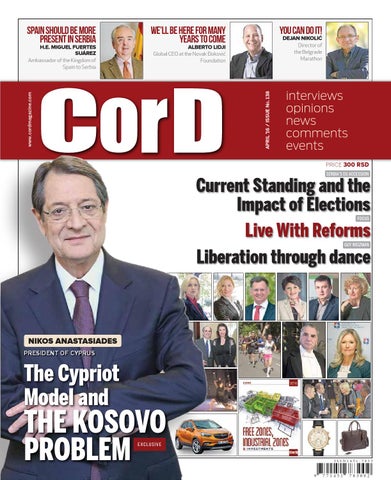
NIKOS ANASTASIADES PRESIDENT OF CYPRUS
The Cypriot Model and
THE KOSOVO PROBLEM E XC L U S I V E
ISSN1451-7833
9
771451
783002
2 |
138
| APRIL
APRIL
|
138
| 3
COVER NIKOS ANASTASIADES, President of Cyprus
CONTENTS
PAGE 08
6
The Cypriot Model and THE KOSOVO PROBLEM
April 2016
Serbia’s progress on its European path is based on fulfilment of the conditions and criteria set out in the Negotiating Framework, and Serbia recognising Kosovo’s independence is certainly not among them
EDITOR: Ana Novčić a.novcic@aim.rs
CURRENT STANDING AND THE IMPACT OF ELECTIONS
Dr Ana S. Trbović, Professor at the Faculty of Economics, Finance and Administration – FEFA; first head of Serbia’s European Integration Department (predecessor to Serbia’s European Integration Office), 2002-2004
8
THE CYPRIOT MODEL AND THE KOSOVO PROBLEM Nikos Anastasiades, President of Cyprus
14
SPAIN SHOULD BE MORE PRESENT IN SERBIA
H.E. Miguel FUERTES SUÁREZ, Ambassador of the Kingdom of Spain to Serbia
18
GLOBAL DIARY
20
LIVE WITH REFORMS Focus
24
WE’LL BE HERE FOR MANY YEARS TO COME
Alberto Lidji, Global CEO at the Novak Ðoković Foundation
30
39
Biljana Jovanović, Owner and CEO of Luna Fashion House
46
AFTER WORK
50
CULTURE CALENDAR
52
LIBERATION THROUGH DANCE
Feature
35
LATEST TECHNOLOGY – GUARANTEE OF FUTURE DEVELOPMENT Milena Tošić, Director of Support Services at Tigar Tyres d.o.o., Pirot
PHOTOS: Zoran Petrović
54
FACES & PLACES
TRANSLATION: Snežana Bjelotomić, MRP Editorial
59
FREE ZONES, INDUSTRIAL ZONES & INVESTMENTS
PROJECT MANAGERS: Biljana Dević, b.devic@aim.rs Aleksandra Ebilji, a.ebilji@aim.rs Ljiljana Knežević, lj.knezevic@aim.rs Dragana Radović, d.radovic@aim.rs Nataša trifunović, n.trifunovic@aim.rs
87
ENERGY OF LIFE ON PRESCRIPTION
EXECUTIVE DIRECTOR: Maja Vidaković m.vidakovic@aim.rs
Traditional medicine
90
SYMBOL OF SOPHISTICATION AND PRESTIGE Butler: Life on one’s Toes
92
ONLY THE BEST AND BRIGHTEST Geneva Motor Show 2016
96
CHILL OUT
98
HEED DESIGNERS, BUT FOLLOW YOUR OWN TASTE Fashion
38
EDITORIAL MANAGER: Neda Lukić n.lukic@aim.rs
COPY EDITOR: Mark Pullen
YOU CAN DO IT!
WOMEN ARE UNDER-REPRESENTED IN MANAGEMENT POSITIONS
CONTRIBUTORS: Rob Dugdale, Mirjana Jovanović, Miša Brkić, Radmila Stanković, Steve MacKenzie, Zorica Todorović Mirković, Sonja Ćirić
Guy Weizman, Choreographer
Dejan Nikolić, Director of the Belgrade Marathon
34
BUSINESS TAILORED TO EUROPE
ART DIRECTOR: Jasmina Laković j.lakovic@aim.rs
102 BRIDGE FROM SERBIA TO THE MIDDLE EAST
GENERAL MANAGER: Ivan Novčić i.novcic@aim.rs FINANCIAL DIRECTOR: Dragana Skrobonja d.skrobonja@aim.rs OFFICE MANAGER: Svetlana Petrović s.petrovic@aim.rs PRINTING: Rotografika d.o.o. Segedinski put 72, Subotica CorD is published by: alliance international media Makenzijeva 67, 11111 Belgrade 17, PAK 126909, Serbia Phone: +(381 11) 2450 508 Fax: +(381 11) 2450 122 E-mail: cordeditorial@cma.rs www.cordmagazine.com www.allianceinternationalmedia.com ISSN no: 1451-7833 All rights reserved alliance international media 2016
Vesna Simić Founder of TailorMade Production
Subscribe NOW and save 10% 11 ISSUES FOR ONLY €29 Call our subscription line +381 11 2450-508, 2450-122 4 |
138
| APRIL
APRIL
|
138
| 5
COMMENT SERBIA’S EU ACCESSION
Current Standing and the Impact of Elections A country’s path to European Union membership is both a highly political and a highly technical process. When one speaks of EU directives, which are rules of the highest order in the EU club, one needs to understand that these are guidelines, as the name suggests DR ANA S. TRBOVIĆ, Professor at the Faculty of Economics, Finance and Administration – FEFA; first head of Serbia’s European Integration Department (predecessor to Serbia’s European Integration Office), 2002-2004
T
he EU body of law is not called “EU law” but the acquis nical review of legislation and its implementation, the member communautaire, because it is a combination of so-called countries add a political lens. Croatia has, thus, interpreted that hard and soft laws and has the important role of building requirements for the opening of new chapters should include the a consensus on how it is to be implemented in practice. handing over of Vojislav Šešelj to the Hague Tribunal and enhanced Therefore, analysing how EU directives are implemented in national parliamentary rights for minorities, namely Croats. It will be left to legislation and evaluating whether there is a sufficient degree of political discussion among EU members to decide whether these alignment of Serbia’s legislation with EU standards is both a matter conditions merit a delay in the opening of additional chapters or if of expertise and politics. While all new members have to fully adapt they will be reviewed as part of that negotiation process. This is a to EU standards, the interpretation of the achieved level of harmonicase in point illustrating the intersection between technical and posation is ultimately a political decision. litical conditionality colouring the EU accession process. Moreover, as the EU is learning from its past mistakes, the bar Importantly, while many Serbian citizens resent the politics of is constantly being raised on Serbia’s EU track. Most poignantly, the EU accession process, a high portion (73%) support the related Serbia will need to demonstrate not only that the national legislareforms and consider that they should be implemented for our own tion contains the right provisions, but also that these provisions are sake, even if not demanded by EU accession. Citizens recognise the enforced. It is for this reason that the EU places a special spotlight fight against corruption and judicial reform as the most important on the workings of the regulatory bodies and the judiciary. Another reforms, followed by the reform of education and the health system. reason why the rule of law is among the first chapters negotiated The remaining issue is how upcoming elections in Serbia will with the EU is the recognised importance of impact on the EU accession process. Siminstitutions in both enabling reforms and enply put, since legislative reforms have been Citizens recognise the suring a stable and democratic society. The halted so has the accession mechanism. At fight against corrupfirst goal of the European Union is to ensure the same time, experts should continue to peace, while market development comes secprepare and implement reform policies, intion and judicial reform ond. The Western Balkans, as a post-conflict cluding further technical meetings with the as the most important area, is considered particularly vulnerable and European Commission, as part of the accesthe word “stabilisation” indicates strong conreforms, followed by the sion negotiations. However, the principle cern about the achieving of sustained change. in Serbia is that the number of exreform of education and problem It is in this context that Serbia’s negotiations perts is limited and many expert positions the health system should be viewed. have been politicised, leading to a high turnWith all of this in mind, it is understandover in public administration and insufficient able that the first two of the 35 chapters comprising the acquis knowhow to implement reforms efficiently and therefore also adcommunautaire that Serbia and the EU formally began negotiating vance EU membership. With each election, too many layers within in the past year relate to national and regional stability (“the northe administration change and we lose some precious knowledge malisation of Belgrade-Pristina relations”) and public expenditure and experience. In order to overcome this problem, Serbia needs to oversight (“financial supervision”). Although concern over fiscal build a professional, non-political civil service. Special expertise in policy is certainly heightened as a result of the financial crisis, the acquis communautaire and sector-level technical knowledge also essence of this second “chapter” lies in accountable governance. requires adequate compensation, which can only be achieved if the The next two chapters will delve deeper into ensuring human and public sector is reformed to reduce losses and allow for increased minority rights and the functioning of the judiciary. spending that leads to greater efficacy. Public administration is the As noted, while European Commission experts carry out a techengine of change in the EU accession process. ■
6 |
138
| APRIL
APRIL
|
138
| 7
■ By Ljubica GOJGIĆ
INTERVIEW
The Cypriot Model and
THE KOSOVO PROBLEM NIKOS ANASTASIADES PRESIDENT OF CYPRUS
Serbia’s progress on its European path is based on fulfilment of the conditions and criteria set out in the Negotiating Framework, and Serbia recognising Kosovo’s independence is certainly not among them
EXCLUSIVE
C
yprus’s decision not to recognise the independence of Kosovo is based on the principles of respect for the sovereignty and territorial integrity of countries in international relations, says Cypriot President Nikos Anastasiades. In this exclusive interview for CorD magazine, he talks about the similarities and differences between the status of Kosovo and the situation in Cyprus, which is often cited as an example of why the unresolved status issue will be an obstacle to Serbia’s European Union accession. The Cypriot President also explains why the best way to overcome the decades-long division of Cyprus is the “evolution of the Republic of Cyprus into a bi-zonal bi-communal federation”. ■ Talks on the unification of Cyprus are monitored with
high expectations. At the beginning of this year, however, you noted that there should be no euphoria in this
8 |
138
| APRIL
regard and that some statements of the UN envoy also excessively raise the expectations of citizens. How do you assess the current situation in this process?
- Since May 2015 we have been engaging in intensive negotiations to reach a comprehensive settlement to the Cyprus problem; a settlement that will reunite Cyprus and its people in a bi-zonal, bi-communal federation, which will safeguard and respect human rights and fundamental freedoms, and which will be in compliance with EU values and principles and the acquis. We have reached a common understanding on an important number of issues with Mr Akinci. However, there are still remaining differences in all negotiation chapters and we have yet to embark on substantive discussions regarding a number of core issues. At the same time, there are also issues which have complexities associated with their implementation that would require time and careful planning even if we reach a common understanding. In the recent past I have warned about creating a “climate of euphoria”, because there are so many details left that must be discussed and agreed upon. As such, it is vital we are well prepared, in order to present a clear Plan to the people of Cyprus and thereby avoid reaching a solution with considerable gaps or ambiguities that would have a negative impact on its viability.
for Ankara to convert its words into deeds. Do you see a potential problem in this regard?
- It is our sincere hope that Turkey, an occupying force in Cyprus, will demonstrate genuine political will to reach a settlement, not via rhetorical assurances, but through the adoption of tangible steps that will positively underpin the negotiating process. There is much that Turkey should do in this regard. Some key issues for the resolution of the Cyprus situation depend entirely on Turkey, such as the issue of territory, the security issue and the abolition of the anachronistic system of guarantor powers.
■ How is Cyprus handling the migrant crisis that is facing the EU and which has hit Greece the hardest in recent weeks?
- Cyprus has committed from the very beginning to streamlining its efforts to match those of the European Union, in order to ef-
■ Some critics of the continuing negotiations
consider that you are “sacrificing the republic in order to create a federation”. How do you view that?
- We are working tirelessly to achieve a settlement based on a bi-communal, bi-zonal federation with political equality, as set out in the relevant United Nations Security Council Resolutions, the High Level Agreements of 1977 and 1979, and the Joint Declaration of February 2014, with a single international legal identity, a single sovereignty and a single fectively address these unprecedentWhen we reach a solumigratory pressures. Within this citizenship; a viable and functional solution in tion, there will not be any ed line with the European Union acquis, values framework, Cyprus has accepted to gap, but a continuation of host 541 recipients of international and principles; a European solution that will safeguard the human rights and fundamental the current state under a protection status from Greece, Italy third countries, in the context of freedoms of all Cypriots. new constitutional struc- and All of my six predecessors were elected the relevant Relocation and Resetture, from day one president of the Republic of Cyprus with a tlement programmes. Furthermore, mandate to pursue a solution of the Cyprus Cyprus has responded to the call of problem on the basis of a bi-zonal federation, in line with the the Commission regarding the need for experts and has already basis set out by late President Archbishop Makarios III, the first sent asylum experts to hotspots in Greece, in order to assist with president of the Republic of Cyprus, in February 1977. Since the implementation of the Relocation Programme. Furthermore, then, all of the country’s political leaders have accepted that the Cyprus has sent in-kind humanitarian aid to Greece via the Civil only way to get rid of the unacceptable status quo is for the ReProtection Mechanism. public of Cyprus to evolve into a bi-zonal bi-communal federaWe reached an agreement with Turkey during the last Eurotion. I have to say that when we reach a solution, there will not pean Council Summit and we hope that will alleviate Greece and be any gap, but a continuation of the current state under a new allow the prosecution of smugglers. We are ready to exert every constitutional structure, from day one. effort that will contribute to the fast and effective implementation of this agreement. ■ In order to achieve a sustainable agreement that would put an end to the division of Cyprus it is also essential that Turkey has ■ When Cyprus is discussed in Serbia, talk often turns to the a constructive approach. You recently said that it is necessary
decades-long struggle to restore the sovereignty of its entire
APRIL
|
138
| 9
territory, though of course in the context of the Kosovo crisis. Does the example of Cyprus show that there are no quick solutions for solving such complex problems?
- The Kosovo crisis and the Cyprus issue are two equally critical yet different issues, with their own particularities. In the case of Cyprus, in 1974, a foreign country, Turkey, invaded and occupied 37 per cent of the territory of Cyprus, a sovereign and independent state. That occupation continues to this day. Despite the complexities that exist at the negotiation table, our efforts are directed towards achieving a clear goal: reaching a comprehensive settlement that will reunite Cyprus and its people in a bi-zonal, bi-communal federation. As I have already said, Turkey has an important role to play in efforts aimed at reaching a settlement as soon as possible. ■ The Government of Cyprus has so far persevered in its policy of not recognising Kosovo’s unilateral declaration of independence. Is your government determined to continue with this policy?
- Cyprus does not recognise the 2008 Unilateral Declaration of Independence by Kosovo and abides by the UNSCR 1244(1999) and the relevant International Court of Justice ruling. The decision not to recognise Kosovo’s independence is based on principles and, specifically, on our strong commitment to respecting states’ sovereignty and territorial integrity. Given our own experiences, respect for international law is a driving principle in our foreign policy and our relations with other countries. At present we do not see any change in circumstances that would warrant a shift in our position. ■ What do you make of the message sent to Belgrade that “the EU will not tolerate another Cyprus”, and that if Serbia wants to achieve EU membership it will have to recognise Kosovo’s independence?
■ The latest revision of the credit arrangement with Cyprus saw the IMF note that the country’s macroeconomic results are 138
| APRIL
- There were three dimensions to the Cyprus crisis: a recession, a fiscal crisis and a banking crisis. All of them have seen good progress achieved to date. The Cypriot economy is now emerging from recession. After almost four years of recession, the Cyprus economy grew by 1.6% in 2015, marking the highest growth in the last seven years. With a restructured and fully recapitalised banking sector – mainly through important international investors – consolidated public finances and a programme of radical structural reforms, Cyprus has managed to successfully return to international capital. Obviously, we have a number of challenges still to face: most importantly, to restructure a good part of the Non-Performing Loans and to address levels of unemployment that are still unacceptably high. We now have in place tools that will be used to address the high number of NPLs in the banking system: the foreclosure law, the insolvency framework, the banking ombudsman etc. Substantial progress in viable restructuring has now been achieved. Unemployment has also begun to show the first signs of reducing, as a result of the recovering economy.
Cyprus has committed from the very beginning to streamlining its efforts to match those of the European Union, in order to effectively address these unprecedented migratory pressures
- The progress of Serbia on its road to European is based on fulfilment of the conditions and criteria set out in the Negotiating Framework, and the recognition of Kosovo’s independence by Serbia is certainly not among them. What the EU seeks from Serbia is to enhance cooperation and normalise relations with Pristina, within the framework of the Belgrade-Pristina dialogue, in which, we have to admit, Serbia has indeed been cooperative and constructive.
10 |
satisfactory, which means that the policy of reforms and savings has yielded results. How far have you progresses in terms of overcoming the crisis which your country has found itself in since 2013?
■ Three years have passed since you had to make the decision to enforce a one-time taxation on deposits in Cypriot banks which exceed 100,000 euros. That was part of the agreement with the EU, which allowed Cyprus to gain funds to overcome the crisis. To what extent has this move – which many consider as having particularly hit wealthy clients who had deposits in Cypriot banks – been reflected on the banking sector, which is very important for Cyprus’s economy?
- Significant results have been achieved and have completely transformed in the banking sector. It is now smaller and healthier, no longer reliant on high foreign deposits and operating under the direct supervision of the ECB. The banks have been restructured and recapitalised (mainly through private capital in the form of foreign investments from the United States and Europe) and are refocusing their operations with a prudent risk-based approach to lending, while they now have adequate capital. We are in a position now to say that confidence and stability have been restored. So, to answer your question, yes, the banking sector is definitely different now, as it is more robust and reliable.
■ Cyprus is among the EU member states that are questioning the justification of further sanctions against Russia. In today’s circumstances, how successful can it be to advocate for a policy of cooperation between Russia and the West? This is a topic that is currently very relevant in Serbia.
terranean, we have advocated for this natural wealth not to lead to competition and antagonism, but to cooperation and synergies among the countries of the region, in order to satisfy their energy needs, provide them with energy security, contribute to their sustainable economic development, improve bilateral relations and serve as a catalyst for broader cooperation on a - Cyprus is in favour of a pragmatic and mutually beneficial relaregional level, with a positive reflection on peace and stability. tionship between the EU and Russia, as well as maintaining open Thus, energy became one of the main pillars of the network of channels of communication. In this regard, we believe the EU’s trilateral cooperation frameworks strategy towards Moscow should that Cyprus promoted with a not be limited to imposing restricThe decision not to recognise number of countries in our region, tive measures. Let us not forget that Kosovo’s independence is based on i.e. Cyprus-Greece-Egypt, CyprusRussia is an important EU partner Greece-Israel, Cyprus-Greecein the fields of the economy, trade principles and, specifically, on our Jordan, Cyprus-Greece-Lebanon. and energy, and is also an imporstrong commitment to respecting This cooperation policy is neither tant partner in the fight against the states’ sovereignty and territorial exclusive nor directed against any Islamic State and terrorism. Sanccountry. On the contrary, it is of an tions will not solve the problem. integrity inclusive nature and our wish is to expand it to the greatest possible ■ In this era of hunting for new extent. The only condition is that the countries wanting to parsources of stable energy supplies, the role of Cyprus becomes ticipate respect international law and the sovereign right of any very important. You spoke at the recent Mediterranean Forum country to explore and exploit its own natural resources. on Gas and Oil about the importance of “transnational cooperaI would also like to stress the importance of East Med hytion”. How should that look and which countries – under the drocarbons to the energy security of the European Union and conditions in which Europe and the world now find themselves the promotion and implementation of the EU’s energy policies. I – should be encompassed by this cooperation? would point out that in the first report of the European Commis- Since the first discoveries of hydrocarbons in the Eastern Medi-
APRIL
|
138
| 11
sion on the Energy Union, the State of the Energy Union, there is recognition of the fact that the discoveries of natural gas in the East Med can contribute to the EU’s energy security for the first time. I believe that our policies serve both the interests of our region and those of the European Union as a whole, of which Cyprus is a Member State.
■ How much time will be needed to implement infrastructure projects that would connect Cyprus and Eastern Mediterranean countries to Greece and the rest of the EU? The European Commission has supported the “Euro-Asia Interconnector” project, which would permit the transfer of electricity from Israel to Greece via Cyprus, and also the “EastMed pipeline” project, which will connect Cyprus with Greece via a gas pipeline.
that the project will be completed in three phases, in 2017, 2019 and 2022. The feasibility study for the East Med Pipeline Project, which was adopted as a Project of Common Interest more than a year after the EuroAsia Interconnector, is also underway. Once the study is completed and it has been proven that the project is technically feasible and financially viable, the governments involved will take the necessary decisions. ■ How much progress has been made on researching reserves and producing natural gas in Cyprus’s “Aphrodite fields” and are you still interested in the scenario of connecting with Egypt via gas pipeline?
- Last June, the Block 12 Consortium declared the Aphrodite Field commercial and soon after submitted a Development and Production Plan for Aphrodite. This plan is currently under discussion at the Ministry of Energy, as the Cyprus Government has to agree on the plan with the Consortium (Noble, BG, Delek). Based on existing natural gas quantities (the latest independent resource assessment confirmed that Aphrodite contains mean gross natural gas of 4.5 tcf) and the current economic environment, the Cyprus Government and the Block 12 Consortium concluded that a regional submarine pipeline for the export of Aphrodite’s natural gas to Egypt seems to be the most commercially viable option. Suffice to say that we are currently discussing the export of natural gas with Egypt and companies that run the LNG Plants in Egypt, with a view to concluding the necessary commercial agreements. I would simply add that natural gas from Aphrodite will also be brought to Cyprus for electricitySerbia and Cyprus enjoy a generation purposes.
- The European Commission recognises the importance of the EuroAsia Inlong-standing traditional ■ Finally, relations between Serbia and Cyterconnector Project and the East Med friendship, based on prus are friendly. In which areas do you see Pipeline Project to the implementation room for further improvements? of the European Union’s policy of diverhistorical and religious sification of energy sources and routes, Serbia and Cyprus enjoy a long-standing ties, as well as enhanced -traditional as well as their contribution to the enfriendship, based on historical cooperation in various ergy security of Europe. As such, it has and religious ties, as well as enhanced coadopted them as Projects of Common operation in various fields. The remarkable fields Interest and financed their feasibility support and solidarity that our people have studies. These studies will examine the technical feasibility of demonstrated throughout the years, the principled positions of the projects, as well as their financial viability. Serbia on the Cyprus problem and the consistent position of CyI note that the EuroAsia Interconnector Project will use a prus on the non-recognition of Kosovo’s unilateral declaration of submarine electric cable to connect the electricity grids of Isindependence, represent only some elements that demonstrate rael, Cyprus and Greece to mainland Europe, while the purpose the excellent level of our bilateral relations. Our close cooperaof the East Med Pipeline Project is to export natural gas from the tion can also be seen through the extensive legal framework of Eastern Mediterranean (Cyprus, Israel) to Greece via submarine bilateral agreements signed between the two countries. Moreopipelines. I should also note that both projects are private, with ver, Cyprus and Serbia opened a new chapter in relations beno direct government involvement. tween our countries with the staging of the first Cyprus-Serbia The EuroAsia Interconnector Project is already at an adIntergovernmental Conference in Belgrade in January 2013, vanced stage. The project promoter last December awarded which was attended by the President of the Republic of Cyprus three studies that will pave the way for the pre-works phase, and five Ministers. Cyprus is looking forward to hosting the secleading to implementation and commissioning. It is envisaged ond Conference in Nicosia soon. ■ 12 |
138
| APRIL
APRIL
|
138
| 13
INTERVIEW
Spain Should be More
PRESENT IN SERBIA H.E. MIGUEL FUERTES SUÁREZ AMBASSADOR OF THE KINGDOM OF SPAIN TO SERBIA
Over these past months that I’ve spent in Serbia, I’ve had the opportunity to convince myself of the existence of great affinity for Spain and everything Spanish. Even at sporting events I felt that closeness, which eases my contacts with Serbs, who are dear and warm people
S
pain is one of the EU members that strongly supports the stance that Serbia belongs in the EU, regardless of whether or not it recognises Kosovo’s sovereignty on that path. However, the EU accession process implies a long and arduous road of total economic – and even psychological – transformation of a candidate country. Spain supports the opening of the first chapters in the negotiations, with the expectation that Serbia will implement that which has been agreed and that the opening of the following chapters will start as soon as possible.
■ This year marks the centenary of the establishing of diplomatic relationships between Spain and Serbia. Do you have any plans to mark this event in some way? - In our opinion, the centenary of our diplomatic relations is not 2016, but 2017, as the first Serbian ambassador presented his credentials in Madrid in 1917. As such, we still have time to prepare a ceremonial celebration of the jubilee. 14 |
138
| APRIL
■ When you arrived in Serbia a year ago, the general consensus was that the two countries had friendly relations, with Serbian President Tomislav Nikolić underlining the importance of Spain’s official decision not to recognise Kosovo’s independence. Spain is one of five EU members to maintain such a position. Is this still official Spanish policy, given that certain circles in the EU suggest you should make a change? - Spain’s position regarding the non-recognition of Kosovo is completely unchanged, and will remain so even under possible pressures from other countries, especially considering that Spain bases its Kosovo position on solid legal and political grounds, which have not changed and with which many other countries also agree.
■ Spain also reaffirmed its support for Serbia in UNESCO by voting against Kosovo becoming admitted as a member of this organisation, again contrary to the votes of the majority of EU members. Has this led to Spain being criticised by your European partners? - Given that Spain does not recognise Kosovo, it should not accept Kosovo’s presence in organisations that accept only officially recognised states. That was our stance regarding Kosovo’s efforts to join UNESCO, and that will be our future position regarding any pretensions of Kosovo to join other international organisations. I’m not aware of Spain having sustained criticism for remaining committed to its own position, which is grounded firmly in law. ■ When you took up the ambassadorial position in Belgrade, you said that you would be glad to help Serbia with its EU accession process. Serbia fears that EU membership will not be possible unless the country recognises Kosovo’s independ-
- Of course, with all respect for the decision of the British government ence. As someone who comes from a country that has reto hold the referendum on the UK’s membership in the EU, and bearfused to accept Kosovo’s independence, how do you interpret ing in mind the psychologically important changes that other countries this situation? are willing to accept in order to receive a positive response, I think it is - Spain will support Serbia on its path towards the EU, because it shares logical to be concerned about the outcome of this referendum. The EU the opinion of the Serbian Government that EU accession is a key strawould be weakened by the UK’s departure, and not just for economtegic goal for the future of Serbia. I see no reason why the recognition ic reasons. I was a student at the College of Europe in Bruges during of Kosovo should be a condition of accession, given the fact that five the 1973-74 academic year when the UK joined the Union, and I am member states have not recognised Kosovo. However, let’s put aside the convinced that during these forty years the British have been able to issue of Kosovo, as I would like to return to the issue of EU accession. preserve their own characteristics, while at the same time protecting Spain is a country that is characterised by a strong EU commitment, their own interests and influencing the development of the joint proso, in passing on our own experience, I want to point out that joining ject. The British are great negotiators, have an extremely strong public the EU meant a very important turnaround that was not only economic administration and are quite pragmatic in nature, but also psychological, and depeople. I wish for them to continue to be manded a change in the previous behavThe economic and trade part of the Union and I hope they won’t be iour. It is true that sometimes differences exchanges between Spain and overbearing with the idea of some Europe of opinion within the Union are obvious “à la carte”, because I’m afraid that would and negotiations leading to common soluSerbia are equal, though not be unsustainable. tions are complex, but achieving them is quantitatively significant. It is worth every effort. In that sense, we were ■ On the other hand, certain analyextremely pleased to see the opening of true that there is a certain suggest that the UK’s exit from the first two chapters in the accession geographic distance and that, ses the EU would immediately prompt negotiations with Serbia, and we expect despite the great mutual Scotland to separate from the Unitother chapters to be opened soon. We ed Kingdom, which would in turn encourage the Serbian government to exaffinity of our people, this encourage similar movements in Euert the necessary efforts with the aim of exchange is still modest rope to re-launch their independence speeding up negotiations. campaigns. Even Spain has been facing this issue. Does this concern you? ■ There is much talk about where the EU’s destiny lies in the - Everything that would imply breaking states into their constituent next decade or so, e.g. whether or not the EU will be able to parts would weaken the whole. Divisions worry me; I think they’re control the migrant crisis. wrong and can cause further divisions. This is a phenomenon that - Indeed, the crisis caused by the influx of refugees is a huge challenge should be avoided. that requires the finding of a common solution, and I think any approach that would disregard the idea of unity in seeking a solution is wrong. ■ Returning to the issues that affect Serbia, do you think There may be differences of opinion in the approach to dealing with there is more room to boost economic cooperation between the problem, but it is necessary to come up with a common response, our two countries; and which areas of economic cooperation because the EU is a joint project that we should respect and protect. It have the highest potential in that respect? is necessary, therefore, to strike a balance between, on the one hand, re- The economic and trade exchanges between Spain and Serbia are spect for the principles of international law and the applicable EU laws equal, though not quantitatively significant. It is true that there is a cerand, on the other, acceptance and integration of refugees in a number tain geographic distance and that, despite the great mutual affinity of that would be realistically possible. Excess enthusiasm could be just as our people, this exchange is still modest. Spain should be more present harmful to the EU’s structures as a lack of solidarity that would return in Serbia in the fields of agriculture, tourism and construction. us to the former concept of “Fortress” Europe. ■ UK citizens will this year vote in a referendum on whether or not to stay in the EU. Are you worried about the results?
■ There are over 40 Spanish companies operating in Serbia, while Serbia exports agricultural products, furniture and ve-
• The Hotel Srbija Vršac • operates under Majorca-based EIX Hotels
• Contemporary hotel with a long tradition synonymous for hospitality across the region • Has 78 rooms and 8 suites • New conference call Daurada that can seat 140 persons, ideal for holding MICE events • Personalized services for the most complex events
Svetosavski trg 12 Vršac; Tel: +381 13 834 170; office@hotelsrbija.rs; www.hotelsrbija.rs
• In certain segments, the hotel’s services exceed its star | A P R I L rating 138 | 15
hicle parts to Spain. Despite all of this, trade between the two countries remains modest. What are the biggest difficulties in this segment? - On the other hand, Spain is a major producer of cars and many of the European brands of cars that can be seen around Belgrade were produced in Spain. Apart from that, we should – and I hope that will be the case – create such aviation transport of passengers and goods that it would justify the introduction of direct flights between Belgrade and Spanish cities throughout the entire year. Vueling is currently the only company with direct flights to Barcelona, and they run solely during three summer months. This results in a reduced presence of Spaniards in Serbia and Serbs in Spain, given that they have to take a connecting flight and must sometimes wait a long time for the next one. If there were more flights, there would also be higher passenger numbers. ■ You have said that Spain is Serbia’s natural ally when it comes to exporting to Latin America. Do you see any Serbian products as being interesting to that market? - Serbia has very good political relations with Latin American countries and has embassies in some of them. Latin American countries also have beautiful embassies in Belgrade. In this regard, Spain will always be ready to contribute to forging even closer ties between Serbia and all of our brotherly nations.
■ At one point there was talk about Spain being interested in building a metro system in Belgrade and a hotel on Stara Planina, as well as participating in other infrastructure projects. Is there still such interest? - There are Spanish companies that are involved in infrastructure projects in Serbia. Spain has extremely strong companies in all areas of construction and infrastructure, so it is logical that these companies are interested in participating in all public tenders launched by the Serbian authorities.
Spain will support Serbia on its path towards the EU, because it shares the opinion of the Serbian Government that EU accession is a key strategic goal for the future of Serbia
■ Spain has been successfully implementing the public-private partnership (PPP) format to fund largescale infrastructure projects. Given that this format is still undeveloped in Serbia, how can Spain’s PPP experience assist us? - Financing major construction works can be carried out in many different ways. In Spain there are also major financial institutions that can participate in the design, construction and exploitation of building projects. This is something completely normal, and international financial institutions also encourage that with the aim of improving infrastructure. As I said already, many Spanish companies expect participation in the larger projects that will soon be launched, especially in Belgrade. 16 |
138
| APRIL
■ It was announced recently that Spain recorded economic growth of 3.2% and significantly reduced unemployment last year. Since Serbia is currently implementing reforms aimed at boosting our economy and creating more jobs, what do you think we can learn from Spain’s example? - In recent years, and following the deep crisis that has led to high unemployment, Spain has had to introduce very painful structural reforms that would enable a change of the previous situation and the restoring economic growth, in order to create new jobs. These structural reforms have their social costs, are politically unpopular and impact on the electorate, but they are necessary for creating a meaningful and competitive economy. Governments need to be bold and to adopt such economic healing measures, with the proviso that they alleviate social consequences to the greatest possible extent. It is simultaneously necessary to introduce measures to prevent and, if necessary, curb corruption in the state administration. Citizens, especially when they are forced to endure heavy sacrifices, need to see that the authorities are decisive when it comes to abuse. ■ There is another phenomenon that comes from Spain – Podemos. This party has been recognised globally as one of the movements that gives a voice to ordinary, disgruntled citizens. Do you think Podemos will suffer the same fate as Syriza in that it will eventually have to face a reality in which compromise is sometimes more important that fundamental ideals? It is inevitable that these measures cause discontent and lead to protest movements, particularly among young people. When these protest movements grow into political parties, they have to face the reality called “income-expenditure”, and to make decisions that take into consideration the distinction between desires and reality. When someone is outside the government, he can have “impossible demands” and the syndrome of Peter Pan, the boy who refuses to grow up. However, entering into government requires more common sense and acceptance of the fact that outgoings must be covered by incomings.
■ Do you know that the Spanish language has become a mandatory subject in some primary schools in Serbia, in response to pupil demand? What do you think of that? - Of course I’m convinced that the Spanish language is useful, attractive and easy to learn. It is the mother tongue of 500 million people, while it is a second or third language for the hundreds of millions. I therefore understand the interest that exists in learning Spanish, although I also understand that the authorities have limited resources to implement that. Both sides make up as much as possible. We should not forget that there is a great Cervantes Institute in Belgrade, which encourages that enthusiasm and contributes to learning the Spanish language. ■
APRIL
|
138
| 17
SCHENGEN
GLOBAL DIARY
“If the Schengen system is destroyed, Europe will be seriously endangered - politically and economically. That is why we Europeans have to invest billions in Turkey, Libya, Jordan and other countries in the region as quickly as possible - everybody as much as they can.” - Wolfgang Schäuble, German Finance Minister Photo by Getty Image
THE PRINCE OF WALES AND DUCHESS OF CORNWALL VISIT SERBIA ▶The Prince of Wales and The Duchess of Cornwall arrived in Belgrade for a two-day visit to the country. After being greeted at the airport by Prime Minister Aleksandar Vučić and Parliament Speaker Maja Gojković, the Prince and Duchess were received by President Tomislav Nikolić, who later laid wreaths with Prince Charles at the monuments of the Belgrade defenders of World War I and the Commonwealth Military Cemetery in Belgrade. The Prince of Wales and Duchess of Cornwall, together with historian Dubravka Stojanović, then visited Kalemegdan Fortress and Park. Afterwards, the British royal couple and H.E. UK Ambassador Denis Keefe met with the representatives of Christian churches and Islamic and Jewish communities in Serbia. Prince Charles also had a separate meeting with Serbian Orthodox Patriarch Irinej, while the Duchess visited the Centre for infants, children and youth care in Belgrade. The couple’s activities were concluded with a visit to meet Prince Alexander Karađorđević and Princess Catharine and a reception at the Serbian National Assembly.
PRINCE PHILIP’S ASTON MARTIN SPORTS CAR FOR SALE
“This car is part of our history,” said Damian Jones, Sales Manager at auction house H&H.
TV PRESENTER SACKED WHEN HE FORGOT TO SAY ‘HIS HIGHNESS’
his mistake was minimal and did not warrant the loss of his job. The newspaper also said that al-Herri was later appointed as news editor at “Canal Algerie” after being removed from his position as a news reader.
(IOC) gave the plan the green light. So far, 43 high-performance athletes, who are also refugees, have been identified as possibly being eligible for the Games, which get underway in
‘REFUGEE TEAM’ TO COMPETE IN RIO 2016
▶ An Algerian TV news reader was
▶ Prince Philip had his old Aston
Martin sports car modified so that the Queen could check her hat and he could make prank calls to Prince Charles, it has been revealed as the 1950s convertible goes up for sale for the first time in nearly 40 years. The 1954 Lagonda 3-Litre Drophead Coupe, worth around €580,000, was made to order for the Duke of Edinburgh, winning Aston Martin its first Royal Warrant. The convertible served as Prince Philip’s personal car for around seven years, and was used to ferry Prince Charles to and from Cheam prep school and for trips to Cowdray Park for polo. 18 |
138
| APRIL
sacked for saying the Algerian president’s name without saying “His Highness” before it. According to al-Khaber newspaper, al-Herri was reading an article about the president’s meeting on national gas policy when he made the mistake that cost him his job. A number of journalists and other presenters have expressed their solidarity with al-Herri, saying that
▶ A team of up to 10 refugees could
take part in the Rio Olympics after the International Olympic Committee
WOMEN’S DAY IN CHINA ▶ Chinese use to say that women “hold up half the sky”. In their myth, a goddess named Nv Wa amended the broken sky and created human beings. Like the earth, women have been always taken as a symbol of caring and nurturing. And the moon, water, flowers, cats and snakes are connected with women. They symbolize the softness, adaptability, beauty and wittiness of women. With multi-identities in modern society, women are not only mothers and wives who take care of their families, but also doctors, scientists and teachers who care about their patients, experiments and students. On the photo, female university students participate in a Coming of Age ceremony in Songcheng scenic spot in Hangzhou, Zhejiang province. They held the ancient traditional ceremony of kowtowing to ancient god and releasing festive lanterns in the river in Han Chinese clothing to celebrate International Women’s Day on March 8. Photo/IC
BORDERS
MIGRANTS
If Germany closes its borders, Schengen will slowly but surely be carried to the grave. In the end, that will make the European single market as well as the euro senseless.” - Jean-Claude Juncker, President of the European Commission
More than a million migrants crossed into EU in 2015. The scale of the crisis continues, with more than 135,000 people arriving in the first two months of 2016.
BRUSSELS: BRUTAL TERRORIST ATTACK KILLED 31 AND LEFT ABOUT 260 PEOPLE WOUNDED ▶ The whole Europe is on high alert after attackers launched twin assaults in Belgium’s capital and European officialdom Brussels on March 22, with bombs ripping through the airport and the underground metro line. The Islamic State of Iraq and the Levant (ISIL, also known as ISIS) said it was responsible for the attacks that killed 31 people and left about 260 others wounded - many in critical condition. Belgium’s federal prosecutor Frederic Van Leeuw said there were at least two suicide bombers involved in the airport attack, and a manhunt was on for a third caught on security video. Brothers Khalid, Ibrahim El Bakraoui and Najim Laachraoui are believed to have died in Brussels attacks but Mohamed Abrini is still at large. People from many different countries have used social media to share thoughts, hopes and wishes for those caught up in the tragedy in the Belgium capital.
Brazil on 5th August. “The final number of athletes to make up this team depends on qualification criteria,” said IOC president Thomas Bach after a meeting of the body’s executive committee. “The team would compete under the flag of the IOC.” The IOC had already identified some athletes who fled their home countries and whose skills could be of a high enough standard to feature in the 2016 Olympics. They were a
GERMAN ‘TRIPLE AGENT’ JAILED FOR EIGHT YEARS
Syrian swimmer based in Germany, a judo fighter from the Democratic Republic of Congo living in Brazil and an Iranian taekwondo fighter training in Belgium.
▶ A Munich court has sentenced a
COUNTRY ENVOYS VISIT ALBANIA AND SERBIA ▶ The UN Food and Agriculture
Organisation’s (FAO) Permanent Representatives to Australia, Chile,
Kuwait, Japan, Libya, the Russian Federation, the U.S. and the European Union are on a field visit to Albania and Serbia this week. By visiting FAO project sites and talking with farmers, national officials, FAO partners, other UN agencies and FAO teams on the ground, the officials aim to enhance their understanding of country conditions and FAO technical and policy assistance. Country visits are organised periodically for small groups of FAO Permanent Representatives – officials who represent their countries at FAO headquarters in Rome, participating in technical committees and higherlevel governing body sessions. This week’s visit to Albania and Serbia is the first to Europe and Central Asia since 2014.
former German intelligence agent to eight years in jail for spying for both the CIA and the Russian secret service, German media reported. Markus Reichel had admitted to handing over documents to the CIA, including the names and addresses of agents of the Federal Intelligence Service (BND), in exchange for €95,000.
Left partially disabled after a botched childhood vaccination, Reichel, who speaks haltingly, admitted that he had spied for foreign services out of dissatisfaction with his job at the BND.
APRIL
|
138
| 19
FOCUS TOPIC: SUSTAINABLE BUSINESS IN THE EXISTING BUSINESS ENVIRONMENT AND MEASURES FOR GREATER EFFICIENCY
Leadership Based on Sustainable Development Thanks to its commitment to sustainable development, the Henkel Company has achieved excelPRESIDENT AND HR lent results and maintained its leadership position DIRECTOR AT HENKEL successfully for many years. “To Achieve More with SERBIA Less” is the idea at the core of Henkel’s sustainability strategy, which the company uses as a guideline for all its business processes and activities GORDANA BRAŠIĆ
H
enkel’s factory in Kruševac, which produces powder and liquid detergents and household cleaning products, was the first factory in Serbia ever – in May 2012 – to be certified with ISO 50001 energy efficiency certification, which is a validation of the success of our strategy, as well as of our continuous investments in sustainable operations. While we are on the topic of Henkel’s factory in Kruševac, it is also worth mentioning our top filter, which is integrated into the factory tower to filter out all sorts of air particles and micro particles that linger in the air after production. Because of this filter, the air we release is now completely clean. In addition to releasing almost 100 per cent pure air into the atmosphere, the top filter also saves on water and electricity. In many aspects, Henkel’s Kruševac factory is at the forefront of implementing solutions that facilitate sustainable production. Thanks to a completely cloThanks to the sed water filtration system, we have no waste aforementioned water whatsoever, because the filtered water activities in the is re-used in production. This year we expect sustainability to get the LEED (Leadership in Energy and segment, the Henkel Environmental Design) certificate. Once this is Company has been done, we will become the first factory in Serbia to have this certificate, which is possessed by ranked among the very few industrial facilities. world’s 100 most In September 2015, SEKOPAK outlined Henkel Serbia’s significant contribution to meeting sustainable global the national goals for CO2 emission reduction corporations, given and waste management. On the occasion, we the rank of ‘gold’ by were given the Certificate for the Reduction EcoVadis of Emissions of Harmful Gases and Achieved Results in Waste Management. As a socially responsible company, we regularly implement a series of environmental protection measures in our production facilities in Kruševac and Inđija. A report about the global sustainability of the Henkel Company was released recently. We are proud to say that we have exceeded the strategy’s goals for the 2011–15 period. We have made great progress in all key areas of our sustainability strategy, including reducing electricity and water consumption, producing less waste and others. The company is continuing to work on its long-term global and local goals, as stated in the sustainability strategy covering the period until 2030. For many years now, thanks to the aforementioned activities in the sustainability segment, the Henkel Company has been ranked among the world’s 100 most sustainable global corporations, given the rank of ‘gold’ by EcoVadis. Henkel Serbia will continue to implement all measures and achieve the goals outlined in the sustainability strategy, which contribute to longterm environmental protection and sustainable business operations.
20 |
138
| APRIL
LIVE WITH
Reforms
As well as witnessing the commencement of EU accession negotiations, 2016 will also bring the adoption of several new laws in Serbia in order to facilitate long-awaited, thorough and deep-rooted economic reform. The Serbian government has already warned that this year will be a difficult one, due to this reform, adding that this is a price that will have to be paid by the whole of society in order for it to progress TOPIC: THE MOST RATIONAL SOLUTION IN TERMS OF REGULATING PRIVATE PRACTICES TO THE BENEFIT OF HEALTH WORKERS, THE STATE AND PATIENTS
Health Insurance Reform Needed JASMINA KNEŽEVIĆ
Private medical practice is a very young sector. Until 1989, the laws of the former Yugoslavia did not allow private practice. Now, years later, there are around 1,500 private healthcare facilities (general hospitals, specialised hospitals, community health centres and polyclinics) FOUNDER AND DIRECTOR OF BEL MEDIC
A
ccording to data collated by the World Bank, the share of out-of-pocket expenditure for health in Serbia is 38 per cent. However, private healthcare facilities are still facing many problems, such as a lack of understanding and lack of cooperation with public institutions. In order for the healthcare system in our country to yield more efficient results, we need to reform our health insurance. Our citizens have been paying into health insurance funds throughout their working lives, but not all of them have been able to use healthcare in the way or at the time when they need it the most. Despite paying into state healthcare funds, people often have to pay private health practitioners too, because they are unable to access the state healthcare services or have to wait a very long time for treatment. Because
TOPIC: EXPORT AND PRODUCTION GROWTH LEAD TO THE EXPANSION OF PRODUCTION AND THE CREATION OF NEW JOBS IN SERBIA
JELENA PAVLOVIĆ
MANAGING DIRECTOR AT PHILIP MORRIS SEE
W Similar warnings were announced at the beginning of last year, while business conditions this year are far more challenging due to the parliamentary and local elections, the migrant crisis, an unstable European and global economy, terrorism and undefined international politics. In this issue of CorD we have asked some of our most distinguished business leaders to comment on the operations of their companies in such complex conditions. nobody has come up with a solution as yet, state health institutions are overwhelmed, the private sector has a lot of available capacities and patients are unhappy because they are either going to receive their treatment very late or have to pay for the health services twice, despite having state health insurance. If the national healthcare fund were to introduce fair, economic prices of health services, healtchare funds would work in the service of patients and every patient would be able to choose a doctor and healthcare institution, be it private or state. In that case, private practice doctors would be able to plan and invest better in healthcare, which would definitely increase the level of service. Our country and economy would benefit from a stronger private health sector. We don’t want to see patients and doctors leave for other countries, to be treated or to find jobs respectively. The private medical sector has grown a lot and, thanks to its staff and the number of available beds, has become a credible partner that supports the overall development of our healthcare system.
Record Export and Production, 200 New Workers Hired
Expanding production and focusing on export remain among Philip Morris’s strategic priorities
e more than doubled our export last year, while our export has increased fifteen-fold compared to five years ago. Back in 2010 we exported to just three countries, while by year’s end 2015 the products produced at our Niš factory were sold in over 60 countries. We achieved the best results ever in this segment last year and, in line with our plans and current results, we will be far more successful this year. In the first two months of 2016, our export increased by 44 per cent compared to the same period in 2015, while we have been exporting to three more countries since the beginning of this year. Record export is a result of record production, which increased by 60 per cent, while the number of our employees increased by 200. If demand for greater export and production continues to grow, we will continue expanding our capacity by installing new machinery, resulting in the hiring of more workers. Apart from the expansion of Apart from the our exports, this year will also expansion of our be marked by an organisational exports, this year change following the repositiwill be marked by oning of the Serbian branch of an organisational Philip Morris as the regional cenchange following tre entrusted with managing all Southeast European markets. the repositioning of Our success is, and will continue the Serbian branch to be, useful not only to our comof Philip Morris as pany in Serbia, its employees the regional centre and suppliers, but also to society entrusted with as a whole and the state budget. Philip Morris’s tax contribution managing all SE to the Serbian budget stands at markets over five per cent.
APRIL
|
138
| 21
TOPIC: AGRIBUSINESS AS AN ENGINE OF REGIONAL DEVELOPMENT, AND OPPORTUNITIES FOR SERBIA TO BECOME A HUB
Via Education and Efficiency to Greater Profit Margins
NIKOLA VUJAČIĆ
Agriculture and the food industry are among the key sectors for the development of the economies of Serbia and the region, as well as being sectors that can make us competitive on the global market. Serbia truly has sufficient abilities to become a regional leader, considering its huge agricultural potential DIRECTOR OF OPERATIONS AND EXECUTIVE DIRECTOR OF VICTORIA GROUP
W
ith an appropriate agricultural policy and development measures, this potential could be utilised in a relatively short period of time and the country could increase both the volume and value of its production several-fold. Last year’s total value of exports of agricultural products amounted to approximately $2.85 billion, though this figure could be three to four times higher if we used all of the available resources optimally. In order to increase the value of export, it is crucial to work on improving the structure of export or, in other words, to have more final products to export. If domestic raw materials were processed to If domestic raw a higher level and we managed to materials were export more finished and semi-fiprocessed to a nished products, this would boost our foreign trade balance and higher level and reduce unemployment, considewe managed ring that the processing industry to export more usually employs domestic labour. finished and semiThe experience of Victoria Group finished products, – where final products account for 80 per cent of our overall produthis would boost ction and where we export 50 per our foreign trade cent of our products – merely valibalance and reduce date the fact that we are consideunemployment red competitive on the European market in the segment of soy and sunflower processing. If other agricultural crops and segments also had such a high share of final products, this would provide a huge contribution to the overall development of the economy. On the other hand, the lack of adequate incentives – like those made available to agricultural producers in neighbouring countries – has a negative impact on the competitiveness of Serbian agribusiness in the region. This further complicates the situation, since our agricultural producers have to make their production even more productive and profitable because they represent the first link in the supply chain. Hence, it is very important to implement educational programmes for farmers that relate to the financial aspects of agricultural production and adequate implementation of agri-technical measures, with the aim of increasing yields and protecting against the negative impact of unfavourable weather conditions on crops.
22 |
138
| APRIL
TOPIC: PRIORITIES AND GOALS OF THE NEW LAFARGEHOLCIM GROUP
Transforming Commercial and Market Approach DIMITRIJE KNEGINJIĆ
CEO LAFARGE SRBIJA
T
Lafarge Serbia is part of the LafargeHolcim Group, which was established in July 2015 following a merger between Lafarge and Holcim, the two leading building materials companies.
he LafargeHolcim Group has 115,000 employees worldwide, working in over 2,500 facilities in 90 countries. We are by far the biggest player in the construction materials industry and we also strive to be the best. We have been working to create the company with the highest operational standards in the construction materials industry and our strategic transformation relies on the best practices of Lafarge and Holcim. In terms of the Group’s operations in Serbia, Lafarge Serbia continues to function as part of the LafargeHolcim Group. Holcim’s assets and operations in Serbia were sold to the CRH Group in order to mitigate the potential restriction of competition that would result from the merger. Lafarge has been operating in Serbia since 2002, when the company acquired the Beočin Cement Factory. We Our goal is to extended our business activities create an attractive in 2010 by launching the produand stimulating ction of concrete and aggregaenvironment for our tes. Today our business is conducted at one cement factory and employees and to three concrete factories. This indevelop recognisable tegration will boost our operatiand sustainable ons by creating higher quality sosolutions that lutions and providing even better service, as well as an integrated contribute to the approach that will improve our development of the efficiency, increase the volume community in which of innovation, bring new solutiwe operate ons for sustainable construction and products with added value. Our company’s priorities all pertain to transforming our commercial and market approach in order to create a world class brand and become the number one partner in construction and infrastructure. While working constantly to advance our business in a safe way, we also try to come up with innovative solutions that create added value for our customers. Additionally, our goal is to create an attractive and stimulating environment for our employees and to develop recognisable and sustainable solutions that contribute to the development of the community in which we operate. Our goals are lofty and I am absolutely convinced that the foundations for accomplishing all our goals lie in a combination of global and local knowhow, as well as the vast experience of our team, our unique product portfolio and the great encouragement we derive from this merger.
APRIL
|
138
| 23
INTERVIEW
■ By Nebojša MANDRAPA
We’ll be Here For
MANY YEARS TO COME ALBERTO LIDJI GLOBAL CEO AT THE NOVAK ÐOKOVIĆ FOUNDATION
The Novak Ðoković Foundation was among the hosts of the Duchess of Cornwall during her visit to the project "Family outreach worker" in Belgrade. Together with representatives of UNICEF and Zvečanska Centre, Her Royal Highness was also welcomed by Alberto Lidji, Global CEO of the Novak Ðoković Foundation, who introduced her to the project and explained the mission and vision of the charity led by the world’s number one tennis player
“H
er Royal Highness was extremely personable and engaging, taking the time to meet every single person and hear their stories. Everyone had the opportunity to share a bit of time with her and I think that made it all the more special. One could tell she was enjoying the visit and, in actual fact, the event lasted much longer than originally planned,” says Alberto Lidji, speaking to CorD magazine.“ I had the opportunity to have a substantial conversation with HRH and in the process realised just how well versed she is on Early Childhood Development. As it turns out, she’s the Patron of a UK-based charity that also supports children in their very earliest years. We agreed to continue the conversation and explore whether some international collaboration could be possible,” reveals Lidji. 24 |
138
| APRIL
■ What was the reason for your meeting? Could you tell us more about the Family outreach worker project that she came to support?
- The British Royal family has a long tradition of supporting charities and worthy causes. When the Prince of Wales and the Duchess of Cornwall decided to plan a visit to Serbia, it was natural that they wished to identify charitable work in the country that has a strong impact. Fortunately, the support of the Novak Ðoković Foundation for the Family Outreach Worker Programme has yielded strong results over the past three years, which made it a compelling proposition for them to consider visiting. I met HRH in my capacity as Global CEO of the Novak Ðoković Foundation, and it was wonderful that representatives from UNICEF and the Zvečanska Centre were also there – by bringing likeminded organisations and individuals together there is no limit to what we can achieve.
The Family Outreach Worker Program aims to prevent very young children from being institutionalised. A real effort is made to engage closely with those families most in need and very close attention is paid to the wellbeing of the very youngest and most vulnerable children. There is abundant research on the long-term detrimental effects to children who are exposed to prolonged toxic stress, low levels of parental stimulation, and separation from family and familiar surroundings. Therefore, wherever possible and appropriate, we underscore the importance of protecting the family unit and deploying resources to ensure this is achieved. The Family Outreach Workers provide an invaluable service to society, and we are truly heartened by the success the programme has had over the last three years.
■ What are your tasks and responsibilities as Global CEO of the NDF? Are you satisfied with your team and is your work enjoyable?
■ Novak Ðoković sent a video message, which was played during the visit. What was the focus of his message?
- The video was great, and I’d encourage readers to have a look at the full version online. Novak wanted to lend a personal touch in honour of HRH’s visit, and since he was in the middle of the tennis tournament in Indian Wells, he felt that sending a video on this occasion would be a very nice touch. I showed the video to HRH while we were surrounded by children and Family Outreach Workers – it was very special. Novak’s message was very moving. He explained the hardships faced by the very youngest vulnerable children in Serbia and the importance of his family’s support to him as he was growing up, as well as referencing the impact the programme has had over the past three years. He concluded by thanking the Duchess for her presence, which unavoidably helps to bring
ZORAN MILAČIĆ Center for protecting babies, children and youth (left), ALBERTO LIDJI, Global CEO, NDF, DUCHESS OF CORNWALL and MICHEL SAINT-LOT, Representative of UNICEF in Serbia
Her Royal Highness the Duchess of Cornwall was extremely personable and engaging, taking the time to meet every single person and hear their stories. Everyone had the opportunity to share a bit of time with her and I think that made it all the more special
HER ROYAL HIGHNESS THE DUCHESS OF CORNWALL and ALBERTO LIDJI
our cause to the forefront. It’s hard for policymakers not to notice when such high profile visits occur – and for that, Novak and our Foundation are thankful to HRH.
- Some tasks are what you might expect: finance, strategy, marketing and communications etc. However, this job is unique. We bring the best of the not-for-profit world with a truly entrepreneurial mindset and no two days are alike. For instance, we have the Rio Olympics later this year and it’s fascinating to see how the opportunity of such a high profile event could be used to increase the profile of the Foundation’s work and Early Childhood Education and Development. On the other hand, we have our eye on Milan and are preparing to host a truly memorable Gala Dinner during Fashion Week later this year. The work is challenging but fascinating – when you realise just how many lives you can influence and how much public awareness can drive your cause forward, sometimes it’s difficult to switch off and relax – there is a lot of excitement. I also focus a lot on building partnerships, both formal and informal. A collaborative approach is key, so that you can create an ecosystem that leverages everyone’s best attributes for a greater purpose. Our conversations are wide-ranging and extend from foundations APRIL
|
138
| 25
and corporations to leading academics at top universities and policymakers across the globe. I wouldn’t be able to do what I do without the support of an outstanding team. There is so much talent and such a diverse range of experiences within our family. I never
■ What projects is the NDF working on at present and what are your plans for 2016?
- Our projects are focused on Early Childhood Education (ECE) and Development. While they may vary in precise composition and approach, the theme is constant. Among our key work to date we have established wonderful preschools, facilitated high quality teacher training and supported families at risk. We are currently in the process of establishing nine preschools (projects either in the pipeline or due to start shortly), and we are also reviewing the 1,400 funding applications received during our last ‘call for projects’. This year, we are also starting to explore the creation of a ‘Fellowship’ programme, through which we will support some of the very brightest Ph.D. and Post-Doctoral researchers focusing on ECE. This will enable us to drive growth in the body of knowledge on ECE and support young researchers who will make inroads globally. We plan to be more active on the global stage, particularly in terms of advocating the value of ECE and Development to policymakers, corporations and society at large. We are in the unique position that Novak’s voice is heard far and wide, and we want to ensure we leverage this as much as possible. Novak’s DUCHESS OF CORNWALL met with the families from The "Family Outreach Worker Program" role as a UNICEF Goodwill Ambassador, for instance, The Family Outreach Worker Programme provides him with a platform to emphasise the imaims to prevent the institutionalising of very portance of our cause.
young children. A real effort is made to engage closely with those families most in need
■ We know almost everything about Novak Đoković as an athlete. Tell us more about his charity work, or
stop learning from my colleagues and, likewise, hopefully some of my experiences rub off on them as well. It’s a privilege to work for the Novak Ðoković Foundation and I’m truly humbled by the quality of the charitable work we do and the team’s boundless energy. ■ How did you become CEO of NDF?
- My experience in the not-for-profit sector is firmly rooted in education, having worked in early childhood education, higher education at the university level and, most recently, informal education. As a father of two very young daughters, my heart gravitated back to supporting Early Childhood Education and when this opportunity arose I knew it would be fantastic. What started off as an exploratory chat in Monaco quickly unfolded into very substantive and positive discussions. Our personalities clicked very well from the outset and our passions for early childhood were very much a common denominator – as Novak and Jelena’s son Stefan is around the same age as my daughters. 26 |
138
| APRIL
rather the humanitarian work of his family, which includes his wife Jelena, who is said to be the initiator of many activities?
- Novak has a disarming charm and humour. He articulates his passion for Early Childhood Development very clearly and
his passion is always evident. He is certainly much more than just the Founder or name on the letterhead. Both he and Jelena are intimately acquainted with the day-to-day work of the Foundation and their support is invaluable on many levels. It’s also nice to see that someone who’s at the top of his game is still actually even more driven when it comes to appreciating his family. TV viewers hear him reference his family during victory speeches and it’s heartening to see this also extends off camera. Being a good person and achieving one’s personal best is how I would describe Novak. He’s much more interested in achieving his personal best, irrespective of what others around him may do. That’s refreshing to see.
pact for generations to come and reassures our supporters that we’ll be here today, tomorrow and for many more years. The UN Sustainable Development Goals (SDGs) have clear targets for 2030, some of which are aligned with our view of the road ahead. Target 4.2, for instance, aims to ensure that all girls and boys have access to quality early childhood development and education – no matter where in the world they’re based or what their financial or family situation happens to be. This is a universal goal. The realities of our world mean that financial resources are crucial to being able to make an impact. We are working ac-
■ Jelena Ðoković practically built NDF and is constantly engaged and active on the most pressing issues faced by children from disadvantaged communities. It could be said that the energy Novak has on the court is matched by the energy Jelena has in humanitarian activities.
- Jelena is relentless and definitely has boundless energy. There’s always a smile and an inclination to see the glass as being half full. Her knowledge of the Foundation and every project we make possible is impressive. Somehow she manages to combine the top level strategic view with a thorough grasp of all the moving pieces that make up our Foundation. She has an inquisitive mind and it shows – I know we both value the insights from the Harvard Business Review, hold the Financial Times in high regard and constantly strive to gain new experiences and learn new ways of tackling opportunities. Fortunately, all of these attributes are combined with a love for philanthropy, which enables the Foundation to do great things. She made me feel at home from the very first day I joined the Foundation and is always available for a chat, to discuss strategy or ideas. This is an attitude that is evident throughout the whole team and it provides the ingredients for high team performance and collaboration.
Novak wanted to lend a personal touch in honour of HRH’s visit, and since he was in the middle of the tennis tournament in Indian Wells, he felt that sending a video on this occasion would be a very nice touch
■ What is the NDF’s ultimate goal? Do you have some longterm plans?
- We focus on Early Childhood Education and Development, paying close attention to the most disadvantaged segments of society. Our strongest presence is in Serbia, but we appreciate that Novak and the Foundation have an opportunity to make a difference globally. We have a healthy sense of urgency, since we realise the world’s spotlight is on us now, while Novak is world number one. We need to maximise our opportunities now and ensure the Foundation is thriving and vibrant long after Novak makes his final exit from Centre Court. This ensures we make an im-
tively on building an endowment, so that our Foundation’s financial position is strong in the decades to come. Novak and Jelena have been incredibly generous in supporting the Foundation – so much so that every single Euro and Dollar donated can go straight to the frontlines – but we also very much need the support of other individuals, corporations and foundations to join us on this philanthropic journey.
■ You were previously Director of Development at the Duke of Edinburgh’s International Award Foundation. Can you reflect on that and compare the two Foundations?
- There are similarities and differences. The similarities are that the management teams of both organisations are simply outstanding, the passion to change the world runs deep and education and youth are at our core. The differences are vast, however. The Duke of Edinburg’s International Award was founded 60 years ago, is present in more than 140 countries and supports around a million young people at any given time. Both foundations have very big hearts, and that is really why I worked there and why I work here now. ■ APRIL
|
138
| 27
Get Ready! Saturday 16th April 2016
Belgrade Marathon
Become a Master of Charity!
28 |
138
| APRIL
For the 10th consecutive year, the Belgrade Marathon and CorD magazine will be holding the CorD Charity Masters – a race in which it is more important to be charitable than to finish first. The Charity Masters race will take place alongside the upcoming 29th Belgrade Marathon, to be staged on Saturday 16th April 2016. We are inviting you to run (or stroll if you so desire) at least 5km to raise money for a charity of your choice. Over the last decade, runners in the CorD Charity Masters have raised more than €137,000, which has been donated to more than 50 institutions and individuals in need.
HOW TO RAISE FUNDS
FAQS
Each participant should secure sponsorship of at least RSD 400 for every kilometre they cover during the race.
• How can I apply to compete in the CorD Charity Masters? - Send an email to office@aim.rs or a fax to (+381) 11 2450 122 with a completed registration form. The closing date for registration is 13th April. • Who checks how many kilometres have been completed by runners? - This is a charity race, with each runner expected to calculate the length of their own race. In addition, special judges will be tasked with assisting for half- and full-marathon runners. • How does one become a sponsor or obtain a sponsor? - Sponsors can be any individual, company, organisation, association or mission that agrees to pay the runner. Sponsors can also include work colleagues who are willing to collect funds for the charity of your choice. You can obtain sponsorship within your company or from family members, friends etc., whoever wants to join the race. CorD magazine will sponsor the first 10 runners who apply. • How many participants can compete in the CorD
HOW TO MAKE A PAYMENT Donations should be paid either to CorD’s special account or directly onto the accounts of the organisations you wish to benefit from your donation.
WHERE TO DONATE Race participants have complete freedom to choose any humanitarian organisation they wish to support. Every CorD Charity Master will receive a certificate and a commemorative T-shirt as proof of their participation. The results of the race and details of funds raised will be published in CorD magazine, as well as on www.expat.rs and www.cordmagazine.com, while the formal presentation of donations by teams will feature in the June 2016 issue of CorD.
Charity Masters? - In agreement with the organisers of the 29th Belgrade Marathon, all participants who apply for the CorD Charity Masters will be accepted. • Is there a minimum sponsorship level per kilometre? - The amount of money individuals give to charity is not always the most important factor. Accordingly, there is no set minimum - though RSD400 per km is recommended. • What percentage of the money raised goes to charity? - All money raised goes to charity. • Will CorD Charity Masters run alongside other Belgrade Marathon participants? - Yes. Members of the CorD Charity Masters team will start the race at the same time as all other runners competing in the 29th Belgrade Marathon.
MORE INFO www.cordmagazine.com APRIL
|
138
| 29
INTERVIEW
YOU CAN DO IT! DEJAN NIKOLIĆ DIRECTOR OF THE BELGRADE MARATHON
The Belgrade Marathon will be held for the 29th time on Sunday 16th April. Since its third edition in 1990, it has been headed by Dejan Nikolić, a former athlete and tourism representative, which is no coincidence. Today marathons are at least equally sporting, tourism and business events, and all three dimensions require both vision and long-term work
I
s for these reasons that Dejan Nikolić and his team from the enterprise Belgrade Marathon Ltd. are working hard to prepare for the 30th Belgrade Marathon, to be held in 2017, while preparing in parallel for this year’s 29th edition – the jubilee must be marked honourably.
■ The event that represents marathon running in Belgrade and Serbia was initially called simply the Belgrade Marathon, but then it changed in line with several main sponsors, only to now again bears its original name. Will the 30th marathon be “just” the Belgrade Marathon? - The Belgrade Marathon has passed through various stages and one of the most important turning points in its history was the title sponsorship contract concluded with Soko Štark. At the time we compared that to the marathon starting its first year of school, because it was concluded just before the seventh Belgrade Marathon in 1994 [children officially start school in Serbia at the age of seven]. If I consider the role of Soko Štark and the company’s then CEO, Vojislav Đorđević, from today’s perspective, it would perhaps be better to ask what would have happened to the Belgrade Marathon if it weren’t for them or, even better, would the Belgrade Marathon even exist? ■ Do you still have such partners, who support and understand the basic mission of this event, at which in excess of 20,000 people enjoy socialising and spreading good vibrations? - We still cooperate with Soko Štark, which is part of the Atlantic Group, and they are with us at the Children’s Marathon, through which they promote their brands. First it was “Smoki”, then “Smoki Smokić”, and this year they will have a new product. We renew our cooperation each year, but it is better for us, and for them, as well as for all other partners, to establish long-term cooperation. There’s no need to even mention what such cooperation means to us, but it 30 |
138
| APRIL
enables our partners to familiarise themselves with the event in the best possible way, in order to be able to use it in the best possible way in a positive sense. Whenever we have established such cooperation it has also proven to be the best formula for our partners, because we are able to establish promotionally functional cooperation. This is now the case with Uniqa [insurance company], with whom we have long-term cooperation, similarly to with the MediGroup system [private healthcare], which has expressed an interest in the event we organise, and we also want to contribute as much as possible to the work they do. We have several other partners with whom we have cooperated for a long time – With Idea [retail] we are in the third year of a three-year deal...
■ All major world marathons are named after the cities in which they are held (London, Berlin, New York etc.) and they all have great support from the City, citizens and companies ... Do your development plans for the Belgrade Marathon have adequate support in Serbia? - The Belgrade Marathon today finds itself at a new turning point. We want to organise the 29th Belgrade Marathon well and raise the level of its quality a little bit higher, but that’s not easy because we want and strive to do that every year – meaning, for 29 years we’ve been trying to respond to the social and economic challenges, and we don’t want the 30th Belgrade Marathon to merely be the nice commemoration of an anniversary, but rather for it to be a step into the future in every way. What is most important for us is that the runners are satisfied. Considering that we operate on the international market, which is extremely strong and well developed, we have to keep pace with our “rivals” and respond to all the challenges, not to organise an event that is just for local runners, but also for foreigners who travel the world and who use social networks and other media to constantly compare the marathons in which they participate. Of course, we can’t compare ourselves to the New York, Berlin or London marathons, and we must constantly seek and advance along the road to the goal we have set for ourselves. ■ In the early 1990s you had the slogan “If New York can, so can Belgrade”.
- Perhaps that slogan seemed pretentious to some, but that was primarily related to the idea of a city marathon, and not to grandiosity; it was more a desire to show that we are members of the same marathon movement, marathon migration, in which tens of millions of runners today participate, people who actually divided their annual holidays into several shorter trips in order to be able to visit three or four marathon destinations every year. This is a new, important element that we are also relying on and which has brought us an increased number of participants over the last few years. That increase will be much greater this year, and we are doing everything we can to ensure this progression continues in the years to come.
marathons, e.g. the New York City Marathon, as well as those in neighbouring countries, and also to cooperate with other marathons in the region.
■ Do you also take advantage of the fact that many tour operators and specialised publications and websites have been recommending Belgrade as a desirable tourist destination in recent years? - This fact certainly favours us, but we must not forget that we are also competing with, amongst others, Prague, Budapest, Vienna and Athens, which were among the 20 most visited cities in the world long before they got their own marathons. It is not easy to compete with them, but we are managing to fight for our place, and we also cooperate well with them, and also with Ljubljana and Zagreb. Moreover, this year we expect a record number of participants from Croatia and Slovenia. In fact, we are all recording an increase in the number of participants. The fourth wave of increasing the number of participants in marathons worldwide is now in progress, especially participants of the half marathon, which is much more appealing to novices, and that’s why we are considering changing the concept for the 30th Marathon. So, there are
■ What does that “everything” imply? - That primarily implies everything that is in our power and everything that we are able to provide with the support of our natural partners in this work. Expert analyses show that the Belgrade Marathon is the most important tourist event in Serbia, and that’s why, together with the Tourist Organisation of Belgrade, we developed the project “Long-Term Business Development Strategy of the Belgrade Marathon”, which is also supported by the Belgrade City Assembly, including in financial terms. We will start to implement it this year, while we expect the first results in 2017, at the 30th Belgrade Marathon, and for them to then become increasingly better year on year. We have taken advantage of the experience of other marathons, especially those in the region that took on a similar endeavour 10 or 15 years ago. These are, first of all, Prague, Istanbul and Athens, the home of this racing discipline and its own idea, which had a marathon that fell well short of the reputation implied in the name. They started implementing a project in Athens in 2005 that was supposed to be completed by 2010, when they celebrated the 2,500th anniversary of the Battle of Marathon and that legendary first run from Marathon to Athens, and to make this event worthy of its roots and name. That project was supported by as many as three ministries, the President of Greece accepted to be patron and the Athens Marathon swelled from its usual 2,500 participants to 16,000 runners, with half of that number coming from abroad. ConConsidering that we operate sidering that each foreign runner is on averon the international market, age accompanied by at least two companions – that equates to 24,000 visitors, meaning the which is extremely strong and Athens Marathon has become the city’s most well developed, we have to important tourist event of the off-peak tourist season. keep pace with our “rivals” and
TEAM PIRAEUS BANK, CorD Charity Masters 2015
enough runners – we just need to know how to attract them and send them home satisfied.
■ Which other “markets” do you take into account? - Those are primarily marathon runners from the U.S. We have had excellent cooperation 1989 with the New York Running Club, respond to all the challenges since ■ Is there a projection of when the Belthe world’s biggest sporting collective, which grade Marathon could have 10,000 parhas 65,000 permanent members and 220,000 ticipants in the half and full marathon? associate members who occasionally participate in their events. They all run, - At this moment we already have a much higher number of registered runwhile the demographic picture of marathon runners indicates that as many ners than we had in last year’s record-breaking marathon, so we expect at as 80 per cent of them, regardless of gender, are highly educated and have least 50 per cent more foreign participants this year. Last year we had 1,600 high incomes. In America that means an average of about $80,000 a year, so guests from abroad – around 800 runners and their companions. We now althey can afford to satisfy their affinity for running all over the world. Then ready have 1,500 runners registered from 50 countries and all continents, not there is also the Japanese market. The Honolulu Marathon is the second bigcounting the companions who will come with them. This is a very high rate of gest “Japanese” marathon, despite being held in an American state, because growth, particularly given that we have yet to begin implementing our project. 50,000 Japanese people participate in it every year – in terms of runners and I will remind you that they cover all of their own travel and accommodation their companions. Surveys and research conducted at major marathons show costs for their stay in Belgrade. Not even Belgrade’s trade fairs and expos can that marathon runners spend more money than regular tourists, and Japalure as many visitors, and for those events travel and accommodation expensnese marathoners spend $100 per day more than runners from other counes are covered by private companies. This is a qualitative difference. tries. That represents fantastic potential and we have established contacts One of the most important elements of our strategic project is to present with several Japanese tour operators and can expect the first effects to be felt the Belgrade Marathon at specialised fairs of the kind organised by major at the 30th Belgrade Marathon. APRIL
|
138
| 31
■ When it comes to the U.S. running market, your natural partner could be Air Serbia, the successor of national airline JAT, with which you also cooperated for well over a decade... - After a break of a quarter of a century, Air Serbia is restoring direct flights to New York and that would certainly be a natural partnership. Last year many of our 1,600 guests from abroad also came to Belgrade on Air Serbia flights, and we are keen to increase our number of participants coming from the U.S., and not only from New York, where we presented ourselves at last year’s fair. This year we will also participate in the Chicago fair, which is home to a huge Serbian diaspora. Many young people, members of the second or third generations of immigrants from Serbia, many of whom speak only English, came to our booth and expressed a desire to come to the “old country” and to see Belgrade and Serbia, where they have generally never been.
■ How could the 30th Belgrade Marathon differ from the upcoming race, except for having significantly more participants? - We are also considering changing the course and have received support for that from the City. In doing this we will try to devise a route that is not temporary, but rather can remain for a longer period. We can’t make it quicker,
athletic greats who have shifted the boundaries of human possibilities, and some of them still hold world records or records for medal hauls at major competitions. This will also be the case with this year’s promoter, but I am saving his name for the very end. However, I can already tell you who will be the promoter of the 30th Belgrade Marathon. We are preparing a project that we have already presented to the city government and Mayor Siniša Mali through which we intend to bring a group of former promoters to the 30th marathon to be with us, to hold several public workshops with the children participating in the Children’s Marathon, but also with their peers from all over Serbia, because the whole of Serbia now runs in the Belgrade Marathon. Their stay in Belgrade and Serbia would certainly contribute to better and greater media publicity worldwide. ■ And what kind of impact is achieved by the humanitarian activities that you nurture at the Belgrade Marathon? - They also undoubtedly lead to an increase in the number of participants, because many potential runners need some incentive in order to uncover the marathon running that lurks inside them. Helping someone else is a good motive. We have the example of CorD Magazine, which has been using the Belgrade Marathon as a platform for its humanitarian activities for 11 years, and it does so in the right way, similar to that nurtured by the London Marathon. CorD engages a large number of individuals and companies who gather around each of their runners and collect money to help individuals and organisations in need. To date, if I’m not mistaken, through its activities it has collected more than 130,000 euros from participants in all three of our races – the half marathon, fun marathon and also the 5km Fun Run, which is the usual option for runners from the embassies of many countries and foreign companies. Apart from this direct effect and the popularisation of running, CorD Magazine’s campaign also promotes donating and giving, and the value of that is truly priceless.
■ The City of Belgrade provides you with complete logistical support, while the Ministry of Youth and Sport contributes CHARITY MASTERS 2015 with five million dinars. Do you think that is enough, given the importance of because we don’t want to change the positions At this moment we already the Belgrade Marathon, and especially of the start and finish lines. They are in attrachave a much higher number the possibility of development based on tive locations – at the top of King Alexander Boulevard and on Terazija – and given that we of registered runners than we the “Long-term business strategy”? Speaking at a recent press conference, Belwant to incorporate the new Ada Bridge into had in last year’s record-break- -grade Mayor Siniša Mali quoted the statistic the course, which has an extra climb, no mating marathon, so we expect at that the Belgrade Marathon generates inter which side you enter from, we can’t speed of about 10 million euros annually for up the race. However, we can make it more atleast 50 per cent more foreign come the City in different ways, including income tractive. The new bridge would contribute to participants this year from tourism, positive PR promotions in forthat, but also avoiding a second circuit of New eign media, humanitarian projects and the Belgrade for marathoners. They don’t like to like. On the basis of that figure, we calculated run along the same route twice. That can also that, during its existence, the Belgrade Marathon has contributed more be seen by the example of the Ljubljana Marathon, which immediately recordthan 200 million euros to the community. When one takes into account the ed strong growth in the number of participants after changing its route and increasing difficultly of competing on the international market, I think we abolishing the second circuit. should receive the kind of financial support from the authorities that we need to succeed in realising our full potential. We can do it. Marathon run■ Do promoters impact on increasing the number of participants ners are tough in the world. That is shown by the example of Slobodan Jotić, and can you tell us who the Belgrade Marathon’s guest of honour a man who was diagnosed with multiple sclerosis ten years ago. He fights will be on 16th April? against this incurable disease by running and he will run in the 29th Bel- We founded the institution of promoters in 1990, when we were visited grade Marathon on 16th April. His message to everyone is “You can do it!” by Bob Beamon, then long jump world record holder. In a way, we brought This is also the slogan of this year’s Belgrade Marathon. Together we can him back into the focus of the global public and he help the world to see us. do everything. ■ Since then, the promoters of the Belgrade Marathon have been the kind of 32 |
138
| APRIL
ORIGINAL GREEK YOGHURT
FastStart DOO, Oskara Daviča 42, 11080 Zemun – Beograd, Phone: + 381 11 404 7930, E-mail: office@faststart.rs
CONFERENCE
“WOMEN IN THE POLICE: THE CASE OF THE WESTERN BALKANS”
Women Are Under-Represented in Management Positions The European standard of representation of women in the police force is 30 per cent. However, according to available information, women currently make up 23 per cent of force employees in Serbia, 18 in Macedonia, 14 in Kosovo, 13 in Bosnia-Herzegovina, 10 in Albania and nine per cent in Montenegro, it was noted at the conference of the POINTPULSE network
W
profession, and women find it difficult example, in the first international peaceomen in the police do not to advance to leadership positions. Men have the same opportunikeeping mission in 2005. a policewoman ties for career advancement have much greater authority in the police was deployed, but is was not presented and they still face many and they are more trusted, which is why at all as a positive example that could atprejudices in the workplace, it was noted tract more women to the police,” said Anwomen need much more energy to make at the conference “Women in the Police: drej Bogdanovski, researcher from Anaprogress,” said Hodović. the Case of the Western Balkans”, organlytica from Skopje. Policewomen in Albania face the same ised on 8th March by the POINTPULSE civil Researcher of the Kosovar Centre for challenges as in the rest of the region, but society regional network. Security Studies in Pristina, Plator Avdiu, research by the Institute for Democracy A big problem is the fact that women said that the call for the non-administraand Mediation in Tirana has shown that a are under-represented in management tive position in the police attracted only significant factor is the lack of tradition for positions in the police forces of the region, five per cent of applications from women. women to develop a career in the police. as well as in operational and uniformed “The problem is that women do not “We should launch a campaign which police posts. see themselves in this position. This is due will point to good examples of women in Aurelija Đan, a researcher of the Belto the different stereotypes that prevail the police force that succeeded and that grade Centre for Security Policy, points in a negative context, so women see out that women are formally given the work in the police service as a threat A big problem is the fact that possibility to join the police, but there to private and family life”, said Avdiu. women in police forces in the Dina Bajramspahić, researcher of is still a division between “male” and region are under-represented “female” jobs. Institute Alternativa from Podgorica, “Currently in the police, men gensaid that the key problem is that the in management positions, as erally perform duties related to a high problems of gender equality in the powell as in operational and uni- lice is viewed in isolation from other level of physical and mental endurance, as well as the application of coproblems in the police service. formed police posts ercive measures and the work of spe“In order for women to be able to cial units. On the other hand, women are work and fulfil their professional duties could be a model that other women need in the police force, it is necessary not to tasked with performing more administrato look up to”, said Institute for Democrative, legal, financial and analytical activicy and Mediation researcher Besjana Kuci. pursue a policy of sameness. It should not ties,” said Đan. In the recent history of Macedonia be acceptable only for women to meet The situation is very similar in Bosthere were two female interior ministers, the male perspective on what a police ofnia-Herzegovina, said researcher Mirela as well as more high-ranking functions ocficer should be, but rather feminine valHodović of the Centre for Security Studies cupied by women. ues should be respected in the same way in Sarajevo. “They could have contributed signifiand that should be an added value to the “Police organisations emphasise that cantly to the public perception of the role functioning of the police. It should be a the conditions for men and women are contribution to moving the concept from of women in the police and inspire womthe same, but in practice there are differen to develop a career in the police force, the police force to the police service,” conences. Police work is still seen as a male but we did not take advantage of this. For cluded Bajramspahić. ■ 34 |
138
| APRIL
APRIL BUSINESS LEADERS’ MEETING POINT
PAGE 38
PAGE 39
MILENA TOŠIĆ Director of Support Services at Tigar Tyres d.o.o., Pirot
BILJANA JOVANOVIĆ Owner and CEO of Luna Fashion House
Latest Technology – Guarantee Of Future Development
Business Tailored to Europe APRIL
|
138
| 35
LOCAL
NEWS
KARADZIC I “Overall, we are satisfied with the outcome. The prosecutors will carefully study the judgment before deciding whether to appeal the one genocide acquittal.” — SERGE BRAMMERTZ, Chief Prosecutor of the International Criminal Tribunal for the former Yugoslavia
BANCA INTESA
DSW
Awarded “Best Bank in Serbia” International financial magazine Global Finance has named Banca Intesa the “Best Bank in Serbia” for the second successive year. The criteria in 2016 included asset growth, product innovation, customer service and competitive pricing, while selectors also relied on input from industry analysts, banking consultants and corporate executives. Global Finance is headquartered in New York and has offices in London and Milan. According to the editors, the magazine is honouring banks that excel, in terms of addressing the needs of their clients, and which have the deepest commitment to the markets where they operate.
Conference on Biomass and Biogas in Serbia
In cooperation with the German Federal Ministry of Economic Affairs and Energy, the German-Serbian Business Association (DSW) will hold a conference entitled “Biomass and Biogas in Serbia” at Belgrade’s Crowne Plaza Hotel on 5th April, starting at 8:30am. The event will see leading German and Serbian experts discuss renewable energy sources in Germany, the latest market trends, the potential of biomass in Serbia
and subsidies for wood biomass, as well as providing a lot of other relevant information. The German companies to present their businesses at the conference will hold B2B talks with Serbian companies, state institutions and other organisations, with the aim of better familiarising themselves with the Serbian market, establishing cooperation and exchanging experience and knowhow. The following companies have confirmed their participation in the conference: Ekcentec, A.P. Bioenergietechnik, Strawterm, Vecoplan, and New EcoTech Verfahrenstechnik. There is no registration fee. For more information about participation and the conference programme, please contact Mr Šuput (email address: suput@ahk.rs ).
FRENCH EMBASSY IN SERBIA
Fighting Against Air Pollution “This respected award from Global Finance, which we have taken for the second year in a row, confirms the quality and efficient implementation of our business strategy, which responds to customer needs with innovative products and the highest standard service, as well as an adequate pricing policy,” said Draginja Đurić, president of the Banca Intesa Executive Board. Banca Intesa has held the leadership position in the Serbian banking sector for the past nine years, judged according to all key performance indicators – total assets, capital, loans and deposits.
During the French presidency of the Conference of the Parties (COP), the French Embassy is continuing to support Serbia in its effort to fulfil obligations related to the agreement signed at the Paris Climate Change Conference on 12th December last year. To this end, H.E. French Ambassador to Serbia Christine Moro officially opened a seminar that was organised in collaboration with the Central European Development Forum (CEDEF) and dedicated to air quality and local challenges in fighting climate change. The seminar was attended by major political figures, local government representatives, activists on the ground, members of civil society, academics and researchers – almost 100 people gathered to discuss air pollution and citizens’ concern over the consequences of air pollution on their lives and health. The seminar also provided a good opportunity to share experiences from Lorraine and Metz Metropole, the two French regional communities that were the first to adopt the Territorial Climate-Air-Energy Plans.
MICHELIN GROUP
Inaugurates its Tigar Tyre Extended Factory Based in Pirot Michelin Group and its affiliate company in Serbia - Tigar Tyres announce the full capacity operation of its plant in Pirot, due to the investment project of €215 million started in 2013. The Tigar Tyres plant has ex-
36 |
138
| APRIL
tended production facilities for 12 million passenger car tyres per year, 3000 employees, the latest high technology and a flexible business model to operate according to the demands of the market. As the last phase of the investment project, the new, high tech Mixing unit of Tigar Tyres represents a significant investment that is enhancing significantly the process of production, maintenance, planning and quality management. The €215 million investment in Tigar Tyres represents a modernization of the factory and main capacity expansion. This project demonstrated the trust the Group Michelin has in our Serbian plant, stated Eric Faidy, President Michelin ECS. The new Mixing unit is the last phase in our multi-year investment and the most high tech part of our overall project. This unit is a state of the art plant which will allow us to focus on market needs and enable us to serve our current & future clients. Our teams` professionalism & commitment has resulted in this project being on time & our budget, stated Gary Scheide, Director Tigar Tyres The Tigar Tyres plant currently possesses completely last generation technology, with a total control of the process, the consumption of materials, energy&fluids.
KARADZIC II
DID YOU KNOW
“Dr. Karadzic is disappointed. He’s astonished. He feels the trial chamber took inference instead of evidence in reaching the conclusions that it did.” — PETER ROBINSON, member of Karadzic’s legal team
Milorad Rajčević from Leskovac was the first Serb who travelled the world. He began his journey on March 14, 1910 and arrived in Belgrade on September 21, 1911
ERSTE GROUP
Serbia's GDP Growth to Pick up to 1.5% in 2016 Serbia’s gross domestic product growth is expected to pick to 1.5% in 2016 on the back of a continued robust performance of investments courtesy of a more stable economic environment, pro-business legislations and a bad loans resolution programme that will improve lending potential in the banking sector, Erste Group Research said. In 2015, Serbia saw an economic growth of 0.7% with investments and net exports playing the most supportive role, while private consumption was still weighing on the headline figure, Erste said in a report published on Tuesday. On the policy front, Erste sees room for additional, but less pronounced, monetary easing, given the low inflationary environment and internal stabilization. In early 2016, Serbia’s central bank cut the key rate to 4.25% somewhat sooner than either Erste or the markets expected. “We still see some room for additional cuts, as low inflation expectations could keep the CPI figure anchored at low levels,” the analysts noted. Erste projects that Serbia’s consumer inflation will grow slightly to 2.3% in 2016 from 1.7% a year earlier. Private consumption outlook is challenging, given the still weak labour market and the effects of potential developments on structural reforms front, the report added. “We could see inflation gradually moving towards the middle of the target band throughout 2016, where we see the low base effect, fading effects of low food prices and stabilization of economic activity as the main supportive factors, while low oil prices and the low inflationary environment in the EU should pull in the opposite direction,” Erste commented. Fiscal developments are expected to remain stable, with the share of the general government deficit staying relatively flat at round 3.7% of GDP. However, there are challenges related to the reforms agenda, which has been additionally delayed by the snap elections to be held on April 24. In terms of politics, Erste added that minor changes in the government can be expected. “We have witnessed some tensions between the ruling coalition partners SNS-SPS, as well as significant dissonance between the two-column democratic opposition parties. Bottom line: with SNS still holding its strong position, we do not expect any major changes in the tone of domestic or external policy.” In 2017, Erste sees Serbia’s GDP growth rising to 2.1%, while inflation is expected to jump to 3.1%.
Source: SeeNews
Placements & postings appointments@aim.rs
YANA MIKHAILOVA
Nestlé Adriatic Regional Director - New FIC Serbia President The Foreign Investors Council has announced changes in its management, with Yana Mikhailova, Nestlé Adriatic Regional Director, appointed as the new President of the Foreign Investors Council, while the new acting FIC Vice President will be appointed soon. The announced changes have been promopted by the departure of two top officials from their respective companies in Serbia: Outgoing FIC President Ove Fredheim, Telenor CEO, left Serbia to take on other responsibilities within the Telenor Group, as of 1st March, while outgoing FIC Vice President Gabor Bekefi left his post at Carlsberg Serbia in January 2016. The FIC Board of Directors has two new representatives: Andrej Beslać, new Carlsberg Serbia Group CEO, and Ingeborg Øfsthus, new Telenor Serbia CEO. Other members of the Board of Directors include: Thanos Trimis, General Manager at British American Tobacco for Serbia, Montenegro and Bosnia-Herzegovina; John Kyritsis, Delhaize Serbia COO; Ivan Rakić, Ernst & Young Partner and Head of Tax; Silvia Vernetti-Blina FCA Srbija CEO; Michail Orfanoudakis, PepsiCo Western Balkans Commercial Director; Goran Pitić, Chairman of the Board of Directors of Societe Generale Bank Srbija; and Udo Eichlinger, CEO at Siemens d.o.o. Belgrade. The changes in the FIC management structure were conducted through an internal election process within the FIC Board of Directors.
NEW FRENCH-SERBIAN CHAMBER OF COMMERCE board members appointed
The 22nd March session of the General Assembly of the French-Serbian Chamber of Commerce (CCIFS) saw voting held to renew the mandates of two members of the Board of Directors: Emmanuel Koenig, of PriceWaterhouseCoopers, and Ana Marić, of law firm Mmd-associates. Four new members of the board were also elected: Jelena Bogdanović is the director of Sanofi for Serbia and Montenegro, a member of the Sanofi Board of Directors for the Adriatic MCO region and a member of the Management Board of INOVIA, the Association of the Innovative Pharmaceutical Industry, in Serbia. Carlos de Cordue is the new director of Crédit Agricole Bank in Serbia. Milan Lukić is the CEO of Saint-Gobain CP Weber and Isover for Serbia, Montenegro and Bosnia-Herzegovina. Olivier Si-Tahar is the general manager of Holiday Inn Express Belgrade.
DRAGOLJUB DRAŽA PETROVIĆ
New editor-in-chief of the Danas daily
Dan Graf, the publisher of the Danas daily, held an assembly session on 26th March at which it dimissed the previous editor-in-chief of the Danas daily Zoran Panović and appointed Dragoljub Draža Petrović as the new editor-in-chief. The new editor will officially assume his duty on 4th April. Dragoljub Draža Petrović started his career as journalist in the Borba daily in 1994 after which he worked for the Naša Borba and Glas Javnosti. He came to the Danas daily in 2009 where he worked as the coverage editor.
VUKAŠIN OBRADOVIĆ
Chairman of the Managing Board of the Press Council Vukašin Obradović, President of the Independent Association of Journalists of Serbia (NUNS), has been appointed as the new Chairman of the Press Council’s Managing Board, it was decided at the constitutional session of the Council’s Managing Board. Obradović will head the Press Council for the next two years, while the Chairwoman of the Local Press’s Managing Board, Mileva Malešić, will serve as his deputy. Obradović was born in Vranje in 1962 and graduated in journalism at Belgrade’s Faculty of Political Sciences in 1987. During his studies he collaborated with newsrooms of the youth journals The Student, NON, Mladost and Stav. From 1989 to 1993 he worked at daily Politika Ekspres. After resigning from this position due to disagreements with the then editorial policy, he launched Vranjske, a local weekly, in 1994. Until the year 2000, Vranjske was the only independent medium in South Serbia. He has received the Dušan Bogavac, Jug Grizelj and Stanislav Staša Marinković awards for his journalistic work.
IVA TAIBER
Communications and Marketing Services Director at NESTLÉ Adriatic Iva Taiber, a member of the Management Board of Nestlé Adriatic, has been appointed as the company’s new Communications and Marketing Services Director. After graduating in economics and linguistics at the University of Manchester, Iva embarked on a successful 20-year career in the retail industry. She also has an EMBA from École des Ponts ParisTech (ENCP) and the University of Edinburgh. Taiber joined Nestlé’s regional office in 2002 and during the past 14 years she has held a number of key positions in the company. Prior to her latest appointment, she worked in Serbia and elsewhere first for Nestlé Professional, followed by Nestlé Purina, and then as regional manager for Croatia, Slovenia and Bosnia-Herzegovina.
APRIL
|
138
| 37
INTERVIEW
MILENA TOŠIĆ, DIRECTOR OF SUPPORT SERVICES AT TIGAR TYRES D.O.O., PIROT
Latest Technology – Guarantee Of Future Development The new Mixing Unit represents the successful culmination of our three-year investment project with a value of €215 million, which enables us to have a production capacity of 12 million tyres annually and provides for further growth of another two million to be reached in the future
T
vast assortment, as per the requests of our buyers. All in all, this is how we forge and strengthen long-term partnership relations.
waste, such as packaging waste, to hazardous waste, such as used oils etc. During the preparations for construction of the new factory and new Mixing Unit we carried out the full remedia■ What do you see as the main advantage of tion of the entire location. working in a Free Zone, and in which aspects Furthermore, in order to protect the waterof the general business environment in Serbia course of the River Nišava, Tigar Tyres installed do you expect to see further improvements? 10 separators for oil and fats that have the func- Doing business in a free zone regime has its adtion of preventing possible leakages of polluted vantages, especially for export orientated commaterials into the sewage system. Tigar Tyres panies like Tigar Tyres. The relevant law provides regularly controls its emissions of pollutants significant custom incentives to free zone users into the atmosphere and, in cooperation with and allows special treatment of VAT for goods GZZJ Pirot, monitors the parameters of air in the intended for export. It is very important for Tigar industrial zone constantly. These parameters Tyres to deliver goods quickly and this custom remained far below the permitted values. One system enables us to do that, i.e. the so-called of the most important ecological aspects of tyre “in house customs” organised by the Free Zone ■ Could you describe the impact of Europe’s production worldwide is taking care of tyres afenables us to handle this aspect in a qualitative wavering auto industry market on your longter their working life has expired. Each year Tigar and effective way. term business plans? Tyres pays over a million euros for the eco tax, in - Tigar Tyres’ factory in Pirot is the only facorder to ensure these tyres are properly colThanks to the capacities of the lected and recycled. We simultaneously protory in the Michelin Group located in Europe that produce pneumatics of the third line mote the idea of introducing the so-called new Mixing Unit and new tyre (budget tyres) branded with Tigar, Riken “PR model” (extended responsibility of the factory, we are able to respond producer), which would ensure a more efKormoran and other brands. The market of budget line tyres is growing fast, especially fective and transparent way of disposing of promptly and efficiently to the in Central and Eastern Europe, Russia and old tyres than the current situation created growing demands of the market by the enforced tax system. other former Soviet countries. Thanks to the capacities of the new Apart from the natural environment, Mixing Unit and new tyre factory, we are able to This is only one example of how the business we also direct our CSR activities towards an respond promptly and efficiently to the growing environment in Serbia can have a positive influadditional three priority areas – traffic security, demands of the market. ence on doing business in Serbia. The level of health and education. Regarding these areas, The innovative approach of our expert engagement of the both central and local admintogether with the local community, we are fundteam, which is dedicated to improving our ofistration in simplifying administrative procedures ing significant projects (cycling tracks in Pirot, fer on the market, is extremely important. Our is worthy of all praise, especially in respect to the installing traffic lights at dangerous crossroads, portfolio contains 2,000 different items, eight procedure for obtaining construction permits. providing schools and medical institutions with brands, tyre types for different meteorological equipment, vehicles etc. and land conditions (summer and winter tyres, ■ Could you elaborate on how much Tigar This year we are giving special importance SUV tyres etc.). Tyres invests in environmental protection and to the promotion of volunteering through We are especially proud of the flexibility of other CSR areas? the engagement of our employees in various our production, as well as the quality of accom- Tigar Tyres organises and conducts all of its humanitarian activities, based on an awareness panying technical services and the services of business in accordance with the legal regulathat it is only through mutual action that we professional support departments, which enable tions of the Republic of Serbia. This refers to the may progress and act in line with our CRS motto us to ensure the very fast delivery of tyres in a treatment of various types of non-hazardous “Growing together”. ■ he value of the building and the equipment in the new Mixing Unit is €40 million. The latest generation equipment for the production of compounds will enable us to apply new technologies in the production of tyres, based on silica-materials that add new quality to tyres’ performances. Considering that Tigar Tyres is an export orientated company (with more than 90% of production intended for export), the aforementioned increase in the production capacity will have a direct impact on increasing export totals from €220 million prior to investment to €360 million after investment.
38 |
138
| APRIL
INTERVIEW
BILJANA JOVANOVIĆ, OWNER AND CEO OF LUNA FASHION HOUSE
By Branislava Petrović
Business Tailored to Europe Although the business climate in Serbia has for decades been adverse for the textiles industry and entrepreneurship, company Luna Fashion has been operating successfully on the domestic market and exporting half of its production. Luna is a genuine example of how great effort, courage and investment in quality pay off in a big way invest in equipment and employees and move forward. ■ Your business success was also validated recently when your company received two prestigious awards in 2016, one of which was a regional award. - It gives me great pleasure and is an honour for my company to receive two prestigious awards in 2016, which has been dubbed ‘The Year of EntrepreneurLUNA Fashion, which has been a respectable brand both at home and abroad for years, won two prestigious awards this year – the Best Entrepreneur Award and an award for its contribution to the development of entrepreneurship in Central and Southeast Europe. The owner and director of Luna, Biljana Jovanović, says that flexibility and closely monitoring the needs of the market is what moves the company forward and sets it apart from the competition. ■ Despite very difficult times for the textile industry in Serbia, Luna Fashion has evolved in the last two and a half decades from an artisan shop to a large business system. What is the key to your success? - Willingness to work hard, patience and courage are the main prerequisites for a successful entrepreneurial business. The most important thing for me when I first started was to overcome the existing challenges in the fastest and most efficient way possible, without letting down my customers and business partners. Of course, in order to achieve all of this, I needed support from my colleagues, friends and family. Also, in my opinion, a positive business climate is one of the factors that motivates and stimulates entrepreneurs to
■ Apart from being a respectable fashion brand in Serbia, Luna exports to the countries of the region and some EU markets. How popular is your brand there and do you have any plans to penetrate other markets? - At this moment, our company is exporting more than half of its production. Successful export is primarily a result of design and quality of our products, as well as the overall quality of our business and our relationship with
BILJANA JOVANOVIĆ with RADOJKOM NIKOLIĆ and the other winners
“The Creators for Centuries” regional award was given to Biljana Jovanovic and LUNA fashion for the contribution to the development of entrepreneurship in Central and Southeast Europe ship’, and to be recognised as an example of good entrepreneurial practice. In February this year, business magazines ‘Biznis’ and ‘Ekonometar’ gave us the Planeta Biznis Award for the best entrepreneur in 2015. In early March, we received a regional award called ‘Creators for Centuries’ for our contribution to the development of entrepreneurship in Central and Southeast Europe. The latter award was officially presented to us at the regional entrepreneurial summit, TOP 300, which took place in Dubrovnik.
customers, which is something that we pay special attention to at Luna. ■Regular investments in business development and innovation are very important for advancement in business. What do you think enables you to keep up with the competition? - That’s our flexibility and the way we listen to and monitor the needs and wishes of our Luna ladies. This is what sets us apart from other fashion brands and is what contributes to mutual understanding, as well as building and maintaining trust. ■ APRIL
|
138
| 39
REGIONAL
NEWS
WESTERN BALKANS “The migrant crisis has put the Schengen Agreement at serious risk. If it fails, the Western Balkan countries will suffer the biggest blow.” — MIROSLAV LAJČÁK, Slovak Foreign Minister
CROATIA
Serbia's imports to Kosovo, $431.7 mln
Dogus Group to Invest €350mln in Tourism Sector
Turkey’s Dogus Group is set to invest more than €350 million in Croatia over the next few years, the group’s regional director for Croatia and Montenegro, Burak Baykan, told agency Hina. Dogus, which has already invested around €250 million in Croatia’s tourist sector, plans to invest in a number of largescale projects in the coming years. Baykan says that 2016 will be a ‘dynamic’ year for the group, with around €80 million set to be invested to convert the Maraska factory building in Zadar into a five-star 120-room hotel and construct an adjacent luxury residential complex with 80 apartments and a commercial zone including shops, restaurants and bars. Construction will start on the new hotel after the summer and it should be completed by 2018.
FIR MACEDONIA
Free Economic Zone Exports Total €1.5bln Macedonia’s Free Economic Zone exports amounted to €1.5 billion in 2015. “Last year’s total export from technological industrial development zones reached €1.5 billion. If we go back to 2009, exports then stood at just €22 million,” said Viktor Mizo, head of the Free Economic Zones Directorate. “Last year we grew by 26% and in February this year we had the highest monthly export from the zones, amounting to €145 million. If we continue at this pace, we plan another increase of 20 to 25% this
10 THINGS
year, which means we will soon reach exports of €2 billion just from these zones,” noted Mizo.
Carpatica Asig to be Taken Over by Dutch Investor
40 |
138
| APRIL
Kosovo Chamber of Commerce and Serbian Chamber of Commerce have jointly sent a letter to the European Union and the Quint embassies in Prishtina and in Belgrade. The letter condemned damaging trucks carrying goods produced in Serbia, by Vetevendosje activists. Both chambers asked for assistance by the international factors to stop these acts, which hinder free movement of goods. Serbian media also published an overview of last year’s trade and economic relations between Kosovo and Serbia. The overview showed disastrous proportions, in expense of Kosovo. Last year, goods imported from Serbia totaled at $431.7 mln dollars, while goods from Kosovo exported to Serbia reached the amount of “24.7 million.
SUCCESSFUL PEOPLE DO IN THE FIRST 10 MINUTES OF THE WORKDAY
ROMANIA
Dutch investment company International Insurance Consortium (IIC) has reached an agreement to take over 100 per cent ownership of Carpatica Asig. Carpatica Asig is currently undergoing a financial recovery procedure and IIC said it intends to
KOSOVO
execute the transaction before the summer, depending on regulatory approval. The transaction is awaiting approval from the Authority for Financial Supervision (ASF). Carpatica, which is 93.97% owned by transport company Atlassib Sibiu, is the eighth biggest insurer in Romania, according to ASF data. It now operates a total of 63 subsidiaries and agencies across the country. Wolf Theiss provided IIC with legal assistance in this acquisition.
How you handle the first 10 minutes of your workday can largely determine how productive and effective you'll be for the rest of the day. Here's how to start your workday off right
1. Show up on time. 2. Reflect. Achieving your best results requires you to reflect on where you've been, where you are, and where you're going 3. Take a moment to pause and be present. 4. Get comfortable. 5. Organise your workspace area. 6. Review your to-do list and prioritise. 7. Adjust and map out your day. 8. Anticipate distractions. 9. Block out negativity. 10. Take time to greet the team.
RELATIONS
DID YOU KNOW
“The fact that Montenegro sees its future in the EU and NATO is not directed against anyone, including Russian partners.”
During the nearly forty years of Albania’s Communist period, over 700,000 bunkers were built in the country – one for every four inhabitants
— MILO ĐUKANOVIĆ, Montenegrin Prime Minister
BOSNIA AND HERZEGOVINA
HUNGARY
Fresh Funds for Tuzla and Mostar Airports
Programme to Support ICT Startups
The B-H Federation Government has allocated €2 million each to both Tuzla and Mostar airports. The government will provide €802,730 to each airport for infrastructure upgrades, while an additional €220,000 will be provided to cover operational expenses. Tuzla Airport will use the funds to improve lighting, purchase cargo equipment, upgrade its runway and compile necessary documentation for the fuMONTENEGRO
Mobile User Base Drops Below A Million
Montenegro ended January 2016 with 986,888 mobile telephony users, down on a million in December 2015. Compared with the same month last year, the number of mobile phone users was down by 0.07 per cent. This equates to a mobile penetration rate of
MOSTAR AIRPORT
ture construction of a new terminal building. On the other hand, Mostar Airport will upgrade its terminal and purchase new equipment, including vehicles for aircraft and passenger handling.
159.17 per cent, according to data published by the Agency for Electronic Communications and Postal Activity. Of the total, 59.34 per cent (585,639) were pre-paid users, while post-paid users accounted for 40.66 per cent (401,229). Mobile operator Telenor led with 378,168 users (38.32%), followed by Crnogorski Telekom with 327,165 (33.15%) and m:tel with 281,555 (28.53%). The total number of landline connections reached 152,520, down on December, when they had numbered 154,448. Compared with the same month last year, the number of fixed landline users fell by 7.32 per cent. Crnogorski Telekom had 146,177 fixed lines (148,559 in December), while M:tel accounted for the remaining 6,343 (5,889). The total number of ISDN connections reached 3,887.
The Hungarian government has launched its INPUT programme to support ICT startups in Hungary with HUF 2.5 billion (€8 million) in European Union funding, according to reports. Based on programme regulations, funding cannot be granted to businesses, but rather must be
spent on presentations, interactive workshops and consulting, Hungarian news agency MTI reported, citing the state secretary for ICT and consumer protection. The government expects to reach approximately 800 start-ups outside of the capital; approximately 300 are to receive help in launching their innovative developments and around 200 start-ups are expected to receive assistance in entering foreign markets.
BULGARIA
Bulsatcom Plans to Launch Communications Satellite Bulgarian telecommunications company Bulsatcom plans to launch the country’s first geostationary communications satellite into orbit by the end of the year. Upon its launch, the BulgariaSat-1 satellite will provide direct-to-home television and data communications services to the Balkans and other European regions, the company said in a statement. The manufacturing of the satellite, which was awarded to Silicon Valleybased spacecraft systems manufacturer SSL, started two years ago. SSL has completed assembling the various electrical and mechanical components and has begun a thorough set of tests. Since the satellite will orbit at a distance of 36,000 kilometres above Earth, extensive testing will be performed to make sure it can withstand extreme conditions during the launch and while in space. Bulsatcom is a leading telecommunications company and Bulgaria’s largest pay-TV service provider.
APRIL
|
138
| 41
ENERGY
The Flexible Way to Greater
Energy Yield
Biogas is an important energy source that plays a central role in the energy revolution. Unlike wind or solar energy, biogas can be produced around the clock. Could it soon perhaps even be produced to meet demand?
A
team of international scientists, including microbiologists from the Helmholtz Centre for Environmental Research (UFZ), scientists from Aarhus University and process engineers from the Deutsches Biomasseforschungszentrum (DBFZ), have been studying the feasibility of this kind of flexible biogas production. Among their findings is the discovery that biogas production can be controlled by altering the frequency at which the reactors are fed. If the intervals are longer, more biogas is produced. Biogas production has long been a valuable technology, as the constant feed of organic raw materials such as energy crops, manure, sewage sludge, catch crops and plant residues helps produce energy around the clock. The ability to produce energy at a constant rate is a clear advantage over other renewable energy sources such as wind or solar energy, which depend on the wind or sun for production. As a result of this ability, Germany currently has around 8,000 biogas plants installed, with a total electricity output of approximately 4,500 megawatts. Around 7% of the electricity generated in Germany now comes from biomass. It is hoped that even more electricity will be produced from this source in the future. Scientists succeeded in increasing the production of methane, the most valuable component of biogas, by up to 14% under laboratory conditions when the scientists added the substrate to the fermentation tank at intervals of between one and two days compared to the conventional interval of every two hours feeding. The results were astonishing: “Feeding the reactor less often results in greater energy yield”, summarised Dr Marcell Nikolausz, UFZ researcher. 42 |
138
| APRIL
The researchers fed two 15-litre reactors with distiller’s dried grains with solubles (DDGS) under identical conditions for a total period of almost four months. DDGS is a by-product of bioethanol production using starchy grains. The researchers fed one reactor with DDGS every two hours. The other reactor was fed with the entire quantity once per day, in one experiment, and once every other day in a second experiment. The results were surprising. If the full quantity of biomass was fed into the fermentation tank just once a day, 14% more methane and 16% more total biogas is produced. If the tank was fed every two days, methane yield increased by 13% and biogas yield increased by 18%.
The ability to produce energy at a constant rate is a clear advantage over other renewable energy sources such as wind or solar energy One explanation for this could be that the greater variations in environmental conditions, particularly the fluctuating substrate concentration, increased the diversity of the microbial community, leading to more functional groups of bacteria. “This gives the micro-organisms more ways to degrade the substrate more efficiently”, said microbiologist Nikolausz. He explained that this accelerates production and provides the micro-organisms with better conditions in which to process the biomass more efficiently, especially the components that are difficult to degrade. This flexible feeding management approach has no negative effect on the
stability of the biogas production process. The researchers proved this by using TRFLP profiles of the micro-organisms. This method can be used to verify the genetic fingerprint of the community of bacteria and methanogenic archaea that convert the organic material to biogas in the reactor. In case of the bacteria that convert the complex components of the biomass, such as cellulose, starch, lipids and proteins, into carbon dioxide, hydrogen and acetic acids, in several stages, the composition of these bacterial communities varies in the different feeding regimes. This is because the concentrations of ammonium nitrogen and hydrogen vary, as does the pH value. “The environment in the reactor is more dynamic when it is fed daily or every other day. This creates more functional niches, benefiting certain hydrolysing and acid-producing bacteria”, said Nikolausz. In contrast, the community of methanogenic archaea, which in the final stage produce methane, water and carbon dioxide, remained stable. Regardless of how often the reactor was fed with biomass, the Methanosarcina genus, with a relative proportion of up to 83% of all methanogens, was consistently dominant followed by the genus Methanobacterium, which constituted up to 31% of all methanogens. “Both genera appear to adapt well to the changing conditions”, Nikolausz explained. Research into flexible biogas production by employing feeding management is still in its infancy. The UFZ researchers plan to delve deeper into the results of the study. According to Nikolausz, the research results now need to be confirmed by trials in larger reactors. The use of other substrates is also an interesting subject. “We are keen to see whether we can also confirm that higher quantities of methane are produced when corn silage or sugar beets are used”, said Nikolausz. ■
G
R
E
E
N
S
Q
U
A
R
E Office building FOR RENT GREEN SQUARE is a luxury building of exceptionally high quality situated in a unique location in the city centre. GREEN SQUARE is built to the highest standards of class A+ office buildings. Equipped with innovative technologies that provide care for the preservation of nature and offers maximum comfort to clients with a highest standard of business. the building is located at heart of Vračar in Mutapova Street, overlooking the courtyard of St. Sava Temple. GREEN SQUARE consists of ● ground floor, with entrance hall and exclusive restaurant ● four floors, each with around 580m2 ● fifth floor - VIP etage of 335m2, with a terrace covering 230m2. ● a parking garage on three underground levels with 50 parking spaces ● 24h security with nonstop video surveillance ● cleaning and building maintenance works provided
Granit Invest Mraovića sokače 6, 11000 Belgrade - Serbia Tel: +38111 30 88 850 Fax: +38111 30 88 851 E-mail: granit.invest@eunet.rs Web: www.granitinvest.co.rs
NEWS
RECOVERY
WORLD
“I made it clear that even though monetary policy has been really the only policy driving the recovery in the last few years, it cannot address some basic structural weaknesses of the euro zone economy.” — MARIO DRAGHI, European Central Bank President
The Airbus group has finalised the acquisition of 100 per cent of the shares of private company Navtech. Navtech serves more than 400 aircraft operators and aviation services customers worldwide, with a suite of flight ops products, including electronic flight bag (EFB) solutions, aeronautical charts, navigation data solutions, flight planning, aircraft performance,
FRANCE
GERMANY
Airbus Group Completes Navtech Acquisition
VW Stops Producing its Flagship Phaeton Model
and crew planning solutions. The company generates annual revenues of around $42 million and employs over 250 employees, mainly based in Waterloo, Canada, and in Hersham and Cardiff in the UK. “This acquisition is further confirmation of Airbus’s digitisation and services growth strategies, and is a significant milestone to serve our existing and future customers,“ said Airbus President and CEO Fabrice Brégier.
RUSSIA
Oil Reserves to Last 28 Years Russia has sufficient known oil reserves to last 28 years, said Natural Resources and Environment Minister Sergei Donskoi in an interview with government daily Rossiiskaya Gazeta. Donskoi said that recoverable oil reserves — those that could be theoretically extracted from the subsoil — amount to about 29 billion tonnes. Crude oil production amounted to about 505 million tonnes in 2015. “If we take these figures at face value, then open reserves will last for 57 years,” he was reported as saying by Rossiiskaya Gazeta. However, according to experts the volume of proven oil reserves — those that can be economically produced based on current oil prices — is less than half that amount, around 14 billion tonnes, Donskoi added.
TURKISH AIRLINES
NETHERLAND
Record High Net Profit in 2015
Uber Pays €450,000 in Dutch Fines
According to the consolidated financial statements reported to Borsa Istanbul, Turkish Airlines has reported net profits of $1.69 billion, surpassing the billion dolar level for the first time in its history. Profit from main operations stood at $895 million with an increase of 32 per cent over the previous year. Turkish Airlines generated sales revenues of $10.5 billion in 2015. In terms of operational cash generating ability, Turkish Airlines generated $2.6 billion of EBITDAR, with a 24.5 per cent margin, increasing 5.7 percentage points in 2015. With these financial results, the company strenghtened its place among the most profitable airlines in the world, despite the political and economic instabilities over its operating environment and significant currency fluctuations. In 2015 Turkish Airlines realised a capacity increase of 13.6 per cent (available seat km) and carried 61.2 milllion passengers on its 453 thousand flights, with a load factor of 78 per cent. Selected the “Best Airline in Europe” for the 5th time in a row, Turkish Airlines today flies to 49 domestic and 235 international destinations, a total of 284 destinations in 113 countries, including routes introduced in 2015, such as to San Francisco, Miami, Maputo, Taipei and Manila. One of the youngest fleets in the world, Turkish now operates 304 aircraft, comprising 75 wide-bodied, 219 narrow-bodied and 10 cargo aircraft.
44 |
138
| APRIL
Volkswagen is to halt production of the Phaeton, a prestige project that derives its name from the mortal son of the Greek god Helios. After entering the market in 2002, Phaeton remained one of VW’s least successful models, costing more than three times as much as some of VW’s other, more prudent models. But amid company-wide cutbacks in investments to save money in the wake of the automaker’s emissions cheating scandal, Volkswagen announced last December that it would be striking the current version of the Phaeton from its portfolio. Last month the last gas-powered Phaeton was set to roll off the assembly lines. VW has said the plant will be renovated and repurposed, although it hasn’t officially confirmed for what. That information will be available in April, a spokesman confirmed.
Online taxi platform Uber paid a total of €450,000 in fines last year for breaking taxi regulations with its Uberpop service. Dutch Junior Infrastructure Minister Sharon Dijksma told MPs in a briefing that transport inspectors carried out four specific campaigns focused on Uber’s Uberpop app last year. Uberpop is illegal in the Netherlands because it uses private cars, while Dutch taxi drivers have to be licenced. In November Uber announced it was withdrawing the controversial Uberpop service in the Netherlands. Nevertheless, a legal hearing against the company is still pending. The company withdrew the service because Uberpop is a ‘hindrance to the constructive dialogue about modernising the existing taxi rules’, Uber Netherlands director Niek van Leeuwen said.
SCHENGEN
JAPAN
DID YOU KNOW
“If the Schengen zone is going to be demolished, then it will cause such serious economic damage that I don’t know how Europe is going to handle it”— PETER SZIJJARTO, Hungarian Foreign Minister
Toshiba Sells Medical Devices Unit to Canon Japan’s Toshiba has sold its medical devices unit to camera and office equipment maker Canon for 665.5 billion yen (€5.3 billion), as it sheds businesses to recover from a major accounting scandal. The deal came as Toshiba’s share price plunged nearly eight per cent after a report it was under investigation by U.S. authorities over allegations it hid losses in its nuclear business. It comes as Toshiba expects a whopping loss of about 650 billion yen (€5.17 billion) for the year to March, due to waning global demand and a profit-padding scandal in which high-handed bosses for years systematically pushed their subordinates to cover-up weak financial figures. Following the scandal, Toshiba—a vast conglomerate that makes everything from rice cookers to nuclear plants— has ushered in thousands of job cuts and plans to sell various business units in a bid to revive its fortunes.
In Japan it is acceptable to fall asleep on the job; it shows you’re working hard!
SLOVAKIA
Slovak-Polish Gas Pipeline Approved
The Slovak-Polish gas pipeline is set to secure a connection between the network of high-pressure gas pipelines and underground gas storage facilities on Polish territory with the network of transit gas pipelines on Slovak territory. The gas pipeline will connect the Slovak compressor station in Veľké Kapušany with the Polish gas hub at Strachocin. The total length of the connection is 164 kilometres, of which about 110 kilometres are on Slovak territory and 58 kilometres in Poland. Construction should cost about €100 million on the Slovakian side and is set to commence in 2018. The gas pipeline should start operating in early 2020. The EU has already approved support for this Slovak-Polish gas connection project, for preparation studies and engineering studies, amounting to €4.6 million. The elaboration of studies will cost a total of €9.2 million; thus the project has received EU assistance amounting to 50 per cent of its costs.
APRIL
|
138
| 45
AFTER WORK
01 HEMOFARM SUPPORTS
MAR
PROLONG LIFE CAMPAIGN
A reception to commemorate the forming of a partnership between production company Kobra Film and Hemofarm Foundation – aimed at supporting and raising awareness of the importance of organ donation and transplatation – was held in a packed hall of the Yugoslav Cinematheque Film Archives. The Prolong Life campaign has entered a new stage by rendering support to the film The Keepers of the Formula (Čuvari formule), directed by Dragan Bjelogrlić and written by Vuk Ršumović, which documents the world’s first ever bone marRONALD SEELIGER, CEO of row transplant. Hemofarm AD “When I look back, I feel as if we were sometimes tilting at windmills, proverbially speaking. Still, it is important for this topic to be publicised and for organ donation to be in the category of the highest public interest,” said Sanda Savić, a member of the Hemofarm Foundation Managing Board. For the second consecutive year, the Hemofarm Foundation has been participating actively in this campaign, the goal of which is to raise awareness about the importance of organ donation and transplantation. The Foundation demonstrated its commitment by its own example of joining the Prolong Life campaign and encouraging Hemofarm’s employees to sign organ donor cards.
02 UNICREDIT BANK AND VISA HOLD
MAR
E-COMMERCE MEETING
The continuous increase in the number of online shoppers recorded in the last three years is a great testament to the growing popularity of E-shopping in Serbia. In 2015, over 1.2 million people in Serbia shopped online, which is up five per cent compared to 2014 and 30 per cent relative to 2013. However, and despite these positive indicators, Serbia is still below the European average, with in excess of 57 per cent of Internet users in our country having never shopped (purchased goods and services) online. This just confirms that the domestic market has substantial growth potential in terms of E-commerce – noted participants in the meeting held by UniCredit Bank and VISA.
02 PEPSICO SERBIA RECEIVES TOP
MAR
EMPLOYERS AWARD
PepsiCo Serbia, which acquired company Marbo Product in 2008, received the recognition of Top Employers Europe 2016 and Top Employers Serbia 2016, for the second consecutive year. This award is given by the eponymous independent international institute based in The Netherlands. Certification encompasses a long research process and the first step is a company’s participation in the HR Best Practices Survey, followed by an HR auditing process carried out by the independent auditors of the Grant Thorton Institute. “This certification is a reflection of our continuous work and the efforts of our employees in providing the best possible working conditions and in attracting, developing and retaining incredibly talented people,” said Bojana Vasiljević, HR Manager at PepsiCo Serbia.
46 |
138
| APRIL
02 CHALLENGE 2016 FORUM HELD SUCCESSFULLY
MAR
The second regional forum of communications leaders from the domains of marketing, PR and digital communications, CHALLENGE 2016, took place in Belgrade on 2nd and 3rd March and included the participation of professionals from both companies and agencies. The forum’s topics – relating to trends in integrated communications – were discussed by representatives of the biggest national and regional agencies and companies from Serbia, Croatia, Slovenia, Montenegro, Bosnia-Herzegovina and Macedonia. The forum’s two main topics were: “What are we selling exactly – a strategy and/or an idea?” and; “Do marketing experts belong among a company’s top management?”. A special segment was dedicated to facilitating dialogue between agencies and companies, during which many companies presented case studies to agencies in attendance, including IKEA Serbia, L’OREAL Adria-Balkan, Vojvođanska Bank, Vip Mobile, Delta Holding, Eurobank, UNIQA Insurance, Societe Generale Bank, Infostud, Ušće Shopping Centre and Microsoft Serbia.
TH 03 EXHIBITION COMMEMORATES 700
MAR
ANNIVERSARY OF RAMON LLULL’S DEATH
03
The Cervantes Institute in Belgrade has joined in the commemoration of the Year of Llull, marking the 700th anniversary of the death of famous Catalan writer and philosopher Ramon Llull, with the staging of an exhibition of photographs by Catalan photographer Jordi Plana Pey entitled Revertimini (Turn Around). The exhibition was staged in collaboration with the Belgrade Faculty of Philology’s Catalan Language Department. The official opening of the exhibition was attended by photographer Jordi Plana Pey, Enrique Camacho García, Director of the Cervantes Institute in Belgrade, Siniša Zdravković, a renowned translator of Ramon Llull’s work into Serbian, and other notable figures from the culture scene.
04
MAR
TELENOR AND SBB PRESENT SUPERSET
INGEBORG ØFSTHUS, Telenor Serbia CEO, and GORAN VASIĆ, General and Technical Director of SBB
MAR
EU INVESTMENTS PROMOTE SMES
The EBRD has been implementing the “Support to Small and Medium-sized Enterprise Development Programme” since 2013, with the aim of developing SME operations in Serbia. The programme is realised with the assistance of the Serbian Ministry of the Economy and is funded by the EU. Over 750 SMEs have been included in the programme and received help from professional consultants in various areas, thereby enabling them to acquire much needed technical skills and knowhow, in order to raise their competitiveness and private sector productivity. “This programme has been extremely successful, as can be seen in the fact that 77 per cent of the enterprises we advised have increased their turnover by an average of 23 per cent, while over half of the enterprises that sought advice increased their number of employees by an average of 14 per cent,” said Bojana Vukosavljević, Principal Manager at the EBRD – Small Enterprise Advisory Services.
Companies Telenor and SBB presented SUPERSET – a joint service package with benefits for users of mobile and landline services, digital TV, and mobile and home internet. Users of the SUPERSET package will receive 50 per cent more traffic on their Telenor phone number, a cable internet connection that is 10Mb/s faster and additional HD TV channels from SBB. “The partnership between SBB and Telenor came about as a response to our users’ needs to be connected, always and everywhere. We are now going a step further and giving our users more benefits through new mobile phone applications,” said Telenor Serbia CEO Ingeborg Øfsthus. In addition to the aforementioned, users of both Telenor and SBB’s services will also receive a thousand minutes of free calls between SBB landlines and Telenor mobile phone numbers in both directions. APRIL
|
138
| 47
AFTER WORK
11
MAR
SWITZERLAND FUNDS SERBIAN START-UP SCENE
The Global Entrepreneurship Programme, funded by the Swiss State Secretariat for Economic Affairs (SECO), has been officially launched at Belgrade’s ICT Hub. The project will run until 2019 and will also be implemented in Bosnia-Herzegovina, Albania, Macedonia, Peru and Vietnam. “Through project activities we are going to provide support to organisations that comprise the domestic entrepreneurial scene, in order for them to become sustainable and able to assist startups in an easier and more efficient manner,” said Pauline Menthonnex, Deputy Head of the Swiss Mission at the Embassy of Switzerland in Serbia. The programme is implemented by Swisscontact, a Swiss organisation that is currently implementing projects in over 30 countries worldwide. According to Philip Hostert, SECO Programme Manager for Serbia, “the programme’s goal is to advance entrepreneurial performances.”
15
MAR
PAULINE MENTHONNEX
ITEC DAY CELEBRATED
17
MAR
PHILIP HOSTERT
DEJAN RANĐIĆ, Director of ICT Hub
SMES AS PARTNERS IN ORGANISATIONAL DEVELOPMENT
The Serbian Chamber of Commerce and Industry (SCCI) and Advantage Austria held a panel discussion addressing the topic of finding a more successful format for cooperation between small and medium-sized enterprises and large companies in the region. An innovative approach to SME operations, based on the provision of support to large companies and systems, represents the basis for the recovery and growth of the Serbian economy - it was said at the forum, which was entitled “Small and Medium-sized Enterprises as Partners in Organisation Development”. SCCI Deputy Chairman Miroslav Miletić, Deputy Head of Advantage Austria in Belgrade, Fabian Gems, CEO of NBG Leasing, Silvana Tričković, CEO of GRAWE Insurance, Christoph Czettl, and Sales Director for Central & Southeast Europe at AUTONOM TALENTR, Thomas Gabrie, replied to questions posed during the panel discussion. H.E. Indian Ambassador Narinder Chauhan hosted a Belgrade reception on the Indian Technical & Economic Cooperation (ITEC) Day, in order to honour the Serbian ITEC Alumni. The Serbian Government was represented on this occasion by State Secretary Roksanda Ninčić and Alekesandar Janković, Head of the Serbian Foreign Ministry’s Department for Asia, Australia and the Pacific. A large number of ITEC Alumni also attended the Reception. Under the ITEC Programme, nationals of friendly countries are imparted training in various technical and vocational fields in India, on a fully-funded basis. The Government of India bears the expenditure towards air fare, internal travel, accommodation, medical costs and the cost of the training course fee, including study tours/seminars that form part of the training programme. Scholars are also paid per diem living allowances and book allowances. Visas are issued to the applicants free of charge. To date more than 130 scholars from Serbia have been imparted training under the auspices of the programme.
48 |
138
| APRIL
17
MAR
UNIQA PREMIERES AT BG AUTO SHOW
TITO’S CAR, a Mercedes Benz Adenauer convertible
20 PIRAEUS BANK
MAR
STAFF AGM
Piraeus Bank Beograd organised an annual meeting for all its employees on 20th March at Belgrade’s Metropol Palace Hotel. This was an opportunity to present the new Chairman of the Executive Board and General Manager, Vojislav Lazarevic, to further strengthen the Piraeus team and to talk openly about results achieved so far and plans for the future. This event was also an ideal opportunity to give recognition to this year’s veteran employees, as well as to reward the most successful individuals in the first quarter of this year. A total of 25 employees received awards for 10 years of loyal service to the Bank, while four awards were presented in the category of most successful employees.
21
MAR
UNIQA Insurance prepared well for this year’s BG Auto Show by showcasing three premieres – tyre insurance, all-risk insurance policies for electric motorcycles and a Mercedes used by Tito. UNIQA’s appearance at the Belgrade Auto Show this year was all about the company’s three special premieres. For the first time ever, and in collaboration with Porsche Leasing and Porsche Mobility, the company presented its tyre insurance policy, which will be available to customers in early April. The second premiere pertains to insurance policies for the MOTOGRINI electrical motorcycles, while Tito’s car – a Mercedes Benz Adenauer convertible – also had its premiere. The car has never been exhibited before and Tito commissioned it especially for the official visit of Indian Prime Minister Jawaharlal Nehru to Belgrade in 1955.
SVETA SIMIĆ, Motogrini, SONJA MARIĆ, UNIQA Insurance, DALIBOR RUŽIĆ, Serbian Association of Vintage Cars
21
MAR
SUCCESSFUL YEAR FOR UNICREDIT BANK
UniCredit Bank continued achieving excellent business results in 2015, with the year proving to be one of the most KUZMANOVSKI, Head of Identity and successful for the bank since its arrival NATAŠA Communications (left), CLAUDIO CESARIO and LJILJANA BERIĆ, Executive Board member in in Serbia. Improved processes, products charge of the Finance Sector and services merely validated the efficiency of the bank’s business format. Last year was the first time ever that the bank had a double-digit market share (exceeding 10%), while its leadership position was further consolidated thanks to its efficiency and productivity, which in turn resulted in a higher market share and improvements in all other relevant parameters. “I am very happy with the fact that 2015 was not only a year of excellent business results for us, but also one of the most successful years since we came to Serbia,” said Claudio Cesario, Chairman of the Executive Board of UniCredit Bank Serbia.
TASTE OF FRANCE
Goût de France (Taste of France) is an event that was this year marked worldwide for the second consecutive year, following an initiative of Alain Ducasse, one of the greatest French chefs, and the French Foreign Ministry. The underlying idea was to showcase menus all over the world that have been inspired by French cuisine on the same day – 21st March. Chefs from selected restaurants with H.E. CHRISTINE MORO (centre) Restaurants devised the menus themselves, which were then presented to a jury of renowned international culinary experts. The menus that were approved and the restaurants that devised them subsequently became representatives of the Goût de France brand. The French Embassy in Serbia proudly presented 15 Serbian restaurants that were selected as the representatives of the brand and which also made it into the top 1,500 restaurants from 150 countries. The winning Serbian restaurants are Casa Nova - Belgrade, Cameleon Grand Casino – Belgrade, Dva jelena - Belgrade, Franš - Belgrade, Homa - Belgrade, Homa Bistrot - Belgrade, Hotel Moskva - Belgrade, Kalemegdanska Terasa - Belgrade, Klub Književnika - Belgrade, Madera - Belgrade, Na ćošku - Belgrade, Violeta - Belgrade, Dijagonala or Zaplet 2.0 - Belgrade/Novi Sad, Project 72 Win & Deli - Novi Sad and Zak - Novi Sad. APRIL
|
138
| 49
CULTURE CALENDAR CONCERTS
Concert for Arsen, Gabi, Matija & Friends
4th International Accordion Festival
9th – Sava Centre – 20:00 In homage to Arsen Dedić, one of the best and most original musicians in this part of the world in the last 50 years, a concert will take place at the Sava Centre on 9th April under the name “Concert for Arsen, Gabi, Matija and Friends”. Arsen Dedić is among the artists who have had an enormous impact on music in this region and it is really difficult to summarise the greatness of his body of work. The death of this genius songwriter, singer, poet and musician in August last year left a huge void and brought together generations of his fans from all over the former Yugoslavia who
2nd – 3rd – Guarnerius – 10:00 The Music, Education and Accordion Association is holding the 4th consecutive International Accordion Festival, MehFest. The aim of this festival is to bring together local and foreign students, teachers, concert performers and lecturers. The Festival takes place at the Guarnerius Art Centre concert hall on 2nd and 3rd April.
Seeking out young musical talents, promoting the accordion and supporting talented students are just some of the Festival’s priorities, which are realised through a number of activities. The Festival’s diverse programme has attracted plenty of attention from participants in Serbia and the region, as well as from other countries of the world where the accordion is played and cherished. With an average of 100 competitors in 15 competition categories (solo performance, chamber performance, orchestra), MehFest is one of the most popular accordion competitions in Serbia. The Festival also provides generous prizes and awards for winners in every category. The jury is comprised of eminent accordion professors who are renowned both here and abroad.
grew up and lived through his poems and songs. Apart from his wife Gabi Novak and son Matija, the concert will include performances by many of Arsen’s long-time friends and associates, including Zoran Predin, Zlatan Stipišić Gibonni, Bisera Velentalnić, Zafir Hadžimanov and the Camerata Serbica Orchestra, conducted by
Exhibition: The French Episode of Sava Šumanovic 1st April – 5th May – Matica Srpska Gallery, Novi Sad – 10:00-18:00 An exhibition called “The French Episode of Sava Šumanović” has been co-created by the Sava Šumanović Art Gallery from Šid, the French Institute in Serbia and art historian Professor Lidija Merenik. Director of the Matica Srpska Gallery Tijana Palkovljević Bugarski, Director of the Sava Šumanović Gallery, Vesna Burojević, and art historian Professor Lidija Merenik all spoke at the exhibition’s opening. The exhibition was officially opened by Jean-Baptiste Cuzin, Director of the French Institute in Serbia. The exhibition showcases 24 paintings and drawings from the Sava Šumanović Gallery in Šid, the Matica Srpska Gallery and private collections. Šumanović created the exhibited paintings and drawings in Paris in 1929 and they represent an important body of work when it comes to shedding light on Šumanović’s creative path.
50 |
138
| APRIL
Paris, as Europe’s hub of art and culture, has appealed to many Serbian artists and Šumanović is no exception. He visited Paris on three occasions in the 1920s. The exhibition is accompanied by bilingual (Serbian and French) descriptions. “The French Episode of Sava Šumanović” was put together with the help of the Director of the Sava Šumanović Gallery in Šid, Vesna Burojević, and professor of art history at the Belgrade Faculty of Philosophy, Lidija Merenik. The exhibition is accompanied by an additional programme tailored to both younger and older audiences, which includes lectures, guided tours, educational and creative workshops for children and youngsters and a musical evening.
Radio & Juliet 19th – Sava Centre – 20:00
The “Radio and Juliet” ballet is inspired by Shakespeare's most famous work and the music of popular UK band Radiohead. This spectacle is the work of world-renowned choreographer Edward Clug, while the role of Romeo will be played by one of the world's most famous ballet dancers, Denis Matvienko, champion of St. Petersburg’s Mariinsky Theatre. Maritvenko has won awards at the most prestigious competitions
maestro Josip Cvitanović. The Concert for Arsen, Gabi, Matija and Friends is a great opportunity to pay homage and to be reminded of everything that Arsen Dedić did for music, and for all of us who were shaped by his songs and became better people because of them.
Gobovic Sisters & Gobo Sisters Band 23rd – Kombank Arena – 20:00 Twin sisters Marija and Marina Gobović and the Gobo Sisters Band will perform songs from their two albums – Zora (released in 2014) and Probudi Se (released in 2015) at a concert entitled “Beauty Lies in Tradition”, which will take place in the Great Hall of the Sava Centre on 15th April. These songs are mostly original folk music with a 21st century rhythm. The idea behind the concert is to familiarise younger people with this musical genre. Apart from the Gobović sisters, other members of the Gobo Sisters Band include songwriter and keyboardist Andrej Andrejević, as well as several great multi-instrumentalists
and is ranked among the world’s best contemporary ballet dancers. After ten years performing on the stages of the national theatres of Russia, the U.S., Ukraine, Australia, Canada, Korea, Singapore, Romania and Slovenia, where he has always been escorted off stage to standing ovations, he perform in front of the Belgrade audience will for the first time in the Great Hall of the Sava Centre.
tradition of the Balkans or ethno-pop. The Gobović sisters won in the duet category at the Zlatni Opanak competition in 2009, while at the Vrnjačka Banja Festival of July 2011 they performed the song “Tears of Pearls”, composed by Goran Radinović, which won them the award for the best ethno-pop song. In 2013 they performed as special guests alongside the top trumpet of Guča, Dejan Petrović, at the Guča Festival. The Branko Cvetković Folk Dance Ensemble and several special guests will perform alongside the sisters at this latest concert. The audience will be able to enjoy beautiful interpretations of well-known folk songs and discover a musical tradition previously unknown to them.
International Jazz Day: Lia Pale & Miona Deler Babic who play traditional Balkan instruments. The band performs songs inspired by Serbian and Balkan tradition, with very original and contemporary arrangements. Their songs can be categorised as representing the modern
30th – Dom Omladine – 21:00 International Jazz Day will be celebrated worldwide on 30th April, under the patronage of a UNESCO programme. The UN’s official documents from 2011 declared jazz as “a means of communication, dialogue and unity among people“. Since 2012, Belgrade’s Dom Omladine youth centre and the Belgrade Jazz Festival have been celebrating
this day annually with a series of jazz concerts. This year, to mark International Jazz Day 2016, Dom Omladine will host a double concert featuring two exceptional artists – Miona Deler Babić and Lia Pale. Both combine jazz with pop music and European cabaret music in their own individual style. At this Dom Omladine concert they will perform their own songs, as well as selected traditional jazz songs.
Exhibition of Arno Fischer Photographs 7th – 28th – Gallery Artget
DANCE
The Elegant Salsa Night 1st – Guarnerius – 21:00 The Elegant Salsa Night dance event, arranged by dance schools Primera and Familia, will take place on Friday 1st April at 9pm. This event will
enable the audience to enjoy the performances of professional dancers, with dances choreographed especially for the event.
Rome Ballet 7th – Belgrade Drama Theatre – 20:00 The Rome Ballet will perform in Belgrade for the first time at the 13th Belgrade Dance Festival. This ballet company has completely changed its repertoire during the last two
seasons, welcoming new choreographers and contemporary productions. The troupe will perform two ballets at the Belgrade Drama Theatre. The first will be performed on the small stage on 6th April, at 5pm, as part of the Vip Talents project. The ballet is called “Home Alone” and is choreographed by Italian Alessandro Sciarroni. This performance is mainly for children aged between 8 and 15 and aims to introduce them to contemporary dance expressions. “Home Alone” is a fun ballet with an interactive video segment that inspires youngsters to think by showcasing movements and expressions on the scene in a very different way. The ballet stimulates the intelligence and intuition that young people (and possibly future dancers) all possess within themselves. Through the use of a screen and a computer, performers will deform, expand or reduce the space, while adapting their bodies to suit different shapes. On the main stage, on 7th April at 8pm, the Rome Ballet will give a daring performance called Paradox, choreographed by Israeli Itamar Serussi and
Divna & Melodi 21st – Sava Centre – 20:00 Divna Ljubojević, a singer with an angelic voice, and her Melodi vocal ensemble will celebrate their 25th anniversary with a concert at Belgrade’s Sava Centre on 21st April. The concert will be held under the patronage of the city’s Culture Secretariat and will take place during the Days of Belgrade event. “The concert is also known under the name “Belgrade Meeting Easter” and, from now on it will be held every year. It features Byzantine, Serbian, Russian, Greek, and Bulgarian spiritual music. As always, I will be accompanied on stage by Melodi, as well as our dear musical guests, who are always with us whenever we are celebrating a jubilee or have an important concert,” says Divna. Apart from the Sava Centre concert, Divna and Melodi will release an Anthology CD to celebrate their jubilee. The CD will be released by the PGP RTS label and will be officially promoted on 1st April, when Divna will sing “some
An exhibition put together by the Institute for Foreign Cultural Relations (IFA) showcases 140 photographs by Arno Fischer, a Berlin-based photographer and photography teacher, thereby providing an impressive overview of his exceptional body of work. Fischer’s black and white photographs have had a strong influence on generations of photographers in East Germany and beyond. The exhibition encompasses different stages of Fischer’s work, starting with his earliest collection of photographs, called ‘The Situation in Berlin’. Berlin takes centre stage in Fischer’s photography, which was divided into four sectors at the time when the Italinan Paolo Mangiola, which is intended for seasoned theatre and festival audiences. The performances put together by these two very daring choreographers will explore relations between men and women by combining the use of incredible bodies of dancers from this young Italian dance company with an interesting history. As of recently, the Rome Ballet has been headed by Roberto Casarotto, a long-time art director and curator of the famous dance festival in Bassano del Grappa. The troupe’s performances at the Belgrade Dance Festival will also represent their international premieres.
Exhibition: Miguel in Cervantes – The
ART
The exhibition Miguel in Cervantes: The Theatre of Wonders is a fusion of two art disciplines – Spanish literature and graphic design. The exhibition is being staged to mark the 400th anniversary of the publishing of the second part of Don Quixote (1615) and four centuries since Miguel de Cervantes’ death (1616). The exhibition will also celebrate Spanish illustrators who have made Spain one of the most prominent countries in art. The exhibition also includes the graphical revival of The Theatre of Wonders, one of eight plays written by Cervantes, published in 1615. This play represents Cervantes’ interpretation of Oriental stories where social status hinged upon one’s looks, with no relevance to one’s intelligence. The illustrators who brought to life the characters from The Theatre of Wonders are David Rubin and Miguelanxo Prado, who illustrated Cervantes himself and his life while showing us some unknown details from the writer’s biography.
Exhibition: Art & Science 7th – 27th – Gallery Artget of the most beautiful songs from the Orthodox east”. Divna founded the Melodi choir and spiritual music studio with a group of friends in Belgrade in 1991. Since that time they have performed numerous concerts and held performances at renowned festivals all over the world, releasing a total of 22 CDs in Serbia and abroad. Divna is today considered one of the best missionaries of Serbian, Byzantine and Orthodox cultural heritage, as well as one of the top musical performers. The 21st April concert will enable to the audience to enjoy “a wonderful, visually stunning concert with several musical surprises,” adds Divna.
collection emerged. Fischer’s work was banned once the Berlin Wall was built in 1961. He also worked for East German culture and fashion magazine Zibile, in which he published fascinating portraits of famous people, including Marlene Dietrich, as well as many photographs from his travels both in the country and abroad to places like India, Africa and New York. The final exhibition segment comprises Polaroid images taken in Fischer’s garden. The photographer divided these still-life photographs into groups which he combined to show the essence of his artistic work. Several East German films will be also screened during the exhibition, including the famous ‘Sky above Berlin’ (from 1987), directed by Wim Wenders, ‘Good bye, Lenin’ (2003), directed by Wolfgang Becker, and Jericho (2008), directed by Christian Petzold.
The Science Promotion Centre will organise an exhibition entitled Art & Science at the Belgrade Culture Centre from 7th to 27th April, as part of the project European Digital Art and Science Network. The exhibition will showcase works by both national and international artists that have been inspired by science and new technology.
Theatre of Wonders 21st April – 16th June – Cervantes Institute – 10:00-22:00
APRIL
|
138
| 51
INTERVIEW
■ By Bojana BARLOVAC
Liberation through
DANCE
GUY WEIZMAN
CHOREOGRAPHER
Photo: Luka Trajković
Dance has always been the best kept secret for liberation. By liberating the body, the magic of dance permeates and opens room for debate on important issues, thereby pushing back certain borders within society. This is exactly what Netherlands-based international dance company Club Guy & Roni, led by Israeli artist Guy Weizman, has been doing since it was founded in 2002 sure how good that is (laughs), and there is generosity and friendship. I think Belgrade is Europe’s best kept secret. The West does not have all this in one place, and this is probably the westernmost point at which the East has arrived.
A
lready known to Serbian audiences for its previous performances with BITEF and at the Serbian National Theatre in Novi Sad and the Belgrade Dance Festival, this company brought its magic back to Belgrade for the major celebration of BITEF’s Birthday on 4th March, with the premiere of its show “L’histoire du soldat” – The Soldier’s Tale. In this interview for What’s Up prior the premiere performance, which was supported by Airport City Belgrade, Weizman spoke about freedom, identity, happiness, support and pervading dance. ■ How does it feel to be back in Belgrade? - It feels like coming home. I think Belgrade is the only city in Europe that kind of reminds me somehow of Tel Aviv. I don’t really know why… is it the link of mentality, culture, flavours, noise and a healthy amount of anarchy? In any case, it’s some kind of interaction and something that has come out of the clash of cultures, the combination of East and West. Yugoslav culture is fascinating and you are hospitable people like us [Israelis]. There is also this constant fight for your pride, though I’m not
52 |
138
| APRIL
■ What about the Netherlands, where you live? - It’s beautiful, but it doesn’t have that something. People are trying to determine what is the new Europe and the new identity. The integration process and the clash of East and West have been underway there, but it’s something that is quite new and has yet to yield results. This interweaving here has been going on for very long time, 500 years, and it has brought great results. ■ This time you are coming to Belgrade with L’histoire du soldat. You had a few versions of this libretto, written by famous Dutch Jewish poet Judith Herzberg. What is the final version? - That’s an interesting story. I have been waiting for this piece for a long time. It took me four different versions before we came to this one, and I have been working on it now for about four years. Judith Herzberg, who was hiding in Holland in World War II, wrote a story about a soldier who returns home after hiding for a long time. Her text was very moving from this hiding perspective, but I decided I wanted it to be a little more concrete and modern. I was curious to find out what someone asks when they come back
home after years of fighting… Based on that, we started interviewing soldiers who returned from war and this text is a literally transcript of those stories.
is doing the impossible with your body -- telling a story with muscles and skin and cells, and not with words. We pick a subject and then try to cross a couple of borders. Before this, we did a project in Holland called Phobia… That one was really about terror and how you perceive the idea of people just blowing themselves up. What we are trying to do is really understand how one comes to the point at which one has such belief that they are willing to destroy everything around them. After being so intensely busy with something like this for so long, you stand on the other side of fear. You are not the same man and, in a way, this is how we deal with it.
■ There are Serbian dancers in the play (Ana Ignjatović Zagorac, Nataša Gvozdenović, Luka Mihovilović, Vladimir Čubrilo, Nikola Tomašević and Luka Lukić). How important are collaborations with other artists and institutions in the dance world? - They are very important. The nice thing about dance is that it’s language-free, so we can work anywhere with any group. I think it’s very important that we show other young artists through our work/projects what is new in the dance world and I think such exchanges are closing the circle. Our work here has somewhat changed and inspired artists here to make works that are daring, and that is important. That is the greatest acknowledgement I could receive. We tried to use donor money to help young people have a slightly more normal life, enriched with art. So we came up with this project. I noticed that there is significant help and support to artists here that you might not be aware of... I see that here people from the world of business do that, like Airport City, which supported our project... It’s very special when “Dance is the best kept there is a support system for culture from business, which is not the case in Western Europe, secret for liberation and where culture is only on the market, left withBelgrade is the best kept out any support. I believe that those who support this idea are just as important, if not more secret of Europe” important, than the holders of that idea. How
■ Your company is also engaged in humanitarian work... - As an artist, you have a duty to tell people something that is significant to their daily life. I’m not a preacher and cannot change their life, but I can perhaps push this huge rock a little bit and eventually it will start rolling. Encouraging debate is very important in our work and whenever we have a performance addressing actual things, we also make sure that we bring together philosophers, doctors, scientists and artists from other disciplines and make sure that discussion begins. There is a lot to do in this world. Cancer research is also something I find really important and we try to use this stage not only to make ourselves bigger, but also to try to convince other people to try to do good things. ■ You have received several prestigious awards. How important is that for your work? - They are really good for PR, but they don’t really change anything in real life. It’s beautiful to be acknowledged for what you do and it’s flattering, but we are not doing this for awards.
many talented artists did not get a chance to implement their ideas due to a lack of adequate support?
■ Personal liberation is an omnipresent theme in your work. How do you achieve that through dance? - I think you can achieve it quickest with dance, because you have to kind of liberate yourself from your body when dancing. The essence of dancing
■ Could you reveal some of your upcoming projects? - After making Phobia, which was a very dark piece, the next project is called Happiness. It’s a little bit about the “I want it all / I want it now” mentality, and the culture in which the number of likes you get defines your happiness... With kids saying they want to be famous when they grow up. The question is whether that is really happiness or not. Another next big thing for me is taking over this big theatre company of the north in The Netherlands. The idea is that from that moment we are going to make interdisciplinary projects. It’s kind of a big step, but it’s exciting and something I’m looking forward to. ■ by courtesy of Whats up APRIL
|
138
| 53
FACES & PLACES 29.02.2016
Presentation: FRANCOPHONIE MONTH IN SERBIA
A promotional press conference for this year’s Francophonie Month in Serbia was held at the National Library of Serbia in the presence of ambassadors and members of the International Organisation of La Francophonie, as well as political, cultural and public figures from Serbia. The International Organisation of La Francophonie, in which Serbia has observer status, brings together 80 governments and respective countries with close to a billion of people who are committed to defending cultural and linguistic diversity, as well as human and social rights. This year’s Francophonie Month was devoted to music, film, concerts, exhibitions and debates, in addition to entertaining traditional competitions dedicated to the French language. This year’s Francophonie programmes were held in Belgrade, Novi Sad, Niš, Kladovo, Novi Pazar, Kraljevo and Kragujevac.
JEAN-BAPTISTE CUZIN, Director of the French Institute in Serbia (left), H.E. Swiss Ambassador JEAN-DANIEL RUCH, H.E. French Ambassador CHRISTINE MORO, TAMARA BUTIGAN, Deputy Director of the National Library of Serbia, and GORAN ALEKSIC, Assistant Minister of Foreign Affairs
03.03.2016
French National Assembly’s European Affairs Committee Visits Serbia A press conference was held following the meeting of the delegation of the National Assembly of France’s European Affairs Committee with National Assembly of Serbia Speaker Maja Gojković, Serbian Prime Minister Aleksandar Vučić, Serbian Deputy Prime
54 |
138
| APRIL
AWARDED MEMBERS OF THE HBA
01.03.2016
Hellenic Business Association of Serbia’s Celebration The Hellenic Business Association of Serbia (HBA) organised an event in honour of the traditional cutting of vasilopita at Belgrade’s Hyatt Regency Hotel. The event was attended by HBA members and friends, as well as members of the wider Greek business community in Serbia and representatives of the Greek Embassy in Belgrade. HBA President Georgios Papanastasiou underlined that, despite the challenges Greece has been facing in the last few years, the Greek business community in Serbia remains as strong as ever. He added that Greek companies still hold leading positions in key segments in Serbia, such as banking & financial services, hospitality, construction, retail etc. H.E. Greek Ambassador to Serbia Constantinos Economides also addressed guests, noting that cooperation between the HBA and the Embassy is exceptionally successful, while emphasising the HBA’s support for initiatives and events organised by the Greek Embassy in Belgrade.
HBA President GEORGIOS PAPANASTASIOUX
Minister and Foreign Minister Ivica Dačić, Minister without Portfolio responsible for European Integration, Jadranka Joksimović, heads of the Serbian National Assembly’s committees on European affairs and foreign affairs, Ombudsman Saša Janković and representatives of NGOs, the media and the French community in Serbia. The French delegation included Christophe Caresche, Deputy Chairman (SRC Parliamentary Group), Rudy Salles (UDI Parliamentary Group), Yves Fromion and Didier Quentin (both LR Parliamentary Group).
03.03.2016
Bulgarian National Day Marked The Republic of Bulgaria’s national holiday was commemorated with an official reception at the Belgrade residence of H.E. Bulgarian Ambassador Angel Simeonov Dimitrov. Guests included Serbian officials, members of the diplomatic corps, representatives of the Bulgarian national minority, figures from the culture scene, academics, business organisations and presidents of municipalities and local government. Bulgarian Foreign Minister Daniel Mitov addressed guests via video beam, while promotional material about Bulgarian history, culture and tourism was presented on a special stand.
H.E. ANGEL SIMEONOV DIMITROV (centre) with Bulgarian Embassy staff
07-09.03.2016
Canada Days in Novi Pazar The Embassy of Canada organised the Canada Days event in Novi Pazar from 7th to 9th March, in cooperation with local NGO Akademska Iniicijativa Forum 10. The event was supported by Novi Pazar City Hall, the Culture and Multimedia Centre of Novi Pazar and film distributor Megacom. Ambassador Philip Pinnington gave the opening lecture at the Novi Pazar Culture Centre, in which he discussed the ‘Canadian Multicultural Mosaic’. The Ambassador also opened the exhibition ‘Dream, City Dreams’ by Canadian artist Heather Huston at the Multimedia Centre Gallery. Novi Pazar’s film lovers were able to see Canadian 3D animated film children’s The Legend of Sarila, as well as the film Mommy, directed by Xavier Dolan, both of which were part of the Canadian contribution to this month’s celebration of the Francophonie in Serbia.
H.E. GIUSEPPE MANZO, Italian Ambassador (left), H.E. JOHANNES EIGNER, Austrian Ambassador, H.E. KYLE SCOTT, U.S. Ambassador, Moderator, H.E. MICHAEL DEVENPORT, Head of the EU mission to Serbia, and H.E. AXEL DITTMANN, German Ambassador
08.03.2016
Kopaonik Business Forum 2016 This year’s Kopaonik Business Forum took place in the Conference Centre of the Grand Hotel Kopaonik from 8th to 10th March and brought together a record number of participants - 820 government representatives, domestic and foreign businesspeople, diplomats, economic analysts, theorists, international experts and media representatives. The general theme of this year’s Forum was “Catching up with and converging on leading trends: How to fix the main fractures in the system”. The three days of the Forum saw the staging of a total of 20 panel discussions, three plenary sessions and five special presentations. The participants of the Serbian Davos, which is considered the most important annual event of its kind in the country, tried to create a platform for a well-argued, constructive discussion through the examining and analysing of crucial reform challenges from different perspective.
APRIL
|
138
| 55
FACES & PLACES 15.03.2016
NBS Governor Meets with Members of the French-Serbian Chamber of Commerce A meeting has been held between Jorgovanka Tabaković, Governor of the National Bank of Serbia (NBS), Serbia’s central bank, and members of the French-Serbian Chamber of Commerce. During a working lunch that was also attended by H.E. French Ambassador Christine Moro, French businessmen, directors of French banks and insurance companies, and other members of the French-Serbian Chamber, discussed measures implemented by the NBS in order to maintain financial stability and boost the business environment. Economic cooperation between France and Serbia was also discussed. Representatives of French insurance companies were particularly interested in finding out how amendments to the Insurance Law will impact on the market, while they also posed questions about the liberalisation of foreign investments made by insurance companies, advancing the legal framework that regulates the Act of God insurance segment, and the possible introduction of tax incentives for life insurance.
H.E. CHRISTINE MORO, French Ambassdor to Serbia
JORGOVANKA TABAKOVIĆ, NBS Governor
16.03.2016
Expo Russia Serbia 2016 The third trade fair Expo Russia Serbia 2016 and the third Russia-Serbia Belgrade Business Forum took place in the conference hall of Belgrade’s Metropol Palace Hotel. The event was organised by Zarubež Expo AD under the patronage of the Russian Federal Chamber of Trade and Commerce and the Serbian Chamber of Commerce & Industry. The fiar was attended by over 100 companies from various districts of the Russian Federation and representatives of the business community in the region. The fair was divided into segments that included energy, machine production, metal processing, air and railway transport, agricultural & industrial complexes, oil and gas industry, hi-tech and innovation industry, banking, telecommunications, medical sector, pharmaceutical industry, education, construction, project design, retail goods and others.
DAVID VARTANOV, Director, Zarubež – Ekspo (left) and H.E Russian Ambassador ALEXANDER CHEPURIN
16.03.2016
Serbian PM Vucic visits to Panasonic factory in Svilajnac Prime Minister of Serbia Aleksandar Vucic visited Panasonic factory in Svilajnac where he was welcomed by Chairman of Panasonic Corp. Shusaku Nagae, company’s officilas in Europe and Ambassador of Japan Juichi Takahara. The Panasonic factory produces parts of electric lighting devices such as ballast, LED lighting modules since 2011. Prime Minister Vucic appreciated Panasonic as a model of the foreign direct investment to Serbia which increase the GDP and enhance the employment.
H.E. JUICHI TAKAHARA and Prime Minister ALEKSANDAR VUČIĆ
56 |
138
| APRIL
SHUSAKU NAGAE, Chairman of Panasonic Corp. and ALEKSANDAR VUČIĆ
22.03.2016
Krichbaum Meets DSW Members Welcoming the decision to set up the GermanSerbian Chamber of Commerce in April this year, the Head of the German Bundestag’s Committee on EU Affairs, Gunther Krichbaum, said that Germany is a reliable partner to Serbia on its road to EU membership. Giving a presentation entitled “Europe in Crisis” at the Belgrade headquarters of company Hemofarm, the German MP spoke about the work done by the Committee on EU Affairs that he heads. The meeting’s host, Dr Roland Seeliger – Hemofarm boss and President of the German-Serbian Business Association (DSW) – welcomed those present and said that it was very important for businesses to constantly receive concrete answers from relevant institutions, both national and European. In an open dialogue, DSW members posed questions about the EU’s future plans and Serbia’s position in the EU integration process, the utilisation of EU funds and support from Germany as Serbia’s partner.
RONALD SEELIGER and MARTIN KNAPP
GUNTHER KRICHBAUM
24.03.2016
The National Day of Pakistan Marked
23.03.2016
National Day of Greece Marked
H.E. CONSTANTINE ECONOMIDES and LJUBICA GOJGIĆ, Editor RTV
H.E. CONSTANTINE ECONOMIDES and H.E. Russian Ambassador ALEXANDER CHEPURIN
In honour of the National Day of Greece, H.E. Greek Ambassador to Serbia Constantine Economides held a reception that was attended by representatives of the Greek community in Belgrade, international institutions in Serbia, many Serbian friends and associates of the Greek diplomatic mission in Belgrade, media representatives and businesspeople. The reception was also attended by the Speaker of the Serbian National Assembly, Maja Gojković, and two Serbian ministers, Nebojša Stefanović and Ivan Tasovac. Following renditions of the national anthems of Greece and Serbia, the Embassy played a Byzantine Orthodox version of the song “Lord, Have Mercy” (Gospode pomiluj), in remembrance of the victims of the terrorist attacks in Brussels. The Greek national holiday falls on 25th March and is celebrated in honour of the granting of Greece’s independence after the national uprising of 1821.
The National Day of Pakistan was honoured at an official reception at the Hyatt Regency Hotel with both national and international guests in attendance. Apart from the representatives of the diplomatic chorus and religious communities, members of the Serbian Government and many other guests attended the reception. The guests were welcomed by the Pakistani Ambassador to Serbia H.E. Mr. Arif Mahmood. „Pakistani state and society has shown zero tolerance for terrorism and the nation is determined to eradicate it once and for all,“ said Mr. Mahmood. „ As regards to our relations with my host country Serbia, I feel happy to say that our two countries have always enjoyed good friendly relations and I avail this opportunity to reaffirm to our Serbian friends and leadership that Pakistan side has an abiding interest in further strengthening and enlarging existing relations with Serbia in all fields of mutual interest.“
H.E. MR. ARIF MAHMOOD
H.E. MR CHRISTER ASP, Ambassador of Sweden (left), H.E. MR. GORDAN MARKOTIC, Croatian Ambassador and H.E.MR. JUICHI TAKAHARA, Ambassador of Japan
APRIL
|
138
| 57
58 |
138
| APRIL
GUIDE
2016
FREE ZONES, INDUSTRIAL ZONES & INVESTMENTS
S P E C I A L
E D I T I O N
INTERVIEW
Engines of Serbia’s Economic Growth The establishment of industrial and free zones, as well as efficient management and sustainable development, are important prerequisites in the implementation of the development strategy for the Serbian economy, and are equally important both for local communities and the country as a whole GORDANA HAŠIMBEGOVIĆ, SECRETARY GENERAL OF THE
SERBIAN CHAMBER OF COMMERCE & INDUSTRY’S TRADE ASSOCIATION
I
n order for the concept of industrial parks and free zones to attract new direct investments effectively, maximised incentives and benefits have to be in place, while cheap labour and the free trade and preferential trade agreements that Serbia has concluded with other countries should be considered only as additional arguments for attracting new investors. • Industrial parks and free zones are still insufficiently developed as special in-
industrial activities. There are several types of industrial parks that depend on ownership type, location and purpose – industrial, technology, incubators, science & research etc. Free zones are part of the Republic of Serbia's territory that have been specially sectioned off and marked and represent areas in which companies are eligible for special benefits, as regulated by the Law on Free Zones (Official Gazette #62/2006). Free zones enable their users to do business without having to
IT MEANS A LOT TO US TO SEE THAT THE PIROT AND ZRENJANIN FREE ZONES HAVE BEEN RANKED VERY HIGHLY ON THE FINANCIAL TIMES’ LIST OF THE WORLD’S TOP 50 FREE ZONES, AS RANKED IN TERMS OF FDI struments of economic development for both local communities and the country as a whole. Could you explain the difference between free zones, industrial parks and business zones? - An industrial park is a designated complex of land allocated for production purposes and supporting activities in the relevant planning documents. This complex of land also has adequate primary and secondary infrastructure for performing
2
FREE ZONES, INDUSTRIAL ZONES & INVESTMENTS
pay customs duties or VAT, which in turn facilitates export-orientated production. When goods produced in a free zone are sold on the domestic market, customs duties and VAT are applied in order to protect the domestic market. Industrial parks offer the same benefits as free zones and have available land plots with adequate infrastructure. A free zone can be established within a segment of an industrial or technology
park, and with all of the benefits concentrated in one place we have synergy and compatibility between two concepts that are essentially the same – free zones and industrial parks. • According to your records, how many industrial zones and parks are there in Serbia and how many free zones? - Serbia has over 200 work and industrial zones and parks, while the number of free zones is limited and there are currently only 14 – Pirot, Subotica, Novi Sad, Zrenjanin, Šabac, Kragujevac, Užice, Smederevo, Kruševac, Svilajnac, Apatin, Vranje, Priboj and Belgrade. These zones also simultaneously serve as manufacturing industrial parks. • How are these zones regulated legally and does the regulation provide enough good reasons for new investors to be attracted by local self-governments? - Industrial zones are not legally regulated in Serbia and local governments are entrusted with their development. As far as the free zones go, they are all active and are home to production companies. Free zones in Serbia are based on the export processing zone concept,
i.e. zones that are home to export-orientated production companies. There are always interested investors. We are briefed on this matter regularly by our members at meetings between the Free Zones Group and customs warehouses, which operate under the auspices of the Serbian Chamber of Commerce & Industry’s Trade Association. Interest is great and investors expect to be granted as many benefits as possible. We have been doing our best, together with the Republic of Serbia’s legislators, to pass laws that will boost the competitiveness of the free zones in Serbia. It means a lot to us to see that the Pirot and Zrenjanin free zones have been ranked very highly on the Financial Times’ list of the world’s Top 50 Free Zones, as ranked in terms of FDI. Turkish investors have been showing a lot of interest in our free zones of late, inquiring about conditions for producing and exporting goods to Russia. However, no concrete investments have been forthcoming as yet. I can conclude that there is suf-
The free trade agreements that Serbia has concluded with Russia, Belarus and Kazahkstan are unique in the sense that we are the only country to have such agreements. They stipulate that Serbian goods sold on these markets are exempt from customs duties. It is worth mentioning that these countries are collectively home to over a billion people. Additionally, production companies in free zones are exempt from paying VAT on the energy products they use, which ensures the entire production process is less costly. Add to this
GOODS PRODUCED IN SERBIA CAN BE EXPORTED UNDER FREE TRADE AGREEMENTS TO THE EU, EFTA COUNTRIES (ICELAND, LIECHTENSTEIN, NORWAY AND SWITZERLAND), AND CEFTA COUNTRIES (ALBANIA, BOSNIA-HERZEGOVINA, MACEDONIA, MOLDOVA, MONTENEGRO, AND UNMIK, ON BEHALF OF KOSOVO). SERBIA ALSO HAS A PREFERENTIAL TRADE REGIME WITH THE U.S. ficient and growing interest and we expect the Ministry of the Economy to offer new tax incentives to investors in free zones. • What special incentives does Serbia currently offer investors who decide either to launch or expand their operations in one of the Serbian free zones? - Serbia has maintained good relations with quite a few countries and, thanks to this policy, we have managed to conclude a substantial number of free trade agreements. Goods produced in Serbia can be exported under free trade agreements to the EU, EFTA countries (Iceland, Liechtenstein, Norway and Switzerland), and CEFTA countries (Albania, Bosnia-Herzegovina, Macedonia, Moldova, Montenegro, and UNMIK, on behalf of Kosovo). Serbia also has a preferential trade regime with the U.S.
the fact that all machines, equipment and raw materials used by companies in free zone are exempt from customs duties and VAT, and you have very attractive conditions for investors. • Considering the current economic situation and the volatile global market, how profitable is it to invest in the construction and infrastructure equipping of these zones? - Both the state and local self-governments benefit from investments, because new investments create new jobs and added value, while increased production has a positive impact on the country's GDP, which, coupled with higher exports, boosts the country’s foreign currency revenue. People also spend their earnings locally, which means more revenue for local self-governments and their budgets, due to there being higher consump-
tion and more money in circulation. • In which way does the Serbian Chamber of Commerce & Industry support the economy in its efforts to establish, promote and educate about these zones? - The establishing of free zones is regulated by relevant laws and comes under the jurisdiction of the Ministry of Finance, or rather its Free Zones Administration. The Serbian Chamber of Commerce & Industry and its Trade Association have formed the free zone group, which is tasked with coordinating activities aimed at promoting free zones and presenting free zones during the official visits of foreign delegations and our Chamber's appearances abroad. We offer all available assistance to interested stakeholders whenever required. • Do you have data on how many investments have been made in Serbian free zones in the last couple of years and how many new jobs were created as a result? - There are over 260 companies, mostly domestic, operating in Serbia’s free zones. According to 2014 data, they employ almost 20,000 workers, which is a substantial increase from 2012, when this number stood at just under 8,000. Over €755 million was invested in all free zones in Serbia in 2012. A year later, in 2013, this amount stood at €198 million, and in 2014 it was €220 million. The data about investments, number of employees and turnovers in 2015 is due to be collated by May this year. • Which incentives are available to local selfgovernments, with a view to advancing their efforts in the free zone segment? - During our campaign – “You Have the Word – Be Part of the Solution”, the Free Zone Group suggested additional tax breaks for export-orientated companies in free zones, the simplification of customs procedures, construction of production incubators that would be owned by the state, the drafting of the Master Plan for the Development of Free Zones and a new strategy, extending the benefits offered by free zones once Serbia joins the EU, as well as during the EU accession negotiations, and with local governments providing exemptions from town and municipal charges and fees during the construction and utilisation of production facilities in free zones. With this set of measures, we could increase the competitiveness of free zones in Serbia and boost the investment influx in the period ahead. ■
FREE ZONES, INDUSTRIAL ZONES & INVESTMENTS
3
INTERVIEW
Success Based on Highest Standards
Thanks to the Pirot Free Zone having amassed almost two decades of experience and proven its success, it doesn’t seem pretentious that the company has set some fairly high standards for itself – namely, in striving to create the most favourable business environment and thus attract as many domestic and foreign companies engaged in export-orientated high technology production as possible, while, of course, offering the best possible services to the Zone’s clients
DRAGAN KOSTIĆ, DIRECTOR OF THE PIROT FREE ZONE
T
he Free Zone Pirot JSC spans over 116 hectares, is fully equipped in terms of infrastructure and houses sixteen production firms and more than 100 retail companies that have a combined total of almost 5,800 employees. Excellent infrastructure and an efficient administration, coupled with special incentives for construction, optimum utilisation of existing facilities, doing business and hiring new workers, make the Free Zone Pirot one of the top free zones in Serbia.
completed successfully and contracts have been signed with several companies in the Pirot Free Zone. Consequently, the number of SMEs in the Pirot Free Zone has increased this year and we currently have 16 production companies operating here. • The Pirot Free Zone was recently recertified as an integrated management system (IMS). What standards does this recertification relate to specifically, and how do they contribute to
BY PROVIDING HIGH-QUALITY SERVICES, WE STRIVE TO MAKE OUR CLIENTS’ OPERATIONS EASIER AND TO ENABLE THEM TO FOCUS ON THEIR CORE BUSINESSES, IN ORDER TO ACHIEVE BETTER RESULTS • Earlier this year you signed two new contracts with production companies in the Pirot Free Zone. Which companies are coming to the zone; when will those investments be implemented and how many new jobs will they create? - This year has been dubbed the year of support for small and medium-sized enterprises and we will act accordingly. Following the implementation of large-scale investments, it will be the turn of SMEs. Both existing and future SMEs will support the operations of large companies by providing them with services. The negotiations with investors that have taken place in the last few months have been
4
the development of business in the free zone? - The Recertified Integrated Management System pertains to quality management systems that in line with the standard SRPS ISO 9001:2008, environmental management system (SRPS ISO 14001:2005) and occupational health and safety (SRPS OHSAS 18001:2008). This certificate expires in the last quarter of 2018. The main reason for the implementation of IMS is to increase the quality of our services. By providing high-quality services, we strive to make our clients’ operations easier and to enable them to focus on their core businesses, in order to achieve better results.
FREE ZONES, INDUSTRIAL ZONES & INVESTMENTS
Their good results are the best promotion for the Free Zone and can result in the attracting of new users, as well as enabling existing users to increase their capacities. Moreover, following a large number of requests from users and an increase in the number of administrative tasks, we also received IMS recertification in order to continue carrying out our daily activities in an uninterrupted manner, boost the quality of our services and solidify our business confidence. • What has the Pirot Free Zone been doing to attract new investors and do you plan to bring new companies here any time soon? - The Free Zone Pirot is open to new investments and has been working to create a favourable business environment and thus attract domestic and foreign companies engaged in export-orientated production, as well as provide quality service to its clients. Bringing in new clients is uncertain at present – at least until production facilities are open. We have held talks with a substantial number of potential zone users, with whom we have had numerous discussions and reached different stages of negotiations. However, we have only established cooperation with those companies that have been insistent upon realising their plans. We negotiate with potential users on an almost daily basis, but we cannot say with certainty that they will become new zone users. Negotiations with
investors are ongoing and we are doing our best to bring in serious investors willing to develop their businesses over the long term. • There is also an industrial park in the Pirot Free Zone. What kind of benefits are brought by the synergy between these two formats? - Having a one-stop-shop actually enables the synergy between the industrial park and the free zone. The Pirot Industrial Park provides infrastructure for users of land plots here, while the Free Zone Pirot provides a set of consolidated incentives, including state benefits for the creation of new jobs or preferential trade agreements with various countries (EU, CEFTA, EFTA, Russia, Belarus, Kazakhstan, Turkey, the U.S.), custom incentives, and incentives provided by the local government (such as exemptions from paying various construction fees, partial coverage of waste collection costs etc.). The Free Zone Pirot has personnel licensed to carry out freight forwarding services, which enables the expediting of import and export procedures. The Zone also has a customs office and customs terminal where goods are inspected, which also boosts operational efficiency. We have also provided a parking lot for haulage vehicles. In addition to haulage services, we organise
Investors are offered three types of benefits by the Pirot Free Zone: state incentives (the Law on Free Zones, duty and VAT exemption), local incentives, and many other services offered by the Free Zone Pirot Joint Stock Company (freight forwarding services, customs representation, organisation of transport and assisting investors with investment procedures). • Serbia still has relatively few free zones, though they have proved to be a good for-
PIROT FREE ZONE
THE FREE ZONE PIROT HAS PERSONNEL LICENSED TO CARRY OUT FREIGHT FORWARDING SERVICES, WHICH ENABLES THE EXPEDITING OF IMPORT AND EXPORT PROCEDURES
domestic and international transport, provide storage services, and goods loading/unloading in both indoor and outdoor warehouses at affordable prices. Companies can build their own storage or production facilities in the industrial park, which is fully equipped in terms of infrastructure.
increase industrialisation and export levels. Serbia’s free zones have achieved better results in recent years than businesses that operate elsewhere, in terms of increasing FDI, export turnover and value, and in terms of the number of employees. However, Serbian free zones are not currently competitive compared to their global and regional counterparts, which do provide better conditions for investors. The fact that certain tax exemptions will be in place until
mat for attracting investors and developing the overall economy. Why is that so? - Free zones promote efficient economic instruments that facilitate fast FDI influx into the host country, boost employment, provide access to new technologies, enable workforce training and
Serbia joins the EU, that we have simplified VAT procedures, that the Master Plan for Free Zones is completed and assets for infrastructure have been allocated will certainly increase the attractiveness of our free zones compared to those of neighbouring countries, as well as attracting foreign investments and boosting employment in Serbia. Unlike direct government subsidies for new jobs, investors can take advantage of the benefits of free zones after they become operational in them. The free zone concept is based on the principle that investors are exempt from paying taxes after they complete the construction of their production facilities and hire workers. Once the effects of direct investments become evident, companies in the zones then become eligible for customs and tax exemptions, which were among the initial motives for their investments. The State then receives new revenue by charging VAT on higher public consumption as a result of new jobs being created. If this proposal is accepted by legislators, relevant analyses show positive effects on employment, regional development and technology transfer, in addition to an increase in the overall number of free zones in the country. ■
FREE ZONES, INDUSTRIAL ZONES & INVESTMENTS
5
INTERVIEW
Modern Operations for Top Results The Subotica Free Zone is proud of being engaged in almost all aspects of contemporary operations in this segment – from administrative incentives to a liberal operations regime, as regulated by the Law on Free Zones, as well as special customs clearance benefits BRANISLAVA STOJKOVIĆ MARČETIĆ, DIRECTOR OF THE SUBOTICA FREE ZONE
T
he Subotica Free Zone is undoubtedly one of Serbia’s top free zones. It has an exceptional geographical location, comprehensive infrastructure, simplified administrative procedures and staff that go out of their way to meet the demands of existing investors. The Free Zone has brought several multinational companies to Subotica, which found exceptional conditions for doing business here. • The biggest complaint among investors in Serbia is the country’s complicated administration. Which procedures do investors need to complete in order to use the services of your free zone? - The procedures are very simple and quite fast. In order to become a user of the Subotica Free Zone, you would need to fill in an application containing a short description of the business you plan to do in the zone and to submit a photocopy of company registration documents. After you submit an application, you will sign a contract with the Free Zone and receive written confirmation from us that you are now officially a user of the Zone’s services. Once that is done, your business in the zone can begin. Of course, it is very important for your company to establish offices in one of the facilities inside the Free Zone, regardless of the nature of your business (production or retail).
6
• Who currently uses the Subotica Free Zone? - We are very proud of the business reputation of our users. Apart from Siemens, which was practically the first to come to the Free Zone, today we have many companies that are leaders in their respective business segments. Siemens has been producing wind generators here for over a decade and we are very happy with the fact that every third wind generator used in Europe was actually manufactured in Subotica. Norma Group is also one of the leading companies in its respective segment and their factory in Subotica produces car parts. They came to Subotica in October 2011 and now have their own production facility spanning 12,000 square metres. Continental Contitech Fluid is engaged in a wide range of operations and here they produce car parts. They have their own production facility of 7,400 square metres and will soon begin to build the second facility, spanning over 12,000 square metres. In Subotica, the world-famous Swarowski Company has one of the best equipped production facilities in Europe covering 15,000 square metres. They produce their famous jewellery and jewellery parts in the free zone. They also own four hectares of building plots which they might use to expand their production facility. Dunkermotoren Company, which was acquired by AMETEK Group in 2012, produces a wide range of multipurpose micro-engines in their 4,500-square-metre production facility in the Subotica Free Zone.
FREE ZONES, INDUSTRIAL ZONES & INVESTMENTS
Another company from the AMETEK Group – AMETEK FSM, which produces similar products for Dunkermotoren, launched production here in June 2015. Apart from large manufacturers, there is a variety of retail users that store their products in the Free Zone. • What advantages does the Subotica Free Zone have when it comes to attracting new investors? - First and foremost, the Free Zone offers more liberal operations regulated by the Law on Free Zones. In addition to special custom clearance benefits and completely simplified administrative procedures, you can do any business here apart from those that might threaten our country’s security or could have an adverse environmental impact. The land in the zone is regulated and has proper infrastructure, located within the borders of this country altough is an institution that encourages investment of capital, production and product exchange, and it also offers a series of benefits in terms of foreign trade and foreign exchange, with an emphasis on protecting the invested assets and property of our foreign users. Apart from the aforementioned benefits, another advantage of our Free Zone is that it is close to the border with the EU, which can result in huge savings in terms of transport costs compared to other regions of Serbia. We would also like to mention our outstanding cooperation with the customs office, our all
day-time working hours, which include Saturdays, and good road links to all major transport corridors. Additionally, we have excellent collaboration with educational institutions and the possibility in mediation on defining educational profiles in high schools and colleges in Subotica, to help to ensure better base for qualified labour force and choice for our clients. Last, but certainly not least, Subotica is a friendly environment for anybody coming to live here from the EU, while the city and its surroundings offer many social activities. From the business point of view, we have a very
tor hires a third party to build and rent a facility. We are open to various possibilities and are willing to realise every opportunity that will benefit both, investors and the city. The Free Zone offers several benefits that can be grouped as follows: FISCAL BENEFITS - Exemption from paying VAT on bringing goods into the Zone, providing transportation and other services in connection with the entry of goods - Exemption from paying VAT on supplying goods and services in the Free Zone
IT IS VIEWED AS AN INSTITUTION THAT ENCOURAGES INVESTMENT OF CAPITAL, PRODUCTION AND PRODUCT EXCHANGE, AND IT ALSO OFFERS A SERIES OF BENEFITS IN TERMS OF FOREIGN TRADE AND FOREIGN EXCHANGE, WITH AN EMPHASIS ON PROTECTING THE INVESTED ASSETS AND PROPERTY OF OUR FOREIGN USERS flexible approach to monitoring the development of companies and their needs, in order to provide them with the best possible infrastructure. • Are there possibilities for Greenfield investments or it is just the opportunity to use the Zone’s existing facilities? - Most of the investors have opted for Greenfield investments here and it is our job to follow their requirements according to their business policies. Both types of investments can be realised here and our team has sufficient experience. Siemens, Dunkermotoren and AMETEK FSM have leased facilities from us, while other investors headed by green fields and built their own production facilities. We are also experienced in tripartite arrangements, where a potential inves-
- Exemption from VAT on supplies of goods between users of two Free Zones - Exemption from paying VAT on energy consumption for production companies. - Exemption from paying certain types of taxes related to FDIs CUSTOMS CLEARANCE BENEFITS - Exemption from paying custom duties and other import fees on goods to be used in the company’s operations and in the construction of facilities within the Free Zone (raw materials, equipment, construction materials). FINANCIAL BENEFITS - Free capital, profit and dividend flow - Funds from the Republic of Serbia’s
budget for financing projects in both the production and service sectors that could later be the subject of international trade. SIMPLE AND FAST CUSTOMS CLEARANCE PROCEDURES - A customs office in every free zone - Simplified customs clearance procedures in free zones Apart from the aforementioned benefits, free zone users also have the right to take advantage of the benefits contained in the free trade agreements which Serbia has signed with the CEFTA and EFTA countries, as well as with the Russian Federation, Kazakhstan, Turkey and Belarus. Of course, first of all it is necessary to fulfill the condition to become a free zone user, which is simple as we described earlier. • How does the Subotica Free Zone promote its activities? - We carry out our promotional activities in cooperation with specialised public enterprise PTP (Privredno-Tehnološki Parkovi) and the City of Subotica. We are the part of a team that has managed to achieve one of the best results in attracting foreign investments in last six years. We are very proud of the fact that, from the initial 53 hectares of the available land for the construction of the Mali Bajmok industrial zone, today we have grown to encompass over 100,000 square metres of production halls, where more than 3,500 of our fellow citizens have found job. Apart from the companies that operates in the Free Zone Subotica, there is another company – Calzedonia – that does business in the industrial zone and has approximately 1,150 workers. We regularly attend the most prestigious investor fairs (particularly REAL EXPO MUNICH), appear in specialised magazines and collaborate with many chambers of commerce and agencies like Austria Advantage. We are convinced that our biggest promotion power in the forthcoming period is the satisfaction of our users and their recommendations to everyone to become the part of of a successful team. In the next period we have accepted a new challenge, in which, with Municipality of Kikinda will together, apply the successful recipe from Subotica and where we will expand our land plots on the territory of Kikinda with additional 40 hectares of land plot for the purpose of our business. ■
FREE ZONES, INDUSTRIAL ZONES & INVESTMENTS
7
INTERVIEW
Gem Yet to be Discovered The municipality of Plandište is located halfway between Zrenjanin and Vršac, on the Plandište-Alibunar-PančevoBelgrade regional road. It spans 383 square kilometres of fertile land and is surrounded by the River Brzava and the Danube-Tisza-Danube and Šulhovo canals
MILAN SELAKOVIĆ, PRESIDENT OF THE MUNICIPALITY OF PLANDIŠTE
D
espite the fact that Plandište is categorised as a less developed municipality, it has huge potential in terms of arable land, water resources, infrastructure, ample hunting grounds, oil fields, twohundred-year-old parks, castles that date back to the late 18th and early 19th centuries and many other reasons that make it appealing to investors.
• Plandište is categorised as one of the less developed municipalities in Serbia. How high is unemployment locally and what is the situation when it comes to the municipality’s finances? - Unemployment is one of the most difficult economic and social problems in Serbia and in the municipality of Plandište, where the unemployment rate has been high for a number of
WE HAVE MANAGED TO REPAY MOST OF OUR DEBTS TO OUR CREDITORS AND STABILISE OUR FINANCES, WITH A LOT OF DIFFICULTY AND INVESTED EFFORT. WITHIN OUR BUDGET MEANS WE HAVE BEEN ALLOCATING A LOT OF FUNDS FOR INVESTMENTS PRIMARILY AIMED AT BOOSTING EMPLOYMENT, IMPLEMENTING INFRASTRUCTURE PROJECTS AND ADVANCING AGRICULTURE Agriculture is the most developed economic branch here, with tourism – primarily hunting and rural – also having great potential. We should add to this the new Zapad (West) work zone, which covers eight hectares of land and has so far seen investments worth over 100 million Dinars. The zone’s infrastructure is due to be finished by the end of April this year.
8
FREE ZONES, INDUSTRIAL ZONES & INVESTMENTS
years. Overall economic and social trends have had an immediate impact on the situation and the tendencies on the labour market in terms of employment. According to the National Employment Service, the municipality has 1,614 unemployed persons and the local unemployment rate stands at approximately 35 per cent, which is much higher than the state’s average,
despite the fact that the municipality has been doing everything in its power to increase employment through its measures of active employment policy and in collaboration with the National Employment Service, the competent ministry and the provincial secretariat. In terms of the municipal budget, we have managed to repay most of our debts to our creditors and stabilise our finances, with a lot of difficulty and invested effort. Within our budget means we have been allocating a lot of funds for investments primarily aimed at boosting employment, implementing infrastructure projects and advancing agriculture. • What is hindering the development of this mostly agricultural municipality? Is it possible to make a living from agriculture? - The majority of the municipal population is engaged in agriculture, mainly farming. We are in constant contact with our population and have been trying to boost agricultural production with the help of various subsidies and incentives.
• What is the local government doing to boost Plandište’s economic development? - By providing incentives for all agricultural segments, primarily for farming and fruit growing, the municipality is trying to help so-called small producers. We have also been allocating substantial funds for our food industry, with an emphasis on the development of poultry farming. • Do you receive any help from the state and provincial authorities? We noticed that in April 2014 domestic company Jasmil opened a production facility here, thanks to the New Technologies Programme. Did this investment meet your expectations and are there any other state-assisted projects in the pipeline? - The municipality of Plandište has excellent cooperation both with the state and provincial authorities. Thanks to the funds we obtained through competitions launched by the state and provincial bodies, we have managed to advance the municipal infrastructure, find jobs for a substantial number of young people, improve the municipality’s business environment and create favourable conditions for investors. I am con-
fident that this successful cooperation will continue in the future. In collaboration with the provincial government, we managed to secure some of the funds needed for the launch of Jasmil’s production facility in
Plandište. The facility now employs 100 workers. Following the arrival of Jasmil, the average salary in the municipality of Plandište increased, which pushed Plandište from the fourth to the third category in terms of the development level in the Republic of Serbia, which we consider a great success. In the following period we expect Jasmil to employ 50 more people and, by so doing, impact positively on the living standard in the municipality.
have fulfilled yet another prerequisite for attracting investors. • How is Plandište attracting investors and how many have either arrived in the municipality or announced their arrival? What would you say is the municipality’s comparative advantage in terms of investments? - By investing constantly in infrastruc-
• Two years ago it was announced that an industrial zone would be opened in Plandište. How far along is that project, which could substantially improve the municipality’s economic standing? - Two years ago we opened a new work zone called Zapad
TWO YEARS AGO WE OPENED A NEW WORK ZONE CALLED ZAPAD (WEST|), WHICH SPANS EIGHT HECTARES. I AM VERY PLEASED TO SAY THAT THE ZONE’S INFRASTRUCTURE WILL BE COMPLETED IN LATE APRIL. THE TOTAL VALUE OF THIS INVESTMENT IS AROUND 100 MILLION DINARS
(West|), which spans eight hectares. I am very pleased to say that the zone’s infrastructure will be completed in late April. The total value of this investment is around 100 million Dinars. Once the zone’s infrastructure is finished, we will
ture, we have been striving to create a favourable business climate and environment, thereby facilitating the arrival of investors. In addition to Jasmil, we expect production to be launched in what used to be the Banatplast Company.
FREE ZONES, INDUSTRIAL ZONES & INVESTMENTS
9
With regard to the food industry, Vindija has employed quite a few people here in the last few years. We are also set for talks with a potential investor operating in the textiles industry. • You have now been the president of the Municipality of Plandište for four years. How did you personally contribute to the municipality’s development and what are your future plans if you remain in this position following the coming elections?
KATH. KIRCHE PLANDISTE
offer investors for the first time ever. Here I am referring to the industrial zone, where between 300 and 500 people will find jobs – as proposed by the Serbian Government. Following the arrival of large global companies like Tönnies, the world’s biggest producer of pork, we expect another 100 new jobs to be created in the agriculture sector. There are also a lot of suppliers who are going to cooperate with the company. This is the only way to keep our rural areas alive.
CHURCH SAINT RAFAILA BANATSKOG
DYNAMIC ECONOMIC GROWTH WILL LEAD TO AN EVEN BETTER AND BIGGER INCREASE IN BUDGET FUNDS, WHICH WILL IN TURN FACILITATE BETTER CARE OF OUR CHILDREN, YOUTH, OLD AND DISABLED PEOPLE, IMPROVING HEALTHCARE AND PROMOTING SPORT, CULTURE AND RURAL DEVELOPMENT. COURT PROCEEDINGS REGARDING THE SEWER SYSTEM IN PLANDIŠTE ARE OVER AND WORKS CAN NOW CONTINUE - First and foremost, finding jobs for young and educated people. We have managed to find jobs for the young people who have helped us to accomplish the aforementioned results. Of course, we should also not forget the significant results we achieved in stabilising our municipal budget. We feel great responsibility in managing and leading the local government and the municipality has something to
10
FREE ZONES, INDUSTRIAL ZONES & INVESTMENTS
to an even better and bigger increase in budget funds, which will in turn facilitate better care of our children, youth, old and disabled people, improving healthcare and promoting sport, culture and rural development. Court proceedings regarding the sewer system in Plandište are over and works can now continue. The blueprint of the BelgradePančevo motorway project is finished and this road link will definitely pass through the municipality of Plandište, which will bring additional benefits to
Vindija is building four additional chicken farms and a meat processing facility that will employ another 150 people. Jasmil will stay here for at least another ten years and the company has plans to open a vocational textile school here. We also plan to enable passenger transport on the Vršac – Plandište – Stari Lec railway segment (a monthly ticket would cost 1,500 Dinars). Dynamic economic growth will lead
both existing and new investors, as well as to the municipal population. By having the motorway run through our municipality, we have managed to defend the municipality’s strategic goals and interests against a much stronger lobby coming from a neighbouring municipality. In collaboration with our neighbour – Romania, we have submitted six projects for EU funding valued at over a million euros, while we also expect to be granted a permit to build a border crossing. Maintaining local roads Plandište – Veliki Gaj and Banatski Sokolac – Miletićevo – Stari Lec, as well as maintenance and construction of other local roads, is among our priorities. All of the relevant projects have been drafted in line with new regulations. We have no plans to change our property tax, which is the lowest in South Banat. ■
INTERVIEW
From Tourism and Agriculture to an Industrial Park and Good Infrastructure The Municipality of Bela Crkva has developed a comprehensive assistance and support programme for existing and potential investors that is implemented via the Local Economic Development Office, starting with a letter of intent and land lease request, to the acquiring of all necessary construction permits and the commissioning of facilities
DARKO BOGOSAVLJEVIĆ
President of Bela Crkva Municipality
T
he Municipality of Bela Crkva lies along the border with Romania in the fertile area of the Banat District. It is surrounded by rivers, canals, lakes and the Deliblato Sands – a one-of-a-kind nature reserve and a genuine green oasis. This municipality has for decades been viewed as a prime example of multicultural and multinational harmony between 20 different nationalities. The people here are diligent and welcoming, which provides excellent incentive for potential investors to pick this location for their projects. • What are the most important reasons to invest in Bela Crkva? - Bela Crkva municipality is situated to the northeast of Central Serbia and in the far southeast of
blato Sands (also known as the European desert) is a unique nature reserve located only 15km from Bela Crkva. Hunting and breeding grounds, with all sorts of game, span an area of 1,500 hectares and this area is also known for its diverse bird population. All of the aforementioned ensure that our municipality is a wonderful place to live and work. • What options do you offer potential investors? - The municipality offers many investment opportunities and locations. Potential investors can lease land near Bela Crkva’s lakes, where they can build tourist facilities and hotels. They can also lease land in our industrial park. • What advantages does Bela Crkva's Nera Industrial Park offer?
BOTH THE MUNICIPAL AUTHORITIES AND THE LOCAL ECONOMIC DEVELOPMENT OFFICE ARE HERE TO OFFER ANY ASSISTANCE INVESTORS MIGHT NEED – FROM WRITING A LETTER OF INTENT AND LEASING LAND, TO ACQUIRING ALL NECESSARY PERMITS FOR BUILDING AND COMMISSIONING FACILITIES Vojvodina and Banat. It is 106km east of Belgrade and spans an area of 353 square kilometres. The population is 17,367 and we have 20 different nationalities living here. Apart from the Serbian language, Romanian, Czech and Hungarian are also spoken here. Bela Crkva town is tranquil and has wonderful Baroque buildings. Life is leisurely and calm, while our rivers – Karaš and Nera – are a wonderful natural resource. The western part of the town has a complex of seven manmade lakes, the Danube-TiszaDanube Canal and the River Danube itself. The Deli-
4 | INTERNATIONAL GERMANY 2012
- The industrial park spans a total of 14.26 hectares and is located in the existing work zone. The park has good links to B category state road 18, which starts in Zrenjanin and passes through the municipalities of Sečanj, Plandište, Vršac, Uljma and Bela Crkva before ending not far from the Kaluđerovo border crossing. The state border with Romania is only two kilometres from this road, while Kaluđerovo is some 11km away. The lease fee is 0.10RSD per square metre per month. Available land plots come in different sizes and range from four hectares and 68 square
metres to 56 hectares and 16 square metres, with several plots joined together. Up to 12 land modules can be joined together. The land is leased for a 99-year period, in accordance with a special planning project. Investors can build commercial, production and storage facilities in the industrial park, as well as multi-purpose facilities. The land plots can be connected to water, power and transport grids. Until the construction of sewer links is completed, waste water can be collected in impermeable septic tanks. Joint Serbian–German company Flammat d.o.o. has been operating successfully in the industrial zone since 2012 and this company also plans to open a production and distribution facility for kerosene ignitors soon. • What kind of incentives and support does the municipality offer investors wanting to utilise the Nera industrial park? - Both the municipal authorities and the Local Economic Development Office are here to offer any assistance investors might need – from writing a letter of intent and leasing land, to acquiring all necessary permits for building and commissioning facilities. In collaboration with the National Employment Office, the municipality trains unemployed citizens and funds their first year of work. We are also trying to secure the best possible infrastructure and human capacities that would facilitate easier and faster economic development. ■
FREE ZONES, INDUSTRIAL ZONES & INVESTMENTS
11
INTERVIEW
Ample Capacity For Development and Investments
The current economic situation in Kraljevo is exceptionally difficult and is actually the result of the failed privatisations of companies Magnohrom, Fabrika Vagona and Autotransport, which have been completely devastated TOMISLAV ILIĆ, MAYOR OF KRALJEVO
"W
e have started to partially solve these inherited problems with the help of the Serbian Government, which has recognised the serious implications for Kraljevo and its citizens,” says Kraljevo Mayor Tomislav Ivić. “The unemployment rate in Kraljevo stands at close to 33 per cent and such high unemployment is a consequence of badly executed privatisations and a huge number of workers who lost their jobs in privatised companies.” On the other hand, notes Ivić, the City
sporting etc. The local government has been investing in amplifying resources and identifying the town’s potential. Kraljevo has allocated relevant funds to the Agriculture Development Fund, while we have also allocated funds for the development of rural tourism in this year’s city budget. We will also definitely help the SME sector. I have to say that the state authorities have recognised Kraljevo’s potential and have been helping us, primarily with the construction of infrastructure in the locations that will house industrial zones.
LAST YEAR SAW THE MOST FUNDS INVESTED IN KRALJEVO’S AGRICULTURE, ROAD INFRASTRUCTURE AND, WITH THE HELP OF THE SERBIAN GOVERNMENT, IN BUILDING INFRASTRUCTURE IN THE FUTURE INDUSTRIAL ZONES WHICH WILL DEFINITELY PROVIDE THE BASIS FOR THE TOWN’S DEVELOPMENT of Kraljevo has no debts, so we can say with pride that our budget is completely stable.
• Kraljevo is known as a retail centre with a developed service sector. Which economic branches have a chance to develop further, and how much have the local and national authorities been investing in improving the municipality’s potential? - The City of Kraljevo has excellent foundations for the development of various kinds of tourism – religious, spa, mountain, rural,
12
FREE ZONES, INDUSTRIAL ZONES & INVESTMENTS
• How many new investments have been realised in Kraljevo in the past year and in which economic segments? - Last year saw the most funds invested in Kraljevo’s agriculture, road infrastructure and, with the help of the Serbian Government, in building infrastructure in the future industrial zones which will definitely provide the basis for the town’s development. • It was announced recently that Lađevci Airport will finally open and a cargo facility will be built there, while there are also plans to build a new children’s resort on Mount Goč. When will these projects be implemented and what importance do they hold for Kraljevo? - The Serbian Government has founded Public Enterprise Airports of Serbia, which includes Lađevci Airport. This airport is a major development opportunity for economy Kraljevo’s and once we link the town to Corridor 11 our territory will become appealing to investors. And, yes, there is a plan to build a cargo facility. There is also a plan to build a new pavilion
on Mount Goč, close to the town. Construction will start in late April or early May. Once the pavilion is finished, the resort’s children’s accommodation will be vastly improved, because Goč is envisaged as providing accommodation for preschool and school children. There is a so-called nature school in the mountain, which means a lot to Kraljevo. We also plan to implement a sports village project. Kraljevo is currently negotiating with our twinned town of Maribor in Slovenia, which will provide funds for the construction of ski slopes and ski lifts that will also serve to greatly increase the town’s tourist potential. • When do you expect the situation to be resolved with regard to Magnohrom and the
Mataruška Spa, and what do you think will happen to these two companies? - We expect the situation with Magnohrom to be resolved pretty quickly, i.e. we believe a serious buyer will show up soon and that the company will re-hire a certain number of workers. In terms of the Mataruška and Bogutovačka spas and Natural Health Resorts, we expect a swift and transparent privatisation. With the help of the Serbian Government, we also want to restore the former glory of the Mataruška and Bogutovačka spas, which were once renowned beyond our country’s borders. • What has the local government been doing in an effort to attract new investors? - We are currently lobbying with the Serbian Government to construct the aforementioned cargo facility near Lađevci Airport and to purchase land near the airport from private owners. We are starting to install utilities infrastructure in the Sportski Aerodrom business zone near Magnohrom, namely access roads, water supply and sewer connections. We have set up
an office that will assist with the resolving of various property-related legal issues, provide help with putting together various documents and issue required permits with the support of other local services. Furthermore, the City authorities have been striving to attract investors by providing subsidies for utility fees, charges associated with the use of public areas, utility connection charges etc. We are also certified as a municipality with a favourable business environment and last year we achieved great success in drafting project documents for a waste water filter, valued at €17.1 million. This waste water collector will be one of the best in Serbia and we hope that, thanks to the EU grants, we will be able start building it in 2017. The town
the project documents that need to be written in accordance with the General Spatial Plan, which is also something for which we are receiving assistance from the Serbian Government. This zone will also have a bypass, as well as a section of the Pojate-Preljina motorway. Industrial zones are definitely going to be the driving force behind economic development. Once the airport is opened and the Morava Corridor built, and considering how close Corridor 11 is, the territory of Kraljevo will become one of the most appealing investment destinations. • What are your priorities when it comes to the town’s development and what are your plans for the future?
THE TOWN WILL CONTINUE TO WORK ON PREPARING BUSINESS AND INDUSTRIAL ZONES IN THE FUTURE, IMPROVING THE BUSINESS ENVIRONMENT TO MAKE IT MORE CONDUCIVE TO FOREIGN INVESTMENTS AND CONSTRUCTING TRANSPORT AND OTHER TYPES OF INFRASTRUCTURE also plans to invest in, and provide incentives for, renewable energy sources. • Industry is Kraljevo’s weak point, but industrial zones have always been a good driving force behind economic development. How many active industrial zones are there in Kraljevo and do you have any investors interested in doing business there? We should also mention work zones too, and if we are not mistaken you currently have two of them. - Our industrial zones cover several locations – the first one is in the Šeovac Industrial Zone, the construction of which was funded by the local authorities. We also plan to build a zone close to Magnohrom and the Sportski Aerodrom (airport for small planes). We are currently drafting
- The town of Kraljevo has assisted with the development of agriculture and SMEs by providing utility infrastructure in order to facilitate and ease business. We have invested most heavily in the development of agriculture via the Agriculture Development Fund, which covers the entire territory of the town. Apart from domestic companies, we also have French and British companies engaged in wholesale fruit buying and bulk freezing. The town will continue to work on preparing business and industrial zones in the future, improving the business environment to make it more conducive to foreign investments and constructing transport and other types of infrastructure. ■
FREE ZONES, INDUSTRIAL ZONES & INVESTMENTS
13
INTERVIEW
Great Ambitions, Realistic Foundations Our plans are serious and ambitious and in order to realise them we need to overcome all of the problems we encounter. I would single out unemployment and utility and transport infrastructure as the biggest problems – says Boban Janković, President of the Municipality of Mionica
BOBAN JANKOVIĆ,
PRESIDENT OF THE MUNICIPALITY OF MIONICA
M
ionica is a municipality with a small population that is mainly engaged in fruit growing and cattle and poultry farming. The locals produce 120 million eggs or 8,600 eggs per capita annually, which makes Mionica one of the world’s most successful municipalities in this respect. • What is the current situation in the municipality of Mionica; what are the biggest problems and what is the local government doing to boost the municipality’s development? - Exactly one year after my appoint-
We are a municipality with a small population that is mostly engaged in agriculture and tourism and, thanks to our rich natural resources, we are one of the Serbian municipalities with the brightest future, and that’s where we see our chance for development. We can only utilise all of the municipality’s resources and potential if we have powerful large-scale processing capacities here. Hence, our number one task is to attract potential investors and build proper infrastructure. • The Mionica area is known for agriculture. Which branches have the
FRUIT GROWING AND CATTLE AND POULTRY FARMING HAVE THE GREATEST DEVELOPMENT POTENTIAL IN THE MUNICIPALITY OF MIONICA, DUE TO THIS AREA’S NATURAL RESOURCES ment as municipal president, the situation today is much better than it was. When I came into office, the municipality was deeply indebted, we had bailiffs knocking on our door every day and our local income was almost nonexistent. Today, however, we regularly meet our financial obligations and have continuity in collecting municipal claims. Thanks to the persistence and determination of the team working with me, and the support we have received from the Serbian Government, we have managed to achieve our goals.
4 | INTERNATIONAL 2012 FREE ZONES,GERMANY INDUSTRIAL ZONES
14
& INVESTMENTS
greatest development potential and how does the municipality stimulate this potential? - Fruit growing and cattle and poultry farming have the greatest development potential in the municipality of Mionica, due to this area’s natural resources. In 2016, the municipality allocated substantial funds to boost these agricultural branches. Apart from this, we also offer advice and professional help to both potential manufacturers and small farms. Mionica produces 120 million eggs, or 8,600 eggs per capita,
annually, making it one of the most successful municipalities in the world in this respect. We also raise 1.2 million white broilers annually. We are focused mostly on primary production, which also has huge investment potential for investors from the processing industry. Our capacity is over 15,000 head of cattle. We produce a lot of milk and exceptionally high quality dairy products, around 30 million litres annually. Fruit growing is definitely the segment with the highest potential and we export our raspberries and strawberries to the EU. • Tourism is also one of the economic branches that could contribute significantly to Mionica’s development. You have the Vrujci Spa, with Mišić’s Days as one of the more popular events. What should be done to attract more tourists to this area? - We have been celebrating Mišić’s Days, in honour of Duke Živojin Mišić, since 1997, and this is one of the most important events held in the municipality and in Serbia. Each July, as part of this cultural, historical and tourist event, a number of artists, figures from the culture scene and scientists gather in Struganik, the birthplace of Duke Živojin Mišić. This event includes many exhibitions, culture evenings, children’s and adult plays, performances of folk dance groups from all over the world and sporting competitions.
The Vrujci Spa tourist resort has the highest tourism potential in the Kolubara District. It has many natural and tourist resources, including a favourable geographical location, thermal mineral water wells with healing properties and a capacity of over 200 litres per second, making this spa the number one in Serbia, radioactive mud with medicinal properties, a good microclimate and diverse plant and animal species. All of the aforementioned potentials are not utilised fully, which hinders the development of the Vrujci Spa. What we need to do now is to attract knowhow, investments and capital (you can read more about investments on the municipality’s website www.mionica.rs ). Natural and tourist resources can be used to develop various kinds of tourism and we are currently drafting the Development Strategy for Tourism in Mionica, which stipulates that tourism should be stimulated in order for it to have a more dynamic role in the municipality’s economic development. By the way, Mionica has the best thermal mineral water in the area and there are three water bottling companies operating here.
in those negotiations. Diplomatic cooperation between Serbia and the world has resulted in a growing number of free trade agreements that give Serbian producers a privileged position on markets with a total of over 1.1 billion people. The municipality of Mionica has the necessary investment capacities in terms of natural and human resources and infrastructure. • What concrete steps have been taken by the local authorities in order to bring investors to Mionica? Have any investors expressed interest in opening factories in the municipality lately, as Sinalco did back in the day?
three years (in the case of SMEs) after the implementation of the investment project. Investment companies have to pay out regular salaries that are at least 20 per cent higher than Serbia’s minimum wage. Incentives are allocated following a public call and in line with the relevant regulations. The municipal authorities are currently negotiating with several investors interested in greenfield and especially brownfield investments. • How can you improve the municipality’s economy and what projects do you have in the pipeline?
• How many companies currently operate in Mionica? - There are 145 companies and 487 small businesses registered on the territory of our municipality. The predominant branches here are
NATURAL AND TOURIST RESOURCES CAN BE USED TO DEVELOP VARIOUS KINDS OF TOURISM AND WE ARE CURRENTLY DRAFTING THE DEVELOPMENT STRATEGY FOR TOURISM IN MIONICA the food industry and the metal processing industry and, to a certain extent, construction, the services sector and tourism. • Which industries in Mionica are suitable for investment? - The most wanted investors would be those willing to invest in agriculture and the processing industry, tourism and hospitality, metal processing and mining. Mionica is in group four, undeveloped municipalities. The Government has devised a development programme for similar municipalities in order to develop their economies. The ratings received by Serbia from credit rating agencies show that the country’s economic future is sustainable. Fitch, Moody’s and S&P have all given Serbia positive ratings, in light of ongoing reforms, EU accession negotiations and the opening of new chapters
- Mionica is geared towards meeting the needs of potential investors. We provide free locations, exemptions from paying local fees and assistance in training the workforce in certain areas. We also provide investment incentives in the production and service sectors, which could engage in export. The level of incentives depends on the investment sector, the value of investment, company size and the number of new jobs it will create. Incentives are allocated on the basis of substantiated investment costs and the costs of gross salaries for new workers. The requirements for these incentives are for an investor to stay in the same location for at least five years after the project has been implemented (or three years if investors are SMEs) and for the number of employees to remain the same for at least five years (in the case of large companies) or
- We are planning to extend the old industrial zone and install the required infrastructure there. We also want to install proper infrastructure in rural areas and construct sewage and install filters, as well as doing everything that the Vrujci Spa needs in order to expand its capacities. We additionally plan to replace asbestos pipes in the municipality’s water system. There is also an initiative to establish a business association or club that would have a representative in the municipal authorities. By having their own local association, businesses would be able to participate actively in the process of making important decisions that are in the best interests of the municipal population. We are currently putting together the Catalogue of Resources in the Municipality of Mionica. Considering Mionica’s existing resources, we need just a little push to become an engine of development in the Kolubara District, particularly in agriculture and tourism. I am absolutely convinced that we are going to become that one day. ■
FREE ZONES, INDUSTRIAL ZONES & INVESTMENTS
15
ŠABAC FREE ZONE
Excellent Business Environment, Location and Efficient Governance
The Šabac Free Zone offers everything that an investor might need – from providing land with complete infrastructure and brownfield investments, to ensuring efficient administration
T
he town of Šabac took the formal decision to establish the Šabac Free Zone in 2009, despite the global financial crisis and unstable market trends. Successfully resisting negative trends in the macro-economic environment, this Zone has been marked by sustainable growth since it was established. Its success is attributed to its excellent geographical location, easy access to a market of 15 million consumers, regulated property and legal issues, dedicated staff and the clear goal of the local authorities to create the best possible business environment and to support anyone wanting to work. Šabac is the administrative centre of the Mačvanski District and has a population of 120,000. Over
GREENFIELD The Northwest Work Zone covers 600 hectares of land, making it one of the biggest industrial zones in the region. A total of 208 hectares of land has been made available to investors in this zone, which is situated just four kilometres from the town centre. The appeal of this location lies in the fact that the
THE ŠABAC FREE ZONE ATTRIBUTES ITS SUCCESS TO ITS EXCELLENT GEOGRAPHICAL LOCATION, EASY ACCESS TO A MARKET OF 15 MILLION CONSUMERS, REGULATED PROPERTY AND LEGAL ISSUES, A DEDICATED STAFF AND THE CLEAR GOAL OF THE LOCAL AUTHORITIES TO CREATE THE BEST POSSIBLE BUSINESS ENVIRONMENT AND TO SUPPORT ANYONE WANTING TO WORK 300,000 people also gravitate towards the town for work and trade. Šabac has an excellent road network and is linked to directly to the E-70 motorway via a 24km-long segment. Belgrade is just 70 km away, while the national borders with Bosnia-Herzegovina and Croatia are just 35km and 40km away respectively. The Šabac Free Zone has made two locations available to investors, spanning a total of 243 hectares.
16
land, currently owned by the town’s authorities, can become investor’s property less than 35 days after confirmation of the purchase. The land is still not divided, so investors can choose the shape and size of their land plots. Gas, water and sewage networks are in place, as well as electricity connections and an access road. Land here is priced at €7 per square metre. In line with global trends, considering that time is money and recognis-
FREE ZONES, INDUSTRIAL ZONES & INVESTMENTS
ing the needs of serious stakeholders, the zone also includes a customs office, while investors are not required to submit an additional construction project.
BROWNFIELD The East Industrial Zone, located in the complex of the Šabac Goods & Transport Centre AD, covers 35 hectares of land. Apart from being linked to main roads, this location is equipped with the necessary infrastructure and is connected to the industrial rail tracks that are operated by Serbian Railways. The Šabac Customs Office is located beside this complex. Further plans include the construction of an international port on the River Sava in this area. The zone also contains a closed production and storage area spanning 12,000 square metres and is completely adapted to cater to the needs of investors.
SELECTING INVESTORS Over time, the Šabac Free Zone has evolved into a business oasis – thanks to the fact that its operations are run in a responsible manner, while full legal security is provided for its users, which are considered as being the most valuable resource. By taking care of its clients – which include companies like Camozzi Industries, SBE Serbia – Vescovini Group, Vopachel S.r.l. and others – the Šabac Free Zone has gradually earned their trust. ■
Contact: Slobodna zona Šabac doo Beogradski put bb, Šabac Phone +381 64 876 27 70 www.sabac.rs; E-mail: violeta.sestic@sabac.org
MUNICIPALITY OF VLADIMIRCI
Great Potential Awaits Investors
The Municipality of Vladimirci, located in the Posavsko-Tamnavski District, comprises 29 towns and villages. According to the 2002 census, some 20,373 people live in the municipality’s 6,834 households. Of the total population, 16,000 people are farmers, while agricultural land covers 28,298 hectares
MILORAD MILINKOVIĆ President of the Municipality of Vladimirci
I
n terms of geographical location, existing infrastructure, a river transport network and proximity to main roads and airports, the Municipality of Vladimirci has huge investment potential that primarily lies in agricultural production, where the dominant segments are crop, vegetable and fruit production, as well as cattle breeding .
• Although Vladimirci is predominantly an agricultural municipality, located in the resource-rich Posavsko-Tamnavski District, it is still considered as one Serbia’s poorer areas. Why is that? Which segments of agricultural production have the greatest development potential in Vladimirci? - Vladimirci is located in the cultivated PosavskoTamnavski District and is traversed by the River Sava and the River Tamnava, in the direction of Koceljeva. We are an agricultural municipality that spans an area of 50 kilometres and comprises 29 local com-
ity of 10,000 pigs, were completely destroyed. The potential in terms of agricultural development lies in re-establishing cattle, fruit and vegetable cooperatives, building processing facilities (dryers and cold storage units for fruit and vegetables), launching organic production and selling finished products, as opposed to basic raw materials. • Apart from agriculture, the municipality has rich mineral, water and geo-thermal resources. How much have these resources been utilised to date and what are your future plans in this respect? - In the settlement of Jazovik the municipality has a semi-marbled stone quarry that is used as a raw material by the sugar industry. The quarry has an almost
THERE ARE PLANS TO BUILD AN INDUSTRIAL ZONE. WE HAVE PURCHASED FIVE HECTARES OF LAND NEAR THE ENTRANCE TO VLADIMIRCI AND OUR PLAN IS TO MAKE THIS LAND AVAILABLE TO INVESTORS munities. The municipality’s population is mostly engaged in clean agricultural production, of which 95 per cent is crop, fruit and vegetable production and cattle breeding. The main reason that the municipality remains undeveloped is the fact that agriculture has been neglected and is undervalued in our country. We had two leaders of agricultural production here – the Vladimirci Social Enterprise and the 7th July Enterprise, located in Debrc – which have both collapsed. Following so-called “successful” privatisation in the period between 2000 and 2005, the entire agricultural complex, cattle farms that reared 2,000 heifers annually and pig farms with an annual capac-
inexhaustible capacity, while Jazovik also has huge deposits of quartz sand. A company from Singapore is interested in building two run-of-the-river hydroelectric plants in the aforementioned villages. This investment would be worth €110 million, while negotiations are pending. There is also a plan to build a multipurpose dam in the Vukošić local community, which would have a capacity of approximately 15 million cubic metres of water, as well as creating a beautiful lake spanning 150 hectares and with a 15-metre-high water column. This would provide a great opportunity to further develop tourism here. We are additionally planning to build
a lakeside ethno village that would include motels, hotels, fishing spots and hunting grounds. We also plan to increase the population of wild ducks, in order to encourage hunters from abroad to come here on hunting trips. In the town of Vladimirci we have made a 400-metre-deep geo-thermal bore that could be used by spas. The water has a temperature of about 50°C and high sulphur content making it suitable for the treatment of skin disorders. All of the aforementioned projects await investors. • There was a plan to build an industrial & business zone in Vladimirci. How is that project advancing and what importance does it hold for the municipality? - Yes, there are plans to build an industrial zone. We have purchased five hectares of land near the entrance to Vladimirci and our plan is to make this land available to investors, as well as to provide proper infrastructure. However, this project is currently on hold due to a lack of funding. • What efforts have the local authorities exerted in an effort to attract investors to Vladimirci, and what would you say has been your biggest personal contribution to boosting the municipality’s investment climate? - The local authorities are doing everything in their power to attract investors to the municipality. We have managed to find an investor to invest in the Faso Company, which was declared bankrupt, and we are currently finalising negotiations with the Ministry of Economy and the liquidation administrator regarding this matter. We need to install recycling equipment for all types of plastic masses – from candy wrappers to jumbo bags. This company would initially take 20 unemployed people from the local job office. In my capacity as municipal president, in less than a year I have contributed to establishing a much simpler and faster process for issuing permits and licenses, including building permits and various others. The administrative procedure for issuing these permits is now simplified and expedited to the best of our abilities. ■
ANY 2012 FREE ZONES, INDUSTRIAL ZONES & INVESTMENTS
17
INTERVIEW
Realistic Plans for Economic Development Thanks to its geographical position in the tristate area between Serbia, Croatia and Hungary, the town of Sombor has all the necessary prerequisites to improve its competitiveness, achieve better economic results, attract both foreign and domestic direct investments and raise the population’s living standards through planned improvements in economic infrastructure
VLADISLAV ŽIVANOVIĆ DEPUTY MAYOR OF SOMBOR
I
n order to achieve these goals, one of the Town’s priorities is to develop the free and industrial zone sector, in particular by designating and developing a free zone in the town itself, which would result in sustainable economic development. It is only fitting that the main goal of the 2014-2020 Strategy of Sustainable Development of the Town of Sombor is to boost the economic capacities and competitiveness of local businesses, as well as creating a positive environment for doing business.
product processing; 4. Mara d.o.o. – production of frozen and fresh pastries and wafers. There are several other smaller companies also doing business in the industrial zone. In terms of attracting investments, the local authorities have been carrying out numerous activities to that end. We have established and maintained contacts with potential domestic and foreign investors, with the objective of developing cooperation with them and enticing them here. When it comes to the arrival of major inves-
ONE OF OUR STRATEGIC PRIORITIES IN TERMS OF BUSINESS INFRASTRUCTURE IS ESTABLISHING FREE AND INDUSTRIAL ZONES, WITH THE END GOAL OF DEVELOPING A FREE ZONE IN THE TOWN OF SOMOBOR • How many companies currently operate in the Sombor Industrial Zone and which would you single out as being the most important? Have some investors announced their imminent arrival here and what have you been doing to attract investors? - The following companies, ranked in terms of economic relevance (number of employees), operate in the Sombor Industrial Zone: 1. Calzedonia Group – Fiorano d.o.o. - textiles industry; 2. Sunce AD – food industry; 3. Meteor Commerce – storage and primary
18
tors, we have reached an agreement with British company Poseidon Group on the construction of Capitol Park Sombor, in which this company will invest over €10 million. Around 200 workers will be hired to construct this retail park. We have also signed a contract with German supermarket chain Lidl, which is to construct its own facility on a plot next to Capitol Park Sombor. Chinese company Longin plans to build an industrial park in Sombor and we have signed a Memorandum of Understanding with them pertaining to the construction of a 30-hectare-industrial zone.
FREE ZONES, INDUSTRIAL ZONES & INVESTMENTS
• There was talk last year about Sombor getting its own free zone. How far have you progressed on that front and what would a free zone mean for the town? - One of our strategic priorities in terms of business infrastructure is establishing free and industrial zones, with the end goal of developing a free zone in the town of Somobor. In 2015 we implemented a project entitled “Drafting Technical Documentation for the Establishment of the Free Zone”. As a result of this project, we conducted surveys on the preparation and implementation of the research necessary to establish the Sombor Free Zone, and on the economic viability of setting up such a zone and the territory it would cover in Sombor. The whole process of establishing the Sombor Free Zone is being done with the goal of achieving sustainable economic development that will facilitate competitiveness, enable better business results, bring in domestic and foreign direct investments, raise the living standard of the local population and create adequate infrastructure, as well as any other condition that would boost Sombor’s development. Sombor’s main strategic goal is to attract the FDI that is crucial to the town’s development, which is why we need to utilise the opportunities created by free zones fully, as a wellknown and proven instrument of economic policy. During the process of setting up the Free Zone, the town’s authorities and the Municipal-
ity of Apatin have reached an agreement about extending the Apatin Free Zone. The Sombor authorities are currently negotiating with several companies on the implementation of large-scale investments with the aim of having these companies occupy the free zone, which would help us complete its establishment. • Could you tell us something about Sombor's business image? Does the town provide sufficient opportunities for the development of small businesses; which economic branches are the most common; are there any hidden economic opportunities; how many unemployed people do you have and what have the local authorities been doing to improve Sombor's economic situation? - Opportunities for the development of small business in Sombor mainly lie in agriculture, tourism and the processing industry, considering the town’s geostrategic features, natural resources and infrastructure. There are many opportunities for the development of tourist infrastructure, as Sombor doesn’t currently have hotels or motels that could take more than 50 guests. The business sectors with the highest number of employees in Sombor are the production
of textiles and footwear, food processing and production, agriculture, retail and services, and the metal processing sector and related services. As of 31st January 2016, the town of Sombor had 7,453 people registered as unemployed, including 2,891 women (source: the National Employment Office). The main goal of the 2014–2020 Strategy for the Sustainable Development of the Town
supporting entrepreneurship (self-employment) and supporting young people through work experience placements. • What has been done recently with regard to the strategic economic development of Sombor? - We have achieved many results regarding Sombor's economic development during the current government's term. First and foremost is the
WE HAVE ACHIEVED MANY RESULTS REGARDING SOMBOR'S ECONOMIC DEVELOPMENT DURING THE CURRENT GOVERNMENT'S TERM. FIRST AND FOREMOST IS THE DRAFTING AND ADOPTING OF THE 2014-2020 SUSTAINABLE DEVELOPMENT STRATEGY of Sombor is to increase the economic capacities and competitiveness of local businesses, as well as creating a positive business environment. One of the measures for reducing unemployment is to devise and implement an annual Local Action Programme, which stipulates various employment policies. The measures stated in the programme would contribute significantly to the creation of new jobs (new employment programme), setting up companies,
drafting and adopting of the 2014-2020 Sustainable Development Strategy, which has been harmonised with the EU’s strategic documents that together comprise the Europe 2020 – Strategy for Smart, Sustainable and Inclusive Growth. All advancements made in terms of economic development in the last two years are the result of a joint effort of all of Sombor’s services and their excellent coordination with the work done by the town’s executive authority. ■
ADVANTAGES OF BUSINESS ENVIRONMENT ● The certification programme for municipalities with favourable business environment ● Campaign at Nikola Tesla Airport - promotion of certified municipalities and towns ● Improving business environment on the local level through regulatory reform
Trg cara Uroša 1, 25000 Sombor +381 25 468 111 www.sombor.rs FREE ZONES, INDUSTRIAL ZONES & INVESTMENTS
19
INTERVIEW
Priority on Infrastructure and Industrial Zones
The development of the economy in the municipality of Bela Palanka lies in the hands of a dozen companies that are leaders in the production of children’s footwear in Serbia. The municipality manages a large area of land and has significant resources to develop agriculture and tourism, as well as constructing hydro power plants and industrial zones. Regarding the latter, the Murica 1 industrial zone now has complete infrastructure
GORAN MILJKOVIĆ, PRESIDENT OF THE MUNICIPALITY OF BELA PALANKA
T
he advantages of the municipality of Bela Palanka can be found in its exceptional natural resources and opportunities for the development of cattle, sheep and goat farming. The municipality currently has 1,406 head of cattle, 7,000 sheep, 2,613 pigs and 2,121 goats. A lot has been done in the last few years to improve existing breeds and acquire quality bulls, primarily for breeding purposes. Orchards cover approximately 500 hectares of land in the municipality and are predominantly plum orchards. However, thanks to the local gov-
cherry and plum, with our subsidies. We are working on being granted the protection of geographical indication for our indigenous variety of pepper, called Belopalanačka Vrtka. The environment here is perfect for growing medicinal herbs and we have the biggest lavender farm in the Balkans, spanning 30 hectares. Beekeeping is also very well developed, thanks to the bountiful flora in the hills and mountains, as well as a well-organised beekeepers' association called Kovanluk. Bela Palanka has a great cultural and historical heritage which we have been promoting constant-
WE TRY TO DO SOMETHING GOOD FOR OUR POPULATION EVERY DAY. AS MUCH AS OUR CAPACITIES ALLOW, WE TRY TO MAKE EVERYONE FEEL AS THOUGH THIS LOCAL GOVERNMENT IS WORKING IN THE SERVICE OF ITS CITIZENS ernment’s assistance to private investors, 30 hectares of cherry orchards have also been created. • Which areas have the greatest development potential in the municipality of Bela Palanka? - The real development potential here lies in the municipality’s exceptional strategic position, wealth of natural resources, good climate, many tourism opportunities and cultural heritage. Agricultural production is also a great development opportunity and, that to our almost ideal climatic conditions, our aim is to facilitate the development of fruit growing, primarily cherry, sour
20
ly with the goal of developing various aspects of tourism. Our long history enabled us to become a member of the Association of European Capitals and Cities of Culture in 2013. We have been of great assistance to the Bela Palanka Tourist Association, which is engaged in promoting the municipality’s historical heritage and tradition. The municipality was also declared the most successful local government in terms of helping with the staging of various events. Our most important event, which is renowned nationwide, is the Banica Days, during which we promote the cultural heritage of the Bela Palanka area, our traditional banica dish, our
FREE ZONES, INDUSTRIAL ZONES & INVESTMENTS
customs and old crafts. This is a very popular event and in 2015 alone we had over 20,000 visitors from Serbia and 4,000 visitors from Bulgaria. • What are the municipal authorities plans when it comes to improving the overall economic image of the municipality and how much help do you receive from the state authorities? - Good infrastructure and well-equipped industrial zones are the main prerequisites for enticing investments and this is our priority. We have launched a public call for the allocation of subsidies for private companies, which would hire unemployed people who are usually less employable, as well as for introducing new standards and products and improving the quality of existing products. We also provide agricultural subsidies for the acquisition of equipment, machinery, irrigation systems and registered cattle, as well as subsidies for the acquisition of greenhouses with the relevant equipment and beekeeping equipment. All of our documents and plans are drafted in accordance with the Municipality of Bela Palanka’s Sustainable Development Strategy. We have established cooperation with international organisations, the Institute of the Regions of Europe, the OSCE, the Danish Council, and the EU PROGRESS, and we have also implemented large-scale projects within the framework of the Cross Border Cooperation Programme. The municipality of Bela Palanka has won many awards, including one for success-
fully implementing a project in the Exchange 3 Programme and the Leader of Sustainable Development Award presented to us by the CEDEF.
of the good strategic position of our industrial zones. The Detailed Regulatory Plan now allows us to start working on the Murica 2 zone.
• All municipalities expect an FDI influx, including Bela Palanka. Could you tell us something about the municipality’s priorities in terms of attracting potential investments? - Revitalising economic capacities and regulating industrial zones are the main priorities in our municipality. The Murica 1 industrial zone now has complete infrastructure. We are currently negotiating with investors and expect between 300 and 500 new jobs to be created through greenfield and brownfield investments. Tourism is also one of our top priorities. Thanks to the public-private partnership and Cross Border Cooperation Programme, we will implement projects that will improve our tourist infrastructure. Since we expect a lot of tourists to visit our municipality, we are going to construct the Vrelo Hotel in an attractive location, near the town centre. The hotel will improve the town’s tourist offer and create new jobs. We have applied for funds from the Cross Border Coooperation Programme with our project “Construction of the Cultural-Tourist-Educational Centre Vrelo in the location of the Vrelo Park”. We will also establish a facility that will provide all sorts of services to tourists, host cultural events and educate future hospitality staff, both from Serbia and abroad. During implementation of the “Rehabilitation of Lapidarium” project, we are going to revitalise the old Remisiana archaeological site and improve our town’s tourist offer.
• A section of Corridor 10 recently opened in the municipality. How much is this going to improve the municipality’s economic environment? - Bela Palanka has an extremely favourable geographical location and transport position. In addition, Corridor 10, which has a 32-kilometre-long segment traversing our municipality and which connects Central and Western Europe to the Middle East, ensures that Bela Palanka is also well-connected to other regional centres. We are 42km from Niš and 108km from Sofia. Companies from Turkey have heard about our good strategic position and, with the help of the Turkish ambassador to Serbia, we have man-
• The municipal spatial plan envisages three industrial zones. When do you expect these zones to become active? -Yes, our spatial plan envisages three industrial zones in the close proximity of Corridor 10. Following the adoption of the General Regulation Plan and Detailed Regulation Plan for the Murica 1 industrial zone, we installed complete infrastructure in that zone, which spans eight hectares. We are currently negotiating with potential investors who are very interested in investing in our municipality because
aged to establish contact with them and present our municipality’s potential to businesspeople from Istanbul, Ankara and Kocaeli. • What are the biggest challenges you’ve had to face since you became municipal president and what are your future plans? - We inherited a lot of debt, exceeding 250 million Dinars. We have managed to normalise the functioning of the local public enterprises that are vital for the entire municipal population. We invested a lot of effort into implementing large-scale infrastructure projects with the funds (around €1.5 million) we received from the EU. We have built a sports hall and the Banjica Environmental and Recreational Centre. Since we need more money to continue working on the Centre, we have applied for funds from the Cross Border Cooperation Programme. After providing full infrastructure for the Murica 1 industrial zone, we are in the final stages of negotiations with future investors and we expect
between 300 and 500 new jobs to be created as a result. Following the adoption of the Detailed Regulatory Plan, we are going to install infrastructure in the Murica 2 zone. Bela Palanka also has several other locations suitable for brownfield investments. We also plan to build 10 small hydro power plants with a total output of 11 megawatts, which will cost €30 million. In order to build these plants, we had to adopt five detailed regulatory plans and two spatial planning projects. We are currently constructing the Vrgudinac mini hydro power plant, valued at €4.5 million. International funds have recognised our expertise and experience in project management, which is why Bela Palanka has been chosen to be one of the 34 partners in the EU PROGRESS programme, thanks to which we have been implementing several important infrastructure projects. In cooperation with this programme, we have been preparing a number of large-scale investments for the 2016-2019 period. We will pay a lot of attention to young people in rural areas and plan to award grants for the development of farms, especially small dairy farms, with the aim of encouraging young people to return to, or stay in, rural areas. We are also going to support farms that want to engage in the fruit processing sector, through subsidies for the construction of small driers and cold storage units, as well as providing support to farmers who want to grow vegetables. We will focus in particular on granting incentives for growing Vrtka, our indigenous variety of bell pepper. We have been trying to achieve economic progress based on the contemporary concept of economic and social development and, in order to do this, we need to both plan and define our development goals. In our 2010-2020 Sustainable Development Strategy we have identified key areas that require additional investments, with the endgoal being the swift economic recovery of the municipality of Bela Palanka. We try to do something good for our population every day. As much as our capacities allow, we try to make everyone feel as though this local government is working in the service of its citizens. ■
FREE ZONES, INDUSTRIAL ZONES & INVESTMENTS
21
INTERVIEW
Hidden Treasures of Homolje The municipality of Kučevo is located in Northeast Serbia and belongs to the Braničevo District. It occupies the lower part of the River Pek basin and the flat part of the municipality stretches across the Zviška Valley, while the southern part spans across Braničevo (the lower part of the Pek). The mountainous part of the municipality belongs to the Zviške Mountains and North Kučaj, nestled alongside the north-western slopes of Homolje Mountains
NOVICA JANOŠEVIĆ
PRESIDENT OF THE MUNICIPALITY OF KUČEVO
K
učevo is known for its wellpreserved natural resources (caves, forests, clean rivers and lakes and mineral water), interesting folk customs, events with a long tradition and a wealth of archaeological heritage. Due to its vast quantities of primary raw materials, the wood and stone processing industries have the best opportunities for development here. Agriculture is also an important
istry for Categorisation of Rural Tourism Facilities, which enables the owners of registered farms to engage in tourism as well if they wish. By doing this we have enriched our municipality's tourist offer, as well as helping our farmers to become more economically empowered. With the goal of developing tourism, the municipality has also launched construction of the Ravništarka ethnovillage in the close proximity of the
THERE ARE EXCELLENT OPPORTUNITIES FOR THE DEVELOPMENT OF THE WOOD PROCESSING INDUSTRY, GIVEN THAT HALF OF THE MUNICIPALITY OF KUČEVO IS COVERED IN FORESTLAND. THE MUNICIPALITY SPANS 721 SQUARE KILOMETRES, WITH 348 SQUARE KILOMETRES OF FOREST AREA
22
economic branch in the area, especially cattle breeding – considering that we have many pastures.
eponymous cave. There is also a nearby restaurant, as well as a tourist information centre and a wooden lodge.
• The economy of the municipality of Kučevo is mainly based on agriculture, especially cattle breeding, which, in synergy with the natural beauty of Homolje, provide an excellent opportunity for the development of rural tourism. - The municipality of Kučevo has the Reg-
• Kučevo had a lime pit called Veljko Dugošević which was operational until U.S. Steel decided to withdraw from Serbia. Is there any chance of this factory reopening and what should be done for this timber-rich municipality to utilise this potential fully?
FREE ZONES, INDUSTRIAL ZONES & INVESTMENTS
- There are excellent opportunities for the development of the wood processing industry, given that half of the municipality of Kučevo is covered in forestland. The municipality spans 721 square kilometres, with 348 square kilometres of forest area. Our municipality was home to one of the biggest wood processing companies in the former Yugoslavia – ŠIK Kučevo – which used to produce lumber, veneer, plywood, seats and chair backs, kitchen doors, wardrobes and similar products. Today this company's premises in the Kučevo industrial zone are suitable for brownfield investments. The zone has several other available land plots suitable for new investments and is one of the investment locations in our municipality. • What other areas have hidden investment opportunities and how can they be promoted and developed? - It is very important to mention that our municipality borders municipalities that are also heavily forested, which is quite important in terms of acquiring raw materials and reducing costs. I would also like to underline that we have workers who are trained in the wood processing industry, as well as in the lime and stone extraction industry.
Apart from the wood industry, we also had a very well developed lime and stone processing industry. The location which today houses the former lime processing facility is also suitable for brownfield investments. It is located on the premises belonging to the Smederevo Steelworks, immediately in front of the surface mine, some six or seven kilometres from the town centre and less than a kilometre from the M-24 main road and the Belgrade-Zaječar railroad. The location also has its own rail track leading to the industrial facility. Suffice to say that this location has complete infrastructure necessary for lime and quartz production.
at developing sports tourism. This year, in collaboration with the Ministry of Sport, the municipality is going to build new pitches with artificial turf in the Kučevo Sports Centre. We are also planning to reconstruct and revitalise the summer residence of King Aleksandar Karađorđević I in Neresnica, which would contribute significantly to the development of tourism here. • You have been the municipality’s president for two years now. Is there something you are especially proud of in terms of your personal
village infirmary; - Renovating a school, procuring school equipment and teaching aids; - Renovating an old people’s home in Kučevo; - Cleaning the basin of the River Pek in Kučevo and Neresnica, improving the municipality’s flood protection system; - Successfully staging the Homoljski Motivi event in the original timeslot; - Building a new, multifunctional sports ground suitable for volleyball, basketball, five-a-side football and handball at the Kučevo high school; - Building a sports ground in Rakova Bara;
• The municipality has an industrial zone. How many investors currently occupy that zone and what are your plans for attracting new investors? Do you plan to build new industrial zones? - In terms of attracting investments in this area, it is important to mention that a gas system installation project will be implemented in the region, which includes our municipality. • Kučevo places special emphasis
ESTABLISHING THE INDUSTRIAL ZONE, WHERE WE CURRENTLY HAVE MINERAL RAW-MATERIAL/STONE PROCESSING COMPANY ABM INTERNATIONAL D.O.O., IS THE BASIS FOR DEVELOPING THE BUSINESS ENVIRONMENT IN OUR MUNICIPALITY on brownfield investments. Which brownfield locations are available to future investors? - The two aforementioned brownfield locations are the most important investment locations in our municipality. The municipal authorities have also been working on employing new workers through the implementation of the new jobs programme, which has been devised by the National Employment Office. • Which large-scale investments have been implemented in Kučevo in the last year or so and how big are investments planned for this year? - Establishing the industrial zone, where we currently have mineral raw-material/stone processing company ABM International d.o.o., is the basis for developing the business environment in our municipality. We have also carried out activities aimed
contribution to the development of Kučevo? - I would like to single out the following successful projects implemented during my term in the office: - Paving roads in all populated municipal areas, covering a length of 35km; - Reconstructing and rehabilitating pavements in Kučevo; - Installing an optical cable from Petrovac to Kučevo; - Renovating a nursery last year, completely replacing the woodwork and renewing the building’s façade; - Opening a new nursery in Rabovo; - Building a contemporary facility for meat and animal product vendors in the Kučevo outdoor market; - Renovating the local health centre, acquiring new medical equipment and renovating the
- Organising a number of cultural events, including the FESTEF Film Festival, theatre plays, concerts, exhibitions, festivals and murals; - Joining the gas system installation project; - Renovating culture centres; - Assisting in the construction of religious facilities in Rabrovo, Mišljenova, Turija, Ševica and Voluja; - Constructing the main part of the water supply system in Ševica; - Simplifying procedures for the issuing of building permits; - Helping farmers and agricultural associations by supplying fruit saplings and providing financial and professional help; - Providing assistance to ABM International Company; - Providing free transportation for primary school pupils and for high school students from impoverished families; - Helping socially vulnerable persons in the municipality of Kučevo; - Charity campaigns; - Rehabilitating infrastructure and the machinery park at Kučevo Public Enterprise; - Providing scholarships for 100 students. ■
FREE ZONES, INDUSTRIAL ZONES & INVESTMENTS
23
INTERVIEW
Town With a Great Future Zrenjanin’s free zone is one of the most attractive investment locations in the world. Following research conducted by FDI Intelligence (the Financial Times), the Zrenjanin-Southeast Free Zone was ranked 48th among the top free zones in the world in terms of investment appeal. This research covered 600 zones in over 120 countries
ČEDOMIR JANJIĆ MAYOR OF ZRENJANIN
Z
renjanin has one of only 14 industrial zones in Serbia. It spans three different locations – Southeast (51 hectares), Bagljaš (40 hectares) and Cvetna (6 hectares). These locations are fully equipped and ready to accept new investors. As the motor that drives the economic development of Zrenjanin, these zones are supposed to facilitate faster industrial development, infra-
tion facility here. This company produces steel structures, mainly for the petroleum industry, and the value of the initial investment is close to €4 million, while the company plans to invest a further €6 million. The Southeast industrial zone spans 72 hectares, has relevant infrastructure and can be extended to include an additional 1,100 hectares of land. At present we have 30 hectares available.
THE FINANCIAL TIMES DECLARED THE ZRENJANIN FREE ZONE THE BEST ZONE IN EUROPE, IN TERMS OF INCENTIVES FOR INVESTORS. OUR ZONE IS ALSO THE RECIPIENT OF THE BRAND LEADER AWARD structure construction, new technologies, the acquisition of knowhow, employment and better living standards for the people of Zrenjanin and the entire region. • How many investors currently operate in these zones; what is the total value of concluded contracts and how many new jobs have been created? - Apart from domestic investors, we also have foreign ones, including joint RussianSerbian company “Crown”, which invested €8 million in a food processing facility. Italian company Tecnostrutture, which is headquartered in Belgrade, is building a produc-
24
FREE ZONES, INDUSTRIAL ZONES & INVESTMENTS
In addition, we have built the BagljašElemir industrial zone, which is located in close proximity to the Zrenjanin-Novi Sad regional road. Several companies are doing business there, including Italian companies Modital, Geze, and Fulgar, as well as German company Draexlmaier, which is currently the biggest company in Zrenjanin and the biggest exporter in the Zrenjanin Free Zone and Central Banat region. The company has 3,500 employees and is currently building a third production hall spanning 14,000 square metres. Thanks to contracts concluded with
investors between 2013 and 2015, a total of 1,600 new jobs were created. Once the remaining contracts have been implemented, another 200 new jobs will be opened. • Do you plan to build more industrial zones and are new investors coming to Zrenjanin? - There are still locations available in our existing zones for interested investors. Of course, we have several investors interested in coming to our city, because we have been promoting it successfully as a good place to invest. We have also been trying to create a good business environment for investors in our town. If there is a need to expand our zones, I am confident we will also achieve that successfully. • Apart from industrial zones, Zrenjanin also has one of only 14 free zones in Serbia. How important is this free zone for the town? - We are very proud of our free zone. It was established in 2005 and there are currently 13 companies operating there, including Swedish company LK Armatures and Slovenian company Kolpa. Apart from these companies' turnovers, it is important to mention
that they have hired over 3,000 local workers. The free zone spans 90 hectares and comprises three locations in the town. The biggest location is Southeast Ečka, which covers 50 hectares, followed by the Bagljaš location (40 hectares) and the location in Cvetna Street (6 hectares). The Financial Times declared the Zrenjanin Free Zone the best zone in Europe, in terms of incentives for investors. Our zone is also the recipient of the Brand Leader Award which was presented to us by Transport & Logistics of Southeast Europe and the Danube Region (TIL) Business Conference. The Zrenjanin Free Zone is one of 14 free zones in Serbia. Companies can cut their costs by up to 40 per cent by opting to do business in free zones.
pany Fulgar, which is now expanding its production halls for the fourth time.
• What is your secret when it comes to attracting investors? - We try to create a good business environment for investors and our industrial zones have complete infrastructure. Investors can also use offices in our Business Incubator. They are given both administrative and technical assistance with the issuing of permits and we provide financial incentives (30% reduced price of land if they make a one-off payment and exemptions from paying contributions for production activities). We have also extended the area of the Zrenjanin Free Zone. Thanks to all of the aforementioned activities, we have received many international awards, but the most important thing is that several investors here have decided to extend their capacities – like Draexlmaier, which has done that three times already, or Italian com-
too. We have great IT potential and educated young people in this town, which has prompted interest among investors. Our Mihajlo Pupin Technical College has great courses for future computer programmers and IT professionals. Joint Dutch-Serbian company LEVI9 Global Sourcing Balkan has been operating in Zrenjanin since 2014. This is the first IT company to lease business premises in our town, while there are indications that an IT company from Novi Sad – founded and owned by a Zrenjanin local – will open a branch office here.
• Zrenjanin is predominantly an industrial town. Which industrial branches are the most developed here? Is there room for further development and what other branches can become a driving force behind the town’s economic development? - Back in the day, Zrenjanin's industry had the entire Yugoslav market at its disposal. However, that market disappeared and then problems with transition and privatisation came, all of which combined to force many great companies to die out. However, we have been trying to recapture some of that old glory in Zrenjanin. Production is the predominant branch here, while great opportunities also lie in agriculture, the food industry and, as of late, in the IT sector
• What about the SME sector? Does the local government invest in SME development and, if so, in which ways? - Of course we care about small businesses as much companies that have hundreds of workers.
Let me remind you that the Serbian Government declared 2016 the Year of Small Business. The City of Zrenjanin has been implementing several projects in accordance with the Government’s goals, especially those that involve educating young people on entrepreneurial skills and how to launch a new business. Together with my colleagues, I have set up several meetings with businesspeople from Zrenjanin so that we could discuss their problems and needs. The local self-government will do everything in its power to help them, as we want both domestic investors and SMEs to be supported in the best possible way. • How would you describe the overall economic image of Zrenjanin? What can be done to increase employment, engage available capacities and boost economic potential? - The economic image of Zrenjanin has been changing for the better in the last few years and investors in our zones have certainly contributed to this positive trend. However, bearing in mind that there are a lot of unemployed people here, according to the National Employment Office's records, we are not happy. We are going to work on improving the efficiency of the local administration, with myself at its helm, promoting our town's potential and finding development opportunities in new segments. All of this will be done with the aim of providing the best possible living conditions for the people of Zrenjanin. It is important to mention that most of the projects stipulated in the Development Strategy for Zrenjanin we have drafted pertain to the economy and the development of the town, its economy and agriculture. • How have you contributed personally to promoting and developing this town since you took up this leadership post? - When I was appointed mayor I promised that I would work on improving living conditions in the town. That was my promise to my fellow citizens and this is what I have been working on. My associates should also be commended for everything that has been done so far, and I thank them for the support they give me. I have also emphasised that my biggest task is to move the city forward and create conditions conducive to employing as many people in Zrenjanin as possible, as this has been one of our town’s biggest problems. I think I have been successful in that. Zrenjanin has a future. I am absolutely convinced of that and that's the direction in which we are headed. ■
FREE ZONES, INDUSTRIAL ZONES & INVESTMENTS
25
INTERVIEW
Good Conditions For Investors Požarevac spans an area of 481 square kilometres and comprises two municipalities – Požarevac and Kostolac. Some 80 per cent of the territory comprises arable land. This land is one of the most valuable assets in the area and encompasses the Stiška Plain and the banks of three rivers – Velika Morava, Danube and Mlava
MIOMIR ILIĆ,
MAYOR OF POŽAREVAC
T
he most successful companies in the area are food producer Bambi, TE-KO - Termoelektrane i Kopovi Company from Kostolac (former Kostolac Industrial and Energy Combine), Veolia Transport (former TP Litas) and Žitostig. Small businesses, construction and agriculture are also developing rapidly here, thanks to the fact
ed in launching operations in this zone? - All planned industrial zones in the city of Požarevac are regulated by the General Spatial Plan. There will be a possibility of constructing businesses and industrial facilities, as well as facilities for other purposes. The North Block of the Industrial Zone in Požarevac comprises the revitalised old industrial zone and a
HAVING A FREE ZONE WOULD MEAN A LOT FOR OUR POPULATION, THE MAJORITY OF OUR WORKERS AND POTENTIAL INVESTORS. IT HAS BEEN PROVEN THAT FREE ZONES ARE EXCEPTIONALLY APPEALING TO FOREIGN INVESTORS. WE ARE GOING TO ALLOCATE AN AREA FOR A FREE ZONE IN SPATIAL PLANNING DOCUMENTS REGULATING THE INDUSTRIAL ZONE that some of the rural population works abroad and usually invests their savings in small family businesses, construction and the services sector.
• Construction of the Požarevac Industrial Zone started in 2011. Is it now completely finished? You bought a former sugar plant from the state last year and, as a result, Požarevac now has more land available in the industrial zone. Are there any investors interest-
26
FREE ZONES, INDUSTRIAL ZONES & INVESTMENTS
new segment connected to the old zone. The industrial zone is linked to Požarevac and the surrounding area via state roads of the first and second order, corridors 10 and 7, and the Belgrade-Majdanpek railroad. The new block received complete infrastructure in 2013, including internal and access roads, sewer connections and rainwater drainage, a gas supply system, communal lighting, a transformer station, TS and MN networks and other facilities. We have launched a public call that is open to legal entities and individuals (both domestic and foreign), relating to the construction of planned production
capacities. Several investors have already expressed interest. Following the purchase of the movable and immovable assets of the Požarevac Sugar Factory, we have created the opportunity to establish new production facilities. We are currently preparing a tender in which all interested parties can participate, whether they are legal entities or individuals (domestic and foreign). • It was announced that Israel-based company Aviv Arlon would build a retail park in
Požarevac. How far along is that project? - Aviv Arlon is currently busy leasing its facilities to interested retailers and we expect official confirmation of the launch of the bidding procedure for the purchase of the land to be made soon. • What have the local authorities been doing to entice investors and are there major investors who are willing to invest in Požarevac in the near future? - We have established contact with a number of interested investors and foreign delegations. The local authorities have been preparing spatial planning documents and we plan to adopt a new Decision on Incentives for Investors in 2016, in accordance with the Law on Investment. Aviv Arlon is currently our biggest investor. • Is there any chance of Požarevac opening a free zone and, if so, how important would that be for the city and its population? - There is interest because having a free zone would mean a lot for our population, the ma-
jority of our workers and potential investors. It has been proven that free zones are exceptionally appealing to foreign investors. We are going to allocate an area for a free zone in spatial planning documents regulating the industrial zone. • Industrial corporations like Bambi and TE-KO Kostolac are the engines that drive Požarevac’s development. What is happening to small businesses? In which way do the city’s authorities support the development of SMEs?
the period ahead will be based on implementing all of our development plans for the TE-KO Kostolac and especially development plans for the agriculture and food industries, because this area has a lot of fertile land. • Which economic branches have the greatest development potential for the city? - Apart from development of TE-KO Kostolac and local agricultural production, special attention should be paid to developing tourism, because the city of Požarevac is located between three rivers (the Danube, the Velika
APART FROM DEVELOPMENT OF TE-KO KOSTOLAC AND LOCAL AGRICULTURAL PRODUCTION, SPECIAL ATTENTION SHOULD BE PAID TO DEVELOPING TOURISM, BECAUSE THE CITY OF POŽAREVAC IS LOCATED BETWEEN THREE RIVERS (THE DANUBE, THE VELIKA MORAVA AND THE MLAVA) AND HAS MANY HISTORICAL SITES - In terms of the Serbian and local energy sector, TE-KO Kostolac is definitely the engine that drives development. The Bambi Concern does the same for the food industry. The City of Požarevac plans to revitalise the old industrial zone and factories that used to be the driving force behind the agricultural development of this area. The city allocates substantial funds every year that are aimed at boosting agricultural production and helping farmers (crop farming, cattle breeding, wine growing etc.). • What do you think of the overall economic situation in the city and what should be done to improve Požarevac’s economic image? - In my opinion, Požarevac’s development in
Morava and the Mlava) and has many historical sites (Viminacium, Požarevački Mir, Ljubičevo Stables etc.). • How have you contributed personally to the economic development of Požarevac since you’ve been the city’s mayor? - Many utility and infrastructure projects have been implemented in Požarevac in the last four years (roads, sewers, rainwater drainage, 260km of gas supply grid, construction of two nurseries, construction of two water wells and others). Following the construction of production facilities in the new industrial zone and the revitalisation of the old zone, we have created numerous job opportunities for young people. ■
FREE ZONES, INDUSTRIAL ZONES & INVESTMENTS
27
OPŠTINA PLANDIŠTE Vojvode Putnika 38, Plandište, SRBIJA, Tel:+381(0)13/861-033,Fax: +381(0)13/ 861-134, office@plandiste-opstina.rs www.plandiste-opstina.rs
TRADITIONAL MEDICINE
Energy of Life on
PRESCRIPTION Due to the ever increasing influence of new technologies on our daily lives and business, market challenges and competitiveness, fighting for the best position on the social scale, facing an unpredictable business environment etc., businesspeople are exposed to everyday stress, exhaustion, dissatisfaction and depression
■ If the end of the 20th century will be remembered for the technological revolution, then the beginning of the 21st century could become known as the years of mental revolution. How does such a view sound from your perspective?
M
MARGARITA MILENKOVIĆ
any medications that should alleviate stress often have only short-term effects, while it is even more common for them to lead to addictions and to have a negative impact on human health. For this issue of CorD we spoke to Margarita Milenković, an Usui/Tibetan Karuna Reiki Master and a member of the U.S.-based International Centre for Reiki Training. Born in Russia in 1967, she also holds a degree in philology and is an expert in intercultural communication. Margarita is Master of 25 Reiki styles, a founder and honorary president of the Serbian Reiki Association, as well as being the author of manuals for all levels of Reiki training and several books covering this field. Since 2009 she has organised free Reiki workshops at the Palilula and Voždovac health centres. A resident of Belgrade, she provides Reiki training at the Reiki Serbia Association. “Reiki is a legalised method of traditional medicine, classified as a means of advancing health and rehabilitation, and approved by an act of the Ministry of Health of Serbia,” explains Margarita. “This is probably the oldest known method of improving health, originating from Japan. The compound word “Reiki” is translated from Japanese as “Rei” – spirit, miraculous, divine, and “ki” – vital energy. In most developed countries (the U.S., UK, Germany, Austria, France, Greece, Switzerland, Italy and others) Reiki is integrated into methods of modern medicine and is formally applied in parallel or in tandem with them,” says Margarita.
- I agree completely with that kind of opinion and believe that this mental revolution has been caused by the new leap in the spiritual development of humanity and the raising of the awareness of the collective to a new level. And those are not momentary phenomena; they were preceded by particular conditions that can take centuries to be created. Quite simply, human beings have become ready to uncover their potential abilities, which they arrive at during a return to their own nature as it truly is and which allows them to develop and create the best version of themselves. ■ A very large number of new theories today advocate precisely this kind of holistic approach to work, life, family ... Emotional and social intelligence is finding its place in almost all spheres of life.
- Reiki is one of the most popular and most researched complementary methods on the planet. It is applied successfully by millions of people and there is no developed country where the Reiki method is not formalised and covered by social health insurance. The Reiki method has for many years been declared the world’s number one self-help method, but of course we can also use Reiki to help other people and to improve their quality of life. The Reiki method has earned such recognition thanks to its simplicity, naturalness, disassociation with religious and other beliefs, as well as the complete absence of the aspect of faith. Likewise, this recognition is also due to the very broad list of APRIL
|
138
| 87
positive effects of Reiki, the most important of which are: increasing physical and mental strength capacities, increasing concentration levels, enhancing mental functions, soothing the spirit, improving mood, strengthening immunity – and not only to physical ailments, but also to stress.
■ We are today flooded by life coaching methods as modern lifestyle ideas. How would you explain Reiki knowledge and skills in this context?
joy. Skills of such a character, like Reiki, always allow a human being to help not only themselves, but also those close to them.
■ Leaders of technological development in developed countries and societies pay great attention to these skills. Knowledge of Reiki skills is one of the preconditions for any management position in a Japanese company.
- A person who applies Reiki, as a rule, does not suffer from anxiety, is charismatic, calm and radiates positive energy, and - Reiki is based solely on the application of life energy with is also very successful in every communication. All of this is the help of learned techniques. That’s why Reiki training difimportant for leaders, when it comes to establishing harmonifers from others in that it does not require a person to beous cooperation with the team and increasing the labour prolieve in its effectiveness. Irrespective of a harmonious mind ductivity of each individual and the team as a whole, but also and regardless of the personal when it comes to achieving the abilities and potential of each required results during discussions and negotiations. person, without exception, acSuch an approach is also companied only by their debeing applied increasingly in sire and will, can easily and many other developed counsuccessfully master the initial level of Reiki, which lasts tries worldwide, and that is not nine hours in a single day and without good reason. Methods is aligned with international like Reiki enable a person to standards for initial Reiki eduvery quickly develop or improve cation. their leadership qualities and attain a very high level of their ■ Stress is one of the most pre-existing leadership potencommonly used words when tial. This is transferred down describing health status tothe chain to the team they manThe World Health Organisation day. Stress is the universal age and, thus, the work of their cause of numerous diseases company as a whole. On the announced a few years ago that 90 and impacts equally on all other hand, it also raises the per cent of health problems are of a modern societies. level of concentration, memory psychosomatic character and origin, and personal intelligence, while - As one of the biggest enemies of modern society, stress which means that they are hidden at Reiki significantly increases levis a phenomenon that comes els of creativity, which enhances the mental and emotional level of a leader’s ability to quickly idenfrom both the inner world of the individual a human being and from the tify the right solutions. When it comes to Japan, a outside world, and which has a very strong impact on psychological and physical condition. special place is occupied by Hiroyuki Miyazaki, a successful and more than self-actualised businessman, and a very spiritual inThe World Health Organisation announced a few years ago that 90 per cent of health problems are of a psychosomatic dividual. Thanks to his concept of “Spirituality and business”, character and origin, which means that they are hidden at the many businesspeople and company leaders recognise the relamental and emotional level of the individual. Reiki, as one of tionship between progressive success and the harmonisation of the personal energy of employees, between the competitive the world’s most successful methods of reducing stress, inevitably acts, rapidly and effectively, to influence the causes abilities of a company and the activation of employees with the help of spiritual energy methods of increasing innovation, creaof undesirable mental states, which is reflected not only in an individual’s psychophysical condition, but also in their overtivity and enthusiasm. all quality of life. Could we conclude that civilisation is starting to tire and exhaust itself, and that it is important to understand that an exit should be sought in one’s own capacities, assisted by the personal potential that we all undoubtedly possess?
- Precisely. The very fact that civilisation is tiring and exhausting itself has become a natural condition to develop, and often to restore from oblivion, those very skills and abilities that would not only enable a human being to discover the eternally sought purpose of their existence, but also to live in health, peace and 88 |
138
| APRIL
■ The culture of business does not teach us to be socially operational (functional)... There is no empathy in business. Are we also starting to conceive business differently?
- The culture of business is also changing slowly, just as everything around us is changing, and that is noticeable in all fields of life. Empathy in business, if it is considered superfluous, can always be replaced with wisdom, patience and inner peace, which it is possible to develop. Following the changes that are already present, there is a need to adapt to these changes, which also requires new ways that possibly weren’t
previously an option. The human being, with the desire and the will, can follow absolutely everything that requires time and circumstances, and we always have at least one possible way to do this that is close to us. All you need is to pay attention to the so-called “signs next to the road of life” and allow yourself new experiences, new knowledge and new skills. A human being usually doesn’t know exactly what they can do and where there limits are ... until they try to find them... Reiki practitioners greet every change with a positive attitude and a willingness to transform and develop. Thus, from the start we not only adapt to them, but rather we are certain to win over those who at first glance are not welcome.
- The future of mankind is based on self-help. People need to rely on themselves and their own potential as much as possible. In the “new” society everyone should be ready and able to take responsibility for their own mental and physical health, for the quality of their own life and the life of the community. What is most important is that in such a society everyone can create their own real life environment independently and consciously, in accordance with their own expectations and needs. Such skills are welcome for every human being from an early age. Reiki, as the natural science of energy, is
■ A large number of politicians, top athletes and major artists are Reiki practitioners – Robert de Niro, Richard Gere, Keanu Reeves, Celine Dion, Paul McCartney... Major corporations around the world organise Reiki training for their employees. How can knowledge of Reiki help managers and businesspeople?
- Apple, Google, Deutsche Bank and others enable their employees to have yoga classes and Reiki sessions during their 30-minute breaks. Meditation classes, as well as seminars on spiritual energy methods that serve to reduce stress, calm the mind, increase creativity levels and enhance energy potential, are organised for employees by the world’s successful banks, telecoms companies and companies in other sectors in Germany, Russia, Canada. Reiki is fast, simple and always acts in Apple, Google, Deutsche probably the easiest skill in the life a way that is certain to reduce stress, inBank and others crease the capacity of mental and physical and body of a human being. strength, strengthen the immune system enable their employees and increase levels of concentration, crea■ Nikola Tesla has also been linked to have yoga classes and to Reiki! What kind of phenomenon tivity, consciousness, and also enthusiasm Reiki sessions during their is that? and positive vibrations in life. All of the aforementioned represents quality in and - Many methods are based on the use 30-minute breaks of itself, and an environment that is essenof “life energy”, just like Reiki. Nikola tial for every human being, and especially for people who Tesla, as a prominent scientist and a pioneer in many areas, cerare always expected to show a very high level of accounttainly mastered the ways of using and managing “Life energy”. ability and achieve results. Life energy (Rei - life, Ki - Energy) is what Hippocrates dubbed This is, of course, transferred down the chain to the team the Natural healing force, while many scientists have called it, and still call it, the “X Force” or the “fifth force”. All the ancient they manage, and onto the work of the company as a whole. On the other hand, by raising a person’s level of concentration, peoples and cultures of the world know about its healing qualimemory and personal intelligence, Reiki significantly increases ties and positive impact on the human body and life force, thus the level of creativity, which gives a leader an enhanced ability information about Reiki dates back to 3,000 years ago. to identify the right solutions quickly. ■ The first to recognise this need in Serbia were medical professionals. It can be heard increasingly among doctors that Reiki should be introduced as early as primary school, in order for children to acquire skills and adapt to the conditions of life in the civilisation of the 21st century ... You have worked personally on educating health workers for more than a decade. How do you view such initiatives?
■ You said that Reiki energy is measurable and scientifically proven. Research worldwide has gone quite far in this regard...
- In recent years around the world on the internet over nine million pieces of data on the subject of scientific research in the field of Reiki have been recorded. This is one reason why Serbia, like all of the world’s developed countries, has approved Reiki by law, and in most countries it is also covered by social security insurance. ■ APRIL
|
138
| 89
BUTLER: LIFE ON ONE’S TOES
Symbol of Sophistication and Prestige Historically, butlers were employed by the wealthiest families as means of keeping a close eye on their most valuable assets within the household. These individuals, usually men, were often in charge of the wine cellar, the pantry and polishing the silver, three extremely valuable commodities during the middle of the nineteenth century. Nowadays, modern butlers serve a much different purpose, often becoming a jack-of-alltrades while taking care of and managing most domestic matters, in addition to attending to the common duties of a personal assistant
I
90 |
138
| APRIL
n the last few years, butler services have become a symbol of sophistication and prestige at various high-class resorts throughout the world, who offer guests the ultimate in personalized service. Today, usually associated with a long-gone era, butlers are among Britain’s hottest commodities: half of those trained in the UK work abroad and the best easily earn $150,000 or more. Popular Downton Abbey runaway may reference an era a century past. But Carson’s real-life butler descendants – armed with Blackberries as well as silver polish – are more stylish than ever. About 350 to 400 butlers are trained each year in Britain, estimates Gary Williams, former head butler at the Ritz Hotel and now principal of the British Butler Institute. Of these, only about half stay in the UK, he says. The rest go overseas, particularly to increasingly middle-class China and to the oil-rich countries of the Gulf. Roughly 30 per cent of people hiring British butlers are in the United Arab Emirates, Qatar, and Saudi Arabia, says Swedish-born Sara Vestin Rahmani, who runs the British Butler Academy. Like the British Butler Institute, the Academy is London-based but offers courses worldwide. Employers are a mixture of royals, sheikhs and oil proprietors, with an average of at least three houses – and 15 staff per home, Rahmani says. In the UK, salaries average from £40,000 to £50,000 (€52,000 to €60,000), Williams says. Pay is slightly higher in the Gulf, says Rahmani, where butlers’ pay averages £65,000 per year. This is tax free and with bonuses “the norm”, she adds. But the pay then soars for ‘super-butlers’, who are those boasting
good references from the stateliest hotels or from the royal family and 2010. The course’s syllabus runs the gamut, with lessons on fire control who work for particularly wealthy overseas ‘principals’ (how butlers and first aid, how to care for leather, wool and wood, food preparation refer to their employer). They might easily earn £100,000 to £110,000 and service, wine, basic sewing, etiquette around the world and how to In 2014, Rahmani placed 30 ‘super-butlers’ in positions in the Gulf manage a busy property. paying more than £100,000. In 2015, she placed double that number – a The diploma came about because the Savoy and the royal household sign of just how much the trend of hiring butlers abroad has grown. were training their staff internally to a very high standard, says Patricia Paskins, one of the course’s organisers. “But they had no accredited One super-butler is John Deery, in his mid-40s and a native of Northern Ireland. Along with planning travel arrangements for his principal, a businessman, and valeting, serving meals, and making sure visas are up to date, Deery manages three of his employer’s properties. One is in the Balkans with 34 staff, there is a London residence with another 12, and a third is being developed. “You need to know when to be in the background, not too intrusive, very respectful of his time and space to ensure his comfort at all times and that the household runs like clockwork,” Deery says. “You have to be on your toes, very dedicated, and you don’t have too much of a private life. But I have to say, I love it.” Particularly for wealthy employers from Middle Eastern, Asian or Russian backgrounds, one of the attractions of a British butler is their knowledge of the nuances of the traditional English way of dining or formal dressing. But the stereotype of a butler as a lifelong position held by an older man is no longer the case. The average age of a newly employed butler is 41, and 40% of the people placed by the British Butler Academy are women, says Rahmani. (Many work as combined lady’s-maids and personal assisat the end of their tants to women from the Gulf). Good butler needs to know when to be qualification training,” she says. “They wanted And many butlers are career in the background, not too intrusive, them to have a diploma they could changers. Deery had a first career as a graphic designer. With very respectful of his employer’s time build on.” cutbacks in the armed forces, Paskins is currently training and space to ensure his comfort many other butlers were previbutlers for Etihad Airways, who at all times and that the household ously in military service. There will staff private suites on the airline’s Airbus A380 aircraft. are also a good number of forruns like clockwork mer actors, unsurprising given Another surprising butler employer is the university system. Richard Hein is head butler at Peterhouse, the element of performance required in the role. Cambridge, where he has worked for five years. Cambridge’s oldest colOthers find their way from traditional British crafts, which form lege, Peterhouse’s butlers date back at least to its early statutes of 1344. part of a butler’s art. Deery mentions a Jermyn Street tailor-turned-butler who previously made handmade shirts. Today, of course, one major difference is the technology. “We have a WhatsApp group with the staff,” he says. “I use it for covering the shifts EVERYONE WANTS A CARSON and for training, to take a picture of something new or interesting and With the worldwide desire for butlers increasing, training them has send it round.” become a flourishing British industry. The butlers of yesteryear may not have approved. But it seems safe to assume that they would, at least, be glad to see their profession flourishing. ■ To meet demand, the City & Guilds Butlers Diploma was set up in
THE NUMBER OF BUTLERS WORLDWIDE The International Guild of Professional Butlers estimates that there are a few million professional butlers in the world today. Note that the term “butler” is defined differently by different people. According to The Guild there has been a steady increase of butlers the past 30 years with a surge during the past 10 years. The Guild has some 10.000 active members from around the world. More than 35% of these members are from the USA.
THE BEST BUTLERS Because of the many British TV series and movies featuring butlers, many people believe that butling is a “British thing”. This is an unfortunate myth, just like “British style butling”. This notion comes from a rather overwhelming number of books, TV series and movies, all featuring a British butler. The French invented the butler and the Americans invented the modern butler. Most butlers are employed in the USA and in the Middle East. Most successful butlers are Swiss. The best butler school in the world is located in The Netherlands. The best service in the world can be found in the Far East.
APRIL
|
138
| 91
GENEVA MOTOR SHOW 2016
Only the Best and
BRIGHTEST O
ne of the year’s biggest automotive happenings, the 86th edition of the Swiss show, known locally as the Salon International de l’automobile, saw some 10,000 media representatives travel from all over the world to Geneva to attend 67 press conferences over the course of two days, on 1st and 2nd March, with the gates open to the public from 3rd to 13th March. Whether it’s expanding the boundaries of speed and performance or redefining expectations of luxury and techno-
logical advancement, the cars of the Geneva Motor Show are invariably leaders in their class. All the major car companies priorities this one week in March as the time to show off their very best and most advanced automobiles, and Geneva rarely disappoints. This year’s edition of the Geneva Motor Show featured new special edition luxury cars, but also a variety of other unveilings and innovations. Here’s our choice of the cars from the 2016 Geneva International Motor Show.
2017 MERCEDES-BENZ C-CLASS COUPE Mercedes-Benz has redesigned the C-Class Coupe for the 2017 model year, making the car larger, more efficient, and more sophisticated in terms of materials and technology. Initially, the new 2017 Mercedes C-Class Coupe will be offered as the C300 and the C300 4Matic. A turbocharged,
92 |
138
| APRIL
2.0-litre 4-cylinder engine producing 241 horsepower and 273 lb.-ft. of torque is standard and the 4Matic model includes all-wheel drive. On sale in spring 2016 PRICE: $40,325
AUDI Q2 The sportily-styled Q2 model has just been revealed at the 2016 Geneva Motor Show. The Q2 is aiming to punch above the Mercedes GLA and forthcoming BMW X2 in the fierce crossover boom. The petrol lineup will kick off with the familiar 148bhp 1.4 TSI ‘Cylinder on Demand’ unit, then moves on to the Quattro and auto-only 187bhp 2.0 TFSI. The diesel range consists of a 115bhp 1.6 and 148bhp 2.0 TDI for now, with Quattro four-wheel drive set to be available across most engines later in the year.
PRICE: £22,000
BMW ALPINA B7 BITURBO Alpina has unveiled the new BMW Alpina B7 Bi-Turbo, the fourth generation of an Alpina spec BMW 7-Series. The B7’s begins with its 4.4-liter V8 engine that produces 507 hp with a maximum of 700 Nm of torque. 0-100 km/h in 4.7 seconds, and an electronically limited top speed of 280 km/h. Two new largevane turbochargers have been mounted with an optimized intercooler system. In the end, it receives an impressive 115hp output per liter. The driver controls this power through a ZF six-speed automatic sport transmission. AROUND USD 131,000
CITROEN 4 CACTUS RIP CURL The Citroen Cactus Rip Curl is a special edition Citroen C4 Cactus and has been created in association with Rip Curl, a leading Australian manufacturer of wetsuits. The special edition is based on the Citroen C4 Cactus “Shine” level 3 finish and was presented at the 2016 Geneva Motor Show. The C4 Cactus Rip Curl introduces the Grip Control system. Two engines will be available: 1.2 Puretech 110 S&S and BlueHDi 100. The special edition will go on sale by June 2016.
AROUND £17,290
APRIL
|
138
| 93
OPEL MOKKA X The new Mokka X will made its world premiere at the 2016 Geneva Motor Show, showing off its updated exterior design, new interior and new generation infotainment systems. Alongside the 1.6-litre 136 PS diesel engine, Opel is offering the new-generation 152 PS 1.4-litre Direct Injection Turbo unit that debuted in the new Astra. This engine will also be available in combination with a six-speed automatic gearbox, start/stop technology and adaptive all-wheel drive that can send as much as 100% of the torque to the front wheels or simply do a 50/50 split between the front and rear axle, depending on road conditions. FROM £18,750
R E N A U LT S C E N I C 2 0 1 6 Engine options on the 2016 Scenic will include 115 hp 1.2-litre TCe petrol engine; 110 hp 1.5-litre dC; diesel engine; 130 hp 1.6-litre dCi bi-turbo diesel engine and 160 hp 1.6-litre dCi bi-turbo diesel engine. The transmission choices will include 6-speed manual transmission and 7-speed Efficient Dual-Clutch (EDC) transmission, varying as per the engine option. Furthermore, the report also hints a possibility of an electrified version of the Scenic arriving by 2018. FROM €23,290
HONDA CIVIC TYPE R The production model of the new Honda Civic Type R carried over much of the styling cues from the concept model. The interior sports a pair body-hugging semi bucket seats, with a nice short throw manual shifter. The rest of the interior has the usual Type R sporty red stitching all around. Petrol-heads will revel because the new Honda Civic Type R packs quite a punch; it gets a turbocharged 2.0-litre iVTEC engine under the hood, which was said to produce in excess of 280 horses. PRICE: £29, 995
94 |
138
| APRIL
BRABUS 900 The BRABUS 900 based on the MB S 65 Coupé delivers an astonishing 662 kW/900 hp and a peak torque of 1.500 Nm, catapulting itself from 0-100 km/h in only 3,7 s. Sporty and elegantly styled carbon fiber aerodynamics and BRABUS forged wheels in designs up to 22” give the coupe an exclusive appearance. The top speed of 350 kph makes the Rocket 900 the fastest business limousine in the world. In the back there is a complete Brabus iBusiness package to be always online and stay up to date with your appointments.
PRICE: €475,000
FIAT TIPO HATCHBACK The Fiat Tipo hatchback should be the successor of the Fiat Bravo The diesel engine range will comprise two turbodiesels – a 1.3-litre MultiJet with 95hp and a 1.6-litre MultiJet with 120hp (the latter offered with six-speed manual or six-speed TCT twin-clutch transmission). There’ll also be three petrol engines on offer: a 1.4-litre producing 95hp, a 1.4-litre turbo with 120hp and a 1.6-litre ‘e-TorQ’ producing 110hp. The latter will come with a regular six-speed automatic transmission only. PRICE: €12,500 TO €19,900
2017 RIMAC CONCEPT_ONE The Rimac Concept One (also styled Concept_One) is a two-seat high-performance electric sports car designed and manufactured by Rimac Automobili, Croatia. With a total output of 1,088 hp, an acceleration from 0 to 100 km/h in 2.8 seconds, and a price of US$980,000, Concept One has been described as the world’s first electric supercar, becoming the world’s fastest accelerating electric automobile.
PRICE: $980,000
APRIL
|
138
| 95
CHILL OUT FRANCE
THE GLOBETROTTING 1600 PANDAS ▶ The 1600 Pandas World Tour project first began in 2008 when World Wildlife Fund (WWF) collaborated with Paulo Grangeon, the renowned French sculptor artist responsible for creating 1,600 papier mache pandas. With over 30 years of experience under his belt, Grangeon was able to create the pandas in various poses, emotions, and sizes using recycled paper, as a symbolic representation of the amount of pandas left in the wild. The 1600 Pandas+ not only refers to the population of wild giant pandas living in the wild at the project’s inception 8 years ago, but the plus symbol also celebrate the 17% increase in the giant panda population since then. After traveling across the globe to countries such as France, the Netherlands, Italy, Germany, Switzerland, Taiwan, and Malaysia, the pandas will end their journey on April 10.
UAE
PINK CARAVAN RIDE ▶ His Highness Dr Shaikh Sultan bin
USA
SELF-STERILIZING AIRPLANE BATHROOMS ▶ Boeing’s new bathroom design uses ultraviolet light to clean the bathroom between uses. The company says the system will take three seconds to clean the toilet seat, sink and countertop
in an unoccupied lavatory. Boeing plans to use Far UV, which it says is different than the waves used in tanning beds and is not harmful to people. The design also incorporates a hands-free faucet, soap dispenser, trash flap, toilet lid and seat and a hand dryer to decrease the number of surfaces passengers have to touch. Boeing says it is also working on a hands-free door latch.
Mohammed Al Qasimi, Member of the Supreme Council and Ruler of Sharjah, UAE, attended the opening ceremony of the 6th annual Pink Caravan, that sees the participation of more than 100 male and female riders of various nationalities. The official ceremony was also attended by prominent local, regional and international figures, and a number of governmental
bodies representatives and directors, Pink Caravan ambassadors and media personnel. The Pink Caravan Ride is under the patronage and support of Her Highness Shaikha Jawaher Bint Mohammed Al Qasimi, Wife of the Ruler of Sharjah, The “Soldiers of Pink Hope” ride kicked off on March 7 from Sharjah, and wraped up on March 17 in Abu Dhabi, travelled across all seven emirates, raising awareness about breast cancer and offering free breast cancer screenings across the UAE.
CHINA
THE 13 HOTEL IN MACAU OPENS UP ▶ Louis XIII Holdings Limited has christened its Macau hotel, “The 13”, the most luxurious hotel ever built with an estimated cost of $1.4 billion. Located in the gambling hub of Macau, China, it is expected to open in late summer 2016. The hotel includes 200 palatial multi-level villas. Every Villa du Comte room includes a private elevator lobby and a spacious ornate marble Roman Bath that fits up to eight guests. Everything from the elaborately detailed Baroque scrollwork, to the sculptures, fabrics and 20 Rolls-Royce Phantoms (the world’s largest such fleet) was created by Stephen Hung the Joint Chairman of Hong Kong Louis XIII Holdings Ltd. and his team of designers. While pricing for the hotel has not yet been announced, some analysts are speculating that a one night stay could set you back $100,000.
96 |
138
| APRIL
SPAIN
SEVILLE’S APRIL FAIR ▶ Seville’s April fair has a long and varied history. The Fair is always supposed to take place two weeks after Holy Week. However, because Holy Week moves around each year, this can be a cause for problems if it means the fair can’t happen in April. Therefore, it has been officially stipulated that if the “Semana Santa” occurs so late it pushes the fair into May, the fair can then be moved forward so that at least part of it takes place in April. Both men and women wear the traditional costume. For men particularly those on horseback or driving carriages, this is the “traje corto” - or short suit consisting of fitted pants and a short cut jacket with wide-brimmed hat. Women wear the traditional “traje de gitano”, literally “gypsy outfits” or flamenco dresses. This year the Fair will be held from 12th to 16th April. G R E A T B R I TA I N
BEER FAN COMPLETED LONDON'S LONGEST “PUB CRAWL' ▶ Sam Cullen, a beer fan has taken the humble pub crawl to another level having spent the last three years visiting hundreds of boozers. He completed ‘London’s Longest Pub Crawl’ after stopping off for refreshments at watering holes near each of the capital’s 270 Tube
FRANCE
stations, in the order they opened to the public. The 28-year-old politics researcher set himself the challenge after being inspired by a documentary about the Tube’s 150th anniversary and had his first pint for the challenge in March 2013 at The Fountains Abbey in Paddington. He finally completed his challenge mid last month when he heads to The Defector’s Weld near Wood Lane station in West London.
G R E A T B R I TA I N
GOOD YEAR FOR BRITISH FUNERAL FIRM ▶ A sharp increase in the number of deaths in Britain in 2015 compared with the previous year helped funeral services firm Dignity post a 16-percent profit increase, the firm said.
USA
BANK ROBBER GOOGLED 'HOW TO ROB A BANK'
‘JOAN OF ARC RING’ IS BACK TO FRANCE ▶ A medieval ring widely believed to be Joan of Arc’s last worldly possession is finally back in France, and will soon be unveiled to the public, after being purchased at an auction in England. Le Puy du Fou, a history-themed amusement park in western France, paid close to €385,000 for the devotional jewel at an auction in London. The UK’s TimeLine Auctions said numerous documents offered evidence that the ring belonged to the French national heroine, who gave it to English cardinal, Henry Beaufort, before she was burned at the stake.
▶ A New Orleans man who tried to rob a Panama City-area bank did some research beforehand, Googling “how to rob a bank,” police said. James Alexander, 38, went to Panama City to commit the crime because it’s associated with spring break. Before robbing the bank, Panama City police said, he did research on how to pull off the heist. According to police, Alexander took a cab to the bank and had the driver wait, unknowingly, while he committed the robbery. He was driven back to a bus station, where he was arrested while buying a ticket back to New Orleans. He was arrested on robbery charges.
Dignity said the 7-percent year-on-year rise in the number of deaths in England, Scotland and Wales represented a rate of change not seen for over 60 years. “This has been an extraordinary year, with the number of deaths changing in percentage terms by a greater amount than any year since 1952,” the firm said. “ We don’t know the reason for the increase. The broader trend was that the rate of deaths had been dropping since the 1970s and was forecast to start rising again in the 2020s,” a spokeswoman said. Dignity said its underlying operating profit for 2015 was $138 million, up 16 percent on the 2014 figure. Source: Reuters APRIL
|
138
| 97
FASHION
Heed designers, but follow your own taste April is the month of the growing season and when trees and flowers begin to “open”. It is also believed that the month’s name is named after the Greek goddess, Aphrodite (Aphros), the goddess of love, beauty and pleasure. Perhaps it is also because this is the first month of the year that is sure to bring good weather, sunshine and the leaving behind of heavy winter clothing. In accordance with this, designers are suggesting for the Spring 2016 season that we opt for lively lemon yellows, candy apple reds, deep magenta, melon pink, orchid purple, periwinkle and aqua.
These announced colour trends certainly shouldn’t limit your creativity in choosing several combinations from your existing wardrobe that fit you best. When it comes to materials, proposals range from PVC to technical mesh, but we advise you choose those materials that emphasise your positive side in the most effective way. And finally, and most importantly: for the first time in years, experts have not created separate men’s and women’s Top 10 lists of colours – they are not restricted by gender.
Kate Spade 'Genice' sunglasses A subtle cat-eye silhouette furthers the retro sophistication of elegant sunglasses finished with polished goldtone temples. PRICE: €140
PRICE:
€328
Eliza J Dot Jersey Faux Wrap Dress Extended shoulders and a mock collar add a more sophisticated tone to keep the look workready and polished. PRICE: €110
98 |
138
| APRIL
Michael Kors Sawyer Watch Perfect for work or play, it would make both a practical and elegant accessory.
Garment Washed Linen Blazer Every capsule wardrobe needs a classic blazer. Finished with contrasting striped lining, ours is made from garment washed linen, so it feels soft and warm-weatherready. We think it’s perfect for smartening up an off-duty look (think a simple tee, skinny jeans and ballet flats). PRICE: €190
PRICE:
Saint Laurent Star Print Scarf
€1,510
Chloé Shoulder Bag
Defined by its colourful star print and lightweight, semi-sheer design, it will instantly elevate every weekend ensemble. PRICE: €495
Crafted in smooth leather with a suede flap front, this slimline shoulder bag is deceptively spacious thanks to two roomy accordion compartments.
'Claw' Strappy Sandal A hand-distressed finish heightens the rugged appeal of a stacked-heel sandal completed with an open toe and antiqued buckle hardware. PRICE: €180
Balmain Single Breasted Cotton Blazer Finished with shawl lapels and golden lion embossed buttons, it will go with everything from leather skinnies to pencil skirts. PRICE: €1,560 PRICE:
€365
Cruiser Jacket A cropped silhouette in perforated suede with fringed sleeves and hem. Angled, open front. Exposed zip welt pockets.
Trace Knit Dress
Laurent Pant
A timeless, fit and flare silhouette in stretch knit is ever-feminine. PRICE: €272
Antonio Berardi Silk Trousers Crafted in Italy from fluid silk crepe, they are cut wide through the leg before tapering slightly at the ankle. Style with a plain vest top and wedge sandals for a chic finish.
A bright graphic print brings this wide leg pant to life. Fitted at waist, pleat front and a long, fluid wide leg. PRICE: €220 PRICE:
€635
PRICE:
Jimmy Choo 'Lottie' Sandal
€470
Armani Silk Spot Shirt
Crisscrossed straps enhance the effortless elegance of a pristine stiletto sandal crafted from luminous patent leather.
Add a playful element to your workwear with this Armani Collezioni shirt composed of pure silk with an allover spotted print.
PRICE:
€920 APRIL
|
138
| 99
FASHION
Ray-Ban Thin Square Sunglasses Ray-Ban’s square sunglasses feature a thin frame complete with lenses etched with the brand’s all-American logo in the corner. A timeless accessory to invest in. PRICE: €210
Lanvin Contrast Detail Shirt Crafted in super-lightweight cupro, it features a spread collar and ribbed knit inserts to the shoulders. Wear with dark chinos for a slick evening look. PRICE: €580
PRICE:
Lightweight Cashmere V-Neck Sweater
Versatile and luxurious, this Armani Collezioni polo shirt will lend itself to a multitude of casual looks. It will pair perfectly with jeans or chinos. PRICE: €190
Clarks® 'Trigen A sneaker-inspired rubber sole gives an ontrend update to a handsome oxford shaped from supple nubuck leather and fitted with footbed for all-day comfort. PRICE: €128
| APRIL
Cashmere Half-Zip Sweater
Armani Jersey Polo Shirt
It's a must-have for the guy who wants the laidback look of a longsleeve T-shirt but also the luxuriously soft feel of cashmere.
138
€272
A year-round staple that works with everything in your wardrobe, this is the kind of sweater meant to last a lifetime.
€180
100 |
PRICE:
PRICE:
€730
Tom Ford Cotton Polo Shirt Featuring ridged button fastenings and a classic spread collar, the look is complete with decorative ribbed trims. Wear with slim cut trousers for inimitable smart-casual style.
Cross Body Document Holder
PRICE: PRICE:
€695
€540
G-Shock Solar Power Watch
A sleek accessory for home and away, this Valextra document holder is crafted in premium grain leather and accented with hand-painted edges.
G-Shock Edifice introduces the new solar power EQWT1010RB watch which is inspired by Red Bull racing F1 car colouring. Finished with a multicoloured bezel, this sporty watch is sure to lend a striking touch of masculinity to your everyday looks.
PRICE:
€158
Paul & Shark Gingham Shirt
Crosby Blazer In Italian Cotton Perfect for warmer weather, this blazer is how you lighten up your tailored looks without sacrificing any style. PRICE: €210
Cut for a regular fit in pure cotton, the long sleeved silhouette is styled with a neat buttondown collar and shiny pearlescent buttons.
Small Mount Street Bag Handmade from the finest chocolate brown saffiano textured Italian calf leather, this Small Mount Street Bag is the ultimate business accessory. PRICE: €700
AMI Paris Double Buckle Monk Shoe Designed with double monk straps, an almond toe and a slight block heel, it’s sure to make a luxurious addition to your wardrobe for smart and casual soirees. PRICE: €335
APRIL
|
138
| 101
PROFILE
Bridge from Serbia to the Middle East As a cluster of advertising professionals from Southeast Europe, TailorMade Production has become an outsourcing partner to advertising agencies in the UAE, Saudi Arabia and Lebanon, producing TV commercials, mobile applications and website content
VESNA SIMIĆ Founder of TailorMade Production
W
hen she was a child, Vesna Simić liked to pretend that she was running her own business and negotiating with clients in her father’s office. Today her child’s play has become a reality. She founded TailorMade Production as a cluster of advertising professionals from Southeast Europe and it has grown to become an outsourcing partner for advertising agencies in the UAE, Saudi Arabia and Lebanon, producing TV commercials, mobile applications and website content. TailorMade Production opens the doors to international markets and exposes the region of Southeast Europe to global business. “We have amazing creative TV production and digital professionals, and the kind of world-class quality that we can offer to our international clients. The region of Southeast Europe is widely recognised as a hub for advertising and entertainment, so we are utilising this platform and bringing the work of this region’s best professionals to our partners in the Middle East. When we first started there, advertising professionals didn’t know much about Serbia or that we had something to offer,” admits Simić. 102 |
138
| APRIL
Together with her team and partners from TV production company Cyber, Vesna successfully introduced the Serbian market to clients based in the Middle East. “It took a lot of persistence to establish and build relationships with our clients, but we can now say that we are in the Middle East to stay for the long term. I am excited to show advertising professionals abroad that Serbia is a new hot spot destination for TV commercials, service production, software and web services. What they receive here is the highest quality at competitive prices, as well as a ‘can do’ attitude and an unrivalled work ethic.” Vesna’s main motto is one she adopted from Richard Branson: “Nothing is impossible. Be creative and play the cards you’ve been dealt.” This ‘never give
“I love doing business in the Middle East because of the people there. Arabic people are probably the kindest people I know.” up’ attitude brought Vesna from her previous job to launching her company. Prior to starting her own business, Vesna was director of marketing at one of Central Europe’s largest media groups - Ringier Axel Springer. “Before I started my career in marketing, I was in journalism for years, and that broadened my horizons and gave
me strength and my ‘never give up’ attitude. As a political journalist, I interviewed nearly all of the most important Serbian politicians, and some of them later engaged me as a public speaking consultant”. Speaking about her partners, Vesna says that she loves doing business in the Middle East because of the people there. “Arabic people are probably the kindest people I know. Working with them is not all about business; they forge friendships along the way and that is something I appreciate. Moreover, the United Arab Emirates – our hub for doing business in other countries of the Middle East – is a melting pot with an amazing mix of people from all around the world. They all fit in perfectly and bring something new to the UAE’s economy and culture. After just a couple years of doing business between Belgrade and Dubai, I already feel like Dubai is my second home.” Vesna and her team plan to remain active in the Middle East and to strengthen their position there. And when you look at Vesna you have no doubts that she will achieve this – wearing high heels and a broad smile, this ultimate professional is a woman who is full of energy and is also determined and reliable. She has everything that is required to ensure success in a “man’s world”. “I don’t think of work as work and play as play. It’s all living, as Richard Branson says”, concludes Vesna.
New Special Offer for 2016
1 2 3
NOW! Subscribe NOW! You can now subscribe online: www.cordmagazine.com/subscriptions Get a year of CorD and receive your copy each month in addition to all special editions FREE
and Receive a Special Gift! ONE COPY €39.oo p/a
TWO COPIES €60.OO p/a
THREE COPIES €85.oo p/a
Contact Us Without Delay
011.2450-508 011.2450-122 011.2450-204
office@aim.rs www.cordmagazine.com