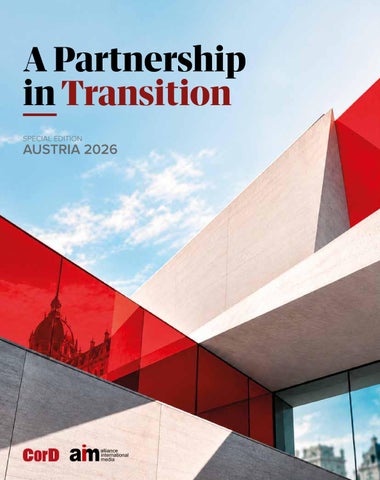
A Partnership in Transition SPECIAL EDITION
AUSTRIA 2026
Contents 04 A Partnership at a Crossroads
08 A Crisis Is the Ultimate Test of Trust
06 B uilding on Trust, Investing in the Future
Milena Avramović Bjelica and Tamara Bekčić Directors of Chapter 4 PR and Consulting Agency
Austria 2026 11 The Price of Stability Austria Today
12 The Art of Erasure Arnulf Rainer
Andreas Haidenthaler
Austrian Commercial Counsellor and Head of ADVANTAGE AUSTRIA Belgradeserbia
Formwork & Scaffolding
We make it work.
Doka Serb d.o.o. | Svetogorska 4 | 22310 Šimanovci | Srbija T + 381 22 400 100 | serb@doka.com | www.doka.com/rs | A company of Umdasch Group
COMMENT
A Partnership at a Crossroads ustria and Serbia have built a relationship that extends far beyond diplomatic cooperation. Decades of investment, trade, migration and cultural exchange have created strong connections between their economies and societies. Austria is among Serbia’s largest foreign investors, with its companies employing more than 26,000 people. But the depth of these ties should not obscure the challenges that will determine their future. Serbia today faces a different set of choices from those that shaped its earlier development. Attracting foreign capital and creating jobs remain important, but they are no longer sufficient measures of economic success. The greater challenge is to develop a more competitive economy, strengthen domestic businesses and create conditions in which investment generates innovation, higher productivity and lasting value. For Austrian companies, opportunities are emerging in renewable energy, advanced manufacturing, digital technologies, environmental solutions and healthcare. Serbian businesses, meanwhile, have the potential to become more deeply integrated into Austrian and European supply chains. Realising that potential requires more than competitive costs and geographical proximity. It demands predictable regulations, transparent procedures and institutions that businesses and citizens can trust. These conditions cannot be separated from Serbia’s wider political and institutional environment. Persistent corruption concerns, weaknesses in judicial independence and short-
A
04
comings in public procurement continue to undermine confidence in the rule of law. The European Commission’s 2026 assessment makes clear that these are not abstract political questions, but structural problems affecting accountability, fair competition and the investment climate. Austria’s support for Serbia’s European integration therefore carries both an opportunity and a responsibility. Vienna has consistently advocated enlargement, but progress towards EU membership ultimately depends on reforms undertaken in Serbia itself. The stalled accession process illustrates the limits of diplomatic support when commitments are not matched by implementation. The relationship nevertheless has considerable room to develop. Stronger links between Austrian industry and Serbian suppliers, cooperation in technological innovation and investment in skills could help Serbia move towards a more sophisticated economic model. Equally important is ensuring that the benefits of growth extend beyond individual projects and established investors. The cultural and human connections between the two countries provide a further foundation for cooperation. They offer continuity even when political circumstances change, while opening space for dialogue, creativity and mutual understanding. As this special edition explores through its diplomatic, economic and cultural perspectives, Austrian–Serbian relations are entering a period in which established partnerships must respond to new realities. Their future will depend not simply on how much capital crosses the border, but on whether Serbia can build the institutions and economic conditions needed to turn existing opportunities into lasting progress.
AUSTRIA 2026
MINIMALIST DESIGN Expansive glass surfaces, concealed vent, and minimal aluminium profile dimensions. FUNCTIONALITY Quality, reliability, and durability of the aluminium system. ARCHITECTURE A combination of aesthetics, comfort, and energy efficiency.
ALU KOENIG STAHL d.o.o. Vladimira Popovića 6, 11000 Beograd, Srbija
+381 11 222 30 83 +381 63 430 78 7 +381 63 437 05 1 office@alukoenigstahl.rs
INTERVIEW | ANDREAS HAIDENTHALER A USTRIAN COMMERCIAL COUNSELLOR AND HEAD OF ADVANTAGE AUSTRIA BELGRADE
Building on Trust, Investing in the Future
Austria and Serbia enjoy decades of successful economic cooperation, built on strong business ties and mutual trust. With new opportunities emerging in innovation, renewable energy and advanced manufacturing, the focus is increasingly shifting towards higher-value partnerships and deeper integration into European supply chains
06
AUSTRIA 2026
eturning to Belgrade more than a decade after his previous posting, Andreas Haidenthaler finds a Serbian economy that has undergone significant transformation. As the new Head of ADVANTAGE AUSTRIA Belgrade, he sees considerable potential to build on Austria’s position as one of Serbia’s leading investors, strengthen cooperation between businesses and create lasting partnerships through EXPO 2027.
R
You previously headed ADVANTAGE AUSTRIA in Belgrade from 2008 to 2015. How has Serbia changed as a business destination, and what are its greatest strengths and challenges today? — Returning to Belgrade after more than a decade feels both familiar and excitingly new. Serbia has undergone a remarkable transformation in recent years. Its infrastructure has improved significantly, its economy has become more diversified, and its role as a regional business hub has strengthened considerably. For Austrian companies, Serbia’s key strengths are its strategic location, competitive and highly skilled workforce, strong industrial tradition and growing innovation ecosystem. Equally important is the entrepreneurial spirit I encounter across the country. Serbian companies have become increasingly export-oriented and technologically advanced, making them attractive partners for Austrian businesses. What has remained constant is the exceptionally strong economic relationship between Austria and Serbia. Austrian companies have invested in Serbia for decades and continue to rank among the country’s most important investors and employers. These long-standing ties have created a high level of trust, often one of the most valuable assets in international business. Challenges remain, of course. Companies everywhere value predictability, transparency and efficiency. Continued progress in these areas will further strengthen Serbia’s attractiveness. Where do you see greater potential – in attracting new Austrian investors or expanding existing operations and strengthening links with Serbian suppliers? — Many Austrian companies have operated successfully in Serbia for years. Their positive experiences often lead to additional investment, expansion into new business areas and the development of higher-value activities. Existing investors know the market well and are therefore well positioned to increase their engagement. cordmagazine.com
SUPPLIERS Serbian companies offer growing engineering expertise and opportunities to enter European value chains. EXPO 2027 Flow2Expo aims to connect businesses, research institutions, start-ups and publicsector stakeholders. INVESTMENT Austrian companies are exploring opportunities in renewable energy, healthcare and advanced manufacturing.
At the same time, Serbian suppliers have become increasingly competitive, offering high-quality products, engineering expertise and growing technological capabilities. This creates excellent opportunities for closer integration into Austrian and European value chains. Strengthening these connections benefits both sides: Austrian companies gain reliable partners, while Serbian businesses gain access to new markets and technologies. New investments remain equally important. Austrian companies are closely following opportunities in renewable energy, environmental technologies, digitalisation, healthcare, advanced manufacturing, logistics and infrastructure. Serbia’s economic development, geographic position and skilled workforce continue to attract Austrian businesses seeking long-term opportunities in Southeast Europe. How will Austria use EXPO 2027 and initiatives such as Flow2Expo to create lasting business partnerships? — EXPO 2027 will be a historic event for Serbia and an outstanding opportunity to showcase the country’s economic dynamism and innovation 07
potential to the world. Austria intends to make full use of this platform to strengthen business cooperation and create lasting partnerships. For us, EXPO is not simply about presenting Austrian innovation. It is about connecting people, companies, institutions and ideas. Through initiatives such as Flow2Expo, we want to facilitate direct contacts between Austrian and Serbian businesses, research institutions, start-ups and public-sector stakeholders. Austria has internationally recognised expertise in sustainability, energy efficiency, environmental technologies, smart cities, mobility and advanced industrial solutions. These are also areas of growing importance for Serbia. By bringing together relevant stakeholders, we aim to generate concrete business projects, joint ventures, technology partnerships and investment opportunities. Above all, we want EXPO 2027 to leave a lasting business legacy, with contacts established before and during the exhibition developing into longterm cooperation. 08
Which improvements to Serbia’s business environment would make the greatest difference to Austrian investors? — Austrian investors generally view Serbia as an attractive market with strong long-term potential. Nevertheless, further improvements in several areas would encourage greater investment and business activity. One of the most important factors is regulatory predictability. Businesses make decisions with
These long-standing ties have created a high level of trust, often one of the most valuable assets in international business a long-term horizon and therefore value stable, transparent and consistently implemented rules. Greater predictability helps companies plan investments, allocate resources and pursue expansion projects with confidence. Administrative efficiency is another key area. Significant progress AUSTRIA 2026
has already been achieved, particularly through digitalisation and modernisation. Further simplification of procedures and a continued reduction in administrative burdens would benefit both domestic and foreign companies. What are your priorities for your new mandate, particularly in strengthening Serbian companies’ integration into Austrian and European value chains?
Businesses make decisions with a long-term horizon and therefore value stable, transparent and consistently implemented rules. — Although I previously served in Belgrade, I approach Serbia as a new posting, as much has changed in recent years and I am getting to know the market afresh. My primary objective is to further strengthen the already excellent economic partnership between Austria and Serbia. The relationship between our countries goes far beyond statis-
tics. It is built on decades of successful cooperation, strong business connections and close people-to-people ties. I see considerable potential in renewable energy, digital technologies, industrial innovation, healthcare, infrastructure and environmental solutions. Another priority will be integrating Serbian companies into Austrian and European supply chains. Serbian businesses have demonstrated impressive capabilities, flexibility and competitiveness. By connecting Serbian suppliers with Austrian industry, we can generate benefits for both economies while contributing to more resilient European value chains. ADVANTAGE AUSTRIA will continue to serve as a platform for business networking, knowledge exchange and innovation partnerships. Our role is to bring the right partners together, identify opportunities and support long-term cooperation. By contributing to stronger trade, increased investment and deeper integration of Serbian companies into European markets, we can strengthen bilateral economic relations while supporting sustainable growth and prosperity in both countries.a
Osigurajte svoje zaposlene. Wiener Premium Care je jedinstveni proizvod na našem tržištu koji podrazumeva pokriće troškova lečenja malignih bolesti u inostranstvu do milion evra! Pogledaj ponudu
Dobrovoljno zdravstveno osiguranje Zdravlje prvo.
INTERVIEW | M ILENA AVRAMOVIĆ BJELICA AND TAMARA BEKČIĆ DIRECTORS OF CHAPTER 4 PR AND CONSULTING AGENCY
A Crisis Is the Ultimate Test of Trust
Reputation is built not through individual campaigns, but through consistency, transparency and lasting relationships. Companies must therefore remain true to their values, even as markets, media and public expectations evolve s part of the Vienna-based international Chapter 4 Group, Chapter 4 has operated in Belgrade for 17 years, providing communications and strategic support to some of the market’s most successful companies. Its directors, Milena Avramović Bjelica and Tamara Bekčić, discuss trust as the foundation of reputation, the value of combining local expertise with international experience and why consistent communication matters more than following passing trends. Trust is now every brand’s most valuable currency. How can companies build and maintain it? MAB: Trust is built primarily through behaviour, when what a company says consistently matches what it does. The first step is honesty, followed by consistency, because audiences remember patterns rather than individual messages. The third is a willingness to communicate openly, even when things become difficult. A crisis is the ultimate test of trust. Companies that have invested in transparent communication over the years have built up reserves of goodwill that protect them, while those that communicated only when necessary find themselves without that support. Chapter 4 has worked closely with clients’ management teams for years. How important are local expertise and international experience? TB: For us, it is about balance. Local expertise means understanding society, the media, culture and how audiences think and respond. Without it, even the best strategy remains theoretical. International experience provides a broader perspective, high professional standards and insight into what works in other markets. The best results come from combining the two. We help international clients understand the local context, while supporting domestic companies in adapting their stories for international audiences and partners. Markets, media and public expectations are constantly changing. How can companies remain relevant and true to their identity without getting lost in trends? MAB: The key is a clear understanding of your values. Not every new platform or format suits every brand, and that is perfectly fine. We advise companies to treat their identity as a stable foundation while adapting how they communicate. Tone, channels and formats may change, but the essence should remain. 10
Photo by Nebojsa Babic
A
Brands that chase every trend gradually lose their distinctiveness and, with it, trust. In your experience, what distinguishes brands that endure for decades, and what role does communication play? TB: Enduring brands have a clear purpose and remain committed to it, regardless of challenges. They listen to their audiences and adapt without losing their character. They invest in relationships, not just sales, and understand that reputation is built strategically over many years. Communication is the thread connecting everything. It translates corporate values into clear messages, builds relationships with employees, partners and the public, and protects brands during crises. A brand without communication is just a name, while communication without substance is merely noise. If you could offer companies one piece of advice, what would it be? MAB: Before thinking about media, campaigns or social networks, ask yourselves: who are we, and why should anyone choose or remember us? Once you have that answer, communication becomes simpler and results more lasting. And do not wait until you need communication to start investing in it. TB: I agree that the best time to start building a reputation is before you need to rely on it. I would simply emphasise the importance of continuity in both communication and reputation building. AUSTRIA 2026
AUSTRIA TODAY
The Price of Stability After two years of recession, Austria is confronting a difficult question: how can it preserve the prosperity and social protections that have long defined its identity while restoring economic competitiveness and bringing public finances under control?
or decades, Austria has represented a particularly successful European compromise: a competitive economy, strong public services, extensive social protection and a political culture built on negotiation. Its prosperity has rested not only on industrial strength and exports, but also on the conviction that economic success should translate into security and opportunity for society as a whole. Today, that model is facing a demanding test. After contracting in 2023 and 2024, Austria’s economy returned to modest growth in 2025. The recovery, however, has been fragile. High energy and labour costs, weak productivity growth and pressure on export-oriented industries have exposed structural vulnerabilities. According to the European Commission, Austria has also lost economic ground relative to the EU average. Public finances present another challenge. In October 2026, the Finance Ministry projected a budget deficit of 4.1% of GDP for the year, equivalent to approximately €21.4 billion. The government fac-
F
cordmagazine.com
es the difficult task of consolidating spending without undermining the services and protections on which much of Austria’s social consensus depends. The pressure is particularly evident in the debate over social welfare. Chancellor Christian Stocker’s coalition is pursuing changes intended to make social assistance more consistent across Austria while strengthening incentives to work. Supporters argue that reform is necessary to ensure fairness and sustainability. Critics face a different question: whether tighter eligibility requirements could leave vulnerable households with less protection at a time of rising living costs. Demographic change adds to the difficulty. An ageing population is increasing pressure on pensions, healthcare and public finances, while businesses face shortages of skilled workers. Austria’s established vocational training system remains an important strength, but adapting education and employment policies to technological change is becoming increasingly urgent. The challenge is not simply financial. Austria’s traditional culture of political
compromise is being tested by sharper divisions over migration, social policy and the distribution of economic burdens. Decisions about who receives support, who pays for it and how newcomers participate in society increasingly shape the national political debate. Yet Austria retains considerable advantages: strong institutions, a highly developed industrial base, skilled workers and a tradition of social partnership. These provide a foundation for renewal, particularly if investment in innovation, digitalisation and clean technologies can help restore competitiveness. The central question is therefore not whether Austria can afford its social model, but how that model must evolve to remain viable. Fiscal discipline alone cannot guarantee prosperity, just as generous social protections cannot be sustained without a productive economy. Austria’s experience offers a broader European lesson. Stability is not a permanent achievement inherited from the past. It requires continual adjustment, public trust and a willingness to reconcile economic necessity with social responsibility. 11
hat happens to an image when an artist begins to erase it? Does it disappear, or does something previously invisible emerge? For the Austrian painter Arnulf Rainer, these questions became the foundation of an extraordinary artistic career. He painted over photographs, obscured faces, crossed out drawings and covered entire canvases in dense layers of colour. Yet what might appear to be an act of destruction was, in his hands, a means of discovery. Few artists have pursued the relationship between creation and destruction with such persistence. Rainer, who died in December 2025 at the age of 96, left behind a body of work that resists easy classification. His paintings can be violent and contemplative, disturbing and strangely beautiful. They invite the viewer to look closely at what has been concealed, while refusing to reveal everything. That tension lies at the heart of a major retrospective opening at Vienna’s Albertina on 13 November 2026. Bringing together works from different periods of his career, the exhibition offers an opportunity to reconsider one of Austria’s most influential post-war artists, whose rad-
W
12
AUSTRIA 2026
Photo Christian Wind
Art of Erasure
ARNULF RAINER
The
For Arnulf Rainer, painting was never simply an act of creation. It was also an act of concealment, destruction and transformation Images Courtesy of the ALBERTINA Museum, Vienna, and the Arnulf Rainer Museum, Baden
cordmagazine.com
13
ical experiments helped redefine the possibilities of painting.
Schwarze Rinnen
PAINTING AGAINST THE IMAGE
Born in Baden, near Vienna, in 1929, Rainer grew up in a country whose cultural and political identity had been profoundly shaken by war. The collapse of familiar certainties formed the background against which a new generation of Austrian artists sought alternative ways of seeing and expressing the world. Rainer’s artistic education was unconventional. His encounters with formal institutions were brief, and he developed much of his practice independently. Early experiments with surrealism gave way to an increasingly personal visual language, shaped by abstraction, automatism and an interest in psychological states that resisted conventional representation. By the early 1950s, he had begun developing the technique that would become his signature: Übermalung, or overpainting. Rather than beginning with an empty canvas, Rainer began with something already present. An existing image became both the foundation of the work and the object of its transformation. Sometimes only fragments survived: an eye, a contour, a patch of colour, the suggestion of a figure beneath an apparently impenetrable surface. Elsewhere, the original image seemed to vanish altogether. Yet its absence remained palpable. Rainer’s overpaintings challenge the assumption that artistic creation necessarily involves adding something to the world. In his work, concealment and interruption become equally powerful creative gestures. Painting becomes a way of questioning whether an image can ever be considered complete.
THE FACE AS A BATTLEFIELD Muede pose
14
Among Rainer’s most compelling works are his celebrated Face Farces, developed from the late 1960s onwards. In these photographs, he contorted his face into extreme expressions, transforming his features into a theatre of physical and psychological tension. He then intervened in the images with paint, drawing and aggressive marks. The results are unsettling. Eyes disappear beneath dark strokes. Mouths are distorted. Faces seem to struggle against the very surfaces on which they are represented. The conventional portrait seeks to preserve identity. Rainer’s portraits appear determined to destabilise it. His face becomes a site of conflict between the individual and the image, between the body’s involuntary expressions and the artist’s deliberate interventions. The painted marks do not simply disguise the person beneath them. They intensiAUSTRIA 2026
fy emotions that the photograph can only partially communicate. There is also an element of performance. Before the camera captures an expression, the artist must physically produce it. The photograph records an action, while the subsequent painting transforms that record into another event. The body is no longer merely represented. It participates in the creation of the image.
THE BEAUTY OF DISTURBANCE
Rainer’s work is frequently described in terms of aggression, darkness and destruction. Thick black marks cut across delicate photographs. Red pigment spreads across surfaces like a wound. Human figures appear trapped beneath gestures that seem simultaneously expressive and destructive. Yet to see only violence in these works would be to overlook their sensitivity. His interventions often follow the underlying structure of an image. A sweeping brushstroke may echo the movement of a body. A dark field may intensify the vulnerability of a face. A seemingly chaotic accumulation of marks may produce an unexpected visual balance. Rainer was fascinated by the expressive potential of the human body, including states of exhaustion, ecstasy, fear and physical strain. His painted photographs frequently capture figures at moments when ordinary composure has disappeared. The body becomes exposed, vulnerable and difficult to interpret. Such images challenge the comforting distance that often separates a viewer from a work of art. They demand an emotional response, even when that response is discomfort. For Rainer, beauty did not necessarily reside in harmony. It could emerge from disturbance, contradiction and the refusal to make experience reassuring.
Arnulf Rainer, Ich brenne und strahle
A RADICAL AUSTRIAN LEGACY
BEYOND THE VISIBLE
An overpainted image contains two histories: the image that existed before the intervention and the marks that transformed it. Neither can be understood entirely independently of the other. The viewer is invited to imagine what lies beneath the surface, even when the original can no longer be recovered. This creates a peculiar form of visual memory. Something has been obscured, but its disappearance becomes part of the work’s meaning. The process has psychological resonances. Human memory rarely preserves experience intact. It alters, suppresses and reconstructs. What we remember is often inseparable from what we have forgotten, while what we attempt to conceal may continue to shape our understanding of ourselves. cordmagazine.com
Rainer’s paintings do not offer a literal illustration of these processes. Their power lies in their resistance to a single interpretation. Nevertheless, they make the viewer conscious of the unstable relationship between appearance and experience. The visible surface is never the whole story. This is perhaps why his work remains so compelling in an age saturated with images. Contemporary visual culture encourages immediate recognition and effortless consumption. Rainer’s paintings resist both. They demand time, uncertainty and an acceptance that not everything can be explained.
Ohne titel
Over a career spanning more than seven decades, Rainer explored an extraordinary range of materials, formats and artistic strategies. His practice encompassed drawing, painting, photography and experimental approaches to the body and gesture. He worked with religious imagery, crosses, death masks and photographs of other artists, repeatedly returning to the possibility that an existing image could become the starting point for an entirely new work. The cross became a recurring form. Sometimes it carried religious associations; elsewhere, its stark geometry offered a structure through which colour, gesture and concealment could be explored. Rainer’s relationship with Austria’s artistic establishment was often uneasy, yet his international reputation continued to grow. He represented Austria at the Venice Biennale in 1978 and became one of the country’s most widely recognised contemporary artists. His work entered major museum collections, while exhibitions across Europe and beyond in15
seems inadequate and sometimes attempt to erase what we would rather forget. Yet those earlier layers rarely disappear entirely. Rainer transformed this tension into a visual language of extraordinary intensity. His paintings suggest that destruction and creation are not always opposites. An image can be altered beyond recognition and still retain the presence of what came before. A gesture that appears to obliterate may also reveal. That is the enduring paradox of his art. In an age increasingly devoted to producing flawless images, Rainer reminds us that imperfection, conflict and uncertainty can possess a deeper expressive truth.
troduced new audiences to an artistic language that remained unmistakably his own. In Baden, the Arnulf Rainer Museum, housed in a former bathhouse, provides a permanent institutional setting for engagement with his work. The retrospective at Vienna’s Albertina, running from 13 November 2026 to 25 April 2027, adds another chapter to that legacy. Featuring approximately 70 works, it traces his artistic development from early overpaintings and the celebrated Face Farces to his crosses and later paintings. Opening less than a year after his death, it offers a timely opportunity to reconsider the enduring significance of his work.
WHAT REMAINS BENEATH
There is something profoundly human about Rainer’s refusal to leave an image untouched. We, too, revise the stories we tell about ourselves. We conceal what is painful, alter what
Arnulf Rainer, Sternsucher, 1994, ein Film von Herbert Brödl
Schranken
Arnulf Rainer, Body Pose (Ohne Titel) Arnulf Rainer, Schwarzes Blut
The marks that cover his paintings are not simply barriers preventing us from seeing. They are evidence of an artist’s struggle to reach beyond what an image can ordinarily contain. And perhaps that is what makes his work so difficult to forget: the sense that beneath every surface, however heavily painted, something continues to demand to be seen. 16
AUSTRIA 2026