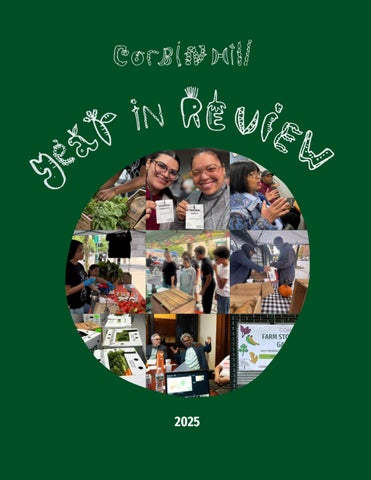
2025
OUR VALUES & FRAMEWORK THE FOOD ACCESS, FOOD JUSTICE & FOOD SOVEREIGNTY FRAMEWORK
Food Sovereignty (FS)* Goes beyond access and justice to demand community control over food systems. That means the people who produce, distribute, and consume food also have decision-making power over how food is grown, sourced, distributed, and shared. Food sovereignty is grounded in ecological sustainability, cultural relevance, economic fairness, and the right to self-determination. Focus Areas: Ownership, self-determination, ecosystem design Common Strategies: Land access, community enterprises, co-ops Food Access (FA) Focuses on ensuring people have the ability ‒ physically and economically ‒ to obtain healthy, affordable, and culturally relevant food. This includes addressing barriers like income, grocery store location, transportation, and affordability. Focus Areas: Convenience, affordability, service delivery Common Strategies: Incentives, transportation, SNAP acceptance
WHERE DOES YOUR WORK FIT?
Food Justice (FJ) Addresses the root causes of food disparities by challenging inequities in the food system. This includes advocating for the fair treatment of workers, equitable food distribution, community-led solutions, and dismantling structural racism across food, health, and economic systems. Focus Areas: Equity, systemic analysis, community voice Common Strategies: Movement building, racial equity, cultural foods
FEEDING THE BLOCK
FEEDING THE MOVEMENT
FEEDING THE FUTURE
Food Access
Food Justice
Food Sovereignty
We believe that fresh, healthy food is a right.
We believe that gathering around food fosters the exchange of knowledge, wisdom, and ideas, which is medicinal for our communities.
We believe that being connected with the people who grow our food can be healing for our communities, bodies and land.
We believe in supporting local food economies and providing market opportunities for BIPOC growers and producers who have been habitually excluded from accessing markets.
02 | ANNUAL REPORT 2025
We believe food should be transformative and a celebration of culture and community.
Table of Contents
2025 Year in Review
Corbin Hill Food Project
Values & Framework
2
A Letter from the Team
4
Reflections
6
Organizational Highlights
8
Collective Dreaming of the Farm Stop Farmstand at 110th Street Equitable Procurement - Farmer Support Farmshare Food Access/1115 Waiver Research/Narrative Corbin Hill in the Spotlight
Gratitude/Acknowledgements
19
LETTER FROM THE TEAM
A YEAR OF LEANING IN TO OUR COLLECTIVE EFFORTS, STRENGTHENING RELATIONSHIPS AND INVESTMENTS IN COMMUNITY-BASED ASSETS Facing opposition and setbacks has never been new or a surprise for oppressed communities—it is the very structure of how the system was built. The start of 2025 was no different. We braced ourselves not for the unknown, but for the predictable onslaught from an incoming administration determined to stifle collective efforts to reimagine and create a reality that serves the many. As expected, our partners faced weaponized cancellations of federal contracts, gutting growing plans, staffing, and programs. We challenged and refused every insidious request to sanitize our language, even as funders threatened to withhold capital and bury our finalized report. et, we rejected these policies designed to control Y and divide. Corbin Hill doubled down on a strategy for food access, justice, and sovereignty—rooted in ownership, dignity, and true community health. With initial investment from our funder, we forged forward.
We have much to celebrate, including increasing our operational budget and holding our staff—an intentionally diverse staff that marries grassroots organizing with serious number-crunching and resourceful, non-status quo thinking. We kept our farmshare program and farmstand not just open, but vibrantly operational. We continued to feed the block with revenue from the Medicaid 1115 waiver as we wrapped up our USDA Gusnip Food as Medicine program. Securing our future is an act of radical permanence. We signed a five-year lease in the heart of Harlem, a commitment signifying that we are here to stay and anchor this transformation. We invested in a state-of-the-art sprinter truck with cooler capabilities and hired a dedicated driver. We secured funding to purchase a walk-in cooler and blast chiller — critical, non-extractive assets that will serve both Corbin Hill programs and fill a systemic gap within the ecosystem.
our future is g n i an cur e act S o
f ra dic al p er m
04 | ANNUAL REPORT 2025
ane
n
. e c
non
-n e g o
ti a b l e j u s
al reciprocity adic , r an , ti c e d
Our efforts are not random, nor are they reactionary to the political climate. They are following an intentional, strategic roadmap. This includes collective fundraising with the FED Collective to collaboratively dreaming up the Farm Stop with the Black Farmer Ecosystem and mapping out routes with the BQE. As we're doing, we're also capturing and codifying the work—in partnership with Lehman College and Cornell University— through uncompromising Research and Narrative that centers resident-informed programming. From product development to equitable procurement to justice-driven dietetics and culinary nutrition, we're committed to leaning into and leveraging our collective strengths, experiences, and areas of expertise.
de
ep,
enduring relati
We enter 2026 with certainty and clarity of a collective, transformative vision. Together, we can build a future rooted in non-negotiable justice, radical reciprocity, and deep, enduring relationships that support healthy communities, from the farmers who grow our food to the communities that receive the food with inherent dignity and respect.
-The Corbin Hill Team
05 | ANNUAL REPORT 2025
ip nsh
s
.
future rooted in
we
c
an
a ild u b
o
REFLECTIONS FROM THE TEAM We asked each of our team members to share one defining word that describes their 2025. Here’s what they said:
Authenticity R
O Together O T Always coming E through D futurtity
Adaptability
Purpose Expansive
Community Chiquita - Purpose I am at the time in my life where I question whether I have fulfilled my purpose here on earth. Teaching, sharing and wellbeing are the keys and reason for my being, and I equate this as my purpose, for the better of others. Serving others. A key aspect is contributing to the greater good by acting with love, kindness, and compassion to make a positive difference. Discovering and using one's gifts: Spiritual purpose involves identifying and sharing unique talents, abilities, and passions with the world. Meaning & Connection: Seeking answers about existence, connecting to the universe, others, and a deeper self. Service to Others: Acting with kindness, love, empathy, and using your talents for the greater good. Authenticity: Living in alignment with your true self and core values, not just external goals. Inner Growth: A journey of self-discovery, overcoming challenges (tough mind, tender heart), and finding joy in the process. Beyond the Material: Focuses on inner fulfillment rather than career, wealth, or possessions. How it Manifests: Daily Choices: Being fully present and intentional in everyday tasks, big or small. Values in Action: Letting core beliefs (like love, compassion, gratitude) guide decisions. It's my "why"—the profound reason I am here, felt as a deep sense of belonging and contribution, a path to true flourishing.
Eric - Always coming through My word/slogan for what we (Corbin Hill ) do is: Always coming through. No matter what is thrown at this little company, our little team always comes through, we always make it happen one way or another. Like the little train that could and never gave up.
06 | ANNUAL REPORT 2025
Ismail - Adaptability Defining 2025 is our unique ability to be adaptable as we navigate a turbulent political climate, administration and funding landscape and unprincipled policies that keeps our communities perpetually dependent upon the free food complex, subsidies and unhealthy foods that flood our communities. No matter the challenge, we can rely upon our ability to reimagine, our resourcefulness and adaptability to continue our collective pursuit of food and land sovereignty.
Jenna - Community I spent so much time cycling through words, trying to think of one in particular to sum up the year. It was emotionally complex, one where both sadness and hope existed, often in the same breath, as two things can. Resilience came to mind, also hope, and the gentle places that continuously nourish hope. Watering it like a plant. Community holds these pieces: caring for one another, showing up, believing, advocating, even when things get hard and get complicated. And there is no one person, no body of government, that can take away the intrinsic good that we seek in each other. And I will carry that knowledge in my heart for this new year.
Norma - Authenticity My word/slogan for what we (Corbin Hill ) do is: Always coming through. No matter what is thrown at this little company, his year demanded authenticity in the face of real pressure. At a time when words like justice, equity, diversity, and even Black are being targeted by national efforts to dismantle DEI, organizations like ours are being warned, defunded, or told to dilute our language for safety. No one would fault Corbin Hill Food Project for choosing selfpreservation and softening our words. It would be the easier path, and a temporary one. But compromising our language compromises our integrity. CHFP exists to challenge the narratives that uphold oppression, systemic racism, and broken food systems. To edit ourselves for the comfort of the powerful would be a step away from who we are.our little team always comes through, we always make it happen one way or another. Like the little train that could and never gave up.
Rebecca - Expansive
Yadi - Rooted My word for 2025 is Rooted. This year I feel myself digging deeper into the work at Corbin Hill, into our partnerships, our communities, and preservation of the cultural knowledge that guides how we show up. Being rooted means standing firmly in the mission of food justice while also nourishing my own foundations as a mother, leader, and creator. As we open our new offices and storefront in Harlem, I feel an even stronger sense of grounding in the neighborhoods we serve and the future we’re building. In 2026, I want to grow upward and outward, but only in ways that keep me connected to the people, places, and practices that anchor this work.It's my "why"—the profound reason I am here, felt as a deep sense of belonging and contribution, a path to true flourishing.
Defining 2025 is our unique ability to be adaptable as we navigate a turbulent political climate, administration and funding landscape and unprincipled policies that keeps our communities perpetually dependent upon the free food complex, subsidies and unhealthy foods that flood our communities. No matter the challenge, we can rely upon our ability to reimagine, our resourcefulness and adaptability to continue our collective pursuit of food and land sovereignty.
Saim - Together My time at Corbin Hill Food Project has really shown me what it means to work together. Everyone is connected and genuinely supportive, which makes the work feel meaningful. It feels good being part of a team that moves together toward the same goal
Najha - Futurity Sometimes it’s not easy to see into the future, and understand the unknowable, especially when empire’s grip appears strong…. But I’m certain that this moment we are collectively living in demands that we build our way into the future. As a lifelong resident of Harlem, joining the Corbin Hill team has felt like a deepening of my own commitment to our neighborhood’s sustainability. For me, learning from and building alongside the Corbin Hill team reflects a type of futurity that looks toward the visionary work of the Black Farmer Ecosystem as a roadmap around how we deepen practices of sustainability and sovereignty, and how we create alternative realities that affirm our collective wholeness and need for nourishment, health, communal abundance, reciprocity and respect. Working in partnership with Corbin Hill and the Black Farmer Ecosystem on our Farm Stop and Gathering Hub on 140th and Frederick Douglass has become an exercise in futurity— a type of world-building that affirms our communities have what we need to resource ourselves while building alternative models for sustainable community development.
07 | ANNUAL REPORT 2025
Organizational Highlights
COLLECTIVE DREAMING OF THE FARM STOP WITH THE BLACK FARMER ECOSYSTEM
“Farm Stops are year-round, every-day markets that support smallscale farmers and strengthen local and regional food systems. They do so most often by operating on a consignment model, which gives producers a fair price, flexibility with their time and products, and provides more direct connections with consumers.” - Kathryn Barr, author of “How to Start a Farm Stop”
When Corbin Hill secured initial investment to open our physical location, the Ecosystem rallied together to begin to dream, plan, and strategize how the space can serve its constituents, from Black farmers and producers to community members that would be supporting the aligned value-chain through purchasing produce and products through the farmshare program or receiving subsidized produce and meals.
CHALLENGES The Corbin Hill team looked high and low, from the Mott Haven, Bronx to Brownsville, Brooklyn, for a space that would hold our collective vision. We defined the parameters, creating a rubric or lens, to help us filter the listings. The new location would need to support the immediate needs of the Corbin Hill team, proximate to existing partnerships, and support the future growth and expansion of the work drawing upon decades of experience and data from the communities we serve. While we aimed to sign a lease agreement at the start of 2025, we faced challenges, from spaces that were too expensive, had limited square footage, were strangely shaped, had competing offers, or too many costly infrastructure issues. When we finally submitted our offer to the location that would become our new home, it would take additional months for the lawyers and the building’s board to approve our lease. Additionally, CH was faced with shifting priorities throughout the process as we learned of developments stemming from the incoming administration. When we began our search for a space, we knew it was necessary that it serve both communities that need food and farmers that needed to sell their food in NYC markets. To that end, our initial search was to find a space that would house cold storage to store significant amounts of produce for farmers to park their produce prior to last-mile delivery into the city, as many farmers were poised to increase their production in 2025. However, at the start of 2025, food access programs, which guaranteed farmer sales, were gutted by the administration, leaving many farmers uncertain about the season.
08 | ANNUAL REPORT 2025
Organizational Highlights
HERE’S WHAT TO EXPECT AT THE FARM STOP: “Living Room” - Third Space for pop-ups, community events and activations Processing Equipment Culinary Nutrition Kitchen Corbin Hill Offices Flexible Meeting and Event Space
The Black Farmer Ecosystem is a collective exploring how to operate as an ecosystem of organizations to shift power and ownership to Black farmers in New York State by cultivating community, resources, skills, and learning to ensure thriving Black farmers drive policy and advocacy, hold capital and land, and control markets.
Beginning in May, as CH inched closer to a finalized lease agreement, the Ecosystem met on a weekly basis to begin shaping the vision, mission and work plan for the space. Given the breadth and depth of the project, subcommittees were formed. These included storefront planning, procurement and distribution, design, programming, research, value-add product logistics and development. Each of these core committees serve to tackle one component of what would be necessary to open the space, from design to filling shelves, and engaging the community surrounding 140th and Frederick Douglass Boulevard.
09 | ANNUAL REPORT 2025
Organizational Highlights
FARMSTAND AT 110TH STREET
In early July, we launched into our 2nd season of our farmstand at 110th Street and Malcolm X Boulevard. Over 18 weeks, we nourished the Harlem community with local, seasonal produce, freshly harvested. Each weekend, the Corbin Hill team alongside dedicated volunteers erected tables and tents and thoughtfully arranged colorful displays and hand-drawn signage to inform buyers which farms carefully cultivated the food. Alongside the produce was value-add products from New York dairy to handmade soaps and salves. But our farmstand was more than a place to buy fruits, vegetables and value-add products, it was a representation of a just value-chain connecting growers whom steward the land with care to the community receiving healthful food with dignity and respect.
Workforce Development: The farmstand served as a training ground for 2 Lehman College Program in Nutrition interns and 2 Dept of Youth and Community Development and Children’s Aid Society youth.
THE FARMSTAND SHOWCASED: Culturally-informed Culinary Nutrition Education: We hosted Equitable Procurement: 20+ NYS BIPOC farms & local makers
15 culinary nutrition education demos led by our student and intern team, sharing simple, tasty and nourishing recipes utilizing produce from the farmstand.
10 | ANNUAL REPORT 2025
Organizational Highlights
CHERRY GOOD OPPORTUNITY CASE STUDY SAVING 1,600 LBS OF BLACK-GROWN CHERRIES
Corbin Hill received a call to action to support a Black grower within our ecosystem that had harvested with no buyers. Without buyers, the peak season cherries would within weeks go to waste or compost and the farmer would have gone unpaid for their labor. Within days, CH mobilized its network to secure an institutional buyer and pre-sale over 40 quarts ahead of our Farmstand, selling out the cherries completely!
Activation Table: New at our farmstand this season included an “activation table” creating space for collaboration. From a free seed exchange hosted by Soulfire Farm to a materials swap from Black Farmers United, the activation table brought new ideas, skills and community building to our corner. We also thank Mayor's Office of Mental Health and Wellness, Jean Chatman Cakes, Saboon Maazeh and Philip Randolph Houses for tabling and spending time with us in community.
Our social posts were viewed over 7,000 times and reshared 59 times! Accessibility: We distributed a total of $250 Health Bucks at the farmstand and accepted SNAP, EBT and WIC.
11 | ANNUAL REPORT 2025
Organizational Highlights
EQUITABLE PROCUREMENT - FARMER SUPPORT Imagine you're at a farmers market, and you pick up a crisp apple from the top of a full wooden bucket of them— overflowing orbs in shades of red and green. You take a McIntosh, admire its firmness in your hand, the way its red blush blends into green. You buy it, shine it clean on your pant leg, and take a bite maybe you even nod while you're doing it, because it’s sweet and tart, hitting the spot. Perhaps you consider how this purchase is supporting small farmers. We ask you to delve deeper, in curiosity, how each piece of produce has a story attached - the story of the produce itself, and that of the person who nurtured it. The intimate bond of whose hands held it with care before it entered into yours. When we at CHFP talk about supporting QTBIPOC farmers, we are also uplifting their stories - stories of having to be so many different things at once: nimble, responsive, hardworking, and deeply human.
And yet, these stewards of the earth hold such a unique connection to the soil, to people, rooted in love and care. It is not easy work. It is deeply meaningful work. In the Hudson Valley, for the past few years, a plan has been in the works for shared aggregation of over 19 QTBIPOC farms, where routes would bring produce into Harlem and into Cleveland, Ohio. This requires coordinating vehicles and capacity and this became concrete action this past year. These are dedicated routes, designed around farmer needs: pick-ups, timing, storage, and access to new markets.
“Farming is one of the few enterprises that is almost completely vertically integrated. Farmers are distributing the food, packing it, washing it, and sometimes processing it. Farmers do everything except eat their own food. But we have to eat dinner [too]” -Rafael Aponte, Rocky Acres Community Farm
This is not written by a farmer, but by someone with great admiration and respect for all they do. Farmers are some of the coolest, smartest, most compassionate people in any room, who pick people over profit time and time again, who are willing to try with us and fail and try again, because they know a better food system can exist. People who believe in ancestral growing practices, in growing culturally important crops, in growing food to feed the community with dignity and with joy. Consider a food system where you could know your farmers by name. The farming community went through a lot this past year: personal loss, serious illness, pulled funding, fires, flooding, abrupt temperature changes, to name only some. This is why produce can be unpredictable, as it grows and is harvested in tandem with the conditions of humanness, of the earth. It’s not like a grocery store, where produce is practically manufactured and travels across the country in bulk, where accessibility creates an expectation that it will always be there. This system exists within a value chain long monopolized by white farmers, who have historically received the most support.
13 | ANNUAL REPORT 2025
Organizational Highlights
From Harlem To Chester To Ithaca To Buffalo To Cleveland
INFRASTRUCTURE INVESTMENTS
Farmer Storage (Rent): $7,000/mo Walk In Coolers: $45,000 Blast Chiller: $50,000 Reach in Fridges: $40,000 Refrigerated Sprinter Truck: $85,000 Transporation Costs: $54,000 Having a refrigerated vehicle is similar to fresh food in our current system - not easily accessible or affordable. We were fortunately able to get one through grant funding, which made it possible to bring our part of this puzzle to life by doing lastmile work. This route isn’t just logistics, it’s infrastructure that shifts power, opens markets for QTBIPOC growers, and ensures that community-driven supply chains can grow on their own terms.
The other day, a member of the CH team was feeling down and received a surprise package in the mail. A farmer, who had become a friend, sent them a letter, a painting they made, and a shirt they designed. The colleague was so moved by this--the farmer doesn’t know yet that they framed their artwork. That is the thing about the system we are all trying to build: one rooted in equity, one that prioritizes those who have been marginalized for far too long, and one centered on caring for one another instead of leaning into extractive systems, into capitalism. This is real. It can exist. We are in it now; it is alive and in action. And as James Baldwin said, “Once you realize that you can do something, it would be difficult to live with yourself if you didn’t do it.”
The last mile is the first mile for the community. We have agricultural plates--the city has extremely limited parking for us so we got tickets every other day. Produce also needs to travel into the city at different times. To ensure we could receive it at our farm stand, half was delivered by another vehicle, or picked up by our driver. Additionally, each week another half of the produce was delivered to a farmer’s family restaurant, where they’d kindly store it (and transport it up and down a flight of stairs), and we’d come with our vehicle to pick it up the next day. Sometimes, we accidentally took produce meant for other organizations and had to bring it back. Mistakes happened, but that was always okay. There was space for error. What mattered most was that we figured it out together. Sometimes, vehicles break down. Our driver, Saim, would do regular delivery trips for the farms and often make last-minute ones for anyone who needed it—because that is what the community does for each other. Another farmer saves veggies for him that he loves, as a thank you. We all help each other as much as we can, because we believe in what’s possible.
“During my time on the road, I traveled to all 48 continental U.S. states and had conversations with many farmers, hearing firsthand about the challenges they face, especially unfair pay and treatment. That experience shaped my values and made me passionate about food equity, which is why I’m excited to join Corbin Hill Food Project. I appreciate the mission of partnering with local farms and distributing fresh food to underserved communities.” Saim Bari
14 | ANNUAL REPORT 2025
Organizational Highlights
FARMSHARE
Continuing into its 14th year, Farmshare has been a flagship program for Corbin Hill since its inception. Small, local food systems do not receive subsidies the way that Big Food does, which is why CH prides itself on the longevity of its program that has predominantly been sustained through its members or ‘shareholders.’ Rather, CH’s “Impact Shares” and other operational dollars create a small subsidy for keeping shares accessible. While CH has always emphasized accessibility and affordability of Farmshare, the difficult decision was made this year to raise the price of a share. The increase reflects the realities of the market and inflation, which impacts not just people purchasing shares, but CH’s operational costs and the farmers we purchase from. With continued support of the farmshare program, shareholders are participating in helping us to build a more equitable and sustainable food system that pays small farmers fairly and ensures quality produce to all members.
Farmshare By the Numbers:
% True Cost Shares: 81.4% % Impact Shares: 18.6% lbs of produce moved: 36,000+ BIPOC-owned/operated farms: 100% Farm size: ⅛ acre - 60 acres
12 | ANNUAL REPORT 2025
Organizational Highlights
FOOD ACCESS/1115 WAIVER
In recognition of the persistent need for healthy food options in our communities, CH continues our food access work, diving into the 1115 waiver as a revenue source to continue to feed the block. Advocacy: The NYHER (New York Health Equity Reform) 1115 Waiver program launched in January 2025. However, Corbin Hill Food Project had begun to lay the groundwork for participating in the program long before. In 2022, in CH submitted comments to the New York Department of Health, advocated for food security as a social determinant of health and emphasized that investment must focus not only on individual health-related treatment and prevention initiatives, but rather those that invest in developing an equitable food system building upon the work of nonprofits and community based organizations across the State. When the waiver was approved, CH collaborated with the Harvard Law School Center for Health Law and Policy Innovation to draft a letter to the state, providing a series of recommendations to ensure that community-driven organizations would not be left behind.
Client Testimonial Miss B: “I have four kids and I came in person to pick what we need. Unlike other box programs that don’t let me choose, I have the dignity to bring home exactly what my family needs.”
Learnings: As applications for the Social Care Network opened, CH prepared to apply only to find that organizations with an operating budget of over $5M would be eligible to apply, effectively leaving community-driven organizations, like CH, out of the equation. Furthermore, CH began to receive requests for letters of support from institutions applying to become SCNs, despite having no relationship to the applying institutions. Ultimately, when SCNs were finally announced, they scrambled to onboard as many CBOs as possible as quickly as possible to begin disbursement of funds. After a series of webinar trainings, a heap of paperwork and fulfilling a myriad of insurance requirements, CH was able to be onboarded onto the Manhattan SCN, Public Health Solutions and began accepting referrals in August. In November, CH applied for capacity building funds to continue to support the work. Following CH’s learnings from its previous USDA GusNip Food as Medicine program, CH plans to establish partnership hubs for more efficient distribution, increased nutrition education and pre-and-post surveys to measure impact in 2026.
15 | ANNUAL REPORT 2025
Organizational Highlights
RESEARCH AND NARRATIVE
“This year, the world dangled many carrots urging us to compromise. Instead, CHFP held its ground, even while experiencing the loss of funding and funders. And yet, we continue to thrive in the mud of challenge.” Norma, Director of Research and Narrative
Claiming Our Narrative: In January 2025, Corbin Hill submitted our final report for our SARE 2.0 research project, titled, “Reclaiming Power and Ownership to Create a Black Farmer Commons in the Northeast.” The project captures how an ecosystem of organizations led by Black and Indigenous People of Color are individually and collectively working towards creating new ownership and economic pathways for Black farmers’ collective success. A few months later, our funder asked for a call - and presented CH with an “alternative version” of our report— stripped of specific language on anti-Blackness and references to Black farmers and replaced bold naming with softened language with generalized framing. They admitted their priority was safeguarding future funding and avoiding federal scrutiny—particularly under increased attention to DEI language. CH was faced with a choice: They would not publish our report as originally submitted and without publication, the remaining funds for the project would be withheld or presenting the redacted version and receiving payment. Corbin Hill made the decision to own our narrative. This decision left a funding gap from which Corbin Hill could not fulfil its obligations to participating farmers. However, we shared the situation transparently with the ecosystem, and unanimously, they agreed to step in to ensure our farmers could be made whole. Despite the funders attempt to control our narrative through withholding funds, we, collectively, were able to take a stand against the oppressive funding structure.
“Reclaiming Power and Ownership to Create a Black Farmer Commons in the Northeast” Key Findings
1.Land access and ownership is critical for economic and financial stability, reflecting broader systemic inequities in land acquisition and access to capital 2.Scaling Black farmers’ operations beyond their immediate community requires access to food aggregators, transportation and other resources. 3.Black farmers rely on community-driven solutions, from informal networks, mentorship, cooperative learning, grassroots efforts and collaborative governance to overcome systemic challenges and foster long-term resilience. 4.More transparency, inclusivity, and equitable decision-making is necessary for structural and cultural change to create an equitable and sustainable Black Farmer Commons. Read our finalized report here.
16 | ANNUAL REPORT 2025
Organizational Highlights
CURRENT PROJECTS The FED Collective
CDC Foundation Nutrition & Health CBO Innovation Lab
As part of the FED Collective, CH presented at two national conferences this year, including the Farm 2 Institution (F2i) Summit in April 2025 and Institute for Social and Economic Development Solutions (ISED) Conference in June 2025. The presentations and live workshops shared out Corbin Hill’s Food Access, Justice and Sovereignty Framework, alongside other learnings from putting FED Principles into practice. The Collective also identified future direction for the work beyond dissemination FED Principles, including a self-evaluation framework and grant-aligned evaluation process. Additionally, a national technology platform will be developed and launched in 2026, engaging a wider network of CBOs, to create FED-informed tools and training resources that support policy engagement, collective leadership, and narrative shift, centering CBOs as innovators and leaders in the Food as Medicine industry.
In response to the 2022 National Conference on Hunger, Nutrition, and Health, The CDC Foundation was tasked with organizing around the commitments made. Corbin Hill, DAISA Enterprises and Hmong American Farmers Association were enlisted to identify 10 leading community-based organizations (CBOs) from across the country— recognized for their innovation and effectiveness in addressing hunger—to form the Hunger, Nutrition & Health CBO Innovation Lab. Together, the HNH CBO Innovation Lab collaborated to define a framework of understanding hunger, addressing root causes, and advancing food justice and equity through transformative, sovereignty-driven approaches.
One exciting output was the grantee-developed Dimensions of Hunger framework and paper.shared with 20 multi-sector partners.
FUTURE DIRECTION Corbin Hill is continuing to redefine Our Food is Medicine, capturing data and evaluating our interventions from the lens of our access, justice and sovereignty framework. We’ve partnered with aligned institutions led by disruptors in the food and nutrition space, Dr. Kate Burt and Dr. Angela Odoms-Young, to support our efforts to codify and disseminate our narrative and strategies for a sovereign food system.
17 | ANNUAL REPORT 2025
Organizational Highlights
IN THE SPOTLIGHT
Corbin Hill’s work is local, regional, and national. While we’re doing local food programs, we’re building a regional farmer network and contributing to the national conversation around food system transformation. We’re at the table with the FED Collective, National Produce Prescription Collaborative and the Hunger, Nutrition and Health Action Collaborative advocating for our voice, concepts and whole systems interventions to be included and invested in.
Confrences, Gatherings, Media and Presentations
March 2025: NY Foodways Gathering April 2025: BU Pardee Center Workshop Exploring the Future of Food April 2025: F2i Summit: The Path to Sovereignty: A Hands-on Approach to Rewriting Food Systems through the Food Access, Justice and Sovereignty Frameworks April 2025: Equity And Justice In Food As Medicine in Health Affairs (FED Collective) May 2025: 40 Under 40: The Rising Stars in NYC Food Policy Class of 2025 (Jenna Rice, Equitable Procurement) July 2025: ISED Conference Beyond Biometrics: The FED Approach to Shifting Food as Medicine Narratives November 2025: CDC Foundation Hunger, Nutrition & Health Changemakers November 2025: Center for Heath Law & Policy Innovation (CHLPI) Food is Medicine (FIM) Implementers’ Workshop at Harvard Law School December 2025: FED Webinar: Scaling and Solidarity in Food as Medicine—Deep Roots and Strong Branches
18 | ANNUAL REPORT 2025
GRATTITUDE AND ACKNOWLEDGEMENTS In a year where the industry turned cold, forcing peer organizations to shutter their doors and others to sanitize their mission in fear of losing funding, we stayed the course. While the world told us to soften our language, we hardened our resolve. We refused to simply survive; we pivoted, deepened our roots, and invested in the infrastructure necessary to sustain this fight for the long haul. We are still standing because of a fierce ecosystem of people who refuse to trade equity for comfort. This is a glimpse of who kept the work moving forward for our land, our farmers, and our collective future.
Adrian's Family Farm Afterlife Mushrooms Alena Gutierrez Anonymous Donor/s(7) Black Farmer Ecosystem Black Farmer Fund Black Farmers United - NYS Inc. Black Yard Farm Boston Medical Center Brian Bethke Carly Frankel Carol and Mark Willis CDC Foundation Central Park Conservancy Children’s Aid Society Chiquita McCullough Choy Division Cindy Saenz Cyrine Ait Oumeziane DAISA Enterprises Denise & Martin Greller Dennis Derryck Donna Jackson Emily Ren Emony Nublett Farm and Food Growth Fund Farm Fresh Caribbean Growers Huerta Farm Farm School NYC
Felix Justo Rick Wessler Finca Seremos Riverside Church Fort Baptist Farm Rocky Acres Farm Gentle Time Farm Rise & Root Farm Grandpa Farm Rose Ellen Neidish Hannah Payne Mark Reed Hannah's Homemade Ruby Sprott Harlem Wellness Center Saboon Maazeh Joy Anderson Savi Horne Karen Backus Serra Vida Farm Kate Masuch Soul Fire Farm Institute Katherine Burt Star Route Farm Liberation Farm Surdna Foundation Madeline Roth Sydney Waller Marge Frosch Tabitha Ashura Mattie Kaiser CHLPI Moss Fresh Fruits & Vegetables The FED Collective New York Department of Health Tamara Hoover New York DYCD The Rudolph J and Daphne A Munzer Foundation Nicole Grunfeld Tony Rohr NEFOC Land Trust Trinity Farm Novo Nordisk Inc. Upstream Impact Solutions Philip Randolph Houses V&V Farm Public Health Solutions Valerie Block R&R Produce Victoria Stadin Ruby Sprott Rafa Aponte Xiomara Olivares Raquel Lopez Yara Farm Rebecca Karl Yolande Cadore Rhys Powell
“Working to navigate this political and philanthropic climate, we are constantly told to wait for policy change, institutional support, or for higher-ups to approve funds or actions to support our work. But the truth is, we have never waited. This isn't a "job"—it's a mission. The most urgent work is already underway, built not in boardrooms, but on the ground and has been a staple in our communities as we fight for true justice for all.” -Ismail Samad, Director
19 | ANNUAL REPORT 2025
Corbin Hill Food Project PO Box 113 New York, NY 10030 corbinhill-foodproject.org/ info@corbinhillfoodproject.com
ANNUAL REPORT 2025