THE HALACHIC
CORNER OCTOBER 2026
|
תש ר י תשפ״ז
COR - KASHRUTH COUNCIL OF CANADA
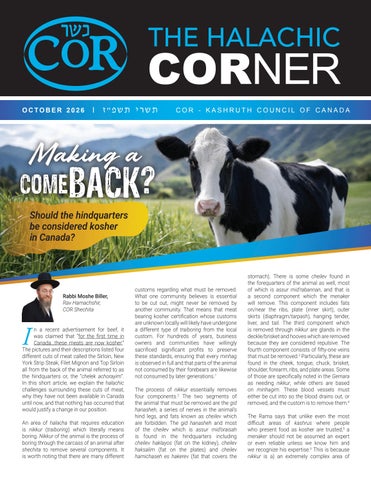
Making a
come
BACK?
Should the hindquarters be considered kosher in Canada?
Rabbi Moshe Biller, Rav Hamachshir, COR Shechita
I
n a recent advertisement for beef, it was claimed that “for the first time in Canada…these meats are now kosher.” The pictures and their descriptions listed four different cuts of meat called the Sirloin, New York Strip Steak, Filet Mignon and Top Sirloin all from the back of the animal referred to as the hindquarters or, the “chelek achorayim”. In this short article, we explain the halachic challenges surrounding these cuts of meat, why they have not been available in Canada until now, and that nothing has occurred that would justify a change in our position. An area of halacha that requires education is nikkur (traiboring) which literally means boring. Nikkur of the animal is the process of boring through the carcass of an animal after shechita to remove several components. It is worth noting that there are many different
customs regarding what must be removed. What one community believes is essential to be cut out, might never be removed by another community. That means that meat bearing kosher certification whose customs are unknown locally will likely have undergone a different type of traiboring from the local custom. For hundreds of years, business owners and communities have willingly sacrificed significant profits to preserve these standards, ensuring that every minhag is observed in full and that parts of the animal not consumed by their forebears are likewise not consumed by later generations.1 The process of nikkur essentially removes four components.2 The two segments of the animal that must be removed are the gid hanasheh, a series of nerves in the animal’s hind legs, and fats known as cheilev which are forbidden. The gid hanasheh and most of the cheilev which is assur mid’oraisah is found in the hindquarters including cheilev haklayos (fat on the kidney), cheilev haksalim (fat on the plates) and cheilev hamichaseh es hakerev (fat that covers the
stomach). There is some cheilev found in the forequarters of the animal as well, most of which is assur mid’rabannan, and that is a second component which the menaker will remove. This component includes fats on/near the ribs, plate (inner skirt), outer skirts (diaphragm/tarpash), hanging tender, liver, and tail. The third component which is removed through nikkur are glands in the deckle/brisket and hooves which are removed because they are considered repulsive. The fourth component consists of fifty-one veins that must be removed.3 Particularly, these are found in the cheek, tongue, chuck, brisket, shoulder, forearm, ribs, and plate areas. Some of those are specifically noted in the Gemara as needing nikkur, while others are based on minhagim. These blood vessels must either be cut into so the blood drains out, or removed, and the custom is to remove them.4 The Rama says that unlike even the most difficult areas of kashrus where people who present food as kosher are trusted,5 a menaker should not be assumed an expert or even reliable unless we know him and we recognize his expertise.6 This is because nikkur is a) an extremely complex area of
understanding. He warns us not to think for a moment that our rabbonim could not send a delegation to a place which had expertise in order to learn from them and bring the skill back home. Rather, in their wisdom and with great foresight, they understood that allowing the hindquarters as kosher would cause severe consequences due to the intricacies of the work required and that it would ultimately lead to michshol. He concludes that something regarded as forbidden for generations cannot now simply be declared kosher; its prohibited status is as firmly established as any other longstanding restriction, such as kitniyos.15 Rabbi Aharon Walkin zt”l who was born over 150 years ago in Pinsk Karlin was asked if it might be better to allow the chelek achorayim as kosher and to give it to people who would otherwise eat non-kosher. Amongst his arguments against it, he unequivocally states that once nikkur achorayim was prohibited, it is now a community vow which can never be annulled.16
such meat may be found in a few places elsewhere in the world justify introducing this ?practice in Canada The halachic question is whether avoidance due to minhag creates a lasting issur. The custom to avoid the achorayim should be likened to kitniyos on Pesach. If someone were to propose allowing kitniyos against the
"...does the fact that such meat may be found in a few places elsewhere in the world justify introducing this "?practice in Canada
On the other hand, Rabbi Moshe Feinstein zt”l provides a dissenting opinion. In a teshuva he writes that we would not be able to protest if there is a “great need” to be menaker the chelek achorayim. This is especially true if the reason to be menaker is to create an opportunity for more people to eat kosher. However, he warns that this approach should be considered only if the nikkur is performed by a local expert.17 Rabbi Moshe Sternbuch shlit”a reinforces the opposite
custom due to the existence of technology which could quickly survey and rid kitniyos of any chometz grains, it would still never be considered. Rabbi Yitzchok HaLevi Bamberg zt”l was born more than two hundred years ago and was a Rov in Germany. In his Shu”t Yad HaLevi he posits that when our rabbonim did not consider chelek achorayim kosher it was neither a mistake nor a lack of
כהן שכן נהגן באיטליא .אבל המצרים לא היו מנקרים את האחוריים כמבואר בשו"ת הרדב"ז ח"א (סימן קס"ב) וכן בספר נהר מצרים (עמוד קס"ד) הביא ד' טעמים למה במצרים לא נקרו האחוריים כל הדורות .ועי' בערוך השלחן (סימן ס"ד סעיף נ"ד) שכ' שברוב המקומות אין מנקרין אחוריים אלא מוכרים אותם לגויים .גם בספר ניקור ירושלים הזכיר שעשו ניקור אחוריים בקובנה ,ובספר נצוני ניסן שהיה מנקר בביאלשטוק כ' (דף )19שבמקומו היו מנקרים האחוריים .אמנם כ' שם שזה היה העיר היחידי בכל מדינת פולין שנהגו כן. 15שו"ת יד הלוי יו"ד )סימן ל'( שאלו האם הוא אסור מכח חומרא/ וז"ל אנכי לא כן עמדי כי מה שאבותינו ואבות אבותינו נוחי נפש הרבנים הגדולים בכל המדינות נהגו איסור לנקר האחוריים "פשיטא שלא משום טעות או חסרון ידיעה נהגו מנהגן כן ,אלא שברוחב בינתם וגודל ידיעתם בתורה ועוז צדקתם בחנו וראו גודל המכשלה אשר תצא מזה אילו נתיר לנקר את האחוריים ,כי רבו מאד הגידין והקרומים האסורים משום גיד הנשה וחלב” ,היעלה על הדעת שכל גדולי הרבנים והלומדים אשר לפנים לא יוכלו לשלוח איש לאחד המקומות שנהגו היתר בניקור האחוריים ללמד סדר הניקור ,אך כל איש הולך ישר ומשכיל על דבר אמת יודה כי גם להראשונים היה נודע דבר זה אבל חששו שיכשלו באיסור דם וחלב וגיד הנשה ,כי מאד קשה מלאכת מניקור וצריך אימון רב ובקיאות גדולה והרבה שימוש לזה כנודע ,ומסיים שם ודבר זה אין שום סברא להתיר בדבר שנהגו בו איסור בדורות שלפנינו משנים קדמוניות ,ע"כ עיי"ש שמאריך בזה. 16שו"ת זקן אהרן חלק יו"ד )סימן ל"ז( שהשואל שאל אם כדאי להתיר לעיר אחת הניקור אחוריים ,כי על ידי זה יותר אנשים יאכלו כשר .ובתשובה מחמיר ואוסר להתיר להם אפילו אם על ידי זה שנאסר להם יהיה אנשים שלא יאכלו בשר כשר ,ומבאר שם כמה טעמים למה לא להתיר להם .א') שהטעם שאסרו הוא משום שחששו לדברי הב"ח שהבאנו לעיל ,שאפילו דבשחיטה אנו סומכים על הכלל של רוב מצויים אצל שחיטה מומחים הם
בניקור אחוריים לא אמרינן כן משום דרבו בו הפרטים ובקל אפשר לטעות .ב') אפילו אצל שחיטה הטעם שיש נאמנות נגד החזקת איסור ,הוא משום דרגילים אחר שוחט ירא אלקים מרבים ומוחזק בכשרות יותר מסתם אנשים וגם נאמן ומביא ראיות על זה ,ואם כן כל שכן בניקור חלק אחוריים דמחמרינן יותר מבשוחט משום דטרחתו גדולה מהשוחט לאין ערוך ובעינן הצטיינות יתירה ביר"ש, ובלא זה אי אפשר להוציא מחזקת איסור ,ובזמן הזה שמלאכת ניקור לכל נמסר לקלים והדיוטים ,לכן אפילו איתרמי מנקר מומחה ויר"ש נמי אין להכשירו משום לא פלוג .ג') כיון שכבר נהגו כן בכמה קהלות לאסור הרי נעשה זה כבר כנדר שאין יכולים להתיר, משום דקיבלו עליהם מטעם גדר ופרישות שאי אפשר להתירו. ומסיים שם אם בקולי תשמעו הייתי מייעץ שחלילה להנהיג חדשות, ואפילו אם המנקר הוא בן תורה ויר"ש אחריתו מי ישורנו מי יודע מי יבוא אחריו ,ועד אני בעירנו שאוכלים בשר אחוריים ויש גם הרבה מנקרים ויש גם כן מהם יראים ושלמים ,אבל כיון שניתן רשות שוב אין מבחין ע"כ. 17עי' בשו"ת אגרות משה יו"ד ח"ב (סימן מ"ב) .והא דכ' דיש לנקר את הבשר במקומו הוא משום שלא יעשה מליחה יותר מג' ימים ע"ש. 18עי' תשובות והנהגות חלק א' (סימן תי"ח) שהחמיר מאד ואוסר להתחיל לנקר את האחורים 19יסוד ושורש העבודה שער השביעי (שער הבכורות) ,ז"ל שם בשר אחוריים של בהמה ,האריז"ל מזהיר שלא לאכול ,וביותר צריך ליזהר במקום שאין יודע ומכירו להמנקר אם הוא ירא את השם מרבים ובקי בטיב הניקור ובשמותיהם ,כי גדלה המכשלה של איסור גיד הנשה וכדומה כמבואר בזוהר פרשת וישלח בדף ק"ע ע"ב עיי"ש. 20שו"ת מקדשי השם חלק א' סימנים (כ"ב-כ"ה) שמביא את החליפת מכתבים שהיה אז בין האדמ"ר הריי"ץ מלובאויטש זצ"ל והגאון מרן ר' חיים עוזר זצ"ל והאדמו"ר הק' הרב"צ מבאבוב הי"ד, אם אפשר להקל בשעת הדחק להתיר ולנקר את בשר אחוריים.
kashrus, b) takes immense effort to perform,7 c) is a profession with very few experts8 and d) the consequences of not performing it properly are serious and punishable by karess. Some go as far as to say that beef traibored by a menaker that is unknown to the local community should not be consumed until the work is reviewed by a local trusted expert.9 The seriousness of this issue historically created a distinct uneasiness amongst early Poskim, both Sephardim and Ashkenazim, toward the hindquarters. It seems to have begun with the Radba”z who lived in the early part of the 16th century in Egypt who rendered the achorayim off-limits to his community and beyond.10 This sentiment was reasserted by the Sheloh Hakadosh in the mid sixteenth century Prague who wrote to stay away from the achorayim11 and subsequently paskened by the Rama.12 Clearly some communities consider the hindquarters kosher and the possibility to expertly traibor is available under some kosher certifications even today in Eretz Yisroel.13 People mistakenly associate the allowance of hindquarters as a Sephardic custom since it was performed in many Sephardic communities. Indeed, there were some Ashkenazic communities that performed nikkur achorayim and there were many Sephardic communities that did not.14 There are even people living in Canada who may remember that their grandparents did eat the hindquarters. But does the fact that
וכנראה שם מחליפת המכתבים שאפילו שהניקור אחוריים הוא ענין חמור מאד ,אבל מחמת חומרת המצב שלא יתבטל לגמרי השחיטה ר"ל ,רצו להקל ולתקן להעמיד מנקרים ירא שמים תחת השגחה מעולה שינקרו את אחוריים בבהמות הגסות .ורצו לשלוח כמה מנקרים לא"י .והיסכימו הגדולים הנ"ל להתיר כדי שלא יתבטל השחיטה לגמרי ,וכן האדמו"ר מבאבוב זצ"ל הי"ד הסכים עמם להיתר ,אבל הסתפק לאסור מטעם אחר האם הא שלא ניקרו את אחוריים באלו מקומות שאסרו עד כה ,האם אין זה בכלל גדר וסייג ופרישות שצריך חרטה והתרה על זה ,ולא יועיל חרטה על זה אם קיבלו עליהם מחמת חומרא ,או שלא היה מחמת איסור או חומרא שקיבלו על עצמם ,אלא מחמת שלא היה לחוצים לאכול בשר אחוריים ,הן מצד חומרת הדבר והן מצד הוצאות מרובות והיה להם מספיק קופצים מהגוים ,ולבסוף מתיר מרן הגר' חיים עוזר זצ"ל והובא בשו"ת אחיעזר בתשובה האחרון על פי מה שמבואר בשו"ת הרא"ש שאפילו נדר וקבלה של מצוה אם יכול לצאת מזה תקלה יש לבטל המנהג ,ואין לך תקלה גדולה מזו שיתבטל כל השחיטה .ועל כן הסכים עמו להתיר ,משמע מדבריו שרק משום שלא יצא מזה תקלה ,דהיינו שלא יתבטל לגמרי השחיטה באירופה התיר ,אבל בלא זה אי אפשר להתיר מחמת קבלת חומרא של מצוה שקיבל על עצמו .וע"ע בשו"ת אחיעזר ח"ג (סימן פ"ד) שמיקל אך ורק כדי שלא יתבטל השחיטה לגמרי. 21עי' בסדר הניקור השלם שנערך ע"י הרב קושיצקי שליט"א שכ' שבירושלים בראשות הישוב מחמת העוני והשלטון הטורקי היה צריכים להשתמש עם כל הבשר על כן נהגו לנקר את האחוריים, ועיין בספר תורת הניקור הירושלמי בהקדמה באריכות על זה ,ועד היום הרבנות הראשית מכשיר כמה חלקים מחלק האחוריים ,ומה שיוצא מכמה שו"ת שרוב קהילות האשכנזיות לא נהגו לנקר ולאכול את הבשר האחוריים חוץ הכמה קהילות ,עיין בישועות יעקב בסימן ס"ד על זה.
2026 / 5787 / HALACHIC CORNER
2
approach and shuts down the possibility of nikkur achorayim.18 Likewise, the Sefer Yesod V’Shoresh Ha’Avodah writes that for reasons of kabala, the Ariza”l says to avoid it and that the possibility of unwittingly stumbling upon the prohibition of gid hanasheh should be treated as a disaster of the greatest degree as the Zohar explains.19 Even Rabbi Moshe Feinstein only permitted nikkur achorayim in situations of great need.
Rabbanut in Eretz Yisroel is completely different than ours, even on the forequarters. Rabbi Amitai Ben David, author of Sichas Chullin and a world-renowned expert in field of nikkur, told the author that anyone selling the chelek achorayim is also performing the nikkur of the forequarters dynamically different than our custom. He stressed that it would be problematic to allow any meat into Canada if nikkur is performed according to other customs. Ultimately, meat will continue to be regulated according to the custom of the local rabbonim of the community. We pray that Hashem grant our community’s rabbonim the wisdom to navigate these questions carefully while preserving both our established standards and communal unity.n
1עי' שו"ת שמש מרפא מהגאון הרב שמשן רפאל הירש יו"ד (סימן ל"ד) שכ' באמצע דבריו ,אבותינו ואבות אבותינו במדינתינו משכו ידיהם ממנו מחלק אחוריים מחסרון בקיאות בניקור ,ואף שוק וירך וכל רגלים האחרונים בכלל איסור זה עכ"ל. 2רוב הרשימה של הקטע על מציאות חלבים מצוטט מהמאמר על ניקור ע"י הרב דוד כהן שליט"א ,רב המכשיר בCRC https://consumer.crckosher.org/publications/nikkur
3ספר הניקור מהמהר"ץ ורמז לדבר אל תאכלו ממנו "נא" ונא בגמטריא נ"א. 4סדר הניקור לבעל העיטור ,דרכי משה (סימן ס"ה ס"ק ז') ,מהרש"ל פרק גיד הנשה (פרק ו') 5עי' במאמרי בענין נאמנות שכתבתי לכבוד חג הפסח תשפ"ו 6ז"ל שו"ע (סימן ס"ה סעיף י"ג) מי שניקר והלך לו ואין אנו יודעים אם הוא בקי בניקור ,ואין כאן מי שהוא בקי בניקור להראות לו מותר .אמנם הרמ"א מגיה ודוקא שיודעים שהשלים ניקורו ואם לאו הכי אסור שמא לא השלים ניקורו ,ואם אפשר להראות לבקי אין לסמוך על המנקר ,אם לא ידעינן אותו בקי בניקור ומוחזק בכשרות ,אף על גב דרוב מצויין אצל ניקור מומחים הם ,מכל מקום טוב להחמיר ע"כ. 7ועי' מהרש"ל בים של שלמה חולין (פרק א' סימן ב') שמבאר באופן ברור למה יש להחמיר כל כך בזמן הזה ,ז"ל וכן קבלתי שאין הנשים נאמנות על ניקור אחוריים ,כי אין לך מילתא דטריחא יותר ממנו ,ומפני עצלותן לא יפשפשו כל כך ולא ינקרו כפי הצורך ,ומה שכ' המחברים שהנשים נאמנות על ניקור בסתם ניקור קאמר, דהיינו הפנים אבל לא האחוריים ,שצריכות ניקור היטיב ואומנות רבה ,ועוד אפשר לומר בימי הקדמונים לא החמירו כל כך בניקורם כמו עתה ,כי מדין התלמוד אין הניקור קשה כל כך ,רק שהוסיפו עליו לאחר מכן ,כמו שהחמיר בזה בעל העיטור בסדר הניקור שלו, ובארץ אשכנז החמירו עוד יותר ,בענין חטיטת הקנוקנות ,וקליפת הבשר מהחלב ,וכמה ורידים מדם ואף שהרוב הם חומרות דרבנן, ומדרבנן המנוהו לנשים ,מכל מקום הכא לא ידעי מה הוא דרבנן
3
minhag creates a lasting issur, the achorayim could nevertheless be allowed since the entire shechita in Europe was at risk. One can easily understand from these tragic teshuvos that, Boruch Hashem, it is impossible to apply that heter in our community.20 Even in Yerushalayim and broader Eretz Yisroel, where the nikkur achorayim is performed by the Rabbanut, it was allowed at the start of the Yishuv out of great necessity since there was no possibility of selling the achorayim to gentiles.21 In the typical scenario, our slaughterhouses are owned by gentiles and the kosher butcher only purchases the front half of the animal. The hindquarters are never even owned by the Jewish butcher in the first place. Once again, it is critical to note that the nikkur conducted according to the custom of
ומה היא דאורייתא ,ומה היא משום איסור חלב ומה הוא משום איסור דם .וכאשר ראיתי הרבה מנקרים שאינם יודעים ,ועל כן מפני עצלותם לא ינקרו היטיב ,ולפעמים הוא נמצא אחריהם כשיעור חלב כאשר הוא נמצא עתה ברוב המנקרים כשרבתה בהם המלאכה, שימצא אחריהם חלב וקנוקנות ,ודברים אלו ק"ו לסמוך על נשים, ואף בסתם מנקר אין לסמוך עליהם לבעלי נפש אם לא שמכיר בו שהוא איש ירא אלקים ובקי במלאכת הניקור ,ומשום שלא לחלק בין המנקרים ושלא לבייש אם שום ישראל ,נהג החסיד מהר"ם מינ"ץ שלא לאכול שום בשר מנוקר ,עד ששלח אחר מנקר אחר, שראה אחריו אם נשאר בו דבר שאינו מתוקן ,וסיפר דבר זה לכל המנקרים שלא יתביישו זה מזה ולא יתקנאו זה מזה ,ותיקן גדול הוא ביראת השם עכ"ל. 8הב"ח מסביר הטעם למה אנו מחמירים בניקור יותר מבשחיטה, כיון דניקור אחוריים רבו הלכותיו ובקל יגיע לידי טעות ,הלכך יש להחמיר בו טפי עכ"ל .וכ"כ הכריתי והפליתי (ס"ק ט"ז) מכל מקום יש להחמיר ,וביותר יש להחמיר בזמן הזה דרבו החומרות דבעל העיטור ,וכדומה וכבד עליו טורח הניקור ,ואינם על הרוב בעלי תורה, והם מחמירין במקום המותר ומקילים במקום שאסור ,ומסיים שם ועכ"פ אין לסמוך על ניקור כי על בקי וירא שמים מרבים ,ומיום עמדה על דעתי שלמדתי הלכות ניקור להיות בקי בהם ובשמותיהם, לא סמכתי על המנקר ,כי אם מה שהייתי מנקר בעצמי ויגיע כפי אכלתי ע"כ. 9ט"ז (ס"ק ז') בשם המהרש"ל ז"ל ואני הגבר שמעתי וראיתי שרוב המנקרים שלנו אע"פ שמחמירין לחתוך אף מן ההיתר מכל מקום כמה פעמים מקילין בחלב ובהקנוקנות של גיד מחמת המהירות, ועל כן נהגתי בעצמי שלא לאכול בשר המנוקר עד שיראה למנקר אחר לראות אם הוא מנוקר כראוי עכ"ל. 10שו"ת רדב"ז חלק א' (סימן קס"ב) באמצע דבריו ז"ל אין קונין מן המקולין אלא המוקדמין של הבהמה ,אבל האחוריים מניחין אותו להם (לעכו"ם) מפני הניקור ,ומנהג יפה הוא שאין הכל בקיאים בניקור עכ"ל ,דהיינו שהיה מנהג שלא לאכול ולנקר את האחוריים
2026 / 5787 / HALACHIC CORNER
In the years prior to the holocaust, there were terrible decrees in Europe that created inordinate challenges in in shechita arena. One of those decrees was that no meat from a slaughtered animal could be subsequently sold to a gentile. The challenge that this created was that it would now be impossible to slaughter an animal since the chelek achorayim could no longer be sold. Doing a shechita for half an animal was not possible for economic reasons. In Shu”t Mekadshei Hashem, Rabbi Tzvi Hersh Meislish hy”d brings several letters exchanged between the Rebbe Rayat”z from Lubavitch, the Rebbe Benzion Halberstam from Bobov and Rabbi Chaim Ozer Grodzinski zt”l, the Gadol Hador and Rov of Vilna. The painful teshuvos depict a dire situation in which the rabbonim reluctantly allow the nikkur achorayim under careful watch and expert hashgacha rather than allowing the shechita in Europe to fall apart completely. One of the focal points of the discussion is our question as to whether the minhag to avoid the chelek achorayim creates a lasting issur. At the end of the teshuva, Rabbi Chaim Ozer zt”l writes that while it is true that
כבר מקדמת דנא. 11בספר השל"ה הק' שער האותיות בענין קדושת האכילה (אות י"ז) שכ' לאסור לאכול החלק של האחוריים ,וז"ל עתה ארשום אזהרות פרישות איסורא שצוה עליהם אבא מורי ז"ל בצוואת יש נוחלין וז"ל שם אל תאכלו מירך הבהמה אם לא תדעו נאמנה שהוסרו חוטיה בחמימי שאז יוצאים לגמרי ,כי הם אסורים משום חלב ,ובלאו הכי ראוי לחסיד שיפרוש מבשר אחוריים של בהמה ,אם לא שניקר אותו צדיק וישר ומוחזק במומחה ,ואע"ג דרוב מצויין אצל ניקור מומחים הם ,מכל מקום טוב להחמיר שלא תאכלו בשר אחוריים בהיות לאל ידכם לאכול שאר בשר בהמה ועוף ,כי אף למדן גדול אינו יכול לבאר את זה מתוך הספר עכ"ל .וכ"כ בספר דמשק אליעזר שהיה מתלמידי הב"ח חולין (צ"ג ).ז"ל כמה חסידים ואנשי מעשה שאינן אוכלים אחוריים שקורין זאדיק בשביל זה ,וכמו שצוה החסיד מוהר"ר אברהם לבניו הגאונים כדאיתא בספר יש נוחלים עיי"ש ,וכן אני נוהג אחריו וכל ימי לא אכלתי האחוריים אף לאחר שניקרן ע"כ. וע"ע בשו"ת חתם סופר חלק יו"ד (סימן ס"ח). 12רמ"א (סימן ס"ד בסעיף ז') ז"ל וסדר ניקור אלו החלבים צריך ראיה מן הבקי בניקור ,ואי אפשר לבאר היטיב בספר ,וכל אלו החלבים אין לחוש להם אלא באחוריים של הבהמה וכו' ,עכ"ל ,משמע שמשום שאי אפשר לבארם היטיב יש לחוש ולהחמיר ולא לאכול את האחוריים ,וע"ש באר היטיב (ס"ק ז') ז"ל יש שיטות להחמיר שלא לאכול בשר האחוריים כי אף למדן גדול אין יכול לבאר זה היטיב מתוך הספר עכ"ל. 13אבל כל זה הוא רק בבהמה הגסות אבל בבהמות הדקות משמע שכולם לא ניקרו את האחוריים בלי יוצא מן הכלל מחמת שהגידין הן דקות וקשה מאד לנקרם ,כמבואר בשו"ת האלף לך שלמה יו"ד (סימן ק"כ) ,ובישועות יעקב (סימן ס"ד ס"ק ב') שאסור מדינה לנקר את האחוריים של הבהמות הדקות. 14עי' ספר זבח תודה שהביא סדר ניקור אחוריים מה שעשו בתימן מימות הקדמונים ,ועי' בספר תוכחות חיים מהרב חיים פלאג'י פרשת וישלח שכ' שנהגו לנקר את אחוריים בטורקי ,ובספר זבחי
9
What peer-reviewed scientific papers actually say about shechita
Richard Rabkin, Managing Director
F
or the last number of years, shechita has been under an intense microscope - in Canada and around the world. Here at home, our dispute with the Canadian Food Inspection Agency (CFIA) over its restrictive regulations unfortunately moved into litigation. At the time of writing, we continue to negotiate with the CFIA in the hope of reaching a resolution that protects both animal welfare and the integrity of shechita. The litigation taught us an important lesson. It was not enough to explain the halachic safeguards of shechita, to point to centuries of practice, or even to produce respected experts. If regulators, courts and international standard-setting bodies were to reconsider entrenched assumptions, the scientific case had to appear in peerreviewed academic journals - where independent experts examine the methods, challenge the conclusions and require revisions before publication. That realization began a long, complicated and costly process. Cardiologists, neurologists, veterinarians, neurophysiologists, engineers and animal-welfare experts have worked together to revisit old experiments, test modern claims and ask the right scientific questions. Nine papers have now been published. They do not all study the same issue, but together they tell a remarkably consistent story: a properly performed shechita causes a catastrophic and irreversible collapse in the blood supply needed for conscious brain function; loss of consciousness follows rapidly; movements after the cut do not necessarily indicate consciousness or mental awareness; and some common arguments used against shechita rest on measurements that do not actually prove conscious pain.
The Nine Scientific Papers, in Plain English The blood-flow question The first paper, published in the Journal of the American Veterinary Medical Association, was written by my father, Dr. Simon W. Rabkin, a cardiologist and professor of medicine at the University of British Columbia. Critics had argued that, even after the carotid arteries are cut, blood might continue reaching a
cow's brain through the vertebral arteries. They also suggested that so-called "false aneurysms" might block bleeding and delay unconsciousness. After reviewing the experimental literature and calculating the resulting blood flow, he found that cerebral blood flow falls to less than 5% of normal within seconds - far below the level needed to sustain brain function.Blood flow to the brain is dependent on blood pressure if blood pressure is zero it doesn’t matter if 30% of a cow’s blood flow to the brain is from vertebral arteries. Of course, 30% times zero is zero! He also found that the published images did not establish true false aneurysms or show that they meaningfully delayed blood loss. Therefore, the brain is rapidly deprived of the circulation needed for awareness and conscious pain; movements seen afterward cannot, by themselves, mean that the animal remains conscious or is suffering.
A second mechanism: air embolism My father's second paper, published in the Canadian Veterinary Journal, examined something largely overlooked in the shechita debate. When the jugular veins are opened, air can be drawn into the circulation by the heart's pumping action. Air reaching the right side of the heart can create an "air lock" that sharply impairs circulation; air bubbles that pass through the lungs can also enter the arterial circulation and contribute to brain ischemia. This does not replace blood loss as the main explanation. It identifies an additional, well-known medical mechanism that can accelerate circulatory collapse and death after the incision. Therefore, air embolism provides another reason the loss of circulation after shechita is rapid and irreversible, rather than a prolonged period of conscious suffering.
How quickly is consciousness lost? In the American Journal of Veterinary Research, Jacob R. Hascalovici, Hyman M. Schipper, Joe M. Regenstein, Stuart D. Rosen, Ari Zivotofsky, Guy St-Jean, Simon Freilich, Thomas J. Morrison, Simon W. Rabkin and Sheryl Haut systematically reviewed 15 studies addressing loss of consciousness in cattle after slaughter without stunning. They ranked four as high quality, three as medium quality and eight as low quality. The highest-quality evidence consistently showed loss of consciousness within 10 seconds when the procedure was performed correctly under low-stress conditions. The review separated stronger evidence from weaker evidence instead of treating every measurement as equally reliable. Thus, if an animal moves after losing consciousness, that movement is not proof of pain; the strongest evidence
indicates that the capacity for conscious experience disappears rapidly.
A virtual cow confirms the physiology In the American Journal of Veterinary Research, mechanical engineer Asher Benchimol, veterinarian Thomas Parmentier, neurologist Jacob Hascalovici and engineer David Vidal published "Impact of carotid artery sectioning on cerebral blood flow in bovines: a numerical hemodynamic study." This was not another literature review. The researchers built a detailed computer model of the bovine cerebrovascular system in COMSOL Multiphysics using established anatomy, vessel dimensions, blood pressure and fluid-dynamics equations. They simulated circulation before, during and immediately after both carotid arteries were severed, including different levels of possible carotid blockage. The model predicted a nearinstantaneous loss of approximately 99% of cerebral blood flow and pressure. It also showed why the intact vertebral arteries do not rescue the brain: their remaining flow is redirected through connecting vessels away from the brain and toward the open carotids. Even simulated carotid occlusions did not materially restore cerebral perfusion or delay its collapse. The model independently confirms the physiology described in the review papers: once the major vessels are severed, the cortex almost immediately loses the pressure and blood flow required for consciousness. Reflexive movement may continue, but the animal cannot consciously experience pain without functioning brain (cortical) circulation.
Do the vertebral arteries keep the brain alive? In Frontiers in Veterinary Science, Jacob R. Hascalovici, Paolo Pozzi, Kathleen Yvorchuk, Guy St-Jean and Stuart D. Rosen examined 13 studies dealing specifically with the vertebral arteries - the vessels at the back of the neck that are not cut during shechita. Across the available evidence, vertebral pressure and flow dropped to negligible levels after the incision, and much of the residual flow was diverted away from the cerebral cortex. A pipe may remain physically connected to the brain, but that does not mean it carries enough blood, at enough pressure, in the right direction, to support consciousness. The review concluded that vertebral flow is unlikely to sustain cortical function or delay loss of consciousness. As a result, although an animal may potentially move after shechita, it is in part because of spinal reflexes as its cerebral cortex is not receiving the blood supply needed for awareness and it cannot actually be experiencing conscious pain.
2026 / 5787 / HALACHIC CORNER
5
The hidden vulnerability of stunning In The Veterinary Journal, my father, Dr. Simon W. Rabkin, published "Blood pressure responses to captive bolt and electrical stunning in sheep and cattle: a systematic review." The paper examined a question often omitted from comparisons between shechita and conventional slaughter: what happens to an animal's blood pressure after the stun? A stun can produce immediate unconsciousness, but unless it also stops the heart it is potentially reversible; bleeding must follow quickly enough to ensure that the animal dies before consciousness can return. Dr. Rabkin searched for studies that directly measured systemic arterial blood pressure after electrical or captivebolt stunning. Blood pressure increased in every study except one using halothane anesthesia - a drug that lowers pressure and blunts the body's stress response. The rise in blood pressure appeared within seconds. This matters because blood pressure is the main force driving blood to the brain. In human and veterinary trauma medicine, maintaining pressure after brain injury can preserve brain viability. In the slaughter setting, the same response may help explain why an incompletely stunned animal can regain consciousness. Therefore, a stun should not be judged only by whether it renders the animal unconscious at the first instant. The full two-step stun-and-bleed process can fail if the stun is ineffective, begins to wear off or bleeding is delayed. Proper shechita, by contrast, begins irreversible exsanguination in the same act that collapses cerebral perfusion. This paper therefore provides a scientific basis for arguing that, under real-world conditions, shechita may even offer a welfare advantage over conventional stunning.
Are inspectors looking for the right signs? In Frontiers in Veterinary Science, Jacob R. Hascalovici, Ruth Woiwode, Hyman M. Schipper and Joane Parent reconsidered the physical signs used to decide whether an animal is conscious. Awareness and conscious pain require a functioning cerebral cortex. Yet several regulatory indicators - such as certain eye, breathing or postural reflexes - arise from the brainstem or spinal cord and can persist after cortical function has been lost. The authors proposed that rules for shechita should instead focus on signs suited to its physiology, including confirmation that both carotids have been severed and that continuous, high-volume bleeding is occurring. Kicking, paddling or another brainstem or spinal reflex after the cut should not be mistaken for conscious suffering; those movements can occur after the brain (cortex) has ceased functioning.
6
Dr. Rabkin presenting his research at a shechita conference at the Ministry of Agriculture in Israel.
What direct brain recordings show In Frontiers in Veterinary Science, Sheryl R. Haut, Thomas Parmentier, Robert S. Fisher and Nofal M. Khalil reviewed nine studies using EEG, electrocorticography and related techniques. These tools record the brain's electrical activity; electrocorticography is generally more reliable because its electrodes are placed closer to the brain and are less affected by the skull and movement. In the strongest studies, electrical patterns consistent with loss of consciousness appeared between 4.4 and 13 seconds after the incision, with average values between 7.5 and 10.8 seconds. The authors concluded that the best available electrophysiological evidence supports rapid loss of consciousness and explained why less reliable surface recordings sometimes produced longer estimates. Therefore, the most direct objective brain evidence supports rapid unconsciousness, and movements occurring after that point cannot establish that the animal is consciously experiencing pain.
Can an EEG prove that an animal feels pain? In the American Journal of Veterinary Research, Simon Freilich, Sheryl R. Haut, Jeffrey S. Mogil, Paolo Pozzi and Jacob R. Hascalovici addressed one of the most emotionally powerful claims in this debate: that EEG changes after the neck cut prove the animal experiences pain. After reviewing nine studies, they concluded that the evidence does not support that leap. A noxious event can trigger nociception - process of detecting and responding to harmful or damaging stimuli without consciously appreciating pain. Pain is an experience and requires preserved consciousness and integrated cortical function. The observed EEG changes could instead reflect the brain's rapidly deteriorating blood supply and metabolism. Therefore, EEG changes alone cannot be cited as proof that an animal consciously feels pain, especially when the
2026 / 5787 / HALACHIC CORNER
same evidence shows rapid failure of the cortical function required to experience it.
What the Evidence Means No single paper answers every question, but the strength lies in the convergence of different disciplines. Cardiovascular measurements, a numerical blood-flow model, neuroanatomy, neural electrophysiology and reviews of consciousness indicators all point in the same direction. Properly performed, shechita rapidly deprives the cerebral cortex of the blood flow and blood pressure required for awareness. It is irreversible.
Is It Worth It? Some people ask whether nearly three years of legal battles, advocacy and scientific publication have been worth the effort. We now have our first clear sign that the work is bearing fruit. Great Britain's Food Standards Agency recently placed an important conclusion on the official record: "Our analysis found no clear evidence that animal welfare breaches are more or less likely to occur during non-stun slaughter compared to stunned slaughter." That is careful government language. But it is meaningful: the government's own analysis did not support the assumption that non-stun slaughter produces more animalwelfare breaches. This is real progress. Granted, the work is expensive. Research, statistical review, publication, translation, legal advocacy and engagement with regulators all require sustained effort and resources. We need continued financial support to keep moving this effort forward. The question is no longer whether the work is worth it. The early results show that it is. The real question is how do we ensure that this important work can continue to benefit Jewish communities in Canada and around the world. n To support this effort, contact Samuel Herzog at sherzog@noblepack.com
Shaimos:
More than Just Burial
Rabbi Yosef Dovid Rothbart Rabbinic Administrator of the Halacha Institute of Toronto
The “Shaimos Problem”
Over the last several decades, much of the world has undergone a transformation. Businesses, governments, and institutions have increasingly moved toward becoming “paperless,” encouraging people to print less and rely more heavily on digital material. Yet this transition has not affected the Jewish community in quite the same way. If anything, we are producing an extraordinary amount of printed Torah material. New seforim
and new editions appear constantly, often not because the material was previously unavailable, but because a new commentary, format, or feature has been added. At the same time, Torah sheets, source sheets, newsletters, and photocopied material are routinely printed for short-term use. The result is that seforim that were once widely used are increasingly set aside in favour of newer editions, while loose pages and printed Torah material accumulate at an enormous rate. What happens to all of it when it is no longer wanted or needed? In short, we have a shaimos problem. The Toronto Jewish community is no exception.
The Halacha Institute Approach To address the growing need for a yearround shaimos drop-off, the Halacha Institute developed an approach that took into account the practical challenges
involved, including proper respect for shaimos, storage, burial, and ensuring that only material that actually requires genizah is ultimately buried. Rather than following the more conventional model of simply collecting shaimos for eventual burial, our approach places a strong emphasis on sorting the material that is dropped off. The premise is simple: too often, papers and books that are not actually shaimos become mixed together with material that requires genizah. In addition, a sefer that one person no longer wants may be exactly the sefer someone else would otherwise purchase. By carefully sorting the material, recycling what does not require genizah, and setting aside usable seforim, the amount that ultimately requires burial can be significantly reduced. This lowers the amount of storage required and, ultimately, the amount of land needed for burial. The premise proved correct.
2026 / 5787 / HALACHIC CORNER
7
What We Found We have found many items mixed into shaimos that clearly did not belong there, including expired passports, lawyers’ letters, and even a dash cam that somehow found its way into a shaimos box. One of the more memorable finds was a tzedakah box full of money. We were ultimately able to return the pushka and its contents to the organization to which it belonged. At the same time, we have found hundreds of seforim that were still in excellent condition, including English seforim, leatherbound volumes, complete sets, and even a Haggadah dating back to 1760. In fact, we have enough usable seforim to fill more than thirteen bookcases, with some volumes still in their original plastic. These seforim are made available for others to purchase at a reduced price rather than being buried unnecessarily. As of this writing, more than 150 seforim have already found new homes.
The Grey Area The sorting process has also brought with it a number of interesting practical shaylos. Not every item that is dropped off fits obviously into the category of either “shaimos” or “not shaimos,” and some objects require closer halachic consideration. The following are a few of the questions that have come up through our work.
Double Yud A written Name of Hashem may not be erased and, when no longer being used, must be properly stored away or buried.1 At the same time, not every word, abbreviation, or symbol that refers to Hashem must be treated as an actual Name of Hashem. This distinction is important when determining what does and does not require shaimos. For example, one may write ד׳, השם, or הקב״הas references to Hashem. Although each of these clearly refers to Hashem, they do not have the kedushah of an actual Name and may be discarded.2 In many siddurim, a double yud ( )י־יis used to represent the Name of Hashem. An older form of the symbol consisted of two yuds together with an additional mark, giving it the numerical value of twenty-six, corresponding to the numerical value of Hashem’s Name.3 Although י- יrepresents Hashem’s Name, it does not itself have the same status of an actual Name. It should not be erased except in pressing circumstances,4 and while it does not need to be properly stored away or buried, it
8
2026 / 5787 / HALACHIC CORNER
should not be thrown in the garbage in a disrespectful manner.5
Name of Hashem in English A name of Hashem written in another language (e.g “G-d” in English) may be erased as it is does not have same kedushah as one of the Names of Hashem.6 However, it may not be said in an unclean place or uttered for no purpose as doing so would be disrespectful.7 Accordingly, one may not dispose of such a Name in a disrespectful manner.8
Mitzvah Items Another area where we saw a lack of clarity was regarding the proper treatment of objects used for a mitzvah. The fact that an object was purchased for, designated for, or even used for a mitzvah does not necessarily mean that it has kedushah or requires burial. Rather, there are different categories of mitzvah articles, including mitzvah items, tashmishei mitzvah, and tashmishei d’tashmishei mitzvah, and the proper treatment of an item depends on which category it falls into. A mitzvah item is an item that has been used for a mitzvah and is still fit and intended to continue being used for that mitzvah, such as a kosher tallis.9 This does not include an object that was merely designated for a mitzvah but was never actually used. For example, if someone purchases arba minim and then decides not to use them for Sukkos, they may be thrown in the garbage. Once an object has actually been used for a mitzvah, however, it should continue to be used for that mitzvah as long as it remains relevant and fit for use.10 A tashmish mitzvah is an object that was used in the performance of a mitzvah but is no longer being used for that mitzvah, either because the item is no longer fit for the mitzvah, such as torn tzitzis strings, or because the time for the mitzvah has passed, such as a lulav after Sukkos.11 A tashmish mitzvah does not have inherent kedushah and may therefore be used afterward for an ordinary purpose, provided that the use is not demeaning.12 The Rema13 writes that such items should not be treated disrespectfully. Accordingly, a tashmish mitzvah should not simply be thrown into the garbage. Technically, however, it may be left in a place where it is unlikely to be trampled or otherwise treated disrespectfully. Some, however, have the practice of burying such objects, thereby demonstrating a special respect
for mitzvos. The Rema writes that one who follows to this practice will merit bracha. There is also a still lower category known as a tashmish d’tashmish mitzvah. This is an item that was designated for a use that brings it in contact with the mitzvah itself and it served an accessory to something used for a mitzvah. This category includes Shabbos candlesticks. Such an item has no kedushah and does not require genizah or burial. If it is not recognizable as a mitzvah accessory, it may even be placed in the garbage. If its connection to a mitzvah is obvious, however, it should preferably not be discarded in a degrading manner and may instead be wrapped before being thrown away.14 These distinctions help explain the treatment of a number of familiar household mitzvah items that we found among the shaimos that had been dropped off. BESAMIM. Besamim used for Havdalah may be thrown in the garbage. However, when the besamim were designated exclusively for Havdalah, according to some Poskim, it is appropriate not to throw them away disrespectfully. Instead, they should be set aside until the dry out and then and burned. This is a praiseworthy practice, but not a strict halachic requirement.15 CHANUKAH MENORAH AND SHABBOS CANDLESTICKS. The menorah and Shabbos candle sticks are a tashmish mitzvah. They do not have inherent kedushah, but because they are readily recognizable as objects used for a mitzvah, they should not be thrown into the garbage in a degrading manner. The glass cups, however, may be thrown out, unless they are clearly recognizable as mitzvah accessories, in which case they should not be discarded disrespectfully.16 A KIDDUSH CUP. A kiddush cup likewise has no inherent kedushah. It does not require shaimos or burial. Nevertheless, because a
ההדס של שבת לא יזרקנו אחר מוצאי שבת שיהיה עם,לשמה אלא יצניענו עד שיתייבש ויניחנו בהסקת התנור של,הזבל לאשפה ועי' בספר גנזי הקודש (פ"כ הער' ח') שזהו הנהגה.לחמי שבת .טובה ולא דין . שם פי"ט אות י"ג וי"ד16 .' שם פ"כ אות ו17 שם אות ז' מהגהרח"ק זצ"ל וראיתי על אתר18
https://asktherav.com/12602-frequently-asked-shaimos: שאלה זוquestions In general, publications that contain pictures of the Rebbe – Halachicaly it’s not necessary, however many Chassidim are careful to place in Shaimos
כששאלתי דבר זה להגאון רב ניסן, שם אות ח' ונכתב בהער' שם19 . הוא תמה על שאלתי ואמר שאין שום צד שנצריך גניזה,קרליץ
kiddush cup is clearly recognizable as a mitzvah object, it should not be discarded disrespectfully. If pesukim or other sacred text are engraved on the cup, the writing creates a separate shaimos concern and must be treated accordingly.17 PICTURES OF GEDOLIM. Pictures of Gedolim present a different type of question. A photograph or picture of a rav or tzaddik does not have kedushah merely because of the person depicted, and it may therefore be discarded. However, some people are careful to place such pictures in shaimos. If a pasuk is printed on the picture, however, the presence of the pasuk requires the item to be treated in accordance with the halachos of shaimos.18
kavod due to a sefer that had once been used for Torah and tefillah. In that sense, shaimos is not simply about disposal; it is about completing the life cycle of an object of kedushah properly. As long as a sefer can still be used, its proper place is in the hands of someone who can learn or daven from it. When that is no longer possible, its proper place is in genizah. Our mission at the Halacha Institute is to make sure that each item is treated according to its true halachic status, with clarity, with care, and with the proper kavod ha-kedushah. n
YARMULKE. A yarmulke may be thrown in the garbage and does not require genizah.19
Conclusion I recently saw an article based on a story which traces the life cycle of a siddur, from the time it is new and treasured, through years of use, wear, and changing hands, until eventually it reaches the point where it can no longer be used and is brought to burial. I was inspired by the story because it brought out that a sefer is more than just a book. It is an object of kedushah, one that can accompany a person through years of tefillah, learning, and growth. It reminded me what our goal was when we stepped up to address the “shaimos problem.” Our goal was not merely to collect old seforim. It was to look at each one and determine whether there was still life left in it. If there was, we wanted to find it a new home where it could continue to help another person learn and grow. And if there was no longer life left in the sefer, then our responsibility was to ensure that it was brought to genizah and burial with the full
.ורוסי"א וכיוצא בזה אסור לאמור שם אפילו בלשון לע"ז כגון, משנ"ב (סי' פ"ה ס"ק י') וז"ל7 גא בלשון פולין ורוסיא וכה"ג שאף ששם זה-ט בלשון אשכנז או ב-ג אין בו קדושה באותיות כתיבתו ומותר למוחקו מ"מ יש בו משום בזיון .בהזכרתו במקום טינופת .) עי' בספר גנזי הקודש (פ"ז אות י"ב עם הערות8 פרי מגדים (או"ח משבצ"ז סי' קנ"ג ס"ק ט"ו) ועי' סי' כ"א עם משנ"ב9 .)'(ס"ק ב .) משנ"ב (שם10 עי' מגילה (כ"ו ע"ב) וע"ע מש"כ בשו"ע (או"ח סי' כ"א סעי' א') עם11 .משנ"ב . שם12 . שם13 בספר גנזי הקודש (פט"ז) מהגריש"א זצ"ל והגרח"ק זצ"ל ומביא14 .פוסקים שמקילין טפי וכתוב בספר תורה, בא"ח (שנה שניה פרשת ויצא סעי' י') וז"ל15
UNDER THE LEADERSHIP OF THE RABBONIM OF HALACHIC INSTITUTE OF TORONTO Rabbi Yacov Felder, Chairman
info@halachainstitute.com 416.535.8008 www.halachainstitute.com • Halacha Line • Rabbinic Mediation • Pikuach Nefesh Issues • Halachic Estate Consulting • Halachic Business Consulting
עי' ביו"ד (סי' רע"ו סעי' ט' וי') איזה שמות נכלל בזה ואם אינם1 .) וכן מבואר בספר גנזי הקודש (פ"ז,נמחקים טעונים גניזה ועי' בספר גנזי הקודש (שם) שהביא,) ועי' בערה"ש (סי' רע"ו סכ"ח2 .עוד דוגמאות וכת' שהסכים הגריש"א זצ"ל ואשר שאלת אם, תרומת הדשן (פסקים וכתבים סי' קע"א) וז"ל3 מותר למחוק הנכתבים בסדורים ותפילות הנרשמים בשני יודין וי"ו על גביהן? נראה הטעם דנכתבין הכי היינו משום דעולים מניינם כ"ו . עיי"ש,כשם המיוחד שו"ע (יו"ד סי' רע"ו סעי' י') והשם שכותבין בסדורין ב' יודין ואחד על4 אם היה, ועי' ש"ך (שם) וז"ל, מותר למחקו אם הוא לצורך,גביהן . ומפסקי מהרא"י איתא לצורך גדול וכך הובא בד"מ.לצורך ' עי' אגר"מ (יו"ד ח"ב סי' קל"ח) ועי' בספר גנזי הקודש (פ"ז הער5 .כ"ב) שמביא עוד פוסקים שפסקו כן אבל השם בל' הקדש הוא שם, ש"ך (יו"ד סי' קע"ט ס"ק י"א) וז"ל6 אבל בלשון חול אינו שם כלל והגע עצמך דהא מותר למחות שם ג בלשון פולי"ן-ט בלשון אשכנז או ב-שנכתב בלשון חול כגון ג
2026 / 5787 / HALACHIC CORNER
9
S ur Grapes
What is the appropriate beracha to recite on unripe grapes?
Rabbi Yechiel Teichman, Rabbinic Administrator and Halachic Advisor
A
community member asked the following: He has grapes growing in his yard. If they are left to fully ripen, squirrels and raccoons eat them. He therefore harvests them early, shortly after they change colour, and uses them to make wine. This raises two questions: (1) Does one recite Borei Pri Ha'eitz when eating these grapes, or are they considered boser (unripe grapes) whose beracha is Borei Pri Ha’adamah? (2) What status does the wine produced from such grapes have? Is its beracha Borei Pri Hagafen, and is it suitable for Kiddush? This question may also be relevant to light (low-calorie) grape juice (see below for the OU's statement regarding Kedem Lite Grape Juice*). Shulchan Aruch,1 states that grapes must
reach the size of pul halavan (a white bean) before one may recite Ha'eitz. Since we are not proficient in identifying which bean this refers to, one must be machmir and refrain from reciting Ha'eitz until the grape is very large. Similarly, Sha'arei Teshuva2 writes that one should not recite Hagafen over wine made from unripe grapes (boser).
is smaller than pul halavan, the beracha is Ha'adamah; when it reaches the size of pul halavan, the beracha is Ha'eitz.
What level of maturity must a grape reach for one to recite Ha'eitz over the grape and Hagafen over its wine? As mentioned above, the grape must reach the size of a white bean (pul halavan) for one to recite Ha'eitz. The source is the Gemara3, which cites a Mishnah in Shevi'is discussing the prohibition against cutting branches and thereby ruining shemittah fruit before it has had an opportunity to complete its growth. It states that one may not cut a branch of a grapevine once the berries have formed seeds. The Gemara states that this stage is also known as boser and corresponds to the size of pul halavan. Once the grapes have reached the stage at which they are obligated in ma'aser (onas hama'asros), one may cut the branch, as they are no longer considered unfinished fruit. Tosafos4 writes that the size of pul halavan is also relevant to the beracha: when the fruit
The threshold for reciting Hagafen on the grapes’ juice, however, is more stringent. According to Sha'arei Teshuva, juice squeezed from grapes that have reached the boser stage still receives the beracha of Shehakol. Only some point after the grapes have grown beyond the pul halavan stage is the beracha of Hagafen recited. The question is at what point the liquid inside the grape is halachically considered wine. It seems that the liquid inside the grapes attains the status of wine only once the grape has reached
* Kedem Lite Grape Juice has become indispensable for many who seek to lower their sugar intake while partaking of Kiddush and the Arba Kosos. The secret to producing low-sugar grape juice is to use lower-sugar grapes. Kedem Lite Grape Juice uses early-harvest Concord grapes picked at approximately 11-13 Brix. (Late-harvest Concord grapes can reach 18 Brix.) Some have questioned whether these grapes are boser (unripe grapes). The beracha over boser is Ha'adamah (not Ha'eitz), and Sha'arei Teshuva writes that the beracha over juice made from boser grapes is Shehakol (not Hagafen). However, the grapes in question are full-sized and purple. They look the same as other ripe Concord grapes but taste less sweet and more tart than regular grapes. The Mishnah Berurah writes that once grapes have the appearance of ripe grapes, they are no longer boser. Furthermore, the Levush writes that boser refers to grapes that cannot be made into wine. This does not apply to these grapes, since they can be made into wine, albeit with a lower alcohol content (approximately 5-6%). To lower the sugar content further, Kedem Lite Grape Juice is also diluted with approximately 33% water. Therefore, the beracha over Lite Grape Juice is Borei Pri Hagafen. It is not recommended to add additional water to Lite Grape Juice.
10
2026 / 5787 / HALACHIC CORNER
2026 / 5787 / HALACHIC CORNER
11
onas hama'asros, identified as the point at which the seed is visible from the outside. The source for this is Tosafos. The Mishnah mentions a stage at which the “water enters the boser”, indicating that at this stage the liquid in the grapes at this stage is still categorized as water rather than wine. Tosafos5 quote Rabbeinu Meshulam, who states that because the Mishnah identifies the liquid in boser grapes as water, what is squeezed from boser is not considered wine and may therefore be touched by a non-Jew. Rabbeinu Tam,6 however, does not agree that a non-Jew should be permitted to touch it because we are not proficient to determine until what point the liquid is still considered water rather than wine. Rabbeinu Tam adds: If, in a particular year, the grapes did not ripen properly, would we say that the wine produced that year may be touched by non-Jews?
Rav Moshe Feinstein, in Dibros Moshe,7 addresses an apparent contradiction in Rabbeinu Tam. On the one hand, Rabbeinu Tam is stringent with allowing a non-Jew to touch the wine, since we are not proficient in determining until what point it is considered water. On the other hand, he argues that wine was made from boser during a year when the grapes did not ripen properly, is certainly considered wine and subject to the relevant prohibitions. Rav Moshe Feinstein explains that grapes which are capable of producing quality wine, cannot be considered boser, halachically, and people who call it such are doing so erroneously. What emerges is that although Sha'arei Teshuva writes that, regarding the beracha, Rabbeinu Tam would agree that it cannot be considered wine, this applies only when there is a safek. When the grapes, however, are able to produce good wine, it establishes that they are not boser, the
beracha is certainly Hagafen. Let us now address our original question: May one recite Borei Pri Ha'eitz over grapes that are harvested early? The Mishnah Berurah8 writes that if the grapes have the appearance of fully ripened grapes, their size is not an issue. Furthermore, if the pits are visible from the outside, they are close to fully ripening, and the beracha is Borei Pri Ha'eitz according to all opinions. What about reciting Borei Pri Hagafen over wine made from unripe grapes? As noted above, Rav Moshe Feinstein holds that if one can make good wine from the grapes, there is no doubt that the beracha is Borei Pri Hagafen. Additionally, the Chazon Ish9 writes that once the pits of the grapes are visible from the outside (onas hama'asros), at that stage one may make wine from them for Kiddush and recite Borei Pri Hagafen. n
Divine Design
In the development of fruit, one can clearly see the divine plan in its design. Since Hashem wants the fruit to reproduce, the fruit's first priority is to produce a viable seed. During the first period of growth, it does just that: it develops a viable seed. At the same time, however, the fruit produces acids and other compounds that discourage animals and people from eating it. By the end of the first period of growth, a viable seed has been produced. During the second period, the grape therefore becomes sweet-tasting and appealing in colour. This makes the fruit appealing to birds, animals, and humans, who consume it and thereby disperse the seeds.
מאחר שאיכא ברוב השנים ענבים שנתבשלו יותר ומהם יהיה ודאי יין טוב אין רוצין האינשי לטרוח הרבה ולהוציא הוצאות בענבים שלא ואין להם, אבל בשנה שכל הענבים לא נתבשלו יפה,נתבשלו כל כך והיה ג"כ יין, עשו בהכרח יין מענבים שלא נתבשלו,ענבים אחרים הרי חזינן דאף מהענבים שלא נתבשלו כל כןי יש,טוב מהרבה ענבים , אך מחמת שלא בקיאי האינשי קורין את כולם בוסר,שיוצא יין טוב ואין רוצים לעשות מהן יין שלכן כשעשה אחד מענבים שלא נתבשלו דשמא יש להחשיב יין ויש לאסור,יפה יש להחמיר מספק דלא בקיאין .במגע וכן משמע ברא"ש ע"ז דף כ"ט ריש סימן י"ג שמשמע כן ואם לפי מראית עין כבר נגמר בישולו אין,) משנ"ב (סי' ר"ב ס"ק ט"ו8 נ"מ כלל בגדלו ובכל אופן מברך עליו בפה"ע וכן אם החרצנים שלהם .נראה מבחוץ בודאי הוא קרוב להתבשל ומברך עליהם בפה"ע לכו"ע , נראה דענבים משיבאישו לא משגיחין בגודלן,)309 ' חזו"א (זרעים עמ9 ולכן אם נראין, הרי הן פירות גמורין,ואפי' לא הגיעו לפול הלבן עושין מהן יין לקידוש, שזה פי' יבאישו כמש"כ הר"ם,הגרעינים מבחוץ .'ומברכין עליהן בפה"ע וברכת מעין ג
12
משולם במגע עובד כוכבים משום דמה שיוצא ממנו נקרא מים כדאמר ') משעת כניסת מים לבוסר וכן בפרק ד.פרק כל הגט (גיטין דף לא דמסכת שביעית (מ"ח) הבוסר משהביא מים אוכל בו פתו בשדה הקפיד רבינו תם משום דאין אנו בקיאין מתי קרוי בוסר ועוד כתב ששנה אחת לא נתבשלו היינות וכי בשביל שיינותיהם אינם מבושלות .כל צרכיהן הכי נמי נאמר שלא ינהג אותה השנה דין יין נסך ובשעת כניסת מים לבוסר,) תוס' (גיטין ל"א ע"א ד"ה ובשעת כניסת6 נראה לר"י כלשון ראשון שפירש בקונטרס כשנכנסה בו לחלוחיתשיכול לעצור מהן כל שהוא היינו כניסת מים מדתנן במס' שביעית בפ"ד (מ"ח) הבוסר משהביא מים אוכל בו פתו בשדה הבאיש כונס לתוך ביתו כו' ויש שאין נזהרין בו על מגע לפי שאינו קרוי יין אלא מים ור"ת אומר שאין להקל לפי שאין אנו בקיאין עד מתי קרוי מים ולא יין וכתב ר"ת ששנה אחת לא נתבשלו היינות יפה והיו בוסר וכי באותה .שנה לא נהגו יין נסך וז"ל ונראה שהוא להוכחה דודאי מענבים,)470 ' דברות משה (גיטין עמ7 עשו ג"כ יין והיו שותין אותן בחשיבות יין אף שהאינשי קירין עינבי דכל אותו השנה בשם בוסר הרי חזינן דאף ענבים שלא נתבשלו ,יפה נמי איכא שהם כבר ענבים טובים שראוין לעשות מהן יין טוב שא"כ אין אנו בקיאין דמה שאין עושין יין מענבים שלא נתבשלו הוא
2026 / 5787 / HALACHIC CORNER
, כל זמן שלא הגיע לכפול הלבן, הבוסר,)' שו”ע )או”ח סי' ר"ב סעי' ב1 בורא פרי: ומשהוא כפול הלבן ואילך מברך עליו, בפה"א:מברך עליו עד, בפה"א: לעולם מברך,העץ; ומתוך שלא נודע לנו שיעור פול הלבן . וכו,שיהיה גדול ביותר ואם סחט ענבים בעודם בוסר ועשאם יין מברך,)' שע"ת (שם ס"ק ד2 שהכל ועיין יו"ד סי' רכ"ג ולדעת רבינו משולם אינו נאסר במגע עכו"ם שנקרא מים ואף שר"ח אוסר משום שאין אנו בקיאים מהו בוסר וכן . וכו,הסכימו הפוסקים מכל מקום לענין ברכה אינו מברך רק שהכל ? מאימתי אין קוצצין את האילנות בשביעית: והתנן,) ברכות (דף ל"ו ע"ב3 החרובין: כל האילנות משיוציאו; ובית הלל אומרים:בית שמאי אומרים ושאר כל האילנות, והגפנים משיגרעו והזיתים משיניצו,משישרשרו פול. הוא פול הלבן, הוא גרוע, הוא בוסר: משיוציאו; ואמר רב אסי. שיעורו כפול הלבן:הלבן סלקא דעתך? אלא אימא ופחות מכאן לא הוי- שיעורו כפול הלבן,) תוס' (שם ד"ה שיעורו כפול4 פירא מכאן יש ללמוד דעל בוסר פחות מפול לא מברכינן עליה בורא .פרי העץ אלא בורא פרי האדמה וגם על הבוסר שהתיר רבינו,) תוס' (ע"ז כ"ט ע"ב ד"ה אי משום5
in the
Jewish Home
Warnings and Disclaimers
Warning: This article presents a speculative futuristic scenario that may never occur, at least not within your lifetime.
By: Rabbi Tsvi Heber Director of Community Kosher
Disclaimer: This article was written by Copilot with the assistance of the author. Some of the words used in the article are not exactly the words of the author just
what AI “thinks” might be words that the author would use based on his previously published works in Kosher CORner publications and elsewhere on the internet. Information included herein should not be relied upon since Copilot’s “brain” consists largely of hallucination and inaccuracy. But since the content is stimulating and food for thought, we feel it is worthy of being presented to the public even if it is inaccurate since that is largely consistent with the AI’s general approach to life.
2026 / 5787 / HALACHIC CORNER
13
Bishul Optimus In recent months, public attention has turned toward Optimus, the humanoid robot developed by Elon Musk and engineered to perform increasingly complex household tasks. Among the more stunning demonstrations was Optimus preparing simple food items like stirring a pot, pressing microwave controls, and manipulating kitchen tools with surprising dexterity. As technology advances, kosher consumers should be asking whether robot assistance in cooking is condoned by halacha. This would be incredibly helpful especially for people who can no longer cook for themselves. Would food cooked by Optimus fulfill the requirements of bishul yisroel? The rabbinic prohibition1 of bishul akum applies when certain foods2 are cooked exclusively by a gentile, even if (or perhaps especially if) he acted as an agent of the Jew to cook.3 The decree was instituted to prevent inappropriate social interaction that could lead to intermarriage.4 Is an Optimus robot a gentile or a Jew? Should we view his actions as independent human actions or as the extension of the person who issued the instruction? Can a prohibition to prevent inappropriate social interaction apply to a robot which has no halachic identity, no religious status, and no capacity for the independent social interaction that Chaza”l sought to regulate. No matter how distorted the societal perspective becomes toward the role of the robot; can this prohibition apply to anything but a human being? The answer depends on whether this halacha is framed as an absolute requirement for Jewish intervention, or whether it is framed as the requirement to avoid non-Jewish cooking. Answering this question provides insight as to whether food cooked exclusively by Optimus is kosher. The Gemara5 discusses a case where a gentile ignited a fire in a swamp with the intention of cooking grasshoppers. In the context of the discussion, the Gemara relates that if the gentile had not intended to cook the grasshoppers rather to burn the overgrown reeds, the inadvertently cooked grasshoppers would still be kosher even though they were cooked by a gentile. This is because the prohibition of bishul akum requires the gentile’s intent to cook. Another example brought in the Gemara is when a gentile burnt off the hair of a shechted cow and inadvertently cooked the meat of its ear. This meat remains kosher because it
14
was cooked inadvertently. The Tur6 brings a third example of a gentile who fired up a kiln to dry pots, and unbeknownst to him the kiln had a pumpkin inside which he inadvertently cooked. In these scenarios, the absence of kavanas bishul – mindful intent to cook by the gentile – allows the food to retain its kashrus.7 Clearly, bishul yisroel is not an absolute requirement for Jewish intervention; rather it describes food whose cooking process avoids nonJewish cooking. Bishul Optimus, therefore, is permitted. Now let us proceed to the next step and ask whether Optimus can replace Jewish intervention? For example, can a mashgiach utilize his Optimus robot to turn on the oven for a non-Jewish chef who is cooking in a kosher restaurant. Rabbi Chaim Yisroel Belsky zt”l in Shulchan
shooter – “meshum chitzo”.11 As a result, the fire belongs to the igniter even though he is located at a distance. A fire ignited from a distance, by telephone or app, certainly belongs to the igniter. However, shouldn’t instructions to Optimus be classified as a grama? Indeed, Rabbi Belsky’s reasoning may be superfluous. Rabbi Shlomo Miller shlit”a once related that even if the fire was lit by a Jewish person through a grama it would still be considered his fire and the food would be permitted. Rabbi Miller brought proof from the Gemara about a gentile who ignites a fire to burn the overgrowth of reeds and inadvertently cooks the grasshoppers. The Gemara concludes that this does not render the food bishul akum since the gentile did not have intention to cook. The implication is that a gentile who does have
"Is it permitted to ask Optimus to perform melachos on Shabbos on behalf of a Jew?... ...To execute a process that instructs Optimus to turn on or turn off a light, Optimus would likely need to compute hundreds or thousands of melachos." HaLevi8 writes about a similar scenario. The question was whether a kashrus agency can set up a system whereby the ignition in the oven is automated and can only be lit from a distance by the mashgiach through a phone call or app. Rabbi Belsky writes that this is indeed considered to be bishul yisroel for several reasons. First, the Gemara9 indicates that the fire on the mizbeach could have theoretically been lit by a Kohen with a fan even though it is ignited from a distance. Second, the Yad Ramah explains that the immediate reaction caused by your action is never classified as a grama – an indirect causation – rather it is classified a direct action.10 Finally, we know that someone who lights a fire is responsible for the damage that it causes. Although the fire made its own way toward the property it damaged, it is the responsibility of the igniter since he initiated it. He is compared to someone who shoots an arrow which eventually makes its own way toward a target through the force expended by the
2026 / 5787 / HALACHIC CORNER
intention to cook the grasshoppers indeed creates bishul akum. Is the act of igniting a fire in the swamp a grama? Rabbi Miller cites the opinion of Reish Lakish who holds that responsibility for damage caused by fire at a distance is because the fire is his property and he has responsibility for his property – “meshum mamono”. Accordingly, the act of setting the swamp on fire is only a grama, even if it is done with intent to cook. Yet, we do not find anyone who writes that setting a swamp on fire with intent to cook is not bishul akum according to Reish Lakish. Therefore, we must assume that even according to this opinion, the grama results in bishul akum. If we extend that principle to its logical conclusion, then the type of cooking that when performed by a gentile, results in bishul akum, if performed by a Jew creates bishul yisroel. Therefore, if a Jew ignites a fire through a grama his action is sufficient to create bishul yisroel.12 According to the opinion of Rabbi Miller
shlit”a, a fire lit by an Optimus robot which is instructed by a Jew is the equivalent of a fire lit by grama and the food cooked on that fire is permitted.
Amira l’Optimus Is it permitted to ask Optimus to perform melachos on Shabbos on behalf of a Jew? Almost half a century ago, Rabbi Moshe Feinstein zt”l penned a teshuva prohibiting the use of a timeclock that is set prior to Shabbos to enable an electric implement to cook on Shabbos. Reb Moshe, in a prophetic statement, reasoned that if we were to allow it, we would eventually end up with fully automated factories working by themselves on Shabbos! He felt that if such innovation was around at the times of the Tanaaim and the Amoraim they would have prohibited it the same way they prohibited amira la’akum – melacha performed by a gentile for a Jew on Shabbos. He further reasoned that the decree against amira la’akum may already include timeclocks since that prohibition should include any type of melacha initiated by a Jew even if performed by a machine. Finally, he reasoned that allowing melachos performed by a timeclock would be prohibited under the general rubric of zilusa d’Shabbos – the disregard for the sanctity of Shabbos. Accordingly, for the same three reasons, Reb Moshe would prohibit amira l’Optimus. It is interesting that at the end of the teshuva, Reb Moshe allows the use of timeclocks to turn on, and to turn off lights based on several reasons which are outlined in the footnote below.13
Nevertheless, it is reasonable to assume that Reb Moshe would not extend this heter to amira l’Optimus. To execute a process that instructs Optimus to turn on or turn off a light, Optimus would likely need to compute hundreds or thousands of melachos. For example, when you tell Optimus to “pick up that cup,” its cameras capture the scene and its neural network identifies the cup, locates it, and plans the required full-body movement. As it reaches, sensors continuously provide feedback so the robot can maintain balance, correct its path, and adjust its grip. Graphics Processing Units (GPUs) process visual data, update the motion plan, and issue motor commands many times per second, producing hundreds of micro-adjustments and thousands of parallel computations even for a simple action. It is this type of zilusa d’Shabbos caused by an unbridled Optimus that was articulated in Reb Moshe’s prophetic teshuva half a century ago. Even those who disagreed with Reb Moshe at the time regarding timeclocks and permitted them, which is the common custom today14, cannot deny that utilizing Optimus is much more complex than a timeclock. Furthermore, although we do not make up our own gezayros, it is important to be practical. It is obvious to me that someone who sets up his Optimus to perform melachos on Shabbos will ultimately stumble and unwittingly instruct it to perform a task on his behalf on Shabbos. In doing so, he will transgress hundreds or even thousands of sequential melachos many of which are melachos d’oraysos as a result.15 This cannot be allowed to happen. n
בספר קב וישר (פרק ע"ה) כ' שאיסור בישולי עכו"ם מדאורייתא1 ועי' בספר שדה חמד (כללים מערכת ב' אות ס"ט) שדבר פשוט .דמדרבנן הוא שו"ע יו"ד (סימן קי"ג סעיף א') דבר שאינו נאכל כמו שהוא חי2 וגם עולה על שולחן מלכים ללפת בו את הפת או לפרפרת .שבשלן גוי וכו' אסרו משום בישולי גויים עכ"ל שם (סעיף ו') כל שבישלו ישראל מעט בישולו בין בתחילה בין3 בסוף מותר לפיכך אם הניח גוי בשר או קדרה על גבי האש והפך ישראל בבשר והגיס בקדרה או שהניח ישראל וגמר הגוי .הרי זה מותר ע"ש ברמ"א ועוד עי' רשב"ם הובא בהגהות אשר"י דבשולי עובד כוכבים נאסר4 ) וכ"מ מהרמב"ם (פיה"מ.משום גזירה שמא יאכילנו דבר טמא שפירש שלשון חתנות ענינו חיבור ולאו דוקא נישואין וז"ל נאסרו כדי שנתרחק מהם ולא נתערב עמהם כדי שלא נמשך בהתערבנו עמהם להתפקרות במה שאסור והוא ענין אומרם .משום חתנות ). ע"ז (ל"ח5 )' טור (שם סעיף ה6 ) שו"ע (שם7 ) שו"ת שלחן הלוי יו"ד (סימן כ"ו8 ). יומא (מ"ה9 ) ד"ה אמר רב פפא: סנהדרין (ע"ז10 ): ב"ק (כ"ב11 הובא בכתבי ידיד נפשי הרב יחיאל טייכמן שליט"א הנקרא12 6.29.2022 "מורי ורבותי" בשם הגרש"מ שליט"א בתאריך שו"ת אגרות משה או"ח ח"ד (סימן ס') וז"ל בסוף התשובה13 אבל עכ"פ מה שכבר נהגו להעמיד ע"י מורה שעות לכבות וגם שיחזרו להדליק אח"כ בסוף,הנרות דעלעקטרי שהודלקו היום אין לאסור מאחר דלכבוי הנרות של המדורות הגדולות שנקראו בלע"ז לאמפן שהיו דאש ממש נהגו בכל המקומות והיו גם מקומות שהיו נוהגין לחזור,לכבותם ע"י עכו"ם ונמשך מזה באיזה.ולהדליקם בביהמ"ד לתפלת נעילה ביו"כ מקומות שגם בשבת לעת ערב הדליקו ע"י נכרי לאמירת ) עי' נוב"ק חאו"ח (סימן ל"ג. אף שכבר צווחו הרבה,המזמורים והרמ"א (סימן רע"ו סעי' ב') שנהגו,אבל נתן טעם להמתירין ובפרט,רבים להקל לצוות לעכו"ם להדליק לצורך סעודה .בסעודת חתונה או מילה ומשמע שבמקום צורך גדול מתיר ובגבולנו ביורא"פ החמירו מ"מ,שלכן אף שמן הראוי להחמיר כיון שיש רבוותא שהתירו ונהגו כן בהרבה מקומות אין לאסור מה שכבר נהגו להקל בהעמדת העלעקטרי בע"ש ע"י מורה וגם ממילא.שעות שיכבה וגם שידליק בשבת להזמן שהעמידו ליכא זילותא לשבת בזה וליכא טעם האחרון לאסור כיון שהיו מקומות שנהגו בזה אדרבה למצות כבוד סעודת שבת ונשאר רק טעם הראשון שיש ג"כ לסמוך להתיר אבל הבו דלא לוסיף .עלה להתיר גם לבשול ומלאכות אחרות ויש לאסור עכ"ל ) עי' שמירת שבת כהלכתה (פרק י"ג הלכה כ"ו14 הרי לא התיר בתשובת הגרמ"פ זצ"ל אלא משום שכבר נהגו15 ,)להדליק ע"י עכו"ם במקום צורך גדול וכדאי' ברמ"א (שם ובכן עדיף להשתמש בשעון שבת מלהדליק ע"י עכו"ם ולית משא"כ כאן.בה משום זילותא והבו דלא לוסיף עלה כדאי' שם שכלול בו מאות או אלפי מלאכות ביחד שלא התירו כלל לעולם ובעצם הענין איכא זילותא דשבת ופירצא.משום אמירה לנכרי גדולה וכמעט א"א למנוע מלעבור מאות או אלפי מלאכות .דאורייתות השם יצילנו
2026 / 5787 / HALACHIC CORNER
15
in the
comm
unity
Rabbi A ssa kosher f Swissa givin bagel fa g ctory to a tour of the G Eitz Ch aim Gir ryfe's ls
Mashg ichim J
ason L e at the c xchin and Ra bb ommun ity kash i Yaakov Fleis ering hma
n
At the C
OR Sta
ff Appre
ciation
Event
Joe Bou sida Stebben n, Jimmy Kado ch — COR p roprieto , Alexander Scu rs and m ta ashgich ru, Eliezer Alte im — at the COR r & Matis Kollel
Rabbi D ovid L in BC w aufer at the C ith BCK O 's Rabb R certified P e i Binyo min Go psi facility rdon
Aaro at the H n Cohen an dM alacha Institute iriam Kleim an 's Shaim os drop off
Rabb inspec i Rothbart of ting a s th hofar fr e Halacha In s om Ale xander titute Scutaru
Rabbi R
osen a
nd Rab bi Roth bart at th
e J2J E
Rabbi M
oshe B
iller giv
ing shiu
r at the
KASHRUTH COUNCIL OF CANADA @ CORKOSHER
Toronto with th Police Chief e Toron M to Vaad yron Demkiw a HaRab bonim nd staff mee at the C ti OR Offi ng ce
xpo
COR offi ce
Richa from th rd Rabkin me e e Kash rut offi ting with Isa a ce of th e Cons c Barchichat istoire de Pari s
(416) 635-9550 @ COR_KOSHER
WWW.COR.CA
QUESTIONS@COR.CA
@ CORKOSHER