Gardens win prizes
St
St
Entries
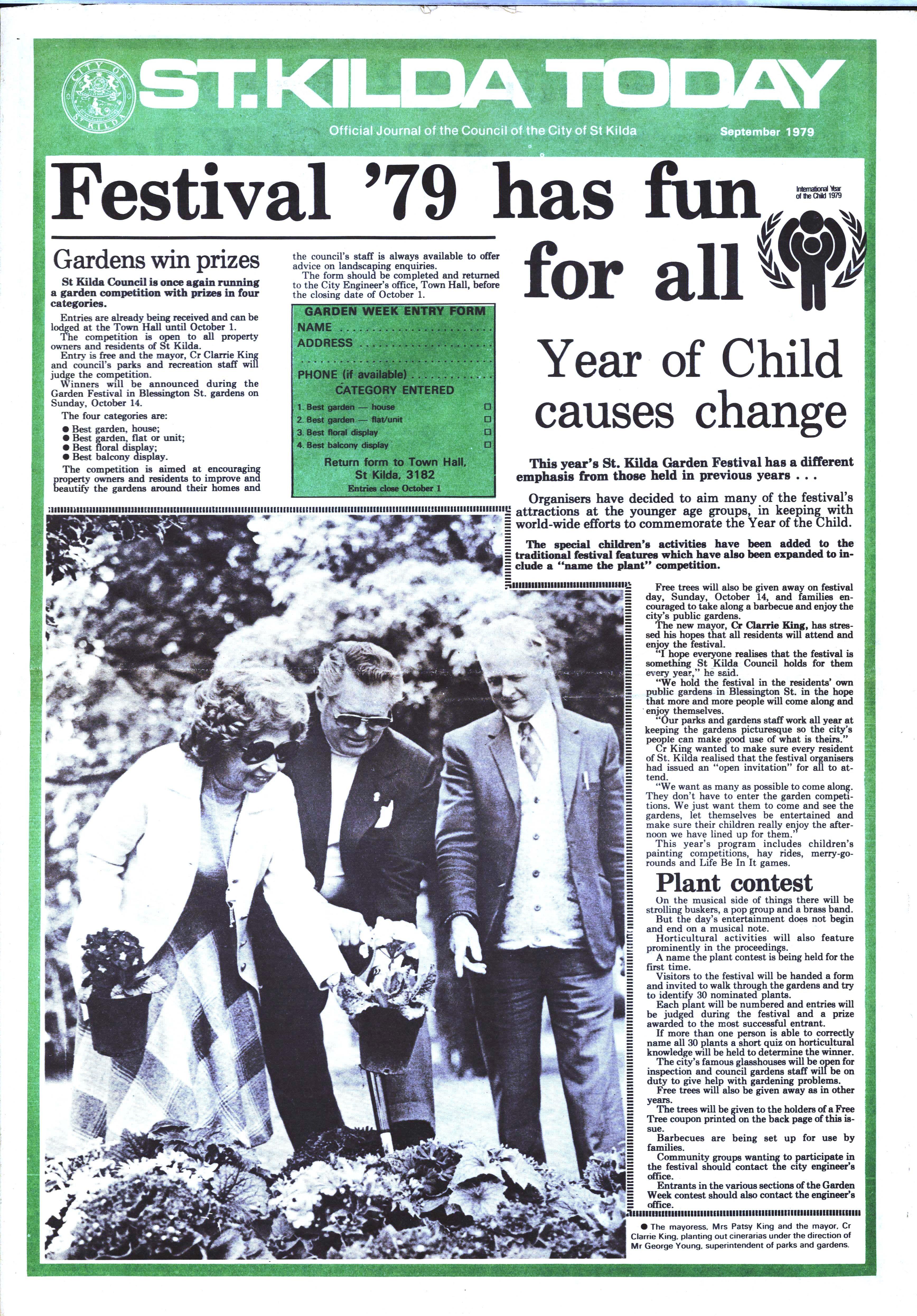
The
This year's St Kilda Garden Festival has a
Organisers have decided to aim many of the
attractions at the younger age groups, in keeping with
world-wide efforts to commemorate the Year of the Child
The special children's activities have been added to the traditional festival features which have also been expanded to include a "name the plant" competition
Free trees will also be given away on festival day Sunday October 14 and families encouraged to take along a barbecue and enjoy the city's public gardens
The new mayor, Cr Clarrie King, has stressed his hopes that all residents will attend and enjoy the festival
"I hope everyone realises that the festival is something St Kilda Council holds for them every year," he said
"We hold the festival in the residents' own public gardens in Blessington St in the hope that more and more people will come along and enjoy themselves
"Our parks and gardens staff work all year at keeping the gardens picturesque so the city's people can make good use of what is theirs."
Cr King wanted to make sure every resident of St Kilda realised that the festival organisers had issued an "open invitation" for all to attend
"We want as many as possible to come along They don't have to enter the garden competitions We just want them to come and see the gardens, let themselves be entertained and make sure their children really enjoy the afternoon we have lined up for them.'
This year's program includes children's painting competitions, hay rides, merry-gorounds and Life Be In It games
On the musical side of things there will be strolling buskers, a pop group and a brass band
But the day's entertainment does not begin and end on a musical note
Horticultural activities will also feature prominently in the proceedings
A name the plant contest is being held for the first time
Visitors to the festival will be handed a form and invited to walk through the gardens and try to identify 30 nominated plants
Each plant will be numbered and entries will be judged during the festival and a prize awarded to the most successful entrant
If more than one person is able to correctly name all 30 plants a short quiz on horticultural knowledge will be held to determine the winner
The city's famous glasshouses will be open for inspection and council gardens staff will be on duty to give help with gardening problems
Free trees will also be given away as in other years
The trees will be given to the holders of a Free Tree coupon printed on the back page of this issue Barbecues are being set up for use by families
Community groups wanting to participate in the festival should contact the city engineer's office
Entrants in the various sections of the Garden Week contest should also contact the engineer's office
The City of St Kilda has one of the highest population densities in Australia
The unusually large number of inhabitants have given it an environment similar to many European cities Researchers believe this is one reason many migrants have settled in the city
And, because of its many flats, boarding houses and rooms for rent, St Kilda also has a very mobile population.
These trends showed up in the first study ever made of the city's social structure and housing
The first report of the on-
I going study has now been completed and released to | the public
The main objective of I the study *vas to document I changes in the city's social | structure, the types of | housing now existing, and I to find what changes were [necessary in policies adopted by St Kilda Council and the State I Government to improve the municipality's residen| tial attractiveness
The study is being carried out part-time by a [consultant, Mr Peter [Viola, in conjunction with [council staff The first | report deals mainly with a [wide range of existing lstatistics and an analysis [of the various problems |and issues in these areas
The second stage of the study concentrates on |analvsing the effects of I strata subdivision of flats I in the municipality, the [future of boarding and I apartment houses, and in-
I eludes a wide community
I interview survey designed
I to ascertain the views of I residents about living conditions
Results will be I published as a stage two report
Before 1971 the most densely populated local government area in Victoria had been Fitzroy with an overall density in 1966 of 74.3 people a hectare compared with 65.5 in StKilda , says the report
But by 1971, because of the rapid depopulation of Fitzroy St Kilda had the highest overall density in the state, 70 people a hectare This decreased to 62.0 by 1976
Within St Kilda itself the North Ward, with 74 p.p.h in 1976, was particularly dense
Even inclusive of open space and non-residential uses, the densities in some districts within St Kilda are over 80 p.p.h
Such high densities were quite unusual in Australia and gave rise to an environment reminiscent of parts of some European cities It was not surprising that the area tended to attract many urban European migrants
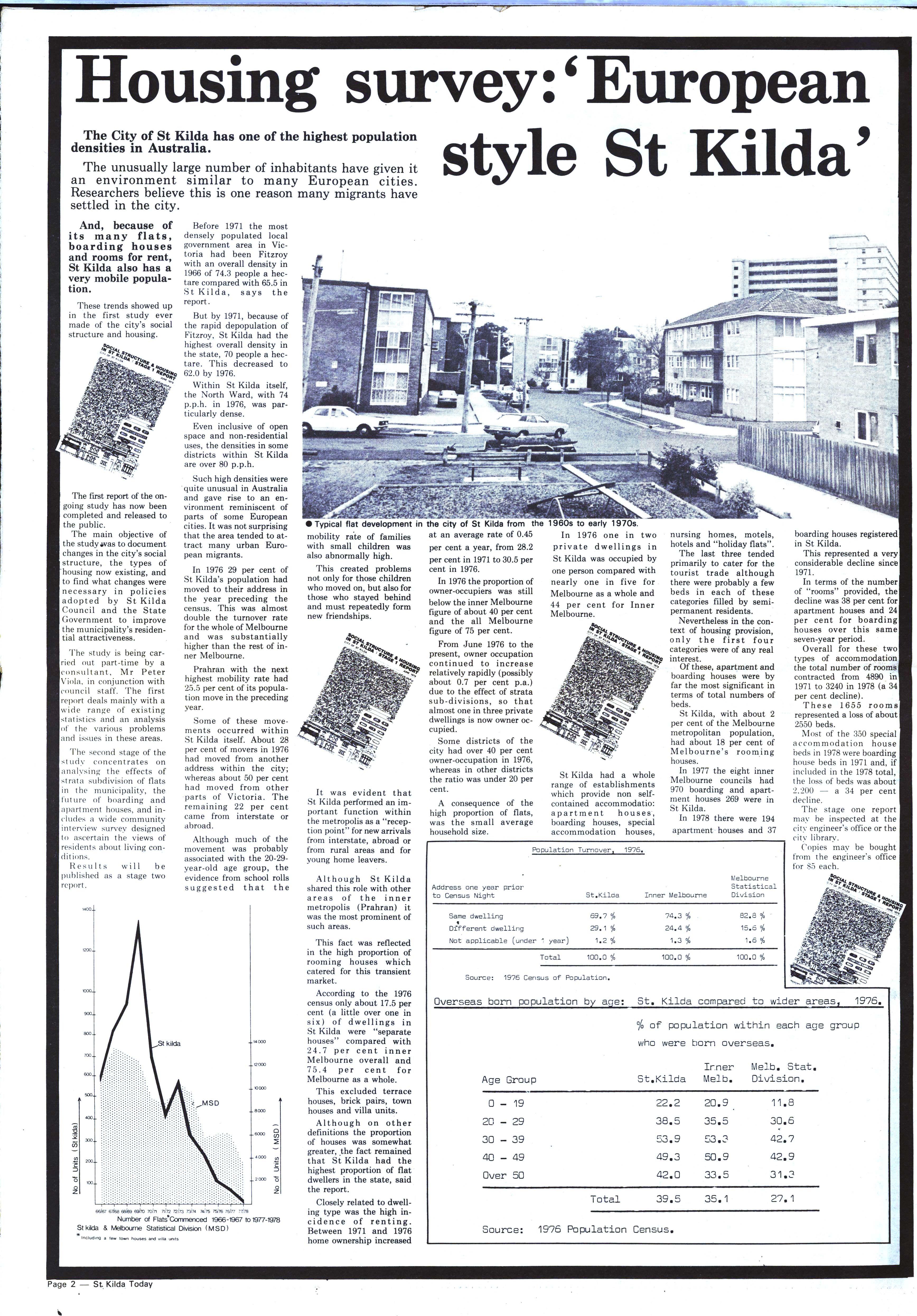
In 1976 29 per cent of St Kilda's population had moved to their address in the year preceding the census This was almost double the turnover rate for the whole of Melbourne and was substantially higher than the rest of inner Melbourne
Prahran with the next highest mobility rate had 25.5 per cent of its population move in the preceding year
Some of these movements occurred within St Kilda itself About 28 per cent of movers in 1976 had moved from another address within the city; whereas about 50 per cent had moved from other parts of Victoria The remaining 22 per cent came from interstate or abroad
Although much of the movement was probably associated with the 20-29year-old age group, the evidence from school rolls suggested that the
mobility rate of families with small children was also abnormally high
This created problems not only for those children who moved on, but also for those who stayed behind and must repeatedly form new friendships
It was evident that St Kilda performed an important function within the metropolis as a "reception point" for new arrivals from interstate, abroad or from rural areas and for young home leavers
Although St Kilda shared this role with other areas of the inner metropolis (Prahran) it was the most prominent of such areas
This fact was reflected in the high proportion of rooming houses which catered for this transient market
the
This excluded terrace houses, brick pairs, town houses and villa units
Although on other definitions the proportion of houses was somewhat greater, the fact remained that St Kilda had the highest proportion of flat dwellers in the state, said the report
Closely related to dwelling type was the high incidence of renting Between 1971 and 1976
at an average rate of 0.45 per cent a year, from 28.2 per cent in 1971 to 30.5 per cent in 1976
In 1976 the proportion of owner-occupiers was still below the inner Melbourne figure of about 40 per cent and the all Melbourne figure of 75 per cent
From June 1976 to the present, owner occupation continued to increase relatively rapidly (possibly about 0.7 per cent p.a.) due to the effect of strata sub-divisions so that almost one in three private dwellings is now owner occupied
Some districts of the city had over 40 per cent owner-occupation in 1976 whereas in other districts the ratio was under 20 per cent
A consequence of the high proportion of flats, was the small average household size
In 1976 one in two private dwellings in St Kilda was occupied by one person compared with nearly one in five for Melbourne as a whole and 44 per cent for Inner Melbourne
St Kilda had a whole range of establishments which provide non selfcontained accommodatio: apartment houses, boarding houses, special accommodation houses,
Populatio n Turnover 1976
nursing homes, motels, hotels and "holiday flats"
The last three tended primarily to cater for the tourist trade although there were probably a few beds in each of these categories filled by semipermanent residents
Nevertheless in the context of housing provision, only the first four categories were of any real interest
Of these, apartment and boarding houses were by far the most significant in terms of total numbers of beds
St Kilda, with about 2 per cent of the Melbourne metropolitan population, had about 18 per cent of Melbourne's rooming houses
In 1977 the eight inner Melbourne councils had 970 boarding and apartment houses 269 were in St Kilda
In 1978 there were 194 apartment houses and 37
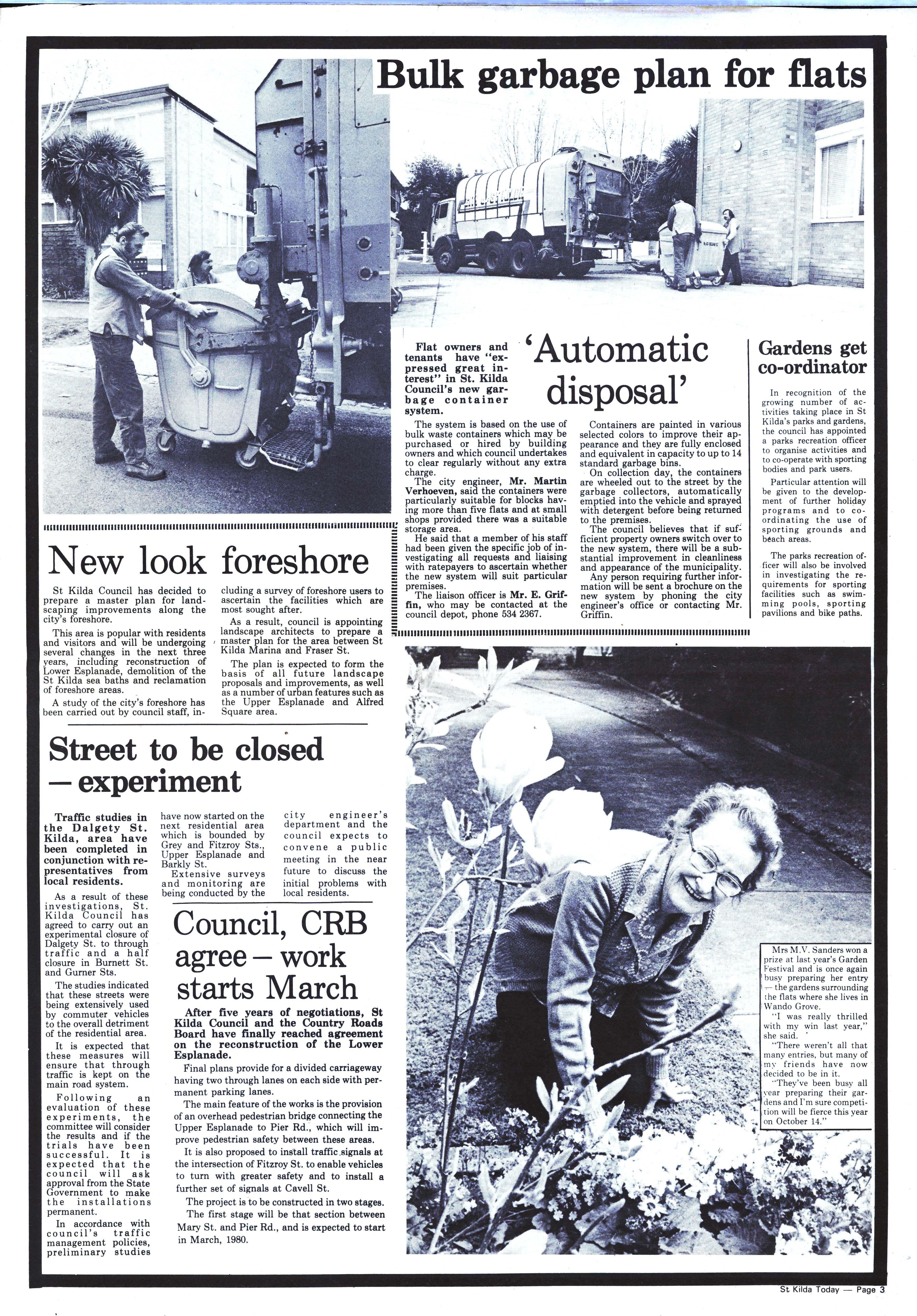
Flat owners and tenants have "expressed great interest" in St Kilda Council's new garbage containe r system
The system is based on the use of bulk waste containers which may be purchased or hired by building owners and which council undertakes to clear regularly without any extra charge
The city engineer, Mr Martin Verhoeven, said the containers were particularly suitable for blocks having more than five flats and at small shops provided there was a suitable storage area
St Kilda Council has decided to prepare a master plan for landscaping improvements along the city's foreshore
This area is popular with residents and visitors and will be undergoing several changes in the next three I years, including reconstruction of Lower Esplanade, demolition of the St Kilda sea baths and reclamation of foreshore areas
A study of the city's foreshore has been carried out by council staff, in-
cluding a survey of foreshore users to ascertain the facilities which are most sought after
As a result council is appointing landscape architects to prepare a master plan for the area between St Kilda Marina and Fraser St
The plan is expected to form the basis of all future landscape proposals and improvements, as well as a number of urban features such as the Upper Esplanade and Alfred Square area
Traffic studies in the Dalgety St Kilda, area have been completed in conjunction with representatives from local residents.
As a result of these investigations , St Kilda Counci l has agreed to carry out an experimental closure of Dalgety St to through traffic and a half closure in Burnett St and Gurner Sts
The studies indicated that these streets were being extensively used by commuter vehicles to the overall detriment of the residential area
It is expected that these measures will ensure that through traffic is kept on the main road system
Followin g an evaluation of these experiments , th e committee will consider the results and if the trial s hav e bee n successful It is expecte d tha t the counci l wil l ask approval from the State Government to make th e installation s permanent
In accordance with council' s traffi c management policies, preliminary studies
have now started on the next residential area which is bounded by Grey and Fitzroy Sts., Upper Esplanade and Barkly St
Extensive surveys and monitoring are being conducted by the
cit y engineer' s department and the counci l expect s to conven e a publi c meeting in the near future to discuss the initial problems with local residents
After five years of negotiations, St Kilda Council and the Country Roads Board have finally reached agreement on the reconstruction of the Lower Esplanade
Final plans provide for a divided carriageway having two through lanes on each side with permanent parking lanes
The main feature of the works is the provision of an overhead pedestrian bridge connecting the Upper Esplanade to Pier Rd., which will improve pedestrian safety between these areas
It is also proposed to install traffic signals at the intersection of Fitzroy St to enable vehicles to turn with greater safety and to install a further set of signals at Cavell St
The project is to be constructed in two stages
The first stage will be that section between Mary St and Pier Rd., and is expected to start in March, 1980
He said that a member of his staff had been given the specific job of investigating all requests and liaising with ratepayers to ascertain whether the new system will suit particular premises
The liaison officer is Mr. E. Griffin, who may be contacted at the council depot, phone 534 2367
Containers are painted in various selected colors to improve their appearance and they are fully enclosed and equivalent in capacity to up to 14 standard garbage bins
On collection day, the containers are wheeled out to the street by the garbage collectors, automatically emptied into the vehicle and sprayed with detergent before being returned to the premises
The council believes that if suf: ficient property owners switch over to the new system, there will be a substantial improvement in cleanliness and appearance of the municipality
Any person requiring further information will be sent a brochure on the new system by phoning the city engineer s Griffin office or contacting Mr
«lllllllllllllllll1IIIIIIIIIIII!ll!lllllllll!l!lllllillllllllllllll!lllllllllllllllllllllllllllllllllllll]|lll
In recognition of the growing number of activities taking place in St Kilda's parks and gardens, the council has appointed a parks recreation officer to organise activities and to co-operate with sporting bodies and park users
Particular attention will be given to the development of further holiday programs and to coordinating the use of sporting grounds and beach areas
The parks recreation officer will also be involved in investigating the requirements for sporting facilities such as swimming pools, sporting pavilions and bike paths
Mrs M.V Sanders won a prize at last year's Garden Festival and is once again busy preparing her entry the gardens surrounding I he flats where she lives in Wando Grove "I was really thrilled with my win last year," she said "There weren't all that many entries, but many of my friends have now decided to be in it "They've been busy all year preparing their gardens and I'm sure competition will be fierce this year on October 14."
In the past 20 years many Australian gardeners have realised that there are native trees and plants suited to every soil and situation
And since the advent of conservation pressure groups, this realisation has become apparent in suburban gardens
Plant breeders have concentrated in developing new species of natives with bigger flowers, longer blooming times and greater xapacity to withstand adverse conditions
Landscape gardeners regularly use Australian plants because of their natural tolerance to difficult positions as well as their variety of foliage and habits of growth
There has been a similar development in books about native plants
The botanical books, by such authoritative writers as Thistle Harris and A M Blombery, are still the basic texts for the true enthusiast
The average suburban gardener is more interested in selecting the right plant for his needs and learning about new plants One of the best books on this subject is the recent publication, Australian Plants For Small Gardens and Containers (Hyland House, $12.95)
Author Gwen Elliot and her husband Roger are regular contributors to gardening periodicals and TV programs
Their nursery Stringbarka, is well-known to native plant growers
On Sunday, October 7, at 2.30 p.m Gwen Elliot will be guest speaker in the Community Room at St Kilda Public Library
She will show a variety of plants, some of which can be grown in fairly small containers
These should be of particular interest to gardeners with courtyard or balcony gardens
There will also be a demonstration of potting methods, and plenty of opportunity to ask questions
The library is at 150 Carlisle St., opposite the Town Hall
It is open to the public at the following times: 11 a.m to 9 p.m Monday Tuesday Thursday and Friday; 10 a.m to 5 p.m Saturday; and 2 to 5 p.m Sunday
It is closed Wednesdays and public holidays
Phone 534 8028 for further information
Membership is freely available to everyone who lives or works or attends school or owns rateable property in the City of St Kilda
"You don't have to be a ratepayer to join and there are no fees to join or borrow books Fill in an application form and provide current proof of your St Kilda address
Gwen and Rodger Elliot will also be at the Garden Festival on Sunday, October 14
A collection of plants suitable for St Kilda gardens will be on display from noon to 4.30 p.m., and they will demonstrate care of the plants
There will also be a display of books on Australian native plants, selected from the library's extensive collection of books on all aspects of gardening
Flower arranging enthusiasts should make a note to be at the Garden Festival at 3.30 p.m., for a demonstration of this art
Again, the Library will supply a collection of books to further inspire you
Plans are well advanced to build a bike path along the St Kilda and Elwood foreshores
The bike path planning has been carried out in conjunction with the cities of Brighton and South Melbourne and is designed Roses were planted 30 years ago
Visitors to the Blessington Street Gardens have always shown interest in the extensive rose garden which occupies the north-western comer of the park. The rose garden was established in 1950 as a joint venture between the St Kilda Council and the National Rose Society of Victoria as a memorial to Mr Alister Clark
The cost of the original establishment was about $5000. The rose beds occupy nearly two acres
The path will pass through existing open spaces but there are several sections where it will be necessary to share the use of existing footpaths and roadways These sections are presently under discussion with the Road Safety and Traffic Authority
One of the main features of the bikeway is the proposed bridge over Elwood Canal which will be built during 1980 to link reclaimed areas on each side of the canal
The design for the bridge prepared by the city engineer's department, is based on an arched structure made from laminated timber and estimated to cost 834,000
Published by St Kilda council in the interests of better local government in the City of St Kilda and printed by Standard Newspapers Ltd of 10 Park Rd., Cheltenham, Vic
There are more than 2000 rose plants in the garden to provide a recreational bike path, possibly linking into the Albert Park area
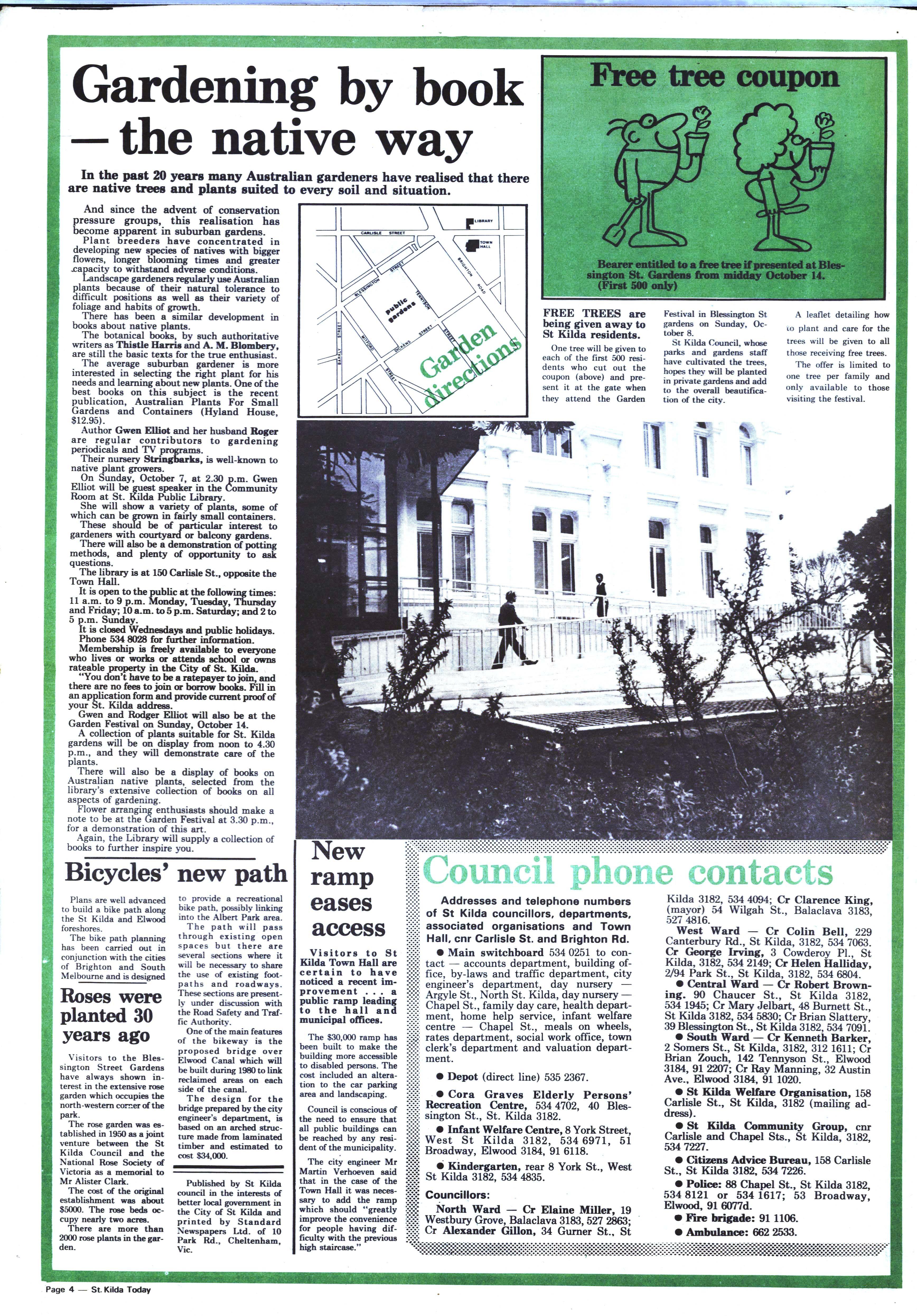
Visitor s to St Kilda Town Hall are certai n to have noticed a recent improvement a public ramp leading to the hal l and municipal offices
The $30,000 ramp has been built to make the building more accessible to disabled persons The cost included an alteration to the car parking area and landscaping Council is conscious of the need to ensure that all public buildings can be reached by any resident of the municipality
The city engineer Mr Martin Verhoeven said that in the case of the Town Hall it was necessary to add the ramp which should "greatly improve the convenience for people having difficulty with the previous high staircase."
Addresses and telephone numbers of St Kilda councillors, departments, associated organisations and Tow n Hall, cnr Carlisle St and Brighton Rd Mai n switchboar d 534 0251 to contact — accounts department, building office, by-laws and traffic department, city engineer's department, day nursery — Argyle St., North St Kilda, day nursery — Chapel St. family day care health department home help service infant welfare centre — Chapel St. meals on wheels rates department social work office town clerk's department and valuation department
• Depot (direct line) 535 2367
• Cora Graves Elderly Persons' Recreation Centre, 534 4702, 40 Blessington St., St Kilda 3182
• Infant Welfare Centre, 8 York Street, Wes t S t Kild a 3182 534 6971 51 Broadway, Elwood 3184, 91 6118
• Kindergarten, rear 8 York St., West St Kilda 3182 534 4835
Councillors: North Ward — Cr Elaine Miller, 19 Westbury Grove, Balaclava 3183, 527 2863; Cr Alexander Gillon, 34 Gurner St., St
Kilda 3182, 534 4094; Cr Clarence King, (mayor) 54 Wilgah St., Balaclava 3183, 527 4816
Ward — Cr Colin Bell, 229 Canterbury Rd.
St Kilda 3182, 534 1945; Cr Mary Jelbart, 48 Burnett St., St Kilda 3182, 534 5830; Cr Brian Slattery, 39 Blessington St., St Kilda 3182, 534 7091
• South Ward — Cr Kenneth Barker, 2
Kilda, 3182 (mailing address)
• St Kilda Communit y Group, cnr Carlisle and Chapel Sts., St Kilda, 3182, 534 7227
• Citizens Advice Bureau, 158 Carlisle St., St Kilda 3182, 534 7226
• Police: 88 Chapel St., St Kilda 3182, 534 8121 or 534 1617; 53 Broadway , Elwood, 91 6077d
• Fire brigade: 91 1106.
• Ambulance: 662 2533