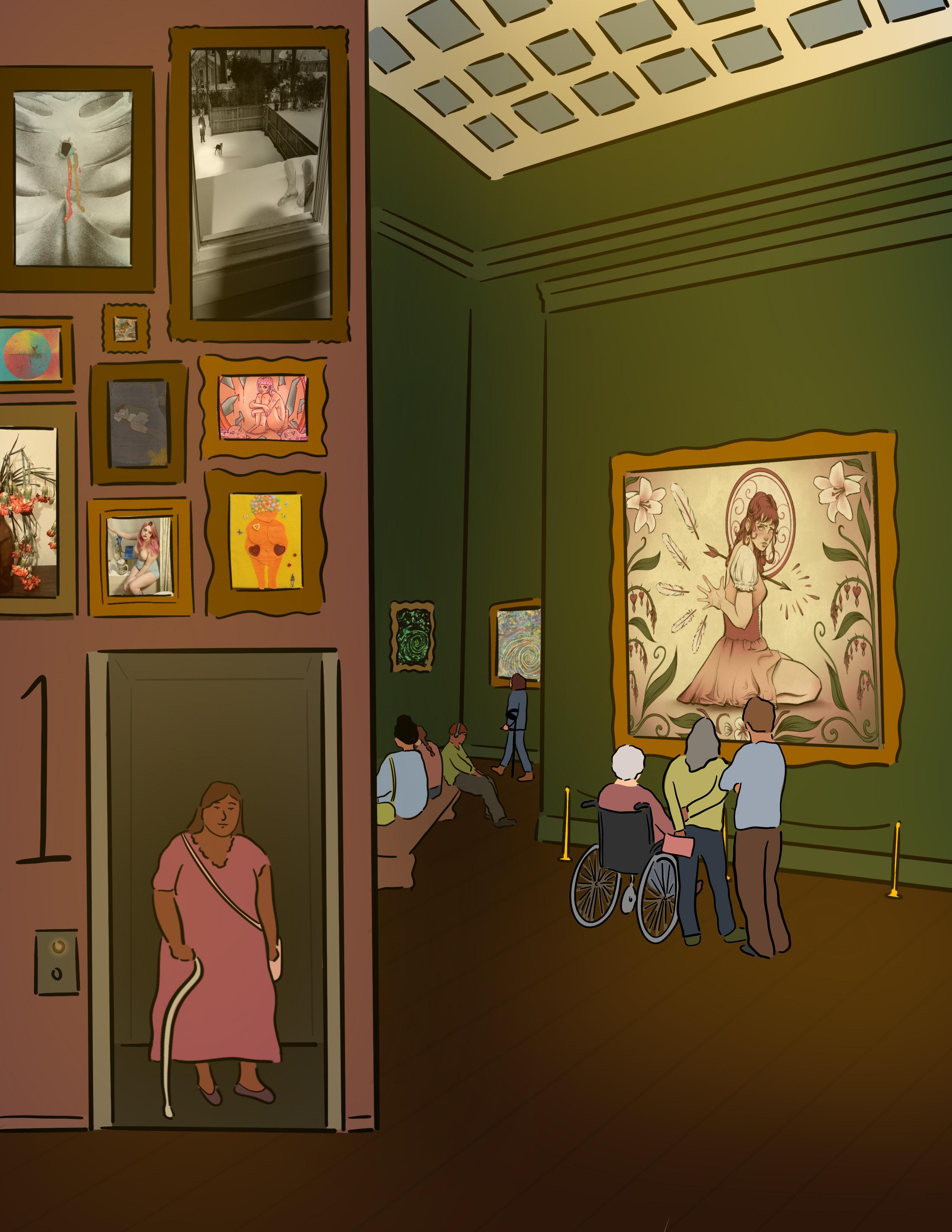
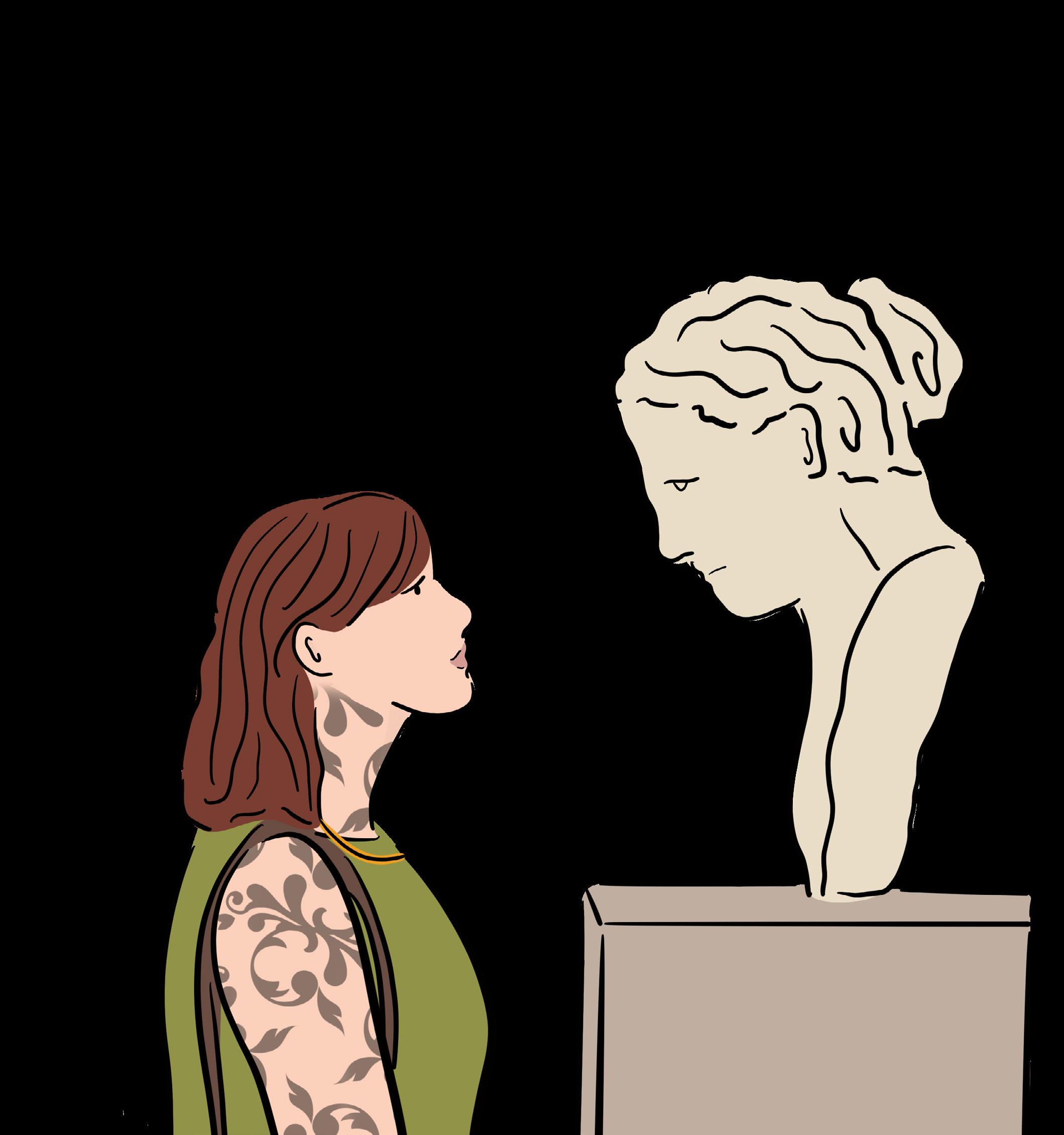
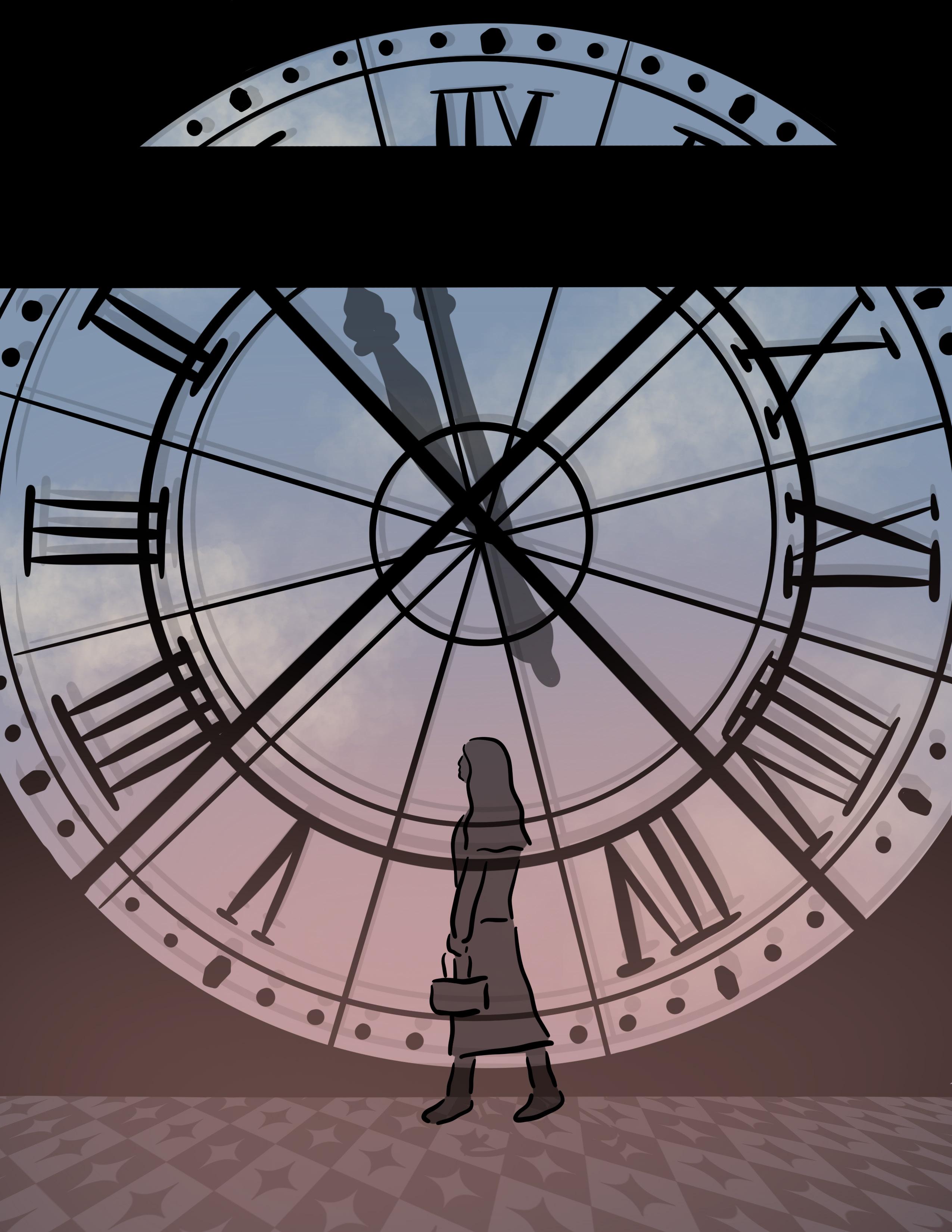
Liz Zonarich is a graphic designer and illustrator based in Boston. For her, chronic illnesses are personal, motivating her to make a difference. As a graduate of the Master of Science in Media, Medicine, and Health program at Harvard Medical School, she loves to convey health messaging through storytelling and visuals. Her background is in graphic design, public health, and art history. Her favorite ways to cope are mailing letters to friends, reading, illustrating, and rewatching Pride & Prejudice (2005) for the millionth time.
K. Hamilton is a writer, born and raised in Philadelphia, PA. They have a background in English Literature and Education, and has lived with both mental and physical conditions for a large portion of their life. Their favorite ways to cope are gaming, rooting for all Philly sports teams, playing heavy metal too loud, annoying their dogs (Salem and Oreo), and reading.
Jenn is a gay teacher in Philadelphia, born in New Jersey. Just trying to channel her love for history, poetry, and knowledge into Gen Alpha. She’s cycled through multiple therapists and had enough hospital visits to know a thing or two about the importance of coping. Her favorite ways to cope are blasting music in her ears, painting, writing some poems, playing Stardew Valley, and cuddling her cats.
COPE MAGAZINE is a place for storytelling. Every work published is a creative and personal story, and should not be taken as medical advice.
letter from the editor
DEAR READERS,
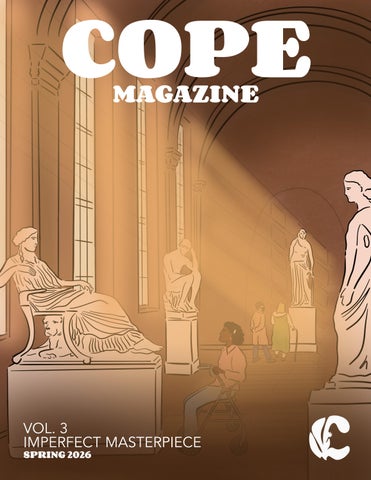
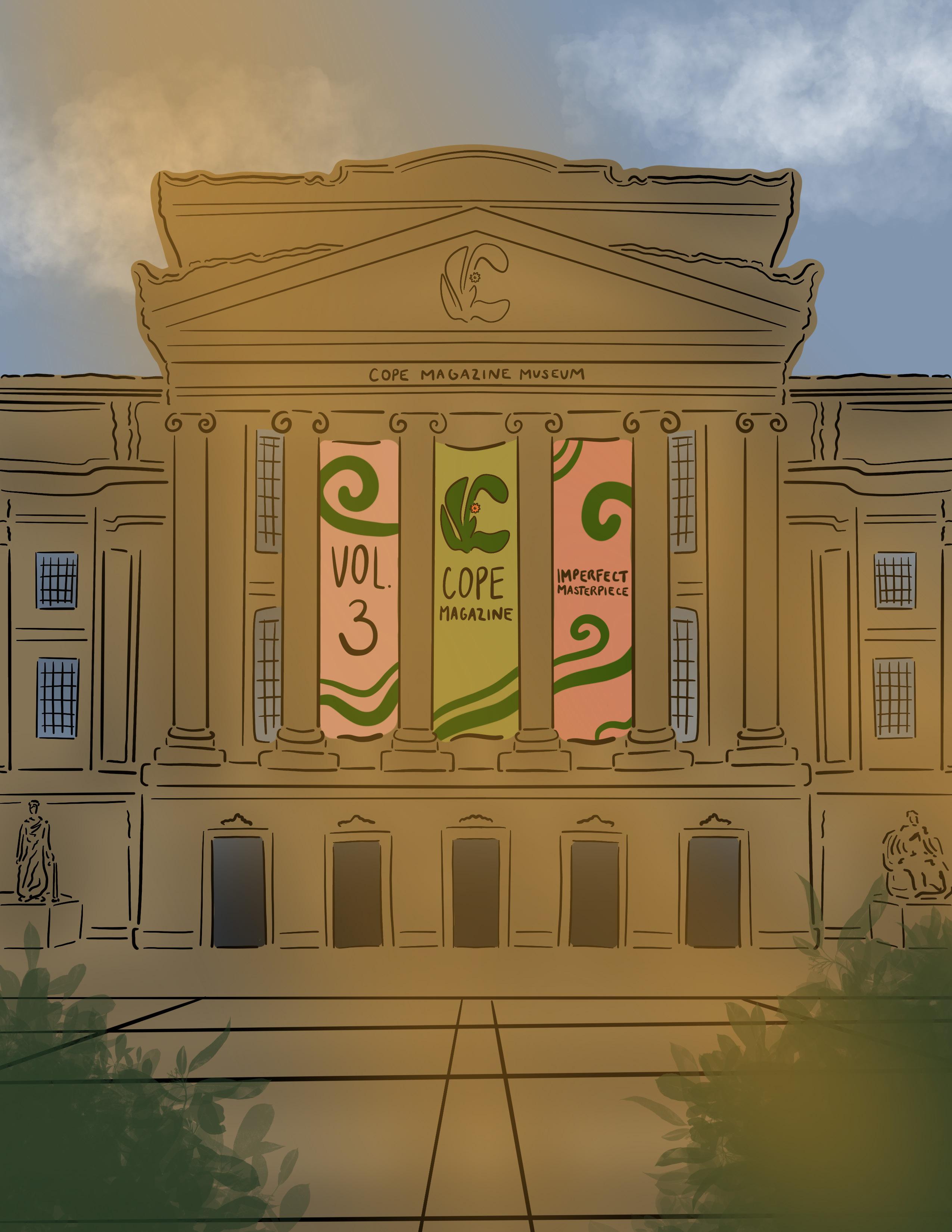
Welcome back to our spring issue of COPE MAGAZINE, Volume 3: Imperfect Masterpieces. We’re so excited to share another meaningful, beautiful, and exploratory issue.
Last spring I suffered a very bad flare that took months to recover from. I felt so disconnected and frustrated with my body, and continue to have fleeting moments of yearning for something I can’t yet grasp. So as this time of year came around again, I thought why not make this a theme?
So we posed the question: “How do you love your body when it doesn’t love you back, or makes it hard to love?” And honestly, there’s no one-sizefits-all answer to this. But once again through the collection of stories here, I am reminded of the collective frustration, resilience, care, and grit we have. And that makes me feel seen, and that’s what I hope for you as you read this issue.
As you flip through the pages you might also notice how this issue is deeply inspired by art history. As an artist myself, I’ve always been inspired by “the great works,” but it’s not until recently that I discovered how many of these notable artists had chronic illnesses. Artists like Kahlo, Van Gogh, Monet, Goya, and Haring all used their experiences with chronic illness to influence their work. Artists like us have always been here, making art. We’re here in the pages now. We will continue to leave our marks on the world.
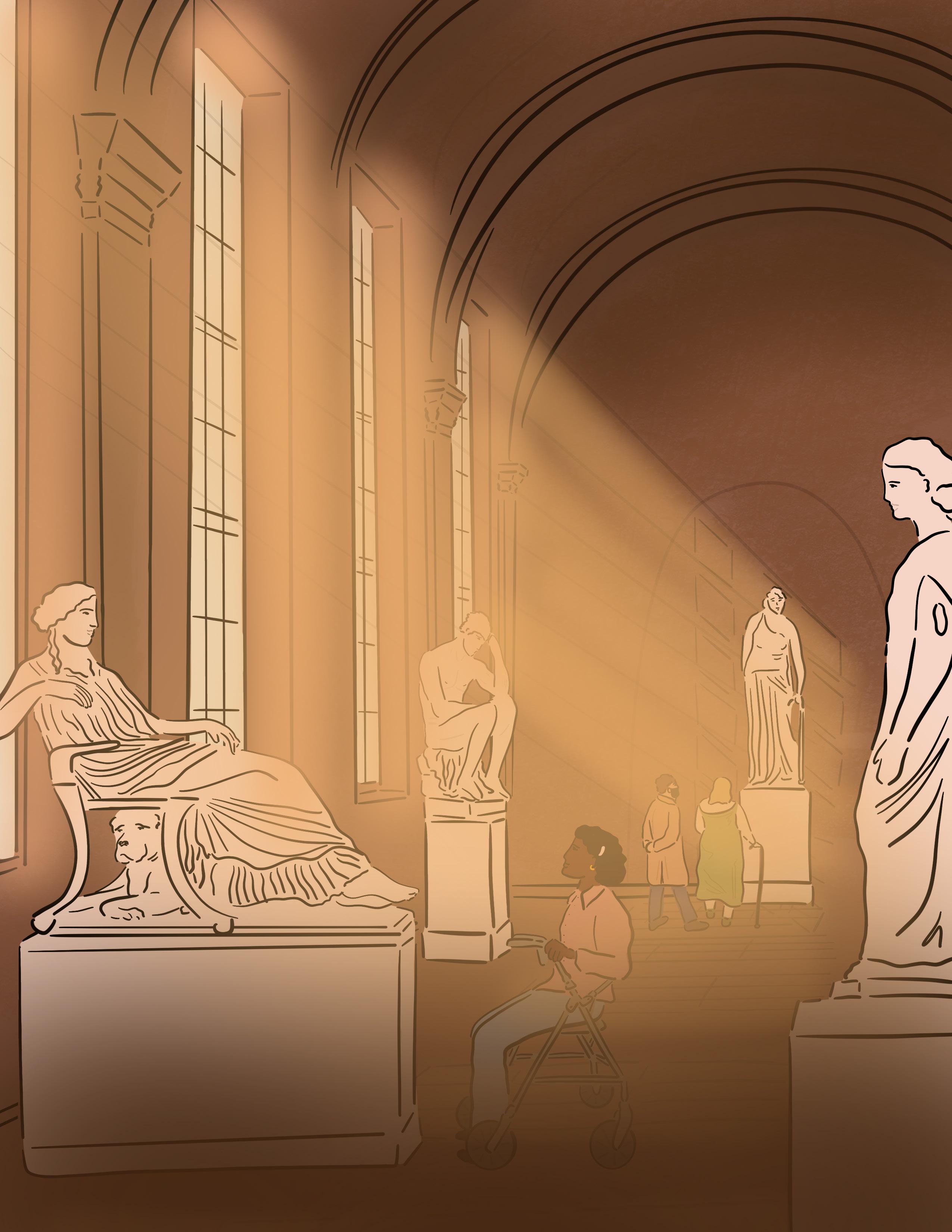
Enjoy your trip to the COPE MAGAZINE museum, a place where all these imperfect masterpieces live. Explore at your own pace and take time to reflect on what you see.
WARMLY,
45 Heartbreak by Robin Allen
46 Snowed In by Gardner Mounce/Pain by Samantha Erickson
47 Fatigue - A Self Portrait by Lily Mire
48 Unrequited Love Of A Tumor by Rachel Warden
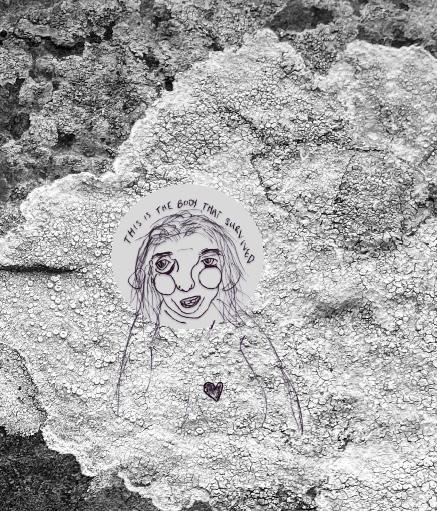
49 This Is The Body That Survived by Miriam Saperstein
50 Man In The Mirror by Erik West
52 Wound Down & Dragging Ground by Amanda Bialy
53 Migraine & Anthrodynia by burnsbothends
54 Sustain the Snail by Kate Rehurek
56 Fragile: Handle With Care by McKenna Stone
58 Revive by Simon Collinson
60 The Thorns May Stay on My Roots, But They No Longer Surround Me by Jaime M
61 Aware by Kate
62 A Good Day by Celeste Finelli
63 Riot Grrl by Brittany Redd
64 What’s For Dinner? By Denise Schnieders
66 Little Piggies by Kara Nothem
67 This Body by Rhynn
68 Sick at 25 by Girl Venom
70 Still Here. By Samantha Starr
74 Features
80 Special Exhibit
90 Contributers
by Bee Walsh
to disarm able bodies. Our bodies put your bodies ill at ease and we have to help you help us. We help you help us have the life you take for granted, in bodies you take for granted. “Take my body, please.” That was a joke. Are you more comfortable now? Now that you’ve seen my tubes, seen me cry over a staircase, seen me drop what was in my hands as I drop my words, seen my skin tear. Now that you’ve seen me, how do you see yourself? How does your body feel when you see mine fail me? Touch your face. Touch your arms. Touch your legs. We see it all.
We see you look and try not to look, we see you stare in the reflection of the glass to catch a sight at us, we see you look two, three, four times. It’s okay. We look too. We never stop looking. At our skin, our scars, our stripes. At your neck, your hair, your shoes. We see your clothes and think, “not for us.” We think, “caught in a wheel,” “too hard to close,” “not while sitting,” “not with tubes.”
Your body could be like my body. Easy. The next time you trip, sneeze, sleep. The next time you try a new food or give birth. The next time you get older or wiser. Your body is more likely to become like my body than you think. Honestly, it more than likely will be. Have you thought about that?
I rub tallow into my skin that doesn’t age. My body that doesn’t eat. My muscles that grow weak. You’re “too young,” “too pretty,” “too healthy looking.” If wishing made it so, would I wish my body away? What else would I have to give up? Would it be worth it? What would you give up to keep your body not like mine?
I feel my lips, my teeth, my tongue. I feel my scars, my tube, my bag. I feel my pain. I won’t tell you about the pain. You don’t know, and if you did, you wouldn’t be ablebodied. I will spare you like your body spares you. I feel the pain in my cells, like I am made of the pain, and it makes me “me.” I feel my feelings, my grief, my fatigue. I feel your pity, your curiosity, your disgust. I think about your body instead.
If your body ever becomes like mine, I will think about your body differently. And so will you. You won’t know what to think, where to look, or how to feel. You will look everywhere, frantic. You will search and ask and question. You will pray and cry and mourn. You will think about every body that you see and even the ones you don’t. You will wonder if you will be disabled in your dreams.
I want your body while trying to want my body. I want nothing more than to think about anything else. I want a job, a home, a life. I want a hobby, a vacation, a wardrobe. I want to be curious, or throw caution to the wind. I want to pick up and go with nothing in my hands. I want my hands to work. I want to work. I want to want and be wanted. I want this body to be everything it is not; a vision of perfection, unreality. I am working on it. I will be working on it forever. I will be thinking about your body forever.
The Monster Under My Bed by Georgina
It’s the monster that lives under my bed, That only comes out at night, Waiting for it to be completely, Utterly, a l l c o n s u m i n g Dark.
He crawls out, long fingers and arms i n g round onto the bed p p a r w
Before they envelope me, And it is all I can see
While he holds me, All the times I have been let down By my own body
All the times I have felt stuck And trapped
All the times....
Until I am sobbing Heavy but silent, Racking my body
No one can know.
This monster the only caress
Holding me while I feel way the
My through dark
Until there is left. nothing
Until the soft sigh of love stirs next to me
And the morning chorus slips in Through the
Of the shutters that shut out everything [but my thoughts]
And the monster r e t r e a t s
to his hiding place under the bed
Waiting until I need to be held by him again.
Untill then I am safe
Lying still and softly, tired and accepting,
Forgiving all the times I have allowed the monster out.
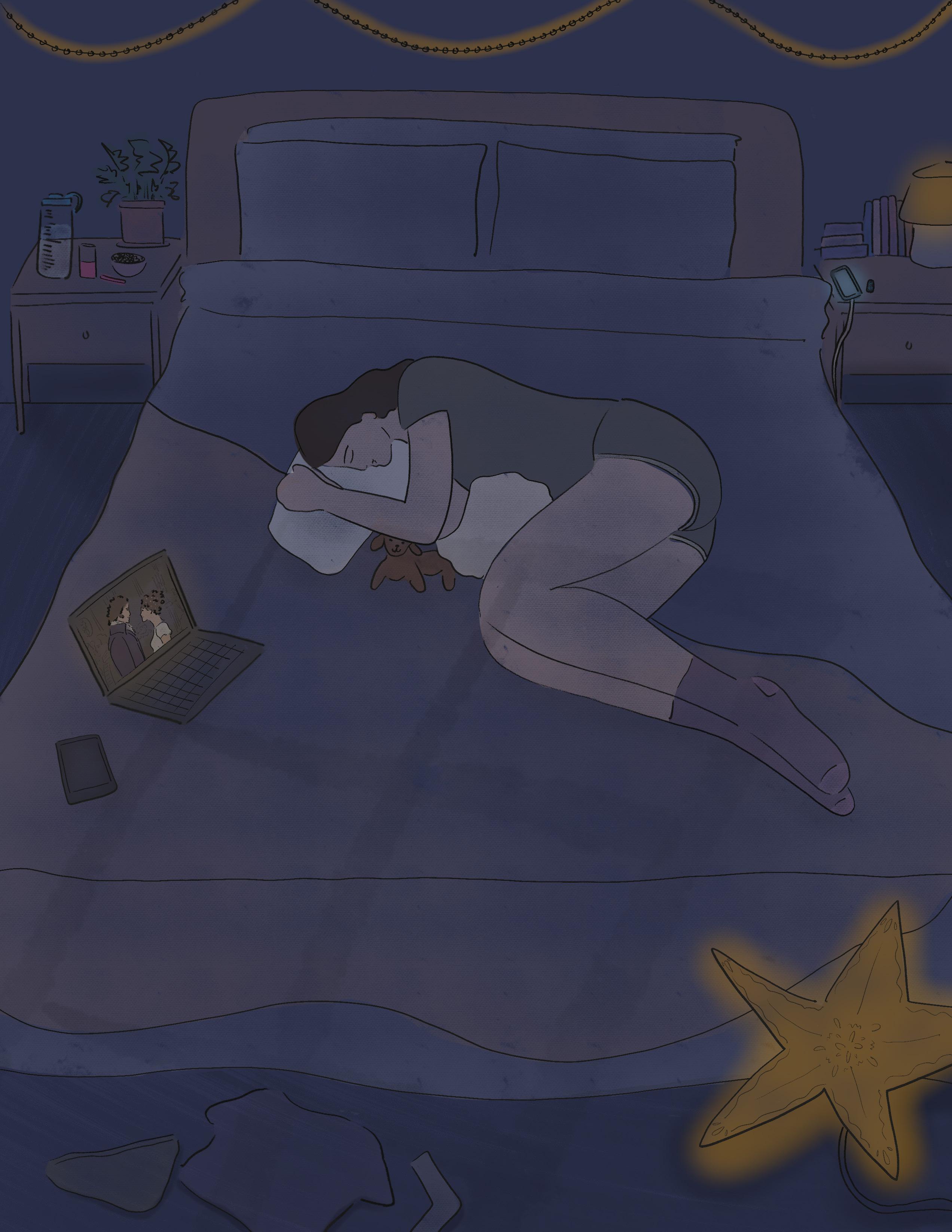
Being Kind To My Body When It Isn’t Kind To Me
by Liz Zonarich
Digital illustration
This illustrates those tough nights I have when I’m in a flare. When my body is enduring pain, a racing heart, headache, or general fatigue. All I can do is be kind to my body with things that comfort me (electrolytes, salty snacks, pulse ox, Pride & Prejudice, soft bedding, my kindle, and my warmie, Henry).
Sabai Sabai
Lois Ann Dort
“Sabai Sabai” (Thai phrase: relax, everything is alright)
One brilliant summer afternoon my mother stood, arms akimbo, on the doorstep and asked, “Did you show David your stomach?”
I did show him, but I guessed from my mother’s tone that I wasn’t supposed to. These cousins — the city cousins — had never seen it before, and I wanted to show them; shock them, perhaps. The city cousins, who smirked at us country kids when we were oblivious to the latest trends and television shows, wouldn’t be prepared for the spectacle that was me.
At the time, there was a joke going around: God knew Adam when he arrived in heaven because he was the only one who arrived without a belly button. I assured my cousins that I would be the next. I didn’t have a belly button either.
They didn’t believe me, and without much convincing, I lifted my shirt and made a display of myself. My scar (a fireworks display or a mangled starfish, depending on your frame of mind) took up most of the real estate on my stomach, radiating out from the center in ridges and valleys. It was a curiosity worthy of a sideshow, and I was a born performer.
When my cousins reported back to their mother, she was mortified by my exhibitionism. While this was the least offensive thing we kids got up to, it was deemed heinous. My mother was called directly, and I was in the hot seat.
My scar was the result of a birth defect called a giant omphalocele, which resulted in a lifetime of chronic bowel obstructions; a heavy burden, to be sure, but people’s reactions to my physical imperfections were often a greater affliction.
From the day that I got in trouble for showing this symbol of perseverance and survival to my cousins, I was made to feel ashamed of my body. As I got older, I was urged away from two-piece swimming suits and told to tuck my shirt in, lest it should ride up and show my disfigurement. I recall my aunts going through a bag of second-hand clothes and discarding tube and halter tops because it was “too bad about your stomach.”
By the time I graduated to adulthood, I had been fully converted to the Church of Too Bad. Dating was fraught with insecurity. How do you prepare someone for this? Was it worth the humiliating conversation and the questions that would follow? With time I got used to it: broaching the subject before any clothes came off, before any hands found something
unexpected in the dark. To my surprise, given how repugnant I had come to believe my scar was, it was never a showstopper.
For the first quarter-century of my life, this is how I lived: ashamed of my body, feeling like I had to hide it and apologize for its disturbing presentation. On the heels of my first serious breakup, I decided that the best way to mend a broken heart was to move it to a new location. I chose one as far away from my former boyfriend as I could get: Bangkok, Thailand.
I took what was left of my student loan money and bought a one-way ticket to a country I knew nothing about — and that’s the way I wanted it: a very fresh start.
I arrived there just after the 1997 Asian economic crash, when everyone was in a kind of financially-induced medical emergency. Thai TV was littered with soap operas involving people dying in hospitals. In real life, the streets were full of beggars with various ailments and absent limbs. And no one, other than foreigners, batted an eye at this display of mangled humanity.
About a year into my ten-year sojourn in Thailand, I went to a popular Thai — not tourist — beach with my fiancé. I could say I forgot to pack my swimsuit, but I didn’t own one. I hadn’t owned one in years – not wanting to deal with the fallout if I did.
My fiancé remedied that apparel oversight, returning from the nearest beach shop with two skimpy pieces of fabric that were meant to serve the purpose. I strangled myself tying the spaghetti straps, then proceeded to wrap myself in a sarong (chest high) before we headed to the beach chairs.
Just like the girl in the yellow polka-dot bikini, I was afraid to reveal myself to the sun, the sea, and the citizens populating the beach. My fiancé was keen to be seen, and to be seen with me Unveiled – not hidden beneath voluminous yards of jungle print.
Tugging not-exactly-playfully at my sarong and nodding towards my ample chest, he said, “If anyone is looking at you on this beach, it isn’t because of your scar.”
The sarong fell to the sand, and I could feel the hot sun in hidden places for the first time. My muscles unclenched and I sank into the chair.
A smile spread across my fiancé’s face as he held a hand up over his eyes to shade them while he surveyed the beach and me.
“Sabai sabai, nah,” he said. “People in this country — they’re missing arms, legs, even noses. Nobody cares.”
I knew he was right. People did stare as they passed me on the beach, but not at my scar — at my white skin, at my near nudity, and at the fact that I was there at all.
During the years I spent under the Thai sun, my scar shrank until it was only visible to Western eyes. It was a cultural construct that I toppled one beach day after another.
Relationship To My Old Self
by Ally Meisner
I wish I could see my old self again. I wish I could go outside and feel the breeze brush up against my skin without worrying about the burning sensation running through each and every one of my bones. I wish I could go outside on a breathtakingly sunny day and not have to worry about symptoms, or hiding in the shade from fear of my body temperature rising to the point of an outbreak in hives and overconsuming dizziness. I wish I could breathe without fighting back the never-ending tears, and stand and move and think without being shattered by the pain. I wish my days were filled by being outside, running, laughing, and being free; not trapped inside, bedridden, and glued to my heating pad. I wish I didn’t need to cancel plans because of a sudden flare or side effects from my medications. I wish I was able to sit through class without having to ask to go to the bathroom to soak my face with cold water just so I could remotely stay upright. I wish I could experience the blessing and joy of a healthy and functioning body once again. I wish I could feel the chains lift off of my damaged self; to be able to trust in people without fearing judgment and disbelief. I wish I could face each day wide-eyed and innocent, instead of having bags under my eyes, well aware of the challenges that I will inevitably face each day. I wish I could see the person who was a go-getter, the person who had so many goals, determined to achieve things; not the person who feels defeated after taking one physical step up the stairs. I wish I could see my old self again.
Despite grieving the loss of who I once was or what I once was capable of doing, she is what has given me the ability to live life to its fullest. She has allowed me to find joy in all of the little things. She has allowed me to fight, push, and continue to breathe even when it seems impossible. When I feel broken, when I feel horrible, when I feel nothing but sickness, she is what keeps me going. She reminds me that there is something more to live for than just the pain. She was the foundation on which I was built; she is what has shaped me into who I am. If it wasn’t for her, my healthy body, I wouldn’t have something to fight for every single day.
Neuropathy by Callie
Badorrek
What is touch really?
What does it mean to feel?
Something taken so for granted yet so lacking when it’s gone
The feeling of too-hot sand between your toes
The whisper of salt air on your skin
Or the bite of freezing snow on your fingertips, ever the rebel taking off your mittens
A brush of soft fur as your beloved pet snuggles into your side
The sweet feeling of morning dew slick on your feet as you run barefoot in the grass
Tentative touches from a cute boy, a gentle nudge of the foot
What does it mean when it’s all gone?
Perhaps slipping away gradually, but the lack of sensation seems so sudden
When your feet have become dead bricks, unsure of each step
Fingertips once so deft have become useless sticks, prodding and hopeless
When your dog feels like nothing, and sand and snow may as well be the same
When the touch of your love becomes a void
And you cannot feel the ground beneath your feet
How do we keep going as parts keep being stripped away?
How human are we if we can’t feel the touch of another?
Or the simple joy of warm sand between our toes?
The Grief of Having No Control Over Your Body by
Alycia Corpiel
In December of last year, I got my ear pierced in a really cool pattern I made up. It looked awesome. It was four piercings, clustered in a diamond shape in my lobe. I did research ahead of time and went to the best piercing place I could find. I was really really excited when I got them done.
It was recommended for me to focus on the lobe because, “you can’t mess it up.” Well, I don’t think my body got that memo, or at least it saw it as a challenge.
With ME/CFS, your body heals a lot slower, which makes the chance of infection higher. I got all four piercings done at once because I was scared I wouldn’t go back, as I only leave my house every month or so for very short periods.
I really wanted this piercing idea to come to fruition, and I felt like it was a great way for me to feel like I was taking control of my body back from my disease. Unfortunately, my body had other plans.
A month into having the earrings, the healing was actually going well and I was ready to size down the jewelry. I went back to the piercer, who sized the earring post down. By the next day or so, I had a raging infection and the top piercing had completely embedded in my ear.
I rushed to a different piercing place, because the one I had been going to was closed for another few hours. The place was disgusting, but I don’t know, they seemed like
they were following sanitation protocols. Honestly, I should have just left. They drained the infection and put the long post back in.
I kept doing everything I was supposed to do. I cleaned it with saline spray, I dried my ear because they were flat back posts. It wasn’t enough.
The infection worsened, and I knew there was no way I would be able to repair it. I was so exhausted. I hadn’t been able to sleep on my right side for almost 2 months, which is hard on my body that is chronically in pain. Donut pillows do nothing. I decided to take the earrings out and just let my earlobe heal.
The wounds are looking much better now, but there is grief and regret I can’t get rid of. I regret spending so much money on something I thought was going to be really cool and was going to bring me some sort of idea of control over my body, and it failed. I have so much grief over this. The one thing I wanted to do for myself failed.
My body decides what I will do every day. It decides if I will struggle with fatigue, chronic pain, breathing issues, acid reflux, digestive issues. I have no choice. I just
have to deal with whatever it throws at me. When I look in the mirror, I always look different. Sometimes my skin is really pale. Sometimes my lips are blue. Sometimes I have dark circles under my eyes. I am continuously gaining weight and forming stretch marks. My legs look weird as hell because of the muscle degeneration I am dealing with. I can’t think properly. I say the wrong words, and sometimes lash out when I don’t mean to.
This was one way to permanently alter my body how I chose. My body rejected it and won again after all the effort I put in. Reminding me again that I have no control.
I feel like I’m being punished for trying to outsmart my body. I know that’s a ridiculous way to think, but it’s automatically where my brain goes. I stepped out of line, and now I’m being punished. And the guilt I feel about the money is so strong at the same time.
I don’t know how to really take my body back from this disease. I don’t know if there is a way that I will ever feel satisfied. I’m just glad my ears are healing properly and hopefully I will be out of this crash soon. Hopefully very soon because I have an MRI on Saturday.
My Body is A Blessing
by MC Gilmore
My body is a blessing.
It works so hard for me, stopping me from dangerous choices like refusing assistance getting dressed. It sweats through my pajamas and bedsheets that I cannot wash with an illuminating warning, even sleep will not bring rest.
My body is a blessing that steals my chance to see the world and do any amount of the life I’d envisioned in my 7 year old head. It keeps me locked in place, unrested in the sinkhole that swallows the middle of my bed.
My body is a blessing which contorts my dreams and the sounds I hear in the silence, so that I will never know how disturbing peace can be when there is only violence.
My body is a blessing from a life of constant ease, one with a purpose and fulfilled desire to be seen.
My body is a blessing in disguise, it keeps even my loved ones from seeing the me that’s right before their eyes.
My body works so hard for me, I really swear it does.
But my body is a blessing from someone who hates me high above.
I Miss Her
by Samantha Erickson
I used to be awesome. I was smart, driven, strong. I used to snowmobile and go four wheeling. I used to skeet shoot competitively. I used to camp, hike, and kayak. I used to be a Surgical Technologist. I used to run my own charity. I used to be so proud to be me. But now, I don’t know who I am anymore. I’m none of those things.
The only thing I am these days is sick. I will wake up every morning sick, go to bed every night sick. It’s all I am now. It has completely taken away my identity. This illness controls every single aspect of my life. I have no say in it, I never get a break from it; It’s all consuming. It’s all I know anymore. I’m grieving the version of myself I worked so hard to be. The version of myself I loved. Every day, I wake up and I know I am going to have to fight so hard just to make it through the day. Harder than when I made the Dean’s List in college while working three jobs and going to clinicals all at the same time. Harder than when I was hired at the age of 19 to work for the New England Donor Services, their youngest employee ever. Harder than passing my National Surgical Technologist exam. Harder than winning an award within my first year of graduating college. The truth is that waking up every single day with this illness is harder than anything I have ever done in my entire life. And it is something I will have to do every single day. Again, and again, and again. I go to bed knowing that each and every day, I will have to fight harder than I ever have just to make it through. All while grieving the loss of myself. I miss her, I miss my life, I miss being awesome.
This issue of COPE Magazine asked me to explore the topic of “How do you love your body when it doesn’t love you back?” I have been thinking a lot about how to answer that question, and I think I just need to be brutally honest. I don’t love my body. I hate it, I am so angry with it. I don’t understand what I have done to deserve this disabled and pain-ridden body. And as harsh as it sounds, I think there are so many people who can relate. I think it’s important to know that it’s okay to be angry. It’s okay to be sad and not have love towards your body right now. For me, I have suffered most of my life with some degree of pain, but it was only about a year and a half ago that I became fully disabled by my illnesses. It’s all still new to me. So, I think it’s okay to not love my body right now. I think more people need to hear that. I’m working towards it, I will get there eventually, but right now, I am still getting used to living in a body that doesn’t allow me to do 90% of the things I want to do. I think it can feel isolating hearing all of this positivity around loving your disabled body and being grateful for what you still have. Don’t get me wrong, I want to be happy and full of love again, I really do. But I just can’t right now. I’m working through grief, and with that comes anger, sadness, and confusion. So, I think it’s important to recognize that it’s okay to be in a place where you don’t love your body right now while understanding that you’re working towards it. It may take a while. There is no timeline on when you will come to acceptance and love, and I’ve felt a lot of pressure to get there. But I’m doing my best. I will get there eventually. But right now, I’m angry.
Like this artist’s work? Scan the QR code to read their comic “ENDO” about early experiences of endometriosis.
Tidework by Maria Rising
Chronic illness doesn’t move in straight lines. It moves like a tide — in, out, anger, gratitude, sometimes within minutes, sometimes across years.
I was angry at the pause forced into my life. My career stopped. My relationships shifted. The forward motion I trusted disappeared overnight. Everything I had been building froze without asking me first.
And now, I hold gratitude for that pause. Not for the stroke — but for the way the stillness forced me to look again at life. It gave me time to notice what I actually wanted: happiness, satisfaction, a life that felt like mine.
I was furious at losing my independence. I couldn’t live alone. I couldn’t feed myself. I couldn’t walk. I couldn’t speak. I became a version of myself I didn’t recognize.
And yet, the gratitude that followed still surprises me. I learned how deeply I was loved. How many people showed up. How much space I occupy in this world. I learned I mattered — not for what I produced, but because I existed.
I was enraged by being trapped inside my body. Paralyzed, cognitively aware, watching life continue without me. My mind intact. My body refusing to follow.
Now, walking through my garden, playing sports, moving freely — the joy is overwhelming.
I know I would never feel it this sharply without knowing what it is to be frozen.
I was angry at the words stuck inside my brain. Fully formed thoughts with nowhere to go. My mouth refusing to cooperate, no matter how desperately I tried.
Now I savor the simple luxury of speech. Talking about nothing. Talking about everything.
Saying complicated words and hearing them land. The freedom of thought leaving my body the way it was meant to.
I hated the exhaustion.
Walking from my bed to the bathroom felt impossible. Every movement borrowed against an empty battery.
Now I wake up with energy that feels doubled. Movement feels like abundance.
The absence of constant fatigue feels like joy.
And still — I am angry today.
I am angry at how much I hated my body. How I blamed it. How I resented it.
While it kept me breathing. While it kept my heart beating through holes I didn’t yet know existed. While it protected my brain through trauma I couldn’t comprehend.
My body was doing the best it could. And I did not thank it.
It showed up for me even while I was punishing it. It kept going despite the situation being, frankly, dire. It kept me cognitively aware for the most part. It kept trying. And now, from the distance of five years, I can finally see what I couldn’t see while I was inside the fire: my body was not my enemy. It was doing the best it could with a catastrophe I didn’t understand yet.
That’s what makes the theme Imperfect Masterpiece feel so painfully accurate.
Because this isn’t a story about being restored. It’s a story about being changed and still changing.
You Must Cut the Rope
by Miko
While looking at me, you would never know there is anything wrong, but when I was younger, my disability became my biggest insecurity.
I have Morning Glory Syndrome. I don’t know if what I have would be considered a chronic illness or more of a disability, but I do know that it affects me every day and will never go away. The condition causes the optic disk in the eye to form incorrectly, and instead of being circular, it is shaped like a Morning Glory flower. Also, the optic nerve is not fully developed and causes varying levels of vision loss. It’s typically only in one eye, and usually causes you to become legally blind in that eye.
Most children get diagnosed with it not long after they are born. I unfortunately was not diagnosed as a baby; I was not diagnosed until kindergarten. Being diagnosed so late and thinking I was normal up to this point caused me to have huge feelings of embarrassment. As a kid, I used to think, “I’m a one eyed freak.” I still had two eyes, but only one worked. As I grew up, I became completely blind, which made me feel weird and different. I thought if anyone knew, I would be the new thing to be made fun of.
So, as most kids do, I hid it. I put my hair in front of that eye, and would spend hours looking up any way to fix it. As I got older, I was no longer just embarrassed; I was angry and frustrated. I only had one usable eye now, and that impacted everything I did. I would get headaches, even when I wore my glasses, because my eyes would strain so hard. The headaches would get really bad, but I was too embarrassed to tell anyone I was struggling. Sometimes, my entire left side would pause or freeze if I looked too far right, as it caused confusion for my brain to process. I would bump into things I couldn’t see, and I would run into people by accident in crowded areas. I struggled with depth perception, making it difficult to grab things correctly, miscalculate the space in a doorway, and miss where a seat was. I also had issues with balance and constantly tripped over my own feet.
I was embarrassed and frustrated. Honestly, it’s not until the past couple years that I have come to terms with the fact that this is my life and I can’t keep pretending it doesn’t affect me. When I was younger, I would never ask for help or admit I was struggling.
When I was in 6th grade, I hit the peak of hating my body. My disorder and all the struggles it came with caused me to have an awful relationship with my body. It was not just that I hated my body; I tied it to who I was and my limitations with my disorder. I had this mindset that I would never be able to be who I want because of my issues. That who I wanted to be and what I could do were directly tied to my disorder.
Then, I started seeing my first therapist; this was the start to accepting myself and my body. One session I had with her really stuck. She said, “You must cut the rope in your mind that ties who you are and what you can be with your disorder. You must cut the rope and see that who you can be is more than your disorder.” She would go on to explain to me that yes, you have this disorder, but it does not define you or your body. You know who you are and you know your limits. I should go do all the things I want, but need a healthy balance of listening to my body as well. That conversation helped me learn that I can do most things I want, as long as I listen to my body and stop when I need to.
Another important thing I learned from therapy is that life takes time and you don’t have to do everything at once. If you can’t do things all at once, you can space it out and slowly do it over time. Adapt what you
want to do in life to your body. That could mean modifying the activity to your mobility. That could mean taking breaks and coming back. It could mean not doing it traditionally. Your disorder does not define you. Your life may not be normal, but you can modify it and still live a happy life achieving things you want to do.
I did not learn that lesson overnight. It took a year after hearing those words to really understand that it was okay to modify things for myself. I started with being honest about my disability, because I had been in denial so long. I went through a lot of therapy.
It was a long, slow process to learn to accept myself. First, I just had to sit and tell myself, “this is who you are.” I had to look at the pros of my body instead of focusing on the disorders (besides MGS, I struggle with multiple other chronic conditions). I started doing daily affirmations where I would look in the mirror and say one thing I can do despite what I’m dealing with. I would also frame things with the statements “I struggle with ____ but I can do ____.” This way I still acknowledge my limits while proving to myself I can do things. After doing that for over a year, I finally started talking about my struggles with my family and a few friends. I always felt that no one would love me if they found out I had a disability, so I hid it for years. I struggled to accept who I was, so I would lie to people. I got mad when people saw me struggling and asked if I had some type of issue. This rude, defensive behavior cost me friendships.
MGS also makes one eye smaller than the other, so for the longest time I thought I must be ugly because my eyes are two different sizes. People would make comments about my eyes which caused more self image issues. Then, I met a group of people in high school who had similar issues. One girl also had two different sized eyes, one of them was a lazy eye. She was so confident, and no one could bring her down. She taught me that beauty is subjective, and that there are millions of people in the world; that no one is truly ugly and that people are just art. She believed just like art, beauty comes in all different looks, shapes and sizes, and that everyone is made for a reason. She changed how I see myself. I started looking for things about myself that I loved and focusing less on what I thought was “ugly.” Of course, even the most confident people have bad days, and on days that I’m really struggling, I still have moments that I hate myself all over again.
Last year, I finally felt comfortable enough in my body and who I am outside of my disorder to talk about it beyond family and friends. I wrote my English final about my struggles in an essay called “Being The 1 in 100,000.” Over the summer, my teacher emailed me about submissions for COPE Magazine. I was not going to submit it, because I still felt embarrassed about it a little on the inside. To prove to myself that I am comfortable enough with myself and my body, I did submit it. It ended up being published in Volume 2: Chronic Connections, and that was the moment I think I fully accepted who I am and realized that my chronic illnesses truly do not define me.
Unfortunately, there is no treatment or cure for MGS, but I’m okay with that. I have learned over the past few years that I’m more than my disorder. I decided to accept myself, disorders and all, and what I truly want most is to share what I have learned with others; to learn to love themselves just like I did. I hope reading this gives you a little hope that you are more than your body, and you can live and enjoy the world, even if you have something that makes it harder.
Without Each Other by Georgia Knox
My body grumbles and whines
Shouldn’t have done that Shouldn’t have eaten that Shouldn’t have smelled that Shouldn’t have looked at that Shouldn’t have felt that Shouldn’t have listened to that
My body winces and begs
Stop doing that…you know it’ll hurt tomorrow
Stop eating that…you’ll only throw it up later
Stop smelling that…oh so you want to fast forward to the throwing up?
Stop looking at that…um, are you trying to go blind?
Stop feeling that…these tears will only lead to more tears but they’ll be tears of pain OK? OK. Stop listening to that…it’s drilling a hole through our brain
My body threatens
Don’t do that…or I’ll make our left arm not work for a little while
Don’t eat that…or I’ll just have to send it straight back up, or out the other end…real quick
Don’t smell that…or I’ll have to make you so dizzy you fall over in public, how embarrassing
Don’t look at that…or I’ll revoke your sight privileges for a day
Don’t feel that…or I’ll tell the Valium you send in they’re not required and send them away, HA! Don’t listen to that…or I’ll have to leave your ears ringing for hours
I bargain with it
If you let me do that…we’ll rest in silence Saturday afternoon
If you let me eat that…I won’t eat dairy for a whole month, like not even a little bit
If you let me smell that…I’ll buy us a face mask as well for Saturday afternoon
If you let me look at that…I’ll take us swimming next week
If you let me feel that…I’ll set an alarm reminder to take my pills from now on
If you let me listen to that…I’ll…I’ll give you our first-born child?
We ache and cry
We can’t do that…we’re paralysed on one side at the moment
We can’t eat that…we’re so nauseous
We can’t smell that…we’re already throwing up
We can’t look at that…we’re blind right now
We can’t feel that…there’s too many pills in the way
We can’t hear that…the ringing is drowning it out and it might make our head explode
We can’t
We can’t
We can’t!
I soothe it like I would a fussy baby
We’ve just the right amount of freckles
Our nose is the perfect size
These lips are good for a bazillion kisses
The blue in our eyes is striking
This big bum is very comfy to sit on
Our brain is so smart, like, are we a genius?
This voice can hold a tune
These hands can hold a friend’s
We have very good taste (nobody can pick a soft furnishing like us)
I remind it why we bother…because it always forgets (silly!)
This life is full of love
This world is full of beauty
And I can’t
taste it
smell it
see it
feel it
hear it do it
…without you.
Revival by Jane Gold
My first-ever UTI came out of nowhere and was completely asymptomatic until it landed me in the hospital with severe hematuria. The next three months were an endless cycle of antibiotics, pain, urgent care and emergency room visits until I was put on long term antibiotics. When the embedded infection finally cleared, I was still having symptoms. It was like a daily UTI without the actual “I” part. Gosh, let me tell you: we take our normal, functioning bladders for granted. Because when it stops functioning, it affects every aspect of your life. My life and world shrank rapidly. I retreated inward. This was utterly out of my wheelhouse. I became a stranger in my own body, and daily activities suddenly became off-limits.
Despair set in, then anger. I was furious. Why me? This felt like punishment. The anger settled into my bones, and I retreated even further into darkness. I felt unattractive, isolated, and gross. My relationship to my body shifted dramatically. My self-esteem plummeted as my physical strength and fitness vanished. I’m no stranger to chronic illness. But this was different.
Interstitial cystitis. I found the term on Reddit. After weeks of puzzling, this seemed to actually align with what I was experiencing. Intense, chronic inflammation of the bladder due to infection or other unidentifiable causes. I scrolled a Reddit support group and found thousands of people suffering in near total silence like me. For the first time in nearly a year, hope flickered in me simply with the realization that I wasn’t alone. I was so relieved that I hadn’t made this up. I was also relieved to read that so many others were dealing with a similar cursed cycle. Their doctors, for the most part, approached interstitial cystitis without much concern; many fellow sufferers were being thrown heavy sedatives, pain medicines, and procedures, only for them to not work and their bladders to continue to fail them.
Reading the threads, I felt a mix of hope and dismay. Remission was possible, but fleeting and fragile, and certainly not guaranteed. I read stories of people abandoned by the people in their life because they weren’t “fun” anymore. This illness—their bladder— had robbed them of their life. Months went by with very little progress, the pattern of pain and self-hatred now my new routine. Then, one day at work, I was listening to a podcast with an internet doctor. I tend to take internet doctors with a grain of salt, but there was something in his demeanor and clarity that spoke to me. And he said something that would become a turning point in my journey.
He said, “Never give up on the body’s ability to heal itself.”
I paused. My body had given up on me, it seemed, so unconsciously, I’d given up on her. The thing about interstitial cystitis is that there’s no cure. But you can improve. And the way I see it, even an improved life is still one of value.
I dug my heels in. I dove back into the Reddit threads and began a trial-and-error period of foods and supplements. I stopped isolating. I started small and adjusted. I adjusted the parts of my life that were affected, like eating, drinking, travel, intimacy, and social activities, to make them more accessible. Almost two years later, guess what? I’m not fixed. I still get flare-ups, and sometimes when they’re bad, I get angry again. And that’s okay. I’m allowed to be angry about it. But I am better. I began to accept what I could do physically rather than being angry about what I couldn’t do. Inch by inch. Interstitial cystitis has a very high depression and suicide rate. And no wonder. There are people suffering from this disease tenfold. Some have no access to the resources I did, others are unable to rise out of their despair to help themselves. Treatments are expensive, time consuming, and exhausting. Once a week I read a desperate post from someone who doesn’t want to go on living. Everyone has abandoned them, and they have no hope. My heart breaks. Interstitial cystitis takes and takes without any concern for your mental or physical health. To get better in any capacity, is an enormous achievement that requires an absolutely herculean effort, so I don’t take my progress for granted.
That’s all it is, anyway, is progress. Like I said, I’m stuck with this for life. It’ll never go away. There is no lesson to learn from my diagnosis or my condition. But it’s given me a renewed purpose and a new desire to help others.
And just because I’ve improved doesn’t mean the feelings have magically disappeared or I’ve therapied my way into a toxically positive existence. No, it sucks. Depression, anxiety, anger, sadness, that’s all justified and real. One of my friends got a UTI recently, got meds, and in five days was perfectly back to normal. I was jealous about that. Some days I still feel like an ugly, undesirable burden on the lives of the people I know. I feel like no one will want to have sex with me, be in a relationship with me, or be my friend because I’m medically complicated. Everything is caveated. But I have a lot to be grateful for, and I’m grateful that I even have that mindset. Because I didn’t for a long time. I’m grateful that I do have friends and family that have not only adapted to me, but made pointed, conscious efforts to understand what I’m going through and how they can help. What a gift. And so, if someone else doesn’t have that in their life, I hope I can be that person for them.
It’s taken a lot of effort for me to come around to loving myself and my body again. And this new kind of love has to be radical, to a degree, because in a way, I’m existing in a completely new body. And I still want to live a life, with the body I have, so it’s taken what could only be considered a rebirth of sorts to come to terms with this “new normal.”
I refuse to be quiet about my condition. If it’s stuck with me, then it’s a part of who I am. I’m open, honest. Nothing’s taboo. I’ll bring it up on a date. If my chronic illness scares someone away, then they’re just not meant to be in my circle and that’s fine. Being loud has helped me immensely. I’m not saying complain, necessarily (although I think you’re allowed to complain sometimes!), but I think this is such a destructive and isolating condition, that to not talk about it is not the way. And if therapy is cost-prohibitive, join us on Reddit, or Discord. Journal your heart out with angry thoughts then rip it up and do a breathing exercise. Cliché, but effective.
And if you’re reading this and you think you might have interstitial cystitis, my hope for you is the same for myself. Your body may have given up on you, at least right now, but don’t give up on your body. Your new normal, whatever that looks like, is waiting for you, and the “other side” is within reach.
My body is a beast, a creature. She is not something to be controlled. She will resist the harder I try. If she does not want to go somewhere, she will not go. If she wishes to sleep, she will sleep. I can fight it. I can scold her and drag her where I want to go. I can tape my eyes open and force her to sit upright, rebuke the exhaustion. But she is stronger than me. She knows this world better than I do. And she knows what we need. I don’t like to admit this. She understands. But she does not let me bully her into submission, for she is no domesticated animal. She is wild and untamed. Her wishes are simple, primal, and she demands they be respected. I insist that my wishes are more important. That they are not just requests, but needs. She knows better. She sees through the illusion of human society. She remembers the wilderness, the simplicity of survival. She understands that rest is a priority. That exhaustion is dangerous. She remembers that nature provides. I try to tell her that things have changed. That nature doesn’t provide anymore. The human world has overthrown her, and we must now live within its confines. I warn her of the dangers of refusal. She warns me of the dangers of compliance. We are at a standstill.
The next day, I try again. This time she seems more forgiving, though she does not forget how I pushed her. That deficit of trust still exists. I promise her I will rest, I will do nothing. For a day, maybe two. I will make up for my transgressions. She is grateful, but wary. To me, rest is a chore, a task, a means to an end. We both know I will transgress again.
When we have rested enough to move, I implement a new approach. If my body is an animal, then I must train her. If she becomes stronger, she will no longer need rest. If she stops resisting, she will no longer be sick. She will be able to handle life as I wish to live it, and we will no longer argue over who makes the decisions. I will. And I will teach her my ways. I must teach her that listening to me will get us where we need to go. She disagrees about where we need to go. I tell her to sit, she wants to run. I tell her to run, she wants to lie down. I carefully curate a meal, she craves only freshly picked fruit and uncooked fish. I tell her why we need to do things my way. She rolls her eyes. I try to bribe
her with things she likes. She is smarter than me. She knows her way around a bribe. She will still do as she wishes. I yell at her. This is her fault. If she would just do as I say, we would feel better. We would accomplish more. We would matter. She watches me as I spiral. She is patient. When my tantrum is over, she nudges me to bed. I obey. I am the one who is exhausted.
In the morning, I am too tired to fight. I go at her pace. Slow, steady, gentle. Quietly, we move through her day. We eat what she craves. We move the way she yearns to move. We rest when she wants to rest. We stick our feet in the grass. We bask in the sunshine. We expect nothing. As we watch the sun set, the day wasted or cherished depending on perspective, I ask her how she feels. She says she feels good. Replenished. Slowly, steadily, gently, I realize I do too.
Today, I ask her what she needs. I listen. I carry her wishes in my chest. I honor them. I am determined to earn her trust. And to my surprise, once she is cared for, she asks me what I want. I tell her I want to draw. We draw. I tell her I want to make music. We make the most beautiful music we’ve ever made. I tell her I want to see my friends. We see my friends. She coaxes their animals out of their homes and we take a walk. They feel better too.
We are still sick. I begin to realize it might not go away. I cry. She holds me. She reminds me that I am not stuck. My life is not over. That we can learn to ride the waves of pain together. The weight will feel much less heavy when we carry it together. She does not hate me. She is keeping me alive.
Tomorrow, I will ask her what she needs. She will ask me what I want. We will build our life together. For even beasts just want to be loved.
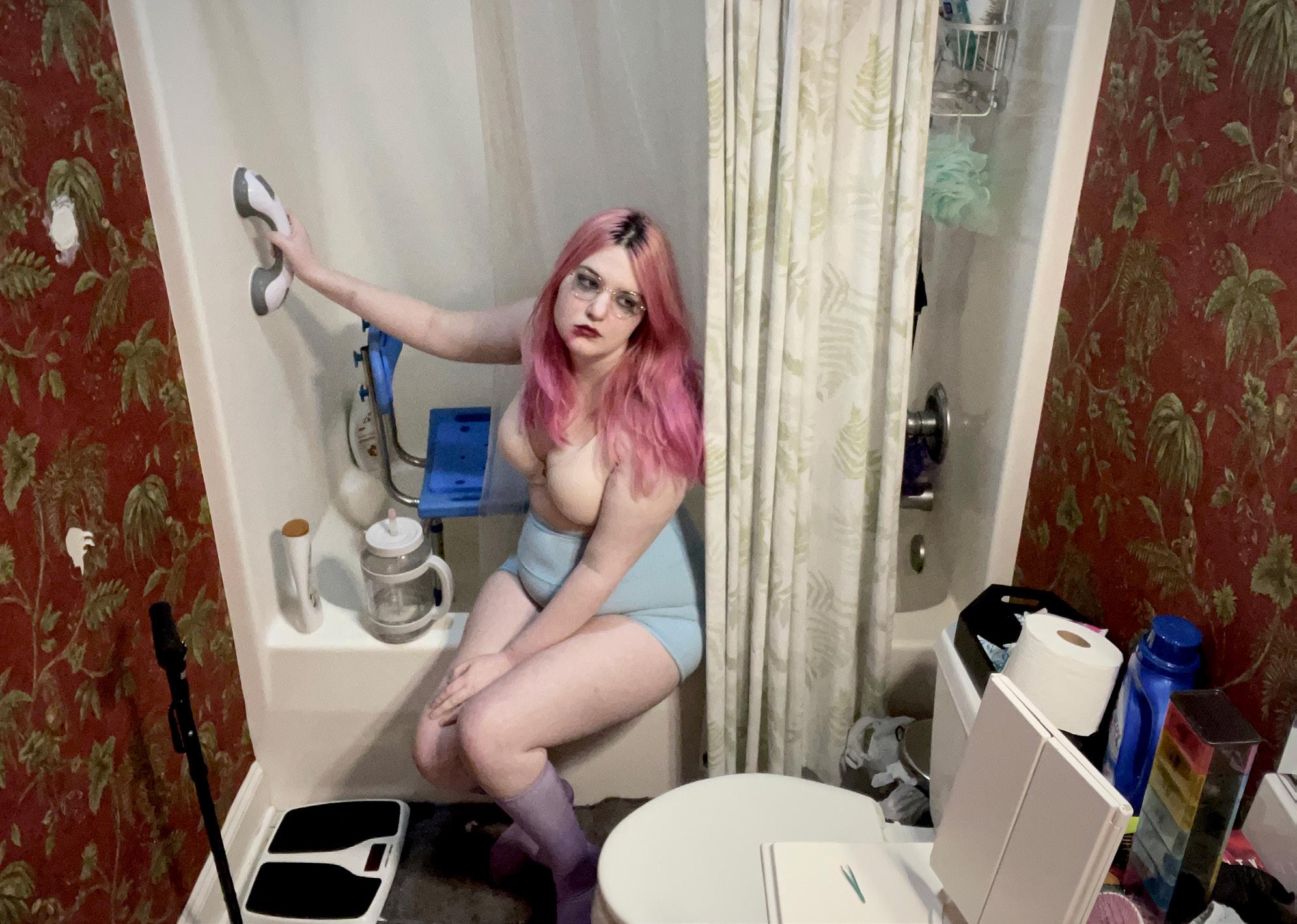
Fatigue - A Self Portrait
by Lily Mire
Photograph
This self portrait is meant to express the ongoing fatigue, frustration, and isolation of having to take care of my medically complex body; trying to maintain the image of a beautiful, put-together young woman. I sit on the edge of a tub, with long, tangled, pink hair, smudged makeup, and compression wear. Signs of my illness litter the bathroom: a cane, a shower chair, a scale, a weekly pill container, even the plastered-over hole in the wall from a nasty fall.
Man In The Mirror
by Erik West
I am a disabled man. I am a disabled transgender man. I am also, by a whim of nature much more unfortunate, something of an amateur philosopher. These three things don’t always play well together.
I think a lot about a lot of things. Due to my disability, mental and physical, as well as autism I hesitate to label as a disability, I cannot handle working a job and full-time sort-of-graduate school (a complex quirk of the Australian school system, in which it is possible to be in a program that requires a bachelor’s degree but does not count as graduate school) at the same time. This leaves me with a lot of time to think. One of the things I think about is the nature of what it means to be a man. I narrowed my scope early on to what it means for me to be a man — anyone else’s gender is not really any of my business, unless for some reason they ask for my opinion. Anyone else is whatever gender they tell me they are. And, unfortunately, I find I have built a schema for myself that I cannot live up to.
I discarded, early on, the idea that what it meant to be a man was to have a certain shape of genitals or a certain dominant sex hormone. That would have excluded me straight out. I understand, of course, the desire to work towards having that shape of genitals or dominant sex hormone (in fact, I share it, but it isn’t in the cards for me right now health-wise), but I cannot believe it is impossible to be a man without them. It became quite obvious to me that being a man is not an accident of birth. I considered the hypothesis of it being a nature of the shape of one’s brain, but it didn’t convince me. I then contemplated the idea of being a man being something about the shape of a person’s soul. I like this idea, actually. But for a man like me in the midst of another religious crisis — which is neither here nor there to the subject at hand — it seemed rather too foggy to be a definition I could work with. What is a soul? I’d give myself a migraine trying to answer that. So, I needed a more practical answer I could work with.
I came to the eventual conclusion that being a man is something you do. Here is the place I must reiterate that I apply these standards only to myself (yes, I’ve discussed the topic in therapy). I’d never question another person’s identity or masculinity. Only my own. With that being said, I decided for myself that masculinity was about being strong, being active. A man is able to protect the people in his life. A man helps his friends move. A man does things, often physically, for people.
I do not have a strong and active body. Almost a year ago, I was diagnosed with multiple sclerosis. For a long time before that, I had symptoms: weakness, poor balance, poor coordination, among others. Even before the development of MS symptoms, I suffered from hypermobility (no doctor seems certain whether or not I can be diagnosed with Ehlers-Danlos Syndrome), migraines, and general chronic pain. Before that, I was a clumsy and unathletic child, opposed on principle to most exercise. The one exception being my great love: fencing. I could write a whole separate piece on the way disability has taken fencing from me.
The point being, I have never fit the standard of masculinity I have constructed for myself. With my disability, I never will. And despite my frequent disclaimers I only apply this standard to myself, the same does not go for wider society. I did not construct this standard whole and entire; I did not come up with the idea that a man should be strong and physically capable and a protector. The only innovation I really made to the popular idea was to decide to me specifically rather than to men as a class, and to be gay and aroace [aromantic asexual] enough to decouple the standard from heterosexuality.
In other words, I’m rather set back in the search to find a way to be a man. My disability has forced me to develop a paradigm of manhood that my previous searching did not provide, and nor does society as a whole. Neither my concept of myself as a man nor society’s concept of a in general have space for a disabled man.
Perhaps a man can man can be clever (though that one a requirement). Perhaps a man can lose taken care of by those around us. I’ve written before on how disability forces us to rely on others; what I didn’t say was how it was a blow to my masculinity. Perhaps a man can be disabled. Perhaps a man can be what the heck he wants to be, or is forced by circumstances to be, and be no less a man for it. Perhaps there is no right way to be a man, and, as such, no wrong way.
These are the things I have to grapple with to exist inside a disabled, transgender body. It’s not societal bias alone that makes occupying such a body a challenge, though it certainly does not help. But what else is hard is having to grapple with how I take up the space I want to in the world despite my disability. No popular definition of identity includes the provision that those occupying that identity might be disabled. So we, as disabled people, are left to make definitions of identity for ourselves. It’s hard work, and it can feel thankless, but it’s worth doing. It makes moving through the world a whole lot easier, knowing who you are despite the way your body is not what you might want it to be.
Wound Down & Dragging Ground
by Amanda Bialy
fawn footsteps no matter how old joints like candy wrapper crunching as I jostle never glide, always guided by pain pardon me nothing to see, throw myself to the back of the crowd to blend into shadows that swirl around me
I let them and their people pass let them all pass by me so my hurt doesn’t hinder
a snail among women, my purse a shell to tell: daring you all to sprinkle me with salt covered in bruises like medals proof that I do not fit–a fish in the sky a bird choking on briny seas
I move through the world like a crumpled paper bag, holding what anyone wants
to give me never knowing the safety of floating, folding only to the escape of elevator dreams
gravity grappling with grudges–what have I done to you? I ask in a whisper to the ground after yet another fall the earth catching beneath me forcing me to to pray, to thank whomever it was that brought me here
this sick creator holds me hostage, trapped in a fleshy prison filled with rusty gears hidden beneath a half-decent paint job so I bite my nails in my sleep as time ticks, counting down to inevitable combustion.
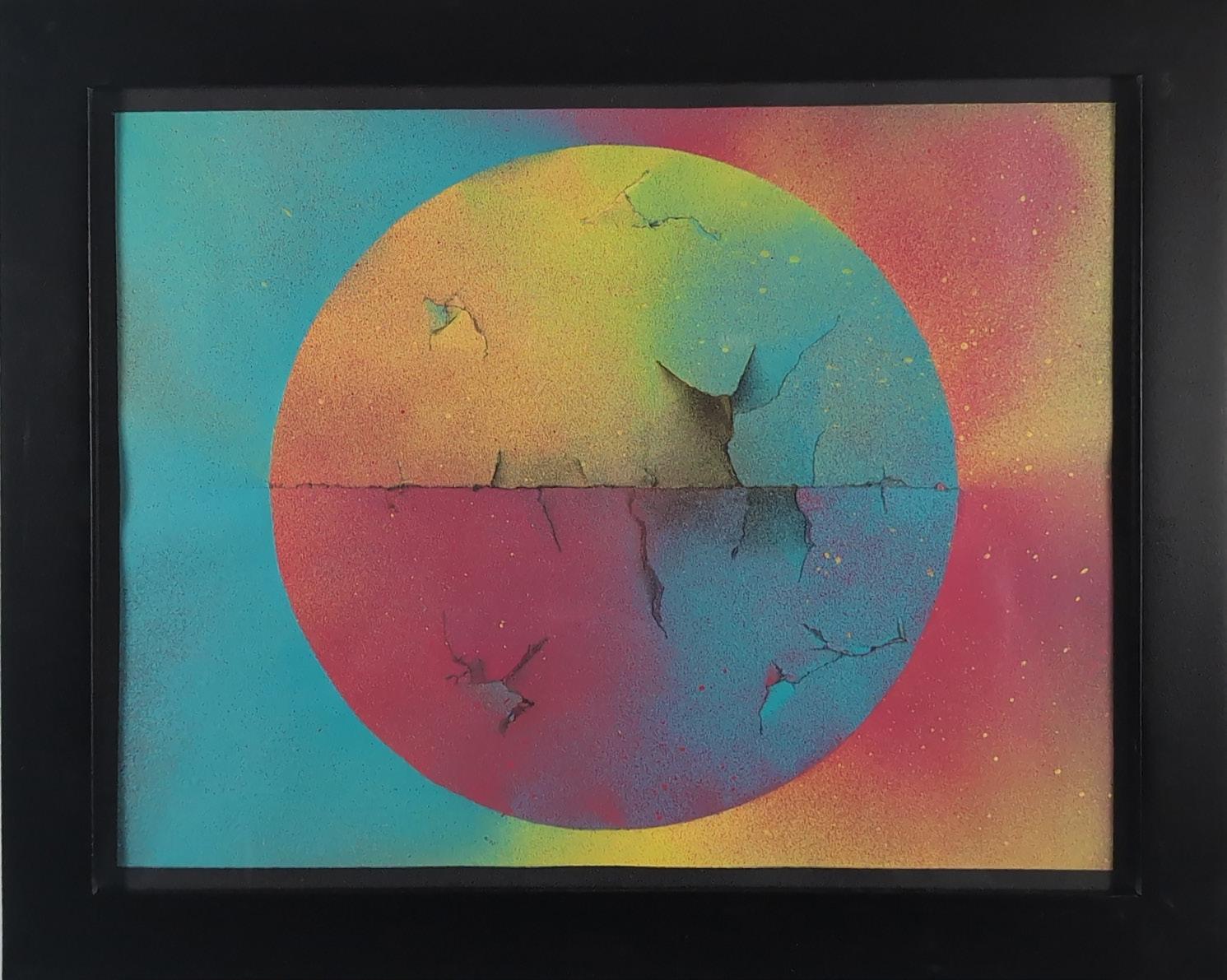
Migraine
by burnsbothends
Spray paint, paper
I formed the piece to make the sphere out of paper, then when I had a migraine attacked it in parallel with what I was feeling. I painted it after I recovered, and flattened all the damage back into place afterwards, illustrating the damage that would be left if the pain left its marks on me.
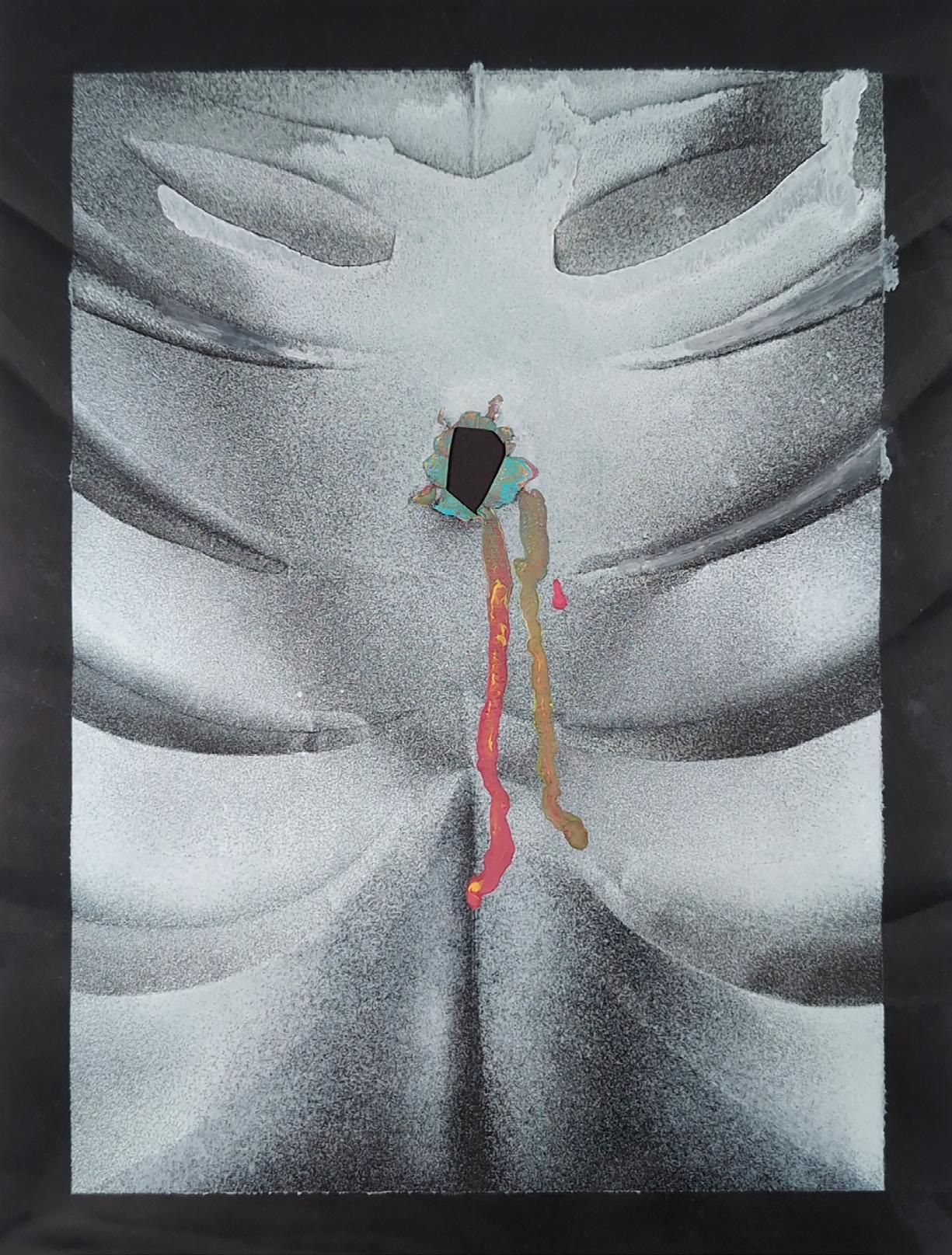
Anthrodynia
by burnsbothends
Spray paint, paper
Part of the way I make peace with my body and mind is through recognizing and accepting the way it feels when I am not doing well. This piece is how it feels when I am in the deepest depths of my depression — like there’s a literal hole in my chest and everything that was inside of me that was good has poured out.
Sustain The Snail
by Kate Rehurek
“I wish to believe that there will be a day when someone chooses to look at my face before my body.” I looked at the snail on my desk, wondering what in the world she could be referencing. “Pardon? I thought you were just going to eat your lettuce.” Pushing the tiny, green little morsel towards her, I was slow and careful with my own movements. “Here, eat. Don’t focus on any of that right now.”
“No, thank you. I’ll gain weight again if I do.”
I sighed. “I won’t force you to eat it, but it’s there if you want it.”
“I certainly don’t want to look the way I used to. It’s either showing weight gain, or the scars. Plus, it’ll hurt my stomach. It hurts if I eat, and it hurts if I don’t eat.”
“Basic nutrition’s important, Snail.”
The little snail gave me no reply as my eyes went back to the project I was working on. I’d recently started a new crochet project, and this one was a little plush bee. As my hands worked on the soft yarn, I slowly worked on the craft in silence next to the snail. She’d been on my windowsill, as I’d taken her out of the little home I’d made for her so that she could have dinner. Dinner was not satisfactory, apparently. It wasn’t even a motive or a thought to be had. Snail was an odd case today. She seemed almost bitter, like the lettuce wasn’t an option right now? The silence was deafening as she sat and looked out the window.
“Do you think I’ll ever be well enough to go out there again? Maybe I’ll get to eat something besides lettuce?”
I looked up from my crochet to her eyes. I was shocked to see tiny, tiny little droplets forming in her small, beady eyes as she looked out the window. Her eyes seemed to be on the one singular butterfly that was flapping near the bushes.
“But, if there’s other snails that want to hang out with me, and they only eat lettuce, that’s alright with me as well,” she stated quickly, shaking her little head, “It won’t matter, because I’ll be with my friends. At least, I’ll find someone who will want to be my friend. Or someone that will pretend to be my friend.”
I wasn’t sure how to respond to the creature who wanted a certain future in a time of her uncertain illnesses. She’d always been this way; a snail who was born different, not by her choice. I looked at the cracks in her amber shell, then to the scarring on her little face and body. So small, barely half the size of my pinky, yet so much of a soul and a tired heart inside of Snail.
“Right? There will be a ‘someone’ who understands that I have to go slow, and that I need time to do basic tasks.” Snail’s teared eyes looked at the lettuce once more, in a frustrated squint. “I mean, I can’t even get up on most days. I get scared; if I’m like this now, what will my body deteriorate to in a year? Two years? Three years? My shell can only stay together so long…”
“I understand. I will always help you,” I cut in; my eyes and face were turned to Snail’s.
“But…but…you won’t always be around. I can’t rely on a caretaker. You might leave me, or my
friends will leave me, and I’m going to be all alone.” Snail’s voice was barely over a whisper. “I can’t look in mirrors anymore. I’ve gained weight since my body’s trying to protect itself. Plus, nobody’s able to figure out why my shell keeps cracking and shaping into these weird scars. My doctors aren’t sure. Plus, people telling me to stand in front of those mirrors is so frustrating. Telling myself to love myself over and over in front of the mirror isn’t working.” Snail had gone on a rant, and the tears were back. I could see the rage forming from an inkling to a complete session. With one angry swipe of her head, she shoved the damp lettuce from the windowsill onto the desk.
Plat.
It was the slowest, quietest fit of rage I’d ever witnessed, but it was the last straw for her. In a gentle sigh, I picked up the miniscule leaf, setting it back next to Snail. “Your body’s betrayed you, I know. I don’t have the answers, and certainly can’t give you a definite answer on anything.” Snail looked like she was going to give a reply, but I raised a finger. “I don’t know if you’ll die early, like everyone’s expecting. I don’t know if you’ll always be in pain, feeling sick like this, and unable to communicate so to others. I don’t know what your body is doing, quite frankly, because every illness is different.”
Another sigh escaped me, this time with anxiety of trying to find the right words to say. “What I can tell you, Snail, is that you have to sustain yourself. Slow progress is still progress. There are other snails that may have a different type of situation, but the shattering experience of having your body as the enemy is something in common. Being forced to reframe your mindset absolutely sucks, and doesn’t feel fair, because it isn’t.”
Snail was now looking at me with such intensity I thought her black, beady eyes were going to pop. “So what do I do? What you’re saying is true, but it’s got nothing for me to act upon. I don’t even know where to start loving what I am. I’m not pretty to look at. I’m stared at so often, it hurts.”
“Who you are,” I corrected her, “You are a who. Who you are is not defined by what someone else says about you. Your body does not define your talents, your passions, your energy, your dreams, what you like to do on your weekends, or your passion projects. Starting with the fact that you don’t have to justify anything about the way you look is where it begins. You are allowed to just exist, Snail. Rather than forcing a fake love upon yourself, you are allowed to just sit in your existence, because you don’t have to fit a standard. The stress of being some sort of beauty standard, or meeting some expectation was never a battle that was required.”
Snail had no bitter rebuttal. She seemed to understand. “I can just sustain myself.”
“Sustain the Snail,” I responded, but with a soft smile on my face.
“Sustain the Snail,” she repeated, her little eyes going into a squint of calmness.
A light knocking on my door drew me from my thoughts. “Dear, are you talking to your snail again? Silly,” I heard the muffled voice of my mother through my bedroom door.
I blinked, shaking my head to myself. “Sorry, was I too loud? I was counting my rows,” I replied, shifting my hands over my crochet, standing to answer the door. I looked at the wooden door that was shut between us.
“Can you make sure you call the doctor back for your follow-up? Also, your med refills for this week. I don’t know if they went through, so I need you to check on that. They left a…”
As my mother’s voice became a drowning to-do list, and I could hear the letters jumble together, I turned back to the desk. Snail was gone from the windowsill.
Sustain the Snail.
Maybe just allowing myself to breathe and take in what advice I’d given was something I needed to do, too. I am a who; I am a collection of stories, passions, and habits of everyone I have ever met. I am a mosaic, a slow-collecting narrative of everyone I have ever loved. That makes me something to be loved.
And you are, too.
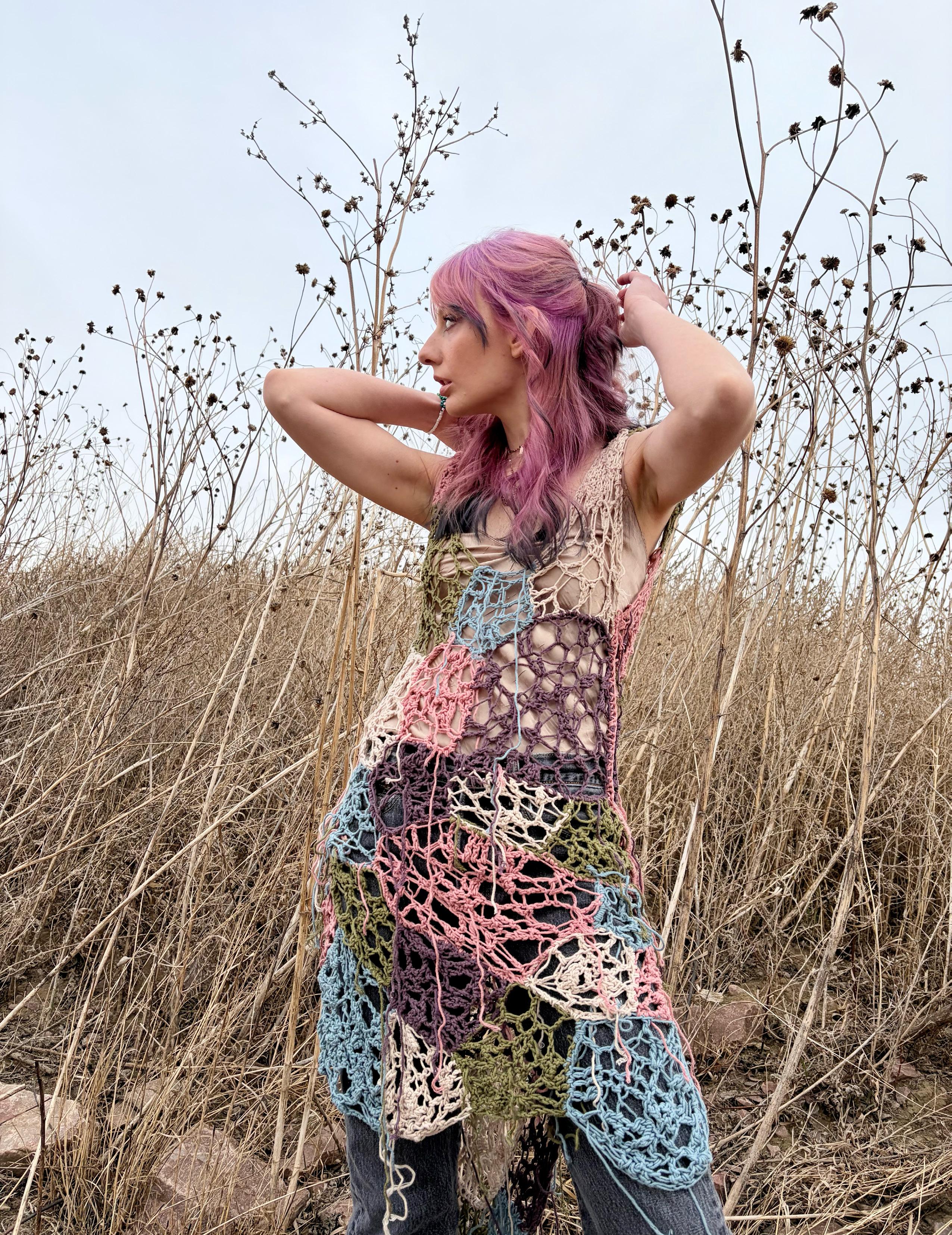
Crochet dress image/Cotton-bamboo blend yarn
For this project, I designed a crochet dress and wrote a companion poem that explores the beauty I look for in my fragility. I chose freehand distressed stitches and loose ends to represent the complex vulnerability I feel. The poem is an insight into finding strength among heavy thoughts and pain. Together, I wanted them to illustrate the juxtaposition of the love and fear I carry within my body while being chronically ill.
Revive by Simon Collinson
“They found him wandering in some field,” they said.
“He’s brain damaged,” they said.
“He’s artistic,” they said.
People say a lot about you when you suffer with mental health issues. It’s like you’re not there. Inside, I was broken.
Having a nervous breakdown, losing my job and my career wasn’t in the plans for my life. To be considered a failure came as a complete shock, I never thought it would happen to me. They say someone with depression has a prejudice against themselves. That was true, for I hated and despised myself. In the lonely hours before dawn, pacing the floor, I faced the darkest abyss and the worst ideas would go through my head. The worst. In that state, I wasn’t much use to anybody. For years, I hid away; became a shell of what I once was. A hollowed half-life really. You’re not dead, but you’re not really living.
Slowly, I emerged to engage with the world. But it’s never the same. It’s as though everything is disjointed and jagged. Then one day, my name came up for a plot at the local allotment. I thought I’d give it a go. The sight that confronted me was a ramshackle plot that was overgrown with grass and weeds, rubbish strewn everywhere. In that first year, I set to work clearing away the rubbish and getting rid of weeds. There was lots of digging. My back ached.
But I kept at it, and month by month saw the improvements in the garden, allowing me to plant seeds in some areas. Over the spring and summer, I could watch them grow.
I got a thrill seeing stuff grow that I’d planted and looked after with my own hands. And then an even bigger thrill of picking the crops and fruits to take home. They tasted lovely and fresh. There was the joy of searching the soil for potatoes, like finding buried treasure.
Even winter had its consolations, where you could be busy tidying the plot up and planning for next year. My mind was thinking of the improvements I could make. I was thinking less of the awful things in the past. The flashbacks receded.
I could see changes in me, too. Bit by bit I was emerging from my shell to venture out. I was talking to people, getting to know their names, getting a sun tan, and muscles. I felt much
healthier. My sleep was better, no longer tormented by doubts and fears. With each swing of the spade, I was climbing a little more out of the darkness I had fallen into. Slowly, the shadows and shade that dominated my life made way for a bit more light.
Some crops didn’t turn out, but I learned to cope with all that. I learned that with nature, there is only so much you can do to change things; sometimes you just have to get on with it. Change what you can, learn to accept the things you cannot. Nature is so much bigger than all of us. But in the end, it’s going to be mainly alright.
I found I was getting interested in the wildlife that moved all around me. I loved to see the butterflies and bees flying around me. It was like an affirmation that I was alive. It was like I was coming back to life.
I noticed other changes. My body clock was changing. No longer fixed to 9-5 Monday to Friday, but moving to a different rhythm. More relaxed, in tune with the weather. I was becoming less anxious. I was having fewer explosions in my head, fewer dizzy spells; each day I hated myself a little less.
Most of all, I was fascinated by compost. This stuff I found almost magical; you could pile all your unwanted cuttings and clipping, add it to paper and cardboard, and put it in a box, and in a few months it would turn into a warm, crumbly, black material that the land loved and would enhance the fertility and growth of your plot. I found that those irritating leaves that clogged my garden in autumn could be used to make more compost. And as more soil was improved with the compost, I saw improvements in the yields of my plots. More peas, beans, potatoes, onions, rhubarb, broccoli, lettuce, and strawberries to take home.
If I had a bad day, I knew I could go to the plot and work out my frustrations on digging the weeds out. In my head I called it worrying the weeds; worry the weeds every day and every day I would worry and stress less. My garden would be better having fewer weeds, and my mental health and heart would benefit too.
I loved to get in the plot and get amongst the bushes to be touching my crops, and loved getting my hands dirty. Here was a space of tranquillity away from the noise and pressures of the world, here I could breathe, think and relax. I felt a pride I had not known for a long time. Bit by bit as my plot grew and flourished, I was growing too.
Eventually, there came a time when I was stronger, that new doors opened and I had to make a choice to stay or leave. I realised that in gardening, you couldn’t be half in half out, you had to be completely focused on the land. I couldn’t do that anymore. Something else was calling me, something far stronger I felt I had to do. I wanted to be a writer.
As I left the plot for the last time, I was no longer a broken man. I was in a much better place. Gardening had healed a lot of the hurt that had been inside me. I walked out confident that I’d learned to accept myself and knew that I wasn’t a failure. I had over the years restored a neglected plot to fertility, and the plot had helped restore my mental health.
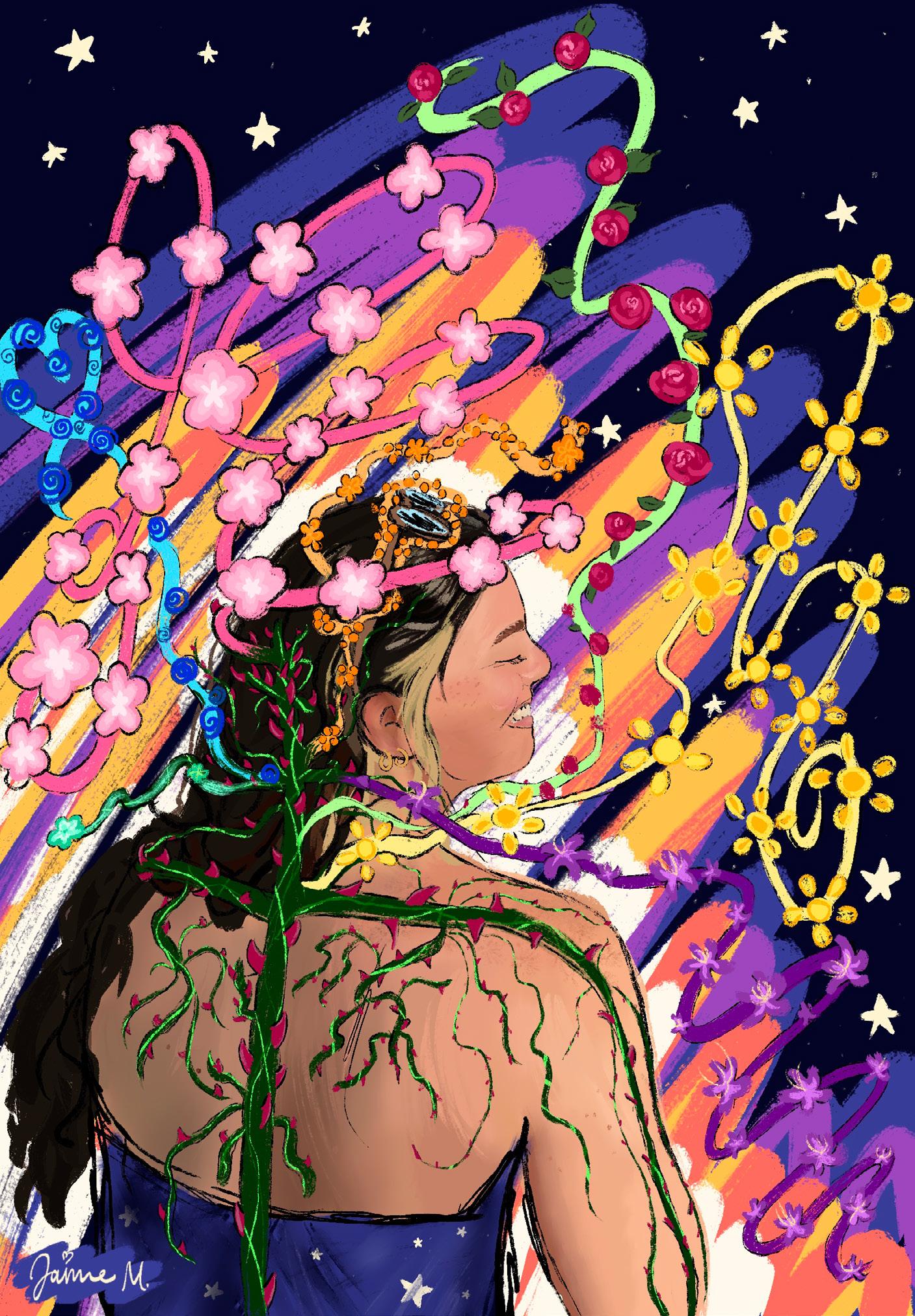
The Thorns May Stay On My Roots, But They No Longer Surround Me
by Jaime M
Digital painting
In this work, I wanted to show where my pain was, and even in some ways how it feels. From the thorns on my neck and back to show you the pain, to the flowers surrounding my glasses because I no longer hide from the sun (literally due to light sensitivity, and metaphorically due to the attention of chronic pain). I hope you feel beauty in this work, and also feel the strength and love it took to get here.
Aware by Kate
I am very aware of my body. I didn’t used to be. Chronic pain makes you aware of the space you take up. Aware of how you fit into the world around you. Aware of how every little detail of a situation is going to impact your body for the next 24 hours (or longer). Aware of the consequences of your own actions. Aware of taking those actions anyway.
I love gardening. My friends like to make jokes about me working on my “farm” (a flower garden and a small plot of vegetables every summer) and we laugh as I show off everything I have grown, proud of what I did with the body I have. The part I don’t burden them with is how every single tomato I pull off the vine took hours of physical labor over the course of weeks that left me exhausted and in pain. I crawl into bed, bordering on tears, with pain radiating across my body, trying to remind myself how delicious that tomato is going to be when it’s done growing and how much I love the feeling of digging my now-aching fingers into the dirt. It’s a constant give-and-take situation. I borrow the energy and movement to accomplish my goal, but it creeps up to take its revenge later.
I love going to concerts. I’ve been a huge metal fan my entire life, and going to a few concerts every year is my favorite kind of special event. I save up money for my ticket, I plan a special outfit, I listen to the band’s discography for weeks before the concert in anticipation. My best friend comes with me, and we pre-plan the night in advance. It always starts with Wawa hoagies and tailgating in the parking lot, a beloved tradition (and a chance to rest my body in the car before the show). We get through security and find our seats (climbing so many steps I feel like my knees are going to snap). We sit and take everything in (I start thinking about how my neck is going to hurt from the angle we’re at, my knees are painfully bumping the seat in front of me, my lower back is already radiating from the uncomfortable seat). I’m in above-typical pain before the opener even takes the stage, but I try to keep the energy up for my friend so she doesn’t have to worry about me. If I tell her something is wrong, she’ll try to help or find some solutions, but all I hear is that I’m bringing the excitement down and taking away from the experience. The bands play and I have a great time, trying my best to ignore the strained pleas coming from my joints. We join the sea of people walking out of the venue, and I’m being bumped and banged every couple seconds by another person. It feels like someone is pouring lava through my body; slow-moving and hot and radiant and nearly takes my breath away. I’m no longer thinking about the joy I felt moments ago watching the show.
I love spending time with my nieces. I have no desire for kids of my own, but my brother’s kids are a joy in my life I never saw coming. We live 2 states apart, but we coordinate at least once a month to all get together. I force myself to rest the few days leading up to these gatherings, knowing the older niece’s favorite game is “wrestling” (aka being picked up and carefully thrown around the furniture). She’s only 4 years old, but her tiny body is deceptively heavy. I spend hours carrying her around, tossing her onto the sofa, chasing her around the backyard, and any other game she asks me to play. I spend this time thinking about how easily she moves, how quickly she recovers from a fall, how her energy never dwindles. I smile, I laugh, I hide the wince when she jumps on me without warning in a way that sends an electric volt down my spine. My younger niece is just over a year old and slightly less demanding than her sister. She sits on my lap and asks me to read to her. I trip over the words as I breathe through the throbbing in my leg from how she is sitting on me, refusing to readjust her and disrupt her comfort. I spend my drive home remembering how much fun I had, thoughts occasionally disrupted by my body sharing its grievances about my actions earlier in the day.
In my body, every single action has a consequence. Every single thing I do comes after bargaining, begging, compromising, agreeing to pain I do not deserve, and accepting that punishment anyway. I am very aware of my body every minute of the day, and I really wish I wasn’t.
A Good Day
by Celeste Finelli
Oil painting
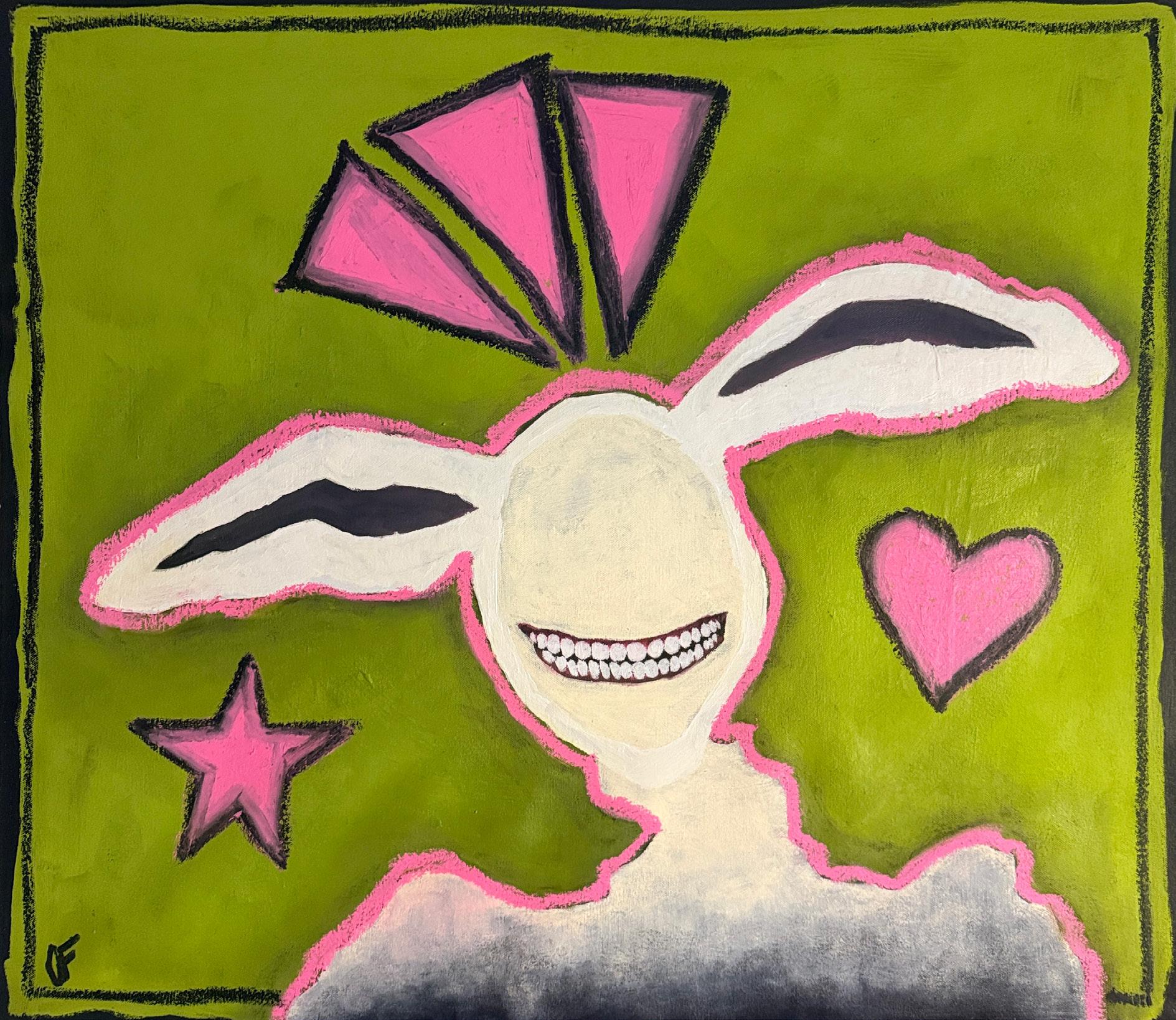
I struggle with being the perfect human, the perfect wife, the perfect friend. And sometimes, I just slap on a smile and call it a “Good Day.”
Riot Grrl
by Brittany Redd
My left knee is a rebel. She buckles when I want her to stand tall; remains taut when I want her to bend. She wants to run. She wants to rest. She cannot make up her mind. I think about all that connects her mind to my own: the fascia, sinew, arteries, capillaries, and veins. I wonder how much of that contrarian spirit bleeds into the rest of me. A part of me wants to crush her resolve, show her who’s boss, bend her to my will. But she is a part of me, too.
What’s For Dinner?
by Denise Schnieders
There was a night not long ago when dinner defeated me.
It was supposed to be simple. Polish sausage. Sauerkraut. Mashed potatoes. One of those dinners that comes together easily after a long day. Comfort food. The kind you can practically cook on autopilot.
The potatoes were already boiling. The sausage was browning in the pan. All that was left was the sauerkraut.
I grabbed the jar and twisted the lid.
Nothing.
I tried again, tighter grip this time. Then the trick where you tap the lid on the counter. Then the dish towel method. Then the “use your whole body weight and pretend you’re opening a pickle jar from hell” method.
Nothing.
I stood there, staring at that stupid jar like it had personally betrayed me.
There was a time when I could hit a softball over a fence. When I could throw batting practice for hours. When I coached a 7A state championship team and spent whole weekends on my feet in the Georgia heat yelling from a dugout and loving every second of it.
And now, I was losing a fight with sauerkraut.
The anger came fast. Not dramatic. Not loud. Just that hot frustration that creeps up your neck and settles behind your eyes.
Because the thing about MS is that it steals in the most ridiculous ways.
Not all at once. Not with some big cinematic moment. It takes jars. It takes grip strength.
It takes the quiet confidence that when something needs to be done, you’ll just do it.
My husband was at volleyball practice. The practice I should have been at. The gym where I usually am; watching, helping, living in the rhythm of whistles and squeaking shoes.
But that day I was too tired.
MS tired.
The kind of tired that doesn’t care how strong you used to be.
For a second, I thought about calling him. Just asking him to swing by the house and open the jar. It would have taken him two seconds.
But I didn’t.
Because, for most of my life, I have been the one who fixes things. The one who figures it out. The one who doesn’t need rescuing.
He fell in love with a ridiculously independent athlete. And lately, this is what he comes home to.
Sausage.
Mashed potatoes.
No sauerkraut.
And a wife already in bed before he even walks through the door.
That night I climbed into bed earlier than usual, defeated in a way that had nothing to do with dinner.
But somewhere between the frustration and the quiet of the house, something softer settled in too.
A kind of reluctant tenderness toward this body of mine.
Because the truth is, this body still showed up that day. It taught a classroom full of kids. It got through the grocery store. It cooked most of the meal. It carried me through another ordinary Tuesday.
It just couldn’t open the jar.
And maybe acceptance, at least for now, looks like mashed potatoes and sausage for dinner.
This Body
by Rhynn
Micron pen, sharpie, digital media (text)
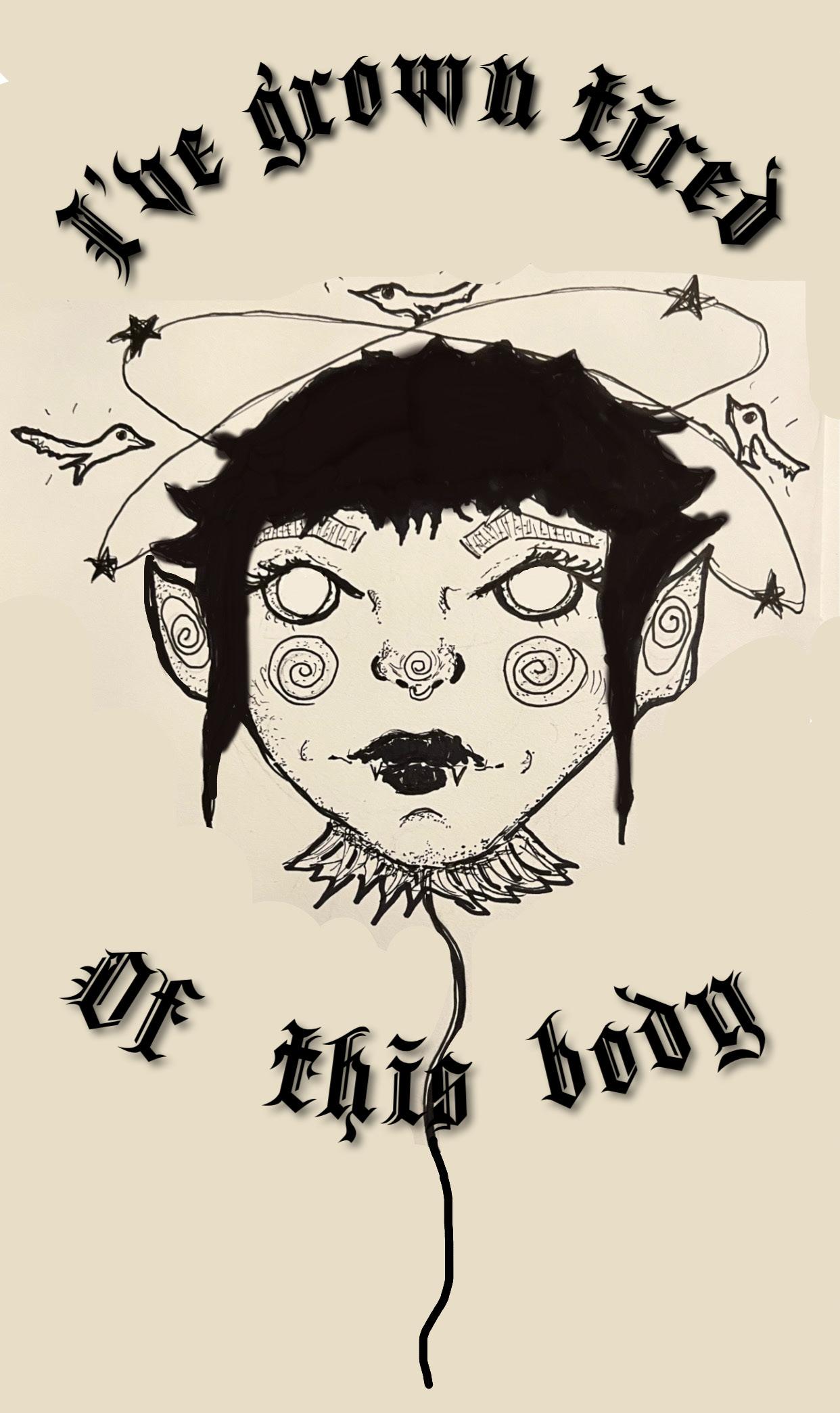
This work is about feeling disconnected from one’s body, having no autonomy physically over it. It is its own separate entity; sick, unforgiving, unpredictable, and at times useless. Unlike myself. (Inspired by my life and lyrics from “This Body” by Mother Mother)
Sick At 25 by Girl Venom
These are the lyrics to my song “Sick At 25”, which initially started out as a poem. I wrote it about struggling to cope with chronic illness, especially as a young woman. Over the past year, I’ve been diagnosed with additional conditions, including intracranial hypertension, which was treated with both brain and spinal surgery. Having major surgeries at such a young age really impacted my views on life/death and who I want to be as a person. I’m often the youngest person at my specialist’s office. I grew up chronically ill, but didn’t start identifying as disabled until my 20s, when I lost my ability to hold a full time job and my quality of life declined drastically. Becoming sick/disabled is a visceral, intense, and life changing experience.
On top of that, my conditions are considered “invisible illnesses” which makes it hard for me to be taken seriously in the medical community. I’ve experienced medical gaslighting and been denied care, all while experiencing excruciating pain and debilitating symptoms. I threw myself into my art as a way to process my pain and ended up writing 3 entire albums in the process. “Sick At 25” is out now on my album Undead & Unsaid. Music available on Spotify, Apple Music, Amazon Music, YouTube, Bandcamp, and Soundcloud.
Want to listen to Girl Venom?
Scan the QR code to find her on Spotify
Sew me up with a needle and thread
I don’t feel alive, but I don’t feel dead
I never thought I’d be sick at 25
I wish I was untouched by sickness and disease
I wish I could commandeer my body with ease
I never thought I’d be sick at 25
The kind of sick where you don’t live, you just survive
Sew me up with a needle and thread
I don’t feel alive, but I don’t feel dead
I never thought I’d be sick at 25
I never thought I’d be sick at 25
The kind of sick where you don’t live, you just survive
Sew me up with a needle and thread
I don’t feel alive, but I don’t feel dead
I never thought I’d be sick at 25
Still Here
by Samantha Starr
Post-Concussion Syndrome is a clinical term. It sounds neat. Contained. Almost manageable. In reality, it feels like living inside an undertow that no one else can see. I am sixteen years old, and my brain and I are still learning how to trust each other.
There have been countless hospital rooms, white walls, bright lights, humming machines making piercing loud noises, the quiet shuffle of papers between doctors who speak in careful sentences. My mom sits beside me, my head resting on her shoulder. My dad asks questions I’m too tired to form. I watch their faces when the doctors articulate unclear answers. I see the flicker of frustration my dad tries to swallow. I feel it too. Not sharp and loud, but heavy. Like a weight pressing down on all of us at once.
I’ve always been good with words. I’ve always known how to express myself and say what I mean. But after my most recent concussion, communication felt like a bridge that had collapsed. I would reach for a sentence and find nothing. I struggled to speak, to read, to remember things, and even simple actions like walking in a straight line or eating felt like something I had to relearn. It was as if someone had snuck in and quietly rearranged the wiring in my brain, and I was left searching for the light switch in the dark.
The headaches are not just pain. They suffocate. They eclipse. When they come, I can’t open my
eyes. I can’t move. I lie still, trapped inside my own mind. My body exists, but I cannot participate in it. It feels like being paralyzed in a room that is entirely my own mind. And yet, when I stand up and smile, I look fine.
That is the strangest part. If someone breaks a leg, the injury announces itself. Crutches. A cast. Something visible. My injury is silent. It hides under skin and bone.
Someone asks, “How are you?” and I say, “I’m fine,” because explaining feels impossible. There are no visible cracks. Just me, carrying something invisible.
People tell me they understand concussions. They talk about a week of rest in a dark room. About sitting out for a game or two. But this is different. This lingers. This reshapes you. I don’t know anyone my age who has lived inside this kind of uncertainty for this long. I have been made fun of for something I didn’t choose. I have worried about falling behind (academically, athletically, socially) as if life were a race I could hear continuing without me.
Sports have always been the rhythm of my life. My room is lined with posters of players. When I’m bored, I watch highlights. When I eat, I rewatch games. In the evenings, I fall asleep to the sound of commentators’ voices. Sports isn’t just something I do; it’s something I am. And now, I can’t play.
Some days, I can’t even watch. Hockey, the sport that feels like home, has become painful. The ice is too bright, too white. It burns behind my eyes. There is something almost cruel about loving something so deeply and having it hurt you simply by looking at it.
I have also noticed the way I cling to certainty. I rewatch the same shows. Reread the same books. I avoid new movies and new stories because I don’t know how they end. I think that’s the point. When you know the ending, there is peace. No anticipation. No bracing yourself for what might happen. In my own life, there is no ending written yet. No timeline for healing. Just the quiet and persistent question: When will this part be over?
That question has followed me into every appointment, every MRI, every concussion specialist’s office. There are so many tests. So many theories. And still, so many unknowns. The brain is a mystery, even to the people who study it. I have had to learn to sit inside that mystery without letting it eat me alive.
There were long stretches when sadness settled into everything. I woke up exhausted, already drained before the day even began. Most mornings, the only goal I could hold onto was simple: just make it back to bed. Just get through the hours. Just endure until
I could lie down again in the quiet. I cried often; sometimes from pain, sometimes from a heaviness I couldn’t explain. That was the hardest part, knowing no one could truly feel or understand what was happening inside my mind. People could listen, they could care, but the experience itself belonged only to me. It wasn’t a loud kind of breaking. It was gradual. Private. A slow wearing down of energy, certainty, and hope that I had to face by myself.
There have been nights when frustration spills over into tears. When I am nothing but angry at my body for failing me. When I want to scream because I am trying so hard to rest, to recover, to stay hopeful, and it still isn’t enough. The disconnect between my brain and my mouth feels like betrayal. I know who I am. I know what I am capable of. But sometimes, my body does not cooperate with that version of me. And yet, in the middle of all that frustration, there have been moments of tenderness.
Tenderness is my dad dimming the lights without me asking. It is my mom driving me to another appointment, even when the answers remain uncertain. It is learning to forgive my body instead of fighting it. Realizing that it is not betraying me; it is hurt, it is injured. It is trying.
I have had to become gentler with myself. To say no. To rest without guilt. To leave practices early. To put my health before my pride and ambition. I have learned to advocate for myself in rooms full of adults. I have learned that strength does not always look like pushing through pain. Sometimes it looks like lying in a dark room and allowing yourself to heal. People say, “Everything happens for a reason.” Some days, that sentence feels hollow. But I do know this: I am not the same person I was before.
I notice the little things now. A clear-headed afternoon feels like a gift. A pain-free morning feels like possibility. I am more reflective. More grateful. Kinder, not just to others, but to myself. I think differently. I measure success differently. I have learned that perseverance is not loud. It is quiet. It is waking up and trying again.
I still don’t know how this ends. That uncertainty used to terrify me. Now, I am learning to live inside it. My body and I are still negotiating. Still rebuilding trust. Still figuring out how to move forward together.
I am sixteen, and I have learned that sometimes the greatest strength is invisible. It does not show up in trophies or scoreboards. It shows up in endurance. In patience. In the quiet decision to keep going. And I have hope.
Even on the days when I cannot watch the game, I am still here.
Healing. Enduring. Becoming.
Features
A collection of projects created by members of the chronic illness community
Your Friendly Ghost
by Kate Kirby
Recently I collaborated with Not Just a Patch to create some designs for their products. The over-patches are primarily for people with diabetes who want some extra coverage for their medical devices so they don’t come off as easily.
When thinking about what designs I wanted to create I was considering what would be both fun and meaningful for me. The little diabetic ghosts came to mind first. I’ve been making ghost illustrations showcasing what it’s like to live with diabetes for a few years now. I never thought too deeply about what the ghosts mean to me. They were always just a fun character that got to represent what I was going through. Something that comes up for me a lot in living with diabetes in the invisibility of it all. The carb counting, the constant predicting of blood sugar, the emotional and mental burden, and so much more is all mostly invisible. Ironic that my diabetes character is a ghost! I like to think that this representation makes the invisible visible. It shines a light on what we all experience but what we might not talk about. I think we all have a little diabetic ghost that follows us around and carries all the struggles, loneliness, anger, and frustration of living with diabetes. But we all have one and that’s how we know we’re not alone. So all that to say, I made a patch with a bunch of diabetic ghosts together :)
Check out the collection here
*All images in this spread were found in the public domain
Exhibit
How the most famous artists in the world used their chronic illness to define art history...
Animals in the Sky, 1819.
Keith Haring was a pop artist known for his bold lines, vibrant colors, and animated style. He also explored social issues through his work such as the HIV/AIDS epidemic, anti-apartheid, drug addiction, and nuclear disarmament. In 1988 at the age 30 he was diagnosed with AIDS, and died two years later. His energetic art had a lasting social impact as his art promoted vital conversations and awareness about HIV/ AIDS at a time where public discourse remained silent and riddled with stigma.
“The lines I draw are an expression of my innermost feelings.”
Christina’s World
Andrew Wyeth, 1948
“Although I do have the ability to walk, unlike the subject in the painting, I am limited, and having to cross a big field to get somewhere is daunting and difficult. I also often feel like I am marooned on the outside of safety and stabilitywhat the house could represent - and always will be, never able to reach it.”
Nighthawks
Edward Hopper, 1942
“This painting is intimate, but also evokes a feeling of isolation. It brings me comfort; there’s a warmth and familiarity that I feel, almost nostalgia. I’m in on the quiet conversation that’s being had.”
Camille Monet on Her Deathbed Claude Monet, 1879
“Seeing this painting in person made me weep. I could feel Monet’s profound grief at the death of his wife and I felt my own grief at various losses when looking at it. It is a beautiful way to say goodbye and grieve someone you truly loved.”
The Snail (L’Escargot)
Henri Matisse, 1953
We asked contributors to share artwork that resonates with them.
“This piece was created near the end of his life, when poor health prevented him from painting, prompting him to “draw with scissors.” In poor health, he still found a voice to have in the world, and that gives such inspiration to my work, that despite my circumstances, I too am allowed to have a voice.”
Georgina
I am an aspiring author living in Bristol. I have been navigating life with chronic illnesses for the last five years. I am a climber and an avid reader (and hoarder of books). I have also rekindled my love of arts and crafts, predominantly knitting and crochet, some of my favourite past times when I am confined to my flat.
Lois Ann Dort (she/her)
Lois Ann Dort started a career in journalism in Bangkok, Thailand, keeping body and soul together for over 25 years by the power of the pen. She’s a former coordinator of the Bangkok Women Writers Group, mother of two, educator, explorer, and scientist. She currently resides in her hometown of Guysborough, Nova Scotia.
Dana Hangle (she/her)
Hello! I live in Canada on the unceded territory of the St’at’imc people. My disability falls under the category of “chronic neurodegenerative disease”; I am in constant pain. As with many people, I find writing incredibly therapeutic.
Lexie Collins (any pronouns)
Lexie Collins is an artist with many hobbies and loves to explore artistically. Based out of Indiana, they can be found switching between painting, sculpting, fashion, photography, poetry, and other avenues often.
Heather Evans (she/her)
@heatherevansmusic
Heather Evans is an award winning singer/ songwriter who has had music featured on Netflix, HULU, NBC, ABC, Disney+ and more. She is not shy about using her platform to raise awareness and start conversations about the impact of chronic illness, and writes music that is geared toward healing the soul.
Ally Meisner
IG & TikTok @socialwork.ally
Hi! I’m Ally Meisner, a second-year graduate student studying trauma social work! Living with multiple chronic illnesses myself, it has become my mission to raise awareness and fight for this community!
Callie Badorrek (she/her)
@monsterhollowstudios
Callie Badorrek is an artist and writer living in Maryland with her grumble of pugs and her partner Chris. She has been a professional ceramic artist for many years, recently focusing on painted works on clay. Callie is a writer too; her works often explore personal trauma and growth, living in a larger body, and the impact of chronic illness on her life.
Emma Maravetz Bohman
Emma Maravetz Bohman is a multidisciplinary artist with a specialized interest in digital collage. She uses color, opacity, and scale to emphasize the emotions within her pieces. Maravetz Bohman’s work explores visual textures, the coexistence between shapes and text, and the harmony of literal and figurative imagery.
Alycia Corpiel (she/her)
IG: @alyciatakesindy
Alycia is a disabled author, artist, and disability justice activist in Indianapolis, IN. Her main disability is severe Myalgic Encephalomyelitis with comorbidities. Alycia is able to cope through her art and sharing awareness of her struggles.
MC Gilmore
MC Gilmore is an amateur writer in Ohio living with hEDS, dysautonomia, fibromyalgia, interstitial cystitis, and CPTSD. After beginning her artistic journey as a conceptual photographer over ten years ago, her conditions have increasingly limited her abilities to pick up a camera, but she is determined to persevere in her search for creative joy. Her written work is influenced by her chronic conditions and trauma, and the attempt to find freedom within them.
Samantha Erickson
A 30-year-old Surgical Technologist forced to stop working after a long and ongoing battle with chronic illness. I live with Hypermobile Ehlers-Danlos Syndrome, Dysautonomia, Cervical Instability, and COPA Syndrome.
Maria Rising (she/her)
TikTok: @tirzepatidetale and @therisingproject, Youtube: @thehorseproject
Maria is a writer, educator, and stroke survivor whose work sits at the intersection of embodiment and healthcare. She helps people make meaning of their bodies and experiences through reflection, education, and care, and spends her time riding horses, tending plants, and being outdoors.
Miko
I have multiple mental and physical health issues, but I mainly write about Morning Glory Syndrome because I can’t ever escape it unless I close my eyes. I’m 16 and write hoping to inspire other young artists with disabilities and chronic illness to do the same, and also to help others learn to cope like I have had to learn.
Lily Mire (she/her)
TikTok: @sicklynsapphic
IG: @lilliesinthewilde
I am a 22 year old, queer, disabled artist, photographer, and writer from Louisiana. I have been disabled and chronically ill my whole life, primarily affected by my HEDS, POTS, autism, and ADHD.
jelliebabiesart (they/them)
IG: @jelliebabiesart, TikTok: @jelliebabiesart_
Jelliebabiesart is a colourful universe centred around portraiture and nature. Recent works focus on the emotional and physical complexities of living with endometriosis. Art was once practice, now it is therapy.
Georgia Knox (she/her)
@gknox_
I’m a creative living in Naarm/Melbourne. I like to explore the concepts of place, absurdism, chips, disability, and in particular, the intersection of all four. I’ve recently had fiction published in Patter, Babyteeth Journal, and COPE Magazine. Previous work also includes a roving children’s story for the City of Perth, several plays, and touring in the UK as a children’s performer.
Jane Gold
@itstherealsjg
Jane is a former gifted child and theatre actor now living in LA, working as a writer and filmmaker. Her drama script THE MIDNIGHT ZONE was a second rounder at the 2025 Austin Film Festival. She loves thrifted artwork and long walks to anywhere.
Alex Pellerin (she/her)
IG: @alexpellerin_
Alex Pellerin (she/her) is a writer from New England. She holds a degree in Creative Writing and English, and primarily writes poetry and fiction. She is currently working on her first poetry collection.
burnsbothends (they/them)
Tumblr and IG: @burnsbothends
burnsbothends is a self-taught artist and craftsperson who has spent much of their life casually making creative works, whether through origami, bookbinding, traditional crafts, photography, or woodworking. They have combined their lifelong origami hobby with an understanding of painting informed by their education in print media to create works that play with the definition of the term “painting.”
Kade Bliss (he/they)
IG, TikTok, Youtube: @serenityrenegade
Kade Bliss is a trans artist based out of Salt Lake City, Utah. Kade works in multiple mediums, including ink drawing, photography, writing, and painting. His artwork explores themes of grief, abuse, death, love, religion and spirituality, and the relationship between humanity and the natural world.
Madeline Maioho (she/her)
@Madelinemaioho
Madeline Maioho is a writer and MSW student who draws inspiration from personal growth, resilience, and human connection. Her work explores themes of healing, identity, and the transformative power of empathy in everyday life. Through her studies and creative expression, she aims to highlight the importance of understanding, compassion, and shared experience in both personal and professional spaces.
Robin Allen (she/her)
IG and TikTok: @rainbowtrix5
I have hypermobile Ehlers-Danlos Syndrome as well as many of the comorbidities that come with it. Chronic illness comes with a lot of grief, whether that be grieving the person you once were, or the future you thought you’d have. I use art as a way to cope with my grief and I hope that it helps someone else going through the same thing feel seen.
Rachel Warden (she/they)
Rachel Warden is an American multidisciplinary artist living in Antwerp, Belgium. Hailing from the Pacific Northwest, she carries her love of storytelling and magical realism into her writing across the world.
Erik West (he/him)
Erik West is an Australian-American Classics student living and studying in Tasmania. He hopes one day to be a professor. TikTok: @finalboyerik
Miriam Saperstein (they/them)
IG: @bitter_water_babe
Miriam Saperstein mourns alongside rivers, and collaborates with disabled humans and other ecological beings to create accessible art rituals. Their work has been exhibited at Waterway Arts and Black Mountain College Museum + Art Center, and is published or forthcoming in The Encyclopedia of Radical Helping (Thick Press), Upstream, and Blue Bag Press. Find them online at miriamsaperstein.com
Gardner Mounce (he/him)
@gardner_mounce
Gardner is a self-taught photographer, writer, and visual artist living in Memphis, Tennessee with his wife and pets. His photographic process involves flashes, colored gels, high-powered laser pointers, UV lighting, full spectrum photography, and LED flashlights. He graduated from Clarion West Writers Workshop in 2019 and the University of Florida MFA in Fiction Program in 2020. In 2022, he was diagnosed with the chronic illness ME/CFS, which he continues to treat. He works as the head of creative for an audio company based in the Bay Area.
X: @simon_coll87859 3
Amanda Bialy (she/her)
IG: @a.bialy.wit.butta
Amanda Bialy is a therapist and writer from NJ, living with her husband and adorable pets Luna and Louis. Her favorite snack is Prosecco and popcorn. When not working or writing, she’s annoying her husband by loudly singing along to 60’s and 70’s rock.
Kate Rehurek
IG: @katerehurek
Kate Rehurek is a passionate, creatively intentional, chronically ill Texas-born writer. She’s particular to bug metaphors, academia, and a good book. She hopes that her work inspires the spark in another to continue on.
McKenna Stone
My favorite way to express myself is through clothing. Particularly, I enjoy styling thrifted finds, upcycling, and crocheting. Creativity is a bright spot that helps me navigate adversity.
Simon Collinson (he/him)
Simon is a writer from England. He is a member of the All Seasons writing group. He seeks stillness and solitude.
Girl Venom (She/They)
Tiktok: Instagram:@girlvenommusic, @grrrlvenom
My name is Caroline Watson and I’m a small, lesbian and disabled solo artist who goes by Girl Venom. I make indie/alt rock/shoegaze/ industrial/you name it! music. I am located in Connecticut and have been writing and recording music for over a decade.
Samantha Starr (she/her)
Samantha is a student athlete from Toronto, Ontario, Canada, with a deep passion for sports, arts, and music. After experiencing Post-Concussion Syndrome, she conducted independent research on concussion protocols, athlete recovery, and returnto-play decision-making, developing a strong interest in athlete welfare and sports leadership. She hopes to advocate for greater awareness while connecting with others navigating long-term concussion recovery.
Exhibit Items
Sleeping Area mat
By Tutsi artist (an ethnic group in Rwanda and Burundi) c. Early–mid-20th century
This panel is a woven fiber mat made from naturally black and beige reeds. The zigzag design is a class pattern, as these woven panels often decorated the walls and floors of wealthy Tutsi.
Assortment of Gems
Aquamarines — are often believed to help with digestive issues, eye problems, and dental health. The light blue gem is also thought to radiate positive energy and help process grief.
Amethyst — this rich purple gem is thought to help promote creativity and mental clarity. It’s also known to bring strength, peace, and courage to those who accessorize with it.
Garnets — the deep red gem is thought to energize those who wear them, as well as protect from negative energy.
Pomegranates Vases
Dynasty 19-20, ca. 1280-1080 B.C.
Provenance unknown
Glass
I wanted to create a special version of an Ancient Greek vase featuring a reader of COPE MAGAZINE. 6
In ancient Egypt pomegranates were introduced from Western Asia in ca. 1550-1295 B.C.). Pomegranate juice was a special drink known to reduce swelling wounds as well as treat various stomach issues such as dysentery and diarrhea.
Amida Buddha as known as Amida Nyorai
Kōshun
c. 1269
This statue was recently featured in an exhibit “Asian Medicines: the art of balance” at the Guimet Museum.
Horus-eye amulet
Saite-Ptolemaic Period, ca. 600-200 B.C.
Provenance unknown
Gold
Horus is the God of the sky, war, and hunting. He is often depicted as a protector and defender. The eye of Horus is a believed to have a protective power. In an early myth, Horus temporary lose his eye and later went through recovery which ultimately brought his vision back. Since then, the eye of Horus has become a symbol of recovery and prevention from harm.