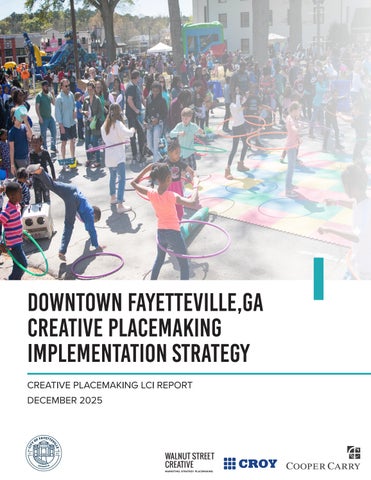
DOWNTOWN FAYETTEVILLE,GA CREATIVE PLACEMAKING IMPLEMENTATION STRATEGY CREATIVE PLACEMAKING LCI REPORT DECEMBER 2025
I MPL EM ENTATI O N PL A N
TABLE OF CONTENTS 1 . Intr o d uctio n & Purpos e 2 . Ph asing & P ri ori t y T i mel i ne 3 . E levating Downt own Fayet t evi lle: Br and & Identity 4 . Actio n Plan by Focus Area: Publ ic sp ac e A . Pub lic S pace & Mobi l i t y Pe de s t r i an Sa fety & Mob ility Pe de s t r i an Loop D ev elopment En hanc e d Crosswa lks & Wa yfind in g Shade & C o mfort E nha ncements Addi t i onal I nfra structure Solution s B . S ignage G at e way & Arriv a l Signa ge Cul t ur al S i gna ge & Storytelling Wayfi n di n g B us i n e s s Visib ility & Bra nd ing C. Action Plan by Focus Area: Arts & Cultur e P r og r ams P u bl i c A r t E nha ncement Stra tegy Di ffe r e n t i at ing the D owntown Fa y e t t e v il l e A r t s D ist r ic t Ac t i vat i on Zones & E v ents 5. Ar ts Pr ogr am Managem ent & Over sig h t 6. Bud geting & Fundi ng St rat egy A p p e ndice s
2
4 7 8 11 12 13 16 18 18 20 23 23 29 30 33 35 35 39 45 54 65 72
I M PL EM ENTATI O N PL A N
3
I MPL EM ENTATI O N PL A N
1. INTRODUCTION & PURPOSE
THIS IMPLEMENTATION REPORT IS NOT SIMPLY A LIST OF PROJECTS, IT IS A COORDINATED STRATEGY DESIGNED TO GUIDE DECISION-MAKING, PARTNERSHIPS, AND INVESTMENT OVER TIME.
4
I M PL EM ENTATI O N PL A N
The Downtown Fayetteville Creative Placemaking Implementation Strategy builds on a foundation of extensive community input, creative dialogue, and shared aspirations for the City of Fayetteville’s, Georgia’s future with staff, stakeholders, Atlanta Regional Commission Livable Centers Initiative staff, and the community at large. Over the past several months, residents, business owners, artists, and civic leaders have contributed their time and ideas through public meetings, pop-up events, surveys, and roundtable discussions. These conversations did more than identify challenges—they revealed what Fayetteville stakeholders value most: authentic local identity that reflects the City’s history; walkable and connected districts; strong small businesses; thriving arts and culture; and inclusive public spaces that invite everyone to participate in civic life. From these collective insights, the project team developed a clear set of priorities that reflect both the community’s vision and the City’s capacity to act. Rather than starting from a top-down list of projects, this Implementation Plan was shaped by what residents consistently said matters most: improving walkability by enhancing safety and comfort for pedestrians, expanding opportunities for local artists and entrepreneurs, enhancing and elevating the visibility and identity of downtown through art and signage, and creating a vibrant arts district where the people of Fayetteville love to spend time. Community input directly guided the prioritization process. Each recommendation in this plan was evaluated through the lens of community benefit, feasibility, and alignment with Fayetteville’s broader goals of creativity and economic vitality. Projects that rose to the top not only advance physical improvements but also reinforce the city’s sense of place, creating places where people gather, celebrate, and belong, This Implementation Plan is therefore more than a list of actions; it is a roadmap built by and for the people of Fayetteville. It honors the voices that shaped it and sets a path forward for coordinated, achievable investments that will sustain Fayetteville’s energy, character, and community spirit for years to come through creative placemaking.
OBJECTIVE: CREATE A VIBRANT, INCLUSIVE, ARTFOCUSED DOWNTOWN THROUGH PHASED PLACEMAKING STRATEGIES. CORE GOALS: •
Enhance the vitality of downtown Fayetteville through thoughtful placemaking • Enhance walkability and pedestrian safety • Improve signage, shade, and infrastructure • Activate underused public and private spaces
•
Implement culturally relevant arts installations throughout downtown • Increase community engagement through art • Promote an active arts and culture life throughout the community • Strengthen marketing, promotion and value of the arts
•
Recommend a clear process to curate, approve, and install art and arts events throughout downtown Fayetteville. • Create a mechanism for sustainable arts funding
•
Clarify how the Arts District is activated and defined from the rest of downtown Fayetteville
5
I MPL EM ENTATI O N PL A N
KEY FAYETTEVILLE ARTS DISTRICT PEDESTRIAN LOOP SECONDARY PEDESTRIAN LOOP
GLYNN ST S
KATHY AVE
N JEFF DAVIS
CHURCH ST
GEORGIA AVE W
S LANIER AVE
COURTHOUSE SQUARE
W LANIER AVE STONEWALL AVE
LEE ST
JOHNSON AVE
S JEFF DAVIS
CITY CENTER PARK
GRA
DY A V
E
BEAUREGARD BLVD
CENTER DR
IVE
JIMMIE MAYFIELD BLVD
DOWNTOWN FAYETTEVILLE MIXED-USE DISTRICT AND ARTS DISTRICT BOUNDARIES
6
I M PL EM ENTATI O N PL A N
2. PHASING & PRIORITY TIMELINE Implementation is structured across four phases, allowing the City to align early wins with longer-term capital investments and partnerships: FIRST 90 DAYS – Foundational actions that establish momentum, visibility, and organizational structure. Short-Term (0–12 Months) – Pilot projects, tactical improvements, and early activations. MID-TERM (1–3 YEARS) – Expanded infrastructure, permanent installations, and program growth. LONG-TERM (3–5+ YEARS) – Major capital improvements and district-defining investments. This phased approach ensures flexibility while providing a clear path forward for funding, coordination, and implementation.
7
I MPL EM ENTATI O N PL A N
3. ELEVATING DOWNTOWN FAYETTEVILLE: BRAND & IDENTITY
A R TI S TI C V I S UA L I D E NTIT Y E LE M E NT S
Downtown Fayetteville is at a pivotal moment of transformation, yet its current brand identity no longer reflects the city’s evolving character or ambitions. A refreshed brand is essential—not only to unify Fayetteville’s visual language, but to signal its readiness to attract new businesses, residents, and visitors. As the city grows, it seeks to preserve its rich heritage while embracing a vibrant, inclusive, and walkable future. By aligning with the aspirations of its community, the new brand will position Downtown Fayetteville as a culturally rich, creative, and accessible destination in the Southside region. Rooted in history, energized by creativity, and defined by its welcoming spirit, Fayetteville is a place where families thrive, artists create, and communities connect. A revitalized brand identity will support a thriving local economy by enhancing visibility for downtown businesses and cultivating an environment that invites exploration, investment, and belonging. Even if the relatively recent civic logo for the City of Fayetteville remains the same, it is recommended to undertake a visual identity effort to create a sub-brand for ‘Downtown Fayetteville’ and the Downtown Fayetteville Arts District, and to streamline other civic logos in the city. As part of this project, our team incorporated many brand-focused engagement questions and finalized a Brand Themes document (see Appendix J) that will provide a foundation for this sub-branding effort.
PY LO N S I G N A N D B R A N D I N G M O M E NT
8
RECOMMENDATION 1: Create a Historic and Cultural Resources Survey for Downtown Fayetteville: Throughout the community engagement process, when asked questions about brand identity and placemaking, residents expressed concern about the loss of historic structures and the loss of the cultural history of downtown Fayetteville that make the City distinct within the region. A citywide Historic and Cultural Resources Survey
I M PL EM ENTATI O N PL A N
both architectural and cultural data, suitable for inclusion in creating visual tools that can be used as a visitors guide (see https:// storymaps.arcgis.com/) •
Use survey findings to update or create local historic overlays, design guidelines, and interpretive programs that honor Fayetteville’s diverse heritage.
RECOMMENDATION 2: Undertake a visual identity effort in 2026 to create sub-brands for Downtown Fayetteville and the Arts District. D OW NTOW N B R A N D I N G E X PR E S S E D I N BA N N E R S
is recommended to establish a comprehensive baseline of Fayetteville’s built heritage and cultural heritage. The survey should record historic structures, streetscapes, and cultural landmarks— such as gathering spaces, schools, churches, performance venues, and sites of social significance— through field documentation, mapping, and oral histories. This effort will highlight the stories and traditions that shape Fayetteville’s identity, guide adaptive reuse strategies, and help prioritize resources for preservation incentives and placemaking storytelling opportunities. The previous survey was conducted in 1991 and included the County and City. KEY ACTIONS: • Partner with the Georgia Historic Preservation Division (HPD) and pursue Certified Local Government (CLG) status to access matching grant funds.
KEY ACTIONS: •
Clarify Goals & Scope: Define what these sub-brands should achieve—attract business, unify identity, reflect community values.
•
Identify a graphic design team: This may be part of the city’s communications team, or a local graphic designer with knowledge of the City. Build on experience in municipal branding and placemaking.
•
Share Engagement Findings: Provide the design team with summaries, notes, and themes from the previous community engagement process to ground the brand in local input — and reduce community engagement needs in a following effort.
•
Conduct a Brand Audit: Review existing logos, collateral (both physical and digital) signage, apparel / merchandise, swag and communications to identify gaps and opportunities across all brand touchpoints and city platforms.
•
Engage local stakeholders—including the Main Street Program, Arts Council, and Fayette County Historical Society—to define cultural heritage themes and gather community input.
•
Develop Brand Strategy: Collaborate to align all brand touchpoints on personality, target audiences, and messaging pillars.
•
Develop a GIS-based inventory that integrates
•
Design Visual Identity: Create a flexible 9
I MPL EM ENTATI O N PL A N
system—logos, colors, typography, messaging and taglines, apparel / swag, media templates, signage templates, etc.—that reflect Downtown Fayetteville’s character.
10
•
Prototype & Test: Build mockups for digital assets, print assets, and physical assets like additional gateway signage in public spaces; gather feedback before finalizing.
•
Launch the Sub-Brands: Roll out with events, communications, and storytelling that highlight the downtown’s transformation.
•
Implement Across Touchpoints: Apply the brand consistently across departments, public spaces, and marketing channels.
I M PL EM ENTATI O N PL A N
4. ACTION PLAN BY FOCUS AREA PURPOSE: PUBLIC SPACE
11
I MPL EM ENTATI O N PL A N
A. PUBLIC SPACE & MOBILITY Through multiple rounds of community engagement, it is clear that there is a strong desire for better, safer walkability in and around Downtown Fayetteville. Stakeholders repeatedly indicated they would prioritize and spend more money on transportation, walkability, and infrastructure improvements before implementing other arts and culture activations. Based on that feedback, a comprehensive set of pedestrian-focused transportation recommendations has been developed to improve safety, accessibility, and comfort throughout the downtown area. These recommendations align with best design practices to support a walkable, connected, and vibrant city center accessible to pedestrians and cyclists. It should be noted that each of these items is conceptual and that each is subject to a traffic study and/or preliminary engineering/design to determine the details of implementation.
C LE A R LY I D E NTI F I E D S PAC E F O R P E D E S TR I A N S A N D CYC LI S T S
12
I M PL EM ENTATI O N PL A N
PEDESTRIAN SAFETY & MOBILITY RECOMMENDATION 1: Establish a mid-block crossing between City Center Park and the Arts District at Heritage Park, south of the new City Center Drive between Lee Street and Commercial on the west side of Glynn Street. This could be completed in conjunction with the proposed median on Glynn Street between the new City Center Parkway/ Boulevard and Melear Way. RECOMMENDATION 2: Install mid-block crossings to enhance pedestrian mobility around the downtown square. Proposed locations include: •
Stonewall Avenue
•
Lee Street and Church Street
•
Lanier Avenue near the Fayetteville United Methodist Church parking lot
M I D - B LO C K C RO S S I N G W ITH A R E C TA N G U L A R R A P I D F L A S H I N G B E ACO N ( R R F B)
13
I MPL EM ENTATI O N PL A N
KEY PEDESTRIAN LOOP S E C O N DA RY P E D E ST R I A N LO O P FAYETTEVILLE ARTS DISTRICT PEDESTRIAN LEADING INTERVALS MIDBLOCK CROSSINGS & RFB’S
GLYNN ST S
INTERSECTION IMPROVEMENTS
KATHY AVE
N JEFF DAVIS
CHURCH ST
GEORGIA AVE W
S LANIER AVE
COURTHOUSE SQUARE
W LANIER AVE STONEWALL AVE
LEE ST
JOHNSON AVE
CITY CENTER PARK
GRA
DY A V
E
BEAUREGARD BLVD
S JEFF DAVIS COURTHOUSE SQUARE
CENTER DR
IVE
JIMMIE MAYFIELD BLVD
TRANSPORTATION AND PEDESTRIAN IMPROVEMENTS: MID-BLOCK CROSSINGS & PEDESTRIAN LEADING INTERVALS
14
I M PL EM ENTATI O N PL A N
RECOMMENDATION 3: Introduce mid-block crossings and Rapid Flashing Beacons (RFBs) on major state roads and high-traffic areas to improve pedestrian access and safety. Recommended locations include:
M I D - B LO C K C RO S S I N G E X A M PLE
•
Glynn Street near Georgia Avenue and LaFayette Avenue, Fisher Avenue, and Beauregard Boulevard
•
Jeff Davis Drive near Georgia Avenue and Hightower Drive
•
Lanier Avenue between Lee Street and Church Street
•
Stonewall Avenue at Lee Street and Church Street
RECOMMENDATION 4: Implement pedestrian signals with Leading Interval Technology at all signalized intersections within the study area. This technology gives pedestrians a 3–5 second head start before vehicles receive a green light, improving visibility and reducing right-hook collisions.
I N C LU D E P E D E S TR I A N LE A D I N G I NTE RVA L
15
I MPL EM ENTATI O N PL A N
PEDESTRIAN LOOP DEVELOPMENT RECOMMENDATION 5: Create a Primary Pedestrian Loop through the Arts District and along Church Street to offer a quieter, safer alternative to walking or cycling along Glynn Street. Infrastructure should include:
S H A R E D U S E PATH
•
A 10–12 ft Shared Use Path (SUP) on the east side and a 6-ft sidewalk on the west side of the Arts District corridor
•
Streetscape elements such as chicanes, additional benches, bollards, planters, and bicycle parking
•
Decorative crosswalks and wayfinding signage
•
Buried utilities where feasible, particularly between Lanier Avenue and Center Street
RECOMMENDATION 6: Develop a Secondary Pedestrian Loop along major north-south and east-west corridors that connect to the existing bike/ped trail network. Improvements should include: •
10 ft SUPs or 6–8 ft sidewalks (minimum), all ADA-compliant
•
Shade trees and visual buffers between sidewalks and roadways
•
Bike parking at commercial centers and striped driveways
•
Traffic calming on Stonewall Avenue (25 mph speed limit, angled parking) and conversion of the third lane between Church Street and Jeff Davis Drive into parking
•
Advisory lanes on Georgia Avenue if rightof-way is limited
D E D I C ATE D B I K E PA R K I N G
16
I M PL EM ENTATI O N PL A N
KEY PEDESTRIAN LOOP S E C O N DA RY P E D E ST R I A N LO O P F AY E T T E V I L L E A R T S D I S T R I C T C R O S S W A L K / W AY F I N D I N G GLYNN ST S
KATHY AVE
N JEFF DAVIS
CHURCH ST
GEORGIA AVE W
S LANIER AVE
COURTHOUSE SQUARE
W LANIER AVE STONEWALL AVE
LEE ST
JOHNSON AVE
S JEFF DAVIS
CITY CENTER PARK
GRA
DY A V
E
BEAUREGARD BLVD
CENTER DR
IVE
JIMMIE MAYFIELD BLVD
TRANSPORTATION AND PEDESTRIAN IMPROVEMENTS: ENHANCED CROSSWALKS
17 PRIMARY CORRIDOR
I MPL EM ENTATI O N PL A N
ENHANCED CROSSWALKS & WAYFINDING RECOMMENDATION 7: Improve east-west pedestrian movement by upgrading crosswalks between City Center Park and the Arts District. RECOMMENDATION 8: Increase visibility of crosswalks and sidewalks at Booker Avenue and the entrance to Sugar Hill to enhance pedestrian safety and awareness. RECOMMENDATION 9: Prioritize pedestrian movement around Church Street and the downtown square to support walkability and local business access. A R TI S TI C C R O S S WA LK S A R E R E CO M M E N D E D O N C IT Y OW N E D S TR E E T S D OW NTOW N
SHADE & COMFORT ENHANCEMENTS RECOMMENDATION 10: Enhance the Arts District streetscape by establishing street trees, lighting, and sidewalks along Lee Street, Glynn Street, and cross streets— particularly Fisher Avenue. RECOMMENDATION 11: Ensure the Primary and Secondary Loops include street trees, ample sidewalks, lighting, and additional benches to create a comfortable walking environment. RECOMMENDATION 12: Prioritize the addition of street trees and benches along Highways 85 and 54 within the downtown district.
CO LO R F U L B E N C H E S PROV I D E S E ATI N G A N D CO M F O R T, PLU S O P P O R TU N ITI E S F O R A R TI S T S
18
I M PL EM ENTATI O N PL A N
KEY SHADE PEDESTRIAN LOOP S E C O N DA RY P E D E ST R I A N LO O P
FAYETTEVILLE ARTS DISTRICT GLYNN ST S
KATHY AVE
N JEFF DAVIS
CHURCH ST
GEORGIA AVE W
S LANIER AVE
COURTHOUSE SQUARE
W LANIER AVE STONEWALL AVE
CITY CENTER PARK
GRA
DY A V
E
BEAUREGARD BLVD
LEE ST
JOHNSON AVE
S JEFF DAVIS
CENTER DR
IVE
JIMMIE MAYFIELD BLVD
TRANSPORTATION AND PEDESTRIAN: SHADE & COMFORT SHADE & COMFORT TRANSPORTATION AND PEDESTRIAN IMPROVEMENTS:
19
I MPL EM ENTATI O N PL A N
RECOMMENDATION 13: Add trees and/or shade structures to civic spaces such as City Center Park, the Bus Barn, and Heritage Park to improve comfort and usability. It should be noted that Heritage Park is owned by Fayette County, and that coordination between the City and the County would be required to fully act upon this recommendation. City Center Bark and the Bus Barn would receive heat relief from commercial shade sails in bright colors. Benches can be covered with awnings, pergolas, or umbrellas. Trees are the most optimal shade structure, especially in a park. ADDITIONAL INFRASTRUCTURE SOLUTIONS S TR E E T TR E E S TR A N S F O R M D OW NTOW N S
RECOMMENDATION 14: Close slip lanes in the downtown area to reduce vehicle speeds and improve pedestrian safety. Specifically, close the Bradley Drive slip lane and replace it with a right-turn lane. RECOMMENDATION 15: Implement traffic calming measures along Highways 85 and 54 throughout the downtown corridor to create a safer and more pedestrianfriendly environment. RECOMMENDATION 16: Update and implement an ADA infrastructure plan to ensure all intersections and crosswalks in downtown Fayetteville meet accessibility standards.
A R T I N C LO S E D S LI P L A N E S
20
RECOMMENDATION 17: Reduce posted speed limits throughout the downtown area to 25 MPH. Work with GDOT to evaluate the feasibility of this proposed action on GDOT-owned roads.
I M PL EM ENTATI O N PL A N
TRANSPORTATION & PEDESTRIAN IMPROVEMENTS INITIATIVE
DESCRIPTION
PHASE
PARTNERS
COST RANGE
NOTES
Cross-Street Connections
Mid-block crossing and RFB on Glynn St south of City Center Drive
Long
Croy, City, GDOT
$150,000
Key walkability link
Cross-Street Connections
Mid-block crossings with RFB on Stonewall and Church Street, Stonewall and Lee St., and Lanier Ave at FUMC Parking Lot
Mid
Croy, City, GDOT
$450,000
Key walkability link
Cross-Street Connections
Mid-block crossings and RFB on Glynn St at two locations, Jeff Davis at two locations
Mid
Croy, City, GDOT
$600,000
Key walkability link
Cross-Street Connections
Re-signalize pedestrian leading at six signals along Hwy 84 and Jeff Davis Dr
Mid
Croy, City, GDOT
$1,500/Signal
Key walkability link
Lee Street Initiative
Create a primary path through the arts district, to the square, and to Church Street
Long
Croy, City, GDOT
$1M - $1.5 M/mi
Install SUP/ Sidewalks
Secondary Loop
Create a secondary sidewalk/SUP along major corridors connecting to primary path
Long
Croy, City, GDOT
$1M - $2 M/mi
Install SUP/ Sidewalks
Cross-Street Connections
Improve existing Crosswalks between City Center Park and Lee St
Mid
Public Services, local artists, Croy
$100,000
Restripe, muralize, add signage; ADA Compliance
Mid
Public Services, local artists, Croy
$200,000
Restripe, muralize, add signage; ADA compliance
Mid
Public Services, local artists, Croy
$200,000
Restripe, muralize, add signage; ADA Compliance
Cross-Street Connections
Cross-Street Connections
Improve Crosswalks and Sidewalks at Booker Ave
Prioritize pedestrian movement on the square
21
I MPL EM ENTATI O N PL A N
TRANSPORTATION & PEDESTRIAN IMPROVEMENTS, CONT.
22
INITIATIVE
DESCRIPTION
PHASE
PARTNERS
COST RANGE
NOTES
Safety and Comfort
Add benches, shade trees and lighting along primary loop and cross streets (particularly Fisher)
Long
City, Croy
$500,000/mi
Trees and Lighting
Safety and Comfort
Add benches, shade trees and lighting along secondary loop, particularly Glynn and Jeff Davis
Long
Croy, City, GDOT
$500,000/mi
Trees and Lighting
Safety and Comfort
Add shading structures or trees to civic spaces
Mid
City
$50,000/shelter
Shade
Safety and Comfort
Close slip lanes in downtown areas, particularly Bradley at Glynn, Holly at Stonewall
Mid
Croy, City, GDOT, local artists
$40,000/lane
Lane closure, paint, bollards
Safety and Comfort
Implement traffic calming measures on 85
Mid
Croy, City, GDOT
$150,000
Reduced speed countermeasures
Safety and Comfort
Update and implement ADA Plan for Downtown
Mid
City
$50,000
Plan creation
I M PL EM ENTATI O N PL A N
B. SIGNAGE To support Fayetteville’s transformation into a walkable, arts-forward, and culturally vibrant city, this signage strategy outlines key recommendations for enhancing arrival experiences, storytelling, and navigation. These improvements will reinforce the city’s identity, improve connectivity, and support economic and cultural activation. GATEWAY & ARRIVAL SIGNAGE OBJECTIVE: CREATE A STRONG FIRST IMPRESSION AND CLEAR SENSE OF ARRIVAL INTO A DISTINCT, WELCOMING, AND CREATIVE CITY. RECOMMENDATION 1: Design downtown gateway signage at key entry points to downtown to reinforce the boundaries and character of downtown:
B R A N D E D G ATE WAY S I G N AG E F O R D OW NTOW N
•
West at West Lanier Ave. and Grady
•
East at Stonewall Ave. East and East Lanier Ave.
•
North entry point along Glynn Street: Glynn and Forrest
•
South entry point along Glynn Street: Glynn and Grady.
23
I MPL EM ENTATI O N PL A N
RECOMMENDATION 2: Design Arts District gateway signage at key entry points to the arts district. •
Stonewall Ave. E. and Lee St.
•
Glynn St. at Fisher Ave.
•
Center Dr. and Lee St.
Alternate / additional locations could be at Glynn and Kathi Avenue and Lafayette Avenue and Glynn – these are outside of the established Arts District boundaries but could help get visibility along Glynn Street. These locations could have a variation in design to ensure they are promoting the Arts District and not entries to the arts district.
C IT Y C E NTE R PA R K , FAY E T TE V I LLE , G A
24
I M PL EM ENTATI O N PL A N
KEY PEDESTRIAN LOOP S E C O N DA RY P E D E ST R I A N LO O P F AY E T T E V I L L E A R T D I S T R I C T A R T L O C AT I O N S D OW N TOW N S I G N AG E
GLYNN ST S
A RT S D I ST R I C T S I G N AG E
KATHY AVE
N JEFF DAVIS
CHURCH ST
GEORGIA AVE W
S LANIER AVE
COURTHOUSE SQUARE
W LANIER AVE STONEWALL AVE
LEE ST
JOHNSON AVE
CITY CENTER PARK
GRA
DY A V
E
BEAUREGARD BLVD
S JEFF DAVIS
CENTER DR
IVE
JIMMIE MAYFIELD BLVD
ARTS & CULTURE MARKERS: GATEWAY AND ARTS DISTRICT IDENTIFICATION
25
I MPL EM ENTATI O N PL A N
RECOMMENDATION 3: Design artistic elements that signal to visitors they are in the arts district. •
Add branded Arts District toppers to street signs and banners.
•
Use branded crosswalks or paving patterns at key intersections (e.g., Lee Street at Johnson, Fisher, Long, Melear).
RECOMMENDATION 4: Ensure brand consistency in new gateway and arrival installations and improvements. Use consistent materials and motifs that reflect Fayetteville’s history and artistic character and ensure the designs are in each location to reinforce the brand identity
G ATE WAY I N S TA LL ATI O N S C A N R E I N F O RC E B R A N D A N D I N C LU D E A R T A N D H I S TO RY E LM E NT S .
26
•
Use consistent branding (logo, color palette, typography) to keep the signage system unified and reinforce the city’s identity.
•
Incorporate public art elements into the signage family— sculptural forms, patterns / mosaics, or lighting features that double as landmarks. • Murals on key locations with maximum visibility like West Lanier and Glynn St. North and 85 Glynn Street South (utility building) • Sculptural feature in the Courthouse Square
I M PL EM ENTATI O N PL A N
•
•
Consider new ground-mounted panels for art and branding. • Along Lee Street • Along Church Street Utilize more traditional banners on light poles for art and branding. • Along Glynn Street North and South • Along East and West Lanier Ave.
•
• Along East and West Stonewall Ave. Incorporate illumination to enhance visibility of art and signage, especially in areas with high traffic or nighttime activity.
LI G HT P O LE W ITH A R TI S TI C TR E ATM E NT
27
I MPL EM ENTATI O N PL A N
KEY PEDESTRIAN LOOP S E C O N DA RY P E D E ST R I A N LO O P F AY E T T E V I L L E A R T D I S T R I C T A R T L O C AT I O N S STORYTELLING ART
GLYNN ST S
HISTORIC NEIGHBORHOOD S I G N AG E
KATHY AVE
N JEFF DAVIS
CHURCH ST
GEORGIA AVE W
S LANIER AVE
COURTHOUSE SQUARE
W LANIER AVE STONEWALL AVE
LEE ST
JOHNSON AVE
CITY CENTER PARK
GRA
DY A V
E
BEAUREGARD BLVD
S JEFF DAVIS
CENTER DR
IVE
JIMMIE MAYFIELD BLVD
ARTS AND CULTURE ACTIONS: HIGHLIGHT HISTORIC NEIGHBORHOODS AND STORIES
28
I M PL EM ENTATI O N PL A N
CULTURAL SIGNAGE & STORYTELLING OBJECTIVE: CELEBRATE FAYETTEVILLE’S HERITAGE AND COMMUNITY STORIES THROUGH CREATIVE STORYTELLING. PARTNER WITH LOCAL ARTISTS AND THE HISTORICAL SOCIETY TO ENSURE AUTHENTICITY AND COMMUNITY OWNERSHIP.
I N E X P E N S I V E V I N Y L C LI N G S O N W I N D OWS C A N TE LL S TO R I E S W ITH I M AG E S A N D G R A PH I C S KEY
RECOMMENDATION 5: Install interpretive panels near historic landmarks (e.g., Old Courthouse, Bus Barn, Train Depot) that share stories of Indigenous, African-American, and local history that can get lost from generation to generation. Design these to be easily updated over time to allow for easy maintenance, renewed interest, and to accommodate more stories and content. RECOMMENDATION 6: Install Fayetteville-branded signage identifying historic neighborhoods including: •
Sugar Hill
•
Church Street
•
North Jeff Davis Drive
29
I MPL EM ENTATI O N PL A N
RECOMMENDATION 7: Use artist-designed storytelling elements— such as illustrated maps, poetry, or interactive displays— to make history engaging and accessible. These can be executed across physical and digital platforms, incorporated into signage, the web, digital platforms, etc. •
Arts District at Glynn Street: • Fisher Avenue/City Center Parkway • Melear Way
S I G N AG E C A N B E U S E D F O R H I S TO R I C S TO RY TE LLI N G A N D P L AC E K E E P I N G KEY
•
• Grady Avenue Heritage Park
•
Sugar Hill
•
Meridian on the Square
Incorporate augmented reality or interactive elements for dynamic storytelling. Include QR codes or digital extensions to link signage to websites holding audio tours, videos, or community archives that can be easily updated in one place. WAYFINDING OBJECTIVE: ENHANCE PEDESTRIAN NAVIGATION AND SAFETY FOR BOTH DRIVERS AND PEDESTRIANS WHILE SUPPORTING BUSINESS VISIBILITY AND PLACEKEEPING. TIMELINE: LONG-TERM.
AU G M E NTE D R E A LIT Y U S E D TO E N H A N C E A N A R TI S T ’ S M U R A L
30
I M PL EM ENTATI O N PL A N
RECOMMENDATION 8: Conduct a signage audit to assess visibility, placement, and orientation from both vehicular and pedestrian perspectives. •
Identify priority locations for additional signage.
•
Identify missing sign types to complete a unified wayfinding system with clear directional signage, landmark identifiers, and parking guidance. This can include modifications to the existing sign system as well as adding new sign types such as pedestrian directories with maps, pedestrian-scaled directional signage, street sign toppers, etc.
•
Prioritize placement at key decision points. This may allow a reduction in the number of signs needed.
•
Ensure signs are perpendicular and adjacent to the lane of travel for maximum visibility and effectiveness.
Where and how do you all place attribution for the report (including team logos and photo attributions). We pulled these photos from all over the place and many are likely used without permission....? S I G N PL AC E D O PP O S ITE L A N E O F TR AV E L ; F O U R - S I D E D D E S I G N O B S TR U C T S PA N E L S
31
I MPL EM ENTATI O N PL A N
RECOMMENDATION 9: Simplify the signage design. The existing wayfinding signage is in good condition overall, but the four-sided design and poor placement of some signs reduces the overall effectiveness. •
Convert four-sided signs to two-sided for better clarity.
•
Relocate the branding panels above the messages to avoid obstruction.
RECOMMENDATION 10: Improve directional messaging and nomenclature •
Replace triangle arrows with full arrows (head+tail) for clarity.
•
Use consistent, intuitive naming (e.g., clarify “Biergarten” vs. “Line Creek Brewing”).
•
Ensure terms align with public understanding.
or themed signage inspired by local culture. Engage local artists and designers in the creation of signage elements. RECOMMENDATION 14: Ensure signage is ADA-conforming, well-lit, and placed at key decision points (intersections, trailheads, public spaces). RECOMMENDATION 15: Integrate maps and icons on all signage that highlight amenities, cultural sites, and walking/ cycling loops to encourage exploration.
RECOMMENDATION 11:
Develop design guidelines for signage that align with the city’s refreshed brand identity once complete. RECOMMENDATION 12: Coordinate with GDOT and city departments to ensure signage supports safety and mobility goals. •
Pilot signage improvements in high-visibility areas before scaling citywide. RECOMMENDATION 13: Use art-based navigation tools to lead pedestrians and cyclists to the Arts District— such as color-coded paths, creative bike racks,
32
B R A N D E D A N D C LE A R S I G N AG E
I M PL EM ENTATI O N PL A N
BUSINESS VISIBILITY & BRANDING OBJECTIVE: SUPPORT LOCAL BUSINESSES WITH SIGNAGE THAT IMPROVES VISIBILITY AND IDENTITY.
E N S U R E T Y P E S T Y LE S , CO NTR A S T A R E R E A DA B LE F O R B OTH V E H I C LE S A N D P E D E S TR I A N S KEY
RECOMMENDATION 16: Review and update the sign ordinance to support visibility across travel modes (car, bike, pedestrian). The current ordinance primarily addresses policy intent (avoiding clutter, promoting aesthetics, ensuring safety) but does not include technical specifications for things like typestyles, contrast, letter heights based on viewing distance, etc. Add language to address technical specifications that would improve problem areas, for example: •
Improve legibility for 240 Glynn Street by establishing parameters for typeface weight, scale and contrast for improved legibility
•
Add clearer signage to identify Awkward Brewing— require entry and building identification to be placed consistently throughout the city (on building exterior walls, etc.)
RECOMMENDATION 17: Allow for individual business brand expression within a more unified signage framework that expresses the Fayetteville brand but still allows for flexibility. S TR O N G CO NTR A S T A N D LE G I B LE T Y PE FAC E S I M PROV E B U S I N E S S V I S I B I LIT Y
33
SIGNAGE & WAYFINDING I MPL EM ENTATI O N PL A N
INITIATIVE
DESCRIPTION
PHASE
PARTNERS
COST
NOTES
Downtown Gateways
A dd at 4 ke y e n try p oin ts for c le ar arrival
Mid
b r a nd ing fir m , wa yfind ing co nsulta nt
$300K to $500K (+d esign fees)
E nsure brand a lig nment , co nsi st ency
Arts Distric t Gateways
A dd at 3 to 5 e n try p oin ts
Artful Wayfinding
Stre e t s ig n top p e rs , ban n e rs , c ros s w alk art, c re ative bike rac ks , e tc .
I nterpretive Panels
A dd n e ar his toric lan dm arks , an d in n e ig hborhoods
I m p rove vis ibility , add Wayfinding m is s in g e le m e n ts Audit / Redes i gn f or p e de s trian s , e tc .
Wayfinding Modification
S im p lif y exis tin g s ig n c on fig u ration from 4 to 2 s ide d to im p rove vis ibility , re loc ate d bran d p an e ls , e tc .
Wayfinding Design Guidelines
Cre ate u p date d s tan dards
Business Signage Support
34
U p date s ig n ordin an c e to im p rove bu s in e s s s ig n ag e vis ibility
Sh o r t
Sh o r t
Sh o r t
Lo ng
b r a nd ing fir m , wa yfind ing co nsulta nt
wa yfind ing co nsulta nt, lo ca l a r tists, DPW
Wa yfind ing co nsulta nt, lo ca l a r tists, sto r yteller s, h isto r ica l so ciety
Wa yfind ing co nsulta nt
Mid
Wa yfind ing co nsulta nt
Mid
Br a nd ing fir m , Wa yfind ing co nsulta nt
Mid
C ity sta ff, d o wnto wn b usinesses, wa yfind ing co nsulta nt
$75K to $1 50K (+d esign fees)
E nsure brand a lig nment , co ns i st ency, co m muni cat e di st ri ct b o undari es
$50K to $1 00K , ~ 50 lo ca tio ns (+d esign / a r tist fees)
Reinfo rce di st ri ct b o undari es and b r a nd i dent i t y
$1 2-20K ea ch (+d esign fees)
Hig h l i g h t lo cal h i st ory a nd i dent i t y, a r tist desi g ned ele ment s (m a ps, p oet ry, interact i v e element s l i ke
$8 5K to $1 50K co nsulta nt fee, fa b r ica tio n / insta ll TBD b a sed o n qty.
Ident i f y lo ca tio ns f or new signa g e, modi f y d esi g n and a d d a ddi t i onal sign t yp es t o co m p l et e t h e wa y f i ndi ng system, ensure ADA c onf ormi ng d esi g n
$25 to $50K co nsulta nt fee, fa b r ica tio n / insta ll TBD b a sed o n qty.
C o nve rt 4 - si ded signs t o 2 , r elo cat e brand pa nel s, use f ul l a r r o ws i nst ead o f tr i ang l es, use consi st ent a nd i nt ui t i v e d est i nat i on na mi ng , et c.
$20K to $50K
C o m pl et e once b r a nd i dent i t y h as been r edesi g ned
$1 5K - $30K co nsulta nt fee
Rev i se o r d inance t o includ e t ech ni cal spec i f i cat i ons fo r desi g n pa r a met ers, not just pol i cy i nt ent (a vo i d cl ut t er, et c.
I M PL EM ENTATI O N PL A N
PUBLIC ART ENHANCEMENT STRATEGY Art can be used to brand and define downtown Fayetteville, welcome visitors, and provide landmarks for orientation and wayfinding. In this plan, ‘art’ is a broad term that includes wall murals, surface murals, artistic elements on street furniture and utility boxes, iconic sculptures, projection, and generally any type of creative element. EVERY BLANK SPOT IS AN ART OPPORTUNITY. GUIDELINES FOR ART INSTALLATIONS: 1.
Where to start: This plan recommends installing art first in highly visible locations in Downtown Fayetteville, focusing on Lee Street, and then extending out from that downtown core.
6. Therefore, this plan will not determine or specify exactly what should go in each of the possible locations outlined in the plan. • A key component of implementing a place-focused art strategy is to highlight the creativity of an artist, not to prescribe specific elements for each location. 7. Allow a mix of different art types: contemporary, historic, storytelling, faces/ portraits, graphic elements, etc. Highlighting or focusing on only one type of art could lead to stale and outdated visuals. Read more below for guidelines for the Arts Committee. 8. Time frame: Most murals last for 5 to 7 years if installed properly, depending on sun exposure and other factors.
2. Define who is an artist: generally, it is someone who identifies as an artist! 3. Treat artists as partners in problem-solving, not just decoration or fulfilling a need. 4. Create guidelines for publicly visible art and add it to the existing “Application for Public Art Enhancement (PAE).” Guidelines often require art that is suitable for a general audience, and don’t allow: nudity; pornography; political, offensive, or copyrighted content; faces of living people; actual photographs; and works generated using artificial intelligence (AI). See Appendix K for draft guidelines. 5. Outside of those guidelines, however, leaning on the artist to come up with themes and ideas should result in a high-quality outcome. Note: ‘design by committee’ or asking an artist to ‘water down’ their design often results in lackluster art. A R TI S TI C B I K E R AC K S
35
I MPL EM ENTATI O N PL A N
RECOMMENDATION 1: Implement downtown murals. Cover blank walls throughout downtown Fayetteville with colorful murals.
RECOMMENDATION 2:
Use existing elements to highlight iconic features downtown.
KEY
CO LO R F U L M U R A L S C A N B E I N S TA LLE D O N B L A N K WA LL S TH RO U G H D OW NTOW N
36
•
Water Tower: Cover the water tower with artwork to create a unique landmark that says “You are here!” Because this water tower is so enormous, it is recommended to cover a portion of the tower and not provide full coverage.
•
Brick Tower at the corner of North Jeff Davis Dr. and West Lanier Avenue: The tower on the corner of Jeff Davis and Lanier could become a beacon by adding branded patterns (geometric shapes, florals, organic items, etc.). Cut from metal, patterns can become a custom lattice that expands the brand. Lighting can enhance the experience at night with backlighting or uplighting. Landscaping can play a role with climbing evergreens layered with blooming varieties for seasonal interest.
I M PL EM ENTATI O N PL A N
•
Open areas in City Center Park: These spots provide space for unique freestanding sculptural elements that can also become landmarks for wayfinding or photo opportunities.
•
Heritage Park: Install storytelling opportunities in the form of cultural signage as well as opportunities for community members to share their stories.
•
Intersection of S. Glynn, Lee Street & Williamsburg Way: This empty property could provide a perfect opportunity for a large gateway sculpture announcing the Arts District and Downtown Fayetteville for drivers approaching from the south.
•
Additional temporary sites: As development occurs throughout downtown Fayetteville, the City should coordinate with property owners to secure access to temporary mural spaces while projects are under construction or awaiting demolition. Covering empty buildings with artwork once they’re awaiting demolition will tell the story of transformation and announce the arrival into downtown. Those sites could then be turned into a more permanent installation once development is complete.
I CO N I C A R TI S TI C M U R A L V I S I B LE TO V E H I C LE S D R I V I N G TH R O U G H D OW NTOW N
37
I MPL EM ENTATI O N PL A N FOUNDAT I ON
RECOMMENDATION 3: Turn unsightly utility boxes into canvases for creativity, color, and art. Utility boxes and traffic control signal boxes are located throughout downtown, including in City Center Park and on primary arterials. Covering unsightly and plain utility boxes with artwork using a vinyl wrap beautifies these spaces while creating opportunities for local artists to submit their visual work. Note: Vinyl wraps, not painting, are recommended for these boxes; many jurisdictions will only allow the vinyl wraps, which are easily secured from a professional signage or graphics contractor. Vinyl wraps should be UV-treated and will last for 5-7 years or more. KEY
1.
Create a list of the exact locations and ownership entities of each traffic control box. Traffic light signal boxes are likely wholly owned by the state and on state roads. Utility boxes in City Center Park and on side roads are owned by the City.
2. Contact a signage/printing company to measure each of the boxes and provide specs and a quote for printing. Many companies will do this for a nominal fee or for free.
V I N Y L C LI N G S O N UTI LIT Y A N D TR A F F I C CO NTRO L B OX E S: CO LO R + A R T TO COV E R S O M E TH I N G U N S I G HTLY
38
3. Prioritize the Arts District and City Center Park utility boxes, then focus on other highly visible corridors. • Secure permission from GDOT to wrap state-owned utility boxes along primary corridors of Georgia 85 and 54. 4. Put out a call for artists and request designs.
I M PL EM ENTATI O N PL A N
5. This effort is a good opportunity for the public to get involved in voting on designs. Create a design competition and ask members of the public to vote for their favorites. Use a visually capable platform such as Poll Unit (https://pollunit.com/). With a number of boxes, these installations provide opportunities to showcase local artists, schools groups, historical photos/maps/stories, and other partnerships and themes. HERE ARE SOME EXAMPLES OF SUCCESSFUL UTILITY BOX PROJECTS: • •
•
•
•
Washington, DC: https://swbid.org/publicart/traffic-box/ Savannah, GA:https://www.gpb.org/ news/2024/06/12/savannah-sprucesstreet-corners-graffiti-resistant-vinyl-wrapsadorned-archival Warner Robins: https://www.41nbc.com/ warner-robins-launches-utility-box-artprogram-to-beautify-city-showcase-localtalent/ Warner Robins’ adopt-a-box program would likely take longer to create in the beginning due to the partnerships required with property owners — but this could ultimately reduce the costs of installation if adjacent property owners or ‘adopters’ eventually covered the costs of printing. Here is more on their program: https://www.wrga.gov/ forms/adopt-a-box-application Midtown Atlanta has created a banner program that rotates annually. A similar program could be used for utility boxes or smaller murals. Details here: https://www.
midtownatl.com/get-involved/design-astreet-banner. Other types of art to consider that could be led by a professional artist with specific skills: •
Projections or colorful light installations on iconic structures or buildings
•
Interactive or virtual reality installations that highlight place-focused stories, oral history, or what a particular block/building used to look like.
•
Scavenger hunts that invite people to walk around and explore downtown searching for smaller-scale pieces of art, specific components of murals, or other creative elements
M U R A L A LO N G A WA LK I N G PATH
39
I MPL EM ENTATI O N PL A N
KEY F AY E T T E V I L L E A R T D I S T R I C T A R T L O C AT I O N S SCULPTURE OPPORTUNITY
GLYNN ST S
KATHY AVE
N JEFF DAVIS
CHURCH ST
GEORGIA AVE W
S LANIER AVE
WATER TOWER
COURTHOUSE SQUARE
W LANIER AVE STONEWALL AVE
LEE ST
JOHNSON AVE
CITY CENTER PARK
GRA
DY A V
E
BEAUREGARD BLVD
S JEFF DAVIS
CENTER DR
IVE
JIMMIE MAYFIELD BLVD
ARTISTIC ELEMENT LOCATIONS
40
I M PL EM ENTATI O N PL A N
POTENTIAL MURAL AND ART INSTALLATION LOCATIONS INITIATIVE
DESCRIPTION
PHASE
PARTNERS
Mural at S. Glynn and Stonewall Ave n u e
A d d a t 4 ke y e n t r y p o i n t s for clear arrival
RFQ already released by Main Street B o a r d / D DA in Oc tober 2025
B u i l d i n g o w n e r, Main Street Board/ D DA
Mural at BellSouth building gateway opportunity, South Wa l l , e a s t e n d
The BellSouth proper ty provides a gateway oppor tunity into the ar ts distric t visible from both Le e S t r e e t a n d GA H W Y 85. This location is highly visible on the nor th end of the district.
Lo n g
BellsSouth
Lo n g
BellSouth
BellSouth building gateway opportunity
NOTES
South wall, west end To w n S q u a r e Jewelers wall facing south (back o f b u i l d i n g)
The mural could adver tise the ar t s distric t, have a j e w e l r y /g e m t h e m e , o r even showcase something u n ex p e c t e d .
Short
Proper ty owner
T h e s i t e r e ce i v e s high views from cars queued at that stoplight.
Southside Church white wall mural ex p a n s i o n
The small mural on this large wall is lost in the s p a ce. W h i l e t h i s m u r a l has special meaning for vic tims of abuse, there is an oppor tunity to add to this w a l l t o m a ke i t v i s i b l e f r o m around City Center Park and draw more people to v i e w a l l t h e m u r a l s t h e r e.
Mid
Proper ty owner
It al so provides a southern anchor to the ar ts distric t.
Former tattoo shop blank wall, facing south
Ta t t o o S h o p: W h e t h e r o r n o t the tat too shop is gone, this blank wall is highly visible to nor thbound traf f ic on Ga. 85.
Mid
T h e B ear Ra d io Stat io n b la n k w a l l
T h e B e ar h as a l ar g e bl ank w al l t h at j u s t n e e ds som e co l o r t o h i g h l i g h t t h e radi o s t at i o n .
Long
Ci t y Cen t er Park res t r o o m b u i ld ing s (2)
Each o f t h e s e co u l d be p ai n t e d i n p ar t o r i n whol e by ar t i s t
Short
Proper ty owner
It al so provides a southern anchor to the ar ts distric t.
The Bear Radi o Stati on
Vi si ble from the Cou rt h ou s e Sq u a re
O wned by the c i ty
Instal l prot ect ive fram es to h igh ligh t art that ca n’t b e expose d t o t h e el emen t s .
41
I MPL EM ENTATI O N PL A N
POTENTIAL MURAL AND ART INSTALLATION LOCATIONS, CONT. INITIATIVE
DESCRIPTION
PHASE
PARTNERS
NOTES
Cit y C en t er Pa r k picn ic pa vilio n s
T h i s i s a g r e at opportunity for t e m p o r ar y ar t w o r k t h at co u l d be ch an g e d every 12-18 months.
Mi d
O wned by the Ci ty
Wi l l need to c onsolid a t e regul atory si gnage t o ma ke room for art
Art i n st a lla t io n o n h igh sc h o o l ext er io r o r pa r k i n g lo t
Wo r k w i t h t h e s ch o o l an d s t u de n t s an d a l o cal m u r al i s t t o co cr e at e a w o r k o f ar t
Long
BO E , F ayette County Hi gh Sc hool
Partnershi p program wh ereb y youth ac qui re c ommu n it y servi c e hours th rou gh supporti ng downtown /a rt s di stri c t event s
Sur f a c e m u r a ls o n T iger Tr a il beh i n d F C H S
Wo r k w i t h t h e s ch o o l an d s t u de n t s an d a l o cal m u r al i s t t o co cr e at e a w o r k o f ar t
Mi d
BO E , F ayette County Hi gh Sc hool
Partnershi p program wh ereb y youth ac qui re c ommu n it y servi c e hours th rou gh supporti ng downtown /a rt s di stri c t event s
Art in st a lla t io n s a t H er i t a ge P la za
T h i s s p ace co u l d h o s t cl as s i cal co n ce r t s , M e m o r i al Day o r o t h e r p at r i o t i c e v e n t s , s t o r y t e l l i n g an d f e s t i v al s , s cu l p t u r e, an d m o r e.
Short to Mi d
County
Vi si bl e to pedestria n s a n d vehi c l es
COST RANGES FOR MURALS: Typical costs for wall murals are roughly $25-$40 per square foot for most artists, including design fees, installation costs, materials, etc. For extremely large mural installations, the cost per square foot can go down slightly. Surface murals require a particular kind of paint, depending on the amount of vehicular or foot traffic the mural expects to see. Murals that will require a boom lift or other equipment to get the artist up to the upper heights of the space will cost more due to equipment rentals. COST RANGES FOR SCULPTURES: Sculptures are more complicated depending on the nature of the site and the need for longevity in design, engineering, and materials. For a temporary sculpture (available for a few months), costs will range from
42
CO LO R F U L S U R FAC E M U R A L TH RO U G H A PE D E S TR I A N A R E A TH AT S E E S LI G HT V E H I C U L A R TR A F F I C
I M PL EM ENTATI O N PL A N
$40,000-80,000, depending on site constraints, materials, artist fees, and if the sculpture is already created. For permanent sculpture installations, typical costs start around $90,000-$150,000 and can easily reach into the millions.
ICONIC FEATURES DOWNTOWN INITIATIVE
DESCRIPTION
Wa t er t o wer
C o v e r t h e w at e r t o w e r w i th ar t w o r k t o cr e at e a u n i q ue l an dm ar k .
Bric k t o w er at co r n er o f J ef f D a vi s & La n i er
PHASE
PARTNERS
NOTES
Long
County
$ 3 - 7 m i l l i on (depend in g on c overage, ti m i ng, equ ipmen t needs, and arti st select ion ; c oul d be far m ore)
In s t al l ar t i s t i c l i g h t s an d/or o t h e r m at e r i al s t o cr e at e v i s u al i n t e r e s t day an d night.
Mi d to Long
Property O wner
TBD dependi ng on t y pe of artwork i nc l u d ed
O p en ar ea s in C it y C en t er Pa r k
F r e e s t an di n g s cu l p t u r e, cu l t u r al s i g n ag e, o r “ In s t ag r am abl e m o m e n t ” photo opportunities.
Short
Ci ty, Arti sts
TBD dependi ng on t y pe of artwork i nc l u d ed
Her it a ge Pa r k
T h i s h i g h l y v i s i bl e s p o t is a g r e at co n n e ct i o n p o i n t be t w e e n t h e A r t s Di s t r i c t an d C i t y C e n t e r Par k .
Short to Mi d
O wned by the County
$ 1 5, 0 0 0 - 3 5, 0 00 for storytel l i ng ac ti vat ion s a s a fi rst effort
Sculp t u r e a n d/ or sign age op po r t u n i t y a t S. G ly n n , Le e St r eet & Wi llia msb u r g Way
This empty property co u l d p r o v i de a p e r f e ct o p p o r t u n i t y f o r a l ar g e g at e w ay s cu l p t u r e.
Long
Property O wner
TBD dependi ng on t y pe of artwork i nc l u d ed
Add it io n al tem p o r ar y sit es
A s de v e l o p m e n t o ccu r s t h r o u g h o u t do w n t o w n F ay e t t e v i l l e, t h e C i t y s h o u l d co o r di n at e w i t h p r o p e r t y o w n e r s t o s e cu re acce s s t o t e m p o r ar y m u ral s p ace s w h i l e p r o j e ct s ar e u n de r co n s t r u ct i o n or aw ai t i n g de m o l i t i o n .
Mi d to Long
Property O wners
TBD dependi ng on t y pe of artwork i nc l u d ed
Ut i lit y B ox Wr aps
P r i o r i t i z e A r t s Di s t r i ct and H w y s 85 / 5 4 co r r i do r s i n do w n t o w n
Mi d
Publ i c Servi c es and Uti l i ty Com pani es
(4 - 6 boxes): $ 5, 0 0 0-$10,000 (1 2 - 2 0 boxes): $ 15 ,000$ 3 5, 0 0 0
43
I MPL EM ENTATI O N PL A N
DIFFERENTIATING THE DOWNTOWN FAYETTEVILLE ARTS DISTRICT The City installed signage denoting Lee Street as an Arts District, but the area requires more definition. Throughout this process, the team gathered feedback from the community about what people would like to see in their Downtown Fayetteville Arts District. The results were varied and covered many types of creativity. An arts district is a defined geographic area that is intentionally developed and branded as a center for creative and cultural activity. It serves as both a physical hub for artists, galleries, and cultural (dance, theater, visual arts) organizations, and a strategic tool for community and economic development. An authentic Downtown Fayetteville Arts District should reflect the culture and identity of the city and should be based on and built with partnerships. However, Lee Street does not yet have a strong arts ‘infrastructure’ of cultural organizations and spaces. Therefore, it’s important to use temporary and pop-up activations to change people’s perception of Lee Street and activate it through partnerships — which will help build momentum through visible, low-cost, community-centered projects that gradually attract artists, investment, and more cultural concentration.
RECOMMENDATION 2: Define the name of the Arts District: It is recommended to call the space ‘Downtown Fayetteville Arts District’ rather than ‘Lee Street Arts District.’ Lee Street is barely recognized within the City as a key place, and could be in any town in America — whereas ‘Downtown Fayetteville’ currently has strong recognition within greater Atlanta and a positive perception on the southside (from the data we gathered). Highlighting Fayetteville in the name will help promote the district to visitors coming from elsewhere in the County and region. Note: Per feedback from community workshops for this strategy, residents mentioned removing confederate names from downtown streets, particularly City-owned streets and particularly in the Arts District. If the Committee and City staff do not want to change the name, it is still recommended to use the moniker ‘Downtown Fayetteville Arts District’ for clear branding recognition.
RECOMMENDATION 1: Upgrade the pedestrian and other basic infrastructure throughout the Arts District, then fill it with as much art as possible. Focus on Lee Street first so that art projects happen faster and more visibly. This plan has identified a number of infrastructure needs throughout Lee Street to make it walkable, inviting, and welcoming. This section will focus on adding art throughout Lee Street. LE E S TR E E T E X I S TI N G CO N D ITI O N S
44
I M PL EM ENTATI O N PL A N
RECOMMENDATION 3: Formalize the Arts District boundaries. Once the name is finalized, adopt an official resolution or ordinance to formalize City support to establish the official boundaries and objectives. Incorporate it into relevant City plans and efforts (comprehensive, economic development, tourism, branding, etc.).
RECOMMENDATION 7: Create welcoming gateway areas with planters or other landscaping, and large sculptural arches or signage to announce the Arts District. Locations should include: 1. Melear Way at S. Glynn
RECOMMENDATION 4: Designate one small space as a “Creative Anchor.” This could be a shared studio, co-op gallery, or arts incubator in a city-owned or underused building. This space could rotate exhibits, host small workshops, and serve as the arts district’s headquarters. This gives the initiative a physical heart even before larger investment arrives. Note: This will require partnerships with existing property owners or small businesses until the City can secure property. The Partnerships Committee could be instrumental in achieving this. This could even include a temporary ‘kiosk’ or shipping container set up on a parking lot and emblazoned with murals. Think creatively.
3. Lee Street and Stonewall at the SW corner of the Courthouse Square
RECOMMENDATION 5: Provide unrestricted grants for existing businesses to install murals on their buildings (i.e., Awkward Brewing, Tribal Chic, Junk Mama’s General Store, 240 Glynn, others). Streamline the application process and make the requirements flexible to make it easy for business and property owners to participate. Contact absentee property owners to install murals on their buildings (i.e., BellSouth, etc.). RECOMMENDATION 6: Brand the Arts District differently than the rest of downtown (but within the same sub-branding family/visual identity). Once the branding effort is completed, develop a digital presence for the Arts District — website, map, and event calendar — that is unique from the other spaces Main Street is activating.
2. New City Center Parkway connection at Fisher Avenue
4. Lee Street and Johnson Avenue across from Heritage Parkway RECOMMENDATION 8: Upgrade the lighting and street pole banners, then include colorful vinyl banners all the way down Lee Street. Vinyl banners are inexpensive and a great way to showcase digital art from people of all ages. RECOMMENDATION 9: Work with the County to secure access to an existing property along the corridor for events and/or parking facilities (see ‘Activation Zones & Events’ table). RECOMMENDATION 10: Begin a collaborative process with the County and other key stakeholders to create a large arts festival or other major event along Lee Street. RECOMMENDATION 11: Work with major arts stakeholders throughout the County and encourage them to bring their businesses, events, festivals, etc., to Downtown Fayetteville, and specifically Lee Street.
45
I MPL EM ENTATI O N PL A N
RECOMMENDATION 12: Since 240 Glynn is the largest space in the center of Lee Street, host pop-up galleries, creative events, festivals, etc., around 240 Glynn to elevate the local businesses and activate the district. (See parking concerns in “Activation Zones & Events” table.”) RECOMMENDATION 13: Create official partnerships and regular contact with all the businesses and property owners within the Arts District to secure their support and collaboration in advance of major events, installations, etc.
Lee Street and invest in those properties to eventually create space for artist pop-ups, incubators, and artist-in-residence programs. RECOMMENDATION 18: Wrap existing programming with businesses in the Arts District (such as Awkward Brewing and 240 Glynn) into the Arts District sub-brand and promoted events. Regular, consistent events will create energy over the long run.
RECOMMENDATION 14: Begin a pop-up art installation program to activate empty parking lots and spaces along Lee Street while the City seeks access to land owned by the County or others. Include local artists and schools in shaping early installations. RECOMMENDATION 15: Focus on lighting: string lights, projection art, or simply creative City light poles will make Lee Street and all of Downtown feel vibrant at night. RECOMMENDATION 16: Convert parking spaces or sidewalks into micro art installations or seating areas with pop-up “parklets” or art benches. RECOMMENDATION 17: Investigate available properties for sale along
C R E AT E D U S I N G A I
TH E V I S I O N F O R LE E S TR E E T
46
I M PL EM ENTATI O N PL A N
A B OV E : B L A N K WA LL S V I S I B LE F R O M P E D E S TR I A N S A N D V E H I C LE S . B E LOW: A M U R A L I N PRO C E S S W ITH CO M M U N IT Y S U PP O R T.
47
I MPL EM ENTATI O N PL A N
RECOMMENDATION 19: Grow visibility of the weekly farmers market and provide more support from Main Street and the City communications team. Consider a bigger splash once a month with 5–10 local vendors or makers to create more energy while keeping it manageable. RECOMMENDATION 20: Through Arts or Partnership Committees (further described in the Arts Program & Management & Oversight section), find and promote dance studios, theater groups, and open mic nights that want to hold their events along Lee Street. Hold pop-up performances for theatre, dance, poetry, or storytelling in any available public spaces. In addition, use these events for “story gathering” as well, to compile oral histories about Downtown Fayetteville.
Build a strong partnership with both the downtown Fayetteville United Methodist Church and Fayetteville First Baptist Church to spread the word to their members. The Partnerships Committee should hold a focus group with each church to find out what kinds of artistic endeavors they are already working on that could be a collaborative opportunity for a broader audience via the Arts District. RECOMMENDATION 23: Offer micro-grants ($250–$1,000) with flexible, wide parameters for local artists to implement creative projects throughout downtown. These grants could fund artistic installations on old, unused signage; vinyl clings inside windows; paint on glass windows in empty retail spaces; painted wooden benches; tiny scavenger huntstyle installations; and more.
RECOMMENDATION 21: Borrow momentum and audiences from others. Co-brand these efforts under the “Arts District” name to build recognition — even if the City provides most of the initial leadership. 1. Schools (student art shows, murals, performances) 2. Churches or civic clubs (host exhibits, concerts, or workshops) 3. Small businesses (sponsor murals, display local art, host “gallery nights”) 4. Libraries (art programs, maker labs, writing workshops) 5. Local colleges (internships, design partnerships, community art projects) RECOMMENDATION 22:
48
E V E NT S PRO M OTE A R T S A N D C U LTU R E
I M PL EM ENTATI O N PL A N
A B OV E : E M P T Y PA R K I N G LOT S A R E PE R F E C T F O R F E S TI VA L S , M A R K E T S , A N D V E N D O R S . B E LOW: A P O P - U P FA R M E R S M A R K E T O N A N E M P T Y LOT.
49
I MPL EM ENTATI O N PL A N
ACTIVATION ZONES & EVENTS TOP RECOMMENDATION: CREATE AN ACTIVITY ZONE TO ANCHOR THE ARTS DISTRICT ON THE SOUTH. Downtown Fayetteville already has an active Main Street program that organizes and promotes a full calendar of downtown events year-round; and Fayette County also organizes many public events in and near Downtown Fayetteville each year. With this successful programming already existing, this plan recommends augmenting and elevating the existing programs and taking the long-term approach to finding new locations for larger events as the Arts District grows. Events and activations are a critical component of the strategy to bring people downtown by: 1.
Changing the narrative and public perception of a place
2. Providing an opportunity for media coverage 3. Supporting and elevating small businesses 4. Storytelling and sharing history (see Appendix G for online examples) As part of this strategy, it is recommended to move some events to Lee Street, and work to attract larger events to the Arts District (specifically along Lee Street itself) or County-owned property at the Annex or the “Grassy Knoll.” FA M I LY F R I E N D LY E V E NT S S H O U LD AT TR AC T A VA R I E T Y O F AG E S .
50
CHURCH ST
I M PL EM ENTATI O N PL A N
KEY FAYETTEVILLE ARTS DISTRICT
COURTHOUSE SQUARE
HERITAGE PARK
LEE ST
JOHNSON AVE
CENTE GRASSY KNOLL
GRA
R DRIV
E
DY A V
E
DOWNTOWN FAYETTEVILLE ARTS DISTRICT BOUNDARIES
51
I MPL EM ENTATI O N PL A N
EVENTS TO DIFFERENTIATE ARTS DISTRICT INITIATIVE
DESCRIPTION
PHASE
PARTNERS
NOTES
Co unty A nnex
T h is lo ca tio n is a pe rfe ct s po t fo r a co lla b o ra tiv e a r t-fo cu s e d e v e n t in co lla b o r a tio n b e tw e e n th e C ity & C o u n ty . C o u ld i n co r po ra te a rt in w in d o w s , m a rke ts , f es tiv a ls , a rt fa ir, e tc.
Short
*C ou n t y
Pi l ot ev en t
Lo ng Avenue
T h is s h o r t s tr e e t ha lfwa y d o wn Le e Str e e t is a gr e a t s po t s m a lle r a rts ev e n ts , fe s tiv a ls , a n d mo r e, e s pe cia lly if mo re o f Le e Str e e t is a ctiv a te d .
Mid to Lon g
C i t y ; *C ou n t y ow n s adj ac en t j ai l an d f or m er WI C bu i l di n g . A ddi t i on al p ar t n er s ar e Lee St r eet r esi den t s an d t h ose w h o l i v e i m m edi at el y adj ac en t t o Lon g Av en u e
Lon g Av e. w ou l d be a useful st ag i n g ar ea f or p o t ent i al f est i v al s al on g Lee St r eet
Th i s l ar g e g r as s y ar e a w o u l d be G ra ssy Kn o ll p e r f e ct f o r o u t do o r Act i va t io n m o v i e s , f e s t i v al s , o n So u t h ki d- f r i e n dl y e v e n t s Lee St r eet s u ch as e g g at Cen t er h u n t s o r o bs t acl e Dr i ve c o u r s e s , p l e i n ai r p ai n t i n g act i v i t i e s , an d m o r e
Su per io r Co u r t Con c en t r ic Lo t
Th e B ear Rad io St a t io n bla n k w a ll
52
Par k i n g / e v e n t s . Th i s p ar k i n g l o t is i n r e g u l ar u s e b y t h e C o u n t y bu t n o t o n w e e ke n ds , an d i t p r o v i de s t h e p e r f e ct s p o t f o r p ar k i n g f o r l ar g e f e s t i v al s an d e v e n t s o n Le e St r e e t , du e t o v e h i cu l ar acce s s t o t h e Eas t an d We s t . T h e B e ar h as a l ar g e bl an k w al l t h at j u s t n e e ds s o m e co l o r t o hi g h l i g h t t h e r adi o s t at i o n .
Needs si te agre emen t Mid
*County
The si te appears t o b e perfec tl y graded for movies , if the sc reen i s at the b ot t om of the hi l l .
Mid
*County
Needs si te agreemen t . Bec ause peopl e alrea d y thi nk there i s l i m i te d pa rkin g downtown, the Arts D is t rict real l y needs ac c e s s t o a very l arge spac e l i ke t h is for park i ng for l arge fes t iva ls .
Lo n g
The Bear Radi o Stati on
Vi si bl e from the Cou rt h ou s e Square
I M PL EM ENTATI O N PL A N
INITIATIVE
DESCRIPTION
H er it a ge Par k
H e r i t ag e Par k i s a n u n de r - u t i l i z e d e v e n t act i v at i o n s p ace. T h i s s p ace co u l d h o s t c l as s i cal co n ce r t s , M e m o r i al Day o r o t h e r p at r i o t i c e v e n t s , f e s t i v al s , s cu l p t u r e, an d m o r e i f i t w as c o n n e ct e d t o o t h e r act i v at i o n s an d h ad m o r e s h ade.
Lee St r eet
B e cau s e Le e St r e e t i s a n ar r o w, i n t i m at e s t r e e t o w n e d by t h e C i t y , i t co u l d be a p e r f e ct s p o t t o cl o s e t h e s t r e e t a n d cr e at e r e g u l ar ‘ w al k i n g an d bi k i n g ’ e v e n t s o r f e s t i v al s al o n g t h e street.
PHASE
PARTNERS
NOTES
Lo ng
*County
Ac c ess: It woul d ma ke s en s e to extend the street grid ac ross Georgi a 8 5 b et ween Heri tage Park way a n d J ohnson Avenue d u e t o it s dead- end street and proximit y to Lee Street. If ped es t ria n s c oul d traverse G eorgia 8 5 to ac c ess Lee St reet easi l y, thi s woul d crea t e a c ri ti c al c onnec ti on t o ma kin g downtown m ore wa lka b le.
S h o r t - Long
O wned by the Ci ty; partners i nc l ude exi sti ng resi dents and busi nesses
However, park i ng wou ld b e needed for thi s type of even t ; see the notes abou t t h e Superi or Court parkin g lot .
* D E N OTE S A PRO PE R T Y TH AT I S OW N E D BY TH E CO U NT Y A N D W I LL R E Q U I R E S I G N I F I C A NT CO LL A B O R ATI O N O F CO U NT Y PA R TN E R S .
53
I MPL EM ENTATI O N PL A N
5. ARTS PROGRAM MANAGEMENT & OVERSIGHT
54
I M PL EM ENTATI O N PL A N
TOP RECOMMENDATION 1: Create an Arts Committee under the Main Street Board/DDA to champion the implementation of arts and culture throughout Downtown Fayetteville. A Public Space Committee and a Partnership Committee will support the goals of the strategy over time. TOP RECOMMENDATION 2: Hire a full-time placemaking professional to oversee the implementation of all the projects in this plan. Without a full-time ‘quarterback’ to shepherd these diverse projects throughout various City agencies, boards, and committees, the projects will take longer to implement and could stall altogether. Successful public art programs around the country share key features:
MURALS CAN BE USED AS I M P O R TA NT WAY F I N D I N G TO O L S , A S W E LL A S B E AUTI F I C ATI O N
•
Dedicated funding sources, often through percent-for-art ordinances
•
Clear governance through advisory committees
•
Community engagement in artist selection and design process
•
Integration with city infrastructure and capital improvement planning
•
Diversity of project types: permanent, temporary, interactive
•
Artist rosters or pre-qualification systems to streamline implementation
•
Often a hybrid governance model combining professional expertise and public input
•
A focus on specific goals and criteria for art quality and community involvement
This plan incorporates a variety of these
55
I MPL EM ENTATI O N PL A N
elements at every level. See Appendix G for examples of public art webpages and storytelling examples. See Appendix I for examples of additional successful public art programs. STEP 1: EMPOWER THE MAIN STREET TOURISM ASSOCIATION TO BE THE CHAMPION FOR THIS PROJECT The first step to creating and implementing public art and placemaking projects is to highlight a champion for the project. This could be one or two people on the City Council or staff that will rally partners, City staff and stakeholders over the course of the next five years. Due to its inherent nature as a partnershipfocused, placemaking organization, Downtown Fayetteville Main Street is perfectly situated to be this champion. STEP 2: CREATE COMMITTEES UNDER THE EXISTING MAIN STREET TOURISM ASSOCIATION BOARD Creating a series of committees that will report to the Main Street Board/DDA and, ultimately, City Council, will ensure that projects move forward faster with more stakeholder support. Committes are part of infrastructure and bringing more partners into the process — which builds community support and also provides more volunteer hands to get the work done. Committees should not be formed all at once, but over time, as the staff has time to manage them and as the needs arise for more projects simultaneously.
56
RECOMMENDED COMMITTEES: •
Arts Committee: Responsible for implementing and advancing arts and culture installations in the City. This committee will be part of securing property owner approvals, defining public art requests for qualification (RFQ) and proposals (RFQ), reviewing artist submissions, and making recommendations to the Main Street Tourism Association Board and ultimately City Council. The committee should have representation from diverse groups, cross-sector leadership, and support from the City Council. Suggested to meet bimonthly.
•
In the case of multiple projects happening simultaneously, a large influx of projects and funding, or other big changes, the Arts Committee may eventually (in year 2 or 3) determine that a Partnerships Committee is needed. This committe’s work would be handled by the Arts Committee in the first few
I M PL EM ENTATI O N PL A N
R O B U S T PA R T N E R S H I P S ARE INTEGRAL TO THE I M P L E M E N TAT I O N O F T H I S VISION, AND BRINGING MORE PEOPLE ALONG THROUGH THE PROCESS ENGAGES THE COMMUNITY AND BUILDS BROAD, AUTHENTIC SUPPORT F O R T H I S B O L D P R O J E C T. years as the infrastructure and Arts District are being formed. A Partnership Committee could be responsible for uncovering partnerships with nonprofits, corporations, and small businesses, building ownership for initiatives, and encouraging authenticity through participation. These partnerships should each have an explicit goal of helping to implement one aspect of this placemaking plan, support Main Street events, and increase brand awareness for downtown Fayetteville. Suggested to meet bimonthly. •
Public Space Committee: Responsible for moving forward public space, transportation, walkability, and pedestrian comfort initiatives throughout downtown. This committee will be comprised of Public Works staff officials and could also incorporate County and GDOT members as well. Suggested to meet monthly.
•
Committees should designate a secretary to provide notes to the Main Street Board/ DDA.
•
Their tasks should include implementing projects for the tasks outlined in this plan.
•
Committee members should have alternating 2-year terms, and be appointed by the City Council, upon recommendations from the Main Street Board/DDA.
ARTS COMMITTEE MEMBER SUGGESTIONS: 1.
Placemaking Coordinator as staff
2. Artist #1 3. Artist #2 4. Downtown property owner or small business owner #1 5. Fayette County Historical Society representative 6. Arts Council of Fayette County representative 7. Lee Street property owner or resident (rotating) 8. Main Street Board/DDA board member #1 9. Resident or youth voices (rotating)
HOW TO FORM COMMITTEES: •
Committees should be nimble enough to move quickly, but large enough to provide volunteer hours in support of their goals. Suggested size: 5-10 members.
57
I MPL EM ENTATI O N PL A N
PARTNERSHIP COMMITTEE MEMBER SUGGESTIONS:
PUBLIC SPACE COMMITTEE MEMBER SUGGESTIONS:
1.
1.
Main Street manager as staff
2. County events contact 3. Jake Pittman, Trilith representative 4. US Soccer representative 5. Downtown business owner #1 6. Downtown business owner #2 7. Artist #1 8. Board of Education / Fayette County High School representative 9. Tourism or chamber of commerce representative Rotate in members in 2-year terms, and include library-affiliated groups, Fayette Senior Services, cyclist organizations, runners, book clubs, etc.
58
Fayetteville Planning Department member as staff
2. Placemaking Coordinator 3. Downtown church parishioner or leader (as needed) 4. 1 representative from Sugar Hill neighborhood (as needed) 5. 1 representative from Church Street neighborhood (as needed) 6. Fayetteville Department of Public Services 7. Paola Kimbell, Fayette County transportation 8. Georgia DOT representative 9. Fayetteville Engineering Department
I M PL EM ENTATI O N PL A N
STEP 3: HIRE A NEW PLACEMAKING MANAGER To provide one point of contact among city staff, one of the first steps will be to designate or hire one person that will be responsible for keeping the arts and culture programming and initiatives moving forward. Because many of the projects and strategies straddle city budget departments including economic development, planning, marketing and communications, and community engagement, having one person who is keeping track of all initiatives will ensure the process is streamlined and the goals are achievable. An Arts & Placemaking Manager would be responsible for managing public space projects focused on community engagement, art, walkability, and local activation. Their role includes: • Project management of placemaking initiatives •
Coordinating artists, vendors, city staff, and volunteers
•
Leading community outreach and input session
•
Overseeing grant writing, tracking, and reporting
•
Marketing activations and overseeing events logistics
See a draft job description in Appendix F.
STEP 4: BEGIN IMPLEMENTATION OF ARTS & CULTURE PROGRAMS Arts and culture should be a component of each project in this plan, and should be messaged as such. Even construction projects to improve sidewalks, add lighting, or build mid-block crossings can be communication as part of the larger downtown improvement strategy. Construction fencing downtown could be wrapped with vinyl banners that feature artwork or designs from local artists. ART SELECTION PROCESS: 1. Secure funding for the project 2. Issue an RFQ and solicit for artists 3. Designated city staff and Arts Committee review artist submissions 4. Arts Committee should make a shortlist of artist groups and a final recommendation to the Main Street Board/DDA 5. Main Street Board/DDA approves the recommendation and selects the final artist 6. Artist is selected; design begins. Allow at least 30 days for design. 7. Artist submits between 2-3 designs (depending on the scope of the project) 8. Committee provides feedback; artist refines the design 9. Submit design to Main Street Board/DDA for approval and recommendation to City Council 10. Secure City Council approval 11. City staff work with artist on promotions, scheduling and implementation
59
I MPL EM ENTATI O N PL A N
A R TI S TI C S I G N AG E C A N B E PL AC E D OV E R O LD M A P S O R OTH E R E X I S TI N G WAY F I N D I N G TO E X TE N D TH E I R LI F E S PA N
60
I M PL EM ENTATI O N PL A N
12. City staff work with Main Street manager on relevant events and programs around the installation of the work 13. City staff work with communications team on promotions, artist statements, and media releases ART SELECTION PROCESS WITH COMPETITION: This type of process works well for art installations that can utilize multiple designs simultaneously: such as a street pole banner program, trash can vinyl wraps or acrylic plates, utility box wraps, and smaller mural installations like the pavilions/picnic areas around City Center Park. 1.
Secure funding for the project
2. City staff releases a request for submissions (with a stipend for each work submitted) 3. Designated city staff and Arts Committee review artist submissions 4. Arts Committee should shortlist artist groups, removing only artists that didn’t meet the qualifications 5. Hold a design competition via an online platform with a publicly advertised campaign to get people to participate
8. Main Street Board/DDA approves the recommendation 9. Artists and their designs are selected 10. City staff work with artist on promotions, scheduling and implementation 11. City staff work with Main Street manager on relevant events and programs around the installation of the work 12. City staff work with communications team on promotions, artist statements, and media releases It is recommended to keep approvals within the Main Street Board/DDA for artwork on private property and on smaller or temporary installations in order to allow these projects to move forward more quickly. City Council approval should be required for larger projects and those on major gateways. HOW TO RELEASE AN RFQ/RFP In general, here are a few best practices for procuring and selecting artists: • Streamline requirements for artists to submit for civic projects. Issue a streamlined RFQ in a simple pdf. •
An RFQ should not require designs or sketches; it should ask for qualifications to ensure an artist is qualified for the project and has done similar work in the past. Surface murals, particularly, require artists that are familiar with particular types of paint suited for ground planes.
•
Allow at least 30 days for round 1 of design. Require no more than 2 rounds of edits. Note: Remember, ‘design by committee’ will water down any art project.
6. Allow 1-2 months for people to prioritize and vote on the designs 7. Arts Committee reviews the final votes and finalizes select number of designs, making a recommendation to the Main Street Board/DDA.
61
I MPL EM ENTATI O N PL A N
•
Require an artists’ statement so the committee has an understanding of the artists’ intent, creativity, and vision.
•
Require a community impact statement (how it supports local identity, placemaking goals, or historic character)
WHERE TO POST RFQS/RPFS Requests for qualifications, proposals, and art submissions should all be posted clearly and widely on the City of Fayetteville website and released to other partner organizations listed throughout this plan, including the Atlanta Regional Commission and the ‘arts interest list’ that is created as part of this effort. All RFQs/RFPs should have a clear point of contact for questions. If the city expects to release more than just a couple of RFQs per year, consider joining one of the following platforms to enable a broader release:
S U R FAC E M U R A L
•
Café: https://www.callforentry.org/ (RFP posting, nominal fees to access 180,000 artists)
•
Public Artist: https://www.publicartist.org/ (RFP posting)
•
Beautify Earth: https://beautifyearth.com/ (find artists)
•
CODAworx: https://codaworx.com/ (find artists, sculptors, etc.)
PAYING ARTISTS Artists should be paid for their work and for each design they create. A best practice is to offer a $500-$1,000 stipend for each design based on the size of the project. Each contract
62
I M PL EM ENTATI O N PL A N
should allow one or two non-substantial design revisions; if the requested revisions substantially change the content of the design, then an additional stipend should be included for the artist to come up with a wholly new design. ARTIST PROTECTIONS, COPYRIGHT & MAINTENANCE CONSIDERATIONS Consider maintenance and protection, specifically around copyright of the artist and how that may limit use/maintenance/removal of the artwork in the future. This should be discussed with the artist and a license agreement should be created for each work of art. For more details and legal language, see the Appendix H. STEP 5: SPREAD THE WORD WITH COMMUNICATIONS & PARTNERSHIPS To advance the placemaking strategy goals, the appropriate staff and committees should work on cultivating partnerships throughout their networks in order to: 1.
Elevate Downtown Fayetteville’s identity
2. Generate excitement about placemaking and walkability changes that are coming 3. Increase public support for the initiatives in the plan 4. Highlight partnerships that can support Main Street-led events 5. Promote the work while it is underway In addition, the staff and committees should coordinate regularly — if not weekly! — with the City communications team to:
website so that it comes up quicker in search engine results (“search engine optimization”). 7. Create and regularly update a placemaking program web page (see examples Appendix G*); recommended on the Main Street website. 8. Visibility online often brings new partners or funding — it signals that something’s happening. 9. For examples of great public art web pages run by city governments that offer a clear vision for their art program and ways to get involved, see the Appendix G. 10. Create and regularly update an ‘arts interest’ email list of people interested in placemaking, art, walkability, history, and culture initiatives. This can serve as a great way to locally release RFQs/RFPs, This list can eventually become a ‘Creative Directory’ that identifies and connects local makers, musicians, and designers. 11. Once the sub-brand effort is complete, create a Key Messaging document for how to talk about placemaking projects downtown; ensure that messaging is consistent and all stakeholders are aware. 12. Compile photography and videography strategically as projects are implemented. 13. Release news of completed projects broadly through the City’s communications channels (email newsletters, boosted social media posts to increase engagement, press releases and media outreach, etc.) 14. Celebrate milestones (e.g., “10 murals completed” or “5 new creative businesses downtown”).
6. Update and optimize the Main Street
63
I MPL EM ENTATI O N PL A N
To amplify reach, every task or successful project implemented from this plan’s recommendations is cause for celebration and further spreading the story of downtown Fayetteville. Therefore, a best practice is to: • Conduct a full communications push/media release for every major project, installation and/or design competition. •
Organize and promote an event in coordination with each art installation. Mural painting ‘watch parties,’ festivals and celebrations are great ways to invite the public into the process.
STEP 6: TRACKING SUCCESS 1.
Track key performance indicators (KPIs) for each project that has been completed.
2. Require annual updates from each committee and appropriate staff that can be compiled into a presentation for the City Council and city leadership. Key Performance Indicators will differ due to the variety of projects included in this plan, but should include data points relevant to each category. Measurable outcomes could include increased downtown foot traffic, more small business activity, enhanced public realm and sense of place, and a stronger creative ecosystem. For a list of data points to track for in various categories, see the Appendix D. C IT Y C E NTE R PA R K , FAY E T TE V I LLE , G A
64
I M PL EM ENTATI O N PL A N
6. BUDGETING & FUNDING STRATEGY
65
I MPL EM ENTATI O N PL A N
TOP RECOMMENDATION:
ABOUT PUBLIC ART PROGRAMS:
CREATE A PUBLIC ARTS & CULTURE FUND FOR THE CITY OF FAYETTEVILLE THAT COMPRISES 2% OF DEVELOPMENT AND CONSTRUCTION COSTS PLUS ADDITIONAL DEDICATED FUNDING TO CREATE A DIVERSIFIED POOL THAT WILL KEEP ARTS AND PROGRAMS GOING WHEN DEVELOPMENT CYCLES WANE.
There are more than 350 established public art programs in the United States including federal, state, city, county, transit, and aviation programs. Most are legally mandated with 1/2% to 3% of construction project budgets set aside specifically for public arts and culture programs.
The City of Fayetteville should plan to spend between $800,000-$1 million each year to implement the key components of this plan over a five-year period. Expenditures should include transportation and walkability recommendations, as well as arts and culture components, in order to be successful. Transportation and infrastructure improvements alone could cost upwards of $30 million total over a period of time, including all the long-term strategies outlined in this plan. However, managing a City-wide concerted effort, hiring full-time staff, and spending nearly $1 million per year for five years will yield significant results.
66
Generally, a percentage of a typical public art project budget goes to: •
Artists’ design fees including travel costs
•
Insurance and legal fees
•
Suppliers, engineers, construction and installation (materials, labor, contractor fees, equipment rental, etc.)
•
Maintenance
I M PL EM ENTATI O N PL A N
67
I MPL EM ENTATI O N PL A N
TOP RECOMMENDATION: TRANSPORTATION INFRASTRUCTURE PROJECTS COULD BE FUNDED VIA SPECIAL PURPOSE LOCAL OPTION SALES TAX (SLPOST) ALLOCATIONS, LCI PROGRAM IMPLEMENTATION FUNDING, THE GDOT TRANSPORTATION ALTERNATIVES (TA) PROGRAM, AS WELL AS IN CONJUNCTION WITH PRIVATE DEVELOPMENT (I.E.: NEW OR ENHANCED SIDEWALK OR MULTI-USE PATH ALONG THE ROADWAY FRONTAGE OF A PARCEL UNDER DEVELOPMENT OR REDEVELOPMENT). ARTS AND CULTURE PROJECTS COULD BE FUNDED BY A COMBINATION OF THE FOLLOWING: •
Percent-for-art programs linked to construction and development projects
•
Hotel/motel taxes
•
Private donations, corporate sponsors, and fundraising events (especially for events & activations, signature art pieces, benches, art signage)
•
Crowdfunding: Community-backed placemaking (especially for events, smaller activations, and smaller art projects)
•
State and federal grants
68
State: • The City’s Main Street program is an established conduit for funding through the Department of Community Affairs for wayfinding, branding, marketing, tourism, historic resources, etc. •
•
Georgia Council for the Arts offers small grants for most of the non-transportation elements focused on creative identity.
Leveraging tourism funding sources from DCA and Explore Georgia can fund storytelling and build on what the City of Fayetteville Communications team is already undertaking. OP RECOMMENDATION:
I M PL EM ENTATI O N PL A N
SAMPLE FIVE-YEAR BUDGET & PRIORITIES: $275,000/YEAR DRAFT BUDGET 1: $275,000
2026
2027
2028
2029
2030
I t em
Es t i m at e d Cost
Es t i m ated Cost
E sti m ated Cost
E sti m ated Cost
E sti m ated Cost
Tra n spo r t at io n & Pedest r i a n Imp r o vemen t s
$ 1 00, 000
$ 8 2 ,7 5 0
$ 1 0 0, 4 3 2
$ 98 , 0 4 5
$ 7 6,1 7 4
Si gn age ( a ll c at eg o r i es)
$0
$ 1 0, 000
$ 3 5, 0 0 0
$ 2 5, 0 0 0
$44,413
Art s & Cu lt u r e P r o gr ams
$ 5 0, 000
$ 3 0, 000
$ 60, 0 0 0
$ 7 0, 0 0 0
$ 7 0, 0 0 0
G r aph ic Design Effort for Su b -B r a n ds
$ 5 0, 000
$0
$0
$0
$0
Complet ed i n firs t y ea r.
H i st o r ic Reso u r c es Su r vey
$0
$ 7 5 , 00 0
$0
$0
$0
Complet ed i n s econ d y ea r. Con t ra ct support or fu ll-t ime s t a ff Recommen d s fu ll-t ime s t a ffer memb er; i n clu d es c os t of livin g i ncrea s e of 3 % per y ea r.
P la c emak in g C o o r din at o r Ro le: 20 8 0 hou r s per y ear
$ 7 5 , 000
$ 7 7, 2 50
$ 7 9, 568
$ 8 1 , 955
$84,413
To t al
$ 2 7 5 , 000
$ 2 7 5 , 00 0
$ 2 7 5, 0 0 0
$ 2 7 5, 0 0 0
$ 2 7 5, 0 0 0
N ot es
69
I MPL EM ENTATI O N PL A N
ARTS IMPLEMENTATION BUDGET (5-YEAR RAMP-UP PLAN) This budget reflects the fact that the percent-for-art ordinance and other City infrastructure funds will have to be created or set aside; and that projects will take time to design and implement. Therefore, it’s likely not possible to immediately spend $800,000 in Year 1 (2026).
SAMPLE FIVE-YEAR BUDGET & PRIORITIES: UP TO $800,000/YEAR CATE G ORY
2026
2027
2028
2029
2030
NOTES / FOCUS AREAS
Tra n sp o r t at io n & Ped est r i a n Im p r o vemen t s
$ 7 5 , 000
$ 2 00, 000
$ 3 2 5, 0 0 0
$ 3 1 5, 0 0 0
$ 4 0 5, 0 0 0
Si dewa lks , c rosswa lk a rt , benc hes, ligh t in g, pedest ria n c onnect ivit y
Sign age + I d en t it y
$ 2 0, 000
$ 4 0, 000
$ 50, 0 0 0
$ 4 0, 0 0 0
$ 4 5, 0 0 0
Down t own i nterpretive s ign s , gateway ma rkers
$ 2 2 5, 0 0 0
Publ ic a rt c om m i ssi on s , popup events , cu lt u ra l festi vals , a rt m arket s
Art s & Cu lt u r e P r o g r ams
$ 7 0, 000
$ 1 2 5 , 000
$ 1 50, 0 0 0
$ 1 4 0, 0 0 0
G r aph ic Design f o r Ef f o r t f o r Su b B r a n ds
$ 5 0, 000
$ 2 5 , 000
$ 3 5, 0 0 0
$ 4 0, 0 0 0
$ 2 5, 0 0 0
Down t own storytellin g, m arket in g c am pai gns , web s it e, vi su a ls
H ist o r ic Reso u r c es Su r vey
$ 7 5 , 000
$0
$0
$0
$0
Com pl ete d in firs t yea r.
Plac emak in g C o o r din at o r Ro le (St a f f Po sit io n )
$ 5 0, 000
$ 7 5 , 000
$ 90, 0 0 0
$ 95, 0 0 0
$ 1 0 0, 0 0 0
Sal ary and b en efit s for a ful l - time s t a ffer
$ 8 0 0, 0 0 0
Contrac t s u pport or ful l - ti me s t a ffer; rec om m e n d s fu llti m e staffe r memb er; i nc l udes cos t of l i vi ng i nc rea s e of 3% per y ea r.
Tot a l An n u al B u dget
70
$ 3 4 0, 000
$ 4 6 5 , 000
$ 650, 0 0 0
$ 63 0, 0 0 0
I M PL EM ENTATI O N PL A N
ADDITIONAL FUNDING STRATEGIES IN YEARS 2-3
YEAR 2-3: CREATE A 501(C)(3) NONPROFIT TOP RECOMMENDATION: CREATE A SEPARATE NONPROFIT ARM THAT CAN FUNDRAISE TAX-DEDUCTIBLE AND PRIVATE GRANTS. This is a successful method to increase implementation and fund highly visible projects. The nonprofit could be set up in partnership with Main Street and, through its bylaws, include designated board members that will allow oversight. However, having a nonprofit will provide some autonomy for arts and cultural events and enable more partners and private organizations to participate in implementation and activations. Thousands of Main Street organizations throughout North America are 501(c)(3) nonprofit organizations and the model is successfully proven. In addition,
place management (BID and CID) and civic organizations nationwide often operate a nonprofit fundraising arm with specific goals and projects. See Appendix E for examples of bylaws from several public arts commissions and nonprofit place management organizations. YEAR 2-3: CONDUCT A FEASIBILITY STUDY FOR A CID TOP RECOMMENDATION: CONDUCT A FEASIBILITY STUDY TO LOOK AT IMPLEMENTING A CID FUNDING MECHANISM. As Downtown Fayetteville becomes more dense with new housing and development, opportunities for additional funding streams could arise from a CID (Community Improvement District) model, a place management funding mechanism with an additional assessment on private properties.
L A N D S C A P I N G I N B E D S O R PL A NTE R S C A N S O F TE N H A R D D OW NTOW N E D G E S
71
APPENDI CES
LIST OF APPENDICES Appendix A: Fayetteville Placemaking Action Plan by Time Frame Appendix B: Recommended Partners & Nonprofits Appendix C: Definitions Appendix D: Key Performance Indicators Appendix E: Bylaws from Other Public Arts Commissions and Placemaking Nonprofits Appendix F: Arts & Placemaking Manager Draft Job Description Appendix G: Examples of Public Art Webpages & Storytelling Examples Appendix H: Artist Protections & Copyright Considerations Appendix I: Public Art Programs in the US Appendix J: Brand Themes Appendix K: Public Art Guidelines Appendix L: Supporting Documents from the City of Suwanee’s Public Arts Commission
72
APPENDI CES
APPENDIX A: DOWNTOWN FAYETTEVILLE PLACEMAKING ACTION PLAN BY TIME FRAME THE FIRST 90 DAYS THIS TABLE COMPILES THE TOP-RECOMMENDED INITIATIVES IN THE FIRST 90 DAYS.
#
H I G H E ST P RI ORI TY ACT I ON S
O BJ E C T I V E OR INTENDED I M PAC T
TIMEL IN E / M IL ESTO N E (FIR ST 9 0 DAYS )
S UC C ES S IND ICATO R S / M ETR IC S
CAT E GORY
C ity C ou n c i l , Ma i n St r eet Boar d/ DDA
M on t h 1
Pl ac em aki n g st r at eg y adop t ed by C i t y C ou n c i l an d sen t t o st af f w i t h m an dat e t o i m p l em en t
St r a t eg y / I m p l ement at i on
L EAD E N TITY / PARTN ER S
1
Ad o pt th e Pla c ema kin g Stra teg y
2
Crea te a n d relea se a n RFP fo r pro fessio n a l servic es fo r gra phic d e s ign servic es to c rea te d o wntow n Fa yettev ille sub -b ra n d s
C re a te a u n iqu e id e n tity fo r d o wn to w n
C om m s D ep ar t m en t , Ma i n St r eet Boar d/ DDA
M on t h 1
Rev i ew p r op osal s an d sel ec t f i r m by en d of 9 0 day s
B r a ndi ng
3
A ppo int a n Ar ts Co mmitt e e
Bu ild cr o s s s e cto r co lla b o ra tio n a n d gu id e e a rly pr io r itie s
Ma i n St r eet Bo ar d/ DDA , Ar t s C ou n c i l , C h am ber, lo c al ar t i st s, b u si n ess ow n er s
M on t h 1
C om m i t t ee f or m ed an d h as m et on c e
Ar t s
4
Sec ure fun d in g to hire a Crea tiv e Pla c ema kin g M a na ger
E s ta b lis h d e d ica te d le a d e rs h ip a n d co o rd in a tio n fo r a rts -b a s e d d o wn to w n in itia tiv e s
Ma i n St r eet Boar d/ DDA , C ity Ec on om i c D e v el op m en t
M on t h 1
J ob desc r i p t i on p ost ed
St r a t eg y / I m p l ement at i on
5
Set a mee tin g with Cou n ty events te a m to d isc u s s 2 02 6 even ts opportunitie s on Coun ty owned prope rty d o wntow n
Id e n tify underused s pa ce s , a r t lo ca tio n s , a n d a ctiv a tio n o ppo rtu n itie s
Ma i n St r eet m a n ag er, M ai n Stre et B oar d/ DDA
M on t h 2
Hol d 1 m eet i n g an d i den t i f y 1 ar t s- f oc u sed ev en t t h e C i t y an d C ou n t y c an p ar t n er on i n 2026
E v ent s
73
APPENDI CES
THE FIRST 90 DAYS, CONT. LEAD ENTITY / PA RT N E R S
SUCCESS I N DI CATO R S / METRICS
CAT E GORY
Month 2
Ci ty staff shoul d c reate a ti m el i ne to fi x and extend si dewal ks, pai nt new c rosswal ks, i nstal l l i ghts, and rem ove broken banners/ pol es
Infra s t ru ct u re
Art s / Mes s a gin g
#
6
Co nv ene a P u bl i c Sp a c e Co m m i t t e e o f Cit y st a f f t o f i x a nd up g r a de Le e St r ee t inf r a st r u ct u r e q uic kl y
S ch e du l e q u i ck f i xe s o n Le e St r e e t to improve w al kabi l i t y
Publ i c works, M ai n Street B oard/ DDA, M ai n Street m anager, Ci ty pl anni ng
7
I nc o r p o rat e d o w nt o w n A r t s D ist r ic t me s s ag i n g int o t he ex i s t i n g mur a l e f f o r t al r e ady und er way
C r e at e an e ar l y , v i s i bl e w i n t o bu i l d p u bl i c exci t e m e n t
M ai n Street B oard/ DDA, l oc al arti sts, property owner, Com m s team
Month 3
Com m s team c reates pl an for m essagi ng about arts proj ec ts; i nstal l s page on websi te
8
Co d if y t h e ar t a p p r o v a l p r o ce s s a nd st r e a mli n e R F Q / R FP r e q uir e m e n t s f o r a r t s a nd cu l t u r e p r o jec t s
St r e am l i n e p r o ce s s f o r p o p - u p s , ar t i n s t al l at i o n s , an d e v e n t s
M ai n Street B oard/ DDA, Pl anni ng, Code Enforc em ent, Arts Com m i ttee
Month 3
Gui del i nes approved or i n pi l ot use
Art s / Im pl emen t a t ion
9
I nc o r p o r a t e ar t i s t s a nd a r t f o cu s i n t o o ne sp r in g o r summe r up co m i n g c o mmunit y e v e n t o r g a nized b y M ai n St r ee t
De m o n s t r at e t h e v al u e o f p l ace m ak i n g through e n g ag e m e n t
Mai n Street B oard/ DDA, M ai n Street, l oc al m akers, f ood vendors
Month 3
Inc rease arti st parti c i pati on, i nc rease event attendanc e, begi n m essagi ng about arts downtown
Even t s
10
S c he d ule m e e t i n g w it h G D OT t o d isc us s a d van ci n g t r a f f ic c a l m i n g r e c o mme nd at i o n s
Tr an s i t i o n f r o m “ q u i ck w i n s” t o a long-term f r am e w o r k
Mai n Street B oard/ DDA, GDOT
Month 3
Hol d 1 m eeti ng and set up a sc hedul e for fol l ow- up m eeti ngs
Infras t ru ct u re
11
Mo d if y s i g n o r d ina nc e s t o al l o w f o r la r g er a n d m o r e v isib le sign ag e
E n abl e v i br an t s i g n ag e f o r bu s i n e s s e s do w n t o w n
Pl anni ng Staff, c ode enforc em ent
Month 3
Approval of m ore vi si bl e/ arti sti c si gnage for l oc al busi nesses
Sign a ge
12
B eg in w o r k t o c r e a t e a p e r ce n t f o r -a r t o r d i n an ce in c o nc er t wi t h t h e Cit y Co unc i l an d Ma in St r ee t B o ar d/ D DA
C r e at e f u n di n g for future p r o j e ct s
Mai n Street B oard/ DDA, Mai n Street board, Ci ty Counc i l , l egal d epartm ent
Month 2
Draft ordi nanc e and hol d work sessi on wi th Ci ty Counc i l
Art s / Im pl emen t a t ion
74
OB JE CTIVE OR IN TE N D E D IMPACT
T I M E LI N E / M I LE STO N E ( F I R ST 9 0 DAYS )
HI GHEST PRI ORIT Y AC TI ONS
APPENDI CES
THE FIRST YEAR THE FIRST YEAR: THIS TABLE COMPILES THE TOP-RECOMMENDED INITIATIVES IN THE FIRST 12 MONTHS OF IMPLEMENTATION.
#
R E C O M M E N DAT I O N / AC T I O N ST E P
O B JEC TIVE O R IN TEN D ED IMPAC T
L EAD EN TITY / PARTN ER S
CATE GORY
1
So ci al i z e t h e P l ace m ak i n g St r at e g y am o n g s t C i t y St af f a nd f i n d ch am p i o n s i n e ach d ep a r t m e n t . P l an dr af t e d an d a d o p t e d by M ai n St r e e t B o ar d/ D DA B o ar d; m e e t i n g s w i t h e ach Cit y de p ar t m e n t t o g e t bu y - i n .
Bui l d c onsensus
Mai n Street Board/ DDA, Steeri ng Com m i ttee, c onsul tant
Strat egy / Im pl emen t a t ion
2
Co lla bo r at e w i t h F ay e t t e C o u n t y t o h o l d o n e l ar g e e v e n t i n do w n t o w n .
Attrac t peopl e downtown
F ayette County
E ven t s
Co mp l e t e g r ap h i c de s i g n e f f o r t .
E qui p Ci ty wi th stream l i ned vi sual i denti ty and m essagi ng.
Com m s team , Mai n Street Board, Mai n Street Board/ DDA
Brand in g / m essa gin g
4
Co m p l e t e H i s t o r i c Re s o u r ce s Survey
Doc um ent c ul tural and hi stori c assets and gai n i nform ati on for the storytel l i ng c om ponents of the pl an
Pl anni ng, Mai n Street
Bran d in g
5
I ns t a l l t w o m u r al s do w n t o w n in h i g h l y v i s i bl e l o cat i o n s . Co nsi de r p o s i t i o n i n g o n e m u r al a s ‘t e m p o r ar y ’ i n s t al l i t m o r e q u i ck l y .
Preferabl y gateways: show peopl e c hange i s oc c urri ng.
Arts Com m i ttee, Mai n Street Board, Ci ty Counc i l , Com m s team
Art s
6
H ire C r e at i v e P l ace m ak i n g Ma na g e r as f u l l - t i m e p o s i t i o n .
2 0 0 0 hours of i m pl em entati on and strategy to keep proj ec ts m ovi ng
Arts Com m i ttee, Mai n Street Board
Art s / Im pl emen t a t ion
7
Cr ea t e a m i cr o - g r an t p r o g r am t o e n co u r ag e ar t i s t s t o p ai n t exi s t i n g , u n u s e d s i g n ag e th r o u g h o u t do w n t o w n . I nc o r p o r at e t h e s e ar t i n s t al l at i o n la unc h e s i n t o ex i s t i n g M ai n St r e e t events.
Attrac t peopl e downtown; support arti sts
Arts Com m i ttee, Mai n Street Board
Art s
8
E x pan d t h e ex i s t i n g f ar m e r s ma r ke t an d add a m o n t h l y ar t s m ar ke t .
Attrac t peopl e downtown; support arti sts
Arts Com m i ttee, Mai n Street Manager
E vent s / Art s
3
75
APPENDI CES
THE FIRST YEAR, CONT.
76
#
RE COMM E N DAT I O N / AC T I O N ST E P
O BJ E CTIVE O R I N T E N D ED IM PAC T
L EAD EN TITY / PARTN ER S
CATEGO RY
9
Ho ld qu ar t e r l y m e e ting s w i t h GDOT t o s t a r t i m p l e m e n t at i o n c o n v e r s at i o n s .
C r e at e a pl an for i m p l e m e n ti ng traffi c cal m i n g strategi es o u t l i n ed here.
GDOT, Publ i c Servi c es
Transportati on / I n fra s t ru cture
10
Co m p l e t e t h e Le e St r ee t i n f r as t r u ct u r e effort.
Wal kabi l i t y down Lee Street
Publ i c Servi c es, Pl anni ng, Com m s team to hi ghl i ght
Arts Di stri c t / Infra s t ru ct u re
11
H o ld m o n t h l y m e e ting s w i t h t h e A r t s B e g i n pri ori ti z i ng Co mm i t t e e f o r t h e i m p l e m e ntati on stratf ir s t ye ar, t h e n s w i t ch e gi es. t o bi m o n t h l y .
Arts Com m i ttee, Mai n Street Board
Arts Di strict
12
U p d at e an d h e av i l y p r o mo t e a do w n t o w n p a r king m ap w i t h n e w v isua l i de n t i t y / s u bbr an d.
A ddr e s s es a hi ghl y v o cal i zed need.
Com m s team , Mai n Street m anager, GIS m anager
Brandi ng / m e s s a gin g
13
Beg in m e e t i n g s w i t h Pa r t ne r s h i p C o m m i tt e e; t a s k t h e co m m i tt e e w i t h u n co v e r i n g lo w -c os t p ar t n e r s h i p s t o a m p l i f y an d au gme nt ex i s t i n g e v e n t s .
Un co v e r partners to am p l i f y the goal s h e re.
Partnershi p Comm i ttee, Mai n Street m anager, Mai n Street board
E vents, bran d in g
14
Cr ea t e a s h ade s t r ategy to implement sha d e s t r u ct u r e s an d inf ill m i s s i n g s t r e e t t r ee s do w n t o w n .
C o m f o r t a bl e wal k i ng co n di ti ons.
Publ i c Servi c es, Pl anni ng, Com m s team to hi ghl i ght
Publ i c Services
15
Co nd u ct a u t i l i t y box a ud it a n d m e as u r e al l t he b oxe s . C r e at e a d esig n co m p e t i t i o n t o s o ur c e ar t i n Ye ar 2 .
C r e at i v e and relat i v e l y l ow- c ost ar t w o r k t hroughout do w ntown.
Publ i c Servi c es
Arts
APPENDI CES
APPENDIX B: RECOMMENDED PARTNERS & NONPROFITS This is the Project Advisory Group that provided regular feedback and suggestions during the Placemaking Strategy creation process:
List of stakeholders to continue building relationships with: •
Islamic Community Center
•
Griffin Gulledge, First Baptist Church
•
Lee Street residents
•
Danny England, Historic District
•
American Legion
•
Pastor Velma E. Grant, Flipper Chapel A.M.E. Church
•
BellSouth/AT&T
•
Amanda Poliak, Awkward Brewing
•
Fayetteville First Baptist Church
•
Asad Masjeed, Islamic Center
•
Fayetteville Methodist Church
•
Carolyn Fludd, Revival Wine Bar
•
Southside Church
•
Mike Scott, Villages HOA
•
Edgefield Baptist Church
•
Anita Godbee, Fayette County Parks
•
Megan Trocquet, Planning Commission
•
Krystal Maynor, Muralist
•
Karen Baxter, Artistic Fusion
List of stakeholders to incorporate into projects moving forward:
• Flipper Chapel AME Church These partners bring strengths in public art, youth engagement, and multicultural programming: •
The Arts Council of Fayette County
•
Fayette FACTOR
•
Southern Conservation Trust
•
Bloom Our Youth, Inc.
•
Fayette County Public Library
•
Georgia Council for the Arts: grants for murals, resources for cities and artists, lists of artists https://gaarts.org/
•
County Board of Commissioners
•
Historical Society
•
Sugar Hill residents
•
Church Street residents
•
Fayette Senior Services
•
Fayette County High School
•
Georgia Department of Transportation
•
Local elementary schools
•
Fayette County Transportation
•
Fayette County BOE
77
APPENDI CES
Including a diversity of ages in outreach, selection, and implementation of arts and culture projects: •
Engages students year-round, teaching them about civic life
•
Brings families and adults to the events/ programs to support their children/youth
•
Builds a sense of place for people of all ages
•
Creates memories in a particular place
•
Completes community service hours for older students
Youth partnership projects could include: •
Work with FCHS’s art department to audit potential locations for public art around the high school, then design works that could be installed by professional muralists
•
Consider installing a large surface mural on the FCHS parking lot or the FCHS band practice tower visible from The Ville
•
Install new colorful crosswalks around Tiger Trail and other FCHS-surrounding spaces with welcoming messages and vibrant colors
APPENDIX C: DEFINITIONS Placemaking incorporates community input to collectively reimagine public spaces — making them more comfortable, welcoming, and inspiring. Placemaking includes all forms of public art, stories, memories, community assets, and place potential, such as shade, street furniture, signage, wayfinding, walkability connections, and more.
78
APPENDIX D: KEY PERFORMANCE INDICATORS Placekeeping builds on placemaking by honoring and sustaining the cultural, social, and physical qualities that make a place unique — ensuring improvements reflect and preserve the community’s identity. Transportation & Pedestrian Improvements Goal: Enhance downtown walkability, safety, and multimodal access. KPIs: - Linear feet of new or improved sidewalks per year - Number of crosswalks enhanced - Pedestrian counts before and after improvements (manual or sensor-based) - Average vehicle speed on key downtown corridors (should decrease) - Crash rate involving pedestrians or cyclists (should decrease) - ADA compliance rate of sidewalks and crossings - New bike racks or micromobility stations installed - Community satisfaction with walkability (annual survey) Signage (Wayfinding + Identity) Goal: Improve downtown legibility and reinforce place identity. KPIs: - Number of new wayfinding or interpretive signs installed - Visitor directional accuracy (via intercept
APPENDI CES
surveys or QR code engagement) - Downtown “brand consistency” score (signage following design guidelines) - Average time to reach key destinations (shows improved navigation) Arts & Culture Programs Goal: Activate public space and strengthen cultural identity. KPIs: - Number of public art installations or performances per year - Event attendance (aggregate or per event) - Local artist participation rate (percentage of artists from city/county); track by Fayette County and state of Georgia - Number of partnerships with arts or cultural organizations - Economic impact of arts events (estimated visitor spending, vendor revenue) - Resident perception of downtown (annual survey) - Social media engagement Placemaking Coordinator Role Goal: Build internal capacity and sustain community-led placemaking. KPIs: - Number of partnerships or collaborations initiated per year - Volunteer hours coordinated for public space or art projects - Grant dollars or sponsorships secured for placemaking programs - Community events led or supported by the coordinator - Project completion rate (on time and within budget) - Stakeholder satisfaction score (business owners, residents, city staff)
Cross-Cutting KPIs (apply to all categories) These indicators measure overall success of the placemaking and walkability strategy: - Downtown foot traffic (monthly average) - Vacancy rate of downtown storefronts - Resident satisfaction with downtown experience (annual survey) - Private investment leveraged per public dollar spent - Growth in downtown visitors (via hotel data, event counts, annual survey) - Green infrastructure added (street trees, planters, shaded seating) - Event frequency and seasonal distribution
APPENDIX E: BYLAWS FROM OTHER PUBLIC ARTS COMMISSIONS AND PLACEMAKING NONPROFITS Bylaws of Interest from other Arts Commissions: Bylaws of the Public Art & Design Board, City of Raleigh, NC https://cityofraleigh0drupal.blob.core. usgovcloudapi.net/drupal-prod/COR10/public-artdesign-board-bylaws.pdf Artist Policy of Eligibility, City of Tacoma, WA https://cms.tacoma.gov/CEDD/TacomaCulture/arts/ TA_Policy_Eligibility07.pdf Tacoma Municipal Code, Tacoma, WA (creating an arts commission and determining who will serve on it) https://cms.tacoma.gov/cityclerk/ Files/MunicipalCode/Title01-
79
APPENDI CES
AdministrationAndPersonnel. pdf#Chapter_1.28A Archive of Completed Projects, Chattanooga, TN https://chattanooga.gov/things-to-do/artsculture-creative-economy/public-art Establishing a Public Art Commission, Chattanooga, TN https://library.municode.com/tn/ chattanooga/ordinances/code_of_ ordinances?nodeId=878118 City of Frederick Memorandum of Understanding with Downtown Frederick Partnership: Ensures that City Council has leadership on a 501(c)(3) board: https://cityoffrederick.granicus.com/ MetaViewer.php?meta_id=136039
APPENDIX F: ARTS & PLACEMAKING MANAGER DRAFT JOB DESCRIPTION Arts & Placemaking Manager City of Fayetteville, Georgia Department: Downtown Development Authority / Economic Development Reports to: Main Street Board/DDA Executive Director / Economic Development Director Classification: Full-Time, Exempt Position Summary The Arts & Placemaking Manager is responsible for enhancing the vibrancy, walkability, and cultural identity of Downtown Fayetteville through place-based projects, arts and cultural programming, and public space activation. This position blends urban
80
design, community engagement, and event programming to strengthen Fayetteville’s sense of place and support economic growth. The manager will work collaboratively with city departments, community partners, property owners, and artists to reimagine public spaces, implement placemaking initiatives, and build partnerships that align with the City’s strategic goals for downtown revitalization. Key Responsibilities Placemaking & Urban Design • Plan, coordinate, and execute placemaking initiatives that improve downtown’s walkability, visual appeal, and community gathering spaces. •
Support the design and implementation of small-scale capital projects (e.g., parklets, murals, lighting, landscaping, streetscape enhancements).
•
Collaborate with city planners, engineers, and public works on downtown design standards and infrastructure improvements.
•
Evaluate public and private projects for alignment with Fayetteville’s Downtown Master Plan and Main Street Board/DDA vision.
Arts & Cultural Activation • Curate and coordinate a diverse calendar of public art, events, and cultural experiences downtown. •
Partner with local artists, schools, and cultural organizations to produce creative installations and performances.
•
Manage public art projects and creative placemaking grants, from concept to completion.
APPENDI CES
•
Support branding and storytelling efforts that celebrate Fayetteville’s local identity.
Community & Economic Development • Build and maintain relationships with downtown businesses, property owners, and civic groups. •
Facilitate public-private partnerships that advance community-driven placemaking and economic vitality.
•
Support business attraction and retention through creative use of public spaces and events that drive foot traffic.
•
Leverage placemaking projects to increase investment and strengthen downtown’s role as Fayetteville’s cultural core.
Program Administration • Manage project budgets, contracts, and grant reporting related to placemaking and arts programs. •
•
•
Seek and secure external funding (public, private, philanthropic) to expand placemaking initiatives. Measure and report outcomes using key performance indicators (e.g., pedestrian counts, projects installed, event attendance, economic impact). Prepare presentations and updates for the Main Street Board, City Council, and community stakeholders.
Qualifications Education: Bachelor’s degree in Urban Planning, Landscape Architecture, Urban Design, Public Administration, Arts Management, or related field. Experience: Minimum of 4–6 years of
experience in placemaking, urban place management, downtown development, arts programming, urban design, or community development. Experience in public-private collaboration, event management, and/or municipal project coordination preferred. Familiarity with small-city dynamics and community engagement in the Southern U.S. context is a plus. Skills & Attributes: •
Passion for place-based development and downtown revitalization.
•
Excellent project management and organizational skills.
•
Strong communication, consensus-building, and presentation abilities.
•
Creative thinker with attention to detail and a collaborative spirit.
•
Comfortable working both in the office and in the field—interacting with diverse community members.
•
Proficient in Microsoft Office, Adobe Creative Suite, and/or GIS tools.
•
Knowledge of grant writing and arts or cultural funding sources is desirable.
Work Environment The Creative Placemaking Manager will be embedded in the Downtown Development Authority and the City’s Economic Development Office. The role involves both office work and active fieldwork in downtown environments, attending evening and weekend events as needed. Compensation & Benefits Salary commensurate with experience. The City of Fayetteville offers a competitive
81
APPENDI CES
benefits package, including health, dental, and vision insurance, retirement contributions, paid time off, and professional development opportunities.
APPENDIX G: EXAMPLES OF PUBLIC ART WEBPAGES & STORYTELLING EXAMPLES Gainesville, GA’s Vision 2030 & arts programming: https://www.vision2030.org/the-bigideas/public-art/ and https://www. publicartgainesvillega.com/ Raleigh, NC’s Public Art & Design Board oversees over 700 works with frequent community engagement. Website: https:// raleighnc.gov/arts/services/public-art Public Art Chattanooga, TN developed a strategic public art plan in 2019, focusing on placemaking, equity, and collaboration. Website: https://chattanooga.gov/things-to-do/artsculture-creative-economy/public-art/public-artcommission-pac Tacoma, WA Municipal Art Program (1%). Includes traffic-box wraps, mural roster, and ‘Artist in Residence’ within Public Works. Website: https://www.cityoftacoma.org/government/ departments/arts-cultural-vitality/public-art Visit Berea, KY: A website that outlines where to visit, what to do, and a list of public art to enjoy. Website:
82
https://visitberea.com/art/ Jacksonville, FL’s Art in Public Places Program is managed by a Cultural Council and oversees 100+ public artworks. Website: https://www.culturalcouncil.org/public-art/art-inpublic-places-coj-program Explore Georgia Public Art Walking Tour: https://exploregeorgia.org/gainesville/artsculture/cultural-trails-tours/public-art-walkingtour Former Walter Reed Army Medical Center Neighborhood History Project: https://theparksdc.com/about/ Tour of arts in Greenville, SC: https://storymaps. arcgis.com
APPENDIX H: ARTIST PROTECTIONS & COPYRIGHT CONSIDERATIONS Any agreement with an artist should allow the artist to retain the copyright for their work, but also allow the City or property owner to use images of that work for positive promotion of the work, the City, and the downtown. The agreement should incorporate the federal Visual Artists Rights Act of 1990 (VARA). VARA exclusively grants authors of works that fall under the protection of the Act the following rights: • Right to claim authorship •
Right to prevent the use of one’s name on any work the author did not create
APPENDI CES
•
Right to prevent use of one’s name on any work that has been distorted, mutilated, or modified in a way that would be prejudicial to the author’s honor or reputation
•
Right to prevent distortion, mutilation, or modification that would prejudice the author’s honor or reputation
Below is some legal language from an agreement that ensures the Artist retains the ownership to their work. Artist Intellectual Property Ownership and License. As between the Artist and Property Owner [or City], the Artist maintains all ownership, rights, title, and interest in and to the Artist trademarks and copyrighted materials (“Artist Intellectual Property”). Except for the express license(s) granted in this Agreement, the Artist does not grant Property Owner any right, title, or interest in the Artist Intellectual Property. Subject to Property Owner’s compliance with this section, the Artist grants Property Owner a limited, personal, nonexclusive, non-assignable, non-transferrable, non-sublicensable, revocable license to download, use, and reproduce the Artist Intellectual Property, name and associated logo (“Licensor Marks”), as shown [in rendering], solely and exclusively for the purpose of this Agreement. Property Owner may not (and Property Owner may not permit anyone else to) copy, modify, or create a derivative work of the Licensor Marks. This license grant is further conditioned by the following requirements: (1) Property Owner shall not use the Licensor Marks in any way that might be seen as an endorsement by the Artist of Property Owner’s other products or services;
(2) Property Owner shall not knowingly display the Licensor Marks in any way that places the Artist in a negative light; (3) Property Owner shall only use the Licensor Marks for the purpose of carrying out this Agreement; and A violation by Property Owner of any of the requirements in this section shall serve to immediately revoke the license granted to CCLC for use of the Licensor Marks.
APPENDIX I: PUBLIC ART PROGRAMS IN THE U.S. See Appendix G for a few additional programs focusing on storytelling. Additional public art programs of varying sizes throughout North America include: Gainesville, GA: Gainesville’s Arts Council is a nonprofit organization led by a board of directors. Website: https://www.theartscouncil.net/ Suwanee, GA: Public Arts Commission: The City Council-appointed Public Arts Commission was established to create programs that bring and promote public art in Suwanee. https://www.suwanee.com/explore-suwanee/ public-art Hapeville, GA: The Hapeville Arts Alliance works in coordination with the Hapeville Main Street Board. https://hapeville.org/256/Public-Art-Projects Seattle, WA: Seattle Public Art Program (Percent-for-Art since 1973). Panels of
83
APPENDI CES
professional artists, community members, and city representatives vet projects. Maintains over 400 site-integrated works and 3,600 portable pieces. Website: https://seattle.gov/arts/programs/public-art Salt Lake City, UT: Salt Lake City Arts Council (1.5% for art since 1984). Features site-specific, temporary, and integrated infrastructure projects using a pre-qualified artist pool. Website: https://saltlakearts.org/programs/public-artprogram Oakland, CA: Oakland Public Art Program (1.5% of capital projects + private development contributions). Oversight by staff and a public advisory committee. Website: https://www.oaklandca.gov/topics/about-thepublic-art-program San José, CA: San José Public Art Program (1% of CIP budgets). Governed by Public Art Committee and advisory sub-committee, overseeing around 250 artworks city-wide. Website: https://www.sanjoseca.gov/your-government/ departments-offices/cultural-affairs/public-art/ about-public-art Cambridge, MA: Cambridge Percent-for-Art Program (1%). The Cambridge Arts Council manages over 200 site-responsive artworks with strong community engagement. Website: https://www.cambridgema.gov/arts/Programs/ publicart Richmond, CA: Richmond Public Art Program (1.5%, including private development requirements). Public Art Advisory Committee and Arts & Culture Commission oversee siting
84
and community rep involvement. Website: https://www.ci.richmond.ca.us/126/Public-ArtProgram Tacoma, WA: Tacoma Municipal Art Program (1%). Includes traffic-box wraps, mural roster, and ‘Artist in Residence’ within Public Works. Website: https://www.cityoftacoma.org/government/ departments/arts-cultural-vitality/public-art Raleigh, NC: Raleigh Percent-for-Art Program (1%). Public Art & Design Board oversees over 700 works with frequent community engagement. Website: https://raleighnc.gov/arts/services/public-art Jacksonville, FL: Art in Public Places Program (0.75% of city construction). Managed by the Cultural Council with over 100 public artworks. Website: https://www.culturalcouncil.org/public-art/art-inpublic-places-coj-program Chattanooga, TN: Public Art Chattanooga developed a strategic public art plan in 2019, focusing on placemaking, equity, and collaboration. Website: https://chattanooga.gov/things-to-do/artsculture-creative-economy/public-art/public-artcommission-pac Boston, MA: Boston Art Commission (est. 1890). A nine-member board approves all public art. Includes neighborhood-focused programs like PaintBox. Website: https://en.wikipedia.org/ wiki/Boston_Art_Commission Philadelphia, PA: Mural Arts Philadelphia (nonprofit/public partnership). Has created over 4,000 murals through deep community
APPENDI CES
engagement. Website: • Iowa City, IA: Iowa City Public Art Program: Managed by an advisory committee and the Economic Development Office, overseeing around 30 works. Website: https://www.icgov.org/business/public-artprogram Miami-Dade Public Art: Art In Public Places Trust is appointed by the Board of County Commissioners. Created in 1973, the program has commissioned and maintained more than 1,000 works of art. Website: https://miamidadepublicart.org/app/home.page
APPENDIX J: BRAND THEMES Brand Outline & Themes November 2025 Why does downtown Fayetteville need a new/updated identity? This Brand Outline distills the insights gathered through a months-long community engagement process in 2025, including surveys, workshops, stakeholder meetings, and public forums. It is intended to guide the City and a future brand design firm in developing a refreshed identity for the City of Fayetteville, Georgia—one that reflects its evolving character, community values, and aspirations. Goals: • Position the City for economic, residential, and retail growth in the future as it
changes. Fayetteville is seeking to attract people who appreciate the Fayetteville lifestyle, which is active, outdoor-focused, and family-oriented, with a sense of community and an educated workforce. •
Focus on preserving authenticity and history especially while the City evolves and grows.
•
Grow as a more walkable, connected city on the Southside of Atlanta
•
In short: Downtown Fayetteville wants to become a unique place not only in Fayette County, but in the entire Atlanta Metro. Highlighting its unique attributes will ultimately help the City attract more businesses, corporations and residents to diversify the tax base and enable future growth.
Core Values: What matters most to downtown Fayetteville stakeholders?* Community: Strengthening relationships and shared experiences Authenticity: Honoring the city’s rich history, diverse stories, and historic places while differentiating from surrounding towns and cities Creativity: Fostering artistic expression and innovation Progressiveness: Embracing change while respecting tradition Inclusivity: Welcoming diverse voices and perspectives, from families with kids, young professionals new to the area, long-time residents...fun for all ages Connectivity Downtown: Prioritizing walkability, safety, and access
85
APPENDI CES
*This is what stakeholders highlighted through 2025 community workshops. Primary Target Audiences 1. Creative Professionals & Entrepreneurs Why: Fayetteville is positioning itself as an arts-forward, culturally vibrant city. Creative professionals—artists, designers, makers, and small business owners—can help activate downtown spaces and contribute to a unique local economy. 2. Young Families & Urban Transplants Why: Fayetteville is seen as safe, friendly, and family-oriented, with excellent schools and green spaces. It appeals to families seeking a quieter lifestyle with access to amenities.
engagement. •
Artists & Makers from Southside ATL: Seeking visibility and support outside saturated markets. Themes: What are specific and unique themes that make this place special? Fayetteville is a city in transition — rooted in history, energized by creativity, and defined by its welcoming spirit. It is a place where families thrive, artists create, and communities connect. As it grows, Fayetteville seeks to preserve its heritage while embracing a vibrant, inclusive, and walkable future. •
Creative – A hub for local talent, public art, and cultural expression : Fayetteville is emerging as a vibrant hub for artistic expression, with strong community support for public art, local artist residencies, and successful cultural programming. Residents envision a city where murals, sculptures, performances, and interactive installations reflect the unique stories and identities of Fayetteville. The community feedback revealed that citizens of Fayetteville value art that is locally inspired, inclusive, and rooted in the city’s diverse history—including Indigenous and African American narratives. There is a desire to create spaces where artists can thrive, collaborate, and contribute to the city’s evolving identity.
•
Family / Community – A safe, friendly, family-oriented environment with strong neighborly ties Fayetteville is cherished as a safe and welcoming place to raise families. The City is defined by strong social ties, intergenerational connections, and a shared commitment to community well-being. Residents emphasized the importance of preserving this character even as the City grows. Events like the Jack-O-Lantern parade, ice cream socials,
3. Remote Workers & Knowledge Economy Professionals Why: With the rise of remote work, professionals are seeking livable, affordable communities with character and connectivity. 4. Local & Regional Small Business Owners Why: The city wants to boost economic vitality and business visibility. Entrepreneurs in food, retail, wellness, and the arts can thrive in a walkable, activated downtown. 5. Cultural Tourists & Day-Trippers Why: Fayetteville has the potential to become a regional destination for arts, history, walking tours, and events. Visitors from Atlanta and surrounding areas are looking for authentic experiences. Secondary Audiences •
Developers & Investors: Interested in mixed-use, infill, and adaptive reuse projects aligned with the city’s character.
•
Retirees Seeking Community: Drawn to safety, walkability, and cultural
86
APPENDI CES
and walking tours are fondly remembered and seen as opportunities to strengthen community bonds. The city’s schools, parks, and cultural institutions are central to its appeal and should be celebrated in future branding. •
Connection – A destination as well as home-base, easily accessed with local charm. Fayetteville is both a destination and a home base. Its location between major interstates makes it accessible, yet its lack of transit and walkability creates barriers to exploration. Residents want to see improved pedestrian and bike infrastructure, safer crossings (especially over Highway 85), and a connected loop trail that links key destinations. Enhanced wayfinding, landmark signage, and artbased navigation tools can help make Fayetteville easier to explore and more inviting for visitors and locals alike.
•
Relaxed & Natural – Green spaces, shaded walkways, and a connection to nature. Green spaces, shaded walkways, and nature-infused public areas are essential to Fayetteville’s identity and success. The community expressed a strong desire for more pocket parks, trails, shaded seating, and picnic areas. These elements contribute to a relaxed, healthy lifestyle and offer opportunities for gathering, reflection, and recreation. Integrating natural materials and landscaping into urban design will reinforce Fayetteville’s connection to its environment and enhance its appeal as a peaceful, livable city.
•
Encourage Exploration - Get people out of their cars safely. Residents want Fayetteville to be a place that invites people to get out of their cars and engage with the city on foot or by bike. This means creating safe, comfortable, and interesting
pedestrian experiences—Complete Streets, creative bike racks, shaded routes, and activated public spaces. Exploration should be intuitive and rewarding, with art, history, and local businesses offering moments of discovery at every turn. •
Leverage Stories – Highlight existing place names, especially historic neighborhoods. Fayetteville’s rich history and cultural legacy are central to its identity. The community emphasized the importance of preserving and promoting historic neighborhoods, landmarks, and place names—such as Sugar Hill, Millionaire’s Row, and the Courthouse Square. Branding should celebrate these stories, using creative placemaking and interpretive design to make history visible and engaging. Artists and historians can collaborate to weave the past into the present, ensuring that Fayetteville’s unique narrative is front and center.
•
Economic Vitality & Business Visibility – Promote local businesses. Fayetteville’s future brand should support a thriving local economy by enhancing visibility for downtown businesses and creating a culturally rich environment that attracts both residents and visitors. Public art, placemaking, and creative signage can serve as visual draws, helping businesses stand out and encouraging foot traffic. Community members expressed a desire for more cultural programming, markets, and events that activate underutilized spaces and foster collaboration between artists and entrepreneurs. By positioning Fayetteville as a destination for the arts, food, and family-friendly experiences, the city can cultivate a vibrant downtown economy rooted in local character and creativity.
87
APPENDI CES
Key Words •
Local
•
Southern charm
•
Artsy
•
Authentic
•
Energy
•
Active element = entrepreneurial spirit
•
“Country living with city amenities”
•
Bit of history, a lot of fun
Visual Guidelines • Fresh but sophisticated •
Fun, but not informal
•
Unique on the Southside
•
Room to grow
and one visual identity system. •
Translate these themes into messaging that supports the goals and work of the communications team.
•
Develop a brand narrative for downtown that captures Fayetteville’s transformation and aspirations.
•
Align branding for downtown Fayetteville and other City departments with placemaking initiatives, public art strategies, and economic development goals.
A full brand effort will dive deeper into these themes and values, and will uncover an identity for downtown Fayetteville and the city’s various departments that is: •
aspirational for the future
•
authentic to the city’s history and stories
Competitive Landscape: Who are our primary competitors?
•
encompassing of the small businesses and big corporations
Dining, restaurants: Senoia, Peachtree City Central gathering places: Tyrone, Newnan, Peachtree City Arts & culture: Community members mentioned traveling to downtown Atlanta, Savannah, Greenville, SC, and Nashville, TN for more
•
equipping the City with a streamlined visual identity, messaging, positioning statements, and marketing collateral
Fayetteville ultimately wants to differentiate itself from other Fayette County and south side locales, including Peachtree City and Senoia (too quiet), and Tyrone (too small).
Strategic Opportunities: •
Reframe perceptions of Fayetteville as a culturally rich, accessible, and progressive city.
•
Celebrate local places and stories to build a brand rooted in place.
•
Create a cohesive visual identity that reflects Fayetteville’s unique blend of tradition and innovation.
•
Position Fayetteville competitively among regional destinations like Newnan, Trilith, Senoia, and Peachtree City.
What Comes Next? Engage a brand and identity consultant to: •
88
Streamline all of the city’s various departmental logos into a ‘family of brands’
APPENDI CES
APPENDIX K: PUBLIC ART GUIDELINES
•
Avoid incitement to violence or unlawful behavior
•
Avoid explicit sexual content or graphic violence that would be inappropriate for general public viewing, including youth
Guidelines for Publicly Visible Artworks
•
Avoid copyrighted content
•
Avoid faces of living people
•
Avoid works generated using artificial intelligence (AI)
•
Respect the dignity of individuals and communities represented
In recognition of the city’s role as steward of shared public spaces, these content standards are intended to balance artistic expression with the city’s responsibility to ensure that publicly visible art is appropriate for the public realm. Public art should contribute positively to the public realm while balancing artistic freedom. Equity and representation considerations should be embedded throughout artist selection, site selection, and community engagement. All publicly visible art should strive to: •
Be welcoming and accessible to a broad public audience
•
Respect the cultural, historical, and social context of the site
•
Demonstrate artistic merit and thoughtful design
•
Be safe, durable, and appropriate for its environment
•
Encourage dialogue, curiosity, or connection
Content Guidelines: Public art may address a wide range of themes, stories, and perspectives, including social, cultural, historical, or contemporary issues. Artworks are not required to be neutral, decorative, or universally liked. However, publicly visible art should: • Avoid explicit hate speech, harassment, or discrimination against individuals or groups
Context-Sensitive Review: The city recognizes that public art can be challenging, provocative, or reflective of difficult histories. Such works may be considered when they are: •
Thoughtfully contextualized
•
Grounded in community engagement or historical research
•
Presented in a way that encourages understanding, dialogue, or reflection
Content decisions will focus on appropriateness for the public realm, not agreement with a particular viewpoint. Disagreement or discomfort alone shall not be grounds for denial or removal. If an artwork is considered to be provocative or challenging, and when appropriate, the city may require artist statements explaining intent and context and opportunities for public education or dialogue.
89
APPENDI CES
APPENDIX L: SUPPORTING DOCUMENTS FROM THE CITY OF SUWANEE’S PUBLIC ARTS COMMISSION City of Suwanee 330 Town Center Ave. Suwanee, GA 30024 (770) 945-8996 (770) 945-2792 Project Information Project Name Project Address Project Type Zoning
District Number of Lots
Acreage
Land Lot
Dist. Acreage
Parcel Sewer or Septic
Owner Name Owner Address Owner Phone
Owner E-mail
Contact Contact Address Contact Phone
Contact E-mail
The date of review begins on the date a complete plan/plat is submitted and the review fee is paid. Submitted by:
Date
Print Name
Accepted by:
Date
Print Name
Review Fee:
Applicant’s LDP Permit Checklist Paid by:
Date:
Permit Fee:
Paid by:
Date:
City NPDES Fee ($40/dist. acre):
Paid by:
Date:
State NPDES Fee ($40/dist. acre):
Paid by:
Date:
Erosion Control Bond ($3000/dist. acre):
Delivered by:
Date:
Erosion Control Affidavit Submitted by:
Date:
BMP Maintenance Agreement Submitted by:
Date:
Primary Permittee NOI Submitted by:
Date: For Office Use Only
Submittal Date Type of review(s):
JDO# or Case # Concept Plan Grubbing Plan
Development/Site Plan
90
Clearing Plan
Preliminary Plat Final Plat
Grading Plan
Other Review
Exemption Plat
Minor Review
APPENDI CES
Reviewing Agency or Department
• •
Georgia Soil and Water Conservation Commission (Erosion Control – Sites greater than 1.0 acres)
•
City of Suwanee Public Arts Commission (PAC) (All Development Permits)
Signed:
•
Print Name/Conditions:
□ I intend to participate in the City’s Public Arts initiative □ I decline participation
Signed:
• • Signed:
• • Signed:
• •
Signed: Water Signed: Sewer
• • Signed:
•
Print Name/Conditions:
Gwinnett County Department of Environmental Health (Septic Tanks and/or associated structures) Print Name/Conditions:
Gwinnett County Fire Department (Fire Safety and ADA compliance)
•
Signed:
Print Name/Conditions:
Applicable Not Applicable Date
Date Applicable Not Applicable
Print Name/Conditions:
Date
Gwinnett County Development Department (Assign street names and addresses, or project with frontage on County Road) Print Name/Conditions:
Applicable Not Applicable Date Applicable
City of Suwanee Public Works
Not Applicable Print Name/Conditions:
Date Applicable
City Engineer –_____________________________________
(Development Compliance, Storm water, Access, Erosion Control if less than 1 acre, etc.) Print Name/Conditions:
Gwinnett County Department of Transportation (Construction in County Right-of-Way)
• •
Georgia Department of Transportation (Construction in State Right-of-Way)
•
Other
Signed:
Date
Date
• •
Signed:
Applicable Not Applicable
Print Name/Conditions:
City of Suwanee Planning and Inspections Department (Zoning Compliance and Landscape Review)
Signed:
Date
Applicable
• •
Signed:
Applicable
Not Applicable
Not Applicable
Gwinnett County Department of Public Utilities (Existing or proposed water and/or sewer)
Signed:
•
Applicable/NA (Circle One)
Print Name/Conditions:
Print Name/Conditions:
Not Applicable Date Applicable Not Applicable Date Applicable Not Applicable Date Applicable Not Applicable
Print Name/Conditions:
Date Applicable Not Applicable
Print Name/Conditions:
Date
Final Approval
City of Suwanee Planning and Inspections Department Signed:
Print Name/Conditions:
Date
91
APPENDI CES
Developers, Please find attached the City of Suwanee Public Arts Ordinance Guide for Developers along with an Executive Summary. The Executive Summary will give you the information you need in a concise format while the Guide will provide you with additional information. Please take some time to read through these documents as they explain the purpose and intent of the ordinance. After you have reviewed the documents, please complete the Developer’s Form (page 4 of the Executive Summary) and return it to me along with a site plan for the project as soon as possible. The form and site plan can be emailed to me electronically at ktowne@suwanee.com. When you are ready to meet with the Suwanee Public Arts Commission (PAC), notify Kim Towne of your intent to attend at least 10 days prior to the scheduled meeting date. A completed Developer’s Form and site plan are required in order to be added to the PAC meeting agenda. The meetings are generally held on the second Wednesday of each month beginning at 6:00 p.m. at City Hall, however this is subject to change. Should you have any questions, please feel free to contact me at 678-546-2122 or by email to ktowne@suwanee.com. Sincerely,
Kim
Kim Towne, Special Projects Manager Economic and Community Development City of Suwanee 330 Town Center Avenue Suwanee, GA 30024 678-546-2122
92
APPENDI CES
93
APPENDI CES
94
APPENDI CES
95
APPENDI CES
96
APPENDI CES
97
APPENDI CES
98
APPENDI CES
99
APPENDI CES
REQUEST FOR PROPOSAL CALL TO ARTISTS SculpTour: Public art exhibit of original outdoor sculptures displayed April 2025 – March 2027 in downtown Suwanee, GA The Suwanee Public Arts Commission (PAC) is seeking proposals from artists and/or artist teams for design, execution, and installation of original outdoor sculptures for long-term, temporary display throughout downtown Suwanee. The objective is to have a well-balanced exhibit of sculptures with various styles, types, and sizes. Specific locations will be determined based on submissions. This will be the eighth consecutive exhibit which has been enthusiastically received by residents and visitors alike. Program goals include: Enhance Suwanee’s downtown with an exhibit of original and unique pieces of art. Stimulate interest in Suwanee’s public art initiative and add cultural value to the area. Provide a platform for artists to showcase their pieces, frequently resulting in commissions or private sales. Serve as an economic development tool by attracting visitors, residents, businesses, and events to the area. The 2025-27 program goal is to welcome at least 20 new pieces for the exhibit (previous SculpTours ranged from 14-17 new pieces). In addition to the existing active downtown area, the City recently opened a new 25-acre park that connects to the original city center. Selected pieces will be displayed in and around the downtown area at the discretion of the Public Arts Commission.
RFP DETAILS AT A GLANCE DEADLINE TO SUBMIT RFP
December 9, 2024
SELECTION NOTIFICATION
January 31, 2025
Since its inception in 2011, over 100 pieces have been part of SculpTour.
INSTALLATION/ DURATION
Late March/early April, 2025 through March 2027
Visit Suwanee SculpTour | Suwanee, GA for information on previous exhibits.
STIPEND
$2000, dispensed as $1200 upon delivery and $800 upon deinstallation (2027)
HOST CITY
City of Suwanee, Georgia (30 mi. northeast of Atlanta) Page 1
100
APPENDI CES
Suwanee Community As a community of over 23,000 residents, the City of Suwanee, considered to be a leader in the public art realm, is recognized as one of the premier small municipalities in metro Atlanta, Georgia, and the nation. An award-winning community in a variety of areas, Suwanee has been recognized three times by Money magazine as one of America’s best places to live, and by both Fortune (2024) and Family Circle magazines as one of the nation’s best towns for families. The City is committed to continually enhancing our citizens’ quality of life and our community’s long-term economic vitality.
Public Art Initiative Believing that public art plays a significant role in helping to create a well-rounded, vibrant community, Suwanee created the Public Arts Commission (PAC) in 2008. The PAC was charged with enhancing the quality of life in Suwanee through public art. A hallmark of the City’s public arts initiative is the 1% for Art focus. All new development, including City construction projects, are challenged to contribute 1% of costs to the public arts program, whether that be in a cash donation, commissioning a piece of art for the new property, or purchasing an existing piece that may be on loan within the City. Developers frequently turn to SculpTour exhibits to look for pieces or artists; to date, developers have purchased or commissioned nearly 20 pieces from SculpTour artists. An additional 16 sculptures have been either purchased/commissioned by the City, or purchased and donated to the City, directly from SculpTour artists.
Public Art Master Plan The City completed a Public Art Master Plan in 2015 in order to set a vision and develop a ten-year strategy that would help take public art in Suwanee to the next level. The vision outlines three directions; Art + City Image (strengthen the visual structure of the city), Art + Play (interactive art), and Art + Temporary (short term projects). To view the Public Art Master Plan in its entirety, please visit Suwanee Public Art Master Plan
“
What artists are saying… Suwanee’s SculpTour program has helped to put my work in rotation, creating visibility and has propelled several of my own sales and commissions. It has become a cornerstone of my business plan. The city staff has been remarkably easy to work with. Their public works department assists with install and deinstallation every step of the way.” - Gregory Johnson, 5-time participant in SculpTour
His n Hers (2017-19 SculpTour) now part of Suwanee’s permanent collection. - > Page 2
101
APPENDI CES
Visibility and Promotion The SculpTour program has had a robust presence through the City’s website, various printed materials, a self-guided walkable tour, social media, interactive passport, and more. Additionally, the 2025-27 exhibit will be presented by Explore Gwinnett, the county’s destination marketing organization. Explore Gwinnett enhances the visibility of the SculpTour program through its website, special initiatives such as Artober, and has often featured SculpTour pieces in printed or electronic materials.
Potential Sites for Installation of Pieces The 2025-27 exhibit will install pieces in and around Town Center Park, along Buford Highway, and in the new Town Center on Main & DeLay Nature Park – all walkable from the downtown area.
Suwanee’s temporary SculpTour exhibit joins nearly 50 permanent pieces located within the City limits. These pieces are a mix of commissioned works (many by former SculpTour participants), purchased SculpTour pieces, and private developer installations. To see a detailed map with photos, visit Locations of Suwanee Public Art.
Page 3
102
APPENDI CES
Suwanee SculpTour Submission Instructions and Details I.
ELIGIBILITY The SculpTour program is open to artists (or teams of related disciplines) who submit an application on time, can meet the various program requirements, and are selected to participate. Prior experience in public art is encouraged, however, not required.
II.
PROGRAM REQUIREMENTS AND INFORMATION • The number of pieces chosen will be approximately 20 depending on available funding and location availability. • Pieces will vary in size and will be located as appropriate. Potential sites are suited for mediumscale as well as large-scale sculptures (minimum height of about 36 inches). • While there is no limit on the market value of sculptures that may be submitted, it is likely that only sculptures valued under $25,000 will be eligible for the PAC’s purchase of the potential “People’s Choice” contest (described in this RFP). • All sculptures will be insured for liability and physical damage through the City of Suwanee. • Artists may submit up to three pieces for consideration. There is no fee to the artist for submitting artwork. • All entries must be original works of the submitting artist or team of artists; however, pieces do not need to have been created specifically for this exhibit. • All sculptures are required to be made of durable material appropriate for outdoor display and at times, adverse weather conditions (high winds, low temperatures, high temperatures, snow storms, high traffic areas). Pieces should be constructed with audience safety in mind, understanding that they will be displayed in a public setting. • Most of the sculptures will be displayed on either steel pedestals (base tops are 3’x3’, and 4’x4’) or concrete pads (varied sizes) designed to fit the location and/or artwork. • All sculptures must be able to be structurally secured to either a steel pedestal or concrete pad with anchor bolts or similar devices provided by the artist. • Artists are responsible for shipping and delivering the artwork to and from the installation site. • Artists will be responsible for the timely installation and removal of their sculpture. Suwanee’s public works department will assist artists with installation and removal. • Accepted entries will receive an agreement outlining further information including details regarding delivery and installation/placement of the artwork.
III. TIMELINE/SCHEDULE: SUBJECT TO CHANGE Nov. 1, 2024
RFP opens
Dec. 9, 2024
RFP submission deadline
Jan. 31, 2025
Artist/artwork selection complete; notification via e-mail
Mar. 31-Apr. 4, 2025
Artwork to be installed (Additional dates may be available)
Apr. 2025 – March 2027
Public art exhibition and on-line voting open
Late March/early April 2027
Artwork to be removed Page 4
103
APPENDI CES
Submission Instructions and Details (cont’d) IV. ARTIST FEE/STIPEND/AWARDS Artists chosen to participate in the SculpTour exhibit will receive a stipend of $2000 per sculpture, of which $1200 will be paid upon delivery and installation of the sculpture. The remaining $800 will be paid to artists for sculptures that are not ultimately purchased through the program and are properly removed at the end of the specified display period. Additionally, artists chosen to participate may be eligible to win cash awards at the end of the exhibit period, if funding allows. The artwork remains the property of the artist throughout the exhibit and reverts to the artist’s possession at the conclusion of the approximately two-year exhibit. In essence, the artwork is “rented/loaned” to the exhibit. All sculptures will be insured for liability and physical damage through the City of Suwanee. The Suwanee Public Arts Commission (PAC) may elect to purchase artwork and has the right of first refusal after the exhibit period has ended. Artists submitting proposals agree that the City of Suwanee and/or the PAC may reproduce images of the artwork for non-commercial, educational, and promotional purposes, with credit given, when possible, to the artist when artwork is highlighted. V.
ARTWORK SALE OPPORTUNITY The Suwanee Public Arts Commission (PAC) and City of Suwanee will promote the sale of sculptures to the public – either for personal/commercial use or as a purchase resulting in a permanent donation to the City and/or the PAC. Artists may broker a sale of their work during the exhibition period; however, the work should remain on site for the duration of the exhibition. SculpTour will receive a 15 percent commission of the purchase price on sold sculptures and 10 percent on other commissioned works resulting from participation in the exhibit. Should someone wish to purchase and donate a piece to the PAC or should the PAC purchase the piece, the SculpTour program would forego the 15 percent commission, however, the sales price would be discounted by the amount equal to 15 percent. The artist will also forego the second stipend payment of $800 in this scenario. The PAC may organize an on-line voting procedure wherein visitors of the exhibit can vote for their favorite sculpture – designating “People’s Choice” award- winner. Provided funding is in place and the piece has proven to be sustainable, the PAC will consider purchase of that piece of public art for its permanent collection. The chosen sculpture will then be displayed in one of Suwanee’s numerous public spaces or parks.
To date, over 30 pieces have been purchased and/or commissioned through our SculpTour exhibit. Approximately half of these have been purchased by the City or by a private citizen and donated back to the City, and the other pieces were selected by developers and permanently relocated onto their property within Suwanee for the enjoyment of the public.
Portal Majestic by Nathan Pierce (2022-24 SculpTour) Page 5
104
APPENDI CES
Submission Instructions and Details (cont’d) VI.
SELECTION PROCESS The selection committee is comprised of the Suwanee Public Arts Commission (PAC) and possibly other community members/artists. The committee will make exhibit recommendations to the Suwanee City Council. Submissions will be evaluated on the following: ▪ Originality/creativity ▪ Quality of materials and execution ▪ Appropriateness (fit, theme, etc.) to the City of Suwanee, and general community appeal ▪ Durability of the artwork: preference may be given to pieces requiring less maintenance and better sustainability ▪ Installation requirements ▪ Sale price/valuation of artwork ▪ Other evaluation criteria not outlined above may be considered as necessary
VII. APPLICATION PRESENTATION AND CONTENT E-mailed applications in a .pdf format are preferred. Please be sure to resize each page to 8.5 x 11” so that we may print if needed. Each page of submitted materials should clearly indicate your name and artwork title. Artists may submit up to three pieces for consideration. For each submission, complete the following. Present your materials in the following order: 1.
2. 3.
4.
5.
Application Form (see attached form on page 8). Application must be completed in full and include detailed specs/dimensions and installation requirements. Color photo/drawing/image of proposed work (maximum 2 pages). Project/sculpture title and narrative description (maximum 2 pages; maximum of 750 words). Include origin of idea, theme, design/creative rationale, etc. Also, please share with us what you love about your piece! Installation requirements: Describe how the art will be attached to the base/pedestal (provided by Suwanee). Detailed dimensions for the piece are required. Estimate the size of base if possible (maximum 2 pages). Artist’s bio (maximum 1 page).
Artists will not be compensated for RFP submissions regardless of medium presented. Unless otherwise requested, all applications become the property of the Suwanee Public Arts Commission. Artists will receive e-mail confirmations upon receipt of RFP(s). VIII. APPLICATION DEADLINE AND DELIVERY
Submissions must be received by 4:00 p.m., ET, Monday, December 9, 2024. Electronic .pdf submissions are preferred! Each page size should be 8.5 x 11”. E-mail .pdf submissions to: ktowne@suwanee.com -orBy mail to: City of Suwanee/attn. Kimberly Towne 330 Town Center Avenue Suwanee, GA 30024
Page 6
105
APPENDI CES
Final Notes The Suwanee Public Arts Commission (PAC) reserves the right to accept or reject any and all submittals, waive technicalities and informalities, change scope of work, and amend said Request for Proposals as desired by the PAC. The PAC reserves the right to negotiate with artists and to select the artists who best meet the PAC’s needs. The dates outlined within this document may be subject to change. For more information on the Suwanee public arts program, please contact: Kimberly Towne, Special Projects Manager (SculpTour) 678/546-2122, ktowne@suwanee.com
To view all RFQ/RFP opportunities with the City of Suwanee, please visit https://www.suwanee.com/business/requests-for-proposals We encourage you to also visit Suwanee SculpTour for information on previous exhibits.
THANK YOU! We look forward to reviewing your proposal!
“
What artists are saying…
Working with the City of Suwanee for the past several years has been a great experience as an artist. The community has embraced public art beyond my expectations. It has been a pleasure to work with the staff and everyone involved in this successful exhibition.” - Phil Proctor, Georgia His work has been featured in numerous SculpTours. The City has also commissioned pieces for permanent display. <- Iron Canopy (2013 SculpTour) now part of Suwanee’s permanent collection. Page 7
106
APPENDI CES
Request for Proposal (RFP)/Call for Artists APPLICATION Suwanee SculpTour 2025-27 installation Artist Name Mailing Address
State
City
ZIP
E-mail *print clearly. Differentiate between “1” and “L” for example, or zero and “o”
Phone
Can this number receive text messages?
❑Yes ❑No
Alternate Phone
Can this number receive text messages?
❑Yes ❑No
Website or social media (if applicable) Sculpture Title Material/Medium Height
Approximate Dimensions: Insurance Valuation
$
Width
Sales Price
Depth
Weight
$
Have you been selected for a previous Suwanee SculpTour?
ALONG WITH THIS COMPLETED FORM, INCLUDE
• All materials listed on Page 6 (color photos/drawing; description; installation requirements & base dimensions; artist bio, etc.) • Each page of the presentation (all submitted materials) should clearly indicate your name and project title. You may submit up to three pieces and each piece must have a complete packet, including its own application form. Submissions must be received by 4:00 p.m., ET, Monday, December 9, 2024. Electronic submissions preferred! E-mail .pdf submissions to: ktowne@suwanee.com -orBy mail, send a complete packet to: City of Suwanee/attn. Kimberly Towne 330 Town Center Avenue, Suwanee, GA 30024
Page 8
107
APPENDI CES
ATTRIBUTIONS: Special thanks to the many community members who provided feedback and participated in the creation of this strategy, including: City of Fayetteville City Council
Planning Advisory Group
Joe Clark iPost 2
Karen Baxter
Darryl Langford Post 1
Danny England
Edward Johnson Mayor
Carolyn Fludd
Emmett Spurlock Post 3 (Formerly Rich Hoffman) Niyah Glover Post 5
Anita Godbee Pastor Velma E. Grant
Shannon Moultrie Post 4 (Formerly Scott
Griffin Gulledge
Stacey)
Krystal Manor Asad Masjeed
City of Fayetteville Staff
Amanda Poliak
Julie Brown
Mike Scott
Lori Funderwhite
Megan Trocquet
Ray Gibson Nicole Gilbert
Stakeholders
Chris Hindman
Jeff Angelo
Marissa Jackson
Kathleen Brewer
Katelyn Perkins
Tori Betsill
Atlanta Regional Commission
Bree Deck
Lauren Blaszyk Antemil Jorkey Consultant Team
Elizabeth Dixon Chris Doane Carolyn Fludd Wendy Gallacher Jack Harrison
Cooper Carry
Erin Hawkins
Walnut Street Creative
Tony Jennings
Croy Engineering
Paola Kimbell
108
Krystal Maynor Lori Mideau Nancy Musselwhite Amanda Poliak Andrew Poliak Scott Prince Brandon Sadler Kaylen Short Michael Thompson Megan Trocquet Simona W.T. Karen
APPENDI CES
109