Published monthly by Cookson Hills Electric Cooperative, Inc.
H
JUNE 2022
T WATTS
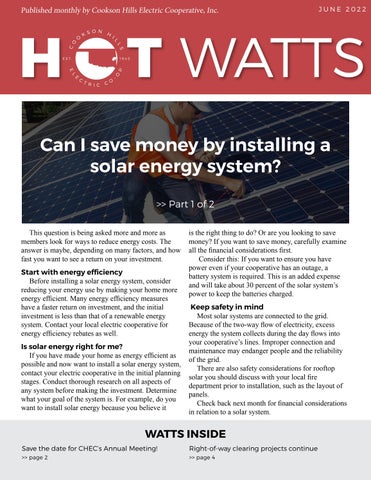
Can I save money by installing a solar energy system? >> Part 1 of 2 This question is being asked more and more as members look for ways to reduce energy costs. The answer is maybe, depending on many factors, and how fast you want to see a return on your investment. Start with energy efficiency Before installing a solar energy system, consider reducing your energy use by making your home more energy efficient. Many energy efficiency measures have a faster return on investment, and the initial investment is less than that of a renewable energy system. Contact your local electric cooperative for energy efficiency rebates as well. Is solar energy right for me? If you have made your home as energy efficient as possible and now want to install a solar energy system, contact your electric cooperative in the initial planning stages. Conduct thorough research on all aspects of any system before making the investment. Determine what your goal of the system is. For example, do you want to install solar energy because you believe it
is the right thing to do? Or are you looking to save money? If you want to save money, carefully examine all the financial considerations first. Consider this: If you want to ensure you have power even if your cooperative has an outage, a battery system is required. This is an added expense and will take about 30 percent of the solar system’s power to keep the batteries charged. Keep safety in mind Most solar systems are connected to the grid. Because of the two-way flow of electricity, excess energy the system collects during the day flows into your cooperative’s lines. Improper connection and maintenance may endanger people and the reliability of the grid. There are also safety considerations for rooftop solar you should discuss with your local fire department prior to installation, such as the layout of panels. Check back next month for financial considerations in relation to a solar system.
WATTS INSIDE Save the date for CHEC’s Annual Meeting!
Right-of-way clearing projects continue
>> page 2
>> page 4
Cookson Hills Electric Cooperative, Inc. Headquarters Office PO Box 539 • 1002 E. Main Stigler, OK 74462 • 800-328-2368 Branch Office PO Box 587 • 1800 KOA/Power Drive Sallisaw, OK 74955 • 918-775-2211 Pay-by-Phone: 1-888-678-1937 www.cooksonhills.com Alternate Emergency Only: 918-552-0016
SAFETY TIPS FOR BEFORE, DURING AND AFTER
THE STORM By Abby Berry
BOARD OF TRUSTEES Joe Ogle, President Rocky Woods, Sr., Vice President Ronnie Pevehouse, Sec/Treasurer Dan Callahan, Trustee John Dillard, Trustee Dart Drummonds, Trustee Mike Rose, Trustee
District 6 District 1 District 7 District 2 District 3 District 4 District 5
STAFF Juli Orme, General Manager Chris Morris, Chief Financial Officer Mark Blaylock, Director of Operations — Stigler Marty Huff, Director of Operations — Sallisaw Ellen Mattison, Manager of Accounting Services Kristie Cash, Manager of Office Services Rockey Oldham, Manager of Broadband Services Jeremy Stubblefield, Chief Technology Officer Brad Martin, Director of Member/Public Relations and Economic Development Dallin Shaw, Director of Engineering
Russell V. Barber, General Counsel Cookson Hills Electric Cooperative, Inc. welcomes members to submit photos, and articles which will be subject to editing. Cookson Hills reserves the right to publish or modify any article. Companies and individuals featured in the Hot Watts newsletter do not necessarily reflect the official policy, position, or view of Cookson Hills. Cookson Hills Electric Cooperative, Inc. is an equal opportunity provider and employer. If you find your account number hidden in this issue of the Hot Watts, you’ll receive a $25 credit on your electric bill.
bit.ly/CHEConFB (case-sensitive)
2 | June 2022
Storm season is in full swing. Many summer storms have the potential to produce tornadoes––they can happen anytime, anywhere, and can bring winds over 200 miles per hour. In April, a video of NBC Washington chief meteorologist Doug Kammerer went viral. During a live broadcast, Kammerer called his teenage son to warn him of a tornado that was headed straight for their home. Knowing the kids were likely playing video games and not paying attention to the weather, he told them to head straight to the basement. Kammerer debated if he should call his family on-air, but he knew it was the right thing to do. Luckily, the kids made it safely through the storm. As adults, we understand the importance of storm safety, but younger children and teens may not realize the dangers storms pose. That’s why it’s so important to talk to your family and have a storm plan in place. Here are a several tips you can share with your loved ones. BEFORE THE STORM
Talk to your family about what to do in the event of a severe storm or tornado. Point out the safest location to shelter, like a small, interior, windowless room on the lowest level of your home. Discuss the dangers of severe thunderstorms; lightning can strike 10 miles outside of a storm. Remember: when you hear thunder roar, head indoors. Make a storm kit. It doesn’t have to be elaborate––having a few items on hand is better than nothing at all. Try to include items like water, nonperishable foods, a manual can opener, a First-Aid kit, flashlights and extra batteries, prescriptions, baby supplies and pet supplies. Keep all the items in one place for easy access if the power goes out.
Join us for our Annual Meeting Saturday, Oct. 1 at the Sallisaw High School gymnasium. More details to come.
DURING THE STORM
Pay attention to local weather alerts––either on the TV, your smartphone or weather radio––and understand the types of alerts. A thunderstorm or tornado watch means these events are possible and you should be prepared; a warning means a thunderstorm or tornado has been spotted in your area and it’s time to take action. If you find yourself in the path of a tornado, head to your safe place to shelter, and protect yourself by covering your head with your arms or materials like blankets and pillows. If you’re driving during a severe storm or tornado, do not try to outrun it. Pull over and cover your body with a coat or blanket if possible.
New zones open now!
AFTER THE STORM
If the power is out, conserve your phone battery as much as possible, limiting calls and texts to let others know you are safe or for emergencies only. Stay off the roads if trees, power lines or utility poles are down. Lines and equipment could still be energized, posing life-threatening risks to anyone who gets too close. Wear appropriate gear if you’re cleaning up storm debris on your property. Thick-soled shoes, long pants and work gloves will help protect you from sharp or dangerous debris left behind. Summer is a time for many fun-filled activities, but the season can also bring severe, dangerous weather. Talk to your loved ones about storm safety so that everyone is prepared and knows exactly what to do when a storm strikes.
Substation 2 – ENT 4 – TEN 14 – LIB 12 – NIC
Feeder 4 1 1, 2 1, 2, 3
Substation and feeder numbers can be found on your electric bill.
Abby Berry writes on consumer and cooperative affairs for the National Rural Electric Cooperative Association, the national trade association representing more than 900 local electric cooperatives. From growing suburbs to remote farming communities, electric co-ops serve as engines of economic development for 42 million Americans across 56% of the nation’s landscape.
The Steps to Restoring Power When a major outage occurs, our crews restore service to the greatest number of people in the shortest time possible – until everyone has power.
1. High-Voltage Transmission Lines These lines carry large amounts of electricity. They rarely fail but must be repaired first.
2. Distribution Substations Crews inspect substations, which can serve hundreds or thousands of people.
3. Main Distribution Lines Main lines serve essential facilities like hospitals and larger communities.
4. Individual Homes and Businesses After main line repairs are complete, we repair lines that serve individual homes and businesses.
Other CHEC News Congrats to Board Trustee Dart Drummonds for completing the National Rural Electric Cooperative Association Board Leadership Certificate! CHEC’s offices will be closed Monday, July 4, in observance of Independence Day.
www.cooksonhills.com | 3
Right-of-Way Clearing Projects Continue Crews are busy in the Cookson Hills Electric service territory working on clearing the rights-of-way (ROW). The clearing of trees, limbs, foliage and brush is an ongoing effort to decrease the number of power “blinks” and outages, as well as reduce the risk of coming into contact with power lines. Work is currently focused on clearing distribution lines fed by Substation 15 - AKI (Akins Substation). You may determine which substation serves your location by finding the substation number and three-letter identifier located in the box labeled “Sub” on your electric
bill. Clearing for this substation is expected to continue through late July 2022. Members receiving power from Substation 16 – POR (Porum Substation) can anticipate crews clearing the ROW as soon as late July or August 2022. [214600] Clearing the right-of-way protects individuals from the hazards of electricity and makes power restoration quicker and safer for Cookson Hills Electric members, the public and our personnel. Please contact Marty Huff at 918-775-2211 with any questions or concerns you may have about this project.
Considering the option of installing solar panels? Please make certain you call us first at 800-328-2368. We will be happy to provide you with some very important details before you sign up for solar. 4 | June 2022