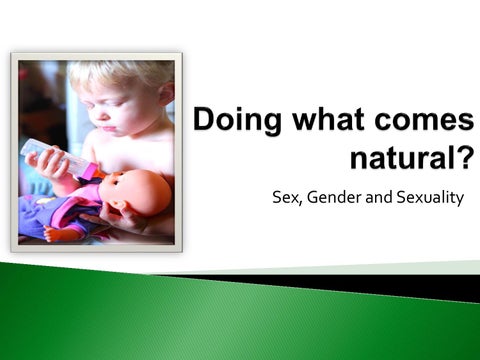
Sex, Gender and Sexuality
From biological differences to social divisions
Feminism and the turn to gender
Identity politics and the possibility of progress
Limits – biological, economic or political?
Normative sexuality and resistance
Thus far we have considered class and ethnicity as forms of social division
Biological sex (or gender?) is perhaps the most noticeable social difference
Whilst this has an obvious physical element, sociologists argue that sex (gender) is socially constructed
This involves both individual constructions and social determination
Whilst divisions are readily apparent, there appears to be some progress in relation to gender and sexual equality
This progress contrasts with both economic and ethnic inequalities (or does it?)
Nonetheless, gender and homosexuality remain one of the only areas in which active discrimination is legally and socially accepted
Biological assumptions, particularly in relation to masculinity and power, remain extremely common
Sex: Biological differences, male vs. female
Gender: Cultural differences, masculinity vs. femininity
How society understands the links between sex and gender significantly effects social and political responses to differences and divisions
Biology • Functional cohesion • Women’s roles
Social constructions • Feminism • Power inequality
ď ˝
Differences between men and women are often considered to be natural
ď ˝
The idea of the natural instincts of the human animal remain part of common sense assumptions
ď ˝
This is often celebrated in regards to sexuality (but remains subject to strict prohibitions) but rejected in relation to gender equality
Biology
Society
To what extent does biology determine individual gender identity and social gender roles?
Why does the masculine position dominate power relations in Western societies?
Is sexuality something we are ‘born with’ or is it socially constructed, and does it matter?
To what extent is gender determined by biology? ?
Different gender roles allow an ‘organic’ solidarity and social cohesion
Men and women might have different positions within society, but this is a reflection of natural differences
Durkheim: “Further, we have seen that in all the countries of the world women commit suicide much less than men. They are also much less educated. Fundamentally traditionalist by nature, they govern their conduct by fixed beliefs and have no great intellectual needs”. Suicide, p.121
Humans are just another animal species
The animal kingdom is marked by significant distinctions in ‘gender roles’
These biological distinctions are reflected in social gender roles ◦ Men and women are ‘separate but equal’
This concept helps to naturalise divisions between genders…
…and stigmatise ‘unnatural’ sexual practices
But has an intuitive grip on our understandings?
“By one of nature's cruel ironies, facially challenged chaps are most likely to get a hard time from their wives at the time of the month when she is most fertile, according to a scientific study in the US. As if this weren't bad enough, women whose husbands are less sexy also tend to be more attracted to other men at that time. Researchers at the University of California found women whose partners were low in sexual desirability become more distant, more critical, and less tolerant during high-fertility. This goes back to when the needs of women to get good mates, and therefore healthy children, were paramount� Source: http://www.independent.co.uk/news/science/looks-arent-everythingbut-heres-the-ugly-truth-8229436.html
On working mothers “Many women have told me, and surveys have shown, that they find it easier, more ‘professionally’ gratifying, and certainly more socially affirming, to work outside the home than to give up their careers to take care of their children.” — From “It Takes a Family”
On stay-at-home mothers “Respect for stay-at-home mothers has been poisoned by a
toxic combination of the village elders’ war on the traditional family and radical feminism’s misogynistic crusade to make working outside the home the only marker of social value and self-respect.’’ — From “It Takes a Family”
Gender had not been considered a social category until introduced in the 1950s by controversial psychologist John Money
The social construction of gender did not come into widespread use in sociology until the 1970s ◦ Masculinity vs. Femininity rather than Male vs. Female
This framework suggested that divides between the masculine and the feminine were socially determined and fluid
Biology does not ‘determine’ gender – it is an ‘inadequate explanation’
Humans are social and culture creatures; our biology is not simply expressed but constructed through social norms and institutional structures
Normative constraints on gender and sexuality are particularly determining, a process that begins in the womb
Gender is a verb – something that is done or performed
Social conceptions of gender remain constraining, even if they are self-constructed
What attributes make up feminine and masculine categories?
Nurturing
Powerful
Slim
Logical
Gentle
Muscular
Sensitive
Sexual
Communicative
Violent
These divisions have tended to represent an extension of private roles
Feminist’s have argued both that ‘women’s work’ in the home is undervalued and that certain tasks are considered to be women’s work
The idea of ‘women’s work’ has been extended in public roles
Divide these occupations by gender Masculine?
Feminine?
Teacher
Nurse
Lecturer
Architect
Account manager
Visual Effects (film)
Accountant
Personal Assistant
Lawyer
Builder
Plumber
Retail (fashion)
‘Feminine’ occupations tend to follow wife/mother nurturing roles Wife/receptionist
Mother/Teacher
Female Jobs
% Women
Male Jobs
% Women
Neutral Jobs
% Women
Sales Assistants
73
Taxi Driver
8
Lawyer
42
Waiters & Waitresses
73
Security Guard
12
Shelf Filler
48
Cleaners / Domestics
79
Software Engineer
14
Chef
49
Primary Teachers
86
Sales Manager
25
Secondary Teacher
55
Pamela Abbott (2006) Gender, p90
Girls’ Subjects
Boys’ Subjects
Not Gendered
A Level
Degree
A Level
Degree
A Level
Degree
Biology
BioSciences
Physics
Physical Sciences
Geography
Medicine
Psychology
Social Sciences
Computer Studies
Computer Science
History
Humanities
Media, Film & TV
Teacher Training
Economics
Planning
Business Studies
Art & Design
Pamela Abbott (2006) Gender, p78
Why are women over-represented in certain occupations?
Feminism, and feminist theory, seeks to understand and contest gender inequality ◦ Tends to be based around the idea of gender inequality and the subsequent need to promote women’s issues
Feminist sociologists argue ‘that it is necessary to reconceptualise sociology, not just add women, but to develop adequate theories for explaining the exploitation and subordination of women’ (Abbott, 2006: 71)
By arguing that distinctions between men and women are socially constructed rather than biologically given, feminist theory provided resources to challenge social divisions
The rise of feminism has been part of a significant shift within Leftist politics from the politics of class struggle to ‘identity politics’
Rather than being economically defined by the position of white, working class males, Leftism opened up to include a number of social movements
Identity Politics‌ 1)
Societies are marked by inequalities, divisions and relations of power (eg: sexual orientation, gender, ethnicity, class)
2)
No one inequality is privileged over any other
3)
Argued that political institutions are not ‘value neutral’ , nor are discourses of shared identity e.g. Nationalism
4)
These identities are founded upon the exclusion of non-members
5)
Identity politics is the battle for inclusion of previously marginalised groupings (Sandra Harding, 1991)
“Girls have outperformed boys in the proportion achieving an A grade [in A-Levels) since 1998” ◦ http://www.guardian.co.uk/education/2010/aug/19/a-levelresults-2010-subjects (GSCE’s)
http://www.guardian.co.uk/news/datablog+education/gcses
Why are girls outachieving boys n education? Should measures be taken to improve boys’ performance?
Whilst there appears to have been significant progress, strong limits remain, particularly in relation to; ◦ The control of power in the public domain ◦ The representation of femininity ◦ The normalisation of certain sexual practices
These limits have been the subject of strong feminist critique
There have also been conservative reactions, particularly around the ‘crisis’ of masculinity
From feminism to feminisms
Liberal feminism
Radical feminism
Marxist feminism
ď ˝
Liberal feminism has focused on ensuring formal and cultural equality between men and women
ď ˝
This can be limited to ensuring equal pay for equal jobs or equal opportunities
ď ˝
Alternatively, liberal feminists have attempted to tackle more institutional forms of gendered discrimination
The demands of childcare often coincide with normalised periods of career progression
Women are often expected to take on domestic ‘responsibilities’ as well as paid employment
There exists a cultural bias towards masculine characteristics within public life
The ‘Equal Pay Act’ was passed in 1970
In 2010, research by the Chartered Management Institute (CMI) suggested that the gender pay gap in the UK would not be bridged until 2067
http://www.leftfootforward.org/2010/03/gender-inequality-women-still-earn-20-lessthan-men
What factors contribute to this pay gap?
Radical feminists such as Simone de Beauviour argue that a ‘patriarchal’ system of power ensures male supremacy
Masculine positions are normative, forcing women take on these roles
Radical feminism is a structural perspective that risks essentialism by reducing women and men to an ‘essence’
Source: http://jezebel.com/uk-gender-inequality/
Can you be feminine and powerful?
Against these institutional boundaries, it is argued that women have been reduced to a shadow of masculinity
In order to compete, women have to ‘act’ like men
Youth culture, drinking and sex (and the city)
This process has been encouraged within capitalism
The focus of Western capitalism has shifted from production to consumption
Women and sexual minorities have been encouraged into the market place
This shift has included the loss of working class ‘masculine’ manual labour in favour of service orientated roles
Consumer culture celebrates the feminine shopper
Much as with the proletariat within capitalism, Marxist feminists have argued that men control women’s domestic labour
Capitalism has encouraged the entry of women into the job market, increasing the supply of labour
However, capitalist dynamics continue to determine the value of this labour e.g. Finance capitalists are more valuable than hospice nurses
The rise of feminine perspectives and reduction in working class status has challenged ‘what it means to be a man’
There has been considerable fretting about systematic biases in the education system…
…and ‘discrimination’ against (white) men through progressive programmes
No.10 Learn to talk the talk No.5 Forget the past No.9 Get the news
No.4 Don't write anything
No.8 Develop your voice
No.3 Drink hard
No.7 Hit the gym
No.2 Shake with authority
No.6 Foot the bill
No.1 Look 'em in the eye
http://uk.askmen.com/top_10/dating/top-10-ways-to-be-a-real-man_10.html
Part of the ‘crisis’ of masculinity is the notion that society has moved away from its ‘natural’ state by encouraging more relativist conceptions
This concern returns us to question of socialised biology
To what extent can we ‘choose’ our gender?
Of all the divisions we have thus far examined, only prejudice against sexual minorities in enshrined in law
Moreover, whilst these discriminations are gradually being reduced there exists strong ‘moral’ and normative prejudice against non-normative sexual practices
Again, these concerns are dominated by ‘naturalist’ agendas
Are forms of sexuality natural to the human body, or are they socially constructed?
Are the meanings and status attached to labels such as homosexual and heterosexual based on fixed and enduring characteristics and understandings?
Why does progressive sexual reform provoke such a strong emotional reaction?
1533 - Buggery Act 1533 Henry VIII, male-male sexual activity punishable by death 1836 - Last recorded execution for sodomy in Great Britain 1861 - Offences Against the Person Act 1861 replaces death for sodomy with 10 years prison 1886 - Criminal Law Amendment Act 1895 - outlaws male-male sex 1895 - Oscar Wilde sentenced to two years jail Criminal Law Amendment Act 1885 1930 - Denmark first European country to decriminalise homosexuality 1967 - Sexual Offences Act 1967 - decriminalises male homosexual acts involving two men in private aged 21+ in England/Wales 1973 - American Psychiatric Association - removes homosexuality from DSM 1988 - Sweden first country to legally protect rights of lesbian women and homosexual men in social services, taxes, and inheritance 1992 - World Health Organisation removes homosexuality from psychiatric disorders 1995 - Sweden legalises same-sex partnerships 2000 - Sexual Offences (Amendment) Act 2000 reduces age of consent for male-male sex from 18 to 16 (16 for female-male sex) 2000 – Homosexual men / lesbian women can serve in UK armed services 2001 - The Netherlands legalises same sex marriages 2004 - Civil Partnership Act 2004 - allows same-sex couples in UK to register and receive same rights as married couples 2005 – Gender Recognition Act 2004 – Allows legal gender change 2007– Sexual Orientation Regulations – Prevents discrimination against buyers on the basis of sexual orientation 2012 – Scottish parliament announces plans to legalise gay marriage
Whilst legal progress has been made in relation to sexual discrimination, a social privileging of ‘natural’ heterosexuality orientated towards marriage and reproduction is still hegemonic Biological Essentialism ‘Reduces sexuality to reproduction, [so] only heterosexual sex can be fully ‘natural’, Hence its implications are heterosexist as well as sexist’ (Scott & Jackson, 2006: 237) Privileging & Institutionalisation - Marriage ‘As an institution, heterosexuality is not just about sex, it is as much about who washes the sheets as what goes on between them [e.g. gender equality]’ (van Every, 1996, cited in Scott & Jackson, 2006: 245)
Should ‘natural’ human behaviour be regarded as ‘normal’?
Trans-gender politics 1)
Challenges need to list sex on birth certificate and other documents
Civil partnerships 1)
Heterosexual marriage as natural model?
2) Challenges impact of sex 2) Civil partnerships and gender in other areas as substitute of (access to IVF, parenting, hetero-sexualised education etc.) ‘real thing’? 3)
Reinforces privileges of marriage over other forms of partnership?
Social Equalities 1) Promotes neoliberal consumer hedonism? 2) Dissolves gay/lesbian identities? 3) Reproduces heterosexuality as normative position??
Which is the more influential within contemporary British society, in terms of determining? ◦ Education ◦ Income ◦ Status
Do these factors interact to reproduce social divisions?
Whilst significant progress has been made in the West, persistent divisions remain
These divisions are often reproduced through biological assumptions
Sociological and political feminism(s) have challenged biological essentialism
These assumptions and subsequent discriminations continue to have resonant strongly
Disability, Health and Illness – Special guest, Prof. Steven Wainwright!
Please read Chapters 11 (Disability) and 14 (Health)