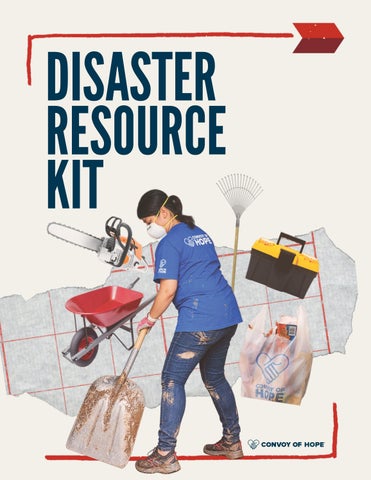
TER DISAS DISASTER RESOURCE KIT
RESOURCE KIT
1
Table of Contents
2
Letter to Leader
3
Disaster Quick Guide
4
Emergency Management 101
6
Community Assessment
9
Structure Matters
18
Phases of Disaster for Churches
22
Leveraging Volunteers in Disaster Response
25
Donations Management
26
Distribution Methods
29
Drive-Thru POD Checklist
30
Disaster Cleanup Operations for Churches
32
Disaster Cleanup Checklist
37
Partnering With Convoy of Hope
40
Demobilization Guide
42
Disaster Long-Term Recovery Guide for Churches
46
Spiritual & Emotional Care
49
Leaders Checklist
51
DEAR LEADER,
Disasters or crises rarely check our calendars before they strike. In a matter of hours, a community can shift from routine life into an emergency. And almost immediately, people look to the church. They look to you.
We believe every church is “ground zero” in its community. You know your people. You know your city. Our role is not to direct from a distance, but to come alongside you — strengthening what God is already doing through your leadership.
In chaos, clarity Not because you have all the answers matters. In urgency, wisdom matters. And — but because you are trusted. in every moment, your Because you are steady. Because long before the storm ever came, you presence matters most. were already there. This Disaster Resource Kit was created with that reality in mind. It is not meant to replace your leadership or prescribe a rigid playbook. Instead, it is a simple, practical blueprint designed to support you in the critical early days and weeks following a disaster. Each page offers clear, field-tested practices that churches across the country have used to serve effectively, wisely, and sustainably.
Our prayer is that this Disaster Resource Kit helps you lead with confidence, compassion, and endurance as you care for and serve your community. You are not alone in this work. Convoy of Hope stands ready to support you. Stacy Lamb
Vice President - Disaster Relief 3
DISASTER QUICK GUIDE Begin every response with prayer and discernment.
1.
Seek God’s wisdom, protection, and direction. Let prayer shape decisions, not just open meetings. Prayer is not optional — it sets the tone for everything that follows.
PRAY FIRST & KEEP PRAYING
LEAD WITH A PLAN
KNOW WHO YOU ARE
2.
Identify leadership roles and decision-makers. Communicate clearly and consistently. Respond thoughtfully, don’t react emotionally. Think long-term, not just a few days. A simple plan brings calm, clarity, and credibility.
4
Care for your church family first.
4.
Organize volunteers — don’t just mobilize them. Provide clear roles, safety, rest, and spiritual care. Healthy people are the greatest resource in any response.
BUILD BRIDGES FOR GREATER IMPACT CARE FOR PEOPLE WELL
3.
with local leaders and 5. Coordinate trusted partners. Avoid working in isolation.
Remember you are a church, not an emergency agency. Serve from your strengths and acknowledge your limits. Keep an eternal agenda, not a promotional one.
Support and strengthen what others are already doing. Disaster response works best when the Body of Christ moves together.
Faithfulness matters more than visibility. 5
EMERGENCY MANAGEMENT 101 When disasters strike, communities look for help, hope, and leadership. Churches are often among the first places people turn to in difficult times. Pastors and church leaders already play an important role in caring for their communities. However, when a disaster occurs, there is also an established emergency management system that coordinates the overall response. Understanding how this system works can help churches serve more effectively, avoid confusion, and ensure their efforts truly meet the needs of those affected.
What Is Emergency Management? Emergency management is the process communities use to prepare for, respond to, recover from, and reduce the impact of disasters. Emergency managers coordinate the efforts of many groups, including: Fire departments, police departments, emergency medical services, public health agencies, local government, volunteer and nonprofit organizations, faith-based organizations, utility companies, schools and hospitals Because disasters often involve many agencies and large numbers of people, coordination and organization are essential. Without coordination, well-meaning efforts can unintentionally create confusion, duplication, or even safety risks. Emergency management helps ensure that resources, volunteers, and information are directed where they are most needed. 6
THE DISASTER LIFE-CYCLE
Emergency management is typically described in four phases.
1 Mitigation
Mitigation involves actions taken to reduce the impact of disasters before they happen.
2 Preparedness
Preparedness focuses on planning and training before a disaster occurs.
3 Response
Response refers to the immediate actions taken during and right after a disaster to save lives and protect property. During this phase, emergency managers coordinate multiple organizations so that resources are used effectively. Churches often play valuable roles in response by: • Providing volunteers • Offering facilities for distribution or shelter
• •
Supporting emotional and spiritual care Helping communicate needs within the community
However, coordination with emergency management is important so that efforts align with the overall response.
4 Recovery
Recovery begins as soon as the immediate danger passes and may continue for months or even years. Recovery includes: • Debris removal, rebuilding homes and infrastructure, financial assistance programs, emotional and spiritual care for survivors, long-term community support
7
How Emergency Management Is Organized Most communities follow a common structure designed to help many organizations work together during disasters. While the details vary by location, the overall approach is generally similar across the country. In most disasters, local government is responsible for coordinating the response. •
A city or county emergency manager
By following an organized structure, responders can make decisions quickly and ensure that help reaches the right places.
•
Fire and law enforcement leadership
•
Volunteer coordination
•
Public works and utilities
•
Supply distribution
•
Public health officials
•
Community communication
•
Long-term recovery efforts
This usually includes:
If the situation becomes larger than local resources can manage, additional support may come from state or national agencies, but the response typically still operates through the local emergency management structure.
Incident Command & Coordination Disaster responses use a management structure designed to keep communication clear and responsibilities organized. This structure helps answer questions like:
8
•
Who is in charge of the response?
•
What resources are available?
•
Where are volunteers needed?
•
What areas still need help?
Disasters are challenging and often overwhelming for communities. Emergency management systems exist to organize the response and ensure that help reaches those who need it most. When pastors and church leaders understand the basics of emergency management, they can work alongside these systems to serve their communities wisely and effectively. By combining faith-driven compassion with coordinated action, churches can play a powerful role in helping communities respond to crises and rebuild with hope.
COMMUNITY ASSESSMENT Understanding your community is the first step in meeting its needs. This assessment is designed to help you begin gathering information that deepens your awareness and connection. It also invites you to reflect on how you are currently engaging and to explore new ways your church can serve more effectively in your local area.
Benefits of Researching Your Community •
•
•
Builds awareness of the community’s identity, stakeholders, and needs. Research helps churches gain a clearer understanding of who their neighbors are, what matters to them, and where support is most needed. Encourages wise stewardship by avoiding duplication of services. By learning what programs and resources already exist, churches can partner effectively and focus efforts where they will have the greatest impact. Identifies gaps and new opportunities for meaningful service. Understanding unmet needs allows churches to respond creatively and compassionately, expanding their reach and deepening their local impact.
Websites for Community Data Gathering With the help of online tools, gathering this information has never been easier. Census.gov/quickfacts This website is run by the U.S. Census Bureau. It provides statistics about population, cultural demographics, education, and housing for communities with populations over 5,000 people. City-Data.com City-Data provides a variety of information about a community, such as cost of rent, crime rates, school information, and religion statistics.
9
1. Community Demographics Population
Age Ratios
_________ Total Population _________ _________ % Urban
_________
_________ % Suburban
_________
_________ % Rural
_________
Cultural Factors Ethnicities
Religions
Languages
10
Gender % _________ % _________
Estimated percentage of the population that speaks English as a second language: % _________
Note Space
11
2.
Economic Factors
_________ Average income _________ Average cost of living
2026 Poverty Guidelines for the 48 Contiguous States
_________ % of households earn near the poverty level of income or below
Persons in Family/Household
Poverty Guidelines
_________ % of working class are white collar
1
$15,960
_________ % of working class are blue collar
2
$21,640
3
$27,320
4
$33,000
5
$38,680
6
$44,360
7
$50,040
8*
$55,720
_________ % are retired and financially stable _________ % are veterans _________ % are unemployed
Major Employers
*For families/households with more than 8 persons, add $5,680 for each additional person.
Other Sources of Income
12
Have there been any recent major changes in the community?
3. Housing, Family Life & Other Statistics
_________ % own house/apt.
Average cost of rent
_________ % are single parent
Heads of household are:
____ $
Average cost of home ____ $
____ % male
% female ____
____ % live with family ____ % live alone
At-risk neighborhoods
Other notable statistics
Divorce Rate
High School Dropout
County: _________ State: ________
County: _________ State: ________
Teen Pregnancy Rate
Teen Substance Abuse Rate
County: _________ State: ________
County: _________ State: ________
Child Abuse/Neglect Rate
Crime Rate
County: _________ State: ________
County: _________ State: ________
What are some overall community values?
What are some community strengths?
13
4. Community Stakeholders & Leaders
14
Mayor
Sheriff
County/City Government
Deputy
Judges
City Council Members
Social Workers
City Management/Public Works
Local Emergency Managers
Chief of Police
Fire Chief
County Commissioner
Superintendent of Schools, Board Members, Principals
Pastors & Churches
Nonprofits & Community Organizations
Other Community Leaders
15
5. Finding
the Gap
To avoid duplication of services in your community, it’s important to know what services are being provided.
Is your church currently active in offering or supporting various community services? If so, list them here:
Name
Services Provided
What are some community services that are needed?
16
What are your church’s top four strengths?
1 3
2 4 What are ways your church can tap into its natural strengths in order to meet unmet needs that still exist in the community?
What types of disasters are most likely to occur in your area?
17
STRUCTURE MATTERS
m (ICS)?
ICS is not about
control — it’s about clarity.
Speaks the same language as local authorities
Provides clear leadership during chaos Establishes who leads, who supports, and how decisions are made when pressure is high and time is limited.
Aligns the church with emergency management and local government systems, allowing for clearer communication and coordination. Strengthens partnerships without compromising mission Enables the church to work effectively with civic partners while remaining Christ-centered in purpose and approach. 18
Sy ste
d
h
an mm
yS h W
ld u o
Co
aC
e Its Own In v a cid
t en
hu rch
H
INCIDENT COMMAND SYSTEM FOR CHURCHES
Improves communication inside and outside the church Creates clear pathways for sharing information with staff, volunteers, and the surrounding community. Stewards the moment with excellence Helps the church respond wisely — not react emotionally.
Things a Church Should Remember When Building Its Own ICS
1.
Flow from your mission and culture ICS should support the church’s calling and essential ministries, not compete with them.
Align with existing leadership Build on current church leadership structures to ensure clarity, trust, and continuity.
3.
Use people’s strengths and gifts Assign roles based on skills, experience, and temperament — not just availability.
Keep it simple and scalable Design an ICS that fits your church size and can expand or contract with the disaster.
5.
2.
4.
Communicate roles clearly and often Repetition reduces confusion and helps everyone lead and serve
A church’s ICS doesn’t need to be perfect — it needs to be familiar, flexible, and faithful.
19
Understanding Roles & Responsibilities
An ICS is a framework, not a hierarchy It provides clarity and coordination — not control or additional authority. One person may hold multiple roles Especially in smaller churches or during the early stages of a response, roles can be combined. Titles matter less than responsibilities Churches may adapt role names to fit their culture as long as functions are clear. Clarity takes the place of certainty in the chaos of disaster When roles are clear, leaders and volunteers are free to focus on compassion, care, and presence.
20
BASIC ROLES Response Lead
Provides overall guidance for all response-related activities.
Logistics Lead
Communications Lead
Operations Lead
Volunteer Lead
Coordinates all tasks related to shipping and receiving of resources, as well as provides oversight of equipment and the facilities.
Promotes and provides clear communication of response activities via social media, organizational webpage, and local media outlets.
Participates in, and provides leadership for carrying out the practical, hands-on response efforts.
Creates an inviting and engaging atmosphere for volunteers to successfully assist in response activities.
Partnership Lead
Cultivates and faithfully stewards relationships with both existing and new community partners and fellow organizations to strengthen response capabilities.
21
PHASES OF DISASTER FOR CHURCHES The Phase of Disaster A Church’s Role Before, During & After Crisis
The
1 PREPAREDNESS Plan & Prepare
4 RECOVERY Rebuild & Restore
22
4
Phases of Disaster
FOR CHURCHES
2 MONITORING Stay Alert
3 RESPONSE Take Action
No one can predict when disaster will strike. But churches can prepare for the possibility. Preparation strengthens response. Clarity reduces confusion. And when a crisis impacts a community, the local church is uniquely positioned to serve as a steady presence. Disasters can be broken down into phases. Emergency management professionals commonly organize their work into mitigation, preparedness, response, and recovery. Churches must view disasters through a similar lens. Viewing disaster relief in phases provides a holistic approach and equips the church to serve its community more effectively. Preparedness, monitoring, response, and recovery are essential components of faithful and practical leadership in times of crisis.
1 Preparedness
(Planning Before Impact) Preparedness happens long before headlines or warnings.
What This Phase Means Intentionally planning for the possibility of disaster so the church can respond with clarity rather than chaos.
What the Church’s Role Could Be • • • • •
• • •
Develop a simple response plan. Assign leadership roles and decision-makers. Establish a communication strategy (staff, volunteers, congregation). Identify vulnerable members within the church body. Build relationships with local emergency management, first responders, and other community stakeholders. Assess facility capabilities (capacity, accessibility, sustainability, safety). Pray proactively for wisdom and protection over your community. Preparedness builds confidence and positions the church to lead when uncertainty rises.
2 Monitoring
(Situational Awareness Phase) Monitoring begins when a potential threat emerges.
What This Phase Means Staying informed and ready as situations develop, without overreacting or spreading panic.
What the Church’s Role Could Be • • • • • •
Follow credible updates from local authorities and weather services. Communicate clearly and calmly with your church. Review plans and confirm leadership readiness. Encourage families to take appropriate precautions. Prepare facilities and supplies if response becomes necessary. Monitoring bridges preparation and action. It keeps the church steady and informed.
23
3 Response
(Action Phase) This is the most visible phase — but not the only one.
What This Phase Means Providing timely, practical, and spiritual care in the immediate aftermath of impact.
What the Church’s Role Could Be •
• •
• • •
Begin walking out the plans that have been made and the training that has taken place. Offer prayer, spiritual care, and emotional support. Support relief efforts through distribution, volunteers, or space (if appropriate). Partner with trusted organizations rather than operating independently. Communicate consistent and accurate information. In response, the church embodies hope. Presence often matters more than programs.
4 Recovery
(Long-Term Restoration Phase) Recovery is often the longest phase — and where the church’s influence is strongest.
What This Phase Means Walking with individuals and the community as they rebuild physically, emotionally, and spiritually.
What the Church’s Role Could Be •
Support long-term volunteer rebuilding efforts.
•
Assist with benevolence and resource navigation where possible. Recovery deepens trust and strengthens long-term ministry impact. Become educated about the community’s Long-Term Recovery plan.
•
•
When churches understand disaster through these four phases, they lead with wisdom instead of urgency alone. They prepare before a crisis. They stay informed as threats emerge. They respond with clarity. They remain present through recovery. Prepared churches do more than react — they shepherd their communities through every stage of crisis with strength and compassion.
24
LEVERAGING VOLUNTEERS IN DISASTER RESPONSE Volunteers are the force multiplier of most churches. Without them, many of the ministries that serve your congregation and community simply would not exist. From children’s ministry and serve teams to greeters, ushers, and hospitality teams, volunteers make ministry possible. As a church leader, you likely already understand the incredible value of a strong volunteer culture. That same volunteer base can play a powerful role when disaster strikes your community. When a federally declared disaster occurs, the federal government typically covers 75% of eligible response and recovery costs through FEMA’s Public Assistance program, while the remaining 25% is the responsibility of the local government or community. Many churches are unaware that their volunteers can actually help reduce that local financial burden. When volunteers from your church serve during disaster response — whether distributing relief supplies, assisting with cleanup, or supporting community recovery — their documented volunteer labor may be credited toward the local government’s required cost share. FEMA assigns a monetary value to each volunteer hour, based
on standardized hourly rates for general labor and skilled labor. When those hours are properly documented and submitted through your local emergency management office, they can be counted toward the community’s portion of disaster recovery costs. Because of this, it is extremely important that churches responding to disasters track volunteer participation carefully. At a minimum, you should record: •
Volunteer name
•
Date of service
•
Location where they served
•
Type of work performed
•
Hours worked
Simple documentation allows your church to not only serve your community well but also strengthen your partnership with local emergency management and help offset recovery costs for your county. Keeping good records ensures that every act of service — every box distributed, every hour served — can contribute to the overall recovery of your community.
25
DONATIONS MANAGEMENT In the aftermath of a disaster, generosity pours in. People want to help. Churches want to respond. Trucks start moving. Supplies start arriving. But unmanaged generosity can create chaos instead of relief. Effective donations management ensures that what is given truly meets needs and strengthens — not burdens — your response.
•
How many people are affected?
•
What is our realistic capacity to serve?
Donations management is not just about receiving items. It is about stewarding resources wisely for the sake of people who are hurting.
If you cannot store it, move it, or distribute it, it becomes a burden. Capacity determines what you should receive.
Meeting Needs Begins With Assessing Needs Before accepting a single donation, you must clearly understand the need.
•
5 cases
•
5 pallets
•
5 truckloads
Working With Community Partners You are rarely responding alone. Effective donations management requires communication and coordination.
What is needed right now may not be what is needed three to five days from now. In the first 24–48 hours, water, shelf-stable food, hygiene kits, and cleanup supplies may be critical. A few days later, the focus may shift to tarps, tools, baby supplies, or long-term recovery materials.
Start with clear communication.
Needs on the ground change quickly. Roads reopen. Power is restored. Grocery stores resume operations. Relief agencies arrive. Your assessment must be ongoing, not static.
Understanding Logistics
Ask
26
Understanding scope is essential. There is a big difference between:
•
What is the immediate need?
•
What will the need likely be in 3–5 days?
•
What is needed now?
•
What will be needed in a few days?
•
What is your plan?
•
What is their plan?
Clarity prevents duplication and waste.
Before accepting a large shipment, consider: •
Can you receive a tractor-trailer?
•
Do you have access to a forklift or pallet jacks?
•
Do you have volunteers to unload?
•
Are transportation routes open and safe?
A truck arriving without the equipment or people to unload it can paralyze your operation.
Working With Multiple Partners Know who else is responding: •
Other churches
•
Nonprofits
•
Emergency Management
•
Local government
It is wise to understand who is distributing what and where. Coordination ensures that one neighborhood does not receive five deliveries while another receives none.
Also Ask •
What is Emergency Management’s plan for donations? In some communities, a centralized donations warehouse may be established. Aligning with their structure increases efficiency and credibility.
Effective Donations Management
Saying No With Grace You will sometimes need to decline donations. Do so with gratitude and clarity. Thank the donor. Explain the current need. Offer alternative ways they can help. For example:
“Thank you for wanting to give clothing. Right now we are focusing on cleanup supplies and hygiene kits. Would you consider supporting that effort instead?”
At times, relationships may influence decisions. Occasionally, you may accept items because maintaining a key relationship matters long-term. When this happens, make a plan to steward those resources responsibly. Generosity is a gift. Stewardship is your responsibility.
Effective donations management begins with knowing what to accept — and what to decline. This requires: •
A clear impact assessment
•
An understanding of current infrastructure (What is open? What is closed?)
•
A realistic evaluation of your capacity
If grocery stores are open, pallets of bottled water may no longer be necessary. If power is out, refrigerated food may create waste. 27
Intake: Where Order Begins
Trust from:
Every effective distribution starts with disciplined intake.
•
Survivors who need help
•
Donors who gave sacrificially
•
Community partners who are watching
•
Emergency officials who must coordinate
Ask •
Are these items meeting verified needs?
•
Are they safe and usable?
•
Do we have space and a plan for distribution?
Distinguish clearly between receiving and distribution. Just because you received it does not mean it should immediately go out. Intake is about organization and accountability. •
Organize with intention.
•
Keep like items together.
•
Clearly label pallets and storage areas.
•
Separate damaged or expired items.
•
Pay close attention to expiration dates.
•
Maintain a running inventory.
Inventory does not need to be complicated, but it must be consistent. Even a simple spreadsheet or clipboard system helps you track what is coming in and going out. And remember: •
Pallets are your friend.
•
Whenever possible, keep items on pallets.
•
Shrink-wrap and label them.
•
Move pallets instead of individual boxes.
This saves time, reduces chaos, and protects your volunteers from unnecessary strain.
Final Thought: Stewardship Builds Trust Donation management is about more than supplies. It is about trust. 28
When donations are assessed carefully, received intentionally, stored responsibly, and distributed strategically, your church becomes a place of order in the middle of chaos.
GENEROSITY MAY ARRIVE QUICKLY. WISDOM MUST GUIDE IT. AND WHEN GENEROSITY AND WISDOM WORK TOGETHER, THE IMPACT MULTIPLIES.
DISTRIBUTION METHODS Using the Right Strategy To Serve the Community Well
Best used when:
Effective disaster response requires selecting the distribution method that best serves the specific needs of the community. No single method fits every situation. In many cases, multiple strategies may be used simultaneously or sequentially as needs evolve. Flexibility and proper assessment are essential.
Key considerations:
Guiding Principle
Drive-thru distributions are efficient for serving high volumes of families quickly and safely.
The goal is not simply to distribute supplies, but to serve people with dignity, wisdom, and compassion. Choose the method — or combination of methods — that removes barriers and best meets the real needs of the community.
Points of Distribution (POD) A Point of Distribution (POD) is a fixed location where individuals come to receive relief supplies. PODs may operate as walk-up, drive-thru, or a hybrid of both depending on community needs and available space.
Drive-Thru Distribution A fixed site where families remain in their vehicles while receiving supplies.
•
Damage is widespread.
•
A large number of families are impacted.
•
Most residents have access to vehicles.
•
Requires a larger space with defined traffic flow.
•
Needs additional volunteers for staging, loading, and traffic control.
•
Allows distribution of larger quantities and a wider variety of supplies.
Mobile Distribution Mobile distribution delivers supplies directly into impacted neighborhoods. Best used when: •
Residents lack transportation.
•
Individuals are elderly, disabled, or homebound.
•
Specific neighborhoods are disproportionately affected.
Key considerations: •
Requires prior assessment to identify highest-need areas.
•
Pickup trucks or vans must accommodate supplies and volunteers.
29
•
Strong situational awareness and safety protocols are necessary.
Mobile distribution ensures vulnerable populations are not overlooked.
Walk-Up Distribution A fixed site where individuals walk to receive supplies. Best used when: •
The community has limited access to vehicles.
•
Serving dense urban areas or lower-income housing communities.
•
A smaller physical footprint is required.
Key considerations: •
Supplies must be limited to what individuals can carry.
•
Clear flow and crowd management are critical.
•
Can operate alongside a drive-thru model.
Walk-up distributions are simple to establish and effective in communities where transportation is limited.
DRIVE-THRU POD CHECKLIST Drive-Thru POD Checklist
A Drive-Thru Point of Distribution requires planning, coordination, and clear roles to operate safely and efficiently.
Traffic flow plan developed
Site Selection & Layout
Clear signage for entrance, exit, and directional flow
Adequate space for vehicles to line up (keep out of traffic if possible)
Cones, delineators, or traffic barrels in place
Clearly defined entrance and exit routes One-way traffic flow established
Dedicated traffic control volunteers assigned
Separate volunteer parking area
Plan to prevent congestion on public roads
Staging area for supplies (protected from weather if possible) Safe pedestrian lanes for volunteers 30
Traffic Plan
Coordination & Communication Local law enforcement notified (if needed for traffic control) Property owner approval secured (if not the church) Local emergency management aware of operation Internal communication plan for volunteers (radios or group messaging) Single point of contact identified (POD Leader) Orientation and rally before distribution begins
Volunteer Staffing Leader/Site Coordinator Traffic control team Supply staging team Car Loaders
Plan for handling aggressive or distressed individuals
Community Communication Distribution time and location clearly communicated Clear expectations on what supplies are available Plan for managing early arrivals Media contact identified (if needed)
Trash Cardboard/plastic disposal area identified Volunteer assigned to trash responsibility End-of-day cleanup team designated Site left in equal or better condition than received
Floaters/relief volunteers Safety Volunteer check-in and sign-out process established Clear role assignments communicated
Logistics Supplies pre-staged for efficient loading Load plan determined (what each vehicle receives) Restocking plan in place Counting method identified
Safety Weather conditions monitored Hydration plan for volunteers First aid kit available Clear instructions for vehicle drivers
31
DISASTER CLEANUP OPERATIONS FOR CHURCHES When disasters occur, churches often want to mobilize volunteers quickly to serve their community. While this desire to help is valuable, cleanup operations involve different levels of risk, skill, and equipment. Church leaders should carefully consider what level of cleanup their church is prepared to support safely and responsibly.
•
Picking up scattered belongings and assisting homeowners with sorting
•
Moving limbs and debris into organized piles at the curb for municipal pickup
•
Clearing yards, sidewalks, and driveways
•
Minor removal of small branches and brush
Not every church should attempt every type of cleanup operation. The safest and most effective response is one that matches the skills, training, insurance coverage, and supervision your church can provide.
These projects are typically short-term and can often be completed in a few hours.
Below are common levels of cleanup work that churches may encounter after wind events, tornadoes, storms, or flooding.
Wind Event Debris Cleanup Basic Cleanup Operations Basic cleanup is often the best entry point for church volunteers because it requires minimal equipment and training.
32
Typical equipment: •
Rakes
•
Loppers or hand pruners
•
Wheelbarrows
•
Gloves and safety glasses
Personnel considerations: •
Team leader or site supervisor
•
Teams of general volunteers
•
Minimal specialized training required
Intermediate Cleanup Operations
Typical tasks may include:
Intermediate cleanup begins to involve greater risk and requires trained volunteers and supervision.
•
Typical tasks may include:
Raking and collecting small vegetative debris
•
Chainsaw work to remove fallen trees and large limbs
•
Cutting and removing damaged trees from properties
•
Clearing debris from collapsed structures
Projects may last several hours to multiple days.
•
Dragging and stacking brush and debris
•
Installing emergency roof tarps to prevent additional damage
Typical equipment: •
Skid steers
Clearing large debris from structures
•
Excavators
Projects usually take several hours to a full day.
•
Dump trailers
•
Trucks and fuel
•
Chainsaws
•
Typical equipment: •
Chainsaws
•
Safety equipment (helmets, chaps, gloves, eye protection)
•
Tarps, boards, and roofing nails
•
Ladders and hand tools
Personnel considerations: •
Trained chainsaw operators
•
Team leader with safety oversight
•
Unskilled volunteers assisting with brush removal and debris movement
•
Volunteers must follow strict safety protocols
Advanced Cleanup Operations Advanced cleanup involves heavy equipment and significant hazards. These operations are often better handled by professional contractors or highly trained disaster response teams. Typical tasks may include: •
Removing large trees from structures
•
Clearing heavily damaged properties
•
Moving large debris piles
•
Hauling debris away with trailers
Personnel considerations: •
Highly trained equipment operators
•
Safety officer or experienced team leader
•
Smaller teams to maintain safe work zones
•
Chainsaw teams may operate alongside equipment teams
Flooding Event Cleanup Flood recovery is often more labor intensive and longer in duration than storm debris cleanup. It also introduces additional health hazards including contaminated water, bacteria, and mold.
Basic Flood Cleanup Basic cleanup focuses on helping homeowners sort and remove items impacted by floodwaters. Typical tasks may include: •
Assisting homeowners with salvaging belongings
•
Removing debris, mud, and sediment from yards 33
• •
Clearing personal property from flooded areas
•
Power drills and saws
•
Shovels and buckets
Removing water-damaged items from structures
•
Shop vacuums
•
Fans and drying equipment
These projects are usually short-term and may take a few hours. Typical equipment: •
Shovels
•
Rakes
•
Wheelbarrows
•
Buckets
•
Gloves and protective gear
Personnel considerations: •
Team leader or supervisor
•
General volunteers
•
Volunteers should use protective equipment due to contamination risks
Intermediate Flood Cleanup (Muck & Gut)
•
Team leader with construction knowledge
•
Volunteers with basic construction skills
•
Additional volunteers to remove and haul debris
•
Proper protective equipment is essential
Advanced Flood Cleanup Advanced flood recovery often includes major debris removal and mold remediation, which can involve significant health risks. Typical tasks may include: •
Removing structural debris from properties
“Muck and Gut” operations involve removing damaged materials from flood-damaged structures so the building can begin drying and repair.
•
Using heavy equipment to clear damaged structures
•
Sanitizing buildings after muck and gut operations
Typical tasks include:
•
Mold remediation and treatment
•
Removing mud and debris from inside structures
These operations may last multiple days or longer.
•
Removing drywall, insulation, flooring, and cabinets
Typical equipment:
•
Removing damaged appliances and furniture
•
Skid steers
•
Preparing the structure for drying and rebuilding
•
Excavators
•
Trucks and trailers
These projects may take several hours to several days. Typical equipment: 34
Personnel considerations:
•
Pry bars and demolition tools
Heavy machinery:
Sanitization and remediation equipment: •
Sprayers
•
Pressure washers
•
Mold treatment chemicals
•
Respirators and protective suits
Personnel considerations:
Volunteer Waivers & Legal Protection Churches should review their volunteer waiver or release forms. Important questions include: •
Does our volunteer waiver specifically include disaster response or debris cleanup?
Trained safety supervisors
•
Does it cover hazardous activities?
Strict use of personal protective equipment (PPE)
•
Does it include medical release language?
•
Do minors require parent or guardian consent forms?
•
Heavy equipment operators
•
Mold remediation specialists
• •
Important Considerations Before Mobilizing Volunteers Before sending volunteers into disaster cleanup operations, church leaders should carefully review several important questions. These considerations help protect volunteers, homeowners, and the church itself.
Insurance & Liability Church leaders should review their current insurance coverage and ask: •
Does our insurance policy allow volunteer disaster response activities?
•
Are volunteers covered under our liability policy during off-campus service work?
•
Are chainsaw operations or heavy equipment use covered?
•
Are we covered if a volunteer is injured while serving?
•
Does our policy allow volunteers to work on private residential property?
It is wise to consult legal counsel or an insurance provider to ensure these forms are appropriate for disaster response work.
Volunteer Age & Participation Not every volunteer task is appropriate for every age group. Consider establishing clear guidelines such as: • Minimum age for participating in cleanup work • Age limits for chainsaw or power tool use • Whether minors must be accompanied by a parent or guardian • Physical requirements for demanding tasks Many organizations restrict chainsaw work or roof work to adults with specific training.
Some policies restrict hazardous activities, including chainsaw use, roof work, or equipment operation. 35
Safety & Training Churches should ask: •
Do we have trained team leaders?
•
Who is responsible for safety on each work site?
•
Do volunteers receive a safety briefing before starting work?
•
Do we have the proper protective equipment?
At a minimum, volunteers should have access to: •
Gloves
•
Eye protection
•
Hard hats (when appropriate)
•
Closed-toe footwear
•
High visibility clothing when working near roads
Volunteer Coordination & Supervision Disaster cleanup can quickly become disorganized without clear leadership. Churches should consider:
36
•
Who will serve as the cleanup coordinator
•
Who will serve as site leaders
•
How volunteers will be assigned to projects
•
How work sites will be evaluated for safety before sending volunteers
DISASTER CLEANUP CHECKLIST Churches often want to respond quickly after disasters, but effective and safe disaster response requires preparation. Use the checklist below to evaluate whether your church is ready to mobilize volunteers for cleanup operations.
This checklist can help identify strengths, gaps, and areas for improvement before disaster strikes.
Leadership & Coordination Consider whether your church has leadership in place to coordinate response efforts. Our church has identified a disaster response coordinator or leader. We have a small leadership team that can help coordinate volunteers during a disaster.
Insurance & Liability Before mobilizing volunteers, it is important to understand what your insurance policy allows. Our church has reviewed its liability insurance policy related to volunteer activities. We know whether our insurance allows offsite volunteer work on private property. We understand whether our policy covers disaster response activities. We know whether volunteers are covered if they are injured during cleanup work. We have confirmed whether our insurance allows volunteers to use chainsaws or power tools. We understand whether heavy equipment operation is covered under our policy.
Our leadership understands how disaster cleanup efforts will be organized and supervised.
If you are unsure about these answers, it may be helpful to contact your insurance provider before disaster response begins.
We have a plan for communicating with volunteers quickly (email, text alerts, church app, etc.).
Volunteer Waivers & Documentation
We understand how we will receive requests for help from the community. We have a process for evaluating cleanup projects before sending volunteers.
Volunteer waivers help protect both volunteers and the church. Our church uses a volunteer liability waiver or release form. Our waiver includes language related to hazardous work or disaster response. 37
Our waiver includes a medical release or emergency contact information. We have a process for collecting waivers before volunteers begin work. We have parent or guardian consent forms for minors.
Equipment & Tools Cleanup work often requires tools and equipment. Our church has access to basic cleanup tools such as rakes, shovels, loppers, and wheelbarrows.
Volunteer Age & Participation Guidelines
We have volunteers who can provide chainsaws or other specialized tools if needed.
Not all cleanup work is appropriate for all volunteers.
We know who is responsible for maintaining and transporting tools.
Our church has defined minimum age requirements for cleanup volunteers. We have guidelines for which activities minors are allowed to participate in.
We understand which equipment volunteers are allowed to operate under our policies.
We have clear restrictions on who can operate chainsaws, ladders, or power tools. We understand when adult supervision is required for younger volunteers.
Volunteer Training & Safety Safety preparation helps reduce the risk of injury. We provide a safety briefing before volunteers begin work. We have team leaders who can supervise volunteers at cleanup sites. We have volunteers with specific skills such as chainsaw operation or construction experience. We know when to decline projects that exceed our skill level or safety capacity.
Personal Protective Equipment (PPE) Safety equipment helps protect volunteers from injury. Volunteers are encouraged or required to bring work gloves. We have access to eye protection or safety glasses. Hard hats are available when working around falling debris or tree removal. Volunteers understand the importance of wearing sturdy, closed-toe shoes or boots.
38
Additional PPE is available when needed (dust masks, respirators, etc.).
Site Assessment & Worksite Safety
Final Readiness Reflection
Every cleanup site presents different risks.
As you review this checklist, ask these key questions:
A leader will evaluate the site before volunteers begin work. We understand how to identify unsafe structures or hazards. Volunteers know not to enter heavily damaged buildings without proper training. We know when to refer a project to professional contractors instead of volunteers.
Volunteer Care & Support Disaster response can be physically and emotionally demanding.
•
Are we prepared to mobilize volunteers safely and responsibly?
•
Do we understand our limitations as well as our strengths?
•
Are we prepared to serve our community well during a disaster?
Disaster response is not simply about working quickly. It is about serving wisely, safely, and compassionately during times of great need.
Note Space
We plan for adequate water, breaks, and rest for volunteers. Volunteers understand they may encounter people experiencing trauma or loss. We encourage volunteers to show compassion and respect toward survivors. Volunteers are reminded to avoid making promises the church cannot guarantee.
Partnership & Coordination Churches are often most effective when working with other organizations. Our church understands how to coordinate with local disaster response organizations. We are willing to work under the direction of established disaster relief groups if needed. We understand that some situations require trained professionals or specialized teams. 39
PARTNERING WITH CONVOY OF HOPE Who is Convoy of Hope?
Convoy of Hope is a faith-based nonprofit organization that partners with local churches, businesses, and communities to provide disaster relief, humanitarian aid, and long-term recovery support. Convoy is committed to working through the local church — not around it — empowering you to serve your community with strength and credibility.
When should our church contact Convoy of Hope? You should reach out as soon as your community begins experiencing significant impact from a disaster, such as: •
Flooding, tornadoes, hurricanes, wildfires, winter storms, or earthquakes
•
Widespread power outages or infrastructure damage
•
Displacement of families
•
Shortages of food, water, or essential supplies
Early communication allows for a faster and more effective response.
How do we start a partnership with Convoy of Hope? Contact Convoy of Hope Disaster Relief through your existing relationship or by 40
emailing the Convoy Disaster Relief team at disasterrelief@convoyofhope.org. Be prepared to share: •
Church name and location
•
Type of disaster and current conditions
•
Immediate and anticipated community needs
•
Church capacity (facility access, volunteers, storage, parking, forklift access)
A Convoy representative will follow up to assess needs and determine next steps.
What role does our church play? Your church serves as a vital local partner and may function as: •
A distribution site for relief supplies
•
A hub for volunteer coordination
•
A trusted voice identifying real-time community needs
Convoy provides resources, logistics, and guidance, while your church provides local leadership, relationships, and presence.
What assistance can Convoy of Hope provide? Based on the situation, Convoy may provide: •
Food, water, and essential relief supplies
•
Cleanup tools and safety equipment
•
Volunteer coordination and best-practice guidance
•
Long-term recovery support and partner connections
•
Volunteers are engaged based on verified needs.
All support is tailored to the greatest needs of the community.
•
Self-deploying or spontaneous volunteers are discouraged.
Can we collect or donate items?
•
Convoy or your church will communicate when and where help is needed.
Please do not collect or ship items unless specifically requested by Convoy. Convoy distributes pre-vetted, need-based supplies to ensure: •
Efficiency
•
Proper logistics
•
Dignity for impacted individuals
Is this partnership short-term or long-term? Both. •
Convoy responds to immediate relief needs.
•
Convoy’s disaster response is just one part of its broader global mission. Beyond immediate relief, there are meaningful opportunities for your church to continue partnering in bringing hope to communities both locally and around the world.
If your church wants to respond immediately, financial giving is the most effective way to help.
How should we communicate with our congregation and community? Clear and coordinated communication is essential. Convoy recommends:
Your church’s continued presence plays a vital role in sustained recovery.
Why partner with Convoy of Hope? •
Proven disaster response experience
•
Sharing consistent, accurate messaging
•
•
Directing volunteers to approved opportunities only
Strong logistics and supply chain capabilities
•
Deep commitment to the local church
•
Avoiding independent or uncoordinated distribution efforts
•
Christ-centered compassion and excellence
•
You are not alone.
Convoy can assist with messaging and communication best practices.
What about volunteers? Volunteers are critical — but must be mobilized safely and strategically.
Convoy of Hope exists to come alongside your church so that together — we can br— Hope In Every Storm.ing 41
DEMOBILIZATION GUIDE Disaster response is often intense, urgent, and deeply meaningful work for churches. In the days and weeks after a crisis, congregations frequently mobilize volunteers, distribute supplies, host response teams, and care for affected families.
Churches frequently help meet these urgent needs through donations and distributions.
However, every disaster response eventually moves into a new phase where the community begins stabilizing and long-term recovery begins. At that point, churches must thoughtfully demobilize their response efforts and transition back to the normal rhythm of ministry.
Signs of product saturation may include:
Demobilization does not mean the church stops caring. Instead, it means shifting from emergency response to sustainable ministry and long-term support. This tip sheet outlines several guiding principles to help church leaders recognize when and how to scale down disaster response efforts.
Recognizing When It’s Time To Demobilize Every disaster is different, but several indicators often signal that the initial emergency response phase is ending. Church leaders should pay attention to changes in the community such as:
Product Saturation Early in disasters, communities often face severe shortages of basic items like water, food, cleaning supplies, and hygiene kits. 42
Over time, however, the situation often shifts. Warehouses fill up, distribution sites become crowded with supplies, and fewer people are coming to receive aid. •
Large amounts of unused donated goods
•
Distribution lines becoming smaller
•
Local stores reopening and restocking
•
Emergency agencies asking organizations to slow or stop product collection
When basic supplies are widely available, churches can begin scaling back large distribution efforts.
Infrastructure Is Restored One of the most important turning points in disaster response occurs when basic infrastructure is restored. This may include: •
Roads reopening
•
Water systems repaired
•
Public services operating again
•
Schools and government offices reopening
When infrastructure stabilizes, the community is often able to function more
independently, reducing the need for emergency distribution sites or temporary operations run by churches.
Power & Utilities Are Restored
Professional Recovery Efforts Are Expanding
The restoration of power is a major milestone in disaster recovery. Once electricity, water, and sanitation services are restored across most of the community:
Another signal that response is transitioning is when long-term recovery organizations and government programs begin ramping up services.
•
Families are able to safely remain in their homes.
This may include: •
Disaster assistance programs
•
Businesses can reopen.
•
Insurance claim processing
•
Food storage and supply chains normalize.
•
Case management services
•
Organized rebuilding programs
•
Long-term recovery groups
When most homes have utilities restored, churches that have been operating emergency services may begin transitioning back to normal operations.
Supply Chains Are Functioning Again
As these structured recovery systems develop, churches can shift from emergency operations to supporting recovery in more targeted ways.
In the immediate aftermath of a disaster, grocery stores and retailers may be closed or unable to restock shelves. This creates a critical need for donated food and supplies. As transportation routes reopen and businesses recover, supply chains begin working again. Indicators of supply chain restoration include: •
Grocery stores reopening
•
Fuel availability stabilizing
•
Construction materials becoming available
•
Local businesses resuming operations
When communities regain access to normal commercial goods, emergency distribution from churches becomes less necessary.
43
Healthy Demobilization Principles for Churches
Demobilization should be intentional and thoughtful. The goal is not to stop serving, but to transition wisely so that ministry remains sustainable.
Scale Down Gradually Avoid shutting down response efforts abruptly. Instead: •
Reduce operating days or hours.
•
Limit new volunteer shifts.
•
Transition distribution efforts to other partners.
Gradual changes help the community adjust and prevent confusion.
Communicate Clearly As response efforts wind down, communicate clearly with: •
Volunteers
•
Partner organizations
•
Your congregation
•
Community members receiving assistance
Let people know when services will end and what resources are still available elsewhere. Clear communication helps prevent misunderstandings and maintains trust.
Avoid Overcommitting Long-Term In the urgency of disaster response, churches may take on more responsibilities than they can realistically sustain.
44
•
Staff workload
•
Facility needs
Church leaders should ensure the ministry response remains healthy and sustainable.
Returning to the Normal Rhythm of Church Life One of the most important parts of demobilization is restoring the normal rhythm of church ministry. During disasters, churches often pause regular activities in order to respond to urgent needs. While this is appropriate in the short term, long-term ministry health requires returning to the regular patterns that support the congregation. This includes: •
Worship gatherings
•
Small groups and discipleship
•
Children’s and youth ministry
•
Pastoral care
•
Community outreach
Restoring these rhythms is important because the church must continue to shepherd its congregation while serving the community. When churches remain in crisis-response mode for too long, leaders and volunteers may experience fatigue and burnout. Returning to a healthy rhythm allows the church to: •
Care for its people.
•
Renew volunteers.
Demobilization is an opportunity to evaluate:
•
Sustain long-term ministry.
•
Volunteer capacity
•
•
Financial resources
Continue supporting recovery in meaningful ways.
Honoring the Work & Caring for Volunteers
Note Space
As disaster response winds down, take time to acknowledge and care for those who served. Consider: •
Thanking volunteers publicly
•
Sharing stories of impact
•
Providing opportunities for reflection
•
Encouraging rest for those who served heavily
Disaster response can be emotionally and physically demanding. Honoring volunteers helps reinforce the importance of their service and promotes long-term ministry health.
A New Phase of Ministry Demobilization does not mean the church’s role in the community is finished. In many ways, the church’s most important ministry begins during long-term recovery, when public attention fades but families are still rebuilding their lives. By demobilizing responsibly and restoring the normal rhythm of church life, congregations position themselves to continue serving with compassion, wisdom, and endurance.
45
DISASTER LONG-TERM RECOVERY GUIDE FOR CHURCHES 1. What is “long-term recovery” in a disaster?
Answer: Long-term recovery is the phase after immediate relief when individuals and communities work to rebuild their lives, homes, and stability. It can last months or even years. For churches, this is where your role often becomes most impactful — walking alongside people spiritually, emotionally, and practically as they rebuild. 2. Why should churches be involved in long-term recovery? Answer: Because recovery is not just physical — it’s deeply spiritual and relational. Churches are uniquely positioned to: •
Provide hope and spiritual care.
•
Offer consistent, trusted presence.
•
Build community and connection.
•
Mobilize volunteers and resources.
Government and nonprofits often focus on systems and services — the church focuses on people. 3. How is long-term recovery different from immediate disaster response? Answer: Immediate Responsee
Long-Term Recovery
Days to weeks
Months to years
Food, water, shelter
Rebuilding homes, finances, and lives
Crisis care
Ongoing emotional and spiritual care
External responders
Local community leadership (including churches)
Churches often start in response — but are essential in recovery. 46
4. What are the biggest needs people face long after a disaster?
churches, nonprofits, and agencies.
Answer:
•
Participate in an LTRG.
Beyond the initial crisis, people often struggle with:
•
Support existing efforts.
•
Focus on care, not coordination.
•
Housing and rebuilding
•
Financial hardship
•
Emotional and mental health challenges
•
Spiritual questions (“Why did this happen?”)
•
Fatigue and isolation
Your church can:
Collaboration is more effective than working alone. 7. How can we care for people spiritually after a disaster? Answer: Focus on presence over answers.
Important: Many needs surface after outside help has decreased.
Helpful approaches:
5. What role can our church realistically play?
•
Listen more than you speak.
•
Acknowledge grief and loss honestly.
•
Offer prayer and Scripture with sensitivity.
•
Create safe spaces for people to process.
Answer: Your role doesn’t have to be everything — it should be faithful and sustainable. Common church roles include: •
Hosting or supporting recovery groups.
•
Providing pastoral care and counseling.
•
Serving as a volunteer hub.
•
Offering space for meetings or services.
• •
Avoid rushing people toward “closure” — healing takes time. 8. What mistakes should churches avoid? Answer: Common pitfalls include: •
Offering warehouse or storage space for donated goods.
Trying to do too much too quickly. Burning out volunteers and leaders.
•
Partnering with organizations doing rebuilding work.
Acting independently instead of partnering.
•
Ignoring emotional and spiritual trauma.
•
Forcing the pace of response onto recovery efforts.
•
Assuming recovery is “over” too soon.
Start with what aligns with your church’s strengths. 6. Do we need to lead recovery efforts ourselves?
Sustainability matters more than intensity.
Answer: Not necessarily. In many communities, a Long-Term Recovery Group (LTRG) forms — bringing together 47
9. How can we prepare now for future disasters?
•
Answer: Preparation doesn’t have to be complex:
12. Where do we start if a disaster just happened?
•
Answer:
Identify a disaster response point person/ team.
You cannot pour from an empty cup.
Start simple:
•
Build relationships with local emergency managers and ministries.
•
Develop a simple communication plan.
2. Connect with local authorities and response efforts.
•
Train volunteers in basic care and response.
3. Assess your church’s capacity.
•
Decide in advance how your facility might be used.
Preparation increases confidence and reduces chaos. 10. How long should our church stay involved? Answer: As long as you can serve well and sustainably. Recovery often lasts: •
1–3 years for many communities
•
Longer for major disasters
Your involvement may shift over time — from hands-on help to ongoing care. 11. How do we care for our own church members during recovery? Answer: Remember: Your congregation may also be affected.
48
Encourage rhythms of rest and renewal.
•
Check in regularly with members.
•
Provide pastoral care for leaders and volunteers.
•
Watch for burnout and compassion fatigue.
1. Ensure safety of your people.
4. Communicate clearly with yourAnswer: congregation. 5. Take one step at a time. You don’t need a perfect plan — just a faithful next step. Disaster recovery is not a sprint — it’s a ministry of presence over time.
Your church does not need to have all the answers. What people need most is:
CONSISTENCY COMPASSION HOPE And that is exactly what the Church is called to offer.
SPIRITUAL & EMOTIONAL CARE The church’s mission is to shine the light of Christ to the community before, during, and after a disaster.
•
Allowing people the opportunity to feel understood and tell their story so their healing can begin.
•
•
This can be done during every response activity, from debris removal to resource distribution.
The church’s ministry of presence communicates the caring and compassionate love of Jesus Christ.
Intentionally taking time to listen and understand those who are hurting, scared, and anxious begins the process of healing following a disaster. People’s daily lives are severely disrupted by a disaster.
Can have a dedicated team at response locations, or even going door to door in the community. What does spiritual and emotional care look like to your team?
•
Disasters not only create physical trauma, but emotional, mental, and spiritual trauma as well.
For the Team
Trauma responses are like fingerprints, no two people will respond the same, even under similar circumstances.
•
•
•
Both religious people and nonreligious people will be affected, as well as your own team. What does spiritual and emotional care look like to the community?
•
•
Daily debriefs and post-response debriefs Daily •
What are some wins? Encouragements? Team member shout-outs?
•
What are some things that could have gone better?
•
What are the goals for tomorrow?
•
•
Godly people being present and available to listen in a nonjudgmental way. •
•
This is shown through asking questions and repeating back what they say, to show them you understand them.
Daily debriefs
•
Post-response •
Post-response “hotwash”
•
Where did we succeed?
•
Where could we improve?
•
Did response activities achieve our goals?
You are not trying to fix theological beliefs or their situation. 49
Options for the Leader •
Daily devotional thought
•
Protection of team dynamics: •
•
Embrace the tension between doing too much and not enough. There will always be a want to do more, but you can very easily spread yourself, and your team, too thin, which leads to burnout and compassion fatigue. •
Spiritually, emotionally, mentally
•
Who rescues the rescuers?
•
Get the right people on the bus
•
Protect yourself. You cannot effectively help others if you are burned out (put your O2 mask on first).
Reacting vs. responding: •
Reacting tends to reveal unpreparedness and typically delivers sub-optimal results.
•
Responding is guided by planned, rational, and logical actions.
Interacting With the Community •
Psychological first aid •
Feeling understood and having a safe space to tell their story helps begin the healing process.
Basic process: •
Establish empathy with intentional listening. •
50
Ask open-ended questions.
Paraphrase what was said to demonstrate understanding. •
Repeat the information back to them. This will demonstrate that you have understood what they have said, and it allows them to correct/add information.
•
Establish healthy boundaries.
•
Normalize reactions. •
Shepherd your team.
•
•
•
•
Feeling depressed, sad, anxious, etc., are NOT abnormal reactions.
Refer for professional help when necessary.
LEADERS CHECKLIST Spiritual Foundation
Plan & Prepare
Start with prayer — and keep returning to it.
Have a simple, flexible response plan.
Seek God’s wisdom before making decisions.
Identify key leaders and communication pathways.
Lead from faith, not pressure or urgency.
Know your facility capacity and limitations.
Clarity & Leadership Establish clear leadership roles and decision-makers.
Build relationships with local leaders before disaster strikes.
Stay Coordinated
Communicate simply, consistently, and calmly.
Work with — not around — local emergency management.
Respond with a plan — not emotion.
Partner with trusted organizations and churches.
Think beyond today (long-term impact matters).
Stay Grounded in Identity Remember: You are a church, not an emergency agency. Lead from your strengths — don’t try to do everything. Focus on faithfulness over visibility.
Care for People First Prioritize care for your church family. Organize volunteers with clear roles and expectations. Build in rest, safety, and spiritual care. Protect your team from burnout.
Avoid duplication and independent efforts. Align with what is already happening in your community.
Serve With Wisdom Assess real needs before acting. Match your response to your capacity. Keep systems simple, clear, and scalable. Steward resources and donations responsibly.
Lead Through Every Phase Prepare before crisis. Stay informed as situations develop.
51
Act with clarity during response. Stay present through long-term recovery.
Care Beyond the Crisis Focus on presence over programs. Listen more than you speak. Support long-term recovery, not just immediate relief. Help people rebuild spiritually, emotionally, and physically.
Finish Well Scale down response gradually and intentionally. Communicate clearly as you transition. Return to healthy ministry rhythms. Honor and care for volunteers.
52
Note Space
53
Note Space
54
Note Space
55
DISASTER RESOURCE KIT 56