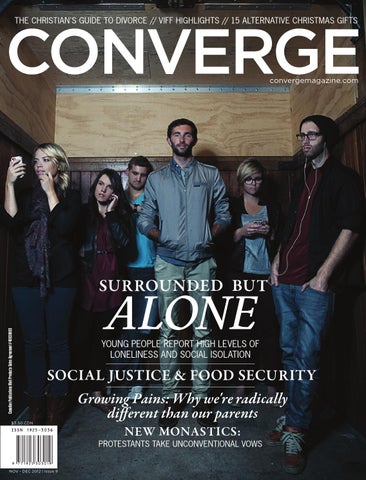
THE CHRISTIAN'S GUIDE TO DIVORCE // VIFF HIGHLIGHTS // 15 alternative christmas gifts
convergemagazine.com
Canadian Publications Mail Products Sales Agreement #40038603
surrounded but
ALONE
Young people report high levels of loneliness and social isolation
SOCIAL JUSTICE & FOOD SECURITY
$3.50 CDN
Growing Pains: Why we're radically different than our parents New Monastics:
Protestants take UNCONVENTIONAL VOWS NOV - DEC 2012 | Issue 9
JEWISH NATIONAL FUND OF CANADA Experience Israel the JNF Way! HIGHLIGHTS l l l l l l l l l
Walking Tour of the Old City of Jerusalem Via Dolorosa l Church of the Holy Sepulchre Optional tour of Bethlehem Boutique Winery l Golan Heights Plant a tree with your own hands Research & Development Centre New Pioneer Community Massada l Dead Sea Swim l Ein Gedi All breakfasts and dinners included
JOIN US ON OUR MISSION TO ISRAEL
FEB. 19 - MARCH 3, 2013
And so much more...
Full Package
$2,325.00 USD
Land Only
$1,725.00 USD
- Price per person, double occupancy, ex Toronto - Price per person, double occupancy
Single Supplement
$570.00 USD
FOR FURTHER INFORMATION CONTACT SHARON AT (514) 943-0313 EXT. 243 OR NATIONAL@JNF.CA
No Matter What the Occasion ...
Say it With Trees
f no o i t ra ts leb Even e In C mily Fa Planting trees in the Holy Land is the perfect way to recognize family and friends and be part of the restoration of the land of Israel
In M Lo emor ved y On of es
Order on line at www.h ol yl andr es tor er s. co m or call 1-855-563-8733
For just $18 each, we will plant the tree(s) in the Holy Land and mail a custom-printed card to you or your loved one.
Training for Full Time Christian Service Regardless of Occupation! Leadership Through Servanthood by Christ’s Indwelling, Resurrection Life. Practical Bible Teaching Genesis to Revelation: Christ Revealed in the Written Word.
Capernwray URL
Proclaiming Jesus Christ as Life! TheTis island - BriTish ColumBia - Canada
What's inside: 7
REFLECTIONS
12
CATHOLIC CONVERSATIONS
16
15 ALTERNATIVE CHRISTMAS GIFTS
19
FIELD NOTES VOL.3 Facing fears in a state of isolation
20
REGRET: A LOSING GAME
22
GROWING PAINS
A generation stuck in limbo
24
LOCAL SOCIAL JUSTICE
30
URBAN LONELINESS
34
THE CHRISTIAN GIRL'S GUIDE TO DIVORCE
39
NEW MONASTICISM
44
TOP 12 ALBUMS OF 2012
46
VIFF HIGHLIGHTS
48
LAST WORD
Religious life in the inner city
30
Mumford & Sons, Gungor, and more!
LONELY TOGETHER
why is it so hard to make friends in a city packed with people?
8 39
On the cover:
BOOKMARK THIS! 5 sites worth checking out.
30
There are people in need in our very own communities. How do we help?
10
We head to Portland for a first hand experience at this church
converge 09 | Nov-Dec 2012 Christian Info Society #301 - 291 East 2nd Ave Vancouver B.C. V5T 1B8 604.558.1982 1.888.899.3777 editor
Shara Lee shara@convergemagazine.com editorial assistant
Ashley Chapman
Consistent top tier ranking by Princeton Review, Forbes.com, and U.S. News & World Report
designer
Carmen Bright carmen@convergemagazine.com design intern
Amy Wang accounting
Daniel Anggara accounting@convergemagazine.com sales & operations
Jeremy Mills jeremy@convergemagazine.com contributors
Clayton Imoo, Cam Smith, Craig Ketchum, Alastair Sterne, Mathew Block, Chelsea Batten, Nick Schuurman, Lauren Bentley, Anna Li, Karen Giesbrecht, Michelle Sudduth
Find your place in God’s world Sioux Center, Iowa www.dordt.edu
cover photo
Geoff Heith Opinions expressed in CONVERGE magazine are not necessarily those of the staff or board of Christian Info Society SUBSCRIPTION RATES: 1 year (6 issues) Canada: $12 US: $22 International: Please inquire.
Embrace Complex Issues cmu.ca
BULK DISCOUNTS We offer special bulk discounted rates to churches, schools, and other non-profits. Call 604-558-1982 or toll-free at 1-888-899-3777 TO SUBSCRIBE subscribe@convergemagazine.com TO SUBMIT letters@convergemagazine.com GENERAL INQUIRIES info@convergemagazine.com TO ADVERTISE jeremy@convergemagazine.com DROP US A LINE! letters@convergemagazine.com www.facebook.com/convergemag www.twitter.com/CONVERGE_mag
Learn to See Differently CANADIAN MENNONITE UNIVERSITY
CIF
4 | CONVERGE. nov-dec 2012
editor's letter
Waste Not,
Want Not
"I had three pieces of limestone on my desk, but I was terrified to find that they required to be dusted daily, when the furniture of my mind was all undusted still, and threw them out the window in disgust." — Walden, Henry David Thoreau
M
aybe Thoreau’s minimalist experiment appeals to the writer in me. (He built a tiny cabin and planted a small garden and spent two years living and writing near a remote pond.) An escape to the woods to dive into creative pursuits without distraction would be a welcome retreat amidst the crippling pressures of consumer society. But I imagine it might get a bit lonely being isolated, even if I did get the occasional visitor. Humans are social animals after all. Still, I think there’s something to be said for de-cluttering one’s life, keeping only the essentials. I’m starting to take a good hard look at all my stuff. Lately I’ve been feeling like the excess is weighing me down. For example, I don’t really need to renew my gym membership when I can just run outside with the dog, and I don’t need a new dress for the wedding on Saturday when I have a closet full of good choices. The money saved from the gym could go towards someone less fortunate, and the time reclaimed from shopping could be spent more productively. How much of what we possess do we actually need? My guess is not as much as we keep in old dusty boxes, underneath beds, and stuffed into already-crammed closets.
So many things in my life have been accumulated mindlessly — some items purchased on impulse, others to satisfy a void. The fact is that I don’t need most of it. Having too much stuff can build walls around us so that we are isolated from the people, sights, sounds, textures, and tastes of the outside world. How many lifelong connections did I miss out on because I was too busy watching Netflix reruns on my iPhone? Possessions keep us anchored, while having less can free us — even just a little bit. Change starts with a shift in thinking, a desire to live intentionally, and a realization that we don’t really need all that much to survive. This isn’t to say you can’t have nice things; I’m a firm believer in spending a little more to get a higher quality item. Also keep in mind that things don’t have to be purchased brand new to prove valuable, so remake, repurpose, or borrow! Waste is only created when we have an overabundance of the useless. Having too much can distract us from our true purpose and can take our thoughts away from what really matters in this life. I’m trying not to let myself be ruled by what I have or don’t have, instead I'm trying to be who God wants me to be. Possessions don’t really matter. Job put it best when he said, “Naked I came from my mother’s womb, and naked I shall depart.”
convergemagazine.com
|5
Come visit us at the Urbana Missions Conference December 27-31
Could our aid actually be hindering the poor?
Sometimes our ‘best’ attempts at serving the poor and vulnerable might actually be harming them. Join respected experts on this relevant topic to learn why good intentions aren’t always enough—and how you can avoid the most common missional mistakes.
INFO or REGISTER:
HELPING WITHOUT
HURTING
ONE- DAY CONF EREN CE 1o f DECEMBER st
SHERWOOD PARK ALLIANCE CHURCH 8 A M -4 P M FEATURI NG DR. BRIAN FIKKER T AUTHOR OF WHEN HELPI NG HURTS :30
$35 HALF DAY $45 REGULAR
CANADA
WWW.P OVERTY R EVOLUTION .ORG/HWH
6 | CONVERGE. nov-dec 2012
:30
Flickr photo by Jeff Kubina
reflections
M a t t h e w 1 1:3 “Are you the one who is to come, or should we expect someone else?”
J
ohn, the prophet who announced the coming Messiah, questioned his mission as he sat despondent in jail awaiting execution. Even seeing God in human form, John had to fight with disappointment and disbelief when Jesus wasn’t as he had expected. People have incomplete perceptions of God and each other, but plenty of expectations about each. Anticipating many possibilities of a new acquaintance or a new relationship may natural but it is not always a good thing to do. Depending on the grace in our perspective, we can either take offence or retain “good soil” in our hearts. Some propagate the dangerous message that having no expectations is the easiest way out of relationship troubles, which is true, though it will set you up for a lack of connection. No trouble, but no depth, either. A garden f lourishes if the soil is first tilled. We receive what we perceive. Expectations don’t necessarily kill relationships, but a certain kind of expectation
can. Expecting my friend to fulfill me in a certain way may blind me to the many other things he is offering. If I am watchful for his gestures that could potentially bless me, I will grasp them. What we focus on, we magnify. Unvoiced expectations can damage a relationship. A partner’s expectation for the other to speak or act in a certain way can yield resentment unless tempered by grace. Staying silent about expectations to avoid awkward moments might end up resulting in greater agonies of misunderstanding and hope deferred, which makes the heart sick (Proverbs 13:12). Jesus knew about pouring into people without expecting to receive the same in return. Though countless people turned away, many of Jesus’ true friends paid ultimately for their love and commitment to him. 1 Corinthians 13 demonstrates how God’s love in us does not insist on its own rights or its own way, for “it is not self-seeking”.
—Craig Ketchum
Scripture taken from the NIV and the Amplified Bible. convergemagazine.com
|7
5
SITES TO BOOKMARK By Ashley Chapman
Stuff Christians Like jonacuff.com/scl
Prodigal magazine prodigalmagazine.com
Jon Acuff knows what Christians like. He runs a blog that uncannily lists all our faves, and he even filled a book that’s a cross between a bathroom reader and coffee table conversation piece. But if you didn’t think your tastes and habits could be pigeonholed, just try to deny this recent gem: “One of our favorite things to do as Christians is to assume that Paul’s thorn in the flesh, the thing that tormented him, was exactly what you struggle with.”
You know when you open your inbox in the morning and it’s full of daily deals and subscriptions you thought you wanted but that now sit unopened or get sent straight to the trash? The ones where you’re either too lazy to unsubscribe, or too fed up looking for the seemingly invisible opt-out link? Daily posts from Prodigal Magazine are nothing like that. It’s a daily story from a community of young people who aren’t afraid to be honest about their struggles with careers, relationships, and God. It’s edifying, encouraging, and a great way to start the day.
Good Women Project goodwomenproject.com
Jamie the very worst missionary theveryworstmissionary.com
This one’s just for the ladies. Married, single, divorced, virgins, experienced — there’s content for everyone, as well as respectful and insightful discussion to bring a wealth of perspectives on each issue. What do I do if my boyfriend or husband is looking at porn? How do I make the switch from modest non-temptress to sexually alluring for my husband on our wedding night? Great articles on questions you’re not brave enough to ask your mother.
Blimey cow blimeycow.com If you learned Elvish as a homeschooler, went to youth group to lay hands on (uh, “pray for”) your crush, or had a sneaking suspicion that your slacktivism wasn’t actually working, you should watch these sibling/sibling-in-law's weekly video jabs that are both hilarious and refreshingly countercultural.
8 | CONVERGE. nov-dec 2012
If you like to go on short-term missions trips with your DSLR, you should read this blog. If you like to look down on people who do shortterm missions you should read this blog. Sample of Jamie’s tone: “I want to fill a rental van marked ‘Tourist’ with unbelievably rich people and then I want to bring them to your middleclass neighborhood to take pictures of you and your kids and your house and your cars . . . ‘This man,’ I will say with a gesture of my upturned palm, ‘cuts his own lawn.’” (And yes, she’s an actual missionary.)
BLIMEY! Chances are you've got your phone on you. Scan these codes and check out some of our favourite Blimey Cow videos!
Well-Being
Neck Stretches With the majority of our time spent in front of a computer, it ’s no wonder that we’re slowly becoming more hunched and stiff-necked. Take a break to do some of these stretches before you're found hiding away in the towers of Notre-Dame.
1
Stretch 1: Neck Stretch
To begin, sit up straight in your chair. Reach down and hold the seat with your hands. Stretch your neck to the front, back, and sides (both chin to shoulder and ear to shoulder) — holding each stretch for 10-15 seconds. Stretch 2: Shoulder Stretch:
This stretch is based on a muscle relaxation technique called "Progress Muscle Relaxation." Shrug your shoulders up to your ears and hold tightly for 2-3 seconds. Still holding them tightly, roll your shoulders back (you'll feel your pecs stretch) and then relax them back into normal position. Do 10 repetitions. Stretch 3: Upper back Stretch
Stretch your arms out in front of you and rotate your hands until your palms face away from each other. You can put the backs of your hands together or you can cross your hands at the wrists, whichever is most comfortable. Then bend your upper back like you are diving off a diving board. Pull your chin to your chest at the same time.
2
Winter Greens
Kale Along with broccoli, kale is one of the nutritional stand-outs among vegetables. It is unusually high in fibre, and also an excellent source of nutrients, especially vitamin A, iron, and calcium. Sadly, many people dislike the taste of kale alone, so add it to a fruit smoothie or bake some crispy, salty kale chips!
3
Flickr photo by Rosie Tulips
Baked Kale Chips serves 6
20 min
1.
Preheat the oven to 350˚F. Line a non-insulated cookie sheet with parchment paper (optional).
2.
Use scissors to remove the kale leaves from the thick centre stems, and tear them into bite-sized pieces. Wash and thoroughly dry the kale (salad spinner a plus!) and place on the cookie sheet in a single layer. Drizzle with olive oil and sprinkle with sea salt.
3.
Bake until the edges brown, about 10-15 minutes, but don't let them burn. Check around the 10 minute mark and add the Parmesan.
Ingredients 1 bunch kale 1 tsp sea salt 1 tbsp olive oil Parmesan to taste
convergemagazine.com
|9
Door of hope
church profile
doorofhopepdx.org 5pm & 7pm Sundays 1315 SE 20th Ave Portland, OR
The View from the Pew
local church reviews, one region at a time
FIRST GLANCE
Urban location; mid-size congregation; two services (both in the evening). Portland, OR is a place that breeds an open mind, so as I approached the church, I tried to empty myself of stereotypebased expectations. Tattoos, unruly facial hair, the scent of unwashedness . . . if those were present in greater quantity here than in other churches, it might be simply because this church was particularly welcoming, and might have nothing to do with the church’s location smack in the middle of crusty hipster mecca. The first thing that struck me was the number of families. No 30-something subculture being bred here; there were children running around and hidden in the arms of people both conventional and outlandish in appearance. Maybe it's superficial prejudice, but I feel immediately inclined toward a church that is full of kids. All this was momentary, however, because the second impression came with much fuller force. Most churches these days offer a coffee stand with a single battered airpot and a stack of paper cups; this church had four urns lined up against the back wall, flanked by four smiling bearded young men, and labels detailing each brew’s name, origin, and flavour characteristics. The adjacent wall featured orderly rows of thrifted ceramic mugs hanging on pegs. It was an ingenious way of straddling warring cultures: they offered all the convenience and indulgence of a megachurch espresso bar, with the keep-it-real aesthetic of a small community-focused church. I took a bulletin from the information table, along with a fresh fig from the cardboard box labelled in crayon “Help Yourself,” then followed the Birkenstocks, ear gauges and vintage dresses into the sanctuary. The design of the space reminded me of an old Puritan meeting hall — a boxy U-shape arrangement of seats with a matching mezzanine overhead, and sparse on decoration except for two wood-burned engravings of a cross growing into a tree (the church’s logo, as I learned later) on either side of the stage. People were chatty and friendly, making lots of eye contact, moving their belongings in welcome for me to sit near them. A couple behind me asked if this was my first time, and where I was from. A recording of Johnny Cash singing a hymn played over the PA.
Worship Though the room was full, it couldn’t quite absorb the volume of the music. The songs all had a nice groove; none of the driving tempos common to traditional hymn-centric environments or purpose-driven worship choruses. Though played with proficiency, the songs were hard to fol-
10 | CONVERGE. nov-dec 2012
low, both because the volume blurred the sound of the words, and also because I didn’t know any of them. The lyrics that I did catch had a reflective, metaphorical cast: “As fire burns away all the lies . . . ” Again, I tried to preempt my assumption, based on the Portland stereotype, that these must all be professional musicians, while simultaneously guessing that this place probably had a lot of in-house worship songs in rotation. The worship leader was a tall man with gaunt cheeks fringed by mutton chops, wearing tight jeans, tattoo sleeves, and a slack mohawk. His delivery was both sincere, with the requisite eye-closing and head tilts, and conscientious, as he guided the band through the changes. His guitar was beautiful blonde wood with a neck inlaid with mother-of-pearl. After two songs, we were invited to sit down.
Sermon The worship leader turned out to be the head pastor as well. His sermon delivery had the same laid-back sincerity as his music direction. I wish I could tell you exactly what he preached on, but it was warm in the room, and it was also my favorite time of day to nap. (This particular church does its services on Sunday evenings, rather than in the mornings.) Even in my sleepiness, I was (typical of church shoppers) on the alert for bad doctrine and lame conceits in his sermon; however, I didn't catch any of either. There was a little self-deprecating Portlandia humour — “Even I smell like patchouli, as I speak!” elicited an obedient, knowing chuckle from the congregation — but I was thankful that he avoided the au courant churchspeak about "being missional" and obsessively self-identifying with their particular city.
Afterward Two more songs were sung in closing, just after the adjoining prayer room was pointed out. There I met a girl named Michelle, who asked what I'd like prayer for and, rather than launch a mini-counselling session, began immediately to pray. We chatted for a while after praying; I ended up praying for her, in turn. We exchanged emails and we're still in touch. I lingered in the foyer for a little while, but nobody approached me. However, the pastor was greeting folks by the front door, and the klatch of people around him were very accommodating when I came up to say thank-you for the sermon. The pastor himself was very warm and friendly.
Flickr photo by incanus
Friendliness: 6 While there was lots of eye contact, I didn't find the people particularly outgoing. The times when I took the initiative, however, I found them very welcoming.
Amenities: 10 The coffee setup alone would earn this place a 9.5. But they also had a thoughtfully curated collection of interesting and offbeat books and music in their media alcove.
Music: 5 I would definitely listen to this music while driving, working, or drinking tea. Singing along, however, was a challenge.
tia, oa Cr , ica R a st Co a, bi m lo Co a, in Ch , ile Republic, Chad, Ch , Ecuador, lic ub ep R n ica in m Do o, ng Co of lic ub ep R c Democrati Kenya, , on ab G ji, Fi a, ni to Es a, ne ui G al ri to ui El Salvador, Eq i, it Ha a, an uy G , au ss Bi a ne ui G a, al m te Georgia, Ghana, Gua Jamaica, t, as Co ry vo I q, ra I , ia es on nd I , ia nd Honduras, I , ia an hu it L , ia er ib L , ho ot es L a, vi at L Kenya, Kosovo, tius, ri au M i, al M i, aw al M r, ca as ag ad M , ia Macedon pack e, qus! shoz M oeam o, gr ne bobi te on M , x lia go e on M v, do Mexico, Mol nea, ui G ew N ua ap aP m na Pa r, 10 ige N 0 a, gu M ra ica i llion Namibia, Nepal, N ngo, Co of lic ub ep R , nd la Po , es in pp ili Ph , ru Pe Paraguay, vakia, lo S , ne eo L a rr ie S a, bi er S , al eg en S , da ia, Rwan • pack a shoe box • bless a,child omaninvolved Rget ts it K t. S an ud S th ou S , ica fr A th ou S Solomon Islands, help u
s r e ac
h
operation christmas child is a project of samaritan’s purse,
an international Christian relief organization that works to meet the physical and spiritual needs of people throughout the developing world.
pack a shoe box online!
samaritanspurse.ca • 1.800.303.1269 ©2012 Samaritan’S purSe canada
Sermon: n/a Sleepy inattention kind of disqualifies me from giving a rating in good conscience. Instead, I'll give it a sheepish thumbs-up.
Vibe: 8.5 "Vibe" is my term for the intuitive attraction of a social situation. All the rationally measurable factors can be present, and still the situation can have a bad vibe that makes you leery of returning. Equally, those factors can be lacking, and still you feel inexplicably drawn back.
Would i go back? Yes.
have a unique church? Want your church featured in Converge? Email us at: info@convergemagazine.com
convergemagazine.com
| 11
F.A.Q
catholic conversations
More than bread and wine? By Clayton Imoo
Sources: catholic.com catholicscomehome.org
I
remember the first few times that I went to Mass with my then girlfriend (now wife) Gail back in our high school days. There were some things that I grasped right away while others took me a bit of time. I enjoyed the music as it helped me to pray. I was always attentive to the priest’s homily since I found myself learning something new every week. But that whole Eucharist thing? It was a tad confusing to say the least. I also remember Gail trying to explain to me the Catholic teaching and belief that Jesus is literally, not symbolically, truly present in the Holy Eucharist — body, blood, soul, and divinity — and that we are truly consuming His body and blood at Mass. This was the first time I heard the word “transubstantiation” — the concept that, in the Eucharist, the substances of bread and wine are miraculously transformed into the substance of Christ himself: body and blood. I recall Gail telling me: “It’s a mystery how it happens . . . that’s where faith comes in.”
12 | CONVERGE. nov-dec 2012
“It’s a mystery how it happens . . . that’s where faith comes in.”
Each issue, Clayton Imoo of the Archdiocese of Vancouver will take a look at a few questions about Catholicism. If you have a question you’d like answered, write to Clay at clay@claytonimoo.com
The belief is rooted in scripture, for Who can receive Holy at the Last Supper Jesus said, “Take, Communion in the eat; this is my body” (Matthew 26:26), and “Drink from it, all of you; for this is Catholic Church? my blood” (Matthew 26:27-28). Catholics don’t believe that Jesus is speaking To receive Holy symbolically here. Communion, a In John 6, Jesus says, “Unless you eat Catholic must be the flesh of the Son of Man and drink in a state of grace, his blood, you will have no life in you. have made a good Those who eat my flesh and drink my confession since his blood have eternal life, and I will raise last mortal sin, believe them up on the last day; for my flesh is in transubstantiation, true food and my blood is true drink. observe the Eucharistic Those who eat my flesh and drink my fast (one hour), blood abide in me, and I in them” (John and not be under 6:53-56). an ecclesiastical Many of the Jews didn’t like what censure such as they were hearing and began to quesexcommunication. tion Jesus. Instead of softening His When Catholics receive stance, He only reiterated His point. Holy Communion, Some Jews began to leave Jesus, but He it is an expression didn’t call them back. He stood firm. of the unity of the As I wrote in the last issue, the EuBody of Christ. That charist has both “substance” and “acciis, those who are dents.” During the Mass, the substance in communion with of the bread and wine turn into the the Catholic Church body and blood of Christ. But the accithroughout the world, dents don’t change; thus it remains the who live in union with bread and wine in shape, smell, taste, her, and who maintain feel, and colour. Usually, a change in the belief in the Real substance results in a change in acciEucharistic Presence of dents. Not so with the Eucharist. Christ. Therefore, only St. Thomas Aquinas, a theologian those who believe in of the 13th century, stated that during the Real Presence of transubstantiation, “the whole subChrist in the Eucharist stance of the bread is changed into the may participate in this whole substance of Christ’s body, and sacrament of oneness the whole substance of the wine into with Christ and the the whole substance of Christ’s blood.” Catholic Church. Catholics believe that transubstantiation occurs only by the power of God. How it actually happens at Mass is a true mystery, but we have faith in this invisible reality. After all, if God can raise the dead and create our world from nothing, He can turn bread and wine into His body and blood. Clayton serves as the Director of the Office of Youth and Young Adult Ministry of the Roman Catholic Archdiocese of Vancouver. He blogs about family, faith, and the Vancouver Canucks at claytonimoo.com. Follow him @claytonimoo.
A Jigsaw Guide to Making Sense of the World In this charming new book, Ravi Zacharias associate Alex McLellan shares his proven method for training and empowering budding Christian apologists.He encourages potential truth-tellers to proceed in piecing their worldview together—trusting that the fragments of truth you set in place today are the outlines of a far greater picture.
978-0-8308-3781-6, $15.00
a working picture of truth
“[A] valuable tool for the believer who is serious about engaging with the worldview of postmodern culture.” —J. Paul Nyquist, Ph.D., president, Moody Bible Institute
For more thoughtful Christian books, visit ivpress.com
ivpress.com 800.843.9487
Converge Jigsaw Ad #9218 1
10/18/12 1:19:30 PM
ke to What does it tarty truly end pove hild? c in the life of a
it takes the gospel.
e local church works only with th n io ss pa m Co y wh That’s n get an education, tries to help childre un co t es or po ’s in 26 of the world hips and discover ild strong relations bu to w ho n ar le stay healthy, sus Christ. in the gospel of Je God’s love for them
OmPaSSiON: SPONSOR wiTh |C1-800-563-5437 ca
www.compassion.
Photos by Carmen Bright
Community
from nine to five to
FARM FOR LIFE By Shara Lee
S
tepping out of my car and onto this small farm, I am welcomed by a duck who greets me with a little nibble on my boot buckle. He’s the friendliest creature with webbed feet I’ve ever met and he reminds me more of a dog than a duck. Several of the Farm for Life crew — Jocelyn Durston, Chris Kasza, and Chris Moerman — are not far behind. “This is Vincent,” says Durston. “Our pet duck.” Vincent was a rescue; his former duck girlfriend met a tragic end and the group adopted Vincent hoping he would bond with the other birds on the farm. “It turns out he’s more attached to humans,” laughs Durston. We start with a tour of the grounds and Vincent follows closely as we wander through the two acres. He quacks for us to slow down when we move ahead too quickly. Knowing where the food that they eat comes from and how it is produced is vitally important to those living on this Maple Ridge, B.C. farm. Because of this, they use an ecological farming method. Instead of pesticides, natural approaches are employed. Durston describes using beer as slug control for instance. Slugs are attracted to the yeast in the beer, yet the substance is lethal for them. Moerman describes how the ducks on the farm are natural insect eaters. Crop rotation is also used so that if one plant pulls nutrients out of the soil, another will replace them. Kasza explains that they grow the herb comfrey because it pulls certain nutrients to the surface for other plants. The produce they grow is specifically chosen to handle the lower mainland’s wet autumns and low-light winters. They’ve built makeshift greenhouses out of old windowpanes to aid some plants. The vegetation on the farm includes kale, a variety
14 | CONVERGE. nov-dec 2012
of gourds, beets, lettuce, mustard greens, stinging nettle, and more. Along with Vincent, the other animals include chickens and rabbits. The rabbits were initially acquired by Moerman and his wife Julie Clarke for their meat (neither Durston nor Kasza eat meat) but the process of butchering proved to be more of a hassle than it was worth. Now only the eggs from the hens are collected (the chickens aren’t butchered either). It’s a pretty impressive operation now, but only a little while ago it was an undeveloped plot of land. The project began when Moerman and Clarke invested in a 2.5 acre lot in Maple Ridge. The property had originally belonged to Moerman’s parents. It had been his family home and now the couple wanted to make use of all the land that sat untouched. The farm began as a little experiment, one that Clarke and Moerman wanted their friend Durston on board for. Could a couple with a small child, along with a friend, grow enough produce to feed themselves for a year? It turns out they could, and then some. “We've had more food than we could consume ourselves,” says Durston. Soon Kasza who has a background in permaculture design and organic farming joined the team. Today they’re selling their produce at local farmers’ markets. Durston began blogging about her farming adventures at farmforayear.com and through friends, interest in the project quickly spread. First it was the media, then people in their community grew interested. Now they are connected with both environmental groups and school groups. A number of elementary classes have toured the farm, and there are plans to turn Farm for Life into an eco-educational space. After the tour we head over to a little bench where we sip on a
fruity organic tea that Kasza explains came from a local farmer. I can’t help but notice how peaceful it is here and how sun-kissed each farmer looks in the chill of mid autumn. Although they all live a seemingly idyllic farm life now, not too long ago each had proper “day jobs.” Though some were less conventional than others. (You may recognize Moerman from indie rock band Stabilo.) Moerman says he favours farm life over busy city living. “I enjoyed living in the city too. But when you come directly from there to here there’s kind of this calm peacefulness that’s very noticeable,” he says. Kasza agrees. Life on the farm for him means less time spent on idle activities like surfing the internet. “At the nine-to-five job, I was always tempted to check my Facebook account at work and always be on top of email. You can unplug a lot easier here.” Not only is life more peaceful here, it’s also deeply fulfilling. This is especially true for Durston, who spent many years in nine-to-five office jobs. “They were meaningful to a degree — but I wasn't really feeling satisfied,” says Durston. Now her time is spent gardening during the day and supplementing her wages with tutoring jobs at night. “My goal is to get to the point, business-wise, where I can do this full time because I’m so happy doing this, I love it. It’s so creative and I really feel like the projects I work on have a tangible, noticeable outcome.” Although they have been reaping the benefits of growing their own food with some left over to sell at the local farmers’ markets, Moerman thinks that one day if would be great to give a lot of the food away. While the four core members use the land the most, one plot is shared with a local farmer named Bob. “He’s a pastor at a small church and he just gives [most of] it away,” explains Moerman. Growing their own food gives them a sense of empowerment. “Being able to control what you eat from the seed up is awesome,” says Durston. “We’re able to control what feeds we use and what we put in our soil, whereas at the store there’s still no labelling on items that have been genetically modified, and that’s a big health concern.” Moerman agrees. Although they’re not entirely self-sufficient, he likes that they’re not 100 per cent reliant on “other people, corporations, or the economy.” As for future plans, Kasza says that so much has happened in only one year he can’t quite picture what the future holds. “Maybe 10 years down the road we’ll have a meandering stream that waters everything. We wouldn't even have to worry about water collection.” Moerman jokes about wanting to build an earth ship, “a completely sustainable and self-sufficient off-the-grid structure built out of tires packed with sand, and then covered with earth.” If done properly, the earth ship would need no outside electricity or gas to heat it or cool it. In the near future, Durston thinks they will continue to expand their educational initiatives, but also hopes that the farm will become something of a sanctuary. “I would love to see meandering trails and lots of little nooks where you can sit and read, and flowers everywhere . . . Like a modern Garden of Eden where people just want to come spend time.” The day at the farm ends with a few photos. When it’s time to go, Vincent quacks an enthusiastic goodbye. Driving back into the city, there’s a polar opposite green-to-concrete ratio. The air feels a bit thicker here, the wildlife (which mostly consists of pigeons and crows) decidedly less friendly. I can’t help but wish I was back at the farm.
Don't have a green thumb? You can still start planting. Start small Plant things you actually like eating!
Skip the seeds. Plant seed starts When starting out, you don't need to buy a seed packet with a hundred seeds. Go to a farmers' market that sells seeds that have already sprouted.
Be thoughtful of where you plant Make sure there's lots of sun and that there's easy to access for harvesting and watering.
Soil The most important thing is soil and that it has organic matter in it.
weed Control To mulch, put driedout grass clippings, cardboard, or straw on the soil to suppress the weeds. Mulching stabilizes the soil temperature and moisture, and prevents sunlight from germinating weed seeds.
Observe, learn, & Have fun Don't get discouraged if your plants die. Some things will grow better than others. It’s a learning process! You have nothing to lose so have lots of fun. Don't forget to try a couple things!
Don't put ALL your effort into ONE crop This might be discouraging. Try planting a few different plants. Though you might lose one, a lot of them will survive.
Reward yourself Taste what you've grown. It's so good when you pick it in the end — ripe, fresh, delicious!
for more of vincent and the farming life:
From top to bottom: Chris Kasza, Jocelyn Durston, and Chris Moerman
top 15
Outside the Box These are the ultimate “it’s the thought that counts” gifts — except hopefully without the secret disappointment or eye rolls on the part of the receiver.
Alternative
Christmas Gifts For those who don’t want to join the soul-killing consume-a-thon that runs from November till Boxing Day at a mall near you, take heart. Here are some alternatives for the gift-giving season. By Ashley Chapman
Recipe rolodex This can be a book, a recipe box, or an online collection. Gather time-tested recipes from family and friends for that special someone who loves to cook, is learning to cook, or needs a hint that the kitchen is more than the sum of its freezer and microwave. Pinterest sleuth You know all those DIY projects that get pinned but never made? Choose something doable from a friend’s board, and make it for them! Oh the surprise on their face when they realize they recognize the gift! Plus you already know they’ll love it.
Thrifted Gifts These gifts are perfect if you’re on a tight budget or love the thrill of a good find. If you’re new to thrifting, this list will help you sort through the clutter and zero in on some great items you can find in almost every second-hand store!
CSA veggie box So it’s not exactly outside the box, but signing your family up for a “Community-Supported Agriculture” veggie box is a gift that just keeps giving. A quick Google search will help you find a farm that can deliver a box of local seasonal veggies once or twice a month.
Pottery mugs You may have to dig through some cow-spotted cups and Comic-Sans-adorned “World’s Best Dad” mugs, but there are almost always some ceramic gems in the back. Bracelets and bangles It’s much more fun to mix and match when the selection is truly eclectic and nothing costs more than a toonie. Classic board games Oh, “Sorry,” I didn’t have a “Clue” that Scrabble could still be played in real life, with real friends. Other recommendations: Tri-Bond, Balderdash, and Cranium — usually for a few bucks each!
CDs Imagine getting an entire album for the price of two songs on iTunes; an album that can be easily loaded into a digital library. Treat a friend to the musical stylings of Wyclef Jean, Will Smith, or Alanis Morissette — just a few of the regulars on the thrift store CD racks. Picture frames It’s a classic gift: printing out a special picture and framing it. With the money you’ll save buying second-hand frames, you could even get a few extra photos enlarged. If you find uniquely sized and shaped frames and want to unify them somehow, spray paint works wonders!
Magazine subscription It’s always nice to get something in the mail, especially when it’s full colour, with beautiful pictures, and overflowing with fascinating, relevant content. Give junk mail a reason to shudder; send a friend something they’ll actually want to read. (A Converge subscription is just $12 for the year — wink, wink, nudge, nudge). Buy Nothing Christmas You could always throw out this list and actively resist the commercialization and commodification of Christmas. Join a group of cheeky but inspired Canadian Mennonites who are leading a national movement that reminds us to ask, “WWJB?” buynothingchristmas.org
These gifts aren’t always cheap, but their impact lasts long after the final Christmas orange is eaten and every gift but the new iPad ends up in the closet. With the many life-changing choices to give on behalf of your friends and family, there’s something for everyone (including you; you get a tax receipt!).
Charitable Choices
Solar lighting Perfect for the uncle who drives the veggieoil van and who’s working to one day get off the grid. Solar lanterns are a great alternative to kerosene lamps which can cause respiratory illness in children and require constant refills of costly fuel. compassion.ca/ shop, $100.
16 | CONVERGE. nov-dec 2012
Coffee seedlings Perhaps this item would pair well with a pottery mug from the thrift store and a pound of fair-trade coffee. The gift helps farmers grow an income from one of the world’s best-loved crops. fhcanada.org/ gifts, $20.
Teach a mom to read This gift will hit home for mothers. It’s never easy to raise a child, but illiteracy can make the job harder. This gift provides literacy classes for a new mother to open doors for her and her family. compassion.ca/shop, $30.
Birth certificate You know that person whose birthday falls close to Christmas, and so they always complain about getting fewer gifts? They won’t have the heart to resent this birthdayChristmas combo. A birth certificate provides a child with proof of existence and protection against child trafficking. plan.ca/ GiftsofHope, $25.
Clean water Could you convince your entire family or church to forgo traditional giving this year? Get involved with the Advent Conspiracy, a movement encouraging groups and individuals to give relationally, and put their budgeted gift money towards clean water initiatives worldwide. adventconspiracy.org.
Be Prepared. OVER LUNCH A CO-WORKER ASKS YOU WHY YOU ARE A CHRISTIAN. WHAT YOU SAY MAY DRAW THEM CLOSER TO CHRIST, OR PUSH THEM AWAY. WHAT WILL YOUR ANSWER BE?
THE INSTITUTE FOR CHRISTIAN APOLOGETICS
Through the Institute for Christian Apologetics, ACTS Seminaries offers relevant training to Christians from all walks of life on how to effectively present their faith in the face of challenges. Call Liisa at 1.888.468.6898 for more details
1.888.468.6898 acts@twu.ca www.acts.twu.ca
Essential Training for Christian Service.
PREPARE TO MAKE A DIFFERENCE convergemagazine.com
| 17
City in Focus & The Young Professionals' Network's (aka Bread for Lunch) 1st Annual Christmas Celebration of Arts, Culture & Engagement:
[
the Unbridled Spirit
\
Buffet dinner provided by the Sheraton Wall Centre The Stradivari Orchestra, Rosemary Siemens & Roy Tan Art and Film Showing, featuring Zenga Brothers and "We Make Stuff " Key note presentation by Mr. Ron Reed, Founder of the Pacific Theatre
COST PER TiCKET - $59 | GROuP TABLES AVAiL. BREADFORLuNCh.COM December 8th, 2012, 6pm at the Sheraton Wall Centre Pavilion Ballroom 1088 Burrard Street - Vancouver 18 | CONVERGE. nov-dec 2012
LIFE
FIELD NOTES VOL. 3
State of Isolation Facing fears on the open road
Illustration by Carmen Bright
By Chelsea Batten
M
ost of us sit in an office or stand behind a counter — somewhere in the anonymous middle of wherever we live — for about eight hours a day. We're told to do things, and we do them, and money comes every two weeks in the mail, and we spend it at regular intervals until more comes to replace it. In the clockwork life of the Western world, relationships are the final frontier, the only place left where we can find adventure, drama, unpredictability. No wonder we make such stupid choices in how and whom we date; we need the drama in our lives! I recently embarked on a project that has me travelling around the United States and Canada, never stopping in any place for more than a few weeks at a time. It's the happiest I've been in a long time, which is strange, because I've never been more alone in my life. I'm travelling alone, experiencing things alone, and thinking about them later in complete isolation. Just tapping them into my computer, with only the company of voices that drift like ghosts out of the radio.
Fear never seems to get bored and go away because you aren't paying attention to it Maybe “happy” is too strong a word for what I feel; “content” might be more accurate. Either way, it’s a little unnerving to me that I can be anything but angsty in this state of isolation. Please note I don’t say I’m never angsty — I'm frequently terrified, whether by real dangers (like blown tires, treacherous roads, and a thinning bank account) or by the mere idea of them, which can sometimes be worse. When those fears show up, I find myself wishing as fervently as ever for a man — a strong, capable, courageous type, preferably with James Dean’s eyes and Hugh Jackman’s jawline — to be riding along with me. Not that he could stop my tires from blowing or my chequing account from being overdrawn, of course. I just want him around to . . .
What, exactly? I guess I could cry on his shoulder, or something. At best, he'd provide a handsome distraction from the fear. But fear never seems to get bored and go away because you aren’t paying attention to it. Except, apparently, the fear of being alone. Choosing to do this project was a choice to be alone. Choice, it seems, is the one thing that can defang a fear. I think we’re built for frontier-conquering adventure. And adventure is simply a positive engagement of a challenge; the opposite of approaching it with fear. Now that I’ve embarked on this project, my drama centres on its success or failure, and the issue of finding or losing a man is like a commercial break. (Then again, I have a date tomorrow night, so we’ll see if that fear doesn’t just come skipping back.) Fears stand in the way of our joy, like those little mushroom monsters on Super Mario Brothers. I want to press forward, but jumping on them makes my thumbs tired, and I wish for a magical cloud to carry me — safe and unmolested — over the pixelated landscape. If what I’m after is a man, I’ll likely have a long journey to find him. Knowing that, I’ve always wanted a great job to help me transcend the mushrooms in the road. And now that I have a great job — accompanied, of course, by its requisite fears — I daydream about a man who could laugh at Follow Chelsea those fears with me, while riding shotgun, or Batten on her sometimes even taking the wheel himself. quest to find "the Sometimes we get that, and sometimes one." She'll take we just have to keep avoiding the mushyou through the rooms and potholes on our own. irks and quirks I don’t really know what to say by way of of the journey resolution, except that I’m grateful to be on getting there. the road, with joy set before me. convergemagazine.com
| 19
FAITH
Flickr photo by SGV FILMWORKS
Playing should-have could-have would-have How regret can hold us back By Alastair Sterne
Have you ever looked back on a decision and seen what you could have done differently to avoid a world of hurt? When it happens to me, my mind starts to race through a game of “should-have, could-have, would-have.” It’s a bartering, of sorts, with the past. “I should have done this instead,” or, “I could have done that as well,” and, “It would have been different.” But no matter how many scenarios play out in my head, one fact remains: I am exactly where I am, as I am. A game of what-ifs does not change what’s happened. Sometimes it’s even harder when the decisions were exactly the ones I knew I had to make. At least when I know I’ve made a wrong decision I’m justified in trying to reverse the negative consequences. But with right decisions I have to realize that resulting challenges are just part of the package of being precisely where I’m supposed to be. I started to think about this the other day as I was reading the book of Acts. There’s a twist about halfway through the book when Paul heads to Jerusalem. Paul has always gallantly gone forth to spread the word of God, but now we see that Paul is heading towards what will ultimately be his death. It’s a deeply disruptive and confusing portion of Scripture. It reminded me that the decisions we make for God don’t always guarantee an easy path or smooth sailing. Quite often they open up a new direction that includes unexpected challenges ripe with opportunities to question whether or not we’ve done the right thing.
No matter where you are — be it the outcome of your good decisions or even mistaken decisions — you are where you are.
20 | CONVERGE. nov-dec 2012
Paul says in Acts 20:22-25, “Now compelled by the Spirit, I am going to Jerusalem, not knowing what will happen to me there. I only know that in every city the Holy Spirit warns me that prison and hardships are facing me . . . I know that none of you among whom I have gone about preaching the kingdom will ever see me again.” I can hardly imagine this farewell. At least when we left our family and friends in Orlando we knew that we could always call, text, email, Skype — you name it. But Paul knew this was the last time they’d ever see each other. And if that departure wasn’t hard enough, when Paul arrived in the next city on his way, the people who received him didn’t understand his mission. “Through the Spirit they urged Paul not to go on to Jerusalem” (Acts 21:4). Can you imagine that? You’ve heard clearly from God about what you have to do, you’ve made some painful steps towards that realization, and then Godloving people through the Spirit urge you not to move forward. Wouldn’t you begin to start questioning the decision you’ve made? Where you’re heading is hard enough, and now it is creating wave after wave of pain for those who care about you. But Paul could no be dissuaded. He continued onward. When Paul arrived in Caesarea, a prophet named Agabus came and prophesied. He took Paul’s belt, tied it around his own hands and feet and explained, “The Holy Spirit says, ‘In this way the Jews of Jerusalem will bind the owner of this belt and will hand him over to the Gentiles’” (Acts 21:11). The picture intensifies. Each step towards Jerusalem reveals more danger. Apparently this was even too much for Luke, the author of Acts. “When we heard this, we and the people there pleaded with Paul not to go up to Jerusalem” (Acts 21:12). Surely the logic could have been something like, “Paul, clearly this is a prophetic warning! God is saving you from a world of hurt.” But again, Paul could not be dissuaded. And it came to pass, all of it. Paul was handed over to the authorities on his way to Jerusalem; he was mistreated and falsely accused. He ended up spending years in jail while Roman authorities neglected him, and while Jewish authorities sought his death. And while in captivity, Jesus himself consoled Paul and said, “Take courage! As you have testified to the facts about me in Jerusalem, so you must also testify in Rome” (Acts 23:11). After a few more sham trials, Paul — exasperated by the false accusations — appeals to Caesar, which was his right as a Roman citizen (Acts 25:11). But the kicker here is that the authorities were ready to let him go; they recognized Paul’s innocence. “Agrippa said to Festus, ‘This man could have been set free if he had not appealed to Caesar’” (Acts 26:32).
Instead he was sent to Rome, experienced shipwreck on the way, more imprisonment, and church history tells us he was beheaded in Rome. There were so many difficult moments in this part of Paul’s life that I can’t help but wonder if he asked, “Did I make the right decision?” Surely he could have played the game that we all sometimes play. He had opportunity after opportunity to turn around or reset his course. “I could have responded differently to Agabus,” he might have thought, or, “I should not have appealed to Caesar.” Finally, “If I had chosen differently, I would have remained with my friends.” Did these sorts of thoughts play as a continual loop in his head? Acts unashamedly underlines what is undeniable in all these events: that what unfolds is all according to God’s plan. Paul kept his eyes fixed on Jesus and would not look away. I can’t help but wonder though, was Paul just being stubborn? Maybe. But even if he was, it seems that God used Paul in all his stubbornness to accomplish His plan. Are you looking at what’s going on in your life and seriously questioning some of the decisions that have led you to where you are? Maybe you know you made the right decision, but had no idea what it would cost you. The decisions we make to follow Jesus will not always be easy, and they won’t always guarantee outcomes we desire. Paul’s journey was met with resistance, it was misunderstood, and yet it was fundamentally God-inspired. Maybe this retelling of Paul’s life is discouraging for you. Following God and discerning what he has for us isn’t always clear. Sometimes we make decisions based on God; sometimes they’re just based on what we want. Often we have difficulty hearing God’s voice amid the array of opinions. So we pray, make the decision, and move forward in hope. But then you look at your circumstances and start thinking, “Did I really listen to God?” “Should I have done this differently?” “I could have spent more time in prayer.” “I would have sought more counsel.” Ultimately, playing the “should-have, could-have, would-have” game does nothing but cause anxiety and regret. It’s really just a way of avoiding your discomfort, or pain, or disappointment. No matter where you are — be it the outcome of your good decisions or even mistaken decisions — you are where you are. The only true way forward is to take one step at a time towards Jesus, trusting that God is the one who guides even if the path is dark and the situation bleak. We have to remember that God guided Paul, and he guides us as well.
YOU’RE RAD. WE’RE RAD.
LET’S HUG.
ADVERTISE IN CONVERGE! REACHING THOSE RAD 20 & 30 SOMETHINGS ACROSS CANADA AND INTO THE USA
All you have to do is call Jeremy:
1-888-899-3777
(hint: ask about our first time advertiser dealio)
CULTURE
All Grown Up? Getting through the growing pains of emerging adulthood By Nick Schuurman
Education for the emerging adult typically lasts several years, and increasingly takes the form of an extended undergraduate degree, professional certification, graduate school, and even doctorate degrees. Four years into a major economic recession with still-dismal employment numbers, young adults are finding it increasingly necessary to go to school longer in order to land jobs in a lot of
I began to realize just how
radically different
my generation is from my parents
22 | CONVERGE. nov-dec 2012
technical and professional fields of employment. This means more time spent in limbo, and that adds to the in-between. The 21st century has also seen a radical shift in values. Many of our grandparents, having lived through the World
Illustration by Carmen Bright
"Twenty-five years old,” he said to himself. After a pause my father continued, “That’s how old I was when we had you.” It was one of the more surreal conversations I had this year, where I began to realize just how radically different my generation is from my parents’. I had just turned a quarter of a century old, was visiting my parents, and was — as I have already mentioned — reminded that when my father was my age, he and my mother had not only gotten married, but had already brought one of their four children into the world. Now, I would like to think that I have at least a few accomplishments to my credit, and that I’ve made some steps towards development as an adult — but the contrast cannot be denied, and the statistics back it up. You and I are putting off marriage, having fewer children later on in life, and shifting from job to job as we struggle to become settled into a career. We continue to live as students, with our parents, or as tenants into our early 30s. And it’s hard to know exactly what to call it. This interim period in life can’t exactly be called prolonged adolescence. We haven’t been tucked in for years, and besides, we're paying our own rent now, right? While it would appear that the typical 20-something is still stuck in the same place they’ve been for the first two decades of their life, there are some distinctions that indicate they’re in a separate, albeit transitional, stage of development. A lot of folks who study this kind of stuff have chosen to call it “emerging adulthood.” I call it living in an in-between kind of place.
Wars and Great Depression, were eager to say “I do,” sign up for a mortgage, and start a family (which, it is important to note, was generally significantly larger than the 1.67 children Canadians now average, and so this involved starting early). Our generation is not so sure. It’s not that we don't want these things — we like kids, or at least other people’s kids, or the idea of kids, and having a house would be great — it’s just that we don't want them yet, or don’t have a long-term career plan that would allow us to keep up with the bills that come with these sorts of things, yet. None of this is likely to come as a surprise. What I am more concerned with is where we go from here. There is, to be sure, a wisdom that comes with understanding that we (as the old song goes) are “poor, wayfaring strangers.” Despite our best efforts to feel at peace in this world, we will never completely shake that feeling of “not being there yet,” precisely because “there” isn’t tied to a marriage, family, paid-off house, or retirement fund. “There” lies beyond the borders of this world that we are just “travelling through.” And yet, if we are honest with ourselves, the restlessness and hesitancy we feel about long-term commitments (combined with our penchant for constant movement) has in many ways been coupled with a sort of spiritual rootlessness and immaturity. And so here’s the question I want to end with: how is your community working through the tensions of living in an in-between kind of place? In what ways can the dynamics of membership — of being a committed part of a particular Christian community in a particular place — help us push each other into a more radical and more rooted life of faith? How can the regular practice of gathering together corporately provide stability in the midst of our current cultural climate of uncertainty? Finally, how can we be present in the midst of the in-between?
Wycliffe Bible Translators of Canada is a unique ministry. We serve minority language groups worldwide by fostering an understanding of God’s Word through Bible translation, while nurturing literacy, education and stronger communities. With your everyday work experience and the training we provide, you can pursue your passion to affect change in the world.
God’s love is . . . being the change you wish to see in the world.
wycliffe.ca
convergemagazine.com
| 23
social justice
16,000 18,000 people live in the DTES 60:40 (men:women)
38%
of adults do not have Grade 12
64%
start With
the heart
Photos by Carmen Bright
of households in the DTES are below the poverty line. 27% are below the poverty line in Vancouver 86 Single Room Occupancy Hotels 4,272 units but still 2,600+ people left homeless
Compassion, community, and care in Vancouver's Downtown Eastside By Anna Li
T
Anna is passionate about faith, people, and public policy. She hopes to be a catalyst for positive change in the community, city, and world by bringing the love of Christ to the marginalized and poor. Anna currently works in Vancouver's Downtown Eastside with Union Gospel Mission.
he sun shone brightly overhead as he sat under a tree savouring the bit of shade. It was another day of loneliness and pain. He mustered what little strength he had in order to stand, still leaning against the tree for support. He knew he needed to get up because he was hungry. There was no food in sight so he began to walk in search of something — anything to fill his stomach. He stumbled upon another hungry vagabond, a woman living at the edge of the city, and asked for some water and bread. She looked at him with dismay and said that she was preparing what little she had into a final meal for her and her son, so they could eat one final time before slowly starving to death. The man asked again and added that his God would provide for her and her son. Out of sheer kindness and trust, the woman obeyed and gave him some water and bread. And surely, God did provide daily food for both her and her son. This is the story of Elijah and the widow from 1 Kings 17. Although the story dates back over 2000 years, poverty has been present throughout human existence and still exists today. Working in the “poorest postal code
24 | CONVERGE. nov-dec 2012
of Canada,” Vancouver’s Downtown Eastside (DTES), I have come to see the dire desperation of those who are truly in need, marginalized, and rejected from society just like the widow on the outskirts of town. They have few material goods, not even enough to eat and live. Often we look at the poor in our cities and we pity them. They do not have the comfort and warmth of our homes. They cannot rest in a soft comfy bed after a long rainy day. Yet how many of us feel unsatisfied with our lives even when we have luxuries and comforts at our fingertips? What’s the next thing we must have? What’s the current trend we must follow? How many of us commute home without saying a word, turn on the television or the computer to entertain ourselves, and then call it a night? Even though the poor have little, they have each other and they share what little they possess. The DTES may be rampant with addiction, mental illness, disease, homelessness, and crime but it’s a special community where everyone is welcome no matter how much or how little they have. They don’t need to hide their true selves for fear of rejection or judgment.
5,000 hard drug users live in the DTES 65% male 34% FEMALE
An estimated
1,000 women are in the sex trade in the inner city
Avg. age of entry: 14 Avg. life expectancy: 40 97% use illegal drugs 26% are HIV+ with only 6% receiving treatment
Source: City of Vancouver
Is your journey taking you where you need to go? Why wait?
Shoe Tossing:
The act of throwing a pair of shoes onto raised wires. While it can sometimes be a practical joke, in the DTES, shoe tossing is commonly used to mark a location for a drug meet-up.
be change.
Rocky Mountain College Calgary, Alberta • 1.877.YOUnRMC www.rockymountaincollege.ca Many people may toss some change into a panhandler’s hat, some may volunteer to serve a meal, others may attend a benefit event, but how much impact does that make? This isn’t to belittle small efforts to help, but are we just checking off a list of good deeds or patting ourselves on the back for a job well done? We should ask ourselves if these gestures truly fulfill our Christian responsibility to feed the hungry. Compassion starts with the heart, which will then spur permanent habits and actions. God’s heart is for the poor. Jesus was often found surrounded by the poor, preaching to the poor, and healing the poor. Many commands given by God were to protect the needy. His heart is one of grace and compassion. Hence, ours should be as well. The poor know they are the same — but do we? Proverbs 22:2 says, “Rich and poor have this in common: The Lord is Maker of them all.” We are created with the same cravings for acceptance. Just because we
may be blessed with material goods simply means that we need to steward what we have by sharing with those who have less. God blessed us so that we can bless others. How much do we give out of what we have? Sadly, many of us only give what we don’t want for ourselves — the leftovers and the used. We are called to give out of faith, like the widow, so that God will provide even more. The widow didn’t give her leftover f lour and water to Elijah, she gave so that she had none left. You don’t have to give more than you are able, but give out of faith, trusting that even more will be provided for you. No matter where we live, there are needs. How can we actively participate, share, and give? For some that means volunteering, for others it is giving or fundraising for a specific need. Imitate Christ through your heart and deeds. Care for those around you by creating a community, like that of the poor, where none are judged or condemned because we are all the same.
sadly, Many of us only give what we don’t want for ourselves — the leftovers and the used.
on stage this Christmas at
The Lion, the Witch, and the Wardrobe
adapted from the novel by CS Lewis
“a dream so beautiful you remember it your entire life, always wishing you could get back into that dream again.”
Dec 5-15 at Pacific Theatre Dec 19-22 at The Evergreen Cultural Centre (Coquitlam)
info and tickets: www.pacifictheatre.org 604.731.5518 convergemagazine.com
| 25
social justice
Satisfying
Hunger
Questions we should be asking about food By Karen Giesbrecht
If
I had to assess someone’s diet with only one question it would be: “What vegetables have you eaten in the past few days?” For the more vulnerable members of our community, the answer to this question is all too often “none.” Vegetables should be at the centre of every healthy diet, but are often more expensive than packaged convenience foods. They also tend to be one of the more time-consuming, perishable parts of our diet. As a result, there are hungry and malnourished people in our communities who are getting fed — but in unsustainable ways
my This is a m !
progr
— or who are not getting fed at all due to limits with traditional food programs. There are also inspiring examples of sustainable food programs in our community provided by under-resourced, grassroots groups that help meet this need. The newest member of Vancouver's food security and equality movement is Planted, a local network of charitable food programs. Together they're increasing nutrition for the city’s most vulnerable by involving them in community efforts to create a virtuous circle between food growers, food providers, and food consumers. I am a registered dietitian with CityGate Leadership Forum, one of the founding partners of Planted. The problems that poverty and malnutrition create in our community are complex and real, despite the herculean efforts of charitable food programs in Vancouver. Many are still without access to fresh, healthy food, while others lack opportunities to experience the social and emotional power of sharing a meal.
Our BA program o f f e r s o v e r
30
DIFFERENT
COMBINATIONS
of m a j o r s a n d c o n c e n t r a t i o n s
Bachelor of Arts in Biblical Studies, TESOL, Youth Ministry & Global Ministry
26 | CONVERGE. nov-dec 2012
Photo by Sarah Gackle
when [vegetables are] prepared with care, no other type of food can delight us with a comparable variety of colours, textures, tastes, and nutrients
I believe that by asking simple questions about people’s eating habits, we can shed some light on the issues and begin to outline solutions. So again let me ask, “What vegetables have you eaten in the past few days?” Assuming we are able to get enough to eat and have the freedom to make choices about what to consume — which for some people in Vancouver is not necessarily true — we generally choose a balance of proteins and starches, easing hunger pangs and satisfying our appetite for saltiness, sweetness, crunchiness, and flavor. Vegetables can take a back seat because preparing fresh food is often time-consuming, or intimidating. But when prepared with care, no other
type of food can delight us with a comparable variety of colours, textures, tastes, and nutrients that we need not merely to live, but to thrive. If I could ask two questions about someone’s diet, the second might be: “Where did your last meal come from?” Our health is intimately connected with the health of our neighbours and of the land. Many farm workers are not treated fairly, nor paid equitably. In our eagerness to pull as much food from the earth as cheaply as possible, soil can be left depleted and toxic. The nutrients that plants draw from the soil must be replaced in the natural cycle of decomposition of food waste. Who prepares our food is also a concern. There is a strong correlation between homemade meals and health, or conversely, between eating out frequently and poor nutritional status. Food made at home tends to have more wholesome ingredients, and if we cook with others we share invaluable skills and cultural knowledge. If allowed a third question, I would ask: “Did you say grace before eating?” When we pray, or give thanks, we acknowledge that the food we are about to eat is a precious gift — not to be taken for granted, but consumed with intentionality. We pause to reflect on how our health is dependent on a large network of systems, starting with the interplay of sun and rain and land, and then including the countless people who tend to and transport the food. We recognize that some food choices involve us in a destructive, exploitive system. So we give thanks with humility and a commitment to make our daily decisions count for something larger than ourselves.
If I could ask a fourth question about the last meal someone ate, it would be: “Who sat at the table with you?” Loneliness is now recognized as one of the primary issues in Vancouver, and despite the excess of good food, too many of our neighbours live in “food deserts,” without adequate access to nourishing food, or a community to eat with. Our enjoyment of food comes just as much from the companionship of sharing a meal as from the food’s taste or its ability to relieve hunger. I have seen people bond over preparing and sharing food. Strangers are no longer strangers after they have eaten together. Food security is a communal issue that concerns everyone who believes access to nutritious meals should universal. I hope that through my work with Planted, I can bring together a passion for food and a concern for those in our city who are hungry, malnourished, or in short supply of quality food — and I hope I can inspire others to do the same. If you want to become part of the domestic food security solution, join a dialogue about our food choices and local responses to hunger and food insecurity at plantednetwork.ca.
Karen Giesbrecht is a registered dietitian with CityGate Leadership Forum cglf.ca, one of the founding partners of Planted. Karen takes great delight in sharing good meals with her family, friends, and those in her community who are hungry.
“I’M A CHRISTIAN, SO HOW COME I FEEL SO LOST?” YOU CAN PROVIDE ANSWERS THAT MAKE ALL THE DIFFERENCE Train online to lead others through The Truth Project – a DVD-based study for small groups
FIND OUT MORE AT TRUTHPROJECT.CA/ENGAGE convergemagazine.com
| 27
social justice
What else can you do with $26?
thE $26 ChaLLENGE “Of the $610 a month the B.C. government provides for a person on welfare, after paying for accommodation, bus tickets and cellphone (necessary to look for work), and basic hygiene only $109 remains for food – less than $26 for a week." www.welfarefoodchallenge.org
Raise the Rates recently launched the Welfare Food Challenge. The challenge is to live for a week on the food budget that a single, able-bodied person on welfare would have — spending only $26. Here's a look at what a few participants bought with the budget.
We looked at how far this weekly allowance could go on our favourite staples and favourite spots
24 Cup Noodles in a warehouse flat plus 12 more single Cup Noodles.
Seven tall caramel macchiatos at Starbucks.
Participant #1 Five Happy Meals from McDonalds.
Four regular BLT or turkey breast sandwich combos at Tim Horton's.
Three Single Bypass Burgers at Heart Attack Grill (though we can't fathom just why you would have more than one in a week . . . or ever).
ALMONDS
RICE
SOY MILK
OIL
SALT
OATS
One winter fingerling potato salad (an appy) at Hawksworth, one of Vancouver's swankier restaurants. (Anything else puts it over $26.)
Participant #2 S
OATS
One large beef souvlaki and Greek salad at your neighbourhood Greek tavern.
One pasta and dessert at Anton's Pasta Bar with a really slim tip left over.
S
GG
12 E
28 | CONVERGE. nov-dec 2012
Two medium pepperoni pizzas and one can of pop from Panago, with enough left to tip the delivery person.
BREA BREAD
Prawn and scallop spaghettini at Cactus Club. No drink. Slim tip.
*Tax has been taken into consideration muchmenus.com urbanspoon.com foodvancouver.com Respective restaurant websites
FIND YOUR STORY AT
CONVERGEMAGAZINE.COM FOR STORIES ON FAITH, CULTURE & LIFE
OR GET THE PRINTED MAGAZINE! ONLY
$12
convergemagazine.com
convergemagazine.com
6 issues /year
HIGHER EDUCATION GUIDE // FALL FASHION BASICS // THEOLOGY OF FOOD // 5 BOOKS PASTORS NEED TO READ
MANLINESS
WHAT GOD REALLY INTENDED
convergemagazine.com
MODERN DAY MARRIAGE ROM-COM: convergemagazine.com A DYING Driscoll style LOVE AFFAIR
5
Christ culture zombies
SERMONS and EVERY PASTOR SHOULD HEAR
10 SCARES
WORD BIBLE DESIGNS:
JAN-FEB 2012 | Issue 5
MAR-APR 2012 | Issue 6
THE WORD AS SEEN BY JIM LEPAGE
REALITY TV | JAYESSLEE | UNEMPLOYMENT | CONSCIOUS CONSUMERISM
$3.50 CDN
SOCIAL JUSTICE $3.50 CDN
APOCALYPTIC
depression 2012 HIGHER ED GUIDE are we the in the dumbest generation? church
DEREK WEBB
DAWN OF THE The conscientious DAILY DEAL rebel speaks his mind Canadian Publications Mail Products Sales Agreement #40038603
Canadian Publications Mail Products Sales Agreement #40038603
NOV-DEC 2011 Issue 4
Canadian Publications Mail Products Sales Agreement #40038603
Canadian Publications Mail Products Sales Agreement #40038603
MISSIONS SPECIAL
CUSSING SHAWN CHRISTIANS
GORE SEPT-OCT 2011 | Issue 3
Is it okay for us to swear?
THE $3.50 CDN CFL RECEIVER TALKS FAITH, FOOTBALL, AND FAMILY
girl
at the
rock show
HELL RAISERS
THE DEBATE BETWEEN CHAN, GALLI & BELL
EXCLUSIVE INTERVIEWS
plus Kye Kye, Burlap to Cashmere and MC Jin
$3.50 CDN
Subscribe online to receive six issues a year or email us at:
subscribe@convergemagazine.com *Offering churches, schools and other non-profits discounted rates for bulk subscriptions.
converge is a faith based magazine for the culturally curious and spiritually driven who strive to find their purpose in god.
find us on facebook & follow us on twitter @converge_mag
CONVERGE
L
O
N
E
L
Y
In a world so connected, why do we feel so alone? By Ashley Chapman
T
T
G
E
H
E
O Photos by Geoff Heith
R
used to hate the city. I remember being 12 and feeling lost in a sea of unsmiling faces who wove and bobbed past each other on their way down the sloped sidewalk I was trying to climb. I smiled at as many of the rushing yuppies as I could, but not a soul smiled back. I couldn’t wait to get back on the bus and escape the welldressed hell masquerading as Canada’s most livable city. A decade later I had a similar culture shock when I moved from university back to my childhood home. It was no longer the pre-internet, block-party central paradise of my childhood; it seemed perpetually empty. People were home, but they weren’t outside, or at least not out front. No one ever walked between houses after late-night visits and not a single new neighbour got a plate of cookies, let alone an introduction. Soon I began longing for the city — for public space and evening events and people bustling about, smiling or otherwise. What I got instead was a string of back-entrance basement suites and apartments in a midsized, low-income town centre. No one knew I was down there — or up there in my apartment days — so I’d smile at the old folks in the elevator and at the young people in the local coffee shop. I even volunteered to canvas my street for a national charity as an excuse to meet my neighbours. “Hi, my name’s Ashley and I just moved in down the street . . . ” Surprisingly, more people gave me money for the charity than introduced themselves or welcomed me to the neighbourhood. I appreciated their generosity, but I had hoped for something more.
I
A RUDE Awakening aybe it’s the sudden jump from the four years of university that most people call “the time of their lives.” I remember potlucks where everyone brought whatever wasn't rotting in their fridge; apartment hallways where half the doors were perpetually open and laptops were left out in the study lounges; midnight strolls to a friend’s place and all-nighters on the soccer field, rarely did I fear for safety with all the campus police strolling about. And then — usually somewhere between ages 21 and 24 — it all ends. Apartment doors can no longer be left open, dinner is prepared for one or two most nights, and there’s no bevy of friends within a three minute walking radius for when you just don’t want to be alone. You’re back to being 12 years old when you first realized the world was ambivalent to your existence. That’s why I wasn’t surprised when the Vancouver Foundation published their shocking report about people’s main concern in Metro Vancouver. It wasn’t homelessness or poverty as
M
the Foundation had expected. It was social isolation and disconnection. Turns out I wasn’t alone. According to the report, one in three people find it difficult to make friends in the city and surrounding areas, and one in four is lonely. “People are polite, but I wish they were more friendly,” said one survey respondent. The numbers jumped among the younger demographic. More than half of adults living with non-family members (i.e., postparents’-house, pre-spouse-and-kids) find it difficult to connect. Almost half of those living in basement suites or garage apartments say they struggle to make friends. The survey found that people aged 24-34 struggle the most. Twenty-four-year-old Hannah Brencher, founder of The World Needs More Love Letters, clearly remembers her fall into post-university depression after moving to New York for an internship. In an interview with the North Haven Register, she explains how her international love-letters-for-strangers movement began with the isolation she felt on her daily commutes. “I had a hard time riding the subway . . . people looked so tired and worn out. I was very lonely and missing people,” she remembers. “I started writing letters in a notebook in an effort not to cry on the train.”
Going it Alone? ike Hannah, I know what it’s like to move somewhere new — urban, suburban, and even subterranean — without the benefit of school to meet people. I’ve experienced coworkers who have no interest in being friends past five o’clock and church pew-mates who nervously babble about how busy they are the minute you mention you’re new and interested in meeting people. I’ve had guys start talking loudly about their girlfriends after I’ve smiled warmly at them in a coffee shop. I’ve been the person who arrives alone at events, tries talking to you, and loses out to your smartphone. It got me wondering if I was the only twenty-something sick of a hyper-connected yet suffocatingly disconnected modern landscape. I registered for Simon Fraser University’s “Alone Together” youth and young adult conference in an attempt to find out. The food was amazing (best gyoza I’ve ever tasted) and it turns out I’m not the only young Canadian who is close to bursting with the inanity of modern isolation. In a morning session, improv theatre was used to explore the comedy of everyday scenarios we Millennials know all too well. One skit had dinner guests more attached to their phones than their meals and each other, so the actor playing the host redid the scene and collected phones in a basket as guests came through the door. “I actually do that at my parties!” yelled the college student sitting next to me excitedly. “But I use a bowl,” he explained,
L
convergemagazine.com
| 31
Another Time and Place n our constant connection with people who are far from us — whether they’re our university friends who moved to different cities or our second cousin in Australia who sends the funniest texts — we’re not always present to connect with the people physically around us. It takes days of back-and-forth to schedule a Skype chat with an old roommate three time zones away; forget about scheduling dinner with the new neighbour three doors down! But life wasn’t always like this, and I’m not just referring to a Leave it to Beaver era that still lives in syndication. During my childhood, the doorbell used to buzz as often as my cell phone now does. And when my mom was my age, she moved continents, then clear across Canada, and easily settled into each new city without knowing a soul. She even managed to meet my dad without the internet to tell her who was single and compatible. Even now, whenever we return to Mom’s native Ireland, it’s still standard to drop in on neighbours, friends, and family unannounced. No calls or texts or Facebook invites, just a knock at the door and you’re invited in for tea. It was the same in college, where people would constantly flow in and out of each others’ dorms and apartments. Most of my Luddite friends and I had no need for cell phones until long after graduation.
I
turning to me and lowering his voice again. Clark, another conference participant, shared how he used to feel isolated from his neighbours as a single renter in Vancouver. “I would walk around my community and realize I had no way to really get to know people. I’d knock on neighbours’ doors and they’d say, ‘I’m kind of busy right now, you can’t come in.’” He has since moved into social housing where people are welcomed into each other’s homes and there’s a communal kitchen for regular potlucks. He loves it.
Rewriting Normal ity Lights church planter Brett Donald and his wife Natalie were looking for ways to serve and connect when they moved into their Burnaby, B.C. apartment two years ago. Seeing loneliness around them — and being new to the city themselves — they made an effort to meet the people on their floor. “We just knocked on our neighbours’ doors and said, ‘Hey, we just moved in,’ and we gave them little Starbucks cards as peace offerings for knocking on their doors.” Brett is upfront that these initial meetings sometimes got awkward, but says they led to hallway and elevator chats, and a real sense of community that now has people telling them, “Things are different since you came here.” In June of this year, the Donalds threw a floor party. “Two of the neighbours sat down in the living room and realized they pretty much do the exact same job at different companies, and they had never actually hung out before. They’ve been living right beside each other for 15 years!”
C
32 | CONVERGE. nov-dec 2012
Exercising Community
N
ora Young, a technology journalist for CBC radio, is cautious about blaming our modernday devices for our disconnection, but instead focuses on their potential to bring people together in new ways. Still, she reminded people at SFU’s “Alone Together” event, we sometimes forget that we’re creatures who don’t just need the message of a text, but the actual abiding together that was once necessary to communicate it. And isolation doesn’t just affect mental sanity, but a person’s physical health as well. University of Chicago Professor John Cacioppo, a leading expert in the psychology of loneliness, says the difference in health between a lonely person and a sociable one is like the difference between a smoker and a non-smoker. Other researchers list the risks as similar to obesity, and say that something as simple as joining a social club has health benefits on par with losing weight. It’s vitally important then to undermine the slowly atomizing trend toward complete real-life disconnection from our neigh-
when my mom was my age, she moved continents, then clear across Canada, and easily settled into each new city without knowing a soul.
bours, communities, and even friends. Toronto-based artist and activist Dave Meslin is a young-yet-veteran organizer who brings disparate people together for projects that improve their communities — it’s that whole two birds with one stone idea. He led a spree of garden bombing (or, “beautifying”) neighbourhood corners with a ragtag crew told only to “Bring a spoon” (the everyman’s shovel for flower planting). Then there was the “De-fence” project where he volunteered to remove people’s front yard chain-link fences that were making neighbourhood streets look like dingy SPCA hallways, minus the cute wide-eyed pets. His volunteer workers were simply told: “Bring pliers.” Hard work, bonding, and more open neighbourhoods ensued. Valisha Reber of the Communities First Association suggests something that sounds even more radical but requires neither spoon nor brute strength. In true asset-based-development style, she recommends finding out what gifts and resources already exist in a neighbourhood as the starting point for improving it. This could mean inviting neighbours over — or even going door-to-door to their homes — to ask what they like about the neighbourhood, what they’d like to see improved, and what talents and resources they can bring to the table. This will lay the blueprints for a more connected community, and it could also lead to some unexpected friendships as you show interest in other people’s gifts and perspectives.
ably make you feel more connected to others. And similar small acts of kindness can deter feelings of isolation and foster an increased sense of community. Heck, I know that if a neighbour rang my doorbell and asked me about my unique areas of expertise, I might get the confidence boost to host a poetry night over lentil stew or start a Dance Walk club for the seniors in my complex. And if I told that kind person at my door that I wanted to bike more, but that my bike’s always breaking — they might tell be about the bike mechanic they just met two houses down, and I might feel a bit more connected to the place I’m currently calling home. If no one comes to my door soon, though, I might just have to dig up a clipboard and a smile (and maybe some Starbucks cards as peace offerings). Ashley Chapman is a writer and editor from White Rock, BC. She is the editorial assistant at Converge and writes for several international development non-profits. She blogs about post-university, pre-family, below-ground, NGOworking life at www.ashleychapman.ca.
Practicing Presence ometimes I still feel like the indignant 12-year-old who wanted to go home on the bus after two minutes in the unsmiling city. But little did I know at 12 that when I grew up even transit would be pressed to the doors with Olympic caliber eyecontact avoiders, and that it’s hard to run “home” when you’ve moved seven times in two years. While I was door-to-door canvassing — (for the charity, I haven’t been brave enough to survey the neighbours yet) — I met a lady who was new to Canada and the neighbourhood. I had plans to bake her and her family banana bread with a welcome note and invitation to dinner. A few weeks passed before I bought the ingredients. Then I second guessed myself: maybe only Westerners enjoy banana bread. What if her kids are allergic to gluten? Soon I had moved without ever seeing her again. But I can’t be the 12-year-old who gives up easily and settles on escape. That means being at peace with unreciprocated smiles and giving someone a sincere compliment on the bus — even if I need to motion for them to take out their headphones so I can express how much I like their necklace. The Vancouver Foundation survey found that the number one reason people don’t engage with their community isn’t busyness, as I would have thought, and as many would claim. Instead, it was the belief (fostered, perhaps, by our growing autonomy) that they had nothing to offer the community. At the heart of it, that’s probably why I never sent my banana bread and dinner invite, because what would I have to offer in friendship to a mother of two from an entirely different culture? What could I actually say to the person in this waiting room that would be more stimulating than their 400th game of Bejeweled? What good is my smile on the mean streets of Vancouver? Well, according to a recent study in Psychological Science, even one smile from a stranger on a busy street can measur-
S
convergemagazine.com
| 33
One woman’s blog,
The Christian Girl’s Guide to Divorce, confronts whether divorce is an occasion for shame or for gratitude.
Unearthing
the Truth
By Chelsea Batten
Above: Leslie Spencer | Photo by Chelsea Batten
If Thou shouldst give me choice to live in pleasure and keep my sins, or to have them burnt away with trial, give me sanctified affliction. — Puritan prayer from The Valley of Vision
L
ately I’ve been trying out for myself the practice, espoused by hardcore believers, of thanking God for affliction. Not just in general, but for specific ones — financial insecurity, sickness, loss of relationship. I was surprised to find that this practice brings a kind of perverse joy. Every loss is, after all, a freedom gained. Getting sick means that I finally have an excuse to skip my friend’s book club; losing a friend (as might result from that last comment) means I don’t have to worry about what they think anymore. Even having someone die brings the cold, hard consolation that I can finally stop worrying about whether or not they will. Here’s another confession: in the last few years, I’ve started to secretly regard divorce that way. As an opportunity for thankfulness, I mean, especially as I see more and more peers embark on marriages that are (in my humble opinion) settlements waiting to happen. I’m not saying that I hope these people will get divorced. I'm saying that a secret inner part of me
34 | CONVERGE. nov-dec 2012
thanks God that sometimes divorce does happen, freeing the parties involved from the prison they’ve built for themselves. God might indeed hate divorce, as we're taught to believe, but he surely is kind to some folks following their divorce. I know several combined families that operate with a grace, compassion, and affection that I rarely see anywhere, even in nuclear families who have faithfully followed the Dobson/Tripp/Priolo protocol. So it was with surprise that I encountered a widespread unwillingness on the part of these people to talk about their experience. One woman told me, “Our families are a testimony to the redemptive character of God. The only way something as sinful and ugly as divorce can turn out good is the kindness of God. But it always leaves ugliness in its wake — there is no escaping it. What you see now, is not what has always been. Some things are best left in the grave.” Maybe she’s right. Two years (to the day) after discovering that her husband was having an affair, Leslie Spencer opened her old journals and began to blog about the experience of trying, futilely, to save her marriage. Her friend featured the first post on a women’s issues blog and the resulting landslide response ended Leslie’s ambivalence about the importance of telling her story.
How did this HAPPEN? How could it happen? We had done everything right. We were Christians. We loved Jesus. We went to church. We had church friends. We had saved ourselves for each other. We even were virgins when we got married. We always had a lot of sex throughout our marriage. We were a month away from celebrating our 10th wedding anniversary. — Leslie Spencer, The Christian Girl's Guide to Divorce
I
’m not afraid to talk about hard things,” Leslie tells me. “It was really scary in the beginning. It’s the most vulnerable I’ve ever been.” Even two years after the whole debacle, there were many in her circle of casual friends who weren't even aware of the change in her marital status. Others knew that it had happened, but were at a loss as to why. Leslie and her ex-husband had been the iconic couple, textbook examples of how much better marriage is when you believe in God, date the right way, and save sex for your wedding night. Not only did perceptions of Leslie and her ex-husband change after the blog launched; her readers themselves began to change. People told her they were rolling out of bed and immediately checking their email to see if a new post had dropped into their RSS feed. Others were contacting her with their own stories after finding her through Google searches like, “Help! I’m a Christian and I need a divorce.” “Christians need help,” she says, “and they’re searching for the right way to do this. In society, and especially as Christians, we’re afraid to fail.” She ticks off on her fingers all the various relational “guides” on the market — to Christian marriage, Christian dating, Christian parenting. It’s not only women who find Leslie’s blog relatable — she is frequently contacted by men; married, divorced, chronically single. But her story also alienates people; a recent boyfriend told her bluntly, “I hate your blog.” (They aren’t dating anymore.) Leslie chalks it all up to the authenticity she brings to the story. The Guide part of her blog’s title is entirely tongue-in-cheek — “There’s no right way! Everyone’s story is different. There’s just being real about it, accepting that we’re broken human beings and we’re doing the best we can. This is why we need a saviour.”
In society, and especially as Christians, we're afraid to fail.
Many divorces are not really the result of irreparable injury, but involve instead a desire on the part of the man or woman to shatter the setup, start out from scratch alone, and make life work for them all over again. They want the risk of disaster, want to touch bottom, see where bottom is, and, coming up, to breathe the air with relief and relish again. — Edward Hoagland
W
hen her marriage hit the rocks, Leslie says that she was “all business — ready to fix it, do the work.” To be fair, her ex-husband did some work, too. But in the end, the work didn’t work. She admits that the failure was just as much hers as her ex-husband’s. While he did the actual cheating, Leslie says that there were many times before his infidelity started when she “checked out,” giving less attention to him than to her career, her home, or her desire to be a mother. “But I had this idea that because I'd done A, B, and C, I was covered.”
V I UN I S R E TYMP CAhigh for
ol o h sc ts n e stud
Aug. 23-28, 2013 If you are currently in Grades 10, 11, or 12, you can earn transferable university credit during a week at camp while hiking, canoeing, wakeboarding, and studying by the lake. Then, when university starts, you’ll find yourself ahead of the game.
apply today!
summer@twu.ca twu.ca/summer-highschool
convergemagazine.com
| 35
In the wake of her husband’s infidelity (and the many following instances of it), Leslie swung between sacrificial willingness to work things out and bitter blowups of righteous anger. Her blog doesn't flinch from any of it. “This didn’t just happen to me,” she says. “I was an active participant in my relationship. I did and said a lot of things I shouldn’t have. I don’t get to pick and choose elements of my life that look the best.” As a result, Leslie’s blog doesn’t read like a juicy tell-all. It’s riveting, for sure, and rife with unexpected plot twists. (Eviction! Incarceration! Bigamy!) It's also narrated in language that might occasionally leave a little grit in your teeth. (She considerately provides fair warning by tagging these posts with the phrase “F-Bombs.”) But she never comes across as the heroine of her own tragedy. “It takes two people to make or break a relationship. I’m just as flawed as the person that hurts me.” She laughs. “I was crazy . . . I’m still crazy!”
"God's got him, and God's got me, too. I don't need to wish him ill. I don't need that in my life — to be bitter and angry, always thinking about what he has and I don't. He gets as much grace as I do."
In contrast, Leslie says, “I think my exhusband was a wonderful person — very smart, very attractive, very intelligent. And I loved him. And I did not marry the wrong person.” The freedom she now enjoys is not, as some church folk encourage her, to go out and find the right man. (Nor is it the freedom to go out and get laid, as some unchurched friends recommend.) The real freedom is from her own expectations. She ruefully recalls the time her ex-husband said that his mistress “held the manual to his happiness.” Leslie shakes her head. “I’m like, ‘What does that mean? Where do I get this manual?’” But in fact, she had the same expectations of him, and of herself, believing that each of them could fulfill the other if they just “did marriage right.” She is also relieved of the emotional consequences of her ex-husband’s choices, even when he receives the blessing that she, as the wronged party, would seem to deserve. Leslie recently found out that he and his new wife are expecting a baby. “If things go according to people’s TO READ Leslie's BLOG When two people decide to plans, that should not be his story; that should be mine. That’s what I want.” get a divorce it isn’t a sign She’s reconciled to this new reality by they don’t understand one the knowledge that “God’s got him, and God’s got me, too. I don’t need to wish another, but a sign that they him ill. I don’t need that in my life — have, at last, begun to. to be bitter and angry, always thinking about what he has and I don’t. He gets —Helen Rowland as much grace as I do.” When I ask what got her to that place, she takes a long time to answer. When she does, it’s in an unn any ending of a relationship, whether it’s a breakup or characteristically moody, meditative voice: a divorce, there’s a tendency to focus myopically on what “I don’t know.” went wrong, the warning signs you should have heeded; Another long pause. to seek solace in calling the whole thing categorically bad, to “Realizing that God is so much bigger and greater than I say that you married the wrong person. ever thought He was. Maybe, through the pain and devasta-
I
Vanguard students will engage in ministry while learning throughout the year. Our urban setting provides a great variety of practical ministry opportunities to work with each student’s specific program focus. Serving in local and global ministries with guided practicums and ministry trips, our students graduate with experience, equipped to enter church, para-church or marketplace ministry.
36 | CONVERGE. nov-dec 2012
tion of losing someone, I gained more of a relationship with God, knowing that one person is not responsible for my happiness.”
Never underestimate the power of compassionately recognizing what is going on. — Pema Chodron
T
here are people who like to reassure Leslie that a new, better marriage is just around the corner. While she hopes for that, she guarantees that she will not write the ending to her story with a Scarlett O’Hara fist lifted in tenacious optimism from the ashes of failure. Her dating life since the divorce has revealed — in the unflattering light of male-female relationships — just how flawed everyone is. But it has also given her the opportunity to practice newfound freedom from the “rules” she used to trust instead of simply trusting God. Her blog humourously details a vacation in Europe that began as a quest to kiss a French guy, and ended as a makeout spree that led to her friends nicknaming her “the Kissing Bandit.”
The people who constantly encourage her with the prospect of a happy second marriage, she says, are saying it because they need to believe it. That experience, she recalls, “was maybe God revealing to me, ‘Your wholeness is not based on what you give away, or what someone takes from you; your wholeness is complete in me.’” She shrugs. “You don’t have to worry that you’re going to lose your soul if you give a Frenchman a little tongue.” The people who constantly encourage her with the prospect of a happy second marriage, she says, are saying it because they need to believe it.
FAMILYLIFE
“As Christians, we’re so family and marriage-centred that the thought of a 35-year-old divorcee having a really fulfilled life minus those things is a foreign concept.” Regardless, it’s a concept that was wholly embraced by Leslie’s new publisher, Burnside Books, who offered her a book deal. She says that her hope for the book, with all its potential offensiveness, is to show a few people who are “married to their marriages” that horrible things happen to good relationships, as well as to bad. “I think it takes so much courage and strength to look at yourself, and see that you too make mistakes — and that Christ accepts us. I think authenticity brings people to know Jesus.”
O what blessedness accompanies devotion, when under all the trials that weary me, the cares that corrode me, the fears that disturb me, the infirmities that oppress me, I can come to Thee in my need and feel peace beyond understanding! — The Valley of Vision
L
eslie says she still believes in marriage. “I believe that marriage is an opportunity to make us holy. I’m fighting the idea that there is ‘the one.’” She gazes into her coffee cup, now empty. “I hope I’m not coming across as jaded. The point of marriage is not the marriage itself, but to reflect the ultimate relationship between us and God.” Maybe God could have given her this clarity without her marriage ending in divorce. But since divorce was the means He used, should she refuse to thank Him? Would it be right for her to leave what she’s learned in the grave? Leslie doesn’t seem to think so. In sharing her story, she’s finding healing, and so are her many readers who thought they were alone. Leslie’s book, The Christian Girl’s Guide to Divorce, will be released in Spring of 2013 through Burnside Books. Visit christiangirlsguidetodivorce.wordpress.com to read more of her story.
Blue Mountain, ON Nov 2-4, 2012
™
Blue Mountain Resort
marriage getaway
Whistler, BC Nov 16-18, 2012 Fairmont Chateau Whistler
Halifax, NS
get away. come together.
register at: familylifecanada.com
or call 1-800-247-3180
Nov 30-Dec 2, 2012 Halifax Marriott Harbourfront convergemagazine.com
| 37
EXPERIENCE REDEEMER
YOUR FUTURE: Choose from more than 80 majors and minors to earn your BA, BSc. or B.Ed. degree. YOUR FAITH: Integrate your faith into the lectures, labs, residences, service opportunities and every other aspect of university life. YOUR COMMUNITY: Our supportive Christian university community will prepare you for a rewarding career, graduate studies or work in ministry.
Visit www.redeemer.ca now to book a campus visit or apply online.
Relax... Retreat... Renew... Lu xu ry & d orm st yl e room s E x c ep tiona l F ood & Recrea t ion Adult & Youth Packages for up to 450 guests
It’s worth the trip!
www.rockridgecanyon.com 38 | CONVERGE. nov-dec 2012
1-888-881-6023 extension 1-1
By Mathew Block
“Monastic vows . . . must be absolutely abolished . . . For he who makes a vow to live as a monk believes that he will enter upon a mode of life holier than ordinary Christians lead, and wishes to earn heaven by his own works.” “Let us see the nature of the vows by which the monks of the present day are initiated . . . As their intention is to institute a new and fictitious worship with a view to gain favour with God, I conclude . . . that every thing which they vow is abomination to God.” So spoke the Protestants Martin Luther and John Calvin during the heady days of the Reformation. The distaste for and distrust of monastic orders evident in their words reflects a consensus which has prevailed, more or less, in the churches descending from their theological break from Rome. Whatever other differences there are between Protestants, surely they agree on this one thing: monasteries and convents are not a Protestant idea. Surely monasticism is a tad too close to Roman Catholicism . . .
Then again, maybe not.
convergemagazine.com
| 39
canada has a growing number of new monastic communities. Here are a few from across the country.
T
oday, a “new monasticism” is sweeping parts of North American Evangelicalism. Believers are developing communities in areas at the fringes of society. In the poorest neighbourhoods of our cities, in the places most riven by racial discord, Christians are moving in. They don’t always live together, but they stay near one another. They open their homes to the homeless. They look after each other’s physical needs, sometimes pooling income and resources. They counsel, comfort, and encourage one another to grow in faith. It’s Spirit-driven work, according to Jonathan Wilson-Hartgrove, a prominent leader in the movement. In his 2008 book, New Monasticism: What it Has to Say to Today’s Church, he expresses his belief that “God is moving to create new monastic communities to help the church in America remember resurrection.” They’re breathing new life into a broken world.
The Fractured Church
I
n many ways, the movement can be seen as a reaction to the disintegration of intentional community in Western society. As North Americans have gotten wealthier (those of us middle-class and up, anyway) we’ve gotten used to having more choice, more opportunities to “have it your way.” We’ve learned to approach decisions — and relationships — in an almost selfcentred manner: does it fit my preferences? My schedule? My own way of seeing the world? That individualism has infected the Church as well. We often decide what church we’ll attend based on whether we like the music, how compelling the pastor’s sermons are, or on the number of (ahem) eligible men or women in the congregation. In short, we’re looking for churches where our wants — not our needs — are met. Seldom do we phrase the question the other way: what can I bring to this church? How can I serve those around me? How can I be a part of this community as we hear God’s Word together, commune together, live life together? As a result, we end up in congregations full of individuals. Sure, some young people will connect at the college and career group. And some married couples will attend events with other married couples. But this compartmentalization of congregants into “categories” demonstrates the very individualization I’m talking about. We compartmentalize the church and join up with the niches that interest us the most. Don’t like the book
40 | CONVERGE. nov-dec 2012
club? No problem! Just join the church hockey team instead. Some Christians don’t even get that involved. Today there are mega-churches where you can quite happily be a long-time attendee without ever knowing anyone else in the church. But even in congregations that do manage to figure out community inside the church, there’s still the question of community outside the church. Consider the area where your church is situated. Do you know the people who live in the houses you drive by on the way to worship? How involved is your church in their lives? What do your neighbours think of you? Do they even think of you at all? New monasticism takes a stand against self-absorbed Christianity and says, “No, it’s not all about you. It’s about Christ and his body in this world; the Church.” New monasticism is about creating intentional community — taking seriously the call for Christians to care for and support one another in the Church, and those outside it as well. As Wilson-Hartgrove says, “Monasticism . . . isn’t about achieving some sort of individual or communal piety. It’s about helping the church be the church.”
Planting community
T
hat’s precisely what the Little Flowers Community in Winnipeg, Man. is trying to do: be the Church in and with the inner-city neighbourhood in which they live. It began when Jamie Arpin-Ricci and his wife Kim were hired to work in the area by Youth with a Mission. In his 2011 book, The Cost of Community: Jesus, St. Francis and Life in the Kingdom, ArpinRicci recounts the quick realization that, “such a calling required complete immersion.” So they moved into a former gang house and set up a used bookstore providing coffee and a place to relax. People came. Trust was built. Community grew. Soon the Little Flowers Community — a church — emerged. ArpinRicci explains that by sharing frequent meals and worshipping together, members developed a “committed relationship with one another and to a community that surpassed formal church gatherings or programs.” Not that it’s easy to be the Church in an area like inner-city Winnipeg. “It meant welcoming people from our neighbourhood into our community,” writes Arpin-Ricci — welcoming people who faced, "the challenges of poverty, mental illness, addiction and so much more.” Like Francis of Assisi before them, they learned that being the Church for the poor and broken is
Servants Vancouver Community Where: In the Downtown Eastside (DTES) of Vancouver, B.C. In the beginning: Servants Vancouver is part of an international organization called Servants to Asia’s Urban Poor. Founders Craig and Nay Greenfield had spent six years living and working in a slum in Phnom Penh, Cambodia. Returning to the West, they wanted to live out the Servants principles (incarnation — living among those you serve, simplicity, servanthood, wholism, and community) in a Western context. Arriving in the Downtown Eastside of Vancouver, they asked, “What is the bad news in this neighbourhood?” and realized that the greatest poverties are probably loneliness and isolation. In order to counter this bad news with the Good News, the Servants community in the DTES was established to live with “radical hospitality,” to have open doors for people in need, to blur the lines between those on the margins and those with Servants, and to build mutual relationships. Why is it better together? It is better together, but it is also harder together. That is why we believe that every intentional community needs to have a clear purpose for living life together; otherwise the community will not last. We know that the kind of intense ministry we do in the DTES (having three open community dinners a week, having people stay with us as they wait for a place in a rehab program, etc.) could not be done by an individual or a single family. We need a strong community to carry the load together and to create a space of loving relationships that people can enter into. We sometimes compare community life to marriage. Accountability, openness to speak into each other’s lives, and sharing space and resources all help us to grow in maturity, humility and grace. What are your plans for the future? We are in the process of restructuring the community. Thus far, all of our community members have been “full time neighbours” on financial support. In 2013 we’re opening the community up to people who work a paid part-time job (or go to school part-time). We are also looking for new ways of empowering and integrating our friends from the DTES into our community. For more info: servantsasia.org Tom Wartenweiler, Servants Vancouver Team Leader, tom@servantsasia.org Check out the short documentary Kids on the Block about the Servants Vancouver community:
New monasticism takes a stand against self-absorbed Christianity and says, “No, it's not all about you. It's about Christ and his body in this world; the Church.”
difficult. Nevertheless, it’s the Church’s calling. The tragedies seen by the Little Flowers Community are not small. Members have faced addictions, homelessness, gang violence, suicides, and brokenness more concentrated than many of us ever will. But — and this is the key — they face such tragedies together. They share each other’s burdens in a way many of our middle-class churches fail to do. They make a point of knowing each other’s difficulties; making community real in the midst of heartache and suffering. Of course, living in such close proximity can itself bring challenges. Frustration and anger can break out between members. But even this brokenness in new monastic communities can, paradoxically, be a source of strength. “For when I am weak, then I am strong,” writes St. Paul (2 Corinthians 12:10); our weaknesses point us back to Christ. Arpin-Ricci puts it well: “We have lived together through the good, the bad and the downright ugly. We have seen each other at our most selfish and sinful moments. And it is precisely because of that messy reality that we are forced daily to have our hearts confronted by the cross. Slowly, day by day, our disintegrated selves decrease while Christ increases in and through our love for one another.”
Protestant Monasticism
T
here have always been vestiges of monastic community present in Protestantism. Even in post-Reformation Germany, where Luther’s inf luence loomed large, not all monasteries closed. A small number embraced Protestant theology and continued to operate; some still exist today. But they took seriously the reformer’s criticism of monasticism. They agreed their vocations were not holier than those of common people. The blacksmith had a trade just as holy as the nun. Being a parent, a child, a fisherman, a farmer, a prince — all these things were holy callings from God, vocations through which God works to care for and bless the world. And just as people in the “real world” were called to serve and love their neighbour, so too were monks and nuns to care for people’s physical needs. In the words of St. James: “If a brother or sister is poorly clothed and lacking in daily food, and one of you says to them, ‘Go in peace, be warmed and convergemagazine.com
| 41
Little Flowers Community Where: West End of Winnipeg, Man. In the beginning: The short story is that the church was formed out of a group of inner city people who began to share life together. It is a partnership between YWAM Urban Ministries Winnipeg and Mennonite Church Manitoba. Why is it better together? It is better together because that is how we are created to be. Community is a fundamental aspect of what it means to be created in the image of the Godhead, Three-InOne. The work of sin disintegrates. The work of Christ is to welcome us into His resurrection Body, as the Church. What are your plans for the future? We are developing an affordable housing initiative called Chiara House that will provide safe and dignified housing, especially for people with mental health dynamics. It will also house a small intentional community.
For more info: littleflowers.ca chiarahouse.ca Jamie Arpin-Ricci: (204) 898-7319
42 | CONVERGE. nov-dec 2012
Like every worthwhile movement in the Church, new monasticism is less about innovation than it is the rediscovery of something very old and very good.
filled,’ without giving them the things needed for the body, what good is that?” (James 2:15-16). Praying for the poor without caring for the poor just wouldn’t cut it. Of course, Protestant communities never saw themselves as doing something new in approaching monastic life this way. St. Francis, for example, was famously committed to helping the poor. But in Martin Luther’s time, monasteries had become primarily places of withdrawal from the world — places where people committed themselves to prayer and fasting in a desperate attempt to become holy enough to find favour with God. For Luther, an Augustinian friar himself, the danger was not just that they had lost sight of grace and mercy (which he feared they had); they also failed to do the one real work God wanted them to do — namely, love their neighbours in tangible ways. Monasteries had become self-focused and self-serving; they were places to pursue a personal holiness cut off from the outside world. Outside Germany, monasticism was for the most part forgotten by Protestants. It would not be until the 19th century that religious orders would begin to arise in Anglicanism, more than three centuries after King Henry VIII disbanded such institutions. And like their Lutheran cousins, Anglican religious communities began to advocate the importance of living lives of service to their neighbours and not withdrawing from the world around them. They insisted on combining intense commitment to prayer and devotion with acts of charity to the community outside the order — something that has since come to be called the “mixed life.” In the midst of all this, Roman Catholic orders in their great multitude have continued to expand and develop. And while reformers like Luther would still have qualms with their theology, even he would have to grant that a focus on works for neighbours has re-emerged as an essential part of many orders. One need only to think of Mother Teresa and the order she founded, the Missionaries of Charity; their fourth vow is to give “wholehearted and free service to the poorest of the poor.” If anyone lived such a life, Mother Teresa did.
The Jeremiah Community Where:
The short answer is that we’re located in the west Toronto neighbourhood of Parkdale. The longer answer is that we’re currently a dispersed community without a permanent location. Through the tremendous hospitality of the local Franciscan order, we do have a place to gather regularly for worship. So, between the Franciscan mission, the living rooms of community members, and various missional activities in the area, we are finding ways to establish a common rhythm of life, even in dispersion. I am sure that this predicament will not sound strange to someone familiar with grassroots intentional communities. But our story is actually somewhat different. As an Anglican community, we exist within the episcopal structures of the Diocese of Toronto. But as an intentional and new monastic community, we have found the traditional parochial structures to be overly limiting. We are thus beginning a journey out of the parish system and toward a status something akin to a traditional religious order. We continue to embrace our Anglican identity — our Eucharistic worship, the support of our Diocese, and the oversight of our Bishop — but we have significant discernment and much work ahead of us. Of the “12 marks” of new monasticism, “humble submission to Christ’s body, the church,” is the mark that we have wrestled with most intensely. In this struggle there exists the possibility (and the reality) of injury, but also the promise of a blessing.
In the beginning:
At the risk of sounding abstruse, I would say that the origins of the Jeremiah Community can be traced to the confluence of two sets of forces, two separate but attuned movements that were attempting to draw the church beyond Christendom. We began in 2009 as “The Jeremiah Project,” an initiative of the Anglican Diocese of Toronto. The community was founded as a church plant out of a historic parish in the city’s west end. Like many Anglican dioceses in the UK, the Diocese of Toronto was coming to see the importance of supporting “fresh expressions of church.” So, from within a mainline denomination, there was an emerging willingness to encourage new and creative ways of being church. Simultaneously, in other sectors of the church, the radical potential of monasticism was being recovered and newly contextualized. The founding leaders of the Jeremiah Community rightly saw the chance for a productive convergence between these two movements — Fresh Expressions and New Monasticism. They wagered on the possibility that in the coming together of these two movements a larger movement — the movement of the Spirit — might find expression. They called together a number of individuals and families who were passionate about the Gospel, interested in living missionally-oriented lives, and committed to a common rule of life. Thus, the Jeremiah Community was born.
The language of forces and movements is appropriate here not because the individuals who constitute the nucleus of the community are the nameless bearers of historical and institutional forces, but because as these particular individuals, called to faithful and creative discipleship, we also participate in a movement that is larger than we are.
Why is it better together?
This whole project would be vain without an understanding of the church as that people — as that community — who come together, in gratitude, as a response to the gracious act of God in Christ. It would be impossible without a committed core of members.
What are your plans for the future?
Our exodus from traditional parochial structures, and from the particular parish which gave us birth, has brought us into a phase of wandering. This wandering is not aimless, however. We have learned to gratefully acknowledge our situation of insecurity and we have learned, from our patron prophet, Jeremiah, to embrace our dispersion. We are gathering strength from our common life of prayer and formation. We are deepening our partnerships with other Christian communities in the neighbourhood. We are even developing a relationship with another local parish. And in all of this we are discerning the call of the Spirit.
“New” Monasticism?
I
t is in this historical context that new monasticism has arisen in North American evangelicalism over the past hundred years or so. And members of the movement are the first to admit there’s nothing particularly “new” about it. “New monasticism ain’t as new as it seems,” writes Wilson-Hartgrove. Like every worthwhile movement in the Church, new monasticism is less about innovation than it is the rediscovery of something very old and very good. That “something” is community — caring for each other in the Church and for the broken outside its walls. We are all the
As we look to the future I would anticipate a focus on two areas: deepening the spirituality of our common life and experimenting with new missional and ministry initiatives. Let me give an example of each. We are exploring what it means, practically and theologically, to keep Sabbath together. This celebration of Sabbath (on the seventh day) is distinct from, but nonetheless related to, Sunday worship (on the first day). It seems to me that the anti-Judaism that has made many Christians skeptical of Jewish liturgical practices is a perspective that should be abandoned to the smoldering ashes of Christendom. In terms of possible future ministry initiatives, I am engaged in some interesting conversations with the Junia House community, another new monastic community here in Parkdale. We are dreaming together about an experiment in alternative theological education. The fundamental shift that is taking place in the church, from “attractional” to “missional” models, will necessarily have reverberations in the institutions that serve the church: namely, in the seminaries. What better way to equip future theologians and ministry practitioners to serve a postChristendom church than to train them in communities that have learned, as John Howard Yoder puts it, to receive “diaspora as grace”?
For more info:
www.jeremiahcommunity.ca admin@jeremiahcommunity.ca
body of Christ. The hand cannot say to the foot, ‘I don’t need you,’ nor the foot to the hand, ‘I don’t need you.’ The fact is, we need each other desperately. And we need Christ, the head, to hold us all together. We are broken people. But we are broken people loved by God, called to dwell in His mercy and to share that mercy with one another. He can move us — as one body — to use our eyes to clearly see sin and pain in the world, our feet to go care for the broken, our hands to bind up the wounds of the suffering, and our tongues to speak the healing word of the Gospel. But it’s something we must do together. One community. One Church. That’s the message of the new monastics. It’s one we need to hear. convergemagazine.com
| 43
HAVE YOU HEARD? By Craig Ketchum
TOP 12 OF 2012 Twenty-twelve saw sugary sweet Carly Rae Jepsen and the baffling PSY rise to fame through their contagious singles, while the album charts saw returning veterans post their sixth (No Doubt), ninth (Cat Power), twelfth (Leonard Cohen) and even seventeenth albums (Bruce Springsteen). Artists both new and old have put out incredible pieces this year. Here’s a sampling of 2012's most successful, creative, and influential albums.
Coexist The xx Purposefully leaked by the British outfit to a single fan days before the official release, Coexist went viral and has enjoyed comfortable popularity since. The album is characterized by pulledback dream-pop and R&B instrumentation with subdued anti-duets, evoking both tenderness and conflict.
Babel Mumford & Sons The London folk-pop quartet returns with a highly listenable, stylistically similar follow-up to Sigh No More, pleasing fans and attracting many more from its considerable Internet buzz. “Banjolin” has secured its comeback.
Provincial John K. Samson
Gravity Lecrae Appearing prolific and full of potential with two albums out this year, Lecrae’s Gravity peaked at number one on Gospel charts and number one on Rap charts while his free mixtape Church Clothes rose to number five on the charts, featuring contributions from notable up-andcomers like Beautiful Eulogy.
44 | CONVERGE. nov-dec 2012
Battle Born The Killers The Killers play with past and present in epic Battle Born. The synth-infused reverberating guitar sound possesses all the arena-era feel of U2 and Tom Petty.
Weakerthans frontman John Samson decided to write an apostrophic love letter to Canada for his first solo album. This album makes it onto this list partly for that fact, and partly because Samson does such an incredible job with his lyrics — examining topics from grad school to winter in Manitoba.
A Creation Liturgy Gungor Gungor may be the most important Christian independent band right now, producing liturgicalbased post-rock that is equally technical, artful, and enjoyable. Their rise to popularity and their message transcend church walls.
Tramp Sharon Van Etten Van Etten’s smooth-as-silk voice fills the plentiful space given to it with this album’s sparse, leisurely, and exact orchestration. The sound is infused with well-matched contributions from vocal/ instrumental masters such as Zach Condon of Beirut.
Celebration Rock
Bloom
Japandroids
Beach House
The Vancouver rockers mince no words with the title to this short, rousing anthemic record.
Suspicions about Victoria Legrand and Alex Scally’s ability to provide a followup to Teen Dream are put to rest with the hypnotizing Bloom: worth the two-year wait.
Shields Grizzly Bear Grizzly Bear has concocted something exquisite with the disparate sounds of Shields.
Satellite Kite Beautiful Eulogy Derived from a theological analogy of a kite tethered in a healthy way to its owner, Satellite Kite brings fresh textures and fresh insights to the rap scene, intended, as stated in a lyric from the album, to “make you logically stop and think doxologically cause honestly a little bit of music and theology never really hurt anybody.”
Ten Stories mewithoutYou Three years after their last release, post-hardcore band mewithoutYou began writing again. Vocalist Aaron Weiss found inspiration in William James’ tale of a tiger that (because of habit) dared not leave its cage when it opened in a circus train crash. Weiss finds stupendous symbolism in the story and uses his unique lyrical gift to paint allegories in tracing the stories of various animals with his characteristic spoken-word and sung vocals.
convergemagazine.com
| 45
HAVE YOU SEEN?
By Cam Smith
2012 Vancouver International Film Festival Highlights Arguably no historical moment in time has proven more Neither picture provides easy answers. influential on cinema than the Nazi occupation in Europe during World War II. Horrifically unfolding during the early Rather, they leave us with tough, days of Hollywood’s game-changing Golden Age, this dark intriguing questions to chew on as we era has provided fuel for several of the medium’s most intensely profound achievements, such as Shoah, Schindler’s emerge from the theatre. List, and Das Boot. It also continues to attract the attention of today’s artists, who continue to both explore the human experience of living under the Third Reich and, by contemings, capturing the serene beauty and suffocating danger of the plating the Holocaust, valiantly attempt to make sense of the natural world. Almost post-apocalyptic in tone — appropriate, utterly senseless. given that Lore and her charges’ secure world has completely Among the most exciting entries at this year’s 31st annual disintegrated around them — there’s an omnipresent sense of Vancouver International Film Festival were two extremely dread to the picture’s defeated Germany, punctuated by the personal works that sought to examine the lingering wounds occasional corpse of a suicide victim or encounter with an imfelt by descendants grappling with complex ancestral ties to posing stranger. It’s an uncomfortable environment, damp, sufNazism. While both films — Cate Shortland’s coming of age focating, and gloomy, that subtly mirrors our heroine’s journey drama Lore and Arnon Goldfinger’s intimate family docuas she slowly crawls out from underneath the manipulative fog mentary The Flat — tackle the issue of Nazi ideology towards a new life at from very different perspectives, each her grandmother’s cozy country farm provides a compelling and moving some 500 miles away. portrait of the struggle to make peace Lore often feels aloof and matterwith the sins committed by loved of-fact, drained of the sentimentalones. Neither picture provides easy ity and melodrama one might expect answers. Rather, they leave us with from the material. Ultimately, it’s a tough, intriguing questions to chew quiet film of transformation; mapping on as we emerge from the theatre. a girl’s maturation into womanhood, Lore, named after the resourceful and a brainwashed puppet’s slow deteenage protagonist played by comvelopment towards free-thinking inmanding newcomer Saskia Rosendependence. And when the wonderdahl, is the more stylish of the two; ful final image comes, a small angry a haunting narrative of discovery act of defiant destruction, it explodes cloaked in ominous, vaguely mystiwith symbolism and hope for a better cal Herzogian atmosphere, leisurely tomorrow. delivered through seemingly disBy contrast, Israeli documentary tant flickers of long ago memories. The Flat may be more modest in conCharged with escorting her three struction and intent, but it’s nonethesiblings to distant Hamburg after her less an engrossingly funny, touching, Nazi parents vanish in the wake of and powerful chronicle of one man’s the Fuhrer’s defeat, the tough-edged investigation into his intentionally Hitler Youth soon finds herself bravburied familial history — not to mening not just the chaos of the country tion one of the best pictures of 2012. — where violence, hysteria, and rape The film opens with Goldfinger and are widespread — but her own interAbove: Lore, by Cate Shortland his extended relations preparing his nal struggle with her indoctrinated Below: The Flat, by Arnon Goldfinger grandmother’s Tel Aviv flat for sale belief system as well. This exhausting shortly after her passing, cheerfully trip is complicated by the appearance reminiscing as they dismantle the of a slightly threatening, mysterious traveller (played by Kai physical space she so lovingly created. Things take a turn for the Malina — perhaps a little too male model-ish for the role), unexpected, however, when our narrator discovers a Nazi propawith tightly-held secrets of his own. ganda newspaper featuring photos of his grandparents with the Working from her own adaptation of Rachel Seiffert’s novarticle’s author, Baron Leopold von Mildenstein, a pro-Zionist el The Dark Room, Australian director Shortland adds an imNazi, and his wife. Following the disconcerting trail of crumbs, pressionistic Malick-like touch of dreaminess to the proceedGoldfinger travels to Germany to meet with von Mildenstein’s
46 | CONVERGE. nov-dec 2012
HAVE YOU READ? By Craig Ketchum
accommodating daughter Edda, who isn’t quite as interested in the potential implications of their two relatives’ relationship. To reveal any more of The Flat would be a disservice, as the real pleasure of the picture is watching the pieces of the puzzle gradually come together, and observing how each of the subjects in the documentary (Goldfinger’s mother and Edda’s husband also feature prominently) deal with the unfolding information. One of the most admirable strengths of the film is how even-handed it is in portraying its subjects; it likes them, regardless of their personal stance, and wholeheartedly respects their emotional stakes in the matter. In Goldfinger’s interactions with them, there’s so much warmth, intelligence, and good humour that it’s a joy simply to spend time in Edda’s comfy, cluttered suburban house or Grandma Tuchler’s refined former apartment. Of course, there is indeed a bombshell to be dropped, and Goldfinger, to his credit, does not seem to delight in doing the deed. He’s neither a showman nor a condemning judge. His sole concern is to wrap his head around why his loved one made the choices she did. And he raises fascinating points regarding the generational disparity in how WWII is acknowledged, with older Germans programmed not to ask questions, while their modern offspring thirst for answers. Perhaps The Flat’s most resonant message, though, is that it’s not necessarily an individual’s responsibility to understand or forgive their ancestors’ transgressions, but rather to accept that they indeed happened.
Hearing God: Developing A Conversational Relationship With God Intervarsity Press Dallas Willard
Communication: it’s the buzzword for healthy relationships. If faith is a personal relationship with God, why is communication with him such a mystery? This updated and expanded book seeks to clarify what it means to hear God and to address misunderstandings about this fundamental piece of the life of faith. This is easily one of the most comprehensive, level-headed, and challenging books out there on divine guidance. While believers around the world soundly establish communication to God, best selling author Dallas Willard seeks to address the communication from God: hearing and understanding what God has to say about us. With great breadth and depth of insight, Willard challenges the reader cognitively and calls forth reflection. Although he uses plain language, he draws the reader through exceptional material — everything from quantum mechanics to human anatomy — as he conveys the substance of God’s interaction with us. The book’s second interest is answering whether it is more dangerous to risk trying to hear God or not trying to hear God at all. Willard is adamant about the importance as well as the reality of Christians being able to hear from God personally. More than ever, Christians are seeking “God’s will” for their lives. As a result, many groups devise seminars, strategies, and steps to discern this. Willard’s thesis revolves around developing a relationship with God in all kinds of ways, including through the Bible. The updated and expanded edition includes six Lectio Divina exercises to guide readers into hearing God through reflective reading of Scripture, while readers are also trained to hear other ways in which God communicates. Each chapter ends with reflection questions that may help the reader unpack further meaning for his or her life.
Stay on Track! Visit us online at:
emmanuelbiblecollege.ca 100 Fergus Ave. Kitchener, ON, Canada N2A 2H2 T: 519.894.8900 F: 519.894.5331 convergemagazine.com
| 47
l ast word
What do I want to order from your ten-page menu, Mr. Waiter? You have no idea the inner turmoil you are creating by giving me so many options with only three minutes to self-diagnose my food craving! The decisions of everyday life, much like selecting from a multi-page menu, can be overwhelming for even the non-overthinkers out there. “Isn’t it nice to have choices?” we think as we peruse vacation destinations, churches, car dealerships, chewing gums, and television channels. But when did more become better? Of course it’s a gift not to be forced into decisions based on a lack of alternatives, but have we made the mere presence of options a pinnacle of the good life? Discernment isn’t just something we practice when deciding what to buy or where to travel; it’s a much more complex practice when we face the endless options of our daily lives. A constant search for alternatives to the difficult or uncomfortable (or even just routine) places we find ourselves in can diminish our spiritual growth. It’s easy to want to avoid what we’re naturally given in favour of other, more fulfilling, more glamorous options. Sometimes we start looking for new horizons when we’re not given “the very best imaginable,” as if we’re entitled to the very best car, microwave, small group, job, or burger every time. Our choosiness can short circuit the chance for spiritual growth we are offered in every circumstance, whether “good” or “bad.” Our inclination to control our lives can be all consuming: we want to avoid disappointment and the feeling of powerlessness. But trying to stand outside of our lives to judge whether or not we “need” the circumstances we’ve been given is often fruitless. If we choose to confront situations with maturity and wisdom, every situation can be rich. The question for spiritual growth is, “How, or in what way, do I need what is being given here?” This can be answered through prayer, the guidance of trusted friends, and interaction with God’s Word. When we can’t answer these questions, we are invited to a deeper trust that God knows what we need, and even brings purpose and good out of the most confusing and senseless of circumstances. For those of you who are in a season of abnormal turmoil, be assured that accepting the reality of your life is neither excusing the injustice of any evils that have come your way nor is it assigning responsibility to God for these disasters. We battle with God against these evils. But the normal, everyday difficulties we face contain many wonderful and wise secrets for the betterment of our lives, should we be humble enough to receive them.
When we attentively and prayerfully engage with life as it happens, we walk towards wisdom. Let your conversation with God about the reality of your circumstances tell you something true about life and about yourself. Humbly receive the things that you wouldn’t choose, don’t understand, and that are the opposite of the high life “promised” by North American culture. Your freedom will not be found by looking in a storehouse of options, but by receiving from God what he desires to give you in the real stuff of your everyday, ordinary experience. So I ask you, in the circumstances you find yourself in today, are you ignoring something that God wants to speak through? Or are you willing to be in prayer, seeking wise counsel, or meditating on God’s word so that you can hear what He has to say? In merciful, restorative love, God invites you to the only option for true fulfillment — a life found in Him.
Flickr photo by devinish
—Michelle Sudduth
48 | CONVERGE. nov-dec 2012
Give them a summer that lasts
forever!
Two months of high impact, high adventure, and thousands of changed lives. The ministry possibilities are amazing.
Join The Team!
Join a dynamic team united with passion to help kids discover the love of Christ. Form life-long friendships, learn valuable ministry skills, and stretch your spiritual life. Together we’ll experience the power of Christ first-hand. Apply online to serve for a week or the summer.
www.qwanoes.ca 1-888-99-QWANOES (1-888-997-9266) staff@qwanoes.ca HELP US LOVE KIDS TO LIFE!
Vancouver Island, BC, Canada
convergemagazine.com
| 49
O T E K A T T I S E O D WHAT TY IN R E V O P D N E Y L U TR D? L I H C A F O E F I L THE
IT TAKES . L E P S O G E TH orks only with the w n io ss pa m Co That’s why e world’s poorest th of 26 in h rc u local ch t an education, ge n re d il ch lp he countries to rong n how to build st stay healthy, lear ve for discover God’s lo d an s ip sh on ti la re el of Jesus Christ. them in the gosp
OMPASSION: C H IT W R O S N O P S 1-800-563-5437 passion.ca |
om2012 w-.cdec ww 50 | CONVERGE. nov