Flanders today JANUARY 21 2009
i
N°63
i
I N D E P E N D E N T N E W S W ee k l y
The China Issue i
Ferdinand Verbiest, p.16
www . f l anderst o day . E U
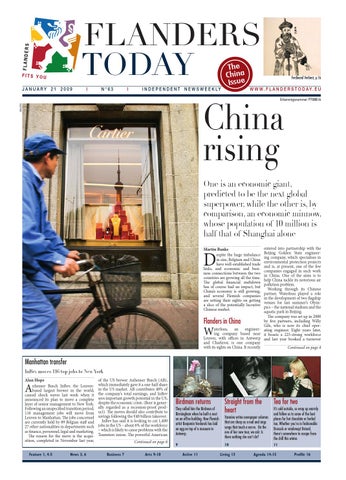
China rising
Jimmy Kets
Erkenningsnummer P708816
One is an economic giant, predicted to be the next global superpower, while the other is, by comparison, an economic minnow, whose population of 10 million is half that of Shanghai alone entered into partnership with the Beijing Golden State engineering company, which specialises in environmental protection projects and is, at present, one of the few companies engaged in such work in China. One of the aims is to help China tackle its notorious air pollution problem. Working through its Chinese partner, Waterleau played a role in the development of two flagship venues for last summer’s Olympics – the national stadium and the aquatic park in Beijing. The company was set up in 2000 by five partners, including Willy Gils, who is now its chief operaterleau, an engineer- ating engineer. Eight years later, ing company based near it boasts a 225-strong workforce Leuven, with offices in Antwerp and last year booked a turnover and Charleroi, is one company with its sights on China. It recently Continued on page 4
Martin Banks espite the huge imbalance in size, Belgium and China have well-established trade links, and economic and business connections between the two countries are growing all the time. The global financial meltdown has of course had an impact, but China’s economy is still growing, and several Flemish companies are setting their sights on getting a slice of the potentially lucrative Chinese market.
D
Flanders in China
W
Manhattan transfer InBev moves 116 top jobs to New York Alan Hope nheuser Busch InBev, the Leuvenbased largest brewer in the world, caused shock waves last week when it announced its plan to move a complete layer of senior management to New York. Following an unspecified transition period, 116 management jobs will move from Leuven to Manhattan. The jobs concerned are currently held by 89 Belgian staff and 27 other nationalities in departments such as finance, personnel, legal and marketing. The reason for the move is the acquisition, completed in November last year,
A
Feature 1, 4-5
News 3, 6
of the US brewer Anheuser Busch (AB), which immediately gave it a one-half share in the US market. AB contributes 40% of the company’s total earnings, and InBev sees important growth potential in the US, despite the economic crisis. (Beer is generally regarded as a recession-proof product). The moves should also contribute to savings following the €40 billion takeover. InBev has said it is looking to cut 1,400 jobs in the US – about 6% of the workforce – which is likely to cause problems with the Teamsters union. The powerful American Continued on page 6 Business 7
Arts 9-10
Birdman returns They called him the Birdman of Birmingham when he built a nest on an office building. Now Flemish artist Benjamin Verdonck has laid an egg on top of a museum in Antwerp. 9 Active 11
Straight from the heart
Tea for two
Yasmine writes newspaper columns that are sharp as a nail and sings songs that touch a nerve. On the eve of her new tour, we ask: Is there nothing she can’t do?
It’s cold outside, so wrap up warmly and follow us to some of the best places for hot chocolate or herbal tea. Whether you’re in fashionable Brussels or windswept Ostend, there’s somewhere to escape from the chill this winter.
10
11
Living 13
Agenda 14-15
Profile 16
2 i
F L A N D E R S T O D AY i J A N U A R Y 2 1 , 2 0 0 9
Editor’s Notes
FACE OF FLANDERS
W
e are marking Chinese New Year, 26 January, with a special issue of Flanders Today devoted to the links between China and Flanders. The aim is mainly to explore the business links between the two countries and to find out whether there are opportunities for closer economic cooperation. With China recently overtaking Germany as the world’s thirdbiggest economy, it is now more important than ever that people in Europe understand what’s happening in China. In putting together this issue, we also wanted to find out about the cultural connections that tie together a small European region and an Asian superpower. We discovered that that the relationship goes back at least as far as the 17th century, when the Flemish Jesuit missionary Ferdinand Verbiest settled in Beijing (see full story on page 16). Verbiest was a fascinating figure who introduced European astronomical methods to China. He also carried out experiments with steam that led in 1672 to the creation of a vehicle that is regarded by some as the world’s
first car. The Flemish astronomer designed the vehicle as a toy for the Chinese Emperor. It was a fairly rudimentary wooden trolley fitted with a steam boiler heated by a brazier. As the fire warmed the water inside the boiler, steam shot out of a nozzle to turn a system of cogs that drove the front wheels. Although a drawing still exists, there is no evidence that Verbiest ever actually built his car or if anyone else has ever constructed a version. At Flanders Today, we are curious to know if there is a working model in existence anywhere. And if there is not, we are keen to launch a campaign to construct the world’s first car following Verbiest’s plans. It would be the perfect way to celebrate more than 300 years of cooperation between China and Flanders. In the absence of the car, we suggest that you join the Chinese community in central Brussels or on Antwerp’s Van Wesenbekestraat as they celebrate their New Year with parades, firecrackers and banquets. Derek Blyth
Vroom vroom: the world’s first car?
COVER PICTURE • Flemish photographer Jimmy Kets took the
photographs for the cover and page 4 in this week’s issue. Kets’ work is regularly published in De Standaard, De Morgen and Knack magazine, as well as in Flanders Today.
online
www.jimmy kets.be
Flanders Today independent newsweekly Editor: Derek Blyth Deputy editor: Lisa Bradshaw News editor: Alan Hope Agenda: Sarah Crew, Robyn Boyle Picture research: Esther Bourrée Prepress: Nancy Temmerman Contributors: Marie Dumont, Stéphanie Duval, Sharon Light, Alistair MacLean, Marc Maes, Ian Mundell, Anja Otte, Monique Philips, Saffina Rana, Leander Schaerlaeckens, Steven Tate, Christophe Verbiest, Denzil Walton Project manager: Pascale Zoetaert Publisher: VUM NV Vlaamse Uitgeversmaatschappij Gossetlaan 28, 1702 Groot-Bijgaarden Editorial address: Gossetlaan 30 1702 Groot-Bijgaarden
Tel.: 02.373.99.09 _ Fax: 02.375.98.22 E-mail: editorial@flanderstoday.eu Subscriptions: France Lycops Tel: 02.373.83.59 E-mail: subscriptions@flanderstoday.eu Advertising: Evelyne Fregonese Tel. 02.373.83.57 E-mail: advertising@flanderstoday.eu Verantwoordelijke uitgever: Derek Blyth
Shutterstock
The world’s first car
TALKING DUTCH notes on language
stilte
Protect 7-7
Y
ou could make an easy joke by saying that Flemish artist Wim Tellier thinks big. His photographic installations may be some of the largest ever produced, but, paradoxically, they reflect his belief that it’s a very small world. In 2007, Tellier installed a 600 square-meter photograph flat on the ground on Antwerp’s Grote Markt. It filled almost the entire square – an image of the artist’s eight-day-old son superimposed on a photo of a bed of colourful rubber ducks. The piece was made up of hundreds of separate squares, and anyone who wanted could buy one of them. Tellier has now used the same concept to create the phenomenal Protect 7-7. He photographed six elderly people, each from a different continent, all lying down naked (with bird’s feathers covering their most delicate areas). With eyes closed, they appear calm and relaxed. Look closer and you’ll see that they are lying atop 700 separate photos of children’s faces. Each child has made a drawing on plexiglass and held it in front of his or her face to be photographed. “I asked the children to draw their dreams of how they see the future of the planet,” Tellier explains. “The six older people are resting on the dreams of the children. The question it asks is: How do we leave a better world for our children?” Each adult is 77 years old. Each child is aged 7. And they are all on view on the seventh continent: Antarctica. Well, technically not “on view” since there is no one there to actually see it. But that doesn’t matter to Tellier. “The idea was to put the six continents together on the seventh,” he says. “We all live in the same world, on the same planet. It’s about cooperation and creating a medium to tell a story. These children made drawings of their dreams, and when you put them all together, you create something powerful.” Tellier specifically photographed the old people to look as though they are basking in the sun – then placed them in the coldest place on earth. “It’s an illusion,” he says. “Sometime you have to do something crazy – like put an installation in Antarctica – to get across a message.” The pieces, which measure a whopping 800 square metres each, will remain in Antarctica until April, when they will be shipped to Antwerp for a 10-day show on the huge square known as the Gedempte Zuiderdokken. They have been photographed from above in Antarctica, and these aerial photos, plus a film about the making and installing of the gigantic works, will also be on view. A lift will also be on hand in Antwerp to take visitors 80 metres in the air to see the installation from above – the way it is meant to be seen. And then Protect 7-7 will be broken up into one-metre squares and sold to the public. Each square is either a child’s face or a part of the body. (You could buy a piece of the tattoo on the man from Oceania, above, for instance.) You can in fact reserve your square now on the project’s website. The earlier you order, the cheaper the cost – anywhere from €100 to €350. One-quarter of the pieces have already been sold to people in 155 countries. You’d be buying a unique piece of art, of course. But you’ll have to get together with 1,200 people from across the planet if you ever want to put it all together again. Lisa Bradshaw
online
www.protect77.com
Depending on which philosopher one follows, one either holds that there is a universal order for us to discover or that chaos reigns, and it is up to us to create order. For those who believe the latter, words form reality: if we don’t name it, it doesn’t exist. But what if different languages name things differently? Is the reality then different? Take the Dutch word kussen: this is translated either as “cushion” or as “pillow”. For an English speaker, “cushion” and “pillow” are distinct objects despite obvious similarities. Dutch speakers will of course protest that they know perfectly well what the difference is and probably explain that they would use hoofdkussen (head cushion) or oorkussen (ear cushion) if the situation requires a distinction to be made. Such a concrete example doesn’t reveal so much; instead, let’s turn to the abstract to see if a word in one language creates a different reality than its “translation” does in another language. For this purpose I have picked on “silence”, stilte in Dutch. Before continuing, I have sat for many minutes in silent contemplation. My thoughts have flown from Sweden to the Hebrides to my Flemish village as I try to get a handle on the word “silence”. My thoughts turned to Sweden because that’s where you soon learn to sit with others in comfortable silence, the Hebrides was where I met two lads from Ghent searching for silence to record birdsong, and here at home is where the distant rumble of the motorway is always present. Talking about silence is problematic. Those of a particular religious persuasion might have a proprietorial attitude towards silence, which often puts off the unbeliever. Rather, let’s see how the words silence, stilte, and their adjectives are used. We talk about een stille zee _ a calm sea; een stil verlangen _ a secret wish; Stille Nacht _ Silent Night; een diepe stilte _ a profound silence; de stilte verbreken _ to break the silence; een minuut stilte _ a minute’s silence; een pijnlijke stilte _ an awkward silence. In the proverb spreken is zilver en zwijgen is goud _ speech is silver, silence is golden, silence translates as zwijgen _ saying nothing. From these examples, it appears that silent/ silence isn’t always an adequate translation for stil/stilte; perhaps still/stillness would sometimes be more appropriate. The word “silence” only describes the absence of sound, whereas stilte can also describe the presence of the calmness of self-imposed silence. Does this mean that Dutch speakers experience something different from English speakers when they experience silence? You will probably need time in stilte to decide on this. For such contemplation, stiltegebieden _ stilte areas have been created: “stiltegebieden zijn uitnodigingen om innerlijke rust op te zoeken _ stilte areas are invitations to seek inner peace. You will find out more at De Helix in Grimminge, an educational centre run by the Flemish Community. Alistair MacLean
NEWS Zaha Hadid Architects
F L A N D E R S T O D AY i J A N U A R Y 2 1 , 2 0 0 9 i 3
FIFTH COLUMN Shutterstock
What’s in a name?
NEW ARCHITECTURE l The London-based Zaha Hadid Architects has been chosen 63. Almost 100 international firms entered the competition to design a building that would to build a new headquarters for the Antwerp port authority. The e31.5 million Havenhuis, symbolise Antwerp as a world port and the economic powerhouse of Flanders. The building or Port Building, is to be built in the Eilandje quarter above an existing fire station on Quay is scheduled for completion in 2013.
News in brief: T
hate-crime victim’s family turned down for compensation; no copyright for Ghent tattoo artist
Belga
he 2009 Auto Salon opened at the Brussels Expo at Heizel amid worries of the effects of the economic crisis on sales. Organisers reported that all stands were filled as usual, but many exhibitors had clearly invested less on the occasion than usual. One report said that Mercedes was spending up to 40% less on its presence this year, while Opel’s budget was 25% down. Car manufacturers, meanwhile, spent “more than 10% less” than in previous years on advertising, according to advertising agency Clear Channel. The January salon period is normally a high-point of the year for car advertising.
T
he Landbouwkrediet group is to take over all the Belgian accounts of Kaupthing, the troubled Icelandic bank whose savers have seen their accounts frozen since October of last year. But the deal, which covers 5,000 private banking clients and 16,000 holders of the online Kaupthing Edge account, will not give savers immediate access to their money. “That will only come when the Kaupthing Luxemburg dossier is finalised,” said Landbouwkrediet CEO Luc Versele.
A
Ghent tattoo artist has lost his case for copyright over a series of tattoos on a customer’s body. The tattooist has been using photos of the tattoos as publicity for his business but was ordered to stop by a court, which argued that a line had to be drawn between his rights over the conception of the artwork and the physical tattoo on the man’s skin.
O
nly a tiny minority of pre-school children wash their hands after going to the toilet, according to a study by the Free University of Brussels (VUB). The study included 22 schools across the country and found that only 8% of children washed their hands.
T
he prices of milk, butter, olive oil, ice cream and potatoes fell in December, and food prices are expected to fall further in 2009, according to forecasts. Food prices peaked last year, with grain and dairy prices 20% higher than the year before. Ironically, the economic crisis may be partly to blame for the price decreases: consumers are less willing to spend, even on food, and because of the pressure on demand, prices are forced to fall. “The car industry or a chemical giant can cope with a fall in demand by shutting down production, but a Shooting victims Oulematou Niangadou (left) and Luna Drowart farmer can’t stop milking his cows for a month,” explained a Boerenbond spokesman. “So we are soon left with a surplus, which leads to he family of Oulematou Niangadou, one of the victims of price cuts.” gunman Hans Van Themsche, will not receive compensation for ne in three young people in Flanders is in favour of pro-anoher murder in Antwerp in May 2006, the government has decided. rexia websites, which encourage young girls to starve themselves, Oulematou was gunned down by Van Themsche, along with two-yearold Luna Drowart, a child in her charge. Another woman, Songul Koç, according to figures from the Leuven School of Mass Communications was injured in the shooting. At the trial of the killer, the court ordered Research. One girl in eight has visited such sites, most of which are in damages of €71,500 to be paid to all the victims. Since Van Themsche English – although Dutch-language sites are on the increase. The sites himself is unable to pay, a government fund would normally pay the typically provide discussion forums in which young people give each damages, but the justice minister has informed Oulematou’s family other tips on how to lose weight and how to keep their extreme dieting that she is not eligible for payment because she was not legally in the secret from parents and other adults, as well as showing “thinspiration” country at the time of her death. Representatives of the family said the photos of super-thin stars like Nicole Ritchie and Paris Hilton. decision was “unjust” and “discriminatory”.
T
O
Discipline is one of the main characteristics of SP.A, the Flemish equivalent of the British Labour Party. (We hesitate to call it the Socialist Party, for reasons that will become evident.) Party matters are rarely discussed in public. If there is any internal dissent, the outside world sees no more of it than shadows on the wall. This changed last week, when the young party president Caroline Gennez pushed through a name change: SP.A would no longer stand for Socialistische Partij Anders (Socialist Party) but Socialisten en Progressieven Anders (Socialists and Progressives). To the outside eye, the difference is hardly noticeable. But the upheaval this caused within SP.A was unprecedented. First, Mia De Vits, MEP and former union leader, spoke out against it. Then Freddy Willockx, a minister of state. Fred Erdman, former party leader, and Willy Claes, another minister of state, soon joined in. But what really hurt was the criticism by Louis Tobback, the mayor of Leuven and yet another minister of state. An authority, if not a hero, within SP.A, Tobback publicly called the name change “stupid”. Moreover, it annoyed him intensely that “a total stranger” had announced it. This total stranger is the Flemish minister for culture, Bert Anciaux, who is no stranger to SP.A: in 2003 and 2004 he was elected on a joint SP.A/Spirit list (Spirit, his former party, has subsequently evaporated). Since then, Anciaux wanted to join SP.A, but he stressed over and over that he is “not a socialist”. What better way to infuriate proud socialists? At first, Gennez reacted the way all Flemish politicians do when their plans do not work out well. She said that there was nothing wrong with the decision, but it was not communicated well. Ultimately, she had to reverse the decision. SP.A is still the Socialist Party, while Socialisten en Progressieven will be the baseline from now on. SP.A has changed its name before: in 2002 it added the A from Anders (Different), to underline its openness to people like… Bert Anciaux. The party militants accepted this grudgingly because the decision was pushed through by a strong leadership – the group nicknamed the Teletubbies (Patrick Janssens, Steve Stevaert, Johan Vande Lanotte and Frank Vandenbroucke) – and the party was in a winning mood. All of that is different today: Gennez has yet to gain some authority (which has become even more difficult now), and the party faces one of its biggest electoral defeats ever. To make matters worse, a dissident internal group has emerged: SP.A Rood, which protests against anything that alienates SP.A’s traditional working-class backing. SP.A Rood may be tiny, but it can be very irritating, as was the case this weekend when it adopted a new baseline: Socialists. Anja Otte
Continued from page 1 of some €50 million. Waterleau specialises in converting waste from raw materials into energy sources and, as Gils explains, is now involved in the construction and operation of several waste treatment plants in China. The projects include a water treatment factory in Macau and a waste-to-energy plant in Shanghai, China’s commercial centre, for which it supplies engineering equipment. Gils says that the significance of the Chinese element of its operation cannot be overestimated, accounting for 15% to 20% of its annual turnover. “China is a growing market, which is why we are always looking at new investment opportunities over there,” he explains. “The success we are having in China now has not come overnight; it’s the result of building up contacts over the last 20 years. There is huge potential in the Chinese market, and it has got to be said that most Flemish companies have not taken advantage of it.” His comments are endorsed by recent research by the EU chamber of commerce in China which says that European firms are missing out to the tune of €21 billion, partly because of trade barriers but also due to not making the most of business opportunities. Hubert Cooleman, Flemish economic representative in Beijing, who regularly leads business delegations from Flanders to China, says that when it comes to business opportunities in the most populated country in the world, Flemish firms are mainly focused on the environmental and renew-
THE CHINA ISSUE
A
whopping 50% of food imported to Europe comes from China. But some trade goes in the opposite direction. The Flemish Pinguin Group, based in Staden, near Bruges, is doing well in China. Set up in 1965 by brothers Georges, Andre and Frans Dejonghe, it specialises in readymade meals and frozen vegetables. The company now has eight vegetable production sites, including
Pinguin
Ancient and modern traditions co-exist in China’s urban spaces
The Pinguin Group near Bruges provides the Chinese with frozen, ready-made Asian cuisine
➞
“China is not always an easy place for a foreign company, but clearly this is a going to be a good place for Flemish firms in future” able energy sector. “The thing that Belgian-based enterprises have to realise is that if they are going to do business in China they have to be here for the long-haul,” says Cooleman, who is based at the Belgian embassy in Beijing. “Any success they may achieve is not likely to come in the short term.” His role is to promote the Belgian market to the Chinese. “Unfortunately, at a time of global financial meltdown this is not very easy,” he says, “because Chinese companies are consolidating and increasingly questioning whether now is the right time to move.”
F L A N D E R S T O D AY i J A N U A R Y 2 1 , 2 0 0 9
➞
FEATURE
Jimmy Kets
4 i
three in Belgium, four in Britain and one in France. Pinguin has just expanded into the Chinese market, where it sells a range of products in supermarkets in a number of cities. “Demand for frozen vegetables is constantly growing in China, due to the amelioration of the economic situation,” explains company spokesperson Nadja Meulemans. After receiving more and more requests for Asian-style readymeals last year, the company entered into a partnership with a Chinese producer to prepare “authentic stir-fry recipes according to ancient traditions,” Meulemans says. “All ingredients coming from Asia are rigorously selected, weighed and freshly stir-fried in huge woks. They are then immediately frozen and conditioned.” Products sold in China by the firm include soups and meals with Chinese noodles, tofu and vegetable mixes, including Chinese cabbage and other specialities. “Our producers are carefully selected so that we can offer a complete range of oriental products of consistently high quality.” Brussels-based Flanders Investment and Trade (FIT) is the body that oversees much of the activities of Flemish companies in China. The agency, set up in 2005, helps to promote the interests of local enterprises both at home and abroad. ”We were set up because more and more Flemish companies are working beyond the boundaries of Flanders,” explains Michelle Surinx, area manager for the Asia-Pacific region. FIT has offices in China, Hong Kong, Guangzhou, Shanghai, Beijing and Taipei. “Right now, business connections between Flanders and
“Belgian-based enterprises have to realise that if they are going to do business in China, they have to be there for the long-haul” China are quite healthy and growing all the time,” she says. Flemish Liberal MEP Dirk Sterckx, a former presenter with the Flemish TV channel VRT, has just returned from leading a European parliament delegation to China. He met officials at the Belgian consulate in Shanghai and discussed future business links between the two countries. “China is not always an easy place for a foreign firm to operate within,” he says. “But clearly this is a going to be a good place for Flemish firms to be based in future.”
China in Flanders
M
ention the word “Chinese” and most people will inevitably, if unfortunately, think of their local Cantonese restaurant. It probably remains true that the traditional Chinese restaurant remains the most obvious symbol of the Chinese presence in Flanders. But there is much more to China’s impact on the region than the undoubted delights of
LED lights, recently set up their distribution centre in Antwerp. Overall, Verzeele estimates Chinese investment in Flanders to be worth a cool €1 billion to the local economy. “Just two or three years ago, this level of activity and investment in Flanders was unheard of, but things are rapidly changing,” he says. “We are seeing the Chinese setting up here more and more – and I’m not talking about Chinese restaurants.” Chinese investment here still remains “relatively minor” compared with that of India and Japan. Still, FIT predicts that China’s huge economic growth will continue to spell good news for an otherwise stagnant Flemish economy. side from economics, the Chinese impact in Flanders also extends to arts, culture and scholarship. The Flemish Theatre Institute, based in Brussels, helps to provide a platform for Chinesebased artists and to establish cultural connections between Flanders and China. Marijke De Moor, spokesperson for the institute, said that such exchanges between the two are growing all the time. Supported by the Flemish government, an arts initiative called HUB offers guidance and advice to artists while coordinating long-term Flemish/ Asian projects. “Usually, it’s Flemish artists going over to China to perform,” she says, “but we are trying to build up our Chinese contacts so that this becomes more of a reciprocal arrangement.” Compared with some ethnic groups in Flanders, the Chinese community is relatively small. Most came in the 1960s and ’70s and decided to stay, either to run restaurants and other businesses or to work in universities and hospitals. The Chinese in Flanders are, however, generally well integrated into Flemish society. Su-Yin Wang, for instance, is married to a Fleming, lives near Antwerp and offers calligraphy courses and lectures on Chinese culture. When she first settled in Loenhout, a quiet Flemish village, in the mid-1960s, she says that “the people were rather conservative, and I was aware of being the only foreigner in the village.” Agnes Hsiao, meanwhile, left her homeland in 1991 and has lived in Belgium ever since. Her eldest son was born here, and she now regards Belgium as “home.” The 53-year-old lives in Linkeroever, Antwerp’s left bank, where she demonstrates the art of Chinese tea making and plans to start a Chinese Tea-Zen Association. “Of course, I feel homesick occasionally – not least for the food – but living in Flanders has helped me realise the importance of the work-life balance,” she says. “That’s something that was miss-
“We are seeing the Chinese setting up here more and more – and I’m not talking about Chinese restaurants.”
Belga
A
Belga
its cuisine – not least of all in the economic sector, where Flanders is among the top five regions favoured by Chinese businesses seeking to invest abroad. Based on figures for the last five years from the European Investment Monitor, top Chinese investment destinations in Europe are Britain, where 117 Chinese companies are based, Germany (63) and France (26), followed by Flanders (17). “We see this as quite logical,” says John Verzeele of FIT, “because to market their products, Chinese companies need a global distribution network. Due to its central location within the EU, Flanders offers an excellent springboard to increase market penetration into Europe.” In addition, Flemish port, road, rail and waterway infrastructures, and its logistics knowhow, are also distinct assets for any prospective foreign investor. “The trend among Chinese companies to invest abroad is becoming increasingly clear,” adds Verzeele. “Because purchasing power in their home country is limited, Chinese entrepreneurs are actively seeking new sales markets for their finished products. These are no longer just cheap mass-produced goods but also electronics products, IT items and automotive and pharmaceutical products, which are often sold under the original Chinese brand name.” Verzeele, who helps to promote Flanders as a potential base for Asian companies, says that currently the main Chinese investment projects in Flanders are sales and marketing offices and distribution centres. At present, there are 15 of these in the region. “Up to now we have seen smaller projects, but there is a clear trend towards bigger ones,” he says. “More and more Chinese companies want to access the European market with their own brands, so they need to take control of the supply chains and distribution networks. In the port of Antwerp, for instance, there has been investment by Cosco, a major Chinese shipping line.” According to FIT, Zeebrugge Port is set to sign a €45 million agreement with Shanghai Port company, the biggest in China, to buy 40% of its container terminals. This would open up access to the north Flemish port and – more importantly – the European market to yet more Chinese shipping companies. “It’s a particularly important investment and shows how important Flanders is becoming to the Chinese,” he says. With Flanders considered a top European region for logistics, interest in setting up Chinese distribution centres is steadily growing, with the main focus currently on consumer electronics. Hisense, manufacturer of LCD televisions, has its headquarters and European showroom in Mechelen, while the Yankon Group, manufacturer of
Belga
F L A N D E R S T O D AY i J A N U A R Y 2 1 , 2 0 0 9 i 5
China in Flanders: Chinese carmakers at the Cardoen cars market in Antwerp (top left); professor Jing Men (top right); celebrate Chinese New Year on 25 and 26 January in Antwerp (above, left); Claire Dong of China came in second at the Stella Artois World Draught Master 2008 in Leuven (above, right) ing from my life back home.” Some immigrants from China, such as Jing Men, are now firmly established in Flemish academic life. She came to Flanders in 1998 to do a PhD in political science at Brussels Free University (VUB), met her Flemish husband two years later and settled down in Vilvoorde. She is now a professor teaching EU international relations and diplomacy studies at the College of Europe in Bruges. She also works in Brussels as assistant professor at Vesalius College and as senior researcher at the Brussels Institute of Contemporary China Studies. “The Chinese are a small minority in the Flemish community and are scattered around,” she says. “Apart from some associations organised by Chinese restaurant owners and businessmen, there are not many organised Chinese groups.” She says that she finds people
in Flanders to be friendly towards her. “It has been a big change in my life, from the moment I landed in Brussels without knowing a single person. I’m now settled here with lots of friends, which shows that people here are friendly and openminded.” Keeping up her Dutch, though, is a different problem. “All my friends and colleagues speak English to me, which is sometimes frustrating because I learnt both Dutch and French,” she says. “My husband is Dutch speaking, but we speak English most of the time because he says it’s too timeconsuming to speak Dutch with me.” Other Flemish people also speak English to her. “I start in Dutch, but the shopkeepers reply in English.” Despite the frustration of not being able to practice the language, she sees it as a sign that “they are considerate to foreigners”. Men, 40, is very aware of the presence of right-wing politics but
puts it in perspective. “Of course, there is the Vlaams Belang,” she says, “but I think they are against those who are not hard working, who want to benefit from the Belgian welfare system and who bring trouble to Belgian society. The Chinese community, in general, gives a positive impression to the Flemish. They are hard working and abide by Belgian law, so being Chinese in Flanders is not a problem.” Men says that her experience in Flanders shows her that certain qualities – sincerity, honesty and hard work – are universally recognised. “If you open your heart to others, they will open theirs to you,” she says. “If you are an honest, friendly and hard-working, you will be respected by others.”
online
www.flandersinvestmentandtrade.com
6 i
NEWS
F L A N D E R S T O D AY i J A N U A R Y 2 1 , 2 0 0 9
The week In figures
InBev Leuven outsources top management union opposed the merger in the first place because of fears surrounding InBev’s wellknown history of buying up companies and then slashing jobs. Last week, the company announced the closure of a procurement division in St Louis, though the number of jobs affected was not specified. A further 250 vacancies will not be filled, and 415 contractor positions will be wiped out. According to reports, CEO Carlos Brito and CFO Felipe Dutra will split their time between Leuven and New York. (Brito famously does not even have a designated parking space at the Leuven headquarters and flies economy when possible.) After the management move to New York, Leuven will still employ 70 or so executives. The company’s breweries and their 2,900 workers in Belgium will not be affected. The InBev move is the latest in a long line of major companies that have chosen to move their headquarters out of Belgium. Other examples include Generale Maatschappij (taken over by the French group Suez and moved to Paris), Tractebel, Electrabel and Petrofina. In addition, former banking giant Fortis has been sold to the French and Distrigas to the Italians. InBev, having taken over the US giant AB, was seen as a reversal of the general trend, but that view now appears to have been prematurely optimistic. Others have pointed out that the Belgian
Shutterstock
Continued from page 1
€8,250
InBev’s Leuven headquarters will lose top executives character of InBev was lost a long time ago when Interbrew was taken over by AmBev of Brazil. Even before the merger with AB, most of the company’s top managers were not Belgian. In fact, most, like Brito, are the product of MBA courses at US business schools. It’s unlikely the move from Leuven to New York will be marked by regret on the part
of the managers. The main shareholders, however, continue to be a group of wealthy Belgian families. In this matter, as in most others within the company, they are keeping their distance and are happy as long as decisions taken are good for the balance sheet.
Employers slam Zaventem jobs plan results. The following projects are among the alleged failures: l A planned Airport Village was supposed to provide 9,800 new jobs in the area, but Brussels Airport has decided to shelve the project for the time being l A new terminal for low-cost airlines, which would attract carriers away from Charleroi, was supposed to have been operational by Easter this year, providing 3,000 jobs. The economic climate, as well as protests from major airlines, which consider the new terminal unfair competition, have slowed down the project l New industrial estates at Zaventem and
European Court ruling could endanger jury trials
T
here is a real risk that some Belgian jury cases may have to be retried as a result of a ruling by the European Court of Human Rights (ECHR) in Strasbourg last week. The body was ruling in the case of Richard Taxquet, one of the main defendants accused of murdering Socialist politician André Cools in Liege in 1991. In the main part of its verdict, the ECHR ruled that the jury’s verdict was not sufficiently justified when it was asked a series of yes/no questions by the judge. According to the ECHR, the jury should have explained in detail why it was answering in the affirmative. According to Leuven University professor Raf Verstraeten, an expert in criminal procedure, there is now a chance that other defendants in future cases could take their appeals to Strasbourg – and be vindicated. Speaking to De Morgen newspaper, Verstraeten said: “Thanks to the Taxquet ruling, there is now a legal vacuum between our law and European jurisprudence.” When asked to define how much explanation a jury might be required to give, he replied: “I should say that you would need to make it clear in a verdict why you thought someone was guilty. The jury will need to explain how they were convinced of the fact that someone did or did not do what he is accused of doing.”
Diegem, which should have brought 6,000 jobs, have been held back by protests, planning delays and a lack of enthusiasm on the part of developers. Other industrial estates in Machelen-Vilvoorde and at Brucargo are going ahead, however, with the prospect of 6,200 jobs Currently, about 20,000 people are employed at the airport and a further 40,000 in the surrounding area. “That’s only about as many as in the time of Sabena,” said Freek De Witte, an expert with Voka. The Flemish government, he argued, has no vision for the future of Zaventem because of a lack of political consensus.
School’s out forever – in 100 days
€600,000
A gift by a rich couple who wish to remain anonymous to the Massart family from Temse, bringing them to the €1 million needed to pay for treatment for Sandra, aged 7, who suffers from a rare metabolic disorder. An experimental medication, Metazym, is only available in Ireland.
25%
The number of Belgian boatbuilding companies facing collapse as a result of a fall in demand, according to research bureau Graydon. One-quarter of the 620 businesses polled were doing well, and 50% getting by, Graydon said. Meanwhile the number of companies participating in the Boat Show in Ghent in February has fallen by 13%, with many of those who will show presenting a limited range.
16.2%
F
inal-year students at secondary schools across the region are starting to celebrate the Flemish tradition of “100 Days”, which counts down their final days in school. Strictly speaking, the first day of the event should fall on 27 January – 100 days before July 1, the start of the summer holidays. But some schools don’t include weekends and holidays, so the party – known as Honderd Dagen in East and West Flanders and Flemish Brabant, and Chrysostomos in Antwerp and Limburg – is a moveable feast. Not that there’s a great deal of feasting. The old days when final-year students took over the school as Lords of Misrule are long gone: in Hasselt, a code of good conduct drawn up by the municipal authorities was signed by student representatives in all schools. At one school in Dilbeek, the last dance was set for 3.00 and no later. Another school in Roeselare has banned firecrackers and shaving foam. The day is thought to originate from the Middle Ages, when an oratory contest was held for last-year students in honour of St John Chrysostomos (345-407), the patron saint of preachers. St John’s feast-day falls in September, but 27 January was the day his remains were brought after his death from exile in Armenia to Constantinople, where he had once been bishop.
shutterstock
T
he much-anticipated investment in businesses around Zaventem has failed to materialise, according to the Flemish government’s action plan for the area. The doubling of the number of jobs on offer by 2025 now looks unlikely to be reached. “We are disappointed,” said a spokesman for employers’ organisation Voka. The START plan for the region was launched in 2004 by former Flemish minister-president Yves Leterme and was intended to give the area around Zaventem a boost following the bankruptcy of Sabena and the closure of the Renault car plant at Vilvoorde. Since then, critics argue, the various job plans have failed to yield any
The fine handed down to a 72-year-old man from Heist, near Mechelen, found guilty of trapping and eating protected species of songbirds and birds of prey. The man had equipped his whole garden as a trap, and when police searched they found 72 living birds and the carcases of 50 more stored in the deep-freeze, plucked and dressed ready for eating.
The reduction in the number of industrial vacancies notified to the Flemish jobs and training agency VDAB in 2008. However, that shortfall was partly made up by an increased number of jobs in the social and public sectors.
15.8%
The increase in turnover for Delhaize in the fourth quarter of 2008, to €5.42 billion. But the company also announced the closure of seven loss-making Sweetbay stores in the US and the end of a project to test out the German market for possible expansion there.
17,220 kg
The weight of a record-breaking sculpture of Manneken Pis made completely out of gummi bears. Constructed last week by confectioner Joris in Sint-Agatha Berchem, the model, at 81cm, is taller than the original and beats the previous gummi record by 10 kg.
BUSINESS
THE CHINA ISSUE
F L A N D E R S T O D AY i J A N U A R Y 2 1 , 2 0 0 9 i 7
Shanghai, here they come
The week IN FIGURES Chemicals • Kaneka
Flanders goes to Expo 2010 Shutterstock
Alan Hope landers will be represented at the World Exhibition in Shanghai in 2010, but only after a hard-fought battle. “There are many better ways these days to promote a country or a region than to stand in a corner of the Belgian pavilion at something so outdated as a world exhibition,” said Flemish minister-president Kris Peeters in October of 2007, commenting on the decision taken by his government several weeks earlier. “It costs far too much and brings relatively little in return,” he said. The Flemish agency for foreign trade had given thumbs down to the idea, based on costs of €4 to €5 million. “The Flemish government must invest its resources in the most efficient way possible, and the expo is not the most efficient way possible,” Peeters said. His point of view was supported by Philippe Muytters, chairman at the time of the employers’ organisation Voka: “The emphasis of an expo like that is mainly on prestige. But if you’re looking for the best return on investment, there are better ways of spending your money.” The general reaction, however, was more in line with Herman De Croo, the then speaker of the federal parliament. “We’re talking here about the third economic power in the world,” he said. “We’ve sent the king once, the prince three times, the last time with 450 businessmen. I’ve been twice with a delegation, and yet we’re staying away from the biggest show the Chinese have put on this century?” De Croo was referring to the last major delegation, which took place in June 2007, when Prince Filip led representatives from 138 companies (60 Flemish, 39 Walloon and 39 from Brussels) together with ministers and commercial representatives on a trip to Beijing, Hong Kong, Shanghai and Shenyang. Among the party were some companies long-established in China, such as dredger Jan De Nul, pharmaceuticals giant Janssen and Bekaert, which employs 3,800 people there. The Flemish government’s decision caused so much protest it was left to economy minister Patricia Ceysens to “re-examine” the situation, following Peeter’s unequivocal comments. The FlemishChinese chamber of commerce pointed out to her that the decision would involve a loss of reputation for Flemish businesses, particularly in Shanghai itself, which was an important centre where the region’s exporters had made their first tentative steps into the Chinese market. “We received signals that staying away would be seen as disloyal, with possible direct consequences for trade relations,” she said. As a result, Flanders will be represented at Shanghai by Flanders Investment & Trade. Shanghai was selected in December 2002 at a meeting in Monaco of the International Exhibitions Bureau (BIE), beating rival applications from Warsaw and Moscow, as well as Yeosu in South Korea and Queretaro in Mexico. The exhibition grounds will take up 5.4
F
FLANDERS TODAY JANUARY 21 2009
I
N°63
I
I N D E P E N D E N T N E W S W E E K LY
The China Issue I
Ferdinand Verbiest, p.16
W W W. F L A N D E R S T O D AY. E U
China rising
Electronics • Bosch
The German industrial products and electronics group Bosch has acquired the Aartselaar-based Servico, which distributes its Junkers Thermotechnology range across Belgium.
Food • Subway
Shanghai shining: Flanders will be there after all square kilometres on the banks of the Huangpu, with 25,000 people being rehoused to make room. (The city stresses that their homes had no electricity or sanitation, and the new homes will be better.) Shanghai, a city of 16 million residents, aims to attract 70 million visitors over the course of the exhibition, setting a new record. The city has budgeted €3 billion for the exhibition itself, with as much as 10 times that to be spent on modernising the city and extending the urban transport network. The theme of the exhibition is “Better City, Better Life”, with the accent on urban development. Applications were invited from 30 cities from across the world to be featured as examples of “urban best practice”. Antwerp applied with a project called Antwerp, Project of the Century, but the bid wasn’t successful. The main part of the exhibition, which runs from May to October 2010, will feature 185 countries and regions, as well as 45 international organisations like the World Health Organisation.
online
http://en.expo2010china.com
Economic imbalance
B
elgium’s exports to China grew 5% in 2006, but imports grew by 16%. For every €1 earned on exports, Belgium spends €3.50 on Chinese goods. Flanders accounts for about 80% of Belgium’s exports across the board. For the 2009 budget for Flanders Investment & Trade, economy minister Patricia Ceysens has created posts for 11 new trade representatives to be concentrated in growth areas like Russia, Brazil, India, the Emirates and China.
Get Flanders Today in your letterbox each week
Erkenningsnummer P708816
One is an economic giant, predicted to be the next global superpower, while the other is, by comparison, an economic minnow, whose population of 10 million is half that of Shanghai alone entered into partnership with the Beijing Golden State engineering company, which specialises in environmental protection projects and is, at present, one of the few companies engaged in such work in China. One of the aims is to help China tackle its notorious air pollution problem. Working through its Chinese partner, Waterleau played a role in the development of two flagship venues for last summer’s Olympics – the national stadium and the aquatic park in Beijing. The company was set up in 2000 by five partners, including Willy Gils, who is now its chief operaterleau, an engineer- ating engineer. Eight years later, ing company based near it boasts a 225-strong workforce Leuven, with offices in Antwerp and last year booked a turnover and Charleroi, is one company with its sights on China. It recently Continued on page 4
Martin Banks espite the huge imbalance in size, Belgium and China have well-established trade links, and economic and business connections between the two countries are growing all the time. The global financial meltdown has of course had an impact, but China’s economy is still growing, and several Flemish companies are setting their sights on getting a slice of the potentially lucrative Chinese market.
D
Flanders in China
W
Manhattan transfer InBev moves 116 top jobs to New York Alan Hope nheuser Busch InBev, the Leuvenbased largest brewer in the world, caused shock waves last week when it announced its plan to move a complete layer of senior management to New York. Following an unspecified transition period, 116 management jobs will move from Leuven to Manhattan. The jobs concerned are currently held by 89 Belgian staff and 27 other nationalities in departments such as finance, personnel, legal and marketing. The reason for the move is the acquisition, completed in November last year,
A
Feature 1, 4-5
News 3, 6
of the US brewer Anheuser Busch (AB), which immediately gave it a one-half share in the US market. AB contributes 40% of the company’s total earnings, and InBev sees important growth potential in the US, despite the economic crisis. (Beer is generally regarded as a recession-proof product). The moves should also contribute to savings following the €40 billion takeover. InBev has said it is looking to cut 1,400 jobs in the US – about 6% of the workforce – which is likely to cause problems with the Teamsters union. The powerful American Continued on page 6 Business 7
Arts 9-10
Birdman returns They called him the Birdman of Birmingham when he built a nest on an office building. Now Flemish artist Benjamin Verdonck has laid an egg on top of a museum in Antwerp. 9 Active 11
Straight from the heart
Tea for two
Yasmine writes newspaper columns that are sharp as a nail and sings songs that touch a nerve. On the eve of her new tour, we ask: Is there nothing she can’t do?
It’s cold outside, so wrap up warmly and follow us to some of the best places for hot chocolate or herbal tea. Whether you’re in fashionable Brussels or windswept Ostend, there’s somewhere to escape from the chill this winter.
10
11
Living 13
Agenda 14-15
Profile 16
The Japanese chemical products company Kaneka is considering investing up to €160 million at its site in Westerlo to build a solar cells production unit. The company already has three operations in Westerlo specialising in plastics and PVC-related products.
Want to keep in touch with Flanders? Simply fill in the subscription form below and send it to: Flanders Today Subscription Department Gossetlaan 30 _ 1702 Groot-Bijgaarden _ Belgium Fax: 00.32.2.375.98.22 Email: subscriptions@flanderstoday.eu
Free n! subscriptio
The newspaper version will be mailed to subscribers living in any of the 27 countries of the European Union. Residents of others countries will receive a weekly ezine. Name: ............................................................................................................................................................................................................... Street: ............................................................................................................................................................................................................... Postcode: . ........................................................................................................................................................................................................ City: .................................................................................................................................................................................................................. Country: .......................................................................................................................................................................................................... e-mail: .............................................................................................................................................................................................................. Privacy policy: We fully respect Belgian legislation on the protection of personal information. The data we collect will only be used for distribution of publications and will not be disclosed to any third parties without express consent.
Subway, the US fast-food chain that mainly sells sandwiches, has confirmed its plans to open up to 25 outlets in Belgium. The first are expected in Brussels, Ostend and Bruges.
Food • Top Brands
Top Brands, the Belgian operator of the US-based Pizza Hut (which has 80 outlets in this country), has acquired the bulk of the chain’s French operation. The move will push the total number of restaurants under management to over 150. The company has plans to open an additional 30 outlets in France and Belgium this year.
Fuel • Pomp van het Volk
A new petrol retailing company called Pomp van het Volk (The People’s Pump) has opened its first outlet in Aalst with the promise of the lowest prices for petrol. The company has plans to open up to 10 more stations this year.
Home furnishing • Domo
The Zele-based carpet and floor covering company Domo is jointly investing some €10 million with its partner, the Vanheede group. The aim is to expand production of carpet pellets used as fuel for cement ovens to 80,000 tonnes a year.
Oil • Exxon
The US-based Exxon is poised to invest several hundred million euros in its Antwerp refinery to develop production capacity of diesel as part of the company’s plans to meet increased worldwide demand. Two other refineries in the US will benefit from similar investments. The new unit is expected to come on stream in late 2010.
Pharmaceuticals • Janssen
Janssen Pharmaceutica, the Beerse-based affiliate of the US Johnson and Johnson group, has signed a €10 million contract with the US Vanderbilt University to jointly develop a medicine to fight schizophrenia.
Rail • Eurostar
The high-speed cross-Channel train service linking Brussels and Paris to London had a record year in 2008 thanks to the opening of the final segment of the route, bringing passengers into the renovated Saint Pancras train station in London and cutting travel time to less than two hours. Traffic rose 10% to over nine million passengers, with day trips representing some 20% of the total. Eurostar expects further growth this year despite the economic turmoil.
Software • Q-Layer
The Lochristi-based software developer Q-Layer, which was founded four year ago, has been acquired by the US Sun Microsystems company.
CLEARLY
NOT MOVED
BY
GOSSELIN
The items you treasure most deserve the greatest attention when you move. They are treated with the utmost care by those meticulous men sent by Gosselin, who wrap them in that specific Gosselin paper and move them in accordance with the Gosselin master plan specially drawn up for you. Gosselin has over 70 years’ experience in VIP treatment. Their service is so impeccable that you will be moved when you see their specialists at work. Gosselin was the first moving company in Belgium to have achieved FAIM/ISO, the international moving industry’s most prestigious accreditation. With their 32 own branches across Europe, CentralAsia and the Caucasus, you will no doubt receive the service you have always been looking for.
WE KNOW HOW TO MOVE PEOPLE Belcrownlaan 23 | B-2100 Antwerp - Belgium T +32-3-360 55 00 | T +32-2-772 34 87 | F +32-3-360 55 79
WWW.GOSSELINGROUP.EU | INFO@GOSSELINGROUP.EU
ARTS
F L A N D E R S T O D AY i J A N U A R Y 2 1 , 2 0 0 9 i 9
Feathering his nest It’s never a dull moment in Antwerp with a year-long project by the incomparable Benjamin Verdonck
“
Lisa Bradshaw ow does he get out?” “How does he get in?” “I think they should cover the rotunda in bird’s nests; it’s much prettier.” So went the comments from onlookers of Benjamin Verdonck’s most famous installation, “The Great Swallow”, in Birmingham, England. Verdonck constructed a gigantic bird’s nest on the side of an office building known locally as “the rotunda”. Then he lived in it for several days, sometimes perched on top of it wearing an Indian headdress, sometimes throwing out bits of twine, sometimes scattering large, colourful feathers to the wind. A giant egg sat perched on the sidewalk far below him, and loud bird sounds ensured passersby glanced up in his direction. Mouths dropped. Verdonck had already made a splash with this piece, which is still a YouTube favourite, in Brussels in 2004. Although he had long made an impression with art critics and the public alike in Belgium for his avant-garde theatre and surreal installations, it was the swallow’s nest that shot him to international stardom. To delighted audiences below, Verdonck played the part of nature trying to communicate with the modern world. After several days, a chalk outline on the ground below dramatically illustrated the bird’s metaphorical fall from the nest. The piece was both psychologically intriguing and visually astonishing. But it wasn’t the first time Verdonck lived in a public space. In 2000, he built a tree-
H
house atop a pole in Brussels’ Bara square and lived in it for a week, too. Nearby was a huge billboard depicting a tropical paradise. Much closer to people in the street, he chatted with them about his view from above and what exactly he was doing up there. “I try to communicate a project clearly, so that there is no question of ‘why’,” Verdonck says. “The nest, for instance, is a very basic story. When you see a big glass and steel building with a swallow’s nest on the side, people get it. It’s about the friction – something natural that isn’t supposed to be there, which I put there like a child’s dream. Putting a treehouse where no one is allowed to – people said ‘oh yes, when I was a boy, I wanted to do this and this, too…’ ” In 2002, Verdonck again made headlines across the country when he locked himself in a cage with a pig and talked to it about the American war in Iraq. What at first glance looks like pretty esoteric performance art is to Verdonck, again, an action easily understood by the public. “During the Iraq crisis, there was a lot of thinking and talking around it – not about for or against, but more like a question of ‘why’,” he says. “When you try to make an art work about it, it becomes very difficult. It’s hard to say this is right and this is wrong.” So rather than make a “statement”, Verdonck confessed his confusion about the subject to the animal. “I think people can recognise themselves in that situation with the pig – going to another space and questioning. It’s understandable to others with the same questions.” Now Verdonck has begun the presentation
ambassador in Brussels, the other half to the representative of the Palestinian territories in Brussels. Notes were attached to each: “Please use this together with the recipient of the other half for a useful action that meets with the approval of you both.” “It’s one big theatre exercise in public space,” explains Verdonck. He likes the word “exercise” to describe creative endeavours “because artists are trying to define something that lies beyond the borders of what we know. It’s beyond language, both emotional and pictorial. It’s always an exercise because we don’t know what is beyond; artists are trying to formulate the thing you cannot formulate.” Although most of his recent work has been onstage, Verdonck loves the unexpected responses he gets with public art. “These people on the street did not come to watch art,” he says, “so they have no preconceived ideas. It’s a totally different way of looking at art.” But it’s Verdonck’s theatre work of last year that just got him nominated for a Flanders Culture Prize, winners of which will be announced next month. It’s not his first nomination, but it would be his first win. “I’m not really interested in winning,” he admits. “I’m really happy for the recognition, but the idea of winning – of being ‘the best’ – is just stupid in art because you cannot measure it like that.” That question of measuring – of value – is clearly on the artist’s mind. One of his actions in Kalendar has been to place giant sculptures of an apple and an egg atop both the Fine Arts Museum and a GB supermarket in Antwerp. In these tough economic times, how do we measure the value of things, he asks on his website. “And how much value, I wonder, in what I’m going to try this year?”
of Kalendar, a project that will last throughout 2009. He began on 3 January in Antwerp – the first day of the sales in Belgium’s shopping capital. For “Shopping=Fun” he paraded through the crowded streets with dozens of shopping bags in hand. Far from appearing to have fun, his gaze was straight ahead, his face a picture of stress. He’s a man with a mission – fulfilling an obligation more than having a good time. Verdonck will continue with 100 actions until the end of the year – many of them public and all based in Antwerp, where he lives. “I’m playing in the city for one year,” he says, reaching back to those boyhood dreams. “I’m interested in the interaction with the city and with its people. I want to encourage them to also play in their city – to think about what they can do. It’s a way of sharing, which is what I want to do with art.” Many of the big public actions are planned in advance but others will happen organically depending on the outcome of previous actions or spontaneous events. On 6 January, for instance, the day of the three kings, Verdonck dressed up with two others and sang traditional songs on the street. They earned €50 for their efforts. This was planned well in advance, but what Verdonck did with the money – his next action – came out of real-world conflict. On his website you can see it: a €50 note online cut in half – one half was sent to the Israeli www.benjamin-verdonck.be
Benjamin Verdonck attached a giant nest to the side of Brussels’ Belgacom building for “The Great Swallow”(left), went shopping on 3 January in Antwerp as part of the year-long project Kalendar (above) and throws caution (and milk) to the wind on stage (right)
10 i
ARTS
F L A N D E R S T O D AY i J A N U A R Y 2 1 , 2 0 0 9
Johan Jacobs
music
Yasmine times three
Flemish singer and TV star is true to her word – and to herself
An Gydé asmine never does a job by half. On 1 February in a show that is already sold out, the artist launches a unique, three-dimensional project: it’s a tour, it’s a book, and it’s a CD. This celebration of Yasmine’s literary heroes is aptly called Yasmine houdt woord (Yasmine Keeps Her Word). In a Belgian concert tour that lasts until April, Yasmine will present a selection of her favourite poetry, all of which reflects in some way or another on her own work as an artist. A VJ’s suggestive images will accompany the poems: word and image will melt into one. The book centres around four major themes: desire, loss, surprise and progress. She includes both classic, such as 17th-century poet Joost van den Vondel, and contemporary, like Leonard Nolens and Herman de Coninck. To keep the synergies piling up, she puts some of the poems to music. You can listen to them on the CD that, conveniently, comes with the book. Which comes with the tour, or vice versa.
Y
Who is Yasmine?
W
ho is Yasmine, you ask? She is in fact everywhere. Through the years, she slowly but surely evolved from an inconspicuous starlet to a widely respected, firstname-only personality. You may have spotted her as a presenter on TV één. She is the friendly but cheeky girl, generally slightly tomboyish, who comments on Flemish and
international showbiz in the popular nightly show De rode loper. Or perhaps you know her as the singer who brought the songs of Leonard Cohen to a Flemish audience in 2004. Or maybe you’ve seen footage of her much talkedabout wedding in 2003 to another woman – Marianne Dupon. Dupon had orbited into fame a few years before as the winner of the first edition of De Mol (The Mole), a hugely popular reality series. In 2007, the spotlights were fixed on them again when the couple’s daughter was born: Ella Louise. None of this could have been predicted when Yasmine debuted in 1991 with the album Mooi zo (Beautiful That Way). She was just your average girl-next-door then, obediently singing other people’s (often corny) Flemish pop lyrics. In those early days, she presented Tien Om Te Zien, a legendary live show a bit like the British Top Of The Pops, but with mainly Flemish pop singers with a penchant for kitschy tunes and quirky dance routines. A lot has changed since then. Gradually, Yasmine began to take matters into her own hands; the turning point really came in 2004, when she decided to translate and cover Leonard Cohen songs. The beautiful and intelligent way she handled the icon Canadian singer’s material won the heart of many a “serious” music lover. Moreover, she shook off the shackles of the music industry and started het own record label, Skillshotsounds. This paved the way for her next CD, Licht ontvlambaar (Highly Flammable) in 2006. She amazed friends and enemies alike by delivering an authentic rock album, writ-
First-name basis: the amiable Yasmine mixes music, poetry and video in her new Belgian tour ing most of it herself and working with alt rock musicians like Stef Kamil Carlens of Zita Swoon and Frank vander Linden of De Mens. It comes as no surprise to Yasmine fans that the 36-year-old is now embarking on a literary project. Her translation of Cohen lyrics pointed to a sensibility for poetic language. In the last two years, she has also penned regular columns in newspapers De Morgen and Het Nieuwsblad. Straight from the heart, but always with an eye for life’s little ironies, she tackles subjects as varied as advertisements for toys, the Taliban, the Eurovision Song Contest, lesbian motherhood, women in sports, and the entry of Turkey into the EU. On top of all that, Yasmine is one of the few famous Flemish lesbians who are out of the closet. As early as 1998, she and her then-girlfriend openly discussed their rela-
FILM FREAK
White Shadows D
idier Volckaert has just shattered all of his illusions. The Flemish filmmaker made a trip to Antarctica last year, a place he calls “the last piece of no man’s land on earth”. But once you’ve been to the final frontier, what’s next? “I used to think America, wow, that’s so far, and then when I went, it was actually really fast and easy to get to,” he tells me from his home in Ghent. “Then I had a dream to go to Japan, and now I’ve been there seven times. Then I thought the same thing of Antarctica. So I’ve been to the most remote place in the world, the farthest place I could ever imagine. Now what do I have to dream about?” This sentiment permeates his new documentary White Shadows, which will screen just once in Ghent on 1 February. Volckaert’s personal experience echoes the question of exploration and tourism on the seventh continent, asking the question:
Just because you can does that mean you should? In the film, he is on a tour boat that follows in the footsteps of the Belgica, the late 19th-century Belgian research vessel that was the first to travel into Antarctica. Interspersed with footage of tourists, penguins and stunning polar landscapes is a short history of the discovery of the continent and the Belgica voyage of 1897-1899. Although the Belgica was the very first scientific vessel to reach Antarctica and brought back invaluable research and specimens, it was a story that was essentially lost. It was only with the recent “In the Wake of the Belgica” expedition of the last two years that Europeans – even Belgians – learned about the history-making voyage. The big heroes and names that lasted instead came during the following decades in the form of explorers who put their country’s flags in the ground. “They only
“I’m telling people not to go”: Didier Volckaert in Antarctica went to claim land and get into the history books,” laments Volckaert, which is in direct contrast to the Belgica’s refusal to nationalise its exploration. And now boats take tourists to the south pole, sailing between huge scientific institutions. Antarctica is under strict protection, but Volckaert questions for how long.
tionship in Humo magazine. Since then, Yasmine has never hesitated to stand up for gay rights. The lesbian and gay community has expressed their thanks on several occasions: she was voted “Biggest Belgian Lesbian” in 2005 and “Most Fun Gay Person” in 2006 for her positive, nonstereotypical image. It all heightens the expectations for Yasmine houdt woord, coming soon to a concert hall (or a bookshelf or a CD player) near you! The kick-off concert is sold out, but there are tickets available for other concerts in the tour. Visit the website for details
online
www.yasmine.be
“There are no Antarctic police, there are no laws,” he says. “It’s protected out of good will; but how long can we hang on to that good will?” Although White Shadows shows how the landscape is completely unchanged since the Belgica’s original expedition, the number of tourist boats surprised Volckaert. “Sometimes we had to wait for others before doing a landing. Waiting in line to see Antarctica.” The filmmaker even questions the scientific missions on the far-off continent, arguing that some of that information we simply don’t need to know. Much like his own trip. “Since I’ve been back, I’m telling people not to go,” he smiles. “Keep on dreaming, the dream is better. Tourism is destroying magic.” Lisa Bradshaw 1 February, 21.00, Sphinx Cinema, SintMichielshelling, Ghent. White Shadows is also available in shops with English and French subtitles
online
www.antarcticatourism.info
ACTIVE
F L A N D E R S T O D AY i J A N U A R Y 2 1 , 2 0 0 9 i 1 1
Liquid heaven Beat the cold with the best hot drinks in Flanders
I
t’s been cold. We don’t have to tell you, right? It’s been so cold, you haven’t even wanted to leave the house to trundle to work or to run errands or to pick up the kids from school. But you must. There is an antidote for the chill that doesn’t seem to want to leave your bones. Follow the lights that glow inside a local café – a place where, for just a couple of euros, you’ll get a piping hot cup of liquid, some kind of little sweet and the freedom to sit by yourself and while away an hour without being hassled to give up your seat.
Herbal supplement
A
fter water, tea is the most widely-drunk beverage in the world. But this does not mean it shouldn’t be savoured, and there’s no better place to do that than the Comptoir Florian in Brussels (Sint-Bonifaasstraat 17). Fifteen years ago, Vincent Perpète left the graphic design world to create a calm space where people could sip a perfectly-prepared, select tea. His collection boasts 195 different types of tea from all over the world, including an unusual lavender brew and 10 sorts of Rooibos (red bush tea). (He also serves eight kinds of coffee for those who have yet to be converted.) Although it’s reminiscent of English tea shops with rows upon rows of canisters (and a poster of Agatha Christie), Comptoir maintains a laid-back, contemporary feel. By day, it’s a haunt for people from local Ixelles businesses and the European institutions. By early evening, the clientele becomes more Bohemian, with artists and actors relaxed into the lounge chairs. “I didn’t like the way that tea is associated with being a snob. I wanted to make it accessible to everyone,” said Perpète. Pair that attitude with a fine selection of patisseries, and you’ll find yourself returning again and again. Emma Davis
online
www.comptoirflorian.be
The drink of 1,000 addicts
I
will let you in on a little secret: when journalists do interviews, we often set them up in coffee houses. There are two main reasons: (1) coffee houses are quieter than bars and (2) we are addicted to caffeine. Deadlines loom day and night, so coffee is a journalist’s best friend. We know our coffee, and we know where to get it. Coffee houses are run by people who know coffee as well as we do and specialise in serving it. They are not waiters, they are baristas. Imagine my surprise, then, when the best coffee house in Antwerp turned out to be a wine bar. Patine (Leopold De Waelplaats 1) bills itself as such, at least. But make no mistake. The coffee is the best in the province. “One hundred percent Brazilian,” says Patine’s manager William Sleeckx. “We’ve tried a lot of different kinds, and this is the best.” Patine is a popular spot in Antwerp for late-night acoustical music, but in the morning it’s full of locals and tourists alike looking for their fix. The coffee is strong – really strong – but not bitter. A light foam lingers on top, while a chocolate sits to the side. And what a chocolate. Sometimes it’s a Côte d’Or, but the last time I visited it was something – dare I say it – even better. I cannot remember the name. Sleeckx says he can’t either – but I think he’s just trying to get me to come back. He won’t have to trick me into it. As I sat there, finished with my interview, my subject asked if I had any more questions. I didn’t, but I wanted more coffee. I ordered another and extended the interview. What can I say? I’m an addict. Lisa Bradshaw
online
www.wijnbistropatine.be
1 Because you live in Belgium
W
hen I moved to Ghent just over four years ago and was still finding my way around, I stepped into a little café with a rainbow flag on the door and found a guy smiling at me from behind the counter with a T-shirt that read “chocolate boy”. I knew I had found my place. And he wasn’t lying: Ömer Balci does make the best hot chocolate I’ve ever experienced. He hears this a lot because he makes it fresh with dark chocolate cocoa powder (Côte d’Or), full milk and just a little brown sugar. You can drink it “natural” or add one of many flavoured syrups, like hazelnut, vanilla or caramel. The first thing you notice is how incredibly thick it is compared to other places (that usually heat up something thin out of a bottle). It’s also not so sickeningly sweet, retaining that slightly bitter taste that good dark chocolate should always have. But if you find it too thick or not sweet enough, Balci will adjust it to your liking. Coffee Lounge (Botermarkt 6) is also a comfortable place to sit back and read the papers, which you’ll find a lot of people doing, either in the old cinema seats against the wall or cushier chairs near the piano. The chandelier above lends a sense of elegance – but delightfully more haunted house than posh. LB
2
S
tep into Van den Berghe and step back to a time when women wore white gloves and gentlemen put on jackets to sup hot drinks by the seashore. This restaurant in Ostend (Albert I-Promenade 63) has a lingering sort of class reminiscent of the 1940s. “It’s like my grandmother’s living room,” observed my drinking companion, while reading the note tucked under the glass tabletop requesting us to hang our coats in the back of the room “out of view”. But Van den Berghe’s smartly-dressed staff is as friendly as can be and has no problem with parka-clad tourists dropping in just for a taste of their delicious hot chocolate – again, with real cocoa powder – or one of the overwhelming selection of homemade desserts. A generous portion of one of them is served with the hot drinks. Surrounding you is an array of local characters who seem to have been there forever. My friend, not usually a fan of hot chocolate, drank hers all up. At the end of the journey, after a long walk during an especially blustery and cold January, my friend paused. “I was warm all day.” LB
3
1 2
Van den Berghe Coffee Lounge
3
Comptoir Florian
A warm welcome to Belgium! We hope your days here are happy ones. At KBC we’ll be glad to settle you in by providing you a full bank and insurance service.
Anne Marie Azijn and Leo Verhoeven, KBC Expat Advisers expats@kbc.be • +32 (0)2 429 18 57
www.kbc.be/expats
Ad.Expats380X255.indd 1
putting people first
24-10-2007 11:14:27
LIVING
F L A N D E R S T O D AY i J A N U A R Y 2 1 , 2 0 0 9 i 1 3
EVENT
Whisky for Guinness
Flanders takes on Stockholm’s world record for whisky tasting Robyn Boyle orld’s tallest man, largest Easter egg hunt, most people dressed as Smurfs. There are countless ways to stake a claim in Guinness World Records. Sometimes all it takes is a bit of creative inspiration, such as when eight years ago a Swede had the idea to set a new record by organising the largest ever whisky tasting. What ensued was a gathering of no less than 1,221 people in Stockholm, with each participant imbibing five different kinds of whisky. Fast forward to present day, and we are getting ready to break this record right here in Flanders. On 31 January, whisky lovers from all over the world will come to Ghent to taste six, all in the name of record breaking – and fine malt whisky, of course. The idea for the record attempt came easily to Wouter Wapenaar of Whisky Unlimited, a company that specialises in whisky-related events. “When I found out about the existing record, it occurred to me that we could put together something similar and blow that record out of the water,” he asserts. The choice of Ghent was obvious, “not only due to its strong reputation as a festive city,” he explains, “but also because of all the great contacts here, particularly the Flemish Caledonian Society.” The Ghent-based Flemish Caledonian Society (FCS) has been actively promoting and celebrating all things Scottish for more 30 years. Chairman Reggie Picavet tells about their humble begin-
W
nings. “The society started out as a joke, as a matter of fact,” he laughs, “with a few Flemish guys getting together for drinks. By the end of the evening, they’d organised a whole symposium around the legend of the Loch Ness Monster, and a week later, they had 100 followers.” Today, there are about 750 members who share a passion for, next to the monster, the whole of Scotland. Their main goal is to maintain strong cultural bonds between the country and Flanders, two places so historically and culturally intertwined that, according to Picavet, it would require more than a little in-depth reading to begin to understand it. When most people think of Scots, their thoughts typically turn to Scotch, but the FCS is also involved in music and dance. Coincidentally, all these aspects of Scottish culture – whisky, music, dancing – blend quite nicely. Performances by pipe bands and dance groups, therefore, will liven up the upcoming tasting. The city of Ghent was characteristically accommodating for the large-scale event, offering its best possible site. Emile Braunplein is perfectly located in the heart of the city, nestled between the historic Belfry tower and Saint Nicholas Church. The temporary ice rink that has graced the space throughout the holiday season will soon be replaced by a covered hall big enough to hold the planned crowd of 2,009 whisky enthusiasts. For €10, each participant receives a souvenir tasting glass, a certificate of attendance, loads of information, vouchers for extra drams
The ultimate happy hour: 2,000 people, six whiskies, one world record and six samples of Scottish and Irish whisky from the following leading brands: Singleton, Johnnie Walker Black Label, Dalwhinnie, Cragganmore, Bushmills and Talisker. Proper time will be taken to appreciate each whisky, starting with a look at colour and consistency, followed by a nosing for individual aromas and finally, small sips for flavour. Wapenaar assures us that the selected whiskies are all very different from one another. “Some are rather peaty, others have more vanilla undertones,” he explains. “Everyone will find something to like in the assortment.” Those who register ahead via the website could win some lovely prizes, not the least of which is a
trip for two to visit the Guinness Book of World Records Museum in London. And there’s more good news. If the tasting makes you hanker for more, the International Malt Whisky Festival and Scottish Fair are coming up just two weeks later. Yes, these will also take place in Ghent. As whisky becomes increasingly popular worldwide, there’s
never been a better time to turn up, break a world record and put Ghent firmly on the whisky world map. A kilt, while encouraged, is optional.
online
www.worldrecordwhiskytasting.be www.caledonian.be
Can I be part of the world record? Yes, you can! Come to Emile Braunplein in the centre of Ghent on 31 January.
16.00-17.00 Welcome and reception 17.00-18.00 Whisky tasting 18.00-20.00 Post-celebrations
FOOD
Evening delight Belgium’s first Moorish cuisine in a classic tapas style
W
ith his nuanced vision of the classic tapas bar, Moroccanborn restaurateur Nordine Bekkour has added a pinch of gusto to the mix of trendy restaurants on Antwerp’s south side, the neighbourhood known as ’t Zuid. The result is Moorish cuisine, a first in the Benelux. Bekkour’s venture is a marriage of his native Moroccan dishes and southern Spanish tapas, and he has brought in chefs from both Morocco and Grand Canary Island to make the fusion happen at Cordoba’r (Kasteelstraat 3). Berber potatoes, merguez (Moroccan spiced sausage) and char-
moulah (a spicy salsa) make for a simple but tasty blend. An at first alarmingly simple potato is given life by the creative dressings that accompany it, enabling a variety of taste syntheses, all delectable and distinctive. The drink menu at first glance seems rich in possibility; this is due rather to the variety than the depth – a handful of countries are represented by a handful of bottles. Several port wines and sherries up to 30 years old are the focus, but the reds and whites are in small number, giving the impression that this is more of a social hotspot than a haven for the
gourmet. Although the red house wine is reasonable for the price, it is distressingly cold. Consolation, though, comes in the form of an exquisite olive mix provided with the wine, covered in a mouthwatering marinade that makes one impatient for the main dishes. Among the many after-dinner options, a pick from the sherry list is a fine finish. As for the setting, Bekkour has pulled off a congruous union of Moorish and modern sleek. A sultry fuchsia glow emits from under the bench seating along the walls. Vibrant light fixtures cast
hued shadows. Cream coloured cushions offset the dark wooden tables and chairs, a colour scheme hinting at a former stockhouse for colonial spices. As a tribute to the artistic character of the area, the first floor features a gallery, exhibiting the work of local artists given carte blanche by Bekkour. A great initiative, especially compared to the previous owner’s intentions: installing a dance club. Similarly, Cordoba’r is open daily for lunch though, Cordoba’r is best visited and dinner, tapas €4-€7 each in the evening, when the restaurant is more lively, and the lighting has its desired effect. online Dustin Benner www.cordobar.be
AGENDA
14 i
Classical & New Music Antwerp Amuz Kammenstraat 81; 03.248.28.28 JAN 25 15.00 Musica ad Rhenum: Couperin, Telemann deSingel Desguinlei 25; 03.248.28.28, www.desingel.be JAN 21 20.00 Garret List Ensemble and Aquarius, conducted by Garrett List, Marc Michael De Smet: State of Siege by Palestinian poet Mahmoud Darwish set to music by List (part of Masarat Palestine Festival) JAN 23 20.00 Film concert: experimental films by Henri Storck and Charles Dekeukeleire accompanied by Hermes Ensemble, with Boris Berezovski, piano: music by Annelies Van Parys, Eric Sleichim, Joachim Brackx, Jan Van Outryve
Assenede Krekenland Schoolstraat 3; 09.344.98.92, www.krekenland.be JAN 25 11.00 Vrouwentrio Anna-Belle: interpretation of the contemporary Dutch novel Een Schitterend Gebrek (A Wonderful Weakness)
Bruges Concertgebouw ’t Zand 34; 070.22.33.02, www.concertgebouw.be JAN 23 20.00 Orchestre des Champs Elysées, conducted by Philippe Herreweghe, with Steven Isserlis, cello: Schumann, Mendelssohn JAN 24 20.00 Alain Planès, piano: Chopin, Janácek JAN 29 20.00 Alexei Lubimov, piano; Alexander Trostyansky, violin; Kyril Rybakov, clarinet: Stravinsky, Silestrov, Ustvolskaya, Kurtág, Gubaydulina
Brussels Beursschouwburg Auguste Ortstraat 20-28; 02.550.03.50, www.beursschouwburg.be
F L A N D E R S T O D AY i J A N U A R Y 2 1 , 2 0 0 9
JAN 21-22 20.30 Film concert: Muziektheater Transparant in Pour vos beaux yeux, with films by Henri Storck and Charles Dekeukeleire and music performed by Hermes Ensemble Bozar (Paleis Voor Schone Kunsten) Ravensteinstraat 23; 02.507.82.00, www.bozar.be JAN 21 20.00 Les Musiciens du Louvre-Grenoble, conducted by Marc Minkowski: Purcell, Handel, Haydn JAN 22 20.00 Queen Elisabeth Music Chapel Gala Concert: Belgian National Orchestra, conducted by Walter Weller: Sibelius, Chopin, Schumann, Verdi De Munt Muntplein; 070.23.39.39, www.demunt.be JAN 23 12.30 Georg Nigl, baritone; Peter Tomek, fortepiano: songs by Schubert, Loewe Flagey Heilig Kruisplein; 02.641.10.20, www.flagey.be JAN 25 11.30 Helen Kearns, soprano; Teodor Ilincai with Dana Protopopescu, piano: Mozart, Schubert, Strauss, Donizetti, Verdi, Puccini JAN 26 20.00 Charlemagne Orchestra, conducted by Bartholomeus-Henri Van de Velde, with Letizia Belmondo, harp: Beethoven, von Dittersdorf, Haydn JAN 29 20.15 Nadar Ensemble & Ictus: Steen-Andersen, Grisey’s Vortex Temporum Until FEB 6 12.30 Bach’s complete Sonatas and Partitas for solo violin: JAN 23 François Fernandez Miniemenkerk Miniemenstraat 62; 02.511.93.84, www.minimes.net JAN 25 10.30 Miniemenkerk Orchestra and Choir, conducted by Philippe Gérard: Bach cantatas Musical Instruments Museum Hofberg 2; 0475.76.23.32, astoriaconcerts@skynet.be JAN 25 11.00 Trio Bamberg: Mozart, Smetana
EMI
Get your tickets now for...
Royal Conservatory of Brussels Regentschapsstraat 30; 02.213.41.37 JAN 22 20.00 New Year’s Concert by Royal Music Conservatory symphony orchestra: Haydn, Mendelssohn JAN 24 14.00 Open Door: introduction to classical music at the conservatory, including a concert by the Symfonieorkest Conservatorium Brussel, conducted by Dirk Vermeulen: Haydn, Mendelssohn JAN 24 20.00 Ebène Quartet: Haydn, Debussy JAN 25 20.00 Ebène Quartet: Haydn, Fauré JAN 26 Ebène Quartet: Haydn, Ravel 20.00
JAN 28 20.30 Christian Wallumrød Ensemble
Schaerbeek Hotel Communal Colignonplein; 02.244.75.11, culture@schaerbeek.irisnet.be JAN 21 20.00 Ensemble Exploration: Vivaldi
Le Grain d’Orge Waversesteenweg 142; 02.511.26.47 JAN 23 Whatever You Want (tribute to Status Quo)
Ghent De Bijloke Jozef Kluyskensstraat 2, 09.269.92.92, www.debijloke.be JAN 21 20.00 Hagen Quartett: Beethoven, Mendelssohn, Bartok Handelsbeurs Kouter 29; 09.265.92.01, www.handelsbeurs.be JAN 24 20.15 Flat Earth Society
Leuven 30CC Minnepoort Dirk Boutslaan 62; 016.23.84.27, www.30cc.be JAN 25 11.00 Quel Beau Jour
Opera Antwerp Vlaamse Opera Frankrijklei 3; 070.22.02.02, www.vlaamseopera.be JAN 21 20.00 Die Schöpfung, oratorio by Haydn with the Vlaamse Opera Symphony Orchestra, conducted by Umberto Benedetti Michelangeli
Bruges Concertgebouw ’t Zand 34; 070.22.33.02, www.concertgebouw.be JAN 21 20.00 Operation: Orfeo, contemporary opera by Hotel Pro Forma with the Latvian Radio Choir, conducted by Kaspars Putnins
Brussels De Munt Muntplein; 070.23.39.39, www.demunt.be Until JAN 29 15.00/19.00 Death in Venice by Benjamin Britten with De Munt Symphony Orchestra and Choirs, conducted by Paul Daniel
Ghent Vlaamse Opera Schouwburgstraat 3; 070.22.02.02, www.vlaamseopera.be JAN 22 20.00 Die Schöpfung, oratorio by Haydn with the Vlaamse Opera Symphony Orchestra, conducted by Umberto Benedetti Michelangeli
Jazz & blues Simon Rattle and the Berlin Philharmonic
19 February, 20.00, Bozar, 23 Ravensteinstraat, Brussels. Tickets from 02.507.82.00 or www.bozar.be
P
repare to be engulfed in an ocean of sound next week as the curlyheaded Brit and the Berlin Philharmonic – of which he’s been chief conductor for the past seven years – present a deeply religious programme revolving around two of his favourite composers: Anton Bruckner and Oliver Messiaen. Simon Rattle once compared the experience of conducting Bruckner’s music to being “caught up in a gigantic wave”. The programme will begin with Bruckner’s ninth and last symphony, a colossal effort that kept him busy for the last decade of his life and is dedicated to God. Messiaen, meanwhile, is one of those 20th-century figures Rattle has done much to introduce into the orchestra’s repertory, amid criticism from its most conservative devotees that he should stick to more Germanic fare. His Et exspecto resurrectionem murtuorum (“I await the resurrection of the dead”) is a haunting piece awash with thickly-woven orchestrations and shimmering colours. Marie Dumont
Borgerhout De Roma Turnhoutsebaan 286; 03.292.97.40, www.deroma.be JAN 25 20.30 Film concert: Steamboat Bill Jr, starring Buster Keaton, with music by Eric Sleichim performed by Bl!ndman JAN 30 20.30 Piet Van Den Heuvel Trio Rataplan Wijnegemstraat 27; 03.292.97.40 JAN 28 20.30 Animus Anima
Brussels
Espace Victoire Overwinningsstraat 96; 02.534.79.92 JAN 21 20.00 Jean-Charles De Keyser & les Bleu Blanc Blues Jazz Station Leuvensesteenweg 193-195; 02.733.13.78 JAN 21 20.30 Bansuricollectif JAN 22 20.30 André Donni/Lolo Meier Quartet JAN 24 18.00 No Vibrato JAN 28 20.30 Carlo Nardozza Quintet
Sounds Jazz Club Tulpenstraat 28; 02.512.92.50, www.soundsjazzclub.be JAN 22 22.00 Patricia Baileys Duo JAN 23 22.00 Augusto Pirodda Quartet JAN 24 22.00 Nicolas Kummert JAN 26 22.00 Master Session JAN 27 22.00 Da Romeo & The Crazy Moondog Band JAN 29 21.00 Singers night The Music Village Steenstraat 50; 02.513.13.45 Concerts at 20.30: JAN 21 The Smash Trio JAN 22 Philippe Tasquin JAN 23-24 Manu Leprince Quartet JAN 27 B&B Etno Quartet JAN 28 LABTrio
Dendermonde Belgica Theater Kerkstraat 24; 052.20.26.26, www.ccbelgica.be JAN 22 22.00 Animus Anima
Eeklo N9 Villa Molenstraat 165; 09.377.93.94, www.n9.be JAN 23 21.00 Little Kim & The Alley Apple 3
www.abconcerts.be Concerts at 20.00: JAN 21 Frank Vander linden solo JAN 22 Alkaline Trio JAN 23 Spinvis solo JAN 24 Mira JAN 25 Enter Shikari JAN 28 Stef Bos Fuse Blaesstraat 208; 02.511.97.89 JAN 24 23.00 Darko Le Botanique Koningstraat 236; 02.226.12.57 JAN 21 20.00 Little Man Tate Maison du Peuple Sint-Gillisvoorplein 37-39; 02.217.26.00, www.maison-du-peuple.be JAN 23 20.00 Queimada: Dr Eugène, Tristan Driessens Solo, Trio DCA, A Contrabanda Recyclart Ursulinenstraat 25; 02.502.57.34, www.recyclart.be JAN 25 20.00 Zombie Zombie + Le Baron + DJ Agent Palmer VK Club Schoolstraat 76; 02.414.29.07, www.vkconcerts.be JAN 24 21.30 Sud Sound System Vorst-Nationaal Victor Rousseaulaan 208; 0900.00.991 JAN 28 20.00 Chris Brown
Eeklo CC De Herbakker Pastoor De Nevestraat 10; 09.378.40.90 JAN 24 20.30 Comas
Ghent Bij’ De Vieze Gasten Reinaertstraat 125; 09.237.04.07, www.deviezegasten.org JAN 24 20.30 HT Roberts - Motion/Still
Ghent
Charlatan Vlasmarkt 6; 09.224.24.57, www.charlatan.be JAN 22 21.30 Lefties Soul Connection
De Centrale Kraankindersstraat 2; 09.265.98.28, www.decentrale.be JAN 25 20.00 Mathilde Renault and the Knutson Jonas Duo (Sweden)
De Centrale Kraankindersstraat 2; 09.265.98.28, www.decentrale.be JAN 29-30 20.00 Frank Vander linden
Vooruit St Pietersnieuwstraat 23; 09.267.28.20, www.vooruit.be JAN 21 20.00 Animus Anima JAN 23 20.00 Yildiz Ibrahimova & Serkan Çagri, Balkan jazz JAN 27 20.00 Buffalo Collision
Roeselaere Cultureel Centrum De Spil Spilleboutdreef 1; 051.26.57.00, www.despil.be JAN 24 20.00 Boogie Boy – Paul Ambach’s tribute to Ray Charles
Pop, rock, hip-hop, soul Ardooie Cultuurkapel De Schaduw Wezestraat 32; 0479.80.94.82, www.deschaduw.net JAN 24 20.30 Maximus
Antwerp Sportpaleis Schijnpoortweg 119; 0900.26.060, www.sportpaleis.be JAN 22-23 20.30 Tina Turner (sold out, but tickets still available for February shows)
Borgerhout Rataplan Wijnegemstraat 27; 03.292.97.40 JAN 27 20.30 Mr & Mr Mörg
Beursschouwburg Auguste Ortstraat 20-28; 02.550.03.50, www.beursschouwburg.be JAN 28 20.30 Massot-FlorizooneHorbaczewski
Trix Noordersingel 28; 03.670.09.00, www.trixonline.be JAN 21 20.00 Underground Railroad JAN 24 20.00 Baddies (UK)
Espace Senghor Waversesteenweg 366; 02.230.31.40, www.senghor.be
Brussels Ancienne Belgique Anspachlaan 110; 02.548.24.24,
Kinky Star Vlasmarkt 9; 09.223.48.45, www.kinkystar.com JAN 25 21.00 Falling Man JAN 28 21.00 JonGeduld: A Solid Silence NTGent Minnemeers Minnemeers 8; 09.223.22.27 JAN 29 20.00 Nashville Pussy, Supersuckers Vooruit St Pietersnieuwstraat 23; 09.267.28.20, www.vooruit.be JAN 25 14.00 dj Guy Broeckhove 15.00 The Baboons White Cat Drongenhof 40; 09.223.22.27 JAN 23 22.00 Dyn-O-Mite Funk & Soul Night: Alpacas + All Dyn-O-Mite Residents Witte Zaal Posteernestraat 64; 09.267.96.77, www.francekunstart.be JAN 23 20.30 Odradek
Hasselt Cultuurcentrum Kunstlaan 5; 011.22.99.33, www.ccha.be JAN 23 20.00 Arid Muziekodroom Bootstraat 9; www.muziekodroom.be JAN 25 20.30 Kreator + Caliban, Eluveitie, Emergency Gate JAN 30 19.30 Turisas, Dragonforce
Kortrijk Cultuurcentrum Schouwburgplein 14, www.cultuurcentrumkortrijk.be JAN 21 20.15 The Rhythm Junks
AGENDA
F L A N D E R S T O D AY i J A N U A R Y 2 1 , 2 0 0 9 i 1 5
Leuven
Opwijk Nijdrop Doortstraat 4; 052.35.61.65, www.nijdrop.be JAN 23 The Hickey Underworld + Confuse the Cat + The Rones
World, Folk Borgerhout De Roma Turnhoutsebaan 286; 03.292.97.40, www.deroma.be JAN 29 20.30 Kocani Orkestar
Brussels Art Base Zandstraat 29; 02.217.29.20, www.art-base.be JAN 23 21.00 Silvia Abalos, tango Beursschouwburg Auguste Ortstraat 20-28; 02.550.03.50, www.beursschouwburg.be JAN 23 20.30 Diaspora Sounds #2 with Anna Ciborowska, Cezariusz Gadzina and Jo Zanders JAN 24 20.30 Kocani Orkestar Sounds Jazz Club Tulpenstraat 28; 02.512.92.50, www.soundsjazzclub.be JAN 21 22.00 Chamaquiando, salsa JAN 28 22.00 Caribe con K, Caribbean
Ghent
Ardooie Cultuurkapel De Schaduw Wezestraat 32; 0479.80.94.82, www.deschaduw.net JAN 23 20.30 De foute avond met Preuteleute (in Dutch)
Antwerp Antwerpen X Berchem, Antwerpse Ring; 070.344.555, www.daens.be Until FEB 8 Daens: The Musical (in Dutch with French surtitles) Arenberg Theatre Arenbergschouwburg 28; 070.222.192, www.arenbergschouwburg.be JAN 24-26 15.00/20.15 British American Theatrical Society in Snow Queen, pantomine (in English) deSingel Desguinlei 25; 03.248.28.28, www.desingel.be JAN 23-24 20.00 Toneelgroep Amsterdam in Iphigenia in Aulis, staged by Robert Woodruff (in Dutch)
Brussels KVS Box Arduinkaai 9; 02.210.11.12, www.kvs.be JAN 22-24 20.30 The Bult and the Beautiful (in Dutch) Kaaitheater Sainctelettesquare 20; 02.201.59.59, www.kaaitheater.be JAN 24-25 20.30 Superamas in Empire (Art & Politics) (in English and French, surtitles in English)
De Bijloke Jozef Kluyskensstraat 2, 09.269.92.92, www.debijloke.be JAN 29 20.00 Khaled Arman, Vittorio Ghielmi (classical, Italy/Afghanistan)
The Warehouse Studio Theatre Waelhemstraat 69a; atc. theatreinbrussels.com JAN 22-31 20.00 American Theatre Company in The Complete Works of Shakespeare (Abridged) (in English)
Handelsbeurs Kouter 29; 09.265.92.01, www.handelsbeurs.be JAN 21 20.00 Marta Gomez JAN 28 20.30 Night of the Gypsies: Kocani Orkestar
Theatre 140 Eugène Plaskylaan 140; 02.733.97.08, www.standupworld.com JAN 24 20.30 Sean Meo (UK), Stewart Francis (Can) and Ian Moore (UK), stand-up comedy (in English)
Vooruit St Pietersnieuwstraat 23; 09.267.28.20, www.vooruit.be JAN 24 20.00 Orient Expressions, Ayben (Turkish Fusion, Istanbul hiphop)
Zaal Molière d’Aumealestraat 2; 02.522.74.07 JAN 23 20.00 Family Matters, comedy (in English)
Leuven 30CC Minnepoort Dirk Boutslaan 62; 016.23.84.27, www.30cc.be JAN 24 20.00 Ana Moura, fado
Roeselaere Cultureel Centrum De Spil Spilleboutdreef 1; 051.26.57.00, www.despil.be JAN 29 20.30 Fanfara Tirana, Balkan brass
Dance Antwerp deSingel Desguinlei 25; 03.248.28.28, www.desingel.be JAN 21-22 20.00 Ballet de l’Opéra de Lyon in Limb’s Theorem, choreographed by William Forsythe, music by Thom Willems Stadsschouwburg Theaterplein 1; 0900.69.900, www.sherpa.be JAN 24-FEB 1 20.00/14.00/15.00 The Royal Ballet of Flanders in Swan Lake by Tchaikovsky, music performed by Brussels Philharmonic
Ganshoren GC De Zeyp Van Overbekelaan 164; 02.422.00.11, www.dezeyp.be Until FEB 1 Oswald (in Dutch)
Ghent La Barraca Muinkaai 16A; 09.222.31.64, www.labarraca.be JAN 24-FEB 14 20.00 Bloedbruiloft (in Dutch)
Hasselt Cultuurcentrum - Grote Schouwburg Kunstlaan 5; 011.22.99.33, www.ccha.be JAN 27-28 20.00 Mark Vijn Theatre Productions in Anatevka (Fiddler on the Roof) (in Dutch)
Leuven 30CC-Wagehuys Brusselsestraat 63 JAN 23-24 20.00 Hoerenleed (in Dutch) JAN 27 20.00 Het Zesde Bedrijf in De drie mannen van Ypsilanti (in Dutch) JAN 28 20.00 De Werf in Dummies (in Dutch)
Leuven
Stuk Naamsestraat 96; 016.32.03.20, www.stuk.be JAN 21 20.30 Bloet & Comp Marius in Wintervögelchen by Jan Decorte (in Dutch)
Stuk Naamsestraat 96; 016.32.03.20, www.stuk.be JAN 28-29 20.30 Damaged Goods in Blessed, choreographed by Meg Stuart
CC Stadsschouwburg Keizerstraat 3; 015.29.40.00, www.royaernouts.com JAN 22 20.15 Alles altijd en overal,
Mechelen
debut show from Roy Aernouts (in Dutch)
Don’t miss this week
Roeselaere
HermanSorgeloos
Stuk Naamsestraat 96; 016.32.03.20 JAN 29 20.00 Paramount Styles with Soon + Scott McCloud
Theatre
CC De Spil Spilleboutdreef 1; 051.26.57.00, www.despil.be JAN 21 20.00 Ashton Brothers in Charlatans: A Medicine Show (comedy and circus, in Dutch)
Visual arts Antwerp deSingel Desguinlei 25; 03.248.28.28, www.desingel.be Until FEB 8 Stellproben, five largescale architectural installations by contemporary Austrian artist Heimo Zobernig (open during performance nights) Extra City Tulpstraat 79; 0484.42.10.70 Until MAR 8 Justine Frank: a retrospective, work by the 20th-century Jewish-Belgian Surrealist, who is the alter ego of contemporary American artist Roee Rosen
Bruges Arentshuis Dijver 16; 050.44.87.11 JAN 23-SEP 27 The Museum of Museums 2009, imaginary show by contemporary artist Johan van Geluwe
Brussels Belgian Comic Strip Centre Zandstraat 20; 02.219.19.80, www.stripmuseum.be Until MAR 8 The New Children’s Comic Strips, works by young comic strip artists, including Sfar, Trondheim, Robin, de Bonneval and Guibert Bozar (Paleis Voor Schone Kunsten) Ravensteinstraat 23; 02.507.82.00, www.bozar.be Until FEB 8 Lava II, installation by Until MAR 15 Image/ Construction 3 Cities, Brussels, Bruges and Liège seen in monumental photographic montages Czech Centre Troonstraat 60; 02.213.94.30 Until FEB 6 The Martinu Phenomenon, life and work of Czech composer Bohuslav Martinu (1890-1959), with archives and photographs, on the occasion of the European Union’s Czech Presidency Flemish Parliament - De Loketten IJzerenkruisstraat 299; 02.552.40.43 Until FEB 21 Fifteen creations by winners of the Henry van de Velde Awards&Labels 2008 design competition
Ruhe (Rest)
22-24 January, 20.30, De Roma, Turnhoutsebaan 286, Borgerhout (Antwerp). Tickets from 03.292.97.40 or www.deroma.be
I
n the 1960s, Dutch artists Armando and Hans Sleutelaar interviewed a number of former Dutch members of the Nazi SS paramilitary guard. The result is Ruhe (German for “rest”), a sombre theatre piece, accompanied by the music of Schubert. Muziektheater Transparant’s Tom Jansen, Dirk Roofthooft and TV and film actor Josse De Pauw provide the fascinating monologues (two perform per performance), while the Collegium Vocale Gent provide the haunting song. They stand on chairs with the audience all around in a sometimes chilling but always captivating performance. Ruhe moves to Ghent after its run in Antwerp. Lisa Bradshaw Until FEB 22 Angel, photographs by Marie Le Mounier Museum van Elsene Jean Van Volsemstraat 71; 02.515.64.22 Until FEB 1 More Than Words, 200 drawings by poets and writers, including Marcel Proust, Gustave Flaubert, Charles Baudelaire, Henry Miller and Günter Grass Until FEB 1 Paul Delvaux, a selection of works on paper by the late Belgian artist (1897-1994) Natural History Museum Vautierstraat; 02.627.42.38 Until AUG 30 X-treme, surviving in the most extreme climates and environments
Speelgoedmuseum Nekkerspoelstraat 21; 015.55.70.75, www.speelgoedmuseum.be Until JAN 31 De beer in al zijn staten (bears) Until MAR 31 Gils, Belgische saga van de elektrische trein (trains) Until SEP 30 Cowboys and Indians (toys)
Meise
Royal Museum of Art and History Jubelpark 10; 02.741.72.11 Until MAR 8 Continental Superstar, mechanical organs from the Ghysels collection, with recreated dance floor, bar and lighting
Festivals & special events
ISELP Waterloosesteenweg 31; 02.504.80.70 Until JAN 31 Ligne rouge, installation by Maria Dukers
Design Museum Jan Breydelstraat 5; 09.267.99.99 Until JAN 26 100 years Demeyere, stylish cooking utensils by the Belgian manufacturer Until JAN 26 Retrospective of German Jewellery designer Hermann Jünger (1928-2005)
Le Botanique Koningstraat 236; 02.226.12.57 Until FEB 22 Dark Pool, photographs and video by Belgian artist Marie-Jo Lafontaine (also shown in the Gesù church, in front of Le Botanique)
Mechelen
Kasteel van Bouchout, Meise Botanical Garden Nieuwelaan 38; 02.260.09. 20 Until FEB 1 Plantenportretten (Plant Portraits), watercolours by the garden’s illustrators
Tour & Taxis Havenlaan 86C; 02.549.60.49 Until MAR 31 That’s Opera: 200 Years of Italian Music, a look behind the scenes at the making of an opera
La Cambre Architecture Flageyplein19; 02.640.96.96 Until JAN 25 Lucien De Roeck, drawings, graphic work and models by the creator of the logo of Brussels’ 1958 World’s Fair
Roger Raveelmuseum Gildestraat 2-8; 09.381.60.00 Until FEB 22 Ensor & Raveel: Kindred Spirits, drawings and paintings by the two Belgian artists
Passa Porta A Dansaertstraat 46; 02.226.04.54, www.passaporta.be Until JAN 25 Greenwich, drawings of chess players at Brussels’ Greenwich café by Yvonne Catter
Hallepoort Zuidlaan; 02.534.15.18 Until JAN 31 Design Textile Paradise, works by students of Brussels’ Fine Arts Academy, inspired by objects in the museum’s collection
Jewish Museum of Belgium Minimenstraat 21; 02.512.19.63 JAN 23-APR 19 Robert Capa, retrospective of the work of the JewishHungarian photo reporter (1913-1954) and founder of the Magnum agency
Machelen-Zulte
Ghent
Kunsthal Sint-Pietersabdij Sint-Pietersplein 9; 09.243.97.30, www.gent.be/spa Until MAR 29 Flemish wall tapestries from the 15th and 16th centuries Stedelijk Museum voor Actuele Kunst (SMAK) Citadelpark; 09.221.17.03, www.smak.be Until FEB 22 The Absence of Mark Manders, installation by the contemporary Dutch artist Until FEB 22 Pluto, installations by contemporary German artist Max Sudhues
Brussels 87th European Motor Show Brussels: Commercial and recreational vehicles, plus motorcycles Until JAN 25 at Brussels Expo, Heysel 02.474.89.81, www.febiac.be Djangofollies: Jazz and blues festival dedicated to musician Django Reinhardt JAN 22-25 at Rijke Klaren, Rijke Klarenstraat 24 02.548.25.80, www.lesrichesclaires.be Festival café-théâtre: Chanson, soul, rock and gypsy music JAN 28-FEB 7 at Uccle Cultural Centre, Rodestraat 47 02.374.64.84, www.ccu.be
Ghent Body & Beauty: Beauty and wellness fair JAN 24-26 at Flanders Expo, Maaltekouter 1 09.241.92.11, www.bodybeauty.be
Kortrijk Velofollies: Cycling fair featuring team presentations, clothing, accessories and demonstrations JAN 23-25 at Kortrijk Xpo, Doorniksesteenweg 216 056.24.11.11, www.velofollies.be
16 i
LIVING
THE CHINA ISSUE
F L A N D E R S T O D AY i J A N U A R Y 2 1 , 2 0 0 9
PROFILE
The Emperor’s right-hand man Belga
Flemish Jesuit missionary Father Ferdinand Verbiest’s close friendship with the Kangxi Emperor opened up 17th-century China to Christianity. But that was only one of Verbiest’s amazing achievements
Flemish star gazer: Ferdinand Verbiest in a 1685 woodcut
S
Continuing Verbiest’s work
T
he Ferdinand Verbiest Institute at the Catholic University of Leuven was formed in 1982. Faithful to the inspiration of its patron, the institute combines scholarly exchange with an active interest in the Church of China. Research is focused on the Verbiest era and the Belgian missionaries of the Congregation of the Immaculate Heart of Mary (popularly known as the Scheut Missions), who succeeded him in the 19th and 20th centuries. Researchers also monitor the religious policies of the current Chinese government. Staff at the institute work closely with colleagues in Taipei and are organising their 10th Joint international Symposium in Beijing later this year.
THE LAST WORD
astronomer. He didn’t discover new stars, constellations or comets.” An area in which Verbiest definitely excelled was engineering. He constructed an aqueduct, designed a new gun carriage, cast 300 cannons of various types for the imperial army and even designed what has been described as the first working steam-powered vehicle. At around 60 cm in length, it was too small to carry a human passenger, but was nevertheless a remarkable invention. Another of Verbiest’s talents was diplomacy. “He played a key role in the peace talks between China and Russia that ultimately resulted in the signing of the Treaty of Nerchinsk a year after his death,” says Golvers. “The treaty was the first between Russia and the Qing Empire and resolved the 50-year Russian-Manchu border conflicts.” Verbiest died in Beijing in 1688 from injuries sustained after falling off a horse. He was buried alongside two other famous Jesuits – Father Matteo Ricci and Father Adam Schall von Bell – and was succeeded as the chief mathematician and astronomer of the Chinese empire by another Belgian Jesuit, Antoine Thomas. Verbiest may not be a household name in his native Flanders, but he is highly regarded in China, where he is known by his Chinese name Nan Huairen.
Verbiest’s celestial globe still stands in Beijing
what they’re saying in Flanders
Time to learn
Risk aversion
Become Belgian
“Last week I was at the Belgian cyclocross championships. I learned more from the people in Ruddervoorde than from any opinion poll or market research.”
“Parents are happy to help their children buy their own house because that’s seen as a safe investment. But if it’s a question of risk investment, they’re nowhere to be seen.”
“Integration brings happiness, and we want you to be happy here. Learn this country’s languages. Learn them well, and teach them to your children. Become Belgian. But nobody can ask you to give up your identity.”
Yves Leterme former Belgian prime minister in an unusually relaxed mood
ers from the Verbiest Institute at the Catholic University of Leuven. “As a token of his appreciation and a mark of his friendship, the Kangxi Emperor reinstated the Jesuit missionaries. Under the Emperor’s protection, Christianity spread spectacularly throughout China.” The friendship between Verbiest and the Emperor lasted for 20 years, until Verbiest’s death. The Jesuit was frequently summoned to talk with the Emperor in the Forbidden City, where he taught him geometry, philosophy and music, and accompanied Kangxi on his travels through his empire. Verbiest’s next accomplishment was to compose a table of all solar and lunar eclipses for the next 2,000 years. Delighted, the Emperor awarded him complete charge of the imperial astronomical observatory. Verbiest not only relocated and rebuilt it but designed and constructed six new large-scale astronomical instruments, including a quadrant, an azimuth compass and a sextant, which are still visible in Beijing today. Based on these achievements, Verbiest is often considered to be an eminent astronomer, but Golvers refutes this claim: “Verbiest was certainly a keen observer of the stars, but he would never have called himself an outstanding
Belga
Denzil Walton croll down the many lists of “Famous Belgians” on the internet and the name of Father Ferdinand Verbiest is generally nowhere to be seen. His absence is a travesty because Verbiest’s achievements should see him firmly established in the top 20.
Over the course of two decades, this humble Jesuit missionary from Pittem, near Kortrijk, was the Chinese Emperor’s trusted advisor and companion. Never before had someone from the West enjoyed such a privileged position with a Chinese Emperor. Verbiest’s influence in the royal court transformed Jesuits in China from objects of scorn and persecution to highly respected members of society. Verbiest also brokered the first peace talks between China and Russia and introduced European advances in astronomy to the Far East. As if that were not enough, in his spare time the missionary designed and built the first steampowered car. Born in 1623, the young Verbiest’s thirst for knowledge was unquenchable. He studied humanities in Bruges and Kortrijk, philosophy in Leuven and theology in Rome and Seville. In 1641, he joined the Society of Jesus (Jesuits) and was ordained a priest in 1655. His call was to the Far East, so in 1658 he set sail from Lisbon, bound for China, where he took up his first posting in Shanxi. These were testing times for Jesuits in China. The death of the Shunzhi Emperor in 1661 left his seven-year-old son Kangxi on the
throne. The country was run by four regents, who didn’t merely dislike Jesuits, they actively persecuted them. The most serious setback came in 1664 when the Chinese astronomer Yang Guangxian challenged Father Adam Schall von Bell, the German head of the Jesuits, to a public astronomy competition. Yang won and Schall von Bell and the other Jesuits – including Verbiest – were accused of teaching a false religion, sentenced to death, and thrown into prison. Christianity was virtually forbidden in the empire. Fortunately for the Jesuits, three inexplicable natural events occurred the following year: an earthquake, a meteor strike and a fire. They were seen as an omen, and the Jesuits were released, although Christianity was still banned. By 1669, the Kangxi Emperor was old enough to take power, and discovered serious errors in the following year’s calendar, which had been drawn up by the Jesuits’ old adversary Yang Guangxian. Another public test was held to compare the merits of European and Chinese astronomy, and it was Verbiest’s turn to go face to face against Yang. The test was to predict the length of the shadow thrown by the arm of a sundial of a given height at noon on a certain day; the absolute and relative positions of the sun and the planets on a given date; and the exact time of an anticipated lunar eclipse. Verbiest had a trick up his sleeve – the latest updates on Kepler’s Rudolphine Tables of the stars and planets. He succeeded in all three tests, the calendar was amended (a superfluous month was removed), and Yang was put to death. Verbiest had saved his own life – and those of his Jesuit colleagues – but the consequences were even more far-reaching. “Verbiest gained the young Emperor’s trust, and his lunar calculations and predictions supported the legitimacy of the Manchu dynasty in China,” says Professor Noël Golv-
Rudi Thomaes director of the employers’ organisation VBO, lamenting the lack of young business entrepreneurs
Tayyip Erdogan Turkish prime minister, speaking to a gathering of Turkish immigrants in Hasselt
LocationFlanders Serpentarium LyneRenée ADirtyMind Griep FilmMuseumreopens next week in Flanders Today