Flanders today december 12, 201 2
news
6
business
Erkenningsnummer P708816
#260
2
f r e e n e w s w e e k ly
7
science & education
May flowers
Stepping up
The National Botanic Garden of Belgium has been transferred to Flanders
World leaders come to the capital for Vito’s first Sustainable Development Summit
4
w w w. f l a n d e r s t o d ay. e u
7
9
living
13
arts
14
agenda
Reviving a tradition De Klok jump-started Flanders’ advocaat revival and awaits you now at Christmas markets 11
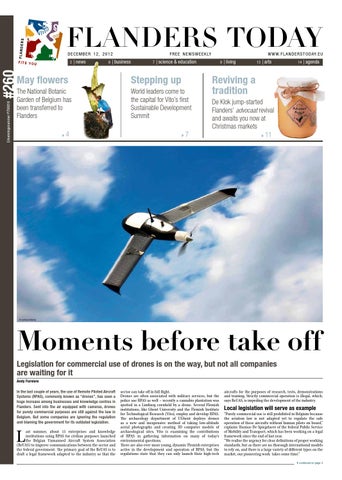
© courtesy Gatewing
Moments before take off Legislation for commercial use of drones is on the way, but not all companies are waiting for it Andy Furniere
In the last couple of years, the use of Remote Piloted Aircraft Systems (RPAS), commonly known as “drones”, has seen a huge increase among businesses and knowledge centres in Flanders. Sent into the air equipped with cameras, drones for purely commercial purposes are still against the law in Belgium. But some companies are ignoring the regulation and blaming the government for its outdated legislation.
L
ast summer, about 15 enterprises and knowledge institutions using RPAS for civilian purposes launched the Belgian Unmanned Aircraft System Association (BeUAS) to improve communications between the sector and the federal government. The primary goal of the BeUAS is to draft a legal framework adapted to the industry so that the
sector can take off in full flight. Drones are often associated with military services, but the police use RPAS as well – recently a cannabis plantation was spotted in a Limburg cornfield by a drone. Several Flemish institutions, like Ghent University and the Flemish Institute for Technological Research (Vito), employ and develop RPAS. The archaeology department of UGhent deploys drones as a new and inexpensive method of taking low-altitude aerial photographs and creating 3D computer models of archaeological sites. Vito is examining the contributions of RPAS in gathering information on many of today’s environmental questions. There are also ever-more young, dynamic Flemish enterprises active in the development and operation of RPAS, but the regulations state that they can only launch their high-tech
aircrafts for the purposes of research, tests, demonstrations and training. Strictly commercial operation is illegal, which, says BeUAS, is impeding the development of the industry.
Local legislation will serve as example “Purely commercial use is still prohibited in Belgium because the aviation law is not adapted yet to regulate the safe operation of these aircrafts without human pilots on board,” explains Thomas De Spiegelaere of the federal Public Service of Mobility and Transport, which has been working on a legal framework since the end of last year. “We realise the urgency for clear definitions of proper working standards, but as there are no thorough international models to rely on, and there is a large variety of different types on the market, our pioneering work takes some time.” ``continued on page 3
Flanders today
news
december 12, 2012
face of flaNders
Alan Hope
News in brief The Flemish Sports Jewel awards were given out in Brussels’ Viage Theatre last week, hosted by Flemish sports minister Philippe Muyters and Carla Galle, administrator of the sporting federation Bloso. Attendees included athletes who took part in the summer’s Olympic and Paralympic Games in London, as well as medal winners from various European and World championships. This year’s Sporting Jewel Prize was combined with the award for Service to Sport, and both given jointly to decathlete Hans Van Alphen and paralympian Marieke Vervoort, the wheelchair athlete who won gold in London in the 100m and silver in the 200m.
© Belga
Rik Van Cauwelaert He’s one of the most respected and most feared columnists in Flanders – a man who makes Bart De Wever tremble, by the N-VA leader’s own admission. Next month he’ll be back in print, following an absence of two months. Rik Van Cauwelaert, like his former Knack colleague Koen Meulenaere, has found a new home at De Tijd, the once-stuffy financial daily that is undergoing a renaissance under editor-in-chief Isabel Albers, who is transforming it into the hottest newspaper in the country. Van Cauwelaert was born in Roosdaal, Flemish Brabant, in 1950, one of the seven children of Emiel, former editor of the Catholic daily Het Volk (now Het Nieuwsblad). He followed his father into journalism as a sports writer and photographer, working for a time for the Associated Press. He moved to Sportmagazine and later was plucked up by the political department at Knack, where Van Cauwelaert developed his reputation for a formidable knowledge of the issues with which he would skewer politicians when the occasion required.
After a stint as director-editor, he wrote Knack’s column “Woord vooraf ” (A Word Up Front). He became director of strategy for Knack publisher Roularta in 2011 but clashed with management when they appointed former Humo editor Jörgen Oosterwaal as Knack’s new editor. According to Van Cauwelaert, this represented too much of a leftward shift in editorial policy. Van Cauwelaert and Meulenaere both resigned and have both been snapped up by De Tijd. Van Cauwelaert will write a weekly column in the Saturday edition titled “Paleis der Natie” (Palace of the Nation, the official name of the parliament building on Wetstraat) and cover politics and economics. Last week, his return to active service was welcomed across the spectrum, including by those who will doubtless become his targets. “He is an important opinionformer in Flanders, with a sharp pen,” commented De Tijd editor Albers. “His column certainly won’t be restricted to domestic matters. Over the years, for example, he’s developed a strong interest in Europe.”
flaNders TODAY Flanders Today, a free weekly English-language newspaper, is an initiative of the Flemish Region and is financially supported by the Flemish authorities. The logo and the name Flanders Today belong to the Flemish Region (Benelux Beeldmerk nr 815.088). The editorial team of Flanders Today has full editorial autonomy regarding the content of the newspaper and is responsible for all content, as stipulated in the agreement between Corelio Publishing and the Flemish authorities. Editor Lisa Bradshaw DEPUTY Editor Sally Tipper News Editor Alan Hope Agenda Robyn Boyle, Georgio Valentino Art director Paul Van Dooren Prepress Corelio AdPro Contributors Daan Bauwens, Rebecca Benoot, Robyn Boyle, Leo Cendrowicz, Sarah Crew, Katy Desmond, Marie Dumont, Andy Furniere, Bjorn Gabriels, Nicholas Hirst, Toon Lambrechts, Mark Latham, Katrien Lindemans, Marc Maes, Ian Mundell, Anja Otte, Tom Peeters, Senne Starckx, Georgio Valentino, Christophe Verbiest, Denzil Walton General manager Hans De Loore Publisher Corelio Publishing NV
2
Editorial address Gossetlaan 30 - 1702 Groot-Bijgaarden tel 02 373 99 09 - fax 02 375 98 22 editorial@flanderstoday.eu Free subscriptions subscriptions@flanderstoday.eu or sign up online at www.flanderstoday.eu Advertising Evelyne Fregonese 02 373 83 57 advertising@flanderstoday.eu Verantwoordelijke uitgever Hans De Loore
Brussels is the 22nd best city in the world to live, according to the annual survey of 221 cities carried out by outsourcing consultants Mercer. The capital holds on to the same place as last year. The survey, intended to help international companies in posting executives, gives points for international schools, living space and recreational amenities. The best city on the list was Vienna, and the worst was Baghdad. Six out of 10 people in Flanders think their ecological footprint is not too large, although Belgium has the fifth largest footprint in the world, according to a survey by Ghent University. Every adult and child in the country requires 7.1 hectares of land and sea to provide the resources used, whereas the country only has 1.33 hectares per person. About 43% of those polled thought the problem was not too serious, while 15% thought use of resources could even afford to increase. Brussels public transport authority MIVB will this week begin a two-month trial of an electric bus as a possible replacement for diesel buses, which are being phased out. The bus will carry no passengers, but will be equipped with measuring apparatus to test its energy use, cost
and suitability. The number of hit singles in the Ultratop 200 produced by Flemish artists has halved since 2005, despite a 300% increase in the number of singles sold over the same period, according to figures from the Belgian Entertainment Association. The association called on the government of Flanders to support the music industry, as they do audiovisual productions. The Flemish parliament will host a unique meeting of four deaf members of parliament – three from the European parliament and Helga Stevens of the Flemish parliament – to discuss how deaf members can better represent the interests of deaf voters across Europe. “There are 800,000 deaf people in Europe who use sign language,” said parliament chairman Jan Peumans. “It is important for there to be deaf politicians who represent this group; they have the means to show that deaf people can … take decisions that influence the daily lives of everyone, deaf or hearing.” The two foundlings who were discovered in the special hatch maintained by the charity Moeders voor Moeders in Antwerp this year have been placed with foster families, the district’s social aid agency said. If the children’s mothers cannot be contacted within six months, the families can begin adoption proceedings. Manneken Pis is the most overrated attraction in Europe, according to visitors to the review website stedentripper.com. Others on the list include the Eiffel Tower and Copenhagen’s Little Mermaid statue. Awel, the Flemish hotline for children and youth, has received a
flood of calls about bullying in the wake of the motorway suicide two weeks ago of a young man whose parents allege he was the victim of extortion at school. One in five young people, according to the Flemish network against bullying, is a victim of bullying or is aware of a bullying situation. ``www.kieskleurtegenpesten.be
The town council of Beersel, Flemish Brabant, last week unveiled a monument to Karel Van Miert, the former minister and EU commissioner who died in 2009 at the age of 67. The memorial is a wall covered in ceramic tiles. A niche contains a photo of Van Miert and the text: “With respect, with warmth and admiration. In memory and in honour of Karel Van Miert 19422009”. The head of the Serbian delegation to NATO, 52-year-old Branislav Milinkovic, last week committed suicide by jumping from a multi-storey car park at Brussels Airport, in front of colleagues, including the Serbian foreign minister. The delegation was taking part in a meeting of foreign ministers under the Partnership for Peace programme. The Brussels prosecutor’s office is investigating. Milinkovic, a former journalist, was an opponent of the regime of former Serbian president Slobodan Milosevic. The public is not sufficiently aware of the risk of sun beds in causing skin cancer, according to a survey carried out for the Stichting tegen Kanker (Foundation against Cancer). Sun beds and other tanning machines give off both UVA and UVB radiation. About 18,000 new cases emerge every year in Belgium, with the figure rising by 5% a year. The International Agency for Research on Cancer places sun beds at the same risk level as tobacco and asbestos.
OFFSIDE
Alan Hope
Here’s to you, Mr Crombez The country is in a budgetary pickle, and with tax avoidance being considered the second national sport in Belgium, any government short of funds has no choice but to make sure that everyone who owes pays. Still, it surprised some when the announcement came that tax authorities planned to levy VAT of 21% on the drinks vouchers given out after youth football matches. Every weekend, at hundreds of football grounds across Flanders, the end of the match sees thousands of boys and girls packed off to shower off the mud. Afterwards they repair to the canteen where mums and dads await. The clubs then dole out a bonnetje for a drink or snack to each player. But the rules say each
voucher carries VAT to be paid by the club, and heavy fines await those who do not comply. Rather than face that sanction, many clubs decided to abandon the after-match drink. “A socially heavy price for a couple of thousand euros of extra income,” fulminated editor of De Morgen Yves Desmet. Luckily, concessions have been made. John Crombez, secretary of state in charge of tackling fraud, told the VRT that volunteer associations like local clubs will be exempted from VAT. All clubs will have to do is keep a register of who gets a bonnetje and how often. Across the land last weekend, schoolkids raised a glass of fizzy drink to Mr Crombez.
© wikimedia commons
Flanders today
cover story
december 12, 2012
Moments before take off
Once legislation is ready, RPAS “could provide a real boost to the economy” ``continued from page 1
The emergence of the BeUAS, he says, “has helped our work, and when the full legislative package is ready in a few months, it will serve as an example for the rest of the world. It will not just regulate the technical requirements of the devices but also the working and training of the operators.” A few elements are clear already: RPAS should only operate in airspace where there is no common air traffic. They will be forbidden from flying over urban areas because of the possible danger to the population. After detailed analysis, companies and institutions can receive permits for specific tasks with certain types of aircraft, so that they don’t have to file a request each time for similar projects. Operators will have to follow official training programmes and obtain certificates that prove they have the essential skills to safely control the aircraft.
Working out of bounds There are, however, member companies of BeUAS that feel they cannot wait for the government. Cammotion, based in Berlaar, Antwerp province, is a specialist in aerial photography, filming and inspection using RPAS technology. The enterprise has carried out projects for government departments like the Flemish agency for roads and traffic but also purely commercial assignments for property
Mobility and Transport about the procedure to get an official permit,” says Matth Mouling of Cammotion, “but we were told there were none yet available. It’s not our fault that the Belgian government has not yet adapted its aviation legislation. In the Netherlands, Germany and the United Kingdom, we didn’t have any problem obtaining licenses.” Mouling says Cammotion has never received fines or complaints and stresses that they take the maximum safety precautions: “The person operating the drone is a professional helicopter pilot, who never flies it over people, nor above 150 metres high and thus does not bring helicopters or airplanes into danger. The drone always remains in his line of sight, inside 300 metres, and we don’t fly when the wind speed reaches more than four Beaufort. We also limit the duration of a flight to 12 minutes. Hopefully, such kind of standards will soon become official and obligatory.”
Certain areas off-limits De Spiegelaere says that Mobility and Transport is aware that some companies break the rules out of ignorance or – like Cammotion – ignore them. They have not fined Cammotion yet but have warned the company about the illegality of its commercial operations: “We especially do not approve of Cammotion’s inspection at the chemical plant Fina Olefins in the
“Like airports, ports are risk areas with strategic importance for a country, and RPAS operations there will be illegal” developers, architecture bureaus and the media. Cammotion’s drone is a small type of helicopter with eight rotors that keep it stable in the air. The company also has special expertise in the inspection of sites and recently inspected the chemical plant Fina Antwerp Olefins. Their services are popular because they are much quicker, efficient and cheaper than the hiring of a helicopter and pilot. “When we started two years ago, we asked the Public Service of
port of Antwerp. Just like airports and military centres, ports are risk areas with strategic importance for a country, and RPAS operations there will be illegal under the new legislation.” When an enterprise wants to deploy RPAS legally, it has to send a request to Mobility and Transport. Ghent company Flight Plus launched earlier this year to manage this administration for RPAS clients. “Originally, our priority was to offer services such as
organising flight plans for manned aviation, but the demand from the unmanned aviation sector was so large that it’s now our main market, explains Jürgen Verstaen, deputy general manager of Flight Plus and vice-chairman of BeUAS. “It takes about two weeks to draw up a detailed request, and it takes the public service another two weeks to analyse whether all safety conditions are met and to take preventive measures, such as warning the aviation community,” explains Verstaen. Flight Plus is working to help the government avoid this lengthy procedure for each case by creating certificates for enterprises and institutions that have proven their trustworthiness.
© courtesy Couderé
Easter Island and hurricane Sandy One of the clients of Flight Plus is Gatewing, also from Ghent, which developed the revolutionary X100 RPAS technology. The X100 (pictured on cover) is a winged aircraft fitted with a camera that flies autonomously with a GPS. It can reach an altitude of 750 metres and a distance of five kilometres from its operator on the ground. The X100 is mainly active in topographic mapping, such as surveying the progress in open mines, and infrastructure mapping, like inspecting road works, bridges, canals and flooded areas from the air. Gatewing works for industries in countries such as Canada and South Africa, where there are no legislative obstacles. The X100 has been used for research on Easter Island and, more recently, by the American government to map the consequences of hurricane Sandy. Gatewing will soon also provide a service in the inspection of crops to determine, for example, where insecticides are necessary. “Hopefully, we can also offer our commercial services in our home country soon,” says Michael Maes, Gatewing’s Flight Operations Officer and chairman of BeUAS. “The innovative RPAS sector could provide a real boost to the economy.” ``www.beuas.be
© courtesy Couderé
© Flugia.com / BELGA
RPAS technology provides aerial images – of traffic patterns, industrial sites or an alarmingly crowded floating stage at Tomorrowland – much more cheaply and efficiently than a pilot and helicopter
© courtesy Gatewing
Training RPAS operators The international distribution of Gatewing’s X100 is in the hands of the Flemish company Couderé, a service provider specialised in measuring and mapping solutions for, primarily, the surveying industry. Couderé, based in Bruges, also provides training to the buyers. “It takes four days to teach someone without prior knowledge how to
“These are not harmless model airplanes” operate the X100,” says Wim Van Huele of Couderé. “The principal issue is safety.” Pilot training includes test flights and mapping and photogrammetry – determining the geometric properties of objects from photographic images. To make sure that operators of all sorts of RPAS have the
proper knowledge and skills, the Ben-Air Flight Academy, established at Antwerp Airport, is preparing an official training programme in cooperation with the federal government. If all goes according to plan, it should start early next year. The training for some RPAS will be nearly a year long, says Ben-Air CEO Marc Kegelaers, which is longer than the training of a private pilot who can operate non-commercial aircraft for personal or recreational purposes. “To avoid accidents, they have to know the areas where they can fly, at what altitude, be able to read maps and take into account weather conditions,” says Kegelaers. “You should not underestimate the technical knowledge and general skills necessary to safely control RPAS. These are not harmless model airplanes.”
3
Flanders today
news
december 12, 2012
Botanical garden in Flemish hands
FIFTH COLUMN
After 11 years of talks, the National Botanical Gardens officially belongs to Flanders Alan Hope
A
fter more than a decade of negotiations, the National Botanical Gardens in Meise to the north of Brussels will finally come into the hands of the Flemish region, following an agreement reached last weekend at a special ministerial meeting of the Flemish and French-speaking communities. The transfer of the garden to Flanders was agreed in 2001 in the so-called Lambermont accords, which divided up responsibilities for certain dossiers between the federal government and the regions. However, differences over the buildings, the scientific collection
and the language requirements for staff all held up the transfer until now. In the meantime, investment was frozen and the garden’s authorities complained repeatedly of many much-needed investment, for which it seemed no-one was responsible. The Botanical Garden dates from 1788, employs 184 people, holds a number of internationally important scientific collections and hosts researches from across the world. Every year 110,000 people visit the garden. ``www.br.fgov.be
© Donar Reiskoffer / Wikimedia Commons
Schools’ Dutch-only regulation called into question Schools in Flanders should allow students to speak their native languages on school premises as a means of combatting low selfesteem, according to research by the universities in Antwerp, Leuven and Ghent. Researchers found that 65% of schools in Flanders insist on the use of Dutch in both class and on the playground. In the case of Turkish and Moroccan students in particular, 80% have reported being punished with detention or extra homework
for breaking the rule – more often than children who speak French or English, for example. The researchers interviewed 11,000 students in the second year of secondary school, as well as staff and parents. “One teacher told how students had to put money in a pot when they were caught speaking Turkish or Moroccan,” says Noel Clycq, who coordinated the project in Antwerp. “But children who made racist statements in Dutch also had to pay up. It was said that the effort had to
Koksijde Sea King in rescue operation
come from both sides. But the signal being sent out is very negative: that speaking Turkish or Moroccan is as bad as making racist statements.” Sanctions against a student’s mother tongue give the impression that the culture is not valued, said Anneloes Vandenbroucke of the University of Leuven. “The exclusion of the native language increases the gap between life at home and life at school. But students are able to perform just as well if those two worlds overlap, according to our analysis.”
It is important to encourage the use of Dutch in school as much as possible, without resorting to sanctions, according to Mieke Van Hecke, director of the Catholic school network in Flanders. Outside of school, many students aren’t speaking Dutch at all, she says. “For that reason, the school needs to encourage them to speak more Dutch than only what is required in class. All the same, it should not be perceived as a denigration of their culture.”
First voyage for high-speed train Fyra
A Belgian Sea King helicopter from the air base at Koksijde on the Flemish coast last week played a major role in rescuing the 13 survivors of the freight ship Baltic Ace. The ship sank in Dutch waters, and 11 other crew members drowned. The Bahamian Baltic Ace was carrying cars on its way from Zeebrugge to Kotka in Finland and collided with the Cypriot container ship Corvus J in bad weather in the North Sea south of the Eurogeul approach to the port of Rotterdam. The Corvus J was travelling from Grangemouth in Scotland to Antwerp and sustained minor damage. Seven of the survivors were plucked by helicopter from one life raft. The survivors were taken to hospitals in Ostend and Veurne suffering from hypothermia. The accident will be investigated by both Dutch and Bahamian authorities.
The long-awaited Fyra train between Brussels and Antwerp made its maiden voyage last weekend. The new high-speed train rolled out of Brussels South station for the first time on Sunday afternoon, and the first of the day’s journeys went without a hitch in both directions. Later, one train broke down and came to a standstill north of Antwerp for 45 minutes. The NMBS said it was investigating the cause of the incident. The train will make 10 journeys daily from Brussels to Amsterdam, rising to 16 soon, with stops at Brussels Central, Antwerp, Rotterdam and Schiphol. In the spring, a new service will be introduced eight times daily between Antwerp and Breda. The high-speed Fyra takes an hour off the previous journey time, to just two hours. Rail authority NMBS reported that they had sold 14,400 tickets by Sunday afternoon.
© Belga
The new train takes the place of the Benelux train, eliciting complaints from travellers about the increased prices, the lack of passes, less stops and the need to make a reservation. The cheapest return ticket costs €50 if booked in advance.
THE WEEK IN FIGURES 8 weeks
€10,000
68%
5 million
199,400
for Bart De Wever to form a city council in Antwerp, “a week earlier than expected,” according to the city’s new mayor Full details in next week's issue.
fine from the Flemish Media Regulator for the public broadcaster VRT for product placement of a brand of ski goggles in an episode of the reality show Tomtesterom
of De Lijn buses and 35% of trams in Flanders are accessible to the disabled. The vehicles are equipped with a low floor, a ramp and a special place with safety belt for wheelchairs
tickets for De Lijn sold in 2012 via SMS, 2.2 million more than in 2011. Tickets via SMS are up to 28% cheaper
square metres of nature reserve around the Klein Nete river in Herentals, Antwerp province, purchased by Natuurpunt from a €6 donation from electricity supplier Lampiris for every new client switching to their service. The action runs until 15 December
``www.tinyurl.com/delijnsms
``www.natuurpunt.be/lampiris
4
Back to the future
Anja Otte
All eyes were on Open VLD last weekend, which elected Gwendolyn Rutten as the new party president. One would almost forget that another party also chose a new leader: Gerolf Annemans is to succeed Bruno Valkeniers as president of Vlaams Belang. Unlike Rutten, Annemans is no youngster. In fact he is looking forward to his 25th anniversary as member of the federal parliament. With Filip Dewinter, he represents the two faces of Vlaams Belang. Dewinter is known as a street fighter, never shying away from strong language or harsh antimigrant or anti-Muslim stances. Annemans is the intellectual of the duo. When he takes the stand in parliament, many listen up, for his interventions can be sharp, humorous and sometimes even to the point. Karel Dillen, the founding father of Vlaams Belang (then known as Vlaams Blok), found it hard to choose between Dewinter and Annemans as his successor, fearing antagonism between the two. So instead he opted for Frank Vanhecke. Under Vanhecke (but with Dewinter and Annemans firmly in control), Vlaams Blok/ Belang became a formidable political force, winning election after election. In 2004, one in four Flemish voters supported the ultra-right party – resulting in much foreign attention. Vlaams Blok/Belang never entered the government though, as all other parties boycotted it for ethical reasons. According to some, this cordon sanitaire contributed to Vlaams Belang’s success, as it made it the anti-establishment party. In the end, though, it also contributed to its downfall, as some of its prominent members grew tired of the opposition and left the party for N-VA. Ironically, the relatively neutral Vanhecke speeded up this process. When he got involved with Marie-Rose Morel, whom he married shortly before her untimely death last year, he joined in with her criticism that Dewinter and Annemans had failed to move on. After Morel’s death, she became somewhat of an icon and a good number of people followed her example by opting for N-VA. One of the defectors was Koen Dillen, son of founding father Karel. Valkeniers, Vanhecke’s successor as party president, was unable to stop the exodus, and the electoral success of N-VA ended the upward curve of Vlaams Belang. Dewinter and Annemans are now left to their own devices. Annemans says he is “optimistic” about his party’s fortune. However, in that, too, he remains rather isolated.
Flanders today
news
december 12, 2012
Speaking their language
Gentenaar Geert Joris is the new leader of the Taalunie, the Dutch Language Union
G
eert Joris, currently directorgeneral of the Flemish book trade federation Boek.be, has been named as the next general secretary of the Nederlands Taalunie, or Dutch Language Union, based in The Hague. The Taalunie is the only organisation of its kind in the world. It was established in 1980 by a treaty signed by Belgium and the Netherlands, with the goal of “the integration of the Netherlands and the Dutch community in Belgium, in the field of Dutch language and letters in the broadest sense”. Its policy is defined by a ministerial committee comprising the Dutch and Flemish ministers of education and culture: Pascal Smet and Joke Schauvliege for Flanders, and, since 5 November and a new Dutch government, Jef Bussemaker and Sander Dekker for the Netherlands. Their meetings are also attended by an associate from Suriname – either the education minister or an embassy representative. The South American country has been an associate member of the Taalunie since 2005. The Netherlands Antilles and Aruba joined as associates in 2007 and 2011 respectively. The tasks of the organisation cover several related language fields:
spelling, education, literature and literacy, the position of Dutch in Europe and the world and the digitalisation of Dutch language patrimony. “The Language Union is facing a crucial period, not least in demonstrating why, in economically difficult times, we together contribute €11 million a year for our common language,” commented Pascal Smet, who currently chairs the ministerial committee. Smet describes Joris as “the man with the experience, the expertise and the skill to implement the policy laid out, and to take advantage of new opportunities. We consciously chose someone who does not shy away from public debate because we believe that position only strengthens our language.”
Upcoming key goals Joris, 52, studied moral sciences at Ghent University, followed by management at the Vlerick Business School. Before his present job with Boek.be, he worked in the graphics business, set up an early e-learning company and worked as a roving manager. He lives in Ghent but will move to the Hague to take up his new post next month. “There is a multi-year programme
© Saartje Van de Steene
Alan Hope
NEDERLAND
SINT MAARTEN ARUBA
CURAçAO
VLAANDEREN
SURINAME
Geert Joris is off to The Hague next month
that was set up by my predecessor, but that leaves me sufficient room to take some initiatives of my own,” says Joris, “and that’s what I’m going to do.” That of course will happen in cooperation with, among others, the Council for Dutch Language and Letters and the interparliamentary commission. “Two important issues have lately come to the fore: the place of Dutch in an increasingly globalised world and in a world that’s becoming more and more digital, and target groups that are, for the time being, not being reached, or only with difficulty. This includes newcomers to Flanders and the Netherlands who don’t speak Dutch, but who nevertheless need to find jobs in a Dutch-speaking environment.”
Belgium and the Netherlands are Taalunie members, as are Dutch territories in South America and the Caribbean
He also points to second- and thirdgeneration people of immigrant origin “who don’t speak sufficient Dutch, but for whom a command of the language is an indispensable tool for finding a good position in society.” Boek.be, meanwhile, organises various activities for the promotion of the book trade, the most important of which is the annual Antwerp Boekenbeurs, or book fair, which this year attracted more than 170,000 people, a result that exceeded expectations. Boek.be also administers the Herman de Coninck
prizes for poetry and the Debut Prize for first novels. “It was hard sometimes,” admits Joris, “but I knew what I was getting myself into with Boek.be: bringing together the interests of large and small players, who each in turn represented various genres. It wasn’t always easy, but I look back on all that happened with a smile.” Joris’ successor as director-general of boek.be will be named at a later date. www.taalunie.org
Flemish history at your fingertips Flandrica lets you browse through both famous manuscripts and sketches of the daily life of yesteryear Andy Furniere
T
hanks to the online museum Flandrica, you can now explore the cultural history of Flanders without stepping into the winter cold. The website offers guided tours tracing the paths of Flemings who have influenced global history, illustrated by the masterpieces they left behind. But you can also scroll through the ages to learn, for example, the best way to make a pear tart (in the 17th century). Flandrica contains documents created in and dealing with Flanders, as well as gems that have become part of the Flemish patrimony, such as the Anjou Bible. This fragile manuscript from the 14th century, made in Italy but in Flemish hands since 1509, is safely stored in a dark vault in Leuven, but you can now admire its superbly illuminated pages online. “We bring such treasures from the heritage libraries to the general public,” explains coordinator Eva Wuyts of the Flanders Heritage Library. “Visitors can learn about
Flemish culture throughout the ages while enjoying wonderful handwriting and illustrations.” You can skim through the database of 425 heritage items via themes, places and periods, but there also are three guided tours available. These take you through a history of influential Flemish personalities, official masterpieces and places that have disappeared in the course of time.
From anatomy to gastronomy Flandrica’s oldest manuscripts are theological documents of papyrus dating from the fifth century; the collection also contains a poem by contemporary Flemish author Tom Lanoye. Flandrica presents several historical masterpieces such as On the Structure of the Human Body, the most influential textbook on human anatomy of its time, written by 16th-century Flemish physician Andreas Vesalius.
You’ll also find Karel ende Elegast, a poem in Dutch from around the 13th century. The platform also includes documents that describe daily life in times past, such as the 1651 Brabant Cookbook with its pear tart recipe.
You can discover how an artist from Antwerp illustrated the manners, customs and dress of 18th-century Calcutta through his drawings. Or read some of the 16th-century “sea stories” in the Whale Book of biologist Adriaen
Coenen. Take a look too at the more recent history of Limburg’s mines through pictures and testimonies collected in a commemoration book from 1957. Flandrica is the result of 20 months of work by the Flanders Heritage Library, a network established in 2008 by six heritage libraries in Flanders. The Flemish government supports the network with an annual budget of €100,000, a sum used to develop competence and spread knowledge about preserving Flemish heritage library collections. The goal is to make the patrimony accessible and raise public awareness about its riches. Apart from adding to Flandrica’s content, the Flanders Heritage Library has plans to expand its functionality so that it can more easily be used for education and research purposes. Flandrica’s treasury will also become part of the European platform Europeana. `` www.flandrica.be
5
Flanders today
business & work
New car sales are expected to drop by 15% this year compared to 2011, to some 485,000. Market leader Volkswagen is down almost 12% for the first time in 11 months, while runner-up Renault is down 22%. Brands seeing an increase are Mercedes, BMW and Audi.
BankingKBC Flanders' largest bank will return €3.45 billion of the €7 billion it received as part of its rescue package at the height of the 2008-2009 financial crisis by the end of the year. The bank already paid back €500 million earlier this year. Meanwhile, KBC has sold the remaining assets of its private equity portfolio to the Swiss LGT Capital Partners Kebek 1 fund.
FreightBrucargo The Brussels Airport Brucargo freight terminal will invest €200 million for redevelopment over the next five years. Three freight handling and logistics buildings will replace the existing premises, and some 50,000 square metres of additional office space will be built. Brucargo is expected to attract customers from the pharmaceutical sector.
MetalsNyrstar The world’s leading zinc and non-ferrous metals mining and production group, headquartered in Brussels, is investing €280 million in its Australian Port Pirie smelting facility to upgrade and develop capacity.
PortsZeebrugge The Port of Zeebrugge has won the Terminal and Ports Operator Award from the UK’s Automotive Supply Chain magazine. The port handled some 1.74 million cars in 2011.
PropertyWDP The WDP property fund has paid €26 million for a 30,000 squaremetre distribution centre in Barneveld, the Netherlands. This latest move brings the company’s Dutch investments to some €350 million.
ShippingExmar The Antwerp-based mid-size gas tanker operator has signed an agreement with Bermudabased Teekay shipping group to create a joint venture, with Teekay investing $140 million and Exmar handing over 23 of its tankers to the new company. The deal allows Exmar to register a €57 million book profit.
SoftwareGIMV The Flanders government venture capital fund GIMV has sold its stake in the French telecommunications software company Mentum for an undisclosed amount.
6
An Antwerp architect signs on to design a new city, while 45 Flemish businesses make contacts Alan Hope
T
he Antwerp-based Conix Architects has won a contract to build an entire city in the north of Morocco. The bureau, led by Christine Conix, will transform the dormitory town of Nador into a new economic and tourism centre, with a special eye to sustainability, Conix said. The master plan, approved by the Moroccan king Mohammad VI, involves the construction of infrastructure, including housing, schools and hospitals. “This is the biggest project we’ve ever been involved in,” said Conix, whose company supervised the renovation of the Atomium and the design of the Belgian pavilion at the World Expo in Shanghai. The contract was announced during an official visit by Flemish minister-president Kris Peeters, heading a delegation of 45 business representatives on a four-day mission to Casablanca and Tangiers.
Morocco is one of the two countries on the continent (the other being South Africa) singled out by Flanders Investment & Trade as the focus of intensive trade efforts. Morocco benefits from a European regulation that allows its goods to enter the EU tariff-free, and in recent years the economy there has grown by an average of about 5% a year. The main attractions of Morocco for Flemish businesses lie in logistics and construction, where several companies are already working, as well as food and renewable energy; 25 of the companies on the mission were representing those sectors. Dredging group Deme and Betafence were present in Tangier to visit the new harbour, which they helped construct between 2003 and 2007. Peeters also held talks with Moroccan prime minister Abdelilah Benkirane and foreign minister Saad-Eddine El Othmani about the country’s planned regionalisation,
Social accord reached at Brussels Airlines Management and unions at Brussels Airlines have reached an agreement on social concessions in exchange for a guarantee of secure employment until 2014. Majority owner Lufthansa will go ahead with a planned investment of €100 million. The agreement involves an increase of 5% in productivity for flight and ground crew, and 15% for maintenance workers. Pay increases will be limited to the index for two years, and pilots will move to part-time work, with more flights in the summer and fewer in the quieter winter period. The plan will cut costs by €110 million. The union representative said they had “come down on the side of employment” in accepting the measures, in return for a guarantee
jobs would be preserved until the end of 2014. “The staff has made an essential contribution to ensuring the continued existence of the company,” he said. Bernard Gustin, CEO of Brussels Airlines, said that the agreement “makes it possible to increase our competitiveness, to guarantee jobs and to create growth. We’re not euphoric, but we fight on each day.” The federal government is working on an emergency plan to save Brussels Airlines from going broke, with the risk of the loss of 3,500 jobs directly and up to 6,500 more indirectly. Federal mobility secretary Melchior Wathelet was due this week to present his plan to fellow ministers.
Flemish business awash in awards Brussels-based production house Czar België walked away with 18 awards from the advertising festival Eurobest in Lisbon. The biggest winner, with three grand prizes and five golds, was the “Push to Add Drama” clip directed by Koen Mortier for Duvel Guilaume Modem, contracted by TNT broadcasting. It was shot in Aarschot, Flemish Brabant, and went viral on YouTube with 39 million views. Brussels chemical company Solvay has been listed among the top 100 most innovative companies by Thomson Reuters. Solvay is the only Belgian company on the list, which is dominated by American and Japanese firms. The list is based on the number of patents the company holds. The port of Antwerp has won the Best Belgian Sustainability Report award from the Institute of Auditors, Business and Society and sustainability network Kauri. The award is given for a report that approaches sustainability from environmental, economic and social points of view.
announce successful trade relations during the visit:
•
CGH Group from Bornem and Lokeren opened a new factory in Morocco for the production of double-walled petrol storage tanks. The factory will also produce LPG tanks in the future, for export to other African countries.
•
Excellent Breeding from Drongen made several sales from its stable of top-class show-jumping mares, to owners, breeders and investors. Architect Christine Conix’s firm is responsible for constructing an entire city in the north of Morocco
a subject in which his government has some experience. “They showed a great interest, and of course there’s concern as to how best to approach the question,” Peeters said. Other companies were able to
•
Environmental technology company Waterleau from Herent opened a wastewater treatment centre in Bouskoura, a new satellite town just outside of Casablanca. Waterleau will maintain and operate the station for 10 years. The contract was worth €8 million.
“Mega-brainstorming session” for a post-Ford Limburg Turn the province into one giant wi-fi hotspot to stimulate cooperation; become a producer of green energy; open a cooperative bank giving funds to start-ups. These are just some of the ideas to emerge from a “mega-brainstorming session” held last week in the C-Mine complex in Genk, to contemplate the future of the province of Limburg after the closure of Ford Genk in 2014. The session was organised by the non-profit Creative Class and attracted 150 people ready to throw their ideas on the table. Some of those ideas will now be further developed to be presented to the Limburg task force set up by the government, which is drawing up its own strategic plan for the province. “It’s clear we’ve set something in
motion – a feeling that anything is possible if we go for it together, with creativity as the oxygen of the economy,” said Nick Decrock of Creative Class. Meanwhile, TV Limburg reports that four of the Ford factory’s suppliers – SML, IAC, Lear and Syncreon – will next week announce closures of their own, representing about 1,500 jobs. On VRT television’s De zevende dag last weekend, minister-president Kris Peeters repeated his call for a new initiative to help industry in the province. “Europe needs to give us the means to convert the area to new industrial activities,” he said. “The EU has the instruments and the funds. They have to be brought into play in the solution to the problem of Ford Genk.”
Voka asks for “New Deal” for economy The economy in Flanders is ripe for relaunch, providing the government is able to create the conditions necessary, according to the Flemish chamber of commerce Voka. “We need a New Deal,” said chairman Michel Delbaere (pictured) in a speech to last week’s annual congress. Between 1995 and 2009, 262,000 jobs were created in the private sector in Flanders, the equivalent to a new Ford Genk every seven months for 15 years in a row. That sort of growth can be realised again, Delbaere said, if the economy follows the example of “hidden champions” in industries like dredging, food, biotechnology and chemicals, which are focused on client requirements, innovation and an international outlook. Government’s contribution, he said, should include lowering the amount of taxation on employers by 1% a year; make subsidies more transparent and easier to administer;
simplify the tax system in general; and scrap the automatic indexation of wages. A leading Flemish entrepreneur, meanwhile, has criticised Voka for being too male oriented. Danielle Krekels, owner of engineering recruitment specialist Alprocor, has announced that she will no longer attend Voka events in future unless one-third of the speakers are women. © Voka
Autos Sales down
Flanders gets down to business in Morocco © Belga
THE WEEK in BUSINESS
december 12, 2012
Flanders today
science & education
december 12, 2012
From Rio to Brussels
Vito puts sustainable development back on the global agenda at new summit Andy Furniere
Media in denial The Planetworkshops co-founder George J Gendelman (left) will speak at the first Brussels Sustainable Development Summit
to a political dialogue, in the presence of Prince Philippe, with the focus on forging partnerships between political authorities, private companies and non-profit organisations. The summit concludes with a public event.
Aiming for concrete results Vito expects at least 200 participants and 40 speakers, among them Connie Hedegaard (European Commissioner for Climate Action), Elizabeth Thompson (coordinator of Rio+20), Steven Vanackere (Belgian
“The media treat sustainable development like just another trendy issue” i-SUP2012 conference last spring in Bruges, which revolved around the variety of inspiring local efforts towards sustainability. BSDS will be opened next Monday by Barroso; Flemish minister-president Kris Peeters; head of electricity giant EDF Henri Proglio; and the directors of Vito and Teri, Dirk Fransaer and Rajendra Pachauri. Pachauri is also the chairman of the influential Intergovernmental Panel on Climate Change (IPCC). Thematic workshops will lead
enterprises set up in villages without electricity. It organises an annual global conference, and “we are glad that Vito is making similar efforts to spur international stakeholders into action,” says Planetworkshops co-founder George J Gendelman, an American and also founder of the International Press Syndicate. “We cannot wait any longer on UN conferences such as Rio+20 to change the current situation.”
© JB Le Quere / Maxppp
T
he Flemish Institute for Technological Research (Vito) is behind the first Brussels Sustainable Development Summit (BSDS), which it is organising together with The Energy and Resources Institute (Teri) from India. International policymakers, such as Nobel Prize laureate Rajendra Pachauri and EU Commission president José Manuel Barroso, are gathering next week to discuss, define and implement action plans for a more sustainable world with representatives of companies and the non-profit sector. The first BSDS, which takes place on 17-18 December at the Square Conference Centre near Brussels Central Station, is the result of several years of cooperation between Vito and Teri, a non-profit dealing with environmental problems. In keeping with its tagline, “Bringing the Rio+20 Agenda to Life”, the ambitious summit wants to define concrete ways to extend actions and renew the global agenda for sustainable development in the aftermath of the disappointing United Nations Conference on Sustainable Development in Rio de Janeiro last summer. BSDS follows closely after Vito’s
minister for finance and sustainable development) and Peter Tom Jones (chairman of I-Cleantech Vlaanderen – the new organisation uniting the Flemish clean-tech sector). “We are introducing the concept of Teri’s prestigious annual conference – the Delhi Sustainable Development Summit – in Europe,” says Fransaer. “Our goal is not to bring out one big statement after two days but to stimulate an open discussion by bringing different stakeholders together. In the long term, we hope
this leads to concrete results such as a more energy efficient and a socially equal society that takes care of its valuable resources.”
Online BSDS Dialogues Although most guests have not arrived in the capital yet, the summit is already well underway on the web via the “BSDS Dialogues”. These online discussion platforms identify and analyse best practices for sustainable development, gather policy recommendations from grassroots movements and set the stage for summit discussions. The platform’s main themes are “international collaboration”, “cities and regions” and “the bio-based economy”. The BSDS Dialogues will result in a political document that will contribute to the debate with political leaders. Throughout 2013, BSDS Dialogues organisers will follow up the project and ensure that the project’s outcomes are effectively feeding policy decisions at the European and international level. One of these organisers is The Planetworkshops, an international, independent think tank based in Paris that examines contemporary and future challenges for sustainable development. The Planetworkshops has worked with Teri and Vito before on projects, such as Lighting a Billion Lives, which provides high-quality and costeffective solar lamps through micro-
The conclusions of The Planetworkshops last conference were assembled in a “white book” and contributed to Rio+20. “But it was frustrating to see how our recommendations were ignored,” states Gendelman, who will speak at BSDS. “While we demanded more input from all partners, and especially from civil society, in the end a handful of dominant nations – such as the United States and China – took the final decisions. Without global participation, we will get nowhere.” Gendelman hopes that political leaders involved with BSDS “don’t just nod, but truly listen to the speeches and implement what they learn from the debates and from local initiatives that will be presented.” He already sees hope that this will be the case, “such as Ecuador’s recent efforts to preserve its biodiversity instead of blindly exploiting its resources.” A former director of international operations, both at The New York Times and the International Herald Tribune in Latin American, Gendelman says he is “absolutely not” satisfied with the attitude of the international media towards global warming and sustainable initiatives. “They treat sustainable development like just another trendy issue, while in reality it is linked to all parts of society: economy, ecology, politics and culture. The media minimise its importance and its urgency.”
You experienced the coming of the financial crisis first-hand.
I worked in the American financial world as a pricing specialist from 1998 to 2007 and realised in 2002 that the financial bubble was bound to explode soon. but it took
What does Stewardship of Finance entail? There will be 15 lectures per year over five years, all of which can be freely attended. They should stimulate students from various disciplines to comprehend ethical financial services and implement them once they start working in the financial sector. There is also research: PhD students will examine finance from the perspective of different scientific disciplines. This should lead to new insights about the ethics and
The Centre of Microsystems Technology at Ghent University, associated with nanotech research centre imec, have developed an LCD display that can be embedded in contact lenses. The displays could in the future be used for medical purposes, to control, for example, the light transmission to a damaged iris. Cosmetic applications include changing the colour of the iris. In the long term, smartphones could transfer emails or text messages to the lenses. Scientists at the University and University Hospital of Antwerp have developed a genetic test that increases the chances of a correct diagnosis of deafness in children from 15% to 50%. Most genetic abnormalities are caused by one or two mutated genes, but for deafness there are more than 50. Today, researchers only test a few genes because of the high costs. Only a minority of the patients therefore knows the exact cause of their deafness, while this knowledge is important for the choice of therapy and the risk of deafness for siblings.
morals of insurance and financial management specifically. The chair is sponsored by six major insurance companies, right? Yes, that shows that certain actors in the industry are striving to develop their activities sustainably and responsibly and that the chair is not just an academic project. During five annual panel discussions, Belgian and international participants from the financial industry and from politics will be involved in a broad discussion. Among our guests are European Union trade commissioner Karel De Gucht and former head of Belfius Insurance, Guy Roelandt. We will also organise several conferences.
In a discussion note, Flemish education minister Pascal Smet has proposed dividing teachers into three categories: junior teachers, teachers and expert teachers. The three groups would receive different salaries but would earn bonuses and receive permanent supplementary training. Smet also said that primary and secondary schools should establish associations of at least 10,000 students. He suggested assembling all teacher trainings at university colleges into so-called Schools of Education. The different educational networks should form one official network in the long term, he said. AF
`` www.bsds.vito.be
Anthropologist Paul Jorion is the head of the new chair on ethical financial services at Brussels Free University (VUB) me a long time to find a publisher for the book about my predictions because they all thought I was delusional. The Crisis of American Capitalism finally appeared in 2007, and, unfortunately, history proved me right.
Flemish archaeologist Stan Hendrickx of Limburg Provincial College has made a significant finding of Egyptian rock engravings. Helped by an old photograph he received in 2008 and by a team from Yale University, Hendrickx discovered the engravings close to the southern city Aswan. The illustrations date back to 3,200 BC and are considered essential for the reconstruction of the earliest Egyptian monarchy.
The Brussels Photonics Team at Brussels Free University (VUB) has launched the Photonics Explorer, an educational kit that makes it possible for secondary school students to experiment in class with high-tech instruments like lasers and optic fibres. The VUB team developed the kit with financial support from the EU, and the equipment will be distributed all over Europe once teachers have been trained. In Flanders, technology company TE Connectivity has already provided 100 schools with the kits, and the first 30 teachers received training this week.
Q&A Why is the chair called “Stewardship of Finance”? Stewardship implies service to the community. The financial sector should be useful to society instead of causing economic crises through ignorance and greed. The chair should help to improve both the reputation and the actual working of the industry. Finance is essential, but people now see it as a monster taking money from them. We have to go back to the pre-1867 situation, when speculation was forbidden in Belgium. A second remedy for the current problems is also found in the past: an international monetary union similar to that set up at Bretton Woods after the Second World War.
THE WEEK in SCI & ED
Interview by AF
7
BO ZAR THEA TRE INTER NATIONAL STAGE 2012-2013 23 & 24.11.2012
J’AURAIS VOULU ÊTRE ÉGYPTIEN
Alaa El Aswany – Jean-Louis Martinelli (France) 25 & 26.01.2013
CLÔTURE DE L’AMOUR
Pascal Rambert – Stanislas Nordey (France) 22 & 23.02.2013
TESTAMENT
She She Pop (Germany) 15 & 16.03.2013
PERSONA. MARILYN Krystian Lupa (Poland) 26 & 27.04.2013
OYUN (PLAY)
Samuel Beckett – Sahika Tekand (Turkey) 14 & 15.06.2013
IVANOV
Amir Reza Koohestani (Iran)
Beeld: Clôture de l’amour © Marc Domage
Flanders today
living
december 12, 2012
Point and shoot
A Flemish photographer tries to capture in imagery her life in Buenos Aires Lawrence De Geest
I
t seems impossible to sum up a large city in one picture. But Flemish photographer Katti Borré led your correspondent through the Argentine capital she calls home one afternoon on the hunt for the perfect picture. We started from a café in stylish Palermo and ended at a little church in classic Recoleta. All the while Borré told the story of how she left Ghent for good. “We lost our heart the first time we came here,”
she says. “It was love at first sight. Buenos Aires is more European than Europe.” During her first visit with her husband in 2003, the pair went to a town called Ostende, founded by two Flemings. They instantly entertained the thought of moving to Argentina. Then came the economic crisis of 2008. “By then we had come to Buenos Aires five times every year,” says Borré (pictured above). “And I was the typical Belgian who never moved and promised never to travel anywhere twice.” Borré’s husband opened a branch of his international trade business as an excuse to move. She enrolled her three kids in a private school. One came back to Ghent to go to university; the others are disconnected from Flanders. “People thought I was crazy to move. They
good as mine.” Over time, her focus moved to floral photography, but that has ended, due to Argentine bureaucracy. In the city parks, you cannot use a tripod without government permission. After more than a year of applications, she gave up. She decided to go back to school. “I felt like I was at a stage where I could not get any better on my own,” she says. She is now finishing a three-year programme in creative photography. “You pull something from inside yourself to put into your surroundings. A sunny day doesn’t just look different from a rainy day – it feels different.” Modern digital cameras have sensors that receive all the light that but only publish some of it based on settings that decide what the best image will be. Borré uses digital negatives that remove this feature. The negatives contain the same information that the eye receives and can be digitally adjusted. We walk in the mist, and she describes taking pictures – of fire, an empty hotel with moving shadows on the wall, a dirty street, a utility shop with baskets of freshly washed screws.
“We belong here” We look through the locked gate of Cemetery La Recoleta, and Borré notes her favourite details out of millions. Then she talks about the light after the rain. Here the sky is never blanketed grey; there is always some sun with well-defined clouds. Reflections are everywhere because water collects in the damaged streets. Ghent still feels like home, says Borré, “but you see things better from a distance. Years ago, before we ever thought about Buenos Aires, I bought a book at a museum in Paris, and in it there was a questionnaire I filled out. I said I wanted to live in an historic apartment in a big city. Now here we live, in exactly that. Not out of exotic appeal did we come to Buenos Aires. We
“People thought I was crazy to move here. They asked if I would have internet” asked if I would have internet,” Borré laughs. Part of her response is her blog: “Why On Earth Did I Move to Argentina.” Most of her readers, however, are Argentinean. We drive to Recoleta on streets that change direction with sufficient frequency to disarm the GPS. Recoleta depicts the prosperous Argentina of 80 years ago. Belgrano and Palermo are the next best two neighbourhoods, but Recoleta never loses its value. In its tree-lined streets of French houses with balconies and fruit shops you can buy many sorts of tobacco. I see a naval officer in uniform reading the newspaper while he awaits his order from an empanada vendor working out of a stolen shopping cart. The neighbourhood is one of Borré’s favourite to photograph. She says her eye for beauty has changed since arriving here. We stop at a corner across from which are classical French houses in perfect condition. You would have a postcard if you made sure to leave the traffic lights, telephone wires and shoeshine boys out of the picture. “But now I leave them all in,” says Borré, “because they make the beauty complete. Now I search for pictures that before I would walk right past.”
Learning curve Borré got her first camera at age six and bought a better one at age 18. “What I loved were travel pictures. You take a piece out of reality. Friends would say that their vacations never looked as
belong here.” That afternoon we took no shots because you cannot fit Buenos Aires into one picture. It would have to have not only that certain light that fills you with melancholy. It would also have to have that certain cadence of Spanish, dulce de leche for breakfast, Domingo tobacco rolled in corn paper, the train to San Isidro, where the trees never lose their blossoms, and the socks you bought from the market that are now drying in front of the fireplace. Walk at night down Calle de Espejo and turn the corner to find a throng of kids having a party waiting in line for the rock show. It must have all this and more. Evening drew when we got to the little church beside the cemetery. It was a Catholic church adorned with gold. The pews were empty except for a middle-aged woman sitting quietly. The poor box sounded hollow when you deposited a coin. There were small candles by the doors. Borré reiterates that she does not miss home. But she does miss hearing the church bells in Ghent. “When I was studying, my grandmother would say she lit a candle for me. And when she was sick, I would always light a candle for her.” Walking out, we passed the table with candles. Many were lit, and many were out of wax. But no one took them away. `` www.kattiborre.com
Katti Borré captures the diverse architectural styles on the Plata river as it flows through Buenos Aires’ Puerto Madero district; the downtown historical district of Recoleta in the rain; the city’s Museum of Decorative Arts foregrounded by flowering jacaranda trees
9
WANTED
Investors searching for opportunities!
Take advantage of the expertise of top managers.
Are you looking for an investment opportunity? In order
way, our investment specialists can offer you tailored
to offer you the best solutions for your capital, ING
solutions in complete impartiality. Make an appointment
works with several renowned partners (Amundi, Axa
with one of them, at a branch or on ing.be, in order to
Investment Managers, BlackRock, Franklin Templeton
discover our range of investment options.
Investments and ING Investment Management). In this
ING Belgium SA/nv – Bank – Registered office: Avenue Marnix 24, B-1000 Brussels – Brussels RPM/RPR – VAT: BE 0403.200.393 – BIC: BBRUBEBB – IBAN: BE45 3109 1560 2789). Publisher: Inge Ampe – Cours St-Michel 60, B-1040 Brussels – 706429E – 09/12 © Editing Team & Graphic Studio - Marketing ING Belgium.
Flanders today
living
december 12, 2012
An advocaat evolution De Klok single-handedly revitalised the market in Flanders for the traditional egg-based liqueur Lisa Bradshaw
E
ls places a cloth on top of the small jar, holds it in place with her chin and ties the twine around it expertly. The bow is perfect, every time. This jar of De Klok advocaat is now ready for storage, where it becomes thick before being shipped to one of hundreds of retail outlets across Flanders. I, like many others, became familiar with De Klok at a Christmas market. Every year, I buy a bottle of their chocolate jenever. De Klok focuses the taste on the alcohol rather than the chocolate, making it less thick and sweet than other brands. I much prefer this more grown-up approach to making the creamy versions of jenever, the spirit made from juniper berries for which the low countries is famous. The small company in Serskamp, East Flanders, makes only four kinds of jenever – chocolate, vanilla, the traditional lemon and the coveted krieken op jenever. That last one comes in a jar rather than a bottle and includes a generous portion of whole cherries.
Quality over quantity The less you make, the better you can perfect it is the guiding principle behind De Klok, which has been in business since the 1940s, when rail worker Raoul Galle started a side-line in delivering spirits from wholesalers to retailers. He eventually left his day job to make his
own line of liqueurs such as amaretto, parfait d’amour and advocaat, which is made with egg yolks, milk, sugar and alcohol (usually brandy or a non-flavoured jenever). He called his company De Klok, a name that was given
to one of the jenevers produced in the area. Klok means “bell” in Dutch and has historically been used by Flemish business owners quite frequently, probably because of its Catholic church symbolism. Now Raoul’s son, Dirk Galle, runs the company with his wife, Veerle Van de Velde. When they took over in the mid-1980s, says Van de Velde, interest in sweet liqueurs with a high alcohol content was at an all-time low. “We had two choices,” she tells me from her home office: “Close down the company or re-brand it with a whole new look.”
They chose the latter, though they couldn’t have known at the time how successful they would turn out to be. They stopped producing most of the liqueurs but kept the advocaat. “At that point, advocaat was really not popular anymore,” says Van de Velde. “People would say, ‘oh, I know that from Christmas at my grandmother’s,’ but they were not buying it at all. It was a forgotten product.” The couple re-dressed their packaging in Old-World style, with a simple but pretty label, a cloth cover and that hand-tied twine. Then they went out to the markets, where people approached with caution. “They had heard of it but had never tried it,” says Van de Velde. Although the thick, yellow liquer had always been in cookbooks and made by the older generation, it had all-but disappeared from the retail market. It’s unthinkable now, just 20 years later, when advocaat is so easy to find at any grocery story and often served in cafes with your coffee. “We started the revival,” says Van de Velde. “I can name you five or six companies who are now doing what we started doing, even copying our packaging.”
Secret recipe De Klok employs only 10 people, including Van de Velde and her husband, so it’s astonishing that
the advocaat – and the jenevers and their lines of chocolates – are all hand made in their small factory. They even break open and separate the eggs by hand. (Other companies simply buy egg yolk in large containers.) There are no preservatives in De Klok’s advocaat, but the alcohol content naturally preserves the liqueur “for years”. De Klok’s advocaat recipe comes from Raoul Galle’s own mother and has two extra ingredients that are top secret. It also contains 22% alcohol, more than the average 14 to 20%. The texture and consistency are excellent and the taste indeed strong, but not too strong for my liking. Nor for the experts: De Klok won silver medals at both the 2009 and 2010 World Spirits Awards for their advocaat, and took home the Best in Class honour in 2009. They would have won gold, claims Van de Velde, were it not for some judges being convinced that advocaat should be thinner – drinkable. De Klok’s is not: It’s so thick, you have to eat it with a spoon, but this is the way Flanders prefers to enjoy its advocaat. Their krieken op jenever, in fact, did win a gold medal in 2010.
STREEKPRODUCT SERIES
That recipe comes from Van de Velde’s mother. “She said: ‘If you’re going to sell advocaat, you have to sell krieken op jenever’.” De Klok also makes chocolates (some filled with advocaat) and a winterkoffie, made with jenever and coffee, to drink warm. A few other products – jam, chocolate paste and honey – are made outside the country but according to their own recipes. De Klok has a shop on their site in Serskamp and also sells their products at Christmas markets in Bruges, Ghent, Antwerp and Leuven as well as in speciality shops across Brussels and Flanders. `` www.deklok.be
Alan Hope
Don't arrive empty-handed The holiday season is a time for giving and for visiting, so this month we’re taking a look at some Flemish streekproducten, or regional products, you might take with you when you call on someone. A cake, for instance, is always welcome when you drop in on family or friends. Flemish Brabant is the centre of local sugar production, so at the end of the 19th century bakers in Hoegaarden took a traditional flan recipe – milk, butter, flour, yeast and eggs – and coupled it with the local sugar pie to make a tart known as Hoegaardse © VLAM suikervlaai (pictured). It sounds oppressively heavy, but isn’t. It is very sweet, though. This recognised streekproduct is made by baker Benny Swinnen of Bakkerij Swinnen.
Swinnen also makes mumbollen, a hard sweet made of butter, sugar, honey and peppermint oil, another traditional local treat dating from at least 1854. Avelgem in West Flanders is where a young Frank Lateur – later known as the writer Stijn Streuvels – went to school and trained at the family bakery. There he learned to make Avelgemse perentaart from the hard pears that ripen in the area in September. In 1961, on his 90th birthday, the recipe using pear mousse as a filling was revived in his honour. The Lateur-Gezelle bakery (Streuvels’ mother was the younger sister of the priest-poet Guido Gezelle) is no more, but the tart is available from bakers Corne and Taelman, both on the Doorniksesteenweg. For something a little less sweet, you can’t go wrong with fizzy wine. Flanders produces two of note. Sonien winery uses black table grapes from the druivenstreek (grape region)
around Hoeilaart and Overijse in Flemish Brabant. They are pressed, then fermented in wooden barrels and then once more in the bottle, after the addition of sugar and yeast. The wine is light rosé in colour and available in brut and demi-sec versions. Hageland and Haspengouw in Flemish Brabant and Limburg are the fruit baskets of Flanders. Grapes have been grown there for wine since the 15th century, prior to the minor Ice Age that struck Flanders in the 16th century. New vines were planted in 1960, and now the two Schorpion brothers make the region’s only sparkling wine, made of Chardonnay, Pinot Noir, Pinot Blanc and Auxerrois grapes. The wine is matured for three years, and comes in Gouden (a bone-dry Blanc de Blanc), Zwarte ( fuller and fruitier) and Brut Goud. Domein Schorpion is in Vliermaal, but the product is also sold all over Flanders. The streekproduct website advertises this and other Flemish regional products, any one of which would be gratefully received by a foodie of your acquaintance. If you’re bringing gifts home for the holidays, don’t do the same old box of chocolates. `` www.streekproduct.be
11
Al het stadsnieuws in 3 talen Toute l’info régionale en 3 langues The local news in 3 languages
6
816 er P708 numm nings erken
A sin
nde
201 2
busines
s
leemans
ger’s
A phot o most book and popular an blows Flem exhibition secret out 72 cand ish singer provide a retrospec of Without behind his les – on 2 the last tive 50 biggest Augu st – Will years. Befo of the a cent You,) and ury. a care hit, “Eenzaam re he Tura er that told has span zonder jou” us the efore ned more (Lonely Avenuewe sit down than half It’s a typicLouise, Willin the bar and alwa Tura of a luxu al asks if ry hote air-condi ys think reflex of and the tioning, s ahead: an artist whohe can keep l on Brus sels’ listen next showsomethingHe doesn’t takes his his scarf ing to on. be a musi the advic. It’s also that would want to getjob seriously cian and e his the refle comprom sick from hard for moth one thingit.” So that’ build your er gavex of an artis ise his voice His wife he loved s what he dream, him as a t who keep , but only boy: “You s around had alrea the most did, all thro when can you work when 50 concertsdy asked , he had to ugh his months.he’d do the a year. him to slow sacrifice career. For It’s a same down the rest. the You’l book Will Tural find proo number far cry from – meaning The phot , een levenf of his of concerts his 1960 only busy 19 Augu os are also in beeld schedule in less s heyday, on displ of them st. Amo than ay at (Will Tura in the new two neve ng the Take an exhib , a Life photo July 1969r publishedpictures from in ition Every befo : 31 in Oste Images). the town day he took days, 31 re – there family arch nd . his orchconcerts, are a few ive – until “Now most I try to from lists estra he know stick to anot Booischo of dates. her ball t to Berg like I’m s his wife to about in anot . I slow 50. It mustis right: “I55 concerts her down a year, will a bit, be the musi be 72 soon ” he says, mayb A risk e I can c that keep , but I’m because still even The caree that pai go on s me youn acting d off r a little birth g. certi of Arth bit long But if in Flan ficate ur Blan er?” ckaert he traveders. In the– reads like – lled the rural sociea guide that’s the fans, to name “Now in a tent oncountry to ty of the post-war on entertain Tura’s 1960s reme it seems like the town perform men mbe his and even with me. rs. “The folklore, square or countless the 1970 t but in whole hits for s, I was Later, villag they sure front of the he was as society king of the e was prese were greatthe chur his balls time ch. nt and 1974), the first (and the entertain.” they all s,” he intim and in the Flemish artis sang men was myate indoor 1980s he t to sell t indu stry) show shifted out the drinksound engin changed, s. “It was from Forest Natio rowd a risk eer, and and reall ing and y tents nal (in I were my late broth By the y listen dancing to more willi TV chanend of theto my musiat the balls ng to take er Staf, who c.” , fans interest nel appe 1980s, when came . Instead of in local ared, to sit down artists; he tookthe first Flem with the advantag ish com catch y “Mooe of the mercial i, ’t leven renewed is moo i”
They
science
rs t oda y
new
& edu
swe
cation
w
ekly
ill com Leuven e resear to attract ch interna talent wit h tional school new
5
Flemi looks sh music succesback on icon Will sful ca his long Tura Tom Peeters and reer
fre e
7
day
9
living
ww w.f
13
arts
Lint’s secret best-kep t
lan der 14
sto day .eu
agenda
Cirque du Sol Franco eil visi onary link wit Dragone’s h Flande rs
7
pers
ay od
evera n
11
ce
B
e
nd
a Fl se
pt
em
be
r
12
, 20
12
6
ess
busin
kl
y
ww
13
w.
fl
an
de
rs
to
da
14
y. eu
da
agen
arts
living
9
ee w sw ne new ion n on ee ucat fr The pia exhibitio rightsal & ed ce scien Uto p-notchof humany in Visu up A to state entr 13 ing the e final rs de mp eat u P e h s from in g is Arthts Flan th archerpioneers ing usin 7
Rese are al heat es VITO herm d min geot done aban
news
2
t rs
l enta ossin
7
m onu
#24
7
s D ders M len opwenhile Flangrated he l, Mec oria an inte e mem ches ritag laun for he plan
erk
enn
ing
snu
mm
er p7
0881
6
5
tristr
am
on kent
/ eno
#240
25,
news
r
©
Tell us what you think.
2
© dirk
?
Flanders t day
Fla
july
Bake
for a Politic ian Quinte Joke ns hands- gains on exp erience
rs’ most
enduri
ng musica
l celebri
ty, will
tura,
whose
life and
career
are being
celebra
ted with
a new
book
and an
ion
` contin
ued on
page
l evi eD
snummer
P708816
#252
2
17, 2012
5
news
7
business
science &
tourism
9
education
so orm perf sters era ma Op g se arin am de Vla ost en m
tions: Local elec wave the yellow lished parties across Flanders s estab rp N-VA upset mayor of Antwe r becomes Bart De Weve
and bart cannaerts
of flemish
production
#255
tim Van aelst
Wor herit ld War age ial
an
of
the
g rin
u
end
ost
’s m
rld
wo
of
NO VE 2
© Hugo willocx
MB ER
new
s
7, 20 12 7
P70881
busine
leg
mmer
8
nnin gsnu
ers f RE
scienc
Gra stra teful ng
e&
E NE ws
educat
ion
de smaak
van
s legrèv e - week
© thoma
P
wE Ek
to
ly
9
ers Orga nis familie ation su helps s of org pports the an do recipi connect no them rs and ents with
and for s, to do nest here birds that that reflects small factors have on strong fertiliser specific soils. Other s breeding The line that need the effects of t paths. agriculture relies of habitats 5 graph concern biodiversity. densely . tion, and In such a , but, Anotherof the indicators of s follows two differen you see the disappearance s acidifica of over-fertilisation Flanders. but what are one those also provoke nature in a long time. nce in Flanderits own story, for wild corners Fertilisationare often linked with and has been for n absorb well with to stop the their appeara ic group has explains Verheyen. is little room All is not g drier, slightly, while acidic soils area, there it is in our interest species at “Each taxonom water provisio also becomin forests groundwater a global trend,” forests improve the ts, populated Flanders is ure and drinkingthe level of is pollution, to scientis We look at some of here is surely that live in the because the Flemish reducing is ecologically Industry, agricult there according of water, “The species in decline. This becoming more struggles biodiversity. ar. Finally, wood. decline of reasons behind their large volumeswetlands disappe been achieved. and thus remains more dead the rest are brought has graphs. are gradually aging further.” and making this point much and invasive speciesof threats. risk and the because there pe degrades me a few on although on the list n shows a good sign. valuable, partly rest of the landsca region climate change tion are notwill not affect our Kris Verheye is red: seldom of the state of ile, the Remarkably, interven rofessor Meanwh y why colour nt reasons d summar here by human : “Climate change University’s on page 3 The domina , and the of Ghent in chains n explains ned. Five ` continued ” is his one-wor specialises for Broken biodiversity are complex s are intertwi tation Verheye “Dramatic, sity. Verheyen is head where he and fragmen speak ar in Flander biodiver Flanders’ for Nature and Forest,and his figures are on the Ecology species disappe First, there is the s ment, so many Laboratory a major role. and manageall species in Flanderdanger zone. factors play the of forest ecology they’re in ated or is about About half themselves. List, which means deterior Red infamous one-quarter has severely As much as
Toon Lambrec
nd
ss
s tou r Fle bid for es to pre mish ted status World Heonepaofrethe most fragmen too s is into pieces Flander pe. fro disinteg m Unoftenrita ge rate of the landsca ale esco agriculture. Large-sc Europe. Habitats to survive. regions in with many species which cause
Erke
new habi n of much acquisitio Despite theto deteriorate s continue ar. to disappe hts
living
11
Pick pen a g Kiwan uin
rtisin
g execu
y da
o st
turne
d bake
r Brend
a keirs
bilck
follow ed her
dream
s to
er
nd
a Fl no
ve
m be
r
news
, 20
12
7
8
Sm
ake
9
lijk
Taste, a year a mu is bac off, We ek k. Brusselti-genr And it’s van ls and e showca biggerde Sm aak, Flan se of than or We he We ders from food, tak ever. The ek of Last ek of 14 to es Tas yea eve wou by cult r it too te has 25 Novplace acr nt, ld no und ure k agency ember. oss longer min a break, ergone more for and som be ister e cha it and sectorscultura run Joke nge Sch was and educati , includil heritagby Faro, auvliegannoun s. Tien subsidy on. The ng the e, but the gov e tha ced up moen Sug , but the govern food indwould ernme t it The re of ar and Spaprivate ment still ustry, encom nt’s the pas resu agr sec events lt resp r sup s tor, provide icul in dee all theis that onsibility.ermark includi s sup ture et, has ng spo port way the regi pest on, wit Lim from Week now nsors as this bur of Veu pick h ed yea others g, som rne in Taste now The of a e of whi the far Koekjr’s the on sinc incl ude esr me is themore loca ch cov wes han ded e 19 Octoute (Co taste l sor er thet to Bre s govern t– ove of obe oki ent e were ors r biscuit r, whe e Tra home. appropriatire tins n baker il) has e, governfilled of all with five and Brenda been variou ors was Flem her reci goin both s organi to pas own biscish pro pe fold Keirsb g ilck chain in the sations s the uits vinc ers tins , and es. Theto the in provincletter ir turn and the wit the the e wit for the h loca ir own the fold job of tins are swe To event on h the bigg et tool cookies a, who ers on the kick baking thin 14 Nov th, in and would to est file emb reci – We sess gs off, er win of reci other wor pes fill –a pes som st Flanions wit the gov sa ds. The ewh h chil ern prize. at the museu at by ders’ end ors of the in the m to recruitigovernor dren, help nurses mselves from events out ng the Carl their the web guid – and thehouse Decaluwand othheld and way aro site. e for eac ir reci baker of é che ers ated The pes Five even som und sch are the Veu tins h regi figu passion e bak ools, and on, dowall availabrne rehead ate erie rest folders nlo taking hom ada le s foo s acr Bre place. for som dies oss Flan es, famare ma ble ders. ily homking e of have in advnda Kei the agreed es took ertisingrsbilck regi on-widto act befo trained artisanover re Juli e acti as that bisc ette’s finding in marke makes uitons her Art ting a wic maker isanale dream and wor in ked asso Bruges Koekenjob, whe ked rtm (ww bakker n she ent of bak w.juliet ij, ed goo tes. an ds. Shebe) ’s ` conti
ce
scien
6
ne
fede the age The es on a w age agre , with ntre st 2013ng ce taki
artisa
ww
w.
an
fl
de
rs
to
da
y. eu
da
agen
14
arts
12
n biscu
w sw
ee
kl
y
11
it-ma
ker in
living
Brug
es
is ge ing g e cotta linSee lievinTudor styla Michea be glish uses and
ion
ucat
& ed
nt kery l ho En An erze staura n ba in Be red re eratio star th-gen four
ess
ot, rn s are ct Fea man archersto interawork hu ish rese robots me, at
Julie
11
nued
on page
3
9
4
erk
enn
ing
snu
mm
er P7
0881
ee
fr
9
over
tte’s
busin
ho Flem loping le at l ea deve peop hospita hav ent We dget governmdget for ze withor in the bu ral bu free
#25
8
2
28
take
s
ketel tophe
©
You can’t win if you don’t play – complete the Flanders Today survey right now!
e
b
ea
s ten
In
ew
’s n
len
che
Me
www.flanderstoday.eu/survey
Chris
d
en eek
it re, squa the ing . n ll fac ne tha wa adsto re rial, nk mo d bla nt he be Memost an its a gia th d to cks: au ssion , t wi ch as ende Barra Holoc discu ted tha so so mu s , is intssin the rs of emora ity, ne, ng sto nothi focuwever is Do e forthe yea comm mmunseum t pale s co hts ho me Centrects ld be in emble rig seum,full nantation t refltly shou Jewish ish Mu itmenterres get, tha Jew comm nis mu an e ac me ful for It m n the ale mi uld nce. by all-sc A firm mish der Hu e Dossi rial. dThDocumouth what ex un le worefere Th memo an , a over m, mish posedthe sm site. n Fle onal s m hts nt peop onal seu Fle pro the a the d ati seu Rig so me m mu the st he on oti e3 ern say Mu man agree to uilt em pag int Reeth y is the s fir ablis ce 01 fro on of a cost s reb an ed n an Van “A cit by a , Hu d dis w. m wa dy est sistanin 20 tinu wa e as an d ho seu ea d Re me ation rs at s wo 07. ject. borne ink h it its rol ` con Th ll ect an e mu d alr n an m ca el. realis Peete houg ape hit in 20 l pro e, ity. tba Th ich ha rtatio seu Dewa final Kris , alt esc .” g arc hed ectura canc un , foo ch a ce’ aw nc ing le to nifi mm ns su and wh Depo w mu trick the dent hit buildbe ab absen firm t laul arc al sigas a co statio s to be ical on of a ne t Pa til esi jec ua se eci in wa tor ng ssin for siden n un ter-pr Do ll nevert ‘inten twerp pro us ve sp to usls, tra tion a his pacti pre m theminis the wi ou ’s Anfor the m the t ha rtant dra voca from e, im ph ab eth tha , s’ open the it Fro rrent epita ul’s is n Re tion d fro ons s impo , catherrack ich aranc to cu “In t g eti wh ere Pa k Va mp diff locati wa halls Ba n, appe e.” no ce. sin d the n or nc e, cti St loo ds nt, w co t it up of t is town Dossi an ico city’s ca rpos pra it, clo is cla in rea e,” Wren nume the ne d – tha de ing tha , of . The an urb s the signifi ’s pu lly the und ilding ma ild pic : ple on ne its ing ua aro bu ms her his mo d for eken n bu exam d so ilding termi use of build is us a wall The circu ristop seek agine s we re tha for dia an nt bu , de beca of the e, as with ins. u thi mo death im uiris, Ch sta nifica aspectntity, ult spac ing expla pe req t Sir s: If yo be opens t to Nazi rthern sig ltural ide as a res blic build ,” he bu m uld n Ho ntu hitec mean co ich man to the d no urn cu city’s ed, as pu the tside Ala It tto nume at arc on. r mo n, wh onal rted um an to ret the decid floor I drew re ou po lgi mo r nd ele pti , d the s He un tch squa “Si the grel in Lo bette Mech exce re de d Be neve gro st ske the oughe, thi dra u. No in one ey we cupie cases, to fir from d thr s sit mish Catheund yo seumnot to le. Th of oc most off al op passem, thithe Fleotion e in aro in Mu nt pe o ole – , ry wh ss wh seu eth em s. Th site Do nume ina ople s mu n Re “An ces the very a mo 0 ord m s 0 pe thi Va seum.ing pro ,00 ke up Bob 25,00 s fro m thi n 25 s ma ins ssin Mud build campnce fro re tharrack y,” explaw Do n an Fra mo he ssin bathe cit the ne e desig Do rt of ned entir pa o desig the wh ormed ect hit e inf arc erenc ref
“T
ted
ica
ed md
seu
mu
c sen
to
the
nd
ta
aus
loc
Ho
ns
ghts
n ri
a hum
ope
this
w
w.f
la Nd
ER st
14
T
adve
day
ww
arts
with is raises au sculp ction of money artist tures co-cr penguin s an d ch eated by ildren
The to Fl Week of with anders Taste mou it hund , bringi returns thwat reds ng Alan Hop erin of e g ev ents Afte r
tive
a’s
em
cin
T
Fla
house shelter
Offic
6
tom baetens,
Flanders war sit iversity in
tat, biod
Everyone who fills in the survey has the chance to win: one of three vouchers from Vlaanderen Vakantieland (€100 value) one of 10 Bongo gift boxes (€50 value) one of 10 art books on Flanders (€35 value)
ne
ho
wit
s end
the Ark
4
of The state
At the same time, we’d like to know a bit about you: Where you come from, what you like to do and what else you’re reading. So we are conducting a readership survey to find out all of these things and more, and you can take this survey at www.flanderstoday.eu/survey. It will take about 15 minutes of your time, and, because we know how valuable your time is, we are giving away prizes to make it worth your while.
ne
ay rs tod Th
eekly free newsw
octob er
Gi
ncert s a co wa as d it m. but , an l for i 46, 1869 ica Dmitr al atr s sic in 18 in ris z died in thee,” sayd mu ns, tio s in Pa tim an ed . Berliosentedhis era indica effectthe rm al at rfo opera s preead of se Op n see eci st pe ged rk wa ah am u ca of sp ssible s fir ly sta wo much Vla t. “Yo sort t po e3 the us wa no pag ce a ful t the y of me re on ed pie than tha s ver tor of Fa s so y we e tinu wa uc ed on r 93 Th he 18 z nd cti ne e the ` con rat ly in Berlioief co du t he caus es olv d on think , ch this pro tha be it invsionehis “I owski for score, scribe use illu Jur ector the n’t de beca d dis ewingoffers dir in could cult g an d ren n follow even t he ll diffi agein an e demo wi is de tha ce t an ici . Th he e.” pla su ars ly tim Faus t, one om of Faus een appe if on m bedro hell. tw on ati rney. be lès sires g fro m a into mn jou vering ophé de pin , fro wn ist nd Da tic s, jumadowally do he tas is wa Méph fou a fanolar, en st pro begin a me d fin sch d, wht’s mo rney to an jou tavern tains ation it in Go Faus d the lar moun ersto day.eu Damn ce, e faithgrant pie Th s, an a cel the The www. fland z’s s this ust. ht to . agree from into 12 arts himust ug rlio Fa er, up 11 living r Be stage m’s n bro after Fa anoth eet, lia cto to the str He Opera Gil Pytho ) and, . This as rry to ve ell of it amse as Te Monty ctured nderscreati nd (pi Mu thinkthe Vla ht of er of year r in Flamost eras. Ian t ug mb will op ers when be tho r me on las its tou ema’s tic lov but cin blema me Lond ds en sic Mu ust, as oft d for ge in , it en one of pro Fa an st of just tor sta lermo see mo ’s will direc to the in Pa ce to rld film opera ces t chan the wo the rman ur las e of on perfo be yo kle will s tac mind
3
Flande
erkenning
We want to know how you feel about us. Do you read Flanders Today every week? Which articles do you read? What do you want to see more of – or less of? We’d like to know your level of satisfaction with Flanders Today so that we can continue to provide content that suits your needs.
y err dT
exhibit
m
llia
flande
!
Od ay.
agenda
Eu
Flanders today
arts
december 12, 2012
Out in front
Instrumental quintet Aranis escapes classification but is finding comrades nonetheless Christophe Verbiest
I
t’s difficult to pinpoint the instrumental music of the Flemish band Aranis. At its core, it’s classical chamber music, but you can also hear elements from folk, world, sometimes even jazz. And at times the compositions are played with the spirit of a rock group. So I checked with two members to find out which section of the record store they would like their music to be found. Flautist Jana Arns (photo, front), who also spends a lot of time taking care of the administrative rigmarole that comes with self-managing a band: “No idea. We escape classification.” According to double bass player Joris Vanvinckenroye (photo, second from left), who writes all the music, that’s “a disadvantage when it comes to promoting and marketing the band.” But, notes Arns: “Some people find it a plus that we can’t describe our music in a few words. Others, though, can’t fathom that. Cultural centres struggle with it, too. In the beginning, we embraced it as an advantage: we played classical bills, a festival like Dranouter [a folk festival in the broadest sense] and rock clubs. Now, the classical world thinks more and more that we’re ‘not classical enough’. Maybe because the music got a bit rougher. Still, for other organisers, we’re too soft.” It might be a sign of the times, she says. “Contemporaries that shy away from walking on well-tread ground tell me, too, that they have difficulties finding concert venues.” Vanvinckenroye stresses that this is no reason to change the music. “For me, it goes without saying that you mix different musical genres until you reach an original and personal result. ” “When people aren’t able to precisely pinpoint music,” continues Arns, “they’re afraid it might be too difficult and inaccessible.” Which certainly isn’t the case for Aranis’ at times playful compositions.
School days Aranis originated a decade ago as a group of students at the Antwerp
Conservatory. “At that time, the concept of the band was completely different,” explains Vanvinckenroye. “We needed an ensemble to play chamber music for school.” The quintet consists of violin and viola player Liesbeth Lambrecht, accordionist Marjolien Cools, guitarist Stijn Denys, Arns and Vanvinckenroye. Throughout the years, different musicians have come and gone to reinforce the band for specific projects and/or albums. In recent years, that has included Belgian pianist Pierre Chevalier. After focusing for a while on the compositions of the Argentine tango maestro Astor Piazolla, Aranis began concentrated on original work by Vanvinckenroye. “That’s when we started thinking professionally,” Arns explains. “I don’t think we were bad at playing Piazolla, yet there were loads of other bands doing the same. With Joris’ music, we could do something that no one else was doing.” Over seven years, Aranis has released five albums. They are living proof that the band keeps evolving: None of them sound like another. For Songs from Mirage, they were joined by three singers. And Roqueforte leaned heavily on percussion.
Made in Belgium Aranis’ latest album, Made in Belgium, is probably their most surprising. Vanvinckenroye wrote only one piece; the rest are compositions by a wide variety of contemporary Belgian composers. Among them are the versatile Geert Waegeman, folk man Wouter Vandenabeele, Daniel Denis from chamber rock ensemble Univers Zero and the world-famous Flemish avant-garde and minimalist composer Wim Mertens. Vanvinckenroye: “After we had been working for years, we realised that Aranis was not alone – Belgium has some musicians and composers that are working in the same vein as we are.” “For a long time,” says Arns, “we thought we were only at our best as long as we stuck to Joris’
compositions.” Quod non, as Made in Belgium proves. Aranis also has found a highly original way to play this music live. In every city, they select local musicians to play with them. A week before the show, they rehearse. “It’s a way of narrowing the gap between Aranis and the audience,” explains Vanvinckenroye. It sounds like a social-artistic workshop. “What we do is different,” he admits. “I know, because I have done those workshops before. But I can use some techniques I learned then, like how to work with musicians with a wide variety of skills.” Finally, what does the name Aranis mean? In fact, nothing. “It’s just a beautiful word,” says Arns. Vanvinckenroye: “The only condition I gave myself when looking for a name was that it had to start with an ‘A’. That way we come, alphabetically, at the front of the bunch. Of course, afterwards people made associations with Jana’s last
name.” Indeed! “Well, he came up with the name when we started dating,” smiles Arns. “Maybe unconsciously it had an influence,” says Vanvinckenroye. “I also discovered that in Turkish
aranis meant looking for something.” Which is a pretty perfect name for a band that’s always trying to find new directions. ``www.aranis.be
Triggerfinger win big at MIAs Better late than never for Triggerfinger. The classic style rock band, together since 1998, have won their first MIA (Flemish Music Industry Awards) for Hit of the Year for their beautiful rendition of Swedish singer Lykke Li’s 2011 song “I Follow Rivers”. The trio (pictured) was in fact the big winner overall at the awards ceremony last weekend, also bringing home best alternative band, best band overall and best live act. The Antwerp-based band can currently be heard on the soundtrack of Flemish film Offline.
Other winners of the MIAs were Balthazar for best album (Rats), Netsky for best male solo and Selah Sue for best female solo. ``http://mias.een.be
© Tjorven Bruyneel
Glimps Festival Follow the Noise The Spot festival in Denmark, Reykjavik’s Icelandic Airwaves or Eurosonic Noorderslag in the Dutch city of Groningen: They’re just a few of the famous showcase festivals in smaller European countries. This kind of event serves different purposes. First and foremost, it’s a platform for local bands. International journalists and people from the music industry are sometimes flown in to get a chance to discover those local bands. Often it also works in reverse: A bunch of new international bands are invited
to a city to establish a local audience. The demand for a festival with the first function has been heard in Belgium for almost a decade, since all three regions of the country have a thriving music scene. Brussels seemed an obvious location, but it never happened. Luckily, the city of Ghent and the Flemish Community were persuaded of the importance of such an event. Enter Glimps Festival, the name being a perfect compromise between the English glimpse and its Dutch translation glimp.
It’s only the second edition this weekend, but the festival seems here to stay. More than 80 bands will occupy 13 stages all over the city. There’s a strong Belgian selection, of course, plus artists from 20 other European countries. I can’t give you any tips, because most of them are new to me, too. That’s, of course, the idea of the festival. Just follow the noise and let yourself be surprised. CV ``www.glimpsgent.be Super cool Flemish ambient jazz trio De Beren Gieren play the Glimps Festival
13
Flanders today
agenda
december 12, 2012
The dark side of the fairytale
The Magic Flute You know The Magic Flute? That bubbly fairy tale with the wideeyed lovers, the three cute boys, the cheerful chap with the feathers, the Santa Claus-like potentate? Well, you can forget about all that, because David Hermann’s new production, about to be premièred at the Vlaamse Opera in Antwerp, gives an altogether grimmer reading of Mozart’s famous Singspiel. “I didn’t set out to do something new just for the sake of it,” the young German-French director tells me. “Of course I knew the opera, but I hadn’t seen it much on stage. When I sat down to study it, I was amazed by what I found. Who are Papageno’s parents? Why did Tamino leave his home? It struck me that there is a lot of loneliness and anguish beneath all the fluff – the same feeling as when you sing in the forest to reassure yourself.” The scene, designed by Hermann’s
long-time collaborator Christof Hetzer, is straight out of some sci-fi dystopia. Women and men have had a falling out. King Sarastro and his court have stayed on terra firma, while the Queen of Night and her female retinue have mutated and live under water. It’s a forbidding universe where nothing is what it seems and every noble feeling has a darker flipside. It is true that for an opera that often passes for aural champagne, The Magic Flute does contain a surprising amount of bad blood, including floggings, trials through fire and water, lashings of misogyny, one near rape, one planned contract murder and two failed suicide attempts. “Sarastro is an ambiguous character if ever there was one,” says Hermann. “He preaches good, but there’s power behind it. The lovers are under his influence. And the tests
© Annemie Augustijns
Marie Dumont
he puts them through are actually a very nasty game – Pamina nearly dies from it.” Nor is the love between Tamino and Pamina as pure as it seems. “There is a keen sense of erotic awakening
12-31 December Antwerp opera house - Frankrijklei 1 10-20 January Ghent opera house - Schouwburgstraat 3
COMEDY
Kadootjesmarkt
© Willem De Puydt
In the last 10 years, Flemish stand-up comedian Alex Agnew has risen to the top of his profession. Audiences in Flanders – particularly his hometown Antwerp – absolutely adore him. His shows sell out months in advance, as did this one, which is why another date has been added. Agnew says it will be his last on the circuit. He plans to bow out at the top of his game and focus on his other passion, fronting the hard rock group Diablo Blvd. Should your Dutch not be quite up to the occasion, Agnew is opening for British superstar comedian Eddie Izzard next spring in a special English-language performance. Georgio Valentino
Sportpaleis, Antwerp
Some of us haven’t even started thinking about holiday gift shopping, but the big day is nearly upon us. Try something new this year: Skip the big chain stores and spread the joy by buying from local designers and artisans. De Nieuwe Vrede, a cultural centre in Antwerp’s Berchem district, is hosting this one-day-only market packed with handmade goodies, courtesy of Flemish webshops Huismus and Creative Greet. From knitwear to toys to home accessories, you’ll find cute gifts for almost everyone on your list. There will also be live music and theatre activities for kids. GV
www.sportpaleis.be
More comedy this week Across Flanders
Michael Van Peel overleeft (Michael Van Peel Survives): Unabashed stand-up comedy about the end of the world, judgement day and dozens more controversial topics by the young comedian from Antwerp (in Dutch) Until FEB 2
16 December, 11.00-17.00 De Nieuwe Vrede, Antwerp
www.denieuwevrede.be
More markets this week Ghent
``www.michaelvanpeel.be
MIELmarkt: A new, travelling market for small publishers, designers and artists, featuring handmade journals, calendars, cards and other gifts, plus free cake and coffee
Ghent
``www.miel.ohbara.com
Papa: Philippe de Maertelaere, best known as the actor from the popular play Caveman, takes the stage alone for this hilarious (and highly recognisable) comedy about becoming a father, from breast milk and sleepless nights to diaper changes and stuffed animals (in Dutch) DEC 14-15 20.00 at Tinnenpot, Tinnenpotstraat 21 ``www.tinnenpot.be
14
www.vlaamseopera.be
MARKET
Alex Agnew: The Legend Ends
26 October, 20.00
in Tamino’s aria when he falls in love with her portrait,” he says. “And she is clearly aroused by Papageno, a half-human, half-beast and very virile creature.” None of this is explicit: Hermann
believes in the power of suggestion. “It’s a fairy tale, all right,” he says. “But fairy tales often have something ambiguous and menacing about them. The violence is latent. The tension comes from tiny hints and details.” Hermann, 35, is a rising star of the international opera scene. He studied stage directing at Berlin’s prestigious Hanns Eisler conservatory because, a keen amateur pianist and actor, he couldn’t for the life of him choose between music and the theatre. “Opera directing was a nice way of combining the two, but it’s a treacherous world. I was advised that if two years after graduating I still showed no sign of talent, I should do something else.” Two years came and went. He was about to give up when, out of the blue, he won a prestigious staging competition. It’s the stuff of a fairytale – a happy one.
DEC 13 & 18 at Sint-Lievenspoortstraat 166
Lommel (Limburg province) Euro Kerstfestijn: Sample and buy local delicacies and artisanal gifts from Belgium, France, the Netherlands, Germany, Italy, Hungary, Finland and Ireland Until DEC 16 at Kerkplein ``www.lommel.be
Flanders today
agenda
december 12, 2012
SPECIAL EVENT
EXHIBITION Roots
Brussels’ Kaaitheater has been experimenting this season with a new concept: Soul Food. No, it’s not down home Southern cooking. It’s rather an encounter with artists around the dinner table. A democratic €12 buys you food, drink and a place at the table, where one of the guests is interviewed by a moderator while you graze. The last supper of 2012 is more than a mouthful, with not just one but four artists on the menu. Kaaitheater’s 2013-2016 resident artists—Mette Ingvartsen, Eleanor Bauer, Ivo Dimchev and Kris Verdonck—take over Kaaistudios for an entire week, just before Christmas, to give us a taste of what the next four years have in store. Residents’ Week closes on 21 December with a Soul Food feast and a late-night party. And you’re invited. GV
Antwerp-born photographer Harry Gruyaert is perhaps best known for exploring exotic atmospheres, but this exhibition, as its title suggests, finds him presenting his vision of Belgium. Gruyaert made his name in the 1970s with a bold switch from black-and-white photography, which was fashionable at the time, to vibrant colour. This move was only one part of a complete revolution in Gruyaert’s work. He also broke with New York’s pop art scene and went East, finding inspiration in Morocco, India and Egypt. And when he wasn’t trotting the globe, Gruyaert kept busy documenting the look and feel of his native land. Like Brueghel and Ensor before him, he saw beauty in the most banal or bizarre scene. This exhibition presents 100 photographs taken in the 1970s and ’80s, some of which have never been seen by the public. A selection of his photos from Morocco is also on display. GV
© Jonas Maes
Soul Food
13 December to 3 February Botanique, Brussels www.botanique.be
More exhibitions this week Antwerp INKid: Black-and-white photos of tattooed bodies, with a particular focus on facial expressions, by Flemish photographer Benoit Meeus Until JAN 13 2013 at Gallery Louiza, Louizastraat 13 ``www.gallerylouiza.com
Ghent Joachim Koester: Maybe One Must Begin with Some Particular Places: More than 20 works by the Danish artist, including film, photos and installations about pioneering expeditions, esoteric movements and psychedelic experiments Until MAR 10 2013 at SMAK, Citadelpark ``www.smak.be
Our past, our future: The story of ethnic minorities through 15 portrayals of prominent pioneers who make clear how we can build a future by making use of a collective past Until DEC 20 at Amsab Institute of Social History, Bagattenstraat 174 ``www.amsab.be
DUSK TIL DAWN 21 December, 19.00
Kaaistudios, Brussels
www.kaaitheater.be
More special events this week Antwerp
FutureShorts: The first edition of this mini film festival features short films from Egypt, the UK, Germany and the US, a cosy atmosphere, drinks, popcorn and live music. Places are limited on a first come, first served basis; subtitles in English DEC 13 20.00 at Gallery Louiza, Louizastraat 13 ``www.gallerylouiza.com
Turnhout Lange Nacht van het Korte Verhaal (Long Night of Short Stories): Nearly 20 local and international authors, including Herman Brusselmans, Kristien Hemmerechts, Annie Proulx and Philippe Claudel, read their own short stories DEC 15 19.30 at de Warande, Warandestraat 42 ``www.warande.be
Katrien Lindemans
Last day on earth? It’s mid-December, cold and dark. Yet there are plenty of reasons to go out and dance the night away. Dancing keeps you warm, obviously. It also helps you stay in shape, which is not unimportant with all the end-of-year dinner parties and drinks. Last but not least, if the Mayas got it right, 21 December will be our last day on earth. Let’s make the most of it, shall we? “Prepare for a night of doom.” That’s how Ghent culture centre Vooruit introduces us to its event on 21 December. Titled The Game is Over, the night promises “sin-eating mutants”, killer zombies, apocalyptic music and a twisted shoot-’em-up game. You get to star in your own video game, fighting zombies in the Vooruit’s labyrinthine building, getting swept away by the soundtrack and
eating your own sins. Yes, you read that right. You can upload your sins via the event’s page on the Vooruit website and eat them on 21 December. Spooky.
from the Radio Modern parties) and DJ Beatbuster (originally from Chile), who has a liking for garage, Britpop and ’80s Mod revival. Groovy!
The doors open at 21.00 and are hermetically sealed at midnight. Tickets are €6.66 on the Vooruit website.
Doors open at 22.00, and tickets are a mere €5 at the door.
But ... if the Mayas got it wrong, 22 December will be just like any other pre-Christmas Saturday. Might we then recommend Modklub X-Mas in Hasselt. Join the crowd at Muziekodroom where the Modest Men will be the host of the evening. This local DJ duo knows all about the best soul, Motown and R&B and have put together a great line-up. They have invited the Boppin Benvis Brother (you might know them
``www.muziekodroom.be
``www.vooruit.be
15
Flanders today
backpage
december 12, 2012
BITE
Robyn Boyle
Huis Temmerman
The (authentic) 17th-century baroque façade of this house in Ghent’s historic centre brings to mind the story of Hansel and Gretel. But instead of a cannibalistic witch inside, you’ll find a charming little shop filled floor to ceiling with cookies and candy. It’s the perfect place for me to finish holiday shopping for my nieces and nephews. Glass jars brimming with sugary treats are a colourful site to see, but what’s inside? They’re marked with names like boterspekken, bezekes and muiletrekkers. To the non-native speaker, it’s an exercise in breaking Dutch code. Spek, it seems, is local dialect for “candy”, and I don’t hesitate to order a scoop of the golden rectangular butter candies that look like miniature waffles. Bezekes is a bit of slang for “kisses”, so I ask for a scoop of these as well. They look like raspberries. Add to this a helping of muiletrekkers, or “face pullers” for their sourness, and I’ve already filled a stocking or two. But I’m far from finished here. My eye is drawn to a pile of bright purple neuzekes, or “noses”. You must know these cone-shaped, jelly-filled candies by now; they happen to be a Ghent classic. Too sickeningly sweet for me, I opt instead for a box of sneeuwballen, or “snowballs”, a seasonal delicacy often referred to as “truffles for the poor”. The small rounds are a thin layer of chocolate covered in a dusting of powdered sugar and filled with an incredibly soft and sweet margarine concoction that melts on your tongue. Temmerman started out as a gingerbread bakery, and it still specialises in the yummy spiced cake with all the trimmings:
currants, raisins, candied fruit, nuts, etc. I take one of these home with me, for myself. I certainly can’t leave the shop without a bag of mammelokkerkes. The name refers to an 18th-century Ghent relief of a woman breastfeeding a grown man. (I’ll let you discover the full story for yourself). The sweets by this name are little cookies (yes, in the shape of breasts) flavoured with frangipane and coconut. Next to these, I see Gensche spekulaas, those lovely buttery biscuits made with cinnamon that go so wonderfully with a cup of coffee. Four packages, please. And for even more variety, I throw in some kletskoppen (disputable meaning is someone who’s either bald-headed or chatty), thin and crispy biscuits that consist mainly of sugar and a few almonds. I have to laugh when I see lutsepoepe, flan-like caramel biscuits, with a name that basically means “flabby bum”. (Lutsepoepe took second place in this year’s competition for Ghent’s coolest word.) Candies with an equally “naughty” name are wippers. According to urban legend, these hard caramels rolled in powdered vanilla sugar were created when the confectioner spent a little too much time getting frisky with the maid, leaving these caramel pieces to boil too long and become hard. Come to think of it, it’s a good thing my nieces and nephews don’t understand the meaning behind the names of these treats from their dear auntie.
Talking sports
Leo Cendrowicz
Luca and Lions impress in defeat “Show me a good loser, and I’ll show you a loser,” the legendary American football coach Vince Lombardi once said. Yet in sport, as in life, we are all losers at some point. The question, surely, is what sort of show you gave the fans. Teenage snooker prodigy Luca Brecel offered a tantalising peak at greatness last week as he burst through the UK Championship before bowing out to Shaun Murphy in the quarter-finals. Brecel, 17, was twice on the brink of a famous victory at just his second major tournament, but the rising Flemish star missed crucial pinks in the 10th and 11th frames to allow Murphy to capitalise both times. However, Murphy, who went on to become the losing finalist, identified Brecel – a 100-to-1 outsider for the British title before the tournament – as a future champion. “He doesn’t seem to show any nerves, he doesn’t seem to feel any pressure just until the last minute; and it was lucky for me he did,” Murphy said. In Melbourne, Australia, the Belgian field hockey squad was also impressive in defeat. In their firstever appearance in the Champions Trophy, the Red Lions finished fifth – in the process, humbling Germany and England. While they came last in their group, with precisely zero points, the Lions battled solidly to lose honourably against eventual winners Australia (4-2) and runners-up the Netherlands (5-4). But they won both their fifth to eighth place playoff matches, thumping England 4-0 before edging past Germany 5-4, with an extra time Golden Goal by Sebastian Dockier. The victory was not merely about a league position: Belgium’s fifth-
16
place finish ensures the Red Lions a spot at the next Champions Trophy. Meanwhile, spare a thought for the Flemings in the fifth Africa Eco Race. The successor to the Paris-Dakar rally, this is a 5,796 kilometre, two-week drive in the sands of the Sahara desert. It begins on 27 December in Nador,
Morocco, with a 658km stretch to Boudnib, before taking in Western Sahara, Mauritania, and finishing in Lac Rose near Dakar, Senegal. The Belgian contingent – some 40 cars, trucks and motorbikes – will be on show this weekend in Knokke. `` www.tinyurl.com/africaeco
Kraanlei 79, Ghent; 09.224.00.41 Wed-Sat, 10.00-18.00 Enchanting confectionery shop specialising in all sorts of sweets from Ghent
The last word... Pure class
Lions and tigers and bears
A male-to-female transgender teacher is now working in the Catholic schools network
“Last year the animals were a great success. This year we decided to invest even more.”
“After the operation, the kids started calling me ‘miss’ right away.”
Health benefits
A spokesman for the Basilica in Koekelberg, where the crèche this year includes a lama and ponies
“Unhealthy clients will likely pay 5 to 10% more. On the other hand, most Belgians will pay less.”
Double Dutch
A spokesman for AG Insurance, which plans to charge higher premiums to smokers and the overweight
“Servais, every time I have to pronounce your last name I go into a panic.” Prime minister Elio Di Rupo in the parliament, addressing CD&V secretary of state Servais Verherstraeten
NExt week in flanders today Cover story
The bus crash in Switzerland earlier this year is undoubtedly the biggest news story of 2012. What else do you remember about the news this year? The local elections? The Uplace controversy? The Oscars? We take a trip through yesteryear and update you on the biggest news items we covered throughout 2012
Business
You may have heard of the naties of Antwerp’s port, but also may have no idea what that means. We’ll tell you why some businesses sport the Dutch word for “nation”, why they are grouped together at the port, what they do and even which ones you can visit
Living © Paul Crock / AFP
The Red Lions celebrate after a goal against Germany last week at the Hockey Championships
The school holiday period is almost upon us. As a parent, you might lament it, but we’ll tell you two things every parent in Flanders should know: What to do with the kids to keep everyone engaged and busy and where to go to get away from the kids, should that be necessary