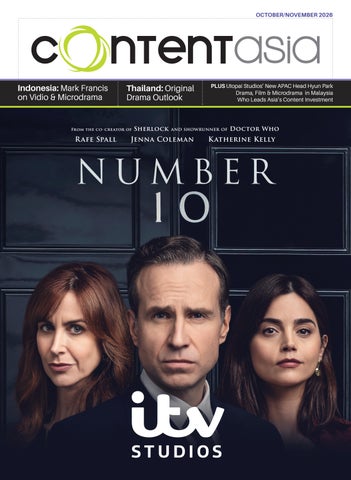
OCTOBER/NOVEMBER 2026
C
NTENT
Indonesia: Mark Francis on Vidio & Microdrama
Thailand: Original Drama Outlook
PLUS Utopai Studios’ New APAC Head Hyun Park Drama, Film & Microdrama in Malaysia Who Leads Asia’s Content Investment
From the co-creator of Sherlock and showrunner of Doctor Who
R afe Spall
Jenna Coleman
Katherine Kelly
NUMBER
contents...
what’s inside... 80/20 Rules When it comes to content investment in seven Asian markets in 2025, Korea leads with 46.6% of the US$14.8 billion total. India is second with 33.8%. The other five markets split the approx 20% balance, Media Partners Asia (MPA) says. As growth slows to a crawl between now and 2031, the good news is that investment isn’t being cut – just “reallocated”.
4
The Long & the Short
C
Indonesian streaming platform Vidio has opened its doors to a new customised vertical video environment in partnership with microdrama app ReelShort. Chief content and strategy officer Mark Francis talks about the one-ofa-kind approach.
6
“Girl from Nowhere: The Reset”
Thailand Loses Local Streaming Race to Korea
Janine Stein janine@contentasia.tv Events Manager CJ Yong cj@contentasia.tv ContentAsia Marketing & Awards awards@contentasia.tv Production
“The Heart of Yiwha”
“How Much Value Can We Add?” Utopai Studios’ new APAC president, Hyun Park, talks about budgets, backing and the fledgling AI studio’s plans for Asia.
24
From Idea to Audience: How AI is Powering Asia’s Next Entertainment Ecosystem Entertainment is changing. Audiences are consuming stories across more platforms, formats and languages than ever before, while AI is transforming how those stories are developed, produced and brought to market.
31
Editorial Director
Hopes for Thai drama series regional/ international potential have never been higher. In Thailand though, premium Korean TV series are nowhere near to being beaten.
16
NTENT
Brought to you by Loomi Entertainment Group (LEG)
contentasia october/november 2026
True’s Story As homegrown platforms compete more heavily for Thai viewers, local audiences still have to come first. At the same time, no one is giving up on the idea that a good story travels. TrueVisions Now’s content strategy and production specialist, Nitipat (Earn) Uahwatanasakul, talks about the Thai platform’s booming originals slate.
32
Rae Yong
Now That’s Entertainment Malaysia’s leading integrated television and content group, Media Prima Content & TV Networks (MPCTN), raises the curtain on a fresh slate of drama, microdrama and film.
29
Brought to you by Media Prima Content & TV Networks (MPCTN)
Tableau Vivant Japanese drama’s overwhelming popularity at home is no secret. The most recent surprise is the revival of Tokyo Broadcasting System’s 2023 hit “Vivant” S1 on Netflix, riding the S2 release on multiple platforms not including Netflix. The still-unanswered question is whether there is a path to global audiences.
Associate Publisher (Americas, Europe) and VP, International Business Development Leah Gordon leah@contentasia.tv Assistant Publisher (Asia/Middle East) Malena Amzah malena@contentasia.tv To receive your regular free copy of ContentAsia, email contentasia@contentasia.tv Copyright 2026 Pencil Media Pte Ltd. All Rights Reserved.
34
3
US$14.8 bil.
total content investment across Asia Pacific, 2025 Korea & India US$8b
80%
concentrated in two markets: Korea and India
US$2.9 bil.
split across the remaining five markets
Remaining five markets
US$6.9 bil. US$5.0 bil.
6b
4b
US$2.9 bil.
2b
0
Korea
India
47% · of total
34% · of total
Other five markets 20% · of total
Source: Media Partners Asia (MPA). Chart: ContentAsia
80/20 Rules
When it comes to content investment in seven Asian markets in 2025, Korea leads with 46.6% of the US$14.8 billion total. India is second with 33.8%. The other five markets split the approx 20% balance, Media Partners Asia says. As growth slows to a crawl between now and 2031, the good news is that investment isn’t being cut – just “reallocated”. Korea and India dominate content investment in Asia, taking 80% of the total US$14.8 billion that Media Partners Asia (MPA) estimates was invested in video content across seven markets in 2025. Korea led with US$6.9 billion, followed by India at US$5 billion. The other five markets – Indonesia, Malaysia, the Philippines, Thailand and Vietnam – split the remaining 20%, or approx US$2.9 billion. The total amount for 2026 is forecast to reach approx US$15.1 billion – an increase of US$300 million (or just over 2%) year on year. By 2031, total video content investment across the seven markets could reach just US$15.4 billion, according to the MPA report, Asia Video Content Dynamics 2026, released at the end of September. Asia’s video industries, the report says, “continue to command large audiences, valuable brands and deep creative capability... but these strengths are not consistently converting into attractive financial returns”. With many established media companies trading well below equity book value, MPA argues that “capital allocation, cost rationalisation and protection of genuine content advantages will increasingly separate companies that create value from those that let it dissipate”. Key findings show that regional content investment “is being reallocated, not cut”, and local
4
film has emerged as the region’s clearest growth opportunity. Vietnam’s box office rose 20% to US$213 million in 2025 with local titles taking 69% of revenue; Indonesia’s grew 10.5% to US$325 million with a 60% local share; India posted a record US$1.41 billion box office; and a stronger local slate is driving a substantial theatrical recovery in Korea in 2026. “Television needs deeper rationalisation,” MPA says, adding that while viewing remains substantial, monetisation continues to weaken. Thailand’s TV advertising fell 18% to US$422 million in 2025 and MPA concludes that several television industries “still carry more legacy capacity than their advertising economics can support”. Television still accounts for around 60% of spend, online video 30% and film 10%, but virtually all incremental growth comes from streaming and film as television budgets decline, MPA says. In India, streaming has overtaken TV and is scaling across the region. For the first time, online video in 2025 commanded 46% of India’s content investment overtaking 42% for TV. Indian users streamed 420 billion hours of online video in 2025. JioHotstar leads India’s premium VOD category with a 58% viewing share and over 180 million paying subscribers. Sports is the key differentiator in streaming, MPA
says, using JioHotstar in India, TVing and Coupang Play in Korea; Vidio in Indonesia; and premium VOD in Vietnam to support the finding. JioHotstar’s cricket-led model lifted connectedTV reach 26% during IPL 2026; TVing’s exclusive KBO baseball rights grew subscribers from 5.3 million to 6.5 million; Coupang Play has assembled Korea’s broadest premium sports line-up; Vidio tiers Indonesian football, the Champions League and the Premier League across price points; and the FIFA World Cup helped lift Vietnam’s premium VOD viewing by 22% in 2026. Meanwhile, MPA says “production is shifting from volume to sustainable economics. More selective TV and streaming commissioning is squeezing production-fee models, while value is concentrating among integrated studios and producers with recurring demand, IP ownership or diversified revenue”. Korea combines Asia’s highest production costs with compressed 5%-10% drama production margins; Southeast Asia operates at lower costs but faces the same pressure as commissioning tightens. MPA suggests that collaboration and restructuring “can unlock significant value”. India and Korea lead the move towards consolidation. Southeast Asia has been slower to follow, “but there are clear opportunities for collaboration and consolidation in Indonesia, Thailand and the Philippines”.
contentasia october/november 2026
“Rahasia caption Kelam Kakak Tiriku”
The Long & the Short Indonesian streaming platform Vidio has opened its doors to a new customised vertical video environment in partnership with microdrama app ReelShort. Chief content and strategy officer Mark Francis talks about the one-of-a-kind approach. The question for Vidio’s chief content and strategy officer, Mark Francis, was never whether to add short-drama to the Indonesian streaming platform. Rather, his issue was always how to integrate the new format into the entertainment offering, including where the collection of vertical series would live within the existing interface. By the end of August this year, enough boxes had been ticked on the vertical video bet, and Vidio pressed start on its landmark acquisition and production partnership with global microdrama app ReelShort. The deal – ReelShort’s first of its kind in Indonesia – is a significant departure from the data-bundled distribution alliances that the Crazy Maple Studios-owned app has forged with telco partners. The approach avoids replicating the offering from pure-play microdrama apps while still fulfilling corporate revenue dreams and growth wishes. Vidio CEO Sutanto Hartono says that boosting short drama is in line with the changing ways Indonesians consume content. The country has emerged as Asia-Pacific’s largest market for short-form drama consumption, accounting for 39% of the region’s total audience, according to Media Partners Asia (MPA). “As audiences increasingly look for content that fits seamlessly into their daily lives, we want to ensure they can find every type of entertainment they love on a single platform, from live sports, local originals, global entertainment to
6
“Girl from Nowhere: The Reset”
contentasia october/november 2026
Vidio Short Drama category page
now, the rapidly growing format of short dramas,” Hartono says. He enters the microdrama space in pole position and with a lot to protect. The MPA/ampd report, “Online Video Consumer Insights: Southeast Asia Q2 2026”, shows Vidio holds the largest share of Indonesia’s SVOD subscriptions at 20.7%. In Q2 2026, Vidio reached 5.8 million paid subscribers across Southeast Asia, ranking third regionally. Vidio’s ReelShort agreement involves vertical drama acquisitions as well as co-productions involving Indonesian production houses and talent. The co-productions will play on both Vidio in Indonesia and ReelShort globally. The first ReelShort titles launched on Vidio on 1 September in a dedicated short drama tab hardbaked into existing premium subscription packs. More than 200 titles across a range of genres including romance, billionaire romance, fantasy, and family drama series, were fully dubbed in Bahasa Indonesia in the initial rollout, with coproductions to follow that will stream across both Vidio and ReelShort globally. Vidio said the partnership combined global content scale, local production capabilities, skill transfer, and deeper localisation, reinforcing its position as a platform for the next generation of entertainment in Indonesia. The collaboration also creates opportunities for Indonesian creative talent to gain production expertise and knowledge from ReelShort’s global short-drama experience, the platform said. In a wide-ranging interview with ContentAsia, Francis talked about Vidio’s multiple efforts to customise a vertical video strategy, about experimenting with production and pricing, and about finding “a third space” that allows all parties to “triple-dip on revenue”.
8
You were considering the ReelShort deal for more than a year. What took so long? “Definitely more than a year... It’s taken some doing, but this wasn’t our first attempt at microdrama. We’d already launched around 30 acquired titles and started producing our own originals, but that was very much a deliberate experimentation phase. We tried everything, sachet pricing, rewarded ads, and it felt like something else needed to happen. “About six or seven months ago we went in with a different hypothesis. If you look at the unit economics of microdrama, the full-blown apps are really competing amongst themselves, and we don’t think Vidio is one of those. Vidio is both mobile and big screen, and we’re the largest platform in Indonesia. A lot of our users already consume different formats on mobile, so the question was never really if, it was how. We believe ReelShort represents the way we want to enter.” Walk us through your microdrama deal with ReelShort. “First and foremost, it’s a very robust output deal. ReelShort is doing deals everywhere, but I wouldn’t say, compared to some others, that they’re a full-blown distributor yet. They still run direct-to-consumer, including their own app in Indonesia, and they’ll keep pursuing telco partnerships. “We think there’s a third space that doesn’t necessarily cannibalise either of those and hopefully lets all parties triple-dip on revenue: injecting a meaningful amount of good microdrama into an ecosystem that already has quality engagement around local content and other formats. We believe that’s Vidio.
“There’s a world where a piece of IP starts as a microdrama and later extends into something longform. Creatively, with generative AI in the mix too, that opens up a lot of possible formats. That’s really where we need to focus.” - Mark Francis, Chief Content & Strategy Officer, Vidio
contentasia october/november 2026
“Microdrama apps reportedly spend as much as 80% of their budget on marketing. What if you didn’t have to? What if, instead, those titles can be marketed to the same audience more organically and efficiently? That’s where you start to see different efficiencies.” - Mark Francis, Chief Content & Strategy Officer, Vidio
“To do that, we needed ReelShort to take a leap of faith with us. Our launch commitment is around 30,000 episodes. From day one we’ll have 100 titles available, on top of the library of existing microdrama we already carry, and we’ll build from there. “Just as important is the co-production piece. We’re not disclosing the exact number of coproductions, but it’s not insignificant. We’ll take their IP and formats and adapt these into Bahasa Indonesia using Emtek’s production infrastructure, which is actually a longer-term strategic goal for our group too. Vidio is part of [listed media conglomerate] Emtek, which also owns TV channels and studios, so we have access to a lot of stars and soap opera writers whose tropes aren’t that different from microdrama.” You also have access to about 5.8 million paying subscribers and a much larger number of monthly active users (MAUs) on Vidio’s free tier... “Microdrama apps reportedly spend as much as 80% of their budget on marketing. What if you didn’t have to? What if, instead, those titles can be marketed to that audience more organically and efficiently? That’s where you start to see different efficiencies.” Are you charging extra – or a separate subscription – for microdramas? “Not specifically. There’s no bundle to buy, it’s part of the platform, a value-add, for now. Never say never, but right now it’s built into the existing subscription. Users get an extra service without paying more.” Where does microdrama fit into Vidio’s broader content strategy? “I’ve always described Vidio as a content buffet. There are three core pillars: live local and international sports, premium original series (about 10 to 12 of those a year), and investment in Indonesian film. Then there’s local TV. Local TV isn’t where the wallet is, but it’s absolutely where the taste is: a lot of our engagement and minutes rely on it. Looking forward, quality engagement, appointment viewing and live content, whether that’s an entertainment format or live sport, is going to matter more and more. This is about being relevant to our users on every screen, at all times. That’s really what’s behind this deal. There’s another feature in the works too... to optimise how microdrama is presented on big screen TV. It might
12
sound counterintuitive, but a lot of people already watch vertical content from YouTube on their TVs without really noticing. That convergence between mobile and big screen is something we want to be ahead of.” What have you changed about the user experience, based on your first attempt at microdrama? “The same old lesson holds: the medium is the message. Every format is slightly different, and audiences are far more fragmented and segmented than we like to admit because that doesn’t fit neatly into quarterly reports. Our job is to find niches large enough to be worth serving. That was one of the first things I focused on when I joined Vidio three years ago. If you look at the whole map of Vidio’s user base, there are so many different segments. How do you serve all of them well, in one place that’s understandable and easy to navigate? “With microdrama specifically, I felt there was no way we could go head to head with the pureplay apps. A lot of those were born out of taking individual pieces of popular web novel content and putting them into WeChat, generating billions of clicks. That format doesn’t necessarily translate to a platform like Vidio, which is built around curated, long-form IP. “So the lesson was to think not just about the content, but the context in which it’s consumed, because mobile and big screen use is going to keep diverging. You can already see that with the big premium streamers... which are mostly built for the big screen but are now also launching microdrama and vertical formats for discovery, which makes a lot of sense. Our answer was to build it ourselves, from day one, through local production and meaningful partnerships. “What we’re building is a way to present and curate thousands of episodes on the mobile homepage. You’ll see a short drama rail next to the live button. That’s really the beginning of what I think of as Vidio Vertical. There may be more formats than just short drama to come. We’re also seeing behaviour where users who engage with this content on mobile give us great retention, low churn and high lifetime value once they move to the big screen. “There’s a world where a piece of IP starts as a microdrama and later extends into something long-form. Creatively, with generative AI in the mix too, that opens up a lot of possible formats. That’s really where we need to focus. “On localisation, we’ve committed to fully dub-
bing more than 200 titles at launch. We can’t chase down everything we need to know all at once, so dubbing lets us move quickly and take it from there.” On the co-production side, will you only adapt ReelShort IP, or develop your own as well? “We’re pretty open. Early on, we didn’t overthink it, we just tried a bunch of things. Looking back, it was very early days. We didn’t fully appreciate how much the algorithm was driving the storytelling, and we didn’t lean into copying a proven format outright. “Going forward, our assumption is that unless you follow the rhythm and story hooks the data tells you work, the content will probably suffer. So our next phase is about relying more on proven formats for structure. We may still adapt them to a degree, and then choose the themes and subjects with the best chance of working.” Who decides what gets adapted? “Broadly, we look at two things: revenue and engagement. Were these titles the ones that paying subscribers were willing to pay to unlock behind a paywall? And engagement: how many people watched, how long, how interested were they? If a title already over-indexes in an Indonesian context, that can raise the question of whether an adaptation would even add anything, but we don’t focus on the unknowable. We just treat that as a good starting point: the top-performing titles in that space.” If a title is already a top performer among Indonesian audiences, doesn’t that mean people already know the story? “I don’t think everyone does, and that’s the point of Vidio. A title might be the top microdrama title in Indonesia among ReelShort’s existing users, but there are still 15 million to 17 million people on Vidio who’ve never seen it. “We’re not here to serve the microdrama superuser first. We’re not trying to fight for the viewer who’ll spend on rewarded ads or sachet payments, that’s not our space. We want to bring the most relevant, popular content, in a format that’s clearly working, to an existing base of Vidio users who already watch soap opera and other formats. “What I’ve found is that more is sometimes more, it can lift engagement across the board. Add something that was missing, and more people show up. That’s the whole idea behind the buffet.”
contentasia october/november 2026
Singapore's largest content creator and national media network
BROADCASTER OF THE YEAR 2026
Two years running
DRAMAS
LIFESTYLE
DOCUMENTARIES
Visit contentdistribution.mediacorp.sg to check out our latest programmes or connect with us
“We’re not here to serve the microdrama super-user first. We’re not trying to fight for the viewer who’ll spend on rewarded ads or sachet payments, that’s not our space. We want to bring the most relevant, popular content, in a format that’s clearly working, to an existing base of Vidio users who already watch soap opera and other formats.” - Mark Francis, Chief Content & Strategy Officer, Vidio
Looking at your launch marketing material, most of the lead titles feature Western, largely white, casts, even though a lot of the underlying story data comes from Chinese web novel platforms. Why lean into that? “We used the top-trending titles at the time we launched the marketing, so there’s some data behind the choice. But it’s true that a lot of the funnel and engagement in this category comes from Mandarin-language programming generally. What drew us to ReelShort specifically is that they have a lot of original, branded content, some AI and generative AI involved too, but by and large they’re closer to being the HBO of microdrama. Their number-one market by revenue is still North America, which is part of why we leaned into a lot of this Western-cast content. If Vidio’s ambition from day one was to be as broad as possible across microdrama generally, that might look like a strange choice, but I don’t think it is. ReelShort is number one by market share and global revenue, so that’s the proof point... “It’s a fascinating case where the algorithms and tropes that work were largely shaped by Chinese
14
data, even when the companies producing this content are based in L.A. and work with Western casts. This kind of data really turns an assumption on its head. We’ve generally believed people engage more with content featuring people who look like them. But the engagement here, with entirely foreign faces, suggests that might only be part of the story.” What’s your theory for why it travels anyway? “I think it’s specific to this genre, the soap. The hyper-dramatisation, the histrionics, that travels. Korean 16-part dramas and rom-coms travel. Turkish soaps travel. Latin American telenovelas travel. Hating your mother-in-law probably translates into a number of languages and cultures.” When you localise beyond dubbing, what kind of stories do you think will work with local casts and cultural references? “I think we need to let the data speak for itself here, and resist the urge to lean on 30 years of making shows and assume I already know the answer. At
least for now, I don’t want to prejudge what those stories are. People might think they want something, but often the reality is more complicated than that.” Do you see a future where you broaden local production beyond this deal, co-producing more widely with Thailand, Taiwan or the Philippines? “Yes, quite possibly soon. You could imagine an IP or a world, say the equivalent of a family dynasty soap, where certain characters or storylines are perfectly suited to a microdrama format, catching a new type of user while still linking them back into the broader universe you’re building. The benefit is that if you complete the ecosystem, you’re building an engagement value chain around that IP across different formats. That has to be a good thing.”
contentasia october/november 2026
Based in Taiwan, GagaOOLala offers the widest range of legally licensed, international LGBTQ+, BL and GL content, along with its own original productions, to audiences worldwide. The platform currently hosts over 1,600 titles, including films, series, shorts, microdramas, documentaries, animation, and variety shows, with new, curated content added on a weekly basis. NEWEST FEATURES
Micro-Dramas. Maximum Entertainment.
Find Your Next Watch, One Scroll At A Time.
“The Heart of Yiwha”
Thailand Loses Local Streaming Race to Korea Hopes for Thai drama series regional/international potential have never been higher. In Thailand though, premium Korean TV series are nowhere near to being beaten. Hopes for Thai drama series regional/ international potential have never been higher. In Thailand though, Korean TV series are nowhere near to being beaten. Netflix’s viewers in Thailand consistently pick Korean drama as their top weekly watch, putting titles like period drama “The East Palace” and romantic com-
16
“Girl from Nowhere: The Reset” “Girl from Nowhere: The Reset”
edy “Our Sticky Love” above homegrown fare. Only four Thai TV series have made it to the top of Netflix’s TV rankings in Thailand this year so far. And no Thai title has held #1 for more than two consecutive weeks from January to early September. Two of the four series – stand-up comedy special “Deaw Still Alive” with comedian Udom Taephanich and legal drama “The Evil Lawyer” – are Netflix originals. The other two – psychological thriller “Girl From Nowhere: The Reset” and thriller “One Night Stand” – were released on local channels
contentasia october/november 2026
Thailand’s Chart Toppers
and acquired by Netflix for simultaneous or later release. “Girl From Nowhere: The Reset” and “One Night Stand” each had a single week at #1 on the domestic charts before dropping back down. A Thai-produced title led the Netflix Thailand Top 10 in just six of the 36 weeks tracked – 17% of the window. The contrast between Thai originals and South Korean series is stark: a South Korean title led 22 of the 36 weeks (61%) — more than three times Thailand’s share and the dominant country of 18
origin at #1 for the entire period. China (5 weeks), Japan (2 weeks), and the United States (1 week) filled most of the remainder. Even if they rarely reach #1, Thai titles have a steady presence overall on Netflix’s Thailand top 10. Thai-produced titles filled 102 of the 360 Top 10 slots tracked across the first 36 weeks of this year (28.3% of all slots). Twenty-six distinct Thai titles appeared somewhere in the Top 10 over the period from a range of production houses. These include BEC World/BEC Studios (“Brothers”, “The Scam-
mer Games”), Maker Group (“Wrong Side of the Rainbow” aka “Love Betrayal”/“Rak Hak Lang” with BEC World), The One Enterprise/Change 2561 (“The Hidden Shadow”, “One Night Stand”), the Kantana Group (“The Face” S4), and Domundi TV/Mandee (“Khemjira”), among others. Domestic presence moved in waves rather than a straight climb: from zero to two slots a week through late December and January, up to two-to-four slots a week from early February to late April, back down to mostly one-to-two slots a week over an early-summer lull from late April
contentasia october/november 2026
Top 10 Thai Series
Thailand: A Genre Breakdown
20
contentasia october/november 2026
TV SERIES / FORMAT / SCRIPTED / UNSCRIPTED / ANIMATION / REMAKE
D I S C O V E R J A PA N E S E I P F O R A D A P TAT I O N
ASIA'S LEADING MARKET FOR FILM,TV, ANIMATION
Total Participants
Business Meetings
4,600+ 7,700+ (2025 Results)
Rhatha “Ying” Phongam as Jittri in the “The Evil Lawyer”
“Two Faces of Thatri”
“The Believers” S2
“The Scammer Games”
to mid-June, then settling into a steady three-tofour slots a week for the entire back third of the window, from mid-June through the first week of September. The clearest illustration of that gap between presence and #1 finishes is a three-way tie for the longest run of any domestic title: “Wrong Side of the Rainbow”, “The Scammer Games” and “The Hidden Shadow” each charted for a full 10 weeks. Of the three, “The Hidden Shadow” fared worst, never rising above #7, while “Wrong Side of the Rainbow” and “The Scammer Games” both peaked at #3. Genre is where the Thailand Top 10’s split 22
“Wrong Side of the Rainbow”
personality shows up most clearly. Across all 360 slots tracked, action is the single biggest draw by a wide margin – 106 slots (29.4%), well ahead of comedy (54 slots, 15%) and thriller (48 slots, 13.3%). But that action-led profile is almost entirely an import: action accounts for 35.3% of the slots filled by non-Thai titles, against just 14.7% of the slots Thai titles occupy. What Thai audiences watch from their own industry looks different again. Mystery is the leading genre among Thai-produced slots (17.6%), followed closely by romance (16.7%) and thriller (15.7%), with action only fourth (14.7%) – the reverse of the pattern international titles set.
“Girl From Nowhere: The Reset” and “The Hidden Shadow” anchor the mystery share; “Money, My Love”, “Wrong Side of the Rainbow” and “In Love Forever” carry romance; “One Night Stand”, “The Scammer Games” and “Time” make up thriller. One genre remains a genuinely Thai-only category on the Top 10: cooking competitions. “MasterChef Thailand”, “Bid Coin Chef” and “Less Is Delicious” between them filled eight of the 102 Thai slots (7.8%) – a bigger share of Thai presence than action – with no non-Thai title in the same category charting at any point in the 36 weeks tracked.
contentasia october/november 2026
The world’s largest rights transaction platform for all content
Move into the new era of content icensing There is no greater power on Earth than a story and how it moves people. We have a mission to close the distance between a story and the audiences waiting for it, clearing the friction that slows down the licensing process.
Your own branded website Automate your sales by creating your own, always-on, rights transaction platform using Vuulr technology. Your brand, your content, your buyers, and no maintenance.
“How much value can we add?” Utopai Studios’ new APAC president, Hyun Park, talks about budgets, backing and the fledgling studio’s plans for Asia.
Hyun Park is betting – safely in our opinion – that a US$1-million Indonesian movie has a much better chance globally if it looks like a US$10-million movie. But that’s a bit further down the road for the newly appointed APAC president of Utopai Studios. For now, and for a fledgling AI company running faster than its legs can carry it, Korea and Japan are Targets #1 and #2. Perhaps best known for his early involvement in Korean streaming platform DramaFever in 2009 as well as stints at SoftBank and CJ ENM’s Studio Dragon, Park was appointed to the new Utopai Studios role in August this year. This followed Utopai’s acquisition of his Seoul-based production house Alquimista Media in early 2026. The integration consolidates Utopai’s KoreaJapan venture into a single regional operation with more than 18 film and television projects in the pipeline of a total 25 titles in development. First titles are due for release in 2027. There’s no single approach to projects and no template to impose. The highest-profile Asialinked projects announced so far include financial backing for “Half Moon” live-action co-production between Germany and Korea, and a fully AI-generated “Journey to the West” series with China’s Huace. There’s also the U.S. animated movie adaptation of Mike Bender’s children’s book, “The Most Serious Fart”. “For us it’s great to be able to come in and say not only do we have the agentic workflows to
24
help you reduce costs in production, we have the development team to help you craft the scripts, we also can come in with skin in the game and invest in your movies. That’s a powerful message in these times when liquidity is an issue,” he says, adding: “We have so many things going on at such different levels, different levels of investment, different levels of involvement from our company.” Korea, Park explains, is the natural proving ground for the AI-powered model. If, in Hollywood, AI still splits the industry 50/50 – “50% of people love to talk about it, 50% will not want to hear about it” – Korea is the market “where you have this combination of great IP, great creative talent”. More importantly, Park says, “we’re talking to top directors in Korea, top writers in Korea, they’re all using AI now.” Park is open about AI’s current limitations, and acknowledges that the technology doesn’t suit every director. His goal is simple: “How we can use AI to enhance productivity, shorten production schedules, lower budgets, and make better content.” Japan’s take on the tech is more cautious, shifting from blunt refusal six or so months ago to growing acceptance of the inevitable. “Animation companies now all have their AI teams... They see that there aren’t enough resources to produce content at the massive scale that global markets are now asking for, and AI becomes a great additional tool to create
animation.” In early September, Utopai Studios unveiled an AI-assisted animation collaboration with Japanese tech company DeNA. If outcomes are not settled yet, conversations are well underway. “For us, it’s mostly like, ‘let’s start doing something together’. And then we’ll decide how far we can go.” Southeast Asia – including Vietnam, Indonesia and Malaysia – and beyond remain on the horizon. “Can we help big media companies that don’t have the tech resources to create a production AI workflow to help them create better content faster? A million-dollar movie in Indonesia could look like a $10 million movie, right?” Park explains. Talks in Southeast Asia so far are tech-based, with expectations that creative conversations will follow to support long-form premium content. Continuity is important; “we aren’t doing shorts or social media originals at great scale,” Park says. For Utopai Studios, the biggest question is: “How much value can we add, and where should we spend our resources?” Park’s own involvement with AI – and his subsequent tie-up with Utopai – comes on the back of soaring costs of premium production and shrinking distribution options. The question for his company – Alquimista Media, set up in Seoul in early 2025 – then became: “How can we ensure the creative vision of our talent without lowering the bar on production quality?”
contentasia october/november 2026
contentasiaawards.com
Brought to you by Media Prima Content & TV Networks (MPCTN)
Doa Yang Terlindung
NOW THAT’S ENTERTAINMENT
Malaysia’s leading integrated television and content group, Media Prima Content & TV Networks (MPCTN), raises the curtain on a fresh slate of drama, microdrama and film. DRAMA Dorm 403
⏯
Genre: Teen, Mystery, Thriller | Duration: 13x42 mins | Country: Malaysia | Language: Malay | Release year: 2026 What begins as a mystery surrounding a missing student soon uncovers the hidden realities of bullying, peer pressure, and the devastating consequences of silence. Set in a prestigious boarding school, “Dorm 403” delivers a gripping coming-of-age thriller inspired by an issue that continues to affect young people worldwide. Main cast: Muaz Zabir, Zairi Aziz, Noki K-Clique, Dynas Mokhtar EXPLORES THE GLOBAL ISSUE OF BULLYING COMING BACK FOR AN EXCITING SECOND SEASON.
Doa Yang Terlindung (The Veil of Silence)
⏯
Genre: Psychological Melodrama | Duration: 28x42 mins | Country: Malaysia | Language: Malay | Release year: 2026
A fearless student enters a prestigious religious institution, where her presence begins to unravel a carefully protected world of faith, power and buried secrets. As the truth emerges, “Doa Yang Terlindung” captivated audiences with 10 million total viewership, 2.7 million average viewers and 930+ million social reach – establishing itself as a standout drama that leaves audiences wanting more. Main cast: Firdaus Karim, Fasha Sandha, Nafiz Muaz, Sharifah Rose THE STORY DOESN’T END HERE. A NEW CHAPTER AWAITS.
MICRODRAMA
⏯
BRU: Masin & Manis (BREW: Salted Sweetheart)
Genre: Drama, Romance | Duration: 45x2-3 mins | Country: Malaysia | Language: Malay | Release year: 2026 Set against Malaysia’s growing specialty coffee culture, “BRU: Masin & Manis” follows Mohsin, a gifted barista whose journey of healing begins after personal setbacks lead him to a quiet village. Featuring a fresh new lead and a heartwarming story of resilience, the vertical micro drama blends romance, self-discovery, and the passion behind
Dorm 403
every perfect cup of coffee. Main cast: Imranul Effendy, Ellyza Azizi, Siti Hariesa ROMANCE / SLICE OF LIFE / MICRO DRAMA VERTICAL SERIES
FILM Polong
⏯
Genre: Horror, Mystery, Thriller | Duration: 120mins | Country: Malaysia | Language: Malay | Release year: 2026 Polong, known in Malay folklore as an evil spirit associated with black magic, lies at the heart of the 2026 Malaysian horror film of the same name. The film follows an ambitious journalist who unleashes ancient vengeful spirits after disturbing the remains of a notorious black magic practitioner, forcing her to team up with the dead woman’s estranged daughter. Main cast: Mimi Lana, June Lojong, Nadiya Nisaa, Fad Anuar, Namron MALAYSIA’S 2026 #1 HORROR FILM OVER RM15 MILLION BOX OFFICE GROSS
Pewaris Susuk
⏯
Genre: Horror, Thriller | Duration: 94mins | Country: Malaysia | Language: Malay | Release year: 2026 Polong
contentasia october/november 2026
BRU: Masin & Manis
“Pewaris Susuk” uncovers the dark price of an ancient mystical ritual passed down through generations. Blending supernatural suspense with family drama, the series follows a legacy where ambition, sacrifice, and forbidden desires collide, revealing that every gift comes with a devastating consequence. Main cast: Sarimah Ibrahim, Alya Iman, Rosyam Nor A GRIPPING FAMILY SAGA HEADLINED BY AWARDWINNING AND FAN-FAVOURITE MALAYSIAN STARS. For enquiries: contentdistribution@mediaprima.com.my
Pewaris Susuk
29
With heartfelt thanks to our sponsors for making the ContentAsia LIVE 2026 possible
contentasia-live.netlify.app
Brought to you by Loomi Entertainment Group (LEG)
From Idea to Audience: How AI is Powering Asia’s Next Entertainment Ecosystem Entertainment is changing. Audiences are consuming stories across more platforms, formats and languages than ever before, while AI is transforming how those stories are developed, produced and brought to market. For Loomi Entertainment Group (LEG), the opportunity goes beyond using AI to make content faster. LEG is building the entire entertainment value chain with AI — spanning IP development, production, localization and global distribution to take stories from idea to audiences around the world.
Building the Entertainment Value Chain with AI Traditionally, the entertainment industry has operated in silos. IP development, production, localization and distribution are often handled by different companies, creating gaps between a great idea and its ability to reach an audience. LEG is taking a different approach. They are building capabilities across the entire entertainment value chain, with AI embedded throughout to create a more efficient, scalable and globally focused entertainment ecosystem. At the production level, LEG combines filmmaking expertise with AI-powered workflows through Imaginary, their proprietary cinematic AI engine. This enables them to produce fully AI-generated
contentasia october/november 2026
productions, hybrid AI and liveaction content, as well as traditional productions — choosing the right approach for each story and creative vision. AI gives creators new ways to visualize ideas, accelerate production, rapidly create new IPs, and bring ambitious scenes and concepts to life that may previously have required significantly larger budgets, teams or resources. But AI’s role extends beyond production. It can support localization, content adaptation, marketing and audience development, helping entertainment move more efficiently across languages, platforms and markets. LEG distributes content through the Loomi mobile app, social platforms including TikTok and YouTube, OTT platforms and a growing network of regional and international distribution partners. Together, these capabilities form LEG’s end-to-end entertainment value chain: IP development → production → localization → distribution → audience.
Taking Asian Stories to the World Asia is home to a wealth of stories, creative talent and IP with the potential to travel internationally. But bringing those stories to global audiences requires more than great production. It requires the capabilities to take content all the way from concept to market. LEG’s growing slate of Loomi Originals puts this approach into practice, spanning AI-generated, hybrid AI and live-action productions developed for audiences across different markets and platforms. For LEG, AI is not the destination. It is the technology helping reshape
how the entire entertainment value chain operates — making it possible to create, adapt and distribute stories in new ways. From idea to audience, LEG is building Asia’s next entertainment ecosystem with AI — creating a value chain designed to take great Asian stories to audiences around the world.
31
True’s Story As homegrown platforms compete more heavily for Thai viewers, local audiences still have to come first. And at the same time, no one is giving up on the idea that a good story travels. TrueVisions Now’s content strategy and production specialist, Nitipat (Earn) Uahwatanasakul, talks about the Thai platform’s booming originals slate. Thai platform TrueVisions Now is well into an ambitious premium drama slate for 2026/7, adding 34 titles commissioned from about 20 production houses. Against an industry backdrop that prioritises international sales, the domestic platform is sensitive to its obligations at home at the same time as hoping for broader exposure. “My honest answer to the question about what originality means when your first priority is the audience on your doorstep is that local-first isn’t a ceiling on how far a story can travel. It’s the condition of travelling at all,” says TrueVisions Now’s Nitipat Uahwatanasakul. “The Thai titles that have resonated across the region were never engineered for export. They were the ones most confident in being themselves. That’s the bet we’re making at TrueVisions Now: We don’t make Thai stories for the world. We make Thai stories at world standard.” This is TrueVisions’ biggest original slate ever, with everything from erotic horror and religion to medical drama and a webtoon-based period rom-com. Let’s start with “Hell Home”... Audiences love melodrama, family problems, mother-in-law versus daughter-in-law, the wife versus the mistress... For “Hell Home”, we put this together in one
house, one home. And we added elements that freeTV rarely touches – religion – and the culture shock that emerges when a woman changes her religion to marry. How risky is making religion a central theme? It’s too sensitive for free-TV, but global streaming platforms talk about religion, so I thought why not. This is a story we face in many families, among many friends. “Cycle of Sin”, which you describe as erotic horror, is also not anything that would be seen on free-TV... For streaming, we can push the boundaries a little because it’s individual – not family – viewing. “The Loveless Heroine” (วันทองไร้ใจ) is more mass market... “The Loveless Heroine” comes from a popular Line webtoon based on Thai folklore. The series is a romantic-fantasy, time-travel drama that reimagines the Thai legend and asks “what if...?” The original story is about Wan Thong, who is executed for failing to choose between two powerful men. “The Loveless Heroine” was a really easy decision because it’s based on a famous IP, with a well-known cast. Can Thailand’s production eco-system execute on 34 original series right now? Easily. At Thailand’s peak we were producing more than 200 titles, including film and series. The media industry is disrupted, but that talent is still there. We now have 20 partners. Next year we plan to have more. What are you anticipating for 2027, when I understand some of the local broadcasters are increasing original productions? That’s going to be challenging but it’s a happy fight. If other channels, other platforms, come back and we have more competition
32
and more content, it’s the best case scenario for the audience and for the content industry. A few weeks ago you announced an alliance with regional streaming platform Viu. Are your shows made to travel? We produce for the local market first, absolutely. International is about the infrastructure, not the creative direction. The local market is not big enough. If we want higher budgets and better production values, we have to find bigger markets. You mention Thai producers as the “sandwich generation”... For Thai producers, it’s like in the sandwich generation, living between the world’s expectations and limited budgets. Because now we can watch world-class content every day. If you don’t want to watch local content, you can just switch to other platforms, to watch very high standards. For example, Thai rock guitarist and singer Nene Royal recently won Season 21 of “America’s Got Talent”. She has set the standard for 16-year-old girls who play the guitar. So standards rise a little every day. But for producers, we still have limited budgets and resources. I think that’s the challenge – but also the advantage and the opportunity for us to prove that we can be better than others. Do you ever think about Korean drama and the way costs soared, creating what many see as a crisis for Korean producers? It’s on my mind. I come from a production background. I know what budgets were maybe 15 years ago and what they are now. For me now, on the platform side, I try to find a healthy balance and budget. Are you looking for IP and/or co-production partners from any other Asian markets? In the coming year we will be expanding the search for Japanese IP, or other Asian IP. Co-productions are part of our plan, but we have to focus on local production first... we have great quality and the capability and the capacity to produce at high standards. So my main focus is on local production first, but we are planning broader cooperation soon. Edited for length from the original conversation during the ContentAsia LIVE 2026 event in Bangkok.
contentasia october/november 2026
59.7M
hours viewed across six half-year periods
+57%
hours viewed, Jan-Jun 2026 vs Jul-Dec 2025
#1,535
best half-year rank (Jan-Jun 2024)
“Vivant” season one: Hours Viewed Globally (July 2023–June 2026) Hours viewed (millions) 14.9M 12.7M 9.5M 7.5M
7M
8.1M
Jul-Dec 2023
Jan-Jun 2024
Jul-Dec 2024
Jan-Jun 2025
Jul-Dec 2025
Jan-Jun 2026
1M VIEWS
1.5M VIEWS
0.7M VIEWS
0.8M VIEWS
0.8M VIEWS
1.3M VIEWS
Rank #2,037
Rank #1,535
Rank #2,555
Rank #2,459
Rank #2,534
Rank #1,799
Source: Netflix “What We Watched” half-year global rankings, “Vivant” Season 1. Chart: ContentAsia
Source: Netflix “What We Watched” half-year rankings. Vivant: Season 1, runtime 9:53. Chart: ContentAsia
Vivant Rebounds on Netflix in 2026 Tableau Vivant Japanese drama’s overwhelming popularity at home is no secret. The most recent surprise is the revival of Tokyo Broadcasting System’s 2023 hit “Vivant” S1 on Netflix, riding the S2 release on multiple platforms other than Netflix. The still-unanswered question is whether there is a path to global audiences. Season two of Tokyo Broadcasting System’s (TBS) original drama action spy thriller “Vivant” returned with a vengeance in August, reaching an estimated 15.1 million viewers in Japan, and another 500,000 elsewhere in the region led by TrueID in Thailand, according to Media Partners Asia’s ampd measurement platform. The new season also pulled season one back into Netflix’s domestic series Top 10 for another 12 weeks, giving the series a total of 16 weeks on Netflix Japan’s Top 10, most recently at #5 (14-20 September). The original season released on Netflix in December 2023 following its TBS broadcast from 16 July-17 September 2023. The drama airs in TBS’ prime-time Sunday Theater slot and is thought to be TBS’ most expensive original yet, with an estimated production budget of ¥100 million (US$714,000 at average 2023 exchange rate) per episode for season one and ¥120 million (US$792,000 at average 2024 exchange rate) per episode for season two. That puts the 20-episode series at ¥2.2 billion (US$15 million). Season two picks up the story from the end of season one, when Yusuke Nogi, a meek employee of a trading company in Tokyo, is falsely accused
34
of orchestrating a US$100-million corporate overpayment error. As he attempts to track down the money, it becomes clear that Nogi is not quite who he says he is. ampd’s measurement platform showed “Vivant” as only the third title to cross 10 million on a single platform in one market in one month. The results so astonished the platform that it put out a special note in September, talking about distribution strategy and saying 10.2 million watched the show on domestic catch-up platform TVer. In addition to its free-TV slot, season two was released on catch-up service TVer for free, with paid VOD exclusive to U-Next, within an hour of the 9pm Sunday broadcast. Netflix aired season one in select territories in 2023. Three years later, and very likely on the back of the season two launch, the first series returned to Netflix’s Japan Top 10 at #9 (22-28 June 2026), rising to #2 for the week of 27 July-2 August, #1 for the following week (3-9 August), and in all adding 11 weeks to the show’s presence on the domestic Top 10. The streamer, which runs ahead of U-Next in Japan, hasn’t talked about adding season two to its
line-up yet. If “Vivant” made waves domestically, there are scant signs that Japanese drama series are being given rapturous welcomes in other markets. No Japanese title of any kind – anime, drama or reality – reached #1 on the global TV chart in weeks 1 to 38, so no drama did either. So far this year, Netflix’s best-performing Japanese drama has been original series “Straight to Hell”, which appeared on the Top 10 for three weeks, peaking at #4 and attracting just over 60 million hours viewed in the three weeks. “Viral Hit” season one reached #3 in its two weeks on the rankings (22.1 million hours viewed / 4.5 million views). The title in the spotlight in the run-up to MIPCOM is psychological medical drama “Plastic Beauty”, which ranked #5 for the week from 14-20 September in the first week of its release. The best-performing Japanese genre for 2026 is likely to be anime, which had six titles on the global Top 10 for the year to 20 September. Three anime titles rose to #2 – “Jujutsu Kaisen” season three, “BAKI-DOU: The Invincible Samurai” season one, and “STEEL BALL RUN JoJo’s Bizarre Adventure: 1st STAGE”.
contentasia october/november 2026
ln the business of building businesses