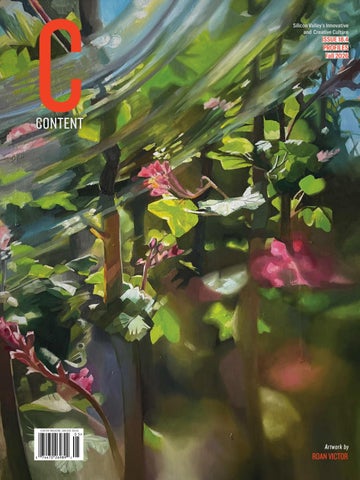
C
Silicon Valley’s Innovative and Creative Culture
ISSUE 18.4
PROFILES
Fall 2026
CONTENT
CONTENT MAGAZINE, SAN JOSE $14.95
Artwork by
ROAN VICTOR
540 Ramona St Palo Alto | Tues – Sat | 11– 6 pm pamelawalshgallery.com | info@pamelawalshgallery.com
CONTENT ISSUE 18.4
LETTER FROM THE EDITOR
Fall 2026
It is an honor to step into the role of Executive Editor for CONTENT MAGAZINE. This 76th issue marks a profound transition—the final issue guided by our founder and Cultivator, Daniel Garcia. Daniel, thank you for your vision, your mentorship, and for paving a path that honors and connects stories from our creative community.
“Profiles”
Cultivator Daniel Garcia Executive Editor David E. Valdespino Jr. Production Manager Jazzie Bridges Lead Copy Editor Danae Stahlnecker Associate Copy Editor Samantha Hull Editors Alessandra Cortez, Esther Young Felicia Alvarenga, Katherine Hypes, William Jeske Writers Brandon Roos, Bree Karpavage, Felicia Alvarenga Jessica Kwong, Joshua Hascall, Julia Chie Michelle Rundowitz, Nathan Zanon, Nikoo Parsizadeh Samantha Hull, Stephanie Lam, Tanvee Tirthapura Yvonne Phan Photographers Alex Knowbody, Arabela Espinoza, Daniel Garcia Jai Tanju, Jazzie Bridges, Lauren Locquiao Marietta Asemwota, Miguel Ozuna, Paul Gallo Stan Olszewski Lead Designer Trinh Mai Garcia Designers Daniel Garcia, Jesse Garcia, Katie So Sana Akita, Taylor DuBose
Publisher SVCREATES IN THIS ISSUE Mayra Flores | Jeremiah Matthew Davis | AWỌ Center To participate in CONTENT MAGAZINE: david@content-magazine.com Membership & sponsorship information available by contacting editor@content-magazine.com
Having artwork from Roan Victor on this cover is intentional. It is a symbolic offering of “flowers”—a gesture of gratitude for Daniel, and a bouquet for the entire creative culture of the South Bay. Circling back to feature Roan nearly 10 years since Issue 8.4, “Profiles” recognizes that history is the foundation of the present and that our scene relies on continued commitment. Her dedication to the community through murals, education, and creating space for artists deserves this long-form celebration. The curation of this issue reflects shared growth for artists like Allegra J. Bick-Maurischat, who also writes for the magazine, and her residency at Art Ark Gallery; long-time artist and educator George Rivera, and his move into a new studio at Obelisk Applied Arts; and Yuting Wang, who is moving to New York to continue an education in art. Returning to Mighty Mike McGee—over a decade since his feature in Issue 7.2, “Connect”—taps into the roots of San Jose’s golden era of poetry while looking toward the next wave currently unfolding. In my own life, having grown up in a household influenced by bands like Alkaline Trio and Less Than Jake, thanks to my eldest sister, featuring South Bay music icon, Mike Park, is truly an honor. To land this plane, I would not be here without the pillars of my life. Thank you to my parents, David Sr. and Linda, for your love and joy. To my eldest sister, Monique: you are my original role model, and your strength and ability to never lose sight of yourself through hardship inspire me daily. To my middle sister, Jenna: thank you for always gassing me up. I rely on your guidance in life and storytelling. And to my beautiful Alyssarhaye: my best friend, love, and partner. You have walked with me through so many phases of my life, always striving and inspiring me to want more for myself, for us, and for our community. CONTENT MAGAZINE could not exist without our incredible contributors. Trinh Mai Garcia and Danae Stahlnecker have stepped up immensely during this transition in supporting the vision. I am relying more than ever on our brilliant team of writers, photographers, editors, and designers—drawing on their skills as artists in their own right. We are equally indebted to our partners and sponsors who believe in the power of storytelling and the vital importance of documenting our culture. To the South Bay community: thank you for welcoming me with open arms and trusting me to share your stories. Let’s keep raising the floor of what is possible, modeling excellence, and growing together. Enjoy, -David V.
501(c)(3)
CONTENT MAGAZINE is a quarterly publication about the innovative and creative culture of Silicon Valley, published by
.
LETTER FROM THE CULTIVATOR This issue, Profiles 18.4, our 76th, is my last as the head of CONTENT MAGAZINE. I have been looking to pass on the leadership of this magazine I founded 14 years ago for a few years. Even in the hiring process with David E. Valdespino Jr. I told him I was looking to hand over the reins in a couple of years. Soon after David came on staff, it was evident that he has the skills and desire to direct CONTENT into the future. I look forward to seeing how he, Jasmine Bridges, SVCreates, and all the great contributors will carry the mission of featuring South Bay creatives into the future. There really is no other message I can communicate in this last “Cultivator Notes” than, “Thank you!” Though I get much of the credit for CONTENT, the reality is that it has always been a collaboration—from the willingness of my wife, Sarah Garcia, who gave me the support to venture out and start a print publication in the digital age, to the very early-day volunteers like Mary Matlack, Flora Moreno de Thompson, Jeff Gardner, Brandon Roos, Stan Olszewski, Stacy Ernst, Terra Wood-Taylor, Odile Sullivan-Tarazi, Connie Martinez, Kristen (Pfund) Garcia, and all the SVCreates staff. And there are so many more that I cannot list them all, but your willingness to see and act on the vision that the South Bay has a vibrant and active creative scene is what has made it possible. To you all, I thank you for helping, contributing, supporting, and seeing the vision. Thank you, and here’s to many more years of celebrating our local creatives. Thank you all for your friendship and support. Daniel Garcia
THE CULTIVATOR
t t r r A A TELLS TELLS OUR OUR STORY STORY Ria Krishnan Painter & Educator @riakrishnanfineart
PACIFICARTLEAGUE.ORG PACIFICARTLEAGUE.ORG
CONTENT PROFILES 18.4.
Fall 2026 San Jose, California
CULTURE 10 AWỌ Center, Folake Phillips 14 San José Museum of Art, Jeremiah Matthew Davis ART 18 Multidisciplinary artist, Yuting Wang 24 Painter, Pragati Sharma Mohanty 30 Mixed-Media Artist, Allegra J. Bick-Maurischat 34 Painter, George Rivera 40 Painter/Muralist, Roan Victor 46 Mixed-Media/Chicano Artist, Armando Delgado-Franco
Folake Phillips, pg. 10
POETRY 50 Poet, Mighty Mike McGee 54 Poet, Mayra Flores MUSIC 58 Asian Man Records, Mike Park 62 acari, Carina Valdes 66 DJ Toonin, Yareli Rivera 70 Contributors George Rivera, pg. 34
All materials in CONTENT MAGAZINE are protected by United States copyright law and may not be reproduced, distributed, transmitted, displayed, published, broadcast, or modified in any way without the prior written consent of Silicon Valley Creates, or in the case of third party materials, the owner of that content. You may not alter or remove any trademark, copyright or other notice from copies of this content. For further information, or to participate in the production or distribution, please contact us at editor@content-magazine.com.
Yareli Rivera, pg. 66 CONTENT MAGAZINE is made possible in part by funding from the County of Santa Clara.
Allegra J. Bick-Maurischat, pg. 30
Get a premier arts education at West Valley College. As a top transfer institution, we know how to help you reach your goals. Learn from industry experts in world-class art, design, and performing arts programs - celebrating 10 years of Cilker School of Art & Design
» »
10 Profiles 18.4
Folake Phillips Nigerian-born community activist highlights stories of the Bay Area’s African diaspora
A
Written by Stephanie Lam Photography by Daniel Garcia Event Photography by Freshdidit Production Layout Design by Trinh Mai Garcia awocenter.org Instagram awo_center
round the Bay Area, African American communities carry pieces of their ancestral language, music, and culture. Everyone’s experience navigating life in the tech-centered region is different, but Folake Phillips believes they share similarities: people long to feel a sense of belonging, celebrate their heritage, and have equitable access to educational opportunities. As the founder and executive director of AWỌ, Phillips is on a quest to unify and amplify underrepresented voices in the Bay Area. Awo is the word for “skin” and “color” in the Yoruba language of Nigeria. The Los Gatos-based organization creates local programs, community workshops, and advocacy events specifically centered around understanding the African diaspora. “We’re using art, culture, nature, environment, technology, and innovation to help the community,” Phillips says. Since 2020, Phillips and the AWỌ team have organized a lengthy list of well-known events in Los Gatos, Mountain View, and San Jose, from
African culture fairs to public drumming performances. Phillips’ efforts to create inclusive spaces and preserve African heritage landed her a 2026 Woman of the Year award by the California Assembly. For Phillips, AWỌ’s accomplishments highlight the good that comes from bringing people together. “We want to see a colorful world where people come together in one space,” Phillips shares, emphasizing “the learning, connection and engagement, the power of that when people come together.” Born in Lagos, Nigeria, Phillips grew up traveling with her parents. She spent her university years at Coventry University London studying marketing management. Being exposed to different cultures and 11
“I’m using my son’s lens and making sure we can serve youth that look like him or look like me. Families that need support and any group that feels voiceless or powerless, we can be a voice for them.” – Folake Phillips customs at an early age, Phillips says, shaped her into a “global citizen and thinker.” She immigrated to California in 2017, got married, and shortly afterward had her son. Phillips wanted to find a way to make her community more inclusive for people who look like her. She reflects, “It felt like the whole world was coming to an end at that time. The global pandemic, George Floyd, and the realization of how poorly educated I was on all of these things.” At the height of the Black Lives Matter protests and the death of George Floyd in 2020, Phillips realized she needed to educate herself more about America’s racial issues and tensions. She noticed that her city lacked spaces for open and honest dialogue about race. Despite not knowing how to operate a nonprofit, Phillips said her faith in God encour12 Profiles 18.4
aged her to try. In the back of her mind, a question nudged her: What are you going to do with what you know? Being a mother to a mixed-race son also motivated Phillips to turn her vision into a reality. “I’m using my son’s lens and making sure we can serve youth that look like him or look like me. Families that need support and any group that feels voiceless or powerless, we can be a voice for them,” Phillips shares. Phillips regularly encourages her fellow Los Gatos neighbors to come together by providing space for important conversations to take place. She believes, “Education and community health are the core of what we do, but it has evolved to address social isolation needs and support mental health and connection. It’s a place for people to address bias, to be curious and ask questions.” In 2021, Phillips spoke about the power of unity at Los Gatos United Against Hate rally, which was put on by the town and other organizations in response to Floyd’s killing. In 2023, three years after Floyd’s death, Phillips and AWỌ organized a local memorial for him in Los Gatos. They’ve also worked with the Rotary Club of Los Gatos and local churches to spread their message. Today, AWỌ operates several community-focused programs around the South Bay aimed at promoting diversity, education, and inclusion. Their
most well-known events include the Village Square and Africa Day. The Village Square is a week-long camp aimed at helping children develop leadership skills and promote African culture by encouraging the importance of physical artistic expression. Africa Day is a three-day springtime culture fair that takes place across Los Gatos, San Jose, and Sacramento. Onlookers bask in the sound of live drum circles and spoken-word performances while taking in the vibrant displays of African artwork and small businesses. While AWỌ aims to help all communities, staff and volunteers are especially keen on helping recent immigrants in the Bay Area. According to the USC Equity Research Institute, of the nearly 218,000 Black immigrants living in the state, more than half have come from countries in West Africa, East Africa, and the Caribbean. The institute reports that recent Immigration and Customs Enforcement raids statewide have “sown fear” throughout the African community. “Right now, under the current administration, immigrants are under attack,” Phillips says. “We want to be a part of history that records us as those who spoke for them, who protected, worked with others, and supported those who needed it most.” C 13
14 Profiles Profile 18.4 18.4
14
JEREMIAH MATTHEW D A V I S A LEADER’S COMMITMENT TO COLL ABORATION AND AUDIENCE ENGAGEMENT
“M
Written by Samantha Hull Photography by Stan Olszewski Layout Design by Jesse Garcia sjmusart.org Instagram jeremiahmatthewdavis
y role, wherever I go, is to determine how I can make the biggest impact,” shares Jeremiah Matthew Davis, the San José Museum of Art’s new Oshman director and chief executive officer. Impact is just one aspect of Jeremiah’s leadership ethos; intentional collaboration and a deep commitment to audience engagement are also integral. Jeremiah explains, “I’m always thinking about the audience and what they’re going to take away from this experience. I’m not going to do this because I think that it can exist in a vacuum. I do it for the circular connection that engaging with audiences can create.” His resume, unlike many leaders in his sector, is in theater; he came to museums by chance and stayed by choice. He is a leader committed to making an impact within the community he serves. Born in Oklahoma, Jeremiah grew up on an organic
farm in Osage County, about an hour outside of Tulsa. Surrounded by farm animals and nature, he was always a creative child with an affinity for drawing, singing, and reading. He found opportunities for experiencing art through public programming at his local library and by exploring the Smithsonian museums while visiting his grandmother every summer. For Jeremiah, art has been omnipresent. He says, “Art for me was always a window. It was a window to explore, to experience the world, and to recognize that there was something greater than my immediate experience.” With three degrees in hand—two undergraduate degrees in theater and social studies, and an MFA in theater—Jeremiah was living in Brooklyn when fate struck. His wife stumbled upon an opening for an artistic director at Oklahoma Contemporary, a non-collecting arts organiza15
16 Profiles Profile 18.4 18.4
“Collaboration is what I’ve always done. I’ve never been a solo artist. It’s always been about teamwork and collective action to realize anything.” – Jeremiah Matthew Davis
tion with an emphasis on performance and education. After initial hesitation, Jeremiah applied and shortly thereafter was offered the job. His experience in theater and the performing arts— building various theater companies and creating new work in New York City—prepared him to catapult Oklahoma Contemporary to new heights, growing the organization from a staff of 12 to over 100 and from a budget of $1.7 million to $6.5 million. Although he had a background understanding of art history, he was unfamiliar with museum theory and practice, so he took it upon himself to learn from his colleagues across departments, relying on his skill set of collaboration to lead the institution forward. After an impressive tenure, Jeremiah was at the right place at the right time. He knew of the San José Museum of Art’s reputation, and after accepting the position and relocating to downtown San Jose, he found a kinship with the local community. He shares, “I’ve been asking everybody, ‘What does San Jose mean to you?’ And my barber said, ‘In San Jose, people show up for each other.’ I thought that was such a lovely comment to make about a place, and that’s the kind of place I want to live in.” As the director, he is building a triangular base of artists, ideas, and audiences—rooted in deep collaboration. “Collaboration is what I’ve always done,” Jeremiah states, “I’ve never been a solo artist. It’s always been about teamwork and collective action to realize anything: a work of art, an idea, an ephemeral experience, or an object. I think that, whether we see it this way or not, the visual arts are and have historically been just as collaborative,
but it has been masked by the idea of the cult of the lone genius.” He revokes the notion of the lonely artist stereotype, in turn, leading with respect and encouraging the museum to serve as a true mediator between the artist and the public. Integral to his vision is ensuring that the San José Museum of Art acts as a “third place” for visitors where they feel welcomed and inspired, and who then, in turn, take pride in their local museum. Existing isn’t enough—consistently being accessible to the community is key. “From my perspective, the goal should always be: let’s get people here,” Jeremiah proclaims. “Let’s send out the carrier pigeons into the world, and let them know that this is where the action is. Because to me, the future success of any museum or cultural organization will be serving as a community third space.” An optimist with deep ties to education, Jeremiah is primed to lead the San José Museum of Art into the future, demonstrating what true collaboration in a contemporary art museum can achieve. His commitment to understanding audiences is evident in the way he leads. Most importantly, his goal is to convey to the community that the museum is for them, with an open invitation to engage: “If you are in the South Bay and you live here, this is your art museum. I want to make sure that whatever I do conveys that message consistently and clearly. So when you see the clock tower, you know whatever time it is, it’s time to experience some art at the San José Museum of Art.” C
17
YUTING WANG
18 Profiles 18.4
ENGINEERED IMAGINATION
Y
History II - Web of Stories, 2025, watercolor and ink on khadi paper, 30”x22”
Written by Nikoo Parsizadeh Photography by Daniel Garcia Layout Design by Trinh Mai Garcia yutingwangart.com Instagram yutingwangpainting
uting Wang was born in Beijing in 1992 in an environment where creativity silently thrived. Her father was a painter who did not practice his art professionally. He did, however, expose Yuting to painting when she was young, allowing her to paint freely on pieces of paper he taped to the walls and regularly replaced once filled. She grew up in a house full of memories of museums and classical art in the form of books. At eighteen, Yuting moved to Israel to pursue her studies in civil and environmental engineering. This marked a period when she discovered her identity, enjoyed freedom, and developed connections with diverse worldviews. This time, she was away from home, learning about cultures, histories, and perspectives she had not encountered before. Her university education offered her more freedom compared to high school, and living abroad gave her unrestricted space for creation and imagination. “I think every person is an evolving process,” she says. “You never fully understand yourself, and you never fully understand others. That mystery is what keeps drawing me back to painting.” While studying engineering, Yuting remained intrigued by the psychology of people. She developed an interest in the concept of paradoxes: people can have contradictory feelings simultaneously, their identities change continuously, and their relationships generate emotional tensions that remain unseen. Such concepts gradually formed the basis of the emotions embedded in her artwork. 19
“Watercolor teaches you that not everything beautiful comes from control. Sometimes the painting knows where it wants to go before you do.” – Yuting Wang
20 Profiles 18.4
Embrace the Fall, 2025, watercolor on paper, 32”x24”
21
“Beauty can hold your attention long enough for you to remember that life is still worth living.” After completing her degree, Yuting relocated to Stanford University to pursue a master’s in civil engineering. However, life at Stanford did not prove easy for her. The stresses of pursuing a master’s, the uncertainties surrounding immigration, and the pressure to ensure her future in the country all exhausted her. As a result, painting became nonexistent in her life. “When you have an idea inside you but cannot bring it into reality, it feels unbearable. At the time, not painting felt easier than carrying that frustration,” she recalls. After completing her studies, Yuting worked in construction in the Bay Area as a project manager. Over the course of seven years, she enjoyed success in a profession based on structure, deadlines, and exactness. But art did not go away. Gradually, she resumed artistic activities, creating paintings at night and on weekends. Starting as a simple hobby, art transformed into more than just that, serving as a reminder of her true self in the midst of her corporate career. Taking lessons and practicing alone, she mentally prepared for a future that scared her. The day Yuting received her green card became a turning point in her life. Finally, she could follow her passion without constant thoughts about uncertainty. In 2023, she quit engineering to devote herself entirely to art. It was thrilling but terrifying. Today, Yuting’s work explores cycles, paradoxes, and the emotional push and pull between freedom and limitation. The figures in her paintings often glow within their symbolic and dreamlike environments. The influences behind her work come from both the East and West, and her artwork blends figurative realism with watercolor and symbolism. Yuting eventually found watercolor to be her preferred 22 Profiles 18.4
Mirror of Listening, 2025, watercolor on khadi paper, 22”x30”
Purple Rain, Purple Dream, 2025, watercolor and ink on paper mounted on panel, 12”x12”
medium—not only because it fit within the time she had while working full-time, but also because it embodied her philosophy of control and relinquishment. “Watercolor teaches you that not everything beautiful comes from control,” she says. “Sometimes the painting knows where it wants to go before you do.” Her latest collection, called Hide and Seek in the Hidden Mirrors, delves into the concepts of identity, projection, and boundaries between inner and outer worlds. The presence of mirrors, fragmented spaces, and symbols in her works reflects an interest in the process of perceiving oneself through others. One principle she will not relent, regardless of how her style evolves, is valuing beauty. For Yuting, the concept of beauty goes beyond mere aesthetic appeal or technical skill. She believes beauty itself holds profound importance. During one of the darkest periods of her life, the possibility of creating beauty kept her connected to the world around her. Art became more than self-expression; it became a reason to continue forward. “Beauty can hold your attention long enough for you to remember that life is still worth living,” she says. Preparing to relocate to New York City for a master of fine arts degree, Yuting views her life experience not as a point at which she finally becomes who she is, but merely as another stage in the never-ending process. Yuting does not see anything in life as something final or definite. Rather, she sees life as a series of cycles, growing, questioning, exploring, falling apart, and regrowing. Throughout it all, Yuting keeps painting—not because she knows everything there is to know, but because painting helps her stay honest about what she has yet to learn. C 23
Stories Within Stories
PRAGATI SHARMA MOHANTY 24 Profiles 18.4
25
Written by Michelle Rundowitz Photography by Marietta Asemwota Layout Design by Trinh Mai Garcia pragatisharma.com Instagram pragati_sharma_artist
F
or artist Pragati Sharma Mohanty, painting is more than a visual practice—it’s a way of reviving and interpreting history, folklore, and culture through richly layered narratives. Pragati brings folk stories to life with vibrant color, detailed motifs, and symbolic storytelling rooted in her Indian heritage. Born and raised in India, Pragati grounds her art in the mythologies and traditions of her cultural background. She had formal training in architecture and industrial design, though she always had a love for local art. “I was very passionate about folk arts in general. I went to all these states in India and learned them through the artisans who actually practice them,” says Pragati. “Every state has its own folk art, just like every state has its own language, culture, dance, music.” She continued to pursue art and grow her practice while working in design, then later moved to Connecticut with her husband. When Pragati eventually moved to the Bay Area in 2014, she decided to leave her design career and become a full-time artist. She began developing her distinct maximalist-miniaturist style, blending the more-is-more style of maximalism with the highly detailed, micro-scale execution of traditional miniature painting. “There’s more than you see on your first impression of the painting because there are stories hidden in the paintings as well,” says Pragati. She draws inspiration from the miniature art styles of Southeast Asia, adding her own twist. “I’m not a purist. It’s my own interpretation of the miniature painting traditions.” Her current body of work is centered on the Ramayana, one of the two major Sanskrit epics of ancient India and an important text in Hindu traditions. It follows the life of Rama, a prince and avatar of Vishnu. He goes into exile, seeks to rescue his kidnapped wife, defeats the demon king Ravana, and eventually returns to reclaim his throne. Pragati was interested in painting this epic not only for its cultural importance and depth, but also because of how it moves across many different regions of India as the narrative progresses. “It literally starts from the northern part of India, goes all the way to the bottom,” says Pragati. “And then the flora and fauna change as well, so I try to bring that out.” What began as a plan to paint around ten stories from the Ramayana eventually grew into a much larger project. “When I started reading the book and I started digging more into it, I found so many other interesting stories. And I thought that I could tell those stories.” While the Ramayana is well known in much of the world, Pragati is interested in the lesser-known details and hidden turns within the epic. “What I also want to offer to those people who know the story is further rare details that are not well
26 Profiles 18.4
Mareechh Vadh, 2022, acrylic and mixed media on canvas, 40”x30”
Pampa Sarovar, 2024, acrylic and mixed media on canvas, 36”x24”
Putrakameshti Yagya, 2023, acrylic and mixed media on canvas, 52”x52”
known,” she says. “Oftentimes when Indians visit my studio and I tell them the story, they’re like, ‘Oh, I never knew this part of the story.’ ” She has read around twenty versions of the Ramayana, including regional and folk versions from other countries. She adds, “The story has gone to various cultures, and each culture, based on its sensibilities, will add twists to the story—and that’s the beauty of it.” For Pragati, the story is always the center of the piece. She explains, “The hero of the painting is the story. I want [the viewer] to interpret the story that the painting is trying to tell. It can be interpreted in many ways.” Her paintings often include animals, plants, and architectural elements, while human figures are sometimes small relative to the surrounding world. This allows viewers to better appreciate how the environment and the surrounding world play a key part in the narrative. Architecture especially plays a major role in her work, an extension of her education and previous career. In painting the Ramayana, she uses local architectural styles of buildings and temples to ground the viewer in the setting where the story takes place. Her process combines painting, drawing, collage, digital design, and even laser cutting. Pragati’s first love was water27
color, so when she began working on canvas, she missed the fine detailing that watercolor allowed. She began experimenting with different techniques to blend these styles. “I feel like I invented something, a process where I collage a piece of paper on top of my acrylic painting,” says Pragati. “And then on top of that paper, I paint with gouache or watercolor.” To achieve this, she draws elements such as animals, plants, and parts of buildings on her iPad, prints them, and cuts them out of thin rice paper using a laser cutter. She then fuses them onto the canvas. This process also allows her to build a visual inventory that can be used across the entire series of paintings, helping viewers to connect each work and story together as a cohesive epic. “When you have a designer’s and architect’s brain, it’s hard to go completely organic and unplanned,” she says. “It pretty much is fifty percent planning, and then the rest of it is the painting process taking over.” In addition to her own practice, Pragati manages the Pragati Art School, which she founded and teaches at part-time. While she used to teach children, Pragati now teaches adults, many of whom came from India and have deep-rooted ties to folk art. “Those people who grew up in India have that connection with those art forms, and feel really satisfied when they actually practice those art forms,” she says. “They have something nostalgic about it.” Over time, Pragati has seen the school become not only a place to learn artistic skills, but also a place for friendship and bonding, especially as her students are primarily women. “A massive amount of healing happens because these women are taking time out for themselves to come and learn something,
“There’s more than you see on your first impression of the painting because there are stories hidden in the paintings as well.”
– Pragati Sharma Mohanty
28 Profiles 18.4
which is purely doing something for themselves,” she says. Many of her students had no formal art training before joining her class but have stayed with the practice for years. Some have been with Pragati for nearly a decade, learning multiple art forms and building confidence in their own work. More recently, several of her students showed their pieces during Silicon Valley Open Studios alongside other professional artists. “I feel so good because I trained them and they have been so hardworking,” says Pragati. For her students, the classes are more than a creative outlet—they’re a place to be with friends while reconnecting with familiar cultural traditions. Looking ahead, Pragati plans to continue expanding her Ramayana series for another year or so. While doing that, she also feels ready to start sharing her current body of work more widely and is beginning to work with galleries on exhibitions. In parallel, Pragati is developing a book for her pieces. “The visuals need to be supported by the story,” she says. “It makes it easy for people to understand, and then a book is a great compilation of the whole work.” Pragati continues to be guided by the hope that everyone can find a point of connection in her work, whether as a viewer, a student, or a future reader. C 29
Allegra J. BickMaurischat
An emerging artist obsessed with paper and repetition recontextualizes historical imagery, pushing the boundaries of medium and meaning.
30 Profiles 18.4
t
i h t
s g n
ar t a th
faithfu ea n t o
si tm
td oe “W
ha
e
en s re p e r
A
lly
m ak e
ta
tio na
l a nd
aurisc
ha
intenti ona – Alleg ra J.Bic k-M
l?”
Written by Bree Karpavage Photography by Jazzie Bridges Layout Design by Sana Akita allegrajbickmaurischat.studio Instagram allegrajanebmstudio
llegra J. Bick-Maurischat’s intrigue for compelling subject matter and controversial historical discussion are key ingredients for her artistic inspiration. With a sketchbook and pencil in hand, this seventh-generation San Jose native’s progressive attitude and insatiable desire to manipulate images into art pieces offer a fresh perspective to the local scene. Allegra’s love of repetition and “as many ways as possible until it’s boring” ideology is the leading inspiration behind the body of work she developed during her 2026 summer residency at Art Ark Gallery in San Jose. Her only plan was to experiment with large-scale work and continuously repeat images until they’re fully exhausted. She says this opportunity was less about the residency and more about owning the space to be “big, brave, and slightly experimental.” Creating site-specific work was also a new concept for Allegra and a challenge she was excited to take on. Typically, working on a small scale, Allegra begins her process with graphite drawings. From there, she plays with the imagery to turn them into weavings or prints in cyanotype. Experimenting with mediums and pushing their boundaries fuels her inspiration, with repetition her main focus. Allegra shares, “If you can keep peeling back the layers of something that you’re making and it is still intellectually and visually engaging, there’s no reason to stop pushing the boundaries of what you can make; I’m just following that.” Allegra’s love for manipulating paper is only matched by her love of history. And not just any history—the stories you only find when you’re raised by a progressive hippie mom who hands you books that challenge the mainstream historical landscape. These books spotlighted women who lived during the California Gold Rush—such as Allegra’s childhood obsession Nellie Bly, the first woman to circumnavigate the globe during the Industrial Revolution. Allegra says that these stories, all but lost to modern society, informed her curiosity for the past. She is particularly fascinated by art histories steeped in 31
Afterimage #2, 2026, cyanotype on paper, 10“x10“
Give A Girl A Gun #10, cyanotype and colored pencil on paper, 12“x9“
Public Domain #4 (Oregon), 2023, graphite drawing on paper, 30“x22“
32 Profiles 18.4
Public Domain #5 (Idaho), 2024, graphite drawing on paper, 22“x30“
“women’s work,” and how her current work can raise awareness of the people and labor behind it. Her own grandmother and great-grandmother embroidered fabrics and painted China in factories during wartime—two creative labors that women were employed to do. One of her current musings is a series of Civil War-era textile patterns and drawings that she plans to weave together to conceptually reference women’s labor. “Slicing up drawings and weaving them together is really hard but really rewarding,” says Allegra. “It creates work that doesn’t deliver its meaning too easily, which is never boring. The conversations they start are always very interesting.” Allegra categorizes her work as “vaguely representational,” artwork composed of recognizable imagery delivered in abstract ways. She loves recontextualizing what people would normally expect, playing with photos and drawings in different contexts, and abstracting meaning beyond what was originally depicted. She is also interested in the emotions that the treatment of materials can create. Allegra muses, “If you care to dissect it, a weathered edge of paper could imply time, while torn paper has an immediate violence to it. I want people to get up close and intimate with my work. When my art makes people stop and think—that’s the goal.” Replication has its own dichotomy today, with technology infiltrating the art world. Allegra poses the question of how to represent imagery during the AI revolution. “What is it to replicate an image now when there’s so much homogenized imagery that can be made by AI? What does it mean to faithfully make things that are representational and intentional?” For Allegra, the analog world of layering images in a collage, drawing with pencil, and slicing and weaving paper are all ways to keep art intentional, impactful, and rooted in our creative history. C
33
GEORGE RIVERA Paint That Never Dries: After decades of teaching, curating, and painting, George Rivera measures success in what endures.
A
throaty roar of exhaust announces the arrival of a classic Harley-Davidson motorcycle. A man with an unmistakable salt-and-pepper goatee and a personality that seems to outshine the chrome on his bike gives the throttle one last twist, making the motorcycle growl and pop before dismounting and striding into Obelisk Applied Arts’ building. George Rivera throws his keys on a table and settles into an office chair. He leans back, pushing a rolling cart full of brushes and paints aside with a leather boot, and stares off into the distance. The studio settles into a long hush, broken only by the rumble of a passing Caltrain. He leans forward, resting his elbows on his knees, and looks up. Then he speaks. “You know, I was looking at my artist bio the other day, and it felt like I was reading my obituary,” George says with a half-grin. Coming from a man in his seventh decade of life who rides a chopper with his wife, Kristin Lindseth—an internationally exhibited sculptor and printmaker—the remark sounds less like a concern and more like a challenge. “As an artist, you really need to try to outlive death,” he says. For nearly half a century, George has been a fixture of the South Bay arts community. He served as executive director and senior curator of the Triton Museum of Art from 1985 to 2013, curated nearly 400 exhibitions, taught for four decades, and exhibited his own work more than 200 times. His paintings reside in permanent collections, while generations of artists trace some part of their development back to his mentorship, exhibitions, or 34 Profiles 18.4
advocacy. When the conversation turns toward his accomplishments, George waves it off and shifts the focus back to where he started. “When I was at San José State, downtown San Jose was falling apart because people were going to all the new super malls like Eastridge, one in Cupertino, and one down Oakridge. Those became the hubs that people were going to, and old downtown San Jose was changing, and there were so many buildings that were now available,” says George. “In the late ’70s and the early ’80s, there were so many phenomenal art studios around that reminded me of the studios you would see in art movies. Those huge spaces with wonderful windows suddenly became available for artists to rent for artist spaces.” Those vacant commercial buildings became the gathering spaces and creative incubators for the local art scene. “We had to do it on our own and by word of mouth,” says George over an ironically timed notification chime from his phone. Switching his phone to silent, he resumes, “We got an arts group together, and it was kind of like a cross-pollination of ideas. A lot of us got together at Sal and Luigi’s pizzeria on First Street, and there was a grittiness to it. There was something that was very raw, very real about the art scene in that way—at least for the artists.” As Silicon Valley expanded, many of those artist communities disappeared. Friends and colleagues migrated to Oakland, San Francisco, and elsewhere in search of affordable studio space. George stayed. “If you’re a young artist and you’re willing to volunteer, you’ll get
Written by Joshua Hascall Photography by Paul Gallo Layout Design by Jesse Garcia Instagram georgeriverazorro
Solitary Reflection, 2018, oil on canvas, 7‘x5‘ 35
Amidst the Chaos; Hope, 2019, oil on canvas, 5‘x6‘
opportunities,” he says. He soon found himself on the Santa Clara County Fairgrounds Fine Arts Committee and the board of the San Jose Art League. Once he started to go down that path, he was hooked. He says, “If you had a unique idea and you were willing to work on it and you got other people to work with you, you would get the green light.” As an artist striving for recognition, George experienced firsthand the uncertainty and rejection of exhibition selection. “As an artist entering competitions, you either got in or not. You go to the reception, and you’re still puzzled. What was the criteria? Why did my work not get in? The rejection, you know, it hurt,” he explains. He recalls his professors at San José State University sharing with him that basically every artist they ever knew could fill the whole room with rejections they had gotten throughout their career, both in the early part and down the road. George says, “This had a huge impact on me because if a piece of mine got rejected, I had no idea why it didn’t get in.” That experience eventually led him to serve as a juror. He began pushing for more transparency in the selection process. “If I’m the judge and you don’t get into a show that I judge, send me an email with the work that I rejected, and I will write you back,” George says. “Maybe what I share with you is something you might want 36 Profiles 18.4
to consider. You may not agree, but you know that I looked and this is what I saw.” Community building remains core to George’s practice, reflected in his recent move to a new studio at Obelisk Applied Arts in Santa Clara. Founded during the pandemic by Steve Dellicarpini, Obelisk has grown from a fabrication shop to include artist studios and a gallery curated by Steve and his wife, Mindy. For George, being in a space focused on living artists aligns with a vision he’s held for decades. It’s also brought full-circle moments: his former student, painter Hadi Aghaee, recently showed at Obelisk Gallery to widespread praise. The same empathy that drives George’s approach as a juror, educator, and advocate for change also shapes his work as a painter. His paintings, dense with symbolism and emotional complexity, explore life, relationships, vulnerability, and the constructed masks that people wear to conceal themselves. His wife, friends, and even George himself frequently appear in the work. Paintings such as Overcoming the Fear of Reality (Incendiary) and The Presence of Hope in Haunting Realities confront viewers with difficult emotional truths. Painting is George’s way of directly confronting those emotions. “People often
37
“As an artist, you really need to try to outlive death.”
– George Rivera
Missiles Strike over Gaza, 2025, oil on canvas, 5‘x6‘
Overcoming the Fear of Reality (Incendiary), 2021, oil on canvas 5‘x7‘
38 Profiles 18.4
say to me, ‘George, you’re such a happy guy. So why do you capture those really poignant, dark moments? Where does that come from?’ I’m puzzled by that question,” he says. “How can you not know those experiences? How can you not know people who are hurting in life?” George rises from his chair and walks over to a canvas bearing a woman’s face half-rendered over an imprimatura ground. With outstretched arms, he tightly grips the top of the canvas, clenches his eyes, and bows his head. “How do I show that type of empathy, compassion, that love that’s not necessarily all happy, but the love of difficult moments in life? Unconditional love. Pain. Emotional range of depression. Anxiety. How do I open those doors within myself that I’ve also felt and put it out there?” He looks upward as fading daylight streams through a skylight, illuminating his face and,
for just a fleeting second, revealing the lines in his brow that speak to years of experience. “The reason I am so happy is because I am able to convey these feelings and others connect with them. Feeling connected leads to change,” George says. Still gripping the canvas, he turns his head and says, with conviction, “And that is how the world can become a better place.” That belief has remained constant through decades of exhibitions, teaching, curation, and advocacy. While the South Bay around him transformed, George continued doing what he has always done: creating opportunities for artists, building community, and using art as a vehicle for change. Perhaps that is what he meant about outliving death. Not simply surviving through artwork, but through the artists, students, exhibitions, and conversations that continue long after the paint dries. C 39
Roan Vi c t or
40 Profiles 18.4
Fuchsia and Monkey Flowers, 2025, acrylic on aluminum composite, 48“x73.5”
In t h e Gard e n
P
Written by Jessica Kwong Photography by Marietta Asemwota Layout Design by Daniel Garcia roanvictor.com Instagram roanvictor knowfuturegallery
ainter and muralist Roan Victor has two creative sanctuaries: her backyard garden, where she grows California native plants, and Japantown’s Know Future Gallery, where she co-runs the art gallery, shop, and studio space. In both places, she plays nurturer and steward, caring for the surrounding natural and artistic ecosystems. Roan’s paintings of plants and wildlife are lush and luminescent, evidence of her careful attention to detail. Her garden—filled with native plants like manzanita and sticky monkey-flowers, as well as creatures like cats, chickens, and bees—offers no shortage of inspiration. As the garden cycles through seasons and shifts in light, color, and shadow, each of her paintings functions as a snapshot, helping her to process events. “I’m so obsessed with getting the value and color—all that stuff— to be as glowy as I see it with my own eyes,” she says. As much as this fidelity serves her observations, it is also her way of sharing her passion and engaging viewers’ curiosity about the natural life around them. “When I paint the plants in my garden, I’m hoping that when people see it, they’re like, ‘What is this plant?’ and I get to tell them about it.” An avid reader, Roan sees her life in a series
of chapters. Born and raised in the Philippines, her parents encouraged her early love of drawing by providing her with art supplies and taking her to workshops. She found more creative outlets at school such as nationally ranked art classes and the environmental club she founded, where they made zines and buttons about ecological issues. Her father’s job took the family to the United States after she finished high school. She enrolled in art classes at De Anza College and San José State University, including a class on color theory— which she credits as “the most impactful class I’ve ever taken. It leveled up my painting conceptually and visually.” Classmates who became friends in turn formed the basis of her creative community. She participated in group art shows, where she met her husband, fellow artist Sean Boyles. Roan’s earlier work was more figurative, and her gradual transition to focusing on nature began after moving out as a young adult. Moving into a new duplex afforded her an entire backyard available to fill with whatever plants she could desire. So naturally, she enrolled in horticulture classes at Foothill College and worked for a landscaper specializing in California native plants. Her passion for 41
Bird of Paradise, 2026, acrylic on canvas, 36”x36”
“I‘m so obsessed with getting the value and color—all that stuff— to be as glowy as I see it with my own eyes.” – Roan Victor
42 Profiles 18.4
Hello Iris, 2021, acrylic on interior wall, Yahoo Office Building in San Jose, California
gardening and horticulture grew such that, as she recounts, “I was going to give up painting and art—I can’t multitask. I [must] put my whole brainpower into one thing.” To meld her passions, she incorporated flora and fauna into her work. She made a series of drawings and paintings in 2012 that showcased figures with California native plants erupting from their heads—an effort to express the fullness of her new preoccupation. As she took on more commissions, various clients suggested removing the figures. She describes her solution: “I would focus more on, ‘I really like this plant,’ or ‘I really like these birds.’ I would put all those things—minus a figure.” Using her garden as a never-ending source of material, she developed a proposal for San José Mineta International Airport while watching creatures flying in and out of her garden. The resulting work, Frequent Flyers (2025), acquaints travelers with our region’s hummingbirds, bees, and butterflies.
While Roan has consistently participated in art shows and created commissioned work throughout her career, her primary focus for a long time was not her own studio practice. From 2011 to 2022, Roan and Sean owned and operated the Arsenal, which had snowballed from an initial T-shirt printing business to a full-blown art supply store where they also taught art classes and exhibited artists. Roan marvels, “the Arsenal was so crazy. It was, like, how many businesses in one? And, like, how many jobs?” Eleven years and a global pandemic later, the end of the store’s Japantown lease brought an opportunity to reassess priorities. The couple decided to close the Arsenal and dedicate more time to their own art. By a stroke of serendipity, an artist studio space a few blocks away was available for rent. In the spirit of commitment to San Jose’s arts community, Know Future shares certain elements with the Arsenal, including an art 43
Lola in the Sun, 2025, gouache on wood panel, 14”x11”
Fuyu, 2024, acrylic on canvas, 48”x48” 44 Profiles 18.4
gallery and a store in the front. Studio space in the back is dedicated for the four co-operators and resident artists—Roan, Sean, Fernando Quinones (aka Nandoid), and Jessica Mendez— who take turns curating each month’s gallery exhibition. The arrangement maintains a space for other local artists to show their work and host events, while allowing each co-operator the time and flexibility to focus on creating their own work. Now with the freedom to pursue more personal projects, Roan is in an introspective period. In October 2026, her first solo exhibition since 2019 opens at Obelisk Gallery in Santa Clara. Titled Review, the show will look back on the past year, both in Roan’s life and the world at large, with each month paired with a distinct painting and a “tabloid” publication with commentary from the artist. For Roan, the last few autumns have come
with losing loved ones, including the death last year of her 19-year-old cat Amelie, who was a beloved part of Roan’s transition into adulthood. Her paintings of falling leaves convey mourning and processing the end of a chapter. The exhibition balances moments of grief with growth and rebirth, such as pink manzanita blossoms glowing in the sun to represent the month of January. Roan’s paintings allow a glimpse into her world while also reflecting our collective experiences. “The only way I can tell a story is through my own eyes,” Roan says. “A lot of my work needs to be from my experience, from what I know, because when I’m painting, I need to put my whole brain, my whole self in it. No matter what it is, no matter how small, it needs to be something that’s really treating me.” C 45
46 Profiles 18.4
ARMANDO DELGADOFRANCO From a childhood spent beneath Gilroy’s iconic murals, Armando Delgado-Franco has become one of the city’s most recognizable artists, creating art rooted in service, storytelling, and community care.
fternoon sunlight warms West Sixth Street in Downtown Gilroy, illuminating the bustle of close-knit families out to lunch and nimble walkers sidestepping strangers on the sidewalk. Nearby, lowriders blast 1980s music while paleteros on the corner invite passersby with mouthwatering coolers of helados and nostalgic SpongeBob SquarePants popsicles. Amid the animated public, 6th Street Studios & Art Center welcomes visitors to the community with the mural, What Does a Healthy Gilroy Mean to You?, a community initiative directed by mixed-media artist Armando Delgado-Franco. Vibrant hues and distinct symbolism embody the spirit of Gilroy, presenting a proud display of its diverse citizens and their hopes for the community. The center exhibits Armando’s visual signature inside and outside with both the community mural and his latest tape mural, Diego y Yo, a rendition of Frida Kahlo’s painting by the same name. From afar, the portrait emerges through layers of tape, while intersecting strips cast shifting shadows across the wall. Armando, in all his humility, dares not claim artistic spaces as his own. For him, his works are a gift to his beloved community. He is the carnal you can
A
Written by Felicia Alvarenga Photography by Lauren Locquiao Layout Design by Jesse Garcia Instagram adfranco_art
enjoy una cerveza with as you shoot the breeze. Amiable and sympathetic, his first question calls for collaboration: “What do you guys think?” His artwork is not simply an extension of himself, but also of his Chicano roots and community. Gilroy’s iconic Aztec calendar mural, La Piedra del Sol (The Sun Stone), painted on the back of the Tacos Del Guero building, remains etched in Armando’s memory as his original creative influence. Born in the apartment complex adjacent to the site, Armando was drawn to the mural as if his bloodline itself had dictated a message of purpose onto the brick walls. “My art journey started with my parents’ journey, coming from Mexico to the United States,” he says. “This entire journey is a part of their journey.” Armando grew up in a single-parent household with two siblings while he formed his early identity as a Mexican American. He recounts his early days spent after school at the Mexican American Community Services Agency (MACSA), a center focused on empowering the Chicano community through creative and educational enterprise. MACSA provided Armando with a refuge during periods of isolation, self-doubt, and demoralization. Fundamentally, MACSA enlightened Armando 47
Diego y Yo-Solo un Recuerdo, 2026, black masking tape mural, 10‘x8‘
„
Before I chose art, I always had this feeling that whatever I was going to do, I needed to contribute to positive change for the ongoing fight for social justice.“– Armando Delgado-Franco 48 Profiles 18.4
to the legitimacy of his people and to the power of visual art within the Chicano community. In a nation where Mexican voices are silenced and misrepresented, art reigns as the surviving mechanism to bolster Chicano voices and rectify a system of cultural erasure. Long before tape murals became his signature, Delgado-Franco imagined a different future entirely. His academic journey began with a few detours to psychology, music, and business. On the verge of abandoning his academic pursuits, Armando was introduced to the art of graffiti by his best friend and his brother. Armando began illustrating in black books, which served as training tools for his future mural work. Trading spreadsheets for masking tape, pen, and paint, Armando pursued a degree in fine arts. His most influential mentors include Hector Dionicio Mendoza, Angelica Muro, Amalia Mesa-Bains, and Guillermo Aranda. Each has their own aesthetic, conceptual, and spiritual imprint that permeates Armando’s work today. Armando’s artistic evolution spans a multitude of media, yet his most notable contributions remain his intricate tape sculptures and lively public murals. Before graduating as a first-generation California State University, Monterey Bay student, Armando began his first tape installation as part of the student club Working Hard as Artists Together. Embracing the temporal and non-destructive qualities of tape, Armando adapted the original concept to define the trajectory of his future art. “I’m not
trying to say ‘Oh, I invented tape art’ or ‘I’m this avant-garde artist,’ ” he says. “No. I’m simply passing the torch. Passing knowledge through traditions, through art, and through activism.” While his peers pursued traditional MFAs, Armando returned to Gilroy to forge partnerships with non-profit agencies to launch community art programming and mural projects. Armando says, “Before I chose art, I always had this feeling that whatever I was going to do, I needed to contribute to positive change for the ongoing fight for social justice.” Driven by personal family trauma, Armando joined Community Solutions to help provide housing for survivors of domestic violence and human trafficking. His art grew deeply intertwined with the social justice missions of the various organizations he has served, including CARAS and CASA of Monterey County, where he now works as a Juvenile Justice Specialist. For Armando, creating art is a sacred act—a spiritual reality rooted not in formal religion, but in deep devotion to his community and Chicano identity. His distinct aesthetic serves as a vehicle for a larger mission: elevating others. He wants his community to look at his work and say, “That’s me in that mural.” By channeling his lived experience into a vibrant Chicano aesthetic, he intends for his community to receive each work as a deeply personal, visual, and emotional declaration: “I care.” C
49
MIGHTY MIKE MCGEE
50 Profiles 18.4
From slam championships to small gatherings, this award-winning wordsmith aims to bring poetry to the people.
M
ighty Mike McGee sits outside Tōno Coffee Project in San Jose’s Japantown, settling in for a reflection about his career as a poet, comedian, and storyteller. “I like picking places I want people to know about,” he says. “And I love coffee.” Sporting a recognizable beard and projecting a friendly, engaging demeanor, he greets visitors to the cafe and pets some dogs that walk by. At home, he’s cat dad to a rescue named Xena, whom he describes as “a bit skittish—she’s a worrier princess.” It’s a clever turn of phrase that comes easily to McGee, a former national champion in slam poetry, the competitive style of poetry reading that saw a heyday in the 2000s. McGee won a national championship in 2003 and a world championship in 2006. He spent more than a decade touring, performing poetry and comedy around the globe, before returning to his roots in San Jose where he had grown up. “I love San Jose,” he says. “It’s a very important place to me.”
McGee was born with spina bifida, a spinal condition that makes walking a challenge—a fact that he does not take for granted. He walks wherever he can, has never had a driver’s license, and is “a proud VTA rider.” He anticipates losing the ability to walk as he ages and speaks candidly about how the condition has forced him to wear diapers for his whole life. This made him an easy target for bullying as a kid, but he learned to fight back with words—which is how he began to find his voice as a performer. “My life is very strange,” he muses. “Not knowing how long I was going to live, not knowing how long I would have to stand on my own two feet. I don’t know how anyone gets through life with a variety of obstacles without becoming a bit of a character, you know?” How did he become “Mighty” Mike McGee? Turns out the moniker was something of an accident: in the late 1990s, during his nascent days as a performer, he needed to choose
Written by Nathan Zanon Photography by Alex Knowbody Layout Design by Taylor DuBose mightymikemcgee.com Instagram mightymikemcgee 51
“I don’t know how anyone gets through life with a variety of obstacles without becoming a bit of a character.” – Mighty Mike McGee
52 Profiles 18.4
a unique email address, and his name was already taken. He tacked on “mighty,” not thinking much more of it, but when emcees introduced him using the name, it stuck. At that time, along with a group of slam enthusiasts, McGee worked hard to hone his craft and started winning competitions. Poetry was having its moment in the spotlight. “Everyone who was involved at the time thought we were all going to get famous and rich from performing poems.” But the model eventually topped out. “It ate itself,” McGee recalls. “There was this influx of amateur slam poets who saw HBO’s Def Poetry Jam. You’d go to your local poetry slam, and it’s not nearly as good. The general consensus was, ‘Why would I pay money to listen to people be angry about stuff if there’s not at least a beat and a good bassline?’ ” While McGee was able to tour the country and travel internationally based on his success, he eventually came to a realization. “No matter where I lived…San Jose was home. I had to be back here. I was trying to be famous. But why try to be famous in Florida when I’d much rather be able to make connections with people in San Jose?” In 2014, he returned and settled into a house with his mom. In 2018, he was named Santa Clara County Poet Laureate and was the first poet to hold the post whose work originated in the slam poetry scene that had put San Jose on the map so many years prior. McGee hosted local slams and variety shows at the Tabard Theatre until the space shuttered in 2023—which points to a challenge that has emerged in the live performance scene: many potential performance spaces have moved to an expensive, up-front “pay-to-play” model that can be prohibitive for a small nonprofit or community event producer. “After the pandemic, I’m theorizing that [these venues] realized they had a premium,” McGee explains. “They needed to
treat it like a commodity. I think community folks who want to put on events need to go to those spaces and say, ‘Produce the show with me. Let’s make money at the door. If you help and you are a part of this, you will see a return, and you could be part of an actual community as opposed to just being this locked door most nights of the week.’ ” When he can find a venue, McGee continues organizing events like Story Lines, a monthly storytelling open mic potluck at Visual Philosophy Studio, and Third Thursday with Poetry Center San José, an open mic at Willow Glen Branch Library. He also teaches poetry to youth, perhaps inspiring the next generation of “mighty” poets who will take the mantle and run with it. “I love promoting poetry,” McGee says. “I love it. That is my life’s passion for sure. But I want to also have something that is accessible to everybody, because poetry isn’t accessible to everybody—certainly not interesting to everybody. Whereas a good story is. Everyone is interested in a good story.” C
“Poetry isn’t accessible to everybody—certainly not interesting to everybody. Whereas a good story is. Everyone is interested in a good story.”
53
Mayra Flores A POET STEEPED IN COMMUNITY
H
er inspiration comes in snatches: typed hurriedly onto her phone between meetings or scribbled onto a notepad during a poetry reading, her art worked into the margins of her overf lowing life. Yet, the woman in the center does not seem overwhelmed, so much as invigorated—treating each new demand on her time as another opportunity to connect and create. Mayra Flores is, in her own words, “a poet steeped in community.” She says it frankly, more fact than feeling: “You write what you know, and this is what I know. I know community. I’ve seen community. I’ve felt community, and I want that for everyone around me.” Born to Mex ic a n immigrants, Flores felt the power of writing before she grasped words. Her parents immigrated to America without knowing the language. Watching them learn English taught her the importance of language
54 Profiles 18.4
early. Reading and listening mattered, she says, but the ability to speak and write gave people a voice. To Flores, though, writing has always been “a fifth appendage.” As a child, she soon found poetry in everything around her, from pop songs to church hymns. Writing took on an almost sacred quality—a private place for catharsis, then closure. While Flores’ creative journey doesn’t have a defined beginning, her first public victory was in second grade. She won second place in a contest hosted by the Ronald McDonald Foundation with an essay that described her dream of becoming a teacher, inspired by watching her parents learn English. “It was a huge deal, and it wasn’t,” Flores says, shrugging. The first in her family to attend college, Flores graduated from San José State University in 2005, majoring in magazine journalism with a minor in creative writing and a concentration in poetry.
Written by Tanvee Tirthapura Photography by Miguel Ozuna Layout Design by Daniel Garcia mayrafloreswrites.com Instagram mayrafloreswrites
55
ABUELITA MIA “You crossed a border to give me life and every day I ask myself what border do I need to cross to pay you back for that sacrifice?” — Diana Medina, Healing Out Loud Your watery eyes, now blurred with cataracts, move toward my direction, but see past me Mijita, como estás, you ask in a soft, broken whisper, you reach out your thin, small hand translucent skin now a tinted memory of your golden days spent under the sun, in el corral I take your hand into mine and smile with my heart, hoping the warmth will reach you through the cobwebs of dementia Your salt and pepper hair is pulled up into a tidy little bun atop your head, a detail of tenderness, courtesy of mi ama Your daughter, the fourth eldest of nine children, who shares your golden skin and stoic demeanor through the heartache and heartbreak that life has brought forth And me, your granddaughter you still remember by name, tu Mayrita, who you cared for, using your yerbas buenas, yerbas santas, every time my head—or heart—hurt.
“Abuelita Mia,” Flores, (Bookleaf, 2024)
56 Profiles 18.4
“Writing is so powerful. It’s the ability to cradle those stories and uplift my community in a way that feels protected and safe.” – Mayra Flores
After college, she pursued journalism in newsrooms across the Bay and now serves as chief of staff for Santa Clara County District 4 Supervisor Susan Ellenberg. For the past seven years, she has also served on the board of the Latino Leadership Alliance, first as a board member and now as a part of its inaugural advisory board committee. It was in school, though, where Flores truly nurtured her writing into more than just a hobby. Encouragement from her high school English teachers and later from her college professors—Kristen Iversen, Samuel Maio, and Alan Soldofsky—gave Flores the confidence to call herself a poet and to share her work. Still, Flores struggled to carve out a space in the niche world of poetry. “I am the first in a lot of spaces. I didn’t see many other brown women poets, and that scared me,” Flores says. “There are existing narratives and structures in place [that] don’t serve us, and we do, in some ways, have to ‘play the game.’ But, we don’t have to play it the same way; we can change those systems from within.” Her work, written in English and Spanish, is how she attempts to introduce cha nge. Flore s fou nd that traditional poetr y, full of complex language, felt inaccessible to her community. So she set out to write poetry with the express purpose of universal and immediate connection. “There’s no gatekeeping with language,” Flores says. By stripping away unnecessary ornamentation, Flores hopes her poetry can connect with readers regardless of their education or native language. F lor e s’ first book, Flores, wa s published in 2024 . The poet r y collection memorialized her grandmother, who died
of Alzheimer’s disease. As her grandmother’s health deteriorated, Flores recalls being struck by the fact that her stories—and her entire family history—might be erased once there’s no one left to remember them. The realization set Flores on a years-long journey to draft, edit, and publish the collection. “Writing is so powerful,” Flores says. “It’s the ability to cradle those stories and uplift my community in a way that feels protected and safe. [After the book was published], it was like how [can anyone] take these stories away from us now?” For Flores, preserving stories is only one part of the work. Equally important is creating spaces where artists can build community with one another. That philosophy informed her collaboration with muralist and painter Lacey Bryant, culminating in a joint exhibition at Empire Seven Studios in San Jose’s Japantown. The two began working together, painting and writing, during a trip to Joshua Tree National Park. “Everyone is trying to create,” Flores says. “It just made sense to do it together.” In the exhibition, each of Flores’ poems, written both in English and Spanish, hung with one of Bryant’s paintings. The paintings, fluid and loose, captured the flora and fauna of Joshua Tree’s two colliding deserts, and Flores’ accompanying poems abstracted words from the art. Like much of Flores’ work, the exhibition invited viewers not only to witness the art but also to find themselves within it. “My hope, always, is that someone out there is going to read it and feel seen,” Flores says. “I hope they see my work and go, ‘Yes. Me, too.’” C
57
e k i M : k r a P an M n a A , K N U P ONCE A
K N U P A LWAY S
i s A an s d r o c e R
58 Profiles 18.4
Written by
Brandon Roos Photography by Jai Tanju Layout Design by Daniel Garcia asianmanrecords.com Instagram asianmanrecords mikeparkmusic
59
“W
hen you’re young, you’re always taught if you find a job that you love, it’s not like work. That’s what this is for me. Except for accounting. I hate it,” quips Mike Park from the Asian Man Records garage while doing an activity he loves: mail order. Park speaks while dutifully packing orders on a six-foot folding table as he looks out upon a quiet, shaded culde-sac in the picturesque Los Gatos foothills. The only possible giveaway that we’re at Asian Man HQ is the weathered red Dodge passenger van parked in the driveway, bearing bumper stickers that declare “Peace Through Music” and “Unite Against Racism,” alongside a block sticker promoting the former Asian Man band Link 80. What causes someone to dedicate their life to music? Park blames Fishbone. “That was the band that got me started on many different paths—musically, politically, aesthetically—it just changed everything for me,” he says while recalling vividly when he saw the band at a basement show at Santa Clara University in 1985. He’d never experienced that kind of energy. “It was just the best natural high going to those shows.” Chasing that feeling, he dove headfirst into the local underground music scene. Park was part of various bands in high school and eventually formed the skapunk band Skankin’ Pickle,
60 Profiles 18.4
a group celebrated alongside Operation Ivy as a pioneering force in the rise of thirdwave ska. Inspired by Ian MacKaye, founder of the independent label Dischord Records and leader of the bands Minor Threat and Fugazi, Park followed the same DIY ethos. He launched Dill Records to self-release Skankin’ Pickle’s music, taught himself the nuts and bolts of selling t-shirts at a profit, and used time in the van between gigs to plot new tour routes. Book Your Own Fuckin’ Life, released by the zine Maximum Rocknroll, connected him with fellow punks to book independent tours. At the height of the group’s success, Park wasn’t interested in the grind of touring anymore. “We were one of the few bands that were touring consistently. We really had this underground buzz, and everything that you would want was happening, [but] the more popular we got, the less happy I became,” he shares. In particular, he remembers playing a gig to a crowd of roughly a thousand people. He felt the band was playing terribly. The crowd didn’t seem to notice. When he left the band, he used that same DIY know-how to launch Asian Man Records in 1996. In the three decades since, the label has been home to many shades of rock: Park’s own output with groups the
“For me, the drive has always been not to make as much money as humanly possible. The drive is, ‘How can I share art with people at an affordable price?’ ” – Mike Park
Misfits Of Ska Tour, Europe, 2000 Photography by Greg Alesandro
Elvis Is Dead, I’m Still Alive: The Story of Asian Man Records, Mike Huguenor (CLASH Books, 2026) Berlin, Germany, 2006, Photography by Hiro Tanaka
Bowery Ballroom, NYC, 2004, Photography by Hiro Tanaka
Chinkees and the Bruce Lee Band; celebrated albums from Alkaline Trio and Less Than Jake; and modern Bay Area releases from bands Pacing and Grumpster. The label’s 30-year legacy was recently charted in the book Elvis is Dead, I’m Still Alive by Mike Huguenor, detailing its quiet, influential trajectory. An Asian Man Records hallmark is Park’s informal approach to deal-making. He doesn’t even like to use the term “deal” when talking about it. “We’re just gonna put out a record,” he notes, adding, “If we end up doing another record, great. If not, it’s fine.” Every partnership happens one release at a time, with the label and band splitting profits fifty-fifty. In certain cases, with longstanding partnerships, he’s re-negotiated splits so bands receive an even greater share of the profit. “For me, the drive has always been not to make as much money as humanly possible. The drive is, ‘How can I share art with people at an affordable price?’ ” explains Park. “The smart thing for me as a business would be to stop putting out new bands and strictly work on the back catalog,” but, he says, “I want to keep working with new bands and experiencing their
joy of putting out their first songs on vinyl.” While he doesn’t make it out to shows as much as he used to, he remains very connected to the South Bay’s DIY scene, noting his admiration for the current work being done by collectives Crossthread and Heavy Lemon. “One thing that’s changed with Asian Man is my vision now is to really work locally,” he says. “I will still obviously work with bands from all over the world, but [with] this phase I’m going through, I want to help bands in this community in particular.” Even in the face of a $2 million offer to buy the label, Park is still interested in doing it himself. At this point, it’s legacy that drives him. “The best part about having Asian Man is I have an outlet to release any music at any time. It’s just at my pace, whatever I want,” he says before making a crucial point about music’s timelessness: “I just want something for my kids when I die. They don’t care about any of the stuff I do now, but I’m hoping one day they’ll be able to look back and listen to all of the music I’ve done and be able to share time with me when I’m long gone.” C
Ogikubo Station, 2013, Photography by Skylar Suorez
61
acari Pursuing joy in reggae and motherhood
S
an Jose-raised lo-fi artist acari got her name from the Japanese word for light, akari (明かり). Her newest EP, clean dopamine, feels like sunshine, from f loating R&B melodies to easygoing reggae. Also known by her given name, Carina Valdes, acari has been releasing euphoric sounds on streaming platforms since 2022. Prior to that, she took a long hiatus from music. On social media, she opened up about falling victim to the opiate epidemic in the early 2010s. “To say it changed my life in the worst way is an understatement. I was lucky enough to get out of it, and even luckier to somehow start a new life,” she wrote on Instagram. According to the CDC, there have been three waves of the opiate epidemic since 1999, claiming over 800,000 lives. Acari adds, “I’ve seen many people lose themselves completely or worse, become a statistic. I am truly, truly grateful to be here today, and that’s something I don’t take for granted.” This new EP was acari’s climb out of the rabbit hole—a way to express her experiences as a body of art. The lead single, “soft trailz,” is a fan-favorite reggae track
62 Profiles 18.4
that spotlights her gentle voice with a dreamy, reverberated quality. This marks a shift from earlier work, such as her 2022 single “No Rules,” which is reminiscent of an early 2000s indie-pop love song, and her later single, “paranoid,” which captures feeling-forward lyrics with rounded basslines and smooth guitar lines. Acari mainly produced clean dopamine alongside her husband, Kenny Nishikawa, who is intertwined with her music career. “Soft trailz” was written after the birth of their son, Koji, who is now three years old. Finding time to collaborate can be hard as parents, so they often work separately. “He’ll be working on the mix, and as soon as Koji goes to sleep, then I’ll start tracking vocals. You have to make it work somehow,” acari says, describing the doubleteam strategy. For this album, she also worked with Rey Resurreccion, her former roommate, and Angelo David, who plays keys for her live sets. What brings these artists together is their beginnings in the grassroots San Jose music scene. Acari’s first venture into music was fronting a garage band called April Chase about 15 years
Written by Julia Chie Photography by Arabela Espinoza Event Photography by Francis O’Keefe Layout Design by Sana Akita Instagram acari.music
63
Opening for the Expendables and Chad Tepper, 2026, Cornerstone Berkeley, California 64 Profiles 18.4
– acari
“I am truly, truly grateful to be here today, and that’s something I don’t take for granted.”
2026, Uptown Theatre, Napa, California
ago, when Filipina women like herself were rare to come by in the rock genre. “My favorite thing to do was just go check out local bands,” she reminisces on a time of vibrance in the local underground scene. “It’s how I met a lot of people musically that I know now.” One of her favorite memories from that time was throwing a DIY show in a friend’s screenprinting warehouse for their CD release, where her friends were the “bouncers.” Acari traces her love for reggae music back to 2019, when she went to Hawaii, not necessarily to her Filipino roots. She references American Idol finalist EliMac, another Filipina artist who has transitioned into reggae, as more identities gain visibility in the community. It’s a genre that has fortified a subculture within Hawaiian and Polynesian communities, with the Bay Area as a major hub for the Jamaicanoriginating counterculture. Acari celebrates this subculture by throwing in hits from artists like Fia during gigs at Mastro’s Steakhouse in San Jose. Beyond her belief, she even had the chance to open for Fia, who headlined at Music in the Park, an annual summer concert series. “It was just a dream to be able to play on that stage,” she says. A long-time fan of Maoli and the Expendables, she has earned opportunities to open for legendary artists in the scene. With one toddler and another baby on the way, motherhood has completely shifted acari’s viewpoint on music. “Honestly, I was so scared. I thought, ‘That’s it for me, I’m gonna have to put this on the back burner,’ ” she expresses. Listening to a podcast, she realized how important it was for parents to lead by example first. “My son’s
dreams run parallel to mine,” she explains. “[Having a child] fueled my passion for music more. Now I have to make time for it if I want to do it, not just when I have inspiration.” Acari wants to bring joyfilled music to the world, and much more of it. “Clean dopamine was the album that I needed to get out to move on with things,” she says. “I’m ready to make music that incorporates the evolved version of myself and my experiences.” As her son shows an early interest in the drums, she can’t wait to see his growth. Having observed other bands with growing teens, she’s excited to jam with her children. “Every time a TikTok like that pops on my feed, I’m just like bawling, ‘This is gonna be me and my son someday.’ ” C 65
dj
M
TOONIN
ost DJs don’t find their calling through yoga, but Yareli Rivera— also known as DJ Toonin—did. For her, it was about “tuning in” and realizing how it feels to bring people together through music. “The word ‘yoga’ is actually from Sanskrit (yuj) and, when translated to English, it means ‘to unite,’” says Yareli. Yareli sees deep parallels between yoga and jamming out to music at the club. Both involve a union between one’s mind, body, and spirit. When Yareli became a certified yoga instructor, she had no idea that DJing would come next. Following her yoga training in Bali, Indonesia, she hosted a handful of park yoga sessions in her own San Jose neighborhood at the end of the pandemic. She enjoyed these types of gatherings where she could lead people to become more aware of what it means to focus on their bodies and become physically stronger.
66 Profiles 18.4
Shortly after the pandemic restrictions lifted, Yareli and her friends started going to concerts and parties again—but Yareli brought a renewed presence to how she showed up for herself. At a concert for the Wailers, she had an experience that became a core memory about enjoying the music and living in the moment. She has always been a music lover and played piano since elementary school, but she realized that when she mindfully and intentionally engages with music, she always has an amazing time. Those moments made her want to become the person behind the music. “I was like, ‘I want to do this, but for other people. I want other people to also feel this kind of freedom to dance it out, laugh it out, meet other people, and create community.’ I figured I could do that through DJing,” says Yareli. Once she decided she wanted to create those musical experiences, she began looking for ways to learn. Yareli learned the craft
Written by Yvonne Phan Photography by Arabela Espinoza Layout Design by Taylor DuBose Instagram djtoonin
Written by Yvonne Phan Portrait Photography by Arabela Espinoza Instagram djtoonin 67
“I want to do this, but for other people. I want other people to also feel this kind of freedom to dance it out, laugh it out, meet other people, and create community.” – Yareli Rivera
68 Profiles 18.4
of DJing through DJ Cutso’s cohort-based training program. After learning how to DJ, Cutso and her group started First Wav Preservation Society, a collective that teaches DJing and music production through Ableton, rekordbox, and Serato Studio. Over time, Yareli became a true open-format DJ. In a single week, you could find her playing country, K-pop, house, and Latin pop at all sorts of Bay Area venues, from Pilates studios to nightclubs. Her ability to move between genres comes from a lifetime of musical curiosity, and her artistic identity has been shaped by the different women she looked up to in her youth. On both her yoga and DJ Instagram accounts, Yareli has adopted the character Betty Boop as her profile picture. “When I think of Betty Boop, I think of my mom. My mom is such a baddie; she loves hard and works hard,” says Yareli. Betty Boop is often compared to the rebellious flappers of the Roaring Twenties, with short hair and bold features, which were inspirational to Yareli. During her teen years, she loved to listen to Latin pop artist Paulina Rubio and alt-rock band Paramore. “I loved to see women have power on the big screen. I feel like even today there aren’t enough women.” Ultimately, her familiarity with different genres enables her to switch up her sets for different audiences and to know which songs engage people and get them out on the dance floor. Some people go out of their way at the end of the night to tell her they had a great time because of the songs she chose and how she executed her set. “It’s really heartwarming and special,” says Yareli. “DJing showed me in real time just how powerful music is, how healing it is, and how it can really shift people’s moods.” In addition to bringing music to San Jose’s clubs and sports bars, Yareli volunteers to play music at events through Vibes & Smiles, a local community resource organization that provides
“DJing showed me in real time just how powerful music is, how healing it is, and how it can really shift people’s moods.” essentials to low-income and unsheltered families. Her involvement with the organization, as well as her full-time role in the City of San Jose’s housing department, has opened her eyes to what it means to have a public service-oriented career—both creatively and civically. While Yareli remains booked and busy playing music all over the Bay, her future vision includes working with incarcerated women and expanding access to yoga by teaching in Spanish. By blending music and yoga, Yareli hopes to build community and bring moments of connection to places where they are needed most. C
69
CONTRIBUTORS The production of CONTENT MAGAZINE would not be possible without the talented writers, editors, graphic artists, and photographers who contribute to each issue. We thank you and are proud to provide a publication to display your work. We are also thankful for the sponsors and readers who have supported this magazine through sponsorships and memberships. Be a part of the CONTENT community.
Contact us at: editor@content-magazine.com
DANAE STAHLNECKER Danae is a writer, editor, and literacy educator from Eastside San Jose with a fondness for macabre art and a passion for creative expression. She aims to uplift oft unheard voices through storytelling, skillbuilding, and intentional community.
JAI TANJU Jai Tanju is a visual artist and photographer from San Jose, California, whose work centers on photography, zine-making, books, and collage. He is a husband and father and works at the San José Museum of Art. Instagram: iajujnat
Instagram: danaexgloria
FELICIA ALVARENGA Felicia Alvarenga is a Bay Area writer and artist studying Art Practice at UC Berkeley. Her interdisciplinary practice explores ceramics, sculpture, and art criticism through examinations of memory, social structures, and the subtle dynamics of power that shape collective experience.
PAUL GALLO Paul Gallo, born and raised in San Jose, is a photographer specializing in fine art portraiture. His work focuses on capturing authentic images that represent the individuality of his subjects.
JULIA CHIE Julia Chie is a journalist who walks the intersection of news, music, and culture. A former DJ on 90.5 FM KSJS, she’s a community builder from the Bay to LA and Orange County. LinkedIn: julia-chie
Instagram: _paulgallo_
Instagram: fefe.alvarenga
COVER IMAGE Ribes Sanguineum, 2024, oil on wood panel, 48”x24” by Roan Victor. San Jose painter and gardener Roan Victor captures the native plants and shifting light of her backyard. Her paintings serve as personal snapshots to process life’s chapters, sharing her obsession with nature’s natural glow and sparking our curiosity about regional flora. Profile on page 40.
70 Profiles 18.4
JAZZIE BRIDGES Jazzie is a photographer drawn to storytelling through images that evoke emotion, invite introspection, and inspire new perspectives. As Production Manager at Content Magazine, she is passionate about celebrating South Bay creatives and elevating the voices, artwork, and community stories that make the region’s creative culture vibrant and inspiring. Instagram: jazziebphotography
TANVEE TIRTHAPURA Tanvee Tirthapura is a student writer from Saratoga. She enjoys learning more about herself and her community through her writing. When she’s not working on her next story, you can find her reading or baking with her friends. Instagram: tanveetirthapura
C
CITY LIGHTS THEATER’S 2026-27 SEASON: COMEDY. CHAOS. CONNECTION. THE 1940s RADIO HOUR
EUREKA DAY
Book by Walton Jones Music by various composers
By Jonathan Spector
BASED ON A TOTALLY TRUE STORY
ARSENIC AND OLD LACE
By Roberto Aguirre-Sacasa
By Joseph Kesselring
DREAM HOU$E
COMPANY
By Eliana Pipes
Words and music by Stephen Sondheim Book by George Furth
529 S. Second Street, Downtown San Jose
CLTC.ORG
Congratulations to artists Brooke Einbender and Esteban Garcia Bravo on their Downtown San José 2026 Public Art Installations!
GAIASCOPE Brooke Einbender, founder of Mindbender Studio, created a world of light, color, and movement with Gaiascope, a large-scale interactive public art installation. Suspended above the plaza, three kaleidoscopic sculptures transformed Circle of Palms into an immersive environment of shifting light and infinite reflections.
PILS (PORTABLE INTERACTIVE LIGHT SCULPTURES) SJSU Professor Esteban Garcia Bravo, in collaboration with students in the CADRE Digital Media Art and Spatial (Sculpture) Programs, developed four interactive light sculptures that blended traditional metal fabrication with programmable light systems and projection mapping visuals. These dynamic artworks dazzled crowds of fans at the San Pedro Square World Cup watch parties.
SanJoseCulture.org
ANNUAL GLASS PUMPKIN PATCH SANTANA ROW October 2nd 3:00 pm - 9:00 pm
October 3rd
10:00 am - 9:00 pm
October 4th
10:00 am - 5:00 pm
Scan Here To Learn More
BAGI B AY A R E A G L ASS I N S T I T U T E
635 Phelan Ave. San Jose, CA 95112 (408) 993-2244 www.bagi.org
Community Ignition: Partn rship an rtmaking in th isability rts Community On
view 10/16/26-3/21/2
at ew useum Los atos ption 10/1 /26 numulosgatos org /communit -ignition
Rece
Lead Pencil Studio, Double Vision: Doorway, 2026, 60 yr epoxy finish on welded stainless-steel rods, 12 x 8 x 1 ft; Montalvo Arts Center 2026 Marcus Commission (Photo: Paul Gallo)
What happens when art intersects with architecture? 13 contemporary artists use bold and fantastical architectural forms as catalysts for collective future imagining and playful resistance.
On view June 26–November 8, 2026 Montalvo Arts Center montalvoarts.org
This exhibition is made possible by the George and Judy Marcus Family Foundation and the Jo and Barry Ariko Fund for Artistic Programs. It is presented with gratitude and appreciation for the Lucas Artists Program Committee and the members who invest in Montalvo Arts Center.
Featuring artists Terry Berlier; Taro Hattori; Cameron Hockenson; Robin Lasser, Adrienne Pao, and Sasha Vermel; Lead Pencil Studio; Lee Mingwei; Tony May; Rebeca Méndez; Viviana Paredes; Edra Soto; and Andre Woodward.
The Four (Revisited)
The Four (Revisited): Judy Chicago, Lynda Benglis, Miriam Shapiro, Bonnie Sherk (1973/2027) is the first in The de Saisset Exhibition Histories series excavating and re-staging significant projects that took place at the museum during the early 1970s, under the visionary leadership of de Saisset Director Lydia Modi-Vitale. Featuring original artworks and archival materials the exhibition comprises paintings, drawings, sculpture, large-scale photographic reproductions, video, and installation. September 22 - December 11, 2026 Panel and Reception: Wednesday, September 30, 2026, 3:30-5:30 p.m.
Image: Original 1973 exhibition announcement, rearranged. www.scu.edu/desaisset Free admission
The Museum is now open Tuesdays through Sundays from 11am–6pm and Fridays until 9pm. Visit today!
a small ocean swallowed ⋅ Through February 14, 2027
SAN JOSE MUSEUM OF ART 110 South Market Street ⋅ sjmusart.org/ocean ⋅ Free for youth 17 and under, students, and teachers
Artwork: Kiyo Guiterrez, boca errante / wandering mouth (detail), 2024. Courtesy the artist. Full caption at sjmusart.org/ocean
,
POETIC UTTERANCES: Work by Viviana Paredes
SEPTEMBER 4 - NOVEMBER 15, 2026 510 S. First Street San Jose, CA 95113
HOST YOUR NEXT EVENT AT
Venue for Performances, Conferences & Social Events
Downtown San José’s Most Unique Event Space
State-of-the-Art Tech with a Creative Team by Your Side 408-295-8815 |opensj@creatvsj.org | 38 South 2nd Street, San José
Congratulations 2026 SVCREATES Operating Grantees Thank you for building a thriving Santa Clara County arts community!
1202 Contemporary 6th Street Studios and Art Center Abhinaya Dance Company of San José Aimusic.us Art Docents of Los Gatos, Inc. Arthouse Studio Bach-Millennium Music California Youth Symphony Calpulli Ocelocihuatl Aztec Dance Cambodian American Resource Agency Cantabile Youth Singers Cashion Cultural Legacy Chinese Performing Arts of America Chopsticks Alley Art City Lights Theater Company Contemporary Asian Theater Scene Cupertino-Toyokawa Sister Cities Committee, Inc. de Saisset Museum Eritrean Community Center of Santa Clara County Foothill Symphonic Winds Friends of Levitt Pavilion San José genARTS Silicon Valley Golden State Youth Orchestra Institute of Contemporary Art San José Japanese American Museum of San José (JAMsj) Kaisahan of San Jose Dance Co., Inc. Los Gatos Museum Association Luna Park Arts Foundation MACLA/Movimiento de Arte y Cultura Latino Americana Mission Chamber Orchestra of San José Mosaic America Nova Vista Symphony Opera Cultura Palo Alto Chamber Orchestra Palo Alto Players Peninsula Cantare Peninsula Symphony of Northern California Association Peninsula Women's Chorus
Playful People Productions Positive Alternative Recreation Teambuilding Impact Program Rainbow Women's Chorus Red Ladder Theatre Company Resounding Achord Productions Rising Phoenix Dragon and Lion Dance Association Russian House Kedry Sampaguita Press San José Chamber Orchestra San José Choral Project San José Metropolitan Band San José Multicultural Artists Guild San José Museum of Quilts & Textiles San José Stage Company San José Symphonic Choir San José Taiko San José Youth Symphony Schola Cantorum Silicon Valley African Film Festival (SVAFF) Silicon Valley Gay Men's Chorus Silicon Valley Shakespeare sjDANCEco South Bay Guitar Society Steinway Society - Bay Area Teatro Nahual Teatro Visión Terrible Adult Chamber Orchestra The Audacity Performing Arts Project, Inc. The Pear Theatre Together We Create (TWC) Triton Museum of Art Vietnamese American Roundtable Vivace Youth Chorus of San Jose Voices of Silicon Valley Works/San José Youth Utilizing Power and Praise Organization
Funding made possible with support from the County of Santa Clara and the David & Lucile Packard Foundation. Visit svcreates.org
SILICON VALLEY’S
INNOVATIVE & CREATIVE
CULTURE made in san jose, ca Est. 2012
NEXT ISSUE
Discover 19.1 Next
Pick-Up Party
Thurs, Nov. 12, 2026 Doca Festival, Discovery Meadow, San Jose
SAN JOSE 2026
WWW.CONTENT-MAGAZINE.COM social media: contentmag
ANNUAL MEMBERSHIP- $42.00 SINGLE ISSUE- $14.95
SUPPORT
www.content-magazine.com