C
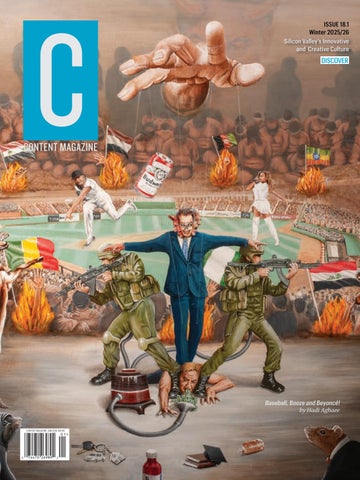
ISSUE 18.1 Winter 2025/26 Silicon Valley’s Innovative and Creative Culture
DISCOVER
CONTENT MAGAZINE
Baseball, Booze and Beyoncé! by Hadi Aghaee
CONTENT MAGAZINE, SAN JOSE $14.95
VISIT
110 South Market Street San José, CA 95113 sjmusart.org
HOURS
Museum + Store Thursday: 4–9pm Friday: 11am–9pm Saturday–Sunday: 11am–6pm Museum Café Thursday: 4–9pm Friday: 11am–9pm Saturday–Sunday: 11am–3pm
ADMISSION
- Adult, $20 - Senior 65 and over, $15 Free Individual Tickets - Youth 17 and under - College student + teacher Free Unlimited Visits - Museum members
Get this info on your phone! Scan QR, or visit sjmusart.org/visit
Artworks: Ruth Asawa, Untitled (S.155, Hanging Seven-Lobed, Multi-Layered Interlocking Continuous Form with a Sphere Suspended in the Top and Fifth Lobes) © 2025 Ruth Asawa Lanier, Inc./ARS, NY. Courtesy David Zwirner. rafa esparza, Yosi con Abuela (detail), 2021. Acrylic on adobe, 72 × 57 × 1.5 inches. Collection of San José Museum of Art. Museum purchase with funds provided by the Acquisitions Committee, 2021.12. Courtesy of the artist and Commonwealth and Council. Photo by Johnna Arnold. Yolanda López, Tableau Vivant (detail), 1978. Twelve color photographs, 14 × 9 ¼ inches each. Collection of San José Museum of Art. Museum purchase with funds provided by the Acquisitions Committee and the Lipman Acquisitions Fund, 2023.11a-l. © 1978 Yolanda López Legacy Trust. Courtesy of San José Museum of Art. Photo by Susan Mogul. Elias Sime, Tightrope: Behind the Processor #5 (detail), 2023. Reclaimed electrical wires and components on panel. 99 5 ⁄8 × 110 ¼ × ¾ inches. Museum purchase with funds provided by the Lipman Family Foundation, 2023.15. Courtesy of the artist and James Cohan, New York. Photo by Glen Cheriton, Impart Photography. Martha Atienza, Tarong 11°16’12.0”N 123°45’23.4”E 2019-08-06 Tue 2:27 PM PST 1.50 meters High Tide, 2019. Single-channel HD video, no sound, 44 min. 3 sec. Collection of San José Museum of Art. Museum purchase with funds provided by the Collection Committee, 2023.18. Courtesy of the artist and Silverlens, Manila/New York. Louise Nevelson, Sky Cathedral (detail), 1957. Painted wood, 57 × 149 × 16 inches. Collection of San José Museum of Art. Gift of Beverly and Peter Lipman, 2010.16. © Estate of Louise Nevelson / Artists Rights Society (ARS), New York.
Tending and Dreaming Stories from the Collection On View
540 Ramona St Palo Alto, CA | pamelawalshgallery.com | @pamelawalshgallery | (650) 300- 6315
Andrew Faulkner, Radiant Shore, 2025, Oil on canvas, 60 in x 48 in
C
CONTENT ISSUE 18.1
“Discover”
Winter 2025/2026 Cultivator Daniel Garcia Editors Elizabeth Sullivan, Danae Stahlnecker Alessansdra Cortez, Grace Olivieri Katherine Hypes, Katie Shiver Samantha Hull
Photographers Arabela Espinoza, Alex Knowbody Marietta Asemwota
Developer David E. Valdespino Jr. Writers Brandon Roos, Bree Karpavage Danae Stahlnecker, Joshua Hascall Nikoo Parsizadeh, Samantha Hull Sendy Tapia, Shelly Novo Stephanie Lam, Troy Ewers Yvonne Phan Designers Jesse Garcia, Trinh Mai
Publisher SVCREATES
As we enter CONTENT’s 14th year, I feel both proud and nostalgic—grateful for the opportunity to uplift the South Bay art scene and honored by the many artists I’ve met along the way. Telling their stories is a privilege, especially in an age where connection, visibility, and diversity are more vital than ever. Culture thrives on relationships; peace is born from “love for your neighbor.” And, CONTENT is about introducing you to your neighbor. In that nostalgic spirit, I’ve returned our cover design to its early roots—not just because I’ve always liked it, but because it reminds me of the innocence, passion, and bold vision that shaped our beginnings. I hope it reminds our readers that rising above comes through vision, hope, and purpose—not control, exclusion, or ego. CONTENT has always been about blessing others, and that remains our mission. As you read about the creatives in this issue, I hope you will connect with them as your neighbors and discover a new friend. Enjoy, Daniel Garcia
THE CULTIVATOR
IN THIS ISSUE
Tachiya Bryant | Arturo Garces | Works/San José | Sarah Bianco To participate in CONTENT MAGAZINE: daniel@content-magazine.com Membership & sponsorship information available by contacting david@content-magazine.com
501(c)(3)
CONTENT MAGAZINE is a quarterly publication about the innovative and creative culture of Silicon Valley, published by
.
Threshold
A RTI ST Philip Beesley Studio & Living Architectural Systems Group LOCATI O N San José Mineta International Airport (Terminal B)
Threshold, a sculpture in two parts, features Nest and Shower—radiant crystalline worlds within glass cases that frame the passage from airport to city. Shower cascades with rays and bursts, suggesting planetary auras, while Nest gathers dense floating spheres studded with tiny glass orbs, like a well at the world’s center. Together, they form a dream-like vision of our collective origins.
CONTENT DISCOVER 18.1.
Winter 2025/2026 San Jose, California
ART & DESIGN 10 Works/San José 14 Tattoo Artist, Low Le 20 Artist & Teacher, John Contreras 26 Artist, Valentina Carrillo aka “Betty Proper” 32 Chicano Muralist, Augie WK 38 Multimedia Canvas Artist, Jasmine Reid 44 Artist, Sarah Bianco 52 Painter, Hadi Aghaee 58 Multimedia Artist, Tachiya Bryant CULTURE 64 Open San José, CreaTV San José LEAD Filipino Northern California Public Media Latina Coalition of Silicon Valley Chopsticks Alley Art San José Spotlight Mosaic America Works/San José
Hadi Aghaee, pg. 52
Betty Proper, pg. 26
MUSIC 74 DJ and Producer, Arturo Garces 78 Contributors
All materials in CONTENT MAGAZINE are protected by United States copyright law and may not be reproduced, distributed, transmitted, displayed, published, broadcast, or modified in any way without the prior written consent of Silicon Valley Creates, or in the case of third party materials, the owner of that content. You may not alter or remove any trademark, copyright or other notice from copies of this content. For further information, or to participate in the production or distribution, please contact us at editor@content-magazine.com.
Jasmine Reid, pg. 38 CONTENT MAGAZINE is made possible in part by funding from the County of Santa Clara.
Low Le, pg. 14
CILKER SCHOOL SCHOOL CILKER OF ART ART && DESIGN DESIGN OF
CREATE CULTURE CHANGE CREATE CULTURE CHANGE Get a premier arts education at West Valley’s Cilker School of Art & Design. As a top
Get a premier arts we education at West Valley’s Cilker Arteducational & Design. As a top transfer institution, know what it takes to help you School achieveof your goals. transfer institution, know and whatperforming it takes to arts helpcourses you achieve your goals. With world-class art,we design, taught by educational industry experts Withexperienced world-classfaculty, art, design, and performing arts courses taught industry and West Valley College prepares you for the pathby you want toexperts take! and experienced faculty, West Valley College prepares you for the path you want to take!
DESIGN & ARCHITECTURE
DESIGN & ARCHITECTURE ࢝ Advanced Manufacturing ࢝ Architecture Advanced Manufacturing & Landscape ࢝ Architecture Architecture & Landscape ࢝ Communications Design Architecture Design & Design UX) ࢝ (Graphic Communications ࢝ Fashion (GraphicDesign Design & UX) ࢝ ࢝ Interior FashionDesign Design& CAD ࢝ Interior Design & CAD
PERFORMING ARTS
PERFORMING ARTS ࢝ Acting & Technical Theater ࢝ Acting & Technical Theater& Gaming | ࢝ Creating Music for Film,TV ࢝Songwriting Creating Music for Film,TV & Gaming | ࢝ Film, Television, and Electronic Media Songwriting ࢝ Performance & Music Education ࢝Music Film, Television, and Electronic Media ࢝ & Recording Arts ࢝Music MusicProduction Performance & Music Education ࢝ Theater ࢝Musical Music Production & Recording Arts ࢝ Musical Theater
ACCREDITED PROGRAMS PROGRAMS »ACCREDITED National Association of Schools of Art & Design
» National National Association Associationof ofSchools SchoolsofofMusic Art & Design Cilker is an All-Steinway offering courses in » National Association School of Schools of Music Stage Technology, Dance, Applied Music lessons Cilker is an All-Steinway School offering courses in (Performing Arts), and CLO3D (Fashion). Stage Technology, Dance, Applied Music lessons
VISUAL ARTS
ARTS ࢝VISUAL Animation & Computer Art ࢝ Animation ࢝ Art History & Computer Art Art History ࢝࢝Drawing & Painting ࢝࢝Photography Drawing & Painting ࢝࢝Sculpture & Ceramics Photography ࢝ Sculpture & Ceramics
Enroll Now! westvalley.edu/cilker Enroll Now! @wvccilkersoad westvalley.edu/cilker @wvccilkersoad
works/sj
Written by Samantha Hull Photography by Daniel Garcia workssanjose.org 38 South Second Street San José, California 95113 Instagram workssanjose
10 Discover 18.1
A Radically Inclusive Art Center Representing Artists at the Forefront of Contemporary Art
“W
orks has been a launching pad for so many people,” acknowledges Joe Miller, the longest serving board president of the 100 percent volunteer-run community art and performance center, Works/San José. Since its founding, the organization has been at the forefront of contemporary art, with groundbreaking exhibitions and performances, such as CADRE, an exhibition in 1984 that included an installation of the first interactive artwork on the first patented clamshell GRiD Compass laptop. The GRiD Compass is now in the permanent collection of the CooperHewitt, Smithsonian Design Museum in New York City. Nearing its 50th anniversary, Works/San José, opened its doors in 1977 during a very activist time for community art and artist-run spaces that popped up around the country. In downtown San Jose, Works was brought to life by a community of artists looking for a space that would represent the art they hoped to see, not what was dictated by tra-
11
The seven locations of Works/San José: 248 Auzerais Ave 1977-1985 * 66 South 1st St 1985-1990 * 260 Jackson St 1990-1996 * 30 North 3rd St 1997-2006 * 451 South 1st St 2007-2011 * 365 South Market St 2011-2022 * 38 South 2nd St 2022-present
12 Discover 18.1
featuring
a heartfelt exhibition of 140 amazing local artist
works/san josé 365 south market street workssanjose.org
closing and art pick-up party: sunday, february 18, 4 to 6pm
ty, by the community. Over the years, the arts center has partnered with San José State University, the San José Museum of Art, and currently shares a home with Open San José: a community hub led by CreaTV San José. Being part of the community is integral to Works’ success, and Joe sets the record straight stating, “People make the mistake in our name, thinking we’re called Works Gallery, but we’re Works/San José, and we have a gallery. We have other
exhibition: february 2 through 18, 2018 hours: friday, noon to 6pm saturday/sunday, noon to 4pm
age. Although not an exhaustive list, the following artists have exhibited at Works and/ or supported the organization as volunteers, artist members, or board members throughout its history: Laurie Anderson, Robert Arneson, Jim Campbell, Marie Cameron, Sofía Córdova, Binh Danh, Joseph DeLappe, Kathryn Dunlevie, Katherine Levin-Lau, Hung Liu, Tony May, Elizabeth Jiménez Montelongo, Sonya Rappaport, and Alan Rath— this whole article could be
artists reception: saturday, february 3, 6 to 9pm
a roundup of the countless successful artists who have exhibited at Works over the decades. Works’ resilience and its commitment to exhibiting experienced artists with emerging talent have been central to its mission even amidst seven location changes, unpredictable funding challenges, and an ever-evolving downtown landscape. The secret to its continued success is due to a dedicated team of volunteers and artist members, who over the decades have given their money, sweat, and blood to an organization they believe in—one that advocates for artists to exhibit their art. “It’s been over all of those decades that people just dared to get it through the next thing. This right here (38 South Second Street) is the seventh location of Works. No other organization I’ve heard of anywhere has survived that frequency of upheaval,” Joe states, adding, “It’s always been a real community effort.” As board president, Joe Miller, an artist and designer, has dedicated several decades to ensuring Works/San José is a space for the communi-
a community exhibition open to all artists, media, artistic statements, and points of view
ditional, top-down arts organizations such as the San José Museum of Art, which had opened its doors eight years prior, in 1969. Reflecting on the organization’s founding, Joe shares, “[that time] inspired people to think about what everybody wanted to see, what artists wanted to see, and what artists wanted to show in the area. That’s what Works came out of: this idea that there should be a community space where it’s not just more democratic but totally democratic, a place where shows are completely open, and we still do those—whatever comes in gets installed.” Works has provided a start for hundreds, if not thousands of artists, many of whom have gone on to be shown, represented, and collected by museums and galleries nationally and internationally. The goal is to bring young, emerging artists into the fold, give them their first shot, and develop their confidence and skillset. According to Joe, “San Jose is not the end of everything, but it could be the start of something.” And a start it has been for many of the most beloved artists in our contemporary
programs, too. We program three exhibitions a year at the Mexican Heritage Plaza, we’ve exhibited w ith Mosaic America, and so these projects that go beyond our space, there are some misperceptions that we’re a private gallery, and we’re of ten a ske d who owns this space, and we respond with, ‘Well, people like you.’ ” People who are passionate about art and committed to sharing their creative practice is what keeps Works going. Artists, arts administrators, and curators have made and sustained Works, and this commitment to radical inclusion provides a space where challenging the boundaries of contemporary art is core to its mission and vision. It is also one of the few art spaces that radicalized the idea that anyone can be a collector, as the annual community art auction has consistently remained the most affordable in the area. For Joe and the board, continuing the legacy of supporting artists is crucial: “Take a work of art that would be pushed back anywhere else, comes to Works but is not ready to be shown, we accept it and fix it. This idea of radical inclusion describes us, and people come to a show and believe it,” shares Joe. Works also offers unique professional development opportunities for artists to learn about how gallery representation works, how to install a
museum-quality exhibition, and gives guest curators in the community the opportunity to hone their craft. In defense of their commitment to group exhibitions, Joe shares Works mentality, “There are other places around town that do solo exhibitions, we want to show more people, basically. And we also want to be fostering this idea of the independent curator learning curation.” This notion itself is radical; in the art world, serving as a guest curator is a coveted opportunity. One often finds themselves in the position by landing a competitive internship, through mutual curatorial networks, or in master’s programs specializing in curation. Works provides a unique opportunity for curators to submit an exhibition proposal that includes at least three artists and explores concepts that seek to relate to the community through human, societal, or artistic concerns. The goal of the guest curator pro-
gram is to encourage a range of viewpoints and broaden the voices included into the fold of contemporary art discord. For example, the first Bay Area exhibition in response to the AIDs epidemic, Look at Me, in 1987, took place at Works. Wo r k s/S a n José will celebrate its 50th anniversar y in 2027, a feat shared in downtown San Jose only by the San José Museum of Art and ICA San José. Throughout the years, Works has grown, evolved, been reimagined, and yet has remained entirely democratic. The secret to its success can be drawn back to the people, the board, artist members, and volunteers who keep the lights on and inspiration alive. For Joe, sustaining this passion and commitment is key to Works continued success, “We’re making sure there’s this resilience built into the art center with the people. What’s really inspiring about being on a board like this is that it’s amazing that there are people in the world who don’t need anything back for themselves other than seeing that you did it,” adding, “I hesitate to use the word selfless, but it kind of is; there’s no money, your name won’t be on the wall, but yet, you know you did it, the people on your team know you did it. It’s pretty cool to see. Finding ways to see this continue is the goal.” C
13
LOW LE from underground tattoo artist to community builder Low Le got his first tattoo at age 14. It’s of a hannya, a Japanese demon representing life’s most intense emotions: jealousy and rage. The rich, black tattoo etched on Low’s left forearm has been through hell and back with him, no touch-ups needed. The hannya tattoo was the start of Low’s ongoing journal, and he has always kept each entry as is: “It’s a diary—I can look at every single tattoo and remember exactly what I was doing that day, what I was feeling, what was going on in my life.” Now, over 20 years later, Low is
Written by Yvonne Phan Photography by Daniel Garcia tattoosunlocked.com 1900 Lafayette Street Santa Clara, California 95050 Instagram outlaw_ofthe_mind 14 Discover 18.1
15
a tattoo artist and an instructor known for creating images of Asian mythology with dynamic, detailed backgrounds. Clients come to him for his shading style and ability to make tattoos look like they dance on skin. While most tattoos tend to look stationary—like 2D images printed on the human body—Low’s tattoos illustrate flow and movement through his careful execution of organic elements like water, wind, and smoke. His large, intricate pieces can take 60 hours or more to complete. The permanence of tattooing is what drew him in: “It’s crazy to think that you could create art and have it be with someone for the rest of their life. It’s the greatest gift in the world.” Before he started tattooing, Low built a strong background in self-taught pencil drawing starting at age five. In his childhood, art was a form of expression, but also a coping mechanism. When he was drawing, he felt like he could be in his own world, even when his outside environment felt confusing, noisy, and overwhelming. In his early days, he took inspiration from anime and manga and identified with characters like Goku and Vegeta from Dragon Ball. He started drawing his favorite cartoon characters in pencil, then moved to pen and ink as he built up his skills. Everything changed when Low discovered that art could live on human skin. “Once I figured that out, I was hooked. My life was just completely absorbed by tattoos, and that opened up new doors,” he says. Low got his hands on his first set of tattoo equipment at age 15. He learned how to tattoo through informal settings, mainly from other artists in an underground way. Today, aspiring artists have the advantages of utilizing social media to promote their work, using synthetic skin to practice on, or being apprentices to learn the craft systematically and safely. When Low was first starting out, clients came to his house for tattoos and his small business grew through word of mouth. Today, Low practices in his own studio (which doubles as a classroom) in Santa Clara.
“Once I figured that out [that art could live on skin], I was hooked. My life was just completely absorbed by tattoos, and that opened up new doors.” 16 Discover 18.1
17
18 Discover 18.1
Low’s tattooing course, which includes art theory and tattooing practices, prepares aspiring tattoo artists to build their businesses from the ground up, with many of his former students now running their own businesses. The most important concept for students to understand is “Theory of Mind,” a fundamental theory in psychology. “You have to understand that the way you are looking at the world and what you feel can be completely different than the person sitting next to you,” Low says. “This makes it so that our assumptions and narratives don’t blind us from learning about someone. It opens up endless possibilities.” Low also leans into psychology in his Instagram account, @outlaw_ofthe_mind. He considers himself to be an outlaw because there are no limits to his mind or sense of self. He didn’t follow a traditional educational pathway in life and doesn’t box up his mind when experimenting with new forms of artistic expression or meeting new people. “It used to be @ lowletattoo, but ‘outlaw’ is an umbrella term to cover all of the things my social media offers to people,” he says. On his social media, you can find his tattoo work, pencil and ink drawings, original music, and poetry, as well as information regarding community events he has organized. Since 2021, he has purchased hundreds of gifts for underprivileged children living in San Jose neighborhoods— the ones he grew up in. “I took out all the money from my savings, took donations from everyone around me, and went to buy as many toys as humanly possible,” he says. In 2021, dozens of families came to Flickinger Park, ate tacos, and picked up toys for Christmas. Low has been on a spiritual journey, and the community events are only one part of it. Recently, he’s leaned into lower-arousal emotions in his artwork, such as calmness and serenity—completely opposite from those of his first tattoo at age 14. “I’m growing as a person and exploring different avenues and hitting different notes. We don’t always have to be raging and aggressive all the time,” he notes. C 19
Itzayana Silva Guided by the Dark
20 Discover 18.1
Contreras
JohN The air is heavy with the smell of eucalyptus and sunbaked asphalt. It’s an area of Menlo Park that many zip past without so much as a glance. But hidden behind an old fence and bursting flower bushes is a backyard transformed, not into a haven, but into a battlefield of color and shape. One sculpture, one moment of calm, one memory at a time. This is where John Contreras labors: a space that is half battleground, half chapel. John seems not a man stating himself, but nearly all he makes is. His work treads the balance between memory and message, between inherited suffering and chosen voice. He returns again and again to war, culture, innocence, and the discomfort of dualism—military and civilian, brown and American, sacred and broken. These are not themes; they are coordinates that belong to him. “You can’t run away from that stuff,” he says. “It’s my life. It’s in my thesis. It’s in my artist statement. It’s everywhere in my life.” Before arriving at his current role as a program assistant at the Palo Alto Art Center, John wore many hats: artist, teacher, veteran. He studied at UC Santa Cruz and earned his MFA from San José State University, eventually teaching for their spatial art program. He’s also worked with incarcerated populations as an art therapist, supported his local community in various city roles, and served in the US Marine Corps. John was raised on the east side of Menlo Park, an area rarely spotlighted in Silicon Valley. His childhood, shaped by a military upbringing and the contradictions of being both American and culturally “other,” finds its way into every medium he touches. Growing up in a big family, John often had to explain his creative side or justify it through his work. From sculptures to performances and paintings, his work speaks volumes about the things most people avoid: violence, identity, alienation, and longing. One such project was a website he created where the main page featured his story of being in the military. Surrounding his story were questions he wanted viewers to engage with. He recalls, “It was questions surrounding the current times. Like, what do you think about police brutality? What do you think about ‘black-on-black crime’? And then with so many other instances going on—how do we heal America?”
Written by
Nikoo Parsizadeh Photography by
Marietta Asemwota johnjcontreras.com Instagram
john_contreras_art
21
Screwball, 2021
Flower, 2025, tattoo on practice skin, 6“x8“
En Plein Air , 2021, 2023,120”x132”
When creating art, John is often captivated by the relationship between belonging and contradiction. The absurdity of luxury next to poverty, the silence of innocence amid conflict, the desire to be free in a world full of constraints. John doesn’t mind if people don’t immediately understand his work. He only minds if they walk away without feeling anything. He says, “There’s this message I keep trying to send, which is you can be who you want to be. You can talk about the hard things. The things people don’t want to talk about, like war, grief, mental health, racism. Art is where I feel free enough to say it.” It’s clear that John’s profession is not merely about making things, but about making bridges. Bridges between the past and the future. Between the boy he once was, the man he is now, and the artist he’s been transforming himself into. Between the unseen people and the world that fails to see them. It’s in these moments that John’s vulnerability shines through, not performative, not packaged, simply real—like his art. It’s honest, multilayered, sometimes messy, and always reaching for something human. John has no delusion about fame. His aspiration is more intimate: to leave a mark on people, not walls, and to create something that speaks when words don’t. John’s installation, Where Christopher Robin Played, reads like a nursery rhyme and lands with a grim thud. Stark white clay sculptures stand out against a pile of dark wood rubble. Christopher Robin, body twisted at odd angles, lies prone next 22 Discover 18.1
“There’s this message I keep trying to send, which is you can be who you want to be. You can talk about the hard things.”
Under One Sun pt. 20, 2024, iron rebar, Rust-Oleum, house paint, 10‘
23
Under One Sun pt. 21, 2024,detail, iron rebar, Rust-Oleum, house paint, ~10‘
24 Discover 18.1
Where Christopher Robin Played
“I love humanity. All of it. All its ugly and all its beauty.”
to a toy rifle as his teddy bear friend looks on in horror. Looking at the installation, you remember the childhood wonder of Winnie-the-Pooh and the Hundred Acre Wood, but here the playground is taken back, remapped, and wounded. It’s an exploration of innocence lost, recovered, or even mythologized. Here, John weaves together tenderness and trauma so that they are indistinguishable and asks the question: “What happens to the children when the war follows them home?” John’s personal identification with the themes and characters he chooses to explore has a profound complexity. He resonates not only with the characters, but also with their creators who perhaps put some of themselves into their creations. John’s art is not just about art, it is about witness. Particularly, it is about what society does not want to witness: domestic violence, homelessness, incarceration, and the ripple effects of militarism. He does not paint for comfort. He paints for truth. John shares one of his truths: “I always say, if I don’t see you, don’t hug you, don’t look you in the eye or talk to you, just know that at the end of the day, I love you. And that’s hard to hear, right? Because we’ve twisted the word ‘love’ so much. But I mean it. I love humanity. All of it. All its ugly and all its beauty.” C 25
Betty Proper VALENTINA CARRILLO
Written by Shelly Novo Photography by Daniel Garcia bettyproper.bigcartel.com Instagram betty_proper 26 Discover 18.1
PAINTING BEYOND THE FRAME
S
plashed across the sides of buildings, gracing planter boxes, and featured at paint jams, art walks, and exhibits, art by Betty Proper catches eyes across the Bay Area. Behind her artist name and these bold and colorful paintings, you’ll find the petite, unassuming Valentina Carrillo. In a recent exhibit at the Santa Clara County Fairgrounds, Valentina displayed her art in a custom-designed studio space—a welcome change from her typical setup at the kitchen table. Stepping inside the exhibit, the viewer is enveloped by a wash of
mint green, distinctive lines, and characters with retro hairstyles and big doll eyes. Here you find Valentina painting, drawing, and meditating on her art. Wide-eyed girls with long, swooping bangs covering one eye were one of the first things that she began drawing. Eyes with big lashes can still be consistently found throughout Valentina’s art. At first, she couldn’t get the pair of eyes just right but that would come with time. Growing up in a Chicano household, she saw lots of tattoos with big eyes and dramatic shading. She pulls many style elements from Mexican folk art, '90s hip-hop culture, and her younger years. Although Valentina has been creating since she was a child, the art community in San Jose wasn’t unveiled to her until a friend invited her 27
to a South First Fridays art walk. “I definitely remember a mindset shift…it was so eye opening.” Prior to this evening, the only exhibitions she had seen in San Jose were at the San José Museum of Art. In 2008, she bought a pack of watercolors from University Art and started playing with them. She hoped to produce controlled, detailed pieces with watercolor paints. However, without instruction, she became frustrated with the colors bleeding across the page. She couldn’t get the watercolor to do what she wanted it to do and hated fighting with the paint. Eventually, she signed up for a formal painting class and learned that the effects she thought were
28 Discover 18.1
produced by watercolors could be produced with acrylics. In art class, she learned how to shade and add depth to her work. Revisiting pictures of her art from that time she notes, “It’s cool to see how far I’ve come and how long I’ve been doing this.” Diving into the art world in San Jose, Valentina started frequenting art shows. Role models became friends, including Fernando Amaro Jr. (also known as Force 129), who would eventually become her partner. Largely influenced by his encouragement, she held her first art show at Iguanas Burritozilla. She featured a variety of Día de los Muertos characters and pieces she had made in her art class.
“I was just jumping into the void, hoping I could latch onto something.” 29
30 Discover 18.1
At that time, she went by Nifty Vee, signing blog posts with “Sincerely, Nifty.” The name Betty Proper didn’t come until 2015. She designed a paper-doll character, complete with an old school apron, little shoes, and a retro mixer; the title of the illustration was a tonguein-cheek reference to Betty Crocker. Valentina began developing her range by trying out different art styles. Still today, she explains that her art style is hard to describe: “That’s why I say mixed media. Because it needs to incorporate everything. I even learned to love watercolor.” Persisting through the challenge of learning a new medium has been a theme of Valentina’s growth. She had a similar experience as with the watercolors when she learned to paint with aerosols. After some spray-painting sessions in her backyard with cans purchased from Home Depot, she found herself wondering, “How the hell do they do this?” But she had ambitions to paint big. She didn’t stop trying. Instead, she got help from Force 129. One of their collaborative murals can be found in the San Jose SoFA district.
Valentina now has a collection of large-scale murals in the Bay Area. Her first mural proved that she would and could paint big: she could paint beyond the frame. Although she was nervous about making a mistake, she has developed control and confidence. It may seem surprising that Valentina has such a passion for painting big, being a self-described introvert, but she explains how she finds balance between her quieter moments and her bolder self-expression. She doesn’t regularly put her name on her art and goes by Betty Proper, but when people see her art, they see the work of someone who has a cool self-assurance. Art is ultimately a meditative process for Valentina. As someone who works a nearly full-time job, is a mother to a daughter with special needs, and creates from her kitchen table, it can be challenging for her to find the time to make art. And yet she makes time for it. When she creates, all her worries melt away. She gets to freestyle, unplanned and unworried about where the brushes will take her next. C
31
Augie WK 32 Discover 18.1
SITUATION CRITICAL A
rtists are one of the cornerstones of culture, but what people don’t talk about is what the artists have to go through to get their work put up, the environments they work in, the people they encounter, or the amount of time they work on a piece. Sometimes artists are put in situations that aren’t ideal. Augie WK, a Chicano muralist, describes these situations as critical and his “Situation Critical” approach to art affords him an ability to create in various places and work as a full-time artist. Augie has been doing art all his life but has only been fulltime for the last two years. Even when he was working a fulltime job, working four days a week, ten hours each day, he was still operating like he was a full-time artist. His appreciation for his art is shown in his approach. Augie is a technician. “I’m creating a paint-by-numbers,” Augie says. Augie describes his style as “neo-Chicano” because it’s more than what people classify as Chicano art. “I’m influenced by everything, Asian style, comic style, everything,” Augie says, and that influence is reflected in his style—vibrant and complimentary to the wall he uses as a canvas. Augie’s style is undefined, just like he is as a person. He has no clear place he says he’s from or name used, other than his alias. The only things that he says define him are the place he’s creating at and the piece he’s creating at that place. “I’m there with the elements,” Augie says. Home is where he’s creating. Augie explains, “I have my speaker, I have my jams, and I organize my color palette.” That feeling of home is why he’s comfortable in high-pressure situations. He has even more of a sense of home when he creates with his romantic partner as an art duo named The Jams. The name is inspired by the music they play while creating. When asked what it’s like creating with his partner, Augie refers back to Situation Critical. “Anything can go wrong, so be ready to improvise.”
Written by Troy Ewers Photography by Daniel Garcia thejamsbrand.com/augiewk Instagram augiewk 33
Art is a journey. “
34 Discover 18.1
don’t
I want to be stagnant I
want
to move forward.”
35
Lowrider Chained at Writer’s Bench Alley, San Jose, California , 2025
Vocho for the Old Skulls Festival, Xochimilco, Mexico City, Mexico, 2024
36 Discover 18.1
Augie creates with the spirit of graff (graffiti) artists, and he goes for that crowd even when working certain corporate gigs. The fulfillment comes from how it looks at the end, and he takes that picture in front of his piece. He says it has to “look good from up close, but legible from across the street.” This feeling is essential to graff culture. The feeling you have when you take that picture of the piece you just hit on a wall is what muralists of all levels chase when they truly are passionate about the work. Augie looks at his art as something he wants to excel at every day of his life. “Art is a journey. I don’t want to be stagnant; I want to move forward.” Augie says, “It’s freeing,” and when he’s describing his work, the freedom he has is inspiring. Kids have seen his work and realized that art isn’t just on paper, it’s on the walls you see on the way to Santa Cruz Beach Boardwalk. Augie explains jokingly, he doesn’t sweat the small stuff. Augie creates from the idea that everything he does can be done by someone else if they really care about what they’re doing. The only thing that limits people when they’re creating is their own imagination, and if you approach the thing you’re creating as a critical situation, then it becomes as important to you as a wrestler going for the world title. Augie is a one-ofa-kind artist, a combination technical craftsman and a pure storyteller. His pieces come from a place that is passed down through his connection to his family and his culture, which is why his home is where he creates and even in the most critical situations he doesn’t fold under pressure. “It’s got to be a hit,” Augie says, because the situation is always critical. His next piece always has to be a hit and just like in music, a hit doesn’t have to be palatable, it just has to be great. C
Selena, 2023, San Jose, California
37
Dancer in Red, 2025, mixed media on canvas, 36“x24” 38 Discover 18.1
JASMINE
REID
Written by Stephanie Lam Photography by Arabela Espinoza jasminereidart.com Instagram jasminereidart
WHEN JASMINE REID PAINTS, she doesn’t always have a clear idea of what the finished product will look like. That doesn’t stop the San Jose–based multimedia artist, however, from picking up a brush and mounting a canvas. Rather than relying on her eyes, Reid listens to her gut to figure out how the picture will take shape. Her instincts tell her to deviate from straight-lined strokes and instead use tissue paper or dried paint to help fill the empty space. “I know when a piece is settled, and I know when it’s unsettled,” Reid says. “I can feel it, I can sense it, and I can trust that feeling so strongly. So far, it hasn’t steered me wrong.” This is typical of Reid’s work: onlookers will never find an art piece made entirely from acrylic paint or any one medium. There are always objects cleverly layered onto the canvas, like flecks of gold leaf, clay, or ink. Reid takes pride in calling herself a “scrappy artist,” someone who looks at waste and byproducts, and repurposes them. This artistic process is both improvisational and strategic for the New England native, who recently graduated from Stanford University with a PhD in archaeology. Her finished pieces explore the nuances of memory, reclamation, emplacement, and displacement, concepts inspired by her academic work. Never quite knowing what a piece will become or what materials will be used also helps free Reid from pressure or criticism she feels towards her art. Painting is her creative space, where she can process her thoughts and grow as an artist and individual. “I have a lot of self-doubt in so many other parts of who I am, whether it’s work or whether it’s relationships and how I nurture those relationships,” Reid says. “But in art, it’s where I feel the most confident, even though I feel it has the most room for growth.”
39
The Exodus, 2023, mixed media on canvas, 36“x48”
Many of Reid’s paintings feature vibrant gestural drawings of landscapes and the human body. Her beloved paintings include The Earring, which depicts the backside of a longhaired person and is made with acrylic and latex paint, card stock, tissue paper, ink, and 14 karat gold. To finish it off, Reid has a real-life earring of hers attached to the canvas. Another favorite is The Listener, which showcases a portrait of a person sitting and is compiled with paint, tissue paper, modeling paste, string, bentonite clay, plastic, and ink. “I very much feel that it’s a dialogue between me and my painting,” Reid says. “I do let paper act as paper and paint act as paint, but then I try to manipulate that by ripping or tearing or modifying it in some way. I love being able to speak back to whatever is left and build on that.” Art has always been a constant pursuit in Reid’s life. She grew up in a small town outside of Boston, a place where she could explore the limits of her creativity but was often “confronted by the reality of being a Black girl,” Reid says. In high school, she took art classes and was drawn to the use of texture in artwork. Although she was interested in the arts, Reid eventually chose to major in African studies and anthropology at Yale University. During her time there, Reid shares she felt drawn to learn more about South African history and understand “the fullness of what it means to be a Black woman.” As she continued to explore South Africa’s culture at Stanford, Reid recalls the stress of graduate school was getting to her. The Listener, 2024, mixed media on canvas, 24x18” 40 Discover 18.1
41
42 Discover 18.1
“I know when a piece is settled, and I know when it’s unsettled. I can feel it, I can sense it, and I can trust that feeling so strongly. So far, it hasn’t steered me wrong.”
Opposite page: Mise en Garde, 2024, mixed media on canvas, 36“x24”
Seeking a creative outlet, she decided to return to art. “I genuinely don’t think I would have gone back to art if I hadn’t been in that stressful pressure cooker of grad school,” Reid says. Reid’s PhD work examines how creative institutions in South Africa can facilitate difficult conversations about land justice and race relations. She journeyed to Johannesburg to find those answers and frequently interacted with local artists. Reid says she felt inspired by the artists’ abilities to turn trash and recyclables into art and retell historical South African events in an interesting way. “Being around so many creative people who are not afraid to identify the creative impulses inside them and own them, gave me a lot of confidence to do that myself as well,” Reid says. While Reid has stepped away from academia, she is still intent on exploring people, their history and experiences in her artwork. As she navigates San Jose’s art scene and the publicity of being an artist, Reid is focused on protecting her creative impulses: “I think of myself as someone who always has this creative flame,” she says. “I feel like I’m going to die if I don’t get it out.” C
This page: San Jose at Dusk, 2024, mixed media on canvas, 24“x36” 43
Sarah Bianco An Abstract World Imbued with Remembrance and the Existence In Between
Written by Bree Karpavage Photography by Daniel Garcia paintingbybianco.com apricitygallery.com sarahbianco.com Instagram paintingbybianco 44 Discover 18.1
45
Respect What You Love, mixed media on wood panel, 32.75“x24.5“
46 Discover 18.1
Shifting Terrain, 2025, acrylic and spray paint on canvas, 60“x96“
Her Flowers Still Bloom, mixed media on wood, 18“x18“
“Apricity,”
which means the warmth of the sun in winter, is an antiquated word removed from the modern dictionary—but its feeling far from obsolete. This feeling, says Santa Cruz artist Sarah Bianco, is one that everyone feels, knows, and loves, and is the inspiration behind her art practice and gallery at the Tannery Arts Center. Sarah’s work in the arts is twofold. Working most days for her company, Painting by Bianco, specialty painting homes and businesses, Sarah’s attention to detail comes through in custom finishes, designs, murals, and intricate work that most house painters don’t do. Alongside her commercial practice, she’s also a fine artist, taking commissions for public murals, portraits, and paintings. She considers these dual practices a marriage of sorts: the yin and yang balance of the soft and ethereal feminine energy with the external tough and logical masculine. This balance keeps her inspired and always evolving, both in medium and style, and in the understanding behind her own processes and challenges. 47
This marriage shows up in her recent body of work using old painter’s tarps from her commercial business as the canvas for her fine art paintings. The material retains a canvaslike texture that she either stretches or leaves unstructured, the latter being her favorite form to work with as it provides raw edges and an organic feeling. Sarah views the tarps, abstract in style, as landscapes and works with the accidental lines, dots, and marks as part of the background to inform what comes next. Moving away from her once more controlled way of painting, she has adopted a head space that allows her to drop in, stop thinking about the process, and allow the paint and canvas to talk to her. The airy dreamscapes that come through often depict figures floating, jumping, or suspended above the ground. This liminal space, she says, is her favorite place to be, the moment in between when you jump and when you land. “Showing up to a canvas without a plan starts the process of breaking through the judgment I put on myself. I allow myself to get into the flow of painting what’s coming
through and that’s what being an artist is all about—being available for what wants to come through,” Sarah shares. She goes on, “I don’t know what’s happening in the moment I’m painting, but when I look back, I really understand…the art is very telling about what was going on in my life at that time.” Her recent shift from oil to open acrylics contributes to her latest style. While she still loves the viscosity of oil, she’s found that open acrylics provide a movement she can work with, without the long dry time. She’s also been finishing her pieces with oil-based paint bars. The bar’s chunky quality gives her paintings a unique and distinct texture, a deep pastel color story that exudes a dark yet bright feeling, again playing to this idea of her practice being a marriage of opposites. Mixing these two paints has become her signature in this new series. Sarah’s versatility has allowed her to embrace a variety of creative work from live paintings and murals to creative installations at Burning Man. As a muralist she doesn’t
The Ending Was the Beginning, oil on used painters tarp, 8“x10“
48 Discover 18.1
Keep Swimming, oil on used painters tarp, 8“x10“
“If I want to make the work better or different or push it into new territory, I have to be comfortable with that awkwardness.” The Artist, oil on used painters tarp, 29“x48“
We Run to Feel Free, oil on used painters tarp, 45“x36“
49
Feel, oil on used painters tarp, 30“x39.75“
50 Discover 18.1
“It’s not just me and the piece. Once it’s created, it has its own relationship with everyone who sees it, and that’s actually the magic of it all.” use spray paint, which she says defines her style, having painted several large walls in Santa Cruz and collaborated on many others, including several at the Tannery Arts Center. Her brush work carries over to her creative work at Burning Man, where Sarah muses, “I love being thrown into a non-logical world. It takes me back to play and reminds me why art is so important.” In 2024, she contributed to a portal room inside The Man, where she worked with teams to help bring another artist’s creative visions to life. Her fun personal side project during the event was offering realistic portraits of nipples on 2x2 inch canvases to festival goers. “In the spirit of getting weird, I decided to paint nipples; just like faces, nipples are all very different. People have a lot of stories about their nipples and painting them feels like a type of therapy,” Sarah says. These projects keep Sarah inspired and engaged in her creative community. As an original resident, studio artist, and gallerist
at the Tannery Arts Center, Sarah explains the impact it has had on her career over the 15 years she’s been there. “I’m a poster child the Tannery was built for,” Sarah shares. Her studio doubles as a gallery space aptly called “Apricity Gallery” and has given her a way to connect with other artists by frequently featuring guest artists during First Friday Santa Cruz and for special exhibitions. Not only has the arts center offered her affordable housing in a growing city, but it’s also given her a home within a diverse community of artists and provided her opportunities with the Arts Council Santa Cruz County. As for the feeling of apricity, Sarah holds a close connection. Within apricity she finds a relatability between her work and the viewer giving each other a feeling of warmth. “It’s not just me and the piece. Once it’s created, it has its own relationship with everyone who sees it, and that’s actually the magic of it all.” C 51
HA ADI ghaE
Bearing Witn e ss
E nts ar,
: A p ain te r t h at c o n f r o w
p ower, and humanit y he 52 Discover 18.1
ad - on
Written by Joshua Hascall Photography by Daniel Garcia hadiaghaeefineart.com Instagram hadiaghaeefineart 53
F
or Hadi Aghaee, art began as a quiet rebellion. Growing up in Shiraz, Iran, while his brothers wrestled in the living room, he would sit quietly on the floor with a pencil and paper, sketching their movements. Without formal training or proper supplies, Hadi taught himself to draw. The walls of his childhood home were eventually filled with portraits of movie stars, musicians, and world leaders.
Hadi’s passion for art was set aside for decades when he made the difficult decision to immigrate to the United States and pursue a more practical path: an engineering degree. The journey wasn’t easy, and he arrived alone with only a bag and the clothes on his back. “With the help of my brother and my dad, I came here with $200 cash in my pocket. That’s it,” said Hadi. During his studies, Hadi reluctantly enrolled in an art class and was quickly recognized for his talents. The dean offered him a full scholarship to study art, but accepting it would have meant dropping his engineering program. At the time, this was not an option for him. He explained, “I could have done art in Iran. I didn’t have to go all halfway around the world with my parent’s hard-working money. I rejected it for that reason.” In hindsight, he thinks his parents would not have minded if he pursued art, but out of respect, he chose not to. “If I go just to [study] art, it’s an insult to them,” said Hadi. Corona Declared a Pandemic, acrylic on canvas, 48“x48“
Warriors, acrylic on canvas, 48”x48” 54 Discover 18.1
“My only purpose is to open up a conversation and a dialogue. If it’s war or rape or whatever, discrimination, let’s talk about it.”
The urge to create never left him. Even in his most time-starved years as an immigrant student, translating engineering textbooks word by word into Farsi, Hadi occasionally picked up a pencil to draw. The drawings from his youth shared a constant thread of his work—social commentary. “When I look back, those drawings that I did, they were all social issues at that time too,” said Hadi. In 2014, Hadi rediscovered painting. His first work was an imagined seascape. “When I did it, I said, ‘Wow! It looks good. I can still draw. I can still paint,’ ” recalled Hadi. That realization propelled him into a period of prolific practice painting florals, landscapes, and scenes familiar to most painters. After two years, Hadi made a radical pivot. “I maybe sold two or three. I thought, this is not even bringing my money I put in,” he says. “So, if I’m not going to bring money in, then I do what I want to do: talk about social issues and politics.” That decision redefined his purpose as an artist. Today, Hadi’s paintings are visually arresting collages of time and ideology. He composes each painting as a careful narrative, built from visual fragments and layered with historical depth from exhaustive, emotionally taxing research. He doesn’t work from a single photo reference, instead he builds his subjects from dozens of individual images. For example, Hadi might use hands from one photo, a figurative pose from another, and various facial features from several more. “Everything—all the characters you see in all my paintings—is made up of a dozen pieces from a dozen photos,” Hadi said. 55
No Business Like War Business, acrylic on canvas, 48“x48“
Godz 2nd Mistake (Part 2), acrylic on canvas, 36“x24“
56 Discover 18.1
Godz 2nd Mistake (Part 4), acrylic on canvas, 36“x24“
In one very personal painting, The Lingering Summer Memories, Hadi explores the disintegration of familial unity during the Iran-Iraq War which claimed the lives of his two youngest brothers. The government illegally conscripted Hadi’s youngest brother at age 16, using falsified documents. That brother was never seen by the family again. “My two youngest brothers, they took those away without telling the family,” Hadi said. “That really took a toll on everybody in the family. It wasn’t under anybody’s control, but they became mad at each other, and the whole family fell apart as far as unity goes.” He structured the painting as a visual timeline, telling the story before, during, and after the war. This was the first time Hadi understood how to capture a complex historical event in a single frame. He said: “I put it on every painting now, how you put different time frames of events to create a story within one frame.” Hadi does not shy away from politically
charged or controversial themes. Many of his critiques focus on global power dynamics, even to the point of inciting anonymous critics to demand his art be removed—like the painting The Absence of Humanity, which the Triton Museum of Art exhibited in 2013. Dialogue, not dogma, is his goal. “My only purpose is to open up a conversation and a dialogue,” Hadi says. “If it’s war or rape or whatever, discrimination, let’s talk about it.” He is not interested in easy answers, only honest and sometimes difficult conversations. “If someone has a problem with my work, tell them to contact me. Let’s talk.” Throughout it all, Hadi remains an artist fueled by history, justice, and the many threads of the human experience. Hadi Aghaee’s work dares us to pause, look closer, and ask questions about the stories that are hidden beneath the paint. “If I make people talk about it and they stay in front of my work, my painting is doing its job,” Hadi says. “That’s all I want.” C 57
TACHIYA BRYANT Masks of Truth: Tachiya Bryant’s Journey Toward Bold, Unapologetic Power Written by Sendy Tapia Photography by Daniel Garcia tachiyabryant.com Instagram tachiyaroolz 58 Discover 18.1
A
mongst the suave R&B beats echoing throughout her San Jose studio, Tachiya Bryant almost cries. She had been living with her acrylic portraits and sculptural cotton masks for months—stacked on tables, lining walls, works-in-progress that carried both her frustration and her hope. But when photographer Alex Knowbody captured them in high-resolution, she suddenly saw them differently: luminous, alive, commanding. “I’ve just been living with this work…not really thinking anything of it,” she recalls. “But just seeing it in a different light, I was like, wow, this is me.” For Bryant, a self-taught multimedia creative, that moment didn’t just attest her talent. It was an affirmation, stepping into her power after years of shrinking herself in spaces where she didn’t always feel seen. Born and raised in San Jose, she describes her city as a place where Black representation was scarce. Her mother, determined to protect that identity, filled their home with Black art, music, and dolls. Still, outside the house, Bryant often felt the burden of trying to fit in. “I don’t think I had a clear understanding of who I was,” she says. “I was so busy trying to survive.” Only after high school, distanced from those pressures, did she begin to fully embrace her Blackness—loudly, proudly, unapologetically. That shift marked the beginning of her intentional art practice, one that now spans collage, painting, illustration, and sculpture. Several years later, her work explores more than expression—it explores truth telling, making space for the emotions and stories often ignored or misrepresented. Bryant’s latest series, We Wear the Mask, represents her boldest turn yet. The project centers on Black women and the complicated terrain of anger, healing, and emotional expression. For Bryant, the project is both personal and political, a challenge to the stereotypes that have long silenced Black women. “I wanted to imagine a world where embodying the feeling of anger didn’t mean having it weaponized against you,” she describes. “What does it look like to speak up for yourself without worrying how society will perceive you?”
T
Written by David E. Valdespino Jr. Photography by Daniel Garcia Instagram tunedbytyler
59
Da Bluez, 2023, acrylic on canvas, 22“x28” 60 Discover 18.1
Void pt. 2, 2025, acrylic on canvas, 22”x28”
(LEFT) We Wear the Mask, titled after the famous poem by Paul Laurence Dunbar, is a four-part series comprising paintings, masks, photography, and short films.
Afro Punk, mask, cotton base and crochet braiding hair
Target, mask, cotton base and crochet braiding hair 61
La Negra, 2024, acrylic on canvas, 22”x28”
Mercy, 2025, acrylic on canvas, 22”x28”
Specialized Epic Hardtail, 2024, tonal dry brush Freeze, 2025, acrylic on canvas, 22”x28”
62 Discover 18.1
The masks and paintings she creates are vessels for emotions often denied or diminished. Many of the women in her work are faceless, intentionally so. They stand in for the countless women who, she argues, have been left to heal themselves, denied care by the very communities that depend on them. “I think Black women are often left to fend for themselves,” Bryant explains. “It’s painful to have to do all of those things by yourself. You just want to exist, to feel without judgment.” Her journey to this point has not been straightforward. In her earlier years, she resisted the pressure to be labeled a “Black artist,” opting instead to create strange, experimental work— characters and sculptures that couldn’t be easily categorized. It was her way of pushing back against a narrow, palatable box the art world often reserves for Black creators. “I didn’t like being told what to be,” she declares. But with We Wear the Mask, Bryant has arrived at a new clarity. “This project feels like I actually have something to say,” she reflects. “And not only say, but say it in a way that reaches people authentically.” What emerges from this body of work is authenticity. Bryant’s masks are mirrors, reflecting uncomfortable truths to the viewer. They are not meant to soothe. They intentionally insist. “More than ever, I just want people to feel seen,” she explains. “Being real is not always pretty. Sometimes it offends people. Sometimes it hurts. But it’s necessary.”
Valiant, 2024, acrylic on canvas, 22”x28”
Still Here, 2024, acrylic on canvas, 30”x40”
Stepping into her power has also meant learning how to sustain it. Bryant admits she has a habit of throwing herself entirely into projects, only to realize later that it isn’t sustainable. These days, she is practicing consistency over intensity, guided by wisdom passed down from her matriarch: “The only way to eat an elephant is one bite at a time.” For Bryant, it’s a reminder to stay present, to focus on what’s in front of her rather than getting lost in the next milestone. “The things I wanted back then, I have now,” she says. “I have my own studio space. I’m doing the kind of work I never imagined I’d be capable of. That in itself is a blessing.” Affirmations also play a vital role in her practice. For years, she studied manifestation without fully embracing it. Now, repetition and faith fuel her progress. That mindset has carried her to achievements she once thought impossible—like working with the San Jose Sharks twice and seeing her artwork on a billboard in her hometown. “Once you get that confidence, like okay, now I know it’s going to
happen—then you start asking yourself, ‘What do I really want now?’ ” As Bryant continues to build her career, she remains committed to making art that tells the truth—even when it is uncomfortable. Her advice to young Black creatives reflects the same conviction: “It’s important to figure out what you have to say. Pull from your experiences before you speak for the whole community. Black joy is also resistance. There are so many more layers to what it means to be Black.” Her masks and collages, her affirmations and rituals, all speak to a deeper philosophy, that visibility is a responsibility and authenticity is a form of power. “I think I’ve been used to shrinking myself,” Bryant reveals. “But at this point, I can’t shrink even if I want to. I have to show up, because there are people who could benefit from my story.” In her work, and in her life, Bryant is doing just that—showing up, boldly, unapologetically, and in full view. C
63
hop s t ick lley Ar reaTV San Jos a t i n oalition o ilicon Valle
OPEN san josé Downtown San Jose’s Community Hub of Connection and Collaboration Thirty-eight South Second Street in downtown San Jose has a storied history. Over the years, it’s been
a furniture store, a grocery store, and a tech makerspace. As of June 2023, it’s home to CreaTV and a co-
alition of nonprofits hoping to not only make their mark in San Jose’s history, but also to forge a path for the future of arts, culture, and civic engagement. Walk through the glass doors under the still-hanging Zanotto’s sign, and you’ll find yourself at the entrance of Open San José—a new community hub aimed
at uplifting oft-silenced voices through technology, storytelling, and justice-minded community building. Open San José was born from CreaTV’s need to relocate. As their lease was ending and they sought a
new home, CEO Chad Johnston proposed something different: rent a space twice as large as they need-
ed, and then provide a place for other organizations to also call home. Chad remembers thinking, “We’re Written by Danae Stahlnecker | Photography by Daniel Garcia opensanjose.org | Instagram: open.san.jose
64 Discover 18.1
EAD Filipin osaic Americ oa lri ft ohrenri ublic Medi an Jos porks/San o t l i gJos h “We’re just here to help people achieve what they’re trying to achieve.” –Chad Johnston, CEO, CreaTV
in the most innovative place on earth, but we can’t innovate when we’re wondering about our basic needs.” Silicon Valley has a lot to offer, but it’s an expensive place for small and midsize organizations. Those costs can threaten their ability to stay open or have a deeper impact in the community. CreaTV sought to solve this problem by rethinking collaboration in the nonprofit landscape.
Instead of renting a studio for themselves, they would curate a group interested in cross-sector collaboration and in thinking of an office as an exercise in power building. So they found an unused
space in the heart of downtown and transformed it into a playground for new means of collaboration. The eight anchor partners are clear that this is not a co-working space, it’s a partnership. They meet
every other week for sharing, planning, and collective decision making. While they may have interacted anyway, Open San José’s model gives them opportunities to do so much more—and to challenge
traditional ideas of power and agency as they do so. Looking at systemic injustice in conventional gov-
ernance models, Chad questions, “How do we solve the power analysis? We don’t do it alone. What if we tried something new? It won’t solve it all, but it can be the start of a new model.” CreaTV may have initiated the project, but each partner has equal voice and vision in carrying the work forward. He re-
calls Trami Cron from Chopsticks Alley Art saying, “Let’s build inside Open what we want to see outside.” That means Open San José is for everyone. At first glance, it’s primarily an incubator for nonprofits.
Chad explains. “If we can give you some room to breathe and give you a home base, does that give
you room to think about expansion or growth or sustainability?” But it’s also a place for community members to feel safe, get connected, and have an opportunity to tell their story—San Jose’s story. The partners want the space to be truly representative of culture and community in San Jose, giving people a platform to express themselves through equitable access to resources like technology, gather-
ing spaces, and a broader network of partnerships. “This is their space,” Chad says. “We’re just here to help people achieve what they’re trying to achieve.” Already they’ve hosted punk concerts, sound
bathing sessions, independent film screens, community forums, educational workshops, and more. The hope moving forward is that more people will gather here, form new connections, and build agency that empowers them to preserve San Jose’s history, celebrate its present, and transform its future. C
65
CreaTV San José
( L to R) Abby Walsh, Ph.D DIRECTOR OF EDUCATION & COMMUNITY * Enrique Oliver CLIENT SERVICES MANAGER
CreaTV San José
Chad Johnston CHIEF EXECUTIVE OFFICER * Sakshi Pathania MARKETING & COMMUNICATIONS MANAGER
W
hen you tune in to public television in San Jose, you’re probably getting it from CreaTV. Established in 2008, CreaTV San José is a media nonprofit committed to inspiring, educating, and connecting San Jose’s diverse communities—especially those that are underserved and underrepresented. In addition to operating four public-access television channels, they also offer one-time classes, multi-week workshop programs, equipment checkout, and production services. Their goal is to uplift oft-unheard voices, create a more equitable media ecosystem, and foster civic engagement. For CreaTV, connections matter. “We’re connected, and we’re connectors,” explains Chad Johnston, CEO. CreaTV’s team works directly with city governance to produce and air local government broadcasts, like city council meetings or the mayor’s State of the City address. They also work with nonprofits, colleges, and individual community members. Their power is the power of network, and it’s
66 Discover 18.1
their mission to leverage their position to seek a more just world. Connecting people to resources and to one another is how they do that. Chad explains, “We’re one foot in the city, one foot in the community. We’re never the rabble-rouser, but everything we do is through an equity lens. How can we get these people together?” He finds that trust goes a long way. Over 17 years, CreaTV has built up trust by going to people and asking what they need—and then using connections to meet those needs. Within CreaTV’s studios and classes, their key tool is storytelling. Through CreaTV’s programs and public platforms, anyone can share their story. In this way, CreaTV expands the diversity of voices represented in local media and facilitates broader social change. “What we’re trying to do is help people understand and shift their position of power,” says Chad. “When you learn to tell a story, you realize you have agency, and your worldview and your approach to life changes.” C
“When you learn to tell a story, you realize you have agency and your worldview and approach to life changes.” –Chad Johnston, CEO
creatvsj.org Instagram creatvsanjose
LEAD Filipino
Camille Valerio SENIOR PROGRAM MANAGER & LEAD DESIGNER
“Our work is never focused just on Filipino issues. Our work is to mobilize Filipino communities to show up for these broader human issues. –Angelica Cortez, CEO
leadfilipino.org Instagram leadfilipino
L
EAD Filipino focuses on increasing the civic engagement of Filipino and broader AAPI communities through leadership development, boards and commissions training, health equity, and coalition building. Rooted in San Jose, they also have chapters in San Antonio and Las Vegas. Their impact can be seen in their health education programs for lowerincome families, a ground-breaking Cancer Survey in partnership with Stanford Cancer Institute, their annual Fly Pinays Leadership Summit for women and girls, and even their stewardship of Delano Manongs Park—the first park in San Jose named in honor of Filipino American history. Before Open San José, LEAD Filipino did not have a dedicated office space. Having one now gives them a level of credibility that supports their outreach efforts, says founder and CEO Angelica Cortez. They hope to leverage this legitimacy to someday run their own community center. For Angelica, being an anchor
partner is a key learning opportunity. She says, “We’re looking at this model, and we’ll glean bits and parts for what we’re trying to do.” She notes, in particular, the business practices aligned towards their mission and adds, “Our goal wasn’t to stay here but to move forward. Our communities are in need, so [we’re] taking the models and applying it for our context.” The proximity to other organizations also inspires their work. “It’s made it so much easier to develop the relationships but also to dream together,” says Angelica. She recounts a 2024 collaboration with Latina Coalition of Silicon Valley to host a successful, expansive voter hub. She says, “Our work is never focused just on Filipino issues. Our work is to mobilize Filipino communities to show up for these broader human issues. Being part of this helps us extend our reach.” She trusts that Open San José’s model will propel all of the anchor partners forward. C 67
Northern California Public Media
Rick Bacigalupi TV PRODUCER
N
orthern California Public Media is many things to many people. For some, they’re PBS News Hour and NPR programming. To others, they’re PBS Kids, Downton Abbey, or Masterpiece. However you experience them, they’re more than just a public broadcaster— they’re the voice for the public and a force for social change. NorCal Public Media first joined airwaves in 1984 with North Bay’s KRCB TV. They expanded their reach in 2018 with KPJK TV, a station serving San Mateo and San Jose, while their headquarters remained in Sonoma. Engagement with southern members was limited to mail and phone calls. Now, thanks to Open San José, they can meet face-to-face, increase South Bay voices in their content, and better serve the community. “We exist so that the community can have a voice in the media,” says president and CEO, Darren LaShelle. “Every day our producers, our writers, our journalists are out in the community trying to find stories of people and how they’re affected by an issue...We’re always looking for people who aren’t heard.”
68 Discover 18.1
In addition to high caliber amenities, NorCal Public Media enjoys partnerships with other organizations already rooted in the community. “Because of the partners and their deep connections, we’re able to benefit from conversations with them about who are the leaders in the spaces we’re trying to serve,” Darren explains. “They are able to open doors for us.” These connections are working. As they produce more South Bay content, they see increases in membership and fundraising. Darren points out this is in direct contradiction to what’s happening in most places nationwide with public media. Darren says they’re taking that support and turning it right back around to uplift the community. They hope their increased visibility means more folks will reach out to them with story ideas, flood them with correspondence, he says. “We want to talk to them. We want their neighbors or their neighboring county to hear them and understand what their lives are like.” C
“We’re always looking for people who aren’t heard.” –Darren LaShelle, President and CEO
norcalpublicmedia.org Instagram norcalpublicmedia
Latina Coalition of Silicon Valley
( L to R) Nathalie Carvajal OPERATIONS AND GRANTS SENIOR DIRECTOR
Esmeralda Fregoso COMMUNICATIONS & MEMBERSHIP SPECIALIST Gabriela “Gabby” Chavez-Lopez EXECUTIVE DIRECTOR
“It’s not that we’re doing so many different things, but that we’re responsive to a demographic whose lives and realities are constantly changing.” –Gabriela ChavezLopez, Executive Director
latinacoalition.org Instagram latinacoalition
“H
ow do we think bigger? How do we leverage each other and not duplicate efforts? How do we lean on each other?” asks Gabriela “Gabby” Chavez-Lopez. She’s the executive director of the Latina Coalition of Silicon Valley, a nonprofit aimed at empowering Latinas through sisterhood, leadership, and civic engagement. These concepts inspire Gabby’s work both in LCSV and as part of Open San José. LCSV began as an all-volunteer group who saw a need to bring Latina voices into the public sphere of policy. For the last 26 years, LCSV has been building Silicon Valley Latinas into transformative leaders through educational activities, cohort programs, community outreach, and a powerful membership network. Gabby says, “Although our mission has stayed the same for over 25 years, depending on the cultural, societal, and economic context of our times, our organization has shifted to meet that moment.” During the onset of the COVID-19 pandemic, they saw many women reexamining their careers, so they developed new work-development programs on the fly. Now they’re shifting focus to know-your-rights
trainings and developments in AI. “It’s not that we’re doing so many different things,” says Gabby, “but that we’re responsive to a demographic whose lives and realities are constantly changing.” While LCSV centers Latina issues, they know other communities face similar challenges. Gabby believes the anchor partners can have greater impact by leveraging their strengths—whether that’s access to media tech, different audience networks, or shared funding and event opportunities. Even just working in the same space has positive impact. Gabby notes the tenuous state of federal funding for nonprofits sparks concern, but working alongside other teams means they can more easily connect and provide much needed support. Looking outwards, Gabby encourages the community to get involved. “Find that communitybased organization that shares your goals, shares your values, is doing things that supports a community you care about, and support them in any way you can,” she urges. “We need it, we love it, and it makes for a more connected community.” C 69
Chopsticks Alley Art
( L to R) Trami Cron EXECUTIVE ARTISTIC DIRECTOR AND CURATOR * Kristina Robertson PRODUCER AND GALLERY COORDINATOR
* Cynthia Cao EXHIBIT DESIGNER AND INSTALLER * Hang Huynh TEACHING ARTIST AND CLASS COORDINATOR
“A
lot of Southeast Asian folks had to mi- of support in their community because they’re “We’re able grate. [Our] parents came here and supposed to be doctors and lawyers.” to remind many of us were young or born here, so Becoming an anchor partner with Open San we’re the in-between generation. We don’t fit in José means Chopsticks Alley Art has a home. artists how either here or there,” says Trami Cron, founder Before this, they were hopping around, bend- special they and executive artistic director of Chopsticks ing to meet other places’ needs. Now, they can are and Alley Art. She speaks to the pain point that create a space of mainstream quality that’s led to the gallery’s founding: a gap in the com- culturally conscious, where people of Asian support them munity between the elders and the youth. She descent feel comfortable because it’s familiar. in their work, saw that older generations had their own stuff No need to explain themselves; instead, they because going on, while young folks found themselves feel like they’re coming home. Chopsticks’ team also relishes in the access oftentimes lost, seeking belonging. In 2014, to bridge that gap, Trami started to resources and support from other partners. they don’t Chopsticks Alley, a multimedia publica- “It’s truly like a shared home,” Trami says. “We get that kind tion that highlighted topics important to the each have our own goals and what we’re workyounger generation. By 2018, this platform ing on, but we feel like it’s cool to share the of support evolved into Chopsticks Alley Art, a nonprofit space together.” Working with anchor partners in their using the arts to promote Southeast Asian has increased Chopstick Alley Art’s visibility, cultural heritage across all generations. Now, gaining them new audiences. Likewise, their community.” through exhibits, classes, mindfulness events, events create exposure for others. This cul- –Trami Cron, Founder and open mics, they’ve transformed the local ture of collaboration leads to innovation, and and Executive Director art scene for Southeast Asian artists. “We’re innovation leads to impact. Trami says, “If the able to remind artists how special they are world we live in isn’t how we like it, we need to chopsticksalleyart.org and support them in their work,” says Trami, create our own world.” C Instagram “because oftentimes ( L to R) Faith Eusebio theyMARKETING don’t get ASSISTANT that* Ellie kind Honl Herman GALLERY DIRECTOR * Nicole Czapinski ASSISTANT DIRECTOR * Sydnie Pedemonte WORKSHOP COORDINATOR chopsticksalleyart
70 Discover 18.1
San José Spotlight
Josh Barousse CO-FOUNDER AND EXECUTIVE DIRECTOR
W “We hope everybody sees value in our reporting and that it helps them in their day-today life.” –Josh Barousse, Co-Founder
sanjosespotlight.com Instagram sjspotlight
hen San José Spotlight launched in 2019, co-founders Ramona Giwargis and Josh Barousse knew they wanted to be more than a top-down organization—they wanted to create a two-way conversation. The husbandand-wife team started the nonprofit newsroom as a means of filling a void in Silicon Valley reporting. In just six years, they’ve become a nationally-recognized, award-winning example of local journalism that’s 100 percent community supported, giving them freedom to pursue, as their mission statement says, “fearless journalism that disrupts the status quo, uplifts marginalized voices, holds power to account, and paves the way for change.” From the start, San José Spotlight partnered with CreaTV on events like electoral candidate forums. So when Chad Johnston was looking for local arts, media, and culture nonprofits to join Open San José, becoming an anchor partner felt like a natural next step. “The Open San José concept is a beautiful concept,” says Josh. “It’s so great that you have this local ecosystem of arts and organizations so we can
come together and collaborate for events and just share best practices.” This collaboration has expanded Spotlight’s opportunities to promote civic engagement through voter education, and in turn, Spotlight has been able to introduce readers to the anchor partners, supporting their community-building and local recognition efforts. Looking forward, Spotlight is hoping to expand further out in Santa Clara County, especially southward to Gilroy and Morgan Hill. Having an affordable space at Open San José means they can grow their team and extend their reach. Josh reflects, “The harsh reality is legacy newsrooms are having to lay off staff. They’re shrinking while nonprofit newsrooms are bucking the trend.” Josh hopes this nonprofit model is the way to save and sustain news—and to create a better informed community that gets involved. “We really care about the community,” he says. “We hope everybody sees value in our reporting and that it helps them in their day-to-day life.” C 71
Mosaic America
Priya Das CO-FOUNDER AND CHIEF PROGRAMMING OFFICER
I
n an environment of isolation and disconnec- also host the annual Mosaic Festival, weekly tion, Mosaic America strives to build social wellness workshops, and various arts and culcohesion. Priya Das, a co-founder and the ture events. Glady Lee, the programming and chief programming officer, says, “I see it as my marketing manager, attests to Mosaic’s impact: job to stay in network and in relationships with “Mosaic has really been able to help me cure “We employ all the small visible and invisible groups that my curiosity about other people. [I can] show exist.” With that philosophy in mind, they can up as myself and learn about others as them- the arts to build pathways that didn’t exist before. selves and how they want to be seen.” create social For Mosaic, it all starts with “place” and With Open San José, Mosaic can become change, to “belonging.” Originally founded in 2012 as one of those gathering places. “We have one Sungam Arts, they sought to bring together extra dimension to meet people where they create a the cultures and subcultures of the Indian di- are,” Priya says. “We now get to work with such different aspora. But, Priya says, “Living in America for histories and practitioners of community enmindset in anybody is an isolating experience...We real- gagement themselves, both with the anchor ized that if it’s happening within the Indian partners and other groups who participate in people about diaspora, it must be happening to other cul- other gatherings in the space.” how to create tures as well.” In a world that’s rapidly changing, Mosaic community.” Mosaic emerged from this realization and offers a way to find a place of belonging, and has since worked to identify, connect, and am- then rebuild our interconnectedness. Priya –Priya Das, Coplify various gatherings across the Bay Area. says, “We employ the arts to create social Founder and Chief They’ve partnered with San José State Univer- change, to create a different mindset in peo- Programming Officer sity to develop the Mosaic Atlas, an interactive ple about how to create community, to also digital map and database that catalogs those create space for each other. We find the arts people, places, organizations, and events. The as a wonderful language with which to con- mosaicamerica.org goal is to get people out of their own silos and nect people.” C Instagram build community ( L to R) Faith through Eusebio MARKETING engagement. ASSISTANT So they Honl Herman GALLERY DIRECTOR * Nicole Czapinski ASSISTANT DIRECTOR * Sydnie Pedemonte WORKSHOP COORDINATOR * Ellie mosaicamerica
72 Discover 18.1
Works/San José
( L to R) Joe Miller BOARD PRESIDENT * Amy Street BOARD VICE PRESIDENT * Steven nizzotes Rubalcaba BOARD MEMBER AT LARGE
W “For the more challenging and unusual ideas, Works has been the most likely to listen.” –Joe Miller, Board President
workssanjose.org Instagram workssanjose
orks/San José sits at the heart of local arts. Founded in 1977, Works was a radical idea: it would be a place focused on local artists’ interests and concerns, run democratically by panels rather than by a single head curator. Some people thought they faced inevitable failure, but after 48 years, despite some crisis moments and frequent geographic upheaval, Works is a known survivor. Their dedicated, all-volunteer team upholds this legacy. Board President Joe Miller says, “Rarely do we do something that’s of the concern of just art or making things. We shy away from that sort of ‘inside the art field’ and more towards societal concerns.” Works has a history of supporting underserved community groups. They were early partners with the Association for Viet Arts, as well as other smaller Asian, Latinx, and Black groups, and were the first in the Bay Area with exhibitions on AIDS, graffiti arts, and interactive digital art. Joe says, “For the more challenging and unusual ideas, Works has been the most likely to listen.” Works/San José is more than a gallery.
They’re a creative laboratory. Yes, they host exhibits, but they also teach classes, facilitate professional development, and invite non-artists into the art world through volunteerism. They’ve also contributed to on-the-ground events in East San Jose and (soon) History Park, to bring art into the community. Joe encourages participation: “This is a community art space. Not every exhibit invites everybody in, but come and talk to us and attend a few things and start to see where you want to fit.” Open San José is where Works fits. They help anchor partners with small favors, and those partners bring in new audiences. The increased visibility supports their mission of highlighting varied voices. “Works is historically a first-chance thing for tons of people,” says Joe. “For people who are totally new to us, they think ‘Wow! My stuff can be here?’ ” Expanding the local arts community is the goal. Joe describes San Jose as an arts desert, with little to no growth in decades. He hopes C Works’ radical inclusion of artists and guest curator programming can help change that. C 73
PA RT OF T H E Q UI ET, ST E A DY PULS E
HOUS E
OF
SC E N E ,
74 Discover 18.1
SOUT H DJ
B AY
AND
O R U RT
PRODUC ER
A
THE
G
S E C AR
C IT ES T H E I NFL UE N C ES T HAT ROUN DE D OUT HIS SOUN D.
“
Where do you want me to start?” asks Arturo Garces with a laugh. Sitting outside at San Pedro Square Market in San Jose, he muses over a distant '90s memory of holding down a Sunday event at Hamburger Mary’s, a beer and burger joint with a countercultural atmosphere that once stood where San Pedro Square is now. Arturo’s career as a DJ, producer, record distributor, and label manager stretches over 30 years. A verifiable South Bay house veteran—he identifies as part of the region’s second wave, behind watershed local legends Harry Who, Rick Preston, and Julius Papp—Arturo has shared the stage with acts like Mark Farina, Doc Martin, and DJ Dan and kept the four-to-the-floor pulse present at night clubs since the mid-2000s. He first got exposed to turntables at age 12 in the late '80s when he assisted his cousin, DJ 007, on mobile gigs. Arturo discovered music production in a multimedia class at Lincoln High School when he asked Lucas Rodenbush—later known as renowned house and techno producer E.B.E.—what he was creating on a keyboard in the back of the room. Once he heard Rodenbush’s trance music beat, he was eager to learn more and to start creating beats of his own. Upstairs Records, formerly on Santa Clara Street, became a critical hub for his burgeoning interest in electronic music. Co-owner Jo Lerma-Lopez would share the latest house releases every day after school. “I was introduced to my first records of Kerri Chandler and MK. My early, early influences came from her showing me that stuff,” Arturo adds. His constant presence eventually landed him a job at the record store. Upstairs is also where he met the legendary “Jazzy” Jim Archer, who ran the mix show at Hot 97.7. Arturo soaked up whatever he could, then silently got to work on his own megamixes once he learned how they were made. He eventually mustered up the courage to hand Jim a mix, then couldn’t believe his ears when he heard it being played on the radio that
Written by Brandon Roos Photography by Alex Knowbody arturogarces.com Instagram: beatbums
75
I a lway s fel t I m t he kind of DJ t ha t play s stuff y ou d idn t t hink y ou wa nted to he a r a nd y ou d idn t y et know y ou needed to he a r. .
76 Discover 18.1
weekend. From then on, he was in regular mix show rotation. When Hot 97.7 shuttered in 1995, he aired mixes for KMEL in the Bay Area and Power 106 in Los Angeles. Yet once he reached this DJ apex, he became disillusioned by the playlist restrictions he was instructed to follow. “The DJs that always stood out to me are the ones that took the risk,” he shares. “I always felt I’m the kind of DJ that plays stuff you didn’t think you wanted to hear—and you didn’t yet know you needed to hear.” Arturo pivoted to the rave scene, where he was inspired by the adventurous selections DJs shared and the receptive audiences they played for. His interest ultimately led him to connect with Funky Tekno Tribe, who are renowned in the Bay Area electronic scene. He became a resident at their monthly party known as “Organic” in the late '90s and went on tour with the collective in 2000 for select dates of the Generations: World Tour.
Arturo’s output includes releases with Paris-based Robsoul Recordings, UK-based Cross Section Records, local imprint Jump Recordings (he’s currently label manager), and his own label, Beat Bums Music. His hypnotic music, perfectly patient, has a soulful center—the result of growing up on Teddy Pendergrass and Marvin Gaye vinyl as a child. “The Rain,” his best-known track, pairs skittering snares with a relaxed bassline as a vocal sample muses, “We used to play out in the rain…,” inspiring reminiscent contemplation. “Understand Me,” from the 2024 EP of the same name, is a slice of finely aged soulful house that builds a strong groove around snippets from Lenny Williams’ classic “Cause I Love You.” He helped launch Get Down (2006– 2012) inside Cardiff Lounge, a longtime hub in Campbell for house music, and Rhythm Ritual, a midweek party started in 2007 that maintained a weekly
presence inside the Continental Bar from 2014 to 2024. Currently, the party has transitioned to a seasonal outdoors popup format on Post Street. “House music hits home,” Arturo explains of his love for the sound. “It’s the 4:4 [time], the heartbeat. It’s the dancing. When I was younger, I was a dancer. It touches my soul more than anything.” Sharing that it was actually an administrative error that led him to be enrolled in that fateful multimedia class at Lincoln High, Arturo can’t help but wonder what life might have looked like if he hadn’t been granted that opportunity. “I feel like I owe everything to music,” he says. “I could’ve easily went down the wrong path if I didn’t go in that class. I have friends that are in prison. I have friends that are dead. I have friends that are still doing dirt, still addicted to drugs. [Music] is what really saved me.” C 77
CONTRIBUTORS The production of CONTENT MAGAZINE would not be possible without the talented writers, editors, graphic artists, and photographers who contribute to each issue. We thank you and are proud to provide a publication to display your work. We are also thankful for the sponsors and readers who have supported this magazine through sponsorships and memberships. Be a part of the CONTENT community. Contact us at:
editor@content-magazine.com
JOSHUA HASCALL Joshua is an artist, journalist, and fourthgeneration Californian based in downtown San Jose. Described as a modern-day polymath, he captures the world as he sees it through painting, photography, filmmaking, and writing. Instagram: hscl.art
ALESSANDRA CORTEZ Alessandra is a traditional artist who expresses her world in quick doodles and poetry. She strives to develop skills in the various fields she is interested in. Instagram: aless_cortez11
STEPHANIE LAM Stephanie is a freelance journalist based in the Bay Area. She specializes in writing profiles and feature stories on unique people and businesses. X: StephCLam
SENDY TAPIA Sendy Tapia is a mesmerizing daydreamer with over 15 years of experience in storytelling. Find her regularly with an obsidian-inked pen and a cafecito, lost in a daydream. Instagram: sunlightbysailynn
BREE KARPAVAGE Bree is a collage artist, a writer, and the director of First Friday Santa Cruz. She works with artists to support their artistic talents and goals by coordinating community events, telling stories, and making connections through art. Instagram: bree.karpavage
COVER ART This issue’s cover is Baseball, Booze and Beyoncé! by featured artist Hadi Aghaee. Hadi uses his art as both a vehicle for social commentary and a way to provoke dialogue on complex historical and political themes. Hadi is featured on pg. 52.
TRINH MAI Trinh is a Bay Area–based illustrator and graphic designer, originally from Vietnam. She has enjoyed drawing since a young age and continues to love it to this day. She is now working toward turning her passion into a career as a packaging designer.
ALEX KNOWBODY Alex is a photographer and creative director from the Eastside of San Jose. His goal is to bring authenticity through visuals to every project. Instagram: alexknowbody
Instagram: trixiedestyle
C 78 Discover 18.1
GINA GIN A OCCHIOGROSSO O CCHIOGROSSO SOLO SOLO EXHIBITION EXHIBITION
ABIAM A BIAM ALVAREZ A LVAREZ
CUT AND SEWN FIBER PAINTINGS
SOLO SOLO EXHIBITION EXHIBITION
3D PRINTED CERAMIC SCULPTURES
Open Call Group Show also on view! Join us for the opening reception of all three exhibitions on Sat, Jan 10, 2026 from 4-6PM
On View:
Learn more about exhibition programming:
JAN 10TH MARCH 1ST 2026
CURA Contemporary
curacontemporary.com curacontemporary@gmail.com
17395 Monterey Road Morgan Hill, CA 95037
CITY LIGHTS THEATER’S 2025-26 SEASON: INNOVATIVE. INTIMATE. INSPIRING.
Festive Night Ride ic orric istto his a ah hee o o y tt tth lleey oll t trro m!! um usseeu m mu e Rid
Dracula: a Comedy of Terrors
Over the River and Through the woods
By Gordon Greenberg & Steve Rosen
By Joe DiPietro
running after shadows
dial m for murder
By Vincent Terrell Durham
anthropology
By Lauren Gunderson
Exhibitions Art Exhibitions Art making making Fun Fun for for all all ages! ages! @ New @ New Museum Museum Los Los Gatos Gatos Fri, Fri, Dec Dec 12, 12, 4-8 4-8 PM PM Free Free
Adapted by Jeffrey Hatcher From the original by Frederick Knott
ride the cyclone
Book, music and lyrics by Jacob Richmond and Brooke Maxwell
529 S. Second Street, Downtown San Jose
CLTC.ORG
KATHRYN POLK
SOLO EXHIBITION PRINTS AND WORKS ON PAPER
On View:
NOV 1ST 2025 JAN 4TH 2026 Learn more about exhibition programming:
CURA Contemporary 17395 Monterey Road Morgan Hill, CA 95037
curacontemporary.com curacontemporary@gmail.com
ektor garcia: loose ends October 17, 2025 – June 7, 2026
SAN JOSE MUSEUM OF ART 110 SOUTH MARKET STREET SJMUSART.ORG/EKTOR
Museum admission is always FREE for youth, students, and teachers Artwork: ektor garcia, crochet bronze textile (detail), 2021. Cast bronze, crocheted copper wire, 53 × 16 × 1 inches. Courtesy the artist and Rebecca Camacho Presents, San Francisco. Photo by Robert Divers Herrick, San Francisco.
MADSEN G A L L E R Y L O S A LT O S N A H Y U N
K I M
F E R N A N D A M A R T I N E Z T A Y L O R S T O N E M A N
Art meets fine dining in a new architectural landmark. verarestaurant.com | 17395 Monterey Road, Morgan Hill, CA
l l a H n w o T S E T A SVCRE & Conference
We are deeply rooted in community.
We are a unified force for change.
We are stronger together.
Join
us
for
the
2025
DocuMentorMe screening to celebrate seven short documentaries by emerging San José filmmakers. DocuMentorMe is a 15-week mentorship program designed for new artists to learn digital media and storytelling. The filmmakers will present their documentaries on the big screen for the first time and discuss their work with the audience. Please come support their debut and experience the voices shaping San José’s narrative.
December 13 38 South 2nd Street, San José, CA
7397 Monterey Road Gilroy, CA 95020
Data Trust Stephanie Dinkins
September 19, 2025 – March 22, 2026
1202contemporary.com
creativityis contagious, pass it on.
Exhibitions Art Classes Workshops Community Free Events pacificartleague.org
Jonathan Calm Jonathan Kota Ezawa Kota Jessica Monette Jessica JonathanCalm’s Calm’sTo ToWherever, Wherever,Forever: Forever: Jonathan ArchivesofofAbsence Absence&&Sites Sitesof ofPassage, Passage, Archives unfoldsacross acrosstwo twovenues venuesatatSanta SantaClara Clara unfolds University.Incorporating Incorporatingvideo, video,installation, installation, University. andphotographic photographiccollage collageoverlaid overlaid with with and embroidery,To ToWherever, Wherever,Forever Forevermarks marks embroidery, Calm’smost mostexpansive expansiveand andambitious ambitious Calm’s exhibitionto to date. date. exhibition
January 5 - February 20, 2026 (Art and Art History Gallery) January 5 - February 20, 2026 (Art and Art History Gallery) February 5 - June 13, 2026 (de Saisset Museum) February 5 - June 13, 2026 (de Saisset Museum) Reception: Thursday, February 5, 2026 Reception: Thursday, February 5, 2026 Safe Space II (Arc of the Moral Universe), 2016, Safe Space II (ArcPigment of the Moral Universe), Archival Print, 20” x 20” 2016, Archival Pigment Print, 20” Courtesy of the Artist x 20” Courtesy of the Artist
Kota Ezawa, National Anthem (video still), 2018, Kota Ezawa, (video still), 2018, SingleNational channel Anthem video with sound, 1:38 sound, 1:38 © Kota Single Ezawa,channel courtesyvideo of thewith artist, RYAN LEE Gallery, York, and Fraenkel Gallery, San Francisco © KotaNew Ezawa, courtesy of the artist, RYAN LEE Gallery, New York, and Fraenkel Gallery, San Francisco
Kota Ezawa’s National Anthem (2018) Kota Ezawa’s National Anthem (2018) Special one-day screening with the artist Special one-day screening with the artist on Saturday, February 7, 2026, the day on Saturday, February 7, 2026, the day before Super Bowl LX. before Super Bowl LX.
Jessica Monette: Root Me in the Soil, In Jessica Monette: Root Me in the In the Wake and the Becoming, theSoil, second the Wake and thede Becoming, the second exhibition in the Saisset’s new Project exhibition in theexplores de Saisset’s newmemory, Project Room initiative, familial Room initiative, explores familialand memory, presence & absence, place. presence &Onabsence, and place. view through June 13, 2026 On view through June 13, 2026
Root Me in the Soil, In the Wake and the Becoming, installation view. Root Me in the Soil, In the Wake and the Becoming,
installation view.
www.scu.edu/desaisset www.scu.edu/desaisset Free admission Free admission
artists: it’s your works!
call for art: super hunger anti-valentine bowl games part LX
art by charlotte kruk from super hunger anti-valentine bowl games part 50
@artistamybeans approved
open to all artists in all media, this is an open-call for commentary on sport, the state of love, and current american culture. ten years earlier, as an official nfl cultural event, works presented an exhibition with this title and “part 50.” in 2026, we reprise this mix of american sport, deadly competition, and valentine’s day—all meshed together. see link to enter at workssj.org.
works/san josé 38 south 2nd street workssanjose.org @workssanjose
art by rita norton from super hunger anti-valentine bowl games part 50
works/san josé is your community art space. works is member and volunteer supported, and is funded, in part, by a grant from city of san josé office of cultural affairs, by sv creates, in partnership with the county of santa clara, and eternally by the ray ashley trust. ad by joe miller’s company, cake by lisa miller, photos by joe.
From FromTheir Their Hands Handsto toOurs Ours JOINTLY JOINTLY PRESENT PRESENT
FREE FREE RSVP RSVP
DECEMBER DECEMBER 5, 2025 5, 2025 - MARCH - MARCH 8, 2026 8, 2026 EXHIBITION EXHIBITION AT:AT: 510510 S 1ST S 1ST ST, ST, SAN SAN JOSE, JOSE, CA CA 95113 95113 MACLAARTE.ORG MACLAARTE.ORG | @MACLA_SANJOSE | @MACLA_SANJOSE | MONTALVOARTS.ORG | MONTALVOARTS.ORG | @MONTALVOARTS | @MONTALVOARTS (25-8), Edra (25-8), Soto, Edrapaint, Soto,wood, paint,plastic, wood, plastic, inkjet print, inkjetporcelain, print, porcelain, 2023 2023
SILICON VALLEY’S
INNOVATIVE & CREATIVE
CULTURE made in san jose, ca
NEXT ISSUE
Sight & Sound 18.2 Next
Pick-Up Party Feb 2026
SAN JOSE 2025
WWW.CONTENT-MAGAZINE.COM social media: contentmag
ANNUAL MEMBERSHIP- $42.00 SINGLE ISSUE- $14.95
SUPPORT
www.content-magazine.com