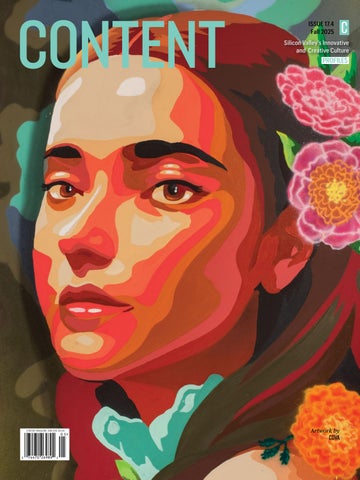
ISSUE 17.4 Fall 2025
C
Silicon Valley’s Innovative and Creative Culture
PROFILES
CONTENT MAGAZINE, SAN JOSE $14.95
Artwork by
COVA
MARK ENGEL Shifting Terrain
August 16, 2025 - January 4, 2026 Permanent Collection Gallery Reception Date: August 30, 2025
540 Ramona St Palo Alto, CA | pamelawalshgallery.com | @pamelawalshgallery | (650) 300- 6315
Andrew Faulkner, Moonage Daydream, 2025, Oil on canvas, 60 in x 48 in
open ‘25 call CURA PRESENTS CURA CONTEMPORARY CONTEMPORARY PRESENTS
ATTENTION ATTENTION BAY AREA BAY AREA ARTISTS! ARTISTS! 17395 Monterey Road Morgan Hill, CA 95037 17395 Monterey Road Morgan Hill, CA 95037
Apply here: Apply here:
Or visit Or visit curacontemporary.com curacontemporary.com
Questions? Email us at curacontemporary@gmail.com Questions? Email us at curacontemporary@gmail.com
MA AD D SSE EN N GA AL LL LE ER RYY Y G G A L L E R
C LO O C KK W W I S E F R O M C CL L OC C K W II SS EE FF RROOM M U P P E R L E F T U U PP PP EE RR LL EE FF TT
T AY Y LO O R SS TT O O NEEM M A N T TA A YL L OR R S T ON N E MAANN C A R L H O P G O O D * C CA AR RL L H HO O PP G GO OO O DD** N A H Y U N K I M N NA AH HY YU UN N KK II M M LU UC C AA SS BB LL O OKK**** L L U C A S B L O K * * RO O YY AA LL SS O O C IEETTYY OOFF *** R R O Y L OS ROSCC IIM EETM Y BO SC CU UL L PA P TT ERF R S O R SS M EE M BBEE S C U L P T O R M M RR * * P O L L O C K K R A S N E * * P O L L O C K - K R A S N E R * * P OFLOL UONC DK A- K R A S N E R F O U N D A TTI IOONN F OGURNADNATTEI EO N G R A N T E E G R A N T E E
MA A II N N SS TT 33 55 11 M 3 ITNO S T L5 O1SS M AA L O A LL T O SS L S AAD LS T O .SC O M A O P M E N
A P M A D S E N . C O M A P M A D S E N . C O M
C
CONTENT ISSUE 17.4 “Profiles”
Fall 2025 Cultivator Daniel Garcia Editors Elizabeth Sullivan, Danae Stahlnecker Katherine Hypes, Katie Shiver Samantha Hull, Virginia Graham Writers Brandon Roos, Esther Young Joshua Hascall, Meghan Lee Nikoo Parsizadeh, Samantha Hull Sendy Tapia, Troy Ewers William E. Jeske, Yvonne Phan
Developer David E. Valdespino Jr. Photographers Arabela Espinoza, Ariana Siguenza Britt Bradley, Cyntia Apps Jason Leung, Marietta Asemwota Mike Schwartz, Stan Olszewski Stephanie Barajas Designers Jesse Garcia, Trinh Mai
Publisher SVCREATES
I celebrate a number of things in this 73rd issue, “Profiles.” First, I celebrate the great privilege we have to award local artists recognition, furthering their emerging careers. Of course, this would not have been possible without the generous support of our partners: Santa Clara County, City of San Jose Office of Cultural Affairs, Gilroy Foundation, Heritage Bank, and City of Morgan Hill. And, members, like you! In addition, I am excited to have the opportunity to commission writers, designers, editors, and photographers to create this platform and highlight our creative scene. Specifically in this issue, I’m glad to work with Britt Bradley on the portraits of this year’s Content Emerging Artists. Next, we are excited to feature and partner with CURA Contemporary gallery in Morgan Hill. Their vision and space provide a tremendous focal point for the underrepresented and expanding culture scene in Morgan Hill. Lastly, we have again collected a diverse range of creatives for you to befriend. From the salon and DJ styles of Blair Carson to the watercolor work of Uma Kelkar, Muralist COVA, and painter Mark Engel, you will get a cross section of the talent in our region. Though this issue is another full plate, I feel that the 72nd issue is merely an amuse-bouche to all the talent we have to share. For now, I hope you enjoy these profiles. Enjoy, Daniel Garcia THE CULTIVATOR
IN THIS ISSUE
COVA | Cynthia Brannvall | Troy Tuan Truong | Mark Engel To participate in CONTENT MAGAZINE: daniel@content-magazine.com Membership & sponsorship information available by contacting david@content-magazine.com
501(c)(3)
CONTENT MAGAZINE is a quarterly publication about the innovative and creative culture of Silicon Valley, published by
.
10 Profiles 17.4
CU
R
A
CONTEMPOR ARY A gallery committed to providing a welcoming space for both artists and the public to explore, create, and be inspired
D
owntown Morgan Hill bustles with activity as neighborhood restaurants activate Monterey Road. On the corner of West Second Street stands a sculptural structure, home to gallery Cura Contemporary and its sister restaurant, Véra. Exposed timber and floor-to-ceiling windows permeate the two-story gallery, combining warmth and color with contemporary sophistication accessible to the passerby. Cura Contemporary is more than a gallery; it is an artist workshop studio, community hub, and restaurant, with the goal of providing all people with the opportunity to appreciate and be inspired by the arts. Designed by KTGY architecture firm, at the direction of local entrepreneur Dan McCranie, Cura Contemporary is a long time coming. Dan and his late wife, Kathy, who made Morgan Hill their home in the 1980s, were determined to give all their money away and had always planned to give back to the community. Cura Contemporary’s gallery director, Ellie Honl Herman, had worked with Dan for several years before the gallery opened its doors last November. Ellie is a printmaker and first met Dan as a framer at his frame shop, now Colibri Gallery, located down the street from Cura Contemporary. In 2019, Colibri added a gallery space with Ellie at the helm, until she transitioned into her role as the inaugural gallery director of Cura Contemporary in late 2024. Colibri is now Cura Contemporary’s sister gallery, featuring more traditional artwork.
Written by Samantha Hull Team Portrait by Daniel Garcia Architecture photograph by Mike Schwartz Provided by CURA 17395 Monterey Road Morgan Hill, California 95037 curacontemporary.com Instagram: cura_contemporary 11
Together, Dan and Ellie worked to bring Cura Contemporary to life, making a pointed effort to design an accessible space. The name Cura came about from the word “curate,” which in Latin (curatus) means “to help” or “to take care of,” perfectly encapsulating the type of space Dan and Ellie began to cultivate. Ellie shares, “When Dan and I first started talking about this art gallery, his number one thing was that he wanted it to be a welcoming place. I’ve based every decision on creating a welcoming place for people to experience the arts. We want people to feel comfortable. People might not normally step into a gallery and feel comfortable.” Designing an accessible space was a priority for Dan, as was ensuring regular rotating exhibitions to continually encourage people to return. Cura Contemporary is able to change exhibitions every month due to pivoting, movable walls and a track system, making installation a breeze and allowing staff to easily transform the space to meet a variety of needs—from artist demonstrations to kid-friendly art programs and community events. Ellie reflects on their working relationship, “Along with being a welcoming space, Dan also wanted the space to be active and alive, where people could learn about art through hands-on programming. All through the process of building Cura (both literally and 12 Profiles 17.4
“
I want people to not be afraid of art. I want people to feel comfortable around it. I want them to feel like they don’t have to rely on an expert’s opinion. I want them to feel confident in whatever artwork they like, and I want that to add to their enjoyment of life.” –Ellie Honl Herman
figuratively), we both shared that same vision. Looking back, it’s amazing that we were always so in alignment with what Cura should be.” Adding a restaurant, Véra, was always part of the vision, bringing a food and drink element to the space to elevate the gallery. Assistant director Nicole Czapinski adds, “I think it helps make the space more accessible to people. It lowers the barrier to entry. You have to walk through the gallery to go to dinner, so maybe you normally wouldn’t visit a gallery, but you go to dinner a lot. You’re going to experience the gallery by default.” With such a flexible space, Ellie and her team can focus their energy on the artists they represent, rotating exhibitions, art programming, and marketing, ensuring Cura Contemporary’s desire to share artist stories reaches as many people as possible. With a mission to “become an arts destination for the greater Bay Area and to invigorate the local art scene in the South Bay by creating opportunities for growth and connection,” Ellie has focused her attention on exhibiting artists working with materials in unique ways, “I want people to not be afraid of art. I want people to feel comfortable around it. I want them to feel like they don’t have to rely on an expert’s opinion. I want them to feel confident in whatever artwork they like, and I want that to add to their enjoyment of life,” Ellie shares. The artists represented and exhibited are based in the South Bay, greater Bay Area, and nationally, and according to Ellie, “The artwork we choose has some kind of unexpectedness— either unexpected imagery or an unexpected way of using 13
( L to R) Faith Eusebio MARKETING ASSISTANT * Ellie Honl Herman GALLERY DIRECTOR * Nicole Czapinski ASSISTANT DIRECTOR * Sydnie Pedemonte WORKSHOP COORDINATOR 14 Profiles 17.4
material. A lot of times it’s more process oriented, and usually bright, colorful, and a more optimistic viewpoint.” As artists themselves, importance is given to ensuring the artists Cura Contemporary represents are treated fairly, paid equitably, and given a space to experiment without expectation. Beyond the artists they represent and exhibit, the gallery focuses on offering art workshops for adults and children alike. Whether an artist demonstration in the galleries, a beginner or advanced art workshop, or kid-friendly art-making activity, it is clear the staff have a passion for sharing their love of art. “Art has made such an impact on my life, I want other people to be able to have that” reflects Ellie. In addition, Cura Contemporary will soon launch artist professional development workshops and this fall, their first open call for local artists to submit their work, from August through September 2025. To Nicole, it’s important to offer resources for artists in the community to feel connected and supported by the gallery: “Being accessible to artists, as an artist, has to be central to what we’re doing.” Cura Contemporary is not your stereotypical art gallery. First and foremost, the architecture adds warmth and comfort unimaginable in the standard white cube space many associate
“We’re a gallery, but we’re finding out that we’re more of a center for the arts. Being privately funded gives us flexibility so we can do things really quickly. We don’t have to go to a board first. We can do what we think is right for our community in our space.” –Ellie Honl Herman with contemporary galleries. Secondly, the unequivocal support of Dan, who Ellie and Nicole regard as “a modern patron for the arts,” has provided the staff with a gift—the opportunity to experiment and to reimagine how a gallery could feel by cultivating a space that inspires creativity and invites curiosity, a gallery that emphasizes welcoming, educating, and guiding the community on their own creative exploration. “We’re a gallery, but we’re finding out that we’re more of a center for the arts. Being privately funded gives us flexibility so we can do things really quickly. We don’t have to go to a board first. We can do what we think is right for our community in our space. We’re very kid-friendly: we welcome children into our space, we have programming specifically for them, and we really enjoy participating in talking to people about the artwork, showing them how things are made,” Ellie shares with pride. As traditional funding sources for the arts drastically shift regionally and nationally, Cura Contemporary offers a respite from the norm, bringing artists to the forefront to explore, create, and inspire the community in Morgan Hill and the greater Bay Area. It is a model that shines bright and offers inspiration to all who walk through the front door. C
15
Memorias, 2024, mixed media on vinyl record, 12”x12”
Mi Corazón, acrylic on canvas, collaboration with Mario Aguilar, 8‘x4‘
18 Profiles 17.4
“I would paint these figures that I would see... They had shown me more of a medicinal way into my culture.”
Flower, 2025, tattoo on practice skin, 6“x8“
weaves many of the symbols and insights she received into her acrylic work. In her 2022 painting Tlazoltéotl, she portrays the goddess’s feminine power, weaving in symbols of Mother Nature and culturally-rooted mystical animals. Through this piece, she explored the guidance of dark entities and began to release lingering shame. In her newer piece, Dulce Muerte, renditions of the Deer Spirit, symbolizing a softer and kinder natural spirit; a skull, representing death; and mushrooms, a symbol of life emerging from death, all appear together. Her works have been included in art exhibitions from Hollister to Fox Tale Fermentation Project in San Jose, and audiences from all over have come to see her pieces. To her surprise, viewers embraced her dark-themed art with overwhelming positivity. It became clear to Itzayana that her path forward would be illuminated by the darkness. She formed an alliance with others at a survivor support group called Silently Loud Collective, which gave her a sense of community and a new direction for her art. Joey
and Jade Castaneda, along with the rest of the Gilroy-based collective, Shades of Brown Alliance (SOBA), welcomed her, and the group secured a mural commission at a Santa Clara County family facility in Gilroy, giving Itzayana a chance to serve the medical community she’s deeply committed to, this time through art. Connections with others who experienced the same life-changing traumas and who have similar goals helped her forge strong bonds within the community. With the guidance and support of strong mentors, such as Carlos Rodriguez, Wisper from the TWC crew, and Elba Raquel, Itzayana travels forward on the path to becoming a pillar of cultural, medical, and communal support. Itzayana’s journey from a timid solo artist to a confident presence in the public art scene has deepened her self-understanding and empowered her to help others find their own creative paths. “We’re both feeling like this,” she says of others who feel timid too, “but we can do this together.” C
19
Still frame from Copacabana, a short film, featuring lead actors Leslie Castillo and Max Wulf, On-set photo by Jaime Ibanez 20 Profiles 17.4
Stitching Stories in Satin and Celluloid:
Lorena Cortez on Vintage Beauty, Intentional Art, and Reclaiming Glamour
T
Written by Sendy Tapia Photography by Stephanie Barajas rubyraeclothing.bigcartel.com Instagram retrorubyrae rubyraeclothing
he human sense of touch is powerful enough to detect surface bumps as small as one micron—a thousandth of a millimeter. Applying that sensitivity to what we wear daily: the crispness of cotton, the ridges of corduroy, satin silkiness, the seams across a jacket, the running stitches that hold panels together, the ladder stitches that seal raw edges. This is the precise, tactile world where Lorena Cortez sews her soul into every creation. Her meticulous eye for fashion design eventually found a second home behind the camera. Stitching together fabric and film, Cortez crafts a visual elegance where intentional art and vintage glamour meet. Born and raised in San Jose, Cortez blends mid-century aesthetics, cinematic storytelling, and community-rooted creativity into a nostalgic and boldly contemporary practice. Her love for vintage clothing, especially from 1945 to 1950, anchors her work. “That era just had a level of craftsmanship that we don’t really see anymore,” she says. The beauty of those years lives in the details: the curve of a lapel, the silhouette of a skirt, the melody of a Benny Goodman track playing in the background. It’s also a family inheritance, passed down through the music, cars, and design sensibilities of her grandparents. Creativity pulses through Cortez’s lineage—from her grandfather’s R&B, jazz, and big band classics record collection, to her
uncle’s work helping design the iconic Las Vegas Stardust sign. But as a queer Chicana filmmaker, she also recognizes the dissonance of romanticizing an era that didn’t welcome people like her. She explains: “We were there. So, what would it be like to reimagine those old Hollywood films with us in the scenes?” Reimagining the past is the heartbeat of her art. Cortez often crafts wardrobes herself, sewing garments with the same care she applies to framing a scene. Her deep knowledge of fabric construction informs every aesthetic decision. She can break down an article of clothing by its darts, seams, and finishes, “Those details matter,” she says. Like a classic car enthusiast naming a model on sight, Cortez explains, “I want the viewer to feel that level of immersion.” Her creative process always begins with music—thanks to a self-curated playlist called “Use This Shit in a Movie”—a running archive of songs that ignite her imagination. “I see it so vividly,” she says, “If a track really hits, I’ll start a project from that single spark.” That enthusiasm, however, has taught her the importance of pacing. “As artists, it’s easy to get swept up in momentum,” she reflects. “But I’ve learned to pause, to decide which projects are sprinting ahead and which ones need a slower, more deliberate path.” That mindset now defines her approach to production. Cortez recalls outlining a four-month 21
“
I want women to feel empowered when they watch my films, to see themselves on screen and remember they can have glamour every day of their lives.
Top to bottom: Copacabana, short film still, lead actress Leslie Castillo. Dolores, music video, singer La Cassandra, dress designed and made by Lorena Cortez. Selina Clone Liquor, photo shoot and edited by Lorena Cortez. 22 Profiles 17.4
timeline for a film, only to be met with skepticism from her brother, who asked: “Why are you trying to rush it?” The comment stuck with her: “Because I slowed down and was intentional with every detail, the project ended up having way more impact than if I’d just powered through it.” The seeds planted by her brother have recently produced fruit with the completion of her project, Copacabana. Despite her recent project being the largest she’s produced thus far, Cortez encourages artists to embrace imperfection and push through self-doubt. “Let creativity pour out of you before you press delete,” she advises. “Too many of us delete too quickly. It’s okay not to have everything figured out because that’s what community is for, and the internet is there to help you learn the rest.” Through stepping outside her comfort zone, Cortez has cultivated a collective of diverse, passionate storytellers. “We’re always casting each other for projects,” she says. “They’ve helped me grow so much as a filmmaker and taught me things I never would’ve figured out alone.” Collaboration, she believes, is key,
“You’ll limit your own work if building community isn’t part of your creative fabric.” This stance informs her future goals. She dreams of producing a television series about her queer Latina friend group, something between Insecure, Sex and the City, and Curb Your Enthusiasm. Until these seeds begin to grow, Cortez is actively measuring every pattern twice, directing every frame splice. In between the stitches and clapperboards, new ideas prosper. From clear visions straight out of her imagination (cue the playlist) to honoring historically forgotten heroines, whatever form her projects take, her core mission remains the same: “I want women to feel empowered when they watch my films, to see themselves on screen and remember they can have glamour every day of their lives.” In merging the tactile intimacy of sewing with the emotive reach of filmmaking, Lorena Cortez is not just preserving the past. She’s reshaping it, stitch by stitch, scene by scene. Visit her vintage inspired clothing store to add glamour to your life. C 23
T YL E R MARCHESANO
Colors, Materials, & Finishes
24 Profiles 17.4
bike be just another ike “I don’t want tobe just anotherisb t.” “I don’t want toant to beaannaarrttist.” w I , r e t n i a p e b o t painter, I want
e k i b r e h t o n a t s u j e b e k o i t b t r e n e k a h i w t b t o ’ r n n a h t s t o u “Iedkoib’t e j n ” e . a t b s t i o s t t u r t j a n e a n b a w o e t b n nrte t o n t a t h w n “I dpo t a o ”t’no . w n t s I a i , t r t r e s a u n j ”a.ti sietrr,aI n a e b b o o t t t t n n a w e t’no b o t t n t i n aw I ,raewtn pa”.tsitra n
ia a eb ot tnaw I , retnia
T
Written by
David E. Valdespino Jr. Photography by Daniel Garcia Instagram tunedbytyler
he art of establishing a brand’s identity often lies at the intersection of creativity and design. At the global headquarters of Specialized Bicycles in Morgan Hill, California, a level of exploration is required to determine which techniques and textures can be effectively applied to specific materials. Tyler Marchesano, a Colors, Materials, and Finishes (CMF) designer for Specialized Bicycles, sets the tone for how each model of bicycle will roll off the showroom floor or across the finish line. In explaining his role at Specialized, Tyler shares, “CMF, in theory, handles color and material challenges for designers. My job is to create a palette and guidelines and pass them off. The challenge is boxing those strategies so that all our products feel cohesive, but not so tight that designers can’t be creative. I feel like my job is to make sure designers can just focus on designing.” Since transitioning from concept paint designer to CMF designer in 2023, Tyler spends less time in the paint booth; instead, he dedicates his time to researching color trends, attending events such as Milan Design Week, and traveling to places like Japan, London, and Paris, where he investigates the future of color. Despite the specialization of his current role, Tyler wants folks to know he never planned this route. “A lot of people think they need to leave high school, go to college, do the jam, and be done with it. I did that, and then I went in a completely different direction.” Tyler’s journey has roots that lead back to his youth, growing up in Milpitas, California. Throughout primary school, Tyler was a self-proclaimed “jock.” “Baseball was life for my childhood, and that’s why I think when I tore my rotator cuff, it was like a life shift.” Out of high school, Tyler received a scholarship to play baseball at California State University, Dominguez Hills, before a rotator cuff tear quickly ended his college career. The experience of losing the sport
25
Trabajo Divertido, 2022, metal flake, variegated gold leaf, candy paint on aluminum
26 Profiles 17.4
Specialized Crux, 2023, bass boat flake, 24k gold leaf, gravel texture
he invested so much in changed his perspective. He shares, “When I got into bikes, I knew I didn’t want them to be my life. You don’t have control of everything.” Bicycles have become a significant part of Tyler’s life, but in a more holistic sense that engages various aspects of his personality. Tyler became serious about bicycles while attending Sacramento State University, where he was a bicycle commuter. Sacramento’s cycling subculture brought him in during this period of transition and growth. “They introduced me to this type of cycling that was fitness, but also enjoyable and not so serious.” That nonconformist cycling culture mirrored an early memory of painting his first BMX bike maroon and gold. “I saw a Lincoln Navigator drive by one day, and it was this deep maroon with gold spoke wheels dumped on the ground. That was the start. I had always wanted something different than what I was seeing offered in the bike industry. I think that was what drew me to painting and customization—having my own thing.” Later, Tyler became a mechanic at City Bicycle Works in Sacramento. “That was my first push to be the best.” That pursuit of excellence in bicycle service led Tyler to create his Instagram handle, tunedbytyler, to showcase his repairs and build an audience. Eventually, the profile caught the eye of recruiters at Specialized, who were looking for a white-glove marketing mechanic. During his tenure as a Specialized service technician, he connected with Dylan Buffington, who ran the paint studio and offered Tyler a shot in the paint booth. Tyler took the opportunity to learn under Buffington and ran with it, sharing, “He walked me through how to mix paint and find colors, and it was game on.” Although he didn’t have a background in art or design, Tyler had a vision for what he wanted to see in bicycles. Honing his technique as a painter involved trial and error, but his fearlessness in the booth led directly to his development from a service technician to CMF
27
Specialized Epic Hardtail, 2024, tonal dry brush
28 Profiles 17.4
n e e b e v a h d l u o w I k n i nting h t ee t ’ n o “I d t think I would hbaeveenbp t u ’ t ’ n n o d d “Ible to do it if I ha been putting t ’ a n d a h I f i t i ” . n i e m i t e able to do h t the time in.” Wuhan Relief Raffle Bike, 2019, gold pearl over gradient
designer. “I think part of what made me good at what I do is that I didn’t know the rules at first. In the beginning, it was very Bob Ross; there are no mistakes. I don’t think I would have been able to do it if I hadn’t been putting the time in. It was nine-to-five, dinner with friends, and then back to painting.” Tyler spent countless hours in the booth honing his craft. The experimentation gave way to technique. A 2019 tunedbytyler caption captured his drive: “I don’t want to be just another bike painter, I want to be an artist. I want to paint things that make people stop and think for a second. I want to paint things that change the perception of what is possible.” As a concept paint designer, Tyler painted iconic frames, such as French downhiller Loïc Bruni’s 2021 World Cup-winning rustpatinaed Specialized Demo and American criterium racer and founder of L39ION Los Angeles racing team, Justin Williams’ custom Kobe Bryant-inspired Black Mamba Tarmac SL7, with a snakeskin-textured finish. Tyler’s artistic approach to commercial paint jobs pushed boundaries. He muses, “I think technique is how I got my job here, more than color even. I was pushing technique like texture and impasto at a time when the industry wasn’t necessarily accepting it. Bringing an artistic touch to what we were already doing is what excited me about paint.” Tyler is currently working on a home paint studio, taking on occasional commissions, and enjoying working on his track cars as a way to maintain his hands-on creative outlets. When asked about his goals for the immediate future, Tyler shares, “to constantly try something different, to change any stereotypes about the bicycle industry, push the limits, and keep the bike industry fun.” C
29
30 Profiles 17.4
UMA KELKAR
THE WORLD OF ENGINEERED ART
U Written by Nikoo Parsizadeh Photography by Stan Olszewski Instagram umapaints
ma Kelkar is a watercolor artist, engineer, international sketching instructor, and founder of a deep-tech startup built for creative minds. Her life stretches across disciplines that are often boxed into opposite corners: art and engineering, intuition and logic. But for Uma, the line between them blurs beautifully. Her journey is one of rediscovery, purpose, and a persistent need to create. Uma found art to be something she is naturally good at. She started out with no formal training, but a group of older art students saw something in her and insisted she join them. Uma reflects, “I didn’t understand what they were talking about, harmony or composition, but they said, ‘Just come.’ That blind faith was everything. You need someone to say, ‘Come join, even if you think you don’t belong.’ ” As a kid, Uma breezed through state-level drawing exams and won competitions with minimal effort, but her love for problem solving led her down an engineering path. Midlife, though, has a way of waking people up. At 32, Uma picked up the paintbrush again, launching herself into a soulful journey. She recalls, “I had lost it, so I started painting again. That one Thursday in April 2009, I made a promise to myself and I said, ‘I’m starting.’ I’ve painted every Thursday since.” Even when Thursdays get hard, Uma doesn’t let go of that promise. Today Uma is a full-time engineer and a startup founder, yet art remains a vital, structured part of her 31
week. As she got deeper into painting and began connecting with urban sketchers and other artists, she uncovered a love for teaching. She shares, “Every time someone congratulates you or enjoys your work, you feel energized to do it again. We all believe in ourselves, sure, but there’s something powerful about third-person validation. It fuels the cycle.” For Uma, art and engineering are not separate; they’re puzzles. In both disciplines—art and science—there’s no finality, just a constant hum of iteration. “You make something really pretty, and ten days later you realize: ‘Oh, I could’ve done this better.’ Or sometimes you imagine something beautiful, but you just can’t make it happen. That challenge of trying and failing and solving is everything,” she explains. When asked how she merges the left and right sides of her brain—math and emotion, logic and intuition—Uma has found good artists dissect problems, not themselves, just like good engineers. She finds inexperienced artists often internalize a bad painting as a personal failure, but seasoned ones, like seasoned engineers, break down the issue into smaller problems dissecting it and tinkering with it. This philosophy of tinkering runs deep for Uma, as this practice builds a repository of solutions for problems that haven’t happened yet and, therefore, builds confidence. It can lead to happy accidents, such as an accidental brushstroke that creates a perfect texture. In October 2022, Uma shifted again, this time launching a startup at the intersection of art and technology. After years of juggling engineering, teaching, and art, she wanted to scale herself and help others like her do the
TOP: Sketches from Cancún, Mexico BOTTOM: Plein air at Stanford University 32 Profiles 17.4
“Every time someone congratulates you or enjoys your work, you feel energized to do it again. We all believe in ourselves, sure, but there’s something powerful about third-person validation. It fuels the cycle.”
same. Her product, Vivify.ai, is a visual-intelligence communication platform for creatives. Much like the cloudbased communication platform Slack, this platform is specifically for the creative industry where designers are no longer describing their visuals with text and instead through images. Uma describes the traditional design review process—sending multiple PDFs back and forth, endless emails, instant messaging, and Zoom meetings—are the norm to decide on something as simple as the right shade of blue. That kind of miscommunication stretches timelines and blows budgets. Animation projects get delayed 80 percent of the time, interior design, 60 percent. Her tool streamlines that process, using image-based prompts and voice messaging to reduce it by half. By enabling designers to speak and see the results reflected visually in real time, her platform saves each designer 10 hours a week. More importantly, it gives freelancers and solo creators a way to scale without burnout. Uma explains, “Artists at times do five jobs. They’re architects, animators, teachers, influencers, and makers. Their intelligence is scattered. I want to collect that and make them agents of their own scale.” Outside of the tech-centric nature of her work, Uma’s artist heart still beats strong. Despite her high-tech business and its staggering impact, her art remains rooted in the most human of things: beauty, presence, and story. She paints landscapes and florals not for show, but because they are accessible in the snippets of life between work and family, and she believes drawing in a crowded street creates a kind of soft intimacy. Urban sketching brings stories to Uma’s mind as she quietly draws strangers as they go about their day. Uma Kelkar walks the tightrope between creation and computation. In her world, art and engineering don’t just coexist, but rather they solve each other and are her puzzle, her story, and her freedom, declaring, “You try to achieve something; you might only get 80 percent there, and the remaining 20 percent keeps you coming back. That’s where the kick is.” C 33
Cyn thia Bran 34 Profiles 17.4
Threads woven together tell stories about history, culture, and identity
C Written by Yvonne Phan Photography by Jason Leung cynthiabrannvall.com Instagram cynthiabrannvall
ynthia Brannvall enjoys making Swedish meatballs with turkey and kale and still calls them Swedish meatballs. Building on her grandma’s original recipe, she regularly cooks this special fusion dish for her family. As a California native who contains multitudes—American, African, and European roots—blending, transforming, and carrying on aspects of different cultures feels natural to her. It has become a central theme in her life and work. Cynthia is an interdisciplinary multimedia artist, a community college professor, and the current Cubberely Artist in Residence, whose work explores identity, culture, history, and how to move forward in a world of conflict and uncertainty. She was raised primarily by her grandmother, a seamstress who not only taught her recipes, but also introduced her to textiles at a young age. One of her most important works, Continents, is a large threepanel textile painting consisting of off-white strips of linen, 35
cotton, and lace that depicts themes of genomics and geology. “These patterns represent sediment or histories, landscapes, and various patterns crossing from one panel to the next, like DNA traits passing from one ancestor to another,” she said. Her work also incorporates vintage and recycled textiles, such as blouses from the 1920s, which plays into intergenerational themes in her paintings. While sourcing materials, Cynthia was drawn to working with white textiles, which were never a crisp white. Many of her materials are thrifted, sourced from antiques purveyors or acquired through special collections such as those at Lacis Museum of Lace and Textiles in Berkeley. The fabric scraps she chooses naturally vary in color and come frayed, fragmented, and stained—yet enduring, which only adds more depth and meaning to her art. In another piece, titled The Threads That Bind a Divided Nation, she used off-white and beige colored antique textiles to construct a divided map of the United States. The states are disconnected at the MasonDixon line, which historically divided free and slave states. While Cynthia was studying art history at UC Berkeley, she witnessed many conversations where artists used the color black, and people concluded that the artwork must be sending a message about race. However, that was never applied to works that were made in white. “It was kind of a defiant move. Like, I dare you to ask me, as a Black artist, why I’m working with the color white so much,” she said. But people rarely ask her that question.
Intergenerational Horizons on a Thousand Plateaus, 2023-2025 ongoing, vintage and antique textiles and clothing fragments, trims, lace, appliques, jet and glass beading, buttons and feathers on crinoline and canvas, multiple canvases, installed 60”x90”
“We live in a polarized time. What would it look like for us to belong somewhere together—whether we agree or not, whether we have hurt each other or not? Is that possible? And what would it look like?”
36 Profiles 17.4
Threads That Bind a Divided Nation, 2020, vintage and antique textiles painted on stretched crinoline, white thread in long stitches, 36”x58”
Continents, 2014-2016, vintage and antique cotton textiles painted on stretched crinoline, 3 panels 48”x68”
37
38 Profiles 17.4
Not Quite Tame, 2024, vintage birdcage, globe, sea fans, vintage and antique trim, lace, and crocheted doilies and trim, 19”x36”x12”
In the past few years, Cynthia has built a new arm of her work, focused on black textiles. She aimed to push back on the obvious connotations of the color black, associated with darkness and mourning. To contrast those feelings, she adds flecks of mica, beads, and sequins to allude to a sense of whimsy and magic. She is currently creating a large black textile painting that will include at least a dozen panels. The use of black was inspired by dark matter and black holes that catalyzed the beginning of the universe, but they are also metaphors for the Black experience. “In my lifetime, I was not born into slavery. But as a Black person, I feel the gravitational pull of that,” she explained. In addition to textile paintings, Cynthia also creates sculptures in a genre of works she calls “surreal textiles.” In her process, she takes clothing fragments or whole pieces of clothing and molds them into shapes that are often disorienting and thought-provoking. In her piece titled Roar, she molded a thrifted 1950s pink dress in resin to create a sculpture reminiscent of a target or a screaming mouth. She created the piece in 2022 and it helped her access and process her feelings that followed the overturning of Roe v. Wade that summer. Usually, Cynthia mattifies her resin pieces for a satin finish, but for Roar, she wanted a wet look. “It looks wet, so there is this erotic element. It’s clearly a dress, but I think it also evokes the body. It could be a screaming mouth or a vaginal opening. But it also has that sweetness to it because it’s pink,” she said. The juxtaposition of the ruffled pink dress and the way it is opened up evokes uncanny feelings and depicts psychological tensions. As Cynthia’s past works have conjured questions about history, culture, and identity, she continues to ponder unanswered questions every day. One motivator for her in working with abstraction is that it allows people to come up with different questions and answers when viewing her artwork. Currently, she hopes her artwork can help people think about how to bridge cultural and political divides. She explained, “We live in a polarized time. What would it look like for us to belong somewhere together—whether we agree or not, whether we have hurt each other or not? Is that possible? And what would it look like?” C
“In my lifetime, I was not born into slavery. But as a Black person, I feel the gravitational pull of that.” OPPOSITE PAGE:
Shadow Work #2 A Pickaninny World, 2024, 19th century dress, vintage silk and velvet ribbon, vintage seam binding tape, polyester ribbon, acrylic paint and globe
39
42 Abiam Alvarez
44 Alice Hur
SVCreates is excited to announce the 2025 Content Emerging Artist Award recipients, celebrating the vibrancy and impact of early-career artists working in all disciplines, across visual, performing, and literary arts. This award, a testament to SVCreates’ commitment to building the capacity and amplifying the voices of artists in our community, has been granted to three artists who have made a significant impact. These artists, who
40 Profiles 17.4
46 Hana Lock
work with diverse communities and across mediums, have shown remarkable courage in taking risks and embracing challenges. Their unwavering commitment to their practice, intentional sharing of their vision, and rigorous approach to creation and production are commendable. We are privileged to have them as part of our community in Santa Clara County, where they have contributed significantly to the richness and vibrancy of our region.
Written by William E. Jeske Instagram svcreates svcreates.org
PHOTOGRAPHY BY BRITT BRADLEY
EMERGING ARTIST AWARDS 2025
41
“I WANTED TO INCORPORATE SOME KIND OF MACHINERY, LIKE AGRICULTURAL MACHINERY, AND THAT MACHINERY WAS ALSO JUST KIND OF BROKEN DOWN AND RUSTED.”
42 Profiles 17.4
Instagram abiam.alvarez abiamalvarezsculpture.com
pays homage to the fading era of agriculture with sculptures
ABIAM ALVAREZ
Roman emperor and philosopher Cicero said, “Of all the occupations by which gain is secured, none is better than agriculture, none more profitable, none more delightful, none more becoming to a free man.” Ceramics sculptor Abiam Alvarez echoes this sentiment in a career spent replicating agricultural tools and equipment, every piece a hand-molded love letter to a disappearing era. “I wanted to incorporate some kind of machinery, like agricultural machinery, and that machinery was also just kind of broken down and rusted,” Alvarez says. “And I’m speaking about how, in a way, ‘what if the farm workers were gone?’ and how, without them, we’d all be also rusting, [without] agriculture. It’s like, ‘who’s going to be picking the crop for the consumer?’. ” The 37-year-old Alvarez was born in Mexico and immigrated to a small agricultural city in California in 1999, well after Santa Clara County established itself as Silicon Valley at the expense of its hallmark fields and orchards. From a childhood spent in an agricultural town and then falling in love with ceramics, to an influential art class in high school, Alvarez focused his passion on creating art that expresses gratitude, nostalgia, and austerity. Alvarez’s sculptures of tools, machinery, and produce in various stages, from fresh to desiccated, have been displayed in a number of California galleries, such as at the Sylvan Gallery in Sand City and, locally, at the Herbert Sanders Gallery and the Art Building at San José State University.
CERAMICS SCULPTOR
When not sculpting for his career, he shares his passion for art that requires physical handling of clay and water as a teacher at Gavilan College and at the high school level in Morgan Hill, where he tries to impress upon his students that the process of creating is just as important, if not more so, than the results. Ceramics is among the few arts that demand faith in fire to complete. “A lot could go wrong in the kiln—cracking, exploding, colors not turning out how you envisioned,” Alvarez says. “Even if it survives the first firing, the second could prove disastrous.” Alvarez points out that the process is more physical at the beginning stages because the artist is building with the clay, molding it, and shaping it. After that is the waiting and thinking about a color theory. “You’re just thinking, ‘How am I going to finish the piece… what’s the color going to say about the work? Or the glaze? What’s it going to do?’ ” A perusal of Alvarez’s portfolio shows several lifelike sculptures of stacked fruit or dioramas of tools that could easily be confused for the real thing if not for the glaze, but Alvarez says he does put effort into validating the clay and the craftsmanship. Alvarez says, “I feel like when people would look at that work, they would just kind of question, ‘Is it really ceramic or is it the actual object?’ ” Alvarez says. “I feel like people would fly past the actual meaning of the work. I wanted to make the objects feel more ceramic. That way, people will know there was some actual labor that went into making them.” C 43
dance as the means to declare freedom and belonging for the traditionally marginalized
ALICE HUR
COMPETITIVE STREET DANCER
Urban dancer and Midwestern transplant Alice Hur specializes in waacking, an expressive street dance style that emerged from the West Coast in the 1970s, heavily associated with disco, and involving elaborate arm contortions, striking poses, and storytelling. Hur discovered waacking as an undergrad in Chicago but expanded on the style as a grad student studying public policy. Ultimately, she became a formidable freestyle battle dancer, teacher, and curator of the semiannual event Waack, Crackle, Lock! “Where waacking came from in the 1970s, there was a lot of social oppression and suppression of personal expression in the queer community, and this dance primarily exists as a means of freedom and liberation,” Hur says. While taking dance classes in Chicago, a club dancer named Tonic noticed Hur and offered to mentor Hur in the street dance culture and community, which at the time was suffering from a deficit of female representation. “Upon meeting, [Tonic] took me and some other women under her wing, taught us about the culture, taught us movement. After practice sessions, she would make us go out to the club because it was important to teach us this dance in the context outside of just the practice session or studio. So that’s when I really got into street dance.” For nearly 20 years, the 34-year-old Hur has not only competed but also taught “oneoff” workshops in Seattle, her hometown of Chicago, and Honolulu. And, of course, San Jose. “I ran something called San Jose Waacking sessions for several years, which was basically me kind of teaching for free for anyone who was interested, and that was just outside MLK Library where a lot of dancers actually congregate.” Public policy’s staid nature may not seem to complement the passionate art of dance, but 44 Profiles 17.4
Hur has mastered a sort of emulsification. “I think [having studied public policy] helps with my approach to community organizing and dance,” she says. “I think being from a kind of street dance community, there’s a lot of questions about inclusion and marginalized populations and the sort of socioeconomic debt contexts that these dances came from. So, I think in terms of community organizing and representation/accessibility, that’s why most of my events were free or sliding scale, and I am very conscious of making sure the community that created these art forms are represented in my organizing efforts. So, insofar as giving me the background to understand that and a kind of academic sense, it allowed me to kind of live those principles in my dance organizing.” As a waacking ambassador, Hur makes sure to teach the range of musical styles from the 1970s forward. “A lot of waackers,” she says, “dance to Donna Summer and Cheryl Lynn. I think another artist that is popular is Prince, but now I kind of enjoy experimenting waacking to R&B and house music, particularly Jorja Smith, Tems, and Karizma. So that’s what I enjoy doing now. It’s been a few years, and we sort of go through the more traditional waacking competition tracks but try to explore different avenues.” Hur is preparing for her 12-dancer show, Strike & Release, scheduled for a pair of performances in September at CounterPulse in San Francisco. “It explores this theme of learning to love yourself and releasing the parts that other people want to erase through waacking,” Hur says. “It’s almost like a vignette that centers around that idea, but in different ways.” C
Instagram wondhurland iamexclusv.com/portfolio/alice
45
“IT’S LIKE MORBID CURIOSITY IN A WAY THAT SUCKED ME IN, AND I NEVER LEFT.”
46 Profiles 17.4
The Beauty in this Macabre Lens
HANA LOCK
ILLUSTRATOR
Instagram medama_dango hanalock.wixsite.com/gallery
Human and animal skeletons interacting with the mortal coil they just shed, or a nude woman standing in a pond holds a severed head that’s surprised—aware and beguiled with its situation—or a mandolin-playing frog serenading a girl with a transparent torso from inside which another frog regurgitates an ornate flower garden: if the old proverbs “art is long, life is short” and “art improves nature” are true, then illustrator Hana Lock’s pieces ask that we continually reconsider mortality through a macabre lens. The 25-year-old Hana utilizes paint and ballpoint ink to translate a childhood anxiety over death in general—skeletons and flesh in particular—into macabre yet whimsical images. “I try to balance the grotesqueness with beauty,” Hana told Content in issue 17.3. A younger Hana held no affection or appreciation for bones or death. “When I was little, I was really scared of skeletons. I distinctly remember having nightmares about them,” she says. “Death and skulls scared the hell out of me.” However, a family trip to the California Academy of Science’s exhibit Skulls when she was 14 tested her mettle and left her compelled. “I saw the exhibition and thought, ‘this is beautiful and interesting.’ It’s like morbid curiosity in a way that sucked me in, and I never left,” she recalls. Her skills in sketching, drawing, and illustrating were honed for years in sketchbooks but mastered in college, resulting in a BFA in fine art, studio arts, and pictorial arts from San José State University. Though she contemplates pursuing a master’s degree, her focus is on making a living creating art. “That’s all I want to do. As long as I’m drawing, I think I’m happy.” “I started to get a better idea of what
I wanted to draw in that last semester,” Hana says. “It was like a light bulb went off—ballpoint pen plus anatomy plus flat colors helped bring it all together.” She does, however, occasionally implement contemporary devices. “Sometimes I make digital sketches to figure out composition and color, but the majority of it is traditional.” Her preferred digital tools are Procreate on an iPad she’s used for years and has no plans to upgrade. Among Hana’s signature illustrations is Guren, a red, two-foot-by-six-foot canvas on which a large skull with a horned baby in its eye socket seems to laugh while a blackand-gold snake slinks through the skull’s mouth and the snake’s tail transforms into a woman’s torso, the head of which is held at arm’s length with a frog poking from her mouth. From her neck emerges a wolf’s head, out from which jump a couple more animals and flowers. Oh, and there’s some more frogs, too. “Pretty much all my pieces have at least one or two frogs hidden in there. My pieces are pretty dark, but I like adding a playful element,” says Hana. Created in 2022, Guren won best in show at the annual 2025 Salon at the Triton: 2D Art Competition & Exhibition. Hana’s work has since appeared at Chopsticks Alley in downtown San Jose and in San José State University’s Reed Magazine. Hana also calls on her exposure to Buddhist and Shintoist elements during her formative years and often incorporates their respective approaches to art, life, and death into her work. “I grew up seeing cool-looking deities—big statues of Buddha, warriors, gods, demons, and folklore about death and reincarnation,” Hana says. “I think that bled over into my work before I realized it.” C 47
48 Profiles 17.4
A V COVA CO Big Walls
No Ceilings
A
Written by Troy Ewers Photography by Daniel Garcia covastreetart.com Instagram cova____
lot of artists see their art and create limits to what they can and can’t do. Some look at what they can do and only want to go bigger. There is no ceiling for them. Cova is one of those artists. Some would say he’s not satisfied with his art, but he would say he can always go bigger. From skateboarding to architecture to painting murals, Cova doesn’t stop striving for greatness. Hector Covarrubias, known as Cova Street Art, is a Mexican artist who lives in San Jose. He grew up in Mexico, skateboarding and seeing the amazing art throughout his hometown. “I skated for 10 years professionally,” he says, showing off a young Cova skating the streets of Mexico. His grandfather showed him the art and graffiti around the city. One graffiti artist he was inspired by is a man from Guadalajara known as Peque_VRS. “I started to paint graffiti because of [him],” Cova explains. Cova saw what Peque could do with art, but before attempting to work on his own art professionally, Cova pursued a career in architecture. He saw it as a “safe” career because his mom thought a career in art would leave him broke. In his early twenties, though, Cova got an opportunity that helped him see how far he could really go. “[My] first mural was for my cousin in Tracy,” Cova says. Cova is a multidisciplinary artist with a notable focus on muralism. “Everyone can paint. Not everyone can paint big walls,” he confidently proclaims. “Big walls
are what I do. Smaller walls don’t do anything for me.” That statement may sound cocky to some people, but Cova says this with such humility that it’s inspiring. He takes pride in the immensity of doing big wall murals and holds dear the challenge and process. That’s why smaller walls are limiting to him. With over a decade of experience as an international artist, Cova has work that can be found in Mexico, Belgium, France, Amsterdam, Costa Rica, and New York. On his journey, he’s had opportunities to partner and collaborate on various mural projects for schools, universities, galleries, restaurants, and private residence commissions. In 2023, he was invited to be a part of Art Basel in Miami, Florida, where he and other global artists collaborated with aWall Mural Projects to paint murals at Citrus Grove Middle School. Recently, he completed work in Costa Rica and in the Bushwick neighborhood of Brooklyn, New York City. This was a return to New York, where he’d painted before. He explains with excitement, “I did a mural in Freeman Alley, and that’s a place where everyone goes and no one painted over it.” Even though he is internationally known, his goal is to take his talents to the biggest walls of the city he’s currently living in. “I’ve painted in Costa Rica, France, every place, but there’s no walls in San Jose, where I live. I want to paint on the biggest wall in San Jose,” he says with a passion. Cova’s process is quick but professional and 49
Raíces Fragmentadas
52 Profiles 17.4
Divine Interference
prepared. “I paint very fast,” he says, detailing his process. “When you’re cooking, you have all the ingredients. That’s how I paint—knowing the colors, dimensions, everything.” His art consists of similar color palettes and themes, but nothing ever starts or ends the same. “I never know where it’s going to end,” he says. While he works, he doesn’t treat his art as “precious,” since he knows it can always be done over and done again. He declares, “I’m not afraid to do my work over. A lot of artists are.” By embracing change through refinement, Cova keeps himself from putting any limits on his art. When Cova says that, he says it as an artist who, even though he is passionate about it, treats his art as a job. He works Monday to Friday, business-like hours during the day, and takes the weekends for himself and what he loves: his motorcycle and his wife. “My life is 60 percent art, 20 percent my bike, and 20 percent my wife,” he laughs. He loves to spend time with his wife and take random weekend trips across the states, exploring places like Seattle, South Dakota, and Texas on his motorcycle and with friends. Even in his other interests, nothing is limiting. His taste in music ranges decades and genres, his favorite movies are all over the spectrum, and when he rides his bike he sometimes just goes until he doesn’t feel like it anymore. Coincidentally, that’s also his approach to art.
“People recognize who is Cova,” he proclaims, and he’s not wrong. Cova aims to tell a story and evoke emotion with his art. He emphasizes Mexican mythology, traditions, and folklore through a mixture of modern and abstract art with a touch of surrealism. Using the elements of the earth and garnering inspiration from both Mexico and the United States, Cova’s style showcases a lot of color and detail. Whether he paints with watercolor, acrylic, or spray paint, you see the care and attention to detail. His previous work as an architect allowed him to develop his creative process and elevate his creative design. Cova has said before that he doesn’t think he has yet done his greatest work—his magnum opus, some might say—but that doesn’t mean he is dissatisfied with what he has done. Art may be his job, but when he’s at work, art is his life. Nothing will ever stop him. There is no glass ceiling for someone like Cova. There is no gatekeeper. There is only the elevation and progression of his art, because it’s all he cares about at the end of the day. “If I don’t do art, I can’t do anything else,” he says. Judging by his past and current work, art is exactly what he will do. No place is too far, no wall too big. If anything, Cova wants the biggest walls you have, because it means he’s reaching for bigger and bigger things with no ceilings to stop him. C 53
Mark Engel Holding Form, Letting Go: Inside Mark Engel’s World of Shifting Figures Written by Joshua Hascall Photography by Daniel Garcia markengelart.com Instagram markengelart
54 Profiles 17.4
55
After the Flood, 2024, acrylic and spray paint on canvas, 60“x48“
56 Profiles 17.4
Inner Circle, 2024, acrylic and spray paint on canvas, 48“x60“
M
ark Engel stands in his Walnut Creek studio. Birdsong and the distant hum of a highway blend with the hush of his brush against the canvas. Around him, figures emerge and dissolve: faces freeze midexpression, limbs smear into strokes of color and shadow. Some figures lean into each other while others yearn to separate. “There’s sort of this atmospheric pressure trying to push through,” Engel said, glancing at a fresh piece still drying on the wall. “Having this pressure of allowing something bigger than myself to come through, to me, is where the art happens.” As a painter and an educator at Mission College, Engel is a driving force in the Bay Area’s art scene. His figures feel both intimate and unknowable. The forms merge, stretch, and fracture in ways that echo how we relate to each other and ourselves. In Shifting Terrain, his solo exhibition debuting at the Triton Museum in Santa Clara August 2025, Engel will showcase works exploring tensions and transformations within the human form. Engel followed an unusual path to art. With no family or scholastic exposure to art, he found creativity through skateboarding, which quite literally opened a garage door to
his artistic journey. “I had a friend’s house I’d go over to, and his dad had a darkroom that he built in his garage. And so that got me into taking photographs and playing around in the darkroom,” said Engel. “So that was kind of my very first introduction into anything related to art.” Engel kept returning to photography while working through general education courses at junior college. Everything changed when he transferred to San José State University. There, a drawing class exposed him to a world of creativity that he had not known existed. “When I went there, I met a lot of painters,” said Engel. “I was like, wow, there’s a lot of cool stuff you can do with paint that you really can’t do with photography.” Engel’s curiosity about figurative art led him to instructor Leroy Parker, who inspired him and became both mentor and close friend. “His approach to the figure and his philosophy on life and on the figure, it just really was inspirational for me,” said Engel. “That really got me into working with the figure and with painting.” Engel switched his major from photography to the more flexible option of pictorial art, 57
60 Profiles 17.4
Shifting Terrain, 2025, acrylic and spray paint on canvas, 60“x96“
“If I want to make the work better or different or push it into new territory, I have to be comfortable with that awkwardness.” visual metaphors for how relationships bind and reshape us. Engel’s painting Drawn Together, Pulled Apart anchors his current exhibition at the Triton Museum, embodying a concept people feel more than speak about. “Drawn Together, Pulled Apart is really about relationships and how we’re affected by other people,” said Engel. “In a relationship, everybody has their own perspective. That interaction with people is really instrumental in how we change and grow individually and as a group.” For years, Engel focused more on teaching than exhibiting his own work. He has taught art to at-risk youth in alternative schools and juvenile detention centers and has been a college instructor at De Anza College, Mission College, and other Bay Area schools for decades. The students, he says, constantly remind him of how vital it is to feel awkward, even after so many years of creating art. “They’re struggling with it because it’s something new,” Engel said. “It just always reminds me of how I need to be with my own work. If I want to make the work better or different or push it into new territory, I have to be comfortable with that awkwardness.”
Engel has shown work in group exhibitions in New York and Chicago as well as shows closer to home. His recent focus has been on making a name for himself through solo work. During his recent sabbatical, his exhibition Shapeshifters, at Know Future Gallery in Japantown San Jose, marked a return to the solo stage after so many years of prioritizing the classroom. With Shifting Terrain, Engel hopes to reach a broader audience and secure gallery representation to help take his work worldwide. “I really want to put my work out there as much as possible and go as far as I can,” said Engel. “The Art Basels or any of the big shows, all of that is definitely what I’m trying to do.” Engel stands on the edge of the next phase of his career, pondering what lies ahead. He lets the brush hush against the canvas once more, capturing what most can feel but rarely see: every form we hold is always shifting, always becoming something new. “You can’t really separate the work from yourself,” said Engel. “Anything you do is really about yourself.” C
61
M AY O R OF POST STREET Blair Carson’s knack for understanding and connecting with others has earned her a prestigious, though unofficial, title: Mayor of Post Street.
62 Profiles 17.4
P Written by Brandon Roos Photography by Arabela Espinoza pageboysj.com 30 Post Street San Jose, California 95113 Instagram pageboysjc and __pardib
ageboy on Post Street carries a comforting essence. It starts with the f loor-to-ceiling windows you pass on the way to the entrance with the warm, neutral palette complemented by light wood accents. Inside are black leather barber chairs flanked by oversized mirrors and a row of small potted plants against the far wall. There’s a large disco ball overhead. Blair Carson is a key thread in the tight-knit fabric of downtown San Jose and someone whose multitude of passions is emblematic of the tireless hearts that power the cultural soul of the city. On the surface, she’s a business owner and stylist with a quarter century of experience. She’s also a well-recognized DJ—although she prefers you call her a record selector. Perhaps most importantly, she takes pride in Pageboy being a calming presence on the block. “I want this to be a positive space, and I really, truly believe that everybody that comes in here feels that,” notes Carson. When asked why fostering that sense of safety is so critical, she points to the start of her own South Bay story. “I definitely know when I moved here, I felt like an outsider,” she says. Carson arrived from Idaho when she was seven, with her mother, who relocated because of a new opportunity at semiconductor company Zilog, “It was a big adjustment, because we left our whole family.” San Jose was a culture shock at first, but she grew fascinated by the cultural diversity all around her, not to mention the tight family dynamic she noticed in the homes of her Mexican, Filipino, and Vietnamese friends. She recalls spending her formative years at the skate rink and at Eastridge mall, with high school years occupied by a non-stop schedule of school, raves, and multiple jobs. She started studying cosmetology because she believed it would help her pay for college. Six weeks into classes at San Jose City College, at the age of 18, she found out she was pregnant. What started as an aspirational idea soon became a critical means to an end. Days after graduating with her license, she started work at 5 Color Cowboy, then located on the Alameda. “I was getting paid 35 dollars a day, and I was sharing a bedroom with my daughter,” she recalls of her first job in the 63
industry. “I don’t think it was the healthiest or the best, but it makes a really strong stylist that can multitask and jump into any situation.” From 5 Color Cowboy, Carson spent two years working in Los Gatos before returning to San Jose to join the first wave of stylists at Bigsby House. When she felt it was time to move on, she talked to friend and coworker Jasmine Lazzarino, who suggested they open a salon together. While Carson admits she never had a desire to become a business owner, she eventually warmed to the idea. The two christened their spot Pageboy, a name chosen by Lazzarino’s grandfather, in 2017. Lazzarino stepped away from Pageboy during the pandemic, leaving Carson the driving force behind the salon and creative space. “I love this place so much,” says Carson. “The amount of heart and soul and blood and tears and money and stress and all of the things that I’ve poured into this place, it hasn’t been easy, but nothing that’s easy is worth it.” In recent years, Pageboy has expanded its concept, making space for local goods and a curated selection of vintage clothing. It’s even been flipped into an events space on a handful of occasions. Carson’s remarkable people skills have aided her as a stylist. They’ve also made her a perceptive DJ. A self-proclaimed analog girl, she’s spun vinyl around town for more than 20 years since getting her start playing Tuesday nights inside the Caravan Lounge. “At that point, I would throw on Misfits and then Tupac. I would just ram it together,” she recalls of her earliest gigs. The choice to express herself musically was likely inescapable—music was ever present in her house growing up, with multiple stereos tuned to the radio all day. As Pardi B, she’s shared her collection at spots like Still OG, the Ritz, Mac’s Club and at all-vinyl party Wax Wednesday. And the name “Pardi B?” Thanks to a friend, that’s the nickname of Carson’s party alter ego. In conjunction with Pageboy’s expansion into more than just hair, Carson has gained more prominence as a public advocate for the transformation of Post Street. She’s now a board member with the San Jose Downtown Association and an active participant in programming the block during the summer. It’s all tied to her greatest asset. “I love doing hair. I’m good at it and I’ve mentored so many, but it’s always been about the people,” says Carson, “the connections I make with people in my chair, the connections I make with my stylists, the connections I make with my assistants.” C
64 Profiles 17.4
“I love
doing hair. I’m good at it and I’ve mentored so many, but it’s always been about the people— the connections I make with people in my chair, the connections I make with my stylists, the connections I make with my assistants.
”
65
66 Profiles 17.4
TROY TUAN TRUONG
ONBAR MUSIC “NO” IS NOT AN ANSWER
Soft, harmonized vocals whispered into the mic. Bass grooves woven tastefully into a reliable, steady outpour of kicks and hi-hats. Cymbal crashes taper the hooks, and each measure is crafted with care. Such are the signature marks of Onbar’s music, whether he built the entire song from scratch or produced it for another artist. The result is true ear candy, awash with emotion you can almost touch.
Written by Esther Young Photography by Marietta Asemwota Instagram onbar_
67
E
ach of Onbar’s songs contain something that resonates. Through the influential stylings of K-pop R&B, there may be a spoken vocal comp passed through a telephone filter or a calculated pause in the groove for a hook landing. But a listen through his discography is not complete without a stroll through that of his producer alias, the Vietnamese Prince, where Troy Truong— aka Onbar—extends his engineering work to other songwriters’ visions. It may not be a surprise that K-pop was among Troy’s early inspirations, but those roots go deep. From middle through high school, he remembers all his friends listening to Big Bang, the boy band whose early ’00s hits helped push Korean pop culture into the mainstream. Watching their fashion-forward music videos, he felt inclined to follow their style. “Big Bang gave me a sense of identity in a way,” he says. “They’re the ones who impacted me in even thinking about making music—sometimes you need to see someone in your own
skin, that looks like you, to even think about doing it.” For fun, Troy learned their dance moves, and he joined his high school choir to start singing. From the basic piano skills he learned at eight years old from a nun at the church he grew up at, he taught himself to play electric guitar. “I think accepting my K-pop identity helped me see myself as an artist—a musician and someone that’s creative,” he says. While taking classes at De Anza, Troy started working as a barista at a coffee shop. Within a year, he fell in love with writing music and decided to gamble on doing it full-time. “I was about to transfer to a state school and was actually studying for an exam when I made the decision,” he recalls. He moved from San Jose—where he’d spent all his life—to San Diego. “I was just jumping into the void, hoping I could latch onto something.” While there, he saw a coworker write an entire song during his break. Immediately inspired, Troy decided to make his own song that day. Thus, “Clementine” was born.
“I was just jumping into the void, hoping I could latch onto something.”
68 Profiles 17.4
While not his first release, it was his first original—proof to himself that he was an artist with something to show. His first release, “Maniac,” was actually the fourth song he wrote. Initially, Troy reached out to a contact who’d offered to produce for him. But after several back-and-forths with no outcome, he decided to pay a professional. “Sometimes you have to invest to get things done,” he says. “At that time I was heavily banking on ‘if it happens, it happens’—kind of letting others dictate my destiny.” That’s how he met Patrick Hizon, his producer for many songs released from 2020 to now. They worked incredibly fast together. Sometimes, only a few days passed between the first demo Troy self-recorded and the final mix he received. He settled into a groove where he could focus on writing and trust Patrick to take full reign. But Troy was curious about the production aspect, so over Zoom calls, Patrick shared his
screen so he could watch and ask questions about mixing. “I think bottlenecks are my biggest fears,” Troy says of his drive to master production. If the funds to work with a producer ran low, he realized he couldn’t take no for an answer. On the side, Troy began to make his own beats. He and a friend who specialized in YouTube algorithms started a lo-fi beat channel called Cafe Beats. They each honed their craft, playing with tags as they uploaded content together. Then, for the entirety of 2021, Troy challenged himself to release one song a month. During this monthly challenge, he released several self-produced songs, one of which is “Baby Blue”—the one he favors as a symbol of his growth. Having moved back to San Jose during the pandemic, Troy also started busking in order to practice his live singing. Nearly every week for two years, he sang and danced in public, EQ’ing and troubleshooting his own setup. Coworkers and customers at his workplace, Academic Coffee, helped him figure out where to buy gear, perform, and connected him with other local artists. Now a general manager for Academic, Troy continues to push his different creative avenues around the clock. Throughout the week, he rehearses with a worship team, meets up with artists he’s producing for, and plugs away at his first full-length album. To combat the tendency to over-critique his own project, he reminds himself to treat his songs like they’re someone else’s. As he works towards a sustainable music career, the excitement of working with other artists pushes him forward. “There’s something special about that,” he says. “I get to become a part of someone’s journey— how they became an artist. I wouldn’t be where I’m at now if it wasn’t for the people who helped me.” C 69
Written by Meghan Lee Photography by Cyntia Apps verarestaurant.com 17395 Monterey Road Morgan Hill, California 95037 Instagram vera_restaurant_mh
70 Profiles 17.4
V É R A
restaurant 71
Maine Lobster Roll butter toasted top-cut bun, chilled lobster salad, lemon, tidewater coleslaw and Old Bay seasoned potato chips 72 Profiles 17.4
I
n a way, Morgan Hill’s latest fine dining establishment, Véra, has been in the making for more than 20 years. Director of Hospitality Katrina Parsen brought everything she’d learned from her two decades in the food service industry into creating Véra. The restaurant opened in January 2025 and sits at the back of Cura Contemporary art gallery, the newest building in Morgan Hill’s downtown. Parsen and Cura gallery director Ellie Honl worked closely to ensure the two spaces complemented each other. “Ellie and I picked everything out together, because we wanted Cura and Véra to very much be like sisters,” Parsen says. Parsen chose the name Véra after véraison, a French term to describe the process wine grapes go through when they ripen. Parsen wanted Véra to offer a unique culinary experience to Morgan Hill. Guests can choose from a highly curated menu of fresh local seafood, local and international wines, and craft cocktails. The restaurant’s name is a nod to its origins as a wine bar. That’s how Dan McCranie, who also owns Morgan Hill’s Ladera Grill, first envisioned it. Parsen was Ladera’s general manager when McCranie asked her to help him expand Véra into a full-service restaurant. She was both anxious and excited to take on the project. “I was
Chef Diego Martinez & Director of Hospitality Katrina Parsen
so honored that he was entrusting this big project to me, and so excited, and a little nervous, because I’d never, like, fully opened a restaurant before,” Parsen recalls. Parsen’s career in the food industry began when she was 15, working as a host at the Inn at Tres Pinos. Like many in the industry, she worked her way up from host, to busser, and finally to server. She lived in San Luis Obispo, Hollister, and even one cold winter in New York. Whatever she was doing, she was always serving. She eventually moved back in with her parents in San Jose. Her mother is a certified sommelier and was working at Ladera Grill as their sommelier at the time. Parsen found out about Ladera’s event coordinator position through her mother. It was her first time stepping into a management role. After several years at Ladera, she became the general manager. Every choice Parsen made for Véra was meticulous, deliberate. Because Véra was originally intended to be a wine bar, Parsen had to take special care in optimizing the space for a full-service restaurant. The kitchen was small, so she chose to focus on dishes that needed minimal cooking. She completely reworked the plans for the bar. There originally wasn’t space for a bar fridge or glass storage. Both of those would have been crucial even if Véra had
73
Burrata with Peaches, Fig & Oranges balsamic pearls, honey-balsamic vinaigrette, pecans, and basil oil
“But unless you’re going up to like, you know, Bodega Bay or Half Moon Bay or all these seaside areas, you’re not seeing a lot of quality seafood.”
74 Profiles 17.4
Tinned Wild California Sardines sustainable, lightly smoked, baked in spicy arrabbiata sauce, with olive oil toasted baguette
remained a wine bar. “If I didn’t have the experience that I have, you know, maybe I would have overlooked that and then got operational and said, ‘Oh, wait, now we’re all done here, but I don’t have anywhere to put glasses,’ ” Parsen explains. She considered two main questions when planning the menu of the restaurant: what’s a culinary experience that is missing from the area, and where would she, and others, want to eat? Her first thought was of raw oysters. “There’s so many great places to get really good-quality seafood around here,” Parsen says. “But unless you’re going up to like, you know, Bodega Bay or Half Moon Bay or all these seaside areas, you’re not seeing a lot of quality seafood.” From there, Parsen had a plan. She tapped her network from years in the industry and found Chef Robert Mancuso. Mancuso helped her curate each dish, focusing on raw seafood but incorporating options for all palettes. She later hired Chef Diego Martinez to execute her menu. Parsen also reached out to mixologist Robin Wolf to put together a set of unique craft cocktails to go with her food. The cocktails are named as a series, Untitled One through Untitled Four, encouraging guests to interpret them like the art surrounding them. Parsen’s eye for detail even went into the choice of tableware. “My food has to look good on these dishes, but also the type of dishes needs to match the food, like, can my food be served on this size of dish or is it going to make it look too small or too big?” Parsen says. When Véra opened, Parsen didn’t want the huge rush that usually accompanies a new restaurant. “I would rather it be slow in the beginning, but those people that are coming in are having such an awesome experience, you know, they’re going out and telling people about their awesome experience, rather than people coming in saying [the restaurant] is new, they’re still working out the kinks,” Parsen emphasizes. After months of being open, she says, Véra is ready for summer crowds. C
75
CONTRIBUTORS The production of CONTENT MAGAZINE would not be possible without the talented writers, editors, graphic artists, and photographers who contribute to each issue. We thank you and are proud to provide a publication to display your work. We are also thankful for the sponsors and readers who have supported this magazine through sponsorships and memberships. Be a part of the CONTENT community. Contact us at:
editor@content-magazine.com
TROY EWERS Troy is a writer and creator with a unique voice and passion for storytelling. Raised in the Southside of San Jose, Troy has worked in music, sports, and fashion for almost a decade now and wants to promote more originality and creativity in art.
NIKOO PARSIZADEH Nikoo is a journalist, poet, and multimedia artist. She is an art advocate and is passionate about writing, weaving diverse mediums to express intricate narratives. Instagram: nikoo_pars
Instagram: trizzyebaby
MARIETTA ASEMWOTA Marietta is a photographer and storyteller, capturing honest glimpses of joy, connection, and hope through photos, videos, and podcasts—reflecting the beauty she sees in others.
WILLIAM E. JESKE William is a reporter-in-exile and amateur photographer in San Jose. By night he profiles amazing people; by day he’s a mild-mannered medical records technician.
Instagram: ettamedia
COVER ART This issue’s cover is a section of COVA’s Dos Almas, a diptych created with spray paint and acrylic, exploring the duality of identity and the emotional complexity of womanhood. COVA is featured on pg. 48.
JASON LEUNG Jason is a self-taught Bay Area–based photographer and videographer with a passion for food. He enjoys revisiting old places as well as discovering and exploring new ones. Instagram: xninjason
BRANDON ROOS Brandon is a writer and DJ native to San Jose’s Berryessa neighborhood. His favorite pastime is hate-watching the San Jose Earthquakes. Instagram: brandiathan
VIRGINIA GRAHAM Virginia, a San Jose native, founded the “The Right Edit.” She works in communications and in the startup world and loves to dance bachata. Tik Tok: the.right.edit
C 76 Profiles 17.4
July 11, 2025 – February 22, 2026
SAN JOSE MUSEUM OF ART 110 SOUTH MARKET STREET SJMUSART.ORG/PAO
Museum admission is always FREE for youth, students, and teachers Artwork: Pao Houa Her, My grandmother’s favorite grandchild – Pao Houa from “My grandfather turned into a tiger” series, 2017. Courtesy of the artist and Bockley Gallery.
READY TO BE INSPIRED?
Discover what Morgan Hill's creative community has in store for you . . .
PRESENTS
Inebria me
September 25 - 27, 2025
TICKETS ON SALE NOW!
510 S. FIRST STREET SAN JOSE 95113 | (408) 998-ARTE | MACLA.EVENTBRITE.COM Photo credit: Texas Isaiah
Art meets fine dining in a new architectural landmark. verarestaurant.com | 17395 Monterey Road, Morgan Hill, CA
Monica Rodriguez: Californiana Poignantly site-specific, Californiana examines the colonization of present-day California, specifically the period of missionization by Spain (1769 – 1833). Rodriguez translates and refabricates tools used by the Spanish empire to explore the enduring impact of this history, which continues to exert its influence on the people, land, and culture of California. Concept sketch for inverted adobe bells that serve as jardinières for Native California plants in the exhibition. Monica Rodriguez: Californiana is curated by Ciara Ennis, Director, de Saisset, and is part of the new series of interdisciplinary and transhistorical projects connected to the Museum’s new vision. September 23 - December 19, 2025 Evening Reception: Thursday, October 2, 2025 + Project Room Exhibition: Jessica Monette The Project Room series is organized by Ennis, Baines, & Sicat www.scu.edu/desaisset Free admission
Ongoing
Without Them is Not Us Oscar Lopez
Always Free. Open Thursday - Sunday 12- 5 pm
creativityiscontagious, pass it on.
560 S 1st St, San Jose, CA 95113 www.icasanjose.org
Exhibitions, Art Classes, Workshops, Community, Free Events, and more
pacificartleague.org
CONGRATULATIONS CONGRATULATIONS SVCREATES SVCREATES2025 2025 OPERATING OPERATINGGRANTEES! GRANTEES! You are the foundation onon which our arts community thrives. You are the foundation which our arts community thrives. 1202 Contemporary 1202 Contemporary 6th Street Studios and Art Center 6th Street Studios and Art Center Abhinaya Dance Company of San Jose Abhinaya Dance Company of San Jose Aimusic.us Aimusic.us Art Docents of Los Gatos, Inc. Art Docents of Los Gatos, Inc. Art Forum SF Art Forum SF Arthouse Studio Arthouse Studio Bach-Millennium Music Bach-Millennium Music Calpulli Ocelocihuatl Aztec Dance Calpulli Ocelocihuatl Aztec Dance Cambodian American Resource Agency Cambodian American Resource Agency Cantabile Youth Singers Cantabile Youth Singers Cashion Cultural Legacy Cashion Cultural Legacy Chinese Performing Arts of America Chinese Performing Arts of America Chopsticks Alley Art Chopsticks Alley Art City Lights Theater Company of San Jose City Lights Theater Company of San Jose Contemporary Asian Theater Scene Contemporary Asian Theater Scene Cupertino-Toyokawa Sister Cities Committee, Inc. Cupertino-Toyokawa Sister Cities Committee, Inc. de Saisset Museum de Saisset Museum Eritrean Community Center of Santa Clara Eritrean Community Center of Santa Clara Foothill Symphonic Winds Foothill Symphonic Winds Friends of Levitt Pavilion San Jose Friends of Levitt Pavilion San Jose Golden State Youth Orchestra Golden State Youth Orchestra Institute of Contemporary Art San José Institute of Contemporary Art San José Japanese American Museum of San Jose (JAMsj) Japanese American Museum of San Jose (JAMsj) Kaisahan of San Jose Dance Co., Inc. Kaisahan of San Jose Dance Co., Inc. Local Color Local Color Los Gatos Museum Association Los Gatos Museum Association Luna Park Arts Foundation Luna Park Arts Foundation MACLA/Movimiento de Arte y Cultura Latino American MACLA/Movimiento de Arte y Cultura Latino American Mission Chamber Orchestra of San Jose Mission Chamber Orchestra of San Jose Mosaic America Mosaic America Nova Vista Symphony Nova Vista Symphony Opera Cultura Opera Cultura Palo Alto Chamber Orchestra Palo Alto Chamber Orchestra Palo Alto Players Palo Alto Players Peninsula Cantare Peninsula Cantare
Peninsula Women’s Chorus Peninsula Women’s Chorus Playful People Productions Playful People Productions Rainbow Women’s Chorus Rainbow Women’s Chorus Red Ladder Theatre Company Red Ladder Theatre Company Resounding Achord Productions Resounding Achord Productions Rising Phoenix Dragon and Lion Dance Association Rising Phoenix Dragon and Lion Dance Association Russian House Kedry Russian House Kedry Sampaguita Press Sampaguita Press San José Chamber Orchestra San José Chamber Orchestra San Jose Choral Project San Jose Choral Project San Jose Metropolitan Band San Jose Metropolitan Band San Jose Multicultural Artists Guild San Jose Multicultural Artists Guild San Jose Museum of Quilts & Textiles San Jose Museum of Quilts & Textiles San Jose Stage Company San Jose Stage Company San Jose Symphonic Choir San Jose Symphonic Choir San Jose Taiko San Jose Taiko San Jose Youth Symphony San Jose Youth Symphony Schola Cantorum Schola Cantorum Silicon Valley Gay Men’s Chorus Silicon Valley Gay Men’s Chorus Silicon Valley Pride Silicon Valley Pride Silicon Valley Shakespeare Silicon Valley Shakespeare sjDANCEco sjDANCEco South Bay Guitar Society South Bay Guitar Society South Bay Musical Theatre South Bay Musical Theatre Steinway Society - Bay Area Steinway Society - Bay Area Teatro Nahual Teatro Nahual Teatro Visión Teatro Visión Terrible Adult Chamber Orchestra Terrible Adult Chamber Orchestra The Audacity Performing Arts Project, Inc. The Audacity Performing Arts Project, Inc. The Bay Area Glass Institute The Bay Area Glass Institute The Pear Theatre The Pear Theatre Together We Create (TWC) Together We Create (TWC) Triton Museum of Art Triton Museum of Art Vivace Youth Chorus of San Jose Vivace Youth Chorus of San Jose Voices of Silicon Valley Voices of Silicon Valley Works/San José Works/San José
Funding made possible with support from the County of Santa Funding made possible with support from the County of Santa Clara and the David & Lucile Packard Foundation. Clara and the David & Lucile Packard Foundation. Visit svcreates.org Visit svcreates.org
climate interrelations imaginative 9/5/2025–10/18/2025 kaory santillan bueno linda gass josie lepe sarah loyola valentino loyola guest curator valentino loyola
edge of softness 11/1/2025–12/7/2025 lydia rae black cynthia yadira gonzalez guest co-curator alyssarhaye graciano guest co-curator mary morse mario montes pozo works/san josé 38 south 2nd street workssanjose.org @workssanjose
cynthia yadira gonzalez
works/san josé is your community art space. works is member and volunteer supported, and is funded, in part, by a grant from city of san josé office of cultural affairs, by sv creates, in partnership with the county of santa clara, and eternally by the ray ashley trust. ad design by joe miller’s company
SILICON VALLEY’S
INNOVATIVE & CREATIVE
CULTURE made in san jose, ca
NEXT ISSUE
Discover 18.1 Next
Pick-Up Party November 13th Open San Jose
SAN JOSE 2025
WWW.CONTENT-MAGAZINE.COM social media: contentmag
ANNUAL MEMBERSHIP- $42.00 SINGLE ISSUE- $14.95
SUPPORT
www.content-magazine.com