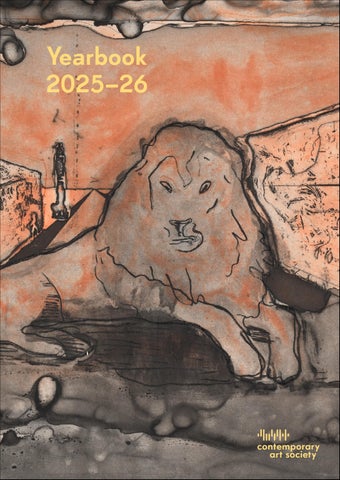
Yearbook 2025–26
Contemporary Art Society
59 Central Street
London
EC1V 3AF
Tel: +44 (0)20 7017 8400
Email: info@contemporaryartsociety.org
Website: contemporaryartsociety.org
Follow us on social media
Facebook: thecontemporaryartsociety
Instagram: contemporaryartsociety
Linkedin: contemporary-art-society
Every effort has been made to contact all copyright holders. If proper acknowledgement has not been made, please contact the Contemporary Art Society. All rights reserved. No part of this publication may be reproduced, stored in a retrieval system, or transmitted in any form or by any means, electronic, mechanical, or otherwise, without first seeking the written permission of the copy right holders and of the Contemporary Art Society. Images cannot be reproduced without prior permission from the Contemporary Art Society.
Date of publication: June 2026
Edited by Asah Adolphe, Caroline Douglas, Martha Hibbert, Elliott Higgs, Isis Ky, Christine Takengny, Paula Zambrano, and CAS *Consultancy
Designed by Fraser Muggeridge studio
Printed by Graphius
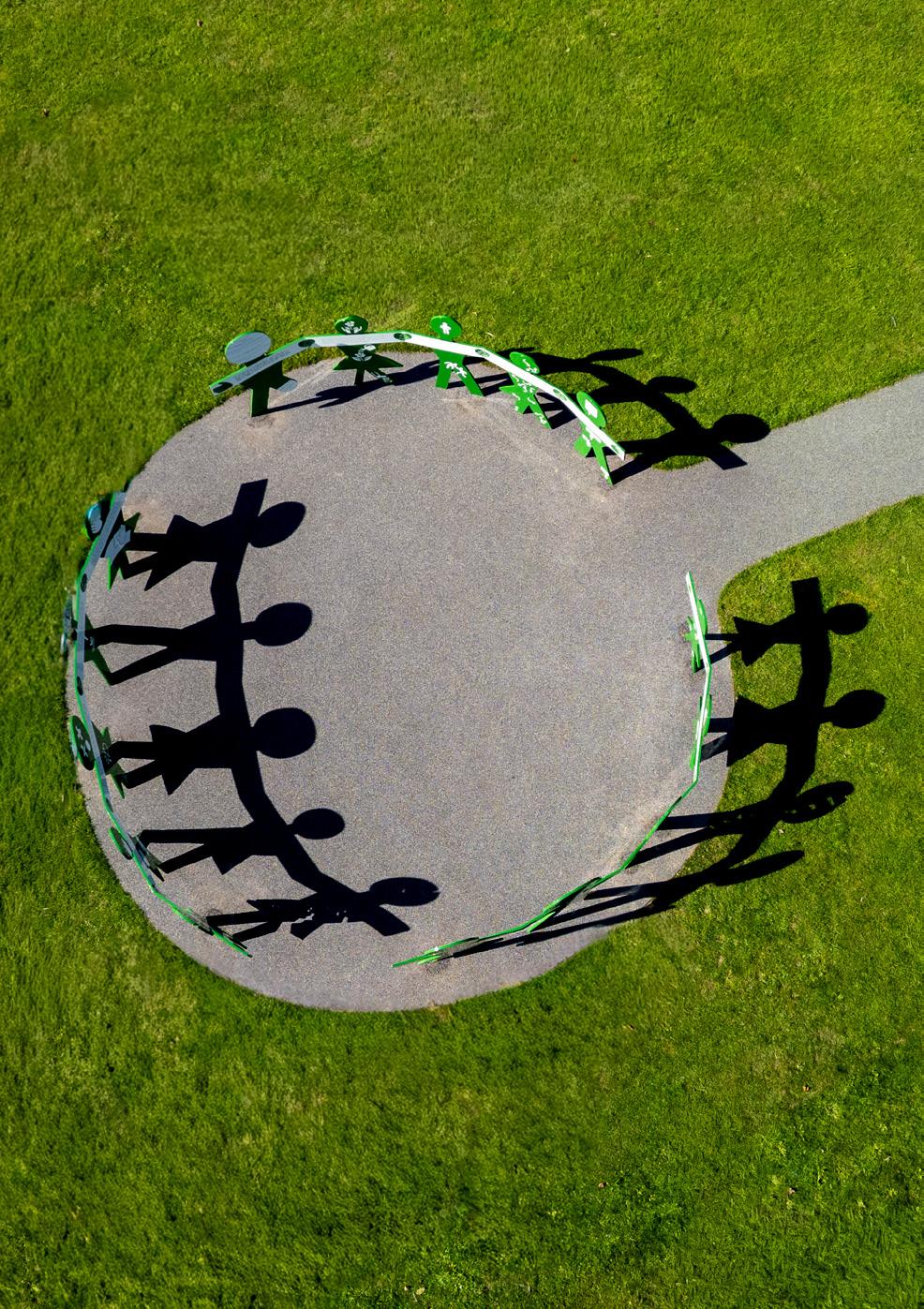
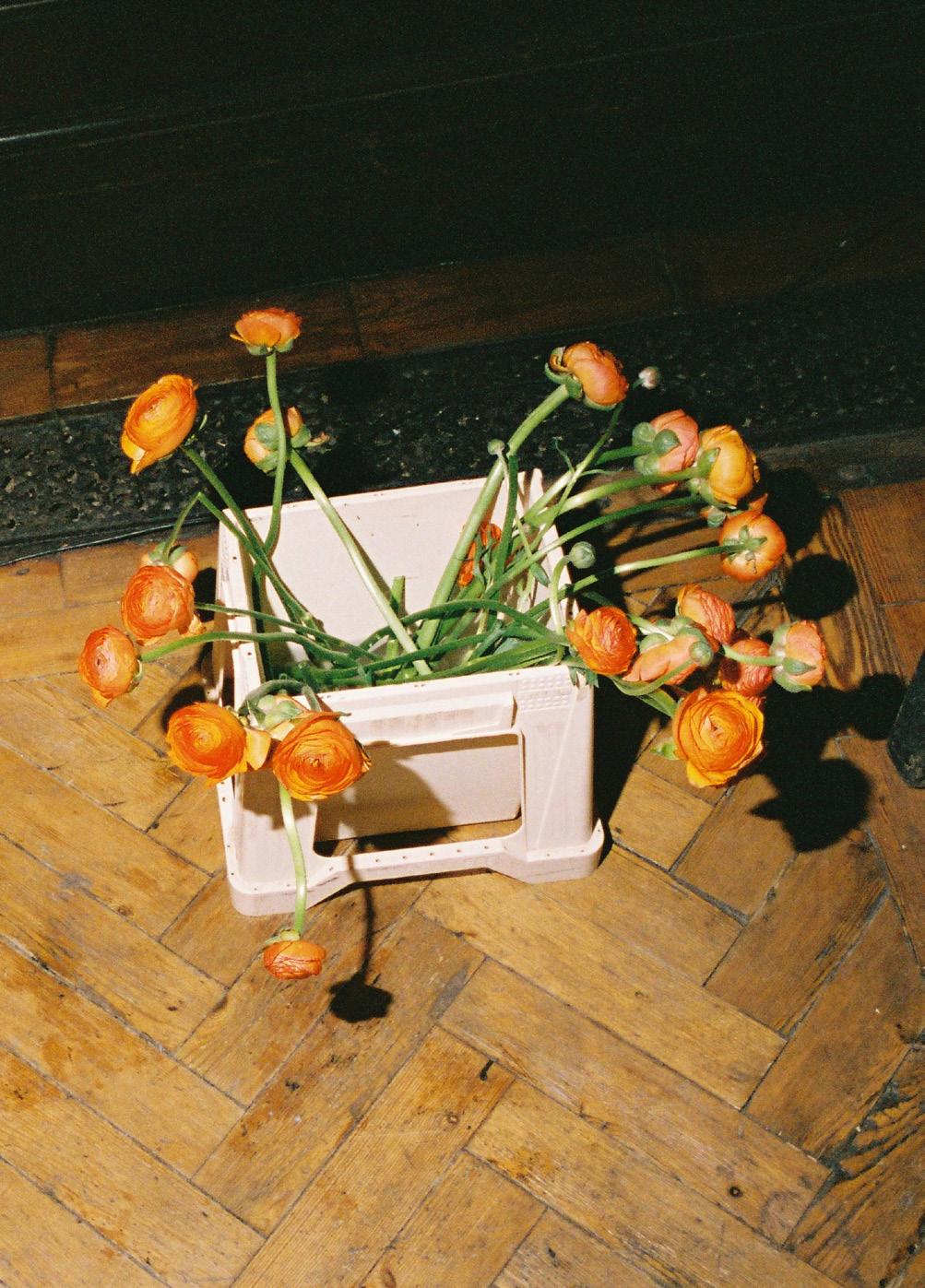
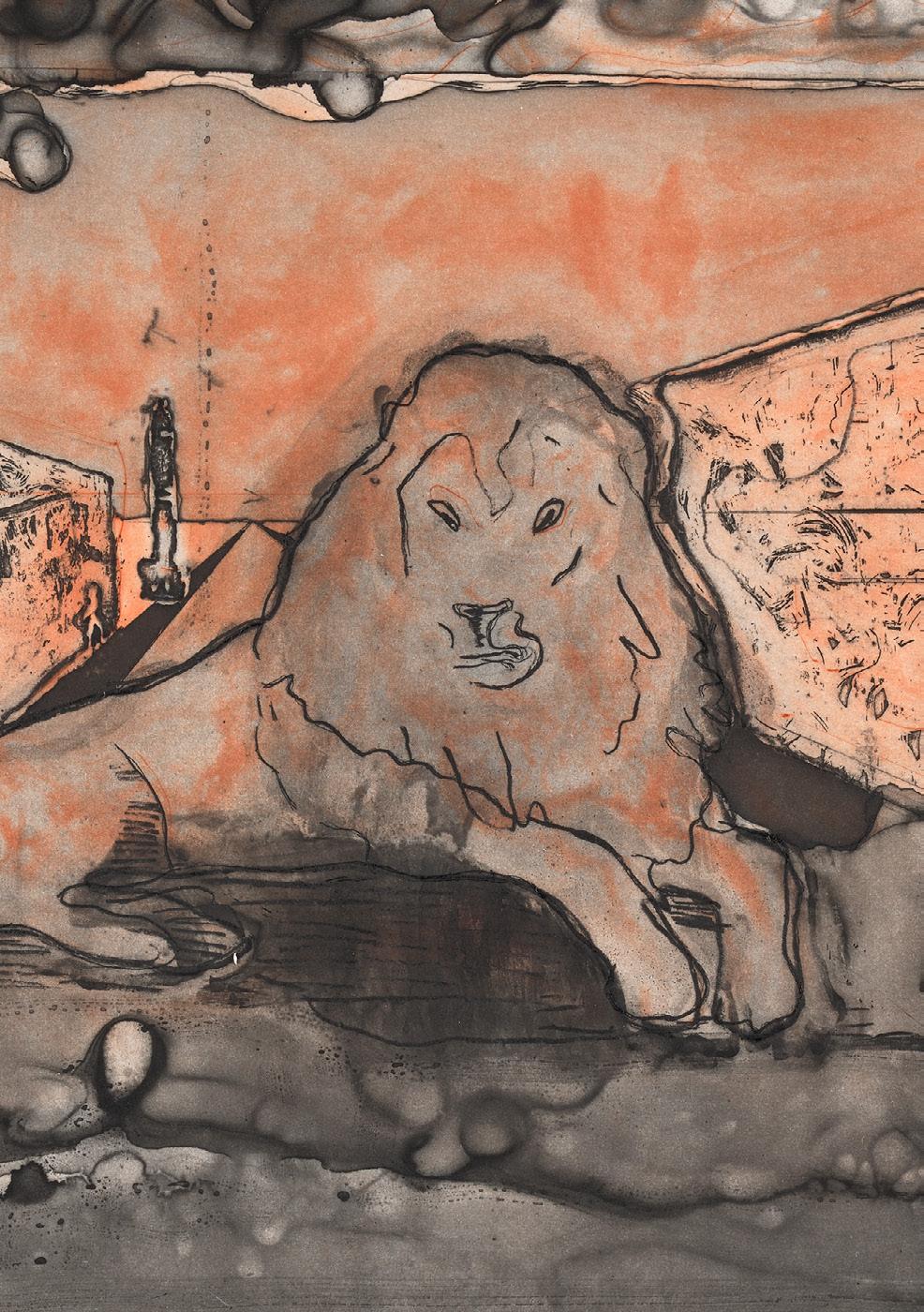
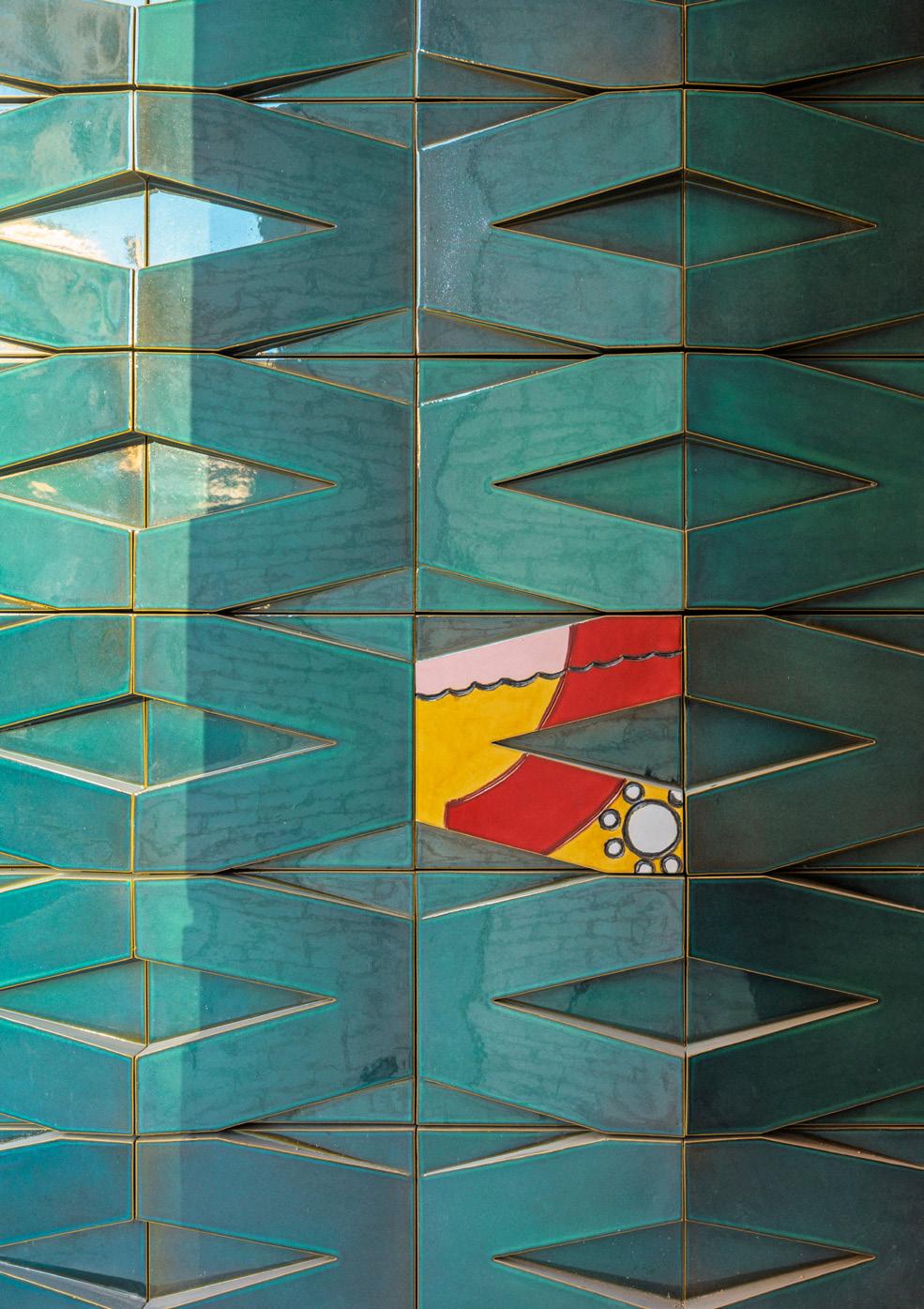
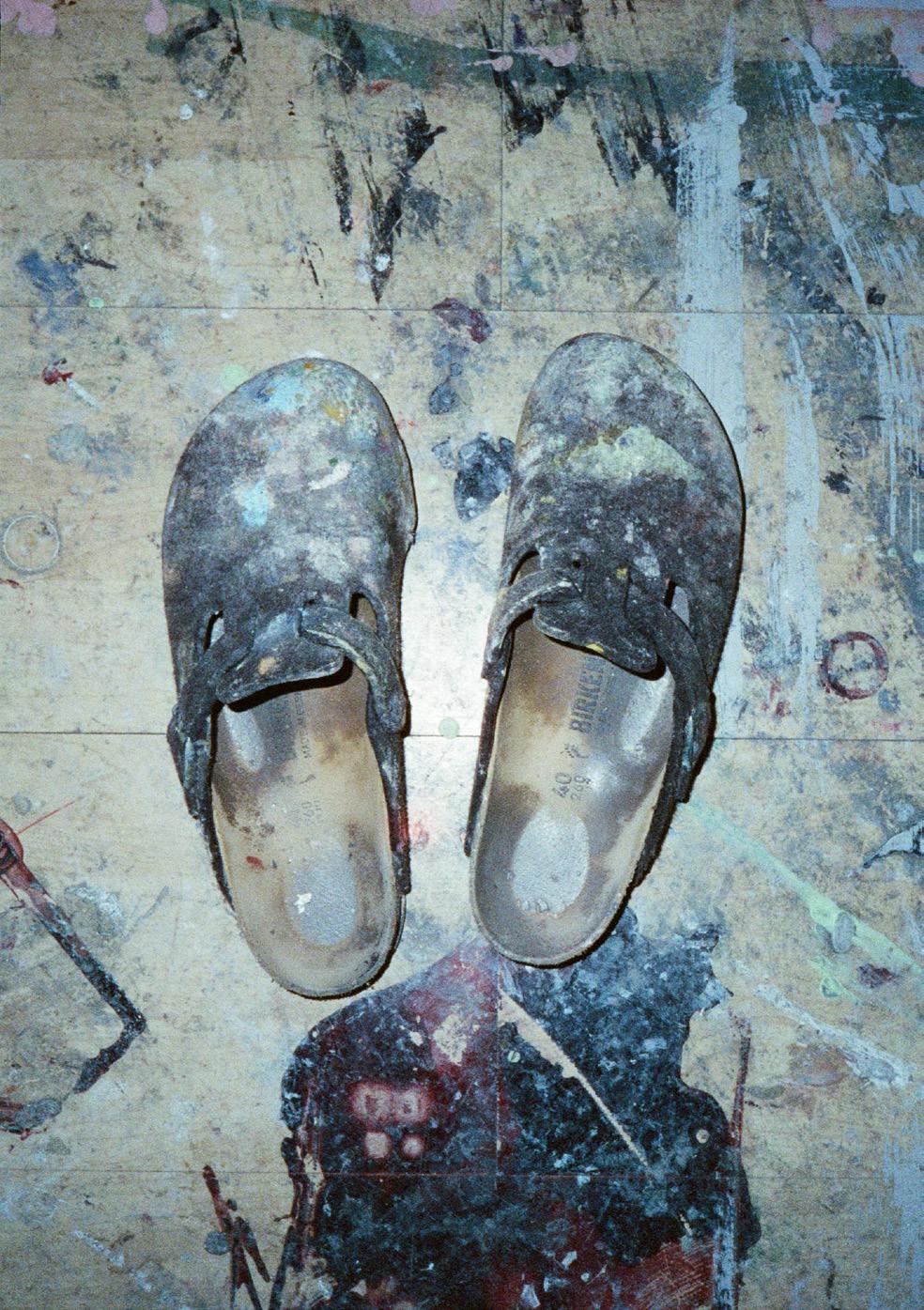
Front cover image: Peter Doig, Lion in the Road (detail), 2016, © Peter Doig. All Rights Reserved, DACS 2026. Courtesy National Galleries Scotland Inside front cover image: Alexis Teplin, 150 Aldersgate (detail), 2025. Photo by Dirk Linder Inside back cover image: Michael Landy, Humanitarian Memorial, 2025. Photo by Jonty Wilde Back cover image: The Artist’s Table, Alvaro Barrington, 2025. Photo by Alfi Moss-White
Foreword
We begin this year by signalling our huge gratitude to two trustees who have stepped down from the Board in recent months. Anna Yang and Bianca Roden have both made significant, long-lasting contributions to the Society’s work over the past decade.
Anna has held several roles in addition to trustee, including chairing the finance committee for many years and helming the wonderful Artist’s Table fundraiser with Do Ho Suh in 2019. Anna, together with her husband Joe Schull, was also a supporter of the first five years of our partnership with the National Gallery and its new artist-in-residence scheme. The project has proved to be an outstanding opportunity for mid-career artists and continues to go from strength to strength. Both Anna and Bianca were early supporters of our Rapid Response Fund during the COVID-19 pandemic in 2020, with Bianca chairing the committee for our first in-person Artist’s Table event after the pandemic. She continues to fund the Senior Curator role here, which has been transformational for us. We offer our heartfelt thanks to them both.
As we celebrate all the acquisitions we have been able to make in the last financial year, we extend our thanks to the advisory committees for fine art and craft, whose wisdom is much valued by the CAS team as well as by the curatorial staff at all our member museums. They are: Hettie Judah, Sarah Brown, Peter Davies and Osei Bonsu for fine art; Alison Britton, Sarah Griffin, Tanya Harrod and Jareh Das for craft.
In February, the National Galleries Scotland debuted the landmark acquisition of an initial group of 67 prints by Peter Doig through the Great Works scheme. Doig, who was born in Edinburgh, intends to make the galleries the home of his complete graphic oeuvre. A second group of pre-2008 prints will join the initial acquisition next year. From now on, the artist will also donate one copy of each print he editions. This extraordinary gift is made possible only through the continued support of Keith Morris’s Sfumato Foundation.
The year has been notable for the number of commissions completed, all with a special connection to a UK town or city. Mike Nelson created two new sculptures for Leeds Art Gallery, acquired through our partnership with the Henry Moore Foundation and Cathy Wills.
In Doncaster, Hannah Starkey was commissioned through the Valeria Napoleone XX scheme to create a new work for the Danum Gallery, Library and Museum. Starkey’s commission celebrates the role that the miners’ wives played during the Miners’ Strike of 1984–86, and as important figures within their now post-industrial communities. Metalsmith Adi Toch was commissioned through the Griffin Fund to create a new work for Reading Museum, responding poetically to the Roman artefacts discovered at nearby Silchester. Through the Griffin Award for Craft, we have also commissioned Ranti Bam to make a new work for the Crafts Study Centre in Farnham, and Jessica Warboys for Abbot Hall in Kendal.
We were delighted to support The Holburne Museum in Bath, one of our newer members, in the acquisition of a major work by the ceramicist Neil Brownsword. The work will be on semi-permanent display in the museum’s stairwell, where visitors will be able to admire it from multiple viewpoints in natural light.
Towards the end of the financial year we were thrilled to complete the acquisition of a very important early sculpture by Rachel Whiteread. This was a final purchase for Leeds Art Gallery as part of the second cycle of their partnership with the Henry Moore Foundation and Cathy Wills. The work is the first by Whiteread to enter Leeds’ collection and is, in large part, a gift of the artist. We extend our warmest thanks and appreciation to Rachel for this gesture.
Ming Wong is the National Gallery’s Artist in Residence for 2025–26. This year we partnered with the Glynn Vivian Art Gallery in Swansea. Thanks to the generous support of our trustee Suling Mead, the first edition of Ming Wong’s new film, made during the residency, will enter their permanent collection.
Two very successful Artist’s Table events were held this year, both of which played a major role in funding the Society’s work. We are indebted to artists Sir Richard Long and Rose Wylie for working with us. The Artist’s Table with Richard Long at the Royal Geographical Society was chaired by Cathy Wills, with support from Soo Hitchen, while Nicola Jones chaired the event at the Royal Academy with Rose Wylie. Our thanks go to them, and to all those who joined their committees and gave time and energy to realise such elegant and enjoyable evenings.
The Contemporary Art Society is thrilled to continue and extend the corporate patronage of Cristea Roberts Gallery, Frieze, Lisson, Thaddaeus Ropac, Victoria Miro, Weil, and White Cube. This year we were also delighted to welcome our new corporate patron Boodles jewellers.
Towards the end of this publication you will find sections dedicated to our programmes for museum colleagues and patron groups. Both programmes have included wonderful international visits: in June, museum curators travelled to Norway and Sápmi, to meet with artists who are also members of the Sámi community there; in February, patrons, took part in Cape Town’s glittering Art Week. Both trips proved to be fantastic opportunities to be introduced to international artists, institutions and collectors. We are grateful to all those who helped us put together such rewarding and rich programmes. This year, our Council member India Rose James launched the new Young Patrons group with a visit to Rye to see artist Alfie Caine in his studio, as well as a print workshop.
For many years now we have been aware of the especially challenging circumstances in which we are operating. We cannot stress enough how much we recognise and value the support we receive from individuals and corporate patrons, enabling us to deliver our charitable mission. As we write this, in late March 2026, the global outlook is more perilous than ever, and museums and galleries in the UK face ever more precarious futures. In this environment, the Society is increasingly committed to being a lifeline, a unique resource, a friend, and an ally. Most of all, we recognise and are proud to be part of such a wide, diverse community of kindred spirits, determined to keep fighting for great art for everyone.
Caroline Douglas, Director Rob Suss, Chair of Trustees
In October 2025 the Collections Fund Committee, once again co-chaired by trustees Nicola Blake and Liesl Fichardt, raised an unprecedented fund for Frieze London, enabling us to make major acquisitions by Michael Landy and Shaqúelle Whyte for the Walker Art Gallery in Liverpool. Michael Landy’s kinetic sculpture on the Thomas Dane Gallery stand stand was a standout highlight of the fair, and the painter Shaqúelle Whyte continues to dazzle with each new body of work. Both acquisitions will be on display in the newly redesigned collection galleries at the Walker in the summer of 2026. 7
Member Museums
The Crafts Study Centre, UCA, Farnham
The Lightbox, Woking
Pallant House Gallery, Chichester
Albert Memorial Museum & Art Gallery (RAMM), Exeter East
UH Arts + Culture,
In the last year we placed 130 artworks by 42 artists
in 31 museum collections.
The total value of the works placed was £1.2 M.
Total number of visitors
32,847,532
Total number of schoolchildren in organised visits
4,615,142
Total number of community group visits
180,211
Artists acquired by the CAS in 2025–26
1. Larry Achiampong pp. 60–61
2. Sam Ainsley pp. 42–43
3. Audrey Albert pp. 46–47
4. Evelyn Albrow pp. 82–83
5. Sammy Baloji pp. 48–49
6. Ranti Bam pp. 30–31
7. Shiraz Bayjoo pp. 52–53
8. Neil Brownsword pp. 74–75
9. Chila Kumari Burman pp. 36–37
10. Lubna Chowdhary p. 78
11. Connor Coulston pp. 72–73
12. Chris Day pp. 54–55
13. Peter Doig pp. 16–19
14. Louis Fratino p. 90
15. Chantal Joffe pp. 38–39
16. Jon Key pp. 92–93
17. Yuki Kihara pp. 56–57
18. Joy Labinjo p. 91
19. Michael Landy p. 20
20. Linder p. 63
21. Che Lovelace pp. 40–41
22. Anina Major pp. 84–85
23. Benaiah Matheson pp. 76–77
24. Rene Matić pp. 50–51
25. Rosie McLachlan p. 79
26. Lindsey Mendick pp. 58–59
27. Mike Nelson p. 22
28. Ṣọlá Olúlòde pp. 96–97
29. Henry Orlik p. 62
30. Celia Paul pp. 26–27
31. Jacqueline Poncelet pp. 32–33
32. Emma Prempeh pp. 44–45
33. Thomas J Price p. 94
34. Veronica Ryan pp. 64–65
35. Hannah Starkey pp. 28–29
36. Adi Toch pp. 80–81
37. Jessica Warboys pp. 68–69
38. Rachel Whiteread p. 23
39. Shaqúelle Whyte pp. 21, 66–67
40. Jesse Wine p. 95
41. Ming Wong pp. 24–25
42. Huimin Zhang pp. 86–87
Special Awards
‘We are incredibly grateful to the Contemporary Art Society for selecting the Walker as the recipient of this year’s Frieze Collections Fund. This generous support has given us the rare opportunity to make ambitious acquisitions, and we are delighted to bring works by Michael Landy and Shaqúelle Whyte into the collection. These hugely significant pieces will transform our displays and be at the centre of our new Post-War and Contemporary Art galleries when they re-open next summer, ahead of our 150th anniversary in 2027. Fittingly, both works bridge the gap between our historic and contemporary collections in their subjects and references, while bringing new ideas and concepts to our displays.’
‘Peter Doig is one of the most consistently inventive artists working anywhere in the world today. The collection of prints acquired for National Galleries Scotland through the CAS Great Works scheme will form an internationally unique resource which will be accessible for exhibition, loan and study now and for future generations. We are indebted to Peter and to the Contemporary Art Society for their generosity and vision in supporting NGS to represent one of Scotland’s greatest contemporary artists across his whole career.’
Charlotte Keenan, Head of the Walker Art Gallery at National Museums Liverpool
Simon Groom, Director of International & National Partnerships at National Galleries Scotland
National Galleries Scotland, Edinburgh
Peter Doig
Great Works
The Great Works scheme, supported by the Sfumato Foundation, aims to address the absence in regional museums and galleries across the UK of works by British artists who have established international reputations in the last 20 years. It is the ambition of the Great Works scheme to ensure that major contemporary works, which might otherwise be inaccessible to museum audiences, enter public collections during the artist’s lifetime. A key consideration is the artist’s relationship to the location of the recipient museum, helping artists establish a lasting presence in a town or region of particular significance to them.
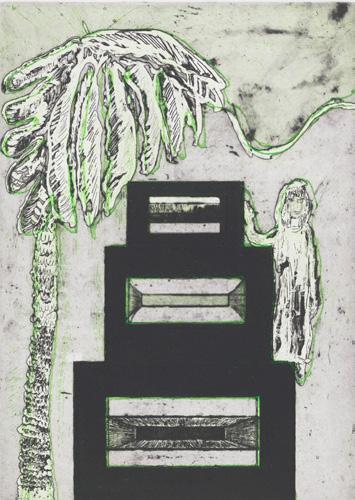
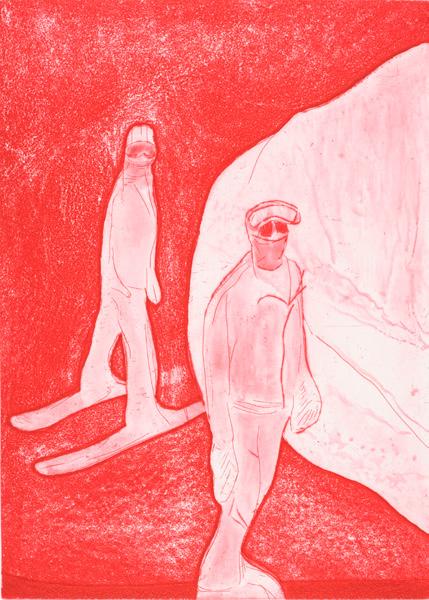
Doig, Two Brothers (red), 2021, etching with aquatint, spitbite, 35.6 × 25.4
Peter Doig is a contemporary painter and printmaker known for his dreamlike landscapes that blur the confines between reality and memory, often referencing personal experiences, popular culture and art history. Born in Edinburgh in 1959, Doig migrated to Trinidad and then Canada as a child. He moved to London to study in 1979, later living and working in Trinidad from 2002, before relocating his main studio back to London in 2021. Doig’s breakthrough as a painter came in 1990, while studying towards a master’s degree at Chelsea School of Art. His inventive style, sensuous colour palette and suggestive imagery set Doig apart from much of the contemporary art scene at the time, which favoured artists whose works emphasised content and ideas rather than form and technique. Today, Doig is credited with having reinvigorated the medium of painting internationally.
A group of 67 prints, relating to paintings dating from 2008–25, have been acquired for National Galleries Scotland. Doig’s prints are an essential component of his practice. He begins by sketching and developing compositions while honing details which will later become part of his paintings. Doig is a tireless innovator and image-maker across both mediums. He has been making prints from the very beginning of his career and continues to do so now, having just installed all the equipment he needs in his London studio.
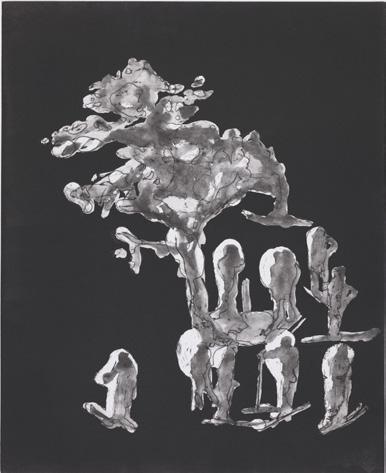
Peter Doig, Maracas (Speaker Box), 2013, etching with aquatint, 45.1 × 34.3 cm
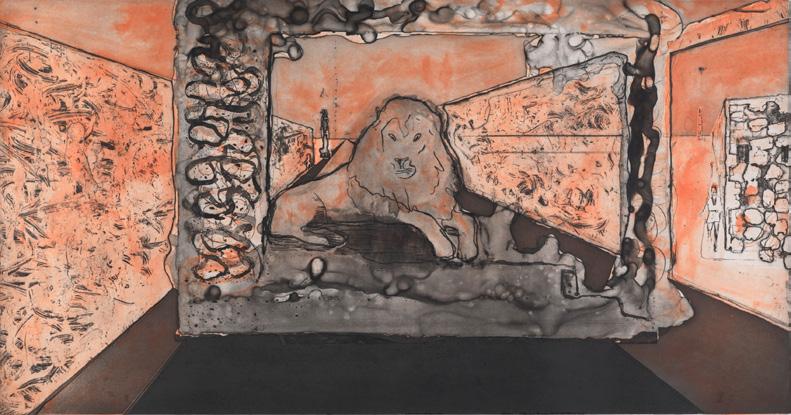
Peter Doig, Lion in the Road, 2016, etching with gravure, aquatint, spitbite, and openbite, 40.6 × 76.2 cm
Peter Doig, Ski Jacket (night) (Morning, Paramin series), 2017–2025, etching with aquatint, spitbite, 61 × 45.7 cm
Peter
cm
National Galleries Scotland, Edinburgh
Peter Doig
We are thrilled that from now on, one edition of each new print produced by the artist will also enter the national collection, as well as an edition of each print made pre2008. This means that National Galleries Scotland will come to hold a record of Doig’s complete graphic output.
The prints capture many of Doig’s ongoing painterly concerns, reflecting on imagery, themes, landscapes and motifs that are common to his body of work. A significant grouping of prints have a connection to Morning, Paramin, a 2016 book made in collaboration between Doig and the St Lucian poet Derek Walcott. Walcott’s writing, deeply rooted in Caribbean topography and history, finds a visual analogue in Doig’s layered and often elusive imagery. Rather than directly illustrating Walcott’s poems, Doig’s prints operate in parallel, creating a dialogue between text and image where meanings are left open. The medium of printmaking – particularly etching and aquatint – allows Doig to explore tonal subtlety and atmospheric effects that resonate well with Walcott’s recollections of light, humidity, and temporality in the Caribbean landscape.
Doig’s prints are also sites of reproduction and reinvention. The Morning Paramin series sees the artist returning to past paintings and reinterpreting them through repetition. The translation from painting to print frequently involves a process of reconfiguration, in which compositional elements are isolated, intensified or reimagined. This approach places Doig within a tradition of painters who value printmaking as a generative counterpart to painting. Doig also takes advantage of the specific material qualities of printmaking – such as its capacity for repetition, variation and accident – to produce images that appear both familiar and estranged.
From a technical point of view, Doig’s prints are marked by a sensitivity to process. He uses techniques such as aquatint, drypoint and lithography to foreground the physical act of mark-making, often preserving the spontaneity of drawing. In contrast to the dense and immersive surfaces of his paintings, Doig’s prints frequently emphasise linework and negative space, as well as the interplay of light and shadow. This can result in images that feel more fragmentary, as though glimpsed in passing or recalled imperfectly. Such qualities align with broader art historical concerns around memory and perception, linking Doig’s work to traditions of romantic landscape painting.
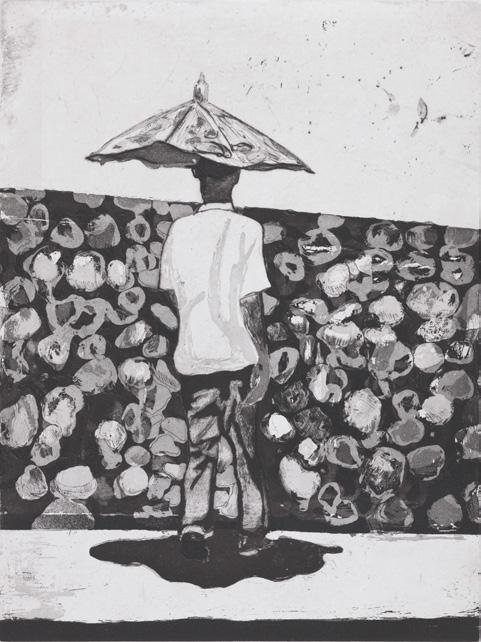
Peter Doig, Maracas (Speaker Box), 2013, etching with aquatint, 45.1 × 34.3 cm
Peter Doig, Lion in the Road, 2016, etching with gravure, aquatint, spitbite, and openbite, 40.6 × 76.2 cm
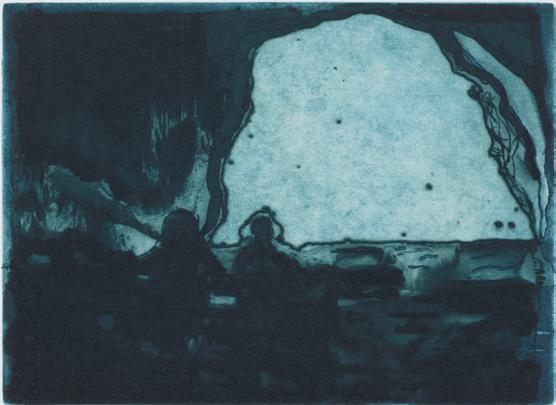
Peter Doig, Boat cave (Saut d’Eau) (Morning, Paramin series), 2017–2025, etching with gravure, aquatint, spitbite, 45.7 × 61 cm
Peter Doig, Lapeyrouse Wall (Fernandes) (Morning, Paramin series), 2017–2025, etching with aquatint, 61 × 45.7 cm
For Doig, landscape and place are never fixed or entirely topographical; rather, they emerge on the canvas as fluid constructs shaped by memory, displacement and cultural encounters. This is evident in his Zermatt series of skiers, derived from found photographs of alpine scenes, where the figures appear dwarfed by a vast and silent expanse of snow. In both painting and print form, these images resist the clarity of traditional mountain landscapes, evoking distance and disquiet instead. By contrast, the recurring figure of the lion from the Trinidadian carnival – rooted in Doig’s years living in the Caribbean – introduces a very different conception of place: one defined by performance, ritual, and embodied experience. Together, these motifs underscore Doig’s broader reimagining of landscape not as a stable setting but as a mutable space, shaped just as much by imagination and memory as by direct observation.
The acquisition of a comprehensive body of Doig’s prints by the National Galleries Scotland will be the basis for a deeper understanding of the reciprocal relationship between the artist’s graphic and painterly practices. Having secured both historical and future editions of Doig’s prints, the National Galleries Scotland are now a key site for the study of one of the most influential painters of his generation, while also foregrounding the enduring relevance of printmaking within contemporary artistic practice.
Peter Doig (b. 1959, Edinburgh, Scotland) lives and works in London.
Gift of the artist, presented by the Contemporary Art Society through the Great Works Scheme, supported by the Sfumato Foundation, 2025
Text by Kerry Gledhill, Senior Librarian, National Galleries Scotland: Modern
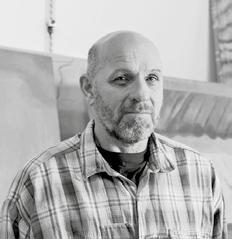
Artwork © Peter Doig. All Rights Reserved, DACS 2026. Portrait by Fergus Carmichael
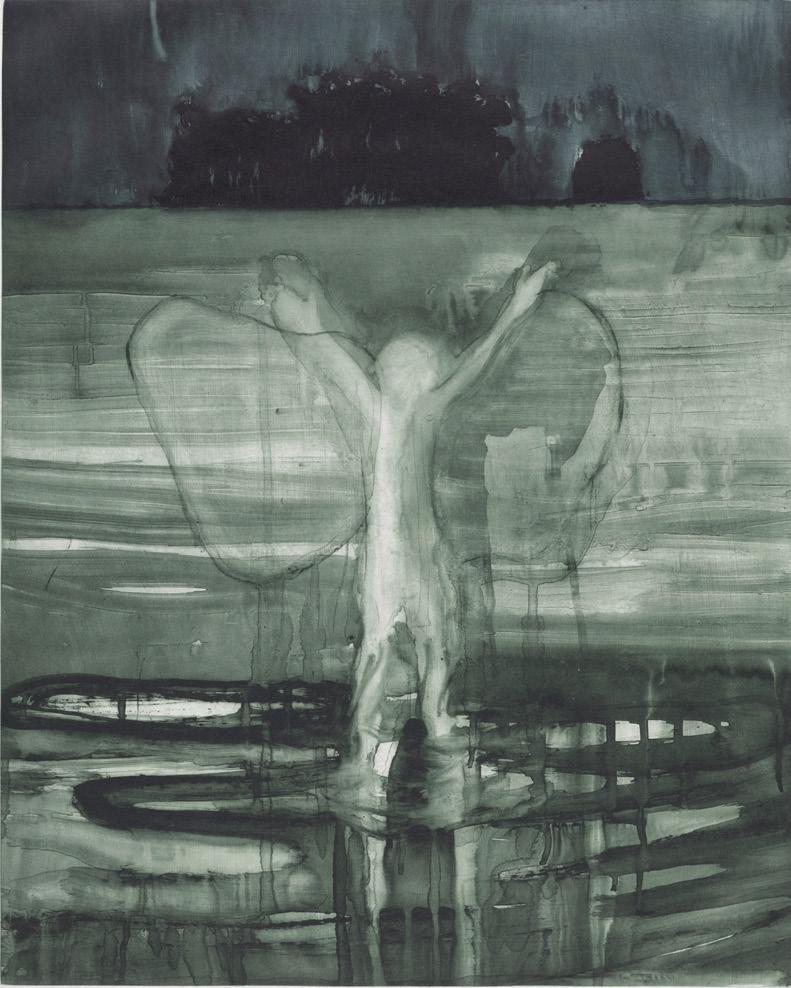
Peter Doig, Paragrand 2, 2013, etching with aquatint on Japanese surface gampi, 50.8 × 40.6 cm
Peter Doig, Ski Jacket (night) (Morning, Paramin series), 2017–2025, etching with aquatint, spitbite, 61 × 45.7 cm
Peter Doig, Two Brothers (red), 2021, etching with aquatint, spitbite, 35.6 × 25.4 cm
To view all 67 of Peter Doig’s prints, scan here.
Peter Doig, Ski Jacket (night) (Morning, Paramin series), 2017–2025, etching with aquatint, spitbite, 61 × 45.7 cm
Peter Doig, Two Brothers (red), 2021, etching with aquatint, spitbite, 35.6 × 25.4 cm
Peter Doig, Paragrand 2, 2013, etching with aquatint on Japanese surface gampi, 50.8 × 40.6 cm
Walker Art Gallery, National Museums Liverpool
Michael Landy and Shaqúelle Whyte
Collections Fund at Frieze
Founded in 2012 and partnered with Frieze from 2016, the Contemporary Art Society’s Collections Fund is designed to support the acquisition of significant contemporary works for our museum members across the UK. The scheme draws together the knowledge and experience of private collectors with that of museum curators, who together conduct a period of research leading to an acquisition. Through the Collections Fund 2025, works by the artists Michael Landy and Shaqúelle Whyte were acquired at Frieze London for the Walker Art Gallery, National Museums Liverpool. In anticipation of the Walker’s 150th anniversary in 2027, the works selected by the Walker’s curators and this year’s Collections Fund Committee take inspiration from prominent themes in the museum’s vast collection, while also granting fresh perspectives.
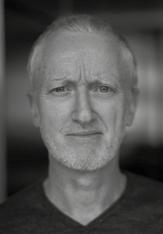
Michael Landy is known for his conceptual work which often softly critiques or playfully challenges dominant systems such as capitalism, consumer culture and organised religion. Landy is best known for the work Break Down (2001), in which the artist destroyed 7,227 of his belongings in a public exhibition held in an empty shop on Oxford Street. He later created Art Bin (2010), where artists were invited to throw away their failed or rejected artworks into a giant transparent bin placed in the South London Gallery.
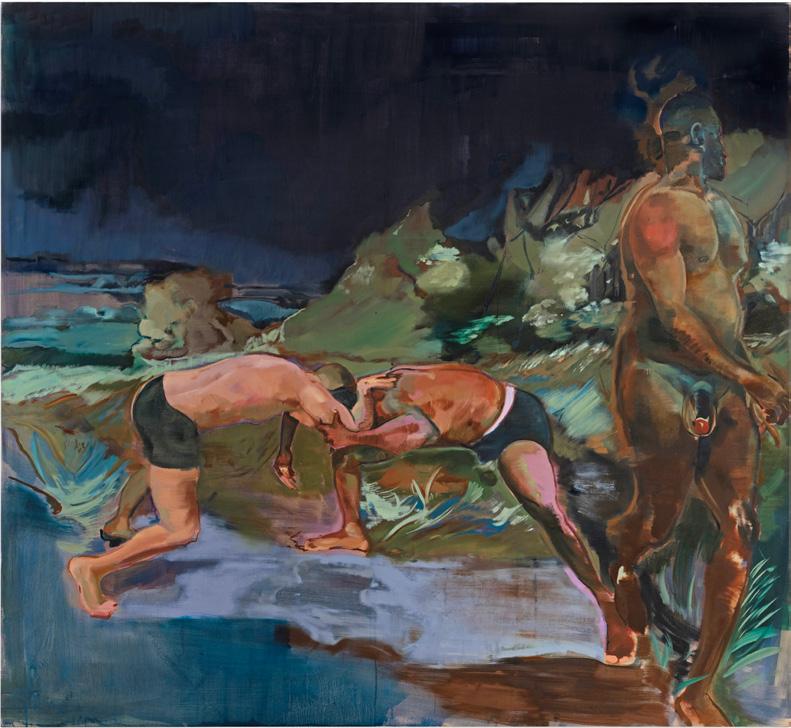
Shaqúelle Whyte, In an embroiled fashion, 2025, oil on linen, 220 × 240 cm
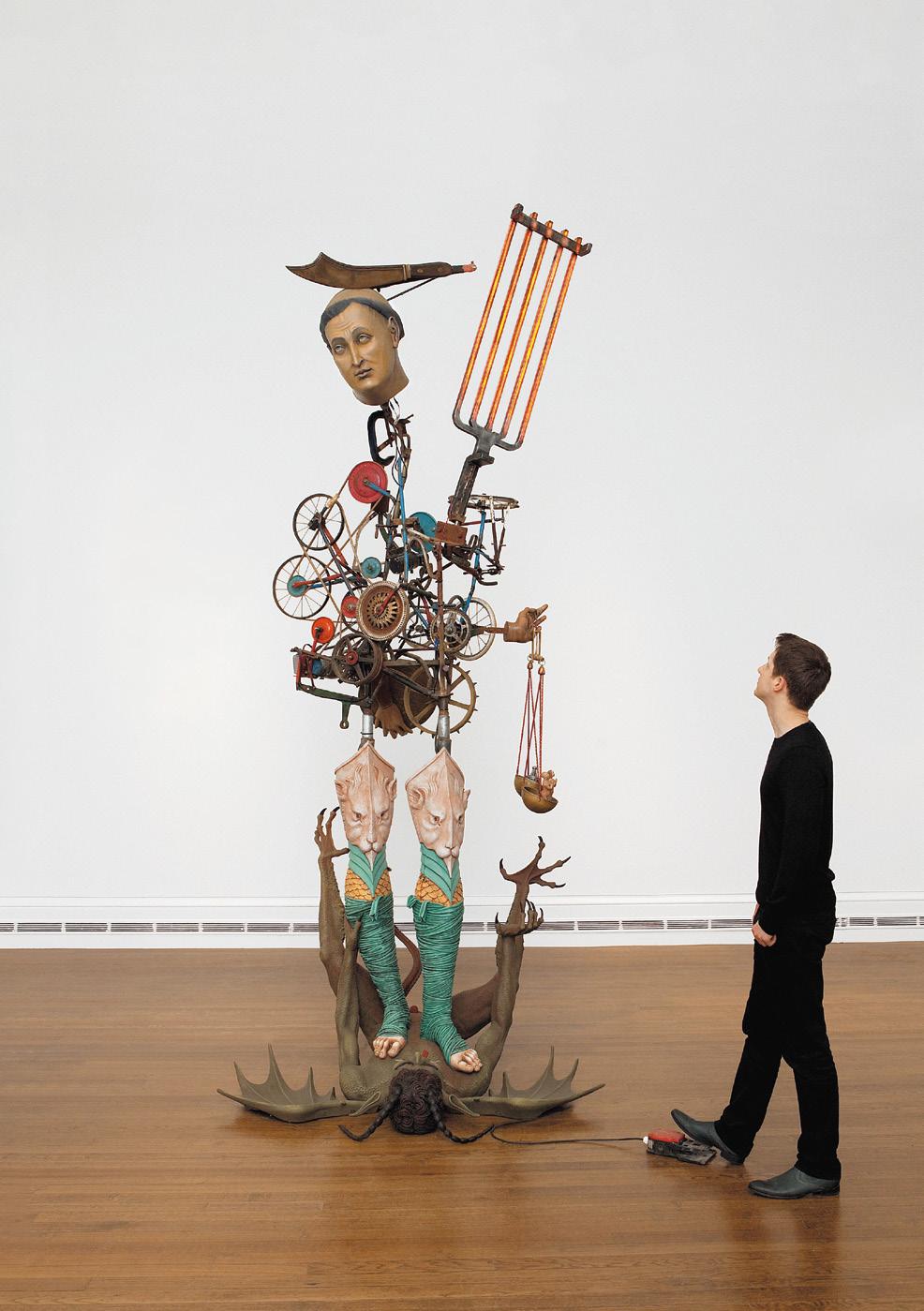
Complementing the Walker’s historic painting collection of Christian iconography, Landy’s interactive kinetic work Multi-Saint (2013) represents a number of saints –St Catherine, St Lucy, St Peter Martyr, St Lawrence and St Michael – through their respective identifying symbols. The sculptural assemblage also draws upon modern references, particularly Swiss artist Jean Tinguely’s kinetic sculptures, which are operated with a foot-pedal. Landy first encountered them at Tate Britain in 1982, when he was a student. Created after Landy’s National Gallery residency (2010–2012) and the subsequent 2013 exhibition Michael Landy: Saints Alive, this new acquisition satirises the canon of art history in a playful and provocative manner which directly engages the participation of audiences.
Michael Landy CBE, RA (b. 1963, London, UK) lives and works in London.
Michael Landy, Multi-Saint, 2013, mixed media, 458 × 165 × 157 cm
Walker Art Gallery, National Museums Liverpool
Michael Landy and Shaqúelle Whyte
Michael Landy, Multi-Saint, 2013, mixed media, 458 × 165 × 157 cm

Shaqúelle Whyte’s psychologically charged figurative paintings allude to surreal, otherworldly narratives which are nonetheless rooted in his own experiences. His enigmatic works conjure a sense of palpable tension and dynamism. Engaging with representations of Black masculinity and evoking mythological tales as well as the artist’s own musical influences, Whyte’s enigmatic works conjure a sense of palpable tension and dynamism.
Whyte’s In an embroiled fashion (2025) reprises the artist’s characteristic style of loosely rendered and energetic brushwork with a colour palette of deep and rich hues. Featuring two figures engaged in a physical wrestle, here Whyte interrogates the human body without revealing his subjects’ identity, adding to the work’s pervasive sense of mystery. Emerging from the foreground, a third, naked man walks towards us. His head is turned backwards, as if having detected something – or someone – beyond our gaze. Narrative plays a key part in Whyte’s work, qnd his enigmatic paintings actively invite further specualtion, either read individually or sparking dialogue with others.
Shaqúelle Whyte (b. 2000, Wolverhampton, UK) lives and works in London.
Presented by the Contemporary Art Society through the Collections Fund at Frieze, 2025/26
Texts by Charlotte Keenan, Head of Walker Art Gallery
Artwork © Michael Landy. Courtesy Thomas Dane Gallery, London. Portrait by David Bebber, courtesy Thomas Dane Gallery, London
Artwork © Shaqúelle Whyte. Courtesy the artist and Pippy Houldsworth Gallery, London. Photography by Eva Herzog. Portrait by Brynley Odu Davies
With thanks to our committee members: Nicola Avery-Gee, Nicola Blake (Co-Chair), Liesl Fichardt (Co-Chair), Whitney Gore, Soo Hitchin, Stephanie Holmquist, Helen Janecek, Sophie Kingsley, Béatrice Lupton, Andrew Pirrie-Franks, Katrina Reitman, Susan Rosenberg, Varvara Roza, Andreas Siegfried and Pamela Stanger
Whyte, In an embroiled fashion, 2025, oil on linen, 220 × 240 cm
Shaqúelle
Leeds Art Gallery
Mike Nelson and Rachel Whiteread
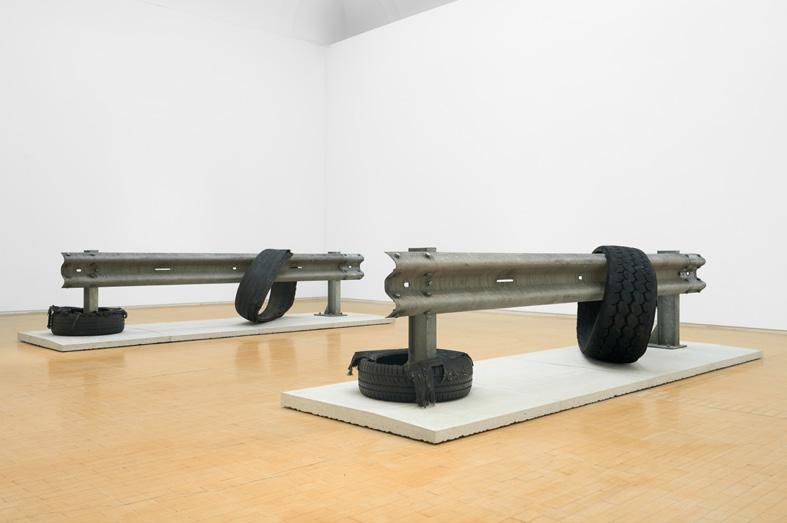
Mike Nelson, M62 (East, West), 2024, cast concrete slabs, motorway barrier, galvanised posts, blown-out tyres, galvanised nuts and bolts, 110 × 380 × 100 cm
Special Partnership with the Henry Moore Foundation and Cathy Wills
The Contemporary Art Society has acquired sculptural works by Mike Nelson and Rachel Whiteread for Leeds Art Gallery through a special partnership between the Henry Moore Foundation and the CAS, supported by Cathy Wills. The four-year scheme supports Leeds Art Gallery and The Hepworth Wakefield which are both located in Yorkshire, the UK’s centre for sculpture.
Mike Nelson’s new commission M62 (East, West) (2025) forms the latest edition of a serial work that utilises blown-out tyres gathered from major road systems of cities across the world. The series began in 2013 with M6, titled after the motorway which passes through Birmingham. M6 was followed by A7 (Route du Soleil) in Lyon, France (2015), A52 in Düsseldorf, Germany (2017) and M25 in London (2023). The series could hypothetically be extended to include every city or town in the world, all represented through roadside detritus.
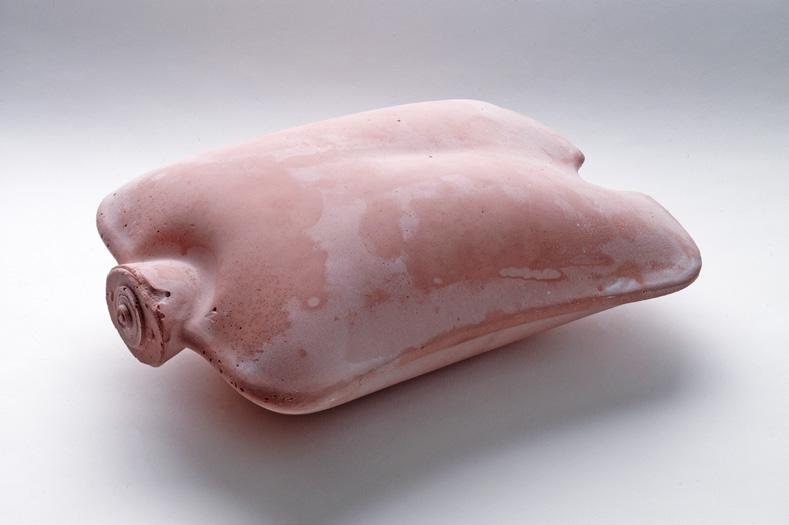
Rachel Whiteread, Untitled (Pink Torso), 1995, pink dental plaster, 10 × 17.5 × 27.5 cm
For Leeds Art Gallery, Nelson took the nearby M62 as his point of focus, which runs from east to west. He created two works in response. M62 (East) and M62 (West), which appear almost identical. These two doppelgängers encourage close study, almost suggesting a game of ‘spot the difference’. To accentuate this sense of doubling, two sections of motorway barrier have been incorporated and mounted onto a concrete platform with a chamfered edge, simulating the central reservation of road systems. M62 (East) and M62 (West) have been conceived to be viewed together or presented in separate galleries, creating a sense of déjà vu.
Mike Nelson (b. 1967, Loughborough, UK) lives and works in London.
Presented by the Contemporary Art Society, through its Special Partnership with the Henry Moore Foundation, supported by Cathy Wills. This acquisition was generously enabled by the artist, 2024/25
Leeds Art Gallery
Mike Nelson and Rachel Whiteread
Rachel Whiteread is a British artist who has developed a unique approach to sculpture. By casting the negative space around architectural forms and everyday objects, she transforms invisible volumes into solid forms. These castings become enigmatic objects made of materials such as plaster, resin, rubber, cement, wax, aluminium, and silver. Whiteread began using this casting method very early in her career and has remained loyal to its principles. She is best known for her large-scale works such as Ghost (1990), a plaster casting of the interior of a typical Victorian living room. In 1993, Whiteread became the first woman to win the Turner Prize with the monumental sculpture House, a cast of an entire terraced house in London’s East End.
Untitled (Pink Torso) (1995) is one of a series of Torso sculptures dating back to Whiteread’s 1988 solo exhibition at Carlisle Gallery, London. Casting the interior of a hot water bottle in pink dental plaster highlights the absence of the object – the title suggesting a connection with the human body. This acquisition marks the first work by Whiteread to enter Leeds Art Gallery’s collection. The artist first exhibited at the Gallery as part of the British Art Show 3 exhibition in 1990. Now, we become the first civic institution in the North of England to acquire one of Whiteread’s sculptures.
Dame Rachel Whiteread (b. 1963, London, UK) lives and works in London.
Nelson, M62 (East, West), 2024, cast concrete
Presented by the Contemporary Art Society, through its Special Partnership with the Henry Moore Foundation, supported by Cathy Wills. This acquisition was generously enabled by the artist, 2025/2026
motorway barrier, galvanised posts, blown-out tyres, galvanised nuts and bolts, 110 × 380 × 100 cm
Texts by Jane Bhoyroo, Principal Keeper
Artwork © Mike Nelson. Courtesy the artist; Matt’s Gallery, London; 303 Gallery, New York; Galleria Franco Noero, Turin; and Neugerriemschneider, Berlin. Photography by Rob Battersby, Leeds Art Gallery. Portrait courtesy the artist
Artwork © Rachel Whiteread. Courtesy the artist and Leeds Art Gallery. Portrait by Johnnie Shand Kydd
Mike
slabs,
Rachel Whiteread, Untitled (Pink Torso), 1995, pink dental plaster, 10 × 17.5 × 27.5 cm
Glynn Vivian Art Gallery, Swansea
Ming Wong
National Gallery Artist in Residence Programme
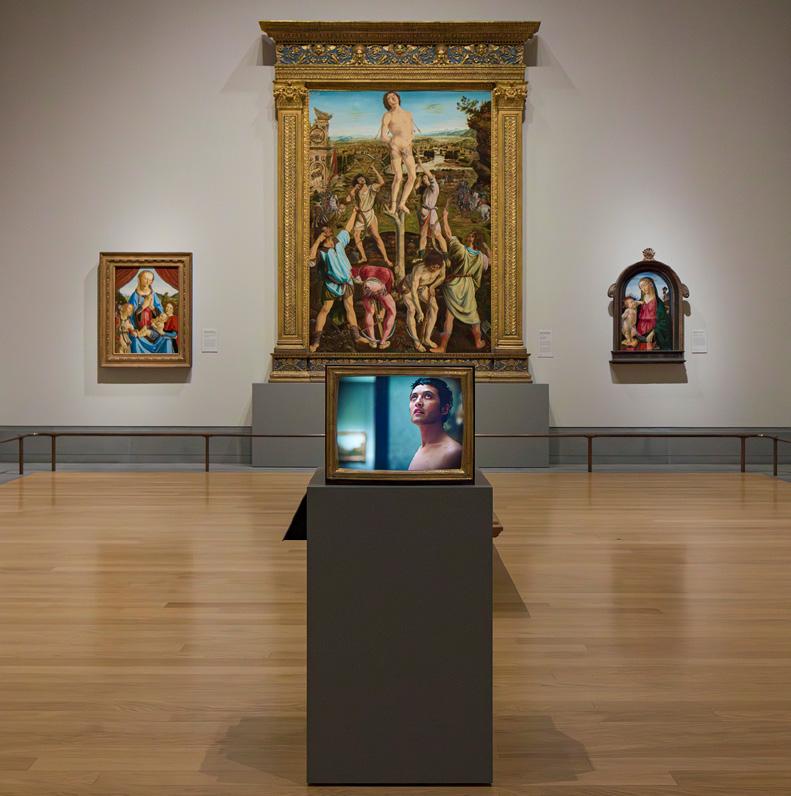
This year, Singaporean artist Ming Wong was selected as the fifth Artist in Residence at the National Gallery since the launch of the institution’s Modern and Contemporary Programme in 2019. In Dance of the Sun on the Water / Saltatio solis in aqua – a new film and display commissioned as part of the residency in partnership with Glynn Vivian Art Gallery – Wong allows eroticism, queer bodies, and temporal ruptures to ripple across the museum, turning it into a site of desire, anachronism and resistance. Installed on ‘medieval televisions’ across four of the National Gallery’s historic rooms and culminating in a projection in the Pigott Theatre, the work reanimates St Sebastian, arguably the most enduring queer icon in Western art, within the very institution that contributed to his canonisation. Wong does more than reinterpret religious imagery; he exposes how desire, devotion and temporality are embedded within art-historical narratives.
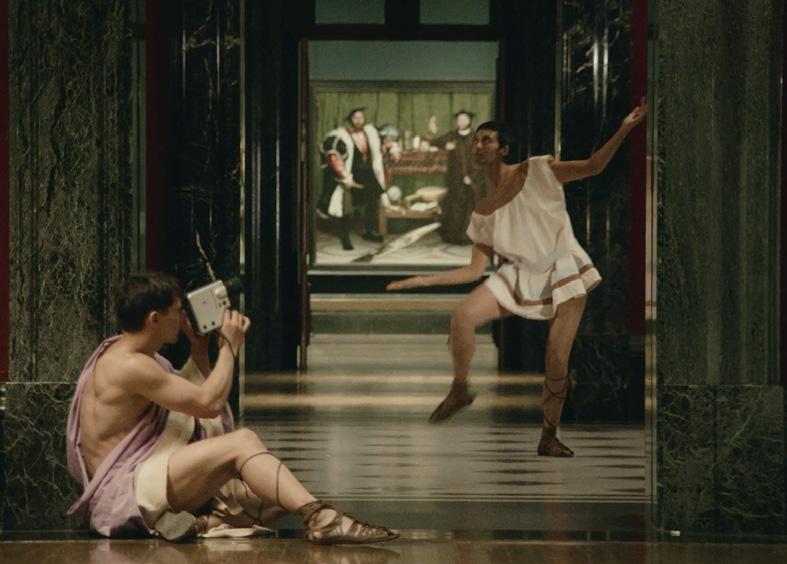
Ming Wong responded primarily to the figure of St Sebastian, as represented in 14 depictions across the National Gallery’s permanent galleries; as well as to Derek Jarman 1976 film, Sebastiane. Wong’s work explores themes of representation, identity and how we interpret artworks. In Wong’s film, a cast of androgynous actors with Asian heritage play the part of a host of Roman soldiers and sometimes St Sebastian himself. Wong appears as both a Roman soldier and the authoritative figure of art historian Kenneth Clark, known for his TV series Civilisation. In Wong’s film Clark’s trademark brown suit is shot through with arrows.
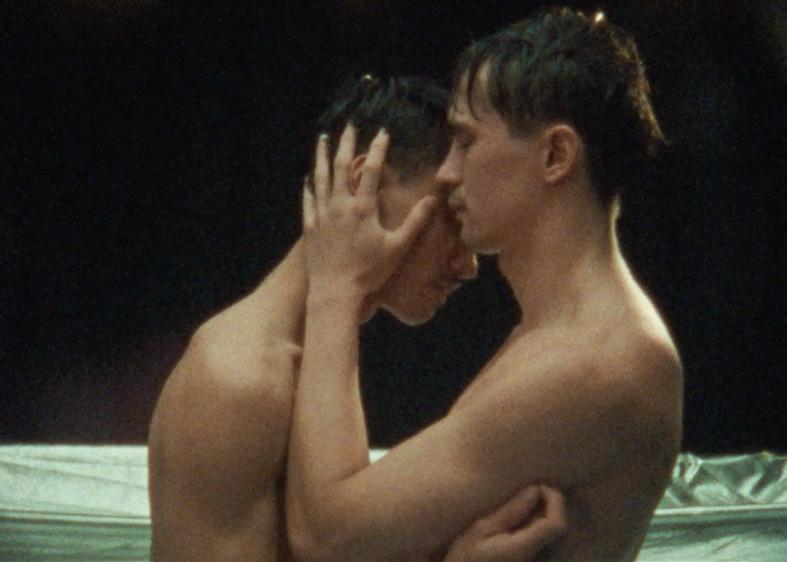
As well as taking his cue from the National Gallery’s collection, Wong’s task was also to make connections with Glynn Vivian’s. Wong found several points of dialogue between the two museums; for example, the work of contemporary ceramicist Clare Curneen and her poignant depiction of the figure of St Sebastian. Wong also explored works relating to Swansea-born Dylan Thomas. He was particularly inspired by Thomas’s 1933 poem,
Ming Wong, Dance of the Sun on Water / Saltatio solis in aqua, 2025–26, digital video, dimensions variable
Glynn Vivian Art Gallery, Swansea
Ming Wong
And death shall have no dominion, which was depicted by artist Ceri Richards in a print of the same name. This beautiful poem with themes of death and martyrdom was a constant inspiration to Wong throughout the residency and appears translated into Latin in the catalogue that accompanies the work.
Wong’s work playfully, with much warmth and humour, brings to life the enduring relevance of St Sebastian and asks important questions about the representation and ownership of artworks, collections and the buildings that house them. We are delighted to accept this acquisition into our collection at Glynn Vivian.
Ming Wong (b. 1971, Singapore) lives and works in Berlin.
Presented by the Contemporary Art Society through the special partnership with the 2025 National Gallery Artist in Residence programme, with the support of Suling Mead, 2025/26
Text by Karen MacKinnon, Curator
Artwork © Ming Wong. Courtesy the artist. Image credit: Glynn Vivian Art Gallery, Swansea
Ming Wong, Dance of the Sun on Water / Saltatio solis in aqua, 2025–26, digital video, dimensions variable
Aberdeen Archives, Gallery & Museum, Aberdeen
Celia Paul
City Council
Ada Award
The Ada Award supports the acquisition of work by UK-based artists who are women over the age of 50. It recognises those with a strong record of exhibiting and receiving critical recognition who remain underrepresented in public collections.
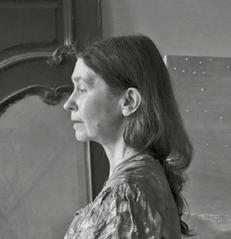
Celia Paul is one of the most compelling painters working in Britain today. Her paintings, often intimate portraits of herself, her mother, and her sisters, are characterised by muted tones, fluid brushwork, and a meditative atmosphere that conveys both vulnerability and strength. Paul is also a celebrated author. Her memoir Self-Portrait (2019) received widespread acclaim, followed by Letters to Gwen John (2022), which explores parallels between her own life and that of the early 20th-century Welsh artist. Despite critical acclaim, Paul’s work remains significantly underrepresented in UK public collections. Notably, there is currently no representation of her work in any public collection in Scotland, underscoring the urgency and importance of this acquisition.
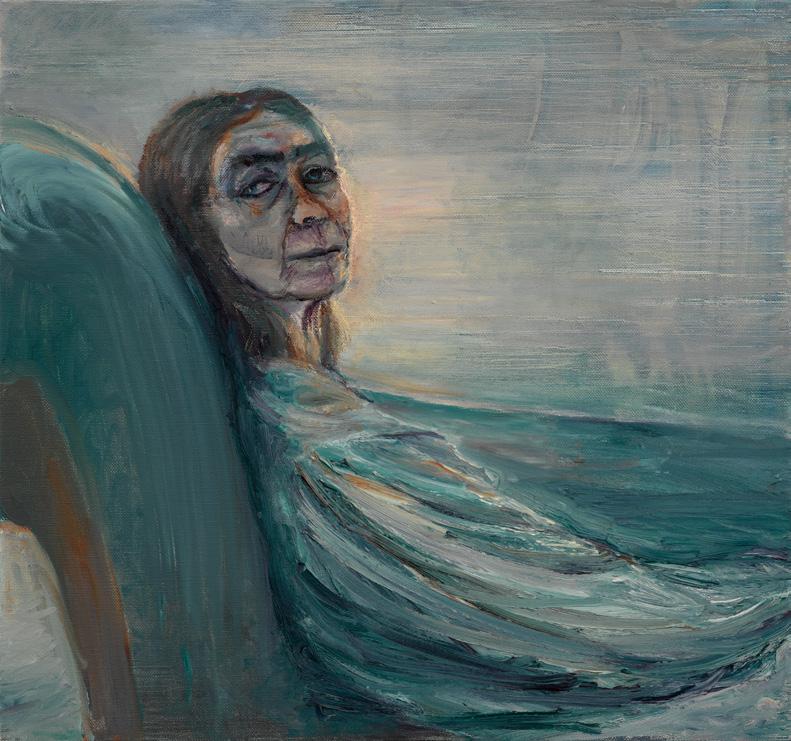
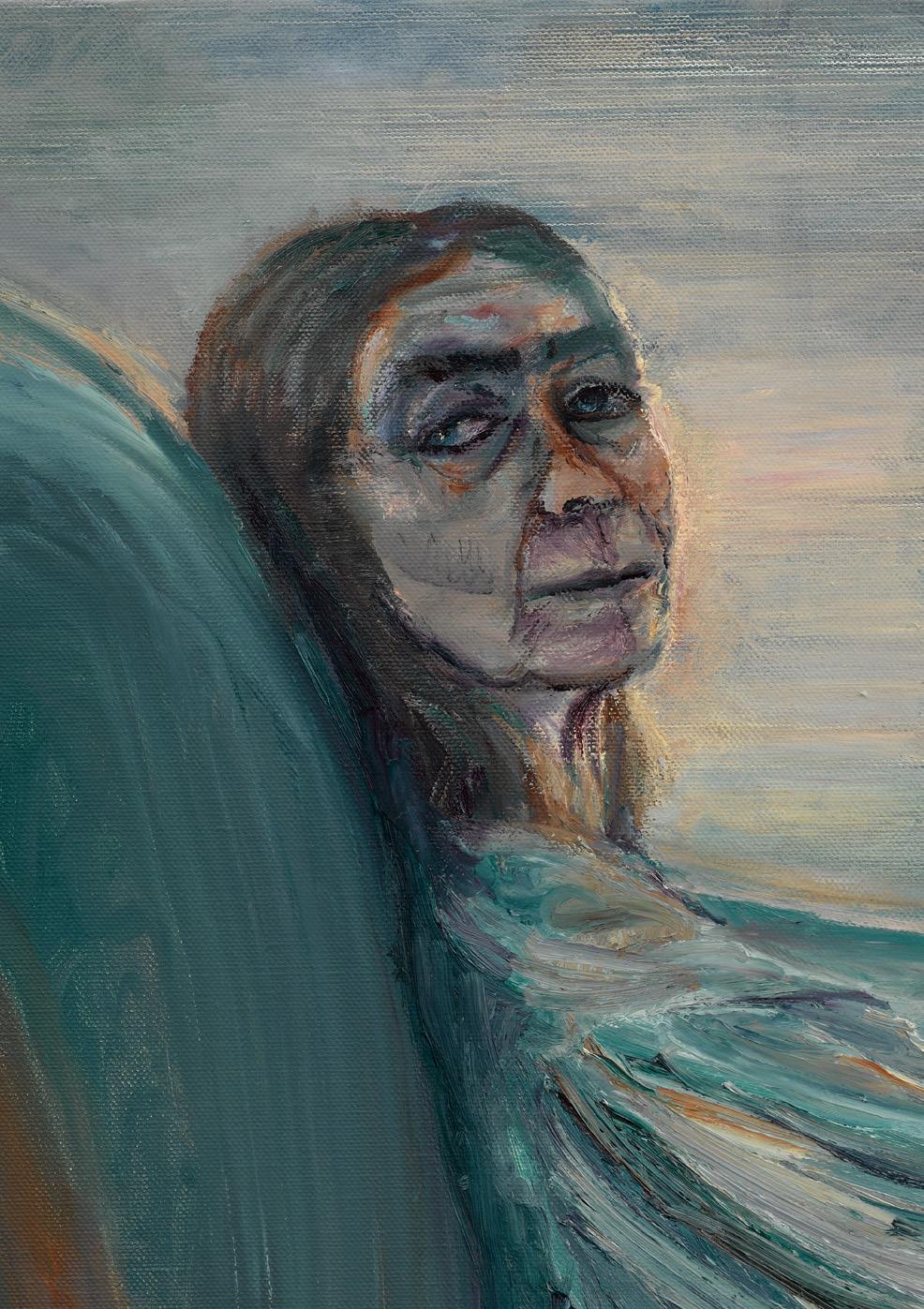
Chaise (2023) is a self-portrait inspired by French artist Jacques-Louis David’s Portrait of Madame Récamier (1800), in which the sitter reclines on a chaise longue with a poised, assertive gaze. Paul adopts this motif to explore themes of bodily presence and autonomy in her own work. Reclining on a green velvet chaise, she appears serene, caught in a moment of transition. The painting balances stillness and transformation, suggesting an inner life that is composed and selfcontained. This contemplative atmosphere reflects Paul’s enduring engagement with solitude, embodiment, and the strength found in quiet resilience.
The setting of the work is Paul’s Bloomsbury flat, which overlooks the forecourt of The British Museum in London. The flat also servers as Paul’s studio. The worn, paintsplattered chaise lounge is the most lived-in object in the space, with its contours bearing the imprint of the artist’s body after hours spent reading and reflecting while sitting in it. It evokes Virginia Woolf’s assertion in her essay
Celia Paul, Chaise, 2023, oil on canvas, 81.3 × 76.2 cm
Aberdeen Archives, Gallery & Museum, Aberdeen
Celia Paul
City Council
A Room of One’s Own that in order to gain artistic freedom, women require not only physical space, but also the ability to pause, think and engage deeply with their inner lives. Paul’s painting is a quiet testament to that internal labour.
Among the founding collection of Aberdeen Art Gallery is a late 19th-century group of 91 portraits and selfportraits painted by men, commissioned by local stonemason Alexander Macdonald and his wife. While historically significant, this body of work reflects a longstanding gender imbalance in artistic representation. Through acquisitions such as Paul’s Chaise, made possible by the Ada Award, we are able to represent the diverse voices that have contributed to visual culture, actively addressing the underrepresentation of women artists whose works continue to define and enrich contemporary British painting.
Celia Paul (b. 1959, Thiruvananthapuram, India) lives and works in London.
Presented by the Contemporary Art Society through the Ada Award, 2025/26
by Griffin Coe, Art Curator
Celia Paul, Chaise, 2023, oil on canvas, 81.3 × 76.2 cm
Text
Artwork © Celia Paul. Courtesy the artist and Victoria Miro, London. Portrait by Gautier Deblonde
Danum Gallery, Library and Museum, Doncaster
Hannah Starkey
Valeria Napoleone XX Contemporary Art Society
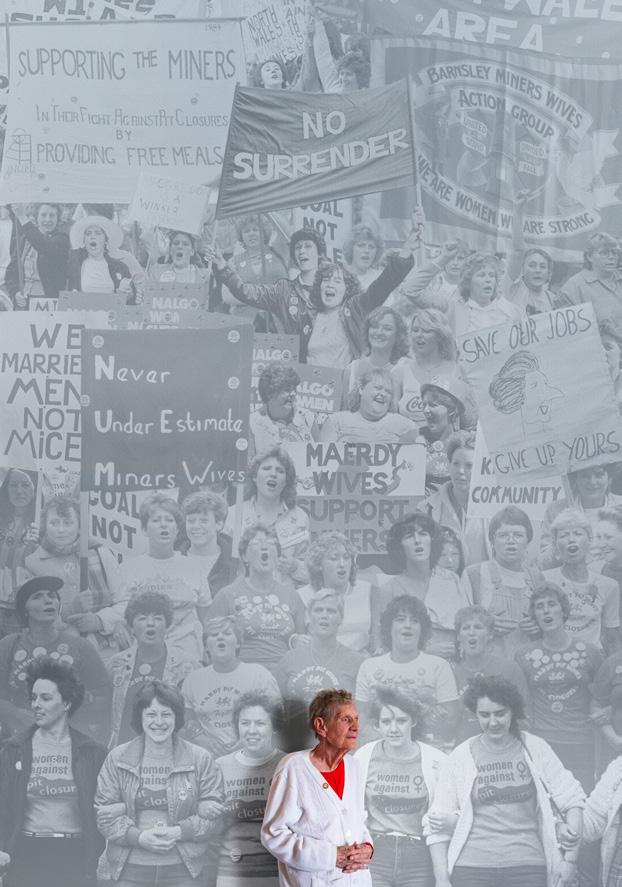
The photograph Cath: A Woman’s Place is on the Picket Line! by Hannah Starkey has been commissioned for Danum Gallery, Library and Museum through the Valeria Napoleone XX Contemporary Art Society award. The award supports the acquisition of significant works by contemporary artists who are women for a museum collection every year.
Hannah Starkey’s carefully composed photographs often portray women, either in moments of quiet reflection or during times of interaction amongst themselves. These compositions frequently result in large-scale photographs.
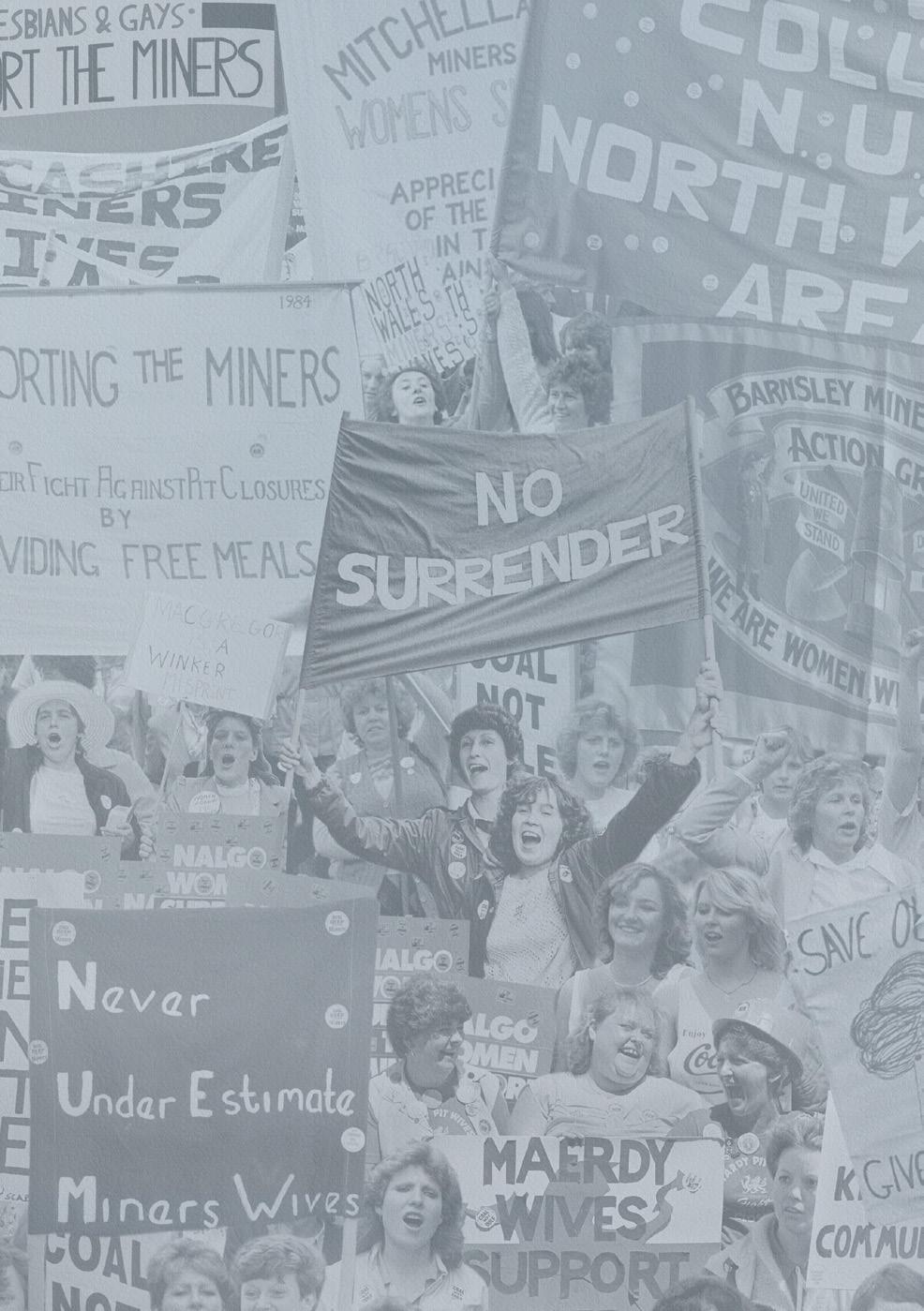
The background research for this commission was carried out by colleagues at Heritage Doncaster during the recent commemoration of the 40th anniversary of the miners’ strike. That work shone a light on the important role that women played in supporting the striking miners; it also brings long-overdue attention to the role they continued to play within their communities, up to the present day.. Hannah Starkey’s commission aims to reflect that legacy, while honouring the women that were involved in the strike both in Doncaster and nationally.
During the creation of Cath: A Woman’s Place is on the Picket Line!, Starkey spent time in Doncaster visiting the sites of some of the collieries that used to surround the city, meeting people that were involved in the strike. When visiting Denaby, the site of the Denaby Main Colliery, the artist met Cath Whitehead, who was extremely active during the strike, both in the soup kitchens and on the picket lines. Now in her middle 90s, she still speaks with passion and energy about her experiences during the strike. During the meeting, Hannah photographed Cath in the living room of her home.
The resulting portrait became central to the commission. In the final photograph, the wallpaper pattern in Cath’s living room – housing a montage of press images of
Hannah Starkey, Cath: A Woman’s Place is on the Picket Line!, 2026, photograph, 260 × 160 cm
Danum Gallery, Library and Museum, Doncaster
Hannah Starkey
women taken during the miners’ strike – appears like a memory both personal and collective. Starkey felt that the women in the artwork should appear like a wave. To reinforce this idea, the photograph is displayed at Danum on a structure that curves away from the supporting wall, evoking a wave breaking.
During the selection process for the VN XX CAS award, we looked at the works that Hannah Starkey created for the Ulster Museum in Northern Ireland in 2023. Entitled Principled and Revolutionary: Northern Ireland’s Peace Women, this series of photographs honours and celebrates women who helped bring peace to Northern Ireland. We felt that Hannah would create something equally powerful and engaging for Doncaster, and that her work would speak to both local and national communities for whom the subject of the strike is still alive and vital. We were right.
Hannah Starkey (b. 1971, Belfast, Northern Ireland) lives and works in London.
Presented by the Contemporary Art Society through Valeria Napoleone XX CAS, 2025/26
Text by Neil McGregor, Collections and Exhibitions Officer
Hannah Starkey, Cath: A Woman’s Place is on the Picket Line!, 2026, photograph, 260 × 160 cm
Artwork © Hannah Starkey and Danum Gallery, Library and Museum, Doncaster. Image credit: Heritage Doncaster. Portrait courtesy of the artist
The Crafts Study Centre, UCA, Farnham
The Griffin Award for Craft
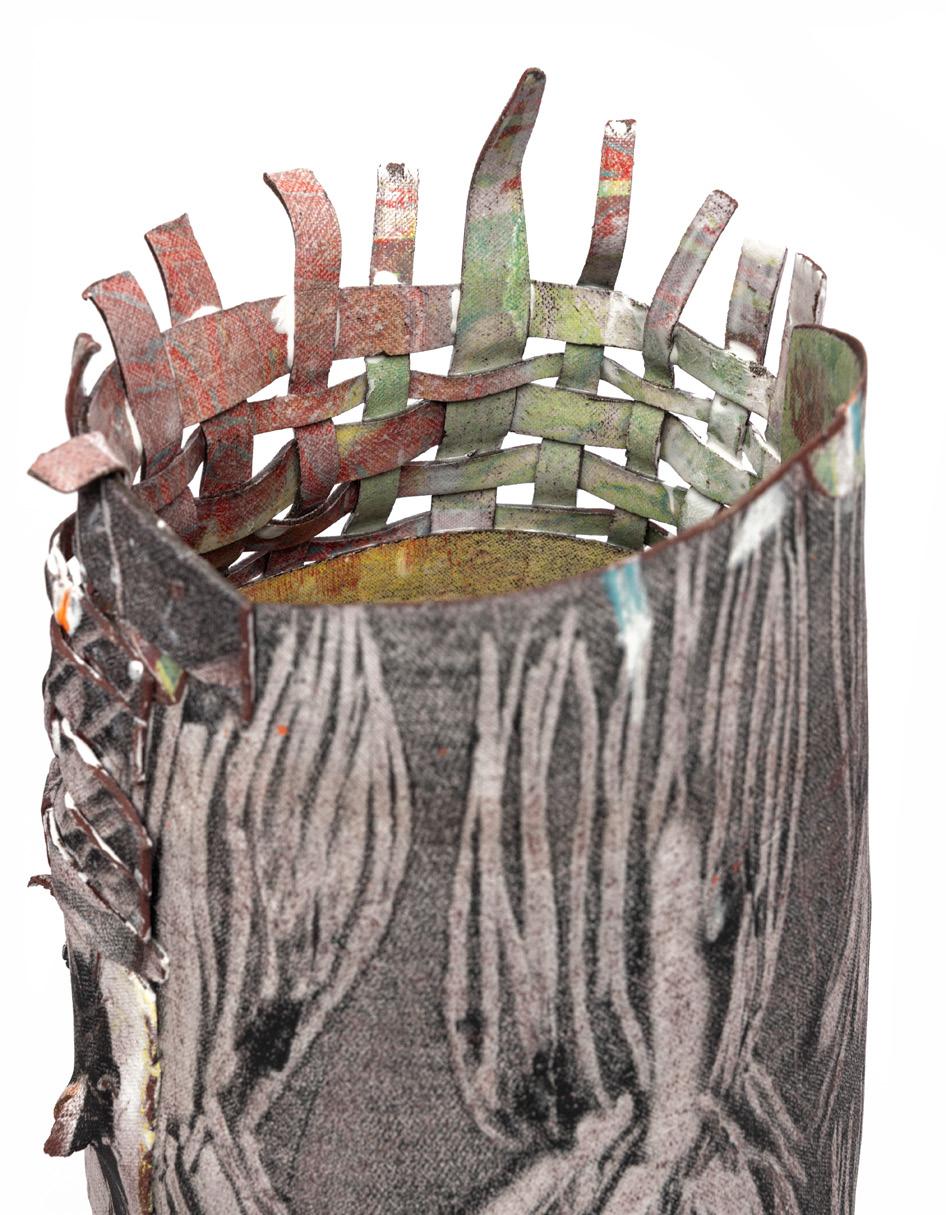
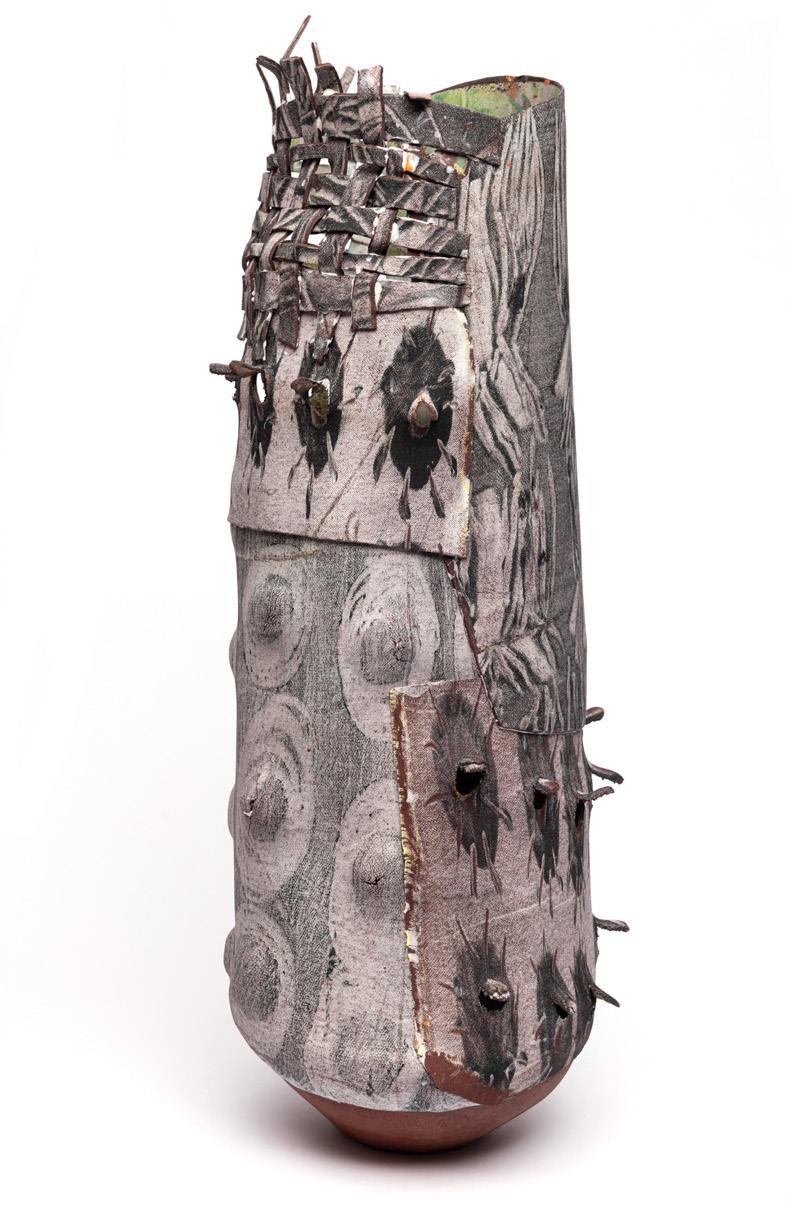
Ranti Bam, Iwa, 2025, stoneware, slip decoration, transparent glaze, 76 × 25 cm
The Griffin Award for Craft is designed to support the acquisition or commission of an important work in a craft medium, intended to play a major role amongst the chosen museum’s existing collection. Applications are encouraged for work in all applied arts media including, but not limited to: ceramics, glass, metal, jewellery, textile, wood, and lettering.
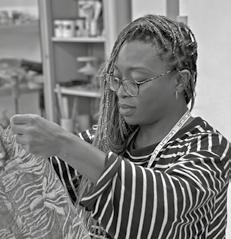
Ranti Bam’s ceramic work Iwa (2025) has been acquired for The Crafts Study Centre (CSC), the culmination of a residency in March–May 2025 that saw Bam explore the CSC collections and produce an artwork in response. This was undertaken in the Ceramics & Glass workshops of the University for the Creative Arts (UCA) in adjoining buildings on the UCA’s Farnham campus, in Surrey.
Bam spent time with the textile collections in the CSC Research Room, in particular with the block printed samples of 20th-century designer Enid Marx. In the UCA workshop, the artist deployed her signature slab-building techniques, pressing painted slips onto red earthenware through canvas to create textured monochrome surface patterns. The latticed top, with its multiple clay punctures and mounds, round base, colourful interior, and glaze seeping through seams of slab sections, make for a pot rich in narrative and drama, with patterns drawing from Marx’s designs.
The site-specific work reflects the CSC’s ambition to nurture and celebrate craft in its diverse forms and emphasise the global connections that underpin British studio craft. As a British-Nigerian artist, Bam’s work speaks to the cross-cultural exchange between Britain and Nigeria in 20th-century studio ceramics, represented in the CSC collections by artists Lawson Oyekan, Ladi Kwali and material from the Michael Cardew archive.
The acquisition also connects to the long history of residencies, workshops, internationalism, and innovative ceramics practice on the Farnham campus of UCA.
The Crafts Study Centre, UCA, Farnham
Ranti Bam
From the 1950s–80s, the ceramics course led by Henry Hammond at the then West Surrey College of Art and Design was a magnet for ceramic students and tutors, from Takeshi Yasuda and Ladi Kwali to Siddig el Nigoumi, Michael Cardew, and Magdalene Odundo.
Ranti Bam (b. 1982, Lagos, Nigeria) lives and works between London and Lagos.
Presented by the Contemporary Art Society through the Griffin Award for Craft, 2025/26
Text by Stephen Knott, Director, Crafts Study Centre
Artwork © Ranti Bam. Image credit: Crafts Study Centre, University for the Creative Arts, Farnham. Portrait by Crafts Study Centre
Ranti Bam, Iwa, 2025, stoneware, slip decoration, transparent glaze, 76 × 25 cm
MIMA (Middlesbrough Institute of Modern Art)
Jacqueline Poncelet
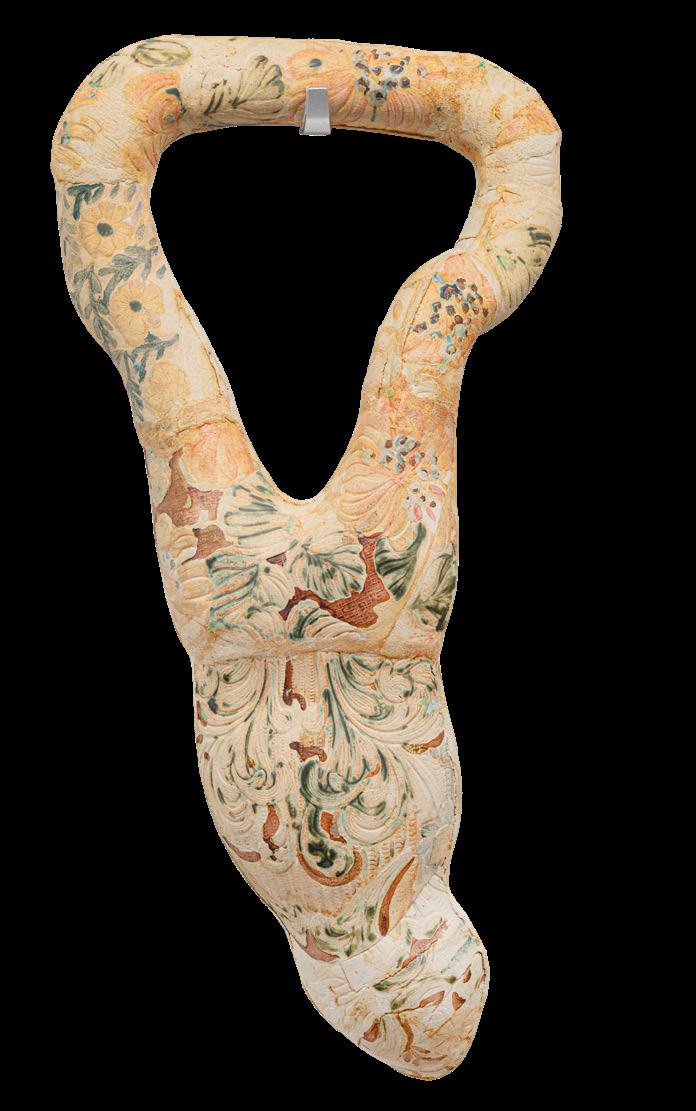
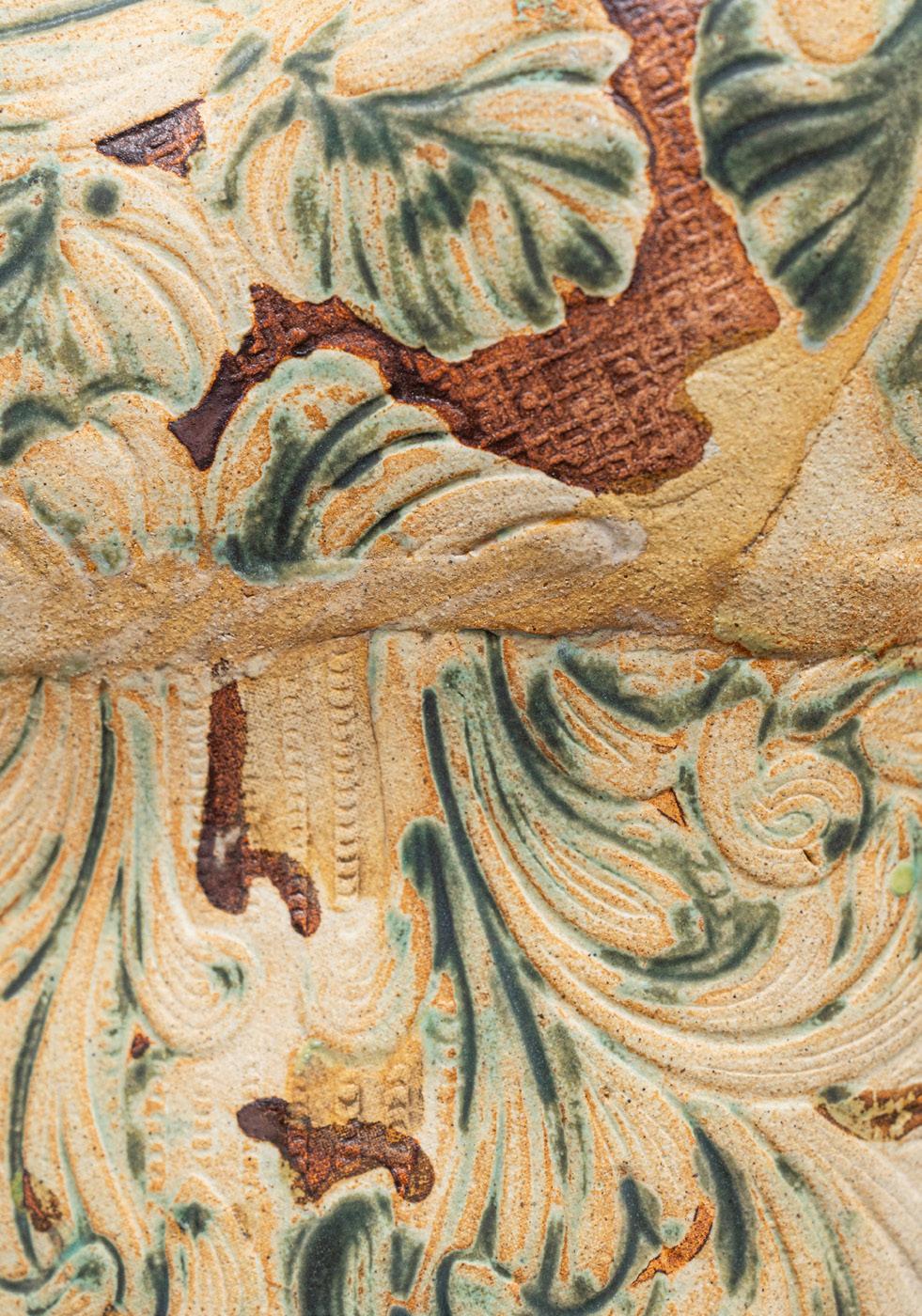
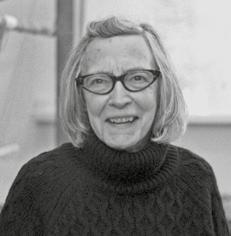
Jacqueline Poncelet is a leading figure of post-war British art, whose multifaceted practice spans over 50 years. Her work in ceramics, textiles, painting, sculpture, and public art is celebrated for its innovative exploration of materials, pattern and surface. She has consistently created work that is visually compelling and conceptually layered, but is perhaps best known for her early contributions to ceramics.
During the 1980s, Poncelet gradually expanded her practice, eventually abandoning clay altogether by the end of the decade in favour of wood, metal and textiles. In the 2000s, she began working on public art commissions. Since then, Poncelet has developed over 20 major works of public art, including the award-winning Edgware Road commission Wrapper (2012) with Art on the Underground. Throughout her career, the artist has consistently challenged the boundaries between fine art, design, and craft, drawing from everyday domestic objects, architecture, and visual culture.
Handbag (1985) encapsulates the complexity of Poncelet’s practice. This ceramic sculpture is hand built in clay with the use of moulds, and embossed with Anaglypta wallpaper. The work’s pattern and fashion references Poncelet’s ongoing interests in the diverse ways in which people express themselves through embellishment and decoration, The work marks a transformative phase in Poncelet’s practice, signalling a shift from craft to a broader identity in visual art. From creating small vessels, the artist is now moving to larger, anthropomorphic sculptures. Handbag was first shown in Poncelet’s 1985 solo exhibition at Whitechapel Gallery, a year before she presented similar works at the Venice Biennale.
Now part of the Middlesbrough Collection, Handbag joins a number of existing collection works by Poncelet spanning 1973–2023. This acquisition will now enable the collection to reflect the full scope of Poncelet’s practice over the last 50 years. Handbag also has a connection with MIMA’s exhibition history; it featured in the exhibition In The Making (2024), the first museum survey of Poncelet’s work, supported by the Freelands
Jacqueline Poncelet, Handbag, 1985, ceramics embossed and part-glazed, 87 × 42 × 16 cm
MIMA (Middlesbrough Institute of Modern Art)
Jacqueline Poncelet
Award and Henry Moore Foundation. Handbag will now sit in dialogue with collection works by Poncelet’s peers, tutors and friends, including artists Hans Coper, Janice Tchalenko, Glenys Barton, and Alison Britton. The collection also includes pieces from the New Jewellery movement (c.1970s–1990s), with which Poncelet’s biography and practice is interwoven.
Jacqueline Poncelet (b. 1947, Liège, Belgum) lives and works between London and South Wales.
Presented by the Contemporary Art Society through the Griffin Award for Craft, 2025/26
Text by Helen Welford, Head of Programmes Artwork © Jacqueline Poncelet. Photography by Rachel Deakin. Portrait by A.K. Purkiss
Jacqueline Poncelet, Handbag, 1985, ceramics embossed and part-glazed, 87 × 42 × 16 cm
Acquisitions Scheme: Fine Art
‘The CAS has been an invaluable resource to us, supporting the development of our art collection in a very tangible way, allowing us to connect with artists and potential donors, building meaningful relationships, and delivering outputs that support our visitors’ experiences of art in the context of science and technology. Because of CAS and their exceptional support, we have been able to engage with ideas, resources and works that were previously unknown to us or seemed out of reach.’
‘CAS membership is essential to Reading Museum in that it keeps the Art Collection alive and relevant to local people. Without it we would be collecting far less, and largely local, work. With it we can branch out, follow a strategic collecting theme with the knowledge that we are adding to the national public portfolio with strong acquisitions. It also provides me with wonderful, all too rare moments for reflection and inspiration in a busy working life, and a growing sense of confidence about the significance of individual works.’
Rebecca Mellor, former Curator of Art and Visual Culture, Science Museum Group
Elaine Blake, Exhibitions & Partnerships Curator, Reading Museum
The Atkinson, Southport
Chila Kumari Burman
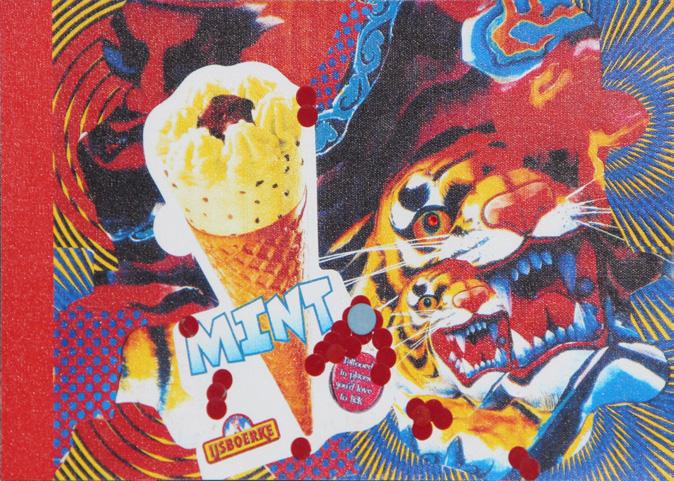
Chila Kumari Burman, Mint, 2020–2025, mixed media, 33 × 43 cm
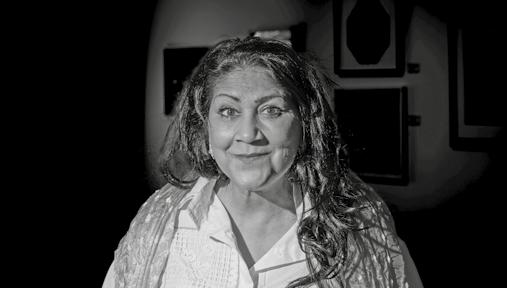
Chila Kumari Burman has built a strong career working with themes such as cultural heritage, feminism and political activism. As a key member of the Black British Art Movement, Burman has consistently challenged stereotypes with her art, including outdated notions of British identity stemming from institutional racism. She uses a range of artistic approaches including printmaking, painting, photography, drawing, collage, and sculpture to explore the relationship between popular culture and fine art.
Burman was born in Bootle, a town in Sefton, Merseyside, and raised by her Punjabi Hindu parents amidst the backdrop of working class Liverpool. The artist’s father, Bachan Singh Burman, was a tailor and magician in Calcutta (now Kolkata), India. He moved to the UK in 1954 and was later followed by Burman’s mother, Kamala Devi, and her two older siblings. Once in the UK, the growing family welcomed the artist herself and two more children. Burman’s experiences growing up in Sefton are key influences on her work. She has many fond memories of her father operating his ice-cream van on Freshfield beach, and proudly recalls the striking life-size Bengal tiger that sat on top of his van.
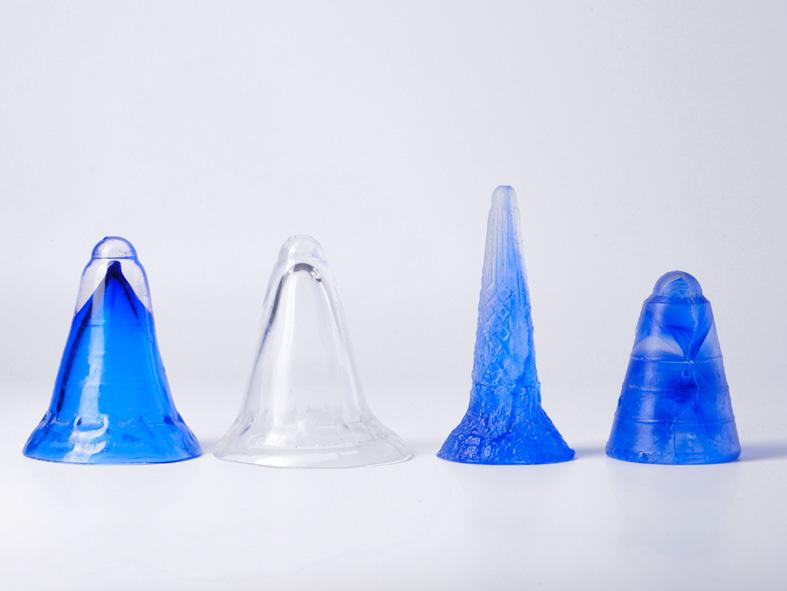
The Atkinson has selected the works Glass Cornets and Screwballs, Mint and BBC Pigeon because they speak of Burman’s early life in the area. The artist noted how her ‘ice cream identity’ lies in Sefton, and that she is happy for her works to have found a home there. Her Auto-portrait (1996–2013) is already a key piece in The Atkinson’s collection, and has been on display several times. These new acquisitions will help showcase a wider representation of Burman’s work in the mediums of glass, prints and collage. BBC Pigeon spoke to The Atkinson as a fitting companion to the ice cream works, and a familiar
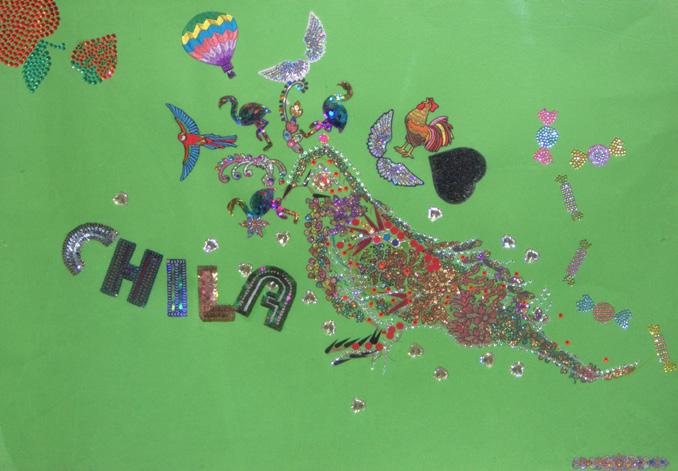
Chila Kumari Burman, BBC Pigeon, 2024, mixed media, 58 × 82 cm
Chila Kumari Burman, Glass Cornets and Screwballs, 2012, Glass Cornet: 11 × 8 cm, Screwballs: 10 × 5.8 cm
The Atkinson, Southport
Chila Kumari Burman
motif that local visitors can identify and engage with. The improvised nature of the work also speaks to accessible art, a theme The Atkinson regularly explores with young artists.
Chila Kumari Burman MBE (b. 1957, Bootle, UK) lives and works in London.
Presented by the Contemporary Art Society, 2025/26
Text by Jemma Tynan, Exhibitions and Learning Officer
Artwork © Chila Kumari Singh Burman. All rights reserved, DACS 2026. Portrait by Dave Jones
Chila Kumari Burman, Glass Cornets and Screwballs, 2012, Glass Cornet: 11 × 8 cm, Screwballs: 10 × 5.8 cm
Chila Kumari Burman, BBC Pigeon, 2024, mixed media, 58 × 82 cm
Chila Kumari Burman, Mint, 2020–2025, mixed media, 33 × 43 cm
The British Museum, London
Chantal Joffe
Chantal Joffe is an American-born British artist known for her psychologically incisive portraits of friends, family, and herself. Using bold and expressive colours and gestural marks, Joffe explores intimacy, vulnerability and the complexities of women’s experiences through her unflinching gaze. Joffe was elected a Royal Academician in 2018, and in 2022 she was commissioned by Art on the Underground to create a large-scale permanent work for Whitechapel station in London, extending her portraiture into the public realm.
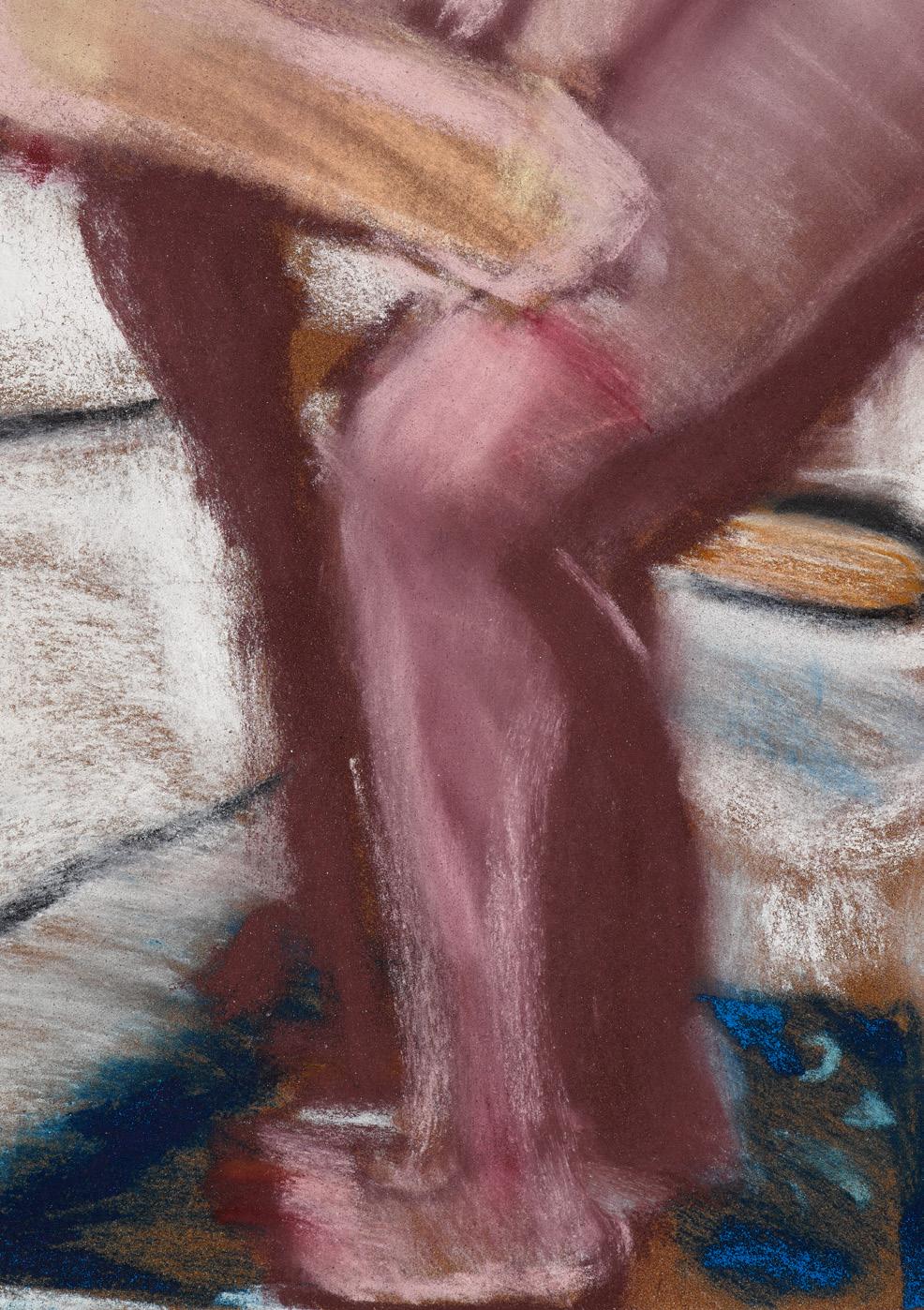
The artist began working with pastels in 2015, recognising the possibilities that the medium could open up for her practice: ‘I got more and more obsessed with [pastels]… the fast hit of the colour, the brightness.’ Working with sanded paper, whose rough texture grips the pastel pigment and holds it within its rough surface, Joffe is able to achieve dense and saturated passages of colour.
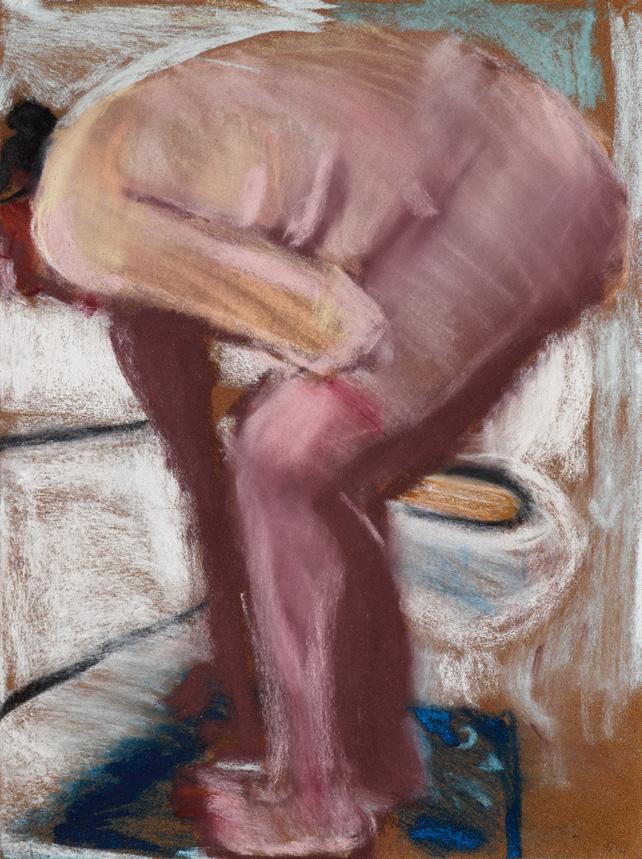
In Self Portrait after the Bath, Joffe echoes the painting Woman Bathing in a Shallow Tub (1885) by French artist Edgar Degas, drawing herself in the role of the bather. The work belongs to a series began in 2015 in which the artist attempts to redraw Degas’ works from memory in charcoal, sometimes with her eyes closed. Gradually, Joffe shifted the focus inward: within the intimate space of her bathroom, Joffe’s own body became the subject. By placing herself in Degas’ pose, she merges the roles of artist and model. The artist explains, ‘the closer I got to him, the more immersed I became in them, until I felt like I became both him the artist and the woman being drawn.’
When Degas exhibited his painting at the eighth and final impressionist exhibition, in 1886, critics were appalled by the bathers’ awkward, inelegant poses. To Joffe, however, they were compelling, offering frank and intimate glimpses of everyday domesticity. In the artist’s own words, ‘I found them incredibly exciting – myself seen from behind, crouching, bending, looking at a foot, drying myself.’ By engaging with Degas’ drawings and inhabiting another’s identity, Joffe found a new means of interrogating herself: ‘I’m wearing the mask of Degas to make something new and modern about my own life.’
Chantal Joffe, Self Portrait after the Bath (after Degas), 2015–2020, pastel on sanded paper, 40 × 30 cm
The British Museum, London
Chantal Joffe
The British Museum’s Department of Prints and Drawings comprises over two million prints and 50,000 drawings, and has served as a site of inspiration for artists for centuries. Although Joffe’s engagement with Degas had begun several years earlier, she saw an example for the first time in 2018, when she visited The British Museum to see Degas’ Dancers at the Barre (c. 1876–77). Joining the eighteen prints and twelve drawings by Degas in the collection, this new acquisition brings the two artists’ dialogue to full circle. This is the first work by Joffe to enter The British Museum’s collection.
Chantal Joffe (b. 1969, St Albans, Vermont, USA) lives and works in London.
Presented by the Contemporary Art Society with the support of Rob Suss, 2025/26
Text by Isabel Seligman, Monument Trust Curator of Modern and Contemporary Drawing
Artwork © Chantal Joffe. Courtesy the artist and Victoria Miro, London. Portrait by Toby Clanville
Chantal Joffe, Self Portrait after the Bath (after Degas), 2015–2020, pastel on sanded paper, 40 × 30 cm
The Fitzwilliam Museum, Cambridge
Che Lovelace
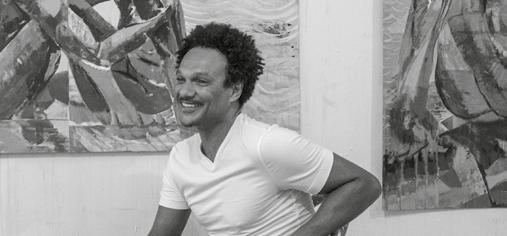
Che Lovelace’s vibrant and dynamic compositions offer a nuanced exploration of postcolonial identity, grounded in an intimate engagement with Caribbean landscapes, interiors, and communities. His lyrical painterly approach operates as a visual metaphor for the complex and multifaceted nature of Trinidad’s cultural history and identity. Lovelace was awarded the Chevalier de L’Ordre des Arts et des Lettres (Knight of the Order of Arts and Letters) by the French government in 2025, presented at the Embassy of France in Trinidad and Tobago. This prestigious honour recognises Lovelace’s exceptional contributions to the arts and his pivotal role in developing Caribbean visual expression internationally.
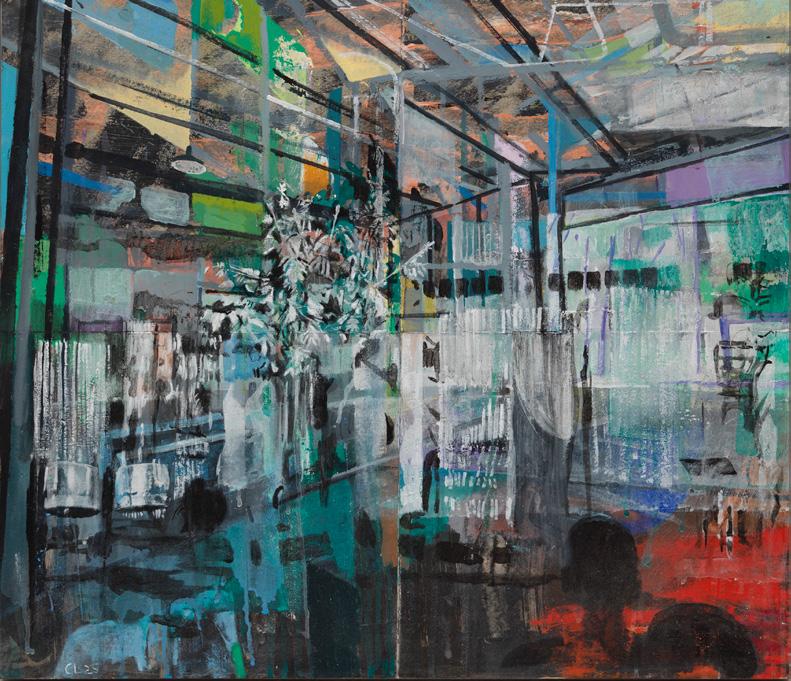
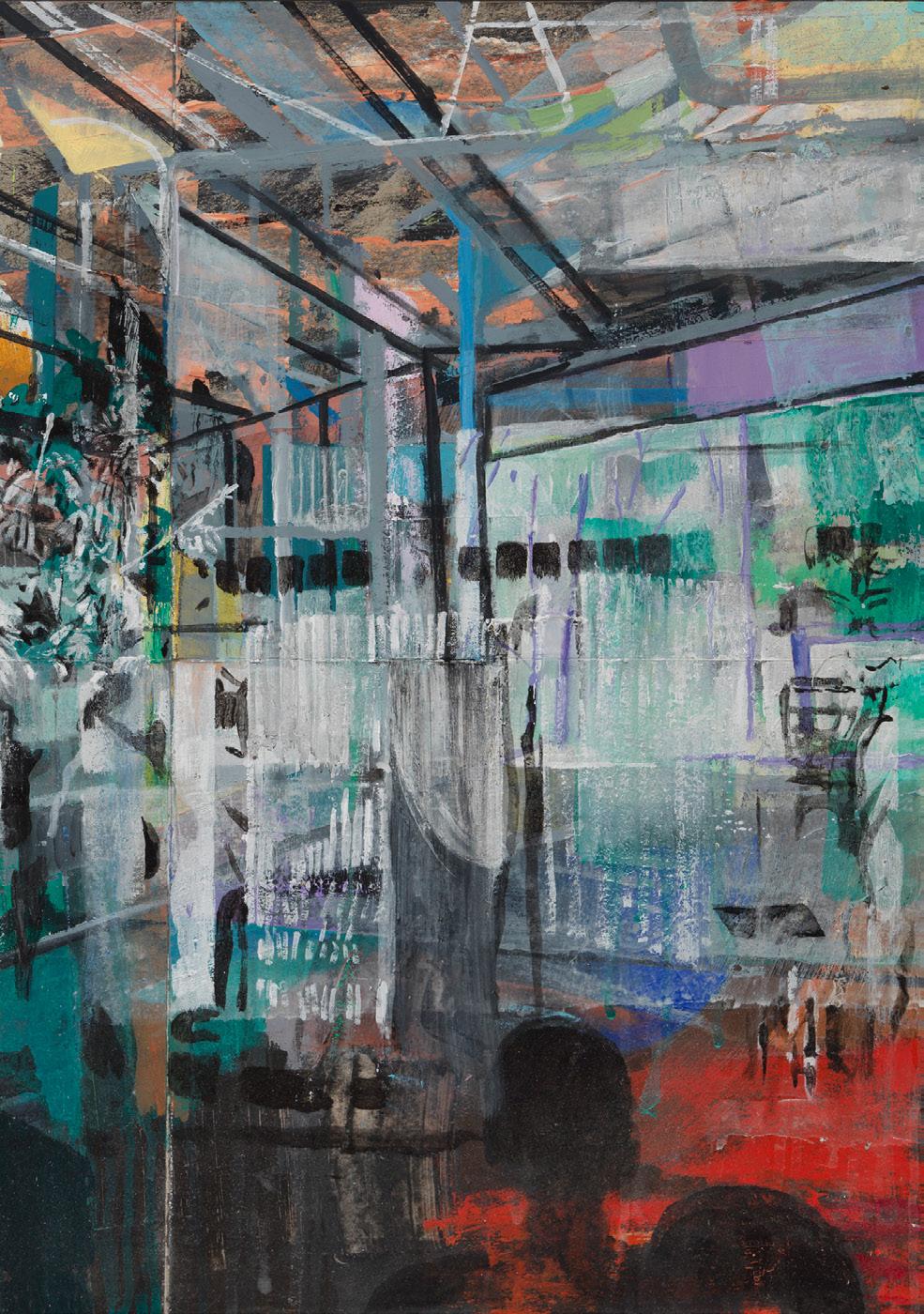
In Imagined Space Within Abandoned Warehouse (2025), the image of a former military base becomes a point of departure for painterly invention. Rather than strictly adhering to representation, Lovelace builds his compositions through a layered process that merges observation with imagination. The interplay between natural and artificial palettes creates a subtle slippage between what is real and what is imagined, something which is also reflected in the artist’s ongoing dialogue between abstraction and representation.
Lovelace employs a quadrant technique in his larger canvases, painting four separate panels that are later assembled into a single tableau. Although this work is conceived as a single composition, it also exemplifies this formal schema, characterised by a deliberate use of line, angularity, and a layered and fragmented visual structure.
The artist’s studio, situated on a former US Army base on the western outskirts of Port of Spain, deeply informs his work. Many of his paintings revisit the ruins and remnants of such sites, transforming them through imaginative renderings that weave together the natural landscape and traces of human presence. As Lovelace
Che Lovelace, Imagined Space Within Abandoned Warehouse, 2025, acrylic and dry pigment on board panel, 66.8 × 76.1 cm
The Fitzwilliam Museum, Cambridge
Che Lovelace
writes: ‘Through ruins, historical traces, and imagined landscapes, these paintings explore the echoes of human presence on the land – its beauty, its scars, and the resilience that transform people, history, and nature.’
Imagined Space Within Abandoned Warehouse is the first painting by a Caribbean-based artist to enter The Fitzwilliam Museum’s collection, marking an important milestone building on the Legacies of Enslavement exhibitions. The work has a direct connection to pieces by Caribbean diasporic artists already in the collection, including Paul Dash’s Dance at Reading Town Hall (1965) and the interior motifs of Caribbean landscapes in Aubrey Williams’ paintings. It also complements forthcoming works by fellow Trinidadian artist John Lyons. This acquisition broadens the collection’s engagement with the theme of interiors while contributing further political and cultural resonances. Lovelace’s addition to the museum also expands The Fitzwilliam’s exploration of abstraction, situating Lovelace alongside artists such as Prunella Clough, as well as those who depict urban ruins and landscapes.
Che Lovelace (b. 1969, Port of Spain, Trinidad) lives and works in Port of Spain.
Che Lovelace, Imagined Space Within Abandoned Warehouse, 2025, acrylic and dry pigment on board panel, 66.8 × 76.1 cm
Presented by the Contemporary Art Society with the support of Christoph and Pamela Stanger, 2025/26
Text by Habda Rashid, Senior Curator Modern & Contemporary Art, The Fitzwilliam Museum, Cambridge
Artwork © Che Lovelace. Courtesy Corvi Mora, London. Portrait by Brendan Delzin
Gallery of Modern Art (GoMA), Glasgow Museums
Sam Ainsley
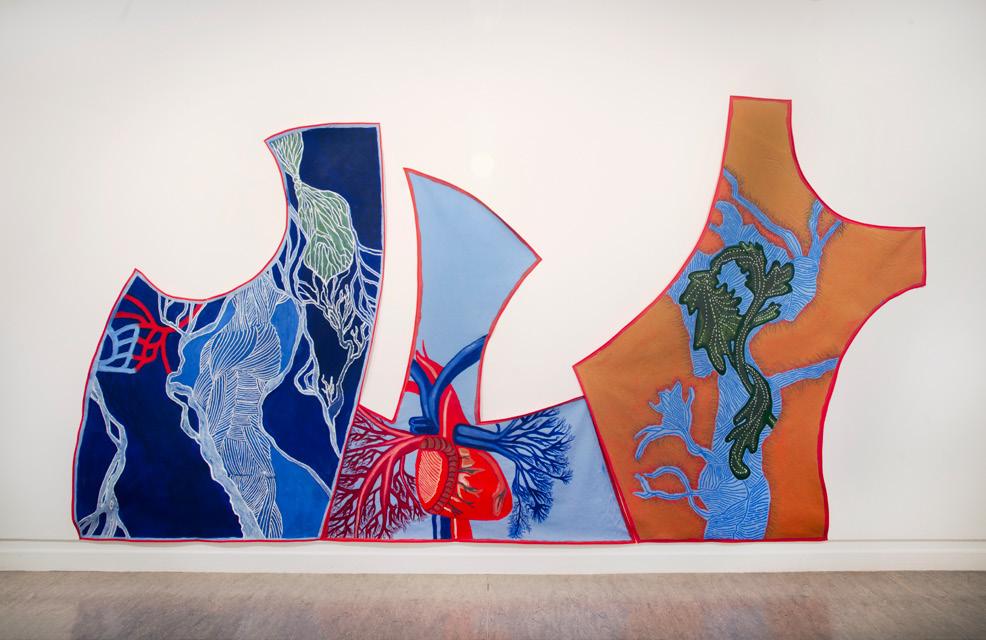
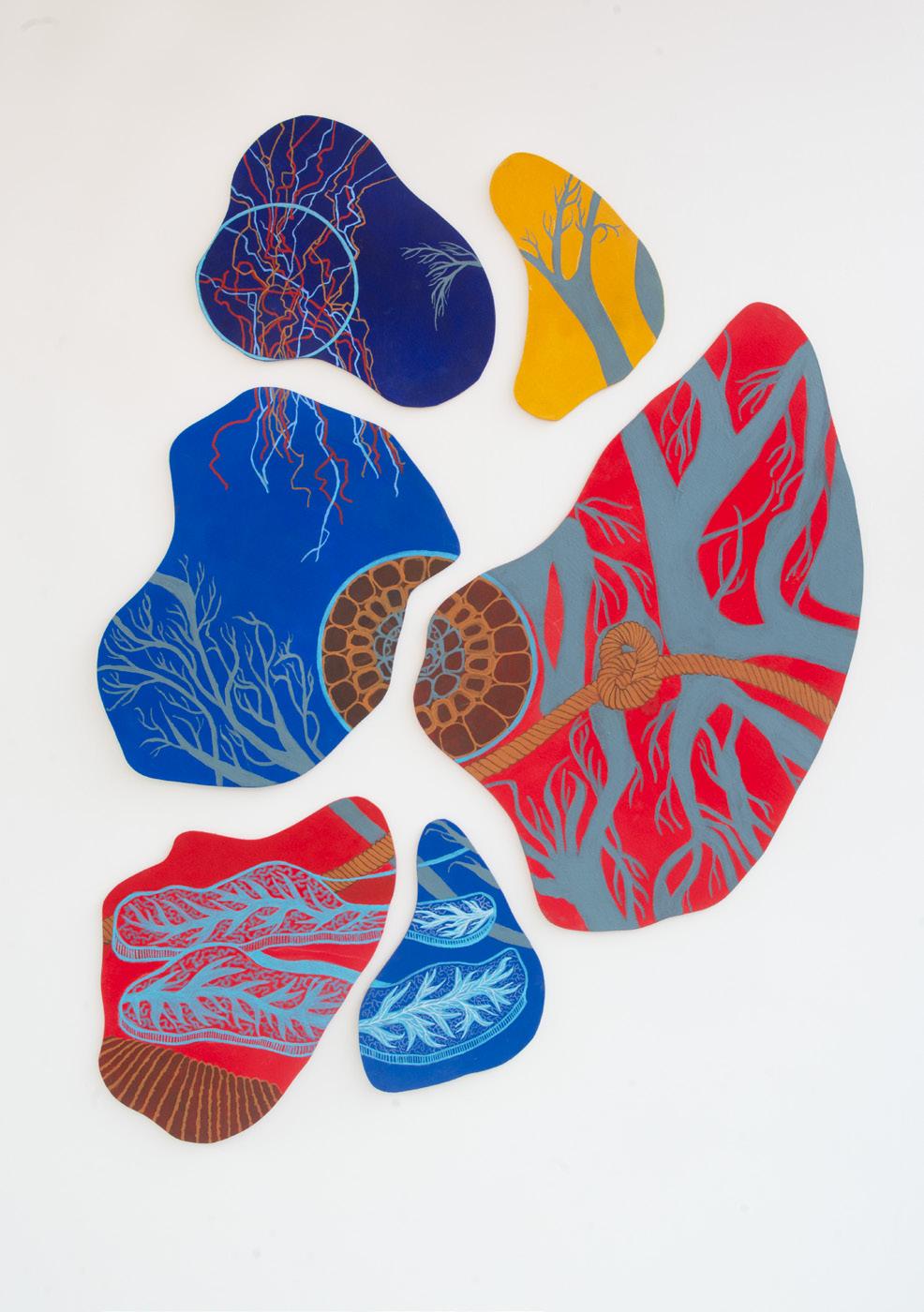
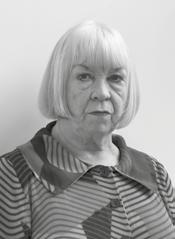
Sam Ainsley is a widely respected artist and educator. She taught Environmental Art at The Glasgow School of Art (1985–1990), and was co-founder and Head of the MFA programme (1990–2005). She is known for her large scale, unstretched and bias bound paintings with bold colours and imagery. The artist’s interest in the human body – especially women’s bodies, however abstracted – and its relationship to the world we live in has consistently been at the core of her practice. Ainsley has a long history of making shrewdly prescient work on the environment, reflecting on social and political change as well as the importance of culture for a nation’s identity. The acquisition of Blue Body, Red Centre, Green Acanthus (2023) and Where there are hopes there are also fears (2025) ensures that this influential artist is well represented within a Scottish art collection.
Blue Body, Red Centre, Green Acanthus is representative of Ainsley’s bold work with textile and paint; comprising of three connecting, shaped canvases, with sewn binding holding their edges together. Here, in these painted forms, Ainsley’s interest in the human body is apparent. Parallels are drawn between biological forms found in nature (branches and roots) and those in manufactured landscapes (roads or scars left by the extraction of minerals). The work also shows how organs like the heart might represent both emotions and a beating drum to drive forward progressive change, with the acanthus acting as a symbol of renewal and hope.
Where there are hopes there are also fears marks a recent development in Ainsley’s practice: by painting on irregularly-shaped boards covered in canvas, the composition of her wall works evokes islands or archipelagos (an ongoing concern for the artist), or amoeba-like forms signalling evolutionary processes. References to the shape of the circle, geology and manufactured landscapes create forms that connect across the painted canvasses, inviting the suggestion that they might ultimately come together. Running through the painting is a length of rope – another one of Ainsley’s recurring motifs, representing the relationship between networks of connectivity (bindings) and the knot in its historical use as an everyday memory aid.
Sam Ainsley, Where there are hopes there are also fears, 2025, acrylic paint on canvas on board, 180 × 140 cm
Sam Ainsley, Blue Body, Red Centre, Green Acanthus, 2023, acrylic on canvas, 165 × 555 cm
Gallery of Modern Art (GoMA), Glasgow Museums
Sam Ainsley
GoMA’s aim is to build a world-class collection of contemporary visual art through the acquisition of important national and international artworks. Since the 2015 exhibition Ripples on the Pond, GoMA has been focused on the gender balance represented by the artists in the collection, as well as on women’s contributions to contemporary artistic practice. The acquisition of two works by Sam Ainsley reflects the ambition to collect important works by artists who are women living and working in Glasgow, proudly presenting an ongoing genealogy of feminist practice that continues to provoke and inspire.
Sam Ainsley RSA (b. 1950, North Shields, UK) lives and works in Glasgow.
Sam Ainsley, Blue Body, Red Centre, Green Acanthus, 2023, acrylic on canvas, 165 × 555 cm
Sam Ainsley, Where there are hopes there are also fears, 2025, acrylic paint on canvas on board, 180 × 140 cm
Presented by the Contemporary Art Society with support from Glasgow Life Museums, 2025/26
Text by Katie Bruce, Producer Curator, Gallery of Modern Art (GoMA) Artwork © Sam Ainsley. Photography by Alan Dimmick. Portrait by Alan Dimmick
Herbert Art Gallery & Museum, Coventry
Emma Prempeh
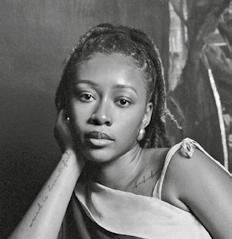
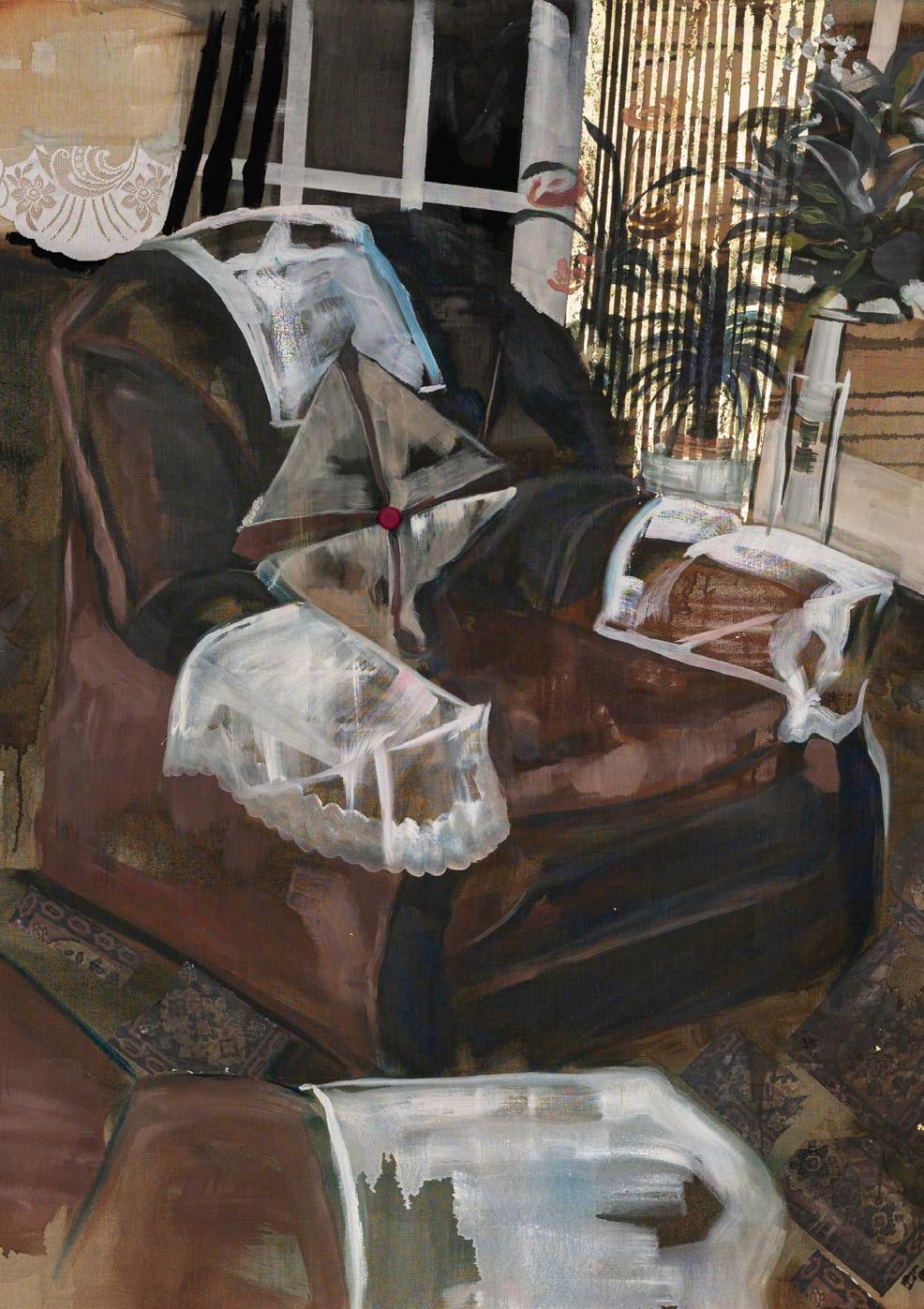
Emma Prempeh is a London-based British artist of Ghanaian and Vincentian heritage. The starting point to Prempeh’s paintings is the concept of blackness –the tonal properties of the colour black establish both the ground to her paintings and a broader conceptual framework to evoke memories of events, people and places, highlighting connections to ancestry, selfhood and acts of transformation. Prempeh uses layered surfaces and schlag metal, a brass alloy of copper and zinc reminiscent of gold leaf, which the artist applies to her often largescale paintings. Over time this material oxidises, creating slow visual changes that animate the image and create a meta-narrative that captures our experiences of the passing of time and its relation to representation and memory. Prempeh occasionally experiments with projected still and moving imagery to invite other experiential and performative encounters with her work.
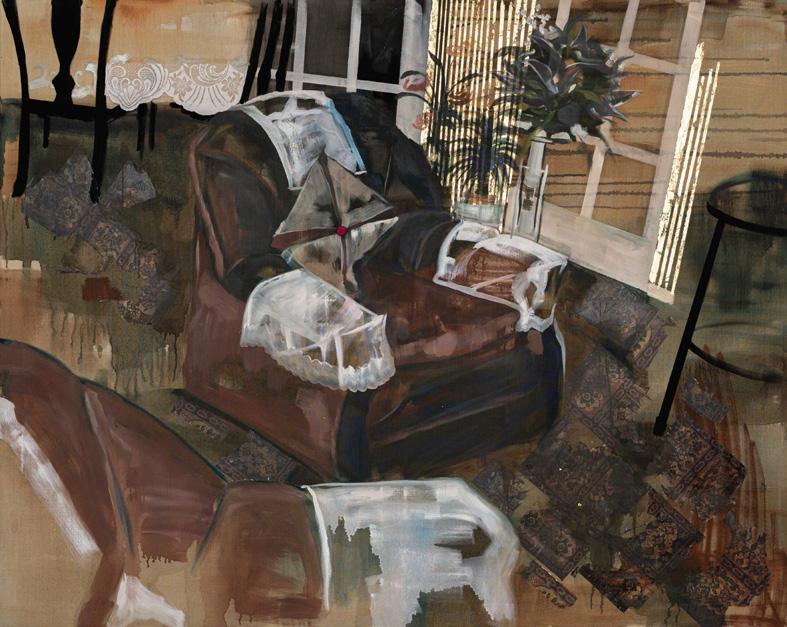
Front Room (2023) is part of a recent body of works representing the artist’s exploration of interior spaces as they collide with aspects of her personal history. The paintings depict familiar aspects of Prempeh’s BritishCaribbean domestic life and upbringing, recalling distant memories and feelings of nostalgia, loss, and intimacy. When thinking about the idea of home, Prempeh often thinks about her Caribbean grandmother’s British living room: heavily draped, with doily patterned fabric, bright patterns and chairs, are now sombre-toned due to the passing of time.
The painting resonated strongly with a cross-disciplinary group of Herbert staff, including members of the Learning & Engagement and Front of House teams, who met to discuss the potential acquisition. It seemed clear that Prempeh’s work would have just as much of an impact on our audiences and communities as it did members of staff. Front Room also holds a powerful connection with many works part of the Herbert’s collection, such as with the scenes of British life and Landscape acquired by the gallery’s first art director in the 1950s and 60s. The collection holds several scenes depicting ordinary people and places, including several domestic interiors; however, there is an almost total lack of representation of the lives
Emma Prempeh, Front Room, 2023, oil, acrylic, textiles, print and schlag metal on canvas, 160 × 200 cm
Herbert Art Gallery & Museum, Coventry
Emma Prempeh
and experiences of Black people in Britain. Front Room helps addressing this imbalance and supports the work we have been doing to increase representation of artist from the global majority and artists who are women in the collection. As such, it builds on recent acquisitions by artists like Claudette Johnson, Leilah Babirye and Cora Sehgal Cuthbert.
Emma Prempeh (b. 1996, London, UK) lives and works in London.
Emma Prempeh, Front Room, 2023, oil, acrylic, textiles, print and schlag metal on canvas, 160 × 200 cm
Presented by the Contemporary Art Society with the support of Artley and Tiwani Contemporary, 2025/26
Text by Martin Roberts, Senior Curator
Artwork © Emma Prempeh. Courtesy the artist and Tiwani Contemporary, London. Photography by Deniz Guzel. Portrait by Ellyse Anderson
Imperial War Museum, London
Audrey Albert
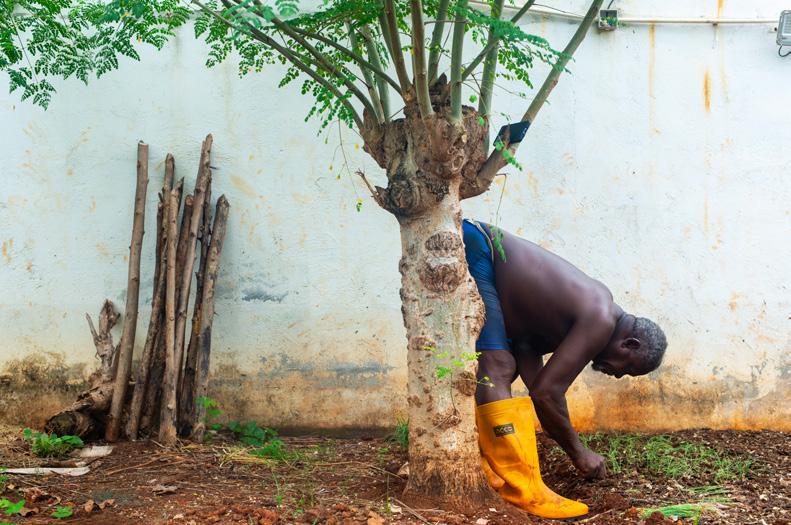

Audrey Albert is a Mauritian-Chagossian visual artist and creative facilitator. Albert’s researchled practice enables her to investigate themes of diasporic identity, collective memory and displacement. Albert’s Belongers series is the culmination of two years of research and interviews following the award of an IWM 14–18 NOW Legacy Fund commission in partnership with Ffotogallery, Cardiff. Comprising photography, film, and installation and presented alongside contributions from other artists and researchers connected to the Chagos Islands, Belongers was exhibited at Ffotogallery in 2025.
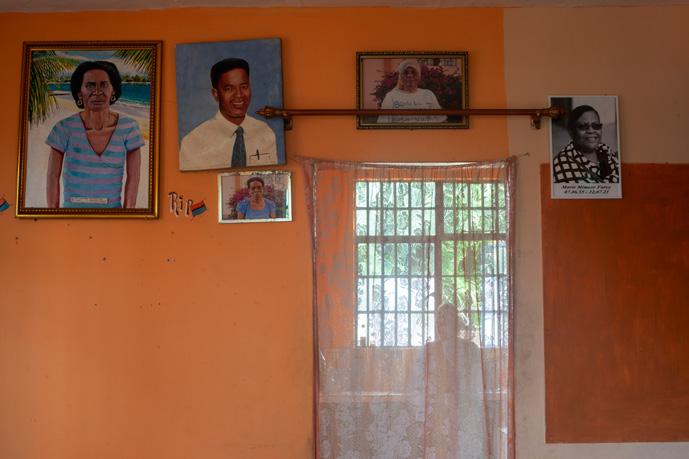
Audrey Albert, Chagos Refugee Group, Pointe aux Sables, Mauritius (from the series Belongers), 2024, digital photograph
Belongers documents the displaced Chagossian community in Mauritius. These three photographs focus on the Chagos Refugee Group (CRG) in Point aux Sables, a space where traditional Chagossian practices are taught and passed on. Led by activist Louis Bancoult, the CRG is the largest Chagossian group in Mauritius. For Bancoult, the purpose of the CRG is to establish a ‘little Chagos’ in Mauritius. Albert’s photographs include an image of William, described as a ‘green magician’ and ‘protector of mama later (Mother Earth)’, tending to the garden of the CRG. Moringa depicts ‘moringa oleifera’ (also known as the ‘the tree of life’), a plant traditionally used to treat various ailments. In her photographs, Albert documents the symbolism and horticultural knowledge that are such vital components for the culture and lives of the dispersed Chagossian community.
This acquisition speaks to themes of forced displacement and ecology, inviting a reflection on the far-reaching legacies of British colonialism. From the late eighteenth century onwards, France and later Britain kidnapped enslaved labourers and contract workers – mostly from East Africa and Madagascar – and brought them to the Chagos Islands via Mauritius (at the time also a British colony) to work in coconut plantations. Since 1965, the Chagos Archipelago has been known as the British Indian Ocean Territory (BIOT). In 1966, the UK gave the US permission to build an overseas military base on Diego Garcia, the largest of the Chagos Islands; the base is still in operation today. Between 1965 and 1973, around 1,500 Chagos islanders were displaced
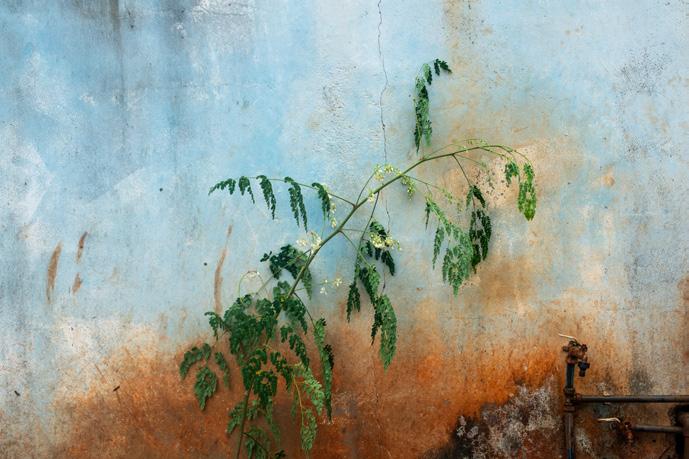
Audrey Albert, Moringa, Chagos Refugee Group, Pointe aux Sables,
digital photograph
Audrey Albert, William; green magician, protector of mama later (mother earth) in the Chagos Refugee Group’s garden in Pointe aux Sables, Mauritius (from the series Belongers), 2024, digital photograph
Mauritius (from the series Belongers), 2024,
Imperial War Museum, London
Audrey Albert
and forcibly relocated to Mauritius, and over 200 to Seychelles. In 2002, the UK granted British citizenship to Chagos islanders and to most of their second-generation descendants, under the British Overseas Territories Act. Since then, many Chagossians have migrated to the UK.
Albert’s work speaks to the IWM’s commitment to further develop its collection to include works that address the forceful expulsion of the Chagossian community (1965–1973) from the Chagos Archipelago. The acquisition also supports the IWM’s initiative to foster a further reaching and more connected understanding of conflict, particularly in relation to Africa and South-East Asia.
Audrey Albert (b. 1990 in Mauritius with Chagossian heritage) lives and works in Manchester.
Presented by the Contemporary Art Society with the support of Emma and Fred Goltz, 2025/26
Audrey Albert, William; green magician, protector of mama later (mother earth) in the Chagos Refugee Group’s garden in Pointe aux Sables, Mauritius (from the series Belongers), 2024, digital photograph
Audrey Albert, Chagos Refugee Group, Pointe aux Sables, Mauritius (from the series Belongers), 2024, digital photograph
Audrey Albert, Moringa, Chagos Refugee Group, Pointe aux Sables, Mauritius (from the series Belongers), 2024, digital photograph
Text by Rebecca Newell, Head of Art, IWM
Artwork © Audrey Albert. Courtesy the artist. Portrait by Grace Springer
Imperial War Museum, London
Sammy Baloji
Sammy Baloji is an artist who explores the cultural and historical memory of the Democratic Republic of Congo through photography, sculpture and installation. His work is an ongoing investigation into the cultural, architectural and industrial heritage of the Katanga region. It also questions the continued impact of Belgian colonisation. Baloji’s use of photographic archives allows him to manipulate time and space, comparing ancient colonial narratives with contemporary economic imperialism. Through video works, installations and photographic series, the artist explores the way identities are shaped, transformed, and reinvented.
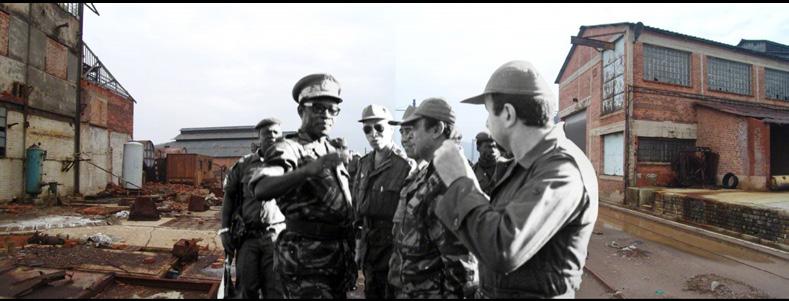
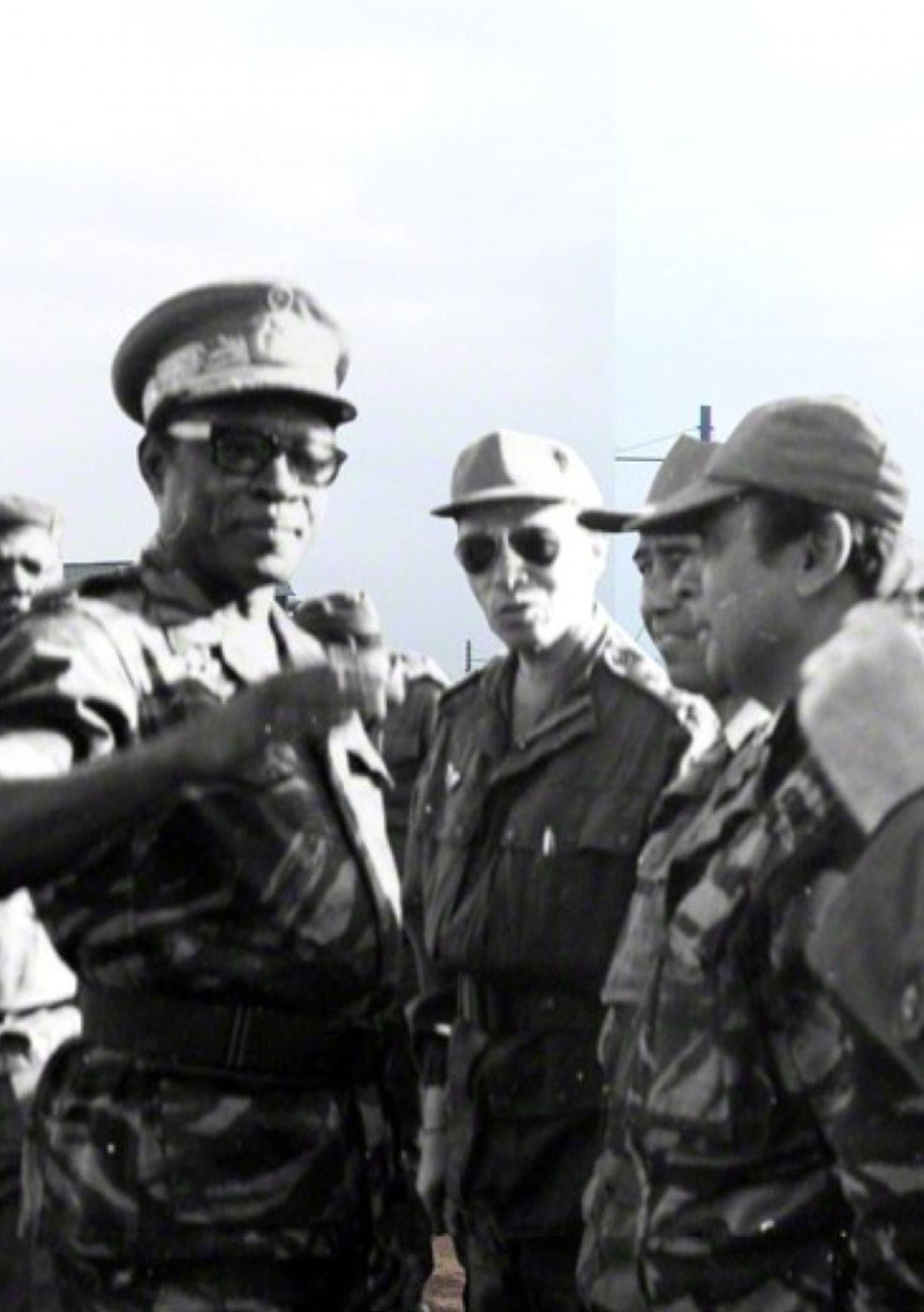
In this photomontage from the series Mémoire (2006), Baloji addresses the exploitation and extraction of labour and natural resources in the mineral-rich Katanga province, an area that has been heavily mined throughout the colonial and into the Cold War period. Untitled #26 shows an archival image of Congolese politician Mobutu Sese Seko superimposed over a contemporary image of a derelict mine. Mobutu was a key figure in the Congo Crisis, a series of destabilising conflicts that occurred immediately after the the Republic of the Congo gained independence from Belgium in 1960. After coming to power in 1965, Mobutu nationalised the Belgian mining company Union minière de Haut Katanga, which significantly impacted British economic interests in the region.
Baloji’s work invites viewers to learn more about Congolese history and experience; it also contextualises the Imperial War Museum’s current holdings and research on the topic of post-colonialism, situating them within a wider global narrative, enabling diverse storytelling and experiences to come to the fore for our audiences. Embracing a broader collecting strategy and connecting wider Cold War histories with legacies of empire supports the IWM’s goal to tell a more inclusive and comprehensive narrative of this period.
Sammy Baloji, Untitled #26 (from the series Mémoire), 2006, archival digital photograph on satin matte paper, 60 × 161 cm
Imperial War Museum, London
Sammy Baloji
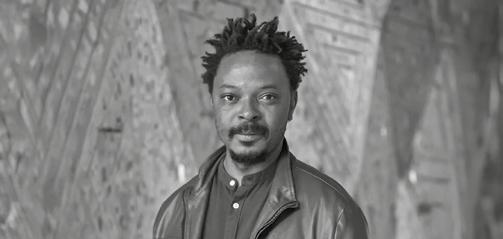
Sammy Baloji (b. 1978, Lubumbashi, Democratic Republic of the Congo) lives and works in Lubumbashi and Brussels, Belgium.
Presented by the Contemporary Art Society with the support of Emma and Fred Goltz, 2025/26
Text by Rebecca Newell, Head of Art, IWM Artwork © Sammy Baloji. Courtesy the artist and Galerie Imane Farès, Paris. Image credit: Imperial War Museum, London and Salford. Portrait
Sammy Baloji, Untitled #26 (from the series Mémoire), 2006, archival digital photograph on satin matte paper, 60 × 161 cm
courtesy the artist and Galerei Imane Farès, Paris
London Museum
Rene Matić
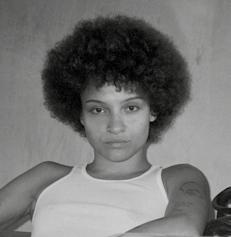
Rene Matić’s personal life forms the core of their artistic practice. Born in Peterborough to an English mother and an IrishSt Lucian father, their work is documentary and diaristic in nature. It is also formally interdisciplinary, embracing photography, filmmaking, writing, and installation to explore themes of family, friendship, identity, and racialised experience in British society.
Caribbean youth culture, music and dance are often a point of departure in Matić’s work, including Ska, 2-Tone, and the 1960s ‘rude boy’ subculture. Talking to the curator Hans Ulrich Obrist, Matić observed:
‘I always say that the overarching theme of my work is this idea of rudeness, the ‘rude boy’ […] it’s about this interrupting and existing in between, and evoking some kind of reaction to your existence.’
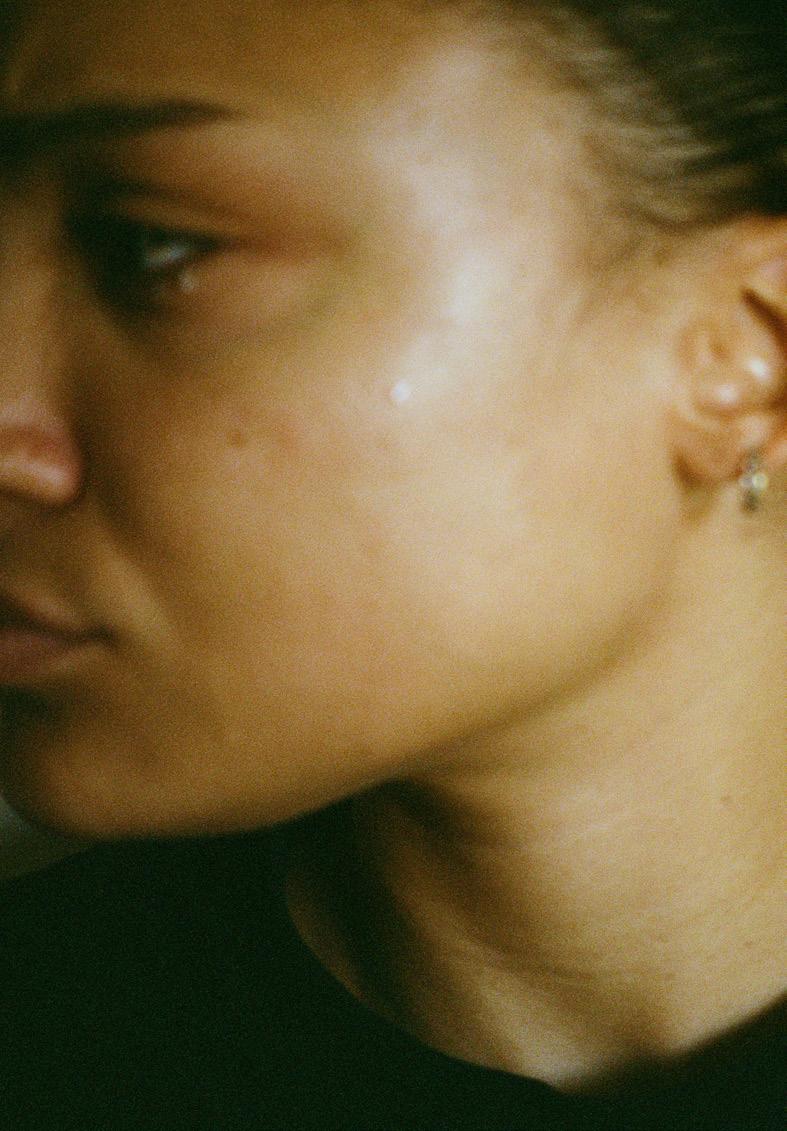
The two works by Matić acquired for London Museum are profoundly personal; they both speak directly about loss while providing a means for the artist to process different types of grief. Rene, Grieving (2023) was made following the death of Matić’s grandfather. The extreme close-up of Matić’s face, printed on a large scale, forces the viewer to step into an intimate space; simultaneously, the artist’s averted gaze and the partial cropping of the frame suggest distance and separation. A complex interplay of revealed emotion, and self-protection emerge from the work.
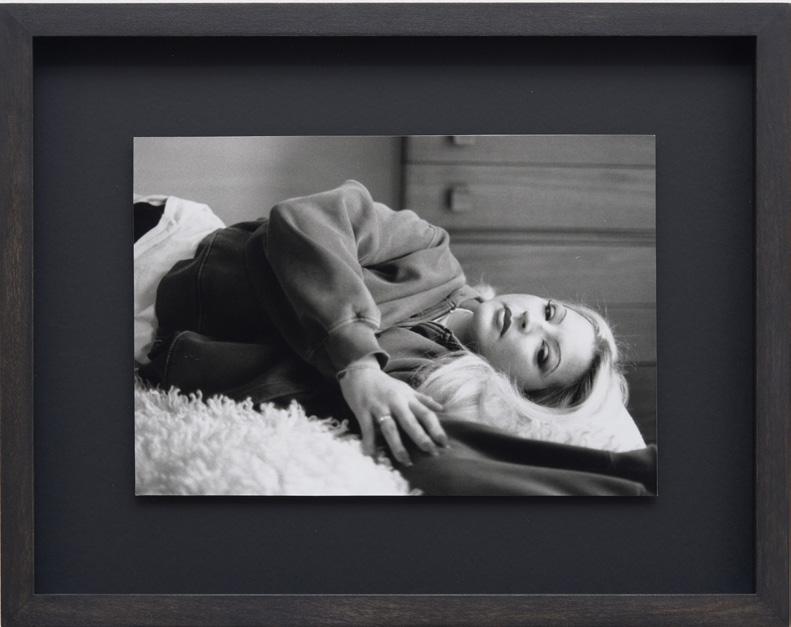
The death of Matić’s grandfather occurred around the same time as their breakup with Maggie, the artist’s wife. Maggie is a strong and constant presence in Rene’s early work, perhaps most notably in Maggie in Morley’s (2020), which renders a visit to a London takeaway with the force of a Renaissance portrait. Maggie on their Bed (2025) was taken as part of the artist’s healing process following the breakup. In one recent exhibition, Rene Grieving and Maggie on their Bed were displayed close together, in dialogue across the corner of the gallery.
Rene Matić, Rene, Grieving, London, 2023, archival print on perspex, wood and electrical cable, 156 × 103 × 10 cm
Matić’s works are important additions to other photography acquisitions exploring LGBTQIA+ histories
Rene Matić, Maggie on their Bed, 2025, gelatin silver print, artist’s frame, 28.5 × 36 × 3.2 cm
London Museum
Rene Matić
made by London Museum over the past six years; Sunil Gupta’s Pretended Family Relationships (1988) and Liz Johnson Artur’s documentation of club nights for queer and non-binary people of colour in South London are two notable examples. More broadly, Matić’s photographs complement other bodies of work held by London Museum which look at social relationships and structures, such as Karen Knorr’s series Gentlemen (1981–83), or Tom Hunter’s series The Ghetto (1993–94).
Rene Matić (born 1997, Peterborough, UK) lives and works in London.
Presented by the Contemporary Art Society, 2025/26
by Dr
Rene Matić, Maggie on their Bed, 2025, gelatin silver print, artist’s frame, 28.5 × 36 × 3.2 cm
Rene Matić, Rene, Grieving, London, 2023, archival print on perspex, wood and electrical cable, 156 × 103 × 10 cm
Text
Francis Marshall, Senior Curator of Visual Media
Artworks © Rene Matić. Courtesy the artist and Arcadia Missa, London. Portrait courtesy the artist
National Maritime Museum, Royal Museums Greenwich
Shiraz Bayjoo
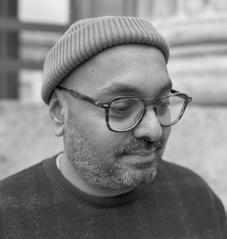
Shiraz Bayjoo is a Mauritian artist whose practice uses the ocean as a passageway for engagement with geopolitical, botanical, ecological, and economic histories. Working with a range of mediums –from photography and film to textile, sculpture, painting, installation, and collaborative performance – Bayjoo’s research-led approach engages with island geographies; in particular those of the Afrasian Ocean, including Mauritius, Madagascar, and the United Kingdom. The artist is best known for working with the colonial archive, challenging dominant narratives and addressing cultural memory to reveal their continuing ecological and societal impact.
Coral Island (2024) explores the ecological consequences of colonial exploration and trade in the Afrasian Ocean. The work consists of six ceramic sculptures depicting scenes of plunder and violence against Mauritius’ flora and fauna, drawn from engravings by Theodor de Bry (1528–98) in the illustrated publication Historiae Indiae Orientalis. Bayjoo recontextualises these images of so-called ‘discovery’ as acts of ecological extraction, rupture and erasure. Each piece has an ornate rococo-esque integrated frame that evokes Europe’s contemporaneous opulence; however, rather than gilded plaster Bayjoo uses Vulcan stoneware –a material that references the volcanic formation of Mauritius and the black of funerary memorials. The work reframes the colonial gaze of the archive, exposing its underlying brutality and memorialising the entangled histories of colonialism and ecological loss.
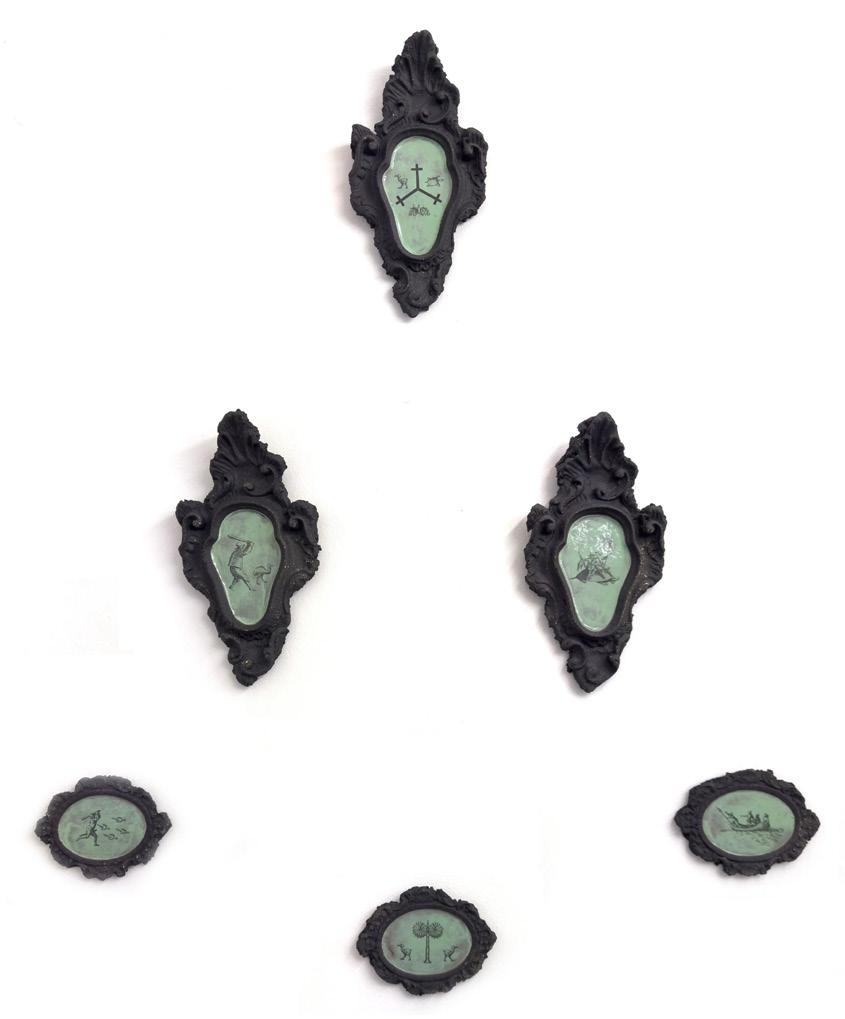
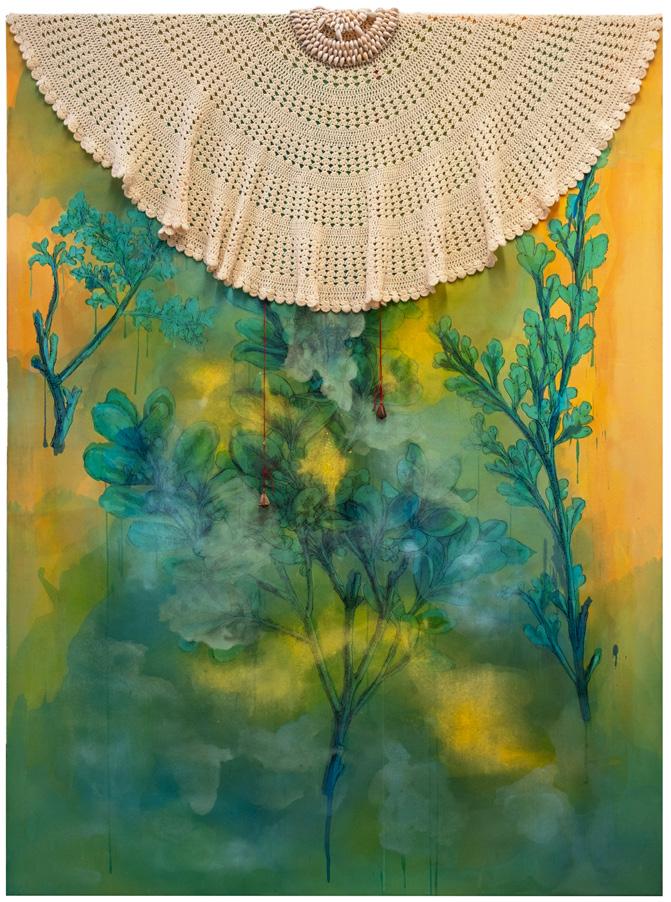
The painting Pa Bliye Mwa (Don’t Forget Me) (2021) reflects on how botanical illustration, often perceived as factual or beautiful, was complicit in the Empire’s civilising narratives. Drawing on the botanical studies of Scottish botanist Isaac Bayley Balfour (1853–1922), Bayjoo shows how such images could function as tools employed within a wider project of control, trade and territorial expansion. Many of the plants depicted by Balfour are now extinct; Bayjoo’s painting serves as a monument to their memory, echoed in the French Creole title. Hanging from red satin threads are brass replicas of botanical seeds, while the composition is crowned with a Mauritian crochet collar with woven cowrie shells.
Shiraz Bayjoo, Pa Bliye Mwa (Don’t Forget Me), 2024, acrylic on Panama fabric, crochet cloth, satin cord, brass botanical seeds, woven sea shells, 190 × 140 cm
Shiraz Bayjoo, Coral Island 1, 2021, decal and glaze on vulcan black stoneware, 6 pieces, medium frame: 15.5 × 12 cm, large frame: 30 × 15 cm
National Maritime Museum, Royal Museums Greenwich
Shiraz Bayjoo
These are the first works by Bayjoo to be acquired by a national collection. Their acquisition for the National Maritime Museum is significant, as they speak to the global impact of British maritime endeavours and the ecological consequences of trade and colonialism. Both works foreground underrepresented histories of the Afrasian Ocean and their colonial legacies, opening opportunities to reinterpret the National Maritime Museum’s historic collections. For example, Pa Bliye Mwa (Don’t Forget Me) can be read as a 21st-century landscape painting, offering a contemporary counterpoint to the 18th-century landscapes of ‘discovery’ by artists such as William Hodges or William Westall that are also held in the museum’s collection.
Shiraz Bayjoo (b. 1979, Port Louis, Mauritius) lives and works in London.
Presented by the Contemporary Art Society with support from the National Maritime Museum, 2025/26
Text by Victoria Lane, Senior Curator, Art and Identity Artwork © Shiraz Bayjoo. Courtesy Copperfield, London. Image credit: National Maritime Museum, Greenwich, London. Portrait courtesy Copperfield, London
Shiraz Bayjoo, Pa Bliye Mwa (Don’t Forget Me), 2024, acrylic on Panama fabric, crochet cloth, satin cord, brass botanical seeds, woven sea shells, 190 × 140 cm
Shiraz Bayjoo, Coral Island 1, 2021, decal and glaze on vulcan black stoneware, 6 pieces, medium frame: 15.5 × 12 cm, large frame: 30 × 15 cm
Reading Museum
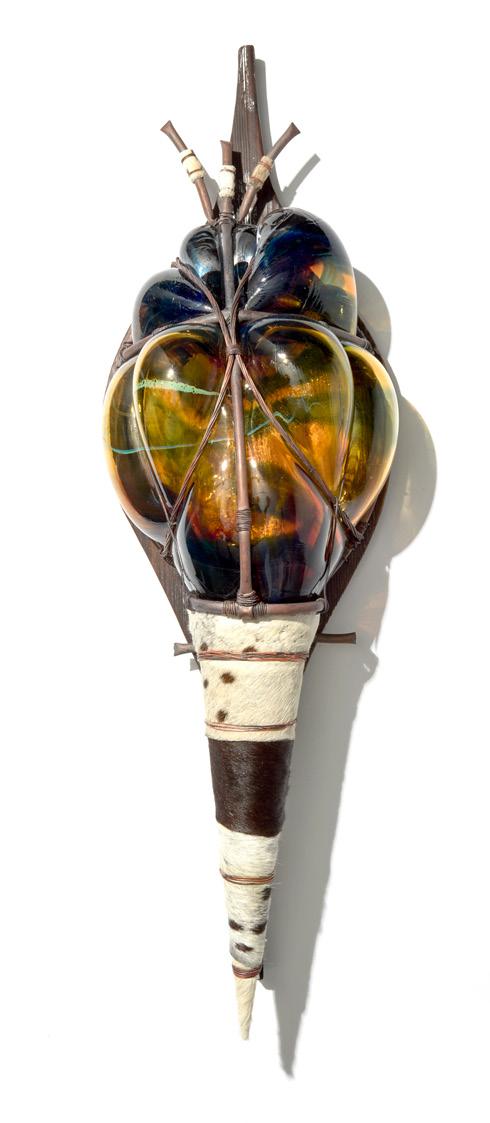
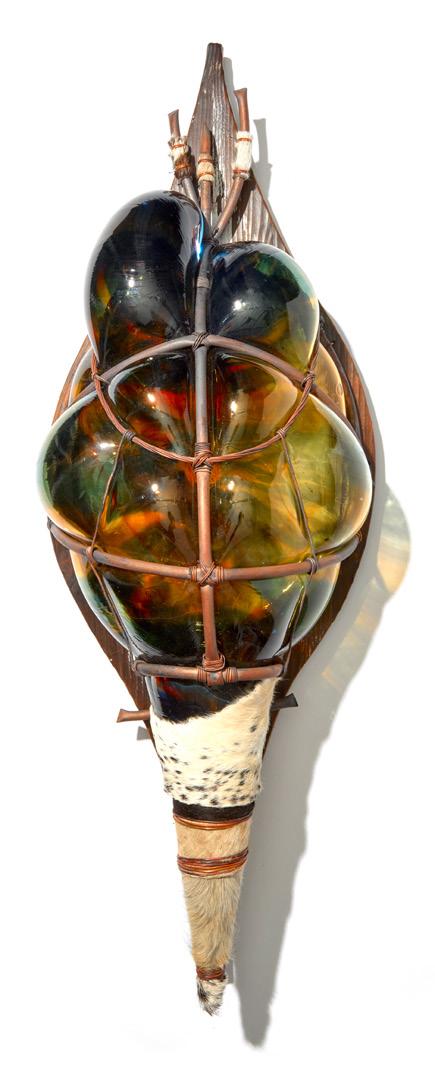
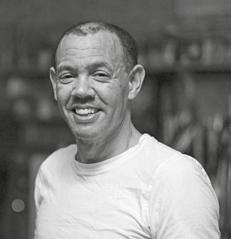
Chris Day’s deeply personal artworks explore what it means to be of dual cultural heritage in the UK, encouraging conversations about the treatment of Black people in Britain and the US. Day works with glass, which he blows into ‘cages’ made of copper pipe, giving each piece a unique character. This process is also reminiscent of the artist’s prior career as a plumber.
Chris Day, Reflections of Resistance III, 2025, blown & sculpted glass with mixed media, 83 × 23.5 × 16.5 cm
Reflections of Resistance (2025) is a wall-hung group of three sculptures inspired by images of shields from several African countries. Made of fragile glass, the ‘shields’ function as a metaphoric means of defence. As explained by the artist, the works address two historical events: the punitive Benin Expedition undertaken by British troops in 1897, which ultimately resulted in the absorption of the Benin Kingdom into the former colony of Nigeria; and the Battle of Isandlwana in Southern Africa in 1879, where invading British troops were massacred by Zulu warriors. Despite the different outcomes, Day observes the Beninese and Zulu people displaying persistent ‘resilience and resistance’, facing ‘gatling guns and ammunition’ with ‘nothing but shields and spears’.
On a more personal note, the ‘shields’ also allude to the protective habits that Day cultivated while growing up in Britain in the 1970s and 80s, at a time of strong stigmatisation against mixed-heritage people. For years, Day would lie and say that his father was dead. In truth, Day’s absent father was a Jamaican man who had been rejected by the artist’s Anglo-Irish maternal family. Only in recent years has he been able to acknowledge and celebrate his paternal heritage in works like Reflections; in the artist’s words, ‘the shield represents a defence, but with the defence mechanism taken away.’
Reflections of Resistance is the beginning of Day’s exploration of his Caribbean and African heritage, and his current references are largely Euro-American and contemporary, primarily film, literature and internetsourced materials. The sculptures also evoke the animal head trophies kept by game hunters, synonymous with Euro-American intervention in African ecologies. This said, there is nothing sad or dead about them; they are potent,
Chris Day, Reflections of Resistance IV, 2025, blown & sculpted glass with mixed media, 83 × 23.5 × 16.5 cm
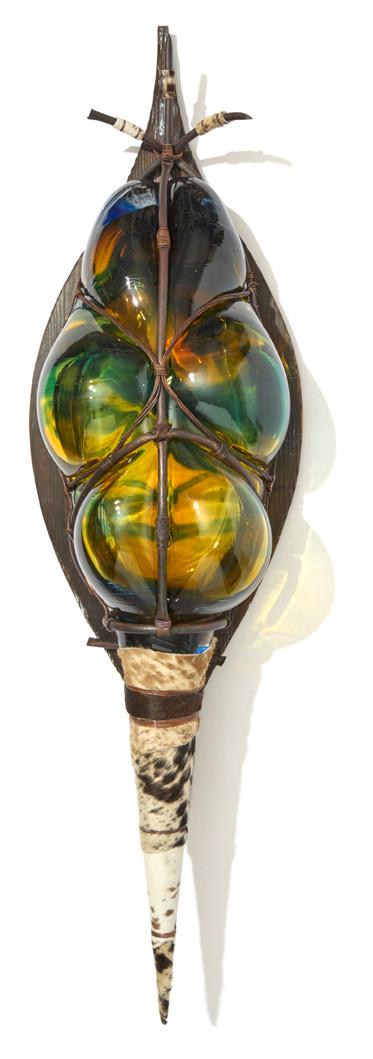
Chris Day, Reflections of Resistance I, 2025, blown & sculpted glass with mixed media,
× 23.5 × 16.5 cm
Reading Museum
Chris Day
animated, intimidating assemblages with the presence of overblown fetishes or amulets. The carefully coloured glass simulates the effect of swirling gasses within it, burgeoning out from their copper cage with explosive energy. Nature seems to burst free from its constraints, given form and shape by the artist’s own breath.
Reading Museum is collecting work that is both conceptually rich and technically brilliant. Our CAS membership is supported by Reading Foundation for Art.
Chris Day (b. 1968, Derby, UK) lives and works in Wolverhampton.
Presented by the Contemporary Art Society, 2025/26
Text by Elaine Blake, Curator, Art, Reading Museum
Artwork © Chris Day. Courtesy of the artist.
Chris Day, Reflections of Resistance III, 2025, blown & sculpted glass with mixed media, 83 × 23.5 × 16.5 cm
Chris Day, Reflections of Resistance IV, 2025, blown & sculpted glass with mixed media, 83 × 23.5 × 16.5 cm
Chris Day, Reflections of Resistance I, 2025, blown & sculpted glass with mixed media, 83 × 23.5 × 16.5 cm
Portrait by Tom Arber
Sainsbury Centre, UEA, Norwich
Yuki Kihara
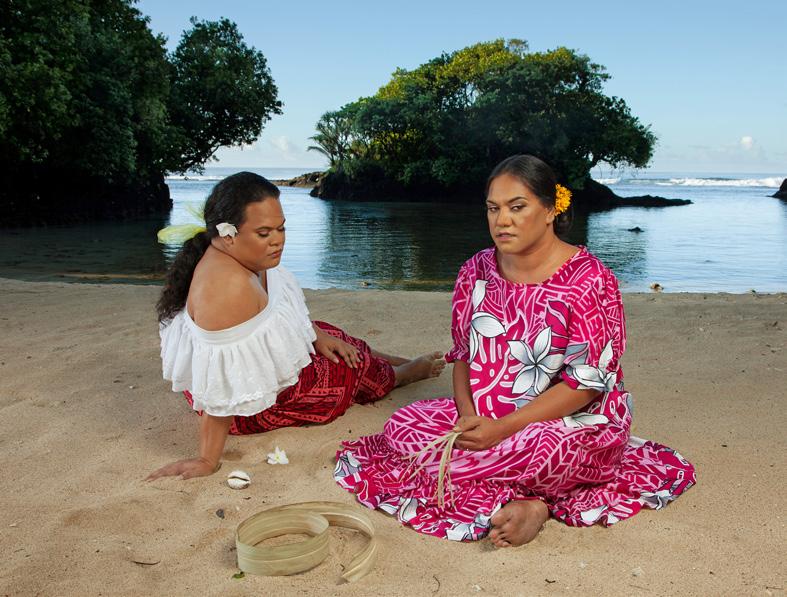
Yuki Kihara is a JapaneseSãmoan artist who draws upon her heritage to critically examine socio-political themes of LGBTQIA+ rights, colonial histories and the climate crisis. The artist is part of the fa’afafine community, who are recognised as a third gender in Sãmoan culture. The term directly translates to ‘in the manner of a woman’, and specifically refers to individuals who are assigned male at birth but later adopt a female identity. Kihara’s photography, performances and installations often highlight queer voices that have been historically overshadowed by the colonial sentiments that have left a lasting societal impact on her native land.
In 2025, the Sainsbury Centre hosted the UK premiere of Yuki Kihara’s Paradise Camp (2020–ongoing), exhibited alongside a newly commissioned work titled Darwin Drag (2025). Two works from Paradise Camp were selected for acquisition, Two Fa’afafine (after Gauguin) (2020) and Two Fa’afafine on the Beach (after Gauguin) (2020).
Kihara’s Paradise Camp series was exhibited as part of the Sainsbury Centre’s Can the Seas Survive Us? season, an ambitious programme which brings art into dialogue with some of the most important questions we face in our lives today. Paradise Camp consists of twelve staged portraits centring fa’afafine models at the forefront. The works are a direct response to Aotearoa New Zealand’s criminalisation of fa’afafine and fa’atama communities in Sãmoa. Although this law was annulled in 2013, transphobic sentiments remain deeply engrained within Sãmoan society. Sexual relationships between two men remain prohibited today.
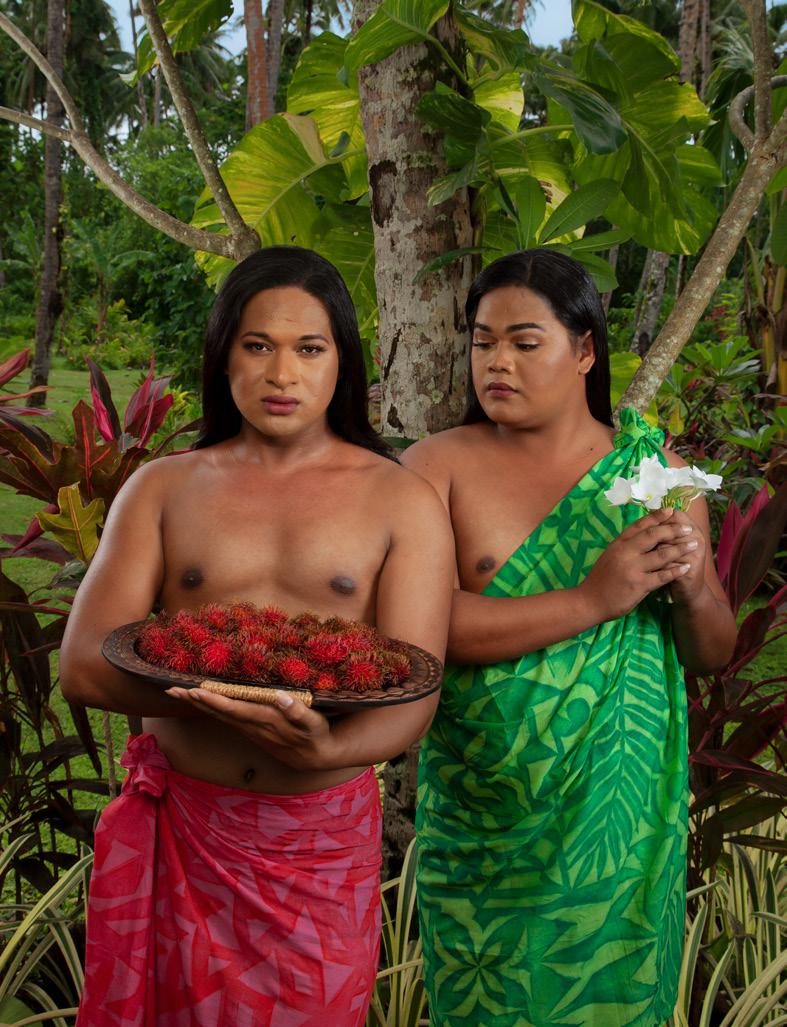
Yuki Kihara, Two Fa’afafine (after Gauguin), 2020, C-print mounted behind acrylic glass, 94 × 72 cm
Kihara conceived Paradise Camp in 2008 during her first major solo exhibition at the Metropolitan Museum of Art in New York, where she saw paintings made by French post-impressionist artist Paul Gaugin following his venture to Tahiti in the late 19th century. Many of these works depict young women whose bodies are exoticised and sexualised against idyllic paradise-like backdrops. After conducting extensive research, Kihara came to realise that Gauguin had likely been referencing compositions from photographs taken by Thomas Andrew (1855–1939),
Yuki Kihara, Two Fa’afafine on the Beach (after Gauguin), 2020, C-print mounted behind acrylic glass, 69 × 91 cm
Sainsbury Centre, UEA, Norwich
Yuki Kihara
a colonial Aotearoa New Zealander photographer. Following this discovery, Kihara repurposed Gauguin’s
Two Tahitian Women and Two Tahitian Women on the beach. In Two Tahitian Women, the central subject of the painting modestly looks away from the view in an act of submission. In Two Fa’afafine (after Gauguin), the subject stares back defiantly, seeming to challenge Eurocentric male gazes like Gauguin’s. In doing so, Kihara reclaims her cultural identity while empowering the Fa’afafine community and subverting Western heteronormative fantasies of Sãmoa as a passive, idyllic paradise.
Yuki Kihara (b. 1975, Sãmoa) lives and works in Sãmoa.
Presented by the Contemporary Art Society, 2025/26, with support from Keith and Rhonda Lloyd, and anonymous donors
Texts by Rosy Gray,
Yuki Kihara, Two Fa’afafine on the Beach (after Gauguin), 2020, C-print mounted behind acrylic glass, 69 × 91 cm
Yuki Kihara, Two Fa’afafine (after Gauguin), 2020, C-print mounted behind acrylic glass, 94 × 72 cm
Head of Living Art
Artwork © Yuki Kihara. Courtesy the artist. Portrait by Gui Taccetti
Sainsbury Centre, UEA, Norwich
Lindsey Mendick
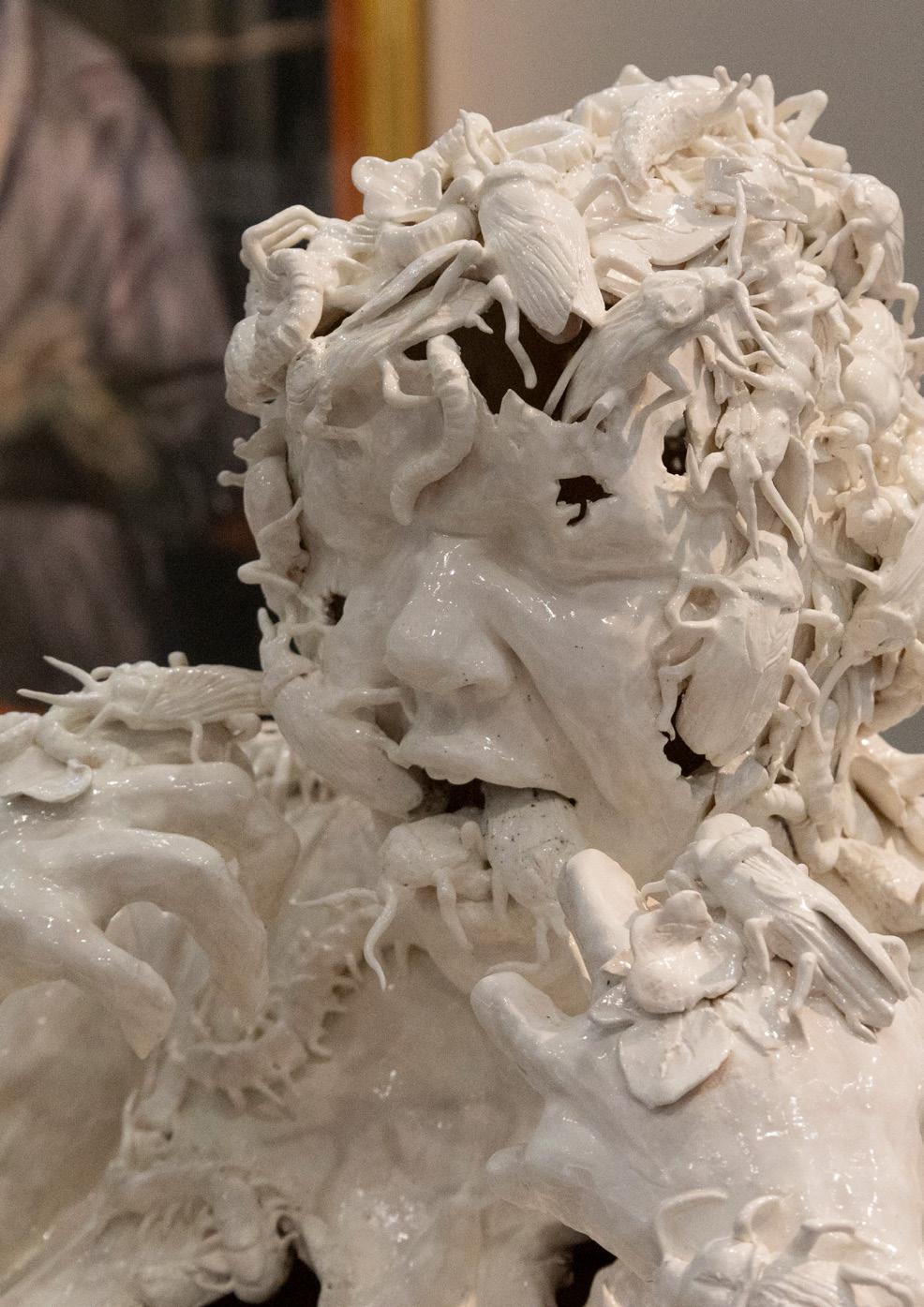
Lindsey Mendick works predominantly in clay, utilising the material to explore various themes: her own personal history, the concept of ‘low’ culture, anxiety, substance use, domesticity and the experience of women.
In 2024, Mendick was invited to respond to the Sainsbury Centre’s collection as part of our Why Do We Take Drugs? Season: a radical approach to programming which focuses on how art can help us navigate some of life’s biggest questions. On this occasion, Mendick created Hot Mess (2024) an installation of new ceramic works across the Sainsbury Centre’s Living Area. In No Worries If Not (2024), the artist explores her intertwined relationship with alcohol, mental illness and antidepressants.
Through mythology, pathos and humour, she unpacks her (at times) debilitating anxiety and the ways in which people have learned to self-medicate by taking drugs and drinking socially. Mendick describes the work as her most personal to date: ‘This is a self-portrait of how I am now, with the desperation to join the party and to get drunk, and the utter shame and self-loathing when I’ve lost my inhibitions and let myself go. I want the work to show the desperate attempts at trying to piece myself back together.’
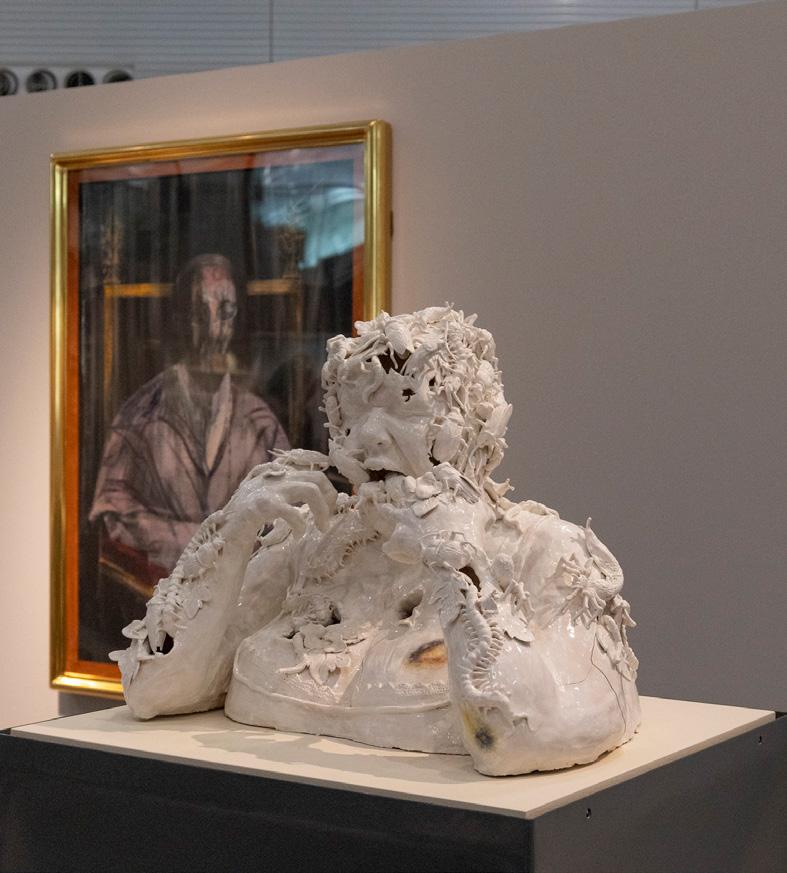
Inspired by the work of Francis Bacon and his paintings of screaming mouths in particular, the bust represents Mendick’s physical and emotional state during bouts of anxiety, when she feels the urge to tear off her own skin. Bacon’s 1955 painting Study (Imaginary Portrait of Pope Pius XII) is one of the highlights of the Sainsbury Centre’s collection; Mendick’s No Worries If Not is now on permanent display next to it. Also sitting alongside other works from across the globe, No Worries if Not is both funny and alarming, an example of an artist who explores femininity in ways that are often humorous as
Lindsey Mendick, No Worries If Not, 2024, glazed ceramic, 440 × 540 × 450 cm
Sainsbury Centre, UEA, Norwich
Lindsey Mendick
well as grotesque. Mendick btrings a new, contemporary, underrepresented and vibrant voice into the collection as the Sainsbury Centre reimagines what it is to be a museum in the 21st century.
Lindsey Mendick (b. 1987, London, UK) lives and works in Margate.
Presented by the Contemporary Society and purchased with support from the Arts Council of England / V&A Purchase Grant fund, 2025/26
Lindsey Mendick, No Worries If Not, 2024, glazed ceramic, 440 × 540 × 450 cm
Texts by Rosy Gray, Head of Living Art
Artwork © Lindsey Mendick. Courtesy the artist and Carl Freedman Gallery, Margate. Photography by Kate Wolstenholme. Portrait by Elissa Cray
Science Museum, London
Larry Achiampong
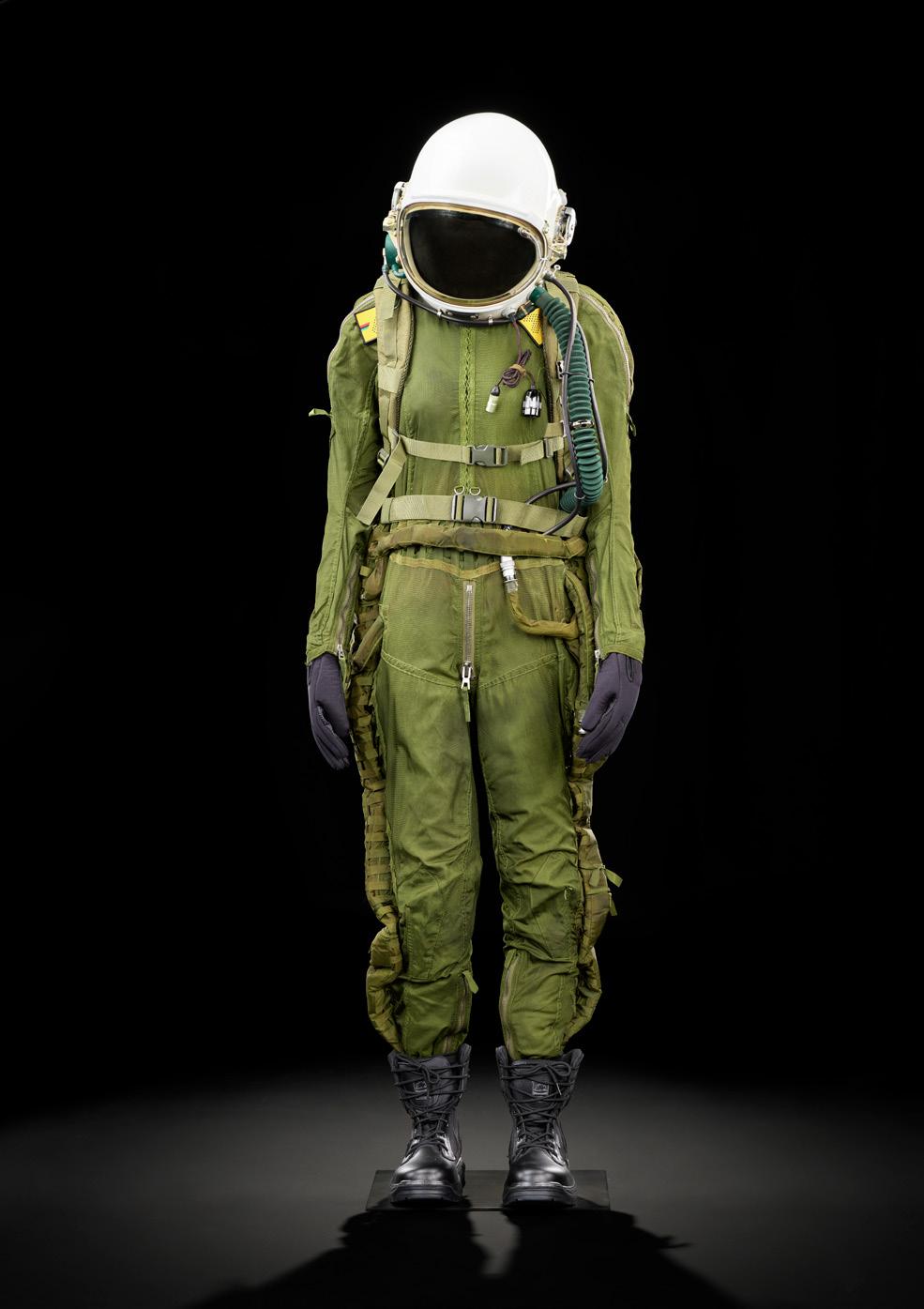
Larry Achiampong is a multi-disciplinary GhanaianBritish artist whose work explores identity in the digital age. His practice is deeply personal, engaging with the themes of cross-cultural identity, working-class African diasporic experience, and the intersection of pop culture and postcolonialism. Achiampong’s work explores his personal heritage while engaging with wider ideas of posthuman entanglements with technology through mediums that include sculpture, moving image, installation and photographic collage. The artist’s 2017 commission Pan African Flag for the Relic Travellers’ Alliance flew on the roof of Somerset House, and in 2022 he adapted the design for Transport for London, transforming the London Underground roundel at Westminster Station.
The Relic Traveller project started in 2017, combining performance, audio, moving image, and prose. Through these varying mediums, Achiampong narrates a possible world of declining western-European powers in which a Pan African Union deploys the Relic Travellers’ Alliance, a covert organisation equipped with hi-tech gear and tasked to recover fragments of lost or suppressed diasporic histories across the planet. Achiampong’s flags and protective suits with decorative insignia embody the speculative futures depicted in the artist’s films and writing, building a symbolic language which moves beyond the shared wounds of colonialism in the African continent towards a new day of prosperity.
Larry Achiampong, The Relic Travellers’ Alliance: Assembly (Standing, Downward Stare) MK 001, 2022, mixed media, life size
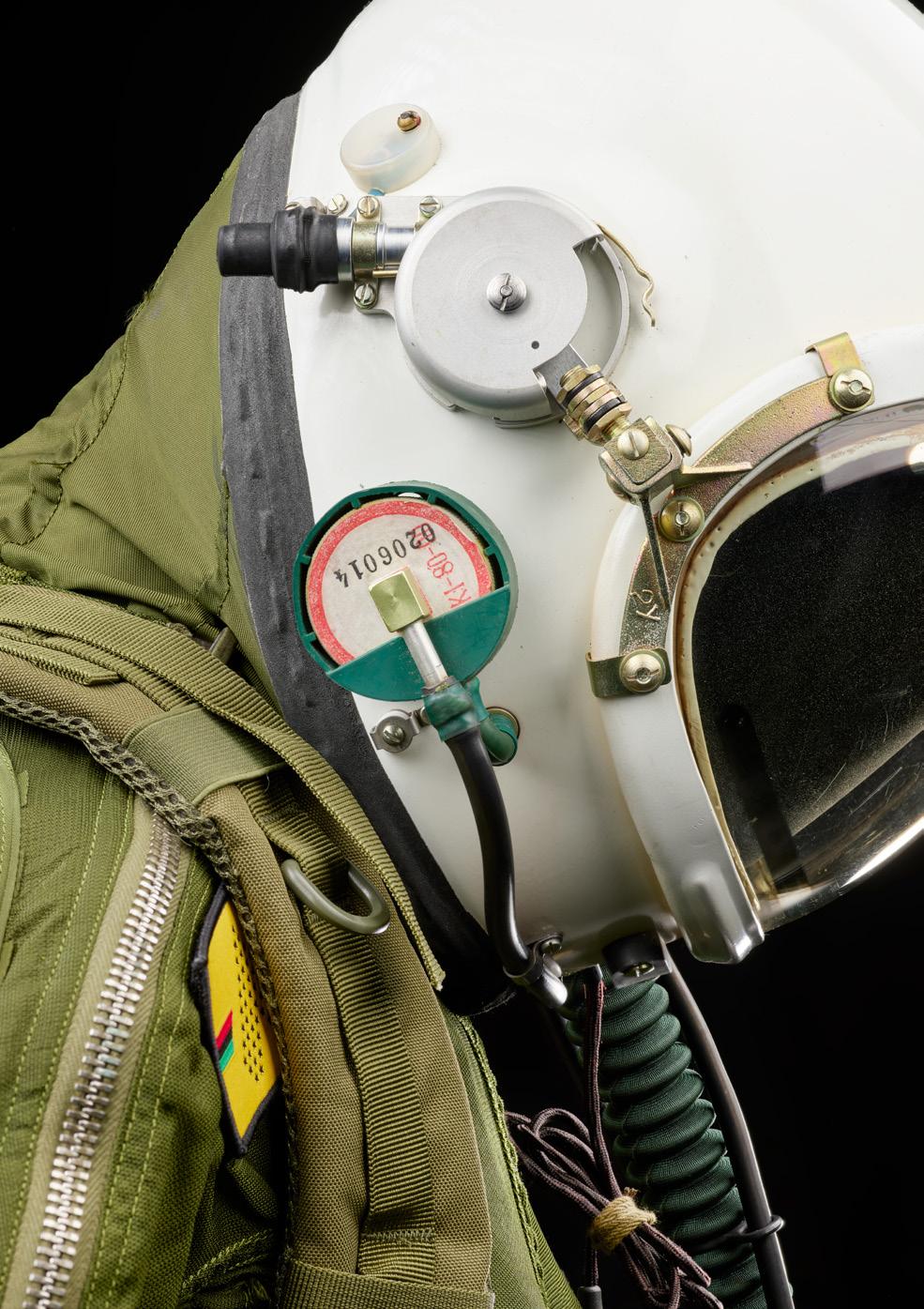
Taking afrofuturism as its starting point, this work acquired for the Science Museum engages with the artist’s own terminology of ‘sanko-time.’ Sankofa, a Ghanaian Twi term meaning ‘to go back and retrieve’, embodies the principle that the past must be revisited in order to comprehend and heal the present, and to pave the way to a better future. Achiampong’s space suit embodies this speculative journey through time as well as complex questions, hopes and fears surrounding humanity’s relationship to the cosmos. Could a near-future Pan African space programme repair the lasting consequences of colonial histories past and present?
Science Museum, London
Larry Achiampong
Larry Achiampong, The Relic Travellers’ Alliance: Assembly (Standing, Downward Stare) MK 001, 2022, mixed media, life size
The Relic Travellers’ Alliance: Assembly (Standing, Downward Stare) (2022) was shown as part of the Science Museum’s Science Fiction: Voyage to the Edge of Imagination exhibition in 2022–23. Within the exhibition, the work encouraged visitors to consider communities that often get omitted from science-fictional futures,. The suit also speaks directly to the Science Museum’s mission to inspire new futures, working with artists to address historical absences. The addition of Achiampong’s work to the collection supports the museum’s mission to share the complex stories of science and technology, championing the next generation of thinkers and explorers from diverse experiences and backgrounds. This important contemporary installation initiates a dialogue between art and science aimed at broader audiences; this is especially true when juxtaposed with the thousands of historical objects from our collection, like British cosmonaut Helen Sharman’s 1991 Sokol space suit.
Larry Achiampong (b. 1984, London, UK) lives and works in London and Essex.
Presented by the Contemporary Art Society, 2025/26
Text by Anna Ferrari, Curator of Art and Visual Culture Artwork © Larry Achiampong. All rights reserved, DACS 2026. Photography by Reece Straw. Portrait by Reece Straw
Museum & Art Swindon
Henry Orlik
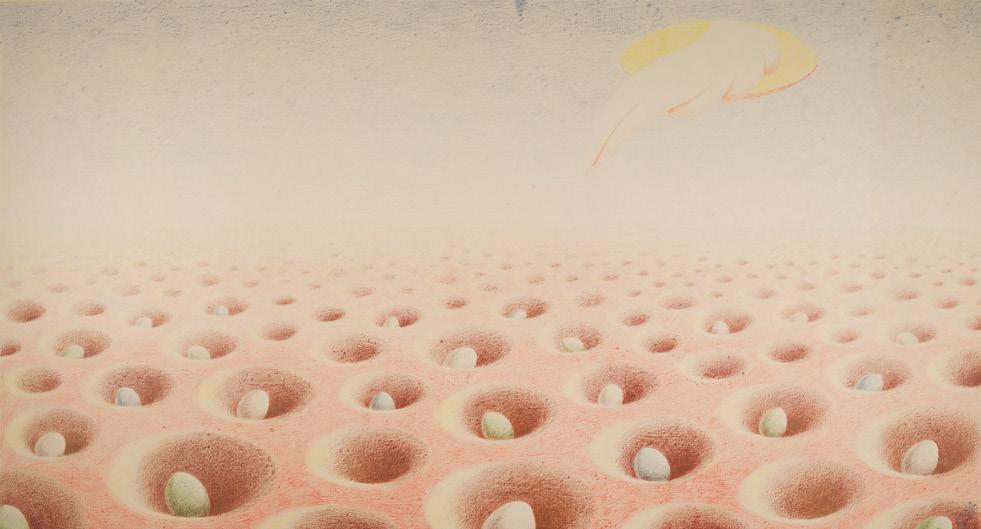
Williamson Art Gallery & Museum, Birkenhead
Henry Orlik is a British surrealist artist born in 1947 in Germany to a Polish father and a Belarusian mother. Seeking refuge after the end of the Second World War, Orlik and his family relocated to Swindon in 1948, having spent some time living in Polish resettlement camps. He worked as an artist in the 1970s, participating in a number of group shows and hosting his own solo exhibition at London’s Acoris Surrealist Art Centre. In recent years, this relatively reclusive painter has gained renewed recognition for the otherworldly scenes depicted in his works. These are created through the use of many intricate, spiralling brushstrokes, which Orlik refers to as ‘excitations’. The technique draws from the artist’s interest in quantum physics, the science of matter and light.
Eggs Unhatched on the Sun (1979–80) depicts an infinite landscape, dented by craters. Whilst some of the indents cradle egg-like forms, others are empty, suggesting that the eggs have hatched and moved on. While the image evokes stillness and serenity, it also suggests a sense of time and life unfolding. The soft colour palette enhances both the surreal nature of the work and its organic imagery, which in turn instills ideas about the cycles of creation and burial of bodily life. Hovering above is an indefinite solar presence, which may reveal itself as a nurturing or destructive force for the delicate processes unfolding below.
This acquisition from a significant local artist compliments the themes and motifs of other surrealist works in Museum & Art Swindon’s collection. Desmond Morris’s The Mysterious Gift (1965) uses egg-like forms and bodily imagery in a still life context, whilst Nightfall (2014–15) by Marlene Hartmann-Rasmussen employs woodland imagery to suggest an enigmatic unhatching. Orlik’s work also speaks to the strong representation of landscapes held by the museum, and contributes to its growing collection of modern and contemporary prints and drawings.
Henry Orlik (b. 1947, Ankum, Germany) lives in Swindon.
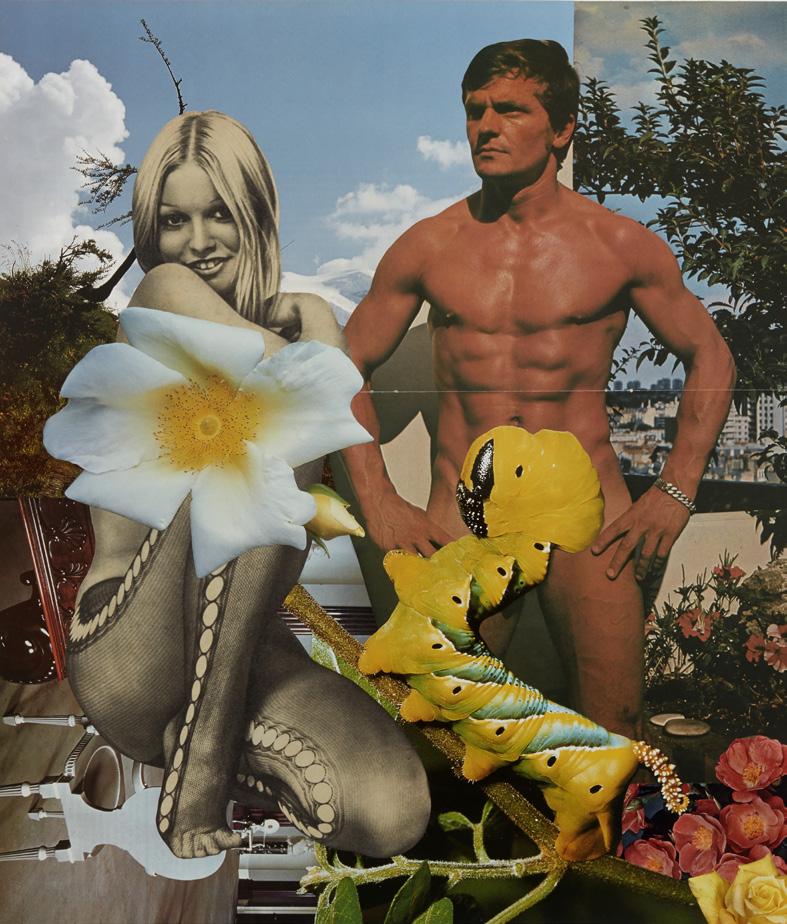
Linder, Origin of the World, 2016, photomontage, 49.1 × 42.1 cm
Presented by the Contemporary Art Society with the support of the Friends of Museum & Art Swindon, 2025/26
Text by Katie Ackrill, Collections and Exhibitions Officer
Artwork © Henry Orlik. Portrait courtesy the artist and Winsor Birch. Portrait courtesy the artist.
Henry Orlik, Eggs Unhatched on the Sun, 1979–80, coloured crayons and pencil, 78.5 × 147.5 cm
Museum & Art Swindon
Henry Orlik

Linder has been an innovator in multiple fields throughout the course of her artistic career. A central figure in the 1970s punk and 1980s post-punk scenes in Manchester, she gained prominence for her cover design for punk group Buzzock’s debut single Orgasm Addict. Linder’s work has always been assertive and exuberant in nature, often with a playful edge. Best known for her photomontages and photography, the artist takes her materials from disparate printed sources, from shop catalogues to pornographic magazines. The overlap of the commercial and the pornographic spheres highlights and complicates the concept of a ‘model life’, which emerged under consumerism and capitalism.
Origin of the World (2016) is a surrealist artwork with masses of detail. The photomontage depicts a man and a woman in a scene reminiscent of depictions of Adam and Eve. The figures’ nudity recalls classical paintings, with both images seemingly cut from erotic magazines. There is a palpable disconnect between the two, with their gazes performing different operations.
Williamson Art Gallery & Museum prides itself on a collection encompassing most major artists from the Wirral and the Merseyside areas. Without the acquisition of Linder’s work, however, this claim couldn’t be meaningfully upheld. A survey of the gallery’s collection of works showing naked subjects determined that out of over 700 of such artworks, only two were by artists who are women. In this sense, our collection is rooted in and caters to the male gaze; our figurative works have historically not reflected a diverse range of artists and their lived experiences. Linder’s work will contrast the biases of our historic collection, boldly challenging the traditions of life drawing and artistic practices that were taught at the academies and schools of the majority of the collection’s artists.
Linder Sterling (b. 1954, Liverpool, UK) lives and works in Lancashire.
Williamson Art Gallery & Museum, Birkenhead Linder
Henry Orlik, Eggs Unhatched on the Sun, 1979–80, coloured crayons and pencil, 78.5 × 147.5 cm
Linder, Origin of the World, 2016, photomontage, 49.1 × 42.1 cm
Presented by the Contemporary Art Society with the support of Bianca Roden, 2025/26
Text by Josh Mackarell, Collections Manager
Artwork © Linder Sterling. Courtesy the artist and Modern Art, London. Portrait by Gabby Laurent.
UH Arts + Culture,
University of Hertfordshire, Hatfield
Veronica Ryan
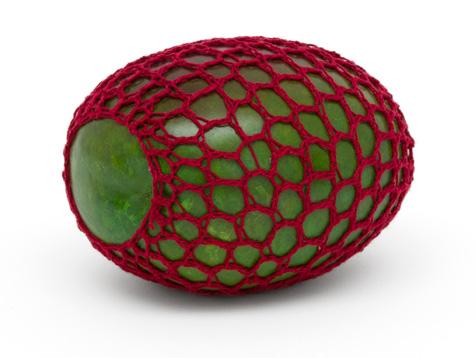
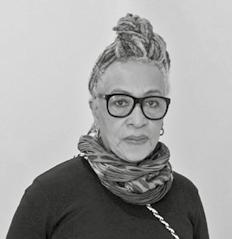
Veronica Ryan works primarily in the media of sculpture and assemblage, using a wide range of materials which include bronze, plaster, marble, textiles, and found objects. Ryan’s works reflect the natural world around her and consider, in her words, ‘multiple conversations’ between ecology, psychology and culture. Taking the shape of organic forms and plant-like sculptures, her works reflect environmental and sociopolitical concerns and personal narratives, interwoven with histories of trade, displacement and objecthood.
Ryan won the Turner Prize in 2022 for her exhibition Along a Spectrum at Spike Island, Bristol, and a three-piece commission for Hackney Windrush titled Custard Apple (Annonaceae), Breadfruit (Moraceae) and Soursop (Annonaceae) (2021), the first UK permanent public sculpture by a Black woman.
Votives for you II (2023–24) is a cast bronze mango. The artist’s interest in organic forms – fruit, seeds, pods –has remained a constant since the 1980s. In this work, the bronze mango is wrapped in a crocheted fishing line. Ryan first started observing fishermen crocheting fishing lines in St Ives; at the time she was working on the sculpture Mango Reliquary (2000) during a residency at Barbara Hepworth’s studio Palais de Danse.
Collective Moments (2000/2022) is the first work of a series with the same name, comprising around forty sculptures. Ryan began working on this series in 2000, and revisited it in 2022. The artwork’s dual date reflects this process: the stacked cups that make up the sculptures’ tower-like structure and the bandages on top are both dated 2000, while the fabric casing is from 2022.
These works are a pertinent example of how Ryan mines physical and psychological repositories, reforming the uncovered sediment into sculptural objects and assemblages. Ryan’s interest in covering, stacking, gathering and binding objects together, evident in both acquisitions, appears as a formal compulsion expressing a desire for order.
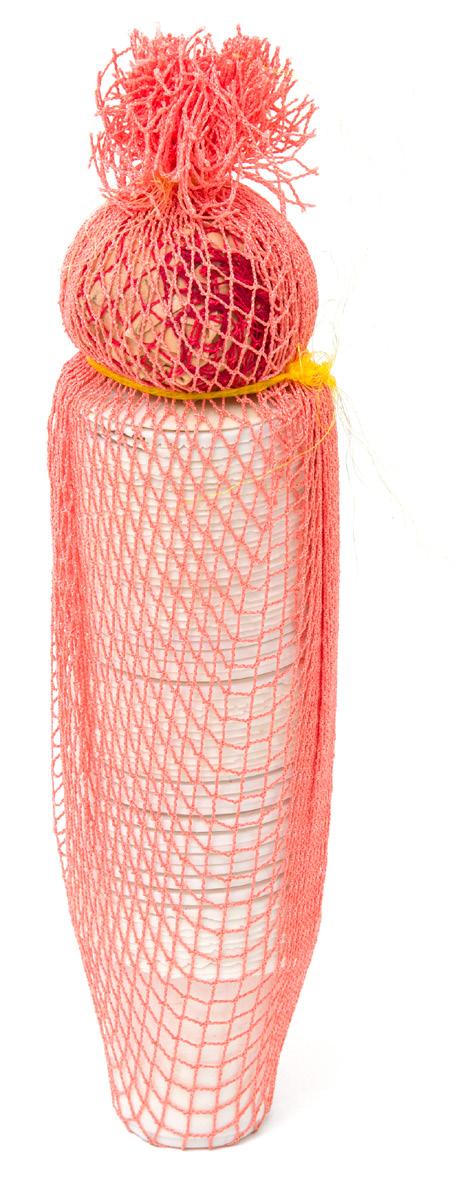
Veronica Ryan, Votives for you II, 2023–24, bronze, crocheted fishing line, 9 × 10.5 × 13.5 cm
Veronica Ryan, Collective Moments, 2000/2022, cardboard containers, bandages and mesh, 26 × 7 × 7 cm
UH Arts + Culture,
University of Hertfordshire, Hatfield
Veronica Ryan
UH Arts + Culture, University of Hertfordshire (UH), acquired these two sculptures by Veronica Ryan to celebrate the alumna’s formidable success within the field of contemporary art. Ryan is a key figure in the impressive roster of alumni from the Hertfordshire College of Art and Design, which in 1992 merged with Hatfield Polytechnic to become the University of Hertfordshire.
The year 2025 was the 150th anniversary of the institution; for the occasion, UH Arts + Culture delivered two major exhibitions with its partner institution St Albans Museum + Gallery to celebrate this significant milestone. Ryan exhibited as part of this dual-venue exhibition; now, these acquisitions into the University’s permanent Art Collection will form a lasting legacy of both the artist’s and the institution’s achievements.
Veronica Ryan OBE RA (b. 1956, Plymouth, Montserrat, UK) lives and works between New York and Bristol.
Presented by the Contemporary Art Society with the support of Soo & Jonathan Hitchin, 2025/26
Text by Inna Allen, Head of UH Arts + Culture
Artwork © Veronica Ryan. Courtesy Alison Jacques, London. Photography Michael Brzezinski. Portrait by Andy Feldman
Veronica Ryan, Votives for you II, 2023–24, bronze, crocheted fishing line, 9 × 10.5 × 13.5 cm
Veronica Ryan, Collective Moments, 2000/2022, cardboard containers, bandages and mesh, 26 × 7 × 7 cm
Wolverhampton Art Gallery
Shaqúelle Whyte
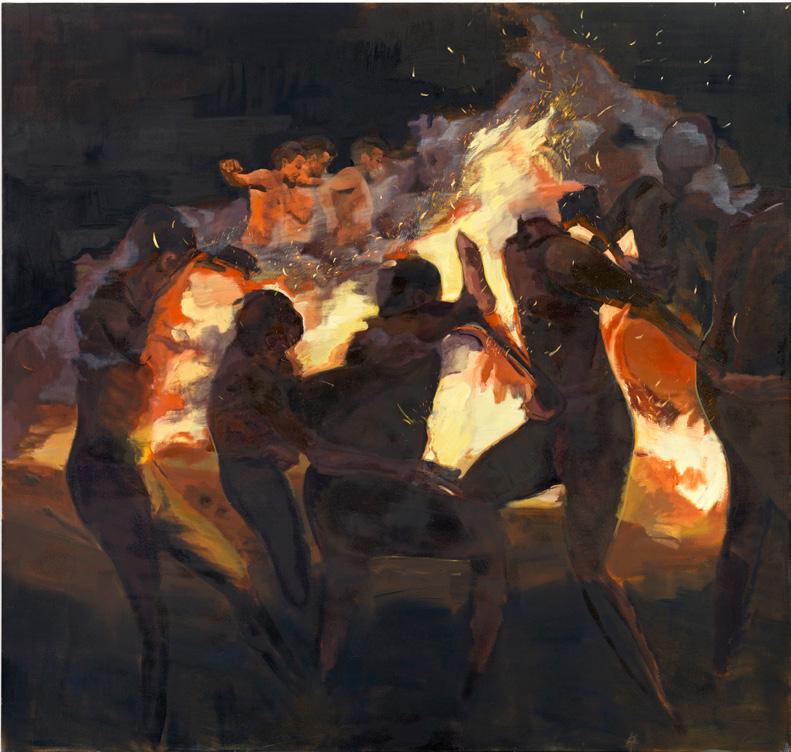
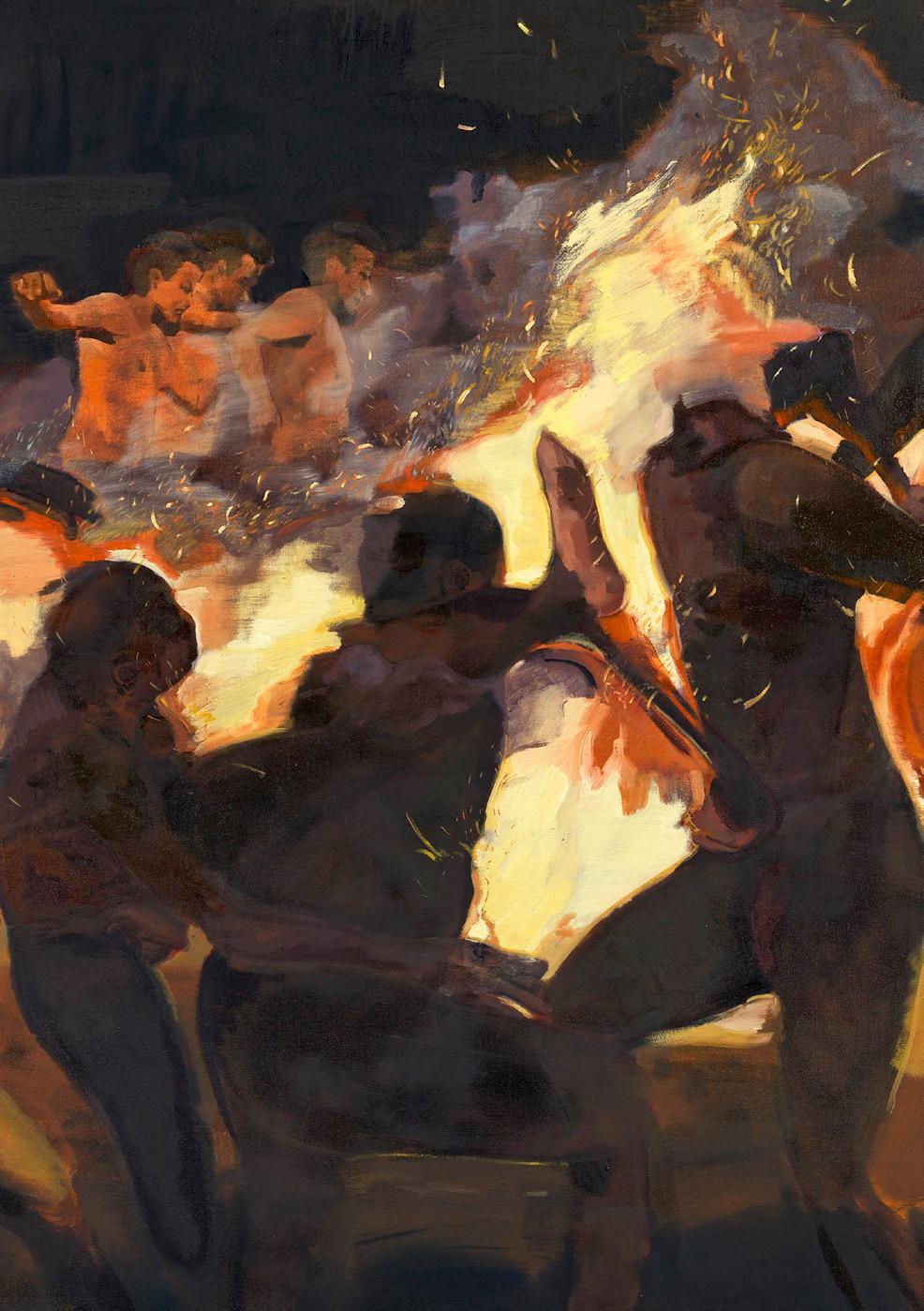

Shaqúelle Whyte is a dynamic figurative painter from Wolverhampton. The now London-based artist’s emergence into the contemporary art scene has been marked by several exhibitions featuring ambitious and emotionally resonant work that explores Black identity, community, embodiment and representation.
Blackbirds singing in the dead of night (2025) is a dramatic figurative painting. Whyte’s vigorous markmaking, dynamic composition, and expressive poses suggest an immediate sense of movement and intensity. The naked figures in the painting fully encircle the flames; some are holding tools, their identities partially obscured by rising smoke and darkness. Glimpses of surrounding trees and buildings hint at a wider narrative. The scene evokes themes of community, ritual and gathering. It remains open to interpretation while inviting questions as to the occasion and identity of the people depicted in it.
Whyte’s painting reflects his engagement with art historical traditions of image-making, particularly in the depiction of nocturnal scenes, fire, expressive gesture and communal gatherings. The artist’s exploration of Black masculine bodies and their representation is also central to the work, weaving together themes of identity, history and collective experience.
Whyte’s connection to Wolverhampton is deeply personal and formative. He has spoken about the importance of visits to Wolverhampton Art Gallery during his youth, which played a pivotal role in nurturing his creativity and introducing him to the possibilities of artistic expression. Acquiring this work celebrates this journey, but also reinforces the Gallery’s role in inspiring future generations of artists.
This acquisition significantly enhances the Gallery’s Black British Art collection, which includes works by innovative artists such as Tam Joseph, Donald Rodney, Claudette Johnson, Eddie Chambers, Keith Piper, Marlene Smith and Lubaina Himid – figures central to the Black British Art Movement of the 1980s and 1990s.
Shaqúelle Whyte, Blackbirds singing in the dead of night, 2025, oil on linen, 200 × 210 cm
Wolverhampton Art Gallery
Shaqúelle Whyte
Whyte’s practice is informed by this legacy, and his inclusion in the collection extends the narrative to a younger generation of contemporary artists who continue the exploration of race, heritage and representation in the UK today.
Alongside recent acquisitions of a drawing by Somaya Critchlow and a film by Rhea Storr, this acquisition expands the representation of a younger generation of Black British artists within our collection. It also deepens our ability to connect with audiences through contemporary art that speaks to lived experience, cultural history, and creative expression. We believe Blackbirds singing in the dead of night will become a cornerstone for meaningful engagement, inspiring dialogue and creativity across our programmes and diverse communities. With this acquisition, Wolverhampton Art Gallery celebrates and supports an emerging artist with strong local roots while diversifying Wolverhampton’s nationally significant collection of Black British Art.
Shaqúelle Whyte (b. 2000, Wolverhampton, UK) lives and works in London.
Purchased with support from the Arts Council England / V&A Purchase Grant Fund, the Contemporary Art Society, City of Wolverhampton Council and Kemal and Tala Cingillioglu, 2025/26
Shaqúelle Whyte, Blackbirds singing in the dead of night, 2025, oil on linen, 200 × 210 cm
Text by Sanna Moore, Senior Curator
Artwork © Shaqúelle Whyte. Courtesy the artist and Pippy Houldsworth Gallery, London. Portrait by Brynley Odu Davies
Abbot Hall Art Gallery, Kendal
Jessica Warboys
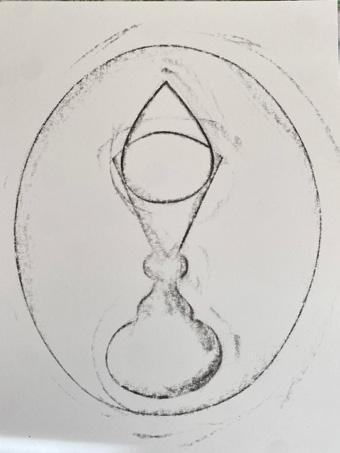
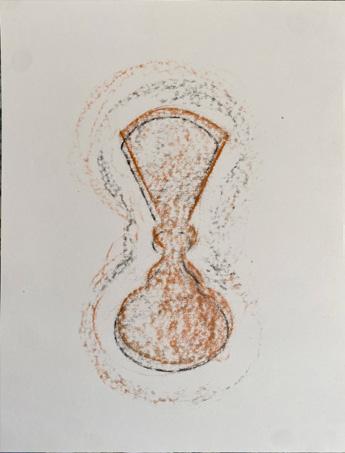
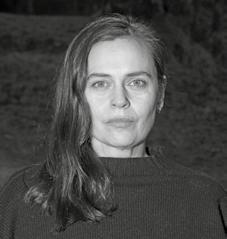
Jessica Warboys’s artistic practice spans painting, film, and performance. Informed by history, memory, and nature, her work is often marked by a ritualistic aspect which interweaves process and place.
Warboys’ sea and river paintings, a series she has been developing since 2009, are typical of this practice: natural pigments are applied to raw canvases that have been submerged in bodies of water, directed both by the artist’s hands and the unpredictable forces of nature. The painting process becomes performative and collaborative, the canvases forming a record of time and place and a document of Warboys’ engagement with the natural landscape.
Abbot Hall commissioned Warboys to make a new river painting responding to the landscape of Cumbria and the Lake District. Following a period of research and visits to the area, Warboys was drawn to the Duddon Valley in West Cumbria. Home to the River Duddon and extolled in the sonnets of William Wordsworth, the valley is also a place with a long industrial heritage, including the Duddon Iron Furnace – a charcoal-fired iron furnace dating back to 1736, the oldest of its kind in northern England.
Warboys’ River Painting, Duddon Valley, was made in March 2026, just after the spring equinox. It was produced by painting raw canvas with beeswax before submerging it in the River Duddon, then scattering and directing mineral pigments directly onto the wet surface.
A series of drawings by the artist accompanies the commission, which like the river painting, follow a thread running through her recent work in which the iron egg and chalice recur as symbols of resistance, ritual, and metamorphosis. Here, the rusty ochre pigment on the iron chalice seems also to resonate with the Duddon Valley’s history of iron extraction and smelting.
Landscapes, and the experience they evoke, are an important part of Abbot Hall’s art collection, which traces artists’ responses to the natural world from the Romantic period to today. In recent exhibitions, particular emphasis has been placed on artists working directly within landscapes. This focus was evident in the 2024 exhibition
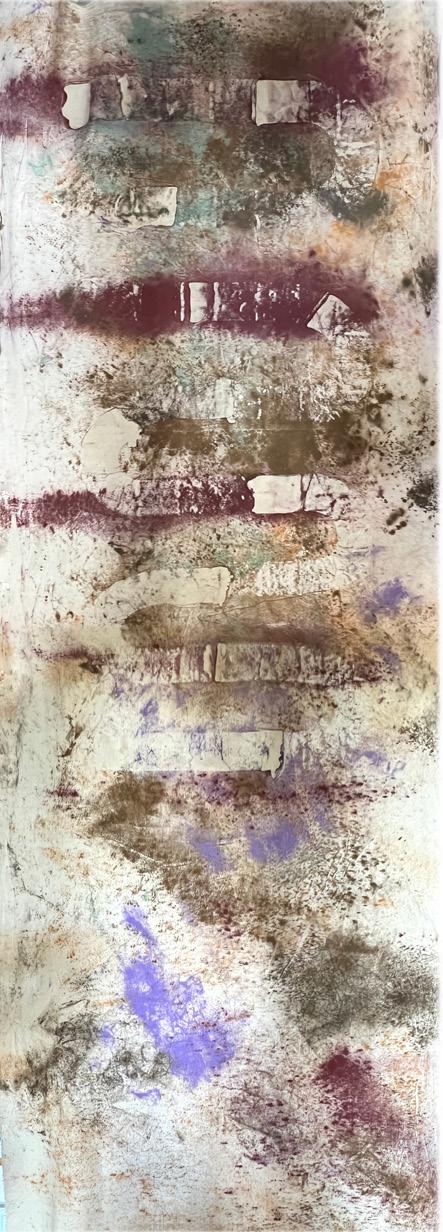
Jessica Warboys, IRON EGG IRON CHALICE I, 2026, beeswax and mineral pigment on paper, 35.6 × 28 cm
Jessica Warboys, IRON EGG IRON CHALICE II, 2026, beeswax and mineral pigment on paper, 35.6 × 28 cm
Jessica Warboys, IRON EGG IRON CHALICE III, 2026, beeswax and mineral pigment on paper, 35.6 × 28 cm
Jessica Warboys, IRON EGG IRON CHALICE IV, 2026, beeswax and mineral pigment on paper, 35.6 × 28 cm
Jessica Warboys, River Painting, Duddon Valley, 2026, beeswax and mineral pigment on canvas, 700 × 180 cm
Abbot Hall Art Gallery, Kendal
Jessica Warboys
Expanding Landscapes: Painting After Land Art, in which Jessica Warboys’ River Painting, Ouse (2019) featured prominently.
The opportunity to commission an artist to work directly in our local landscape of the Lakeland Fells was particularly appealing; and Warboys’ painting will join responses to the Lake District in our collection from artists such as JMW Turner, Hilde Goldschmidt, and Andy Goldsworthy. We also intend to showcase the new works in a forthcoming collection display titled Flowing From The Fells
Jessica Warboys (b. 1977, Newport, Wales, UK) lives and works in Bergen, Norway and Suffolk, England.
Presented by the Contemporary Art Society with the support of India Rose James, 2025/26
Text by Niall Hodson, Keeper of Collections, Lakeland Arts
Artwork © Jessica Warboys. Courtesy Abbot Hall Art Gallery, Kendal. Portrait by Jessica Warboys
Jessica Warboys, IRON EGG IRON CHALICE I, 2026, beeswax and mineral pigment on paper, 35.6 × 28 cm
Jessica Warboys, IRON EGG IRON CHALICE III, 2026, beeswax and mineral pigment on paper, 35.6 × 28 cm
Jessica Warboys, IRON EGG IRON CHALICE II, 2026, beeswax and mineral pigment on paper, 35.6 × 28 cm
Jessica Warboys, IRON EGG IRON CHALICE IV, 2026, beeswax and mineral pigment on
paper, 35.6 × 28 cm
Jessica Warboys, River Painting, Duddon Valley, 2026, beeswax and mineral pigment on canvas, 700 × 180 cm
Omega Fund
‘The Contemporary Art Society is one of the only avenues through which a gallery of our size can continue to acquire art from contemporary, relevant and exceptional artists and craftspeople from the UK and abroad. More than this, it also provides incredible networks and opportunities for connecting with other institutions, curators and artists – avenues which wouldn’t be available otherwise.’
Mackarell,
‘CAS membership is incredibly valuable to our organisation and we’ve benefited from a great number of acquisitions through various grants and donor-supported schemes, allowing us to collect work to keep our collection relevant over the years. We appreciate that CAS grants, training, and support shift over time to align with contemporary social and political challenges, presenting curators with the opportunity to develop their research and curatorial skills, as well as to network with peers.’
Joshua
Curator, Williamson Art Gallery and Museum
Fiona Corridan, Content Lead, Manchester Art Gallery
The Fitzwilliam Museum, Cambridge
Connor Coulston
Connor Coulston, Don’t you think I’m a bit young to join the BNP?, 2025, glazed ceramic, enamel, 87 × 42 × 40 cm
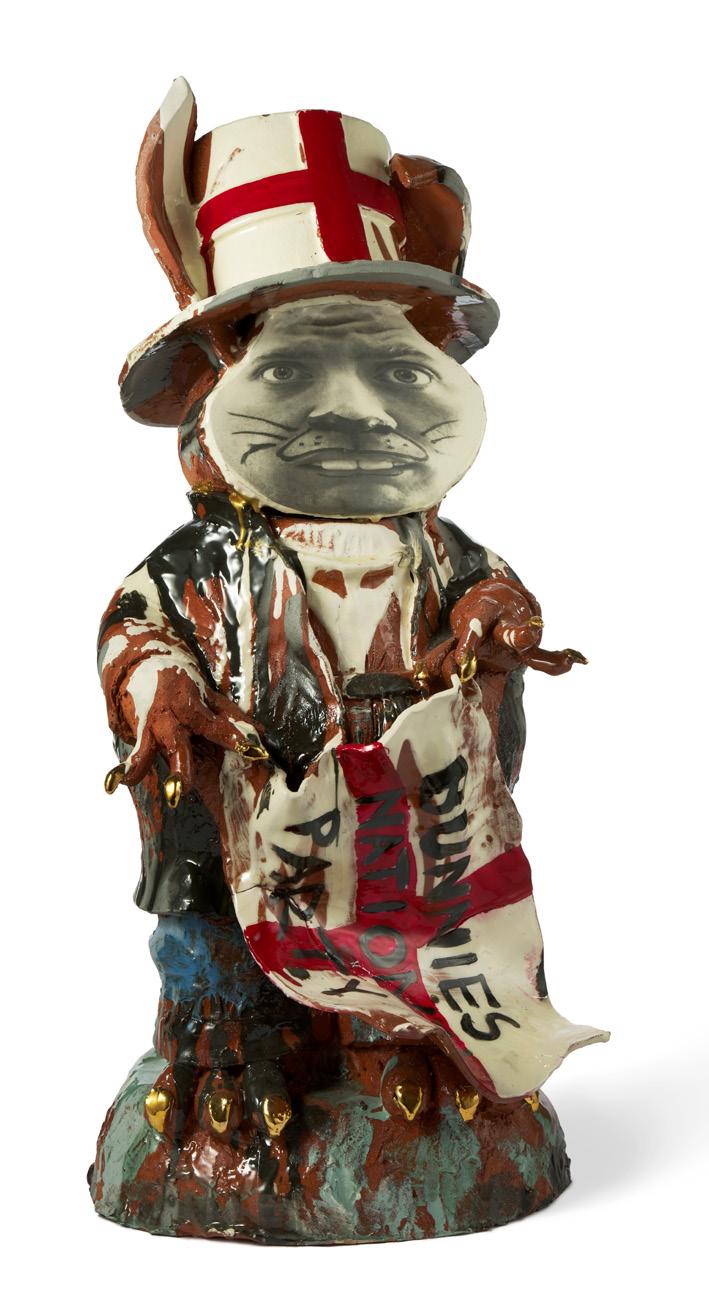
Connor Coulston’s practice is ‘an ongoing articulation of the relationship between self-deprecating humour as a means of enquiry, the mutability of clay, and the wild imaginary,’ as the artist explains. Always bold, often kitsch, sometimes surreal, his work explores historical narratives and legacies intermingled with his own lived experience of queerness, depression, working-class life, and his family’s enthusiasm for right-wing politicians.
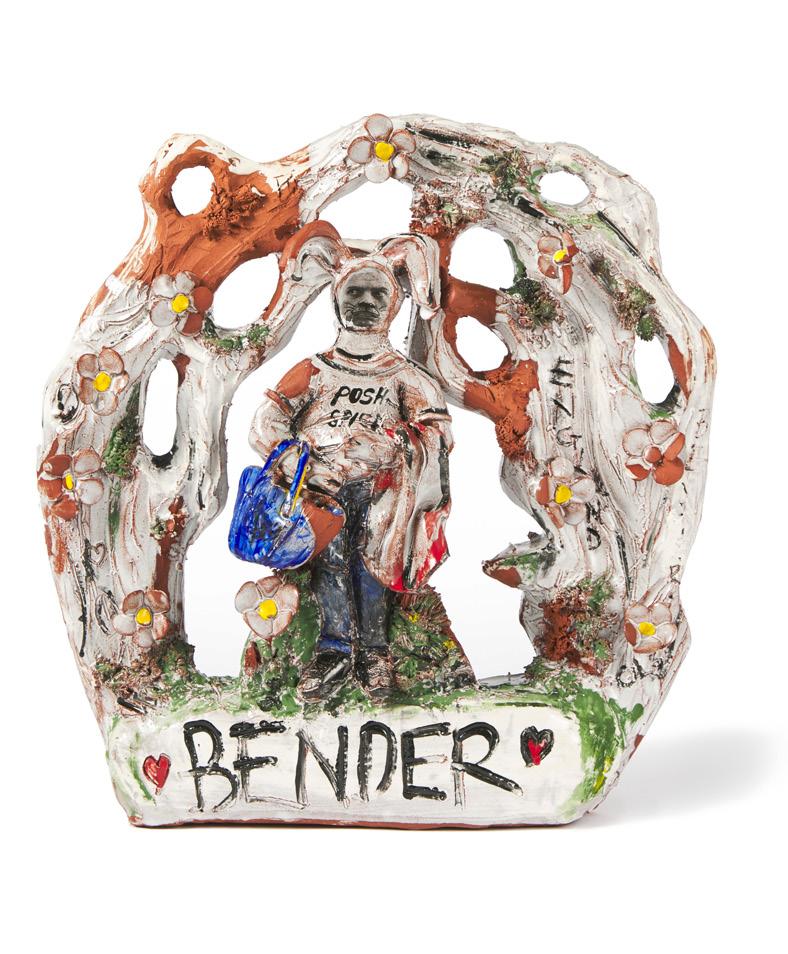
Combining instantly recognisable commercial logos and motifs with fantastical scenarios, his works often feature Coulston himself: he appears inhabiting various avatars or with his face incorporated into his designs. Although humorous at first glance, a closer look at Couston’s work reveals darker undertones of critical cynicism.
Both acquired works were exhibited in 2023 in Coulston’s solo show, Dreamin’ of a Chippy Tea, held at the Drawing Schools Gallery, Eton College, Windsor. The first piece, Don’t you think I’m a bit young to be a part of the BNP? (2025), speaks directly to Connor’s feelings towards –and fear of – his family’s far-right political leanings.
A rabbit with a modified decal of the artist’s own face delicately holds up the St George’s Cross. In Bender Bunny (2025), Coulston appears again as a rabbit, this time in the style of a traditional Staffordshire flatback with an arbour and an inscription. By deliberately using a slur previously used against him, Coulston reclaims his queer childhood as something to be celebrated and commemorated.
These pieces are significant additions to The Fitzwilliam Museum’s collection of historic, modern and contemporary ceramics. Fresh and engaging, they align with the museum’s desire to acquire works that can establish a connection with contemporary audiences while stimulating thought and discussion. Coulston’s works explore sexuality, socioeconomics and politics through an honest and personal lens. With their humorous and questioning nature, they enable the museum to expand the narratives and perspectives of living artists represented in the collection.
Connor Coulston, Bender Bunny, 2025, glazed ceramic and enamel, 35 × 33 × 9 cm
The Fitzwilliam Museum, Cambridge
Connor Coulston
Connor Coulston (b. 1992, Oldham, UK) lives and works in London.
Presented by the Contemporary Art Society through the Omega Fund, 2025/26
Text by Helen Ritchie, Senior Curator of Modern & Contemporary Applied Arts
Connor Coulston, Don’t you think I’m a bit young to join the BNP?, 2025, glazed ceramic, enamel, 87 × 42 × 40 cm
Connor Coulston, Bender Bunny, 2025, glazed ceramic and enamel, 35 × 33 × 9 cm
Artwork © Connor Coulston. Courtesy the artist. Photography by Matthew Booth. Portrait by Tania Dolver
The Holburne Museum, Bath
Neil Brownsword
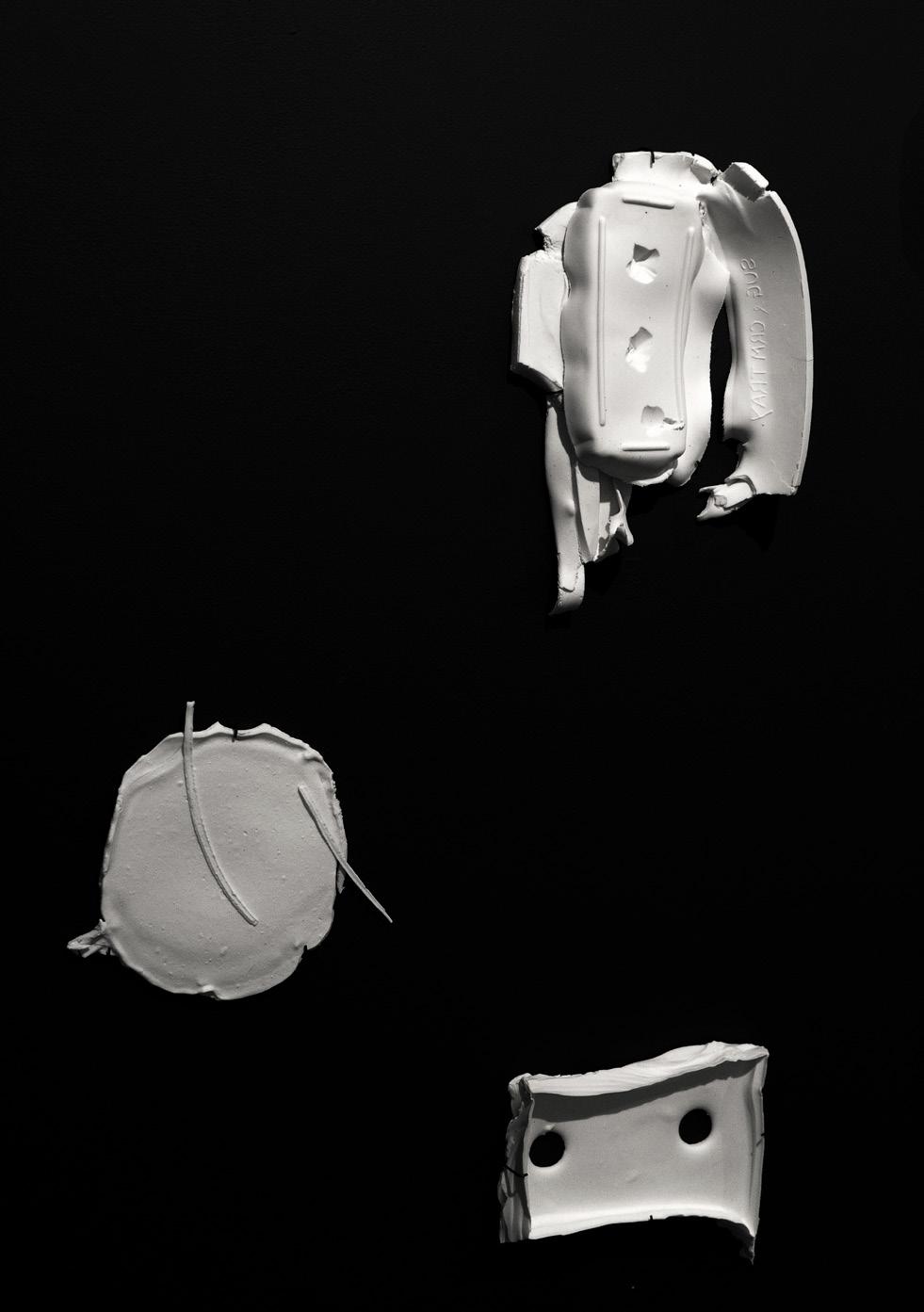
Neil Brownsword is an artist, researcher and educator currently holding the post of Professor of Ceramics at Staffordshire University. His career in ceramics began as an apprentice at the Wedgwood factory in the mid 1980s, where he worked as a modeller and designer. He then entered Higher Education, graduating from the Royal College of Art in 1995. Today, Brownsword’s research into the legacy of deindustrialisation in North Staffordshire’s ceramic industry has had a wide cultural impact, reinvigorating various post-industrial spaces and endangered industrial crafts.
Brownsword’s practice involves rediscovering and repurposing remnants of the industrial ceramic production of now defunct factories. Due to global mass production, many historic ceramic factories in Stoke-on-Trent have been unable to sustain UK production costs. As a result, a significant part of the area’s economy, skill-base and cultural identity was lost over time. Following the closure of many of these factories, Brownsword has sought to salvage their discarded rubber moulds, originally used to create plaster moulds for production. In the past these moulds would be transferred from one factory to another; when these companies shut down permanently, however, they defaced the moulds would to prevent them from being used again.
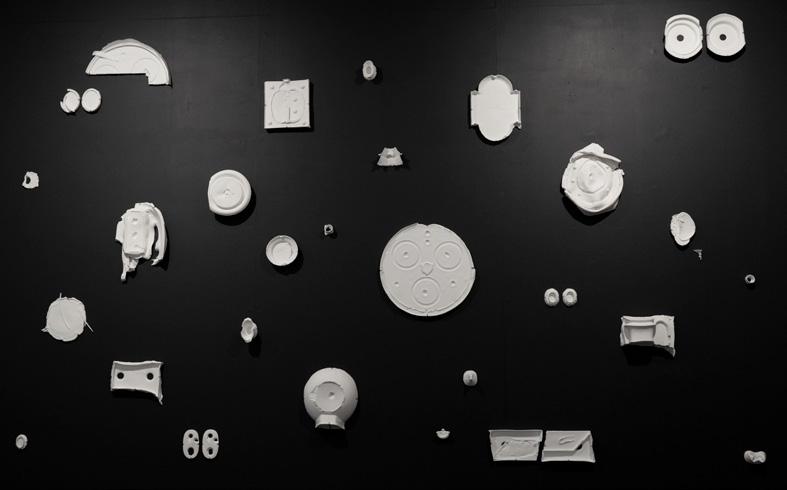
Brownsword, Ghost, 2023–24, bone china, 150 × 300 cm
In Ghost (2023–24), Brownsword uses these marred moulds to create new forms, objects in their own right that hint at their previous existence. He creates groupings of these forms and presents them together in large scale installations. In doing so, he offers thought-provoking reflections on notions of functionality, beauty, and legacy.
In a film accompanying this series, Brownsword elaborates his concerns through a temporal montage. Made from footage collected across Stoke-on-Trent’s ceramic landscape, and alongside archival material captured during fieldwork at the Wedgwood factory (2003–4), the film juxtaposes fixed-camera shots of vegetation reclaiming derelict industrial sites with the close choreography of hand, tool and material that once underpinned ceramic production. Through these layered visual registers, the film
Neil
(variable)
The Holburne Museum, Bath
Neil Brownsword
foregrounds the embodied knowledge that sustained the ceramics industry, highlighting the paradoxes of creation and destruction, permanence and transformation.
The acquisition of Ghost is a significant addition to The Holburne Museum’s growing collection of contemporary ceramics, which began with the work in time (2017) by Edmund de Waal in 2024. The expansion of contemporary ceramic works builds on the rich collection of historic ceramics held by the Holburne, which span from the 8th century to c.1900. The founding collection of Sir William Holburne consists primarily of 18th and 19th-century European porcelain and includes some world-class pieces, representing and a wide range of factories and styles. Brownsword’s work will sit in dialogue with English factory pieces from Worcester, Wedgwood, Chelsea, Bow and numerous other recent acquisitions.
Neil Brownsword (b. 1970, Stoke-on-Trent, Staffordshire, UK) lives and works in Stoke-on-Trent.
Neil Brownsword, Ghost, 2023–24, bone china, 150 × 300 cm (variable)
Presented by the Contemporary Art Society through the Omega Fund and Griffin Fund, 2025/26
Text by Eleanor Powlesland, Curator
Artwork © Neil Brownsword. Courtesy the artist. Portrait courtesy the artist
Huddersfield Art Gallery
Benaiah Matheson
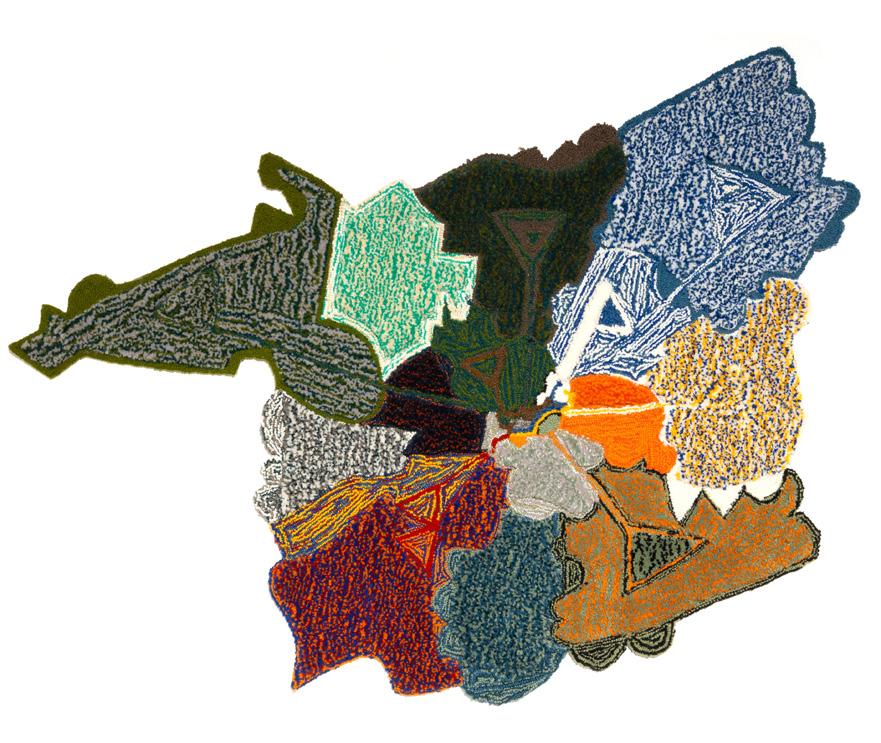

Benaiah Matheson, Carriacou was Eden, 2023, wool on mixed media, 110 × 120 cm
Benaiah Matheson describes his artistic practice with the phrase ‘Town Island,’ a conceptual framework informed by the artist’s dual-heritage identity which blends the perspectives of Huddersfield, a large town in West Yorkshire, and Carriacou, an Island of Grenada in the Caribbean. Matheson creates multidisciplinary artworks – often employing textiles and murals, as well as community collaboration – to explore migration, identity, and the cultural connections between Huddersfield and its significant Carriacou diaspora.
In 2021, Matheson was selected for the Tetley Associate Artist Programme. In partnership with Yorkshire Contemporary and the British Council Biennials Connect, Matheson later undertook a residency in the Caribbean island country of Grenada, where he worked with students at T.A. Marryshow Community College to co-produce a series of flags. Both the flags and the acquired tapestries were shown in the touring exhibition Town Island at the Grenada Pavilion at the 60th Venice Biennale (2024), and at Sovereign Design House, University of Huddersfield (2025) as part of their annual Cultures Of research festival programme.
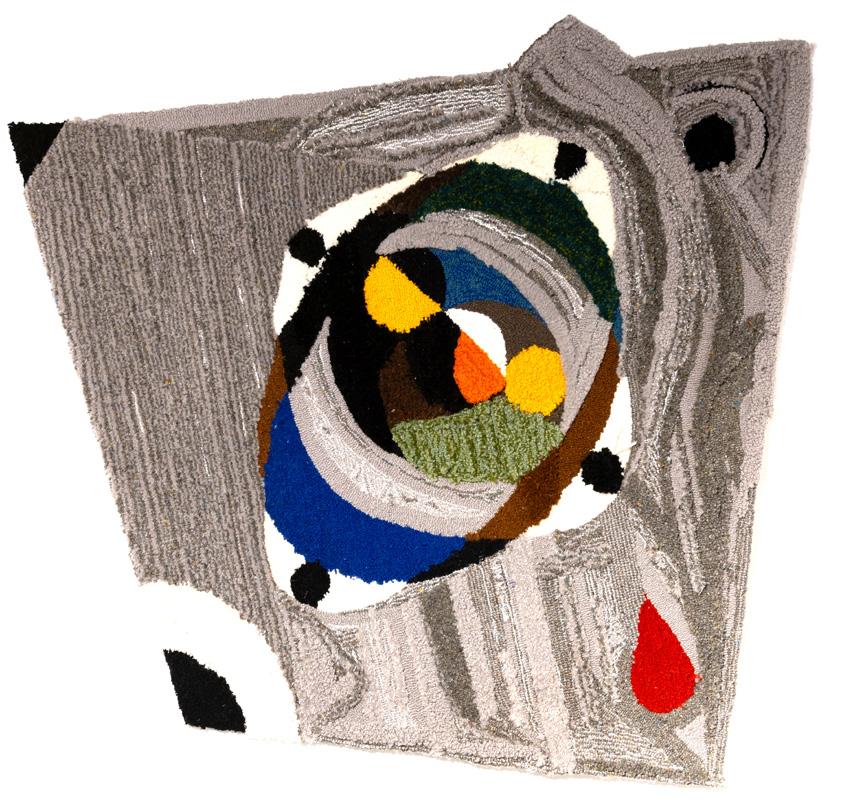
In making the two textile works acquired by Huddersfield Art Gallery, Matheson was influenced by his grandmother’s rug-making techniques. Locally-sourced Yorkshire wool is used to map both physical and psychological geographies of displacement and belonging. Centred on Huddersfield’s Springwood area, the works chart the Carriacou community’s presence before and after the construction of the town’s ring road in the 1970s. Matheson initiates a dialogue between the county’s textile heritage and its Caribbean diaspora, tracing how urban development inadvertently fractured established community networks. Through this mapping of displacement, the works reveal how the Carriacou community evolved from a concentrated centre – represented by Carriacou Was Eden (2023) –to a constellation of separate enclaves, depicted as triangular forms in Carriacou in Huddersfield (2023).
The two tufted tapestries were selected for our collection as they embody most potently the spirit behind Matheson’s Town Island exhibition, as well as the creative and cultural
Benaiah Matheson, Carriacou in Huddersfield, 2023, wool on mixed media, 100 × 130 cm
Huddersfield Art Gallery
Benaiah Matheson
lens adopted by the artist. Exhibiting these works in 2025 marked a time of transformation for Huddersfield Art Gallery, and their acquisition enables us to retain a part of that moment. Through Our Cultural Heart, a multimillion-pound regeneration project to revitalise key areas of Huddersfield, a larger new gallery and museum will be opening in 2029; it is imperative that the collection and programming reflect and represent the diverse cultural identity and heritage stories found in Huddersfield.
Today, Huddersfield hosts one of the largest Carriacou communities outside of the island itself, and their presence significantly contributes to the vibrant social and creative fabric of the town. Huddersfield is also the site of several other interwoven cultural threads, including South Asian, Polish, and Ukrainian communities. The acquisition of Matheson’s tapestries marks a pivotal moment for the town, and reflects a continued desire to represent the cultural confluences that define contemporary art at a local and global level.
Benaiah Matheson (b. 1985, Huddersfield, UK) lives and works in Huddersfield and elsewhere in and outside of the UK.
Presented by the Contemporary Art Society through the Omega Fund, 2025/26
Benaiah Matheson, Carriacou in Huddersfield, 2023, wool on mixed media, 100 × 130 cm
Benaiah Matheson, Carriacou was Eden, 2023, wool on mixed media, 110 × 120 cm
Text by Dr Janine Sykes, Curator (Visual Arts)
Artwork © Benaiah Matheson. Photography by Samuele Cherubini and Jules Lister. Portrait courtesy the artist
Sainsbury Centre for Visual Arts, UEA, Norwich
Lubna Chowdhary
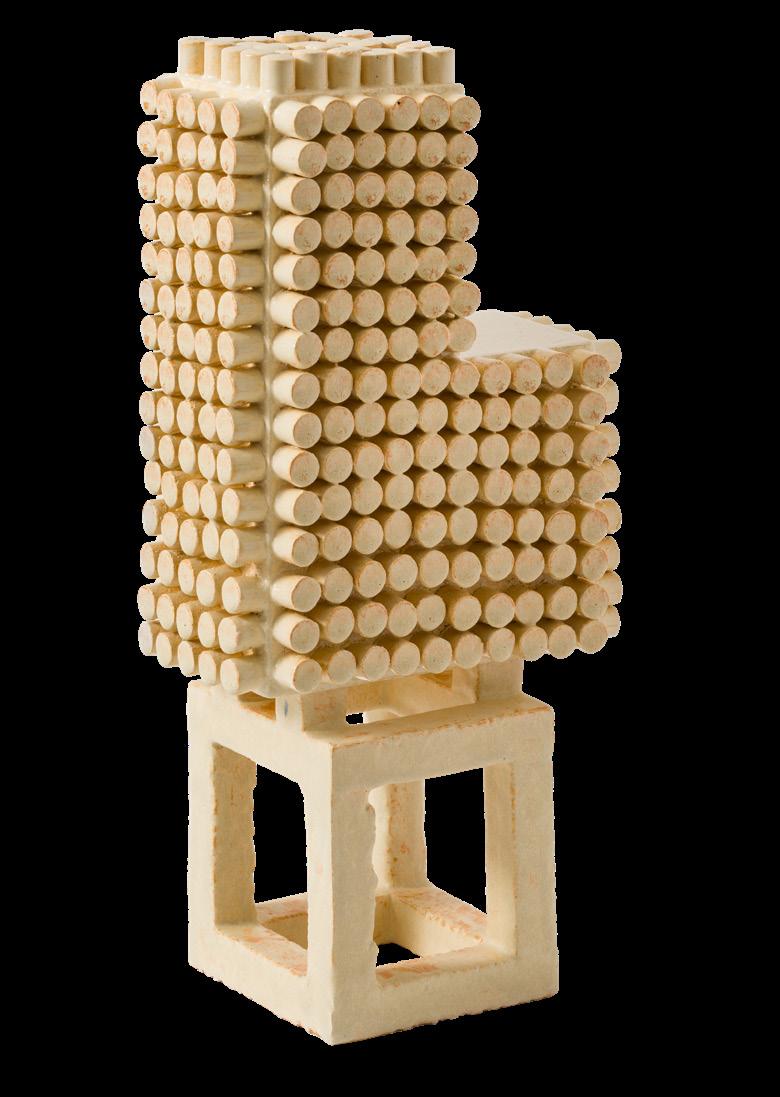
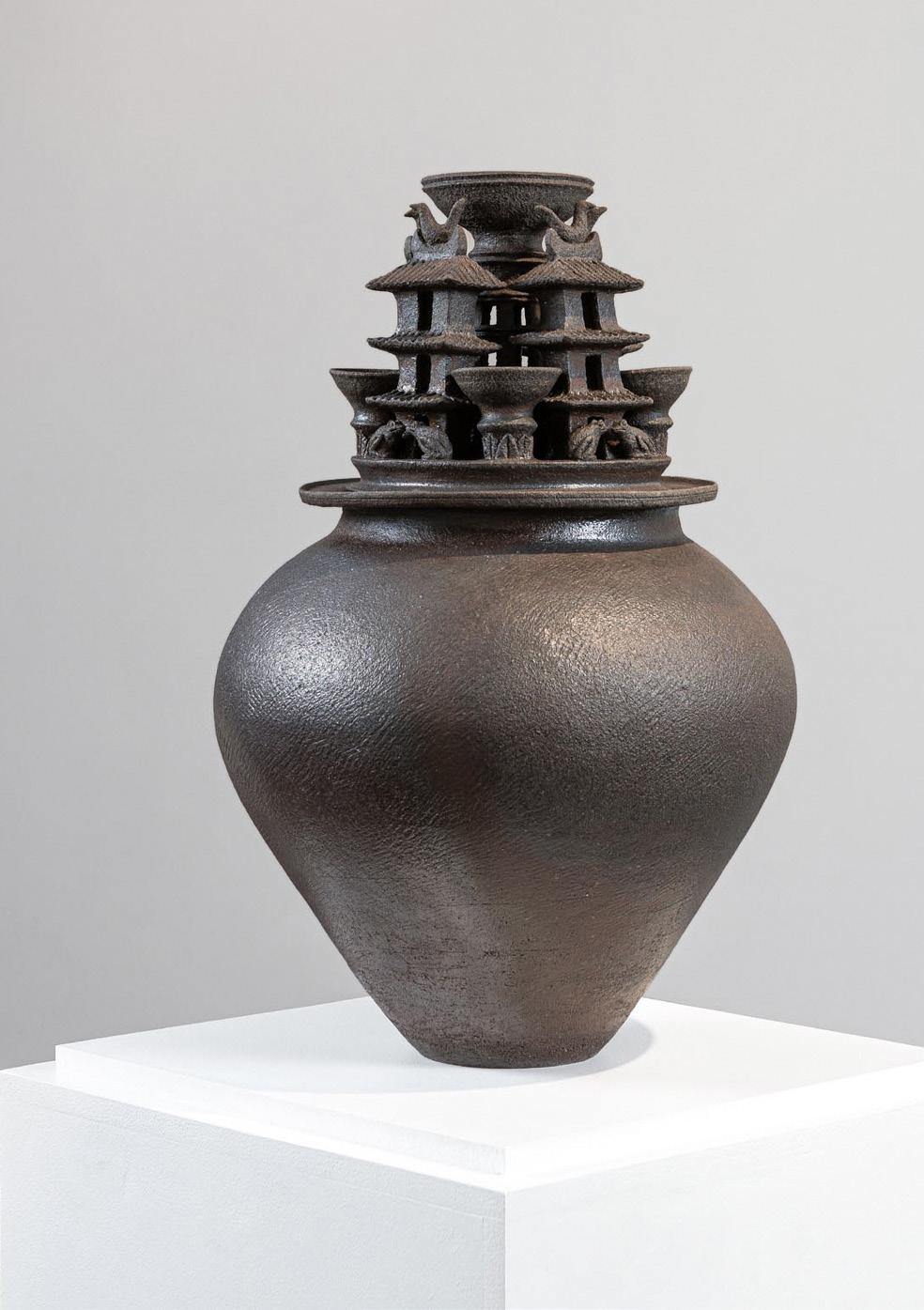
Shipley Art Gallery, Gateshead

Rosie McLachlan
Lubna Chowdhary brings together the disciplines of architecture, craft, design, sculpture, and painting within the field of ceramics. The artist’s work is often characterised by a desire to search ‘for points of contact or a symbiosis between western Minimalism and Modern design and Asian traditions of geometry, architecture and design, and the awkwardness that results in these forms.’
Chowdhary’s Polytype series is a new body of work which comprises of three-dimensional sculptural forms. The artist describes them as ‘utopian objects’ that blend techniques from the East and West to create structures that appear handmade and modernist at the same time. In the words of the art and culture writer Srishti Ojha, Chowdhary ‘[draws] inspiration from conceptual architecture, like Buckminster Fuller’s geodesic domes, to create a vision for hybrid cities and forms of the future that could enmesh themselves in any environment and aesthetic.’
Polytype 4 (2025) resonates with both the Sainsbury Centre’s collection and building. The Centre was designed by the architect Norman Foster (who also collaborated with the architect Buckminster Fuller) to house Sir Robert and Lisa Sainsbury’s art collection. Today, the Sainsbury Centre is also home to a significant collection of abstract works associated with constructivism, an art movement aimed at reflecting the modern industrial world and its materials.
Exhibited as part of Rhythm and Geometry: Constructivist Art in Britain since 1951 (2021), the Sainsbury Centre currently owns two works on paper from Chowdhary’s Switch series. The addition of Polytype 4 unites multiples collection histories while allowing us to present the artist’s two- and three-dimensional works in tandem.
Lubna Chowdhary (b. 1964, Dodoma, Tanzania) lives and works in London.
Presented by the Contemporary Society with support from Arts Council of England / V&A Purchase Grant fund, 2025/26
Text by Rosy Gray, Head of Living Art
Artwork © Lubna Chowdhary. Courtesy the artist and Jhaveri Contemporary. Photography Andrew Judd
Lubna Chowdhary, Polytype 4, 2025, glazed ceramic, 42 × 20 × 11.5 cm
Rosie McLachlan, Hunping IV, 2024, heavily grogged clay body with South Tyne river clay, anagama natural ash, 46 × 29 × 29 cm
Sainsbury
Chowdhary

Rosie McLachlan is a ceramicist who works with a wood fired anagama kiln, an ancient type of pottery kiln brought to Japan from China via Korea in the 5th century. McLachlan sees the long firing process, which takes place over four days and nights, as a devotional act. The resulting sculptural works, transformed by heat, flame and ash accretions, have an elemental, totemlike quality. McLachlan’s work is informed by her background in archaeology and in-depth research into comparative mythology and pan-global cosmologies.
Shipley Art Gallery, Gateshead
Rosie McLachlan
Hunping IV (2024) reflects McLachlan’s engagement with traditions associated with the underworld to create sculptural works that draw upon the mythologies of life and death. A hunping or ‘soul jar’ is a type of ceramic funerary urn often found in the tombs of the Han dynasty and Six Dynasties periods of early imperial China. This work evokes the rituals of an ancient civilisation and, thanks to the use of local clay which McLachlan digs herself, is also connected to her local land and rivers in Northumberland. The ash wood used to fire the kiln is also sourced from a local estate that tackles ash dieback. As McLachlan explains, ‘I dig blood-red clay from the river to coil and shape into vessels that could belong in some future chthonic rite of passage. I am using the transformation of earthen material through fire, from clay to ceramics, to think about liminality and transition from one state of being to another.’
McLachlan’s approach to clay and the firing process, as well as the narrative-led and sculptural quality of her work, resonates with many of the pieces in the Shipley’s collection of studio ceramics. It also further enhances the strong representation of women ceramicists in the Shipley’s collection, which includes works by Lucie Rie, Ruth Duckworth, Gillian Lowndes, Carol McNicoll, Alison Britton, and Kate Malone.
Rosie McLachlan (b. 1982, Shoreham-by-Sea, UK) lives and works in Northumberland.
Presented by the Contemporary Art Society through the Omega Fund, 2025/26
Text by Dr Esmé Whittaker, Keeper of Art
Artwork © Rosie McLachlan. Courtesy the artist. Portrait by Rosie McLachlan
Lubna Chowdhary, Polytype 4, 2025, glazed ceramic, 42 × 20 × 11.5 cm
Rosie McLachlan, Hunping IV, 2024, heavily grogged clay body with South Tyne river clay, anagama natural ash, 46 × 29 × 29 cm
Walker Art Gallery, National Museums Liverpool
Adi Toch
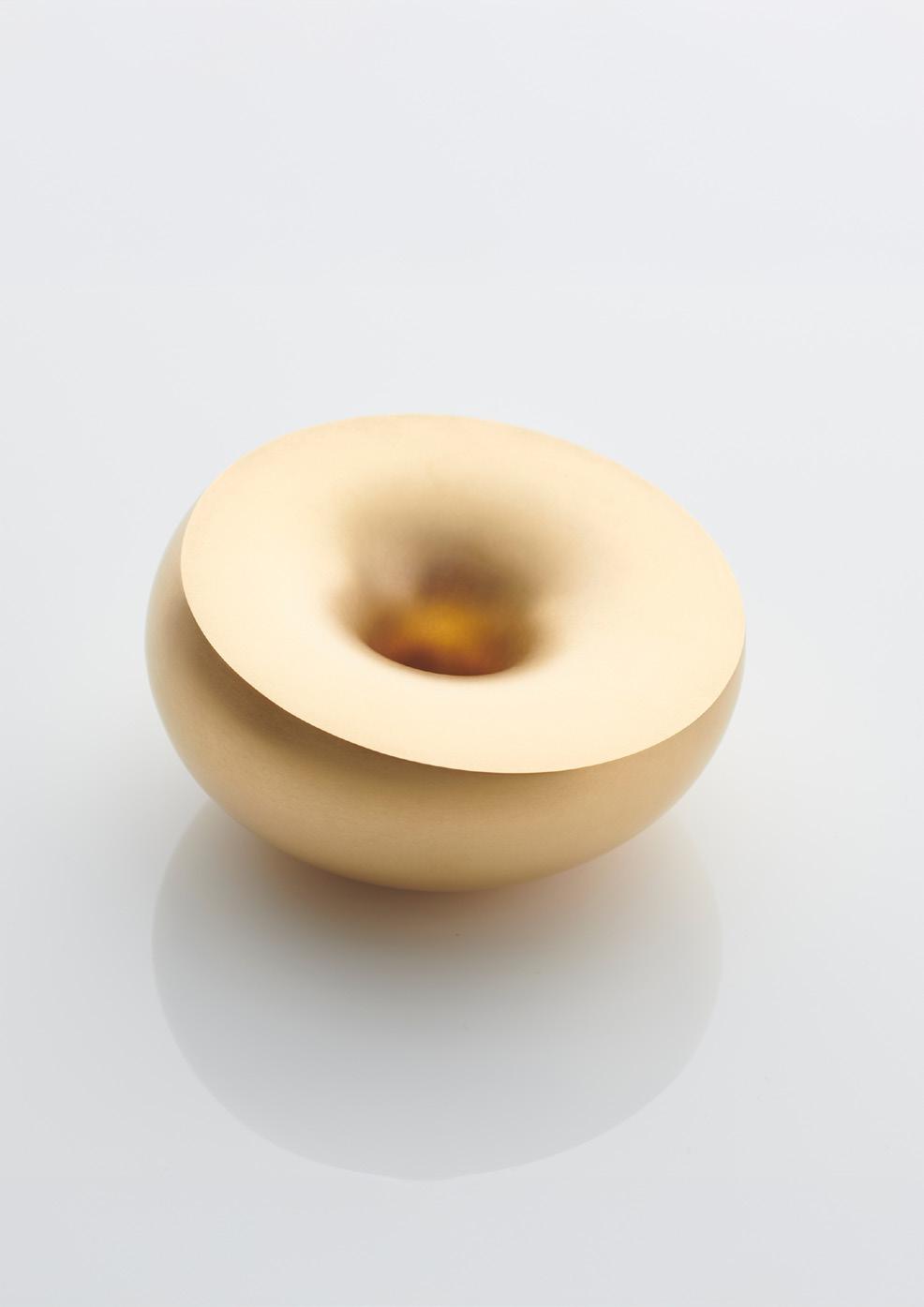
Reading Museum

Adi Toch is an artist metalsmith. A significant branch of her practice is characterised by an ongoing exploration of the vessel form. Toch often references objects from the past in her work, using historic silversmithing techniques to hand raise pieces from a single, flat sheet of metal to form a hollow object. She adopts an experimental approach to surface treatments, using a distinctive visual language created through intricate surface marks and patination. Containers have always fascinated Toch, but the purpose of her vessels transcends the purely functional.
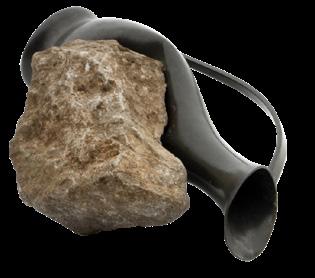
Toch seeks to provoke interactions with the viewer; she feels that her work must be handled in order for it to come to life.
In creating the smooth and gold-plated Sloping Whispering Vessel (2022), Toch’s aim was to infuse it with a compelling and tactile quality. The work contains tiny, shimmering, moonstone gems. By gently rotating the vessel in one’s cupped hands, the stones roll together, tracing the contours of the unseen interior as they make a soft, whispering sound. Toch began to explore the sonic possibilities of the vessel during a short residency in Turnov, Czech Republic. Talking about her ongoing Whispering Vessel series, the artist explains:
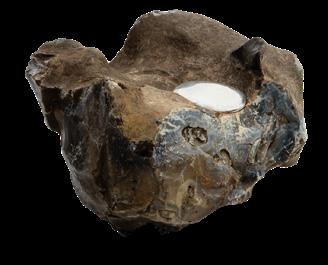
the Edge
flint
‘Whispering Vessels explore the relationship between space, form, movement, and sound. These double-layered vessels, each containing loose yet enclosed gemstones, exist on the threshold between domestic object and musical instrument.’
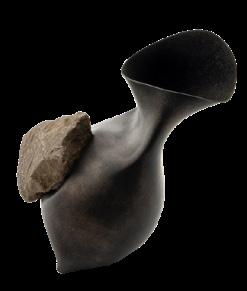
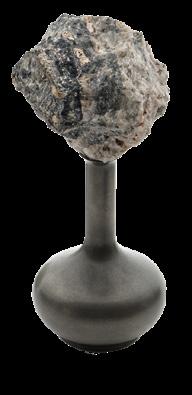
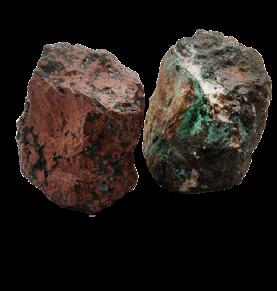
The Walker’s collection of metalwork began in 1867, when local goldsmith Joseph Mayer presented several thousand objects from his own collection to Liverpool Museum. The Walker continues to build on Mayer’s legacy by acquiring new works by innovative, contemporary goldsmiths. Adi Toch’s Sloping Whispering Vessel will complement and contrast with works by other contemporary artist metalsmiths held by the Gallery, while also offering a link to the founder of these collections.
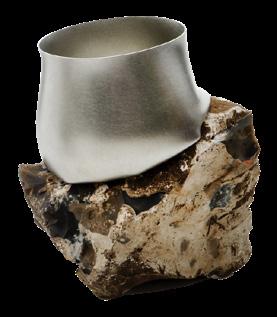
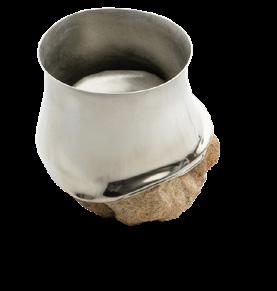
Adi Toch, Sloping Whispering Vessel, 2022, hard gold plated recycled copper alloy, moonstones, 7 × 14 × 14 cm
Adi Toch, By Association, 2025, sculptural work in stone, pewter and tin, individual works all less than 30 cm
Particulate Matter, pewter, Cornish cassiterite
Gut Punch, pewter jug, sandstone from Silchester area
Minor Damage, Major Shift, pewter, sandstone from Silchester area
Within
,
from Silchester area, tin smelted from Cornish cassiterite
Kinship, bronze cast with Roman remnants, cassiterite
Slump, pewter, flint from Silchester area
Mutual Preservation, pewter, oolite (used for pewter casting moulds)
Presented by the Contemporary Art Society through the Omega Fund, 2025/26
Text by Nicola Scott, Curator (Decorative Art)
Artwork © Adi Toch. Courtesy the artist and Sarah Myerscough Gallery, London. Portrait courtesy the artist
Walker Art Gallery, National Museums Liverpool
Adi Toch
Adi Toch’s new commission for Reading Museum builds on our project to reimagine our notable collection of historic material from Calleva Atrebatum, a pre-Roman & Roman town at Silchester, close to Reading. The nearby Silchester Gallery is being redeveloped, notably by refreshing and updating the archaeological displays using new technologies. Toch’s commission reinvents selected Callevan objects through the eyes of an artist.
While visiting the museum store, Toch stumbled across a story that inspired a year-long flow of research into materialities, object-relationships and temporalities. Her starting point was the historic association between a highlight of the Calleva Atrebatum collection, the Ogham Stone (a sandstone column with a surface inscription in Ogham, an ancient Irish language), and a humble pewter flagon. Both were found discovered in a well, the former having crushed the latter which then supported the stone for centuries: A thought-provoking incidental relationship between two historic objects.
The project developed to explore the geological entanglement of stone and metal, and how materials carry memory and accrue meaning through circumstance. The outcome of this research is By Association, poetic group of interrelated objects; found stone juxtaposed with meticulously crafted pewter and tin surfaces. Some pairings are humorous, even anthropomorphic. and there are also harmonious combinations of texture and shape.
Reading Museum aims to collect exceptional craft works by contemporary artists and makers. Previous commissions facilitated by the CAS such as artist woodturner Eleanor Lakelin’s Oh Beautiful World (2020) are crucial additions to our growing collection. By Association forms another such exquisitely crafted acquisition supported the CAS and Reading Foundation for Art.
Adi Toch (b. 1979, Jerusalem, Israel) lives and works in London.
Reading Museum Adi Toch
Adi Toch, Sloping Whispering Vessel, 2022, hard gold plated recycled copper alloy, moonstones, 7 × 14 × 14 cm
Adi Toch, By Association, 2025, sculptural work in stone, pewter and tin, individual works all less than 30 cm
Particulate Matter, pewter, Cornish cassiterite
Gut Punch, pewter jug, sandstone from Silchester area
Minor Damage, Major Shift, pewter, sandstone from Silchester area
Within the Edge, flint from Silchester area, tin smelted from Cornish cassiterite
Kinship, bronze cast with Roman remnants, cassiterite
Slump, pewter, flint from Silchester area
Mutual Preservation, pewter, oolite (used for pewter casting moulds)
Presented by the Contemporary Art Society through the Griffin Fund, 2025/26
Text by Nicola Scott, Curator (Decorative Art)
© Adi Toch. Courtesy the artist and Sarah Myerscough Gallery, London. Portrait courtesy the artist
Williamson Art Gallery & Museum, Birkenhead
Evelyn Albrow
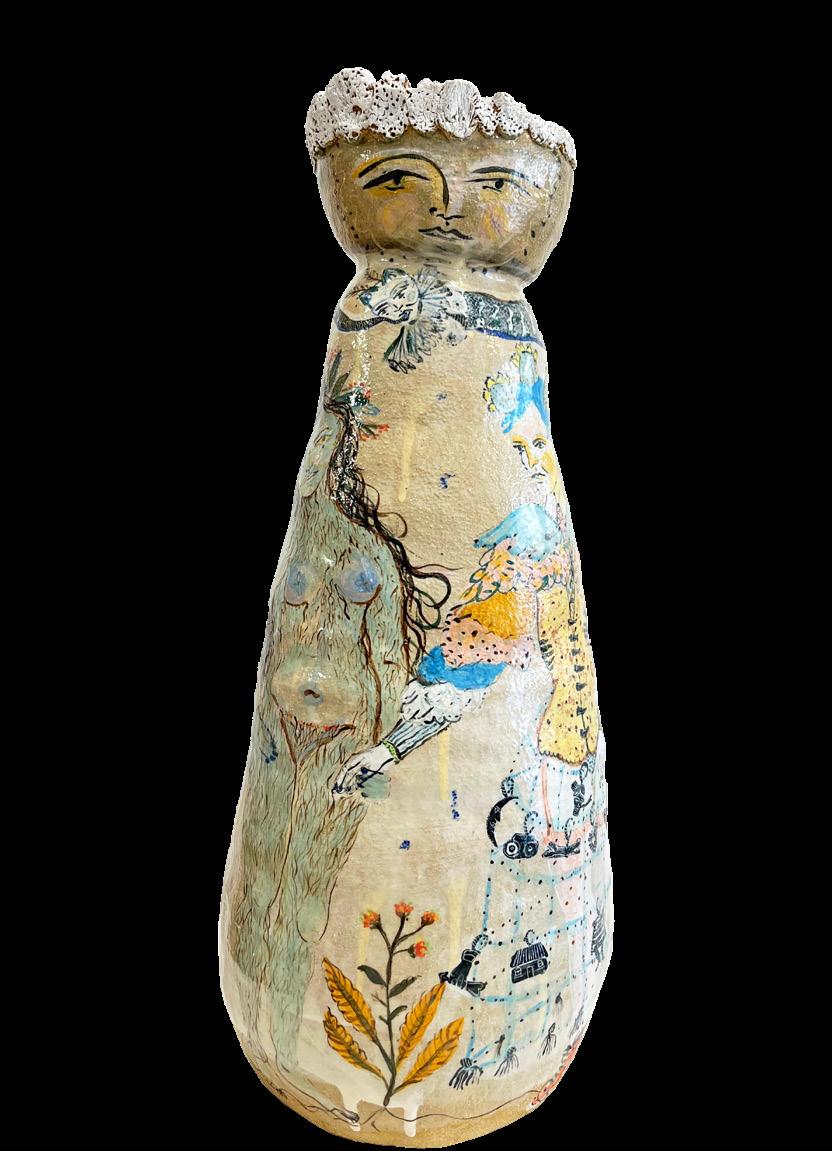
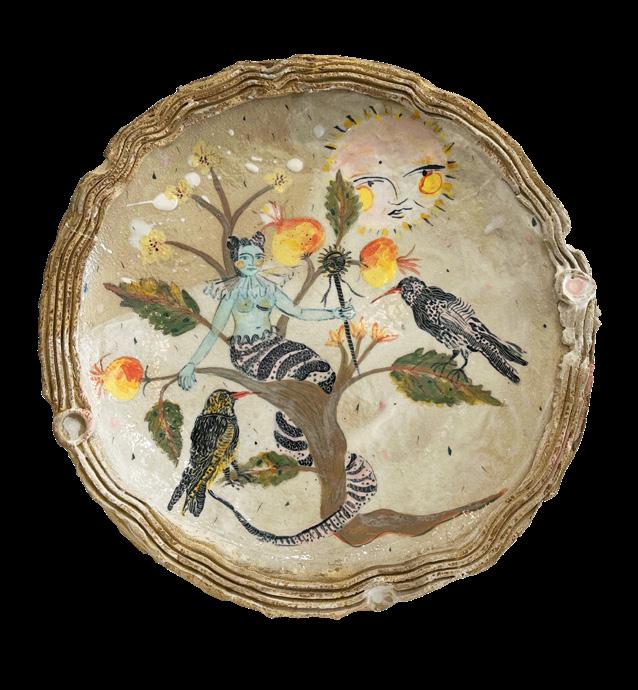
Evelyn Albrow is known for her vessels decorated with medieval and British folklore-inspired scenes. Depicting women and nature in fantastical environments, her pieces offer rich narratives in a manner that is often playful and vibrant. Most often drawn on chargers and vases, these detailed illustrations appear in contrast with the ceramics’ rough texture, adding to the charm and whimsicality of Albrow’s creations.
The Williamson has acquired three of Albrow’s pieces: two chargers and one vase. The first charger, Bird Song (2024), depicts a figure with the top half of a woman and a serpentine bottom half. Perched on a tree, she is surrounded by two birds and an anthropomorphic sun. The piece might echo artistic depictions of a Valkyrie in communion with Odin’s raven. However, while traditional depictions of women from Norse mythology tend to highlight the supposed dangers of women’s autonomy, Albrow depicts a scene of communion and harmony between her protagonist and the natural world.
The vase, titled We Are Who We Are (2024), explores similar themes in its depiction of two women drawn onto on a misshapen vertical form. One figure is dressed in bright colours and expressive patterns, whilst the other is covered in body hair. A sea serpent figure with a woman’s head is wrapped around the vase’s rim; a whole side of the piece is taken up by sunflowers with human faces.
Finally, Agatha’s Birthday (2025) is a riot of colour, detail, and fun. Albrow’s appreciation for medieval marginalia is in full display in this work, with whimsical details sprinkled throughout the composition – including a winged candle, a crowned goose, and a female figure astride a centipedelike creature with human legs.
Albrow,
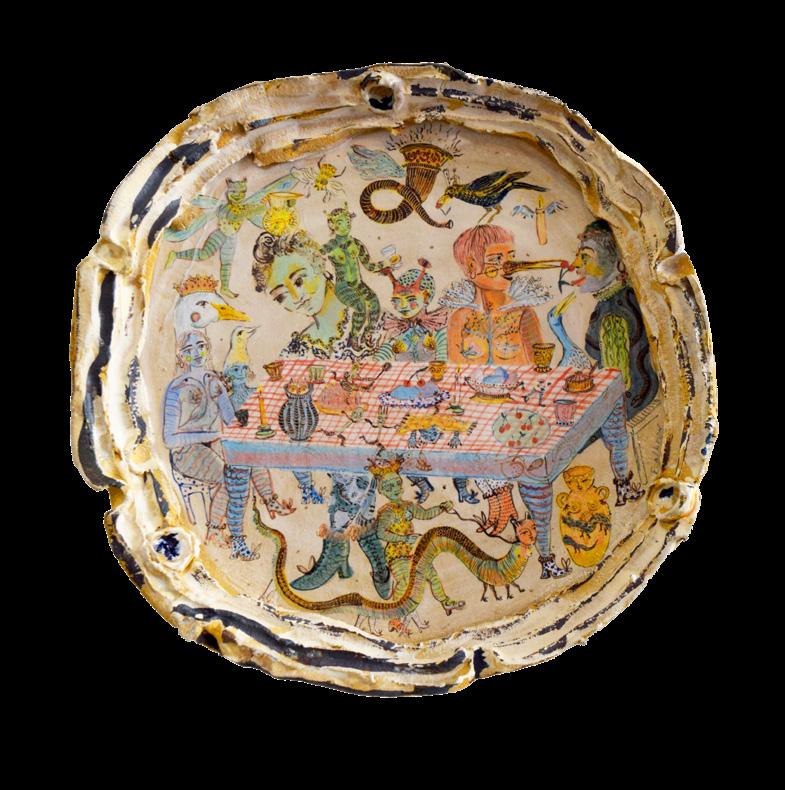
Evelyn Albrow, We Are Who We Are, 2024, stoneware vase, 55 × 23 × 23 cm
Evelyn Albrow, Charger 1. Bird Song, 2024, stoneware charger, 41 cm (diameter)
Evelyn
Agatha’s Birthday, 2025, stoneware charger with underglazed hand drawing, 54 cm (diameter)
Williamson Art Gallery & Museum, Birkenhead
Evelyn Albrow
An artist of joyful originality, Albrow’s pieces will join a nationally important collection of ceramics at the Williamson. Coupled with the area’s deep history and appreciation for Albrow’s explorations in folklore, her pieces have found a natural home in the Wirral.
Evelyn Albrow, We Are Who We Are, 2024, stoneware vase, 55 × 23 × 23 cm
Evelyn Albrow, Charger 1. Bird Song, 2024, stoneware charger, 41 cm (diameter)
Evelyn Albrow, Agatha’s Birthday, 2025, stoneware charger with underglazed hand drawing, 54 cm (diameter)
Evelyn Albrow (b. 1986, Sheffield, UK) lives and works in Sheffield
Presented by the Contemporary Art Society through the Omega Fund, 2025/26
Text by Josh Mackarell, Collections Manager
Artwork © Evelyn Albrow. Courtesy the artist and Alveston Fine Arts, London. Portrait by Alex Mooney.
York Art Gallery
Anina Major
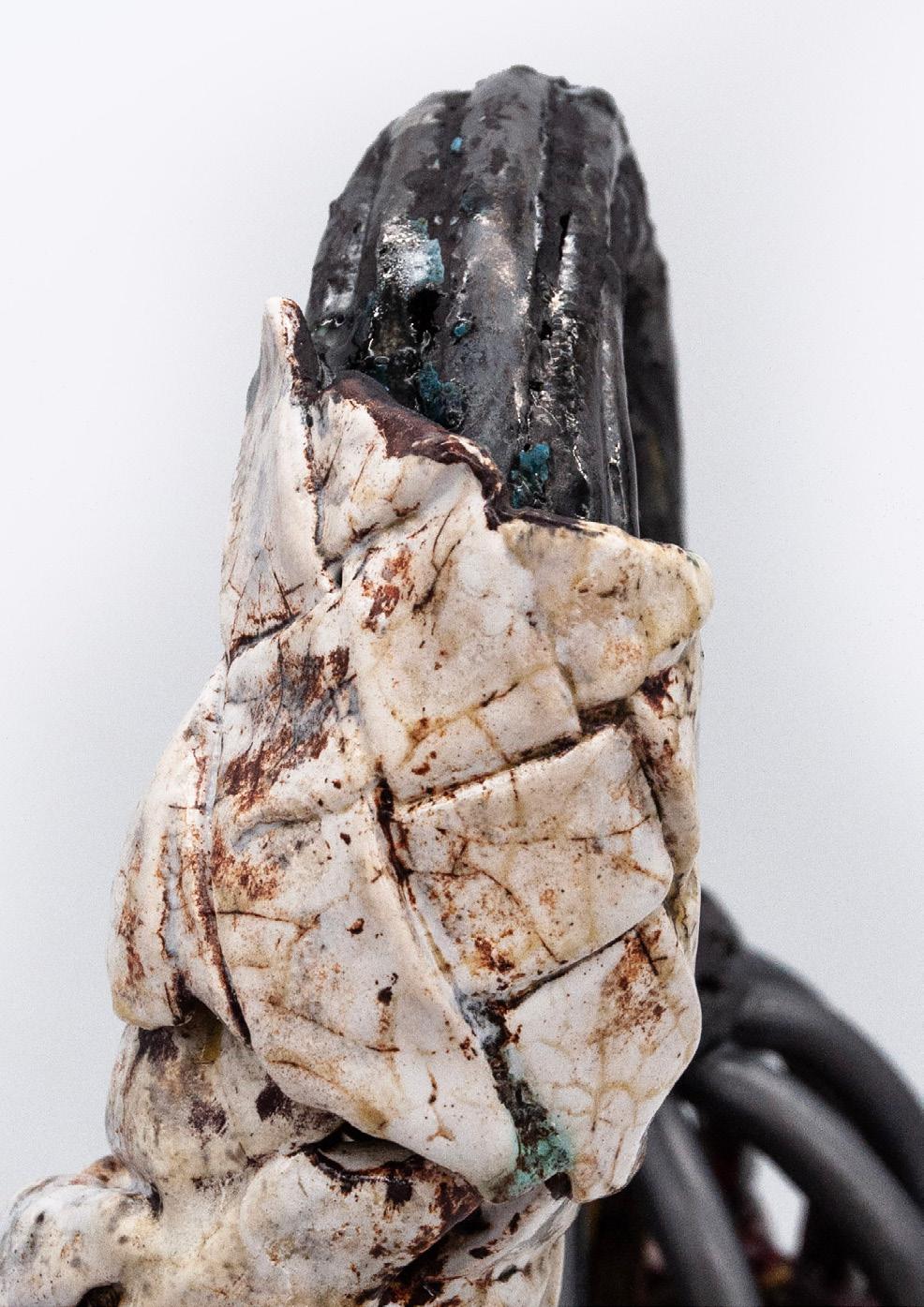
Anina Major describes her practice as an exploration of self and place at the intersection of nostalgia and cultural identity. The artist’s creativity springs from her childhood and from her desire to be surrounded with things that remind her of home, having relocated from The Bahamas to mainland America when she was 18 years old. Major’s grandmother was a skilled craftswoman who used traditional Bahamian plaiting methods. She made and sold straw dolls to provide a better life for her family. After arriving in New York, Major studied and worked in Marketing before deciding to focus on art. Her art-making was prompted by the discovery in a Brooklyn thrift shop of a straw doll which resembling the ones made by her grandmother. The abandoned doll, a piece of craft, prompted Major to confront her own feelings of displacement. The artist had personal knowledge of the skills that had been used to create the doll, prompting her to wonder about the reason why it had been discarded; the experience evoked strong emotions, and led Major to develop her unique way of working with clay.
Major uses techniques originating from traditional Bahamian plaiting methods, passed down through maternal lines. The artist views this intergenerational transfer of craft skills as a way of preserving oral history and culture, seeking recognition for the craft skills and expertise found in displaced and underrepresented communities. Bahamian plaiting is now a craft at risk of extinction due to economic decline; through her work, Major permanently records, preserves and interprets plaiting patterns and techniques for future generations in glazed, fired clay. The title of the work acquired for York Art Gallery, Kindred (2023), suggests thoughts of family, emotional ties and home. The hybrid form becomes a genealogical statement, combining two plaiting styles. It marks the beginning of a series of work in which she takes ownership of her inherited skills and uses them as a form of self-expression to reconnect with her heritage.
Anina Major, Kindred, 2023, glazed stoneware, 45.7 × 33 × 22.9 cm
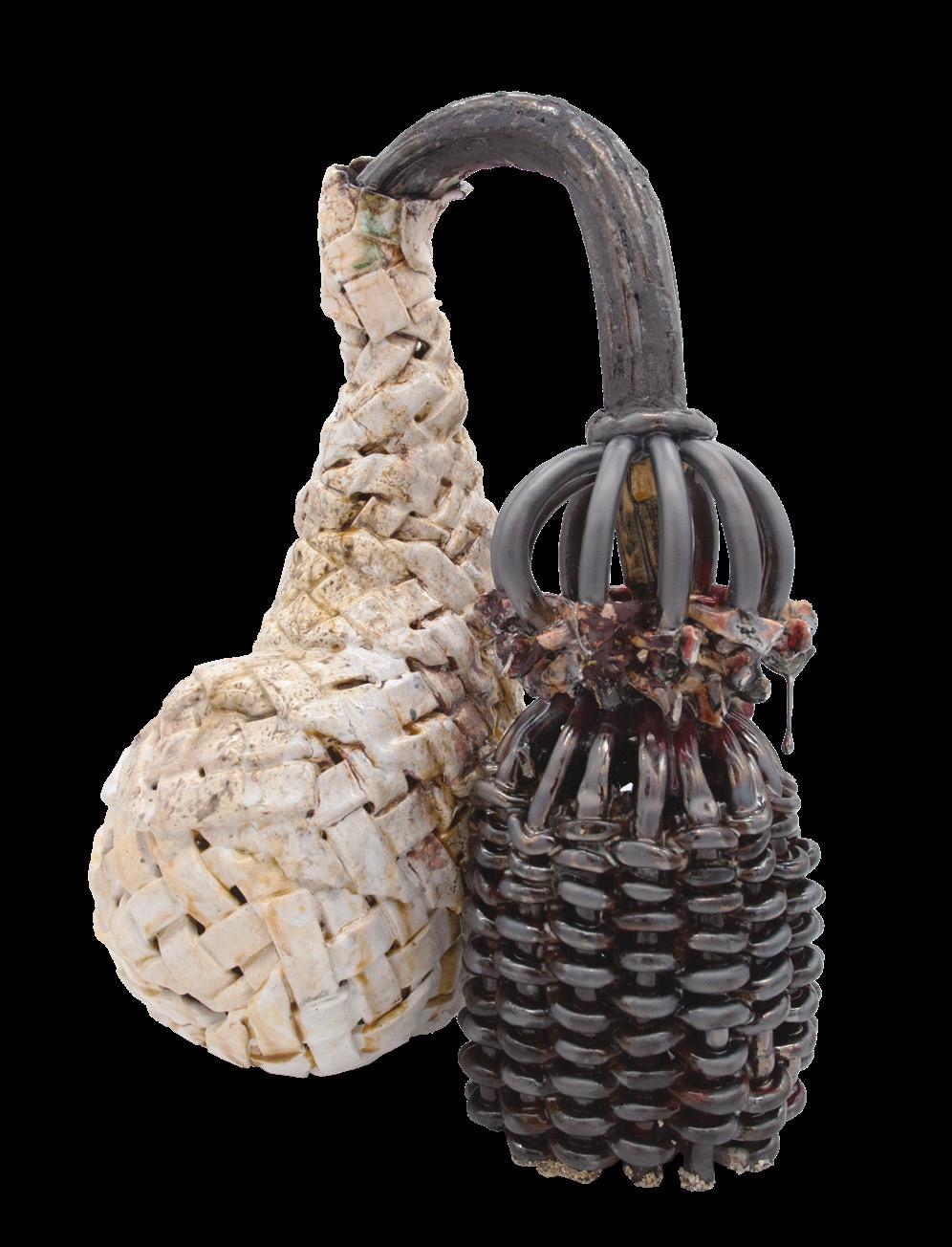
This new acquisition builds upon the diverse collecting we have undertaken in recent years; the support of the Contemporary Art Society enables our collection to become more representative, international, and unafraid
York Art Gallery
Anina Major
to address difficult themes. Major’s work aligns with important 20th-century pieces in the collection by artists such as Ladi Kwali, Halima Audu, and Magdalene Odundo, as well as recent acquisitions of work by Phoebe Collings-James, Jade de Montserrat, and Sahara Longe. Kindred is a sculpture that exemplifies shared histories through its material composition and distinctive production process.
Anina Major (b. 1981, Nassau, The Bahamas) lives and works in New York State, US.
Presented by the Contemporary Art Society through the Omega Fund and Griffin Fund, with the support of the Friends of York Art Gallery, 2025/26
Text by Dr Helen Walsh, Curator of Ceramics
Artwork © Anina Major. Courtesy Maximilian William, London. Photography by Deniz Güzel. Portrait by Blair J Meadows, courtesy the artist and Larkin Durey, London
Anina Major, Kindred, 2023, glazed stoneware, 45.7 × 33 × 22.9 cm
Manchester Art Gallery
Huimin Zhang
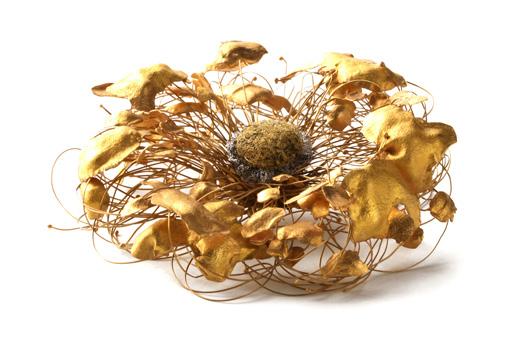
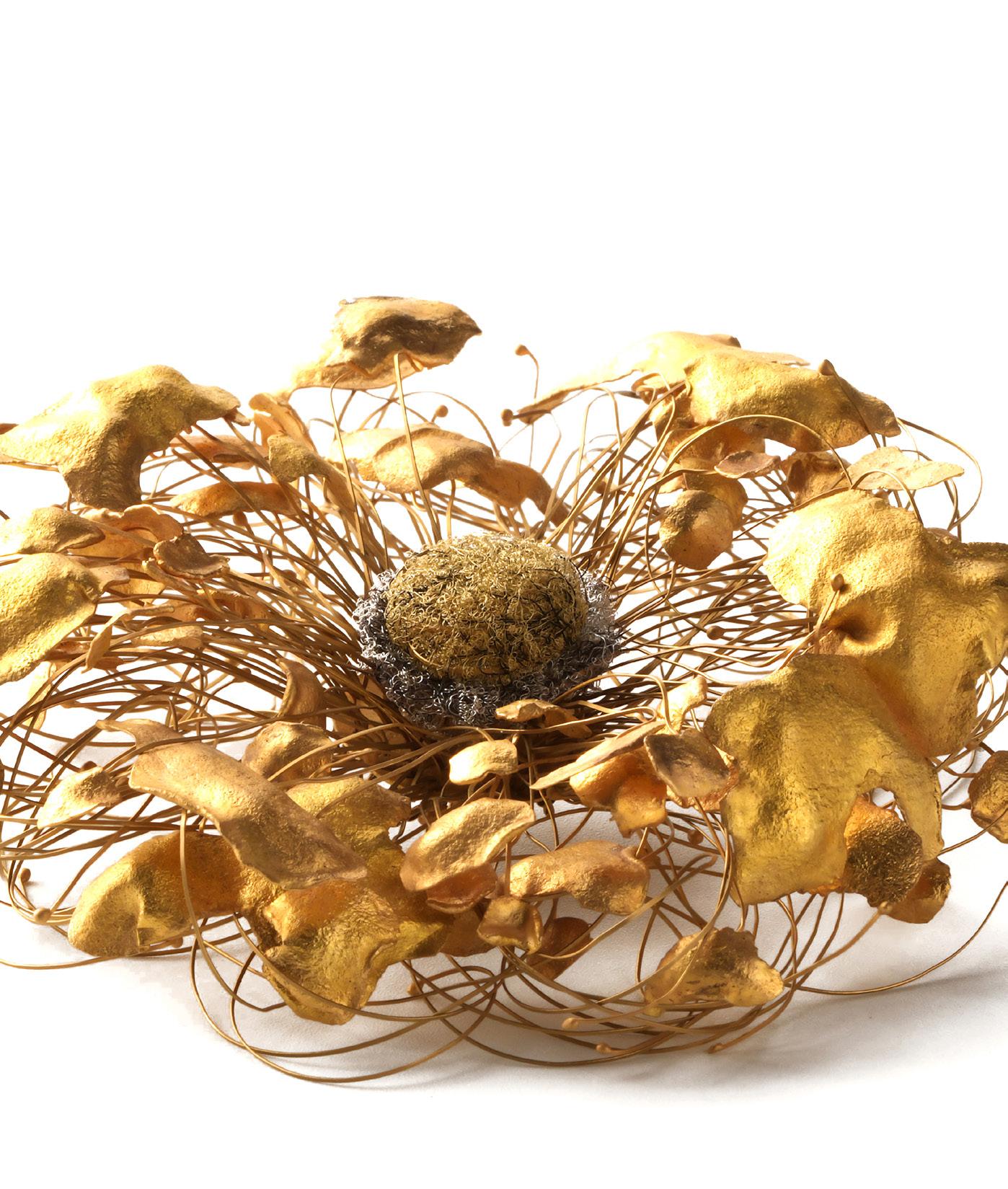

Huimin Zhang is a goldsmith specialising in delicate and innovative wire filigree work. Her oeuvre combines an eclectic mix of influences from antique jewellery to embroidery cultures from around the world. Mammary Gland 02 (2023) is the second of a limited series of ten works conceived as a tribute to a friend diagnosed with breast cancer; affecting one in five, it is the most common form of cancer amongst women in the UK. The work is inspired by the posy-like structure of the mammary gland. Hair was incorporated in the centre of the work, a reference to hair loss caused by chemotherapy. The piece can be worn as a brooch, also functioning as a sculpture when shown on its mounts: a life-cast plaster torso and a small plaster mount with a breast-shaped glass cover, also designed by the artist.
The work adds new perspectives to Manchester Art Gallery’s collection of sculpture, in which women’s bodies are a recurring theme. Examples range from classicallyinspired Victorian allegorical figures, to contemporary works like Susie MacMurray’s Widow (2009). Zhang’s skilful mimicking of organic forms also echoes other works held by the Gallery, such as Junko Mori’s #55 Silver Organism, Pinecone (2006). Zhang’s take on the biological motif uses metal, a material associated with resilience and endurance, which she shaped with great delicacy to convey inner strength in the face of adversity. The springiness of breast tissue is recreated with adjustable petals and stems that reverberate when moved.
Zhang’s work is aligned with Manchester Art Gallery’s objectives of collecting work from artists, makers and designers of African and Asian descent and increasing the representation of women across the collection.
The gallery is situated in Manchester’s Chinatown, making the acquisition of a work in precious metal by a Chinese artist all the more significant. This extraordinary contemporary piece provides a valuable opportunity to engage contemporary audiences, while also expanding the breadth of our historic Chinese collection.
The potential of the artwork to raise awareness about breast cancer also matches Manchester Art Gallery’s health and wellbeing agenda. Working with a piece
Huimin Zhang, Mammary Gland 02, 2023, recycled 22-carat gold, sterling silver, human hair, 7.5 × 7.5 × 3.2 cm
Manchester Art Gallery
Huimin Zhang
holding such resonance for all those affected will allow for further engagement opportunities in the future, increasing the profile of our internationally recognised health & wellbeing programme and trauma-informed approach.
Huimin Zhang (b. 1981, Hebei Province, China) lives and works in London.
Presented by the Contemporary Art Society through the Griffin Fund and the Omega Fund with support from the Gallery’s Assheton Bennett Bequest Fund, 2025/26
Huimin Zhang, Mammary Gland 02, 2023, recycled 22-carat gold, sterling silver, human hair, 7.5 × 7.5 × 3.2 cm
Text by Janet Boston, Curator of Craft and Design
Artwork © Huimin Zhang. Courtesy Huimin Zhang. Photography by Sen Qi. Portrait by Lois Lo
Gifts and Bequests
‘CAS awards and gifts have enabled us to bring new contemporary acquisitions into Towner’s Collection that otherwise we could not have pursued. The association has also helped us to leverage funding from other individuals or organisations – CAS membership is a powerful mark of quality, ambition and commitment around the display and acquisition of contemporary art.’
Niamh Pearce, Deputy Director, Towner Eastbourne
‘The CAS has been of much benefit to Pallant House Gallery, enabling the acquisition of ambitious contemporary works that we would struggle to acquire otherwise, as we do not have dedicated acquisitions funding. These works will make a signifiant impact to our programmes, supporting our curatorial approach and how we seek to make contemporary British art relevant to audiences today.’
Simon Martin, Director, Pallant House Gallery
The British Museum, London
Louis Fratino
Pallant House Gallery, Chichester
Louis Fratino is a contemporary American painter and draftsman whose work captures intimate moments of everyday queer life. Fratino graduated from the Maryland Institute College of Art, Baltimore, in 2015, and was recipient of a Fulbright Research Fellowship in Painting, Berlin (2015–16) and a Yale Norfolk Painting Fellowship, Norfolk, Connecticut (2014). His work was exhibited at the 60th Venice Biennale in 2024.
Goat (after Gio Ponti) (2020) was inspired by another drawing, made by the Milanese architect and designer Gio Ponti (1891–1979). A pivotal figure in the history of twentieth-century Italian design, Ponti integrated traditional craftsmanship and modernist sensibilities through a versatile approach which spanned buildings, design objects, and fine and applied arts.
’Usually when I feel attracted to something I start by making a copy of if,’ the artist has explained. This approach reflects The British Museum’s long-standing commitment to drawing as a site of artistic exchange, study, and reinterpretation. By drawing from and reworking Ponti’s designs, Fratino participates in a tradition of artists studying earlier sources – a practice central to the history of drawing.’
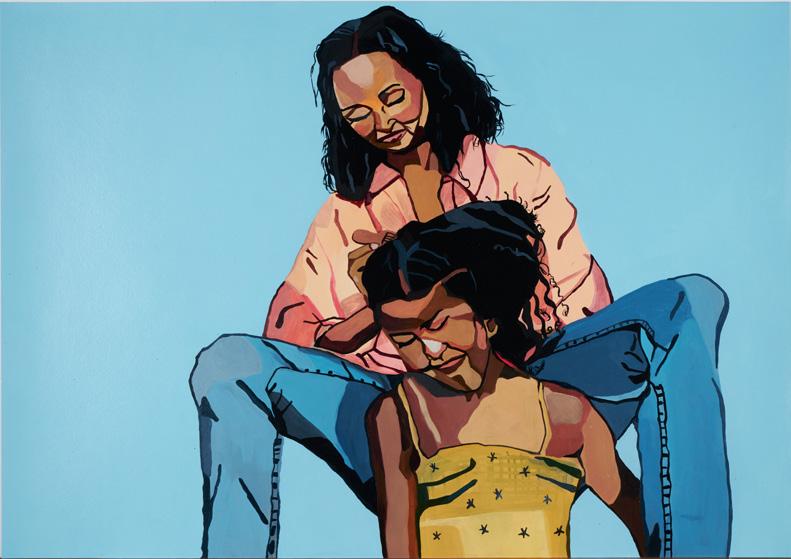
Joy Labinjo, Wash Day, 2021, digital pigment print with gloss silkscreen glaze, 49.5 × 70 cm
As the first work by Fratino to enter the collection, Goat (after Gio Ponti) not only reflects on The British Museum’s holdings of modern Italian design, but also brings a contemporary queer perspective into dialogue with historical objects, affirming the collection as a space where past and present are in continuous dialogue.
Louis Fratino (born 1993, Annapolis, Maryland, US) lives and works in New York City, US.
Gifted by Russell Tovey through the Contemporary Art Society, 2025/26
Text by Isabel Seligman, Curator: Modern and Contemporary Drawings Artwork © Louis Fratino. Image credit: The Trustees of the British Museum. Portrait by Alessandro Teoldi
Louis Fratino, Goat (after Gio Ponti), 2020, graphite on paper, 24 × 21 cm
The British Museum, London
Louis Fratino

Joy Labinjo’s large-scale compositions of figures depict intimate moments of everyday life which are both historic and contemporary, real and imagined. Personal and archival imagery forms a starting point for her paintings, made by working from found images and historical material together with family photographs and the artist’s own memory. Using a distinctive colour palette and graphic patterning, her works explore themes including (but not limited to) Blackness, community, family, and their role in our contemporary lives. Drawing upon her Nigerian-British heritage, Labinjo says, ‘I am interested in conveying the idea of being two, or several worlds, of having multiple identities and belonging to all, feeling “whole”.’
Pallant House Gallery, Chichester Joy Labinjo
Wash Day (2021) was made to accompany Labinjo’s mural commission 5 more minutes for Brixton Underground station, London in 2021. The commission looked at the significance of the hair salon as a centre of community in both Labinjo’s personal experience and wider Black British culture, referencing the social and political history of mural making in Brixton. The surviving Black salons in Brixton also act as sites of defiance against the gentrification of the surrounding area. Labinjo describes the scene of a mother combing her daughter’s hair as nostalgic, evoking memories of sitting between her own mother’s legs as a child.
In both this print and the mural, Labinjo engages ideas of belonging and memory, highlighting the experience of Black British women. A radical celebration of everyday life, this luminous print honours the shared bond of mothers and daughters everywhere. The themes of identity, belonging and everyday life for global majority communities in the UK also speak to Pallant House Gallery’s wider collection, notably to works by Hurvin Anderson, Claudette Johnson, R.B. Kitaj, and Bindi Vora.
Joy Labinjo (b. 1994, Dagenham, UK) lives and works in London.
Louis Fratino, Goat (after Gio Ponti), 2020, graphite on paper, 24 × 21 cm
Joy Labinjo, Wash Day, 2021, digital pigment print with gloss silkscreen glaze, 49.5 × 70 cm
Gifted by Russell Tovey through the Contemporary Art Society, 2025/26
Text by Miriam O’Connor Perks, Curator
Artwork © Joy Labinjo. Courtesy the artist and Tiwani Contemporary. Portrait by Jessica Flavin
Pallant House Gallery, Chichester
Jon Key
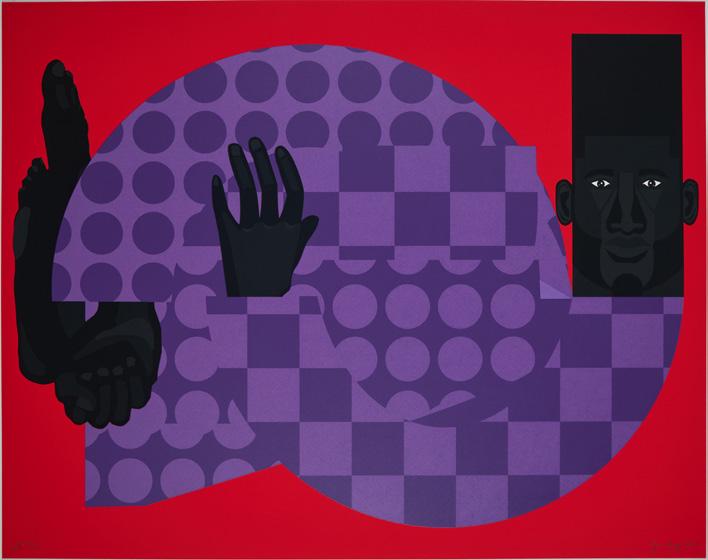
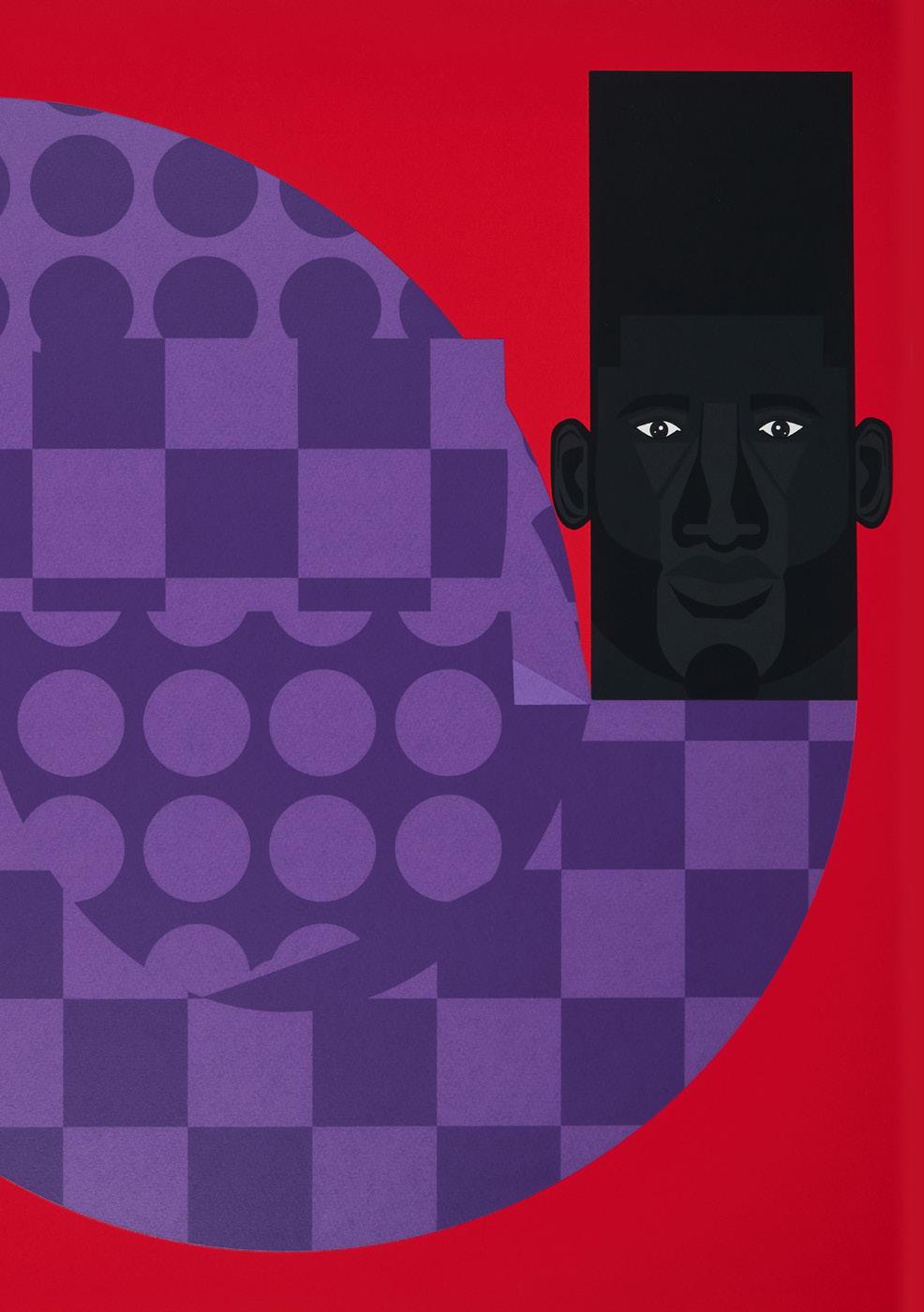
Jon Key is a queer Black artist, designer, and writer from rural Alabama. His vivid paintings, writing and designs explore the intersection of Blackness, queerness and family life. Key’s works often feature his own likeness; they also represent family members including the artist’s twin, parents, and grandparents, and his chosen family of friends and loved ones.
Incorporating the language of design into his painting, Key uses a selective colour palette and patterns – such as polka dot and plaid – to represent the interweaving aspects of his cultural heritage. Key also layers stories of queer ancestry into his work; in doing so, he brings to the fore hidden and oppressed American histories.
The Man in the Violet Suit (Red No.1) (2021) is a 7-colour screenprint that was made at the Counter Editions Studio, Margate in 2021 to coincide with the group exhibition Breakfast Under the Tree, which brought together a diverse range of depictions of contemporary social scenes and shared spaces. Key’s graphic style of flat planes of colour interlaid with bold geometric pattern translates fluently into the medium of screen-printing.
A recurring character in his work, Key says of the figure of ‘The Man in the Violet Suit’, ‘[he] emerged as a mythology of the QTPOC lived experience. This work really focused on the tension and anxiety of performing and existing as a Queer Black Man… [He] responds and contorts to the opaque space that he is [in], but is looking directly at the viewer with unrelenting strength, power and will.’
Demonstrating a masterful handling of the screen-printing process, and remarkable sense of design, The Man in the Violet Suit (Red No.1) speaks to Eduardo Paolozzi’s or Richard Hamilton’s innovative collaborations with the London printmaking workshop Kelpra Studio. Key’s multilayered representation of queer bodies also evokes other works in Pallant House Gallery’s collection, by early artists engaging with printmaking and design such as John Craxton and Keith Vaughan.
Jon Key, The Man in the Violet Suit (Red No.1), 2021, 7-colour screenprint with varnish on Somerset Velvet White 300gsm paper, 60 × 76 cm
Pallant House Gallery, Chichester
Jon Key
Gifted by Russell Tovey, through the Contemporary Art Society, 2025/26
Text by Miriam O’Connor Perks, Curator
Jon Key, The Man in the Violet Suit (Red No.1), 2021, 7-colour screenprint with varnish on Somerset Velvet White 300gsm paper, 60 × 76 cm
Jon Key (b. 1990, Alabama, US) lives and works in New York, US
© Jon Key. Courtesy the artist and Carl Freedman Gallery, Margate. Portrait courtesy the artist and Carl Freedman Gallery
Pallant House Gallery, Chichester
Thomas J Price
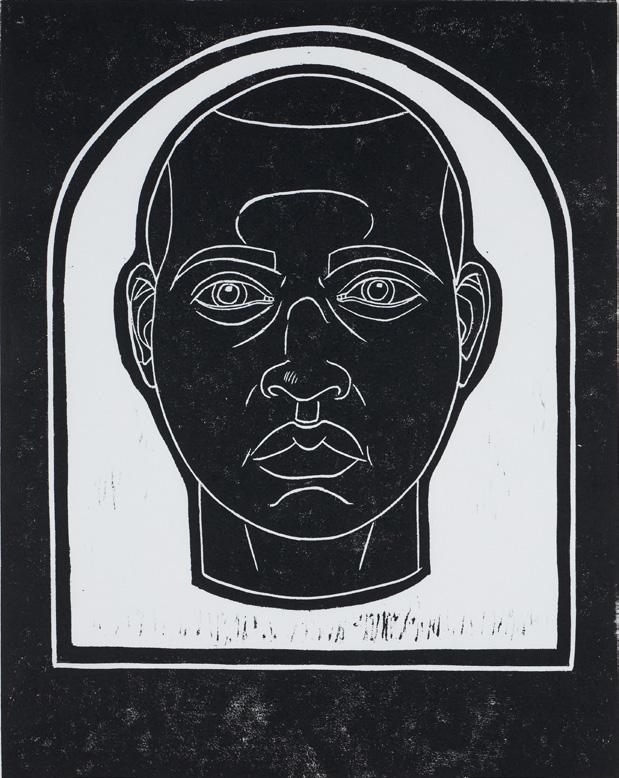
Thomas J Price, Rood boy, 2019, archival relief print on Japanese paper, 26 × 22.5 cm
Sainsbury Centre, UEA, Norwich
Thomas J Price makes art that challenges stereotypes about global majority communities and questions traditional hierarchies. Price wants his subjects to be seen as individuals; he describes them as ‘not being heroic, not being a type, not being recorded as some sort of ethnicity.’ He combines traditional materials and methods with digital technology to make figurative work – most often sculpture – that interrogates the lack of visibility of Black people in the history of European art. In doing so, the artist explores how the presentation of art shapes its meaning and interpretation. Price initiates a dialogue with the viewers, who bring their own understandings and values to their perception of the subjects of his work.
Jesse Wine, JW I have nothing to offer iii, 2013, glazed ceramic, 34 × 54 × 54 cm
Price’s works such as Rood boy (2019) take inspiration from people observed in everyday life, whilst also referring to the language of traditional sculpture. The representation of the head in the print is a nod to the portrait bust, a symbol of beauty and power which traditionally presented an idealised vision of its sitter. The figure’s direct gaze and powerful presence exude authority as much as defiance. A recurring character in Price’s work, ‘Rood Boy’ is a portmanteau of ‘rood’ and ‘rude boy’. The latter is a term with a vast and complex history of Black masculinity, while the subtle reference to a ‘rood’ screen of a church evokes Christian imagery. By playing with the ‘rude boy’ stereotype, Price highlights the way young Black men are usually negatively portrayed in the media, prompting viewers to question their own assumptions.
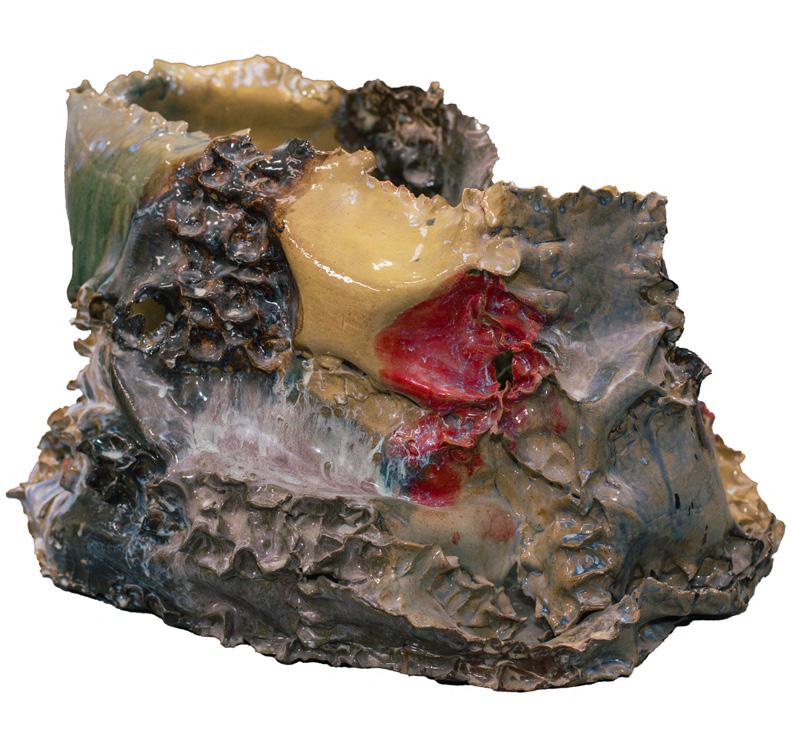
This print expands the Pallant House Gallery collection, sitting in conversation with a number of works that explore shifting approaches to portraiture, from Ronald Moody and Elisabeth Frink to Somaya Critchlow, Kaye Donachie and Barbara Walker.
Thomas J Price (b. 1981, London, UK) lives and works in London
Gifted by Russell Tovey through the Contemporary Art Society, 2025/26
Text by Miriam O’Connor Perks, Curator Artwork © TP STUDIO. Courtesy Thomas J Price Studio. Image credit: Pallant House Gallery, Chichester. Portrait by Ollie Adegboye
Pallant House Gallery, Chichester
Thomas J Price
Jesse Wine works primarily with ceramics, creating highly tactile and expressive works that play and push the boundaries typically associated with clay. JW I have nothing to offer iii (2013) beautifully demonstrates Wine’s chancedriven approach to the firing process, with the eruption of shape and colour across the work’s surface creating unexpected movement and complexity. The work is a testimony to Wine’s experimental techniques: both the glazing and firing processes are constantly evolving within the artist’s individual works, as well as across wider series and groupings.
Wine has expressed his love for the medium, describing his encounters with ancient and historic clay works within museums as products of a ‘consistent industry’ that involves individuals ‘trying to explain an idea with their hands’. The element of human connection emerges from the way in which Wine describes working with clay: with its sensitivity to touch and capacity to register every action from the first moment of shaping to the final glazing, clay makes the dialogue between artist and material visible for everyone to see.
This approach speaks to broader narratives within the Sainsbury Centre’s collection, with vessel-like forms from across the globe highlighting the relationship between human creativity and the use of natural materials. In 1973, Sir Robert and Lisa Sainsbury donated their world-class art collection to the University of East Anglia, choosing to display art from all around the world and from all time periods equally and collectively. Ceramics feature prominently in this highly sought-after collection, with contemporary collecting practices building on these foundations.
Sainsbury Centre, UEA, Norwich
Jesse Wine
Thomas J Price, Rood boy, 2019, archival relief print on Japanese paper, 26 × 22.5 cm
Jesse Wine, JW I have nothing to offer iii, 2013, glazed ceramic, 34 × 54 × 54 cm
Jesse Wine (b. 1983, Chester, UK) lives and works in Brooklyn, New York
Gifted by Russell Tovey, through the Contemporary Art Society, 2025/26
Text by Rosy Gray, Head of Living Art Artwork © Jesse Wine / Image © Katherine Mager. Courtesy the artist. Portrait
artist
Towner Eastbourne
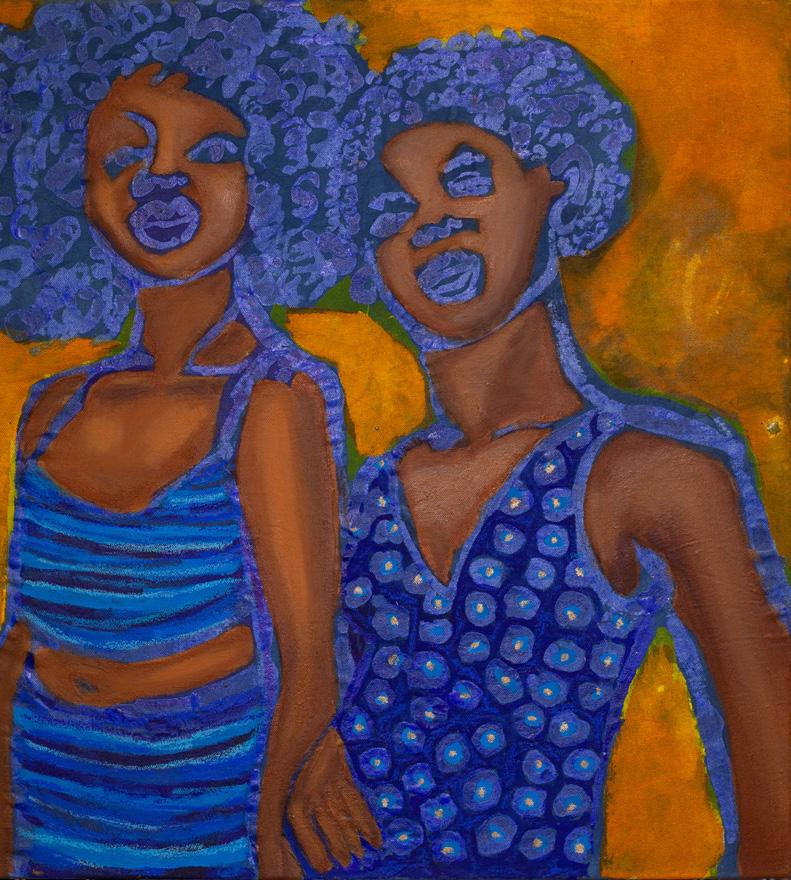
Ṣọlá
Ṣọlá Olúlòde is a British-Nigerian artist whose figurative works explore materiality, the intimacies of Black queer women and the experiences of non-binary people. Often joyful, they construct a world of care and tenderness; a place where bodies are tethered through warmth and tactility. Influenced by Nigerian textile crafts and Adire cloth making, Olúlòde uses resist-dying techniques that include batik and tie-dying combined with mixed media painting which lifts her backgrounds and enhances her figures. Her rich, bold colour palette often reflects those found in nature, drawing inspiration from the deep blues of the sea or the intense yellows and oranges of sunset.
Get your life (2019) is one of a series of 10 mini-paintings on the subject of dance. Rather than by nature, this work’s midnight blue is actually inspired by the glowing lights of London’s QTIBPOC (Queer, Trans, Intersex, Black and People of Colour) nightlife scene. Olúlòde describes her work from this time as a means to explore the complexities of identity within her communities. She considers the lives of her subjects, focusing on their expression of individuality and exploring the strength and intimacy of their relationships with themselves and others.
Olúlòde’s work is closely aligned with the overarching themes of Towner’s own collection, including notions of place, landscape and environment. Olúlòde’s contribution offers a distinct and important expansion of these ideas through diasporic and queer perspectives.
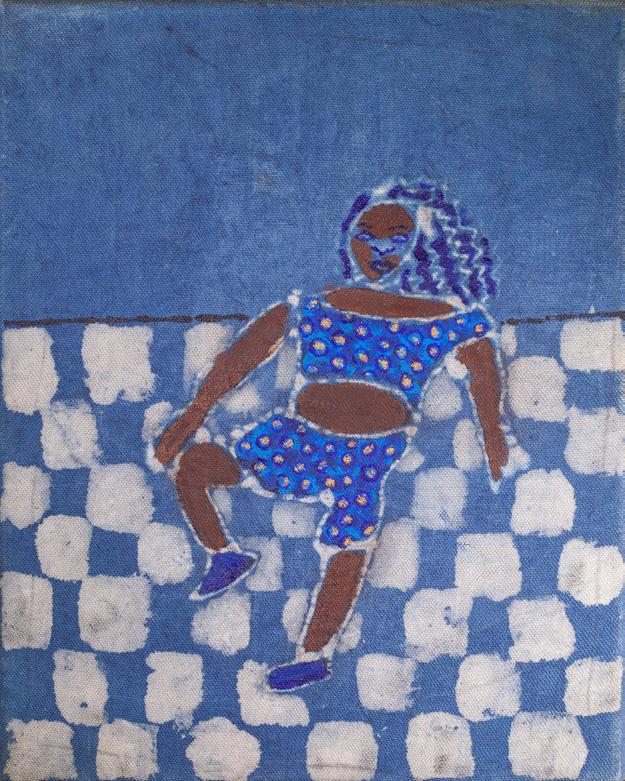
Ṣọlá Olúlòde, Get your life, 2019, oil and pastel on canvas, 30 × 25 cm
Like many of the artists in the collection, Olúlòde collapses the distinctions between art and decoration, illustration and craft, rejecting hierarchy and working holisticly between disciplines. By painting her subjects within richly patterned environments, the artist reimagines landscape painting as a space of belonging rather than observation. Her work complements Towner’s historic and modern collections, inviting audiences to participate in wider global, postcolonial and queer conversations.
Olúlòde, I love her style, 2020, oil and pastel on canvas, 70 × 40 cm
Towner Eastbourne
Olúlòde (b. 1996, London, UK) lives and works in London.
Gifted by Russell Tovey through the Contemporary Art Society, 2025/26
Text by Sara Cooper, Head of Collections and Exhibitions.
Ṣọlá
Ṣọlá Olúlòde, Get your life, 2019, oil and pastel on canvas, 30 × 25 cm
Olúlòde, I love her style, 2020, oil and pastel on canvas, 70 × 40 cm
Artwork © Ṣolá Olúlòde. Image credit: Towner Eastbourne. Portrait by Brynley Davies
CPD Programme
Our Continuous Professional Development (CPD) Programme brings together a vibrant community of curators who are passionate about contemporary art from across all our museum members. Acting as a Subject Specialist Network, the programme offers a supportive space where museum professionals can connect, exchange ideas and share knowledge, resources, and best practices.
Through a thoughtfully curated programme of activities, both in person and online, we create opportunities to explore and research contemporary art in meaningful and engaging ways. This year’s programme has included an edition of our annual conference, On Radicalism, alongside visits to the Liverpool Biennial and to Artes Mundi in Wales, as well as a tour of London galleries. We have also travelled internationally, with a research trip to Sápmi and Norway, and provided opportunities for many other activities that connect our members with both local and global artistic practices.
‘Over the years, CAS membership has provided valuable opportunities. The CPD sessions and travel bursaries have been vital for our curatorial team to remain in contact with peers across the sector at a time when our budgets have been curtailed for this activity. It is a difficult time within local authority museums for programming, commissioning and acquiring contemporary art, but CAS provides an inspiring programme, positive reflections and gathering spaces to motivate us when we come back to our venues.’
‘CAS membership offers invaluable professional development opportunities that our curators and engagement team members have benefited from, allowing us to expand our professional networks. Though Plymouth is a fast-growing cultural hub, CAS member events are especially beneficial given the distance from London and other major cities, for which CAS offers much-needed travel bursaries. CAS also offers advice, guidance and mentorship, which I have benefited from immensely to grow my personal and professional experience working with contemporary artists and galleries.’
Katie Bruce, Curator/Producer of Art Post 1945 at Glasgow Gallery of Modern Art
Terah Walkup, Curator at The Box, Plymouth
The CAS Conference 2025: On Radicalism
1 May 2025
The CAS 2025 conference, held on 1 May at Swedenborg House, London explored radicalism in art museums and curatorial practice. It examined how cultural institutions and art collections shape narratives and influence representation, while highlighting strategies to transform them and open new possibilities for contemporary art. Speakers shared diverse insights: Sharon Heal reflected on activism and crisis in the museum sector; Dr. Clare Carolin highlighted archives as sites of hidden histories and radical potential; Katya García-Antón discussed contemporary art in Sápmi and the Arctic; Helen Legg spoke on a 13-year custodianship of a work by Maya-Kaqchikel artist Edgar Calel; and Sepake Anigiama explored radical pedagogies and unlearning. The day concluded with a roundtable discussion, allowing speakers and the audience to exchange ideas and perspectives.
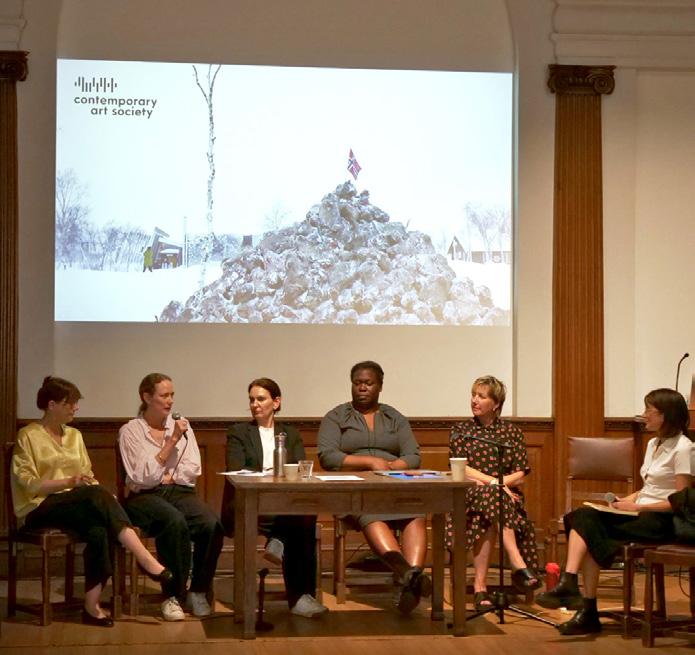
Trip to Sápmi and Norway
16–20 September 2025
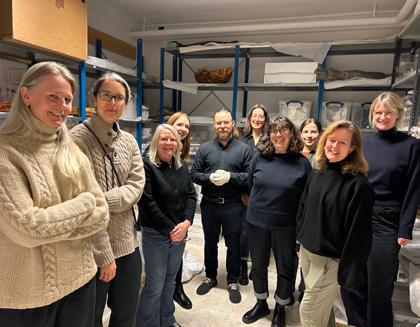
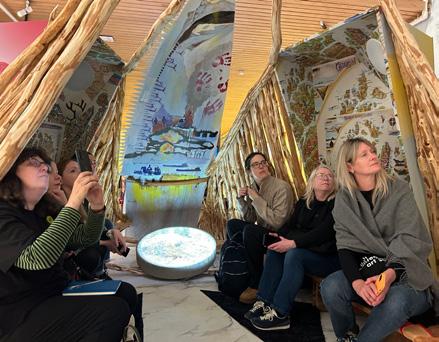
A group of 10 curators from museums across the UK participated in an international trip organised by CAS in partnership with the Office for Contemporary Art Norway. The trip brought CAS members together to engage with artists, institutions, and organisations in Sápmi, the traditional Sámi region of northern Fennoscandia, and Norway. The visit explored the significance of Indigenous practices, knowledge, and wisdom within contemporary global art discourse, alongside pressing issues such as environmental change, climate impacts on Arctic ecosystems, and themes of decoloniality in the European context. Participants also considered the contrast between cultural ‘peripheries’ and ‘centres’ and the ways in which ancient belief systems and living inheritances inform contemporary art and curatorial practice. Curated with local scholar Karolin Tampere, the trip provided an immersive experience, enriching the curators’ understanding of Sápmi and Norwegian art, culture, and the vital role of artists in these regions.
In-House and Gallery Visits in London
11 December 2025
Curators from across our museum network came together in London for an end-of-year gathering celebrating contemporary art and connection. The day began at the CAS offices with pastries, tea, and coffee, providing a relaxed start for networking and conversation. In the afternoon, the group set out on a gallery tour across East London and Clerkenwell, visiting new spaces such as Ginny on Frederick and Brunette Coleman, as well as established venues including the Barbican Curve and Victoria Miro. The day concluded with drinks at a local pub, offering a final opportunity to exchange ideas around collection development, research interests, partnerships, and exhibition ambitions. The event combined art, discussion, and celebration, strengthening connections across the network and inspiring future collaborative projects.
27 February 2026
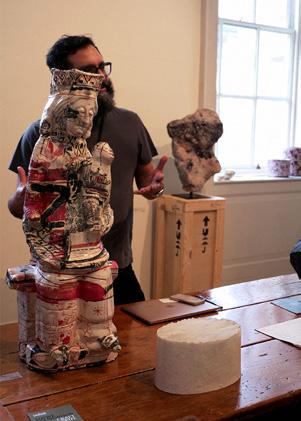
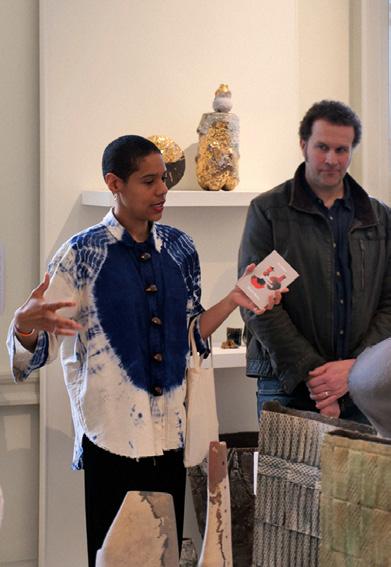
Members were invited to the Collectors’ Preview of Collect, the leading international art fair for contemporary craft and design, held in the neoclassical rooms of Somerset House in central London. The fair showcased the work of over 300 contemporary artists and designers, offering a vibrant overview of current practices in craft and design. This included highlights of works by artists CAS has previously acquired, such as Bisila Noa, Evelyn Albrow and Adi Toch. The day began with guided tours led by specialist craft curators, providing valuable insights into the works on display. This was followed by a shared lunch, creating space for conversation and exchange. In the afternoon, the 26/27 Omega Fund acquisitions cohort met in a private room at Somerset House to discuss collection development and foster dialogue among peers.
Contemporary Art Society
*Consultancy
CAS *Consultancy’s work over the past year has been busy, varied and rewarding. We’ve seen two major large-scale public projects with artists Michael Landy and Olafur Eliasson reach completion; an ongoing commission with the City of Westminster to refurbish public conveniences delivered a further two collaborations; several public art and culture strategies signed off; and a host of communityfocussed projects developed into programmes of great value and integrity.
Our projects have always been about bringing exceptional artists into the public domain. While there are many other public art consultancies practicing in the UK, we are the only team that enjoys the highly regarded reputation of the Contemporary Art Society and its charitable status. Thanks to our track record in delivering strategies and public projects, we are trusted by many artists, galleries and commissioners. We are delivering unique collaborations and investing in exciting artists, developing opportunities for outstanding artworks to exist in the public realm. We make Great Art for Great Places.
CAS *Consultancy
Clients & Partners
2025–26
Allies & Morrison
a space arts
BioMed Realty
City of London
City of Westminster
The Crown Estate
David Walker Architects
FM Conway
Fletcher Priest Architects
The Football Association
Go! Southampton
GummerLeathes Master Developers
Gunnersbury Museum and Park Development Trust
Gustafson, Porter + Bowman Landscape
Architects
Hugh Broughton Architects
Humanitarian Memorial Committee
John Hansard Gallery
La Salle
Metropolitan Properties
Oxford North Ventures
PNB
Southampton City Council
Southampton Forward
Stanhope
Studio Egret West
Swansea City & County Council
St Helens
Borough Council
Thomas White
College Oxford
University of Bristol
University of Southamptom
The Wild Trout Trust
Zoological Society of London
‘Not having created anything permanent in the public realm before, the CAS were brilliant in holding my hand through each stage of the process, from the planning to securing a site, to fabrication and all the politics involved in getting the memorial in the ground.’
Michael Landy, Artist, Humanitarian Memorial, 2025
‘It has been a pleasure to work with CAS*C on Oxford North. They have played a key role as a collaborative member of the design team, bringing their expertise to bear to support the role of public art in the project. Within a complicated scheme with multiple moving parts, they were able to help guide numerous stakeholders to shape engagement and stakeholder participation, develop briefs, assist with artist longlisting, shortlisting and selection. They worked closely with us and the full consultant and contractor team, helping the detailed design development, production and installation of the artworks. The installations, and the events around their unveiling, are such an important component of the new place and were integral to its successful public launch.’
Jonathan Kendall, Urban Design Partner, Fletcher Priest Architects
‘Our work with Contemporary Art Society *Consultancy (CAS*C) on Westminster Notes, part of the City of Westminster’s West End public convenience renovation, has been very successful. We chose to work with CAS*C because of their high-quality portfolio and alignment with our project. CAS*C presented an exceptional and diverse set of artists who we met, eventually selecting the brilliant James Lambert. His artwork, now placed in four of our newly renovated public conveniences, is fun, lively and reflects the local area. CAS*C have worked with our other contractors seamlessly, creating a cohesive and successful project team. We are delighted with the service CAS*C have provided in supporting the Council to achieve fantastic public artworks, bringing our public toilets to life!’
Councillor Paul Dimoldenberg, The Rt Worshipful The Lord Mayor of Westminster, 2025–26
Michael Landy, Humanitarian Memorial, Gunnersbury Park
Humanitarian Memorial Committee
More than ten years in the making, artist
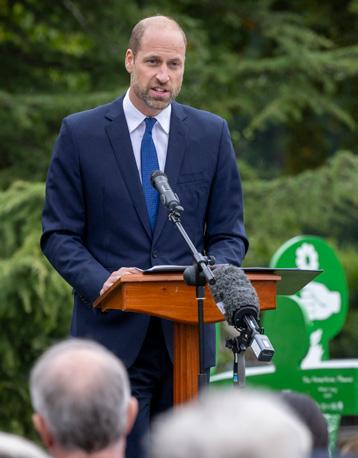
Michael Landy’s Humanitarian Memorial launched at Gunnersbury Park, London in October 2025. The first of its kind, the memorial was opened by His Majesty the Prince of Wales with speeches from Tom Fletcher, Under Secretary-General for Humanitarian Affairs and Emergency Relief Coordinator at the United Nations with support from Sir John Holmes, Chair of the Humanitarian Committee, former diplomat and Chair of the Electoral Commission.
Initiated by a voluntary group of leaders in the UK humanitarian community, the memorial is a tribute honouring aid workers and promoting humanitarian principles, sited in a public space, open to all, without religious or political affiliation, offering support to inspire peaceful reflection. CAS *Consultancy devised a methodology for the memorial, bringing Michael Landy into the process at an early stage.
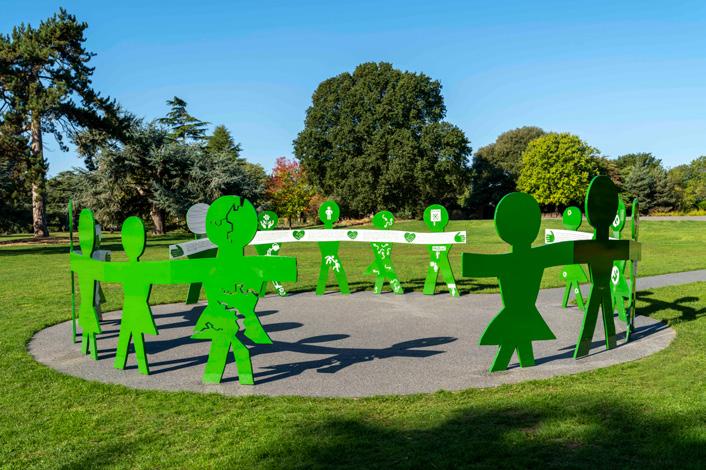
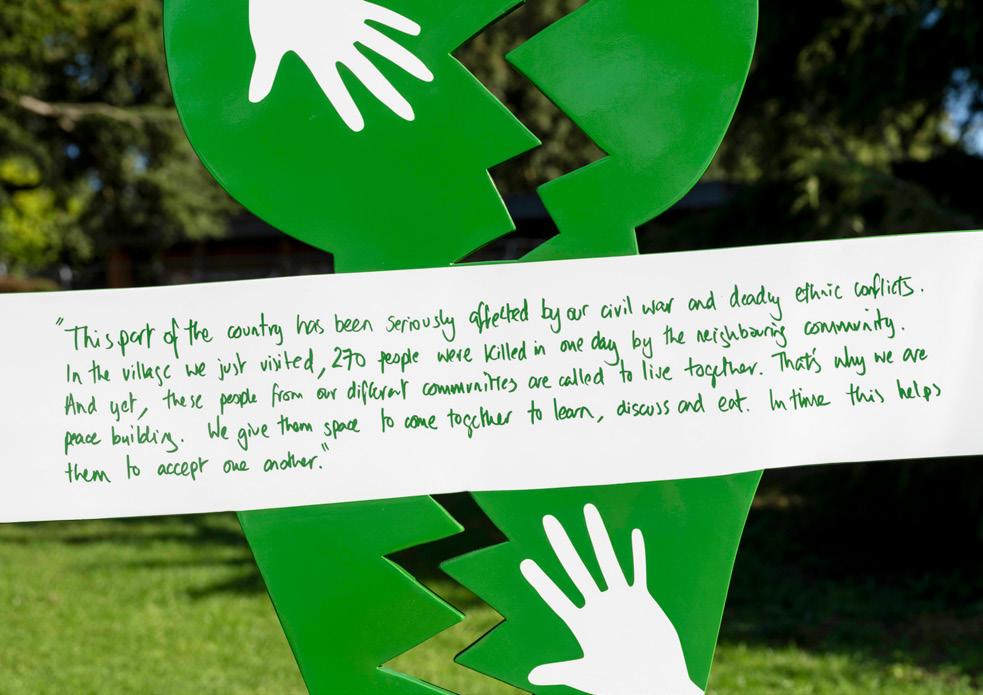
The 7-metre diameter memorial features a circle of 15 human-scale figures, grouped in fives, with gaps that make it possible for visitors to join hands to ‘complete the circle’. Each figure features the first-hand story of either a giver or recipient of humanitarian assistance in the form of an inscription –stories canvassed by the artist and provided by international aid agencies including Oxfam, Save the Children and Care International.
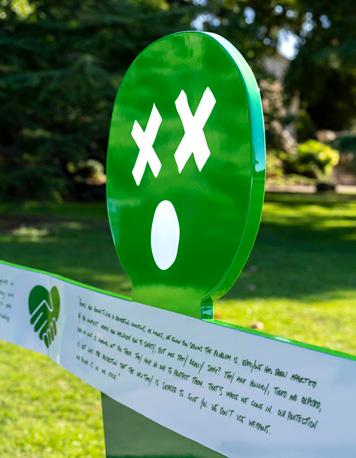
Images by Jonty Wilde
Olafur Eliasson, Your planetary assembly, Oxford North
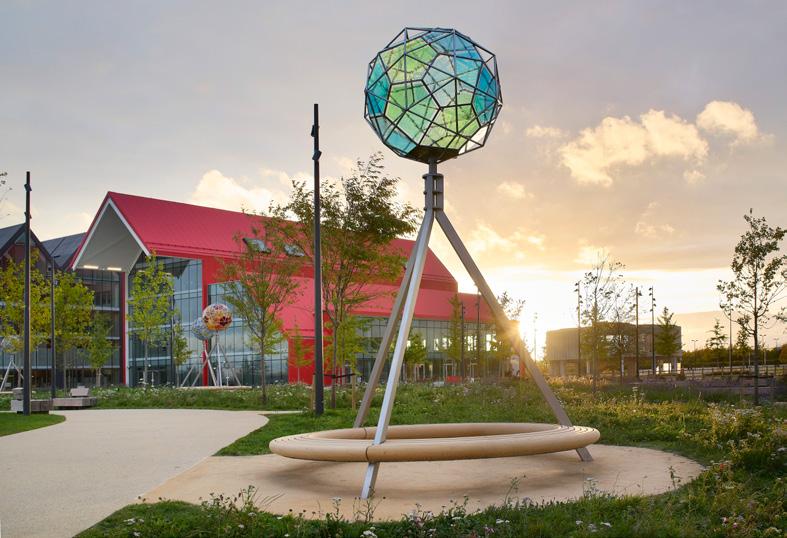
In 2023, *Consultancy worked with Oxford North Ventures to devise a Public Art Scheme for the city’s flagship innovation district. The Scheme advocates for art at every opportunity, as well as practices that engage communities on a range of levels: from signature artworks announcing the site, to participatory projects with young people and academics.
The first project to be delivered was launched by the Rt Hon Lord Hague, Chancellor of the University of Oxford in October 2025. Olafur Eliasson’s Your planetary assembly is the artist’s first permanent public artwork in the UK. Eight illuminated spheres in distinct polyhedric shapes are filled with hand-blown glass, evoking the colours visible in telescopic imagery; each sphere representing one of the eight planets of our solar system. Perched on 4m-high tripods, the sculptures provide a space below for people to congregate. The placement of the works is dictated by the orbits the planets make around the Sun.
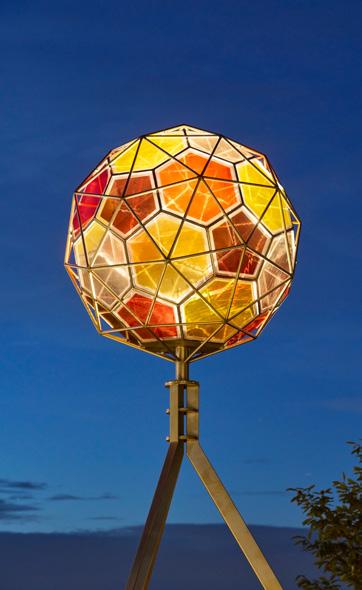
Inspired by the orreries (mechanical models of the Solar System) at the University of Oxford’s History of Science Museum, the works invite visitors to speculate and imagine scales at the macro and micro level. The launch of this first work included an In Conversation event with the artist and a walkabout performance devised by Creation Theatre Oxford. CAS *Consultancy also partnered with IF Oxford Science and Ideas Festival, Modern Art Oxford, Creation Theatre Oxford and Fusion Arts to deliver a linked Engagement Programme to bring Eliasson’s ideas to local communities.
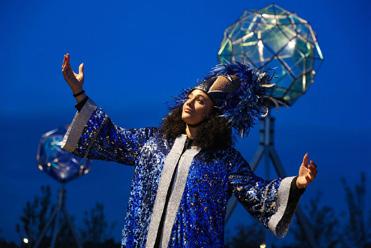
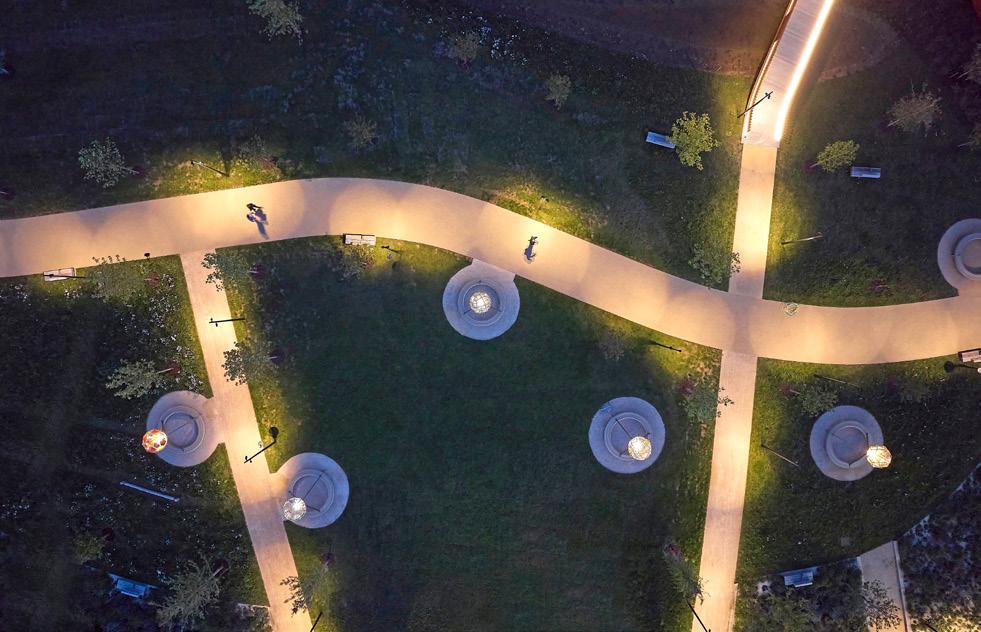
Oxford North Ventures
Images by Hufton and Crow
Creative Engagement Processes, Temple Quarter Enterprise Campus
University of Bristol
CAS *Consultancy are working with the University of Bristol on a public art programme for their new Temple Quarter Enterprise Campus, which will open in September 2026. The art programme has been devised by CAS *Consultancy to centre creative engagement with local communities both inside and outside of the university, with a desire for the new public spaces of the campus to be welcoming and inviting. Content generated through this engagement is also informing a series of temporary and permanent artworks that will be unveiled with the launch of the new building.
The two-year participatory commission Charting Change is led by artists Ellie Shipman and Jack Stiling. Together, Ellie and Jack are exploring how women have shaped the industrial history around the site of the new campus and how they will continue to inform its technological futures. The artists have created temporary artworks to animate the site during construction, and co-hosted a programme of engagement which includes events, exhibitions, workshops, community visits, and collaborations with local industry. Both engagement and research around the site are informing the design of a large-scale textile artwork for a civic space in the new campus building.
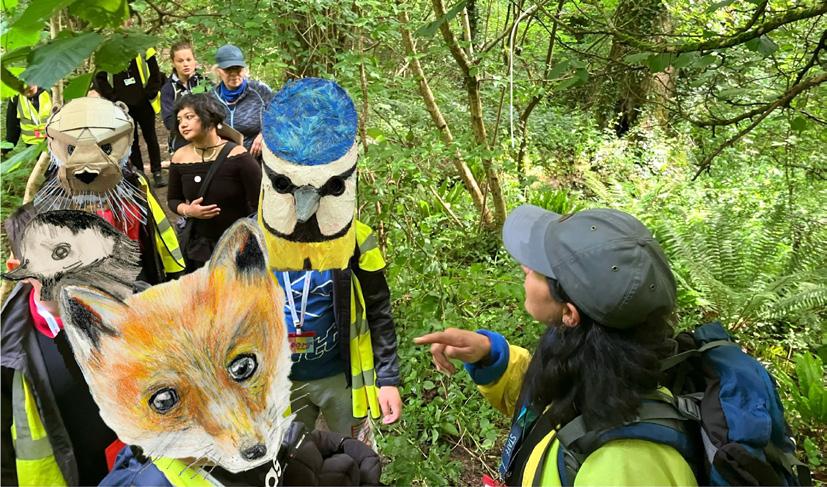
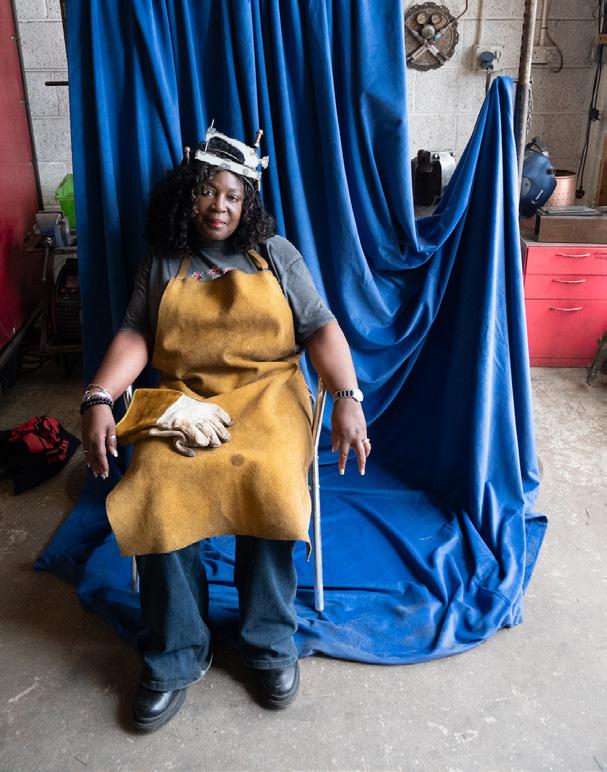
For the commission Wild Spaces, CAS *Consultancy are working with Room 13 Hareclive, an independent artists’ studio co-run by children from Hareclive Primary School in Hartcliffe, on the southern edge of Bristol. The children have been exploring the wild spaces along the river and waterways that lead from Hartcliffe to the new campus at Temple Quarter, engaging with academics and organisations to exchange knowledge about ecologies and wildlife. The commission will see the creation of temporary interventions that animate themes of ecology, opening up the Temple Quarter site to wider audiences in the months leading up to the opening of the campus.
Images by Ellie Shipman and Room 13 Hareclive
James Lambert, Westminster Notes, Piccadilly Circus
City of Westminster, FM Conway
CAS *Consultancy was appointed by the City of Westminster and principal contractor FM Conway to deliver Westminster Notes, a borough-wide public art programme integrated into the refurbishment of historic public conveniences across central London. Developed in collaboration with Hugh Broughton Architects, the series brings together art, architecture and engineering to create distinctive, site-specific artworks across Westminster.
The third work in the series is located at Piccadilly Circus and opened in March 2026, with Green Park scheduled as the next site. James Lambert’s design celebrates energy, movement and encounter, drawing inspiration from the statue of the Greek god Anteros above the Circus, often mistaken for Eros. The whimsical winged figures in Lambert’s design echo the monument’s presence, while the trajectory of Anteros’ arrow becomes a central visual motif.
Motifs referencing theatres, music halls and illuminated billboards reflect Piccadilly Circus’ long history as a centre of entertainment. Pixel-like patterns, graphic elements and decorative flourishes combine to create a vibrant, immersive environment that captures the glamour and perpetual motion of one of London’s most recognisable junctions.
Lambert’s hand-drawn designs were translated into ceramic through a specialist screen-printing process by Digital Ceramics and fabricated by H&E Smith in Stoke-on-Trent, ensuring durability while retaining the vitality of the artist’s drawn line.
Other locations in the Westminster Notes series include the already completed sites at Victoria Embankment and Parliament Street, with further locations to follow at Carnaby Street, Green Park, Covent Garden, Leicester Square and Westminster Bridge.
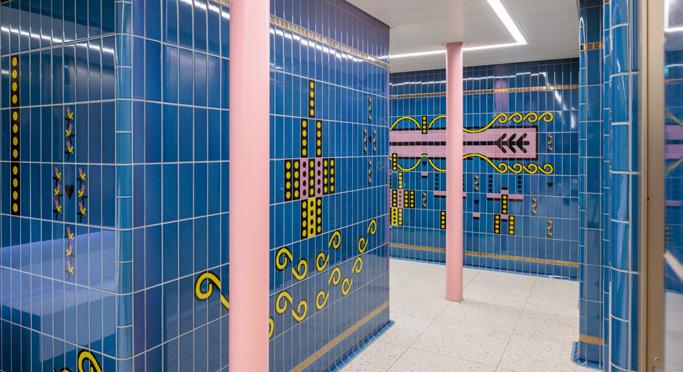
Images by Dirk Linder and James Gifford-Mead
Development
The Contemporary Art Society is extremely grateful to our donors, who provide vital support in our mission to encourage a wider appreciation and understanding of contemporary art, as well as to donate works by important emerging artists to museums and public galleries across the UK. Our work is supported by our Artist’s Table fundraisers, Corporate and Individual Patrons, Legacies, Council, The Collections Fund at Frieze, and several special donor initiatives.
‘Discovering artists and supporting their careers inspires me. The Contemporary Art Society demonstrates how important it is for an up-andcoming artist to be acquired by a museum for the first time. Through the CAS, I have met many new and varied people, and I am happy to lead the next generation to support CAS’ important charitable mission.’
India Rose James, Head of CAS Young Patrons
The Artist’s Table
Sir Richard Long CBE RA
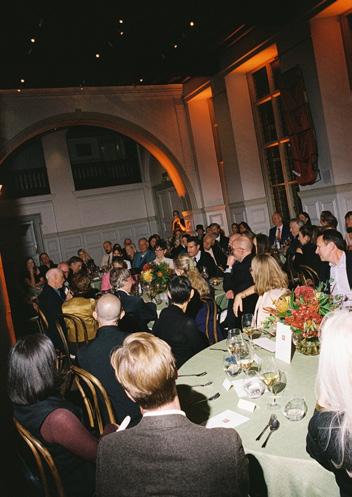
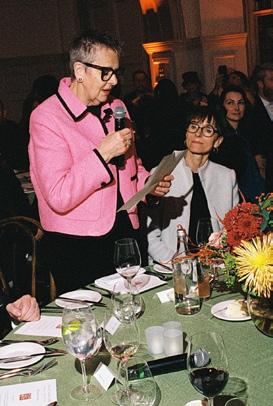
On Wednesday 19 November, the Contemporary Art Society hosted their 20th Artist’s Table with Sir Richard Long CBE RA at the Royal Geographical Society, London, raising over £130,000. The artist kindly donated six unique works to benefit the charity.
The event was made possible with an outstanding committee chaired by CAS Trustee Cathy Wills and a guest list including: Raimund Berthold & Paul Ettlinger, Lord Cholmondeley, Tommaso Corvi-Mora, Tony Cragg, Caroline Douglas, George & Natasha Duffield, Tassos Economou, Liesl Fichardt, Daniel Herrmann, Jonathan & Soo Hitchin, India Rose James, Anthony & Sophie Kingsley, Nicolette Kwok, Richard Long, Lord & Lady Lupton, Keith Morris, Tim & Andrew Pirrie-Franks, Isabelle von Ribbentrop, Varvara Roza, Annabelle & Jeremy Scholar, Dasha Shenkman, Robert Suss, Mary Wolridge, & Anna Yang.
In the Royal Geographic Society’s historic Map Room, guests were welcomed by Professor Joe Smith, Director of the Royal Geographic Society; they were offered gin by MarGin Matchmakers, sparkling wine kindly donated by Domaine Evremond, and wines by Jeroboam and Chateau Chauvin. Guests were then led next door into the Main Hall for a delicious dinner catered by Lodge. Each of the seven dinner tables were named after one of Long’s walks, with the first one being Mountain to Mountain, Ireland which Long completed in 1980. After the main course, guests were treated to an insightful In Conversation between Richard Long and Daniel Hermann, Ardalan Curator of Modern and Contemporary art at The National Gallery, before enjoying a warm festive dessert. After dinner guests were invited to explore behind the scenes of the Royal Geographical Society.
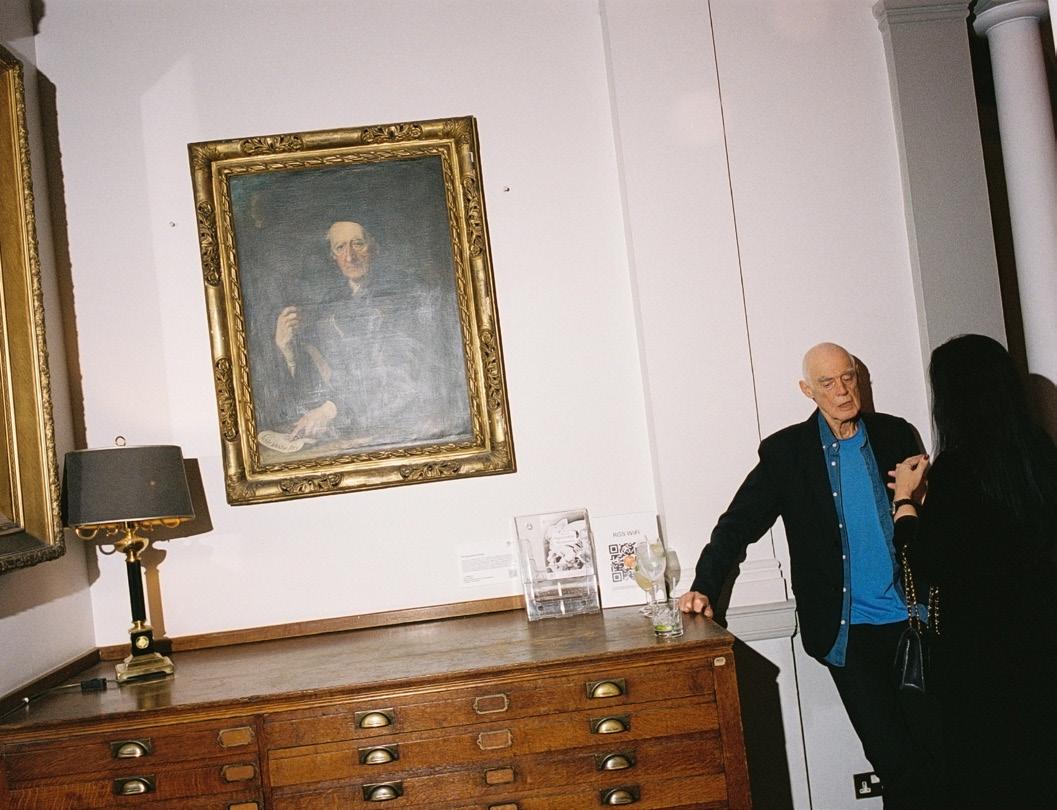
in Britain since he created A Line Made by Walking over half a century ago, in 1967, while still a student. Through the medium of walking, time, space and distance became the subjects of his art. Long was made a CBE in 2013, and was knighted in the 2018 Honours List. He is represented by Lisson Gallery, who also generously supported the event alongside Varvara Roza.
Images by Alfi Moss-White
The Artist’s Table
Rose Wylie OBE RA
On Tuesday 10 March, the Contemporary Art Society hosted their 21st Artist’s Table with Rose Wylie at Burlington House, London, raising over £87,000. Caroline Douglas, Director, Contemporary Art Society welcomed guests, while Wylie led an exclusive afterhours walk-through of her major exhibition at the Royal Academy of Arts, Rose Wylie: The Picture Comes First The artist also kindly donated five unique drawings to benefit the charity.
The event was made possible thanks to our guests and to an incredible committee chaired by Nicola Jones, including: Rose Wylie, Sarah Barker, Nicola Blake, Alex Chantecaille, Caroline Douglas, Sarah Elson, Liesl Fichardt, Chris Grafham, Soo & Jonathan Hitchin, India Rose James, Fernanda Jess, Sophie Kingsley, Suling Mead, Luke John Oxlade, Henrietta Oxlade, James Robertson, Sophie Sofer, Catherine Walsh, Cathy Wills, and Amelia & John Winter.
Following the exhibition tour, the Royal Society of Chemistry hosted a seated dinner catered by Houston & Hawkes. Generous thanks to Jeroboams for their support with the Jeroboams White Burgundy, Domaine Borgeot 2022, and to Sophie Kingsley for donating Bouchard Père et Fils, Beaune du Château Premier Cru, 2021, which was served with dinner. Each of the six dinner tables were named after one of Rose’s paintings: Choco Leibnitz, Dashing Couple, Doodle Bug, Jack Goes Boating, Pink Skater and Quack Quack.
Born in 1934, Wylie is an English artist who lives and works in Kent. She is known for her highly recognisable, colourful and exuberant compositions that at first glance appear aesthetically simplistic, not seeming to align with any discernible style or movement. On closer inspection however, Wylie’s works are revealed as wittily observed and subtly sophisticated meditations on the nature of visual representation itself. Wylie was awarded an OBE in 2018. She is represented by David Zwirner, who also generously supported the event.
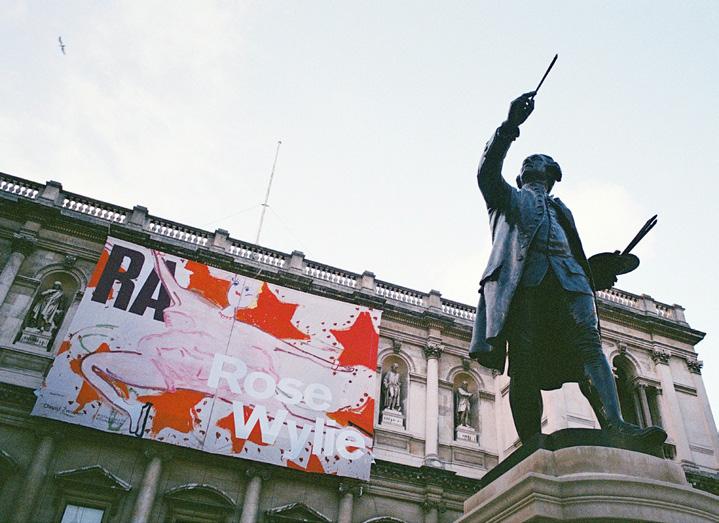
Images by Alfi Moss-White
Copenhagen, May 2025
Highlights of this trip included visits to the Arken Museum’s showing of Eva Helene Pade’s exhibition Forårsofret (The Rite of Spring), the Louisiana Museum of Modern Art, and Christian Andersen Gallery, viewing contemporary works including those by Anton Munar. The group also visited the studios of Tal R Kolbojnik and Evren Tekinoktay, whose collage-based practice examines the body and commodification through found imagery.
Further stops included Kunsthal Charlottenborg, featuring work by Istanbul-based artist Banu Cennetoğlu, and Nicolai Wallner Gallery in Nørrebro, a key space in Danish contemporary art since 1993. The trip concluded in Aarhus with a visit to ARoS Aarhus Art Museum, where guests toured exhibitions by Igshaan Adams and Alexander Tovborg, and previewed James Turrell’s forthcoming Skyspace installation. Thank you to all our patrons for making the trip such a memorable experience.
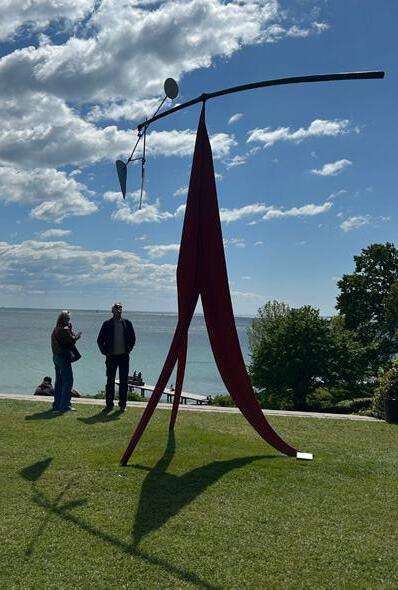
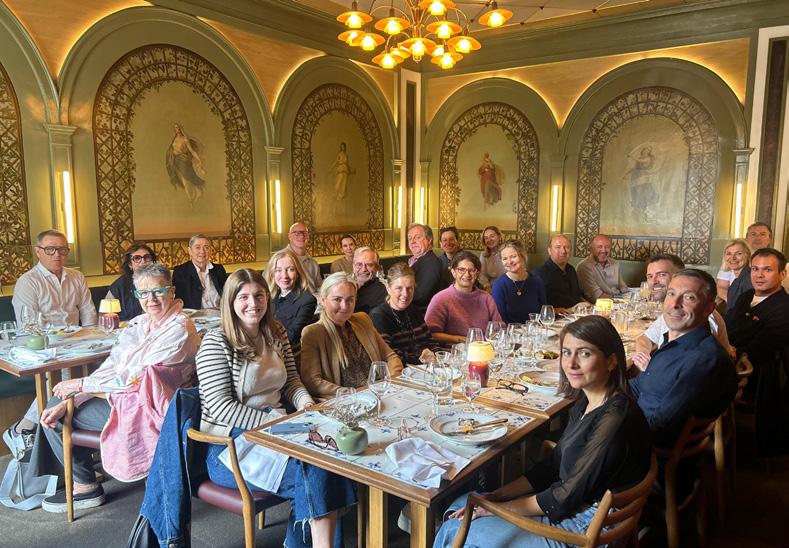
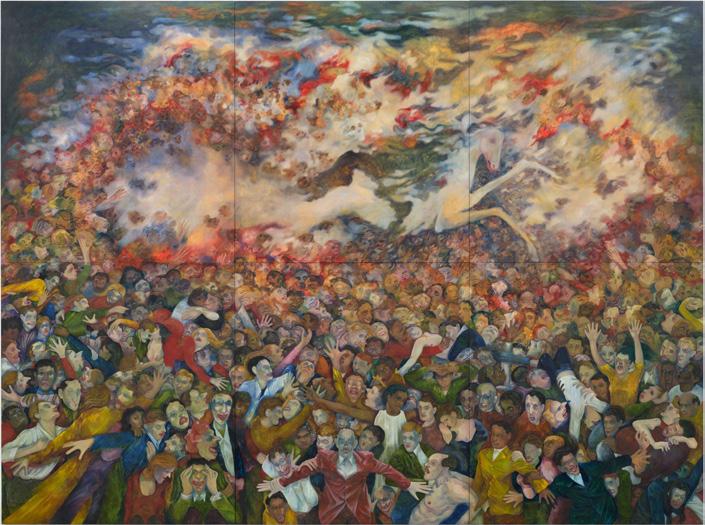
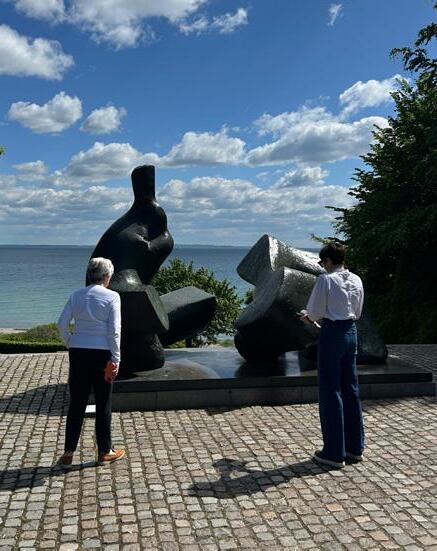
Image below courtesy the artist and Thaddaeus Ropac (Eva Helena Pade, Moments of transition, 2022)
Cape Town, February 2026
Scheduled around the Investec Art Fair, this trip offered an in-depth exploration of Cape Town’s vibrant contemporary art scene through a programme of exhibition openings, studio visits and previews. Patrons were generously invited to view the personal collection of CAS Trustee, Liesl Fichardt, at her home in the city. Highlights included attending the opening of a major exhibition at the Norval Foundation, alongside a collectors’ preview of the fair, providing insight into the region’s artistic landscape. Guests also visited the studios of artists Andile Dyalvane and Zizipho Poswa, whose practices draw on ceramic traditions, as well as iconic photographer and campaigner Zanele Muholi. Other artists visited include Bernie Searle, Sue Williamson and Misheck Masamvu, each offering perspectives on the social, political and material concerns shaping contemporary practice today. Further engagements included the Iziko South African National Gallery and an opening at Stevenson Gallery, one of the country’s leading spaces for contemporary art.
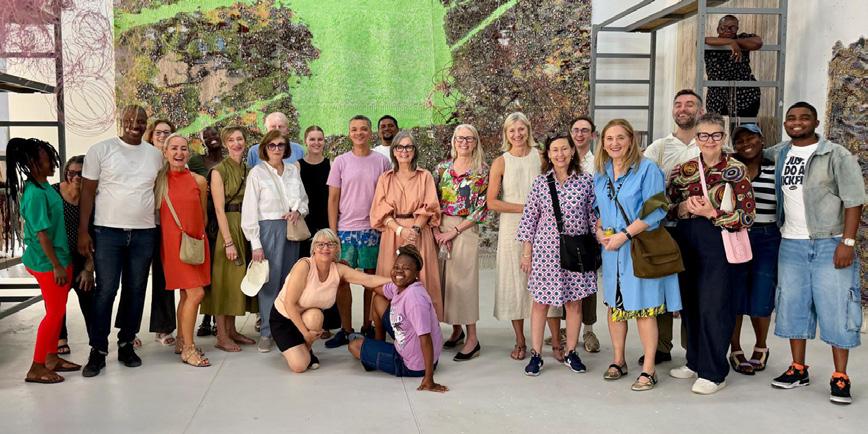
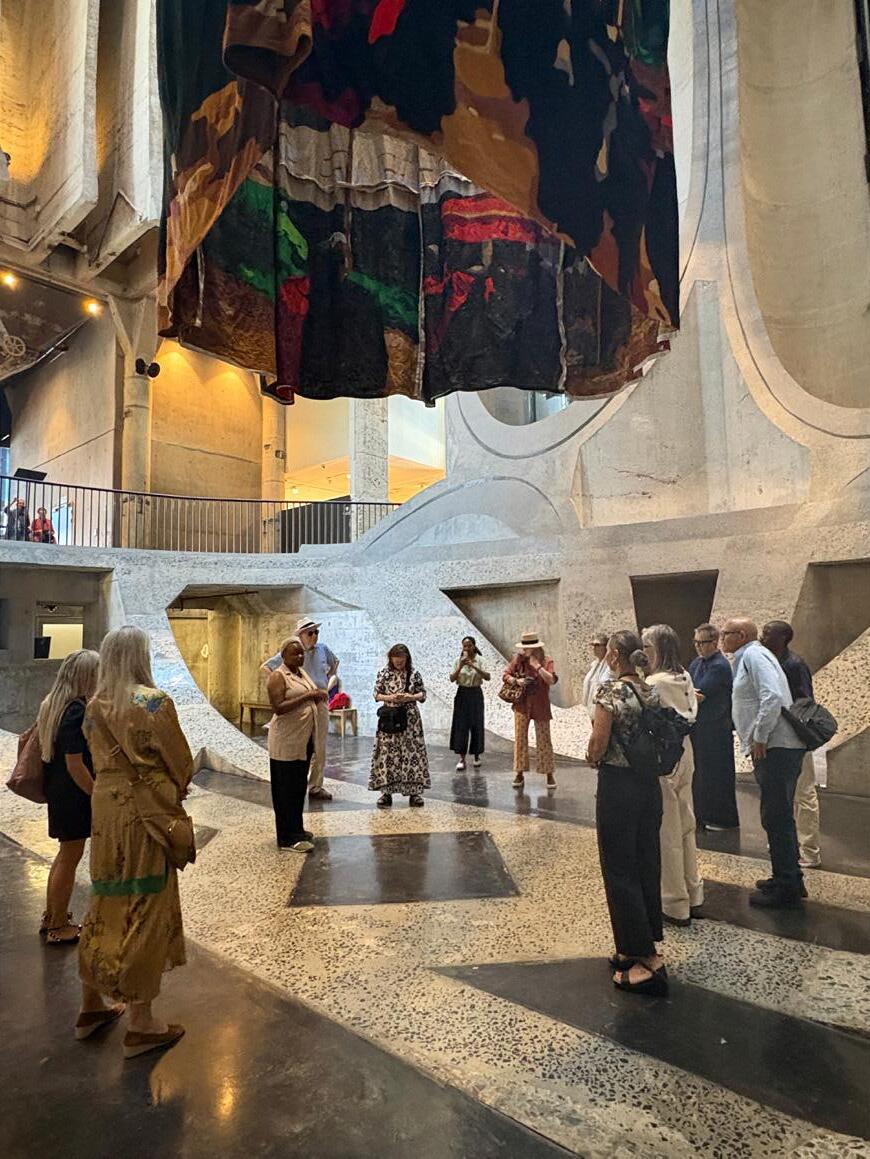
Supporters & Patrons
Collections Fund at Frieze Committee 2025–26
Nicola Avery-Gee
Nicola Blake (Co-Chair)
Liesl Fichardt (Co-Chair)
Whitney Gore
Soo Hitchin
Stephanie Holmquist
Helen Janecek
Sophie Kingsley
Béatrice Lupton
Andrew Pirrie-Franks
Katrina Reitman
Susan Rosenberg
Varvara Roza
Andreas Siegfried
Pamela Stanger
Council
Emma Goltz
Soo Hitchin
Bianca Roden
India Rose James
Pamela Stanger
Robert Suss
Gold Patrons
Nicola Avery-Gee
Chris & Kate Dale
Simon & Sarah Faure
Liesl Fichardt
E-Len Fu
Emma Goltz
The Heller Family
Stephanie Holmquist & Mark Allison
Sophie & Anthony Kingsley
Béatrice Lupton
Suling Mead
Bertrand & Elisabeth
Meunier
Keith Morris OBE &
Catherine Mason
Tim & Andrew Pirrie-Franks
Bianca Roden
Will Rosen
Varvara Roza
Dasha Shenkman OBE
Tina Taylor
Peter Wild & Minka Nyberg
Mary Wolridge
Jonathan Wood
Anita Zabludowicz
Silver Patrons
Charlotte Artus
Sarah Barker
Loraine da Costa
Belinda de Gaudemar
Sophie Diedrichs-Cox
Sarah Elson
Fernanda Gilligan Jess
Whitney Gore
Leonie Grainger
Sarah Griffin
Mark Harris
Helen Janecek
John Lynch
Clare McKeon
Midge Palley
Adam Prideaux
Katrina Reitman
James Robertson
Susan Rosenberg & John Lazar
Samantha Rowe-Beddoe
Andreas Siegfried
Brian Smith
Audrey Wallrock
Cathy Wills
Anna Yang & Joseph Schull
Young Patrons
Sonia Barbey
Jan Bichler
India Rose James (Head of Young Patrons)
Yisi Li
Priya McVeigh
Ric Schmerz
Nicolas Sorbac
Anna Soskine
Leopold Thun & Angelina Volk
Victor (Phone Si Thu)
Ye Yint Kyaw Win
Zhaobo Yang
International Patrons
Jill Hackel & Andrzej Zarzycki
Christoph & Pamela Stanger
Honorary Patrons
Glenn Brown CBE & Edgar Laguinia
Jean Cass
Marco Compagnoni
Christopher Jonas CBE
Penny Mason
Elizabeth Meyer
Alison Myners
Valeria Napoleone
Mark Stephens CBE
Jackson Tang
Russell Tovey
We are also grateful to our generous supporters who wish to remain anonymous.
Artist’s Table Committee for Richard Long
Sarah Barker
Maria Hinel
Soo Hitchin
Adam Prideaux
Varvara Roza
Cathy Wills (Chair)
Artist’s Table Committee for Rose Wylie
Sarah Barker
Liesl Fichardt
Fernanda Jess
Nicola Jones (Chair)
Sophie Kingsley
Suling Mead
Cathy Wills
Development Board
Nicola Blake
Liesl Fichardt (Co-Chair)
Whitney Gore
Isabelle Henkell von Ribbentrop (from November 2025)
India Rose James
Nicola Jones
Béatrice Lupton
Suling Mead (Co-Chair)
Ama Ofori-Darko (until December 2025)
Robert Suss
Mary Wolridge
Corporate Partners
Trustees
Robert Suss (Chair)
Nicola Blake
Tommaso Corvi-Mora
Liesl Fichardt
Timothy Franks
Emma Goltz
Isabelle Henkell
von Ribbentrop
Suling Mead
Béatrice Lupton
Tim Marlow
Keith Morris
Valeria Napoleone
Francis Outred
Charlene Prempeh
James Robertson
John Shield
Ruth Warder
Cathy Wills
Staff
Caroline Douglas Director
Sophia Bardsley
Deputy Director
Curatorial
Christine Takengny
The Roden Senior Curator, Museum Acquisitions
Dr Paula Zambrano
Curator of Programmes
Asah Adolphe
Curatorial Trainee (from January 2026)
Isis Ky
Curatorial Trainee (until December 2025)
Digital
Elliott Higgs
Curator of Digital (maternity cover)
Lydia Figes
Curator of Digital (on maternity leave)
Meej Douglas Communications Coordinator
Tania Adams
Collections Information Manager & Copyright Manager
Ksenya Blokhina
Copyright Manager (until August 2025)
Development
Dida Tait
Head of Philanthropy
Martha Hibbert
Development Manager
Sophie Blower
Assistant Development Manager
CAS *Consultancy
Colin Ledwith
Head of CAS
*Consultancy
Megan O’Shea
Senior Art Producer
Jordan Kaplan
Senior Art Producer
Katharina Worf
Senior Art Producer
Lisa Slominski
Freelance Art Producer
Administration
Heidi Regan
Office Manager
Eddy Hare Administrator