Issue 45
Fall 2026
Letter from the Editor
into the artist’s practice and deep connection with the natural world. Another artist-mystic who has long lived and worked in L.A., Betye Saar, recently turned 100. At her centennial, she is still a student of the past and muses on what lived histories can teach us. “I don’t know all those stories, but I have a feeling about them,” she tells Evan Nicole Brown, speaking about the found objects she uses in her mixed-media assemblage works, and wondering about their past owners. “It’s important to acknowledge the This issue looks to L.A.’s artistic past past because it influences the present to better understand our present. and hopefully the future.” As Carla crafts a contemporary archive In the middle of this issue, of L.A.’s art and artists, it’s essential we leap into the present with a look that we reflect on the city’s—often at the newly opened David Geffen spirited!—creative history. Across Galleries at LACMA, offering two this issue, we tease out stories writers’ perspectives on the building to unearth the practices that have itself and what the experience shaped L.A.’s iconic legacy of freedom of viewing the museum’s permanent and experimentation. collection feels like in the space. Carla’s offices are located While the building may be new, in the same building that in the 1960s the encyclopedic collections it houses housed Gallery 32, a short-lived but are not. Our writers offer critiques groundbreaking artist-run space of the museum’s “non-hierarchical” helmed by Suzanne Jackson. Karla methodology, which collapses objects Méndez recalls how Jackson’s of diverse provenance and eras community-building work presaged into each other at breakneck speed, the experimental ethos that now often leading to more questions permeates L.A.’s creative culture. than answers. This spirit of grassroots exploraMy assumption as we began tion was also proliferated by the editing this issue—that L.A.’s art historiexperimental music nonprofit SASSAS cal past would unlock truths about in the ’90s and early aughts, as it hosted our present—doesn’t reflect the whole intimate, freeform concerts that privipicture. The boundaries between the leged ephemeral embodiment over past and present are, in fact, porous— polish and collaboration over singular as in the work of Todd Gray, the subject authorship. Reuben Merringer traces of this issue’s photo essay: “Time is this trajectory, investigating the precespatial…not linear, but radial.” (Or, dents that inspired SASSAS and pointing in the words of the late Celeste Dupuyto the reverberating ripples of these Spencer, "history as not a straight activations today. line but as more of a lasagna.”) Time Running parallel to some of these and influence are an ouroboros, histories, Lita Albuquerque has been converging, scattering, overlapping, a longtime force in L.A. (and beyond); untethering, and beginning again. she pushes boundaries by reexamining History is a lasagna. the artist’s role through site-specific work that repositions our relationships to time, our bodies, and the natural Lindsay Preston Zappas world. Jessica Simmons-Reid’s on-site Founder, Editor-in-Chief, interviews with Albuquerque in the & Executive Director High Desert offer an intimate glimpse
Issue 45
Somatic Mysticism On Site with Lita Albuquerque Jessica Simmons-Reid
50
18
Artists in Motion
Archiving SASSAS and L.A.’s Experimental Music Scene
Photos and interview: Zachary Lucas
Sonic Overlook Reuben Merringer
26
Featuring Todd Gray
58–71 Reviews
Communal Imagination
Roksana Pirouzmand at OXY ARTS and JOAN —Andrea Gyorody
How Gallery 32 Made Space for Artists
Nancy Holt at MAK Center for Art and Architecture —Nora Kovacs
Karla Méndez
34
Reframing the Landscape Navigating LACMA’s David Geffen Galleries Olivia Gauthier Tara Anne Dalbow
42
Interview with Betye Saar Evan Nicole Brown
Marooning Bodies at Feminist Center for Creative Work —Steven Vargas Celeste Dupuy-Spencer at Jeffrey Deitch —Paula Mejía (L.A. in N.Y.) Manuel Neri and Ruby Neri at Salon 94 —Robby Herbst
Contents
8
900 N Fairfax Avenue · Los Angeles · laeyeworks.com
Bianca Koonce photographed by Josef Jasso. Makeup: Valerie Vonprisk. Hair: Ryan Taniguchi.
Colophon
Contemporary Art Review Los Angeles is an essential voice made in and for Los Angeles. Founded in 2015 by artist and writer Lindsay Preston Zappas, Carla is a nonprofit organization and publishing platform that is dedicated to providing critical, thoughtful, and inclusive perspectives on contemporary art. Our quarterly print magazine is an active source of dialogue on Los Angeles’s art community and is available for free in over 130 galleries and art spaces in L.A. and beyond. Editor-in-Chief & Executive Director Lindsay Preston Zappas
Contributors Lindsay Preston Zappas is an L.A.-based artist, writer, and the founder of Carla. She received her MFA from Cranbrook Academy of Art and attended Skowhegan School of Painting and Sculpture in 2013. Her writing has appeared in Track Changes: A Handbook for Art Criticism, KCRW, Carla, ArtReview, Flash Art, SFAQ, Artsy, LACanvas, and Art21. Recent solo exhibitions include those at the Buffalo Institute for Contemporary Art (Buffalo, NY), OCHI (Los Angeles), and City Limits (Oakland).
Contributing Editor Allison Noelle Conner
Evan Nicole Brown is a Los Angeles-born writer, editor, and journalist who covers the arts and culture. Her work has been featured in Architectural Digest, Dwell, frieze, Getty Magazine, L.A. Times Image, The New York Times, T Magazine, and elsewhere. She is also the founder and host of Group Chat, a conversation series and creative salon in L.A.
Graphic Designer Satoru Nihei
Allison Noelle Conner is an arts and culture writer based in Los Angeles.
Copy Editor Rachel Paprocki
Satoru Nihei is a graphic designer with an MFA from Cranbrook Academy of Art. His work has been featured in The Tokyo TDC Design Annual, METROPOLIS, Graphic Design: The New Basics, and other publications, and has been showcased internationally at exhibitions including the Golden Bee Global Biennale of Graphic Design, Peru Design Biennial, Graphic Matters, Trnava Poster Triennial, Shenzhen International Poster Festival, and others. He judged the 2019 PRINT Magazine Regional Design Awards and received the Golden Bee Award in both 2022 and 2024.
Managing Editor Evan Nicole Brown
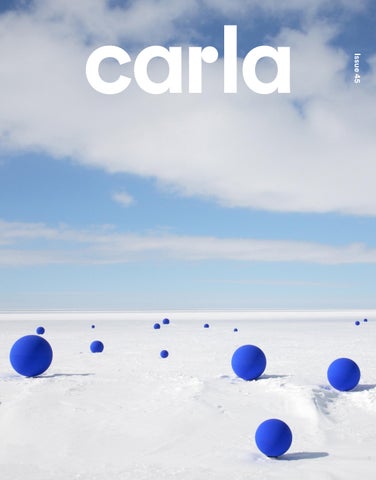
Administrative Assistant Sierra Burton Getty Marrow Publications Intern Paige Glover Color Separations Echelon, Los Angeles Printer Solisco Printed in Canada Submissions For submission guidelines, please visit contemporaryartreview.la/submissions, and direct all submissions to submit@contemporaryartreview.la. Inquiries For general inquiries, contact office@contemporaryartreview.la. Advertising For ad inquiries and rates, contact ads@contemporaryartreview.la. W.A.G.E. Carla pays writers’ fees in accordance with the payment guidelines established by W.A.G.E. in its certification program. Copyright All content © the writers and Contemporary Art Review Los Angeles. Social Media Instagram: @contemporaryartreview.la Cover Image Lita Albuquerque, Stellar Axis: Antarctica (2006). Pigment on fiberglass spheres. Image courtesy of the artist and Nevada Museum of Art. Photo: Jean de Pomereu.
Rachel Paprocki is an editor and librarian who lives and bikes in Los Angeles. Sierra Burton is an art professional and preparator based in Los Angeles. They were a participant in The Broad’s Diversity Apprenticeship Program and a 2025 ArtTable Fellow, serving as a digital archivist for the Betye Saar Catalogue Raisonné at Roberts Projects. Paige Glover is an arts writer and recent graduate of Vassar College, where she received a BA in art history with a minor in dance performance. Her writing and research focus on modern and contemporary art, photographic reproduction, publication histories, and the politics of visual culture. Board of Directors Lindsay Preston Zappas MJ Brown Joseph Daniel Valencia Membership Carla is a free, grassroots, and artist-led publication. Club Carla members help us keep it that way. Become a member to support our work and gain access to special events and programming across Los Angeles. Carla is a registered 501(c)(3) nonprofit organization; all donations are tax-deductible. To learn more, visit join.contemporaryartreview.la. Thank you to all of our Club Carla members for supporting our work. A special thank you to our La Brea and Western members: Anthony Cran, Sarah Ippolito, Tiffiny Lendrum, Jobert Poblete, Michal Hall Bravo Ramirez & Octavio Bravo Ramirez, The Raskin Family Foundation, Anjelica & Neil Sarkar, Ian Stanton, Shahrzad Zarrinnam, Critical Minded, Solid Art Services, and West of West Architecture + Design. Carla is grateful for the many individuals, foundations, and supporters who make our work possible. We are supported in part by:
Los Angeles Distribution Central
East Feia Feminist Center for Creative Work Friday Gallery Gattopardo GGLA Junior High la BEAST gallery Marta Nicodim Gallery Izzy Lee OXY ARTS Parrasch Heijnen Gallery Philip Martin Gallery Staklena Kuća The Armory Center for the Arts The Pit Los Angeles Umico Printing and Framing Vielmetter Los Angeles Vincent Price Art Museum Wilding Cran Gallery North albertz benda ArtCenter College of Design ArtCenter College of Design, Graduate Art Complex The Aster LA Forest Lawn Museum
West 18th Steet Arts Beyond Baroque Literary Arts Center Dorado 806 Projects Laband Art Gallery at LMU Marshall Gallery Otis College of Art and Design ROSEGALLERY Von Lintel
Outside L.A. Beverly’s (New York, NY) Bortolami Gallery (New York, NY) Bread & Salt (San Diego, CA) Buffalo Institute for Contemporary Art (Buffalo, NY) Chess Club (Portland, OR) DOCUMENT (Chicago, IL) Fresno City College (Fresno, CA) High Desert Test Sites (Joshua Tree, CA) Institute of Contemporary Art San Diego (San Diego, CA) Level of Service Not Required (La Jolla, CA) Los Angeles Valley College (Valley Glen, CA) OCHI (Ketchum, ID) Libraries/Collections Alfred University Scholes Library of Ceramics (Alfred, NY) Baltimore Museum of Art (Baltimore, MD) Bard College, CCS Library (Annandale-on-Hudson, NY) Brand Library & Art Center (Glendale, CA) California Institute of the Arts (Valencia, CA) Charlotte Street Foundation (Kansas City, MO) Cranbrook Academy of Art (Bloomfield Hills, MI) Getty Research Institute (Los Angeles, CA) Los Angeles Contemporary Archive (Los Angeles, CA) Los Angeles County Museum of Art (Los Angeles, CA) Maryland Institute College of Art (Baltimore, MD) Midway Contemporary Art (Minneapolis, MN) Museum of Contemporary Art (Los Angeles, CA) Pepperdine University (Malibu, CA) San Francisco Museum of Modern Art (San Francisco, CA) School of the Art Institute of Chicago (Chicago, IL) The Metropolitan Museum of Art (New York, NY) University of California Irvine, Langston IMCA (Irvine, CA) University of Minnesota Duluth, Tweed Museum of Art (Deluth, MN) University of Pennsylvania (Philadelphia, PA) University of Washington (Seattle, WA) Walker Art Center (Minneapolis, MN) Whitney Museum of American Art (New York, NY) Yale University Library (New Haven, CT)
South Angels Gate Cultural Center D2 Art (Inglewood) Experimentally Structured Museum of Art Long Beach City College The Den Torrance Art Museum
Scan to access a map of Carla’s L.A. distribution locations.
Distribution
1301 PE 7811 Gallery Anat Ebgi (Wilshire) Arcana Books Artbook @ Hauser & Wirth as-is.la Babst Gallery Baert Gallery Bel Ami Billis Williams Gallery Canary Test Carpenters Workshop Gallery Los Angeles Charlie James Gallery Château Shatto Cirrus Gallery Clay ca Commonwealth and Council Craft Contemporary D2 Art (Westwood) David Kordansky Gallery David Zwirner Die Plek dublab Ebony Repertory Theatre at Nate Holden Performing Arts Center Fernberger François Ghebaly FOYER–LA Francis Gallery Gana Art Los Angeles Giovanni’s Room Hoffman Donahue Harkawik Harper’s Gallery Heavy Manners Library Helen J Gallery Human Resources ICA LA JOAN KARMA l.a.Eyeworks LACA Lisson Gallery Los Angeles Municipal Art Gallery Louis Stern Fine Arts Luis De Jesus Los Angeles M+B MAK Center for Art and Architecture Make Room Matter Studio Gallery Megan Mulrooney MOCA Grand Avenue Monte Vista Projects Morán Morán Moskowitz Bayse Murmurs Nazarian / Curcio Night Gallery NOON Project O-Town House OCHI Official Welcome One Trick Pony Pace Paradise Framing Perrotin Los Angeles Patricia Sweetow Gallery
Rajiv Menon Contemporary REDCAT (Roy and Edna Disney CalArts Theater) Regen Projects Reparations Club Roberts Projects Royale Projects Sea View Sebastian Gladstone SOLDES Sovern Sprüth Magers Steve Turner St. Elmo Village The Fulcrum The Hole The Landing The Poetic Research Bureau The Wende Museum Thinkspace Projects Tierra del Sol Gallery Tiger Strikes Asteroid Timothy Hawkinson Gallery Track 16 Tyler Park Presents USC Fisher Museum of Art Village Well Books & Coffee Webber 939 Wönzimer Ysasi Gallery Zodiac Pictures
Lita Albuquerque, Sol Star (installation view) (1996). Giza Plateau, Egypt. Ninety-nine ultramarine blue pigment circles.Image courtesy of the artist. Photo: Tarek Naga.
On Site with Lita Albuquerque
In a small, untitled charcoal drawing from 1978, Lita Albuquerque envisions a hallucinatory desert landscape: A solitary mountain emerges from the horizon of an arid plain, bisected by a looming corridor of ultramarine pigment. This band of blue—in the drawing’s perspective, an elongated, receding triangle—stretches from the foreground to the peak’s base, where it greets another ultramarine triangle, this one a geometric portal into the organic body of the mountain. The composition depicts one of the artist’s speculative, unrealized earthworks, labeled as such in handwritten notations that contextualize the pigment interventions: “carve it out of the mountain / dig a trench in the ground”... haptic instructions incite an active engagement with the earth and recall actualized works such as The Washington Monument Project: The Red Pyramid (1980) and Malibu Line (1978/2024), which featured geometric land carvings filled with pigment. Yet the drawing also summons a more uncanny scene. The mountain might recall a nebulous UFO with a triangular aperture, the trough of pigment masquerading as an emanating beam of light. Here, the image’s twin connotations—geological form and celestial anomaly—point to the negative space between land and sky, illuminating the friction between embodied material reality and esoteric belief. Albuquerque’s work frequently inhabits this tension. Albuquerque shared this drawing with me on a blustery afternoon in April in the Mojave Desert near Joshua
Jessica Simmons-Reid
Feature
Somatic Mysticism
Tree, where she was completing a month-long residency at High Desert Test Sites, situated at A–Z West, an 80-acre compound that includes artist Andrea Zittel’s former house and studio. We were standing in a sun-drenched workspace in Zittel’s original, meticulously designed home, nestled among rambling boulder piles at the edge of the wilderness. Albuquerque was residing there with the artist Marc Breslin, her close collaborator, and was in the nascent stages of developing a new site-specific earthwork spread across two locations, one on the property behind the house, and another on a shrubby swath of land in Wonder Valley, a wild and desolate site 40 miles to the east. The finished piece will be revealed in November 2026, a few weeks after the opening of her solo exhibition at the Palm Springs Art Museum, which will include a site-specific rendition of Spine of the Earth (1980), her first-ever Mojave earthwork. We began our visit together in the same manner that she began all of her days there: by descending into a recessed rectangular seating area built into the ground outside, an elegant construction of Zittel’s original design that placed our sightline at earth level, cocooning us into the ground. A hummingbird flitted to the blood-red ocotillo blooms nearby as we gazed towards the mushrooming clouds on the horizon. “Each moment is different here,” she remarked, an observation that attends to life in general but is particularly resonant in the desert, where swift elemental changes—violent bursts of sunlight, sudden whirlwinds— can rewrite conditions in an instant. Albuquerque, a luminary of the California Light and Space movement who rose to prominence in the 1970s, is known for paintings, sculptures, performances, videos, and earthworks that utilize light and pigment to map the interrelationship between humans and cosmos. She is particularly attuned to her surroundings and remains remarkably vigorous at 80 years old, beginning her workday with a series of meditative exercises that include
9
10
automatic writing, drawing, more writglowing orbs of powdery ultramarine ing, calisthenics, and when she’s near pigment dotted the clearing, each the coast, an ocean swim—activities one a material and topographical that merge somatic and linguistic experiment packed flush into the output, hinting at the abiding concerns earth and then left to the elements. that run through her six-decade oeuvre. This specific hue is a hallmark of In a morning drawing session at the Albuquerque’s work that has appeared residency, she produced sketches of in paintings, drawings, sculptures, the surrounding landscape that echoed and earthworks as far afield as her earlier image of the mountainAntarctica (Stellar Axis: Antarctica, turned-UFO. In one, an electric blue 2006); Egypt (Sol Star, 1996); pathway reaches toward a craggy Switzerland (Transparent Earth, 2018); peak pierced by a triangle; in another, and Saudi Arabia (NAJMA: She ultramarine orbs buoy above the terrain. Placed One Thousand Suns Over On the paper she had written “the The Transparent Overlays of Space, expulsion of light into matter,” a poetic 2020). The ultramarine registers, proposition tethering tangible and as she explained over the wind, as intangible things, hinting at her use of a primal memory in the body, stirring language to uncork the ineffable. something inexplicable and deeply Two months earlier in her downfelt. Albuquerque told me she often town Los Angeles studio, Albuquerque “mines the body” for these latent read to me from her personal trove forms of knowledge, an archeological of unpublished writing, which, in addisentiment that connects the matter tion to automatism, includes poetic of the body to that of the land itself, incantations, prose experiments, and proposing each as a source of cryptic missives from dreams. She interred information. often conceives of characters who Each circle of highly dense, presage her own performances tightly packed pigment appeared —“She had scratched into the earth to be a portal into the earth, its circumfuriously,”1 for example—allowing her ference just large enough for my to imagine and later enact her own body to slip through. The first one proprioceptive grammar. The words we investigated rested below an alcove she shared were selections from her of stones; its surface had fractured digitized writings that had survived into a matrix of fissures reminiscent the 2018 Woolsey Fire, the inferno that of the branching faultlines beneath consumed her longtime Malibu home our feet. Albuquerque seemed satisfied and studio. At the Palm Springs Art with its quiet metamorphosis. The Museum, she will for the first time elements had displaced a thin dusting include several charred relics recovered of pigment onto the surrounding from the conflagration—an elegiac sand, creating a spectral illusion that embrace of the cinder as a symbol illuminated the indexical marks of of death and rebirth and a solemn nod the desert floor. The other portals, to the natural world’s volatility. intermittently scattered about the Back at High Desert Test Sites, landscape, remained shockingly I asked about the orbs and Albuquerque unperturbed by the wind. For their led me outside. We followed a sandy placement, she drew inspiration from footpath through the property, the surrounding creosote bushes, contending with a curtain of wind which, due to a biochemical process that overpowered our voices. It led us called allelopathy, grow in evenly to a small wash at the base of spheroidal spaced geometric intervals. Over time, boulder piles, relics of erosion and these fragrant plants form clonal rings, ancient magmatic forces. She pointed dying and resprouting from the root to a distant peak and remarked crown in genetically identical circles, that it would be the perfect site for making them some of the oldest living the pigmented triangle she first organisms on the planet—kindred envisioned in her drawing. Nearby, terrestrial companions for the artist’s
11
Top: Lita Albuquerque, Untitled (1978). Oil stick and charcoal on paper, 22 × 30 inches. Image courtesy of the artist. Photo: Lita Albuquerque.
Bottom: Lita Albuquerque at High Desert Test Sites (2026). Image courtesy of the artist. Photo: Marc Breslin.
Lita Albuquerque, Spine of the Earth (installation view) (1980). El Mirage Dry Lake, Mojave Desert, California. Pigment, 600 feet in diameter. Image courtesy of the artist. Photo: Lita Albuquerque.
14
uncanny blue spheres. Like the her pigment spheres into the ground, creosote’s buried lattice of roots, a gesture that minimizes the discreet Albuquerque imagined her ultramarine margin between the work and its portals tunneling into the earth with site. Peppered with creosote that had “centrifugal force,” converging deep catapulted in height since her first visit beneath the lithosphere. Together in November 2025, the undulating we observed echoes of this imagery terrain was bifurcated by a sandy wash, in the plethora of surrounding anthills, its loamy surface sometimes caving which formed mounds of concentric beneath our feet. Unlike her previous circles in the sand. Mojave earthwork, Spine of the Earth, We spoke about planetary a fugitive pigment drawing on a dry energy, cosmic attunement, plant lakebed, the variable topography here drawings—lines left in the sand did not yield a smooth canvas. by flora billowing in the wind (forms Each ultramarine circle had of terrestrial language)—and the adapted to its environs differently; enigmatic wisdom of stones. When together, they suggested a constellation Albuquerque began her career, of emergent ecosystems—one had these esoteric topics were anathema been newly infiltrated by an army to serious art world discourse. of ants that circumambulated its edge. Later that evening, she reflected While I found this enthralling, the artist on her early days as a faculty member seemed dismayed. “This has never at ArtCenter College of Design, where happened before,” she remarked, she taught for 35 years, noting that and I quickly understood the delicate she initially felt out of place amid precarity of collaborating with the a boy’s club of peers who hierarchized terrain. In other areas, she observed semiotic theory over spiritualism. that the unrelenting sunlight had Still, over time she developed a rapport subtly blunted the pigment’s chromatic with her colleagues and eventually intensity, a conundrum that will likely found her ground there. Now, the art dictate the bounds of the work’s world’s recent institutional embrace fleeting existence. Even ephemerality of spiritual and hermetic practices isn’t exempt from subjective criteria (alongside the canonization of artists —a narrow window of symbiosis such as Hilma af Klint) has only exists between marking the landscape sharpened the prescience of her and being consumed by it. She had somatic mysticism. much to consider. Approaching sunset, we ventured On the cusp of twilight, the east to Wonder Valley to visit the site clouds spread into a vaporous canopy of Albuquerque’s companion earthwork, that resembled a bloom of ink. Later which at the time consisted of a similar that evening, Albuquerque and dispersion of ultramarine spheres. Breslin traveled to Farrington Press, A vast, sparsely populated desert basin an off-grid printmaking studio that abuts the mountainous Sheephole situated in a secluded desert canyon Valley Wilderness, Wonder Valley —a turbulent excursion through occupies a geographic transition zone muscular ravines and ancient groves that renders its topography distinct of Joshua Trees, the trek a baptism from the more arborous Joshua Tree. for the artists invited to the site. Our destination, a rugged tract of Established in 2021 by artist and master land enveloped by two saw-toothed printer Kyle Simon, formerly of Pace mountain ranges, posed a particular Prints, and his wife Sarah LaChance, set of challenges. First, Albuquerque the studio rests below the eponymous had never developed an earthwork Farrington Observatory, an enigmatic on a site that lacked what she referred structure built in the 1970s that the to as “a vista,” meaning that we could couple refurbished and now maintain. not view the entire installation from The mercurial conditions there impact any given vantage point. Before this every facet of the printmaking process, residency, she had also never embedded from the press’s calibration to the
15
Top: Lita Albuquerque installing Stellar Axis: Antarctica (2006). Image courtesy of the artist. Photo: Jean de Pomereu.
Bottom: Lita Albuquerque, Sol Star (installation view) (1996). Giza Plateau, Egypt. Ninety-nine ultramarine blue pigment circles. Image courtesy of the artist. Photo: Tarek Naga.
16
Lita Albuquerque, Cosmic Levitation (2026). Monotype from a steel matrix, 24-karat gold leaf on paper, 28 × 38 inches. Image courtesy of the artist and Farrington Press. Photo: Sarah Lyon.
paper’s absorbency, necessitating viscera of the body and more palpably a frontier-like ethos of resiliency invokes the innards of the earth. and improvisation. The canyon’s otherLike so much of her work, this worldly topography often functions newly planned Wonder Valley perforas an active material accomplice, mance stems from a piece of writing. making Albuquerque “an ideal artist” It envisions a female character cutting to have on site, according to Simon, into the surface of a red pigment-filled who selects his collaborations earth—a choreography evocative carefully. “Every day, as soon as the of her handwritten instructions moon came into view, she would in the 1978 drawing that approximates run to the door. Using the nature the levitating UFO (“dig a trench around us was second nature to her,” in the ground”). Together with her Simon explained, describing the ultramarine orbs at High Desert press’s four-day collaboration with Test Sites, which Albuquerque later Albuquerque.2 Together, they collected likened to fallen stars embedded sap from various species of native in the ground, these earthworks seek pine trees to refine as rosin for aquatints, to parse our haptic connections to the produced atmospheric monoprints cosmic unknown while simultaneously that incorporated gold leaf and embodying the microscopic brevity powdered pigments, and experimented of each passing moment. My own with soft ground techniques informed fleeting encounter with her orbs in by the numerous gestural drawings Wonder Valley had passed. The terrain, that Albuquerque created of the now a desert but once a seabed, observatory and surrounding terrain. will transpose again. I thought of the She gazed at the waning moon, circumambulating ants and our shared scanned the sky for UFOs, traced the moment of chromatic reverence. amorphous shapes of rocks, and gener- “I allowed the desert to share what ated rubbings from the mottled surfaces it has to say,” Albuquerque reflected, of stones. Albuquerque described “I listened, and I gestured back.” this way of working as both “ancient and new,” harking back to painterly Jessica Simmons-Reid is a writer, artist, vocabularies from her earlier decades and critic based in Los Angeles and while simultaneously igniting new Joshua Tree, CA. Her writing has appeared creative frictions, which she succinctly in Artforum, Carla, frieze, Momus, the described to me as “guttural.” Los Angeles Review of Books, and the New This guttural sensation seems York Times’ T Magazine. She is a 2024 to have reoriented Albuquerque’s recipient of AICA’s Young Critics Prize. approach to the ultramarine orbs in Wonder Valley. When we spoke a few weeks later, she conveyed that this portion of the earthwork will shift forms entirely, now existing as a fugitive performance featuring her daughter Jasmine Albuquerque, a choreographer and frequent collaborator. She reflected that, while the orbs at High Desert Test Sites will continue to gestate as planned, the untamed Wonder Valley site entails a more embodied, transient approach—an interpretation no longer anchored by ultramarine pigment, a color connotative of psyche and 1. Lita Albuquerque, unpublished document shared with sky, but rather by powdered crimson the author, May 22, 2026. pigment, a hue that lodges itself in the 2. Conversation with Kyle Simon, May 14, 2026
17
Sonic Overlook
Archiving SASSAS and L.A.’s Experimental Music Scene Take a walk at night. Walk so silently that the bottoms of your feet become ears. —Pauline Oliveros, Sonic Meditations (1974)
18
Between Crenshaw and Culver City stands the Baldwin Hills Scenic Overlook (BHSO), a mound of trails and wildlife with a history rooted in both the natural and built landscape. First used by the Tongva people as a panoramic lookout, the park eventually became swallowed by oil fields before it was ultimately converted into a landscaped California State Park through restorative practices. In 2017, this park served as the venue for a concert by Japanese sound art pioneer Akio Suzuki, his first performance in Los Angeles. Suzuki initially garnered attention in 1963 with a performance that involved throwing, in his words, “all sorts of junk” against a set of staircases at Nagoya Station, after which he was escorted away by the station’s public safety staff.1 For the BHSO performance, he was joined by the younger Japanese visual artist, composer, and curator Aki Onda. The age difference lent a passing- the-torch dynamic to the night, as the two explored four separate locations on the Overlook through sound and listening, an intimate and rapt audience surrounding them at every stop. They created sound through interactions between banal objects like scrap metal, smashed soda cans, Suzuki’s “ANALAPOS”—an invented instrument
Reuben Merringer
of metal cylinders connected by a steel coil—and the built terrain.2 The concert can be viewed in its entirety on the archived website of SASSAS, the sibilant acronym for the Society for the Activation of Social Spaces through Art and Sound, a music and sound art nonprofit that ran experimental concert programming in L.A. for nearly 20 years, between roughly 1999 and 2019. Concerts were free to the public when possible (which was most of the time), operating on the condition that participating artists were always compensated and concerts were documented. It would be hard to grasp the nature of the intimate Suzuki concert were it not for the SASSAS archive, which now exists both as a publicfacing website (sassas.org) and a collection of ephemera, artworks, and documentary media housed at the Getty Research Institute. For many performance-based practices, such documentation can be scant and of disparate quality. Sound is a transitory medium, and the ad hoc conditions in which such performances tend to take place make it extraordinarily difficult to trace a singular, coherent lineage of L.A.’s sonic history. Some of the difficulty lies in the very spirit of West Coast experimen tation, which resists reduction to a single lineage or narrative and is consequently difficult to document. Archives like SASSAS become increasingly valuable as L.A. continues to shift; neighborhoods flip, old haunts are razed and polished over. Having volunteered for SASSAS as my first post-grad school gig, and eventually working on the SASSAS archives in its sundown years—during which the organization faced pandemic-era budget challenges—I have since referenced them repeatedly for all sorts of reasons, often to simply remember the name of a certain park or shop that once served as a performance venue. Founded in 1999 by post- conceptual artist Cindy Bernard, and operating until 2019, SASSAS programmed concerts and workshops
Phil Teele, Bruce Fowler, Mapping sound.: Chung King Corpse (performance view) (2009). Image courtesy of the artists and SASSAS. Photo: Wild Don Lewis.
20
featuring artists, musicians, and their work. Artists such as James Tenney, Mike Kelley, Tetuzi Akiyama, Pauline Oliveros, Glenn Branca, Roscoe Mitchell, and Kelan Philip Cohran produced concerts that ranged from sublimely harmonious musicality to Cage-ian emptiness. Though each concert was distinct, they all seemed to contain a spirit of kinship and chance, imbuing SASSAS programming with a mercurial quality that appealed to tricksters, dreamers, and sensualists. In an exhibition text for SASSAS’s 2019 anniversary installation 20 HRS / 20 YRS, writer and curator Michael Ned Holte summed up SASSAS’s “remarkable run”: how it emerged from “the intersection of a small, but highminded art world and a similarly narrow community devoted to experimental music and sound, often a tightly overlapping Venn diagram of interest.”3 Perusing the archived website and its hundreds of participating interdisciplinary artists, one sees countless visual methods threaded together with an interest in how two invisible quantities —space and the vibrations filling it—can inflect subjective experience. ⁂ Experimental composer and sound artist Alvin Lucier, who was heavily influenced by John Cage, argued for the value of listening over simply “making sounds happen.”4 Along with fellow composer and performer Pauline Oliveros, Lucier began making site-specific sound work on a visit to San Diego in the late 1960s. Chambers (1968) involved players “sounding” seashells in a La Jolla canyon, using sound to “describe the outdoor space”5 by revealing what happens when sonic substances of various textures and viscosities are dumped into it. Throughout the piece, performers move sound through the environment, allowing architecture and portable containers to diffuse, filter, and reshape the audio as their paths cross. Oliveros likewise went on to explore sound through alternative modes
of listening, drawn to collective experience, writing “Sonic Meditations” intended for groups. Teaching at Mills College in Oakland and University of California, San Diego, Oliveros’s influence on West Coast experiment alism is unassailable, and unsurprisingly, Oliveros and other pioneers appear in many forms across the SASSAS archives. For instance, in the 2001 performance Oliveros gave at the MAK Center for Art and Architecture, she instructed viewers to “listen for the subtle rhythms of the body” before playing meditative disjunctive sounds on an accordion. “You’re helping me to create this piece by the way you listen,” she explained.6 SASSAS began with the simple intent to bring visual artists and musicians together in unlikely collaborations in non-hierarchical spaces, often using an “exquisite corpse” format that blended multiple solo performances with overlapping duets, as musicians rotated in and out of the designated staging area. During the six-hour concert Welcome Inn Time Machine (2012), multiple motel rooms in Eagle Rock’s mid-century Welcome Inn were transformed to ad-hoc “micro- concerts” that could be experienced in sequence and simultaneously.7 Visitors were invited to wear “pyramid headphones” by the Los Angeles Free Music Society in one room, while Anita Pace performed Merce Cunninghaminspired dance experiments in two other rooms and the adjacent stairwell. This is a running theme throughout the SASSAS archive: Performers and musicians were placed on the same level as the audience, resulting in highly intimate but wholly unpredictable encounters with sound. A 1998 concert at Angels Gate Cultural Center (a solo event organized by Bernard before she formalized SASSAS the following year) involved the creation of musical trios on the fly: Names were pulled randomly from a hat, and the musicians and artists then improvised in front of the audience. One placed artist Frances Stark on electric guitar alongside artists Joe Potts and Gabie Strong. These early concerts were
21
Top: Vetza, Kira Vollman, sound. at the Baldwin Hills Scenic Overlook: 20th Anniversary Corpse (2019). Image courtesy of the artists and SASSAS. Photo: Wild Don Lewis.
Bottom: Akio Suzuki, sound. at the Baldwin Hills Scenic Overlook: Akio Suzuki and Aki Onda (2017). Image courtesy of the artists and SASSAS. Photo: Wild Don Lewis.
22
Top: Pauline Oliveros, sound. at the Schindler House: Pauline Oliveros and Philip Gelb (performance view) (2001). Image courtesy of the artist and SASSAS. Photo: Sam Durant.
Bottom: Solid Eye (Rick Potts, Steve Gregoropoulos, Joseph Hammer), sound. at the Schindler House: Solid Eye and Extended Organ (performance view) (2000). Image courtesy of the artists and SASSAS. Photo: Cindy Bernard.
aggressively interdisciplinary experiments in chaos and alchemy, artists often bridging generations. The spirit of the West Coast experimentalism that emerged in the 1960s and ’70s typified SASSAS’s increasingly ambitious concert formats and workshops. This was evidenced by SASSAS collaborators like Oliveros or composer James Tenney, who influenced younger generations with shared philosophies on microtonal music and deep listening. Its spirit was informed by earlier projects; anti-professional, anti-commercial agents of chaos like the aforementioned LAFMS, a loose collective of “non- musicians” founded in the early 1970s by brothers Joe and Rick Potts as well as Tom Recchion, Fredrik Nilsen, and many others. LAFMS has spawned many iterative offshoots over the past 50 years. Many performers and projects, like experimental drone collective Extended Organ, which included artists Paul McCarthy and Mike Kelley, performed at SASSAS concerts in the early 2000s. Joe Potts served on the SASSAS board early in its formation and hosted a monthly SASSAS workshop, “soundShoppe,” at the Center for the Arts, Eagle Rock, where anyone could come and make noise with literally anything for a few hours. These sessions often transitioned almost imperceptibly from silence to mad-scientist-levels of cacophonous feedback as audio signal chains ran amok. This de-professionalized chaos, central to LAFMS programming, distinguishes it from 1960s and ’70s East Coast conceptualism, which is often (perhaps inaccurately) perceived as more buttoned-up and clinical due to its focus on language and systems. Critic Thomas Crow has argued that California art of this time developed as a heterogeneous alternative to New York’s critical orthodoxy.8 New York critics such as Lucy Lippard defined East Coast conceptualism through the dematerialization of the object,9 and Rosalind Krauss frequently interpreted the city’s artistic production through questions of signification,
representation, and systems of meaning.10 In California, by contrast, artists from Robert Irwin and James Turrell to James Tenney and Pauline Oliveros often treated perception, atmosphere, and embodied listening as artistic material itself. Though it seems like Light and Space would have little in common with LAFMS’s amplifiers and noisemakers pounding and screaming at full volume, the preeminence of place and perception is the same. But to boil it down to an East Coast/West Coast binary would ignore the dialogue taking place across countercultural circles at the time. One could easily draw a line between the antics of LAFMS and the No Wave or Fluxus scenes that emerged in NYC in the 1960s–’70s. Similarly, LAFMS was thrilled to take the piss out of the uptight perception of experimental music, embracing dissonance, formlessness, and a DIY anti-establishment ethos. The inherent desire of these artists to deconstruct or subvert seemingly traditional features of sound and music reveals a willingness to push beyond our notion of what music can be, thereby opening ever more corridors of creative production. ⁂ It is said that James Joyce boasted that the Dublin of 1904 (specifically June 16, the date on which his iconic book was set) could be reconstructed from the pages of Ulysses. The SASSAS archives function much in the same way: a multi-layered cultural artifact rife with the poetic and factual, creating a sort of four- dimensional map spotted with glowing sites of activity. Though SASSAS earned a dedicated audience over the years, the legacy of Cindy Bernard’s massive project would be at risk of disappearance were it not for its archival efforts. Concerts with historic sonic luminaries may only draw an audience of a couple dozen, but the audience of an archive is potentially endless. For Bernard, this aspect of the organization carries far greater
23
24
impact; as the city disappears and rearranges itself through various internal and external pressures like rising rents and industry precarity, SASSAS offers a window into views of L.A. that are disappearing, if they haven’t already. Like Joyce, SASSAS saw urban life as thrumming, ceaseless, and simultaneous, something to be elevated and loved. SASSAS’s 10-year anniversary concert, Mapping sound. (2009), took place in 8 separate locations, including the defunct Eighth Veil project space and the old Amoeba Music on Sunset Boulevard. The organization’s final concert, the five-and-a-half hour 20th Anniversary Corpse at Baldwin Hills Scenic Overlook, was a massive exercise in simultaneity, sound, and relationalism. More than 25 artists played in five locations around the park, concurrent concerts all held within earshot of each other, all free to the public. No center, no hierarchy. A simple diagrammatic musical score, written by Bernard herself. For five hours, sonic idiosyncrasy spilled down onto the L.A. basin. In the attempt to map a definitive lineage of L.A. sonic history, instead one finds routes and imbricated strata, interacting and networked like our freeways: in constant motion, evolution, and adaptation. The SASSAS archive embodies a different way of listening and interacting with sound and space that invites visitors to consider the city as it is today. What spaces have yet to be activated, and how might that be done while those spaces are still around? Many of the venues noted in the archives, like Sacred Grounds and most recently The Box, which hosted the SASSAS-produced 2017 premiere of James Tenney’s Changes,11 have shuttered and disappeared. However, newer spaces like non-profit Canary Test embrace sound as both physical and communal, and longer- running spaces like Coaxial, Human Resources, Automata, and others continue to program events that foster community and inclusion, celebrating performance practices while challenging norms. As with every
domain, the future is tenuous, but it will undoubtedly be mapped in some sonic form. And what form that sound will take will unerringly depend on the shape and qualities of the space itself and everything and everyone in it, adapting alongside our changing city. Sound, after all, is a vibration that requires another medium to carry it. Reuben Merringer is a Los Angeles-based artist, writer, and educator whose work threads the lineages of language and image through the process-based exploration of materials, natural phenomena, and writing.
1. Akio Suzuki, interview by Aki Onda, translated by Aiko Masubuchi, “Akio Suzuki with Aki Onda,” ISSUE Project Room, September 2012, https://issueprojectroom.org/ news/akio-suzuki-aki-onda. 2. “sound. at the Baldwin Hills Scenic Overlook: Akio Suzuki and Aki Onda,” SASSAS, October 22, 2017, https:// sassas.org/event/akio-suzuki-and-aki-onda/. 3. Michael Ned Holte, 20 HRS / 20 YRS exhibition text, MAK Center for Art and Architecture (The Schindler House), West Hollywood, 2019. 4. Alvin Lucier, “Careful Listening Is More Important than Making Sounds Happen: The Propagation of Sound in Space,” in Reflections: Interviews, Scores, Writings 1965–1994 (Cologne: Edition MusikTexte, 1995), 430–38. 5. Elie Siegmeister, Alvin Lucier, and Mindy Lee, “Three Points of View,” The Musical Quarterly 65, no. 2 (April 1979): 288, https://rohandrape.net/ut/rttcc-text/ Siegmeister1979a.pdf. 6. “Pauline Oliveros and Philip Gelb,” SASSAS, July 28, 2001, https://sassas.org/event/pauline-oliveros-andphilip-gelb/. 7. “Welcome Inn Time Machine,” SASSAS, January 29, 2012, https://sassas.org/program/welcome-inn-timemachine/. 8. Thomas Crow, The Artist in the Counterculture: Bruce Conner to Mike Kelley and Other Tales from the Edge (New Haven: Yale University Press, 2021). 9. Lucy R. Lippard and John Chandler, “The Dematerialization of Art,” Art International 12, no. 2 (February 1968): 31–36. 10. Rosalind E. Krauss, “Notes on the Index: Seventies Art in America,” October 3 (Spring 1977): 68–81. 11. “sound. at The Box: James Tenney’s Changes,” SASSAS, 2017, https://sassas.org/event/james-tenneys-changes/.
25
Top: Akio Suzuki, Aki Onda, sound. at the Baldwin Hills Scenic Overlook: Akio Suzuki and Aki Onda (performance view) (2017). Image courtesy of the artists and SASSAS. Photo: Wild Don Lewis.
Bottom: Rick Potts, Joseph Hammer, Renee Petropoulos, Joe Potts, Fredrik Nilsen, Ace Farren Ford, Tom Recchion, Carla Bozulich, sound.: 20th Anniversary Corpse (performance view) (2019). Image courtesy of the artists and SASSAS. Photo: Wild Don Lewis.
Timothy Washington holding his painting Silent Majority outside Suzanne Jackson’s Gallery 32 (1970). Image courtesy of the Bob Heliton Archive. Photo: Bob Heliton.
Communal Imagination How Gallery 32 Made Space for Artists
Whenever I visit Los Angeles from the Bay Area, traversing the city’s art spaces feels like a marathon shaped by the city’s sprawling geography. Moving between galleries dispersed across different neighborhoods, I encounter not only the art itself, but also the communities, architectures, and social landscapes that inform it. The city’s contemporary art landscape carries traces of earlier histories too, of artists and organizers who imagined cultural spaces as extensions of public life rather than escapes from it. Looking back across L.A.’s art history, we can find moments of growth, volatility, and expansion, often mirroring the ever-changing and, at times, volatile events that the city has seen (from the Watts riots to the East L.A. Walkouts). Decades like the ’60s earmarked moments where the cultural landscape of the city was rapidly expanding.1 But this expansion did not yet resemble the density or commercial visibility that defines the city’s contemporary art ecology. Instead, L.A.’s cultural infrastructure was shaped by smaller, often precarious, artist-run spaces that not only carved out their own space in the landscape but also began to shape L.A.’s iconic spirit of collaboration and experimentation.2 The Los Angeles art world in the ’60s was still in a formative stage. The city did not have a major, dedicated art museum until the opening of the Los Angeles County Museum of Art (LACMA) in 1961, a relatively late development that underscored how young the city’s institutional art
Karla Méndez
foundation remained in comparison to New York City or European cultural capitals.3 For many Angelenos, encountering art meant going to galleries, and by the 1960s Los Angeles had developed the largest concentration of galleries west of Chicago, many of them clustered along La Cienega Boulevard’s “Gallery Row.” Influential spaces such as Ferus Gallery, Nicholas Wilder Gallery, and Felix Landau Gallery helped establish the city as an emerging center for contemporary art by promoting movements like Pop Art, Light and Space, and Conceptualism, with exhibiting artists like Andy Warhol, Ed Ruscha, Jasper Johns, John Baldessari, and David Hockney. Yet even as Los Angeles emerged as an important artistic center, it largely followed postwar trends within the American art world. Across much of the period, museums and commercial galleries privileged Euro-American Modernism and market-oriented practices that emphasized formal innovation and presentation over political or social engagement. Black artists remained largely absent from the city’s leading cultural institutions, which often upheld a narrow vision of contemporary art rooted in neutrality and distance from civic struggle.4 It is within this context that artist Suzanne Jackson founded Gallery 32 in the late 1960s. Trained as a dancer, painter, and theater designer, Jackson was raised in San Francisco, completed graduate studies at Yale University, and toured South America as a dancer before settling in Echo Park in 1967. She began taking drawing classes at the Otis Art Institute with Charles White, where she befriended artists like Alonzo Davis, Dan Concholar, and David Hammons. The latter two encouraged her to open the gallery as a space to exhibit emerging artists, experiment, and be in conversation about the struggles they experienced. Inspired by the philosophy of White, who believed that art could function as a vehicle for activism and social transformation, Jackson opened Gallery 32 in 1968 in the Granada
27
28
Buildings, a Spanish-style mixed used building that today houses organizations such as Los Angeles Review of Books and GetLit, design studios like Agency Artifact and West of West, and galleries such as O-Town House and Official Welcome. (Carla, too, has been working out of the building since 2025.) Located in the Westlake neighborhood, which at the time was positioned near Otis’s original building and the Chouinard Art Institute (which later merged with the Conservatory of Music to become the California Institute of the Arts), Gallery 32 took up shop in the two-story Suite 32; originally serving as Jackson’s living quarters upstairs and private studio downstairs.5 She transformed the studio into an exhibition space for fellow artists—many of them White’s students—who had trouble finding opportunities within institutions like LACMA that refused to exhibit contemporary Black American artists.6 Funded largely through money Jackson earned teaching, the gallery embraced a distinctly DIY ethos that reflected both material necessity and political urgency. According to Jackson, many visitors, whether they were working or middle class, Black or white, felt safe coming to the gallery to see work they otherwise would not be exposed to.7 Though Gallery 32 was not exclusively a gallery for Black Americans —Jackson stated its guiding principle was showing “good work that was not being exhibited elsewhere”—it nonetheless became one of a number of small but critical spaces, along with Brockman Gallery, Black Arts Council, and the Watts Towers Art Center, where emerging Black artists like Hammons, Betye Saar, Emory Douglas, Gloria Bohanon, and Timothy Washington could present their work.8 A pivotal example is The Sapphire Show: You’ve Come A Long Way, a collaborative, five-day exhibition organized in 1970. Widely thought of as the first survey exhibition of Black American women artists in the United States, the show brought together artists like Senga Nengudi (then working under the name Sue Irons), Jackson,
Bohanon, Yvonne Cole Meo, Saar, and Eileen Abdulrashid. Its significance lies not only in that it was a historic “first,” but also in its refusal of the marginal position Black women occupied simultaneously within the mainstream feminist movement, Black liberation politics, and the contemporary art world.9 Though Jackson’s records of the show have since been lost, some of the work believed to have been a part of it includes Meo’s Forbidden Fruit in Garden of Eden (1965) and Nengudi’s Water Composition V (1969–70/2018); Saar’s Taurus (1967) is the only piece confirmed to have been in the original exhibition,10 which staged these artists as producers of critical visual languages that engaged memory, labor, gender, race, and structural injustice, concerns that were often sidelined in dominant artistic and political discourse. Equally fundamental to Gallery 32 was its direct interaction with revolutionary organizing. Jackson and fellow artists like Bohanon, Nengudi, John Riddle, and Concholar would meet in the studio space, asking themselves and each other if there was such a thing as ‘Black art,’ and if so, how was it defined?11 Rather than remaining purely intellectual exercises, these discussions shaped the ways the gallery positioned itself within broader movements for Black political and cultural liberation. The gallery opened its doors to the Black Panther Party, which staged a three-day exhibition of Emory Douglas’s pastel works, including portraits of party leaders, poster designs, and illustrations for the Black Panther newspaper. Organized by Yvonne Carter as a fundraiser for the Party’s children’s breakfast program, the exhibition stressed the gallery’s role not just as a site in which to exhibit work, but as foundational space for political education and movement-building.12 Programming like this modeled a new structure in which a gallery could function simultaneously as an exhibition space and a public forum, in turn collapsing the boundaries between aesthetic practice and communal life.
29
Top: Annie Bianucci, George Evans Jr., and Suzanne Jackson in the courtyard of the Granada Buildings, home of Gallery 32 (1969). Image courtesy of Gregory Wiley Edwards. Photo: Gregory Wiley Edwards.
Bottom: You’ve Come A Long Way, Baby: The Sapphire Show (installation view) (2021). Image courtesy of the artist and Ortuzar, New York. Photo: Timothy Doyon.
30
Suzanne Jackson, To-do list (1970). Image courtesy of the artist.
The radicalism of the gallery becomes increasingly clear when considering the resistance and intimidation from the police and FBI that surrounded certain exhibitions. During the opening of Douglas’s show, police officers were stationed outside the gallery attempting to dissuade visitors from entering and redirecting them elsewhere if they stopped to ask for directions.13 Similarly, on the eve of an exhibition of Elizabeth Leigh-Taylor’s charcoal portraits, the gallery received a bomb threat while the artist and Jackson were alone installing the work late one evening. According to Jackson, phone calls denounced the exhibition as unpatriotic because the drawings centered on oppressed people from around the world, like Angela (1970), a portrait of the activist Angela Davis and the portrait Sharona (1967).14 The gallery was perceived as a threat to the Euro-centric, white supremacist status quo that governed the art world, as attempts to intimidate Jackson and her featured artists were ultimately attempts to silence forms of critique and solidarity between the marginalized communities that the exhibitions made visible. These examples expose the fallacy that art can be separated from politics. The hostility directed toward the space demonstrates how risky it was to support Black artists who challenged the status quo; the gallery’s artists were shining a light on issues like urban decay and police brutality while also confronting U.S. imperialism and militarism abroad. To frame art as neutral or detached from civic life is itself a symbolic act that veils the power structures that determine whose work is seen or not seen—Black artists were often kept out of other spaces, leaving them unable to earn money by selling their art. Many of these artists participated in alternate ecosystems, often organizing exhibitions in Black businesses and spaces like community centers, churches, and even the homes of friends. Jackson’s gallery was part of a movement that worked to move these artists into the mainstream,
though the resistance that met the gallery made sustainability difficult. Less concerned with marketability and sales, the gallery prioritized intel lectual exchange, political dialogue, and mutual support among artists. Yet it was exactly these commitments that set the space in a financially precarious position. In 1970 the financial strain of sustaining Gallery 32 had become increasingly difficult for Jackson to maintain, operating with limited institutional help, and relying heavily on Jackson’s labor and teaching income.15 This scarcity of available resources reflected a cultural system that struggled to sustain spaces that challenged artistic hierarchies. To understand the gallery’s importance within the wider trajectory of L.A.’s art history is to understand how the city’s global art identity was also formed through grassroots spaces like Gallery 32 that fostered investigation, community, and civil discourse. Today, Los Angeles is internationally recognized for its decentralized and community-driven art scene that is shaped by artist-run initiatives, activist organizations, and alternative spaces. For instance, Art + Practice, located in Leimert Park (a neighborhood long considered a cultural center for Black artistic life in Los Angeles), directly continues Gallery 32’s legacy by providing free exhibitions foregrounding artists of color while also partnering with local foster youth organizations to offer social services and educational resources to marginalized communities. Meanwhile, Del Vaz Projects reimagines the domestic sphere as a site for artistic exchange and community formation by centering its programming within the home of its founder, Jay Ezra Nayssan. It highlights multiracial, international, and LGBTQIA+ artists whose work exists outside dominant frameworks, while its activities as a research collective and independent press further expand the possibilities of what an art space can be. These inventive models are two of many—the precedent set by spaces like Gallery 32 continues to impact and inform the
31
32
broader zeitgeist of experimentation and social engagement that permeates across Los Angeles’s art spaces. Gallery 32 exposed the impossibility of impartiality, illustrating that whose work is exhibited, whose histories are centered, and which communities are welcomed into cultural spaces are always political acts. What spaces like Gallery 32 understood was that the realities of living in Los Angeles, from the racial tensions and economic inequalities to its sprawling geography and activist movements, were not conditions to separate from artistic production, but forces that actively shaped it. The gallery embraced the social and political realities as material for dialogue and communal imagination. The collaborative and politically conscious art ecosystem now associated with Los Angeles predated its major institutions; the foundation was built through artist-run spaces that understood art as inseparable from the lived experiences, struggles, and goals of the communities surrounding them. Karla Méndez is an arts and culture writer based in Berkeley, California. Her work is rooted in examining the self-representation of Black and Latin American womxn in visual art, poetry, and performance. She has written for the Boston Art Review, Black Women Radical, Elephant Magazine, and Variable West. She is a PhD art history student at University of California, Berkeley.
1. Samuel Farber, “The Many Explosions of Los Angeles in the 1960s,” Jacobin, 2020, https://jacobin.com/2020/ 06/set-night-on-fire-los-angeles-mike-davis-jon-wienerlapd. 2. Braden Hollis, “50 Years of African American Art: The Legacy of a Hammer Exhibition,” 2018, Hammer Museum, https://hammer.ucla.edu/blog/2018/10/ 50-years-of-african-american-art-the-legacy-of-ahammer-exhibition. 3. “California dreamin’: how Los Angeles gave post-war artists the space to create ‘their own artistic world,’” Christie’s, May 1, 2024, https://www.christies.com/en/ stories/norman-lear-artists-los-angelesc7935941128b4f7c8ac2dce7a47e020d. 4. Kellie Jones, South of Pico: African American Artists in Los Angeles in the 1960s and 1970s (Durham, NC: Duke University Press, 2017), 23–66. 5. O-Town House, “Suzanne Jackson: Building on to a sound,” press release, https://www.o-townhouse.art/ suzanne-jackson. 6. Carolyn Peter and Damon Willick, “Gallery 32 and Its Circle,” Laband Art Gallery, Loyola Marymount University, https://cfa.lmu.edu/media/ lmucommunicationandfinearts/departments/laband/ documents/Gallery32_Laband_2009.pdf. 7. “Interview of Suzanne Jackson,” interview by Karen Anne Mason, A TEI Project, UCLA Library Digital Collections, Oral History Collections, African American Artists of Los Angeles, August 1992, released September 23, 2011, https://static.library.ucla.edu/oralhistory/text/ masters/21198-zz0008zszs-3-master.html. 8. Chase Quinn, “The Paradoxes of Gallerist and Artist Suzanne Jackson,” frieze, 2019, https://www.frieze.com/ article/paradoxes-gallerist-and-artist-suzanne-jackson. 9. Peter and Willick, “Gallery 32.” 10. Ted Loos, “A Rare Spotlight on Black Women’s Art Still Shines After 51 Years,” The New York Times, June 15, 2021, https://www.nytimes.com/2021/06/15/arts/design/ sapphire-show-black-women-artists.html. 11. Peter and Willick, “Gallery 32.” 12. “Suzanne Jackson: Looking Back and Moving Forward,” interview by Nathaniel G. Nesmith, New England Review 44, no. 1 (Spring 2023), https://nereview.com/article/ suzanne-jackson-looking-back-and-moving-forward/. 13. Peter and Willick, “Gallery 32.” 14. Ibid. 15. Melissa Smith, “‘We Had to Do It For Ourselves’: Legendary Gallerist and Artist Suzanne Jackson on Why the Art World Has Never Gotten Her Story Right,” ArtNet, November 20, 2019, https://news.artnet.com/ art-world/suzanne-jackson-interview-1709232.
33
Contact sheet portraying Suzanne Jackson and the Granada Buildings by Elizabeth Leigh-Taylor. © Suzanne Jackson. Image courtesy of the artist and Ortuzar, New York.
Reframing the Landscape Navigating LACMA’s David Geffen Galleries Olivia Gauthier Tara Anne Dalbow
Exterior view of exhibition level, David Geffen Galleries at LACMA. Image courtesy of LACMA. Photo: © Iwan Baan.
1 While driving back from a visit to the David Geffen Galleries at the Los Angeles County Museum of Art (LACMA), digesting my experience of the new brutalist monument to the city designed by Peter Zumthor, I drove under a freeway overpass and was struck by its inset lights and lengthy curvature. Raised over the street, the expansive arc of concrete was uncannily mimicked by Zumthor’s LACMA design. Touted as “a vision of what a global art museum might be in today’s world,”1 the new building —two decades in the making and costing three-quarters of a billion dollars—feels most legible as a sculptural representation of transportation infrastructure, an ode to the nineteenth-century invention of modern reinforced concrete and its impact on the landscape of a multicultural city like Los Angeles. Occupying the east side of the museum campus, the seamless one-story concrete building hovers some 30 feet overhead and curves across Wilshire Boulevard, its floor-to-ceiling windows offering views of some of the artworks from the street. Since the building plans were approved in 2019, the building has been polarizing, with some criticizing the aesthetics and others questioning how best to approach the redesign of the premier encyclopedic collection on the West Coast.2 It’s been clear in reviewing others’ reactions to the building plans that the debate hinges on the tensions between historical relevance and cultural innovation. If we view the role of museums as cultural arbiters and sites of cultural stewardship, the David Geffen Galleries are an example of how the unifying theme of architecture can create a link between the city and the museum collection as a catchall symbolizing the unification of the city’s own diversity. The question becomes how successful this is.
Olivia Gauthier
One key argument against the new buildings has been a practical critique of its craftsmanship and its ability to securely maintain its collections.3 Ultimately, the conversation debates the theoretical and the practical. Some feel, romantically, that the David Geffen Galleries idealize, uplift, and glamorize the aesthetics of an otherwise ubiquitous and un-sexy commuter passageway, recontextualizing it as a monumental, culturally significant symbol of the L.A. landscape. Others, more cynically, emphasize how this vision of the city comes from a non-local perspective; one could argue that the Swiss-born architect situates a cliché symbol of the city as the new locus of Miracle Mile, effectively erasing the legacy of the original Mid-Century Modern buildings designed by William Pereira, which had defined the Wilshire Boulevard landscape for decades. There are redeeming moments across the finished campus that connect the new galleries to the original Pereira buildings: the return of Tony Smith’s Smoke (1967) and Alexander Calder’s original commission Three Quintains (Hello Girls) (1964), though these objects might be the only familiar friends in an otherwise completely upended museum campus. Gone is the regionalism of the mid-century modernism that Pereira cultivated throughout the city. For critics of Los Angeles claiming the city has “no history,” unfortunately, the David Geffen Galleries miss an opportunity to connect to the history and legacy of architecture in the city, choosing instead to cater to a mindset that favors novelty over historical preservation, furthering a message that Los Angeles is a city unmoored from its own past. This all before even entering the building. Once inside, the building’s design continues to conjure a strong sense of transience in the way visitors move through it. Circumnavigating the flattened and sprawling maze of near-identical concrete rooms and exterior corridors, I found myself disoriented. As I weaved through the galleries, I overheard several visitors asking
36
gallery attendants which way the exit After my two visits to the new was. The flattening of the galleries galleries I was left with a yearning resonates on a conceptual level; for the old Pereira buildings and their all the work appears on a single level, mid-century modern design that carried a conscious decision that resists a nostalgia of an older Los Angeles nineteenth-century museology in its unburdened by globalization. The refusal to adhere to traditional art LACMA campus itself is a Frankenstein historical hierarchies defined by culture, of different architectural styles which region, and linearity. However, the was arguably more interesting when results are a labyrinthine open concept the old buildings still existed, almost plan that is more experimental in its like an architectural history of the city statement than it is practical in its itself. Now with the sleek, sculptural actuality. A wall text explains that the concrete Geffen building, the new museum is “designed to encourage LACMA proposes an aesthetic that wandering,” suggesting that the appeals to a newer, more homogenizing museum-going audience could and global perspective that argues for new should be their own authority over paradigms for art viewing. However, their viewing experience. While this these paradigms seem to value aesthetmission is conceptually interesting, ics over substance and practicality. the effect is a cavernous, light-shifting tangle of galleries that are uneven Olivia Gauthier is a writer and gallery director in their scope and minimally narrativized, based in Los Angeles. Her work has previously inviting the question of what a “global” been published in Art in America, The Brooklyn audience prefers: subjective experience Rail, BOMB, and Hyperallergic. She holds or objective authority. an MA in art history from CUNY Hunter College. Similarly, the building attempts a conceptual approach to lighting that at times is more compelling in theory than in practice. The museum wanted “light and shadow to work in dialogue,”4 and the building features floor-to-ceiling glass windows shrouded by Reiko Sudō-designed sputter-plated chrome curtains that filter light through various times of day, season, and 1. “LACMA's New David Geffen Galleries, Designed by weather.5 The shifting nature of the Peter Zumthor, Open on April 19,” press release, April 15, outside light poetically proposes 2026, https://www.lacma.org/press/lacmas-new-daviddaylight as another key characteristic geffen-galleries-designed-peter-zumthor-open-april-19. of the building (and the city itself). 2. Christopher Knight, “LACMA, the Incredible Shrinking Museum: A critic’s lament,” Los Angeles Times, April 19, But in reality, the lack of controlled 2019; Robin Pogrebin, “As LACMA Gets a New Look, lighting results in shadowy contrast, the Art Inside Will Change, Too,” New York Times, May 6, distracting glare, and a sense of theatri2025. cality that in many cases overpowers 3. A nonprofit group called “Save LACMA” began to advocate for a public voice even before the demolition the art. I walked through a corridor of the Pereira buildings. Since the rebuilding has occurred, of Thomas Joshua Cooper’s Atlantic the group has been posting on their Instagram account Basin photographs (1987–2010) to see with a focus on the concrete megalith’s apparent lack of climate control, raising concern for the conservatorship them eclipsed by the sun’s reflection that cast a glare off of the glazed frames, of the artworks on its walls. See savelacma.org. 4. Alexander Schneider, “Everything You Need to Know obscuring the images. An entire wall About LACMA’s New David Geffen Galleries,” LACMA text is dedicated to promoting the unframed, May 8, 2026, https://unframed.lacma. org/2026/05/08/everything-you-need-know-aboutbuilding’s thesis on light in a gallery lacma-new-david-geffen-galleries. that claims to have works on view 5. Alexander Schneider, “The Art of Transparency: Reiko that respond to and reflect the light. Sudō’s Textile Innovation for LACMA,” LACMA unframed, Unfortunately, one must be there May 5, 2026, https://unframed.lacma.org/2026/05/05/ art-transparency-reiko-sudo-textile-innovation-davidat the right time of day to see this claim geffen-galleries. come to fruition.
37
Inaugural presentation in the David Geffen Galleries (installation views) (2026). © Museum Associates/LACMA.
Inaugural presentation in the David Geffen Galleries (installation view) (2026). © Museum Associates/LACMA.
2 In his philosophical treatise Poetics, Aristotle aligns intelligence with the ability to perceive metaphor, to see “the similarity of the dissimilar.”1 The curation of LACMA’s permanent collection in Peter Zumthor’s 110,000- square-foot inhabitable sculpture depends on this kind of associative, idiosyncratic thinking. It asks viewers to draw connections, spot similarities between what might appear divergent —even chaotic—in exchange for unexpected revelations and resonant meanings. Dispensing with traditional museological categories, works across mediums, geographies, and periods, arranged along a single wending plane, meet, challenge, and reframe one another. Organized loosely around the oceans of the world, sculptures, paintings, textiles, ancient artifacts, and decorative objects line the perimeter walls or rest on minimalist wooden tables. Others are gathered in intimate interior galleries—what one might think of as collecting pools—with the meeting points between them like eddies. Without oceanic markers or prescribed routes, you’re left to make your own way, following your own divining eye into territory that might feel radically open or confoundingly opaque, depending on your comfort with ambiguity and familiarity with art history. The formal affinities are most readily legible. Diego Rivera’s Flower Day (1925) hangs beside the Mesoamerican sculpture Goddess with Temple Headdress (1325–1521 CE), whose stout, blocky form evidently inspired the Mexican painter’s volu metric approach to the human figure. A few doors down, the cylindrical women in Fernand Léger’s paintings create a similar rhythm. Elsewhere, the orange and fuchsia biomorphic curves of Craig Kauffman’s Untitled Wall Relief (1967/2008) echo Issey Miyake’s nearby molded resin bodice, Plastic Body (Fall/Winter 1980–81), while
Tara Anne Dalbow
the slick, lacquered finish anticipates the surface of Raymond Loewy and Studebaker’s classic car, Avanti (1963), stationed around the corner. In Lauren Halsey’s monumental gypsum wall relief, Untitled (2026), the car returns as an icon amid the hieroglyph-inflected figures and symbols chronicling the history of her hometown, Los Angeles. With each recurrence, resemblance reveals itself as variation, with motifs accumulating new perceptual and emotional weight as they transfigure under different temporal and material conditions. The building itself offers its own pleasurable correspondences, perhaps none more affecting than the undulating folds of textile designer Reiko Sudō’s sputtered-chrome curtains lining the floor-to-ceiling glass panes that mimic the swaths of fabric draped about the Greek and Roman sculptures. When the sun begins to set, casting long, thin shadows across the floor, the steel, stone, and limpid light appear continuous. The building, a single, elevated plane, refuses the calcified hierarchies that customarily afforded paintings and sculptures (especially Western ones) privileged placement in museum layouts while quite literally marginalizing other cultures and disciplines. In their stead, an updated version of history emerges that accommodates a porous, reciprocal flow of influence and suggests a simultaneity of aesthetic development. Still, the lack of geo graphic and temporal coordinates means the conceptual stakes and the sociopolitical implications of the approach are often lost in translation. Among the exceptions is “The Global Appeal of Blue-and-White Ceramics,” a display that gathers porcelain from across the seas and centuries, beginning with an Iraqi bowl from the Abbasid period (c. 801–900 CE) and ending with Stephanie Shih’s 梅國 (Still life with chamoy and Dirty T Tamarindo) (2025–26), a brilliantly saturated photograph of two vases, one Mexican one Chinese, overflowing with flowers, cacti, and candy. The presentation manifests the history of art as a perpetual game of telephone.
39
40
Functioning as a kind of visual key to the whole, it makes the migration of a formal language across continents easily comprehensible, proving that the right framing can engage and orient. Walter Benjamin wrote in 1923 that “fragments of a vessel that are to be glued together must match one another in the smallest details, although they need not be like one another.”2 Observing dozens of objects oriented around a central theme, it is easy to imagine that the many divergences are merely matters of translation. Elsewhere, the intermingling of contemporary and canonical works carries a poignant political charge. It is, in part, harrowing to emerge from a passageway filled with Spanish colonial treasures—including casta paintings, like Miguel Cabrera’s From Spaniard and Morisca, Albino Girl (1763), which were used to enforce elaborate racial stratifications—to find rafa esparza’s large-scale adobe wall-relief depicting a Mexican migrant, their arms raised against a chain-link fence in we are the mountain (2019). Or, in the Atlantic wing, to see Winslow Homer’s The Cotton Pickers (1876), of Black American field laborers in the postbellum South, installed beside Betye Saar’s sculptural tableau I’ll Bend But I Will Not Break (1998), where a bright white cotton sheet suspended from the wall and appliquéd with the monogram KKK frames a wooden ironing board imprinted with an image of captured Africans packed tightly into a slave ship. Though, these pairings, while heightening aesthetic and thematic relations, can disorient. With very little wall text and even less wayfinding, navigating the currents, pools, and intermittent eddies risks frustration. In a single sightline, for example, one might encounter a gold-ground devotional painting from medieval Italy, an assemblage-inflected grand father clock outfitted with porcupine quills and rubies by a contemporary California-born artist, and a sepia-toned etching of an American bridge in the style of a Japanese woodblock print. In lieu of adequate labels, the museum
offers a virtual guide (accessible only through a QR code), which, while helpful, seems to undermine the embodied, intuitive experience that presumably justified removing the tombstones in the first place. This layout requires viewers to act as interpreters, tracing formal and critical connections across six millennia of human production. At its best, it produces startling revelations. But such interpretations depend largely on prior expertise or at least an elementary fluency with art history; associative reasoning is a learned form of thinking, looking. The abrogated didactic framework was also a form of welcome. By withdrawing that invitation, the exhibition risks reinstating the barriers it claimed to dissolve, transferring the burden of explication onto the viewer without acknowledging who that might leave behind. Openness alone does not guarantee accessibility. These are not irresolvable problems. One can imagine, for instance, one of the vast streaked and speckled concrete walls allocated to identifying different possible pathways or demonstrating this associative method: something not unlike the blue-and-white ceramic display where the cultural correlations are clarified. If the oceans are to remain the organizing conceit, subtle notations that distinguish them each from each other might allow for more, not less, curiosity. Constraints, by all accounts, foster ingenuity, creativity. Translation, Benjamin reminds us, depends not merely on resemblance but on intelligibility. Small adjustments could steady more visitors amid the drift, without so much as slowing the current. Tara Anne Dalbow is a writer living in Los Angeles. Her critical work can be found in the Los Angeles Times, Artforum, Interview, Bomb, Los Angeles Review of Books, ARTnews, frieze, Momus, Art Basel, Artsy, and elsewhere. 1. Aristotle, Poetics, translated by Richard Janko (Indianapolis: Hackett, 1987), 1459. 2. Walter Benjamin, “The Task of the Translator,” Selected Writings, vol. 1, 1913–1926, edited by Marcus Bullock and Michael W. Jennings (Cambridge, MA: Belknap Press, 1996), 260.
41
Inaugural presentation in the David Geffen Galleries (installation views) (2026). © Museum Associates/LACMA. Photo: Kristina Simonsen.
Interview with Betye Saar
42
Some seven years ago, during a spontaneous visit to the Museum of Contemporary Art (MOCA), I spent several silent minutes watching Betye Saar’s video work Eyeball (1972)—a rare and experimental format for her—on a loop. Chaotically edited in quick cuts, the montage film features a menagerie of eyes collaged on top of one another, seemingly culled from myriad mass media sources and couched in mystical iconography. I realized then—with sharp clarity—how heavily Saar’s work is concerned with seeing, being seen, and the unseen. Traditionally, a seer is a prophet, an oracle of sorts, whose spirit is preordained to visualize the future so that it may guide those who cannot envision it. This is, fundamentally, Saar’s contribution to Black culture, to the history of woman makers in the West, and to the art world writ large. That same day at MOCA, installed just beyond the static-filled screen showing her film, my gaze landed on Saar’s seminal work Gris-Gris Box (1972), a narrow, vertical wooden box roughly the length of a xylophone. It is outfitted with a female doll figurine adorned with beads and feathers, framed by celestial ephemera including a crescent moon and planet-shaped globes, and surrounded by symbols that have been established as amulets of Saar’s specific aesthetic lexicon: eyes, hands, hair, mirrors. This work is inspired by traditional West African gris-gris, versatile charm objects (often in the form of small, wearable pouches) that further developed as talismans used in Haitian Vodou (and Louisiana Voodoo) practices, designed to
Evan Nicole Brown
protect—or bring good fortune to— the owner. Saar’s pieces are often physically unimposing, yet filled with symbolic heft. Her juxtaposition of literal and conceptual scale creates a uniquely disorienting experience that causes the viewer to toggle between the present and the past, the interior and exterior, this world and another one. Somewhat infatuated with the mixed-media assemblage, I asked my friend to take a film photograph of me standing right beside the work—the last shot on the roll. When I got it developed, the image was mysteriously cloudy and discolored as if it had been improperly processed, featuring nothing but my silhouette, the box’s disfigured outline, and a strange streak of light illuminating the museum wall at right. I took this as an omen and embraced it as divine: the preservation of a moment that wasn’t meant to be fully seen, only felt. On July 30, 2026, Betye Saar would have turned 100 years old. Inspired by this centennial milestone, I’ve been reflecting on the impact her work has had on my relationship to representations of Black womanhood, our shared hometown of Los Angeles, and my own fixations on mythology, magic, ritual, and intuition. Saar’s legacy as a folk artist —whose work imaginatively reuses and recontextualizes items traditionally coded as “Black” or “feminine” in order to challenge stereotypes surrounding race and domesticity— is singular. Even still, her acceptance into establishment institutions and mainstream conversations on contemporary art has been somewhat belated. In many ways, we’ve caught up to Saar as dominant culture has grown increasingly more comfortable with alternative approaches to spiritual practice. Saar has long channeled an array of symbols, drawing from the visual vocabularies of various faith systems like astrology, African diasporic religions, and others. Saar often describes her
Interview
Image courtesy of the artist and Roberts Projects, Los Angeles. Photo: David Sprague.
44
Betye Saar, Gris-Gris Box (1972). Mixed-media assemblage, 29 × 8.5 × 2.75 inches. © Betye Saar. Image courtesy of the artist and Roberts Projects, Los Angeles. Collection of the Museum of Contemporary Art, Los Angeles. Photo: Brian Forrest.
assemblages as containing traces of the found objects’ anonymous once-owners —an energy that she imbues further with her own touch. She talks about her works with an unaffected freedom, making them seem like mixed-media gatherings of cosmically aligned happenstance, as if the things she collects simply arrange themselves into works of art. Magic comes to those who have faith in its possibility, and I have never doubted the conjuring abilities of Black women with something to say. Born in Los Angeles, Saar spent her early years in Watts before her family settled in Pasadena, where she would develop her artistic sensibility in earnest—first taking art classes at Pasadena City College before matriculating with a degree in design from the University of California, Los Angeles (UCLA) in 1949, where her parents met as students decades before. Known for her mixed-media assemblage works that range from political and mystical to feminist and funny, her pieces poke fun at the madness of logic and critique race and gender-based prejudice through her animation of quotidian and forgotten objects into sacredness. The artist’s penchant for collecting ephemera began as a child: “If you’re an assemblage artist, you don’t throw away anything,” Saar quipped during a Tuesday afternoon press preview at Roberts Projects in May. “Even now, if I’m walking down the street and I find a piece of paper that’s really interesting…I still collect odd things and hope to recycle them into assemblage. Something has a little voice that says, ‘Oh, take me home!’” Most known for her assemblage and printmaking work, Saar’s more obscured, earlier artistic work in the commercial and performance art worlds is the focus of Let’s Get It On: The Wearable Art of Betye Saar (May 30–August 22, 2026), on view at Roberts Projects. This show, which doubles as a centennial celebration,
heavily features Saar’s costume design sketches and creations for theater productions (namely at L.A.’s Inner City Cultural Center). The exhibition also includes handmade objects (including decorative pennants) produced for her booth at the Renaissance Pleasure Faire, which she started attending with her daughters in 1965, during the family’s early days living in Laurel Canyon (where the artist still resides). “Growing up, especially girls, they like to wear costumes and dress up and pretend to be other things, so that just seemed natural to me,” Saar mused about her wearable pieces, often purchased from second-hand stores and reworked by the artist, having learned to sew from her mother who worked as a seamstress. “And then I found out if I present this in the right way, it can also be art.” Let’s Get It On invites us into different aspects of Saar’s practice as a young emerging artist. For instance, a vitrine is arranged with whimsically illustrated greeting cards featuring handwritten phrases like “Sinner or Saint (young is one of the things you ain’t),” (spotlighting Saar’s humor, which often lands with a wink), and a cluster of small enamelware objects representing the decorative arts business Saar cofounded with jewelry designer Curtis Tann in 1951 called Brown and Tann (Brown is Saar’s maiden name). The exhibition also features jewelry Saar fashioned out of leather scraps (given to her by Alonzo Davis, cofounder of Leimert Park’s historic Brockman Gallery), and some of her commercial artwork from the 1960s and ’70s, including album artwork for jazz musician Bennie Maupin and book covers for poet and novelist Ishmael Reed. This expression of her style through watercolor, collage, and illustration feels like an exciting departure from her better-known assemblage works. They offer another lens through which to view the evolution of her style, while
45
also revealing the reality of a working artist: to make a living, often one must explore different avenues of creation (or, pursue multiple streams of income) over the course of a career. “Anything that has to do with the arts is hard living,” Saar said. “I used to wonder: Why is it so hard to be an artist? [But] all the rest of the working people were jealous, because we could really do what we wanted to do. We could use our imaginations to do all sorts of things.” As a folk artist and pivotal figure in L.A.’s Black Arts Movement of the 1960s and ’70s, Saar has lived long enough to see her position in the art world shift from exclusion to embrace. She saw beyond the status quo and restraints of the industry she inherited and was brave enough to imagine new futures, fashioning a sanctuary out of her creative legacy that continues to be a guide.
46
Evan Nicole Brown: Your art practice started with design [and] drawing greeting cards before evolving into assemblage. What did it feel like to find your voice, and to finally land on the medium that felt most aligned with you? Betye Saar: Things came together for me when I saw the work of Joseph Cornell at the Pasadena Museum in 1967. He made these wonderful assemblages, essentially out of junk. They were beautiful and funny and fascinating. I thought, “Hey, I like old boxes and bits of metal. I collect stuff. I can do that, too.” I saw his work and realized that it was okay to make art out of anything. ENB: How does mixed media assemblage invite viewers into your storytelling in a way that graphic design, illustration, or other mediums couldn’t quite achieve? BS: I get most of my materials at swap meets and estate sales, and people give me old stuff. I’ve always felt that
old objects hold a power—they’ve survived, and they have a sense of the previous owner, they have a spirit. When I combine objects into my assemblages, sometimes their powers combine into a new entity. But it is also more personal as each viewer sees an object differently and might have a different interpretation of it. Its appeal is much more mysterious than graphic design. ENB: Are there certain materials that tend to make you feel emotions like joy, confusion, sadness, curiosity? What are they and why do they inspire these emotions? BS: My creative process begins with the materials. Usually it’s an interesting base, like a box or a table, and I think about what goes inside. Sometimes a particular object speaks to me and I find someplace for it to go. I guess my materials have a theme, like using a lady’s glove or vanity mirror makes the work about women. The tall ship symbolizes slavery. Clocks are about aging and the passing of time. Cages about freedom and constraint. Everything belonged to somebody else before anyway, and it has that energy. And that energy on top of another energy. Am I creating another energy? Yes! I don’t know all those stories, but I have a feeling about them. ENB: Speaking of your emotional landscape, it must be so exciting that your hundredth birthday is in July. What a blessing! You’re a Leo in the zodiac; you’re fierce, you have power, and I see that in your work. BS: Yes, but I’m not thinking about that when I’m making the work. I know some artists do work like that, but I think that’s so silly—you lose the whole thing by forcing it, and by concentrating on something rather than doing it naturally. ENB: How did you feel walking through the Roberts Projects show and seeing the range of work you’ve done across your life?
BS: That’s my lifestyle! I’m a mother, I’m no longer a wife but I’m a daughter. I keep house, I make art, and draw pictures. I work in the garden, I like a variety of things to do in my life and always have. ENB: Right, and the timeline installed in the exhibition shows how prolific you’ve been across several decades, cultural eras, and personal phases of your life. I was struck by some of the projects you were involved with in the ’60s and ’70s, during the Black Arts Movement in Los Angeles. What was the lifestyle and community for Black artists like here at that time? BS: What does Blackness mean? It’s the color of your skin, it’s a social upbringing, it’s an attitude. It’s mostly about the attitude. But labels are silly. I grew up in a racially mixed family, not that that was the important thing, but we never really talked about race. I don’t think, until the Black revolution, people really talked about race. We just were. ENB: Though some of your work is overtly Black and political, I also see how cultural mixing finds its way into your work; in your assemblage art you’re often bringing together objects you’ve found from different places and owners, representing different cultural histories and styles. BS: Right, it’s about how you put it together. And it may say one thing to one person and another thing to somebody else. ENB: How important is mythology to you—in terms of developing your own self-mythology as an artist, but also telling stories about Black culture and the world, more broadly?
the good. It’s important to acknowledge the past because it influences the present and hopefully the future. ENB: Have you noticed a shift in attitudes toward mysticism and spirituality compared to when you first started incorporating these images into your work, and making things like Gris-Gris Box? BS: That’s a tricky question, because the mystical images in Gris-Gris Box (1972) have been used for centuries: the constellations, eyes, et cetera. But now with technology, I think there has been some dilution of the power of these images and their concepts. You can buy a celestial mug on Amazon instead of laying on the lawn at night and looking up into the sky. ENB: That’s such a great point. How has the growing focus on technological advancement in society impacted your work—which incorporates so many antiques and objects from the past—over the years? Why have you decided to incorporate modern tech elements into some of your pieces at different points in your career, while still managing to tell stories of ancestral memory? BS: Aside from occasionally using neon lighting, my work is decidedly low-tech. That said, I’m attracted to objects, and I’ve long been attracted to the beauty of computer parts, circuit boards, resistors and such. Ever since creating my artwork Mojotech at MIT in 1987, I’ve been collecting computer parts. It even goes back further to a movie I love called The Gods Must be Crazy (1980), in that I’m often attracted to an object for its shape and form and color and not what it is intended to be used for.
BS: There’s a power in the past, whether ENB: I see. That comes through in the it’s a tribal mask from Africa or an old way you tell stories with your objects vintage photograph. Someone once —through reinvention. To my eye, posed for that photo and held it and you are a visual griot, telling stories may have given it to someone they loved. of your travels, sharing commentary The mask may have been used in some on current events, and keeping sacred ritual to ward off the bad or welcome rituals alive through your approach
47
48
Top: Betye Saar in her Laurel Canyon, Los Angeles studio (1976). Image courtesy of the artist and Roberts Projects, Los Angeles. Photo: Richard Saar.
Bottom: Betye Saar, Kingdom of the Spirits (1991). Mixed media assemblage. Image courtesy of the artist and Roberts Projects, Los Angeles. Photo: Robert Wedemeyer.
to printmaking, assemblage, and other mediums. What role has text played in your practice? I know you often write and include poetry alongside your creations—how does that help further your creative mission, to combine words and images? BS: I do like titles and how words flow and create an image or mood. I’m never at a loss for titles and never use “Untitled” with my artworks—well, maybe way back with some of my early prints. I have a little notebook that I write titles in and also a large envelope, because sometimes an idea comes to me in the early morning and I write it on a scrap of paper and put it in the envelope. Sometimes the title comes first and I create the artwork later. Sometimes I look through the notebook to help a work find its title. In my installation works, I usually have a line of poetry on the wall that helps explain what the piece is trying to convey, but I still prefer the viewer to interpret my work for themselves. ENB: The way you give agency to the viewer to draw their own meaning from your work feels central to your practice, as does experiencing everyday wonder—like seeing beauty in things that have been forgotten, and witnessing magic in the mundane. Two places I’ve always considered non-traditional altars, in the sense that they feel energetically powerful, are my maternal grandmother’s bedroom vanity and my paternal grandmother’s rose garden. Do you have an altar? What does it look or feel like? BS: I think my family would laugh and say that my whole house is an altar that is made up of mini altars. I’m a collector and I like to see my things. I have collections of mercury glass objects, “Tramp art,” urns, blue things, red things. I like altars and their symmetry, so I tend to display my objects as such.
ENB: How would you describe your own personal oasis? What are the things you have there with you? BS: My house is my oasis. I have my gardens and my tortoise. I have big windows to see out to the hills of my canyon, to see nature. I have my studios full of things to make art. I have everything I need. This interview has been compiled from two conversations the writer had with Saar in 2024 and 2026. Correction: An earlier version of this interview incorrectly stated that Betye Saar (1926-2026) celebrated her 100th birthday on July 30th. Saar passed away on July 26th at the age of 99. Carla dedicates this issue to her memory and the profound impact she made on L.A. art and culture.
Evan Nicole Brown is a Los Angeles-born writer, editor, and journalist who covers the arts and culture. Her work has been featured in Architectural Digest, Dwell, frieze, Getty Magazine, L.A. Times Image, The New York Times, T Magazine, and elsewhere. Betye Saar holds more than 37 honors from the National Endowment for the Arts (1974, 1984); Studio Museum in Harlem (1989); Los Angeles County Museum of Art (2019) and Academy of Arts and Letters (2021), among others. Saar has received five Lifetime Achievement Awards from the Congressional Black Caucus (2008); California African American Museum (2011); Edward McDowell Medal (2014); Museum of the African Diaspora (2017) and International Sculpture Center (2019). In 1975, Saar’s first solo museum show was held at the Whitney Museum of Art in New York, where she was the first African American woman to have her art exhibited there. Early major solo exhibitions include Black Girl’s Window, Berkeley Art Center, Berkeley, CA (1972); Betye Saar, San Francisco Museum of Modern Art, San Francisco, CA (1977); Betye Saar: Rituals, The Studio Museum in Harlem, New York, NY (1977); Mojotech, List Visual Arts Center, Massachusetts Institute of Technology, Cambridge, MA (1987) and Ritual and Remembrance, California African American Museum, Los Angeles (1997). Since 1961, Saar has been represented in more than 900 exhibitions. Saar’s artwork is in numerous private collections and more than 90 public collections.
49
Artists in Motion
Featuring Todd Gray Photos and interview by Zachary Lucas
Los Angeles, and California at large, was built on dreams of exploration and expansion. Our city has always been fueled by communities of people with big ideas and makers with the skills and vision to bring them to life. As the city’s composition has shifted with waves of migration, changing transit systems, and eras of cultural exchange, artists have been at the fore-front, documenting stories, unearthing buried histories, and inventing contemporary approaches to their chosen forms. Across four issues of Carla, we will feature photographs of L.A.-based artists and their insights on what it means to create work while living in and moving around a city that is also in motion—these images, and these artists’ insights, reveal how artists respond to a regional environment constantly in flux. “I [want] to shine a light on colonialism locally [and give historical context] to what’s directly underfoot,” artist Todd Gray told us when we met at his studio in Leimert Park, a historically Black neighborhood in central L.A. Born and raised in Los Angeles, Gray interrogates local and global histories through his multilayered photographic objects, which often trace the long shadows of the transatlantic slave trade. Time is spatial in Gray’s work—it’s not linear, but radial. The histories of his ancestors and the migrants that inhabit Los Angeles mix with space imagery, plant life, and cultural references, overlapping to build a new and stronger mosaic of culture and connection.
Words by Todd Gray I did a series of work about 20 years ago called California Mission. It was about the Jesuits who created the California Missions, which were cathedrals and farms spaced out a day’s [horseback] ride from Mexico. They actually compelled the Indigenous to work on these and converted and brutalized them. That made me aware…of my ancestry, which is being snatched from Africa to come here as free labor. It makes me more aware of this land that I’m on, [which] is stolen. It made me see that uncontested power and might is historical; it’s one of the failings of humanity. It gave me a macro view of power, as opposed to the very specific view of power that’s affecting me through the Atlantic crossing and the building of America. When I was in Rome, you’re walking around and seeing buildings from millennia ago or remains of antiquities, and I’m reminded of how brief we are here. Then when I get back to L.A., time disappears and everything is immediate. There were so many international students during my time at Cal Arts, and a lot of ’em did not go back home. They stayed. Because L.A.’s got something. It’s got an openness. I really do think it has something to do with the Gold Rush-slashHollywood. Dreamers chasing the pot of gold.
I first got my electric bike in 2017 [and started riding it to the studio]. On a bicycle, you see details, whereas you don’t see those details in a car. I do believe, wholly, that the gathering of information on the unconscious [level] eventually will play itself out on the conscious level. Bike riding breaks down class barriers [because] there’s a certain class associated with the vehicle that you drive, [or an] amount of economic privilege that’s associated with it.
When you’re in a car you’re always in a capsule —which means you can easily get lost in your thoughts ’cause you’re in your own little cocoon moving through the city. Earlier in my career, this very wealthy collector sent their driver and car to pick me up to meet them at their collection. It was a chauffeur-driven Bentley.
I recall being in the car at a stop sign and a younger person staring at me with death eyes. Because [I was being] associated with the elite…. It gave me a reality check to [ask] why I’m in the game. What’s valuable in the game of life and in the game of art? It makes me double down because I want to leave a clear record of how I saw society was operating.
It’s always a pleasure to come to [the studio]—a place that you have freedom in. But also, there’s a tension as you’re leaving this residential area [by my home] and coming into an urban environment that has tension, [and] it follows me into the studio. I think it’s the grain of sand in the oyster that helps create the pearl. That tension makes me conscious of what’s going on…it makes me sensitive. I believe that architectural space really contributes to mental space.
When you see decay, you’re not seeing the possibility…. I see possibilities that are there. Dominant culture or media will have you look at something and say, there’s only one way to read this, because we work in binaries. Fortunately, as an artist, I’m able to open up and see there are multiple possibilities that I’m looking at…. What is coming at me is what I’m projecting. I am an artist because I want to exercise my voice, and by exercising my voice I can challenge and speak to power. I really gravitate to what I don't understand. I embrace what I don’t understand. The view of life that’s left behind by those in power is called “history,” and it’s skewed. The view of life by artists is more realistic because it’s the people’s point of view.
58
Top: Roksana Pirouzmand, Land (installation view) (2026). Ceramic, steel, contact mic, dimensions variable. Image courtesy of the artist and OXY ARTS. Photo: Gina Clyne.
Bottom: Roksana Pirouzmand, everything was once something else (the land was the sea, the sea was the land) (installation view) (2026). JOAN, Los Angeles. Image courtesy of the artist and JOAN. Photo: Evan Walsh.
sculptures and wall-mounted
to date. Across both spaces,
February 12–April 11, 2026 the artist commits to clay, and February 21–May 2, 2026 casting aside any hint of Roksana Pirouzmand’s solo show everything was once something else, recently on view at OXY ARTS, invited visitors to step onto a thin metal platform that held a trio of ceramic sculptural installations of figures or body parts, each mounted on tall stilts of thick, flexible wire. A sign near the platform cautioned that the floor was intentionally uneven, and sure enough, it buckled and snapped under me as I moved slowly across it. The shock waves of my steps translated into movement in the sculptures, a direct cause-and-effect that felt simultaneously horrifying and empowering. Wave (2026), comprising two clusters of wire topped with hands, resembled cattails bent towards one another by the wind; as I walked, the hands bobbed endlessly and smacked into each other with a clang. Heads crashed in Land (2026), transforming what may have looked like a tender nuzzle in moments of stasis into a violent grinding. Not long into the run of the show, these repeated corrosive touches had taken their toll, visible in amputated fingers, ceramic dust, and worn-down noses. These were sculptures meant to bend and break, and to implicate viewers in their demise. The show at OXY, which also included several smaller
Andrea Gyorody
preciousness and instead iterating, experimenting, and testing its limits as a material. In both form and content, Pirouzmand’s work invokes the experience of exile—one the artist, who relocated to Los Angeles from Iran just over a decade ago, knows firsthand. Exile wears away sense memories—the smells, textures, tastes, and sounds archived in the body over years of living in a place one calls home—that give way incrementally as the body acquires the grammar of another country and a foreign culture. “Home” persists as a diminishing trace; what accrues is a specific grief, an alienation not only from somewhere you can no longer reach, but from the self that belonged there. Diasporic experiences are almost always underscored by longing, but to be a part of the Iranian diaspora today is to have the dull heartache of distance compounded by a sense of helplessness in the face of devastating American military action. Pirouzmand’s 2022 series I was praying at home while you were dying on the streets—ceramic wall works featuring drawn figures praying and meditating, tethered to one another and the earth by their hair— thematized these issues in response to her experience witnessing the “Woman, Life, Freedom” protests from
afar. In a short video produced for Frieze the following year, the artist’s exasperation is evident as she laments being “exposed to all this trauma” while unable to do much about it.1 Her latest work builds on the frustration of being a digital bystander—a condition many of us, exiled or not, can relate to—while also asking us, in ways subtle and profound, to bear witness to our own complicity in violence and its terrible wake. I didn’t fully realize it at the time, but the rumblings generated by the sculptures on the heaving platform at OXY were linked, in real time, to works on view at JOAN. There, stacks of disembodied hands and floating bodies echoing forms at OXY were pushed to even greater visceral intensity, surreality, and poetic resonance. Near the entrance at JOAN was a figure on the floor with no head or torso, aptly titled kneeling, sinking (2025). Cut off at the hip, the sculpture’s bowels—or perhaps its womb—had been replaced by a plate of steel inset into the pelvis and etched with a haunting drawing: a child lying on the back of an adult who appears to be sinking downward, one leg already subsumed. The steel plate was slicked with a pool of water rippling from energy transmitted by a “sound exciter,” a tiny transducer that converts audio signal —in this case the crackling metallic sounds of the platform at OXY—into vibration. The effects of my steps, and those of every other visitor, traveled much farther than I had known, entangling each of us in slow damage staged miles away. Sonic vibrations recorded at OXY, ranging from gentle to
Reviews
reliefs, constituted one Roksana Pirouzmand clay half of a two-venue exhibition that continued at JOAN, at OXY ARTS marking Pirouzmand’s most and JOAN ambitious presentation
59
60
aggressive, caused artworks at JOAN to react and shapeshift. Slabs of ceramic set on steel shelves shook vigorously, eventually cracking into pieces that resembled drought-stricken desert landscapes. Three pairs of chairs invited visitors to sit and feel the pulses that were agitating clay and water on the seats opposite. The visitor-driven movement that had set clay in motion at OXY was here transformed into an alchemical kineticism, allowing the viewer to watch and sense rather than participate. That distancing from action and responsibility—into a mode of subtle but palpable voyeurism—became more acute during the second half of the show’s run at JOAN, when the show at OXY had closed and no further vibration was transmitted to the exciters. Visitors then arrived to a kind of aftermath, with dismembered fingers and a fine dusting of clay on the floor. The only work still in motion was spring (2025–2026), a cracked, hollow human body made of clay, lying on a steel box with water burbling through the figure’s palms and face, like an embalming without end. The subtitle of the JOAN presentation—the land was the sea, the sea was the land—also invokes the destabilization of displacement and the feeling of psychic drift familiar to many who live in diaspora. The exhibition’s own structure performs this drift: Divided across two venues, connected only—and just temporarily— by transmitted vibration, it offers no vantage point from which the whole can be seen at once. Like photos sent over spotty Wi-Fi, offering
evidence of horror or reassuring signs of survival, the view comes in fragments: an image here, a sensation there, the real and the surreal blurring together in physical space and in the space of dreams and nightmares. Bits of violence assimilate into minds and bodies, threatening to break open vessels always already riven in two. 1. “Roksana Pirouzmand: ‘I was praying at home while you were dying on the streets’,” frieze, March 1, 2023, https:// www.frieze.com/video/roksanapirouzmand-i-was-praying-home-whileyou-were-dying-streets.
Nancy Holt at MAK Center for Art and Architecture February 25– May 24, 2026 I drove across the country last summer, from Los Angeles to St. Louis in the sweltering heat. I stopped in Phoenix and Albuquerque. I walked along the Arkansas River in Tulsa. I watched in silence as fireworks exploded in the distance on the Fourth of July, bursts of colorful light illuminating the vast farmlands on either side of the interstate. These poetic interventions become a way of keeping time on a long journey—together they form an assemblage of coincidences and encounters that mirror the prolonged pauses and sudden crescendos of a life well-lived. This kinship between physical expanses and emotional landscapes was at the heart of the latest Nancy Holt exhibition at the MAK Center for Art and
Nora Kovacs
Architecture. Spanning photography, photo-drawings, video, and sound, Nancy Holt: Light and Shadow Poetics laid bare the durational quality of the artist’s practice. The exhibition paid homage to the open-ended processes, meandering paths, and unexpected detours that led to and resulted from Holt’s monumental works in public space. Holt (1938–2014) was known for taking long drives across the American West, sometimes with her husband and collaborator Robert Smithson or fellow land artist Michael Heizer and other times on her own. The audio work U.S. 80 SOLO (1976–79) documents Holt’s 1976 road trip from Salt Lake City to New York after completing her landmark sculpture Sun Tunnels (1973–76). The four-part sound piece was played in its entirety at a listening session hosted by the MAK Center in April, while an excerpt from the artist’s passage through Nebraska played on a loop at the entrance to the exhibition. In a series of voice recordings, Holt reads aloud the names of several towns she passes—Avoca, Walnut, Atlantic—holding certain syllables as if singing a song. She reviews the motels where she stays, the cheap wine and clams she tried at a roadside restaurant. This narrative ritual set the tone for Holt’s exhibition. With each click of the recording device—on and off and on again—Holt’s audio work is as much about absence as it is about presence, about the waxing and waning of geographic landscapes and psychic states over time. Comprising 22 black-andwhite prints, Holt’s Light and
61
Top: Nancy Holt, Sun Tunnels (1978). 16mm film, color, sound, 26 minutes. Image courtesy of the artist and MAK Center for Art and Architecture. Photo: Joshua Schaedel.
Bottom: Nancy Holt, Light and Shadow Photo-Drawings (1978). Inkjet prints on archival rag paper made from 35mm transparencies, each 19.5 × 30 inches. Image courtesy of the artist and MAK Center for Art and Architecture. Photo: Joshua Schaedel.
62
Shadow Photo-Drawings (1978) lined the walls of the Clyde Chace Studio at the Schindler House. Transparent arcs and slivers of light intersect, eclipse, and cast shadows upon one another in these prints, bringing to mind the phases of the moon. Made by shining a light through various cutouts and capturing the resulting forms on 35mm film, Holt’s photo-drawings were a perfect counterpart to the surrounding architecture. Just as Holt’s oeuvre refers to the passage of time, so too do the spaces of the Schindler House transform throughout the day. Designed by Austrian-American architect R.M. Schindler, the modernist structure is in constant dialogue with the natural environment, the diffused light of a foggy Los Angeles morning generating an entirely different viewing experience than the warm hues of a late afternoon sun. This exhibition venue complemented the durational quality of Holt’s work, inviting the audience to return again and again. These cycles and recurrences were echoed across Light and Shadow Poetics. In California Sun Signs (1972), a series of photographs depicting signage for restaurants, liquor stores, schools, and motels, the word ‘sun’ appears in each establishment’s name, from “White Sun Guest Ranch” and “Sun Gold Date Shop” to “Sunshine Pre-School” and “Sun-Ray Lodge.” Through this meditation on the word sun—and all the memories, interpretations, and sensations it evokes—Holt constructs a visual poem for the viewer, revealing a playful dynamic between language and
landscape. As with U.S. 80 the worn out tone of her previSOLO, it is only by traversing ous recordings gives way large swaths of space and to a renewed burst of energy. time that such patterns I felt it too as I got closer to and repetitions begin to Missouri last summer—the emerge. In a sense, Holt used relief and familiarity of the her long journeys to open home stretch. The air began the doors of perception, to hold more moisture; the welcoming the moments environment grew more when boredom begins to lush and green. Holt’s power teeter on the edge of delirium is in her ability to capture and ordinary sights start to these subtle shifts. The artist deviate into the otherworldly. constructs a frame or commits Perhaps most emblematic to a format—be it a concrete of Holt’s spatio-temporal cylinder, a curved cutout, musings is Sun Tunnels. The or a repeated word—and earthwork consists of four allows time, space, light, and large concrete cylinders sound to fill the voids. arranged in an X-formation Presented in conversation in Utah’s Great Basin Desert. with the introspective and The MAK Center exhibition communal spaces of the included video and photo Schindler House, Light and documentation of the work. Shadow Poetics made a strong Shot from the same perspeccase for this collaboration tive—looking straight through between artist and environone of the cylinders—30 ment. The exhibition situated images record the gradual Holt’s long drives and diaristic changes in light and shadow entries as far more than studies that transform the interior for her monumental earthof each tunnel over time. works. They are all part of the Like an industrial sundial, same brilliant constellation, Holt’s tunnels are activated living sculptures of the quiet by their surroundings, in expansions and contractions continuous conversation of time. with the sun, the sky, and the desert landscape. They serve as both containers and portals, alluding to an infinite beyond without ever showing us the full picture. “The sky is pure blue,” February 9–April 18, 2026 says Holt in U.S. 80 SOLO, her voice sounding increasingly The smell of incense consumed fatigued as she makes her me as I entered Feminist way through Iowa, Illinois, Center for Creative Work and Ohio. I could feel that (FCCW). In the gallery space, restlessness in my body on my a large, patchwork coat hung own cross-country drive, from the ceiling, and a wooden hours spent looking through table was piled with books the same window at what and loose papers. On the back Holt calls the “asphalt ribbon” wall, Spanish moss hovered ahead. Until, slowly but surely, over a white altar where winda sense of calm crept in. ing branches sat, stretching As Holt reaches New Jersey, upward. To my right, notes and the place where she grew up, drawings were tacked against
Marooning Bodies at Feminist Center for Creative Work
Steven Vargas
63
Mims and Mười, Marooning Bodies: Prototype as Prophecy (installation views) (2026). Images courtesy of the artists and Feminist Center for Creative Work (FCCW). Photo: Evelyn Hang Yin.
64
a maroon-painted wall. This color represents maroon communities, independent societies formed by enslaved Africans who were able to escape colonial settlements across the transatlantic slave trade.1 The FCCW exhibition, Marooning Bodies: Prototype as Prophecy, presented by artists Mims and Mười, pulled from these rich histories to imagine possible futures. A marooning body is about leaning into incompleteness to find power. Philosopher Dr. Bayo Akomolafe describes it as questioning “how brokenness can redeem us from the incarceration of wholeness.” After their self-liberation from captivity, maroon communities turned to remote landscapes —from the Great Dismal Swamp in North Carolina and Virginia to the jungles of the Guianas—for temporary or permanent freedom. Since maroon communities were formed by people from various parts of Africa, there was no previously shared culture to tether to in these new civilizations. As a result, they had to adapt to the environment but also to various languages, governing styles, and social values. Through cultural exchange, the communities unified with agreed-upon leadership styles. For example, a common trend in maroon communities was the Kuutu, a routine meeting where leaders and community members debated issues, both big and small. Maroon communities were built through a unified understanding that adaptation was a shared effort.2 As the FCCW’s artist-in-residence for last spring, Mims’ exhibition (presented with collaborator Mười) challenged us to
imagine similar worlds that collaborated while attending might operate outside of the University of Southern oppressive systems. At the core California. #jailbeddrop was of the presentation was an the artists’ first collaboration, immersive Marooning Bodies an immersive performance game, designed by Mims to that prompted community build a fictional community by discussions and interaction. collectively imagining a future When Mims began developing centered on equitable goverthe Marooning Bodies game nance, healing, and creation. in 2020, she felt compelled Packed into a cylindrical to return to and explore wooden container that Mims #jailbeddrop’s blend of describes as a “time capsule performance, installation, for the future,”3 the game and community facilitation.4 includes a guidebook, a small The exhibition was split bottle filled with a scent to into three sections: an archive inspire the group’s speculative of the game’s development environment, and card decks (where gameplay tools like that describe the community dice and stopwatches were practices of animals for inspidisplayed alongside the artist’s ration. Throughout the run research) led into a section of the show, the artists hosted of written notes gathered two free 3-hour game sessions from previous game sessions. where groups of up to six Composed on loose slips people delved into the process of paper, the handwritten of building a shared communotes shared past participants’ nity, using the guidebook approaches to conflict resoluto prompt discussions around tion within their imagined creating communal systems communities and revealed and a reflection on the socioideas shared by participants political issues participants who have played the game are facing today. Players were in Ghana, Senegal, Morocco, asked to reflect on personal as well as USC, CSU East Bay, memories—like how they Women and Dance Leadership learned from mistakes as Conference in Los Angeles, a child—before digging into and Norco Prison. Third, larger questions, like the type a collection of what Mims of biome they’d like to inhabit refers to as “Future Relics” or the way they’ll resolve —works of art inspired by the issues within their community. futures imagined by groups For Mims, Marooning Bodies who have played the game— extended her practice of hung from the ceiling and creating interactive pieces rested atop pedestals throughthat are embodied by viewers, out the gallery. often while taking part in Chain Gang in Blue: conversations around oppresThe Bower Dress (2026), for sive systems like the prison instance, was a dress designed industrial complex. “How by Phlemuns, a Black-owned do we extricate ourselves from fashion label based in L.A., any systems that are oppressmade of uniforms from the ing us, and how do we do so California Department of with our whole bodies?” Mims Corrections and Rehabilitation. said during our conversation Denim and lace ribbons flow over the phone. Based in from the body of the dress L.A., Mims and Mười first —rather than disposing of the
3. Marooning Bodies, “About the Game,” past, this dress imagines it as an opportunity for creation and https://www.marooningbodies.com/play. 4. Sophie Bress, “Marooning Bodies,” beauty. Against an opposite The Brooklyn Rail, October 2025, wall, a model for a Collective https://brooklynrail.org/2025/10/ dance/marooning-bodies/. Prayer Stool (to be completed by artist Kia McCormick and used in a performance by Mims after the exhibition’s conclusion) offered a structure that might encourage the types of conversation that the game fosters—a space April 18–June 6, 2026 where people might pray When Celeste Dupuy-Spencer and dream together. was a child, she aspired to “I look at these art objects study archaeology, not art. as tools for rehearsal,” Mims The appeal of the discipline told me. “How do we rehearse did not stem from Dupuysome of the future histories Spencer’s desire to uncover that we’re dreaming up, the dusty relics, but to excavate future communities and the the human need to belong. future systems we want to have?” Marooning Bodies isn’t “You see the paintings in Pompeii and you think you a final product. It is an evolving had an idea of how the people open studio that lives on beyond the exhibition’s closing. lived but then you see a piece of graffiti or the dog frozen Like the game, the work isn’t in time, and you go, ‘oh God meant to be witnessed and I feel I know how it feels like. forgotten—it is meant to be I feel like I’m standing there rehearsed. A marooning body before Vesuvius exploded,’” may be emergent, but by finding empathy to grow alongside she explained in an interview. For her, the profession was other people’s fragments, akin to “being a time explorer together creating a whole, and a magician.”1 the body becomes part Dupuy-Spencer, who of a community—the puzzle died in April at the age of 46,2 is complete. went on to become a painter An earlier version of this article with a visual oeuvre that’s misrepresented the artists’ roles in the archaeological in scope; her Marooning Bodies project. Mims was paintings are acts of divination the FCCW artist-in-residence and is the sole creator of Marooning Bodies. that preserve the minutiae They brought Mười in as a collaborator of living as recorded history. for the Prototype as Prophecy installation Yet it’s hardly coincidental at FCCW. that Dupuy-Spencer name1. Ayana Young, “Dr. Bayo Akomolafe on Slowing Down in Urgent Times checked Pompeii to explain [Encore],” for the wild, June 2020, her longstanding fascination podcast, mp3, 87:24, https://forthewild. with archaeology. In a recent world/listen/dr-bayo-akomolafeon-slowing-down-in-urgent-timesposthumous exhibition at encore-285. Jeffrey Deitch, Burning in the 2. Kenneth Bilby and Diana Baird N’Diaye, Eyes of the Maker, the late “Creativity and Resistance: Maroon artist painted propulsively in Culture in the Americas,” in 1992 Festival of American Folklife (Washington, DC: the Expressionist tradition, Center for Folklife Programs and with a color palette of rotting Cultural Studies, Smithsonian Institution, hues, like a pile of rancid fruit. 1992), 54–61, https://folklife-media.si. edu/docs/festival/program-books/ Paralleling the ash and pumice
Celeste DupuySpencer at Jeffrey Deitch
FESTBK1992.pdf.
Paula Mejía
that famously entombed the ancient Southern Italian city, this substantial collection of 36 paintings considered how fire acts as both cleansing agent and catalyst for destruction. At our tense inflection point in human history, DupuySpencer collapsed together threads of myth, history, and fantasy to gesture toward layered questions of human belonging, desire, and harm. Her works make viewers sit with these discomfiting images of chaos rather than looking away. Dupuy-Spencer once spoke of trying to capture “what it feels like to be living in what really is the fall of human civilization” in her work, which she acknowledged felt somewhat “impossible.”3 But sometimes the vantage point from inside the storm is, if not the clearest view, certainly the most honest. Some of the show’s most outstanding pieces contextualize the rote militarization of everyday life in America, particularly Bones (2022), in which Dupuy-Spencer used a brushy style that imbues choppy emotions into the scene. In it, a young man is being sent off to fight in a civilian militia by his proud parents, presumably the descendants of the Confederate skeleton lying supine on their porch. The elderly couple packs their son’s vest with extra gun clips, while shoving last night’s leftovers into his hand, right before he enters the line of fire alongside others donning familiar red hats. (In the past, Dupuy-Spencer depicted the January 6, 2021 siege on the Capitol, and the encroachment of religious fundamentalism into U.S. politics.4) In Back to Where the Start Ended
65
Celeste Dupuy-Spencer, The Shape of the Rock That’s Hurling Towards the Sea (2022). Oil on linen, framed, 95 × 210 × 3.5 inches. Image courtesy of the Estate of Celeste Dupuy-Spencer and Jeffrey Deitch, New York and Los Angeles. Photo: Joshua White / JW Pictures.
68
(“A Greeting to You from the her face engulfed by flames Mud”) (2024), Dupuy-Spencer —a moment of transformation painted a brutal scene of Israeli and, thus, renewal, despite soldiers marching through her terrified facial expression. Gaza, looking “frazzled A third panel sees various and lost” while confronting ships at war amidst choppy a larger soldier wielding seas, a fire sealing at least a flamethrower (which Dupuyone’s fate and another’s Spencer described as “the triumph. Close by, smudged giant golem of their past”).5 brushstrokes show an armed Dupuy-Spencer, who was border patrol agent and Jewish, often spoke out a row of people, sitting on the against the state of Israel ground by the officer’s car, and advocated for Palestinian directly before him as he aims rights throughout her lifetime. to fire. These juxtapositions On Instagram she described allow viewers to confront and the work as an attempt draw meaning from the works to “envision history as not on their own terms, rather as a straight line” but rather than having Dupuy-Spencer “a hall of mirrors.” Throughout ascribe literal interpretations. the exhibition, and particularly Still, an apocalyptic air in paintings such as this one, pervades the scenes she Dupuy-Spencer critiques portrays, forcing the viewer the political machinations to confront various ills and that have led to a devastating evils while attempting to war, and our world teetering connect the dots. on the edge. Much like the archaeoloThe largest painting gists that fascinated her in the show, the sprawling as a child, Dupuy-Spencer’s The Shape of the Rock That’s paintings both excavate Hurling Towards the Sea —questioning what conditions (2022), situated mythology led to our current polycrisis— alongside present-day and document for future catastrophes fueled by fire. generations that may dig Across four huge linen panels, through the past. With time, Dupuy-Spencer painted they might be able to deterkinetic scenes that warp mine, definitively, if this into one another across moment in America, as immorthe canvas. These images talized by Dupuy-Spencer, subvert the wondrous myth was merely a trial by fire, of evolution, devolving or fated to smolder until only instead into a darker and the ashes remained. more honest vision that 1. “Celeste Dupuy-Spencer on her depicts humanity’s propensity powerful new Artspace edition,” Phaidon for destruction. In the first (blog), https://www.phaidon.com/ panel, ancient animals like en-us/blogs/stories/celeste-dupuyspencer-on-her-new-artspace-edition. saber tooth tigers and dodos, 2. Alex Williams, “Celeste Dupuymany of them long extinct Spencer, Painter of Hotly Topical images, due in part to the destructiveDies at 46,” New York Times, April 17, ness of humanity, amble 2026, https://www.nytimes.com/2026/ 04/17/arts/design/celeste-dupuythrough treacherous landspencer-dead.html. scapes. Medusa, cursed 3. “Celeste Dupuy-Spencer on her against her will to bear a head powerful new Artspace edition,” Phaidon. of snakes, is seen in the largest 4. Alex Williams, “Celeste Dupuysecond panel with half of Spencer.”
5. @_celesters_, “Back to Where the Start Ended (“A Greeting to You from the Mud”), 2024, Oil on canvas, 60 × 75 inches…This painting is trying to envision history as not a straight line but as more of a lasagna...” Instagram, https://www. instagram.com/p/C4KsiOUr7AD/ ?img_index=1.
(L.A. in N.Y.) Manuel Neri and Ruby Neri at Salon 94 March 5–April 11, 2026 I met Manuel Neri near the end of his life at his studio/ home in the Bay Area. I was visiting with his daughter Ruby, and her family, the artist Torbjörn Vejvi and daughter Sigrid, who were visiting up from L.A. at the time. Manuel’s place, a stately Congregationalist Church embedded in a garden, was partly converted to exhibit his work: abstracted female forms made of plaster, stone, or metal, framed by individual walls. Never having encountered his art before, I was surprised to see how it resonated with Ruby’s art, with its bright colors and sculpted figures. Before I knew Ruby, I was familiar with Reminisce, the graffiti name she used when spray painting horses in San Francisco in the ’90s. After a friend pointed it out on a Muni kiosk, I’d see them all around, often painted near other murals done by Ruby’s friends. Her graffiti style stood out because it didn’t include the elaborately- painted letters or drips, sad sacks, hoboes, or drunks of the other members of her DIY crew. Just proud, directly illustrative, occasionally nostalgic horses.
Robby Herbst
69
Top: Ruby Neri, Ghosts (2025). Glazed ceramic, 33.5 × 20 × 20 inches. Image courtesy of the artist and Salon 94. Photo: Pierce Sapper.
Bottom: Manuel Neri, Mujer Pegada Series No. 7 (1985/2005). Bronze, oil-based pigments, 79 × 54.5 × 12.25 inches; edition of 4. Image courtesy of the artist and Salon 94. Photo: Elisabeth Bernstein.
70
Today, both Neris are necessarily correlate with (shape, texture, mark, color) known for their depictions contemporary representations with the classicism of figuraof women in sculpture. Last of gender. tive sculpture. Manuel said spring, art viewers had the His sculptural female he used women’s bodies as opportunity to see simultanenudes were sites for his operaa “vehicle to carry my ideas.”3 ous side-by-side exhibitions tions with a chisel or bright In this sense, these nudes of the father and daughter’s flashes of color. They are of Manuel’s can be considered work in New York City. compelling artworks but his “conservative,” as they were Salon 94 hosted It’s What’s figures lack a distinct “identity” vessels for his artistic ambiin The Ether, featuring new or correlated “voice.” At Salon tions and perhaps sublimations ceramic pieces by Ruby. 94, Mujer Pegada Series of more abstracted impulses. In two adjacent galleries No. 7 (1985, cast 2005), made Ruby, on the other hand, they also hosted Manuel Neri: of bronze and pigment, stood talks directly through her Selected Works by Ruby Neri. in relief against a wall, about nudes. She told me she identiA second location downtown six and a half feet tall. While fies with Joan Brown, an at Andrew Kreps Gallery the figure’s legs were visible, occasional model and former continued Manuel’s show. her shoulders and much wife of Manuel’s, and her The opportunity to look of her arms were submerged approach to the figure, between the exhibitions of into the wall, her facial features in which formal techniques father and daughter in such hinted at, but not present, are used as a tool in art’s close proximity provided the incapable of expression. ultimate communicative chance to reflect on artistic Across her body’s surface, and expressive agenda, rather inheritance as well as the Manuel developed a thrilling than its end.4 In the gallery culture’s shifting understandlanguage of contrasting walkthrough at Salon 94, ing of how the female figure textures and colors; the Ruby said the “ether” in her might communicate in art. figure is mostly ochre, though show’s title refers to “spirit.” Manuel Neri, who passed a bold-blue almost-rectangle This notion of spirit is repreaway in 2021 at the age of 91, frames her midsection. sented throughout the show is considered a significant Her upper chest down to her in such motifs as smoke, American sculptor. He received legs carry yellow puffs of vapors, deities, animals, and a Guggenheim Fellowship, pigment. The figure, based ghosts. They lend her figures the International Sculpture on his longtime model Mary their essential lifeforce. Center’s Lifetime Achievement Julia, becomes a trace for Ghosts (2025), for Award, and the Bay Area Manuel’s mark-making instance, is about three feet Treasure Award from rather than a translation of tall and decorated with SFMOMA. Despite these the figure’s individuality colorfully cartoonish repeating accolades, though, he’s widely or life experiences. motifs and shapes. Two encountered through a footIn a 1998 interview bulbous yellow and orange note: He was a co-organizer with the Los Angeles Times, flowers sit at its top, and of Allen Ginsberg’s Howl Manuel mentioned that below them are a ring of reading at Six Gallery in 1955, he had received critical letters yellow-eyed ghostlike figures. a poetry event understood as from the Guerrilla Girls for The ghost’s black drawn-on an opening salute of America’s the way he was “attacking lips smile behind and above counterculture.1 Yet when the female form” in his art. a ring of women, all in brightly discussing her father The interviewer, Cathy Curtis, colored skirts, topless, their and his artwork at a walkalso made note of Manuel’s booted feet pointing outwards through of Salon 94 this “virile swagger” and the spunkily. Like all of Ruby’s spring, Ruby described him fact that he had been married current work the piece as “conservative.” And while four times. Manuel often embraces a bawdy, spirited Manuel may be associated defended his use of female fullness. Its playful spraywith Beat culture, abstract bodies as subject matter paint-like glaze and circle expressionism, California for his work, stating that they of women tell a story of funk, and the Bay Area represent a universal humaninterconnected generations figuration movement, his ism.2 Manuel’s works push growing, dying, living. bohemian attitudes regarding together the bold formalism In January of 2025, labor and lifestyle don’t of abstract expressionism along with many other artists
in L.A., Ruby lost her home to the Eaton Canyon fire. In the Salon 94 exhibit, in another three-foot-tall ceramic sculpture, a figure lounges nude with a matchstick in her lips. From her mouth, she blows billows of colorful smoke. A group of smaller women stand below her, enduring the weight of the reclining smoking figure, who appears to be a deity. The work, Let The Unknown Pass Over (2026), alludes to the grit and soul demanded to survive life’s chaos and perhaps the community that supports us when we do. While Manuel Neri’s “virile swagger” may rightly strike some as out of step with our time, as his sculptures contain an element of gendered displacement, Ruby has inherited her father’s figurative tradition. But crucially, she translates a different narrative energy into her objects, imbuing them with her own vital life force, portraying a fuller version of the female experience. 1. In a 2008 interview, Manuel stated that he and Peter Forakis invited Allen Ginsberg to read at the Six Gallery after hearing him previously at a poetry reading held at a Berkeley moving company. This remembrance seems at odds with the narrative surrounding Neri’s involvement with the evening. In general, he’s credited with being one of the organizers of the famous Six Gallery reading. Wally Hendricks is generally credited for the invitation. Manuel Neri, “Oral History Interview with Manuel Neri,” by Robert Matteson, Smithsonian Archives of American Art, May 6, 2008, https://www.aaa.si.edu/ collections/interviews/oral-historyinterview-manuel-neri-13699. 2. Manuel Neri, “Oral History Interview with Manuel Neri,”by Robert Matteson. 3. Ibid. 4. Joan Brown, “Oral History Interview with Joan Brown,” by Paul J. Kalstrom, Smithsonian Archives of American Art, July 1–September 9, 1975, https://www. aaa.si.edu/collections/interviews/ oral-history-interview-joan-brown13063.
71
Photo Essay Contributor and Featured Subject With a background in micro-mobility transit design and a long history in the cycling industry, Zachary Lucas takes photos to make sense of the spaces we share and the intricate systems at play in different environments. His work approaches the urban center as a diverse ecosystem and celebrates the miraculous moments in the mundane processes of daily life. Todd Gray (b. 1954, Los Angeles, CA, lives and works in Los Angeles, CA and Akwidaa, Ghana) is a photo-based artist whose work aims to destabilize assumptions about the veracity of photography and provoke reconsiderations of long-accepted norms and beliefs surrounding the medium, including the role of the viewer in constructing meaning. His lush photo assemblages are composed of images ranging from imperial European gardens, West African landscapes, and architecture, to rock icons and portraits of the artist himself, all carefully arranged to create critical juxtapositions that examine ideas of African diaspora, colonialism, societal power structures, and dominant cultural beliefs. With an eye informed by his four decades as a professional music photographer as well as his B.F.A. and M.F.A. from California Institute of the Arts, Gray’s photo sculptures are infused with a certain subversive beauty, reflecting his strong sense of visual aesthetics.
Review Contributors Andrea Gyorody is a curator, art historian, and critic. Recent projects include solo exhibitions of Jeni Spota C., Karl Haendel, Cameron Harvey, Hildur Ásgeirsdóttir Jónsson, and Isabel Yellin. She is co-curator of Joseph Beuys: In Defense of Nature (The Broad, 2024–25); Forms Larger and Bolder: Eva Hesse Drawings (2019– 22); and award-winning Afterlives of the Black Atlantic (Allen Memorial Art Museum, 2019–20). Nora Kovacs is a Hungarian-American arts professional based in Los Angeles. Her writing has been published by Art in America, AQNB, Berlin Art Link, Burnaway, the Julia Stoschek Foundation, Pelican Bomb, Public Parking, and This Is Tomorrow. Nora holds a BA in global liberal studies from New York University and an MA in curating contemporary art from Royal College of Art. Steven Vargas is a multimedia journalist, dancer and actor based in Los Angeles whose work focuses on the intersections of media, social justice, and performance. He’s a former arts reporter for the Los Angeles Times and has also written for publications like Alta Journal, E! News, USA Today, TheWrap, Dance Magazine, and ARTnews. Paula Mejía is a writer and editor living in Los Angeles. Robby Herbst is an interdisciplinary artist/writer recently transplanted from Los Angeles to New York. He investigates avant-garde paradigms to expand cultural imaginations. He’s a recipient of a Warhol Arts Writers Grant and grants from the Mike Kelley Foundation, The Graue Foundation, The Danish Arts Foundation, and The Rema Hort Mann Foundation.
Charles Dickson: Select Works, 1966 - 2026 September 19 - October 31, 2026
parrasch heijnen
September 12–December 20 Opening Reception Saturday, October 10 6–8 pm Curatorial walkthrough 5 pm
UCR ARTS: California Museum of Photography 3824 Main Street Riverside, CA 92501
Exhibition Listings
Luis De Jesus Los Angeles 1110 Mateo St. Los Angeles, CA 90021 luisdejesus.com Evita Tezeno Coming Home: A Gathering of Voices On view through August 15, 2026 Body Memory On view through August 15, 2026
David Kordansky Gallery 5130 W. Edgewood Pl, Los Angeles, CA 90019 davidkordanskygallery.com Tala Madani September 18–October 24, 2026 Keith Sonnier September 18–October 24, 2026 Abraham Lincoln Walker November 13–December 19, 2026 Chris Martin November 13–December 19, 2026 Ivan Morley November 13–December 19, 2026 François Ghebaly 2245 E. Washington Blvd. Los Angeles, CA 90021 ghebaly.com Patrick Jackson All Signs Fail July 18–August 15, 2026 Alexis Smith Rapido July 18–August 15, 2026 Xie Lei September 2026 Ann Leda Shapiro September 2026 Farah Al Qasimi October 2026 La Loma 6516 N. Figueroa St., Unit A Los Angeles, CA 90042 lalomaprojects.com Skylar Hughes Lost Mind in the Tall Grass September 12–October 17, 2026
Phung Huynh Bite the Hand that Feeds You September 12–October 24, 2026 June Edmonds Inheritance September 12–October 24, 2026 Sherin Guirguis Into the Lake of Fire September 12–October 24, 2026 Kim Garcia November 7–December 20, 2026 Danica Phelps November 7–December 20, 2026 Mimi Smith November 7–December 20, 2026 Nazarian / Curcio 616 N. La Brea Ave. Los Angeles, CA 90036 nazariancurcio.com The Other Side, curated by Annie Lapin July 25–August 29, 2026 Bridget Mullen September 12–October 24, 2026 Daniel Gibson September 12–October 24, 2026 Hammer Museum 10899 Wilshire Blvd. Los Angeles, CA 90024 hammer.ucla.edu Huguette Caland A Life in a Few Lines September 27, 2026–February 28, 2027 Mavis Pusey Mobile Images October 11, 2026–February 28, 2027 Felipe Baeza Anima November 21, 2026–April 4, 2027
Skirball Cultural Center 2701 N. Sepulveda Blvd. Los Angeles, CA 90049 skirball.org
The Best Machines are Made of Sunshine July 11–August 22, 2026
Judy Baca The 1960s—A Generation on Fire: Judy Baca’s Great Wall of Los Angeles October 22, 2026–February 28, 2027
Lenworth “Joonburg” McIntosh September 12–October 10, 2026 Avery Wheless October 17–November 14, 2026
Jenny Yurshansky What We Carry October 22, 2026–February 28, 2027
Matthew F. Fisher Opening November 21, 2026
Inventing America: The Comic Book Revolution On view through February 28, 2027
Official Welcome 672 S. La Fayette Park Pl., #46 Los Angeles, CA 90057 officialwelcome.art
Sprüth Magers 5900 Wilshire Blvd, Los Angeles, CA, 90036 spruethmagers.com
Ann Thornycroft September 5–October 17, 2026
John Baldessari Sculptures September 11–October 24, 2026
Sarah Ippolito September 5–October 17, 2026 iris yirei hu October 24–December 19, 2026 Henrik Munk Sorensen October 24–December 19, 2026 PATRICIA SWEETOW GALLERY 1700 S. Santa Fe. Ave., #351 Los Angeles, CA 90021 patriciasweetowgallery.com
George Condo November–December 2026 Vielmetter Los Angeles 1700 S. Santa Fe Ave., Los Angeles, CA 90021 www.vielmetter.com Patrick Wilson September 5–October 17, 2026 Shanna Waddell September 19–October 31, 2026
Liberté Éclairant le Monde: Liberty Enlightening the World July 18–August 22, 2026
April Bey October 31–December 19, 2026
Stories Within September 12–October 17, 2026
Mario Joyce November 21–January 9, 2027
Armando Cortez November 7–December 19, 2026 Pilar Agüero Esparza November 7–December 19, 2026 Regen Projects 6750 Santa Monica Boulevard, Los Angeles, CA 90038 regenprojects.com Alex Hubbard Abstract or Regular? July 11–August 15, 2026 Elliott Hundley Book of Sand September 16–October 24, 2026
If you are interested in joining our Exhibition Listings, please contact ads@contemporaryartreview.la
Exhibition Listings
OCHI 605 N. Western Ave. Los Angeles, CA 90004 ochigallery.com
www.westofwest.com
@west_of_west
Carla is free, grassroots, and artist-led. Club Carla members keep it that way! Join our vibrant arts community, get special access to L.A. art events and programming, and support Carla’s dedication to critical dialogue. Come explore the L.A. art world with us!
Join Club Carla! join.contemporaryartreview.la
May 9, 2026 | Night Gallery Thank you so much for attending and supporting our Carla Soirée & Art Auction earlier this summer, our second annual fundraising event! The event, held at Night Gallery, was a vibrant, unforget table celebration—from cocktails during golden hour in the gallery’s beautiful courtyard, to artist Michelle Blade’s exhibition walkthrough and the delicious Pine & Crane dishes, to Sharon Chohi Kim’s special performance and the art bids coming in throughout the night, our community showed up full of passion, connection, and love for L.A.’s art scene. Huge thanks to all of the participating artists, hosts, sponsors, and event attendees! We can’t wait for next year!
Thanks to your support, this year’s fundraising event grossed over $59,000. This event is not only an opportunity to celebrate with our community, but the funds raised also provide crucial support to our organization across the year, helping us to sustain our key program: producing a free quarterly art publication that engages the community and builds platforms and entry points for artists and writers across L.A. It’s not too late to support Carla at join.contemporaryartreview.la; plus, you can join Club Carla to attend member-only events throughout the year. Let’s explore the art world together!
Photos: Leah Rom | Logo: Ben Sanders
Thank you to our event hosts and sponsors: Alex K. Scull, Analia Saban, Alexandra Grant, Andres Payan Estrada, Anjelica Sarkar, Art Papers, Audrey Olsen, Critical Minded, Danielle Costa, Echelon Color, Elizabeth Greenberg, Joseph Daniel Valencia, Kim Allen-Niesen, L.A. Art Exchange, Lizzie Salvati, Luis De Jesus Los Angeles, Michal Hall Bravo Ramirez & Octavio Bravo Ramirez, MJ Brown, OCHI, Shahrzad Zarrinnam, Solid Art Services, Steve NyBlom, The Hell Yeah Group, Tiffiny Lendrum, and Mike Zappas.
Two exhibitions open September 1, 2026– January 3, 2027 Getty Center
From top: En su propia cárcel / In Her Own Prison (detail), 1950, Lola Álvarez Bravo. Gelatin silver print. Getty Museum, Gift of Daniel Greenberg and Susan Steinhauser. © Center for Creative Photography, The University of Arizona Foundation | Lotería de Muertos (detail), 1983, printed 1993, Ricardo Valverde. Hand-colored gelatin silver print. Getty Museum. © Esperanza Valverde and Christopher Jude Valverde. Text and design © 2026 J. Paul Getty Trust
FREE ADMISSION Plan your visit