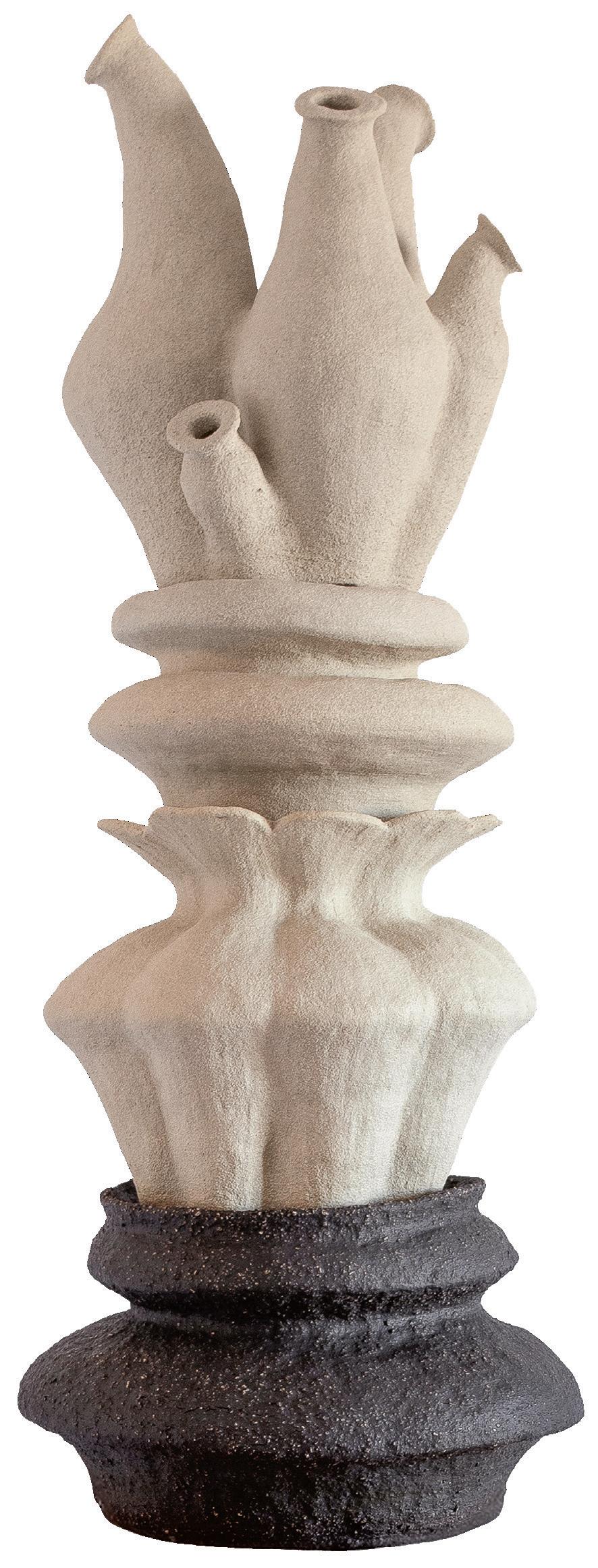
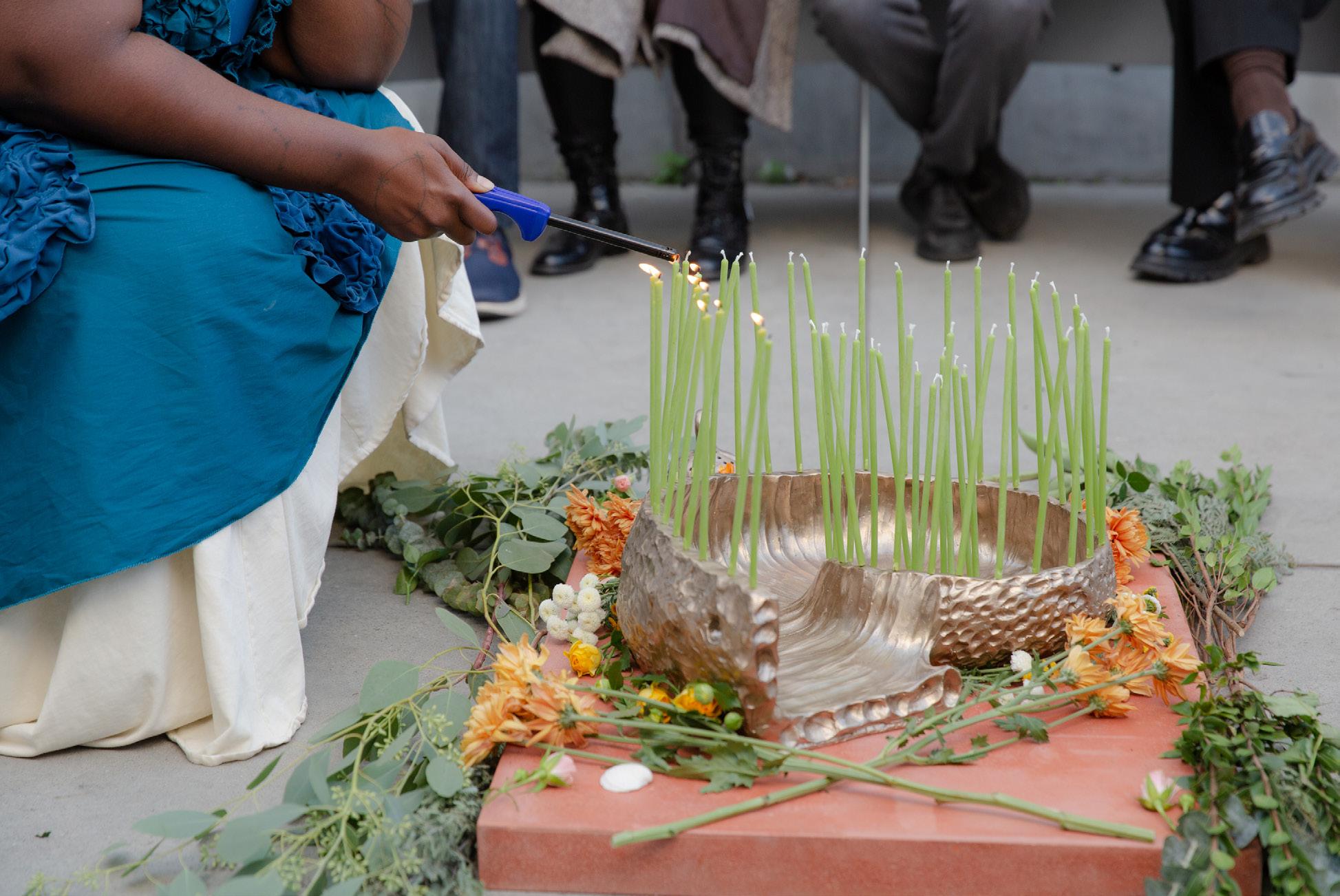
Ayla Tavares, Sonantes 10, 2024. Ceramic. Courtesy of the artist and Hatch Gallery. Photo: Pauline Assathiany.

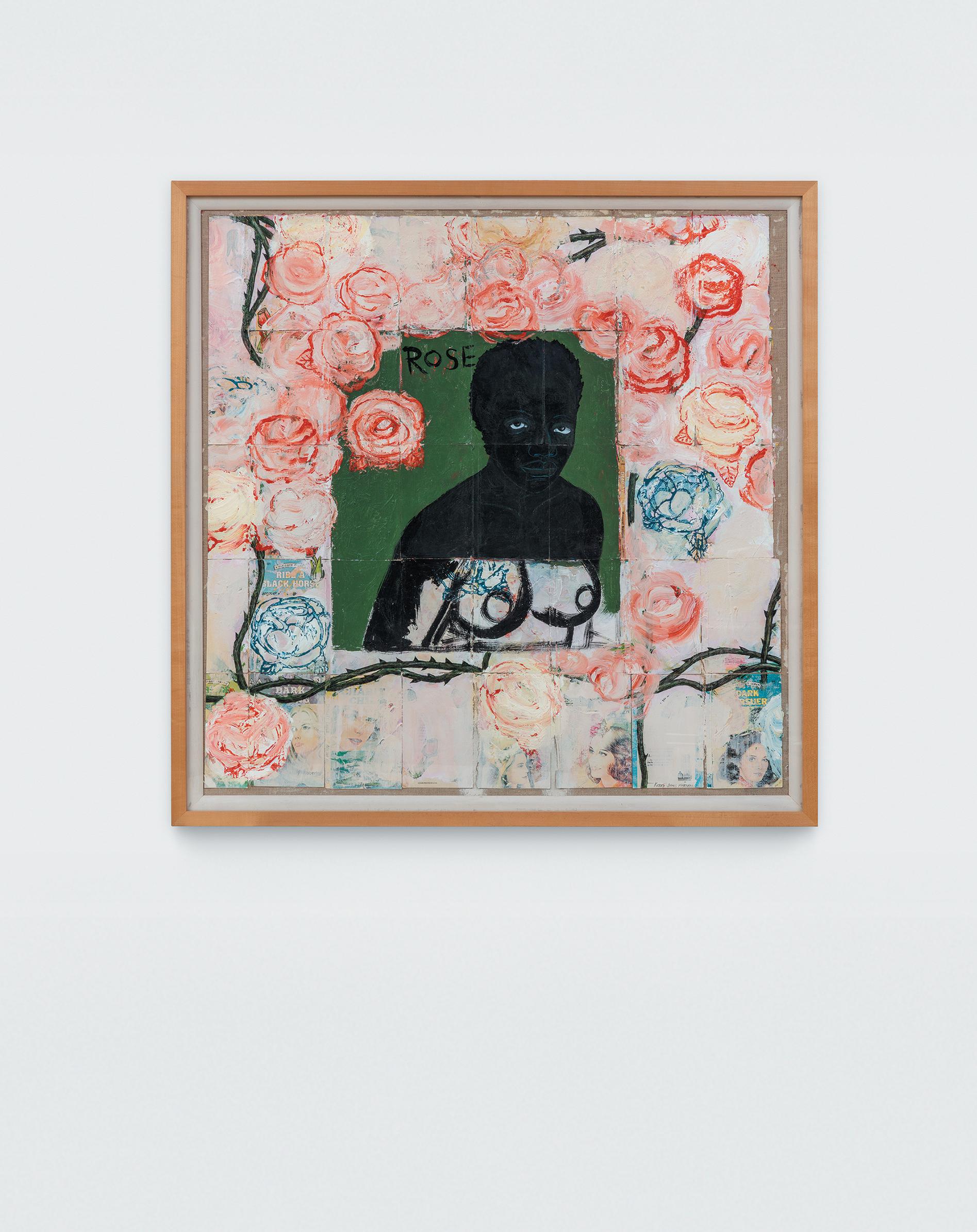


















When I first started Carla in 2015, I began to facilitate a process in which writers think critically about the artwork in our city, words get put to paper, and that paper gets disseminated across our town. I didn’t initially grasp that those words—which felt slippery and of the moment—were actually becoming part of something bigger and more diffuse: the archive. At the time, I didn’t consider my work significant enough to be “archival”—a notion that carries the consequence of institutional credibility. But I’ve come to see that we are all crucial parts of archivebuilding. (Yes, you too!) In Marie Heilich’s essay in this issue, she argues that archives “function at their fullest when put to work,” when people respond to them and make them anew.
A couple of years ago, we asked artist and curator Irene Tsatsos to reflect on Carla’s role as an archive. “There’s production happening and history being built at the same time… the archive is really being constructed in real time,” she said. This issue marks our 11th year of actively facilitating critical dialogue in Los Angeles’s art community. In this time, we’ve added to, investigated, and activated the archive. We have covered over 2,000 artists, 460 art spaces, and worked with hundreds of writers. Our readers are also an essential part of this real-time community archiving. We are building the plane together as we fly it.
We need artists to make, gallerists to exhibit, writers and editors to tease out each sentence on the page, and
readers to read. And we certainly need material support from our community. The reality of nonprofit art publishing often involves a tiny team that is underfunded and (frankly) a bit overworked. A recent study by the Literary Arts Fund showed that literary nonprofits only receive 1.9% of foundation support compared to the larger creative landscape (which includes music, art museums, dance, and theatre). And arts writing is an even slimmer piece of that pie. Yet, Carla’s team is buoyed by the work that we do and the immense value it has for our city—not just for today but tomorrow, too.
“[Carla is] a malleable, growing, evolving entity,” Tsatsos continued.
“[It’s] a place for telling our stories…by a community of people that may or may not even know each other directly.” Whether we have had the opportunity to meet or not, you are part of our team of archive-builders. Support for our work looks like reading, writing us an email to say hello, or coming to our events. If you are ready to engage a bit deeper, join Carla as a member, sign up for a mailed subscription (both of which you can learn more about at join.contemporaryartreview.la), or help us continue our work by donating money that goes toward our general operating budget, writers' fees, and so much more.
Carla continues to tell stories that future Angelenos will reference to learn about the artists and exhibitions that came before them, stories that will keep the archive alive and in motion. Thank you for your participation in supporting our work over the years, and I invite you to engage with us as we continue to reimagine the future, together.
Lindsay Preston Zappas Founder, Editor-in-Chief, & Executive Director
Contemporary Archives in L.A. and Beyond
Marie Heilich
On Panteha Abareshi and the Spectacle of Illness
Ella Ray
Censorship, Dialogue, and Institutional Responsibility in Trump’s America
Aleina Grace Edwards
Driftwork at Southern Guild —Nneka Jackson
Against Outer Space at the Beall Center for Art + Technology —Teresa Fleming
Sandra Vásquez de la Horra at ICA LA —Nahui Garcia
Beverly Semmes at Official Welcome —Silvi Naçi
(L.A. in N.Y.)
Vaginal Davis at MoMA PS1 —Aaron Boehmer
Horror at Sprüth Magers —Alexander Schneider
Farrah Karapetian
Rajiv Menon
Connects Cultures
Photos and text:
Claire Preston



Contemporary Art Review Los Angeles is an essential voice made in and for Los Angeles. Founded in 2015 by artist and writer Lindsay Preston Zappas, Carla is a nonprofit organization and publishing platform that is dedicated to providing critical, thoughtful, and inclusive perspectives on contemporary art. Our quarterly print magazine is an active source of dialogue on Los Angeles’s art community and is available for free in over 130 galleries and art spaces in L.A. and beyond.
Editor-in-Chief & Executive Director
Lindsay Preston Zappas
Managing Editor Evan Nicole Brown
Contributing Editor Allison Noelle Conner
Graphic Designer Satoru Nihei
Copy Editor Rachel Paprocki
Administrative Assistant Sierra Burton
Intern Lizzie Stewart
Color Separations Echelon, Los Angeles
Printer Solisco
Printed in Canada
Submissions
For submission guidelines, please visit contemporaryartreview.la/submissions, and direct all submissions to submit@contemporaryartreview.la.
Inquiries
For general inquiries, contact office@contemporaryartreview.la.
Advertising
For ad inquiries and rates, contact ads@contemporaryartreview.la.
W.A.G.E.
Carla pays writers’ fees in accordance with the payment guidelines established by W.A.G.E. in its certification program.
Copyright All content © the writers and Contemporary Art Review Los Angeles
Social Media
Instagram: @contemporaryartreview.la
Cover Image
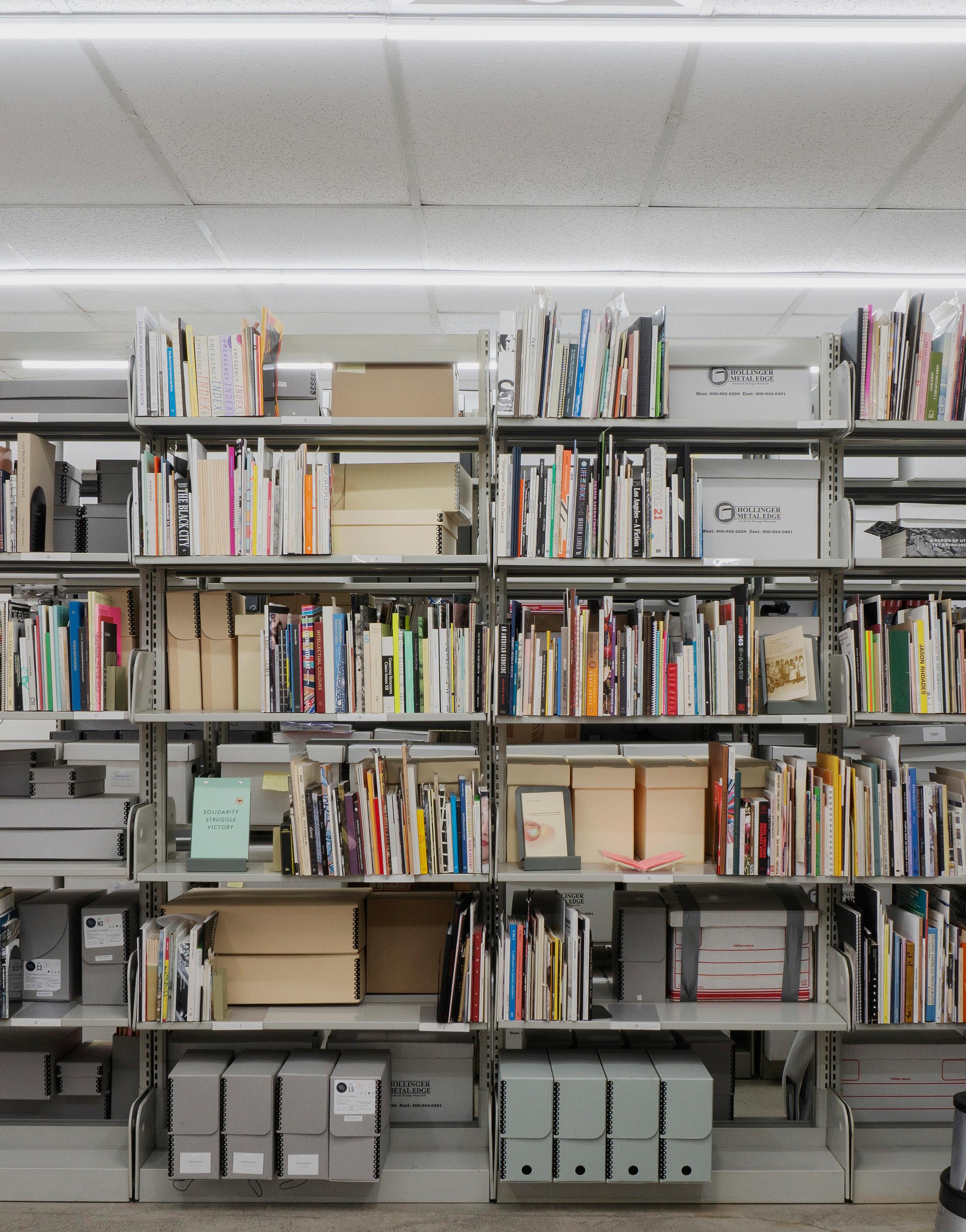
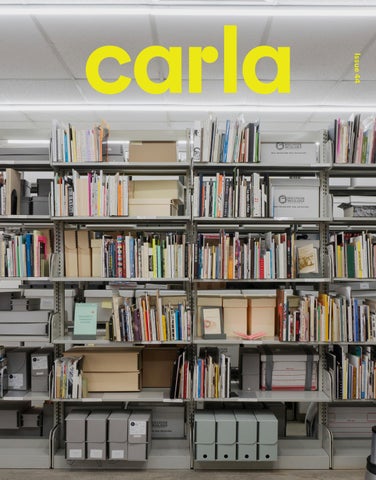
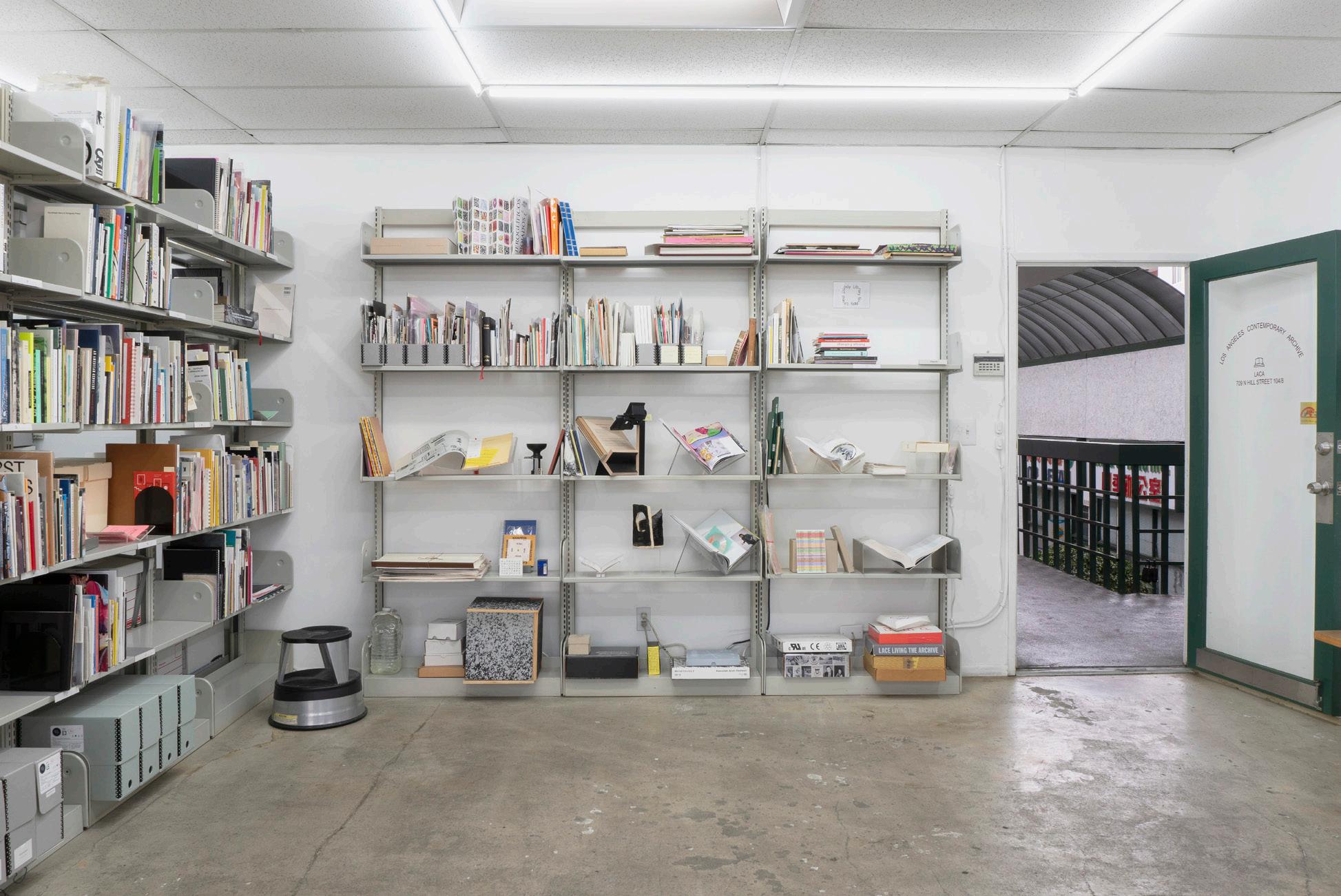
Artist book collection inside LACA's Reading Room. Image courtesy of Los Angeles Contemporary Archive (LACA). Photo: Max Cleary.
Contributors
Lindsay Preston Zappas is an L.A.-based artist, writer, and the founder of Carla. She received her MFA from Cranbrook Academy of Art and attended Skowhegan School of Painting and Sculpture in 2013. Her writing has appeared in Track Changes: A Handbook for Art Criticism, KCRW, Carla, ArtReview, Flash Art, SFAQ, Artsy, LACanvas, and Art21 Recent solo exhibitions include those at the Buffalo Institute for Contemporary Art (Buffalo, NY), OCHI (Los Angeles), and City Limits (Oakland).
Evan Nicole Brown is a Los Angeles-born writer, editor, and journalist who covers the arts and culture. Her work has been featured in Architectural Digest, Dwell, Getty Magazine, The Hollywood Reporter, L.A. Times Image, The New York Times, T Magazine, and elsewhere. She is also the founder and host of Group Chat, a conversation series and creative salon in L.A.
Allison Noelle Conner is an arts and culture writer based in Los Angeles.
Satoru Nihei is a graphic designer with an MFA from Cranbrook Academy of Art. His work has been featured in The Tokyo TDC Design Annual, METROPOLIS, Graphic Design: The New Basics, and other publications, and has been showcased internationally at exhibitions including the Golden Bee Global Biennale of Graphic Design, Peru Design Biennial, Graphic Matters, Trnava Poster Triennial, Shenzhen International Poster Festival, and others. He judged the 2019 PRINT Magazine Regional Design Awards and received the Golden Bee Award in both 2022 and 2024.
Rachel Paprocki is an editor and librarian who lives and bikes in Los Angeles.
Sierra Burton is an art professional and preparator based in Los Angeles. They were a participant in The Broad’s Diversity Apprenticeship Program and a 2025 ArtTable Fellow serving as a digital archivist for the Betye Saar Catalogue Raisonné at Roberts Projects.
Lizzie Stewart is a rising junior at USC studying journalism and art history. She is interested in exploring the intersection of art and journalism through print media, criticism, and artist profiles.
Board of Directors
Lindsay Preston Zappas, Executive Director
MJ Brown
Joseph Daniel Valencia
Membership
Carla is a free, grassroots, and artist-led publication. Club Carla members help us keep it that way. Become a member to support our work and gain access to special events and programming across Los Angeles.
Carla is a registered 501(c)(3) nonprofit organization; all donations are tax-deductible. To learn more, visit join.contemporaryartreview.la.
Thank you to all of our Club Carla members for supporting our work. A special thank you to our La Brea and Western members:
Anthony Cran, Audrey Olsen, Tim Disney, Sarah Ippolito, Tiffiny Lendrum, Rebecca Morris, Jobert Poblete, Michal Hall Bravo Ramirez & Octavio Bravo Ramirez, The Raskin Family Foundation, Anjelica & Neil Sarkar, Ian Stanton, Shahrzad Zarrinnam, Critical Minded, Solid Art Services, and West of West Architecture + Design.
Carla is grateful for the many individuals, foundations, and supporters who make our work possible. We are supported in part by:

Los Angeles Distribution
Central
1301 PE
7811 Gallery
Anat Ebgi (Wilshire)
Arcana Books
Artbook @ Hauser & Wirth
as-is.la
Babst Gallery
Baert Gallery
Bel Ami
Billis Williams Gallery
Canary Test
Central Server Works Press
Charlie James Gallery
Château Shatto
Cirrus Gallery
Clay ca
Commonwealth and Council
Craft Contemporary
D2 Art (Westwood)
David Kordansky Gallery
David Zwirner
Die Plek
dublab
Ebony Repertory Theatre at Nate Holden Performing Arts Center
Fernberger
François Ghebaly
FOYER–LA
Francis Gallery
Gana Art Los Angeles
Giovanni’s Room
Hannah Hoffman Gallery
Harkawik
Harper’s Gallery
Heavy Manners Library
Helen J Gallery
Human Resources
ICA LA
JOAN
Jurassic Magic Mid-City
Jurassic Magic MacArthur Park
KARMA
l.a.Eyeworks
LACA
Lisson Gallery
Los Angeles Municipal Art Gallery
Louis Stern Fine Arts
Luis De Jesus Los Angeles
M+B
MAK Center for Art and Architecture
Make Room
Matter Studio Gallery
Megan Mulrooney
Michael Werner Gallery
MOCA Grand Avenue
Monte Vista Projects
Morán Morán
Moskowitz Bayse
Murmurs
Nazarian / Curcio
Night Gallery
NOON Projects
O-Town House
OCHI
Official Welcome
One Trick Pony
Pace
Paradise Framing
Perrotin Los Angeles
Patricia Sweetow Gallery
Rajiv Menon Contemporary
REDCAT (Roy and Edna Disney CalArts Theater)
Regen Projects
Reparations Club
Roberts Projects
Royale Projects
Sea View
Sebastian Gladstone
Smart Objects
SOLDES
Sovern
Sprüth Magers
Steve Turner
St. Elmo Village
The Box
The Fulcrum
The Hole
The Journal Gallery
The Landing
The Poetic Research Bureau
The Wende Museum
Thinkspace Projects
Tierra del Sol Gallery
Tiger Strikes Asteroid
Timothy Hawkinson Gallery
Track 16
Tyler Park Presents
USC Fisher Museum of Art
Village Well Books & Coffee
Webber
Wönzimer
Ysasi Gallery
Zodiac Pictures
East
Feia
Feminist Center for Creative Work
Gattopardo
GGLA
John Doe Gallery
Junior High
la BEAST gallery
Marta
Nicodim Gallery
North Loop West
OXY ARTS
Parrasch Heijnen Gallery
Philip Martin Gallery
Rusha & Co.
South Gate Museum and Art Gallery
Staklena Kuća
The Armory Center for the Arts
The Pit Los Angeles
Umico Printing and Framing
Vielmetter Los Angeles
Vincent Price Art Museum
Wilding Cran Gallery
North
albertz benda
ArtCenter College of Design
ArtCenter College of Design, Graduate Art Complex
The Aster LA
Forest Lawn Museum
Angels Gate Cultural Center
D2 Art (Inglewood)
Experimentally Structured Museum of Art
Long Beach City College
The Den
Torrance Art Museum
West
18th Steet Arts
Beyond Baroque Literary Arts Center
Dorado 806 Projects
Laband Art Gallery at LMU
Marshall Gallery
Beverly’s (New York, NY)
Bortolami Gallery (New York, NY)
Bread & Salt (San Diego, CA)
Otis College of Art and Design
ROSEGALLERY
Von Lintel
Buffalo Institute for Contemporary Art (Buffalo, NY)
Chess Club (Portland, OR)
DOCUMENT (Chicago, IL)
Et al. (San Francisco, CA)
Fresno City College (Fresno, CA)
High Desert Test Sites (Joshua Tree, CA)
Institute of Contemporary Art San Diego (San Diego, CA)
Left Field (Los Osos, CA)
Level of Service Not Required (La Jolla, CA)
Los Angeles Valley College (Valley Glen, CA)
OCHI (Ketchum, ID)
Libraries/Collections
Alfred University Scholes Library of Ceramics (Alfred, NY)
Baltimore Museum of Art (Baltimore, MD)
Bard College, CCS Library (Annandale-on-Hudson, NY)
Brand Library & Art Center (Glendale, CA)
California Institute of the Arts (Valencia, CA)
Charlotte Street Foundation (Kansas City, MO)
Cranbrook Academy of Art (Bloomfield Hills, MI)
Getty Research Institute (Los Angeles, CA)
Los Angeles Contemporary Archive (Los Angeles, CA)
Los Angeles County Museum of Art (Los Angeles, CA)
Maryland Institute College of Art (Baltimore, MD)
Midway Contemporary Art (Minneapolis, MN)
Museum of Contemporary Art (Los Angeles, CA)
Pepperdine University (Malibu, CA)
San Francisco Museum of Modern Art (San Francisco, CA)
School of the Art Institute of Chicago (Chicago, IL)
The Metropolitan Museum of Art (New York, NY)
University of California Irvine, Langston IMCA (Irvine, CA)
University of Minnesota Duluth, Tweed Museum of Art (Deluth, MN)
University of Pennsylvania (Philadelphia, PA)
University of Washington (Seattle, WA)
Walker Art Center (Minneapolis, MN)
Whitney Museum of American Art (New York, NY)
Yale University Library (New Haven, CT)

Scan to access a map of Carla’s L.A. distribution locations.
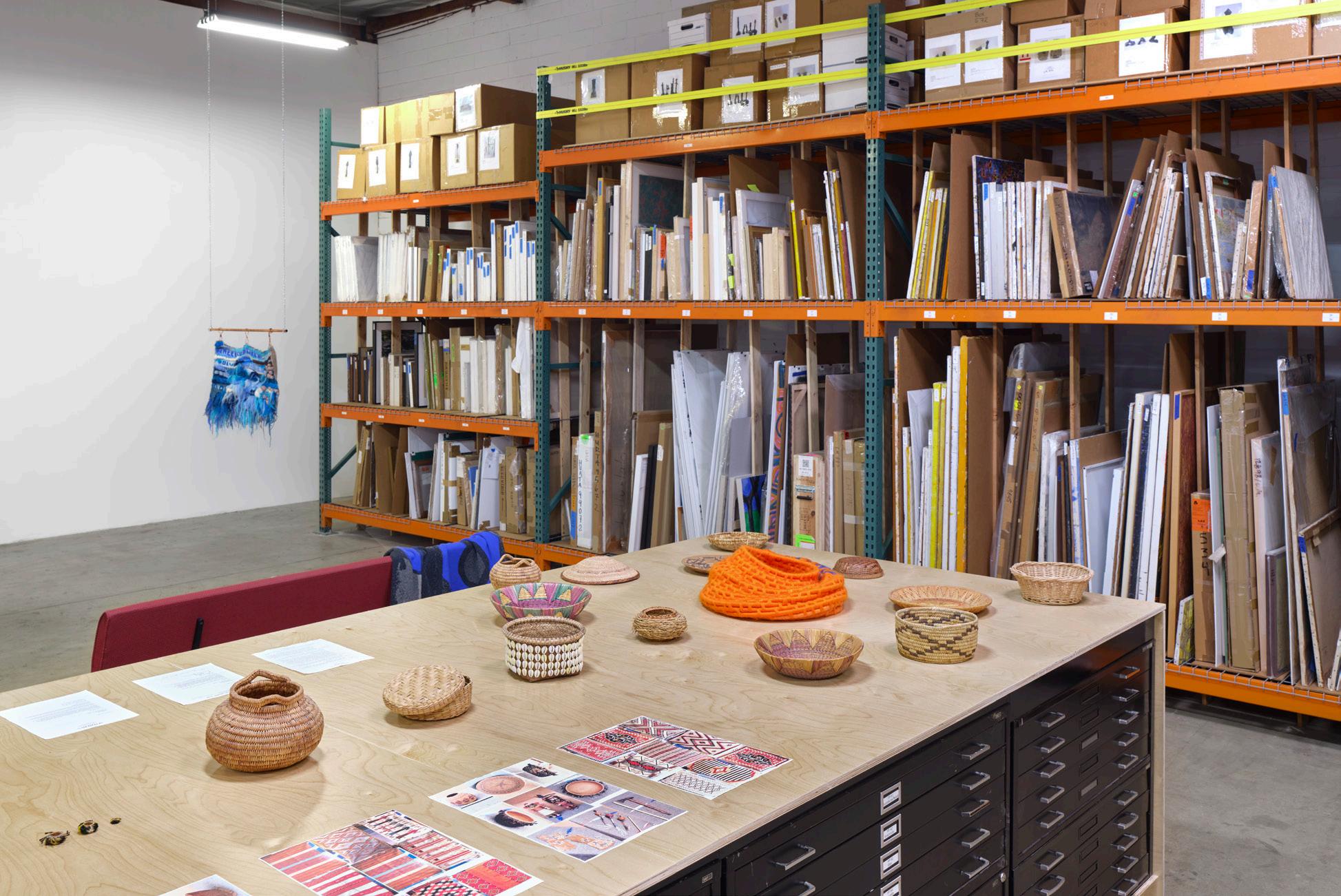
Over the past few years, conversations with artists around my engagement with the estates of Luchita Hurtado and Lee Mullican began opening new perspectives on two practices I thought I knew well. My work with Hurtado began through independent interviews, which later informed the biographical timeline I prepared for her retrospective at the Serpentine (2019) and LACMA (2020). In the years that followed I continued researching and writing on the work of Lee Mullican, Hurtado’s late husband, and aided in processing the estate’s archive after Hurtado’s passing in 2020. Along the way, dialogue with artists repeatedly expanded the universes of these distinct practices into the present moment in ways that neither the archive nor existing scholarship accounted for. In response, I initiated Wolfpack HQ, an exhibition series within the estate archive itself, borrowing the name that Hurtado gave to her studio entity. Working with artists in this context has become a way of continuing the legacies of two figures who lived steeped in their art and artist communities, inviting contemporary artists to learn from and respond to their archive in the present.
This project brought to my attention other organizations, artists, and estates across California, as part of a wider turn, that are similarly approaching archives as sites of production, prioritizing proximity and use over restriction and codified procedure. Diverging from traditional
curatorial conventions, they exceed preservation and engage what’s still contested or withheld, as archives function at their fullest when put to work. In the following examples, wayfinding is foundational, displacing bureaucratic containment with political readiness and collective learning. Within such work, retention, organization, and access are continually negotiated, as the present repositions the past with each archival act, rearticulating history anew.
In Shakespeare’s Cymbeline, “the same dead thing alive” describes a law that only becomes real in execution. The phrase also names a mode of archival practice where past work returns to generate new forms, while questions of stewardship, access, and sustainability remain in play. Art history persists, but its modes of engagement are changing. Rather than aiming for closure, such models enlist artists as collaborators to activate and interpret materials in relation to the present. In doing so, they create conditions for inquiry and new production, keeping histories active, nuanced, and in dialogue with present political realities.
Twelve years ago, the shelves of Los Angeles Contemporary Archive (LACA), a nonprofit archive and library built through collective participation and community authorship, were empty by design in acknowledgment of the organization’s roots in institutional critique. Materials accrued gradually, selected by artists and organizers for their capacity to respond to the present moment and inspire new projects. As acquisition proceeded through open submission and discussion-based review, LACA has assessed materials for their ability to generate new insight. With this evolving framework, LACA’s collections bring artist-run spaces, studio documents, performance ephemera, union organizing, sex work, child care, death care, and immigration documentation into relation, while steering committees from members of these communities author collection descriptions to produce a composite
Marie Heilich
of L.A.’s underrepresented cultural labor that risks falling outside the scope of major institutions.
In defining an archive as a collection of material set in relation, information emerges through ongoing interpretation. For example, in 2015, LACA commissioned Scott Benzel to create Sonatine Bureaucratique, an essay borrowing its title from Erik Satie’s 1917 composition of the same name. Satie’s piece, itself a humorous appropriation of a classical piano sonatina by Muzio Clementi, narrates a bureaucrat’s uneventful day at the office through marginal notes inserted into the score: He arrives, dreams of promotion, listens to a nearby piano, and leaves, having accomplished nothing. Developed through research using materials held at LACA, in his essay Benzel references catalogs and artist books by Douglas Huebler, Charles Gaines, Guy de Cointet, and Seth Siegelaub, foregrounding procedures of enumeration, coding, and dematerialized circulation. With Satie’s satirical score as guide, the project considers how conceptual art’s refusal to work has mutated into fully realized systems of surveillance, simulation, and data extraction. Benzel’s project thus pivots from Satie’s gently satirical portrait of bureaucratic boredom to a contemporary condition in which the history of conceptual propositions have been absorbed into networked governance, their once impossible gestures now internalized, what once stalled meaning now accelerating control for profit. By drawing together dispersed archival materials into a single, operative frame, the project re-engages the archive as a site where legibility is actively rewritten, coming to resemble the social field that produced it by recalibrating its stakes as cultural and political contexts shift. If LACA draws the social field into the archive, 18th Street Arts Center in Santa Monica works from the inside outward, reanimating its own discursive history as a means for performance to engage community. At 18th Street the archive is currently activated through High Performance: A 2-Year
Conference (2025–2027).1 In partnership with the burgeoning artist-founded Performance Art Museum, the complete 72-issue run of High Performance is being digitized and made publicly accessible. Founded in 1978 by Linda Frye Burnham and Steven Durland and published through 1997, the quarterly was produced by the nonprofit Astro Artz from 1983 to 1995, an organization that would later become 18th Street Arts Center. Across its run, High Performance documented performance as social intervention, urban maintenance, and collective address well before such modes were formalized as social practice and relational aesthetics. As part of 18th Street’s initiative, a reading group revisits Burnham and Durland’s book The Citizen Artist, which distilled the magazine’s ethos into a theory of artists as civic actors shaping public life. The archive, in turn, becomes a foundation for future practices, a reminder that performance has always operated with its finger on the pulse of embodied civic life, social relations, and labor.
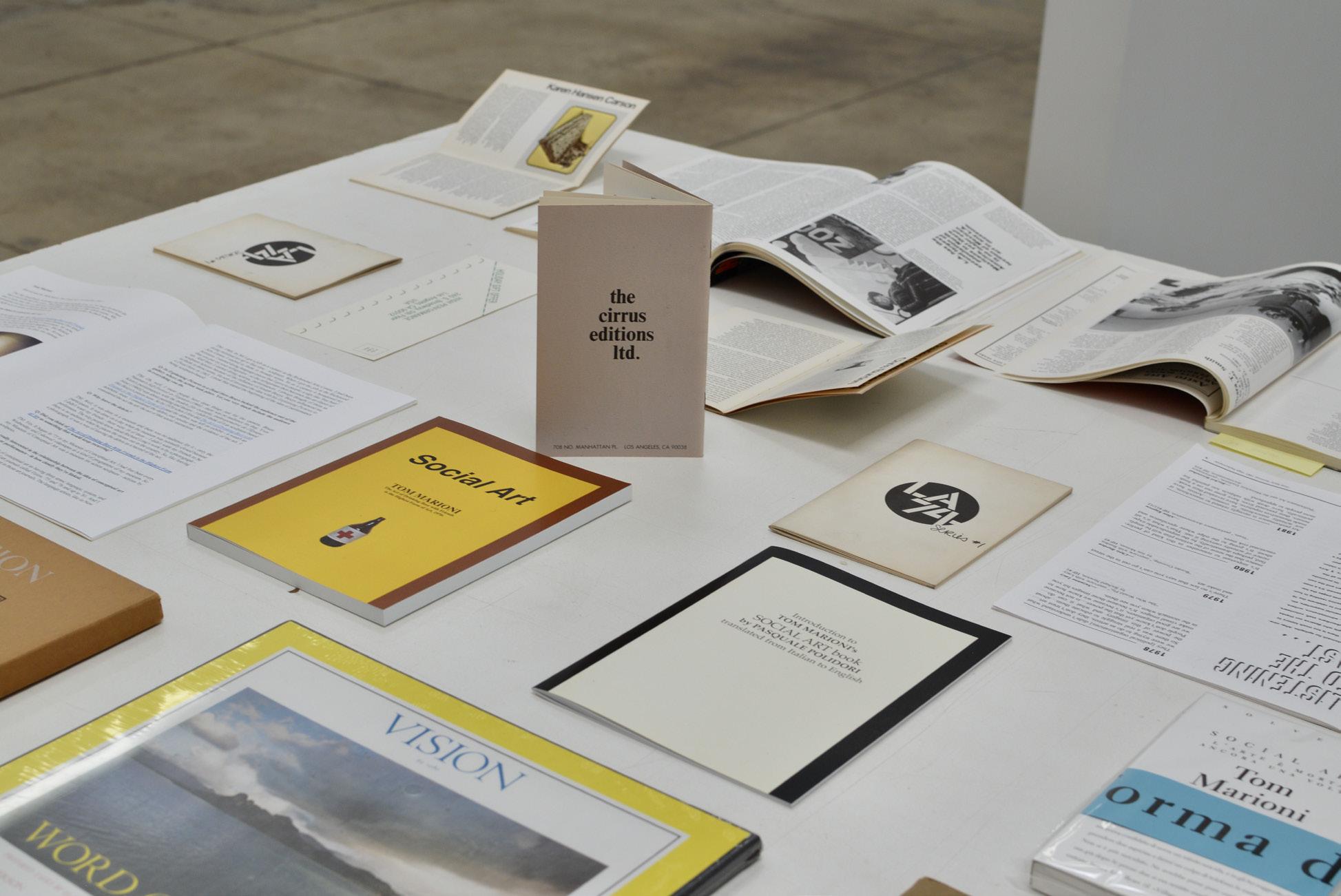
With a similar impulse for immediacy, the active and agile Society of Art and Living Archives (SALA) focuses on California’s cultural history through public programs including exhibitions, workshops, and walking tours. The nomadic project, which recently expanded its Los Angeles roots to the Bay Area, operates as a salon-like, peer-driven alternative to more formal institutional models. Functioning as a roaming archive and social site, SALA moves at a faster pace, connecting historical material with contemporary artist networks. This approach was evident in LIVING PROOF / LIVING ARCHIVES: Action Artefact, a recent exhibition at Cirrus Gallery where artists engaged prints and ephemera from the gallery’s archive through new production, including a ring-suspended printed silk scarf Spotted Lantern Moth (2026) by Frances Stark, made in response to Chris Burden’s If you fly, if you drive (1973). While engaging specifically with Cirrus’s archive here, the exhibition exemplified SALA’s commitment to keeping California’s
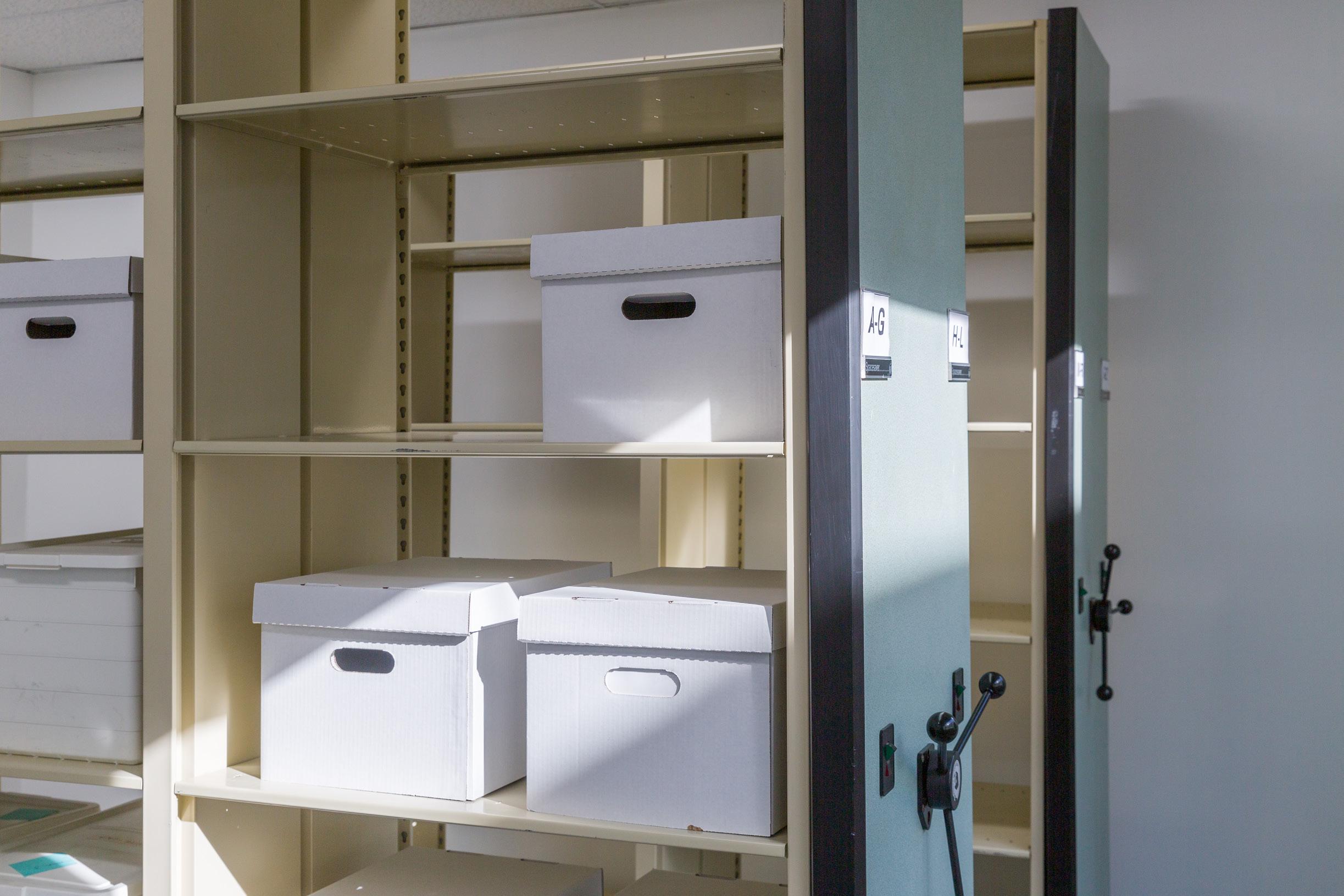
archival material in circulation as a site of ongoing interpretation.
While organizations such as LACA, 18th Street, and SALA approach the archive as a collective resource for research, discussion, and new artistic production, artist estates, inseparable from specific artists’ legacies, are increasingly activating their archives through exhibitions that place historic artists in dialogue with contemporary practices to think alongside, extend, or reconsider the artists’ concerns.
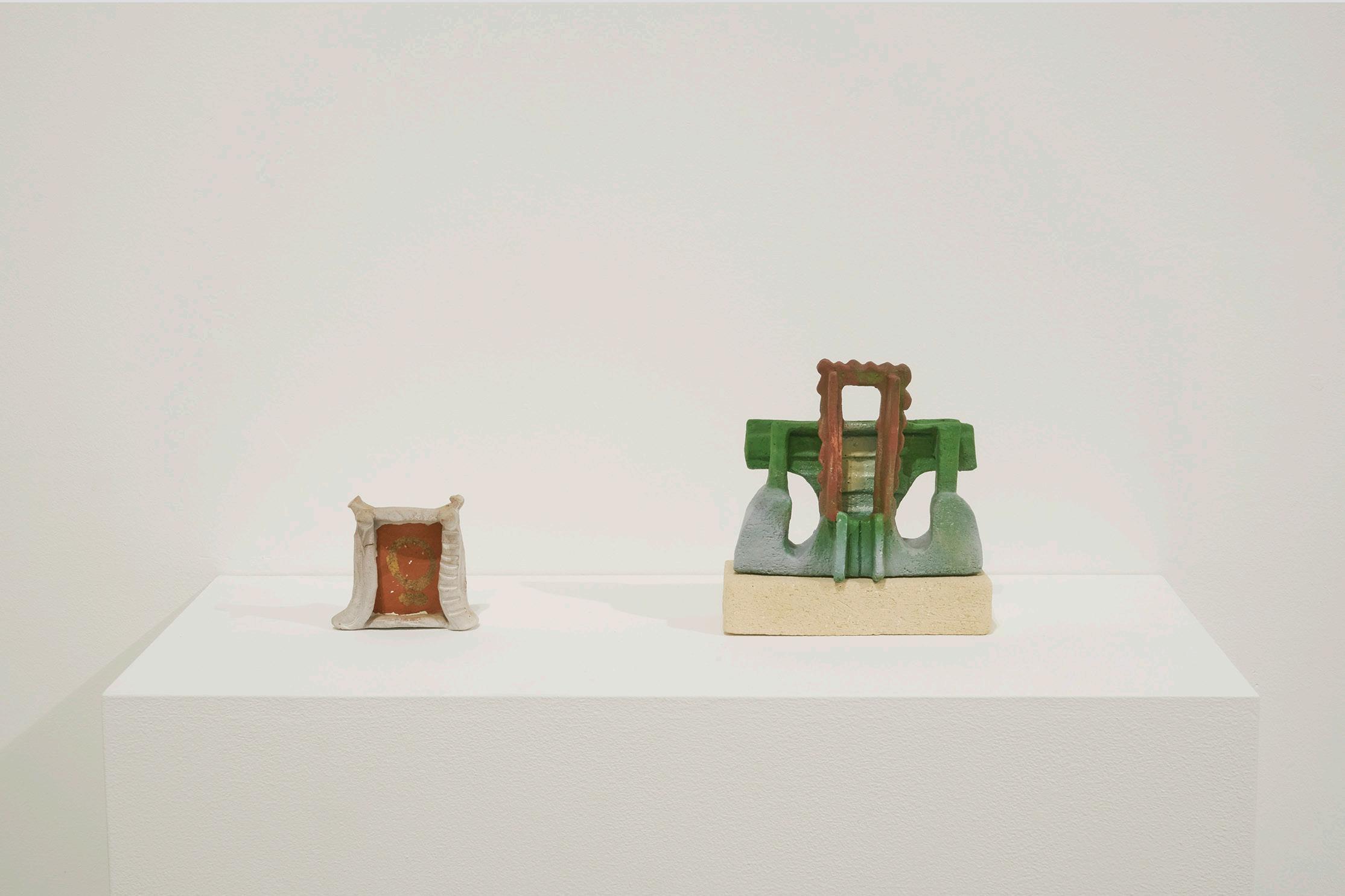
At Blunk Space in Point Reyes, the exhibition arm of sculptor JB Blunk’s estate, the 2023 exhibition JSP JBB paired artist James Sterling Pitt and JB Blunk in a cross-generational conversation. New ceramic works by Pitt were put in proxy with Blunk’s ceramic trays from the 1970s and ’80s. While Blunk’s shifting relationship between positive and negative space negotiates use, Pitt’s clay sculptures draw from an object journal developed in response to traumatic brain injury, where drawing served as calendar and prosthetic memory. Their scaled-down architectural forms relate inner and outer worlds, extending Blunk’s investment in the relation between interior and exterior space and reconsidering Blunk’s work alongside a contemporary counterpart.
While Blunk Space operates from a site separate from where the artist once lived and worked, projects such as 500 Capp Street and TOM House stage exhibitions within their artists' homes and studios. Once home to David Ireland in San Francisco’s Mission District, the nonprofit 500 Capp Street brings Ireland’s home and archive into contemporary discourse, inviting risk, experimentation, and new production. Since late 2024, the program has shifted to a collective leadership model, replacing a single director with shared oversight, embedding decolonization research, social practice, and land use into its curatorial methods and institutional structure. Programming now emphasizes Bay Area and California-based artists, treating
locality as a working condition through artist-driven and process-oriented exhibitions. Recent residencies, including yétúndé olagbaju’s 2023–2024 term, inspired this approach after the artist redistributed their funds to collaborators, foregrounding collective labor and social infrastructure.
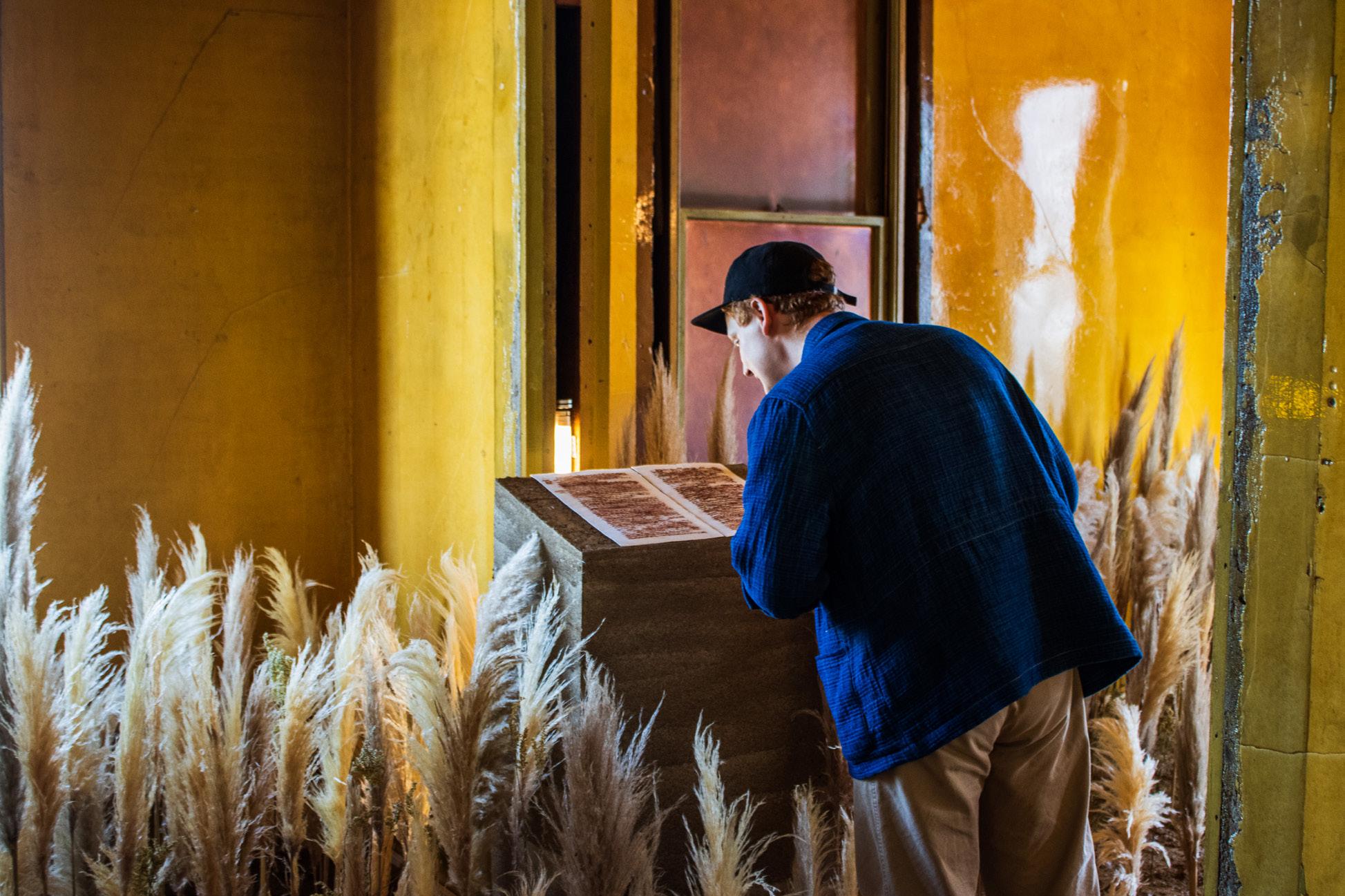
Trina Michelle Robinson’s recent 2026 exhibition Open Your Eyes to Water, co-presented between 500 Capp Street and the arts organization Root Division, sets Ireland’s archive in conversation with the legacy of conceptual art and institutional critique. Drawing on records and matter gathered over two decades before she was a practicing artist, Robinson works with ledgers, wills, tax records, soil, water, and sound gathered from sites of the transatlantic slave trade. In the mixed-media work Liberation Through Redaction (2022–2026), Robinson partially obscures documents that listed enslaved people as property, stitching over the text with red thread while leaving names visible. Field recordings gathered in Ohio and California play throughout the house, linking the domestic scale of 500 Capp Street to Robinson’s wider diasporic landscape. Drawing on a practice that is both archival and embodied, the artist considers the body as a “memory index,” situating ancestral traces and imagined heirlooms between what was recorded and what remains unacknowledged. Rather than illustrating a direct relationship to Ireland’s archive, the exhibition stages a dialogue between practices, using the archive as a site where conceptual art’s strategies of redaction, repetition, and indexicality are engaged critically in Robinson’s process-based material practice.
The Tom of Finland archive offers another example of how archival structures can be organized collectively from within a site where the artist lived and worked. When the nonprofit was established in 1984, its founders recognized that the archive would need to take an open, collective form rather than one that’s closed and singular. Erotic art, photographs, zines, correspondence, and ephemera around Tom’s work
entered the collection through acts of trust by the members of the queer community who submitted them, rather than institutional mandate. Today, the Tom of Finland Foundation holds an extensive collection, preserving access for future generations to encounter queer histories in their original material form. Maintained by a librarian alongside volunteers, the library continues to be a labor of love, offered equally to artists-in-residence, researchers, and visitors.
This logic continues in the Foundation’s artist in residency program through which new work is made, lovers meet, and boundaries are tested and reimagined. As m black, an artist-inresidence, observed, the Foundation functions as a place where “people find each other.” In this sense, pleasure becomes a methodology of attention, consent, and community. Recent artist-in-residence Yinon Avior Philivsohn’s exhibition Torn Suspense worked with what the artist calls “the underworld of the archive,” images and materials marked for loss, twice over. Drawing from photographs in the Tom of Finland collection of artists who died of AIDS alongside scraps from a BDSM magazine collection deemed too materially worn for official preservation, Avior Philivsohn committed to what he describes as “the discarded of the discarded.” Scanned, enlarged, and reprinted fragments are quilted into gridded surfaces where stitches mark labor integral to the new image. Protective coatings preserve even as perforations penetrate, suspending the work between risk, trust, and aftercare.
Taken together, these practices show how historical materials can circulate to respond to evolving social, political, and artistic contexts. They complicate and multiply standardized art histories, favoring intimacy, immediacy, and primary stewardship over comprehensive coverage or authoritative resolution, emphasizing the ethics of archival practices rather than straightforward administrative procedure. As Jacques Derrida reminds us, “effective democratization can
always be measured by this essential criterion: the participation in and the access to the archive, its constituting, and its interpretation.”2 What emerges is not simply retrieval, but a belated clarity where the past becomes legible, its meaning cohering only in retrospect.
Across these practices, historical material is afforded the capacity to generate new contexts. Museums enter at later stages as sites of preservation and historical contextualization, yet the vitality of larger institutions depends on earlier forms of care that accept uncertainty as necessary and reimagine archives as living infrastructures sustained by ongoing interpretation. Here, the archive is a site of pressure, where what cannot be fully known continues to exert meaning by keeping its tensions alive. Rather than resolving into stable narratives, these practices stay with the present, understanding history without endpoint. Operating outside codified conventions, such projects demonstrate how archives remain productive when responsiveness and relation take precedence over closure, extending the past into the present while holding open futures still under negotiation.
Marie Heilich is a writer and curator in Los Angeles. Her writing appears in BOMB, Texte zur Kunst, IMPULSE, The Whitney Review of New Writing, Artforum, artist monographs, and exhibition catalogues.
1. Participating institutions include 18th Street Arts Center, Getty Research Institute, Los Angeles Contemporary Exhibitions, Highways Performance Space and Gallery, and Performance Art Museum.
2. Jacques Derrida, Archive Fever: A Freudian Impression, trans. Eric Prenowitz (Chicago: University of Chicago Press, 1996), 4.
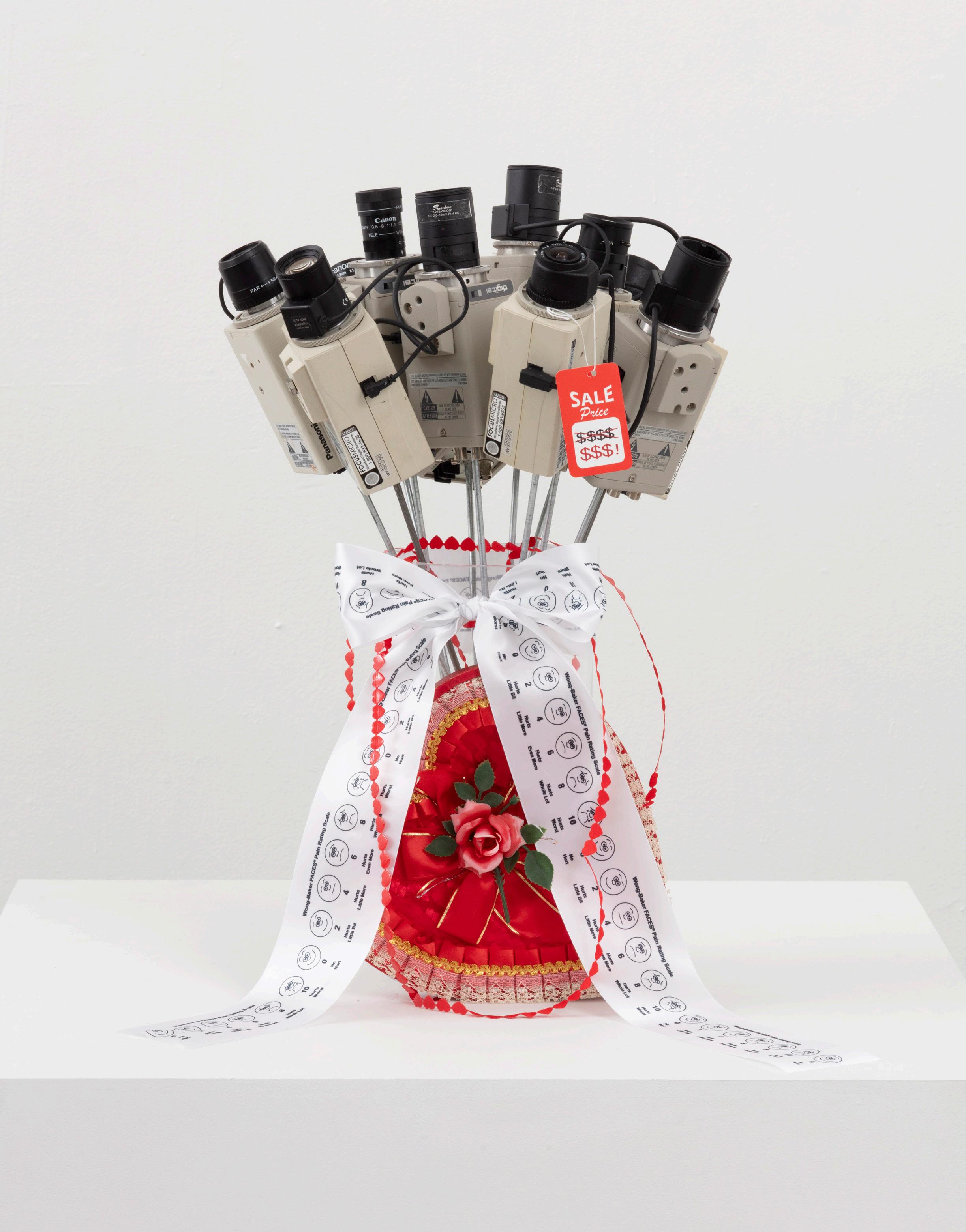
Everyone is getting sicker. Measles, a deadly virus once eradicated in the U.S., reached a record number of cases in January of this year.1
Infections from COVID-19 are ceaselessly downplayed despite the serious consequences of contracting the illness. Our working conditions are only becoming more dangerous and more disabling as we attempt to survive this technofascist regime. And while the boundaries between well and unwell, disabled and abled have always been porous —not to mention crucially dependent on race, class, nationality, and gender—the current sociopolitical conditions are shortening these gaps considerably. Instead of this dynamic leading to greater access to health care for all people, binaries like “healthy” and “sick” are weaponized by the state to reify further what scholar Robert McRuer calls “compulsory able-bodiness,” or the idea that a “normal” person is able-bodied, heterosexual, white, and neurotypical.2 In this logic, health is defined as the absence of all illness and disability. “The sick,” or those of us in deviant bodies, then endure surveillance and regulation in an attempt to reach archetypal normality or to survive our abject positionality.
Panteha Abareshi’s exhibition
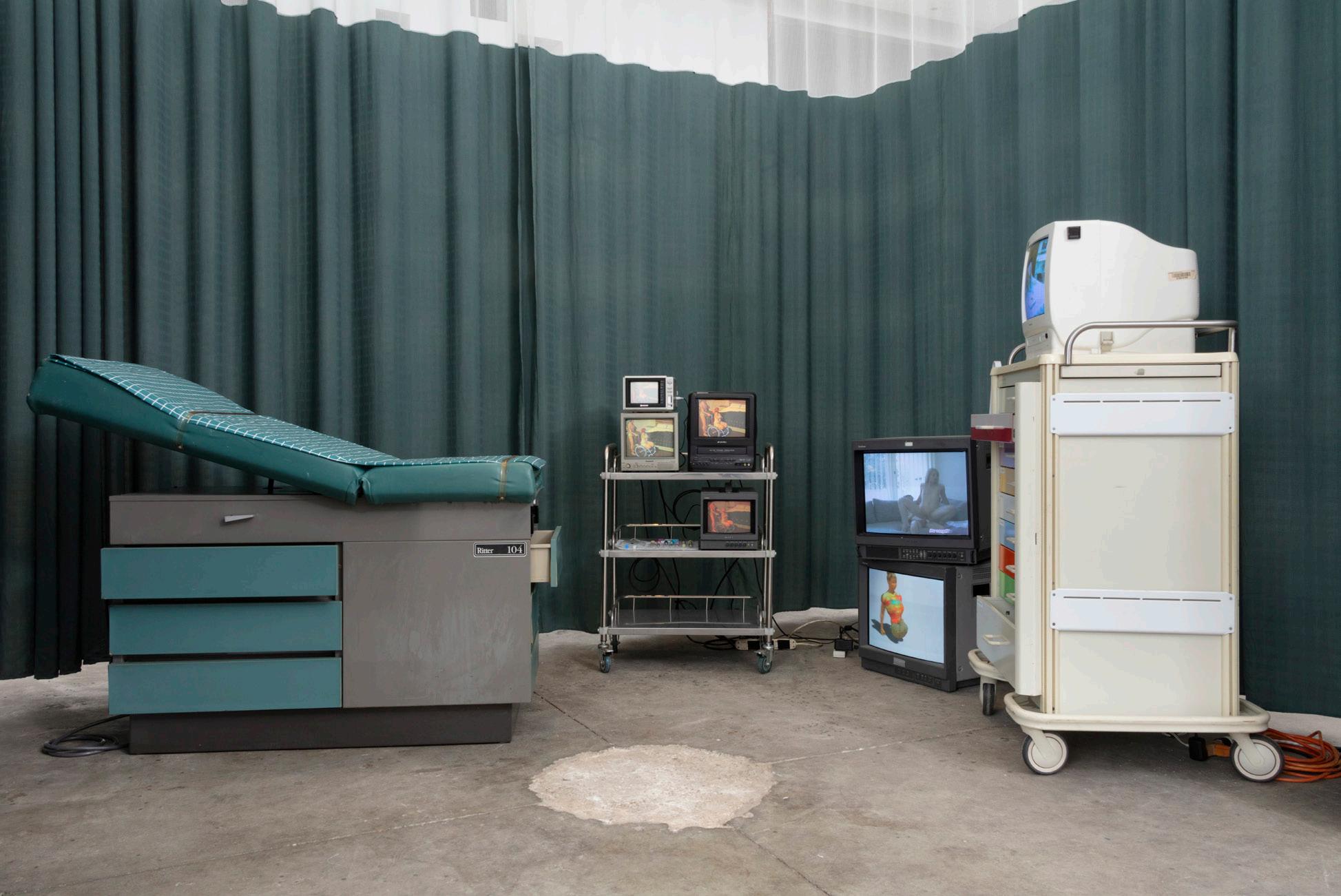
CAREROTICS: On Giving and Taking, presented at Human Resources last November, considered this spectacle of illness with refreshing directness. The exhibition, an uncanny combination of video works, conceptual sculpture, and installation, transformed the gallery
space into what felt like a sterile medical clinic. In the middle of the gallery, a drab teal curtain created a partitioned facsimile of a doctor’s office, a pop of color against the white box’s starkness. Across the exhibition, artworks included plastic hospital mannequins, prescription notepads, tubing, and other medical equipment—rendering an unfiltered portrait of the ephemeral excesses of the body in pain and illness.
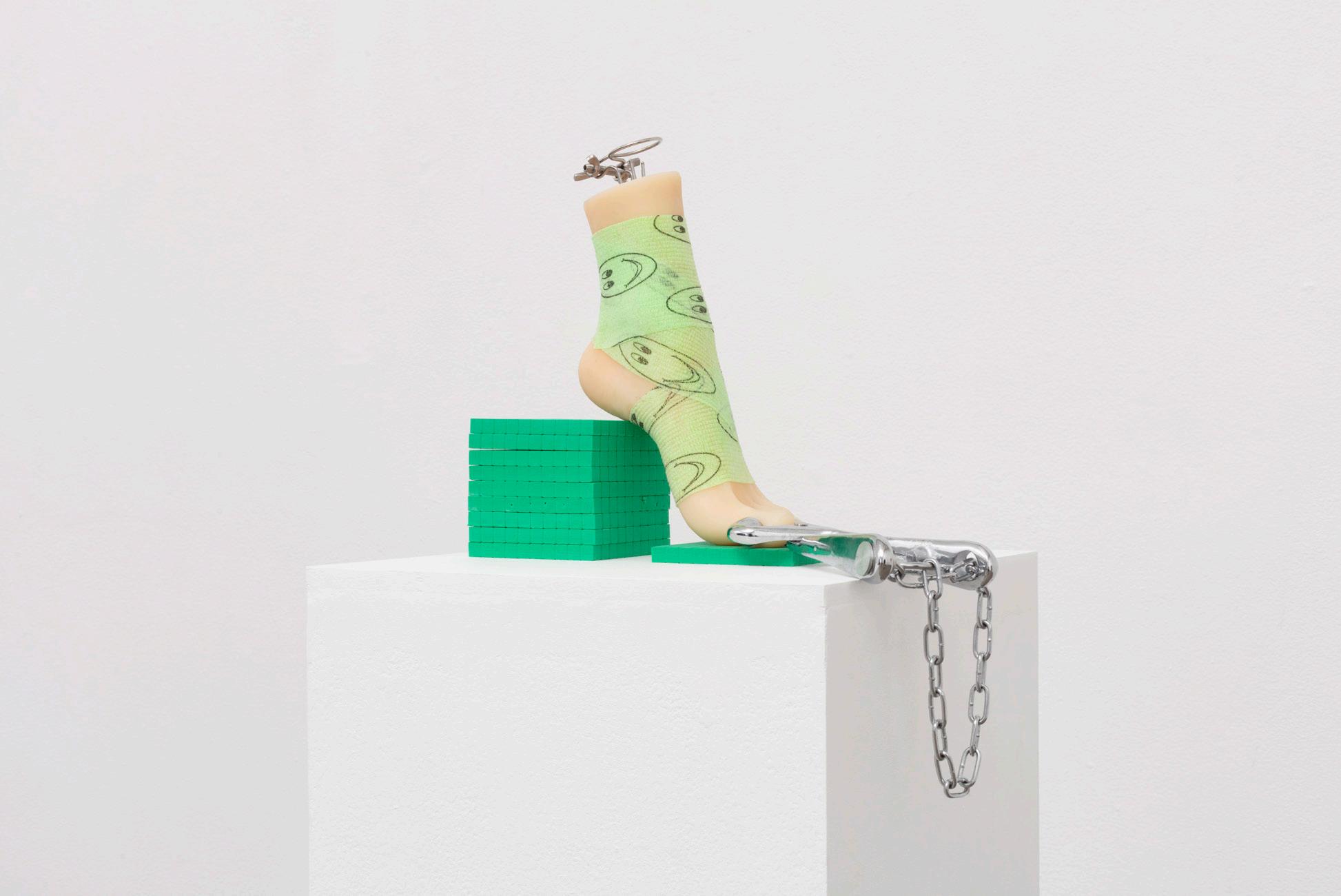
Abareshi, a Black, queer Los Angeles-based artist, describes their practice as being rooted in their “contending with multiple medical illnesses, at the foundation of which is sickle cell zero beta thalassemia —a genetic blood disorder that causes debilitating pain and bodily deterioration, both of which increase with age.”3 While the body—in extreme pleasure and pain—is unmistakably central across their practice in content and materiality, formally, their work takes many shapes, including video, installation, sculpture, and performance. Through the employment of hospital aesthetics and a sadomasochistic grammar, Abareshi uses the disabled body (often their own) to interrogate the hypervisibility and invisibility of their condition, and the simultaneity of those realities.
EXAMINATIONS (2025), for instance, pushes the politics of disabled sexuality beyond asexual assignment into a fetishistic arena, implicating the audience in the potential enjoyment of taboo representations of disability. Inside a curtained area in the gallery partitioned from the rest of the show, an empty medical examination table, a crash cart, and several CRT monitors were installed. Amidst medical ephemera, such as vials, gloves, and syringes, neatly organized on surfaces as if prepped for a procedure, “cripple porn” —as it is named in the gallery label—played on a set of TV monitors. Here, “cripple porn” is not merely figurative, but literal pornography featuring both real and simulated amputees, wheelchair-bound folks, and other disabled people having sex with themselves and each other.
Ella Ray
Though this appropriation and exhibition of pornography directly opposes dominant indexes of disabled and sick people as “docile” or “de-sexed,” this media’s proximity to the fabricated medical environment creates an urgent tension between subject and object, where the nude disabled body is both vulnerable and empowered.
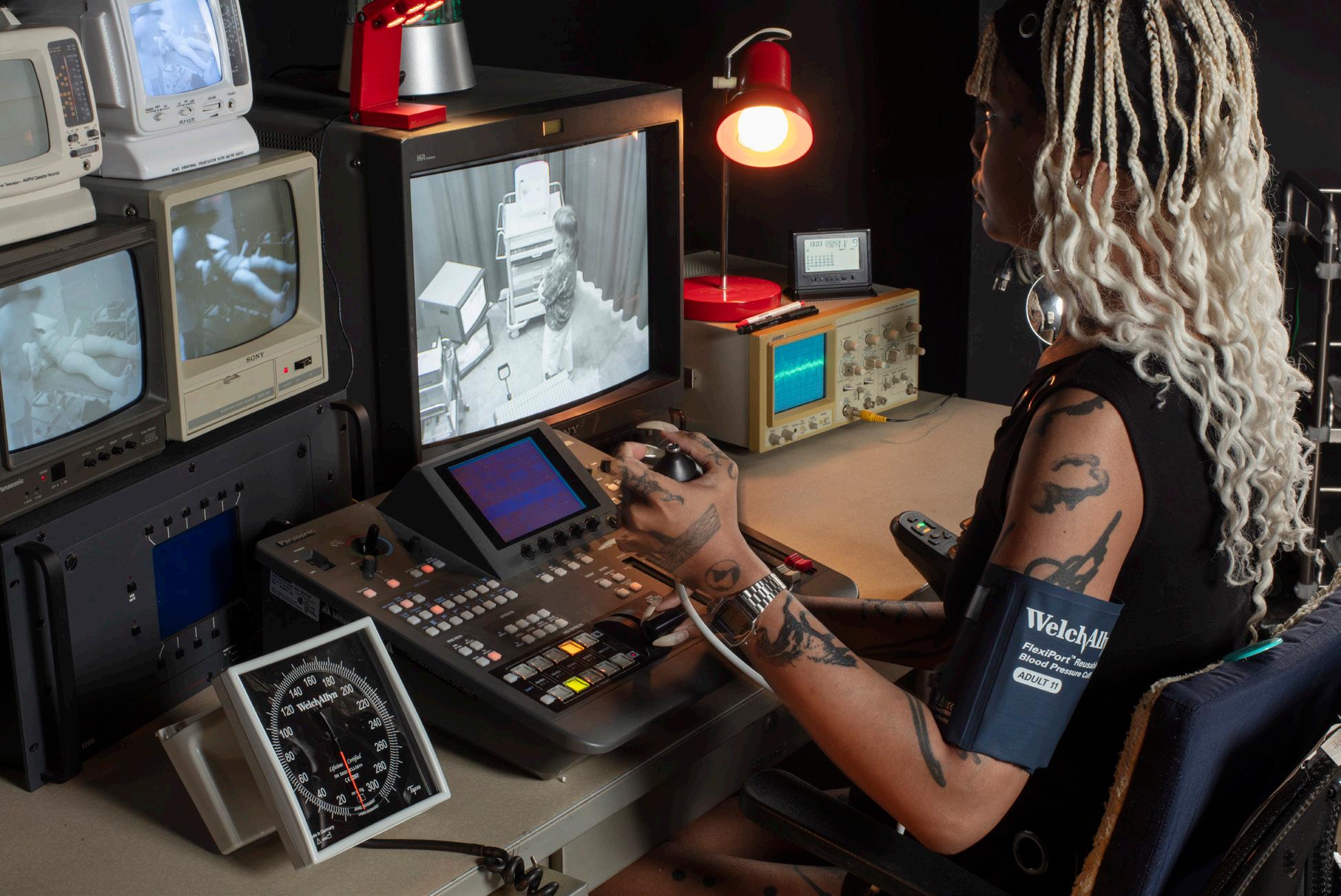
During the exhibition, Abareshi monitored this area from a control room in the gallery’s back room, where the artist captured surveillance footage of visitors and curated, in real time, what appeared on the monitors in the gallery, switching between different disabled erotic material. The objects and images within the curtain brought to the surface how easily medicalization and fetishization, in process and aesthetic, can merge. Abareshi, now the one watching us, invited participants into this highly monitored medical environment where the public in the role of gallery spectator were now the artist’s specimen.
In this power play, Abareshi’s physical absence from the gallery space refuses the expected hypervisibility of Blackness and disability. Within the medical establishment, legible performance of disability that subscribes to the notion of disabled people as “bodies to be fixed” ironically often results in greater material access to medical and social forms of care. The artist has spoken about the practice of intentionally excluding legible renderings of their body as a means of “tearing their body away from any sort of corporeal definition, refusing to allow [their] body to even be identified as a body and taking away the validity of it.”4
When closely examining works from Abareshi’s exhibition in relation to mainstream conceptualizations of disability and illness, it becomes increasingly apparent how the disabled body is made into what the artist calls “a vessel for the taboo corporeal fears and desires of the able-bodied audience.”5 CAREROTICS confronted this watchful audience and clearly spotlighted our participation in this dynamic.
Although disabled artists critically interrogating the spectacle of illness is nothing new, this work gains potency when it meets with an increasingly ill and debilitating world. Abareshi’s works can be situated alongside a lineage of disabled and chronically ill artists—Bob Flanagan, Donald Rodney, and Xixi Edelsbrunner —who also use their experience as medicalized subjects to explore erotic desire, objectification, and authority. Considering this cosmology reveals not only theoretical and aesthetic linkages between these “sick” artists, but underscores the normalized, yet deeply ableist social choreographies that seek to neutralize care and pacify disabled people.
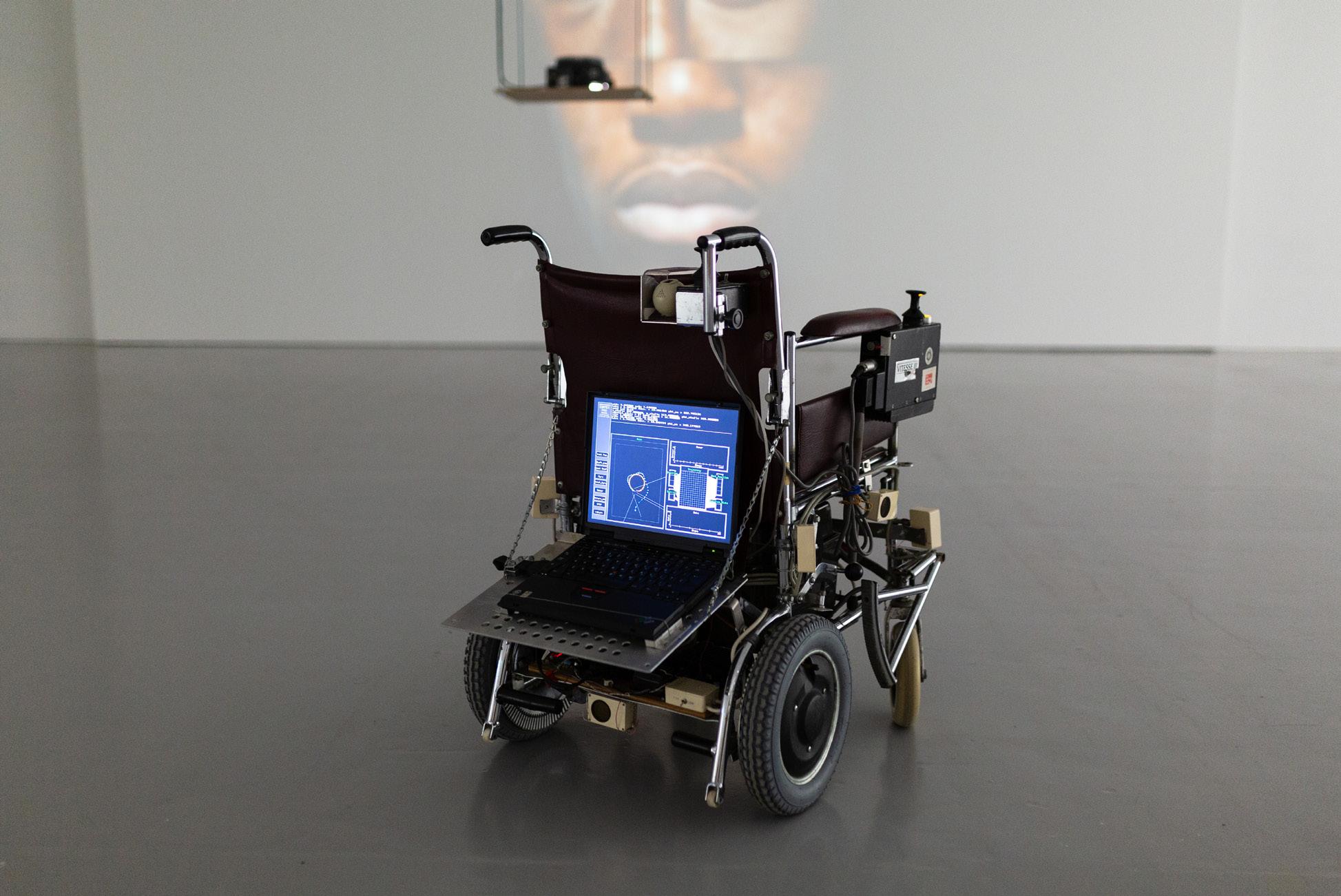
The empty examination table in CAREROTICS recalls Donald Rodney’s (1961–1998) Psalms (1997). The piece, a remotely controlled, empty motorized wheelchair, attended a gallery opening in Rodney’s place at the end of his battle with sickle cell anemia. While some read this piece as Rodney’s “avatar” in absentia, a Black disabled embrace of opacity cannot be separated from the historical violences against Black people or from the Western construction of Black people as sources of disease and deviance, and thus subjects to be contained, regulated, and surveilled.6 Confronted by the chair’s vacancy, the visitor must consider their own performance of ability as being dependent on the presence of the sick, racialized other. Rodney’s capacity to refuse and return the gaze of his audience probed at a perennial topic for disabled and sick artists. Los Angeles performance artist and self-appointed supermasochist Bob Flanagan (1952–1996) similarly flipped ableist social contracts, completely embracing brutal bodily pain in the face of a lifelong, involuntarily painful battle with cystic fibrosis. BDSM-focused performance and poetry became a methodology through which he “fought sickness with sickness,” intentionally blurring the boundaries
between caring for his body and his sex practices.7 Rear Window (1994) illustrates how Flanagan’s personal desires were foregrounded alongside, despite, and in relation to his worsening health condition. A nod to the voyeuristic 1954 Hitchcock film Rear Window, in which a temporarily disabled James Stewart obsessively watches his neighbors, Flanagan’s performance took place at a California hotel with the artist in one room and the audience directly across the courtyard. Through a window, people watched a very ill Flanagan self-administer a wine enema. His emaciated body was hooked up to an oxygen tank while he wore nipple clamps and weights hung from his penis and testicles. The hour-long performance, punctuated by the diegetic sound of Flanagan’s artistic process and his failing body, included zero direct audience interaction.8 Similar to what happened inside the curtain in CAREROTICS, the viewers were transformed into voyeurs and forced to reckon with their discomfort as the artist made public what many would consider the “private activities of a medicating chronic illness and BDSM,” all while simultaneously (and maybe unknowingly) fulfilling Flanagan’s exhibitionist desires.9 These public performances of pain trouble the normative “assumption that a life with pain [or illness] is an ontological impossibility.”10 Flanagan’s distinct combination of deviance and sexual vulnerability muddied the dominant rendering of the disabled body-in-pain, effectively refusing vanilla notions of how a disabled person should behave in public and private.
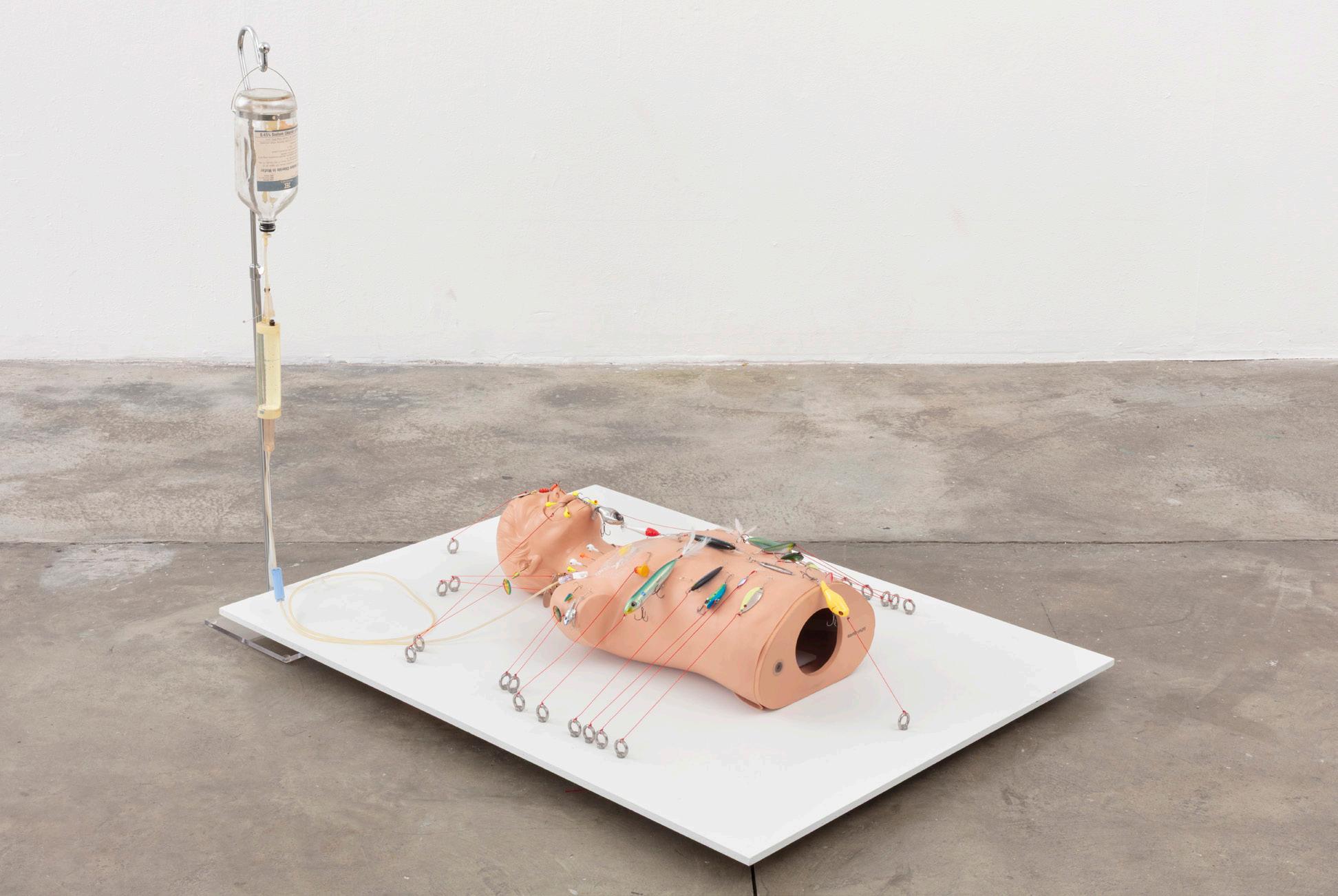
Embodied submission and domination visually engulf the sick body in Abareshi’s The Ward (2025). Affixed to the white pedestal by a systematic web of red fishing wire, hooks connected to artificial bait sink uniformly into the sandy colored “flesh” of what appears to be a CPR practice doll. The form’s gaping mouth is held open by silver lures. Frozen, open, the sick body is ready and waiting for intervention. A port-a-cath—used to provide long-term vein access for
treatments such as chemotherapy or blood transfusions—mirrors the location of the artist’s chest port and connects the mannequin torso to an IV. The erotic manner in which the body is bound to the ground-level plinth reveals an unnerving sensitivity. Under the stark gallery lighting, this generic, nameless, faceless (partial) body, reduced to a restrained object, was at the mercy of the medical industry’s power and our surveilling eye. In collapsing the space between everyday materials, such as fishing gear and a captive medicalized form, Abareshi effectively illustrates how the enduring, quotidian maintenance of a chronically ill body requires submission for survival.11
These interactions between artist and audience inform our discursive world’s relationship to care, and our expectations of how “the sick” and “the well” should respond to bodily and mental suffering. Isolation and classification, as defining characteristics of for-profit medicine and late-stage racial capitalism, turn care into an individual responsibility—something to be bought and then exchanged. Writer and performance artist Johanna Hedva asserts that the “language of illness is a language of platitudes,” emphasizing how the repetitive nature of our verbal expressions of care: “get, send, take, hope,” drain illness and disability of their complexity.12 Care operates as something given to the body-in- illness with the expectation of both unremitting thankfulness and linear improvement. But what if there’s no getting better? What if you’re in pain forever?
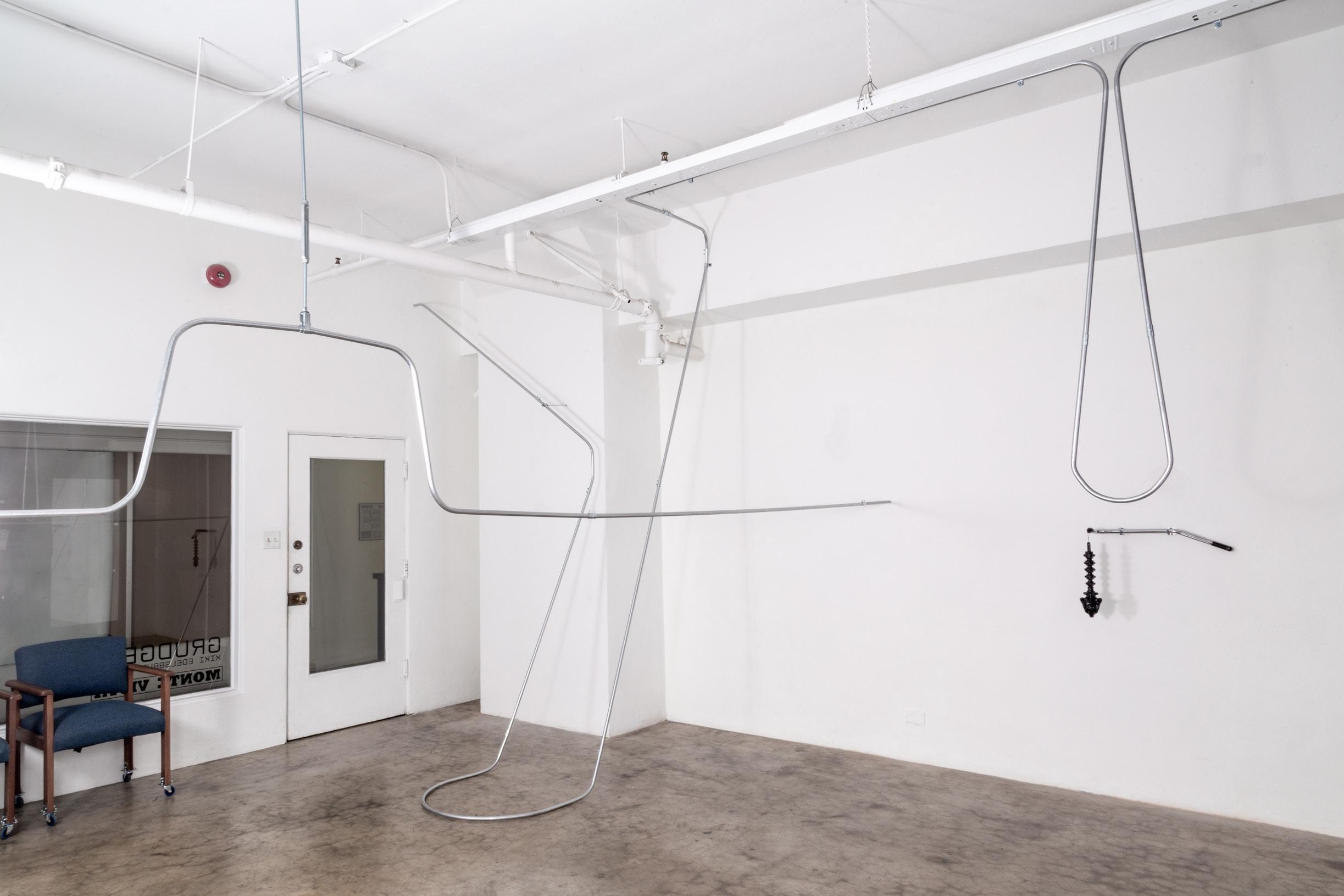
Chronically ill and disabled artists contending with popular articulations of care give way to more expansive understandings of disability and disabled people. For example, in the accompanying text for L.A.-based Xixi Edelsbrunner’s “anti-cathartic” solo exhibition Grudge at MONTE VISTA PROJECTS in 2025, we see an outright rejection of care. “Care is over. Repair is over,” stated the press release.13 Throughout the gallery, large stainless steel poles were installed
from the gallery ceiling, interrupting normative physical passage and requiring someone walking to distort their body around the space to view Edelsbrunner’s rubber and steel sculptures. At first glance, the works within Grudge—oversized metal tubular objects, rubber and stainless steel assemblages, and disorienting reflective surfaces—might register as quotidian, but Edelsbrunner modified these forms and their presentation. This rejection of exhibition architectures that prioritize the able-bodied experience only deepens the finality of Edelsbrunner’s initial statement. The artist’s embrace of doom is antagonistic by choice, resulting in artworks that formally and conceptually sidestep institutional and social optimism that fails to account for the violence of white supremacist, capitalist, patriarchal ableism.
By the same token, Abareshi’s Honorable Mention (2025)—an oversized cherry red rosette ribbon accented with the banal words often used to express consideration—thrums with a similar confrontational energy. As we read the white text from top to bottom, the excerpted “Get Well Soon” mutates into an authoritative “Get Fixed,” and ends with the curt demand: “Better Now!” That the object resembles a prize ribbon further situates popular modes of care within the world of capitalist achievement. Honorable Mention reflects back an image of our ableist world to its audience, drawing attention to the brutality of even the most routine and undisputed social interactions. When the status quo is disrupted, we can reassess the violences we assume are necessary for making and maintaining our lives. Abareshi’s CAREROTICS explored the consequences of indiscriminate spectatorship, allowing “the sick artist” to selfarticulate and return the gaze. This timely exhibition wholly contradicted the perceived neutrality of looking and of caring, complicating even the act of experiencing the artist’s work. Staying with this complexity, this rupture of norms, we can begin to tear down
our allegiance to the spectacle of illness and begin to build more spaciousness for disabled people, our bodies, and how we want to exist in relation to each other.
Ella Ray is a writer, editor, and full-spectrum doula based in Portland, Oregon. Ray’s multi-passionate practice is indebted to a cosmology of radical Black women cultural workers who were, and continue to be, unwavering in their commitments to craft and liberation.
1. U.S. Centers for Disease Control and Prevention, Measles Cases and Outbreaks, March 27, 2026, https:// www.cdc.gov/measles/data-research/index.html.
2. Robert McRuer, Crip Theory: Cultural Signs of Queerness and Disability (New York: NYU Press, 2006).
3. From Abareshi’s artist statement, https://www.panteha. com/about.
4. Panteha Abareshi cited by Caroline Ellen Lou, “The Body Is a Bundle of Chaos. Their Art Was Designed to Make You Feel Discomfort,” Los Angeles Times, March 1, 2023, https://www.latimes.com/lifestyle/image/ story/2023-03-01/panteha-abareshi-their-art-wasdesigned-to-make-you-feel-discomfort.
5. Human Resources, CAREROTICS: On Giving and Taking, https://www.h-r.la/event/carerotics-on-giving-andtaking/.
6. Virginia Marano, “Bodily Matter and Complex Embodiment in the Art of Donald Rodney,” RACAR: Revue d’art Canadienne / Canadian Art Review, (2024), 90.
7. Bob Flanagan, The Pain Journal (Cambridge, MA: Semiotext(e), 1997).
8. Kirby Dick, Sick: The Life and Death of Bob Flanagan, Supermasochist (1997).
9. Martin O’Brien, “Performing Chronic: Chronic illness and endurance art,” Performance Research (2014), 8.
10. Emma Sheppard, “Using Pain, Living with Pain,” Feminist Review (2018), 7.
11. O’Brien, “Performing Chronic,” 4.
12. Johanna Hedva, How to Tell When We Will Die (New York: Hillman Grad, 2024), 81.
13. Monte Vista Projects, https://www.montevistaprojects. com/past-1/2025/10/13/xixi-edelsbrunner-grudge.
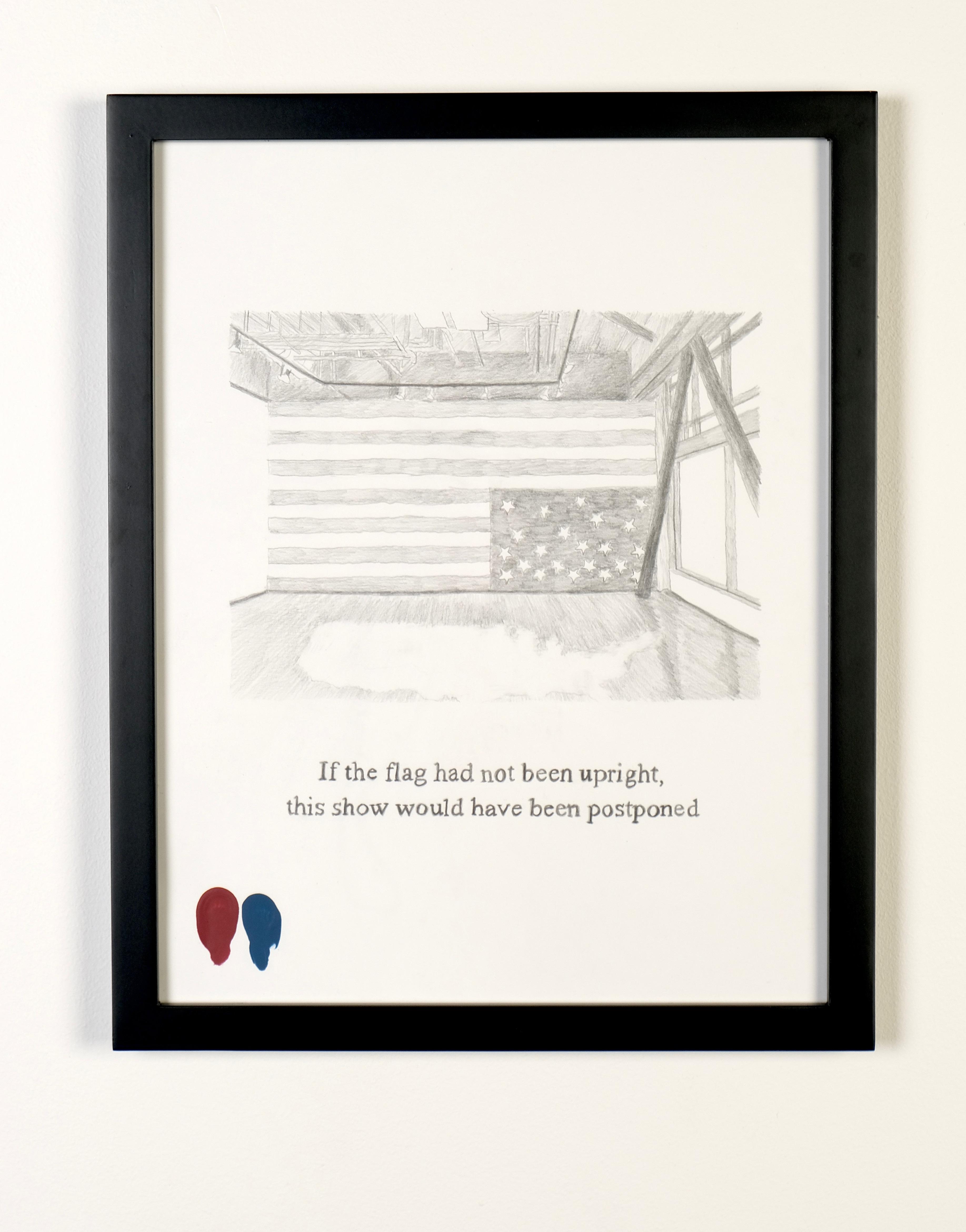
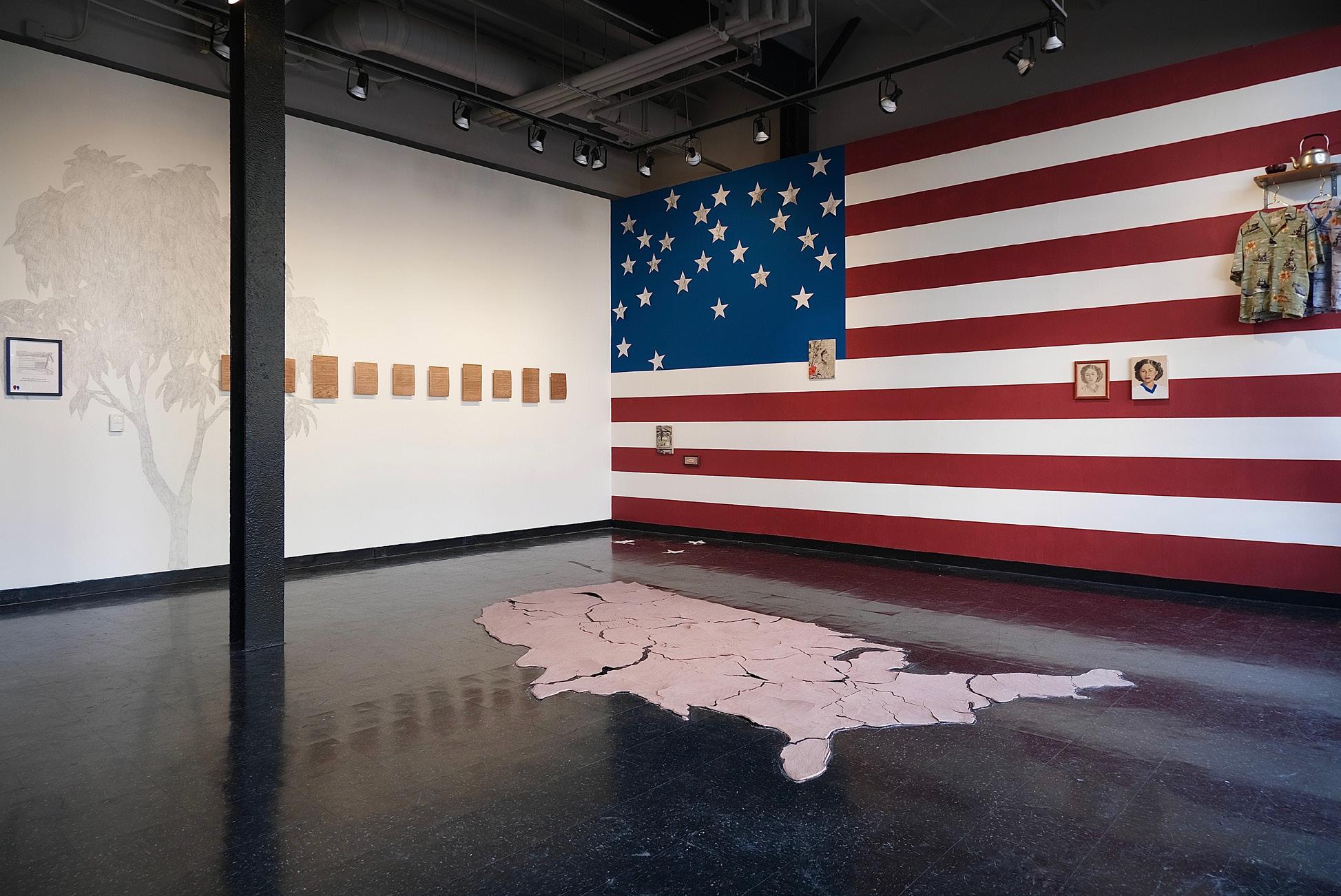
In early 2026, Dear Uncle Tani, opened at Grand Central Art Center (GCAC), a 45,000-square-foot public-facing institution in downtown Santa Ana, California. The show was JapaneseUchinanchu artist Dane Nakama’s second iteration of this work, an epistolary exchange with their great-uncle Kyoshi “Tani” Iguchi, a soldier who died in service during World War II. On one wall wartime letters from Iguchi to his family were interspersed with Nakama’s earnest and introspective present-day responses. A clay facsimile of the United States spread across the gallery floor, and behind it, the wall was painted to look like an American flag. The familiar blue starfield held 26 cut-out paper stars, 18 illustrated with graphite portraits of Uncle Tani’s troop mates. The details were hard to make out—the highest star was about eight feet up the wall. Preparing for the GCAC show, Nakama had proposed flipping the flag upside down, with the star portraits at eye-level. “The show warns about blind militarism and blind allegiance to the United States,” Bella Marinos, the exhibition’s curator, told me, “and the upside-down flag is a bipartisan side of distress.”
But when Nakama shared this idea, “several individuals associated with Grand Central Art Center expressed their concerns for the symbolism that an upside-down flag would represent.”1
Since President Trump’s March 27, 2025 executive order “Restoring Truth and Sanity to American History” demanded an end to “divisive,
race-centered ideology,”2 artists, curators, and institutions have been grappling with the exhibition of works that directly address political oppression in the United States or subvert symbols of American pride. Presenting work that challenges the country’s “unmatched record of advancing liberty, prosperity, and human flourishing”3 has become a risk for government-funded institutions. “Museum neutrality”4—an institutional reluctance or refusal to take sides on a politically-charged issue—has been more frequently invoked. “It’s not lost on me that this is a show about the dangers of nationalism,” Nakama told me when we spoke this February, “and the language that was used to justify pausing the show reflected those same fears.”
Informed by financial realities like government funding, stakeholders’ input, institutional missions, and their personal beliefs, museum staff must weigh competing interests, while artists must decide how they will allow their works to be presented—and potentially altered. The issue, then, is defining the difference between compromise and censorship.
Censorship is a unilateral, homogenizing force—an assertion of ideology, as in President Trump’s order. Compromise can be amorphous and requires dialogue, disagreement, and discomfort. Nakama weighed the possibilities of changes to their plan against the option of cancelling the show entirely.5 Prior to the installation of the exhibition, John Spiak, the Director of GCAC, offered three options: keep the flag upside down, but delay the opening a month to prepare public programming; propose an alternative and keep the current show schedule; or choose not to work with GCAC. Nakama decided to flip the flag and proceed on schedule, but to reveal the behind-the-scenes decision-making, they proposed a new piece: a drawing of their original plan for the flag captioned, “If the flag had not been upright, this show would have been postponed.” Spiak said had Nakama proceeded with the inverted flag, GCAC would have
Aleina Grace Edwards
paused one month to prepare public programming contextualizing the work. “We were going to be installing in December,” Spiak explained, noting the storefront space would then be closed over the holidays. “[T]here would be no context, and no one here to talk about why the flag looked like this.” Spiak’s curatorial approach foregrounds conversation, and Spiak was adamant that GCAC staff be on site to facilitate discourse if the flag were to be upside down. “[The flag] was more contentious than I expected. The whole meaning of the show could have been lost in the controversy,” Spiak said.
Nakama had already considered the implications of exhibiting in Santa Ana, which has historically leaned Republican, politically and culturally. When Dear Uncle Tani, was exhibited in Hawaii, the flag was abstracted and pulled onto the ground, where people could walk on the stripes made from dirt. “But I didn’t want to do that in Santa Ana,” Nakama told me. “I was aware Orange County was a conservative area, and I was more comfortable exhibiting this work in Hawaii, where it wouldn’t be as vulnerable to backlash.” The upside-down flag was perhaps its own form of self-censorship; in effect, it reads as an attempt at compromise. Originally a sailors’ distress signal, this symbol has historically been used by both the right and left.
But Grand Central is just one part of a large ecosystem in downtown Santa Ana, with dozens of entrenched community members. The nonprofit art space is a collaboration between California State University, Fullerton’s College of the Arts and the City of Santa Ana. The main floor of GCAC houses two retail tenants; a collaborative black box theater run by the Cal State Fullerton theater department and two outside theater companies; and two other nonprofit organizations. Some two dozen second-floor apartments house Cal State Fullerton graduate students.6 Among the concerned stakeholders was a GCAC staff member who prizes the American
flag displayed on their mantle in remembrance of their parent’s military service, Spiak explained. “So maybe [reverence for the flag] is not blind nationalism. Maybe it’s about homage to family.”7 Marinos had their own frustrations with the notion that the flag couldn’t be shown upside down without programmatic priming. “The show was intended to highlight the parallels between Japanese internment and ICE kidnapping people and holding them in horrific conditions,” Marinos told me. Inverting the flag would have been an act of solidarity with these people, and a link across time, an indication of history repeating itself. “It’s important for people to see those connections, and to explore things that make them uncomfortable,” Marinos insisted. When the flag became an internal issue, part of Marinos’s reaction was personal: “Am I going to get fired? Am I going to cause irreparable damage to this place I love?” The community members’ concerns and Spiak’s subsequent solution sparked shame, a fear of being wrong, and potentially being excommunicated. Spiak and Nakama both lauded Marinos’s stalwart support of the exhibition, but Marinos themself lamented the position they were in as the primary liason between artist and institution, institution and public. “Leaving Grand Central would have been an act of solidarity [with Dane], but people don’t understand how solidarity can be so lonely,” Marinos said. “You get pats on the back from artists, then you go home and drop your keys by the door, and you don’t have a job anymore.”
This was the reality for one curator at Pepperdine University’s Weisman Museum of Art last fall, after the institution altered several artworks on view in Hold My Hand in Yours. Curated by museum director Andrea Gyorody, the group show explored the hand as a tool of artmaking and a metaphor for community and care.8 Initially, “museum officials” turned off Elana Mann's audiovisual piece, Call to Arms
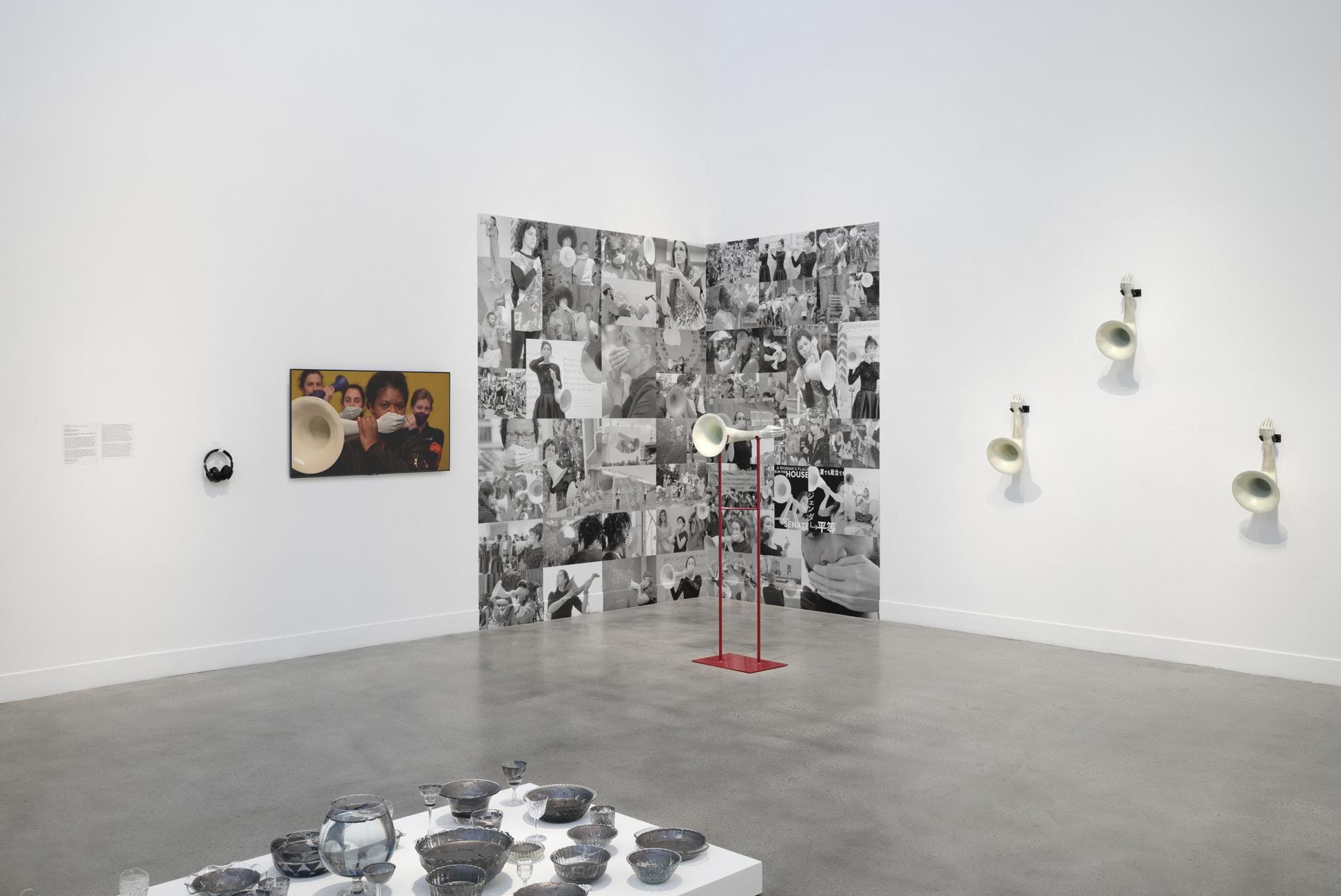
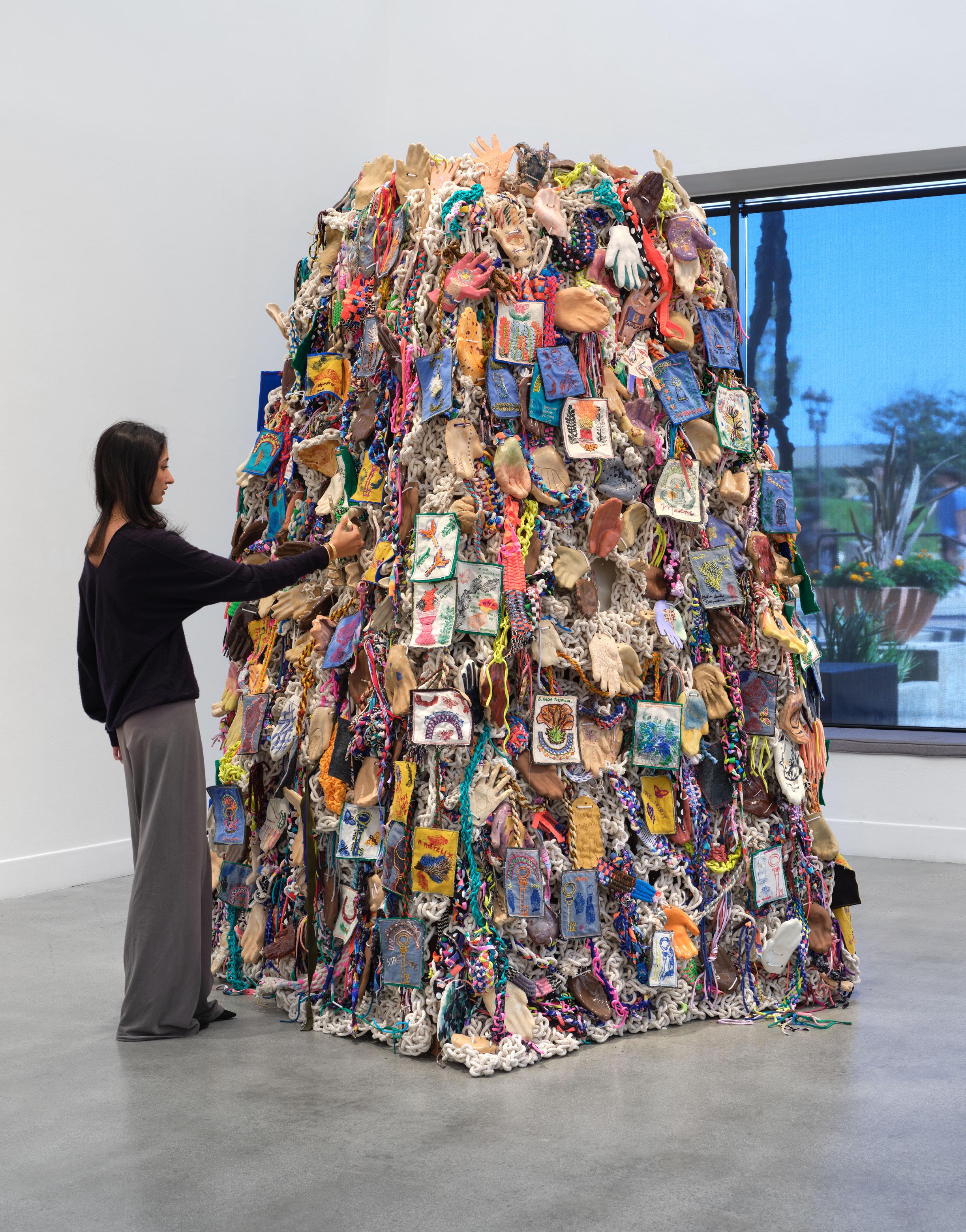
2015 - 2025 (2025), a record of an ongoing performance featuring people shouting into custom bullhorns shaped like hands covering the protestors’ mouths. The title card noted the “unruly sounds” of protests, including proimmigration immigrant chants, the most direct of which is “say it loud, say it clear, immigrants are welcome here.” The museum targeted another piece in the exhibition within that same week, a work by Art Made Between Opposite Sides (AMBOS) titled Con Nuestros Manos Construimos Deidades (With Our Hands We Build Deities) (2023).9 Previously included in The Hammer’s biennial Made in L.A. 2023: Acts of Living, this piece is a communal monument of clay hands and handstitched fabric scraps made by more than 240 migrants; one fabric swatch is embroidered with the phrase “Abolish ICE.” Museum officials flipped this swatch over, and to prevent anyone from discovering it, removed the wall text that encouraged visitors to touch the artwork. No one at Pepperdine discussed modifications to Mann and AMBOS’s work with the artists beforehand.
When other artists withdrew from the exhibition in protest, the show closed six months early; in a “mutual decision” with the university shortly after, Gyorody resigned.10 “For an academic museum that exhibits the work of living artists, constituencies are like concentric circles,” Gyorody explained via email, when I asked how she defined institutional responsibility within an institution like the Weisman. “At the center are the artists (and others) with whom the museum partners for exhibitions and programs; then students, staff, and faculty who use the museum as a laboratory for dialogue and research; and finally, the general public,” she continued. To first do right by living artists “ethically morally, and financially—is the best way, perhaps the only way, to be truly responsible to any other audience and to your core mission as a museum.”
Responding to the controversy, Pepperdine’s communications director
said the Weisman Museum’s “established practice” has been avoiding “political content,” per the requirements of the university’s nonprofit status.11 Under the current federal administration, this stance has its logic. Since 2024, one third of American museums have reported losing grants or contracts, mostly from federal sources like the National Endowment for the Arts.12 But to conflate the exhibition of an opinionated piece of art with institutional endorsement of that opinion is a dangerous logical fallacy—one that limits art’s role as a catalyst for conversation, connection, and evolution—and sets a restrictive precedent for institutions and their staff. To obfuscate elements of an artist’s work without discussion is certainly an act of censorship.
“What is censorship?” Spiak posed the question multiple times during our conversation. “Is pausing the show [for] a month censorship? For us to have to answer that constantly—that is institutional responsibility. We should have to say, ‘this is why we did this. And we understand if you agree or disagree.’”
Nakama characterized Spiak’s response as a “sign of the times,” explaining, “if the show can’t exhibit a symbol of dissent for fear of backlash, then it’s being censored.” Ultimately though, Nakama appreciated the additional subtext the negotiations and final direction for Dear Uncle Tani, introduced. “Conceptually, I thought it worked,” they said. “The drawings now, which are the stars of the flags, are difficult to see. On the insistence of seeing the nation’s pride, we can no longer see these men.”
Trump’s ongoing censorship campaign attempts to dissolve specificity and difference in the name of the “restoration” of our national symbols, monuments, and museums. The Smithsonian is the particular focus of the “Truth and Sanity” order, including the National Portrait Gallery, where painter Amy Sherald was set to show her exhibition American Sublime
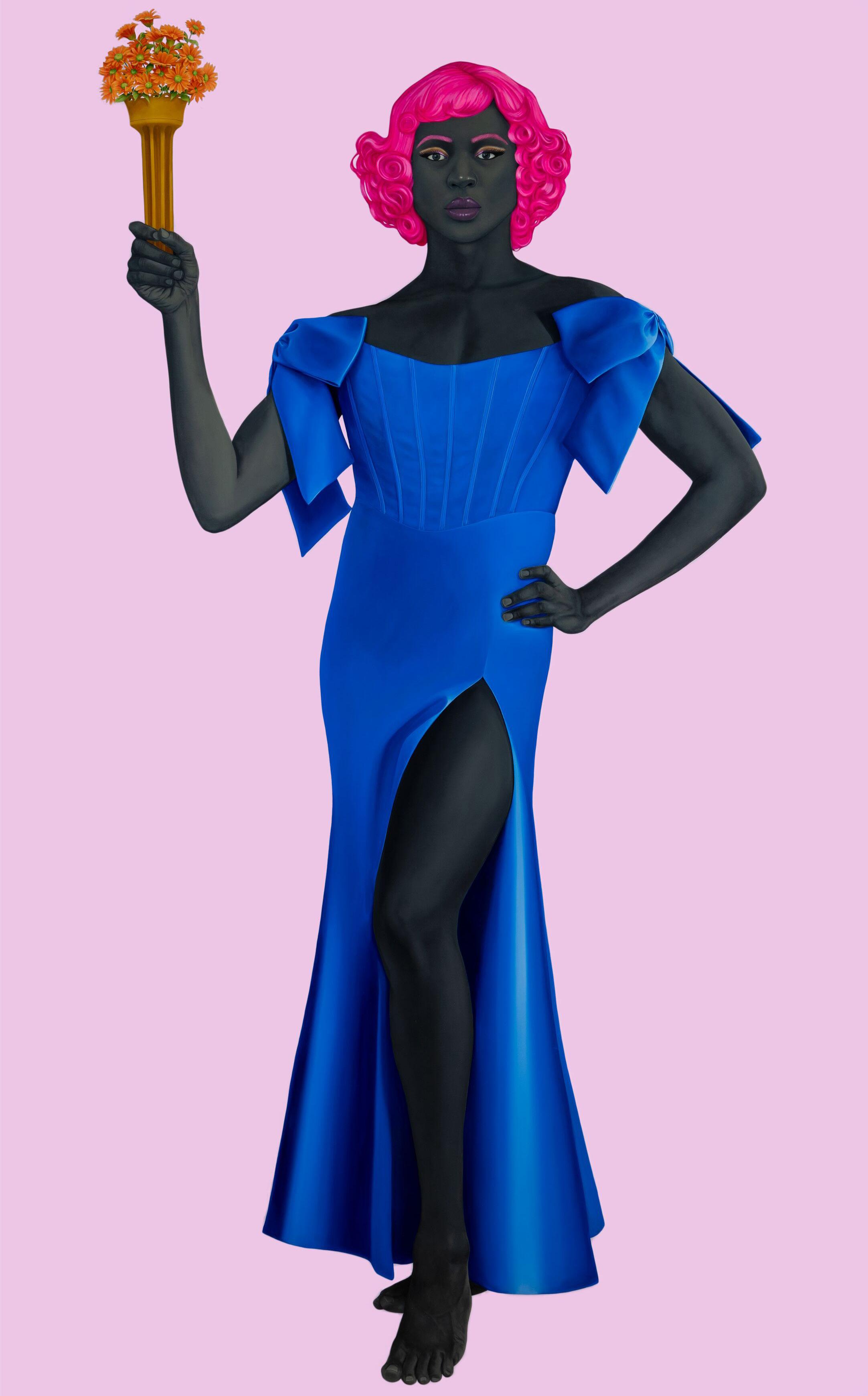
—an expansive collection of portraits of Black Americans—this past fall. During the planning process, Sherald was “informed that internal concerns had been raised” about one of her paintings, Trans Forming Liberty (2024), which shows a trans woman holding a bouquet of flowers à la the Statue of Liberty. Concerned about potential backlash, the National Portrait Gallery curatorial staff had suggested including a video of “people reacting to the painting and discussing transgender issues.”13 The museum staff and Sherald couldn’t reach an agreement, and unwilling to include potentially antitrans views in the context of her work, Sherald pulled the exhibition from the Portrait Gallery.14 Kim Sajet, the museum’s director, quit shortly after Sherald withdrew.
If the responses to the upsidedown flag at Grand Central and Sherald’s Lady Liberty are any indication, the enforcement of American symbology is directly correlated with the experience of national instability; for the Trump administration, this enforcement is a direct bid for control. The administration stated that “the Statue of Liberty is not an abstract canvas for political expression—it is a revered and solemn symbol of freedom, inspiration, and national unity.”15 “Unity” here is a dog-whistle for white-washing and scrubbing dissenting or difficult stories from the cultural record— “unity” becomes a monologue, not a dialogue. Sherald’s Smithsonian decision was not necessarily an acquiescence to Trump’s demands, but perhaps a prescient, mutual understanding that there was no real discussion to be had about American ideology here. The inverted flag “is not a call to arms or an implication of violence,” Nakama said. “It’s a symbol of distress to say we’re not okay. For this to be controversial exemplifies the state we’re in.”
Nakama’s choice to show the flag upright and reveal the decision-making process was, on both practical and conceptual levels, an excellent one. “The disagreement reveals more than it does conceal,” Nakama said, pleased
with the nuanced conversations the exhibition has ignited. Unearthing fraught details from American history, Dear Uncle Tani, complicated our ideas of patriotism. True love of self, family, or country doesn’t require denial or compartmentalization, and criticism can be a form of devotion. For Spiak, Marinos, and Nakama, belonging to a community means fielding criticism and bearing out disagreements, and responsibility requires discomfort. “Some people see conflict as an abuse,” Nakama said, “but I am not one to shy away. I think this is how you express love.”
Born and raised in Los Angeles, Aleina Grace Edwards is an arts writer and essayist focused on preserving and promoting locally-rooted arts and culture.
1. Email exchange with John Spiak, Director of Grand Central Art Center, March 20, 2026.
2. “Executive Order 14253 of March 27, 2025, Restoring Truth and Sanity to American History,” https://www. federalregister.gov/d/2025-05838.
3. Ibid.
4. Freemuse, State of Artistic Freedom 2025, 58, https:// www.freemuse.org/wp-content/uploads/2025/04/ SAF-2025_web.pdf.
5. After the exhibition opened, Nakama shared the following on Instagram. Dane Nakama (@bydanenakama), “One of the only new works I made for this iteration of Dear Uncle Tani is a sketch of my original installation plan,” January 5, 2025, https://www.instagram.com/p/DTIxeuDD1k8/ ?img_index=1.
6. Email exchange with John Spiak, March 20, 2026.
7. Conversation with John Spiak, February 4, 2026.
8. The exhibition’s page has been archived: https://web. archive.org/web/20251009051030/https://arts. pepperdine.edu/museum/2025-2026/hold-my-hand-inyours-25-26.htm.
9. Henry Adams, “Pepperdine Administrators Shut Down Weisman Exhibition After Censoring Artwork,” The Graphic, October 10, 2025, https://pepperdinegraphic.com/pepperdine-administrators-shut-downweisman-exhibition-after-censoring-artwork/.
10. Ibid.
11. Ibid.
12. Ibid.
13. Robin Pogrebin, “Amy Sherald Cancels Her Smithsonian Show, Citing Censorship,” New York Times, July 24, 2025, https://www.nytimes.com/2025/07/24/ arts/design/amy-sherald-smithsonian-censorship.html. 14. Ibid.
15. Lindsey Halligan cited in ibid.
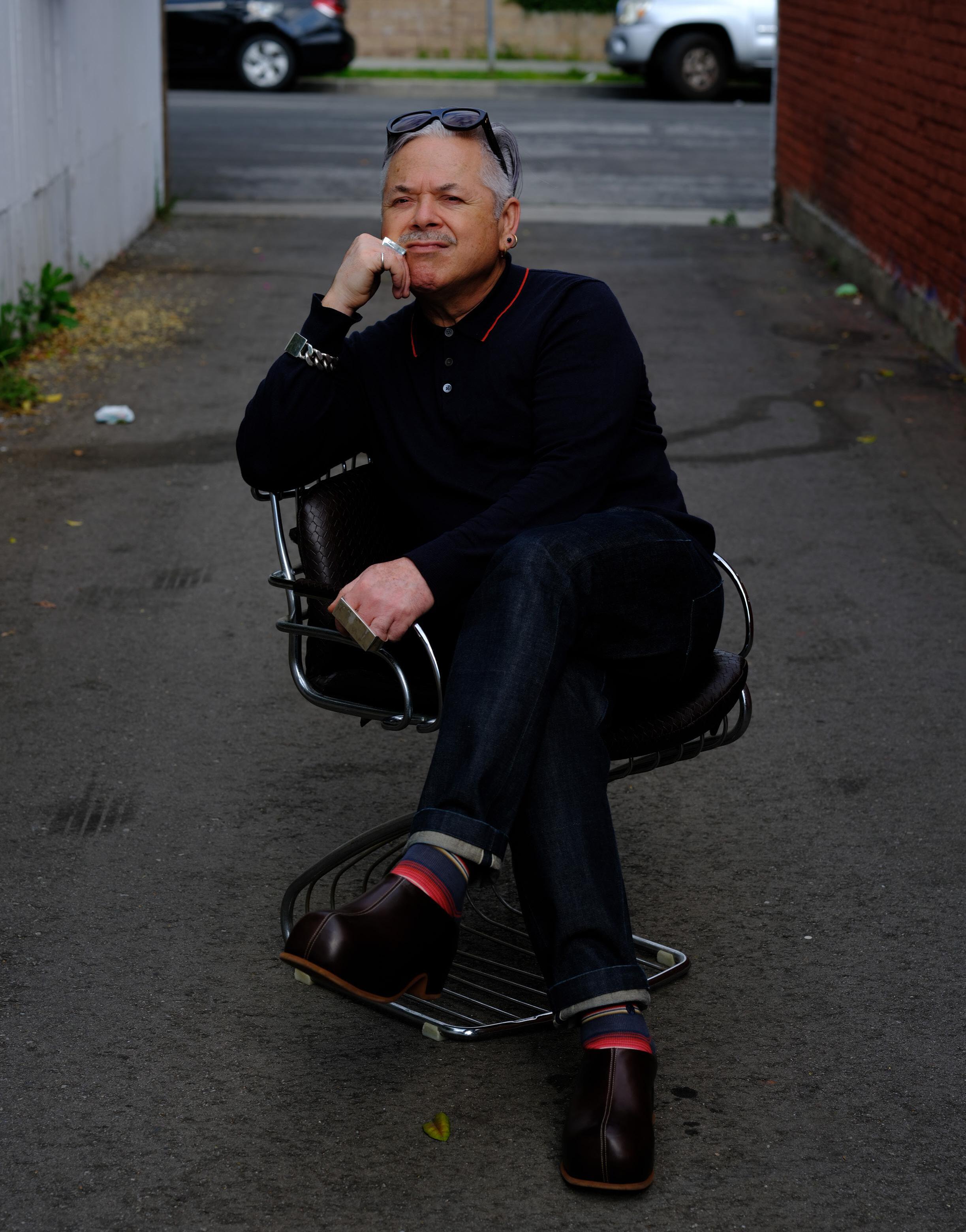
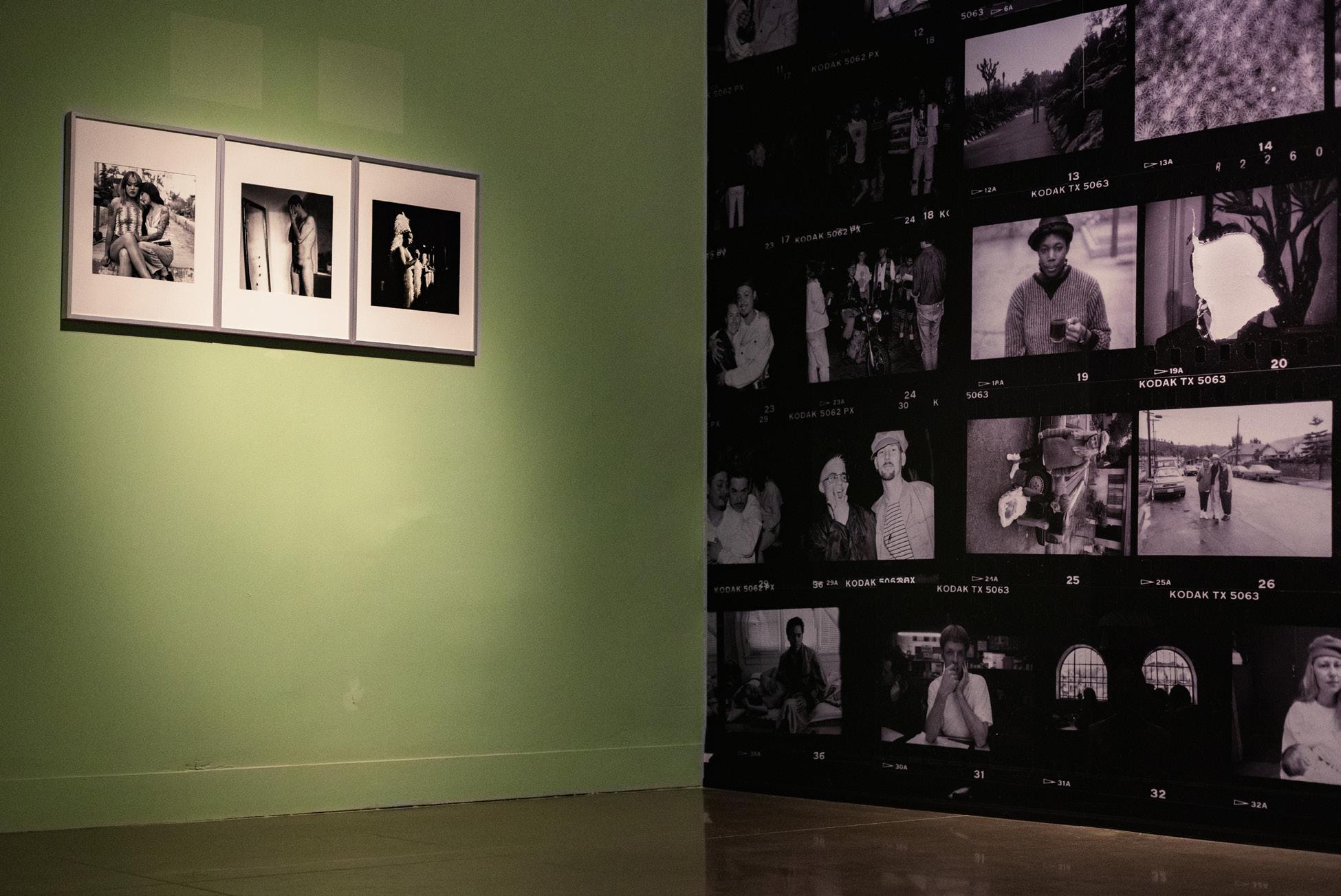
“Mexicali is my Aztlán,” says the artist Reynaldo Rivera. He sits in the garden behind his house in Lincoln Heights, a few hours northwest of the northern Mexican city where he was born: capital not of the Aztecs’ legendary original kingdom, but of Baja California. His first exhibition in his hometown has just closed: Propiedad Privada, or Private Property, a retrospective at La Universidad Autónoma de Baja California organized through the Instituto de Investigaciones Culturales-Museo (IIC-Museo) in collaboration with Planta Libre, a local experimental space. In the exhibition, the photographer shared prints, but also VHS tapes, Polaroids, and even his Rolleiflex camera in a little shrine. “I wanted my folk, my Chicalicenses to experience all the best stuff.”
Rivera worked the fields in the San Joaquin Valley when he was very young: cherries, tomatoes, chabacano. When he was 14 or 15, he started working at a cannery and making “real money. The fields don’t bring any money to do anything.” He fell into photography when he spotted a 35mm Yashica in a box of stuff his father was selling. A woman running a Fotomat explained the camera’s mechanics, and the two daughters of the viejita who ran the Hotel St. Leo, where he lived, posed for him.
Over time, he began to photograph himself, his lovers, and the other “damp, slightly wilted glamsters” in East L.A.1 What the Hungarian photographer Brassaï did for the Antillean dancehalls of 1930s Paris, Rivera does for the legacy of the Silverlake Lounge. Both men’s
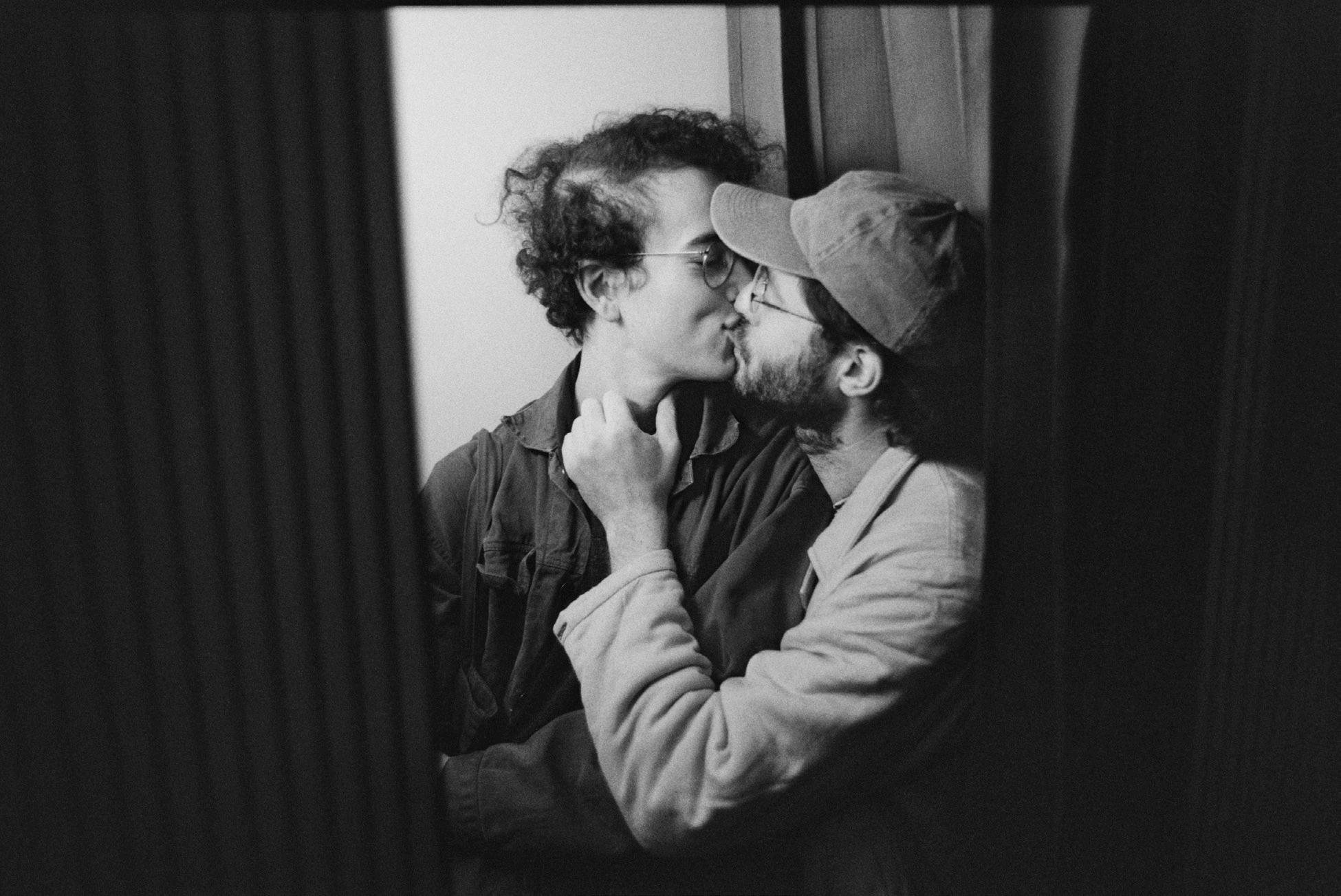
photographs remind their viewers that a kiss can melt a crowd away, in a bathroom or a booth. They show the streets around the bedrooms and bars they frequented: befriending the foggy glow of streetlights on cobblestone or concrete, and the euphoric claim that comes from running through them on late nights, young.
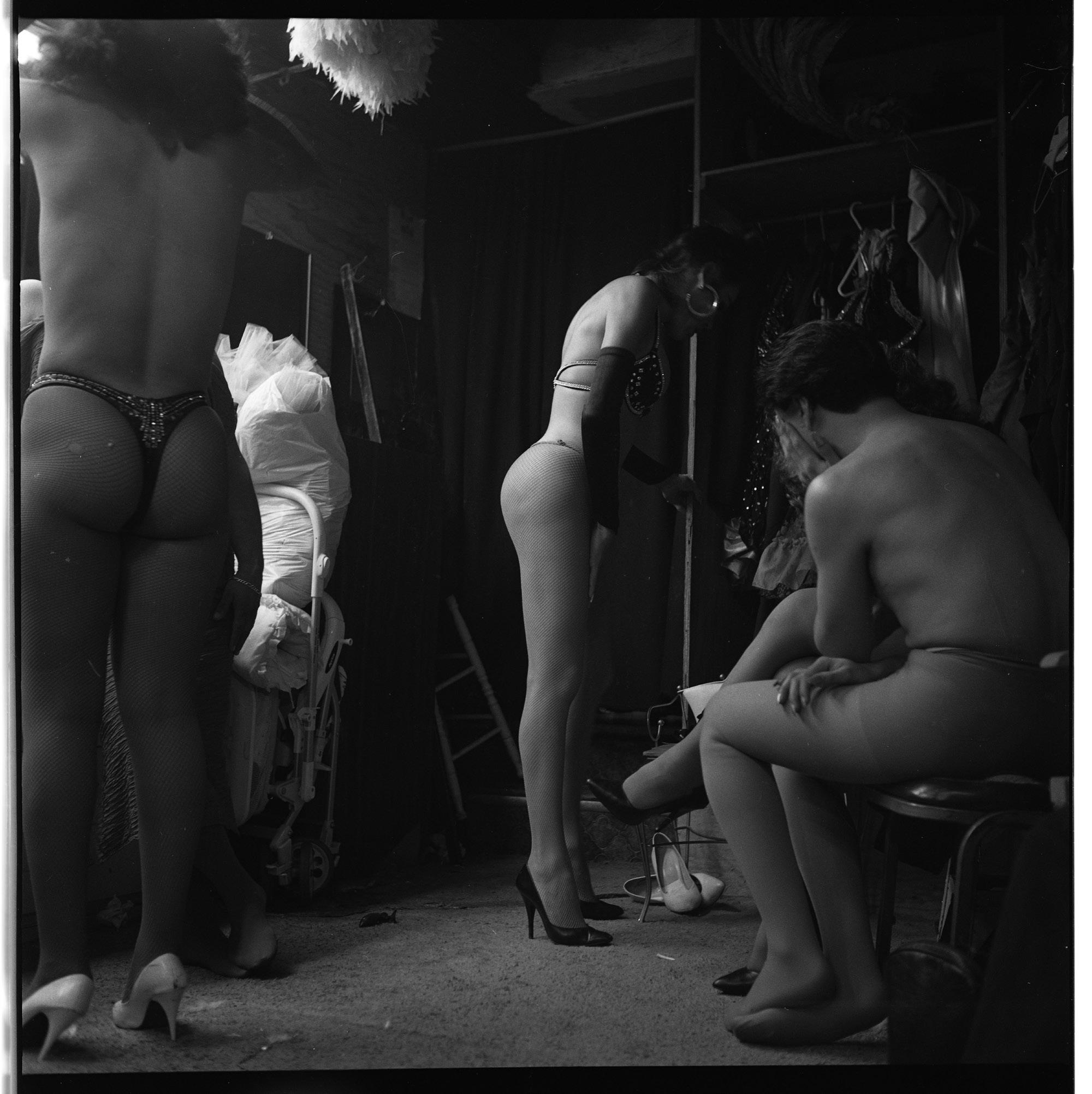
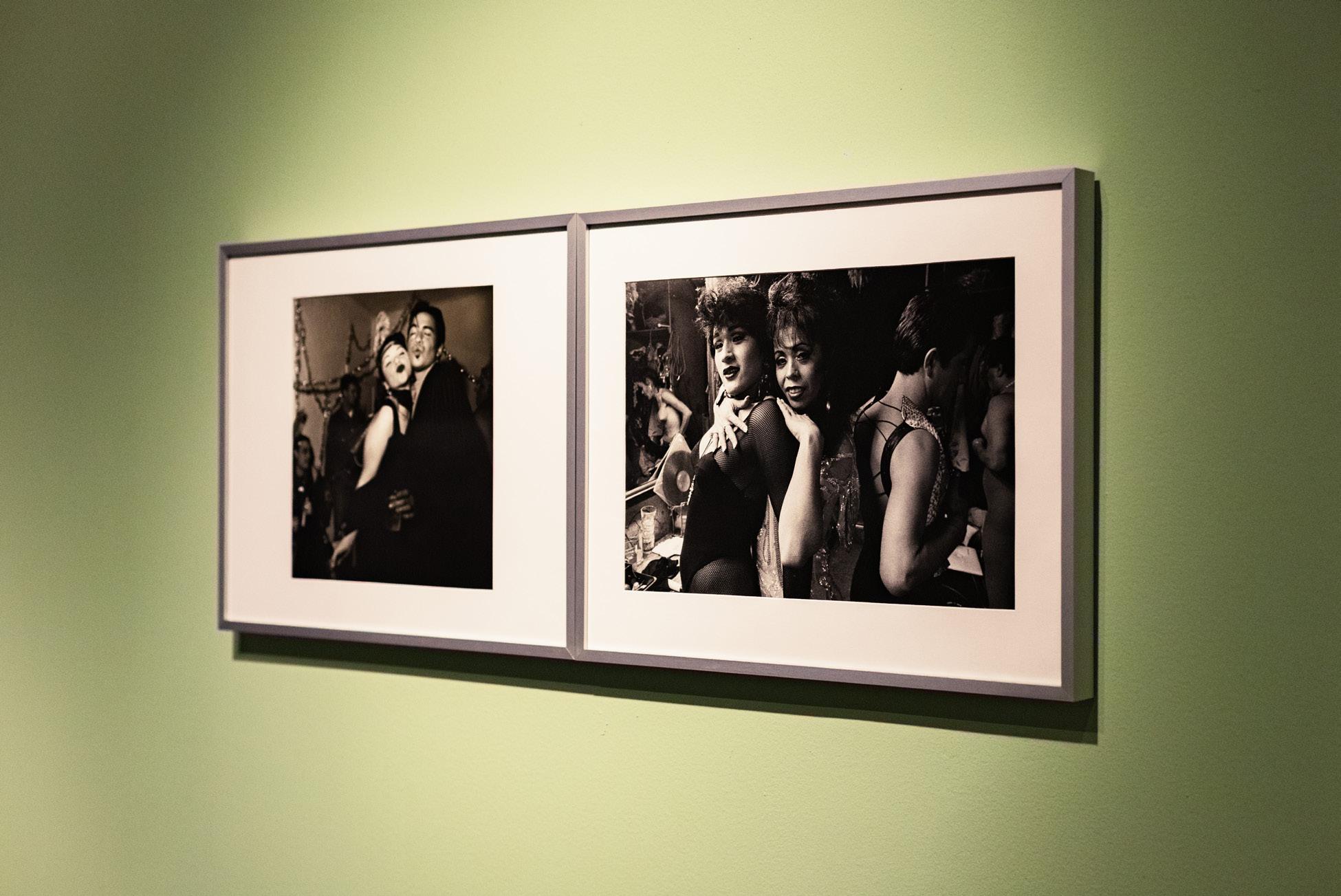
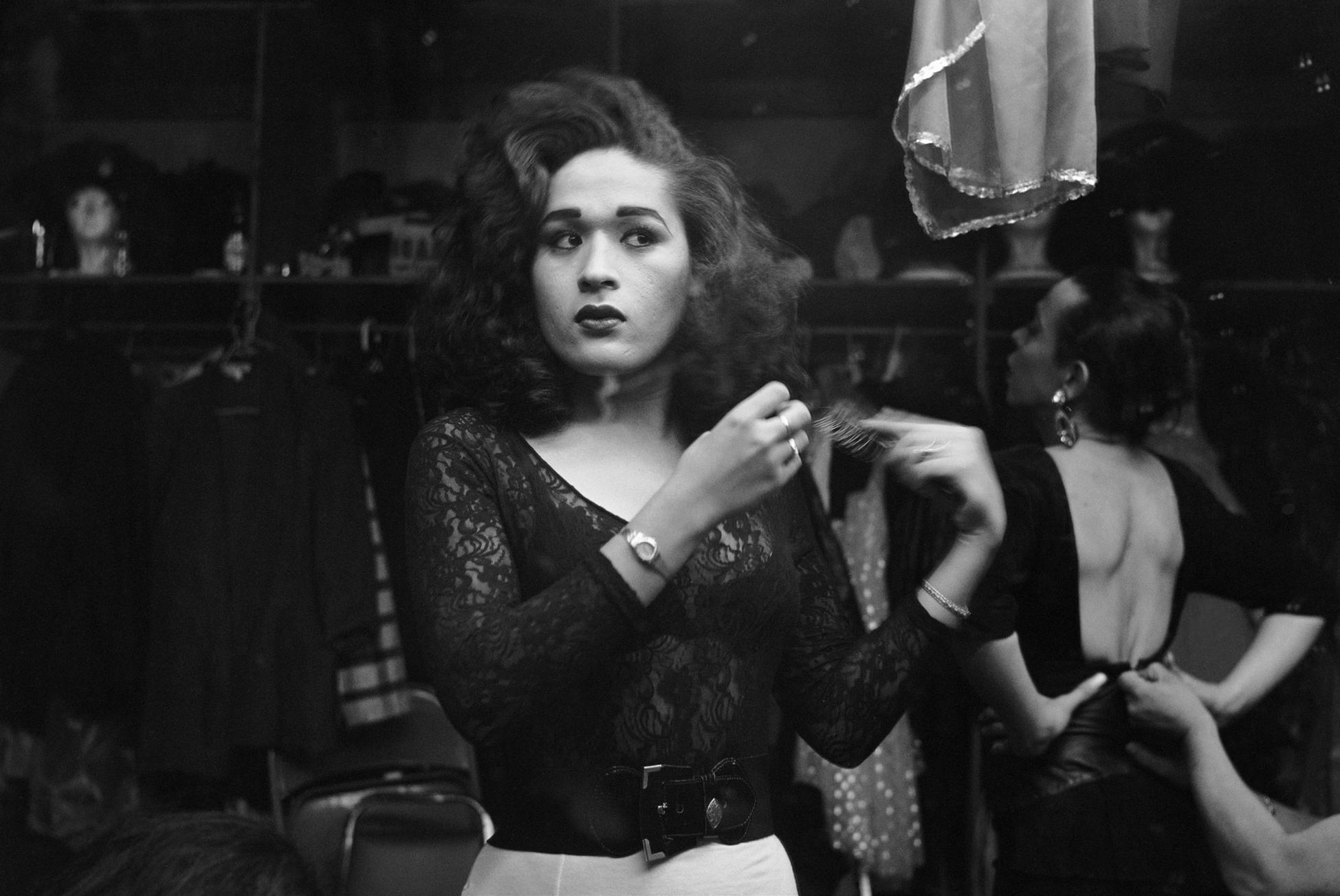
He entered the world of drag performers as if “going to a Diana Ross concert… They were the stars, and I gave them stardom.” In Las Reinas de la Noche, La Plaza, a picture from 1992 in the recent exhibition, a dancer’s body is the secure, illuminated, slippery center around which backstage dynamics swirl. Like Aztlán, the dressing room is a place in which myths are made —and not one easy to visit. The fact that the dancers allowed Rivera backstage at all reveals their trust in his perspective. “They’re long gone,” he told me, “but I’m like, I’m gonna leave you a star, bitch.”
In Rivera’s pictures, nobody asks for permission to be themselves. In an untitled self-portrait from 1990, Rivera holds his penis and faces his camera, reaching for the shutter as his body lurches towards the lens. A book balanced on a trash can and a can of Barbasol shaving cream on the shower’s ledge render the scene real, but the artist’s tension renders his form legendary, like a Greek kouros, stepping forward with sexual purpose. Made in a time before text messaging, this picture still communicates desire for someone, to someone, of someone, but only after it had been taken, developed, selected, and printed. “This is a life lived,” Rivera explains. “The ups and the downs. And you can’t have a body of work or a life shown without the sex.”
Rivera speaks about his work in a way that locates it in photographic histories as well as social ones. Over coffee and pan dulce, he reveals his new monograph published by Semiotext(e), also titled
Farrah Karapetian
Propiedad Privada. Taken in Echo Park or elsewhere, the photographs themselves are Aztlán: a place of self-determination that could be anywhere.
Farrah Karapetian: It feels like not only the content of the work is private property, but the material on display is sometimes private as well. Is that instinct unique to this show?
Reynaldo Rivera: The thing is it’s all been private property in theory... I didn’t do it for jobs. Most of the stuff isn’t for someone else. There are a few exceptions—like the stuff I did for the newspaper [The LA Weekly]. But even that was for me. I had a friend that worked there and I was like, “Can we make something out of this?” [S]he used to be the Fashion Editor for a bit…and so I made up these fake fashion trends. My sister would sew the clothes. I would photograph them, and boom out we go. Make some extra cash. I had a lot of fun.
FK: Really, anyone—like Bill Cunningham, the photographer who shot The New York Times’ “On the Street” for 30 years—going out there and shooting trends, is just making it up too. I like the way we reference our predecessors in art, though, rather than the way fashion houses hire new designers to replace the brand’s namesake when they die.
RR: We all borrow. Anyone who says they’re original is insane.
FK: Sure, but you would still never say you are Brassaï.
RR: It’s funny you say Brassaï. My education was one used bookstore in Stockton, California. That’s where I learned everything, like Brassaï and Bresson and this lady called Lissette [Model]… …I would devour this stuff…I had nothing else to do. The whole fucking day I would spend with my dad, either working or at the pool hall. [S]o when I discovered the printed page,
oh my god… This granny that used to work the little bookstore, it was this old Filipina lady who, I guess liked me, because she would let me go into the side of the bookstore where the owner kept all of his shit, and fill up a box, and then she would charge me a dollar. Boom.
FK: Oh wow.
RR: [The owner of the bookstore] used to collect all this movie memorabilia… Tatler and Hush-Hush, all these magazines. I would read that stuff like the Koran, the Bible, the Torah—backwards and frontwards. I learned a lot about the old Hollywood.
FK: And about how people were pictured.
RR: One of the books was Félix Nadar, and he had done these photos of Sarah Bernhardt, where he took a fucking old curtain and wrapped it around her, so I did the same thing. …I’d go back to my St. Leo hotel. I was 16 or something. And I would ask these girls to pose for me… This was the late ’70s, so they were wearing halter tops. I had them put the sheets to here. [He gestures as if pulling the sheets up towards his pits.] Both of them were in the bed… I did photos of them and Minnie, the viejita who used to clean the place. And, they were so good.
FK: How did you image her? Was she working?
RR: No, no. There was the staircase, and [I photographed her] with the big glasses, the big hair. Those ginormous glasses.
FK: I noticed that male bodies are shown relaxing or in pleasure mode or just enjoying themselves in your work. I kept identifying joy and relaxation with the male body. In most pictures throughout representational history, you see women naked. You see women reclining. You see women having sex. You see men working.
RR: I wanted to create something that would be, how do we see pleasure? How do we see ourselves?
FK: And who’s “we,” to be clear?
RR: Ethnic folks, specifically. Ethnic queer, ethnic straight, ethnic folk, the secret life of ethnics. I feel that we have been portrayed by others most of our lives. Usually, most everything is being documented by someone else. Porn, you name it. It’s like someone feeding us us. What does sexy look like to us? What does that look like to me? What does that look like to you?
FK: Did you ever show your pictures to your friends, like Nan Goldin’s slideshows?
RR: No… Someone gave me her book The Other Side years ago in the ’90s, because, you know, if you took photos of a few drag queens, you’re always going to get pigeonholed. That’ll happen no matter what. Originally, I was always compared to Diane Arbus…
FK: What?
RR: …I think it was the subject matter. People are lazy. Diane Arbus, we might have taken photos of similar people but…
FK: …Totally different attitude.
RR: It’s like she made normal people look freaky; I made freaky people look normal.
FK: Exactly.
RR: There’s something to be said about documenting your own. It looks different. When you’re around someone like yourself, it’s easier for you to just be you. I was looking at these photos [by] Graciela Iturbide, who I was a huge fan of back in the day. I was looking at them with an older eye, and I was thinking, how funny, because she took photos of all these trans folk in Oaxaca… [T]hose photos are very famous, and I’m like I would never have taken their
photo that way. I find it so kitschifying. [I]t’s funny that at one time I thought they were amazing. But they are, as photos. They’re beautiful… But they don’t show these people as they are, for sure.
FK: As people.
RR: This is how she saw them—or the airs they put on for her, because they probably thought this is how she wanted us to be. …[T]hese queens would have given me a very different persona, if I was the one taking the photo… [T]his is the reason my stuff looks different… [T]his is what I always tell my own young folk that are doing photography: There is a place for us, and the work you’re doing, as long as you’re being honest with it. Because you are going to see something that they won’t, when you document your own.
FK: I know that Mayté Miranda and Minoru Kiyota, from Planta Libre in Mexicali, were really proud to put this show together with you… What’s the difference between Propiedad Privada and other shows you’ve done?
RR: …I didn’t include everything, because I didn’t want it to be that diluted… So it really has all what I consider the best work, at least most of it, and then some of the new stuff. I think it really represents the work.
FK: How did Mayté and Minoru get in touch with you?
RR: …Minoru messaged me on Instagram and I immediately wrote him… I’m like, yes, I want to do a show. If that’s what you’re calling me for, then yes… I had been wanting to do a show in Mexicali forever. I mean, that’s my fucking hometown.
FK: You said on the phone, “that’s my Aztlán.”
RR: It is. It’s Mecca. Even though I didn’t really live there for very long periods of time, I was born there, and it’s so
weird. It has this calling. It’s strange, like this place.
FK: Origin story. And you print your photographs downtown L.A.?
RR: [Printing is] half the work. …Every step has its reason and its impact on the final product… The developing, well, the shooting… Like, last night I did photos of this writer, and we shot this stuff…basically in the dark…so I knew, when I get home, I’m gonna develop this extra, even more than I usually do, because the fucking negs are gonna be really thin. Thank god I did. …You take this to the…enlarger, your darkroom, and then the rest of the magic happens. …I can make one image look so many different ways. You have to do it all to create your style, the final product. I tell you, I know this because I’ve tried to get other people to print my shit and it’s like…
FK: It’s a different voice.
RR: That’s the difference between each photographer, or each person, They will tell the same story a million different ways. That’s the importance of you doing it all. If you take your neg to someone else, they’re going to print it in a way: either… a machine just calculates the density… or they’re gonna put their own style. Some people print really dark; some people like really high contrast, and I’ve even gone back and forth myself. You can tell the stuff I printed in the ’90s, the late ’90s. It kind of goes towards the dark: very deep. I liked detail in the darkness. Not now. I guess I got to an age where I want it all. I want detail… all the darkness, but I want the light too...
1. Tootsie Woodly, “L.A. DEE DA: On the Streets,” LA Weekly, vol. 7, no. 51, November 21, 1985, https://cdnc.ucr. edu/?a=d&d=LAW19851121.1.55&srpos=3&e=-------en-20-LAW-1-byDA-txt-txIN-%22Reynaldo+rivera%22.
Farrah Karapetian, an L.A. native, makes artwork and writes about visual culture. Her artwork is collected at the J. Paul Getty Museum and LACMA among other institutions. It has garnered support from the Pollock Krasner and Fulbright Foundations and been discussed in publications including Artforum and Art in America. Her writing earned her the Warhol Arts Writers Grant.
Reynaldo Rivera was born in Mexico but spent his childhood traveling across the border and within the United States—mostly between San Diego de la Unión, Mexico; Los Angeles; and Stockton, California—before settling as a young adult in East L.A. Rivera’s large body of photographic work captures the city’s queer clubs and house party scene in the 1980s and 1990s. These images depict a version of Los Angeles that has all but disappeared: Echo Park as a predominantly Latinx neighborhood rife with artists, writers, and performers full of flair and queer glamour. Reynaldo Rivera lives and works in Los Angeles. Recent solo exhibitions have been organized at PS1 MoMA, University of Mexicali, Mexico, Reena Spaulings Fine Art, Los Angeles and New York (2023, 2021). He has participated in group exhibitions at The Museum of Contemporary Art, Los Angeles (2023), the Michael C. Carlos Museum, Emory University, Atlanta (2023), and the Princeton University Art Museum (2022). His work featured in Made in L.A. 2020: a version at the Hammer Museum and the Huntington Library, Los Angeles. His first monograph, Provisional Notes for a Disappeared City, was published by Semiotext(e) in 2020. In 2026, Rivera published his second book with Semiotext(e) titled PROPIEDAD PRIVADA. Rivera’s photographs are in the permanent collections of MOCA, Los Angeles; the J. Paul Getty Museum, Los Angeles; The Hammer Museum, Los Angeles; and The Museum of Modern Art, New York.
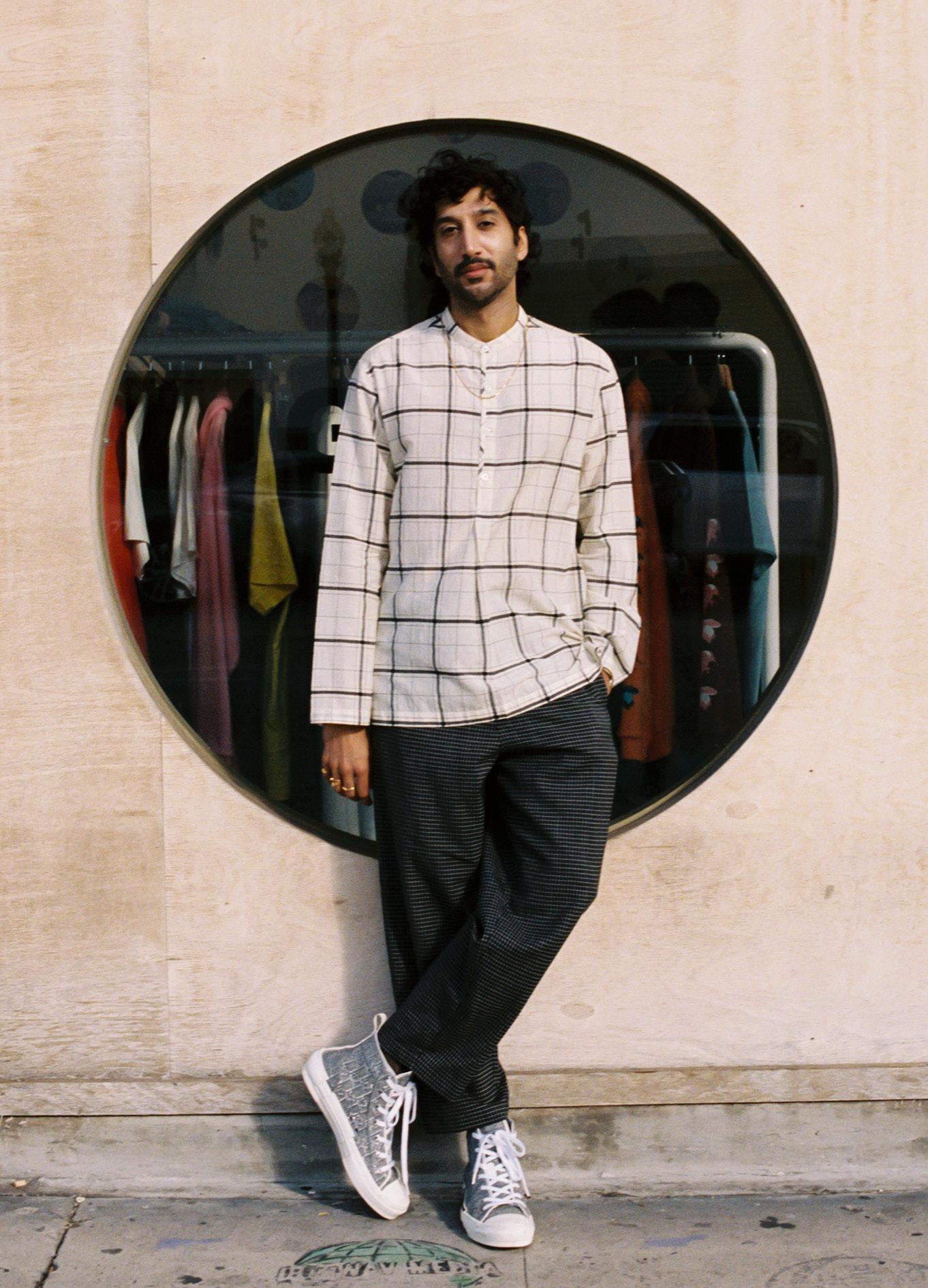
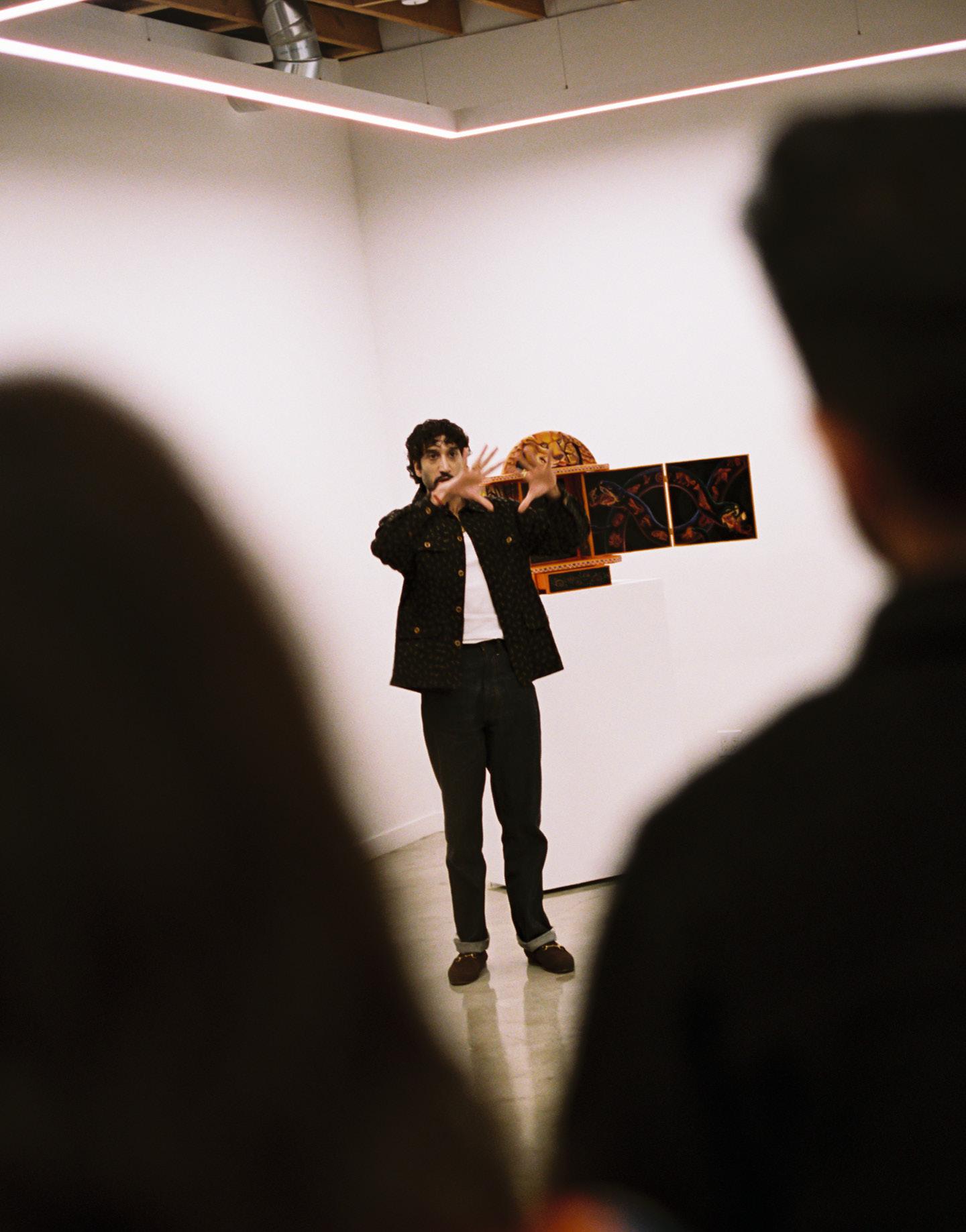
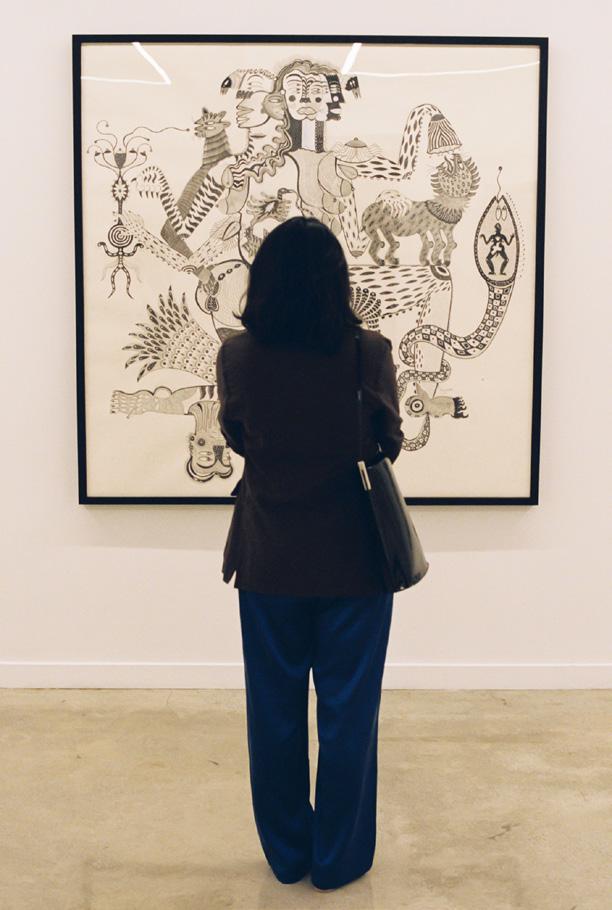
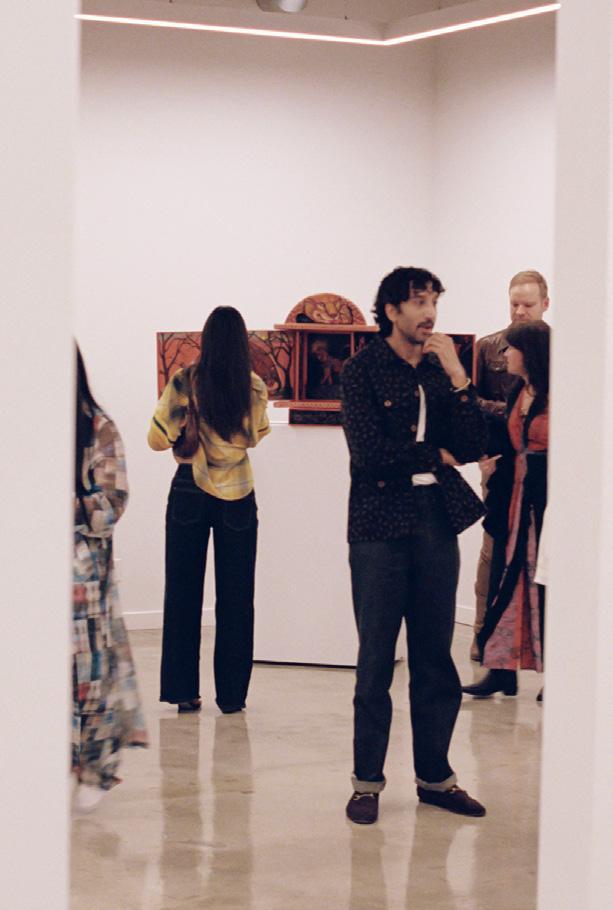
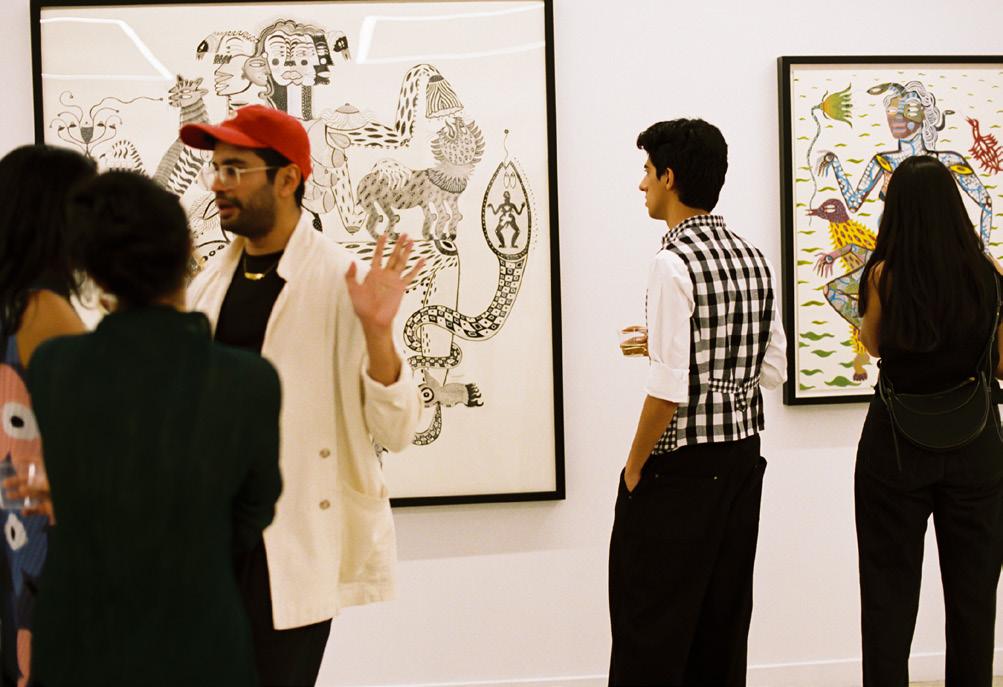
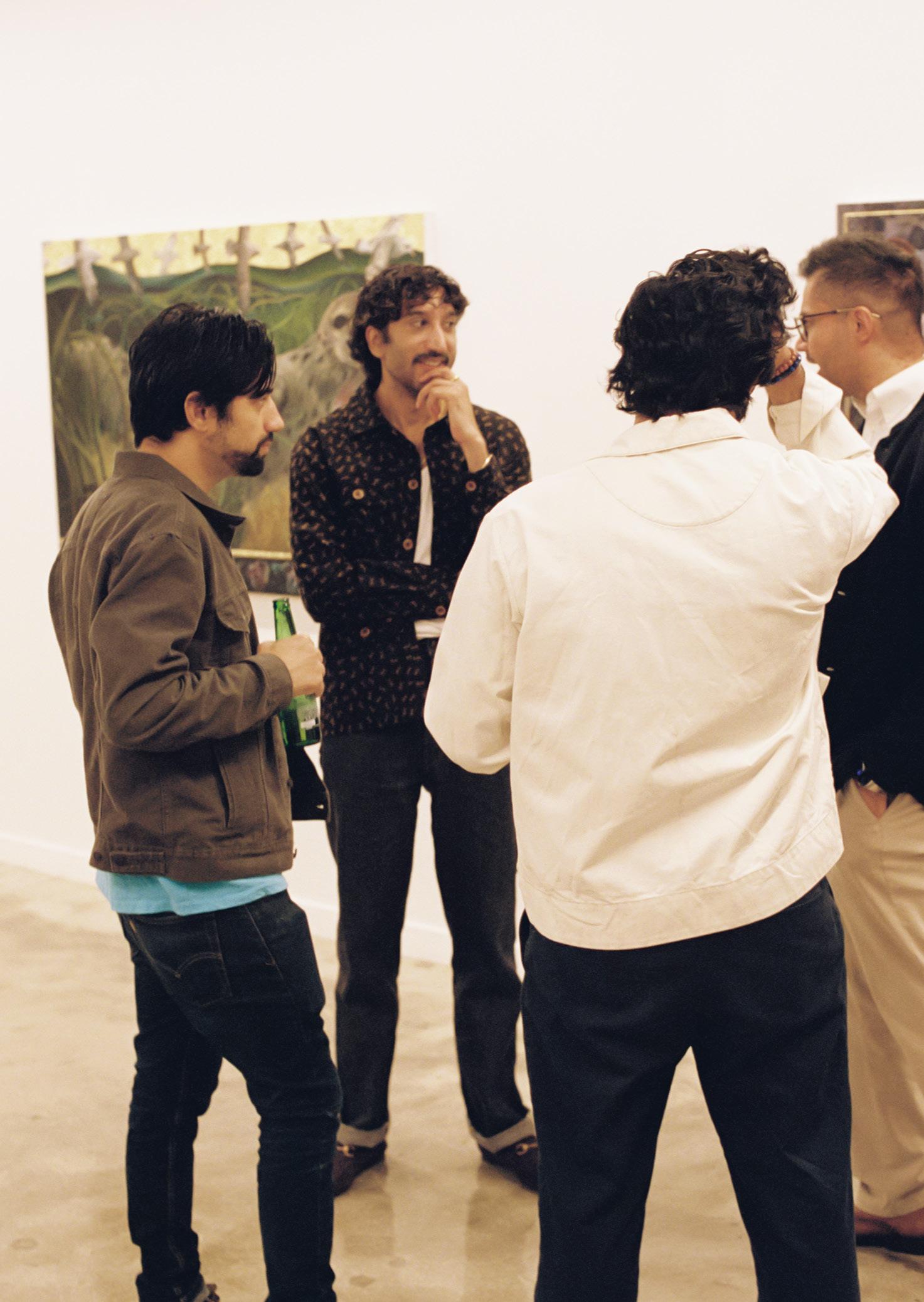
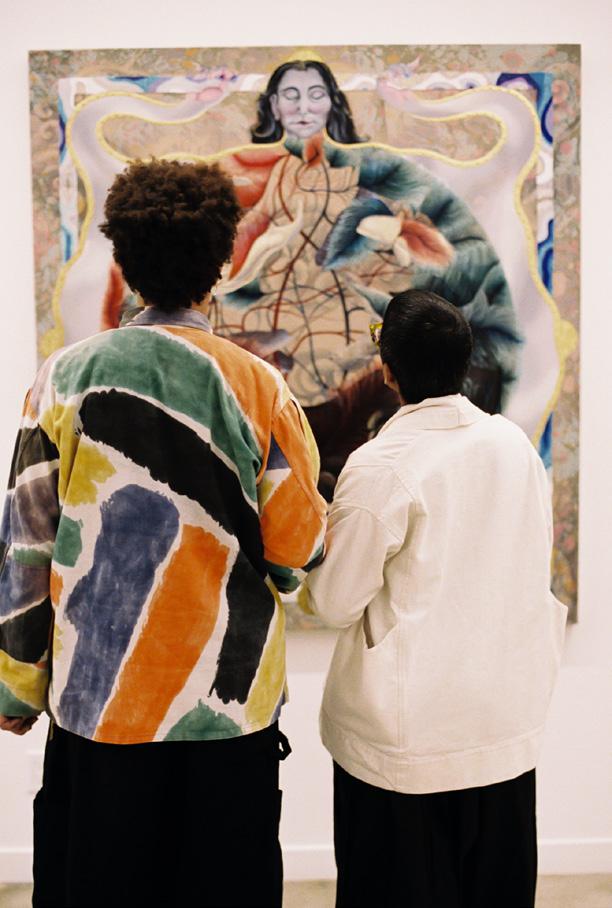
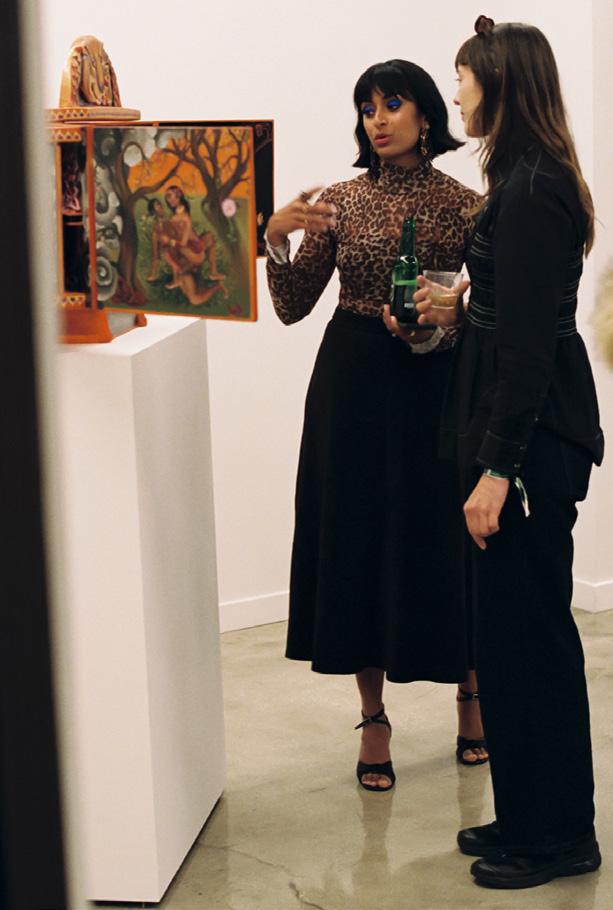
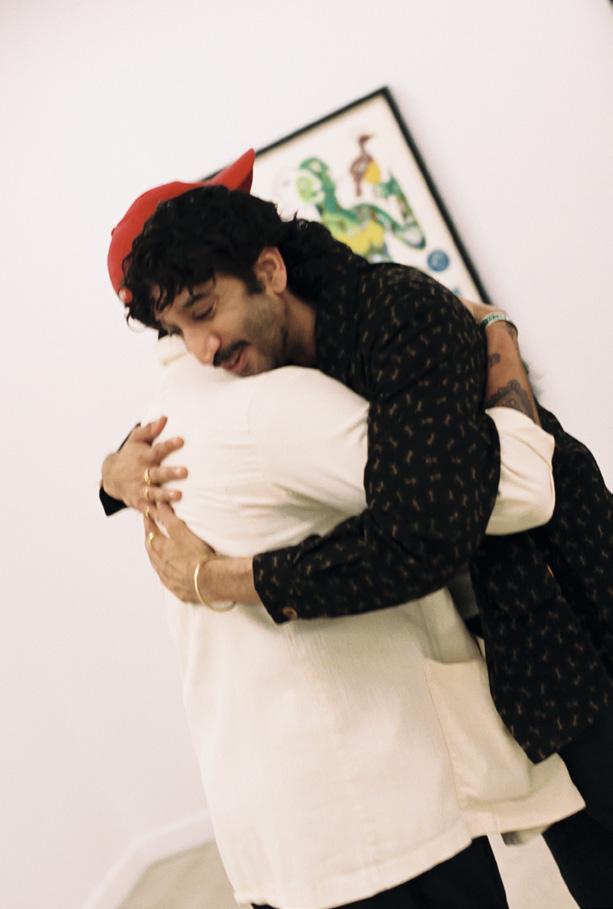
Since founding his eponymous gallery Rajiv Menon Contemporary (RMC) in 2023, the gallerist has brought South Asian hospitality and style to the West. In February 2025, the gallery established its quietly capacious headquarters on Highland Avenue in Hollywood. RMC aims to not only preserve but also amplify South Asian culture in Los Angeles—already home to a robust and diverse art community. By choosing to exhibit predominantly South Asian diasporic artists, Menon contextualizes modern American perspectives through Indian heritage. In the past year, RMC hosted 12 exhibitions, participated in two global fairs, and produced a historic debut show at Jaipur City Palace in India. Through press, meaningful connections, and institutional placements (six in one year, with more to be announced), RMC facilitates an impactful global dialogue through the artists featured within its walls.
Inspired by the stories of Jhumpa Lahiri, a contemporary British-American writer of Indian
descent navigating the grief of displacement, Menon has built a central art palace, offering a haven for conversation, idea exchange, and belonging. A natural orator, Menon encourages gathering through public speech, genuine curiosity, and a warm disposition. He previously worked in the film and television worlds and enjoys situating himself at the intersection of aesthetics and storytelling, which is visible in his wardrobe (a mix of travel finds and Indian labels like Raw Mango). He identifies Fairfax District as his personal homebase, consistently collaborating with local restaurant Badmaash and frequenting nearby markets for the occasional client run-in. Often overlooked as a district for fine art, Fairfax has depth, much like the artists Menon prefers to work with: emerging global artists deserving of recognition in the United States.
The Dealers is a year-long photo series featuring up-and-coming art dealers in L.A.
Photos and text by
Claire Preston
What kind of dealer are you?
I’m driven by culture first. I come from an academic background. I did my PhD at New York University in my 20s and that deeply shaped my way of seeing the world. Intellectual curiosity and cultural impact are the driving forces behind how I engage with art.
I see myself as both a dealer and an educator. I’m not just selling art, I’m also helping people understand the art history and context that shapes the artists’ practices.
I’m also very mission-driven. When you have a specific cultural focus like I do, this isn’t just about the buying and selling of art. This is building a collective sense of visual identity.
Why do you deal?
To bring my culture and my community into the global mainstream.
I want to create the next generation of custodians for work that I believe is deeply important and culturally significant.
I firmly believe that bringing art into your home can change your life, and bringing art into an institution can change an artist’s career.
What are you proud of?
I’m very proud of building a market from the ground up in Los Angeles.
When I started the gallery, it came from wanting to see more energy around South Asian art in Los Angeles. I wanted to build the gallery I wasn’t seeing as
a collector, and I also saw so many potential collectors who wanted to invest in culture, but had no idea where to start. I don’t think there was a gallery speaking to them. I don’t think there was enough infrastructure or education around why collecting art is important, and I take a lot of pride in fostering new collectors in a place that didn’t previously emphasize the South Asian diaspora.
What changes would you like to see in the art industry?
Connoisseurship needs to be more accessible. Appreciating and loving art should not be an insider’s game.
The goal should be to bring in new collectors and create a love of art that’s contagious. Sometimes the industry focuses too much on existing bubbles and established ways of doing things.
What makes a piece of art ‘important’?
Cultural significance.
Art should change the way you experience reality or the world. A significant work does that.
I think of it similarly to great literature or an award-winning film—work that fits within a larger cultural canon, and changes the way people experience the world around them.
I want to show artists who are shifting the cultural conversation. The best works of art for me feel wholly singular, but also challenge and push the way we view the wider world.
Best advice you have received?
I am really lucky to have great mentors. When starting my career, I was very reluctant to put myself forward in any public-facing way. But my mentors encouraged me to share my voice and to own my perspective, and I think that’s been key to the gallery’s success.
Worst advice you have received?
To downplay my cultural interests and background to be more palatable to a mainstream audience. I fundamentally rejected the idea that I needed to operate that way. I was constantly being told I was “too academic,” but I increasingly find that to be a strength.
I was also told early on not to emphasize being South Asian, that it might be off-putting or pigeonholing. I completely rejected that idea, and I’m very glad I did.
What advice do you have for artists on gallery etiquette?
Be mindful of timing and stress.
Don’t bring a portfolio to an opening when staff are busy taking care of guests. Instead, come during gallery hours, introduce yourself, leave your information, and let things happen organically. Adding stress to an already hectic moment isn’t a good way to build a relationship.
Which artists dead or alive would you start collecting given money was no constraint?
I love twentieth-century British figurative art—Lucian Freud is an all-time favorite, and I would love to live with his work.
Among contemporary artists, I think Salman Toor is one of the most significant painters of my time. I would love to live with one of his works.
Who are some of your favorite players in the field and why?
In Los Angeles, there are so many great galleries. Megan Mulrooney is showing how a young gallery can thrive in this climate. Emilia Yin at Make Room is contributing to L.A.’s global culture. I also love programs like Vielmetter, Nicodim, and François Ghebaly, who have built Los Angeles as an international art hub.
And of course, I really admire dealers like Jeffrey Dietch and Bill Powers, who embrace a strong sense of perspective and personality.
In India, I admire Experimenter, Jhaveri Contemporary, and TARQ.
In Dubai, The Third Line is doing incredibly compelling global emerging work.
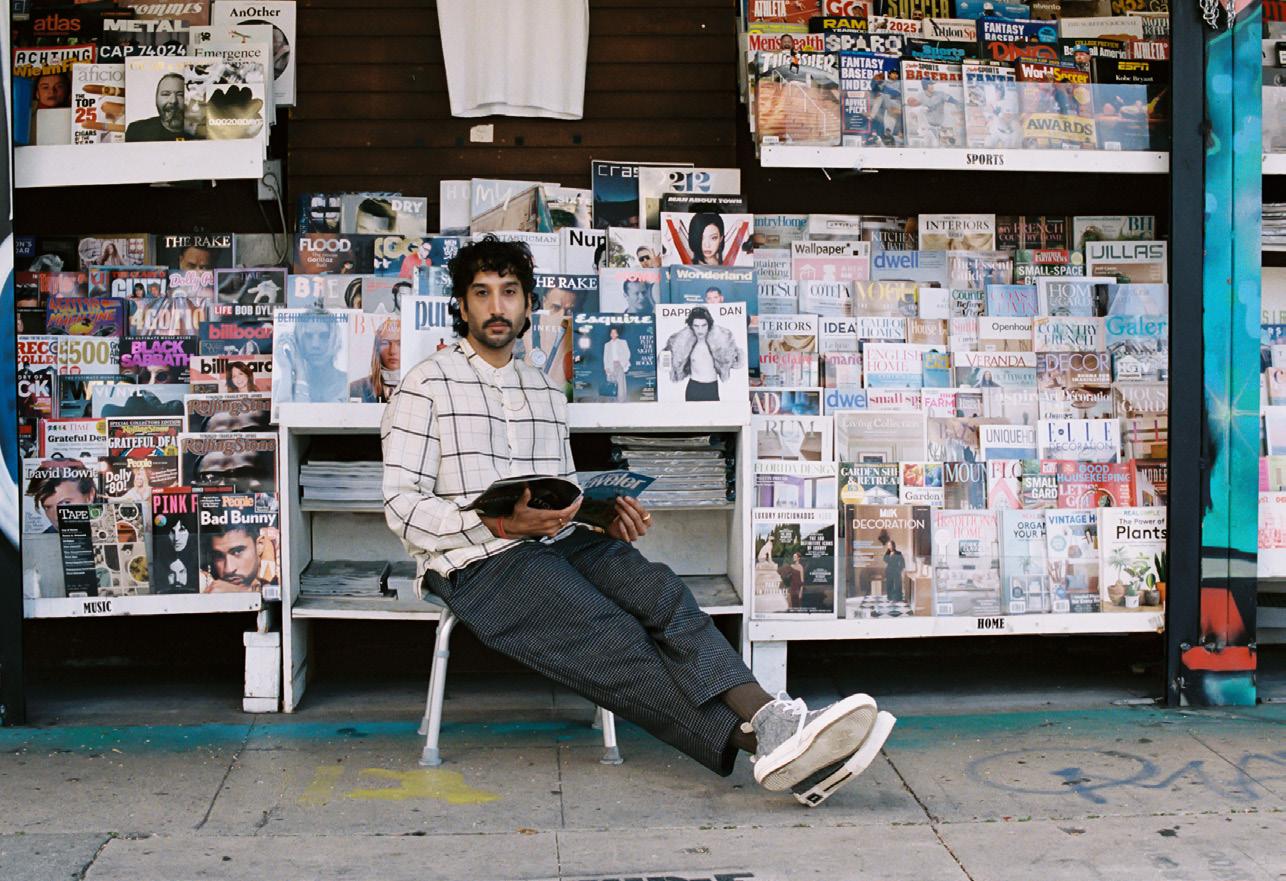
What do you value most in working with an artist?
I love working with artists who are culturally curious, who are reading and expanding their worldview. I love exchanging articles and books with artists and collaborating to build a larger critical framework around their work.
How do you define good taste?
How has your taste evolved?
For me, taste is all about perspective, both informed and innate. Good taste is about being able to place and assess a work within a larger context, but also having a personal point of view. Social media culture has produced a lot of armchair critics who can give you a curt answer about why something is bad, but it can be a lot more challenging to effectively communicate why something is successful.
What’s one thing you wish more people asked you about?
Overlooked mid-career talent. There’s a strong focus on young emerging artists, who I also love working with, but I also want collectors and curators to take chances on artists who maybe didn’t get noticed in their emerging years.
What is your least favorite trend in contemporary art?
The art market is already fixated on larger waves, and the TikTokification of culture has made people treat trends as an absolutely certain cultural framework.
I want to reject trendbased thinking. Art should be about longevity, permanence, and singularity—not time-sensitive boxes we call trends.
In your opinion, what responsibilities do galleries have beyond sales?
Cultural impact.
That includes press, institutional placements, introducing artists to meaningful collectors, and bringing them into broader cultural conversations.
Sales follow—but cultural impact is the mission.
Do you believe in art world karma?
Yes—everything comes back around.
The art world is a small, interconnected ecosystem of artists, collectors, and galleries. Treating people well matters, because energy, trust, and reputation circulate constantly.
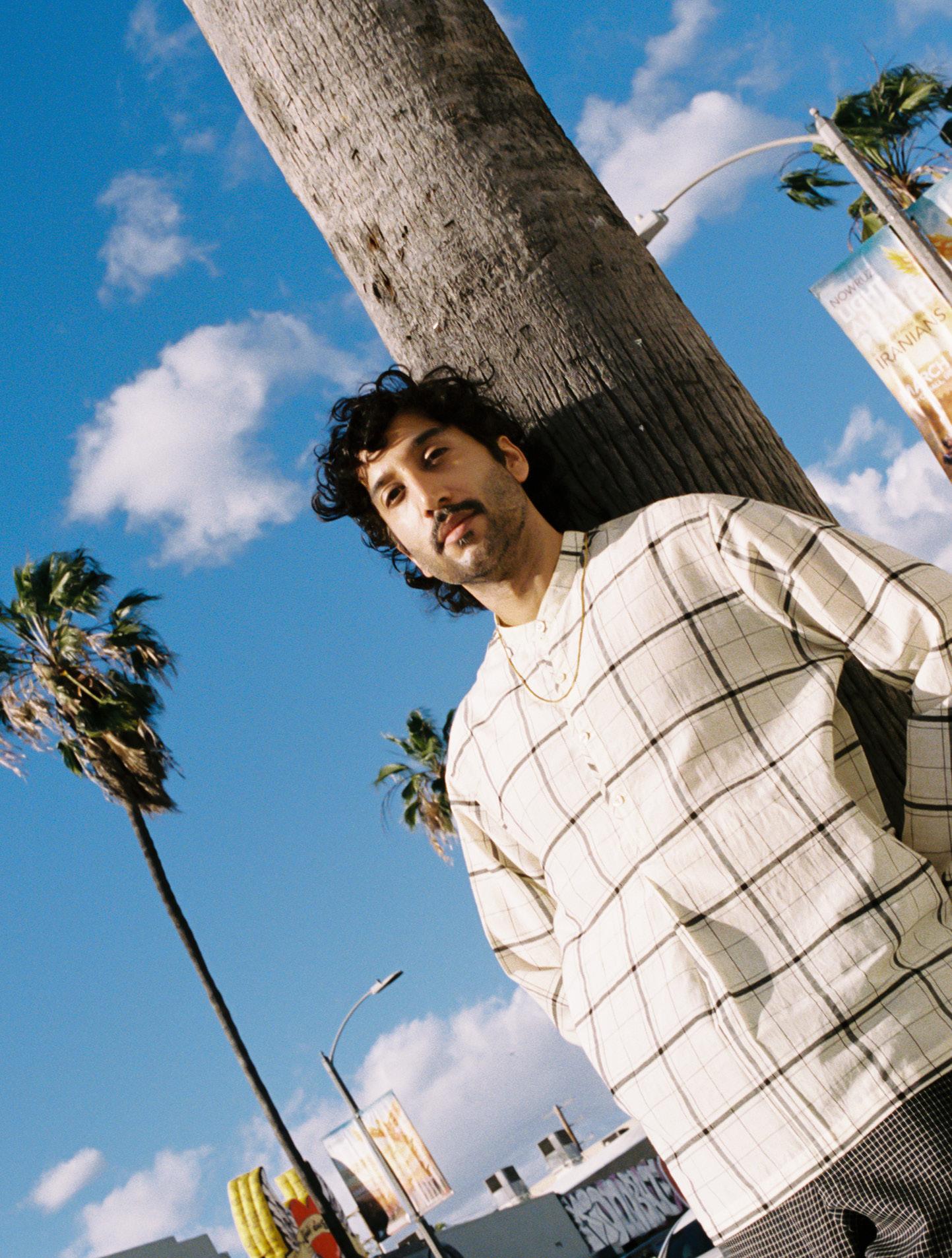
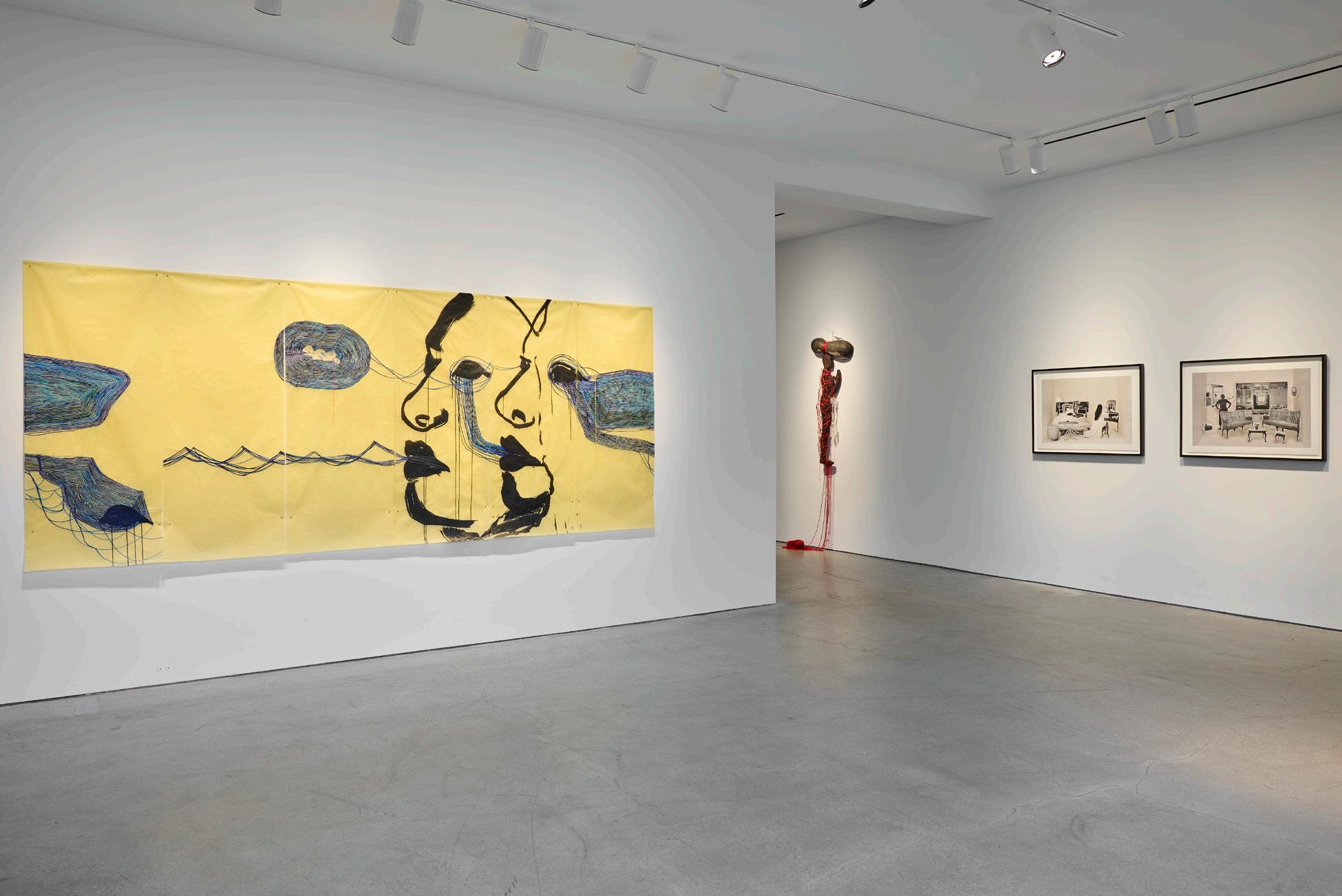
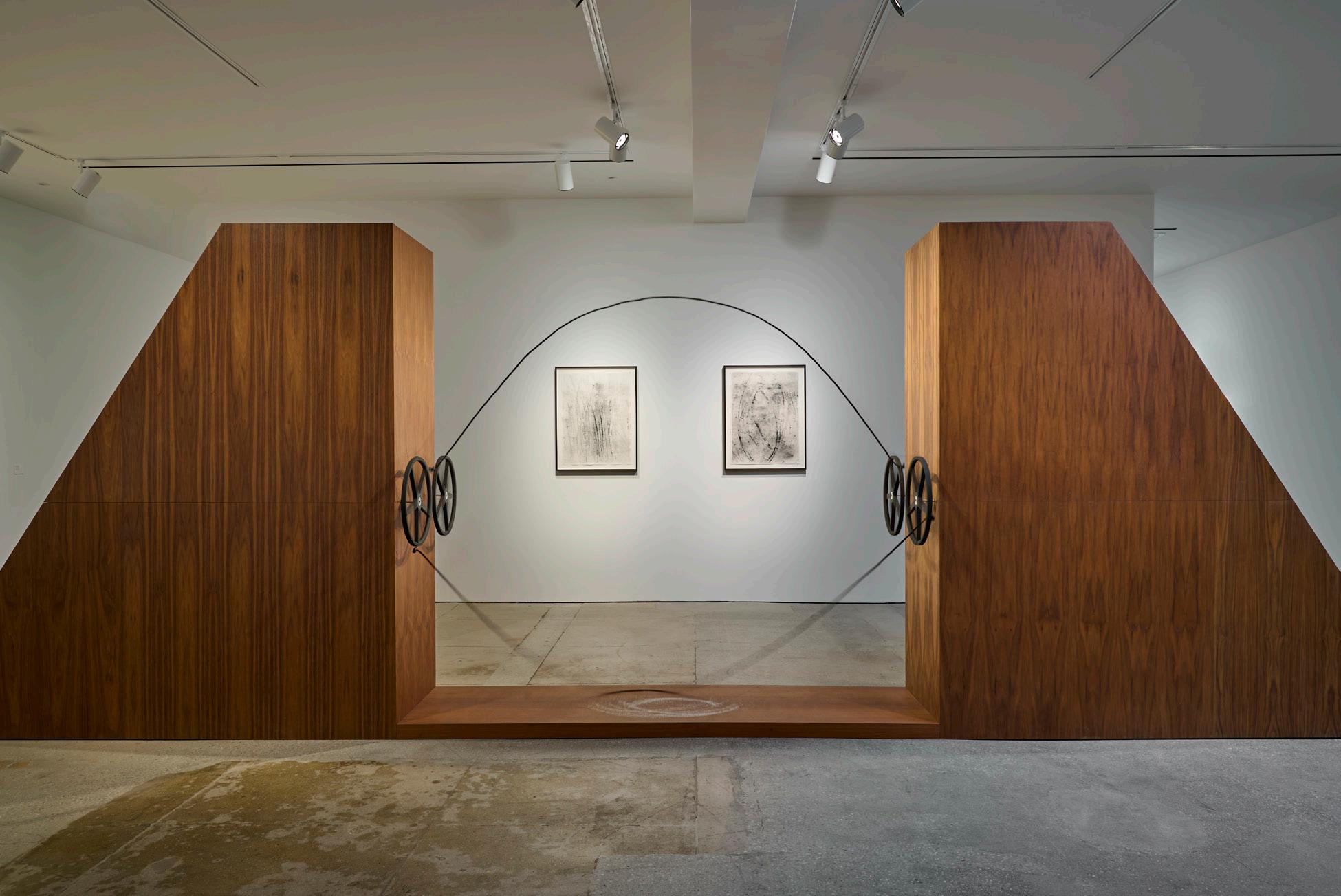
November 14, 2025–
January 10, 2026
Gazing through the gallery window, I was met by an expanse of soft, atmospheric yellow. Wura-Natasha Ogunji’s Lagoons and Lagoons and Lagoons (2021), measuring 12 feet across, stretched across the entrance wall, its suspended sheet displaying inked faces. Blue thread ran from black lips, peaking and falling across the width of the piece, stretching toward pools of cerulean and indigo lines on the other side. Cutting through the gallery’s stillness came a steady thwack, thwack —the sound of double-dutch ropes striking the floor somewhere out of view. Turning the corner to follow the sound, my eye caught the lower left corner of Ogunji’s lagoons, where the phrase “You catch up with yourself” was stitched. In Driftwork, Southern Guild’s final exhibition in Los Angeles, curated by Essence Harden, memory operated as both material and method. In this convening of 11 African, Caribbean, and Afro-disaporic artists —including Zalika Azim, Jasmine Thomas-Girvan, Sandra Brewster, Janiva Ellis, Sidony O’Neal, Anique Jordan, Shaniqwa Jarvis, and Wura-Natasha Ogunji, among others—memory was rendered visible. Fragments of personal and collective histories surfaced through rope, textile, photography, and paint, demonstrating how remnants gain power by activating and transforming one another.
The works dwell on what Édouard Glissant describes as relation:1 a space where selfhood is not singular but multiple, layered through migration, rupture, and entanglement. The artists in Driftwork position remnants as connective tissue, revealing diasporic identity as something continually shaped through accumulation, proximity, and exchange.
One of the show’s most arresting presences was Zalika Azim’s sculptural installation, Ascension Device II (actions for earth…or some other oscillation…a haptic and sonic engagement…a breath…or an architecture for gathering between space and time) (2024). Spanning nearly 23 feet across the center of the main gallery, doubledutch ropes trace a wide, continuous arc between two towering wooden structures. The repetition of the ropes’ movement fills the gallery with familiar, kinetic percussion. Azim extracts the movement of double-dutch and reconstitutes it as sculpture, allowing its syncopated timing to endure as an ongoing temporal structure within the gallery. This rhythm reverberates, conjuring a felt sense of communal inheritance that registers in the body and, like the looping sound, has the potential to continue indefinitely.
Across the wall of the gallery’s second room, three sculptural figures from Jasmine Thomas-Girvan’s Revisiting Belisario: Sketches of Character series (ongoing) were imposingly wall-mounted. Their dark textured bodies, two made of PVC, sleek and precise, are studded with screws and bolts. The PVC figures and the burnt wood
figure all have portruding forms—an elongated wooden orb streaked with gold leaf and etched like exposed grain, a web of bronze wire, a sculpted sea of vibrant macaw feathers laden with a gold-railed wire boat of small, dark anatomical hearts. These assemblages, including bronze, calabash, silk cord, plexiglass, wood elements, function simultaneously as artefacts and icons, objects that document and consecrate. In Thomas-Girvan’s hands, fragments gathered as ritual elements carry ancestral knowledge forward, their accumulation a record of both what persists and what has been lost.
In contrast, Shaniqwa Jarvis’s work turns towards the interior. Just inside the gallery entrance, sat Don’t Forget Us (2025). The work features a wooden dresser and bench, anchoring a circular mirror draped in a sheer, black fabric printed with blurred tones of pink, yellow, and green, like a photograph exposed too soon. The dresser conjures the ritual of getting ready: smoothing hair, lining perfume bottles, tucking photographs into the mirror’s edge. The vanity itself, a family heirloom passed down through three generations of Jarvis’s maternal line, operates as a remnant carrying lineage into the present. The draped silk disrupts the mirror’s promise of a clear reflection, fracturing it into a surface that holds absence and possibility in equal measure.
Ogunji’s expansive works on architectural tracing paper extend across luminous yellow grounds, their surfaces layered with ink, collage, graphite, and thread. In The Atlantic The Atlantic (2024),
Nneka Jackson
an 80-x-120-inch composition assembled from two sheets hung side by side, spiraling fields of indigo and black arc across the thin paper like a whirlpool. Eyes cut into the paper reveal small, colorfully stitched faces, while strands of thread fall beyond the paper’s edge. The work captures the residue of thoughts and feelings in conversation—made visible, left unresolved.
At a panel presentation at the gallery, Harden described the recently-opened exhibition as unfinished—still in its making. This declaration can frame the entire project: Driftwork is process. Its progression from communal, to ancestral, to personal revealed a curatorial vision both exacting and generous. In the exhibition, diasporic selfhood unfolded as Glissant describes: formed in the ongoing entanglement of lives across time and distance, sustained through absence, transformation, and the ever-renewed act of turning back.
Though Southern Guild retains its Cape Town home, the show carried the poignancy of its departure from Los Angeles. That this gathering, so attuned to echoes, fragments, and the familiar interiors of Black life, should mark an ending felt unbearably tender. Driftwork assembled what we did not know we had forgotten and surfaced it with care. The exhibition became a trace within the city’s art ecology, a meditation on disappearance. It revealed relation itself as a generative force, a site where diasporic voices remain distinct and alive.
Even in departure, something persists. If, as Harden
suggests, this exhibition is in process, it is because the work of holding these voices in conversation, of surfacing what has been lost and refusing to let it settle, cannot end here. To move through Driftwork was to feel what happens when these traces converge: a current passes between the works and the body. The show demonstrated that identity can be reconstituted through and beyond rupture, that across difference and distance, we find each other anyway, and must. Being in relation is itself the practice. A transmission that does not explain but makes itself felt.
1. Édouard Glissant, Poetics of Relation, trans. Betsy Wing (Ann Arbor: University of Michigan Press, 1997).
November 15, 2025–February 28, 2026
Cultural narratives around outer space often hew curiously close to the colonial past: the fantasy of an open frontier, ready to offer up its resources to an intrepid explorer. In the absence of living beings, we imagine its empty space as a blank canvas, which might be inscribed with any number of possible futures.
To walk through the galleries of Against Outer Space at the Beall Center for Art + Technology at UC Irvine was to be briefly taken in by this fantasy. Circling
through shadowed passages, one’s sense of direction and gravity was disrupted by the alien contours of works suspended across the walls and ceiling. But while the exhibiting artists contend with cosmological subjects, their practices are rooted in the earthly origins of their mediums: Mica, dried gourds, and charcoal-coated clay all appeared among the works on display. Across an array of works that showcased the agency and affirmed the dormant histories of each artist’s chosen material, Against Outer Space critiqued conceptions of outer space as a passive site of potential extraction. It imagined instead technologies that might operate in tandem with their materials, drawing on past and future forms of knowledge to envision new modes of existing in relation to natural resources. It proposed kinship with non-living materials, honoring their capacity to contain knowledge and confound our sensory worlds. Entering the gallery space, one passed through the illuminated orbit of Marcus Zúñiga’s photosphere (2025), a work commissioned for this exhibition that felt less like a sculpture than a portal. Sitting within a singular alcove, a fragment of densely-layered, gleaming white mica was suspended at eye level within a double-sided pyramid of wooden and acrylic cubes. From within its wooden scaffold, the mineral centerpiece fractured the spotlights surrounding it to cast a kaleidoscopic grid of light across the enclosing walls. Mica remakes the world in its own image. The same atomic structure that forms its layers also endows it with
Teresa Fleming
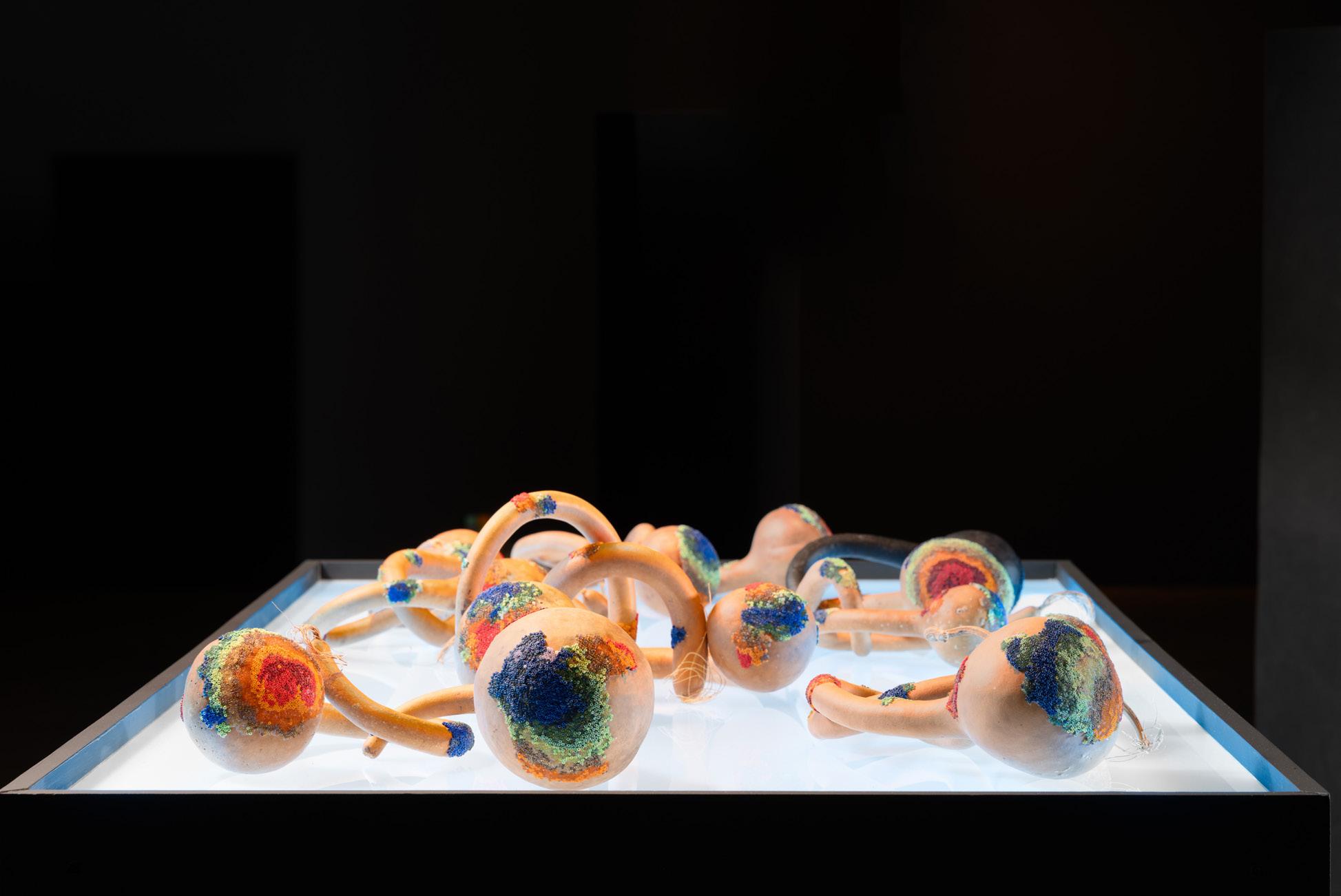
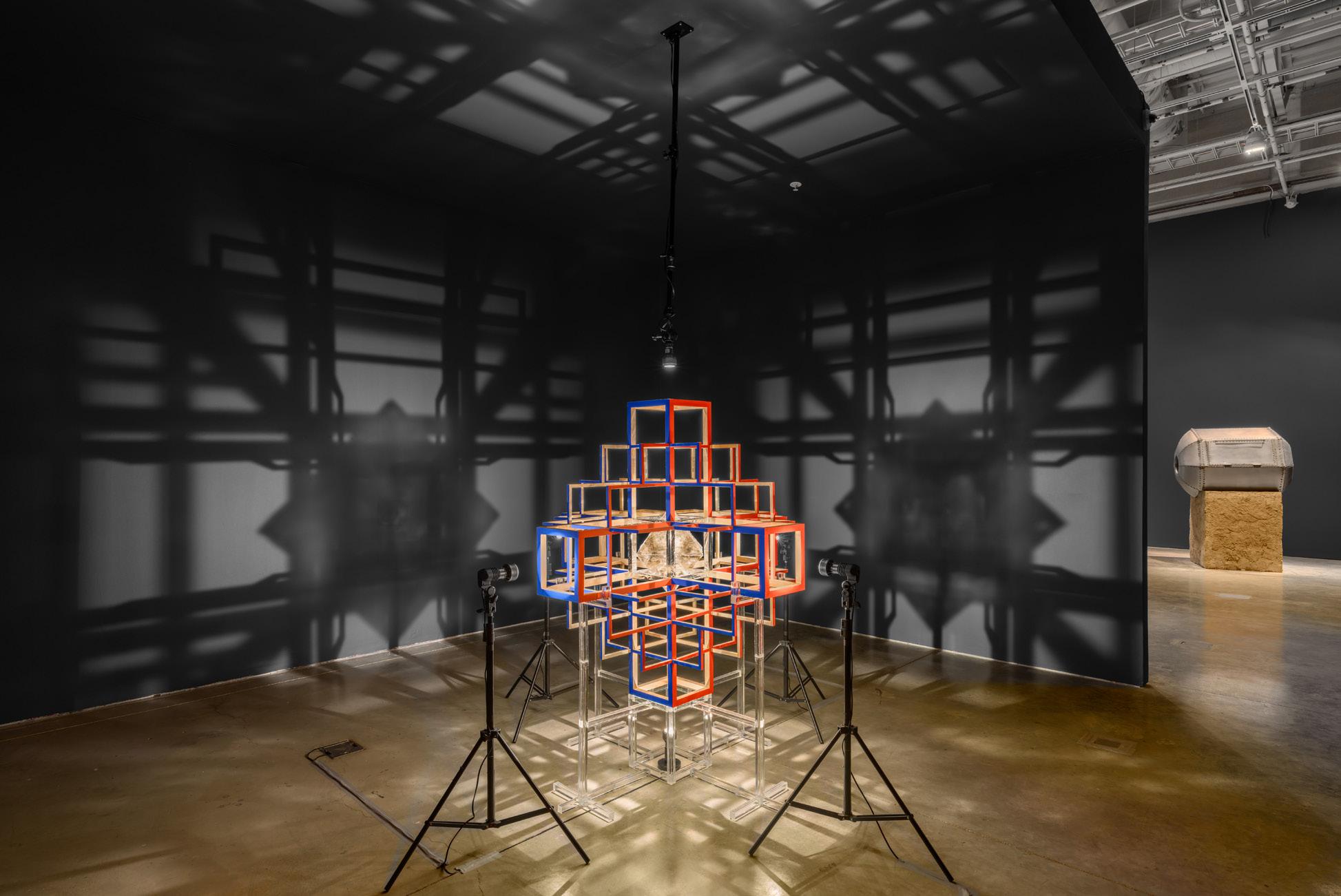
birefringence, the capacity to sever rays of light into separate, radiant beams. The material’s framing within a tiered pyramid conjures its ancestral applications within Mesoamerican architectural structures, a history that spans from Teotihuacán to Copan.1 But the work’s staging also complicates its status as an artifact to examine: The sculpture inverts the anthropological hierarchies of the vitrine, which encloses a prized object in a clear cube, by balancing its crystalline centerpiece in a pine scaffold, positioned not to be inspected but to transmit light. To examine the work is to be ensconced by it, as you turn outward to watch the contours of your own body move through the surrounding illuminated grid. Within the scaffold of Zúñiga’s sculpture, the medium’s transformative power takes precedence over the artist’s intervention. The work’s dazzling refractions trace the contours of our perceptual limits, a ghost remaining in the retinas even as one walks away.
Across the gallery, Sarah Rosalena’s CMB RBG (2021) reframes contemporary imaging technologies within the ancestral forms of her chosen medium. Nestled in interlocking patterns atop a plinth, her sculptures invert the form of Wixárika gourd bowls, their bulbous exteriors embedded with iridescent beads that radiate across their shells like a technicolored lichen. Traditionally, the hollow interior shells were embedded with beeswax and beads were used to form astrological maps, their spherical shape offering prescient insights
into the elliptical paths of celestial bodies.2
While these early cartographic artifacts preserved astro-navigational knowledge, Rosalena’s sculptures offer another means of making sense of the cosmos: Her brightly-colored, intricate beadwork reflects a heat map of the early universe in microcosm. Her titular subject, the Cosmic Microwave Background (CMB), is a thermal record of the Big Bang, a faint photonic glow of modulated color that resembles a weather map, invisible to the naked eye but everpresent in empty space. Excerpts from the heat map are translated into Rosalena’s sculptures, every spectral wave corresponding to a glass bead, in a record of an ancient world overlaid on the present. The spherical forms of the gourds, which served as miniature models of the cosmos in Huichol religious practices, are re-inscribed with the contemporary cartography. Her practice of assemblage weaves together traditional and technological modes of seeing, refuting the existence of empty extraterrestrial landscapes by materializing the discovery that every element in the univers with its own atomic history.
If Against Outer Space began with rays of light (Zúñiga’s photosphere), its final gallery was framed by darkness; five blackened pillars make up Alice Wang’s Untitled (2024). Standing at just over five feet, her monoliths carry monumental weight that belies the organic texture of their surfaces, rendered in slabs of sculpted clay, bearing the marks of
the artist’s hands. But these impressions are blurred by the coating applied to the pillars, a mixture of charcoal and graphite, two materials with the capacity to absorb light across a uniquely broad spectrum of wavelengths. As a medium, charcoal conjures both the deep time of our earliest cave paintings and the profound ephemerality of its material substance, which coats everything it touches in inky black. Absent of any apparent texture, Wang’s pillars appeared less like physical objects than slices of dark, disorienting space, hovering across the gallery. Rather than casting a singular shadow, their dark forms reflected in the polished floor, furthering their profound sense of dislocation and disorienting the viewer who stood beside them.
Far from an inert canvas, Wang’s chosen medium bends perceptions of space and light. This darkness has a substance, a material weight and history, a sentiment that coursed through the works on display in Against Outer Space. Rather than imagining uninhabited galaxies as empty sites for conquering, these artists animated the transformative potential of non-living natural materials, excavating the pre-colonial histories of their own mediums to subvert otherworldly fantasies of extractive expansion and empire. The vision of the future they conjure is radical not for its technical prowess but for its adherence to ancestral modes of knowledge embedded in their organic materials.
1. Linda Manzanilla,“Teotihuacán: A Multiethnic Metropolis,” Berkeley Review of Latin American & Caribbean Studies (September 2015).
2. Regina Lira Larios, “Feathers, crosses, mirrors, and gourds: Embedding words and images in a Wixárika ritual chant,” Anthropology and Aesthetics (2023), 79–80.
Across the retrospective
The Awake Volcanoes, exhibited at the Institute of Contemporary Art, Los Angeles (ICA LA), Sandra Vásquez de la Horra’s radiant watercolor strokes resolved into vast oceans, active volcanoes, and snowcapped mountains. If these shifting landscapes, painted with wax on paper, convey a message about navigating through the world, it is that migrant bodies, once set in motion, acquire the momentum to travel again and understand the multifaceted expansiveness of humanity. Born in Chile and raised during Augusto Pinochet’s military dictatorship, Vásquez de la Horra moved in 1995 to study fine arts in Germany, where she has lived for the past four decades. Her retrospective traced a comparable trajectory. First presented at the Denver Art Museum, it traveled from Chile and Argentina to Los Angeles, where in a room complete with more than a hundred graphite drawings, watercolor paintings, and accordion-like paper sculptures, the experience of migration was given visual form. Within this dense display, the complex changes triggered
by displacement are imagined through fantastical beings that are at once human, vegetal, and animal, altered by the distances they have crossed, where blooming flowers flaunt human facial expressions and reclining women morph into mountain ranges. For Vásquez de la Horra, the human body is a map marked by movement, and in her exhibition geographies, religious beliefs, and new memories were gathered, fused, and reassembled on paper, each drawing an index of both past identities and future selves.
Like an inventory of detailed cartographies, Vásquez de la Horra’s drawings, some dating back to the 1990s, map Chile’s coastal and Andean volcanic zones through bodily parts. In the massively-sized work spreading over four sheets of large paper in a square formation, Volcánica (The Volcanic Woman) (2023), a brown-skinned nude woman stands before ranges of blue and grey mountains. The smallest peaks take the form of protruding breasts, releasing smoke against a saturated red, clouded sky. Vásquez de la Horra adopts a freehand approach, drawing silhouettes with fine graphite lines that she then fills with deeply hued strokes of color. Breasts that morph into mountain ranges reappear in Anillo de fuego (Ring of Fire) (2023), which explicitly references the vast seismic belt of the Pacific Ocean, where tectonic plates, including those beneath the Andes, press against one another, producing the majority of the world’s volcanic eruptions. Towering in scale, the drawing presents a female
body arching backward, whose abdomen rises with snowcapped volcanoes exhaling smoke. In both works, positioned only a few feet apart, the artist blurs the boundary between geological formations and human anatomy, proposing, perhaps, that the body functions as a repository of memory, where life experiences marked by movement and change accumulate, layer by layer, like the earth itself.
This continuity between the human body and the Earth extends to the spiritual dimension in Vásquez de la Horra’s work. After settling in Germany, she renewed her connection to ancestral religious traditions, particularly those of Cuba, which she visited after meeting a shaman who introduced her to Santería in 2000.1 These encounters surface in the accordionfolded paper sculpture Yemanjá (2025), named after the Yoruba deity revered as the Mother of the Orishas, who is associated with the ocean and motherhood. Displayed on a plinth, Yemanjá’s mountainous silhouette transmutes into a reclining woman as the viewer approaches closer, with a fetus-like newborn penciled in place of her ear. In this transformation between mortals and deities, and between the tangible and immaterial, Vásquez de la Horra demonstrates how a person’s faith can also expand over time to embrace multiple ways of understanding the world at once.
Just as the exhibition entwined spiritual symbolism with geography, it also fused human anatomy with plant life in large-scale compositions
Nahui Garcia
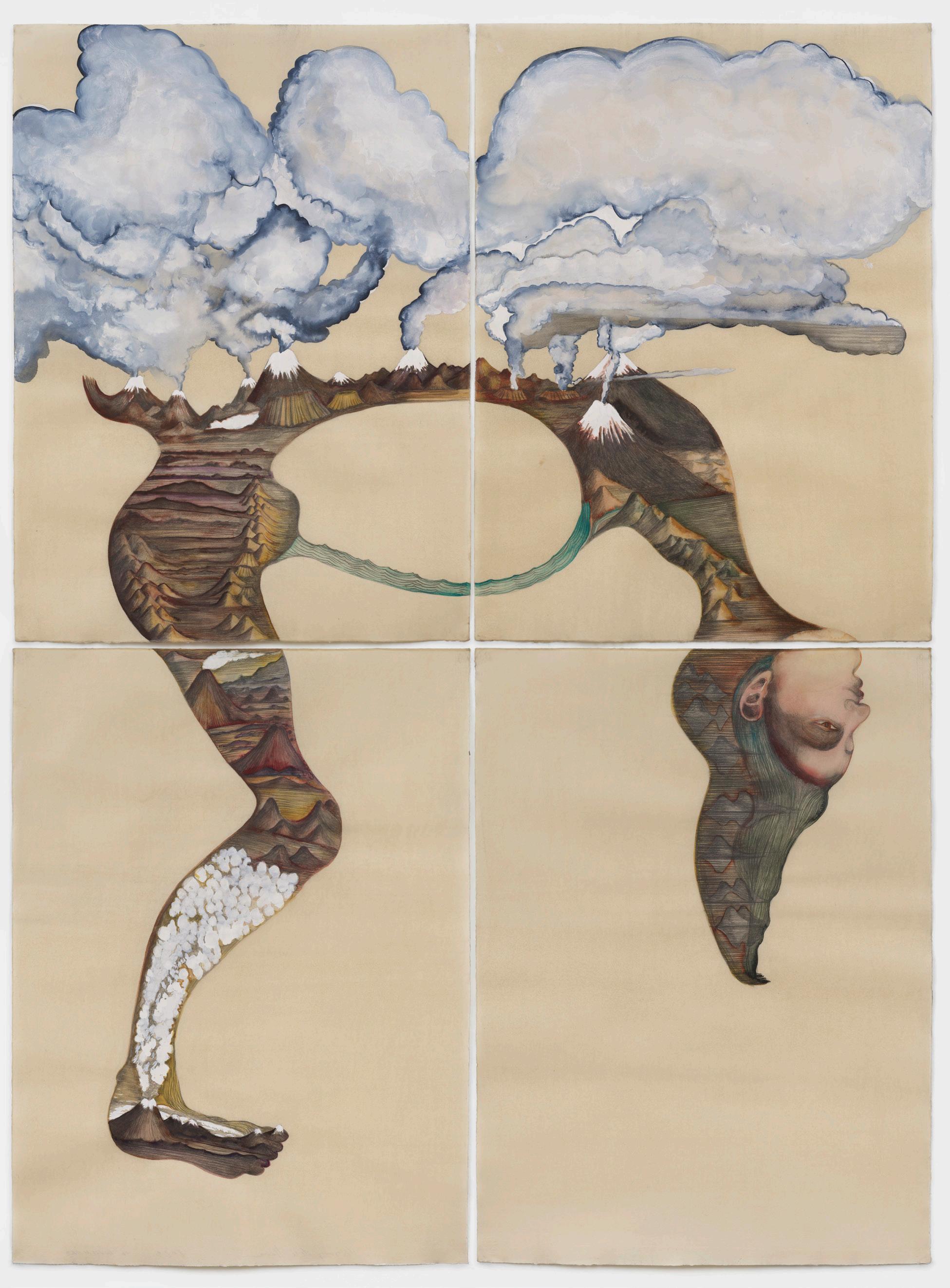
assembled from multiple sheets of paper. The modest scale of the single sheet allows for a private, almost diaristic way of working, in which images are created individually and only later joined on the wall, as seen in Metamorfosis (Metamorphosis) (2023). From the mouth of a brownhaired human head, a flowering stem emerges. Creatures rest along its meandering path, including a black butterfly, two purple blossoms with human-like facial features, and a caterpillar whose face is a skull. As its title suggests, life unfolds through different stages of transformation, change the only constant. This process of becoming something else, of birthing new life and witnessing growth, finds visual parallels in the rising smoke of mountain ranges in Anillo de fuego and in the newborn figure that surfaces in Yemanjá, where human life, the earth, and plant life converge into a unified whole. For these fantastical beings, and in many ways for those experiencing the dislocation of migration, there is no clear distinction between what they have been and what they are becoming; existence is understood as a continual state of flux.
Throughout ICA LA, and especially in the salon-style wall display that assembled 71 graphite drawings, a sense of accumulation became vividly apparent. Here, the artist’s transnational experience was most visible through language: single words and short phrases appear in Spanish, German, and English. Within this arrangement of works, the 2009 eponymous drawing
bore the phrase “El pueblo unido jamás será vencido” (The people united will never be defeated), written beside a man holding a black flag much taller than the height of his own body, the work is perhaps a metaphor for the weight of revolutionary ideals. First voiced as a 1970s Chilean protest chant, the phrase has long exceeded its original context, circulating across Latin America and reappearing in Englishlanguage protest songs, banners, and ephemera.2 Words, in this sense, are not bound to a single language, just as migrants are not constrained to a single place. In this process of exchange, migration follows a reciprocal logic, one in which individuals absorb the beliefs and customs of a foreign culture while simultaneously leaving lasting traces upon it, becoming jointly and inseparably transformed.
1.Alfredo Lopez, Jr., interview with Sandra Vásquez de la Horra, “Sandra Vásquez de la Horra: “Soy médium desde niña,” Velvet, November 18, 2025, https:// revistavelvet.cl/sandra-vasquez-de-lahorra-soy-medium-desde-nina/.
2. Sergio Ortega, Quilapayún, “El pueblo unido jamás será vencido,” Marxists Internet Archive, https://www.marxists. org/subject/art/music/lyrics/es/ el-pueblo.htm.
January 10–February 21, 2026
If you are familiar with Beverly Semmes’s practice, you know that in the midst of encountering her work, you might encounter yourself. Traces of play, desire, and care were present in Body
Shop, her most recent exhibition at Official Welcome. Entering the gallery space I felt a sense of anticipation, as I was greeted by nine iterations of Semmes’s humorously assembled works that resembled larger-than-life figures whose imposing presence make you aware of your own body. Soft and lush, some spanning several feet across, each assemblage was composed of painting, drawing, sculpture, textile, and photographic materials. Each one was absurdly pinned to the wall with T-pins that mapped out the shape of a torso. These bodies, or “bodices” as Semmes calls them, invite you to reorient, each holding their own offering as a gesture of transformation. Semmes’s work has always beckoned me, transporting me to a place of feminist radical play where desire materializes, where bodies spill, slip, and fold onto each other through humor and care.
Semmes's practice is an ongoing investigation of the body, materiality, and the politics of form—one that moves fluidly between drawing, sculpture, and installation. Central to her process is the long-running series FRP (Feminist Responsibility Project), a drawing practice in which Semmes pulls images from Penthouse and fashion magazines to create collages that combine manipulated photographs, paint, and other materials. Alongside these works are other series, like her ceramic bodies and her daring “impossible garments,” which occupy space in distinct yet related ways: The ceramics engage distance and depth with a grounded physicality, while
Silvi Naçi
the garments reclaim form even as they allow meaning to slip.
In Body Shop (all works 2025), Semmes collapsed many of these mediums together to play with new constructs. Her mixed-media sculptural works queer both body and space, each a fluid conception of identity that ruptures stable form. In one work, Nikie with Ugg, an FRP painting featuring Nikie, a model from Semmes’s collections of magazines who appears in many of her works, hangs stacked in a symmetrical composition over a single layer of pink tulle fabric roughly cut into the shape of a long sleeve-shirt. Flanked by a pair of red Ugg boots, Nikie is veiled by a layer of bright orange paint, limiting direct access, and yet her eyes invite you in. To the left, emerging from beneath a slipper, a drawing resembling Pac-Man’s profile heads toward Nikie. By refusing fixed orientations and linear narratives, the assemblage creates conditions of slippage—where identity is continuously re-formed rather than resolved. In these works, Semmes plays with speed and labor, abutting luxury designer shoes made in factories with careful and immediate painting gestures and low-brow cultural references. As Semmes’s use of humor destabilizes, desire emerges from overlapping materials, forms, and bodies. Semmes’s assemblages play with our desire through their overlapping power relations, handled with humor and care. They invite us to listen with our whole bodies, proposing a feminist responsibility to the body becoming.
Duck Slippers, the largest work in the exhibition and installed in the far right corner of the gallery, drew attention to the window and, in turn, to the subtle features of the gallery’s architecture. When I visited, afternoon light poured in, casting a reflection across the work’s luscious brown fur that read almost like a portal. Sunlight, architecture, and Semmes’s sculpture seemed caught in a quiet flirtation. In the piece, a large piece of brown textured faux fur—pinned to the wall high enough to resemble a window curtain—spilled down onto the floor and across the gallery floor, occupying nearly half the room’s width. At the far edge of this cascade of fur with bird-like feather texture, was a swatch of red patterned fur which sat underneath an FRP painting. The painting again features Nikie, here obscured by a thick layer of light blue paint (so only her heeled feet are visible) and a pair of luxury slippers embroidered with ducks, which sit atop the assemblage. In previous exhibitions, the cascade of brown fur in Duck Slippers has been installed alongside other works to more overtly resemble a figure. In one iteration, it occupied the position of a skirt while other works were installed above it to stand in for a torso. At Official Welcome, however, Hat (in which a brown fur hat is positioned at the center of a sea of pink velvet torso) and Fur & Bit (in which brown faux fur slippers sit where breasts would be within a caramel brown field of a torso) were installed in a line next to Duck Slippers, the implied figure being stretched out linearly across the gallery wall. Through Semmes’s
playful installations, in which artworks are placed in various proximities to each other upon each installation, the artist plays with space and orientation, fluidity of identity and becoming. Together the works resist a single viewing position —moving from wall to floor, from vertical to horizontal. This shifting orientation asks the viewer to renegotiate their physical relationship to the work, and by extension, their own embodiment.
The assemblages, holding layers of Semmes’s formal and conceptual languages, neither consume us nor ask to be consumed. Consumption, central to this body of work, is never satiated; the viewer is kept in the hold of desire. The slippages in meaning and embodiment within this new body of work asks us to play with the ways we inhabit form, space, language, identity, and other conceptual possibilities. By playing with spatial orientation, destabilizing bodily form, and layering through repetition and concealment, Semmes’s work ruptures the expectation that identity and meaningmaking unfolds in a linear, coherent way. Instead, identity is experienced as fluid, contingent, and continually in the process of forming.
(L.A. in N.Y.)
October 9, 2025–March 2, 2026
At the entrance of Magnificent Product, two vinyl eyes were stuck onto the doors that led into the first gallery. Even before entering, L.A.-born,
Aaron Boehmer
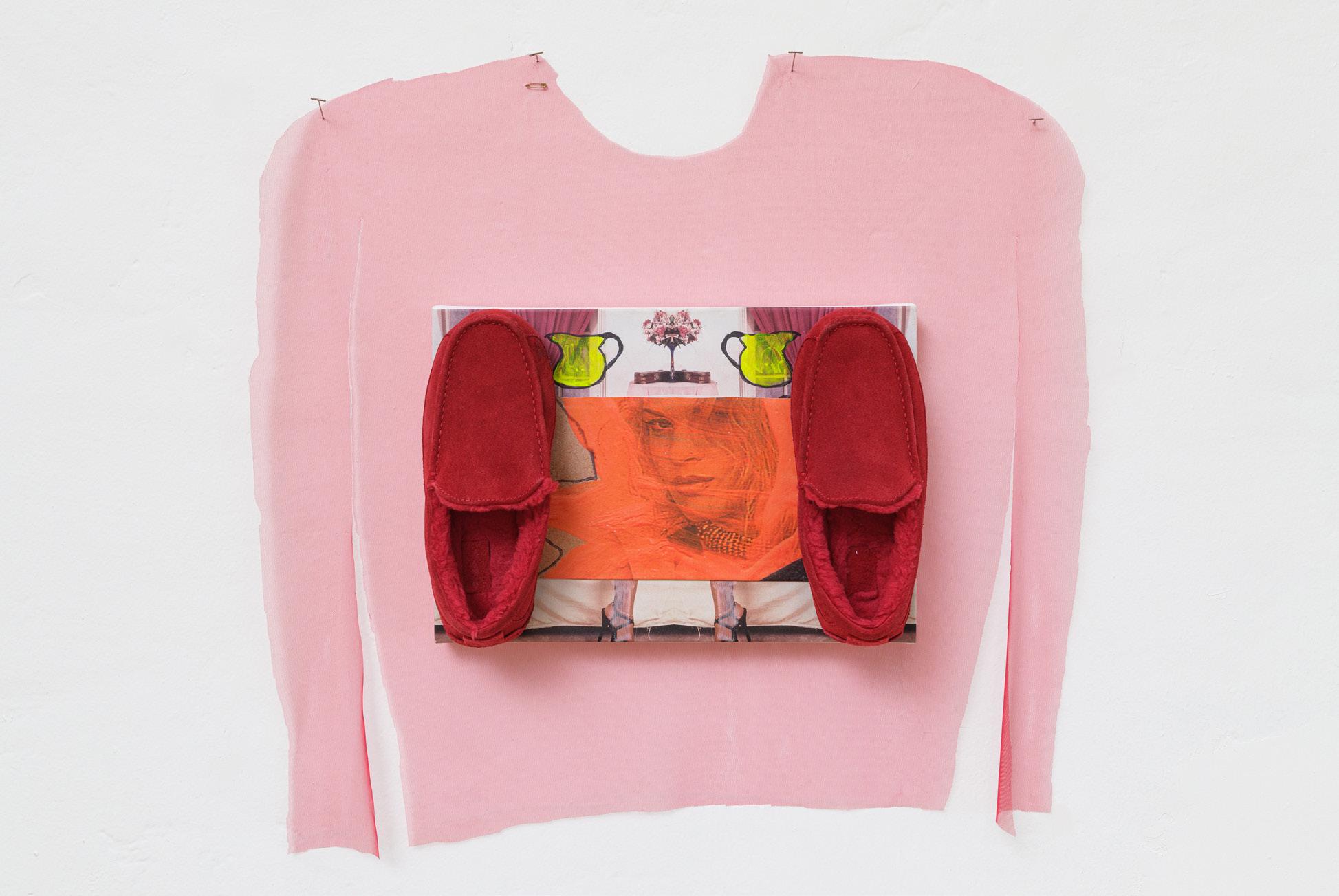
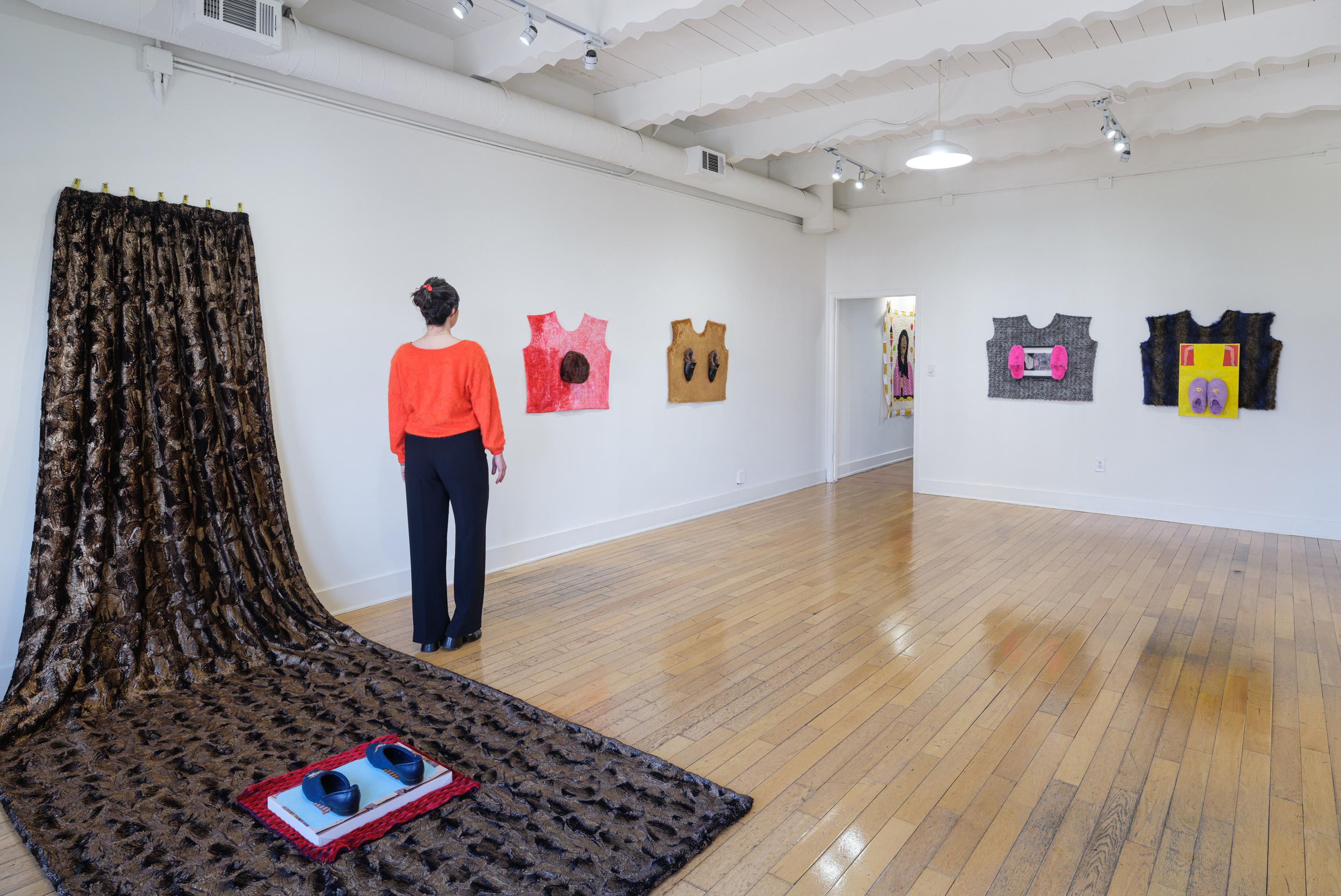
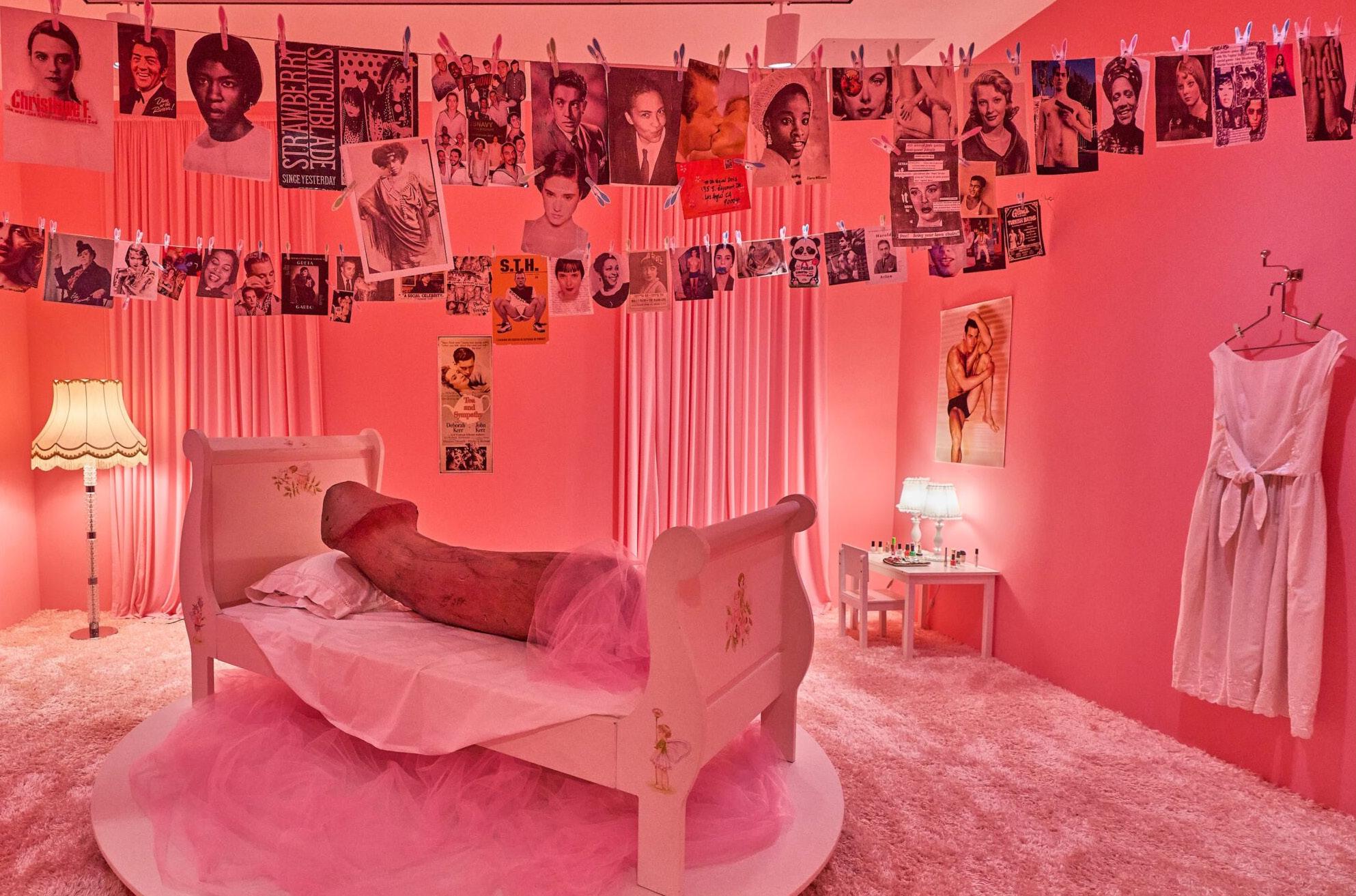
Berlin-based artist Vaginal Davis’s gaze invited you into her sprawling, amorphous world—one of gestural paintings and low-fi filmmaking, of punk and drag performance, of zine-making subculture, of gossipy blogs, and of playful sculpture, big and small. Her all-encompassing practice is difficult to distill into words. And yet, language is central to her artistry. Throughout her retrospective and first major institutional exhibition in the U.S.—which closed at MoMA PS1 in New York in March after traveling from Moderna Museet in Stockholm and Gropius Bau in Berlin —Davis’s handwriting decorated the walls. Stacks of her printed materials unearthed corners of the 1970s and ’80s underground. Her bubblegum-pink library paid homage to literary icons
like Octavia E. Butler, June Jordan, and Nikki Giovanni. No matter the form, be it performance, painting, or parody band, Davis infuses her work with reference to and reverence for language, using it as a tool to carve out and give shape to a world of her own.
Self-authorship is particularly relevant to Davis’s practice. In her now-23-yearold blog Speaking From the Diaphragm, Davis once wrote that mainstream publications often approached her with a story already in mind about her work, laced with preconceived notions.1 Admittedly, I too entered the exhibition with an assumption, not so much concerning Davis but whether a major museum could do justice by an artist so historically at odds with the mainstream,
the institution, and other forces of containment. “I don’t fit into mainstream society, but I also don’t really fit into ‘alternative culture,’ either,” Davis told The New Yorker in 2015.2 “I was always too gay for the punks and too punk for the gays. I am a societal threat.” Since the ’70s, Davis has authored her own path as an originator of the homocore punk movement, carving a place for herself within the club performance scene, and working with nearly every artistic medium imaginable. As I engaged with the show, I found it was much more enthralling to consider the formal qualities of Davis’s work rather than my initial assumption: how she—while moving across multiple separate rooms, fluid in material and chronology—refused the allure of palatability
and convention through constant, relentless experimentation. Davis is as much a painter as she is a drag queen, as much an author as she is a sculptor, and so on, and here, in Magnificent Product, her many selves were afforded the room to exist without boundary.
Where there’s one Vaginal Davis, there are many. The first Davis I met was the sculptor. Naked on my Ozgoad: Fausthaus — Anal Deep Throat (2024–ongoing), created with artist Jonathan Berger, occupied the first room of the exhibition. The entire installation was inspired by Davis’s first visual art showcase at L.A.’s Pio Pico Library when she was just eight years old. It was there that she first expressed her fascination with L. Frank Baum’s storytelling through drawings and dioramas inspired by the world of Oz, which the librarians then turned into a display.3 While Davis’s interest in Oz remains, her expression has expanded. At MoMA PS1, dark green floating shelves hung on parallel walls, illuminated by emerald pendant lights. Each shelf platformed cast-aluminum sculptures depicting characters and entities from Oz. While the figures are abstract, ultraminiature versions of Glinda the Good, Ozma, Professor Wogglebug, and others, they’re no less monumental. Meticulously crafted, the sculptures are brought to life as much by residual fingerprints and handmade marks as they are the makeup that finish their surfaces off in dusts of gold, red, green, yellow, and blue. Even at this tiny scale, Davis manages to capture, for instance,
the robot Tik-Tok in great detail, from the mechanical man’s rounded torso and startlingly wide-open eyes to his thick mustache and shiny metallic exterior. A showcase of her dexterity as an artist, Davis the painter also appears in the installation; using discontinued makeup, she transformed more of Baum’s fantastical figures and objects into murals painted onto the gallery walls. If Magnificent Product is an Oz of Davis’s very own, then this foyer was her glistening Emerald City.
As I ventured along the artist’s yellow brick road, not unlike Dorothy Gale, I met many more Davises along the way. The second version I came across was the gossipy historian-zine-maker. In the interactive Hofpfisterei (2024/25), I sifted through transparency sheets on an overhead projector, swapping an article about Black Fag, one of Davis’s many punk parody bands, for her column “Because I Said So,” which she published in GLUE Magazine from 2000 to 2002. “It was comforting to me that such a mega-diva was more paranoid than I was,” Davis wrote in one entry, talking about Hollywood’s Glenn Close, whom she learned was terrified of flying while Davis was seated next to her on a plane ride from Montreal to Paris.4 Here, and throughout the myriad other entries, zines, essays, and tell-alls scattered on a round table nearby, Davis recounts ideas about everything from culture to cruising. Davis dishes, exposes, and eats celebrities’ airplane food, all the while crafting her own story where gossip, cultural criticism,
self-reflection, and history share equal weight in her world-building. Later, in The Wicked Pavilion (2021), I met Davis the librarian and dioramist. In a pink-washed library, Davis paid homage to influential cultural figures—Butler, Jordan, and Giovanni, but also Wanda Coleman and Minnie Riperton, Joan Didion and Eve Babitz—with vibrant gestural paintings made from discontinued nail polish and makeup on found material. On the back of a postcard, Davis painted Audre Lorde in purple, white, and gray with thick, assured brush strokes, capturing the scholar’s energy and poetic style— indelible, lyrical, direct, expressive—more than her actual likeness. Shelved above the paintings were around 500 in-progress books from her own repertoire, with titles ranging from SHADE to TRADE. Whereas a traditional library might be seen as a mausoleum for completed literature, Davis’s reiterates the fluidity through which she approaches and uses language. Her library is malleable, pulsating with drafts, half-written fictions, and budding ideas. In the future, perhaps she’ll return to one of these books and finally finish its story off, or perhaps she won’t. Either way, the most important thing is that the shelves in her library continue to expand, and with it, a freedom to imagine, to merge fantasy with reality, and to write new worlds and selves into being. In the second half of The Wicked Pavilion, Davis recreated her tween bedroom in a surrealist diorama: a child-sized vanity in the corner, pages of pop-culture
ephemera and erotic magazines strung across the room, and a tiny bed rotating like a music box at the center. Although, instead of a ballerina spinning in the middle, there was a giant penis. Erect and curving upward, its head rests atop a light pink pillow. Cheekily rewriting her adolescence, Davis takes stock of the media that made her while simultaneously, and yet again, blurring the boundaries of being. Magazine cut-outs featuring Butler, Isabella Rossellini, and the pornographic magazine Straight to Hell were clipped to a clothesline. Davis is as much the dainty pink tulle pooling on the floor as she is the phallic figure tucked into bed. She is sculptor and author, archivist and historian. In Magnificent Product, Vaginal Davis is the many all at once—her world, punctuated only by both/and.
1. Vaginal Davis, Speaking From the Diaphragm: The Vaginal Davis Blog, http://blog.vaginaldavis.com/.
2. Cyrus Grace Dunham, “The ‘Terrorist Drag’ of Vaginal Davis,” The New Yorker, December 12, 2015, https://www. newyorker.com/culture/culture-desk/ terrorist-drag-vaginal-davis?_ sp=cee9bce1-8ebc-4542-b732c6ee5e37fe1e.1773688666799
3. “On Libraries and Librarians,” Moderna Museet Guide – Stockholm, 2024, https://guide.modernamuseet.se/ stockholm/en/collection/vaginal-davis/ om-bibliotek-och-bibliotekarier/.
4. Vaginal Davis, “Scarfing celebs’ airplane food,” Because I Said So (column), GLUE Magazine (2000-02), March/April, 13.
November 21, 2025–February 14, 2026
In 1993, Mike Kelley curated The Uncanny, a group exhibition that was mainly preoccupied with anxieties surrounding familiar, humanlike figures. Originally presented at Sonsbeek 93 in the Netherlands, it was populated by artworks made up of dolls, mannequins, statues, and disembodied limbs and heads, as well as gruesome photographs depicting them. Recently, a group exhibition at Sprüth Magers took the psychological discomfort of The Uncanny as its starting point—though its title, Horror, signaled its aim of presenting a more “explicit shock of horror,” one befitting our traumatic age of “societal collapse.”1 Curated by artist Jill Mulleady and installed across several rooms on two floors was the work of about 30 artists and filmmakers, some hidden behind dark partitions or curtains or displayed in a living room-like gallery upstairs, complete with a rug, TV, and duo of sofas. Most noticeably, many video and audio works imbued the space with a sort of supernatural quality, their echoing sounds and flickering lights playing off each other. If The Uncanny’s greatest fears were rooted in physical encounters with the human body, the more diffuse subjects in Horror, ranging from ghostly domestic scenes to gun violence, were harder to pin down, but perhaps this technologicallymediated audio-visual
jumble characterizes our multimedia age. While many works seemed too restrained or self-conscious to be properly horrific on their own, they were chaotically amplified when taken together, providing a feeling of desensitization familiar to anyone who finds themselves overwhelmed by a daily flood of disturbing images and clips.
The exhibition’s hauntedhouse atmosphere was tense. Its scares ranged from eerie abstract paintings to psychologically charged sculptures to darkly humorous videos, many of which employ the amateur aesthetic of found-footage scary movies. Mulleady included six pieces by Kelley himself, among them video works that display his typical engagements with pop culture, like the self-explanatory Superman Recites Selections from ‘The Bell Jar’ and Other Works by Sylvia Plath (1999), where the self-serious hero monologues the author’s existential angst in a darkened void. This video was in turn referenced elsewhere in one of Mulleady’s own hallucinogenically colored paintings, Kryptonite (2025), depicting a young man reading a copy of The Bell Jar while a disembodied hand holds an eerily glowing rock; in a painting-withinthe-painting, meanwhile, sinister figures loom on the wall beside him. This recursive, self-referential playfulness typifies the exhibition, which engaged more readily with film and media tropes than directly with any real-world horrors.
Like in The Uncanny, many works employed human bodies or their constituent parts, though often in a much
Alexander Schneider
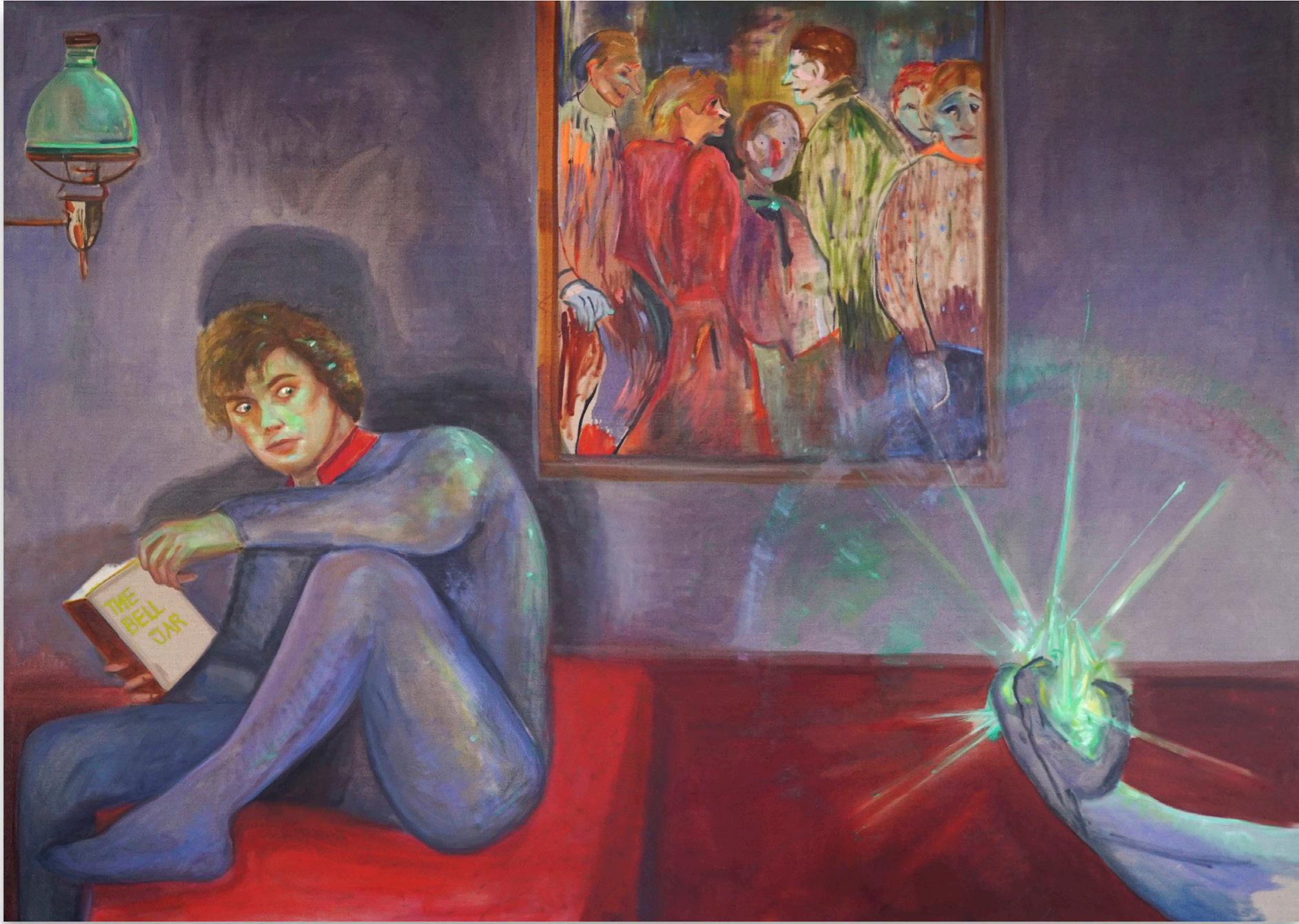
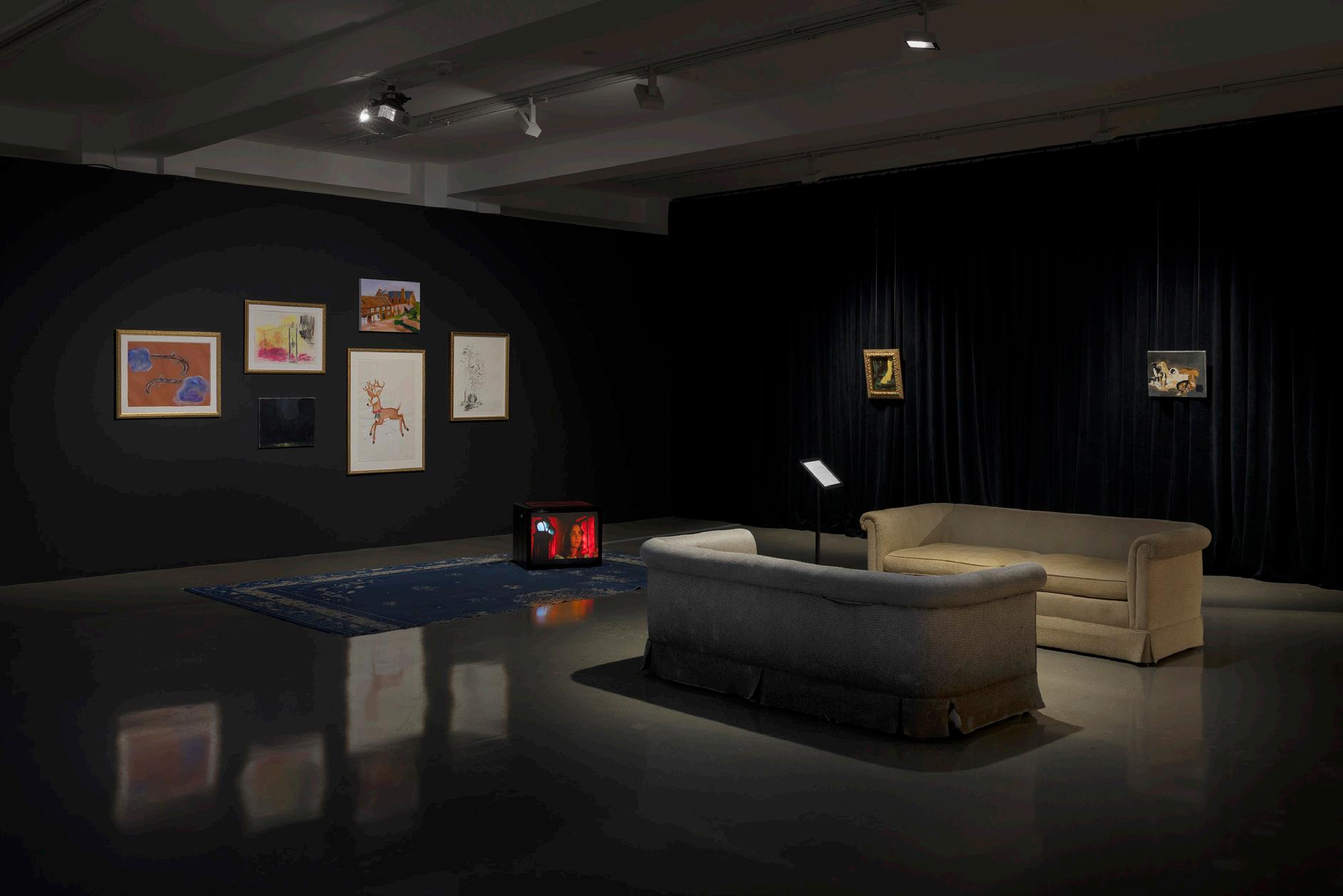
more understated way. Stretched across two empty white walls was Paul Thek’s Meat Cable (1969), an off-kilter steel wire with four waxy, flesh-colored nodes across its length. Its vague minimalism produces perhaps a stronger psychological reaction than something more explicit would, forcing the viewer to work out if they’re looking at the result of some sort of distressing scientific experiment or biological process, neither possibility a pleasant one. Body horror is given a biopolitical dimension in Rosemarie Trockel’s video Manus Spleen 3 (2001), a home movie that shakily captures a birthday party at which a woman’s pregnant belly suddenly pops and deflates as guests laugh and raise their glasses. The jovial mood’s discordance with the disappearance of Rosemarie’s baby gestures toward very real anxieties related to women’s lack of bodily autonomy, even if its dry humor is too detached to reach any immediate levels of horror.
There were also specters of violence hiding in unlikely places. Diego Marcon’s TINPO (2006), for example, choppily edits camcorder footage of a young boy pointing a toy handgun at himself and his relatives, turning a family gathering into a jittery, stuttering piece of analog horror. In Curb Dance (2011), Harmony Korine wears a bright pink dress and holds a clown doll as he tap dances across sidewalks and parking lots, his voiceover declaring “curb dancing is the best” before abruptly transitioning into a story about two teenage brothers who killed people
they found in remote cabins. Both give you a dreadful feeling that casual murderous violence underpins the most mundane, even cheerful, moments of American life, although the nostalgic VHS aesthetic of these and other video works can too easily make them feel like a relic of the past. Meanwhile, the inclusion of pieces of media like Dario Argento’s Technicolor thriller Suspiria (1977), also playing on a CRT monitor that was sitting on the floor of the exhibition, seemed to relegate them to the realm of fiction.
We are living in frightening times, with so many incomprehensible horrors playing out at once; what scared us just a few decades ago, at least as it was presented in The Uncanny, seems almost benign in retrospect. Perhaps it was precisely Horror’s conflation of fact, fantasy, and scary movie tropes— channeled through an inescapable interplay of screens, projections, and recordings—that appropriately embodied the anxieties of an overwhelming age in which scenes of gruesome brutality are presented and consumed alongside movie clips, ads, and lifestyle content. Yet the exhibition’s most haunting gesture might also be its quietest. In Ottessa Moshfegh’s Untitled (2025), two unremarkable couches faced one another at the center of a gallery crowded with paintings and flickering images. Only on closer inspection did you notice that each is caked with dirt and debris, and the accompanying plaque that recounts how one was previously abandoned outdoors in Pasadena, the
other kept inside, and how both survived the 2025 Eaton Canyon fires, chemical damage, and other environmental catastrophes before being brought to the gallery. “Both sofas should be destroyed,” it concludes, a genuine sentiment that felt out of place among the deliberate irony that permeated so much of Horror Moshfegh’s installation was singularly unsettling among the exhibition’s more selfconscious engagements with cinema and theatrics, the implied realities of the havoc wreaked on its previous unknown owners briefly providing a visceral connection to some of the immediate, real-world fears of our place and time.
1. Jill Mulleady, “Horror,” Sprüth Magers, 2025,https://spruethmagers.com/ exhibitions/horror-group-exhibition-losangeles/.
Photo Essay Contributor and Featured Subject
Based in Los Angeles, Claire Preston’s experience includes creative production (event/photo), film photography, and artist marketing/management. She is skilled in understanding a vision, building on ideas, and executing.
Rajiv Menon is a gallerist based in Los Angeles. Rajiv earned his PhD from New York University, where he studied global media and visual culture, with additional coursework from the Sotheby’s Institute. Rajiv has made it his mission to expand the art collecting audience within diasporic communities and to promote new, emerging voices in this space. In May of 2024 and 2025, Rajiv was honored by the City of Los Angeles for his contributions to the city’s art scene. Rajiv’s work has been featured in the New York Times, British Vogue, Frieze, and Esquire India
Review Contributors
Nneka Jackson is a writer, cultural strategist, and attorney working at the intersection of intellectual property, creative economies, and cultural equity. She collaborates with artists and cultural organizations to develop frameworks that support creative practice and cultural infrastructure. Her writing engages diasporic memory, identity, folklore, and radical possibility.
Teresa Fleming is a writer and arts worker based in L.A., where she works at at the Hammer Museum. She received her MA in Visual & Critical Studies from the School of the Art Institute of Chicago, and has previously worked at the Art Institute of Chicago and Museum of Contemporary Art Chicago.
Nahui Garcia is a writer and curator based in Los Angeles. She currently serves as Assistant Curator at JOAN.
Silvi Naçi (they/them) is an artist and writer working in the diaspora between Albania and Los Angeles. Their work examines how the marginalized body is affected by an oppressive state, the subtle and violent ways that migration results from colonialism, and how processes of decolonization affect and reshape a people, the body, language, and possibilities of gender identity.
Aaron Boehmer is a writer and photographer from Texas. He is interested in writing and research related to the intersection between politics and art and has written for publications such as The Nation, The Drift, and Texas Monthly
Alexander Schneider is a writer and editor currently based in Los Angeles. He holds an MA in Contemporary Art Theory from Goldsmiths, University of London.
Good on Paper: Works from the Gene J. and Betye M. Burton Acquisitions Endowment
Now through August 2, 2026
Haegue Yang:
Star-Crossed Rendezvous
Now through August 2, 2026
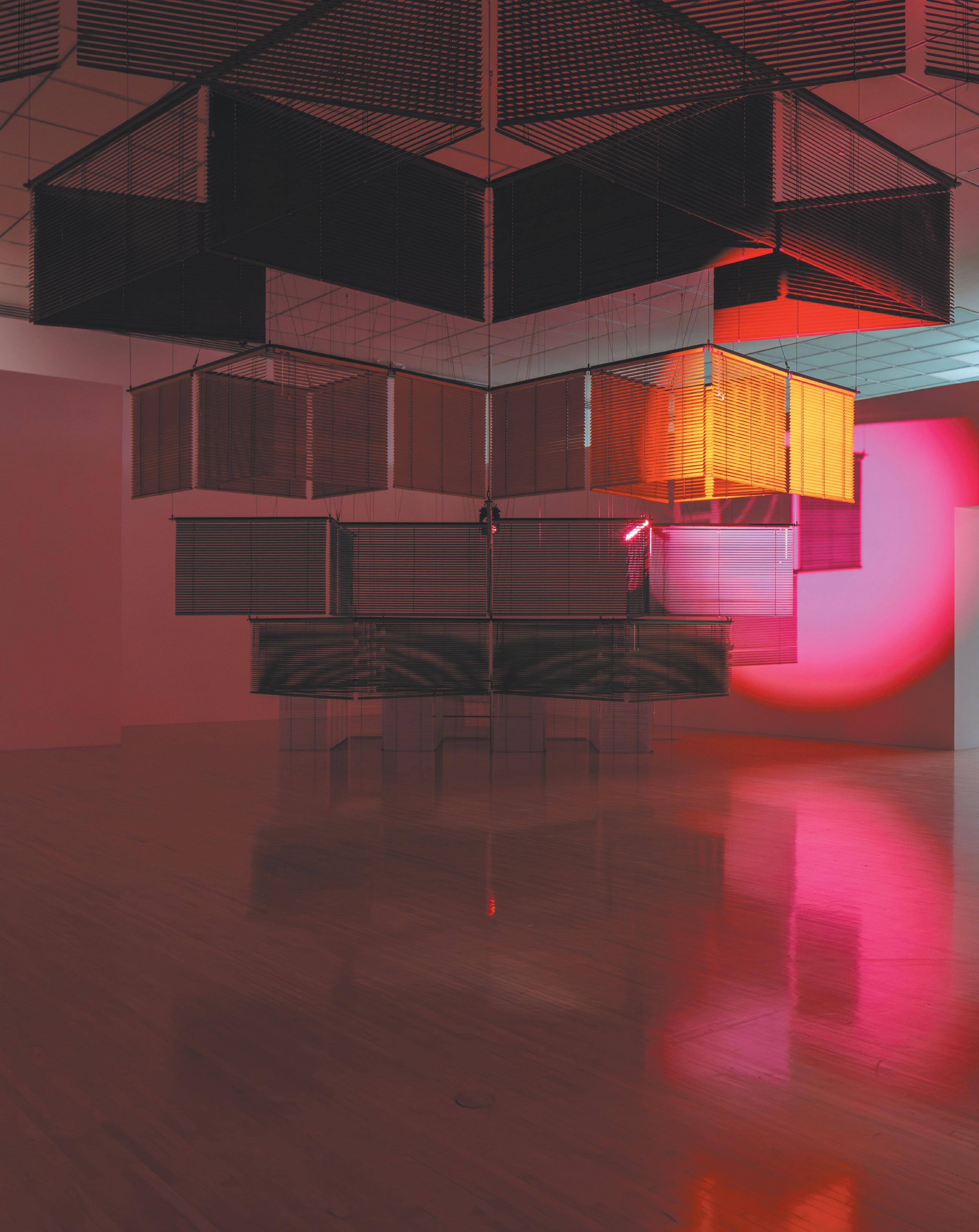
MOCA Grand Avenue
250 South Grand Avenue, Los Angeles
For more information or to reserve tickets, visit moca.org
Michael Asher
Now through August 2, 2026
Gifts of Michael Asher
Now through August 2, 2026
The Expanding Field: MOCA’s
Collection from the 1940s to 1970s
April 18–September 20, 2026
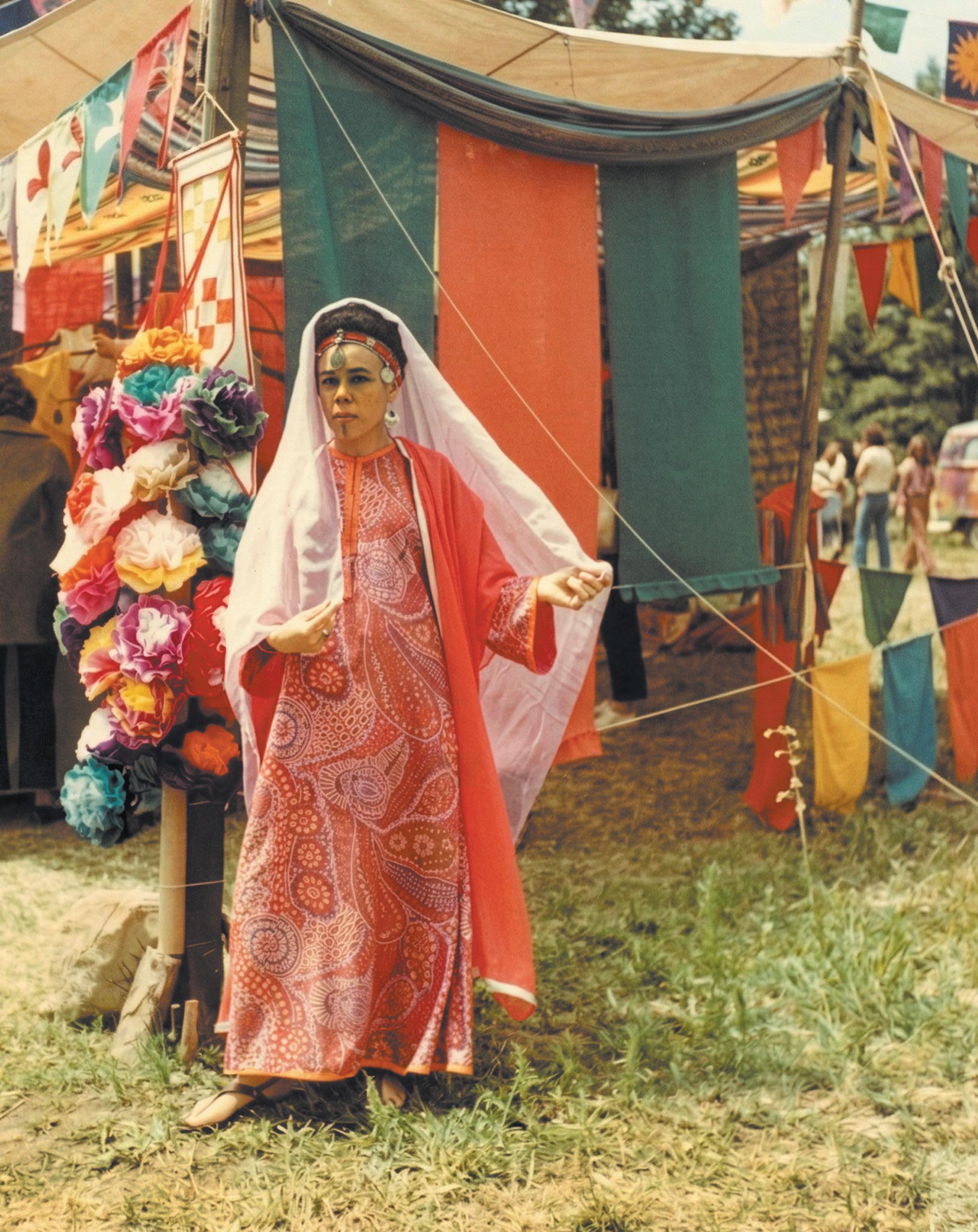

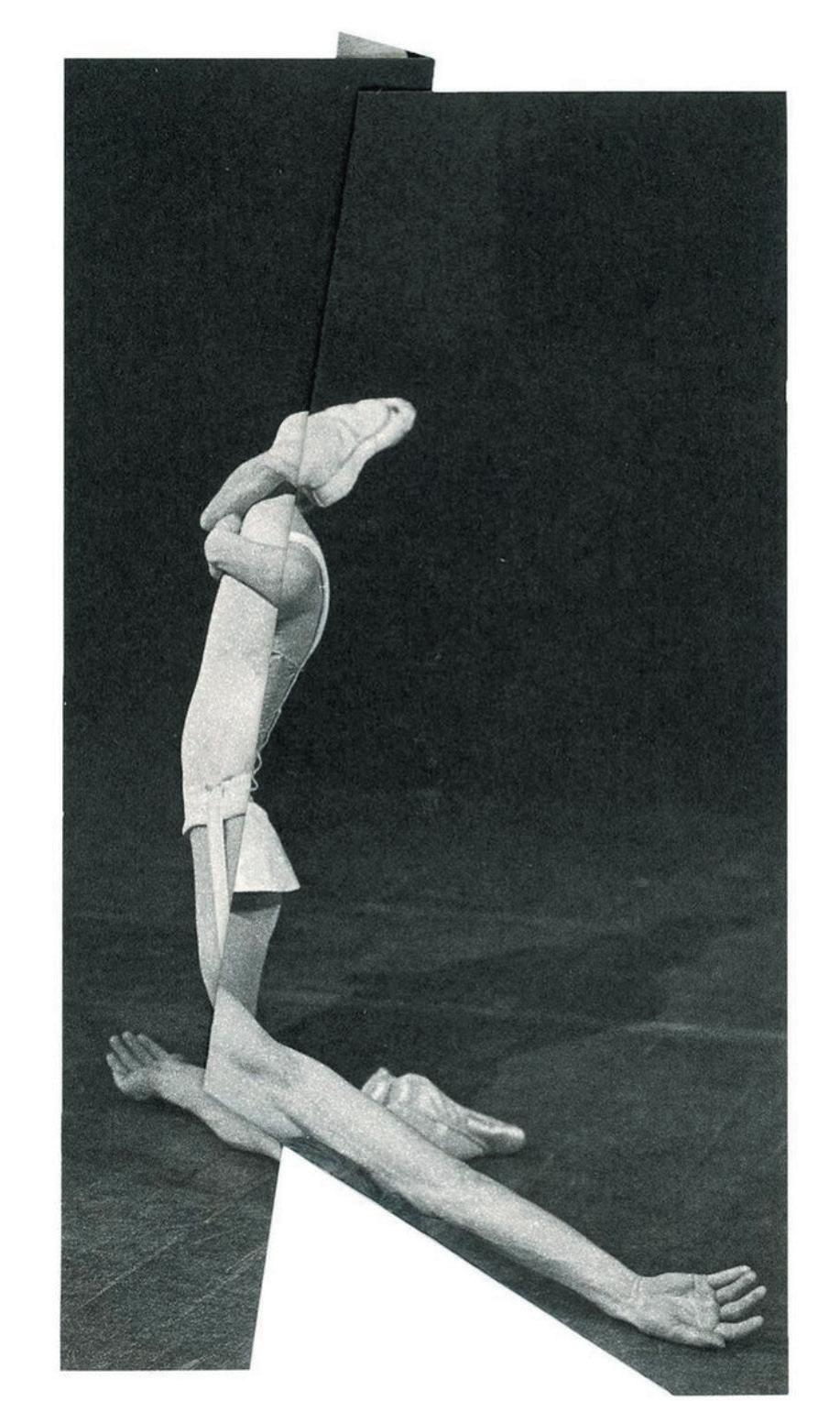
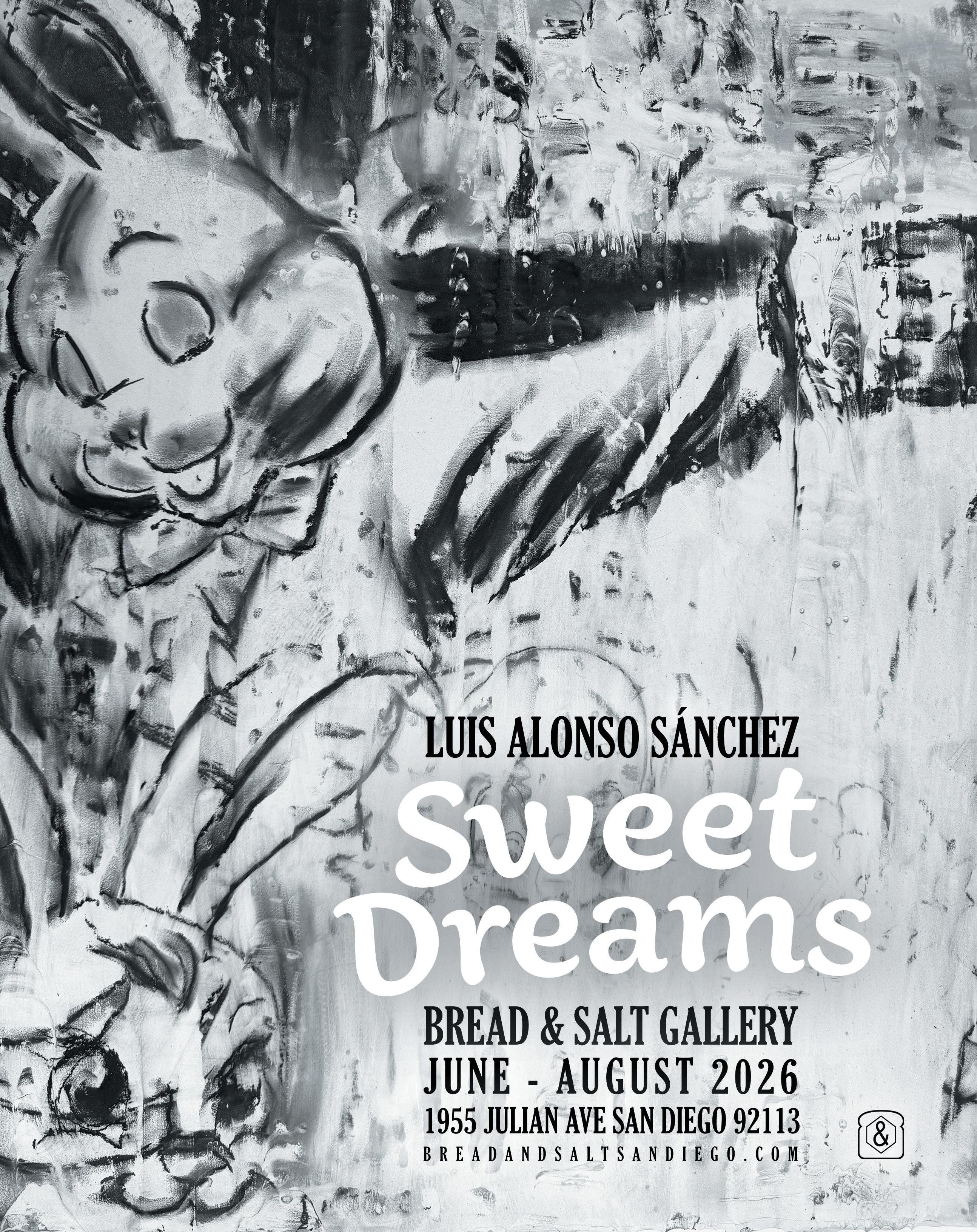
YEAH! Rentals offers a curated collection of design-forward furniture and objects for events, photo shoots, and immersive experiences. Our inventory blends timeless forms with unexpected pieces that elevate any environment. In addition to our existing collection, we offer custom color treatments to align seamlessly with your palette, ensuring every detail feels intentional, cohesive, and distinctly yours.
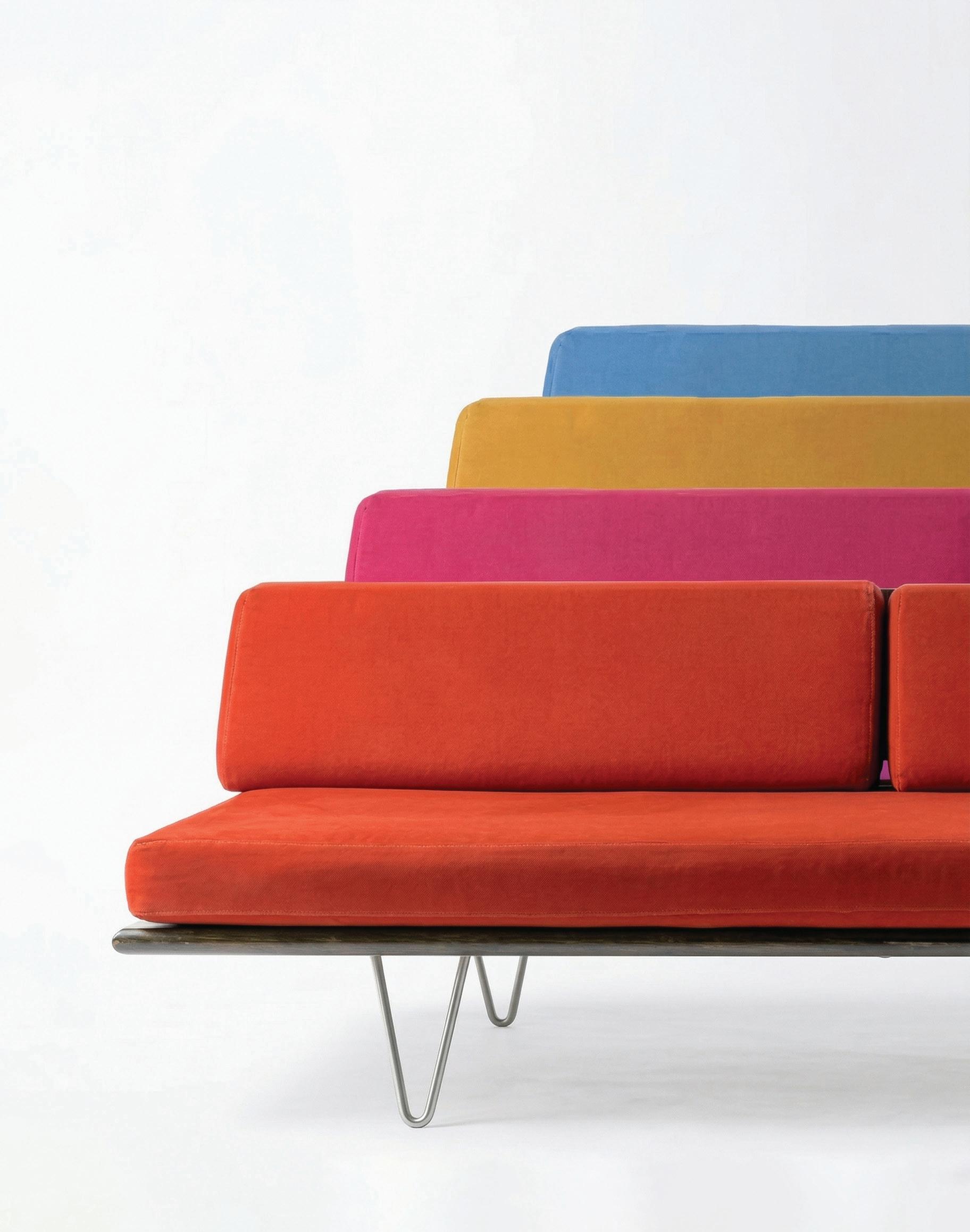



One Year Later: 22 Artists Reflect
March 13 - June 1, 2026
6006 Washington Blvd
Culver City
Wednesday - Sunday
1 pm - 6 pm

Eddie Rodolfo Aparicio
Kelly Akashi
Maura Brewer
Jamison Carter
Evan Chambers
Kevin Cooley
Kenturah Davis
Brad Eberhard
Margaret Griffith
Olivia Hill
John Knuth
Alice Könitz
T. Kelly Mason
Ana Medina
Adam Ross
Caitlin Slegr Ross
Rachelle Sawatsky
Ross Simonini
April Street
Camilla Taylor
Diana Thater
Ariane Vielmetter
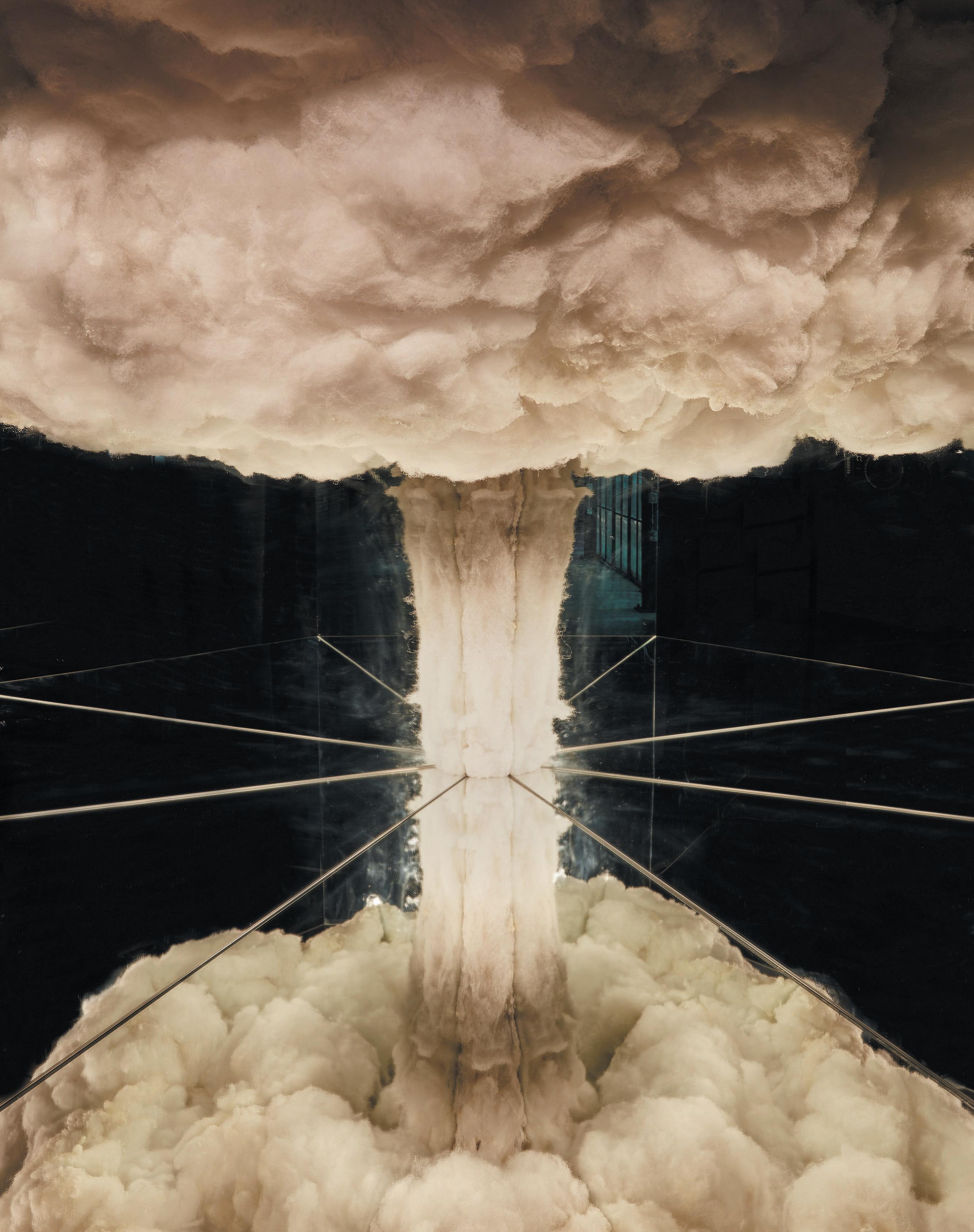
Opens May 30, 2026