FOR THE PEOPLE, BY THE PEOPLE.
WEDNESDAY, NOVEMBER 4, 2026
GRANTSPASSTRIBUNE.COM | $0.00
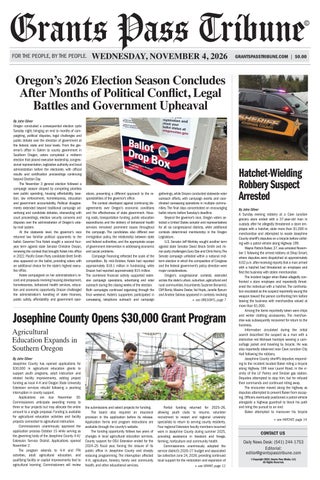
Oregon’s 2026 Election Season Concludes After Months of Political Conflict, Legal Battles and Government Upheaval By John Oliver Oregon concluded a consequential election cycle Tuesday night, bringing an end to months of campaigning, political disputes, legal challenges and public debate over the direction of government at the federal, state and local levels. From the governor’s office in Salem to county government in Southern Oregon, voters completed a midterm election that placed executive leadership, congressional representation, legislative authority and local administration before the electorate, with official results and certification proceedings continuing beyond Election Day. The November 3 general election followed a campaign season shaped by competing priorities over public spending, housing affordability, taxation, law enforcement, homelessness, education and government accountability. Political disagreements extended beyond traditional campaign advertising and candidate debates, intersecting with court proceedings, election security concerns and disputes over the administration of Oregon’s voteby-mail system. At the statewide level, the governor’s race returned two familiar political opponents to the ballot. Governor Tina Kotek sought a second fouryear term against state Senator Christine Drazan, renewing the contest that brought Kotek into office in 2022. Pacific Green Party candidate Brett Smith also appeared on the ballot, providing voters with an additional choice for the state’s highest executive office. Kotek campaigned on her administration’s record and proposals involving housing development, homelessness, behavioral health services, education and economic opportunity. Drazan challenged the administration’s handling of state finances, public safety, affordability and government oper-
ations, presenting a different approach to the responsibilities of the governor’s office. The contest developed against continuing disagreements over Oregon’s economic conditions and the effectiveness of state government. Housing costs, transportation funding, public education expenditures and the delivery of behavioral health services remained prominent issues throughout the campaign. The candidates also differed over immigration policy, the relationship between state and federal authorities, and the appropriate scope of government intervention in addressing economic and social problems. Campaign financing reflected the scale of the competition. By mid-October, Kotek had reported approximately $18.1 million in fundraising, while Drazan had reported approximately $15 million. The combined financial activity supported extensive campaign operations, advertising and voter outreach during the closing weeks of the election. Both campaigns continued organizing through the final weekend. Kotek’s supporters participated in canvassing, telephone outreach and campaign
gatherings, while Drazan conducted statewide voter outreach efforts, with campaign events and coordinated canvassing operations in multiple communities. The final days concentrated on encouraging ballot returns before Tuesday’s deadline. Beyond the governor’s race, Oregon voters selected a United States senator and representatives for all six congressional districts, while additional contests determined membership in the Oregon Legislature. U.S. Senator Jeff Merkley sought another term against state Senator David Brock Smith and minor-party challengers Gary Dye and Chris Henry. The Senate campaign unfolded within a national midterm election in which the composition of Congress and the federal government’s policy direction were major considerations. Oregon’s congressional contests extended across the state’s urban, suburban, agricultural and rural communities. Incumbents Suzanne Bonamici, Cliff Bentz, Maxine Dexter, Val Hoyle, Janelle Bynum and Andrea Salinas appeared in contests involving
•
see OREGON'S, page 7
Josephine County Opens $30,000 Grant Program
Agricultural Education Expands in Southern Oregon
By John Oliver Josephine County has opened applications for $30,000 in agricultural education grants to support youth programs, adult instruction and related facility improvements, adding project funding as local 4-H and Oregon State University Extension services rebuild following a yearlong interruption in county support. Applications are due November 30. Commissioners anticipate awarding money to three or four projects but may allocate the entire amount to a single proposal. Funding is available for agricultural education activities and facility projects connected to agricultural instruction. Commissioners unanimously approved the application process October 15 while serving as the governing body of the Josephine County 4-H/ Extension Service District. Applications opened November 2. The program extends to 4-H and FFA activities, adult agricultural education, and qualifying facility or capital improvements tied to agricultural learning. Commissioners will review
the submissions and select projects for funding. The board also required an insurance provision in the application before its release. Application forms and program instructions are available through the county’s website. The funding opportunity follows two years of changes in local agricultural education services. County support for OSU Extension ended for the 2024–25 fiscal year, forcing the closure of its public office in Josephine County and sharply reducing programming. The interruption affected 4-H, agriculture, forestry, family and community health, and other educational services.
Partial funding returned for 2025–26, allowing youth clubs to resume, volunteer recruitment to restart and regional university specialists to return to serving county residents. Four regional Extension faculty members resumed work in Josephine County during summer 2025, providing assistance in livestock and forage, farming, horticulture and community health. Commissioners unanimously adopted the service district’s 2026–27 budget and associated tax collection June 24, 2026, providing continued local support for the restoration and expansion of
•
see GRANT, page 12
Hatchet-Wielding Robbery Suspect Arrested By John Oliver A Sunday evening robbery at a Cave Junction grocery store ended with a 37-year-old man in custody after he allegedly threatened a store employee with a hatchet, stole more than $1,000 in merchandise and attempted to evade Josephine County sheriff’s deputies on a bicycle before colliding with a patrol vehicle along Highway 199. Wayne Patrick Baker, 37, was arrested November 1 following the armed robbery at Shop Smart, where deputies were dispatched at approximately 6:02 p.m. after receiving reports that a man armed with a hatchet had threatened an employee and fled the business with stolen merchandise. The incident began when Baker allegedly confronted a store employee and repeatedly threatened the individual with a hatchet. The confrontation escalated as the suspect reportedly swung the weapon toward the person confronting him before leaving the business with merchandise valued at more than $1,000. Among the items reportedly taken were chips and winter clothing accessories. The merchandise was subsequently recovered for return to the business. Information circulated during the initial search described the suspect as a man with a distinctive red Mohawk hairstyle wearing a camouflage jacket and traveling by bicycle. He was also reportedly observed near Cave Junction City Hall following the robbery. Josephine County sheriff’s deputies responding to the incident located Baker riding a bicycle along Highway 199 near Laurel Road, in the vicinity of the Lil’ Pantry and Sinclair gas station. Deputies attempted to stop him, but he refused their commands and continued riding away. The encounter moved along the highway as deputies attempted to prevent Baker from escaping. Officers eventually positioned a patrol vehicle alongside a highway guardrail to block his path and bring the pursuit to an end. Baker attempted to maneuver his bicycle
•
see HATCHET, page 14
CONTACT US Daily News Desk: (541) 244-1753 Editorial: editor@grantspasstribune.com ©Copyright 2026, Grants Pass Media, LLC, All Rights Reserved.
2
GRANTS PASS TRIBUNE
Wednesday, November 4, 2026
Wednesday, November 4, 2026
GRANTS PASS TRIBUNE
3
OREGON
Oregon Child Welfare Reforms Advance Under Federal Court Agreement
New Findings Reveal Persistent Safety Failures
By John Oliver Oregon's child welfare system remains under federal court supervision as the state reports progress implementing reforms intended to protect children in foster care, while newly released findings document continued abuse, delayed medical assessments and shortcomings in the investigation of potential threats to children's safety. The Oregon Department of Human Services released its second semiannual reform report October 30, 2026, identifying progress on 23 of 29 improvement strategies, even as an independent review found that several critical child welfare performance measures remain substantially below established standards. The latest developments mark another stage in Oregon's response to Wyatt B. v. Kotek, the federal class-action lawsuit that challenged conditions within the state's foster care system and ultimately produced a comprehensive reform agreement in May 2024. The agreement requires Oregon to improve child protection practices, strengthen foster home supervision, expand access to healthcare and behavioral health treatment, and demonstrate sustained improvements in the safety and stability of children placed in state custody. The Department of Human Services reported that approximately 79% of its improvement strategies remain on schedule following six months of administrative changes, expanded training and revisions to child welfare procedures. The report covers activities conducted between April 1 and September 30, 2026, and identifies additional measures scheduled for implementation through 2027. The state's reported progress comes alongside findings from Kevin M. Ryan, the independent neutral expert appointed to evaluate compliance with the federal settlement. His first annual review, completed October 29, documented continuing deficiencies in foster care safety, healthcare assessments and case management, including a confirmed maltreatment rate more than twice the standard established under the agreement. During federal fiscal year 2025, Oregon substantiated 370 reports of abuse or neglect involving children in state custody, producing a maltreatment rate of 24.7 incidents per 100,000 days in care. The settlement requires the state to reach a rate of 9.07. Oregon would have needed approximately 235 fewer confirmed incidents during that period to meet the established target. The Department of Human Services has identified differences between Oregon's maltreatment reporting practices and those used by other states, including broader definitions of maltreatment and the investigation of allegations involving individuals who do not have direct caregiving responsibilities. Those differences can affect interstate comparisons, but the standard remains the performance target incorporated into Oregon's settlement agreement. The state has undertaken an extensive examination of reported maltreatment incidents as part of its corrective measures. During the latest reporting period, child welfare officials reviewed 488 incidents reported in 2025, examining circumstances surrounding alleged abuse or neglect and identifying recurring problems involving placement conditions, supervision and safety procedures.
The findings are being incorporated into prevention planning, with additional corrective measures expected at the district level during 2027. Oregon developed a statewide maltreatment prevention plan in June, although portions of its implementation have taken longer than originally anticipated. Independent case reviews have identified additional weaknesses in the assessment of child safety. The department's own evaluations rated its efforts to assess and address safety and risk concerns as adequate in 65% of reviewed cases, compared with 69.7% in 2022. The decline leaves approximately one-third of the reviewed cases without a favorable assessment of the agency's handling of identified safety concerns. The department has revised procedures governing Child Protective Services investigations, including updated coordination agreements with law enforcement agencies and other partners. Additional changes involve improved guidance for identifying safety threats, more consistent documentation and requirements for caseworkers to record visits promptly. Oregon has also expanded training and administrative support for caseworkers responsible for maintaining contact with children, biological parents and foster caregivers. Monthly face-to-face meetings remain part of the state's child welfare supervision requirements, providing opportunities to evaluate placement conditions, monitor family circumstances and address concerns identified during ongoing case management. Foster home certification procedures underwent additional changes in January 2026, when the department increased the frequency of required visits from every 180 days to every 90 days. By August, 91% of those visits were being completed within the prescribed timeframes. The number of certified foster homes associated with confirmed maltreatment increased from 64 in 2023 to 83 in 2025, prompting recommendations for a more detailed examination of the circumstances contributing to those incidents. The independent neutral has called for further investigation into the locations, causes and frequency of maltreatment, including whether previous allegations involving affected children had been screened out or determined to be unfounded. Additional recommendations address inappropriate restraint practices in congregate care settings and whether caseworker workloads contribute to failures in child protection. Healthcare access remains another significant concern following substantial discrepancies between the state's initial performance reporting and subsequently verified information.
Oregon's first semiannual report, released May 1, indicated that approximately 80% of children entering foster care received timely initial nursing assessments. A June 18 amendment corrected that figure to 30.1%, substantially below the settlement's 90% requirement. The correction changed the reported level of compliance for a service intended to identify medical needs shortly after children enter state custody. Oregon's procedures call for an initial nursing assessment within 10 days of placement and a medical assessment within 60 days. The independent review also identified differences between administrative reporting and individual case records. In a sample of 25 children, the state's data indicated that 84% received timely medical assessments, while examination of the underlying records established a rate of 76%. For mental health assessments, administrative records indicated 92% compliance, compared with 88% established through the independent review. Statewide performance figures showed that 74.8% of children received timely medical assessments and 88.4% received timely mental health assessments, both below the 90% requirements. Additional case reviews found that children's mental and behavioral health needs were not adequately addressed in 31% of examined cases. Physical healthcare needs were rated as adequately addressed in 75% of cases. The Department of Human Services has introduced operational changes intended to reduce delays between a child's placement and the initiation of healthcare services. Those measures include more immediate documentation of placements, revised referral procedures, coordination with nursing personnel and additional communication with healthcare organizations responsible for arranging treatment. The department is also working with the Oregon Health Authority and coordinated care organizations to improve access to physical, mental and dental healthcare for children in foster care. Oregon's behavioral health treatment network has undergone additional expansion during 2026, with 24 contracted beds added through Behavioral Health Treatment Foster Care and 12 psychiatric residential treatment beds added to the state's available capacity. Other specialized residential services have also opened as part of efforts to address treatment shortages affecting children with complex behavioral and mental health needs. The expansion is occurring alongside efforts to strengthen community-based services and
provide additional support to foster caregivers responsible for children requiring intensive supervision or specialized treatment. Oregon has continued developing its Response and Support Network, Child Specific Caregiver Supports and other programs intended to prevent placement disruptions. The department has requested additional funding to expand Child Specific Caregiver Supports from nine counties to 16 and the Response and Support Network from three counties to 16. Those expansions have not yet been fully implemented, leaving their eventual reach dependent on future funding and administrative decisions. Support for foster caregivers has also increased through existing programs. Participation in the KEEP foster parent support program rose 7% above its July 2026 baseline, while inquiries about respite care increased from 325 during 2025 to 400 during the portion of 2026 covered by the latest report. The department has also revised responsibilities involving enhanced supervision plans for children with particularly demanding care requirements. Those plans must be completed within 30 days, but the state has not achieved the expected improvements in timely completion. Responsibility is scheduled to shift from caseworkers to foster parent certifiers before the end of 2026. Placement stability and family reunification remain additional components of the federal agreement, with earlier reporting documenting improvements in several performance measures. The percentage of children placed with relatives increased from 18.8% in 2022 to 36.1%, reflecting an expansion of placements involving grandparents, aunts, uncles and other eligible family members. Oregon also reported that 5.7% of children returned to foster care following reunification, approaching the settlement's 5.6% target. Case planning has improved substantially since 2021, when 39.5% of initial plans were completed within the required timeframe. The latest independent findings placed timely completion at 81.1%, although performance remained considerably lower in several individual districts. Districts 1, 4 and 14 recorded timely case planning rates of 60% or below, identifying significant differences in performance among the state's regional child welfare operations. The department's reform responsibilities extend throughout Oregon, including Southern Oregon communities served by local child welfare offices, foster families, healthcare providers and treatment organizations. In Josephine and Jackson counties, statewide child welfare requirements govern investigations, foster care placements, case management and access to services for children in state custody. The availability of specialized treatment and appropriate placements remains part of the broader statewide effort to strengthen services across urban and rural communities. The department has distributed county-level maltreatment information covering 2023 through 2025 to district managers for the development of locally tailored corrective action plans during 2027. Those plans are intended to address conditions identified through regional reviews while maintaining compliance with statewide requirements. The October report does not provide separate maltreatment totals establishing the number of confirmed incidents in Josephine or Jackson
•
see CHILD, page 5
4
GRANTS PASS TRIBUNE
Wednesday, November 4, 2026
Wednesday, November 4, 2026
GRANTS PASS TRIBUNE
5
OREGON Oregon Opens New Health Insurance Marketplace Higher Premiums and Fewer Insurers Reshape Coverage Across Southern Oregon By Ellen Ward Oregon's new state-operated health insurance marketplace opened November 1, beginning a 2027 enrollment period marked by sharply rising premiums, declining participation and fewer insurance companies offering individual coverage. The Oregon Health Authority announced the launch of Explore Health on November 2, completing the state's transition away from the federal HealthCare.gov enrollment platform. The change places private insurance enrollment under Oregon's administration as residents prepare for an average 21.6% increase in individual health insurance premiums next year. For households across Josephine, Jackson, Douglas and Curry counties, the transition arrives amid continued pressure on household finances and health care expenses. Self-employed residents, independent contractors, early retirees and families without employer-sponsored insurance face higher coverage costs while navigating changes in participating insurers and medical provider networks. The Oregon Division of Financial Regulation approved average premium increases of 21.6% for individual policies and 15.5% for small-group coverage in 2027. State regulators identified rising medical expenses, changes in federal financial assistance and declining insurance enrollment among the factors contributing to the increases. The higher rates will affect consumers differently depending on household income, eligibility for federal premium tax credits and the insurance plans available in their counties. For Southern Oregon residents purchasing coverage independently, the increases add to expenses already competing with housing, transportation, utilities and other household necessities. Oregon's individual insurance market is also losing two participating companies. Providence Health Plan and PacificSource are withdrawing from the market for 2027, leaving BridgeSpan, Kaiser Permanente, Moda Health and Regence
BlueCross BlueShield of Oregon among the remaining insurers. Coverage options will continue to vary geographically. State insurance regulators report that six Oregon counties will have two participating insurers, 23 counties will have three and seven counties will have four. The distribution leaves consumers in some areas with fewer companies competing for individual insurance enrollment. The changes carry particular significance in rural communities where access to medical specialists, hospitals and participating physicians can already require travel outside a resident's immediate area. Insurance network changes may affect whether patients can continue receiving treatment from existing providers at in-network rates. State enrollment figures show Oregon's individual insurance market contracted before the new marketplace opened. Approximately 140,000 residents were enrolled in individual coverage in 2026, compared with 161,000 in 2025, a decline of about 21,000 people. The decrease followed changes in federal premium assistance that raised coverage costs for some households. Reduced enrollment and higher medical expenses have added financial pressure to the insurance market as Oregon enters another year of increasing premiums. State officials have committed an addition-
al $15 million to Oregon's reinsurance program, which offsets some of the expenses insurers incur from exceptionally costly medical claims. Regulators estimate the program reduced projected 2027 individual-market premiums by an average of 10.7% compared with rates that otherwise would have been charged. The new marketplace follows legislation enacted in 2023 authorizing Oregon to establish its own health insurance exchange. Federal regulators granted conditional approval for the transition in August 2026, clearing the way for the state to assume enrollment operations previously handled through HealthCare.gov. The launch marks Oregon's return to independent marketplace administration more than a decade after the failure of Cover Oregon, the state's original online insurance exchange. Technical problems disrupted the 2013 rollout, and Oregon subsequently transferred its enrollment operations to the federal system. Explore Health now serves as the state's enrollment platform for private medical and dental insurance, including plans offered under the Affordable Care Act. Residents can compare coverage, determine eligibility for federal premium tax credits and submit enrollment applications through the state-operated website. Existing HealthCare.gov customers are being transferred into the new system and are ex-
pected to activate their Explore Health accounts, confirm household information and review available coverage for 2027. Changes in insurance company participation and annual plan offerings make the review particularly important for residents seeking to retain their current physicians or medical facilities. Oregon continues to offer standardized Bronze, Silver and Gold insurance plans, with coverage levels reflecting different combinations of monthly premiums, deductibles and out-ofpocket expenses. Certain standardized plans include three office visits at $5 each before the deductible is met, subject to plan provisions. Residents receiving insurance through the Oregon Health Plan, OHP Bridge, Medicare, Veterans Affairs programs or employer-sponsored health coverage generally remain outside the individual marketplace enrollment process. The new system also shifts greater responsibility for consumer assistance, enrollment administration and marketplace operations to state health officials. Oregon is providing free enrollment assistance through certified community organizations and licensed insurance agents, with telephone support available at 855-268-3767. The financial consequences of the 2027 insurance changes will extend beyond monthly premiums for some Southern Oregon households. Higher deductibles, altered provider networks and the availability of federal financial assistance will influence the overall cost of maintaining coverage and obtaining medical treatment. Small-business owners and self-employed workers purchasing individual policies face the same market changes as other residents, while businesses obtaining small-group insurance are confronting their own approved premium increases. The combined increases introduce additional health care expenses into household and business budgets throughout the region. The enrollment period began November 1 and continues through January 15, 2027. Residents seeking coverage effective January 1 must enroll by December 31. Applications and plan comparisons are available through Explore Health at explorehealthor.gov. The marketplace's opening establishes a new administrative system for Oregon's individual insurance market, while higher premiums, fewer participating insurers and reduced enrollment define the financial conditions facing Southern Oregon residents as the 2027 coverage year approaches.
Child Welfare Reforms Advance Under Federal Court Agreement From page 3 counties. Financial constraints have also affected implementation. The department terminated a planned technology procurement intended to improve foster parent recruitment and certification because of budget limitations, while other service expansions remain dependent on additional appropriations. The reform initiative is proceeding alongside Oregon's existing federal child welfare oversight requirements administered through the U.S. Department of Health and Human Services. The federal Administration for Children and Families, through its Children's Bureau, conducts Child and Family Services Reviews examining state performance in child safety, permanency and family well-being. Oregon maintains a separate federal
Program Improvement Plan addressing requirements identified through that process. Federal funding under Title IV-E of the Social Security Act supports eligible foster care and adoption assistance expenses, while Title IV-B supports child and family services and related planning requirements. Those federal obligations operate separately from the Wyatt B. settlement, although several performance objectives involve similar aspects of child welfare administration. The latest state announcement does not identify any new federal funding penalty associated with the October findings. The federal lawsuit that established the current reform framework was filed in April 2019 on behalf of 10 named children. Disability Rights Oregon, A Better Childhood and the law firm Davis Wright
Tremaine pursued the litigation over conditions affecting children in Oregon's foster care system. The case received class-action certification in 2022, extending its significance beyond the original plaintiffs to a broader population of children affected by the challenged practices. U.S. District Judge Ann Aiken appointed Ryan as the independent neutral expert in June 2024, creating a process for evaluating the state's performance through regular reporting and independent review. The settlement establishes measurable standards extending through 2028 and 2029, with certain requirements subject to sustained compliance for three years. Oregon's next major accountability deadline is May 2027, when the department is scheduled
to release updated results for the 14 performance measures established under the settlement. The independent neutral has also recommended additional reporting by May 1 examining the causes and circumstances of maltreatment involving children in state custody. More than seven years after the federal lawsuit was filed, Oregon remains responsible for correcting the child welfare deficiencies identified through the litigation. The state has completed or advanced numerous administrative changes, but the latest independent findings establish that several required safety and healthcare outcomes have not been achieved. Federal court oversight will continue as Oregon works toward the settlement's remaining deadlines and the sustained performance standards required for compliance.
6
GRANTS PASS TRIBUNE
Wednesday, November 4, 2026
Wednesday, November 4, 2026
GRANTS PASS TRIBUNE
7
ELECTION
Oregon’s 2026 Election Season Concludes From page 1 federal taxation, healthcare, immigration, natural resource management, infrastructure investment and economic development. Southern Oregon voters participated in congressional elections with particular implications for public lands, agriculture, timber production, wildfire management and federal support for rural communities. The region’s congressional representation carries responsibilities involving federal land management agencies, transportation infrastructure, veterans’ services and economic programs affecting communities outside Oregon’s major metropolitan areas. The legislative elections added another dimension to the statewide contest. Candidates for the Oregon Senate and House of Representatives competed for positions that will influence the state budget, transportation policy, public school financing, housing legislation and the administration of state agencies during the next legislative term. The composition of the Legislature will also affect the governor’s ability to advance policy proposals and negotiate spending priorities. In Southern Oregon, those legislative contests carried particular significance for communities seeking representation on issues involving rural infrastructure, education funding, healthcare access, wildfire preparedness and the distribution of state resources. Oregon House District 3 placed incumbent Representative Dwayne Yunker against challenger Susan Fischer-Maki in a contest for representation of Grants Pass, Cave Junction and surrounding Josephine County communities. Yunker, who was appointed to the Legislature in December 2023 and subsequently elected to a full term in 2024, sought to continue representing the district. Fischer-Maki, a former Three Rivers School District board member with experience in education, business and government consulting, challenged the incumbent for the two-year legislative term. Their contest brought state government directly into the Josephine County election, connecting local concerns over public education, economic conditions, healthcare, government spending and rural services with decisions made at the Capitol in Salem. The district’s representative participates in legislative decisions affecting school funding, transportation, housing policy, state agency budgets and laws governing local government operations. The House District 3 election also took place while Josephine County was experiencing substantial political turnover and continuing disagreements over county administration. Although the legislative race was separate from the county commissioner contests, voters were simultaneously considering representation at the state level and leadership within county government. Elsewhere in Southern Oregon, incumbent Representative Court Boice faced Bret Cecil in House District 1, encompassing portions of Curry, Coos and Douglas counties. The contest involved representation of coastal and rural communities confronting issues involving natural resources, transportation, wildfire preparedness and economic development. House District 2 incumbent Virgle Osborne appeared without an opponent on the general election ballot, while House District 4 incumbent Alek Skarlatos also ran unopposed. In neighboring Jackson County, Representative Pam Marsh faced Alexander Krigsvold in House District 5, while Representative Kim Wallan faced John Holm in House District 6. The Rogue Valley also featured a three-candidate contest for Oregon Senate District 3, with Brad Hicks, Clay Bearnson and Denise Krause competing for representation in the upper chamber of the Legislature. Their campaigns addressed economic conditions, taxation, healthcare, wildfire preparedness and the direction of state policy. Together, the Southern Oregon legislative elec-
tions extended the statewide political discussion into communities where state funding decisions and regulatory policies affect schools, hospitals, roads, emergency services, agriculture and rural economic development. While candidates competed for public office, Oregon’s election administration became the subject of a separate series of legal and political disagreements involving federal authority, state election procedures and ballot security. Secretary of State Tobias Read spent the months preceding the election addressing questions surrounding Oregon’s established vote-by-mail system. Federal actions affecting election administration created uncertainty over voting requirements and the responsibilities of state and county election officials. Legal proceedings involving federal election requirements and mail ballot procedures continued during the election season. The disputes addressed the relationship between federal administrative authority and state responsibility for conducting elections, while Oregon maintained its established voting procedures for the November general election. The disagreements placed election administration alongside the candidates and policy issues that traditionally dominate statewide campaigns. Questions concerning ballot access, voter eligibility, election security and federal involvement became part of the political discussion even as county election offices continued preparing for the general election. Read also addressed concerns involving threats directed at election personnel, misinformation and voter intimidation. Reports of threatening communications against election workers underscored the security responsibilities faced by county clerks and their employees during ballot processing. State election officials maintained voter information and ballot tracking services, providing residents with ways to monitor the delivery, receipt and acceptance of their ballots. Oregon also maintained more than 300 official ballot drop boxes statewide, with additional access developed in several counties before the election. Election security and public participation remained subjects of statewide attention on Election Day itself. Read scheduled a November 3 appearance at Portland State University alongside U.S. Senator Ron Wyden, Attorney General Dan Rayfield and university President Ann Cudd, bringing together state and federal officials and university leadership to address election integrity, voter participation and the infrastructure supporting Oregon’s elections. The involvement of the Secretary of State and Attorney General reflected the separate administrative and legal responsibilities associated with elections. County clerks conduct local election operations, the Secretary of State oversees statewide election administration, and the Attorney General represents the state in legal proceedings involving state interests. The political environment was especially complicated in Josephine County, where voters entered the November election following nearly two years of changes in county leadership, recall elections, resignations, appointments and continuing disagreements over government operations. The county’s recent political history included the December 2024 recall of Commissioner John West, followed by further changes to the Board of Commissioners during 2025 and early 2026. Commissioner Andreas Blech resigned in December 2025, while Commissioner Chris Barnett faced a successful recall in January 2026 and subsequently resigned. Those departures required the county to fill vacancies through appointments, including the February 2026 appointments of Colene Martin and Gary Richardson. The changes altered the composition of county government before voters returned to the polls to determine representation for the next governing period. The November election included a contest be-
tween Martin and West for Commissioner Position 1, returning a former commissioner removed through the recall process to a ballot involving the county’s future leadership. The contest placed competing approaches to county administration before voters following the earlier recall and subsequent appointments. The special election for Commissioner Position 2 featured Chad Hansen and Mark Jones. That contest also followed the changes in county government and involved responsibilities extending from public expenditures and county services to administrative oversight and long-term financial planning. County leadership disputes during the election period included disagreements over government decisions, public statements and the conduct of political participants. Civil litigation involving individuals connected to local political affairs added another dimension to an already contentious environment. Those proceedings remained separate from the election process, and allegations raised in lawsuits did not establish wrongdoing without judicial findings. The county’s political disputes also demonstrated the different mechanisms through which residents and public officials have sought to address disagreements over government. Recall petitions, elections, public meetings, administrative decisions and civil court proceedings each operate under separate legal requirements, with different standards for determining outcomes. Josephine County voters also considered leadership of the Sheriff’s Office, with incumbent Sheriff Dave Daniel facing challenger Jonathan Knapp. The contest involved an agency responsible for patrol services, criminal investigations, jail operations and public safety across a geographically extensive county containing substantial rural territory. Sheriff’s Office staffing, law enforcement funding, emergency response capabilities and the administration of county public safety resources remained significant concerns. Those responsibilities intersect with broader financial challenges facing county government, although the sheriff’s statutory duties and operational authority remain distinct from those of the Board of Commissioners. The county treasurer’s election placed Dustin Calvo and Simon Hare before voters for an office responsible for important financial functions within county government. The contest added another component to the countywide discussion over fiscal administration, public expenditures and accountability. Municipal elections further extended the November ballot into the daily operations of local government. Grants Pass voters considered City Council representation in several wards, while Cave Junction residents participated in elections for municipal leadership. Those offices carry responsibilities involving local budgets, infrastructure, land use, public services and the implementation of municipal policies. The combination of legislative, county and municipal contests meant that Southern Oregon’s election involved considerably more than the statewide race for governor or the national balance of congressional representation. Decisions concerning representation in Salem, county administration, law enforcement leadership, financial oversight and city government were also placed directly before local voters. Throughout Oregon, the 2026 campaign season demonstrated how disagreements over government policy extended across multiple jurisdictions. Statewide debates over public spending and housing occurred alongside local disputes over county budgets and service delivery. Federal arguments over election administration developed while county election workers continued processing ballots under Oregon law. Political advertising and campaign statements competed for public attention as voters evaluated candidates with different records and proposals. The election also followed an established cal-
endar governing voter registration, ballot distribution and the return of completed ballots. Oregon’s registration deadline fell on October 13, and county election offices began mailing ballots to active registered voters on October 14. State officials recommended October 27 as the final day for returning ballots through regular mail, encouraging voters to use official drop boxes as Election Day approached. The November 3 deadline required ballots returned in person to reach an authorized election office or official drop box by 8 p.m. Qualifying mailed ballots postmarked by Election Day may continue arriving during the statutory acceptance period, meaning the conclusion of voting does not immediately complete the counting process. Initial election returns are unofficial and remain subject to additional ballot processing, verification and required post-election procedures. Oregon law provides for audits following elections, and the Secretary of State is scheduled to certify final statewide results on December 10. Those procedures apply regardless of the apparent margins in individual contests. Close races may require additional processing or review, while the certification process establishes the official results under state law. The conclusion of the 2026 campaign also leaves a series of governing responsibilities that will continue regardless of which candidates ultimately take office. Oregon’s next governor will confront the continuing demands of housing development, public education, transportation financing, healthcare access and state budget management. Members of Congress will represent the state in federal decisions affecting taxation, immigration, natural resources, infrastructure and national spending. State legislators will return to the Capitol with responsibilities for developing laws and appropriating public funds. For Southern Oregon, representation in the Legislature will determine who participates in state decisions affecting Josephine, Jackson, Curry, Coos and Douglas counties. Those decisions will include funding for rural schools, transportation infrastructure, healthcare programs, wildfire response and economic development, with individual representatives and senators responsible for advancing their districts’ interests within the legislative process. In Josephine County, the next period of county government will require decisions concerning fiscal stability, essential services, public safety funding and the administration of county operations. Recent recalls, resignations and appointments form part of the county’s political history, but the offices themselves retain their statutory responsibilities regardless of the individuals elected. The campaign disputes and legal proceedings that accompanied the election will not necessarily conclude with the counting of ballots. Civil cases follow judicial schedules independent of election certification, while disagreements over government policy will continue through public meetings, legislative proceedings and administrative decisions. Oregon’s 2026 election season concluded with voters having exercised their authority to select representatives at multiple levels of government. The campaign period included substantial financial expenditures, competing policy proposals, litigation over election procedures, concerns for election worker security and significant turnover in local government leadership. With voting completed and official results still undergoing verification, the transition from campaigning to governing becomes the next stage of the political process. The candidates who assume office will inherit the same financial obligations, statutory responsibilities and public policy questions that occupied the election season, while Oregon’s election officials complete the legally required work of determining and certifying the results.
8
GRANTS PASS TRIBUNE
Wednesday, November 4, 2026
Relentless Heroes’ mission is to assist local Veterans when other programs or benefits cannot meet their needs in a timely manner. We work closely with the local Vet Center and provide assistance to individual Veterans during their time of need. Relentless Heroes has been able to make this possible through generous donations and community support. We would love it if you could join us in our mission to expand and continue to help our local veterans.
Click here to donate www.relentlessheroes.org “Every Veteran, Every Day”
Wednesday, November 4, 2026
GRANTS PASS TRIBUNE
9
ELECTION
Josephine County Election Places School Improvements, Public Funding and County Leadership Before Voters By John Oliver Josephine County residents completed the November 3 general election Tuesday, deciding contests for county leadership, state and federal representation, and a proposed multimillion-dollar investment in Grants Pass public schools. The election included a $10.89 million school bond that would secure an additional $8.168 million in state funding, placing nearly $19.06 million in educational infrastructure improvements before voters in Grants Pass School District 7. Measure 17-130 presented district voters with a financing proposal to modernize aging school facilities, replace deteriorating building systems and address maintenance needs across elementary, middle and high school campuses. The proposed improvements would be financed through locally approved general obligation bonds and a conditional grant administered through Oregon's School Capital Improvement Matching Program. Approximately half of the buildings operated by Grants Pass School District 7 are between 60 and 70 years old, with the district's oldest facility dating to 1956. Decades of continued use have left several campuses requiring substantial improvements to roofing, electrical systems, plumbing, heating and cooling equipment, and other essential infrastructure. The district's proposed construction program included approximately $3.275 million for air conditioning and electrical improvements at North Middle School and $3.758 million for entrance and infrastructure modifications at South Middle School. Grants Pass High School was identified for roofing, cooling and athletic facility improvements, while additional projects were proposed at Allen Dale, Highland, Lincoln, Parkside, Redwood and Riverside elementary schools and the Gladiola campus. Building security, restroom renovations and traffic circulation improvements were also included in the districtwide proposal. The projects were designed to address existing facility deficiencies and extend the useful life of school buildings already serving the community.
Under the financing arrangement presented to voters, approval of the $10.89 million bond would qualify the district for approximately $8.168 million in state matching assistance. The combined funding would provide approximately $19.06 million for eligible construction and modernization projects. Rejection would leave the proposed bond financing unauthorized and the conditional state grant unavailable to the district. Property owners within District 7 were asked to consider an estimated additional tax of 10 cents annually for every $1,000 of assessed property value. A property assessed at $220,000 would incur an estimated $22 in additional annual property taxes. The calculation applies to taxable assessed values, which can differ substantially from market values under Oregon's property tax system. Revenue generated through the bonds would be restricted to authorized capital improvements rather than routine district operations, classroom staffing or employee compensation. The district's financing proposal also included citizen oversight
of expenditures and construction projects. The bond measure was among the local decisions accompanying a broader election for Josephine County government, where voters selected candidates for commissioner, treasurer and sheriff. Those offices carry responsibilities for county financial administration, public safety, government operations and the delivery of essential services. The commissioner elections followed a period of significant changes in county leadership, including recalls, resignations and appointments that altered the composition of the Board of Commissioners. Tuesday's vote provided residents an opportunity to select representatives responsible for county budgeting, infrastructure priorities, administrative policy and oversight of public resources. The county treasurer election addressed the office responsible for managing and accounting for county funds, while the sheriff's contest determined leadership of the agency responsible for law enforcement, patrol services, corrections and
other public safety operations throughout Josephine County. State legislative and congressional contests completed the election landscape, placing regional representation before voters whose communities depend on decisions involving transportation funding, education, public safety, natural resources and state and federal assistance programs. For Grants Pass School District 7, the proposed capital investment carried financial implications beyond the school system. Nearly $19.06 million in potential construction and infrastructure spending would support a series of building improvements, equipment purchases and contracted projects, with local economic participation determined by subsequent procurement and construction arrangements. The district's proposal also established a direct connection between local voter authorization and state financial participation. The $8.168 million matching grant was contingent upon passage of the bond, making the availability of those state dollars dependent on the outcome of Measure 17-130. The election placed separate but substantial responsibilities before Josephine County voters. School district residents considered whether to authorize additional property taxes for long-term educational improvements, while countywide voters selected officials entrusted with public finances, government administration and law enforcement. With ballots cast and official certification still ahead, the November 2026 election has established the next stage of Josephine County's public administration and financial planning. The results will determine whether Grants Pass schools can proceed with the proposed capital improvements and which elected officials will oversee county operations through the coming years. The decisions reached Tuesday will carry forward into county budgets, school construction planning, public safety administration and the management of government resources, establishing the financial and administrative framework for Josephine County's next chapter.
10
GRANTS PASS TRIBUNE
TAKE A BREAK
Wednesday, November 4, 2026
Nov
November 2, 2
Nov
November 2, 2026 Posti
Wednesday, November 4, 2026
GRANTS PASS TRIBUNE
11
POLITICS
Congressman Cliff Bentz highlights accomplishments and priorities By Jay Meredith, CPA Investigative Journalist Congressman Cliff Bentz (R-Ore.) stopped into Grants Pass last month on the campaign trail for another interview with the Grants Pass Tribune. Congressman Bentz, who represents Oregon’s sprawling 2nd Congressional District, sat down with Grants Pass Tribune investigative journalist Jay Meredith for a wide-ranging discussion covering constituent concerns, legislative priorities, energy and healthcare challenges, data centers, and the growing interest in critical mineral development in Southern Oregon. Bentz said affordability remains the dominant issue for his constituents. High diesel and gasoline prices sit at the top of the list, framed within broader cost-of-living pressures. He pointed to cumulative inflation that began under the prior administration and continued at lower rates afterward, calling the overall impact “extremely challenging for everybody to deal with.” “The first thing you want are better jobs, so you have more money to deal with what you have to buy,” Bentz said. He repeatedly returned to the theme that Eastern and Southern Oregon are “surrounded by all kinds of assets” that residents often feel they cannot access, using an analogy of people dying of thirst near the mouth of the Amazon River. Overcoming that sense of hopelessness and unlocking local resources has been a through line of his work from the Oregon Water Resources Commission through the state legislature and now Congress, he said. This year, Bentz serves on both the House Energy and Commerce Committee (energy, health, and technology subcommittees) and the Natural Resources Committee (water, wildlife, and federal lands). He obtained a
rare waiver to remain on Natural Resources after joining Energy and Commerce, forgoing a water subcommittee chairmanship in the process. He described the dual assignment as essential because of the overlap in hydropower and energy issues. On energy costs, Bentz said he has focused on the Bonneville Power Administration. He recently met in Portland with the Energy and Commerce Committee chairman and a new BPA administrator to discuss better transmission and lower rates that could attract business. He also noted House passage of the Ratepayer Protection Act (417 yes to 3 no), addressing data-center cost impacts; the measure later stalled in the Senate. Healthcare has been another major focus. Bentz reported meeting with at least 35 hospitals and clinics across the district. Key solutions he identified include training more nurses and lowering drug prices. He highlighted passage of pharmacy benefit manager reform and a $50 billion rural transformation fund that will deliver roughly $1 billion to Oregon over five years. “They’re terrifically important to every community,” he said of rural hospitals and clinics. Other recent efforts include manufactured housing provisions in a housing bill intended to lower construction costs, additional childcare funding, and past state-level attempts to expand tax credits for farmers donating produce to food banks. On fuel prices, Bentz discussed the difficulty of avoiding supply shocks and floated small-scale ideas such as on-farm canola crushing for diesel production. Looking at recent accomplishments, Bentz pointed to securing F-35s for Klamath Falls, advancing a Canada-Oregon water storage arrangement for the Hermiston area (complicated by federal negotiations), passage of a
wolf delisting bill, his move onto the powerful Energy and Commerce Committee (where he quickly rose in seniority), the rural healthcare funding, and $37 million for a Klamath Falls-area water treatment facility expected to advance in the lame-duck session. Asked for his top priority over the next two years and the single bill he most wants to see enacted, Bentz named the Fire Reduction Market Expansion Act. The measure would create markets for excess forest fuels by converting them into products such as kerosene, reducing wildfire risk, insurance costs, and reliance on foreign fuel sources. He said there is an outside chance the bill could advance in the current lame-duck session. Expanding the nursing workforce ranked a close second. The conversation then turned to critical minerals. Josephine County has seen new interest in nickel laterite deposits in the Illinois Valley, while lithium projects are advancing in southeast Oregon. His consistent advice: treat the resource as something the community owns rather than simply accepting temporary jobs and a reclaimed hole in the ground. He urged local leaders and the companies to negotiate contractual revenue-sharing arrangements modeled on royalty structures used in states such as Nevada or Colorado. Those agreements, he argued, would generate ongoing revenue for schools, roads, and services and give Oregon stronger leverage in Salem against regulatory obstacles. “You own it… You’re the ones that live here,” Bentz said, drawing parallels to how the Northwest benefits from federal hydropower investments and how communities host data centers. He cited a diatomaceous earth mine on a school section near John Day that regularly sends lease payments to the state as a positive example.
Bentz expressed openness to federal legislation that would create revenue-sharing for mineral production on federal lands similar to the O&C timber counties model. He cautioned, however, that amending the 1872 Mining Law is extraordinarily difficult. A contractual approach among the company, county, and state offers a more practical path, he said, and he would discuss the concept with key Natural Resources Committee members such as Rep. Pete Stauber (R-Minn.), a strong mining advocate. Bentz closed by emphasizing relationship-building in Congress. “The longer you’re there, the more relationships you have an opportunity to create, and that’s how you get stuff done,” he said. The interview underscored Bentz’s focus on turning Oregon’s natural resource base into durable economic benefits for rural communities while navigating the political and regulatory realities of both Washington, D.C., and Salem.
GRANTS PASS TRIBUNE
12
Wednesday, November 4, 2026
THE SOUTHERN OREGON GOVERNMENT WATCH EDITORIAL BY JAY MEREDITH, CPA | INVESTIGATIVE JOURNALIST
Grants Pass City Council advances the idea of a city municipal court LAST SUMMER the Grants Pass City Council began studying in earnest the potential to create a municipal court. In another extensive workshop on the topic on Monday of this week, the concept took a giant leap forward towards becoming a reality. Grants Pass has been one of the only larger cities in Oregon in the last few decades that didn’t have its own municipal court. And it’s generally not feasible to partner with Josephine County for a local Justice of the Peace court to handle local issues because these types of courts are not allowed to be located in the County seat under state law. And so, for decades everything from minor violations and traffic tickets to serious crimes has been processed through the state’s circuit court of Josephine County. The City Charter already has provisions for a municipal court, including powers and duties of a municipal judge. The City Council’s primary motivation to consider launching a municipal court would be to address some of the lower-level nuisance type crimes and misdemeanors that the County Jail and County District Attorney don’t have the resources to fully prosecute. Certain Council members have also expressed concerns about repeated trespassing and other nuisance crimes committed by some homeless individuals in Grants Pass. A municipal court in Grants Pass could potentially give the city more local control over both the prosecution of misdemeanors and local traffic and other violations. And it could help bypass some of the state roadblocks that keep the County jail and district attorney from fully prosecuting all levels of crimes. In the workshop on Monday this week, Grants Pass City attorney Stephanie Nuttall unveiled the massive research project she has undertaken in recent months looking at the options the city has to open its own municipal court. The City court could process only violations and traffic citations but also has the option to prosecute misdemeanors in a manner very similar to how the state and District Attorney prosecutes criminal cases. As an excep-
tion, most municipal courts do not prosecute DUI arrests due to their complexity. Processing traffic and other violations would almost be a breakeven proposal from a financial perspective, but the prosecution of misdemeanors would be a costly venture. Relaunching a municipal court in Grants Pass would likely start with only prosecuting violations, and once this is up and running misdemeanor prosecution would be added. Violation processing and court operations (which would be held in the Council Chambers) could be up and running as soon as the end of 2027. While the majority of the City Council advised moving forward with the next steps required to start municipal court operations, several Council members expressed hesitation due to the cost of prosecuting misdemeanors. Just like the prosecution of more serious crimes through the state court system, prosecuting misdemeanors through the city court would require the city to contract with a prosecuting attorney and defense at-
torneys for those in need. Unless some type of administrative fee structure is added to cases that go through municipal court, a city court that prosecuted both violations and misdemeanors is estimated to cost an additional $805,000 to the City’s General Fund in year one, going down to an estimated $630,000 in additional annual General Fund support by year three of court operations. It remains unclear at this time whether the City could implement administrative fees, filing fees, or conviction fees that could be sufficient for the municipal court to be financially self-sustaining without extra support from the General Fund. This would be addressed next year along with other municipal code changes that would be required before launching court operations. During the Monday workshop, Police Chief Warren Hensman reminded the Council that the city police arrest individuals that commit all levels of crimes, including misdemeanors. And while Monday’s workshop was an exten-
sive review of municipal court information, additional questions remain about the incremental benefit of a local city court. However, it was stated during the workshop that the City could enter into an agreement with the County jail to have more local control over jail time resulting from city-prosecuted crimes. But it was not immediately clear from the workshop how much that might reduce the “catch and release” that anecdotally happens often when police arrest individuals for lower-level crimes. It was stated that the financial estimates about the potential cost of a municipal court were likely the worst-case scenario. Revenue estimates appear to be built on actual amount of case convictions that went through the local circuit court in the last three years. Theoretically, a municipal court would allow many more cases to be prosecuted as compared to the resources available to the District Attorney. Data was not made available in the workshop on how many misdemeanor cases in the last three years were not prosecuted due to lack of resources in the District Attorney’s office. In future discussions, it would be helpful to understand the number of misdemeanor cases brought by city police that have not been fully prosecuted by the County District Attorney in recent years due to lack of resources. Knowing how many more cases could be properly prosecuted through the City Court could help the City Council decide whether to make a significant investment in public funds to create a municipal court. That being said, if the goal is to be able to prosecute more of the nuisance type crimes affecting Grants Pass, the City Council made the right call this week by moving this concept forward. The key questions that remain to be addressed appear to be how much revenue might be gained by adding some level of administrative fees to cases processed through the city court and how many misdemeanor cases per year are currently not being prosecuted due to lack of resources in the County District Attorney’s office.
Grant Program Opens as Agricultural Education Expands From page 1 Extension programs. The $30,000 grant pool will fund individual agricultural education projects alongside the district’s annual support for Extension personnel, facilities and services. Josephine County 4-H enrolled 101 young people during the 2025–26 program year as local activities resumed. Enrollment included 74 members ages 9 through 19 and 27 Cloverbud participants ages 5 through 8. Twenty-two adult volunteers completed orientation and training to support clubs and activities. Four clubs were active by June, Clever Clovers, Josephine’s Musketeers, Pooch Paw Raiders and Bullseye Shooting Sports. The Josephine County 4-H Association also resumed fundraising, fund
allocation and advisory work. An animal sciences training day in March drew more than 50 participants from 4-H and FFA. Josephine County also hosted a shooting sports training in Grants Pass for 4-H volunteers from across Oregon. The return of clubs and training restored opportunities for young people to participate in animal science, agricultural projects and other practical learning activities close to home. Adult volunteers supported instruction and club operations while local families returned to organized programming. Oregon 4-H serves young people ages 5 through 19 through projects supported by volunteers and university educators. Agricultural
and animal science instruction operates within a broader youth development program that includes leadership and other project areas. Local Extension services receive support through a federal, state and county funding partnership. State and federal resources help pay for university faculty and centralized services. County contributions support local program staff, office operations and facilities, with additional resources provided through grants, gifts, fees and volunteer work. The partnership operates within the national Cooperative Extension system established through the Smith-Lever Act of 1914. The U.S. Department of Agriculture’s National Institute of Food and Agriculture works with land-grant universities
and local programs to deliver research-based education in agriculture and other fields. In Josephine County, the November grant application period brings youth organizations, adult education programs and qualifying facility projects into consideration for the same $30,000 allocation. Awards will depend on the proposals commissioners receive and approve. Applications must be submitted by November 30 using the county’s application form and instructions. Questions about the grant announcement may be directed to county Public Information Coordinator Thomas Gray at 541-4745151. Local Extension and 4-H inquiries may be directed to Josephine County program manager Frank Boothby at 458-291-7301.
Wednesday, November 4, 2026
GRANTS PASS TRIBUNE
13
COMMUNITY 4-H Returns to Josephine County as Enrollment Opens for New Generation of Young Leaders By Bryce Robinson A longstanding tradition of youth education, agricultural development and community involvement is returning to Josephine County as Oregon State University Extension Service begins rebuilding its local 4-H program, opening enrollment for the 2026–2027 year and inviting families, young people and adult volunteers throughout the county to participate. The return of 4-H restores an opportunity for local youth to develop practical skills, explore personal interests and participate in educational activities that extend beyond the traditional classroom. Enrollment is now open for children and teenagers ages 5 through 19, with opportunities for adults to volunteer and help establish the program's next chapter in Josephine County. Oregon State University Extension Service is working with local families, community members and prospective volunteers to rebuild the county's 4-H program. The effort welcomes both returning participants familiar with the organization and families discovering its educational opportunities for the first time. For generations, 4-H has connected young people with agriculture, animal science, leadership development and hands-on education. Its programming encourages participants to take responsibility for projects, develop problem-solving abilities and gain experience through activities that combine individual achievement with cooperation and community participation. The renewed Josephine County program will provide an opportunity for local families and volunteers to help shape the direction of 4-H as enrollment progresses. Community participation will be an important component of rebuilding the program, particularly as youth members pursue their interests and adults become involved in supporting educational activities. Although 4-H is widely recognized for its agricultural traditions and livestock exhibitions, its educational mission extends beyond farming and animal husbandry. The national program encompasses science, technology, engineering, creative pursuits, civic participation and leadership, allowing young people with different interests and backgrounds to develop skills through practical experience. Agricultural education nevertheless remains an important part of the organization's history, particularly in rural communities where county fairs, livestock projects and youth exhibitions have long provided opportunities for young participants to demonstrate their accomplishments. With enrollment underway, Josephine County families interested in participating in the 2027 Josephine County Fair will need to pay particular attention to registration requirements and upcoming deadlines. While young people may join 4-H throughout the year, Oregon State University Extension Service is encouraging families to complete enrollment before the end of December 2026. Early registration will help participants meet applicable county fair eligibility requirements and provide additional time to take part in educational activities during the 2026–2027 program year.
GRANTS PASS WEATHER 5 DAY OUTLOOK SOURCE: WEATHER.COM
WEDNESDAY
Mostly cloudy 61/42
THURSDAY
Mostly cloudy 64/40
FRIDAY Youth intending to exhibit market livestock at the 2027 Josephine County Fair face an additional registration requirement. Participants must register with the Josephine County Youth Livestock Auction by January 1, 2027, and comply with livestock possession requirements and other deadlines established by the Josephine County Youth Livestock Auction Committee. Those requirements are particularly important for families planning livestock projects, which can involve months of preparation, animal care, recordkeeping and financial responsibility before an animal is presented for exhibition or auction. The program's return also brings a family-oriented enrollment structure intended to make participation financially accessible to households with multiple children. For the 2026–2027 program year, enrollment costs $30 for up to two youth members in a family, with additional family members eligible to participate without an additional youth enrollment fee. Children enrolled in the Cloverbuds program, which serves ages 5 through 8, have a separate enrollment fee of $15. Cloverbuds introduces younger children to the 4-H experience through age-appropriate learning activities that encourage curiosity, cooperation and early skill development. The program provides an introduction to the broader educational opportunities available as participants grow older. Older youth can pursue projects that encourage greater independence, responsibility and personal development. Through handson learning, 4-H participants gain experience setting goals, managing their time, completing assignments and presenting their work, abilities that can carry into future education, employment and community involvement. The educational structure emphasizes learning through direct participation rather than relying exclusively on classroom instruction. Members are encouraged to explore subjects that interest them while developing the confidence and practical knowledge needed to complete projects and work with others. Adult volunteers will also have an opportunity to contribute to the rebuilding effort. Their participation can help support youth activities, share practical knowledge and strengthen connections between the program and the broader Josephine County community. For residents with previous experience in 4-H, the reopening offers an opportunity to return to an organization that has traditionally re-
lied on community participation and volunteer involvement. Families without prior experience are equally welcome to become involved as the local program develops. The Josephine County program operates through Oregon State University Extension Service, connecting local youth development activities with the educational resources of Oregon State University and the U.S. Department of Agriculture. Nationally, 4-H is the country's largest outof-school youth development program, serving more than six million young people annually. Its mission centers on helping participants develop knowledge, leadership abilities and practical skills through educational experiences that prepare them for responsibilities beyond childhood. In Southern Oregon, where agriculture, livestock production and community fairs remain part of the regional economy and cultural identity, the return of 4-H creates another avenue for young people to become involved in activities that connect education with everyday experience. The program also provides opportunities for youth whose interests lie outside traditional agricultural projects, broadening participation among families seeking structured educational experiences, personal development and community connections. As Josephine County's 4-H program resumes, the immediate priorities include enrolling youth members, welcoming adult volunteers and establishing the community participation necessary to support the upcoming program year. Families interested in enrolling are encouraged to begin the process before December 31, 2026, particularly those anticipating participation in next year's county fair. Market livestock participants must also complete their separate auction registration by January 1, 2027, and meet the applicable project requirements. Enrollment information is available through Oregon State University Extension Service at beav.es/josephine4h, or by contacting the Josephine County Extension office at 541-241-3050. With registration officially open, the 2026–2027 program year marks the return of organized 4-H youth development opportunities to Josephine County, bringing together agricultural traditions, hands-on education and community volunteerism for a new generation of Southern Oregon participants.
Partly cloudy 68/38
SATURDAY Partly cloudy 69/46
SUNDAY Rain 62/42
GRANTS PASS TRIBUNE
14
Wednesday, November 4, 2026
NEWS DESK
Oregon Eases Brownlee Reservoir Health Advisory Water Conditions Improve, Precautions Remain By Bryce Robinson Oregon health officials have downgraded the recreational health advisory for the Powder Arm of Brownlee Reservoir in Baker County following improved water-quality testing, allowing recreational activities to continue under precautionary guidance while concerns remain about potentially harmful cyanobacteria. The November 2 decision by the Oregon Health Authority follows months of elevated toxin concentrations affecting portions of the reservoir along the Oregon-Idaho border. The revised designation replaces the recreational health advisory issued September 21 after laboratory testing identified cyanotoxin concentrations exceeding Oregon's recreational health guidelines. More recent monitoring found concentrations had declined below the state's thresholds for human recreational exposure, although levels remain high enough to warrant continued precautions for dogs and other animals. Brownlee Reservoir, situated along the Snake River within the Hells Canyon region, is a popular destination for fishing, boating, camping and outdoor recreation. The reservoir attracts visitors from eastern Oregon, Idaho and surrounding communities, making changes in recreational water conditions particularly relevant to residents and travelers planning activities throughout the region. The Powder Arm has experienced recurring water-quality concerns since July, when Oregon initially established a precaution following the detection of cyanotoxins. Additional advisories involving Brownlee and Hells Canyon reservoirs followed July 20. Conditions in the Powder Arm subsequently worsened, prompting the September 21 rec-
reational health advisory after testing identified elevated toxin concentrations, including a microcystin measurement of 6.64 micrograms per liter. The November downgrade marks an improvement from those earlier conditions, although the revised designation applies specifically to the Powder Arm. Separate advisories affecting other portions of Brownlee Reservoir and neighboring Hells Canyon Reservoir are not automatically lifted by the Oregon announcement. Idaho has also maintained its own recreational health advisory records for Brownlee Reservoir following laboratory sampling conducted during July. The Idaho Department of Environmental Quality identified cyanotoxin
concentrations exceeding health thresholds in portions of the reservoir within its jurisdiction. Oregon's revised guidance does not supersede separate advisories issued by Idaho. Recreational fishing and boating have not been prohibited by the November announcement, but visitors are advised to avoid areas displaying visible cyanobacteria accumulations or unusual water discoloration. Activities involving direct water contact or substantial water spray can increase the potential for exposure where toxins remain present. Pet owners face additional concerns because dogs can ingest contaminated water while swimming, drinking along the shoreline or licking their fur. Exposure to cyanotoxins can cause severe illness, including neurological
complications, and potentially fatal poisoning. Oregon's continued precaution reflects toxin concentrations that remain above the state's educational guideline values for dogs. Anglers are also advised to exercise caution when considering fish consumption from waters affected by cyanobacteria blooms. Health guidance recommends avoiding fish harvested from affected bloom areas because certain toxins can accumulate in fish tissues. The November announcement did not establish new fishing restrictions or identify a fish mortality event associated with the Powder Arm. The Brownlee advisory is among several recreational water-quality concerns recorded across Oregon during 2026. State monitoring has identified cyanobacteria-related advisories or precautions involving Agency Lake, Prineville Reservoir, Cullaby Lake, Eckman Lake and Lake Selmac in Josephine County, reflecting conditions affecting recreational waterways from eastern Oregon to the southern portion of the state. Oregon's recreational water monitoring program evaluates reported blooms and laboratory findings, although conditions can change between sampling periods and vary considerably throughout individual reservoirs. The absence of visible cyanobacteria or an active advisory does not necessarily establish that recreational water is free of toxins. The November 2 action leaves the Powder Arm under precautionary guidance rather than the higher-level health advisory imposed in September. Fishing, boating and other appropriate recreational activities remain available, but visitors should continue avoiding potentially contaminated water, particularly when accompanied by pets. Additional monitoring and changing water conditions will determine whether further revisions are warranted as Oregon's recreational season progresses into November.
Hatchet-Wielding Robbery Suspect Arrested Following Bicycle Pursuit Through Cave Junction From page 1 around the patrol vehicle but struck its front bumper, causing damage to the sheriff’s vehicle. Investigators determined that the collision was intentional. Deputies subsequently took Baker into custody without further incident. Additional details reported following the arrest indicated that Baker acknowledged taking the merchandise during his interaction with deputies. Authorities also recovered the stolen property, preventing the business from sustaining the full merchandise loss initially reported. The arrest concluded an incident that involved an alleged armed confrontation inside a commercial establishment, a fleeing suspect traveling through the community on a bicycle and an attempted escape along one of Southern Oregon’s principal transportation corridors. Highway 199 serves as a major transportation route through Cave Junction and the Illinois
Valley, connecting local neighborhoods, businesses and surrounding communities. The location of the arrest near Laurel Road placed the final encounter along a roadway regularly used by residents, commercial vehicles and travelers moving through the region. The Josephine County Sheriff’s Office referred six criminal allegations against Baker to the Josephine County District Attorney’s Office for consideration: first-degree robbery, unlawful use of a weapon, first-degree theft, menacing, first-degree criminal mischief and resisting arrest. The first-degree robbery allegation concerns the reported use of a dangerous weapon during the theft, while the unlawful use of a weapon and menacing allegations arise from the reported threats involving the hatchet. The first-degree theft allegation concerns the value of the merchandise, and the criminal mischief
allegation relates to the damage sustained by the patrol vehicle. Resisting arrest was also included among the allegations referred for prosecutorial review. Under Oregon law, first-degree robbery is a Class A felony, carrying substantial potential criminal penalties upon conviction. The remaining allegations include offenses that may carry additional penalties depending on the charges ultimately filed and the findings of the court. The referral of criminal allegations by law enforcement does not constitute a formal charging decision or a determination of guilt. Prosecutors are responsible for reviewing the investigative findings and determining which charges, if any, will proceed through the judicial system. Baker was reportedly lodged in the Josephine County Jail following his arrest. As of November 3, confirmation of his current custody status, any bail determination and the filing of
formal criminal charges had not been established through the available public information. Authorities have not released information indicating that the threatened employee sustained physical injuries. The extent of damage to the patrol vehicle has also not been publicly quantified, and no additional information has been confirmed regarding the recovery of the hatchet. The investigation is documented under Josephine County Sheriff’s Office case number 2629994. The November 1 arrest concluded the immediate law enforcement response to the Shop Smart robbery, with the criminal allegations now subject to review by the Josephine County District Attorney’s Office. Any subsequent prosecution will depend on the evidence presented and the formal decisions made through Oregon’s criminal justice process.