Q3 2026 PUBLISHED SINCE 1997
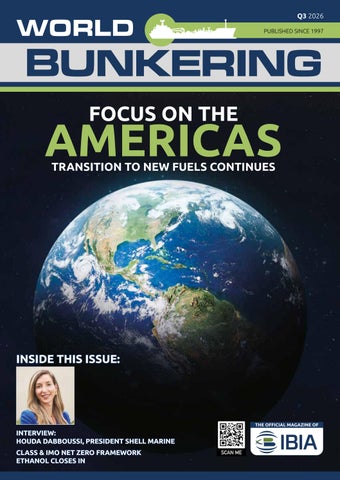
FOCUS ON THE
AMERICAS TRANSITION TO NEW FUELS CONTINUES
INSIDE THIS ISSUE:
THE OFFICIAL MAGAZINE OF
INTERVIEW: HOUDA DABBOUSSI, PRESIDENT SHELL MARINE CLASS & IMO NET ZERO FRAMEWORK ETHANOL CLOSES IN
2
EDITOR'S LETTER
D
ear Reader
I am again writing my letter while the Strait of Hormuz remains closed. To some extent, as it always has, shipping is coping with the use of work-arounds, but, as our Geopolitics pages note, only to an extent. A large chunk of the world fleet, and its long suffering seafarers, is still stuck in the Middle East Gulf and, as I write this, the world continues to teeter on the edge of an all-out regional war. So, uncertainty is still a major theme in this issue, not only due to 'wars and rumours of wars' but also to the continuing impasse over the future of IMO's Net Zero Framework (NZF). It remains to be seen what progress can be made at IMO prior to or at its Marine Environment Protection Committee session in November/ December this year (MEPC 85). However, as IBIA's representative at IMO, Dr Edmund Hughes, reports an informal group of IMO Member States and observers, including IBIA, continue to work on the technical instruments required to support the uniform and effective implementation of the draft regulations. Hughes warns of new risks as regulation turns to a 'well-towake' basis. The politics at IMO may be complex but the technical challenges are also great and need to be overcome if unintended consequences of new rules are to be avoided. Talking of unintended consequences, our Environmental News includes a fascinating report on the effects of the 2020 IMO sulphur cap. Sulphate particles produced by burning high sulphur fuel reflect sunlight and reduce global warming. This was known back in the 2000's but the effect was not considered significant enough to modify the then proposed sulphur cap rules (although a few voices did advocate doing so). World Bunkering Q3 2026
Emerging evidence suggests stopping the use of high sulphur fuel may indeed have had a measurable and, possible regionally, more significant impact than previously thought. Returning to the here and now, the hiatus at IMO is the focus of this issue's special feature on classification societies, who broadly support a single IMO-led route to decarbonisation. However, their recent statements reveal differing confidence in current proposals and the industry’s ability to deliver net zero. That said the societies are generally keen to avoid the political aspects and concentrate on technical matters.
Ethanol is primarily produced in the Americas which, together with South Asia, are the subject of our Geographical Focus. In addition, our Legal section is written by US-based shipping lawyer Steve Simms. He looks at recent legal developments affecting bunkering in the US and draws attention to some heightened risks. This Americas emphasis is not entirely coincidental since this year's IBIA Annual Convention will be in New York in November. Hopefully this issue will provide plenty of food for thought in the run-up to what is set to be another blockbuster IBIA event. With best wishes
In reality, technical, political and commercial matters are closely interlinked and are comprehensively covered from major supplier's perspective in my interview with Shell Marine's president Houda Daboussi. She tells me: “Our customers must balance today's operational realities with long-term progress and decarbonisation ambitions, often amid considerable uncertainty.” Referring to the role of LNG in the pathway to NZF, she asserts that it will be part of “shipping industry’s energy evolution, not an overnight transformation”.
David Hughes Editor
There is much else in this packed issue of World Bunkering. There is too much to comment on here, but mention must be made of a major feature within our Alternative Fuels & Technology section. It is on ethanol, which is just starting to enter the marine fuel market. We talk to major players and ask searching questions about this potential fuel.
3
4
Chair’s Letter ..................................
9
Executive Director's Report ..................................
12
IBIA Events ..................................
19
IBIA Africa ..................................
21
IBIA Training ..................................
22
IBIA Asia ..................................
24
IBIA Marketing Updates ..................................
28
New IBIA Members ..................................
32
52 - 56
82
58
83
North America Most wanted Supply chain takes shape .................................. South Asia Smoother services ..................................
60
Geopolitics and Bunkering Increased risk for bunkering ..................................
63
Lubricants ..................................
64
Environmental News ..................................
67
Equipment & Services ..................................
68
Fuel Management Accuracy matters ..................................
Alternative Fuels and Technologies: Methanol Few orders .................................. Alternative Fuels and Technologies: Nuclear Studies support nuclear case ..................................
84
Alternative Fuels and Technologies: Wind Assist Into the mainstream ..................................
85
Alternative Fuels and Technologies: LPG Going beyond gas carriers ..................................
86
Alternative Fuels and Technologies: Solar Joins bunker supply chain ..................................
87
Alternative Fuels and Technologies: Biofuels Gaining ground? ..................................
IMO / Regulatory Matters “Last-mile” emissions conundrum ..................................
70
35
72
88
75
90
Interview: Houda Dabboussi Shell Marine President ..................................
38
The BIMCO & IBIA Shipmaster’s Bunkering Manual 2022 ..................................
43
Class and IMO Net Zero framework ..................................
47 - 49
South America Good Bio And Good Luck Green fuel potential ..................................
50
Central America & Caribbean Steady as she goes ..................................
Editor: David Hughes anderimar.news@googlemail.com Project Manager: Alex Corboude alex@worldbunkering.net Publisher & Designer: Constructive Media ibia@constructivemedia.co.uk Constructive Media Tel: 01495 239 962 Email: ibia@constructivemedia.co.uk www.worldbunkering.net
World Bunkering Q3 2026
Industry News .................................. Fuel Quality Beyond compliance .................................. Scrubbers ..................................
76
Legal ..................................
78
Alternative Fuels and Technologies: Ethanol Ethanol closes in ..................................
81
Alternative Fuels and Technologies: Electric Power Cold ironing “a compliance requirement” ..................................
On behalf of: IBIA Suite Lu.231. The Light Bulb1 Filament Walk, Wandsworth, London, SW18 4GQ, United Kingdom. Tel: +44 (0) 203 951 9615 Email: ibia@ibia.net www.ibia.net
Alternative Fuels and Technologies: LNG LNG builds its lead .................................. Alternative Fuels and Technologies: Ammonia Ammonia moves into service ..................................
91
Alternative Fuels and Technologies: Hydrogen Building commercial viability ..................................
100
Events & Training Diary 2026 ..................................
102
Next Issue ..................................
The views expressed in World Bunkering are not necessarily those of IBIA, or the publishers unless expressly stated to be such. IBIA disclaims any responsibility for advertisements contained in this magazine and has no legal responsibility to deal with them. The responsibility for advertisements rests solely with the publisher. World Bunkering is published by Constructive Media on behalf of IBIA and is supplied to members as part of their annual membership package.
5
CONTENTS
7
6
ix months have passed since I became Chair of IBIA, and over that time I have gained an even greater appreciation of the association and the work it does. There is no doubt in my mind that IBIA is enjoying an exceptionally successful decade. The association is more relevant than ever, more engaged with the key stakeholders across bunkering and shipping and continuing to strengthen its position as the industry's leading voice. A great deal of the credit belongs to the Secretariat. While our Board members, and many nonboard member, make invaluable contributions, it is the tireless and dedicated IBIA Secretariat that continues to innovate, raise standards and deliver for our membership, our industry and indeed the entire marine fuel supply chain. In the months leading up to taking on the role of Chair, I made a conscious decision to be as active and accessible as possible, travelling whenever time allowed to meet members and nonmembers alike. That commitment took me to London, Singapore, Athens and Panama within the space of just two months. This was important not only because I was following in the footsteps of highly engaged previous Chairs, but also because, on a personal level, I wanted to meet our members face-toface and reconnect with the industry. It may seem strange to admit after more than 40 years in bunkering but having spent the last decade working as a consultant, removed from the day-to-day demands of the business, I wasn't entirely sure I still knew who made up our industry. After all, even setting aside the multiple "black swan" events we have all experienced, the past decade has transformed our industry in ways few could have imagined — and that transformation is far from over.
events. For others, it is our work on regulation and advocacy. There are probably as many reasons for joining as there are members. What also became clear is that our $200 billion value chain, with its 260 million metric tonnes of bunker deliveries, is made up predominantly of small and medium-sized companies. I can see that reflected in the growing stack of business cards I have collected over the past few months — introducing me to many companies I either barely knew or had never encountered before. There is a real danger in taking these smaller businesses for granted while naturally focusing attention on the industry's largest players. Membership associations will always seek to engage major companies because, by working together, we have a greater opportunity to influence change. IBIA should make no apology for working closely with many of the industry's largest organisations and we will continue to do so. At the same time, it is equally important to recognise that much of the industry's innovation and future growth comes from smaller companies, which are often the driving force behind new ideas and change. One of IBIA's strengths is its democratic voting structure, which ensures that our Global Board reflects the diversity of our membership, with both large and small companies represented. In fact, some of our most active and committed Board members come from smaller organisations, often driven by a genuine passion to improve the industry.
So, what did I discover about our membership?
Of course, balance matters. If larger companies are absent from our boards, something important is missing and we should continue working to maintain that balance. Our Regional Boards also play an important role, sometimes helping to strengthen representation from larger organisations while equally ensuring that smaller buyers and suppliers continue to have a strong voice.
One of the first things I realised is that our members join IBIA for many different reasons. For some, it is the sense of community and the opportunity to connect through our
One area where I believe we still have an opportunity is encouraging more of the industry's major companies to become part of IBIA. While not every large company is represented on our
World Bunkering Q3 2026
Global or Regional Boards, some are not yet members at all! Over recent months I have spent many hours encouraging these companies to join and I hope more will recognise the valuable role IBIA now plays across the marine fuels value chain. Their participation would not simply strengthen the association; it would strengthen the industry's collective voice. Furthermore, I believe they would benefit from the expertise, collaboration and influence that IBIA provides to its members. This brings me back to the point I really wanted to make. As IBIA continues to grow in influence and visibility, I hope none of our members feel that we are becoming overly focused on a more political or corporate agenda at the expense of their interests. That certainly will not be the case during my time as Chair. Although much of my own career has been spent in large companies, I have found real satisfaction over the past six months in seeing just how engaged, entrepreneurial and enthusiastic our small and medium-sized members are. They have always been central to IBIA's success, and I firmly believe they will continue to shape its future. They have my full attention and support. And if, at any point, you feel that is not the case, please let me know. Adrian Tolson IBIA Chair
7
CHAIR’S LETTER
S
8
W
hen writing this column, we are preparing the IBIA’s Annual Convention in New York City. You may well be reading these lines at the event as copies of World Bunkering are being distributed there. As I write, anticipation is high. We are bringing together what I believe is one of the strongest programmes we have developed in recent years, covering the topics that matter most to our industry: geopolitics, regulation, decarbonisation, alternative fuels, digitalisation and the future of the marine energy value chain. Our commitment remains unchanged. IBIA will continue investing in highquality events and bringing together leading voices from across the industry to create meaningful discussions, practical insights and valuable networking opportunities. The positive feedback we have received over recent years confirms that our members appreciate this approach, and we will continue building on it. The months leading up to the convention have been both busy and productive. One of the highlights was the highly successful IBIA Asia Dinner, which once again demonstrated the growing engagement of our members across Asia. The event has grown significantly over the past few years and continues to reinforce Singapore’s importance as a major global bunkering hub and a key meeting point for our industry. This was followed by another successful IBIA reception during Posidonia. As always, Posidonia proved to be one of the most important gatherings for the maritime community, bringing together decision-makers, industry leaders and stakeholders from around the world. The reception provided an excellent opportunity for members and guests to connect in an informal setting and discuss the developments shaping our sector. Before heading to New York, we also participated in what remains the largest and most important global gathering for the bunker industry, SIBCON. IBIA had a strong presence throughout the event, both through our participation in the conference programme and through
World Bunkering Q3 2026
our newly branded exhibition booth, which attracted significant interest from members and visitors alike. It was particularly encouraging to see the positive response to the refreshed IBIA brand and the strong engagement from companies across the marine fuels and energy sector. Events such as SIBCON continue to demonstrate the importance of industry collaboration as we navigate a period of significant change. At the same time, geopolitical uncertainty continues to dominate discussions across the maritime sector. Looking back at the first, second and now third quarter of the year, it often feels as though many of the same challenges remain with us. Ongoing tensions in several regions continue to create uncertainty around trade flows, energy markets and global economic growth. While the bunker industry has once again demonstrated remarkable resilience, I believe we all share the hope that by the time this magazine reaches you, the situation will have improved and that greater stability will have returned to global markets. Against this backdrop, attention is increasingly focused on the upcoming MEPC meeting, which follows shortly after our Annual Convention. The industry continues to look for greater clarity regarding the future direction of shipping decarbonisation. Progress needs to be made; many stakeholders are seeking a clearer understanding of how future regulations, market-based measures, fuel pathways and compliance mechanisms will develop. The decisions taken will play a significant role in shaping investment decisions across the marine fuels sector for years to come.
Our engagement in Asia will continue immediately after the convention. We are proud to be participating in the 10th anniversary of Hong Kong Maritime Week, where IBIA will host a timely discussion focused on alternative fuels. We expect strong participation and meaningful dialogue as the industry continues to evaluate the role of different fuel options in supporting decarbonisation objectives. This follows our participation at Pudong Maritime Week and the Global Maritime Forum events, both of which provided valuable opportunities to engage with industry leaders and policymakers. These events once again highlighted the increasingly global nature of the challenges and opportunities facing shipping and underscored the importance of collaboration across regions and sectors. As we move through the final months of the year, it is fair to say that 2026 has been a very active and successful year for IBIA. At the same time, planning is already underway for 2027, with several exciting initiatives under consideration. Despite the challenges and uncertainties around us, our industry continues to adapt, innovate and move forward. That resilience remains one of our greatest strengths, and I am confident it will continue. Alexander Prokopakis IBIA Executive Director alexander.prokopakis@ibia.net
IBIA will continue engaging constructively with regulators, policymakers and industry stakeholders to ensure that the practical realities of bunkering remain part of the conversation. As always, our objective is to support a safe, credible, commercially viable and achievable transition while ensuring fuel availability, energy security and operational efficiency for the global fleet.
9
EXECUTIVE DIRECTOR'S REPORT
NAVIGATING UNCERTAINTY, DELIVERING TOGETHER
C
M
Y
CM
MY
CY
CMY
K
2027
ANNUAL DINNER
REGISTER NOW MONDAY 22 MARCH 2027
Grosvenor House Hotel, London, United Kingdom For further details please visit www.ibia.net | email ibia@ibia.net
IBIA EVENTS
CONNECTING THE INDUSTRY, FROM SINGAPORE TO NEW YORK IBIA connects the global marine fuels community through insight, collaboration and engagement
T
he second quarter of 2026 brought a strong programme of in-person events, online member engagement and collaboration across the wider maritime and energy sectors. From Singapore and Athens to a growing programme of meetings, forums and international partnerships, IBIA continues to create opportunities for members to connect, exchange perspectives and contribute to the discussions shaping the marine fuels industry. In April, the IBIA Asia Dinner returned during Singapore Maritime Week, welcoming a record 450 attendees from across the bunkering, shipping and marine energy sectors. The strong turnout reflected Singapore’s continued importance as a global maritime hub and the value of bringing the industry together to strengthen relationships and share insight. Further coverage of the week can be found in the Asia report from IBIA Regional Manager – Asia, Siti Noraini Zaini. IBIA extends its thanks to all members, partners and industry colleagues whose support contributed to another successful event.
12
In June, IBIA brought its global community together in Athens ahead of Posidonia, hosting the IBIA Posidonia Drinks Reception on the evening before the exhibition week began. The reception was held under the stars in the gardens of the Official Residence of South Africa’s Ambassador to the Hellenic Republic, Her Excellency Dr Lindiwe MsenganaNdlela, with the Embassy of South Africa as our gracious host. We were honoured by the presence of IMO Secretary-General Arsenio Dominguez and the Premier of the Eastern Cape, South Africa, the Honourable Oscar Mabuyane. They joined IBIA Chair Adrian Tolson and Executive Director Alexander Prokopakis in welcoming more than 300 IBIA members, shipowners and industry colleagues. Our sincere thanks go to Reception Partner Scandi Trading and Gold Sponsors Agataz Energy, Coral Marine, Eleven Energy and Flex Commodities. Their support helped create a memorable evening and demonstrated the value of bringing together different parts of the marine fuels value chain in an open and welcoming setting.
IBIA’s online engagement continued in May with the members’ meeting, MFM Survey Insights: Quality and Quantity in Focus. Building on IBIA’s 2022 study, the session presented updated insights into global mass flow meter implementation and examined how bunker licensing, technology and regulatory alignment are influencing transparency, quantity assurance and fuel quality across key ports. We were grateful for the contributions of IBIA Board Member Claudia Beumer of C4 Fuel, Haitham Al Tamimi of SOHAR Port and Freezone, Michael Green of World Fuel Services and Kenneth Dam of TFG Marine. The discussion reinforced the importance of reliable data, practical experience and consistent standards in building greater confidence throughout the bunker supply chain. The members’ programme continues with a September session focused on FuelEU Maritime: Regulation, Compliance and Trading in Practice. Tailored specifically for IBIA members, the meeting examines the fundamentals of FuelEU Maritime, its legal implications, potential trading scenarios and the wider operational and commercial considerations for organisations across the marine fuels sector. World Bunkering Q3 2026
The IBIA Annual Convention will take place in New York from 10 to 12 November 2026, bringing together international leaders to examine the regulatory, commercial and operational forces reshaping bunkering and marine energy. Discussions will cover market outlooks, fuel availability, policy, quality, digitalisation, decarbonisation, regional developments and the practical realities of a multi-fuel future. Programme highlights include a keynote address from Laura DiBella, Chair of the Federal Maritime Commission; a policy address from Sydney Plante of the US Maritime Administration; and a leadership fireside conversation between Adrian Tolson and Houda Dabboussi, President of Shell Marine.
As the marine fuels sector moves towards a more diverse fuel mix, informed discussion across the full value chain will remain essential. Beyond its own programme, IBIA continues to support and contribute to industry events around the world. Engagements during 2026 include the Marine Fuel Forum in Singapore, the Xinde Marine Forum in Athens, Maritime Week Americas in Panama, APPEC in Singapore, the Argus Sustainable Marine Fuels Conference in Houston and the Bosphorus Shipbrokers Dinner in Istanbul. These platforms allow IBIA’s Board, regional representatives and Secretariat to share expertise, listen to industry concerns and ensure that the marine fuels sector remains part of the wider maritime and energy conversation. Planning is also well advanced for 2027. The IBIA Annual Dinner will return to the JW Marriott Grosvenor House Hotel in London on 22 March 2027, immediately preceding
International Energy Week, for which IBIA will be a Supporting Association. To our members, thank you for your continued engagement, insight and support. Your participation ensures that IBIA remains connected to the issues that matter most. Please continue to share your views, join our discussions and reach out whenever there is an issue on which we can support, represent or connect you. I look forward to seeing many of you across IBIA’s global programme. Tahra Sergeant Regional Manager (Africa) & Global Head, Events tahra.sergeant@ibia.net https://linkedin.com/ company/ibia.net InternationalBunker IndustryAssociation/ ibiabunkers
IBIA will then participate in Hong Kong Maritime Week, hosting an Alternative Fuels Forum followed by an evening networking reception. The Forum will bring together fuel suppliers, shipowners, engine manufacturers, classification societies, regulators and other stakeholders to consider the current and future roles of biofuels, LNG, methanol and ethanol. The emphasis will be firmly practical, covering deployment experience, infrastructure readiness, regulation and commercial decision-making.
World Bunkering Q3 2026
13
IBIA EVENTS
In October, Dr Edmund Hughes, IBIA’s representative to the IMO, will lead a pre-MEPC 85 members’ meeting. The session will give members an opportunity to better understand the issues expected to shape the IMO discussions and consider their potential implications for the industry. IBIA’s programme in Singapore also includes participation at SIBCON in October. Representatives from the Secretariat and Board will be present, with IBIA once again hosting a stand within the exhibition. The stand will provide a meeting point for members and industry colleagues to exchange views, discuss key developments and connect with the IBIA team.
IBIA POSIDONIA RECEPTION 14
World Bunkering Q3 2026
IBIA POSIDONIA RECEPTION
World Bunkering Q3 2026
15
IBIA POSIDONIA RECEPTION 16
World Bunkering Q3 2026
/ Bunkering across Spain Through AVIA, the commercial brand of ESERGUI, we deliver high-standard bunkering solutions across Spain, combining the strength of an established energy operator with the agility of our own logistics.
Ports where we supply
Andalusia (13) Cantabria (5) Galicia (34) Valencia (4) Asturias (4) Catalonia (7) Murcia (1)
We adapt to every type of vessel or coupling configuration, ensuring dependable on-time delivery, operational excellence and the confidence the maritime sector demands. Our ambition is clear: to be the benchmark partner for marine fuel supply in Spain, offering premium service, flexibility and performance. Products we currently supply MGO 1,000 ppm
24-48 h delivery fast bunkering
www.esergui.com
24/7 coverage 365 days a year
www.aviaenergias.es
+150 own fleet vehicles
MGO 10 ppm
HVO
Urea / AdBlue
SIGES ULS MGO ≤ 15 ppm
LS MGO ≤1,000 ppm
Certifications & Standars ISO 9001
ISO 14001
MARPOL Standars
+34 659 174 874 - Álvaro García Burgos (Commercial Director)
www.worldbunkering.net
ADVERTISE IN Increase your visibility to the global bunker industry with an advert in World Bunkering. The ONLY official magazine to IBIA. For more information about our media packages or to make a booking please contact Alex Corboude - Project Manager, IBIA’s World Bunkering Mob: +44 7957 472 317 • Email: alex@worldbunkering.net
18
World Bunkering Q3 2026
IBIA AFRICA
IBIA AFRICA: REGIONAL UPDATE An overview of recent market developments, regional engagement and upcoming activities across Africa
T
he past quarter has reinforced the diversity of Africa’s bunker and marine fuels landscape. Conditions continue to vary across the continent, shaped by fuel availability, changing supply routes, regulatory frameworks and local infrastructure. While challenges remain, there is growing momentum and a shared understanding of the importance of collaboration in supporting sustainable market development. North Africa remains relatively stable, with continued demand for low-sulphur marine gasoil around key Mediterranean ports. The Mediterranean Emission Control Area is also influencing fuel requirements and regional demand patterns. Across West Africa, demand remains active, with local production in Nigeria becoming increasingly important to the wider market. Lagos and Port Harcourt remain key locations, while renewed refinery activity in Ghana may create further opportunities to strengthen regional fuel availability. East Africa continues to face more complex conditions, with availability, logistics and supplier reliability remaining concerns in some markets. Mozambique and Kenya remain important supply locations, but continued investment and greater regulatory certainty will be central to longer-term development. In Southern Africa, the market remains stable but constrained. Algoa Bay continues to represent a significant missed opportunity, with regulatory restrictions limiting offshore bunkering activity. World Bunkering Q3 2026
Some vessel traffic has shifted towards alternative locations, including Mauritius, which continues to report strong bunker volumes.
This year’s conference will be held under the theme: “An Inclusive Energy Future: Bunkering & Renewables Growth in Gqeberha.”
At the IBIA Posidonia Drinks Reception in Athens, IBIA Chair Adrian Tolson and Executive Director Alexander Prokopakis had the opportunity to discuss the support IBIA can provide to regional industry discussions with the Premier of the Eastern Cape, South Africa, the Honourable Oscar Mabuyane.
IBIA will also support Maritime Week Africa in January 2027, continuing its engagement with the wider African maritime community.
This engagement aligns closely with the activities of the IBIA Regional Board - Africa, which continues to support discussions around South Africa’s bunkering environment and the future potential of Algoa Bay. Across the continent, IBIA is also exploring opportunities to strengthen relationships with national and regional industry bodies, including potential engagement with the Nigerian bunker association. These discussions will focus on regulatory alignment, safety standards, infrastructure and the conditions required to support market growth.
The IBIA Regional Board - Africa and the Secretariat look forward to supporting initiatives that strengthen Africa’s bunker and marine fuels sector. We welcome approaches from organisations seeking engagement, collaboration or industry support. Please contact me in my capacity as IBIA’s Regional Manager for Africa. Tahra Sergeant Regional Manager (Africa) & Global Head, Events tahra.sergeant@ibia.net
Looking ahead IBIA is planning an Africa-focused webinar offering practical insights into marine fuels and bunker activities across the continent. The 2nd Annual Bunker Africa Conference 2026 will take place from 28–30 September 2026 at the Boardwalk Hotel and International Convention Centre in Gqeberha, South Africa.
19
20
IBIA TRAINING
KEEPING PACE
WITH A CHANGING MARINE FUEL INDUSTRY The maritime industry is changing quickly
T
he maritime industry is changing quickly. New fuels are entering the market; regulations are evolving and technologies that were once considered experimental are becoming part of everyday operations. For everyone working across the marine fuel supply chain, keeping up is becoming just as important as keeping the ships moving. That is why practical training has an increasingly important role to play. IBIA continues to develop its education and training programme to help people across the bunker and marine fuel industry understand these changes and, importantly, put that knowledge into practice. From the fundamentals of bunkering to new technologies and alternative fuels, the aim is to give industry professionals the confidence and practical understanding they need in a changing market. One example is IBIA’s MFM in Bunkering: Technology, Compliance & Practice course, taking place in Rotterdam on 4 November 2026. Organised in partnership with C4 Fuel and endorsed by the Port of Rotterdam and the Port of Antwerp-Bruges, the one-day course focuses on one of the most significant developments in bunkering measurement in recent years: Mass Flow Metering (MFM). IBIA has been closely involved in supporting the industry as MFM implementation has progressed in Rotterdam and Antwerp. Since the first discussions began, IBIA, in partnership with C4 Fuel, has delivered a number of training sessions for people from across the industry. Now, around nine months into the implementation process, there is something particularly valuable to discuss: real experience. The Rotterdam course will look at how Coriolis Mass Flow Meters work, as well as the regulatory requirements under the Measuring Instruments Directive (MID) and ISO 22192.
World Bunkering Q3 2026
But it will not stop at the theory. Delegates will have the opportunity to look at the technical and commercial realities of bunkering with MFM, common system issues and practical troubleshooting. The changing role of the bunker surveyor will also be explored. As bunkering becomes increasingly datadriven, surveyors are having to work with new sources of information and new ways of verifying what happens during a fuel delivery. The course is aimed at those involved in bunker operations, trading, surveying and port administration, and will provide plenty of opportunity to discuss case studies, share experiences and learn from what the industry has encountered during the first months of MFM operation. IBIA's training programme is also looking firmly towards the future. During Singapore Maritime Week in April, IBIA hosted a half-day workshop on Ethanol and Methanol: Alcohol Based Fuel Pathways for Shipping, in partnership with the Global Centre for Green Fuels and the Maritime Ethanol & Methanol Alliance. The event explored the growing interest in alcohol-based fuels and the practical questions surrounding their use in shipping. The conversation will continue in New York on 10 November 2026, when IBIA, in partnership with the US Grains & Bioproducts Council, will hold a half-day Workshop on Ethanol as a Marine Fuel as part of the IBIA Annual Convention. Ethanol is attracting growing attention as the industry considers how best to reduce emissions while maintaining the global supply chains on which shipping depends. Unlike some emerging fuels, ethanol is already produced commercially and has established international supply chains. Advances in engine technology and recent bunkering demonstrations are also helping to move the discussion from theory towards practical application.
The New York workshop will look at the whole picture, including global ethanol markets and policy, lifecycle carbon intensity, sustainability, the food-versus-fuel debate, engine and vessel readiness, safety, classification and regulation. Importantly, it will also look at the commercial realities. What will it take to move from individual trials and pilot projects to wider use? What do shipowners need to see before making the investment? And where do fuel producers, ports, engine manufacturers, regulators and other stakeholders fit into the picture? These are the kinds of questions that need an open and practical discussion if alternative fuels are to move forward. Not everyone needs the same type of training, and IBIA's education programme reflects that. Alongside its in-person specialist courses and workshops, IBIA also delivers online training courses for both beginners and advanced students. This means that whether someone is new to the bunker industry and looking to build a solid foundation, or an experienced professional wanting to deepen their technical knowledge, there are opportunities to learn and develop. The energy transition will not happen overnight, and there will undoubtedly be plenty more changes along the way. What is clear, however, is that people will remain at the heart of that transition. By combining technical knowledge with practical experience and open discussion, IBIA's training programme is helping the industry prepare for those changes — one course, one workshop and one conversation at a time. For more information on IBIA's training courses and to register, visit www.ibia.net/training or email the IBIA Secretariat on: ibia@ibia.net.
21
IBIA ASIA
iStock
©
NAVIGATING UNCERTAINTY WHILE BUILDING MOMENTUM Practical industry insights are more important than ever
A
s we enter the third quarter of 2026, the marine fuels sector continues to operate against a backdrop of geopolitical uncertainty. The conflict served as a stark reminder of how quickly geopolitical events can influence energy markets, supply chains and operational planning. The resulting volatility reinforced the importance of resilience, supply chain flexibility and transparent communication across the bunker value chain. For Asia, where maritime trade remains the lifeblood of regional economies, collaboration and the sharing of practical industry insights have become more important than ever. In an increasingly interconnected environment, strong partnerships and open dialogue remain essential as the industry navigates uncertainty while continuing to move forward on longer-term priorities. Strengthening Connections Across the Region The highlight of the past quarter was undoubtedly the IBIA Asia Dinner, held during Singapore Maritime Week (SMW) on 22 April 2026. This year’s dinner welcomed a record 450 attendees, bringing together members, regulators, industry leaders and stakeholders from across the region for an evening of networking, conversation and reconnecting with industry peers. The exceptional turnout reflected the industry’s continued commitment to coming together, despite the challenges and uncertainties facing the sector.
22
SMW also provided an excellent platform for conversations on the future of marine fuels. Together with the Global Centre for Green Fuels (GCGF), IBIA co-organised the Half-Day Workshop on Ethanol & Methanol: Alcohol-Based Fuel Pathways for Shipping. The workshop explored the practical realities of adopting alcohol-based marine fuels, covering safety considerations, regulatory developments and operational readiness. As the industry continues to balance decarbonisation ambitions with commercial and geopolitical realities, these discussions remain both timely and necessary. IBIA’s engagement with the industry continued beyond Singapore Maritime Week. In May, IBIA was represented at the MPA Marine Fuels Forum, where a presentation on State of the Bunker Industry & the Evolving Geopolitical Landscape discussed the implications of recent geopolitical developments on the bunker industry, emphasising the importance of diversification, resilient supply chains and close collaboration across the value chain.
Together, these events will provide valuable opportunities to discuss safety, operational excellence, market developments and the transition towards lower-carbon marine fuels. While geopolitical developments will undoubtedly continue to influence global energy markets, the industry’s ability to adapt has once again demonstrated the importance of collaboration, knowledge sharing and trusted industry engagement. IBIA Asia remains committed to connecting people, policy and practice across the region. Whether through our training programmes, industry events or partnerships with regulators and stakeholders, we will continue to support a safe, transparent and resilient marine fuels sector while helping the industry prepare for the opportunities and challenges ahead. Siti Noraini Zaini Regional Manager, IBIA Asia siti.zaini@ibia.net www.ibia.net
Keeping the Conversation Going Looking ahead, preparations are well underway for several important industry events in the second half of the year. IBIA will have a strong presence at SIBCON 2026, continuing our support for one of the region’s leading marine fuels conferences and providing another opportunity to engage with industry stakeholders. We are also preparing for the IBIA Annual Convention in New York and Hong Kong Maritime Week. World Bunkering Q3 2026
ASIA Singapore | 14 April 2027
SAVE THE DATE
14 April 2027 Venue: The Fullerton Hotel, Singapore, The Ballroom, Lower Lobby For further details, please contact us at siti.zaini@ibia.net and Noraini.salim@ibia.net. For sponsorship opportunities, please contact Alex Corboude, IBIA Sponsorship Sales: alex@worldbunkering.net
IBIA MARKETING UPDATES
SUPPORTING COLLABORATION ACROSS THE MARITIME AND ENERGY LANDSCAPE The past few months have been a busy period for IBIA, with a strong focus on building relationships across the global maritime, bunkering and energy sectors
F
rom championing diversity and inclusion to expanding engagement in Asia and strengthening ties with the wider energy community, each initiative reflects the Association's commitment to supporting a connected and forward-looking marine fuels industry. Women in Maritime One of the highlights was the IBIA Secretariat's attendance at the IMO Women in Maritime event at the International Maritime Organization headquarters in London. Bringing together professionals from across the maritime world, the evening celebrated the achievements of women throughout the industry while recognising the progress being made towards greater gender equality. More importantly, the event reinforced the message that real progress comes from turning good intentions into meaningful action. Creating a more diverse and inclusive industry takes continued commitment from organisations across the maritime value chain, and opportunities to share experiences, build networks and learn from one another remain invaluable.
24
For IBIA, supporting diversity is not simply about representation; it's about ensuring the industry benefits from the broadest possible range of skills, experience and perspectives. As the marine fuels sector continues to evolve, attracting and retaining talented people from all backgrounds will be essential to its future success. WeChat Launch IBIA has also taken another important step in strengthening its presence across Asia with the launch of its official WeChat account.
Launched in partnership with XINDE Marine News, one of China's leading maritime media and events organisations, the account will help
IBIA engage more directly with one of the world's most important maritime markets. The initial focus is on building awareness and growing the account through the support of industry partners, including Xinde, Manifold Times and members of the IBIA Asia Regional Board. As communication increasingly takes place through digital platforms, establishing a presence on WeChat allows IBIA to share industry news, technical developments and policy updates in a way that is accessible to stakeholders across China. It is another step in strengthening the Association's engagement with members and the wider maritime community throughout the region. Supporting International Energy Week 2027 Looking ahead, IBIA is also pleased to be a Supporting Association for International Energy Week 2027, organised by the Energy Institute. Taking place from 23–25 March 2027 in London, the event brings together energy professionals, policymakers, technical experts and innovators to discuss the challenges and opportunities shaping the future of global energy. World Bunkering Q3 2026
Issues such as decarbonisation, fuel availability, infrastructure development, regulation and energy security are shared challenges that require shared solutions. As the global voice of the marine energy value chain, IBIA welcomes the opportunity to contribute to these wider conversations and ensure the interests and expertise of the marine fuels sector are represented. International Energy Week provides an excellent platform to exchange ideas, share knowledge and explore practical solutions that will help support the industry's transition.
IBIA MARKETING UPDATES
The partnership comes at an important time. As shipping accelerates its transition towards lower-carbon operations and a more diverse fuel mix, closer collaboration between the maritime and energy sectors is becoming increasingly important.
IBIA's role as a Supporting Association reflects its ongoing commitment to collaboration across the wider energy landscape. Alongside these initiatives, IBIA continues to raise its profile through speaking engagements at conferences, seminars and technical forums around the world. These events provide valuable opportunities to contribute to industry discussions, share expertise and ensure the marine fuels sector remains part of the wider conversation as shipping continues to evolve. While each of these activities is different, they all point towards the same goal: bringing people together, encouraging collaboration and helping to shape a safe, efficient and sustainable future for marine energy. Elena Wilson Marketing & Business Development Manager elena.wilson@ibia.net
GIRONE TRADING OIL Reliable Bunker & Lubricant Services Across Italy and Europe Your trusted partner for bunker fuel and marine lubricants in Italy and Europe Girone Trading Oil delivers dependable, efficient, and highquality bunker and marine lubricant solutions throughout Italy and across Europe. With a strong logistics network and strategic partnerships, we ensure timely supply, competitive pricing, and consistent product quality for vessels of all sizes. From major Mediterranean ports to key European hubs, our experienced team provides tailored fuel and lubricant solutions designed to optimize performance, reduce downtime, and support your operational needs. At Girone Trading Oil, we combine flexibility, speed, and industry expertise to keep your operations running smoothly — wherever your journey takes you.
Tel: 0039 347 3392064 I E-mail: gtosrl@yahoo.it I Pec: gironetradingoil@pec.it
World Bunkering Q3 2026
25
CODE OF CONDUCT Abiding by this Code of Conduct shows that members support our common goal: to promote the widespread adoption of a common set of ethical values within our industry. We believe that when the entire industry acts with the highest ethical standards that this will be to the benefit of us all.
FAIR BUSINESS 3 We conduct our business in a fair and transparent manner 3 We will always act in the best interest of each business partner and are honest with the stakeholders involved in our business 3 We only engage in business using compliant products, and deliver the quality and quantity agreed with our business partners 3 We always act in good faith
BEST PRACTICE 3 We always act in accordance with applicable legislation, including sanctions 3 We always meet contractual obligations in a timely manner 3 We always do our best to avoid disputes and seek resolution promptly if disputes occur 3 We comply with all applicable competition and anti-corruption laws 3 We respect confidential information and do not unlawfully use any intellectual property
SOCIAL RESPONSIBILITY 3 We seek to minimise our environmental impact and the risk of environmental damage 3 We will always ensure employees’ health, safety and security 3 We offer equal opportunities, prohibit unlawful discrimination and respect human rights 3 We offer the same opportunities for professional development to all our employees
TRANSPARENCY 3 Our accounts and records are kept accurately and reflect the true state of the company and its operations 3 During audits or investigations, we fully cooperate with the authorities 3 We will not receive or give any gift or entertainment of disproportionate value 3 We are fully committed to preventing both money laundering and terrorist financing This Code of Conduct is endorsed by the IBIA – The International Bunker Industry Association. IBIA encourages members to abide by this Code of Conduct and to endorse it.
www.ibia.net 26
World Bunkering Q3 2026
Distribution & Trading
䈀甀渀欀攀爀猀 ☀ 䰀甀戀爀椀挀愀渀琀猀
Quality
Quantity
Pricing
Timing
Delivering reliability, value, and trust across global ports
WELLS BUNKERING is a trusted distributor of marine fuels and lubricants which operates in Greece and Cyprus. With a company operated tank truck fleet Wells ensures the smooth and timely deliveries in Greek and Cypriot ports. Wells is also actively engaged in worldwide trading with partnerships with leading global brands and carefully selected local suppliers that ensure product reliability, fast response times, and highly competitive pricing. Wells Bunkering Ltd Head Office: CYPRUS 11A Karyatidon Str., Lakatamia, 2311, Nicosia, Cyprus Tel: +357 99130711 Email: gm@wellsbunkering.com Linkedin: https://www.linkedin.com/company/wellsbunkering/
wellsbunkering.com
GREEK OFFICE 4 Bouboulinas Str. ,18535, Piraeus, Greece Tel: +30 210 4100008 Email: gm@wellsbunkering.com
NEW IBIA MEMBERS
NEW IBIA MEMBERS CORPORATE Trader Aramco Trading Fujairah FZE Danielle Van den Berg Middle East Bunker Supplier, Ship Manager ATH Trading S.L. Jorge Calvillo Europe Digital Solutions Supplier, Finance and Banking, Financial, Marine Service Providers, Reporting Agency, Technology and Software, Other (Credit Assessment Platform for Bunker Trade Transactions) CERTY Michel Grebenikof Middle East Bunker Fuel Supplier (Physical), Energy Producers, Supplier (Physical), Other (Ethanol Supplier, Biofuels Trader) Eco-Energy Global Biofuels, LLC Hagan Rose Americas Digital Solutions Supplier, Finance and Banking, Financial, Financial Advisory Service, Fuel Testing, Technology and Software Fuel Sure Pte Ltd Alok Sharma Asia Charterer, Ship Manager, Ship Owner, Shipping Company Hercules Shipping Limited Matthew Dormer Europe
28
Ship Manager, Broker, Ship Owner Master Ship Management Zehra Kiran Europe Marine Equipment Supplier Trelleborg Marine Systems UK LTD Andrew Stafford Europe
INDIVIDUAL Bunker Trader, Shipping Company Muhammad Valent Asnawi PT Jelajah Laut Nusantara Asia Bunker Surveying, Surveyor Elvis Che Cho Andrew Moore and Associate Asia Bunker Surveying, Digital solutions supplier, Marine Equipment Supplier, Marine Service Providers, Oil Industry Major, Service, Surveyor, Technology and Software, Other (Electronic Fuel Management Systems as partners of Fueltrax) Patricia Gomez Alanis INTEMAR Americas
Bunker Broker, Bunker Fuel Supplier (Physical), Marine Consultancy, Marine Equipment Supplier, Port, Port Authority, Regulatory Body, Supplier, Supplier (Physical) Habib Ibrahim Nigerian Ports Authority Africa Bunker Fuel Supplier (Physical), Energy Producers, Supplier, Supplier (Physical) Matt McMonagle Elemental Clean Fuels Americas Barge Operators, Bunker Fuel Supplier (Physical), Bunker Supplier, Bunker Tanker Owners, Ship Owner, Supplier (Physical), Other (Marine Bunker Company) Hammad Ali Mirza Shaukat Marine Services Asia Legal Arnold Ridley RR&CO PTE. LTD. Asia Bunker Fuel Supplier (Physical) Christophe Rooman Belgian Trading and Bunkering BV Europe Ship Owner Martijn Van den Berg Spliethoff Group Europe
World Bunkering Q3 2026
JOIN
TODAY
to play an integral part in the sustainable future of the bunker industry
By joining IBIA, you will become part of a global network of bunker industry experts who collectively form one of the world’s leading authorities on bunkers. Not only will you have access to a wealth of information and insight (we publish newsletters and industry updates on current issues), which offer pragmatic advice for managing the industry’s challenges; members also have the potential to shape and influence both international and local legislation. This happens through IBIA’s Working Groups, which are responsible for developing industry guidance, participating in IMO correspondence groups, solving long-term industry issues, and addressing both commercial and technical aspects.
INDIVIDUAL
CORPORATE
3 IBIA Board Member eligibility
ALL THE BENEFITS OF INDIVIDUAL +
£350
3 The right to 1 vote for Board Member Elections 3 IBIA Working Group eligibility 3 Access to all IBIA Members Meetings 3 Discounted IBIA training courses/ conferences/ seminars events/conventions 3 Individual discounts on other industry events 3 Subscription to World Bunkering magazine 3 Representation at IMO (International Maritime Organisation)
£1750 3 Register up to two offices anywhere in the world 3 The right to 2 votes for Board Member Elections 3 10 user registrations on the IBIA Member Platform 3 Eligible to book up to 4 tables at the prestigious IBIA Annual Dinner
3 Access to IBIA’s member networking platform
3 Eligible to add further offices for a reduced fee of £600 per office
3 Eligible to book up to 4 tickets at the prestigious IBIA Annual Dinner
3 Use of the IBIA Members’ logo on your website and stationery
3 IBIA membership certificate
USEFUL INFORMATION 3 15% discount for 3-year membership (Paid in one instalment) 3 Guarantee no membership price increases for the next 3 years 3 To join IBIA go to www.ibia.net or contact tara.morjaria@ibia.net
www.ibia.net
(Updated 2026)
30
World Bunkering Q3 2026
IBIA & INDUSTRY 2026/2027 CALENDAR SEPTEMBER 2026 1
Xinde Marine Forum Hamburg
Hamburg, Germany
1-4
SMM
Hamburg, Germany
7 - 10
Asia Pacific Petroleum Conference (APPEC)
Singapore, Asia
7 - 11
The Oxford Bunker Course
Oxford, United Kingdom
16
IBIA Members Meeting: FuelEU Maritime: Regulation, Compliance and Trading in Practice
Online
21
Maritime Leadership Program 2026
Athens, Greece
22
10th Clean Marine Fuel Forum
Singapore, Asia
23 - 25
The Argus Sustainable Marine Fuels Conference
Houston, United States
28 - 30
2nd Annual Bunker Africa Conference 2026
Gqeberha, South Africa
28 - 01
BunkerExperience 2026
Vlaardingen, Netherlands
6
Oil Spill India (OSI) 2026
New Dehli, India
7-8
SMF Fest
Velencia, Spain
7-8
Robban Assafina Shipping Forum & Awards 2026
Beirut, Lebanon
13 - 15
SIBCON
Singapore, Asia
19
IFFW London Brief
London, United Kingdom
19 - 23
Pudong Shipping Week 2026
Shanghai, China
22 - 23
ARACON 2026
Rotterdam, Netherlands
20 - 22
The Argus Biofuels Europe Conference & Exhibition
London, United Kingdom
27
IBIA Members Meeting: IMO and MEPC 85 preparation
Online
28 - 30
WISTA International Conference
Kuala Lumpur
3-6
IAPH World Ports Conference
London, United Kingdom
10 - 12
IBIA Annual Convention 2026
New York, United States
10
IBIA Annual Convention Workshop: Ethanol as a Marine Fuel
New York, United States
15 - 21
Hong Kong Maritime Week
Hong Kong
18
Xinde Marine Forum Hong Kong 2026
Hong Kong
19
IBIA Alternative Fuels Forum: Fueling Now and the Future
Hong Kong
2-3
3rd Ship Energy Efficiency Summit
Athens, Greece
3-4
Marintec Innovation Conference 2026
Shanghai, China
8
Motorship Propulsion & Future Fuels Conference 2026
Hamburg, Germany
16 - 18
CMA
Houston, Texas, United States
22
IBIA Annual Dinner 2027
London, United Kingdom
23 - 25
IE Week 2027
London, United Kingdom
OCTOBER 2026
NOVEMBER 2026
DECEMBER 2026
MARCH 2027
IBIA ONLINE TRAINING COURSES ONLINE BUNKER TRAINING COURSE MODULE 1 TO PURCHASE
Bunker Market Regulations and Enforcement
Online at www.ibia.net
MODULE 2 TO PURCHASE
Understanding ISO 8217 and ISO 4259
Online at www.ibia.net
MODULE 3 TO PURCHASE
Best practice for suppliers with VLSFO
Online at www.ibia.net
MODULE 4 TO PURCHASE
Best practices for users with VLSFO
Online at www.ibia.net
MODULE 5 TO PURCHASE
Adapting to a changing market
Online at www.ibia.net
MODULE 6 TO PURCHASE
Compatibility and stability – Issues with VLSFO fuels and the measurement of Stability Online at www.ibia.net
MODULE 7 TO PURCHASE
Sales terms and conditions – The purpose, structure and application of Sales terms
Online at www.ibia.net
MODULE 8 TO PURCHASE
Quantity measurement – The principles of quantity measurement including Mass Flow Metering
Online at www.ibia.net
MODULE 9 TO PURCHASE
Sampling – The basics of sampling, sampling methods and sample handling
Online at www.ibia.net
MODULE 10 TO PURCHASE
Fuel quality – Impact on storage, treatment and use in the engine
Online at www.ibia.net
MODULE 11 TO PURCHASE
Alternative Fuels
Online at www.ibia.net
MODULE 12 TO PURCHASE
Bio Fuels (updated 2026)
Online at www.ibia.net
MODULE 13 TO PURCHASE
Exhaust Emissions
Online at www.ibia.net
MODULE 14 TO PURCHASE
Introduction to LNG Bunkers
Online at www.ibia.net
COURSE TO PURCHASE
The IBIA Basic Bunkering Course
Online at www.ibia.net
*All dates were correct at time of going to print but may be subject to change, please refer to IBIA's website (https://ibia.net/events/) for any updates
World Bunkering Q3 2026
IBIA Event
IBIA Supported Event
Industry Event
31
IMO / REGULATORY MATTERS
“LAST-MILE” EMISSIONS CONUNDRUM IBIA's representative at IMO, Dr Edmund Hughes, warns of new risks as regulation turns to a 'well-to-wake' basis
A
s I have highlighted before the possible introduction of a global standard for GHG intensity of marine fuel (GFI), with that intensity being calculated on a 'well-to-wake' (WtW) basis, will bring the most significant change to the global supply of marine fuel since coal was replaced by oil.
supplier to ship. This understanding is captured in the IMO guidelines used to support implementation of the regulations1. Even so, whilst seemingly a straightforward and readily understood transaction, it remains subject to legal disputes and arbitration.
For the bunkering industry, which sits at the fulcrum of the marine energy value chain between the fuel producers/suppliers and the ships, this will bring significant new operational and commercial risks that if not managed effectively could result in major compliance failures along the chain of custody that end up in the courts.
A new governance regime for supply of marine fuel to international shipping Since the adjournment of the MEPC Extraordinary session in October last year, and the resulting failure to adopt the IMO Net Zero Framework, work has continued through an informal group of IMO Member States and observers, including IBIA, on the technical instruments required to support the uniform and effective implementation of the draft regulations.
Currently to reflect that there are different actors engaged in the supply and delivery of fuel oil to a ship, the provisions of MARPOL Annex VI refer to the following entities: fuel oil “supplier’s representative” (regulation 18.8.1 and appendix V), for example, the person responsible for delivering the fuel oil to the ship on behalf of the local supplier and/ or for completing and signing the declaration on the BDN; “local suppliers of fuel oil” (regulation 18.9.1) who are required “to provide the bunker delivery note” (regulation 18.9.2); and “fuel oil supplier” (regulation 18.9.2 & 18.9.4), for example, the entity responsible for the final blend supplied to the local supplier and/or for certifying it meets the requirements of regulations 14 and 18 of MARPOL Annex VI. Of course, the interpretation of these terms is ultimately the prerogative of the jurisdiction where the fuel supplier operates and sells their fuel. However, when fuel is supplied to a ship the point of transfer is commonly recognised as the point that responsibility for the quality of the fuel oil is transferred from fuel owner/ 1
MSC-MEPC.2/Circ.18, paragraphs 3.4 and 4.4
32
The relevant draft provisions of the IMO Net Zero Framework for bunkering of sustainable marine fuels are set out below: “Regulation 34 Sustainable fuels certification schemes 1. The GHG intensity of a fuel shall be calculated using GHG emission factors and also taking into account all relevant metrics and indicators for each sustainability theme or aspect of a fuel as documented on the Fuel Life Cycle Label(s) (FLL). 2. GHG emission factors and sustainability themes or aspects of a fuel as documented on the FLL shall be certified, as appropriate, by a recognized Sustainable Fuels Certification Scheme (SFCS) taking into account guidelines developed by the Organization. 3. The certified information in the FLL may accompany the bunker delivery note referred to in regulation 18, taking into account guidelines developed by the Organization.”
The IMO 2024 Guidelines on life cycle GHG intensity of marine fuels (resolution MEPC.391(81)) (LCA guidelines), specify that all upstream emissions, including emissions from the last-mile delivery must be included in the calculation of GFI. So, in addition to the BDN the marine fuel value chain will be responsible for collating and supplying additional information to the receiving ship from the upstream (Well-to-Tank (WtT)) so that the ship can calculate the required annual GHG marine fuel intensity (GFI). However, currently existing sustainable fuels certification schemes that cover marine fuels do not seem to include emissions from the lastmile delivery to the ship. An added complication is that any bunker vessel of 5,000 gross tonnage and above and trading internationally (even for a single voyage) would also have to report its GHG intensity to the IMO GFI registry (draft regulation 37 of MARPOL Annex VI), noting that future amendments to the regulations could potentially also change the tonnage threshold. Without clarification, this risks the double counting of emissions. Initial analysis undertaken by RINA and the Mærsk Mc-Kinney Møller Center for Zero Carbon Shipping suggests that the average impact of the last-mile delivery is less than 1% of a liquid fossil fuel WtW GHG intensity2. However, how this might be incorporated into both default and actual values needs further consideration, with clarification in the LCA guidelines and certainty on the approach to calculation needed before the regulations are adopted. If IMO decides that the GHG impact of the last-mile delivery is required to be added to the GHG intensity of the marine fuel, there are a number of scenarios as to who will be responsible for doing so. In the event of the use of a default value (noting that disaggregated default values are
2 Proposal for operationalizing the fuel life cycle label in the context of the IMO Net Zero Framework, ISWG-GHG 20/2/29 (Norway, IPIECA, RINA, IBIA and WSC), 5 September 2025.
World Bunkering Q3 2026
IMO / REGULATORY MATTERS
currently not mentioned in the 2024 LCA Guidelines), this may be added by the last certified entity in the chain of custody without any knowledge of the details of the last-mile delivery. On the other hand, if an actual value needs to be calculated per fuel batch, then this implies that the last-mile fuel supplier / local supplier must be certified by a SFCS in order to supply low-carbon fuel with the Fuel Lifecycle Label certificate to a ship. While the scope of the last supplier in the value chain may differ substantially, common principles to report on last-mile GHG emissions can help establish the responsibility for emissions reporting, noting that this approach is based on how the issuance of the Bunker Delivery Note takes place today: 1. An “economic operator” that at any point legally owns a low-carbon fuel batch should be certified by an IMO recognised scheme (SFCS). 2. For last-mile GHG emissions intensity: a. If the local supplier legally owns the fuel batch, this entity is responsible for adding last-mile emissions to the sustainability certificate. b. If the local supplier is a service provider, the sustainability certificate is issued (with the lastmile GHG emissions included) by the certified supplier who legally owns the fuel batch. 3. An economic operator that legally owns the fuel batch must be certified and pass on the sustainability documentation. The last economic operator that legally owns the fuel batch is the fuel supplier and must issue the Fuel Lifecycle Label for onboard usage, including last-mile emissions. The possible process for recording of last-mile emissions and Fuel Lifecycle Label issuance is illustrated in the figure on the right.
Possible last-mile emissions recording and issuance of Fuel Lifecycle Label (ref: IMO document ISWG-GHG 20/2/29, see footnote 2) The term “economic operator” is defined under the draft guidelines for recognition of Sustainable Fuels Certification Schemes3 as “the actors/ entities certified and include, but are not limited to, feedstock and fuel producers, processing facilities, and traders”. However, the 2024 LCA Guidelines are standalone, and so, to avoid confusion and ambiguity, it will be imperative to clearly specify in the context of those guidelines the envisaged relationship between the “economic operator” as it relates to the “supplier” roles already set out in the provisions of MARPOL Annex VI.
As a minimum, this term needs to be further qualified with a note to indicate that the emissions from bunkering could be determined using a “default emission value”. Without such an amendment the complexity of disaggregating the emissions per stem so that the required emissions information can be provided to the ship so that it can then calculate the required GFI cannot be understated. Wishing you safe seas and fair winds Edmund Hughes
Clarification of the treatment of last-mile delivery and use of “default emission values” for the bunkering operation remains a high priority for the bunker industry. In this regard, the calculation of total emissions set out in the 2024 LCA Guidelines uses the term “etd” which includes emissions associated with bunkering.
3 Draft guidelines on requirements and procedures for recognition of sustainable fuel certification schemes and reporting of certification activities (SFCS guidelines), MEPC 84/WP.5, annex 4, 24 April 2026
World Bunkering Q3 2026
33
Annual Convention is coming to New York 10-12 NOVEMBER 2026
REGISTER NOW
Fueling the Next Era of Marine Energy Join decision-makers shaping tomorrow’s marine energy 34
LEADING TRANSFORMATION Shell Marine's president, Houda Dabboussi, recalls to David Hughes her journey to her current role and explains how the company is meeting the many challenges facing the marine fuels and lubricants sector DH: Having led businesses, investments and growth strategies across diverse sectors and international markets, what would you consider the most formative moments of your leadership journey before Shell Marine? And how do those experiences influence the way you guide the company as the shipping industry works to reconcile today's energy needs with its decarbonisation ambitions? HD: If there is one defining theme across my career, it is leading transformation at moments when industries, markets and organisations are being reshaped. Whether in education, energy or lower-carbon solutions, I have been drawn to opportunities where the challenge is not simply to manage change, but to create growth, build new businesses and leave a lasting impact. One of the defining experiences early in my career was helping build and scale what became the leading early English language learning business in China. We recognised a powerful shift underway and built a business that enabled thousands of families to invest in education as a pathway to opportunity and economic advancement. Later, in the energy sector, I worked with governments and strategic partners across the Middle East and North Africa to develop projects that delivered reliable energy, supported economic growth and created longterm value for the countries and communities we served.
World Bunkering Q3 2026
At Shell, that journey continued through integrated gas, commercial leadership, business development, M&A and lower-carbon solutions. Across those roles, my focus has been on helping shape new markets, unlocking growth opportunities and making investment decisions that create both immediate value and longterm strategic advantages.
DH: Shell Marine is putting considerable emphasis on LNG, bio-LNG and synthetic LNG as a pathway. What would you say to shipowners who worry that LNG risks becoming a transition fuel without a clear transition?
Those experiences have been invaluable in leading Shell Marine at a time when shipping is navigating one of the most significant transitions in its history while being the backbone of our global economy. Our customers must balance today's operational realities with long-term progress and decarbonisation ambitions, often amid considerable uncertainty. Our role is to help them navigate that complexity with confidence by combining deep customer understanding, market insight and practical solutions that deliver value today while creating options for tomorrow.
LNG offers a pragmatic and costeffective alternative to fuel oil and a bridge to renewable methane. Because conventional LNG, bio-LNG and synthetic LNG are compatible with the same vessel technology and much of the same infrastructure, shipowners can progressively lower the carbon intensity of their fuel without changing the vessel or bunkering infrastructure, allowing them to adapt the fuel mix as regulations, fuel availability and commercial realities evolve.
I believe the role of leadership is not to predict the future, but to help create it. Throughout my career, I have been drawn to moments of transformation, building businesses, unlocking new markets and helping industries navigate change. What excites me most about Shell Marine is that we are operating at one of those defining moments. Our responsibility is not simply to respond to the future, but to help shape it. That is how I have always approached leadership: turning vision into action and action into enduring impact.
HD: We see LNG as part of the shipping industry’s energy evolution, not an overnight transformation.
Renewable methane's biggest advantage is that it builds on an ecosystem that already exists. It leverages a global LNG market, established infrastructure and mature supply chains with scale well beyond shipping. Shipping cannot build an entirely new global energy ecosystem on its own. The sector's fuel demand is significant, and any pathway to scale will require alignment across producers, infrastructure providers, regulators, fuel users and cargo owners. Renewable methane benefits from being able to build on infrastructure, supply chains and investment that already exist across multiple sectors of the economy.
35
INTERVIEW: HOUDA DABBOUSSI - SHELL MARINE PRESIDENT
Shell expands LNG bunkering footprint to Valencia ©Shell Marine
INTERVIEW: HOUDA DABBOUSSI - SHELL MARINE PRESIDENT
We are already seeing this happen. Bio-LNG is being used by customers today, demonstrating that renewable methane isn’t a future concept. Bio-LNG can deliver significant lifecycle emissions reductions, with some manure-based pathways recognised as net-zero and net-negative in certain regulatory frameworks. DH: Given the uncertainty around regulation, fuel availability and technology maturity, what characteristics should shipowners prioritise when making vessel investment decisions today to preserve optionality and avoid stranded assets? HD: What makes today's environment different is that shipowners are managing several uncertainties at once. A vessel ordered today is expected to operate for more than 20 years, during which fuel markets, regulation, technology and trade patterns will continue to evolve. Rather than trying to predict a single winning fuel, shipowners should ask a different question: how resilient is my newbuild investment across a range of possible scenarios? The first consideration is operational resilience. For the first five to 10 years of a vessel's charter period, can it reliably access fuel along the routes it trades? How robust are the supply chains and bunkering networks supporting that fuel? Recent disruptions have reinforced the value of being connected to a diversified energy market rather than relying on a narrow supply base. The second is pathway readiness. As renewable fuels become more available, can the vessel increase its use of those fuels without major modifications or new infrastructure? Solutions that leverage existing infrastructure while accommodating renewable fuels offer a more practical route to scale. The third is long-term investment value. Owners need to consider how regulation, carbon costs and fuel standards may evolve over the life
36
of the asset, and whether the vessel can remain commercially competitive without significant retrofit costs or operational constraints. Ultimately, the goal is not to predict the future, but to invest in vessels that can remain competitive as conditions evolve. In our view, LNG dual-fuel vessels combine operational resilience, pathway readiness and long-term investment value, positioning them well to navigate the fuel evolution. DH: With FuelEU Maritime now in force and global regulation still uncertain, how is this changing the fuel choices and procurement strategies of shipowners? HD: FuelEU Maritime's first year offers a valuable real-world test of how lifecycle-based regulation influences market behaviour. Our analysis of reported vessel emissions data suggests a noticeable increase in the use of LNG, biofuels and bioLNG among vessels trading within Europe. We have also seen widespread use of pooling, providing a practical compliance mechanism that gives operators greater flexibility while creating bankable demand for lower-carbon fuels. Together, these developments demonstrate that regulation can drive adoption when it rewards credible well-to-wake emissions reductions and strengthens the business case for lower-carbon solutions. As a result, bunker procurement is becoming more than a fuel purchasing decision. Shipping companies operating in the EU are increasingly evaluating fuels through the lens of compliance, considering factors such as lifecycle emissions performance, certification, route exposure, fleet flexibility and future regulatory risk. While FuelEU is creating momentum, the industry ultimately benefits from a global framework that provides clear investment signals and a level playing field. We believe that regulation should be fuel- and technology-neutral, based on well-to-wake emissions,
and flexible enough to recognise different pathways to emissions reduction. It should reward real emissions reductions, support credible certification and mass-balancing accounting methodologies, and allow the most practical and scalable solutions to compete on their merits. DH: Cargo owners and charterers are increasingly looking at the Scope 3 emissions associated with ocean transport, while IMO regulation is framed more around well-to-wake fuel intensity and ship compliance. How does Shell Marine see those two worlds coming together, and could Scope 3 pressure from cargo owners become as important as regulation in creating demand for lower-carbon marine fuels? HD: We see cargo-owner demand and regulatory frameworks becoming increasingly complementary drivers of demand for lower-carbon marine fuels. Regulatory frameworks can help create the conditions for the adoption of lower carbon marine fuels by providing greater clarity and investment signals across the industry. At the same time, many cargo owners are seeking greater visibility into the GHG emissions associated with transporting goods and are exploring ways to support lower carbon transport solutions within their value chains. We are already working with customers to explore practical mechanisms that can help bridge this gap. Earlier this year, Shell collaborated with Mitsui O.S.K. Lines (MOL) on a book-and-claim initiative involving the use of lower-carbon marine biofuel. The lifecycle GHG emissions data relevant to the cargo owners were recorded and allocated through an established registry process and subsequently made available to MOL customers through Environmental Attribute Certificates (EACs). This collaboration reflects ongoing efforts across the maritime value chain to explore mechanisms that can support customer demand for lower-carbon transport solutions.
World Bunkering Q3 2026
Ultimately, we believe progress is likely to require collaboration across fuel suppliers, ship operators, charterers and cargo owners. Regulation and voluntary customer action can each play a role in supporting the development and adoption of lower carbon marine fuel solutions. DH: Shell Marine’s recent sensor service points to digital and technical services as well as fuel supply. Is Shell Marine becoming as much a performance and data business as a fuels and lubricants supplier? HD: Fuels and lubricants remain fundamental to what we do and underpin the relationships we have built with customers over many years. By combining high-quality products with technical expertise and digital capabilities, we help customers improve efficiency, enhance reliability and make more informed operational decisions. This integrated approach enables us to deliver solutions, not just products, strengthening our role as a trusted and preferred partner, and supporting customers' evolving business and performance needs. Shell LubeAnalyst helps customers understand equipment condition through laboratory testing and expert analysis. Shell LubeMonitor combines onboard and laboratory data to support maintenance decisions. While our latest Shell Marine Sensor Service provides continuous, real-time monitoring. Using an inline sensor and onboard traffic-light display, it gives crews 24/7 visibility of issues between routine oil World Bunkering Q3 2026
samples. Our technical experts review the sensor data alongside laboratory results to identify trends and provide tailored recommendations. We’ve already seen the value of this approach. On a large car carrier, continuous monitoring detected trace amounts of water that routine laboratory analysis had not confirmed, allowing the crew to investigate and address the issue before it developed further. DH: With demand for lower-carbon marine fuels expected to grow, how is Shell Marine helping customers build confidence in the future availability and scalability of bio-LNG and biofuels? HD: Customers are right to look closely at the scalability of lower-carbon marine fuels. Renewable fuels will not scale overnight, and availability will vary by fuel, region and route. The question is not only whether a fuel is available today, but whether there is a credible pathway to scale it reliably over time. That is where Shell Marine can help. We work with customers to assess how renewable fuels such as bio-LNG can fit into their fleet today, while also supporting discussions around mediumand long-term fuel strategies and offtake arrangements.
We help customers understand where supply is developing, how regulations are evolving, and what is needed to support wider adoption, including certification, chain-of-custody systems and the infrastructure required to deliver these fuels safely and reliably. The long-term supply potential is one reason we see bio-LNG as a promising renewable fuel for shipping. The International Energy Agency estimates that up to 1 trillion cubic metres of biomethane could be produced sustainably each year, while only a proportion of that potential is being utilised today. Biomethane is therefore one of the strongest renewable fuel opportunities available and has the potential to make a meaningful contribution to sectors that are difficult to electrify, including shipping. For bio-LNG, a key advantage is that it can leverage existing LNG infrastructure and vessel technology. This means operators of LNG dual-fuel vessels can begin reducing the lifecycle emissions intensity of their fuel mix today, where bio-LNG is available, without waiting for an entirely new marine fuel ecosystem to emerge. As supply grows, customers can progressively increase the proportion of bio-LNG in their fuel mix to support their carbon intensity targets.
Houda Dabboussi, Shell Marine's President
37
INTERVIEW: HOUDA DABBOUSSI - SHELL MARINE PRESIDENT
As these trends evolve, demand from cargo owners has the potential to become an increasingly important factor alongside regulation. Regulation can create compliance-driven value, while cargo-owner demand may create additional commercial opportunities for emissions reductions that are not required for compliance or that fall outside regulated shipping activities. Together, these complementary drivers can help strengthen the business case for lower carbon marine fuel solutions across the maritime value chain.
38
World Bunkering Q3 2026
The Shipmaster’s Bunkering Manual 2022 is the first practical industry guide for both owners and suppliers, seeking to create a common understanding of best practices when bunkering to facilitate a smoother process and safe bunkering globally.
The manual is a unique result of cooperation between IBIA and BIMCO to create insight and practical understanding of bunkering across the shipping sectors. Bunkering operations are routine, critical and high-risk operations which require accurate planning from both the owner and supplier to ensure a safe and successful operation. The publication consists of background information as well as checklists and key notes for the entire process for shipowners, masters and crew on how to prepare, execute and follow up on bunkering, including what to do when it goes wrong. Totalling 4 chapters and phases of the bunkering process, the manual covers the following topics: Chapter 1:
Background insight on fuel types and key regulation Everything you need know from fuel oil types, safety, and environmental regulations to ISO standards and contractual issues related to bunkering.
Chapter 2:
Origin and supply chain of marinebunkers An overview of bunker blends before the ship arrives for bunkering followed by a detailed description of the ship’s preparation and planning prior to bunkering. Advice is also given on how to handle a situation if compliant fuel is unavailable in a specific port. Paperwork including the bunker delivery note and certificates of quality are described and recommendations are given that aim to help to use them correctly.
Chapter 3:
Bunkering procedures Bunker sampling is one of the most important aspects of bunkering. This chapter covers preparations, practical issues and what to do if something goes wrong. Details of the role each stakeholder ashore and on board undertakes during the process including actions required before, during and after the bunkering.
Chapter 4:
Calculation of bunker quantity and after completion procedures Details on how to create a solid background for calculating the bunker quantity and determine if the ordered bunker stem has been delivered. For ships carrying equipment to undertake onboard testing of marine fuels, testing procedures are referred to and detailed description of how to interpret test results provided. Keeping an accurate and up to date oil record book is, together with the bunker delivery note, important as records for internal and external use for example during port state control.
The book is available to buy from Witherbys on this link: https://shop.witherbys.com/shipmaster-s-bunkering-manual-2022/ IBIA members receive a 20% discount on all publications. Please enter “IBIA” in the “Coupon/Gift Certificate” box to receive your 20% IBIA member discount. World Bunkering Q3 2026
39
THE BIMCO & IBIA SHIPMASTER’S BUNKERING MANUAL 2022
THE BIMCO & IBIA SHIPMASTER’S BUNKERING MANUAL 2022
40
World Bunkering Q3 2026
H
LNG
H
H
Ethanol
Methanol
Biofuel
FUELING NOW AND THE FUTURE IBIA Forum on Alternative Marine Energy Part of Hong Kong Maritime Week 2026
THURSDAY, 19 NOVEMBER 2026 14:00-19:00 Forum Followed by a networking cocktail reception
World Bunkering Q3 2026
H
41
42
CLASS WEIGHS NET ZERO OPTIONS Classification societies broadly support a single IMO-led route to decarbonisation, but their statements reveal differing confidence in current proposals and the industry's ability to deliver net zero
C
lassification societies have largely avoided joining the political argument over the IMO Net Zero Framework (NZF). Their public responses nevertheless reveal a spectrum of views, ranging from detailed proposals for changing the mechanism to cautious regulatory summaries and practical advice that shipowners should prepare despite continuing uncertainty. That uncertainty remains substantial. The draft MARPOL Annex VI amendments agreed in principle at MEPC 83 would combine a mandatory greenhouse gas fuel intensity standard with an economic measure. However, the extraordinary MEPC session convened to adopt them in October 2025 was adjourned for one year. MEPC 84, held from 27 April to 1 May 2026, advanced supporting technical work but did not resolve the main disagreements. Further intersessional meetings are planned before MEPC 85, with the extraordinary session expected to resume on 4 December 2026, subject to confirmation by MEPC 85. The earliest possible entry into force is now March 2028.
World Bunkering Q3 2026
Classification societies do not determine IMO policy and do not vote on adoption. Their influence lies in developing technical rules, verifying compliance and assessing whether new fuels and technologies can be used safely.
global framework and should avoid a fragmented regional system. However, implementation must reflect lowercarbon fuel availability, infrastructure, vessel operating patterns and the commercial structures of different shipping sectors.
IACS says IMO remains the right body to develop global greenhouse gas regulations, while class should help ensure that the resulting requirements are technically robust and capable of effective implementation. Its 12 members class more than 90% of the world’s cargo-carrying tonnage.
John McDonald, ABS chairman and chief executive officer, summed up the society’s assessment: “There is a clear direction set by the IMO, but the pathway forward has become increasingly complex for the industry.”
This role helps explain why many society statements are descriptive rather than political. Reporting an IMO meeting, publishing a compliance calculator or approving an alternativefuel design does not necessarily endorse the framework. Even so, the emphasis chosen by each society indicates where it sees the principal risks. ABS sets out reform agenda ABS has published the most detailed society-specific critique. In June it released The ABS View: A Practical Path Forward on IMO Mid-Term Measures, arguing that the industry broadly shares the need for one
Its central argument is that the transition cannot be uniform. Liner and ferry services with predictable routes may secure alternative fuels at selected ports, while bulk carriers and tankers in tramp trades face greater supply uncertainty. LNG has the most developed infrastructure and methanol is emerging, but renewable supply remains uncertain. Ethanol may have a complementary role, while ammonia is a longer-term option. ABS expects conventional fuels, including biofuel blends, to remain important through 2030 and warns that regulation could move faster than the industrial system required for compliance.
43
CLASS AND IMO NET ZERO FRAMEWORK
IMO
©
CLASS AND IMO NET ZERO FRAMEWORK
ABS does not reject an IMO measure. It supports combining elements of proposals advanced by Liberia and Japan, refining fuel intensity targets as supply and technology develop, and avoiding a system in which compliance is achieved mainly through payments rather than physical emissions reductions. The society also argues that energy efficiency should receive explicit recognition. Technical and operational efficiency measures are available now, can be applied across much of the existing fleet and reduce both fuel use and emissions. ABS wants credits for verified efficiency improvements within the fuel intensity structure. It also favours greater commercial trading of surplus compliance units and less reliance on a centrally managed IMO fund. This places ABS firmly in favour of a global IMO system, but not necessarily the draft architecture in its present form. Its position gives greater weight to vessel efficiency, trade-specific constraints and the pace at which fuel supply can expand.
CCS expects adoption China Classification Society has adopted a different tone. An analysis published by its Shanghai Rules and Research Institute in January described the framework as the first mechanism to integrate a mandatory fuel intensity requirement with greenhouse gas pricing across international shipping. It acknowledged the delay and opposition but argued that the core direction aligned with the IMO strategy and that eventual adoption was effectively a matter of time. This is among the strongest positive assessments published through a classification society’s official channels. It should, however, be read as expert analysis by CCS researchers rather than a declaration on behalf of the Chinese government or an indication of how China will vote. The CCS paper focuses on ships continuing to use fossil fuels. It argues that rising compliance costs could make onboard carbon capture increasingly important where alternative fuels are unavailable.
CCS has supported LNG carrier concepts incorporating carbon capture, including designs assessed at around 35% net capture. Its analysis therefore treats the framework not only as a fuel-switching measure, but also as a driver for abatement technology on existing fuel pathways. BV warns over current framework Bureau Veritas has described the framework as a world-first combination of fuel intensity limits and pricing, but its latest institutional position is more critical than its earlier technical summaries suggested. In March, Alex Gregg-Smith, president of Bureau Veritas Marine & Offshore, warned that continuing with the framework in its present form could prejudice the chances of securing a practical global agreement acceptable to member states. At the same time, failure to reach an IMO agreement would increase the likelihood of fragmented national and regional emissions trading systems and fuel standards.
Class supports the technical transition to NZF. As with DNV's approval of the Econowind Wind-Assisted Ship Propulsion
44
World Bunkering Q3 2026
He stressed that class must remain outside the political dispute while providing the practical expertise needed to implement whatever global framework emerges. BV also called for renewed attention to energy efficiency and the use of fuels already available, arguing that shipping cannot decarbonise substantially faster than the wider global economy on which its fuel supply depends. Alongside this policy position, BV continues to model the operational consequences of the proposed requirements for different ships and fuels. One example indicates that a 25% biofuel blend could keep a medium-range tanker within the first compliance tier through 2031 and the second through 2033, although outcomes would depend on lifecycle values and the final rules. BV’s methane work demonstrates another practical issue. Conservative default values may apply where actual emissions are not verified. The society is developing methods allowing measured methane slip to replace defaults, potentially reducing compliance exposure for engines demonstrating better performance. Following MEPC 84, BV said technical guidelines had progressed, but political differences still blocked agreement on elements including the proposed fund and registry. Prepare despite uncertainty DNV’s message is that owners should not treat delay as permission to postpone preparation. It estimates compliant low-emission fuels could cost three to four times as much as conventional marine fuels and notes that ships ordered now will remain in service well into the period covered by the IMO strategy. Its guidance concentrates on scenario planning, fuel flexibility and understanding the cost of different compliance routes.
World Bunkering Q3 2026
BV classed LNG bunkering vessel
After MEPC 84, DNV reported continuing division and no decisions on the principal design questions. It has not publicly selected a preferred pricing model or fund structure. Its position is pragmatic: the final form remains uncertain, but regulatory direction and ships’ long lives make early preparation commercially prudent. Knut Ørbeck-Nilssen, chief executive officer of DNV Maritime, has linked progress directly to the quality and global reach of future rules. He said: “Progress will depend on effective and global regulations that incentivize alternative fuel uptake.” He also called for a level playing field, fair competition and workable implementation. Lloyd’s Register has provided one of the clearest diagnoses of the political divide. Its MEPC 84 summary said no compromise had been found between states seeking minimal changes and those arguing that the measure must reflect market readiness. LR has not aligned publicly with either camp, but its description underlines that the dispute concerns whether fuels, infrastructure and finance can support the proposed pace of change. LR has also highlighted that compliance under the draft is principally determined by the lifecycle
greenhouse gas intensity of energy used, rather than a ship’s operational efficiency. Efficiency reduces fuel purchases and the overall burden but does not improve the fuel’s intensity value. That distinction helps explain ABS’s demand for direct efficiency credits. ClassNK has maintained a neutral regulatory posture. Its preliminary MEPC 84 report mapped four broad positions: adoption without major change; removal of carbon pricing and the fund; a more pragmatic trajectory linked to commercially available fuels; and wider relaxation with additional flexibility. It said adjustments remained possible, with further negotiations planned for September and November. The Japanese society emphasises lifecycle assessment methodology, which will determine fuel values, the treatment of zero and near-zero fuels and certification evidence throughout the supply chain. Its contribution is primarily to explain how policy options could become auditable technical requirements, rather than advocate one outcome. Korean Register has likewise concentrated on preparedness. It notes that the EU Emissions Trading System and FuelEU Maritime already impose costs while the IMO delay adds uncertainty to investment decisions.
45
CLASS AND IMO NET ZERO FRAMEWORK
Gregg-Smith said: “It is now vital that we reach an international agreement, together, on the best way forward to support global action.”
CLASS AND IMO NET ZERO FRAMEWORK
KR has developed digital tools to compare regulatory exposure, fuel options and vessel performance, encouraging decisions based on verified data and cost analysis rather than waiting for complete certainty. Other societies remain cautious Indian Register of Shipping says the supporting guidelines would establish common technical standards but cannot be approved before the global framework. It identifies the next intersessional meetings as the route towards convergence, without expressing a preference on pricing, the fund or compliance-unit trading. Polish Register of Shipping similarly reports that the need for a global framework is broadly recognised, while substantial differences prevented agreement at MEPC 84. Its emphasis is continued technical development and participation in the IMO process, not promotion of a particular design. Türk Loydu describes the IMO’s 2050 net zero objective as a critical milestone and supports the wider direction of efficiency, alternative fuels and better emissions data. Its latest reporting notes continued work on technical and economic measures but does not take a position on the disputed fund or pricing arrangements. RINA has not published a clear institutional verdict on the draft. Its recent alternative-fuels work argues there is no single route to net zero and identifies limited feedstocks, high costs, immature supply chains and fragmented regulation as constraints. It says certification can build confidence in new fuel markets and that policy is moving faster than parts of the market. This echoes market-readiness concerns without constituting a formal position.
46
The work of classification societies goes well beyond assigning loadlines
Common ground Taken together, the statements show more common ground than disagreement. None of the published positions reviewed advocates replacing IMO with regional regulation. IACS and its members broadly support consistent global rules, lifecycle-based accounting, credible certification and technologyneutral pathways. They repeatedly identify the same constraints: fuel availability, infrastructure, safety, data quality, cost and differing vessel operating profiles. The differences are mainly of emphasis. ABS makes the strongest case for detailed redesign, efficiency credits and a smaller central fund. BV has now warned explicitly that the present framework may not produce a practical global agreement. CCS analysis assumes the core framework will eventually be adopted and examines how it could accelerate carbon capture. DNV and KR urge preparation. LR and ClassNK explain the fault lines without choosing sides. Other societies concentrate on technical implementation or avoid public policy advocacy. For the bunker industry, the final framework will influence demand for biofuel blends, LNG and methaneabatement measures, methanol, ammonia and other low-emission fuels. It will also determine the value
of verified lifecycle data, default emissions factors and compliance units. Classification societies may not decide the carbon price, but they will play a central role in deciding whether the fuels, engines, capture systems and evidence used to meet it are safe and credible. The class verdict is not a single view. It is a spectrum of support for global regulation, caution over the present design and insistence that regulation must be matched by fuel supply, infrastructure and verifiable performance. As negotiations move towards December, that practical test may prove as important as the political compromise. IBIA’s representative at IMO, Dr Edmund Hughes, sums up the position in which class has found itself: “Classification societies are the assurers of technical risk for the shipping industry. As such, they are having to respond to the needs of the industry by providing insight and analysis of the implications of implementing the draft regulations, while trying not to stray too far into the politics. Walking this tightrope is a challenge that they are managing, but it is evident that until the policy differences between governments are resolved and the IMO framework finally adopted, in whatever form, the brake on implementation cannot be released.”
World Bunkering Q3 2026
SOUTH AMERICA Petrobras is giving the green light to fresh biofuel investments. ©Wilson Melo/Petrobras Agency
GOOD BIO AND GOOD LUCK Biofuel development and supply is coming along apace, particularly in Brazil, as John Rickards writes
W
hile regional markets make broad swings in response to fuel price spikes and shifts in trade – after the conflict with Iran started, Brazil went back to taxing bunkers as exports to sell less fuel and protect domestic supplies, while Argentina ended a next-port-only volume cap on bunker sales effective from the start of the year to increase sales and hasn’t returned to it – Brazilian oil giant Petrobras is in the process of boosting its biofuels production. At the end of March, the company and Finep, the Brazilian government’s research financing service, launched a call for proposals for RD&I projects in biorefining. The aim is to diversify the supply of feedstocks and develop routes for the production of more competitive and sustainable biofuels in the long term and is linked to the Petrobras Connections for Innovation program, with expected funding that may reach up to R$120m (US$24m). The company aims to integrate science and technology institutions (STIs), companies, startups, industry associations and funding agencies, among others, into the process. “The development of this model is due to Petrobras’ need to adapt to an increasingly dynamic, technologically complex and competitive business World Bunkering Q3 2026
environment in the oil, gas and energy sector, where open and collaborative innovation plays a central role,” said Renata Baruzzi, Petrobras’ director of engineering, technology and innovation. “At the same time, it optimises the company’s RD&I investments by leveraging synergies and sharing competencies and resources.” Among the challenges proposed in the call are obtaining low-carbon products such as biofuels for segments such as aviation, maritime or road transport through biotechnological routes, using residual feedstocks. Biotechnological routes are pathways that use biological systems, such as microorganisms and enzymes, to create or modify products and processes. They are suitable conversion processes for transforming feedstocks into products of interest at competitive cost and in an environmentally sustainable manner. Petrobras is already a major supplier of B24 biofuel blends to ships bunkering in Brazil. According to Elias Ramos, director of innovation at Finep, “the partnership between Petrobras and Finep represents a milestone for advancing the energy innovation agenda in the country. As the main funders of R&D in
the sector, we are aligning efforts to drive the development of biorefining technologies and support the decarbonisation of the fuels sector, a central challenge of the energy transition.” Petrobras’ business plan for the 2026– 2030 period foresees investments totalling US$4bn in RD&I, of which US$1.2bn is allocated to energy transition, including the development of sustainable products. The results of the call aren’t quite yet available at the time of writing - the company is expected to make an announcement before World Bunkering goes to print - but the company announced in June that it was also going ahead with its own RPBC biorefinery project, which provides for the implementation of a dedicated plant for the production of bio-jet fuel and renewable diesel at the Presidente Bernardes Refinery (RPBC), located in Cubatão (São Paulo state), with an estimated investment of approximately US$1.2bn. Construction works are expected to begin by the end of 2026. The plant will have a production capacity of up to 15,000 barrels per day (bpd) of renewable fuels (bio-jet fuel and
47
SOUTH AMERICA
renewable diesel), with startup scheduled for 2030. Petrobras hasn’t said whether or how much of its output might go to the bunkering sector for blending.
mature in a way that not all other alternative fuels enjoy and while production and availability are very region-dependent, there’s certainly capacity there.
From a decarbonisation and sustainability point of view, the asterisk that always has to accompany this kind of news is the sheer scale of Petrobras’ earnings from fossil fuels: in the first quarter of 2026 alone, it made a net profit of US$6.2bn, enough to fund its five-year decarbonisation RD&I program five times over or build five more biorefineries on RPBC’s scale. Nonetheless, better availability of lower-carbon fuels in itself isn’t a bad thing.
“The question is no longer whether bioethanol can be used as a marine fuel. It is whether it can be supplied safely and reliably at the point of demand. This operation demonstrates Bunker One’s ability to bring together the expertise, infrastructure and execution required to make that happen,” said Bunker One’s CEO Peter Zachariassen.
And there is competition in the field. July this year saw Bunker One make what it says is Latin America’s first bioethanol bunkering operation for an ocean-going vessel, delivering 500,000 litres of anhydrous ethanol to the 13,000 TEU tri-fuel CMA CGM Iron at the Port of Santos. The fuel was supplied by Copersucar, one of the world’s leading sugar and bioethanol companies. Tomás Manzano, president of Copersucar, said: “More than a pioneering bunkering operation, we are building the conditions for ethanol to become part of the navigation energy matrix in a competitive way, expanding Brazil’s leading role in the transition to a low-carbon economy.” “Brazil already possesses one of the world’s most mature and scalable bioethanol supply chains. This operation demonstrates how that capability can be connected to international shipping through safe and reliable bunkering infrastructure,” added Bunker One’s Latin America MD Flavio Ribeiro. As a low-flashpoint fuel, bioethanol has practical handling and safety complexities that have so far limited its exploration as a fuel type; Bunker One was keen to stress the careful preparation and planning that went into this particular bunkering operation. On the other hand, as a product in its own right it’s relatively
48
connections and its proximity to both existing and projected energy infrastructure. “Paita has the availability of natural gas to be used as raw material for the development of petrochemical projects on an industrial scale,” he said. At the same time, Spanish oil company Repsol has signed two technical evaluation agreements with the regulator Perupetro for exploration and evaluation of two areas offshore of the country. The TEAs would give Repsol first refusal for extraction licenses.
Peru, on the other hand, is very much looking to boost its conventional hydrocarbon sector. In June, the country’s Ministry of Energy and Mines (Minem) announced that the northern port of Paita in the Piura region is to be a development zone for a broad petrochemical industrial complex, a move it said would “generate new and greater opportunities for growth and development for northern Peru”, with natural gas the core focus. Minister Waldir Ayasta said the development was expected to generate investments of more than US$1bn from the petrochemical industry, and that Paita was identified as a strategic position in part because of its existing port and logistics
Given that Peru is currently only a minor oil producer, any uptick in its production of both oil and gas can only improve local and regional fuel access and infrastructure. Late last year, Repsol more than doubled its Peruvian bunkering capacity, deploying the 20,000 dwt bunker tanker Thomas B alongside the 16,000 dwt Adrian operating in Callao, offering all the main grades of fuel, including B24 biofuel. At the time, Repsol said it was working to expand its services to the country’s other ports, but so far, both vessels have remained operating out of the country’s biggest port, and a request for an update on those expansion plans went unanswered.
Santos has seen Latin America’s first bioethanol bunker operation take place. ©Bunker One
World Bunkering Q3 2026
SOUTH AMERICA
GREEN FUEL POTENTIAL South America’s next marine fuel opportunity may come from renewable export projects in Uruguay, Colombia and Chile, although converting production plans into dependable bunker supply remains a major challenge
B
razil currently dominates the region’s visible alternative fuel bunkering activity, but elsewhere the emphasis is moving towards largescale production of e-methanol, green hydrogen and ammonia. These projects could eventually serve shipping, either directly in regional ports or through exports to established bunker hubs. For now, however, most remain development propositions rather than operational supply chains. Uruguay offers one of the clearest methanol examples. In March, HIF Global submitted its environmental authorisation application for a proposed US$5.3bn e-fuels complex at Paysandú. Developed in four production trains, it would produce up to 876,000 tonnes of e-methanol annually while recycling about 900,000 tonnes of carbon dioxide. Its proposed renewable power supply includes solar and wind developments totalling more than 2.2 GW. For shipping, the attraction is clear: a potentially low-carbon methanol source with Atlantic access, arriving as the methanol-capable fleet expands. There is nevertheless no firm commitment that the output will be sold as marine fuel or bunkered in Uruguay. The plant must still complete environmental assessment, obtain financing and secure customers. HIF describes its Haru Oni facility in southern Chile as the world’s only operating e-fuels plant, but that is a demonstration-scale operation rather than proof that commercial quantities can be produced competitively. World Bunkering Q3 2026
Colombia has put ports more directly at the centre of its plans. A World Bank and Colombian National Planning Department study identified seven potential green-hydrogen projects around Cartagena, Barranquilla, Puerto Brisa and Puerto Bolívar. It found exports to be the largest prospective market, followed by bunker demand. Green ammonia was assessed at all four locations, while green methanol was considered most suitable at Cartagena and Barranquilla. Indicative investment requirements ranged from US$1.6bn to US$2.7bn per project. The maritime focus matters because production alone is insufficient: storage, transfer systems, safety arrangements and links between plants and berths must also be developed. Ecopetrol is building the 5 MW Coral electrolyser at its Cartagena refinery. Designed to produce up to 800 tonnes of green hydrogen annually, it will initially replace grey hydrogen in refinery processes rather than supply ships. Even so, it gives Colombia experience that could support larger fuel projects. Chile provides the greatest proposed scale. TotalEnergies subsidiary TEC H2 MAG has sought approval for a US$16bn green hydrogen and ammonia development in Magallanes. The scheme includes wind generation, seven electrolysis centres, desalination, an ammonia plant and maritime export infrastructure. Production could reach 10,800 tonnes of ammonia a day, with operations targeted for 2030.
That scale could make Chile an important supplier to shipping, but the project remains subject to official permissions and convincing potential providers of investment of its commercial viability. Export facilities would not automatically provide local bunkering, while producers still need shipowners willing to sign long-term purchase agreements at prices above conventional fuel. Venezuela presents a contrasting picture. Since US forces captured Nicolás Maduro on 3 January, no confirmed commercial bunker delivery naming a vessel, supplier, grade and volume has been publicly reported. Specialist price services continue to list Venezuelan ports, and commercial shipping has continued calling at Puerto Cabello, La Guaira and Maracaibo. Port activity therefore persists, although late-June earthquakes disrupted La Guaira and shifted cargo towards Puerto Cabello. Reports of power and domestic fuel constraints also counsel caution. Venezuela may still be supplying ships privately, but the available evidence is not strong enough to claim a bunker-market revival. Across the region, the missing link is not renewable potential, but the commercial and physical infrastructure that turns a fuel project into a reliable bunker stem.
49
CENTRAL AMERICA & CARIBBEAN
Panama’s bunker sector has held up well despite global pressures. ©Terry Ott/CC-BY
STEADY AS SHE GOES With Canal traffic holding up and the Caribbean cruising along nicely, there aren’t too many clouds on the horizon, John Rickards writes
I
f Panama remains the bellwether bunker hub for the Caribbean as a whole, then 2026 has been unremarkably steady. That might sound like damning with faint praise, but on balance local suppliers should be quite happy with a stable market broadly unaffected by any wider wobbles in global trade. At the time of writing, bunkering figures released by the Panama Maritime Authority ran up to the end of May, and while the latter month saw a 13% downturn on 2025, overall, the first five months of the year have barely moved the needle at all, barely a quarter of a percent up at 2.3m tonnes sold. In terms of fuel share, high-sulphur fuel has dropped steadily (and perhaps unsurprisingly; 2025 was an oddly high year), with VLSFO taking up the slack. The Atlantic end of the Canal was somewhat busier, up 7.3% in volumes, continuing a trend of recent years, while the Pacific end, which still takes the lion’s share of business, held almost perfectly steady. During the first half of the Canal’s FY2026 (October 2025 through March 2026), there were 6,288 transits, an increase of 224 year-over-year, 254 million tonnes passing through, up 5%,
50
with traffic particularly high during the early part of 2026 in part driven by demand following the US/Israel attacks on Iran. Canal Administrator Ricaurte Vásquez Morales said: "Amid all the geopolitical complexities in the world today, the shifts and various factors affecting international trade, the Panama Canal remains open and reliable. With water levels currently at optimal levels, we are accommodating an ever-growing volume of traffic. There is strong performance coming from container traffic and liquefied petroleum gas. Energy products are playing an increasingly important role in the volumes we are handling here at the Panama Canal.”
As a result, using weekly lake-level projections and evaluating possible water-deficit scenarios for the start of this year’s rainy season based on maintaining 38 daily transits, the ACP announced that current data did not forecast the need for transit restrictions through to the end of 2026. Good news for the bunker market, even if the ACP did also sound a warning note: “History indicates that the most pronounced impacts of moderate or strong El Niño events tend to be reflected more clearly in the subsequent year, as was the pattern in 1982–1983, 1997–1998, 2015–2016, and 2023–2024,” it said in a statement. “Accordingly, operational projections for 2027 are already being developed.”
The most recent transit data isn’t yet available but at the time of writing, pre-booking figures released for Q3 in May were at “record” levels, with almost all neopanamax slots already booked. This followed the good news that despite the likely effects of El Niño this year, water-saving measures implemented in late 2025 and high rainfall early this year enabled the Canal Authority (ACP) to boost water reserves in Gatún and Alhajuela Lakes.
The ACP is also pushing ahead with strategic initiatives to take some of the pressure off the Canal itself as well as boosting its draw as a general logistics hub for the Caribbean and Central American region as a whole. The first stage of taking on development offers for an energy pipeline connecting both coasts and new container terminals at either end of the Canal closed in June following initial meetings with potential partners late last year.
World Bunkering Q3 2026
It’s not just future port operators and products logistics firms that the ACP has been chatting to, though. The start of the year saw the authority sign a cooperation agreement with Monjasa “aimed at developing initiatives that benefit communities within the Panama Canal Watershed (CHCP)”. The five-year agreement “establishes a strategic alliance aimed at designing, developing, and executing joint projects that integrate the three fundamental dimensions of sustainability: environmental, social, and governance. It also includes actions focused on decarbonisation and emissions reduction, aligned with the IMO’s objectives, the integration of ESG criteria and sustainable practices, as well as volunteer programs and community engagement.” Monjasa’s Rasmus Jacobsen said: “Monjasa fuels global maritime trade and it is a privilege to further deepen our relationship with the Panama Canal Authority on this important agenda. Our local presence must also benefit the communities and the environment around the Panama Canal.”
in new cruise ship piers and berthing facilities in Freeport, according to the Nassau Guardian.
sector is nothing like as big as Freeport’s, which has a more commercial port base to draw from, but the city is the centre of the Bahamas’ nascent LNG bunkering industry. Ship-to-ship operations were launched there through a partnership between Texas-based Eagle LNG and local operator Elnet Lightering in 2024.
“The project is designed as a multiuser facility, supporting operational flexibility and positioning Grand Bahama to capture greater cruise activity, higher passenger volumes, and wider economic spillover into transportation, hospitality, culture, and small business,” he is quoted as saying. The project, if it goes ahead as planned – having remained quiet at the time too, MSC Cruises was approached for updates by World Bunkering, but none were forthcoming; no timescale was given at the time of the initial announcement – would be a significant lift for Freeport’s cruise capacity and the port’s bunker suppliers feeding it.
Last year, LNG bunker sales in the Bahamas jumped 61% to 148,000 tonnes, predominantly to MSC and Royal Caribbean vessels, with whom Eagle had previously arranged a supply deal, from Eagle’s Coral Favia and Shell’s New Frontier 2 . The latter vessel was largely shifted away from Jamaica – prior to 2024 the Caribbean market leader for LNG fuel – and as a result supplies there slumped 17% despite stronger interest from container vessels.
Rival port Nassau enjoyed a round of upgrades completed either last year or into 2026. The most recently available figures from operator Global Ports Holding suggest that the first quarter of this year saw ship calls up 5.5% and passenger volumes up 15% to 1.8m, which the company described as “significant momentum” that “reflects the strength of our partnerships and the continued appeal of Nassau as a premier cruise destination”. Nassau’s conventional bunkering
The market remains relatively niche, though, and cruise vessels are still much more likely to fill up close to home in US ports than top up in the Caribbean itself. But with clearer regulatory underpinnings – the Bahamas only introduced a government bill dictating the rules for wider natural gas adoption in 2024 – and a firmer framework behind it, if ports like Nassau get the infrastructural support, or at least wider barge service, this niche has potential to widen.
While Panama isn’t likely to see its dominant position for cargo vessel bunkering in the Caribbean threatened any time soon, the cruise sector is a different matter. Here, the Bahamas has been keen to hold onto its hub status on the back of the strengths of Freeport and Nassau as key ports of call. In January, the country’s prime minister Philip Davis announced at a press conference that cruise giant MSC was going to be investing US$450m
World Bunkering Q3 2026
Nassau and the Bahamas are taking LNG bunker trade away from Jamaica. ©Global Port Holdings
51
CENTRAL AMERICA & CARIBBEAN
The 76km pipeline will access terminals on both the Atlantic and Pacific coasts and transport propane, butane, and ethane, with an estimated capacity of up to 2.5 million barrels per day. The two proposed container terminals will increase Panama’s national transshipment capacity to between 5.0 and 6.0 million TEUs per year.
NORTH AMERICA
Long Beach is offering a big cash reward to the first commercial methanol bunker operation in its waters. ©Sergei Gussev/CC-BY
MOST WANTED While slow adoption is hampering some green fuels’ impact across North America, transitional options in key ports are going strong, John Rickards reports
T
he US port of Long Beach launched an unusual initiative in May of this year, with a US$1m bounty on offer for the first oceangoing vessel to bunker there with green methanol on a commercial scale, in what it says is an effort to jumpstart the industry’s transition to cleaner, lower-carbon fuels like methanol. The port said the Clean Fuel Bunkering Challenge “is expected to send a strong signal to the global market of the interest in expanding the availability of clean marine fuels”. “We know the shipping industry is considering moving toward adopting methanol marine fuel for some great reasons – they want to reduce greenhouse gas emissions and improve air quality. Today, we’re giving them 1 million more reasons to embrace clean fuels,” said Port of Long Beach CEO Dr. Noel Hacegaba. “This is about demonstrating that we’re serious about creating a North American market for methanol bunkering and giving the industry an incentive to invest. We’re also seeing how rising fuel costs are strengthening the case for energy diversification and greater energy independence.” “The Port of Long Beach has been advancing the commercial availability of clean technology and sustainability solutions for decades,” said Long Beach Harbor Commission President Frank Colonna. “This is the most direct and practical lever we can pull to demonstrate the feasibility of bunkering methanol fuel in San Pedro Bay.”
52
According to the port, fully bunkering a vessel with methanol would cost about $1.5 million per call compared to approximately $1 million for conventional fuel. The award is intended to offset the difference and provide another $500,000 toward additional costs including development of operational and safety procedures and working with fuel providers and distributors, as well as local permitting agencies. While we’re clearly some way off anyone claiming the award, World Bunkering spoke to Port of Long Beach CEO Dr Noel Hacegaba to find out whether the prize had driven early interest from potential suppliers or operators. “It has definitely generated the buzz we were hoping for within the industry,” he told WB. “Since the announcement of the Challenge Award, we have been hearing significant interest from shipping lines that call at the Port of Long Beach, including from shipping lines that currently operate dual-fuel methanol capable ships.” At the same time as announcing the award, Long Beach also announced it will be updating its wider Green Ship Incentive Program, launched into a rather different world in 2021, within the next year. Asked whether there were any specific areas where the program would be seeing changes, Hacegaba said:
“The Port is also working to update the Green Ship Incentive Program based on upcoming changes to the ESI scoring system. As part of this process, the Port will engage the public and consider adding new incentive tiers that reward specific clean practices, potentially including the use of methanol as a fuel. Alignment in objectives is key to ensuring reasonable programs are adopted globally that are understandable, and manageable and achievable by ship operators.” Wider incentives for methanol adoption aren’t necessarily a bad idea at a time when a relative lack of immediate demand for the fuel has seen owners with less deep pockets than AP Moller shy away from taking the initial plunge in the face of the economic headwinds of the last year or so. The result has been a number of large-scale methanol production developments across the US in particular being cancelled with rather less bullish fanfare than they were announced. One such project was the Beaver Lake bio-methanol and carbon storage project in Louisiana, which was going to produce 550,000 tonnes of the fuel annually from 2029 as well as selling carbon credits on the basis of storage – environmentally contentious, but certainly a buffer for the project’s income stream while the shipping industry caught up. The project, first announced three years ago and backed with US$100m investment
World Bunkering Q3 2026
Roll around to June this year and the company announced further development of the Beaver Lake project had been canned. The company blamed the decision on a combination of factors “that affected Beaver Lake’s ability to advance on the timetable required”, including slowerthan-expected market adoption of low-carbon methanol, uncertainty regarding the CCS side of the project, and clarity on the available regulatory support and financing conditions. Even with backing from the company betting biggest on the fuel isn’t always enough, it seems. “We continue to believe low carbon methanol can help decarbonise the maritime, aviation and chemicals industries,“ SunGas CEO Robert Rigdon said. ”However, given the current regulatory uncertainty, slower customer uptake and broader financing and infrastructure constraints, we do not believe the conditions are in place to move the project forward successfully. We are grateful to the many public and private partners who supported the project, and today’s announcement does not change our confidence in the long-term potential of SunGas’ technology to produce low-cost, low carbon molecules, including methanol, SAF, other transportation fuels and methane.” The financing difficulties mentioned almost certainly include the cancellation of a swathe of federal funding for green energy projects late last year, including numerous green hydrogen projects especially in California and the Pacific Northwest, and tax credits for others. On the regulatory side, the US Coast Guard issued a raft of new guidance and regulations for alternative fuel bunkering in mid-2025, which may have provided a framework for normalisation but has also required World Bunkering Q3 2026
the early wave of would-be suppliers and clients to adapt their own intended practices to match. However, the nascent sector isn’t dead in the US, with at least a couple of firsts in the months before going to print. At the very end of March, the Port of Houston saw what the USCG said was the first ship-to-ship methanol bunkering in the US. The Tangier Maersk took on 2,000 MT of the fuel supplied by Kirby Marine. Shortly before that, World Fuel Services and West Coast Clean Fuels - a joint venture between WFS, Clean Marine Energy and Pasha Hawaii Holdings - made the US’ first “over the water” methanol bunkering in Florida, supplying fuel from truck rather than barge. Their approach, they said, had been developed alongside the USCG and “recent regulatory guidance has incorporated elements of this work, reflecting how the operational approach developed by West Coast Clean Fuels and World Fuel has helped inform evolving industry standards.” In this respect at least, methanol is largely on par with some parts of LNG bunkering in southern Florida; at roughly the same time, Port Everglades saw its first ever shore-toship LNG bunkering operation when
Sawgrass LNG & Power refuelled the Ritz-Carlton Yacht Collection Ilma. “This is a defining moment for Port Everglades and our partners RitzCarlton Yacht Collection and Sawgrass LNG & Power,” said the port’s assistant director of energy and innovation, Neil Kutchera. “We are excited to have this lower-carbon fuel available for both landside and waterside delivery and applaud Ritz-Carlton and Sawgrass LNG for their commitment to safety and sustainability.” In this case, though, it’s only the extra means of delivery that’s new, as LNG bunkering by barge has been available at the port for a couple of years, primarily for the cruise sector; the first box ship bunkering there took place last year. And while one methanol-fuelled door closes, another offers to open. Just before the announcement that the Beaver Lake wood waste-to-biomethanol development in Louisiana was being cancelled despite off-take backing in place from a box shipping giant, Southern Energy Renewables announced a US$1.4bn wood waste-tobio-methanol development in Louisiana with off-take backing in place from a box shipping giant. Hapag-Lloyd is the
With its hefty cruise business, Port Everglades has a firm grip on LNG bunkering – including now from the shore. ©Port Everglades (Len Kaufman)
53
NORTH AMERICA
just last year, was driven by C2X via its subsidiary SunGas Renewables, with C2X majority controlled by AP Moller Group itself; Maersk was set to be one of its main customers.
NORTH AMERICA
operator in this case, inking a letter of intent to fuel its vessels in the long term, though nothing is completely set in stone yet. The development is subject at the time of writing to the state of Louisiana agreeing a US$400m bond allocation, but with construction not expected to begin until next year and production towards the end of 2029, there’s perhaps enough time in hand for the prevailing conditions to shift and make this project a success where others have failed. Southern Energy Renewables CEO Jay Patel said: “This agreement represents an important step forward in our mission to deliver scalable, low-carbon fuel solutions while generating meaningful economic impact. Our collaboration with Hapag-Lloyd and the State of Louisiana reflects a shared commitment to strengthening domestic energy production, enhancing supply chain resilience and revitalising key industrial sectors.” Hapag-Lloyd’s head of green fuels, Ilyas Muhammad added: “Southern Energy’s green methanol project is strategically important to HapagLloyd’s green fuels off-take ambitions, offering a long-term, cost-competitive
54
pathway to replacing fossil fuels with green alternatives. We look forward to continuing our discussions and finalising a binding off-take agreement in the coming months.” Canada’s alternative fuels market is dominated by LNG, centred around Vancouver. Here, FortisBC, which began LNG bunkering ten years ago initially to supply Vancouver’s ferry fleet, celebrated its 10,000th LNG bunker delivery earlier this year. “Reaching our 10,000th LNG bunkering delivery is a testament to the innovation, collaboration and long term commitment that defines FortisBC’s approach to providing increased access to lower carbon intensity marine energy compared with traditional marine fuels,” said Mike Leclair, the company’s vice president of major projects and LNG. “This milestone reflects not just the growth of our LNG capabilities, but also the shared effort to build a sustainable future for marine transportation with made-in-BC refuelling solutions.” Alexa Young, vice president of government, external and environmental affairs at the Vancouver Fraser Port Authority, added:
“As Canada looks to double exports to non-US markets in the next 10 years, the Port of Vancouver will play an outsized role in moving more of what Canadians make, mine, harvest and grow - and we know that must be done with care for the environment. LNG bunkering has an important part to play as the first alternative fuel available in significant quantities for the maritime sector. We’ve seen cruise, cargo and container ships all embrace LNG since its introduction to the port last year through approved provider Seaspan Energy, helping reduce air pollutant emissions while keeping Canadian cargo moving.” FortisBC sources and supplies most of its LNG via its Tilbury Island facility, the phase 2 expansion of which passed a revised environmental impact assessment in March and is now, at the time of writing, going through a public comment period ahead of the BC government’s final report and recommendation. The expansion would more than triple the current storage on site as well as adding 2.5m tonnes of liquefaction capacity to serve the bunker market and others. If approved, construction is slated to start in 2027.
World Bunkering Q3 2026
NORTH AMERICA AdobeStock
©
SUPPLY CHAIN TAKES SHAPE Across North America, attention is turning from demonstration bunker stems towards the harder task of establishing dependable, repeatable alternative marine fuel supply
N
orth America’s emerging alternative marine fuels market is entering a more practical phase. Individual firsts remain important, but the commercial test is whether suppliers can provide fuel repeatedly, in sufficient quantities and at locations that fit vessel schedules. Recent developments in the US Gulf, western Canada and the Pacific Northwest indicate that the next stage will depend on dedicated bunker barges, long-term customer commitments, storage capacity and the aggregation of demand. Mexico could eventually add another significant supply point, although its largest announced bunker hub is still a project. Gulf project targets delivery fleet The Galveston LNG Bunker Port project in Texas took a further step towards implementation in January 2026 when it signed a heads of agreement with TOTE Services covering the development and operation of dedicated LNG bunker vessels. The agreement establishes a framework for vessel development, construction and long-term operation. It is intended to connect the proposed production and storage facility at World Bunkering Q3 2026
Texas City with customers throughout the Houston-Galveston port complex.
agreements and progressed customer offtake discussions.
Project developer GLBP said the arrangement provided customers with the option of introducing bio-LNG and e-LNG through the same delivery system. The January agreement envisaged reaching a charter agreement for the first bunker vessel by the middle of 2026, although the project had not announced the completion of that charter at the time of writing.
The latest project timetable puts operations in 2029. The two-phase development would have capacity of up to 720,000 US gallons, or approximately 1,225 tonnes, of LNG a day. It would be supported by two three-million-gallon storage tanks, each capable of holding approximately 5,100 tonnes of LNG.
TOTE Services brings established operational experience to the proposal. The company operates four LNG-powered cargo vessels and two LNG bunker vessels and, according to GLBP, has completed more than 850 LNG bunkering operations. Jonathan Cook of GLBP described securing the company as its vessel partner as “a critical step for GLBP and our customers”, adding that safe and reliable delivery would be central to the project. The terminal itself has not yet reached a final investment decision. GLBP says it is working towards FID during 2026, having awarded engineering, procurement and construction
This is later than earlier expectations that initial deliveries could begin during the second half of 2027, illustrating the time required to convert a proposed bunker hub into an operational supply chain. Canada moves towards term supply On the West Coast, Seaspan Energy’s May 2026 agreement with Mitsui OSK Lines represents a shift from individual LNG deliveries towards contracted recurring demand. Seaspan described the arrangement as the first annual LNG term bunkering contract for car carriers at the Port of Vancouver. The company will supply MOL vessels as the Japanese operator receives additional LNG-fuelled tonnage.
55
NORTH AMERICA
MOL Marine Fuel GX Division General Manager Daisuke Fujihashi said the companies intended to deepen their cooperation in cleaner fuels, “including bio-LNG”. That is commercially significant because it suggests the bunkering relationship could continue if MOL progressively substitutes renewable gas for fossil LNG. Seaspan now operates three purposebuilt LNG bunker vessels, the Seaspan Garibaldi, Seaspan Lions and Seaspan Baker. Its wider marine fuel business has completed more than 15,000 conventional bunker operations, while its Vancouver LNG experience includes more than 2,000 truck-to-ship operations since 2016. The company currently serves Vancouver, Nanaimo and Long Beach. This combination of vessels, operating experience and an annual customer contract gives the Canadian market a more substantial commercial base than a series of isolated demonstration deliveries would provide. Elsewhere in the Pacific Northwest, however, a recent Port of Seattle assessment shows that having technically suitable fuel in the region does not automatically create a reliable bunker market. The report concluded that renewable diesel could be used by harbour craft without vessel modification, but that fragmented demand, insufficient dedicated tankage and uncertain access to fuel were preventing wider adoption. Puget Sound harbour craft collectively consume an estimated 53 million US gallons of fuel a year, equivalent to approximately 160,000 tonnes of renewable diesel. Fuel suppliers interviewed for the study indicated that approximately five million gallons a year, or about 15,000 tonnes, committed under multi-year offtake agreements could provide an investment-grade signal for dedicated supply and infrastructure.
56
Washington State Ferries alone accounts for about 16 million gallons, equivalent to approximately 48,000 tonnes, annually.
with capacity of between 50,000 and 140,000 cubic metres. This would be equivalent to approximately 22,500 to 63,000 tonnes of LNG.
The difficulty is organising that demand into bankable commitments. Adding or converting storage generally requires 18 to 36 months, while existing terminal capacity is heavily utilised by conventional products. The report consequently identified storage and last-mile logistics, rather than fuel compatibility, as the principal physical constraints.
The developers now list planned production of 720,000 US gallons, or approximately 1,225 tonnes, of LNG a day and describe the construction and permitting period as approximately 36 months.
A National Renewable Energy Laboratory assessment reached a related conclusion about the wider regional supply picture. It estimated that 89.4% of existing alternative-fuel capacity within its Pacific Northwest study area consisted of renewable diesel, biodiesel and sustainable aviation fuel. These largely drop-in products could make use of much of the existing transport, bunkering and vessel infrastructure. NREL estimated that 729.7 million very-low-sulphur fuel oil gallon equivalents could potentially be available to maritime users annually by 2030. This represents approximately 2.7 million tonnes of VLSFO equivalent, although it is an energy-equivalent calculation rather than a forecast of the physical tonnage of alternative fuels that would be supplied. The laboratory nevertheless cautioned that announced facilities might not begin operating at their stated capacities or on their proposed schedules. Mexican project Mexico’s most prominent dedicated alternative-fuel bunker proposal is the Salina Cruz LNG Bunker Port in Oaxaca, being developed by Pilot LNG and GFI LNG.
Its location on Mexico’s Pacific coast could allow Salina Cruz to serve vessels trading between Southern California, Central America and the Panama Canal region. The project should not yet be treated as firm bunker availability. The original 2024 announcement anticipated production of 600,000 US gallons, or approximately 1,020 tonnes, a day, an investment decision during the second half of 2025 and operations beginning in mid-to-late 2027. The current project website gives the higher capacity figure but no confirmed investment decision or operating date. Across North America, therefore, the decisive measure of progress is becoming less the number of alternative-fuel announcements and more the availability of delivery vessels, tankage and contracted customers. Galveston is assembling those components, Vancouver has secured recurring demand, Puget Sound has identified where its supply chain is failing, and Mexico retains the potential to add a Pacific bunker hub. The region is unlikely to develop around one fuel or one dominant port. Its bunker transition is instead taking shape as a network of local markets, each dependent on turning theoretically available fuel into reliable delivery alongside the vessel.
The current project design comprises modular land-based liquefaction trains and a floating storage unit
World Bunkering Q3 2026
SOUTH ASIA
Karachi now has locally refined low sulphur fuels on offer. ©Scott Edmunds/CC-BY
SMOOTHER SERVICES Despite conflict-driven price spikes, service and supply improvements are very much the pattern across the region, John Rickards reports
P
akistan’s bunker market has long been dogged by issues of availability of locally refined fuels and the consequent expense of relying on imports. Things have improved on this score in recent years, though. Late last year, Vitol Bunkers launched LSMGO and VLSFO supplies across Karachi Port, Port Qasim and Karachi Anchorage via its 8,700 dwt barge Marine Ista through a partnership with the country’s largest refinery, Cynergico, using US crude. The company said the move marked the first large-scale production of IMO compliant low sulphur fuel oil in Pakistan and would be “a significant milestone for Pakistan’s energy and maritime sectors”. In February this year it then added HSFO to the mix, marking the first regular supply of the fuel in Pakistan since 2020, again supplied by Cynergico. Vitol Bunkers’ global strategic business manager, Ammar Hussaini told World Bunkering: “Since launching our marine fuel offering in Pakistan, market reception has been positive, and demand has continued to build across all three grades. “To date, we have supplied around 120 vessels and completed approximately 38 barge loadings from oil terminals. We currently have two barges, Marine Ista and Marine Xena , supplying HSFO,
58
VLSFO and LSMGO at Karachi and Bin Qasim. We are also seeing demand for larger stems, including deliveries of around 5,000 tonnes.” Asked specifically about both supply and demand in the context of Pakistan’s sometimes wobbly local market, not to mention the ongoing tensions and conflict in Iran, he was upbeat about the future too. “We expect HSFO, VLSFO and LSMGO to remain part of our standard marine fuel offering in Pakistan over the long term. Vitol’s focus is on providing customers with reliable, secure supply and flexible delivery options, even during periods of heightened regional uncertainty.” Sri Lanka, meanwhile, is looking to build on a positive recent record in terms of overall cargo traffic and bunker business, both of which are likely to benefit from conflict in the Middle East Gulf just as they benefitted from the Red Sea diversions before it. Last year, the Port of Colombo hit a record throughput of 8,291,178 TEUs, up from the already impressive 7,792,069 TEUs in 2024, which it said affirms the port’s standing as the leading container and transshipment hub in South Asia “at a time when international trade conditions remain uneven and freight networks continue to recalibrate”.
“The 2025 performance is notable not only for the volume achieved,” the Sri Lanka Ports Authority said, “but also for the context in which it was delivered. Global shipping networks continue to adjust to route realignments, fleet expansion and persistent cost pressures. Against this background, Colombo’s ability to attract additional vessel calls, retain transhipment volumes and improve vessel turnaround times reflects operational maturity and commercial credibility. These outcomes also point to effective coordination between terminal operators, port services, regulators and logistics partners, ensuring service continuity and reliability across the port ecosystem.” The most recent available figures at the time of writing, covering the first four months of 2026, suggest Colombo is on track to beat that record, with traffic up nearly 14% on 2025 to 2.91m TEUs by the end of April, and April particularly busy. However, while vessel traffic is booming and with it the sales scope for Sri Lanka’s bunkerers, the spike in oil prices due to the conflict with Iran has hit Sri Lanka particularly hard as a major fuel importer. Prices for VLSFO peaked at just over $1,000/MT and consistently run $100/MT+ more expensive than Singapore – albeit still cheaper than neighbouring India. But even Indian ports have been benefitting from the shift away from the Gulf. The first four months of 2026 saw bunker sales at Kochi, similarly close to the main East-West trades
World Bunkering Q3 2026
Kochi clearly has an eye on strengthening its position as a regional bunker hub; it signed an MOU with Bharat Petroleum Corporation Limited for a Rs5bn LNG bunkering project at the port last year to enable gas bunkering in both the inner and outer port anchorages as well as from the Petronet LNG jetty. In May this year, perhaps wisely given the geopolitical situation and a spate of domestic concerns about fuel availability with Hormuz shut, BPCL made a point of emphasising progress in the US$20bn LNG concession in Mozambique operated by TotalEnergies that the company holds a 10% stake in. The project, BPCL said, was 42% complete and on schedule, and “amidst evolving geopolitical challenges this development is aligned with BPCL’s strategy of diversifying its energy portfolio while supporting India’s transition towards a gas-based economy and strengthening energy security.” Kochi should also, hopefully, be boosted by the “Mission Samudra” Kerala state budget proposal announced in June, a Rs4bn development initiative to tie together the state’s multimodal transport network including its 600km coastline and main ports of Kochi and Vizhinjam with its manufacturing and industrial zones, with infrastructure to move cargo to and from India’s hinterland. Vizhinjam, under the plan, will become India’s first port to provide “green bunkering” services (BPCL, not incidentally, announced a similar LNG bunkering deal with the port not long before its Kochi announcement), while a new state-wide maritime policy will be produced to boost the full spread of maritime sectors.
Chief Minister VD Satheesan described Mission Samudra as “an ambitious plan aimed at transforming Keralam into a major force on the global maritime map within five years.” The possible wrinkle to this ambitious plan came a couple of weeks after that announcement, when the state government announced it had dissolved the Kerala Maritime Board – which handles a swathe of the state’s maritime economy but not its main ports – on the grounds of financial and administrative failings. The government said the KMB had failed to submit annual reports for three years and an audit of its finances for FY2023 had raised issues with port revenue, budget overspending, and how it had used its budget allocation in the first place.
The failings “reflect several financial indiscipline and the board’s failure to safeguard the interests of the government”, the government said. While modernising the board, or replacing it entirely, could very well be a good thing ultimately – if the list of its failures given by the government is accurate, and there’s no reason to suppose it’s not, the KMB does seem to have been crumbling at the seams – whether the upheaval will have any effect on the Mission Samudra plan or timescale remains to be seen. The linchpins of the development are the two privately operated major ports, but several areas of the maritime economy interlinking with them would have fallen under the KMB’s purview before; the organisation involved might now be very different.
ORION BUNKERS FUELING TRUST AT KARACHI AND PORT BIN QASIM
w
20 YEARS OF EXCELLENCE
Fueling Confidence, Powering Voyages Orion Bunkers DMCC is a leading physical bunker supplier based in Dubai, with a dedicated operational focus on Karachi and Port Bin Qasim, Pakistan’s busiest and most strategic seaports. With a reputation built on transparency, responsiveness, and service excellence, Orion Bunkers is proud to be a trusted bunkering partner for vessels calling at these ports. info@orionbunkers.com
www.orion-bunkers.com
Karachi I Port Bin Qasim I Dubai HQ World Bunkering Q3 2026
59
SOUTH ASIA
as Colombo but without as much vulnerability to the monsoon season and rough weather as its Sri Lankan rival, jump 24% in FY2026 to 463,000 tonnes, while individual monthly performances across the first five months of this year were similarly up with a particular spike in March in the wake of the conflict’s start.
GEOPOLITICS AND BUNKERING
INCREASED RISK FOR BUNKERING Houthi action against Saudi shipping and tighter Russia sanctions are changing routeing, bunker demand and compliance exposure
A
s of the time of writing, there remains considerable uncertainty over the prospects for renewed unfettered navigation through the Strait of Hormuz. Meanwhile geopolitical risk facing the bunker sector has expanded geographically. The alternative Red Sea route used by Saudi Arabia has come under direct pressure from Houthi action, while a new round of European sanctions has brought bunkering vessels explicitly within measures targeting Russia’s shadow fleet. The change in the Middle East came into sharp focus on 20 July, when Yemen’s Houthi movement announced what it described as a naval blockade against Saudi Arabia. An email sent to shipping companies, seen by Reuters, warned vessels not to load or discharge cargo at Saudi ports and said ships breaching the instruction could be targeted wherever they came within the group’s operational reach. European multilingual news organisation Euronews separately reported in Arabic that Houthi military spokesman Yahya Saree had announced what the group called “ a ban on maritime navigation linked to Saudi Arabia.”
60
Yanbu comes under pressure The threat is particularly significant for Yanbu. Saudi Arabia has made greater use of its East-West pipeline and Red Sea export facilities as an alternative to Gulf loading during the disruption at Hormuz. Shortly before the Houthi announcement, S&P Global Energy reported that South Korean and Japanese refiners intended to continue taking Saudi crude through the Red Sea even if Gulf shipping conditions improved. South Korean refiners were planning to lift at least 6 million barrels a month of Arab Light from Yanbu as part of efforts to diversify their Middle Eastern crude delivery options. S&P Global said 13 South Korea-bound tankers had already used the Red Sea route to carry Arab Light since the start of the conflict. The Houthi action therefore put pressure on a route that had become more important precisely because of disruption elsewhere. The group subsequently said it had targeted the Saudi tankers Encelia and Layla. Saudi authorities confirmed that Encelia had been struck and that a fire broke out forward, although they did
not attribute responsibility for the attack. The crew was reported to be safe. The claimed attack on Layla was not independently confirmed. A further Saudi vessel, NCC Masa, suffered minor hull damage in an attack in the Red Sea on 24 July. Saudi Arabia’s Transport General Authority said the vessel and crew were safe and that the ship continued its voyage following checks. The report was carried in Arabic by the Saudi Press Agency as well as by regional Arabiclanguage media. The Saudi-led coalition responded by striking what it described as Houthi military targets in Hodeidah. In an Arabic-language statement published by the Saudi Press Agency on 25 July, coalition spokesman Major General Turki Al-Maliki said Hodeidah port itself had not been targeted and that Hodeidah, Ras Isa and Salif remained open to commercial shipping. He said the military targets struck were associated with threats to shipping in the Red Sea.
World Bunkering Q3 2026
GEOPOLITICS AND BUNKERING
The risk has not subsequently disappeared. On 6 August, the Houthis claimed missile attacks against a Saudi oil tanker off Yanbu and another Saudi tanker in the Gulf of Aden. Saudi Arabia had not confirmed either attack when Reuters reported the claims. Kpler data cited by Reuters showed only one commodity vessel crossing Bab el-Mandeb on 5 August, down from 20 the previous day. Traffic subsequently recovered, with Reuters reporting 26 to 28 vessels passing through the strait on 6 August. The figures point to a highly volatile operating environment rather than a continuous physical closure. For owners, charterers and bunker buyers, that distinction is important. Decisions may change from one voyage to the next according to security assessments, insurance conditions and the perceived nationality or commercial links of individual vessels. War-risk pricing has reacted accordingly. Reuters reported after the July attacks that premiums for southern Red Sea voyages had risen from about 0.3% of vessel value to more than 1%, with quotations of as much as 3% for some higher-risk voyages close to Yemen. Northern Saudi Red Sea calls, including Yanbu and Jeddah, were attracting substantially lower rates at that stage, but the subsequent Houthi claims against shipping near Yanbu underline how quickly the assessment can change. Diversions move bunker demand For ships already in the Red Sea, avoiding Bab el-Mandeb can produce a particularly long diversion. An Asiabound vessel may have to sail north through Suez, cross the Mediterranean and then head south around the Cape of Good Hope before turning east. Gibraltar-founded marine energy supplier Peninsula warned in late July that such route changes could place additional pressure on bunker availability at ports along the alternative route.
World Bunkering Q3 2026
Bunkering vessels waiting at Gibraltar anchorage. ©AdobeStock
It identified Port Said, Malta, Gibraltar, Algeciras, Las Palmas, Algoa Bay and Port Louis among locations likely to see additional demand. Peninsula said the diversions could more than double tonne-mile demand compared with a normal eastbound passage through Bab el-Mandeb. Some of these markets were already operating with relatively long lead times. Bunker market intelligence provider ENGINE reported on 29 July that buyers in the Gibraltar Strait were being advised to book stems around five to seven days ahead, while lead times for HSFO, VLSFO and LSMGO at Las Palmas were around 10 to 12 days. VLSFO availability was also reported tight at Malta, Algoa Bay and Port Louis. Those conditions cannot be attributed solely to the Red Sea situation, but additional diverted traffic would leave less flexibility if demand rises abruptly. Conditions in Fujairah have meanwhile demonstrated that physical bunker availability and navigational risk do not necessarily move together. ENGINE reported in mid-July that Fujairah’s heavy distillate and residual stocks had averaged 111% above June levels, while VLSFO and LSMGO availability had improved. Fuel oil imports into the UAE bunker hub had also increased significantly.
The problem is therefore not simply whether bunkers exist in a particular region. A vessel must also be able to reach the port, obtain insurance, satisfy charterer and crew requirements and have sufficient confidence in its onward route. Hormuz remains central to that calculation. Reuters reported on 7 August that only 33 vessels had passed through the Strait from Monday to Thursday, compared with 50 during the equivalent period a week earlier. Before the conflict, around 130 to 140 vessels typically transited each week. Negotiations involving Iran and Oman over a possible reopening continue, but proposed arrangements have raised questions over sanctions, insurance, transit charges and the principle of unimpeded navigation. Shipping and insurance sources told Reuters that some of the proposed mechanisms would be difficult for the industry to operate in practice. Russia sanctions reach bunker suppliers A separate development with direct consequences for the bunker industry came with the EU’s 21st sanctions package against Russia, adopted on 23 July.
61
GEOPOLITICS
The EU added a further 41 vessels to its shadow-fleet list, on top of 632 already designated. More significantly for marine fuel suppliers, it expanded its vessel-listing criteria to include ships providing services to sanctioned vessels. The European Commission said five bunkering vessels that had regularly refuelled already-designated tankers were themselves designated. This represents an important extension of sanctions exposure for physical suppliers. Compliance is no longer solely a question of whether the receiving vessel appears on a sanctions list at the time of a stem. Under the expanded EU criteria, repeated provision of bunkering or other services to sanctioned ships can itself result in a vessel becoming designated. For bunker companies, that increases the importance of retaining a clear record of the vessels supplied, their ownership and management structures and their sanctions status at the time of delivery. The frequent renaming and reflagging of vessels associated with the shadow fleet can make that process more difficult. The sanctions package also illustrates how Middle East geopolitics and Russia policy are beginning to overlap. The EU suspended the automatic adjustment mechanism for the Russian oil price cap until July 2027, saying this was necessary because of the exceptional market conditions caused by the closure of the Strait of Hormuz. It also introduced a notification requirement for sales of LNG tankers to third countries , with the possibility of a future prohibition on sales to Russian companies and citizens following further assessment.
Enforcement activity is also becoming more visible. In June, Royal Marines and National Crime Agency officers boarded the sanctioned tanker S myrtos in the English Channel in the first UK-led operation of its kind. The Ministry of Defence said the vessel would be held and monitored while investigations continued.
The cost effect has been substantial. Reuters reported market estimates showing average Black Sea oil tanker costs rising above $300,000 a day, from just over $200,000 a week earlier. Warrisk insurance for some Black Sea port calls had increased to as much as 2% of vessel value, compared with around 1% two weeks previously.
European forces have since undertaken verification boardings in the Mediterranean. The EU’s EUNAVFOR MED Irini mission boarded the sanctioned tanker Toa Payoh west of Pantelleria on 2 August to check its registration and flag documentation. Reuters said this followed a similar boarding of South Star in July. The EU’s Mediterranean naval mission, Operation Irini, did not have authority to seize Toa Payoh, but information gathered during the inspection could be passed to national authorities for possible subsequent action.
For bunker markets, the significance is less likely to be a simple shortage at a particular port than a further change in voyage economics. Higher insurance costs, interrupted loadings, altered vessel positioning and additional waiting or sailing time all feed into fuel purchasing decisions and the locations at which stems are required.
Black Sea pressure increases The Black Sea has added another source of operational and commercial risk. Reuters reported on 5 August that attacks against ships, ports and export terminals had increased sharply during July, affecting grain, crude and product trades.
The geopolitical picture confronting bunker buyers and suppliers has therefore become more fragmented. A reopening of Hormuz would ease one of the most severe constraints on Gulf shipping, but the Houthi campaign has weakened the assumption that Saudi Arabia’s Red Sea outlet provides a straightforward alternative. At the same time, the EU’s decision to designate vessels for supplying bunkers to sanctioned ships has extended sanctions risk more directly into physical bunker operations.
Loading operations at Novorossiysk and the Caspian Pipeline Consortium terminal, the principal outlet for Kazakh crude, were temporarily interrupted following attacks. Russia has meanwhile continued attacks against Ukrainian port infrastructure, while Ukraine has increased attacks against tankers involved in Russia’s oil trade. Both sides say they target military-related assets.
Routeing, insurance, sanctions compliance and bunker procurement are increasingly part of the same decision. In the present market, the critical question may not simply be where fuel is available and at what price, but whether the ship can reach it, whether its onward passage remains viable and whether all parties involved in supplying it remain commercially and legally accessible.
The UK has continued to apply separate pressure. On 6 August, Britain announced another package targeting Russian vessels, banks and companies, adding to earlier measures against ships accused of supporting Russia’s energy trade. AdobeStock
©
62
World Bunkering Q3 2026
ADAPTING TO NEW FUELS A Chinese additive breakthrough, tighter Japanese supplies and new biofuel guidance underline the changing demands on marine lubricants
R
ecent marine lubricant developments have highlighted how alternative fuels, supply security and condition monitoring are reshaping a comparatively mature but essential part of ship operations. The most significant product announcement came from China. Kunlun Lubrication said its 5040P marine cylinder oil and KunLun M3536 additive package had both secured Everllence Category II approval. China National Petroleum Corporation reported that the additive package became the first based on independently developed Chinese technology to receive the approval. Category II oils are designed to provide the enhanced detergency and wear protection required by newer lowspeed two-stroke engines, particularly when burning low-sulphur fuels. The significance of the Kunlun development extends beyond another approved finished lubricant. Approval of the underlying additive package potentially enables the company to supply other lubricant blenders, entering a specialist market traditionally controlled by a small group of international additive manufacturers. Everllence has meanwhile issued updated guidance for operating its B&W two-stroke engines on biofuels, including fatty acid methyl ester, hydrotreated vegetable oil and blends with conventional fuels. The engine designer says the cylinder oil and feed rate used for VLSFO or ULSFO can initially be retained when changing to biofuel, provided cylinder condition is satisfactory. World Bunkering Q3 2026
That is not, however, a recommendation to operate without additional oversight. Everllence says the lubricant type or feed rate may subsequently need adjustment according to scavenge drain oil analysis, liner temperatures and scavenge port inspections. It also advises careful monitoring and inspections before and after biofuel use. The guidance reinforces the view that fuel switching increasingly requires condition-based lubricant management rather than a fixed oil selection rule. Evidence supporting that approach came from VPS in July. Analysis of its 2026 results found that about 26% of high-speed engine oil samples from units burning distillate fuel generated a caution or alert. Fuel dilution accounted for around 23% of caution or failed results. VPS argues that synthetic engine oils can extend drain intervals considerably compared with mineral equivalents, but only where routine analysis confirms that contamination, oxidation and viscosity remain controlled. Fuel dilution and water ingress can otherwise remove much of the anticipated economic benefit. Supply has also moved up the agenda. Japan’s Ministry of Economy, Trade and Industry reported in April that lubricant shipments by domestic oil companies had risen by around 30% year on year during March, substantially reducing inventories. The government said Japan had sufficient overall lubricant volume, but precautionary ordering had caused uneven distribution and delivery delays for some normal purchasers.
It asked suppliers and users to avoid excessive ordering and maintain broadly normal purchasing patterns. The episode was not presented as a specific marine lubricant shortage, but it demonstrated the vulnerability of specialist lubricant and base oil supply chains during wider energy disruption. Japanese authorities also noted difficulties involving imports of some specialised high-performance base oils. Chinese distribution capacity is expanding at the same time. Gulf Marine added bonded marine lubricant supply points at Putian, Ningde and Fuqing in Fujian province during April, extending availability across operational, chemical, container and bulk terminals. China’s Zhoushan Port also completed Zhejiang Province’s first simultaneous anchorage delivery of bonded fuel and lubricants. The bulker Falbala received fuel oil from one side and lubricants from the other, reducing the need for sequential deliveries and potentially shortening port turnaround times. Taken together, the developments show marine lubrication becoming more closely linked to fuel choice, engine-condition data and regional supply resilience. The oil itself remains critical, but technical support, analysis and dependable delivery are increasingly part of the product.
63
LUBRICANTS
Yangshan deep water port, Zhoushan City, Zhejiang Province, China ©AdobeStock
ENVIRONMENTAL NEWS ROUND UP
THE GREEN SCENE Our round-up of environmental developments New EU port rules “risk targeting competition rather than emissions”, WSC warns Proposed revisions to the EU Emissions Trading System could accelerate alternative fuel uptake, but plans targeting neighbouring transhipment ports risk penalising infrastructure rather than emissions, the World Shipping Council (WSC) has warned. The European Commission’s maritime proposals include a fuel-support mechanism following the approach adopted for aviation. WSC said using ETS revenues to narrow the price gap between conventional and alternative fuels could stimulate demand, encourage production investment and strengthen Europe’s position as an alternative fuel bunkering hub. “Liner shipping has already invested over €160 billion in ships that can operate on renewable fuels, but these cleaner ships need cleaner fuels,” said Simon Bergulf, WSC Vice President, Environment and Climate. “Closing the price gap is one of the most practical ways to get those fuels into ships’ tanks.” Sustainable maritime fuels can cost between 100% and 400% more than conventional fuels. WSC therefore welcomed proposals to return a significant proportion of ETS revenue to maritime decarbonisation. It said funding could also support alternative fuel infrastructure and electrification at European ports.
64
The Council additionally welcomed recognition that the ETS can make EU ports less competitive when handling cargo moving between two non-EU markets. However, it opposed plans to expand the list of neighbouring non-EU transhipment ports partly according to their infrastructure. WSC argued that ports within 150 nautical miles of the EU could be penalised simply for possessing deep water, long berths and ship-to-shore cranes, irrespective of their actual transhipment activity. “The ETS should be focused on cutting emissions, not making neighbouring non-EU ports less competitive,” Bergulf said. The Federation of European Private Port Companies and Terminals, FEPORT, took a different view. It welcomed proposed criteria allowing more neighbouring ports to be listed, including lower transhipment thresholds and assessments of their capacity to accommodate transhipment traffic. Current rules already exclude Tanger Med and East Port Said from the definition of a port call, preventing operators from reducing ETS liabilities through additional calls at those ports. Nevertheless, FEPORT Secretary General Lamia Kerdjoudj said the new proposal was unlikely to address every form of evasion, including relay
arrangements involving cargo whose origin and destination are both outside the EU. FEPORT also criticised the proposed distribution of financial support, arguing that ports and terminals had not received sufficient recognition for their contribution to electrification, alternative fuel infrastructure and industrial competitiveness. Both organisations called for greater certainty. WSC wants a firmer commitment to prevent double payments once a global IMO measure is adopted, while FEPORT wants ETS allowances earmarked for port-sector decarbonisation. EU countries spend only about 5% ETS money on Energy Transition Shipping could contribute as much as €9 billion annually to EU and national budgets through the Emissions Trading System, but relatively little revenue is being reinvested in the sector’s energy transition, according to European Shipowners' body, ECSA. An ECSA study estimates shipping’s annual contribution at €9 billion with a carbon price of €100 per tonne of CO₂, including €7.7 billion accruing to national governments. At a carbon price of €85, the corresponding figures would be €7.65 billion and €6.6 billion. However, the European Commission’s 2025 Carbon Market Report indicated that member states spent only around World Bunkering Q3 2026
ECSA said sustainable shipping fuels remained, on average, four times more expensive than conventional fuels, while Europe’s maritime energy transition required investment of about €40 billion annually. Only a few member states had earmarked ETS revenues specifically for shipping. European shipowners account for 44% of the global order book for sustainable fuel-powered ships, but Europe produces only 10% of sustainable fuels worldwide, with less than 5% intended for maritime use, ECSA said. Ahead of the ETS revision, the organisation called for revenues to support fuel-price bridging and clean technology. It also sought withdrawal of EU measures once an IMO agreement takes effect, simplified reporting and safeguards against competitive distortion. UK-EU ETS alignment “not a silver bullet for emissions cuts” Linking the UK and EU emissions trading systems should reduce regulatory fragmentation, but will not by itself guarantee emissions reductions, Columbia Group has warned. Philippos Ioulianou, Managing Director of Columbia Group member EmissionLink, described the planned alignment as an important step, particularly for cross-border shipping. It could provide greater regulatory certainty and strengthen business cases for low-carbon investment.
Shipping companies already face overlapping requirements under the IMO Carbon Intensity Indicator, EU ETS and FuelEU Maritime, with separate reporting and compliance arrangements. Ioulianou said this created duplication and encouraged companies to focus on responding to successive regulations rather than following coherent, long-term decarbonisation strategies. Columbia Group called for greater international coordination and urged other countries to pursue compatible carbon-pricing arrangements. With the IMO Net-Zero Framework under discussion, the company said national and regional schemes should ultimately be integrated into a global system. “We must all recognise the energy transition comes with a high cost, but also with high stakes,” Ioulianou said. “Collaboration is no longer optional, it’s essential.” “Shipping cannot decarbonise on promises alone,” Emissionlink European Commission assurances that ships will not be charged twice for the same emissions must be supported by detailed rules explaining how EU and future IMO requirements will interact, integrated emissions management company EmissionLink has said. Ships trading into Europe could face obligations under EU ETS, FuelEU Maritime and the proposed IMO NetZero Framework.
These regimes have different scopes, calculation methods, timetables and commercial arrangements. EmissionLink warned that liabilities might fall on different parties, while emissions could be calculated differently and costs might not be recoverable through existing charterparties. Owners consequently faced not only duplicate carbon charges but parallel reporting, calculation and compliance processes. “The industry needs to know how EU and IMO obligations will be reconciled, how equivalent payments will be recognised, and what evidence shipowners will need,” said EmissionLink Managing Director Philippos Ioulianou. The company, which has supported FuelEU emissions-data delivery for more than 600 vessels, said auditable data would be essential but must be accompanied by commercial and regulatory expertise. EmissionLink also called for carbonpricing revenues to be returned to maritime decarbonisation, including the infrastructure required to support alternative fuels. “These funds should be directed back into the maritime sector,” Ioulianou said. “Demanding that shipping pays more while failing to invest in the infrastructure needed to make decarbonisation possible is not a transition strategy. It is taxation with a green label.”
However, he said the 8% increase in carbon prices following the announcement was likely to be temporary. “The idea that linking ETS schemes alone drives significant cuts is a misconception,” Ioulianou said. “Market tools must be backed by clear targets, regulatory support and real-world actions.” World Bunkering Q3 2026
EmissionLink Managing Director Philippos Ioulianou
65
ENVIRONMENTAL NEWS ROUND UP
5% of their total ETS revenues on the wider economy’s energy transition.
ENVIRONMENTAL NEWS
SULPHUR’S CLIMATE TRADE-OFF Evidence that sulphur controls have contributed to warming over Europe and the oceans is strengthening, although the scale and implications remain contested
“H
eatwaves caused by fall in pollution,” declared a recent headline in the UK newspaper The Telegraph, reporting research linking Europe’s rapid summer warming with declining atmospheric aerosol emissions.
The reality is more nuanced. Greenhouse gases remain the underlying driver of rising global temperatures, while individual heatwaves cannot simply be attributed to cleaner air. Nevertheless, evidence is strengthening that reductions in sulphur pollution have removed part of the cooling previously provided by reflective particles and brighter clouds. This does not diminish the case for moving away from fossil fuels, whose cumulative CO2 emissions are the principal cause of long-term global warming. A July 2026 paper in Geophysical Research Letters concluded that accelerated European summer warming and changes in atmospheric circulation were “robustly associated with decreasing aerosol emissions”. The researchers found that reductions in pollution had allowed more sunlight to reach the surface and contributed to circulation changes that concentrated additional warming over western and central Europe. Shipping has provided a large-scale natural experiment. On 1 January 2020, IMO replaced the previous 3.5% global sulphur limit with a 0.5% limit for fuel used outside emission control areas, where the limit is 0.1%. IMO forecast that the measure would reduce overall ship SOx emissions by 77%, delivering substantial air-quality, health and environmental benefits. However, sulphur dioxide emitted by ships also forms sulphate particles that reflect incoming sunlight. These particles can increase the number of droplets in marine clouds, making the clouds brighter and increasing the amount of solar energy reflected back into space.
66
A 2024 multi-model study published in Atmospheric Chemistry and Physics estimated that the approximately 80% fall in international shipping SO2 emissions produced positive effective radiative forcing, meaning an additional warming influence, of 0.06 to 0.09 watts per square metre (W/m²). The researchers said shipping aerosols had “historically masked an uncertain fraction” of greenhouse-gas warming. Their central estimate of 0.073 W/m² was comparable with the additional forcing produced by two to three years of rising atmospheric CO2. The direction of the effect is widely accepted, but its magnitude is not. A 2025 international study led by Scripps Institution of Oceanography, University of California, estimated that IMO 2020 would add about 0.03°C to average global temperatures during 2020 to 2040. It concluded, however, that the response remained “within internal variability” and could not yet be separated confidently from natural temperature fluctuations. More recent University of Exeter-led research suggests that climate models may be understating the effect. A May 2026 preprint, produced with researchers from the University of Leeds and the UK Met Office Hadley Centre, used the UKESM1.1 climate model to examine assumptions about ship exhaust particles. Representing ship-emitted sulphate as smaller, more numerous particles increased the estimated forcing from 0.10 W/m² to between 0.19 and 0.31 W/m². A higher-sensitivity case reached 0.41 W/m². The authors argued that an IMO 2020 effect two to four times the current consensus could “explain a larger portion of Earth’s energy imbalance”. The findings remain provisional, however, and a referee warned that the study relied on a single model and overstated some conclusions.
Direct observations also show that marine clouds do not respond uniformly. Research published in January 2026 found an approximately 15% fall in cloud-condensation nuclei over the eastern North Atlantic following IMO 2020. Clouds contained fewer but larger droplets, as expected, but additional cloud liquid water offset much of the anticipated reduction in reflectivity. Regional consequences may however be significant. A 2026 study led by the University of Melbourne estimated that reduced shipping sulphur allowed an additional 11 W/m² of daytime solar radiation to reach the Great Barrier Reef during conditions preceding the 2022 bleaching event. It calculated possible sea-surface warming of 0.05°C to 0.15°C and 5% to 10% additional thermal stress for corals, while identifying wider climate change as the principal threat. The emerging evidence does not establish a case for restoring unrestricted high-sulphur emissions. A study submitted to IMO by Finland estimated that delaying implementation of the sulphur cap from 2020 until 2025 could have contributed to more than 570,000 additional premature deaths worldwide. Nevertheless, the emerging evidence does highlight that sulphur regulation involved a real climate trade-off. Future measures may need to assess CO2, methane, black carbon, sulphate aerosols, air quality and regional climate effects together. IMO 2020 delivered substantial health benefits, but its reduction of shipping’s global cooling influence is real and increasingly quantifiable, even though scientists cannot yet distinguish confidently the resulting global temperature change from natural variability.
World Bunkering Q3 2026
Aderco programme links fuel savings with carbon credits
M
arine fuel additive specialist Aderco has launched its 2055G+ programme for the international shipping market, combining fuel treatment, verified emissions data and voluntary carbon credits as operators using conventional marine fuels face tighter carbon reporting requirements and volatile fuel costs. The programme is intended to help owners, managers and charterers respond to IMO Carbon Intensity Indicator (CII) and EU Emissions Trading System (EU ETS) requirements. Aderco said more than 100 vessels have entered the programme, with reported fuel savings ranging from 2% to 5%. Two results have been independently verified by classification societies. ABS verified a 4.84% fuel saving on a reefer vessel, while RINA verified a 3.25% saving on a capesize ship. At the centre of the programme is Aderco’s 2055G fuel additive, described by the company as a vegetal, organic, ashless and metalfree treatment. It is intended to improve combustion efficiency, disperse sludge, stabilise fuel and support engine reliability. A typical project begins with a trial lasting at least six months after baseline fuel consumption and emissions performance have been established from historical noon reports, generally extracted during drydocking. Performance is then monitored to measure changes in fuel consumption and emissions. Aderco has partnered with carbon and biodiversity project developer Adi Terra, which will oversee monitoring, data integrity and verification. Verified reductions may then be converted into voluntary carbon credits under the Gold Standard Retrofit Measure Improving Efficiency Methodology. Each verified tonne of carbon dioxide avoided is equivalent to one credit.
World Bunkering Q3 2026
Customers may resell the credits or use them to support their carbon reduction claims. Aderco said the structure is intended to improve transparency and reduce the complexity of proving and monetising emissions savings. Esteve Servajean, head of marine at Aderco, said the programme creates a link between fuel treatment technology, operating data and monetisation. Gérald Baiwir, head of environment, said it offers shipping companies a lower-risk route to verified emissions reduction. Ulstein launches AI emissions reporting tools Ulstein Digital has launched two AIpowered emissions reporting tools for ship operators in EU, UK and Norwegian waters, with both available immediately as tighter regulations and higher carbon costs increase the risks associated with manual compliance work. The first solution automates reporting under EU and UK Monitoring, Reporting and Verification (MRV) rules, including the EU ETS. The second handles quarterly nitrogen oxides (NOx) reporting for vessels operating in Norwegian waters. Both systems connect directly to data already generated on board, requiring minimal hardware changes. Ulstein said the data is automatically collected, validated and compiled into submission-ready reports, reducing manual entry and duplicated work for crews and shore-based teams.
The MRV solution covers EU, European Economic Area and UK waters. It applies regulatory rules in real time and delivers verifier-ready reports to DNV’s Veracity platform, with a complete audit trail. The vendor-independent system can also be integrated with existing onboard equipment, regardless of supplier. Ulstein said the solution could reduce reporting and verification time by up to 40%, while lowering the risk of rejected submissions and providing clearer visibility of fleet-wide emissions costs. It is offered through a per-vessel, per-month subscription and builds on a platform already used by shipowner customers. The launch comes as the EU ETS phasein for shipping reaches 100% of verified emissions in 2026. Data accumulated during the year must be reported by March 2027, increasing the financial consequences of inaccurate or late submissions. For Norwegian operations, the NOx tool is aimed at vessels with propulsion power above 750 kW. It automatically compiles fuel consumption and selective catalytic reduction performance data for submission to the NOx Fund or relevant flag authorities. The system also provides fleet-level information on fuel use and NOxrelated costs by vessel, helping managers identify and address operational outliers. Ulstein said the tools are intended to free crews from routine reporting and allow operators to use compliance data more directly in vessel performance management.
Ulstein Digital Commercial Director Dordi Blekken and Data Scientist Mikal Breiteig
67
EQUIPMENT & SERVICES
REPORTING MATTERS
FUEL MANAGEMENT
In Singapore, bunker suppliers have been required since 1 April 2025 to provide digital bunkering services and issue electronic bunker delivery notes by default ©AdobeStock
ACCURACY MATTERS Fuel management becomes an operational control function
F
uel management is taking on a wider role for ship operators as emissions rules tighten and reporting demands increase. What was once treated mainly as a procurement and consumption issue is becoming more closely tied to voyage planning, compliance workflows and ownercharterer cost allocation. For many operators, the question is no longer simply how much fuel a vessel consumes, but how well that fuel use is measured, documented and translated into commercial decisions. That change has been driven by regulation, but its effects are being felt in day-to-day operations. FuelEU Maritime has applied since 1 January 2025, and the first FuelEU report covering the 2025 reporting period is due to a verifier by 31 January 2026. At the same time, the EU Emissions Trading System is increasing the share of emissions that must be covered by allowances, from 40% of reported 2024 emissions surrendered in 2025 to 70% of reported 2025 emissions surrendered in 2026. For operators, that means fuel data has become both a technical record and a cost exposure.
68
The wider direction of travel is also clear at IMO level. In April 2025, the organisation said its net- zero framework would combine “mandatory emissions limits and GHG pricing” across shipping. That language matters because it helps explain why fuel management is moving closer to the centre of operational control. Once fuel choice, consumption and documentation feed directly into compliance and cost, they stop being back-office matters. One consequence is that monitoring has become more granular. FuelEU Maritime requires annual ship-specific reporting, while the EU ETS links verified emissions data directly to surrender obligations. In practice, that leaves less room for approximation. Shore teams need information that can withstand verification, while crews are under greater pressure to ensure that onboard records match what is later reported externally. That is making fuel management a more structured discipline, particularly for companies with mixed fleets and multiple chartering arrangements.
The commercial implications are becoming just as important as the technical ones. BIMCO’s ETS Allowances Clause says owners must monitor the ship’s emissions and provide the relevant emissions data and the basis of calculations to charterers, after which charterers transfer the appropriate allowances monthly. In practice, that means fuel reporting now feeds directly into financial obligations between counterparties. Data quality is no longer only about internal performance management. It can also shape the timing and scale of settlements between owners and charterers. BIMCO has made a similar point in its FuelEU guidance. Its FuelEU Maritime clause for time charterparties places responsibility on owners to ensure the monitoring plan is recorded in the FuelEU database, while charterers are responsible for providing compliant fuel or paying the FuelEU penalty. In commentary published in February 2025, BIMCO said charterers need to be aware of a vessel’s past compliance record in order to “strategically plan” their approach and avoid unexpected costs. World Bunkering Q3 2026
This is also where fleet strategy starts to matter more than single-vessel efficiency. Under FuelEU Maritime, compliance is assessed ship by ship, but companies are having to think more carefully about how vessels are deployed, what fuels they use and how any compliance exposure is managed across chartering and operational decisions. Even where owners are not trying to do anything especially novel, the regulation encourages a broader view of fuel performance. A ship that underperforms on one route may still be manageable within a wider commercial strategy, but only if the company has robust information and a clear internal process. That is a different mindset from traditional bunker management. Digitalisation is reinforcing that trend. In Singapore, bunker suppliers have been required since 1 April 2025 to provide digital bunkering services and issue electronic bunker delivery notes by default. The Maritime and Port Authority of Singapore says the initiative aims to streamline operations, enhance security and transparency, and is expected to save up to 40,000 man-days annually. For operators, the significance is not only administrative convenience.
World Bunkering Q3 2026
A cleaner documentation chain makes it easier to connect procurement, delivery, onboard records and later compliance reporting. That view is also appearing in company reporting. Wallenius Wilhelmsen said in its 2025 annual report that “Accurate and complete emissions data is essential...”, underlining how fuel and emissions data are now being treated as a core operating capability. The full sentence, in the climate section of the report, says accurate and complete emissions data is essential for the company to reach its 2027 and net-zero 2040 ambitions. That is notable because it reflects how large operators are presenting fuel and emissions data as a core operating requirement rather than a supplementary sustainability exercise. The same report links that data focus to commercial and technical measures. Wallenius Wilhelmsen said it introduced a transparent multi-fuel surcharge in 2025 and continued work on reducing vessel energy demand. It also said it operated seven dual-fuel LNG vessels on medium-term charters by the end of 2025, giving it more flexibility to switch between fuel types depending on availability and cost. That does not mean optionality is simple or inexpensive. It does, however, suggest that operational fuel management is increasingly about resilience and flexibility as well as straightforward consumption reduction.
The shift is unlikely to be reversed. The IMO’s net-zero framework points towards tighter long-term emissions control, the EU ETS is already attaching a rising carbon cost to shipping activity, and FuelEU Maritime has created a reporting timetable that operators cannot ignore. BIMCO’s clauses show how quickly those pressures are feeding into charter-party wording and commercial allocation. Singapore’s digital bunkering regime points in the same direction from an operational angle, placing more weight on documentation efficiency and traceability. Taken together, those changes suggest fuel management is becoming less a support function and more an operating discipline in its own right. For ship operators, the practical task is now clear enough. Fuel must still be procured competitively and consumed efficiently, but it must also be measured accurately, documented cleanly and reported in a way that supports both compliance and commercial recovery. That is a broader brief than the industry used to attach to fuel management. It also explains why some companies are starting to treat fuel and emissions data as part of the core operating system rather than an afterthought.
69
FUEL MANAGEMENT
That is a useful summary of the operational reality. For ship operators, fuel management increasingly depends on how well technical, commercial and legal teams work together rather than how well each function performs in isolation.
INDUSTRY NEWS
Containers at Hong Kong commercial port ©AdobeStock
INDUSTRY NEWS A round-up of the bunkering scene World Kinect reports mixed first half World Kinect reported an 86% yearon-year increase in first-quarter marine fuels gross profit in April. By July, however, second-quarter marine fuel volumes had fallen to 3.46 million tonnes from 3.87 million tonnes a year earlier, with the company attributing much of the decline to Middle East disruption.
Seaspan secures MOL contract An annual agreement announced in May will see Seaspan Energy supply LNG to Mitsui OSK Lines’ LNG-capable car carriers at Vancouver. The first delivery took place on 29 April. The agreement strengthens Seaspan’s position in North America’s developing ship-to-ship LNG bunker market and supports MOL’s expanding dual-fuel fleet.
Bunker Holding beats expectations Bunker Holding’s results announced in June showed gross profit of $424 million and pre-tax profit of $73 million for 2025/26, exceeding its forecast despite geopolitical disruption and strong competition. Revenue fell 4% to $13.1 billion, primarily reflecting lower average oil prices, while equity increased to $342 million.
Long Beach offers methanol incentive The Port of Long Beach announced in May a $1 million incentive for the first oceangoing vessel to undertake commercial-scale methanol bunkering at the Californian port. The initiative is intended to encourage early demand and establish Long Beach as a methanol supply location, although fuel eligibility details initially remained unclear.
KPI OceanConnect earnings rise KPI OceanConnect said in July that it had delivered 13 million tonnes of marine fuel during 2025/26 and increased revenue to $6.2 billion. Pretax earnings rose 21% to $10.9 million. The company also reported that newfuels volumes had doubled, supported by customer demand and investment in energy-transition services.
E-Marine opens Shanghai operation Hong Kong-based bunker trading company E-Marine established a branch in Shanghai in June. The office gives the company closer access to Chinese shipowners, suppliers and port markets while strengthening its coverage of one of Asia’s largest marine-fuel and shipping centres.
Bunker One expands German supply Bunker One extended its supply of 0.10% sulphur ULSFO to the Weser River region from the beginning of April. The service covers Bremerhaven, Bremen, Brake and Nordenham and supports contract and spot enquiries. The expansion is backed by an integrated sourcing, quality-assurance and delivery operation.
70
MOL agrees bio-LNG supplies Mitsui OSK Lines broadened its access to lower-carbon fuel in June by signing bio-LNG bunker supply agreements with Titan and Axpo for car carriers operating in Europe. The arrangements demonstrate efforts to move beyond conventional LNG through biomethane-derived products capable of using existing supply and onboard infrastructure.
Peninsula and Itochu form joint venture Peninsula and Itochu established I&P Marine Ammonia in July to develop ammonia bunker supply in major European and Mediterranean ports. The joint venture will combine Itochu’s upstream and infrastructure capabilities with Peninsula’s physical supply network and customer relationships, initially focusing on establishing a scalable European supply chain. Propeller Fuels expands in Americas A partnership formed in July between UK-based Propeller Fuels and Proteus Supply adds the latter’s Florida physical supply operation and wider Americas trading coverage. The combined business will target the US east coast, Caribbean, Gulf of Mexico and South America, extending Propeller’s geographical reach and physical capabilities. S-Oil launches B30 blend South Korean refiner S-Oil added a B30-VLSFO marine fuel to its product range in July. Containing a 30% bio-component blended with very low sulphur fuel oil, the product targets shipowners seeking near-term emissions reductions without replacing existing engines or onboard fuel systems. Vitol completes record Karachi delivery Vitol Bunkers’ 6,800-tonne-capacity Marine Ista completed what Karachi Port Trust described in April as the port’s largest recorded bunkering operation.
World Bunkering Q3 2026
Mawan receives major LNG delivery A new LNG supply option emerged at Mawan Port in April when CNOOC’s Haiyang Shiyou 301 delivered about 2,300 tonnes to the dualfuel containership MSC Sabrina. The operation was reported as the bunker vessel’s first at Mawan and expanded LNG supply capacity in southern China. Osaka Gas expands LNG service Osaka Gas began ship-to-ship LNG bunkering with the newly delivered Seto Azure in April. The first operation, at JFE Steel’s West Japan Works in Fukuyama, allowed bunkering during cargo handling. Osaka Gas can now supply LNG by truck-to-ship, shore-toship and ship-to-ship methods. Busan completes car-carrier bunkering Busan recorded its first commercial LNG bunkering of a car carrier in April when Korea LNG Bunkering’s Blue Whale supplied CMA CGM’s 71,631-tonne Daytona. The ship-to-ship operation took place at Busan New Port, where commercial LNG bunker supply began in November 2024. CMA CGM venture orders bunker vessel Capital Clean Energy Carriers and CMA CGM revealed in June that their newly formed joint venture had ordered a 20,000 cubic metre dual-fuel LNG bunker vessel. Delivery is scheduled for the third quarter of 2028. The order marks CCEC’s entry into LNG bunkering and its first marine-fuel supply vessel. China Marine Bunker receives vessel The delivery of Zhong Ran Lv Neng 85 to China Marine Bunker at Zhoushan was announced in June. The stainlesssteel chemical tanker is described as China’s first methanol bunker vessel designed to operate throughout domestic waters and complements the company’s licences covering Shanghai, Ningbo and Shenzhen. World Bunkering Q3 2026
Avenir LNG launches bunker vessel Avenir LNG expanded its bunker fleet programme in July with the launch of Avenir Ambition, the first of a pair of new LNG bunker vessels. The ship will undergo final outfitting before entering service as the company develops its position as both an LNG and bio-LNG marine-fuel supplier. Singamas adds Singapore tanker The newbuild Pacific Wise joined Singamas Petroleum Trading’s Singapore bunkering fleet in July. The vessel expands the physical supplier’s delivery capacity in the world’s largest bunker port. Its arrival is also relevant to fleet renewal as Singapore tightens efficiency, digitalisation and fueldelivery requirements. Hokkaido Gas expands LNG bunkering Hokkaido’s first LNG bunkering of a foreign-flagged cruise vessel took place in May when Hokkaido Gas and MOL Techno-Trade supplied Luminara at Hakodate. Hokkaido Gas handled fuel procurement and the truck-to-ship operation, while MOL Techno-Trade managed the commercial side of the transaction. Molgas completes Palermo operation Molgas established another central Mediterranean LNG supply point in June by bunkering a ferry at Palermo for the first time. Three road tankers were used for the truck-to-ship delivery, which took approximately 10 to 12 hours and extended the company’s existing Italian LNG bunker network. CNOOC passes 200,000 cubic metres CNOOC reported in June that its bonded LNG bunkering volume in China had exceeded 200,000 cubic metres during 2026. The milestone indicates accelerating activity by the state-owned energy company and growing demand at Chinese ports, supported by expanding dual-fuel containership fleets and additional ship-to-ship delivery capacity.
Busan plans fuel-storage hub Plans unveiled by Busan Port Authority in May envisage green-fuel infrastructure covering 123,000 square metres at Busan New Port. By 2032, the site would include 370,000 cubic metres of LNG storage, 150,000 cubic metres of green-methanol storage and berths for bunker transport and supply vessels. Hong Kong volumes exceed 60,000 tonnes Hong Kong revealed in June that 38 green-fuel bunkering operations, totalling more than 60,000 tonnes, had been completed during the first five months of 2026. LNG volumes doubled year on year. Further measures include storage facilities, a qualitysupplier scheme and incentives encouraging mass flow meter use and green-ship calls. Shanghai plans bunker-vessel expansion Two new LNG bunker vessels are expected to enter service at Shanghai in 2028, according to plans reported in July. Their deployment should raise the port’s LNG bunkering capacity above one million cubic metres. Shanghai also aims to establish million-tonne-scale methanol and biofuel capacity by 2030. Hamburg develops ammonia safeguards Hamburg Port Authority and MB Energy completed a risk analysis and safety concept for ship-to-ship ammonia bunkering in July. Hamburg aims to become ammonia “bunker ready”, while MB Energy’s planned Blumensand import terminal, expected from 2029, would underpin supplies to Hamburg and other northern German ports. DP World plans Fujairah terminals DP World agreed in July to develop two new terminals in Fujairah, adding container and general cargo capacity. Although not solely a bunker project, the expansion is significant for one of the world’s principal marine-fuel hubs because additional vessel calls and cargo activity could support bunker demand and associated services.
71
INDUSTRY NEWS
The vessel delivered 4,900 tonnes of marine fuel to the containership MSC Apollo, which made a bunker-only call within the port authority’s operating area.
FUEL QUALITY
FUEL QUALITY BEYOND COMPLIANCE New reports reinforce concern over fuels that pass routine specification tests but cause operational difficulties, although IBIA cautions that association must not be treated as proof of causation
M
arine fuel quality concerns have intensified as new claims data and laboratory findings indicate that some fuels meeting ISO 8217 requirements can nevertheless prove difficult to store, treat or consume.
Shale oil debate The most closely watched cases concerned Singapore-bunkered residual fuels containing compounds indicating the presence of Estonian shale oil.
The latest evidence does not point to a single worldwide contamination episode. Instead, it presents a more complicated combination of conventional off-specification failures, unstable or incompatible blends and operational incidents requiring forensic investigation.
VPS reported on 1 April that it had identified about 90,000 tonnes of VLSFO supplied during February and March containing resorcinol and alkyl benzenediols at concentrations of 4,000 to 13,200 ppm. Acid numbers ranged from 1.98 to 2.34 mg KOH/g.
Lloyd’s Register’s Fuel Oil Bunker Analysis and Advisory Service said in its Fuel Quality Report for the first half of 2026 that fuel quality variability remained a major operational risk. Persistent problems included sulphur non-compliance, excessive water, high sediment, catalytic fines, sodium contamination and low-flashpoint distillate fuels. FOBAS also found that off-specification cases remained elevated throughout the period, with major hubs in Singapore and Europe experiencing some of the most complex challenges. The report’s more significant conclusion, however, was that compliance alone does not always predict performance. FOBAS said some fuels that passed routine ISO 8217 testing subsequently displayed poor stability or compatibility or contained non-conventional blend components identified only through more detailed investigation. Murray Kirkwood, LR fuel specialist consultant, said: “The challenge is no longer simply identifying fuels that fail specification. Increasingly, operators are encountering fuels that meet the required limits but still create operational difficulties once they are stored, handled and used onboard.” He added that the distinction increasingly lay between fuels that were “operationally resilient” and those that were “operationally fragile”.
72
VPS said at the time that it had received no reports of operational problems from vessels consuming the fuels. Nevertheless, it advised caution over the possibility of delayed sludge formation, filter and purifier blockage and effects on fuel-injection equipment. It recommended enhanced monitoring, avoiding unnecessary comingling and seeking information from suppliers about blend components. FOBAS subsequently investigated incidents involving Singaporebunkered fuels containing relatively high concentrations of Estonian shale oil. LR’s H1 report said forensic analysis estimated that shale oil represented about 10% to 15% of some fuels. These fuels met the routine ISO 8217 requirements but were associated with stability difficulties, filter blockages, separator problems and increased maintenance. The wording is important. LR said higher concentrations of shale oil could be associated with instability and operational difficulties. It did not establish that shale oil was necessarily the direct cause of every reported incident. IBIA has now intervened to emphasise the distinction between an observed association and established causation. Its Technical Working Group issued the following statement: “IBIA is aware of recent reports highlighting operational issues observed in connection with certain
residual marine fuels containing components which may indicate the presence of shale oil. IBIA's Technical Working Group has reviewed the information currently available and notes that, while these reports raise legitimate questions that warrant further investigation, the available evidence does not establish a direct causal relationship between the presence of these compounds and the operational issues reported. “Shale oil-derived hydrocarbons are a permitted feedstock under ISO 8217. Their presence alone should not be regarded as evidence of fuel quality deficiencies or non-compliance. The relevant consideration is whether the finished fuel, as delivered, meets the requirements of ISO 8217, including the provisions relating to fuel composition and operational fitness for use. “The reported cases nevertheless reinforce the importance of understanding how increasingly complex marine fuel blends perform in practice. As the industry continues to diversify feedstocks and blend components, greater transparency, traceability, quality assurance and information sharing across the supply chain will become increasingly important. “IBIA supports further technical investigation, industry collaboration and data sharing to improve understanding of fuel behaviour and operational performance. Such work will help ensure confidence in marine fuel quality while supporting the safe, reliable and efficient operation of ships.” IBIA also noted that the Maritime and Port Authority of Singapore had issued Bunkering Memo No. 3 of 2026 to all its licensed bunker suppliers concerning the matter. The association’s position does not dismiss the operational incidents. Rather, it cautions against treating the identification of shale oil indicators as World Bunkering Q3 2026
That distinction is relevant because residual fuels are complex mixtures. Their performance may be affected by the concentration and interaction of different components, compatibility with other fuels, storage conditions and the effectiveness of onboard settling, purification and filtration. Claims on the rise The broader concern extends beyond shale oil. Gard recorded more than 70 bunker-related claims during the first five months of 2026, approximately 50% more than in the corresponding period of 2025. Almost all involved fuel quality. VLSFO accounted for the majority of the claims. Gard attributed its prominence partly to its complex blended composition, which can result in greater variability than more homogeneous fuel grades. A significant proportion of the claims involved fuels that met the conventional parameters listed in ISO 8217 but subsequently caused operational problems or machinery damage. Several affected vessels were disabled or required towage. Gard reported no major casualty directly linked to poor fuel in its dataset but warned that a propulsion failure in congested or coastal waters could create substantial exposure. Gard said the cases highlighted the importance of ISO 8217 Clause 5, which addresses whether fuel is fit for use and free from harmful material. Standard testing may not identify all unusual contaminants, making advanced investigative analysis necessary when an apparently compliant fuel is suspected of causing damage. VPS separately reported that the proportion of tested samples showing at least one parameter outside the relevant ISO 8217 limits increased from 6.8% in 2025 to 8.5% in 2026. World Bunkering Q3 2026
This equated to about one in every 12 samples having at least one offspecification parameter. VPS said 93% of samples handled by its laboratory network were reported within one working day of receipt. It argued that rapid results enable operators to identify potentially problematic fuel before it is consumed, make segregation and purification decisions and act within contractual notification or time-bar requirements. Familiar risks remain More familiar hazards have not disappeared. Maritec-Naias reported five VLSFO samples representing deliveries from two Singapore suppliers between 20 May and 2 June with aluminium plus silicon readings of 61 to 68 mg/kg. These readings exceeded the 60 mg/ kg limit contained in the 2010 and 2017 editions of ISO 8217, although they remained within the 72 mg/kg tolerance allowed under ISO 4259 for an individual test result. Maritec-Naias stressed that the findings did not represent the overall quality of fuel supplied in Singapore. Catalytic fines are abrasive particles capable of increasing wear in fuelsystem components, piston rings and cylinder liners. Maritec-Naias noted that many engine manufacturers specify a maximum aluminium plus silicon concentration of 15 mg/ kg at the engine inlet.A fuel that is commercially accepted under the applicable testing tolerance may therefore still require effective settling, purification and filtration.
The company recommended sampling at several points in the fuel system, including before and after the centrifuge, to determine whether the treatment plant was removing catalytic fines effectively. Biofuels hold up The FOBAS report offered more encouraging findings on biofuel quality. It recorded continuing growth in FAME-based blends, particularly B30, but found no evidence that the biofuel component had become a significant source of quality incidents or off-specification cases. Where problems occurred with biofuel blends, LR said they were generally associated with the conventional VLSFO component rather than the FAME fraction. Nevertheless, operators still needed to manage cold-flow behaviour, storage stability, compatibility and transparency over the composition of the blend. The emerging picture is therefore more nuanced than a simple claim that marine fuel quality is worsening. Conventional off-specification failures remain widespread and potentially serious. At the same time, some compliant fuels can prove operationally troublesome, but the presence of a particular permitted feedstock does not by itself establish the cause of an incident. ISO 8217 remains the essential contractual and technical baseline. Increasingly, however, confidence in a fuel also depends on understanding its composition, testing before consumption and monitoring how the finished blend behaves during storage, purification and combustion.
Fuel quality is becoming more variable and less predictable in specific locations. ©iStock
73
FUEL QUALITY
proof that shale oil caused a particular machinery or handling problem.
74
Wider fuel price spreads and strong newbuilding uptake are improving SOx scrubber economics but tighter washwater controls are likely
A
renewed widening of the price differential between high and low-sulphur fuel oil has strengthened the commercial case for exhaust gas cleaning systems, particularly aboard large tankers and bulk carriers. By 26 June, the average HSFO price across 20 leading bunker ports had reached $574 per tonne, according to figures reported by Lloyd’s List and subsequently carried by the Koreanlanguage Korea Shipping Gazette. This was 35% above the January to February average of $426. VLSFO averaged $724 per tonne, 46% above its earlier average of $496. The resulting scrubber spread was approximately $150 per tonne, compared with less than $100 for much of 2025. The widening differential followed geopolitical disruption and sharp movements in oil and refined-product markets. The Marine Bunker Exchange (MABUX) put the global average scrubber spread at more than $159 per tonne in early May, while the Rotterdam differential rose from $92 to $140 per tonne in one week. This is encouraging investment in scrubbers, particularly as part of newbuilding programmes. By June, 66% of the existing VLCC fleet had scrubbers, up from 62% a year earlier. More significantly, 92% of VLCCs under construction were expected to be fitted, compared with 81% in June 2025. Among Suezmax tankers, penetration increased from 37% to 40% of the existing fleet and from 63% to 66% of vessels on order. A similar trend was evident in dry bulk. Scrubbers were installed on 57% of existing Capesize bulkers and specified for 74% of newbuildings, up from 58% of the orderbook a year earlier. Existing Panamax penetration edged up from 18% to 19%, while the proportion of newbuildings due to receive scrubbers rose from 38% to 46%.
World Bunkering Q3 2026
The position is less uniform in the container sector, where penetration is already high among the largest vessels. About 80% of containerships above 17,000 TEU had scrubbers, down from 84% a year earlier. The reduction partly reflects fleet changes and growing dual-fuel newbuilding deliveries.
“As operators increasingly focus on maximising scrubber uptime and fuel-cost savings, remote diagnostics and support are becoming an essential part of efficient scrubber management and lifecycle service,” he said.
Anders Skibdal of PureteQ said geopolitical turmoil, higher fuel costs and the postponement of more ambitious decarbonisation investment had increased demand for both retrofit and newbuilding scrubbers.
Commercial momentum continues to be accompanied by regulatory uncertainty. MEPC 84, held from 27 April to 1 May, did not agree global restrictions on scrubber washwater. Instead, the IMO extended its work on evaluating and harmonising discharge rules to 2027.
He added that demand was particularly strong in new construction, although much of the equipment installed at Chinese and Korean yards was now being supplied by large domestic manufacturers. Local procurement preferences and established shipyard supply chains were influencing manufacturers’ market shares.
IMO member states have been invited to record local and regional restrictions through a dedicated IMO GISIS database. The MEPC also agreed that countries proposing Particularly Sensitive Sea Areas (PSSAs) should consider whether protective measures addressing scrubber discharge would be appropriate.
Chinese reports illustrate the scale of this competition. Earlier this year, CSSC’s 711 Institute signed a contract with Beihai Shipbuilding for 35 openloop systems, taking its cumulative scrubber order intake above 900 installations.
Further proposals will be considered by the IMO’s Pollution Prevention and Response (PPR) Sub-Committee in 2027.
As the installed fleet ages, maintenance and system availability are also becoming more commercially important. PureteQ says it has developed a Remote Access Unit, (RAU), capable of connecting its service engineers to the controls and compliance-monitoring equipment of almost any scrubber, regardless of manufacturer. Many earlier systems were not designed to provide remote, real-time access. Skibdal said the RAU enabled specialists ashore to review operating data, analyse performance and verify compliance parameters. Faults can consequently be investigated without immediately dispatching an engineer to the vessel.
Meanwhile, regional restrictions continue to expand, increasing the operational importance of hybrid systems, residue storage, port reception facilities and accurate information on where discharges are permitted. So, scrubbers appear to have regained commercial momentum, but their longer-term viability will depend on more than the fuel-price differential. Reliability, service support and the eventual direction of washwater regulation will be central to investment decisions.
75
SCRUBBERS
SCRUBBERS REGAIN MOMENTUM
LEGAL
AdobeStock
©
HEIGHTENED RISKS Past IBIA Board member and principal of law firm Simms Showers LLP, Steve Simms, looks at recent legal developments affecting bunkering in the US
I
n 2026, the prominent legal issues concerning US bunkering involve the intersection of maritime lien and cabotage laws amidst the unexpected geopolitical instability in the Strait of Hormuz. Bunker suppliers and traders are now confronting not only their traditional hurdles such as payment security, fuel speculation, sanctions, and sulphur compliance but also heightened military risks, possible vessel requisitions, unstable fuel pricing, and potential alterations in US coastwise fuel distribution. The case of Three Fifty Markets, Ltd. v. M/V ARGOS M (United States Court of Appeals, Fifth Circuit) has been the most consequential 2026 US court decision. The Fifth Circuit upheld the maritime lien in rem for bunkers delivered under a layered purchasing arrangement by the trader Three Fifty Market. This ruling accurately mirrors contemporary bunkering operations, which often involve multiple brokers, traders, guarantors, charterers, managers, confirmations via email and direct fuel suppliers.
76
The decision reinforces the position of a contractual bunker seller who meticulously documents the nomination and contractual process, incorporating US law and lien stipulations.
influencing traders’ and suppliers’ contract fulfilment capabilities. Those dealing under US law must not presume a general force majeure clause suffices to justify price surges or diminished profits.
Three Fifty Markets exemplifies that for traders and suppliers to prevail after seizing a vessel, maintaining detailed records of nominations, confirmations, terms, credit approvals, delivery receipts, BDNs, invoices, and all communications identifying the vessel and associated parties is essential.
It remains critical for parties governed by US law to ensure their agreements address supply disruptions, refinery outages, navigation limitations, governmental actions, war-risk premiums, and issues in obtaining or moving designated fuels. Furthermore, their agreements should factor in price escalations, replacement fuels, deviations, delays, cancellations and substantial cost exposures.
As of now, the year 2026 continues to see rapidly evolving US legal scenarios influenced by military activities with Iran and their tangible consequences on previous unrestricted navigation through the Strait of Hormuz. Legal and contractual repercussions persist. War-risk clauses, sanctions, force majeure, port closures, unsafe-port conditions, governmental limitations, actual shortages, and surging transport or insurance expenses are
The US government’s response to the Hormuz crisis includes the most extensive Jones Act waiver since at least 1950, allowing vessels not qualified for coastwise trade to transport covered cargo between US ports. The waiver is likely to remain effective for much of 2026, potentially enabling foreign tankers to reposition crude World Bunkering Q3 2026
LEGAL
oil, refined products, blend stocks, LNG or other sanctioned energy cargoes between US ports. This could enhance supply flexibility for Puerto Rico, the Northeast, Gulf Coast, West Coast and other areas where domestic marine transport is limited by the restricted Jones Act tanker fleet. Increased coastwise movement by foreign vessels presents new opportunities for bunker traders, potentially resulting in additional stems, shifting demand across US ports, compressing transportation margins, and heightening competition between domestic and imported fuel supply networks. This waiver might also allow foreign vessels transporting energy cargos to engage in domestic movements that escalate bunker demand. However, the waiver is in contrast to the administration’s declared support for the US-flagged maritime and shipbuilding sectors, both of which have criticised it. Nonetheless, a National-Defense Waiver does not automatically lift all coastwise laws for every shipment or voyage. Suppliers must verify the legitimacy of cargo, vessel qualifications, loading timelines, approved routes, CBP directives and waiver expiration conditions before relying on waiverbased operations.
Despite US opposition at the IMO, the US Environmental Protection Agency (EPA) has set the 2026-27 Renewable Fuel Standard (RFS) volumes and percentages. Nevertheless, the administration has not endorsed two associated maritime-fuel bills pending in Congress: the Renewable Fuel for Ocean-Going Vessels Act, S. 881 / H.R. 1896, and the Clean Shipping Act of 2025. This is despite that the Renewable Fuel Act would grant credits for fuels derived from corn-based ethanol or gasified to methanol, a vital income source for US agriculture. Office of Foreign Assets Control (OFAC) compliance remains a pivotal concern in bunker trading, particularly for vessels linked to Iran, Russia, deceptive ownership structures, AIS manipulation, ship-to-ship transfers, or obscure payment routes. Traders and suppliers, even those not US-located but transacting in US dollars, must diligently screen beyond the buyer to include the vessel, owner, manager, charterer, cargo stakeholders, financial institutions, insurers, and voyage history. Increased commercial uncertainty arises from the US Trade Representative’s (USTR’s) actions concerning maritime, logistics and shipbuilding issues with
China. Although this USTR in 2025 temporarily halted action, reinstatement is possible before the suspension terminates in November 2026. The measure could impact port visits, voyage economics, credit risks and fuel demand associated with Chinese-built, owned or operated vessels. As the year progresses, bunker contracts for traders and suppliers must consider not only fuel quality, volume and payment risks but also military disruptions, sanctions, cabotage designations, waiver qualifications, carbon attributes, extraordinary transport expenses, and swiftly changing government regulations. The situation in the Strait of Hormuz illustrates that US policies and legal frameworks continue to significantly influence global bunker trading. J Stephen (“Steve”) Simms is Principal of Simms Showers LLP, www.SimmsShowers.com, a US-based law firm with its maritime legal practice concentrating in world-wide legal representation of bunker traders and suppliers. Mr Simms is a member of the IBIA Americas Board, chairs IBIA’s Legal Working Group and is a past IBIA Board member. He may be contacted at jssimms@simmsshowers.com and +1 410-365-6131 (WhatsApp/mobile).
California remains the most influential US state-level jurisdiction. The California Air Resources Board’s (CARB’s) rule for ocean-going vessel fuel mandates cleaner marine distillate fuels within California waters and up to 24 nautical miles from its baseline, targeting reductions in PM, NOx, and SOx emissions from ocean vessels. For suppliers, compliance with California’s environmental standards also poses a contractual risk. Sellers providing fuel to vessels calling at California must ensure the ordered fuel, delivery location, alternativefuel claims and documentation align with California’s requirements. World Bunkering Q3 2026
J Stephen (“Steve”) Simms, Principal of Simms Showers LLP
77
ALTERNATIVE FUELS & TECHNOLOGIES - ETHANOL
ETHANOL CLOSES IN Recent ship trials and bunkering operations are giving ethanol a more credible place in shipping’s alternative fuel mix, but regulation and lifecycle accounting remain decisive
E
thanol has spent years on the fringes of the marine alternative fuels debate. In 2026, that has begun to change. Maersk has progressed from ethanol-methanol blends to 100% ethanol operation on methanolcapable vessels, while X-Press Feeders has trialled a 10% ethanol and 90% methanol blend. On 9 July, Maersk bunkered the 16,200 TEU Antonia Maersk with 100% ethanol at Barcelona. Three days later, CMA CGM, Copersucar and Bunker One completed a bioethanol bunkering of the 13,000 TEU CMA CGM IRON at Santos in Brazil. The attraction is straightforward. Ethanol is already produced and traded globally in very large volumes, is liquid at ambient conditions and can potentially be used in ships equipped for methanol. Reuters reported in June that ethanol was around $700 a tonne on a US loading basis and above $800 a tonne imported into Asia, broadly competitive with low-sulphur fuel oil at the time and well below green methanol. For US producer Marquis Energy, the marine market looks less like the creation of a new fuel chain than an extension of one it already uses. Paula Nava, Marquis Energy Global Director of Sustainability and External Relations, told World Bunkering that Marquis produces more than 425 million gallons of ethanol a year at Hennepin, Illinois, as well as co-products.
78
Around two-thirds leaves the site by barge for export, a route the company has used for more than 25 years. “So, when people started asking about ethanol as a bunker fuel, it did not feel like a new idea to us,” she said. “The fuel already travels on ships. The only question is whether some of it stays on board as a bunker.” Nava argues that shipping’s immediate problem is not a lack of decarbonisation ambition but the shortage of fuels available at commercial scale, at workable prices and in ports ships already use. Ethanol, she said, is not the complete answer, but is an available option that can fit existing infrastructure. The technical case is strengthened by the relationship between ethanol and methanol. IMO’s MSC.1/Circ.1621 interim safety guidelines cover both methyl and ethyl alcohol as fuel. IMO also lists ethanol as having no dedicated marine fuel standard at present, although ISO has initiated work on one. Nava describes the opportunity in simple terms: “Same ship, same fuel system, different alcohol.” She sees ethanol and methanol as complementary rather than competing fuels, with the expanding methanolcapable fleet creating a potential customer base for ethanol.
That does not mean every methanol ship can automatically switch fuels without approval or operational changes, but engine makers have confirmed that ethanol can be used in methanol-compatible engines without major retrofit in suitable cases. World Bunkering asked whether Marquis intended to become a bunker supplier itself or work through existing traders and physical suppliers. Nava said the company’s present role is to place certified ethanol, with the required documentation, into storage close to ships at competitive prices in the US, Europe or Asia. Physical delivery is currently carried out by specialist bunkering companies, although Marquis is open to future partnerships. “The specifics of these operations and the coordination between all the moving parties are still moving,” she said, adding that the company expects to remain flexible as the market develops.
Paula Nava, Marquis Energy Global Director of Sustainability and External Relations
World Bunkering Q3 2026
Nava said Singapore matters because of its position as the world’s largest bunker hub and because the Maritime and Port Authority has already created a framework for alternative fuels such as methanol. However, she sees storage as the first requirement. “Without tankage in port you cannot offer a bunker window at all,” she said. Blending follows because some of the first commercial volumes are likely to be alcohol blends. She identifies Amsterdam-RotterdamAntwerp, the US Gulf Coast, New York and Singapore as particularly relevant locations. These are also places where ethanol is already handled as cargo, meaning parts of the storage, export and logistics chain already exist. According to Nava, the US exported a record 2.18 billion gallons of ethanol to more than 80 countries in 2025. Safety, specification and sustainability World Bunkering also asked how important fuel specifications, safety responsibilities and proof of sustainability would be to establishing a global market. Nava pointed again to MSC.1/Circ.1621, while stressing that operational details still have to be worked through by vessel operators, class, engine makers, bunker suppliers and ports. She said ethanol producers are already accustomed to sustainability certification and chain-of-custody requirements through schemes including International Sustainability and Carbon CertificationI(SCC) EU, ISCC Plus and ISCC CORSIA. Fuel specification remains a more obvious gap. IMO’s regulatory mapping confirms that there is not yet a dedicated marine ethanol fuel standard and that ISO work is under way.
World Bunkering Q3 2026
Nava said one recurring commercial issue is denaturant. Fuel-grade ethanol is commonly denatured for international trade, while engine makers, class societies and crews want a clear specification defining what can be accepted on board.
the key question is whether final international rules will allow verified differences between production pathways, including lower-carbon farming, plant efficiency and carbon capture, to be reflected in the fuel’s recognised greenhouse gas intensity.
A more difficult issue is how regulators count the fuel’s greenhouse gas performance.
The US policy question That issue is also central for Growth Energy, the US biofuels trade association. World Bunkering asked its Director of Global Policy, Emily Marthaler, how US crop-based ethanol should be treated under IMO lifecycle assessment rules, including indirect land-use change, chain of custody and the use of default rather than certified carbon-intensity values. Marthaler’s current role covers international biofuels policy and market development.
World Bunkering asked whether carbon-intensity documentation was ready for FuelEU Maritime and future IMO requirements. “The documentation is ready. The European rules are the problem,” Nava replied bluntly. Her criticism is directed at FuelEU Maritime’s treatment of biofuels produced from food and feed crops. Under the European framework, certain crop-based biofuels receive the same emission factor as the least favourable fossil pathway rather than gaining the compliance benefit their measured carbon intensity might otherwise produce. Nava argues this can override certified, plant-specific lifecycle performance even where producers can provide detailed traceability and carbonintensity data. “If the concern is land use, then assess land use, origin by origin,” she said. “A blanket exclusion assesses nothing.” She is more positive about the IMO approach because it is being built around lifecycle greenhouse gas assessment. For ethanol suppliers,
Marthaler said US corn ethanol’s carbon intensity has continued to fall as producers adopt measures, including carbon capture, and farmers use lower-carbon agricultural practices. Growth Energy wants IMO methodology to follow the US Department of Energy GREET approach and reject what it regards as outdated indirect land-use-change penalties. The association is also focused on the US Section 45Z Clean Fuel Production Credit, which could materially affect the competitiveness of American ethanol in export markets. World Bunkering asked whether exported undenatured ethanol used as a marine fuel would qualify.
79
ALTERNATIVE FUELS & TECHNOLOGIES -ETHANOL
The next issue is infrastructure. World Bunkering asked how important Singapore would be, and whether ethanol bunkering was also likely to develop in the US and Northern Europe.
ALTERNATIVE FUELS & TECHNOLOGIES - ETHANOL
“Yes,” Marthaler said, adding that under the latest 45Z-CF GREET model undenatured ethanol used as a marine fuel would qualify. Growth Energy welcomed the June model update in particular for supporting the eligibility of undenatured fuel ethanol for export. Asked what happens when ethanol moves through commodity traders, bunker suppliers and other intermediaries, she said the latest rules allow sales through a qualified intermediary provided the fuel is ultimately sold to an unrelated party and is fit for fuel use. World Bunkering also asked whether 45Z could operate through normal international commodity distribution arrangements rather than requiring a direct contractual link between producer and shipowner. Marthaler said Growth Energy sees no reason why the credit should disrupt existing commodity markets, although the marine ethanol business model is still evolving. The association’s current policy position calls for rules recognising midstream ethanol sales as well as exported ethanol. US versus Brazil? The Santos bunkering inevitably raises another question. Brazil already has a huge sugarcane ethanol industry, established export infrastructure and, in some lifecycle models, an advantage over US corn ethanol. World Bunkering asked Marthaler how US producers could compete on price, carbon intensity, availability and proximity to bunker markets. Growth Energy rejects the premise that Brazilian ethanol should automatically receive a better carbon score. Marthaler said models giving Brazilian sugarcane ethanol a lower default value than US corn ethanol were relying on what the association considers outdated land-use assumptions. “If the rules reflect the latest science and accurately measure the environmental benefits of American
80
corn bioethanol, we have no doubt about our industry’s ability to compete,” she said. Nava took a less adversarial view. Her reaction to the Santos operation, where she said about 400 tonnes were supplied to CMA CGM IRON, was “excitement, not rivalry”. “Every completed operation makes my next conversation with a charterer easier, whoever supplied the fuel,” she said. The 12 July operation was the first bioethanol bunkering of a deep-sea containership at Santos and involved Copersucar supplying the ethanol, with Bunker One among the partners involved in delivering it to the ship. For Nava, a viable marine ethanol market will need multiple origins. No shipowner, she argues, should build a fuel strategy around a single supply source. US corn ethanol and Brazilian sugarcane ethanol could therefore be complementary sources serving different bunker regions. Both Growth Energy and Marquis also reject the familiar “food versus fuel” criticism of crop-based ethanol. Nava notes that US ethanol plants primarily use the starch in dent corn, while protein, fibre and oil remain available as animal feed and other co-products. Marthaler likewise argues that experience has shown expanding biofuel production need not prevent food production. The more substantive environmental argument concerns land-use change. Nava accepts that this is a legitimate concern but argues it should be addressed through traceability, certification and rules preventing conversion of forests, wetlands and other high-value land rather than through a blanket exclusion of cropbased fuels. Growing the next step The U.S. Grains & BioProducts Council has been another prominent advocate for ethanol in shipping.
Its Senior Manager of Global Ethanol Export Development, Ankit Chandra, has set out his position in recent public comments. In March, Chandra published a report arguing that marine fuel policy should pay more attention to fuels already produced at scale and traded internationally. He said the aim was to bring the discussion back to “what’s already in motion”, rather than assume every lower-carbon pathway must start with new production and infrastructure. At Maritime Week Americas in Panama in May, Chandra described shipping as the “next step” in growing ethanol’s role as a dependable, affordable and available fuel supply. The Council’s workshop brought together producers, Growth Energy, Marquis, ABS, Everllence and technical specialists to discuss production scale, fleet readiness and carbon performance. That argument has gained credibility from the practical developments since then. Maersk has moved to E100 on a large dual-fuel containership, CMA CGM IRON has bunkered bioethanol at Santos and X-Press Feeders has tested an ethanol-methanol blend. Ethanol is not yet an established bunker fuel, but these operations have moved it from technical potential towards practical commercial use. The remaining obstacles are now more recognisable to the bunker industry: specification, storage, custody transfer, certification, regulatory treatment and enough demand to justify physical supply at major hubs. Ethanol’s strongest claim is therefore not that it will replace methanol, LNG, ammonia or conventional biofuels. It is that a sizeable global production and logistics system already exists, while a growing fleet of alcohol-fuelled ships may provide ethanol a route into the market. However, it seems likely that whether ethanol's potential turns into significant global bunker demand will depend as much on regulation and carbon accounting as on the fuel itself.
World Bunkering Q3 2026
DNV asserts shore power is no longer a voluntary energy-saving measure
S
hore power is shifting from a local environmental measure to a key operational and regulatory consideration for shipowners, according to DNV’s latest white paper Shore Power in Shipping: Technology, regulation and implementation. As regulatory pressure builds in Europe, California and parts of Asia, access to shore power is shaping compliance and operating costs during port stays. Historically a voluntary option for saving energy and reducing emissions in ports, shore power, DNV says, is becoming part of baseline compliance considerations for many shipowners. The technology is mature and can deliver immediate, measurable reductions in noise, fuel use, and emissions during port stays by replacing auxiliary engine operation. However, uneven deployment means shipowners must make route-specific and berth level decisions when planning operations, particularly where penalties apply for not using shore power when it is available. “To help shipowners navigate these complexities” DNV's white paper outlines how regulatory exposure, technical suitability, berth-level availability, and operational factors translate into cost and emissions impacts. Cristina Saenz de Santa Maria, CEO Maritime at DNV, said: “Shore power can deliver immediate, measurable emissions reductions by reducing the need to burn fuel while at berth. However, uptake remains constrained by a mismatch between ship and port readiness. World Bunkering Q3 2026
Ports hesitate to invest without predictable demand, while shipowners delay retrofits without reliable berth-level availability. Accelerating adoption will depend on regulatory clarity, public co-funding, and targeted incentives working in parallel.” DNV’s white paper finds that shore power's potential impact on fuel savings is significant. Analysis suggests it could reduce global fleet fuel-oil consumption for ships above 5,000 gross tonnage (GT) by 3.5%, equivalent to approximately 9.24 million tonnes of fuel and around 29 million tonnes of CO₂ annually. However, this reflects auxiliary-engine use during port stays and does not fully replace onboard energy demand in all cases, particularly where oil-fired boilers remain in use during port stays. Despite this, current industry readiness is highly fragmented with around 29% of cruise vessels and 20% of container ships equipped with shore power connections, compared to 7% of bulk carriers and 1% of tankers. Port-side availability is highly limited, with around 3% of global ports offering shore power infrastructure, primarily concentrated in Europe, China and the US. Amidst these gaps in infrastructure and readiness, DNV says, the regulatory landscape is tightening. Under FuelEU Maritime, shore powercapable container, passenger, and cruise vessels above 5,000 GT will be required to connect in key European ports from 2030, with penalties applying where shore power is available but not used.
FuelEU Maritime is also among the regulatory frameworks that strengthen incentives for ports to expand shore power infrastructure and improve access to low-emission electricity at berth. Shore power can therefore help reduce compliance costs by lowering emissions during port stays, while supporting overall emissions performance. Similar measures are emerging in California and parts of Asia, linking the use of shore power during port stays to compliance and cost exposure. Taken together, these developments point to shore power capability becoming a determining factor for operating in certain trades towards the end of the decade. Jason Stefanatos, Global Decarbonization Director at DNV, said: “The business case for shore power depends on how and where a ship operates. For some segments, reducing auxiliary engine use can lower maintenance demand and improve operational predictability alongside noise and emissions reductions. For others, shorter port stays and lower electrical demand change the economics. Complexity also varies, particularly for tankers, where hazardous-area considerations and the need to align on connection point locations can increase complexity and influence adoption timelines. This is why investment decisions need to be grounded in berth-level realities rather than general port availability.”
81
ALTERNATIVE FUELS & TECHNOLOGIES - ELECTRIC POWER
COLD IRONING “A COMPLIANCE REQUIREMENT”
ALTERNATIVE FUELS & TECHNOLOGIES - METHANOL
The Tema Mærsk, powered by WinGD's X82DF-ME multi-fuel engine platform
LOTS OF DELIVERIES, FEW ORDERS Methanol-capable vessels are entering service in growing numbers, but ordering has slowed and fuelsupply uncertainty remains a challenge
M
aersk has taken delivery of the 9,000 TEU Tema Mærsk, providing another indication that methanol propulsion is moving from the orderbook into the operating fleet. The vessel, built by Yangzijiang Shipbuilding in China, is powered by WinGD’s X82DF-M/E multi-fuel engine platform. Maersk ordered WinGD X-DF-M engines for a series of six 9,000 TEU container vessels in March 2023, with the engine for Tema Mærsk installed during 2025. Ole Graa Jakobsen, Maersk’s Head of Fleet Technology, said future-proof engine technology was critical to providing the flexibility and reliability required by global supply chains. He added that shipping’s energy transition required collaboration between shipowners, regulators, fuel producers, infrastructure providers and engine manufacturers. The delivery comes as the global methanol fleet expands rapidly. DNV’s Alternative Fuels Insight data for May counted 137 methanol dualfuel vessels in operation and 313 on order, giving a combined fleet and orderbook of 450 ships. However, the figures also illustrate a change in market direction. No new methanol-capable vessels were ordered during May, as deliveries from the earlier ordering surge continued.
82
Methanol has several practical attractions. It remains liquid at ambient temperature and pressure, allowing bunker systems broadly similar to established liquid-fuel arrangements. It is sulphur-free, produces negligible soot and can reduce nitrogen oxide emissions. Against this, its lower energy density requires greater tank capacity, while its toxicity and low flashpoint demand specialised safety measures. Methanol established a strong position in container shipping during 2023 and 2024, but new contracting has since slowed amid uncertainty over regulation, fuel availability and costs. DNV said methanol orders fell to 61 during 2025, from 149 in 2024. Nevertheless, recent developments suggest the supporting infrastructure is becoming more substantial. China is emerging as both a major shipbuilder and a potentially important methanol bunkering centre. Shanghai authorities reported that 3,643 tonnes of domestically produced green methanol was supplied to a CMA CGM container ship while cargo handling continued. The stem was delivered by the bunker barge Haigang Zhiyuan, her 29th methanol delivery, with a total of more than 90,000 tonnes supplied.
China has also completed the world’s first 24,000 TEU methanol dual-fuel container ship. The 24,168 TEU OOCL Wisdom, constructed by Nantong COSCO KHI Ship Engineering for OOCL, was named in May and delivered in June. Retrofitting is also becoming part of the picture. Everllence PrimeServ completed the conversion of the Seaspan Yangtze’s main engine to methanol dual-fuel operation in Shanghai on 2 June. The ship is the first in a five-vessel programme for vessels operating in the Hapag-Lloyd fleet. Everllence said complex conversions could be completed with less than three months’ off-hire. The main challenges are the availability and the price of genuinely lowgreenhouse-gas methanol. Engines can operate on conventionally produced methanol, but significant lifecycle emissions reductions depend on renewable production routes and credible certification. Methanol propulsion is gaining operational credibility, with more ships, larger vessels, retrofit experience and expanding bunkering capability. Its next phase will depend less on proving the machinery than on supplying sufficient certified lowcarbon fuel at a commercially viable price.
World Bunkering Q3 2026
A Rotterdam study suggests existing port safety systems could provide a starting point for nuclearpowered ship calls, as Norwegian projects advance practical reactor and vessel concepts
A
joint study involving Lloyd’s Register, the Port of Rotterdam Authority, CORE POWER and A.P. Moller-Maersk has set out a possible pathway for assessing calls by nuclearpowered commercial ships at major European ports. Using Rotterdam as its case study, the project found that existing risk-based port safety and management systems could provide a credible starting point. However, nuclear-specific requirements covering safety, security, emergency preparedness, liability, insurance and public engagement would be needed before routine operations could be contemplated. The study, Enabling Nuclear-Powered Feeder Ships: A Joint Development Project on Port Call Feasibility and Regulatory Pathways, examined a defined feeder vessel concept, operating scenario and port-call profile. It was a desktop assessment, rather than a licensing application, endorsement of deployment or final safety and security case. Its importance lies in moving part of the debate beyond reactor technology to the practical question of whether ports could receive nuclear-powered merchant vessels. Port access was one of the main obstacles faced by earlier nuclear ships, including the US-built NS Savannah. Commercial deployment would require predictable arrangements involving ship operators, port authorities, maritime administrations and national nuclear regulators. The Rotterdam study suggests ports may not need an entirely new safety philosophy. Established riskassessment procedures could instead be extended to cover reactor safety, radioactive materials, physical security, emergency response and operational restrictions.
World Bunkering Q3 2026
Current IMO provisions relating to nuclear-powered ships were developed for an earlier generation of technology and would need to be modernised, the report said. Coordination would also be required between maritime regulation, national nuclear rules and International Atomic Energy Agency arrangements. CORE POWER chief executive Mikal Bøe said gaining the confidence of port cities and their populations would be central to the success of civil nuclear propulsion. Maersk adopted a more cautious position. Head of Fleet Technology Ole Graa Jakobsen said the study did not represent a decision to pursue nuclear propulsion. He pointed to continuing challenges involving safety, waste management, regulatory alignment and public acceptance. The port study comes as technical work in Norway moves from general research towards defined vessel concepts. Two demonstration projects are being developed, including a nuclearpowered LNG carrier backed by Knutsen OAS and a specialised offshore vessel involving Island Offshore. The work builds on the NuProShip I and II programmes, involving ship designers, operators, class societies and researchers. NuProShip II, led by VARD and supported by the Research Council of Norway, examined the integration of a helium gas-cooled reactor into an offshore construction vessel. The project considered vessel layout, reactor safety, dynamic positioning operations and the need for highly redundant power systems. The research assessed Generation IV small modular reactor concepts with outputs ranging from about 5 MW to 55 MW.
Three principal technologies were identified as having possible maritime applications. Molten salt reactors were considered suitable for large ocean-going vessels. High-temperature gas-cooled reactors could provide lower power outputs with operating characteristics closer to conventional machinery, while liquid-metal fast reactors may be more suited to floating or stationary assets operating at relatively stable loads. The work indicates that there will be no single reactor solution for commercial shipping. The preferred technology would depend on vessel size, power demand, trading pattern and operational profile. Passive safety is central to the newer designs. The selected concepts are intended to stabilise or shut down without relying entirely on active equipment or crew intervention. TRISO fuel is also being considered. Uranium particles are enclosed in several protective ceramic layers intended to retain radioactive material under high temperatures and abnormal operating conditions. Taken together, the Rotterdam and Norwegian projects indicate that maritime nuclear propulsion is developing along parallel tracks. Engineers are considering how advanced reactors could be integrated into practical ship designs, while ports and regulators are beginning to examine how those vessels might be received. Commercial deployment remains some distance away. Nevertheless, the debate is becoming more structured, with greater attention being given to port access, regulatory responsibility, liability, emergency planning and public confidence, rather than technical feasibility alone.
83
ALTERNATIVE FUELS & TECHNOLOGIES - NUCLEAR
STUDIES SUPPORT NUCLEAR CASE
ALTERNATIVE FUELS & TECHNOLOGIES - WIND ASSIST
INTO THE MAINSTREAM Wind-assist is moving towards repeat installations, vessel-specific designs and independently reviewed performance calculations
W
ind-assisted propulsion systems are entering a new phase of commercial development, with recent projects placing greater emphasis on fleet deployment, standard ship designs and the regulatory value of wind-generated thrust. The International Windship Association’s vessel list identified 96 large commercial ships with wind propulsion installations by the end of the first quarter of 2026. Its wider order pipeline suggests that uptake could now accelerate, although the technology still represents only a small proportion of the world fleet. The tanker sector has emerged as a particular focus. Anemoi Marine Technologies, Hafnia, Guangzhou Shipyard International and DNV have completed a joint development project integrating two folding, explosionprotected Rotor Sails into a mediumrange tanker design. DNV issued Approval in Principle for the concept, which uses 5 metre by 35 metre units and a lightweight deck seat intended to avoid underdeck strengthening. The design addresses the limited deck space, hazardous areas and cargo-handling requirements of product tankers, while providing Guangzhou Shipyard International with a Rotor Sail-ready design that can be offered to owners. A separate project announced at Posidonia brings together Lloyd’s Register, K Shipbuilding, bound4blue and the Liberian Registry. The partners will develop a 50,000 dwt MR tanker incorporating bound4blue eSAIL suction sails, with LR supporting design appraisal and work towards Approval in Principle. The two projects illustrate how competing wind technologies are being incorporated into standard tanker designs before an owner places an order.
metre eSAILs on Maersk Tahiti in April. The vessel is the second in a fivetanker Maersk Tankers programme covering 20 sails. Union Maritime meanwhile took delivery of Monza, the third LR2 tanker in its series to carry two 37.5 metre BAR Technologies WindWings. These are no longer isolated demonstrators but repeat installations forming part of wider fleet programmes. Elsewhere, Mitsui OSK Lines (MOL) completed the first retrofit of its telescopic Wind Challenger rigid sail to an operating vessel, the coal carrier Kurotakisan Maru III. MOL says it plans to have 25 Wind Challenger-equipped ships by 2030 and 80 by 2035. Sea-Cargo has also placed Trans Hav and Trans Sol into commercial operation after each vessel was fitted with three Norsepower Rotor Sails. Norsepower said the mechanical installation took as little as two days per ship and was completed without removing the vessels from service. Sea-Cargo attributes reductions of up to 35% in carbon dioxide emissions per tonne transported to the complete upgrade package, which also includes batteries, solar panels and propulsion modifications. The figure should not therefore be interpreted as the saving from the Rotor Sails alone. A further technical milestone came in July when Oceanbird completed installation and sea trials of its first
full-scale Wing560 prototype aboard Wallenius Wilhelmsen’s car carrier Tirranna. The 40 metre-high wing received a DNV design certificate before passing harbour and sea acceptance tests. Alongside these installations, class scrutiny of performance calculations is becoming increasingly important. ABS has reviewed bound4blue’s methodology for producing the aerodynamic force matrices used to calculate Pwind. Verified Pwind values can support EEDI and EEXI calculations and the FuelEU Maritime wind reward factor. However, the review does not verify actual fuel savings or whole-ship hydrodynamic performance. RINA has similarly approved the modelling framework used by a new GT Wings and Blue Wasp Marine assessment tool for the AirWing jet sail. The tool provides early route-based estimates of potential fuel, emissions and regulatory savings. The distinction between projected savings, methodology approvals, design approvals and measured operational results remains important. Nevertheless, recent activity shows wind propulsion moving towards industrialisation, supported by repeat customers, established shipyard integration and clearer routes to regulatory recognition.
Actual fleet deployment is also gathering pace. Bound4blue completed the installation of four 24
84
World Bunkering Q3 2026
GOING BEYOND GAS CARRIERS LR says established infrastructure and renewable variants could make LPG a viable fuel for a wide range of vessels, although engine availability and regulation remain constraints
L
loyd’s Register (LR) has strengthened the case for LPG as a marine fuel, arguing that its established technology, global supply chain and lower capital costs give owners a practical route to near-term emissions reductions. LPG, or liquefied petroleum gas, consists mainly of propane and butane, stored as a liquid under pressure, with the precise blend affecting its storage and handling characteristics rather than fundamentally determining engine efficiency. The classification society’s updated Fuel for Thought: LPG report, published with the World Liquid Gas Association in May 2026, stops short of presenting fossil LPG as a zero-carbon solution. Instead, it describes a transition pathway that is already proven aboard gas carriers and could eventually extend into container ships, bulk carriers and other sectors. Constantinos Chaelis, LR’s Global Gas Segment Director, said LPG combined “mature infrastructure, a growing dual-fuel fleet and clear emissions advantages” with a route to compliance today. He argued that renewable LPG, wider retrofit options and onboard carbon capture could extend its usefulness, although all three elements remain at differing stages of commercial and technical maturity at present. LR says fossil LPG produces about 97% less sulphur oxides, 90% less particulate matter and approximately World Bunkering Q3 2026
20% less carbon dioxide than heavy fuel oil. On a well-to-wake basis, greenhouse gas emissions may be up to 17% below marine gas oil, although performance will vary with production and supply chain.
a 1,400 TEU LPG dual-fuel container ship design. DNV said the concept offered smaller container operators a credible route to lower emissions while retaining flexibility for future net zero fuels.
The practical case rests heavily on scale. Global seaborne LPG trade rose 5% to a record 145 million tonnes in 2025. LR counted 1,758 LPG carriers in service at December 2025 and identified about 500 terminals that could potentially support bunkering for other vessel types, subject to local regulation, safety assessment and sufficient demand.
Regulation is progressing but remains incomplete. IMO approved interim safety guidelines for ships using LPG fuel in June 2023, followed in July 2024 by separate guidance covering LPG carriers using cargo as fuel.
Commercially, the LR report estimates that converting a conventional engine to LPG dual-fuel operation could cost between US$9.5 million and US$27 million, compared with US$12 million to US$33 million for LNG. LPG storage also requires less space than LNG, although about 1.5 times the tank volume of marine diesel oil. Evidence of continuing uptake remains concentrated in gas shipping. LR recorded 24 additional LPG-capable vessel orders during 2025. BW LPG, which has built extensive operating experience through dual-fuel retrofits, said in March 2026 that its LPGpowered VLGCs had delivered fuel cost savings of about US$5,000 a day during 2024. There are early signs of interest beyond that segment. In June 2026, DNV awarded approval in principle to HD Hyundai Heavy Industries for
The provisions address arrangements, installation, control and monitoring, reflecting hazards including LPG vapour’s tendency to sink and accumulate in low spaces. Longer-term claims depend on renewable supply. Renewable LPG and bio-LPG are chemically identical to fossil LPG and can be used without modifying existing systems. LR says lifecycle reductions of up to 80% may be possible, depending on feedstock, and cites projections that renewable production could meet half of global LPG demand by 2050. For now, LPG engine choice beyond low-speed two-stroke applications remains limited, bunkering rules are uneven and renewable volumes are small. LPG therefore offers a credible, available emissions-reduction option, but its wider role will depend on cross-sector orders, regulatory standardisation and demonstrable growth in genuinely low-carbon supply.
85
ALTERNATIVE FUELS & TECHNOLOGIES - LPG
Vidar Dolonen, Regional Manager Korea & Japan, DNV Maritime, presented an AiP certificate to Hongryeul Ryu, CTO of HD Hyundai Heavy Industries at Posidonia
ALTERNATIVE FUELS & TECHNOLOGIES - SOLAR
The Wattlab-Solar Flatrack solar system was trialled at sea last year
SOLAR JOINS BUNKER SUPPLY CHAIN Recent projects link solar power with renewable ammonia, LNG production and auxiliary shipboard electricity
S
olar energy is beginning to play a more direct role in marine fuels, with developments in South Korea, Japan, India and Oman linking photovoltaic power to ammonia bunkering, shipboard electricity and loweremission LNG production. The most tangible step came at Ulsan, where Lotte Fine Chemical supplied 600 tonnes of renewable ammonia to EXMAR’s ammonia dual-fuel gas carrier Antwerpen on 23 April. The fuel originated at Envision Energy’s Chifeng plant in China, where wind and solar electricity are used to produce renewable hydrogen and ammonia. It was supplied for the vessel’s ammonia-fuelled sea trials. The operation brought together renewable production, international transport, terminal handling and physical bunkering. It also illustrates that solar’s largest potential contribution to deep-sea shipping may lie upstream, in the production of hydrogen-derived fuels, rather than in generating propulsion power aboard ships. Direct onboard use nevertheless advanced in May when MarineSolar Energy Solutions completed a noncommercial trial of its NanoDeck photovoltaic system aboard Rio Tinto’s 204,950 dwt bulk carrier RTM Cook. MarineSolar said the equipment operated for several months under real sea conditions and continued transmitting data after exposure to
86
waves and high winds. The company sees the system as a source of supplementary electricity at sea and in port. However, it did not publish installed capacity, output, measured bunker savings or an independently verified economic assessment. The trial therefore demonstrates durability more clearly than commercial performance. Japan is pursuing a different shipboard approach aboard Shin Nihonkai Ferry’s new 14,300 gt ferry Hamanasu . About 13.6 sqm of lightweight perovskite solar cells, equivalent to around 20 modules, are intended to be installed on exposed deck areas. The Japanese transport ministry project will test resistance to salt spray, ultraviolet exposure, snow and low temperatures, as well as attachment methods at the vessel’s 28.3-knot service speed. It will also examine the safe integration of power generated at about 260 to 270V DC into the ship’s AC electrical system. The intention is to support future newbuilding and retrofit applications on ferries and ro-ro ships. The Hamanasu was due to enter service on the Maizuru to Otaru route on 29 June, but Shin Nihonkai Ferry postponed its introduction after a defect was found during construction and delivery was delayed. The operator says no revised entryinto-service date has yet been set. It has not linked the defect to the solar installation.
In India, AM Green and VO Chidambaranar Port Authority have agreed to develop a renewable ammonia production and bunkering hub at Tuticorin. The proposed onemillion-tonne-a-year ammonia plant would use hydrogen produced with electricity from large-scale solar and wind generation. Plans also include storage and handling infrastructure and pilot bunkering, with initial bunker capacity of up to 200,000 tonnes a year targeted for 2029 to 2030. Solar is also entering the LNG supply chain in Oman. A tender issued in June seeks consultancy support for the planned Marsa solar project, expected to provide about 280 to 300 MW to the electrically driven Marsa LNG plant at Sohar. The one-million-tonne-a-year facility is being developed primarily for the marine fuel market, with production targeted for 2028. Solar-powered liquefaction should reduce production-stage emissions, but it does not make fossil LNG a zero-carbon fuel. IMO’s lifecycle methodology also takes account of feedstock production, transportation, onboard combustion and methane slip. Together, the projects show solar moving beyond port rooftops. Shipboard generation remains supplementary, while the larger opportunity lies in using renewable electricity to reduce the lifecycle carbon intensity of marine-fuel production.
World Bunkering Q3 2026
GAINING GROUND? Recent trials, new chartering clauses and policy work are moving marine biofuels closer to routine use, while sustainability concerns remain unresolved
M
arine biofuels have continued to move from isolated trials towards commercial bunker supply over the past three months, supported by tightening emissions rules and the ability of many blends to be used in existing engines and fuel systems. Rotterdam’s first-quarter figures provided one indication of that shift. Although total bunker sales fell by about 25% year on year, sales of bioblended fuels increased by 2.7%, mainly because of greater use of bioblended distillates. Combined sales of bio-LNG, LNG, bio-methanol and methanol rose by 6.4%, while more than 15,000 m³ of bioblended LNG was supplied for the first time on what the port described as a significant scale. The port cautioned that implementation of the EU’s revised Renewable Energy Directive in the Netherlands had contributed to higher prices than in neighbouring markets. Operational developments have also broadened the feedstock discussion. In early May, the BHP-chartered bulk carrier Berge Lyngor bunkered a B100 blend in Singapore comprising equal proportions of tallow-derived biodiesel and used cooking oil methyl ester. BHP and the Global Centre for Maritime Decarbonisation said the blend could reduce well-to-wake greenhouse gas emissions by about 79% for the voyage compared with very low sulphur fuel oil. World Bunkering Q3 2026
The pilot is also examining oxidation, corrosion, waxing, fuel-system clogging and the traceability of different waste-derived components. In July, Petrobras transport subsidiary Transpetro completed its first B30 marine fuel bunkering in Rotterdam, further underlining the growing use of blended products in mainstream operations. The move towards higher blends increases the importance of knowing what has been delivered. Feedstocks differ in lifecycle emissions, cold-flow behaviour and oxidation stability, while mixing batches can complicate storage and treatment. These issues make testing and documentation requirements, not technical precautions. Contractual arrangements are beginning to catch up. BIMCO adopted a Biofuel Clause for Time Charter Parties in June, covering agreed specifications, sampling, testing, segregation, storage and handling. It also provides for adjustments where a biofuel’s lower calorific value affects speed and consumption warranties. The clause reflects a practical reality: biofuel procurement can alter vessel performance, costs and liabilities even when no major engine conversion is required.
Policy treatment remains more contentious. MEPC 84 continued technical work on lifecycle assessment and added a pathway code for intermediate corn ethanol, while deciding not to amend the IMO lifecycle guidelines at this stage. Reuters subsequently reported an IMO default greenhouse gas intensity of 20.8 gCO2 e/MJ for Brazilian secondcrop corn ethanol, compared with an average marine fuel intensity of 93.3 gCO2 e/MJ. From the 2027 reporting year, the carbon factor for biofuel blends is to be calculated using a massweighted average. However, environmental groups continue to warn that favourable accounting could encourage cropbased fuels associated with indirect land-use change, deforestation and competition with food production. Their criticism reinforces the distinction between waste-based biofuels, whose availability is limited, and crop-derived products that may offer less certain lifecycle benefits. The near-term case for marine biofuels therefore remains strong but qualified. They offer immediate emissions reductions and compatibility with the fleet, but scaling will depend on credible certification, transparent feedstock data, careful fuel management and policy rules that reward genuine well-to-wake performance rather than simply renewable content.
87
ALTERNATIVE FUELS & TECHNOLOGIES - BIOFUELS
Sales of bioblended fuels increased by 2.7% at Rotterdam in Q! 2026 ©AdobeStock
ALTERNATIVE FUELS & TECHNOLOGIES - LNG
Wärtsilä Gas Solutions will supply the Cargo Handling and Fuel Gas Supply systems for four new LNG Bunkering Vessels being built at the Nantong CIMC Sinopacific Offshore Engineering shipyard in China
LNG BUILDS ITS LEAD Orders, deliveries and rising bunker volumes have strengthened LNG’s position as a near-term alternative fuel, although methane emissions and renewable gas supply remain decisive tests
L
NG has recently consolidated its lead in the alternative-fuel newbuilding market, despite weaker overall contracting and continuing uncertainty over the timing and shape of global regulation. The result is not an across-the-board ordering boom. Rather, owners appear to be concentrating investment on the most mature fuel option, particularly where vessels operate on predictable liner, vehicle or passenger routes with dependable bunkering access. DNV’s mid-year figures recorded 73 LNG-fuelled vessel orders during the first six months of 2026, out of 137 alternative-fuel orders. Container ships accounted for 42 and car carriers for 21. A further 61 LNGfuelled ships were delivered during the period. By early July, DNV counted 914 LNGpowered ships in operation and 654 on order, excluding smaller inland vessels and dual-fuel LNG carriers. The figures support the central argument of Lloyd’s Register’s latest Fuel for Thought: LNG report. LR described LNG as a mature and significant fuel in transition and said its own dataset showed 1,665 dual-fuel LNG vessels in service at
88
the end of March and another 982 on order. Quoted fleet totals vary substantially according to the vessels and propulsion categories included, but both datasets point in the same direction. LNG remains the largest established alternative-fuel pathway. LR’s modelling also concluded that LNG remained the lowestcost alternative-fuel route to 2050 under the regulatory frameworks it examined. It argued that blending fossil LNG with bio-LNG and, eventually, e-LNG could allow owners to reduce lifecycle emissions without replacing existing tanks, engines or bunkering systems. The clearest recent individual order came from OOCL. On 29 April, the Hong Kong-headquartered carrier contracted Hudong-Zhonghua Shipbuilding in Shanghai to build twelve 13,600 TEU LNG dual-fuel container ships. They will be OOCL’s first LNGpowered vessels, a notable strategic move by a company that said it had assessed regulatory trends, fuel availability and competing technology pathways before placing the order.
Chinese shipbuilding sources said the design would carry up to 13,640 TEU, including about 1,600 reefer containers, and combine LNG propulsion with energy monitoring, optimised hull lines and energysaving equipment. The order underlined the concentration of LNGfuelled containership construction in China and the confidence of major liner operators in a fuel supply network already available on the principal east-west trades. Delivery activity has been equally visible in the vehicle carrier sector. Guangzhou Shipyard International delivered the Glovis Lighthouse on 28 April to Seaspan. The 10,800 CEU LNG dual-fuel pure car and truck carrier, developed with Hyundai Glovis, is the first of its series and one of the largest vehicle carriers yet built. Its 14 decks include four liftable decks, allowing the vessel to combine very high capacity with greater cargo flexibility. Japan’s “K” Line followed in June with contracts at China Merchants Jinling Shipyard in Nanjing for four smaller, 1,380-vehicle LNG dual-fuel carriers for its European shortsea subsidiary KESS.
World Bunkering Q3 2026
The technical specification also illustrates the industry’s growing focus on methane. The ships will use high-pressure ME-GI engines, shaft generators and vacuum-insulated LNG tanks designed to limit boil-off gas. “K” Line said this arrangement would reduce the need to burn boiloff gas in lower-pressure generator engines and therefore lower methane slip. It is also considering bio-LNG and biodiesel alongside conventional LNG. Meanwhile, South Korea’s three major shipbuilders reportedly secured ten LNG carrier orders worth Won3.73 trillion during May, supported by new North American export projects and replacement demand. LNG carriers are excluded from DNV’s alternative-fuel ship totals, but their construction sustains the engine, containment, gas-handling and shipyard expertise on which LNG propulsion depends. Infrastructure investment is also following the fleet. Wärtsilä Gas Solutions will supply cargo-handling and fuel-gas systems for four LNG bunker vessels ordered by GSX Energy at Nantong CIMC Sinopacific Offshore & Engineering. Two were booked in the first quarter and two in the second, with equipment deliveries for the first pair due to start in December. DNV recorded seven LNG bunker-vessel orders during the first half of 2026. In Japan, Osaka Gas’s Seto Azure was completed on 9 April and carried out the company’s first ship-to-ship LNG bunkering operation at JFE Steel’s Fukuyama works on 21 April. The vessel will operate mainly in Osaka Bay and the Seto Inland Sea. Osaka Gas can now supply LNG by
World Bunkering Q3 2026
truck-to-ship, shore-to-ship and ship-to-ship methods, with the Seto Azure able to load at two separate terminals. Mitsui OSK Lines also signed what it described as Vancouver’s first annual LNG supply agreement specifically for car carriers. The first delivery under the contract with Seaspan Energy took place on 29 April. MOL said regular deliveries were becoming more important as additional LNG-fuelled car carriers entered service on North American routes. Volumes are rising at the largest hubs. LNG lobbying group SEA-LNG said Singapore supplied 150,000 tonnes in the first quarter, 48% more than a year earlier. Combined Rotterdam and Antwerp-Bruges volumes rose 44%, with AntwerpBruges up 214%. The group also reported rapid growth in liquefied biomethane. Rotterdam recorded 15,260 cubic metres of LBM blend bunkering in the first quarter, almost matching its total for all of 2025. SEA-LNG chairman Peter Keller said 2026 was “testing the industry’s nerve”, but argued that the IMO’s regulatory delays had not slowed the methane pathway. Investment, infrastructure and fleet uptake were continuing to move forward together, he said, demonstrating that owners and operators continued to see long-term value in LNG, liquefied biomethane and e-methane. These figures are commercially significant because renewable methane offers the principal means of extending the value of LNG assets under tightening greenhouse gas rules. DNV has argued that biomethane and e-methane are chemically compatible with existing LNG engines, tanks and bunkering systems. However, cost, certification and competition from other sectors remain substantial barriers. Its April analysis said liquefied biomethane in Rotterdam was then priced at several
times fossil LNG, although EU ETS and FuelEU Maritime compliance costs could narrow or occasionally reverse that gap on particular intraEuropean voyages. Methane emissions remain the central weakness in LNG’s case. LR said high-pressure two-stroke engines were achieving methane slip as low as 0.2 g/kWh, while exhaust gas recirculation had cut slip from some low-pressure engines by more than 60%. Methane Abatement in Maritime Innovation Initiative (MAMII) separately reported reductions of 60% to 70% across several engine types and argued that the obstacle to wider deployment was increasingly policy and investment support rather than basic technology. Both organisations want regulation to recognise verified performance rather than rely solely on default factors. LR said current FuelEU Maritime and IMO lifecycle factors did not yet reflect the best available engines and abatement systems. It also stressed that upstream leakage, production emissions and credible fuel certification must be controlled if LNG vessels are to achieve their claimed lifecycle savings. Recent market developments therefore present qualified but strong support for LNG as shipping’s main transitional fuel. Owners are ordering ships, yards are delivering them, suppliers are adding bunker capacity, and renewable methane use is beginning to move beyond trials. The remaining question is not whether LNG can expand, but whether methane emissions and the cost and availability of lower-carbon replacements can be addressed quickly enough to preserve its regulatory, environmental and commercial advantage.
89
ALTERNATIVE FUELS & TECHNOLOGIES - LNG
The vessels are intended for frequent, small-lot services and ports with strict dimensional limits, showing that LNG investment is moving beyond the deepsea largecar-carrier model.
ALTERNATIVE FUELS & TECHNOLOGIES - AMMONIA
Wärtsilä will supply its advanced Wärtsilä 25 Ammonia solution to Skarv Shipping cargo vessel newbuild
AMMONIA MOVES INTO SERVICE Vessel conversions, newbuild deliveries and engine approvals are beginning to provide operational evidence for ammonia propulsion, although clean fuel supply and safety remain major challenges
A
mmonia propulsion is advancing from demonstration projects towards commercial operation, with a vessel conversion, an ocean-going newbuild and larger engines now moving into service. Norwegian offshore vessel owner Eidesvik has started converting the LNG-fuelled platform supply vessel Viking Energy to ammonia propulsion, demonstrating that the fuel may offer a route for existing ships as well as new tonnage. The 2003-built vessel entered Halsnøy Dokk in May for installation of a Wärtsilä dual-fuel ammonia engine. The project is being carried out with Equinor and is expected to make Viking Energy one of the first offshore vessels able to operate routinely on ammonia. The partners estimate that the conversion could reduce greenhouse gas emissions by more than 70%, although the result will depend heavily on the production pathway of the ammonia consumed. The project is important because much of the fleet that will be trading in the 2030s is already in service. Newbuild development has also crossed an important threshold. EXMAR took delivery in June of ANTWERPEN, a 46,000 cu m LPG/ ammonia carrier powered by WinGD’s X52DF-A two-stroke dual-fuel engine.
90
WinGD describes it as the first oceangoing ship designed to operate on ammonia fuel. The first of four vessels, ANTWERPEN completed sea trials in South Korea before delivery. Its engine uses high-pressure ammonia injection, supported by a pilot fuel dose of about 5% at full load. WinGD said the trials demonstrated load response and fuel efficiency comparable with its equivalent diesel engines. “Ammonia propulsion is no longer theoretical, we are deploying it,” said EXMAR Group chief executive Carl-Antoine Saverys. In another development Wärtsilä will supply its advanced 25 Ammonia solution to power a new Skarv Shipping cargo vessel, “marking,” the manufacturer says, “a key step towards reducing emissions and promoting sustainable short-sea shipping”. WinGD has meanwhile completed factory acceptance testing of its larger X72DF-A engine in China. The first unit will be installed in a 210,000 dwt bulk carrier, the first of ten ordered for CMB.TECH. The manufacturer has secured 40 X-DF-A engine orders across several vessel types. Ammonia contains no carbon and therefore produces no carbon dioxide at the point of combustion.
That advantage does not make it automatically climate-neutral: upstream emissions, pilot fuel use and possible nitrous oxide formation must all be considered when assessing the fuel on a well-to-wake basis over extended commercial voyages. The other critical issue is producing ammonia with genuinely low lifecycle emissions. Most ammonia is currently manufactured using fossil-derived hydrogen through the energy-intensive Haber-Bosch process. UK start-up Rhizo PTX is developing a modular electrochemical stack intended to produce ammonia directly from water and nitrogen in the air using renewable electricity. Its process avoids separate hydrogen production and storage. A benchtop demonstrator has reached technology readiness level four, with a larger unit capable of producing up to 1 kg daily now being designed. Rhizo is using Signal Group’s heated S4 NEBULA analyser to verify ammonia production continuously and distinguish genuine output from false positives. Commercial engines and ships are therefore arriving before large volumes of renewable ammonia. Toxicity, safe bunkering, ammonia slip, nitrogen oxide control and crew competence also remain substantial challenges. The latest projects nevertheless show that ammonia propulsion is moving beyond readiness notations and towards measurable operating experience. World Bunkering Q3 2026
BUILDING COMMERCIAL VIABILITY New class approvals and training guidance are beginning to turn hydrogen into a commercially assessable option
H
ydrogen’s maritime development is moving on two connected fronts: the certification of equipment and vessel projects, and the creation of risk-management systems needed to operate them safely. DNV has issued recommended practice DNV-RP-0703, setting out competence requirements for crew, inspectors and shore-based technical personnel involved with hydrogen-fuelled ships. The class society says seven hydrogen vessels are in operation and another 30 are on order, but identifies leakage, very low ignition energy and the handling of high-pressure or cryogenic storage as continuing barriers. The guidance is intended to support training, onboard familiarisation, emergency planning and company management systems. The emphasis on competence is commercially important. Technical approval alone does not give an operator a workable safety case. Insurers, flag administrations, class societies, charterers and ports will also need confidence that crews understand hydrogen’s behaviour and that procedures cover bunkering, detection, ventilation, isolation and emergency response. IMO has interim guidelines for fuelcell power installations, while generic and fuel-specific training provisions continue to develop. In the meantime, class frameworks are providing routes for projects that do not fit established prescriptive rules. World Bunkering Q3 2026
That approach is illustrated by the UK research vessel Prince Madog. Lloyd’s Register has certified a planned hydrogen fuel-cell and battery retrofit under its ShipRight Risk Based Certification framework. The project includes gaseous hydrogen storage, fuel cells, batteries and associated systems, and follows an earlier Approval in Principle. LR says the process demonstrates a route for projects outside conventional rule frameworks, with risks assessed against an equivalent level of safety. RINA has taken a similar early-stage approach in Singapore, granting Approval in Principle to ST Engineering Marine for replacing one auxiliary diesel generator on BatamFast’s 25-metre passenger ferry Asean Raider I with a hydrogen fuel cell and battery system. The limited scope is significant commercially: auxiliary loads and short, predictable routes may offer a more manageable entry point than full propulsion, particularly where bunkering can be concentrated at one port. Engine development is also advancing. LR has awarded what it describes as the first Type Approval for a 100% hydrogen-fuelled spark-ignition marine engine. Developed by BeHydro and tested at ABC Engines in Ghent, the range covers 900 kW to 2,670 kW and uses no pilot fuel. It therefore avoids onboard carbon dioxide emissions arising from fuel carbon, while the engine must still satisfy applicable nitrogen oxide
requirements. Type approval does not guarantee orders, but it reduces technical due diligence and gives yards and owners a defined, independently assessed product. The most ambitious development is in Japan. J-ENG’s full-scale 6UEC35LSGH low-speed two-stroke engine has achieved more than 95% hydrogen co-firing at full load. It is scheduled for installation in a 17,500 dwt multi-purpose vessel being built by Onomichi Dockyard, with a Kawasaki liquid-hydrogen fuel supply system. Demonstration operations by MOL and MOL Drybulk are planned from fiscal 2028, with ClassNK conducting safety evaluations. These projects broaden hydrogen’s potential beyond harbour craft, but commercial barriers remain substantial. LR notes that lowemissions hydrogen accounts for less than 1% of present global production, while liquefaction at about minus 253°C, low volumetric energy density and immature bunkering infrastructure add cost and reduce usable space. Hydrogen is therefore not yet a fleetwide fuel proposition. However, typeapproved engines, certified retrofits and clearer competence requirements are building the assurance chain needed for investment. The first commercial markets are likely to be tightly controlled operations where fuel supply, vessel design, training and port procedures can be developed together in practice.
91
ALTERNATIVE FUELS & TECHNOLOGIES - HYDROGEN
Lloyd’s Register certification for the Prince Madog hydrogen fuel-cell retrofit was presented at Seawork 2026
COMPANY PROFILE COMPANY PROFILE
REMOTE ACCESS,
REAL OPERATIONAL SAVINGS For many shipowners, scrubbers remain one of the most important investments made in response to global sulphur regulations.
Y
et while exhaust gas cleaning systems provide the flexibility to burn high-sulphur fuel oil and manage fuel costs, maintaining those benefits depends on one critical factor: keeping the system operating reliably. When a scrubber alarm occurs at sea, the challenge is rarely the alarm itself. The real cost often lies in diagnosing the problem. Delayed troubleshooting, limited system visibility and the need for onboard service attendance can quickly turn a minor technical issue into an expensive operational event. Bringing the Experts Onboard Without Boarding PureteQ’s new Remote Access Unit (RAU) has been developed specifically to solve one of the most common challenges in scrubber support: gaining reliable access to onboard control systems when rapid technical assistance is needed. The RAU is a Windows-based industrial computer system that creates a secure, stable and full-featured remote connection to scrubber systems and auxiliary equipment onboard vessels. Installed directly on the vessel's network, it provides technical specialists with access to equipment
92
that would otherwise be difficult - or impossible - to reach remotely through traditional operator interfaces. For shipowners, this means expert support can often begin immediately rather than waiting for the next port call or service attendance. The Problem with Traditional Remote Access Many marine automation systems were not originally designed with modern remote diagnostics in mind. Proprietary operator panels, closed operating systems and restricted interfaces can limit how much information is available to shore-based support teams. As a result, troubleshooting frequently becomes a lengthy process of exchanging emails, screenshots, alarm reports and telephone calls between vessel and shore. In many cases, service engineers must be dispatched simply to access information required for diagnosis. The cost of these interventions extends beyond travel expenses. Time spent waiting for technical resolution can affect operational efficiency, increase workload for onboard crews and prolong equipment downtime.
The RAU was designed to eliminate these limitations. By integrating a dedicated Windows environment within the vessel's local network, it enables remote access to the same systems technicians would normally need to inspect in person. And unlike temporary remote-support solutions or office-grade computers, the RAU is designed specifically for marine operations. Faster Diagnostics Mean Lower Service Costs The strongest business case for remote access is simple: faster diagnosis reduces service costs. Whether the issue involves automation, communications, instrumentation or general scrubber operation, the ability to access the system remotely allows technical experts to investigate problems much more efficiently. Instead of relying solely on crew reports, engineers can directly review system information, assess operating conditions and guide corrective actions in real time. This improved troubleshooting capability enables many issues to be resolved remotely and significantly reduces the number of situations that require onboard attendance.
World Bunkering Q3 2026
Fleet managers are under pressure to reduce maintenance costs, improve equipment availability and provide crews with faster technical support. By providing secure access to scrubber systems and auxiliary equipment, the RAU enables quicker responses, more effective troubleshooting and improved collaboration between vessels and shore-based technical teams.
Rather than reacting to problems after costly delays, operators gain a practical tool for resolving issues faster and more efficiently. In an industry where every hour of downtime matters and every service visit carries a cost, reliable remote access has become a competitive advantage.
PureteQ Remote Access Unit (RAU): Reliable remote access to scrubber control systems. Faster diagnostics. Better troubleshooting. Lower service costs.
Contact pureteq.com service@pureteq.com spares@pureteq.com 24/7 Global Service Hotline: +45 36 99 02 22
www.worldbunkering.net
ADVERTISE IN Increase your visibility to the global bunker industry with an advert in World Bunkering. The ONLY official magazine to IBIA. For more information about our media packages or to make a booking please contact our Projects Manager Alex Corboude. Alex Corboude - Project Manager, IBIA’s World Bunkering Tel: + 44 203 935 1474 • Mob: +44 7957 472 317 Email: alex@worldbunkering.net
World Bunkering Q3 2026
93
COMPANY PROFILE
Supporting the Future of Fleet Technical Operations As vessels become increasingly connected, remote diagnostics are evolving from a convenience into an operational necessity.
COMPANY PROFILE
CUROIL, YOUR RELIABLE ENERGY SUPPLIER IN THE CARIBBEAN. As a trusted regional energy supplier, Curoil fuels the Caribbean with a legacy defined by reliability and excellence.
F
ounded in 1985 in Curaçao, Curoil has grown into a leading supplier of energy products and services, with a well-established presence throughout the Southern Caribbean. Supported by a solid foundation and a proven track record, the company holds a leading position in the energy sector in Aruba, Bonaire, and Curaçao, while actively expanding into new markets across the wider Caribbean region.
Over the past 40 years, Curoil has earned a reputation as a reliable, customer-focused energy supplier, consistently operating at the highest standards of safety, quality, and operational excellence. As the global energy landscape evolves toward cleaner and more sustainable alternatives, Curoil continues to invest in research and development to drive innovation and support the energy transition.
Guided by a firm commitment to sustainability and operational excellence, Curoil is recognized as the Caribbean’s preferred energy partner. By delivering reliable, high-quality energy solutions, the company creates long-term value for its stakeholders while contributing positively to the communities it serves. For more information, visit www.curoil.com
ENACOL, CONNECTING CONTINENTS Based in Cape Verde, strategically located on the main maritime routes between Europe, West Africa and the Americas
E
NACOL, offers high quality fuels and lubricants and ensures efficient delivery service to all types of vessels: Guaranteed Marine fuels quality according with ISO 8217: 2017 standards: • LS MGO Max 0,1%S (constant availability) • IMO 2020 Compliant Fuel Oil with max 0.5% Sulphur Content • Competitive prices in the region • Safe and efficient supply service • Fleet compliant with international standards: MARPOL, SOLAS, ISPS and ISM • High quality lubricants in partnership with GALP-LUBMARINE
94
Enacol can deliver bunker fuels to international fleets in Cape Verdian main ports of Mindelo (alongside berth and anchorage) and Praia (service alongside berth only) by barge, truck or pipeline. Mindelo have been reinforcing its position as a recognized and specialized “bunker-only” port due to its perfect anchorage conditions for a safe and efficient quick turnaround bunker operation without congestion, bad weather or security risks.
services, such as crew changes, spare parts supply, ship chandling, sludge disposal, fresh water, among others. We look forward for your enquiries! Phone: (+238) 5346065; Mobile: (+238) 9968405; (+238) 991 5964 E-mail: bunker@enacol.cv I energia@enacol.cv www.enacol.cv
The port, supported by an international airport nearby and quality hotels for accommodations, offers a wide range of maritime
World Bunkering Q3 2026
COMPANY PROFILE
BUNKEROIL.
PHYSICAL SUPPLIER AND BUNKER TRADER IN ITALY Passionately engaged in the bunkering and supply of marine lubricants for over 40 years
B
unkeroil is a trusted physical supplier of marine fuels and lubricants in Italy, with over 40 years of experience. Operating directly in key ports across the Tyrrhenian Sea in Italy, the company ensures reliable supply, full operational support, and seamless coordination on every delivery. In addition to its physical presence, Bunkeroil offers a dedicated international trading desk designed to support foreign shipowners and fuel buyers. With fast responses, competitive pricing, and a single point of contact for all bunker enquiries in Italy, the team provides efficient and transparent handling from enquiry to completion. Bunkeroil manages the entire process on behalf of its customers, coordinating with ship agencies, terminals, and service providers to guarantee timely, safe, and compliant bunkering. World Bunkering Q3 2026
This combination of strong local operations and responsive international trading support makes Bunkeroil a dependable partner for any vessel operating in the region. For reliable bunker supply across Italy, and support throughout the wider Mediterranean, choose Bunkeroil as your partner. BUNKEROIL CONTACTS: For bunker enquiries please send an e-mail to: bunker@bunkeroil.it For lubricant enquiries please send an e-mail to: lubricant@bunkeroil.it Phone: +39 0586 219214 Address: Via Pietro Paleocapa 11, 57123, Livorno, ITALY.
95
COMPANY PROFILE
DELIVERING UNPARALLELED SERVICE For over two decades, OMTI has stood as a distinguished and privately-owned enterprise, demonstrating unwavering dedication to its customers
O
perating Uninterrupted for 22 years within the esteemed bunker hub of Fujairah, ranked among the world's top three, OMTI has consistently delivered unparalleled service to discerning clients. The company's commitment to being a dependable and adaptable partner in the Gulf region has solidified its reputation as a premier choice for those seeking superior service. Over 2000 vessels put their trust in OMTI in 2022 for their legacy of reliability and flexibility in an important hub of the global maritime industry. Boasting a collective experience exceeding 150 years, OMTI's operations team expertly manages a dynamic fleet of SIRE approved and Oil Majors recognized vessels as well as a barge with a mass flow metre capable for quantity determination. Charterers can take pride in selecting OMTI's services, confident in the team's seasoned proficiency. To complement the operations team, strategically positioned offices in Fujairah, Dubai, Singapore, and Greece provide a 360° perspective and seamless contact with the majority of the world's ports and clients.
96
Experience unparalleled connectivity without delays or disruptions, as OMTI brings a global reach to clients' fingertips. Trust OMTI for a comprehensive maritime solution that seamlessly integrates operational excellence and strategic trading acumen. OMTI ensures each interaction is marked by punctuality, personalization, and seamless execution. The company adopts a ONE-STOP shop approach, providing tailored fuel procurement, risk management, and bunkering solutions that meet the specific needs of each partner, reflecting OMTI's commitment to elevating clients' businesses.
In addition to its supplying operations, OMTI maintains a floating storage of 75,000MTs with a mass flow metre fitted for accuracy in quantity and enabling uninterrupted loading – supplying – loading cycles independent of terminal congestions and shortages. This strategic approach offers flexibility and assurance to both OMTI and its clients, aligning with the practical needs of shipping companies. The proximity of neighbouring ports, Kalba and Khorfakkan, further expands supply options, accommodating the schedules and routes of OMTI's clientele.
World Bunkering Q3 2026
COMPANY PROFILE
The company delivers a comprehensive and adaptable approach to fuelling success in the maritime industry, grounded in operational efficiency and strategic foresight. OMTI specializes in the supply of all distillate and residual grades of bunkers, deploying experienced barge crews and officers for seamless operations. The company pioneered the provision of high-quality Very Low Sulphur Fuel Oil (VLSFO) following the enforcement of the IMO 2020 regulation, maintaining this commitment across all bunker grades. Integral to OMTI's operational success is a robust supply chain management system that ensures the quality of its products. With meticulous oversight from sourcing to delivery, OMTI adheres to stringent quality standards at every stage. This dedication to a meticulous supply chain empowers the company to consistently deliver bunkering solutions that meet or exceed industry regulations. OMTI stands as a reliable and quality-focused leader in the Fujairah fuel sector.
World Bunkering Q3 2026
Since April 2022, OMTI has strategically aligned with Fujairah Engineering Company (FECO), the exclusive fuel supplier in Salalah, Oman. As the operator of the port's bunker terminal and the sole bunker barge in the region, FECO has been providing fuel and Marine Gas Oil (MGO) at the anchorage and berths of the bustling port since April 2022.
With established facilities and enduring relationships cultivated over two decades, the forthcoming milestone in bunkering comes with the assurance of OMTI's steadfast commitment and guarantees.
Remaining forward-focused, OMTI and FECO are well-prepared to address and fulfill the biofuel requirements of their clients.
E-mail: bunkers@oil-marketing.com https://www.oil-marketing.com/
Oil Marketing & Trading International Tel: +971 4 4350500 Fax: +971 4 4350505
97
COMPANY PROFILE
THE PORT OF CHOICE Gibraltar’s strategic location at the crossroads between the Mediterranean Sea and Atlantic Ocean has made it the port of choice of many vessels
A
n average of 60,000 vessels pass through the Straits annually and Gibraltar works extremely hard on making it attractive for them to stop at the port for different services.
No doubt, the main business for the Port is bunkering. 2021 showed an increase of bunkering vessels calling at Gibraltar by 6.54% compared to 2019, the last pre pandemic year.
Gibraltar has developed into the largest bunkering port in the Mediterranean. Not only has the attractive price been the reason for this but the high safety standards in place too. Being able to provide other services like spare parts and provisions has contributed to this. From tankers to super yachts to cruise ships, Gibraltar has seen an increase year on year.
The port has also granted its first LNG bunkering license two years ago. This is a market that Gibraltar is keen on developing. There is already interest from cruise lines who have introduced LNG vessels in their fleet. This could be very good business for Gibraltar at the same time as showcasing its green credentials.
During the pandemic the Port of Gibraltar was open for business as usual. While other nearby ports closed down Gibraltar rolled up its sleeves, put in the right safety protocols and kept on providing the best service possible to its clients. With the airport only 5 minutes away from the port and having a 4 weekly flights to London at the height of the pandemic ensured that Gibraltar could maintain contact with the outside world.
98
Interest in Gibraltar continues to grow on wanting to provide further bunkering services. The Port Authority is studying all these proposals and only wants to grant licenses to the best operators. It is looking to protect its reputation as the preferred port in the Mediterranean.
A lot more needs to be done and there is substantial work going on in the background to make sure that this is achieved. Alternative fuels is only one aspect but Gibraltar is also looking at shore power. This has to be the target if Gibraltar wants to show its true ambitions in the maritime industry. As Gibraltar looks ahead, it is clear that it does so with great optimism. In these challenging times one needs to have targeted initiatives. Gibraltar certainly has that and coupled with its proactive people it will no doubt achieve its goals. www.gibraltarport.com
The Government of Gibraltar has set a net zero target of 2050, with the port being included in this.
World Bunkering Q3 2026
COMPANY PROFILE
INSPIRED BY ENERGY A comprehensive range of marine fuels and premium-quality lubricants Calling at Lisbon represents only a short deviation and offers the advantage of a sheltered port with protected anchorage all year-round, ensuring safe bunkering by barge within port limits. Our clients can carry out various operations at no extra cost, such as crew changes, loading of spare parts, provisions, fresh water, lubricants, and even minor repairs — all supported by the full infrastructure of an European capital.
World Bunkering Q3 2026
Just a few miles to the south, the deep water Port of Sines is an ideal location for bunkers-only calls, offering the benefit of berthing without additional fees. We supply a comprehensive range of marine fuels and premium-quality lubricants.
We can supply any biofuel blend with all type of fuels. Galp operates three bunker barges serving the ports of Lisbon, Setúbal, and Sines, with a combined delivery capacity of 15.5 KTon. For more information please visit: www.galp.com
In line with our commitment to sustainability, we have been consistently supplying biofuels to multiple shipowners.
99
EVENTS & TRAINING DIARY 2026
1 SEPTEMBER 2026 HAMBURG, GERMANY XINDE MARINE FORUM HAMBURG
Under the theme “Navigate Uncertainty, Embrace Transition”, Xinde Marine Forum Hamburg 2026 will bring together maritime leaders and industry experts to discuss the key issues shaping the global shipping industry. The forum will explore topics including geopolitical risks, regulatory developments, trade fragmentation, green transformation, digitalisation, the multipurpose (MPP) shipping market, and shipping finance. The event provides a valuable platform for knowledge sharing, industry dialogue, and networking among shipping professionals. For more information: https://www.xindemarine.com/Hamburg2026.html
1 – 4 SEPTEMBER 2026 HAMBURG, GERMANY SMM
With more than 2,200 exhibitors and approximately 49,000 attendees from around the world, SMM remains a leading event in the maritime industry calendar. It provides an important platform for gaining industry insight, building relationships, progressing business opportunities and contributing to discussions with influential leaders shaping the future of the global maritime sector. For more information: https://www.smm-hamburg.com/
7 – 10 SEPTEMBER 2026 SINGAPORE, ASIA ASIA PACIFIC PETROLEUM CONFERENCE (APPEC) 2026
Siti Noraini Zaini, IBIA Regional Manager (Asia) will be speaking at APPEC 2026 – the Asia Pacific Petroleum Conference taking place in Singapore. Her participation highlights IBIA’s continued engagement in key global energy discussions, particularly around the future of marine fuels and the energy transition. APPEC is one of the region’s most influential forums, bringing together industry leaders to explore critical developments in the oil, gas, and shipping sectors. For full programme details and registration, visit www.spglobal.com/energy/en/events/conferences/appec
7 – 11 SEPTEMBER 2026 OXFORD, UNITED KINGDOM THE OXFORD BUNKER COURSE
IBIA is proud to support this five-day intensive residential training course, designed for newcomers to the business and for those who may already have some experience. During the week, all students meet and work with the experts and have an extraordinary opportunity to build long-term relationships with their peers from all sectors of the business. For more information and registration, visit www.ship.energy/conference/oxford-bunker-course-sept/
16 SEPTEMBER 2026 ONLINE IBIA MEMBERS MEETING: FUELEU MARITIME: REGULATION, COMPLIANCE AND TRADING IN PRACTICE
22 SEPTEMBER 2026 SINGAPORE, ASIA 10TH CLEAN MARINE FUEL FORUM 2026
Now in its 10th edition, the event brings together global leaders, fuel producers, shipowners, policymakers, and technology experts. The 2026 programme will focus on navigating regulatory frameworks, addressing the gap between fuel production and fleet renewal, and clarifying risk allocation and bankability. From green methanol, ammonia, LNG and biofuels to hybridisation and digital optimisation, discussions will centre on commercially grounded pathways that balance ambition with execution. For more information, please visit www.mediacomz.com/events/10th-clean-marine-fuel-forum-2026/
23 – 25 SEPTEMBER 2026 HOUSTON, UNITED STATES OF AMERICA THE ARGUS SUSTAINABLE MARINE FUELS CONFERENCE
Over three days, the conference will examine viable near term fuel options alongside emerging supply chains, port and bunkering infrastructure readiness, the role of charterers and cargo owners, and the regulatory and policy developments shaping investment decisions. With insight from across fuel producers, shipowners, traders, ports, technology providers, financiers and policymakers, the event provides a critical forum for navigating the next phase of the marine fuel transition in North America and the wider Americas market. For more information, please visit https://www.argusmedia.com/en/events/conferences/sustainablemarine-fuels
28 – 30 SEPTEMBER 2026 GQEBERHA, SOUTH AFRICA 2ND ANNUAL BUNKER AFRICA CONFERENCE 2026
The conference brings together key stakeholders from across the maritime, bunkering, renewable energy, regulatory, government, investment and academic sectors to explore opportunities, policy developments, innovation, sustainability and collaboration within Africa's evolving maritime energy landscape. The programme includes keynote addresses, expert panel discussions, networking opportunities, an industry masterclass and a technical port tour, while placing a strong emphasis on youth and SMME participation within the blue economy. For more information contact: bunkerafrica@gmail.com
6 – 7 OCTOBER 2026 NEW DELHI, INDIA OIL SPILL INDIA 2026
Oil Spill India (OSI) 2026 returns in its 8th edition as South Asia’s premier international forum dedicated to spill prevention, planning, preparedness, response, and restoration. Organised under the aegis of The Energy & Climate Initiatives Society (ENCIS) and jointly conceptualised with the Indian Coast Guard and ONGC Limited, OSI has grown into one of the world’s most authoritative and collaborative platforms for advancing environmental protection across marine and inland spill domains. For more information and to register, visit https://register.oilspillindia.org/
This IBIA Members’ Meeting will provide a practical overview of FuelEU Maritime and its implications for the marine fuels and wider maritime sectors. The session will examine the regulatory framework, key legal considerations and the commercial realities of FuelEU compliance. It will also explore potential trading scenarios and how organisations can prepare for the operational, contractual and strategic decisions arising from the regulation. For more information: www.ibia.net
100
World Bunkering Q3 2026
10 – 12 NOVEMBER 2026
BEIRUT, LEBANON ROBBAN ASSAFINA SHIPPING FORUM & AWARDS 2026
NEW YORK, UNITED STATES OF AMERICA IBIA ANNUAL CONVENTION 2026
The two-day Shipping Forum and Robban Assafina Maritime Awards in Lebanon will unite maritime leaders to explore growth, sustainability, digitalisation and operational excellence. The Forum on 7 October 2026 will foster collaboration and practical solutions, while the Awards on 8 October will recognise outstanding individuals, organisations and innovations shaping the regional and global maritime industry. For more information: https://awards.assafinaonline.com/
IBIA is proud to host its 26th Annual Convention from 10 to 12 November 2026 in New York. Returning to the United States, the flagship event brings the global marine energy community to one of the world’s most influential commercial centres. At a time of significant transformation across shipping and marine fuels, hosting the Convention in New York reflects both the evolving dynamics of international markets and the increasing importance of cross-regional collaboration. For more information and registration, please visit https://ibia.glueup.com/event/ibia-annual-convention-2026-172620/
13 – 15 OCTOBER 2026 SINGAPORE, ASIA SIBCON
Organised by the Maritime and Port Authority of Singapore, SIBCON is the world’s biggest and most influential event for marine fuels and bunkering. Powered by a Steering Committee of experts representing the marine fuel industry, which includes IBIA, SIBCON 2026 brings together leading industry leaders and innovators who will deliver keynotes, panel discussions, workshops and more. For more information visit https://www.sibconsingapore.gov.sg/
20 – 22 OCTOBER 2026 LONDON, UNITED KINGDOM THE ARGUS BIOFUELS EUROPE CONFERENCE & EXHIBITION
IBIA is proud to support the Argus Biofuels Europe Conference & Exhibition taking place from 20 to 22 October in London. Dr. Edmund Hughes, IBIA Representative to the IMO, will be speaking on 20 October in the dedicated Marine Fuel Workshop. For more information, visit https://www.argusmedia.com/en/events/conferences/ biofuels-europe-conference-and-exhibition
15 – 21 NOVEMBER 2026 HONG KONG HONG KONG MARITIME WEEK
Hong Kong Maritime Week, taking place from 15–21 November 2026, brings together global maritime leaders for a week of conferences, seminars, and industry events. Organised to showcase Hong Kong’s role as a leading international maritime hub, it promotes collaboration, innovation, and sustainable development across the sector. For more information: https://www.hkmw.hk/en/index.html
19 NOVEMBER 2026 HONG KONG IBIA ALTERNATIVE FUELS FORUM: FUELING NOW AND THE FUTURE
The IBIA AF Forum will bring together fuel suppliers, shipowners, engine makers, classification societies, regulators and industry stakeholders to discuss the current and future role of biofuels, LNG, methanol and ethanol in shipping. The event will provide a balanced view of available fuel options, practical deployment experiences, regulatory developments, infrastructure readiness and commercial considerations. For more information: www.ibia.net
3 – 6 NOVEMBER 2026 LONDON, UNITED KINGDOM IAPH WORLD PORTS CONFERENCE
This year’s #IAPH2026 will be held in London, UK. The conference will reunite global port leaders with their counterparts in shipping, policymaking, financing and technology. Delegates can attend in-person plenaries, breakouts, site visits and workshops as well as the conference gala dinner celebrating the winners of the IAPH Sustainability Awards. For more information: https://www.worldportsconference.com/event/WPC/home
World Bunkering Q3 2026
All dates were correct at time of going to print but may be subject to change, please review the related websites
101
EVENTS & TRAINING DIARY 2026
7 – 8 OCTOBER 2026
WORLD BUNKERING
Q4 2026... NOW OPEN FOR BOOKINGS
Q4 2026 SPECIAL FEATURES: IBIA Convention 2026
A round-up of photos and reports from this year's IBIA Convention in New York. Who was there? What was said?
Market overview & outlook
The global bunker market overview will assess demand, pricing and supply across leading ports, while examining prospects for conventional and alternative fuels. It will consider refining capacity, trade flows, regulatory pressure, fuel availability and investment in new infrastructure. The report will also explore the challenges of geopolitical disruption, uncertain demand, higher compliance costs and an increasingly complex fuel mix.
GEOGRAPHICAL FOCUS:
Northern Europe
Northern Europe examines the reshaping of the ARA bunker market, where Rotterdam’s volumes have fallen and Antwerp has gained business amid differing implementation of RED III. We also consider experience with mandatory mass flow meters, growing supplies of bio-LNG, methanol and ethanol, the commercial effects of FuelEU and EU ETS compliance, and the operational and environmental risks posed by Russia’s shadow fleet in Baltic waters.
Middle East
Our report will examine how conflict and sanctions are reshaping bunker availability, pricing and voyage planning around Fujairah, the Strait of Hormuz and the Red Sea. It will also assess the resilience of regional supply chains and progress on biofuels, LNG and future green-fuel hubs. Given the extraordinary unpredictability of the region, final coverage will necessarily follow events.
Australia
This feature will examine whether Australia's ports can convert abundant renewable resources and bulk-export traffic into a competitive marine-fuels market. Coverage may include Pilbara ammonia-bunkering trials, the Singapore-Australia green corridor, BHP’s mixed-waste biofuel pilot and emerging low-carbon fuel policy. We will also consider fuel security, port infrastructure, safety and why many vessels still bunker more cheaply in Singapore than in Australia.
Regular Features
IBIA News, IBIA Africa Report, IBIA Asia Report, Events Reports, Views & Analysis. Plus: Interview – Industry News – Environment – Testing – LNG – Lubricants – Innovation – Scrubbers – Carbon Capture – Electric Propulsion – Methanol – Biofuels – Hydrogen – Ammonia – Alternate Fuels – Diary – Legal - Equipment and Services – Event Previews & Reviews
102
World Bunkering Q3 2026
World Bunkering Q3 2026
103