Q1 2025 PUBLISHED SINCE 1997
THE OFFICIAL MAGAZINE OF IBIA
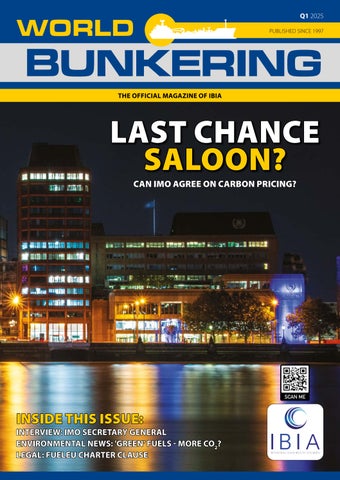
LAST CHANCE SALOON? CAN IMO AGREE ON CARBON PRICING?
INSIDE THIS ISSUE:
INTERVIEW: IMO SECRETARY GENERAL ENVIRONMENTAL NEWS: 'GREEN' FUELS - MORE CO2? LEGAL: FUELEU CHARTER CLAUSE
2
EDITOR’S LETTER IMO
©
D
ear Reader
Another year, another last chance for IMO. This time, though, expectations are high that the UN agency will be able agree a mechanism that will accelerate shipping's progress to Net Zero. Decarbonisation has become a key focus for IMO, although it is by no means the only important work going on at its headquarters on London's Albert Embankment. Attempts to agree a strategy to achieve Net Zero are sure to take centre stage this year. IBIA's representative at IMO, Dr. Edmund Hughes, provides an insightful backgrounder to the key meetings that will take place in the next few months. He cautions that “anyone telling you the outcome of the IMO’s negotiations this year is a done deal is misguided” but nevertheless we could, he says, be looking at “one of the most significant decisions in the history of modern shipping”. He sets the scene for our interview with IMO Secretary General Arsenio Dominguez who among many other important points notes that “the input of industry organisations, such as IBIA, is vital to IMO’s decision-making process”. On decarbonisation, the Secretary General emphasises that he is confident that “we will maintain the momentum required for reaching the shared targets”. His passion for the safety and well-being of seafarers also comes through loud and clear. More details of the latest proposals submitted to IMO can be found in Environmental News. This section also includes a couple of items that will be controversial to many in the shipping and bunker industries. Fleet performance solutions provider Oceanly tells us that the green fuels push may lead to increased global CO2 emissions.
World Bunkering Q1 2025
That is not something most of us will want to happen. Then green campaign group Transport & Environment asserts that container shipping has not become any more fuel efficient over the past few years and that the EU should mandate slow steaming. Again, that is not a view that all will share. In an ideal world IMO would be the only body we would be looking to for the regulation of the global shipping industry. In reality the EU's FuelEU regulations are about to have, in fact are already having, a huge impact on the world's shipping industry. That reality is reflected in many of the pages of this issue of World Bunkering, including in Environmental News where we report on a new DNV white paper outlining FuelEU Maritime requirements and compliance strategies for shipowners.
On the subject of options, as usual we look at a range of alternative fuels and technologies. While some stakeholders, including for example SEA-LNG, may be very confident of their pathway to Net Zero, many owners will still be looking with trepidation at the choices they need to make. Some big players are betting on several horses. Meanwhile a possible dark horse, carbon capture, continues to gain traction. We report on a pilot project now being trialled at sea that not only captures CO2 but also results in a saleable by-product. So, another packed issue to start the year. I look forward to seeing many of you at the IBIA Dinner in London. Best wishes
David Hughes Editor
The EU regulation has spawned a substantial industry that helps shipowners comply and that is the focus of this issue's Equipment & Services section. FuelEU is also on the minds of shipowners in the Western Mediterranean, as John Rickards reports. He notes that, with new rules making cleaner fuels much more attractive over the next year, short-term availability of transitional options looks like being a pinch-point. Wherever based, shipowners whose vessels call at European ports will be concerned about their liabilities under FuelEU, especially when there are disputes. Our legal section looks at BIMCO's new FuelEU Maritime Clause for Time Charter Parties 2024 and includes observations from P&I club Gard.
3
4
Chair’s Letter
9
Executive Director's Report
11
IBIA Events IBIA’s year ahead: A global outlook
13
IBIA Africa Navigating New Horizons in Africa's Bunkering Sector
17
IBIA Training Key Training Courses for 2025: Preparing for the Future of Bunkering
20
IBIA Asia Asia’s Decarbonisation Journey
22
New IBIA Members
24
IMO / Regulatory Matters Shape of things to come!
26
34
Western Mediterranean Betting on Green
39
Green Finance Investing in cold ironing
42
Training Focus on training
44
Environmental News Our regular round-up of environmental developments
46
Industry News Bunkering industry news
48
Equipment & Services Compliance with FuelEU Maritime
50
Alternative Fuels and Technologies – Ammonia Ammonia-fuelled engines
Innovation Bunkering plus hull cleaning
54
Editor: David Hughes anderimar.news@googlemail.com
On behalf of: IBIA. Suite Lu.231. The Light Bulb 1 Filament Walk, Wandsworth, London, SW18 4GQ, United Kingdom. Tel: +44 (0) 203 951 9615 Email: ibia@ibia.net • www.ibia.net
Publisher & Designer: Constructive Media ibia@constructivemedia.co.uk Constructive Media Hornbeam Suite, Mamhilad House, Mamhilad Park Estate, Pontypool NP4 0HZ Tel: 01495 239 962 Email: ibia@constructivemedia.co.uk www.worldbunkering.net
World Bunkering Q1 2025
Alternative Fuels and Technologies – LNG LNG becomes top choice
58
Alternative Fuels and Technologies – Nuclear Nuclear impact
59
Alternative Fuels and Technologies – Biofuels Limited supply?
60
I.T Going digital
61
Legal FuelEU charter clause
72
53
Project Manager: Alex Corboude alex@worldbunkering.net
56
52
30 33
Alternative Fuels and Technologies – Methanol Setting standards
62
The BIMCO & IBIA Shipmaster’s Bunkering Manual 2022
IMO - INTERVIEW Clear focus on key issues
55
Alternative Fuels and Technologies – Carbon Capture Something to sell
Alternative Fuels and Technologies – Hydrogen Hydrogen bunkering station
CONTENTS
7
Company News
Events diary 2025
73
Training diary 2025
74
Next issue
Alternative Fuels and Technologies – Wind Power Blowing a gale
The views expressed in World Bunkering are not necessarily those of IBIA, or the publishers unless expressly stated to be such. IBIA disclaims any responsibility for advertisements contained in this magazine and has no legal responsibility to deal with them. The responsibility for advertisements rests solely with the publisher. World Bunkering is published by Constructive Media on behalf of IBIA and is supplied to members as part of their annual membership package. Cover Image ©IMO
5
6
ear friends and fellow IBIA members, I sincerely wish you all a happy, healthy, prosperous, creative new year. As 2024 was highly productive and expansive for IBIA, let us look forward that 2025 will follow its path and mark even more growth and success for our association. We all look forward to the - as always - amazingly well-organised by our secretariat and hugely well-attended Annual Dinner on the 24th of February, marking the apotheosis of IE Week, where we shall also announce the host city of our 2025 Annual Convention, following the unparalleled success of our Athens one in November, last year.
We are always assessing and evaluating the well-targeted and meaningful interventions we should be making in order for them to have the highest practical impact for our industry. In that respect, we have had the honour of hosting in the current issue of World Bunkering the Secretary General of the IMO, Mr. Arsenio Dominguez, sharing his insights which never fail to provide an opportunity for further thinking. Moreover, the new EU regulations of FuelEU are now a reality and we all look closely as to how they are followed, implemented and scrutinised. This requires a complex, multilayered strategic approach by all parties involved, and clarity will always be sought.
Dear friends and fellow members, there is not a day gone by without the full commitment of our volunteering Global Board members, aiming at furthering IBIA’s impact and encompassing representation of the full marine energy industry. Equally, the same aims are being gradually realised through the invaluable participation and assistance of all our Regional Boards and, supremely importantly, through the tireless, meticulous and dedicated work for our association by our Secretariat. The work carried out within IBIA is ceaseless, so that its results, impact and importance become apparent to you all. This is our mission; this is my steadfast goal.
We shall also become acquainted with our two newly elected board directors, following the conclusion of this year’s general elections of our association. A separate note should also be made to our Asia Gala Dinner in Singapore, in March during the Singapore Maritime Week, which offers a wonderful opportunity to connect and for which we look forward to seeing you.
Additionally, we never lose sight of one of the primary objectives as an association, and something for which I have been vocal from the moment I was elected as IBIA Chair: collaborations and synergies. Collaborating with IPIECA and OCIMF, we have submitted the views of the marine fuel value chain to MEPC 83 as it will consider mid-term GHG reduction measures. and more of such collaboration ventures are being contemplated as we speak.
Looking forward to seeing as many of you as possible during IE Week, I, once again, wish you all a wonderful new year. Best regards,
Constantinos Capetanakis IBIA Chair
There are plenty of issues and boxes to tick going forward, all of them referred to in detail in the current issue of World Bunkering: We get the opportunity to obtain fresh updates on all major new sources of energy, and of the prospective IMO deliberations in which IBIA is always present and particularly vocal, as you will be able to see. We are closely looking into the new submission by the industry and IMO member states on a revised levy proposal to meet the decarbonisation goals, especially as regulations on alternative fuels are progressing rapidly, including ammonia safety guidelines and permitting the carriage of B30 biofuels by bunker tankers. IBIA supports measures like CII correction factors for vessels undertaking short voyages, a sustainable fuel certification framework under IMO, and electronic Bunker Delivery Notes.
World Bunkering Q1 2025
7
CHAIR’S LETTER
D
8
Building on momentum in 2025
I
BIA closed 2024 on a high note, marking significant milestones that reflect the association’s evolving role and its commitment to members and the broader maritime industry. As we look ahead, 2025 promises to build on this momentum with an ambitious agenda and enhanced member engagement. Our successful Annual Convention in Athens this past November was a testament to IBIA’s growing impact. It featured the introduction of the European Regional Board - the fifth and final addition to IBIA’s Regional Boards. These boards now provide comprehensive representation across the Americas, Europe, the Middle East, Africa, and Asia, ensuring that IBIA’s regional initiatives align with the unique needs and challenges of each area. The Convention also showcased recordbreaking attendance, reinforcing IBIA’s reputation as a hub for collaboration and dialogue within the bunker industry. This achievement underscores the importance of regional inclusivity in addressing global industry challenges and advancing IBIA’s mission. As you read these lines, IBIA’s 2025 elections have concluded, and we warmly welcome our newly elected board members. IBIA’s elections are a cornerstone of our democratic structure, and we encourage all members to participate actively. Your involvement ensures that we maintain a balanced representation of our dynamic and diverse sector, which is crucial for shaping the future of the industry. 2024 was a remarkable year for IBIA. Beyond the success of our Athens Convention, we saw membership growth and record-breaking attendance at our flagship events, including the IBIA Annual Dinner. Additionally, our Chair and Board dedicated considerable effort to updating the association’s byelaws, ensuring they remain relevant and supportive of our evolving objectives.
World Bunkering Q1 2025
As we enter 2025, we anticipate an even busier and more productive year. With fullcapacity attendance expected at the IBIA Annual Dinner and ambitions for another record-breaking Annual Convention, our calendar is set to be packed with opportunities to connect and collaborate.
As we embark on another promising year, IBIA’s focus remains steadfast: to serve as a dynamic and inclusive association that meets the needs of our members while addressing the broader challenges of the bunker/marine energy and maritime industries.
Bunkering’s relevance to the shipping industry has never been greater, and IBIA is committed to playing an active role in shaping its future. In 2025, we aim to maintain a strong presence at key industry events, including Singapore Maritime Week and Sea Asia in Singapore, the CMA in Connecticut, the International Bunker Conference in Oslo, FUJCON in UAE, and Hong Kong Maritime Week, among others. These gatherings provide vital platforms for engaging with industry stakeholders and advancing discussions on critical issues such as decarbonisation.
With a robust strategy, an expanding global presence, and commitment to decarbonisation, IBIA is well-positioned to drive meaningful progress in 2025 and beyond.
In 2024, we undertook a comprehensive perception audit involving our members and broader stakeholders. This initiative offered valuable insights into our association’s strengths and areas for growth. As a result, we are now examining our future strategy, marketing approach, governance structure, and membership models to ensure we continue providing exceptional value.
Sincerely
We invite all members to stay engaged, share their perspectives, and join us in making 2025 a year of impactful achievements for the bunker/marine energy industry. Together, we can continue to strengthen IBIA’s role.
Alexander Prokopakis IBIA Executive Director alexander.prokopakis@ibia.net
One of the exciting developments for 2025 is the introduction of a new members’ portal. This platform is designed to enhance member engagement, streamline communication, and provide easy access to resources and updates, making membership with IBIA more rewarding than ever. IBIA remains deeply committed to supporting the IMO’s initiatives to decarbonise shipping. As environmental regulations tighten and sustainability becomes a priority, IBIA will continue to provide guidance, education, and advocacy to help our members navigate these transformative changes.
9
EXECUTIVE DIRECTOR'S REPORT
FROM MILESTONES TO MILESTONE YEARS
10
IBIA EVENTS
IBIA’S YEAR AHEAD: A GLOBAL OUTLOOK With sold-out events, global engagements and online initiatives, IBIA is set for an outstanding 2025
A
s you read this, the IBIA Annual Dinner is taking place, the most anticipated event in the bunker and shipping calendar. With over 1,200 attendees and sponsorship support from industry leaders Platinum, The Hawks PVT Ltd, Gold: Arte Bunkering Group, Bunker Partner, Pema Corporation Ltd, Sohar Port and Freezone, Silver: Cockett Marine and Exxon Mobil Marine Ltd, Bronze: Uni-fuels Pte Ltd and Al Shareq Al Matwaset Oil Service and our Advertising sponsors: Drumo Coin S.A., Unerco, Arkas Bunkering & Trading SA, Asmira Petrol S.A. and Deimos Energy, this year’s Dinner is once again showcasing the strength and unity of our members and the larger industry. Selling out as early as November 2024, the IBIA Annual Dinner has solidified its reputation as an unmissable event. The iconic Grosvenor House will remain its home for the foreseeable future, so for those who missed out this year, we encourage you to book early for 2026. Look out for our next edition of World Bunkering, which will feature event highlights, photos, and key announcements from the Dinner. Looking ahead, 2025 promises to be a year of significant activity for IBIA on a global scale. From Africa to the Americas, Asia, Europe, and the Middle East, we will be actively engaged in industry events whether through hosting our own flagship gatherings or supporting key conferences with speakers and panels. In addition, IBIA will also be hosting online member meetings throughout the year, creating opportunities for more inclusive engagement regardless of location. World Bunkering Q1 2025
Details of these events will be shared via the IBIA Bulletin, your essential resource for staying informed. Among our upcoming engagements, the IBIA Asia Gala Dinner, taking place on 26 March in Singapore, is a highlight on the regional calendar. This muchanticipated event offers a unique opportunity to network, connect, and discuss pivotal issues shaping the industry in a dynamic setting. The most significant announcement for IBIA this year is that our Annual Convention will be hosted in Asia, continuing our commitment to delivering global engagement with a regional focus.
Tahra Sergeant Regional Manager (Africa) & Global Head, Events tahra.sergeant@ibia.net Follow our social media: https://linkedin.com/ company/ibia.net InternationalBunker IndustryAssociation/ ibiabunkers
While the host city is being kept under wraps for now, it will be revealed during the IBIA Annual Dinner. So unfortunately, details are not available at the time of going to print, but we are confident the chosen location will provide an exciting and dynamic backdrop for this key event. As we move into 2025, IBIA remains committed to supporting our members and sponsors by delivering high-quality events and initiatives. We extend our heartfelt gratitude to everyone who has contributed to the success of our activities and look forward to engaging with you, whether in person or online, as we navigate the year ahead together. Here’s to a productive and impactful 2025!
11
Advertise in The ONLY official magazine to IBIA
Increase your visibility to the global bunker industry with an advert in World Bunkering. For more information contact our Projects Manager: Alex Corboude Tel: + 44 203 935 1474 Mob: +44 7957 472 317 Email: alex@worldbunkering.net
www.worldbunkering.net 12
World Bunkering Q1 2025
IBIA AFRICA
NAVIGATING NEW HORIZONS IN AFRICA'S BUNKERING SECTOR As we step into a new year, the IBIA Africa region is poised for an eventful period marked by key industry gatherings and initiatives
w
ith summer holidays behind us, the momentum is building, and updates on our activities will follow shortly.
Both events underscore IBIA's active role in shaping the future of the bunkering industry in Africa.
One of the highlights for 2025 is Maritime Week Africa, set to debut in Mauritius from 24-27 March. IBIA is proud to support this significant event, which will unite marine fuel professionals from Mauritius, across Africa, and beyond. The conference will tackle pressing industry challenges and opportunities, fostering meaningful dialogue among stakeholders. I will have the honour of moderating the session on South Africa, facilitating discussions on critical topics that influence the region's marine fuel landscape. This event, organised in collaboration with Petrospot, promises to be a dynamic platform for knowledge exchange and networking, with many of our IBIA members in attendance.
As these conferences approach, we anticipate vibrant discussions, strategic partnerships, and shared insights that will drive progress within the region's maritime sector.
Stay tuned for more updates as we continue to support and strengthen Africa's position in the global bunkering landscape. Tahra Sergeant Regional Manager (Africa) & Global Head, Events tahra.sergeant@ibia.net
Another milestone on the calendar is the Nigeria International Bunker Industry Conference 2025 (NIBIC 2025). As proud supporters of this inaugural event, IBIA looks forward to engaging with stakeholders from Nigeria's oil, gas, and maritime sectors. NIBIC 2025 will delve into bunkering opportunities, regulatory frameworks, maritime security concerns, and the broader implications of the energy transition and IMO 2020 regulations on West Africa. Spanning three days, the conference will feature insightful presentations, robust panel discussions, and a dedicated focus on enhancing women's participation in the maritime industry, reflecting our commitment to diversity and inclusion. World Bunkering Q1 2025
13
IBIA & INDUSTRY 2025 CALENDAR MARCH 6
IBIA Training Course- Green Marine Methanol Bunkering Masterclass
Rotterdam, Netherlands
12
14th Green4Sea
Athens, Greece
12
IBIA Training Course - Mastering MFM for Bunkering
Antwerp – Bruges
19-20
IBIA Training Course - 2 Days Advanced Bunkering Course SS600:2022 & SS648:2024
Singapore, Asia
20
2nd Ship Propulsion
Rotterdam, Netherlands
24-27
Maritime Week Africa
Flic en Flac, Mauritius
25-27
Sea Asia
Singapore, Asia
25
Capital Link Annual Singapore Maritime Forum
Singapore, Asia
26
IBIA - Asia Gala Dinner
Singapore, Asia
28
2nd Green4Sea
Singapore, Asia
APRIL 1-3
CMA Shipping
Stamford, USA
2
IBIA - Americas Networking Drinks
Stamford, USA
7
IBIA Training Course - Basic Bunkering Course
Lagos, Nigeria
7-9
NIBC (Nigerian International Bunker Conference)
Lagos, Nigeria
7-9
FUJCON
Fujairah, UAE
16
IBIA Training Course - Mastering MFM for Bunkering
Rotterdam, Netherlands
16-17
IBIA Training Course - 2 Days Basic Bunkering Course SS600:2022 & SS648:2024
Singapore, Asia
23-25
3rd Green Shipping Forum
Dalian, China
MAY 5-9
UAE Maritime Week
Dubai, UAE
6-8
IBC (International Bunker Conference)
Oslo, Norway
14
IBIA Training Course - Mastering MFM for Bunkering
Antwerp – Bruges
21
IBIA Training Course - 2 Days Advanced Bunkering Course SS600:2022 & SS648:2024
Singapore, Asia
19-22
Maritime Week Americas
Tampa, United States
21-22
IBIA Training Course - 2 Days Advanced Bunkering Course SS600:2022 & SS648:2024
Singapore, Asia
26-27
9th Istanbul Bunker Conference
Istanbul, Turkey
28
IBIA Training Course - Future Fuel Training Course
Istanbul, Turkey
15-19
London International Shipping Week
London, UK
25
The Maritime Standard Transportation & Climate Change Conference Abu Dhabi, UAE
SEPTEMBER
OCTOBER 29
The Maritime Standard Awards
Dubai, UAE
30
The Maritime Standard Tanker Conference
Dubai, UAE
Hong Kong Maritime Week (HKMW) 2025
Hong Kong
NOVEMBER 16-22
IBIA ONLINE TRAINING COURSES ONLINE BUNKER TRAINING COURSE MODULE 1 TO PURCHASE
Bunker Market Regulations and Enforcement
MODULE 2 TO PURCHASE
Understanding ISO 8217 and ISO 4259
Online at www.ibia.net
MODULE 3 TO PURCHASE
Best practice for suppliers with VLSFO
Online at www.ibia.net
Online at www.ibia.net
MODULE 4 TO PURCHASE
Best practices for users with VLSFO
Online at www.ibia.net
MODULE 5 TO PURCHASE
Adapting to a changing market
Online at www.ibia.net
MODULE 6 TO PURCHASE
Compatibility and Stability – Issues with VLSFO fuels and the measurement of Stability
Online at www.ibia.net
MODULE 7 TO PURCHASE
Sales Terms and Conditions – The purpose, structure and application of Sales terms
Online at www.ibia.net
MODULE 8 TO PURCHASE
Quantity Measurement – The principles of quantity measurement including Mass Flow Metering
Online at www.ibia.net Online at www.ibia.net
MODULE 9 TO PURCHASE
Sampling – The basics of sampling, sampling methods and sample handling
MODULE 10 TO PURCHASE
Fuel Quality – Impact on storage, treatment and use in the engine
Online at www.ibia.net
MODULE 11 TO PURCHASE
Alternative Fuels
Online at www.ibia.net
MODULE 12 TO PURCHASE
Bio Fuels
Online at www.ibia.net
MODULE 13 TO PURCHASE
Exhaust Emissions
Online at www.ibia.net
MODULE 14 TO PURCHASE
Introduction to LNG Bunkers
Online at www.ibia.net
COURSE TO PURCHASE
The IBIA Basic Bunkering Course
Online at www.ibia.net
*All dates were correct at time of going to print but may be subject to change, please refer to IBIA's website (https://ibia.net/events/) for any updates
= IBIA Events
INTERNATIONAL BUNKERINDUSTRY ASSOCIATION
16
PREPARING FOR THE FUTURE OF BUNKERING
Stay ahead of industry advancements with IBIA's updated training offerings on MFM technology, future fuels, and more
I
BIA is excited to announce a series of essential training courses scheduled throughout 2025, designed to equip professionals with the knowledge and skills needed to stay at the forefront of the evolving bunkering industry. With new regulations, emerging technologies, and a rapidly changing fuel landscape, it’s more important than ever to stay up to date. Below are some key courses we will be offering in the coming months. We encourage industry professionals to register early to take full advantage of these invaluable opportunities to enhance their expertise. 1. Update on Online Training Courses To ensure you remain at the cutting edge of the bunkering industry, IBIA is updating all of our online training courses to reflect the latest trends, technologies, and best practices. These enhanced courses will equip you with vital knowledge and practical insights to keep you ahead of the curve. Stay tuned for more details on how these updates will help you stay competitive in this fast-paced industry. 2. Mastering MFM for Bunkering: Comprehensive Technical & Practical Training for Surveyors The "Mastering MFM for Bunkering" course is one of the most sought-after in the industry. In 2025, we will offer this comprehensive course at various locations, providing surveyors with an in-depth understanding of Mass Flow Meters (MFM) technology and its impact on bunkering operations. The course dates are: 19 February 2025 (Rotterdam) 12 March 2025 (Antwerp – Bruges) This intensive course covers: Regulatory Overview: Key updates on MID and ISO 22192 compliance. Theory and Practice of MFMs: A deep dive into MFM technology and its role in improving bunkering efficiency. Surveyor’s Evolving Role: Understanding the changing responsibilities of surveyors in an MFMequipped environment.
World Bunkering Q1 2025
Troubleshooting & Process Optimisation: Practical skills for troubleshooting and optimising MFM systems onboard vessels. Networking & Collaboration: Connect with industry experts and peers to share insights and enhance learning. Hosted in partnership with C4 Fuel and endorsed by the Ports of Rotterdam and Antwerp-Bruges, this course is an excellent opportunity for professionals to enhance their technical skills and stay competitive in the rapidly advancing bunkering sector. This event is a must for bunker surveyors, shore and ship personnel, and maritime professionals keen to stay ahead in the transition to sustainable fuels. 3. IBIA-GREEN MARINE Methanol Bunkering Masterclass - Rotterdam Join us on 6 March 2025 at Vopak Terminal Europoort for an exclusive full-day workshop on methanol as a sustainable marine fuel. Co-hosted by IBIA and Green Marine, this session will cover key topics for safe and efficient methanol bunkering, including: Methanol’s Properties: Safe handling, health and safety, and fire protection. Emergency Response: Spill prevention and firefighting techniques. Dual Fuel Systems: Insights into ship design and operational planning.
This course is designed for professionals with a basic understanding of conventional fuels who wish to expand their knowledge of the practical, commercial, and regulatory aspects of future fuels. Stay Connected with IBIA As the bunkering sector enters a new era of sustainability and technological innovation, IBIA is committed to providing industry professionals with the tools they need to stay informed, skilled, and competitive. We encourage you to follow us on social media and read the IBIA Bulletin for updates on training opportunities and industry news. Don’t miss out on the chance to advance your career and be part of the future of bunkering. Register today for any of our upcoming courses to ensure you are well-prepared for the challenges and opportunities that lie ahead. For more information and to register, visit our website. Warm Regards Sofia Konstantopoulou Global Head, Marketing & Development sofia.konstantopoulou@ibia.net
4. Training Course and Regional Conference on Future Fuels in Turkey On 28 May 2025, IBIA will host a specialised training course focused on future fuels, in collaboration with the Turkish Bunker Association’s conference. The course will explore the latest developments in alternative fuels and their regulatory implications, including: Alternative Fuels: LNG, Methanol, and Biofuels – their environmental impact and adoption challenges. Practical Applications: Real-world case studies and insights from guest trainers, demonstrating how maritime businesses are integrating future fuels. Networking Opportunities: Connect with regional and global industry stakeholders to gain valuable insights into the future of fuels in the maritime sector.
17
IBIA TRAINING
KEY TRAINING COURSES FOR 2025:
IBIA ASIA
ASIA’S DECARBONISATION JOURNEY Collaboration, Innovation, and Challenges Ahead
A
s we step into 2025, the maritime sector in Asia is primed for transformative change. Building on the momentum of past successes, including a landmark year in 2024. The focus remains on sustainable growth, green energy adoption, and fostering collaborative initiatives. With the global emphasis on decarbonisation, Asia continues to be a hub for innovation and leadership in the maritime industry. Active Participation in Singapore Maritime Week and Sea Asia 2025 The Singapore Maritime Week (SMW) 2025 and Sea Asia 2025 will be pivotal events for the region. As a supporting association, IBIA will play an active role in both events, contributing to sessions that foster dialogue on emerging fuels, safety protocols, and the industry’s decarbonisation journey. The IBIA Asia Dinner, to be held during SMW 2025, is set to be a highlight, building on the success of past years. This prestigious event serves as a platform for stakeholders to network and exchange insights. With notable industry leaders and policymakers expected to attend, it reinforces IBIA’s role as a key facilitator of sustainable maritime practices .
20
Strengthening Regional and Global Collaboration The year 2024 saw significant strides in green shipping, with events such as the Singapore International Bunkering Conference and Exhibition (SIBCON) and the DSH International Shipping Innovation Conference highlighting Asia’s commitment to low-carbon marine fuels. The signing of the Lingang Special Area Green Shipping Industry Open Platform underscored IBIA Asia’s commitment in advancing green shipping technologies within the region .
I look forward to engaging with stakeholders across the region at key events like SMW and Sea Asia, while also welcoming everyone to our IBIA Asia Dinner 2025. Together, we can drive meaningful change and ensure a resilient, sustainable future for our industry. Siti Noraini Zaini Regional Manager, IBIA Asia Siti@ibia.net www.ibia.net
SIBCON 2024 and other international forums provided pivotal platforms for industry leaders, including IBIA, to share insights on the future of maritime fuels. During these events, IBIA reaffirmed its commitment to working with the Maritime Energy Training Facility (METF) and the Maritime and Port Authority of Singapore (MPA) to develop training courses. Outlook for 2025 As we embark on another year of opportunities and challenges, it is clear that IBIA Asia remains at the forefront of the maritime energy transition. By fostering collaboration, advancing technological innovation, and prioritising sustainability, we are setting the stage for a transformative decade in maritime shipping.
World Bunkering Q1 2025
NEW IBIA MEMBERS
NEW IBIA MEMBERS CORPORATE A Bunker Supplier BP Sinopec Marine Fuels Pte Ltd Bobby Tham Asia Bunker Trader, Trader Bunker Next FZC Abid Farooq Shah Middle East Supplier C.I. Quality Bunkers Supply S.A.S. Sergio L. Vargas Americas Oil Industry Major EBURNY'S ENERGY Adou Jean Jorese Yatte Africa Bunker Supplier, Supplier Finecor Oil Bunkering S.A. Christoforos Ifantidis Europe Other (Not for profit Think Tank advising on green energy policies) Global Centre for Green Fuels Limited Clarence Woo Asia Ship Manager Latsco Marine Management Inc. Ioannis Panorios Europe Ship Owner, Other (Senior Fuel Supplier) Palmali Holding Famil Farajzada Europe
Supplier (Physical), Trader, Oil Industry Major Petrocore Energy L.L.C-FZ Mohsin Ali Malik Middle East Ship Owner, Oil Industry Major, Ship Manager, Charterer, Supplier Ship and Shore Services Limited Iftikhar Ahmad Africa Trader, Ship Owner Sima Petrol S.A. Mahmut Antalyali Europe Bunker Supplier, Storage, Ship Owner, Trader, Supplier State Trading Organization PLC Mohamed Shuaib Ahmed Asia
CORPORATE B Surveyor, Other Bureau Veritas Bill Stamatopoulos Europe
INDIVIDUAL Marine fuels and port consultant Eugenia Benavides Americas Bunker Trader, Ship Manager, Broker, Charterer, Trader, Supplier Carlos Cervela TSL Shipping & Trading LLC Americas Bunker Trader, Trader Fabrizio Fialdini Europe
Storage Hassan Jan VTTI B.V. Middle East Bunker Supplier, Bunker Trader, Fuel Supplier Ahmed Khaleel Oilbiz Inc Asia Bunker Supplier Bahi Meygooni Al Shareq Al Matwaset Oil Service Middle East Legal, Bunker Supplier, Surveyor, Port Authority, Supplier, Agent Aditya N V ABN Bunkers Asia Other Xinzhi Shen Asia Financial Amit Singhania Krystal Financial Consultants LLC Middle East Legal Yalın Caner Soysüren Soysuren Legal & Associates Europe Bunker Trader, Broker Stefanie Tay Uni-Fuels Pte Ltd Asia
IMO / REGULATORY MATTERS
IMO
©
SHAPE OF THINGS TO COME! IBIA's representative at IMO, Dr Edmund Hughes, looks at the challenges looming this year
T
o remove the current uncertainty in the market about the next steps for the decarbonisation of international shipping, there is an urgent need for IMO to adopt regulations in 2025 that mandate, from 2027, the further reduction in GHG emissions from ships towards the ‘net-zero’ goal by, or around, 2050. This is in order to provide the shipping industry, and those that provide services to it, including those of us in the bunker value chain, a framework for future investments and to clearly signal to the fuel producers that there will be a demand, and therefore a return on investment, for producing the sustainable marine fuels needed to meet net-zero by, or around, 2050. So, what can we expect in 2025 from IMO, and will it go a fair way of removing that uncertainty? When I worked at the IMO the focus was always on the forthcoming meetings and in particular, for myself and others in the division, the meetings of the Marine Environment Protection Committee (MEPC). We always said that every MEPC there was one, maybe two, big decisions that needed to be finalised at that session. To say that the forthcoming 83rd session of the MEPC has some big decisions to make is a significant understatement. Before discussing that further and the possible developments I consider it necessary to recall where we have come from.
24
In 1997 the International Air Pollution Conference adopted a Protocol to MARPOL that added Annex VI, the international regulations for the prevention of air pollution from ships. MARPOL Annex VI was revised in 2008, that revision including the global 0.50% sulphur limit for fuel oil (IMO 2020). MARPOL Annex VI continues to be amended to this date and is expected to be the international instrument used to enact the mid-term GHG reduction measures for ships. These measures have been discussed at length before and to recall the 2023 IMO GHG Strategy envisages those measures will encompass a global GHG intensity marine fuel standard and a maritime GHG emissions pricing mechanism. If these measures are adopted at the extraordinary session of MEPC (MEPC/ES.2) this October, then the earliest they could enter into force would be Spring 2027. This outcome would be the culmination of 30 years consideration by IMO of the control of GHG emissions from international shipping. The Air Pollution Conference held in 1997, in addition to adopting MARPOL Annex VI, also adopted resolution 8 on “CO2 emissions from ships” which was the first time IMO’s Member States recognised CO2 as having “an adverse effect on the environment”.
Then in 2003 IMO’s Assembly adopted its own resolution (A.963(23)) that urged the MEPC “to identify and develop the mechanism or mechanisms needed to achieve the limitation or reduction of GHG emissions from international shipping and, in doing so, to give priority to the evaluation of technical, operational and market-based solutions”. The road from 2003 to where we are today has not been easy to say the least! In 2013 the deliberations of MEPC on the development of GHG reduction measures were suspended as, at the time, no consensus on a way forward was forthcoming despite extensive groundwork by an expert group. In some respect, this reflected the state of relations between Member States following the adoption of the Energy Efficiency Design Index (EEDI) and Ship Energy Efficiency Management Plan (SEEMP) by a vote in 2011. That experience left several mental scars, not least with the IMO Secretariat, and it was not really until the Paris Agreement was made in 2015 did a way forward become apparent and, building on the data collection system for fuel oil consumption of ships adopted in 2016, enabled Member States to begin to work on what became the Initial IMO GHG Strategy adopted in 2018. World Bunkering Q1 2025
The text developed by MEPC 82 was a consolidation of several proposals for mid-term GHG reduction measures with a view that the technical measure – the global GHG fuel standard – had greater “convergence”. At the time the text for the GHG levy/fund proposal was considered more just a consolidation of proposals. However, a revised proposal for a universal GHG levy/contribution per tonne of CO2 emitted paid into a fund, used both to support those using zero or very low carbon fuels and developing countries with the transition, that has garnered nearly 50 Member State co-sponsors has now been tabled and arguably sees significant convergence among those proponents.
IBIA will be doing its utmost to assist them although as many of the issues are highly political it will be the role of the governments that will be key. Most importantly at this stage is to keep everyone in the room and moving forward. On this point – and is something I have been asked about - the decision of President Trump to withdraw the US from the Paris Agreement may see the US participate in the negotiations but ultimately reserve their position on any measures that IMO choses to adopt – as they did with the Initial IMO GHG Strategy during his last term. How this impacts the implementation of any adopted measures would remain to be seen, for example, would the USCG enforce them for international trading ships entering US ports/waters? But the measures would not come into force until 2027 and there is always the prospect of a new US administration following a different policy from 2029.
IMO / REGULATORY MATTERS
As things stand February’s intersessional meeting of the Working Group on Reduction of GHG emissions from ships (ISWG-GHG 18) will be considering 25 submissions of which several are proposing amendments to the draft regulatory text prepared at MEPC 82 last October for a new Chapter 5 ‘IMO NetZero Framework’ of MARPOL Annex VI. Other issues under consideration include the development of a sustainable marine fuels certification framework so that IMO can recognise bodies issuing ‘proof of sustainability’ certificates.
The reason for the extensive history lesson in this article is to identify that international negotiations and the development of binding mandatory instruments is extremely difficult and anyone telling you the outcome of the IMO’s negotiations this year is a done deal is misguided. MEPC 83 will see one major decision, and by initiating the energy transition for international shipping, it may be one of the most significant in the history of modern shipping. In the short term it is likely that the uncertainty I spoke of at the beginning may continue to prevail, at least for another six months. Wishing you all a fair wind and safe seas. Edmund Hughes edmund.hughes@ibia.net
What it tells you though is that to achieve a compromise – and the all-important “consensus” so that the amendments can be approved at MEPC 83 for circulation (a six month circulation period is a legal requirement) prior to adoption at MEPC/ ES.2 - will require those Member States opposing the imposition of a universal levy on international shipping that supports a fund to move their position. It may sound difficult – it is – but it is not impossible and the great thing about the long process of reaching agreement is that it provides time for new ideas and nuances to be identified that can bridge the gaps to the satisfaction of all. At this critical time, we are fortunate to have a highly experienced chair of the working group developing these regulations and an IMO Secretary-General who has outstanding communication skills. Both need the full support of the IMO membership. World Bunkering Q1 2025
25
26
World Bunkering Q1 2025
The Shipmaster’s Bunkering Manual 2022 is the first practical industry guide for both owners and suppliers, seeking to create a common understanding of best practices when bunkering to facilitate a smoother process and safe bunkering globally
The manual is a unique result of cooperation between IBIA and BIMCO to create insight and practical understanding of bunkering across the shipping sectors. Bunkering operations are routine, critical and high-risk operations which require accurate planning from both the owner and supplier to ensure a safe and successful operation. The publication consists of background information as well as checklists and key notes for the entire process for shipowners, masters and crew on how to prepare, execute and follow up on bunkering, including what to do when it goes wrong. Totalling 4 chapters and phases of the bunkering process, the manual covers the following topics:
Chapter 2: Origin and supply chain of marinebunkers Chapter 1: Background insight on fuel types and key regulation
Everything you need know from fuel oil types, safety, and environmental regulations to ISO standards and contractual issues related to bunkering.
An overview of bunker blends before the ship arrives for bunkering followed by a detailed description of the ship’s preparation and planning prior to bunkering. Advice is also given on how to handle a situation if compliant fuel is unavailable in a specific port. Paperwork including the bunker delivery note and certificates of quality are described and recommendations are given that aim to help to use them correctly.
Chapter 4: Calculation of bunker quantity and after completion procedures Chapter 3: Bunkering procedures
Bunker sampling is one of the most important aspects of bunkering. This chapter covers preparations, practical issues and what to do if something goes wrong. Details of the role each stakeholder ashore and on board undertakes during the process including actions required before, during and after the bunkering.
Details on how to create a solid background for calculating the bunker quantity and determine if the ordered bunker stem has been delivered. For ships carrying equipment to undertake onboard testing of marine fuels, testing procedures are referred to and detailed description of how to interpret test results provided. Keeping an accurate and up to date oil record book is, together with the bunker delivery note, important as records for internal and external use for example during port state control.
The book is available to buy from Witherbys on this link: https://shop.witherbys.com/shipmaster-s-bunkering-manual-2022/ IBIA members receive a 20% discount on all publications. Please enter “IBIA” in the “Coupon/Gift Certificate” box to receive your 20% IBIA member discount.
THE BIMCO & IBIA SHIPMASTER’S BUNKERING MANUAL 2022
THE BIMCO & IBIA SHIPMASTER’S BUNKERING MANUAL 2022
Oil Marketing
& Trading International Marine Fuels in the UAE and now in Salalah Oman
IMO - INTERVIEW
IMO Secretary-General Arsenio Dominguez ©IMO
CLEAR FOCUS ON KEY ISSUES IMO Secretary-General Arsenio Dominguez explains his role and that of IMO to World Bunkering's editor David Hughes DH: Your association with IMO goes back over 20 years, initially as Panama's representative to the UN Agency and from 2017 as an IMO staff member. You must know the organisation inside out. Did that make for a seamless transition to the top job just over a year ago? Did your long experience of the organisation lead you to make any significant changes in the way it works? AD: The transition into my current role was very smooth. Having worked with or at the Organization for many years prior, I was fortunate to have a deep understanding of its structures and processes and a great appreciation for its indispensable role in the world of shipping. It felt very natural. At the same time, I truly enjoy what I do, and I genuinely believe in this Organization’s capacity to make a positive impact, globally. When I took over as Secretary-General, I set some clear areas for the Secretariat to focus on – our regulatory work, our support for Member States, our public image and our people. Transparency and inclusion are now core values across the Organization. Since then, we have worked hard and become much more visible in the media, more transparent to the general public, and I have restructured some of
30
the divisions in the Secretariat to be more efficient and effective. I actively promote a culture of open communication, dynamism and change, both within the Secretariat and with all our stakeholders. DH: What do you see as the main challenges facing IMO and how optimistic are you that they can be overcome? AD: Shipping has proven to be quite resilient through multiple global shocks. Historically, IMO has a strong track record of navigating complex issues through dialogue and global cooperation. That does not mean that the sector does not face ongoing challenges. The rise of substandard fleets, ongoing geopolitical tensions, and the drive to digitalise and decarbonise while ensuring the safety and welfare of seafarers mean that the IMO’s global regulatory framework is more important than ever to ensure stability, safety and security for shipping in a world in flux. In this regard, I am confident that Member States and the industry share the same overarching values and objectives that will guide us through these waters. DH: IMO is trying to fulfil its mandate at a time when geopolitics are affecting the operation of the global shipping industry.
Recently you explained that IMO's concerns over the 'Shadow Fleet' were about the compliance of vessels with IMO standards and the ability of states to enforce regulations through port state control and not whether ships were evading sanctions. Do you think outside observers, especially in the media, lack a basic understanding of what IMO is and does? AD: IMO’s role as the international shipping regulator can often be misunderstood, especially by those who do not deal directly with maritime issues. It is a communications issue, and I am already taking action to enhance our outreach and shed more light on some of our work in this area. IMO’s mandate is to develop and oversee international regulations and standards that promote safe, secure, and environmentally sound shipping. So, from that perspective, compliance with IMO instruments and enforcement by States are at the core of tackling the so-called “shadow fleet.” Not a single sub-standard ship - regardless of their flag, origin or trading practices - should be operating at sea. DH: At a recent press briefing you were asked a few questions about abandonment, but most were not about seafarer welfare and safety.
World Bunkering Q1 2025
AD: Seafarers have always been my top priority, and the human element has been a long-standing issue on IMO’s agenda. I believe that society is becoming increasingly aware of the importance of shipping and the crucial role played by seafarers, as demonstrated by the COVID crisis and recent geopolitical conflicts. Even when we talk about decarbonisation, seafarers play a crucial role. These issues are intertwined - one is not more important than the other. It is estimated that to decarbonise shipping by 2050, 800,000 seafarers will need to be trained to use alternative fuels by the mid-2030s. There are serious safety risks involved, which is why IMO has approved interim safety guidelines for ships using ammonia as fuel, while continuing to work on guidance for hydrogen-fuelled ships. A just and fair transition means seafarer safety is of utmost importance in the journey to decarbonisation. DH: IBIA is of course represented at IMO by Dr. Edmund Hughes. How important is the input of industry organisations to IMO decision-making? Do you think it is a valid point that technical issues may sometimes be glossed over in favour of political objectives? AD: The input of industry organisations, such as IBIA, is vital to IMO’s decisionmaking process. In addition to 176 Member States, there are 89 non-governmental organisations in consultative status and 66 intergovernmental organisations that follow IMO activities very closely and contribute their technical expertise to discussions. This ensures that any regulations that are developed consider operational realities on the ground, technological feasibility and changing needs of the industry. IMO's processes and structures ensure that technical considerations can be brought to the table, examined, thoroughly debated and incorporated in decisions. World Bunkering Q1 2025
This partnership between governments and industry is precisely what makes IMO effective as a global regulator. DH: Turning to decarbonisation, this is now far and away the biggest issue for the bunkering industry. In the US and elsewhere, scepticism about the need for a move to Net Zero is growing and was to some extent reflected at COP 29 in Baku. Are you concerned that the political will to achieve IMO's decarbonisation goals could start to fade away? AD: The progress we have seen so far in the journey towards maritime decarbonisation was achieved together through the determined effort of all IMO Member States, over many years. I am confident we will maintain the momentum required for reaching the shared targets - and I continue to remain engaged and open to working with all our Member States, and stakeholders at large, to make this happen. DH: On the other hand, new joint proposals for a GHG emissions pricing mechanism for international shipping have gathered additional Member State support. I know you are unable to support any particular proposal, but does this latest initiative signify progress in the decarbonisation debate at IMO? Are you optimistic that compromises on all sides will allow a mechanism to be approved by IMO Member States in April this year and to enter into force in early 2027? AD: Several proposals for new mid-term GHG reduction measures are on the table. Conversations continue, using the draft
text for the “IMO net-zero framework”, developed at the last meeting of the Marine Environment Protection Committee (MEPC 82), as a basis. As Secretary-General, I will continue to facilitate dialogue, but this process is driven by Member States, who must identify common ground and build consensus. The timeline still stands for adopting these new regulations in October 2025 for entry into force in 2027. I am optimistic that we can achieve a breakthrough. DH: Critics of IMO say it has been far too slow to develop a realistic decarbonisation strategy, and one major consequence has been the EU's unilateral measures. Do you accept that? Are we in the last chance saloon at IMO? What would be the consequences for IMO's standing and for the global shipping industry if Member States fail to approve a pricing mechanism this year? AD: IMO revises its GHG reduction strategy every five years, so this is a continuous journey involving 176 different Member States, often with divergent interests. The complexities cannot be underestimated, but this is not the first time that the Organization has faced external factors and has succeeded. That said, shipping is a global industry that requires global regulations. And Member States have already agreed to put in place a pricing mechanism as part of the 2023 IMO GHG Strategy. What is important is to focus on the task ahead and deliver on that commitment, while recognising all efforts being made.
IMO
©
31
IMO - INTERVIEW
Were you disappointed by that and do you think it reflects a general lack of interest by the media and society in the welfare of seafarers? IMO is having to deal with pressing environmental issues, but do you see seafarer safety as being IMO's number one priority?
32
World Bunkering Q1 2025
INNOVATION Hull cleaning using an underwater remotely controlled vehicle at Singapore's anchorage. ©ECOsubsea
BUNKERING PLUS HULL CLEANING New system allows both operations to take place at the same time
H
ull cleaning company ECOsubsea launched its Ultra High Efficiency Hull Cleaning Service (UHEHCS) in Singapore, marking the launch at the 5th SingaporeNorway Innovation Conference (SNIC) in November. The system, using an underwater remotely controlled vehicle (ROV) underwent extensive testing in the Singapore anchorage starting in August last year. According to the company, tests showed the ROV’s superior speed, operating 10 times faster than conventional cleaning methods. "We cleaned a fully laden capesize vessel, with an 18-metre draft, in just four hours," said ECOsubsea CEO Tor Østervold. Golden Ocean’s Head of Global Operations, Tord Brath, commented: "ECOsubsea’s ROV demonstrated impressive speeds and enhanced safety with minimal human intervention. This innovation exemplifies how efficient solutions align with sustainability goals, making it a forwardthinking choice for shipping companies."
World Bunkering Q1 2025
ECOsubsea completed its debut commercial clean on the Odfjell tanker Bow Cedar in two hours. "Deployment time from docking alongside Bow Cedar to starting cleaning operation was about seven minutes," Østervold noted. ‘We can when divers can’t’ The ROV’s efficiency enables hull cleaning during bunkering without prolonging port stays. "Our ROV operates in over 2 knots of current, where divers face extreme hazards at even 1 knot," Østervold said. "This efficiency gap offers major time and cost benefits." Odfjell Tankers’ Port Captain for Asia Pacific, Odd Arne Hansen, highlighted several benefits: "Increased efficiency due to operational speed; ability to work in conditions unsafe for divers; reduced risk to personnel; increased fuel efficiency, reduced emissions, and lower environmental impact through sediment collection and filtration." The company has chartered Eng Hup Shipping’s largest vessel, extensively modifying it with a purpose-built ROV
Launch & Recovery System (LARS), operator station and a 75 cubic metre filtration unit. ECOsubsea is also collaborating with waste-management firm Mencast to process collected biowaste. Kenneth Lim, MPA Assistant Chief Executive, launched the ROV service at SNIC alongside Norwegian Ambassador Leif Trana. A formal contract signing with Eng Hup followed, with options to charter two additional vessels. "In Singapore, we have access to up to 14 times the vessel capacity compared to our European stations. We’re very pleased to be outcompeting ourselves!" said Østervold. With over 5,000 ships signed up for cleaning during the initial licensing period, ECOsubsea says it aims to establish a global network of ROVs. "Conventional hull cleaning has been a transactional service with varied quality. We aim to be the onestop shop for sustainable hull cleaning, delivering consistent quality worldwide," Østervold concluded.
33
WESTERN MEDITERRANEAN
The cruise industry has been a key sector for driving transitional fuel sales. ©Moeve
BETTING ON GREEN With new rules making cleaner fuels much more attractive over the next year, short-term availability of transitional options looks like being a pinch-point, John Rickards writes
W
estern Mediterranean ports are at an interesting point in the road. With FuelEU regulations having come into force this year and the Mediterranean sulphur ECA following rapidly behind in 2026, there are concrete incentives for producers and suppliers to fill the market with alternatives as quickly as possible. While hydrogenbased infrastructure is still, even in Spain where developments are most advanced, a little way off at least in large volumes, transitional fuels like LNG and particularly biofuel, given its largely drop-in nature for use in conventional engines, are obvious options in the short term. The major questions over the switch to such fuels - quite apart from their cost are availability, production and storage. Gibraltar, with Algeciras snapping at its heels, has been the region’s main bunker hub for a very long time, but while the territory has begun to edge into LNG bunkering in the past couple of years, constraints on storage space (admittedly less of a concern for its neighbouring rival) mean that transitional fuel supply in the Strait has been quite limited and it has instead been smaller ports serving ferry traffic which have made the biggest inroads into alternatives so far. That being so, the one-two punch of FuelEU and the Med SECA could be what the regional market needs to fire up both supply and demand.
34
While Spain is still aiming to act as a centre for the production of longer-term replacement fuels for much of Europe through large-scale projects like “Green Hydrogen Valley”, in the immediate term, the country’s fuel producers have been keenly promoting their more conventional transition fuels ahead of FuelEU coming into force. In October last year, Repsol announced that it had made Spain’s first bio-LNG supply, bunkering two Brittany Ferries vessels from Santander’s LNG bunkering terminal by truck. It may only have been 60 tonnes of bio-LNG, but both firms saw it as a significant test of the fuel and the bunkering process.
“This test is the next significant step on Brittany Ferries journey to a more sustainable future,” said Brittany Ferries’ head of energy transition Bertrand Crispils. “The first three truck-loads of bio-LNG are the starting gun for Brittany Ferries to progressively substitute fossil fuels with greener alternatives. Combining the use of biofuels with other measures, such as electrification and efficient hydrodynamics, means we can fully mobilise in the battle to cut greenhouse gas emissions." Carlos Martin Iglesias, LNG bunker trader at Repsol, said, “With these first supplies of bio-LNG, we provide another option for the maritime sector to reduce the
Brittany Ferries’ first bio-LNG bunkering shows promise. ©Repsol
World Bunkering Q1 2025
The fuel is produced at Spain’s first bio-LNG facility in As Somozas, Galicia. It is produced from waste from the agri-food industry, agriculture, and households, as well as sewage plant sludge. Repsol is aiming to reach a total production capacity of renewable fuels, including biomethane and renewable hydrogen, of between 1.5 and 1.7 million tonnes in 2027 and up to 2.7 million in 2030, and to lead the market for this type of fuel for all sectors of transport in the Iberian Peninsula. Earlier in 2024, it began large-scale production of biofuels for bunkering and other transportation at its new Cartagena plant, producing 250,000 tonnes per year. In order to meet the growing demand of raw materials with lower carbon intensity to produce renewable fuels, Repsol has signed a strategic agreement with Bunge by which it acquired 40% of three industrial facilities operated by Bunge Ibérica dedicated to the production of oils and biofuels in Bilbao, Barcelona, and Cartagena, close to Repsol’s industrial complexes.
This year should see a second production plant in Puerollano coming online, producing a similar amount of fuel to Cartagena, with a third to follow before 2030. It also has a demonstration plant for green hydrogen-based fuel production in Bilbao. The latter might yet be beaten to commercial volume production by chemical firm Forestal del Atlántico’s Triskelion project in Galicia. In December, the company signed a deal with Danish firm Topsoe to provide green methanol synthesis technology and engineering support for the plant. A final investment decision on the plant is expected to be made in June this year and production should begin at the start of 2028. The plant will produce 40,000 tonnes of green methanol annually to begin with, climbing to 600,000 tonnes at full capacity, with bunkering a key market for its products. Topsoe’s Kim Hedegaard said: “e-Methanol will act as a key driver in decarbonising the energy-intensive sectors and may be one of the leading e-fuels used in reducing carbon emissions in industries such as international shipping. Topsoe and Forestal del Atlántico have a shared ambition to make the Triskelion project a European leader in this space, and we look forward to working together to turning these ambitions into reality.”
Fellow producer Cepsa - rebranded “Moeve” during 2024 - has also been pushing biofuels. The company signed a distribution deal with Glander International Bunkering to supply second-generation bio-blends, most significantly to cruise vessels serving the Mediterranean market via the port of Barcelona. “We are thrilled to partner with Glander International Bunkering in its journey towards sustainability with these secondgeneration biofuels for the cruise industry,” said Cepsa’s marine fuels director Samir Fernández. "By supplying the wider cruise industry with HVO or biodiesel, we are supporting industry efforts towards sustainable cruising and reinforcing the Port of Barcelona’s role as a leading sustainable hub in the energy transition.” Valerie Ahrens, senior director of new fuels and carbon markets at GIB’s parent company Bunker Holding, added: “Our partnership with Cepsa is a result of our diligent work to form alliances with strong suppliers of low-carbon fuels. As of late, we have been putting concerted effort into developing strategic partnerships with a view to facilitating the decarbonisation of the shipping industry.
Repsol’s plant in Cartagena is now producing bio-fuels at volume. ©Repsol
World Bunkering Q1 2025
35
WESTERN MEDITERRANEAN
CO2 emissions from its activities. This trial is another proof of the commitment of Repsol to the energy transition and to supplying different energy alternatives to help its customers advance in their decarbonisation processes.”
WESTERN MEDITERRANEAN
Italian ports should see a lot more shore-based power in future. ©Ralf Steinberger/CC-BY
We are especially seeing an increase in the interest in biofuels and, with around 30 of our offices now being ISCC-certified, we have expanded our biofuels sales and the availability of biofuels to over 120 ports worldwide." Cepsa’s biofuels are available from Barcelona and Algeciras and are a 24% bio blend, putting them in competition with Peninsula’s blended biofuels offerings in both ports, launched at roughly the same time. The company said it has specifically targeted the cruise industry at a time when the Cruise Lines International Association (CLIA) is turning its attention to ensure that the sector has sufficient access to low carbon fuels in pursuing net zero carbon cruising by 2050, in addition to the FuelEU regulation coming into effect. Algeciras is where Cepsa has seen cargo operators taking on biofuel blends as well, with the company keen to point out the emissions benefits going into 2025 as well as that its bunker barge in the port runs on 100% biodiesel and shore power when docked. The company, in collaboration with Bio-Oils, is building the largest secondgeneration biofuel plant in southern Europe in the province of Huelva.
36
With an investment of up to €1.2bn, this facility will produce 500,000 tonnes annually of sustainable aviation fuel and renewable marine and road diesel. Much like Repsol, Cepsa/Moeve is also planning to begin green hydrogen-based marine fuel production in the near future via the €3bn Andalusian Green Hydrogen Valley development in southern Spain, which promises to be one of the largest green hydrogen projects in Europe. However, Cepsa/Moeve is also expanding across the Med. Late last year, Cepsa signed an MoU with the Algerian state-owned Sonatrach Group to jointly carry out a feasibility study for the development of an integrated project for green hydrogen production and derivatives in Algeria, mainly aimed at supplying the European market. The plans include the construction of an electrolysis hydrogen production plant, solar and wind plants to supply renewable energy to the electrolysers, a methanol and/or green ammonia production plant, as well as necessary facilities for storage, transportation, and other auxiliary facilities for the commercial operation of the project.
Sonatrach has inked a number of deals and built relationships with North African and European energy interests with an eye to supplying the EU market via the “SoutH2 Corridor” in the near future. Neighbouring Morocco also has its own green fuel plans, and French giant CMA CGM, which is banking heavily on future green methanol supplies, late last year signed a 25-year concession to operate half of the Nador West Med container terminal. The new deepwater port in the Bay of Betoya has been under development for some time, overshooting its original completion date by several years, but has been heavily backed by the African Development Bank to reach completion in a boost for Morocco’s economy. Together, CMA CGM and Marsa Maroc will make investments totalling US$28m, with the aim of achieving an annual terminal output of 1.2 million TEU. The company already holds an interest in the ports of Casablanca and Eurogate Tangiers, and in a joint venture operates a ferry service between Marseille and Tanger-Med.
World Bunkering Q1 2025
The company’s chairman and CEO Rodolphe Saadé said: “Morocco is positioning itself as a strategic logistics and port hub with strong growth potential. The partnership we are entering into with Marsa Maroc marks a key step for the CMA CGM Group, strengthening our presence through the Nador West Med container terminal. Our ambition is to support the country’s development, particularly in the forward-looking sectors of logistics and alternative energies.” Tanger Med is also taking an interest in future renewable fuels, albeit in a less specific and concrete fashion. In the past year, the port has hosted workshops for Union des Administrations Portuaires du Nord de l’Afrique members from across North Africa and the African Med on renewables, as well as taking part in the World Hydrogen Summit in Rotterdam as part of a Moroccan delegation promoting the country’s intended hydrogen infrastructure. Tanger Med had a very good year in 2024, with container traffic up 18.8% to 10.2m TEU, enough to push it into the world top 20.
World Bunkering Q1 2025
Ro-ro and passenger traffic were both up, as were overall ship calls, particularly in terms of the largest vessels. The only sector to drop was in hydrocarbons, down 22%, though the port administration said the fall was due to oil imports being transferred to newly commissioned storage facilities in other Moroccan ports. Across the Mediterranean, the mayor of Nice Christian Estrosi caused quite a stir in his New Year speech by calling for a ban on large cruise vessels from the city. In his address, he said, “Cruises that pollute, that dump their low-cost clientele who consume nothing but leave their waste behind, have no place here. We prevented concrete from suffocating Nice, it is not to let over-tourism suffocate it in turn. I don’t want floating hotels to drop anchor in front of Nice.” In further remarks to Nice Press, he explained that the aim would be to ban visits by cruise ships longer than 190m or over 900 passengers from July 1, if possible, rather than the start of 2026, and was working to “cancel all cruises that can still be cancelled” based on current contracts. His office, he said, would be drafting a banning order. (Mr Estrosi’s office was approached for an update by World Bunkering.) Nice obviously isn’t a bunkering spot per se, but the city remains a popular cruise destination and any shift in existing
itineraries away from the city to other locations on the French or Italian Rivieras could have knock-on effects on local bunker demand from this sector. Bunkering in southern France is obviously centred around Marseille, whose port authority has continued to position itself as a renewables and multi-energy hub. Port turnover rose 7% last year to almost €225m on the back of strong container growth resulting from ship diversions away from the Red Sea, with €99m invested in modernisation, new infrastructure including shoreside power provisions, and decarbonisation. The projects under development include new wind and solar plants, the 600MW H2V electrolysis production plant for green methanol and other fuels, Neocarb, a €1bn further industrial platform for producing yet more synthetic fuels for maritime and air transport for which the consultation closed in January this year, and a redevelopment of part of the Fos-sur-Met/Tonkin site into an import terminal for low-carbon ammonia. Marseille is also on track to have all berths equipped for shoreside power by 2028, two years ahead of regulatory requirements. The port also reported 186 LNG bunkering operations in 2024, a mix of ferries, cruise ships and container vessels.
37
WESTERN MEDITERRANEAN
CMA CGM made special mention of the ability to refuel the company’s new batch of dual-fuel gas and methanol vessels in the port thanks to Morocco’s green hydrogen production sector, which it said would make Nador West Med a bunkering hub for new synthetic fuels in the Mediterranean.
WESTERN MEDITERRANEAN
Ships docking at Italian ports are also likely to be switching to shoreside power in coming years. Last year saw the European Commission approve a €570m financial incentives package to subsidise electricity supplied from onshore in a bid to see more vessels make use of it. And it is biofuels, the availability of which has been improving steadily over the past couple of years, that again look set to form the linchpin of immediate alternatives, and availability has improved over the past year or two, with bunker suppliers including Fratelli Cosulich already offering bio-blends in ports like Genoa. Italian energy company Eni has a couple of refineries producing biofuels for transport use, albeit with a current primary focus on road and aviation and has plans to expand its refining capacity from just under 2 million tonnes per year to over 5 million tonnes by 2030. That said, some of those plans have been called into question by campaign group Transport & Environment. Last year, T&E alleged that Eni’s pilot biofuel growing schemes in Kenya and the Republic of the Congo were delivering well under
38
expected yields or, in the case of the latter, had yet to get off the ground, far from producing a combined 370,000 tonnes per year by 2026 as was planned.
The only way to succeed is by uniting the skills, resources and technologies across a range of stakeholders, for a widespread intervention in each of these key areas.
Eni denied the T&E claims, saying it was expecting better yields from new plant varieties.
This agreement marks the start of our collaboration with MSC in the decarbonisation of transport and cruise services.
T&E also pointed out, of course, that Eni’s intended investment in biofuels is less than a seventh of the €25 billion set out for new and existing oil and gas projects, which is hard to see as anything other than valid criticism. Still, at the close of 2024, Eni also announced an MoU with Swiss-Italian shipping giant MSC Group aimed at joint developments in terms of energy transition and decarbonisation. The agreement includes the potential use of LNG as well as lower-carbon fuels such as HVO and bio-LNG biofuels, as well as lubricants from renewable raw materials, for use on MSC’s cargo and cruise vessels.
MSC is the world leader in the sector, and we are confident that together we will be able to develop and implement decarbonisation initiatives, that provide an important contribution to the sector and to the reduction of emissions from our transport systems.” There is a clear market for decarbonisation in the region now, driven in part by incoming regulation like FuelEU but also by the overall direction of travel. Equally, there’s still a clear need for better availability of alternatives in the immediate term, representing a sizeable opportunity for anyone able to take it.
Eni CEO Claudio Descalzi said: “There are many parts of our economic and industrial systems where we must act to reduce emissions.
World Bunkering Q1 2025
GREEN FINANCE
©
Zinus
INVESTING IN COLD IRONING Major firms back Norwegian shore power innovator
M
ajor Singapore-based shipowner Eastern Pacific Shipping Ventures and Norwegian state-owned Nysnø Climate Investments have jointly invested NKr 50 million (US$4.4 million) in? Zinus, an innovator in maritime charging and shore power solutions. "The new co-owners bring significant strength to our company, enabling us to accelerate growth and innovation in sustainable maritime technologies," says Endre Eidsvik, CEO of Zinus. The private placement of NKr 50 million secures EPS Ventures, the corporate venture capital arm of Eastern Pacific Shipping (EPS), and Nysnø as shareholders in Zinus. Both investors will also take seats on the company's Board of Directors, further solidifying their strategic involvement. The current shareholders—LOS Gruppen, Eviny Ventures, and DSD—will retain their full ownership stakes and continue to provide strong support for the company’s vision and growth journey. Zinus is active developing and supplying cutting-edge charging and shore power solutions. World Bunkering Q1 2025
It says these technologies are essential for reducing the maritime industry’s carbon footprint. Access to shore power allows vessels to turn off fossil fuel engines during port stays, leading to significant reductions in CO2 emissions. Expanding charging infrastructure further enables the use of hybrid and fully electric vessels for cargo and passenger transport, with minimal or zero greenhouse gas emissions.
Shore power solutions are critical to reducing the carbon footprint of global shipping, and Zinus has proven itself as a leader in this space. We are excited to partner Zinus and Nysnø to accelerate the adoption of technology that drives the decarbonisation of the maritime sector,” says Gary Ong, Investment Manager at EPS Ventures.
"Our new investors bring vital capital to drive innovation and growth, alongside a shared commitment to advancing shore power solutions for the shipping industry. With their extensive maritime expertise and global networks, we are wellpositioned to accelerate our international expansion. Already established with our products in over ten countries, we remain dedicated to bringing our sustainable technology to new markets worldwide,” says Endre Eidsvik, CEO in Zinus. He adds: “We plan to recruit 15 new employees in 2025, expanding our team from 50 to 65, to support and accelerate this growth.” “Investing in Zinus aligns with our mission to support innovative solutions that drive sustainability in the maritime industry.
©
Zinus
39
COMPANY NEWS
NAVIGATING THE FUTURE: BUNKER ONE’S COMMITMENT TO QUALITY AND INNOVATION Bunker One’s physical operations in the Gulf of Mexico region have undergone steady developments in the past years. With a young fleet, strong and modern infrastructure and the introduction of new solutions, the company is ready for the future in an increasingly volatile market and to continue to serve its customers in the best possible way
R
eliable, efficient and innovative bunker solutions are key when Bunker One is serving the vessels navigating the global trade. In recent years, Bunker One has expanded its global footprint and established a highly reliable physical supply in strategic locations across the globe. Having reached a considerable size and achieved a proven track record, the brand is accelerating its growth strategy and focusing on expanding its footprint. The Gulf of Mexico and the surrounding ports are an important area for the bunker industry. With rising competition in the ever-changing market for bunker products, Bunker One in North America has developed a streamlined network to meet the growing demands of the maritime sector. "In the past three years especially, Bunker One has developed one of the largest independent physical supply setups here in the region. With the vision to create a fully integrated supply chain, we now have control of everything from barges to blending to tanks. This gives us an advantage, and it makes it possible to give our customers the best solution that matches their specific needs," says Georgia Kounalakis, Managing Director for Bunker
40
One’s physical activities in North America, which also includes the Gulf of Mexico and the Caribbean. Bunker One’s integrated approach ensures operational efficiency and control, offering customers reliable and tailored solutions. A modern infrastructure and an extensive fleet allow Bunker One to differentiate itself in the market and by managing every aspect of the supply chain - from sourcing to storage and delivery - the company provides a level of service that few others can match. “Flexibility and reliability are important when we are serving our customers. This is achieved when working with a fully integrated supplier, ensuring smooth operations even in challenging market conditions,” says Georgia Kounalakis. Quality and availability in infrastructure Bunker One’s commitment to quality extends from its infrastructure to its delivery protocols. “We operate one of the youngest barge fleets in the region, and we run north of 400,000 barrels of storage at the moment in North America. This puts us in a better
position as product availability and delivery capacity ensures better and quicker service for our customer entering our region; in ports but also offshore,” says Georgia Kounalakis. One of the new implementations and focus areas in the company’s broader infrastructure is flow meters across all barges and fleets. With flow meters, Bunker One will provide precise fuel measurements that enhance transparency for the customers. “The initiative of implementing flow meters across all of our barges in this region is something that the global group of Bunker One is supportive of. The ports we operate in do not mandate flow meters, but it is important for us that our customers have the option. It creates a quicker and higher utilization of the equipment and a quicker turnaround for the customer during delivery,” says Georgia Kounalakis. Ready for the green transition The focus on having a modern infrastructure not only benefits the customer demands of today – it also positions Bunker One to be a key player in the green transition of the global maritime sector. Bunker One has committed to World Bunkering Q1 2025
"We see a growing demand for new fuel alternatives in the sector - especially in our European hubs. Having an updated infrastructure gives us an advantage towards a more decarbonized maritime industry,” says Peter Zachariassen, CEO of Bunker One. By integrating low-carbon fuel solutions into its operations and continuing to expand its reach into environmentally conscious fuel alternatives, Bunker One is actively contributing to global efforts to reduce maritime emissions. "The transition towards lower carbon emissions in the maritime sector is an increasing requirement from authorities and organizations. We believe that the green transition is not only a requirement; it is a responsibility. Our investments today will define the success of the bunkering industry of the future, and we intend to lead that future," the CEO says. With a steadfast commitment, Bunker One ensures that its customers are equipped for future regulatory challenges while maintaining operational efficiency. Whether through investment in alternative fuels, new technologies or carbon reduction initiatives, sustainability is a core pillar of Bunker One’s growth strategy. Strong customer partnerships The mindset of implementing solutions that benefit the customer is something that runs deep in the DNA of the entire brand, and the mindset also has an impact on the products at Bunker One. “Our position on quality is quite conservative – we are very focused on quality. We are running lower percentages of blending, which is not the best option when you look at the cost efficiency for us. We are dedicated to delivering bunker products of the best possible quality to our customers within the region and also the best terms – even though it comes with a higher price for us as a supplier," Georgia Kounalakis emphasizes.
World Bunkering Q1 2025
Bunker One’s customer-first culture is a core value that defines its operations – not only in North America but globally. To such an extent that customer relationships go further than what is to be expected. "We view our customers as partners – that is one of our core messages. This means that our customers can trust us, that we will walk the extra mile and that we will stand by them in market challenges and anything they may face. We are the trustworthy business partner that never compromises," Georgia Kounalakis explains. This partnership-driven approach goes beyond providing bunker fuel. Bunker One has an experienced global team, that, with decades of combined expertise, offers clients insights and support in navigating the complexities of the global maritime industry. "Our commercial teams have extensive knowledge within the business and the rules that apply regarding bunkering, in the different ports globally. We have people who understand the business, logistics, optimization, and pricing and are keen to provide the best solutions and improvements globally,” says Georgia Kounalakis. Global coverage in key hubs In addition to its robust operations in North America, Bunker One leverages its extensive global footprint to serve vessels across continents.
excellence. The ability to provide seamless support across multiple global regions sets us apart from many independent suppliers who lack the infrastructure and expertise to operate on such a scale," says Georgia Kounalakis. Marine fuel is what we do The one-stop shop approach ensures clients can rely on Bunker One as a single-trusted partner for all their bunkering needs. "Our core business is marine fuels, and we will always focus on that. By focusing exclusively on bunkering, we ensure that every aspect of our operations is optimized to meet the needs of our customers,” says Georgia Kounalakis The combination of local expertise and global coverage ensures that Bunker One can remain a trusted partner for vessels navigating complex trade routes worldwide with operations in key ports worldwide. In the Gulf of Mexico, Bunker One supports vessels from physical activities in North America and the Caribbean, and with the developments in the infrastructure Bunker One is uniquely positioned to provide reliable solutions to customers operating in some of the busiest maritime regions. ”With our steadfast commitment to partnership, quality, and innovation, we will continue to develop in the region and serve as a key player in the bunkering industry for years to come,” says Georgia Kounalakis, and adds: “Marine fuel is what we do.”
"We provide and support all sectors of the maritime industry, from container lines to cruise vessels, tankers, and bulk carriers," Georgia Kounalakis notes. Beyond North America, Bunker One operates in key international hubs, including South America, Europe, Africa, and Asia. This widespread presence allows the company to offer consistent quality and reliability across global trade routes. Its strategic locations ensure that vessels transiting between major regions have access to high standards of fuel supply, regardless of where they operate. "We ensure that whether a vessel is lifting fuel in the Gulf of Mexico, Europe, or Africa, they receive the same commitment to
Georgia Kounalakis
41
COMPANY NEWS
supplying low-carbon fuels, including biofuels, LNG and other emerging alternatives that will shape the future of the bunkering industry.
TRAINING
©
IMO
FOCUS ON TRAINING Study says seafarer training needs comprehensive overhaul to ensure safe decarbonisation of shipping
A
ccording to Lloyd’s Register (LR), over 500 considerations from cross-sector consultations that took place during a series of risk assessment workshops suggest a comprehensive overhaul of seafarer training is required as the industry transitions to zero and near zero GHG emission fuels.
made by over 100 stakeholders during 12 hybrid risk assessment workshops, which took place last year.
These are the outcomes of a summary report, which was produced by the Maritime Just Transition Task Force (MJTTF), in collaboration with Lloyd’s Register’s (LR) Maritime Decarbonisation Hub and the United Nations Global Compact (UNGC) Ocean Stewardship Coalition.
LR notes that zero and near zero GHG emission fuels such as ammonia, methanol and hydrogen present unique challenges and hazards to the crew’s health and safety; requiring specialised knowledge and safety measures to be adequately and effectively implemented. However, the current Standards of the Training, Certification, and Watchkeeping for Seafarers (STCW) Convention do not yet include guidelines or competency levels when specifically dealing with these green molecules.
Made possible with the support of the International Maritime Organisation (IMO) and founding funder Lloyd’s Register Foundation, the report marked the completion of the first milestone of the MJTTF training project for the development of a baseline training framework to equip seafarers with the skills required to safely use ammonia, methanol and hydrogen as marine fuels. It is the high-level summary of the consultations
The workshops focused on the use of ammonia, methanol and hydrogen as marine fuels to gather the industry perceptions on the necessary changes for seafarers transitioning from conventional fuel oil operations to zero and near zero energy sources for ships’ propulsion. The workshops identified the most significant safety risks associated with each fuel in scope and the new or modified training and competencies required for such a
42
transition to be safe and effective, putting the seafarer at its core. Considerations on ammonia highlighted its toxicity as a major challenge and alluded to comprehensive training on emergency response procedures, alongside new PPE standards and process safety measures. Similarly for methanol, key concerns included the fuel’s high flammability, requiring new fire detection methods and updated personal protective equipment (PPE) protocols. Detailed training on methanol’s toxic properties and corrosivity will also be necessary in the next phase of the transition. For hydrogen, considerations focused on issues such as flame detection and enhanced fire safety systems that would be vital for the crew, while repeating the need for new PPE protocols to be introduced to fully address hydrogen’s hazard profile. Following on from these stakeholder engagements, the MJTTF training project will develop detailed competency World Bunkering Q1 2025
TRAINING
standards and a training framework to help maritime training academies and institutions further draft and implement training materials for upskilling and reskilling seafarers who will come in contact with hydrogen, ammonia and methanol as marine fuels. A roll-out of the Instructor Handbook to accompany the training framework is scheduled to take place in MTCC Asia in May 2025. The roll-out will be led by the World Maritime University (WMU), who lead this upcoming milestone as project partners. Natassa Kouvertari, Senior Lead – Human Competency for LR's Maritime Decarbonisation Hub, said: “This report crystallises the industry’s views on what level of human competencies and training frameworks are needed for the safe deployment of ammonia, methanol and hydrogen onboard ships. It also aims to capture the scale of change required for each fuel in scope, establishing the foundations for informed decisions to be taken by the regulators and the industry for a meaningful just transition for seafarers.’. Kjersti Aass, Head of the Maritime Just Transition Task Force on behalf of UN Global Compact, said: “The UN Global Compact, through the Maritime Just Transition Task Force, is proud to lead the Training for Decarbonisation project in collaboration with the IMO Secretariat to facilitate the uptake of alternative fuels and ensure a safe, just and equitable transition as shipping is decarbonising.” Ismael Cobos Delgado, Deputy Director, Subdivision for Operational Safety and Human Element, IMO, said: “IMO is
committed to ensuring that the maritime workforce is prepared for the new fuels, with differing hazards and operational challenges, that will be part of the picture to meet the IMO 2023 GHG Strategy goals. IMO is pleased to be working with partners to ‘fast-track’ the development of training provisions for ships using new technologies and alternative fuels, alongside and in parallel to the comprehensive review of the STCW training Convention and Code.” Free new training standard for alternative fuels In a separate development the Nautical Institute (NI) has released its new training standard for alternative fuels. This standard, available free of charge, underscores the Institute’s commitment to its work as an educational charity dedicated to the safety of seafarers. As the first milestone in the IMO’s 2023 GHG strategy approaches with the requirement for between 5% and 10% of the world fleet expected to be powered by zero or near-zero GHG emission technologies, many shipowners have had to take a decision on how they will fuel their fleets before all the variables have been fully tested. The NI comments: “The result is that we can expect vessels powered by a number of different fuels such as ammonia, methanol and hydrogen to be launching within the next few years before the IMO will be able to establish STCW competency requirements. Although tanker operators have been transporting these fuels as cargo for some time, there is a lack of experience of the procedures needed for their safe bunkering.”
Recognising that there will inevitably be a gap between the first of these vessels coming into service and the STCW requirements being implemented, the NI says it took the lead to develop guidance that provides an interim framework for trainers and training providers globally. This standard is voluntary and offers broad guidelines that will enable training institutions to create training programmes to meet current needs but leave room for future development as alternative fuels become more established and operational practice evolves. With a 10-part scheme of work, the NI’s Training Standard for Handling Alternative Fuels in the Maritime Sector provides guidance to training providers to offer programmes of learning that ensure seafarers will have the knowledge to handle bunkering of alternative fuels safely and confidently. NI CEO John Lloyd said, “This standard doesn’t replace the STCW requirements that will be established in the coming years. Rather it seeks to offer interim support that bridges the gap until that time and, having been designed as a living document, it will be able to evolve with industry best practice. We have always been dedicated to promoting the highest standards of professionalism, competence, and safety in maritime through the provision of training, sharing knowledge and expertise, and prioritising the safety of working seafarers and we believe that by making available this new standard free of charge throughout the industry, we are adhering to these values.”
AdobeStock
©
World Bunkering Q1 2025
43
ENVIRONMENTAL NEWS
OUR REGULAR ROUND-UP
OF ENVIRONMENTAL DEVELOPMENTS New IMO emissions pricing mechanism proposed
F
orty-seven IMO member states, with shipping industry support, have set out proposed MARPOL Convention text for annual contribution by ships, per tonne of greenhouse gas (GHG) emitted, to multi-billion-dollar International Maritime Organization (IMO) fund. The new joint proposal aims to achieve the net-zero goal by reducing price gap and incentivising uptake of zero/near-zero emission (ZNZ) marine fuels. If fit-for-purpose regulations are approved by IMO Member States in April 2025, maritime greenhouse gas emissions pricing mechanism should enter into force globally in early 2027. The joint text is supported by major shipping nations such as Greece, Japan, Korea and the United Kingdom, the world’s largest flag States including Bahamas, Liberia, Marshall Islands and Panama, all EU States (and the European Commission), other African countries including Nigeria and Kenya, as well as Small Island Developing States from the Caribbean and the Pacific. The supporting countries do not include Brazil, China or India. The joint submission by governments sets out convergent regulatory text for amendments to the IMO MARPOL Convention, which will require shipping companies operating ships on international voyages to make GHG contributions per tonne of CO2e emitted to a new “IMO GHG Strategy Implementation Fund”.
The key purpose of this mandatory GHG charge will be to reduce the cost gap between zero/near-zero GHG emission (ZNZ) fuels (such as green methanol, ammonia and hydrogen) and conventional marine fuels, to incentivise the accelerated uptake of green energy sources. Revenue generated will be used to reward the production and uptake of ZNZ fuels, whilst also providing billions of US dollars annually to support the maritime GHG reduction efforts of developing countries. The International Chamber of Shipping (ICS) is playing a key role in developing a pricing mechanism that will be acceptable to IMO member states. ICS Secretary General, Guy Platten commented: “The industry fully supports the adoption by IMO of a GHG pricing mechanism for global application to shipping. The joint text put forward by this broad coalition is a pragmatic solution and the most effective way to incentivise a rapid energy transition in shipping to achieve the agreed IMO goal of net zero emissions by or close to 2050. We are very pleased that such a large and diverse group of nations now firmly supports a common approach to maritime carbon charging. This proposed joint text has been hard fought and is broadly based on ideas which ICS has been advocating for the past ten years.” He added: “While a large number of governments now support a universal flat rate GHG contribution by ships – or something similar – a minority of governments continue to have concerns. Working in co-operation with all IMO Member States we will do our best to allay such concerns during the final stages of these critical negotiations about regulatory text.” If the MARPOL amendments are approved by IMO in April 2025, they should enter into force globally in early 2027, with the collection of annual GHG contributions from ships commencing in 2028.
ICS Secretary General, Guy Platten
44
Green fuels “could lead to increased emissions” Fleet performance solutions provider, Oceanly, has warned that the green fuels push may lead to increased global emissions. As the race to decarbonise the industry focusses on alternative fuels such as hydrogen, ammonia, biofuels and LNG , the company's general manager Frederik Lerche-Tornoe claims it could be compounding the very problem the industry is aiming to solve. Oceanly notes that the key challenge in scaling green fuels is the high demand for renewable electricity, with current estimates suggesting that the shipping industry would need a substantial share of the world’s renewable electricity production, which is a target that seems unattainable in the short to medium term. Lerche-Tornoe, General Manager at Oceanly says: “While alternative fuels are part of the future, current infrastructure and energy availability isn’t enough to support a full transition. Relying too heavily on green hydrogen, could strain global renewable energy resources given that only a fraction of today’s hydrogen production is classified as ‘green'. There’s a vital need for balance. Focusing on immediate improvements in energy efficiency offers a more achievable path to reducing emissions now, especially as most vessels have yet to adopt energy-saving technologies, leaving the potential for progress.” Oceanly's business is maximising energy efficiency through advanced analytics, voyage optimisation, and operational adjustments, which supports the industry with making significant gains. It argues: “While there is an absolute understanding for the need for greener fuels, the need to address the current inefficiencies is equally as important, to ensure that shipping is ready for a future powered by renewables”. Lerche-Tornoe asserts: “Improving energy efficiency across the global fleet is the most important step we can take in the short term, rather than immediately switching to green.” World Bunkering Q1 2025
At the IMO, T&E is calls for negotiators to transform the CII into a true energy efficiency measure and align its targets with the IMO’s 2030, 2040 and 2050 emissions reduction objectives. A new study commissioned by T&E found that there is likely to be no link between fuel prices and ship speeds, which it says is the biggest contributor to operational efficiency. While the study found that shipping companies tend to order more efficiently designed ships six years after higher global oil prices, no link was found between fuel prices and sailing speeds. This is backed up by the EU’s official MRV data for 2018 to 2023. T&E notes that according to EU shipping data, emissions fell slightly in 2023 compared to the year before. “But…” it argues, “contrary to industry claims that ships are operating more efficiently, decreases in emissions like we saw in 2023, are likely down to a fall in trade. Recent improvements in ship technology have led to more technical efficiency in new ships, however, T&E’s analysis shows that under real life conditions, Europe’s container ships pollute just as much on average as they did back in 2018.” Strategies to cut FuelEU Maritime compliance costs According to a new DNV white paper outlining FuelEU Maritime requirements and compliance strategies for shipowners, compliance with the upcoming regulations will be expensive but applying certain strategies can significantly reduce the cost. Effective from 1 January 2025, the rules mandate stringent GHG emission intensity requirements for ships over 5,000 gross tonnage (GT) transporting cargo or passengers for commercial purposes in the EU/ EEA. GHG emissions are calculated from World Bunkering Q1 2025
a well-to-wake perspective. In addition to emissions from onboard combustion, this calculation also includes emissions related to the extraction, cultivation, production, and transport of the fuel. The regulation includes provisions for crediting ships using wind-assisted propulsion. The DNV paper provides shipowners with insights to reduce compliance expenses and avoid major penalties. It contains a comprehensive overview of the regulation, including a case study which highlights a range of different compliance strategies. This shows how the adoption of the most cost-effective strategy can result in savings of up to 16% or USD 21 million over a vessel’s lifetime compared to using BioMGO as a compliance option. Knut Ørbeck-Nilssen, DNV Maritime CEO, said: “It is essential that shipowners understand the requirements and compliance options related to the FuelEU Maritime regulation to make informed business decisions. Adopting a cost-efficient strategy with the right combination of measures can help shipowners reach compliance at reduced costs. Just paying the penalty could prove a more costly option. All parties must understand their potential obligations and privileges, and how these might affect their commercial and compliance agreements. Crucial to this is verified emissions data, which can maintain operational and commercial integrity across the maritime value chain.” The report provides recommendations for shipowners including securing longterm fuel agreements and implementing energy efficiency measures. It also recommends considering pooling as a mechanism for sharing and optimising costs. This is underpinned by a call to begin preparations immediately. The report also highlights how, by leveraging digital tools, maritime stakeholders can access verified emissions data, a key factor in compliance and maintaining both operational and commercial integrity throughout the value chain. EU policymakers “should unlock investments in production of clean maritime fuels” A group of stakeholders is calling on policymakers to “create the regulatory
conditions to unlock investments in the production of clean maritime fuels in the EU”. The Clean Maritime Fuels Platform describes itself as a “bottom-up industry initiative aiming to enhance communication between the shipping sector and fuel producers and to identify common challenges and possible solutions, considering the implementation of the Fit for 55 package and the transition to a net-zero economy by 2050. Its members include ECSA, the eFuel Alliance, EWABA, Hydrogen Europe, FuelsEurope, and the Methanol Institute”. The European Commission's recent Draghi Report estimates that €40 billion in annual investments will be needed between 2031 and 2050 for the energy transition of shipping. The platform notes that building a supply chain for clean fuels in Europe is a priority for the industry to meet its decarbonisation targets and for Europe to achieve its climate targets. The Clean Maritime Fuels Platform supports the report’s conclusions regarding the need to: •
•
•
•
•
De-risk investments in renewable and low carbon fuels, for example via schemes based on Contracts for Difference and auctions as a service. Launch dedicated sectoral calls under the Innovation Fund for the first deployment of decarbonisation solutions. The 20 million EU ETS allowances allocated to the decarbonisation of the maritime sector until 2030 should be used as soon as possible. Expand existing funding mechanisms for refuelling and recharging infrastructure. Start building a supply chain for renewable and low-carbon fuels in the EU. European manufacturing capacity should match demand for clean shipping fuels in Europe as much as possible, in line with the benchmark of the Net-Zero Industry Act.
45
ENVIRONMENTAL NEWS
Green group calls for slow steaming Environmental campaign group Transport & Environment is urging European Commission to propose an energy efficiency measure, “which for example, limits ship speeds and promotes technologies like wind-assistance, through applying the global carbon efficiency measure Carbon Intensity Index (CII) to ships calling at European ports”.
INDUSTRY NEWS
Ship calls and bunker volumes at Rotterdam were down slightly in 2024. ©iStock
INDUSTRY NEWS A round-up of global bunkering news Rotterdam volumes down in 2024 A total of 9.8 million tonnes of fuel was delivered in Rotterdam in 2024 down from 9.9 million tonnes in previous year. This continued a slight downward trend. In 2023 the demand for fuel oil, marine gas oil and other fuels was 0.9 percent lower than in 2022. In 2024, the number of visits by incoming sea-going vessels in the port of Rotterdam fell slightly, from 27,886 to 27,617. However, the number of visiting inland vessels increased: from 89,183 to 91,356.
following the imposition of anti-dumping duties on Chinese biofuel was the primary cause.” Overall deliveries of bio-blends remained unchanged from 2023 at 750,000 tonnes.
The Port of Rotterdam Authority notes that demand for LNG in 2024 rebounded to previous levels after a decline during the period of inflated gas prices. A total of 0.94 million cubic metres was delivered, up 52 on 2023. Following the first bunkering of biomethanol in Rotterdam in 2023, demand for bio-methanol surged in 2024, reaching nearly 4,000 tonnes, compared to 750 tonnes in 2023.
Arrival tonnage in the port of Singapore grew by 0.6%, reaching a new record of 3.11 billion gross tonnage (GT), up from 3.09 billion GT in 2023. Container throughput from both PSA terminals and Jurong Port crossed the 40 million TEU mark for the first time, growing by 5.4% and reaching a new record of 41.12 million TEU compared to 39.0 million TEU in 2023. Singapore's Maritime and Port Authority (MPA) notes it remains the world's largest container transshipment hub.
Demand for bio-blended fuels in 2024 grew slightly in the first half of the year but declined in the second half. The port comments: “That was particularly evident in the demand for bio-blended VLSFO, the largest of the bio-blends. The increased availability of bio-blended fuels in Asia
Total bunker sales of 54.92 million tonnes marked a 6.0% year-on-year increase. The increase was partly due to the extended Asia-Europe shipping routes via the Cape of Good Hope given the disruptions in the Red Sea. According to MPA, Singapore remains the world’s largest bunkering port,
46
Singapore's record figures Bunker volumes were up at Singapore’s where? , last year as vessel arrival tonnage, total tonnage of ships under the Singapore flag, container and cargo throughput and sales of alternative bunker fuels all also reached record numbers in 2024.
supplying over a sixth of the total fuel used by global shipping. Sales of alternative bunker fuels exceeded one million tonnes for the first time to reach 1.34 million tonnes in 2024, a yearon-year doubling. Specifically, the sale of biofuel blends grew from 0.52 million tonnes in 2023 to 0.88 million tonnes. Biofuel blends of up to B50 are available commercially with trials of up to B100 on-going. LNG increased from 0.11 million tonnes in 2023 to 0.46 million tonnes. As part of a pro-enterprise rules review exercise, MPA will reduce the verification frequency of mass flow meters from twice to once a year, starting 1 April . This aligns with the updated SS648:2024 standards and is expected to save the industry about S$300,000 (US$222,356) a year. New bunker JV in Oman Oman Oil Marketing Company (OOMCO) and TFG Marine, an international marine fuel joint venture founded by Trafigura, Frontline and Golden Ocean, have established a bunker fuel joint venture to supply vessels visiting Oman’s ports of Duqm, Muscat and Sohar. TFG-OOMCO LLC, incorporated in Oman, will “combine the local knowledge of OOMCO with the international footprint, World Bunkering Q1 2025
The establishment of the joint venture follows the signing of an MOU agreement between Sohar Port and Freezone and TFG Marine, to set up an international bunker fuel supply operation. TFG Marine has already deployed bunker vessel the Margherita Cosulich to the region to supply vessels at Sohar’s deep-sea port. The vessel is fitted with a mass flow meter (MFM), calibrated to the ISO 22192 international standard as required by SOHAR Port. TFG Marine says it has long been an advocate of the global adoption of calibrated MFMs “to bring much-needed transparency to bunkering and encouraging digitalisation in the long-term interests of the bunker industry and helping to further the decarbonisation goals of the shipping industry”. Stolt-Nielsen to take over Avenir LNG Norway-based Stolt-Nielsen Limited is to acquire all the shares of Avenir LNG owned by Golar LNG and Aequitas, through its subsidiary Stolt-Nielsen Gas during the first quarter of 2025.
This will give Stolt-Nielsen Gas about 94.37% of the outstanding shares and votes in Avenir LNG. Avenir LNG specialises in small-scale LNG supply and is focused on supporting the marine energy transition through one of the largest fleets of small-scale LNG vessels. Avenir LNG owns and operates a fleet of five modern small-scale LNG bunkering vessels, with two newbuildings under construction. Bunker One restructures Denmark-based Bunker Holding Group has announced that it “is parting ways with CCO Christoffer Berg”. A company statement says: “To future-proof and gear the organisation for the increase in complex market dynamics, Bunker Holding is restructuring its Executive Management and re-accelerating its ambitious commercial strategy. The purpose of the new structure is to better equip the Group to respond to an increasingly complex market which involves the separation of Bunker Holding’s sales and operations divisions. Not only will this separation lead to an increase in specialisation within sales, sourcing, risk management, and physical supply, but
it will ensure that Bunker Holding moves closer to customers and suppliers while adapting to changing market conditions.” The company has denied the restructuring will lead to widespread redundancies. Monjasa bunkering LNG in UAE Major marine fuels supplier Monjasa reports it has carried out the United Arab Emirates’ and the Middle East region’s first LNG bunkering. This took place on 4 January at Dubai Harbour Cruise Terminal B together with Costa Cruises, part of Carnival Corporation. The Monjasa-operated 5,000 cubic metre LNG bunker vessel Green Zeebrugge went alongside the 185, 000 GT Costa Smeralda (185,000 GT) cruise line vessel and successfully delivered around 3,000 cubic metres of LNG. The Green Zeebrugge was inspected by the authorities in Port Rashid on 27 December 2024 and the official bunkering permits were issued to Monjasa by the Dubai Maritime Authority & Dubai Ports Authority.
The Green Zeebrugge alongside the 185, 000 GT Costa Smeralda. ©Monjasa
World Bunkering Q1 2025
47
INDUSTRY NEWS
sourcing of all grades of marine fuels, infrastructure and logistics capability of TFG Marine, to offer customers a reliable and transparent bunkering provider in the Arabian Gulf”.
EQUIPMENT & SERVICES
NavFleet 2.1 - an intuitive, easy pathway to FuelEU Maritime compliance
COMPLIANCE WITH FUELEU MARITIME The new EU regulations are now in force and service providers are rushing to support shipowner compliance
N
ow FuelEU Maritime is a reality for shipping that trades with Europe minds are being focused on ensuring compliance without getting mired in administration.
So now shipowners are being bombarded with pitches soliciting their custom. Among them is one from NAVTOR’s Director of Performance Jacob Clausen. The following is an abbreviated version of his pitch which
makes most of the points that the providers are putting to the industry. Just to be absolutely clear, this does not mean World Bunkering is supporting NAVTOR – or any other service provider.
FuelEU sets requirements on the annual average greenhouse gas (GHG) intensity of the energy used by ships which is measured in grammes of CO2 equivalent per megajoule (gCO2e/MJ), on a well-towake emissions pathway and it uses a dynamic baseline for compliance. Initially the benchmark reflects shipping's average well-to-wake intensity in 2020, which was 91.16 gCO2e/MJ. That will be cut by 2% to 89.34 gCO2e/MJ in 2025 and by a further 6% by 2030. It is planned that the benchmark will have been cut by 80% by 2050. The new requirements have of course created a business opportunity for service providers who can take the administrative burden off shipowners.
48
Tor Håkon Svanes, NavFleet Product Manager, NAVTOR
World Bunkering Q1 2025
I’m not suggesting you forget about this incredibly important, though challengingly complex, regulatory framework. That would be damaging - to both the environment, your finances (with stringent penalties) and business reputation. No, rather that you allow an automated system to take the strain, collecting and validating the necessary data, at the optimal quality standard. This could work to deliver not only compliance, but also far greater insights into energy consumption and performance, unlocking green benefits and powerful bottom-line advantages.”
So, Clausen advises: “Find the right partner and you’ll find approaches that integrate all data within single smart shipping ecosystems and platforms, boasting automated data collection and reporting (no more Excel), backed by insystem validation, with further secondary validation from domain experts for optimal quality control.
Clausen does of course have a suggestion as to who your “right partner” might be, as do a large number of competing firms. But the message being pushed strongly by all of them is that complying with, and possibly profiting from, FuelEU is too complex and time consuming for most ship operators to do themselves.
Those same experts – available through the best solutions providers – should also be able to take a 'consultancy' approach, helping assess the latest industry and regulatory landscape to provide added value to your strategic decision making.”
Clausen continues: “Legally, compliance with the regulation comes into force on 30 April 2026, at which point 2025’s figures are digested. That seems like plenty of time… But to understand where your fleet performs in terms of GHG intensity you need insights now. Awareness of today’s operational reality informs the action that you take tomorrow, and the action you take then empowers that all important compliance. What’s more, FuelEU creates a new strategic impetus with regards to buying energy – with new fuel mixes and shore power, for example, moving up the agenda – so you need to plan a route to compliance. The longer you wait, the less options you have (you cannot buy fuel retrospectively), and that lack of flexibility, as every business knows, can be very, very expensive. If you’re lucky enough to have a surplus, it also pays dividends to utilise it – through banking or pooling – and if you’re not you can perhaps borrow to avoid penalties. But, again, to get real business value out of this you have to have a strategy to optimize allowances. And strategic planning, of course, comes back to understanding where you are now. Which you can no longer do with an Excel sheet.”
World Bunkering Q1 2025
49
EQUIPMENT & SERVICES
Clausen says: “The easy way to achieve FuelEU Maritime compliance for your fleet is simple. You don’t do it.
ALTERNATIVE FUELS AND TECHNOLOGIES - CARBON CAPTURE
SOMETHING TO SELL Life-cycle approach “reduces CO2 emissions and creates monetary value”
F
innish green tech company Langh Tech, which produces exhaust gas treatment solutions for ships, has developed a system for onboard carbon capture (OCC) that produces sodium carbonate. The company says that a unique feature of its system is the possibility to sell and utilise the sodium carbonate, which results at the end of the chemical process, for diverse applications in other industries. A pilot project with an OCC installation onboard of one ship of sister company Langh Ship was successfully run in testmode during 2024. According to Langh Tech, the pilot plant has shown that it is possible to capture rates over 80% from the exhaust gas flow coming into the system. Overall CO2-emissions can be reduced at least by 20 to 30 percent, depending on the available space, and other ship and product specifications. The first commercial installations will take place onboard four bulk carriers. Langh Tech has sold the OCC components to Damen Shipyards Group, who will do the installation on the bulk carriers. The ships will be equipped with a hybrid scrubber and an additional onboard carbon capture system from Langh Tech. The installations by Langh Tech are part of a project between Atal Solutions, BAM Shipping and Damen Shipyards Group that aims at retrofitting ships with different technologies and to reduce fuel consumption to achieve a maximum reduction in CO2, SOx, and NOx emissions, while using traditional fuels. The ultimate project goal is to bring CO2 emissions down by up to 60 percent with onboard carbon capture. This could be achieved through the continuous development of the system itself, as well as optimising other limiting factors, such as installation size and onboard space, ship efficiency, loading and operations, or voyage planning. Langh Tech notes that carbon capture is emerging as a key technology in the transition of shipping towards net-zero as it provides a cost-effective addition to other decarbonisation options. It is one of the first movers within the industry.
50
“Our onboard carbon capture solution gives shipowners and operators the possibility to decarbonise and balance their costs. The scarcity and significantly higher costs of carbon-neutral fuels are a substantial hurdle to the decarbonisation of shipping. It will take time until those fuels can be widely used and afforded. We are here to bridge this gap and help companies to decarbonise efficiently and according to their abilities”, says Laura Langh-Lagerlöf, Commercial Director of Langh Tech. “At the same time, it is important to emphasise that the captured CO2 can also be used in the production of biofuels and synthetic fuels. Thus, our technology – if applied smartly – contributes to a green-fuel transition by setting up a circular economy.” Langh Tech says its onboard carbon capture system is based on its experience in exhaust gas treatment and applies a postcombustion technique. The ship’s exhaust gases containing CO2 are directed into a capture unit. CO2 dissolves into the liquid phase through counter-current flowing aqueous NaOH solution. A maximised surface area ensures highest possible carbon capture rates. As a result of several consecutive reactions, CO2 is chemically bound into a thermodynamically stable product of sodium carbonate. In comparison to other carbon capture technologies, which are mostly based on amines, Langh Tech says onboard carbon capture system has several advantages:
•
It uses a value creation and circular economy approach
•
Sodium carbonate, the solid product, which results in the end of the OCC process, can be turned into value what?
•
It can easily be marketed as it is widely applied as a key ingredient by various other industries, for example in the manufacturing of glass and detergents
•
The system uses less energy and other resources. For example, it does not need power? for solvent regeneration or CO2 compression, which significantly reduces the additional energy consumption onboard, as well as the resources needed to operate the OCC system.
•
No additional specialised equipment is needed
•
The capture reagent, sodium hydroxide, can be produced by electrolysis of sodium chloride using renewable energy. This ensures minimised emissions and sustainability over the whole lifecycle.
Langh Tech says its OCC system allows simple operation processes which do not require new specialised equipment. The used chemical is already applied and established in the maritime industry. The sodium carbonate can be collected in containers and be easily transported.
OCC pilot installation ©Langh Tech
World Bunkering Q1 2025
ALTERNATIVE FUELS AND TECHNOLOGIES - HYDROGEN
IMI VIVO Electrolyser ©IMI
HYDROGEN BUNKERING STATION Baltic's First Green Hydrogen Electrolyser to produce green hydrogen
A
new hydrogen refuelling station at the Port of Klaipėda in Lithuania, to be developed by MT Group will be equipped with a PEM electrolyser . This will be the the first in the Baltic region to produce green hydrogen on-site. The IMI VIVO electrolyser will enable the port, which is the second largest EU port by tonnage in the Baltic, to produce 500kg of green hydrogen on-site per day. This is equivalent to 127 tons per year while using an electrical input of 3 MW, drawn from sustainable sources. On-site production helps to reduce the need for transportation and storage of hydrogen, while also reducing associated emissions. IMI’s VIVO Electrolyser offers full customisation in size, capacity, and configuration, ranging from 100kW to 5MW, with potential for further expansion to 20MW through a modular configuration. Mauro Natalini, Sales & Business Development Manager at IMI, said: “Electrolysers can provide huge benefits to the marine sector, and help to meet the stringent targets set out by the EU as part of the European Green Deal.”
52
Mindaugas Zakaras, CEO of MT Group, said: “As part of our vision to encourage sustainability, we are committed to making the new hydrogen refuelling station in Klaipda a benchmark for the entire industry. This will be achieved by using the most innovative technology to maximise capacity while meeting the highest quality and safety standards.
Each delivery of green and renewable hydrogen from Lhyfe can now include a Digital Product Passport, offering buyers full transparency on the origin of the hydrogen produced, the carbon footprint of its production and, soon, an “RFNBOcompliant” label proved through Atmen’s automated compliance and traceability platform.
Tracing hydrogen Hydrogen producer Lhyfe has joined forces with Atmen to become the 1st player in the hydrogen sector to guarantee the traceability of its green and renewable hydrogen, a major step towards its ‘RFNBO*’ certification.
Antoine Hamon, Chief Operations Officer at Lhyfe: “Our collaboration with Atmen is a major step in realising our commitment to transparency for our clients, both in terms of sustainability and traceability. With Digital Product Passports, we are enhancing trust in the sustainability of our hydrogen. We invite the sector to align with this practice, which will help develop the industry with the same spirit of trust.”
Lhyfe is a European group devoted to energy transition, and a producer and supplier of green and renewable hydrogen. Its production sites and portfolio of projects seek to provide access to green and renewable hydrogen in industrial quantities, and enable the creation of a virtuous energy model capable of decarbonising entire sectors of industry and transport.
Lhyfe's other projects include the “first industrial-scale green hydrogen production plant in the world to be interconnected with a wind farm” in 2021. In 2022, it inaugurated the first offshore green hydrogen production pilot platform. In 2023, it inaugurated two new sites, and currently has several sites under construction or expansion across Europe. World Bunkering Q1 2025
WinGD
AMMONIA-FUELLED ENGINES More ammonia-fuelled newbuildings are on order at Chinese shipyards
S
wiss marine power company WinGD has secured further orders for its ammonia-fuelled X-DF-A engine design in the growing ammonia carrier market. The engines, to be built at Yuchai Marine Power Co, will be delivered for a total of seven 25,000 cubic metre and 41,000 cubic metre LPG/ammonia carriers ordered by Tianjin Southwest Shipping. The vessels will deploy 5- and 6-cylinder versions of the 52-bore X-DF-A engines and are scheduled to enter service from Q3 2026. The orders will be built by Huangpu Wenchong Shipbuilding, a shipyard with strong experience in the construction of small- and medium-sized gas carriers. The new orders highlight WinGD’s growing stake in the gas carrier market, which is a vital link in the emerging global supply chain for green ammonia as well as a pioneering segment for the uptake of ammonia as marine fuel. WinGD Director Sales, Volkmar Galke said: “The demand for gas carriers is growing rapidly as the central role of ammonia in the hydrogen economy is becoming clear. WinGD has already reported multiple orders of its new X-DF-A engine in this segment, and these new orders – a result World Bunkering Q1 2025
of our strong relationships in the Chinese shipping market – further the transition towards a sustainable shipping industry that can operate on the zero-carbon energy sources it carries.” WinGD has been developing its X-DF-A ammonia technology since 2019. The company says it has been “following a systematic approach that prioritises safety and a deep understanding of the fuel’s combustion characteristics. The concept has been granted approvals in principle from several leading classification societies, giving ship operators the assurances they need to deploy them safely, with the first engines set to enter service in 2026. WinGD says it has secured close to 30 orders to date for ammonia-fuelled X-DF-A engines, with sizes ranging from 52- to 72bore, for vessels including bulk carriers, gas carriers, container vessels and oil tankers. Offshore production of green ammonia Lloyd’s Register (LR) has signed a Memorandum of Understanding with Samsung Heavy Industries (SHI) for the joint development of a floating production, storage, and offloading (FPSO) system for green ammonia. Sean van der Post, Lloyd’s
Register’s Offshore Business Director, said: “The green ammonia market is poised to grow rapidly in the coming decades, particularly as a clean fuel alternative for the global shipping industry. LR is looking forward to collaborating with SHI to help meet this demand.” The FPSO process has been widely used in the oil and gas industries, but its application for ammonia is relatively new. The unit will use renewable energy to provide power for electrolysis of seawater to produce green hydrogen, which will be combined with nitrogen and synthesised to produce green ammonia, ready for offloading to ammonia carriers. It is planned to be linked with offshore windfarms in Europe. Under the agreement, which was signed at Offshore Korea 2024, SHI will carry out the design for the FPSO and LR will undertake the review of SHI deliverables and provide technical advice for further design development. Hae-Ki Jang, CTO of Samsung Heavy Industries, said: “We are delighted to be working with Lloyd’s Register on this project as a part of our development efforts towards achieving net-zero and pioneering advancements in green energy.”
53
ALTERNATIVE FUELS AND TECHNOLOGIES - AMMONIA
©
ALTERNATIVE FUELS AND TECHNOLOGIES - WIND POWER
Sohar Max with Anemoi Rotor Sails. Anemoi Marine Technologies.Vale S.A.
©
BLOWING A GALE New wind assist projects are coming in thick and fast
F
rom being a novelty not so long ago, new wind propulsion projects are now reported frequently, with a variety of technologies being used.
shipping area of investing in innovation and stimulating the modernisation of the fleet to reduce emissions, in partnership with shipowners.”
Recently Anemoi Marine Technologies completed the installation of five Rotor Sails onboard the 400,000 dwt Very Large Ore Carrier (VLOC), Sohar Max, making it the largest vessel to receive wind propulsion technology to date. The Sohar Max is a first generation valemax vessel, built in 2012 in China’s Rongsheng shipyard. The project involved global collaboration between Brazilian mining giant Vale, Omani shipowner Asyad and UK-based Rotor Sail provider Anemoi.
Vale has announced it is also set to install Anemoi’s Rotor Sails onboard the 400,000 dwt VLOC NSU Tubarao, which is owned by NS United Kaiun Kaisha while Taiwanbased shipowner U-Ming Marine is also installing Rotor Sails on a VLOC.
The five 35 metre tall, five metre diameter Rotor Sails were retrofitted at the COSCO Zhoushan shipyard in China, in October 2024. In addition, Anemoi has installed its bespoke folding deployment system, which will enable the? sails to be folded from vertical to mitigate any impact on the vessel’s cargo handling operations. It is expected that the Sohar Max will now be able to reduce fuel consumption by up to 6% and cut carbon emissions by up to 3,000 tonnes annually. “Since 2010, Vale has been operating with highly efficient ships and, in recent years, has fostered initiatives for the adoption of wind energy, which will play a central role in the decarbonisation of maritime transport of iron ore,” says Vale’s Director of Shipping, Rodrigo Bermelho. “This project reinforces this tradition of Vale’s
54
Anemoi is to install four Rotor Sails on one of U-Ming’s 325,000 DWT VLOCs. They will be of the same type fitted on the Vale ships. The installation work is expected to be completed at the end of 2025, with fuel and emission savings of approximately 10-12% anticipated on deep-sea routes between China and Brazil, South Africa, and Australia.
Meanwhile, in a use of different technology, Eastern Pacific Shipping (EPS) has ordered three 22 metre eSAILs to be fitted on an MR Tanker newbuild from New Times Shipbuilding, China. This is EPS’s second agreement with bound4blue following its first project in February last year, which involved retrofitting three eSAILs on the 50,000 dwt Pacific Sentinel. Bound4blue says it is experiencing a surge in orders for its DNV Type Approved system, which works by dragging air across an aerodynamic surface to generate propulsive efficiency. This helps reduce vessel fuel use, OPEX and emissions to air, while also enhancing regulatory compliance.
Eastern Pacific Shipping has ordered three 22 metre eSAILs ©bound4blue
World Bunkering Q1 2025
As more ships are set to be methanol or ammonia powered, DNV moves to ensure their safe operation
N
orwegian classification society DNV has released a competence standard (ST) for methanol and a recommended practice (RP) for ammonia, to enable crew and shipowners to tackle the safety risks and challenges posed by the introduction of new alternative fuels and technologies through shipping’s decarbonisation. While new fuels and technologies are key to achieving maritime decarbonisation, their adoption necessitates robust safety and competence frameworks. According to DNV’s Alternative Fuels Insights platform, the number of vessels ordered with alternative-fuelled capability is growing with 27 ammonia and 322 methanol-fuelled vessels currently on the orderbooks*. To ensure safe operations as these vessels enter service, DNV cautions, it is essential that shipboard crew has the right knowledge and skills and adhere to updated processes and procedures. Knut Ørbeck-Nilssen, CEO DNV Maritime said: “Embracing new fuels and technologies is essential to achieving our decarbonisation goals, but these advancements introduce new risks, adding complexity to an already challenging operating environment. To obtain a safe, timely, and impactful maritime transformation, we need to ensure safe operations by supporting both our seafarers and onshore personnel. Competence development is crucial for managing the transition safely and avoiding a safety gap that could put crew, assets, the environment, and our decarbonisation efforts at risk.” World Bunkering Q1 2025
The standard, DNV-ST-0687, Competence related to the use of methanol as fuel, published in October, and the DNVRP-0699 “Competence related to the use of ammonia as fuel,” published in December, apply to shipboard crew on vessels using methanol or ammonia as fuel. They clearly outline the expected competencies for using these fuels onboard, enabling the assessment and verification of an individual's knowledge and skills to ensure they can operate and maintain systems and equipment safely. Kirsten Birgitte Strømsnes, Business Development Leader in DNV Maritime Advisory said: “Introducing methanol or ammonia as fuel onboard vessels will impact personnel ashore, the shipboard crew and the shipowner’s organisation. It is critical that the crew can recognise risks and operate systems safely and the organisation needs to accommodate for this through i.e. safety management system and other organisational means. “DNV’s Methanol ST and Ammonia RP can provide the shipowner with an overview of competence needs for the shipboard crew, and assist in defining training needs, crew planning and input to manuals. The purpose of these documents is to be used by shipowners for onboard familiarisation and competence management, by maritime academies and training institutions to develop curricula and courses and by third parties, as a reference document, for certification or verification of learning programs and competence assessments in examinations.”
Methanol fuelled engine Swiss marine power company WinGD says it has reached a milestone in developing its X-DF-M methanolfuelled engine design, running the first commercial engine at full load on more than 95% methanol fuel. The 10-cylinder, 92-bore 10X92DF-M engine was run on a test bed at CSSC-MES Diesel (CMD) in Shanghai in mid-December. The engine will be installed on the fourth of a series of 16,000 TEU container vessels being built for COSCO Shipping Lines at COSCO Shipping Heavy Industry (Yangzhou) shipyard. As reported, the single-fuel 10X92-B engines on earlier vessels in the series will be converted for methanol once the first newbuild X-DF-M engine has been commissioned. The engine ran with less than 5% pilot fuel and minimal pilot fuel injector opening times. WinGD’s site team at CMD reported “excellent engine condition” following the full methanol running. The trip function to diesel fuel and switching to methanol, at 45% and 75% engine load, were also tested. Engine testing will now proceed on schedule for delivery to the yard within the agreed timeline. Earlier this year COSCO Shipping Lines confirmed the selection of 9X92DF-M engines for an additional twelve 14,000 TEU vessels. In total, WinGD has 56 X-DF-M engines on order covering a range of bore sizes, with discussions ongoing for several more engines.
55
ALTERNATIVE FUELS AND TECHNOLOGIES - METHANOL
SETTING STANDARDS
ALTERNATIVE FUELS AND TECHNOLOGIES - LNG
Chinese shipyard Nantong CIMC Sinopacific Offshore & Engineering recently delivered the third and final ship of a series of 7,600 cubic metre LNG bunkering vessel, the S1067, to Seaspan Energy. She is classed by Bureau Veritas Marine & Offshore (BV) ©CIMC SOE
LNG BECOMES TOP CHOICE Box ships and car carriers drive move to LNG
A
ccording to the latest data from DNV’s Alternative Fuels Insights (AFI) platform the maritime industry’s exceptional newbuilding year 2024 drove a significant rise in orders for alternative-fuelled vessels. A total of 515 such ships were ordered, representing a 38% year-on-year increase compared to 2023, underscoring the industry's growing commitment to decarbonisation. While methanol drove newbuilding orders for alternative-fuelled vessels at the beginning of the year, LNG was the industry’s alternative fuel of choice by year-end. The number of LNG vessel orders placed in 2024 was 264, over double the 130 placed in 2023. The number of LNG-fuelled ships in operation doubled between 2021 and 2024, with a record number of deliveries (169) in 2024. By the end of 2024, 641 LNG-powered ships were in operation. According to the AFI orderbook, this number is expected to double by the end of the decade.
56
DNV notes that, while the bunkering infrastructure for some alternative fuels remains underdeveloped, LNG bunkering is maturing. The number of LNG bunker vessels in operation grew from 52 to 64 over the last year, with continued growth expected in 2025. The significant gap between LNG bunkering supply and demand is expected to widen over the next five years based on the AFI orderbook. Addressing this challenge by developing the appropriate infrastructure for alternative fuels – both for vessels and bunkering - can create demand signals to stimulate long-term fuel production. With the EU regulatory package, Fit for 55, setting requirements on a large network of ports to have LNG bunkering infrastructure, it is expected that the availability of LNG in ports will increase. Jason Stefanatos, Global Decarbonisation Director at DNV said: “Market conditions, infrastructure development, fuel production updates, and cargo owners' needs are all shaping the demand for different fuels, both in the short and long term.
The shifting trends in LNG and methanol orders this year might be due to the slow development of green methanol production. In the long run, green methanol has potential to be part of the energy mix along with ammonia. In parallel, LNG offers a vital bridging fuel option benefiting from existing infrastructure and short-term emissions reductions while being capable of acting as a long-term solution as well, assuming RNG (Renewable Natural Gas) will be available and provided at a competitive price.” Meanwhile LNG-supporting industry coalition SEA-LNG analysis shows that LNG dual-fuelled vessels provide the lowest compliance cost for meeting EU and IMO decarbonisation regulations. Using Z-Joule’s POOL.FM, SEA-LNG says it has undertaken analysis based on a modelled mid-sized, 14,000 TEU container vessel. This analysis is in the form of both a single vessel and also an eight-vessel fleet operating the Rotterdam – Singapore trade route over the period 2025 to 2040.
World Bunkering Q1 2025
Sophisticated decision-support tools are needed to model the complex interaction between recent and forthcoming regulations, vessel operations, and commercial drivers. Z-Joule’s software provides the industry with a robust platform to explore and optimise their decarbonisation journey.
The study indicates that LNG, methanol, and ammonia dual-fuel engine technologies can reduce compliance costs compared with VLSFO, with LNG dual-fuel vessels providing a significantly lower cost compliance solution. The basis for this is that the LNG pathway offers immediate greenhouse gas reductions now and, in the future, compared with the other fuel choices. The use of LNG also dramatically reduces SOx, NOx and Particulate Matter (PM), thereby avoiding the use of relatively expensive MGO (marine gas oil) for ECA (Emission Control Area) compliance.
”POOL.FM is a fuel-agnostic model which utilises an advanced optimisation algorithm to determine the optimal fuel mix, pooling strategy, and target speed for each vessel in a fleet (or vessel pool). The regulations currently modelled include CII, ECAs, EU ETS, FuelEU Maritime and Onshore Power Supply (OPS) mandates. Functionality to model possible IMO Market Based Measures (MBM)s is already in place and will be refined as more details about the forthcoming regulations emerge.”
In terms of fleet operations, for an eightvessel fleet with two alternatively fuelled “balancing vessels,” the overall cost of compliance with LNG will be between US$5 million and US$17 million per annum lower than other alternative fuels such as methanol and ammonia. Further, SEA-LNG contends, as FuelEU Maritime is implemented from 2025 onwards, fleet operators using ammonia and methanol dual-fuel vessels are likely to need significant quantities of expensive green fuels in an effort to avoid very high penalty charges.
MPA looks towards sea-based LNG bunkering The Maritime and Port Authority of Singapore (MPA) has launched an Expression of Interest (EOI) to explore scalable solutions for sea-based LNG bunkering reloading to complement the existing onshore LNG bunkering storage and jetty capacities and the supply of e/ bio-methane as marine fuel in the Port of Singapore.
LNG bunkering in Singapore has grown from 16,000 tonnes delivered in 2022 to over 385,000 tonnes delivered from January to October 2024. The EOI seeks to gather proposals on three areas: to scale up sea-based reloading operations, including ship-to-bunker barge LNG operations; to facilitate the supply of LNG alternatives such as liquefied bio-methane; and to develop floating platform concepts to enhance bunkering safety and efficiency. The EOI proposals should also include mitigation measures to address the issue of methane slip on a well-to-wake basis. The MPA says that participants in the EOI do not need to be an existing LNG bunkering licensee. They are required to propose models for operationalising seabased LNG reloading starting from 2025. Participants selected will be required to conduct trials in Singapore to validate the proposed solution’s operational feasibility and safety. Insights gained from the EOI, and trials will inform MPA’s review of the LNG licensing framework, including “enhancements to supply to better serve the industry’s bunkering needs”.
Commenting on the analysis, Steve Esau, Chief Operating Officer at SEA-LNG, said, “It's our mission to provide objective data and analysis to support owners and operators in decision-making at this critical juncture for shipping. As greenhouse gas emissions become subject to increasingly stringent regulation, the industry needs cost-effective solutions to meet its decarbonisation goals. Today, this study clearly illustrates that the LNG pathway is a cost-effective way to meet regulatory compliance targets now and in the future.” Fernando Alvarez, Founder of Z-Joule, said, “Intuition and simple rules of thumb are no longer sufficient when developing optimal regulatory compliance strategies. World Bunkering Q1 2025
iStock
©
57
ALTERNATIVE FUELS AND TECHNOLOGIES - LNG
The analysis focuses on the LNG, methanol, and ammonia fuel pathways and compares their compliance costs against the default of using VLSFO (very low sulphur fuel oil). The analysis uses the specifications for main and auxiliary engines published by the main marine engine manufacturers MAN ES, Wärtsilä and WinDG.
ALTERNATIVE FUELS AND TECHNOLOGIES - NUCLEAR
AdobeStock
©
NUCLEAR IMPACT ABS believes that nuclear energy’s potential can be viewed as two stories: nuclear for ships and nuclear for future fuels
I
t is over 50 years since the world's first nuclear powered cargo vessel, the Savannah, was taken out of service and the commercial use of nuclear power was written off as being uneconomic. Now, however, nuclear power has the potential to make a transformational impact on carbon emissions reduction across the electricity, industrial and transportation sector according to Jin Wang, ABS Director of Technology. In a recent paper he notes: “Its ability to optimise power generation in shipping has already attracted attention and the journey to cleaner maritime energy is gaining momentum. From the perspective of achieving IMO’s 2050 net zero ambitions, it would be a mistake to ignore nuclear as a part of the fuel mix. However, progress will not happen without regulations that provide a foundational basis to how nuclear powered systems in maritime could look.” Wang says that nuclear energy has the potential to be a disruptor for the maritime sector. However, he argues that enabling it to be successfully and safely integrated into the shipping industry requires a new kind of collaboration. He sketches out a scenario where nuclear power for ships holds out the prospect of using advanced small modular nuclear reactors as propulsion, while nuclear for future fuels includes scenarios where small modular nuclear reactors are positioned
58
near shore to produce power for ports and support the production of alternative fuels. Therefore, developing the systems that could power merchant vessels, provide shore power and generate clean fuels, means bringing together players in marine and offshore design with builders of nuclear systems to fill knowledge gaps and exchange ideas. ABS says it is playing a leading role in helping government and industry work towards the adoption of advanced nuclear technology, including key research with the US Department of Energy and multiple new technology qualification and approval-in-principal projects with industry. It believes that nuclear energy’s potential in the maritime domain is much more than a reactor on a ship, “however interesting this prospect”. The classification society contends: “The ability to connect consumers to external power generated by small modular nuclear reactors is a solution that would work in numerous applications. Floating offshore plant has considerable short term potential to supply energy to offshore and onshore facilities. In addition to net zero emission electricity created by a small modular plant, the power barge concept could be extended towards production of alternative fuels such as 'pink hydrogen' and 'pink ammonia' for consumption by onshore and offshore facilities.”
Recently, “reflecting growing interest across the shipping and ports sector”, ABS unveiled the industry’s first comprehensive rules for floating nuclear power plants at a forum for nuclear industry leaders held jointly with Idaho National Laboratory (INL). The event saw presentations on the latest reactor technologies from leading companies and the presentation of a detailed study from ABS and Herbert Engineering Corporation (HEC) modelling the design, operation and emissions profile of a floating nuclear power plant. ABS and HEC subsequently unveiled a study examining the impact of a hightemperature, gas-cooled nuclear reactor (HTGR) on the design, operation and emissions of a 145,000m3 LNG carrier design. The study is designed to help designers, owners and shipbuilders better understand the feasibility and safety implications of nuclear propulsion and to support future development projects. While advanced reactor technology has been demonstrated on land, ABS notes that adapting it for marine application is in its infancy. “However, this study and the other research carried out by ABS clearly highlight its significant potential to address not only shipping’s emissions challenge but to deliver a range of other operational advantages to the industry,” it adds.
World Bunkering Q1 2025
LIMITED SUPPLY?
Biofuel can deliver significant GHG emissions reductions, but future uptake could be hampered by supply, says DNV
A
ccording to DNV’s latest white paper “Biofuels in Shipping”, key biofuels like FAME and HVO have great potential for reducing greenhouse gas (GHG) emissions and supporting compliance with maritime regulations, but their benefits to the industry could be constrained by limited supply in the future. With biofuel use expected to increase, the paper also highlights the importance of its safe introduction, outlining critical operational and technical considerations. DNV notes that, in 2023, the maritime sector consumed just 0.7 million tonnes of oil equivalent (Mtoe) of liquid biofuels, representing a mere 0.6% of global liquid biofuel supply and 0.3% of shipping’s total energy use, highlighting the limited uptake of biofuels in shipping today compared to other sectors. Despite this, biofuel holds significant potential for reducing GHG emissions and achieving compliance with regulatory frameworks, such as CII, EU ETS, and FuelEU Maritime. To realise these benefits, the biofuels used must meet stringent sustainability and GHG savings requirements, verified through a Proof of Sustainability (PoS) or similar document. Drawing on in-depth interviews and written surveys of eight biofuel suppliers and 12 shipping companies, the paper identified more than 60 locations which have already been proven to have carried out biofuel bunkering operations since 2015. The report estimates that the ports of Singapore and Rotterdam accounted for about half of all biofuels supply to shipping in 2023. World Bunkering Q1 2025
Knut Ørbeck-Nilssen, CEO Maritime at DNV said: “Biofuels present a promising decarbonisation option for shipowners, and it's encouraging to see steady growth in the number of bunkering ports offering biofuels in recent years. However, the long-term future of the maritime biofuel market hinges on the availability of sustainable biomass at an affordable level, as well as competition with other sectors. Shipowners should, therefore, aim to explore energy efficiency measures and alternative fuels as part of their wider decarbonisation strategies, while utilising biofuels where they are available and affordable.” The majority of biofuel consumption in shipping occurs through fuel blends, combining biofuels like FAME and HVO, the most established biofuels for maritime use, with conventional oil-based fuels. The DNV white paper contains an overview of the main technical and operational considerations for use of biofuel as a ‘drop-in’ fuel. This includes key recommendations to shipowners such as verifying fuel quality, compatibility with onboard systems, and monitoring performance. Øyvind Sekkesæter, Consultant in Maritime Environmental Technology at DNV and lead author of Biofuels in Shipping said: “The technical compatibility of key marine biofuels like FAME and HVO varies from ship to ship, making it essential to assess each case individually. Doing so will ensure that the fuel specification and quality
are compatible with their intended application, minimising the risk of damage to equipment and loss of power onboard the vessel.” First delivery of renewable lower carbon HVO100 in Singapore KPI OceanConnect, a major global provider of marine energy solutions and Neste, the world’s largest producer of renewable diesel and sustainable aviation fuel, carried out the first successful delivery of renewable diesel (HVO100) for the cruise industry in Singapore. The delivery of Neste MY Renewable Diesel™ took place in November 2024 at the Singapore Cruise Terminal, with the fuel sourced from Vopak Penjuru Terminal and transported to the cruise ship via the barge Maple, operated by Global Energy. The HVO100 fuel is made from 100% renewable raw materials and is a direct replacement for fossil diesel, helping the industry meet its sustainability goals. The use of this renewable diesel can result in up to 90% greenhouse gas (GHG) emissions reduction over its lifecycle compared to fossil diesel. The fuel is a drop-in solution and is suitable for all diesel-powered engines without the need for additional investment or modification to engines or fuel infrastructure. KPI OceanConnect collaborated with Neste to source the fuel and with Global Energy for operational agreements in Singapore waters.
59
ALTERNATIVE FUELS AND TECHNOLOGIES - BIOFUELS
KPI OceanConnect
©
I.T.
BV certification contributes to Marlink’s strategy of meeting customer demand for solutions spanning cyber security, hybrid networks and IoT.
GOING DIGITAL From bunker delivery notes through regulatory compliance to fuel management, the industry is increasingly living in an electronic world
I
t is sometimes said change happens slowly, then suddenly. In Singapore the Maritime and Port Authority (MPA) has been supporting the move to electronic bunker delivery (e-BDN) for some considerable time. However, from 1 April this year, all the port's bunker suppliers will need to provide digital bunkering services and issue e-BDN by default. The MPA says the digital bunkering initiative, which includes its e-BDN record verification, aims to streamline operations, enhance security and transparency, and is expected to save up to 40,000 man-days annually. A standard for digital bunkering supply chain documentation (SS709:2024) was also published in November 2024. Singapore is the first port to implement digital bunkering at scale for bunkering operations following approval by IMO to use eBDN at the 80th meeting of the Marine Environment Protection Committee in 2023. The introduction of eBDN will inevitably add momentum to the digitisation of the bunkering business. Metis, a company specialising in digital solutions for fleet performance management, and Neusner Digital Bunkers, a maritime software company specialising in marine fuels have
60
entered into a strategic cooperation which they say, “aims to revolutionise bunkering operations through data-driven insights and streamlined processes”. The collaboration is intended to use cloud-to-cloud integration for seamless data exchange to support the optimal management and execution of bunkering processes. The Metis platform will provide detailed bunkering information by port—including indicative pricing, pricing trends, fuel quality reports, bunker delivery delays, and vendor performance ratings. This enables ship operators to access vital market data alongside fleet performance metrics. Meanwhile, the Nereus platform will benefit from real customer demanddriven inquiries during the voyage planning stage. In a separate initiative, IT solutions company Marlink, has received Type Approval Certification (TAC) from Bureau Veritas Marine & Offshore (BV) for its Internet of Things (IoT) data collection solution. This enables remote users to collect the data required to understand vessel efficiency, monitor fuel consumption and lower emissions in line with ESG goals. This approval confirms that the solution is compliant with the latest cyber security
regulations in maritime, IACS UR E27, which relates to the certification of equipment and systems onboard ship. According to Marlink data gathered can be used to support understanding of fuel consumption and emissions for regulatory compliance. Vessel operators can use the data collected to enhance maintenance, ensure system uptime and vessel availability. It says that the solution is vendor agnostic, so shipowners and managers can collect data from any equipment made by any manufacturer. In addition, the approval provides a qualification that onboard equipment is operating in compliance with the applicable cyber security regulation. “The digitalisation of the maritime industry continues to be a process of gathering data so that shipowners can derive real value and use it to support their decarbonisation strategies,” said Tore Morten Olsen, President Maritime, Marlink. “New regulations and industrial requirements highlight the critical need for independent third-party organisations to assess and manage cyber risk in systems, assets and products,” said Philippe Vaquer, Cyber Security Manager, Bureau Veritas Marine & Offshore.
World Bunkering Q1 2025
LEGAL
iStock
©
FUELEU CHARTER CLAUSE Bimco adds to its portfolio of carbon clauses
A
s the shipping industry faces an increase in decarbonisation regulations from the EU and the International Maritime Organization (IMO), BIMCO has been developing a portfolio of carbon clauses to support the industry. The latest addition to the portfolio is the FuelEU Maritime Clause for Time Charter Parties 2024 which is designed for incorporation into time charter parties. “This clause has been eagerly awaited by the industry. January is almost here, and the FuelEU Maritime regulation is complex. Because of this, we have carried out several industry consultations during the drafting process to make sure that we arrived at a clause that works in practice,” said Stinne Taiger Ivø, Deputy Secretary General and Director of Contracts at BIMCO, announced in December. “The FuelEU Maritime regulation will significantly impact the shipping industry, even more so than the EU Emissions Trading System. The clause we have adopted today is the result of a collaborative process between owners, charterers, P&I and legal experts and other stakeholders,” said Nicholas Fell, Chair of BIMCO’s Documentary Committee. The company responsible for compliance with FuelEU Maritime under the new BIMCO clause is the shipowner. In reality, however, it may be a third-party ship manager who has agreed to take over all the duties and responsibilities imposed World Bunkering Q1 2025
by the International Management Code for the Safe Operation of Ships and for Pollution Prevention (ISM). BIMCO is therefore working on developing a clause for BIMCO’s ship management agreement, SHIPMAN. Responding to the new clause P&I club, Gard said: “This is a helpful and welcome starting point for Owners and Charterers to agree how calculations and costs will be dealt with under their charterparties. However, as it does not cover everything in detail Owners and Charterers should be mindful of certain issues when incorporating this clause wholesale into their charterparties. This article takes a closer at these issues, and where parties may wish to consider adding to or amending the standard wording.” In a detailed paper on the club's website Gard's Oliver Goossens considers a range of issues covered by the clause and highlights where there is lingering uncertainty. One area where more clarification may be needed is banking / pooling. Goossens notes: “Under sub-clause (i), Charterers have the right to instruct the Owners to bank or pool any Compliance Balance under the BIMCO clause but only where a charter covers a complete reporting period – meaning that it runs from 1 January to 31 December. So, a charterparty entered into from February 2025 – November 2026 will not, without amendment, entitle Charterers to bank or pool any credit.
This is presumably to reflect the fact that Owners (and disponent owners) need to be careful not to grant Charterers conflicting rights about who decides about pooling and banking because in each calendar year, only one party can have the right to make such choices. According to Goossens it is still unclear how pooling agreements will work in practice, and it is not clear under the BIMCO clause if or how Owners will reimburse Charterers in the event that Owners receive payment for pooling a positive compliance balance, or if recoveries would go to the charterer directly. This is another issue which may need some additional wording or agreement. BIMCO’s explanatory notes provide that Charterers should obtain any benefits from the pool, but express provision for this in the clause is seemingly absent. Gard's paper concludes: “The BIMCO clause provides a starting point for how the various mechanisms of the FuelEU regulation could work under a charterparty. Given that the industry is still familiarising itself with how things will work in practice, the BIMCO clause is helpful for negotiations, but it is not a panacea for all parties. There will still need to be some careful thought on how this clause should be amended in order to fit different parties’ needs and their plans for how to use vessels operating in the EU.”
61
COMPANY NEWS
AdobeStock
©
SHIPPING CREDIBILITY, WORLDWIDE At PEMA, we transcend boundaries to fuel the world's maritime commerce. Established in 2019 we have evolved into a standard of reliability and integrity in the global bunkering landscape A global network of trust Headquartered in the maritime hub of London, UK, PEMA holds an extensive network that spans the globe. Through strong relationships with major and independent suppliers in the marine fuel industry, we command access to over 3000 ports worldwide. Our strategic alliances ensure competitive pricing and smooth deliveries, even in the most challenging environments. Our philosophy In everything we do, improvement is paramount. With a client-centric approach, we strive to exceed expectations by understanding and addressing unique needs. Continuous improvement is our ethos, ensuring we remain at the forefront of excellence in the maritime industry. •
Environmental responsibility: We are dedicated to minimizing our environmental impact and promoting sustainability. Innovation at the helm: We embrace innovation as a catalyst for progress and differentiation in the maritime industry. Empowering communities: We believe in giving back and empowering the communities where we operate.
•
•
62
Core values Respect: At PEMA, we deeply respect the intricate network of relationships within the shipping and bunkering industry. We honor diversity of our partners, ensuring respectful engagements that contribute to the smooth flow of maritime trade. Honesty: Transparency is non-negotiable in the shipping and bunkering sectors, and at PEMA, honesty forms the foundation of our operations. We provide clear and accurate information to our clients, fostering trust and confidence in every bunkering transaction.
Sincerity: In the dynamic world of shipping and bunkering, sincerity is essential. At PEMA, we approach every interaction with genuine care, striving to understand the unique needs of our clients and delivering tailored solutions with utmost sincerity. Reliability: PEMA is committed to being a reliable partner for our clients, ensuring timely and efficient bunkering services that keep their vessels operating smoothly and efficiently on the high seas. For more information please visit: www.pemacorp.com
AdobeStock
©
World Bunkering Q1 2025
COMPANY NEWS
KROHNE MARINE KROHNE Marine provides a diverse range of products, services, and solutions for all types of ships
K
ROHNE Marine is a global key division of the KROHNE Group which handles sales, engineering, R&D, aftersales support, and spare parts. With over 60 years of maritime expertise, our team of engineers has dedicated itself to providing the global marine industry with certified systems, instruments, and precise measurement solutions. Cultivated through long-term collaboration with ship owners, managers, and shipyards, our systems and instruments are in vessels ranging from inland to the largest seagoing ships. At KROHNE Marine, we acknowledge the crucial importance of precise and dependable bunkering measurement in the industry. With a commitment to excellence, we provide precise certified systems and utilise premium straight-tube Coriolis mass flowmeters meticulously designed for high-capacity bulk measurement. Our goal is to establish new benchmarks in bunkering measurement, guaranteeing precision, compliance, and operational efficiency. As part of our continuous dedication to sustainability through digitalisation, we offer comprehensive fluid monitoring solutions to ship operators and yards worldwide, promoting greener shipping operations. #measurethefacts www.krohne-marine.com World Bunkering Q1 2025
63
COMPANY NEWS
PureteQ Scrubber Systems are renowned for their high energy efficiency and advanced automation, enabling lower operational costs
THE FUTURE OF SCRUBBERS Scrubbers, a proven and long-standing technology, are essential for reducing air emissions.
T
hey not only remove sulphur oxides (SOx) from exhaust gases but also tackle other pollutants such as nitrogen oxides (NOx) and particulate matter. Their role extends further as they mitigate emissions from emerging e-fuels, underscoring their importance in environmental sustainability. Moreover, scrubbers have evolved into efficient carbon capture solutions, crucial in the transition toward lower CO2 and greenhouse gas emissions.
The report highlights the economic advantages of effective environmental measures, such as scrubbers, which ensure compliance with stringent environmental regulations. Sea-Intelligence emphasizes the vital role of innovation and technological investment in fostering economic growth and sustainability within the shipping sector.
OPEN-LOOP VS. CLOSED-LOOP SCRUBBERS The most common scrubber systems are open-loop scrubbers, primarily due to their lower cost and complexity compared to closed-loop or hybrid alternatives. While cost-effective, open-loop scrubbers face increasing scrutiny due to environmental concerns, particularly regarding their potential impact on marine biodiversity.
PureteQ is currently installing new scrubber systems on vessels in China and in Europe for European and Asian owners. Nearly all dual-fuel new builds now incorporate scrubbers. These systems are driving advancements in carbon capture technology, serving as pre-treatment for CO2 capture onboard ships – an important step in reducing global emissions. Given the projected scarcity and high production costs of green fuels, scrubbers and CO2 capture systems are emerging as vital, long-term, and cost-efficient solutions rather than merely interim measures. Container shipping companies have saved USD 15.7 billion since 2020, according to a report by Sea-Intelligence. PureteQ’s dedicated marine engineers are available 24/7 and dispatched from Europe or Asia
64
World Bunkering Q1 2025
Recent discussions about the potential negative impacts of open-loop exhaust gas cleaning systems in environmentally sensitive areas – such as ports or regions with strict discharge regulations – have prompted the IMO to call for validated sampling data. In response, Norwegian shipowner Solvang has publicly submitted five years of sampling data from its exhaust gas cleaning systems aboard 13 vessels. Verified by SINTEF, an independent research institute, this data effectively refutes a recent German report that presented inflated figures based on inaccurate emission factors and methodological errors. Solvang's validated data, now under review by Norwegian Maritime Authorities and submitted to the IMO for high-level environmental risk assessment, demonstrates that the contamination from exhaust gas cleaning systems is a fraction of the levels reported in the German study.
PureteQ Scrubber Systems are renowned for their high energy efficiency and advanced automation, enabling lower operational costs compared to other brands. PureteQ service engineers can fine-tune even less efficient scrubber systems from other manufacturers to minimize energy consumption caused by over-scrubbing. To further enhance energy efficiency, PureteQ offers shipowners access to Pure-SPOT, a web-based Scrubber Performance Optimization Tool. Available through a service agreement, this tool reduces energy usage across all scrubber brands, lowering operational costs and improving a ship's Carbon Intensity Indicator (CII) rating. TOWARDS A LOW-CARBON FUTURE Maximizing energy efficiency is critical as the shipping industry navigates the challenges of low-carbon fuels and onboard carbon capture technologies, which are still on the horizon.
COMPANY NEWS
However, open-loop scrubbers emit only a small fraction of the limits set by the International Marine Organization (IMO) for washwater discharge.
By investing in advanced scrubber systems and optimization tools like Pure-SPOT, the shipping sector can simultaneously achieve economic and environmental goals, paving the way for a more sustainable future. CONTACT PureteQ A/S, Sverigesvej 13, 5700 Svendborg, Denmark www.pureteq.com CEO: Anders Skibdal, anders@ pureteq.com, (+45) 40 17 14 00
A SIMPLE SOLUTION TO A GLOBAL CHALLENGE
Globally, the use of closed-loop scrubbers is on the rise. These systems release little to no washwater into the sea when operating in closed-loop mode, making them ideal for environmentally sensitive regions. Despite being considered future-proof and offering enhanced adaptability, closed-loop scrubbers come with higher costs and greater operational complexity. To balance cost, compliance, and operational needs, many operators are adopting hybrid scrubbers, which combine both open-loop and closed-loop functionalities. EFFICIENCY OF SCRUBBERS AND REDUCED CARBON INTENSITY The efficiency of scrubbers depends on their ability to effectively treat exhaust gases under varying loads. This effectiveness is determined by the fundamental design of the scrubber tower and the control mechanisms that govern its operation. Maintaining optimal scrubber efficiency requires continuous monitoring and regulation of the washwater system. Any drop in efficiency results in increased electricity consumption and higher operational costs. World Bunkering Q1 2025
Installation of PureteQ scrubber tower
65
COMPANY NEWS
DELIVERING UNPARALLELED SERVICE For over two decades, OMTI has stood as a distinguished and privately-owned enterprise, demonstrating unwavering dedication to its customers
O
perating Uninterrupted for 22 years within the esteemed bunker hub of Fujairah, ranked among the world's top three, OMTI has consistently delivered unparalleled service to discerning clients. The company's commitment to being a dependable and adaptable partner in the Gulf region has solidified its reputation as a premier choice for those seeking superior service. Over 2000 vessels put their trust in OMTI in 2022 for their legacy of reliability and flexibility in an important hub of the global maritime industry.
Experience unparalleled connectivity without delays or disruptions, as OMTI brings a global reach to clients' fingertips. Trust OMTI for a comprehensive maritime solution that seamlessly integrates operational excellence and strategic trading acumen. OMTI ensures each interaction is marked by punctuality, personalization, and seamless execution. The company adopts a ONESTOP shop approach, providing tailored fuel procurement, risk management, and bunkering solutions that meet the
specific needs of each partner, reflecting OMTI's commitment to elevating clients' businesses. In addition to its supplying operations, OMTI maintains a floating storage of 75,000MTs with a mass flow metre fitted for accuracy in quantity and enabling uninterrupted loading – supplying – loading cycles independent of terminal congestions and shortages. This strategic approach offers flexibility and assurance to both OMTI and its clients, aligning with the practical needs of shipping companies.
Boasting a collective experience exceeding 150 years, OMTI's operations team expertly manages a dynamic fleet of SIRE approved and Oil Majors recognized vessels as well as a barge with a mass flow metre capable for quantity determination. Charterers can take pride in selecting OMTI's services, confident in the team's seasoned proficiency. To complement the operations team, strategically positioned offices in Fujairah, Dubai, Singapore, and Greece provide a 360° perspective and seamless contact with the majority of the world's ports and clients.
66
World Bunkering Q1 2025
COMPANY NEWS
The proximity of neighbouring ports, Kalba and Khorfakkan, further expands supply options, accommodating the schedules and routes of OMTI's clientele. The company delivers a comprehensive and adaptable approach to fuelling success in the maritime industry, grounded in operational efficiency and strategic foresight. OMTI specializes in the supply of all distillate and residual grades of bunkers, deploying experienced barge crews and officers for seamless operations. The company pioneered the provision of highquality Very Low Sulphur Fuel Oil (VLSFO) following the enforcement of the IMO 2020 regulation, maintaining this commitment across all bunker grades. Integral to OMTI's operational success is a robust supply chain management system that ensures the quality of its products. With meticulous oversight from sourcing to delivery, OMTI adheres to stringent quality standards at every stage. This dedication to a meticulous supply chain empowers the company to consistently deliver bunkering solutions that meet or exceed industry regulations. OMTI stands as a reliable and quality-focused leader in the Fujairah fuel sector.
World Bunkering Q1 2025
Since April 2022, OMTI has strategically aligned with Fujairah Engineering Company (FECO), the exclusive fuel supplier in Salalah, Oman. As the operator of the port's bunker terminal and the sole bunker barge in the region, FECO has been providing fuel and Marine Gas Oil (MGO) at the anchorage and berths of the bustling port since April 2022. Remaining forward-focused, OMTI and FECO are well-prepared to address and fulfill the biofuel requirements of their clients.
With established facilities and enduring relationships cultivated over two decades, the forthcoming milestone in bunkering comes with the assurance of OMTI's steadfast commitment and guarantees. Oil Marketing & Trading International Tel: +971 4 4350500 Fax: +971 4 4350505 E-mail: bunkers@oil-marketing.com https://www.oil-marketing.com/
67
COMPANY NEWS
ORGANIZACIÓN TERPEL ORGANIZACIÓN TERPEL is a company that sells Fuel in Colombia for automobiles, aircraft and vessels
O
RGANIZACIÓN TERPEL is a leading company of Colombian origin that sells fuel for automobiles, aircraft, and vessels and that also produces lubricants. The company also operates internationally in Panama, Ecuador, Peru, and the Dominican Republic.
Our bunker operations are based in Colombia and Panama, where we deliver marine fuel via barge, truck, and pipeline. We supply marine diesel to passenger ships, fishing vessels, tuna seiners, dredges, general cargo ships, tugboats, and logistics support vessels operating in open waters.
In Colombia, we are market leaders in liquid fuels and natural gas retail. We also manage the largest network of gas stations nationwide.
We provide top-quality Marine Gas Oil and marine lubricants at competitive prices, available at key terminals in Colombia and Panama.
We are proud to have earned the trust of our customers by consistently offering high-quality products and innovative solutions at competitive prices. If you need our services, please contact us at: email: bunkers@terpel.com or visit our website at: www.terpel.com/en/business/marine
Our team consists of 3,000 dedicated professionals across five countries — Colombia, Peru, Ecuador, Panama, and the Dominican Republic — who work tirelessly to ensure seamless service that keeps industry and transportation moving. Our highly qualified and specialized personnel ensure that our operations remain reliable, efficient, and secure for all customers. Innovation is at the core of what we do, enabling us to deliver superior quality, competitive prices, and exceptional value to our customers. Our service stations, airport terminals, and maritime ports are designed to meet diverse and evolving customer needs.
68
World Bunkering Q1 2025
COMPANY NEWS
ATLAS PETROLEUM:
STRENGTHENING MARINE LUBRICANTS DISTRIBUTION IN MOROCCO For the past three years, Atlas Petroleum has played a crucial role in the distribution of marine lubricants in Morocco.
A
s the authorized distributor of ExxonMobil and Cepsa marine lubricants, the company has positioned itself as a key supplier across all Moroccan ports. A subsidiary of the Consulmar Group, an international group of maritime services specialized in port services with 65 years of experience, Atlas Petroleum ensures seamless and efficient supply chains to support the maritime industry. Since its establishment in 2022, Atlas Petroleum has strategically expanded its operations to cover the entire Moroccan coastline, from Tanger Med to Dakhla. With permanent stock available in key locations, including Tanger Med Port, the company guarantees reliable and timely deliveries. Its extensive distribution network includes major ports such as Tanger, Nador, Mohammedia, Casablanca, Jorf Lasfar, Safi, Tan-Tan, Laayoune, and Dakhla, catering to the needs of shipowners and operators.
The company’s distribution efforts contribute to the expansion of ExxonMobil and Moeve (formerly Cepsa) marine lubricants in Morocco. By facilitating access to world-class lubricants, Atlas Petroleum plays a vital role in supporting global energy solutions that drive the maritime industry forward. Its established logistics network and expertise make it a trusted partner for shipowners, operators, and logistics providers seeking dependable lubricant supply solutions in North Africa.
This initiative complements Consulmar’s existing MARPOL waste and slops collection operations, which have been in place since 2017 at the Port of Tanger Med. Through its vessel BALEA, with a capacity of 750 m³, Consulmar provides waste collection services to vessels transiting the Strait of Gibraltar. The addition of Atlas Petroleum further strengthens the group's presence in Morocco, reinforcing its commitment to delivering comprehensive maritime services in the region.
The establishment of Atlas Petroleum in Morocco is part of the broader expansion strategy of the Consulmar Group in the country.
For more information about its services and distribution network, visit www.atlasportservices.com.
A key strength of Atlas Petroleum lies in its ability to offer flexible and customized delivery solutions. Whether through bulk pumping services or sealed packaging options such as IBCs, drums, and pails, the company provides adaptable solutions that ensure smooth lubricant supply to vessels. This approach minimizes operational downtime and optimizes vessel performance, reinforcing Atlas Petroleum’s reliability as a supplier.
World Bunkering Q1 2025
69
COMPANY NEWS
ENACOL,
CONNECTING CONTINENTS Based in Cape Verde, strategically located on the main maritime routes between Europe, West Africa and the Americas
E
NACOL, offers high quality fuels and lubricants and ensures efficient delivery service to all types of vessels: Guaranteed Marine fuels quality according with ISO 8217: 2017 standards: • LS MGO Max 0,1%S (constant availability) • IMO 2020 Compliant Fuel Oil with max 0.5% Sulphur Content • Competitive prices in the region • Safe and efficient supply service • Fleet compliant with international standards: MARPOL, SOLAS, ISPS and ISM • High quality lubricants in partnership with GALP-LUBMARINE
70
Enacol can deliver bunker fuels to international fleets in Cape Verdian main ports of Mindelo (alongside berth and anchorage) and Praia (service alongside berth only) by barge, truck or pipeline. Mindelo have been reinforcing its position as a recognized and specialized “bunkeronly” port due to its perfect anchorage conditions for a safe and efficient quick turnaround bunker operation without congestion, bad weather or security risks.
maritime services, such as crew changes, spare parts supply, ship chandling, sludge disposal, fresh water, among others. We look forward for your enquiries! Phone: (+238) 5346065; Mobile: (+238) 9968405; (+238) 991 5964 E-mail: bunker@enacol.cv I energia@enacol.cv www.enacol.cv
The port, supported by an international airport nearby and quality hotels for accommodations, offers a wide range of
World Bunkering Q1 2025
COMPANY NEWS
BUNKEROIL.
PHYSICAL SUPPLIER AND BUNKER TRADER IN THE MEDITERRANEAN SEA Passionately engaged in the bunkering and supply of marine lubricants for over 40 years
T
hroughout this period, we have earned the trust of many prominent shipowners and have become the reference supplier in the Mediterranean, relied upon by foreign shipowners when they navigate our waters. We work with passion, both as a physical supplier and as a trader, aiming to cover all ports where our clients need to refuel. Our experience as a physical supplier in Italy has taught us that shipowners today place increasing importance on service, precise and timely communication, continuous management along the entire supply chain and expertise in proactively addressing any unexpected issue. In addition we ensure the maximum attention is paid to the quality of the products delivered.
World Bunkering Q1 2025
Given the high price levels that marine fuels have reached in recent years, financial services enabling tailored and deferred payment conditions for the customer have become a decisive factor, allowing us to differentiate ourselves from competitors and expand our clientele. In recent years, we have heavily invested in expanding our know-how and expertise in the field of alternative fuels and also managing the energy transition in the marine sector. As a result, we are now able to offer many clients, upon request, our consultancy service on alternative fuels. In ports where we act as physical suppliers, we work to complement our comprehensive offering of traditional fuels with biofuels capable of immediately reducing greenhouse gas emissions.
Furthermore, in various ports where we operate as traders, we are collaborating with different suppliers to ensure that alternative fuels are increasingly integrated into the package of solutions offered to the customer. We also operate as a physical supplier and as a trader of marine lubricants. In 2018 we launched a constantly stocked lubricants storage service as leading ExxonMobil Distributor for the local market in Italy. BUNKEROIL CONTACTS: For bunker enquiries please send an e-mail to: bunker@bunkeroil.it For lubricant enquiries please send an e-mail to: lubricant@bunkeroil.it Phone: +39 0586 219214 Address: Via Pietro Paleocapa 11, 57123, Livorno, ITALY.
71
EVENTS DIARY 2025
12 MARCH
14TH GREEN4SEA ATHENS ATHENS, GREECE
IBIA is proud to support the 14th GREEN4SEA Athens Forum on 12 March 2025, from 09:00 to 18:00 at the SNFCC Lighthouse, Athens. This non-profit event will host around 450 delegates from 220+ organisations across safety, technical, and marine sectors. Attendance is free, with costs covered by sponsors. For more information: https://events.safety4sea.com/2025-green4sea-athens-forum/
24 – 27 MARCH
MARITIME WEEK AFRICA FLIC EN FLAC, MAURITIUS
IBIA is proud to support Maritime Week Africa, which will debut in Mauritius from March 24-27, 2025. Bringing together marine fuel professionals from Mauritius, Africa, and beyond, the event will address key industry challenges and opportunities. IBIA Africa Regional Manager, Tahra Sergeant, will moderate the session on South Africa, fostering engagement on critical topics shaping the region's marine fuel landscape. For more information: https://www.petrospot.com/events/mwaf25
25 – 27 MARCH SEA ASIA SINGAPORE, ASIA
IBIA is proud to support Sea Asia, a vital platform that has championed innovation and collaboration in the maritime sector for nearly two decades. As Sea Asia celebrates its 10th biennial edition in 2025, IBIA recognises the event's significant contribution to showcasing Asia's pivotal role in the global maritime industry. With its impressive growth and influence, Sea Asia continues to unite industry leaders, foster meaningful dialogue, and shape the future of the maritime sector. For more information: https://www.sea-asia.com/
25 MARCH
CAPITAL LINK ANNUAL SINGAPORE MARITIME FORUM SINGAPORE, ASIA
IBIA is pleased to support the Singapore Maritime Forum, a key event held during Singapore Maritime Week. Organised in partnership with Columbia Shipmanagement and Singhai Marine Services, the forum highlights Singapore’s role as a global maritime hub. It explores key developments in energy, shipping, finance, regulation, decarbonisation, digitalisation, and seafarer welfare. For more information: https://forums.capitallink.com/
26 MARCH
IBIA ASIA GALA DINNER 2025 SINGAPORE, ASIA
Join us at the IBIA Asia Gala Dinner 2025, a key feature of the Singapore Maritime Week’s (SMW) social calendar, gathering over 220 industry leaders, stakeholders, and professionals from the bunkering, marine energy and maritime sectors. The evening will offer an unmatched opportunity for connecting with peers, exchanging insights, and celebrating industry achievements in a sophisticated setting. For more information contact: https://ibia.net/event/ibia-asia-gala-dinner-2025/
28 MARCH
GREEN4SEA SINGAPORE, ASIA
IBIA is proud to support the second GREEN4SEA Singapore Forum, a key event promoting sustainability in the maritime industry. Taking place at Marina Bay Sands, this non-profit forum will bring together around 200 delegates from across the sector, fostering discussions on green shipping initiatives. As with all SAFETY4SEA forums, attendance is free, ensuring broad industry participation, with sponsors covering all costs. For more information: https://events.safety4sea.com/2025-green4sea-singapore-forum/
72
1 – 3 APRIL
CMA SHIPPING, STAMFORD, UNITED STATES
CMA Shipping is North America's most influential gathering of maritime professionals and will return for its 40th edition on April 1-3, 2025. For more information: https://www.cmashippingevent.com/en/home.html
7 – 9 APRIL
THE NIGERIA INTERNATIONAL BUNKER INDUSTRY CONFERENCE 2025 (NIBIC 2025), LAGOS, NIGERIA
IBIA is a proud supporting association of the inaugural Nigeria International Bunker Industry Conference 2025 (NIBIC 2025), which will bring together stakeholders from Nigeria's oil, gas, and maritime sectors to explore bunkering opportunities, regulatory issues, maritime security, and the impact of energy transition and IMO 2020 on West Africa. This three-day event will feature presentations, panel discussions, and a focus on women's participation in the maritime industry. For more information: https://nibunkerindustryconference.com/
7 – 9 APRIL
FUJCON FUJAIRAH, UNITED ARAB EMIRATES
IBIA supports the 14th International FUJCON. Hosted by S&P Global Commodity Insights with the Government and Port of Fujairah, this event will be held on April 7-9, 2025, under the patronage of His Highness Sheikh Hamad bin Mohammed Al Sharqi and supported by the Fujairah Oil Industry Zone. For more information: https://commodityinsights.spglobal.com/fujcon.html
5 – 9 MAY
UAE MARITIME WEEK, DUBAI, UNITED ARAB EMIRATES
A showcase of regional maritime markets, UAE Maritime Week is the essential platform for showcasing the best of local maritime markets across a series of in-person events, conferences and experiences. For more information: https://www.uaemaritimeweek.com/en/home.html
6 – 8 MAY
IBC (INTERNATIONAL BUNKER CONFERENCE) OSLO, NORWAY
The 44th International Bunker Conference IBC 2025 will be taking a look at new fuel availability, focusing on all potential fuel types, the timelines, challenges and not least, the opportunities. Is the green shift slowing down, or are we on the right track? For more information: https://www.bunkerconference.com/
19 – 22 MAY
MARITIME WEEK AMERICAS TAMPA, UNITED STATES
Maritime Week Americas (#MWA25) returns to the United States in May 2025, to the fabulous new location of Tampa, on Florida’s Gulf Coast. MWA25 will look at shipping and bunker markets throughout North, Central and South America and the Caribbean, examining traditional bunker markets and the ‘new’ fuels whose take-up is rapidly picking up pace. For more information: https://www.petrospot.com/events/mwam25-tampa
26 – 27 MAY
ISTANBUL BUNKER CONFERENCE, ISTANBUL, TURKEY
IBIA is honoured to be the Strategic Partner for the ninth Istanbul Bunker Conference, a premier event in the global bunker industry. Bringing together key stakeholders, this conference serves as a vital platform for insightful discussions on market trends, regulatory developments, and sustainability in the marine fuels sector. As the industry's leading voice, IBIA is committed to supporting initiatives that drive innovation, collaboration, and progress within the global bunkering community. For more information: ibia@ibia.net
15 – 19 SEPTEMBER
LONDON INTERNATIONAL SHIPPING WEEK LONDON, UNITED KINGDOM
International Shipping Week will celebrate its 12th anniversary in September 2025, playing host to thousands of international industry decision-makers who will attend the hundreds of official events during the week. For more information: https://lisw.com/ World Bunkering Q1 2025
We are pleased to announce the upcoming IBIA-GREEN MARINE Methanol Bunkering Masterclass in Rotterdam at the Rotterdam Vopak Terminal Europoort, co-hosted by IBIA Green Marine Engineering and Vopak. Join us on March 6, 2025, at VOPAK’s offices for an in-depth exploration of methanol as a sustainable marine fuel and the best practices for safe, efficient bunkering operations. For more information please get in touch with ibia@ibia.net
19 – 20 MARCH
IBIA TRAINING COURSE 2 DAYS ADVANCED BUNKERING COURSE SS600:2022 & SS648:2024 SINGAPORE
Enterprise Singapore and the Maritime and Port Authority of Singapore (MPA) have implemented the Singapore Standard SS600:2022& SS648:2019 to further enhance consistency in practices in the delivery of bunkers for ships calling at Singapore’s port. SS600:2022 & SS648:2019 sets out guidelines and procedures to ensure that the correct quality and quantity of bunkers are being delivered safely and efficiently • Valid Bunker Surveying Certificate issued by MPA • Ex-licensed bunker surveyors would be considered for exemption from the 30 bunker deliveries provided that his last surveying job was carried out in less than 12 months ago. • For New Bunker Surveyors: They need to complete their Basic Bunker Surveying training before registration. For more information please get in touch with ibia@ibia.net
19 FEBRUARY 2025 (ROTTERDAM), 12 MARCH 2025 (ANTWERP – BRUGES), MASTERING MFM FOR BUNKERING: COMPREHENSIVE TECHNICAL & PRACTICAL TRAINING FOR SURVEYORS
Surveyors, who have traditionally played a key role in verifying fuel quantity and quality, will now find themselves with a new and evolving set of responsibilities. To prepare industry professionals for these changes, IBIA, in partnership with C4 Fuel and with the endorsement of the Ports of Rotterdam and Antwerp-Bruges, is offering a highly anticipated one-day course. For more information please get in touch with ibia@ibia.net
7 APRIL
LAGOS, NIGERIA IBIA BASIC BUNKER COURSE
IBIA will host a one-day Basic Bunker Course the day before the inaugural Nigeria International Bunker Industry Conference 2025 (NIBIC 2025). This course, led by IBIA Africa Regional Board Member Siyamthanda Maya, is designed to introduce new entrants or those with limited knowledge to the key aspects of the bunker industry. For more information contact: tahra.sergeant@ibia.net
World Bunkering Q1 2025
16 – 17 APRIL
IBIA TRAINING COURSE 2 DAYS BASIC BUNKERING COURSE SS600:2022 & SS648:2024 SINGAPORE
Enterprise Singapore and the Maritime and Port Authority of Singapore (MPA) have implemented the Singapore Standard SS600:2022 & SS648:2019 to further enhance consistency in practices in the delivery of bunkers for ships calling at Singapore’s port. SS600:2022 & SS648:2019 sets out guidelines and procedures to ensure that the correct quality and quantity of bunkers are being delivered safely and efficiently. Suitable for those seeking MPA endorsement to work as Bunker Cargo Officers as well as all other members of the bunker industry. For more information please get in touch with ibia@ibia.net
21 – 22 MAY
IBIA TRAINING COURSE 2 DAYS ADVANCED BUNKERING COURSE SS600:2022 & SS648:2024 SINGAPORE
Enterprise Singapore and the Maritime and Port Authority of Singapore (MPA) have implemented the Singapore Standard SS600:2022& SS648:2019 to further enhance consistency in practices in the delivery of bunkers for ships calling at Singapore’s port. SS600:2022 & SS648:2019 sets out guidelines and procedures to ensure that the correct quality and quantity of bunkers are being delivered safely and efficiently. • Valid Bunker Surveying Certificate issued by MPA • Ex-licensed bunker surveyors would be considered for exemption from the 30 bunker deliveries provided that his last surveying job was carried out in less than 12 months ago. • For New Bunker Surveyors: They need to complete their Basic Bunker Surveying training before registration. For more information please get in touch with ibia@ibia.net
28 MAY
IBIA TRAINING COURSE FUTURE FUEL TRAINING COURSE TURKEY
IBIA will host a training course on future fuels alongside the Turkish Bunker Association's conference in Turkey. The course will cover developments in alternative fuels such as LNG, methanol, and biofuels, including their environmental impact and regulatory implications. It will also explore practical applications through case studies and insights from guest trainers on adopting future fuels in the maritime sector, while offering networking opportunities to connect with regional and global industry stakeholders. This course is designed for those with a general understanding of conventional fuels and an interest in future fuel applications. For more information please get in touch with ibia@ibia.net
All dates were correct at time of going to print but may be subject to change, please review the related websites
73
TRAINING DIARY 2025
6 MARCH
IBIA TRAINING COURSE GREEN MARINE METHANOL BUNKERING MASTERCLASS ROTTERDAM, NETHERLANDS
WORLD BUNKERING Q2 2025... NOW OPEN FOR BOOKINGS
Q2 2025 SPECIAL FEATURES: Fuel Management A look at the challenges facing ship staff in managing fuel continue to increase as alternative fuels come into use. In particular, what guidance is being given on the handling of alternative fuels?
Scrubbers The use of scrubbers is controversial, but shipowners are continuing to see them as a cost-effective way of meeting sulphur cap regulations. Meanwhile, manufacturers are looking ahead to feasibility of scrubbing both sulphur oxides and CO2.
GEOGRAPHICAL FOCUS: Eastern Mediterranean Geopolitics have continued to overshadow shipping in the East Mediterranean and into the Black Sea. How are the region's suppliers faring in uncertain times?
Africa As a fragile peace process appears to raise the prospect of a return to safe passage through the Suez Canal for the many ships that have been diverting around the Cape of Good Hope, what will be the effect on Africa's bunker industry?
Regular Features IBIA News, IBIA Africa Report, IBIA Asia Report, Events Reports, Views & Analysis. Plus: Interview – Industry News – Environment – Testing – LNG – Lubricants – Innovation – Legal – Scrubbers – Carbon Capture – Electric Propulsion Methanol – Biofuels – Hydrogen – Ammonia – Alternate Fuels – Diary – Legal Equipment and Services – Diary – Event Previews & Reviews