MAGAZINE
NICKEL
T HE M AG A ZINE DE VOT ED TO NICK EL A ND I T S A PPLIC ATIONS NICKEL, VOL. 36, Nº 2, 2021
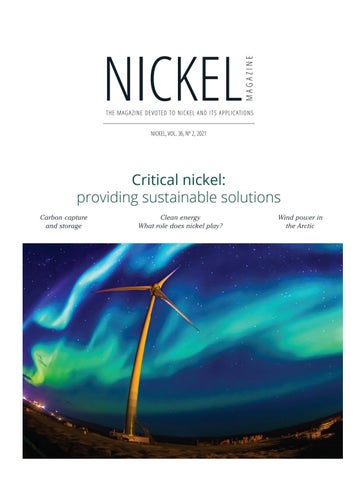
Critical nickel: providing sustainable solutions Carbon capture and storage
Clean energy What role does nickel play?
Wind power in the Arctic
KWANSOO E&C CO. LTD
CASE STUDY 22 TEMBURONG BRIDGE
Opened in March 2020, the Temburong Bridge in Brunei Darussalam spans part of Brunei Bay. It consists of massive viaducts and two cable-stayed navigation bridges. Stainless steel rebar was selected for critical parts of the reinforced concrete structures. Strong and corrosion-resistant stainless steel rebar is now in wide use to extend the service lifetimes of important concrete structures like bridges, which must endure harsh environments. NICKEL, VOL. VOL. 36, 36, Nº Nº 2, 2, 2021 2021 22 || NICKEL,
At 30 km (19 miles) in length, the Temburong Bridge is one of the longest over-sea bridges in south east Asia and is the largest infrastructure project ever undertaken by the Government of Brunei.The bridge spans a part of Brunei Bay and connects the Brunei-Muara District with the Labu Forest Reserve on the eastern shore. Before the bridge was opened in March 2020, vehicles were forced to drive through a part of Sarawak, Malaysia when traveling between these two districts.The bridge has reduced travel time from two hours to about 40 minutes.The Sultanate of Brunei foresees that this massive US$1.6 billion project will lead to an increase in tourism to the beautiful Labu Forest Reserve. Construction of the bridge, which started in 2014, was carried out by the Daelim-Swee Joint Venture of South Korea and the China State Construction & Engineering Corp. Their formidable task involved the construction of a 12 km (7.5 miles) land viaduct to traverse the mangrove swamps of the Labu Forest Reserve, a long marine viaduct and two navigation bridges. These spectacular bridges are cable-stayed,
box-girder structures. In order to greatly extend service life in this tropical marine environment, the use of stainless steel reinforcing bar (rebar) was specified for critical parts of the reinforced concrete structures. This requirement led to the selection of a reported total of approximately 3,500 tons of stainless steel rebar, including rebar made from Type 304 (UNS S30400) and Type 2304 (S32304).
EDITORIAL: SUSTAINABLE SOLUTIONS
is the call of the November 2021 COP26 climate change summit in Glasgow. Government policy changes, investment dynamics and consumer choices are increasingly driving a major overhaul in the energy systems and technologies that power the world. Change in energy demand by type in 2020 relative to 2019
While energy demand from oil, gas and coal fell by 5% during 2020 compared with 2019, the energy
5%
demand from new energy systems, such as renewables remained
0
resilient. Considering 2020 was a year when most economic sectors showed no growth or contraction
-5%
due to the Covid19 pandemic, a -10%
Total
Oil
Coal
Gas
Nuclear
Modern Renewables
1% growth in the renewables sector
“Stronger actions are required to counter the upward pressure on emissions from mineral production, but the climate advantages of clean energy technologies remain clear.” — The Role of Critical Minerals in Clean Energy Transitions International Energy Agency
paints a positive outlook.
Despite needing energy to produce, nickel is one of the minerals that plays a critical enabling role in the energy transition required to reduce CO2 emissions. Its unique properties facilitate the successful deployment of the spectrum of clean energy technologies such as geothermal, batteries for EVs and energy storage, hydrogen, wind, concentrating solar power and nuclear. And as
PHOTO BY JUSTIN BULOTA, © TUGLIK ENERGY
SOURCE: IEA(2021)THE ROLE OF CRITICAL MINERALS IN CLEAN ENERGY TRANSITIONS. ALL RIGHTS RESERVED.
“Secure global net-zero by mid-century and keep 1.5 degrees within reach”
nickel-enabled greener energy becomes more available, the carbon footprint of nickel production is also being reduced. In this edition of Nickel we take a close look at exactly where nickel is and its critical role in four of the technologies which will be part of the mix of solutions for decarbonisation. Often a little nickel goes a long way in emissions-reducing technologies, helping provide sustainable solutions to help us get to net-zero. Clare Richardson
Cover: One of two wind turbines at the Glencore Raglan Mine with the Northern Lights (Aurora Borealis).
Editor, Nickel NICKEL, VOL. 36, Nº 2, 2021 | 3
02
Case study no. 22 Temburong Bridge
03
Editorial Sustainable solutions
04
Nickel notables
06
Wind and water
NICKEL
NOTABLES
CONTENTS
Nickel in clean energy
10
The Northern Lights project Carbon capture and storage
13
Nickel alloys
A clearer solution
14
JOONDONG KIM FROM INCHEON NATIONAL UNIVERSITY
‘C’ Family of alloys Technical Q&A Tea staining
15
New publications
15
UNS details
16
King Abdulaziz Center World culture
Nickel magazine is published by Nickel Institute www.nickelinstitute.org Dr. Hudson Bates, President Clare Richardson, Editor communications@nickelinstitute.org Contributors: Parul Chhabra, Gary Coates, Richard Matheson, Geir Moe, Kim Oakes, Frank Smith, Benoît Van Hecke, Odette Ziezold Design: Constructive Communications Material has been prepared for the general information of the reader and should not be used or relied upon for specific applications without first securing competent advice. While the material is believed to be technically correct, Nickel Institute, its members, staff and consultants do not represent or warrant its suitability for any general or specific use and assume no liability or responsibility of any kind in connection with the information herein. ISSN 0829-8351 Printed in Canada on recycled paper by Hayes Print Group Cover: Photo by Justin Bulota, © Tugliq Energy Stock image credits: pg. 3 iStock©Petmal, pg.7 iStock©Burben_Images, pg. 8 Shutterstock ©encikmohdfirdaus , pg. 13 iStock©typo-graphics
4 | NICKEL, VOL. 36, Nº 2, 2021
It’s a brilliant idea with a bright future. Glass with invisible solar panels that generate electricity. In a recent study published in the Journal of Power Sources, Professor Joondong Kim and his colleagues at Incheon National University, Korea, detailed their latest invention: fully transparent solar cells that can be integrated into windows, buildings, or even mobile phone screens. Abundant and easily manufactured nickel oxide is playing a pivotal role. Until now, solar cells tended to be opaque, limiting their use. Professor Kim and his team developed an innovative technique, zeroing in on the heterojunction, which comprises thin films of materials responsible for absorbing light. To make the junction, the researchers chose nickel oxide, a semiconductor known to have high optical transparency. By combining titanium dioxide and nickel oxide semiconductors, they generated an efficient, transparent solar cell. Says Prof. Kim, “These transparent photovoltaic cells could have various applications in human technology.”
A surprising tail
WIKIMEDIA COMMONS
BALLYMORE PROPERTIES LIMITED
While it’s not unusual to find various metals in the dust tails of comets, nickel and iron have now been found in cold comets far from the Sun. What’s unusual about this? Solid metals don’t normally ‘sublimate’ (become gaseous) in cold temperatures. Polish astronomers first identified nickel vapour in the tail of the icy interstellar comet 2I/Borisov in 2019. Now Belgian astronomers J. Manfroid, D. Hutsemékers and E. Jehin have identified similar gaseous nickel in cold solar system comets, suggesting a possible organometallic origin. These vapours have been detected in comets more than 480 million kilometres from the Sun, triple the Earth-Sun distance.
SMARTTIRECOMPANY.COM
Dive in
Mars to Earth The Smart Tire Company, Los Angeles, California, is set to introduce Shape Memory Alloy Radial Technology (SMART) for bicycles. This revolutionary new technology has evolved from shape memory alloy tires developed for the next generation of Mars rovers and other Space Exploration Vehicles. These tires incorporate the advanced material, advanced nickel-titanium material, Nitinol (UNS N01555), a shape memory alloy (SMA) that’s elastic yet strong to handle the extreme challenges NASA faces on Mars, including no roads and extreme temperatures that can reach -100 °C. Back on Earth, the patented load-bearing design takes advantage of the unique properties of the SMAs, as these special metals can expand, contract, bend or unbend at a very rapid rate. Expected to be on the market by 2022, the company claims they will be a life-of-the-bike tire that shouldn’t ever need replacing, just occasional retreading.
Architecture studio HAL has created a ten-storey (35 metre) high transparent swimming pool that also acts as a bridge between two buildings at the Embassy Gardens development in Battersea, London. Named Sky Pool, the 25 metre-long swimming pool is made from acrylic panels, allowing swimmers to enjoy sweeping views of the neighbourhood, including the Thames. Type 316L (UNS S31603) stainless steel tubs anchor the pool to each building. The tubs are supported on bridge bearings allowing the structure to respond to the buildings’ movement and support the weight of the water. Two 38 mm diameter high strength spring-tensioned stainless steel rods run under the pool to connect the two tubs to reduce loads on the acrylic structure. The result is not only a marvel of architecture and engineering; it is an amazing sight to look up and see. NICKEL, VOL. 36, Nº 2, 2021 | 5
WIND AND WATER NICKEL IN CLEAN ENERGY
Even small quantities of nickel in an application can make a big difference to successful deployment.
Clean Energy Technology
Importance of Nickel
Solar Photo-Voltaic
Low
Concentrating Solar Power (CSP)
Moderate
Wind
Moderate
Hydro-electric
Low
Bioenergy
Low
Geothermal
High
Nuclear
Moderate
EVs and Battery Storage
High
Hydrogen
High
In its recent flagship report, The Role of Critical Minerals in Clean Energy Transitions, the International Energy Agency documents the expected needs of different metals and minerals to enable low carbon-emitting technologies to replace existing non-sustainable electrical generation methods.The report shows the importance of nickel (high, medium, low) for some of the clean technologies. Even a small amount of nickel can be critical in delivering resilience and enabling successful deployment of clean technologies. Take hydro-electric for example. Even though nickel is indicated to be of low importance (low quantity) in hydro-electric, its use is critical in weldability of turbine blades and in the long life of other components used in dam gates. In some applications, we can even say that nickel is essential for these technologies. While the IEA report discusses only electrical power generation, some other clean technologies result in energy in the form of heat. The production of biofuels is a case in point, relying heavily on the use of nickel in the form of stainless steels. In fact, much of the energy mix requires nickel in one form or another, and all the clean energy technologies use nickel. Here we take a closer look at what nickel is doing in three of the clean energy technologies: geothermal, hydro-electric and wind power. Geothermal Heat from deep within the earth can be used to generate electricity as well as for heating homes and other buildings. The concept is simple – steam or
6 | NICKEL, VOL. 36, Nº 2, 2021
pressurised hot water over about 150 °C is brought up in pipes to the surface where it drives turbines to generate electricity and then cools. The now lower temperature water is sent through pipes for district heating systems and subsequently returned to the source to be naturally reheated. One of the main advantages of geothermal is that the energy obtained is reliable and available all the time, unlike solar or wind. Geothermal energy production today is quite limited, perhaps only 16 GW capacity, limited to places where the water sources are relatively close to the earth’s surface, typically less than three kilometres deep. The capital cost of a geothermal power plant tends to be higher than other sustainable technologies, however the costs can be justified by the continuous operation of the system. The quality of the water or steam varies considerably depending on location. Some of the waters are very corrosive as they contain high amounts of chlorides and hydrogen sulphide. This is where the use of nickel-containing alloys is critical. Some of the installations, such as the Salton Sea project in California, make extensive use of nickel-base
alloys like C-22 (N06022), but most others can use lower alloyed materials. Take for example, the Hellisheiði Power Station in Iceland, near the capital Reykjavik, ranked as the sixth largest geothermal power plant in the world. It produces 303 MW of electricity and 400 MW of thermal energy used to heat homes and businesses, carried by a 19.5 km long pipe to the city. The wells bring up water at a temperature of around 200 °C with a low amount of chloride and some hydrogen sulphide. The materials used in the system range from typical carbon steel casing alloys through various types of stainless steels to high nickel alloys. Even titanium is needed for certain critical components. Some of the key components where nickel is found are the turbines, condensers, heat exchangers, pumps and piping systems which use, for example, stainless steels Types 630 (S17400), 316L (S31603), various duplex alloys, 6 %Mo (S31254) and nickel alloy 625 (N06625). In the power plant there may be as much as
a hundred tons of nickel in the alloys used. These materials, all in their correct application, provide corrosion resistance, strength and clean surfaces for excellent heat transfer, resulting in cost-effective service. Hydro-electric power Hydro-electric power is presently the largest source of renewable electricity. Capacity is expected to grow 70 % by 2040, mostly in the Asia Pacific region, according to the IEA. It will remain an important renewable energy source for the future. There will be more plants but in addition, older plants will require refurbishment and efficiency improvements offering the opportunity for current technology to be incorporated for longer life and greater energy production.
Some of the geothermal waters are very corrosive as they contain high amounts of chlorides and hydrogen sulphide. This is where the use of nickelcontaining alloys is critical.
Most hydro-electric power systems have dams that feed turbines to generate the electricity. Nickel is used in these systems for some key components and it looks like nickel will play an even greater role in the
NICKEL, VOL. 36, Nº 2, 2021 | 7
Hydropower is the largest source of renewable electricity. And the most durable turbines are made from nickelcontaining stainless steel.
future. At the heart of the power plant is the generator, which consists of a turbine (runner) driven by flowing water under pressure, with a moving rotor containing magnets inside a fixed stator with copper wire windings which then produces electricity. Usually, the turbine is made from nickel-containing stainless steel. It needs both corrosion and cavitation resistance. Turbines vary in size but are often very large, and their ability to be welded and be weld-repaired is critical to material selection. For these reasons, the most durable turbines are made from nickel-containing martensitic and austenitic stainless steels such 410NiMo (UNS S41500), EN 1.4488 (no UNS), Type 304 (S30400) and their cast equivalents. Stators are also large and here the nonmagnetic qualities of nickel-containing austenitic stainless steel is key to their performance, particularly alloys such as XM-19 (S20910).
We often refer to nickel as the ‘hidden metal.’ In wind turbines, it is indeed hidden, but it is also an enabler of reliable and cost-efficient energy generation.
8 | NICKEL, VOL. 36, Nº 2, 2021
With increasing water pressures and volumes, other system components can be lowered in weight and increased in durability with nickel. High strength low alloy (HSLA) steels remain a great candidate for future development of penstocks (large diameter pipes that feed water to the turbine). Penstocks can be up to 10 m in diameter. Higher strength steel reduces weight and has the advantage of increasing the internal diameter. Nickel in these alloys promotes martensite formation needed to obtain the high strength. Nickel has the added advantage of improving weldability of the penstock materials. These advantages, lower cost, lower steel usage and improved efficiency, are key to the future of this important renewable sector. Wind Power The use of wind to generate energy has accelerated recently to where nearly 750 GW of capacity exists worldwide. The cost of energy from wind turbines has gone down while the size of individual turbines has increased
to where 10 MW and larger turbines are being offered today. Larger wind turbines result in lower intensity of material use, meaning less material per MW of energy is used, an important sustainability criterion. Here nickel is also playing a critical role. Nickel use is most often associated with stainless steels, and in wind turbines, many safety-critical features such as ladders, control panels and fasteners will indeed use stainless steel alloys. But the main use of nickel in wind power will be small quantities to increase the strength and improve the toughness of low alloy steels. Many alloying elements will increase the strength and hardness of steel, but nickel is one of the few that also improves toughness – the ability to absorb mechanical energy without fracturing – which is critical to wind turbine operation. The gearbox of a turbine contains the most critical moving parts. A gearbox for an 8 MW turbine can weigh 86 tons. If something major fails, replacing parts or even the whole gearbox on a land-based wind turbine is a very costly exercise, but for offshore installations, the costs and downtime can be enormous. Thus, reliability and long life are essential factors in making wind power economically feasible. The weight of the gearbox is also important, as the structure must support the weight of the nacelle, where the gearbox is located, in the strongest of wind conditions. A one kilogram weight reduction in the nacelle can save as much as 10 kg of material in the support structure. Design is critical, but so is alloy selection. Much of the steel in the gearbox today contains nickel, as much as 2 % for certain components. Even higher nickel alloy steels are being suggested as turbine sizes as high as 20 MW are being considered. Components that today contain no nickel may in the future contain about 0.5 %, in order to decrease weight and increase reliability.
JUSTIN BULOTA
Wind power in the Arctic Providing electric power and heat
with a sophisticated energy storage
to remote sites in northern Canada
system that includes lithium-ion bat-
is always a challenge, especially if
teries. Integration of the wind turbine
there are no roads to the site. Such
and diesel energy systems was also
is the case for the Raglan Mine, a
mandatory. These first steps were
nickel mine owned by Glencore in
very successful, proving the concept,
Nunavik, which encompasses the
and now studies are underway to
northern third of the province of
potentially install two new 3 MW wind
Quebec. A large supply of diesel fuel
turbines. Each turbine allows savings
is brought in by sea during a short
of over two million litres of diesel
shipping season. The winters are dark
annually resulting in the reduction of
and bitterly cold, so having heat and
3,600 tons of carbon dioxide. Nickel
power is absolutely essential. Wind
contributes to the success. In each
energy is one of the few potential
wind turbine, about 2,000 kgs of
alternative sources of energy. But
nickel are used. Applications relying
can that technology work safely in
on nickel in the nacelle area include
extreme Arctic conditions including
bearings, shafts, gears and hydraulic
blizzards?
components, and in other areas for
Two wind turbines were constructed
fasteners, control cabinet housings
and installed in 2014 and 2018, along
and many other components.
Each turbine allows savings of over 3,600 tons of CO2 annually and requires about 2,000 kg of nickel
NICKEL, VOL. 36, Nº 2, 2021 | 9
THE NORTHERN LIGHTS PROJECT CARBON CAPTURE AND STORAGE TO REDUCE GREENHOUSE GAS
EQUINOR
Carbon capture and storage (CCS) is a vital part of decarbonising society. One such process involves the capture of carbon dioxide (CO2) from large industrial plants, transported in pipelines or ships, and deposited, generally underground, to prevent it from entering the atmosphere. It has a role to play in energy transition because renewable energy sources alone will not meet international 2050 energy and climate targets and completely stop greenhouse gas emissions. Firstly, there is the (slow) speed at which greening the energy or fuel mix is taking place. Secondly, carbon dioxide can be emitted for reasons unrelated to energy consumption, such as in the production of cement.
A fleet of dedicated CO2 transport vessels will be required for maritime CCS to reach its full potential.
Places where carbon dioxide can be safely stored are not generally in the areas where it is produced. Offshore storage – despite its complexity – seems to be gaining over onshore storage, which is often resisted by local residents. To bridge the distance between the place of emission and the place of storage, two options are available: shipping by vessel or transportation by pipeline. Shipping is more economical at low volume and long distance, while pipelines are the most viable option for large volumes at distances below 700 km. Also, in an emerging activity, such as CCS, shipping requires less capital expenditure, making it the preferred option to ship the initially low volumes of CO2 to the few available storage facilities. How to build a carbon dioxide ship?
There are three types of tank structures for liquid gas transport ships: fully pressurised, low temperature 10 | NICKEL, VOL. 36, Nº 2, 2021
(atmospheric) and semi-refrigerated (semi-pressurised). Liquid CO2 can only exist at a combination of low temperature and pressures well above atmospheric pressure. Hence, a CO2 cargo tank should be of the pressure-type or semi-refrigerated. The semi-refrigerated type, including the few existing CO2 carriers, is designed to take into consideration the combined conditions of temperature and pressure necessary for cargo gas to be kept as a liquid. Ship designers prefer this type as it enables larger and less expensive ships to be built. The cargo tank must operate at around -54 °C / 6 bar to -50 °C / 7 bar. This is near the ‘triple point’ of CO2, where gas, liquid and solids coexist, but the technology is not currently at the point where this design can be implemented efficiently and safely. Currently CO2 carriers operate at higher pressure and around -20 °C. They carry liquid CO2
Transport Compressed CO2 transportd by ship
Permanently stored CO2 received and temporarily stored Exported via pipeline offshore Permanently stored resevoir (2,500-3000 metres below seabed)
Liquid CO2
CO2 Capture Capture from industrial plants Compressed and temporarily stored
for food and beverage applications and pressurised products such as fire extinguishers. Nickel is essential for strength and toughness in these thick-walled pressure vessels at below zero temperatures. About Northern Lights
Despite the challenges, CCS projects are beginning to materialise. Northern Lights is the transport and storage component of the Longship project, promoted and supported by the Norwegian government, which includes capture of CO2 from industrial sources in the south-eastern part of Norway (Brevik and Oslo). When it starts operations in 2024, Northern Lights, owned by Equinor, Shell and Total, will be the first-ever crossborder, open-source CO2 transport and storage infrastructure network. It will ship captured CO2 to an onshore terminal on the Norwegian west coast and, from there, transport it by pipeline to an offshore subsurface storage location in the North Sea. This intermediate onshore storage of
NORTHERN LIGHTS
Liquid CO2
liquid gas ensures a constant flow into the pipeline and the seabed and is preferable to a start-stop feed which would occur without this onshore terminal.
The proposed maritime CCS value chain from emission to subsea storage.
As part of the first phase of operations, Northern Lights is building two dedicated 130 m long, 7,500 m3 capacity CO2 carriers. These will take captured and liquefied CO2 from several emitters and transport it to the onshore storage site before it is piped 100 kilometres offshore and 2,600 m beneath the seabed for permanent storage. The first phase aims at gradually storing up to one and a half million tons per year under the seabed, which is the amount the two ships can transport annually. Essential nickel
Because very few dedicated CO2 carriers exist, the design of the two Northern Lights carriers required engineers and the shipping classification societies to agree on the construction material for the onboard pressure vessels. It had to be easy to NICKEL, VOL. 36, Nº 2, 2021 | 11
fabricate and capable of accommodating high pressure and low temperature. The result was the selection of a 50 mm thick, up to 2.50 % Ni pressure vessel steel P690QL2 (EN 10028-6 type 1.8888). Two pressure vessels on each ship operate at 15 bar and -26 °C, safely away from the triple point. This represents about 3,000 tons of steel containing 75 tons of nickel.
• Onshore storage: 12 pressure vessels with a total capacity of 8,250 m3. Nickel is again needed to cope with pressure and low temperature. The entire tank farm represents 2,000 tons of pressure vessel steel P460ML1 (EN 10028-5) and P355NL1 (EN 10028-3) containing up to 0.50% nickel.
• Managing such a long pipeline in an offshore environment requires a set of ancillary tubes that are bundled into an ‘umbilical.’ The small tubes inside the umbilical carry the hydraulics for remote operation of valves and other chemicals. These tubes with a wall thickness of only 1.42 mm are hard to access once installed and must resist seawater. For resilience they are fabricated from Type 2507 (S32750) super duplex stainless steel. 35 km of an umbilical with four 2507 tubes represents about 10 tons of nickel.
• A 100 km 323.8 mm outside diameter pipeline keeps the CO2 in the liquid phase. This again means pressure and low temperature. It runs on the seabed, to reach the offshore location from where the CO2 is injected into a geological reservoir, 2.6 km under the seabed. The pipeline is made of DNV 450 FPDS
According to the Northern Lights model, CCS will start to deliver its promise by 2024. About 150 to 200 tons of nickel are essential to capture and store 1.5 million tons of CO2 per year this way. To achieve climate goals with CCS and other technologies, nickel is clearly an essential component.
The CCS value chain further consists of:
CO2 emitted from sites in South East Norway will be shipped to an onshore temporary storage facility before being transported by pipeline to offshore subsea storage in the North Sea.
NORTHERN LIGHTS PROJECT MAP Offshore subsea storage location in the North Sea
NORTHERN LIGHTS
Northern Lights consortium is handling transportation and storage
12 | NICKEL, VOL. 36, Nº 2, 2021
line pipe steel (similar to API 5L X65) with 0.50 % nickel. With most of the length having a thickness of about 16 mm, this represents about 13,000 tons of steel and 65 tons of nickel.
Onshore facility at Naturgassparken near Bergen
Norway
Fortum Oslo Varme waste-to-energy plant
Norcem cement factory
NICKEL ALLOYS: WORKHORSE ‘C’ FAMILY NICKEL-BASE ALLOYS
PENTICTON FOUNDRY
In the early 1930s, the first Ni-Cr-Mo alloy, known as alloy C (UNS N10002), was introduced. It was an optimisation of the Ni-Cr alloys which had good resistance to oxidising acids, such as nitric acid, and Ni-Mo alloys with superior resistance to reducing acids, such as hydrochloric acid. This combination resulted in an alloy family with exceptional corrosion resistance in a wide variety of severe corrosive environments typically encountered in chemical and petrochemical processing, exceeding that of stainless steels which had been discovered in 1913. In the mid-1960s, advances in both melting technology (namely the development of argon-oxygen decarburisation) and corrosion science (knowledge of the influence of minor element additions) led to the development of alloy C-276 (N10276), a low-carbon, low-silicon wrought version of alloy C. Alloy C-276 is now an industry standard for use in chemical and petrochemical processing. The 1970 United States Clean Air Act led to the widespread adoption of flue gas desulfurisation technology, mostly in the form of wet scrubbing units, to reduce sulfurous gas emissions from the nation’s coal-fired
power plants. These units needed to be resistant to the corrosive acids formed by the flue gases. Alloy C-276 was used in many of these critical applications. Also, at this time alloy C-4 (N06455) designed for the European chemical industry, was introduced. The early 1980s saw the introduction of Alloy 22, with a higher chromium content increasing corrosion resistance in oxidising media. In the 1990s this was followed by Alloy 59 (N06059), Alloy 686 (N06686) and C-2000® (N06200), with additional improvements in corrosion resistance that expanded the range of more demanding applications.
Typical composition of the C family alloys Alloy
(UNS)
Decade introduced
Ni
Cr
Mo
W
Cu
Fe
C
(N10002)
1930s
Bal.
16
16
4
-
6
C-276
(N10276)
1960s
Bal.
16
16
4
-
5
C-4
(N06455)
1970s
Bal.
16
16
-
2
22
(N06022)
Mid 1980s
Bal.
21
13
3
-
3
59
(N06059)
Early 1990s
Bal.
23
16
-
-
<1
686
(N06686)
Early 1990s
Bal.
21
16
4
-
2
C-2000
(N06200)
Mid 1990s
Bal.
23
16
-
1.6
2
90 years after the introduction of alloy C, the C family of nickelbase alloys finds extensive use in applications such as pollution control, petrochemical/chemical, production of various acids, metal processing, and pharmaceutical.
NICKEL, VOL. 36, Nº 2, 2021 | 13
ASK AN EXPERT FAQ FROM THE NICKEL INSTITUTE TECHNICAL ADVICE LINE
Geir Moe P.Eng. is the Technical Inquiry Service Coordinator at the Nickel Institute. Along with other material specialists situated around the world, Geir helps end-users and specifiers of nickelcontaining materials seeking technical support. The team is on hand to provide technical advice free of charge on a wide range of applications such as stainless steel, nickel alloys and nickel plating to enable nickel to be used with confidence. https://inquiries.nickelinstitute.org/
Q A
Q: The stainless steel railing outside our building is showing rusty spots after a couple of years. Was the wrong grade of stainless steel installed?
A: This is likely atmospheric corrosion related to the presence of salts and is commonly known as ‘tea staining.’ It is most often seen near the seashore or in locations where road salt is used. Tea staining occurs when local conditions (such as temperature, relative humidity and presence of corrosive substances on the surface) are too aggressive for that stainless steel alloy in its installed condition. The potential for staining is increased in sheltered areas, such as under eaves, that do not benefit from rinsing by rain allowing concentration of corrosive substances. Also, horizontal and rougher surfaces can more easily retain corrosive substances, thus smoother surfaces and surfaces that can easily drain are less susceptible to corrosion. Type 304L (UNS S30403) is typically suitable away from the seashore and in areas not exposed to road salts. Otherwise 316L (S31603) is
WWW.NICKELINSTITUTE.ORG
corrosion-resistant grades, such as 2205 (S32205) and super duplex (S32750 or S32760) may be required. An appropriate stainless steel alloy is a low maintenance material but is not always maintenance-free.
SUBSCRIBE to Nickel magazine free of charge and receive a printed copy or an e-mail notice when a new issue is published. www.nickelinstitute.org
Natural rain washing may be
READ Nickel magazine online in several languages. www.nickelinstitute.org/nickel-magazine/
washing may be needed.
SEARCH BACK ISSUES of Nickel magazine from our online archive, going back to 2009. www.nickelinstitute.org/nickel-magazine/ FOLLOW US on Twitter @NickelInstitute
sufficient, otherwise manual Tea staining is discussed in greater detail in the NI publication Stainless Steels in Architecture, Building and
JOIN US on LinkedIn – visit the Nickel Institute’s page
Construction – Guidelines for
WATCH nickel-related videos on the Nickel Institute YouTube channel www.youtube.com/user/NickelInstitute
available for download from the
Corrosion Prevention (11 024) Nickel Institute website: nickelinstitute.org/library
14 | NICKEL, VOL. 36, Nº 2, 2021
FROM PUBL 11 024 BY TMR
O N L I N E
NICKEL
usually adequate, however there are some coastal areas where more
NEW PUBLICATIONS Stainless steel infrastructure: a lifetime of savings explains how the unique properties of nickel-containing stainless steel make it a cost-effective choice of material for a wide range of structural applications. It demonstrates through a selection of international case
studies that the total cost of ownership over the life of a stainless steel asset can be highly competitive, despite its higher initial investment cost compared with less durable alternatives. Available for download from the Nickel Institute website. nickelinstitute.org
Refreshed INCO publications Twenty-eight significant technical publications, originally produced by INCO, and maintained by the Nickel Institute have been refreshed and re-published. The digital quality of the guides has been improved and all publications are searchable. The original publications were written by experts in their field and the information they provide is still very
relevant today. This high-quality technical information will give practitioners confidence in working with nickel-containing materials and to harness their benefits in a wide range of applications. This information is of value to materials specifiers, welders, fabricators and engineers, and is available for free download from the Nickel Institute website. nickelinstitute.org
UNS DETAILS UNS
AST 19 FC ELOICK IN-5 CE-N L N M E A EATIU E T STM H ISM SO S IU N EELING AND CRHER OCH ESB STIN SIG MA G YSISAND MACHINING INNLIO RTOIN LEYRG T INNI R L IS S O A O STA R L-RE E REL DIN CE GR R IN STA IN GRINDING NI-RESIST U IELS G K T E TO N N IC CTILE R D ATES ATPEAN —AE N LDU AND DUCTILE IN NG W PRSOTEELSP SIST -RE E NI E S I U U NI-RESIST E HE THSE URR THSE US TO TE TO LOEYATO LLOY IDLEGUID GU ALID USE OCC YS GGUID THE ALGININ 2 GE 3LO TIGCUA TIC 8TO AL 26IN 3AL O 1IN TA INANINCTIC ACLPR AC PRA ICAA PR AO PRACTICAL TO NO 4GUIDE C OYSUSE N TA 08THE NA L-TCK 11ALL AACT ICCKOENI EL-CON NONG EL-CONTAINI A PR IC OF NICKEL-CONTAINING OFKENL-OF OF NICK 242 NO ALLOYS OF N NO 242
ed by ribut ELd by Dist NICK bute Distri ITUTEKEL NIC dE by INST trib by UT Dis TITute uced d by INS NICKEL ProdProduce uted TEby Distrib ed by INSTITU O duc INCO INCPro NICKEL ed by O Produc Distributed INC INSTITUTEby Produced by INCO NICKEL INCO INSTITUTE
Chemical compositions (% by weight) of the alloys and stainless steels mentioned in this issue of Nickel.
Al
C
Co
Cr
Cu
Fe
Mn
Mo
N
Nb
Ni
P
S
Si
Ti
V
W
N01555 pg 5
-
0.07 max
0.05 max
0.01 max
0.01 max
0.05 max
-
-
-
0.025 max
54.057.0
-
-
-
bal
-
-
N06022 pg 7
-
0.015 max
2.5 max
20.022.5
-
2.06.0
0.50 max
12.514.5
-
-
bal
0.02 max
0.02 max
0.08 max
-
0.35 max
2.53.5
N06625 pg 7
0.40 max
0.10 max
-
20.023.0
5.0 max
0.50 max
8.010.0
3.154.15
bal
0.015 max
0.015 max
0.50 max
0.40 max
S17400 pg 7
-
0.07 max
-
15.0017.50
3.005.00
bal
1.00 max
-
-
0.150.45
3.005.00
0.040 max
0.030 max
1.00 max
S20910 pg 8
-
0.06 max
-
20.523.5
-
bal
4.006.00
1.503.00
0.200.40
0.100.30
11.513.5
0.040 max
0.030 max
0.75 max
-
0.100.30
-
S30400 pg 2, 8
-
0.08 max
-
18.020.0
-
bal
2.00 max
-
-
-
8.010.5
0.045 max
0.030 max
1.00 max
-
-
-
S30403 pg 14
-
0.030 max
-
18.020.0
-
bal
2.00 max
-
-
-
8.012.0
0.045 max
0.030 max
1.00 max
-
-
-
S31254 pg 7
-
0.020 max
-
19.520.5
0.501.00
bal
1.00 max
6.06.5
0.180.22
-
17.518.5
0.030 max
0.010 max
0.80 max
-
-
-
S31603 pg 5, 7, 14
-
0.030 max
-
16.018.0
-
bal
2.00 max
2.003.00
-
-
10.014.0
0.045 max
0.030 max
1.00 max
-
-
-
S32205 pg 14, 16
-
0.030 max
-
22.023.0
-
bal
2.00 max
3.003.50
0.140.20
-
4.506.50
0.030 max
0.020 max
1.00 max
-
-
-
S32304 pg 2
-
0.030 max
-
21.524.5
0.050.60
bal
2.50 max
0.050.60
0.050.20
-
3.05.5
0.040 max
0.040 max
1.00 max
-
-
-
S32750 pg 12, 14
-
0.030 max
-
24.026.0
-
bal
1.20 max
3.05.0
0.240.32
-
6.08.0
0.035 max
0.020 max
0.80 max
-
-
-
S32760 pg 14
-
0.030 max
-
24.026.0
0.501.00
bal
1.00 max
3.04.0
0.200.30
-
6.08.0
0.030 max
0.010 max
1.00 max
-
-
0.501.00
S41500 pg 8
-
0.05 max
-
11.514.0
0.501.00
bal
-
0.501.00
-
-
3.55.5
0.030 max
0.03. max
0.60 max
-
-
-
NICKEL, VOL. 36, Nº 2, 2021 | 15
KING ABDULAZIZ CENTER FOR WORLD CULTURE
©SNØHETTA
Located in Dhahran, Saudi Arabia, the Center was designed by architects from Snøhetta of Norway and was completed in 2017. Resembling five smooth ‘boulders’ randomly piled together, this spectacular building complex contains libraries, educational facilities, exhibition halls, theaters, museums, a mosque, and dining facilities. At the lowest point in the Center, an exhibit acknowledges oil as the historical foundation of the Kingdom’s economic prosperity. History gives way to the present at ground level where the Great Hall showcases the best of world cultural experiences. The future is then contemplated and forecast in the 90 m (295 ft) high Knowledge Tower.
The ‘boulders’ are covered with closely-spaced stainless steel tubes to create a veil that stands proud of the building’s weather-proof panels. 16 NICKEL, | NICKEL,VOL. VOL.36,36,NºNº2,2,2021 2021
The boulders are covered with closely-spaced stainless steel tubes to create a veil that stands proud of the building’s weather-proof panels. Fabricated by Seele of Germany, the tubes (7.6 mm diameter x 2 mm wall thickness) are made of duplex Alloy 2205 (UNS S32205) stainless steel. This alloy, containing 5.5 % nickel, was selected for its excellent strength, ductility, long-term abrasion and corrosion resistance,
and clean appearance. Each tube section is unique and was bent to fit its precise position using a computercontrolled machine. If placed end-toend, the 93,000 plus tube sections, weighing over 1,000 tons, would have a total length of 360 km (220 miles). The tubes help to keep the building cool by shading the exterior surfaces and by reflecting and conducting away heat.