WRITERS, Pascal Musungu, Anita Anyango, Patrick Mulyungi
EDITORIAL TRAFFIC
CO-ORDINATOR
Thuthu Klaas
WEB & GRAPHIC DESIGN
Gerald Oswald
WRITERS
Kiemo Teddy, Pascal Musungu, Anita Anyango, Patrick Mulyungi
Sales and Marketing Manager
Faith Mburu
GRAPHIC DESIGN
Austin Ombwa
ADVERTISING
Kenya: William Mutama, Lilian Khavosa, Joyce Ndamaiyu, Wendy Kinya
HEAD OF SALES AND MARKETING
William Mutama
South Africa: Thuli Nkosi, Winnie Sentabire, Angeline Ntobeng,
ADVERTISING
Kenya: Darren Karani, Lilian Khavosa, Fred Okoth
Uganda: Nobert Turiyo, Selina Salumah Namuli
South Africa: Jacqui Nyangabyaki, Tshego Mokonyama, Rachel Molapo
Botswana: Dickson Manyudza, Gerald Mazikana
Uganda: Nobert Turiyo, Selina Salumah
Ethiopia: Haimanot Tesfaye, Ruth Girma
Tanzania: Tom Kiage
Malawi: Anderson Fumulani
Ghana: Samuel Hinneh, Caleb Donne Hadjah
Zambia: Susan Kandeke
Zimbabwe: Chiedza Chimombe
Rwanda: Collison Lore
Nigeria: Seni Bello
China:Weng Jie
Rwanda: Cissy Batamuzira Nigeria: Seni Bello
The editor accepts letters and manuscripts for publication from readers all over the world. Include your name and address as a sign of good faith although you may request your name to be withheld from publication. We reserve the right to edit any material submitted .
Kenya’s National Social Security Fund (NSSF) has announced plans to construct one of the tallest buildings in East and Central Africa in Nairobi’s Central Business District, competing with the proposed Ethiopian Electric Power Headquarters. The NSSF Twin Towers project is set to become one of the boldest property investments by a Kenyan pension fund.
Send your letters to: info@constructionreviewonline.com
The editor accepts contributions for publication from readers. Include your name and address as a sign of good faith although you may request your name to be withheld from publication. We reserve the right to edit any material submitted .
Construction Review is published eleven times a year and is circulated to members of relevant associations, governmental bodies and other personnel in the building and construction industry as well as suppliers of equipment, materials and services in Africa, the Middle and Far East. The editor welcomes articles and photographs for consideration. Material may not be reproduced without prior permission from the publisher. The publisher does not accept responsibility for the accuracy or authenticity of advertisements or contributions contained in the journal. Views expressed by contributors are not necessarily those of the publisher.
Construction Review is published six times a year and is circulated to members of relevant associations, governmental bodies and other personnel in the building and construction industry as well as suppliers of equipment, materials and services. The editor welcomes articles and photographs for consideration. Material may not be reproduced without prior permission from the publisher. The publisher does not accept responsibility for the accuracy or authenticity of advertisements or contributions contained in the journal. Views expressed by contributors are not necessarily those of the publisher.
Construction of 37 by Ineza, a high-end residential project located off Kiambu Road near Nairobi, Kenya, is underway following official handover of the site to the contractor. The project, by Tofauti Lifestyle Limited, follows another successful development in the vicinity.
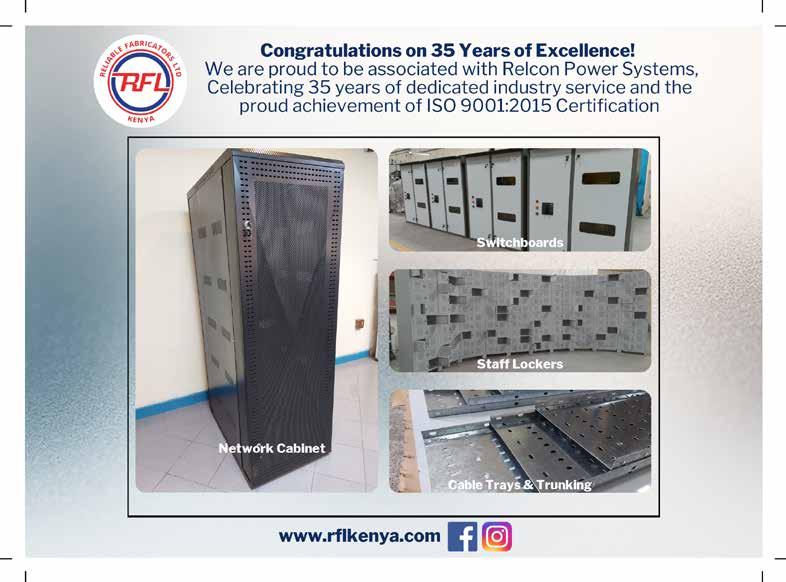
Electrical Contractor Celebrates 35 Years, Secures ISO 9001:2015
Relcon Power Systems Limited, a leading electrical contractor in Kenya, is marking 35 years since its founding. The milestone comes with an added layer of significance: the company has also attained ISO 9001:2015 certification, in a deliberate commitment to quality-driven growth.
Important Considerations in Choice of Roofing Products
38
South Africa
Choosing the right roofing product is a critical decision that affects a building’s durability, aesthetics and long-term maintenance costs. From cost and climate suitability to lifespan and installation quality, multiple factors come into play. We explore common roofing options and the key considerations guiding smart roofing choices in today’s market.
Mining and Construction News Network
9 Poplar Rd, Riverclub, Sandton
Tel: + 27 83 5061626
Ethiopia
Haymi Advertising Services
22 Mazoria, Genet Bldg 4th Flr., Addis Ababa
Tel: +251 118 955 855,
Cell: +251 930 099 152
27
Ghana
Image Consortium
1st Floor, The Ecobank Building, Tesano.
Tel: 233(0)30 223 2728 I 233(0)274807127 I +233(0)206299159
Nigeria
Rahma Associates
B23/24, Aishetu Emoewa Plaza, 196, Iju Water Works Road,
THE ARCHITECTURAL ASSOCIATION OF KENYA Dura Coat Awards of Excellence in Architecture 2026 will be held on 26 March 2026.
The awards recognise architectural work that demonstrates excellence in design, innovation, professionalism and positive impact on communities and landscapes. Sponsored by Basco Paints under the Dura Coat brand, they seek to promote a culture of architectural excellence and set benchmarks for quality and creativity in Kenya’s dynamic construction sector.
Eligible entries typically include completed projects from across Kenya and the East African region, built within the last five years by architects registered with professional bodies such as the AAK, the Rwanda Institute of Architects, the Uganda Society of Architects and the Architects Association of Tanzania.
Kenya
- Architectural Association of Kenya
- Institute of Quantity Surveyors of Kenya
- Institution of Engineers of Kenya
Botswana Mining & Energy Conference and Exhibition Gaborone, 16
- 17 March 2026
THE BOTSWANA MINING & ENERGY
CONFERENCE and Exhibition will be held in Gaborone in 2026, bringing together stakeholders from across the mining, commodities, energy and manufacturing sectors.
The event will focus on commodities processing, mining investment trends, exploration opportunities, precious, base and bulk metals, financing models, ESG and sustainability goals, commodities forecasting, industry partnerships and technological innovation in the mining and energy industries.
The 2026 edition will also introduce a dedicated session on solar power, batteries and energy storage, reflecting their growing role in Botswana’s clean energy transition. The conference is expected to attract international exhibitors, investors, policymakers and industry professionals from across the regional and global mineral resources value chain.
- Association of Consulting Engineers of - Kenya
- Association of Professional Societies of East Africa APSEA)
- Kenya Property Developers Association
- Institution of Surveyors of Kenya
-Town and County Planners Association of Kenya (TCPAK)
South Africa
- ASAQS - SAICE
- South African Council for the Quantity Surveying Profession
- Khuthaza ( Women for Housing)
- Concrete Manufacturers Association
- Green Building council of SA
- South African Property Owners Association
- Master Builders South Africa
Uganda
- Institute of Surveyors of Uganda
- Uganda Institute of Professional Engineers (UIPE) & Uganda Society of Architects
Botswana
- Institute of Botswana Quantity Surveyors
Ethiopia
- Association of Ethiopian Architects
- Ethiopian Association of Civil Engineers
- Construction Contractors Association of Ethiopia
Zimbabwe
- Zimbabwe Institute of Quantity Surveyors
- Zimbabwe Institute of Engineers
- The Construction Industry Federation of Zimbabwe (Cifoz)
Buildmacex Nigeria
Lagos, Nigeria 22-24 April 2026
BUILDMACEX NIGERIA 2026 is one of West Africa’s largest exhibitions for the construction, building materials, and machinery industries. The event, now in its 10th edition, will take place from 22nd to 24th April 2026 at the Eko Convention Centre, Eko Hotel & Suites, Victoria Island, Lagos.
Organised by Atlantic Exhibition Nigeria Limited, the three-day fair brings together key players from across the built environment — including architects, engineers, contractors, developers, and technology providers. It serves as a major platform for showcasing the latest products, machinery, and innovations driving Africa’s construction and real estate sectors. The 2026 theme, “The Revolution of Modern Technology on Structural Design,” reflects the growing emphasis on digital transformation and sustainability within the industry.
Ghana
- Ghana Institute of Engineers
- Architects Registration Council
- Ghana Institute of Surveyors
- Ghana Green Builders Association
- Ghana Institute of Planners
- Association of Building and Civil Engineering Contractors of Ghana
Namibia
- Institute of Namibian Quantity Surveyors
- Association of Consulting Engineers of Namibia
Tanzania
- Tanzania Institute of Quantity Surveyors
- Construction Regulation Board (CRB)
- Tanzania’s Registration Board of Architects and Quantity Surveyors (AQSRB)
Nigeria
- Association of Consulting Engineers Nigeria
- Association of Professional Women Engineers Of Nigeria
- Council of Registered Builders of Nigeria
- The Nigerian Institute of Architects
- American Association of Petroleum Geologists Africa Region
- Nigeria Society of Engineers
- Nigeria Institute of Architects
- Building and Construction Skilled Artisans Association of Nigeria (BACSAAN)
Zambia
- Zambia Institute of Architects (ZIA)
- Association of Building and Civil Engineering Contractors (ABCEC).
SA: CFAO Division Sees Massive Jump in Heavy Equipment Rentals
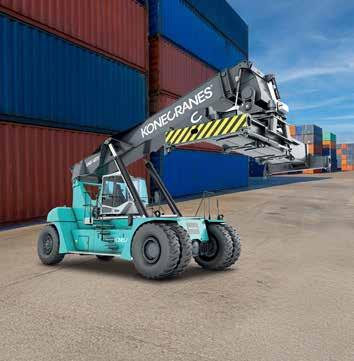
Heavy Lift, a division of CFAO Equipment, reports that 95% of its business over the past 12 months emanated from equipment rentals, highlighting a strong industry trend toward flexible, capitalefficient alternatives to owning heavy lifting machinery.
The growth of heavy equipment rental is no coincidence. Behind it is a mix of financial efficiency, operational flexibility, technological access and maintenance support that purchasing simply cannot match.
Heavy Lift National Product Specialist, Lenny Naidoo, says renting heavy lift equipment has become increasingly attractive as businesses look to avoid the complexity and cost of sourcing machinery themselves. “Nine out of ten rentals require that equipment be ordered from factories in Sweden or China, with lead times ranging from a few weeks to seven months.”
Each unit undergoes full assembly and live testing at the factory before being stripped for shipping. Heavy Lift then manages the transport and final assembly, ensuring customers receive fully operational units without logistical burdens.
Long-term rental options, typically 36, 60 or 72 months, allow customers to secure fixed rates while maintaining the ability to upgrade, modernise or downscale at the end of the contract period. Short-term rentals, from one to 24 months, remain in high demand,
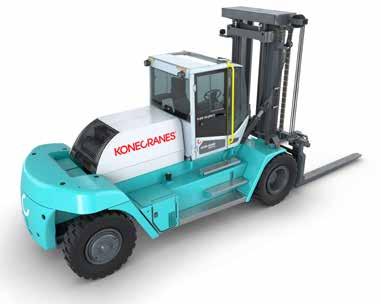
particularly for 16- and 18-ton forklifts which form the core of Heavy Lift’s short-term fleet.
“With new equipment requiring a large up-front investment, rental provides customers with predictable cost management and the freedom to adjust their fleets as business conditions change,” says Naidoo.
All rental agreements include a comprehensive maintenance contract. Heavy Lift performs full inspections before delivery and again with the customer when the contract concludes. Equipment is serviced every 250 hours or every three months, ensuring safety, performance and minimal downtime, even during quieter operational periods.
Rental customers benefit from access to the latest lifting technologies. At contract renewal, businesses can upgrade to more advanced models or update their existing units, staying current without major upfront investment.
As many depots move away from keeping idle equipment on-site, rental provides a more sustainable approach to asset management. Companies can scale their fleet up or down based on workload, improving capital efficiency and reducing unused equipment.
Naidoo says rental demand remains steady throughout the year because it reflects how customers operate. “When workloads increase, they can scale up quickly. When business slows, they can avoid the financial burden of owning costly machinery.”
For companies operating in sectors such as container handling, warehousing and industrial logistics, the case for rental has never been stronger. As industries continue to navigate shifting logistics demands, renting heavy lift equipment has emerged as not only a cost-effective choice, but a strategic one.
Kenya: Much-Awaited Rironi–Mau Summit Highway Makes Progress
Construction has been split between two international contractors - China Road and Bridge Corporation (CRBC) and Shandong HiSpeed Road and Bridge International (SDRBI).
The long-anticipated 175-kilometre Rironi–Mau Summit Highway has taken a significant step forward, with the first operational phase expected to open to traffic in August.
Roads and Transport Cabinet Secretary Davis Chirchir told the Kenyan Senate that construction of the Rironi–Naivasha section is progressing steadily, with full completion of that stretch targeted for June. Motorists will, however, be allowed to begin using the upgraded road from August as works transition into subsequent phases.
Construction responsibilities have been split between two international contractors. China Road and Bridge Corporation (CRBC) is delivering the Nairobi–Naivasha–Gilgil and Nairobi–Maai Mahiu–Naivasha (A8 South) segments, while Shandong Hi-Speed Road and Bridge International (SDRBI) is undertaking the Gilgil–Mau Summit section.
The corridor remains one of Kenya’s most strategic transport links. It forms part of the Northern Corridor, connecting Nairobi to Uganda, South Sudan, Rwanda, Burundi and the Democratic Republic of Congo, and plays a critical role in facilitating regional trade, logistics, tourism and agricultural exports.
After years of delays and changes in development partners, the project was officially launched by the President last November, marking a reset for a highway widely seen as vital to easing congestion and strengthening Kenya’s position as a regional transport hub.
AAK Warns Architects Over Strict KCAA Rules
The Architectural Association of Kenya (AAK) has issued a fresh advisory reminding architects of their legal obligations when designing and supervising developments located within aerodrome control zones across the country.
In a circular, the association drew members’ attention to a recent public notice by the Kenya Civil Aviation Authority (KCAA) issued under Section 57 of the Civil Aviation Act and the Civil Aviation (Aerodromes) Regulations, 2013.
The advisory clarifies that all developments — including new buildings, extensions and alterations — within a 15-kilometre radius of any international or domestic aerodrome must obtain prior written authorisation from KCAA before construction begins. In Nairobi, this requirement affects areas around Wilson Airport and Jomo Kenyatta International Airport, spanning multiple residential, commercial and mixeduse zones.
AAK emphasised that KCAA approval is mandatory and separate from county government planning consent. Architects must submit applications for height clearance and secure either development approval or a letter of no objection before works commence. Failure to do so constitutes a regulatory breach and may attract enforcement action.
The association underscored that architects bear primary professional responsibility for design coordination, regulatory compliance and public safety. It cautioned members against delegating KCAA submissions to unregistered persons or relinquishing oversight to other consultants without clear architectural control.
Somalia Plans Infrastructural Upgrades at Main Airport
Somalia plans to undertake major infrastructural improvements tom improve the country’s main aviation gateway, Aden Adde International Airport.
A high-level coordination meeting was held to discuss the implementation of road construction within the airport and the development of a modern drainage system to improve overall airport operations. The meeting was chaired by the Director General of the Ministry of Transport and Civil Aviation of the Federal Government of Somalia, Mr. Omar Ali Afrah, and was attended by the Airport Manager Abdinasir Gurey, Deputy Airport Manager Da’uud Ahmedey, as well as Directors from the Planning Department and the Airports Development Department.
Also participating in the meeting were officials from the Ministry of Public Works and Reconstruction, the Banadir Regional Administration, and the UNOPS.
During the meeting, detailed plans and designs were presented for internal airport roads and the construction of a high-quality drainage system. The proposed infrastructure upgrades aim to enhance the airport’s aesthetics, security, and the smooth delivery of services. Officials unanimously emphasized the strategic importance of the project in strengthening economic infrastructure and improving the quality of services at the airport. The initiative forms part of the broader Nagaad Project, which is supported by the World Bank. The project is expected to significantly contribute to the modernization and resilience of Somalia’s aviation infrastructure. - SONNA
Uganda: It's All Systems Go for US$ 50m Amari Power Transmission Project
Gridworks and the Government of Uganda have signed two landmark agreements that will enable Gridworks’ Amari Power Transmission (“Amari”) project to begin construction in the coming weeks.
Amari has entered into an Implementation Agreement with the Ugandan Ministry of Energy and Mineral Development, and a Transmission Services Agreement with national transmission utility, Uganda Electricity Transmission Company Limited (UETCL). The progress of the Amari Project is a major milestone for Uganda’s electricity sector, and for the adoption of private sector funding models for transmission infrastructure in Africa. Amari will be the first independent transmission project (ITP) on the continent to move into the construction phase.
Amari is a US$50 million ITP that will upgrade the transforming capacity of four high voltage electricity substations at key points on Uganda’s grid. It will improve the supply of electricity to industrial users in line with the Government of Uganda plans to improve the competitiveness of its industry, particularly the manufacturing sector. Amari will also allow the uptake of more renewable energy onto the grid and provide capacity to support future regional interconnection with Uganda’s neighbours.
Once completed, the project will support Uganda’s growing electricity demand, enable the evacuation of current and future generation capacity, and contribute to lower system losses
and improved power quality across the network. The project is also expected to generate employment opportunities during construction. As a pilot for private sector transmission in Uganda, the project has supported the creation by the Government of a regulatory framework equipped to attract finance for future grid investment.
Gridworks’ Chief Executive Officer, Chris Flavin, welcomed the strong partnership with the Government of Uganda: "This is a decisive step that will allow the Amari Transmission Project to move into construction. We are particularly grateful for the leadership, foresight, and constructive engagement shown by the Government of Uganda in bringing this project to this stage.”
London-based Gridworks was established in 2019 as a dedicated platform for development and investment in Africa’s electricity networks.
Gridworks’ Chief Executive Officer, Chris Flavin
South Africa: Bakwena Advances R276 Million N1 Rehabilitation
Bakwena Platinum Corridor Concessionaire is progressing well with the major rehabilitation works on the N1 between the Proefplaas Interchange and the Pumulani Main Line Toll Plaza in Gauteng, highlighting safety, efficiency and long-term resilience along this critical transport corridor.
This R276 million project, awarded to Roadmac Surfacing, commenced in August 2025 and is expected to be completed by November 2026. The 15-month contract forms part of Bakwena’s broader N1N4 rehabilitation programme.
The scope of work includes the rehabilitation of the slow lane of both the northbound and southbound carriageways; the rehabilitation of the Stormvoël and the Zambezi Interchanges and sections of the Proefplaas Interchange, and an asphalt overlay of the entire road surface. Replacement of the road signage and repairs to the concrete lined drainage systems also forms part of this project. These upgrades are designed to restore the structural
strength, improve the driving conditions, and extend the lifespan of the road in line with international engineering standards.
Construction is taking place during both the day and night. While lane closures are required in both directions, Bakwena is implementing strict traffic management measures to minimise delays and maintain safe travel for all road users.
Beyond improved safety and road quality, the project delivers longterm economic benefits by supporting freight efficiency, regional trade, and job creation. Local employment opportunities and supplier participation contribute to the project’s socio-economic impact.
Through this project, Bakwena continues to demonstrate its commitment to responsible concession management and the delivery of infrastructure that meets the needs of road users, investors, and the broader Southern African economy.
Telkom Business deploys mobile network at site of Africa’s tallest bridge
Telkom Business has deployed new mobile connectivity infrastructure in a highly remote part of the Eastern Cape, adjacent to the construction site of the Mthentu Bridge near Lundini, which is set to become the tallest bridge in Africa.
The LTE base station is already operational, delivering voice, data services to construction teams working on site and to surrounding rural communities, including Kwa-Dlambula and Mtonjeni. Construction of the bridge and associated road infrastructure is expected to continue over a three-year period. The Mtentu Bridge forms part of the N2 Wild Coast road (N2WC) project, which aims to improve the travel time between Durban and East London for heavy freight vehicles.
The Mthentu Bridge, expected to reach a height of approximately 223 metres and span around 1.13 kilometres, is a landmark infrastructure project for the Eastern Cape.
Kenya’s Pension Fund to Build Tallest Skyscraper in East and Central Africa?
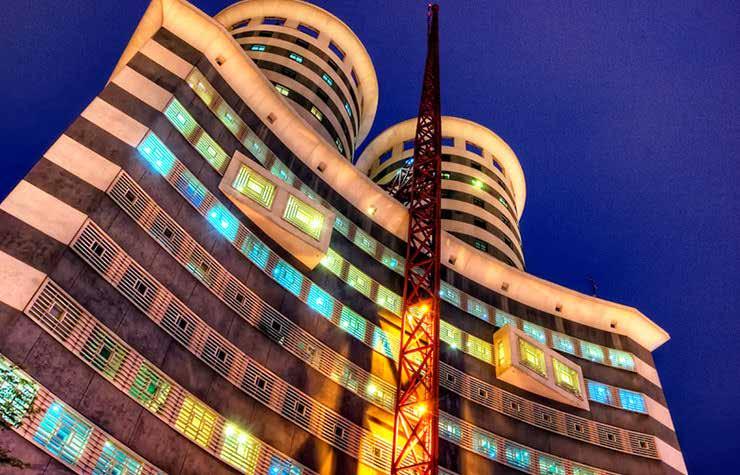
Kenya’s National Social Security Fund (NSSF) has announced plans to construct one of the tallest buildings in East and Central Africa in Nairobi’s Central Business District, competing with the proposed Ethiopian Electric Power Headquarters. The NSSF Twin Towers project is set to become one of the boldest property investments by a Kenyan pension fund.
The proposed mixed-use development is budgeted at approximately $233 million and will occupy prime land at the junction of Uhuru Highway and Kenyatta Avenue. The project transforms a long-idle plot into a high-profile landmark, designed to redefine Nairobi’s skyline and reinforce the city’s role as East and Central Africa’s commercial hub.
In an interview with a leading daily newspaper, NSSF Managing Trustee and CEO David Koros explained the commercial and strategic rationale.
"That land has been idle for years, generating no benefit for contributors. Valued at about Ksh. 4 billion, our objective is to unlock its potential through redevelopment and sell completed units to investors so the returns flow back to the Fund."
Tower Specifications
• Tower A: 60 storeys, approximately 260 metres — set to be the tallest building in East and Central Africa.
• Tower B: 35 storeys, approximately 140 metres.
Facilities
The Twin Towers will include:
• Premium office space
• A business hotel
• Serviced residential apartments
• Retail outlets and conference facilities
• An observation deck on the 56th floor
• Parking for about 1,150 vehicles
Construction Timeline and Contractor
Construction is expected to span 24–36 months. Ground-breaking is scheduled for later this year, pending regulatory approvals. China Road and Bridge Corporation (CRBC), a subsidiary of China Communications Construction Company, will serve as the main contractor.
Financial Outlook
The Fund is targeting a minimum return of 12%, with potential upside depending on market conditions, reinforcing NSSF’s long-term investment approach.
Strategic Impact
Beyond financial returns, the Twin Towers are part of a deliberate effort to reinvigorate Nairobi’s CBD, historically a daytime-only business district.
"We want people to live in the city again. Introducing housing, hotels, and retail will extend business activity beyond office hours and support a 24-hour economy," Koros said.
Once complete, the NSSF Twin Towers will unlock the value of a Ksh. 4 billion parcel of land and establish Nairobi as a regional leader in vertical urban development, with Kenyan workers’ savings literally reaching new heights.
FACT SHEET
STRATEGIC COLOUR SELECTION FOR COMMERCIAL, RESIDENTIAL AND INSTITUTIONAL SPACES
How thoughtful colour application enhances performance, perception, and long-term asset value
Colour rarely features in boardroom conversations at the early stages of a development. It is often treated as a finishing detail, something to be decided once structural works, mechanical systems and budgets have been settled.
However, for developers who track occupancy rates, tenant retention and brand positioning closely, colour deserves a seat at the strategy table from day one.
Across commercial offices, hotels, schools, hospitals and residential projects, colour shapes behaviour and perception in ways that directly affect financial performance. It influences how long people stay in a space, how comfortable they feel, how productive they are, and how much they are willing to pay. In competitive property markets, these subtle psychological cues can determine whether an asset outperforms or struggles.
Workplace Environments and Tenant Retention
In office developments, colour plays a decisive role in productivity and tenant satisfaction. As companies push for higher quality work environments to attract and retain talent, landlords are under pressure to deliver more than square footage. Cool blues and soft greens help create calm, focused work areas, particularly in open plan layouts where visual noise can be overwhelming. Warmer tones introduced in meeting rooms and collaboration hubs inject energy without disrupting the overall tone of professionalism. Neutral palettes layered with texture signal stability and corporate maturity, qualities that appeal to financial institutions, consultancies and multinationals seeking premium space.
When colour is used to subtly define zones rather than relying solely on partitions, developers can save on construction costs while improving spatial flow. The result is a workplace that feels intentional and human centred, increasing tenant satisfaction and strengthening lease renewals. In a market where Grade A office space competes on experience as much as location, that distinction matters.
Hospitality Design and Revenue Performance
Hospitality projects offer perhaps the clearest link between colour and revenue. Guests respond emotionally to inte-
riors long before they assess service quality. A restaurant wrapped in warm earthy tones encourages comfort and conversation, often extending dining time and increasing spend per table. A hotel lobby finished in layered neutrals with depth and texture communicates quiet luxury. Even minor adjustments, replacing stark white walls with softer shades that complement lighting design, can elevate perceived value instantly.
Developers who refurbish older hospitality assets often find that colour transformation delivers one of the highest returns relative to cost. A refreshed palette can reposition a mid-tier property closer to boutique status without major structural changesIn an era where visual appeal drives online reviews and social media exposure, colour also becomes a marketing asset.
Learning Environments That Support Performance
Educational facilities demand greater sensitivity. While bright colours are commonly associated with learning environments, excessive stimulation can undermine concentration. Softer greens and blues tend to promote calm and sustained attention in classrooms. Early childhood centres may incorporate warmer accents, but balance remains essential. Strategic colour zoning can also improve wayfinding, helping students navigate campuses with ease and reducing behavioural friction in high traffic areas.
Durability is equally important. Schools require coatings that withstand constant cleaning and heavy use without fading or chipping. When institutions invest in thoughtful colour planning combined with high performance finishes, they create environments that support learning outcomes while protecting long term maintenance budgets. For private schools competing for enrolment, the look and feel of facilities influence parental perception of quality and care.
Healthcare Spaces That Inspire Confidence
In healthcare developments, colour carries even greater responsibility. Softer aqua tones, muted greens and warm neutrals create a calmer atmosphere that supports healing and reassures families. Clear colour differentiation between wards and departments improves navigation and reduces confusion, particularly in large facilities.
Through tailored colour consultations and technical site support, Crown Paints guides project teams across offices, hospitality, healthcare, education and residential segments.
At the same time, performance standards are uncompromising. Coatings must be easy to clean, resistant to staining and supportive of infection control protocols. When aesthetics and technical performance align, healthcare spaces project trust and professionalism, strengthening institutional reputation and patient loyalty.
Residential Appeal and Absorption Rates
Residential real estate presents another commercial dimension. Buyers and tenants often make judgments within moments of entering a unit. Light contemporary neutrals maximize the sense of space and allow occupants to imagine their own furnishings. Carefully placed accent tones in show houses can suggest aspiration and lifestyle without narrowing market appeal. Externally, cohesive facade schemes enhance curb appeal and protect surfaces from weather damage, reducing repaint cycles and preserving asset value.
Developers tracking absorption rates understand that presentation influences velocity of sales. A well-considered colour scheme can shorten vacancy periods and justify stronger pricing. In high density developments, consistent palettes across common areas also reinforce brand identity and create a sense of community.
Retail Identity and Brand Architecture
For retail and mixed-use projects, colour functions as part of the brand architecture. It guides customer movement, highlights promotional zones and subtly influences purchasing behaviour. Cohesive colour strategies across signage, interiors and exterior elements build recognition and trust. In crowded urban markets, that coherence can distinguish one development from another.
From Aesthetic Choice to Commercial Strategy
Approaching colour strategically requires discipline. Lighting conditions, both natural and artificial, alter perception dramatically. Sample testing on site prevents costly miscalculations. Trend driven hues should be balanced with timeless base tones to maintain relevance over years rather than seasons. Above all, colour decisions must align with the intended behaviour within each space, whether focus, relaxation, healing or purchase.
CROWN PAINTS works with developers, architects and interior designers to translate these objectives into practical specifications. Through tailored colour consultations and technical site support, the company guides project teams across offices, hospitality, healthcare, education and residential segments. Early engagement ensures accurate product selection, consistent application and long term surface performance.
Ultimately, colour is not a cosmetic afterthought. It is a commercial decision that shapes user experience and financial outcomes. Developers who recognise its strategic value treat it with the same seriousness as layout, lighting and materials. When applied with intention, colour enhances perception, strengthens brand positioning and safeguards long term asset performance.
ALL SET AS 37 BY INEZA KICKS OFF
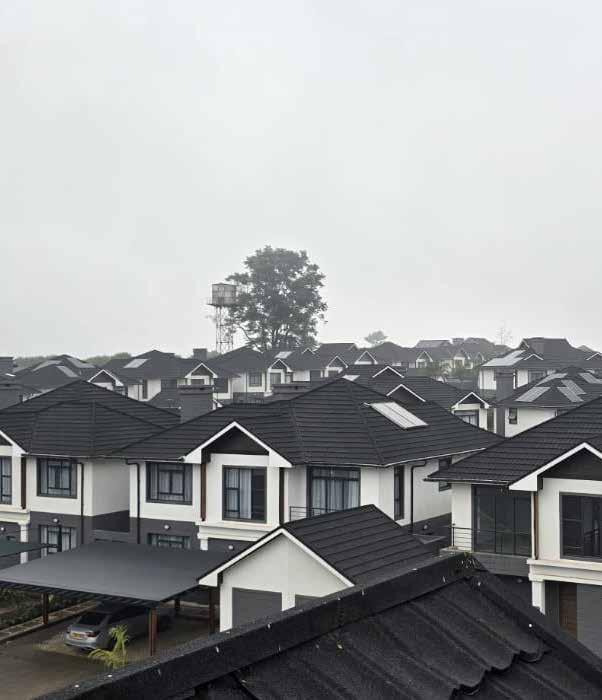
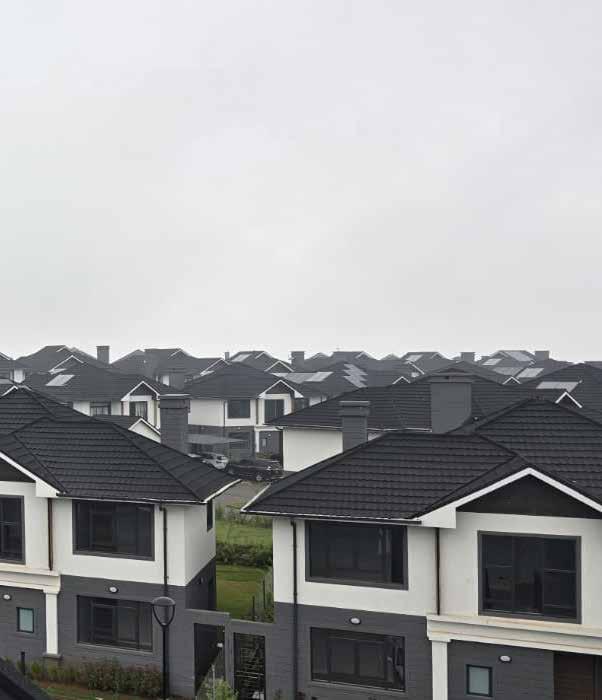
The development of 37 by Ineza, a high-end residential project located off Kiambu Road behind Runda in Kenya, now moves into its construction phase following the official handover of the site to the contractor. The ceremony marked a key milestone for the project’s developer, Tofauti Lifestyle Limited, formally signalling the transition from planning and design into on-site works.
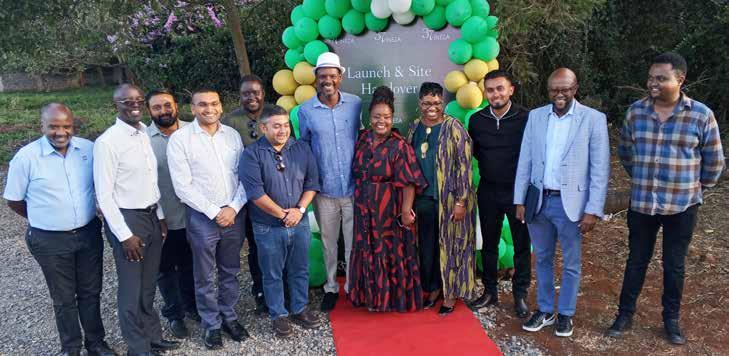
From left: Amit Bhanderi (Site Manager, Canton Building & Construction), Yogesh Kerai (MD Canton Building & Construction), Njeri Gakunju (CEO Tofauti Lifestyle) and Vinay Varsani (GM, Canton Building & Construction) during the site handover.
The project is situated on a five-acre parcel along Kwaheri Road, with access from both Runda and Kiambu Road, placing it within one of Nairobi’s established low-density residential zones.
According to the developer, the location was selected to take advantage of existing infrastructure while maintaining planning controls associated with the wider Runda area. The development comprises 37 residential units, a scale that reflects a deliberate low-density approach in contrast to higher-intensity schemes increasingly common along major urban corridors.
According to Tofauti Lifestyle Limited, 37 by Ineza builds on experience gained from the earlier Ineza Boutique Homes project located nearby, which is fully occupied.
The scheme consists of five-bedroom townhouses, each with a domestic staff quarter, arranged to give each unit a relatively large plot size by Nairobi standards. Each home occupies approximately one-eighth of an acre, a configuration that has implications for civil works, drainage planning, and landscaping. The architectural concept adopts contemporary forms, generous internal volumes and extensive glazing, with a reduced emphasis on traditional heavy stone boundary walls. This approach aligns with recent design trends in Nairobi’s upper-end residential market and places particular demands on structural detailing and finishes.
Internally, the units are organised over two main floors. The ground floor accommodates primary living spaces, kitchens, utility areas, a guest bedroom and the DSQ, while the upper floor contains the remaining bedrooms, all en suite. The relatively large floor areas require careful coordination of structural systems, mechanical and electrical services, and fire safety provisions. Landscaping is integrated into the overall design rather than treated as a secondary element, requiring early sequencing alongside core infrastructure works.
In addition to private residential units, the project includes a range of shared amenities that will be delivered as part of the main construction programme. These include a residents’ clubhouse, a fully equipped gym, a heated swimming pool, a padel court and a basketball court, as well as landscaped green lawns and children’s play areas. Wide internal roads are planned to support estate circulation, service access and emergency response.
The development also incorporates several infrastructure and services components of interest to contractors and consultants. These include a borehole supplemented by a mains water connection, underground water storage, a backup generator and provisions for estate-wide security systems, including CCTV surveillance, intercom access and controlled entry gates. A perimeter wall with electric fencing forms part of the overall security strategy.
According to Tofauti Lifestyle Limited, 37 by Ineza builds on experience gained from the earlier Ineza Boutique Homes project located nearby, which is fully occupied.
The project team brings together several established firms in Kenya’s construction and consulting sector. They include Team 2 Architects as architects, LMJ Consultancy as project managers, Canton Building & Construction Ltd as the main contractor, Africost (K) Consulting as quantity surveyors and Gamma Delta Eastern Africa as electrical engineers, among others. These firms were represented at the site handover ceremony by their respective chief executives, underscoring the multi-disciplinary collaboration underpinning the project.
From left: Eng. Gicheru Kimani, MD Gamma Delta Eastern Africa; Qs Job Mwangi, MD Africost; Amit Bhanderi, site manager with Canton Building & Construction; Yogesh Kerai, MD, Canton Building & Construction; Arch. Deepak Krishna, Director, Team 2 Architects; Njeri Gakunju, CEO Tofauti Lifestyle; Caroline Wanjeri Kihara, Mortgage Business Director KCB; Vinay Varsani, GM Canton Building & Construction; PM Jimmy Kamotho, MD LMJ Consultancy, and Arch. Daniel Gatimu of Team 2 Architects during the launch.
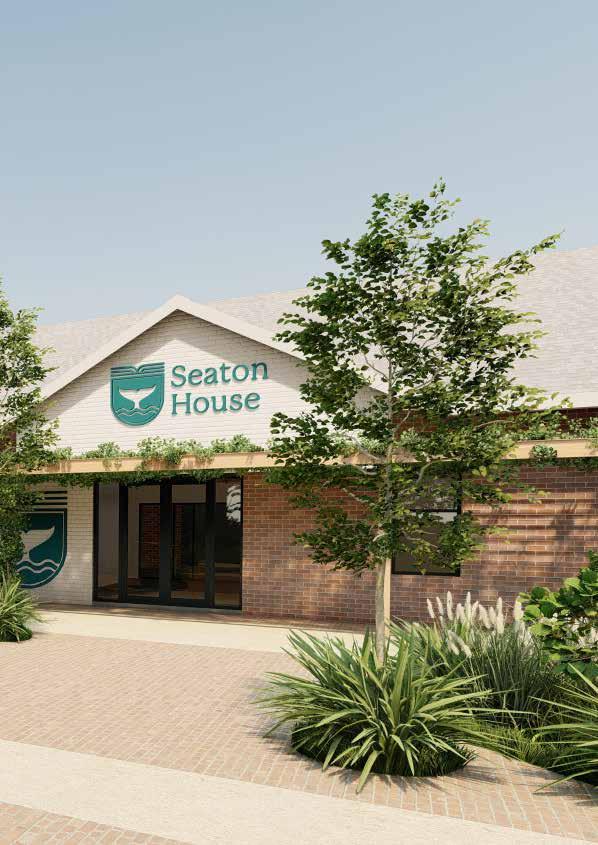
SEATON HOUSE SCHOOL BREAKS GROUND
Setting the Pace for a New Education
Precinct on the North Coast SA
Construction has officially commenced on the Seaton House campus, marking a defining moment for a school that has been carefully envisioned to serve families on KwaZulu-Natal’s rapidly growing North Coast. Earthworks are now underway within the Seaton Commercial precinct, just north of Salt Rock, with the school on track to open its doors to its first intake in January 2027.
Seaton House is an independent, co-educational school with a Christian foundation, offering a continuous educational journey from Grade 0000 through to Grade 12. Purpose-built as a biophilic campus, the school has been designed as a living classroom where academic rigour, character formation, sport, culture and a deep connection to nature are intentionally woven together.
Reflecting on the significance of breaking ground, Seaton House Board Chair and Project Lead Elwyn van den Aardweg said, “Seeing construction begin is a meaningful moment for all of us. We are deeply grateful to all who have believed in this vision and partnered with us to turn it into reality.” He added that the opportunity to build a school from the ground up carries both responsibility and hope.“ We are laying more than physical foundations. We are establishing a school rooted in faith, character and excellence, while also being thoughtful and responsive to the world our children are growing into.”
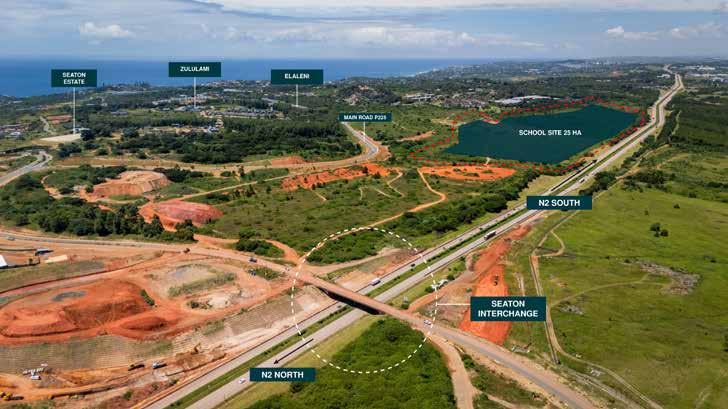
The 25-hectare campus is located on the seaward side of the N2 between Seaton Estate and Lalela Estate, within close reach of established and emerging residential communities including
Springvale, Brettenwood, Dunkirk, Elaleni and Zululami. Improved access via the upgraded P228 provincial road and the new N2 interchange, due for completion in 2026, will provide reliable connectivity for families across the region.
Designed to work with the natural landscape, the campus incorporates 12 hectares of protected wetlands, boardwalks and discovery trails, outdoor learning pods, sensory and food gardens, and a terraced amphitheatre. These spaces form an integral part of daily school life, encouraging curiosity, reflection and experiential learning in natural surroundings.
Phase 1 of construction is being delivered by Construction ID and will provide the core infrastructure required for the school’s opening. This includes an administration building, a 450-seat auditorium, junior and senior classroom blocks, and a central Main Square that defines the heart of the campus. Former polo fields are being repurposed into two rugby pitches, a cricket oval and a netball or multi-use court, ensuring that sport is embedded from the outset. Fundraising has already begun for future facilities, including a swimming pool and a synthetic hockey surface.
Speaking on behalf of the principal contractor, Construction ID Director Stuart Blacklaw said, “Seaton House represents a significant and meaningful project for us in KwaZulu-Natal. It is the kind of development that leaves a lasting legacy, not only through the quality of the build, but through the role it will play in the life of the region.” He added, “At a time when KwaZulu-Natal is seeing renewed momentum through major projects that draw confidence
and investment back to the province, it is a privilege to be involved in a school that contributes so directly to long-term community growth.”
Interest in Seaton House has been strong from the outset, with more than 475 families registering interest and over 170 formal applications already received for the opening grades, which will include Grade 0000 to Grade 6 and Grade 8. The school will add grades year by year until the full Grade 0000 to Grade 12 pathway is established.
Seaton House is the first development to break ground within the broader Seaton Commercial precinct, setting the tone for a mixed-use node that will also include retail, medical and office components currently in planning.
Commenting on the broader context, Geoff Perkins, Managing Director of Collins Residential, said, “We are excited to see Seaton House lead the way as the first phase of Seaton Commercial comes to life. Beginning with a school of this calibre speaks to the kind of place we are shaping here.”
He added, “Education anchors communities. A school like Seaton House doesn’t just serve families; it establishes permanence, attracts long-term investment and helps create a precinct where people want to live, work and belong.”
The professional team is led by architect Elserie Pretorius of TCRPV and landscape architect Bernice Rumble of Land Art Studio, supported by civil, structural, environmental and traffic consultants. Together, they have shaped a campus that is both highly functional and deeply responsive to its natural setting.
Beyond the classroom, Seaton House is expected to deliver broader community benefits, including local employment during construction, opportunities for community engagement and the protection and rewilding of ecological buffers. Communication with families will remain ongoing and relational, with regular construction updates, newsletters and termly forums forming part of the school’s commitment to partnership.
Construction is scheduled for completion by November 2026, allowing time for furniture installation, staff onboarding and operational readiness ahead of the school’s opening in January 2027. As the site continues to take shape, Seaton House is already emerging as a defining feature of the North Coast’s next chapter in education and community life.
RELCON POWER SYSTEMS LIMITED
Relcon Power Systems Ltd Marks 35 Years with ISO 9001:2015 Certification
Mr Mahesh Shah Founder and Managing Director
As Relcon Power Systems Limited marks 35 years since its founding, the milestone comes with an added layer of significance: the company has attained ISO 9001:2015 certification.
For a firm that has grown steadily from its early beginnings into a tier one electrical contractor in Kenya, the dual celebration is both symbolic and strategic. It speaks to longevity, resilience, and a deliberate commitment to quality-driven growth.
Founded in 1991 by Mr Mahesh Shah, Relcon Power Systems Limited has evolved into a respected name in electrical engineering and contracting. The company specialises in the design, supply, installation, testing and commissioning of electrical systems for all types of buildings and specialised installations. Over the years, its portfolio has expanded across commercial, hospitality, educational, industrial, residential and healthcare projects, reflecting both technical depth and market trust.
Today, the atmosphere within Relcon is one of pride and renewed energy. Management and staff alike describe a company that is more structured, more confident, and more ambitious than ever before. The ISO 9001:2015 certification, achieved through Bureau Veritas, is widely viewed not as an endpoint, but as a foundation for the next phase of growth.
A deliberate step towards international standards
For Monali Shah, Relcon’s Chief Financial Officer and the internal champion of the ISO certification process, the decision to pursue ISO 9001:2015 was both timely and necessary. She explains that the certification aligns directly with the company’s long-term vision.
“We want to grow more in our field, and we want to abide by international standards,” she says. “ISO 9001:2015 is an international certification, and getting it through Bureau Veritas, one of the most prominent certification bodies, was very important for us.”
Beyond compliance, the certification was seen as a tool for strengthening operational excellence and positioning the company for sustainable growth. According to Monali, ISO certification brings clear competitive advantages. “You can attract more clients because they know you are ISO certified. It gives you better compliance, efficiency and risk management. Most importantly, it enhances the goodwill and reputation of Relcon.”
While Relcon was already well known and respected within the industry, Monali views the certification as a step that elevates the company further. “It is just another start to our achievement,” she notes. “Many of our suppliers are already ISO certified, and we also wanted to be one of those suppliers to our clients who is ISO certified.”
Leading the process from within
Appointed by Managing Director Mahesh Shah to lead the ISO journey, Monali credits leadership support as a key success factor. “We are very lucky to have him as director,” she says. “He gives staff a free hand to work independently, but at the same time, his guidance made the whole process successful.”
The certification process itself was intensive and far-reaching. With the support of an ISO consultant, Relcon began by identifying the
"You can attract more clients because they know you are ISO certified. It gives you better compliance, efficiency and risk management. Most importantly, it enhances the goodwill and reputation of Relcon.”
Monali Shah Chief Financial Officer
documentation and systems required across departments. “Apart from finance, the most important departments were HR and the project management team – our engineers,” Monali explains. Site reports, progress documentation, client ledgers and historical tender records all had to be standardised and properly maintained.
Crucially, the process was not confined to management. All staff were sensitised through company-wide meetings involving the ISO consultant. “We had a full management review meeting, and after that we had an internal audit carried out in-house,” she says.
Balancing day-to-day operations with ISO requirements was not easy. “Our employees found it very involving,” Monali admits. “It was difficult managing regular work alongside ISO certification.” Even after certification, the work continues. “It’s a continuous process. The consultant comes every month to review and check if everything is in order.”
The outcome, however, has been transformative. “We are very different from before,” she says. “We discovered small glitches we were not aware of, especially in documentation. Now we have improved, and people are aware that we are ISO certified. It has come to the company’s advantage.”
Strengthening the business development engine
Few departments felt the immediate impact of ISO certification as directly as the Tenders Department within Relcon’s Business Development division. Everlyne Ayako Olewa, who joined the company in 2013, and Eric Munyithya, now in his tenth year at Relcon, have seen the organisation evolve significantly.
“Relcon has grown over the years, especially in terms of the projects we are able to undertake,” Everlyne observes. “Big projects like Amref University are ones we could not handle back then.”
Eric agrees, pointing to quality as a defining change. “We have really improved in terms of quality. When you do something well, it sells. We have grown and stuck to standards, and now we are very strict on that.”
Operating in an increasingly competitive market remains a challenge. “There are so many contractors coming in,” Everlyne notes. “Competition has really intensified, and there is a lot of fighting for jobs.”
ISO certification, however, has reshaped how the department works and competes. “It has given us a different direction,” Everlyne explains. “We now see responsibilities we never thought were ours, like following up with clients to understand why we were not selected.”
The certification process also introduced discipline and efficiency. “How we submit tenders, how we arrange documents, how efficient we are – all that has improved,” she says. “If you ask me for a tender
Eric Munyithya Tenders Department
Everlyne Olewa Tenders Department
we did in January, we can easily retrieve it. Everything is organised.”
Eric adds that the shift required an adjustment in mindset. “At first it was challenging because our work used to be less formal. Now it’s an evidence system. Every task must be documented.” Despite being time-consuming, the benefits are clear. “It has made our work easier and more efficient.”
A learning experience that builds confidence
Both Everlyne and Eric describe the ISO journey as eye-opening.
“When we first heard about ISO, it was completely new,” Everlyne recalls. “We started Googling to understand what it was. But once the consultant explained it, we realised it was very interesting.”
She believes the process has had a lasting personal impact. “It improves you as a person. Even if you go to another company, you feel you are working at a different level.”
Eric echoes this sentiment, admitting that understanding procedures and chains of command took time. “Once we learned, we saw it was a good thing. It even made our working easier.”
Their praise for Monali Shah’s leadership during the process is emphatic. “She was like the director of the whole process,”
“Now there is a lot of paperwork compared to before,” Imran explains. “There are checklists, daily proof that tasks are happening. It’s all part of quality control to make sure processes are systematic.”
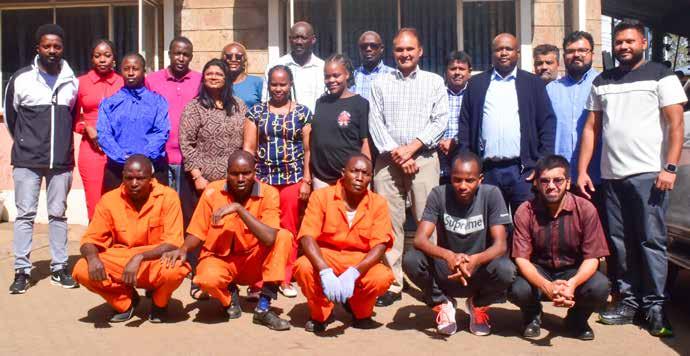
Part of the Relcon Power Systems' team pictured at the head office in Nairobi.
Everlyne says. “She was very supportive, kept us updated, and did a very good job. She was the link between the ISO company and the rest of us.”
They also highlight the role of Managing Director Mahesh Shah. “He kept reminding us we were not doing this just for the company, but for ourselves,” Everlyne recalls. “Even if you leave, Relcon remains ISO certified, but what you’ve learned goes with you.”
Quality control on the ground
For Imran Hamza, a Projects Supervisor who has been with Relcon for 16 years, the ISO certification has reinforced what he already values most: quality and accountability on site. Joining the company at just 17, Imran has grown professionally alongside Relcon. “Mr Mahesh is my first boss until today,” he says simply, underscoring a relationship built on trust.
Imran oversees all electrical works on Relcon’s projects, from wiring and fittings to overall execution. His current assignments include major developments such as 1870 West, a 30-storey residential apartment in Westlands. His role requires constant coordination with consultants, contractors and site foremen, alongside rigorous quality control.
“Now there is a lot of paperwork compared to before,” Imran explains. “There are checklists, daily proof that tasks are happening. It’s all part of quality control to make sure processes are systematic.”
Rather than viewing this as a burden, Imran sees structure as a strength. “We have templates for supervisors. You go to site, tick off what has been done, check quality, and document everything. It’s easy and clear.”
Balancing site work with ISO requirements was demanding. “It’s daily, so there is no shortcut,” he says. “You have to do the work and also make sure you are following standards.”
The pride that comes with certification is evident. “You are very proud to tell someone we are ISO certified,” Imran says with a smile. “It’s even on my business card. We expect to get more and more projects.”
Leadership and culture as differentiators
Across departments, one theme recurs consistently: leadership. Staff describe a management style that combines openness with decisiveness. “If you have a problem on site, you go direct to Mr Mahesh,” Imran explains. “You explain, he gives a solution, and you move on. There are no delays.”
This accessibility has fostered a culture of accountability and trust, enabling Relcon to adapt and improve continuously. As the company celebrates 35 years in business, that culture appears to be one of its greatest assets.
Looking ahead
ISO 9001:2015 certification places Relcon Power Systems Limited among a select group of contractors that have institutionalised quality management systems to international standards. The certification provides a platform for deeper market penetration, stronger client confidence and internal consistency. More importantly, it reflects a company that understands growth is not only about winning bigger projects, but about doing things right, every time. As Relcon looks to the future, its people, processes and leadership suggest a firm well positioned to build on its legacy – with quality firmly at the core.
The certification provides a platform for deeper market penetration, stronger client confidence and internal consistency.
Understanding ISO 9001:2015 and why it matters
ISO 9001:2015 is the internationally recognised standard for Quality Management Systems (QMS). It provides a structured framework that helps organisations consistently deliver high-quality products and services while continually improving their internal processes. Applicable to organisations of any size or sector, the standard places strong emphasis on leadership commitment, risk-based thinking and the Plan-Do-Check-Act (PDCA) cycle as a means of driving continual improvement.
For companies operating in technically demanding and risk-sensitive sectors such as electrical engineering and construction, ISO 9001:2015 serves as a benchmark for professionalism and reliability. It requires organisations to document processes, monitor performance, manage risks proactively and ensure accountability at every level of operation.
The benefits of certification are both internal and external. Internally, ISO 9001:2015 improves efficiency by streamlining workflows, reducing errors and minimising rework, ultimately saving time and costs. Externally, it enhances customer confidence by demonstrating the organisation’s ability to meet regulatory, contractual and client requirements consistently. It also strengthens corporate reputation and, increasingly, is a prerequisite for participation in major tenders and high-value projects.
For Relcon Power Systems Limited, achieving ISO 9001:2015 certification through Bureau Veritas represents a formal validation of systems and practices that have been built over decades. It signals to clients, consultants and partners that quality is not incidental, but embedded in the company’s DNA.
SOME OF THE PROJECTS IN RELCON POWER SYSTEMS' EXTENSIVE PORTFOLIO
SOME OF THE PROJECTS IN RELCON POWER SYSTEMS' EXTENSIVE PORTFOLIO
ROOFING SOLUTIONS IN KENYA
Choosing the right roofing product is a critical decision that affects a building’s durability, aesthetics and long-term maintenance costs. From cost and climate suitability to lifespan and installation quality, multiple factors come into play. We explore common roofing options and the key considerations guiding smart roofing choices in today’s market.
Roofing in Kenya has evolved far beyond the old debate of mabati versus tiles. Today’s market offers a wide range of roofing materials, driven by changing architectural tastes, climate considerations, urbanisation, and rising client expectations. From high-end residential developments in Nairobi to coastal resorts and rural homes, roofing choices are becoming more deliberate — and more technical.
At its core, a roof must do three things well: protect, last, and complement the building. How those needs are met depends largely on the material chosen.
Galvanised and Aluminium Roofing Sheets
Galvanised steel sheets - commonly referred to as mabati - remain the most widely used roofing material in Kenya. They are affordable, widely available, easy to install, and suitable for both rural and urban construction.
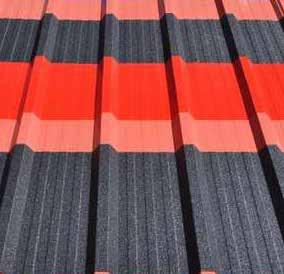
Aluminium sheets, including aluminium-zinc (Alu-Zinc), have gained popularity due to their superior resistance to corrosion and longer lifespan compared to ordinary galvanised steel. They are particularly useful in high-rainfall areas and coastal regions where corrosion is a serious concern.
That said, sheet roofing can be noisy during heavy rain and tends to absorb heat unless paired with proper insulation and ceiling systems.
Stone-Coated Steel Roofing
Stone-coated steel roofing has grown rapidly over the last decade, especially in middle- to high-income residential developments. These are steel sheets coated with stone granules, giving them the appearance of tiles while retaining the strength of metal.
They are lightweight, durable, aesthetically appealing, and come in profiles that mimic clay tiles, shingles, or shake roofs. Their interlocking systems improve wind resistance — a big plus in open or elevated areas.
The main drawback is cost. Stone-coated roofing is significantly more expensive upfront, though many developers justify it through durability and low maintenance over time.
Asphalt Shingles
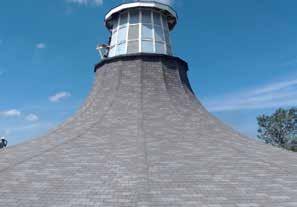
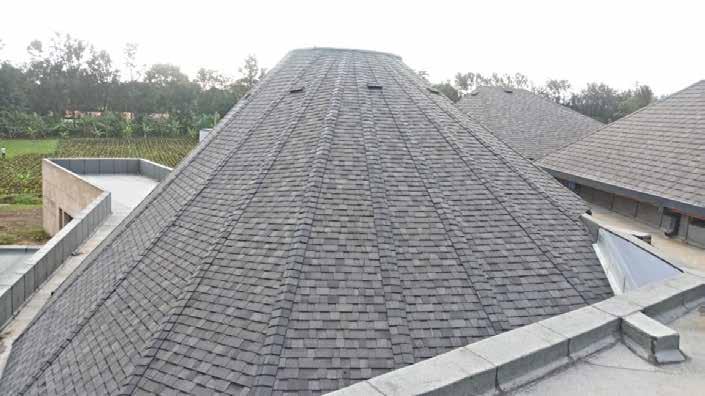
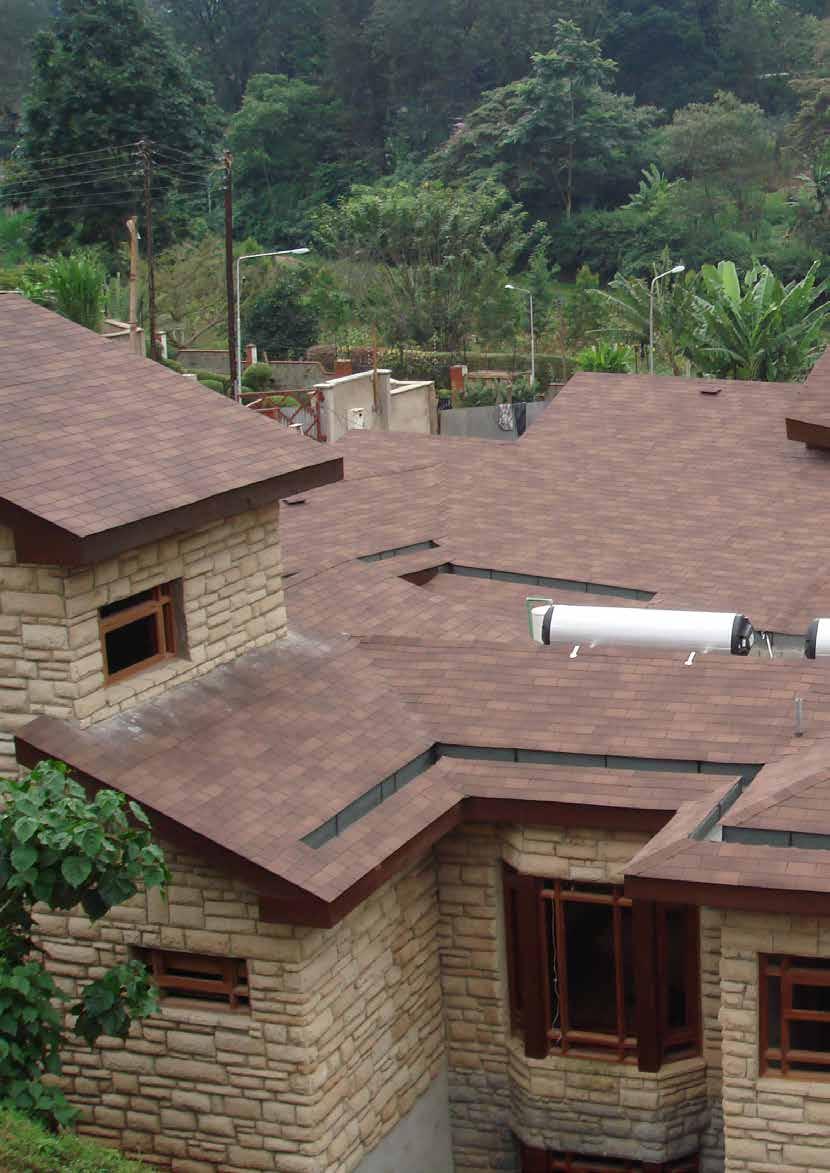
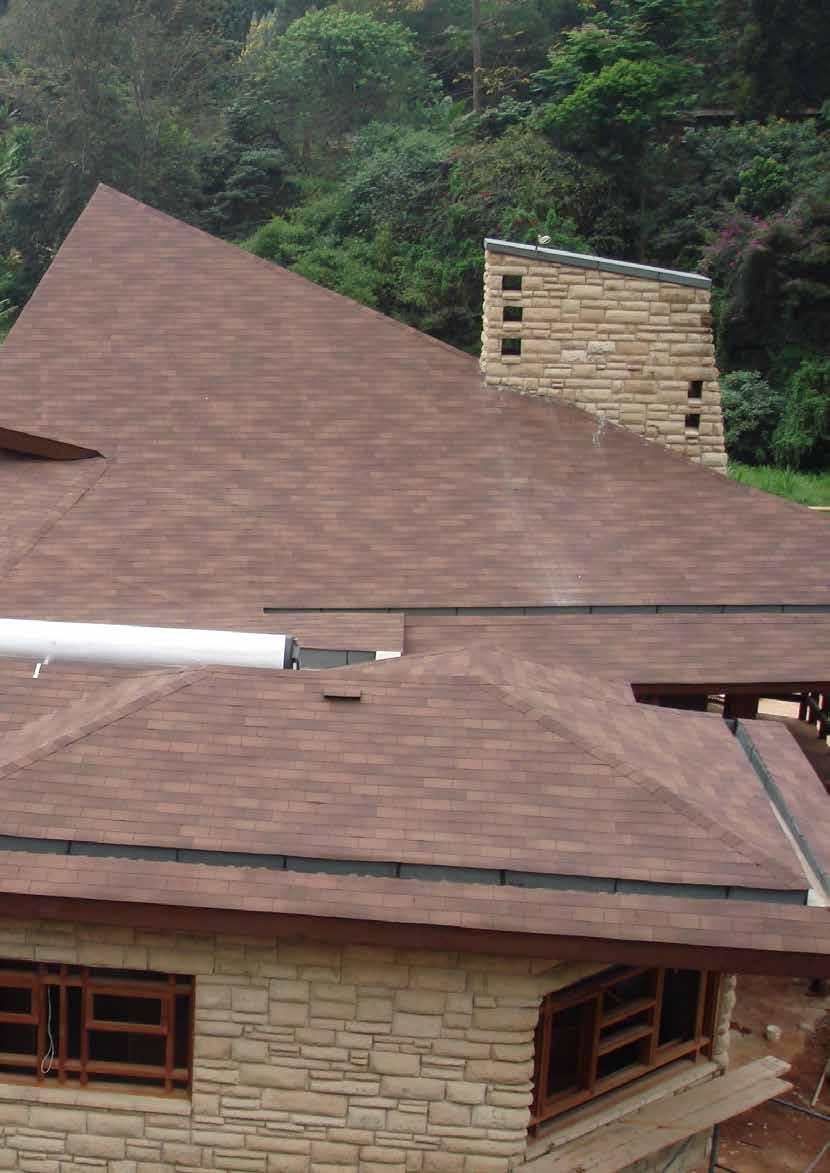
Asphalt shingles are still relatively niche in Kenya but are steadily gaining ground. They offer clean aesthetics, good waterproofing, and design flexibility.
Shingles work best on steeply pitched roofs and require skilled installation, including proper underlay systems. When poorly installed, they can fail prematurely. In hot regions, lower-quality shingles may also deteriorate faster under intense UV exposure.
Clay Roofing Tiles
Clay tiles remain a premium and traditional option, particularly in high-end homes, hotels, and heritage-style architecture. They are durable, fire-resistant, and provide excellent thermal insulation.
However, clay tiles are heavy and require strong roof structures, increasing structural costs. Breakage during transport and installation is also common, making wastage a real consideration. Despite this, their longevity and classic appearance keep them in demand.
Concrete Roofing Tiles
Concrete tiles are a more affordable alternative to clay tiles and are widely used in urban housing estates. They are strong, uniform, and available in various colours and profiles.
Their main downside is weight, which again demands reinforced roof structures. Poor-quality concrete tiles may also fade or absorb water if not properly sealed.
Makuti and Thatched Roofing
Makuti roofing — made from dried palm leaves — is common along the Kenyan coast and in eco-lodges, resorts, and cultural architecture. It offers excellent thermal insulation and blends naturally with tropical environments.
However, makuti requires regular maintenance, has a
shorter lifespan, and is highly vulnerable to fire if not treated. It is rarely used in conventional residential construction.
However, many developers may not be aware of HDPE fireproof artificial thatch roofing. This makuti provides an excellent option as it gives the same thatch appearance but is not susceptible to fire.
Emerging and Complementary Solutions
Other roofing-related materials gaining traction include:
• Fibre cement sheets for industrial and low-cost housing
• Polycarbonate sheets for daylight roofing and verandas
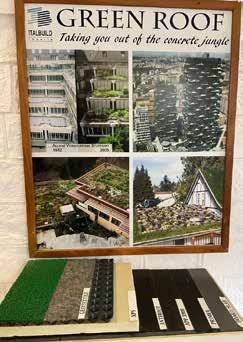
• Green roofing systems (still very limited but growing in eco-conscious developments)
• Solar-integrated roofing, where panels are installed as part of the roof system rather than add-ons
Factors Influencing Choice of Roofing Materials in Kenya
Choosing a roofing material in Kenya is rarely just about aesthetics. Several practical factors influence what works — and what fails — on real projects.
Climate and Location
Kenya’s climate varies dramatically. Coastal humidity, highland cold, arid heat, and heavy rainfall zones all place different demands on roofing materials. What works well in Nairobi may fail quickly in Mombasa or Lodwar. Corrosion resistance, thermal performance, and wind resistance should always be evaluated against the specific site conditions.
Structural Design and Load Capacity
Some materials, like clay and concrete tiles, require heavier roof trusses and stronger wall support. Developers who ignore this often end up with sagging roofs, cracks, or structural stress over time.
Roofing should never be selected in isolation - it must align with the structural engineer’s design.
Cost - Short Term vs Long Term
One of the most common mistakes in Kenyan construction is choosing roofing materials based purely on initial cost. Cheap mabati, low-gauge sheets, poorly coated stonecoated tiles, and imitation products may look acceptable on day one but fail within a few years. Corrosion, leaks, fading, and wind damage then lead to costly repairs or full replacement.
A roof is not a finishing you casually replace. Labour, access, and disruption make re-roofing expensive.
fireproof artificial thatch roofing provides an excellent option as it gives the same thatch appearance but is not susceptible to fire. (Image taken at
Installation Quality
Even the best roofing material can fail if poorly installed. Inadequate overlaps, wrong fasteners, lack of underlay, and poor flashing details are common problems. Skilled installers are just as important as material quality.
Unfortunately, clients often pay for premium materials but cut costs on labour — a false economy.
Aesthetics and Property Value
Roofing plays a huge role in curb appeal and resale value. Stone-coated steel, tiles, and shingles generally enhance property value more than basic sheet roofing. For developers, this can significantly influence buyer perception and pricing.
The Pitfall of “Cheap is Good Enough”
In construction, cheap rarely stays cheap. Inferior roofing materials often result in leaks, rust, noise, heat problems, and frequent maintenance. Over a 20–30 year building lifespan, quality roofing almost always costs less than repeated fixes and replacements.
A roof protects every other investment below it — finishes, ceilings, electricals, furniture, and even structural elements. Cutting corners here is one of the most expensive mistakes a contractor or homeowner can make.
HDPE
Scala Enterprises Ltd, Nairobi, Kenya.)
Profile:
company of Italbuild Imports Ltd in the Italbuild Group.
Scala Enterprise offers a wide range of products and services, focusing on roofing and waterproofing, services that were initially done by Italbuild Imports Ltd but transitioned to Scala over time Although the company was only formed in 2008, most of its staff have been in the roofing business for decades.
For roofing and waterproofing, most materials are imported, including advanced products from Italy, Austria, China, and Egypt, as Kenya currently lacks local manufacturers for these specialized goods
Scala’s competitive edge lies in its highly trained and skilled staff. "The Directors and Supervisors play a significant role in the performance of Scala," Mr. Veneziani asserts
"Our staff undergoe extensive training both locally and abroad, ensuring that every project is meticulously handled."
The founder, Mr. Veneziani, highlights the importance of quality: "the right materials and the right people will do the work."
In roofing, we propose:
1) Bituminous shingles from Tegola Canadese Srl of Vittorio Veneto, Italy, for which we are the sole distributors and installers in East Africa. The most exciting roof for your residential projects and shopping malls.
2) Suntile stone-coated steel tiles, with specialized installation techniques depending on the roof’s shape Suitable for residential and commercial.
3) A large range of roofing / waterproofing solutions for flat concrete roofs, terraces etc
4) As a member of the Kenya Green Building Society, Scala has a deep specialization in green roofs, with several prestigious projects in Kenya
Tegola Canadese Roofing Shingles.
Tegola Canadese Roofing Shingles.
Karen Road, Between The Stables & The Golden Ivy, Karen Nairobi.
Synthetic Makuti Roofing
Cost Quality? versus
The Folly of Shortcuts in Roofing Materials Selection
Kenya’s roofing market is often driven by pricesensitive buying, sometimes at a high longterm cost. In this interview, SAMWEL MUHINGO, Director of HJM CRYSTAL VENTURES LIMITED and a franchisee of Mabati Rolling Mills, shares insights on roof quality, common causes of premature failure, and what clients should consider when selecting roofing materials.
CR: In the Kenyan market, price often drives roofing decisions. From your experience, how widespread is this “price-first” mindset, and what risks does it create for homeowners and developers?
Samwel: It is true that some customers are driven primarily by price, although there are also many who seek value. Price-driven purchases often come with consequences because some of the cheaper products in the market are highly compromised in terms of quality. In the long term, this translates into higher maintenance costs or even complete roof replacement.
We frequently see roofs fading, rusting, or deteriorating within just a few years. What are the main technical reasons behind this premature failure?
There are several reasons, but the key drivers include:
• Rusting due to poorly manufactured roofing materials that lack the required aluminium-zinc coating thickness.
• Wrong material choices for specific locations or applications. For example, coastal areas in Kenya require higher rust protection than places like Nairobi, so specifications must match the region. Highly corrosive environments also demand the right roofing materials.
• Poor paint quality and manufacturing processes, especially weak adhesive properties that eventually lead to fading.
• Importation of raw materials that are not tropicalised; when exposed to intense UV radiation, these tend to fade quickly.
Manufacturers must maintain thorough quality assurance processes and import raw materials suited to our regional weather conditions.
How can contractors and homeowners distinguish between highquality roofing materials and cheaper look-alike products at the point of purchase?
Some quality indicators are intrinsic, and sellers should clearly explain them to customers. Mabati Rolling Mills, for example, has years of demonstrable product performance, which gives the company confidence
Trust suppliers who have been in the market for a long time, and always engage professionals for advice before making a purchase decision.
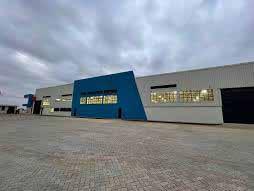
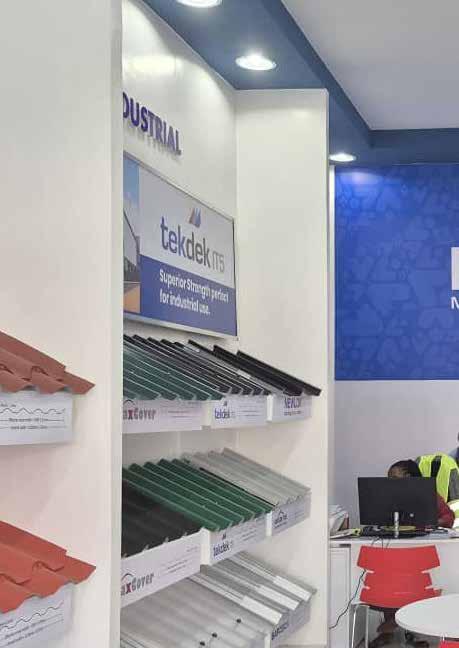
A Mabati Rolling Mills Showroom in Kitengela, Kajiado County
to issue documented warranties. While meeting KEBS standards is mandatory, enforcement is still not as strong as it should be. Unfortunately, some businesses exploit this gap by selling poor-quality roofing materials to unsuspecting customers.
To what extent does poor installation - as opposed to material quality - contribute to early roof failure in Kenya?
Installation is a critical aspect of any building. Poor workmanship can lead to leakages and damage to interior finishes, and the roof will not have a neat appearance. As the crown jewel of the home, the roof deserves proper installation. Customers are encouraged to use certified installers. Mabati Rolling Mills frequently trains fundis across the country to build the right competencies and skills.
What long-term cost implications should clients consider when they opt for cheaper roofing products instead of certified premium products?
The costs can be significant. They include full roof replacement, repainting faded roofs that lose their original appearance, and generally shorter lifespans - especially where rusting occurs.
There is a perception that all mabati products are essentially the same. What key manufacturing or coating differences actually determine durability and performance?
Mabati sio mabati (not every mabati product is the same). Aluminium-zinc coating thickness, colour technology, and the correct sheet gauge all play a major role in determining product durability and performance.
What role should architects, engineers, quantity surveyors and contractors play in guiding clients away from substandard roofing choices?
The most important step is continuous training and information for specifiers, including fundis, so they clearly understand the differences between high-quality products and inferior alternatives in the market. This is an initiative that Mabati Rolling Mills undertakes frequently.
From your perspective at Mabati Rolling Mills, how has the market evolved in terms of awareness about roofing quality and lifecycle value?
Recently, the market has seen many new entrants, and it has been a learning curve for customers. We are already seeing many clients coming to the showroom to replace what they once believed was good mabati but which eventually faded because it was simply the most affordable option at the time.
What specific advice would you give to a Kenyan homeowner or developer tempted to save money by buying the cheapest roofing option available?
Trust suppliers who have been in the market for a long time, and always engage professionals for advice before making a purchase decision.
Looking ahead, what industry or regulatory measures could help curb the influx and use of substandard roofing materials in Kenya?
Market leaders and industry players need to work closely with KEBS and actively report non-compliance. At the same time, the regulator must be equipped with the right tools for effective market surveillance to identify violations and shut down manufacturers and sellers of substandard roofing materials.
DISCLAIMER: The views expressed in this interview are solely those of Mr Samwel Muhingo and do not necessarily reflect the views of Mabati Rolling Mills Ltd.
"Market leaders and industry players need to work closely with KEBS and actively report non-compliance. At the same time, the regulator must be equipped with the right tools for effective market surveillance to identify violations and shut down manufacturers and sellers of substandard roofing materials."
CONSTRUCTION
What changed in in 2025, and how leaders should prepare for 2026
“The technology is ready. The real question for 2026 is whether leadership and skills are ready to use it at scale”, writes Chris Smith, Senior Vice President for MEA and APAC, RIB Software
Construction executives are asking whether their digital investments are changing how projects are won, built, and operated. Construction trends this year highlighted the importance of decision-makers to translate artificial intelligence, digital twins, and modular construction into practical workflows that deliver value on the very first project.
The year construction became a data industry
The defining shift in construction last year was the move from analogue monitoring and paper trails to fully digital project information environments.
Sensors and IoT devices now capture site data that once lived on clipboards. Central data environments have grown from document repositories into the primary workspace where drawings and even design authoring take place. The same data that keeps a project on track during construction now feeds into facility management systems.
This shifts the focus from individual systems to questions of data standards, governance, and skills. Executives who treat digital as a software procurement issue will struggle in 2026. Those who treat it as a strategy for how project and asset data flows across the lifecycle will be better positioned to comply with ESG requirements and to compete on predictability.
Construction 4.0 leaves the hype cycle
The second major shift is that “Construction 4.0” has become part of the budget. A recent global strategic report values the Construction 4.0 market at $16.7 billion in 2024, with projections of $42.2 billion by 2030. That growth is driven directly by automation, robotics, and smart-site technologies rather than generic IT spending.
In practice, technologies such as reality capture, laser scanning, and 360-degree cameras have become standard on complex projects. This provides training data for computer vision systems that detect clashes, safety risks, and quality issues. Early site
robotics has moved from pilot curiosity to serious investigation. Generative artificial intelligence is the most visible layer of this change. In design offices, automated model generation and generative design are allowing teams to test far more scenarios than traditional workflows ever allowed. In the back office, agents are starting to support tasks such as tender analysis, contract review, and schedule optimisation.
However, the winners in 2026 will not be the organisations with the longest list of AI tools. They will be the ones who are ruthless about linking AI to specific value levers such as bid accuracy, time to site readiness, change order recovery, and cash flow predictability.
Modular construction becomes a capacity strategy
Modular and industrialised buildings have also crossed an important threshold. The global modular construction market is estimated at $91.25 billion this year and is expected to reach $122.24 billion by 2030.
In Africa, modular approaches are increasingly tied to structural capacity constraints across housing, energy, and social infrastructure. From a software perspective, modular is unforgiving. It demands a level of supply chain visibility that paper-based processes cannot support. It also rewards leaders who invest in
standardised building systems and who treat data from previous projects as a reusable asset.
Where to in 2026
Three leadership disciplines are key for this year.
First, digital value must be made explicit. Every investment in AI, automation, dashboards, or digital twins must be linked to specific metrics at the project and portfolio levels.
Second, treat competencies as seriously as contracts. The industry has no shortage of technology, but it has a shortage of people who know how to drive it. Structured pilot projects, supported by partners who understand both construction and software, are proving more effective than grand, top-down roll-outs.
Third, design for an industrialised future. Whether or not every project is modular, the direction of travel is clear. Off-site manufacture, repeatable assemblies, and data-rich models are the only realistic way to deliver more with fewer people while meeting stricter ESG expectations.
The industry has reached a point where leaders can no longer claim that the technology is not ready. It is. The question for 2026 is whether leadership, governance, and skills are ready to use it at the speed and scale that competitiveness now demands.
Does water management need artificial intelligence?
AI and digital systems make water smarter and more efficient
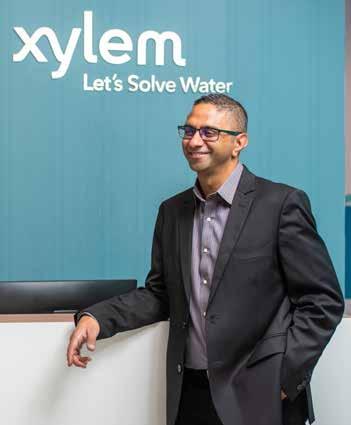
BY CHETAN MISTRY, STRATEGY AND MARKETING MANAGER, XYLEM AFRICA
The right combination of data and algorithms can produce astounding improvements in efficiency, speed, and oversight. While many water utilities already use digital monitoring and analytics to manage operations, artificial intelligence builds on these capabilities by identifying patterns in large datasets, enabling predictive insights, and supporting more informed decisionmaking. Utility managers are taking note, with around 15% of large water utilities across the world using artificial intelligence, set to reach 30% by 2026, according to the Xylem Water Technology Trends 2025 report. By 2035, three-quarters of water utilities will use some form of AI.
With aging infrastructure, climate variability, and rising water demand placing increasing pressure on water systems, utilities are seeking more resilient and adaptive ways to manage operations. Data-driven and AI-enabled tools are emerging as part of this broader digital water transformation.
Experts have good reason to be optimistic about AI adoption in the sector. Already, digital water management systems are producing
excellent results. For example, Yorkshire Water Services in the UK uses Xylem Vue digital services reported a reduction in visible leaks by 57% while still reducing annual distribution main repairs by 30%. Similar digital and AI-driven capabilities are also expanding into industrial water and wastewater operations, where predictive monitoring and process optimisation help improve compliance, reliability, and resource efficiency.
Such outcomes show the hidden capacity at every water management site, says Chetan Mistry, Strategy and Marketing Manager at Xylem Africa, WSS.
"Water distribution and treatment sites produce far more data than they use. But that data gets neglected because of capacity. It would take an enormous amount of time to organise and study the data for patterns and insights. Digital and AI systems are solving those problems. Digital systems record and share accurate and reliable data, which AI systems use to rapidly produce planning information, automation, and other improvements."
Water management sites utilise smart data and AI services in several ways, including:
Real-time process adjustment
Water treatment is at its best when the system can maintain consistency, a laborious task since water flows keep changing. Intelligent water systems add intelligence that adjusts processes such as reagent dosing and treatment line control in real time. Site operators define specific scenarios that automatically adjust operations using information from external technologies such as water management applications and business intelligence systems.
Predictive demand and optimisation
AI systems predict conditions to manage demand and optimisation. Predictive maintenance systems rely on predictive analytics and AI-driven models, which use performance data and systems such as digital twins to anticipate maintenance conditions for equipment. Similar technologies have expanded to help water managers forecast demand, such as consumption peaks. They also optimise energy consumption by adjusting operations based on demand.
Advanced metering infrastructure
Smart meters have radically improved water distribution's performance and efficiency, using digital technologies to gauge consumption and feed reliable data into water planning systems. Advanced metering infrastructure (AMI) is the next step in that journey. AMI performs remote reading and integrates and processes information into AI systems, vastly reducing information intervals towards almost real-time monitoring and feedback.
Decision support systems
Water utilities are using decision support systems (DSS) to inform real-time, medium, and long-term planning and management. DSS tools use AI to analyse large datasets and information from different disciplines, including data from hydrological and meteorological stations, expert knowledge, and local inputs. This analysis models different situations, from simulating water bodies to predicting usage patterns.
While these and other data-driven improvements sound very attractive, utility and infrastructure managers are not always sure where to start. Successful deployment depends on data quality, integration with existing infrastructure, and organisational readiness. Deploying digitisation can become complicated, which is why leading water technology OEMs
develop and maintain extensive software platforms designed to meet water utility challenges.
"Companies like Xylem invest substantially in developing water management platforms that are secure, simple to deploy, and make sure the data remain with the utility," says Mistry. "They create interactive and customisable dashboards and reports, which authorised staff and contractors can access on-site through smart devices and computers."
The real advantage of using data-driven water management platforms is not just in the new features. It enables utilities to leverage information they already have: "Data that does nothing only takes up space. But data made useful through cloudbased management software opens additional dimensions for planning and predictive actions such as maintenance."
Chetan Mistry, Strategy and Marketing Manager at Xylem Africa