Rockport Commercial Vehicles
HEADLINE: ROCKPORT COMMERCIAL VEH
BUILT FOR WORK AND READY TO SCALE
Rockport Commercial Vehicles combines focused divisional leadership, a broad product portfolio and the resources of Forest River to serve dealers, fleets and trades with dependable commercial vehicles. Written by Dawn Killough Produced by Oscar Orozco
2 I rockporttrucks.com
Rockport Commercial Vehicles
HICLES :
rockporttrucks.com I 3
Rockport Commercial Vehicles
Every commercial truck begins as a promise. A bare chassis represents potential, but it does not become useful until it is shaped around the work its owner must perform. For a delivery fleet, that may mean a low-entry body designed for repeated stops. For a service contractor, it may mean organized exterior compartments and enough interior height to stand upright. For a food distributor, it may require insulated, multi-temperature storage. Rockport Commercial Vehicles operates in the space between that factory-built chassis and the finished tool a business relies on every day. Founded in Elkhart, Indiana, in 2002, Rockport manufactures van bodies, enclosed service bodies, enclosed service trailers and specialized commercial vehicles. The company added a second manufacturing operation in Ocilla, Georgia, in 2015, extending its reach
4 I rockporttrucks.com
while building on the manufacturing resources of its parent company, Forest River, Inc., a Berkshire Hathaway company. Today, Rockport supports a dealer-based sales network with a range of standard and highly configurable products built on chassis from Ford, Chevrolet, GMC, Ram and other major manufacturers. The scale is significant, but General Manager
Rockport Commercial Vehicles
Caleb Pontius describes a business that remains close to its products, people and customers. Rockport’s corporate structure gives the division access to centralized accounting, marketing, human resources and information technology. At the divisional level, however, Pontius and his team retain direct responsibility for purchasing, production hiring, engineering, sales and day-to-day operating performance. That balance allows Rockport to draw on the resources of a large organization without surrendering the speed and accountability of a focused manufacturing business.
A general manager close to the work Pontius brought a long commercial-truck background to Rockport. His career began with
Enterprise Rent-A-Car’s management training program before moving into commercial vehicles, fleet development, sales and custom vehicle applications. He also spent time with Boss Industries, a manufacturer of power take-off air compressors and related worktruck equipment, before returning to the commercial body sector. He joined Rockport for the opportunity to lead the division and is approaching six years as general manager. “A day in the life is really whatever that day brings,” Pontius said. He carries full profit-and-loss responsibility and oversees leaders responsible for customer service, engineering, purchasing, production and sales. His sales background keeps him closely involved with dealers and customers, while his broader mandate requires him to ensure that the business runs efficiently across two manufacturing locations.
rockporttrucks.com I 5
Rockport Commercial Vehicles
6 I rockporttrucks.com
Rockport Commercial Vehicles That combination of commercial awareness and operating discipline matters in a business where production schedules depend on raw-material costs, chassis availability, transportation and customer demand. Pontius is not removed from those variables. Capital planning, partner management, financial outlook and sales activity all intersect in his role, and each can affect how quickly Rockport converts an incoming chassis into a finished work vehicle.
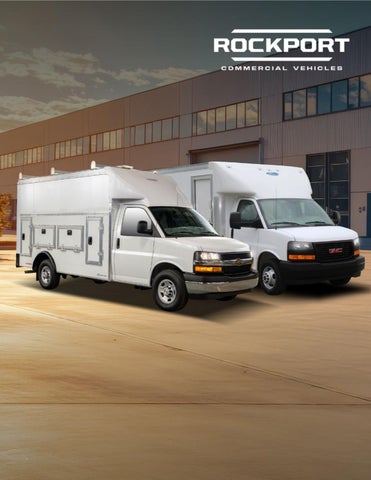
A product for the way the customer works Rockport’s portfolio reflects a simple reality: commercial users do not all move the same cargo or perform the same work. The company’s standard Rockport van body serves freight, moving, logistics and general commercial applications. Its construction choices include aluminum or fiberglassreinforced plywood sidewalls, multiple roof and flooring configurations, cargo-control systems, ramps, liftgates and a wide range of door arrangements. Cutaway configurations include a set-back bulkhead intended to preserve driver-seat travel and comfort. Cargoport addresses operators who make frequent stops and value easy entry. Its low floor height, flexible side and rear door configurations, and available shelving and cargo-control packages make it suitable for multi-stop delivery and other applications where employees repeatedly enter and exit the vehicle. Parcelport was developed from feedback
gathered from parcel-delivery operators. Its design includes a lowered rear deck, a fiberglass wind fairing, rubberized flooring, a translucent roof and available shelving packages. Those features support the highfrequency movement, visibility and traction needs of final-mile delivery work. Workport functions as an enclosed mobile workshop. A stand-up interior, exterioraccessible compartments, available power locks, integrated rear access ladders, shelving, lighting and power options give technicians a secure and organized environment for tools and materials. It is designed for the contractor or service professional who needs more than cargo capacity. The body itself becomes part of the work process. Rockport also manufactures refrigerated bodies for cold, frozen and ambient-temperature applications. Aluminum construction, injected polyurethane foam insulation, an extruded aluminum floor and a seamless foodsafe interior coating support demanding temperature-controlled operations. Beyond its principal product lines, the company’s Special Service Vehicles group develops custom truck and trailer interiors that combine electrical, fabrication and cosmetic options around a customer’s specific use. That breadth is supported by an extensive range of chassis configurations. Rockport maintains cutaway inventory from Ford, Chevrolet, GMC and Ram and can build on major cab-chassis brands when engineering and regulatory requirements are satisfied. The company does not sell directly to end users. Its vehicles reach the market through commercial
rockporttrucks.com I 7
Rockport Commercial Vehicles
8 I rockporttrucks.com
Rockport Commercial Vehicles truck dealers, making dealer relationships, week,” he said. That consistency also supports chassis access and production reliability central recruitment and retention. Northern Indiana to the business model. has a deep manufacturing workforce shaped by decades of RV, boat, trailer and vehicle Stability in an unstable production. Rockport can often find employees market who already understand fabrication and assembly work, reducing the training burden Commercial body manufacturing is exposed that manufacturers face in less concentrated to cost and supply pressures long before a markets. finished truck reaches a dealer. Steel and aluminum prices can move quickly. Fuel costs Attendance and reliability can still be influence inbound and outbound transportation. challenges, and Rockport does not claim Most importantly, body manufacturers depend immunity from broader workforce changes. on major automotive manufacturers for chassis. Its advantage is the combination of skilled When Ford, General Motors or another regional labor and a business with relatively original equipment manufacturer encounters dependable schedules. Pontius described a constraint, that disruption can limit what an turnover as imperfect but comparatively good, upfitter can build regardless of demand for the a practical result of offering employees stable finished vehicle. work in a familiar manufacturing environment. Pontius said cost variance remains a continuing challenge because Rockport wants to treat dealers and customers fairly while managing changes it cannot control. Maintaining steady pricing becomes difficult when material, delivery and chassis costs shift at different times. The demand profile for commercial trucks provides a measure of stability. Businesses still need to deliver products, maintain buildings and infrastructure, and send technicians into the field through changing economic cycles. Pontius contrasted that consistent need with the sharper peaks and valleys often seen in discretionary products. Rockport’s production is not immune to economic conditions, but it tends to move within a steadier band. “It is very rare we are not working five days a
Forest river scale with divisional focus Rockport’s position within Forest River changes what the division can do. Financial strength allows the company to carry a larger chassis inventory than many independent manufacturers could reasonably support. When chassis are scarce, inventory is more than a balance-sheet item. It directly influences whether a dealer can receive a completed vehicle in weeks or wait through an uncertain production cycle. The benefit extends beyond capital. Forest River’s manufacturing network purchases large volumes of steel, aluminum and other materials. Rockport can participate in that purchasing power and draw on established
rockporttrucks.com I 9
Rockport Commercial Vehicles part numbers, supplier knowledge and operating experience from sister divisions. Pontius described a network where another division may already have solved a problem Rockport is beginning to address. Rockport has used that network deliberately when expanding. Its Georgia operation was established directly across from a sister cargotrailer facility. During the startup, Rockport could draw on experienced management, share selected tools and obtain material support when necessary. Similar proximity to other Forest River operations gives divisions outside northern Indiana access to people and resources that would otherwise be far away. Pontius was careful to distinguish operational leverage from product quality. A cargo trailer and a commercial truck body serve different markets and follow different standards. Locating plants near sister facilities does not automatically make a Rockport body better. It does, however, give a new or expanding operation access to experienced manufacturing leadership, labor knowledge, equipment and occasional material support. Those resources help a plant establish stable processes more quickly. The company’s recent facility investments show how it is preparing for future demand. Pontius said Rockport’s Indiana and Georgia operations moved into larger facilities in recent years, doubling manufacturing square footage at both locations. Each facility now has two independent assembly lines. At the time of the interview, he estimated that Rockport was using roughly 40 percent of available capacity in Georgia and approximately 60 percent in
10 I rockporttrucks.com
Indiana. That leaves meaningful room for growth without requiring the company to begin another major expansion before accepting additional volume.
Scale measured in people and production Pontius placed Rockport’s combined workforce at approximately 200 employees. Depending on economic conditions and chassis availability, the two facilities produce an estimated 6,000 to 7,500 units annually. Those numbers describe a high-volume operation, but they also reveal why consistency matters. Thousands of vehicles must move through engineering, purchasing, fabrication, assembly, inspection and delivery while accommodating different chassis, body dimensions and customer options. Rockport’s answer is not to eliminate choice. The company standardizes the processes that must be repeatable while maintaining flexibility where the customer needs it. Product families provide a defined engineering base, and available door systems, shelving, flooring, cargo control, lighting, power, liftgate and access options allow each vehicle to be adapted without treating every order as an entirely new design. This approach also supports the dealer network. Dealers need enough flexibility to solve an end user’s problem, but they also need reliable lead times, parts support and warranty responsibility. Rockport’s website emphasizes quick delivery, understanding customer needs, flexibility and quality as
Rockport Commercial Vehicles
its core market advantages. Its inventory of cutaway chassis and factory replacement parts gives those promises an operational foundation.
Safety and quality as daily practice Rockport has achieved Member Verification Program status through NTEA, the work truck industry’s trade association. The program recognizes manufacturers and distributors that demonstrate defined business practices and an understanding of applicable regulations, safety and quality requirements. Rockport has participated in NTEA as a manufacturer member since 2009.
Pontius views that status as the result of operating systems rather than a badge added after the fact. Forest River maintains corporate safety programs, and each division adapts those expectations to its own equipment and processes. Rockport has formal safety and quality plans, documented operating procedures and training requirements for employees who use manufacturing equipment. The company’s daily morning meetings make those systems immediate. Teams review concerns from the previous day, corrective actions and conditions employees should watch. Forest River also shares safety bulletins across its manufacturing network. When a division experiences a serious incident or near miss, the corporate safety team communicates what happened and how other operations can
rockporttrucks.com I 11
Rockport Commercial Vehicles
prevent a similar event. Rockport’s leaders can A commercial vehicle manufacturer depends then discuss that information with employees at on far more than its own production floor. the start of the shift. Materials, components, specialty systems, logistics and staffing support all influence the Quality follows the same principle of controlled finished product. Rockport evaluates those improvement. Commercial bodies may not relationships with an emphasis on stability, require constant reinvention, but the methods technical validation and mutual economic used to build them cannot become static. health. When Rockport identifies a safer or more reliable way to assemble a vehicle, it can “We want both companies to excel and to update the standard and train the workforce make money,” Pontius said. “We need healthy accordingly. The discipline lies in making the partners.” The test is whether a supplier can improvement repeatable across shifts, products remain dependable over time. As he put it, and facilities. Rockport asks whether a company can be a partner for 10 years rather than six months. Partners chosen for the That distinction is especially relevant around long term Elkhart, where suppliers may serve commercial
12 I rockporttrucks.com
Rockport Commercial Vehicles vehicles alongside RV and boat manufacturers. When discretionary markets are booming, their volume can command a supplier’s attention. When those markets slow, stable commercialtruck business becomes more attractive. Rockport seeks partners that value its consistent demand in both conditions, limiting the swings in service and responsiveness that can occur when priorities follow the hottest market. Price remains important, but savings alone do not justify a structural change. If a proposed component affects the vehicle body or another critical system, Rockport expects testing, compatibility information and engineering review. A lower price has little value if the change creates warranty problems, disrupts production or weakens the finished product. That validation process also gives
qualified suppliers a clearer path to grow with Rockport because expectations are based on performance rather than the lowest immediate quote.
Industry connections and local opportunity NTEA Work Truck Week gives Rockport a concentrated view of the market. Dealers, fleets, chassis manufacturers, equipment providers and body builders gather in one place, allowing the company to maintain existing relationships while seeing new products and customer needs. Pontius has attended the event across multiple employers and values its range. If a work-truck solution cannot be found there, he observed, it may be difficult to find anywhere.
rockporttrucks.com I 13
Rockport Commercial Vehicles He noted that attendance during the year discussed in the interview appeared lighter than in some previous years, likely because CONEXPO-CON/AGG in Las Vegas fell close to Work Truck Week on the calendar. Companies often limit how many major events employees can attend, and exhibitors serving both markets face demanding back-to-back schedules. Even with that overlap, Rockport reported productive conversations with dealers and prospective customers.
to local commercial markets. Its product range addresses delivery, service, freight, temperature-controlled and specialized applications. Its chassis inventory helps reduce a critical source of delay. Its two expanded plants provide capacity, and Forest River supplies financial strength, purchasing leverage and a broad manufacturing knowledge base.
The division’s greatest advantage may be how those resources are organized. Corporate Community engagement operates through both functions handle work that benefits from Forest River and the Rockport division. Forest scale, while Pontius and his leadership team River coordinates much of the organization’s remain responsible for the decisions closest charitable giving, an approach that helps to customers and production. Suppliers are manage the volume of requests generated evaluated for durability rather than a temporary across a workforce of tens of thousands. At discount. Safety lessons move quickly through the local level, Rockport has worked with high schools and on-the-job training programs. Students have spent extended periods in office and engineering-related environments, contributing to the business while learning what manufacturing careers require. Those experiences address workforce development at its earliest stage. A student who sees engineering, purchasing or production planning from inside a manufacturer gains a more accurate picture of the opportunities available. For Rockport, the programs create connections with potential future employees and help sustain the regional talent base that supports its operations.
Capacity for the next stage Rockport’s growth story is grounded in a practical combination of resources. Its dealer model keeps the company connected
14 I rockporttrucks.com
Rockport Commercial Vehicles the organization. Product platforms create consistency without eliminating customization. For the contractor loading tools before sunrise, the delivery driver stepping in and out of a body hundreds of times, or the fleet manager trying to keep vehicles on the road, those decisions become tangible. They appear in floor height, seat travel, compartment access, lighting, replacement-part availability and delivery timing. Rockport’s business is manufacturing commercial bodies, but its real measure of performance is whether the completed vehicle makes the customer’s work safer, easier and more dependable.
With expanded facilities operating below full capacity and a market that continues to require practical work vehicles, Rockport has room to grow. The company has already moved well beyond the few Ford cutaway chassis on which it began in 2002. Its next stage will depend on the same operating principles that brought it this far: disciplined production, strong partners, useful products and a clear understanding of how customers put those products to work.
rockporttrucks.com I 15
ROCKPORT COMMERCIAL VEHICLES Indiana Office 914 CR 1 Elkhart, IN 46514
Georgia Office 193 Industrial Dr. Ocilla, GA 31774